Charting a new course No. 104573
SUNDAY JUNE 5, 2016
Price: $140
(VAT INCLUSIVE)
-Ground-breaking ‘investment conference’ to foster closer economic ties between Guyana, the Diaspora
Page
3
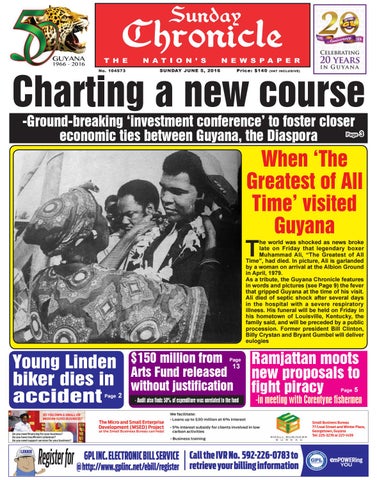
When ‘The Greatest of All Time’ visited Guyana
T
he world was shocked as news broke late on Friday that legendary boxer Muhammad Ali, “The Greatest of All Time”, had died. In picture, Ali is garlanded by a woman on arrival at the Albion Ground in April, 1979. As a tribute, the Guyana Chronicle features in words and pictures (see Page 9) the fever that gripped Guyana at the time of his visit. Ali died of septic shock after several days in the hospital with a severe respiratory illness. His funeral will be held on Friday in his hometown of Louisville, Kentucky, the family said, and will be preceded by a public procession. Former president Bill Clinton, Billy Crystan and Bryant Gumbel will deliver eulogies
Young Linden biker dies in accident Page
$150 million from 13 Ramjattan moots Arts Fund released new proposals to without justification fight piracy 5 Page
2
Page
- Audit also finds 50% of expenditure was unrelated to the fund
-in meeting with Corentyne fishermen
2
SUNDAY CHRONICLE June 5, 2016
President David Granger (front row, fourth from right) and other leaders at the Summit
Granger plugs security, environment at Havana Summit
PRESIDENT David Granger made his inaugural address on Saturday to the 7th Summit of the 32-member Association of Caribbean States (ACS) in Havana, Cuba. Mr Granger, accompanied to the summit by his Foreign Minister Carl Greenidge, underscored the importance of peace in achieving sustainable development- a concept that is featured prominently in the 2015-2030 Global Goals adopted by the United Nations General Assembly in New York last September. “Security is essential to peace. Peace is essential to sustainable development. Development cannot be sustained in situations of threats to a country’s territory, sovereignty and independence,” he stated. The President lauded Cuba for hosting the event while celebrating the island’s history of resistance. “We meet here in Havana, the capital of a country which has been undaunted in defending the rights of all countries to pursue their own course of development, free from threats and intimidation.”
President Granger emphasised this nation’s commitment to addressing the security challenges which affect the region’s approach to sustainable development, climate change, and peace in the Caribbean Basin. Even as the Caribbean outskirts brace for what is believed to be an intense hurricane season, President Granger called on member states to draw a nexus among rising sea levels, floods, droughts, increases in ocean temperatures and the strength of tropical storms with the climate change phenomenon. “Food shortages can result from these disasters. They can trigger conflict and mass migration. They can occasion unmanageable security crises,” Mr Granger said, adding, “Security cannot be dispensed with easily or ignored. It is essential to any strategy to promote sustainable development and to arrest the adverse effects of climate change.” On the part of Guyana, President Granger boasted this country’s setting aside some 371,000 hectares of “pristine rainforests to the Commonwealth to promote the sustainable management of our forests.” “Guyana is part of the ‘lungs of the earth.’ Guyana provides ecological services to all humanity. Every country of our region must contribute to sustainable development and to reducing greenhouse gas emissions,” Mr Granger continued.
Gender Equality features prominently as Goal 5 in the overall 17 Global Goals, formally dubbed Sustainable Development Goals (SDGs). As part of Goal 5, global leaders have committed to ensure women are given fair and equal access to leadership opportunities. At the ACS’s Havana summit, participating members welcomed the body’s new Secretary- General, Dr June Soomer, a St Lucian diplomat and the first woman to be elected to the post. Soomer’s appointment was made earlier this year via a meeting of the ACS’s Ministerial Council, and will last for four years. “We welcome the election of Dr June Soomer as the incoming Secretary-General. We wish her success and we pledge our support in her tenure,” President Granger acknowledged in his address. President Granger not only reiterated the support of this country to the work of the body, but emphasised the need to promote a “zone of peace.” The President also called for preservation of the resources of the Caribbean Sea, which he believes “must be preserved and protected against environmental damage and must be sustainably developed for the benefit our peoples.”
Young Linden biker dies in accident
By Vanessa Braithwaite
A YOUNG Linden biker on Friday evening met his demise after he crashed his unregistered CBR motorcycle into a motor car. Dead is 22-year-old Michael Fox of Cinderella City, Amelia’s Ward, Linden. The accident took place at the intersection of the Amelia’s Ward Public Road and the Amelia’s Ward access road, around 23:46 hrs. According to a police report, Fox was travelling east at an allegedly fast rate when his white motorcycle crashed into the right side rear of motorcar PTT 2372, driven by
Please see page 3
Dead: Michael Fox
3
SUNDAY CHRONICLE June 5, 2016
Charting a new course -Ground-breaking ‘investment conference’ to foster closer economic ties between Guyana, the Diaspora
By Navendra Seoraj in New York THE objective is to foster closer economic ties between Guyana and its Diaspora, and that is exactly what the 100-odd participants will set out to do when the first ever conference of its kind is held next Friday. Billed for the Harvard Club of New York City in mid-town Manhattan, the event, loosely titled the Guyana Investment Conference, will bring together Guyana’s leadership, the business community, corporate leaders and investors to explore the exciting investment opportunities in Guyana’s expanding economy. Among Government officials slated to be in attendance are President David Granger; Prime Minister Moses Nagamootoo; Minister of Public Telecommunication and Tourism, Catherine Hughes; and Minister of Public Infrastructure, David Patterson. As Salaudeen Nausrudeen, one of the organisers, told the Guyana Chronicle by telephone, the idea of hosting a forum of this nature came about from seeing that Guyana means business. "The Guyana Investment Conference was organised as part of the 50th Anniversary activities in New York, and will fundamentally address the need for deeper engagement and an effective pathway between Guyana and the rest of the world, including the Diaspora," Nausrudeen said. "One of the major results of this conference would be to see GO-Invest and the Ministry of Business build alliances
with companies which can promote, nurture, and drive investment into Guyana," he added. Evidence that Guyana was, as never before, ready for business, Nausrudeen said, was the success of last year’s ‘business expo’ as well as this year’s GuyExpo, which saw a host of entrepreneurs, organisations and even small businesses showcasing their drive for investment and commercial development. OPTIMISTIC He is optimistic that the idea will fly, as the whole purpose of the conference is to provide a platform whereon the diaspora can work closely with entities to promote and nurture business in Guyana. He noted that the conference will cover various investment opportunities, key sector profiles, incentives, regulations, services of GO-Invest, and the enabling macro-environment, while also featuring networking sessions where investors, consultants, executives, finance specialists and decision makers can interact and network. The first to admit it will not all be plain sailing, Nausrudeen said: "The road to make Guyana attractive and ready is rocky, but the conference embraces both the opportunities and challenges.” The day-long conference will also provide a forum for potential investors who are looking at Guyana, with time for one-on-one with ministers and GO-Invest executives. Investors are therefore each being encouraged to bring an executive
Young Linden biker dies ... Please see page 3 20-year-old Cleon Nicholson, also a resident of Amelia’s Ward. The motorcar was proceeding south when it was slammed into. According to eye witnesses, Michael was hurled off of his bike and landed some distance away. He was rushed to the Mackenzie Hospital by public-spirited persons but was pronounced dead on arrival. Nicholson who sustained minor injuries is currently in police custody assisting with the investigation. Michael Fox was a miner by profession, but was a lover of motor bikes, even participating in the recently held Biker Fest event during the Linden Town Week. His brother related
to the media that they were hanging out in the central part of Mackenzie when Michael decided to ride ahead of him to go home as he was driving. Less than five minutes later, he received a phone call from someone who notified him of the accident. Upon reaching the scene, the first thing he noticed was the mangled motor cycle. Many persons took to social media to express their grief for the young man who was very popular. Some of them were conversing with him on Facebook minutes before he met his demise. He was described as a very quiet and easy-going person by his mother. Michael has left to mourn his parents, siblings and other relatives.
summary and overview of their investment plans. According to Nausrudeen, “This is not a GO-Invest conference, but one crafted by private and business individuals in the USA who will help to build a pipeline for investment in Guyana while working closely with the Government of Guyana to build alliances with not just the two countries, but also other foreign entities.” Hence the approximately 125 or so participants will engage in deliberations with President Granger and other members of the high-level Government delegation at the conference. Nausrudeen said that during the deliberations, talks will include means by which Guyana can be made attractive and ready for business, in spite of the many challenges that will arise from time to time. Doing business in Guyana is reportedly now easier with the implementation of comprehensive invest policies to deliver higher efficiencies, responsiveness, and services to investors. And according to the pundits, opportunities abound in the rich and vast land of Guyana; now is the best time for investors. By the year 2030, Guyana is expected to be the primary investor destination in the region, featuring a well-diversified economy. The Government of Guyana and the Ministry of Business are already making the necessary adjustments to implement easy investment-friendly policies to support this vision.
4
SUNDAY CHRONICLE June 5, 2016
Harmon plugs township, technical institute for Mahdia
MINISTER of State Joseph Harmon, visiting Mahdia in Region 8 on Saturday, stressed the need for the area to be developed into a town, and for a technical institute to be established in the community. Harmon lauded the infrastructural work in the community, noting that it was needed for township status. The minister’s visit was a surprise one, and he landed in the height of heavy downpour, which however did not stop residents from flocking him to share their concerns. “I didn’t plan this, and decided this morn-
Minister Harmon is interacting with a resident of Mahdia at a supermarket in the area. At left is prominent Mahdia businessman Roger Hinds ing that I should visit Mahdia so as to get a first-hand assessment as to what is happening here, as I want to better understand what is happening on the ground,” he said, adding that his meeting the residents allows him a better understanding of their concerns. Minister Harmon also met with persons from the business community in the area, and thanked them for their dedication and contributions made
DATE: 04/6/2016 K
05 21 22 24 26 27 06
04/6/2016
04
09
16
19
24
04/6/2016
5
0
0
04/6/2016
towards nation-building. “I am a proud Guyanese, and as such will play my part in further developing this community; and as such, I am always ready to help. So minister, be assured of my willingness,” one businessman reportedly told the minister. “I am proud to see the significant work being done by these businessmen, and trust that others would emulate them, as this Government remains committed to ensuring that every part of this country is developed,” Harmon responded. Quizzed on when he intends to return, or when the President will visit, Minister Harmon said: “I cannot say when President Granger will come, but I can tell you that, like I surprised many with my visit today, be confident that I will surprise other communities, and may just surprise the people of Mahdia again.” The minister gave the assurance that upon his next visit he would spend a longer time. He blamed the worsening weather condition for his earlier-than-planned departure.
01
04
05
07 08 13
15
5
SUNDAY CHRONICLE June 5, 2016
Ramjattan moots new proposals to fight piracy -in meeting with Corentyne fishermen By Nafeeza Yahya MINISTER of Public Security Khemraj Ramjattan on Wednesday met with fishermen and families of victims of the recent pirate attack which left one man dead and three others missing. In addressing the fisher folk, he described the incident as “an act of terror”, since the perpetrators reportedly confessed to tying
order to bring closure for the families. Minister Ramjattan said while he wanted to meet earlier with the men who were attacked, he was keeping a close eye on the investigations and wanted to ensure all resources were directed towards finding the perpetrators. He extended condolences on behalf of himself and the Government to the families of the victims, and congrat-
tion to not fight pirates. He called on the fishermen to let him know if that happens. He also assured them of the Government’s stance against corruption, and noted that at least 28 cops have been dismissed because of corruption or complacency. Ramjattan said he recognized that too many lives and properties are being lost at sea, and assured that the Government would do everything in its power to ensure reduc-
tration process for the boats, and detailed information on the names, addresses and other details of the captain and crew before they go out to sea. This responsibility, he said, should fall on the fishermen’s co-op societies, since they are central to the area and would be able to verify the references provided by the fishermen. Once everything is satisfactory, they would be issued with a pass
A Corentyne man makes a point during the meeting on Saturday the men to the boat’s anchor before throwing them overboard. This has since dispelled hopes of finding the men alive, and the search is now on to retrieve the bodies in
ulated the police for using the information on hand and acting swiftly to capture the men. By the same token, he called out “rogue cops’’ who use the excuse of jurisdic-
tion, if not total elimination, of high-seas piracy. In this light he proposed some initiatives that will soon be implemented. these include: * A more stringent regis-
of some sort similar to the driver’s licence, by which they can verify the identity of the captain and the vessel assigned to him and his crew * Equipping all fishing vessels with communication
devices such as radios, so they can give early warning of any suspicious activities or attacks. Minister Ramjattan said he understands the communication devices may be costly to acquire, but a life is costlier than the equipment, thus he urged the fisher folks to seriously consider equipping their vessels with the device as an option. * Provision of guns while at sea, but lodging the weapons with the police upon return to land. Minster Ramjattan said he wanted to implement this as soon as possible, but was met with some opposition when he announced it sometime last year. He was informed that the Upper Corentyne Fishermen’s Society now has a new management committee that supports this option. The fisher folks promised to let the minister know formally, so that he can get this measure implemented as soon as possible. The minister assured that once they are in agreement, the necessary regulations would be put in place to avoid their being locked up by Surinamese authorities for possession of a firearm * Closer working relations with Surinamese patrols * Increased marine and
aerial patrols Among the concerns raised was that the law will allow perpetrators to be placed on bail and they would soon be back to their old tricks. The minister assured that, through the Piracy Act, the men recently arrested have been charged for murder, which is not a bailable offence, and they will remain in custody until the trial is over. There was also the call for compensation for the families of the victims. The minister assured that Government would do all it can to assist the affected families to ensure that children are kept in school and are afforded a proper education. Ramjattan assured that, while it will take some time, Government is working to ensure piracy is a thing of the past. He called on the community to come forward with information, since they know the people better than the police; and he said that by sharing information with the police they can prevent the acts from recurring. Also present at the meeting were Regional Executive Officer Dr.Veersammy Ramayyah and representative of the Prime Minister’s Office, Gobin Harbajan.
6
SUNDAY CHRONICLE June 5, 2016
Editor-In-Chief
Nigel Williams Sunday Editor
Neil Marks
Editorial: 227-5216; 227-5204 guyanachronicle.com wnigel10@hotmail.com gnnleditorial@gmail.com
Editorial
South-South Cooperation THE issue of development has always been on the agenda of every nation and every generation. As a developing country, Guyana’s leaders and technicians have been socialised over the years, and dare it be said for far too long, to plan on the basis of the dynamics taking place in European and North American societies. If for any reason issues such as rice, sugar or minerals have to be addressed, it is not uncommon to see deference to and reliance on the business approaches and dynamics of Europe and North America form centrepiece for guidance in discussions in framing policies, with apparently little or no regard for indigenous realities and needs. And this is not for want of ability on the part of Guyana or like countries, but more because of the sense of historical conditioning that others know what is best for us and should by extension guide us. This region during the liberation struggle in Southern Africa has seen some of its finest acts of self-determination and cooperation with allies in support of what was considered a common cause. The aeroplanes flying from Cuba to Southern Africa stopped over in Guyana to be refuelled, then onward to their destinations. Apart from this significant contribution to the liberation of Southern Africa, what has not happened is that this level of cooperation did not translate into activities to boost economic trade among the countries and regions. For years, the air links between the Caribbean and Africa are not direct. Travelling to Africa from the Caribbean and Guyana requires first going to the United States or Europe in order to get a connecting flight to one’s destination. This in itself makes travelling tedious, which could have a negative impact on the economy, both in tourism and trade. South-South cooperation has been on Guyana’s and many other countries’ agenda for some time now. It is recognised that the economic structures that are in place and maintained by international and transnational companies, supported by several governments from the developed world, have contributed to developing countries such as ours being stymied or denied opportunities of exploiting business for our benefit at cheaper costs. As the society continues to deliberate on the state of the sugar industry and what ought to be done about its future, technical assistance from Europe and North America is being relied on. This reliance comes at the expense of tap-
ping into the technical capabilities of immediate neighbours such as Cuba and Brazil with similar experiences as ours. Cuba and Brazil’s experiences are more model-adaptable to Guyana’s experiences, given that these countries produce similar primary products. Cuba has been able to stabilise its sugar operation by putting in place various measures, inclusive of finding alternative means for the sugar produced, and the lands that have become available after the closure of some of its estates. What Cuba has been able to do, among other things, is to improve their confectionery industry. As that society opens its economy to trade, opportunities are presented to investors, local and foreign, to compete for a ready share of this new and improved industry. In Brazil, some of the defunct sugar factories are being converted into restaurants. These restaurants serve as employment and economic opportunities for the society and its tourist industry. Factories converted to restaurants have been able to maintain their historical legacy through storytelling and leaving untouched aspects of its infrastructure. For instance, a diner entering the restaurant,
outside of fine dining experience, is exposed to educational opportunities through anecdotes recounted about the era during which the factory operated, its activities and workers, and so forth. This is an innovative way of keeping alive the bitter -sweet legacy of sugar in the Brazilian society and to its economy, as these converted factories simultaneously provide new income opportunities. The majority of people who inhabit the Caribbean, South America, India and Africa have shared historical experiences of colonisation. Recognising this reality, it augurs well for working with these countries having the benefit of cultural experiences, including common value systems. South-South cooperation has its benefits and can be exploited among the countries, providing that the beneficiaries to this process seek to be the initiators and executioners of any programme. To make this a reality, Guyana and other countries have to move beyond waiting for the developed world to conceptualise and present to them an agenda, and recognise that the pursuit of economic self-efficiency requires taking the initiative, inclusive of risks, to control our destiny.
7
SUNDAY CHRONICLE June 5, 2016
Muhammad Ali: The People’s Champion
Dear Editor, “WHEN we reached the bottom of the steps, the television cameramen who had been held up by the guards focused their lights on us while a platoon of military police scuffled to keep them behind a rope that blocked the end of the corridor. “Muhammad,” a reporter yells, “did you take the step? Are you in the Army?” “Can we just have a minute Champ?” another shouts. “What did you do? Can you just tell us, yes or no?” I keep walking with the captain, who leads me to a room where my lawyers are waiting. “You are free to go now,” he tells us. “You will be contacted later by the United States Attorney’s Office.”
I step outside and a huge crowd of press people rush toward me, pushing and shoving each other and snapping away at me with their cameras. Writers from two French newspapers and one from London throw me a barrage of questions, but I feel too full to say anything. Covington gives them copies of a statement I wrote for them before I left Chicago. In it I cite my ministry and my personal convictions as reasons for refusing to take the step, adding that “I strongly object to the fact that so many newspapers have given the American public and the world the impression that I have only two alternatives in taking this stand – either I go to jail or go into the Army. There is another alternative,
and that is justice.” By the time I get to the bottom of the front steps, the news breaks. Everyone is shouting and cheering. Some girls from Texas Southern run over to me, crying, “We’re glad you didn’t go!” A black boy standing next to H. Rap Brown shouts out, “You don’t go, so I won’t go!” I feel a sense of relief and freedom. For the first time in weeks I start to relax. I remember the words of the reporter at the hotel: “How will you act?” Now it’s over, and I’ve come through it. I feel better than when I beat the eight-to-ten odds and won the World Heavyweight Title from Liston. Eskridge pushes me to a cab waiting at the corner. “You headin’ for jail. You
headin’ straight for jail.” I turn, and an old white woman is standing behind me, waving a miniature American flag. “You goin’ straight to jail. You ain’t no champ no more. You ain’t never gonna be a champ no more. You get down on your knees and beg forgiveness from God!” she shouts in a raspy tone. I start to answer her, but Covington pulls me inside the cab. She comes over to my window. “My son’s in Viet Nam, and you no better’n he is. He’s there fightin an you here safe. I hope you rot in jail. I hope they throw away the key.” The judge who later hears my case reflects the same sentiment. I receive a maximum sentence of five years
Too many drunkards in our society Dear Editor, OUR society is plagued by young and old rum drinkers from all walks of life, including men, women, young boys and girls, and even children as young as ten years old. We are also the country that has produced the best rum and alcoholic beverages anywhere, and we top the list now by producing plenty drunkards. As I read the daily papers, I see that lots of innocent lives have been snuffed out by drink drivers. The police hardly give statistics about deaths caused by drink driving. The authorities need to take away the licenses of drink drivers for life, and there should be stricter laws for drink drivers. Alcohol has been the destruction of the human race since the beginning of time, and it has now taken a toll on our country with a population of less than a million people. Alcohol has today been a major cause of the domestic violence in our country, and even globally. It has also been a contributing factor to suicide, murder, incest, accidents, ‘cussing’ and fighting. It is a major cause of poverty, family breakups, divorce, and the failure of our children in schools and universities. Alcohol is a drug just like marijuana, cocaine, heroin, etc. As I travel throughout the country, I can see rum shops all over the place. I rode through a small village and counted over 30 rum shops. We have rum and beer sellers at all our bus and car parks. Some of the drivers of minibuses and taxis drink all the time at these parks, and they
put in danger their own lives, as well as the lives of those travelling with them. Rum drinking has affected many communities, and domestic violence and suicide are prevalent in these communities. I know of a Justice of the Peace who owns a bar, grocery and gambling shop, who himself is an alcoholic. How can a Justice of the Peace own a bar and gambling shop? Maybe the Ministry of Legal Affairs would answer that question. It’s over 12 years now since I applied to be a Justice of the Peace; I fulfilled all the requirements, but I am still waiting to be appointed. I am still waiting for a police report to be sent to the Ministry of Legal Affairs. I did, pertaining to my Commissioner of Oaths licence, I did at CID Headquarters and the Beteverwagting Police Station a few months ago. Until now, I have not heard anything about this report from the Ministry of Legal Affairs. Several calls to the BV station have proven futile. I have seen bar owners selling rum and beer to schoolboys in their school uniforms. These people need to go to jail, and many of them also sell drugs and run gambling dens. Our country has become a very vulgar and lawless place to live in. Every day, we hear ‘cussing,’ ‘buseing’ and dirty language coming out of the mouths of our Guyanese people. From the rich to the intellectuals to the man in the street, they all behave the same way. Alcohol abuse and cigarette smoking are contributing factors to major health issues such as brain damage,
cancer, heart attacks, and even stroke. Drinking can cause blackouts, memory loss, and anxiety. Long-term drinking can result in permanent brain damage, serious mental health problems, and alcohol dependence or alcoholism. Young people’s brains are particularly vulnerable because the brain is still developing during the teenage years. Alcohol can damage parts of the brain, affecting behaviour. Alcohol can cause high blood pressure (hypertension), which increases the risk of having a heart attack or stroke. It also weakens heart muscles, which can affect the lungs, liver, brain and other body systems, and also cause heart failure. I totally agree with the Minister of Public Security about the late nights’ curfew. Why would people want to walk so late? We have just seen the brutal stabbing to death of a very young man at the Plaisance hang out bar. That man could have been alive if he had been at home with his family. People are like night owls, they love to walk late, but those same people cannot sit for one hour in a church and listen to a service. I believe licensed rum shops should be given a quota to sell, meaning that if a man goes in to drink, two beers should be enough or two shots of vodka that’s how they sell alcohol abroad. If we are to eradicate rum drinking, domestic violence, dangerous driving, etc, we must have more serious laws and close down all the illegal bars and rum shops in our country. We have become a land of lawlessness. We need
to arrest it now before it’s too late. I have known some very educated and talented individuals who cannot hold down a job because they have a drinking problem. The Prime Minister recently fired a worker because of drink driving; he crashed a Government vehicle. I agree with the Prime Minister. Why should he employ a drunk to drive Government vehicles? REVEREND GIDEON CECIL
in prison and ten thousand dollars fine. The prosecuting attorney argues. “Judge, we cannot let this man get loose, because if he gets by, all black people will want to be Muslims and get out for the same reasons.” Four years later, in June of 1970, the Supreme Court unanimously reverses that decision 8-0, but now this is the biggest victory of my life. I’ve won something that’s worth whatever price I have to pay. It gives me a good feeling to look at the crowd as we pull off. Seeing people smiling makes me feel that I’ve spoken for them as well as myself. Deep down, they didn’t want the World heavyweight Champion to give in, and in the days ahead, their strength and spirit will
keep me going. Even when it looks like I’ll go to jail and never fight again. “They can take away the television cameras, the bright lights, the money, and ban you from the ring,” an old man tells me when I get back to Chicago, “but they can’t destroy your victory. You have taken a stand for the world and now you are the people’s champion.” – Pages 212 to 214, Chapter Six, The Induction, The Greatest – My Own Story, Muhammad Ali with Richard Durham. Granada Publishing Limited/ Mayflower Books Limited. 1976. Walk good champ, and thank you. Yours sincerely, IMRAN KHAN
8
SUNDAY CHRONICLE June 5, 2016
Muhammad Ali, ‘The Greatest’ M
- Now fighting in another ring
UHAMMAD Ali (1942-2016), the three-time world heavyweight boxing champion who identified himself as “The Greatest”, and was in fact The Greatest both in and outside of the boxing ring, as a boxer, had challenged his opponents in and out of the ring, psychologically destroying them long before the actual fight commenced. When Sonny Liston reigned as king of the heavyweight division, having defeated Floyd Patterson, Ali, who broke into the heavyweight boxing scene, challenged him. As part of his psychological warfare techniques, he called Liston a
beast and every name he could have found. On his part, he spoke of himself with elegance and grandeur. He was proud of his looks, and flaunted same in the imitable Ali style. He was known to say that nobody hits him in his face, and when it comes to boxing, his was the ability to “float like a butterfly and sting like a bee”. It was such confidence of self that he not only brought to the sport of boxing and his personal life, but also to the social causes he took interest in. As a citizen of the world, he has left a legacy that is unmatched by many elected world leaders. In reviewing his life, one remembers his
refusal in 1966 to be inducted into the armed forces under the United States (U.S.) draft law to go and fight in Vietnam. By his refusal, he was making a profound statement to the U.S. and the world, given that to refuse to comply with the law could have resulted in penalty of imprisonment and grave risk to his boxing career. In his letter making known the principles that informed his decision, he had this to say, among other things: “Why should they ask me to put on a uniform and go 10,000 miles from home and drop bombs and bullets on brown people in Vietnam while so-called Negro people
in Louisville are treated like dogs and denied simple human rights?” The challenge he took to the political establishment saw mainstream America standing on one side and he on the other. His defiance endeared him to oppressed communities in his country and around the world. This was during the era when the struggle for decolonisation was rampant and the colonised felt they had a common bond with the Civil Rights struggle of African Americans for equality. The world followed the case of his being charged and placed before the court for not obeying the Draft. He was convicted in 1967, stripped of his world heavyweight title, had his boxing licence suspended, fined US$10,000, and sentenced to five years’ imprisonment. However, he never went to jail; he renamed on bail, having appealed the matter to the Supreme Court. He returned to boxing in 1970, and won his case against the Supreme Court in 1971. This victory was seen not only as vindication of his conviction, but also strength-
ened the resolve of those who were fighting to change the dire circumstances under which they lived. Ali represented a beacon of hope, not only in the sense of breaking barriers in the boxing realm, but also his proudness in declaring his blackness when such was not favourably looked upon; and demonstrating that, with equal opportunity, he can be as good as, or even better than, any man of any other race. When Ali converted to the Islamic faith in 1961, and changed his name in 1964 from Cassius Clay, he was engaging in acts considered disruptive to the status quo. Though the U.S Constitution guarantees freedom of religion, the Nation of Islam (NOI) which influenced his religious choice, was seen as a fringe element in society and the group was considered anti-national. Yet, it was the NOI who had among its aims the improvement of the lives of African Americans, and aggressively pursued same. When some in society insisted on calling him ‘Clay’, he made known: “Cassius Clay is a slave name. I didn’t choose it, and I don’t want it.
I am Muhammad Ali, a free name – it means beloved of God, and I insist people use it when people speak to me.” Malcolm X, a fellow Muslim and a leading figure in the NOI, who was viewed with skepticism for his activism by the political establishment, white community and some within the black community, was a major influence in Ali’s life, and he proudly and publicly shared this friendship, having him among selected friends at his boxing events. Ali was nimble on his feet and in his speech. He had a way with words and a love for poetry, which were respected, as seen in him delivering an address to graduates of the Harvard University, considered among the U.S elite universities, and being a professor of poetry at Oxford, considered an elite British university. Guyana holds the honour of saying this great man had walked on our soil in the visits he paid to this country in the 1970s. If one were asked to describe him in few words, it would be: Ali used sports and religion as vehicles to fight for change, justice, and hold government to account. This was a man of humble beginning who, when he took up boxing at age 12, saw it as a way out of poverty; but he used boxing not only to empower himself, but many others. He rose to a pinnacle, and held his own among and above many. And while some may marvel at his rise, given his confidence of self, he would have viewed it as destined. Ali passed away on Saturday, 4th June. Though he embraced the Muslim faith and there is respect for the religion’s view of the afterlife; as a Christian, the view is held that Ali has, in another ring, flown like a butterfly and is already angling to make his presence felt. Woe to any in the Great Beyond whom he may feel the need to sting. Rest in peace, Champ!
9
SUNDAY CHRONICLE June 5, 2016 Crowds swarmed Ali on his arrival at the airport at Timehri
Flashback: ALI FEVER GRIPS GUYANA (The article below, written by Sharief Khan and Raschid Osman, both now deceased, was printed in the Guyana Chronicle on April 22, 1979, when Muhammad Ali visited Guyana. Ali died last Friday night)
W
ORLD Heavyweight Boxing Champion Muhammad Ali swept triumphantly into Georgetown in the wee hours of yesterday morning, at the head of a mile-long motorcade with motorcyclists and pillion riders swerving precariously in and out between the lead cars adding to the fever pitch excitement which marked the arrival in Guyana of this superstar of boxing. It was Ali fever from the moment the Pan Am aircraft bringing him to Guyana touched down at Timehri around 11:25 pm. But even before 9 pm, people begun filling the airport in eager anticipation –men; women, some pregnant, others with babes in arms; children, elderly people. The Ai bug had already bitten, but just how deep became
evident when the gangway to the aircraft was put up and ‘The Greatest’ stepped out, handsome and immaculate in a dark blue suit. WELCOME He smiled and waved in the inimitable Ali style as roars of welcome went up. Flash bulbs popped and heavy arc lights of the film crews swung into focus; and the fever spread. The police at the airport never had a chance. People swarmed the tarmac and around the aircraft, the cops chasing them giving way helplessly to the tide hoping to engulf Ali in the sea of Guyanese hospitality. Ali walked along, smiling, shaking hands and waving, and a chorus of “ALI! ALI! ALI!” went up. The Chronicle Atlantic Symphony steelband added fervour and rhythm to the chanting of the crowds caught up in the inescapable grip of the fever. The night was dark, but Timehri never shone brighter. Ali seemed somewhat tired and perhaps nervous at this enthusiastic display of hospitality at first, but it was not long before he settled in among his people. He moved to the steelband on the tarmac, was handed two of the rubber-tipped beating sticks, and played a pan as if that was just the thing he had been doing since back in Louisville, USA. They swarmed all around him as he moved to the VIP lounge, and loved him even more when he took a baby from its mother and rocked it in his arms. So all-encompassing was the warmth of the welcome that his party and local officials seemed hard put to cope with it. MOTORCADE
Just after his arrival in Guyana in April, 1979, Ali was at home. In picture, he is seen belting out a tune on steelpan. Next to him are Labour Minister Hamilton Green, lawyer Stanley Moore; and Rudy Bishop, leader of the Chronicle Atlantic Steel Orchestra
The airport welcoming ceremony was cut short at about 11:45 pm. The motorcade moved off from Timehri for the trip to Georgetown. It was a cool night, and the 23-mile drive into town looked like an easy going affair for Ali and his party. After all, it was close to midnight, Saturday was a working day, and most people in the motorcade felt Guyana along the route would have reserved their welcome for daylight. But that was not to be – the Ali fever had spread, and it moved along the highway weaved among the official cars, throwing the order of a traditional drive into the city for dignitaries into disarray. The rest of the official motorcade got lost somewhere behind, but Ali was there among his worshippers. They were on the look-out for him and he wanted to see them all. He stood and waved at even those few who chose to stay on the platforms of their houses to watch and cheer as he went by. As the procession, growing longer to eventually reach almost a mile, drew nearer the city, the Ali fever heightened. A police traffic car was moved to the head of the motorcade to help clear the way, but even that did not pre-
Ali, who identified with the oppressed peoples of the world, is seen laying a wreath at Liberation Monument in the foreground of the Umana Yana vent the halting of the procession. At one point, a group just blocked the way holding a cardboard welcoming sign aloft, and they scrambled on Ali’s vehicle just to touch the great man. At times, when the procession had been halted, women almost swooned with cries of “Ow! He too sweet! Look how he nice!” Men and kids jumped with shouts of “Ah see him! Ah see Ali! ALI! ALI!” As the motorcade cruised at about 30 mph, into the Ruimveldt Industrial Site road, the crowds grew from seven deep to fifteen deep on both sides of the road. Along the back road into Kitty Avenue they stood, ran and shouted. Some lost shoes shirts; girls scrambled on to pillion seats of motorcycles; mothers hoisted babies to shoulders and ran alongside Ali’s vehicle, and the cacophony of the ever-present horde of motorcycles added to the din. They followed him all the way to the Residence on Vlissengen Road, and even when Ali had gone into the compound to the Villa, where he is staying, some waited on for a while outside. “He might come outside again to leh we see he”, some said. But Ali was tired and the gale force of his welcome must have sapped his energy somewhat. It was after 1.15 a.m. He needed a rest – but he had arrived and he had been given the hero’s welcome the ‘Greatest’ deserved.
10
SUNDAY CHRONICLE June 5, 2016
Ready to roll
- Hinterland housing drive Phase II set to take off in Regions 1, 9 By Ravin Singh PHASE Two of the Sustainable Housing for Hinterland Development Programme is in its initiation stage, with 12 hinterland communities poised to benefit from the US$3.1M project. The project, which is being funded by the Inter-American Development Bank (IDB) and run by the Ministry of Communities through the Central Housing and Planning Authority (CHPA), is a component of the IDB’s Reformulation of the Expansion and Integration of the Basic Nutrition programme. According to Advisor to the Minister of Indigenous People's Affairs, Mervyn Williams, the 12 communities which have been identified are all located within Regions One (Barima-Waini) and Nine (Upper Takutu-Upper Essequibo). A tell-tale sign that the project is ready to take off, he said, is a recent visit by CH&PA officials to Sebai, one of the riverine villages in Region One to finalise arrangements. Noting that the true purpose of the programme is to improve access to housing and water for hinterland communities, Williams said that in terms of Region One, the deal is that six “full houses” will be built, while the roofs of 15 houses will be replaced. In Region Nine, on the other hand, 11 “full houses” will be erected, and there will be 10 roof replacements. ‘FULL HOUSE’ Explaining what he meant by “full house,” Williams said that essentially, it’s a one-storey building made of either wood or brick, depending on the availability of resources and the nature of the village’s economy. Each house is expected to be approximately 500sq ft. and will comprise four rooms, two stairs, corrugated zinc sheets, guttering, a 400-gallon water tank and a latrine. Noting that some consideration is likely to be given to integrating of an element of indigenous people's culture, Williams said this could be in the nature of a traditional thatched roof or some other traditional element, incorporated into the building so that there is no departure from the culture of indigenous communities. In the case of roof replacements, Williams said this is predominantly required in communities located in Region One, where the water situation forces households to have a preference for harvesting rainwater. As such, he said that corrugated zinc sheets will be utilised to aid in this process. ‘SWEAT EQUITY’ Commenting on the reaction from the villages, Williams said that in many cases, householders have decided to come together and provide the manual labour, or what they termed “sweat equity," in order to reduce the cost factor, so that the resources could be extended to more beneficiaries. But labour was not the only factor of production indigenous peoples were willing to contribute to. As Williams revealed, persons have expressed an interest in providing lumber, free of charge, to the project. Outlining the eligibility criteria which were used to identify the beneficiaries, he said that these included level of poverty in the community; cultural cohesion in the community; the organisational strength of the village council; and the land tenure. The land tenure refers to whether the lands are Stateowned or privately owned. Persons can benefit only if the lands are privately owned. Meanwhile, he sought to suggest that this second phase of the programme will register a success, since the executing agencies which had completed and evaluated Phase One would have learnt some invaluable lessons from that first experience. He also described the first phase of the project as being a huge success, and said that it is hoped that this programme is another of a series of interventions aimed at strengthening hinterland communities and villages.
HINDS’SIGHT
SUNDAY CHRONICLE June 5, 2016
Dr David Hinds
11
Jubilee participation, social cohesion
-ignoring Buxton and denying opportunities to villages THE much-anticipated Jubilee celebrations have come and gone, but some of the issues which arose from them are still dominating the news in the formal media, and the discussions on social media. To the surprise of some, the difficulties experienced in staging the official events have been used to question the Government’s overall competence. This is a very harsh evaluation of the Government, but, in our highly partisan environment, it is to be expected. As I have pointed out before, given the dramatic circumstances under which the Government came to power last year, it is being held to a higher standard than the one it succeeded. One of the outcomes of the Jubilee celebrations that must make all of us uncomfortable is the fact that participation by the ordinary citizens was confined mostly to members of one of our ethnic groups. In particular, the general absence of the supporters of the Opposition PPP was most conspicuous. The responsibility for this cannot be placed at the doorstep of the Government or any single political party; it is a structural problem that has dogged Guyana for all of our independence experience. But one cannot help but conclude that if the PPP had mobilized its constituency to participate in the events, the turnout by that constituency would have been much more significant. Given how quickly it translated into political capital the confusion surrounding the seating arrangements at the flag-raising ceremony, it is clear that that party was more concerned with embarrassing the Government than with genuinely participating in the event. This is really a sad commentary on the state of our politics. Is there not a moment when partisan politics takes a backseat to the national good? Even for a PPP that has shown nothing but hostility to the cause of national unity since losing office, this recent behaviour is scandalous. Clearly, the party of Cheddi Jagan is not interested in being a partner in the struggle for One Guyana. Because of the PPP’s behaviour, one must wonder whether the Government tried hard enough on its own to mobilize the multiracial masses to participate in the events. Was it enough to just pitch the events in a general way, or should there have been outreaches aimed at the particular communities? Did the Government pay enough attention to the ethnic nature of the results of the just concluded Local Government Elections as it crafted its public relations strategy for the Jubilee events? These and other related questions should be considered, going forward. The Government has to be much more pro-active in ensuring that participation in such national events reflects the country’s ethnic makeup. Yes, we have known that such participation had, in the past, been conditioned
by which political party is in power, but that should not deter officialdom from making concerted efforts at social engineering and engaging in other forms of multi-ethnic mobilization. I am glad that African Guyanese participated in great numbers, but that is not good enough for the image of a multi-ethnic nation; the face of our country cannot be mono-ethnic, Guyana belongs to all of its ethnic groups, and that must be reflected especially on big symbolic occasions like the Jubilee. As the make-up of the audiences at the Jubilee events shows, there is a lot of serious work that needs to be done. Clearly, the President was most insightful when he created a Ministry of Social Cohesion, but one must ask how involved that ministry was in the mobilization for the celebrations. As I understand it, the ministry’s primary task is to facilitate ethnic and other forms of cultural cohesion among our diverse peoples. Such an undertaking calls for creative imagination, which goes beyond general declarations of our aspirational motto. At the least, the Ministry of Social Cohesion should be intimately involved in mobilization for such national events. In addition, the ministry needs to me more robust and frontal in tackling this problem of ethnic separateness. Social Cohesion cannot be confined to reaching out to the PPP and the traditional cultural stakeholders in the Indian Guyanese community. Those organizations have political axes to grind, and are never going to be serious about any lasting ethnic cohesion. Their usefulness is most effective at the political level, in particular in trying to arrive at constitutional and other political arrangements to settle the democratic distribution of power at the top. Social cohesion also cannot be confined mostly to mobilization in communities that are friendly to the Government. Work has to be done at the level of the people in all communities. The Ministry of Social Cohesion, in collaboration with the ministries of Education and Communities, has to work the communities individually and together in a clearly defined programme that combines civic consciousness, patriotism, intra-ethnic pride and inter-ethnic respect. There is no other way out. This task requires the energies of all stakeholders, but especially those who have been working tirelessly on the matter of ethnic and racial unity in our various ethnic communities and the country at large. We cannot solve the problem of racial separateness by ignoring the essence of race and ethnicity. Over to you, Madam Minister of Social Cohesion. GEORGE ABRAMS, BUXTON, VILLAGES AND THE GOVERNMENT Last Sunday, Mr. George Abrams, an overseas-based Guyanese, formally declared open a sewing establish-
ment in his village, Buxton. This small business -- which already employs eleven workers, mostly from Buxton -- is a reflection of Mr. Abrams’s commitment to the regeneration of the village economy in terms of providing much needed services, but critically in providing employment for villagers. I salute Brother Abrams for taking this giant step, and hope that others with resources would invest in our villages. As I told the villagers at the opening ceremony, they must see the project as an inspiration to lift the community through self-activity, and the success of the venture requires the support and protection of all villagers. I also hope that the Government, on its own or in partnership with community groups, would encourage the flowering of small businesses in the communities. I had, last year, begun work with a certain government ministry in this regard. I mobilized several communities, including Dartmouth; Buxton; Melanie; Plaisance; Ann’s Grove; Stanleytown and Sisters villages, WBD, to come up with projects to take advantage of an initiative which is housed in that ministry and is aimed at encouraging entrepreneurship in so-called depressed communities. To my utter amazement, not a single one of the communities was awarded any funds. And what is worse, none of those communities was told why their project was rejected, and nobody from the ministry sought to contact me with an explanation. Moreover, when members of some of the groups called the ministry, they were greeted with rude responses. Here are poor people who organize themselves in their villages and come up with initiatives for small community businesses being unceremoniously rebuffed by their Government. What more must poor people do to get some respect? Mr. George Abrams invited four Government ministers to the opening of his business in Buxton; not one of them attended. There was an item on the programme for remarks by these dignitaries, but they were not there. I have seen ministers socializing with the rich -- attending their functions and gracing the opening of businesses -- but Buxton and similar villages are off-limits, it seems. If any reminder is needed, Buxton and similar villages voted 99.99% for this Government. That does not entitle them to monopoly of Government attention, but it certainly entitles them to more than the ignoring they have been receiving. More of Dr. Hinds ‘writings and commentaries can be found on his YouTube Channel Hinds’ Sight: Dr. David Hinds’ Guyana-Caribbean Politics, and on his website www.guyanacaribbeanpolitics.com. Send comments to dhinds6106@aol.com
12
SUNDAY CHRONICLE June 5, 2016
Harnessing rights, riches and obligations of the diaspora: A Committee of Sorts (Part 3)
By Marlon Bristol In Part 1 of this sub-series on harnessing rights, riches, and obligations of the diaspora, I introduced the usefulness of engaging the diaspora and the potential gaps it can bridge, starting at the lowest level with a Committee of Sorts. The second part of the series looked at some of the evidence, particularly on the human agency of return migrants and the human agency of an intention to return. In Part 3, I attempt to make the case for targeted policy to bring the clarity that is needed both for the engagement and involvement of the diaspora more meaningfully in local development, at least those with an interest, and justifying to the domicile non-migrant population exactly how this can be done without fear of a zero-sum
situation. Targeting can focus policy to deliver exactly what it is we ask of the diaspora to deliver. However, return policies are not targeted. The United Nations Department of Economic and Social Affairs, in 2013, reported thusly: “among 58 countries with available data in 2011, (forty) countries had programmes to facilitate the return of migrants to their home countries”. The report also highlighted that “many Governments have set up diaspora units and implemented policy measures to encourage investment by their diaspora”. Commonalities are found in the eligibility requirements, which qualify a returnee based on his/her citizenship, duration abroad, and in some cases ethnic status for second and third generation migrants, etc. Variations refer mainly to policy elements such as age,
type of incentives, inter alia. Blind spots with regard to policy usually show up as lack of data that gives insight into what the optimal migration duration abroad should be; poor policy coordination among the menu of fragmented opportunities that might exist for the diaspora to contribute and benefit from; and policy purpose(s). While there might be clarity on the degree of rights extended, they are usually silent on obligations or the specificity on gaps that need bridging. As such, non-migrant households are usually up in arms, as they feel these policies are discriminatory in favour of diaspora individuals, often wondering “what have they contributed?” or why such favourable policy? Consequently, it is easy to see why, in the absence of any clear requirements on what constraints return
migrants and their resources will address, John from oversees should enjoy duty free benefits over Paul, who feels he has been here “in the struggle” so to speak. In similar vein, people in the diaspora would often ask the following: Why has their patriotism got to be expressed in reduced benefits and remuneration; and if the country has an acute need, why then could their return not be incentivised, based on productivity and priority or shortage being addressed? What some countries have done is to set up special units for such matters. These units focus on measures of sustainable return, and/or circulation of migrants. This is done with the aim of mobilizing and maintaining resources coming from the diaspora for local use. Some initiatives include establishment of free zones, science parks and research outfits, to which the diaspora contributes and benefits; portability of benefits; special investment regimes, and tools such as diaspora bonds, inter alia. We can learn, too, from international cooperation with some countries or group of countries that have gone the route of special projects for capacity building, development, and understanding how such is achieved through the use of the diaspora. These projects include, for example, the MIgration de REtour au Maghreb (MIREM), Migration for Development in Africa (MIDA), Migrating Out of Poverty, inter alia. Together they assist in understanding the use of the diaspora in local development. More specifically, on examples of substantive policy measures that are used to foster local development using the diaspora, a good example would be Anja Wiesbrock’s work investigating some targeted measures used by China, India, and Taiwan. She explained that in Mainland China, the Bureau of Overseas Chinese Affairs created a programme aimed at strengthening ties between
Towards a Good Life in a Green Economy overseas Chinese communities in various countries. This included the establishment of associations of ethnic Chinese overseas drawn from the migrant associations in the host countries. The Government offered support in the allocation of housing, as well as allowing duty-free purchases of computers, cars, and the offering of return airfares for self-financed students. Local and city governments in China have recruited overseas Chinese and offered them financial and other material incentives, such as tax exemptions on imported cars, subsidies for home purchases, schooling for the returnees’ children, and assistance in finding employment for their spouses. In India, there is a separate Ministry of Overseas Indian Affairs (MOIA), which deals with all aspects of persons of Indian Origin and non-resident Indians. Policy measures include enactment of a Foreign Exchange Management Act to facilitate foreign currency transactions in respect of setting up businesses in India, and the setting up of businesses by Indians abroad. Other measures relate to the taxation of remittances and the facility for overseas Indians to receive a 100% tax reduction on exports from Special Economic Zones. There are also a number of bilateral agreements to avoid double taxation of individuals opening enterprises or moving between India and other countries. In Taiwan, substantial
incentives are provided to potential high skilled returnees selected on the basis of their education, current position and salary levels. Incentives offered to such selected individuals include moving costs, subsidized house mortgages, salary top-ups, and the opportunity to establish businesses in Taiwan. Such incentives, aimed at the permanent return of migrants, are supplemented by shorter visiting schemes of about one year. Many migrants have been recruited as lecturers and professors at the national universities by the National Science Council and Ministry of Education. The impact of these measures varies based on a number of critical factors. Given the multidimensionality of migration and development, policy and programmes must be targeted for the local jurisdiction to benefit, rather than leaving policy open on the assumption of the diaspora’s ‘goodwill’ and ‘good intentions’. Secondly, strengthening the enabling environment locally for a necessary and sufficient level of meaningful integration is required. For this to happen, I recommend that Gamlen’s 2006 multi-purposes policy object should be employed for capacity building, extending rights, and extracting obligations. I will provide some insight to Gamlen’s concept in a follow up article. (Comments can be sent to towardsagoodlife@ gmail.com)
Marlon Bristol is a PhD student researching the development impact of return migration to Guyana using parametric and non-parametric techniques. He is currently a Monitoring and Evaluation Specialist with the Ministry of the Presidency. He is published, and his strengths include research methods, development economics, policy advice, project management, and monitoring and evaluation.
13
SUNDAY CHRONICLE June 5, 2016
$150 million from Arts Fund released without justification - Audit also finds 50% of expenditure was unrelated to the fund
THE previous Donald Ramotar administration repeatedly approved excess sums for the Sports and Art Development Fund amounting to more than $150M without any justification. In the end, less than 50 per cent of the expenditure had no relation to the fund. According to a Forensic Audit, in 2012 $100M was budgeted for the Art Development Fund, but at the level of Cabinet $106.414M was approved – in excess of $6.414M. In 2013, approximately $99.9M was approved by Cabinet. “The approved budget for the year 2014 was G$100,000 000 however, Cabinet approvals were seen for amounts totalling G$116, 118, 097,” the audit report stated. According to the auditors, during the initial stage of the investigation, the Ministry of Culture, Youth and Sport had failed to present the register in relation to the expenditure
in 2012, as such, the total number of payment vouchers relative to the expenditure totalling $99.7M could not have been determined. However, 249 expenditure vouchers representing an expenditure of approximately $200.4M were presented for the audit. Upon examination, it was noted that only 210 of the vouchers amounting to $76.6M were related to the fund. The other 39 vouchers which represented expenditure totalling $123.98M show no relation to the fund. “The IFMAS Account Analysis Report at December 31, 2012, revealed that the expenditure for all sub-activities under Programme Two, including the expenditure for the Sports and Art Development Fund were grouped under Programme Administration. The actual expenditure for 2012 could not be ascertained,” the auditors reported. Similar trends were seen in 2013. Prior to the preparation of the draft report, 197
expenditure vouchers were presented totalling $155.9M. However, they were presented without the register. When examined, only 96 of the vouchers amounting to $15.9M were related to the fund, the remaining 101 vouchers representing expenditure totalling $139.9M showed no relation. As was the case in 2012, the actual expenditure incurred or associated with the Sports and Art Development Fund for 2013 could not have been ascertained. In response, the ministry stated that the 101 vouchers totalling $139.9M were payments for National Trust, Professional Sports Programmes and the Castellani House. However, this could not have been verified because of the ministry’s failure to implement and maintain a system to systematically track the expenditure. “A total of $99.9 was reportedly expended in the expenditure schedule for 2013
submitted by the ministry. However, only four Cabinet approvals totalling $10.140M were presented for audit prior to the draft report dated 10th August, 2015,” the auditors pointed out. For 2014, 105 payment vouchers valued at $61.8M were not presented for examination. As a result, the auditor said the accuracy and validity of the amounts expended in the sum of $61.8M could not have been verified. Financial discrepancies were also discovered in instances where contracts were awarded. According to the auditors,
the sum of $172, 000 was awarded for the Cleaning of Castellani House compound and the clearing of a large concrete garbage bin in the area, although there were approved budgetary estimates for Castellani House. Additionally, $996,000 was awarded for repairs to the eastern walls and construction of flooring for storeroom at Castellani House, although there was an approved budgetary estimate for the entity. “The third contract for the sum of $349,102 was paid from the Sports and Art Development Fund to Massy Security (Guy-
ana Inc) for Baton Security Services for Castellani House, for October and November 2014. The payment was within the ministerial limit for contracts and would have required the authority of the Ministerial Tender Board. (However) such authority was not seen or indicated on the payment voucher, sub-vouchers or documents in support of the transaction; neither was there a contract to support the payment made to the security company,” the auditors pointed out in their report. (Svetlana Marshall)
14
SUNDAY CHRONICLE June 5, 2016
Poor management led to GNNL debt of $88.9 million THE Guyana National Newspapers Limited (GNNL) was poorly managed under the watch of the People’s Progressive Party/Civic (PPP/C) Government with over $88.9M owed by its 10 top customers. This is according to Parmesar – the accounting firm which conducted a special audit and review of the company’s operations for the period November 1, 2011 to May 31, 2015. In a report submitted to the Finance Ministry, Parmesar contended that GNNL’s Board of Directors did not execute its duties with due diligence, skill, care and prudence. The accounting firm explained that in an organisation, the Board of Directors is responsible for good
governance, particularly in the area of finance. However, in the case of GNNL, the board’s failure to act in keeping with best practices resulted in the company being exposed to financial loss, reputational risk and supervisory sanctions. In making its case, the firm alluded to the fact that 2013 was the last year a statutory audit of the company’s financial statements was completed. “There was poor oversight for receivables. The receivables balance as at May 31, 2015 was $102.4M. There is no Internal Audit Department,” Parmesar pointed out. Prior to the installation of the current Board of Directors, GNNL was chaired by Marcia Nadir-Sharma with Jason Abdulla, Vidyawattie Loonauth, Jawahar
- audit report Persaud, Hydar Ally, Tota Mangar and Kwame McCoy listed as directors. However, from 2011 to March, 2014, the Board was chaired by Keith Burrowes with Kwame McCoy, Tota Mangar, David DeGroot, Hydar Ally, Pat Dyal and Colin Alfred listed as directors. Due to the deficiencies that existed in the previous boards, the accounting firm advised that the board should comprise persons with the relevant skills and experience for the good governance of the organisation. “The Board of Directors should comprise, among others the following per-
sons, communication and media specialists, marketing personnel, lawyer and accountant.” Additionally, the auditor said there was not enough evidence to confirm that significant efforts were made to collect the outstanding debts. At the end of May 31, 2015, the Government Information Agency (GINA), the National Communications Network (NCN), Video Mega, Police Consumers
Co-op, Kirk Wynter, Kings Advertising, Reamos, Guyenterprise Advertising Agency Limited and Colin Edghill had owed GNNL a collective sum of $88.9M. “The $74M owed by the Government Information Agency represents advertisements printed in the newspaper for several government agencies,” the accounting firm explained. Due to the situation that prevailed at the time of the audit, GNNL is being advised to establish a debt-collection committee with the primary function to collect all outstanding debts within
six months. In addition, there is a call for the company to establish a definitive credit policy which should be documented and approved by the board. The need for all statutory audits to be completed in the specified timeframe was also underscored by the auditor. “An Internal Audit Department should be implemented and managed by a Chartered Accountant,” the accounting firm further advised. (Svetlana Marshall) Table showing an analysis of the top 10 balances outstanding as of May 31, 2015
15
SUNDAY CHRONICLE June 5, 2016
$280M in ‘Jubliee grants’ seek to propel Indigenous villages -IDB to support housing development in hinterland
By Ravin Singh SOME 212 Indigenous communities and villages across Guyana are poised to benefit from $280M in grant funding provided by the Ministry of Indigenous People’s Affairs in the form of Jubilee grants. Mervyn Williams, Advisor to the Minister of Indigenous Peoples’ Affairs, told the Guyana Chronicle that the communities and villages identified to benefit would receive funds ranging from $1M to $2M, with which they can identify priority issues and remedy them by developing counter projects. “What is interesting is the fact that villages are determining what their priorities are, and where they want these financial resources to go. And that is want we want to achieve -- an independent
process for the villages by the village leaders themselves,” Williams explained. Of the 212 villages and communities slated to receive funding, Williams noted, 38 have submitted proposals for their projects and have had those proposals approved. These 38 projects account for almost $55M of the total funds. And while funding is being released for these 38 projects, he was keen to note, it is being released on a phased basis. “There are phases in these projects and funds will be released according to those phases because the Ministry has to give account for those funds,” Williams said. Explaining that funds could be released only once the project proposal is accepted, the advisor related that the Ministry is pushing to
ensure that the other communities submit their proposals as soon as possible.
Mervyn Williams To speed up this process, he said, the Project Department staff from the Ministry is being utilized to facilitate preparation of the projects in accordance with the desires of those villages. “They are going to either
get the village leaders here or get into the villages to guide the process, so that there can be a faster process,” he said. Recognising that all projects cannot be completed by the end of this year, Williams said he is optimistic that all the projects could be approved and funding could be released for them this year. “Funding is not an issue, but it is the process involved regarding the project proposal. That process has to do with the preparation and submission of the proposals, which speaks to the village’s intention, which must satisfy the requirement for the release of the grant. As long as those come in, we will ensure that the funding is disbursed,” the Ministerial Advisor said. He explained that even though the Project Department staff will play an over-
sight role, management of the projects rests entirely in the hands of the village council. He noted that the Project Department would be responsible only for monitoring the projects, and will not be involved in their governance. “So they will basically be an oversight body ensuring that there is accountability,” he said. Further, he described these projects as landmark projects, reasoning that they would not be short-lived. Some of the projects already embarked upon by the 38 villages and communities include, but are not limited to, the construction of guest houses; the construction of bridges; renovating, constructing or fencing multipurpose halls; water projects; construction of benabs; and the construction of recreational parks.
Williams pointed out, too, that a village in Region Nine would be working towards installing Internet services with its $1.2M grant, while another village would be executing a project to upgrade its airstrip trail, since it is not in a pleasant state. And what has been realized after examining the project proposals, the advisor added, is the diversity of the needs of these villages. As such, he noted, these sustainable landmark projects are intended to serve as a reminder of what the Indigenous communities were able to achieve during the year of Golden Jubilee. Williams explained that previous grants to Indigenous communities ranged from $800,000 to $1.5M; and according to the advisor, they were “arbitrarily administered.”
16
SUNDAY CHRONICLE June 5, 2016
SUNDAY CHRONICLE June 5, 2016
17
18
SUNDAY CHRONICLE June 5, 2016
Unlicensed motorcyclist dies after crashing into utility pole - Traffic Chief stresses need for helmet when riding
TWO days before his 22nd birthday, Shawn Patrick of Bagotville, West Bank Demerara (WBD) crashed into a utility pole on the Goed Fortuin Public Road and lost his life. According to police, investigations disclosed that Patrick was riding a motor cycle CH 8338 proceeding south along the Goed Fortuin carriageway at a fast rate, overtook a motor car on a turn, hitting the left side front of motor lorry GJJ 5817 which was facing south, and then slammed into a utility pole. He was rushed to the West Demerara Regional Hospital at 05:00hrs where he was pronounced dead on
arrival on Saturday. Patrick was not wearing any helmet. He was also not licensed to ride a motorcycle. Reports disclose that he was returning home from a party. The driver of the motor lorry is in police custody assisting with the investigation. According to his mother, Abiola Lynch, she last spoke to her son on Friday night when he said he was heading out to party with his friends. “He said he was going to Middle Street with his friends; he doesn’t normally ride motorcycle. “It was not his but his friend’s own; whenever he
Dead: Shawn Patrick borrow it, he would ride,” the mother of six explained. She said Patrick was her
eldest child and he usually worked in the gold mines of the interior, but he has been out for a year now, working as a porter. Acting Traffic Chief Boodnarine Persaud overemphasised the need for motorcyclists and pillion riders to wear helmets for their own safety and protection, while using the roads. Persaud said that most of the persons on motorcycles who were killed in accidents were not wearing helmets. “While there were some who were wearing, it was not properly strapped, so when the collision occurred, it flung off their heads and it could not have protected
The motorcycle Shawn Patrick was riding when he met his demise helmets. “Riding without them.” This, he said, results helmets is dangerous; they in death or brain haem- [motorcyclists] are always orrhaging and other in- the vulnerable group, beternal head injuries. The cause they are injured in survivors are mainly those the slightest collision,” he persons who were wearing explained.
Mines-related deaths on the decrease - Two deaths recorded so far for 2016
S TAT I S T I C A L d a t a from the Guyana Geology and Mines Commission (GGMC) indicate that mine-related deaths are on the decrease. Thus far for 2016, the industry has recorded two deaths when compared to 12 for the same period last year. “ We a r e i m p r o v i n g , but one death is one too many,” GGMC Occupational Health and Safety Officer
Denis Lewis told the Guyana Chronicle during an exclusive interview in Konawaruk Backdam. He said while there are signs of improvement, one cannot ignore the fact that 119 mine-related deaths have been recorded between 2006 and 2016. The majority of mining accidents in Guyana are linked to pit failure. In a presentation made in 2015,
GGMC Senior Engineers Carlos Todd and Ronald Glasgow reported that 72% of the mining accidents that occurred in 2014 and 2015 were as a result of pit-wall failures. “Most of the fatal mining accidents (52%) that occurred over the past six years resulted from pit-wall failure – 72% in 2014-2015,” the engineers had explained in their presentation.
A Commission of Inquiry (CoI), which was headed by GGMC’s former Commissioner Dr. Grantley Walrond, in 2015, found that the principal cause of pit-failure acci-
GGMC Occupational Health and Safety Officer, Denis Lewis
dents was the neglect of safe mining practices. In addition, there was evidence that shortcuts were being taken in an effort to raise production. That CoI was set up and mandated to investigate mining deaths by President David Granger after a mining pit at Mowasie Backdam, Region Eight, collapsed on May 17, 2015, killing 10 miners, in what has been described as the worst accident of its kind to date. Considering the recent death of 18-year-old Ramal Williams, who lost his life when the walls of the pit caved in at Konawaruk Backdam last Sunday, Minister within the Ministry of Natural Resources, Simona Broomes, said there is an urgent need to have the Potaro-Siparuni region re-evaluated to determine safe mining zones.
She said in addition to placing tremendous emphasis on preventative measures, the mining areas should be re-evaluated as part of a pilot project. “We must have engineers go in and evaluate the whole area, the whole of Region Eight – Mahdia, White Hole and St. Elizabeth – to assess the soil types in the different locations,” she said. Additionally, she said there is a clear need to have the Mining Regulations fully enforced by GGMC officers on the ground. “These areas need to be monitored by technical people,” she posited. Miners, however, are being urged to adhere to the rules and regulations governing the mining sector, particularly in the area of Occupation Health and Safety. (Svetlana Marshall)
The pit from which the lifeless body of 18-year-old Ramal Williams was pulled last Sunday in Konawaruk Backdam
19
SUNDAY CHRONICLE June 5, 2016
World Environment Day…
Standards Bureau commits to helping preserve the environment THE Guyana National Bureau of Standards (GNBS) says it will continue to support the care of the environment by promoting standards that would help reduce environmental degradation and encourage preservation for future generations. Joining other agencies here in observing World Environment Day yesterday, the Bureau noted that the ISO 14001 Environmental Management System (EMS) standard, for example, contributes significantly to reducing environmental impact while enlightening users about the effect the environ-
ment has on businesses. “Implementing the requirements of this international standard,” says GNBS Public Relations Officer Lloyd David, “is an important step towards preservation, since it covers all environmental challenges related to water, air, soil, waste, biodiversity, ecosystem services, and climate challenges. “The standard helps organizations to manage all aspects of the environment in a holistic manner. As society struggles with issues such as natural disasters, deforestation, wildlife extinction, climate mitigation and adaptation, companies are continuing to recognize the need to manage their environment. “Achieving certification of the ISO 14001 Standard certainly delivers commercial value to organizations, including reduced greenhouse gas emissions and streamlined waste
Sunday June 5th, 2016 - 05:00 hrs Monday June 6th, 2016 - 05:00 hrs Tuesday June 7th, 2016 - 05:00 hrs
management systems, as well as providing a better handle on business risk.” And since the smuggling of wildlife is also undermining economies and ecosystems, fuelling organized crime, feeding corruption and insecurity across the globe, David said: “We need to quickly come to consciousness, and make a desperate effort to better understand and manage our impact on the environment. “Every effort must be made to counter the illicit trade in wildlife, including the implementation of targeted policies. There is need to increase awareness campaigns and investments in community conservation and law enforcement. Many species remain at risk, and it will take a dedicated and
sustained effort by each and every one of us to turn the tide.” In underscoring the method that needs to be taken, the Bureau explained that citizens need to understand the damage illicit wild life trading and overindulgence are doing to the environment, livelihoods, communities and security. As such, habits and behaviours must change, so that demand for illegal wildlife products falls. Through increased awareness and action, governments and international bodies must be pushed to introduce and enforce tougher laws to combat those still willing to engage in illicit activities that would jeopardize our environment. On the other hand, it is time to recognize the critical role standards can play in preserving the environment.
20
SUNDAY CHRONICLE June 5, 2016
SUNDAY CHRONICLE June 5, 2016
21
22
SUNDAY CHRONICLE June 5, 2016
SUNDAY CHRONICLE June 5, 2016
23
24
SUNDAY CHRONICLE June 5, 2016
SUNDAY CHRONICLE June 5, 2016
25
26
SUNDAY CHRONICLE june 5, 2016
‘The Greatest’ Muhammad Ali dies ...
From back page
after his new bicycle was stolen and he vowed to policeman Joe Martin that he would “whup” the person who took it. He was only 89 pounds at the time, but Martin began training him at his boxing gym, the beginning of a sixyear amateur career that ended with the light heavyweight Olympic gold medal in 1960. Ali had already encountered racism. On boxing trips, he and his amateur teammates would have to stay in the car while Martin bought them hamburgers. When he returned to Louisville with his gold medal, the Chamber of Commerce presented him a citation but said it didn’t have time to co-sponsor a dinner. In his autobiography, “The Greatest,” Ali wrote that he tossed the medal into the Ohio River after a fight with a white motorcycle gang, which started when he and a friend were refused service at a Louisville restaurant. The story may be apocryphal, and Ali later told friends he simply misplaced the medal. Regardless, he had made his point. After he beat Liston to
ENGLISH RACING TIPS Goodwood 08:50 hrs High Shields 09:20 hrs Solveig’s Song 09:55 hrs Powerful Wind 10:30 hrs Seaside Sizzler 11:00 hrs Black Redstart 11:35 hrs Arnold Lane 12:10 hrs Frenchman PERTH 09:05 hrs Another Bill 09:40 hrs Mister First 10;15 hrs Hallingham 10:45 hrs Hostile Fire 11:20 hrs Menotah 11:55 hrs Overtheedge 12:25 hrs Largy Girl IRISH RACING TIPS KILBEGGAN 09:45 hrs Dove Mountain 10:20 hrs Solar Heat 10:50 hrs Dancing Meadows 11:25 hrs Troll D’Oudairies 12:00 hrs As De Ferbet 12:30 hrs Down Under 13:00 hrs Souphanouvan LISTOWEL 09:30 hrs Room To Roam 10:05 hrs Approcaillis 10:35 hrs Live Twice 11:10 hrs Housemaid 11:45 hrs Plough Boy 12:15 hrs Busy Bush 12:45 hrs Wakea IRISH RACING TIPS TURFFONTEIN 08:25 hrs Patric 09:00 hrs Forest Fox 09:35 hrs Red Special 10:10 hrs In The Cruise 10:50 hrs Evening Breeze
win the heavyweight title in 1964, Ali shocked the boxing world by announcing he was a member of the Black Muslims — the Nation of Islam — and was rejecting his “slave name.” As a Baptist youth he spent much of his time outside the ring reading the Bible. From now on, he would be known as Muhammad Ali and his book of choice would be the Koran. Ali’s affiliation with the Nation of Islam outraged and disturbed many white Americans, but it was his refusal to be inducted into the Army that angered them most. That happened on April 28, 1967, a month after he knocked out Zora Folley in the seventh round at Madison Square Garden in New York for his eighth title defense. He was convicted of draft evasion, stripped of his title and banned from boxing. Ali appealed the conviction on grounds he was a Muslim minister. He married 17-year-old Belinda Boyd, the second of his four wives, a month after his conviction, and had four children with her. He had two more with his third wife, Veronica Porsche, and he and his fourth wife, Lonnie Williams, adopted a son. During his banishment, Ali spoke at colleges and briefly appeared in a Broadway musical called “Big Time Buck White.” Still facing a prison term, he was allowed to resume boxing three years later, and he came back to stop Jerry Quarry in three rounds on Oct. 26, 1970, in Atlanta despite efforts by Georgia Gov. Lester Maddox to block the bout. He was still facing a possible prison sentence when he fought Frazier for the first time on March 8, 1971, in what was labeled “The Fight of the Century.” A few months later the U.S. Supreme Court overturned the conviction on an 8-0 vote. “I’ve done my celebrating already,” Ali said after being informed of the decision. “I said a prayer to Allah.” Many in boxing believe Ali was never the same fighter after his lengthy layoff, even though he won the heavyweight championship two more times and fought for another decade. Perhaps his most memorable fight was the “Rumble in the Jungle,” when he upset a brooding Foreman to become heavyweight champion once again at age 32. Many worried that Ali could be seriously hurt by the powerful Foreman, who had knocked Frazier down six times in a second round
TKO. But while his peak fighting days may have been over, he was still in fine form verbally. He promoted the fight relentlessly, as only he could. “You think the world was shocked when Nixon resigned,” he said. “Wait till I whup George Foreman’s behind.” Ali won over a country before he won the fight, mingling with people as he trained and displaying the kind of playful charm the rest of the world had already seen. On the plane into the former Congo he asked what the citizens of Zaire disliked most. He was told it was Belgians because they had once colonized the country. “George Foreman is a Belgian,” Ali cried out to the huge crowd that greeted him at the airport. By the time the fight finally went off in the early morning hours of Oct. 30, 1974, Zaire was his. “Ali booma-ya (Ali kill him),” many of the 60,000 fans screamed as the fight began in Kinshasa. Ali pulled out a huge upset to win the heavyweight title for a second time, allowing Foreman to punch himself out. He used what he would later call the “rope-a-dope” strategy — something even trainer Angelo Dundee knew nothing about. Finally, he knocked out an exhausted Foreman in the eighth round, touching off wild celebrations among his African fans. “I told you I was the greatest,” Ali said. That might have been argued by followers of Joe Louis or Rocky Marciano or Sugar Ray Robinson, but there was no doubt that Ali was just what boxing needed in the early 1960s. He spouted poetry and brash predictions. After the sullen and frightening Liston, he was a fresh and entertaining face in a sport that struggled for respectability. At the weigh-in before his Feb. 25, 1964, fight with Liston, Ali carried on so much that some observers thought he was scared stiff and suggested the fight in Miami Beach be called off. “The crowd did not dream when they lay down their money that they would see a total eclipse of the Sonny,” Ali said. Ali went on to punch Liston’s face lumpy and became champion for the first time when Liston quit on his stool after the sixth round. “Float like a butterfly, sting like a bee,” became Ali’s rallying cry. His talent for talking earned him the nickname “The Louisville Lip,” but he
had a new name of his own in mind: Muhammad Ali. “I don’t have to be what you want me to be,” he told reporters the morning after beating Liston. “I’m free to be who I want.” Frazier refused to call Ali by his new name, insisting he was still Cassius Clay. So did Ernie Terrell in their Feb. 6, 1967, fight, a mistake he would come to regret through 15 long rounds. “What’s my name?” Ali demanded as he repeatedly punched Terrell in the face. “What’s my name?” By the time Ali was able to return to the ring following his forced layoff, he was bigger than ever. Soon he was in the ring for his first of three epic fights against Frazier, with each fighter guaranteed $2.5 million. Before the fight, Ali called Frazier an “Uncle Tom” and said he was “too ugly to be the champ.” His gamesmanship could have a cruel edge, especially when it was directed toward Frazier. In the first fight, though, Frazier had the upper hand. He relentlessly wore Ali down, flooring him with a crushing left hook in the 15th round and winning a decision. It was the first defeat for Ali, but the boxing world had not seen the last of him and Frazier in the ring. Ali won a second fight, and then came the “Thrilla in Manila” on Oct. 1, 1975, in the Philippines, a brutal bout that Ali said afterward was “the closest thing to dying” he had experienced. Ali won that third fight but took a terrific beating from the relentless Frazier before trainer Eddie Futch kept Frazier from answering the bell for the 15th round. “They told me Joe Frazier was through,” Ali told Frazier at one point during the fight. “They lied,” Frazier said, before hitting Ali with a left hook. The fight — which most in boxing agree was Ali’s last great performance — was part of a 16-month period on the mid-1970s when Ali took his show on the road, fighting Foreman in Zaire, Frazier in the Philippines, Joe Bugner in Kuala Lumpur, Malaysia, and Jean Pierre Coopman in Puerto Rico. The world got a taste of Ali in splendid form with both his fists and his mouth. In Malaysia, a member of the commission in charge of the gloves the fighters would wear told Ali they would be held in a prison for safekeeping before the fight. “My gloves are going to jail,” shouted a wide-eyed Ali. “They ain’t done nothing — yet!” Ali would go on to lose
the title to Leon Spinks, then come back to win it a third time on Sept. 15, 1978, when he scored a decision over Spinks in a rematch before 70,000 people at the Superdome in New Orleans. Ali retired, only to come back and try to win the title for a fourth time against Larry Holmes on Oct. 2, 1980, at Caesars Palace in Las Vegas. Ali grew a mustache, pronounced himself “Dark Gable” and got down to a svelte 217 1/2 pounds to beat Father Time. But Holmes, his former sparring partner, mercifully toyed with him until Dundee refused to let Ali answer the bell for the 11th round. “He was like a little baby after the first round,” Holmes said. “I was throwing punches and missing just for the hell of it. I kept saying, ‘Ali, why are you taking this?’ “He said, ‘Shut up and fight, I’m going to knock you out.’” When the fight was over, Holmes and his wife went upstairs to pay their respects to Ali. In a darkened room, Holmes told Ali that he loved him. “Then why did you whip my ass like that?” Ali replied. A few years later, Ali said he would not have fought Holmes if he didn’t think he could have won. “If I had known Holmes was going to whip me and damage my brain, I would not have fought him,” Ali said. “But losing to Holmes and being sick are not important in God’s world.” It was that world that Ali retreated to, fighting just once more, losing a 10-round decision to Trevor Berbick in the Bahamas. With his fourth wife, Lonnie, at his side, Ali traveled the world for Islam and other causes. In 1990, he went to Iraq on his own initiative to meet with Saddam Hussein and returned to the United States with 15 Americans who had been held hostage. One of the hostages recounted meeting Ali in Thomas Hauser’s 1990 biography “Muhammad Ali — His Life and Times.” “I’ve always known that Muhammad Ali was a super sportsman; but during those hours that we were together, inside that enormous body I saw an angel,” hostage Harry Brill-Edwards said. For his part, Ali didn’t complain about the price he had paid in the ring. “What I suffered physically was worth what I’ve accomplished in life,” he said in 1984. “A man who is not courageous enough to take risks will never accomplish anything in life. (Yahoo Sports)
27
SUNDAY CHRONICLE june 5, 2016
Fight of the Century
- 8 March, 1971 th
ON the evening of the match 8th March, 1971, Madison Square Garden had a circus-like atmosphere, with scores of policemen to control the crowd, outrageously dressed fans, and countless celebrities, from Norman Mailer and Woody Allen to Frank Sinatra, who, after being unable to procure a ringside seat, took photographs for Life magazine instead. Artist LeRoy Neiman painted Ali and Frazier as they fought. Burt Lancaster served as a color commentator for the closed-circuit broadcast. Though Lancaster had never performed as a sports commentator before, he was hired by the fight’s promoter, Jerry Perenchio, who was also a friend. The other commentators were play-by-play announcer Don Dunphy and boxing champion Archie Moore.[citation needed]. The referee for the fight was Arthur Mercante, Sr. The fight itself exceeded even its promotional hype and went the full 15-round championship distance. Ali dominated the first three rounds, peppering the shorter Frazier with rapier-like jabs that raised welts on the champion’s face. In the closing seconds of round three, Frazier connected with a tremendous hook to Ali’s jaw, snapping his head back. Frazier viciously attacked Ali’s body as the obviously hurt former champion covered up for the first time. Frazier began to dominate in the fourth round, catching Ali with several of his famed left hooks and pinning him against the ropes to deliver tremendous body blows. Ali was visibly tired after the sixth round, and though he put together some flurries of punches after that round, he was unable to keep the pace he had set in the first third
Obama says boxing’s ‘Greatest’ shook up world (REUTERS)-President Barack Obama paid tribute yesterday to boxer Muhammad Ali, saying his fight
President Barack Obama for racial justice and religious tolerance “shook up the world” and was an inspiration. “Muhammad Ali shook up the world. And the world is better for it. We are all better for it,” Obama said in a lengthy statement honoring Ali’s accomplishments. The former world heavyweight boxing champion died on Friday at age 74 after suffering from Parkinson’s disease for three decades. Obama, who keeps a pair of Ali’s gloves on display
in his private study, said he came to know Ali as “a man who fought for us. He stood with King and Mandela; stood up when it was hard; spoke out when others wouldn’t.” Obama, the nation’s first African-American president, cited Ali’s infamous “I am America” quote: “’I am the part you won’t recognise. But get used to me – black, confident, cocky; my name, not yours; my religion, not yours; my goals, my own. Get used to me.’” Obama, who was golfing in Florida yesterday, said Ali’s struggle “would earn him enemies on the left and the right, make him reviled, and nearly send him to jail. But Ali stood his ground. And his victory helped us get used to the America we recognize today.” Ali “could be careless with his words” but Obama said “his wonderful, infectious, even innocent spirit ultimately won him more fans than foes,” noting time Ali spent visiting sick children. “We watched a hero light a torch, and fight his greatest fight of all on the world stage once again; a battle against the disease that ravaged his body, but couldn’t take the spark from his eyes,” Obama said.
Hard to believe, Muhammad Ali and Joe Frazier were once friends, but would become fierce enemies in the ring. of the fight. His speed and combinations kept him on roughly even terms with Frazier, however, at 1 minute and 59 seconds into round eight following his clean left hook to Ali’s right jaw, Frazier, tired of Ali’s leaning on the ropes and clinching to avoid fighting, grabbed Ali’s wrists and swung Ali into
the center of the ring; however, Ali immediately grabbed Frazier again until they were once again separated by Mercante. Some thought the fight was very close until early in round 11. During the opening seconds of round 11, Frazier caught Ali with a left hook at nine seconds into the round. At 10 seconds into round Ali fell to the canvas with both gloves and his right knee on the canvas with the film clearly showing Ali down at the 10.5 – 11 second mark into the round. Mercante stepped between Ali and Frazier separating them as Ali rose from the canvas. Mercante wiped Ali’s gloves but failed to call the knockdown. At 18 seconds into round 11, Mercante signaled the fighters to engage once again. Round 11 wound down with Frazier staggering Ali with a crushing left hook, and Ali stumbled and grabbed at Joe to keep his balance and finally stumbled back first to the ropes before bouncing forward again to Frazier and grabbing on to Frazier until the fighters were separated by Mercante at 2:55 into the round. Ali spent the remaining 5 seconds of round 11 clowning his way back to his corner. Ali managed to survive the round, but from then on Frazier seemed to control the fight. At the end of round 14 Frazier held a lead on all three scorecards (by scores of 8–6–0, 10–4–0, and 8–6–0). Early in round 15, Frazier landed a spectacular left hook that put Ali on his back. Ali, his jaw swollen grotesquely, got up from the blow quickly, and managed to stay on his feet for the rest of the round despite several terrific blows from Frazier. A few minutes later the judges made it official: Frazier had retained the title with a unanimous decision, dealing Ali his first professional loss. Ali would however later avenge the loss.
Congolese pay tribute to ‘Rumble in the Jungle’ icon Ali By Aaron Ross KINSHASA, (Reuters)-”It was total madness,” said Augustin Lisoya, now maintenance director at Kinshasa’s Tata Raphael stadium, recalling the night in 1974 that he watched Muhammad Ali knock out George Foreman there before some 60,000 fans. “When Muhammad Ali sent George Foreman to the floor, there was an outbreak of joy from the people of Kinshasa and from all of the Congolese people,” says Lisoya, standing in the dimly-lit bowels of the now-decaying stadium where he witnessed the “Rumble in the Jungle”. Many in Kinshasa this Saturday were not yet aware of Ali’s death but as the news spread across the capital of Democratic Republic of Congo - formerly known as Zaire - tributes began to flood in for a man who brought global prestige to the central African nation that adopted him as one of its own. His victory over world heavyweight champion George Foreman was arguably the highlight of a career immortalised in the Academy Award-winning documentary “When We Were Kings”. “Zaire became very well known,” said Ingali Muzembo, a local official at Congo’s national sports federation. “When people talked about Zaire, everyone was talking
about ‘the fight of the century.’” The fight, hyped for months in the media and scheduled for 4 a.m. local time for maximum television exposure in the United States, attracted some of the world’s
The local crowds overwhelmingly supported the outspoken, proudly black Ali against the more reserved Foreman, who, although black himself, seemed to many a symbol of the white establishment.
Sporting history: Muhammad Ali, right, stands back as referee Zack Clayton calls the count over opponent George Foreman on October 30, 1974 - Ali won the fight in Africa by a knockout in the eighth round most prominent journalists and celebrities to a country known by most westerners only for its periodic bouts of instability.
“(Ali) was an African. He was a Congolese,” said David Madiawi, a salesman on Kinshasa’s Avenue de Commerce. “He came to
Congo to return to the land of his ancestors.” Indeed, the crowds inside Tata Raphael for the fight cheered Ali on with cries of “Ali, boma ye!”, or “Ali, kill him!” in the local Lingala language. At a time when Zaire’s authoritarian leader Mobutu Sese Seko was pushing his policy of “authenticity”, which called on Zaireans to renounce Western names and clothing for “homegrown” alternatives, many sensed parallels in Ali’s own iconclasm, including his changing of his name from Cassius Clay following his conversion to Islam. After the fight, boxing rivalled soccer for a time as Zaire’s most popular sport, Kinshasa residents said, although its popularity has faded along with memories of 1974 and as young boxers struggle to find financial support. But even four decades later, memories of that October night remain vivid. Richard Lubaka, who at 15 watched the fight live in the stadium, dramatically fell to the sidewalk, re-enacting Foreman’s decisive eighthround tumble. “I didn’t believe that Ali could defeat Foreman because Foreman trained with a sack of cement. He killed live animals!” Lubaka said. “Ali wasn’t strong. But technically, he was brilliant.”
28
SUNDAY CHRONICLE june 5, 2016
Pristine Muguruza denies Serena a 22 major trophy nd
By Pritha Sarkar PARIS, (Reuters)-For a split second Garbine Muguruza stood wide-eyed and open mouthed as she seemed to have no clue if her lob had landed in -- but as she turned towards the VIP Box, the wild cheers proved she had dethroned Serena Williams to win the French Open title. The 22-year-old Spaniard, who produced a pristine performance for an hour and 43 minutes yesterday to deny Williams a 22nd major trophy with a 7-5 6-4 victory, was soon covered head-totoe in clay after collapsing on to her back to celebrate her maiden grand slam triumph. Her shirt, arms, white sweatbands, cheeks and hair were all caked in red dirt but Muguruza did not care a jot as she became the first Spanish woman to hoist the Suzanne Lenglen Cup since Arantxa Sanchez-Vicario in 1998. “It (match point) was
really weird. Serena was in front of the ball so I didn’t know if it was in or out,” said a beaming Muguruza, who was presented with the trophy by American great Billie Jean King. “I looked at the umpire and he doesn’t want to say anything. I was like, ‘did I win Roland Garros?’ “When he said, ‘game, set, and match’...it was like ...no way. I won. It was amazing.” Incredibly, the Caracas-born player had never claimed a claycourt title before winning what she called “the perfect final” yesterday. If she was the superstitious kind, she would have chosen not to flick through the record books -- as the last time a woman contested her first claycourt final in Paris, she got walloped 6-0 6-0 by an incumbent world number one. Not only did Muguruza avoid suffering the same fate as Natasha Zvereva, who was
humiliated by Steffi Graf in 1988, she did not even allow the current number one to win a set on Saturday.
said of the new title-holder. “She’s a great player on any surface. Spain is very lucky to have this unbelievable tennis player.”
Garbine Muguruza is the first Spanish woman to win in Paris in 18 years. ‘SPAIN IS LUCKY TO HAVE HER’ “She’s world number two after this, only one more step to be number one... she’s going to win many more grand slams,” 1994 Wimbledon champion Conchita Martinez
Muguruza has a history of leaving Williams feeling ill at ease in Paris as the Spaniard is the only woman to have beaten the American there since 2012. That 2-0 record includes a 6-2 6-2 second round win two
years ago -- the heaviest defeat of Williams’ 339-match grand slam career. On the eve of yesterday’s final, Williams said she had “learned a ton” from that defeat as it had propelled her “to many, many, many wins after that”. While it did help her to win 30 of her next 31 major matches to complete a second “Serena Slam” at last year’s Wimbledon, where she beat Muguruza in the final, the lessons were not enough to carry her over the finishing line on Saturday. “So many holes (in my game). I could have served better. I made a lot of errors,” said Williams, whose bid to draw level with Graf’s professional era record of 22 grand slam titles has hit the buffers since last July. “I didn’t play the game I needed to win. Garbine played unbelievable.” After one of the wettest weeks on record in Paris,
Williams was forced to play a fourth match in as many days. She did not look as listless as she had 24 hours earlier, but when she surrendered her serve to Muguruza in the fifth game by firing three backhand errors and a double fault, the signs looked ominous. A match dominated by a barrage of heavy hitting from the baseline was not one for the purists but it was clear from the start that Muguruza planned to take Williams on at her own game. A thundering backhand down the line left Williams chasing shadows as Muguruza bagged the first set and even when the Spaniard missed four match points on Williams’ serve in the ninth game of the second set, it did not fluster her. Only a few minutes later she produced the lob that had the umpire -- albeit after a few seconds hesitation -- announcing “jeu, set et match Mademoiselle Muguruza”.
‘They took the game away from South Africa’ A MATURED and composed, Kieron Pollard. That’s what the fans present at the National Stadium Providence witnessed when the Trinidadian thumped the South African bowlers to all corners of the ground in his effort to pilot West Indies to a four-wicket
win last Friday evening. Showing the balance of his power-hitting and patience of a leader, Pollard’s positivity stood throughout his innings of 67, and it was something that Coach Phil Simmons beamed about at the post match press briefing. “Pollard’s experience
– Coach Simmons in high praise for Pollard, Narine showed there. His ability to hit the ball, and also his experience to guide [Darren] Bravo and so on, through to the end,” the words of a happy
return. “Narine himself, coming back from everything he’s been through, to come and perform the way he did today, you
Mayor’s Cup football continues today with triple -header at Victoria ground
THE 22nd Annual Mayor’s Cup football tournament will continue today with a triple-header card at the Victoria ground, East Coast Demerara. The feature game will see home side Victoria Kings taking on Federal Winners Connections from 21:00hrs, while the opening fixture from 17:00hrs will bring together BV/Triumph and the Guyana Police Force. The penultimate game from 19:00hrs will be contested between Ann’s Grove and Grove Hi-Tech. BV/Triumph, Grove Hi-Tech and Victoria kings have all won their opening matches since the tournament began on May 20. Victoria Kings defeated Agricola on penalty kicks after a 2-2 stalemate during regulation and extra time. BV/Triumph also won their match against Mahaica in a penalty shoot-out after the two teams were tied 1-1 at the end of regulation and extra time. Grove Hi-Tech on the other hand edged Bakewell Buxton 1-0.
West Indies Head Coach Phil Simmons shows the defensive technique (Adrian Narine Photo) West Indies head coach. And no praises were short for returning spin king Sunil Narine who bagged six wickets on his
have to give him a lot of kudos for his grit and his determination, to come out of where he’s been and to come back and
perform like this,” the coach contended. All in all, the Maroon side coach summed them up as, “the two guys who took the game away from South Africa, and it showed that they’re very important to our cricket.” He concluded by praising the bowling and batting department but warned of fielding complacencies, saying, “Everybody knows that we can bowl and we can bat, but the fielding in particular has been improving and that has helped in us keeping teams to low scores.” 30-40 runs short explains AB “Definitely, the last 10-12 overs, the batting overs we lost our way a bit. I thought they set it up exceptionally well and the communication was 220 plus would be a winning score, unfortunately we couldn’t get there, ” the versatile South African. He continued, “I had a nice partnership going with Riley [Rossouw], [but] I got out and after that there were no partnerships and we just lost our way. Like I said, 30 or
40 runs more would have been a very competitive total, probably a winning score.” Nonetheless the skipper was optimistic of the right team set up and analysis of the surroundings, patting himself on the back for getting that part of the game right. “The positive out of that is that our assessment [of the pitch] was good, He added, continuing, “we knew that it would be a turning track, very slow. That’s why we played the extra spinner. Our [team] balance was the same as that of the West Indies team. So we got all of that right.” The South African stroke maker heaped praise on his bowling department for what he deems a job well done, singling out the works of Aaron Phangiso and Imran Tahir. “ T h e r e ’s n o t h i n g more the bowlers could have done. Maybe one or two half-chances could have gone our way, but, as I said, it is with the bat in hand that we cost ourselves tonight.”
29
SUNDAY CHRONICLE june 5, 2016
2J’s supports Petra Organisation Soft Shoes Football Championship 2Js General Store has joined forces with the Petra Organisation for its Soft Shoes Football Championship on Friday, donating an undisclosed amount for cash the event’s Most Valuable Player (MVP). During the brief ceremony at the entity’s Regent Street location, Petra Organisation Co-Director Troy Mendonca expressed pleasure with the timely contribution, hailing it as one that will go a long way. The tournament kicked off last Monday at the Santos Training area on the Square of the Revolution with games expected to continue on Monday June 6th at the same venue with another six fixtures. The event, which is slated to conclude on June 18th, will feature 24 community-based teams competing in an initial groupstage format. Matches for
the event will be staged at the Tucville, West Ruimveldt and Santos grounds, while entry to the venues will be free. Upon the conclusion of the group stage, the top two finishers from each group along with the four best third-place finishers will advance to the knockout round. The competing teams are defending champs Sparta Boss, Back Circle, Campbellville, West Back Road, Charlestown, Bent Street, Old School Ballers, Cross Street, Werk-EnRust, Stevedore Housing Scheme, Sophia, Holmes Street- Tiger Bay, California Square, West Front Road, Queen Street Tiger Bay, Broad Street, Upsetters, East Front Road, North Ruimveldt, Alexander Village, Leopold Street, Channel 9, North East La Penitence, Albouystown and Globe Yard.
Trophy Stall steps up to the bar for Claude Charles Memorial TROPHY Stall, one of Guyana’s ardent corporate sponsors of sport has again lifted the bar, this time providing some much needed sponsorship to the Guyana Amateur Power Lifting Federation (GAPLF). The body will host its annual Claude Charles Memorial Competition today at the Critchlow Labor College from 10:30hrs and the company has recently renewed its commitment to Powerlifting after a one-year hiatus with immediate support of this tournament. According to the GAPLF, patrons can expect a well-
Winner of the event will collect $300,000 and the championship trophy, while the second-placed side will receive $200,000 and the runners-up accolade. On the other hand, the third-placed side will receive $100,000 and the respective trophy, while the fourth-placed finishers will pocket $50,000 and the corresponding title. Other sponsors of the event include the Ministry of Public Health, GTT, Lucky Dollar, Nigel’s Supermarket, Junior’s Jewellery, Star Party Rentals and 2-J’s General Store.
2Js Representative Melissa Torab hands over the cheque for the most valuable player (MVP) to Petra Organisation representative Mark Alleyne, while Petra Organisation Co-Director Troy Mendonca (left) and other members of the company look on
GFF/ NAMILCO Thunderbolt
Flour Power Under-17 tourney kicks off today in Berbice “it’s about trying to get football moving from the bottom up” - Sukhai
THE wait is over! The highly anticipated Guyana Football Federation (GFF) Thunderbolt Flour Power National Under-17 Football League will kick off today from 12:00 hrs at the Esplanade ground, New Amsterdam, Berbice. Today’s proceedings will see three matches, the first of which will pit Corriverton Links against Mahaicony Thunder Hawks which will then be followed by the march past at 13:30 hrs. The football action will resume at 14:00 hrs when Paradise Invaders will take on Canefield Diamond Strikers, which should set the tone for the feature clash between Monedderlust and New Amsterdam United from 16:00 hrs. Managing Director of the National Milling Company of Guyana (NAMILCO), Roopnarine Sukhai, says the rationale behind sponsoring the tournament is essentially “about trying to get football moving from the bottom up.” He is of the view that this national tournament allows
the company to have a greater scope to market its various brands and at the same time allowing the catalyst of Guyana’s future footballers to
ROOPNARINE SUKHAI develop. The Milling Company is no stranger to investing into sports, especially that of football, since they would have partnered with Fruta Conquerors for the “NAMICLO One Love Classic,” but felt that tournament was limited to the Georgetown populace.
Finance Controller of the company Fitzroy McLeod explained that “for the game to develop, it has to be played throughout the year and the youngster didn’t have anything to keep them involved in the sport, so we bought into the tournament so it will be on a yearly basis and the GFF has focused on a national programme.” The tournament will conclude in June 2017 with an expected break in November –December 2016 and will be played in the nine football associations affiliated to the GFF. These associations are: Bartica Football Association (BFA), Berbice Football Association (BFA), East Demerara Football Association (EDFA), East Bank Football Association (EBFA), Essequibo Coast/Pomeroon Football Association, Georgetown Football Association (GFA), Rupununi Football Association (RFA), Upper Demerara Football Association (UDFA) and the West Demerara Foot-
ball Association (WDFA). The competing clubs of the EBFA are Herstelling Raiders, Soesdyke Falcons, Grove Hi Tech, Agricola Red Triangle, Kuru Kururu Warriors, Yarrowkabra Jaguars, Friendship All Stars, Mocha Champs, Diamond United and Craig. While for the BFA are Canefield Diamond Strikers, Mahaicony Thunder Hawks, Corriverton Links, Monedderlust, Cougars, New Amsterdam United, East Bank, Paradise Invaders, Hopetown United Rangers and Rosignol United; the other associations are expected to name their teams in the coming days. NAMILCO has for 47 years been Guyana’s main provider of wholesome and nutritious wheaten flour products (including Thunderbolt and Maid Marian flour) and a line of healthy and convenient value-added products including Pholourie and Roti Mixes, Wheat up, Whole wheat and Harvest High Fibre flour. Admission to the ground is free.
2017 could be Farah’s last year on track Tyrone Eusibio (Pro/Organizing Secretary, white Shirt) and a Trophy stall Representative stocked food and drinks bar in addition to a novelty, even where they can win gift vouchers, compliments of Fitness Express. The sponsors of this event are Fitness Express, Buddy’s Gym, Kathleen Paul and Trophy Stall. The public is encouraged to come out and support.
(REUTERS)-Double Olympic champion Mo Farah said next year could be his last on the track as he looks to concentrate on road racing. The Briton will try to defend his 5,000m and 10,000m titles in Rio this year, having won both events in London four years ago.
He has dominated men’s distance running, also winning both events at the 2013 and 2015 world championships. “I’ve probably got 2017 and then after that we’ll see, 2017 will probably be my last track year,” Farah, 33, told a news conference ahead of today’s Diamond
League meeting in Birmingham. “I’ll probably do some road races, but I really struggle with being away from my kids. I’m on the road for six months, only there for half their lives really.” Farah will race in the 3,000m in Birmingham as he
continues his build-up to Rio. “I’m still hungry and want to do the best that I can, that hasn’t changed one bit,” he said. “I’m thankful to be injury-free and have the right mind set. My aim is to continue winning medals but the hardest thing is being away from my four kids.”
30
SUNDAY CHRONICLE june 5, 2016
ODI Tri-Series…
Confident Windies face Australia today at Providence By Rajiv Bisnauth WEST Indies’s inspirational win against South Africa on Friday evening in the tri-series opener has given the team a much-needed boost ahead of today’s clash
threat as they possess a number of players who are potential match-winners. However, while head coach Phil Simmons acknowledged after the their four-wicket win against South Africa, that there is always
Narine definitely holds the advantage for the hosts. The off-spinner has enjoyed considerable success against the men from “down under,” as in the 10 One Day Internationals (ODIs) he has played against them he has
under 3.4 when Australia last toured in 2012. On the other hand, Australia’s one-day international success over the last two years has been built around a line-up featuring three all-rounders, four specialist batsmen, three
the 16 wickets that fell during the first game were to spin, Australia, the world champions, may be forced to change that formula, and play two spinners. Adam Zampa, the young leg-spinner, could play a big
los Brathwaite, Darren Bravo, Jonathan Carter, Johnson Charles, Andre Fletcher, Shannon Gabriel, Sunil Narine, Ashley Nurse, Kieron Pollard, Denesh Ramdin (wk), Marlon Samuels and Jerome Taylor. Australia: Steven Smith
West Indies bowling consultant Roderick Estwick making a point to fast bowler Shannon Gabriel during yesterday’s training.
Members of the West Indies squad during yesterday’s net session.
Australia had their net session yesterday morning.
against world champions Australia from 13:00hrs at the Providence National Stadium. West Indies may not be the powerhouse of the past, and though the Caribbean side have been listed as underdogs for the series, they remain a
taken 16 wickets at an impressive average of 20.81. His record against the Australians in the Caribbean is even more impressive, with 11 wickets from just five matches at an average of 14.45 runs per wicket.The 11 wickets were taken at an economy rate of
role for the visiting side alongside Nathan Lyon. Captain Steve Smith leads a line-up that includes hard-hitting batsman David Warner, fresh off from captaining Sunrisers Hyderabad to the IPL championship. West Indies: Jason Holder (capt), Suleiman Benn, Car-
room for improvement, his side will hope to sustain the momentum since Australia rarely puts a bad team onto the field these days, and their latest squad should be no exception. The surface is expected to grip similarly today, and
bowlers and one wicket-keeper. It’s a ratio the side used in every match of its World Cup-winning run in 2015. It’s also a formula that makes it virtually impossible to play two specialist spinners, but considering 12 of
( c a p t ) , D a v i d Wa r n e r, George Bailey, Scott Boland, Nathan Coulter-Nile, James Faulkner, Aaron Finch, Josh Hazlewood, Travis Head, Usman Khawaja, Nathan Lyon, Mitchell Marsh, Glenn Maxwell, Mitchell Starc, Matthew Wade (wk), Adam Zampa.
India’s chief selector Sandeep Notts sign Russell and Tahir Patil applies for coach’s job SANDEEP Patil, the former India batsman and current chairman of selectors, has applied for the post of national head coach. Patil, who has headed the selectors’ panel since September 2012, confirmed the development with ESPNcricinfo. Patil’s term as chief selector is due to end in September. He previously worked as chairman of the National Cricket Academy in Bangalore, and coached Kenya and Oman. Patil had earlier coached India as well, back in 1996, but his tenure was a forgettable one; he was replaced within six months. He enjoyed more success with Kenya, though; he was in charge of the team when it made the World Cup semi-final in 2003. According to reports in the Indian media, he was one of four candidates shortlisted by the BCCI for the position of India coach in May 2005, but opted out citing his commitments with Oman. Patil played 29 Tests and 45 ODIs between 1980 and
1986, and was a part of the World-Cup winning squad in 1983. The BCCI had advertised
India’s chief selector Sandeep Patil for the coach’s job on June 1, setting the deadline to submit applications as June 10. The applicants will be screened and the list of names submitted to the soon-to-be-formed cricket advisory committee comprising reputed former players.
That committee will then submit a shortlist to the BCCI, which will likely discuss the names further, if not unveil the new coach, during its working committee meeting in Dharamsala on June 25. The aim is to have the new support staff in place before India leave for their tour of the West Indies, which begins on July 6. A new addition in the support staff will be a chef, who has been appointed by the BCCI to cater to the vegetarians in the squad. The contracts of the previous coaching staff - comprising team director Ravi Shastri, batting coach Sanjay Bangar, bowling coach B Arun and fielding coach R Sridhar - had expired after the World T20 in March. Bangar, the former India allrounder, will coach the team in the interim, overseeing the squad in Zimbabwe in June. Abhay Sharma, who most recently worked with the India Under-19 and A teams, was named fielding coach for that tour.
NOTTINGHAMSHIRE have made a significant double signing by bringing Andre Russell and Imran Tahir to the club. Russell, who was part of West Indies’ victorious World T20 squad, will be available for four NatWest T20 Blast - home and away against Derbyshire, plus trips to Yorkshire and Worcestershire - before heading to the Caribbean Premier League. “With his batting, bowling and fielding taken into consideration, Andre is one of the leading T20 players in the world right now, and he keeps proving it at big tournaments,” Nottinghamshire director of cricket Mick Newell said. “Wayne Noon worked with him during the Big Bash League where the two of them struck up a good relationship, so we know he’ll fit well into our dressing room.” Tahir, the South Africa legspinner, who had a brief spell with Nottinghamshire last season, will then join
for the last seven matches of the group stage and is also expected to be available for six County Championship matches which will be a boost for Nottinghamshire who have won just one out of seven four-day games so far. “We’ve seen many times how valuable a world class leg-spinner can be, in all formats of the game,” Newell said. “Having him available will also allow us to make the most of some of the drier pitches in four day
cricket at the back end of the summer. “He can be a threat on any surface, but throw him the ball on something that’s offering turn & bounce and he could be a real match winner for us at a pivotal point of the season.” Newell also said that Tahir will play a valuable mentoring role for the club’s spinners, Samit Patel, Matthew Carter, Sam Wood and Connor Marshall. (ESPN Cricinfo)
CRICKET QUIZ CORNER (Sunday June 05, 2016) COMPLIMENTS OF THE TROPHY STALL-Bourda Market & The City Mall (Tel: 225-9230) & AUDREY’S TASTY SNACKETTE-176 Charlotte Street, Georgetown (Tel: 226-4512)
Answers to yesterday’s quiz:
(1) Christchurch, New Zealand, 1992 (World Cup) (2) Kepler Wessels & Ritchie Richardson
Today’s Quiz:
(1) Which team won the first ever WI/SA ODI game? (2) Who was voted ‘Player of the Match’ in the first ever WI/SA ODI match?
Answers in tomorrow’s issue
31
SUNDAY CHRONICLE june 5, 2016
AAG National Snrs Championships Day One
Perry wins men’s 100; Bright continues to shine in long jump By Tamica Garnett
ANOTHER great men’s 100m win for Guyana Defence Force’s (GDF) Rupert Perry, a men’s 400m battle between Guyana Police Force’s Winston Dummett and Arinze Chance, and CARIFTA Games gold medalist Chantoba Bright’s women’s long jump win were just some of the crowning moments of the Athletics Association of Guyana (AAG) National Seniors Championships which got underway yesterday at the National Track and Field Centre in Leonora. Wins by Aniquah Powley, Avon Samuels and CARIFTA Games bronze medalist, Andrea Foster
were also some of the highlights of the day’s activities. Perry, who is yet to lose a local 100m since the Joint Services Championships last year, put on a fitting show in the final track race of the day, as he fought it out against a determined Akeem Stewart. Though slow out of the blocks, Perry recuperated to make his way to the front of the pack. Perry caught up to Stewart, and pipped him at the finish line with a time of 10.40 seconds. For his effort, Stewart clocked 10.46 seconds to take second place, while Police’s Kevin Abbensettes was third with a 10.63 seconds timings. In the men’s 400m,
Wo m e n ’s l o n g - j u m p champion, Chantoba Bright Dummett refused to be outdone, despite a stern effort from Chance. One of the crowd favourites, Chance
An injured Aniquah Powley (third from left) fights her way to a win ahead of RB’s Natricia Hooper (second from left). (photos by Ivan Bentham)
took advantage of the turns, but try as he may he could not muster up enough to get past Dummett, who lead the race from the word go. Dummett clocked 48.02 seconds, to outdo the 48.24 seconds timings that Chance had. Linden’s Chantoba Bright covered an impressive 6.09m to win the women’s long jump. Hooper took second (5.58m) and Cindy Fraser was third (5.37m). Bright’s jump was just two feet inside of the 6.70m Olympic qualifying standard for this event. In the women’s 100m, an injured Powley dug deep to overcome Running Brave’s Natricia Hooper. Powley took down the
lanky Hooper in a time of 11.99 seconds, while Hooper touched down at the finishing line in a time of 12.07 seconds. Suffering from a back injury that was further agitated by yesterday’s race, Powley’s scheduled performance in today’s women’s 200m remains tentative. “I’m not feeling well, I have a serious back injury, it’s really paining a lot, but I’m hoping to win the 200m tomorrow. I’m not sure [about tomorrow], I’m hoping it doesn’t [affect me]. Tonight when I get in I’m going to get iced down and hopefully tomorrow I can compete in the 200m.” Powley said. Avon Samuels took a
commanding win in the women’s 400m with a time of 58.54 seconds. Finishing ahead of Flames athletic club’s Alissa Grant, who crossed the finishing line in 1:00.42s. Fresh off her recent gold medal performances at Trinidad’s Hampton International Games, Andrea Foster clocked 4:57.00s to take the women’s 1500m win, ahead of Running Brave’s Claudrice McKoy. McKoy was second in a time of 5:00.80s, while GDF’s Ashanti Scott was third (5:24.01s). Winston Missengher won the men’s 1500m in 4:01.30s. National record holder Leslain Baird continued to dominate the men’s javelin throw, covering 57.12m for first place.
Action in the men’s 100m as Rupert Perry comes in for the win
Harris set to make bid for Rio Olympics FORMER world champion `Vicious’ Vivian Harris is set to be the first high-profile Caribbean professional boxer to embrace AIBA and has confirmed his readiness to attempt representing Guyana at the Rio Olympics. The former World Boxing Association (WBA) junior welterweight champion has hailed AIBA’s latest move to include professional athletes as a step in the right direction and has promised to make urgent contact with Guyana Boxing Association president Steve Ninvalle, concerning his chances of making Rio. “I think it’s great
(what AIBA has done). We now have more options as
VIVIAN HARRIS professional boxers. AIBA is giving us the opportunity
to do what many professional fighters were longing for,” Harris said from the USA yesterday. “My intention is to fight for my country in the Olympics. I have won a world title for Guyana and winning an Olympic medal would be the icing on the cake of my career,” Harris declared. AIBA amended its constitution at an Extra Ordinary Congress last Wednesday in Switzerland, to pave the way for boxing’s “oil and water” to mix at the upcoming and other Olympic games. The move has been criticised by professional governing bodies, but AIBA president Dr Ching- Kuo Wu said that the
best boxers should compete at the Games and added that it
STEVE NINVALLE is his belief that every athlete should have the right to com-
pete at the Olympic Games. When contacted yesterday, GBA president Steve Ninvalle, who is overseas applauded Harris’s decision, labelling it “career-defining.” “I look forward to having [an] early discussion with Vivian as he is not the only Guyanese professional fighter to have signalled willingness to step on the side of AIBA, Ninvalle said. “There is a new era in boxing and several are ready to climb aboard.” The GBA boss also opined that the recent AIBA amendment puts more options in the hands of boxers. “It’s up to the boxer. Many
believe that professionals would come in and dominate, but I beg to differ. The sport is being revolutionised by AIBA and in time, many will see the wisdom in and accept the change.” In order to qualify for Rio, the 37-year-old Harris will have to travel to Venezuela next month for the final qualifier, where 26 places would be made available. Based in the USA, Harris won the WBA junior welterweight title in 2002 after stopping Cuban-American Diosbelys Hurtado in the second round. He was then24 years old and remains the youngest Guyanese to have won a world title.
Harris set to make bid for Rio Olympics see story on page 31
‘The Greatest’ Muhammad Ali dies at age 74 PHOENIX, USA -He was fast of fist and foot — lip, too — a heavyweight champion who promised to shock the world and did. He floated. He stung. Mostly he thrilled, even after the punches had taken their toll and his voice barely rose above a whisper. He was The Greatest. Muhammad Ali died Friday at age 74, according to a statement from the family. He was hospitalized in the Phoenix area with respiratory problems earlier this week, and his children gathered around him. “It’s a sad day for life, man. I loved Muhammad Ali, he was my friend. Ali will never die,” Don King, who promoted some of Ali’s biggest fights, told The Associated Press early Saturday. “Like Martin Luther King his spirit will live on, he stood for the world.” With a wit as sharp as the punches he used to “whup” opponents, Ali dominated sports for two decades before time and Parkinson’s Syndrome, triggered by thousands of blows to the head, ravaged his magnificent body, muted his majestic voice and ended his storied career in 1981. He won and defended the heavyweight championship in epic fights in exotic locations, spoke loudly on behalf of blacks, and famously refused to be drafted into the Army during the Vietnam War because of his Muslim beliefs. Despite his debilitating illness, he traveled the world to rapturous receptions even after his once-bellowing voice was quieted and he was left to communicate with a wink or a weak smile. Revered by millions worldwide and reviled by millions more, Ali cut quite a figure, 6 feet 3 and 210 pounds in his prime. “Float like a butterfly, sting like a bee,” his cornermen exhorted, and he did just that in a way no heavyweight had ever fought before. He fought in three different decades, finished with a record of 56-5 with 37 knockouts and was the first man to win heavyweight titles three times. He whipped the fearsome Sonny Liston twice, toppled the mighty George Foreman with the rope-a-dope in Zaire, and nearly fought to
the death with Joe Frazier in the Philippines. Through it all, he was trailed by a colorful entourage who merely added to his growing legend. “Rumble, young man, rumble,” cornerman Bundini Brown would yell to him. And rumble Ali did. He fought anyone who meant anything and made millions of dollars with his lightning-quick jab. His fights were so memorable that they had names — “Rumble in the Jungle” and “Thrilla in Manila.” But it was as much his antics — and his mouth — outside the ring that transformed the man born Cassius Clay into a household name as Muhammad Ali. “I am the greatest,” Ali
MUHAMMAD ALI
Joe Frazier vs Muhammad Ali - Fight of the Century Frazier had retained the title with a unanimous decision, dealing Ali his first professional loss.(See Story on page 27) thundered again and again. Few would disagree. Ali spurned white America when he joined the Black Muslims and changed his name. He defied the draft at the height of the Vietnam war — “I ain’t got no quarrel with them Viet Cong” — and lost 3 1/2 years from the prime of his career. He entertained world leaders, once telling Philippines President Ferdinand Marcos: “I saw your wife. You’re not as dumb as you look.” He later embarked on a second career as a missionary for Islam. “Boxing was my field mission, the first part of my life,” he said in 1990, adding with typical braggadocio, “I will be the greatest evangelist ever.”
Ali couldn’t fulfill that goal because Parkinson’s robbed him of his speech. It took such a toll on his body that the sight of him in his later years — trembling, his face frozen, the man who invented the Ali Shuffle now barely able to walk — shocked and saddened those who remembered him in his prime. “People naturally are going to be sad to see the effects of his disease,” Hana, one of his daughters, said, when he turned 65. “But if they could really see him in the calm of his everyday life, they would not be sorry for him. He’s at complete peace, and he’s here learning a greater lesson.” The quiet of Ali’s later life was in contrast to the
fights that gave the public an exciting new champion, and he entertained millions as he sparred verbally with the likes of bombastic sportscaster Howard Cosell. Ali once calculated he had taken 29,000 punches to the head and made $57 million in his pro career, but the effect of the punches lingered long after most of the money was gone. That didn’t stop him from traveling tirelessly to promote Islam, meet with world leaders and champion legislation dubbed the Muhammad Ali Boxing Reform Act. While slowed in recent years, he still managed to make numerous appearances, including a trip to the 2012 London Olympics. Despised by some for his outspoken beliefs and
Muhammad Ali was diagnosed with Parkinson’s Syndrome in 1984 but dealt with his condition with courage and dignity. In 1996, Ali was watched by a worldwide audience of billions as he lit the Olympic cauldron in Atlanta. roar of a career that had breathtaking highs as well as terrible lows. He exploded on the public scene with a series of nationally televised
refusal to serve in the U.S. Army in the 1960s, an aging Ali became a poignant figure whose mere presence at a sporting event would draw
long standing ovations. With his hands trembling so uncontrollably that the world held its breath, he lit the Olympic torch for the 1996 Atlanta Games in a performance as riveting as some of his fights. A few years after that, he sat mute in a committee room in Washington, his mere presence enough to convince lawmakers to pass the boxing reform bill that bore his name. Members of his inner circle weren’t surprised. They had long known Ali as a humanitarian who once wouldn’t think twice about getting in his car and driving hours to visit a terminally ill child. They saw him as a man who seemed to like everyone he met — even his archrival Frazier. “I consider myself one of the luckiest guys in the world just to call him my friend,” former business manager Gene Kilroy said. “If I was to die today and go to heaven it would be a step down. My heaven was being with Ali.” One of his biggest opponents would later become a big fan, too. On the eve of the 35th anniversary of their “Rumble in the Jungle,” Foreman paid tribute to the man who so famously stopped him in the eighth round of their 1974 heavyweight title fight, the first ever held in Africa. “I don’t call him the best boxer of all time, but he’s the greatest human being I ever met,” Foreman said. “To this day he’s the most exciting person I ever met in my life.” Born Cassius Marcellus Clay on Jan. 17, 1942, in Louisville, Kentucky, Ali began boxing at age 12 See page 26
Septic shock caused boxing legend’s death BOXING legend Muhammad Ali died of “septic shock due to unspecified natural causes”, his family has said. The three-time world heavyweight champion - one of the world’s greatest sporting figures - died on Friday night at a hospital in Phoenix, Arizona. The 74-year-old had been suffering from a respiratory illness, a condition that was complicated by Parkinson’s disease. A public funeral will be held for the boxer on Friday in his hometown of Louisville in Kentucky.
Printed and Published by Guyana National Newspapers Limi ted, Lama Avenue, Bel Air Park, Georgetown. Telephone 2 2 6- 3243-9 (General); Editorial: 2 2 7- 5204, 2 2 7- 5216. Fax:2 2 7- 5208
“He was a citizen of the world and would want people from all walks of life to be able to attend his funeral,” said the family spokesman, Bob Gunnell. Former US President Bill Clinton is among those who will give a eulogy at the service, and was one of many prominent global figures who paid tribute to Ali yesterday, saying he lived a life “full of religious and political convictions that led him to make tough choices and live with the consequences”. The legendary Brazilian footballer, Pele, said the sporting universe had suffered a huge loss.(BBC Sport) SUNDAY, JUNE 5, 2016