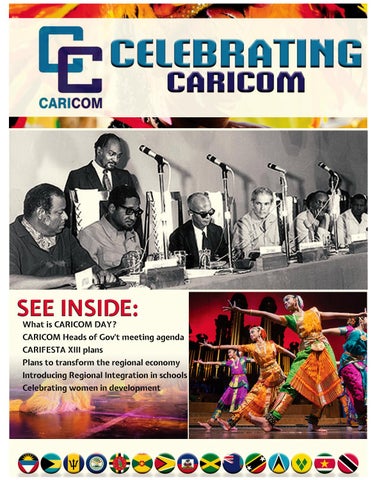
CELEBRATING CARICOM
SEE INSIDE: What is CARICOM DAY?
CARICOM Heads of Gov’t meeting agenda CARIFESTA XIII plans Plans to transform the regional economy Introducing Regional Integration in schools Celebrating women in development
2 A
GUYANA CHRONICLE Monday, July 3, 2016
CARIFESTA XIII plans on stream By Ravin Singh THE heart of the Caribbean will begin beating once again in the land of the flying fish when Barbados stages the historic hosting of the 13th edition of the Caribbean Festival of Arts (CARIFESTA) in August. CARIFESTA XIII will be held in that country from August 17-27, under the theme: “Asserting Our Culture, Celebrating Ourselves.” Earlier this year, that country’s Prime Minister,
Freundel Stuart, was in Guyana and told reporters that the cultural event, which is the largest in the Region, will be characterised by a peculiar Barbadian stamp. Stuart said that while CARIFESTA showcases the diversity of the Region, it highlights the unique character of each host country. “Over the years, it [CARIFESTA] has changed its character to reflect where it is being held because each host country tries to put its cultural stamp on the festi-
val. Therefore, we expect that while we will be having artistes from all over the Region, there will be a peculiar Barbadian stamp on CARIFESTA XIII,” he said. PM Stuart added too that the land of the flying fish hosted the event in 1981, and as such, it is not virgin territory for them. Touching on preparations briefly, he said that the Ministry of Culture, Sport and Youth in Barbados will be leading the charge for the event, and has been very Barbados Minister of Culture, Stephen Lashley receives the CARIFESTA baton from former President of Haiti, Michel Martelly at the closing ceremony of CARIFESTA XII in Port-au-Prince in 2015
A culturally mixed Amerindian and African dance performed by Guyanese at CARIFESTA XII in Haiti (Photo by Ravin Singh)
active in preparations. In a more expansive scheme, he noted that the Government has been working on getting the infrastructure ready in time for the event. The art forms expected to be showcased at the arts festival include: visual arts, literary arts, culinary arts, fashion, craft, film and animation, and the performing arts. Several symposia will also be held. Last month, that country’s Culture Minister, Stephen Lashley, was in Guyana meeting with directors of culture from across the Region at the CARICOM Secretariat to finalise plans for the event. Positive reviews of the preparation were given by the minister, who said that all
plans were on schedule, and a high level of interest has been expressed from within and outside of the region. CARICOM announced earlier this year that there was interest in the Grand Market and Buyer’s Shopping Mall from as far as the Middle East. The Ministry of Culture, Sport and Youth in Barbados had also said that a proposed Caribbean shopping centre during CARIFESTA XIII is generating global interest. “…there has been interest shown in the regional showcase from international buyers in Colombia, North America, Europe, the Middle East as well as from other Caribbean islands, which have a special interest in one
of the major events for the festival,” the ministry announced in a statement. Last week, the Ministry of Education’s Department of Culture announced the 70-member delegation which will be representing the country in every aspect of the creative arts. CARIFESTA, which facilitates the gathering of like-minded souls, will run for 10 days with a Grand Market, exhibits, performances, and other cultural orientations dominating this extravaganza. It is expected to be a fair where Caribbean craft will rub shoulders with fashion shows, gastronomic palaver, music and other creative art forms.
B3
GUYANA CHRONICLE Monday, July 3, 2016
Security, ICT & Tourism high on CARICOM agenda By Ravin Singh
HIGH on the agenda for the 38th regional meeting of the Conference of Heads of Government of the Caribbean Community (CARICOM) are issues related to Information and Communication Technologies (ICT), regional security and tourism. The meeting is scheduled for July 4-6, 2017 in Grenada, under the chairmanship of that country’s Prime Minister, Dr. Keith
Mitchell. President of Guyana, David Granger, is the outgoing Chairman of CARICOM. REGIONAL SECURITY With parts of the Region grappling with high murder rates and other expanding criminal enterprises, the conference is expected to deliberate on a regional strategy to reduce such high rates of violence. Discussions are expected to focus on the drug trade, since the Region has long been accused of being a transit point for drugs being shipped to North America and Europe. Authorities in the region contend that the drug trade remains one of the main factors responsible for high murder rates and other social ills in the Region. This year, the United States (U.S.) Department of State launched a report which details its plan to assist the Region in several key sectors, including security. The report is titled: ‘Caribbean 2020: A Multi-Year Strategy To Increase the Security, Prosperity, and Well-Being of the People of the United States and the Caribbean.’ In that report, the U.S.,
among other things, committed to supporting law enforcement and border-control agencies, defence forces, and regional security institutions with training, equipment, institution-building programmes, technical assistance, and operational collaboration. This will be done with the intention of strengthening the U.S. partnership in the fight against transnational criminal and terrorist organisations. In terms of regional cooperation, the U.S. said
town. The single ICT Space is conceptualised as the digital layer of the Region’s flagship programme -- CARICOM Single Market and Economy (CSME). According to CARICOM, it encompasses the management of regional information, human resources, legislation and infrastructure in the sector to elicit maximum benefit for the Region’s populace. It was announced this year that the single ICT space and the Region’s Digital
Only a few months ago, the U.S. State Department disclosed that 14 million citizens visited the Region in 2016. In relation to employment, the WTTC report indicated that in 2014, the total contribution of tourism to employment, including jobs indirectly supported by the industry, was 13.0 percent of total employment or 2.2 million jobs. This amount, the report stated, is expected to rise by 2 percent to 2,788,000 jobs in 2025.
it will define a common operational framework to tackle shared threats, including combating maritime drug-trafficking and promoting law- enforcement information-sharing.
Agenda 2025 are premised on the Regional Digital Development Strategy (RDDS) which was approved in 2013, and will also have inputs from key regional commissions and the Post-2015 Agenda. Building on this, the Heads of Government are expected to consider a work plan and budget for the single ICT space when they meet in Grenada next week.
Having benefitted tremendously from this sector, the conference will seek to develop strategies to further exploit, sustainably, this revenue earner. According to the agenda of the conference, Heads engage in discussions related to the building of a Caribbean tourism development and marketing initiative.
ICT In May of this year, CARICOM ministers with responsibility for ICT approved an Integrated Work Plan for the Community’s Single ICT Space. The Integrated Work Plan sets out the activities that need to be completed for the development of the Single ICT Space. The activities of the work plan will focus on areas such as: conducting gap analyses; public awareness; specific telecommunications issues; legal and regulatory reform; cyber security; bringing technology to the people; and resource mobilisation; as well as forecasting for the CARICOM Digital Agenda, 2025. The green light was given for this work plan during discussions at the 68th Special Meeting of the Council for Trade and Economic Development (COTED) on ICT, which was held in George-
TOURISM In addition to agriculture, the Caribbean has traditionally relied heavily on tourism to support economic growth. Aside from its tropical climate and sprawling, white sandy beaches, culture and arts have also been regional products in high demand. In its 2015 report, the World Travel and Tourism Council (WTTC) highlighted that the direct contribution of travel and tourism to Gross Domestic Product (GDP) was USD$16.1B (4.5% of total GDP) in 2014. The report added that this was expected to rise to USD$22.9B between 2015 and 2025. Annually, the Region boasts millions of tourists.
OTHER ISSUES Meanwhile, Heads of Government are also expected to deliberate on outstanding matters related to the implementation of the CARICOM Single Market and Economy (CSME). This follows a comprehensive review of the CSME’s performance presented to them at the last Inter-Sessional Meeting in February. In addition, there is also expected to be an update on the preparations for the 13th edition of the Caribbean Festival of Arts (CARIFESTA) to be staged in Barbados from August 17 – 27 under the theme: “Asserting our Culture, celebrating ourselves.”
Further, the work on the Commissions on Reparations and Marijuana is also expected to come under the spotlight. So too, the progress made with implementing the specified actions, agreed a decade ago, under the 2007 Port of Spain declaration to stop the epidemic of Non-Communicable Diseases (NDCs). CARICOM announced too that the conference will welcome its two newest heads of state: the President of Haiti, Jovenel Moise, who was sworn into office on February 7, and newly elected Prime Minister of The Bahamas, Dr. Hubert Minnis, who took his oath of office on May 11.
4C
Celebrating women in development
GUYANA CHRONICLE Monday, July 3, 2017
- domestic workers rights leader is 12th CARICOM Triennial Women Awardee
THE Caribbean Community Professor Rhoda Reddock, na- of domestic workers national(CARICOM) will pay formal tional of Trinidad and Tobago, ly, regionally and internationrecognition to yet another 2002; Justice Desiree Bernard, ally and today, she is described distinguished daughter of national of Guyana, 2005; as “one of the most outstandthe soil when it confers its Prof. Barbara Bailey, national ing Domestic Workers leaders prestigious Triennial Award of Jamaica, 2008; and Prof. in the world.” for Women on Ms. Shirley Violet Eudine Barriteau, Ph.D, In her journey, she estabPryce of Jamaica. national of Barbados, 2011. lished and continues to preside Ms. Pryce, a veteran advocate for domestic workers’ rights, motivational speaker and an “example of women’s empowerment,” joins the rank of some of the Caribbean’s most excellent and exemplary, courageous, committed and creative women. She is the recipient of the 12th Triennial Award for Women and, understandably, the conferral is one of the signal highlights of the livestreamed, official opening of the 38th Meeting of the CAR- CARICOM’s Triennial Women Awardee, Ms. Shirley Pryce ICOM Heads of Government, Ms. Shirley Pryce contin- over the first-ever domestic taking place in Grenada from ues the narrative of excellence. workers union in Jamaica, the 4-7 July 2017. She joins the select army with Jamaican Household Workers Improving the status of her tireless commitment and Union (formally titled Jawomen has been and contin- work across sectors, themes, maican Household Workers ues to be the focus of national regions and countries in a most Association) that currently and regional development selfless manner represents 58,000 Domestic initiatives. Recognition of She has been a human workers. She is also a board women’s role in, and impact rights advocate for more than member of the Association on, the Region’s development quarter of a century, at both of Women’s Organisation of led the Meeting of Ministers the national and regional levels Jamaica (AWOJA) A true of Women’s Affairs, in 1983, and for 15 years at the interna- Caribbean woman, she is also to propose an award for an tional level. Her work, which founder of the Antigua Dooutstanding woman who had has been described as “ex- mestic Workers’ Association, made a significant contribu- tra-ordinarily crosscutting”: as well as Founder and Presition to the socio-economic Gender and Development; dent of the Caribbean Domesdevelopment of the Caribbean. Women and Development, tic Workers Network. The CARICOM Secretariat Trade Unionism and DomesInternationally, she is introduced the CARICOM tic Service, has shaped policy an elected board member of Triennial Award for Women frameworks at the national, re- the Association for Womto acknowledge the landmark gional and international levels. en’s Rights in Development contributions of inspiring and As an advocate of the sec- (AWID) and a member of the distinguished Caribbean wom- tor, she works in all areas that Caribbean Advisory Group to en. affect women’s lives and car- the United Nations Women Ms. Nesta Patrick, a na- ries out programmes with do- and Gender Issues. tional of Trinidad and Tobago, mestic workers and their chilIn her capacity as Presholds the distinction of re- dren, particularly with regard ident of the Caribbean Doceiving the first award, which to workers’ discrimination and mestic Workers Network, she was conferred in 1984. Since women’s empowerment. has created awareness and then, nine awards have been She has been exception- sensitised policy-makers to conferred, these are: the late ally influential in shaping the the ILO Convention (No. 189); Dame Nita Barrow, national current policy framework on advocating for its ratification. of Barbados, 1987; Dr. Peggy women’s empowerment and In this context, in 2013, GuyAntrobus, national of Grena- gender equality throughout ana became the ninth country da and citizen of St. Vincent the Region, particularly as and the first in the Caribbean and the Grenadines, 1990; it relates to the International to do so. This Convention and Ms. Magda Pollard, national Labour Organinsation (ILO its accompanying Recommenof Guyana, 1993; Dr. Lucille Convention) (No189) on do- dation (No201), both adopted Mair, national of Jamaica, mestic workers. in 2011, guarantees minimum 1996; Professor Joycelin MasA domestic Worker herself labour protection to domestic siah, national of Guyana and for 31 years, she has led the workers. Being the first incitizen of Barbados, 1999; way in changing the situation ternational labour standards
specifically devoted to domestic workers, they bring these workers under the umbrella of labour laws. (ILO, 2013). Ms. Pryce’s work and programmes in Jamaica and the wider Caribbean supported by international Development partners (IDPs) including the ILO, UN Women, the Federick Stiftung (FES), have addressed domestic workers in the areas of capacity-building, advocacy, economic empowerment, labour and gender-based violence. She has worked along with the Caribbean Policy Development Centre in Barbados in several Caribbean islands to educate domestic workers on how to access employment and other opportunities through the CARICOM Single Market and Economy.
She was also part of the Jamaica Non-Governmental Organisation team that wrote and presented the alternate report on the Convention on Elimination of all forms of Discrimination against Women (CEDAW) at the United Nations. Ms. Pryce’s journey has been a long one of political commitment for women’s human and civil rights and for making gender democracy a reality. Along the way, this untiring champion, ever committed to the pursuit of excellence and growth, achieved in 2011 a Bachelor’s Degree in Social Work from the Jamaica Theological Seminary; and in 2016 An Advanced Masters’ Degree in Labour Law and Global Workers’ Rights from the Pennsylvania State Uni-
versity, USA. She is the recipient of several awards, including the Badge of Honour for meritorious service to Jamaica (2006), First Caribbean Bank Unsung Heroes Award (2007); and the Order of Distinction (Jamaica) for outstanding contribution in working with domestic workers in the Caribbean (2015); and the Bureau of Women’s Affairs Award for outstanding contributions to initiatives focused on sensitising the public on gender-based violence in Jamaica. The Caribbean Community celebrates this distinguished daughter and is pleased to formally record her footprints in the annals of Caribbean integration. (CARICOM)
5D
GUYANA CHRONICLE Monday, July 3, 2017
Lauding Grenada’s rich history in regional integration Grenada will continue its historically prominent role at the forefront of regional integration when it hosts the 38th Regular Meeting of CARICOM Heads of Government from 4 – 6 July, at the Radisson Grenada Beach Resort. An Opening Ceremony, on 4 July, will be held at the Grenada Trade Centre. Grenada’s Prime Minister, Dr. Keith Mitchell, will chair the Meeting. Dr. Mitchell, on 1 July 2017, assumed the six-month rotating Chairmanship of the Caribbean Community (CARICOM), succeeding the President of Guyana, David Granger. In the build-up to this meeting, we flash back through Grenada’s milestones as a champion of closer integration among the territories of the Region. Theophilus Albert Marryshow, a Grenadian in whose honour the T. A. Marryshow Community College’swas established, was among the earliest pro-
ponents of Caribbean integration. Biographical notes of his era, 1887 – 1958, record relentless efforts, spawning more than fifty years, for closer union among West Indian states, realised in the West Indian Federation. Due to his untiring efforts for West Indian unity, his biography records that he was given the title ‘Father of Federation’. Marryshow died in 1958, shortly after the Federation was formed. Three years after the demise of the Federation, the leaders of Antigua and Barbuda, Barbados and British Guiana, in giving birth to the Caribbean Free Trade Area (CARIFTA) in the Dickenson Bay Agreement, sought to define the ideals that Marryshow earnestly fought to see – reducing gaps in the living standards in the West Indian countries. CARIFTA came into being in May 1968, with the participation of Antigua and Barbuda, Barbados, Guyana and Trinidad and
Tobago. On 1 August, 1968, Grenada along with Dominica, Jamaica, Montserrat, Saint Lucia, St. Kitts-Nev-
joined. CARIFTA’s progeny, the Caribbean Community (CARICOM), established through the Treaty of
Grenada Prime Minister, Dr. Keith Mitchell
is-Anguilla and St. Vincent and the Grenadines entered formally and in May 1971, British Honduras (Belize)
Chaguaramas in 1973, has further embraced multi-lingual, multi-cultural diversity into the integration
movement, with membership of Dutch-speaking Suriname and French-speaking Haiti. Grenada-born Sir Meredith Alister McIntyre, a highly celebrated West Indian academic and intellectual and one of the great social thinkers of his time, served as Secretary-General of CARICOM from 1974 – 1977. Sir Alister took on the mantle of leadership a year after the signing of the Treaty of Chaguaramas which established CARICOM. He took over from Trinidadian Sir William Demas who oversaw the regional integration movement from 1970 – 1974. Before Sir William was Barbadian Fred Lloyd Cozier from 1968 – 1969. Following in Sir Alister’s footsteps were Mr. Joseph Tyndall of Guyana (1977-1978); Dr. Kurleigh King of Barbados (19791983); Mr. Roderick Rainford of Jamaica (1983 – 1992); Sir Edwin Carrington of Trinidad and Tobago (1992 – 2010) Ambas-
sador Lolita Applewhaite of Barbados (acted in 2011) and Ambassador Irwin LaRocque of Dominica (2011 – present). Sir Alister was awarded the Order of the Caribbean Community, OCC, in 1994. CARICOM’s highest award, the Order of the Caribbean Community recognises Caribbean nationals whose legacy in the economic, political, social and cultural development of Caribbean society is phenomenal. Among his many accomplishments, Sir Alister was able to position the Caribbean Region on the world scene and made a significant impact on the international arena through the many high level posts he held in various United Nations organisations and in a consultative capacity to Regional and International Financial Institutions, such as the Inter-American Development Bank (IDB) and the World Bank. (CARICOM TODAY)
6E
What is CARICOM Day? IT’S CARICOM (Caribbean Community) Day today! OF course, many of us are off from work and school because it is a national holiday here. But do we know why it is and what really we are celebrating? For those of you who may have forgotten, CARICOM was established on July 4, 1973, with the signing of the Treaty of Chaguaramas. The document was signed by the four founding members of the Community – Guyana, Barbados, Jamaica, and Trinidad and Tobago. Later, 11 more countries joined the community. In Guyana, the day is observed on the first Monday in July which happens to be today. The day when the Treaty of Chaguaramas was signed is a very important date for the members of CARICOM. The document regulates relations inside and outside of CARICOM under mutually accepted terms.
GUYANA CHRONICLE Monday, July 3, 2017
Include regional integration in school curriculum
By Ravin Singh
The regional bloc seeks to coordinate economic policies and development planning, institution of special projects in the
less-developed member countries. The headquarters of CARICOM is located in Georgetown, Guyana.
AS the Caribbean Community (CARICOM) observes CARICOM Day today, the Working Peoples’ Alliance (WPA) is calling for regional integration to be included in the school curriculum in Guyana from nursery to the tertiary level. “WPA takes this opportunity to call for the study of regional integration to be integrated into our school curriculum from nursery to university,” the party said in its CARICOM Day message to the nation. The party, which was founded by world-renowned historian Dr Walter Rodney, said that it feels that “insularity flourishes in the absence of institutional knowledge,” referencing the Region’s diversity within the context of shared history and common identity. The WPA pointed to the West Indies cricket team and the University of the West Indies, which it said, remain shining examples of Caribbean integration in action. Asked what prompted this call, Chairperson of the WPA, Tabitha Sarabo-Halley, said that it has been a longstanding position of the party. “Our Constitution not only speaks to educating the masses on pertinent issues, but also speaks to a commitment to regional economic integration. So, yes, it has been a longstanding position of the WPA,” she told the Guyana Chronicle. Sarabo-Halley contended that highlighting the need for regional education to be included in the school curriculum can now be
justified, given the shared view that there is a reduced sense of the importance of regional integration in the Caribbean She reasoned that the generation that informed decisions that lead to the creation of CARICOM and the CARICOM Single Market and Economy (CSME), has not been able to pass down to the current generation, how and why they came to the conclusion that regional integration is necessary. As such, the party’s chair reiterated that there is now a need for this generation to be informed about the processes which lead to the creation of CARICOM and the need to revive regional integration. Presently, issues related to CARICOM and regional integration are included in the school curriculum; both at the primary and secondary levels. But according to Sarabo-Halley, who is also a political science lecturer, “the current curriculum is inadequate.” She explained that in its current form, the curriculum focuses on ensuring students define concepts. Lacking, she offered, is the requirement for students to examine, analyse, evaluate and critique these concepts. “…it is only when this occurs that a student can be convinced as to the importance of and reason for the idea that is before them” she added. Questioned about whether this generation is enthusiastic about pursuing and promoting regional integration in an increasingly globalised world, the WPA Chair said that levels of enthusiasm should not be the litmus test in deciding whether integration is
taught in schools. “While enthusiasm may or may not be there, this should not be the litmus test to decide whether or not it [regional integration] is taught. The urgency and importance of regional integration necessitates it being included as soon as possible in a structured and comprehensive way into all school curricula,” she offered. In its message, the WPA also contended that regional integration is not an easy undertaking, as it requires countries to surrender some of their sovereignty in the collective interest of the Region. “We in the Caribbean have had to overcome the failure of the [West Indian] Federation and our subsequent struggles to balance national and regional imperatives. But there can be no doubt that as a Region we have achieved much together. The very fact that CARICOM has remined intact 44 years after the signing of the Treaty of Chaguaramas is itself a monumental achievement,” the party’s statement read. Meanwhile, the party also sought to urge CARICOM’s leadership to continue to resist efforts to get the Region involved in the internal situation in Venezuela. That country is currently experiencing economic and political crises which have demanded international spotlight. The WPA said that while it is committed to respect for human rights in all countries, including Venezuela, the party feels that CARICOM must develop its own approach to what’s happening in that country rather than “bow to the dictates of external agendas.”
7F
GUYANA CHRONICLE Monday, July 3 2017
Caribbean looks to creative arts to transform regional economies By Ravin Singh THE economic potential of the creative arts industry in the Caribbean remains one which can transform regional economies which have been stagnant, Culture Minister of Barbados Stephen Lashley has said. Lashley expressed this view last month at the Caribbean Community (CARICOM) Secretariat in Georgetown, just prior to the start of the 25th meeting of the Regional Cultural Committee (RCC). The committee met in Guyana last month to, among other things, finalise preparations for the hosting of the 13th edition of the Caribbean Festival of Arts (CARIFESTA) which will be held in Barbados from August 17-27. Economic growth in the Region has not been as strong over the last few years, due to the global economic contraction which was influenced by several major political developments, including Brexit. The Caribbean has traditionally relied heavily on agricultural exports and tourism to support economic growth. However, given recent developments in the global economy, the Barbados minister recommended that the Region begin examining the economic potential of the creative arts industry. He said that the realities of the economic situation in the Region is that it is challenging, and so leaders must decide how they are going to reposition the cultural sector to become a leader in transforming economic realities in the Region. “A lot of money go to traditional sectors that do not necessarily give the returns we expect. Governments must… put some money behind the creative sector,” he charged. The Culture Minister posited too that if the Region is serious about its creative sector and achieving economic growth, then it must “re-divert scarce resources into this potential champion of true regional economic expansion.” Aside from its tropical climate and white sandy
beaches,the culture and arts have been the selling points for the Caribbean with world-renowned musicians like Bob Marley and Rihanna emerging from the Region. Optimistic in tone, Lashley said that he has examined the statistics on the economic impact of the creative industries in the Region, and realised that much could be achieved if they are tapped. He suggested that: “Fiscal deficit will be brought under control and our young people will become more creative and innovative and they will begin to lead the world in terms of cultural integration and innovation.” Acknowledging that one of the challenges in the Region is the growing level of unemployment, Lashley opined that young people are energised by creativity and technology. As such, he noted that financial support is needed to drive development of the business models in the creative sector. “It is time we put our money where our mouths are,” Minister Lashley said. Building on his deliberations about the creative industry, the Barbados Culture Minister was keen to note too, that strengthening the creative economy is high on the development agenda of his country. He specifically referenced the fact that in 2015, Barbados passed the Culture Industries Development Act, which enshrines in law, a robust system of incentives for the sector and established a Culture Development Authority as a dedicated institution to support the industry. Minister Lashley shared too that it is time legislation such as these be looked at for wider application in the Region. He noted that Barbados stands ready to support countries to adopt best practices and designing legislation to suit their social and cultural landscapes. Touching briefly on CARIFESTA XIII which will be held in Barbados in August, the country’s Culture Minister said that the main focus this year is about strengthening the
Tourists at a craft shop in Jamaica
creative industries. He added too that Barbados remains committed to realising the ideal for which the festival was created; that is, to showcase the excellence of the Caribbean arts and culture; to foster a vision for Caribbean integration and unity; and to provide opportunities for real artistic and cultural development in the Region. CARIFESTA is being held from August 17-27 under the theme: “Asserting Our Culture, Celebrating Ourselves.”
Revellers at Trinidad and Tobago’s 2017 Carnival – the biggest annual cultural event in the Region which attracts tourists from across the globe