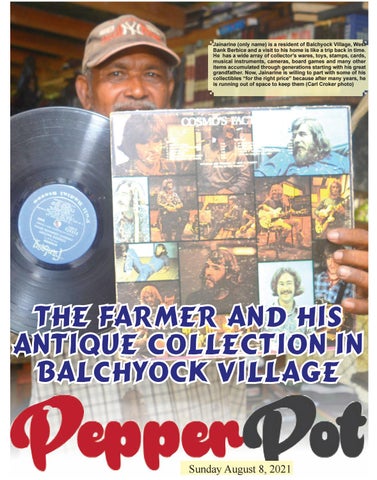
Jainarine (only name) is a resident of Balchyock Village, West Bank Berbice and a visit to his home is like a trip back in time. He has a wide array of collector’s wares, toys, stamps, cards, musical instruments, cameras, board games and many other items accumulated through generations starting with his great grandfather. Now, Jainarine is willing to part with some of his collectibles “for the right price” because after many years, he is running out of space to keep them (Carl Croker photo)
The farmer and his antique collection in Balchyock Village
Sunday August 8, 2021
II
CHRONICLE PEPPERPOT ― Sunday, August 8, 2021
Don’t dismiss a brilliant comedian
By Francis Quamina Farrier G O O D comedians are among some of the most brilliant people one can know. Such brilliance need not be supported with academic qualificationsnot to say it doesn’t help tremendously in being a qualified person. A real, up-scale comedian can be someone who has a PhD level in their craft. We are not referring to those little folks who walk onto a stage, gyrating with arms up and hands flapping and behaving as though they are not the gender stated on their birth certificates. Neither are we referring to those who have yet to develop the art of making us laugh at ourselves due to the nonsense we say and do from time to time - or all the time. The objective of such brilliant comedians is to help us become our better selves and making us laugh in the process. Their aim is to rid ourselves of removable flaws. We want to throw the spotlight on serious comedians who can insult us or throw the nonsense we say and do directly back into our faces, and we respond by inwardly or
Taik Anand Singh
outwardly, saying, “Throw more. That was most refreshing. Help me to be my better self” as we clap and laugh ourselves into stitches. Good comedians are necessary in every society. I met one such Guyanese comedian at GUYFESTA 77 - The Guyana Festival of the Creative Arts - which was the local version of CARIFESTA. (A GUYFESTA has not been held since the turn of the century). Taik
Anand Singh from the Essequibo Coast was a hit with the audience and the adjudicators from the moment he walked on stage with his two partners-in-comedy at that GUYFESTA 77 session which was held at Anna Regina on the Essequibo Coast in Region 2. There is a certain brilliance which not many comedians bring to their audiences. It is a brilliance of intelligence; nothing down in the gutter.
Taik Anand Singh in one of his performances at GUYFESTA
Nothing for cheap laughs, but at the summit of a shining mountain of comedy. The audience laughs, not at smut thrown into their faces, but serious issues creatively sugar-coated with humour. An example could be that song, “Just a spoon full of sugar makes the medicine go down, in a most delightful way.” One can recall a throwback to the presentations of the great Guyanese
Santonian Bill Rogers, who did his in song. Recall “Jimmy Black Pudding” and “Fifteen Cents Sweetheart” for example. Also, his Weed Song. There was also the entertaining team of Sam Chase and Jack Mello - Sam and Jack. On many occasions, Sam appeared in skits dressed in female attire, somewhat like the famous American Tyler Perry, who plays the mature character of the wise and lovable Madia. He simply plays a female the way Guyana’s Sam Chase did so many years ago. It must also be recalled, that those skits always had messages of enlightenment for the audience. Taik Anand Singh has never played the role of a female. His characters are, more often than not, a simple-looking genius. The characters he plays are never out of reach of the simple folks in the audience and are mostly role models. It was a role he mastered and gave the feeling to the ordinary persons in the audiences that brilliance is not necessarily the exclusive property rights of intellectuals and University graduates. Taik Anand Singh migrated from his native Guyana some years ago and resides in the United States, where he has climbed the mountains of abilities in academia with practical purposes. His studies and qualifications in the areas of issues of security, crime and violence in the home and in the society, have motivated him to establish The Guyana Centre for the Prevention
of Family and Domestic Violence, as he puts it “To take a bite off Domestic Violence in Guyana.” That organisation certainly has its work cut out for it. It is known only too well, that there is an extensive amount of domestic violence, not only at the male/ female level but also violence in many forms against the elderly and the very young. In many cases, within families. There can be no human rights when this evil gnaws away at the human spirit. No self-righteous or civil-minded individual or civic association could hide its head in the sand or sweep this destroyer of homes under the rug. This social evil must be laid bare and destroyed. It needs to be given a Mike Benjamin Knock Out (KO) punch and left permanently flat on the canvas. The one-time stage comedian, Taik Anand Singh, is also involved in counter-terrorism, aviation security, predictive profiling, interrogation, criminal investigation, domestic violence, child abuse and human trafficking. He has received world-class training from such prestigious institutions as the National Family Justice Center Alliance, the United States Department of Homeland Security and The Federal Law Enforcement Training Center. Armed with his comprehensive training and qualifications, Taik Anand Singh works diligently to make our Dear Land of Guyana a better place to live.
III
CHRONICLE PEPPERPOT ― Sunday, August 8, 2021
River Guardian Benita Davis is latest recipient of Young Heroes Fund Award By Telesha Ramnarine
BENITA Davis can still recall her seemingly insignificant decision back in 2016 to attend a Sandwatch workshop which ultimately led to her developing the River Guardians Project to increase the protection of rivers and freshwater resources. This again led to her being the latest recipient of the Young Heroes Fund Award. The 26-year-old was in primary school when she realised that she was passionate about environmental protection, and when she moved on to Queen’s College, she continued to enjoy being part of the environmental club and scout group. This provided opportunities for exploring Guyana’s hinterland and allowed her to develop an appreciation for nature. “A trip to Guyana’s interior opened her eyes to the myriad ways gold mining is hurting the country’s environment, such as its rivers, lakes and streams, and impacting indigenous communities,” Stone Soup Leadership Insti-
Teaching Grade Six pupils to play the freshwater board game
River Guardian Benita Davis
tute said in a statement about Davis.
With an advanced copy of the ‘Stone Soup for a Sustainable World: Life-Changing Stories of Young Heroes,’ which Benita is featured in
‘Stone Soup’ is a nonprofit organisation founded in 1997 in Massachusetts that has been recognising those on the front lines of climate change, social justice and economic equity around the world. “The time she spent in the Kaieteur National Park — depending on the river and living alongside indigenous communities — inspired her to educate her compatriots about the importance of protecting freshwater resources. Guyana is called the ‘land of many waters,’ and as a river
guardian, Benita is on the front lines of the battle to protect this precious resource,” the statement further said. As such, the Institute said it was pleased to present its third ‘Young Heroes Award’ to Davis, which supports young leaders who are on the front lines of climate change and who are featured in the book, ‘Stone Soup for a Sustainable World: Life-Changing Stories of Young Heroes.’ The Institute’s Young Heroes Fund provides financial support, mentors, training, and partnerships for these young leaders to scale their efforts and engage others to help rebuild the planet. “I am extremely happy to be one of the recipients of this award since this puts me one step closer to ensuring my freshwater education programme reaches Guyana’s indigenous communities that are impacted by gold mining. I hope that the work I’ve done will motivate others to join me as we advocate
for the smooth phase-out of mercury in gold mining along with the restoration of our freshwater ecosystems,” Davis expressed in an interview with Pepperpot. The school-based component of her project led to 224 coastal Grade Six pupils along with their teachers benefiting from four lessons that were taught over four weeks in 2019. These lessons were created to demonstrate the importance of clean drinking water, help students understand the factors that affect freshwater, assess water quality, and how their activities impact freshwater sources. Through this education programme, Policy Forum Guyana, where Davis is currently employed, created a series of games to teach these lessons. One such game is the River Guardians Freshwater board game which NCERD is now incorporating into the Science Curriculum for grades six to eleven. After this was done, Da-
vis was also able to organise a climate rally in Georgetown in support of global youth-led efforts, mobilising over 500 persons to advocate for environmental protection. “Personally, I would like to say to anyone reading this to make the most of any opportunity they have been given despite how small it may at first appear to be. This is because I would have never expected that a one-week workshop that I attended in 2016 would be the reason I’ve been featured as one of the 100 youths in the world making a difference for environmental protection in 2021,” Davis shared. Having decided to pursue her degree in Environmental Science, she was the Best Graduating Student for the Faculty of Earth and Environmental Science and the 2nd Best Graduating student for the University of Guyana in 2018.
Coordinating a team for the ‘Healthy Rivers Healthy People’ campaign
IV
CHRONICLE PEPPERPOT ― Sunday, August 8, 2021
Rupununi Music & Arts Festival - Dedicated site for year-round activities in the making By Telesha Ramnarine IT’S unlike anything that the country has to offer so far as adventure tourism, music and art are concerned; a little bit outlandish in context of local tastes and choices, but perfect for the nature lovers and those seeking time out from the busy, stressful pace of life. It’s the only fiesta of its kind in Guyana
President Mohamed Irfaan Ali at Rock View Lodge, Annai back in 2014 before he was President (Colin Edwards photo)
Guyanese painter and archaeologist (now deceased) George Simon was a regular patron of the festival
– the Rupununi Music and Arts Festival. Going strong for seven years now, the festival, birthed at Rock View Lodge, Annai in 2014, is an outdoor camping music event that usually takes place on the savannah of the Amazon for three days, Friday to Sunday. As this year’s event approaches on August 15, organisers reflecedt on the
positive impacts of the festival and how it goes way beyond just providing entertainment. They like to describe it as an all-in-one treat for the nature and music lovers, and they see it as having the potential of becoming ‘de tourism product’ that the country has to offer when it comes to adventure SEE PAGE XIV
Festival Director Bob Ramdhanie (left) and local musician Gavin Mendonca
The Surama Cultural Group at the Manari Ranch
V
CHRONICLE PEPPERPOT ― Sunday, August 8, 2021
Meeting emotional needs Talkshow hosts intend to bring less-discussed topics to the fore
By Dillon Goring THE recently launched Fun+nel Chat Show is a zoom programme created to establish open and frank discussions on subjects that are not comprehensively preached from pulpits and may otherwise be deemed taboo. In a recent interview with Pepperpot Magazine, the architects and presenters behind this “Women Only” programme, Eslyn Harris and Marcia Forde divulged that as a result of the COVID-19 pandemic, they were inundated with programmes on Facebook and Zoom, but they were not interactive. “We wanted more on some of the topics, but we realised that because of the stigma and taboo that exist in places of worship; those answers would not be provided anytime soon, [hence] the birth of the Fun+nel Chat show,” Marcia explained to the Pepperpot Magazine. According to Marcia, FUN+NEL stands for Fun plus Never Ending Learning and the purpose is to provide a platform for discussion on “non-preachable” subjects. She explained that based on the name of the show, their tagline, “we pour into each other, as God pours into us” and mantra, “fun+nel your thoughts, they fashion your future” were coined to motivate and encourage the participants. Marcia believes that some topics preached in religious
Eslyn Harris
Marcia Forde
settings need to be more exhaustive but understands that it cannot be done because of the make-up of congregations and the discomfort it may cause. She states, “But what I cannot understand is why are some topics prohibited, forbidden and barred. Didn’t God make the exact things we deem as offensive and distasteful?” Eslyn posited that the participants are all receptive and are at ease with the topics discussed. She informed that the ages of the target audience range from 24 to 60+. Lady Eslyn also reported that the response has been overwhelming and when participants’ log on, they stay for the duration of the programme.
The programme aims to discuss those taboo subjects holistically and decently, making them mentionable and acceptable. To that end, they ensure that in every episode, a “God Aspect” is presented, tying the discussion to scripture which is linked to the motto: “Guiding each other for a secured eternity. The Fun+nel Chat show is a safe space and a non-judgmental zone where participants are encouraged to express themselves in an acceptable manner minus
expletives. Both Marcia and Eslyn expect this programme to be more successful as each woman invites another. One participant Raelene Phillips who joined the show from its inception, told the Pepperpot Magazine during an interview that she believes that the show is very informative and reaches a wide cross-section of participants. Drawing from her knowledge based on what she learnt from the show is that we can work with women and families.
“Well for me, it has changed me in a positive way and that is why I keep going on the show , because I am learning how to relate to
people, teenagers and others, the respect of other people’s opinions is very important. There are certain things you don’t share with everybody, inclusive of your husband if it is going to cause a conflict, if it isn’t relevant necessary, so I have just learnt to choose what I say and to whom I say it,” Phillips said. Societal Impact “ As long as individuals choose to use the new knowledge we have in a positive way, we would have an influence on others around and they can have an influence to persons around them and it is going to work out,” Phillips added. Phillips opined that one of the takeaways that she has been able to pass on to her students in the school where she teaches, is that of learning to respectfully, respect other’s opinions of any situation.
VI
CHRONICLE PEPPERPOT ― Sunday, August 8, 2021
Balchyock Village (Carl Croker photos)
Balchyock Village By Michel Outridge THIS week the Pepperpot Magazine visited the countryside village of Balchyock, Blairmont, West Bank Berbice to highlight the way of life of the locals and the village. This small village was developed for housing eight years ago and people who were squatting in Blairmont District was allocated land for occupancy. Balchyock Village is a Dutch plantation and was
once dense forest before the government developed the land for housing in which less than 100 residents live. There are 91 house lots in Balchyock Village and only 50 lots were allocated the remaining 41 plots are yet to be allocated and are overgrown by thick bushes that need to be cut down since it is infested with snakes. This village has four streets with crush and run roads, potable water supply, electricity, no landline ser-
A place of self-sufficient people vice, a few residents have private internet service, and others have cell phone service. The locals, like most people living on that corridor, depend heavily on the Blairmont Sugar Estate for their livelihood and most people have jobs there while others are self-employed and there are mostly farm-
Focus on the Village
ers and other self-sufficient individuals. Balchyock is a farming community and almost every household has a kitchen garden and they rear livestock, catch fish in the backdam and do their bulk shopping at Rosignol which is a short distance away. The village has a ball field, schools on the main access road both nursery and primary and the nearest secondary school is at Rosignol. Balchyock is bordered by Ithaca, which is the last village, and Shieldstown. Blairmont has four settlements from one to four,
two housing schemes: Zorgen-Hoop and Balchyock and the Neighbourhood Democratic Council covers three villages: Ithaca, Shieldstown and Blairmont. Balchyock Village is occupied by people of East Indian descent and get along well with locals from the surrounding villages. They are hardworking farmers and sugar workers who waste no time and have utilised every yard space to plant and grow food. The people of this village are very curious but welcoming and super friendly and it is a place where people lean on their
neighbours for support and they live like a big family, a close-knit community, where one can still ask their neighbour for a cup of sugar and leave their doors unlocked. The residents have made their homes very comfortable, and they have wooden benches under shady trees for the afternoon meet up and chat, hammocks under their houses, wooden benches and tables to sit and take rest, and they have well-kept, clean homes and surroundings. Most of the people there SEE PAGE XV
VII
CHRONICLE PEPPERPOT ― Sunday, August 8, 2021
The people of Balchyock Village By Michel Outridge AT the entrance to Balchyock Village, Blairmont, West Bank Berbice is the modest cottage owned and occupied by Leslie Lochan, a sugar worker who had worked the night shift and was taking rest in his hammock, in his small verandah. The 30-year-old is unmarried and lives alone in his small wooden cottage and is without potable water supply and electricity but is still comfortable in his own house. Lochan told the Pepperpot Magazine that he was residing with family members in the same village but
Lochan added that he has to work the 14:00hrs to 22:00hrs shift and was preparing to do just that because he has to work and still be able to manage his household chores. “I wanted to live alone, away from family, so here I am with the little I have and in time I will be able to afford utilities and be even more comfortable,” he said. The housewife Further up the street is the home of Satyananti Ramdahan called “Sabrina”, who had woken up at the crack of dawn and had cleaned up, prepared breakfast to send her husband and son off to
by Blairmont Sugar Estate. Her husband is a mechanic at the estate for the past 30 years and he would do his gardening and go fishing when he is off duty and do things around the yard. Ramdahan stated that she is the mother of three, two boys and a girl, who got married two weeks ago and is residing at Rosignol. Her eldest son is a security guard at the estate and her youngest son is a packaging worker at the same sugar estate. The Balchyock resident added that she has some chickens and ducks rearing in the backyard but lost some ducks two months ago due to Leslie Lochan (Carl Croker photos)
Satyananti Ramdahan
decided he wanted his own place and built a small house to relocate. He works as a labourer at Blairmont Sugar Estate and still had to prepare his meal and get some rest before doing other chores such as filling and fetching water from his neighbour’s yard.
work and was making lunch and dinner. The 40-year-old told the Pepperpot Magazine that she would prepare vegetables the night before, so when she gets up to cook, she is ready to make a stew and roti/rice to finish in time to send her husband to work at the near-
the rains. “My husband does the gardening but now it is too rainy to plant much because only the thick leaf calaloo survived,” she said. Ramdahan explained that they do not buy fish since her son goes in the back dam with the cast net and usually
makes a reasonable catch, she uses for the pot whenever they need. During his last trip, he made a catch of hassar, long tail, conga and ‘kurass’. She stated that life is quiet and peaceful there and they do not have minibuses plying the route except cars and they would use that to get to Rosignol and other places and the men would use their motorcycles and bicycles to get to and from work. Ramdahan has one of the most well-kept, cleanest yards and her house is well put together, as well. She added that she used to live in the squatting area at Blairmont and 26 years ago she got married and when
they were allocated a plot they relocated to Balchyock Village. It has been 13 years already and when she moved there, it was dense forest and they do self-help to clear the land and bring it to the condition it is in today. The stay-at-home mom Meanwhile, down the same street is the home of Saskia Kissoon, a mother of one. She is a stay-at-home housewife who has a 13 years old son, who spends most of his time on the internet. She has plenty of time to do chores and cook and still has time to engage the neighbours in friendly chat like they were when the team
visited. Kissoon said she would only leave home when she has to pay bills, buy groceries or visit relatives in New Amsterdam. She had already prepared breakfast and was thinking about a meal plan for lunch/ dinner since her son is picky with certain foods. The 40-year-old stated that she is very comfortable in the village and has good neighbours, who are like family, so she feels safe and protected. She said it is a place where she doesn’t have pesky, miserable, noisy neighbours but good people and it is easier to live in harmony.
Home of Satyananti Ramdahan
Focus on the Village
Saskia Kissoon
VIII
CHRONICLE PEPPERPOT ― Sunday, August 8, 2021
The farmer and his antique collection in Balchyock Village
Jainarine and his wife, Fazeen Alli
By Michel Outridge AT the home of Jainarine (only name) it was like a trip to back in time. He has a wide array of collector’s wares, toys, stamps, cards, musical instruments, cameras, board games and many other items, collected through generations which started by his great grandfather. This collection of antiques was handed down from generations to him by his father and most of the collectors’ items are still in pristine condition. These antiques are displayed in cabinets, dozens of books are stored in barrels,
and other things are placed in every available space in his house and storage shed. The viewing was surreal because his collection is wide and it is quite interesting to know how long and what it took to store away these items and to such good condition and well preserved. Jainarine has paintings, Dutch bottles, sewing machines that are manual, old cinema tickets by the reel, jars, jugs, old-time lamps, a portable gas stove, guitar, band set, violin, fishing rods, matches, shaving razors, smoking pipes, cigarettes and many other collector’s items. His wares, including China sets from way back when
other cutlery are so beautiful and kept in glass cabinets, are displayed with pride and importance. “I am willing to part with some of these antiques if the price is right but I have to look at prices and so on before that happens, as you can see, I have a lot and I am running out of space so selling some isn’t a bad idea because I need the money,” he said. Taking care of these collector’s items is also a fulltime job that requires patience and care and he would do that at nights after a hard day’s work on the farm. He plans to open a SEE PAGE XVI
The fish pond
Focus on the Village
Jainarine displaying some of his antiques (Carl Croker photos)
IX
CHRONICLE PEPPERPOT ― Sunday, August 8, 2021
Leading simple and humble lives in Balchyock Village Deodat Bissoondyal in his garden
Deodat Bissoondyal and his wife
By Michel Outridge DEODAT Bissondyal is a farmer and a member of the Community Development Council (CDC) and plays a vital role in representing his community. The 63-year-old was medically discharged from the Blairmont Sugar Estate in 2015 after he had an accident on the work site and that caused him to suffer a broken leg. He worked for 43 and a half years at the Blairmont Sugar Estate and began working at 16 years old. The father of seven stated that he has three sons in Trinidad and Tobago, another child in the United States of America, and three girls residing in Guyana. He recalled that Balchyock Village was established eight years ago, when the administration fully developed it, but people lived on the land way before that. Bissoondyal is one of the first settlers there and he moved there when there were no houses and only thick bushes. He has been residing in Blairmont for 21 years and before his industrial accident, he depended heavily on the sugar industry for his daily bread. These days he does small scale farming and would catch fish in the backdam and does the general upkeep of the yard while, his wife takes care of the kitchen and
cooking. He said life is quiet and peaceful in the community which is small so they enjoy a country life and would only go out to shop on Saturdays when there is a big market day at Rosignol. Bissoondyal, from the looks of it, takes pride in keeping his surroundings clean and his yard and home is a very tidy place, one of the cleanest places ever with everything in its place and no grass in his backyard. His yard has many fruit trees and vegetables and he would make fruits juices and store it in the refrigerator to use daily. He has a lovely home and he seems very happy. The early retiree, Jasoda Kishore Bissoondyal’s neighbour is Jasoda Kishore. She has a modest cottage and lives alone. The 59-year-old is a retired cleaner at the Blairmont Sugar Estate and these days, she is home doing household chores and cooking. The mother of two said she makes do with her pension and her sons, who reside in Trinidad and Tobago, would send money for her monthly. She has a crop of bananas in her yard and she would harvest and sell them at the market to earn. “I does eat little bit and live long and that is a motto
that has taken through life. I do not live beyond my means and it is a humble way to live,” she said. She, like most neighbours, is an early riser and would get up to do chores and cook before the sun is up. Before 07:00hrs she and the other women living nearby would meet up and chat daily. Anita Bickram In another street, there is Anita Bickram and her family. The 53-year-old is preparing to have the one-year religious service for her late grandson and was in tears as she spoke of him. The boy was six years old and mysteriously took ill at age three and was in and out of the hospital without medical professionals finding any complaints until he passed away while he was a patient at the New Amsterdam Hospital. Bickram said that she has lost a son too, who was also ill. The mother of four stated that she was residing with her daughter in Cayenne assisting on a farm for eight months and only returned to Guyana to bury her grandson. “I really can’t get over the death of my grandchild because he grow with me and I really felt it hard,” she said. She reported that coming
Focus on the Village
Deodat B issoo breadfru ndyal with his fre it (Carl C roker pho shly picked tos)
Jasoda Kishore
back home was the best decision because life is even harder in Cayenne. Bickram and her husband, Angad Kumar, 54,
occupy the top flat of the house while, her daughter and son-in-law live in the lower flat of the building. She is a housewife and
her husband is a watchman at a fishery at Rosignol five days per week and they try SEE PAGE XVIII
X
CHRONICLE PEPPERPOT ― Sunday, August 8, 2021
Professional health care staffers praised for their excellent work ethic at the Ithaca Health Centre
By Michel Outridge IT is one of those facilities you visit and feel welcomed and comfortable because the staffers are professionals, who certainly enjoy their jobs and provide a high quality of service to
people and has very good relations with the community. The Ithaca Health Centre is a very clean and tidy place with all COVID-19 protocols such as hand washing, social distancing, and wearing face masks. The facility has a visiting
Community Health Worker, Leslyn Morris
the people and community at Ithaca Health Centre. This place is the Ithaca Village, the community next door to Balchyock Village, which serves the entire Blairmont, Ithaca and Shieldstown villages. The facility is managed by Community Health Worker Leslyn Morris, a mannerly, skilled professional, who has her way with people due to her friendly demeanour. She is easy to talk to and does her job with relative ease because she serves the
doctor, Hagar Mohammed, who comes on Mondays and Wednesdays; one Community Health Worker; one Patient Care Assistant; one Pharmacist, who visits when the doctor is there; one Pharmacy Assistant; one visiting midwife; and one Health Care Attendant. This place is located just off the main road in Ithaca Village, which is the last on that corridor and the people make use of the services provided. Morris told the Pepperpot
Magazine that they are a primary health care facility and provide ante-natal, post-natal, home visits, family planning, child health clinic, chronic diseases clinic, vaccination and general out-patient services such as dressings. The health centre is opened on Mondays to Fridays from 08:00hrs to 16:30hrs. Morris related that they do not try away visitors except for the more severe cases that they cannot handle they would refer to Fort Wellington Hospital and New Amsterdam Hospital. Ithaca Health Centre is spacious and has adequate seating accommodation both inside and outside the building and there is a sink to wash hands upon entry and the wearing of a face mask sign is on the gate. About 10 to 15 patients would pass through the facility on weekdays and they have the biggest crowd on Mondays and Wednesdays when there is the chronic diseases clinic and the doctor is present. On Tuesdays, Morris said they have ante-natal clinic and Wednesdays, there is the child health clinic and on Fridays, they have home visits to shut-ins, children, who missed their vaccines, among others in the community. On that day which was a Tuesday the visiting midwife, Lavern Baxter said she came to work early and the mothers and children were there early too so she began working to shorten their waiting time since they had children in
Ithaca Health Centre (Carl Croker photos)
tow. She stated that they have excellent work ethic at the facility and do not have patients waiting for long periods. “Our Nursing Assistant is in training to upgrade to a Midwife and she will be back after completing the course so they will have an in-house midwife,” Morris said. Morris added that they
have managed to gain the people’s trust and have very good relations with them and collectively, they work together to reduce the spread of diseases. Like all the staffers of this facility, she is a caring healthcare professional trained and knows how to talk and treat people. It was also evident from
the way they go about their jobs they enjoy every bit of it and their surroundings are very clean. Morris and her team are doing a good job even through the pandemic they are true to their calling and are working even harder to reduce the spread of COVID-19.
Inside the Ithaca Health Centre
Focus on the Village
Community Health Worker, Leslyn Morris, Patient Care Assistant, Ociola McBean-Park and Visiting Midwife, Lavern Baxter
CHRONICLE PEPPERPOT ― Sunday, August 8, 2021
XI
XII
CHRONICLE PEPPERPOT ― Sunday, August 8, 2021
A HAND TO HOLD
For tiredness lies On my lids My body like a Broken goblet The Earth can feel No more my feet “So I must come home, dear Lord,” was the hoarse plea from the lips of the old woman, lying in a recliner on the patio. The middle-aged nurse aid sitting close by reading the newspaper inquired of the old woman, “What is it, Sharda?” She did not answer, looking up at the clear blue sky, her eyes not so dim, her hearing still fine. She could see the lovely flowers bloom and hear the sweet songs of the birds in her garden, but her love and passion for nature were slowly fading away. How does one continue to embrace life when the body has become aged and feeble, memory sometimes floating into nothingness, when you need a young, strong hand to hold and there was none? “How did this happen?” she asked herself, tears misting in her eyes, “Why did this happen?” The loneliness was a deep ache in her heart, craving for the children she loved and missed so much just to hear their voices. But they were gone, now matured adults pursuing careers and sharing their lives with new loves and interests. The mother now lived alone in the home where they had shared a beautiful family life. She had moulded and guided
them, her hard work and sacrifices laying a foundation for the successes they had achieved in their lives. But after reaching great heights in the business world, their
rich lifestyles made them forget where they came from, and for the aged mother, there was no time. A lone tear trickled down her wrinkled face, a face still beautiful never mind her age
she had walked away from her matrimonial home with her four children into the throes of an unknown world. She had worked long hours every day to build a nice little home with comfort
children to provide care and companionship for they hardly found any time in their daily schedules to spend with their mother. That night as she laid in bed, she looked at the paint-
and she lifted a trembling hand to wipe it. A hand that was once strong, that held her children’s small ones every step of the way. A wry smile crossed her face and a faraway look shone in her eyes as her thoughts took her back to a time when she was a young woman. She was so full of life, like a butterfly with amazing colours and a simple, little home filled with love, then her father gave her hand in marriage to a rice farmer’s son; a new life as a bride and later, a young mother. Paths she had walked paved with love, compassion, tears and pain, episodes of her life written on the leaves of time. Then one day, fourteen years later, when she could have borne no more of her husband’s arrogance and abusive behaviour towards her,
for them and today, instead of holding her hand, like she had held theirs, they turned their backs, leaving her alone. A choked sob escaped her lips and once again she whispered, “It’s time for me to come home, dear Lord, there’s nothing left here.” The nurse aid got up and took her hand, urging her gently, “Come on, Sharda, it’s time for your meal and medication.” She sighed and looking up at the nurse. She inquired, puzzled, “Who are you?” “I’m Jeanette,” the woman answered patiently, as she assisted her to her feet, “Your nurse aid.” “Oh,” she exclaimed softly, a momentary lapse in her memory. The kind woman had been with her for the past three years, financed by the
ing on the wall facing her and a smile touched her lips, lessening the pain in her heart. It was the picture of three children, her father working in the garden and her mother standing not far off with a bucket of fresh vegetables on her arm, smiling warmly as she watched her children. A portrait that captured a simple life and a beautiful family. “You have left so long ago, mother,” she said in a weak voice, “I can’t remember much for now I have grown too old.” The brother and sister playing with her had also left, their names now written on tombstones whilst she, the youngest, waited still alone. “Whisper my name, mother,” she said, “And I shall come, so we can be SEE PAGE XXIX
XIII XIII
CHRONICLE PEPPERPOT ― Sunday, August 8, 2021
CHRONICLE PEPPERPOT ― Sunday, February 28, 2021
INDUSTRY UNDER SLAVERY
ON THE AWARENESS OF THE AESTHETIC AND THE ‘BEING’ OF OUR YOUNG NATION Part II
THE MONEY TO BUY VILLAGES
ONE of the first myths to rules governing be dispelled with, would be, relations between to define who were the Afri- masters and slaves. cans that were condemned It prohibited slaves to the ‘Middle Passage’, to from selling -and understand that they were colonists and seanot slaves in Africa, but men from buying were more so tribe people from slaves any opposing the African tribal staple such as sugKingdoms involved in the ar, coffee, cacao, slave trade, whose reach- rum, indigo. But es imposed its ambitions it authorized the on their territory. They purchase of cattle, were traded for European greens, and vegeweapons, iron bars, etc. To tables out of their INassist concluding discussion, is intended “fields.” Slaves to raise in the this expansion of which questions within reader and were inspire to responsible be paid in actions Kingdoms, it isthe also possiamong those that acquire decision making positions or are money, clothing, ble that tribe’s folk within already there, we cannot arrive at a sensible without conthese very kingdoms were or Knick-knacks, siderations in retrospect. So in a brief flashback, we must butphysical by no means in referalso committed slavery, recognise, what weto have lost to our memory Guns or any other for various reasons jusence archive, and use this as inspiration, to be able to raise kind fire arms tified byalarm, the power elite. to a natural a connection theof aesthetic sensitivity nor in Gun Still, the important ingrealerting us to the fact that we need to havepowa historical der or lead. Slaves landdient isinthat theseto were memory respect ourpeosurroundings, as buildings, scapes and belonged architecture are inherent c o m pofl ememories m e n t e d in both ple that or were theexposed conscious subconscious awareness. diet withWe the have to to and or may have their become other thanthe people who occupy a geographic products of their ownspace garevolved from guilds onthat this composed planet, andthese relate to what is theEvery necessary thinking dens. traveller who tribal that will enable us tothe address the now onwardinwhat visited Demerara the Kingdoms. From very from is beginnings significant tooftelling our stories, especially stories imat the inter- early period marvelled portant to our timelines. When we became independent, the slave gardens, where actions in the new world, the euphoria of self-governed nationhood intoxicated us, grew yams, records testify that en- theyalongside it had its grounds forour intoxication sobercorn, exam-a variety of squashes, they slaved ancestors eventually ination. We did not make the observation that all around alsowe raised ducks, some indulgence usallowed within the borders of countries still chickens, held controlled goats, turkeys and times. rarely of privatefor, farming space the admiration had retained edifices of past pigs,dismantled apart fromHadrian’s the small andown know-how various never Our coloniserinEngland Wall. In in more previous colonisers and gardens near their houses areas theways long than day one, of a from also fromharsh despised local leaders, memory hadkept accessthe to provision slave’s existence. In theythey forthe reflection, in ourthat Caribbean, Christophe’s spectacular Their farming three colonies now grounds. fortress of defence in Haiti remain, regardless of the his supplemented comprise our Guyana therewillskills history. Europe with the obvious white supremacy that were laws to such trade. “In colony in times of European emerged with colonisation did not destroy the sculptures 1772 the Dutch government wars when ships were less of Afro-European Knights, artworks and literature that frequent” see-“Crowns of concerned with growing spoke of, or alluded to the African presence in a much Glory, Tears of Blood” by slave unrest, established older Europe, of course, they didn’t in-depth celebrate them either, and also hid their identities with new portraits and in movies. Where we erred in Guyana was not to use the structures that became available with the decline of trademark services like the Trains, to build museums dedicated to that part of our historical memory. Why preserve the physical imagery of the past? Simple, our ancestors lived it, for the historian, the creative mind, the investigative journalist, the physical location is important. The development of museums was a continuous peeve of the late Dr. Dennis Williams, who had identified Five Museums to be built, he insisted that a marine museum would have been a must. I can now imagine a display of the ship’s kitchen on Lady Northcourt with its cook, the portrait of indifference ‘John’, ‘keep away from John’s kitchen, and why?’ A caption should read before this rude faced ship’s cook made of papier máché –“whose kitchen lay beneath a toilet, from which water dripped continuously, or so we were made See Page XIX
Emilia Viotti da Costa. The enslaved were allotted by law one acre to every five slaves for cultivation. This was the foundation that provided the savings possibly concealed in earthen goblets that empowered the possibility to purchase the first villages, (their act of self-reliance would not be ignored because one of the standard decrees of colonization is to ensure the mental dependence of the colonial on the perceived superior craft of the colonizer) and this act did empower the manumitted subjects of the colony to lay the template for
Guyana’s post Emancipation cash crop farmers from the early 19th century to this day. It must be understood that the foodstuff that became the staple of the Creolised colony was ‘tropical’ and not temperate up to the early 20th century. Two prominent markets had envelope the coastal enslaved population of Demerary-a at that time, the Mahaica market, Mahaica during the visit of Henry Bolinbroke 1799-1806 apart from its enslaved populations and vibrant planter population, Mahaica also had Military posts established there
in the vicinity where the asylum was, this area was described as having a peculiar healing power. Thus, sick soldiers were taken there to recover, therefore the need for fresh items from plantation slave farms. The other was and the market at Stabroek, which only existed on Sundays but had the hungry ‘Tall Sail Ships’ eager for their produce, especially the citrus fruit, to suffice the absence of vitamin C after deprived months at sea. The agricultural movement did not fade away after Emancipation, because a battle ensured for village control through its village councils against central government. In 1898 at the opening of the Victoria-Belfield Horticultural and Industrial show, the Chairman had to point out, emphasizing that the support for the show did not come from the planters, but by men more or less connected to the peasant [roots] class. The villages were in a conflict to highlight their products in exhibitions in the colony or abroad that they knew were pushed aside
or completely neglected. See-“Walter Rodney-History of the Guyanese Working People,1881-1905 It must be still in the memory of citizens over 50, that by the 1950s-60s a vibrant campaign was instituted that had successfully appealed to ‘Rich versus Poor’ defining social stratifications in food. Imported apples and grapes, dates, chocolates especially in gift tins, corn beef, marshal sardines, curry mutton, corn and tomato paste, all in tins with beautiful coloured labels, suddenly defined a higher stratum of affordability, the local cuisine we celebrate today came under a fearful attack. Negative lore enveloped around some items sacred to both Africans and the East Indian population in the modern era. The coconut became a symbol of hard times. It shouldn’t rest on the dining table; it was bad luck; this was a staple for villagers and a bush-cook must-have. The avocado pear became mysteriously (the only fruit) source of cholesterol. That era of repressed Emancipation had to wait on Burnham to reassert sanity, lest we forget entirely, the mostly healing, liberating tastes of the ancestral kitchen.
XIV
CHRONICLE PEPPERPOT ― Sunday, August 8, 2021
Rupununi Music & ... FROM PAGE IV tourism, entertainment and cultural preservation. As such, the organisers have in mind developing a dedicated festival site in the Rupununi – an iconic
and future-facing cultural space - with support from the tangible partnerships that have been established over the years with the government, private sector, local and international volunteers, among others.
The concept is to create an environmentally, sustainable, eco-friendly ‘benab-style’village with a main performance stage (thatched), flexible meeting and small performance spaces, camping accommo-
The festival provides more than just entertainment, as it offers a host of other activities (Photos provided by Bob Ramdhani and Gavin Mendonca)
dation (benabs, tents, yurts etc.), seating areas, stalls (food and arts and crafts), a major central dome with local plants, flowers and sculptured totem poles and to create such a site using local materials and a local labour force. “Developing a festival as a vehicle to train young people, build social cohesion, market and promote Guyanese cultural products globally, create employment, diversify and use new technologies and embrace national and international artistes, have always been integrated into our long-term plans,” F e s t i v a l D i re c t o r B o b Ramdhanie told Pepperpot Magazine. He added that the plan is to develop the site into an oasis and an aesthetically attractive cultural landmark to feature all-year-round local arts and cultural creatives, visitors and tourists. Ramdhanie is one of two members; his friend Colin Edwards, the owner of Rock View Lodge, being the second, with some 15 local and international volunteers who manage and produce festival events yearly. “The Rupununi is a most beautiful area of Guyana and establishing
a permanent base there would highlight the region as a destination site and put Guyana solidly on the map for both cultural and experiential arts, culture and tourism,” the director expressed. “We see ourselves as enablers, not just in the cultural arena but also within training, youth development, promoting high-quality Guyanese arts and crafts; collectively wishing to take Guyanese culture to new places globally; also bring to Guyana new arts and musical experiences.” One of the persons who work behind the scenes to make the festival possible is local musician and Programme Director Gavin Mendonca whose own love for music and the arts motivates him to work tirelessly and diligently behind pulling off a successful event. Because participants come from all across the world, Gavin has lots of coordinating and organising to do, especially since the start of the pandemic when the festival started to be held virtually. Reflecting on the in-person experience of the festival, Gavin shared that it is the fusion of camping
and music for three nights in the Rupununi, under the stars, next to a river, or in the rainforest, that makes the event incomparable and absolutely amazing. Seeing how people come together to share space and do fun things together, bridging many different cultures at the same time, is also a wonder to behold. Apart from coming together to share “love and good vibes”, Gavin said the festival also allows for persons to increase appreciation for themselves, nature, and those around them. The experience teaches you how to respect the environment, and persons can learn skills through workshops in yoga, dance, art, craft, etc. Gavin also shared that the festival contributes to the preservation of culture and traditional knowledge and significantly promotes tourism. While the true essence of the festival can only be felt in person, he said the organisers have been sharing content virtually thus being able to target new audiences and help people who are reluctant to travel in Guyana to see what they’ve been missing out on.
CHRONICLE PEPPERPOT ― Sunday, August 8, 2021
Balchyock ... FROM PAGE VI have utilised sections of land, owned by the Guyana Sugar Corporation (GUYSUCO) to cultivate crops. The locals do not buy fish, greens, fruits and most meats since they grow their own food and rear livestock, making them self-sufficient. It is an up and coming small village where the people crave development
and other services but they use the services in nearby villages such as the Ithaca Health Centre, the banks, the markets and other facilities. Most of the women in this community are stay-athome moms and a handful have jobs outside the village within both the private and public sectors. They have a nurse in the community who is attached
to the Rosignol Health Centre. A Community Development Council (CDC) was established last year and its members are villagers, who were elected to manage the affairs of the village. Balchyock has street lights and it is adequately lit at nights and the people said they are comfortable but need landline phones, better roads, clearing of un-
occupied lands, and internet service for an enhanced life. Men and young men work at the nearby Blairmont Sugar Estate and have do their jobs on a shift system. When they are not work-
ing, they enjoy catching fish in the back dam, playing cricket and farming. The locals would go to Rosignol, the central hub for all businesses and some would go to the city or New Amsterdam for other busi-
XV
ness transactions. Balchyock Village is a unique place to enjoy a quiet, countryside life with the family, who prefer that setting of being away from the hassles of everyday life and the big city.
XVI
CHRONICLE PEPPERPOT ― Sunday, August 8, 2021
The farmer and his...
Part of Jainarine’s antique collection
FROM PAGE VIII Nursing Home for elders and a library but needs a plot of land to so do because his yard is used up for planting, and he also has some chickens, ducks and a fish pond. Jainarine is a resident of Balchyock Village, Blairmont, West Bank Berbice and is an antique collector and a full-time farmer. Farming life The 54-year-old is a full-
time farmer and due to the rainy conditions, he lost 1500 heads of tomato plants, peppers, celery and other crops. He has a pond in his backyard where he has some tilapia and the ducks would also use the same pond to swim. “I would take a loan from IPED and buy black ducks to rear and grow food but when the rains come and the place is flooded, I lost most crops, so I am at a loss because I still have to pay the loan,” he said. Jainarine explained that he is able to sustain himself
because he would take loans after loans to stay self-employed, but the rain has destroyed his crops and he is yet to recover from the losses. The father of two stated that he has fruits, cash crops, citrus, bananas, plantains and other crops in his yard and when he harvests he would sell his produce at Rosignol Market to wholesale buyers, who would pay less but resell for a profit. Jainarine added that when the weather is good and he gets a good harvest, he can employ three persons from
the village to assist him on his farm, but he is unable to do so these days. He would pay the labourers $2,500 per day to work as a day-pay, but he cannot since his crops are dying due to the rains. Although he didn’t suffer from prolonged flooding, the rains have beaten the crops of lettuce, tomatoes, celery and peppers. Jainarine reported that he used to rear meat birds on a large scale with 1000 chickens but the flooding killed his poultry business. He has a few creole
fowls and some black ducks. He had to start another small business and bought 215 tilapia and dug a fish pond in his backyard and today that amount has multiplied after six months. As is, his bora plants are barely surviving and with 500 roots of tomatoes at $800 per tree he has suffered a great setback. However, his coconuts, bananas, plantains and some fruits trees have withstood the weather and are still standing. Jainarine told the Pep-
perpot Magazine that he moved to Balchyock Village in 2009 and he sued to rear cattle by the dam in the squatting area and was allocated a plot and he constructed a house and relocated. He stated that these days it is just he and his wife, Fazeen Alli would do the farming and she is also a part-time seamstress. His sons, both work at the Blairmont Sugar Estate as a driver and a mechanic and they too, would assist on the farm when they can.
CHRONICLE PEPPERPOT ― Sunday, August 8, 2021
XVII
XVIII
Leading simple and ...
CHRONICLE PEPPERPOT ― Sunday, August 8, 2021
FROM PAGE IX
Anita Bickram
with whatever they can, fishing, farming, making pointer brooms for the house and doing other things to be self-reliant. Bickram stated that her husband went fishing and he made a catch which she prepared to dry, but with the rainy weather, she could not put it out in the sunshine. The dried fish will be used in the kitchen with vegetables.
Home of Anita Bickram
CHRONICLE PEPPERPOT ― Sunday, February 28, 2021
CHRONICLE PEPPERPOT ― Sunday, August 8, 2021
XIX
Siblings and Mental Health
o not always know what I’m looking losing your phone would be on a scale of 1-10. 98 percent y phone is such a normal part of my said 10 and 2 percent said 9. They all claimed that it would my hand that I cannot count the numbe the worst material possession that they could ever lose. I RECEIVED a column request from a young girl who of understanding, support and resilience. Even those relation- closer friendships outside of their family than those who did hedclaims for toit,bewhile it was actually in my They toinsay that feelings of anxiety, irritation and having constant problems with her siblings. ships that consist continued of many fights can aid our development. not have sisters. She is experiencing what seems to be situational depresThese fights teach us boundaries, forgiveness and effective Would you like to improve your sibling relationship but o when I get up in the morning and sadness would be felt if tothey were to lose their sive symptoms as the onset only occurs during and after conflictoverwhelming resolution skills not sure where start? Below are some suggestions that may an altercation with her siblings. I had a personal conThere have been many studies on sibling relationships that help. going to sleep is check my phone. I phone today. nection with this request as when I was younger, I didn’t have resulted in a few conclusions. Think of your sibling as a supporter, not a competitor; this get along with my sister at all; we fought the time and Sibling relationships tend to outlive all other types of relawill your biggestso challenge and rivalabout into an Invaluable healthy and something mustall be done. It seems harmless, right? turn Caring much a although we loved each other, I feel as though we disliked tionships. A study showed that siblings are the most common resource. Whatever abilities they have that you may be jealand women were more eachfound other for athat long time. Well, sweetheart, I’m here to relatives to see near someone’s bed. week I’ve ous of or want to surpass them in, view them as a source of phone? Well,death this been really paying attention tell you that thankfully, those days do not last. When you education instead. d togrow their phones simply because men individually, you’re able to better grow together and Siblings improve our physical health. that I and others Encourage your siblings in whatever is important to the importance around me give toto athemunderstand each other. You will come to realise that no Research shows that those with siblings are more active whether you have any interest in it or not. Relationships, in ocialmatter media apps.that’s Also, older what happens, the person/ peoplepeople you will and energetic and therefore less likely to develop obesity and general, are improved is a shared interest in an acphone, rather than what’s actually goingwhen onthere around them. have at your side. the subsequent range of diseases that tend to follow. Whether tivity. Spend quality time finding one thing that you both love e addicted. believe this isbenefits because phones -- whether we people, I’m going to I write about the mental health of sib- you’re Our running with them or away from them, you’re still are and dospeaking it together- at leastto onceother a week. Learning something lings and I’m going to dedicate this one to my sister Megan. running. new together, developing a specific skill especially has been use smartphones (My father actually Theusing socialsuggests media or playing games can betakeaddictive Siblings are a source of countless life lessons and skills. hygiene hypothesis that individuals with shown to enhance -the relationship; up a sport together, From a very young age, they teach us respect for others, com- siblings are also less likely to develop auto-immune disorders language classes, cooking sessions – anything really that you they alter moods, trigger enjoyable munication, thoughtfulness and generosity while allowing us such asas Multiple sclerosis (MS) andour Type 1 diabetes mellitus.beliefs would both and enjoy. This may sound counter-intuitive but give to practice our social and skills. Sibling relationships can teachbad the This is due to an excess of germ exposure between siblings them space. Everyone needs space at times, especially those y colleagues friends how and unenjoyable feelings. Apart from obviously being my importance of thicker skin, sympathy, empathy and enhanced that usually build up bodily defences. who share bedrooms. coping skills. I think the relationship with your sibling can deHaving a sister specificallyof allows for a healthier exAcknowledge, understandis andmy acceptnewspawhere their boundmain source communication, my phone termine whether you have healthy or unhealthy coping skills; pression of emotion and a higher resistance to mental health aries are. We often tend to push these in sibling relationships whether you turn to healthy activities or alcohol and other illnesses such aswatch, depression and anxiety. Those with sisters – probably more any other per, alarm, map, recorder, daythanplanner, calendar, SEE PAGE XXIX drugs when in distress. During hard times, they are a source showed to be kinder, more resilient and were able to build relationship in our lives. We camera, music player, calculator, a weapon (sometimes) and my friend when I’m bored or lonely- basically everything. However, it is also my constant interrupter and distractor. I (I imagine much like most of you out there) have a deep desire to know everything that is going on. I believe that is human nature. But when does it become too much? Well, I believe it’s too much when it has a name. ‘Nomophobia’ is the term coined to describe the fear of being without a mobile phone. Seriously, what have we come to? It becomes an addiction when the object begins to control your life and interferes with your daily activities, work, and relationships. I read somewhere that “The biggest obstacle to productivity is connectivity,” but overuse can affect a lot more than our productivity. The truth is, overuse of our phones can harm us psychologically, socially and physically. With regard to affecting our social skills, how many of us miss out on a joke or good conversation as we were on our phones? How many times have we annoyed our good friend or family member because we were posting on social media how much fun we are having with them? It truly affects our
XX
CHRONICLE PEPPERPOT ― Sunday, August 8, 2021
sharing their journeys CHRONICLE PEPPERPOT ― Sunday, August 8, 2021
g seven amazing women from the Women Anthologies. st of Watch Radio NY requested an interasked him if it was okay for me to invite oin me. I am sharing some excerpts from
van Phillips -- born in St Lucia, living in
owards being a Midwife of Purpose came being broken, displaced, and ough this journey, I experienced a divorce, e and got displaced education administrator’s position. Coupled were two major eclipses One week later I completed y life. An eclipse happens when you can my assignment with CTO calling becomes greater than your current and was now ready to move hrough this process, you can transcend to a on to my next career move. hinking where you can connect with your I called Monique to let her ourself as one with nature. know I was available as we lett – born in Guyana and living in NY agreed and she was so hapegan to have the real experience of dreampy to have me start my first my dream world alive. I was immediately temporary assignment with nterview with the agency where they tested Deutsche Bank. My first n using Microsoft Office and typing speed. IT is a week already since the celebration started for my birth anniversary celebration. My God is awesome. The service exceeded my expectations. To God be the Glory because this would not have been possible without him. The stage was set from the anointed opening prayer from Pastor Carol Brooks. I am a proud member of Love & Faith World Outreach Ministry under the leadership of Apostle Claude Brooks. Apostle Brooks, Pastor Nath Ayo Aiyedogbo, Selwyn Sills, Simon Harris, and Joseph Persaud. All the messages were on point and profound and blessed not only me but people who were in the zoom and on the live stream. I recommend you watch the replay on my page. We had two bonuses from two awesome young people. Rashlie Joseph sang ‘To God be the Glory’ and ‘He made a way’, and it was pore-raising assignment lasted two weeks, and a blessing to many. Tondicka Austin shared this poem she wrote specially for covering someone’s vacation. me and I am sharing these meaningful words with you. Due to my work ethic and “ A flower that is fading, a vapour in the wind, a wave in the oceandesire to go the extra mile, We know this, yet when death comes; we are overwhelmed with emotions I landed another assignment So, birthdays at every age are to be celebrated in the same department for We join to celebrate Ms. Sonia Noel, today, we are elated six months, then another for God knew we needed such a caring, kind-hearted sweet soul as you three months, which finally We wish you the very best in all you do led to my permanent posiMay your smile be from ear to ear tion, allowing me to live a May this year be of good cheer dream. You have a smile that’s infectious Dr. Safeeya Mohamed – You are courageous Trinidad Doing what many are scared to do, You charted your own course We received the updates To your dreams, you stayed true that the accident was horrific You are an inspiration to many – for this, we say thank you and that the victim was stuck We thank you for your labour of love and your impartations on ourinlives individually the car. We thank you for your notable contributions to the fashion industry The vehicle had to be cut For your designs are uniquely crafted and recognized internationally open to get to the victim. It Year after year, you do this skillfully never occurred to me that my brother You are a woman of great faith could be remotely inYour reward will be great volved. The next thing I Because of the grace you carry, when you enter the room the atmosphere changes remember, I was looking at instantly the body of my brother We won’t trade you for anybody covered in blood in a Happy birthday our lady! hearse. The strident, agonis ing scream of my mother in I felt so much love and compassion through this service and my gratitude is extended the A&E that to everyone who made it possible. early I received all the advice and prophetic words that were imparted for morning my new has not escaped my mind almost 17 awesome season. I am engaging in a lot of reflection as I approach this significant years later as she howled SEE PAGE XXIII “my son died, my son died, nobody’s helping us!” But nobody could, as his spirit departed at the point of impact. Up to this day, I ponder where the strength came from to navigate that night.
Love and compassion
Shanon Paar – Arizona
When I was six years old I started school in Mesa, Arizona, so I began staying with my mom and her husband routinely. It was like going from heaven to hell. It was a horror story that’s yet to be written. While at grandma’s I was filled with the love of a grandma and Jesus daily. On the other hand, at my mother’s house, I was filled with Rock ‘N Roll, drugs and inappropriate, wild sex parties. Ultimately, from such an environment you can imagine the kinds of abuse that mom’s house provided. When I was 11 years old, grandma Shirley died and my stepdad left. My mom had an emotional breakdown, so I ran away! I couldn’t take any more. Andrea Edwards – born in Guyana, living in Florida As I sat in the back of my dad’s Nissan Bluebird, I peered through the windows at the images on the fence of the Guyana Botanical Gardens and Zoological Park. The radio blasted the popular calypso song “1985” by a then-popular calypsonian. I would have just celebrated my sixth birthday, quite oblivious to the concept of time, but that song would not allow me to forget that it was 1985.
I knew that I would be in big trouble if I told my dad what had happened. It was a secret: the kind that could get me into big trouble. I didn’t know how much trouble, but I wasn’t willing to take a chance. “Shhhh... Don’t tell anyone.” Maybe it’s the trauma of my experience, but for some reason I still cannot remember how often it happened, when it started, or even when it ended Penny Phakahi –South Africa I have had my share of turmoil and I strongly believe that it is these stints of turmoil that brought me this far in my life. I was and perhaps is still in my refinery process. As a young girl, I grew up with one main ambition, wanting to get away, far away from the system of thinking or the box that we often find ourselves in. Apart from understanding myself I always dared to be different, which was a constant struggle when surrounded by my situations. I grew up under a strict Christian family with my grandfather and step granny, as my mother lost her mom SEE PAGE XXV
XXI
XXII
CHRONICLE PEPPERPOT ― Sunday, August 8, 2021
SEE PAGE XXXV
CHRONICLE PEPPERPOT ― Sunday, August 8, 2021
Love and ... FROM PAGE XXI
milestone, and I thought about love and compassion in my life when I received and give. This quote “Love and compassion are necessities, not luxuries. Without them, humanity cannot survive.“ by the Dalai Lama is so profound and I share it with others and invite them to share it with on when they experience love and compassion and how they felt. We Will be sharing two short stories that were submitted “When God made Adam, He saw that it is not wise for a man to be alone and give him Eve, thus making us realise that without love and compassion- which are necessities humanity cannot survive without. I remembered receiving the diagnosis that changed my perception and meaning of what is existing and what is living. Those four words hit me harder than I expected knocking the very wind out of me. “Your result is positive” bellowed the doctor as he looked me dead in the eyes, a mixture of emotions and empathy expressed with every resounding beat of his voice. It was one of those rainy days in the month of May. In my head the rhythms resonated. I smiled, reminiscing on the lyrics of the songwriter who sang, “I’ve got sunshine on a cloudy day, when it’s cold outside, I’ve got the month of May”. Smiling sheepishly, as I stared through the window of the vehicle taking me to know my faith. I honestly wished it was a limousine and I was on a night out on the town, enjoying a fancy dining restaurant with exquisite delicacies. I wished the earth didn’t stop spinning and the orbit could press reset. A journey back to the past would be nice, before closed stores, hushed sneezes, hidden coughs, and deadly colds. Where never in my lifetime persons dropping like flies right before their beloved eyes was the new norm at least it appears that way for now. This diagnosis proved the grace of God bestowed upon us in every wakening day, with each breath that we take not only a privilege but the ultimate gift. The love, support, prayers, and calls I received from near and far, family, colleagues, or friends concerning my COVID-19 diagnosis made me realise that without love and compassion, which are necessities and not luxuries, humanity cannot survive.” Anandy Gittens Another story is by Charissa Rampersaud. “It was the New York leg of my 2017 vacation, and the day I turned 36. I took the train by myself and headed into the city. I was going to treat myself to a birthday lunch at red
XXIII lobster, my favourite restaurant. There I was in this crowded restaurant enjoying my meal and feeling totally at peace. I was the only person who was dining all alone. As I was getting ready to place my dessert order, the waiter came over with a huge smile on my face and said, “This is the nicest thing ever, a gentleman paid for your meal, the coolest thing is he didn’t even want your number or anything. He just wanted to pay for your meal.” I was so surprised I asked him who it was, but the gentleman was already through the door. When I told the waiter this just made my birthday a little more special, he said, “No way! It’s your birthday? How cool is that?” I don’t know why that gentleman decided to do such a kind thing for me. Maybe he felt sorry for me because I was eating all alone. Whatever his reason, he decided to do something kind for a total stranger without expecting anything in return. His kind act will forever be in my memory. Every day, we all have opportunities to do something kind for someone else. It doesn’t even have to cost us anything. It can be as simple as saying a few kind words to help put a smile on someone’s face or asking how they are doing and actually paying attention when they reply. Just think how much more meaningful your life would be if you intentionally set out each day to do at least one act of kindness.” We all can contribute small acts of kindness every day as we continue this beautiful journey called life BEYOND THE RUNWAY.
XXIV
CHRONICLE PEPPERPOT ― Sunday, August 8, 2021
Regulating the Oil and Gas Sector
THE Environmental Protection Agency (EPA) is the sole environmental regulatory agency, and as such is mandated to protect Guyana’s environment via the provisions outlined in the Environmental Protection Act, Cap 20:05 Laws of Guyana. In executing its mandate “to promote, facilitate and coordinate effective environmental management and protection; and the sustainable use of Guyana’s natural resources,” the EPA is responsible for the environmental regulation and monitoring of oil and gas projects. Every project is assessed to ensure that the proposed project can be implemented in an environmentally sound and sustainable manner. The regulation of oil and gas projects is an important step in the project life cycle and has several key objectives, some of which are: (1) Protecting the biotic and abiotic elements (flora, fauna, air quality, water quality, ecosystem services); (2) Protecting cultural resources; (3) Ensuring public health and safety; (4) Ensuring proper waste management; and (5) Ensuring adherence to regulatory requirements. Requirements for Environmental Authorisation: * Application for each proposed well; * Identification of the Permit Applicant (National ID Card, Passport); * Application fee;
* Detailed Project Description (Summary); * Proof of Land Ownership (Petroleum Prospecting License); * Business Registration/ Certificate of Incorporation; * Parent Company Guarantee; * No-objection from the Bank of Guyana; * No- objections from the Ministry of Natural Resources; * Proposed Layout of Operations; and * Any other information which the Agency may require under the Environmental Protection Act, 1996 or the Environmental Protection (Authorisation) Regulations, 2000. Environmental Concerns/Considerations * Impacts on human health; * Cumulative impact of multiple operations; * Noise and Air Quality Management; * Climate conditions; * Water Quality Management; * Waste Management;
SEE PAGE XXV
CHRONICLE PEPPERPOT ― Sunday, August 8, 2021
Regulating the Oil and ... FROM PAGE XXIV * Hazardous Waste/s Materials Management; * Material assets, the culture heritage and landscape; * Radioactive Sources Management; * Compliance monitoring and reporting institutional authority; and * Biological Resource Management? Risks to sensitive ecosystems.
XXV
EPA responsibilities * Authorisation, * Compliance Monitoring, * Enforcement, * Development of regulations, standards, guidelines etc. * Review, evaluate, and determine the adequacy/acceptability of Environmental Impact Assessments (EIA) and Environmental Management Plans to support the authorisation of projects. Oil and Gas Production projects require an approved Environmental Impact Assessment (EIA) before any decision can be made on whether or not to grant an Environment Permit. You can share your ideas and questions by sending letters to: “Our Earth, Our Environment”, C/O ECEA Programme, Environmental Protection Agency, Ganges Street, Sophia, GEORGETOWN, or email us at: eit.epaguyana@gmail.com. Follow us on Facebook and Instagram and subscribe to our YouTube channel.
XXVI
CHRONICLE PEPPERPOT ― Sunday, August 8, 2021
Coping with grief during the COVID-19 pandemic IT’S been approximately one year and four months since Guyana recorded its first case of the COVID-19 virus. From then to now, life has changed entirely for every single Guyanese. Like the rest of the world, Guyana had to put strict restrictions and guidelines in place for its citizens to follow. This changed the way we transact business, the way our students learn and even how we grieve. Many persons lost a whole lot due to the pandemic. While some think that there will be a rainbow at the end of this “storm”, that isn’t a reality many will be able to have. Life will never be the same for some persons, and I think
our country ought to take that into consideration as we plan to move forward with national development and rebuilding after the pandemic. Recently, I’ve been dealing with the loss of someone close to me. They contracted the virus and subsequently passed and life as I know it has changed forever. I do not want to go into details about this saddening situation but I wrote this article just to shed light on what grief and loss feels like in a pandemic. It hits you differently. You start to wonder about all of the possibilities and scenarios of what could’ve happened to prevent such a loss. Perhaps, if someone wore
a mask or sanitised properly; things would’ve been different. Or, if they took their vaccines in time and maintained a social distance from others, things would’ve been different. While grieving, I got angry at the world for allowing such a virus to spread rapidly. I’ve said to myself many times, “If there was no outbreak in China, then there would’ve been no COVID-19 virus and that means that I wouldn’t have been grieving the death of this person after they died from the virus”. Grief can be difficult to handle on any given day, but it’s even more difficult during a pandemic. In some ways or the other, many of us have gotten “comfortable” with the COVID-19 virus. We believe that because we were never directly affected by the said virus, it means that we never will be. We forget that the statistics of increasing cases and deaths account for
real people who lived ordinary lives until they contracted the said virus. They’re more than just numbers. Coping with grief during the pandemic isn’t associated with the death of someone only as well. Many are grieving because they lost their jobs, many are grieving because they lost connections with persons they did not see in a while, many are grieving because they lost their sense of normalcy. We’re all grieving in some way or the other. In the midst of it all, I would like you to remember that you should let go of the things you have no control over. It allowed me to stop blaming myself over situations that I couldn’t stop from happening. It allowed me to be free. It is also important to understand the stages of grief and to comprehend how to cope in each stage you’re in. The most important thing I’ve had to learn through grieving is that I should also remember to be happy and smiling about the good things I still have left. The pandemic took so much from us, but that shouldn’t change the things that can last forever. For me, it’s the continuous support of my friends and family, my ability to persevere through obstacles, my strong sense of compassion for life and those around me. The pandemic couldn’t take that away from me, and I hope you self actualise to find out what virtues and positivity the pandemic cannot take away from you. When you find out what they are—use them as your motivation to keep going. With all of that said, I want you all to also remember to always protect yourself by adhering to the guidelines and restrictions set in place to help us overcome this deadly pandemic. Remember to wear your masks, sanitise and maintain a social distance from others. Take your vaccines if you haven’t already, and if you’re having doubts about said vaccines, do your research and understand that you can be a risk for those around you—think about them. Many of us will still be grieving after all of this is over. Even after the virus is extinct, after the airports are fully opened, and masks are no longer needed—we will always remember the things and people we’ve lost. Healing starts now, but it will always be a continuous journey. I am still trying to find a light and meaning in the midst of it all, and I hope you can do the same.
XXVII
CHRONICLE PEPPERPOT ― Sunday, August 8, 2021
A welcome commitment to reparations for the crimes against humanity
NICLE PEPPERPOT ― Sunday, February 28, 2021
CHRONICLE PEPPERPOT ― Sunday, February 28, 2021
XX
AS Guyana joined other Caribbean nations in observing statements and commitments 183 years since the emancipation of enslaved Africans, by the President and the President Dr. Irfaan Ali stated that Guyana recommits to CARICOM Chairman are the goal of gaining international reparations for the crime important. And I hope we of African enslavement. will all work towards repaThe President highlighted this in his Emancipation Day ratory justice. message last Sunday, which, if you follow the reparations If you would like to movement in the Caribbean, is the first time this new adminis- connect with me to distration stated its support for the reparations to be given DURING for the thiscuss column past this week’s edition ofor‘Inany the of National ON March 11Parliamentarians last COVID-19 became a stark realcrimes against humanity. myyear, previous works, feel Assembly,’ debated the 2021 National ityBudget, in Guyana. Though it had earlier alreadyinbegun spreading whichfree was presented the month by SeThese crimes, of course, were the centuries of forced transto email me at vishacross the globeinathe fewOffice months before, this novel nior Minister of the President with coronaresponsiportation to the Caribbean and enslavement of Africanvirus people a14ragobeer@gmail.com great for Guyana and many of bilitybecame for finance, Dr.concern Ashni Singh. The debate, however, the Caribbean countries only during From the on the plantations, exacerbated by the horrible treatment these spotlighted a lack of decorum in the March. Parliament. very It beginning, Guyana was and exposed to thefor stark is both understandable acceptable the reality different Africans experienced while on the plantations. The Caribbean because the local health authoritiessides dis--sides ofthe thefirst houseperson -- the government and opposition movement for reparatory justice also focuses on thecovered crimes was infected, died. to have opposing views on the budget. After all, the national Guyana’s story ofthe thegovernment’s pandemic, at least in the beginning, (genocide) committed against the region’s indigenousispeople. budget illustrates vision, priority areas, a truly unique one. direction, Certainly, since the country wastowards not as preand general policy it points what It was important, for me, that this commitment was made on pared as it should have been to conduct testing, do contact policies, programmes and plans the government intends to the eve of the President’s first anniversary in office. This,use inGuyana’s my money to fund. would be strange for each member to agree on mind, means that he will direct some of his attention overItthe every single thing, since various individuals have difnext four years to join his Caribbean counterparts in advocating ferent priorities and views and perhaps different sides for the meaningful advance of reparatory justice. of the house have different plans, projects, or policies thatthat would guide Guyana’s developments; and, that is And, because I am more hopeful than most, I believe completely fine. this isn’t a political gimmick or some false commitment. My It is neither understandable nor remotely acceptable, reason being, again, he said it just as he was observing his first for elected officials, sworn in as Members of however, Parliament year in office (and not his last year, ahead of new elections) and (MPs), to openly hurl insults at each other and make racist, sexist, homophobic remarks. It is not acceptable also because he was not asked about this by some journalist, for this level of disrespect to be entertained in the National for example. It was his own routine message on the occasion Assembly. The normalisation of racist, sexist, and homophobic reof Emancipation day. marks in our common, social spaces might be a conversation As usual, cognisant that reparations are still a foreign confor another day, but for crying out loud, this is our National cept that many of us are not knowledgeable of, please Assembly! permit Or, our Parliament, as it is more commonly called. It is not touting at the bus park! me to provide some context. Imagine the astonishment one would experience, years Caribbean enslavement lasted for hundreds of years, involvfrom now, if they were to revisit the hansards. Instead of only well-articulated, thorough analyses of the $383.1 biling a system of forcibly bringing enslaved Africans from West budget that was presented for the year 2021, there would Africa to the Caribbean- Guyana included- and forcinglion them be remarks signalling homophobia or thinly veiled insults of to toil on the plantations. an MP’s reproductive capabilities. To be fair, however, there were a few salient presentaEuropean nations profited as these enslaved Africans toiled tions. On the first day of the debate, it is a point of pride on the plantations and suffered extremely harsh and inhuman that two women -- MPs Susan Rodrigues and Amanza treatment. In Guyana, that meant that the British and theWalton-Desir Dutch who are also new Parliamentarians -- made goodand presentations that one would expect at this forum. were enriched when the sugar, for example, was produced Though this absence of decorum from many of the sold in Europe. MPs,is perhaps, not a new occurrence in the local context, Contextually, reparatory justice relates to the action it begsof us to ask ourselves: what valuable contributions are our elected making amends for a wrong done, by providing payment or officials making at this forum? One would hope that the leaders elected by the people other assistance to those who have been wronged. of Guyana, whether in government or opposition, would maintain a certain level of decorum in the house. In disAs I have written about several times before, Reparations charging their duties towards the people of the nation, at the have been something that the Caribbean Community (CARvery least, it is expected that they would engage in critical ICOM) has been advocating over the past few years through analyses of the budget. The budget debate should attempt to pinpoint deficiencies in allocations, or indicate what other the CARICOM Reparations Commission (CRC). And through areas of priority should be focused on. CARICOM’s 10-Point Action Plan for Reparatory Justice, This is how you operate in a democracy, where transthe Community is seeking to have the nine European nations parency and accountability are underpinning tenets. This is that exploited the Africans and Indigenous people pay how for you the respect the sanctity of Parliament. And above all else, is this how you adequately represent the people of the injustices. nation you committed to serve? Parliamentary affairs -- evIn July, the new Chairman of CARICOM, Prime Minister ery single aspect-- should be geared towards enhancing the development of Antigua and Barbuda Gaston Browne made a strong call for of the nation and its citizenry. Admittedly, clever innuendos and witty remarks have climate reparation against the backdrop of the natural disasters long been part of parliamentary presentations, not only in Guyana, but around the world. The addition of clever satire that have plagued the Caribbean just this year. has itsin usefulness in communication, no doubt. Much of According to the Prime Minister, the volcanic eruption what we saw last week, however, appeared to be a common St. Vincent and the Grenadines, the massive flooding in Guyana bottom house or rumshop debacle, replete with “props” and all,have that left much to be desired. and Suriname, and the recent passing of Hurricane Elsa Last December, Clerk of the National Assembly, underscored the region’s vulnerabilities. And, these natural Sherlock Isaacs, told the Guyana Chronicle that the disasters, he explained, adversely impact lives and livelihoods Parliament Office would arrange and conduct training in the Caribbean, constantly placing the countries of thesessions region for MPs. Training, the clerk said, is essential because Parliamentarians need to learn how to draft in a precarious state. questions and motions, deal with standing orders, and, Climate reparations are not separate from the push for repmost importantly, need to learn about the duties of a Member of Parliament. This is particularly necessary arations; it is part and parcel of the movement for reparations. for those “new faces” in the house. I am not unaware, however, that many people believe thatrecent events have indeed spotlighted the need for The enslavement was a long, long time ago and that we should just forget about it and move on. I disagree with this notion because I am aware of research that supports the position that many of the Caribbean’s pervasive issues- including health issues (owed to the poor diet on the plantation)- are linked to enslavement. Furthermore, Caribbean countries are debt-ridden and that is because of the economic structure they inherited (during colonisation which followed emancipation). Importantly, too, enslavement was a long period of treating Africans as though they were less than humans and not- deserving human beings and as such, we see systems of white supremacy and black prejudice plaguing our societies till today. And, as President Ali said in his message, Emancipation Day remains a constant reminder of the debt that is still owed to Africans and their descendants. As a Guyanese and a Caribbean citizen, and a student of history, I believe that these
Aye or no for A year of parliamentary decorum? COVID-19
XXVII
CHRONICLE PEPPERPOT ― Sunday, March 7, 2021
tracing, and patients to getsoahead the pandemic. But, training of treat Parliamentarians that aof semblance of decorum that was not unusual; all countries across the globe had to could be maintained in the National Assembly. It is enviadapt quickly and contend with the pandemic. What was sioned that such training sessions would also help to guide unique about Guyana was its unfolding elections quagmire. the officials on proper parliamentary procedures. It is not unreasonable to assume--because there is no But also, these events should force us to reconsider what real empirical evidence--that the protracted elections’ pewe accept from our encompassed--distracted elected officials -- all of riod--expect and alland of the shenanigans them-- while their responsibilities towards Guyanese fromthey thisdischarge pandemic. While the pandemic ragedus. they the articulating collective values they make onAre during first few our months, and we werewhen embroiled in racist, sexist, homophobic, and not other derogatoryfor statements? our post-elections drama, it was uncommon there to be large gatherings and we had not yet developed an under-
standing the need forrepresenting the face masks, so cluster spreading Are theyofadequately us and our best interests was very possible. We owe our gratitude to all the frontline at all times? workers who were trying to keep the nation safe then, and who continue to do so even now. I hope we can do better. Aside from the political occurrences, however, it is wellknown that the pandemic also impacted every other sector. If you would like discussschools this column or anyand of Business productivity wastostymied, were closed mytourism previous writings, please feelhit free to contact me via the sector took the hardest with the closure of vish14ragobeer@gmail.com borders and email: the constraints to leisure activities. The closure of schools eventually prompted a shift to virtual learning— ‘Zoom school’—which has been fraught with challenges due to inherent inequalities and disparities. Social services, too, have been constrained, which has been particularly worrisome since the pandemic has disproportionately impacted the vulnerable groups in our society. With the slowdown in business directly contributing to a reduction or loss of income, social safety nets were necessary to support persons. Moreover, it has been found that the pandemic— perhaps due to the ‘stay-at-home’ focus— has contributed to a rise in abuse and domestic violence. These present even greater concerns over the construction of social services. As time and the pandemic progressed, however, efforts would be made to ensure that these disproportionate effects were mitigated, on all fronts. To a large extent, nevertheless, we’re still navigating the complexities of this pandemic and trying to manage ourselves better. Now, however, we’re also contending with the emergence of newer, modified forms of the virus -- the variants, or strains as they are commonly called. The scientific and medical communities expected these variants would arrive at some point or the other, since viruses do mutate. The variants that have emerged so far — the United Kingdom(UK), Brazil, and South African variants — all have the ability to infect more persons. If we’re not careful, their increased transmissibility could lead to a sharp rise in our cases, additional deaths, and an overwhelmed healthcare system. Guyana has not been able to identify whether we do any of these variants without our borders. We have been sending a few COVID-19 samples to the Caribbean Public Health Agency (CARPHA) for testing, but those few samples were not variants. That is not enough to rule out the possibility that we have variants. On the other hand, we’ve been able to secure a number of the COVID-19 vaccines and we have been vaccinating our frontline healthcare workers. Soon, other frontline workers, the elderly, and persons with comorbidities (underlying and undetected health conditions, such as diabetes) will be vaccinated too. The importance of vaccines is that they allow the body to create an immune response to the virus, thereby fighting off infection. And Guyana, incredibly, has been able to secure several vaccines in a short period amid global concerns of vaccine nationalism, where larger, wealthier countries are hoarding these vaccines for themselves. But, even so, vaccines are not necessarily the ‘magic bullet’ for the population and there are, understandably, many concerns. Due to the perceived short period during which the vaccines were developed and granted emergency-use authorisation, concerns about the long-term benefits and impact of the vaccines linger. Additionally, the efficacy of the vaccines on the variants is still evolving. In Guyana, these concerns may contribute to the vaccine-acceptance rates unless greater efforts are made (or continued) to promote greater education, communication, and trust. Despite this, we are still unsure when this pandemic may be over. Reasonable estimates project that we should return to a greater sense of normalcy by 2023 when all countries are finally expected to receive their vaccines and immunise their populations. We don’t yet know for certain, so this means that as we approach our ‘COVID anniversary’ we should be mindful that we still have to take all necessary precautions. If you would like to discuss this column or any of my previous writings, please feel free to contact me via email: vish14ragobeer@gmail.com
XX XIV XXVIII
CHRONICLE PEPPERPOT ―― Sunday, 28, 2021 CHRONICLE PEPPERPOT Sunday,February January8, 10, 2021 CHRONICLE PEPPERPOT ― Sunday, August 2021
THE SEAWALLS FOREVER!
REVISITINGWELCOMES THE GUYANA/ GUYANA VENEZUELA CONTROVERSY SOON APPOINTMENT OF LAW TO COME BEFORE THE ICJ REFORM COMMISSION
THE Guyana/Venezuela controversy will again shortly and discussions where factual bases invariably become come up before the International Court of Justice (ICJ). blurred. In Guyana, most oflie the writings the controversy have In the In last thisis offering, we will depart this with norm and try to THE Seawalls deep in have theon consciousness of Guyanese today ratherGuyana muddy was oncefrom covered seashells and CARIBBEAN societies seem to cycles of compladecade, had begun to evidence this develsun had risen. Lawthe Reform Commission was never appointed. been of a historical and factual nature and for this a good answer two questions many been asking since theup cently drifting along without any movement people, but especially Georgetowners. Yet social, itis has rarely opmental urge. It manifested inhave theexploring widespread there would alwaysthat beitself children anddemand picking why isnew the government Venezuelan public sowere convinced they Onthe moonlit nights the Seawalls always2020, athat crowded When took office in August the economic and political and then are suddenly become democracy and under the APNU/AFC government, thing, since the Guyanese public of the Guyanese fishing boats inthey Guyana’s terribeen noticed byreform the news media andnot the encouraged last time it for wasseizure seashells oftwo different colours; sometimes maythere find large is, have a valid claim to two-thirds of Guyana’s territory and promenade. Many went to socialise with friends, but all went Attorney-General (AG), Hon Anil Nandlall went into his post alivetowith severe demands for development. This for orwas serious discussion regarding founding a Law and mentioned as an item of national concern was five sixtorial conch shells. move their attention into the realms ofdrive arguments waters by a Venezuelan navy ship. TheSchool first question why their politicians are so bellicose and aggressive about with great enthusiasm and, among other issues, turned his mind to enjoy the beauty of the moon rising from the sea and the development seems to emanate from society, though some the passing of the Law Reform Commission Act which was years ago when the Ocean overtopped the wall and flooded The foreshore or continental shelf gradually rises and falls this claim? moonlight And the second question is, why did President to Law Reform. He simplified Estate Administration procedures blue-green which was brighter, since there were credit could given to political leadership. If the political done in every 2016. office house the the foreshore Commission rented,Camp the be yards parallel to the Public Road. This was the first 20An years andtotoday, landwas between Venezuela this time toenjoy seizethe the boats embarked upon Guyana Law Reports up-toleadership is astute enough to grasp the moment, will equipped andand staffed the cost of approximately $100 million no road of lights tobringing dilutechoose it.theOthers would various time in living memory that there was suchthey an occurrence Street the at Pegasus Hotel has almost risen to the height ofandMaduro date in collaboration with the Barbados Cave Hill Campus. when he knew he would alienate the Guyanese population provide creative leadership and sustainability. but unfortunately, the Law School effort faded away and the skies and it led to great panic. The authorities hurriedly con- the wall and coconut trees and other vegetation grow on it. phases of the New Moon with the background of purpleHe commended lastinternational government for passing Reform and causetheembellished the community toLaw condemn or with thousands ofthe stars which appear structed a barrier of standing concrete Commission Act, corrected the deficiencies in the Act and apdisapprove of his action, leaving Venezuela isolated interbrighter since there were no city lights. Others slabs on the Walls to counter such overtoppointed the Commissioners in accordance nationally on the issue. would go to the Seawalls inwith the the latestipulations afternoons to ping. In the last few weeks, the Seawalls of the Act after consultation with groups which included thethe The answer to the sunsets first question began during theinto Cold admire gradually transforming have again featured in the news, but in a Bar Association, the private sector, the religious communities, blue light of dusk. War: At the beginning of the 1960s Britain had decided to happier vein. the withdraw rights commissions, theof National and thethe the joysToshaos of colony the Council Seawalls were fromAnother Guyana and grant the independence, From Camp Street to the Demerara River, consumer community. earlylikely evening concerts givenof bythe the newly Militia but it was very thatSunday the Prime Minister the wall had become disfigured by an accuMr Nandlall gave thetheraison d’etre of Law Reform and Band and Police Band at the Bandstand which independent state would be Dr Cheddi Jagan, an avowed mulation of unsightly garbage and no one encompassing attracted Commissioners with variousTheir skillsrepertoire in addition hundreds of people. conMarxist. U.S. Cold War interests tried to persuade Britain assumed the responsibility of cleaning it. A to Law: “Law Reform is imperative since it captures and sisted ofindependence, light classical music such as Strauss’ and to delay Guyana’s but all that Britain could homeless man, Carl Melville, who sometimes embraces the aspirations, the exigencies, the social maladies other waltzes, ballet music such Delibes’ pizzicato slept there was noticed by Dwayne Hackett was that she would hand over power andpromise vicissitudes of society as it evolves so thattoata non-Comno point andMinister. atAmerican leastbecome one English patriotic song such trying to clean the garbage and immediately munist Intelligence feltof that this in time thePrime Laws ofSylvia, our country archaic, out sync as “This royal throne of Kings” and Guyanese volunteered to help him. Hackett placed the British offer needed further insurance and so they devised with modern reality and remains static while the developmentand Caribbean folk songs. The concerts were arranged incident on social media and immediately a plan whereby theirahead. client would threaten of the population moves .Venezuela . Lawmaking is much moreto so social, that children could attend; numbers of persons volunteered their services. than technical for Lawearly sinceevening there are financial, cultural many Guyanese in later life have admitted that their First Lady Arya Ali was one of the first to and ethnic components along with rights components. The first exposure to classical music was from these volunteer and the Ministry of Public Works, amendments to the Act caters for the diversity and inclusivity Bandstand concerts. the Director of Solid Waste Department of the to be reflected as part of the Commission”. On Easter Monday continued thousands the of kite-flyers Georgetown City Council and the Fire Service “The Law Reform Commission”, AG, “is out fromsocial five o’clock in the morning. Kites became involved with her. The Fire Service expected to hireturned researchers, scientists, financial minds were all hand-made and were in a variety of shapes and persons trained in different disciplines who will constantly cleaned the bandstand and in a few days all the such as boxes, birds and and then snakes, but the predomreview issues arising in the country consider whether garbage was removed and Seawalls appeared shape solution”. was the Guyanese octagon and in a we could find ainant legislative as if they had always been maintained! Many variety would of colours. Singing kite which The Commission be chaired byengines, Retired aJustice of have been high in their praises of this example made a loud was one of Roopnarine the most popular. Hon B. S.droning Roy withsound, Attorneys-at-Law Saof civic responsibility. Likewise, the sea has reclaimed the land along the Kitty Sea-Appeal, tram,Kite-flying Emily Dodson, Deenawattie Panday, Tini Housty,The retired was always combined with picnicking. Easter The Seawalls had always been the promenade and park for wall where houses once stood. Indeed, a substantial building diplomat Clarissa Riehl DrofBrian O’Toole. kite-flying today is aand paleEducationist reminiscence the heyday. the people of Georgetown and the surrounding villages from is still standing close to the wall near the Kitty Pump Station, Guyana Consumers identified a nummentioned above,Association the political has tensions and criminality the last quarter of the 19th century and continued to be so until but the sea is under it. Old fishermen who set their nets on The As ber of Laws that could be made consumer-friendly, and we willthe kept people away from the Seawalls in the 1960s. By the 1960s when the country became plagued with political ten- the foreshore sea could vividly describe the cyclical rise and invade Guyana if theremore wasstable any possibility of a Marxist give three below: 1990s life had become and people again began to sion and there were robberies on the Seawalls. For most of the fall of the beach. government being installed inambience Guyana. had on First, the 12-year rule for prescriptive claims land needs frequent the Seawalls, but the changed. There 1960s, therefore, fewer and fewer people visited the Seawalls. The Seawalls provided a favourite place for health enTheup1899 Arbitral Award settled theThis boundaries of reviewed and extended to 20had orof25 rule wasthe stalls lining the parapet theyears. Public Road from In its heyday, the Seawalls were the most delightful place thusiasts. Many would go there to practise deep breathing ofto begrew Guyana and Venezuela and these boundaries were fully adopted from English Legislation and was appropriate for an in Georgetown. The vast openness of the seascape and the the clean and fresh sea breezes. Others would be cycling or Kitty Pump Station to the Pegasus, selling refreshments and accepted by both parties and International communiurban but inappropriate for the aThe rural society like Guyana, allsociety of these stalls were well-lit. character of the Seawalls surrounding landscape, the blue skies and silver clouds, the even training for cycle races. Probably the most notable were which has one of the highest outward migration rates fair. in theat ty. One of the junior lawyers representing Venezuela had changed from a peaceful promenade to a lively ever-present seagulls and the steady flow of the health-giving the ones who went for physical culture. Many of this group world. When people emigrate, they pay their taxes and leave the arbitration, MalletPrevost, left a letter that was not Now that the tourism industry is being revived, the trade winds and the enveloping peace and quietude attracted would go to the Seawalls by either jogging to get there or bytheir property in the care of relatives or friends. For one reason to have been opened until after his death. In that letter, Seawalls still offer an attractive attraction. hundreds of people at all times of the day. The beach which cycle and they would arrive there at 5 o’clock, long before or another, theirthat property is not given thewas attention it should he claimed the Arbitral Award the result of an have, and when they return, they find squatters have gotten arrangement between Britain and the Russian arbitrator prescriptive over it. State has protected its own to depriverights Venezuela of The its rights. After more than half a property by making it impossible to prescribe on State land and century, Venezuela, based on Mallet-Prevost’s posthumous now needs to extend such protection to citizens. letter, now rejected the Arbitral Award and claimed twoSecond, several government offices or Local Governthirds of Guyana’s territory. Mallet-Prevost’s posthumous ment entities which are required to issue certificates of letter wasthat thecitizens caususwould Venezuela used their to threaten compliance have paid taxes soGuyana as to From Page III and this continued after the Cold War, the raison d’etrebyfor allow them to do other transactions misuse this authority the claim, ended. converting thehad issuance of this certificate into a tax. An actual timate for that area and zone in the village. “So we several short documentaries Most andGeorgetown historiansCity whoHall, took any has notice example is thelawyers case of the which to in the space of 18 months, will work with the villagers called the “Secret Life of ofa certificate Mallet-Prevost’s letterthat dismissed as isa passing historical issue of compliance a vendor itwho a some 33 Giant Anteaters to create certain rules and Giant Anteaters” and each curiosity or very flimsyRegistry evidence on which to attempt transport through the Deeds would have paid his taxesto were identified. help them to know what they episode focuses on different upset a long-accepted Arbitral Award. Butthan the the Venezuelan to the Council. This compliance says not more vendor According to Millar, re- should and should not do. For aspects of the work being haspoliticians paid his taxand for which he had already been given a receipt. the Venezuelan public gave credence and searching the animals includ- example, no one is allowed done. Two more episodes are To issue that certificate, the City Treasurer chargesletter, a tax of .5 importance to Mallet-Prevost’s posthumous which ed going out on horseback to kill them, keep them as a expected to be released this per would cent ofhave the value the property and modern most properties beenofdismissed in the world. are But and following them from a pet, destroy their habitat, and month. soldthe forVenezuelan millions ofpoliticians dollars. This of alive mere andissuance public still in clerical the 19th distance to be able to stock light a fire in certain places, The team also does a lot certificate and treating it as a tax is exploitative and illegal century Napoleonic world where territorial conquests and were up on more scientific infor- so that we can further protect of awareness work, including must be ended. regarded as acceptable and even heroic. In today’s world, mation. One of the things the population.” environmental education. Third. The Attorney General madecompletely some welcome changes this 19th-century ethic has been rejected. they discovered is that the The SRCS has been They have another project for to the Estate Administration Law, but there is one change, if The Guyana/Venezuela controversy has been an albaanimals love to climb trees. granted two years of addi- which they have designed an he could effectuate, would bring much relief to citizens. In the tross around the necks of Venezuelan politicians, since they “Everyone across the tional funding from the Small environmental education curLaw, it specifies that the lawyer who is doing the estate could use 6itper on cent eachofother and their public hasestate themisimprisoned Rupununi assumed it was Grants Programme Guyana riculum that has so far been collect the estate’s value! If the valued at by it. $1 million or $50 million the client must pay 50 times what he jaguars when they saw huge to expand the project to three implemented in four schools The for Venezuelan seizure of the would pay an estate of $1 million andtwo theGuyanese amount of fishing work scratch marks on trees, but more communities, namely in the Rupununi and come boats and President Maduro’s threatening words Guyana has not changed in the least. Further, in such estatetomatters, now we know that it could’ve Shulinab Village, Wariwau this September, depending create a national issue the was clientmeant does to most of the work, such as which gettingthe the opposition ancillary been the anteaters, because Outstation, and Sawariwau on the coronavirus pandemic, has to support. Thethe opposition is thus brought under Maddocumentation etc and main thing the lawyer does is makour research shows that they Village. will be implemented to 12 uro’s umbrella and is temporarily neutralised. ing an affidavit. The government must immediately correct this love to climb trees,” Millar The SRCS uses the fund- other schools. A decision by the ICJ would be in both countries’ unjust exploitation of citizens. disclosed. “The wildlife is there. ing to pay the local rangers interests. It would remove a perpetual threat to Guyana The final stage of the stipends and in some cases, Guyana is so fortunate to
Research work helping curb...
CHRONICLE PEPPERPOT ― Sunday, August 8, 2021
A HAND TO ... FROM PAGE XII together again.” The days went by, and the old lady grew weaker, life’s journey slowly coming to an end. Then one morning, as she sat on the patio, feeling the cool breeze on her face and watching the slight drizzle, the kiss of the raindrops on the plants in her garden, she heard a voice call softly, “Sharda.” A soft cry escaped her lips and she whispered, “Mother.” From within the light shadows in the garden, she saw them walked forward, her beloved family, her mother stretching her arms out to her, “Come, my child, it’s time.” She would leave the world now, leaving her legacy, never mind her children had left her. One day maybe, they would remember her unconditional love. She left a body aged by time, worn and broken from years of hard work and struggles. Now she was free, once again, like a butterfly as she reunited with her family. “We have been waiting for you, Sharda,” they said, embracing her. No more she was of this earthly life but her soul was there that day as they bid her farewell and she saw the old woman whom she had been, lying in eternal sleep, her four children sitting around her in silent grief. They came when she was gone, too late for regrets, too late for tears, for she could not hear their voices nor feel the touch of their hands. The young ones there did not know her, and she wondered, “Will anyone carry on my legacy?” A pretty little girl with curly locks, standing a little way off walked up to where she laid and looking at her for a long moment, she said in a sweet childish voice, “Grandma.” Sharda smiled, for all was not lost. Pic saved as fables
Siblings and ... FROM PAGE XIX
tend to believe that our sibling isn’t going anywhere so we can treat them however we want- tease them, criticise them and even anger them on purpose. Make use of the opportunity of always having someone there and make it the best and healthiest relationship you have. One of the most important – just listen to your sibling. Be there for them if they show any indication of needing guidance and support. It doesn’t matter if your sibling is younger, older etc, they have something to offer you. Whether appreciation is consistently felt or not, I know I’m not the only one who is indebted to my sibling. I value everything I’ve learned from her and every opportunity I have to be with her. I’m more aware than ever how lucky I am to have a close friend in her, one who provides me with emotional support for life. You all can take the steps to begin to feel the same. Why not start today? Thank you for reading and please send in any topics to caitlinvieira@gmail.com. Suicide Prevention Helpline (open 24 hours)- 223-0001, 223-0009, 623-4444, 600-7896. Say Yes to Life and No to Drugs! Always!
XXIX
XXX
CHRONICLE PEPPERPOT ― Sunday, August 8, 2021
CHRONICLE PEPPERPOT ― Sunday, August 8, 2021
XXXI
XXXII
CHRONICLE PEPPERPOT ― Sunday, August 8, 2021
CHRONICLE PEPPERPOT ― Sunday, August 8, 2021
XXXIII
XXXIV
CHRONICLE PEPPERPOT ― Sunday, August 8, 2021
CHRONICLE PEPPERPOT ― Sunday, August 8, 2021
XXXV
XXXVI
CHRONICLE PEPPERPOT ― Sunday, August 8, 2021
CHRONICLE PEPPERPOT ― Sunday, August 8, 2021
XXXVII
XXXVIII
CHRONICLE PEPPERPOT ― Sunday, August 8, 2021
THOUGHT FOR TODAY This
August 8, 2021
above all: to thin
e own self be
true, And it must follo w, as the night Thou canst not
day,
STUDY SUCCESS the
be false to any man. WILLIAM SHAK ESPEARE (156 41616) Act 1, Sc ene 3, Hamlet
Dear Student, Welcome, dear friend. Here is a helpful pre-writing technique. It is brainstorming, which is often a group activity, but you can also brainstorm quietly by
yourself. Brainstorm by clustering. Circle a topic or key word or phrase which you have placed in the centre of your paper. Surround it with related ideas, and connect each of those ideas with others, creating groups or clusters of ideas. Fill in the gaps as you first-draft. Be focused. Be wise. Love you. THE EXCERPT Reading the printed word again and again The story was that Chester was a man who has returned from the dead: in his previous village, people had seen him die and rise again. His first miraculous power explained how he built his house single-handedly and all the other powers attributed to him. The true story was that Chester was a diabetic, a secret that he guarded zealously and when he fell into a deep coma, everybody thought him dead. After two days and nights of wake, rum, coffee, biscuits, and hymns, the corpse was heard to groan. The brave remained to ensure that Chester really groaned. The remainder: atheist, agnostics, and believer fled in panic, creating new passages through the walls as they went. When Chester was next seen, his left hand hung loosely to his side and villagers shunned him. The people told outrageous stories of what caused his left hand to be as it was. Whatever the reason, our entire village lived in mortal fear of that left arm. We had heard stories of the devastating effect it had on those who dared to enrage Chester, a task which anyone could do with no effort. For us children, Chester was everything. He was our village champion in our rivalry with our counterparts in the neighbouring village, who had no such thing to defend them. Our parents even constantly left home when we did anything wrong and went to report to Chester.... What to Do Study read the passage which came from a collection of short stories from the Caribbean.
1. What do you understand is the meaning of each term or phrase as used in the passage? “returned from the dead”; “miraculous power”; “deep coma”; “diabetic”; “believer”; “devastating effect”; “a task which anyone could do with no real effort.” 2. What does the writer make you think about the people’s level of medical exposure? What would make you think like them? 3. Write a short story informed from your own experiences and the happenings in your community, and of course make it bear strongly on what is within this story. Be sure to have a fitting ending. GRAMMAR Making verbs agree with their subjects (cont’d) Today we begin to deal with verb-subject situations that cause difficulty to some students. 1. Do not be misled by a phrase that follows the subject. Once you have found the subject, pay no attention to phrases following it. [though there are some exceptions to this rule.] A long line of mixed fishes was sold for five hundred dollars. (Line is the subject; the singular verb was, is needed.) 2. If the subject is all, more, most, part, some; a fraction; or a percent and is followed by an “of” phrase, use a verb that agrees with the subject in that phrase. More of this theorem needs explaining. More of her well-wishers have left her. All of it is theirs. All of these are hers. Most of the story is true. Most of the stories are true. Part of the confession is erased. Part of the guards are leaving. Some of the cake has been eaten. Some of the cakes have been eaten. Three-fifths of our income was withheld. Threefifths of our chickens were slaughtered. Eight percent of the inheritance is farmland. Eight percent of the houses are two-storeyed. 3. Do not be misled by an introductory there. It is not the subject. There are no landslides.
(Landslides, the plural subject, needs the plural are.) 4. If a predicate nominative differs in number from the subject, make the verb agree with the subject, not the predicate nominative. [A predicate nominative is a noun or pronoun that follows a linking verb and refers to the subject of the verb.] My favourite gift is craft items. Craft items are my favourite gift. 5. If one subject is affirmative and another negative, use a verb that agrees with the affirmative subject. [Affirmative means an expression (such as the word yes) as affirmation or assent; positive support, upholding a side.] Grandpa, not the other family members, was responsible for the renovation of the family home. Something to Do Choose the correct verb for each sentence that follows. Read the sentences correctly aloud. Explain to your study partners why you choose each verb. 1. Twenty-five percent of the followers (supports, support) the cult’s erroneous views. 2. One of the members (has, have) been charged with felonious wounding. 3. It (don’t, doesn’t) seem compensatory enough. One hundred and forty-five thousand (is, are) too little for those extensive damages. 4. Angel, not her bigger sister, (work, works) at the laundromat. 5. Hilary’s first choice (was, were) the huge rewards. 6. Some of the village people usually (prefer, prefers) clay brick ovens. 7. The brothers, not the sister, (is, are) responsible. [To be continued] GRAMMAR Revision of parts of speech Last week’s grammar solutions – the noun and its accompanying verb (i) Festival possessed; (ii) spirit prompted; (iii) difference was; (iv) church was; (v) Festival should come; (vi) Festival was; (vii) prizes were given; (viii) was rivalry.
XXXIX
CHRONICLE PEPPERPOT ― Sunday, August 8, 2021
Dentist-patient relationship SUCCESSFUL treatment in the healing arts is not attributed exclusively to the administration of an appropriate remedy. Once there is person-to-person interaction, a certain degree of understanding must prevail. In the dentist-patient relationship, the concept of success after treatment should be balanced when both parties have systematically analysed the result. Any discussion of the dentist-patient relationship must begin with one singular but critical observation. There is an unfortunate tendency in the dental literature to assume that there is only one kind of dentist-patient relationship. Such a conceptualisation has limited the kinds of research carried out and compromised or limited the relevance of the findings which have been reported. There are three types of relationships that vary according to the relative amounts of responsibility required of the dentist and patient. The importance of being aware of these explains the doubts about whether there is any guarantee of dental work done by the dentist. In one model, the dentist assumes complete responsibility
for caring for the patient. In its most extreme form, the patient is incapable of reacting, that is, he or she is unconscious or in a coma, etc. the second type of relationship is that of the guidance cooperation model, the dentist gives advice, direction or instructions and the patient is expected to carry them out. This type of relationship is probably the most traditional and most familiar one. The third type of relationship is that of mutual participation. In this model, both dentist and patient share equally. The patient is expected to take responsibility for his welfare and to promote his own health. Only here can he engage in preventative and health-promoting behaviours or adherence to prescribed regimens to control chronic disease. Studies have described the “good patient” as obedient, conforming and willing to assume the role of the patient. According to researcher E.F. Borgotta, the degree to which the patient poses little risk of threat to the professional; and the extent to which he readily conforms defines the patient in positive terms. In addition, individuals characterised as “good patients” are described as agreeable, likeable, warm and attractive according to T.A.Wills writing in the psychological bulletin (1999). The psychiatric and social work literature has demon-
strated that the professional’s first impression of the patient in terms of the dimensions discussed above significantly affects the outcome of treatment. Patients who are cooperative and behave well tend to get the better of the dentist. In fact, studies show that the professional image of the patient on the first visit is significantly related to treatment outcome. The findings of Horning and Massagli (2001) indicate that as professionals become more specialised, there appears to be an increased emphasis on the negative characteristics of the patient and the tendency to label them as the negative persons who exaggerate small ailments and who are headstrong. It is conceivable that patients who challenge professional integrity tend to receive labels that place them outside of the profes-
sional’s area of expertise or define them as untreatable. A survey done a few years ago in the USA reported that for dentists, the ideal patient was between ages 25-55 years old female, well educated and at the upper end of the social scale. This aspect further proved the physical appearance dimension in relation to treatment. Also, almost half the dentists surveyed had lost patients due to poor interpersonal relationships. On the other hand, patients believe that critical factors of a good dentist include his personality, ability to reduce fear and anxiety, and technical ability.
XL
CHRONICLE PEPPERPOT ― Sunday, August 8, 2021