II
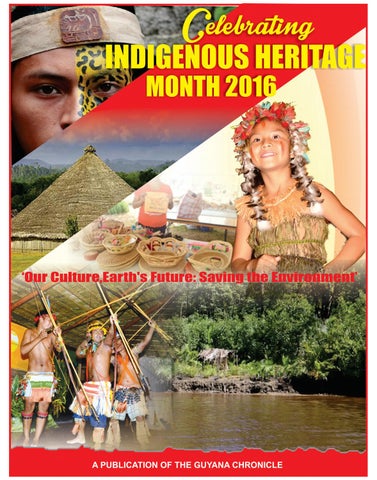
INDIGENOUS HERITAGE MONTH 2016
Why September! EVERY year, without fail, since 1995, the entire month of September is dedicated to the celebration of Amerindian Heritage, in honour of the sterling contributions of Guyana’s First Peoples to the nation’s development. It was so designated by Former President, the Late Dr Cheddi Jagan, specifically in honour of the contributions of the legendary Mr Stephen Campbell, who, at the ripe old age of 60, earned the enviable reputation of being the first Amerindian to ever become a local Member of Parliament. But, why September? Good question! And the short answer is that it’s in memory of the month in which Campbell would accomplish this memorable feat, on September 10, 1957 to be exact. It is also for this very reason that Dr Jagan chose September 10, 1995 as the day on which to make his announcement that the month of September would be dedicated to celebrating Amerindian Heritage, and why, to this day, September 10 is still celebrated as ‘Heritage Day’. Every year, on that very date also, an Amerindian community is celebrated as ‘Heritage Village’, whereby it plays host for the day to a number of activities to mark the occasion. This year, that privilege was granted to Mainstay/Whyaka, in Region Two (Pomer-
oon-Supenaam). Among villages so designated in the past are: Aishalton, in the South Rupununi in 2011; Warimuri in Region One (Barima-Waini) in 2010; Orealla in Region Six (East Berbice-Corentyne) in 2009; and Santa Aratak in Region Three (Essequibo Islands-West Demerara) in 2008. This year, Amerindian Heritage Month is being observed under the theme, “Our Culture, Earth’s Future: Save the Environment; Live the Indigenous Way”. ABOUT CAMPBELL Stephen Joseph Campbell was born in Moruca, a sub-district of the Barima-Waini region, in the northernmost reaches of Guyana, on December 26, 1897. He was of both Arawak and Portuguese extract, having been born to Tiburtio Campbell, a boat builder, and Maria Dos Santos, née Osorio. Unfortunately, both parents died when he was very young, so he had to be raised by one of grandmothers, whom he credited with teaching him the core principles of life, namely: Religion and discipline. A devout Catholic, the father of eight worked for many years as a teacher and a catechist in various regions of Guyana. Besides being the founder of the first school in the village of Sawariwau, reputedly
the oldest Wapichan Village in South Rupununi, he also served as a presiding officer for the North West District during the 1953 elections. He was also involved from time to time in such activities as logging and sawmilling, road construction, gold mining, rubber tapping, fishing and tree spotting. POLITICAL INTEREST His interest in politics would first peak while working at a sawmill in Waini, where Amerindians and other sections of the Guyanese population were seeking representation. The advent of Universal Adult Suffrage in 1951 finally gave Amerindians the opportunity to participate in General Elections, which they did for the first time in history on April 27, 1956. His becoming a parliamentarian the following year would mark a turning point in Campbell’s personal life, which was influenced by a sense of duty towards the Amerindian people. As an MP, he was keen on establishing land rights for Amerindians, and among his greatest achievements was the move towards crafting the Amerindian Act and to develop better health facilities, a postal service and agriculture in the North West District. History has it that back in the colonial days, the rulers allowed Amerindians to live
their life in ‘reservations’ according to their traditions and practices, subject to certain limitations. However, they had no formal title of ownership or established legal rights to the lands which they used or where they lived. As such, they feared that after Independence, whatever rights they enjoyed will then be ignored and the lands on which they lived for thousands of years will be expropriated. PETITION Stephen Campbell travelled to London to present a petition and lobby the British government for recognition of Amerindian land rights. On his return, he would set up the ‘Amerindian Association’ to mobilise pressure on the Independence Commission to ensure that Amerindian interests were taken into account in the independence negotiations. Thus, when Guyana attained its independence from the United Kingdom in 1966, the legal ownership of indigenous peoples of land and rights of occupancy were embodied in the Independence provisions. Unfortunately, Campbell would not live to see this, as he died on May 12, 1966, two weeks before British Guiana gained Independence from Great Britain. He would have celebrated his 69th birthday that December.
Guyana
Amerindian Peoples of
TODAY in Guyana, there are, correctly speaking, four main Amerindian nations, namely: The Warraus, Arawaks, Wapishanas and the Caribs, which are, in turn, sub-divided to include the Arecunas, Akawaios, Patamonas, and Macushis. The Wai-Wais are also included in the Carib-speaking group. The name Indios, given to the indigenous peoples by Columbus, was not at all accurate, as he thought he had found the Indies, making the people there Indians. In order to show the difference between East Indians and these indigenous Indians, as well as to indicate their homeland, the word Amerindian, a blend of American and Indian, was later coined.
Men of the Wai-Wai Nation
THE WARRAUS Believed by many scholars to be the oldest known inhabitants of Guyana, this tribe is known archaeologically for the shell mounds of the North West and Pomeroon, some dating back to 7,000 years ago.
Living in the low-lying coastlands between the Barima and the Pomeroon Rivers and their tributaries, these people were initially called the ‘Water People’, because they built their houses on stilts over or close to the water.
Being inhabitants of the swampy district, the Warraus are excellent fishermen and boat builders; they are also the inventors of the dugout canoe, one of the earliest sea-worthy vessels dating back some 5000 years ago. To them, the palm tree is considered the tree of life, providing them with flour, juice, fruit and branches for thatching and hammock-making. The Warraus, who believe that their ancestors live in the sky land, are unique, in that they are the only representatives of the Warauan linguistic group in South America and Venezuela, and, as a result, their language is known as an ‘isolate’. WAPISHANAS The Wapishanas are said to be recent immigrants to Guyana, having arrived here early in the 18th Century from the Rio Negro area in Brazil. Located in the Rupununi, they are said to be the most reliable and industrious of all the tribes in Guyana. Described as more agriTurn to page IV ►
III
INDIGENOUS HERITAGE MONTH 2016
Remembering
‘a great visionary’ in song, dance and verse
By Clestine Juan
AS part of its programme of events to mark Amerindian Heritage Month, the Ministry of Indigenous Peoples’ Affairs on Monday held an evening of reflection on the life and contributions of renowned advocate for Amerindian rights, the late Mr Stephen Campbell. Revered as being the first person
of Amerindian descent to become a parliamentarian, known back then in British Guiana as a Member of the Legislative Council, Campbell was hailed by both Minister of Indigenous People’ Affairs Mr. Sydney Allicock and Minister within the Ministry, Ms Valerie Garrido-Lowe as “a great visionary”. The event, which was held at the newly-reconstructed ‘Meeting place of the people’, the Umana Yana,
saw a packed to capacity audience being treated to a variety of cultural performances in dance, song and verse, the latter two in both native Amerindian dialects and English. Eighteen persons were also awarded for their contributions to, and development of, the wider Amerindian community countrywide. “Today we gather to reflect on the contribution of a very important
Amerindian who walked Guyana,” Minister Allicock said, adding that Campbell’s legacy is never more evident than it is today, as it has been impacting on the lives of his people in every way possible. Touching on his achievements in the area of land titling in particular, Minister Allicock said, “They say that we came from ‘the bush’; I
say let’s reclaim it! Let the world see our achievement! Let’s record our own history!” The evening’s programme included a dramatic presentation on the legacy of the late Amerindian rights activist, as well as a video presentation by his only son, David, who now lives in Canada and is just as legendary as his dad.
The Mainstay Cultural Troupe in action
Minister of Indigenous Peoples Affairs, Mr. Sydney Allicock (second left) and Minister within the Ministry, Ms Valerie Garrido-Lowe (third right) with awardees following the presentation on Monday night (Photos by Delano Williams)
The dramatic presentation on the legacy of Stephen Campbell
Easter Marslow reciting her poem titled, ‘A proud ‘Buck’
IV
CASSAVA (Manihot esculenta) is a root. The flour is prepared in quantity in order to have enough for baking. First, the cassava root is peeled or scraped of its skin. It is then washed clean and grated. The grated cassava is then squeezed moist of its juice. This is done using a matapee, which is a contractible sieve made of mukru cane (Ischnosiphon arouma, Ischnosiphon obliquus). The resulting dried-out pulp, which is now known as the meal, has to be broken apart into smaller bits, because when it comes out of the matapee, it leaves as a compact tube. The meal is pounded very fine, and sifted to take out any large lumps or fibre from the root. The fine, powdery flour is now ready for baking. Cassava bread is baked flat like a huge flan on a pan. In order to get its form, a hoop can be used to contain the flour, which is carefully spread evenly within the hoop and across the entire surface.
INDIGENOUS HERITAGE MONTH 2016
‒ the Indigenous Peoples way The flour is gently pressed down to make it compact, and allowed to bake slowly until the flour is cooked, and the bread comes together as a flat cake. The cake is then turned over to bake on the other side. When this is done, it is ready for eating. In order to preserve the bread to last longer, it is put out into the hot sun to dry. In the forest, where people spend their time doing many activities, having a food that lasts over a period of time is convenient. THE BY-PRODUCTS Starch, which is also known as tapioca, is one by-product of the cassava.
Amerindian Peoples of... culturists than hunters and fishers, they were once noted for being the major traders and canoe makers of the region. They also excel in the making of cotton hammocks, a skill they reputedly learnt from the Macushis. The Wapishana piaiman (shaman) is called a ‘marinau’, and has power over evil spirits, sickness and disease. The tribe’s religious beliefs are centered on the spirits they call ‘Durimas’.
shovels to build habitation mounds, and raised fields for farming. On the hilltops they planted manioc, which they baked into bread on ceramic griddles. The Arawaks hunted a lot during the rainy season, when animals migrated from the lowlands in search of high ground. Among the game commonly hunted were the deer, labba, tapir, peccary or wild hog, agouti, birds, turtles and parrots.
ARAWAKS (LOKONO) The Arawaks, who were pioneer horticulturists, settled at Hosororo Creek on the Aruka River some 3,500 years ago. They also occupied the Corentyne River around 2,000 years ago, leaving behind their unique type of rock engraving, called the ‘Timehri’. Because of the rich supply of protein found along the coastal swamps, they moved hundreds of tons of earth with wooden
CARIBS (KARINYA) One of the better-known tribes, the people settled in villages near streams, rivers or creeks. The earliest of these inhabited the upper Pomeroon River about 3000 years ago. This tribe was unique in their mastery of painted ceramics, and their pottery is distributed as far as the mouth of the Amazon. The Caribs are the people who gave the Caribbean area its name, and the word
CADIKURA Cassava bread-mak-
Preparing the cassava flour for baking
From page II
‘Carib’ is used to refer to many Amerindian groups scattered throughout the Caribbean islands and South American mainland, north of the Amazon. Their language can be classified together as the Cariban language family, though certain traits of their material culture seem to suggest an association with Colombia. In Guyana, Carib groups are found in the Essequibo Lake District, in the Pomeroon and North-West Districts, along the Cuyuni, Barama and Barima Rivers, and on the Demerara and Mahaicony Rivers. THE SUB-TRIBES THE PATAMONAS Referred to by the Macushi as ‘Ingarikok’, (people of the cool wet place) the Patamonas living in Guyana are mainly located in the North Pakaraimas. They are known, archae-
Members of the Surama Culture Troupe in traditional Macushi attire
ologically, from pottery collections in the Yawong Valley and the upper Siparuni River. The Patamona nation is the one to which the mystical figure, ‘Old Kaie’ belonged. ‘Old Kaie’ is the Amerindian Chief in the legend, which explains how the magnificent Kaieteur Falls got its name. THE MACUSHIS This nation was described as one of the most beautiful ones in Guyana; they were uniquely skilled in the preparation of the deadly ‘curare’ poison. They live mainly in the Northern Rupununi savannahs, and are especially noted for their love of order. THE ARECUNAS Though archaeologically unknown, this nation once occupied the upper and central Kamarang River at least around 1839, and is currently concentrated at Paruima. Their outstanding contribution to Guyanese culture
is the blowpipe, described as ‘the most mysterious and awe-inspiring weapon in the world’. They were once a powerful tribe who were the growers and suppliers of cotton to the other tribes, especially with the Macushis. THE WAI-WAIS They seemed to have moved into Guyana from Brazil during the early 19th Century and occupied the Upper Essequibo River. They are one of the few nations that still use their traditional dress of loincloths and aprons, otherwise known as the ‘Keweyeu’. The Wai-Wais are skilled at weaving and bead-work, and the traditional Wai Wai architecture, exemplified by the Umana Yana, is considered by many Guyanese as the embodiment of Amerindian architecture. THE AKAWAIOS The peddlers and news carriers along the coast, this nation was warlike and ag-
Turn to page V ►
gressive, and was also noted for their blowpipes. They are thought to be the linguistic descendants of the Karinya, and live today mainly in the Upper Mazaruni area, and the Barama, Upper Pomeroon, Demerara, Wenamu and Upper Cuyuni Rivers. It was the Akawaios who pioneered the occupation of the hinterland forests around the beginning of the Christian era around 80 B.C. It is said that once an Akawaio is a friend, he remains that way, but once an enemy, he is an enemy for life. They were so dreaded, that the other nations left them alone, and they became very independent. No matter the nation of Amerindians, they are all renowned for their pride and sensitivity, hospitality, courage, intrepid spirit, dexterity and tracking ability. These proud nations loved liberty, and had no desire for material prosperity. (The Guyana Chronicle: September 17, 2010)
A typical Warrau dwelling in the Orinoco Delta
V
INDIGENOUS HERITAGE MONTH 2016
The ever-popular cassava bread ‒ a tradition with Indigenous Peoples THE Cassava bread is seen as an important part of the traditional diet of Indigenous Peoples. It is said to keep away ‘New-World’ diseases like diabetes, heart diseases, high blood pressure and obesity. Cassava, also known as manioc or yuca in the Americas, is widely used all over the world as a staple. It is one of the food crops developed by Indigenous agriculturists. Fresh fish or meat served with cassava bread is a substantial rainforest meal. Part of this typical meal is fresh hot peppers. Fish or meat is sourced locally. Barbecut meat (a Lokono word from which Barbecue is derived) is commonly served with cassava bread.
With animals becoming scarcer, fish is now much more on the menu. Drinks that are consumed can be made from cassava too. Traditional cassava bread of Indigenous People should not be confused with western-style bread made from cassava flour. In accordance with the recipe of Indigenous Peoples of South America, no salt, sugar, oil, butter, baking powder or yeast is added. When dried properly, the bread can last for days, weeks or even months. The bread is used as a basic staple. Its plain taste can be delightfully flavoured and enhanced by eating with dishes of other flavours.
Making Cassava...
The bread is a filler, because it swells with the addition of digestive juices. To be enjoyed, it has to be properly dried to a biscuit-type dryness, or consumed within a day after baking. The thick, moist type (arasoka), if kept overnight, can be returned to an enjoyable state if mildly simmered in a gravy. One of the best ways to enjoy traditional cassava bread is according to the traditional way. CASSAVA FLOUR The traditional cassava flour of the Indigenous Peoples is made purely from the cassava root, and processed until it is a soft, coarse meal, similar to moist corn meal. Properly processed cassa-
From page IV
A Garifuna, or ‘Black Carib’, woman baking cassava bread in her native Belize
ing has other by-products. The liquid or juice that remains after squeezing is first made into a delicious sauce. It is boiled, and the foamy top is scooped off and collected. This thick, frothy sauce is called cadikura. Fresh meat, fish, shrimp or crab is cooked in the sauce, and spiced with fresh hot pepper. This dish has a unique delicious taste, and is highly prized. CASAREEP Preserving fresh foods such as meat and fish is very important, because it is vital that food is not wasted. The best way to do this is by using casareep sauce. This sauce is made by the further
simmering of the liquid gathered from the squeezing of the cassava after the cadikura is made. After a long time of simmering, the liquid becomes thick and concentrated. By adding the right amount to carefully-washed fresh meat or fish, and including some fresh pepper to taste, a dish is made that can last for weeks by just warming up every day. The casareep sauce preserves the meal. The bonus is that the longer this dish is kept, the more mature it becomes, and the better it tastes. Like cassava bread, this dish has a long life, and is very convenient. (indigenous-rainforest-keepers.com)
Cassava bread being dried on a roof in the Rupununi
va flour, in whatever state, is healthy, and can be a great substitute for persons looking for gluten-free or wheat-free flour. And since cassava flour is gluten-free as well as wheatfree, the bread made from the flour can be used as a substitute
for those who suffer from celiac disease. Cassava bread is also good for diabetic and obese people. It can also be a good substitute for those who wish to have a bread that is free from additives.
VI
Rolling back the years By Neil Primus
DENISE Brittlebank may be 61 and retired, but she’s certainly got a lot of fight left in her still. Born and raised in Linden, Denise first attended St. Aidan’s Anglican, before moving on to Mackenzie High. She would land her first job with the then Demerara Bauxite Company Limited, famously known back then as DEMBA, where she was trained as an electrician. When she left Linden years later for the city, she would enroll at the Government Technical Institute (GTI), where she furthered her electrical studies. After graduation, she became an Electrical Technician, which saw her gain employment with the Guyana National Engineering Corporation (GUYNEC), and much later the Guyana Telephone & Telegraph Company (GTT).
INDIGENOUS HERITAGE MONTH 2016
‒ with Denise Brittlebank, retired educator
Still not satisfied with where she was at, Denise next opted for further studies, and this time entered the University of Guyana, where she successfully completed a degree in Management. CAREER CHANGE She then made a decision to change her career. Denise chose the noble profession of teaching. Her first appointment as an Untrained Graduate Teacher was at the then Lodge Community High, where, after six years of dedicated work, she was promoted to Trained Graduate Teacher and later to Head of the Mathematics Department. In 2006, she was appointed Headmistress of the Port Kaituma Secondary until her retirement in 2009. Years later, she became a Guidance and Counsel-
ling Officer attached to the School’s Welfare Department of the Ministry of Education. After three years, she moved to Camille’s Institute for Business, where she taught for a year before retiring from teaching. Denise now runs a small shop in which she sells confectionery, cosmetics, craft, snacks and stationery. Not only is she an educator and technician, she is also a mother and grandmother. Denise has two daughters. Her eldest is Denise Bristol, who is a teacher at Richard Ishmael Secondary. She teaches Visual Arts. Joanne Young is the second daughter, and she is employed at Fly Jamaica and stationed at Cheddie Jagan International Airport. She has three grandchildren: Andrew Forde, now
deceased, and Jonathan and Joseph Young. FAMILY HISTORY The Brittlebank family belongs to the Arawak tribe and came from a place named Montgomery, on the Upper Demerara River. Her maternal grandfather was an Anglican Deacon named Charles Blunt, who is also an
Denise Brittlebank
Arawak. Her grandmother is from the same village, and their family was involved in timber, cattle rearing and
farming. Her grandfather was a skilled craftsman and violin player. Denise’s mom, Pearl Blunt, moved to Linden when she got married. She had six children, three each boys and girls. Pearl was a dutiful housewife and church helper. She cared for her family, and ensured that they were all educated. Two of her sons are mechanics, and the other a Medex in the Army. Denise became an educator, and another sister a clerical staff. The third sister, like her mother, became a housewife, and an excellent cook and a skilled craft technician like her grandfather. Her father, Isaac Brittlebank, began working at the bauxite company as a greaser. He soon became a Specialist Heavy Duty Operator and Mechanic. Because of his expertise, he was transferred to Matthews Ridge to train persons employed by the Manganese Company. PROUD AMERINDIAN Denise is a proud Am-
erindian who has achieved many things in her life. She is the first electrician trained at Demba (1976). Prior to that year, the field was dominated by men. She is also one of the first female Amerindian electrical contractors, who can wire and certify any building. She disclosed that even though the community she’s from is Amerindian, its peoples are not properly recognised like those belonging to communities in Regions One to Nine. They have the exact same lifestyles, but not the same recognition. She remembers being part of a large family-oriented working group they call Muster. Women, men and children were involved. Suitable land was identified, and everyone gathered there. The men cut down trees, and slashed heavy bushes. They then burned the area. Men, women and children tilled the land, and the children planted the seeds. These ventures were extremely productive, and yielded bountiful crops of cucumber, watermelon, tomatoes, sweet and bitter cassava, eddoes, banana, plantain and other crops.
The talented
Anarika George ‒ a musician in the making
By Neil Primus BORN in Bartica to Olinda and Audley George, 15-year-old Anarika George is smart and buoyant. She grew up among three brothers and two sisters. Her father died ten years ago, and her mother now resides in Venezuela. She attended the One Mile Primary School and later the Bartica Secondary School. Anarika enjoys singing, writing her own music, running and making friends. Her best friends are her cousins Shereda and Sherena. She loves Bartica, and has had the opportunity to travel to Isseneru. The journey was very long, and she remembers part of the journey being by motorcycle. She’s also travelled with her mom to Issano by jet boat. Their having spent a year there, she attended school in that communi-
ty. It was from there that her mom left for Venezuela. One of her happiest memories was travelling to Venezuela to meet her mother. It was a two-day journey by water; they had to stop briefly at Devil’s Hole before going on to San Martin to meet her mom. They were both so delighted to see each other, they cried. In Venezuela, they bought stocks for her to bring back with her to Guyana. She spoke of the warmth and friendliness of the people of Venezuela. Two days later, she was on her way back to Guyana. She also spoke about the two people that mean the world to her. “I love my Aunt Indranie and Uncle Ricardo; I’ve never had the courage to tell her I love her, but I am doing it now. I will always be grateful for all they have done for me.”
VII
Growing up in two different worlds INDIGENOUS HERITAGE MONTH 2016
By Alva Solomon LIFE for me started at the foot of a hill-side community near Mabaruma in the North West District, but on my first day at primary school in the capital, the one thought on my mind was how to fit in. Moving from one environment to another, each distinctly different from the other, is something I’m yet to come to terms with, since I still hold a deep appreciation for life in the hinterland as well as life here in Georgetown.
Mabaruma children making their way home after school
Hosororo Hill is a a small community, the name of which, said to be Arawak in origin, was derived from the “running waters” which flow in a nearby creek of the same name. After their marriage, my parents moved into a large house which was once the home of Roman Catholic priests. It was built close to the village’s primary school, so my daily commute was merely a stone’s throw away. But as time passed, the building’s foundation began to weaken, since it was built close to a swampy area. So, the authorities took a decision to relocate the school a little way up the hill, to the centre of the community. UPHILL TASK Hence, the journey to school to attain an education was now an uphill task, both literally and figuratively; something I’m still grappling with, even to this day. Over time, my parents would make several decisions which impacted my way of thinking from a very young age. As a nine- year-old, I had the responsibility of looking after my siblings while my parents were hard at work long after the normal working hours. Though by no means easy, it was a task that I relished. Then, as I was about to enter Primary Three, known now in the education system as Grade Five, my mother was made headmistress of St Peter and Paul Primary at Morawhanna in the Barima River. And at that early age, I sensed that my future would hinge upon lots of family decisions. But never did I imagine one would entail living in Georgetown. In the Mabaruma sub-region, there were basic country life practices which I’d grown accustomed to, and these included running to my grandparents’ home for food whenever my parents were not done cooking, or “raiding” the
fruit trees in my grandmother’s yard or farm, hungry or not. There is also the Amerindian way of life of my relatives, such as farming, the making of cassava bread and casareep, as well as hunting which was done by relatives on my father’s side of the family. These were all familiar practices.
CITY LIFE But the transition to a city life, one which involves “buying fruits”, having strangers for neighbours, and consuming a different type of food would take some getting used to. Turn to page XIII ►
VIII
INDIGENOUS HERITAGE MONTH 2016
Welcome to
Circuit Ville ‒ a fledgling community with big plans
Circuit Ville’s playground
By Alva Solomon IT’S one of several villages lying along the Soesdyke-Linden Highway, and although it’s a mere three years old, and developing at a rapid pace, it could well do with some assistance from the relevant authorities. It’s called “Circuit Ville”, and lies a few hundred meters from the Yarrowkabra Junction along the Highway. The village was named after the South Dakota Circuit, which lies in the vicinity of the Cheddi Jagan International Airport (CJIA), and since the access road to the Circuit passes nearby, residents settled on the name Circuit Ville. The Guyana Chronicle recently paid it a visit, and since it was a Saturday morning, it was felt that many residents would be at home. It’s an assertion that would eventually prove wrong, as being almost at the end of September, the month dedicated to the celebra-
tion of Indigenous Peoples, most residents were out visiting other villages which were hosting their celebrations. EERILY DESERTED A sign announcing the name of the village on the side of the Highway greets the visitor. On entering the village, however, there was no-one in sight, except for the lone dog wagging its tail in the distance, and a few hens pecking at the earth nearby. The silence was suddenly broken by two children playing with an empty fuel bottle; from all indications, the playful chatter was coming from the first house at the entrance of the village. The family was apparently shy, as each question thrown their way about Circuit Ville was met with the same refrain: Ask Melisa Mundo. “We came here a few months now, but you can go over that side by Melisa; she got all the
A visitor makes her way into Circuit Ville (Photos by Alva Solomon)
information,” said the head of the household from somewhere in the recesses of a hammock. Since information gathering
Melisa Mundo helping her husband prepare some bar-b-que
Cassava and corn plants in a resident’s garden. Farming is one of the village’s main economic activities
seemed to be hitting a stumbling block, the next best step was to find this elusive Melisa Mundo. A brisk walk along the sandy playfield soon led to her home. After hailing out to her a few seconds, her husband reponded, saying she would be out shortly. LEADER OF SORTS Mundo is regarded as the leader of the village. She seemed prepared for an interview, and this first-impression presented by the woman was an indication of the kind
of woman she is: ‘Straight-up’, well-informed, prepared. She also seemed to have all her plans for Circuit Ville at the tip of her fingers. Most of the village’s 378 residents, she said, relocated there from the Rupununi, while a small number moved there from other parts of the hinterland. Some even come from the coastland. She said most of the people living there are Wapishanas, and according to her, nurturing the village’s rich Amerindian heritage
IX
INDIGENOUS HERITAGE MONTH 2016 The Full Gospel Church
is a work in progress. On September 11, the village hosted its third annual Heritage Day celebrations; one which was characterised by dances, football games, and archery among other traditional and conventional games. A Full Gospel church was erected in the village recently, and residents are hoping that other facilities, such as a health hut will bode well for the further development of the community. ORIGIN But, how did Circuit Ville really come about? Mundo said she moved to the area around 2012, and in 2013, the few residents who were there at the time decided to establish a community. “What I did was,” she said, “I found a few squatters here before, and we highlighted what we were doing to the APNU.” To their credit, she said, the then opposition party listened to their concerns. “And as time progressed, so did Circuit Ville. We see a lot of things happening, by no body’s help,” she said, a purposeful ring in her tone of voice. The village boasts a well-kept playground; a football team named “The Circuit Ville Jaguars”, which trains regularly; and a women’s group which undertakes the task of maintaining the craft tradition and other cultural customs. The 70 or so children who make up the population attend school mainly at Hauraruni, a community further south along the Highway. DEVELOPMENT PLANS “The plan is to regularise the place; I am trying very hard to have that done,” Mundo said, adding that this year, officials from the Ministry of Indigenous People’s Affairs visited the village and even attended their heritage celebrations earlier in September. “I hope to God that they do something for the people in here,” she said, adding that water and electricity are two services that are sorely needed there. At the moment, residents rely on their small generators for electricity, while water is obtained from a pond which they excavated to help along the situation. “It’s a spring, but we developed it,” Mundo explained. At the moment, most persons from the village work along the Highway at sawmills or such other entities, while others either have regular office jobs in the city, or are engaged in farming. The women’s group is also trying to reach out to various Non-Governmental Organisations (NGOs) in the hope of getting help with their development plans. As regards upcoming events, the village will be hosting children and adult parties in December, while other areas of cultural exercises are expected to take place. Recently, Circuit Ville formed its own policing group, even though crime is almost non-existent. In the longrun, however, the villages’ aim is to form a Community Development Council (CDC), and work is already in progress in that regard. “There are bigger villages along the highway,” Mundo said, “and we plan to be just as big as they are.”
The pond which is the main source of water for residents
Toshao Fredericks ‘The Singing Pastor’ X
INDIGENOUS HERITAGE MONTH 2016
By Alva Solomon
PRESIDENT David Granger referred to him as the singing pastor. His unique voice can be heard way across the room. He’s Mainstay/Wyaka’s Toshao, Joel Fredericks, a man of many talents. At the opening of the National Toshao’s Conference back in August, Fredericks stood at the podium, and while addressing dozens of Amerindian leaders from across the country, he made known the work of the NTC as well as the expectations of the nation’s First Peoples. It was a bold address by an Amerindian leader; one which gave those in the audience an insight into the measure of man that Fredericks was. On September 10, the day set aside for Heritage Day as well as Heritage Village celebrations across the country, all roads led to the village of Mainstay/Whyaka, the hometown of Toshao Fredericks. The roadway which connects the village with the Essequibo Coast Public Road was busy that morning, as busloads of people were being ferried to and from the village. As a bus loaded at the Anna Regina car park, a familiar voice could be heard in the background. It was, in fact, the voice of Toshao Fredericks, and this time around, he was singing. The music was loud enough for anyone to enjoy his matter-of-fact lyrics, and the two songs were played over, and over, and over. No one in the bus seemed to mind that the same songs were being played so frequently. During the ride into the area, a lady in the bus remarked, “Is Toshao singing a song he only record the other day.” BUSY AS A BEE Once the ‘Heritage’ celebrations got underway, Toshao Fredericks was kept busy as a bee, marshaling the proceedings from the get-go. As the programme moved along, the emcee announced a
He’d served as Toshao in previous terms, leading a village that is well known around the country, mainly for its popular lake.
MAN OF THE CLOTH Fredericks preaches his sermons outside of Mainstay/ Whyaka, at another lakeside village: Capoey Lake. There he preaches every Sunday at the “Grace Church of God”. He’s been travelling every Sunday to take the sermon at that particular church since 2008. The father of five is well loved by his family, especially his wife. “We all love him; he works hard. He loves what he does, and he sacrifices a lot of family time,” she said. But despite his busy schedule, he somehow finds the time to put his Amerindian brothers and sisters first, testimony to which is his efforts to revive the village. stage rforming on Fredericks pe ge Day’ activities during ‘Herita at Mainstay
cultural item. It was Toshao Fredericks turn to take the stage. He grabbed the ‘mic’ and his song, “Love Mainstay”, was played as he sang along to the lyrics. The song was probably played throughout the weekend event, and patrons were in a joyful mood as the event progressed. Busy as he is, it’s an uphill task to find Fredericks, and it seemed well nigh impossible to find out who the man is. Until a call was placed to the next best person: His wife, Gem Pearson Fredericks. She told this publication that her husband has been serving Mainstay/Whyaka for several years.
PINEAPPLE PROCESSING While speaking at the ‘Heritage Day’ celebrations, Fredricks said that the village is in dire need of a strong manufacturing sector, and he named the unused pineapple processing facility as a feature which needed resuscitation. The mill was once operated by the village for a readily available market. Due to several reasons, however, the mill stopped working. Earlier this year, the government examined the possibility of resuscitating the project, and this is among Fredericks’ plans for putting the village back on its feet. In addition, Fredricks is working along with the Council regarding the expansion of the sports facilities in the village; but his biggest dream is to ensure the village builds a guesthouse. His wife said her husband tries his best where the development of the village is concerned, and utilises his talent to inspire the people there.
folklore
INDIGENOUS HERITAGE MONTH 2016
XI
By Neil Primus
Then the moon came up JACOB Himmler was a stone-cold killer; he had killed many times over, and had never been caught. His victims were young women. The only time he ever killed outside his designated kill zone was if someone became suspicious, and began asking too many questions. He always planned well, with three alternatives: A, B and C. It had paid off so far. He sat in the ‘Airbus’ and looked through the window at the country below him. He was about to land at Freedom International Airport in the Amazon Region. As the aircraft’s
he was tired as he climbed the stairs to his room. All he wanted was a bath, a hot meal, then sound sleep. Two days later, he travelled to Vincent International Airport, where he boarded a plane heading into the interior. Soon, they would land at Jaguar Plain, where he disembarked and walked to the guest house. The next day, he hired a guide and began his trek through the jungle, travelling from village to village. WELL EQUIPPED Jacob was well equipped for the job at hand. He had his GPS, compass, satellite phone, and an adequate amount of food. His backpack held his food and other vital items. The most important of them all were the 9mm pistol, the machete, and the wicked-looking 18-inch-long ‘Rambo’ knife. He felt a thrill with every step he took. Soon he would kill again in a foreign country. That was what was unique about him; half of his ten victims were not killed in the USA. The killings were done in France, Britain, Holland, Germany and Italy. This would be his first in the Caribbean. Each village they visited, he was first introduced to the Touchau, and later the villagers. The communities were not very large, and living conditions were below basic. The people were warm and friendly, and opened their homes to him. He kept his eyes open for the chance to pounce on a victim. OPPORTUNITY KNOCKS The opportunity soon pre-
wheels touched down with a slight bump, he gathered his belongings. In an hour, he was sitting in a taxi, heading for the Golden Glow Hotel. The next day, he called the local tour company that he had made contact with before travelling. Arrangements had been made for him to go on three sweeping tours of Amazonia. The first tour was aound the capital city of Happy Valley. He visited many places of interest, and felt contented when he got back to the hotel that evening. Green Trail was his second tour experience. He travelled to sugar estates, cane fields and historic sites in the Ancient County. The drive to and from the eastern part of the country was long, and
sented itself. He heard a parent telling their teenage children to be careful where they slept on their three-day journey to another remote community named Harpy’s Nest. This was the cue he’d been waiting for. First, he paid his guide well and sent him away. The next thing he did was enquire about the way to Harpy’s Nest. Early the next morning, he headed for the small community. He walked for most of the day, then pitched camp a short distance away from the trail. Then he waited. No fire was lit; he used small, modern gadgets that made outdoor experiences less stressful. He saw a few travellers go by: Two men, a family, and three women. Patience was what made him so successful. He just relaxed and waited. The next day, he was in luck. He saw the lone figure of a woman heading his way. He got his tranquilizer injection ready, and slipped as silently as he could towards the trail. As the person drew closer, he saw that it was a teenager. Small-bodied with long black hair, he knew that she would not put up too much of a struggle. As she passed his place of concealment, Jacob struck swiftly and expertly. In a matter of seconds, she was lying motionless on the trail. He scooped her up and withdrew Turn to page XIII ► to his campsite. He packed
‘Tocuma Restaurant’ XII
INDIGENOUS HERITAGE MONTH 2016
‒ Authentic Amerindian foods all year round By Telesha Ramnarine
FOR some time now, Collin Andrews and his family have noticed how it was only during Amerindian Heritage Month that their fellow Amerindians would come to the city to savour all of their delicious indigenous delicacies. And so they thought to themselves, “Why not create a restaurant in the city where people can access such food year round?” Furthermore, they thought that there is not another one of its kind around at the moment! And so the ‘Tocuma Indigenous Restaurant’ was esA staff member preparing the restaurant before it’s opening tablished on May 3, 2016 in scene. time for Guyana’s Jubilee celebrations. ONE OF A KIND In an interview at the restaurant, on Waterloo Street, just “Currently, this is the only restaurant of the sort,” he said, next door to Tropicana, Andrews told the Guyana Chronicle adding: that having observed that there were all sorts of other restau“The celebrations during Heritage Month in September... rants around -- Chinese, Brazilian, Indian, Creole -- he felt it Turn to page XV ► that’s when people get the inwas high time for an Amerindian restaurant to come on the
Owner, Mr. Collin Andrews
XIII
INDIGENOUS HERITAGE MONTH 2016
Then the moon... quickly and moved off into the forest, heading east. The going was tough, but he kept moving. The girl was not very heavy, and the make-shift stretcher he’d created dragged noisily along the bumpy path. He stopped just before dark, and prepared his new campsite. This time he used a fire; he felt confident, because he was deep in the jungle, and away from any settlement. The knock-out medication he had administered three times along the way would soon be wearing off.
NIKITA Nikita was 16 and full of life. She was intelligent and wise; she topped her class in school, and outplayed the girls in any game. But that was not what made her special: She was the daughter of the village Piaiman; a man who was believed to possess all sorts of strange powers. These powers had been passed down from generation to generation. His father had received it from his grandfather, and had passed it on to him. Now, the father had passed it on to his only child, Nikita. Everyone in the village knew the family was special. Her father called her, and asked her to go to Harpy’s Nest to take some special medicine to the ailing chief. She had made this trip many times; as early as seven years old. The next morning, she left before daybreak. She hummed to herself as she walked along. The sun was up, but the trail was cool, because only a limited amount of sunlight was able to penetrate the carpet-like canopy above. She heard a noise in the bush to her left. Wary that it might be snakes, she started to turn in the direction from which the sound came. As she did so, someone put a hand around her neck; then she felt a sharp prick. She tried to struggle, but felt weaker and weaker. Then, total darkness engulfed her. HELD CAPTIVE She came to with a groan, and slowly opened her eyes. She was lying on the ground on some sort of wooden contraption. She tried to get up, but was too
weak to do so. She looked slowly around; she was not alone. Sitting a short distance away was a man; a White man. The only White man she had ever seen before was the Catholic priest who visited the village once every month. This man was different; he was much bigger, and had a mean look about him. He was watching her closely. “I’m glad you are awake; I’m not going to harm you,” he lied. She remained silent, waiting for her strength to return. He seemed to sense what she was thinking. He pulled a gun from his backpack, and showed it to her. “If you scream or try to escape, I will kill you!” She knew that he meant every word. No point in doing anything rash at the moment. This was her home; her territory. And he was an outsider. She knew she had the advantage. She closed her eyes and rested.
WAITING GAME Jacob ate slowly. He put a tin of mixed fruit, two pieces of chicken and a can of soda near to the girl; then he sat and waited. Some instinct told him she might try to make a run for it. He used two shoe laces to bind her hands and feet together. Now that she was well and truly trussed up, he decided to take a quick nap. In a short while, he was sound asleep. He awoke with a start. He looked around quickly, then relaxed. She was still there, lying quietly, and looking at him, pupils jet black and bottomless. He got up and dragged her to the nearest tree. He sat her upright, back against the trunk. Drawing the large knife from its scabbard, he sat and thought about how he would kill her. This excited him. “I am going to kill you!” he said casually. She remained silent. He realised that she had not uttered a word since she had been captured. What impressed him the most was the fact that she showed no fear. Here she was, a captive in the middle of a jungle and about to be cut to pieces, and she did not cry or beg.
COLD AND DARK It was cold and dark at the campsite. They were in a small clearing, and he could see the sky above, littered with brilliant stars. The moon was slowly making its way into a position of prominence in the diamond-studded heavens. Its light was creeping steadily their way. As he watched this magnificent picture, he thought about his first kill. The woman was a hooker he had picked up in London. Instead of going to a motel, he took her to a lonely spot on the bank of the Thames, and there he stabbed her to death. He quickly covered his tracks, making sure that no personal items were left at the scene. He took her purse so as to throw investigators off of the trail. Then he went back to his hotel, which was three hours away by car. He must have dozed off, because when he opened his eyes again, things had taken a bizarre turn. The moonlight had flooded the area, and everything seemed to
come alive. Heart thumping, he stared at the empty spot where he had put the girl. The laces were there, alright, but they’d been snapped and destroyed. Jumping to his feet, he reached for his backpack and received a bigger shock. The gun and knife were gone. For the first time in his life, he felt fear; fear of the unknown. Something was drastically wrong with this entire scenario. How was it possible for a slip of a girl to snap her bonds, steal his weapons and escape? He knew that was almost impossible, because he was a very light sleeper. Something else was happening, and he was right in the middle of it. SOON FREE Nikita smiled when she saw the approaching moonlight. Soon, very soon, she would be free. As the beams saturated her body, it seemed to infuse her with some sort of supernatural power. With every passing second, she grew stronger and
From page XI
stronger. Closing her eyes, she began to chant in the ancient way that her father, her grandfather, and all her ancestors had done. With every chant, her body was being transformed. Pretty soon, she was no longer little Nikita, but a thousand-pound killing machine. She swiftly removed the weapons and hid them in the jungle. Then she crept back to the camp and waited. She did not have to wait too long; the killer awoke with a start. He stared around him in shock, then fear crept into his cold blue eyes. Now was the time to strike. She moved soundlessly towards him, her every instinct telling her to do one thing only: Kill! He sensed that something was nearby. Turning, he came face-to-face with the only animal he needed to fear in the tropics: The Jaguar. THE KILL The animal sniffed the
Growing up in two... In 1993, once settled in the classroom at Tucville Primary in south Georgetown, the task was to become aligned with city life and more importantly, school life. Going to school in the hinterland cannot be compared to doing so in the city. The environment was totally different, and this included having to buy snacks from the school’s canteen, as opposed to climbing a fruit tree or simply visiting my grandparent’s kitchen when the hunger pangs kicked in. At the time, my smaller siblings were still in my grandparents care in the North West District, and that impacted my transition to life in the capital city. But the brighter, faster environment in Georgetown was something to look forward to, hence the learning process at school was made easy. As the Common Entrance Examinations neared, so did my preparation pick up speed; and my father especially was the driving force behind that particular process. When the examination results were announced in August of 1995, I was probably catching fish in a back-dam area way behind my grandparent’s farm outside Hosororo Hill. At the time, the only form of communication was by way of letter, and writing letters at the time probably contributed to my skills today as a writer. I would explain to the recipient what was happening; the developments in a relative’s life, and expectations in the months ahead. GOOD NEWS One afternoon, after the MV Kimbia docked at Kumaka, a port outside Mabaruma, my grandmother called out to me that the Common Entrance results were out, and that I was awarded a place at one of the country’s premier secondary schools, The Bishops’ High School. The information was contained in a letter from my parents, which had arrived moments earlier via the ferry from Georgetown. My story-book life, as I deemed it at the time, grew a few inches more interesting, and when the principal at that Bishops High School informed my parents that I was actually eligible to gain a place at Queen’s College, I was silently elated for I’d worked hard, with the aim of attending that very school.
air, and looked steadily at him. It was the eyes that gave it away; they were as bottomless as those of the little girl. Then, the ‘bigcat’ moved, and he sensed it was she. Only now, she was not the victim; he was. The cat pounced. All he saw was a blur, as its teeth sank into his neck. Everything went blank. The tourist was discovered by a young Amerindian girl. She was on her way to another village, when she noticed buzzards circling nearby. Upon investigating, she found the man, mauled beyond recognition. His flesh had not been eaten; he was just brutally ripped to shreds. Villagers were questioned, but no light could be shed on his movements after leaving the village and heading to Harpy’s Nest. Nikita’s father held a ceremony in the village that night; it was one of thanksgiving and the passing of the baton. She was now the Spiritual Healer of the village.
From page VII
Once at Queen’s College, the task was now to develop my academic potential and make a meaningful contribution in one way or another to the society. Throughout my schooling, I admired several persons in the Guyanese society; some are no longer alive, and some remain vital to the country’s development. And the one thing that has always stirred by interest and will continue to win my attention is hinterland development; to modernise the interior with the basic forms of infrastructure as in the city. While I remain profoundly impartial in my current profession, my Amerindian heritage is forever in my thoughts, and every opportunity that is presented to me to foster the development and maintenance of that heritage, is usually welcomed with open arms. EDUCATION’S THE KEY Education, in my opinion, plays a key role in the harnessing of that heritage, and each year, as time progresses, many of my Indigenous brothers and sisters have been capitlaising on the educational opportunities provided them. Today, some are doctors, lawyers or scientists here in Guyana and overseas. Whether through scholarships or self-sponsored initiatives, many have relocated to the city from the hinterland to enhance their academic potential. Today, too, that task is made much easier through the use of technology, and families can communicate in real time on the developments at their respective ends of the communication lines. Being of Amerindian decent is one of my most cherished qualities, for I can relate to the lifestyle and the perceived struggle of my brothers and sisters in their quest to uplift their respective lives. Living in the city and understanding life here adds to my knowledge. I try to set myself as an example to others, whether young or old, and while I try my best to remain out of the spotlight, I know that there are persons who are working towards their goals in the same breath. Education, in my opinion, is the vehicle which will drive the development of the hinterland, and the country at large.
XIV
INDIGENOUS HERITAGE MONTH 2016
‘Heritage Day’ activities in photos
Benabs constructed at Mashabo in time for Heritage Day activities this year
Children of Mashabo performing a dance during ‘Heritage Day’ celebrations there on Sunday
Stocks on sale at Mainstay/Whyaka
A cultural item at Lake Mainstay during ‘Heritage Day’ activities there (Photos by Alva Solomon)
XV
INDIGENOUS HERITAGE MONTH 2016
The makings of a good Tuma ‒ not everyone knows the secret TUMA is a tasty Amerindian dish that is prepared with various types of meat and fish that is eventually complemented by a sauce that is produced from cassava extracts. Not everyone can get it right, because although it is a simple dish to prepare, there are certain technicalities that must be observed. Only those who grew up around it and who had the knowledge passed on from their parents and grandparents seem to get it right today. Ann Bradford, who hails from Kwebana, in Region One (Barima/Waini), cooks the Tuma on a daily basis at the Tocuma Restaurant on Waterloo Street. She told the Guyana Chronicle of at least some of the things involved in making a good Tuma. After the cassava is grated and squeezed, the juice is boiled and then seasoned, after which the meat is added. To season the water calls
I know about it from small growing up. It’s a simple dish that people enjoy; but you have to know how to do it, because not everyone can do it. I was raised in a village where it was around
a lot,” Bradford said. But her boss, Mr. Collin Andrews, offered that not just anyone can prepare this dish. He explained: “It’s a special delicacy; not everyone can just boil this thing to get the right taste. The extract of the cassava is poisonous, so if you don’t know yourself,
you can have people falling down. That’s why you have to know how much to boil it, when’s ok, all these things. That’s why we had to choose our cooks wisely.” Another cook, who specializes in the preparation of pepperpot at the restaurant, Lunkiin King, grew up in
‘Tocuma Restaurant’ Tuma specialist, Ann Bradford
for the usual thyme, onions, garlic, cubes, salt, and of course, plenty hot peppers. The meat or fish would be prepared separately and seasoned also, and at some point, added to the water to make the Tuma dish complete. “The dish is very tasty;
digenous food. And then they would have to wait until the next September comes around to get back all these delicious delicacies. “So, that gave us some encouragement to have a restaurant of this sort.” Andrews, who hails from Moraikobai, in Region Five (Mahaica-Berbice), described his restaurant as unique, and one that regularly features wild meat, fresh-water fish and the Tuma. “The Tuma is a very special dish among Indigenous Peoples; it’s an extract from the cassava. I have met with friends, and they are always wondering where they could get some Tuma from,” he said, adding: “When I go to the village and come back with some, the amount of people I would have to share it with! That shows how much people want it.” ONLY WILD MEAT Apart from the Tuma, the restaurant daily has regular dishes like curry and so forth, but they’re all only made with
Morawhanna, also in Region One. She said that although Tuma can last for a very long time without spoiling, the restaurant prepares a fresh portion each day. Tuma can take as little as 20 minutes to cook, once all ingredients would have been prepared.
From page XII
wild meat. “Pepperpot with the wild hog; fish cake made out of the fishes from the interior. We have everything that a usual creole restaurant would have; it’s just that our stuff is different,” Andrews pointed out. They, however, cater daily for those customers who do not wish to try out any indigenous foods. As for the restaurant’s cooks, Andrews said they employ persons from various indigenous regions so as to ensure that the dishes taste as they should. “We also source our ingredients from different regions, and try to market their produce,” he said. “Our cooks grew up cooking these foods, and have also qualified themselves at Carnegie.” Andrews said he is cognizant of the fact that each region in Guyana has different delicacies, and so his plan is to feature special dishes on weekends according to the region. He also wants to implement Indigenous karaoke music, and have in the restaurant authentic casareep and cassava bread on sale, in addition to art and craft.
XVI
INDIGENOUS HERITAGE MONTH 2016