ChatGPT raises academic dishonesty concerns, prompts responses, guidelines from teachers
Victor Dang Reporter
ChatGPT and its ability to generate original text from almost any user-provided prompt has cast some uncertainties about the future of technology use in and out of the classroom at Gunn.

The artificial intelligence chatbot developed by the startup OpenAI was originally launched as a prototype in November 2022. Since its official release in February, its popularity has skyrocketed. ChatGPT’s ability to output detailed responses to almost any question has made it appealing to some students as a completely automated homework-completing machine.
it’s not actually their own work—we all know that it’s a shortcut.”

Computer science teacher Joshua Paley compared students using ChatGPT to do schoolwork with the online school experience of the 2020-2021 school year. “During the pandemic, students didn’t have ChatGPT, but they did have Discord,” he said. “So imagine you’re a teacher and you’re giving a test during the pandemic. How long do you figure it will take for the test to be visible by all students on Discord and for them to be chatting about it?”
English teacher Justin Brown is still considering what to do about the rise of ChatGPT usage among students. “Right now we’re just in the stage of trying to get to know the technology and what it can and can’t do, as well as worrying about how much we should really change what we currently do,” he said. “The important thing we’re trying to figure out is how we can use (ChatGPT) to enhance what we do rather than have it be an obstacle that’s a problem for us.”
Ichikawa has done several activities with her students involving ChatGPT, with the goal of demonstrating the gap between human- and machine-generated work.
The Gunn student handbook defines what does and does not count as academic dishonesty: “Allowing others to complete your course work or to take your quiz, test and exams is considered cheating and could result in a review by your teacher followed by consequences.”
English teacher Diane Ichikawa believes that using ChatGPT to complete school assignments violates that honor code. “I showed my freshmen a story where a man bought a painting from an artist, and then interviewed the artist saying that ‘I bought this under the idea that you had painted it, but it turns out it was AI.’ And the artist said, ‘Well, but I put the prompt in for the AI,’” she said. “All the students laughed at it, and I said, ‘If you put the prompt in for an essay, and it spits out an essay, did you write it?’ I think it’s clear to students that
“I had students write about ‘The Grapes of Wrath’ for about 20 minutes,” she said. “Then I had them plug the same prompt into ChatGPT. We compared the two responses and saw quality and depth differences.”
Ichikawa did another activity with her freshmen students to highlight faults in the AI.
“My freshmen plugged in some poetry prompts, and even with very specific prompting to not rhyme or meter the lines, it still continued to rhyme and meter everything, so they could see some of its limitations,” she said.
ChatGPT—p.2
Write me a summary about how ChatGPT is impacting student education.
ChatGPT is impacting student education by providing a wealth of information on various subjects, generating customized study materials and aiding in students’ learning and understanding through natural language processing. Its accessibility on multiple platforms is making it a valuable resource for students worldwide.

PAUSD implements voluntary opioid overdose trainings for staff
In response to the growing opioid crisis among teens, Palo Alto Unified School District will be stocking school campuses with opioid antagonist naloxone hydrochloride, a medication for narcotic overdoses in emergency situations, and implementing voluntary trainings to equip staff members with skills to identify and respond to overdoses this month.
Pursuant to California Education Code 49414.3, the staff trainings will include techniques for recognizing symptoms of an overdose; standards and procedures for the storage, restocking and emergency use of Narcan; and basic emergency follow-up procedures, among other practices. According to District Health Services Coordinator Rosemarie Dowell, the county has also equipped PAUSD with 122 kits of Narcan, which will be distributed across all school campuses, as well as Greendell Preschool, Cubberley Community Center and the district office. Inside each kit will be two doses of Narcan, guidelines on how to administer it, cardiopulmonary respiration face masks and gloves. These kits will be placed in a variety of locations across the campuses, from
emergency carts in health offices to automated external defibrillators mounted on walls.
According to Dowell, although the California Education Code was altered in January 2017 to allow for the administration of Narcan on school campuses, many districts—including PAUSD—decided not to move forward with opioid antagonist trainings because city emergency services could be counted upon to arrive quickly enough to intervene in the event of an overdose.
Safety, Security and Disaster Preparedness Manager Mike Jacobs
Still, rising overdose rates, particularly in the teen population, prompted action. The pandemic saw a surge in fatal adolescent drug overdoses: A report from the Centers for Disease Control and Prevention found that median monthly overdose deaths among adolescents

more than doubled from July to December 2019 to July to December 2021, and 84% of the deaths involved illicitly manufactured fentanyls. According to the California Department of Public Health, the annual crude mortality rate for opioid overdoses in Santa Clara County in 2021 increased by 73% from 2019. “In the past couple (of) years, there has been a growing discussion about being more proactive,” Dowell said. “The county has had a big discussion on that, on really pushing for getting more education (and) being prepared.”
On Dec. 20, 2022, the school board updated its medication policy—Board Policy 5141.21—to reflect existing California School Board Association language regarding Narcan, which allowed district health services to move forward with implementing trainings and distributing kits. According to Safety, Security and Disaster Preparedness Manager Mike Jacobs, distribution of Narcan kits is expected to be completed by mid to late March. Trainings will begin in March and will continue as needed throughout the year. In addition to these initiatives, the district will also be holding a fentanyl awareness event on March 22 to educate students and parents on the issue and to distribute kits of Narcan to them. Fentanyl—p.2

Palo Alto Unified School District Henry M. Gunn High School 780 Arastradero Rd Palo Alto, CA 94306 NON-PROFIT ORG U.S. Postage P A I D Permit #44 Palo Alto, Calif. P. 8-9
Check out student content creators’ processes and plans! Check out our website! gunnoracle.com Follow us on social media @gunnoracle
Features
“The important thing we’re trying to figure out is how we can use (ChatGPT) to enhance what we do rather than have it be an obstacle that’s a problem for us.”
English teacher Justin Brown
Amann Mahajan Forum Editor
“The
amount of fentanyl needed to overdose is equivalent to two grains of sand. In short, one pill can kill.”
Source: ChatGPT
Aarushi Kumar
Monthly highlights: Spring Sports Rally
“We had a solid turnout. Pooja and my (announcing) worked well because we got through the teams quickly.”
Spirit Commissioner Nico Ross, 12
ChatGPT use sparks discourse surrounding its role in education
ChatGPT—p.1
Although faults do exist with the software, junior Om Mahesh believes that ChatGPT can be a useful tool for students with specific questions. “If you’re trying to search for something like a synonym for some word, ChatGPT is pretty good at that,” he said. “I think it’s just a better way of Googling.”
That being said, Mahesh understands that ChatGPT is far from all-knowing and struggles to be helpful in many cases regarding schoolwork. “There was one time when I tried to ask a math question like, ‘What is the prime factorization of one?’ and it gave me a wrong answer,” he said. “ChatGPT is just really bad at math. If you try to do five-digit addition with it, it just can’t.”
Ichikawa agrees that the technology can be helpful for students when used with caution. “The ability to ask (ChatGPT) for prompts, like ‘What should I write about?’ or (when) it’s used as a brainstorming generative tool could be helpful,” she said.
Others, such as freshman Meilin Hansen, believe that using ChatGPT for schoolwork causes more harm than good. “If you’re relying on it to do your homework, then that’s a very strong dependence on a computer that you

can teach two plus two is five,” she said. Still, she expects many students to attempt to be academically dishonest on assignments by using ChatGPT to complete them. “I anticipate students using this to cheat on all sorts of things,” Hansen said. “I’ve had to resist strong temptation to not.” Mahesh echoed her thoughts. “Cheating on essays is definitely spreading and becoming more and more common,” he said.
“The ability to ask (ChatGPT) for prompts, like ‘What should I write about?’ or (when) it’s used as a brainstorming generative tool could be helpful.”
 English teacher Diane Ichikawa
Despite the potential for academic dishonesty, Paley doesn’t plan on adjusting his classroom routine to accommodate for the existence of ChatGPT. “At the end of the day, if you use ChatGPT to do the programs in my class, fine,” he said. “Have fun on the tests that are on paper.”
Paley also believes that, like him, other teachers won’t make any drastic changes to their classes to prevent academic dishonesty stemming from ChatGPT. “I don’t think that there are many teachers out there who are interested in policing ChatGPT,” he said. “Nobody wants to deal with that, and I know I don’t want to deal with that.”
ChatGPT’s computational power, precision and accuracy can only grow over time as its developers continue to improve it. Ichikawa accepts that academic dishonesty from ChatGPT and similar applications will be an ongoing issue for many years to come. “It’s only going to get better and more sophisticated, so I don’t think that we should bang our heads against the wall trying to stop it,” she said. “There should be ways that we can try to work with it. I don’t know what they are just yet.”
Regardless of whether or not overarching Gunn policies or individual classroom policies change as a result of ChatGPT, its existence will most likely be permanent. While Paley doesn’t see himself enforcing policies regarding AI in his classes at all, he still advises awareness of the issue. “The important thing to understand is that ChatGPT isn’t going to go away,” he said. “That’s the world we’re all stuck in.”
Recent rise in opioid overdoses leads to district-wide staff trainings
These recent developments at the district level have made the severity of the opioid crisis clear. Synthetic opioids are often more potent than their natural brethren, meaning that even a tiny dose can be fatal. It’s often difficult to tell the difference between a drug and its fentanyl-laced counterpart, so if users unknowingly ingest contaminated drugs, they can easily overdose. According to the same report from the CDC, evidence of counterfeit pills was found in 25% of adolescent overdose deaths. “Fentanyl-filled pills are being sold in many forms and all look exactly like legitimate pharmaceuticals,” Jacobs wrote in an email. “The amount of fentanyl needed to overdose is equivalent to two grains of sand. In short, one pill can kill.”
“Say you’re at a party and someone shows up under the influence of opiates and there’s an overdose. You could be the person that could prevent someone from dying.”
Junior Prianka Rao
Most of the time, these counterfeit pills aren’t prescribed, but instead bought on the street or on social media. Physical education teacher Amy Anderson recalled the death of her friend’s son, Carlmont High School senior Colin Walker, in 2021. According to Anderson, Walker began using cannabis to self-medicate as he struggled with mental health during the pandemic, eventually moving on to harder drugs. He died after ingesting fentanyl-laced
cocaine bought off of Snapchat. “(His parents) were not condoning their son’s drug use, but the bottom line is (that) what he purchased off of Snapchat was not what he asked for,” she said.
Given the insidious nature of the counterfeit pills, students and teachers alike have advocated for greater drug education. Living Skills teacher Jeanette Tucker emphasized the importance of repeated instruction on the issue. “You just need to hear it more than once,” she said. “Obviously, your parents are going to tell you that. But if your guidance counselors are doing a show or presentation (and) your SELF class talks about it, (it sinks in).”
Some, such as junior Prianka Rao, have also pointed to education about drug medication as a way to counteract fatal overdoses. “Say you’re at a party and someone shows up under the influence of opiates and there’s an overdose,” she said. “You could be the person that could prevent someone from dying.”
Still, stigma often proves to be a roadblock to conversations about drugs. According to Tucker, the mischaracterization of drug use as a conscious choice rather than an uncontrollable addiction often results in a victim-blaming narrative, something Rao has also seen. “People at Gunn aren’t strangers to the fact that kids are doing drugs, but they’re (mostly) talking about smoking weed,” Rao said. “Things like addiction and hard drug use don’t really make sense to them. It’s kind of like, ‘Whoa, that’s scary and extreme, that’s effed up, why are you doing that?’ And it seems like ‘You’re crazy’ rather than, ‘You’re not crazy, you’re struggling.’”
Nevertheless, Dowell notes that the community has become increasingly open to conversations in the past few years. “I’ve had students that have reached out saying,
‘Hey, when are we going to have some Narcan and have some more education?’” she said. “We’ve had more parents bring up the discussions. We’ve had the support of board members like (Jesse) Ladomirak. We’re in a really nice time now where there’s a lot of support for this.”
According to Rao, this support is especially important given the gravity of the issue. “You never know when you’re going to see someone in that situation, even if they’re not your friend or they’re not you,” she said. “It’s something that everyone should know in this day and age because the fentanyl epidemic is getting so bad and out of hand. Just because it doesn’t apply to you doesn’t mean it’s not really important to know—it could save someone’s life.”
Students struggling with substance abuse can reach out to a medical professional or to the Wellness Center for greater support.
What to do if someone is overdosing
1. Call 911 immediately.
2. Administer Narcan if available.
3. Try to keep the person awake and breathing.
4. Lay the person on their side to prevent choking.
5. Stay with the person until emergency assistance arrives.
Source: Centers for Disease Control and Prevention
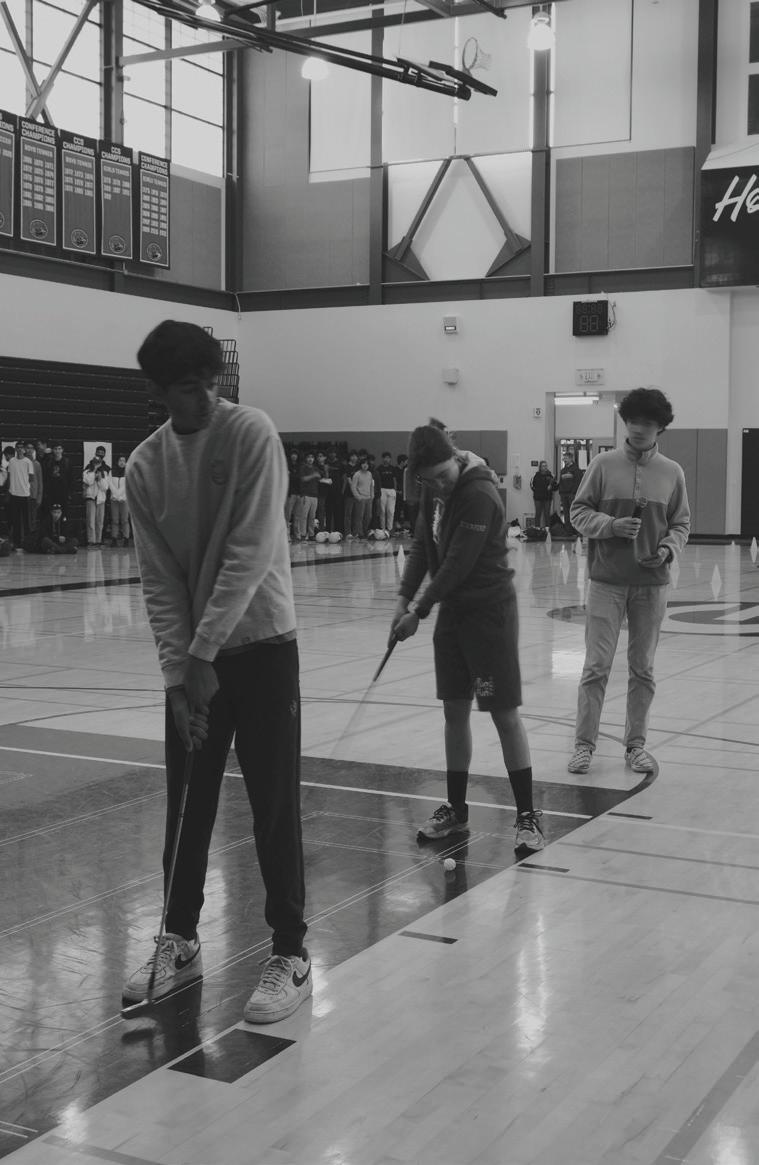
Student volunteers from each grade participate in the class relay to earn points for the Rally Cup.
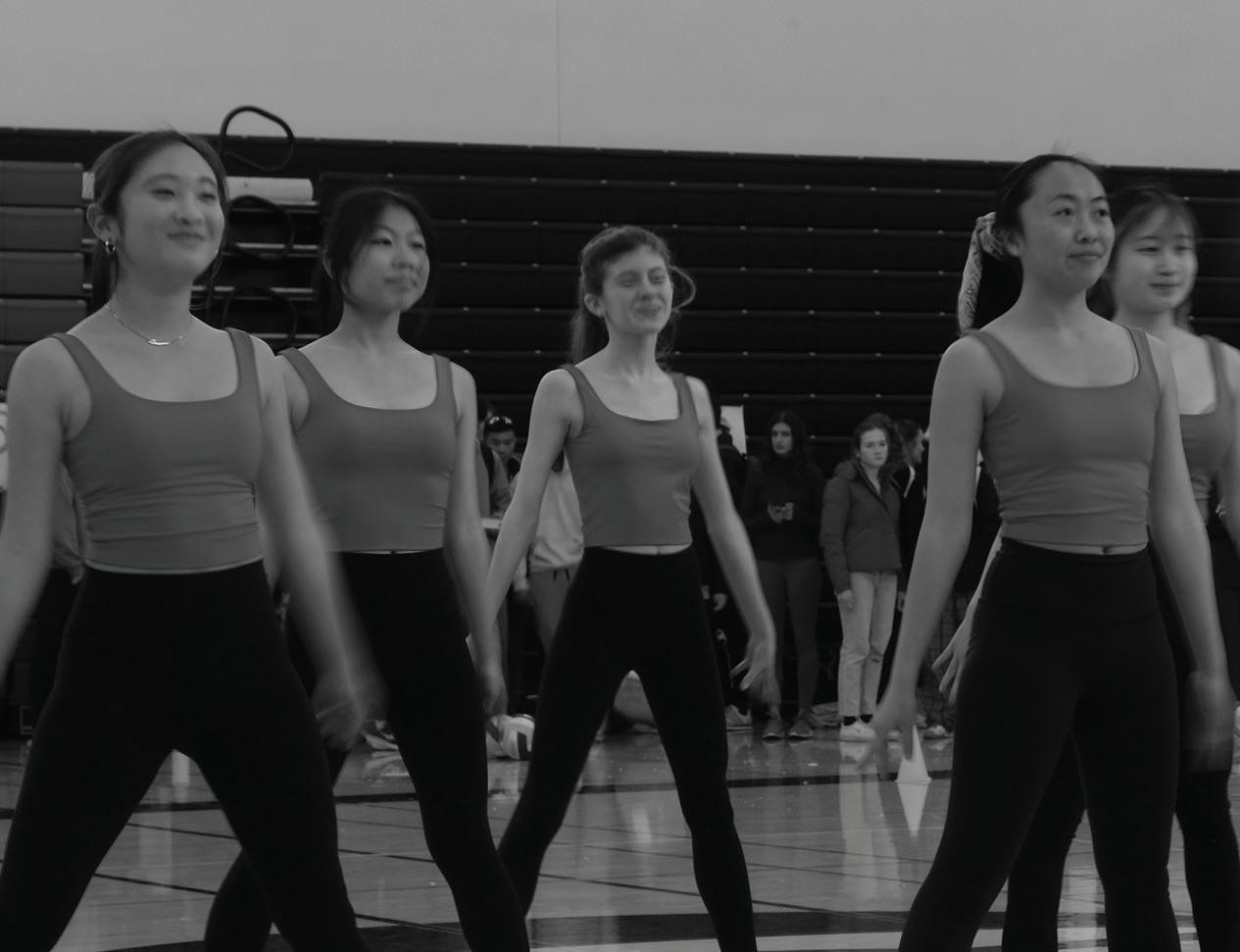
The dance team performs to “Bang Bang” by Jessie J., Nicki Minaj and Ariana Grande for the students at the Spring Sports Rally.
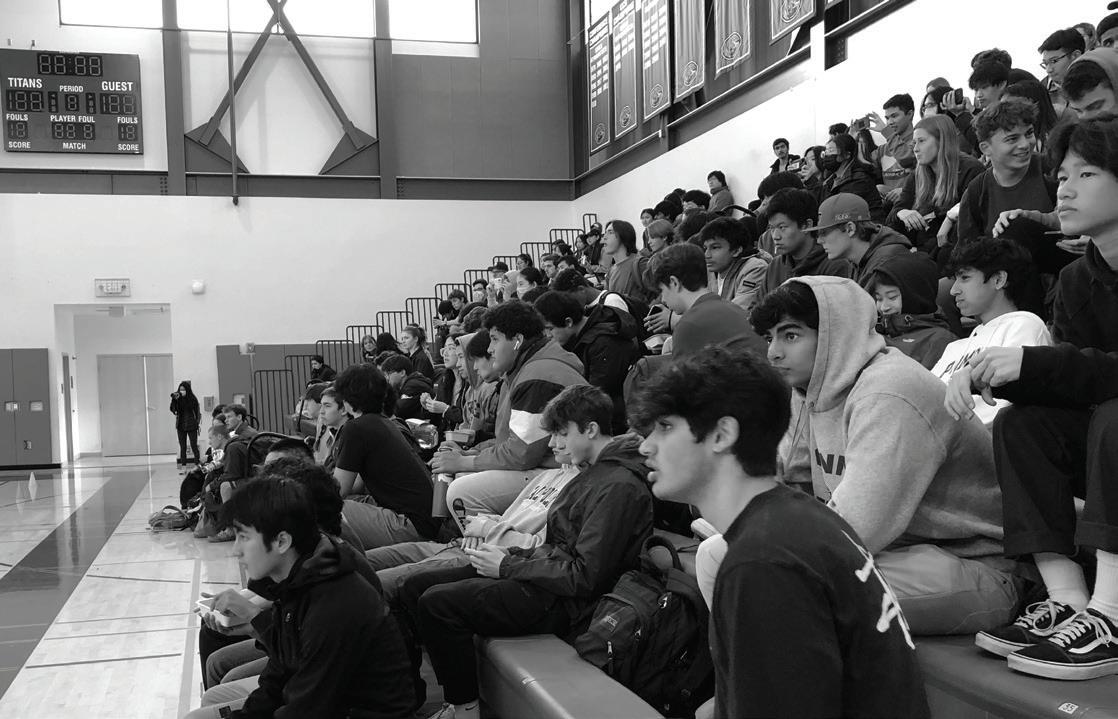
Audience members in the Titan Gym bleachers watch students in their respective grades who are participating in the class competition.
—Quotes compiled by Ellie Yuan
“The rally was a nice way for people to know about our season.”
Softball Captain Lauryn Selvaraj, 11
Amann Mahajan
Ellie Yuan
News 2
Ellie Yuan
Fentanyl—p.1
“ ”
“ ”
THEORACLE
780 Arastradero Rd. Palo Alto, CA 94306 (650) 354-8238

www.gunnoracle.com
Editorial Board
Editor-in-Chief
Katie Shih
Managing Editors
Raphael Semeria
Arjun Shah
News
Michelle Koo
Chris Lee
Safina Syed
Forum
Carly Liao
Amann Mahajan
Features
Katie LaWer
Irene Tsen
Madison Yue
Centerfold
Lise Desveaux
Hila Livneh
Sports
Kenneth Soh
Ellie Yuan
Lifestyle
Vivian Studdert
Becca Wu
Michael Zhang
Online
Kaitlyn Chen
Charlotte Qian
Photo Editor
Chinyoung Shao
Graphics Editor
Irene Hong
Staff
Business/Circulation
John Li
Kelvin Xu
Oracle/SEC Liaison
Safina Syed
Graphics Artists
Emma Cao
Elise Hu
Aarushi Kumar
Natalie Lam
Chaewon Lee
Jenny Lee
Aeron Man
Sophie Rong
Ruhani Suresh
Sarah Xie
Photographers
Yoochan An
Gracie Easton
Grace Gao
Owen Koehler
Naomi Wang
Reporters
Diya Bose-Malaker
Vivien Chen
Kaylee Cheng
Maddie Cheung
Victor Dang
Anne Dong
Paul Garofalo
Yueun Hong
Annabel Honigstein
Dan Honigstein
Sophia Hwangbo
Jeffrey Kang
Zoe Leontis
Isha Sinha
Lita Sone
Dylan Sperandio
Nicholas Weng
Bryan Xiao
Fiona Xiong
Ya-An Xue
Adviser
Kristy Blackburn
School officials, students address frustrations, offer insight on persistent campus bike thefts
Kaylee Cheng Reporter
When freshman Jasper van den Bedem went to retrieve his bike after the Homecoming Dance, the only thing waiting for him in the bike cage was his U-lock—left on the ground in two pieces. Then, just one week later, van den Bedem fell victim to a second bike theft. This time, it was his wire combination lock that had been cut in half.
According to Campus Supervisor Jorge Sanchez, bike thefts occur most frequently during the night, when thieves come equipped with tools such as bolt cutters and grinders designed to cut through all types of bike locks.
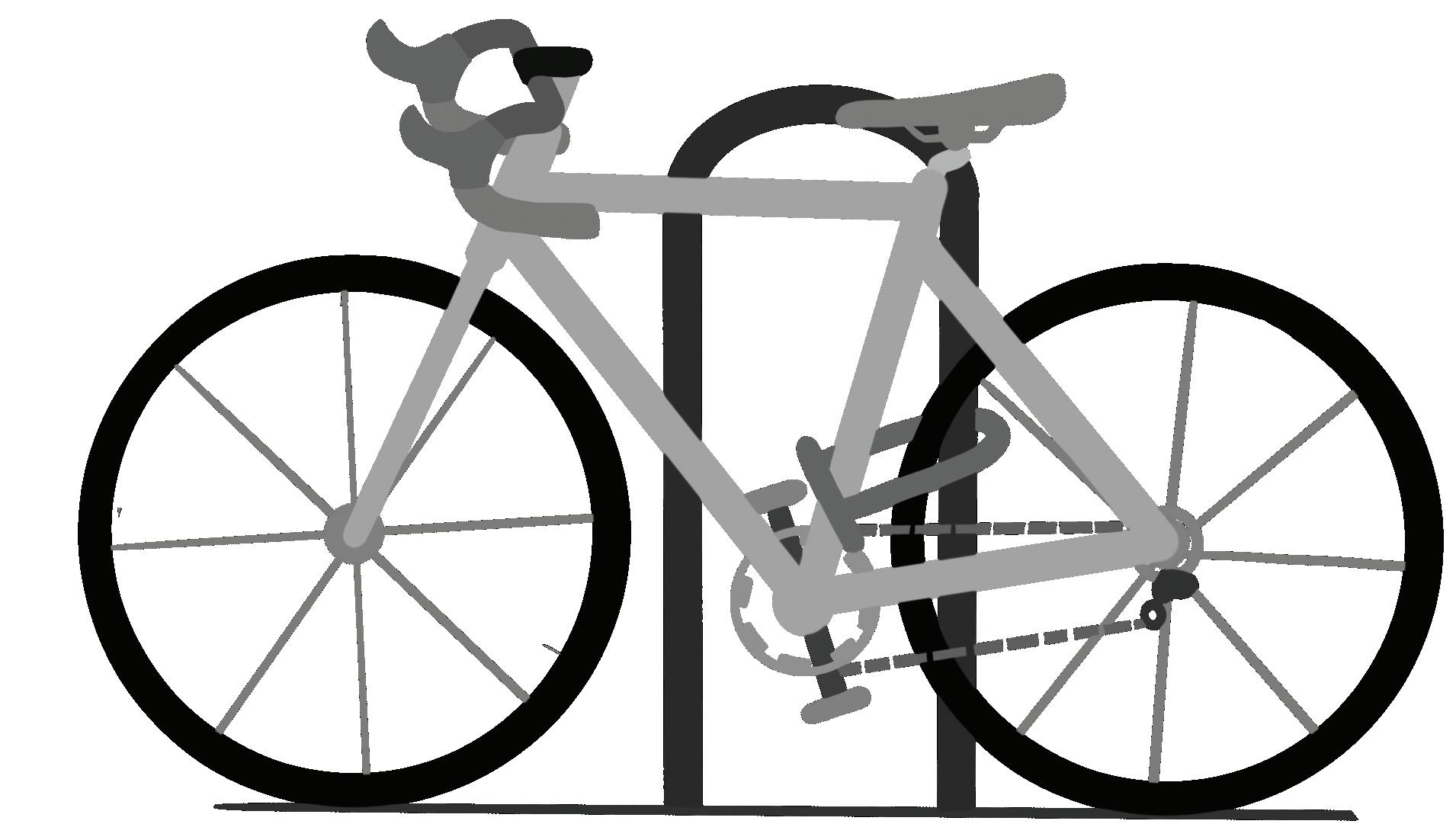
“People are coming in (at) one in the morning and taking bikes,” he said. “Sometimes we get about three (bike theft) reports from people who left their bikes overnight.”
These bike thieves are meticulous with not only their timing, but also their choice of location. According to Assistant Principal Harvey Newland, individuals target Palo Alto schools because there are multiple campuses in close proximity to each other, making it easier to steal from several locations in one trip.
“Recently, there (have) been a lot of thieves that come to Stanford’s, Paly’s and Gunn’s campuses—and they’re looking for bikes,” he said. “It’s become this dark business.”
Sometimes, however, students are the ones taking the bikes. “Some students, if they have a prep, take random bikes,” van den Bedem said.
According to Sanchez, many students take unlocked bikes to go off campus during lunch. Because they are afraid of being caught, students throw their stolen bikes into the
bushes or leave them across campus where campus supervisors then discover them. “If you go (on campus) during lunch or before lunch, you will see that throughout the campus there are bikes laying around,” Sanchez said. “Last time (we checked after lunch), we picked up about 45 unlocked bikes on campus.”
Although van den Bedem frequently hears of bike thefts around campus at Gunn, he never experienced this concern during his time at Jane Lathrop Stanford Middle School.
“At JLS, there were big fences around all the bike cages which were locked during school (hours),” he said. “It helped a lot because I didn’t hear of a single person who got their bike stolen.”
on campus to prevent bike thefts. For example, surveillance cameras stationed around all bike cages make it possible to identify the culprit after a bike theft is reported.
In addition, there are also measures targeted toward students, reminding them of bike safety rules. “The PTSA has been really good about putting signs and big boards that say, ‘Don’t leave bikes overnight’ in bike locations,” Sanchez said.
None of these resources, however, helped freshman Lena Duggan, who got her bike stolen in December. She had secured her bike in the cages adjacent to Bow Gym with a chain lock before attending basketball practice. After a few hours, she returned to find that her bike had been stolen, but chose not to alert anyone of the incident. “I didn’t report it because I don’t think my bike would’ve been found even if they knew,” she said.
Similar efforts have been attempted at Gunn: In previous years, entire bike cages were locked for safety reasons during school hours. This implementation, however, was not permanent because it presented a new set of issues. “Because we have an open campus and students can come and go at different times, it makes it almost impossible to have a locked cage,” Newland said. “It’d be different if you were in middle school, where you had to be on campus the whole time.”
Despite this, there are many other resources
That being said, Sanchez stresses the importance of always reporting bike thefts, and doing it as soon as possible to maximize the chances of finding the bike. “Palo Alto has a lot of containers for stolen bikes,” he said. “Two or three containers full of bikes haven’t been returned to their owners because they didn’t report (the bike theft) right away and didn’t get a hold of the police department.”
In addition to reporting bike thefts, Sanchez also recommends that all students locate their bike’s Vehicle Identification Number, a serial number typically found in-between the pedals. “There’s no other number like the VIN number on your bicycle, or on any other bicycle,” he said. “If you get the brand and the VIN number, then we can go ahead and make the police report. If the (police) find it, they’ll get ahold of you and return it to you.”
Lock it or lose it: How to protect against bike thefts
• Don’t leave your bike on campus overnight.
• Lock your rear wheel and frame together to an immovable object.
• Park in a well-lit and -traveled area.
• Register your bike on bikeindex.org using the Vehicle Identification Number located in-between the pedals.
• Take lights and other easily removable items with you.
“I liked the article about grade discussions. It felt relatable since that’s something that me and a lot of my friends go through.”
—Martin Blanchet, 9
“I think the issue about the use of racial slurs in academia is a debatable issue. It’s not easy to advocate that one side of this issue is totally correct.”
—Chris Li, 11
“I loved the crossword! The graphics were very entertaining and purposeful. I had a lot of fun reading through (the stories).”
—Daniel Pan, 12
Michelle Koo
News 3 Thursday, March 9, 2023 INBOX The Oracle strongly encourages and publishes signed Letters to the Editor and Comments. Comments are generally shorter responses, while Letters are longer pieces of writing. Please include your name, grade and contact information should you choose to write one. Letters and Comments may be edited to meet space requirements, and the writer is solely responsible for the accuracy of the content. Letters to the Editor, Comments and ideas for coverage may be sent to oraclegunn@gmail.com. These letters do not need to be from current students. —Feb. 10, 2023—
“Because we have an open campus and students can come and go at different times, it makes it almost impossible to have a locked cage.”
“ ”
feedback on this issue? Fill out the feedback form at tinyurl.com/OracleMarch2023
Assistant Principal Harvey Newland
Have
Forum students should take meaningful actions



these paths, those with privilege should make purposeful efforts to effect change.
Chris Lee News Editor


The term “privilege” has become ubiquitous in modern-day discourse: In 2019, an FBI investigation titled Operation Varsity Blues revealed how 33 parents of college applicants had paid $25 million dollars between 2011 and 2018 to bribe college officials. Earlier this year, the death of Tyre Nichols again revealed policing disparities between poorer urban areas and wealthier suburban ones, and how they influence relations between law enforcement and the community.
Privilege is supposed to be desirable: Webster’s New World College Dictionary defines privilege as “a right, advantage, favor or immunity specially granted to one; especially, a right held by a certain individual, group or class, and withheld from certain others or all others.” Still, focusing on the latter part of the definition—“withheld from certain others or all others”— can lead to phenomena such as “white guilt,” where one feels a sense of shame due to unearned or unfair privileges. Narratives discussing privilege’s influence only compound this issue. They rarely address meaningful efforts advantaged groups can take, instead stopping at the fact that an event highlighted a certain type of privilege. Thus, those in advantaged groups often make one of two non-ideal choices: Ignore the problem altogether to avoid guilt or engage in performative activism to ease guilt. Rather than pursue either one of
Thus, those in advantaged groups often make one of two nonideal choices: Ignore the problem altogether to avoid guilt or engage in performative activism to ease guilt.
Undoubtedly, the ability to attend Palo Alto schools, including Gunn, is a privilege. Palo Alto Unified School District is a basic aid district, where property tax revenues exceed the minimum funding threshold set by the state. Given that the median home price in Palo Alto is $2 million according to Niche, the district is able to use its plethora of funds to attract highly qualified teachers and offer a diverse array of rigorous courses—factors which have been shown to positively impact post-secondary student achievement. Moreover, individuals with a bachelor’s degree are wealthier and experience less downward mobility. Thus, Palo Alto students—whose families generally make higher incomes—are most likely to stay in their income bracket as adults. Although these wealth figures may not resonate with every Gunn student, schoolprovided resources apply to everyone regardless of affluence, resulting in advantages that may not be afforded to lesser-resourced schools. Students are apparently aware of this dynamic: According to a self-selected survey sent out to Gunn students by The Oracle from March 1 to March 6 with 96 respons
advantaged groups should draw upon their knowledge of current issues, they
let those with lived experiences lead the dialogue.
Meaningful action does not mean every person with privilege is tasked with drastically altering the status quo. It does, however, require advantaged groups to reckon with their privilege and be cognizant of its effects. For instance, while climate change protests or racial equity trainings are opportunities to start addressing privilege, they also demonstrate it: Individuals in the “Palo Alto Bubble” will never experience climate change’s worst consequences, and Gunn is one of few schools across the nation that even offers dedicated spaces to discuss equity.
Therefore, participation cannot be the end goal. Instead, students should use these opportunities to equip themselves with the necessary knowledge and resources to address real-world issues. That may be as simple as having a conversation about life experiences with someone who has different or fewer privileges. While advantaged groups should draw upon their knowledge of current issues, they should still let those with lived experiences lead the dialogue. Otherwise, it can be tempting to adopt a paternalistic mindset akin to the one presented in steel industrialist Andrew Carnegie’s “Gospel of Wealth,” published in the June 1889 edition of the North American Review, where privileged people believe it is their duty to determine which efforts will “produce the most beneficial results for the community” using their “superior wisdom.”
WAYSTOTAKE INITIATIVE

es, 87.5% of students said that they are aware of their privilege. In another question with 78 responses, 21.8% said that they use their privilege to promote meaningful reforms.
Furthermore, students should be open to conversations surrounding privilege, even if these discussions are uncomfortable. Truly confronting privilege requires advantaged groups to step away from their sheltered backgrounds, contextualize the impacts of privilege and gain a better understanding of necessary reforms. More often than not, this process reveals complicity in furthering inequities: Why do a disproportionate



FACES IN THE CROWD: HOW WOULD YOU DEFINE PRIVILEGE?



“I believe privilege is the ability to express yourself as well as your beliefs. If you ever strongly believe in something or ever want to stand up for something then you should definitely use your privilege to accomplish it.”
“To me, privilege is the social advantages, benefits, respect and belonging that someone gains due to their background. I believe that when we identify our own privileges, that is when we have the opportunity to make changes in our world.”
“Privilege is abundant in Palo Alto. I think most people understand that but I feel like a lot of students don’t really get how much their privilege plays a role in their life. Privilege isn’t necessarily a bad thing, but people just take it for granted too much.”
“I believe that privilege is where one person has an absolute advantage over another person in achieving a goal or attaining a position. I do not believe that it is a word that should be tossed around lightly or as a blanket term, as it is a highly nuanced topic.”
4
-
While
should still
—Amarima Syed, 9
—Samhita Krishnan, 10
RECOGNIZE
—John Reeder, 11 —Guangyi Liu, 12
ENGAGE RESEARCH LISTEN CONVERSE
—Compiled by Jeffrey Kang
Sophie Rong
to address inequities

percentage of Gunn students hire private college counselors when most are part of the group that needs them the least? Why do Palo Alto homeowners rally against policies to build affordable housing when their homes are already worth millions of dollars?
Thus, meaningful action necessitates recognizing that reform carries a personal impact. It may look like lobbying for higherdensity housing in Palo Alto even though doing so may deflate housing prices. It may also look like using the power that comes with a leadership position to make space for underrepresented groups to take initiative, instead of furthering personal interests. Especially in a competitive environment such as Gunn, community-outreach efforts can easily turn into pet projects guided by what looks best on a college resume instead of the community’s actual needs. Acting upon personal fulfillment only results in self-serving gestures that—while making students feel charitable—protect them from the harsher realities of those they are pro-
viding said charity for. Ultimately, although privilege comes with birth, those with privilege can choose what they do with it. Acknowledging privilege does not diminish the value of hard work.

Ultimately, although privilege comes with birth, those with privilege can choose what they do with it. Acknowledging privilege does not diminish the value of hard work.
Especially considering that many students or their parents are first-generation immigrants, it can be easy to take the American Dream at face value— that everyone can prosper with enough work and motivation regardless of where they start. While this idea is not inherently false, privilege plays an important role alongside hard work in creating achievement. Thus, the end goal is not to give those with less privilege a “recipe for success,” since there is no guarantee that one person’s path will yield the same final product for another. Instead of standing for others in the community, advantaged groups should stand with them, and work together to create a more equitable future.
Hiring private counselors perpetuates systemic faults, necessitates open discussion
Carly Liao Forum Editor

As a lifelong Bay Area resident, I have grown up equally daunted and thrilled by the prospect of attending an elite college. In kindergarten, I made one of my closest friends by ambitiously proclaiming that we would go to Harvard together. Although I lost a bit of my audacity in high school, gaining admission to a prestigious university remained both a goal and—to a greater extent—an expectation for me. In my freshman year, like many other Palo Alto families with the means to do so, my family decided to hire a private college counselor to guide me through the college admissions process.
In many ways, a private college counselor is an undeniable boon to a student’s development as a scholar and leader. Under my counselor’s guidance, I joined extracurricular activities, entered competitions and explored academic opportunities that I never would have known existed otherwise. Many of my favorite high school memories—such as the time when I flew to Washington, D.C., for a Model United Nations conference or when I explored a rare collection of books with a Stanford University professor—are from experiences I only took part in because of my counselor’s advice. These activities shaped me into a more confident public speaker, effective student and assertive leader.
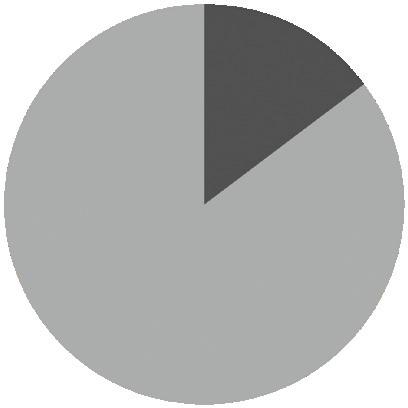
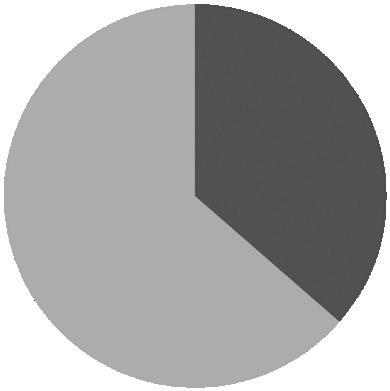
of sTudenTs surveyed believe They have some sorT of privilege.
Source: Self-selected survey sent out to Gunn students by The Oracle from March 1 to March 6 with 96 responses.
The median household income in sanTa clara counTy is of sTudenTs surveyed use a privaTe college counselor.
Source: Self-selected survey sent out to Gunn students by The Oracle from March 1 to March 6 with 93 responses.
87.5% 36.6% 21.8% 18.5% 14.9%
At the same time, private counselors are expensive. Very few families can afford to pay tens of thousands of dollars each year on top of the already steep price of college tuition. As a freshman, I could not fully comprehend just how much my family was willing and able to spend on my education. My ignorance then—my ability not to have to worry about finances—was a privilege. Over the years, I’ve learned that private counselors and all the benefits they bestow serve only those with the greatest opportunities already at their fingertips: Ironically, the same people who likely have the least need to advance socioeconomically through a college degree. I have never found myself, my family or my private counselor to be intentionally insidious, but we all perpetuate an insidious system: Private college counselors help those at the top of the socioeconomic ladder stay at the top.

That is not to say that having a private counselor or living in a prosperous neighborhood are the only contributing factors to an elite college acceptance. I took full advantage of my opportunities by studying hard and dedicating myself to activities that interested me, but my family’s financial situation and private college counselor made many of those opportunities possible for me in the first place. Private counselors are not automatic tickets of admission into a top college, but they certainly do help.
of sTudenTs surveyed have aTTended a climaTe change proTesT.

Aeron Man Sophie Rong
$140,258. AeronMan AeronMan
Source: United States Census 2020
of s T uden T s surveyed said They frequenTly use Their privilege To enacT reforms. of sTudenTs surveyed have aTTended a racial equiTy Training.
Due to their status as evident signs of wealth and privilege, private college counselors have become an open secret on campus. I’ve seen many students around me hire private counselors but rarely discuss them. If the topic ever does come up, it is often accompanied by coyness, or even shame. Talking about private counselors also makes people uncomfortable—perhaps because confronting privilege creates discomfort. Still, it is necessary to admit that having a private counselor has given me an advantage in the college admissions process, one that I earned through no merit or achievement of my own. I will not claim that I have been admitted into college solely by virtue of my own hard work when I have had a well-resourced school to prepare me, a supportive, financially stable family to cheer me on and a costly private counselor to guide me the entire time. Shame and secrecy are counterproductive: Refusing to acknowledge that private counselors undermine true meritocracy only further perpetuates the cycle of privilege in affluent, achievement-oriented communities.
Source: Self-selected survey sent out to Gunn students by The Oracle from March 1 to March 6 with 78 responses.
It is unlikely that ambitious, wealthy families in places such as Palo Alto will ever stop hiring private college counselors as long as elite college admissions remain the competitive processes they are today. Indeed, provided that they are giving legitimate, honest guidance, most private counselors offer valuable services that prepare their students not just for college admissions but for life. It would be willfully reductive to paint families’ hiring of private counselors as innately unethical simply because the practice overwhelmingly benefits the rich. Private college counselors are not the root cause of inequality; rather, they perpetuate inequality in a system that purports to be meritocratic but still gives students a head start based on their family’s income. Simply telling families to stop consulting private counselors would be as ineffective in addressing the roots of this inequity as advising wealthier students to move school districts or score lower on the SAT. Instead, students with private counselors must begin by having more open conversations about their privilege— perhaps by sharing advice from their counselors with peers to resist the mentality of college admissions as a zero-sum game—researching the implications of this privilege and lobbying for change through petitions and other methods of systemic action. Only then can we ensure a fair college admissions system that benefits all.
Source: Self-selected survey sent out to Gunn students by The Oracle from March 1 to March 6 with 92 responses.
Source: Self-selected survey sent out to Gunn students by The Oracle from March 1 to March 6 with 94 responses.
5 Forum Thursday, March 9, 2023
Should students avoid shopping at big businesses?
If a person were to walk into a Macy’s, TJ Maxx or Target looking for a white, button-down shirt, they would certainly find what they came for. Still, while they might walk back to their car with the right item, they will have lost something great—the reward of obtaining an item after a strenuous search, the joy of personal, face-toface interaction or even the feeling that their purchase is making a positive impact on the world. In short, they’ll lose the experience they could have found at a small business. It is important, but most of all rewarding and beneficial, to shop at small businesses over larger ones. They offer a more personal experience through better service, unique products and a stronger emphasis on social and environmental responsibility. In the big picture, small businesses are vital to keeping local economies healthy and protecting the public from monopolization.
As the name suggests, small businesses are, well, smaller: They have fewer customers, lower revenue and less space. As such, they must go the extra mile to assist and retain their smaller customer base. In a 2011 American Express Survey, 81% of respondents said that small businesses had better customer service than their larger counterparts. Small businesses value their customers more, largely because they have time for them— whereas when shopping at big businesses, complaints or queries can easily be overlooked.
Not only do small businesses care more for their customers, but they also care for their communities.
According to another American Express study, small businesses donate around 6% of their revenues to charity, while larger businesses donate only 1%. Forbes found that small businesses are also more likely to purchase products locally, which reduces transportation times and, consequently, pollution.
Additionally, small businesses are significantly

better for local and domestic economies. According to the Maine Center for Economic Policy, for every $100 spent at locally-owned businesses, $68 stays in the local economy, compared to only $43 at a national chain. By keeping money within the local market, small businesses are able to provide jobs and stimulate local economic growth. A 2015 Department of Commerce report showed that U.S.-based multinational corporations hired half as many overseas employees as domestic employees—a figure expected to rise. As American big business continues to grow, its domestic workforce is shrinking. At the same time, small businesses continue to employ about 50% of the domestic workforce, according to the same Department of Commerce report. Therefore, by supporting small businesses, one also supports individuals placed both locally and nationally.
While it is at times more efficient and cheaper to shop
at large companies, this choice comes with detrimental impacts on the economy. If small businesses fail, large businesses will take over and monopolize various markets. One recent example of monopolization is Ticketmaster: The U.S. Department of Justice reported that Ticketmaster controls over 80% of the concert ticketing industry. With competitors out of the picture, monopolies will inflate prices at the expense of their customers. For example, Ticketmaster is able to charge exorbitant service fees with little incentive to improve their services. Public support for small businesses stands in the way of this possibility. This is not to say that one should never shop at a large business. It is, after all, necessary to solicit both small and large businesses to circulate money domestically and internationally. However, it is important to remember the vast advantages that come with frequenting small businesses more often than larger ones.
Anne Dong Reporter

Although purchasing from small businesses is often heralded as the most communal and ethical way to shop, large businesses have perks that are consistently overlooked. With thousands of stores scattered throughout the world, these businesses are usually where most people obtain everyday items. Due to the high amount of revenue large businesses receive, they are able to invest in themselves, allowing them to present consumers with cheaper products and lower financial risk—benefits which small businesses simply do not have the resources to replicate. Thus, students should take advantage of this by
shopping more frequently at large businesses.
Generally, small businesses are not as long-lived as large businesses. According to business magazine Entrepreneur, 20% of small businesses fail within their first year, 50% within five years and 70% within 10 years. These collapsing businesses essentially act as quality control: Those that do not have the ability to sustain themselves over time usually do not provide services or products unique enough to generate much interest. On the other hand, large businesses are more reliable, with wellestablished reputations built by their customers.
With this experience, large businesses are capable of giving buyers an optimal deal for their products. A large consumer base permits companies to mass-produce, purchasing materials from suppliers in sizable quantities to decrease the per unit production cost. For the same profit, these items have lower, more attractive selling prices. Especially when similar items are sold at small businesses for a higher price, consumers should not be ashamed to purchase more affordable alternatives from
large businesses.
A large business’s in-person locations can offer customers more convenience and a lower total cost. With a limited number of physical stores open, few small business patrons have the luxury of testing out products before buying them. The lack of product interaction increases the need for returns or exchanges, a tedious process and unnecessary hassle. Online shopping at small businesses is an inadequate alternative, forcing shoppers to click through pages of images and long lists of information. Even after finding the desired product at an online small business, customers are still required to pay high shipping prices. Shopping at a big business in person leaves customers content with lower prices and a trouble-free shopping experience.


Some may argue that shopping at large businesses is unethical because it supports business practices that may be monopolistic, taking exclusive control over a certain product or service. However, the high number of customers shopping at large businesses does not immediately indicate monopolistic practices, with small businesses continuing to be a staple in many lives. According to the “New York Post,” the average person shops at small businesses 213 times in a year, and 93% of people rely on small businesses for specific events in their lives. If large businesses have completely dominated and controlled their markets, there would no longer be shoppers at small businesses. Any business with quality products is bound to gain traction and build a considerable consumer base without stifling growth and creativity in others.
Moreover, though many say that small businesses present better customer service, large businesses can often outperform them due to their higher employment rates. According to Forbes, 80% of small businesses don’t have any employees, and 16% have only one to 19. The vast majority of small business employees can have a difficult time balancing multiple jobs at once—it is exhausting and close to impossible for a few people to provide quick customer service on top of general maintenance and managing orders. Large businesses struggle less with this underemployment and overexertion issue.
Thus, it is of paramount importance for consumers to realize the often underappreciated perks of large businesses. All businesses present a unique set of advantages and disadvantages, but the many benefits shared among larger ones are the elements that create an inviting environment and a reliable resource for everyday purchases.


6 Forum
NO
361
Dan Honigstein Reporter
According to Forbes, Starbucks Coffee has over 245,000 employees and 32,000 locations worldwide, including this store on
California Ave. in Palo Alto.
YES
Backyard Brew has two locations worldwide, one in Charlotte, N.C., and one on 444 California Ave. in Palo Alto.
52.4% of students prefer to shop at big
Source: Self-selected survey sent out to Gunn students by The Oracle from March 1 to March 6 with 84 responses.
47.6%
Carly Liao
Carly Liao
businesses.
of students prefer to shop at small businesses. Source: Self-selected survey sent out to Gunn students by The Oracle from March 1 to March 6 with 84 responses.
Gifted by grants: Community members contribute to installations on gunn campus
Senior class gifts
Class gifts come from the graduating year’s student body and are funded using extra money from class fundraisers. While gifts can fund material improvements to Gunn’s campus, Student Activities Director Lisa Hall has also seen classes use funds to discount apparel or fund future events. “(Funds for the class gift) come from what is left in (the class) account at the end of the school year,” she said. “We say, ‘Okay, you have this much money left—what do you want to do with it?’”
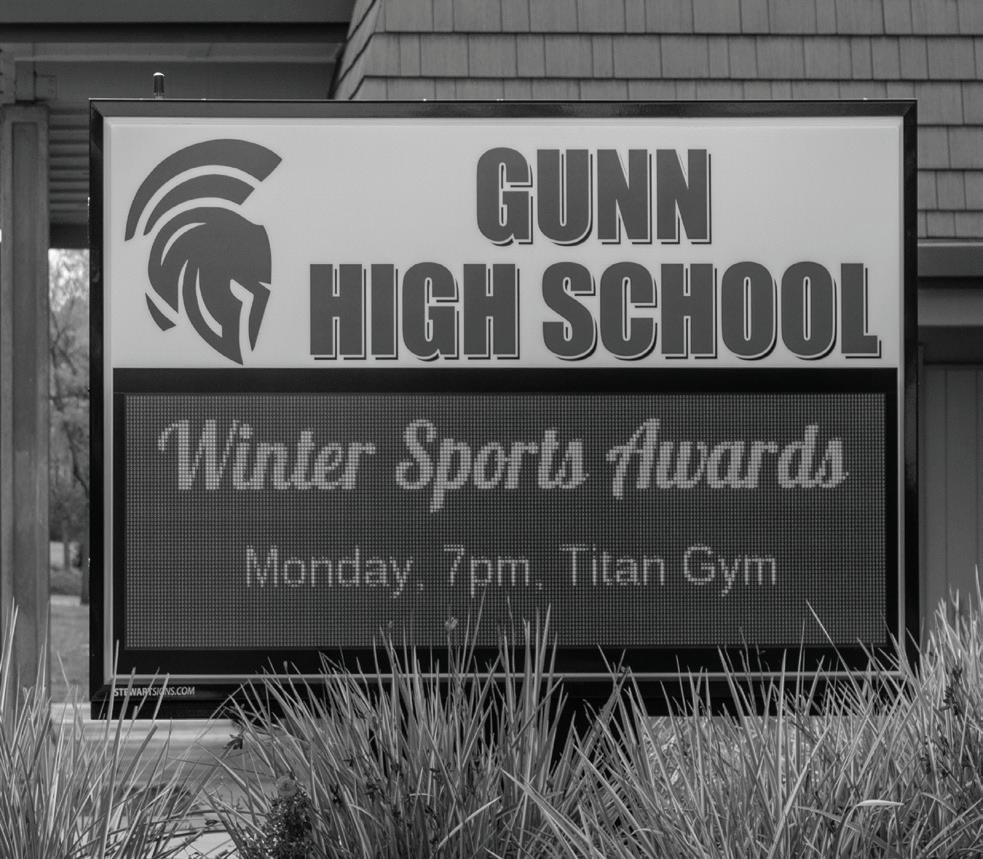
One of the first noticeable things when driving into Gunn is the giant light-up sign. With its colorful screen displaying school news and upcoming events, this new marquee replaced an older worn-down one in January.
Funds of $14,000 from the Classes of 2020 and 2021 were rolled over into the Student Executive Council budget to use toward the student body. From there, Hall consulted with administrators to decide what they could use the funds on. “Our marquee had died,” she said. “It was on its last legs, and we were in need of getting a new one.” On top of the funds provided by the two classes, Palo Alto Unified School District contributed $39,000 and the Parent-Teacher-Student Association an additional $7,000.
Principal Wendy Stratton and administrators noted the issues with the marquee and were involved in its replacement. “It wasn’t a small thing, and it wasn’t fixable,” Stratton said. “SEC became aware, and the students went through a process of deciding what they were going to do with their money.”
Hall believes the new marquee accomplishes the purpose of publicizing relevant school news. “It’s a good way to catch the attention of the riders that either go by the school or come in and out of school,” she said. “It’s also a visual way to quickly promote events and happenings on campus.”
Sophomore Sophie Brown feels the new marquee adds to the campus aesthetic despite sometimes being difficult to read. “I like it, but the news goes by fast, so it’s hard to catch,” she said. “It’s really cool otherwise.”
Seven feet tall and 2,000 pounds heavy, its hair flows in eternal motion and its bronze gaze holds ancient strength and fierce focus. Ten years after its installation, the Titan statue continues to greet students at the entrance of the Titan Gym when they file in for sports, homecoming and SEC events.
The Titan statue was created by former ceramics teacher Erik Bowman, Class of 2011 alumnus William Wang, Class of 2011 alumnus Charlie Yang and Class of 2012 alumnus Tony Yin. The team first started working on the project after Gunn’s principal at the time, Katya Villalobos, asked Bowman if he and his students wanted to create a statue for the Titan Gym, which was being built. Bowman agreed. “We wanted to rework the cartoonish Timmy the Titan,” he said. “We wanted to come up with a more heroic, Greeklike Titan.”
The statue would have cost $20,000 in materials and outside commissioned work. However, an art teacher who was on the committee for class gifts pitched funding its creation to graduating students. The Classes of 2010, 2011 and 2012 agreed to put their class funds toward the statue.
The statue is based on a digital illustration of the Greek Titan Cronus by a Chilean art teacher, with small Gunnspecific alterations. After receiving permission to use the drawing as inspiration, the team sketched drawings and built a maquette, a small model of the sculpture. An enlarger then digitally scanned the maquette and cut the dimensions into a 7-foot-tall styrofoam block.

The styrofoam was then sent to a foundry in Berkeley, who applied an oil-based clay on the sculpture and sent it back to Bowman, Wang, Yang and Yin for refinements. “We spent a whole summer having to resculpt the details,” Bowman said. “This whole process was super involved.”
Wang, who worked on the styrofoam sculpture’s details over the summer, described the collaboration as a fun experience. He, Yang and Yin conversed about where a hand should go or whether a muscle striation looked right. “I’m just very grateful and fortunate to have been able to work on it,” he said. “And that’s something that I’ll always be thankful for.”
Bowman estimates that this sculpture’s creation spanned around two and a half years, from idea to
installation. He hopes that students today recognize the time and effort Wang, Yang and Yin invested in it. “I hope that it’s appreciated,” Bowman said. “I hope that all of our energies, especially my students’, are still valued, and that the students that encounter it are still inspired by it.”
Other gifts
Additions to Gunn’s campus can also be a product of PTSA grants and administrative reactions to campus needs. PTSA Budget Manager Silvia Griswold, who allocates funding within Gunn, works alongside parents, teachers and administrators to help meet staff and student needs. “The PTSA does a round of grants, and every year teachers can propose a project that they want for the school, and then they go in and decide whether (or not to approve these requests),” she said.
Small changes to Gunn’s campus can have lasting impacts on its community. Stratton sees merit in financial improvements to Gunn’s campus. “The aesthetics are always nice,” she said. “Thinking in terms of making this learning environment feel well taken care of, (we prioritize) safety, aesthetics and creating a sense of professionalism for students.”
Students returning to campus in the beginning of the school year may have noticed something different on the amphitheater: a red wooden table once belonging to the now-demolished Bat Cave.
The Bat Cave table was not a senior gift. When the demolition of the A- and B-buildings was announced, the Class of 1972 (undefeated) football team alumni salvaged a table from the Bat Cave and brought it to the amphitheater. The group aimed to preserve the essence of the Bat Cave, which had been a center of student life since the school’s opening in 1964.
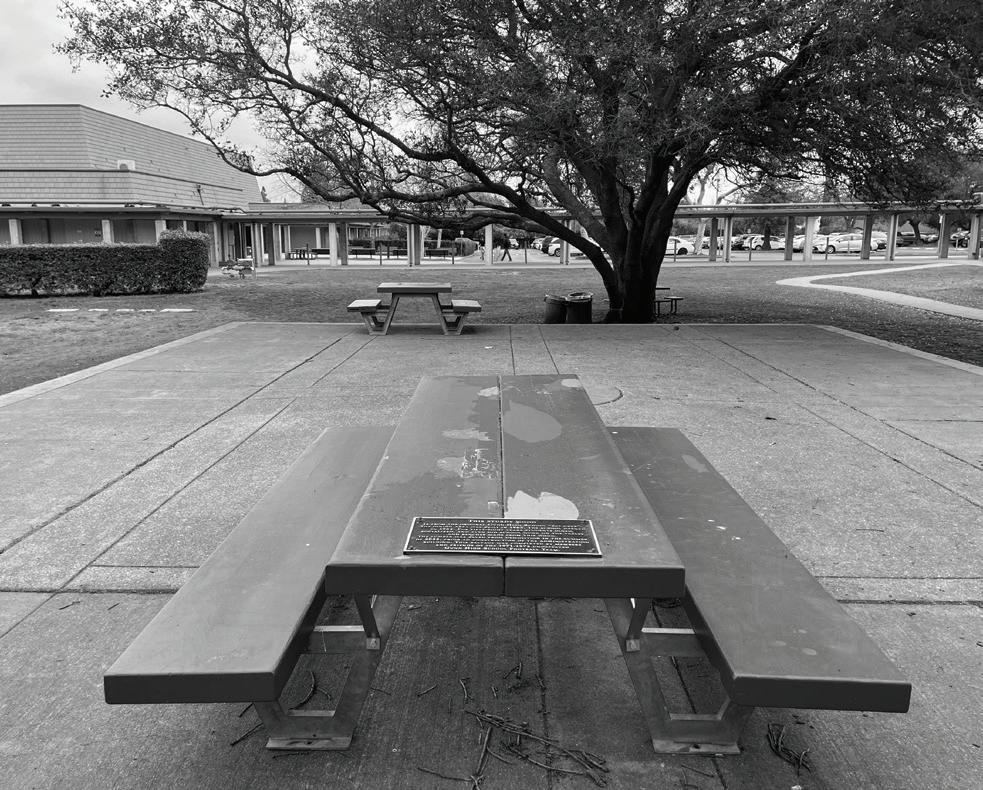
At a 50-year football team reunion, current football player senior Giordano Rischmoller met with the alumni group who helped salvage the Bat Cave table. “(The team) was reminiscing about how they would draw on the tables in the Bat Cave and (how) the tables have been there for so long,” he said. “They decided to grab one of the tables before repairs (started), put a plaque on it with their note and put it on the freshman quad.”
M/N-building benches
Whether it’s brunch, lunch or even the 10-minute passing period between classes, students are constantly looking for places to sit down and talk to friends. Luckily for these students, Gunn has benches in every corner of campus. While most are gifts from former senior classes or installations by the school, the two benches in between the M- and N-buildings have an unique backstory.
The distinct benches were installed by Class of 2018 alumnus Alex Viveros. Viveros planned to give back to Gunn for his Boy Scouts Eagle Project, a project that benefits the scout’s community and the last step in their journey to the final rank. “I picked Gunn specifically because it was where our troop met for weekly meetings,” he said. “I remember growing up and playing ‘cops and robbers’ all across campus as part of Troop 52, so I felt like it was appropriate to give back to Gunn for what it had done for us as Scouts.”
This was Viveros’ first time working on a larger-scale project. “It took about a year of coordinating,” he said. “I’m glad that I had a bunch of people collaborating with me and (PAUSD) to help too.”
One of Viveros’ favorite parts of the project was that he could see the immediate payoff every day on campus, since he installed the benches between his junior and senior year. “(During) my senior year of school, I would pass the benches and see all these people hanging out on them,” he said. “(When students took) homecoming pictures, I would see them featured all the time. I didn’t really realize when I built them that I’d have this big, cool reminder of my time in Scouting on my way to algebra every day, but the fact that I do is awesome.”
Top photo: The marquee at Gunn’s front entrance was funded in part by the Classes of 2020 and 2021 after the old marquee stopped functioning. Funding also came from the PTSA, PAUSD and Gunn.
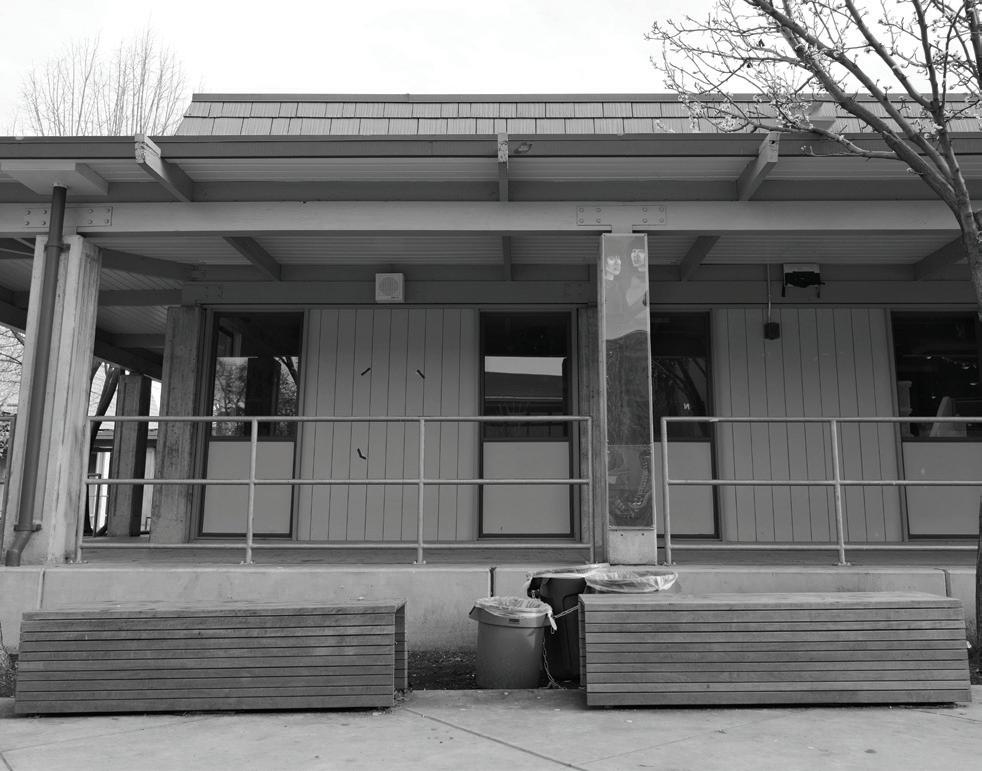
Second photo: The bronze Titan statue in the Titan Gym was created by former ceramics teacher Erik Bowman as well as alumni William Wang, Charlie Yang and Tony Yin. Third photo: The amphitheater table was salvaged by a group of alumni from the Class of 1972 from the Bat Cave.
Fourth photo: The benches between the M- and Nbuildings were installed as part of alumnus Alex Viveros’ Eagle Scout project.
Features 7 Thursday, March 9, 2023
Chinyoung Shao
Benjamin Qian
Grace Gao
—Written by Vivien Chen, Kenneth Soh, Lita Sone and Irene Tsen
Sophia Hwangbo
Marquee
Titan statue
Amphitheater table
Conquering corners of the internet: Content Freshman Alisa Sonehara
YouTube: @alisasonehara
Videos
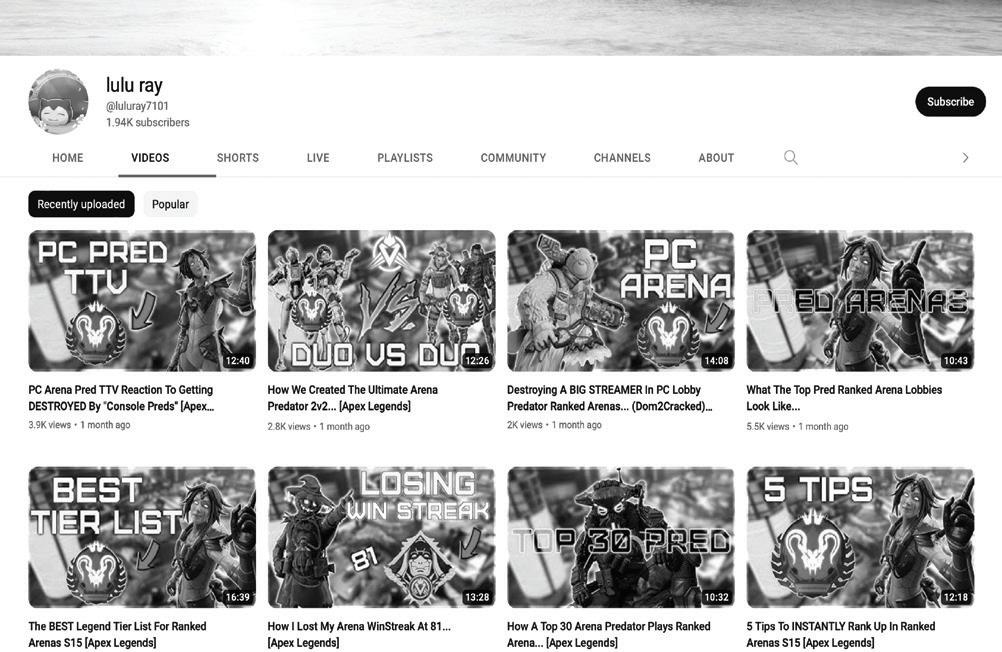
Freshman Alisa Sonehara made her debut as a YouTuber in July 2022 and has since been publishing videos on painting and lifestyle content. “I wanted to share my art with other people and see how I can improve over time,” she said.
When she first started, Sonehara was careful to produce content that didn’t overlap with the productivity or aesthetic-life content of many other YouTubers. “I didn’t want to do something that’s going to be really repetitive, because there is so much similar content and it gets boring,” she said.

Since Sonehara started her YouTube channel relatively recently, she attends Zoom classes and watches other YouTubers, such as Emma Chamberlain, for motivation and inspiration. The classes provide different techniques and types of painting styles for Sonehara to implement in her own content. “I’m still looking for my art style,” she said. “So right now I’m just experimenting with a bunch of different ones, and (the classes) guide me on what to do.”
Sonehara mostly films during her free time and is not too concerned about an irregular uploading schedule. Even though she enjoys filming content, she finds it difficult to be consistent with uploading videos when she is busy with schoolwork. Additionally, creating content on top of painting can prove time consuming. “It’s definitely time-consuming to film and edit everything, rather than just paint,” she said. Sonehara also finds being a content creator challenging because there are times when she can feel unmotivated or uninspired.
Sonehara’s favorite video on her channel is “Decorating My Wall with Art I Love,” released on Aug. 14, 2022. In the video, Sonehara decorates a part of her wall with
Channel views Subscribers
some of her favorite art pieces, which include Monkey
D. Luffy (a fictional character from the “One Piece” manga series), a drawing by her grandfather, a framed motivational quote written by her grandfather and photos of different buildings and landscapes. She also puts up a framed handlettering of her name in Japanese written by her grandfather and photos of people who contributed greatly to her life. According to Sonehara, each art piece shown on the video is deeply significant to her life. “The paintings have a lot of value behind them because every piece has a different meaning,” she said.
Another one of Sonehara’s favorite videos is “The Process of Painting for an Art Show,” published on Jan. 21. Sonehara talks about her struggles with mental health in response to the art show prompt of how mental health or race can affect relationships. In the video, she explains how her painting of two linked arms, with one of the arms disappearing at the top, represents the struggle of keeping promises and trusting individuals.
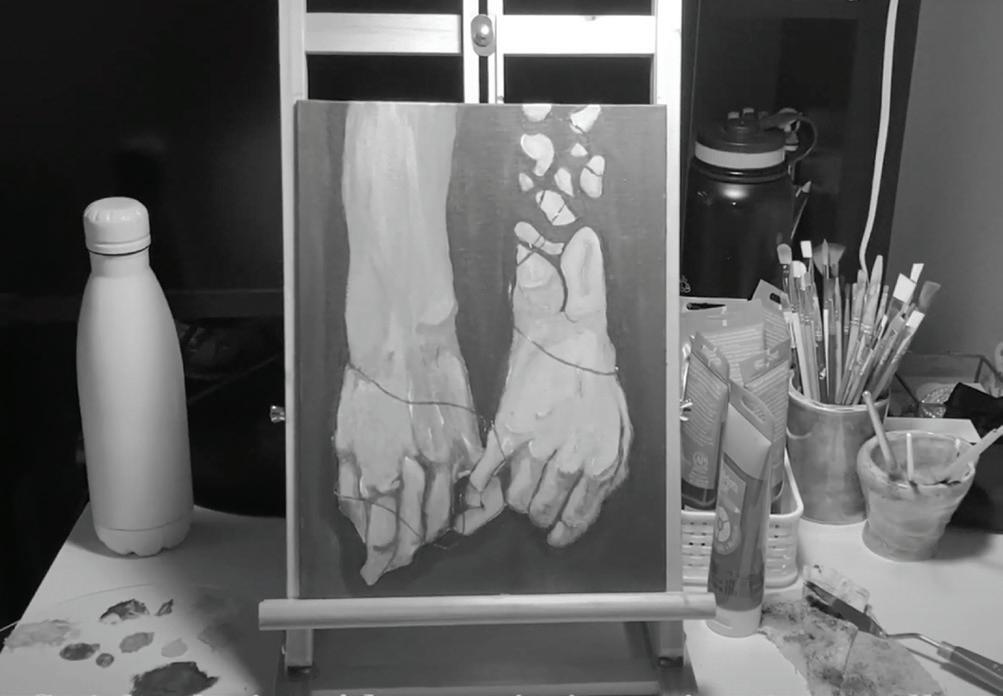
Looking back on older videos has provided Sonehara with a new perspective on her art. “I can compare and contrast to see what I could have done better,” she said.
As Sonehara continues to grow her channel, she hopes expand her following and gain a clearer view of what kind of content she wants to make. “Reaching the right audience of people who are passionate about art as well is really my goal,” she said.
—Written by Yueun Hong
Bottom:
Sophomore Ray Ogawa
YouTube: @luluray7101
101 1.94K 202K
Videos Subscribers Channel Views
Sophomore Ray Ogawa is a content creator who shares his dedication for gaming on his YouTube channel @luluray7101, where he has amassed thousands of views on his videos.

Ogawa began his YouTube journey in 2021, motivated by a desire to go against the grain and extend his passions to a more formal setting. “I started (my channel) because I didn’t want to work a normal job,” he said. “I wanted to be different. I wanted to do what I enjoy for a living, which is playing video games, streaming gameplay (and) making YouTube videos.”
When he started his channel, Ogawa hoped to publish videos similar to those of popular content creators such as Ninja and ItzTimmy. He also watched videos from Matt Cutts Gaming, who greatly inspired Ogawa’s video style. “Matt Cutts Gaming was the first one that made my type of content, (and) he inspired me to make a similar YouTube (channel),” he said.
Although Ogawa’s journey has not been easy, his passion for gaming and the support of his viewers have kept him going. “I love sharing my knowledge about games and helping others become better at them,” he said.
After reaching the highest rank in the game “Apex Predator,” Ogawa realized that he had enough skill and experience to teach others how to excel at the game. From then on, he focused on uploading tips-and-tricks videos, hoping to help players improve their skills.

These videos received incredible recognition, each averaging over 7,000 views, which strengthened his motivation to continue uploading. Ogawa learned how to make high-quality thumbnails and invested more time and effort into learning how to use the editing program
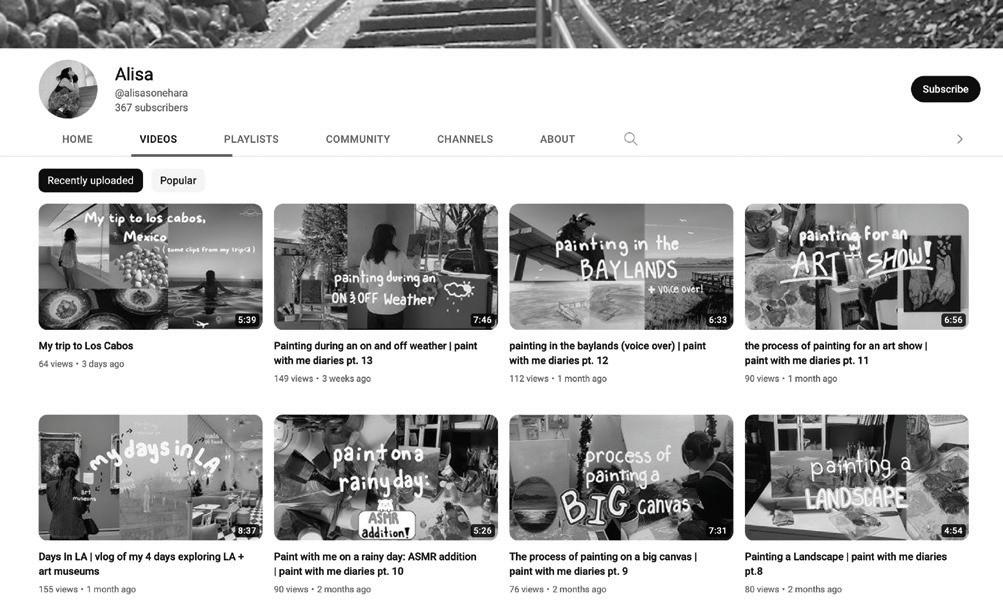
DaVinci Resolve to make his videos more interesting and informative.
With ambitions unfulfilled by being a content creator on YouTube alone, Ogawa has started his conquest on Twitch as well. He streams whenever he has the time, with plans to grow his YouTube channel in tandem with his Twitch audience.
With new content platforms such as Rumble and Kick gaining traction, Ogawa believes that it is the best time for content creators to grow their audience.

Ogawa strives to go down the same path as other streamers who gained popularity. However, doing so has proven challenging. “I play on the Xbox, (but) most gaming teams—or good gaming teams—only (accept PC players),” he said. “Once I switch to the PC and start getting my name and (status) known, I will try it out.”
In the future, Ogawa wants to continue working toward making high-quality content. As Ogawa’s channel grows, he also hopes to inspire others who are looking to do what they love for a living.” I want to collaborate with other creators and grow my audience, (one day) reaching my ultimate goal (of) becoming a full-time content creator and making a living doing what I love,” he said.
—Written by Kelvin Xu
Bottom:
To Getting Destroyed By ‘Console
Yueu n Hong Kelv i n Xu 8 Features
24 11.3K 369
Photos courtesy of YouTube channel @alisasonehara
Top: Freshman Alisa Sonehara’s YouTube channel has content ranging from vacation to painting vlogs.
In her video “The Process of Painting for an Art Show,” Sonehara paints two linked arms for an art show.
Photos courtesy of YouTube channel @luluray7101
Top: Sophomore YouTuber Ray Ogawa makes videos of tips and streams of his playing “Apex Legends.”
Ogawa’s favorite video is “PC Arena Pred TTV Reaction
Preds.’”
creators share passions, uplift audiences’ lives
Junior Melanie Yu
Instagram: @yellowmelown_
Iren e Tsen Posts Followers Account Started
In an age where self-made social media celebrities rule pop culture, it’s hard to imagine the big influencers on TikTok and Instagram as people who live regular lives. However, even the small Gunn community has its social media giants, students by day and content creators by night. One such student is junior Melanie Yu.

With over 11,400 followers on her creative Instagram account, @yellowmelown_, Yu is a viral sensation. Her content is centered around bullet journaling, a creative spin on a day-to-day planner that makes a calendar look like a work of art. Yu started her account in middle school, but only began taking it seriously during the 2020 COVID-19 lockdown. “It was mostly to (hold) myself accountable to committing to a hobby,” she said. “(The account) gave me motivation and I felt it was a good way to track my progress.”


Yu attributed her success on Instagram to the time she spent creating and perfecting a posting algorithm during quarantine. She sometimes posted as often as every other week. “I had a lot of free time in quarantine, and when I started doing things more consistently, I gained a lot of followers,” she said.
When COVID-19 conditions became less extreme and Yu entered high school, she experienced pressure from other parts of her life that made it hard to maintain the account @yellowmelown_, thus forcing her to change her process. “When school started getting busier, I had to put it as a lower priority,” she said. “Only recently I’ve started posting more again, and I don’t put as much effort into it. (But) I’m still happy with where the account is at right now.” Though her bullet journaling is taking a backseat to schoolwork, Yu continues to use her planner, now more practically and productively.
Even after changing her methods, Yu’s hobby of creative journaling still brings her joy. “For me, bullet journaling isn’t just for organization—it’s also a creative outlet,” she said. Although Yu does not consider herself a big artist outside the world of bullet journaling, she has created her own brand of stickers and art prints, Minty Rose Tea Co. (@mintyrose.co on Instagram). The company was created off the back of @yellowmelown_, which she occasionally uses to promote her products.
However, having such a significant following on multiple accounts comes with challenges. Yu has faced issues with privacy and plagiarism of her work. “I have faced some hate, and a lot of people have tried to impersonate me or steal the work that I have posted,” she said. Despite these conflicts, Yu believes that having a large platform and being engaged with others online is a largely positive experience. “(My account has) taught me how great of a community you can find online, and overall I’d say it’s a pretty safe one,” she said.
Despite her fame in the world of bullet journaling, Yu is virtually unknown for her talents in the Gunn community. “Only my close friends really know about my account,” she said. On some level, Yu appreciates the distinction between the spheres of her personal Instagram account and of @yellowmelown_. “Most of the friends I (do bullet journaling) with, I met online, so in its own way that community is this whole other world,” she said.
—Written by Vivian Studdert
Senior Jack Davisson
Spotify, YouTube & Instagram: @DavissonDuo
11
1.93K
39.8K
Songs Instagram Followers YouTube Subscribers
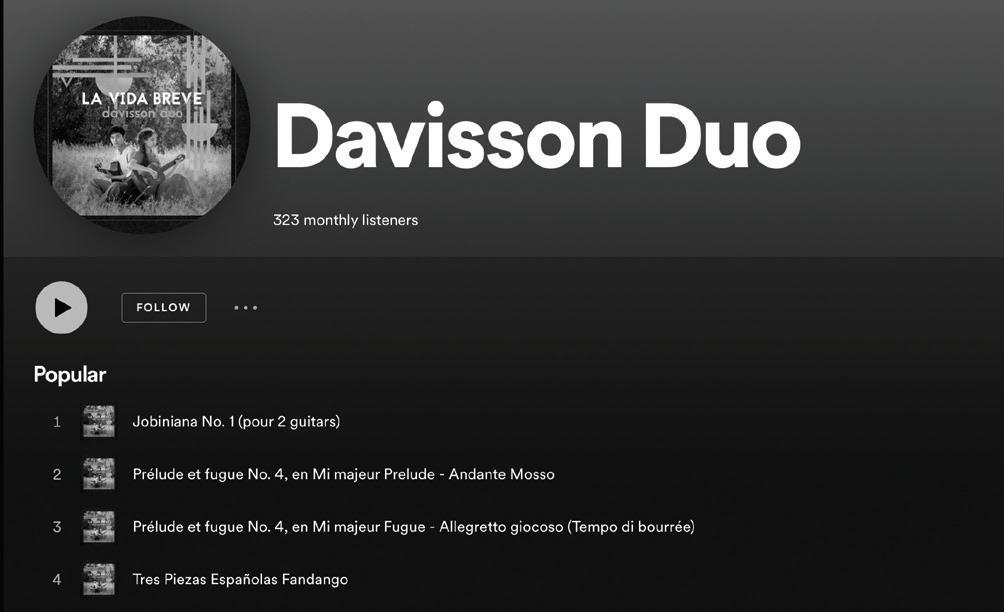
Senior Jack Davisson has a passion for music, particularly playing the guitar. He has turned that passion into a successful social media presence as well as a recent album titled “La Vida Breve,” “The Short Life” in Spanish, which he and his sister released in February under the name Davisson Duo.

Davisson’s love for the guitar began in preschool when his teacher who played the instrument during circle time. “He would strum the guitar, and all the preschoolers would sit in a circle and sing,” he said. “Because I looked up to him, I thought the guitar was pretty cool.” Since then, Davisson has worked with a private guitar teacher, whom he credits as an inspiration, for the past 13 years.
For Davisson, the guitar allows for endless creativity and experimentation in sound. Unlike the piano, which produces a static tone when a key is pressed, the guitar offers a wide range of tonal possibilities. “There’s so much that you can vary to create different noises,” he said. “The contact point between your finger and the string can be altered infinitely, so you can constantly create new and interesting sounds. I think it makes it a super interesting instrument that you never get tired of.”
However, Davisson’s musical pursuits are not limited to classical guitar. He arranges pop music for the guitar as well. “You can play a whole lot more than just classical music,” Davisson said. “You can really do just about everything, from country to metal.”
Davisson’s passion for music extends beyond his personal pursuits, as he also volunteers at the Menlo Park Veterans Affairs Medical Center. Every Friday, he teaches veterans how to play Metallica on the guitar, an experience he finds rewarding and believes can help connect people and heal emotional wounds. “Caring for
our veterans is a privilege,” he said. “I’m grateful for the opportunity to make a difference in their lives through music.”
Davisson and his sister, sophomore Elle Davisson, made use of their additional free time during the COVID-19 lockdown by working on their first album, “La Vida Breve.” Davisson noted that the biggest challenge in producing the album were the hours it took to complete.
“It just took a long time,” he said. “It took longer than it should have, just because of the delays COVID-19 caused.” Despite the challenges, Davisson and his sister were able to release the album, featuring a range of classical guitar pieces, with works by Sérgio Assad, Joaquín Rodrigo and Astor Piazzolla.
Davisson believes that pursuing music or another creative passion is always beneficial later in life, even if one does not pursue it as a career. “Because even if you don’t become a professional at whatever it is you’re doing, you’ll always have that something on the side,” he said. “It’ll give you creative insight into whatever you choose to pursue later in life.”
Looking ahead, Davisson plans to continue playing the guitar and taking lessons in college. He is also considering pursuing a master’s degree in music theory. Reflecting on his musical journey, Davisson believes that music has been a transformative force in his life as he has grown up. “Music has the power to connect people and evoke emotions in a way that words alone cannot,” he said. “I am grateful for the opportunities I have had to share my passion for music with others and to continue learning and growing as a musician.”
—Written by John Li
Courtesy of da vissonduo.com 9
Features Thursday, March 9, 2023
104 11.4K 2020
Photos courtesy of Instagram account @yellowmelown_
Photos courtesy of Davisson Duo Spotify and YouTube accounts
Top: Junior Melanie Yu’s Instagram account features bullet journal spreads of calendars and weekly agendas.
Bottom: Yu’s planner page for the first week of February includes sticker decorations and to-dos.
Top: Senior Jack Davisson and his sister, sophomore Elle Davisson, recently published their first album, “La Vida Breve,” on Spotify.
Bottom: The Davisson Duo YouTube channel features clips of the siblings’ playing guitar.
A look at Women’s history month: gunn celebrates amid discourse
Origins of event

Before there was Women’s History Month, there was Women’s History Week. It was a weeklong celebration in Santa Rosa, California organized by the Education Task Force of the Sonoma County Commission on the Status of Women. Over the next few years, Women’s History Week gained momentum both nationally and globally until finally gaining government recognition in 1980, when President Jimmy Carter declared the week of March 8 National Women’s History Week.
In 1981, Congress passed Public Legislation 97-28, which authorized and requested the future president to proclaim the week beginning on March 7, 1982 as “Women’s History Week.” This proclamation continued to be disputed and updated, until, after petitioning from the National Women’s History Month Project, Congress passed Public Legislation 100-9 in 1987, designating the month of March as Women’s History Month.
For the next eight years, Congress continued to pass resolutions requesting the president to proclaim March as Women’s History Month. Every year since 1995, the president has made a proclamation designating March as Women’s History Month, in order to honor and recognize contributions made by women to American history and society.
Gunn will celebrate Women’s History Month this year, mainly through online means. Diversity Commissioner junior Chania Rene-Corail will be running an information campaign on women at Gunn and in Palo Alto in general. “A lot of it will be interview-based and highlighting certain clubs around campus and influential women, mostly on social media,” she said. “Such recognition could be great exposure for the women being recognized, as well as for young girls who may see these posts and feel more secure in their pursuits.”
Recognition for a month
English teacher Kate Weymouth stresses the importance of allotting time in the year to appreciating the lives of women throughout history. “Having a dedicated Women’s History Month is a start to rectifying the gaps in history,” she said. “But ideally, it would be something that we integrate into history year-round.”
Yet, despite these efforts to recognize women, inequalities between men and women are still visible. These inequalities have without a doubt increased the popularity of Women’s History Month, according to physics teacher Christina Norberg. “When you see the success of someone that looks
like you in the field you want to be in, that can be really meaningful,” she said. “(But) the fact that it has to be specified is a symptom of the problem, and the problem is inequity. It traces back to women having less access to getting to those (positions).”
dangers of tokenism
Weymouth also pointed out the problem of putting women on higher pedestals simply for the sake of doing so. “My hesitation about dedicating a month to women’s history is that it very easily slips into tokenization,” she said. “Ideally, an educational campaign would address a person in all facets of their life and the different parts of their identities—including what they did that might be historically noteworthy, and doing that in a way that addresses the complexity.”
There are fine lines, recognizing them for only their positive contributions to their community and recognizing them solely because they are women.
In a Oct. 2020 article in The Harvard Business Review, Editor-in-Chief Danielle Kost described how tokenization can harm individuals. “Choosing to be a team’s token—a member who’s held up superficially as a symbol of diversity—can be isolating and hurt performance, studies have shown,” Kost wrote. “Members of a particular gender or racial minority might feel pressure to fill stereotypical roles or represent their entire group.”

On the other side, being a women in a male dominated field can bring up other difficulties different from tokenization. “I have been very lucky to work in women-filled departments, (but) when I was going throughout the process of getting my degree, it was obvious that the women were outnumbered by men in higher-level physics classes,” Norberg said. “I didn’t feel impacted by that disparity, because I was always (told by) my parents that whatever I choose to do, I can do.”
Tokenization, however, began to rear it’s head when it came to how others recognized Norberg’s accomplishments in sciences, technology, engineering and math. “People recognized that there are fewer women in STEM fields and praised me for it, which I liked a lot,” she said. “I liked feeling like I was somehow special, and I see (now) how that could also be harmful—that I would be a special case and succeed in STEM rather than the fact that my (gender) has no bearing on my ability to succeed in the field.”
Furthermore, the commercialization of Women’s History Month as a marketing tactic also raises concerns around whether women, and their rights, are truly valued. The White House addresses this in this year’s Women’s History
Month proclamation, issued Feb. 28, 2023: “Despite significant progress, women and girls continue to face systemic barriers to full and equal participation in our economy and society. Despite this seemingly progressive and supportive statement, last year, the Supreme Court overturned Roe v. Wade, stripping away a constitutional right from the American people and the ability of millions of women to make decisions about their own bodies, putting their health and lives at risk.”
mindfully celEbrating
Even when women are recognized, it is often only when they do actions that are seen as empowering by the public. According to Weymouth, this can exclude certain women.
“There’s an implicit message when you highlight one individual as having ‘made it’ or achieved something great: that all the women who didn’t, don’t have the chutzpah overcome their conditions,” she said. “Highlighting the conditions and average lives of women is something that should be considered—what are the statistical realities life for most women?”
Indeed, a woman’s “chutzpah” is far from the only thing which prompts her success. Norberg brings up that many factors impact a woman’s ability to achieve, and also her identity as a whole. “It’s the concept of intersectionality and the idea of putting women in a box, and everything in the box is equal,” she said. “(In reality), womanhood intersects with race and socioeconomic status and all the things that define a person. That is something that should be at the forefront of Women’s History Month.”
 —Written by Becca Wu
Organization Spotlight: Girls on the RUn
Girls On The Run is a nation-wide organization which provides after school running programs for young girls from 3rd to 8th grade. To get involved as a volunteer or to donate, visit their website.
—Compiled by Lise Desveaux and Hila Livneh
IMPORTANT EVENTS
May 28 and 29: At the 1851 Women’s Rights Convention held in Akron, Ohio, Sojourner Truth delivered what is now recognized as one of the most famous abolitionists and women’s rights speeches in American history, “Ain’t I a Woman?”
November: Mary E. Walker becomes the first and only woman to receive the Medal of Honor for military valor and her work as a surgeon, suspected spy and women’s rights activist during the Civil War.
June 4: Congress passes the 19th Amendment, granting women the right to vote in the U.S. Achieving this milestone was a victory for generations of suffrage supporters who protested and lobbied to create change.
August 5: Nancy gender stereotypes female pilot of commander during World Service Pilots.

Centerfold 10
Ain’t I a Woman?
1866 1919 1943 1851
While the existence and celebration of Women’s History Month gives the nation a reminder to remember the ladies, one may wonder whether that is truly enough to achieve equality.
“Despite face our progressive Court constitutional millions putting when public. women. one great: to the that of thing many her and the intersects that the

Historical Female Figures

Mary Wollstonecraft
Born in 1759, Mary Wollstonecraft was a renowned women’s rights activist who made significant contributions to the origins of feminism through literature. She wrote “A Vindication of the Rights of Woman” in 1792, which is considered to be one of the earliest books written about gender equality, and laid a foundation for the fight for women’s rights throughout the world.
Although Wollstonecraft grew up in poverty and her access to education was very limited, she was determined to create reform for women’s rights and challenge prejudices rooted in sexism. Through hard work, she not only acquired an education, but eventually also opened a girls’ school with her sister in London in 1874.
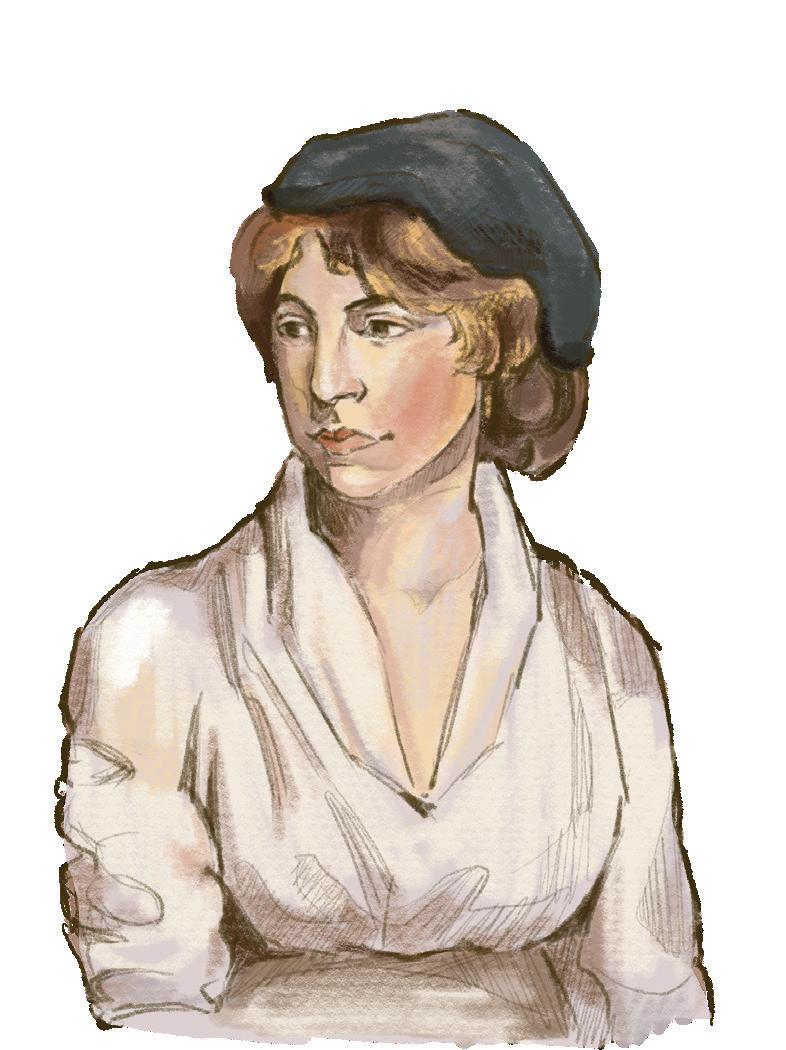
Wollstonecraft was most active during the peak of the Enlightenment era, a time period in which intellectuals engaged in philosophical and scientific discourse regarding society. During this time, Wollstonecraft advocated for accessibility of education for women, despite pushback from the prominent male thinkers such as Jean-Jacques Rousseau at the time who opposed her beliefs. Although her ideas regarding the double standards set for women were very radical for her time, she eventually grew to be one of the most influential philosophers during the Age of Enlightenment.
Claudette Colvin

Although the story of Rosa Parks is well-known, the stories of countless other Black women go unnoticed, such as Claudette Colvin’s. Nine months prior to Parks’ boycott, 15-year-old Colvin didn’t give up her seat when asked to move to the back of the bus in Montgomery, Alabama on March 2, 1955.
Colvin was arrested and was charged with disruption of peace, violation of segregation laws and assault of officers. Following this incident, Colvin was forced to drop out of school and discontinue her education. She decided to channel her energy into advocating for civil rights for African-Americans. She and Parks became closer, with Colvin making contributions to the fight against racial discrimination by joining the National Association for the Advancement of Colored People Youth Council. In 1956, Colvin became one of the four female plaintiffs in the Supreme Court case “Browder v. Gayle,” which determined the laws to be in violation of the 14th Amendment and led to the desegregation of buses in Alabama.
Colvin’s story is often untold because local activists felt Parks would be a better face for the fight against segregation, as she was an adult and presented as less Black to appeal more to white audiences to join the movement. Despite this, Colvin’s story is a powerful example of a young Black female showcasing strength in the face of adversity.
Tarana Burke
Tarana Burke started the Me Too Movement in 2017, which sparked the creation of a global network of sexual violence survivors through meaningful discussions. The Me Too Movement was created to increase awareness of sexual violence and began as a platform for survivors to share their stories and show how rampant the experience of sexual abuse is, as well as the gender inequalities often associated with it.



Burke was a youth worker who mainly worked with young women of color. Burke identified with the story of a girl she worked with so much that she became inspired to start the Me Too Movement because of it. As a survivor herself, she recognized that many others have also suffered through similar tragedies.

The movement began picking up after Hollywood actress Alyssa Milano tweeted about her own story using the “#MeToo” hashtag, which had inspired millions of other survivors to share their own stories. As the hashtag circulated internationally, the door was opened to new discussions regarding the power dynamics between genders and connections between race and abuse. Burke was named the “TIME” Person of the Year in 2017 and also received the Sydney Peace Prize. Today, Burke continues her work for the Me Too Movement and the combat of other social injustices.
EVENTS FOR WOMEN


June 10: President John F. Kennedy signs the Equal Pay Act, prohibiting wage discrimination between men and women performing the same position in the same workplace.
Nancy Harkness Love broke stereotypes by being the first of the Army Air Forces and of the first female pilots War II in the Women Air Pilots.

legal right to an abortion in a case called Roe vs. Wade. It was voted in with a 7-2 decision. In June 2022, the Supreme Court overturned the ruling.
March 24: Halle Berry becomes the first African American woman to win the Oscar for Best Actress for her perfomance in “Monster’s Ball.” 20 years later, another African American actress has yet to win the award.
enterfold 11 Thursday, March 9, 2023
month: discourse
1943 1963 1973 2002
—Compiled by Diya Bose-Malakar
—Compiled by Annabel Honigstein
Wu
Graphics by Emma and Irene Hong



12 Advertisement
Staff Sports: michael leaps through Track and field

home from the first day of practice that I realized just how sore my leg muscles were. Walking up the stairs that evening was one of the most humbling experiences I’ve had in recent memory.
Michael Zhang Lifestyle Editor


Last September, Forum Editor senior Carly Liao took her swing at tennis, and in December, Lifestyle Editor junior Becca Wu tackled wrestling (and it tackled back). For the spring season, I wanted to find a sport I could simply survive—a task which proved to be surprisingly difficult. As a non-athlete whose workouts consist mostly of lugging SEC equipment around campus, I decided to go with track and field, a discipline in which athletes could go at their own pace and where I’d be welcomed despite my shortcomings.

As that first day approached, I grew more and more excited at the prospect of practice. It’d been years since I was a part of one of the school’s sports teams, so I donned my Gunn P.E. shirt, grabbed some sunscreen and set off to the Hal Daner Track and Field after school.
I started off with the throws team, a group which competes in the shot put and discus events. In retrospect, choosing to throw on a day with 25 mph winds was a slight mistake. After one wind-buffeted lap, we began to practice throwing the shot put, and I was pulled aside by an assistant coach to learn proper form and safety procedures. Twelve-kilogram metal balls are about as heavy as you might expect them to be, so I appreciated the run-down.
After about an hour of practice, I had finally managed to get the shot put to a third of the distance that the actual team members could reach. But I only had a moment to celebrate my success before we were whisked off to the weightlifting room.
This first day was the squats day, so my friends on the team guided me through proper form and safety protocols once again. I managed to get a few good sets of squats and box jumps in, but it wasn’t until I finally got
As practices continued through the week, I found myself working with the throws team on technique for shot put and eventually discus, too. There was something magnetic about throwing heavy objects as far as you could get them, and it was extremely gratifying to feel slightly stronger day after day. Although I wasn’t exactly breaking any records with my distances, I had a great time out on the field.
There was something magnetic about throwing heavy objects as far as you could get them, and it was extremely gratifying to feel slightly stronger day after day.
When it came to track, however, I had my apprehensions about the events. When looking through the different track and field competitions, there were a few that I thought might be beyond my reach in the one week I had. For groups such as the distance and sprints teams, which are reputed for doing copious amounts of running at each practice, I knew I faced a very real and very serious risk of vomiting on the track. Out of respect for our custodial staff and everybody who uses the track, I refrained from participating in those events.
What I was most interested in were the jumps. With mats and sand pits to cushion the falls I surely would have, I felt confident that I could avoid any unfortunate instances of my lunch coming into contact with the floor. I began with the high jump, an event reminiscent of my middle school P.E. days. Although the objective was to jump backwards over an elevated bar and onto the mat behind it, I ran into trouble clearing any height taller than a kindergartener. Out of all of the events, high jump might have been the one that I was worst at,
but it was exhilarating each time to run up to the bar and never know for certain if you were going to hit it. In my case, I was in fact certain that I would hit the bar when I went, but the actual team members’ jumps were extremely impressive to watch in terms of both form and distance cleared.
The last event I tried out was the long jump, which required a speedy running start and a solid takeoff to maximize horizontal distance. Possessing neither the speediness nor the technical know-how for a proper jump and landing, I nevertheless had a blast sprinting at full force toward a sand pit and seeing how far into it I could end up. Although the sand-in-shoe problem was a bit of a hassle to deal with, the explosive nature of the long jump made it one of the most enjoyable events I tried.
Beyond the events themselves, though, I found that the most enjoyable part of my week with track and field was interacting with the members of the team community. As a no-cut sport, the team had a place for everybody willing to try their best at whichever event they wanted to compete in—even someone like me. Because of this, there were members from every background imaginable, with both veterans of their events and total newcomers working alongside each other to better themselves and their skills.
To my surprise, almost all of the team members were extremely supportive of my efforts, with many of them going out of their way to correct my form or give me tips to better my performance. As a non-athlete, I felt inspired by the top-performing athletes in the team, and even more inspired by my fellow newcomers who were giving their all and learning all the while.

Developing strength, balance and coordination made me feel more capable overall. By the end of the week I was exhausted but also motivated to continue practicing the stretches and exercises I’d learned beyond my stint for Staff Sports. So to anybody out there with apprehensions about trying a sport, at Gunn or otherwise, just remember this: If even I was able to make it work, anybody can.
Faces in the Crowd: What did you think of Michael’s throwing performance?
“His form was almost as good as mine, which is quite good, as he had about a fifth of the experience that I did.”
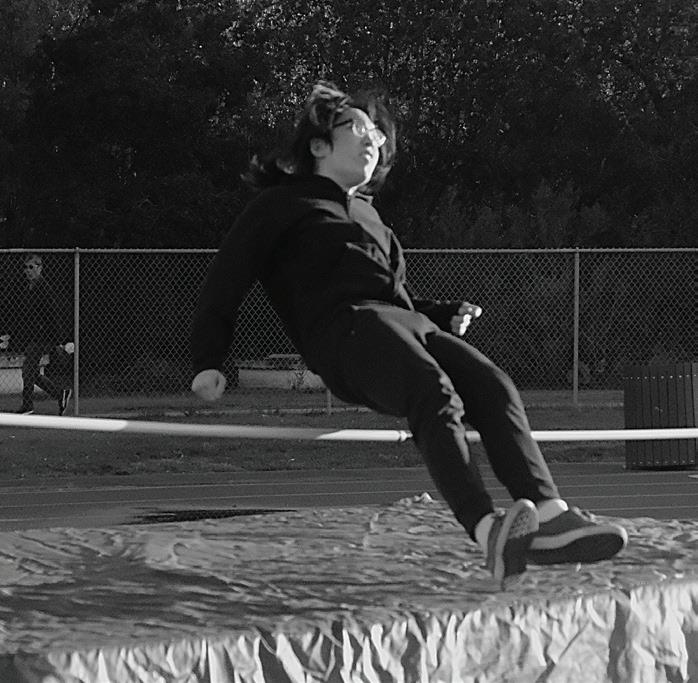
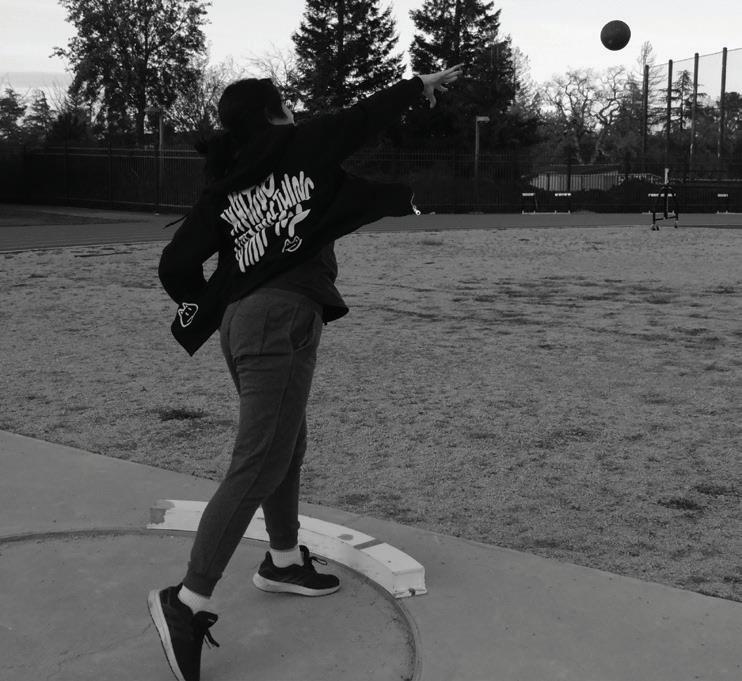
“I think he’s been doing well, but he should do distance to get the real experience.”
“He already made some good progress, especially with (his) form—and most of throwing is form, not strength, so I would say he could make some big improvements if he took it seriously.”
“It looked like he was focusing a lot on his form, which is good. Our coach emphasizes that a lot.”
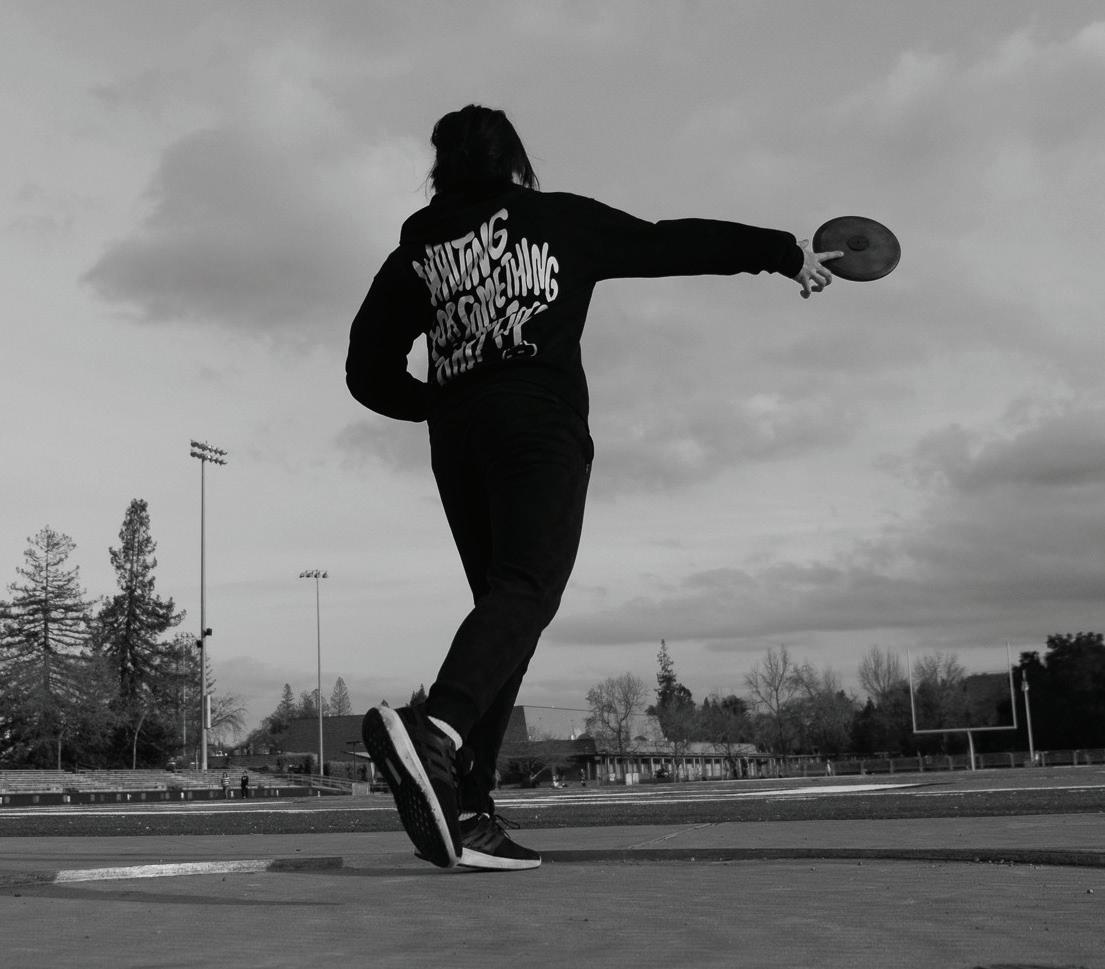
Sports 13 Thursday, March 9, 2023
—Compiled by Michael Zhang
—Jack Fiedel, 9
—Irene Wang, 10
—Nimisha Sivaraman, 12 —Owen Koehler, 11
Left: Zhang starts in standard position in the ring and releases the shot put towards the sector pit. Center left: Senior Michael Zhang practices his discus throw in the ring. Center right: Zhang kicks his legs up in an attempt to clear the high jump crossbar. Right: Zhang power sprints and leaps into the landing pit during the long jump event.
Owen Koehler
Ellie Yuan
Ellie Yuan Owen Koehler
“ ”
Sports spark opportunities for human connection, transcend social barriers

According to a statistical study published in the book “Soccernomics” by economists Simon Kuper and Stefan Szymanski, the number of people who died by suicide in Europe each year decreased by an average of 682 people when their national soccer team played in a major tournament. One likely reason is that sports provide people who might otherwise be unsatisfied with their lives with an outlet for human connection and bonding. After all, one does not have to be especially charming or outgoing to cheer for their favorite sports team among other fans. Perhaps for most people, the stakes are lower than those of life and death presented in the “Soccernomics” study, but the immense social and emotional benefits of sports are still significant in improving many individuals’ lives. Playing or watching a sport can bring families, friends and even strangers closer together.
For senior Mackenzie Green, who does taekwondo with her two brothers, participating in her sport is an opportunity to grow closer to her family in a unique setting. “It really increases the sibling rivalry,” she said. “My brothers always push me, and that rivalry is part of the reason why it’s so competitive. But it’s also really nice to have someone there who understands how tough something is for you or how big of an accomplishment something was.”
The rigorous nature of taekwondo has also allowed Green to foster deeper appreciation for her sports community. During a three-day test to earn her black belt, Green had to perform a variety of challenging exercises, including running time trials and reaching a certain number of pushups and situps. “We all finished that test together,” she said. “So, while it was an individual thing where you were trying to improve yourself, being in a community like that was a really powerful experience. I was able to see that everyone made improvements and (that) everyone came far.”
my family goes down and sits to watch the game on TV,” she said. “Everyone makes time for that—and we’re a very busy family, so that’s kind of impressive.”
While sports are a way for Green to bond with her family, playing lacrosse and football gives junior Joshua Kim an opportunity to form new connections, particularly after feeling isolated during the COVID-19 pandemic. “Especially in freshman year, it was really hard to socialize,” he said. “Playing sports really helps you build connections with people. You have shared common ground and spend so much time together. You go through games, losses and wins together.”
“Playing sports really helps you build connections with people. You have shared common ground and spend so much time together.”
Junior Joshua Kim
Similar to Green, Kim finds the built-in community of team sports one of the most valuable aspects of playing a sport. “When you lose a game or are going through tough times, you have all your teammates there because they’re going through the same (experiences) as you,” he said. “It doesn’t feel like you’re going through anything alone.”
Relationships forged between teammates have the potential to last beyond simply playing the sport together. Kim used to play soccer in elementary school with many teammates who now attend Palo Alto High School. “I stopped playing as I entered middle school, so I never saw them because they (didn’t go) to the same school as me,” he said. “Then, as I started meeting people from Paly again, it wasn’t awkward at all with the people I used to play soccer with. We’re able to go back and have conversations. We’re not building just relationships at the moment, but we’re building stuff that lasts because we have so many shared experiences together.”
What was your favorite sports memory?
“In 2014, my dad got me a huge bracket poster for (that year’s) World Cup. I was little, and I wasn’t really into sports that much before, but watching those games together got me into soccer.”
Senior Mackenzie Green
Taekwondo is not the only major sport in Green’s life. Soccer also holds particular significance in her family history. “My dad is from England, so we’re a very socceroriented family,” she said. “My parents actually met playing soccer: They did a coed soccer team together. I’ve always grown up playing soccer, watching soccer or being exposed to soccer. It’s something that everyone in my family enjoys together. It’s something that we can all talk about or just enjoy in the same room.”
Televised soccer matches are often major events in Green’s household. “If it’s a team that we really like and they’re playing in a pretty big tournament, everyone in
One of Kim’s most memorable moments of connection comes from watching a Sunday football game in a sports bar with his family. “There was this guy sitting alone at one of the bar tables,” he said. “He looked really lonely, so I just sat down with him. The simple fact that we were both enjoying the game helped us talk, and it was a really cool experience because I got to talk not just about sports, but life stories as well. It was really interesting because you get to know people through sports that you would never talk to otherwise.”
Kim’s experience illustrates how sports’ widespread appeal helps people transcend the barriers that may exist outside of a match. “You don’t have to know these people, be the same age, go to the same school or have similar interests,” he said. “You’re able to connect with people you don’t know at all. It’s a universal language.”
—Written by Carly Liao
“Playing basketball in middle school. It was really fun and carefree. (There was) not much competition and more team and basketball-building skills.”
—Sophomore respondent —Sophomore respondent
“Having so many friends from cross country and people just accepting me.”
—Freshman respondent —Sophomore respondent
“Playing soccer as a kid with the friends in my neighborhood. We couldn’t all speak the same language, but we all knew how to play soccer, so that was nice.”
“Spending late nights rehearsing for a dance show with all of my friends.”
—Junior respondent
“The Giants winning the World Series on my birthday when I was in elementary school.”
—Junior respondent
Source: Self-selected survey sent out to Gunn students by The Oracle from March 1 to March 6 with 34 responses.
66.3% of students surveyed agreed sports impacted their lives positively.
Source: Self-selected survey sent out to Gunn students by The Oracle from March 1 to March 6 with 95 responses.

14 SportS
Sarah Xie
“It’s also really nice to have someone there who understands how tough something is for you or how big of an accomplishment something was.”
“ ”
“ ”
Varsity DANCE TEAM competes at usa nationals, wins fourth place
“Full out, whole thing,” Dance coach Stephanie Anderson Ferris says as she starts the music. The dancers, trying their best to remember the new corrections and choreography changes that were just given, take their starting position. It’s the last five minutes of an 8:30 a.m. rehearsal on Friday, Feb. 17, one of many morning rehearsals to come. In exactly one week on Feb. 25, the Gunn Co-ed Varsity dance team will head to Anaheim to compete at the United Spirit Association Nationals.
This was a particularly unique year for Ferris and the dancers, as the team has been unable to attend USA Nationals for the past three years due to COVID-19 restrictions. While they participated in virtual competitions throughout the season, Nationals was the first time this group of dancers has competed in front of a live audience.
To prepare the dancers for this new competition environment, Ferris had the team practice their routine as often as possible. “The virtual competitions that we’ve done are nice because we get to compete with teams from all over the place, but it’s different because there’s no live audience screaming, yelling and amping up,” she said. “We’ve been really focusing on cleaning and making sure our formations are okay, as well as breaking through and keeping the energy up. Since they’ve never competed at live competitions before, they don’t necessarily understand how wild the energy is. So, learning how to really perform well has been the main thing that we’ve been working on so far.”
The rehearsals, occurring both before and after school, could not all be dedicated to working on the Nationals routine, however. The team also had to prepare for school events such as TEDx, boys’ basketball’s Senior Night and the Spring Sports Rally, creating a fair amount of stress for dancers like Dance Captain senior and The Oracle Features section editor Madison Yue. “For the past three days, we’ve had morning practices from 7:40 a.m. to 8:40 a.m. right before school, so it’s definitely been a lot of training for all of us,” she said. “We’re performing at the Spring Sports Rally today, and we just finished (the choreography) yesterday. It’s been a little chaotic having to go to Nationals this weekend while also performing for the Spring Sports Rally—there’s just a lot going on.”
With academic workloads and outside commitments, the team found it difficult to accommodate everyone’s schedules, leading many rehearsals to occur without the entire team present. Even for the very last rehearsal on Feb. 21, some dancers were unable to attend, meaning their performance on Feb. 25 was the first time running the routine through all together.
One final challenge presented itself at Nationals this year: It was the first time the team competed with poms in the “Varsity Song Pom” division. According to Ferris, this change was made mainly because the Nationals competition with the pom division occurs earlier in the year and therefore didn’t risk interfering with some dancers’ regional competitions for their personal dance studios outside of Gunn or with AP testing season.
Not to be confused with cheer, dance pom focuses on choreography using the poms, as well as dance technique. “Cheer typically doesn’t use poms when they compete at competitions since they’re lifting people,” Ferris said. “We’re using our poms the majority of the routine, and we’re doing turns, leaps, a kickline, a hip hop section and more formation changes as well as visuals.”
To showcase the variety of talents across the team,
Meet the team:
Years danced: 12
Years danced: 12
Years danced: 5
choreography for Nationals also incorporated styles of dance besides pom. Solos featured junior and Lifestyle section editor for The Oracle Becca Wu and senior Mylie Rodrigo in genres they excelled at: ballet and hip hop, respectively. “We really wanted to show that we are a wellrounded team, highlighting not only the pom techniques, but also the different individual strengths throughout our dance with the solos,” Yue said.
Despite never competing at Nationals as a team, the dancers found themselves with a fourth place finish in their division among strong competition from schools all across the U.S. In previous virtual competitions, the dancers had the option to re-record their routine until they were satisfied with the results. But this time, with only one shot to be nationally ranked, the team managed a performance with no deductions. “There were so many things that could have gone wrong in our dance,” Yue said. “Our aerials could have not been on time or someone could have dropped a pom, but they didn’t. I think we really performed well under pressure.”
For seniors such as Yue, this competition served as not only their first Nationals, but a bittersweet last as well. “Just being able to finally perform at Nationals for my last year was a memorable experience and one that I’ll never forget,” Yue said. “I definitely wouldn’t have wanted to end it any other way.”
Before the team’s performance, Ferris spoke to the dancers about the importance of leaving the stage with no regrets. Having trained these dancers for so long, their performance at Nationals was an emotional experience for Ferris. “When they were performing, I legitimately started crying,” she said. “It was just so much fun to see them in the zone and leaving it all on the floor. I was really pleased with how they did and very proud of them for pulling it off.”
For Ferris, Nationals also served as an opportunity to connect with old friends and find inspiration for the future. Her experiences as a student-athlete and judge built the foundation of empathy and creativity necessary to lead a team of dancers, as well as instilled in her a competitive drive that was rekindled when she began coaching at Gunn. “As a judge, it’s really cool to see the creativity that different teams come up with; there are so many things that people do to push the limitations of the division,” she said. “Coming back as a coach, you leave Nationals with ideas, feeling inspired and feeling motivated for the next year.”
The dancers also left Nationals with a new spirit for themselves and the team, according to sophomore Anriya Wang. “The main thing I took away was the importance of team spirit,” she said. “With virtual competitions, you can’t really feel it, but when you’re with everyone else at Nationals, it’s a lot more exciting. You have so much more energy and just really enjoy dancing overall.”

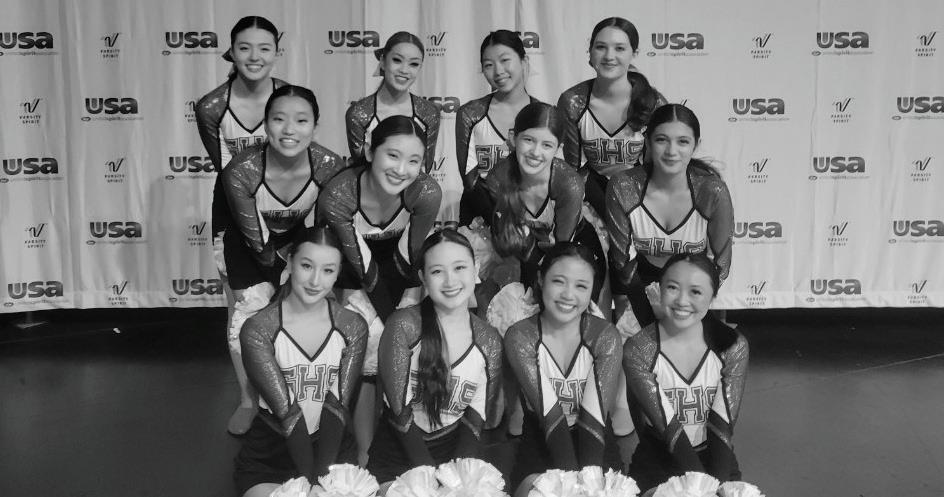
Following the end of the competitive season, a new round of auditions for the team will open up, as well as opportunities for open practices, which Ferris encourages interested students to partake in. In the future, Ferris hopes to create both a junior varsity and Varsity team, compete in more divisions at Nationals and collaborate more often with the cheer team. “I really want to see the team continue to develop and grow and make a name for themselves in the competition world,” she said.
—Written by Kaitlyn Chen and Maddie Cheung
Years danced: 10
Years danced: 14
Years danced: 8
Years danced: 10
Years danced: 11
Years danced: 13
Years danced: 15
Years danced: 14
Years danced: 14
by Madison Yue
15 Thursday, March 9, 2023
Courtesy of Madison Yue
—Compiled
The dance team poses for a group photo after competing at the United Spirit Association Nationals in Anaheim.
Christina Assimes, 10
laura cheunkarndee, 10
Kira Fredericson, 12
Sophie nam, 10
Mylie Rodrigo, 12
Yayoi Tomaszewski, 10
anriya Wang, 10
Becca wu, 11
Jennifer Yang, 12
Madison yue, 12
Reshma valame, 10
Harel klinger, 11
Photos by Madison Yue
2023 Academy Awards nominees prove controversial, demonstrate archaic process
This year’s Academy Awards, more commonly known as The Oscars, marks 95 years since the Academy of Motion Picture Arts and Sciences began awarding artistic and technical merit in the American film industry. Award categories such as Best Picture, Best Actor and Actress and Best Costume Design showcase the best of American filmmaking. This year, the Oscars will be held on March 12 at the Dolby Theatre at Ovation Hollywood with television host Jimmy Kimmel hosting. However, Kimmel was not the first person considered to host. Comedian Chris Rock reportedly turned down the offer after the drama of last year’s awards show where he was assaulted by actor Will Smith—one of the many controversial moments and decisions surrounding The Oscars.
theory that the Oscars don’t truly honor art, as well as the rise of streaming services and the subsequent decrease in people who watch movies in theater have all contributed to this decrease.
“The Oscars have never been about rewarding art and hard work—(they’re about) people who play the Hollywood game right.”
The nominee selection process for the Oscars is carried out by a committee from the AMPAS. However, the selections are not without their biases and prejudices, according to Composition and Literature of Visual Media teacher Mark Hernandez. He believes that the nominations tend to reward self serving films rather than those that display more cinematic expertise. “They’ve painted themselves into a corner where they often reward pandering,” he said. “The quickest path to an Oscar nomination is just talking about how great film is, and I try to stay away from stories like that, when they seem so obviously designed to get nominated.”
Senior Abby Fitzpatrick
In past years, the Oscars has struggled to nominate films that were widely viewed by the public. This year, however, the Academy may be attempting to address this issue by nominating more mainstream movies. Hernandez believes that this act of nominating more popular movies for the sake of boosting ratings is untrue to the purpose of the awards. “The nominations of ‘Avatar’ and ‘Top Gun’ have really exposed almost a crisis in the Academy,” he said. “It seems like they recognized their pattern of nominating films that no one’s ever seen, and now, to stay relevant, are nominating films everyone has seen— both of which can’t be close to the Best Picture. But it’s not clear to me that more people are going to watch, or that this pandering will make the Academy more relevant.”

As someone who enjoys film, senior Abby Fitzpatrick looks forward to The Oscars each year, but she sees the problem posed by the awarding system. “Even though I really enjoy watching the Oscars, trying to empirically measure the worth of art is oftentimes a bad road to go down,” she said. “All art has value, and people are starting to catch on to the fact that the Oscars isn’t really about whether this film deserves recognition. There’s a lot of identity politics also at play. The Oscars has never been about rewarding art and hard work, it’s mostly been about nepotism and giving acknowledgments and accolades to people who play the Hollywood game right.”
There are many factors that play into the decline of people tuning into the Oscars. According to CNN Business, viewership has decreased from 40 million in 2014 to 9.8 million in 2022. Factors such as Hernandez’s point on the bias behind the nomination of films, Fitzpatrick’s
Staffer’s picks for 2023 oscars winners
Another issue that has been brought up is the role that racial prejudice plays in regards to what films are nominated and awarded. In 2015, the hashtag #OscarsSoWhite started trending after all 20 acting nominations that year recognized solely white actors. Junior Rohit Divekar has noticed the prevalence of race in which films get nominations. “(The Academy is) trying to hide it now because it’s not the best image, but there is a lot of racism and xenophobia in the Oscars,” he said. “While it’s gotten better over the years, the Oscars still favors more Eurocentric movies as there’s still a pretty prevalent selectiveness that is not based on qualities that are representative of film such as race.” While this year has seen a historic number of Asian actors and actresses nominated in films such as “Everything Everywhere All at Once,” “Turning Red” and “The Whale,” other films and actors seem to have been snubbed of nominations. One issue sparking debate was the fact that there were no Black actors in any leading acting categories or directors nominated. Films led by Black artists such as “The Woman King,” “Till” and “Nope” are not getting proper recognition from the Academy, with many having taken to social media to vocalize their thoughts on Black actors being overlooked. Director Chinonye Chukwu, who directed the 2022 film “Till,” called out Hollywood and the Academy in an Instagram post on January 24. “We live in a world and work in industries that are so aggressively committed to upholding whiteness and perpetuating an unabashed misogyny towards Black women,”
In recent years, the Academy has made efforts to diversify its nominee pool. The 11 nominations
“Everything Everywhere All at Once” received this year is a significant increase in the number of nominations with Asian American Pacific Islander representation. However, Hernandez still finds the Academy’s irregular nature to come across as forced. “It seems like they are unaware of how racist and sexist they really are,” he said. “A lot of the films that get recognized by the Academy addressing racism are problematic because they’re routinely white savior movies. They have a pattern of applying Band-Aid solutions to these giant wounds that are potentially fatal for the Academy. We’ve got some representation this year with ‘Everything Everywhere All at Once,’ but other than that, there’s not a lot of diversity in this year’s Oscar recognitions.”
Zoe
reporter



Best Actor: Austin Butler
With the Oscars rapidly approaching, anticipation is rising for the reveal of this year’s winners. The category of Best Lead Actor should be awarded to Austin Butler for his portrayal of the titular character in “Elvis.” In the film, Butler was able to encapsulate the distinct voice and mannerisms of Elvis Presley. Butler did most of the singing himself and spent years learning Presley’s signature dances. According to an interview for Variety, Butler was so committed to the role of Elvis that he didn’t see his family for three years while preparing for the film. “Elvis” would not have been so successful if it weren’t for the dedication and hard work that Butler put into the making of the movie.


Best visual effects: “Top Gun: Maverick”

For the category of Best Visual Effects, the film “Top Gun: Maverick” blew the audience away with its incredible visuals. The hit movie was filmed using 2,400 shots of real flight and creative photography, which were then enhanced with visual effects. According to a Men’s Journal interview with actor Miles Teller, who played Lt. Bradley ‘Rooster’ Bradshaw in the film, no greenscreens or CGI were used throughout the filming process. Teller spent three months enduring intensive flight training with some of the top pilots in the world. He also obtained a pilot’s license to perform all of the essential stunts in the movie, truly bringing the film to life.
Best Cinematography: “All Quiet on the western Front”
of students follow the oscars somewhat closely.
Source: Self-selected survey sent out to Gunn students by The Oracle from March 1 to March 6 with 96 responses.
The award of Best Cinematography should go to the film “All Quiet on the Western Front,” which follows a group of friends who enlist in the German army during World War I. The camera takes the viewer through the muddy trenches and action-packed battles, capturing the hardship and violence of war, while having truly captivating cinematography. The production team filmed at an abandoned ex-Soviet air base in the Czech Republic and built trenches filled with mud, running as deep as 20 feet. Other scenes took place in a palace and art gallery, highlighting the vastly different settings of the film.
 Leontis
Courtesy of Paramount Pictures
Courtesy of Chris Pizzello
Courtesy of Netflix
—Written by Safina Syed
Natalie Lam
Leontis
Courtesy of Paramount Pictures
Courtesy of Chris Pizzello
Courtesy of Netflix
—Written by Safina Syed
Natalie Lam
25% 16
Lifestyle
Staff Spies: The Oracle Infiltrates Clubs
Katie LaWer shoots her shot at Photography Club


Photography Club began in a bright, airy classroom with a group of members already gathered at the tables in the front of the room. I felt apprehensive at first, not being a regular member, but no one acted as if my presence was unwanted or out of place. The co-presidents, junior Siena Tacy and junior Jaein Chung, quickly began going over the activity planned for the meeting: creating photograms. Even though I had no idea what a photogram was, I followed the rest of the members into the darkroom anyway. I was surprised at both how large the darkroom was as well as the fact that the lights were on—Tacy explained that the lights turned off when people were working with their film.
During the activity, I found out that a photogram is an image created without a camera by placing


objects onto photogenic paper and exposing it to light.
We began by choosing small objects to display on print, from strings of colorful ribbons to 3D-printed animals. Rummaging through the boxes, I picked out a pink ribbon, a chess piece, two dice and a string of purple beads. I then arranged my objects under the enlarger, a specialized projector used to produce photographic prints. Once everyone was ready, a quick flash lit the dark room. After taking out my photograph-to-be, the last steps were to soak the paper in the developer for one minute and then in water for 15 seconds before leaving it for one minute in a photographic fixer to stabilize the image. After my paper had been thoroughly soaked, I left the dark room and gazed, surprised, at the print. The once-white paper was completely black, with the objects I had chosen visible in bright silhouettes. The print had turned out better than I expected, and I felt a sense of accomplishment at having learned something new. At the end of lunch, I felt regretful that I had not been to earlier meetings in the school year that included other hands-on activities such as using pinhole cameras and making cyanotypes; even though I came as a spy, I thoroughly enjoyed my time at the Photography Club meeting.
Sophia Hwangbo paints a picture of Mixed Arts Club

Mixed Arts Club provides a space for students to learn more about the various forms of art outside of a formal classroom setting. It is a place where members can create small art projects as well as watch presentations about art. The day I infiltrated this club, the members were discussing famous artworks and how they achieved their renown.
Club president junior Tanya Yu began the meeting with a presentation on what makes certain pieces of art famous. Yu spoke about how famous artworks are not always alone in their allure, but they have greater fame due to external factors. This topic immediately piqued my interest because its amazing how out of millions of artworks, only a couple obtain world-wide recognition.
She explained that many factors contribute to the fame of a painting, such as the context in which the painting was created or the emotions it evokes. Yu then played a video explaining how the Mona Lisa became the world’s most famous painting. I never really understood why the Mona Lisa is so famous—it seems like such a simple painting to me, and it’s only one of countless amazing Renaissance artworks. I’ve always heard about how her smile evokes mystery, but I never knew about all the external factors. I learned that the Mona Lisa was written alluringly about by many scholars throughout the centuries and was stolen from the Louvre Museum in 1911, which led to its fame.
The whole video was very informative and I thoroughly enjoyed it.
Yu continued on to talk about postmodernism and how there is much controversy on whether or not it is considered true art. Pieces such as a banana duct-taped to a wall has been sold for thousands of dollars, but Yu emphasized that art is simply subjective and is up to the consumer to judge the quality and worth. Overall, the atmosphere of the club was calm and relaxed, and as a person who enjoys various forms of art, learning more about the world of art was very engaging and interesting.
—Written by Sophia Hwangbo
Isha Sinha steps into the spotlight at Thespian Club
Bright spotlights and boisterous personalities were the first thing I noticed when I walked into Thespian Club. I was initially intimidated by the exuberant members who made for a chaotic environment far out of my comfort zone. I realized I would have to push my own limits to keep up. After eating lunch in the audience seats, Thespian Club President senior Chloe Lee invited all members to the stage to play a game. The rules were simple: Randomly choose a playing card and hold it up for everyone but yourself to see. The higher the value of the card, the richer the
character is. Then interact with others in character and guess the value of your card based on the interactions.
My ineptitude in acting made me slightly nervous, but other members were patient and encouraged me to keep trying. Since everybody treated me like I was upper-class during my interactions, I had guessed my card to be a queen or king. After several interactions I realized that while the club members were originally intimidating, everyone was goodnatured and willing to interact, despite my inexperience. Later, Lee gathered everyone in a group and each person flipped their card around. My guess of my character being royalty was correct, but my card turned out to be a jack. Unexpectedly, the game had turned out to be fun, and the high energy of the club became homey and inviting. After realizing that my original assumption that Thespian Club would be too energetic for me was incorrect, I left the club on a positive note. My experience was overall very fun, and I’d recommend the club to others who enjoy interacting with others and are looking to get out of their comfort zone.
Dylan Sperandio goes for a round at Board Game Club
As I entered Board Game Club, advisor Steve Ames’ voice echoed through the room. “Take your seats, guys,” he said. “We’re going to be playing Sitting Ducks Gallery.” I hurried to a chair, nervous, as I had never heard of this game before. I voiced my unfamiliarity, but everyone assured me that the game was easy to learn. Each participant gets a set of duck pieces at the beginning of the game, and their goal is to get as many pieces across the board as they can. Players receive instructions from action cards they draw each turn and can eliminate each other’s ducks as well as move their own pieces. Actions include targeting a duck, shooting a duck, moving one’s duck forward or backward and more. A few rounds went by and I had taken down many ducks, scheming with others to target certain players and shrewdly making deals to protect my own. It was my first time at the club, but I had forgotten my qualms about learning a new board game. Even though I was there as a spy for The Oracle, I was having fun with everyone else.
After the bell rang, we kept on playing. A few intense minutes later—ducks dropping like flies—we counted the number of ducks eliminated. I ended up being late for my 3rd period class, but it was worth it: I had won. However, even if I had lost, I would not have minded. I had a great time, and look forward to returning to club meetings not as a spy
but as a member. The games are fun, fast and easy to learn. Everyone is nice and welcoming, too. If you are looking for a fun club to go to on a Thursday, make sure to check out the Board Game Club.
—Written by Katie LaWer
—Written by Isha Sinha
—Written by Dylan Sperandio
Photos by Michael Zhang
17 LifestyLe Thursday, March 9, 2023
Ruhani Suresh
Gunn party culture eschews stereotypes
Throughout films, shows and various media, party culture has typically been depicted in a negative light. For example, television series such as “Euphoria” and “Gossip Girl” portray teen partying to the extreme, involving drug usage and drinking. In addition, high school students in media are often viewed as unruly and uncontrollable, as well as lacking empathy and manners. The reality is, teenage party culture, especially at Gunn, remains laidback with movie-like situations being a rare occurrence.


The stereotypical high school party portrays chaotic teenagers dancing and jumping to loud music. However, according to junior Sarah Tannenwald, party culture at Gunn is not as drama-filled, action-packed or crazy as media suggests. “Gunn (doesn’t really have) the traditional party culture you see in movies,” she said. “(Actually,) there aren’t that many parties at Gunn.”
Nonetheless, senior Adele Davis believes that the parties Gunn does have are enjoyable social experiences. Typically, these parties celebrate an occasion or act as an opportunity for individuals to commune with each other. “It’s a time for people to hang out and have fun,” Davis said. Tannenwald agreed that attending parties can be a positive social experience. “(It’s a good time to) listen to music, meet new people (and) sometimes eat,” she said. Parties provide unique situations for students to reach out and meet new people beyond their normal school peers.
Yet not everyone believes in the positive side of teenage party culture. “Especially with teenagers, (party culture) has a bad reputation,” Davis said. In a self-selected student survey sent out to Gunn students by The Oracle with 25
responses, an anonymous student critiqued parties and party culture. “Parties are a complete distraction and an artificial form of having fun,” they wrote.
Whether positive or negative, student experiences with parties will vary for each person depending on their circumstances. In particular, parties tend to take place at different times for students of different grades.
“Gunn (doesn’t really have) the traditional party culture you see in movies. (Actually,) there aren’t that many parties at Gunn.”
Junior Sarah Tannenwald
For example, during AP test preparation season, some students can enjoy the warmer days with fewer responsibilities. “Especially for seniors, people relax more during second semester, so there are more (parties),” Davis said. For juniors, on the other hand, Tannenwald believes that there is more time for parties and social events in the fall semester. “Earlier in the year, there was more time to relax,” she said. “Now, everyone is more stressed.”
Despite their social nature, parties can often have an exclusivity element. “People are very ‘cliquey’ with who they invite,” Davis said. “(Some) people tend to like hanging out with their friends, rather than meeting new people.”
What are your personal views on party culture?
“It

“I
“It’s
Source: Self-selected survey sent out to Gunn students by The Oracle from March 1 to March 6 with 25 responses.
Tannenwald shared similar insights. “Exclusivity occurs because there are specific friend groups that are not good at mixing or intertwining,” she said. “Sometimes when you walk into a party, there’s no music or it’s just really quiet. It’s awkward (at first) if people don’t know each other. If it’s not your normal group of friends, you can feel tension.”
Related to exclusivity, Davis has seen individuals affected by the Fear Of Missing Out when it comes to parties. “There’s definitely a lot of FOMO that people can feel if they’re not invited to certain things or are left out,” she said. “Social media definitely makes it worse because you can see other people posting about things (that you were excluded from).”
Tannenwald has experienced FOMO before, but new experiences have shifted her perspective. “I used to feel it earlier in the year, or when I was younger,” she said. “But now I just have different priorities.”
While parties can serve as a serious distraction to students from typical academic rigor, students still can find themselves conflicted by them—despite Gunn’s party culture being minimal compared to other areas. However, Davis believes that due to the studious environment Gunn creates, students are still capable of managing their time well. “For Gunn students, it doesn’t have too much effect (on school life) because people here are very academically focused,” she said. “People know how to balance.”
—Written by Michelle Koo
Spring forward into a restorative headspace
Do spring cleaning Practice self-care

In a world centered around productivity and hard work, self-care is crucial in maintaining efficiency. Self-care is especially important when it comes to preventing burnout, whether that be in school or any other part of life. With spring break quickly approaching, it could provide an excellent opportunity to take a breath and relax. While some people prefer reading, mindfulness, journaling, exercising, shopping or eating healthy, it is important to identify what type of self-care is most suitable for a proper and personal reset. Self-care is not confined to activities considered “calming” or “laid back”—it should entail whatever an individual finds interesting, pleasurable and overall relaxing. Also, self-care routines offer many psychological benefits such as decreased anxiety and depression, as well as increased happiness and adaptability in other situations. Given its benefits, individuals should make sure to put some time aside and take care of themselves so that they can come back feeling refreshed and ready to work. Something as simple as asking “What do I want to do?” can make an impact on physical, emotional and social wellbeing.
Catch up on sleep
Many students know all too well the amount of suffering that results from deadline-induced lack of sleep. Horrifying sleep schedules consisting of three-in-the-morning bedtimes only become more common with AP testing on the horizon. Breaks are a great opportunity to reset one’s sleep schedule and catch up on all the Z’s they missed.
According to the Center for Disease Control and Prevention, high schoolers need eight to 10 hours of sleep per night—meaning that students should not prioritize binging a book series, watching a TV show or playing video games over much-needed rest. For many, eight to 10 hours can seem unachievable during high work seasons, but taking the time to reset and stick to a schedule can improve performance more than one thinks. Thus, getting enough sleep during spring break is crucial, as it will increase efficiency, help improve concentration and boost academic performance. Instead of falling into the old ways of a 3 a.m. to 8 a.m. schedule, use spring break as a time to go to bed and wake up at a reasonable and healthy hour.
As the weather gets warmer and the scent of flowers wafts around, everyone knows spring is here. Many turn to spring cleaning as a reset or fresh start for the new season. According to the website Healthline, clearing clutter from one’s surrounding areas can have positive effects on their mood and efficiency. Not only that, but it can decrease the risk of injuries or illnesses. When looking around a messy house, tidying up may seem like a daunting task at first. Starting the cleaning process is the hardest part. However, there are tips and tricks to scrape together the motivation to get those hands working. Examples of such include making an exciting checklist, listening to music or playing a podcast. Doing these can help alleviate the boredom associated with cleaning and make the cumbersome task a bit more interesting.
Organize your space
Unlike spring cleaning, organizing your space focuses on rearranging rather than decluttering. This allows for more creativity and freedom. When cleaning communal spaces, one should account for the preferences of people who use the space. One can tailor their item layouts to their own convenience without bothering others. Moreover, personalization can make one feel more comfortable and connected to that specific space, leading to increased productivity and enjoyment. Examples of personalization can include creating a unique color palette, introducing fun stationery, fairy lights and placing a few stuffed animals or figurines around. Something as simple as adding a mug for pens and pencils to a desk or wiping down an ink-splattered area can greatly increase productivity. Especially as busy high school students, working spaces are a large part of life and can be highly reflective of one’s work. Try organization for better quality of work and overall better quality of life.
—Compiled by Charlotte Qian
Charlotte Qian
have never been to a high school party, but I also don’t hear about a lot of crazy parties in general.”
great to have them, as long as they go pretty smoothly.”
can help to take off some of the stress that comes with academics at Gunn.”
Freshman respondent
Junior respondent
Senior respondent
“ ” 18 LifestyLe
From eerie to erudite: Podcasts deserve a listen
“The Mel Robbins Podcast” provides solutions to address problems with procrastination, anxiety and motivation. Hosted by Mel Robbins, the podcast dives deep into practical advice on how one can improve their well-being. Episodes are updated semiweekly and are up to an hour in length. From the psychology of human nature to light-hearted suggestions on holiday fun, Robbins engages the listener in insightful discoveries. She discusses the causes and effects of common obstacles individuals may face in life, as well as potential remedies to those problems. After listening, one will hopefully gain a more comprehensive understanding of solutions for dealing with the ups and downs of life. “The Mel Robbins Podcast” is available on Amazon Music, Apple Podcasts, Spotify and YouTube.

The podcast “Crime Junkie” immerses listeners in bewildering, bone-chilling crime stories based on true events. The podcast presents true crime stories in episodes updated weekly. Each episode features a story laid out by engaging hosts Ashley Flowers and Brit Prawat. Keeping listeners on their toes for an intense session of a storyline, this podcast is perfect for a 40-minute break. These stories are some of the darkest unsolved mysteries in the United States, ranging from complex and deeply layered murder cases to twisted instances of sudden disappearances. The chilling episodes are straight-tothe-point with no lengthy introductions or nail-biting cliffhangers. Finishing an episode will immediately prompt one to click on the next—and soon lead into a true crime obsession. “Crime Junkie” is available on Amazon Music, Apple Podcasts, Pandora, Spotify and Stitcher.

“Ologies with Alie Ward” is a podcast hosted by Alie Ward that draws attention to unique, narrow topics, or “ologies.” Episodes are updated weekly and span about an hour. Perfect to listen to in the background, these topics range from “oneirology,” the study of dreams, to “lampyridology,” the study of fireflies. The majority of episodes are categorized into broad subjects such as organisms, the Earth, food and culture. Expert guest speakers are invited to each episode to share expertise, talk about personal experiences and relate to the listeners’ daily lives. Expect to gain eye-opening insights into these geeky research topics, and be prepared to discover flora and fauna beyond the typical expectations of science. “Ologies with Alie Ward” is available on Apple Podcasts, Audible, Podbay, Spotify and Stitcher.


The Oracle Scavenger Hunt Crossword
Women’s History Month occurs during ____ (p. 10)
Global movement to raise awareness for victims of sexual violence originated by Tarana Burke (p. 11)
According to junior Joshua Kim, sports are “a universal ____” (p. 14)
Frequently heisted vehicle at Gunn (p. 3)
Seniors often sponsor an end-of-year ____ (p. 7)
Over spring break, tired students should take time to catch up on ____ (p. 18)
Social media influencer freshman Alisa Sonehara publishes content on ____ (p. 8)
Viral AI chatbot controversial in schools (p. 1)
Character portrayed by staffer’s pick for the Oscars’ Best Lead Actor (p. 16)

Narcotic overdose medication to be stocked across Palo Alto Unified School District campuses (p. 1)
Spanish word for “life” in the title of senior Jack Davisson’s first album, “La ____ Breve” (p. 9)
Small businesses benefit ____ economies (p. 6)
A benefit specially granted to certain people (p. 4)
Parking in well-lit areas and registering a VIN number are important vehicle ____ measures (p. 3)
Spring sport attempted by staffer (p. 13)
Carly Liao advocates for ____ discussions about hiring private counselors (p. 5)
Recently demolished outdoor student area (p. 7)
Indigenous group originating from Veracruz, Mexico, that junior Jose Morales belongs to (p. 20)
Gunn sports team that recently attended Nationals in Anaheim (p. 15)
Unscramble the circled letters!
FINISHED? Stop by Room P-115 during 5th period or lunch next week with the completed crossword puzzle for a prize!
“The Mel Robbins Podcast” “Crime Junkie” “Ologies With Alie Ward”
3. 5. 7. 8. 10. 11. 12. 14. 15. 17. 18. 19.
1. 2. 4. 6. 9. 13. 16.
—Compiled by Bryan Xiao
—Compiled by Fiona Xiong
Courtesy of Mel Robbins
Courtesy of Alie Ward
Chaewon Lee 1 2 3 4 5 6 7 8 9 10 11 12 13 14 15 16 17 18 19
DOWN 19 LifestyLe Thursday, March 9, 2023
Courtesy of audiochuck
ACROSS
Junior Jose Morales Honors indigenous culture Through traditional dances, symbolic adornments
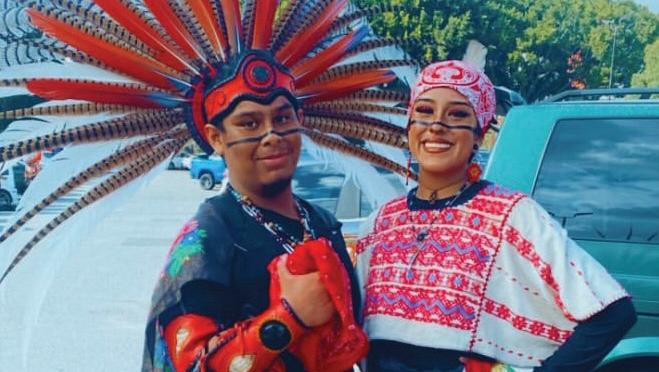

Six-year-old junior Jose Morales was looking for toys to play with when he instead found “coatlicue,” a collection of his grandfather’s indigenous artifacts. Since then, he has learned more about his ancestral history, the traditions and the culture of the Totonaca, an indigenous group from Veracruz, Mexico.
Morales’ grandfather has played a crucial role in introducing him to the indigenous community. “I’m glad that my grandfather introduced the culture to me because now I see life differently,” he said. “I feel that if I didn’t have those teachings from him, I wouldn’t be the person I am today because his words of wisdom took me to another level of accepting what death is. I learned to appreciate who I am, who I can become and whom I can offer that same energy to.”
“As an indigenous, you’re representing your legacy. You’re representing your ancestors because at one point, they couldn’t historically.”
Junior Jose Morales
In one word, Morales described the indigenous community as a family. “We’re not biologically related, but it’s the form of ‘tequio’ (‘trabajo communal’ in Nahuatl), which is communal work where we gather together to share our love, energy and culture,” he said. “We’re all united.”
Being a part of the indigenous community also comes with a lot of responsibility. “As an indigenous, you’re representing your legacy,” Morales said. “You’re representing your ancestors because at one point, they couldn’t historically.”
In addition to the responsibilities that come with being indigenous, Morales is faced with cultural
appropriation. For example, Morales wears macaw feathers because they resonate with him, but he has seen nonindigenous people wear them unknowingly. “Macaw feathers are colorful,” he said. “I’m pretty colorful, but I’m also natural. I only use natural colored feathers, but a lot of people will dye chicken feathers to make it seem like they’re part of something that they’re not.”
Seeing people disrespect his culture leaves Morales feeling disheartened. “I feel that I have failed the dreams that my ancestors had intended for me,” he said. “They wanted me to preserve the culture, but that can’t happen if people are just trying to copy how it’s done.”
As an indigenous person, Morales also recognizes the stereotypes that come with his identity. “As someone who is darker-skinned, my skin color plays a huge component in being indigenous,” he said. “We’re considered ‘savages and animals,’ in terms of colonizers or Spaniards. In some terms, I’m representing those stereotypes. But instead of taking the negativity, I’m taking the positive out of it. I’m proud of it.”
Morales wears jewelry such as jade and jaguar necklaces, which contain medicine, as part of his indigenous culture. “At school, at work and in public, I always carry around my medicine,” he said. “The medicine is not something physical, but it’s my energy that I place within my jewelry.” Animals such as hawks, deer and jaguars are symbols of his ancestors and indigenous community. “Sometimes just walking to school, I see those animals, which takes me to another level of feeling more centered,” Morales said. “Deep down, either my ancestors, my creator or even just a certain energy is protecting me. I know who is going to be there even if I’m not 100% ready to start the day.”
Morales’ grandfather introduced him to traditional indigenous dancing at a time when he didn’t have a connection to the community. Aztec dancing became an important aspect of his life two years ago when he joined Calpulli Tonalehqueh, a dance group that performs at

ceremonies throughout California. “Dancing centers me,” he said. “It reminds me how precious and sacred I am but also honors my body and limits.” His dance costume consists of a long fancy headdress (“copilli” in Nahuatl), instruments made from wood and rattles (“ayoyotes” in Nahuatl). “The ayoyotes are a key instrument that we wrap around our ankles,” Morales said. “Without saying a prayer with our mouth or our words, we use it with our dance and our steps.”
“Our culture is something that should be appreciated and honored. There’s so much beauty in the Mexica and Totonaca cultures, but so much hardship has led us here.”
Junior Jose Morales
Aztec dancing, however, is more than just specific movements: Each step and move has significance. “Every step that we take is a word,” Morales said. “Every move that we do is essentially a phrase to tell a story.” For Morales, Aztec dancing is not only a hobby, but also a way to tell stories. “Our culture is something that should be appreciated and honored,” he said. “There’s so much beauty in the Mexica and Totonaca cultures, but so much hardship has led us here.”
Eventually, Morales would like to share his indigenous culture and energy with the Gunn community. Since his cultures and traditions are sacred to him, though, he has mixed feelings about showcasing them. “It’s scary because I’m going to be vulnerable,” Morales said. “I’d love to spread my medicine to people, but I hope they can accept it, too, rather than ignore it.”
—Written by Madison Yue
Morales’ favorite cultural jewelry pieces provide positive energy, ancestral connection

Jaguar Necklace
An “ocelotl” (“jaguar” in Nahuatl) necklace represents Morales’ coming of age into a society of jaguars and eagle warriors. Ocelotl are patient, yet fierce. These characteristics relate to how Mexica people won’t let anyone who will harm their energy cross their path.
Obsidian bracelet JAde necklace

Morales wears a jade necklace that was made in Guatemala. Many Mexica people wear jade as a symbol of life and purity. Jade necklaces are also a way for Mexica people to express themselves and hold their positive energy.
—Compiled by Madison Yue
 Photos courtesy of Jose Morales
Photos courtesy of Jose Morales
Photos courtesy of Jose Morales
20 Features
Left: Junior Jose Morales dances at the 2022 Day of the Dead ceremony with his indigenous dance group, Calpulli Tonalehqueh, while wearing regalia that represents the afterlife and spirit world. Top right: Morales and other members of the Calpulli Tonalehqueh dance group gather in a ceremony to share space with other Mexica dancers. Bottom right: Morales poses with another member of the Calpulli Tonalehqueh dance group before the Gregorian New Year in Los Angeles, California.
Morales wears his obsidian bracelet on his left wrist according to tradition, because his heart is on the left side of his body. Morales is honored to wear what was once of Mother Earth because it holds his energy.
“ ”
“ ”
