FORUM
IN-DEPTH
Read an opinion piece about how capitalism has intensified caffeine culture.
Read about youth substance misuse at Gunn and student response to admin initiatives.
PAGE 6
PAGE 8,9
Palo Alto Unified School District Henry M. Gunn High School 780 Arastradero Rd Palo Alto, CA 94306
NON-PROFIT ORG U.S. Postage
PA I D
Permit #44 Palo Alto, Calif.
THEOracle Henry M. Gunn High School
gunnoracle.com
New school policies divide admin, student perspectives Arjum Ahluwalia and Ezra Rosenberg Features Editor & In-Depth Editor A student contract and cellphone policy are new in effect for the 2026-2027 school year. The student contract comes in two versions, both of which detail the criteria for a student to be considered in “good standing.” Freshmen, sophomores and juniors have the same contract, while seniors have a slightly different one that addresses to senior-specific events as well. Failure by students to turn in contracts signed by themselves and their parents/guardians, or failure to follow the guidelines set by the contract, results in ineligibility for certain school activities, including homecoming, prom, field trips and senior activities like the senior picnic, Parent Teacher Student Association grad night, senior awards and walking the stage at graduation. To be considered in “good standing,” students cannot have two grades of “F” or “no mark,” any major behavioral offenses or misconduct, nor chronic absenteeism, which is more than five unexcused absences or 10 unexcused tardies in any given class. According to Assistant Principal Kat Catalano, the administration will handle contract breaches on a case-by-case basis, working with students to find constructive resolutions that not always necessarily mean missing out on fun school events. Catalano said that no specific incidents prompted this contract’s implementation. The rules offer explicit detailing of preexisting student expectations and are meant to foster open communication between students and the administration. “We felt that it was really important to clearly communicate expectations (for students),” Catalano said. “(It’s important that) we can have open conversations with students when things are not going the way that we want.” The phone policy stems from a new state law mandating the
restriction of phone use during instructional time. From the second the bell rings at the start of class to the moment it rings at the end, students cannot have their phones out at all. This includes in-class breaks, bathroom trips and water breaks. Most teachers have phone pockets for their students to place their phones in upon entering the classroom, a procedure that was less strictly enforced last year. A student’s first offense against the policy results in a verbal warning and filling out a device-usage form to “reflect and plan for future compliance.” The second offense results in the confiscation of the device, which the student can then pick up at the end of the school day in the main office, after a meeting with their assigned administrator. Finally, an adminstrator holds on to the device following a third offense and a parent or guardian has to come to campus to collect it. Catalano understands that students and parents alike may be uneasy about the phone policy, but reminds all that this is a statewide rule. “At the end of the day, it’s not something that our school gets a choice in,” she said. She sees potential benefits from this new policy, though: Students can develop healthy habits and routines around cellphone use. “We have students who are gonna go to college as early as next year,” she said. “It is really hard to build those good habits independently without somebody helping to support those efforts.” Campus Supervisor Chris Chan has witnessed significantly fewer students out and about during class periods following the policy’s implementation. He found benefits to this when the fire alarm went off on Sept. 4, and the majority of students were in their classes and smoothly evacuated. Regarding the policy, Chan reminds students that, by law, they must be accounted for during the school day and this policy supports the ease of doing that. School policy. —p.3
4 7 % % 3 2 find
of students phones ing stract i d class during
n ve y s e d sur e e t c e l h f-se t s by T e: Sel Sourc unn st uden to Sept. 9 4 G out to rom Aug. 2 . s ef l e c s a n r O re s p o 7 2 2 with
t
of students attendance ’ impacted are by the contract new
S ourc e : S elf- s ele c te d s t u de n s t s by T he Ora ur ve y s e nt o with 22 cle f rom ut 6 re s p o Aug. 24 to Gunn nses. to Sept. 9 Laura W a ng
Friday, September 18, 2026 Volume 64, Issue 1
780 Arastradero Road, Palo Alto, CA 94306
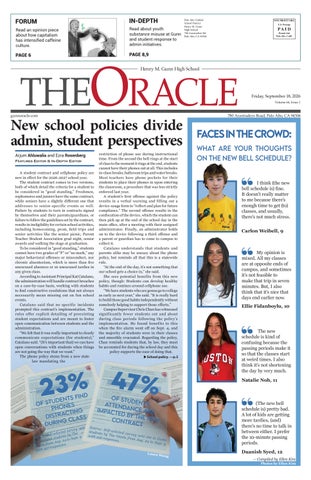
FACES IN THE CROWD: WHAT ARE YOUR THOUGHTS ON THE NEW BELL SCHEDULE?
“
I think (the new bell schedule is) fine. It doesn’t really matter to me because there’s enough time to get (to) classes, and usually, there’s not much stress.
Carlon Weibell, 9
“
My opinion is mixed. All my classes are at opposite ends of campus, and sometimes it’s not feasible to make that trip in seven minutes. But, I also think that it’s nice that days end earlier now.
Ellie Fidanboylu, 10
“
The new schedule is kind of confusing because the passing periods make it so that the classes start at weird times. I also think it’s not shortening the day by very much. Natalie Noh, 11
“
(The new bell schedule is) pretty bad. A lot of kids are getting more tardies, (and) there’s no time to talk in between either. I prefer the 10-minute passing periods.
Daanish Syed, 12 — Compiled by Ellen Kim
Photos by Ellen Kim
2
News
THEORACLE
Flock camera data leaks prompt local concern Olivia Lee Forum Editor Under a contract that runs through Dec. 2029, the city of Palo Alto currently operates 30 automated license plate reader cameras from Flock Safety. The AI-powered cameras capture license plates and vehicle characteristics that police officers can later use during criminal investigations. The Palo Alto Police Union reports that between Jan. 2024
and Sept. 2026, Flock cameras have helped solve 139 cases in Palo Alto, ranging from identifying suspects in local burglaries to locating missing individuals. However, recent growing concerns over privacy and data leaks, outside access to vehicle data and oversight by the Palo Alto Police Department and the Palo Alto City Council have prompted the city to move forward with an independent audit of its Flock camera systems. Student Board Representative junior Enzo Wolff de Tourreil, whose comments represent his personal view and not those of the school board, said that although many students and families are familiar with Flock Safety as a company, they may not be fully aware of how Palo Alto specifically has implemented their technology. “I think for the most part, students understand what the company Flock does,”
he said. “But I don’t think that they fully understand the types of service that Palo Alto purchases from Flock.” Wolff de Tourreil also believes the community tends to feel that the cameras have created a greater sense of surveillance rather than of security. “I think for the most part, students and residents of Palo Alto feel more monitored by of surveyed students the cameras than safer,” he said. are not aware of Concerns surrounding Flock cameras have significantly increased following exposed news regarding patterns of misuse, such as members of flock cameras law enforcement being caught using Flock networks to spy on citizens. Thousands of Source: Self-selected survey sent out to Gunn students by The Oracle from Aug. 24 to Sep. 9 with system searches have also been directly linked 231 responses. to immigration enforcement activities. These searches have led to severe pushback from local civil groups, including Indivisible used for other reasons than its original Palo Alto, a nonviolent community group purpose. “The extreme concern that people might that works to protect democratic values and stand against authoritarianism. In have is that this is how we could have ‘1984’, Aug. 2026, members gathered outside or a surveillance state established,” she said. City Hall with large banners, chants and “Federal agents (could misuse) this footage to speeches to push back aganist Flock’s spy on civilians.” Student and Family Engagement staff regional actions. Additionally, controversy and concerns member Jose Ordonez specified that spiked when Palo Alto unknowingly opted transparency and trust are especially important into a Flock Safety nationwide search, which for families and students who may already be allowed out-of-state and federal agencies to concerned about how local law enforcement view the data despite the state law and local uses their information. “A lot of families don’t know who to trust, policy forbidding such access. In Sept. 2025, out-of-state agencies had run more than 1.6 and (they don’t know) what’s going to happen million searches of the city’s data, including at (to their information),” he said. “I think it least 19 marked as related to ICE, according to would be nice if (law enforcement) could the San Francisco Standard. Although the Palo share (information on Flock cameras) at the Alto Police Department has explicitly stated community center or City Hall. … It kind of that Palo Alto license plates are only accessible feels like (they’re) hiding something that they to properly trained staff with a legitimate shouldn’t really hide.” Nevertheless, Ordonez still acknowledges law enforcement need, the incident raised the potentialby benefits of the as aids in questions around who can access the data Photo and illustration Vin Bhat andcameras Azuki Radhakrishnan crime investigations. how this access is controlled. “I think it should be used and kept for data Cybersecurity Club president junior Diya Bhagat said that while many may be familiar and for car vehicles, accidents or different with what Flock cameras are capable of, they kinds of reports,” he said. “As long as they can may have less knowledge about how the data is share what is being kept or what is not, then stored and protected, as well as why there have that would be helpful.” As Palo Alto reviews and finalizes the been data leaks. “A lot of (the risk) is just misuse, which I program, Wolff de Tourreil believes residents feel like people know about,” she said. “On should play a role in determining how the city the inside, it’s because there isn’t a robust, balances the priorities of privacy concerns and multi-factor authentication that allows police public safety benefits. “The city should do this with a lot of and federal officers to ensure that they have community outreach and make sure that they authorized access to the video footage.” Bhagat also pointed out the broader can properly make choices that will reflect possibility of surveillance technology being everyone’s opinions,” he said.
63%
Laura Wang
New website consolidates tutoring resources, streamlines process process of organizing requests by hand. “(In the past) I’ve used Google Forms (and Sheets to compile all of the) information for the tutors and students who want to be tutored,” she said. “It’s pretty long and Tutoring resources on campus have officially been complicated, and while I don’t mind doing it, Paly has combined into a single website this year. Through gunn. been using Tutor Connect and they find it useful, so (Mr.) tutorconnect.app, students now have one place to request Olah wanted to try it out.” tutoring from students and adult volunteers. Beyond improving organization, the addition of this After being introduced to Tutor Connect and its website also allows for the incorporation of adult tutors. student creator through Paly’s tutoring teacher, English Typically reached by word of mouth, the school district teacher Nicole Menache and Interim vets these volunteers, who are then Principal Erik Olah worked with the able to fill in gaps in student schedules. student as he made the platform. “There was a time when almost The part I miss is (that) I had “The student creator developed every senior had sixth and seventh more personal connection and made all changes to the website,” period off, and so they’d come in here with the students before it Menache said. “Mr. Olah and I was an app. (now, they just) during (those times),” Steward said. were just in direct communication scan a QR code and never “With the (new) schedule, we have far (with them) by email. The student necessarily come in here. fewer prep periods, and so it’s really created (a tutoring) site for a few hard for me to get a tutor for someone other schools, as well, but Paly really —Academic center coordinator during a prep because of availability. helped (make the platform more well … (Now that we have) adult tutors, we Pam Steward known).” can fill in the gaps during prep periods Previously, the Academic Center, K-14 and P-116 each or before school.” ran separate tutoring systems, with students requesting However, the new website comes with its own tutoring through each program depending on the level challenges. In particular, it removes some of the personal of guidance needed. Tutor Connect now brings these connection between students and the coordinators of resources together into one system, allowing students to these tutoring systems. request tutoring based on their class and availability from “The part I miss is (that) I had more personal a single site. According to Academic Center coordinator connection with the students before it was an app,” Pam Steward, the website then matches students with Steward said. “(Now, they just) scan a QR code and never tutors automatically, replacing the more time-consuming necessarily come in here. I liked that personal part, but
Fiona Wu News Editor
(the old method was) not as easy for me to track.” The website is also meant to raise students’ awareness of the tutoring options available to them. Tutor senior Esther Li believes that, although the website isn’t well known enough, it streamlines the process to sign up and become a tutor. “It makes the process more clear and easier, and you have a lot of different options for tutoring,” she said. “I think if we can publicize it more, it would be beneficial for the entire student body.”
73%
of surveyed students believe an official website makes tutoring resources more accesible Source: Self-selected survey sent out to Gunn students by The Oracle from Aug. 24 to Sept. 9 with 205 responses.
”
780 Arastradero Rd. Palo Alto, CA 94306 (650) 354-8238 www.gunnoracle.com
Editorial Board Editor-in-Chief Sarah Grupenhoff Managing Editors Vaani Saxena Melody Song News Melody Na Fiona Wu Forum Olivia Lee Michelle Zhou Features Arjum Ahluwalia Noa Zeitlin In-Depth Ezra Rosenberg Cici Zhang Sports Mayher Dulani Athena Gao Lifestyle Ellen Kim Yuji Song Online Ezra Rosenberg Social Media Athena Gao Ellen Kim Noa Zeitlin Photo Editor Laura Wang Graphics Editor Dani Massarweh
Staff Business/Circulation Olivia Lee Graphics Artists Kai Knutson Sophie Kou Sahana Mahadevan Yuji Song Reporters Emma Chen Pandora Gallusser Michelle Jin Sumayya Khan Nandita Ramakrishnan Naomi Weiner Adviser Kristy Blackburn
3
Rail grade separation plans stalled at city level Nandita Ramakrishnan Reporter Palo Alto’s rail-grade separation project — an initiative to physically separate street traffic, bikes and pedestrians from Caltrain crossings like Charleston Road and Meadow Drive — remains in its conceptual stages. Ongoing gate closures during peak hours cause traffic backups and safety hazards, but commuters and homeowners continue to face uncertainty, with no finalized plans. While public concern mounts over potential property impacts along Alma Street, City Council member Ed Lauing emphasizes that the council has yet to greenlight any one blueprint. “There’s no proposal that’s been approved,” he said. “When you do massive infrastructure like this, you expect it to last for about 100 years or so…When you start with a (blank) piece of paper or a whiteboard, you don’t take off the table (the idea) that some properties (and driveways) will be impacted.” According to Lauing, current designs hover at approximately 15% completion, with the council holding bimonthly rail committee meetings to discuss and receive community input on the separation. City planners have shared early visualizations — such as an approach on Charleston that shaves several feet off a driveway — not as definitive blueprints, but to show residents the realistic trade-offs between vehicle lane capacity, bike safety and neighborhood property boundaries.
Regarding daily safety and construction environmental reviews, utility mapping, detours, City of Palo Alto project engineer drilling and conceptual alignment drafts — Jessica Dai wrote in an email that detailed but lacks the hundreds of millions needed to detour planning begins once designs advance break ground. Relying on competitive state past early stages. and federal grants leaves timelines uncertain. “Large capital projects do have construction “There’s no funding at this point for any of impacts,” she said. “These are generally this except for the $20 million,” Lauing said. evaluated and addressed more thoroughly One student commuter questions whether in the 35% design (completion phase), the long-term payoff justifies the immediate environmental review phase and the final pain. Senior Jake Wood, who crosses the design phase.” tracks at the intersection of Alma Street and According to Dai, the East Charleston every project team will evaluate morning, notes that temporary bicycle corridors, current conditions feel enhanced signage and When you do massive manageable and voices traffic control specifically infrastructure like this, skepticism over the designed to preserve direct you expect it to last for massive price tag and routes for high volumes of about 100 years or so. timeline. student commuters. Dai “Looking into this —City Council member Ed project, I find it’s more noted that construction Lauing concerning that for $1.5 staging will aim to minimize conflicts between to $1.7 billion, Alma students, vehicular traffic and construction. could be restricted for four to nine years Additionally, coordinating with nearby capital building something not hugely beneficial improvement projects will bolster overall to the general public,” he wrote in an email. bike access. “The construction would inhibit everyone it’s Beyond construction detours, Dai designed to protect for a very extended period highlighted extensive logistical hurdles the of time at an exorbitant cost.” city must resolve before moving forward, Without state or federal capital, the city including underground utility relocations, remains caught between logistical hurdles property acquisitions, railroad operational and funding gaps, leaving daily commuters requirements and constructability reviews. waiting. Compounding these design challenges, “The unfortunate fact is that this is going a multi-million-dollar funding deficit stalls to take a long time,” Lauing said. “It could be progress. Palo Alto secured $20 million decades before we get even one of these up.” for preliminary studies — which fund basic
Student contract, phone regulations improve schoolwide organization, class participation
School policy —p.1 One initial concern about the new phone “It’s for the better,” he said. “The fun stuff, policy was that it would result in students technically, is a privilege that is supposed leaving class and immediately returning to to be earned. This is just kind of making their phones. Catalano had worried at first that the policy would take (students) understand the value of things.” away time for students Te acher s now have a to organically interact Google Form where they Finding a balance as a with their peers. So far, can log initial warnings for senior between going to however, she said that students who have their class and hanging out has not been the case. phones when they shouldn’t. with your friends who Instead, the time between As of Sept. 4, there have been you’re not gonna see classes has remained a 12 reports, with three phones for that much longer (is period of socialization for ending up in administrator crucial). students. possession. Catalano Senior Nikolai Bush —Senior Nikolai bush feels hopeful about these finds that the student preliminary results. contract’s regulations “(The statistics) tell me that things are going could have potentially detrimental effects on pretty well so far,” she said. “We’ve had a lot his and his peers’ mental health by limiting more phones turned into the office because time to take breaks. they got left behind, because students forgot “The 5 absence limit per class is a bit about them, which is, to me, a good problem to egregious to me,” he said. “One way that Gunn have in the grand scheme of things.” students have found to combat this intense
”
THEORACLE
Friday, September 18, 2026
”
News
pressure they’re feeling from school is to take breaks when they see fit. Finding a balance as a senior between going to class and hanging out with your friends who you’re not going to see for that much longer (is crucial).” Catalano admits that it’s too early to call these changes a success or a failure, but in the meantime, she offers open doors to any students with concerns about the new initiatives. “It’s still early in the year, so it’s hard to predict where we’re going to be at the end of the semester,” she said. “If a student is concerned about the contracts, we definitely want them to come talk to us. I do hope that students recognize that it’s here to support them and help them be successful.”
INBOX
Letter from the Editor
Michelle Zhou
Dear Titans, I am incredibly excited to present to you The Oracle’s first print installment of the school year. What defines this issue and the year ahead can be summed up in an age-old phrase about journalism’s core purpose: to “comfort the afflicted and afflict the comfortable.” Despite originating from a satirical critique of the field by Finley Peter Dunne’s fictional 19th century bartender character Mr. Dooley, these words ring true with the turn of every page. From our investigation of youth substance misuse that left no stone unturned to our compilation of staff immigration stories highlighting perseverance through the trials and tribulations of setting down roots in a new country, we invite you to experience brief glimpses into the successes and struggles of peers, teachers and perfect strangers. Just as we have dived headfirst into heavy, contentious corners of
story idea exploration, The Oracle has begun experimenting with the formats through which we tell these stories as well. This year will yield a series of news Reels posted to our Instagram page (@gunnoracle), breaking down otherwise daunting subjects, whether that be the plethora of new district policies or the unfamiliar bell schedule. As a student newspaper, it is our mission to amplify community voices. By participating in our student polls, filling out issue feedback forms or even simply messaging our Instagram account with a story you think deserves to be told, you can help us ensure that each edition is as representative of Gunn’s more than 1,600 students as possible. Don’t have access to a print copy of The Oracle? Head to our website (gunnoracle.com) to read every story online. Sincerely, Sarah Grupenhoff The Oracle Editor-in-Chief 2026-2027
4
News
THEORACLE
New initiatives spur policy changes for RV community
To combat issues with common recreational vehicles and oversized vehicles that have been propped up all around Palo Alto, the Palo Alto City Council officially moved to limit the locations these vehicles can legally park on Aug. 25. Fabian Way, East Meadow Circle and Embarcadero road are now the streets these vehicles are allowed to park at, trying to move them away from residential areas. Even though the area around these streets are zoned as “General Manufacturing”, there are still people living near Fabian Way in “Planned Construction” zones. Because of the unclear zoning in the area, legally, RVs and OSVs are allowed to park on those streets. However, there are many more areas, even in other cities, where communities are struggling with unwanted vehicle neighbors. Thus, for residents living near or on these streets, RVs and OSVs can be both hazardous and a cause for sanitary issues. In June 2025, a member wrote on the community google groups that they parked their car in an “RV area” — one predominantly filled with OSVs — and came back to see that two out of four of her car tires were punctured. With these incidents happening locally, a community family, who would like to remain anonymous due to safety concerns, stated especially with young children at home,
that they are worried about potential criminal activity. who isn’t able to pay the rent that is required of the Palo “There’s always a worry about strangers coming into Alto area should still be able to live on Palo Alto roads the community and a worry of petty crime,” they said. free of charge. Per Agenda 16 on the City Council Regular Meetings However, locals in the area aren’t upset about the fact from Oct. 20, 2025, Palo Alto residents have brought that people are living in these vehicles, but the issues they up that, with the presence of RVs near communities have been creating. — because RVs and OSVs aren’t part of normal trash “I feel like my parents are always talking about (the collection — the nearing roads can have sanitary issues, problems RVs) have caused,” said sophomore Scarlett and the presence of these vehicles Mao, “But I feel that we shouldn’t brings the overall market value of the judge them because of their area down. situation.” After the many raccoon sightings and (The RVs aren’t) the issue. It is well known that it’s difficult the growing stench of gas, according to It’s where they are. All the to pay rent in the Bay Area, but the Echelon Board Member Arvind Kumar, cities around (this area) issue is that RVs should be in places these RVs have taken a toll on the should do their part. where they don’t hassle residents. cleanliness in the area. The Echelon Thus, community members have community, which is situated right next —Echelon Board Member begun to believe that to solve the to East Meadow circle and Fabian way, Arvind Kumar problem, cities nearby should come has especially felt the effects. together to provide designated “The fact that they run on generators and pollute the spaces for RVs and OSVs for the better of their residents. air (with exhaust), is the part I think we need to make “(The RVs aren’t) the issue,” Kumar said. “It’s where sure doesn’t happen,” he said. they are. All the cities around (this area) should do their Recently, amidst the new RV permit changes, residents part.” have learned the identities of the people residing in the Even with new policies, residents say that the changes RVs near their homes. Upon further inspection, residents aren’t providing any benefits. are now shocked that some of the people living in the RVs “The fact that the RVs (and OSVS) aren’t gone from own homes elsewhere. With this discovery, community our area means that (these policies are) not really making residents are now raising questions on whether someone a meaningful impact,” Kumar said.
”
Emma Chen Reporter
Photos by Emma Chen
FORUM
Forum
Combating widespread misogyny requires societal recognition, proactive response Ellen Kim Lifestyle Editor We’ve all heard phrases like “you run like a girl,” and “boys will be boys” thrown around without second thought. But why has society been so quick to excuse this kind of commentary? Misogyny is prevalent in so many situations, and yet excuses are constantly made for the behavior. Quick remarks like these are met without punishment because the world has become so desensitized to them. If platforms, actions and daily lives are filled with misogyny, is it ever possible to see those comments for their true meaning and impact? The age of widespread technology and innovation is just one factor of the constant, underlying misogyny in people’s lives — social media in particular. Influencers like Andrew Tate and Clavicular are just two of the thousands of “manosphere” online figures who glorify the patriarchy and emphasize the dominance of men through sexist jokes. Watching this come out of the mouths of “cooler” guys can
bring these comments into young boys’ vocabulary. In a survey of 200 teachers, Professor Kimberley Brayson found that 76% of secondary school teachers and 60% of primary school teachers were “extremely concerned” about the influences of social media and online misogyny on their students. Misogyny and prejudice against non male-presenting individuals is especially apparent in schools. As early as preschool, many girls get “dress coded” for clothing considered “distracting to the boys.” Not only do these rules restrict women from self-expression, they unfairly hold girls to more stifling standards. According to the Government Accountability Office, 90% of dress codes in K-12 public schools restrict female clothing. They also found that the words “immodest” and “revealing” are frequent terms in dress codes, often associated with girls. Such imbalance of judgment between females and males coddles men, which can lead to increased social pressures on all. And not only does misogyny increase social pressure on women, it increases the pressure on men as well. Research at the National Institutes of Health by Megan C. Kearn, Ashley Schappell D’Inverno and Dennis E. Reidy shows that organizational tolerance for sexual harassment and pressure to adhere to stereotypes can sustain aggression toward anyone who does not conform to traditional gender norms.”
When society constantly controls women through onesided regulations, it gives men a free pass to judge women and cross boundaries, leading to rape culture. Rape culture is defined as a social environment where sexual violence is normalized, resulting in the victimization of survivors. According to the Stand Up movement by L’oreal Paris, 80% of women have experienced sexual harassment in public spaces. Even in P.E. classes, where girls can temporarily escape the scrutiny of their clothing with all-inclusive P.E. uniforms, many women still face stereotypical comments. “You throw like a girl” and “That’s pretty good … for a girl” are common phrases. These phrases frame female biology as an insult and a sign of inherent inferiority. They create a presumption that the female gender is always weak, constantly holding a low standard for females. Further comments like “Boys will be boys” excuse the offensive commentary and regard these insults as unimportant, effectively normalizing misogyny. Consumer goods are another aspect of daily life where misogyny commonly occurs and goes ignored. Pink tax discriminates against females by making products “for women” more expensive than those “for men.” A 2015 analysis by the New York City Department of C o n s u m e r Affairs found that, on average, products for women cost seven percent more than the equivalent for men. This was especially common in personal care products, where the largest cost difference was 13% more than all other categories, including razors and deodorant. Still, pink tax is ignored because women, who face greater pressure to maintain their appearance, are expected to be more willing to pay a high price for selfcare. A 2018 study by marketing company Ipsos shows that three in five women “strongly agree” that personal hygiene is directly tied to their self-image, while only half of men believe the same. The assumption that women’s value lies in their appearances is misogynistic. These societal influences pressure young women to constantly dissect their looks and accustom them to objectification, both from others and themselves. Misogynistic oppression of women has existed Sophie Kou for centuries, from the common 1900s saying of, “Women are meant to be in the kitchen” to the modern-day rhetoric, “Girls can’t play sports.” Instead of a single perpetrator, individuals, institutions and society are all responsible for the endurance of misogyny. In fact, many women also have an internal bias against other women, subtly holding each other to misogynistic double standards. For example, the term “pick-me” was coined by a woman, but is incredibly degrading. Research conducted by psychologist Kylie Schwabe finds that a “young adult woman’s perceptions of womanhood will be similarly influenced by common external factors that stem from society’s sexism and misogyny and lead to behaviors of internalized sexism.” Misogyny from women is often ignored because it is assumed that the perpetrator of misogyny itself couldn’t also be the victim. Conflicts between women are often dismissed as petty “catfights,” which is a dehumanizing phrase in and of itself. Advocating against misogyny is critical for protecting women. Constant excuses for sexist behavior add weight onto the shoulders of girls, making them feel invalidated. There should be no excuses, and it is time for it to be faced head-on. Constant justifications for prejudiced actions make it harder for girls to feel confident and willing to be themselves. Though sexism cannot be fully erased, recognition is an important first step.
Friday, September 18, 2026
5
Nonchalance hinders authentic connections, encourages isolation
Ezra Rosenberg In-Depth Editor We human beings are emotional by nature. We laugh when someone tells a funny joke. We cry at sappy movie moments. We get angry when we can’t find the television remote. What makes us unique is how we feel, and nonchalance goes against everything that it means to be a human. Pretending not to care to appear “cool” doesn’t do much for you. The media has romanticized the idea that being cool is all about shutting your emotions off in front of others, but there’s an underlying, isolating truth: All you’ll end up being is emotionally unavailable, reflected in weak connections with others. Nonchalance relates to the concept of “doing too much.” But in school, the notion that it’s cool to just do the minimum doesn’t work so well, does it? Letting your grade teeter-totter barely above the percentage you need to pass can be a fatal mistake. Also, consider the impacts that being nonchalant may have on your future success. Not taking advantage of opportunities you encounter because of that “doing too much” mentality may set you back and, while employers may appreciate the ability to remain calm under pressure, not keeping workplace vibes high may be costly. People look for passion in others. No mentor, investor or partner wants to work with someone who doesn’t bring the right energy. Without a sense of urgency in the real world, you risk falling behind while driven people move ahead. One obstacle may stem from the appearance we strive to put on for others. It may be easy to seem cool, but you can really only get there in two ways: by acting like you’ve got it all figured out, or by acting like you haven’t a care in the world. But neither is true for anyone. In reality, life is all about ups and downs, not half-nods instead of enthusiastic waves. Sure, it’s nice to seem calm and collected. “Look, there goes that super cool dude who knows what he’s doing.” But do you really know what you’re doing? It’s all talk and no walk: a superficial sham. There are better things to focus on than feigning your way through life. By not putting your true self out there, you’ll always live in a shell of who you really are. If you’ve ever dipped from a social situation and then reflected and realized that maybe you should have put yourself out there more, then you’ve also realized that you’ve been living in that shell. That’s what being nonchalant will do to you. Acting cool and aloof in the moment seems like a good idea, but it leads to surface-level social connections instead of meaningful interactions you could have created with even the slightest bit of emotion. Every half-hearted “sup” in the hallway is the dying ember of a warm friendship that will never come to fruition. Many people act nonchalant to shield themselves from negative emotions. You didn’t get the position in an extracurricular you applied for? Oh well, you didn’t care much for it anyways … Right? Your crush doesn’t feel the same way you do? Whatever. We’ve created a culture where you can “overcome” rejection by pretending not to care about what you could have gotten, but that only leads to a lack of desire for anything at all. This trend of pretending not to care has to be stopped in its tracks, or it’s going to run over everything that it means to be human. Nonchalance is everything we aren’t supposed to be, so let’s embrace emotion, care about things and be true to ourselves.
6
Forum
THEORACLE
Intellectual vanity helps teen neurodevelopment, stimulates motivation
Melody Na News Editor When I was a new student at my second middle school, I would often carry around books with mysterious-looking covers like “And Then There Were None” by Agatha Christie, or “The Catcher in the Rye” by J. D. Salinger. My sole intention in being seen with such books was to create the impression that I was a “smart” kind of kid, in the hopes of gaining some sort of admiration from my peers. In fact, I actually considered reading a mundane activity that wouldn’t benefit me greatly. I didn’t understand a third of the vocabulary I read, yet I would continue to turn the pages and move on without looking up each word’s definition — not because I was so deeply absorbed in the story, but because I didn’t want to be that kid who was still on page 13 after two weeks. Eventually, however, I began to find reading much more interesting than I originally assumed. The more I read, the better I became at critical thinking and the stronger my curiosity for learning grew. If it were not for my desire to gain recognition and approval, I would not have been exposed to this opportunity for intellectual growth. Despite it being a rather unhealthy mindset to start with, intellectual vanity can lead to cognitive growth. However twisted it may be, what paved the way for my intellectual growth was my conceit, which functioned as a motivation. The motivation spectrum — part of the Self-Determination Theory developed by psychologists Edward Deci and Richard Ryan — explains my progression. At first, I was externally motivated, prioritizing “appearing” smart and focusing on the acclaim I garnered from my peers to maintain that image of a person I strove to be. Then, this desire for external validation gradually began to fade out as I increasingly found reading more entertaining and intellectually beneficial. By the end, I had become intrinsically motivated, feeling a genuine desire to continue this academic journey. In my case, pretension was a catalyst. While it’s important to note that excessive intellectual vanity can be harmful when the appearance of intelligence is always prioritized over genuine learning, possessing that hubris is still a good starting point. Many emphasize how crucial academic humility is, and though I agree that it helps us acknowledge and fill in the gaps of our understanding, an overemphasis on scholarly wherewithal can be a vice. Excessive humility can lead to diffidence and uncertainty of our own abilities, hindering sound decision-making and consequently increasing vulnerability to misinformation. Dutch philosopher and political economist Bernard Mandeville captures this paradox of vice leading to virtue: “Pride and vanity have built more hospitals than all the virtues together.” Coming across this quote, I realized that my “hospital” was a copy of “Catcher in the Rye” — a highbrow-looking cover. Unless motivated intrinsically (which happens rather rarely), we need our own “hospital” — whether it be reading a sophisticated-looking book, trying to solve complex physics problems you don’t understand or randomly using jawbreaking jargon like “hermeneutics” in colloquial conversations — to start our intellectual journey and eventually experience growth. Cognitive conceit may not be the only way to take the first step down your educational path, but not everyone possesses that innate drive to want to learn from the very beginning. In fact, I think most people start their learning because of extrinsic motivations — like in Newton’s first law of motion, where an object remains at rest unless an outside force acts on it, that external pressure here is pretension. You have to start somewhere.
Capitalism drives modern caffeine culture, encourages harmful behavior consumers and suppliers. To keep up with the market, developing countries, where coffee can make up 20% of their revenues, are competing to produce and sell coffee with minimal monetary investment on their end, which in turn cuts farmers’ pay. The modern caffeine industry has also steamrolled Emma Chen over many other traditionally competitive industries Reporter like drip coffee and traditional diners. Because of the Coffee swept through 17th-century Europe after its dissolution of these industries, corporates and capitalists initial discovery in Ethiopia, spinning the continent into a only have so much space to conduct their war for money. coffee craze. However, even as decades passed, the craze This forces the modern-day caffeine market to constantly didn’t abate. Caffeine and coffee culture would not have adapt and create new markets to stay in the spotlight. Another major reason behind the spike, reported gained popularity without capitalists’ desire for profits at the expense of both the caffeine consumers and producers. by the National Institute of Health, is the correlation Capitalism is a crucial part of our economy, but it should between societal pressures and caffeine intake. Students not be the driving force behind the 820 billion cups of have reported that they sometimes ingest caffeine not for the taste or aftereffect but for the social context behind it. caffeine consumed per year. According to Forbes, with new forms of caffeine like In the 17th century, Europe sought to control coffee distribution to keep their most brilliant coffee addicts energy drinks and sodas always on hand, people, especially functioning. However, since the Ottoman Empire kept youth, can now afford to be pickier with their choices, and strict control of coffee distributions, a grip only broken social media significantly influences decisions. For example, after energy drink brand Alani Nu later in the century, Europeans snuck coffee plants into their colonies and started their own competing coffee partnered with social media celebrities like Paris Hilton and Kim Kardashian, it market. gained a whopping 1.3 million But the craze didn’t stop in just Instagram followers, with its main Europe. After the Boston Tea Party demographic between ages 16 and on Dec. 16, 1773, Americans needed 36. Celsius Holdings, Alani Nu’s a new form of caffeine to substitute energy drink parent company, made for tea and thus turned to coffee. $783 million in the first quarter after Although caffeine was already of students are its acquisition, controlling 20.9% of prevalent in the American colonies, aware of the the energy drink market. the tea boycott only made coffee positive and In June 2026, however, a plaintiff more popular. With the backing of negative effects sued Celsius Holdings after a Texas the American government and the teen’s caffeine overdose. The probe sudden factory reliance on caffeine of caffeine focused on the marketing of the sparked during the Industrial Source: Self-selected survey sent out to Gunn Revolution, coffee commodification students by The Oracle from Aug. 24 to Sept. 9 with Alani Nu line and how it attracts the younger population. Despite Alani became extremely prevalent. As 230 responses. Nu containing too much caffeine coffee rose in popularity, large international markets began competing for coffee for safe intake by minors, it is still pushed toward youth consumers, according to the Texas attorney general. production and prices. Celsius Holdings isn’t the first energy drink company To satisfy these demands around the world, many third-world countries have taken on the challenge to face a lawsuit for accidental death due to caffeine of producing those billions of beans, at the expense overdose, and it won’t be the last. Class Action reports that of workers. In Ethiopia, coffee beans make up over Monster Beverage Corporation, Red Bull Incorporated 20% of their country’s revenue, yet the Department of and Panera Bread have gone to court as well for unsafe Agriculture’s Foreign Agricultural Service reports that caffeine levels in their highly marketed drinks, yet none of coffee bean farmers in developing countries only receive 1 them have dealt with long-term company damage. As youth caffeine intake continues to rise, and the to 10% of their total coffee sales. Child labor laws, too, go number of youth caffeine overdose cases will too. Thus, unenforced in exchange for profit. In youth populations, the Center for Disease Control it is crucial that students are aware of what they’re and Prevention reports that caffeine consumption has consuming. No matter how hard people try to ignore the spiked 40% over the last two decades. With these high bright packaging, the deep roots of caffeine culture are rates of supply and demand, capitalists only fan the constantly fed by the capitalist well. flames that are the gap between the coffee
90.9%
Sophie Kou
Forum
Friday, September 18, 2026
7
World Leaders should refrain from weaponizing religion, misconstruing Ideology for personal gain was the result of a combination of political and economic factors, anti-Muslim sentiment, built up over time by Buddhist extremists, contributed massively to the eventual violence. Christianity has a history of weaponization in both the Michelle Zhou United States and Europe, and continues to be leveraged by people today to justify bigotry. While the U.S. is Forum Editor constitutionally a secular state, Christianity has long The influence of religion persists in every corner of been referenced by presidents and American politicians. the world, whether it be positive or negative, amongst The Trump administration, however, has increasingly believers and nonbelievers alike. It has been both a utilized the Bible to frame their controversial policies weapon of oppression and a banner for peace, and the and military involvement abroad. U.S. Secretary of War invention of the Internet has amplified discussions Pete Hegseth’s first prayer service after the start of the on whether or not religion does more harm or good. Iran war notably featured particularly violent biblical Religion, however, is not autonomous: It is a product passages, raising concerns about military secularism of the people, and it is not inherently oppressive. By especially considering his past defense of the Crusades. solely faulting faith, society risks overlooking human While using Christian rhetoric is not inherently negative, agency and absolving individuals and organizations from the issue comes when scripture becomes a means to accountability. defend violence and villainize political opponents. When It is important to recognize why religion often one could just as easily choose to emphasize the second becomes a tool to justify violence. commandment, “love thy neighbour For one, human beings are naturally as thyself,” it becomes morally predisposed to believe in the questionable to spread messages of supernatural, which makes many hate. inclined to follow a faith. In a In India, Hinduism has become series of studies conducted by PhD deeply politicized: Prime Minister psychologists Deborah Keleman Narendra Modi of the Bharatiya of students and Cara DiYanni, researchers Janata Party, the state’s current sometimes or found that children tend to think ruling party, built his platform on that the natural world was created often see religion Hindutva — a political ideology with a sense of purpose, regardless grounded in Hindu supremacy that being used to of a religious or non-religious imagines India as an exclusively support an background. While most scientists Hindu nation. Modi’s government agree that this instinctive belief did has consolidated power through not evolve specifically for religion, it religious polarization, framing Source: Self-selected survey sent out to Gunn makes humans prone to believing in students by The Oracle from Aug. 24 to Sept. 9 with Hindu identity as synonymous to the idea of a god, and many scholars 224 responses. national loyalty and the Muslim believe that it may have helped minority as threats to culture and national security. By foster the creation and following of the religions we see painting himself as a champion for Hindu rights in India, today. criticism of his regime effectively becomes an attack on In addition to the inherent cognitive bias toward the country. While Modi has undeniably helped India’s supernatural explanations, religion is compelling because economy grow, his promotion of Islamophobia is both it offers something else that humans desire: comfort ethically concerning and religiously dubious considering and community. When science could not yet explain the Hinduism’s religious pluralism. world around humans and laws had not been established In Afghanistan, Islam has become a shield for the to uphold morality, faith in a deity offered people Taliban to justify its oppression of human rights, consolation and guidance. In their 2010 Personality especially those of women. When the Taliban regime was and Social Psychology Review article “Beyond Beliefs: reestablished in 2021, Afghanistan was declared Religions Bind Individuals Into Moral Communities,” an Islamic emirate, and the 2004 constitution psychologists Jonathan Haidt and Jesse Graham was replaced with a new code rooted in the suggested that religion co-evolved with morality as a Taliban’s fundamentalist interpretation way to allow people to form larger social communities. of Sharia law. Fundamentalism is the Under a collective faith and moral code, individuals literal and selective interpretation and would naturally find it easier to cooperate with otherwise enforcement of sacred text, often at the unrelated people, creating a unique group identity and a expense of human rights. Though the sense of belonging. group claimed they were reinstating The qualities that make religion such a powerful Islamic values in Afghanistan, binding factor are also what allow it to be leveraged as the laws since established have a weapon to advance political agendas and violence. The contradicted the religion’s teachings. Social Identity Theory, introduced by psychologist Heri Of the many laws restricting women’s Tajfel in 1978, asserts that humans categorize themselves rights, the 2022 policy banning women and others into ingroups and outgroups, with preference and girls from receiving secondary education for those within their ingroup who share a common directly contravenes the Hadith of Prophet identity or belief. Religion forms strong ingroups and outgroups, which encourages an “us-against-them” mentality that can easily be exploited. By couching a political agenda in familiar religious language, leaders and groups can galvanize members of these religious and cultural ingroups to rally behind their cause while villainizing opposition. Not only does this consolidate their power, but it subtly shifts the responsibility of violence and oppression onto a supernatural being. Their agenda becomes God’s will, and the opposition become heretics. Most importantly, however, people must recognize that all major religions — Buddhism, Christianity, Hinduism, Islam and Judaism — struggle with individuals or groups that weaponize their faith. Although Buddhism is commonly associated with peace, compassion and tolerance, since the turn of the century, outbreaks of violence occurred in eight of out the 11 Buddhist-majority countries around the world: Myanmar, Sri Lanka, Thailand, China, Cambodia, Laos, Bhutan and Mongolia. The incitement of violence contradicts Buddhism’s core ethical principle of ahimsa, which teaches practitioners to avoid causing harm to another living being. Nonetheless, people have used Buddhism to push political agendas and justify violence. A prominent example is the 2017 Rohingya genocide in Myanmar, which forced over 700,000 Muslim Rohingya to flee to neighboring country Bangladesh. Although it
53.5% argument
Muhammed, which states: “The seeking of knowledge is obligatory upon every Muslim male and Muslim female.” Not to mention, the Qur’an and Sunnah emphasize the value of human life, yet the Taliban commonly persecutes the religious minorities within the nation. Afghanistan’s economic and social development has been hampered under the guise of faith, yet Islam has little to no standing in the Taliban’s laws except as a means for control. Similarly, religious rhetoric has become a shield to justify Israel’s actions in the Israel-Palestine war, and defend Israel from criticism. Following the Oct. 7 attack on Israel by Hamas, a militant Islamic group, Israeli prime minister Benjamin Netanyahu frequently used religious imagery and language to frame Israel’s military retaliation. Since then, he and other Israeli politicians have continuously weaponized antisemitism to deflect criticism of the Israeli occupation and attack of the Gaza strip, which a United Nations Independent Commission of Inquiry has described as a genocide. When students on college campuses across the U.S. protested against the war, Netanyahu claimed that “antisemitic mobs have taken over leading universities” and compared them to Nazi Germany. While it is undeniable that antisemitism was an issue in certain instances, the Armed Conflict Location and Event Data Project reported that 97% of campus protests were peaceful. Not to mention, the vast majority were criticizing the actions of the Israeli government, not Jewish people as a whole. The weaponization of antisemitism does not only diminish the legitimacy of their arguments but prevents real antisemitism from being properly recognized. To solely blame a religion for the actions incited in its name would not only risk absolving these individuals and institutions from responsibility, but also inaccurately characterizes a massive group of people. According to the Pew Research Center, around 75% of the world practices a religion. The actions of a few cannot speak for the beliefs of millions. Individuals have the agency to decide how they want religion to influence their lives. To use it to bring harm to society is therefore a reflection of their own immorality and character, not the faith itself. In order to combat rising extremism in our modern world, society must realize that the real harm isn’t necessarily religion but ideological manipulation.
Sophie Kou
8
In-De
THEORACLE
Open discussions essential t misuse, cultivating support, Athena Gao and Michelle Jin Sports Editor and Reporter
Editor’s Note: Because of potential legal consequences, student sources have had their names replaced with pseudonyms since they agreed to be interviewed for this story only on the condition of anonymity.
A
“Youth substance abuse is happening, and ignoring it is not going to make it go away,” she said. “Once people (become educated about substance use, they can) spread that knowledge to a friend, and then (be) in a position to empower each other.” As the prevalence of fentanyl usage among teens has become a national issue, open conversations with youth are necessary to spread awareness of the dangers of drugs and reduce stigma around addiction.
STUDENTs RESPONSE TO DISTRICT INITIATIVES
fter senior Liam Karsten overdosed on ecstasy during a rave more than a year ago, he took his parents’ advice to attend a mental health and substance recovery District initiatives collaborate with local and statewide substance use prevention program and has been sober ever since. But ecstasy and the other substances he programs to bring education and recovery opportunities to students. They include an once used — nicotine and marijuana — have a lasting effect. awareness curriculum in Living Skills, counseling opportunities in the Wellness Center “Especially with nicotine, the urge never goes away,” he said. “You’re never going to get and virtual therapy services through Uwill, a digital mental health platform that provides to a point where you see a vape, and you’re not thinking about it or wanting to do it. That’s students with immediate access to licensed therapists worldwide. going to (stay) with you for the rest of your life.” PAUSD has also instituted the Suicide Prevention and Mental Health Education Youth addiction has gained nationwide attention from a recent increase in the Initiative this year, the implementation of which varies by site. Teen Mental Health First accessibility of deadly drugs. According to a 2025 article by the New England Journal of Aid is now a program in all students’ curricula, teaching them coping strategies and Medicine, drug overdoses are the third leading cause of pediatric deaths in the United methods to support peers with mental-health and substance-use challenges. States. Despite reported use of illicit substances decreasing by over 60% in the past 20 Ramos believes admin involvement in non-judgemental conversations with students years, an increase in counterfeit prescription pills laced with fentanyl led to an average of are the key to lowering youth substance use, strengthen admin and peer relationships and 22 adolescent overdose deaths per week in 2022. prevent further harm. She emphasizes that admin should aim to understand why students According to the 2025–26 PAUSD California Healthy Kids Survey secondary report, may use substances as a coping mechanism rather than just pushing them to quit. 2% of freshmen and 5% of juniors at Gunn used alcohol or drugs last year. “To have any thought or experience of substance use is normal,” she said. “(Students) Santa Clara County Behavioral Health Center medical director Cheryl Ho says fentanyl- should feel safe to ask those questions and talk about either (their) experience with it, driven youth overdose deaths in the county have significantly decreased, with the annual (their) curiosity in it or (their) fear about it.” death toll dwindling from 42 in 2020 to 13 in 2025 for youth aged 15–24. Across the Senior Jerrold Leroy, who uses marijuana and nicotine, believes student users can ensure nation, the youth overdose mortality rate decreased by 50% from 2021 to 2024, Child safe, recreational substance use by informing their parents, even if they are unsupportive. Trends reports. Ho credits this drop to awareness initiatives. Still, Leroy thinks that aside from preventing drug use at school and promoting substance “There were significant and effective public awareness campaigns about the dangers of awareness education through initiatives like Teen Mental fentanyl following the wave of youth deaths in 2020,” she wrote Health First Aid and SELF, reducing student substance in an email. “While (the decrease in fatal youth overdoses) is use should not be part of admin responsibility. promising, there is still more work to be done.” “What students do in their free time is up to Nevertheless, Karsten believes intentional fentanyl use, the students,” he said. “As long as they’re not alongside the risk of overdoses, is rising rapidly at Gunn. He showing up to school high or drunk, then it’s not has observed an increase in blue M30s, a counterfeit pill often really an issue for Gunn or PAUSD. mistaken for prescription oxycodone but usually laced with high (But awareness education) doses of fentanyl, alongside fentanyl test strips, which students is obviously a great of students BELIEVE carry to confirm they know what they’re ingesting beforehand. idea. People should THAT RECOVERY “You see the blue M30s, but 90% of the time the people be informed and PROGRAMS ARE buying those know that they’re fentanyl,” he said. “Fentanyl educated on what presence is definitely increasing (at Gunn), not linearly, but they’re doing and SOMEWHAT TO almost exponentially.” what the risks EXTREMELY EFFECTIVE Nationwide, nicotine and marijuana were the most common are.” non-alcoholic substances among teens in 2023, states a 2024 Source: Self-selected survey sent to Gunn students U.S. News and World Report article. Senior Will Matt, who by The Oracle from Aug. 24 to Sept. 9 with 144 responses. uses marijuana, says he has never felt peer-pressured to try substances. Instead, he says youth substance use begins in social circles, where curious observers ask to try substances their peers are using. Students usually begin by vaping nicotine with Assistant Principal Janeen others, then borrowing a vape from their friends to try alone. A user could then go on to Malatesta acknowledges try marijuana and progress to harder substances. student users’ mistrust According to Mental Health and Wellness Coordinator Michelle Ramos, factors ranging of administration and from academic pressure to family relationships can lead to students using substances to reduce stress. She believes that normalizing difficult conversations is important in spreading awareness about youth substance use and preventing further harm.
18.8%
epth
Friday, September 18, 2026
9
to reducing youth substance fighting addiction stigma Addiction and Recovery The National Institutes of Health defines drug addiction as a neuropsychiatric disorder where users continue drug use despite harmful consequences. The Addiction Center states that nicotine’s rapid release of dopamine, the “feel-good” hormone, makes it particularly addictive, with 23.6 million people in the U.S. over the age of 12 experiencing nicotine dependence as of 2026. Moreover, 40% of adolescents who used substances in the last 30 days reported using them to cope with anxiety or depression in 2024, according to the Centers for Disease Control and Prevention. Karsten believes students with mental health challenges use substances to simulate positive emotions. “These substances are a way to escape out of a current state of mind,” he said. “(People) who have issues with depression, anxiety or a plethora of other things (will) gravitate towards these substances, because they make them feel better.” Matt believes that while underlying mental health conditions can worsen with drug consumption, the majority of substance use at Gunn is recreational and not caused by addiction. He has noticed an increase in substances at Gunn, especially cocaine. However, he thinks this rise is due to wealthy students’ preference toward harder drugs, not a sign of progressing to harder drugs. According to Matt, students are aware yet indifferent to the potential detriments of substance use, including overdose and poisonings. Lack of concern can vary from believing the danger of drugs only applies to serious addiction to not caring about possible consequences. However, the Mayo Clinic states that frequent recreational use can increase reliance, severe withdrawals and increase the risk of further addiction and harm. According to Yaneth Rodriguez, a researcher specializing in tobacco and addiction policy in the University of
Southern California Keck School of Medicine, the earlier substance addiction begins, the more difficult it is to recover. She believes open-minded addiction interventions are necessary for youth to avoid future substance use. Stanford university neuroscience and psychology professor Brian Knutson emphasizes that recovering from addiction is not solely dependent on self-control, because substances fundamentally alter the brain’s reward and decision-making systems. He believes psychological and physiological factors, types of therapies, ranging from talking with professionals to using pharmaceutical drugs, and the user’s environment all contribute to how easily someone can recover. “There (is) a history of people denying that there’s a problem and just saying (people who use substances) have a problem with willpower and are not moral,” he said. “People only have so much willpower that they can exert, and their motivation may be directed by other (neurological) forces, too.” New York University addiction medicine fellow and Palo Alto High School graduate Edward Mei highlights how negative beliefs surrounding addiction and recovery can prevent making the decision to quit. Not only is the initial decision to quit difficult, but completion of recovery programs does not guarantee fully stopping the pull of addiction. However, Mei believes that, while overcoming addiction is difficult, it can definitely be done. “You can think of anyone with an addiction or a use disorder as having a chronic disease,” he said. “These are things that people struggle with for years and years, (and) people will go in and out of using and being sober (before reaching recovery).”
”
site recovery programs. She encourages students to talk with Wellness coordinators about what administrators can do to build trust and transparency around what support should look like. Malatesta believes maintaining confidentiality when possible is crucial to building such support. According to Malatesta, if students get caught selling substances, admin will involve police and may suspend the student based on the situation. If the student is found clearly intoxicated, admin will call 911 and follow up with their parents. Ramos states that if a student is caught using substances on campus, admin interventions are usually confidential because most drug use is not immediately threatening. If students disclose substance use to staff, there must be an immediate safety threat for admin to report it.
THERE IS A HISTORY OF PEOPLE DENYING THAT THERE’S A PROBLEM AND JUST SAYING (PEOPLE WHO USE SUBSTANCES) HAVE A PROBLEM WITH WILLPOWER AND ARE NOT MORAL. (HOWEVER) THEIR MOTIVATION MAY BE DIRECTED BY OTHER (NEUROLOGICAL) FORCES, TOO. — STANFORD University NEUROSCIENCE AND PSYCHOLOGY PROFESSOR BRIAN KNUTSON
Matt believes that the majority of recreational student substance users do not seek recovery, because they think they are not addicted. He thinks that many existing recovery programs can be ineffective. This opinion was reflected in a self-selected survey sent to Gunn students with 144 responses, where only 18.8% of students believed that recovery programs are somewhat to extremely effective. Mei states that the key to reducing drug use begins with reducing stigma around substance users, addiction and recovery. He believes that society’s villainization of substance use disorders reduces empathy toward users’ circumstances and the psychological and physiological factors that increase vulnerability to addiction. In reality, he believes there is no fundamental moral difference between those who use substances and those who do not. “(We need to) remove that stigma and understand that we’re all human,” he said. “We’re all trying to figure out life. Some of us make mistakes. Some of us get into drugs, but that doesn’t make us any better or worse as people.”
Resources • • • • • •
Wellness Team: gunnwellnessteam@pausd.org District Mental Health and Wellness website: tinyurl.com/PAUSDwellness National Suicide Prevention and Mental Health Crisis Hotline: 988 Santa Clara County Behavioral Health Call Center: 800-704-0900 The Substance Abuse and Mental Health Services Administration National Helpline for Mental Health, Drug and Alcohol Issues: 800-662-HELP For serious and immediate safety concerns, call 911 or PAPD at 650-329-2413
Dani Massarweh
10
THEORACLE
FEATURES
Teachers share immigration experiences, lessons learned from teaching high school in new environments SpanisH teacher Teresa Nino-Oliva Leaving behind the people you love can be incredibly tough. For Spanish teacher Teresa Nino-Oliva, the best remedies are visiting her family in Chile every year and staying in touch with them online. Nino first left her hometown, Viña Del Mar, Chile, in 1999, when she moved to Brazil to be with her husband. The two then immigrated to the United States in 2000, first to Pennsylvania and then to California five years later. The multiculturalism of the U.S. made settling into a new place easier. Being just one of many in a welcoming area with a large immigrant population helped her adjust. Contributing to this diverse atmosphere, Nino brings her own culture to others through language. While immigrating here, she struggled most with adapting to English communication. Now, Nino uses her students’ first language to teach them her own: Spanish. Nino originally set out to help people in the country she grew up in by working as a social studies teacher. After arriving in California, she used her credentials to become a Spanish
teacher, a job she thoroughly enjoys. “I never thought that I would be a language teacher,” she said. “I’m enjoying it and happy to be a language teacher, but this wasn’t anything that related to my first vision when I applied to college to be a teacher.” Despite the initial language barrier, Nino believes that ultimately, the U..S. and Chile are not that culturally different. “We celebrate the same things, … (like) Christmas (and) New Year’s,” she said. “I don’t feel like there is something that I’m lacking — that I’m not 100% part of here.” Being an immigrant means having two identities. It is often a struggle to balance adjusting to new areas with staying in touch with your roots. To Nino, however, choosing between one or the other is not necessary. “I am from both places,” she said. “And both places are home.” —Written by Sumayya Khan – Written by Sumayya Khan
Social Studies teacher Arthur Kinyanjui In pursuit of better economic opportunity, social studies teacher Arthur Kinyanjui set out for the United States, a journey that came with many adjustments, big and small. Finding work was a major task, and adapting to an entirely different culture was a significant lifestyle change. But even the smaller changes, like the taste of food, took some getting used to. Organic foods tasted exotic. Milk tasted unusual. Something as ordinary as a banana could instantly remind him of his life in Kenya, memories flooding in alongside reminiscent flavors of home. When Kinyanjui graduated from college in Kenya with a degree in education, the Kenyan government had reduced its hiring of new teachers. So, when the chance of beginning a new life in the U.S. emerged, he sought it out as a fresh start, working multiple part-time jobs to cover his plane ticket and medical expenses. Kinyanjui’s transition to the U.S. was far from easy: finding a job, securing housing and translating his Kenyan diploma into the American system all while raising a family was
challenging to navigate without the support network he once relied on. Kinyanjui found himself adapting to a different social rhythm that consisted of more privacy and planned visits, in contrast to the spontaneous, close relationships with neighbors he had in Kenya. He often found himself longing for his family. “I would dream that I’m in my house in Kenya,” he said. “And (I’d) be very disappointed when I woke up and found that I’m still here.” This gash of unfamiliarity of his new life took time to heal. Combining Kenya’s academic rigor with the flexibility of American schools, he constructed his own teaching philosophy that has shaped the teacher he is today. “(I like to) give the learner the chance to demonstrate that they can do something, but also challenge them,” he said. —Written by Yuji Song
Mandarin Teacher Tsailing Haislmaier Stepping off the plane from sunny southern Taiwan into the cold air of New York City, Mandarin teacher Tsailing Haislmaier found herself in an entirely unfamiliar world. In 2017, she arrived in the United States to teach language at the U.S. Military Academy West Point. Haislmaier quickly experienced a culture shock due to the military culture and its expectation of her to show no weakness and follow rigid rules without question. It was a challenging introduction to the teaching profession. Beyond adjusting to these values, she faced difficulties grappling with the emotional weight of watching her students prepare for military service. “When a student graduates, sometimes they will send me the invitation to their wedding,” she said. “But I might need to attend their funeral as well.” She returned to Taiwan in 2018 and continued teaching Mandarin but found herself wondering about what regular life in America would be like. She felt that in the U.S. she would be able to pursue whatever she wanted
without judgment. In 2022, she returned to California to teach Mandarin and start a family, but it was at West Point where she experienced one of the highlights of her career. When she asked a struggling student why he spent his time on Mandarin instead of something easier, he said that if he practiced consistently, he would still have a chance of passing. “(He told me,) ‘Even if I think I will fail, I don’t want to give up,’” she said. “So now, I tell my students that as long as they don’t give up, they will be able to make it.” Though she faces countless challenges as an immigrant, she knows that she too must keep moving forward. “Coming here was still a good decision,” she said. “Even though I had to give up my (life) in Taiwan, I met my husband and started my new family. It’s a new chapter.” —Written by Michelle Jin
– Written by Michelle Jin – Written by Sumayya Khan
Graphics by Sahana Mahadevan
11
THEORACLE
SPORTS
wearable AI technology applies biometric data, optimizes sports injury prevention Five-time American Olympic gold medalist Missy Franklin retired at 23 years old in 2018, at the peak of her career, citing chronic, debilitating shoulder pain. The condition — bursitis, in which fluid-filled sacs cushioning the joints become inflamed — was masked by heavy accumulation of scar tissue in Franklin’s shoulders. It made swimming a near-excruciating feat. Despite the perceived anomaly of peaking in her late teens, declining in performance ever since and retiring with the inability to swim for longer than 30 minutes, Franklin’s story is not unusual among elite competition. Indeed, a 2021 study conducted by the Brazilian Journal of Physical Therapy found that overuse injuries make up 33% of all injuries in professional team sports and 42% of all injuries in professional individual sports. Franklin’s career-terminating injuries were not an accident but were sustained from excessive practice. According to a 2026 study in the National Library of Medicine, prolonged stress injuries can often be traced back to unaddressed long-term repetitive behavior in training that increases injury susceptibility and risk of strain. Now, experts think wearable technology can set a new precedent in sports medicine by maximizing injury prevention. Subjective third parties such as coaches only observe athletes for limited times, so they struggle to accurately identify risk indicators and to intervene in high-risk practices. However, wearable technology such as smartwatches, offers continuous, 24/7 monitoring and has surged in popularity due to its removal of human subjectivity and inaccuracy. While bystanders can only diagnose injuries with the naked eye, Artificial Intelligence models have access to real-time biometric data, the measurement of unique physical and behavioral human characteristics, such as sleep patterns, oxygen levels and heart rate variability, that can maximize injury prevention in sports. Smartwatches, small, computerized devices able to pair with smartphones to track and analyze data, appeared in the early 2010s and have continued to revolutionize healthcare and sports well into the following decade. For junior cross-country runner Tarun Nikhil, smartwatch brands such as Garmin and COROS, using AI to examine fitness data, give runners the opportunity
to analyze vitals that are crucial to understanding their performance. Nikhil believes AI-wearable technology can help athletes perform better. “I think AI will make training data and efficiency more accessible, thus resulting in better performances from athletes across the board,” he wrote in an email.
70%
of students report moderate to significant concerns about ai privacy breaches Source: Self-selected survey sent out to Gunn students by The Oracle from Aug. 24 to Sept. 9 with 149 responses. Garmin and COROS smartwatches isolate vitals such as heart rate, cadence of walking and sleep cycles without analyzing their combined effect on performance. However, other forms of wearable technology such as WHOOP wristbands and Athlytic, an app available on smartwatches, offer a more dynamic summary of the many factors at play in the body, leveraging AI to conduct a more extensive analysis. According to a 2026 article published by the Consumer News and Business Channel, when entrepreneur and former lacrosse athlete Will Ahmed founded WHOOP in 2013, biometric data could only be accessed through large, invasive equipment at medical centers. By compressing that data into small, relatively cheap wearable devices, Ahmed has appealed to a broad
demographic of athletes and non-elite fitness enthusiasts by prioritizing accessibility, amassing a 2.7-million-strong user base by 2026. WHOOP smartwatch performance analysis includes a “strain” score, mimicking sensor technology such as inertial measurement units, a sensor that tracks gait motion, and surface electromyography sensors, which identify muscular imbalances and overuse injuries through the electrical signal tracking. Despite their many benefits, the proliferation of AI technology in healthcare has led to public concerns about privacy. According to a 2023 Center of Digital Health at Brown University article, continuous data monitoring conducted by smartwatches has triggered several high-profile data leaks. Strava, a health-tracker app, accidentally disclosed the location of U.S. military bases in Afghanistan and Syria when publicizing users’ routes in 2018. In 2011, Google subsidiary Fitbit non-consensually sold users’ health data to third parties, triggering a classaction lawsuit. Uncertainty about data privacy and security has been reflected in student consumer opinions at Gunn, with 70% of students reporting moderate to significant concern about AI privacy breaches in a self-selected survey conducted by The Oracle in September 2026 with 149 responses. This apprehension is reflected nationally, with 74% of smartwatch users expressing concerns about data security in a 2026 study conducted by Clutch, a technology service for businesses. Despite national unease surrounding AI security and privacy, Nikhil believes the expansion of wearables in sports will be beneficial. “For the most part, none of the cross country team is too concerned for privacy and data security,” he said. “If AI could help optimize an athlete’s recovery, which is often neglected, it could make considerable differences in not only training efficiency but also the resultant performance.” —Written by Cici Zhang
WHOOP tracks heart rate, respiratory rate and blood oxygen and exercise patterns
WHOOP collects information during sleep to gauge proper recovery
WHOOP uses data from vitals and workout loads for exercise goals per day & minimizing potential injury
Dani Massarweh and Athena Gao
12
THEORACLE
students run half-marathons, build Stamina, willpower
Senior Randy Zhong
Although his lungs burn and his legs throb, senior Randy Zhong keeps running. Through training for the San Francisco half-marathon, he’s learned that it is the process — not the destination — that brings meaning to any endeavor. Zhong signed up for his first half-marathon last year, because all of his friends were doing it. “We didn’t see the half-marathon distance as particularly new or challenging.” he said. “We just thought it would be fun to race it against a bunch of other people.” Since Zhong is a cross-country runner, he and his teammates were able to train for the half-marathon and the cross-country season concurrently. Instead of it being a daunting task, their preparation was conveniently built
into their daily routine. “As a team, during the season and during the offseason, we’re always running,” he said. “We didn’t do anything special to train for the half-marathon. We just kept training the way we always do.” To Zhong, the enjoyment of training and racing comes less from the competition and more from the sensation of running with other people. “I’ve stopped taking competitions seriously (over) the last few years,” he said. “This isn’t to say that I don’t try to run fast, I just don’t really think about whether my result is going to satisfy me, or satisfy someone else or anything like that.” Zhong’s running career started when he was 9 years old, when his older brother took him to Juana Briones
park and ordered him to run laps. However, what started as an uncomfortable experience slowly but surely grew into a pleasurable pastime. “It was weird because the sensation of running, in your lungs and legs, is extremely painful,” he said. “But the overall satisfaction you get from it is definitely positive.” Driven by this discovered satisfaction, Zhong was soon faster than his brother. He loves the feeling of improving himself through running. running improved his sleep, overall mood and mental stamina. “If running was a prescription drug, people would take it,” he said. Through his experience training for the half-marathon, Zhong learned that given time, even seemingly very difficult tasks can be simple. “Things that seem impossible are very easy, but only if you spend many, many years working on them,” he said. “If you focus on the end result, (instead of the journey), that’s going to happen in a few years, then it’s never going to happen.” He advises that people who are considering embarking on similar, challenging paths first take a moment to consider whether they actually enjoy what they’re doing. “You have to somehow find a way to enjoy the process,” he said. “(If not), you’re just going to regret it the entire time.” —Written by Arjum Ahluwalia
Photos courtesy of Randy Zhong Senior Randy Zhong finds joy in the team aspect of cross-country, including enjoying a team pasta feed before a race.
Freshman Diya Sawhney
Over steep hills and down winding valleys, freshman Diya Sawhney has spent her summer training to run the Rodeo Valley Trail Run half-marathon. Sawhney’s running journey began when she was a kid. She saw her dad go on runs and felt inspired to do the same. She started off by joining a youth running club in fourth grade, and although she enjoyed running with her group, Sawhney quickly discovered that she enjoyed running on her own as well. Compared to team sports like volleyball and basketball that she had previously tried, the independence and freedom of running made it appealing. “Other sports would put a lot of stress on me because I would have to like working with others,” she said. “If I made a mistake, it would affect them too. So I kind of like (playing a sport individually more).”
In sixth grade, Sawhney decided to join the Stratford Middle School cross-country team in addition to running with her dad. As the pair ran their way through many miles and saw significant improvements in both speed and stamina, they decided to try to run a half-marathon together. Sawhney began her training in March of eighth grade, waking up at 6:30 a.m. on the weekends to run through the trails of Los Altos Hills. Once summer break began, she joined a weekend running group in addition to attending cross-country practice twice a week, where she focused on improving stamina and technique for running on an incline. To alleviate her nerves for the halfmarathon, Sawhney made sure to use gear she was most comfortable and confident in, like her favorite Lululemon shorts. “I felt like they would make me happy, and if I wore something that would make me happy, I would perform well,” she said. However, despite her diligent training and careful arrangements, nothing could have prepared Sawhney for the realities of race day, starting promptly at 4:30 a.m. “I was really tired, but I was also really stressed,” she said. “When I got to
the actual race area, I was calmer because it started on a beach … but as soon as the buzzer went off, I felt my heart beating heavily.” Sawhney said that the pre-race nerves calmed down throughout the race, but the race remained a grueling physical challenge. To avoid injury, she had completed an extensive stretching warm-up and cool-down exercise after the race, as well as using cooling gel to reduce body temperature. Despite all these precautions, the run was extremely tiring, and she remained sore for over two days afterwards. “I realized I pushed myself so much that my muscles almost gave out at the end, and I was super sore,” she said. Sawhney plans to use this experience to make the next race less painful. She hopes to run the San Francisco half-marathon next summer alongside her newfound familiarity with the race’s structure. She also intends to continue training with her dad, cross-country team and running group more frequently before the race in order to thoroughly prepare for its physical toll. Despite its physical challenges, running is an opportunity to see measurable and satisfying growth for Sawhney. “I really like being able to show (myself and others) that I am able to do this,” she said. “I get the same result that I work for and put in.” —Written by Mayher Dulani
Diya’s marathon gear: • Lululemon shorts • cooling gel • running belt • water bottle • running shoes
Photos courtesy of Diya Sawhney
Sports
Friday, September 18, 2026
13
left-handed athletes Face benefits, challenges Amid splashing pool water and overhead shouts, varsity water polo player junior Brooklyn Mullins catches the bright yellow ball. All eyes lay expectantly on her right hand when her left hand suddenly surges out of the water as she shoots and scores a goal. According to Scientific Reports, only 10% of the world population is left-handed. This disparity is not only reflected in everyday life geared towards right-handed people, but also in the advantages and disadvantages lefthanded athletes face in various sports. In a self-selected survey student poll sent to Gunn students by The Oracle from Aug. 24 to Sept. 9 with 231 responses, 59% of right-handed athletes have reported noticing more advantages than disadvantages for lefthanded athletes. A key benefit of left-handedness is that opponents are not as adapted to their unique playing style because they are less likely to have experience playing against them. This results in teams being more unprepared in matches, giving left-handed players an element of surprise and advantage in the sport. For Mullins, being left-handed greatly affects how people play around her. She reports often being mistakenly guarded on her right side and confusing the opposing team with the unique way she passes the ball. “I’d say that it forces other people to change the way they play around me,” she said. “I also feel like it makes (me) a more valuable player, even if I’m not having the best game, because (being left-handed) makes playing against certain defenses (easier).” However, sophomore Ray Van Roy, a right-handed fencing and Muay Thai athlete, believes that left-handed competitors who overly rely on their unexpected playing style are vulnerable to players who are experienced in countering them. Still, for most players, adjusting to playing left-handed athletes requires both intense physical and mental preparation. “You need to be more focused,” he said. “You need to keep on thinking about the fact that they’re left-handed, and that (means you have to think about multiple things) in the match.” Yet according to Mullins, even her own teammates, who should be acclimated to her playing variations, can forget, leading to occasional mishaps and potential consequences in games.
“My teammates sometimes forget that I’m left-handed and pass to my right hand, which is funny, except for when I have a perfect opportunity to shoot,” she said. Moreover, the vast majority of sports techniques and equipment are designed for right-handed people. According to sophomore junior varsity tennis player Tithi Sata, being left-handed means needing to learn unique methods of handling the racket and hitting the ball, while the rest of her team uses standard, righthanded approaches. The student-athletes have varying views on how much left-handedness influenced their way of playing and shaped their identity as an athlete. Sata does not believe a different dominant hand would change who she is as an athlete in any way. To her, the only observable change is that her playing style would be more common. “To me personally, it doesn’t change anything,” she said. “It’s just you hold the racket with different hands.” However, Mullins thinks being right-handed would have major impacts on her individual and team role in water polo. “I would probably be playing a different position, which would change the way that I play,” she said. “I also probably wouldn’t have as much confidence in my shot, just because being left-handed makes it, in a way, easier for me to shoot and score.”
— Written by Pandora Gallusser
Courtesy of Brooklyn Mullins
—Written by Pandora Gallusser
Courtesy of Tithi Sata
Courtesy of Brooklyn Mullins
Top: Junior Brooklyn Mullins shoots a goal. Middle: Mullins catches the ball and prepares to shoot. Bottom: Sophomore Tithi Sata prepares to receive a serve.
sports diplomacy brings rival countries together Whether it’s getting together with family for “the big game” or helping improve relations between countries, sports have a unique way of bringing people together. The latter, called sports diplomacy, is the use of players, coaches and athletic events to grow and maintain or improve relations between countries. The U.S. offers a variety of sports-exchange programs specifically for youth to promote friendly foreign bonds, including sending coaches to other countries and hosting talented young athletes from abroad. One of the best-known examples of sports diplomacy is China’s Ping Pong Diplomacy. According to the National Museum of American Diplomacy, in 1971, an American player missed the bus to the table tennis world championships and got on the Chinese team’s bus instead. There, he befriended China’s team captain and fostered positive connections with the team, and the press publicized the chance meeting. Two days later, the U.S. team received an invitation to travel to China to play exhibition matches against their team. The American players enjoyed their visit to China, reporting that they made “real friends” during the trip. This goodwill only continued to grow, as the Chinese team visited the U.S. a year later. China’s Ping Pong Diplomacy was extremely impactful, not just for the players involved, but for both countries. The event even contributed to former President Richard Nixon’s visit to Beijing in February 1972 — the first American president to visit China. While U.S.-China relations were previously strained, Nixon’s visit marked a turning point in the two countries’ relationship. The impact of positive associations between “rivals” is not only felt globally, but reflected among student athletes at Gunn. While competing in Australia at a national level for table tennis, junior Tiffany Tran noted how competitions allowed her to form close connections with opposing teams. “I just like making friends with the people there, because it’s such a small, competitive environment,” she said. “Most of the people I play with, I know them all now.” In the modern day, sports diplomacy often appears through countries hosting large sporting
events to boost tourism and foreign relations. Most of the time, this strategy proves helpful, especially for countries with troubled pasts. Germany hosted the World Cup in 2006 and put an extensive amount of effort into presenting itself as a hospitable host country. On the other hand, 65 countries boycotted the 1980 Moscow Olympics hosted by the Soviet Union. This rejection of participation was primarily due to the Soviet Union’s invasion of Afghanistan a year prior. Foreign Policy Honors teacher Tara Firenzi believes that in cases of countries committing egregious offenses, it is important to use boycotting as a tool to promote justice. However, she thinks that participation in foreign sport competitions can increase positive relations in less severe cases of animosity. “When there’s more run-of-the-mill hostilities, it can be nice to have these separate venues where we can show, at least very temporarily and in a context-specific situation, that we can get along.” she said. Overall, for the U.S., geopolitical relations supported by competitive sports have fostered positive results in both historical and modern settings. From Ping Pong Diplomacy with China, to a World Cup bringing together fans from 48 countries, it has proved to be an effective tool in international relations. Firenzi notes the benefits that the athletic events endorse, since they allow for a normalizing of relationships between world leaders. “The more interactions we can have with other countries where we are building goodwill or are at least kind of showing that we are more similar than we are different,” she said. “That is almost always a good thing.” —Written by Sumayya Khan
Dani Massarweh
14
LIFESTYLE
THEORACLE
THE ORACLE STAFFERS try rejection therapy Juniors Athena Gao and Noa Zeitlin are pretty outgoing. They are always the ones to break the silence in class and laugh so loud you can hear them from the top of the N-building steps. But they were craving a social challenge, and the untamed hallways of Gunn were calling. Chaotic, awkward and bustling are three words that fully describe the ecosystem of a hormonal high school, where even the most outgoing students are bound to struggle. Here, they tried rejection therapy — going out of their way to get told “no” to practice handling rejection — to test just how far their social confidence could go. On Aug. 31, their mission began, starting with the doe-eyed freshmen. Noa asked a group of girls eating lunch if they would do a
cartwheel race with her. Their rejection was polite; They said they didn’t know how to cartwheel well enough. But the verdict was clear: Noa earned her first “no.” Athena was also getting her fair share of rejections. She asked a group of freshmen if any of them could lend her a jacket. And even though she was obviously shivering, a girl clutched her jacket closer and hissed: “It’s not even cold.” When Athena protested, the group teamed up on her, claiming that she was going to steal the jacket and that she “didn’t even have goosebumps.” Indeed, some interactions were chillingly awkward. Athena approached three different groups of guys, asking if any
of them would be willing to buy her something from the vending machine. The first group denied having a form of payment, the second group pointed at a peer and told her to eat his brains instead and the third group resorted to icy stares until Athena retreated. Noa and Athena’s final attempt ended the experiment victoriously. They found two theater students, practiced their monologues with them and even made a four-way secret handshake. On their last day of the challenge, they went full throttle: asking someone for food in class. Surprisingly, their classmate generously offered the Konjac jelly their mom packed for them. After many “no”s, Noa and Athena can now confidently say the hallways were just as awkward as they thought. Nevertheless, they would recommend trying rejection therapy at least once. Engaging in unexpected conversations with strangers transformed i s o l a t i n g , repetitive school days into ones m a r k e d by new connections and a novel realization: rejection really is just redirection. —Written by Athena Gao and Noa Zeitlin
n
nutso
Kai K
everyday activities create whimsy Favorite drink
Comfort show
Good music
to look forward to and acts as a stress reliever. Although it may be small, having something delicious to sip on can help you romanticize studying, making the long hours go by faster and feel more fun.
As the school week comes to an end, nothing can compare to cozying up in your favorite comfy pajamas, dimming the lights all the way down and turning on a favorite autumn comfort show. As you light a scented pecan candle, reach for a fluffy blanket, pull on your cozy socks and retrieve a cookies and cream ice cream from the freezer, suddenly, all of the worry leaves your mind. You are Lorelai Gilmore, strolling through foliagecovered streets with an iced pumpkin spice latte in hand, the crisp autumn breeze blows the curls out of your hair, and that hard math test or excruciating, sweaty sports practice is long gone. As you hear the familiar banter of beloved characters, you can finally sit back, relax and just breathe.
Music — the key to enjoying the walk between passing periods or car rides to school. Having your favorite song play in the background of everyday activities not only adds a little bit of whimsy into life, it sparks motivation to keep going: to go to practice, to
With over 300 dining options in Palo Alto, deciding where to eat often comes down to budget. How many times have you struggled to find a meal within a tight price range? That number might be greater than the number of options available. To combat this, several local spots offer dedicated student discounts – you just need to know where to look. Located on University Avenue, Pho Banh Mi offers student discounts to ease the financial pressure on young adults adjusting to living independently. Server Prisha Bisht sees a steady stream of students coming in, many of whom are balancing tight, minimum-wage finances. “As a student, you need something affordable, and our food is affordable,” she said. “The main purpose (of the discount) is to attract students.” Down the street at Town and Country, Manresa Bread has a 10% student discount on all items. According to barista Neo Medina, local youth are the core of Manresa Bread’s daily business. “Our student discount (is) 10% (off) for all the students from high school,” he said. “It’s for pretty much anything here. I’d say the majority of customers here are students.” For students, these savings directly influence where they spend their free time and their money. Whether it’s grabbing a quick meal during lunch or hanging out on the weekend, local price cuts turn ordinary dining spots into popular student hangouts. Sophomore Yuval Fridman believes that these discounts incentivize students to go there. “When restaurants and businesses offer student discounts, that means that they want students to come over,” he said. Senior Elena Arocha agrees that targeted deals drive student crowds, and special promotions turn a routine meal into an event. “Recently, when Chipotle had the ‘buy one, get one’ free discount for students wearing school apparel, my friends and I definitely wanted to go,” she said. “Seeing the opportunities for students made us more inclined to go.” Navigating Palo Alto’s dining scene doesn’t have to drain your bank account. Next time you head out for a bite, remember to show off a student ID, say “please” and “thank you” and support the neighborhood spots that support students. —Written by Naomi Weiner
Photos by Laura Wang
Whether it be a Starbucks latte, matcha, the new Alani or a boba tea, having a fun drink on hand makes the repetitive school day more enjoyable. A favorite beverage can be a needed pick-me-up through those endless lectures and tedious homework assignments. While preparing for those long study sessions, it’s something
restaurants offer Palo alto student discounts
keep reading that book or even to just head to that next class. Start a playlist where every day, you add one song that represents your mood or helps improve it. By the end of the year, you’ll have a playlist full of memories, feelings and comfort songs from the year. —Written by Mayher Dulani
Restaurants with student discounts: Pho Banh Mi • •
University Avenue, Palo Alto Student discount: 15%
Manresa Bread • •
Town and Country, Palo Alto Student discount: 10%
Chipotle • •
El Camino Real, Palo Alto Seasonal student discounts Graphics by Kai Knutson
Lifestyle
Friday, September 18, 2026
15
MASHED UP: NATIONAL P TAT MONTH CROSSWORD ACROSS 1. Marriage vows (2) 5. Peruvian mascot 10. Open _ of worms (2) 14. Bear caves 15. Eagle’s nest 16. Character in Sterling Point 17. __ and crafts 18. Obsessive fans 19. Demands for payment 20. Managed care acronym 21. Beach blanket 22. __ pretty please? (2) 23. VSCO girl vocal stim 24. Exaggeration 25. Side order at a French McDonalds 27. Eyesight 29. Mike the Tiger’s school 30. On deck 33. Lowest card in a deck 35. Am __ risk? (2) 36. Bien ou _ 37. More in Spanish 39. Full body scan 40. AP Bio oxidation-reduction mnemonic (2) 42. Exist 44. U-turn informal 45. Thanksgiving form of potato 47. Senior (abbr) 48. Cal Poly hometown (abbr) 51. Alternative to cafés 52. Chemistry unit (abbr) 55. Opposite of closed 56. The __ of the show 57. Mother of Perseus 58. Adorable 59. Spanish “but” 60. Minor celebrity ranking 61. TV cable letters 62. God of War 63. Tater-_ 64. Sugar suffix
1.
DOWN 1. Potato state 2. Skin prefix 3. Winning 4. Snake sound 5. Cowboy tools 6. “__ smile be your umbrella” (2) 7. Irish sweater type 8. Care 9. DDE opponent 10. Vietnamese garment 11. Infinite 12. Famous Mac n Cheese 13. Artist of “Old Town Road” 22. Richer, in a way 24. Fencing parry position 26. Long sandwich 27. Fly high 28. Before the __ 30. Vacation property model 31. “Don’t worry about me” 32. Vietnam’s last emporer Bao__ 34. Wary 38. Beaver habitat 41. Reddish-brown 43. Certain cat or dog 46. Villain opps 48. Taters 49. “I’ll do it” (2) 50. __ the loneliest number (2) 52. Opposite of bueno 53. “Will do!” (2) 54. Miss 55. Dos cubed 56. Pampering place 57. Banned insecticide
2.
3.
4.
5.
14. 17.
18.
20.
8.
10.
15.
16.
16.
18.
19.
19.
8.
23. 27.
28.
24.
27.
30.
31. 32.
30.
31.
41.
35.
36.
38.
39.
40.
43.
45.
50. 46.
25.
25.
28.
32.
12.
13.
26. 33.
29.
34.
37. 41. 51.
52.
11.
22.
33.
44.
54.
51.
9.
22.
37.
42.
7.
21.
23. 26.
6.
47. 53.
54.
48. 62.
49.
50.
55.
56.
57.
58.
59.
60.
61.
62.
63.
64.
—Crossword by Naomi Weiner Gr
ap
hic
Finished the crossword? Come to P-115 during lunch or 5th period with your
sb
yK
ai
completed puzzle to collect a prize!
Kn
uts
Fantasy, mythology owe genre longevity to providing comfort, entertainment, joy for diverse audiences
Yuji Song
on
From the animal-headed gods of Ancient Egypt to the hobbits and wizards of “The Lord of the Rings,” the fantastical canon has continuously evolved, reshaping itself to meet the demands of an ever-growing audience. Despite the inability of enthusiasts to identify the cornerstones of or even to reliably define the genre, fantasy has remained popular throughout centuries of human civilization, maintaining a cultural foothold in a society in perpetual flux between conflicting values. Since antiquity, humans have embraced fantasy as a means to comfort, stimulate the imagination of and bring joy to diverse audiences. Classical Mythology teacher Jordan Wells, centers her curriculum around Greek and Roman mythology, equating the origins of fantasy with the genre’s most compelling works. “(Mythology) really reveal(s) what stories resonate with us … either as individuals or a people or a culture,” Wells said. “It’s fascinating.” Although modern audiences may be best acquainted with Greek and Roman mythology. In fact, 2019 survey by Irish organization Bard Mythologies found that ethnic groups often fail to demonstrate knowledge of even their own inherited mythologies — the fantastical subgenre as a whole did not originate in Greece. Ancient Sumerians first coined their immortal city-state patrons — Anu, Enlil and Enki — as early as the fourth millennium B.C.E., immortalizing their religion in cuneiform on clay- and stone-based tablets. Likewise, Ancient Egyptians forged their godly documents circa 3000 B.C.E. Primitive Greek mythology, however, only rose to prominence in 1600 B.C.E. Mycenae. Despite the suboptimal age of Greek mythology, modern authors, gamemakers and screenwriters have succeeded in adapting the Olympian pantheon to contexts palatable for their twenty-first-century audiences. Junior Ellie Frenkel, for example, identifies herself as one of 180 million consumers and, presumably, enthusiasts of author Rick Riordan’s middle-grade series, Percy Jackson and the Olympians. In his septology, Riordan reimagines the Greek gods as absentee supervisors of their jeans-sporting demigod children. The series follows title character and protagonist Percy Jackson through his monster-studded adventures, and it is rife with wit, sarcasm and modern references. “I think the unserious way that Riordan writes … not only keeps the reader entertained but also allows the
information to really stick,” Frenkel said. “I really love seeing all the personal, magical details that (Riordan) puts into (his) story.” Alongside authors such as Riordan, film titans such as Christopher Nolan have jumped onto the Classical bandwagon, translating epics including Homer’s “The Odyssey” to the cinema. Operating on a $250 million budget, Nolan’s 2026 blockbuster of the same name grossed $1.5 billion, seizing the title of the highest-earning R-rated movie in history and demonstrating modern audiences’ willingness to engage with Classical content. Enthusiasts hold differing theories on why Classical mythology has been relatively easy to transpose into modern contexts. Frenkel, for one, believes that the key is creatives’ essentially unlimited freedom to experiment. “Fantasy doesn’t have to conform to the norms of our real world,” she said. “There can be gods, monsters, magic, (and) all sorts of things. That makes it so adaptable, no matter what kind of story is being written.” In addition to dominating written and visual content, fantasy has evolved into tabletop roleplaying games. Dungeons and Dragons, a collaborative activity pioneered by game designers Gary Gygax and Dave Arneson in 1974, has reached the upper echelons of commercial success in recent years, boasting an 85-million-player-strong fanbase. Partially inspired by J.R.R. Tolkien’s landmark 1954 series, “The Lord of the Rings,” the board game involves a Dungeon Master who narrates the journey of the other players, each of whom pilots a character. Together, the participants fulfill common objectives, such as battling monsters. Senior Dante Chung, a member of the Dungeons and Dragons club, has found himself blossoming from a casual participant of the game into a steadfast member of the Dungeons and Dragons community. “Roleplaying is so much more than just a geeky or nerdy thing to do,” Chung said. “(You get) to be someone else … in front of a group of good friends … with a great story, outrageous decisions and so many laughs along the way.” Regardless of whether fantasy enthusiasts experience the genre through book series, Hollywood blockbusters or tabletop games, they share a deep-rooted appetite for the comfort, mental stimulation and joy that cannot be sourced from the non-fantastical elements of their everyday lives. “I think we’re always going to want magic in our lives,” Wells said. “It’s here to stay.” —Written by Cici Zhang
16
Features
THEORACLE
Humans of Gunn: Junior finds freedom through hosting student bands Gabriel Lopez is a walking teenage stereotype: passionate, angsty, always wearing headphones. His day-to-day uniform consists of long flared pants with corduroy patches, wired headphones, graphic T-shirts and chains. He loves to play guitar and does so with his friends, in a band called Evacuation Route. Like many teenagers, he doesn’t always feel like he belongs. What’s different about him? He has turned his angst into a show. Multiple shows. Over the past year, Lopez has hosted two shows, with lineups of student bands from around the Bay Area, at his house. More than 50 people attended his most recent show. From the outside, these shows might seem like classic house parties. But the red Solo cups are filled with water and labeled by name with colorful Sharpies, and the snacks — popcorn and fruit roll-ups — are wholesome. Substances are not allowed and nowhere to be found. At these gatherings, student bands perform music ranging from Katy Perry to Weezer, and even a few originals. One attendee coordinates red and blue lighting sequences to project onto the ceiling, another records with a VHS tape and others take photos in front of the band. Sometimes a crowd surfer, once Lopez himself, will even float across the crowd. The idea to host these shows started when Lopez first attended the Matchbox, a student-run open mic night for teenagers at Red Rock Coffee. “(The Matchbox) was my first real encounter with real artists,” he said. “(It) really inspired me … because it showed me what was possible.” This inspiration to create the shows from the Matchbox was amplified by his own beliefs. As he has gotten older, he has noticed his values and interests straying farther away from the Palo Alto norm. He often travels out to San Francisco and San Jose to see shows and meet new people. He feels that the dissipation of third spaces drives many of the mental health challenges teenagers face today. Hosting these shows has been a way for him to create a welcoming space. “It came from just kind of being tired of the big stuff and wanting to see something genuine,” he said. “(That) is not something I experience much here (in Palo Alto). I wanted to be that for someone else because I didn’t get that.” At a gig in Campbell, he met other student bands, and they began talking about hosting an event of their own. This back-and-forth lasted for over a year, until Lopez decided that finding a venue was too annoying for
his liking and his house would have to do. His parents are Latino and value party culture as regular hosts of dinner parties, so convincing them was not a challenge. As the sole organizer, he took the reins, rallying bands to perform and enlisting friends to help record and take pictures. “I found out more that I have to be a leader,” he said. “Other people aren’t really gonna lead themselves.” For his second show, he mobilized his band and friends to make merch, zines and sell CDs. Many of these new additions to his shows were inspired by his experience this past summer at the Berklee Summer Music Program, Aspire. During the program he went to two hardcore punk shows and discovered merch with messaging like “united against racism,” which he wanted to bring back home. The program also forced him to re-evaluate his identity as a whole. While in Palo Alto, Lopez’s enthusiasm for music makes him feel like he stands out. But in Berklee, he met students who had already been on tour, and realized he was just one of many teenagers with a passion for music. Although he liked straying from the norm in Palo Alto, being surrounded by peers who matched his enthusiasm made him question whether standing out was inherently valuable. But more than anything, it was the music he heard at Berklee that stuck with him. He realized that music should not be a method to get fame, but rather that musicians should serve the music they are playing. He also listened to some of the best shows and music he has heard yet. “I just sat down in front of one of the PA speakers and just closed my eyes and listened,” he said. “It was just that good.” Since returning from Berklee, he has been inspired to keep pursuing his passion. He attends shows with his friends across the Bay Area almost every weekend. He now aims to expand his shows to bigger venues, his ambition driven by the success he has found in his living room. “(It) felt pretty cool to be able to bring people together,” he said. “I guess it’s my way of saying, ‘Screw you, Palo Alto. I won’t be lame.’ It felt great.” –Written by Noa Zeitlin
Alina Liu
Alina Liu
Noa Zeitlin
Top: Lead singer Gabriel Lopez plays guitar to the wild crowd. Middle: Drummer Aditya Deka keeps the beat steady on drums. Bottom: The crowd carries a bluehaired attendee above them. Noa Zeitlin
Faces in the crowd: What is the personal significance of your lunch? JUNIOR MARCUS PARK
senior ellison liK
“Today for lunch I had a grilled chicken sandwich. It was really good. I give it like a nine out of ten…My mom made it with love, and it was just really good.”
“I really like putting a decent amount of effort into my lunch because I’ve been preparing my own lunches since freshman year, and it’s a good way to destress and keep myself healthy and energized during classes.”
Senior Aerin maliuanag
“I really like how the deli line lets us choose from our own preferences. Like some people who don’t like cheese or are allergic to cheese can not get that option, and it just allows us to create our perfect lunch.”
Senior Yumeka niwa
“My mom makes bento box(es) every morning for my family, and I really appreciate all the time and effort she puts into making them. It reminds me of my home country Japan.” Photos by Arjum Ahluwalia and Yuji Song