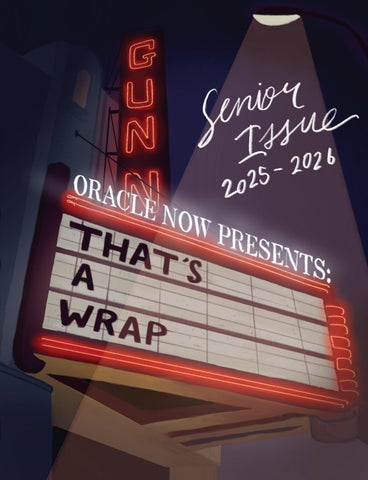
2
The Oracle
Table of Contents Letter from the Editor........4 Crossword........................5 Staff Intros....................6-9 Staff Columns.............10-15 Student Hobbies..........18-19 Alternate Pathways......20-21 Recruited Athletes.......22-25 Memories...................26-29 College Map................30-31
3
Letter from the Editor & Crossword
2025-2026 Senior Staff Sylvie Nguyen Yu-Ming Liu Ya-An Xue Vanisha Vig Kaylee Cheng Claire Jittipun Gwen Domine Lena Duggan Eanam Maor Roy Lao Yael Gottesman Anne Dong Mars Ezakadan Azuki Radhakrishnan Michael Lu Evelyn Chow Hannah Jung
Advisor
Kristy Blackburn (KGB)
4
Dear Class of 2026, By the time you graduate, your life has become organized by texts. Not just obvious ones — essays, novels and quizzes — but the unconventional ones too. Fresh Scholastic News packets spread on tables in elementary school. Reading logs signed off by parents. The first text to your middle school crush. Comically golden group chat names. For most of our lives, we have been surrounded by things asking to be read, answered or archived. Now, we are one of them. This senior issue is an anthology of the Class of 2026. Baked inside these 32 pages are meaningful teacher-student momentos; personal stories written by the paper’s seniors; hot takes that will be taken to the grave; feature profiles on our accomplishments and passions; and snapshots of who we were before everything evolves once more. And maybe that is what makes graduating feel so surreal. Behind every senior portrait or future plan is a much messier, more human story with bloopers: the wrong turns, embarrassing phases and moments of doubt that were off script. But there were beautiful scenes within unexpected conversations and moments that changed us. We survived things we once thought would crush or challenge us. Imperfection means none of us leave high school perfectly written, and that is the point. So before the credits roll and we scatter into different stories, thank you for making these years feel cinematic in the first place. Congratulations, Titans. —Sylvie Nguyen, Editor-in-Chief
The Oracle 1.
2.
3.
4.
5.
6.
9.
8. 11.
10.
12.
13.
14.
15.
16.
18.
17.
19.
22.
20. 23.
21.
24.
25.
27.
35.
36.
39.
26.
28. 29.
34.
7.
30.
31.
37.
32.
33. 38.
40.
41.
42. 43.
ACROSS 1. One California higher education system (abbr.) 4. Boat officer, briefly 8. Art Spiegelman work read in Visual Storytelling 9. Francis of ___ 11. Orange treat for a horse (2) 13. USPS corporate headquarters? (2) 14. ___ d’toilette (perfume) 15. One treatment for spine pain (abbr.) 16. Yearly wages 18. Bullets, slangily 20. Carpe ___ 22. Eyes, ears, or nostrils? (2) 27. Demeanor or appearance, in literature 28. “Since when are those two an ____?” 29. And so on x2 33 Singer Grande, familiarly 34. Gunn’s associated student body 37.au Ceti, in Ryan Gosling’s most recent? (2) 29. Crossword-so living materials, often 33) 41. Place to park a car 42. “I’m all ___” 43. Experts, for short 44. Apology by text
44.
DOWN 1. Darling, in Italy 2. Rides the waves 3. Uncle Sam’s land, in one abbreviation 4. Pacific Northwest mountain 5. Greek goddess desired by Zeus 6. Pressure unit (abbr.) 7.”Good job!” 8. Highest point as on a graph 10. Genre of music originating in Jamaica 11. Alternative space prefix 12. ___the cows come home (forever) 13. One of many on a rosary 17. Himalayan cryptid similar to Bigfoot 19 Off-Broadway award
21.Changes, perhaps unnaturally 23. Cry from a captive (3) 24. Returns for one last song 25. Aired again 26. Leader of Qatar or Kuwait 30. Actress Mendes 31. Most forks have four 32. Fragrant kind of tree 35. City next to Gunn’s (abr.) 36. One type of fish 38. Agile 40. ___ for the course (standard)
—Crossword by Mars Ezakadan
5
Staff Intros
Meet the Staff Anne Do Lifestyle
ng
Editor
3.5 year
s
“Eternal Sun of the Sp shine otless Mind” (2 004)
Azuki ishnan Radhakr
s Editor
Graphic
2 years
s “Princes ke” o n o n o M (1997)
Claire Jit Forum E
tipun
ditor
3 years
“One Ba ttle Afte r Another ” (2025)
aor
Eanam M Features
Editor
3 years
awshank “The Sh tion” Redemp (1994)
6
The Oracle
Evelyn C
how
Photogr
apher
mine
Gwen Do
3 years
ditor
Forum E
“Cars” (2
008)
s
2.5 year
e “To All th ved o L Boys I’ve 18) 0 (2 ” Before
Hannah Graphic
Jung
s artist
1 year “The Kin Warden” g’s (1997) KGB Advisor 22 years sin “My Cou 992) (1 ” y n Vin
Kaylee C Forum E
heng
ditor
3.5 year
s
“Pride a nd Prejudic e” (2005
)
7
Staff Intros
Lena Du Features
ggan
Editor
1.5 year
s
“Little W omen” (2019)
kadan
Mars Eza
ditor
Photos E
s
2.5 year
024)
“Dìdi” (2
Michael Graphic
Lu
s Artist
2 years
“Everyth ing Everywh ere All At Once ” (2022) Roy Lao In-Depth
Editor s
2.5 year
O “The LEG vie” o M n a Batm ) 7 1 (20 Sylvie N Editor-in
guyen
- Chief
3 years
8
“Fantasti c Mr. Fox” (20 09)
The Oracle
Vanisha V
ig
News Ed
itor
2.5 year
s
“Dead P oets Society” (1989)
e
u Ya-An X
g Editor
Managin
s
3.5 year
ill “Good W 997) (1 ” Hunting
Yael Gott e Sports E
sman
ditor
2.5 year
s
“Star Wa rs Revenge of the Sith” (20 05)
iu
L Yu-Ming
g Editor
Managin
s
2.5 year
” oir Dogs “Reserv ) (1992
9
Staff Columns
kaylee cheng
Determining what to give up
10
Growing up, there was nothing I hated more than being called a quitter. Each time I stopped taking piano lessons, quit volleyball, left my swim team, drifted away from robotics, or gave up on the Biology Olympiad, I felt guilty — like I had wasted time, money, and effort on things I didn’t stick with. What I didn’t fully understand until my AP Economics class this year was that not quitting has a cost too. Every “yes” you say comes with a hidden “no” to something else. This is the idea of opportunity cost: If you spend $10 on a sandwich, you are losing the chance to invest that money; if you spend Friday night studying for chemistry instead of going out with friends, you miss out on social connection and enjoyment. So the real question isn’t just “Should I quit?” it’s “What am I giving up by not quitting?” Looking back, I’m sure I understood this concept all along. It was pressure from parents, peers and myself that urged me to continue activities I didn’t feel passionate about. In fact, taking on so much diluted my sense of identity, and obscured my time away from things I truly
love — like art, poetry and journalism. We often think of our time as unlimited and unvaluable, when that is the opposite from the truth. This idea applies to friendships and relationships too. Although it may seem insufficient and callous to measure human connection with a mathematical formula, I found that it is a good starting point for indecisive people such as myself. Are you spending more time worrying about the state of your friendship, arguing and stressed than enjoying each other’s company? It goes without saying that every meaningful relationship in your life will experience times of conflict, however, evaluating the happiness and fulfillment a relationship overall brings you will put you in the driver’s seat of your life. Giving up gets such a bad rap when learning when to quit is actually such a powerful skill. Learning this means you respect yourself and your time, and are constantly putting your actions and commitments in perspective. Learning when to give up will lead you to find the jobs, hobbies and people that you actually want in your life—not just ones you are keeping due to obligation.
The Oracle
Anne dong
Living for yourself
My most prized possession is an old egg roll container stuffed into the corner of my bookshelf, repurposed to hold folded notes from childhood friends, trinkets my grandparents bought for me at Chinese corner stores, prizes won at kindergarten mock auctions and other small things I couldn’t bear to lose. When I was younger, I told my parents that if the house were to go up in flames, I would grab the box first, then run. I could live with my pink piggy bank of life savings burned to ashes, as long as I kept my memories intact. I understood the feeling of holding on too tightly before I possessed the vocabulary to articulate it. Before falling asleep every night, I would replay conversations long after they passed. That mindset didn’t stay confined to a box on a shelf: I began treating approval from myself and others like something I needed to keep safe. If people accepted me, I wouldn’t lose them. I began existing for those around me — desperate to mold myself into a character that nobody could dislike — and hoping that if I stayed agreeable, I wouldn’t have to risk being misunderstood or rejected. Somewhere in my pursuit of becoming universally likable, I lost the ability to recognize who I was beyond other people’s opinions. I told myself to be more outgoing because nobody would enjoy my presence if I was too quiet. I softened my opinions to avoid conflict, afraid of being seen as confrontational. The tipping point came one night at a senior year dance. After grasping for the remaining strands of several crumbling
relationships (attempting to embody the “best” version of myself the whole evening), I felt strangely more defeated than before. In the spur of the moment, I kicked off my heels and drove to The Melt. After poorly articulating a jumble of feelings to my friend, my friend told me an idea so simple, but striking: “Why does it matter if these people like you? Don’t spend time with people who make you feel bad about yourself.” Her words were not magic. However, they helped me understand that not only did I have to let go of some relationships in my life, but also I needed to relinquish the security of a mindset that held me down. For so long, my dependence on others’ opinions gave me a script to follow: be accommodating, be social and be the version of yourself that people will accept the most easily. Yet growth cannot coexist with constant, debilitating self-awareness. So, if my bedroom really does catch on fire (hopefully it won’t), my first impulse would no longer be to grab onto a few pieces of paper and a collection of keepsakes in an old egg roll box. Instead, I would trust that I know myself enough to leave it all behind.
11
Staff Columns
gwen Domine Saying yes
12
Last March, I stood on the stage in Spangenberg before the entire student body and preached about why I should be elected as Sports and Spirit Commissioner. I poured my soul into a speech and hours-worth of campaign posters. I did not win. After that, the appointed position as publicity commissioner for the Student Executive Council came up. So again, I meticulously prepared a slideshow and myself. Telling a much smaller, but just as intimidating, audience, I explained why I could serve the role. I did not win. While both of these rejections felt like major failures, these experiences were a continuation of a personal philosophy that I value: Say yes. By putting myself in situations where I had to speak publicly and advocate for myself, I was also exposed to outcomes that pushed me to evaluate myself, my persuasive tactics, my speechwriting skills. Say yes does not mean making reckless decisions because someone encouraged you; rather, it is to be open to opportunities when they are given to you. In my case, at the beginning of sophomore year, I saw a Schoology update advertising a high school sailing team. I showed up to tryouts without proper gear or real experience in the sport. Eventually,
I became the team captain and competed in regattas across California in my senior year. Sailing became a place where I could have unique conversations with people I would not otherwise have met and create bonds outside of the Palo Alto community. I learned how to understand tactics and wind shifts, how to tie knots and rig a boat. While trying out on a whim ended up benefiting me, I know not every risk taken comes with an immediate visible reward. And initial letdowns can feel heavy. However, it is these moments that reveal lessons that are not only vital to grasp, but also clearer in hindsight. The refusal to give up because of a past rejection is what brings more knowledge, and in turn more opportunities. With each given opportunity, there are two outcomes: failure, which may sting temporarily, but will teach you how to improve and build your resilience; or success, which proves that you are more capable than you believed and that you should continue to take risks. Say yes.
The Oracle
Roy Lao Redefining resilience
I grew up believing pain was a currency. This virtue was drilled into my conscience with the Cantonese hek fu and the Mandarin chi ku, which translates to “eating bitterness.” Inherited from generations of the East Asian diaspora, this logic became my gospel. Witnessing my parents’ sacrifices for my education, I firmly believed that only those who endure the greatest hardships are worthy of rising to the top. By early sophomore year, then, I felt like a billionaire. Every bruise from hitting the water wrong at diving practice felt like a deposit into my savings account of resilience. And when, as the newly elected Class President, my Vice President resigned for personal reasons, I saw an opportunity to double my fortune. I stepped up with conviction. So when a dull, persistent ache settled in my lower abdomen, I plugged my ears. I acknowledged the pain briefly, but I had more important things to do. For days, I led my class with a stoicism that I thought was heroic. Biology, however, does not care about metaphors. When I finally collapsed and was rushed to the ER, the doctor said my appendix had ruptured. Another few hours, she said, and the damage would have been irrevocable. As I lay in the hospital bed, surrounded by humming IV pumps and stoichiometry homework, the absurdity of my logic hit me: By being the “immortal” hero who swallowed bitterness like a daily supplement, I had nearly caused my own mortality. I realized that hek fu might not
be the ultimate virtue I’d made it to be. I returned from the hospital three inches taller, voice half an octave lower, and with the intention of better understanding the inner turmoil of others. Seeing now that I was not the only one “eating bitterness,” I realized that my high school was like a cafeteria of students lined up with the exact same meal on their plates. We drag ourselves through allnighters, suffocating our struggles in the name of duty, terrified that acknowledging the noise means we aren’t strong enough. As we pack up our bags one last time and prepare to scatter, I’m realizing that purchasing success with your own suffering is a bankrupt philosophy. Grit will always be a necessary currency in life, but hek fu is no longer my gold standard. Growing up doesn’t mean learning how to suffer in silence. Resilience isn’t about how much weight you can carry alone in the dark, and it certainly isn’t about deafening yourself to the warning bells. It’s about having the courage to share the load. The “top” isn’t a peak meant to be reached alone, dreary and drained. It’s a summit that’s only truly worth celebrating when we all arrive whole.
13
Staff Columns
Eanam Maor Quality over quantity
14
Most people grow up scared of the dark, spiders or monsters under the bed. And while I don’t smile at the thought of a spider climbing up my leg, my biggest fear was something else entirely: running out of time. Ever since I was young, I’ve had the constant fear of not doing enough. So I had an urge to accomplish everything, be friends with everyone — check all of the boxes off the never-ending list. In my chase for quantity, though, I missed out on quality. Entering high school, I believed having a big friend group was essential. Being invited to many birthday parties and always having someone to walk with between classes was what mattered. But every lunch of freshman year, I sat surrounded by over 15 girls while staring off into space feeling completely alone. My friendships were not the only part of my life consumed by my urge to maximize. I viewed every free moment I had to be utilized productively: another hour studying for that one challenging class, another way to get ahead. Burning myself out for courses I had no interest in, I viewed my performance as a sole indicator of my worth. I felt guilty for not joining more clubs, even though I found no genuine appeal in them. The irony was that my obsession with not wasting time and opportunities only caused me to lose it. Academically, stress consumed the hours I spent studying until it washed away my ability to retain the very content I dedicated time to
learn. Socially, my urge to maintain as many friends as I could blinded me from countless red flags, making me settle for friendships that left that bad lingering feeling in my gut. Would you believe me if I told you my grades improved after I began to use some of my free time to rest, cutting the time I spent studying? After going from planned friend group hangouts and group chats overflowing, to spontaneous late night drives, I began to feel much less alone. Once I began to prioritize what truly mattered, the pieces fell to place. Keeping my circle small surrounded me with the few people that truly made me feel seen, spending my time on the activities I actually enjoy allowed me to flourish in areas I was really passionate about. You don’t have to like everything, be friends with everyone, be the best at everything. It’s okay to spend one Tuesday afternoon doing absolutely nothing, it’s okay to leave some friendships behind. Don’t think this is me telling you to not try new things — don’t limit yourself from meeting new people and going out of your comfort zone. If anything, high school is the time for that exploration. But remember that not everything deserves your time and effort simply because it is available to you. Live without the regret of not trying, but also with the peace of knowing your life — the people you surround yourself with, the goals you strive for and the way you choose to spend your time. When given the option, choose quality over quantity. Because sometimes, less is more.
The Oracle
vanisha Vig Hold onto new and old moments
Sometime in 2019, my brother and I walked down to our neighborhood park for the last time. I didn’t know it was the last. Somewhere in my mind, I had thought, “we’ll do this again next week.” Next week, which used to be every day, turned into “sometime soon.” And then, before I had realized, the park, with all its bright red swings and paint peeling off the climbing frames, was a fond memory. A continent away. I find that parts of life tend to slowly slip away like this. One day I put down a favorite book and never picked it up again. Another time, I wished a friend goodnight and neither of us thought to call again. Even when nothing lifechanging happens, things fade. I was always busy, and that meant the losses themselves didn’t sting until much later. Still, I did understand one thing: Cherishing a memory can mean clutching on too tightly. If you focus too much on a specific feeling, with the expectation that the present can recreate the past, you will always be disappointed. I remember searching for a spark — a perfect replication of the time my childhood best friend and I fell to the floor laughing for the first time. I wanted to recreate times I felt loved or understood. I expected to find them in the activities I enjoyed when I was younger, like getting ice cream at the local Baskin-Robbins. Yet that empty feeling persisted. Something was missing: the sharp bone
of my friend’s elbow against my side, the trade of insults as we struggled to settle on a flavor, the small details that made the moment what it was. It was only when I stopped looking for exact replacements, continued to make new friends and discovered more passions that I no longer felt I was missing something. I started to accept that the past was something I shouldn’t seek to recover. It’s easier said than done, and I’ve yet to master it myself. By all means, chase good things. Make that call to a friend you haven’t spoken to in six months. Pick up the instrument you stopped playing in freshman year. Think fondly of those you loved, but do not look for their company in someone else. Hold true to yourself that new moments do not need to be measured against what came before. And in the future, when that bittersweet feeling comes creeping up on a quiet evening — because it will, and it’s impossible to avoid — give yourself the grace to remember the people, places, pieces of the world that you love and have loved. Remember how they have shaped you, but see yourself beyond them. Hold them, but do not cling too tightly.
15
Childhood Best Friends
16
The Oracle
Johnny Chiang and Yuval Rivlin For seniors Yuval Rivlin and Johnny Chiang, friendship began in fragments with broken English,, the glow of Google Translate and a board game no one knew except for them. Rivlin arrived in the United States in fourth grade without knowing any English, and the two were introduced when Chiang’s mother was advised by the teacher that Chiang should become Rivlin’s friend. Their first playdate was at Chiang’s house, a playdate with his chickens. At first neither of them fully
understood the other, but overtime their bond grew and so did their ability to communicate with the other. “Initially we didn’t fully understood each other and talked through Google Translate, but as I understood more English, it was easier to communicate,” Rivlin said. “I remember when I first came to his house we couldn’t fully understand what the others were saying and we spent like an hour trying to understand.” As they spent more time, rambled more and bonded over the board game “Munchkin” with each other, between the confusion and questions their friendship slowly grew. “Johnny definitely helped me learn English because after I came home from school, I’d speak Hebrew at home, but being with Johnny more time helped me learn English,” Rivlin said. Chiang believed he grew more as a patient and intelligent person with Rivlin by his side. “(Without having met each other) my life would definitely have been more lonely and much more time spent alone,” Chiang said.
kayla Xu and Lauren Murakami Best friends, by definition, are two people bonded by a deep emotional connection and unconditional support for one another. For seniors Lauren Murakami and Kayla Xu, that definition has held true since they were seven years old. Through childhood memories, changing interests and experiencing and growing from challenges together, the pair’s friendship has remained a constant. Although seen as inseparable, Xu and Murakami value independence in their friendship just as much as they value their time spent together. Creating healthy boundaries and giving each other space became vital in fostering a friendship that has lasted over a decade. “I think before sixth grade, we were always together, but it didn’t let us have our own lives, and we became really dependent on each other,” Xu said. “After sixth grade, we didn’t have classes together anymore, and the fact that our friendship got stronger after that showed me that distance didn’t make our friendship less strong. It was really important for us to find our own people and interests.”
Murakami echoes the importance of boundaries and independence. Their friendship has taught her important lessons that she will continue to carry with her in the future. “Our friendship has taught me to appreciate quality over quantity. It’s not about how many friends you have,” Murakami said. “You could have a million friends and not a single best friend. The fact that I do have one best friend means everything to me.”
17
Student Hobbies
Max Dominik: Composing The piece opens quietly — arpeggiated piano chords, a soprano sax melody, then tenor, alto, and baritone joining one by one. The drums begin to mimic a train. This is “March from Calgary,” Max Dominik’s tribute to his late grandmother. He premiered it at Spangenberg last May for his AP Music Theory final. Dominik fell into music during the pandemic, listening to classic rock, hip-hop and electronic artists who sampled vinyl. He started crate-digging at record stores and producing his own tracks. AP Music Theory junior year gave him collaborators, where Dominik created “Match from Calgary.” “It was this beautiful moment where we were all making music with each other,” Dominik said. Contrary to most composers who start at the piano, Dominik composes from behind the drum kit, recording voice memos he transcribes later at the family piano. “For my brain, it’s easier to hear a rhythm and imagine what the rest of the band would be playing around what I’m doing,” he said. Onstage with the Gunn Jazz Big Band, ripping
through fast charts, he says he disappears. “I definitely get into a flow state when I’m playing the drums,” Dominik said. This fall, Dominik heads to Oberlin Conservatory for jazz composition, studying with professor Jay Ashby and taking private drum lessons with Billy Hart, a jazz legend who has played with Miles Davis, Herbie Hancock, and Pharoah Sanders. For Dominik, the work matters beyond a career. “To create is to be human, and making things is the most human thing you can do,” Domink said. “I think it would honestly be irresponsible for me to spend my life doing anything else.”
Dolly Wu: Opera The rehearsal room starts with relaxing hums that turn into lip trills, breath work and the humming of vowels to find resonance. Scattered sheet music and the blend of different repertoires fill the classroom. This is how senior Dolly Wu warms up for opera singing. To Wu, opera didn’t begin on the stages, but at home taught by her mother. “I started off just singing pop,” Wu said. “I’ve always been a really big music lover, but I started singing opera because my mom used to be a vocal professor in China.” From then her career evolved from a classical bel canto to centuries old classical technique in opera. At first, Wu disliked it before attending further operas, ultimately falling in love with the musical genre. Since then, Wu has been training for five years.
18
Wu is currently at the San Francisco Conservatory of Music’s youth training program. There, she’s had the opportunity to sing internationally in France and Spain. “There’s just so many different languages I have to learn,” she said. “Most of the repertoire isn’t just in Italian, but also German, Russian, English and French, so (in a way), this is learning about different cultures and linguistic stuff which has helped me connect to music and understand its different cultures, histories and experiences.” After warming up, Wu is able to work on specific portions of her music, looking up translations and phonetics for pronunciations of the words. “Music is such a discipline that is so integrated into life and (I love) being able to share different stories from opera,” Wu said. “I think the aspect of using your voice to share important stories is something really important to me and learning from other people, not just as musicians, especially in the opera community is such a joy because there’s so many languages and disciplines in the area.”
The Oracle
Julia Kirner: Dogs Unlike most who meet dogs in moments of easy affection, Julia Kirner often immerses herself in the inbetween stage, before tails beat wildly or when animals have yet to learn human hands can be gentle. Kirner has been part of rescue dogs’ transitions while fostering them with her family and regularly volunteering with the non-profit Doggie Protective Service since 2022. “It’s cool to see a complete 180 within the dogs and watch their instincts kick in,” she said. Her attention to reading animals strengthened with DPS, where Kirner was trained to microchip, vaccinate and clean. Her way of helping move canines towards an eventual home follows her to Poppy, her now sevenyear-old pitbull who she rescued in elementary school. “It was really fun to see (Poppy) eventually become like a completely different dog when she plays with other rescue puppies.” Traces of Kirner’s rescue work also accumulate as much physically as they do emotionally: small mounds of dog toys in her room and scratches checkering her legs after a puppy play group. This process, she says, also led her to connect with the wider community of adopters, volunteers and dog-lovers. “There’s a large part of people I have met, like some
neighbors, who I didn’t know existed before I had (Poppy),” she said. “I’ve been able to connect with so many people I never thought I’d be able to.” With her understanding for dogs and the reality of the shelters they move through, Kirner will study animal behavior at a liberal arts college. “There are so many dogs in the system, who end up in shelters, who are completely perfect dogs, who by chance ended up there, who got lost or who had to be surrendered,” she said. “So this interest definitely needs to continue being a large part of my life.”
Oliver fong: denim Oliver Fong carefully stitches together denim with his sewing machine to yield high-quality jeans, jackets and overalls each labeled with his signature patch as part of his denim business “Oliver Fong PDX.” Starting his business from a young age, Fong has always liked making things, which he then applied to making his own clothes starting in middle school. “I just always cared about my clothing: even when I was a little kid, I was always super particular about what types of pants I would wear or what colors I would wear,” Fo n g said. “It was kind of just natural to start making my own clothing, because at a certain point I just couldn’t find the clothes that I like.” Fong encountered issues with growing his brand over the
years, juggling schoolwork and his business while pushing through fluctuations in his following. “For the first few years, it was a lot of ups and downs where I would grow a lot really quick, and then I would lose all that traction immediately, and then I wouldn’t grow for a really long time,” he said. “It was just really inconsistent growth, but it was just a lot of ups and downs, and all the downs taught me how to do better in the future.” After high school, Fong sees himself staying in a business-oriented mindset — perhaps not in entrepreneurship entirely — regarding fashion and clothing. “Perhaps in the future, I’ll be doing a different type of business, but right now, I’m really into fashion, and that’s something I really love,” Fong said. “So I see myself sticking with the fashion thing.”
19
Hobbies/Alternate Pathways
Tomer polak: flying For as long as he can remember, senior Tomer Polak has been captivated by the freedom of aviation. At 16 years old, he began pursuing his passion for flying by training for his solo license. For Polak, his interest in airplanes is much more than a hobby — it is a lifelong passion that inspired him to pursue a future in aerospace engineering. Throughout high school, Polak has flown thousands of miles, traveling to destinations across the western U n i t e d States. One of his most memorable trips took him to Alaska, where he was able to witness breathtaking landscapes from the cockpit of a plane. “(We saw) a lot of mountains and whales, and we flew into random airports,” he said. Beyond the travel and adventure opportunities, flying also provides Polak a unique sense of
escape, allowing him to disconnect with the pressures of everyday life. “I really like flying because you’re disinvolved from everything else that’s happening,” he said. “(You) just go in the plane and nothing that’s happening at school matters.” Polak hopes to expand his interest in aeronautics. He anticipates that Embry-Riddle Aeronautical University’s offerings will aid him in becoming a flight test engineer. “(ERA) has a flight research lab where they test things on experimental planes,” he said. “There are (also) a lot of classes, (such as) aircraft preliminary design or stability control — a bunch of advanced aerospace classes — I’m excited for.” Post-grad, he aspires to work at a defense contractor, such as Anduril or L3 Harris. “You design and execute on new planes and rockets,” he said. “I either want to do defense or some sort of personal, private aircraft… (I want to fly for fun), but also flight test engineering involves flying in some roles.”
kaavya tatavarty: robotics Kaavya Tatavarty began building things from a young age. First beginning her journey in her garage tinkering with scrap wood and cardboard, Tatavarty then moved on to innovation in the sciences during her high school years, achieving the 3rd Place Grand Award in Biomedical Engineering at the Regeneron International Science and Engineering Fair with her creation of a communication device for the deaf-blind. “It’s for people who can’t hear or see,” Tatavarty said. “It’s like a glove that they wear, and then when they make sign language gestures, it is able to recognize it from sensors on their arm, and then it’s able to help them communicate with other people.” Tatavarty’s work on her ISEF project also served as the catalyst for stepping into the community as well as a volunteer for a local center for the blind. Using the perspective she gained through her community service to her research, she found even greater motivation. “That human aspect, and that service aspect, along with my research, really helped broaden my perspective, and then helped me apply that to my research so I can make my device better for those people,” she said. “So I think it really taught me that service
20
and the human aspect is really important for any researcher.” According to Tatavarty, her exploration of the sciences research positions taught her how to think like an academic and embrace the ambiguity within her work along with other vital universal skills. “I think I really learned how to market myself and put myself out there,” Tatavarty said. “At least through ISEF, you have to present to over 12 judges, and I really learned how to be a better science and technical communicator through that process, which was kind of putting myself outside of my comfort zone.”
The Oracle
Barr Elnekave: Israel For many students, four-year college is not the pathway that resonates with them. Whether it stems from the desire to travel or get a jumpstart into the career world, straying from the typical university route is a powerful decision. Barr Elnekave is no exception to this: After graduation, he will join the Israeli Defense Forces, returning to the country that his family is from. Although he has never lived in Israel himself, the country still holds a special connection for Elnekave. Living close to his extended family will provide him the opportunity to see them much more often, especially considering the small size of the country. “It’s something I was always longing for,” Elnekave said. “It’s something I didn’t have growing up here in America, family dinners together and all that stuff.” This benefit to moving out
of the country, however, does not come without its drawbacks: the privilege of seeing more of his extended family means seeing less of his immediate family. “It’s the trade off of you leaving your parents and your brothers here, but you’re going to be with the bigger part,” he said. “It’s going to be a life change.” Being an Israeli growing up in the United States has not always been easy for Elnekave — a strong sense of national pride leads him to feeling out of place both overseas and domestically. This cultural dissonance, however, is remedied by the community he hopes to encounter in the IDF. “In America, people think I’m too Israeli, and I always feel like I would fit better around Israelis,” he said. “But the fear is that once I go to Israel people are going to think I’m too American. But I feel like the act of actually being in the military is sort of that bridge, because one of the biggest things about being Israeli is that everyone goes to the military, and it’s a very unifying sort of thing.”
Connor hubenthal: electrician Connor Hubenthal has gravitated toward fixing what most people only notice once it stops working: a washing machine, door hinges or a backyard sunshade. This pull toward repair and assembly will carry forward as he enters a five-year electrician apprenticeship program at Foothill College next year. By the end, Hubenthal hopes to enter the International Brotherhood of Electrical Workers and jumpstart his career. “I couldn’t see myself anything that wasn’t building with my hands because I’ve always loved to do that,” he said. “I’m in a whole different life when I’m making stuff.” To enter the building trades, apprenticeship is required. Through the program, Hubenthal looks forward to the opportunity to sync up standard college coursework, otherwise called Related and Supplemental Instruction, alongside paid job-site training with local organizations to satisfy that baseline. “I’ll deal with coworkers and customers in a workspace environment, so it’s preparing me to actually go into the world and work” he said. The decision to attend is also practical and financial. While staying close to home and attending the free
program, Hubenthenal says he can support his family, particularly his disabled father. A carpenter and licensed contractor, his father had long involved his son in projects in their home’s garage shop, naturally rubber-stamping Hubenthal’s interest in the trades. He says the buy-in moment that solidified his commitment to the program came more recently. With a four-year streak in automotive technology courses at Gunn, Hubenthal took on a job with a local mechanic through teacher Tomas Grim. The work enveloped him in not only car parts, but also affirmation for what he found most rewarding.” “This work is not a celebrated skill the same way sports, music or academics are because there isn’t the same excitement if I were to show somebody that I built this door or I fixed this washing machine,” he said. “But it’s satisfying knowing you can actually fix something and make it work again.”
21
Recruited Athletes Hannah Casale: Stevens Institute of Technology, soccer
“At the end of the day, it doesn’t really matter how much you win or lose. The best part about playing a team sport is just being with the team and enjoying those memories.”
Violet Hayes: smith college, Softball
“I anticipate the transition to be hard at first, but doable, because I’ve had to play at a higher level before, and I’m excited to get better as a hitter.”
Jacob Jiang: Johns Hopkins university, tennis “I look forward to competing with a team because it is more rewarding than competing as an individual.”
22
The Oracle Emma Lipp: Centenary university, Horseback riding “I think I don’t get as nervous anymore about the riding part though because I really trust my horse a lot and I know she’ll take care of me and I’ll take care of her.”
Jules nagayama: augustana College, waterpolo “I think freshman year me would be proud. I had no idea if I was gonna be good enough, so it feels good to know that I was good enough to play (in college). I would also be proud about how far I’ve come.”
Max oneto: uc santa cruz, soccer “Soccer is important to me because of all the friendships and relationships with coaches I make along the way.”
23
Recruited Athletes Alex silverman: Oberlin college, football “Everyone thinks football is a game of violence and muscle. However, the most important part is strategy. Every minute, down to the last second, has to be perfectly planned in practice so that everything runs according to plan.”
Alex Thu: University of San Francisco, golf “Golf has helped me connect with a lot of new people, specifically my teammates, and get to know people of all backgrounds and abilities.”
Nate yoon: cornell university, swimming “My favorite part of swimming for Gunn is winning CCS as a team in my sophomore year. That’s definitely the highlight of my high school career.”
24
The Oracle Olivia Zhu: stanford university, Artistic swimming “On the recruit trip that I went to, the team was really awesome. They’re super welcoming, really innovative and inspiring. They really take charge at spearheading their own routines and what they want to do for the season. So I think it’ll be really great to be surrounded by Stanford’s culture.”
25
Memories
War mp over illows c pillo old ws
ys da n o ly t M ine th r o sta enu r b staff e g o t f La are ess and l e ts us den stu
ike lly l sed a e r I -ba ence ng d i v i e grad
lo S w E ke LF y go is od …
Ch of em H t cla he m is on sse o e s a st fu tG n un n
T th he B liv e b ay e i est Ar n e th plac a is ew e or to ld
er y oth Ever he Bay nt city i should Area ge mer
be l uld bow o sh the l lk Mi ed in cerea e ur po befor
26
High sc dati hool ng i s over rate d
is me te e r K I ha spy Kri le and donut ib e y terr it’s th r ever o w f o t e h c n hoi eve of c chool s
Peop le a too b re getti ng old thei r Ins with tagr ams
Going to class isn’t useful at all for most classes
The Oracle
e l b a r o Mem s e t o u q f f a t s
h m to eac e h t w o h on’t s wear — d ’Connell r e d n u e asey O are lik eacher C t “Grades e c n e p.” i —Sc e a cree b o other.” t w o you h teaches n i s s a an s s .” A Chris Ch aking it r “Senior t o s d i i v d r e u Sup n yo —Campus test tha s i h t g n s gradi ore tear ilpan Sheth m d e h the s “I cher Sh w it out you out a o e r t h t e c l n l —Scie e, I’ throw hone onc e twice, I’ll p ley r u o y oshua Pa phon u on J o r y r u e o h h y c c t a n a ce te you o “If I c er scien I catch t u f p I m o . c w o ott wind —Retired acher Sc e ” t . w h o t d a n M i the w ed?” — lindfold b t s e t s take thi “Did you quet d arie Dur M r e h c Friedlan a phy te ted Photogra g, I wan ll — n i ” k ? o d o u l h a c good Conne “Are you was too Casey O’ I r e e h s c u a a e c nce t ir be .” —Scie ll my ha e a c n f ath a f h o c t le a /11.” —M p “I cu 9 o e s p ’ t r i e oth no, to give actually — y a d o day t a great s ’ es.” t i , s u s mistak i “Guy ’ S n o g i n t i a n r Dan gene teacher p for my u e k a m bs to guys’ jo r ssey u o y s ’ Mark Bra “It r Kitada e h c a e t Terence r e h c a —Science e lish t unlap n.” —Eng o r o m r Paul D e a h c s a ’ e y t b a nglish “Your b lap.” —E n u D f o ult arger to the c riella G b a G r e h “Welcome teac —Spanish ” . w o e m meow “Wow wow ***.” whiny b* sty Blackburn a s i t er Kri “Hamle sm advis i l a n r u o —J
27
Memories
Confessions I’m still not over the fact that I had to redo my first semester IAC and APUSH finals last year. Instead of doing FOOP assignments, I found a backdoor that lets you install apps on the school Macbooks (purely accidental). I used one of the open P.E. lockers for storage all of junior year and just hoped no one stole anything from it. I wasn’t late or absent, I was on the quad playing spikeball. I’m in one of the Gunn instrumental music programs, but I don’t actually practice every day. The K-building scares me. I don’t remember 99% of freshman year. I have never missed a day of school.
I’ve used the Spangenberg bathroom outside of orchestra hours.
Half of the rumors are true. I’m Batman.
Senior Night Rally Baby Shirt 2026 Doing super well on all the pool games
The great windstorm of 2022 Staff vs. student basketball (game) 67 raid at In-N-Out leading to the number “67” being banned at the restaurant
We used ChatGPT on everything.
I’d get back with my ex.
Freshman year Shooting Stars
Doing a handstand walk across the gym at junior airbands
That one assembly sophomore year where we kept clapping every 10 seconds Watching Paly fans storm the Gunn stands at a football game my freshman year
Supporting our buddy class (the sophomores) who beat the juniors during our senior homecoming 2025 social justice banquet where Ms. Firenzi tap-danced for eight minutes Senior year homecoming games (and) watching the World Cup in class freshman year
28
Most memorable moments
The Oracle
Biggest regrets Not participating in school events for the first two years. Burying myself in extracurriculars and academics and not spending enough time with friends. Coupa Cafe The Penthouse Driftwood Deli
Not making more friends and being more open minded. I didn’t join that many communities during my freshman/sophomore year.
University Avenue Ice skating at Winter Lodge
Peer pressured into not taking classes I wanted to take. Being too afraid to raise my hand or talk to someone. Not taking the fiber arts class — it looks so cool.
Mitchell Park
Ignoring my friends’ advice sometimes.
Skyline
Not saying yes to all the hangouts.
Castle Rock Town and Country
Pressed
Diddams
The Melt
Westwind Barn
Walgreens
Stanford Mall
Starbucks
Couvr Coffee
Senior Quad
Palo Alto High School
Salt and Straw
TeAmo/Ryokucha Cafe
Gwen’s house
The roof of Safeway
The Pasta Market
In-N-Out
Los Altos High School
Foothill Research Park
Antoine’s Cookie Shop
Not giving a TED talk. Taking Chem H. Not skipping more SELF. Not doing a sport. Not going to prom.
Source: Survey sent out to Gunn seniors by The Oracle with 118 responses.
Favorite hangout spots
29
College Map
University of Washington (1) Whitman College (1)
Oregon State University (1)
University of Utah (1)
Biola University (1) Cal Poly SLO (2) Claremont McKenna College (1) De Anza College (1) Foothill College (2) Occidental College (1) Pitzer College (1) San Diego State University (1) San Jose State University (1) Scripps College (1) Stanford (8) UC Berkley (3) UC Davis (5) UC Irvine (5) UCLA (4) UC Santa Barbra (2) UC Santa Cruz (1) UC San Diego (1) University of Southern California (1)
30
University of Colorado Boulder (1)
University of Texas at Austin (1)
The Oracle
College Map Bard College (1) Cornell University (1) Manhattan School of Music (1) New York University (3)
University of Wisconsin Madison (1)
Amherst College (1) Boston University (5) Havard College (1) Northeastern University (4) Smith College (1) Worcester Polytechnic Institute (1)
Centenary University (1) Stevens Institute of Technology (1)
Case Western Reserve University (1)
Carnegie Mellon University (3) Franklin & Marshall College (1) University of Pennsylvania (1) University of Pittsburgh (1)
Purdue University (1)
Loyola University Chicago (1) University of Chicago (1)
Washington University St. Louis (1)
Brown University (1)
American University (1)
Georgetown University (1) Virginia Tech (1) University of Virginia (1)
Sewanee: The University of the South (1)
Florida International University (1)
31
Palo Alto Unified School District Henry M. Gunn High School 780 Arastradero Road Palo Alto, CA 94306
Non-Profit Org U.S. Postage PAID Palo Alto, Ca Permit #44