FEATURES
SPORTS
Read about freshman Alice Cavalotti’s journey to the United States and search for adventure.
Explore how sports video games offer community and accessibility through the comfort of a computer.
PAGE 11
PAGE 13
Palo Alto Unified School District Henry M. Gunn High School 780 Arastradero Rd Palo Alto, CA 94306
NON-PROFIT ORG U.S. Postage
PA I D
Permit #44 Palo Alto, Calif.
THEOracle Henry M. Gunn High School
gunnoracle.com
Friday, October 30, 2026 Volume 64, Issue 2
780 Arastradero Road, Palo Alto, CA 94306
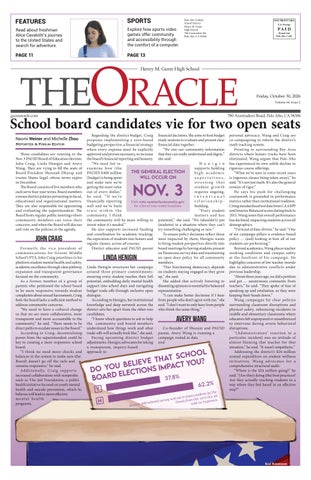
School board candidates vie for two open seats Naomi Weiner and Michelle Zhou Reporter & Forum Editor Three candidates are running in the Nov. 3 PAUSD Board of Education election: John Craig, Linda Henigin and Avery Wang. They are vying to fill the seats of Board President Shounak Dharap and trustee Shana Segal, whose terms expire in December. The Board consists of five members who each serve four-year terms. Board members oversee district policies pertaining to fiscal, educational and organizational matters. They are also responsible for appointing and evaluating the superintendent. The Board hosts regular public meetings where community members can voice their concerns, and when the Board will discuss and vote on the policies in the agenda.
John Craig For merly t he v ic e pre sident of communications for Greene Middle School’s PTA, John Craig prioritizes in his platform student mental health and safety, academic excellence through class pathway expansion and transparent governance focused on the community. As a former member of a group of parents who petitioned the school board to be more responsive towards student complaints about sexual harassment, Craig feels the board lacks a sufficient method to address community concerns. “We need to have a cultural change so that we are more collaborative, more transparent and more accountable to the community,” he said. “There needs to be direct paths to escalate issues to the Board.” According to Craig, decentralizing power from the superintendent could be key to creating a more responsive school board. “I think we need more checks and balances in the system to make sure (the Board) doesn’t go off the rails and remains responsive,” he said. Add it iona l ly, Cr a ig suppor t s increased collaboration with nonprofits such as The Jed Foundation, a public health initiative focused on youth mental health and suicide prevention, which he believes will lead to more effective m e nt a l h e a l t h programs.
Regarding the district budget, Craig financial decisions. She aims to host budget proposes implementing a zero-based study sessions to evaluate and present clear budgeting perspective, a financial strategy financial data together. where every expense must be explicitly “We owe our community information approved and proven necessary, to increase that they can really understand and digest,” the board’s financial reporting and honesty. she said. “We need (to) reH e n i g i n ex a m i ne how (t he supports holding the general election PAUSD) $400 million high academic (budget) is being spent expectations, will occur on and make sure we’re stressing that getting the most value s t udent g row t h out of every dollar,” requires ongoing, he s a id . “I f we ’re intentional financially reporting relationshipVisit vote.santaclaracounty.gov for a list of vote center locations well and we’ve built building. trust w it hin t he “Every student community, I think matters and has the community will be more willing to potential,” she said. “We (shouldn’t) put invest when it’s needed.” (students) in a situation where they can’t He also supports increased funding try something challenging or new.” and coordination for academic tracking: To ensure policy decisions reflect those the separation of students into honors and most impacted by them, Henigin wants regular classes, across all courses. to bring student perspectives directly into District educator and PAUSD parent board meetings by having students present on Panorama survey data and maintaining an open-door policy for all community members. Linda Henigin structures her campaign “Our functioning democracy depends around three primary commitments: on students staying engaged as they grow ensuring every student reaches their full up,” she said. potential, embedding daily mental health She added that actively listening to support into school days and navigating dissenting opinions is essential for balanced budget trade-offs through inclusive open representation. dialogue. “I can make better decisions if I hear According to Henigin, her institutional from people who don’t agree with me,” she knowledge and deep network across the said. “I don’t want to only hear from people district sets her apart from the other two who think the same thing.” candidates. “I know which questions to ask to help the community and board members understand how things work and what Co-founder of Shazam and PAUSD trade-offs will actually look like,” she said. parent, Avery Wang is running a Facing upcoming district budget campaign rooted in data adjustments, Henigin advocates for taking a nd a transparent, inquiry-based approach to
NOv. 3
Linda Henigin
Avery Wang
oo l h c s t e tha v u? e i o l y e t b c u a Do yo lections imp e 37.8% board Y N
62.2%
e ts by Th n studen Oct. 26 n u G to 2 to t ou t s. ve y s e n m Oct. 1 cted sur racle fro ith 111 response le O e -s lf e S w : e c r u So
personal advocacy. Wang and Craig are co-campaigning to reform the district’s math tracking system. Pointing to surrounding Bay Area districts where honors tracks have been eliminated, Wang argues that Palo Alto has experienced its own subtle decline in rigorous course offerings. “What we’ve seen in some recent years is (rigorous classes being taken away),” he said. “It’s not just math. It’s also the general erosion of rigor.” He says his push for challenging coursework is grounded in performance metrics rather than institutional tradition. Citing standardized test data from CAASPP and Smarter Balanced scores dating back to 2015, Wang notes that overall performance has declined, impacting students across all demographics. “I’m kind of data-driven,” he said. “One of my campaign pillars is evidence-based policy … (and) looking at how all of our students are performing.” Beyond academics, Wang places teacher working conditions and campus safety at the forefront of his campaign. He highlights concerns of low teacher morale due to administrative conf licts under previous leadership. “About three years ago, we did a petition and got … anonymous comments from teachers,” he said. “They spoke of fear of speaking up and retaliation, so they were keeping their heads down.” Wang campaigns for clear policies surrounding classroom disruptions and physical safety, referencing incidents in middle and elementary classrooms where educators felt unprepared or unauthorized to intervene during severe behavioral disruptions. “(Ad m i n ist r ators’ reac t ion to a particular incident) was an attitude of almost blaming that teacher for that situation,” he said. “It wasn’t empathetic.” Addressing the district’s $24 million annual expenditure on student wellness i n it iat ive s , Wa ng advo c ate s for a comprehensive structural audit. “Where is the $24 million going?” he said. “(Are they) doing (the) best practices? Are they actually reaching students in a way where they feel heard in an effective way?”
Kai Knutson
2
News
THEORACLE
Diwali faces obstacles to becoming state holiday Cici Zhang In-Depth Editor State Superior Court Judge Stephen Acquisto struck down Assembly Bill 268, which established Diwali as a California state holiday, in July 2026, citing religious concerns. The bill, signed into law by Gov. Gavin Newsom on Oct. 5, 2025, allegedly violated the Establishment Clause of both the U.S. and California constitutions, which ban the federal and state governments from endorsing any religion. Although AB 268 took effect on Jan. 1, 2026, it no longer stands because of the subsequent ruling. According to the Los Angeles Times, Acquisto ruled AB 268 unconstitutional due to its failure to separate church and state in promoting Hinduism. State holidays must be established for a nonreligious purpose, which Acquisto believes Diwali doesn’t have. In Acquisto’s ruling, he took issue with the specific language of AB 268. “The Court finds that AB 268 violates several provisions of the federal and state constitutions by giving Diwali special treatment expressly based on its religious importance, without any significant secular considerations,” Acquisto said. The San Francisco Taxpayers Association, which filed the complaint against AB 268, named Newsom as a defendant. He has not appealed the decision yet. An appellate court ruling could overturn the Acquisto decision,
restoring Diwali as a state holiday. The California Vice President Rowena Chiu believes that state legislature could also do so by drafting a new bill that recognition of Diwali would support the city’s efforts frames it, as a holiday with secular benefits. to better acknowledge Hindu culture. Diwali is a widely recognized holiday in India, “California is a really diverse state, and I think it is with 80% of the Indian population celebrating (Newsom’s) intention to recognize (that),” she said. Diwali according to CNN. Around 45% of non-Hindu Those efforts include PAUSD Superintendent Indian-Americans celebrate the holiday as well, per Jason Glass’s listening sessions with cultural groups the Pew Research Center. and PAUSD’s celebration of many ethnic holidays. The five-day festival of lights takes place in Although Palo Alto can designate Diwali a October or November each year, falling on the new municipal (city) holiday and close city services with moon day of the eighth Hindu month, Kartik, and paid time off for staff, it has not done so. usually involves gatherings with friends and family “You ultimately wonder about equity,” Chiu said. and the lighting of candles. “Where do (people) decide that an ethnic group is Mitchell Park Library Services Manager large enough to merit recognition of their holidays? RuthAnn Garcia, who plans a free Diwali ... I think that’s a really difficult decision.” celebration that takes place on Nov. 22 annually, observes secular interest in her event. “Our Diwali event has been met with much enthusiasm by our entire Palo Alto community,” she wrote in an email. “People learn and connect through these events.” For sophomore Saina Narayan, the holiday is a source of harmony and community. Her family unites over a puja, a Hindu ritual honoring the goddess Lakshmi, of students think that more cultural and lights firecrackers holidays should be recognized together. statewide and Nationwide “There’s a big theme of good triumphing over evil,” Source: Self-selected survey sent out to Narayan said. “That’s why Gunn students by The Oracle from Oct. many people clean their houses, 12 to Oct. 26 with 110 responses. let go of grudges and resolve arguments during Diwali.” PAUSD Board of Education
81.8%
Graphics by Nina Pankov
Lack of funding ends Palo Alto Link pilot program transit options more generally,” Baird said. Senior Sophia Kou believes Palo Alto Link was a beneficial idea and found it to be a supportive service in other community ride the times she’s used it, although she experienced some difficulties with the Link app. services available: Palo Alto Link, a local rideshare program, will end its “(Palo Alto Link shutting down) is not great because services on Friday, Oct. 30. For Palo Alto residents, the it is a great way to get around town,” she said. “If it’s not • Older adult transportation: Avenidas Door program has been an alternative to major companies like working, then I need to ask to Door (Senior Transportation) Uber, Lyft and Waymo, with people for rides, and that’s • Commuting program for low-income the benefit of lower costs. or disabled older adults: Palo Alto inconvenient.” The program piloted Transportation Management Sophomore Nathan Wu its on-demand transit (Link) certainly met a need for a number Association programs dislikes the wait times for system in March 2023 of folks. Folks have repeatedly requested • General shuttle transportation: Marguerite Palo Alto Link, finding he after receiving funds from for it to be expanded, that it continue Shuttle Services could walk from Mitchell • Transportation for veterans: Veterans Measure B, Innovative into the evenings and over weekends, but Park to Gunn in the same Affairs Shuttle Transit. Along with those amount of time it would • Disabilities: Samtrans Redi-Wheels, funds, a partnership ultimately, it has also just been a fairly take for a Palo Alto Link Valley Transportation Authority Access expensive program per ride. between Palo Alto Link Paratransit Services ride to get him there. and Stanford Research —Palo Alto Link Program Manager “If they were to improve Park has covered operating More information on the City of Palo Alto Nathan Baird (their wait times), I’m costs for rides to and from Website: tinyurl.com/Palo-Alto-Transportation pretty sure it would take a the park, as well as two lot more government funding,” he said. “That might mean Transportation Fund for Clear Air grants, which allowed more taxes. I think it’s more preferable the program to stay open until Oct. 30. Each ride had an to spend an extra $20 for an Uber operating cost of about $26 and was priced for consumers rather than paying more tax at around $4. Popular ride destinations included Mitchell money that’s more than Park, Stanford Research Park and Stanford Shopping $20.” Center. Palo Alto Link Program Manager Nathan Baird said that the program was effective and successful while it lasted. “As a pilot program, we were just curious to see how it would work whether it would meet a need,” he said. “It certainly met a need for a number of folks. Folks have repeatedly requested for it to be expanded, that it continue into the evenings and over weekends, but Photo illustration by Vin Bhat and Azuki Radhakrishnan ultimately, it has also just been a fairly expensive program per ride. With those grants expiring, it just became difficult to keep it going.” According to Baird, even though requests have been made for an expansion of the program, transit Wu funding has been difficult to secure, making it harder to na Fio keep Palo Alto Link going. This funding has been difficult to obtain all across the region since Palo Alto focuses what funds are present on those who need it most. “(However), we certainly have (gained) a lot of information about how the program was utilized, where folks most wanted to go and that there is a desire for
Ezra Rosenberg In-Depth Editor
”
News
THEORACLE 780 Arastradero Rd. Palo Alto, CA 94306 (650) 354-8238 www.gunnoracle.com
Editorial Board Editor-in-Chief Sarah Grupenhoff Managing Editors Vaani Saxena Melody Song News Melody Na Fiona Wu Forum Olivia Lee Michelle Zhou Features Arjum Ahluwalia Noa Zeitlin In-Depth Ezra Rosenberg Cici Zhang Sports Mayher Dulani Athena Gao Lifestyle Ellen Kim Yuji Song Online Ezra Rosenberg Social Media Athena Gao Ellen Kim Noa Zeitlin Photo Editor Laura Wang Graphics Editor Dani Massarweh
Staff Business/Circulation Olivia Lee Graphics Artists Florence Chen Norah Fakrudeen Kai Knutson Sophie Kou Nadya Leong Rori Liu Sahana Mahadevan Nina Pankov Claire Sim Fiona Wu Reporters Emma Chen Pandora Gallusser Michelle Jin Sumayya Khan Nandita Ramakrishnan Naomi Weiner Adviser Kristy Blackburn
Friday, October 30, 2026
Community stakeholders debate Measure J efficacy Melody Na News Editor On June 24, the Palo Alto City Council placed Measure J — a 0.5% local sales tax dedicated toward upgrading Cubberley Community Center — on the November ballot. As a general tax proposal, the measure needs a simple majority among Palo Alto voters to pass. The tax revenue is expected to generate approximately $15.6 million per year to fund the redevelopment of Cubberley. It will also finance the city’s $65.5 million purchase of seven acres of land from PAUSD to gain property ownership, according to the joint statement of the city of Palo Alto and PAUSD. The ballot title says that Measure J will help the city repair Cubberley Community Center and provide general city services, including upgrading electrical systems, wiring, plumbing, maintaining streets, preparing for natural disasters and repairing libraries. However, community members disagree on the measure’s effectiveness. Council member and Measure J proponent Keith Reckdahl said that redevelopment allows Cubberley to preserve space for businesses despite upzoning, which increases housing supply but can also displace local businesses. “You’re creating more demand for services, but you’re also reducing the supply by now making these affordable areas harder to find,” he said. “That means that if you want to take
a ballet lesson, you’re probably going down to places where you can find cheaper real estate (as most businesses will be concentrated in those places). Having these types of residentserving nonprofits in Palo Alto is very important for quality of life.” Lee Pfab, CEO of Palo Alto Community Child Care, a nonprofit organization partnering with Cubberley, believes that it is important for nonresidents who commute to the city to support the community center by paying taxes under Measure J. “Palo Alto is a destination community,” she said. “When (people) commute in, (they) end up spending money here. I think this is a way in which commuters can contribute to the benefits they get for living or working in a city that has so many resources to offer.” Former mayor and council member Lydia Kou opposes the measure and expressed concern over the vague language of the ballot title. “There was no funding mechanism on how (the city is) going to purchase the land, and Measure J specifically does not mention the purchase of land,” she said. “What it specifically mentions is that we (potentially) can use the money for renovations of Cubberley, but it also goes towards general city services taxes.” Kou also believes that Measure J proposes a regressive tax, which disproportionately impacts lower-income residents by increasing the cost of essentials while having no end date.
She says the city should prioritize its residents in these decisions. “The people of Palo Alto should have the first dibs,” she said. “(Cubberley) is in our community. There’s a lot of funding mechanisms (such as general obligation and general fund bonds) that the city should explore before they come up with such a damaging regressive sales tax.”
Photos by Melody Na
Above: Cubberley Community Center has stood on Middlefield Road for 70 years. Bottom: Local yard signs campaign for Prop J around Palo Alto.
State propositions draw mixed reactions over housing, tax Athena Gao Sports Editor The California general election, where voters decide on state legislative, congressional contests and 14 statewide ballot propositions, will take place on Nov. 3. The 14 propositions encompass a wide range of topics, including housing, taxes, education and healthcare, with Propositions 1, 3 and 40 impacting Gunn students. Proposition 1 would permit the state to sell $11.25 billion in bonds to fund affordable housing projects, including Ca lifor nia universit y st udent housing. Proposition 3 would permanently enforce the current high-income tax supporting public education and healthcare, while Proposition 40 would enact a new one-time billionaire tax, which supporters’ projections say could raise $100 billion for state healthcare and education in the next five years. Stanford University graduate student Varun Kota, who is pursuing a Master’s in Business Administration, believes Proposition 1 is part of a statewide push to lower housing prices. “I think most people would agree that housing availability is a significant issue in California,” he said. “It’s made buying a home less affordable for people, and (measures like Proposition 1) are aimed at tackling that issue.” According to CalMatters, opponents of Proposition 1 cite concerns that taking out more money to pay for homes does not address root causes of housing shortage: expensive land and insufficient wages.
As debates around housing affordability rise, vice president of Unhoused Action Club senior Sanjana Thangavelu believes students living in wealthy areas like Palo Alto have a responsibility to be educated about the issue and propositions surrounding it. “Being blind sided by problems li ke homelessness can come across as a bit privileged, even (unintentionally),” she said. “It’s important to know people’s experiences (in different) socioeconomic classes.”
87%
of students believe people should be more well-informed about local politics Source: Self-selected survey sent out to Gunn students by The Oracle from Oct. 12 to Oct. 26 with 115 responses.
For Proposition 3, proponents argue the existing high-income taxes are a necessary resource for schools, reports CalMatters. However, opponents believe the proposition could incentivize wealthier Californians, who contribute significantly to funding public education and welfare, move away to states with lower taxes. Similarly, those against Proposition 40 claim a one-time billionaire tax would cause billionaires, a significant portion of whom
Visit gunnoracle.com to read our online exclusives!
Fill out our feedback form at tinyurl.com/OracleOctober2026 Michelle Zhou
3
INBOX
live in Silicon Valley, to leave California. For students, this major drop in state tax revenue could decrease access to public education resources. Oppositional health organizations like the California Hospital Association also argue the revenue generated from Proposition 40 would not solve long-term healthcare funding shortages. Objectors of the measure advocate for Propositions 41 and 42, which enforce strict limits on new taxes and effectively stop Proposition 40 from passing even if it wins a majority vote. However, supporters of Proposition 40 believe the wealthy few paying the tax have an obligation to make up for federal Medi-Cal cuts, which could cause a decrease in healthcare access. Speech and Debate co-president senior Sophia Parang believes t hat while t he implementation of Proposition 40 may be difficult to enforce, a one-time billionaire tax would be a beneficial source of funding to make up for nationwide healthcare cuts. Parang is skeptical of claims that the measure would incentivize billionaires to leave California, as their industry remains rooted in Silicon Valley. However, Parang agrees with concerns about how continuing high-income taxes through Proposition 3 could lead high earners to leave California. “I think capital flight isn’t a huge risk if it’s a one-time (billionaire tax),” she said. “(But Proposition 3) could cause more people leaving, especially because people who are high income but not billionaires don’t feel like they have the stability to undergo that type of tax (while continuing) the same quality of life.”
4
Advertisement
THEORACLE
Ad generated by AI
FORUM
Forum
Friday, October 30, 2026
5
Michelle Jin Reporter Dickens, Fitzgerald, Shakespeare: these are the names ingrained into English curriculums across the world. While their works undoubtedly have literary significance, focusing solely on classics discounts the value of contemporary literature. As themes in classical works grow obsolete, it is important to shift focus onto modern literature, which contain more diverse and relevant perspectives and topics. Classical literature is notorious for propagating problematic beliefs, including racism and xenophobia. Many works contain eurocentric biases and facilitate narratives of white saviorism and Orientalism. H.P. Lovecraft, a foundational horror author, has often been criticized for portraying other cultures as monstrosities. His novel “The Horror at Red Hook” demonizes immigrant communities, using them as the foundation for existential horror and promoting xenophobia in doing so. Laura Ingalls Wilder’s “Little House on the Prairie” paints unsympathetic portraits of Native Americans and frequently uses dehumanizing language. Furthermore, the portrayal of women in classic literature is often weak at its best and flagrantly misogynistic at its worst — rape and sexual assault are treated as irrelevant or less important than a male character’s struggles. From Homer’s “Odyssey” to Wilde’s “The Picture of Dorian Gray,” both of which are narrated by men, sexism is rampant and myriad, with female characters written as extensions of male characters. By consuming classical literature, readers digest these ideas, and their own thought processes may begin to reflect them. In contrast, contemporary authors have more diverse voices and backgrounds, allowing readers to access different perspectives and
build empathy for people vastly different from themselves. In recent years, the pool of authors has greatly diversified. From 2019 to 2023, published works of fiction by nonwhite authors have doubled from 8% to 16%, according to The Atlantic. Dr. Tracey Flores, associate professor of language and literature at the University of Texas at Austin, states that diverse books serve as both windows and mirrors of different experiences, offering the opportunity to build community, increase empathy and combat prejudice. Additionally, contemporary literature better addresses issues that impact modern life. Books like Richard Silken’s “Crush,” covering homosexuality and violence against the queer community, and Toni Morrison’s “The Bluest Eye,” which critiques internalized racism and beauty standards, tackle issues that modern audiences can better sympathize with. Exploring modern literature better educates readers about current issues, building critical thinking skills and finding solutions to present-day problems. A common claim is that classics possess higher literary quality than contemporary literature. However, literary quality is inherently subjective. What one reader considers profound, another may find deficient. Dismissing modern literature as inferior reflects a limited familiarity with the genre. Contemporary literature contains an immense range of themes, styles and subjects, many of which are equally thought-provoking and sophisticated when compared to those found in classics. The themes people consume in literature ultimately impact what they believe. For classics, those themes push society into antiquity and encourage prejudice, whereas modern works allow us to view the world through novel perspectives, equipping us with the ability to address the problems in our everyday lives. This is not to negate any value that classical literature offers; Rather, we must consume classics alongside modern works, as to better ourselves and our viewpoints.
Graphics by Sahana Mahadevan
NO
YES
Should society prioritize modern literature over classics?
Pandora Gallusser Reporter In today’s world, the seemingly growing irrelevance of classics raises the question as to whether they should continue being taught in schools or be swapped for something more modern. However, classics transcend time. They don’t take away from the present — rather, they enrich it through their cultural and historical significance, influence on contemporary culture, universal messages and intellectual stimulation they provide readers. Classics are windows into different timeframes and societies. They are not just incomprehensible Shakespeare plays from the Victorian era but scope a much wider range of topics and styles, from Homer’s “Odyssey” to Sun Tzu’s “The Art of War.” They are reflections of the past and provide channels to access these the minds of the past thousands of years later. These works are the origin of modern-day literature and life, and their influence should be acknowledged. Classic literature has had a tremendous impact on modern-day storytelling mediums, through language, concepts and archetypes. As Italian philosopher Umberto Eco stated, “Thus I rediscovered what writers have always known (and have told us again and again): books always speak of other books, and every story tells a story that has already been told.” For instance, Homer’s “Odyssey” introduced the journey archetype, where a hero goes on an expedition over the course of a novel, reaching a final destination. Countless works have derived their narratives from this archetype, such as The Lord of the Rings and Harry Potter series, both well-loved today. Additionally, classics are valuable resources for improving mastery of language. Classics sophisticate contemporary lives with unfamiliar
terms and concepts that readers can use to expand their thinking further. According to a 2013 study at Liverpool University, the challenging language used in classic literature stimulates the brain much more than straightforward, modern translations. Reading classics also triggers autobiographical memory — the long-term memory system that combines personal life with factual knowledge and emotion, prompting readers to reflect on themselves. English professor Philip Davis, who worked on the study, said “Serious literature acts like a rocket-booster to the brain. The research shows the power of literature to shift mental pathways, to create new thoughts, shapes and connections in the young and the staid alike.” Classics also maintain value and relevance in today’s world through the timeless lessons and messages they bear. Humans still grapple with the same essential problems as they did thousands of years ago: interpersonal relationships, betrayal, identity, moral dilemmas and more. For example, what is the nature of reality? By reading older works, readers will find that all of the questions and problems they face today have been asked and pondered for a long time, and they can gain insight to answer these questions in the process. Some may argue that classics hold outdated messages from the past like racism, sexism and homophobia and should therefore be avoided. However, it is essential to analyze these outdated ideologies and understand why and how such events occurred. This is much more powerful and effective in preventing similar situations from happening in the future. As author George Santayana’s aphorism goes, “Those who cannot remember the past are condemned to repeat it.” Classics hold humanity’s roots, cultures and influences — everything that shapes humankind into the species it has become. By only reading recent works, the richness of humanity and thousands of years of thought that precede the modern day are thrown away and lost. People must not be so quick to abandon classic literature for a more reflective portrayal of their lives. Instead, they should utilize classics to enrich their lives and reflect on humanity’s history.
6
Forum
THEORACLE
Treat service workers with human decency
Melody Song Managing Editor When I first started my job as a restaurant host, my manager told me something I found kind of strange: “Adults are just kids with money.” I thought it was a throwaway one-liner he said just to be funny, but several months in, I’ve realized that he wasn’t joking. Hospitality is taking care of other people. Adults come to restaurants so other people can do what they usually do for themselves — pour the water, cook, do the dishes — and that in and of itself makes them seem more like children. I have no problem with that. There was just one part I had trouble figuring out: I know this is the job, so why does it sometimes feel like a line is being crossed? Why do I like some customers and dislike others if I’m doing the same thing for all of them? The answer is simple: Some customers show basic respect and others don’t. The difference between adults and kids is that when a kid does something “bad,” like break a glass, they have their parents to hold them accountable. Adults don’t have someone like that. I’m not saying people should be super hard on themselves and apologize for every little mistake they make, but offering a small “thank you” isn’t difficult when someone comes to clean up after you. Ideally, look a little apologetic as well. I don’t actually care if I have to sweep broken glass or mop a spilled drink, but I do care if a guest is ignoring me, the person who’s cleaning up after them. I thought we all learned to say “sorry’” and “thank you” in preschool. The acknowledgement always matters, even if it doesn’t change the physical reality. Once, I had to clean vomit off the bathroom floor, and the person who threw up didn’t even let us know what happened. This was the most irritating thing to me: the entitlement that let her just throw up and leave. I’m not your mother. How do you, as an adult, expect someone who doesn’t even know you, to clean your vomit? But someone has to do it, and it’s certainly not going to be the paying customer, so the least you can do is give us a heads-up and apologize. Not for being sick — that would be unreasonable — but for the situation you’ve caused. It is a humiliating, dehumanizing experience to scrub a stranger’s vomit, and it would have been more bearable if that stranger had somehow acknowledged the fact that she was making someone do a very unpleasant job. It really is the thought that counts. You could be thinking, “Suck it up, you need customers.” You would be right, but we already have been sucking it up. The fact that businesses can’t operate without customers allows customers to get away with so much more than they would in any other setting. But why should that be the case? The whole idea of basic respect and dignity is that everyone is entitled to it no matter what. It shouldn’t be something people can pay their way out of showing, because while you may be the one with the money in the restaurant and the hotel, what about when the roles are reversed, and you’re the one being paid to do something at your job? Should your employer be able to walk all over you just because you’re being paid? The world is full of people who do the jobs you don’t want to do. These are people to be grateful to. The world is also full of people whose job it is to help you. They man every front desk, answer every phone and deal with jerks all the time. But we do not have to be jerks to them, even if they have to help us no matter how we treat them. We should treat them with respect, because duh. And although you’re almost an adult, and your parents probably don’t remind you to be polite anymore, grow up and do it anyway.
Youth should leave past memories behind, take charge of present Nandita Ramakrishnan Reporter From teenagers facing the pressures of college admissions to young adults braving the daunting reality of full-time careers, people increasingly like to pretend their lives peaked in elementary school. It is a comforting lie to tell oneself when the reality of growing up feels like an endless onslaught of high-stakes exams, professional expectations and the heavy responsibility of defining an identity. Caught in that panic, the automatic instinct across generations is to hit rewind. However, this romanticization of childhood is not harmless nostalgia, but an emotional defense mechanism driven by a deep fear of adult responsibilities and independence. By clutching onto artifacts of the past, people construct a psychological shield. Look at the baby profile picture trend. It is easy to write off as just a cute aesthetic, but psychology suggests a deeper purpose. According to the American Psychological Association, regression is an unconscious defense mechanism where individuals mentally retreat to an earlier developmental stage to cope with overwhelming stress or conflict. When using five-year-old faces on public accounts, individuals signal regression. In a high-pressure school culture that constantly demands near perfection, adopting childlike markers becomes a subconscious bid to lower expectations for academic achievement, personal responsibility and independence. When students project the innocence of toddlers, they hope to create a buffer against the harsh adult standards of accountability and performance. This nostalgia similarly dominates adolescent social dynamics. Per the Survey Center on American Life, nearly half of Americans report having three or fewer close friends — a steep decline from previous generations, with young adults reporting the sharpest drop in community networks. Back then, connection only required playing four square, trading food at lunch or hanging from the monkey bars together. Proximity did all the heavy lifting. Today, keeping up friendships demands a deliberate effort. In his 2019 study, “How many hours does it take to make a friend?” University of Kansas Communication Studies Professor Jeffrey A. Hall found that developing a close relationship requires upwards of 200 hours of intentional time together. Young adults have to work around busy schedules, communicate clearly and deal with the inevitable risk of growing apart or getting rejected. When people look back wistfully on early friendships, they are often feeling the weight of how demanding mature relationships are. People avoid the difficult work of adult connection and decision-making, and this has deeper consequences: profound isolation. The 2023 U.S. Surgeon General’s advisory, “Our Epidemic of Loneliness and Isolation,” a journal article, emphasizes that withdrawing from real-world communities and relying on passive social habits fuels a widespread public health crisis. Longing for effortless childhood playdates rather than investing the hundreds of hours required to cultivate a mature community directly accelerates detachment. Instead of engaging with peers in vulnerable, meaningful ways, individuals hide behind idealized memories of an era when proximity alone substituted for active effort. This
persistent retreat into the past makes the present world feel far colder and more alienating than it truly is. This avoidance is especially obvious in how high schoolers reacts to everyday pressure. Society prematurely thrusts students into professional roles before they even receive their diplomas by telling them to build resumes, network on LinkedIn and map out long-term careers. Consequently, teenagers crave an era with nothing to do. In his foundational 1998 study, “Ego Depletion: Is the Active Self a Limited Resource?” social psychologist Roy Baumeister demonstrated that making relentless choices — from navigating career and academic trajectories to managing daily commitments — actively depletes mental energy, triggering decision fatigue and prompting individuals to seek passive escape. The hidden appeal of elementary school — where adults dictated every bedtime, meal and activity — is the complete relief from that fatigue. Having zero agency eliminates the terror of making the wrong choice, but also prevents people from developing the confidence and independence necessary to navigate responsibilities. Critics may argue that reflecting on early youth is simply harmless entertainment — a brief mental vacation from the relentless grind of modern expectations. There is certainly value in finding joy in an old animated film or laughing over early internet trends with friends after a grueling week of exams. Occasional reflection can provide genuine comfort and brief emotional grounding. However, a line exists between taking an occasional breather and using the past as an emotional fortress against the present. When nostalgic yearning becomes habitual avoidance, it actively stunts personal growth. It convinces young people that they were only capable, safe and happy when someone else was managing their lives, quietly instilling the false belief that adulthood is purely a state of decline. Overcoming this arrested development requires reframing the very concept of independence. Growing up should not be mourned as the tragic loss of a safety net, but celebrated as the victory of self-reliance. Childhood security was entirely contingent on rules, schedules and futures decided by adults. Maturing replaces that borrowed security with the power to discover what truly matters, cultivate friendships earned through genuine effort and realize that hardships are simply an essential part of learning. Trading the fantasy of an easy past for the freedom to shape the present is the only genuine way forward. It is time for everyone to step off the playground turf, stop looking backward for salvation and claim the authority to build a meaningful life.
Sahana Mahadevan
Features
FEATURES
Friday, October 30, 2026
7
Students maintain connection to cultural identity through conservation of heritage languages brian Kuria: Swahili For most people, speaking a language is merely a means for communication. Junior Brian Kuria, however, learned Swahili to bridge a gap between his American background and Kenyan heritage. Kuria started learning Swahili, a language that is particularly rare in the Bay Area, when he moved to Kenya at 5 years old and began attending school there. The language was his tool to fit into an unfamiliar society. “Interacting with people became easier when I spoke the language,” he said. “I was an outlier because I came from America (and) everyone at school was from Kenya. If I had started speaking English there, it would (have been) awkward or even disrespectful (to) the culture.” A relatively uncommon language in the United States, Swahili is spoken mostly in East Africa — specifically Tanzania and Kenya. Kuria has noticed that speaking it has brought Kenyan culture into his life. “I was introduced to some songs when I was in Kenya and also things associated with dances,” he said. “They all included Swahili and really made me feel more culturally connected.”
Kuria also views speaking Swahili as a way to bring Kenyan culture to the U.S. “The majority of people don’t know (about) African culture,” he said. “Speaking Swahili helps spread the culture of … Kenya that (is) undermined and deserves more (recognition).” For Kuria, communicating in Swahili helps him build his cultural identity and plays an important role in helping him honor his roots. He believes that it is important for him to know the language in order to take part in the passing on of heritage and tradition. “Speaking Swahili helps preserve the language,” he said.“It shows that there are still people who remember the culture, and it is really a part of trying to carry on the language to future generations.” –Written by Ellen Kim
Ellen Kim
Temujin BattuLGA: KHALKHA Mongolian Aside from summers spent visiting family in Mongolia and within his own home, freshman Temujin Battulga rarely hears his heritage language spoken. Battulga’s heritage language is Khalkha Mongolian, the predominant dialect in Mongolia. While 80% to 90% of the population within Mongolia can speak or understand the dialect, it is uncommon to hear outside of the country. According to estimates published by the Census Bureau in 2023, only an estimated 50,000 people identify as Mongolian — approximately 0.2% of the U.S. Asian population. Although his parents taught him English first, they still made sure to teach him Mongolian so that he could connect to his cultural identity. “My parents really care about their culture and (want to ensure) that I know a lot about my own culture,” he said. “They’ve made sure I know where I come from and my roots.” Battulga agrees that becoming a fluent speaker in the language has helped him remain in touch with his heritage.
“Mongolia is not a very large country, so speaking Mongolian makes me feel… like I’m a part of a smaller community and closer to my culture, which is important to me,” he said. Battulga believes preserving dialects is a vital aspect in sustaining heritage. “Language is a big part of culture,” he said. “Preserving languages and dialects can help preserve each culture’s unique identity.” Battulga was born in the United States and only lived in Mongolia for a few years before moving back. For him, speaking Mongolian not only makes him feel more connected to his cultural identity but is key to bonding with extended family as well: for many of them, Mongolian is the only language that they know. “It makes me feel closer to them, because I’m (less of) an outsider,” he said. “Even though I live in America and have adopted a lot of the American culture, I still have ties to Mongolia through the language.” –Written by Michelle Zhou Emma Chen
Eloise O’Donnell: Irish Standing in front of her eighth grade class, sophomore Eloise O’Donnell delivered her middle school graduation speech in a language that barely anyone could understand: Irish. Irish, also known as Gaelic, is a way O’Donnell expresses a piece of her heritage that is gradually becoming obsolete, with only 1.5% of the Ireland’s population speaking the language outside school classrooms, according to the 2022 Central Statistics Office Census. O’Donnell first learned Irish from her mother, who was born and raised in Ireland. As she grew older, she realized the presence of the language around her had steadily diminished. Although Irish is the official language of Ireland, most people speak English as their first language. For O’Donnell, the language is not only a tradition passed down from her mother but also a way to share her culture and distinguish her identity. This ability to represent the Irish language became particularly meaningful when she was given the opportunity to speak it at her middle school graduation ceremony. “(This speech) was a way (to create) a connection to my community by sharing my Yuji Song
language,” she said. However, despite the personal significance of learning the language, she acknowledges the challenges of overcoming its unfamiliar structure and vocabulary. “The language is not as similar to English as some other languages are which has made it a little hard to learn,” she said. Despite its numerous differences from English, O’Donnell continues to practice Irish. She explains how speaking the language with her extended family has significantly strengthened their bond and brought them closer together. “Speaking Irish has connected me a lot to my family,” she said. “It feels like I’m preserving a piece of where I come from.” –Written by Yuji Song
Graphics by Emma Chen and Kai Knutson
8
In-De
THEORACLE
National polarization impacts in Palo Alto, limits constr have a larger white population of 48% while in South Palo Alto, white people make up 18% of residents. These differences may shape how residents experience and prioritize local issues such as housing affordability, education and equality. However, Mayor Vicki Veenker emphasizes that shared values still connect Palo Alto residents, suggesting that common ground can persist despite differences. s the Nov. 3 midterm elections approach, national debates over political control “Since we start from different premises, it’s really hard to get to overlapping positions,” take center stage. Democrats hope to regain control of Congress, seeking to she said. “But because a lot of us share the same values, (we’re more unified than we restore a stronger liberal presence in the federal government, while Republicans think). We all want life, liberty and the pursuit of happiness.” aim to maintain their congressional majority. A shift in power could Fiorina believes that such different premises typically strengthen the role of the out-party and reflect the win-lose dynamic stem from disagreements on federal policy — which have of an increasingly polarized political climate where one party’s more frequently been brought into local debates — rather gains can be perceived as the other’s losses. The effects of political than fundamental differences in residents’ values. polarization extend beyond Congress, influencing how communities “I think (the separation between North and South Palo discuss local issues, how students engage with political ideas and Alto) creates divisions where there need not be divisions,” whether people in the community feel comfortable expressing their he said. “Let’s say there’s (an) agreement on what you views. should do about some local issue. But then, if a national of students ARE NOT upAlthough congressional elections ultimately conclude at the issue is injected into the thing, you have people who might national level, the divisions they create between parties also shape to-date on the California ordinarily be on the same side (arguing over) a conflict political issues closer to home. According to Morris P. Fiorina, a that really has nothing to do with the local issue.” midterm elections Stanford political science professor and Hoover Institution senior Despite its seemingly divided North and South, fellow, party polarization has caused national issues to become more Source: Self-selected survey sent to Gunn Palo Alto actually remains relatively homogeneous in students by The Oracle from Oct. 12 to Oct. closely tied with local elections and debates. socioeconomic status — households in both areas have 26 with 115 responses. “City councils should be debating potholes, the state of their approximately the same average income, according to the schools, crime and so forth,” he said. “Instead, (it’s becoming more U.S. Census Bureau. In its 2024 report, 56% of households common for) national issues to percolate down to local (levels). earned $200,000 or more per year, and 82.3% of residents There used to be very little correlation between how people voted for local offices and state older than 25 held a bachelor’s degree or higher. Fiorina argues that access to educational offices, whereas now the relationships have gotten stronger and stronger.” opportunities and wealth status is a more significant factor than ethnic background in determining how similar residents’ experiences are. “People will say, ‘Oh, look how diverse we are. We have Asians and Latinos and everything,’” he said. “But, those aren’t the dimensions that matter. If you’re all wealthy In Palo Alto, where residents have historically leaned Democratic, national political (and you) all go to great schools and colleges, you’re the same. Rather, the dimension that divisions raise questions about how comfortable people with differing views feel expressing matters (is) if you have money.” their opinions. Fiorina says growing up in Palo Alto also limits student exposure to the vast range The city’s position on the political spectrum reflects California’s past three decades of of experiences and opinions that populate the rest of the nation. He adds that people’s leaning increasingly Democratic. According to the Public Policy Institute of California, perceptions of other parts of the country can be incorrect, influenced by uninformed this political shift began in 1992, when Democrat Bill Clinton won the state after decades portrayals. of predominantly Republican presidential results. The shift was particularly obvious in “Everybody has these mental images (of people dissimilar from themselves),” he said. coastal metropolitan areas like the Bay Area. By 2008, California had become a reliably “(These) are, in many ways, created by people in the media who have never been to, say, Democratic state in federal elections. Texas, (or by people) who go with an entourage that is political.” According to a 2025 U.S. Census Bureau report, Palo Alto’s demographic differences between its northern and southern regions include variations in immigrant population and ethnic diversity. North Palo Alto is noted to While political disagreements have long existed, they have increasingly
Emma Chen and Fiona Wu Reporter and news editor
A
72.2%
CITY HISTORY and demographics
Causes of Political Polarization
aligned with party affiliation, making cooperation across party lines more difficult. Whereas politicians once formed coalitions across party lines from shared views on specific topics, political beliefs now more closely correspond with party identity. Stanford political science professor Tom Clark, who studies judicial politics and policing, says this increased hostility in the framing of political disagreements determines how
epth
Friday, October 30, 2026
9
political voices, creates biases ructive classroom discussions people approach shared problems. “The dominant political narrative is that (parties are) in conflict with each other instead of a political narrative that focuses on our common ground,” he said. “That channels the way that people think about important problems as teams in opposition, as opposed to people unified with different worldviews (who still share a) set of common goals.” Political polarization stems from a combination of economic inequality, partisan identity and changes in the media environment. A 2014 study from the Pew Research Center notes that Americans with consistently liberal or conservative views often rely on different news sources and are more likely to interact with people who share their political views. According to Clark, the factors that cause change in issues — such as limitations of free speech — can help explain the country’s growing divisions. Beyond disagreements over specific policies, polarization has also raised questions about whose interests the country represents. “I mean, the whole idea of the United States is (that it’s) a place where you go and anything can be done,” Clark said. “I think the thing that is divisive in the U.S. today is that what that means for people is unclear. It’s less about whether the U.S. should be a land of hope and dreams, (and is instead) more about whose hope and whose dreams (the U.S. should be for).”
However, the addition of Ethnic Studies course faced initial backlash. The Palo Alto Parent Alliance criticized the course when it was first approved, arguing that its curriculum was too biased, stereotyping with unconscious political bias. Patrick also acknowledged that students with conservative views may feel uncomfortable sharing their opinions in a community where liberal viewpoints are more common. “In Palo Alto, we (teachers) often find ourselves explaining (to students) what the more conservative viewpoint is,” he said. “There are students that have those conservative viewpoints, and sometimes they don’t feel comfortable sharing those with their classmates. So, we try to voice what they might be thinking, and then also create opportunities and structures where students can (share their opinions) in a safe environment.” Having gone through Gunn’s social studies curricula, Gunn’s Amnesty International chapter secretary senior Sambavee Subramanian feels that classroom discussions have focused on liberal viewpoints. “I think we’ve mainly focused more on the Democratic side, because in California the majority of people like to focus on Democrats,” she said. “I don’t think I’ve actually heard much from the other side.” This reluctance to express differing views extends beyond PAUSD. For instant walking through downtown Palo Alto to find faces in the crowd to interview for this article, people with conservative views tended not to feel comfortable having their full names and faces be published alongside their statement. According to Fiorina, in any social setting where people value their connections, Political polarization’s effects aren’t limited to local government — it also changes how reluctance to express views that differ from what they perceive to be the majority position people discuss political issues in schools and what happens if students encounter different is common. This dynamic can make a community appear more politically uniform than it actually is. perspectives in the classroom. Nevertheless, polarization may actually Ethnic Studies and economics teacher Jeff Patrick motivate some people to speak out more in order notices how political polarization makes it less to provoke others. common for students to form nuanced takes that go “There’s a counterargument that in a polarized Since we start from different premises, it’s really hard beyond an all-or-nothing approach. “A lot of people (and students) view things on a to get to overlapping positions. But because a lot world, people want to say things for the purpose very binary lens,” he said. “Things are either right or of us share the same values, (we’re more unified than of angering someone (instead of expressing a wrong, positions are either correct or incorrect and we think). We all want life, liberty and the pursuit of genuine belief),” Clark said. “So, you can imagine that political polarization might induce people to people tend not to challenge themselves by trying happiness. use their freedom of speech more.” to understand people from the other viewpoint, Growing up amid the unique current political —Mayor Vicki Veenker regardless of what the issue is.” climate, Clark says, shapes how young people During the 2025–26 school year, the Class of 2029 understand and engage with politics. became the first Gunn students to take Ethnic Studies, a class initially proposed in 2023 by “For students, the most immediate consequence (of political polarization) that I see is California Assembly Bill 10. As of now, the class operates at a district level, since the state that you’re developing a political culture in a time that seems rather unusual historically,” government cannot fund and make the class mandatory for all California schools. Patrick says the class intends to teach students about the history of minority groups, He said. “And that is a time of exceptional strife and political consternation.” develop empathy they can use while interacting with other people and equip them with the critical thinking skills needed to evaluate information. “What we’re hoping is that students develop a sense of agency, so that they can involve themselves in the (political) process by a variety of different means,” he said. “We’re not telling everyone to go out and protest, but we are hopefully giving students the tools necessary to make decisions for their own: how to look at documents, analyze bias and perspective (and notice the) limitations of sources.”
impacts on local voices
”
Emma Chen andMassarweh Sophie Kou Dani
10
Features
THEORACLE
Gunn Theatre’s ‘Twelve Angry Jurors’ fosters student leadership Sawdust drifts in and out of Little Theater’s spotlights taught me how fun it is to interact with so many actors appreciates the reciprocal nature of the class. as the members of Gunn Theatre gather in a ragged (and) how to stay in character for so long,” she said. “You get out as much as you put in,” he said. “So if you semicircle on the stage, their voices rising above the Actors begin rehearsing together on stage before really care about it and are really passionate, you can get empty audience hall. At their feet, Stage Tech students receiving individualized notes from the directors. Inan, a lot out of the class.” scurry through the building with half-assembled props — facilitating communication between student actors, and He notes that his four years in the program have they are designing a convincing facade of a courtroom, adult director Kristen Lo, works with the former group afforded him useful life skills, both social and physical. complete with nineteenth-century furniture and a to ensure they portray their characters to the best of their Sahami’s leadership in construction has helped with his checkerboard floor, for the fall production, “Twelve ability, diving into the psychology of their words and the organizational skills, and the work itself has taught him Angry Jurors.” choices they make throughout the play. how to use different kinds of tools to build structures. The student-directed play will run from Oct. 30 to Her technique helps actors like sophomore Logan Sahami’s construction crew, one of the many interlinking Nov. 7 in Little Theater. Gunn Theatre’s production Green, who plays Juror 6, to connect deeply with and components of Stage Tech, works together to build the follows the story of 12 ordinary people deciding the fate find commonalities with the entire set for “Twelve Angry of a young man who, if found guilty, he will die by electric characters they play. Jurors.” chair. It is a gender-neutral adaptation of Reginald Rose’s “Juror 6 is an honest guy Another vital department high-rated 1957 legal drama, “Twelve Angry Men.” that listens a lot before making is paint, led by Co-Crew Head The play showcases how the Gunn Theatre community, his arguments and forming I think it’s been (really senior Bethzy Aguilar. She home to both actors and stagehands, is a unique his opinions,” Green said. “I cool) meeting new people originally joined Stage Tech to environment that supports students and helps them definitely resonate with (that) a fill her schedule, but Aguilar in different contexts, has since found a community in overcome challenges through growing into leadership lot.” roles. Aside from developing (we’ve been) able to work theater, and it has become one of Student director senior Ayla Inan, who has 13 years complex characters, “Twelve together as a whole to her favorite extracurriculars. of theater experience under her belt and has already Angry Jurors” also comments “I think it’s been (really cool) directed a musical, feels incredibly excited for the show. on political corruption and create something big. meeting new people in different “I really appreciate how well it creates a diverse group wealth inequality through its contexts,” she said. “(We’ve —Senior Bethzy Aguilar been) able to work together as a of people,” she said. “Each of their perspectives feel central conflict: the jurors are reasonable in a way,” tasked with greenlighting the whole to create something big.” As the show prepares for its first performance, Inan execution of a boy from a poor neighborhood. Despite Both facets of the production — the actors and the channels her determination into making theater a positive starting off with no concrete evidence of his guilt, the technical crew — highlight the importance of student space for students. Many of the Gunn Theatre members jurors allow their socioeconomic prejudices to influence leadership in their respective areas. Students such as taking part in the production of “Twelve Angry Jurors” their decision, and they must be convinced by Juror 8 to Green, Coponen, Sahami and Aguilar appreciate the emphasize the supportive nature of everyone involved more thoroughly consider their impressions of the boy’s initiative that the crew heads and director possess. — they often huddle in a circle and hype each other up character. Their guidance throughout the production provides a before performances. Through For Coponen, the jurors welcoming environment that helps actors to do their best. theater, Inan has formed close symbolize the justice that “My experience with the theatre community has been friendships. inevitably prevails over the great,” Coponen said. “I have really been able to improve “I used to be a nervous inequality present in modern my craft and meet some of my best friends.” person, so I never integrated into Even though it may seem society. –Written by Cici Zhang and Sumayya Khan the community as much as other that our political system “I think the theme of the people had,” Inan said. “This justice system is really cool,” is failing, and the rich she said. “Even though it may has kind of been my ‘in’ into this really tight-knit (group of) and powerful call all the seem that our political system people.” shots, everyone who is is failing, and the rich and Inan has also found solace in call all the shots, tried will always be subject powerful acting, noting its effectiveness at everyone who is tried will always to 12 of their peers. mitigating her anxiety. be subject to 12 of their peers.” “(Acting has) helped me be Coponen also appreciates —Senior Chloe Coponen the sense of justice intrinsic to able to get into a different mental state,” she said. “(Here), I’m not each character, admiring the speaking — I’m a character speaking.” righteous personality of Juror 4, whom she portrays. Inan brings her practicality to rehearsals for “Twelve She is an upper-class woman who relies on her analytical Angry Jurors,” which take place daily after school. The abilities to guide her toward the correct verdict. play requires thorough coordination to direct — every “I think it’s really unique to play someone with more cast member is on stage simultaneously for around 90 social status or power,” Coponen said. minutes. Behind the curtain, those in the Stage Tech course also Student leadership is not the only difficult task in the prepare for opening night. The class consists of many play. Actors such as senior Chloe Coponen, who portrays departments, including lights, sound, props, makeup, Juror 4, also struggle with its duration. costumes, paint and construction. A student heads “I definitely needed to get used to being on stage for each department, and they lead their crew. Stage Tech that long with 11 to 12 other people,” Coponen said. emphasizes collaboration, so it takes the effort of the Still, Coponen has enjoyed rehearsals, characterizing entire class to prepare for shows. “Twelve Angry Jurors” as a Construction Crew Head senior Neil Sahami positive learning experience. “This production has
”
”
How to see ‘12 Angry Jurors’
When: Oct. 30 at 6:30 p.m., Oct. 31 at 2 p.m., Nov. 4 at 4 p.m., Nov. 5 to 7 at 7 p.m. Where: The Little Theater How: Buy tickets at Gunntheatre.org
Laura Wang
11
Features
THEORACLE
Humans of Gunn: from languages to skydiving, freshman Alice Cavalotti seeks adventure in diverse interests Freshman Alice Cavalotti’s most vivid memory of her first day at preschool is sitting in a corner all alone. “I didn’t really know how to interact with the other kids,” she said. Cavalotti was born in France and moved to the United States when she was two years old, after her father accepted the title of Technical Lead & Architect of High Performance Computing at Stanford University. As a non-English speaker, language proved to be a major roadblock for connecting with others early on. Today, Cavalotti has turned what once was a feeling of helplessness into motivation for learning different languages. She finds motivation in not just the satisfaction of mastering a new skill but also in having experienced what it feels like to not understand those around her, hoping to help others in the same situation she was. In elementary school, watching a kid who came in speaking no English struggle was the moment a switch flipped in her head. “Seeing other kids with the same problems (I had) was really the part that made it click,” she said. “If I learn more languages, I can help others.” Ultimately, learning languages ties into an overarching interest in understanding and helping those different from Cavalotti. Although she grew up in California, her French background remains a regular part of her life, with France being where her parents grew up. Having spent significant time in both countries, Cavalotti has not lost her connection with France. “I celebrate most French holidays and I speak French at home,” she said. “But it’s slightly like weird to be in between the two.” Cavalotti’s wide range of interests stretch beyond language learning. Outside of learning French, Spanish, Tahitian, German and understanding Italian, she has spent eight
years learning to play the violin. She also started playing water polo two years ago, after enjoying a summer camp she did at Stanford. Water polo has since become an outlet for her energy. Although her club career started on a boys team, she’s enjoyed being able to play with other girls on the school team. Habitually, Cavalotti is not particularly afraid of trying something unfamiliar, but others may misinterpret this enthusiasm as derring-do. For her, excitement and adventure are how she counters boredom. “ I think what people don’t realize is that being energetic or looking for more adrenaline-prone stuff is my way of not being bored,” she said. “I get bored really easily.” Cavalotti often enjoys electrifying activities such as skiing, including tackling difficult slopes. She fondly remembers taking on harrowing black diamonds while her father opted for the tamer green runs when they went skiing. Cavalotti is also interested in trying skydiving, which she would like to check off of her bucket list. However, others’ misconceptions are not entirely unfounded. Her enthusiasm for intense, adrenalineinducing physical challenges comes with some setbacks. Broken feet have foiled her athletic pursuits twice in two consecutive years. “It was pretty hard because I couldn’t actually do any type of sport,” she said. “I couldn’t do any type of adrenaline (inducing) or exciting experiences.” Despite her thrill-seeking tendencies, Cavalotti’s ideal day Noa Zeitlin
looks like spending time with her friends, eating good food and going to the beach. Her ideal moments are not necessarily the most exhilarating ones, but rather the ones spent with the people she loves. This contrast reveals the balance she has created for herself. While Cavalotti does enjoy pushing herself into unfamiliar territory, she also values the quieter experiences that make her feel connected to others. Her interest in languages reflects that same desire for connection. Cavalotti notes that one of the biggest benefits of her wide range of experiences and interests is that it allows her to approach life with an open mind. “Instead of thinking, ‘Oh, that’s really weird and really different,’ (my experiences allow me to) think, ‘Oh, that’s cool,”’ she said. “I don’t know if I’d be able to do that (otherwise).” –Written by Arjum Ahluwalia
Freshman Alice cavalotti’s bucket list
• Skydiving • Surfing • Studying marine biology in a foreign nation • Getting a tattoo • Traveling around the world Noa Zeitlin
Faces in the crowd: What do you listen to on your way to school? math Teacher Danning Siu
Science Teacher Micah Wynn
“Musician” by Porter Robinson
“September” by Earth, Wind & Fire
“On my drive to school, I like listening to (upbeat music) that makes you move (and think) a little bit faster. I want to recommend because it’s really difficult not to be in a good mood after listening to it for like three seconds.”
“When I’m in a really good mood and I want to keep that feeling going, I feel like it’s is an easy one to move to. It’s upbeat (and) makes you feel like you can tackle whatever you have coming up, and it’s not going to affect you.”
Senior Audrey Berger
Sophomore Aaryan Pamnani
“Kunga de Monte Fuji” by Minyo Crusaders Robinson “It’s this Japanese band that uses mariachi-style background instrumentals with traditional Japanese folk singing. (I like it) because it feels like I’m listening to something upbeat, but not outright happy, like a neutral mood for the start of the day.”
“Kiss of Life” by Sade “I ride the bus, and I like (to listen to) . It’s really chill, and it helps me lock in, focus and reduce my stress.” –Compiled by Athena Gao
Graphics by Nina Pankov
12
Sports
THEORACLE
Fall Sports Recap: varsity captains reflect on season memories, cherish bonds with teammates Water polo
Left: Boys varsity captain junior Andrew Reed shoots the ball into the cage during practice. Right: Girls varsity captain senior Shreya Jog passes the ball.
The girls varsity water polo team held an overall record of 9-13 and a league record of 5-7 in the SCVAL De Anza Division, while the boys varsity water polo held an overall record of 3-11. Despite having a smaller roster compared to previous seasons, the girls team demonstrated stronger performances and higher competitiveness. As the team’s only senior, captain Shreya Jog reflected on the close relationships she built with her teammates. “I’ll miss that sense of sisterhood,” she said. “I’m sad that I won’t be able to continue seeing them grow as players and also as teammates.” Photos by Noa Zeitlin
Girls Volleyball
Left: The girls varsity volleyball team greets Mountain View before the game. Right: Captain senior Audra Yuan dives for the ball.
Photos by Naomi Weiner
With an overall record of 20-12 in the SCVAL El Camino Division, the girls varsity volleyball team has overcome challenges and celebrated victories. As her last season comes to an end, captain senior Audra Yuan will miss seeing her teammates at practice every day and the close bonds they’ve built over three years. “I’m really proud of this team,” she said. “We have been fighting through every game, and it shows in our record.” Nicole Mok
Cross-cOUNTry
Left: Edith McKerracher ‘25 runs alongside current cocaptain senior Chloe Wu in the 2025 Palo Alto City Meet. Right: Co-captain senior Paxton Manning warms up during a daily practice.
Cross country’s ranking in the SCVAL El Camino Division will be finalized in a deciding game on Nov. 3. Co-captain senior Paxton Manning cherishes how the sport has given him a sense of belonging in a close-knit community and built up his perseverance. “It’s a hard sport and it’s taught me how to carry myself in life in general,” he said. “(It has taught me to) put in my best effort, even when it gets hard.”
Courtesy of Chloe Wu
Naomi Weiner
Flag Football
Left and Right: Captain senior Jillian Rizzi plays defense in a home game against Lynbrook.
The flag football team ended their season with an overall record of 10-10, ranking third in the SCVAL El Camino Division. Captain senior Jillian Rizzi has been part of the team since its formation in her sophomore year. She appreciates the consistent support she has received from her coach and teammates during each season. “Our coach (is) really adaptable to us,” she said. “(And) at our tournaments, it’s nice to be able to (catch up and bond) as a team.” Photos by Naomi Weiner
Girls Tennis Finishing the season with a 10-5 record in the SCVAL El Camino Division, the girls varsity tennis team has fostered a supportive community extending beyond competition. Co-captain senior Penelope Zeineh notes how she has grown to rely on the team’s tight-knit community. She believes a huge part of the team’s victories comes from the dedication and support the underclassmen players show to their teammates. “I think it’s really amazing to have a network of other girls that you can rely on and that you can talk to about everything,” she said.
Girls GOLF
Captain senior Kalissa Huang swings the club into the ball.
The girls golf team wrapped up their season with a varsity record of 1-11 in the SCVAL El Camino Division. Captain senior Kalissa Huang noted the season’s bittersweet end as the team finished their final match. “Knowing it was my last match made nostalgic,” she said. “I’ve had a lot of memories from those matches (since sophomore year).”
Girls golf
Courtesy of Sam Zeng
Courtesy of Mayher Dulani
Athena Gao
Left: Girls varsity tennis team with coach Paul Rubens. Right: Captain senior Penelope Zeineh rallies with her teammates in practice.
football The varsity football team ended with a record of 5-3 in the SCVAL Maryam Maskatia El Camino Division. Captain senior Luis Sandoval found his final season to be especially rewarding from his team’s resilience and the friendships he has built. “I’m most emotional about losing some of these guys (and) not seeing them on a day-to-day basis,” he said.
Captain senior Luis Sandoval celebrates with his team at a game against St. Helena.
girls volleyball
Courtesy of The Olympian
—Compiled by Yuji Song and Olivia Lee
Sports
Friday, October 30, 2026
Sports video games drive increase in accessibility, forge community bonds From EA Sports FC to Formula or crazy shot without requiring any present opportunities for players to One, sports-inspired electronic advanced athleticism. connect with other like-minded people games are among the most popular “There’s just as much passion (as online. He believes gaming can bring video games today. According to the playing in-person) when you play people together from across the world Entertainment Software Association, online,” he said. “Despite there not into welcoming spaces, including games like EA Sports College Football being physical contact or anything, … online forums and Facebook groups 2025, NBA 2K25 and EA Sports FC (it) feels equally as good to win.” dedicated to learning techniques and 25 rank among the top 10 grossing However, junior Adithi connecting with other players. games in the U.S. Swaminathan is skeptical of high“I’ve met so many people from For senior Chanew Kim, sports impact athletic improvements from across the nation,” he said. “It’s just video games not only fill the void video games. She has practiced fun to interact with people that you’d of being unable to attend in-person Bharatanatyam, a traditional Indian never physically meet.” sporting events, they also act as a dance, for 10 years, and also plays Some friendly online competitors social tool to build connections online. sport-inspired may even be closer “I think playing (sports video video games like in proximity than games) has gotten myself more Mario Kart and one might have there’s just as much passion thought. acquainted with other people who Arms. The have similar interests,” he said. “I “ C e r t a i n (as playing in-person) when easy accessibility even helped start an (online) Formula games, to some you play online. despite pushes friendship One fantasy league back in January, extent (could there not being any physical during games and which became a pretty fun friend help) with contact or anything, ... (it) forms unexpected group.” s t r a t e g i z i n g , ” feels equally as good to win. bonds between Campus supervisor Chris Chan, she said. “But players. —junior rafael franz a devoted sports video game player I think the “I have even for more than 30 years, says these i n t e r s e c t i o n made a friend games have helped him rekindle past between (physical) sports and (sports once where we both played F1, and friendships. video games) is (narrow), just because I just randomly followed them on “I actually recently found out that of the fact that it is a lot easier to Instagram,” Kim said. “They ended up I play the same games as some of my strategize in a virtual world than it is going to Gunn, and I just didn’t know friends that I grew up with,” he said. when, say, there’s a person coming at them before that, but then we became “We just never really talked about you with a ball.” friends after.” gaming, and then (it) turns out, ‘Oh Still, Swaminathan still believes Although sports video game wait, you play this too?’ And now I that sports video games offer many communities are easily accessible play with them all the time.” benefits, including increasing through a computer, transcending For both athletes and online accessibility for those unable to play geographic location and time zones, gamers, sports video games can sports for various reasons. They also they can also be enjoyable while encourage provide high- physically together. For Franz, sports teamwork and ranking players video games became the center for strengthen skills a rare but real hangouts with friends. applicable to opportunity “In freshman year, my friends and physical sports. to turn their I used to play every Friday,” Franz Junior Rafael interest into said. “They would all come over, and Franz started a profitable then we’d have a tournament to play playing EA career through (EA Sports FC).” of surveyed students Sports FC both streaming or Whether sitting on different believe sportsas a fun way to compet it ions. continents or right next to each other, inspired video games bond with his Despite this, playing with no sports experience create a very tightteammates and S w a m i n a t h a n or to prepare for practice the next knit community to get better at warns that day, sports video game players can soccer. video games, connect across the globe through their Source: Self-selected survey sent out to Gunn “I think it students by The Oracle from Oct. 12 to Oct. 26 with like any online love of the game, creating tight-knit can even be 66 responses. c o m m u n i t y , communities available to everyone helpful in real could lead to regardless of skill set. life because it helps you build game dangerous interactions as much as “The biggest thing that (sports awareness and decision-making (for they lead to connection. video games) bring is just the fostering soccer),” he said. “(Sports video games could be) of good friendships and community,” Indeed, many sports video game a way to experience the game if you Franz said. “I think it just creates players believe playing online can’t for whatever reason, may that be good memories with the boys and games increases real technical skill. physical injury or financial (means),” even just friendly (competition).” According to the ESA’s 2025 Global she said. “(But) like with any type —Written by Ellen Kim Power of Play Report, 54% of gamers of online community, (they) could over 16 said sports video games get harmful when you’re talking to improved their athletic performance strangers (and) bonding with them – in-person. While these games may that always has a very viable route of increase an individual’s athletic getting dangerous.” capabilities, Franz believes they are Nevertheless, for Chan, they enjoyable for everyone, regardless of a player’s initial understanding of sports or their physical skill set. For him, video games replicate the thrill of a perfect pass
”
46%
High sport costs can create unfair advantages What used to be a fostering of human connection, teamwork and healthy competition has turned into a “pay-to-play” industry. According to the Aspen Institute’s 2025 parent survey, the average U.S. sports family spent $1,016 on their child’s primary sport in 2024, a 46% increase since 2019. The cost of sports can quickly add up at the high school level: between equipment, travel and private coaching, purchases are not always sustainable. Not all students can spend the same amount of money on athletics, which gives wealthier players an inherent advantage. Varsity baseball player sophomore Erik Lo has been on the field for nine years. Equipment costs for baseball, he says, are abundant and expensive, leaving little opportunity for less wealthy players to participate in the sport. Although it is possible to play a sport with more affordable equipment, Lo says high-quality equipment is ideal to excel in the sport, with few affordable “medium-quality” options. “It’s kind of weird because the bad bats are thirty bucks, and then there’s no in between,” he said. “(Good quality bats) are hundreds of dollars, and it’s the same thing with gloves … You pretty much want to have good quality everything (to play well).” Although Gunn provides some used equipment for the baseball team, Lo says the free equipment is limited and the gear is often worn. According to Athletic Director Justin Halas, the athletics department spends funds on equipment, but the largest expenses include coaching stipends, bus transportation and referee fees. “These costs are covered by the school district and represent a significant investment in providing students with opportunities to participate in interscholastic athletics,” he wrote in an email. Moreover, varsity cheerleader senior Leah Zeitzer believes out-of-season private coaching gives players who can afford it a significant upper hand, leaving players who cannot an unequal opportunity to succeed. “(Private lessons) can get expensive very fast for tumbling,” she said. “And in order to (improve your tumbling skills) you usually have to have private coaching.” According to Zeitzer, between heavy equipment costs, private lessons and travel fees, expenses in athletics can feel overwhelming. “If you aren’t in a position to have a lot of disposable income, then cheer will be harder for you,” she said. At the end of the day, however, no piece of equipment or coaching lesson can produce athletic talent alone. Lo notes that even if a player were to purchase high-quality equipment, that alone does not lead to success. “I’ve had teammates who have had bats that they’ve had since they were 13 (and) I’ve had teammates who get a new bat every year,” he said. “The thing that matters most is your actual skill. A $500 bat can’t fix a $0 swing.” —Written by Mayher Dulani
Additional costs to sports Participation
Ro
ri L
Claire Sim
13
iu
14
Lifestyle
THEORACLE
Faces: What’s Your
Favorite Fall Book? Sophomore Olivia Nunes Rezende
Junior Arielle Albert “‘The Fall’ by Albert Camus. I read it last year in fall, and I’ve been rereading it and (reminiscing) about last year. I think it’s a pretty thought inspiring book.”
“‘Twilight’ (by Stephanie Meyer). I really love vampire stories, and I think it’s so cozy and gives fall vibes.”
Orchestra teacher Felipe Morales-Torres
Senior Noah Cheng “‘Beloved’ by Toni Morrison. I think it’s very deep and the imagery kind of reminds me of fall and winter.”
“My favorite fall book is one from when I was a kid, and it was like a fantasy novel called ‘Sabrielle.’ (It’s nostalgic,) because I think I read it twice.” Chen Florence
—Compiled by Noa Zeitlin
Humor: Teens are built for trick-or-treating Every year as we grow older, we face a dilemma on Oct. 31: Do we cozy up in our homes with a scary movie marathon or attend a Halloween party? In our teenage years, partying is the “right thing to do,” but there’s one activity we can’t forget. Let me set the “Hallow-scene.” You’re haunting neighborhood streets lined with spookily-decorated houses, for what might perhaps be your last time ever. In the dusky evening light, nearby jack-o-lanterns cast scary shadows as you walk down the street. It’s just like when you were a kid, except everything is a little bit smaller. Instead of being surrounded by scary maskwearing teenagers, you are the teenager. The little children with glow-in-the-dark sticks aren’t the cool kids on the block anymore, they’re just adorable. While little ghosts and police officers run breathlessly to their parents to report the king-size Kit Kat they just looted, you’re preoccupied with the physics test you could be studying for. And a word of caution before venturing out into the toddler-filled streets at the end of this month: Don’t wear a costume that limits your field of vision, especially below you. “The Inflatable Dinosaur who Steps on Little Kids” wouldn’t make for a particularly good nickname. If I had a piece of candy for every time someone said teenagers are too old to trick-or-treat, I’d be able to fill 13 pillowcases. I would tell those critics of my Halloween lifestyle that they’re wrong, but all they’d hear is “mmhf phmhf mfmfh” through a mouthful of candy. If you’re
still on the fence about going out to grab some candy because of your age, then let me convince you with this: We older kids enjoy advantageous biological traits that make us literally built for trick-or-treating. See, you might not be trick-or-treating with a familiar crowd, but if obtaining candy is your goal, then here are two optimal strategies for maximizing candy output as a teenager: First, we must take advantage of our longer legs or perhaps our ability to drive from house to house quicker. We teenagers clearly possess these lankier bodies for one reason and one reason only: to outrun the dozens of Sonic the Hedgehogs and Flashes on the one night it matters. Do this during the day — you may have to navigate large crowds, but no one will have run out of the good treats. Second — this one is a little bit more based on luck — wait ‘til it gets dark. No parental supervision? No problem! In the later hours, once the young’uns have gone to bed, the parents will have too. They might not be on the porch handing out candy, but hopefully they left their bowl out for people just like us. If all goes well, every house is a jackpot unclaimable by the sad six year old whose parents made them go to bed. If there’s one thing to take away from this “Humorween” piece, it’s that the joys of trick-or-treating don’t end after a set number of years patrolling the streets for sweets. No, those joys only fade once the sugar crash kicks in, because you believed you could down five pounds of chocolate and a couple hundred Haribo
gummies and not show it. Don’t be the one to ruin the little kids’ fun, but make sure to still have some fun of your own. —Written by Ezra Rosenberg
Photo illustration by Sophie Kou and Laura Wang
Dani Massarweh
Lifestyle
Friday, October 30, 2026
15
THE ORACLE’ S HALLOWEEN CROSSWORD ACROSS
DOWN
1.
2.
1. Frequent kisses or hugs in front of others (abbr.) 5. Arthouse film streaming platform 9. Fractures 11. “Sunflower” singer Post __ 13. Kind of valve in the heart 14. Botanically fused to a dissimilar organ 15. Paleocontinent who makes up the arctic circle 16. Landlords 18. Opposite of vertical (abbr.) 19. Blood-sucking creature of the night 21. __ de Janeiro 22. In the style of (2) 23. Capital city of Bihar 24. Guys 25. Exam 27. Fall behind 28. French seas 29. Betting odds of 10 __ (2) 32. Insert firmly 35. Oct. 31 activity 40. Rooster’s mate 41. State of fullness 42. Homogenous mixture of nitrogen, oxygen, etc. 43. Small battery 44. Stick out like __ thumb (2) 45. Stephen __ of “Interview with the Vampire” 46. Spellcaster 49. Gets an “F” 51. Help someone recover 57. Places of long-term recovery 58. Verizon offering (2)
1. Waits until the last minute 2. Move quickly 3. Part when Ophelia drowns in “Hamlet” (2) 4. Winter headwear worn on the slopes (2) 5. County of Southern Yosemite 6. Forearm bones 7. Feathery scarves 8. In-betweens of a supply chain 9. “It’s Too Late” singer __ King 10. Anti-phishing warnings (2) 11. One who feigns illness 12. More spooky 15. At the drop of __ (2) 17. As opposed to daughters 20. School org. 26. A list of chapters (abbr.) 28. NYC art museum informally 30. Words of approval 31. Hurricane-tracking agency 33. __s and bounds 34. Body of water surrounding San Francisco 35. Defrost food 36. Broadcast again 37. Spanish uncle 38. Physicist __ Bohr 39. Mardi __ 47. Niger’s eastward neighbor 48. 1981 Roland Garros champion __ Mandlikova 49. Mythical goat-man 50. Cash dispensers 52. What 19-across might turn into 53. “Give __ rest!” (2) 54. Cut branches off 55. Not online, for short 56. Spanish aunt
14.
9.
17.
13.
1.
2.
3.
4.
6.
23.
22.
27.
25.
26. 29.
7.
8.
12.
13.
12.
16.
17.
20.
21.
23.
33. 27.
33.
31.
32.
36.
33.
24.
28.
34.
37.
38.
41.
43.
46.
46.
47.
62.
19.
30.
40.
59.
6.
11.
20.
41.
5.
14.
18.
56.
8.
10.
15.
35.
7.
51.
39.
42. 44.
48. 52.
45. 52.
53.
54.
53.
54.
55.
49.
50.
56.
57. 58. —Crossword by Fiona Wu
Finished the crossword? Come to P-115 during lunch or 5th period with your
Norah Fak
rudeen
completed puzzle to collect a prize!
Staffer Emma Chen reviews psychological horror movie: ‘Other Mommy’
Courtesy of Universal Studios
Being a horror movie veteran, I went in to see the film “Other Mommy” completely blind. No trailers, no surfing on “Rotten Tomatoes”— I had nothing but a trusty bowl of fried cauliflower. Having watched the masterpiece that is “Resident Evil” a month earlier, my expectations for “Other Mommy” were high: It had the potential to be an even greater movie. Although neither film featured a Leon Kennedy cameo, the scare factors of “Other Mommy” did initially show some promise.
The f lashbang-oriented intro sequence, which was actually impressive af ter an a lready exciting cold open, hyped up the crowd for a terrifying entity. In horror movies, there are many common tropes that have potential for modern tw ists. There’s the “She’s right above me, isn’t she?” and the “rat king body horror scene” both of which Jessica Chastain executed with impeccable acting as the Other Mommy. Though the first 30 minutes of the 93-minute film had me quaking in my seat, the
jumpscare-foreshadowing scenes slowly became more and more recognizable. By the second act, the mov ie had become quite dull, stooping to what I like to call “low-stakes sleepover tier.” I missed my already-devoured fried cauliflower. At one point, after a particularly predictable jumpscare, I heard a very loud sigh of confusion from a seat to my right. “What the hell just happened?” Though the mov ie was decently entertaining, the plot ultimately lost me somewhere
between the seemingly 100th attempted jumpscare and the 20th glitter shower. Maybe if there had been one shot of Leon Kennedy, I could’ve followed the plot, but “Other Mommy” was too convoluted to really grasp. Alas, while not for a horror movie connoisseur like myself, “Other Mommy” would make for an enjoyable watch for the mild horror-movie watcher. —Written by Emma Chen
GRT builds annual Haunted House for Juana Briones Elementary School The Gunn Robotics Team hosted its annual haunted house at Juana Briones Elementary School for students and families on Oct. 29 and 30. This attraction was the result of four weeks spent collecting ideas, planning blueprints and building various mechanisms to create an atmosphere of tasteful spookiness. To kick off the process, on Oct. 7, GRT members hosted two fifth-grade classes from Juana Briones and had the students draw out their ideas to provide input on the project. In the following three weeks, the team worked to bring these ideas to life through creating digital models and building in the workshop. The haunted house featured eight moving components mounted onto a two-story gray structure that reached over 15 feet high. One of these pieces, dubbed the “Pumpkin Cat Head,” was an artistic mechanism of a black cat getting its head eaten by a pneumatic-powered jack-o-lantern, complete with crimson cotton balls to simulate viscera. Another component, named “The Chomper,” was a wooden Air Jordan shoe with triangular teeth between the soles and the toe tip that chomped down on whatever unfortunate thing ended up in its jaws. Senior Van Calvert felt that the haunted house project was a valuable bonding and educational experience for GRT members. First year rookies worked alongside veteran members in small groups for what was their first major
project of the year, cementing a strong rapport that would be valuable in the upcoming season. “All of the projects before the season are really good for team building and getting to know everybody,” he said. “You learn to express your ideas and accept other people’s ideas, and you get more comfortable working with other people.” Sophomore Lily Wang, a rookie whose group built an eyeball that popped out of a flower, felt strongly guided and supported by senior members throughout the project. “The environment is very nice,” she said. “Everyone’s supportive and always eager to learn, and the (veteran members) are all really helpful. It’s a very special experience to work as a team on projects such as this.” Furthermore, Wang feels optimistic about the possibility of the haunted house inspiring younger students to pursue STEM in their future. “I (was) really excited for the haunted house to be showcased to the kids,” she said. “When the kids came here (before), I saw many potential future GRT members, so I hope the haunted house inspires them to join GRT and get involved with engineering.” —Written by Michelle Jin
Photos by Michelle Jin
Top: GRT members help construct the haunted house using wood pieces. Bottom: Pumpkin cat head built by GRT meant to decorate haunted house.
16
Lifestyle
THEORACLE
Students show off go-to autumn outfits Ilai Barlev, 12
Hannah Xu, 10
Elijah Chheng-Leam, 11
“
I think fall outfits are generally made up of light pastel colors, and that’s why I wore a light green Henley and beige pants.
“
“
My entire outfit was bought secondhand which makes it really special to me. I used to only buy new clothes, and then I realized how expensive that was, and this outfit cost me less than $150.
I stole this jacket from my sister. She used to wear this religiously back in the end of eighth grade, and she passed it down to me. —Compiled by Mayher Dulani
Photo illustrations by Mayher Dulani and Yuji Song
Compile easy, quick costumes Costume connect: match staff Men in Black If you have a black suit laying around, you’re already halfway done with making this costume. Inspired by the agents of “Men in Black,” this option is perfect if you want to look put together for Halloween without putting in too much effort into making it. First, find a white button-up shirt, black blazer and black tie (optional but recommended). For the bottoms, you can either wear a skirt or suit pants. Either way, they should be black to fit the “Men in Black” uniform. Next is the most important part: sunglasses. Without these, you just look like you’re in a suit and tie — the sunglasses pull the costume together into one everyone recognizes. The best part about this costume is that you can wear this solo or with friends. However, if all your friends are indeed going to wear this, try to vary it up a bit per person to ensure you don’t all look identical.
Alvin and the Chipmunks If you and your friends have put off your costume ideas for the longest time, this one might be the easiest pick. Recreating this iconic trio of chipmunks doesn’t require much more effort past simply coordinating colors between group members. Decide who each person will be. There are three characters to choose from: Alvin, the red one, Simon, the blue one and Theodore, the green one. Now that you’ve chosen which color you’re wearing, grab a hoodie, sweatshirt or shirt in that color. If you’re Alvin, your
costume might take a little bit more work: Grab a yellow piece of construction paper, trace out a big bubble-letter “A” and cut it out. If you have the material, felt might look better than paper, but either one works. For Simon, finding a pair of glasses is crucial. Theodore, on the other hand, does not need anything more than a green shirt or hoodie. If you’re willing to go the extra mile for this costume, you can cut chipmunk ears out of brown construction paper and tape them onto a spare headband you have lying around. Even without it, though, people will immediately know who you are dressed up as.
Adam Sandler This is the ultimate last-minute Halloween costume that you can scrounge together even with only a couple minutes to spare. Adam Sandler’s outfits are composed of all the T-shirts, shorts and color combinations you can think of. The more you try to make it look displeasing to the eye, the more accurate your costume will be. Start by finding the baggiest pair of basketball shorts you have. The farther they reach past your knees, the better. Pair this with an oversized graphic T-shirt, preferably one that clashes with the shorts. Lastly, throw on white crew socks, some slides, a backwards baseball cap and sunglasses, and you’re ready to go. If your wardrobe lacks baggy clothes, look for some in the closet of your parents or an older sibling. The goal is to wear clothes that seem two sizes too big. Not only did you bring this costume together in less than 10 minutes, but it’s also one of the most comfortable Halloween costumes out there.
to correct Halloween costume Tree
Campus supervisor Chris Chan Jedi
Math teacher Misha Hlasek Men in Black
—Written by Olivia Lee
Photos by Athena Gao
ya L
eon
g
Math teacher Marcus Jamison
Chris Chan: Men in Black, Misha Hlasek: Jedi, Marcus Jamison: Tree
Nad