Winter 2026
Page 28
Page 32
Page 06
GRAZIER'S VIEW ON BIODIVERSITY
THE GULF'S REPTILE STORY
THE SPOTTED GUARDIAN
Where productive grazing and native biodiversity exist side by side
Newly described rock monitor species reveal Gulf's reptile diversity
Protecting northern quolls keeps fragile ecosystems healthy and balanced
Hello from the CEO As we open this edition, it’s encouraging to reflect on the progress being made across the Gulf. Every milestone featured in these pages represents the dedication of people who are committed to caring for our landscapes, supporting their communities and creating opportunities for the future. From protecting threatened wildlife and restoring Country to celebrating innovative local businesses and strengthening land management, this edition highlights the many ways collaboration is delivering lasting outcomes for our region. Whether you’re a landholder, Traditional Owner, volunteer, partner or community member, thank you for being part of this shared journey. We hope these stories inspire you as much as they’ve inspired us!
Zoe Williams
CEO Gulf Savannah NRM
About Us We’re a not-for-profit organisation working to promote healthy landscapes while supporting local people and enterprise. Come say hi at our offices in Georgetown, Croydon, and Mareeba.
Reach Out! Got a story, a perspective, or a moment worth sharing? We’d love to hear from you. Reach out to collaborate, contribute, or just say hi. gulfsavannahnrm.org (07) 4092 1088 admin@gulfsavannah.org
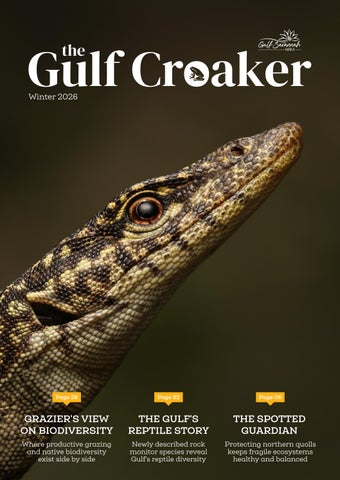
Front cover photo by Edward Evans: Rock Monitor Lizard (Varanus phosphoros) Any questions or queries? Contact our Communications officers: lydia.strohfeldt@gulfsavannahnrm.org eden.manzur@gulfsavannahnrm.org
Contents Photograph from Gulf Savannah NRM Flickr Archive. Chillagoe’s limestone landscape, dotted with dry woodland and termite mounds, is one of the Gulf Savannah’s most distinctive environments.
Page 06 A Tiny Predator Needing Protection: Northern quolls keeps fragile ecosystems healthy, resilient and naturally well balanced overall.
Page 20 Eyes in the Sky: Explore how drone technology is guiding spring conservation.
Page 32 The Gulf's Reptile Story: Rock monitor discoveries reveal reptile diversity across rugged Gulf savannas.
Page 22 Clearing the Way Home: Indigenous rangers reclaim access, culture and connection through weed management at Kondaparinga Station.
Page 36
Page 12 Thug of the Crop: Scientists and growers seek alternatives to spraying Queensland’s troublesome banana-spotting bug in orchards.
Page 16 Learning to Listen: Dr Peta Standley explores cultural burning, Indigenous leadership and healthier landscapes.
Page 4
Little Croakers: Young writers celebrate fishing, wildlife, Country, community and diverse adventures in the Gulf.
Page 28 A Grazier’s Perspective on Biodiversity: Healthy biodiversity supports grazing productivity and creates opportunities for Northern Australian landholders.
Page 39 Climate Update: Gulf producers should plan early for drought, livestock needs and increased fire risk during the upcoming El Niño season.
Winter 2026
The Gulf's Round Up
Aboriginal rock art discovered in Cape York during burn planning A newly documented Aboriginal rock art site has been uncovered in remote Cape York during planned cultural burning. Indigenous rangers discovered engravings while preparing fire management works to protect Country, highlighting how cultural burning is helping reconnect Traditional Owners with remote landscapes, safeguard significant heritage sites and uncover thousands of years of living history still hidden across the peninsula. (ABC News)
New funding backs soy and rice trials in Mossman New crop trials are helping shape a future beyond sugar cane in Far North Queensland. The Queensland Government has committed $300,000 to support soybean and tropical rice projects in Mossman, following promising early trial results. The funding will investigate local soybean processing for livestock feed and expand rice trials, creating new opportunities for growers as the region diversifies its agricultural economy. (ABC News)
Feral Pig Action Plan
Kowanyama Mareeba Karumba
Queensland is developing a new feral pig management action plan to strengthen coordinated control across the state. Feral pigs are estimated to cost Queensland around $95 million each year through agricultural losses and environmental damage. Informed by public consultation and national best practice, the plan aims to support landscape-scale management and guide future investment in protecting regional industries and ecosystems. (National Feral Pig Action Plan)
Flood Recovery Grants Open
Normanton Georgetown
Primary producers across the Gulf are accessing disaster recovery support following widespread flooding. Grants of up to $75,000 and concessional loans are available to help eligible farmers repair damaged infrastructure, replace equipment and return to production, supporting long-term resilience for remote agricultural communities including Croydon. (Croydon Shire Council)
First case of deadly bird flu strain H5N1 on Mid North Coast Australia’s first H5N1 bird flu cases are prompting heightened biosecurity measures as authorities monitor the spread of the virus in wild birds. While detections have been limited to migratory seabirds and there is no evidence of transmission to poultry or agricultural systems, experts warn the disease poses a significant threat to wildlife and could have serious implications for the nation’s biosecurity and food production sectors. (ABC News)
The Gulf Croaker
Page 5
A Tiny Predator Needing Protection Why Australia’s smallest quoll plays an outsized role in keeping northern ecosystems healthy, and why protecting its remaining strongholds matters
Photograph by Brad Leue, Australian Wildlife Conservancy. The northern quoll (Dasyurus hallucatus) has a unique spotted pattern on its back and rump, similar to a fingerprint. This pattern can be used to identify individual quolls, helping ecologists monitor their population status.
The Gulf Croaker
Predators often get a bad rap. Though sometimes cast as storybook villains and documentary antagonists, in the world of ecology, they’re not just high in the food chain, they play a vital role in keeping natural systems balanced.
and the AWC team have set up Mareeba Wetlands as one of their monitoring hotspots since 2024.
Every native species contributes to the rich tapestry of our natural world, but the reality is that some have an outsized influence on how ecosystems function. While there’s a lot of buzz surrounding pollinators and seed dispersers, predators also occupy a very important space in environmental conservation. The northern quoll (Dasyurus hallucatus) is certainly no exception.
“Northern Quolls are part of a host of other predators in North Queensland, including Wedge-tailed Eagles, Dingoes, Scrub Pythons and crocodiles, that together create natural checkpoints and safeguard our ecosystems,” she said.
As one of the largest native, omnivorous predators in Australia, the health of landscapes across the Gulf region may partly rest upon its little spotty shoulders. PREDATOR, PREY AND ECOLOGICAL BALANCE As a field ecologist with Australian Wildlife Conservancy (AWC), keeping tabs on quolls is part of Melissa Christi’s day job. Alongside Gulf Savannah NRM, she
AWC Field Ecologist Melissa Christi clears a camera site for quoll monitoring.
Having studied both their habits and habitat, Ms Christi is no stranger to these “impressive little scavengers.”
“Without their influence, it’s likely we would notice a trophic cascade over time ... especially in a country like Australia where boom and bust events are common.” International studies have documented the phenomenon known as a ‘trophic cascade’. Simply put, it can describe the chain reaction that can occur when predators disappear and prey populations multiply unchecked, placing increased pressure on plants and the wider ecosystem. Picture it as a pyramid: there are many species in high abundance at the bottom, and the rarer apex predators at the top. As you can imagine, there are more flies and frogs in any given habitat than there are crocodiles or dingoes. As a mesopredator, quolls sit at a mid-tier of that pyramid, not quite at the bottom, but also not at the very top, meaning their disappearance would have flow-on effects both up and down the food chain. Though the smallest of all four quoll species (other species are including the spotted-tail, eastern and western quoll), these northern creatures are responsible for maintaining balance in the environment by cleaning up carrion and preying on anything from insects, frogs and birds to other smaller mammals. And Ms Christi recognises humans are just as much a part of the ecosystem as wildlife, meaning we also experience the benefits, or consequences, of how well the environment is able to function. “A healthy ecosystem isn’t just good for our native wildlife, it’s good for us,” she said. “By looking after native predators like northern quolls ... it has a positive knock-on effect down the line, because healthy Country means healthy water, and we all know how important that is!” For a species that plays such an important ecological role, it faces an alarming number of threats and is disappearing across its native range.
Page 8
Winter 2026
Photogrph by Murujuga Aboriginal Corporation. A quoll depicted in the ancient rock engravings of Murujuga, where Aboriginal people have recorded wildlife, culture and environmental change for thousands of years.
A PREDATOR FACING MANY THREATS The northern quoll has been almost entirely lost from the Northeast Top End, Northern Territory, Cape York Peninsula and Einasleigh Uplands, with its habitat range having reduced by about 95 per cent between 1980 and 2010. “These little predators used to have a huge range and were found right across the north half of Australia from Brisbane to the Pilbara, which today has contracted to several patchy populations,” Ms Christi said. Though exact numbers haven’t been documented, the reduction has led the species to officially be listed as endangered under the Environment Protection and Biodiversity Conservation Act. This concerning shift is ultimately what triggered the quoll collaboration on Mareeba Wetlands. Gulf Savannah NRM Biodiveristy Officer Dr Edward Evans notes how this decline fits into an overall downward trend in native species, including those that play critical roles. “Since European colonisation, we’ve lost a huge number of really interesting small to medium sized mammals in Australia for various reasons,” he said.
The Gulf Croaker
“The northern quoll is an iconic native that has significantly declined, predominantly due to cane toads, and continues to be threatened by cat predation and loss of usable habitat.” With the cane toad flagged as a threat for decades, renowned conservation bodies have dedicated themselves to mitigating impact. In 2016, Northern Australia Hub’s long-term study in Kakadu National Park and the Kimberley found each generation of quolls learns to avoid toads, while 50 per cent of surveyed animals were successfully trained to ingest toad-aversion baits. This research shows that ‘toad-smart’ quolls can be reintroduced where infestations are a major issue, offering hope and direction for future control programs. By contrast, habitat loss is a more complicated concern, with compounding influence from weeds, inappropriate fire regimes and human activities, all of which also influence the hunting efficiency of cats. Cited for burning with up to eight times the intensity of native grasses, gamba poses perhaps the biggest challenge of all invasive plant species and is capable of “destroying the habitat where it grows,” she said.
Page 9
The Gulf Croaker
Post-fire conditions leave the landscape stripped bare and can overly expose quolls to their own predators, while land clearing for agriculture, timber, mining and other industries has resulted in environmental fragmentation severe enough to further disrupt survival. Whatever the primary, secondary or tertiary causes of their decline, one thing is certain – the northern quoll needs our help. CONSERVATION EXTENDS TO LANDHOLDERS AND EVERYDAY CITIZENS Though cute, cuddly and iconic, quolls are often perceived as pesky in rural parts of Queensland, with most encounters occurring because they’ve “attacked someone’s chickens or made dens in people’s houses,” Dr Evans said. But the teams at both Australian Wildlife Conservancy and Gulf Savannah NRM are in agreeance: these remarkable marsupials are undeniably “cool”. “Northern quolls are really unique,” Ms Christi said. “They’re a semelparous species, meaning most males die off after breeding season and there’s extra pressure on the young to survive and breed the next year.” Adding to that uniqueness is their distinctive white spots, which are like fingerprints – no two animals share the same pattern. For countless generations, the Kunwinjku and Kundjeyhmi Traditional Owners of Kakadu have told the story of how Njanjma came to bear its spots after arguing with the moon over whether humans should return to life. Angered by the disagreement, people threw burning sticks at Njanjma, leaving the white markings still seen today. As Mareeba remains an “interesting stronghold”, with northern quolls still found in pockets across the region, there’s a rare opportunity to ensure this species remains part of the local landscape. Whether you live on a cattle station or in suburbia, this starts with the choices made in our own backyards. “It can help to not let your cat roam at night as this gives quolls a better chance, particularly around townships, and in general, be mindful of wildlife while driving, especially near known habitats,” Dr Evans said.“Some people might actively remove fallen trees and hollow logs on their property, but it’s really important to leave them as a resource for wildlife.” Alongside these everyday actions, Gulf Savannah NRM and Australian Wildlife Conservancy will
Page 10
Photograph by Melissa Christi. Each northern quoll’s spots are unique, like a fingerprint.
continue monitoring populations while reducing two of the species’ greatest threats through ongoing gamba grass and feral cat control programs. Now a memory in many parts of Australia, the northern quoll is still very much a part of our story here in Far North Queensland. With continued conservation and local stewardship, it can persist as one of the region’s most important native predators, keeping ecological balance while staying its quirky self.
*
This project is funded by the Australian Government Natural Heritage Trust and delivered by Gulf Savannah NRM, a member of the Commonwealth Regional Delivery Partners panel.
Winter 2026
Photograph by Melissa Christi. Northern quolls are excellent climbers and can scale trees to hunt for birds, possums, and gliders. They can have large home ranges and have been known to travel long distances overnight when scavenging for food.
Photographs by Melissa Christi. During live quoll surveys, field teams document age, sex, body condition, mass, spot patterns and overall health. Genetic samples can be an effective way to fill gaps in population estimates - if there is a high level of genetic diversity (i.e. less individuals related to one another), we can assume the population is larger.
FSB Eggs are oval-shaped and approximately 1.7 mm long. They are initially pale green and slightly opalescent, becoming translucent as the nymph develops inside. Eggs are laid singly on flowers, fruit or foliage.
Being able to correctly identify FSB and their developmental stage is essential for obtaining useful and accurate monitoring information. Pictured is a first-instar nymph, the earliest stage of nymph development.
Adults are slender, 11–15 mm long, with fully developed wings. They often gather and breed in recurring orchard hotspots before spreading through the crop.
Nymphs are 2–10 mm long and can be identified by two black spots on the abdomen and the absence of fully developed wings. Across five developmental stages, their markings become more distinct and their wing buds gradually enlarge.
Photograph by Lydia Strohfeldt. Banana Spotting Bug nymph trapped during the Jennings Farm IPM trial. Life Cycle Photographs by Dr. Alana Govender. The lifecycle of the Fruit Spotting Bug.
Thug of the Crop Scientists and growers are looking beyond the spray rig to tackle one of Queensland’s most troublesome orchard pests, the banana-spotting bug.
Despite our considerable difference in scale and size, insects are remarkably good at giving humans the fright of our lives. Whether it’s a cockroach in the drain or a spider in your boot, when things get buggy, we tend to get jumpy.
Spending much of its time concealed amongst dense foliage, the insect can be notoriously difficult to detect, even for experienced growers. By the time symptoms begin appearing on fruit, the destruction has often already been done.
For fruit growers across Far North Queensland, however, some insects are far more than an unpleasant surprise. Hidden amongst orchard canopies, the banana-spotting bug (Amblypelta lutescens lutescens) has been quietly damaging valuable crops for decades, leaving scars beneath the skin of avocado, citrus, mango, passionfruit, custard apple and more.
“They’ll hide from you in the trees and are quite elusive – they see you coming and they’ll duck around the other side of a leaf,” Jeff explained.
Recent industry estimates suggest fruit spotting bugs can cause crop losses of up to 90 per cent in avocados and more than $20 million in annual losses to Australia’s macadamia industry alone through both rejected product and reduced yields. Integrated Pest Management (IPM) consultant Jeff Watson has spent years helping growers understand and manage the elusive pest. While the insect itself is rarely seen, the damage it leaves behind can have serious consequences for fruit quality and farm profitability. So make a dash for your passionfruit and embargo your avocados – let’s meet one of North Queensland’s most notorious orchard pests. AN INVISIBLE OFFENDER Many orchard pests announce their arrival with chewed leaves, visible insects or obvious signs of damage, but the banana-spotting bug takes a different approach.
The Gulf Croaker
“So the first thing that people usually see is the damage rather than the bug. It’s not until the fruit develops a lesion and starts to sink or change colour that you can see there’s damage.” And unlike pests that chew leaves or tunnel directly into fruit, the banana-spotting bug feeds using a needle-like mouthpart known as a proboscis, which injects enzymes into plant tissue and allows access to nutrients beneath the fruit surface. “They use the enzyme to help them feed, and that leaves a big scar inside the fruit under the skin,” Jeff said. “Anyone who’s cut an avocado and found those little stones underneath the skin – that’s fruit spotting bug feeding.” This ability to operate largely unnoticed is one of the reasons the pest remains such a challenge to manage. Growers may not realise there is a problem until fruit begins showing signs of injury weeks after feeding has occurred or, in some cases, until harvest itself. And migration habits only compound the difficulty of managing insect numbers.
Page 13
The Gulf Croaker
In North Queensland, breeding occurs continuously year-round, with females capable of laying more than 150 eggs during their lifetime. On top of numbers constantly replenishing, nymphs and adults are highly skilled at moving into orchards even after spray cycles, making their impact a landscape-scale issue. Even highly effective spray programs struggle to overcome treatment and reinfestation, as insects move in from surrounding vegetation and alternative host plants. “When we spray in the orchard, we control the ones that are in there,” Jeff said. “But any bugs flying in from outside are immigrating into the block. A few weeks later, you’re going to have to spray again, no matter how good a job you did the first time around.” While insecticides remain an important management tool, repeated applications can have unintended consequences. One concern is the impact on beneficial insects that naturally help suppress other pest species.
PROTECTING NATURAL ENEMIES FROM SPRAY CYCLES For advocates of IPM, the challenge is finding ways to control key pests like banana-spotting bug while preserving the beneficial species that help keep orchard ecosystems in balance. When spray cycles remove beneficial insects and render them collateral damage, secondary pests can increase unchecked, resulting in a phenomenon known as pesticide disruption. Jeff explained it in the simplest of terms: “One of the consequences of all the spraying is that we’re probably killing natural enemies for other pests,” he said. These natural enemies – species that help regulate pest populations through predation or parasitism – may be the very insects capable of keeping the banana-spotting bug in check, alongside chemical control. For example, across Far North Queensland, a range of tiny parasitoid wasps are already targeting spotting bug eggs in orchards and surrounding vegetation. Rather than attacking adult insects, these wasps lay their eggs inside those of the banana-spotting bug. The developing wasp larvae consume the contents of the host egg before emerging as adults. It’s a process that sounds more like science fiction than agricultural pest management. “They were inspired by insects, the Alien movies,” Jeff laughs. “Bursting out through the skin of a living creature and stuff, they do that too.” While the comparison is dramatic, it highlights the remarkable efficiency of parasitoid insects. “I’ve had four or even five little wasps come out of a single spotting bug egg,” Jeff said. “That little wasp has to go through its entire larval stage inside that egg – that’s the only resources it has.” Research is currently investigating whether boosting populations of these beneficial insects through strategic releases could help suppress spotting bug populations across the wider landscape.
Photograph by Lydia Strohfeldt. IPM consultant Jeff Watson setting up monitoring traps in a soursop orchard at Jennings Farm during the banana-spotting Bug trial.
Page 14
While Anastatus, a commercially available egg parasitoid, is already attracting much attention, Jeff detected another potential species emerging from egg cards placed in orchards he’s recently assessed. Despite appearing relatively common, the insect has not yet been formally identified, suggesting that the most exciting discoveries could still be waiting in the wings.
Winter 2026
Photograph by Eden Manzur. Damage to a soursop fruit caused by the banana-spotting bug (Amblypelta lutescens), documented during the Jennings Farm trial.
“Sometimes Anastatus would come out, but there was a whole lot of this other species as well,” Jeff said. “It’s hard to find people who are knowledgeable about identifying one-millimetre-long wasps!” The discovery serves as a reminder that orchard ecosystems still hold many secrets, and that some of the most important allies in pest management may be species we don’t yet fully understand. THE FUTURE OF INTEGRATED PEST MANAGEMENT As established, IPM aims to reduce reliance on broad-spectrum insecticides by combining targeted spraying with monitoring, biological control and a better understanding of orchard ecosystems. And so, Jeff believes the future of banana-spotting bug management lies not in eliminating sprays, but using them more strategically.
That philosophy is already shaping new on-ground efforts. At Jennings Farm in Mareeba, Gulf Savannah NRM’s Climate-Smart Agriculture Project established a demonstration site to test pheromone lure technology as a tool for monitoring banana-spotting bug populations. While the lures proved more effective for detection than direct control, the trial contributed valuable insights into how growers might make more informed management decisions in the future. And so, while growers have fought banana-spotting bugs with spray rigs and persistence for decades, the next breakthrough may come not from a new chemical, but from a deeper understanding of these ecosystems themselves. As we speak, somewhere hidden among the leaves and fruit of the crop canopy, tiny parasitoid wasps are already waging their own war against one of Queensland’s most troublesome pests.
“It’s a key pest, so if we could achieve control of that without spraying insecticide every fortnight, it would be a major step forward,” he said.
The challenge now is learning how to help them win.
“It’s about knowing what you’re spraying for and making good choices of products to use and when to use them.”
This Project is supported by the Australian Government through funding from the Natural Heritage Trust under the Climate-Smart Agriculture Program.
The Gulf Croaker
*
Page 15
Photograph by Seth Sedan, Living knowledge Network. Cultural Burning nurtures and replenishes the soil. By burning after rain, the soil stays moist and cool.
Learning to listen Dr Peta Standley explores cultural burning, Indigenous leadership and why healthier landscapes begin by holding space for different knowledge systems
As conversations around fire management evolve, cultural burning is increasingly recognised as an important part of caring for Country. Yet despite growing interest, it remains widely misunderstood. For Dr Peta Standley, the conversation is about much more than fire itself. It’s about Indigenous leadership, genuine collaboration and creating space for different knowledge systems to work together. With a career spanning conservation, tenure resolution, cultural fire and environmental research, Peta has spent decades working alongside Traditional Owners across northern Australia.
until relatively recently, so why try and guess when there are those who can actually show you? Everyone benefits from that.
We spoke with her about what cultural burning really means, and how partnerships can help shape healthier landscapes for the future.
Q. You make an important distinction between integrating and intersecting knowledge. Why does that difference matter?
Q. What does genuine Indigenous leadership look like in environmental management?
A. People often talk about integrating knowledge, but even from an ecological perspective you’re losing diversity. We don’t want to reduce diversity, right? We want to increase and maintain it.
A. How can you understand or learn something that isn’t able to be demonstrated by the people who hold that knowledge? You can learn some things from books, obviously, but now there really is a space for engagement and opportunity, and to continue solving problems together. People often talk about integrating knowledges, whereas I don’t think that’s what is needed. What’s needed is people really coming together with their knowledge sets and demonstrating what solutions they can bring. It’s no secret that, following colonisation, Indigenous People haven’t had that opportunity
The Gulf Croaker
And local knowledge is critically important in that – specialist and technical knowledge all need to come together. What policy makers, NRM bodies and business holders should be doing is getting behind [Indigenous leadership and collaboration], because it can bring a whole wealth of knowledge into light that currently hasn’t had the opportunity to show what it can actually do.
It’s diversity of knowledges, and each sits within its own knowledge domain with its own validity and value. Why do you want to make them intersect? Isn’t it better to collaborate, share that knowledge, and then ask what problem we’re actually trying to solve together? There’s a deep knowledge held in Country that has been practised for millennia. Other knowledge systems have only existed here for a comparatively short time. We need to stop, listen and give it a chance. We
Page 17
The Gulf Croaker
took 200-odd years to destroy [some of these landscapes], and now you’re expecting someone to show you how to fix it in three years. Let’s just look at it realistically, and give these practices a proper chance. Q. Building those partnerships requires trust. What does meaningful collaboration involve? A. People often think all knowledge is freely available because that’s how Western systems operate, but a lot of Indigenous knowledge is place-based, protected and shared [under specific cultural protocols]. We need to keep asking how knowledge should be used, by whom, for what purpose and under whose authority. Like in research, we pass ethics tests; it’s not just a tick and flick, but aconstant dialogue. And when you’re working with such important knowledge, you could actually be having an inadvertently negative effect without even realising it, but by doing stuff you take for granted or don’t understand the complexity of. So there has to be trust built with true, genuine, free, prior and informed consent. There has to be collaboration through Indigenous projects that are led and delivered by Indigenous people, and a space for
co-design where everyone comes together and asks, “what does this look like?” Q. Cultural burning has become a familiar phrase, but many people still aren’t sure what it actually means. How would you describe it? A. I wouldn’t say I’m the expert, I’ve just spent the last 40 minutes talking about why it’s important for Indigenous people to answer that question. But for me, cultural burning is seeing landscapes transformed from what you thought was their normal state. You realise you were only seeing them through the eyes you were taught to see with. When you’re given the honour of being with Indigenous People who are leading these burns and explaining, over time you see changes that occur in the landscape from an ecological perspective – it really is mind-blowing. You see the biodiversity come back, you see less bare ground, changes in species, shifts in invasive plants and animals, and you start to understand what a healthy system actually looks like. I don’t think a lot of scientists or land managers have seen what a healthy system looks like. That’s why it’s so important to stop, listen and let people show you properly.
Photograph by Bella Laifoo, Living knowledge Network. A handful of soil and burnt ground cover following a Cultural Burn.
Q. What are some of the biggest misconceptions surrounding cultural burning?
Q. Why is fire management especially important for our Gulf region?
A. People are only seeing with their own eyes and trying to guess at the answers from their own perspective, but you don’t know what you don’t know. People are often threatened by things they don’t understand, but you have to have confidence in those whose knowledge it is. Give them the opportunity to show you.
A. The Gulf has experienced successive seasons of massive wildfires, followed by flooding, pasture loss and changes to the landscape. If those cycles continue, we’ll see declining productivity, soil degradation and further impacts on biodiversity.
There’s also this fear that cultural burning somehow means people will lose their jobs. But have you looked at how much of this landscape is poorly managed? There’s plenty of work for everybody.
Rather than constantly reacting to disasters, we need to be proactively managing these landscapes together. Early season fire, partnerships between Traditional Owners, landholders, researchers and natural resource managers, and sharing knowledge all have an important role to play.
For example, when people weren’t foresters anymore they became tree planters and agronomists; they took that forestry knowledge and applied it to plantations.
There will never be a one-size-fits-all approach, and cultural fire won’t look the same everywhere. But the partnerships that grow through working together can only benefit our landscapes and our communities.
There’s so much that people can still do in this space with their passions and interests.
The climate’s always been changing. You have to adapt, and farmers know that. So let’s get in, adapt now and work together, because those large parcels of land need to be managed. It will only bring socio-economic strength into the region and give people a chance.
People don’t like change, but as the benefits start to flow, new opportunities emerge. We shouldn’t be afraid of learning something new.
*
Photograph by Bella Laifoo, Living knowledge Network. Smoke drifts across smouldering vegetation during a carefully managed Cultural Burn.
Photograph by Bella Laifoo, Living knowledge Network. Up-close demonstration of traditional plant knowledge.
The Gulf Croaker
Orthophotograph taken by Biodiversity Officer Océane Dupont. Orthophoto created by stitching together hundreds of drone images, providing a detailed aerial view of a Great Artesian Basin spring and approximately 4.5 hectares of surrounding habitat.
Eyes in the Sky How drone technology is guiding spring conservation
In North Queensland’s remotest corners, drone technology is giving conservationists and graziers an unprecedented view of the Great Artesian Basin (GAB) springs, helping guide restoration across some of the region’s most fragile ecosystems. As groundwater-fed wetlands, the GAB springs provide refuge for potentially endemic plants and animals found nowhere else, making them some of Queensland’s most ecologically significant freshwater habitats. Though there are more than 100 active springs scattered across the Northern Gulf region, many have been heavily impacted by historical groundwater extraction and prolonged drought, leaving them vulnerable to invasive plants and feral animals.
Page 20
Biodiversity Officer Océane Dupont says drone imagery is helping the Gulf Savannah NRM team identify which pressures are affecting each ecosystem and measure how the springs adapt to management action over time. “Pigs are one of the main threats to GAB springs as they dig around the edge and destroy vegetation looking for food, degrading the habitat for many invertebrate and plant species,” Ms Dupont said. “Since we’re fencing the springs and controlling feral pig populations, we can use the drone imagery and assessment to monitor change over time and see how the environment around the springs is responding.” Researchers are developing a tool that assesses drone images to automatically measure the percentage of soil impacted from either stock or pigs – a significant advantage when the latter have been disrupting wetlands in North Queensland since the 1800s. During the team’s most recent spring visit, hundreds of aerial photographs were captured before being digitally stitched into a single, high-resolution mosaic map spanning approximately 4.5 hectares. While satellite imagery has traditionally helped researchers analyse broad-scale environments and document human impact, its comparatively coarse resolution can miss the finer details. Drone imagery
Winter 2026
fills that gap, providing a more comprehensive view of the springs and surrounding habitat.
Queensland to southern right whales and pest rabbits in Victoria.
Repeated surveys also create a consistent visual record, allowing researchers to track changes in vegetation and soil disturbance over time while reducing much of the subjectivity that comes with environmental interpretation.
Beyond conservation programs, Dr Bailey believes their increasing accessibility also has enormous potential for landholders, graziers and anyone working with the land. DEMOCRATISING DRONES IN LAND MANAGEMENT
“Everyone looks at the landscape differently, but drones give the capacity to go back and double-check how you’re imagining and interpreting your data,” Monitoring and Evaluation Officer Dr Lachlan Bailey said. “This allows us to calibrate monitoring results between different people.” In conservation, where ecological change often unfolds over years rather than weeks, both reliability and variety of data are invaluable. EXPANDING THE TECHNOLOGICAL TOOLKIT To build a more complete picture of how springs respond to restoration, Gulf Savannah NRM is combining drone surveys with several other emerging technologies. “We’re going to use camera traps and acoustic recorders to understand how fauna is using the source – what kind of birds, frogs and so on are coming and using the spring,” Ms Dupont said. Environmental DNA (eDNA), which analyses the genetic material organisms leave behind in water and soil, will also be used to build an inventory of species present at each site. Together, these technologies allow the researchers to look, listen and observe from multiple perspectives, with the ultimate goal of “protecting 12 hectares of GAB springs in the northern Gulf by improving water quality and vegetation recovery,” Ms Dupont said. “One of the principles in environmental management is that you can’t protect, preserve or enhance something if you don’t know that it’s there. “Drone imagery [alongside other tools] can give you greater capacity to understand what’s present in the landscape ... so having that information is quite powerful.” The growing use of drones reflects a broader shift in conservation science and practice, with studies showing the technology can improve the accuracy and efficiency of wildlife surveys while reducing costs, disturbance to animals and risks to field staff. As a result, biodiversity teams right across the country are deploying drones to monitor everything from the critically endangered Far Eastern curlew in
The Gulf Croaker
Until relatively recently, collecting aerial imagery often required aircraft commissioning or expensive equipment, placing this technology beyond the reach of many. As drones become more affordable, however, they are changing that equation by allowing a variety of stakeholders to collect high-quality data themselves. “Drones are gradually becoming more available to a wider segment of the population, empowering landholders, land managers and anyone working in the environmental space to collect their own data, do their own monitoring, and support their own projects,” Dr Bailey said. “The fact you can survey everything remotely with the drone is a lot safer, especially when there are floods and access constraints.” For graziers across the Gulf, where long wet seasons can leave paddocks isolated for months, drones are increasingly being used to check infrastructure, locate livestock and monitor country while avoiding dangerous floodwaters and crocodile habitat. Industry case studies confirm grazing enterprises are one of the sectors with the greatest opportunity to benefit from drone usage, reducing time spent traversing difficult terrain and lowering risks associated with remote property access. Ultimately, the same qualities that make drones invaluable in conservation are also driving their adoption across multiple industries. Modelling from the Australian Government estimates drones could deliver $2.95 billion savings across agriculture, forestry and fisheries over the coming decades, all while improving workplace safety and increasing productivity. While nature and technology seem unlikely partners, projects like this demonstrate that conserving some of North Queensland’s most fragile ecosystems may begin with seeing them differently – from the skies, and beyond.
*
This project is funded by Queensland Government’s Natural Resource Management Expansion Program.
Page 21
Photograph by Eden Manzur. Rising dramatically above the surrounding landscape, Ngarrabullgan, also known as Mount Mulligan, is a sacred place at the heart of Djungan Country.
Clearing the Way Home How Indigenous rangers are reclaiming access, culture and connection through weed management on Kondaparinga Station
The Gulf Croaker
Clearing the way home: how Indigenous rangers are reclaiming access, culture and connection through weed management As first light fell across the silhouette of Ngarrabullgan (Mount Mulligan), Grandad Desi illuminated the landscape with words that were their own kind of sunrise: full of hope, and a vision of the day ahead. Whatever work we do on Country, he urged us to understand that it’s ultimately about connection, custodianship and honouring past, present and future generations through the way we care for the land. The mountain looked back at us as Kuku Djungan Murtiki Rangers and Gulf Savannah NRM officers stood together atop one of Kondaparinga Station’s highest points. Though stoic, it was a quiet reminder of what we are working to protect.
Natural Resource Management can often focus on methods and monitoring, but in rare moments like this, people and place stand triumphantly side by side, like a partnership bound by both trust and commitment to Country. This was just one moment of many during which the Together for Country Weed Monitoring Program sprung to life during recent field work. Over three days of surveys, strategic planning and spirited yarns, weed control transformed into an intergenerational effort to revive Indigenous land and all the cultural richness that flows from it. MUCH MORE THAN WEED CONTROL From 22 to 24 April, rangers and NRM officers pushed through dense vegetation to understand exactly what the project needs to deliver on Kondaparinga Station. The field trip was designed to survey weed presence within a defined 100-hectare management zone and establish a strong baseline for ongoing monitoring. Though often overlooked, invasive weeds profoundly alter the landscapes they invade. They outcompete native vegetation, transform habitats and reduce biodiversity. Yet during our time alongside the rangers, another consequence repeatedly surfaced – one less frequently discussed, but no less significant. Connection to Country. For Elder and Ranger Coordinator Desmond Grainer, fondly known as Grandad or Desi, invasive weeds are already changing the way Traditional Owners interact with their ancestral lands. “We’ve seen that some places are very hard to get down to places like the rivers,” Desi said. “If weeds make it hard to get to sacred places, then they cut our spirituality and connection with the land. But a weed-free Country means we can access areas more easily, not only waterways, but important things like sacred sites,” he said. As highlighted by Desi, dense infestations can block access to waterways, cultural sites and traditional travel routes. They alter fire behaviour, outcompete native bush tucker species and make areas unsafe for families to visit. For many Traditional Owners, these impacts extend well beyond the environment, affecting the ability to maintain cultural practices and fulfil responsibilities to Country.
Photograph by Eden Manzur. Kuku Djungan Murtiki Rangers scan the bush, putting their weed-spotting skills to work on Country.
Page 24
Waterways offer a powerful example. For First Nations peoples across Australia, rivers, creeks and wetlands have long been places of sustenance, story and spiritual significance.
Winter 2026
Photograph by Eden Manzur. Gulf Savannah NRM Project Officer Ashley King distributes aerial maps to the Kuku Djungan Murtiki Rangers.
The 2007 Echuca Declaration, developed by the Murray Lower Darling Rivers Indigenous Nations, describes water as a living entity rather than simply a resource, while growing research recognises healthy aquatic ecosystems as fundamental to Indigenous social, cultural and spiritual wellbeing. From both a professional and personal standpoint, Desi believes protecting access to these places is inseparable from the responsibility of ensuring future generations can continue caring for them. “For me, and a lot of our elders, we see it as our job to pass on information to these young folk,” he said. “They’re our future, so we have to teach them. If we’re going for a walk and looking for weeds, I’m sharing stories. It all connects.” That connection threads through every aspect of the project. As one of the region’s first Indigenous rangers in the early 1990s, Desi has watched generations grow up. Today, many of the rangers walking beside him are his own grandchildren, including Shaneale Dombi-Grainer. “A highlight of this project is being able to walk around on Country where I haven’t been before, just because
The Gulf Croaker
the number of weeds make no-go zones,” Ms Dombi-Grainer said. “Being with my family and having an elder walk with us ... I don’t really see it as work, it comes naturally.” Ranger Malachi Wason echoed that same sentiment: “I feel proud to be walking where my grandfather was, reconnecting with culture and land,” he said. “I know I’m doing him proud. He’d be with me here today in spirit. It makes me feel over the moon.” Through conversations with the ranger team, one message emerged again and again: a healthy landscape is not simply one that supports biodiversity. It is one that supports stories, ceremonies, family connections and the passing of knowledge between generations. PUTTING KNOWLEDGE INTO ACTION The cultural significance of the project is something Gulf Savannah NRM Project Officer Ashley King witnessed throughout the field trip. “It feels very special to connect with the Rangers – to see them building capacity amongst themselves,
Page 25
Photograph by Eden Manzur. Kuku Djungan Murtiki Rangers and Project Officer Ashley King gather at a Ngarrabullgan lookout at sunrise.
getting out on Country and really learning what defines healthy Country,” Ms King said. “It’s been a beautiful experience to engage and really come together to work towards an impactful project.” That shared understanding sits at the heart of the Together for Country Weed Management Program, which supports Indigenous ranger groups to identify and manage priority weed infestations across those defined 100-hectare management zones. By combining cultural knowledge with modern monitoring tools, the project aims to build a longterm picture of landscape health while guiding future custodianship. “A key focus is integrating Indigenous knowledge with aerial survey data to support future management decisions,” Ms King said. “The effort is also to bring ranger groups together to lead and coordinate weed
Page 26
surveillance and control measures on high-priority species within the region.” During the recent visit to Kondaparinga Station, the team established a baseline understanding of weed presence across the site. More than 15 weed species were identified, with rubber vine recorded as the primary target. The diversity of species recorded reflects a challenge confronting land managers across northern Australia. Australia now hosts more than 2,700 invasive plant species, with around 20 new species establishing each year. Together, they have become one of the country’s greatest threats to biodiversity, transforming habitats, reducing native vegetation and altering natural fire regimes. Those pressures are expected to intensify across Far North Queensland, Cape York and the Gulf of
Winter 2026
Photographs by Eden Manzur and Lydia Strohfeldt . Kuku Djungan Murtiki Rangers and Project Officer Ashley King set out measuring tapes and survey plots for a VegCAT assessment on Country.
Carpentaria, where climate change is projected to expand the distribution of invasive plants. Cyclones, floods and fires create ideal conditions for weeds to spread, while recovery efforts can unintentionally transport seeds and plant fragments on vehicles, machinery and equipment. As regions increasingly experiencing climate extremes, weed management is no longer simply about controlling today’s infestations, but also about anticipating tomorrow’s. Long-term monitoring and early intervention are therefore becoming increasingly important, helping Traditional Owners identify emerging threats before they become more difficult to manage. But while aerial imagery, monitoring sites and weed surveys will guide future management, the project’s greatest success may be less tangible. Desi believes that victory may not be measured by the number of weeds removed.
The Gulf Croaker
“I think the main thing I look forward to is seeing these young rangers [working on Country],” he said. “They’re the future.” As the sun climbed higher above Ngarrabullgan on that final morning, the country below seemed to hold the stories shared over the previous three days: stories of weeds and waterways, ancestors and future generations, connection and shared knowledge. Weed management is often measured in hectares treated, infestations reduced and monitoring points established. At Kondaparinga Station, however, it is equally a story of restoring access to Country and strengthening culture for the next generation to continue walking the same paths as those before them.
*
This project is funded by the Queensland Government’s Natural Resource Management Expansion Program.
Page 27
Photograph by Julie Nicolosi. A kookaburra pauses mid-snack with a snake firmly in its beak.
A Grazier’s Perspective on Biodiversity Across Northern Australia, cattle production and native biodiversity often exist side by side. Julie Nicolosi, GSNRM’s Agriculture Officer, explores how healthy ecosystems can support grazing productivity and create new value for landholders.
There are few places in the world where you can see commercial food production integrated with a natural, almost native ecosystem. Where cattle are living in harmony with the marsupials, birds, reptiles and insects. But in any given location across the extensive beef grazing region of Northern Australia, this unique system exists. On a recent field trip, I had the task of using the Land Condition Assessment Tool (LCAT) at several properties across the Northern Gulf region. After days out in the paddocks, the data we collected certainly caught my eye. With all the media promotion, articles and stories I have consumed on the topic of biodiversity and its global significance, there always seems to be a key point overlooked in the findings. Most biodiversity studies in agriculture, both in Australia and internationally, focus on production systems that were historically cleared of woody vegetation for pasture or crop production, or extensively hunted to remove competition and livestock’s predators. If this is the perspective I have been repeatedly fed, it can only be assumed that other graziers and land managers have experienced similar narratives. And so, I’d like to offer a different perspective... Biodiversity is more than photogenic cuddly or exotic animals. It doesn’t stop at the fence. It can be
The Gulf Croaker
measured in many ways. And it has more value than a checked box for an agenda. In extensive grazing systems across Northern Australia, biodiversity surrounds us every day. We wake up to the call of the birds at the homestead, and your first view out the window is often of wallabies or kangaroos on the lawn. The first job of the day will take you past mobs sharing green pick with birds, or a water trough with a monitor lizard. It is somewhere around lunchtime that you find a shady tree to hide under while you eat, watching the cattle pick out their own lunch selection. What grass will it be today? Perhaps they’ll go for something meatier, like that little native legume between the tussocks? Then it is back to the shed for the late afternoon shift before dinner, sharing after-work drinks with a resident owl, or possum. And when you finally lay down for the night, the outback lullaby floats on the breeze: crickets, cicadas, and cockatoos corralling with the quartet of dingoes on a far-off ridge. There are global studies that capture this interwoven way of life on the land, where grazing and nature co-exist and complement one another. This includes Cristina De Garcia and her team’s 2026 study, which
Page 29
Photographs taken by Agriculture Officer, Julie Nicolosi, while headed out west.
describes how grazing management practices influence biodiversity outcomes. Published in the Journal of Environmental Management, the research concludes that “balancing out grazing intensity is crucial for preserving biodiversity dynamics and ecosystem functionality”.
yourself: “how is this relevant to me?” It’s best to start with building your awareness on the topic to understand how it affects you. Discover which opportunities and benefits are available to you.
Though directed at herd and grazing pressure management in a European system of subalpine regions, it is relevant in describing how important management and documentation is for the conservation of biodiversity.
Queensland’s Department of Primary Industries and the Australian Department of Agriculture, Fisheries and Forestry have documented the benefits of natural landscape stability for agriculture, and the impact biodiversity has on productivity.
The article discusses how the intensified practices and abandonment of lands (overgrazing and no grazing) have impacted the functional balance of the ecosystem following a legacy of long-term grazing land use. The study determines that incorporating extensive grazing practices and allowing pastures to rest during growth phases can help conserve a landscape’s native biodiversity. At this point, you may be asking
Since the early 1960s, Queensland’s agricultural departments have been studying relationships between native pastures, vegetation and wildlife for their influence on landscape productivity and stability. This inadvertently documented the status and value of biodiversity in the extensive grazing systems of our region, well before environmentally conscious produce was demanded by and developed for consumers.
Page 30
PRODUCTIVITY VALUE
Winter 2026
A quick search of grazing environment studies in your preferred search engine will provide you with an endless supply of information about previous studies on topics related to biodiversity, including: vegetation composition, pasture composition and productivity, and indicator species (plants and wildlife). MARKET VALUE Currently, specialised biodiversity marketing is limited for the northern beef producing region as the primary focus of existing accreditation methods is for environmental repair. While this limits the opportunity to participate in credit accruing programs, it does not limit the marketing potential for Northern Queensland producers. With the growing demand for environmentally conscious produce, being able to demonstrate such values may be enough to establish a specialised market advantage within the domestic and select
The Gulf Croaker
global market supply chains. Systems such as the Accounting for Nature framework, AgForce’s AgCarE or CSIRO’s The Natural Capital Handbook, are building agribusinesses’ capacity to demonstrate their position for biodiversity and environmental outcomes. A good starting point for producers interested in finding out more about how the Australian Agricultural Sustainability Framework applies to their industry and how they can demonstrate their environmental stewardship is the Gulf Savannah NRM Environmental Stewardship Guide. You can pick up your copy at any of our offices or ask one of our staff for a copy. Today is a good day to make an account of the environment around you, and the value it provides to your business. Be aware of how it benefits you, both as a productivity benefit and value add. When we recognise biodiversity as an asset, everyone – from graziers to wildlife – stands to benefit.
*
Page 31
Photograph by Edward Evnas. Yellow-headed rock monitor (Varanus phosphoros).
Rock Monitors Reveal the Gulf’s Reptile Story Three newly described rock monitor species reveal the extraordinary reptile diversity still hidden across the Gulf’s rugged savanna
The Gulf’s rugged ranges have revealed another remarkable secret, with scientists formally describing three previously unknown species of rock monitor after years of fieldwork and genetic research. The newly described lizards – the orange-headed rock monitor (Varanus umbra), the rainbow rock monitor (Varanus iridis) and yellow-headed rock monitor (Varanus phosphoros) – were found across rocky landscapes in North Queensland, challenging longheld assumptions about the region’s reptile diversity. The research was led by Dr Stephen Zozaya, a postdoctoral herpetologist at the Australian National University (ANU) whose work focuses on the evolution and diversification of Australian reptiles, alongside PhD candidate Wesley Read, whose research explores evolutionary patterns using Australian geckos. The discovery itself began almost by accident in 2021, when two of the other authors and Mr Read were searching for other reptiles. After stumbling across the first two species “completely by luck,” he and his team returned a year later with eyes peeled specifically for goannas. To their surprise, they not only located both undescribed species again, but were able to add a third to the mix. “When Wes came in with the photos of what became the orange-headed rock monitor, I was just like: what the hell is that?” Dr Zozaya said.
The Gulf Croaker
“Enthusiasts in North Queensland had known about these things for a while, but no one ever really knew whether they were a different species or not.” While local naturalists and Traditional Owners have recognised these distinctive goannas for years, scientists had assumed they were simply regional forms of the widespread freckled monitor. It wasn’t until the ANU research team combined detailed genomic analysis with comparisons and examinations of museum specimens that scientists confirmed they represented three entirely separate species. “We were just blown away when we got the first lot of sequencing back. They were very divergent...obviously a different species,” Dr Zozaya said. Published in the Zoological Journal of the Linnean Society, the study reveals the three species belong to a previously unrecognised evolutionary lineage that diverged from its closest relatives around seven million years ago. The findings also represent the first formal description of rock-adapted monitor lizards from North Queensland’s savanna country, highlighting just how much remains to be discovered across the region. “Over the last few decades, [people] have often fixated on places like the Kimberley or Arnhem Land as
Page 33
Photograph by Edward Evans. Rainbow rock monitor (Varanus iridis)
these incredible, super diverse areas,” Dr Zozaya said. “When you get to Northeast Queensland, everyone just remembers the rainforest ... but we’re starting to form a picture of the reptile diversity of the eastern savannas.”
more diversity out there that we haven’t recognised, so ongoing investigation is always a good thing.” “I would say that goannas haven’t so much as opened the floodgate [into the region’s reptile research], as that they’re part of the flood itself,” Dr Zozaya added.
The findings add to a growing list of newly described reptiles from the Gulf’s rocky landscapes, including several geckos and skinks identified over recent years, suggesting there are likely more species yet to be formally recognised.
Despite the hype, the researchers are also mindful that increased attention can bring new challenges, such as susceptibility to the illegal wildlife trade.
And for Mr Read, that’s a reflection of a broader reality: science is still catching up with biodiversity that has existed all along.
While the commercial export of Australian reptiles and amphibians is a criminal offense, a 2022 study found 170 endemic species had been traded as pets overseas, while Australian Border Force intercepted 4,000 illegal shipments last year alone.
“Western science always lags behind,” he said. “Taxonomy is a slow process as well, and there’s definitely
Page 34
Though rock monitors are particularly sought after,
Winter 2026
Photograph by Edward Evans. Orange-headed rock monitor (Varanus umbra)
Photograph by Edward Evans. Yellow-headed rock monitor (Varanus phosphoros)
and publicity can place additional pressure on accessible populations, Dr Zozaya believes transparency is ultimately more valuable than attempting to conceal their locations out of fear for trafficking. “I think there’s more to be gained from informing landholders and actually keeping an eye on the known spots, than there is trying to keep them quiet from everyone for a long period of time,” he said. “They’re tough animals that live in a rugged landscape. The remoteness of where they live will basically do most of the hard work in keeping them protected.” And for all the excitement surrounding the discoveries, their location might be the biggest surprise of all. Though the remoteness of their habitat may be enough to safeguard against traffickers, it’s remarkably close
The Gulf Croaker
to home for those dedicated to their conservation. “These three new species are all within a few hours of the two biggest cities in Northern Australia,” Dr Zozaya said. “This isn’t some remote corner of the Amazon, or the foothills of the Himalayas. You can just find brand new things within a few hours’ drive and be back home at the end of the day.” With Australia already recognised as home to the world’s greatest diversity of reptile species, discoveries like these are a reminder that many of the country’s landscapes may still have new stories to tell. The next remarkable find may be closer than anyone expects.
*
Page 35
The Gulf Croaker
Little Croakers Through poems about fishing, wildlife, Country and community, young writers from Normanton State School celebrate the adventures of growing up in the Gulf.
Living in the Gulf
Be careful in the water – crocs!!
The sun comes up across the land,
In the water they’re lurking
And birds sing songs loud and proud.
Great barra fishing but beware
The Norman River flows along,
Creeks are owned by big crocs
And starts the day with Mother nature’s song.
Rivers are dangerous and beautiful
The sky is big and bright and blue,
Old cranky crocodiles live alone
The sunset shines with golden light,
Crocs fight each other for territory
The moon shines and look so bright,
Scared tourists take photos of Krys the Croc
The stars twinkle in the night.
Charlie Young, year 4
We fish for barra after school, And like to swim in the town pool.
Out here watch out for wildlife
We know the river, trees and ground,
Up in the Gulf we have excellent fishing
And watch out for crocs that swim around.
The crocs are very vicious to humans
The best thing is our friendly town,
Be ready you’re going to have tasty fish
People help when you are down.
Always be aware of snakes with while walking
Everyone knows who you are,
Camping is very fun and good for buggying
Whether you live near or far.
Kangaroos grow very tall when they’re adults
We learn from Elders every day,
Tino Tu’itahi, year 4
Who share their stories in a special way. They teach us about Country too,
Never cold or boring,
And help us learn what’s old and new.
Our fishing is excellent.
The wet and floods come every year.
Run around town for exercise.
Roads can close and trips take so long,
Muddy in wet season,
Even with challenges big and small,
And the river rises.
We love our Gulf home most of all.
Never swim in the river, crocodiles!
Normanton is a special place to be,
The shops sell ice cream to cool down.
A wonderful town f or you and me.
Old Krys the Croc got shot long ago, but,
Amarlee Rainbow, year 6
Now is nice for photos with tourists. Year 4 class, Normanton State School
Page 36
Spring Winter2026 2026
Colour In!
There are four river catchments in our region: the Gilbert, Staaten, Norman and Mitchell catchments. There are lots of other rivers within these catchments! Can you help us colour in what they might look like?
The Gulf Croaker
Page 37
The Gulf Croaker
Council Updates
Workshop, delivered in partnership with the Department of Primary Industries DPI. This hands-on session will cover fire management practices, protecting assets and property planning and preparedness. Assistance has been provided by the Australian and Queensland governments through the jointly funded Disaster Recovery Funding Arrangements. CROYDON SHIRE COUNCIL
From disaster preparedness in Mareeba to heritage celebrations in Croydon, councils are bringing communities together.
MAREEBA SHIRE COUNCIL This year, Mareeba Shire Council has undertaken the Mareeba Shire Community Resilience Network initiative, working closely with local communities to develop preparedness plans, identify ways to empower residents and deliver community engagement activities and workshops. Mareeba Shire is home to approximately 24,000 residents spread across a large geographic area. During disaster events, our communities can become isolated, as was seen during Cyclone Jasper in December 2023. Flooding, strong winds and communication disruptions meant it took days for services to reach some locations. One of the highlights of the initiative has been the Community Guardians Program, which invites residents to become part of the Community Resilience Network. Volunteers receive training and play an important role in strengthening communication between Council and their local communities. They can assist with evacuation activations, engage residents through community meetings, help share resources and information, and act as key local points of contact during emergency situations.
The 2026 Croydon Heritage Festival wrapped up after a fantastic week of events celebrating our community, history, and culture. Locals and visitors came together to enjoy a diverse and engaging program. Festivities began on Saturday, 19 June, with the Grand Opening Dinner, featuring entertainment by Becci Nethery and a hearty meal sponsored by Jubilee Metal, an enjoyable start to the week. The Family Fun Day was a highlight, beginning with a community breakfast sponsored by Erscon Consulting Engineers. The day featured 1890s games, face painting, and vintage car rides. Sunday evening’s screening of Dad and Dave was also well attended. Monday’s Chinese Culture Day offered hands-on crafts, tea tasting, and cultural experiences for school children and the wider community. Tuesday’s Gold Rush Story Day delighted Croydon Primary students with a gold nugget hunt and historical activities, alongside a heritage walk, sand treasure hunt, and evening cemetery tour. On Wednesday, Croydon Story Day included a Biggest Morning Tea raising over $100 for the Cancer Council, free Gulflander rides, and a memorable sunset yarning circle at Golden Gate with Les Pickering. Thursday’s Tagalaka Day featured an informative yarning circle, bingo, and a movie screening of Bran Nue Day. The festival concluded Friday night with a closing dinner sponsored by Northland Consulting Engineers, a delicious spit roast, and lively entertainment from the Branded Men. Prize winners were announced, and a time capsule was presented to be buried for future generations. Overall, the festival was a great success.
*
Dozens of free workshops have been delivered across the Shire, covering topics such as chainsaw accreditation, mental health first aid, and first aid and CPR training. Another highlight is the Landholder Fire
Page 38
Winter 2026
Climate Update
June July August
With El Niño underway, Gulf producers are encouraged to plan early for drier conditions, livestock needs and fire risk.
GSNRM CLIMATE UPDATE The Bureau of Meteorology (BoM) and the US National Oceanic and Atmospheric Administration (NOAA) have confirmed that an El Niño climate pattern has begun. El Niño is part of the natural ENSO climate cycle, which influences weather patterns across the Pacific and can affect rainfall, temperature and seasonal conditions in Australia.
RAINFALL – CHANCE OF ABOVE MEDIAN FOR JULY TO SEPTEMBER 2026 For more information, refer to the Bureau of Meteorology’s Southern Hemisphere Monitoring page for Pacific updates, or NOAA’s El Niño updates for a United States perspective. For information on Queensland weather and climate on a monthly and seasonal basis visit the Bureau’s Climate summaries archive. THE NORTHERN RAINFALL ONSET The first Northern Rainfall Onset (NRO) forecast for the season is also now available. The NRO is the date when enough rain has fallen to re-stimulate plant growth after the dry season, defined as accumulated rainfall after 1 September reaching at least 50 mm. The forecast provides an early indication of whether the onset is more likely to occur earlier or later than average.
Current conditions show warmer than usual sea surface temperatures in the central and eastern Pacific, along with atmospheric signals typical of El Niño, including a strongly negative Southern Oscillation Index. Impacts of El Niño events vary from one event to another. While not every El Niño results in severe drought, for parts of eastern Australia El Niño can increase the chance of drier conditions through autumn, winter and spring, a later start to summer rainfall, more frost, heatwaves and bushfire risk, and a higher risk of drought if the event is prolonged. WHAT THIS MEANS FOR LIVESTOCK PRODUCTION With an increased risk of warmer and drier conditions through winter and spring, now is a useful time to review stocking rates, pasture position, feed budgets, water availability and trigger points for decision-making. It is also worth keeping fire risk in mind as we head towards spring and summer.
The Gulf Croaker
For more information and seasonal climate resources, visit the https://nacp.org.au Keeping an eye on these climate signals can help support early planning and timely decisions as conditions develop over the coming months.
*
Mandy Pickering, Climate Mate, Gulf Savannah NRM
Page 39
Photograph by Max Marshall. Gulf Savannah NRM field officers gear up to show invasive neem trees who’s boss.
Photograph by Eden Manzur. A hands-on demonstration of Varroa mite testing during workshops held in June.
Photograph by QLD Gov. “Aerial pig control is often advantageous over ground-based control as you can cover a much larger area and access remote places you are unable to reach on the ground”, Dr Evans said.
Project Updates From protecting pollinators and restoring waterways to managing feral pigs, projects across the Gulf are delivering practical solutions for stronger landscapes and communities.
BEE VIGILANT: WORLD CLASS BEEKEEPERS PREPARE LOCALS FOR VARROA As Varroa mite continues to sweep the globe and threaten beekeeping businesses everywhere, Gulf Savannah NRM is preparing locals with support of renowned industry experts. Southern Cross University’s Dr Cooper Schouten and Dr Isabella Lippi visited the Gulf in June to deliver two workshops, sharing the latest research and practical management strategies drawn from years of international experience monitoring and responding to Varroa outbreaks. “What you are about to experience is quite unique on this earth, but you have time,” Dr Schouten said. “Beekeepers down south would be begging for that.” The workshops covered surveillance techniques, treatment options and long-term management, recognising that preparedness, not eradication, is now the most effective approach. Agriculture Officer Karen Dugmore said bringing internationally recognised experts to the region gave local growers
Page 41
The Gulf Croaker
and beekeepers access to real-world knowledge from areas already living with the pest. “They were able to answer questions and share lessons learned from countries where Varroa is already established, helping attendees prepare before the pest reaches the region,” she said. Participants also visited Levison Creek Farm near Mareeba, where they identified native pollinators and explored suitable hive placement in a working lychee orchard.
“If we can protect and work around those native plant species, they’ve got a much better chance of recruiting naturally and restoring parts of the ecosystem themselves,” Mr Marshall said. Already, crews have cut up to three kilometres of access track by hand, allowing vehicles to reach treatment sites and making future monitoring and maintenance more efficient.Neem has become a significant issue across the Gulf, where dense infestations outcompete native vegetation, reduce biodiversity and create ongoing challenges for landholders.
Ms Dugmore said the response from attendees was overwhelmingly positive, with one local beekeeper describing the workshops as the most practical and valuable they had attended since Varroa was first detected in Australia. Gulf Savannah NRM will continue supporting the region over the coming year through additional workshops and a publicly available training package. This project is funded by the Community Bee Innovation Fund.
NEEM TEAM LAYS GROUNDWORK FOR LONGTERM RIPARIAN RECOVERY Gulf Savannah NRM’s field team has completed two successful trips to the Gilbert River near Georgetown, laying the foundation for a long-term project to tackle invasive neem trees and restore riparian ecosystems. Field Team Supervisor Max Marshall said the early fieldwork focused on surveying the landscape, identifying access points and mapping native vegetation to develop an effective management strategy. “We’ve spent a lot of time in the field looking at what’s actually going to work on the ground, not just for the environment, but for the landholders managing these areas every day,” Mr Marshall said. The team has adopted a three-part approach that prioritises treating neem around surviving native vegetation, creating buffer zones along agricultural land, and improving access into remote riparian areas.
Page 42
Field Supervisor Max Marshall in action, clearing a path to tackle invasive neem trees.
Winter 2026
Sources and further reading: 1.
Gulf Savannah NRM CEO Zoe Williams said the project marks an important step towards restoring sensitive waterways while supporting local producers. “We are pleased to now have the necessary funding to work with local communities to tackle this issue and restore native vegetation in sensitive riparian areas,” Ms Williams said.
2. 3. 4. 5. 6. 7. 8. 9.
This project is funded by the Queensland Government’s Natural Resource Management Expansion Program.
10. 11.
AERIAL SHOOTING DELIVERS MAJOR WIN AGAINST FERAL PIGS
12. 13. 14. 15.
More than 400 feral pigs have been removed from Brooklyn Wildlife Sanctuary over two years through a successful aerial control program delivered by Gulf Savannah NRM in partnership with the Australian Wildlife Conservancy. The results reinforce growing evidence that aerial shooting can be significantly more effective than traditional ground-based methods for managing one of Australia’s most damaging invasive species. GSNRM Biodiversity Officer Dr Edward Evans said aerial control allows crews to cover expansive, remote areas that would otherwise be difficult to access. “Aerial pig control is often advantageous over groundbased control as you can cover a much larger area and access remote places you are unable to reach on the ground,” Dr Evans said. “While the costs of running a helicopter are relatively high, the time investment saved compared to baiting and trapping is huge and often outweighs the financial costs.”
16. 17. 18. 19. 20. 21. 22. 23. 24. 25. 26. 27. 28. 29. 30. 31. 32. 33. 34. 35. 36. 37.
The program removed a record number of pigs while dramatically reducing the labour required compared with previous ground-based operations. Improved access also means control can be carried out year-round. The environmental benefits are already becoming evident, with large lagoons at Brooklyn Wildlife Sanctuary showing clearer water and increased native waterlily coverage following the control program.
38. 39.
40. 41. 42. 43.
Australian Government Department of Climate Change, Energy, the Environment and Water. Species Profile and Threats Database – Northern Quoll. https://environment.gov.au/cgi-bin/sprat/public/ publicspecies.pl?taxon_id=331 Australian Wildlife Conservancy. Australian Wildlife Conservancy. https://www.australianwildlife.org/ Terborgh, J., et al. Ecological Meltdown in Predator-Free Forest Fragments. Science. https://doi. org/10.1126/science.1064397 Encyclopaedia Britannica. Trophic Cascade. https://www.britannica.com/science/trophic-cascade Biology Insights. What Is a Mesopredator and Its Pivotal Ecosystem Role? https://biologyinsights.com/ what-is-a-mesopredator-and-its-pivotal-ecosystem-role/ Australian Government Department of Climate Change, Energy, the Environment and Water. Northern Quoll Action Plan. https://www.dcceew.gov.au/environment/biodiversity/threatened/action-plan/ northern-quoll Australian Government Department of Climate Change, Energy, the Environment and Water. Environment Protection and Biodiversity Conservation Act 1999. https://www.dcceew.gov.au/ environment/epbc Australian Government Department of Climate Change, Energy, the Environment and Water. Northern Australia Environmental Resources Hub. https://www.dcceew.gov.au/environment/ environment-information-australia/nesp/hub-northern-australia-environmental-resources National Environmental Science Program. Can We Mitigate Cane Toad Impacts on Northern Quolls? Final Report. https://nesplandscapes.edu.au/wp-content/uploads/2015/10/4.1.35_can_we_mitigate_cane_ toad_impacts_on_northern_quolls_-_final_report.pdf Queensland Department of Primary Industries. Gamba Grass Risk Assessment. https://www.dpi.qld.gov. au/__data/assets/pdf_file/0017/58004/IPA-Gamba-Grass-Risk-Assessment.pdf Cowan, M. A., Nyamal Rangers, Dunlop, J. A., Moore, H. A., & Nimmo, D. G. Movement Patterns of Two Northern Quolls After a Large Wildfire. Austral Ecology. https://doi.org/10.1111/aec.13569 Bush Heritage Australia. Quolls. https://www.bushheritage.org.au/species/quolls Kakadu National Park. Northern Quoll. https://kakadu.gov.au/discover/nature/animals/northern-quoll/ Gulf Savannah NRM. Funding to Safeguard Threatened Species in Mareeba Shire. https:// gulfsavannahnrm.org/funding-to-safeguard-threatened-species-in-mareeba-shire/ Hort Innovation. Leading a Coordinated Fight Against Fruit Spotting Bugs. https:// www.horticulture.com.au/hort-innovation/news-events/media-releases/2026/ leading-a-coordinated-fight-against-fruit-spotting-bugs/ Queensland Government. Banana Spotting Bug. https://www.business.qld.gov.au/industries/ farms-fishing-forestry/agriculture/biosecurity/plants/insects/horticultural/banana-spotting-bug Sustainability Directory. Pesticide Ecosystem Disruption. https://pollution.sustainability-directory.com/ area/pesticide-ecosystem-disruption/ Science Insights. How Natural Enemies Maintain Ecosystem Balance. https://scienceinsights.org/ how-natural-enemies-maintain-ecosystem-balance/ BioResources Australia. Anastatus Wasps. https://bioresources.com.au/good-bugs/anastatus-wasps/ Bush Heritage Australia. Edgbaston Reserve. https://www.bushheritage.org.au/places/edgbaston Queensland Government Department of the Environment, Tourism, Science and Innovation. Feral Pigs. https://wetlandinfo.detsi.qld.gov.au/wetlands/management/pressures/feral-pigs/ CSIRO. eDNA explained: unlocking nature's hidden biodiversity. https://www.csiro.au/en/news/All/ Articles/2023/December/What-is-eDNA ABC News. Queensland researchers use drones and AI to capture bird data critical to conservation efforts. https://www.abc.net.au/news/2026-06-22/ drones-and-ai-help-bring-birds-back-from-brink/106749592 Victoria State Government Arthur Rylah Institute. Drone use in biodiversity monitoring and research. https://www.ari.vic.gov.au/research/technology-and-skills/monitoring-techniques/drones Drought and climate adaptation program. Using a drone on-farm – a grazier’s experience. https:// futurebeef.com.au/wp-content/uploads/2022/04/Drone-case-study-ConnectAg.pdf Australian Government Department of Infrastructure, Transport, Regional Development, Communications, Sport and the Arts. Drone Data and Research. https://www.drones.gov.au/ policies-and-initiatives/data-and-research Bush Heritage Australia. Weed Control. https://www.bushheritage.org.au/what-we-do/our-challenge/ weed-control Murray–Darling Basin Indigenous Nations. Cultural Flows. https://mldrin.org/what-we-do/cultural-flows/ Australian Government Department of Climate Change, Energy, the Environment and Water. Australia State of the Environment 2021. https://soe.dcceew.gov.au/inland-water/environment/indigenous-water Invasive Species Council. Our Work: Weeds. https://invasives.org.au/our-work/weeds/ Osunkoya, O. O., Ahmadi, M., Perrett, C., Calvert, M., Shi, B., Csurhes, S., & Shabani, F. Climate-Induced Range Shift and Risk Assessment of Emerging Weeds in Queensland, Australia. Ecology and Evolution. https://doi.org/10.1002/ece3.71043 Queensland Government. Weeds After Floods. https://www.business.qld.gov.au/industries/ farms-fishing-forestry/agriculture/disaster/flood/recovery/weeds De Gracia, C., Oro, D., Ubach, A., Guardiola, M., Sanosa-Cols, P., & Stefanescu, C. Grazing Legacy Shapes Biodiversity: Impacts on Plant and Butterfly Communities Across Successional Stages in Subalpine Ecosystems. Journal of Environmental Management. https://doi.org/10.1016/j.jenvman.2026.129434 Accounting for Nature. Measure the State of Nature Framework. www.accountingfornature.org/ framework AgCarE. AgCarE Online. www.agcare.org.au/ CSIRO. The Natural Capital Handbook. www.csiro.au/en/research/natural-environment/natural-resources/ Natural-capital-accounting/Handbook Australian National University. Three New Rock Monitor Lizard Species Discovered in Northern Queensland. https://www.anu.edu.au/news/all-news/ three-new-rock-monitor-lizard-species-discovered-in-northern-queensland Central Queensland Coast Landcare Network. Freckled Monitor. https://cqclandcarenetwork.org.au/ wildlife/freckled-monitor/ Zozaya, S. M., Read, W. J., Macor, S. A., Pavón-Vázquez, C. J., Gale, N. P., Wright, J. M., & Broady, E. S. Three New Species Reveal an Unrecognized Clade of Rock Monitors ( Varanidae: Varanus) from the Eastern Australian Savannas. Zoological Journal of the Linnean Society. https://doi.org/10.1093/ zoolinnean/zlaf192 Miami Herald. Speedy creature evading capture in rocky area turns out to be new species in Australia. https://www.miamiherald.com/news/nation-world/world/article290111384.html Chekunov, S., Stringham, O., Toomes, A., Prowse, T., & Cassey, P. Scale of Unregulated International Trade in Australian Reptiles and Amphibians. Conservation Biology. https://doi.org/10.1111/cobi.14355 SBS News. Worth up to $100k and hidden in chocolate boxes: Inside Australia's illegal animal trade. https://www.sbs.com.au/news/article/wildlife-black-market-in-australia/r4p7qz2m7 Australian Conservation Foundation. Australia Is a Megadiverse Country. https://www.acf.org.au/news/ australia-is-a-megadiverse-country
k
a Th n
*
This project is funded by the Australian Government Natural Heritage Trust and the Saving Native Species program delivered by Gulf Savannah NRM, a member of the Commonwealth Regional Delivery Partners panel.
The Gulf Croaker
you!
Feral pigs threaten more than 100 native species nationally and cause widespread damage to wetlands, waterways and sensitive habitats.
Photograph by Edward Evnas. Yellow-headed rock monitor (Varanus phosphoros), one of three rock monitor species newly described by scientists from North Queensland’s rocky savannas.
This project received grant funding from the Australian Government.