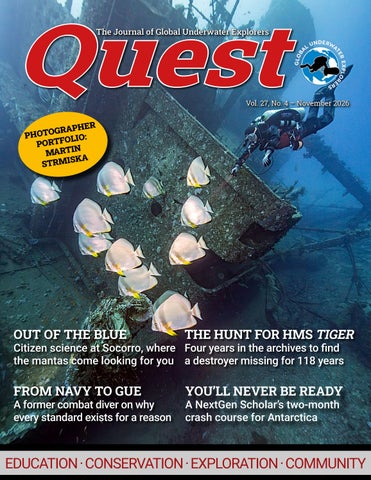
Quest The Journal of Global Underwater Explorers
Vol. 27, No. 4 – November 2026
ER GRAPH O T O H P OLIO: PORTF N MARTI SKA STRMI
OUT OF THE BLUE
THE HUNT FOR HMS TIGER
FROM NAVY TO GUE
YOU’LL NEVER BE READY
Citizen science at Socorro, where Four years in the archives to find the mantas come looking for you a destroyer missing for 118 years
A former combat diver on why every standard exists for a reason
A NextGen Scholar’s two-month crash course for Antarctica
EDUCATION · CONSERVATION · EXPLORATION · COMMUNITY
GET THE MOST OUT OF YOUR DIVING
$24.95 €19.95
NEW EDITION AVAILABLE NOW!
Order today at www.GUE.com
Available in English, German, Italian, Spanish, Chinese, and Korean.
EDITOR’S LETTER LEAVE THE PHONE ON THE BOAT
E
very year I spend three to four weeks in the Red Sea. Some of my favorite dives are on the Brothers Islands and Daedalus Reef, far offshore and out of reach of internet and phone signal. For two or three days at a time, there are no messages, no notifications, and no news. Just reef, blue water, and the next dive. On the first morning, some guests still reach for their phones out of habit. By the second, they have given up. And when the boat heads back toward shore a few days later, they all crowd onto the bow, phones held high, waiting for the first bar of signal. Underwater, every dive gives us a small version of those days. Nothing pings. The only things asking for our attention are the ones that matter: depth, gas, our buddy, and the next breath. We cannot dive well and think about the inbox at the same time. Our breathing slows, the world shrinks to the reach of our lights, and for once we are exactly where we are. I am not sure how long that will last. Some dive computers can already exchange short messages with a buddy using sonar, and a buoy on the surface can relay messages from the boat to the divers below. For now, it is a handful of preset safety messages. It does not take much imagination to see the next step. One day, the inbox will follow us down to 30 m/100 ft. Change is coming faster than at any time I can remember. AI now writes, draws, translates, and answers before we have finished asking, and every new device
promises to keep us a little more connected. On land, most of that is progress. Underwater, I am not convinced. A diver reading a message at depth is a diver who is not watching depth, gas, or buddy. And a reef seen between two notifications is barely seen at all. Cinemas still ask us to switch off our phones before the film starts. Nobody ever had to ask divers, because the water did it for us. When the technology arrives, and it will, we will have to make that choice ourselves. So here is my suggestion: Leave the phone on the boat. And when your dive computer one day offers to bring your messages along, say no thank you. They will still be there when you surface.
Jesper Kjøller Editor-in-Chief jk@gue.com
November 2026 · Quest
3
Quest IN THIS ISSUE The Journal of Global Underwater Explorers
Vol. 27, No. 4 · November 2026
Editor-in-chief // Jesper Kjøller Design and layout // Jesper Kjøller Copy editing // Kady Smith Writers // Jenn Thomson // Leo Fielding // Dan McMullen // Dave Price // Ian Anderson // Jialing Cai // Jesper Kjøller Photographers // Jenn Thomson // SJ Alice Bennett // Bori Bennett // Dan McMullen // Dr. Steffen G. Scholz // Maya Luisa Yglesias // Simon Hilbourne // Jasmine Corbett // Kaitlyn Zerr // Dave Price // Martin Strmiska // Ian Anderson // Nick Francis // Jon Kieren // Andre Rabideau // Jialing Cai // Tim Ho // JOJO // Yanbin Wu // Rose Dalrymple // Lily Zhang // Jesper Kjøller Quest is published quarterly by Global Underwater Explorers 18487 High Springs Main Street, High Springs, Florida 32643 www.GUE.com
4
Quest · November 2026
6 HQ CORNER // SHOWING UP MATTERS
Conferences, Leading Edge, a week of Young Divers Program dives in Sardinia, and a room full of questions in Shanghai. GUE’s in-person events ask for travel, time, and a little courage. In return, they build the kind of trust that is hard to create on a call.
16 THE DISCOVERY OF HMS TIGER
Sunk in a night collision with the cruiser HMS Berwick on 2 April 1908, the destroyer Tiger remained missing for 118 years. After almost four years of archival research, survey, and technical diving, ProjectXplore found both sections at 62 m/203 ft, south of the Isle of Wight.
30 OUT OF THE BLUE // DIVING SOCORRO
At Roca Partida, the smallest of four volcanic peaks in the Eastern Pacific, two oceanic mantas swim straight at the divers and stay to play. During a week with the Manta Trust, Dave Price and his buddy get to name two animals nobody had recorded before.
42 PORTFOLIO // MARTIN STRMISKA
A full-time underwater photographer since 2005, Martin follows the camera into caves, flooded mines, and deep wrecks, where the only light is the light he brings. His images are about space, scale, darkness, and the feeling of being there.
50 GO FOR MISSION // FROM NAVY TO GUE
Ian Anderson left the US Navy in 2023, sure his time underwater was over. Then he found GUE, a civilian system built on the logic he trained under as a combat diver: every standard exists for a reason, and every diver needs to understand why.
60 NEXTGEN // YOU’LL NEVER BE READY
With two months to prepare for Antarctica, 2026 GUE NextGen Scholar Jialing Cai crams in courses, two weeks at a high-altitude lake, and about 50 drysuit dives. Then she floods her suit on the check dive and brings home a single photograph of a sea butterfly.
16
6
42 30
60 COVER PHOTO JESPER KJØLLER
50 November 2026 · Quest
5
HQ CORNER
WHY SHOWI M
– The benefits of in-person events
6
Quest · November 2026
ING UP MATTERS
TEXT JENN THOMSON PHOTOS JENN THOMSON, SJ ALICE BENNETT, BORI BENNETT & UDC
PHOTO JENN THOMSON
November 2026 · Quest
7
GUE Vice President Dorota Czerny on stage at the 2025 GUE Conference. The talks start the conversations. The tables and hallways carry them on.
In-person events ask more of us than logging into a call. They require travel, time, planning, and often a little courage. Yet they return something that is difficult to create remotely: trust built through shared experience. A talk may deliver information, but the conversation afterward can turn that information into a dive, a project, mentorship, or a new direction. In this iteration of HQ Corner, we shine a spotlight on the impact of GUE’s in-person events in 2026.
8
Quest · November 2026
PHOTO SJ ALICE BENNETT
S
howing up matters—especially in GUE. Our community connects education, exploration, and conservation, and those parts become stronger when people meet, exchange ideas, and see how others put shared standards into practice. GUE describes its communities as the link that binds those areas into a global network. In person, that network stops feeling abstract. It becomes a room full of people who can answer a question, offer support, challenge an assumption, or invite someone to take part. The value of attending the GUE Conference is difficult to locate in any single lecture, presentation, or scheduled activity. Those moments matter, but they are only part of the experience. Much of the real value emerges in the conversations that happen between sessions, over dinner, or in the hallway, often long after a presentation has formally ended. Being together creates opportunities for discussions that cannot be planned in advance. A question raised during a lecture continues afterward, drawing in different experiences and perspectives. An informal introduction develops into a technical discussion, a new project, or a lasting professional relationship.
This is especially important during instructor meetings, where meaningful progress often depends on direct back-and-forth discussion, or during community-building workshops, where trust, participation, and shared understanding develop through active dialogue. Online communication is useful, but it is usually deliberate and transactional. We log in for a defined purpose and leave when that purpose has been completed. In-person gatherings create space for curiosity, disagreement, reflection, and unexpected connection. They allow people to read the room, challenge ideas constructively, clarify misunderstandings, and follow a discussion in directions that no one anticipated. The conference is therefore more than a collection of lectures and activities. It is a temporary community, and much of its importance lies in what happens around the formal program: the continuing conversations, the spontaneous exchanges, and the relationships that make future collaboration possible. Fortunately, this is not limited to the GUE Conference; localized events, including community days and trade shows, provide ample opportunities for connection and growth.
November 2026 · Quest
9
CAVE & WRECK NIGHT: The 2026 program also showed the breadth PAYING IT FORWARD behind the GUE name. While GUE instructors Vinkeveen, Netherlands, January 2026 demonstrated skills in the dive tank, the talks Some events directly provide a launch pad to attending conferences in other locations—or inspire interested participants to sign up for future events. A classic example of this can be found in the Cave & Wreck Night, where 400–500 people from across the Netherlands, Europe, and beyond come together for a night of exploration and project talks, and many go on to the Boot show in Düsseldorf afterward. This year was also meaningful, as participants of the 2025 GUE Young Divers Program attended and shared their lessons learned and takeaways, inspiring this year’s cohort to sign up. This goes to show the value of Cave & Wreck Night—an engaging community and lasting impression beyond the main speakers. Cave & Wreck Night is an annual gathering hosted by the GUE Netherlands community and brings together explorers, scientists, and divers to share the latest from the frontiers of underwater exploration and research. The 2026 edition featured five presentations spanning cave systems, polar science, and historic shipwrecks in collaboration with the Royal Navy and archives across the UK. Together, the presentations form a portrait of what exploration looks like in practice: years of logistics, permits, cold caves, flooded equipment, and small teams pushing into places no one has been before. Sign up for the next Cave & Wreck Night waitlist caveandwrecknight.com Watch Cave & Wreck Night 2026 on GUETV gue.tv/programs/gue-cave-wreck-night-2026
BOOT: MEETING THE DIVING WORLD Düsseldorf, Germany, January 2026 At Boot Düsseldorf, the benefit is having a physical stand for the whole week. A booth gives people the chance to stop, ask direct questions, and meet or reconnect with GUE without needing prior knowledge or an introduction. It can turn curiosity about training, exploration, or community into a real conversation with someone who has lived that experience. 10
Quest · November 2026
at the Tauchturm covered divers contributing to science, personal growth through project diving, coral restoration in the Mediterranean, the Young Divers Program, mastery learning, and cave exploration in the Amazon. That mix is important. It shows that diving is not only about equipment or qualifications. It can be a way to support research, protect environments, document history, develop judgment, and work with others. At a large public event, these examples help people see where their own interests might fit. Find out more about Boot www.boot.com
DRT SHANGHAI: CURIOSITY FROM A NEW GENERATION Shanghai, China, March 2026
DRT Shanghai offered a different kind of opportunity. The GUE team’s reflection on the event highlighted the strong interest from younger divers in the region, especially their curiosity, engagement, and willingness to ask thoughtful questions. What made Shanghai special was the sense of possibility. When younger divers meet instructors and explorers face to face, the organization becomes more accessible. They can ask how training works, what project diving involves, and what steps might take them from interest to participation. Just as importantly, GUE learns from them. In-person events are not one-way recruitment exercises. They reveal what emerging communities care about, what barriers they face, and where local partnerships can grow. This was supported by talks from the 2026 NextGen Scholar, Jialing Cai, as well as President Jarrod Jablonski, Vice President Dorota Czerny, and Recreational Program Director Gemma Thomas. Here, they discussed the history of GUE as an exploration organization that expanded into education, as well as updates on GUE’s learning platform. Find out more about DRT Shanghai www.drtexpo.com/shanghai
PHOTO UDC
GUE President Jarrod Jablonski in Shanghai, March 2026. The team came away struck by how many questions the younger divers in the room had. November 2026 · Quest
11
PHOTO BORI BENNETT
“
Young divers need knowledge, but they also need situations where their decisions matter and where mentors can support them without taking over.
A hand up the beach at Leading Edge 6.0. Three of the instructors were female, the most in the series so far, and all three presented.
LEADING EDGE 6.0: SKILL-BUILDING, COACHING, AND REPRESENTATION Vancouver Island, Canada, March 2026
Leading Edge 6.0 on Vancouver Island brought the benefits of a smaller workshop into sharp focus. The event combined skill-building across a range of levels and configurations—from provisional Fundamentals to aspiring Cave 2 divers—with coaching and presentations from instructors traveling from across Canada, the Americas, and beyond. Its sixth year also included the strongest representation of female GUE instructors in the series to date. Three took part, and all of them presented at the evening talks, which are also integral to Leading Edge. That representation mattered because people need to see different paths into 12
Quest · November 2026
leadership. Jenn Thomson spoke about incremental steps toward ambitious goals through exploration, research, GUE diving, and fitness. Sabrina Figliomeni focused on community and mental health awareness through film. Emöke Wagner shared work on resurveying, exploration, and project diving in the Ponderosa cave system. Together, their perspectives showed that leadership is not one personality or one type of achievement. It can mean coaching, documenting, organizing, researching, listening, or helping another diver believe that a difficult goal is possible. Find out more about Leading Edge www.diveleadingedge.com/
GUE YOUNG DIVERS PROGRAM 2026: safety-diver duties, and adapting their plans LEARNING TO DELIVER AS A TEAM through communication. The task demanded Sardinia, Italy, June–July 2026 technical skill, but also preparation, flexibility, The 2026 Young Divers Program in Cala Gonone, Sardinia, may be the clearest example of why in-person learning matters. Participants came together for a week of diving, leadership and character development, fitness, field activities, documentation, project management, personal reflection, and participant-led work. The program moved beyond discussing teamwork by giving teams a real mission. Four single- and double-tank groups contributed to a documentary project on the World War II wreck of the German KT-12. Their work included filming B-roll, completing photogrammetry of the wreck’s cannon and components, managing
responsibility, and trust. This is how the next generation grows into leadership. Young divers need knowledge, but they also need situations where their decisions matter and where mentors can support them without taking over. By planning, encountering setbacks, and delivering something together, participants experience the difference between being a capable individual and being a useful teammate. Find out more about GUE Young Divers Program www.gue.com/nextgen-legacy-program November 2026 · Quest
13
MODEL EASON JIANG & HARRY WU
The outer wreckage of the KT-12, a German World War II wreck off Cala Gonone, Sardinia. Part of the photogrammetry model the YDP teams built this year.
The value of smaller attendance
Not every meaningful gathering needs a conference hall. Local workshops, community weekends, and informal social events often produce the strongest working relationships. Their smaller scale makes it easier to practice, ask detailed questions, receive feedback, and follow an idea through. These events also keep a global organization locally relevant. A shared system gives GUE divers a common language, but local communities decide how that capacity serves their own waters, projects, and people. GUE’s history shows that community-building and education have supported exploration and conservation work around the world. A local workshop can give a new diver the confidence to continue training. A project pre-
Jenn Thomson 14
Quest · November 2026
sentation can attract someone with useful scientific, photographic, or organizational experience. A social gathering can help a person who has previously felt outside the community discover that there is a place for them. Small interactions can have long consequences. The real benefit of an in-person event is not simply that people were there. It is what becomes possible afterward. They renew relationships, spread knowledge, and make space for the next generation to step forward. Most of all, they remind us that community is not a side benefit of good diving. It is the structure that allows education, exploration, and conservation to achieve more than any of us could achieve alone.
Jenn is part of GUE’s Executive Committee as the Dive Project Manager, and is also a GUE Open Water and Performance Diver instructor, teaching in Sardinia, Egypt, and parts of Southern and East Africa. She was the 2022–23 NextGen Scholar and used the year to highlight the roles that recreational scuba can play in scientific operations, completing GUE Scientific Diver and GUE AOW. The NextGen Legacy Program was launched in 2023
and continues to expand, including the Young Divers Program. Jenn continues to work at the intersection of project diving, expedition vessel logistics, and space analogs, connecting the space and marine sectors via scuba diving and exploration. Her most recent courses include FSDA’s Polar Scientific Diving course and GUE’s Cave 2 course.
Surface interval above Cala Gonone. A week of shared dives builds the kind of trust that is hard to create remotely.
PHOTO JENN THOMSON November 2026 · Quest
15
THE DISCOV OF HMS TIG TEXT LEO FIELDING & DAN MCMULLEN PHOTOS DAN MCMULLEN, DR. STEFFEN G. SCHOLZ & MAYA LUISA YGLESIAS
– FINDING A LONG-LOST ROYAL NAVY WARSHIP OFF THE ISLE OF WIGHT PHOTO DR. STEFFEN G. SCHOLZ 16
Quest · November 2026
VERY GER
Y T November 2026 · Quest
17
Some shipwrecks are discovered by chance. Others through persistence. The discovery of HMS Tiger was neither. It was the culmination of almost four years of forensic historical research, hydrographic survey, and technical diving, combining archival scholarship with modern underwater exploration to solve one of the Royal Navy’s last unresolved torpedo boat destroyer losses. For 118 years, Tiger’s final resting place remained unknown.
L
ost during a night exercise in the English Channel on 2 April 1908, the 30-knot torpedo boat destroyer was struck amidships by the armored cruiser HMS Berwick, which severed the vessel in two and claimed the lives of 35 officers and crew. Despite immediate Admiralty attempts to locate the wreck using the most advanced salvage techniques of the day, Tiger disappeared into history. That chapter can now be closed. ProjectXplore has identified and documented both surviving sections of Tiger, resting in 62 m/203 ft of water south of the Isle of Wight. Beyond resolving a century-old maritime mystery, the discovery provides an exceptional archaeological record of one of Britain’s earliest destroyers. Before this expedition, Tiger was the last missing 30-knot destroyer lost in the English Channel between Land’s End and Leathercoat Point. The other three losses, Flirt, Myrmidon, and Bittern, had all previously been located. 18
Quest · November 2026
Reconstructing history
The search began not with sonar, but in the archives. Rather than accepting the reported 1908 loss position, the team re-examined Admiralty correspondence, ships’ logs, hydrographic charts, court-martial transcripts, survivor testimony, and navigational data to reconstruct the collision minute by minute. By rebuilding the movements of every vessel involved while accounting for tides, weather, magnetic variation, and eyewitness accounts, the team identified an alternative search area northeast of the accepted position. Survey operations between 2023 and 2026 were repeatedly hampered by severe weather, equipment failures, and the complex seabed of the central English Channel. Rocky outcrops generated sonar returns resembling wreckage, while heavy commercial shipping imposed continual operational constraints. Success came through meticulous re-analysis of earlier survey data. Side-scan sonar collected during 2025 initially appeared inconclusive, but enhanced post-processing corrected
Leo Fielding measures a Hotchkiss 6-pounder barrel. Every feature was checked against Admiralty records and the plans of Tiger’s sister ship, HMS Thorn.
PHOTO DAN MCMULLEN
maneuver-induced distortion and revealed two coherent wreck sites matching the dimensions predicted by the historical reconstruction. A dedicated high-resolution survey in March 2026 confirmed what years of research had suggested: HMS Tiger had finally been found.
The birth of the destroyer
The Royal Navy’s first destroyers emerged in the late nineteenth century in response to the growing threat posed by the torpedo boat. Small, fast, and inexpensive, these craft could threaten even the largest battleships, forcing the Admiralty to develop an equally swift vessel capable of intercepting them before they attacked. As Admiral Mountbatten said, “Small fast black torpedo boats were designed to launch torpedoes at short range against battleships at night or in low visibility. Torpedo nets could protect big ships in harbour, at least before the invention of net cutters, but the only way to protect them at sea was to destroy the torpedo boats before they could fire their torpedoes.”
The rapid growth of torpedo-boat fleets alarmed British naval circles, creating an urgent requirement for a warship that combined speed with sufficient firepower to counter this new threat. Early “torpedo boat catchers” proved disappointing, hampered by fragile construction, unreliable machinery, and poor seakeeping. The breakthrough came with HMS Havock (1893), widely regarded as Britain’s first successful torpedo boat destroyer. Capable of 27 knots and powered by advanced Yarrow water-tube boilers, Havock combined speed, quick-firing guns, and torpedoes in a compact and highly capable design. The destroyer’s role quickly expanded beyond fleet defense. By the mid-1890s it also served as a scout, extending the fleet’s reach in the era before radio communications. Advances in hull construction, boilers, and machinery steadily improved performance, while increasing standardization laid the foundations for the destroyer classes of the twentieth century. By the First World War, destroyers had become fleet escorts, anti-submarine hunters, and
November 2026 · Quest
19
torpedo attack vessels. Their defining qualities— speed, agility, and offensive power—remained rooted in the pioneering British designs of the 1890s. As Mountbatten later reflected, “To produce the high speed and seaworthiness to carry the guns, torpedoes and anti-submarine equipment in a small craft meant pushing specialized ship design and shipbuilding technologies to their absolute limit. No wonder the development of destroyers produced a long history of technical difficulties and occasional mishaps. But the Royal Navy has led the world in destroyer design ... No Admiral ever had enough destroyers, so the shortage was made up by working them in all weathers to the limit of human and material endurance.”
The 30-knotters
The 30-knot destroyers represented the second major generation of British torpedo boat destroyers, developed to satisfy the Admiralty’s demand for a reliable 30-knot warship. Ordered under the 1894–95 Naval Programme, they were built by several shipyards, resulting in considerable variation in hull form, machinery, and boiler arrangements. By spreading orders among several builders, the Admiralty encouraged rapid innovation, but the resulting vessels were often lightly built and prone to vibration and poor seakeeping. When the Admiralty introduced lettered classes in 1913, these ships were retrospectively grouped into the B, C, and D classes according to their funnel arrangements. Despite their shortcomings, the 30-knotters became the backbone of Britain’s destroyer flotillas around the turn of the twentieth century. They served with the Channel, Home, and later Grand Fleets as patrol vessels, torpedo attackers, and screens against enemy torpedo boats. In practice, however, their celebrated trial speeds were rarely sustainable under operational conditions, where weather, fuel loads, and structural limitations reduced performance. The lessons learned from these pioneering warships proved invaluable. Designers gradually addressed many of the early deficiencies by adopting improved boilers, stronger hulls, and 20
Quest · November 2026
more robust construction, drawing on operational experience when developing the larger and more seaworthy River-class destroyers. The 30-knotters therefore represent a pivotal stage in naval engineering, bridging the gap between experimental torpedo craft and the highly capable destroyers that would dominate twentieth-century naval warfare.
Beneath the surface
The discovery of a shipwreck is often portrayed as a single moment of triumph. In reality, it is the culmination of months of planning, setbacks, careful analysis, and disciplined fieldwork. Between January and July 2026, the team planned twenty-one dive opportunities to locate Tiger. Weather proved the greatest obstacle, with heavy seas forcing the cancellation of almost every expedition through spring, leaving only a brief window on 27 April. Such interruptions are an unavoidable reality of offshore exploration in the English Channel. The first breakthrough came on 27 April, when Dan McMullen, Leo Fielding, Joe Robinson, Steffen Scholz, Alexandra Pischyna, Andrzej Sidorow, Guy Trees, and James Porter assembled over the target site. Although the team failed to locate the wreck, they identified an error in the side-scan sonar layback calculations when analyzing the survey data. Correcting the layback dramatically improved confidence in the target location and laid the foundations for the successful expeditions that followed.
The stern
Those efforts were rewarded on 23 June 2026 when the team finally located and dived the stern section of Tiger. Every observation was compared against historical plans, Admiralty records, and contemporary descriptions. Photography, videography, dimensional measurements, and photogrammetry were all used to confirm the wreck’s identity and record its preservation. Despite rough surface conditions, the underwater environment proved exceptional. Visibility exceeded 15 m/50 ft, with 45–60 minutes of slack water providing ideal working conditions. The stern rested on sand and shingle with a moderate list to port, extending from the rudder
PHOTO DR. STEFFEN G. SCHOLZ
Dan McMullen inspects Tiger’s bell, the find that closed the expedition. Careful cleaning in situ revealed the letters “HMS”. The bell stays on the wreck.
November 2026 · Quest
21
“
By rebuilding the movements of every vessel involved while accounting for tides, weather, magnetic variation, and eyewitness accounts, the team identified an alternative search area northeast of the accepted position.
Documenting the bridge section on the bow. The helm, engine telegraph, and overturned conning tower roof all lie where the ship’s plans predict. 22
Quest · November 2026
PHOTO DR. STEFFEN G. SCHOLZ
November 2026 · Quest
23
assembly to the fourth Normand boiler. The clean fracture exposed the machinery spaces in striking detail. The archaeological evidence matched the historical record. The team found the fourth Normand boiler with its distinctive three-drum configuration intact, while the condenser, engine block, and associated machinery remained in their expected positions. Further aft, the team identified the davits for the 7.6 m/25 ft whaler, the complete stern torpedo tube and slew ring, ammunition racks, and the mounting for the stern-mounted 6-pounder Hotchkiss gun. Among the most remarkable discoveries was the engine revolution telegraph. Protected beneath intact glass, the indicator remained fixed at “Full Ahead,” with its sapphire-blue command windows still visible. This provided compelling evidence that Tiger had not reduced speed before colliding with Berwick. Nearby, the team identified a well-preserved Dent & Co. Admiralty Pattern 20 fluid compass, dating from 1892– 1907, providing further evidence for the identification. Although its glass bore a characteristic Y-shaped fracture, both the compass card and maker’s name remained legible after more than a century underwater. The rudder stood proud of the seabed, while sections of the starboard propeller shaft, shaft brackets, and propeller hub survived despite heavy burial. Photogrammetry of the telegraph, oil lamps, ceramic artifacts, and other fittings created detailed three-dimensional models for future archaeological study. At the end of the dive, the team marked the occasion aboard Wight Spirit with a quiet toast to the ship’s company, remembering the vessel’s mascot—a pet monkey lost in the collision. A second dive on 24 June extended documentation of the stern. A second Dent & Co. compass was located beneath the deck, while a wreath of poppies was laid beside the tiller in tribute to those who lost their lives.
The missing bow
Attention then turned to the missing bow. Contemporary accounts suggested it remained afloat briefly before sinking separately, implying it had drifted east of the stern. On 8 July, the 24
Quest · November 2026
team adopted a two-pronged search strategy. One team navigated east-southeast from the stern using diver propulsion vehicles, while a second descended directly onto a promising sonar target. Guided by a strobe light in the darkness, both teams independently confirmed the discovery of Tiger’s bow. Unlike the sand-covered stern, the bow rested on rock, leaving many artifacts exposed. The bridge area contained an exceptional concentration of surviving equipment, including the helm, engine telegraph, overturned conning tower roof, and both Hotchkiss 6-pounder guns, all matching the ship’s documented layout. Equally significant was the intact midships torpedo tube, preserved immediately adjacent to the fracture separating bow and stern. From its position, the team placed the collision point at approximately frame 69, between the fourth Normand boiler and the midships torpedo tube. Nearby lay the remaining three Normand boilers, the starboard kedge anchor, and the port derrick exactly where the ship’s plans predicted. The final expedition on 9 July focused on detailed documentation of the bow. Highlights included a brass plaque inscribed “12 PDR SHELL RM”, identifying one of the ship’s ammunition spaces, together with cartridge cases, Whitehead torpedo heads, the bridge compass, and numerous engineering fittings. The rudder position indicator remained fixed five to ten degrees to starboard. Combined with the stern telegraph, this indicated that Tiger neither reduced speed nor made a significant alteration of course before impact. The expedition concluded with the discovery of what may prove to be the wreck’s most iconic artifact: Tiger’s ship’s bell. After carefully cleaning the bell in situ, the team exposed the letters “HMS” beneath the heavy marine concretion. The bell was left undisturbed, preserving both its archaeological context and its integrity. Together, the four successful dives transformed a sonar target into a comprehensively documented archaeological site. More importantly, they demonstrated how historical research, modern survey techniques, and disciplined underwater investigation can resolve long-standing historical questions. After 118
PHOTO DR. STEFFEN G. SCHOLZ
“
The objective has never been to recover artifacts, but to record, understand, and protect them. Every photograph, measurement, and photogrammetric model contributes to a permanent archaeological archive while leaving the site undisturbed.
8 July 2026, the day the team found the bow. Unlike the sand-covered stern, it rests on rock, leaving much of its equipment exposed.
November 2026 · Quest
25
One of Tiger’s four Normand boilers, showing the distinctive three-drum V configuration that helped confirm her identity.
PHOTOS DAN MCMULLEN
years beneath the English Channel, the team had finally reconstructed the story of HMS Tiger.
Confirming Tiger’s identity
Locating a wreck is only the beginning. Establishing its identity requires multiple independent lines of evidence. Throughout successive dives, every diagnostic feature was photographed, measured, and compared with surviving Admiralty records and the general arrangement plans of Tiger’s sister ship, HMS Thorn. Among the defining characteristics documented were four distinctive Normand boilers, twin 18-inch deck-mounted torpedo tubes, Hotchkiss 6-pounder gun positions, ammunition lockers, a shell room identification plaque, a Dent & Co. Admiralty Pattern 20 compass, engine telegraphs, propulsion components, and the ship’s bell. Equally significant was the nature of the hull failure. The wreck is divided precisely where eyewitnesses described Berwick striking Tiger between the second and third funnels. The dimensions, orientation, and separation of both wreck sections closely matched predictions developed from historical research years before the first dive. 26
Quest · November 2026
Following the publication of a post-project report of more than 70 pages by ProjectXplore, the Royal Navy publicly confirmed the discovery of HMS Tiger in a press release published on 10 August 2026.
Exploration meets archaeology
For ProjectXplore, the discovery extends beyond identifying a long-lost warship. It demonstrates how rigorous historical research, modern survey technology, and systematic underwater documentation can complement the historical record while preserving Britain’s maritime heritage. The objective has never been to recover artifacts, but to record, understand, and protect them. Every photograph, measurement, and photogrammetric model contributes to a permanent archaeological archive while leaving the site undisturbed. More than a century later, Tiger once again occupies her rightful place in Britain’s naval story, not simply as another wreck on the seabed, but as a protected maritime grave, an archaeological time capsule, and a lasting reminder of the sacrifices made by those who served at sea. After 118 years, HMS Tiger has finally been found.
12-pounder ammunition in the shell room. A brass plaque inscribed “12 PDR SHELL RM”, on the next page, identified the space.
FACTFILE // TIGER TAKES SHAPE Tiger was a three-funnel, 30-knot torpedo boat destroyer built by J & G Thomson at Clydebank (later John Brown & Co.) under the 1900–01 Naval Programme. Launched on 19 May 1900, she completed her gun, torpedo, and machinery trials in December 1900 before entering service in June 1901. DISPLACEMENT 380 tons light, 425 tons full load DIMENSIONS 67.6 m/222 ft overall length × 6.25 m/20 ft 6 in beam × 4.04 m/13 ft 3 in deep and 2.72 m/8 ft 11 in shallow draft PRIMARY ARMAMENT 1 × Q.F. 12-pdr 12 cwt gun on a Pedestal Mounting Mark I forward of the bridge on top of the conning tower SECONDARY ARMAMENT 5 × Hotchkiss 6-pdr 8 cwt guns on Mark I* light recoil mountings (one on the quarterdeck, one abreast the after funnel to port, one abreast the middle funnel to starboard, and two abreast the forward funnel) TORPEDO ARMAMENT 2 × single deck-mounted 18-inch Whitehead torpedo tubes (one amidships and one abaft the after funnel) MAST Single mast abaft the bridge PROPULSION Twin shafts, four Normand boilers, three funnels, 230 psi, 6,400 ihp, 86 tons of coal ANCHORS Two 8 cwt kedge anchors on the turtle deck and one 2¼ cwt Fisherman anchor to starboard of the forward funnel RANGE 1,350 to 1,500 nautical miles at 11 knots Sixty-eight 30-knot destroyers were built, later classified as the two-funnel B class (21 vessels), three-funnel C class (37 vessels), and four-funnel D class (10 vessels). November 2026 · Quest
27
FACTFILE // REMEMBERING THOSE WHO NEVER RETURNED
The discovery of Tiger is ultimately a story about people. Thirty-five sailors lost their lives on a moonless April evening in 1908 during what should have been a routine naval exercise. Their deaths shocked the nation, prompted parliamentary debate, and led King Edward VII to personally express his condolences to their families. For more than a century, however, the location of their final resting place remained unknown. The ship’s company lost, 2 April 1908 Joseph McGarth (Stoker 1st Class) William Beesom (Leading Stoker) Frederick Carter (AB) George Chard (Chief Stoker) William Colley (Stoker 1st Class) William Crawley (Stoker 2nd Class) George Dearnley (Stoker 1st Class) Christopher Dunnaway (Gunner) James French (PO 1st Class) Oliver Goldsmith (PO 2nd Class) James Hargreaves (AB) Albert Hayles (PO Stoker) Joseph Helps (AB) Frank Holmes (Chief Stoker) Frederick Kinch (AB) Thomas King (AB) Ernest Kingham (Steward 2nd Class) Joseph Lightfoot (Stoker 2nd Class) Frank Manning (Stoker 1st Class) Ernest Matthews (AB)
William Middleton (Lt. Commanding Officer) John Mitchell (Stoker 1st Class) Ralph Pickett (Signalman) Edward Pipe (PO 2nd Class) William Pritchett (AB) Edwin Rich (AB) John St Vincent Shaw (Signalman) Harry Smith (Stoker 1st Class) George Webb (Stoker 1st Class) Thomas Worrall (Stoker 1st Class)
Crew on loan draft to Tiger from Amethyst
William Hailwood (Stoker 1st Class) William Newman (PO 1st Class) George Readings (Stoker 1st Class) George Secker (Stoker 1st Class) Frank Troke (Stoker 1st Class)
PHOTO DAN MCMULLEN 28
Quest · November 2026
PHOTO MAYA LUISA YGLESIAS Leo Fielding is a GUE cave and wreck diver based in London who has been diving actively for more than 20 years. He is passionate about organizing expeditions to locate and identify wrecks in the more remote waters around the
Dan McMullen
UK, in particular Hurd’s Deep, the North Channel, and the North Sea. Ever since watching the classic diving film "Le Grand Bleu" as a teenager, he has been motivated both by the pursuit of adventure with good friends and by the importance of helping to build a safer diving community.
Dan McMullen is a GUE technical diver from the North East of England, driven by a lifelong passion for the underwater world that began at the age of seven while diving with his grandfather. Wreck exploration is at the heart of his diving, searching for lost military wrecks in offshore waters around
Leo Fielding
the UK, and through detailed site documentation he works to uncover their stories and ensure they are not lost to time. He is also Northern Coordinator for Project Baseline UK, supporting projects that monitor the underwater environment and build a long-term record of the changes taking place beneath our seas. November 2026 · Quest
29
OUT OF TH
– DIVING SOCORRO WITH THE MANTA TRUST
PHOTO JESPER KJØLLER 30
Quest · November 2026
HE BLUE
TEXT DAVE PRICE PHOTOS SIMON HILBOURNE, JASMINE CORBETT, KAITLYN ZERR, DAVE PRICE & JESPER KJØLLER
November 2026 · Quest
31
Four volcanic peaks break the surface of the Eastern Pacific, and almost nothing else does. At Roca Partida, the smallest of them, two oceanic mantas swam straight at the divers and stayed to play. What began as a bucket-list trip turned into something else: a week of filming bellies, comparing spot patterns with the manta researcher on board, and adding two animals to a global database that nobody had recorded before. Dave Price and his dive buddy got to name them both.
PHOTO JESPER KJØLLER
32
Quest · November 2026
“
As it turns out, there is no need to hurry. These are not animals passing by like the sharks. They want to interact, to play, to dance.
I
n November 2025 I was lucky enough to join a Nautilus liveaboard trip to a group of islands some 460–590 km/290–370 mi off the southern tip of the Baja Peninsula, out in the Eastern Pacific. The group is the Archipiélago de Revillagigedo, four remote islands and the water around them: Isla San Benedicto, Isla Socorro, Isla Roca Partida, and Isla Clarión. Isla Socorro is the largest, and it is the name divers use for the whole place. The islands are only the peaks of an underwater volcanic mountain range, and the water reaches 3.7 km/2.3 mi deep to the west of Roca Partida. The islands are uninhabited apart from a Mexican naval base on Isla Socorro, which does two critical jobs: enforcing environmental protection across the area to keep illegal fishing out, and running search and rescue. You can only dive there from November through to July because of the remoteness and the risk of hurricanes, and the number of boats and divers in the water at any one time is restricted and actively policed. I had already spent time in other parts of the world diving and snorkeling with mantas, but I was not expecting these oceanic giants to be so large, so playful, so inquisitive, and just plain magical to be with.
Thirty hours out of Cabo
We boarded the Nautilus in Cabo San Lucas late in the evening and reached the first of the islands the following morning, some thirty hours later. The sea was surprisingly calm and the sky was blue with the sun smiling down on us, but
there was a real sense of just how remote this part of the world is, and of how critical our safety procedures on the boat and in the water were going to be. Any kind of rescue or medevac from here was never going to be quick or easy.
Into the blue
Roca Partida is the smallest of the islands and the one I most want to dive. As we come up on it I cannot help wondering how this tiny rock, shaped like a manta and white with the build-up of bird droppings, got here at all. It looks completely out of place. We do our final buddy checks, and as we roll back I am still wondering whether the marine life is as vibrant as everyone says it is. It is. The moment we are in the water the reaction is simply wow. I have never seen shoals of fish this big, and the variety and the numbers are breathtaking. There are whitetip sharks resting on a ledge and others out in the blue with their mouths open, facing into the current for a free oxygen fix, and hammerheads, silkies, Galápagos sharks, and sharks I do not recognize passing by, although at times we have to squint to see them because the shoals are so dense. Not long after we settle and start to descend, something blocks the sunlight out. We look up, and there are the silhouettes of not one but two oceanic mantas, swimming straight at us. I have swum with oceanic mantas before, in the Maldives and in Indonesia, but these are truly huge, 7–8 m/23–26 ft across at a guess, and they are curious about us. I hurry to unclip my GoPro from the D-ring on my harness to try to catch the pattern on their underside, the equivalent of their
November 2026 · Quest
33
PHOTO DAVE PRICE
An oceanic manta and its escort of remoras at the Revillagigedo Islands. Two of the mantas the group filmed on this trip were new to the database. fingerprint, and at the same time I am trying to remember what our Manta Trust expert has told us we need to capture in order to identify them. As it turns out, there is no need to hurry. These are not animals passing by like the sharks. They want to interact, to play, to dance. They hover effortlessly, seem to enjoy our exhaled bubbles, and sail over the top of us, watching us intently the whole time. Eventually we leave them behind and drop deeper into the rest of what this place holds, including a whale shark that comes at us out of the blue and passes without so much as blinking an eye. And then, to my surprise and joy, the mantas come back on our safety stop to dance with us a while longer. Totally magical, and something that stays with you forever.
Dancing Queen and Yoda
After every dive we would share our video with Aldo Zavala, the Manta Trust expert on board, hoping that the mantas we had filmed had not been recorded before, because then we would 34
Quest · November 2026
get to name them. The history behind the ones that had already been recorded turned out to be just as interesting. Aldo did not only give presentations about mantas and devil rays. He dived with the groups and got all of us involved in gathering information about new and previously recorded animals for the database. His enthusiasm, drive, and passion for saving these gentle giants went a long way towards inspiring me and others to put a focus on them, on the danger they are in, and on the ways we as GUE divers can help safeguard their future. On this trip we identified two mantas that were not in the database, and we had the fun of coming up with names. Naming is harder than you think, because it comes with responsibility: once named, they will always be linked to those names. After a long discussion with my dive buddy, we settled on Dancing Queen and Yoda, which we thought caught the dancing moves of the first, younger animal and the very wise look of the older second one.
FACTFILE // KNOW YOUR MOBULIDS Mantas and devil rays are one family. Telling the two manta species apart comes down to a shoulder patch, a wingspan, and where you find them. Manta and devil rays, collectively known as mobulids, belong to a group of rays called the Myliobatiforms, which contains 12 families and about 370 species. Within the Mobulidae family there is just one genus, Mobula, and it contains ten species: three mantas and seven devil rays. Close relatives of all sharks and rays, these cartilaginous, filter-feeding fish range throughout the tropical and subtropical oceans of the world. Born into a life of perpetual motion, they can never stop moving, because they must keep water flowing over their gills to breathe. Their daily and seasonal movements are tuned to the ebb and flow of the ocean currents that breathe life into their world, carrying the planktonic food they depend on.
Oceanic manta ray (Mobula birostris) The oceanic manta ray is the largest ray species in the world, with a disc width of up to 6.8 m/22 ft in extremely large specimens. It can weigh 2,000 kg/4,400 lb or more, and is estimated to live for 40 to 50 years. It carries a T-shaped pattern on the shoulders, which is the quickest way to tell it from a reef manta. Oceanic mantas appear to spend much of their time in the open ocean away from reefs, diving hundreds of meters into the deep scattering layer to find their zooplankton prey. They also spend far less time at cleaning stations than reef mantas do. They undertake
long migrations and are typically solitary. They are found in tropical and subtropical regions, often overlapping with reef mantas. The key threats they face are targeted fisheries for their gill plates and meat, and the effect of climate change on zooplankton abundance. They are estimated to give birth to a single pup every two to five years, so a population that is fished down is slow to come back. Now listed as Endangered on the IUCN Red List, they are increasingly vulnerable to both.
Reef manta ray (Mobula alfredi)
The reef manta ray is one of the ocean’s most iconic species. Found in shallow coastal waters across the Indian and West Pacific Oceans, these rays are encountered by divers and snorkelers far more often than their oceanic cousins. With an average wingspan of 3–3.5 m/10–11.5 ft, and some reaching 4.5 m/15 ft, reef mantas can weigh as much as 700 kg/1,540 lb and live for around 40 years. They face threats from targeted fishing, bycatch, habitat degradation, climate change, unregulated tourism, and marine pollution. Those pressures are what make marine protected areas, sustainable fishing, and biodiversity-friendly behavior necessary rather than optional.
PHOTO JASMINE CORBETT | MANTA TRUST
November 2026 · Quest
35
A courtship train of reef mantas in the Maldives, home to the largest reef manta population in the world.
36
Quest · November 2026
“
Whether by joining a Manta Expedition or becoming part of the Manta Trust community, divers can move beyond passive appreciation and become active participants in conservation.
PHOTO SIMON HILBOURNE | MANTA TRUST November 2026 · Quest
37
Exploration with impact
As divers, we are privileged to reach some of the planet’s most extraordinary environments. With that privilege comes the opportunity and the responsibility to make sure our passion leaves a positive legacy. Whether by joining a Manta Expedition or becoming part of the Manta Trust community, divers can move beyond passive appreciation and become active participants in conservation. In an era when the future of our oceans is increasingly uncertain, diving with purpose offers a practical way to support conservation through informed action. Any support helps, whether that is sponsorship or simply entering
the pictures from your own manta dives into the database. I did not just fall in love with these magical giants of the ocean on this trip. I also learned about an organization run by a relatively small number of passionate and dedicated people who give their time to trying to save them for future generations, and that was truly inspiring. On reflection, I am left with the feeling that as divers, whether or not we have been lucky enough to dive somewhere as special as these remote islands, we can always do a bit more to help conserve the marine environment for the generations that come after us. PHOTO KAITLYN ZERR | MANTA TRUST
Photo ID in the Maldives. The spots between the gill slits are as distinct as a fingerprint and stay largely unchanged for life. 38
Quest · November 2026
FACTFILE // THE MANTA TRUST The Manta Trust and Manta Expeditions share many of the values we hold as GUE divers, and between them they make a convincing case that adventure and conservation can sit side by side. The Manta Trust was formed in 2011 and is Participants are not merely observers. a registered UK charity, coordinating global Through hands-on workshops in collecting and research and conservation for manta and devil submitting manta identification images, divers rays. With projects across many of the world’s and snorkelers gain the skills to contribute most iconic manta destinations, it operates directly to research. Those images feed into at the intersection of global databases used science, education, to track individuals, and policy, working monitor populations, What sets the trips to safeguard these and shape conservation apart is the emphasis on species and the strategy. It is citizen understanding why these ecosystems they science in its most animals matter, not just depend on. tangible form, and seeing them. Led by an international proof that a single dive team of researchers, can generate data with conservationists, lasting value. Part of educators, and media specialists, the Trust’s the profit is donated directly to the Manta Trust, mission is clear: to collaborate globally through so every expedition contributes twice. research and education, and to help drive the policies and practices needed to secure Affiliate projects a sustainable future for mantas and their HAMER runs the Manta Ray Awareness relatives. For divers, that means many of the Program protecting Hawaii’s manta populations places we already dream of visiting are also through research, habitat monitoring, and living laboratories, environments where our public education. presence, managed responsibly, can directly support conservation. Manta Project Fiji studies manta populations to guide conservation, reduce bycatch, and Manta Expeditions promote responsible tourism alongside local Manta Expeditions is a UK-registered dive communities. expedition company closely affiliated with the Manta Trust, created with a simple but Mobula Conservation protects threatened devil ambitious goal: to turn dive travel into a force rays in the Eastern Tropical Pacific through for conservation. It runs liveaboard and landresearch, tagging, and direct work with fishers. based dive and snorkel trips built around manta rays, whale sharks, and other wish-list species, The Maldives Manta Conservation Programme with education and ethics kept front and center. defends the world’s largest reef manta What sets the trips apart is the emphasis on population against entanglement and habitat understanding why these animals matter, not loss. just seeing them. They are led by experts with in-depth knowledge of local manta populations, More than thirty additional affiliate projects are and guests take part in presentations on listed on the Manta Trust website. manta biology, identification technique, and the threats the species face.
“
November 2026 · Quest
39
An oceanic manta landed in Sri Lanka, 2019. Gill plates for the Asian medicine trade and meat for local markets drive the fishery.
PHOTO SIMON HILBOURNE | MANTA TRUST
FACTFILE // UNDER PRESSURE Slow growing, slow breeding, and thinly spread, mobulids are built for a world that no longer exists. Fisheries and trade
Manta and devil rays historically escaped the pressures of commercial fishing, but in recent decades they have been increasingly targeted for their gill plates, used in Asian medicine, and for their meat, which is mostly eaten locally. On top of that, more of them are falling victim to fisheries targeting other species such as tuna and swordfish. Fisheries catching mobulids as bycatch, and those targeting them for gill plates and meat, have drastically reduced many populations around the world.
Other human threats
Unregulated tourism can disrupt natural behavior, with overcrowding at feeding and cleaning sites, excessive noise, and direct interference causing stress and driving the 40
Quest · November 2026
animals away from habitat they need. In the Maldives, where manta tourism is a key part of the local economy, managing human interactions is crucial to keeping the impact down. Entanglement in fishing gear and marine debris is a serious threat. Discarded nets, lines, and plastic waste trap them, causing injuries, restricting movement, and even killing them. Boat strikes are another major risk, especially in high-traffic areas, because these rays often feed near the surface. Awareness and enforced protective measures, such as speed restrictions in critical habitat, are vital to reducing the danger. Mobulids are highly vulnerable to all of this because they grow slowly, reproduce rarely, and live in small, dispersed populations.
FACTFILE // MANTABASE Every manta carries its own fingerprint on its belly. Photograph it, submit it, and you have added a data point to a global research program. If nobody has logged that animal before, you also get to name it. MantaBase, developed by the Manta Trust, is a global database that advances manta research and conservation through citizen science. At the center of it is the identification of individual mantas by their unique ventral, or belly, spot patterns, which are as distinct as human fingerprints and stay largely unchanged for life. The ones that matter are the spots between the gill slits. Divers, snorkelers and marine enthusiasts submit photographs of those patterns, helping to track and identify mantas across more than 70 countries. With over 10,000 reef and oceanic mantas identified and 100,000 sightings recorded,
MantaBase provides crucial information about populations, movements, and habitat. To make it easier to take part, the Manta Trust has teamed up with the University of Bristol and IDtheAnimal Ltd to develop automated photo-ID software that simplifies submission. Anybody can go onto the database and submit a picture, and the MantaBase specialist will analyze it and confirm whether there is any history on the animal you photographed. It is very easy and completely free. If it is not already in the database, you get to name the manta too.
PHOTO SIMON HILBOURNE | MANTA TRUST
Photographing the belly of an oceanic manta in the Maldives. One submitted image can tell the MantaBase specialist whether the animal has a history.
Dave Price
Dave Price grew up on the west coast of Scotland, where he fell in love with the ocean, spending many happy hours in and around it with family and friends, and he returned there 26 years ago. He spent over 40 years as a helicopter engineer and retired six
years ago, which has finally given him the time to focus on his passion for diving. He is a tech diver, and although he loves wreck diving, his real love is marine life, large or small, and its protection, so that future generations can enjoy the magical joy it brings.
November 2026 · Quest
41
MARTIN STRMISKA
M
artin Strmiska has been working as a full-time underwater photographer and journalist since 2005. Thousands of dives across oceans, lakes, caves, mines, and deep wrecks have shaped his experience, and yet the motivation behind the work has stayed remarkably constant. Three forces have defined it. The first is an endless love for water and a fascination with the underwater environment, a world he has never stopped exploring. The second is a need to turn emotion into something visible. “For me, underwater photography is not primarily about documenting what is in front of the camera, but about translating the feeling of being there into an image,” says Martin. The third is storytelling: connecting individual moments, places, and encounters into stories that let other people experience environments they may never see for themselves. Curiosity took him beyond recreational diving. The ambition to reach places that are only open to
Light in dark places
technical divers led him to become a cave diver, a rebreather diver, and an advanced trimix diver, and caves, flooded mines, and deep wrecks introduced him to an entirely different visual language. “In technical diving, photography always remains secondary to the dive itself. But once the necessary skills become instinctive, the camera can follow into spaces very few eyes have seen, and even fewer experienced photographers have documented,” he says. That is where his work is now concentrated: on the definition of space, on conveying the scale, darkness, isolation, and atmosphere around a diver moving through an extraordinary environment. Wide-angle photography and videography have become his preferred disciplines, and years spent in places where natural light is limited or entirely absent have pushed him to build scenes with light he brings himself. He describes it as becoming the director of his own underwater stories. “Whether surrounded by open ocean or disappearing into an endless dark tunnel, my objective remains the same: to feel the underwater world, transform that emotion into an image, and use the image to tell a story,” says Martin.
TITLE Railways LOCATION Slovak Opal Mines, Slovakia CAMERA Canon R5 HOUSING Seacam LENS Canon 10-20mm at 10mm EXPOSURE 1/40, f5.6, ISO 3200 FLASH 3 x Big Blue 30,000-lumen off-board lights, 2 x Seacam Seaflash at 1/4 power COMMENTS Pure space architecture with artificial light. Every fin stroke must be deliberate, or stirred-up sediment ends the shoot. 42
Quest · November 2026
TITLE Light razors LOCATION The Pit, Mexico CAMERA Nikon D850 HOUSING Seacam LENS Sigma 15mm fisheye EXPOSURE 1/40, f8, ISO 3200 FLASH Natural light COMMENTS Cenotes are about three-dimensional space and the light itself. This scene took precise timing and a skilled diver.
November 2026 · Quest
43
TITLE Bahamian beau LOCATION Bimini, Bahamas CAMERA Nikon D800 HOUSING Seacam LENS Sigma 15mm fisheye EXPOSURE 1/200, f11, ISO 200 FLASH 2 x Seacam Seaflash 150D at 1/2 power COMMENTS A hammerhead’s first approach offers the cleanest image, with clear water and no divers behind it. I waited at the bait for it.
TITLE Vacuum cleaner LOCATION Marsa Mubarak, Egypt CAMERA Canon R5 HOUSING Seacam LENS Canon 8-15mm fisheye EXPOSURE 1/320, f8, ISO 400 FLASH Natural light COMMENTS I stayed low to catch the dugong in an almost aerial pose, with sand clouds behind and a clean foreground.
44
Quest · November 2026
TITLE Escort LOCATION Big Brother, Brothers Islands, Egypt CAMERA Nikon D7200 HOUSING Seacam LENS Tokina 10-17mm EXPOSURE 1/160, f9, ISO 250 FLASH 2 x Seacam Seaflash 150D at 1/2 power COMMENTS This oceanic whitetip cruised with a school of pilot fish. Eye contact is critical in shark photography.
November 2026 · Quest
45
TITLE The purest playfulness LOCATION Espíritu Santo, La Paz, Mexico CAMERA Nikon D850 HOUSING Seacam LENS Sigma 15mm fisheye EXPOSURE 1/320, f10, ISO 400 FLASH 2 x Seacam Seaflash 150D at 1/2 power COMMENTS Sea lions play with their own reflection in the dome port. I shot from the hip, prefocused, and composed blind.
46
Quest · November 2026
TITLE Karwela LOCATION Gozo, Malta CAMERA Canon R5 HOUSING Seacam LENS Canon 10-20mm at 10mm EXPOSURE 1/50, f6.3, ISO 1200 FLASH 1 x Big Blue 30,000-lumen offboard light, 2 x Seacam Seaflash at 1/8 power COMMENTS The staircase of the Karwela is photographed constantly. Balancing ambient and artificial light was the key, then symmetry and diver placement.
November 2026 · Quest
47
48
Quest · November 2026
TITLE U-boot LOCATION Portofino, Italy CAMERA Canon R5 HOUSING Seacam LENS Canon 10-20mm at 10mm EXPOSURE 1/15, f6.3, ISO 6400 FLASH Natural light COMMENTS A submarine at 120 m/394 ft leaves no time for corrections or signals. The visibility was so good that I scootered away until the whole hull fit in the frame, and shot from 110 m/361 ft as the team moved around it. November 2026 · Quest
49
GO FOR M TEXT IAN ANDERSON PHOTOS IAN ANDERSON, NICK FRANCIS, JON KIEREN & ANDRE RABIDEAU
50
Quest · November 2026
MISSION – DOCTRINE RUNS DEEP
November 2026 · Quest
51
A former US Navy combat diver, trained in the unforgiving environment of submarine-launched dive operations, Ian left the military in 2023 assuming his time underwater was over. The structure, standardization, and team cohesion that had made diving safer—and worth risking—did not exist in the civilian world the way he had known it. Or so he thought. What he found when he began searching for a way back into the water was GUE: a civilian diving organization built on something that immediately felt familiar. Not the specific procedures, not the equipment, not even the culture—but the underlying logic. The insistence that every standard exists for a reason, and that understanding the “why” behind it is not optional. This is an account of two diving philosophies, the distance between them, and what it means to find a system outside the military that demands the same quality of thinking it took to earn your place inside one.
“H
angar, this is Con. Open foxtrot one four turns. Report draft in one-foot increments. Shut foxtrot one when floodup is complete.” “Copy that, Hangar. Trunk, Con. Rig the hangar for red light.” In an instant, a familiar red glow washed over the flooded hangar. Beyond the watertight hatch, the transfer trunk stood manned and ready—the narrow vertical passage led back into the submarine, and, if needed, into the recompression chamber where a dive medical technician waited on standby. “Trunk, Con. Rig the hangar for black.” The red light vanished. Now in complete darkness, with only inches of air remaining overhead, the divers took their last breaths of ambient air and slipped beneath the surface. What might have seemed extraordinary from the outside had, after years of training, become 52
Quest · November 2026
almost routine. Each of the six divers understood the risks and was prepared to remain submerged as long as the mission required. One by one, faint points of light bloomed in the darkness as each diver cracked their chemlights and prepared for the next phase. It was go time. “Copy that, Hangar. Open the hangar outer door. Swim-out deck conditions.” From that moment onward, the mission was in our hands. There was no turning back, no escape to the surface. The only way home was forward. Three measured strikes echoed through the water as the lead diver signaled readiness to come open. The outer door released with a muted groan, revealing a sliver of light and motion where, moments earlier, three tons of steel had sealed us inside. Seconds later, the door locked open, and the ocean filled the frame. As the submarine glided through the water, its displacement ignited a storm of bioluminescence. Blue-green streaks of light scattered
A SEAL Delivery Vehicle pulls away overhead. These freeflooding mini-submarines carry combat divers from a host submarine to the objective.
“
GUE takes a different approach, training their divers not to survive the impossible, but to prevent them from having to.
PHOTO IAN ANDERSON November 2026 · Quest
53
Ian’s Navy combat diving kit, minus the breathing system. On submarine operations, most of the gas came from the boat through hookah whips.
across the hull, tracing vortices and eddies as countless organisms burst to life against the skin of the vessel. Every fin kick, every turn of the body, every ripple of fabric sent sparks cascading through the water. For a brief moment, discipline gave way to awe. Then training reasserted itself. Focus narrowed, tasks resumed, and attention turned to execution. One by one, we departed from the relative safety of our steel cave and into the open water, disappearing into the blizzard-like storm of bioluminescence, and into the night. Seven years of that. Of diving as a collective act—standardized, deliberate, accountable. It was the only kind of diving I had ever known. I had no idea, until it was gone, how much I had been relying on it. 54
Quest · November 2026
PHOTO NICK FRANCIS
The civilian transition
I left the Navy in 2023 and moved from Hawaii to New York City to begin my undergraduate studies at Columbia University. After seven years of military diving, I reluctantly assumed my time in the water was over. The structure, oversight, and team cohesion that made diving safe no longer existed in the same way, and without them, diving felt less like an acceptable risk and more like an unnecessary one. As time went on, however, I began to recognize the significance diving had played in my life. What I missed was not depth, challenge, or adrenaline—it was being a teammate. Navy Dive School taught me that safe diving depended on an individual’s relentless commitment to the team. Diving, as I had learned it, was never an individual pursuit. It was a system of shared
PHOTO JON KIEREN
expectations: standardized equipment, common procedures, and teammates who interpreted risk the same way I did. Without that common framework, the act of entering the water felt incomplete. When I began looking for a way back into the water, I did so cautiously. I was not searching for challenge or novelty; I was searching for a system that treated risk with the same rigor I had known before—one where preparation mattered more than improvisation. It was in that search that I first encountered GUE.
GUE and the Navy
On the surface, GUE’s “Doing It Right” diving philosophy and Navy diving share little resemblance. GUE emerged from the need for safer cave and technical diving practices, while Navy diving traces its origins to surface-supplied salvage operations. The differences extend beyond their mission focus and lineage. Take training philosophy: military dive school is designed to select individuals that possess the gumption to
A land drill before a GUE training dive. In the Navy, the same walk-through is called the dirt-dive. endure, no matter the circumstance. The long runs, endless calisthenics, and dreaded pool evolutions are all used to identify those who will persevere and eliminate those who will not. This approach has clear advantages, including a deeply ingrained resilience among those who pass. It also comes at a cost: roughly 70% of candidates fail to complete the training. GUE takes a different approach, training their divers not to survive the impossible, but to prevent them from having to. Consider the “pool hit.” In military training, candidates are evaluated by their ability to maintain composure and recover control after a simulated catastrophic equipment failure—induced by a highly motivated and physically capable instructor determined to remove critical gear. It is a test of survivability, call it the hammer. Analogously, GUE favors the scalpel. S-drills and gas shares are conducted under nominal conditions, then evaluated with uncompromising scrutiny. Survival is not the goal. Mastery is.
November 2026 · Quest
55
Following the line beneath Budapest. The city’s caves were carved by warm water rising from below, not by rain seeping down from above.
PHOTO IAN ANDERSON
Despite these apparent differences, what GUE and military diving share is what ultimately distinguishes these organizations from the broader diving industry. Each operates from a comprehensive diving philosophy from which equipment standards, training protocols, and dive procedures are derived. Everything has a reason. Among Navy divers, there is a saying that the dive manual was written in blood. While true in part, the nexus here is that standards and procedures are not arbitrary. They exist because of hard lessons learned, often at great cost. Understanding the “why” behind those standards is how doctrine is formed. And it was through that understanding that I knew GUE was different. Understanding the reasoning behind our decisions allows us to adapt to dynamic environments without abandoning discipline. In the military, this concept is formalized as the commander’s intent. When conditions change, as they inevitably do, leaders are expected to make decisions and act in accordance with the objective rather than adhere blindly to proce56
Quest · November 2026
dure. This is not a rejection of standards, but a recognition that standards exist to serve outcomes, not replace judgment. When properly understood, the why prevents both reckless improvisation and blind rigidity.
Doctrine, not dogma
Outside of that context, however, divers often default to defending the way they were taught to do things, without fully appreciating why those methods exist. This tendency is natural, particularly when perception outweighs experience, but it also predisposes us to making judgment errors. Procedure becomes identity. Questioning is mistaken for criticism. The result is dogma—rules are followed because they are familiar, not because they are understood. Though not easy, the antidote is simple: understand the why. Once that shift occurs, our appraisal changes. We move from asking how we dive to why we dive the way we do, a perspective that brings the doctrinal differences between Navy diving and GUE into sharp focus. Consider
Ian prebreathes a Dräger closedcircuit oxygen rebreather during training at Pearl Harbor, Hawaii. Pure oxygen in a closed loop leaves no bubbles to give a combat diver away.
PHOTO ANDRE RABIDEAU November 2026 · Quest
57
breathing gas analysis. To a GUE diver, failure to analyze breathing gas prior to a dive signals a serious lack of competency. To a Navy diver, failure to control gas purity at the origin represents an unacceptable toleration of systemic risk. So who is correct? A good faith argument can be made for either. Without understanding the underlying doctrine, however, the distinction is lost. Dogma, not doctrine. For GUE divers, analyzing gas at the point of use is a practical mechanism for enforcing individual responsibility: if a sample fails, the dive is canceled and safety is conserved. In military operations, where aborting a dive may jeopardize lives beyond those in the water, risk is mitigated upstream through centralized control of gas purity. What appear to be contradictory protocols are, in reality, aligned. Each is optimized to minimize risk within the environments they operate. Ultimately, doctrine is not about equipment, gases, or procedures; it is about understanding the context in which those decisions are made
and the consequences they are designed to prevent. Understanding the why is not just an academic exercise; it is an ethical obligation to yourself, your teammates, and to those who inherit the system after you. GUE makes that why explicit in everything they do, be it equipment configurations, fitness standards, or procedural discipline. Coming from the military, I expected that embracing a new system would require abandoning old habits. What made the transition seamless was realizing that GUE did not ask me to abandon the why—it demanded that I understand it more completely.
GUE NextGen
That philosophy was not abstract to me; it was continuously reinforced throughout my time as a GUE NextGen Trainee. From the outset, it was clear to me that GUE had developed something both entirely unique and immediately familiar. Every decision, from equipment configuration to in-water positioning, was examined not in terms of what or how, but why.
First dive after pool week at Navy Dive School. Roughly 70% of candidates do not complete the course.
PHOTO IAN ANDERSON 58
Quest · November 2026
Ian (second from left) with GUE Instructor Jon Kieren (right) on his Technical Fundamentals course. One tiny inflator adjustment Kieren signaled taught Ian that precision beats effort.
PHOTO JON KIEREN
Standards were held firm, yet mistakes were not treated as failures. Instead, they became opportunities to interrogate assumptions. Every dive began with a land drill and ended with a debrief. In the Navy, we refer to these evolutions as the “dirt-dive” and the “hotwash,” and consider them non-negotiable components of sustained improvement.
The weight of the “why”
Coming from a military background, I expected some familiarity in structure. What surprised me was the consistency. The same insistence on accountability, intolerance Ian Anderson is a former US Navy Deep Sea Diver who served at SEAL Delivery Vehicle Team One. During his tenure he conducted numerous Naval Special Warfare undersea operations in support of national defense taskings. After leaving the Navy, he began his undergraduate
for ambiguity, and the same expectation that every diver understood not only their role, but the reasoning behind it. In doing so, GUE trains divers to become not just skilled practitioners, but above all, dependable teammates. Years earlier, I left the shelter and swam into darkness, not on the strength of individual competence, but because of the trust I had in the people. GUE gave me a way back to the water with that trust intact—not as dogma, but as doctrine.
studies in biophysics at Columbia University and returned to diving through Global Underwater Explorers. As a 2025 NextGen Trainee, he earned his Technical Fundamentals diver certification and completed GUE’s Cave 1 course this summer.
Ian Anderson November 2026 · Quest
59
YOU’LL NEVER TEXT JIALING CAI PHOTOS JIALING CAI, TIM HO, JOJO, YANBIN WU, ROSE DALRYMPLE & LILY ZHANG
PHOTO TIM HO 60
Quest · November 2026
R BE READY
UNLESS YOU START
– FROM THE TROPICS TO ANTARCTICA AS A GUE NEXTGEN SCHOLAR
November 2026 · Quest
61
Jialing Cai plans a year that moves gently from tropical reefs toward the poles. Then the polar trip turns up first. With two months to prepare, she crams in courses, two weeks at a highaltitude lake, and about 50 drysuit dives. In the Southern Ocean, she floods her suit on the check dive, fights a halocline that will not sit still, and brings home one photograph of a sea butterfly. It is enough. Then, just as the momentum peaks, the diving stops.
I
entered my scholarship year with an ambitious plan: to document the hidden life of the ocean, following plankton from tropical waters into temperate seas and, eventually, toward the poles. I imagined a linear trajectory with a gentle slope, working toward polar diving at the end of the year. However, the opportunity to dive in polar waters appeared at the very beginning of my scholarship year, when I had not used a drysuit in a long time, dived in water colder than 25 °C/77 °F, or dived outside tropical environments. By almost any measure, I was not ready. Yet opportunities of this kind are rarely convenient. They arrive when they arrive, and if I let this one pass, there was no guarantee it would return. So the endpoint suddenly became the starting point. What I planned as a gradual progression became a steep acceleration.
Two months of cramming
The moment I decided to accept the challenge, I called my mentor, GUE Instructor Yanbin Wu: “I’m diving in Antarctica in two months. You do want me to come back alive, right?” I’m not sure whether it sounded more like a request for help or a threat, but Yanbin immediately lined up a sequence of courses and workshops for me. There is no dedicated polar-diving certification from any major training agency. Drysuit and 62
Quest · November 2026
ice-diving courses cover important fundamentals, but not the full demands of near-freezing water and equipment management in remote, extreme conditions. I therefore had to piece together the necessary skills from different courses, treating each certification as a tool rather than an end in itself. For a newcomer to GUE like me, this was when the concept of project-based diving started to make sense. Here is the training I completed before heading to Antarctica:
Doubles Primer
Twin tanks are extremely heavy for a weak human being like me. The total setup is heavier than I am. Carrying the twin tanks the 10–20 m/33–66 ft from the truck to the shore and down the stairs feels like a marathon! Given how much I struggled with the configuration, I initially regretted taking Doubles Primer before an already stressful trip. Our Antarctic expedition used single tanks, so I wouldn’t even get the main advantage of carrying more gas. But Doubles Primer turned out to be one of the most practical parts of my preparation. Our polar setup uses a single tank with an H-valve: two independent outlets allow two separate regulators to be connected to the same tank. This matters because extreme cold can cause a first stage to freeze and free flow. With two independent regulator systems, if one fails, I can shut it down, switch to the other, and safely end the dive.
PHOTO JOJO
“
After two months of cramming, I wasn’t ready to be a polar diver, but I was ready to be a diver who could make mistakes and still keep thinking.
Jialing and her mentor, GUE Instructor Yanbin Wu, at Qiandao Lake in Zhejiang Province after her Performance Diver course.
November 2026 · Quest
63
The underlying principle is essentially the same as diving doubles: redundancy and independent-system management. So Doubles Primer taught me a mindset that can be transferred directly to polar diving. In that sense, if you can manage doubles comfortably, you’re already halfway to thinking like a polar diver (in my humble opinion).
Performance Diver
at the surface. Holding my feet down required significant core muscle strength. During the first few dives, my instructor literally had to push my legs down into the water for me. By the end of the course, I knew how to execute the procedures correctly, but I had not truly internalized them yet.
Two weeks at Fuxian Lake
Yanbin proposed a solution. He, Dongdong, and It had been a year since I took my first GUE Weiky were heading to Fuxian Lake in Yunnan, Fundamentals course in November 2024. At the China, to log their closed-circuit rebreather time, I only received a provisional pass, and I (CCR) dives. At 1,700 m/5,580 ft above sea didn’t use a drysuit even once on my own after level, Fuxian Lake is a high-altitude diving envithat course. ronment. They invited me to join them for some Not only was I still traumatized by my previpractice dives, where they could keep an eye on ous drysuit training, but I was also overwhelmed me and give me immediate feedback. by the upcoming Antarctic diving trip. I needed How could I resist such a luxurious lineup: some urgent therapy to confront my fear of the three GUE instructors and a rookie diver! drysuit, rebuild conThis was my first fidence, and prepare time diving the GUE myself for the coldest configuration outside I could practice the underwater environthe classroom. At a configuration. I could build ment in the world, so high-altitude lake, the I chose Performance lower atmospheric muscle memory. I could learn Diver from among the pressure makes the how to respond to equipment entry-level courses. I gas in my drysuit and failures. But I still had no idea wanted to reduce my buoyancy compensator what would happen when I mental workload while (BC) more sensitive put all of it into near-freezing still building the core to changes in depth, skills: buoyancy, trim, demanding much finer water. stability, propulsion, buoyancy control. In basic team awareness, other words, it’s a perand familiarity with the GUE configuration. fect place to practice stability and buoyancy. Some challenges were expected. MaintainAfter Doubles Primer, Performance Diver, ing perfect trim was one. My default trim as an another two weeks of training, and about 50 underwater photographer is to angle my body drysuit dives in thick undergarments, I began to upward by about 30 degrees, so fixing that old feel almost ready. habit was going to take a while. And since it was But there was still one problem: I had never my first time wearing a thick undergarment, I tested my cold tolerance. It was November, and knew my arm movement would feel restricted it was difficult to find a body of water in China and valve drills would be extremely difficult. that came remotely close to Antarctic temperaHowever, some challenges came as a comtures. The coldest water I had trained in was plete shock. One of them was simply keeping 18 °C/64 °F. I could practice the configuration. I my body vertical at the surface. It sounds trivial, could build muscle memory. I could learn how to but don’t you ever underestimate this posture! respond to equipment failures. But I still had no Because of the buoyancy in my feet, especially idea what would happen when I put all of it into with thick undergarments, my legs kept floatnear-freezing water. ing up and I would end up lying flat on my back
“
64
Quest · November 2026
Jialing with GUE instructors Yanbin Wu, Weiky, and Dongdong beside Fuxian Lake, 1,700 m/5,580 ft above sea level.
Thick undergarments made her feet float up, so her instructor held her legs down while she deployed an SMB.
PHOTO JIALING CAI
PHOTO YANBIN WU
November 2026 · Quest
65
PHOTO JIALING CAI
“
Before each dive, the guides would carefully select an iceberg that appeared stable and unlikely to collapse or roll. But even with all that caution, you can never completely control what an iceberg decides to do.
Meltwater floats on denser seawater, so around icebergs, a shifting layer sends divers sinking, then shooting upward. 66
Quest · November 2026
November 2026 · Quest
67
Antarctica
Three days before boarding the ship, I arrived in Ushuaia, Argentina, where I had one last chance to test everything in real cold water. The water was around 7 °C/45 °F. The checklist was simple. The equipment worked as expected. My drysuit wasn’t leaking. My buoyancy and trim felt manageable. My fingers were cold, but not painfully numb. Nothing went wrong. I came out of the water feeling pretty reassured. If everything worked at 7 °C/45 °F, I’d be reasonably fine when the water eventually dropped below zero… right?
Lesson 2: Photographing plankton
As part of my GUE NextGen thesis project, my main objective on this expedition was to document Antarctic zooplankton. Among the most characteristic planktonic animals in Antarctic waters are sea butterflies and sea angels. They’re actually quite common around icebergs. You can expect to see them on almost every iceberg dive. The problem is that they’re tiny—roughly thumbnail-sized. To photograph one properly, I need to keep my camera perfectly still while calmly following an animal that is drifting through the water column. That requires exLesson 1: Zip your drysuit tremely precise buoyancy control. On my check dive, I made a classic rookie misBefore each dive, the guides would carefultake: I didn’t zip my drysuit all the way. The suit ly select an iceberg that appeared stable and flooded completely, on the coldest dive of the unlikely to collapse or roll. But even with all entire trip, in water at –1 °C/30 °F. Well, after that caution, you can never completely control more than 50 drysuit training dives without a what an iceberg decides to do. A nearby icesingle flood, somehow I decided that Antarctica berg could suddenly collapse or flip, sending a was the perfect place to try it for the first time. powerful surge through the surrounding water A flooded drysuit is the ultimate nightmare and stirring up sediment and fragments of ice. on a polar diving trip. I might have forgiven my- Visibility could disappear almost instantly. In self if the experience had been so traumatizing those moments, even staying close to your that I decided to abandon my Antarctic diving buddy became surprisingly difficult. ambitions altogether. Then there were the buoyancy changes. The moment I rolled off the zodiac, icy water The water around an iceberg isn’t perfectly flushed in through my waist and I immediately uniform. Meltwater from the iceberg is less understood the tragedy. I yelled, “Captain! I’m dense than seawater, so it tends to remain out!” Back in the zodiac, I sat for 30 minutes, near the surface, while the denser seawater completely soaked and shivering, waiting to see sits below it, creating a halocline. But this isn’t how badly I was going to regret my life choices. a neat, horizontal line. Currents can distort and But surprisingly, I was okay. move these layers, so the boundary can shift In a strange way, that gave me an almost beneath you. unreasonable amount of confidence. I had In practice, that meant I could be hovering at already survived the worst-case scenario. As a a certain depth, completely focused on a tiny diver who spends 99% of my time in the tropics, sea butterfly in front of my lens, when suddenly polar diving felt like a monumental leap. But I would start sinking for no obvious reason. I’d now it seemed that a single flooded polar dive add gas to my BC to compensate, only to find was enough to strip away my fear. Even this myself shooting upward like a balloon a few disaster, I learned, was manageable. seconds later. I’m now invincible. At first, I almost despaired. I had spent So yes, if you flood your drysuit in Antarctica, weeks training my buoyancy for this exact trip, it’s a hard lesson you’ll probably remember for and now I felt like all of that progress had disthe rest of your life. But if somewhere along appeared. I was back to being a flailing, clumsy your lifelong diving journey you absolutely have diver who couldn’t even stay at one depth. to flood your drysuit once, do it somewhere Then I looked around and felt glad to see I else. was not the only one. One of my fellow divers 68
Quest · November 2026
Ashore in Antarctica. A flooded suit on the check dive in –1 °C/30 °F water left her almost unreasonably confident.
PHOTO ROSE DALRYMPLE November 2026 · Quest
69
PHOTO LILY ZHANG
would slowly sink, another would suddenly shoot upward, and someone else would be desperately trying to stop themselves from drifting away. The normally solemn landscape around the iceberg had somehow turned into a comic scene. So, no, I did not exactly complete the ambitious Antarctic plankton photography project I had promised GUE. After all that training, the only Antarctic zooplankton portrait I managed to bring home was a single photograph of a sea butterfly. However, that one photograph meant much more to me. It was not just a photograph of one Antarctic creature. It was proof that, despite the freezing water, unpredictable currents, constantly changing buoyancy, and my occasional struggle to remain still, I could still find moments of calm after the chaos. I could pause, and actually take in the beauty around me. 70
Quest · November 2026
Lesson 3: Expect mistakes
So, I forgot to zip my drysuit all the way. My buoyancy got completely messed up around the icebergs. The O-ring on my first stage came off. At one point, my entire left arm flooded in the middle of a dive, I suspect because some sediment had gotten stuck in the drysuit valve. I lost my sense of direction underwater once. I even lost my buddy once. In other words, I managed to experience a surprisingly impressive collection of equipment failures, environmental challenges, and rookie mistakes, all within 14 days and 10 dives, in one of the most unforgiving environments on this planet. Clearly, none of my preparation had made me immune to mistakes. What the preparation had given me was something more useful: the ability to respond to those mistakes without immediately becoming overwhelmed. Despite everything that went wrong, I never panicked. Every time something happened, I could work out what to do next. Throughout the whole trip, I didn’t skip a single dive. After two months of cramming, I wasn’t ready to be a polar diver, but I was ready to be a diver who could make mistakes and still keep thinking. If someone asked me how to become a polar diver, I would probably give them an answer that sounds like meaningless nonsense: “You come to the polar regions, you dive there, and you become a polar diver.” Honestly, that’s pretty much what happened. Going from a tropical diver who had hardly worn a drysuit to a polar diver within two months definitely felt like a heroic triumph to me. But scuba diving is a quiet sport. Even in Antarctica, I never felt the adrenaline rush of pushing myself to the limit. What I felt instead was a simple, steady kind of joy: being a calm observer in this icy underwater world.
When the diving stopped
I returned from Antarctica ready to escalate my diving with full momentum. I had conquered Antarctica. What else could stop me from progressing? Then, because of personal circumstances, my life came to a complete stop. Again, there was
A seal rests on the ice. Jialing came for the smallest animals in Antarctica, but the big ones were easier to photograph.
PHOTO JIALING CAI
no gradual transition. Work, study, diving, everything came to a halt overnight. Just when I had been given the financial support, community, and training resources to pursue diving, and just when I was mentally and physically prepared to realize this ambition, diving was suddenly taken away from me. I felt completely helpless and desperate. As an instinctive psychological defense, I withdrew almost completely from my social connections. I stopped responding to people and disappeared from social media. But my GUE instructors in China checked in with me, helped me think through my eventual return, continued to include me in conversations, or simply made me feel that my place in the community had not disappeared because I wasn’t actively training. My GUE buddies even took care of my equipment when I had to dump all my stuff right on the spot and leave. There were friends and instructors who were, in the
Jialing Cai
best possible way, too persistent to let me disappear completely. They kept a connection alive at a time when I could not maintain it myself. I am deeply grateful for that, and also sorry that I could not give much back at the time.
Looking back
It feels almost surreal to see everything that happened during my year as a GUE NextGen Scholar. I began the year in a rush, accelerating my development and pushing myself into territory I had never entered before. Then, just as I had built full momentum, life forced me to hit the brakes. I do not yet know when I will return to diving or what form that return will take. What I do know is that I am not starting from zero. I carry with me a different way of thinking about preparation, the muscle memory of responding calmly when things go wrong in cold, dark water, and the knowledge that when I am ready to return, there will be people who have kept a place for me.
Jialing Cai, the 2026 GUE NextGen Scholar, is an underwater photographer and science communicator from Chongqing, China. For the past eight years, she has been dedicated to documenting the smallest and most overlooked creatures that drift through the open ocean at night: plankton. Her
work has been featured on National Geographic, BBC News, and China Central Television. She started her GUE training with the aim to venture into deeper and colder waters for rarely documented plankton, a goal that took her to Antarctica at the start of her scholarship year.
November 2026 · Quest
71
GUE PREMIUM DIVE CENTERS Area 9 Mastery Diving – Kralendijk, Bonaire www.masterydiving.com
Base1 – Sardinia, Italy www.baseone.it
Deep Dive Dubai – Dubai, UAE www.deepdivedubai.com
Dive Centre Bondi – Bondi, NSW, Australia www.divebondi.com.au
Duikcentrum de Aalscholvers – Tilburg, Netherlands www.aalscholvers.nl
Eight Diving – Des Moines, WA, USA www.8diving.com
Exploration Diver – Hangzhou, China www.facebook.com/qiandaolake
Extreme Exposure – High Springs, FL, USA www.extreme-exposure.com
Islas Hormigas – Cabo de Palos, Spain www.islashormigas.com
Living Oceans – Singapore www.livingoceans.com.sg
Scuba Academie – Vinkeveen, Netherlands www.scuba-academie.nl
Tech Korea – Incheon, South Korea www.divetechkorea.com 72
Quest · November 2026
Third Dimension Diving – Tulum, Q. Roo, Mexico www.thirddimensiondiving.com
Zero Gravity – Quintana Roo, Mexico www.zerogravity.com.mx
DIVE CENTER
2026
PREMIUM
November 2026 · Quest
73
GUE DIVE CENTERS Buddy Dive Resort – Bonaire www.buddydive.com
Dive Alaska – Anchorage, AK, USA www.divealaska.net
Faszination-Tauchsport – Sauerlach, Germany www.faszination-tauchsport.de
GoDiveMex – Playa del Carmen, Mexico www.godivemex.com
Dive in Essen – Essen, Germany www.dive-in-essen.de
KrakenDive – Tossa de Mar, Spain www.krakendive.com
Living Oceans Malaysia – Kuala Lumpur, Malaysia beyonddepth.com
Moby Tek Dive Center – Pahang, Malaysia www.moby-tek.com
Paragon Dive Group – Arizona, USA www.paragondivestore.com
Plongée Nautilus – Quebec City, QC, Canada www.plongeenautilus.com
Scotty's Dive Center – Cebu, Philippines www.divescotty.com
74
Quest · November 2026
Scuba Adventures – Plano, TX, USA www.scubaplano.com
Scuba Seekers – Dahab, Egypt www.scubaseekers.com
Tauchservice Münster – Münster, Germany www.tauchservice.info
Tech Asia – Puerto Galera, Philippines www.techasia.ph
Unique Diving Center – Shanghai, China www.uniquediving.cn
DIVE CENTER 2026 November 2026 · Quest
75