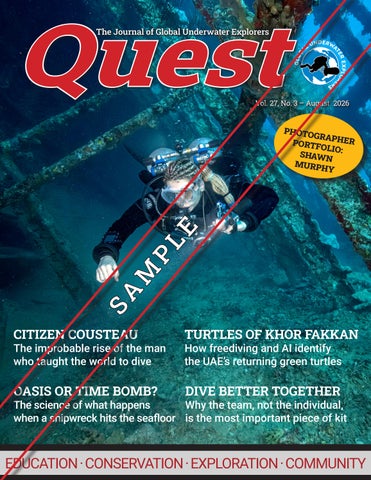
Quest The Journal of Global Underwater Explorers
Vol. 27, No. 3 – August 2026
SA
M
P
LE
PHOTO GRAPH ER PORTF OLIO: SHAWN MURPH Y
CITIZEN COUSTEAU
TURTLES OF KHOR FAKKAN
OASIS OR TIME BOMB?
DIVE BETTER TOGETHER
The improbable rise of the man who taught the world to dive
How freediving and AI identify the UAE’s returning green turtles
The science of what happens Why the team, not the individual, when a shipwreck hits the seafloor is the most important piece of kit
EDUCATION · CONSERVATION · EXPLORATION · COMMUNITY
GET THE MOST OUT OF YOUR DIVING
$24.95 €19.95
NEW EDITION AVAILABLE NOW!
Order today at www.GUE.com
Available in English, German, Italian, Spanish, Chinese, and Korean.
EDITOR’S LETTER PASSING IT ON
S
eventy years ago, a French naval officer named Jacques Cousteau pointed a camera at the sea and showed the rest of us what was down there. He did not invent diving on his own, and he was not always an easy man, but he did more than anyone to hand the underwater world to the public. The Aqua-Lung that carried his name into history was co-invented with an engineer, Émile Gagnan. Even the breathing gear was a partnership. Writing his story for this issue (p.46), I kept coming back to one thing: almost none of it was done alone. Cousteau had his divers, his engineers, his Calypso crew. The films that made his name were a group effort dressed up as one man’s adventure. That has not changed. The divers in our Young Divers Program (p.6) spend a week discovering that the diving matters, but the people around them matter just as much. And the team feature (p.60) makes the same case in plain terms: the strongest diver on the boat is the one who plans, communicates, and looks after the person next to them. The rest of the issue is full of people looking closely at things most of us pass over. Isadora Abuter asks what a shipwreck really becomes once it hits the seafloor—an oasis, or a slow-leaking hazard (p.16)? On the UAE’s east coast, researchers are learning to recognize individual green turtles by sight, using freediving and AI instead of tags (p.28). And photographer Shawn Murphy shows what patience and a little light can pull out of a flooded cave (p.40).
Strip away the gear and the technique, and these stories share something simpler. They are about paying attention and about handing what you have learned to the person coming up behind you. None of these divers work alone, and none of them keep what they find to themselves. That is how the knowledge moves—from Cousteau’s crew to a nervous trainee pulling on fins for the first time. Sixty years from now, with luck, someone will still be passing it on. Dive safe and have fun! Jesper Kjøller Editor-in-Chief jk@gue.com
August 2026 · Quest
3
Quest IN THIS ISSUE The Journal of Global Underwater Explorers
Vol. 27, No. 3 · August 2026
Editor-in-chief // Jesper Kjøller Design and layout // Jesper Kjøller Copy editing // Pat Jablonski // Kady Smith Writers // Jenn Thomson // Isadora Abuter // Jon Lapeyra Martin // Jesper Kjøller Photographers // Jenn Thomson // Omar Abou Nader // JP Bresser // Sean Talamas // Jesper Kjøller // Niccolo Crespi // Jon Lapeyra Martin // Shawn Murphy // Julian Mühlenhaus // Julia Golosiy // Bori Bennett // Kirill Egorov // Derk Remmers
6 HQ CORNER // LEARNING TO LEAD
From recreational to cave, CCR, and project divers, GUE’s Young Divers Program unites young people who took very different routes into the water. Here past participants reflect on what it truly means to become a leader.
16 WRECKS // OASES OR TIME BOMBS?
When a vessel sinks, it begins a slow transformation shaped by depth, current, and chemistry. Some wrecks become thriving reefs; others hide threats—from leaking fuel to invasive species. The science behind what makes wrecks tick.
28 AI-POWERED TURTLE ID IN THE UAE
A thriving aggregation of juvenile green turtles returns season after season to the same coastline. At the Sharjah Marine Science Research Centre, researchers identify each one individually—not through tags, but through freediving, photography, and AI.
40 PORTFOLIO // SHAWN MURPHY
From Mexican cenotes to the open ocean, an underwater photographer and author reveals how patience, precision, and artificial light shape emotion, darkness, and depth—turning fleeting moments beneath the surface into images that linger long after.
46 HE TAUGHT THE WORLD TO DIVE
The improbable story of Jacques Cousteau—inventor, filmmaker, and irrepressible showman—who took the underwater world from a handful of pioneers and brought it, in vivid color, into the living rooms of millions the world over.
60 TEAM // DIVE TOGETHER, DIVE BETTER Quest is published quarterly by Global Underwater Explorers 18487 High Springs Main Street, High Springs, Florida 32643 www.GUE.com
4
Quest · August 2026
GUE treats teamwork as a core value, not an afterthought. Shared equipment, shared procedures, and shared situational awareness turn a group of individuals into a resilient unit—long before anyone gears up on the boat.
August 2026 · Quest
5
HQ CORNER
LEARNING TO LEAD
TEXT JENN THOMSON PHOTOS OMAR ABOU NADER, JP BRESSER, JENN THOMSON & SEAN TALAMAS
– Meet the Divers Shaping GUE’s Young Divers Program
From single-tank recreational divers to cave, CCR, and project-focused divers, GUE’s Young Divers Program brings together young people with very different routes into the water. Here, past participants and upcoming candidates share their backgrounds, motivations, and defining moments from a program designed to build confidence, responsibility and leadership. 6
Quest · August 2026
PHOTO JP BRESSER
More than merchandise, the YDP shirt marks a milestone. Five days, of real project work, team challenges, and personal growth.
August 2026 · Quest
7
PHOTO JENN THOMSON
Laughter and last-minute logistics: The group huddles together to see the final result of several media outputs. 8
Quest · August 2026
“
Applicants may come from openwater, technical, cave, or CCR backgrounds, but selection is based on motivation, teamwork, curiosity, and alignment with GUE values. What connects them is not where they are in their diving career, but where they are willing to go next.
G
lobal Underwater Explorers has never been just about diving. It is about what diving can make possible: exploration, conservation, education, documentation, teamwork and, perhaps most importantly, community. The Young Divers Program sits right at the center of that idea. The YDP is a five-day immersive experience that brings together in-water challenges, real project work, and structured leadership development. It is not a training course, and it is not a fast-track route through certifications. Instead, it asks a different question: What happens when motivated young divers are given responsibility, support, and space to grow? Across the week, participants work as a team while taking ownership of meaningful deliverables. These might involve documenting a site, contributing to exploration knowledge, creating educational materials, supporting community outreach, or working on a conservation project. The tasks are real, not simulated. So are the decisions, the pressures, and the lessons.
Built to grow
That is where the character of the program begins to show. YDP is built around a growth mindset, with leadership and resilience developed through practice rather than theory alone.
Participants are encouraged to try, reflect, adapt, and try again, all within a structured environment that gives them the psychological safety to make mistakes and learn from them. George Polykratis, one of the 2025 participants, described that environment as one of the things that stayed with him most. “What stayed with me most was how JP and Dorota handled mistakes. There was no blame and no finger-pointing. They helped us talk through what had happened in a constructive way, so we could learn from it. That’s what a strong team needs. And I keep coming back to what Jenn said: surround yourself with people who want to see each other succeed, who lift each other up, and who keep improving.” The result is a program that values much more than a technical résumé. Applicants may come from open-water, technical, cave, or CCR backgrounds, but selection is based on motivation, teamwork, curiosity, and alignment with GUE values. Some arrive with project experience. Others bring media skills, outreach ideas, scientific interests or simply a strong desire to contribute. What connects them is not where they are in their diving career, but where they are willing to go next.
Looking back
The 2025 group showed just how wide the YDP pathway can be. Participants came from a range of backgrounds, from quantum physics to August 2026 · Quest
9
PHOTO JENN THOMSON
“Learn, Connect, Inspire” isn’t just a slogan on a shirt—it plays out in conversations like this one, between dives. 10
Quest · August 2026
“
There was no blame and no fingerpointing. They helped us talk through what had happened in a constructive way, so we could learn from it. That’s what a strong team needs. Surround yourself with people who want to see each other succeed, who lift each other up, and who keep improving.
August 2026 · Quest
11
2025 participants
2026 participants
George Polykratis, Greek/Cyprius Current focus: Quantum physicist, skydiver, and aspiring cave explorer Diving level: Cave 1
Eason Jiang, UK/China Current focus: Maritime archaeology and underwater scientific projects Diving level: GUE Fundamentals Technical Pass, TDI CCR Advanced Mixed Gas, NSS-CDS CCR Cave trained to 30 m/100 ft
Dabian van der Heijden, Netherlands Current focus: Aspiring project engineer, interested in technical solutions for projects Diving level: Cave 1, Tech 1 Andy Wilson, USA Current focus: Chemical engineer, aspiring GUE instructor in the Bronx, and aspiring Mexican cenote videographer Diving level: Cave 1 Provisional Fabian Gross, Germany Current focus: Scuba professional with an interest in wreck diving Diving level: CCR 1 Floris Van der Est, Netherlands Current focus: Software developer, aspiring GUE instructor and cave explorer Diving level: Cave 1, Tech 1 Alvaro Jimenez, Netherlands Current focus: Scuba repair and maintenance, aspiring GUE instructor Diving level: Cave 2, Tech 1
Bijan Faghfouri, Netherlands/Germany Current focus: Business information management, data science, and project management design; NextGen Trainee Diving level: Cave 1, Tech 1 planned Oana Beatrice Popescu, Romania/Netherlands Current focus: Newer GUE diver with a focus on community Diving level: GUE Basic Fundamentals, single tank Veronika Paulovicova, Slovakia Current focus: Pilot, VR engineer, and aspiring marine scientist Diving level: GUE Performance Diver, single tank, wetsuit Linda Jarkovská, Czech Republic Current focus: Exploration, technical diving and conservation-focused work Diving level: SSI Dive Guide, planning GUE Performance Diver
Omar Abou Nader, Lebanon Current focus: Architect, international dry cave explorer, trainer, and rescuer Diving level: GUE Fundamentals Technical pass
Alicja Ulejczyk, UK/Poland Current focus: Data science, Project Baseline work, and wreck photogrammetry Diving level: GUE Rec 3 (Master Diver), Cave 1 Provisional
Eva Lourau, France Current focus: Environmental engineer, international dry cave explorer, trainer. and rescuer Diving level: GUE Triox (Deep) Primer; drysuit in progress
Youssef Diouri, Morocco/Malaysia Current focus: Underwater photogrammetry, AR/VR, and 3D printing for natural heritage access Diving level: GUE Fundamentals Technical Pass
Thanapol Tantagunninat, Thailand/USA Current focus: Product launch engineer, aspiring underwater roboticist and inventor; NextGen Scholar 2025 Diving level: GUE Fundamentals Technical pass, GUE Rescue Primer Thies Lendfers, Netherlands Current focus: BSc Marine Science, interested in underwater research and project diving Diving level: GUE Advanced Open Water Wesley van Vliet, Netherlands Current focus: Scuba professional, aiming to become a better diver Diving level: Cave 1
12
Quest · August 2026
Hank Wu, Germany/Taiwan Current focus: Aerospace engineering, expanding GUE access for Mandarin-speaking and Asian communities Diving level: CCR Tech 2, TDI Trimix 75 Koen van der Lee, Netherlands Current focus: New to the GUE community and looking for direction, confidence, and leadership development Diving level: GUE Fundamentals Technical Pass Harry Wu, Taiwan Current focus: Learning to be more efficient at leading clean-up projects Diving level: Cave 1
Note: Certification levels listed are at the time of YDP participation.
PHOTO OMAR ABOU NADER
A dockside selfie captures the energy of the 2025 cohort: technical divers and newcomers alike, united by a shared sense of adventure.
engineering, from architecture to environmental work, and software development to diving. Their interests were just as varied: from caves, wrecks, and robotics to conservation, research, and teaching. It made for a group where people were not bringing the same strengths, but complementary ones. Their diving backgrounds covered a broad range too. Some arrived with cave, technical, Closed Circuit Rebreather, or triox experience, while others brought project-based skills or were newer recreational divers. That mix is part of what makes the program so interesting and dynamic. The Young Divers Program is not only about who holds the most advanced diver certification. It is about motivation, teamwork, curiosity, and the ability to contribute something meaningful and useful to the wider diving community.
The 2026 cohort
The 2026 cohort brought together a particularly varied mix of divers. Some were already working at a high technical level with cave, CCR, and trimix experience. Others came in through single-tank, wetsuit, Basic Fundamentals, or Performance Diver pathways. A few even trained specifically so they could take part! Not everyone has arrived from the same place, and not everyone is trying to reach the same destination. What linked them was the desire to use diving for something bigger. There were participants interested in maritime archaeology, data science, photogrammetry, marine science, conservation, and community-building. Some were looking for technical progression while others were looking for confidence-building or a stronger connection to the GUE community. Together, they show that YDP is not just about producing better divers but August 2026 · Quest
13
about helping different kinds of divers become more useful, thoughtful, and active members of a team.
From participation to leadership
Taken together, the 2025 and 2026 groups show what the Young Divers Program is really trying to build. Not one type of diver. Not one route through GUE. Not one idea of what leadership has to look like. Leadership might come from the diver with deep technical experience or the person who knows how to document a wreck, build a 3D model, or repair equipment. Or, it might come from someone who can communicate science, organize a project, or make a new diver feel part of the team. YDP gives young divers a place to take responsibility before they feel completely ready, to contribute before they have all the answers, and to learn that leadership is often built in the space between people.
For some participants, the most important lessons were not the ones they expected. Omar Abou Nader came into the 2025 program with a strong expedition and rescue background, but what stayed with him was the human side of the week. “I came for the technical skills and the technical learning, but what stayed with me was the human adventure. We learned a lot internally, through our interactions, and as a group. Being able to be vulnerable with each other allowed us to grow and move forward as a unit.” That idea runs through the program: the diving matters, but the people matter just as much. A team can have talent, experience, and ambition, but Young Divers Program asks what happens when those things are placed under pressure, shaped by feedback, and directed towards a shared goal.
WATCH THE FIRST PROGRAM – Sardinia 2025 www.youtube.com/watch?v=fXuq3t1MmJE FIND OUT MORE www.gue.com/nextgen-legacy-program
14
Quest · August 2026
PHOTO SEAN TALAMAS
FACT FILE // YOUNG DIVERS PROGRAM Q&A Q: What is it? A: A five-day immersive program combining diving, community projects, leadership development, and character-building workshops. Q: Who is it for? A: Designed for 18-24 year olds but candidates have ranged up to 30 years.
Q: What do participants work on? A: Each participant selects a project focus linked to the location. These may include documentation and media, exploration and site knowledge, education and outreach, community work, or conservation. Q: What makes a strong applicant? A: Motivation, a learning mindset, team orientation, resilience, and alignment with GUE values. The program is not looking only for the most technically experienced diver.
Q: Is it a training course? A: No. YDP is not a certification course and is not designed as accelerated dive training. It is a development program focused on Q: What is the main aim? responsibility, teamwork, resilience, and A: To help develop the next generation of leadership. leaders in diving, exploration, conservation, education, and community-focused projects. Q: Do participants need to be GUE certified? PHOTO JENN THOMSON A: Yes. Applicants must be GUE certified, but they can be at any level. Previous participants have ranged from Open Water to CCR 2. Q: Do applicants need to have been part of the NextGen Program? A: No. Past and current Scholars and Trainees are welcome, but previous involvement in NextGen programs is not required. Q: Can people apply as a pair? A: Yes. Applications may be submitted individually or as a pair.
Jenn Thomson
Jenn is part of GUE’s Executive Committee as the Dive Project Manager, and is also a GUE Open Water and Performance Diver instructor, teaching in Sardinia, Egypt, and parts of Southern and East Africa. She was the 2022-23 NextGen Scholar and used the year to highlight the roles that recreational scuba can play in scientific operations, completing GUE Scientific Diver and GUE AOW. The NextGen Legacy Program was launched in 2023
and continues to expand, including the Young Divers Program. Jenn continues to work at the intersection of project diving, expedition vessel logistics, and space analogs, connecting the space and marine sectors via scuba diving and exploration. Her most recent courses include FSDA’s Polar Scientific Diving course and GUE’s Cave 2 course.
August 2026 · Quest
15
WRECKS
– UNDERWATER OASES OR OR HIDDEN TIME BOMBS?
PHOTO JESPER KJØLLER 16
Quest · August 2026
TEXT ISADORA ABUTER PHOTOS NICCOLO CRESPI & JESPER KJØLLER
Shipwrecks have long captured the imagination of divers—silent relics of human history, draped in coral and alive with fish. But what really happens when a vessel sinks to the seafloor? And is the picture always as idyllic as it looks? The transformation of a wreck into a reef is a slow, complex process shaped by depth, current, chemistry, and chance. Some wrecks become thriving ecosystems; others carry hidden threats—from leaking fuel to invasive species. This article explores the science behind what makes wrecks tick, and what it means for the divers who visit them. August 2026 · Quest
17
The structural complexity of a wreck creates countless microhabitats. Within months of sinking, bare metal becomes a foundation for sponges, soft corals, and encrusting algae.
PHOTOS NICCOLO CRESPI
W
hen a ship or plane sinks, often suddenly, after a storm, collision, or other catastrophic event, it settles on the seafloor as a bare structure of metal or wood. At this stage, it is not yet a reef. It is simply an object resting on sand, mud, or rock, exposed to currents, waves, and the surrounding marine environment. But the transformation begins promptly: The wreck’s surface becomes coated with a thin, invisible layer made of organic molecules naturally present in seawater. This layer, composed of proteins, sugars, and lipids, acts like a kind of biochemical “primer.” It changes the surface properties of the wreck, making it easier for microscopic life to attach. Soon after, microorganisms begin to colonize the surface. Bacteria settle and multiply, 18
Quest · August 2026
forming what is known as a biofilm, a slimy, living coating made up of microbial cells and the substances they produce. Although invisible to the naked eye, this biofilm is a critical foundation: it alters the chemistry and texture of the surface and creates the first true living layer on the wreck. As the biofilm develops, it becomes suitable for slightly larger organisms. Microscopic algae, far smaller than the seaweeds divers typically recognize, begin to grow, giving the surface a slippery coating. At the same time, fine particles from the water column, such as organic debris and sediment, become trapped in this sticky layer. This creates what can be thought of as a “conditioning layer,” further stabilizing the surface and enriching it with nutrients. This newly formed microhabitat allows the next wave of colonizers to settle. Larvae of marine invertebrates, such as barnacles, tubeworms, and bryozoans, attach themselves
Dense gorgonian fans on a mature wreck tell a story of years of succession. This level of growth requires steady currents, stable structure, and time.
to the surface. These organisms are often fast-growing and opportunistic, quickly occupying available space. Small algae and seaweeds also begin to anchor themselves here.
A living reef shaped by time
Over time, this community becomes more complex. Early colonizers modify the environment, making it suitable for larger species. A thicker, more structured biological layer develops, sometimes referred to as macrofouling. This includes encrusting organisms such as coralline algae (which form hard, pinkish crusts), sponges, soft corals, and small reef-building corals in suitable environments. At this stage, the wreck has effectively transformed into a miniature reef ecosystem. Its surface is no longer recognizable as bare metal or wood, but as a living, layered habitat supporting a wide variety of organisms. Fish and mobile species are attracted to this grow-
ing complexity, using the structure for shelter, feeding, and reproduction. This entire process, known as ecological succession, is not linear or identical for every wreck. It depends on factors such as water temperature, depth, currents, material of the wreck, and proximity to other marine life. What begins as a shipwreck gradually becomes something entirely different—a dynamic, living reef shaped by time, biology, and the surrounding sea.
No two wrecks are the same
If you’ve dived more than one wreck, you’ve probably noticed something surprising: they never look alike. That’s because every wreck exists in a unique set of environmental conditions, and those conditions shape the life it supports. One of the most important factors is depth. In shallow water, sunlight reaches the wreck, allowing photosynthetic organisms, including
August 2026 · Quest
19
algae, to grow. These form the base of a food web that supports a wide range of life. In deeper environments, where light cannot penetrate, this changes completely. There, life depends on organic matter drifting down from above or on chemical processes rather than photosynthesis. As a result, deep wrecks often host very different communities, dominated by sponges, worms, and other filter feeders. Currents are another key driver. A wreck exposed to steady water movement tends to be more productive. Currents bring a constant supply of food in the form of plankton and organic particles, which benefits organisms that feed by filtering the water. You’ll often see dense growth of sponges, soft corals, and other suspension feeders in these conditions. In contrast, wrecks in sheltered areas with little water movement may develop more slowly and support fewer species. The material of the wreck also matters. Steel wrecks provide a hard, stable surface that supports a wide range of encrusting organisms. Wooden wrecks, on the other hand, behave very differently. As the wood breaks down, it becomes a food source itself, attracting specialized organisms that bore into and consume it. Over time, this can dramatically alter both the structure of the wreck and the community living on it. Another factor is the shape and complexity of the structure. Wrecks are rarely flat. They have vertical walls, overhangs, holes, and sheltered interior spaces. This creates a variety of microhabitats within a single site. Exposed surfaces facing the current may be dominated by filter feeders, while shaded or sheltered areas can host completely different species. Cavities and enclosed spaces provide refuge for fish and invertebrates, increasing both diversity and abundance. Finally, location and connectivity play a crucial role. A wreck located near natural reefs or other hard structures is more easily colonized, as larvae and mobile organisms can quickly reach it. In contrast, an isolated wreck in a vast sandy area may take much longer to develop a rich community. In some cases, wrecks act like stepping stones, helping species spread across otherwise inhospitable seafloor. All these factors interact in complex ways, meaning that even two wrecks of similar age 20
Quest · August 2026
can look completely different. What divers see is the result of a long and dynamic process shaped by physics, chemistry, biology, and chance.
The halo effect: life beyond the wreck
When divers think about shipwrecks, the focus is usually on the structure itself, the hull, decks, and machinery covered in life. But a wreck’s influence extends far beyond its edges, creating what scientists call a “halo effect.” As currents flow around the wreck, they change direction and speed, reshaping the seabed. This leads to erosion in some areas and sediment build-up in others, turning a flat seabed into a more varied landscape. These physical changes affect biology. Organic material accumulates around the wreck, enriched by both drifting particles and waste produced by organisms living on the structure. This creates nutrient-rich zones in the surrounding sediment. As a result, microbial life becomes more active and diverse, supporting small organisms like worms and crustaceans. Depending on local conditions, this can either increase or reduce biodiversity, but it always creates a patchy, dynamic environment. This influence can extend tens to hundreds of meters from the wreck. Rather than being an isolated structure, the wreck becomes the center of a wider ecological zone. For divers, this means the surrounding seabed is part of the story too. A shipwreck doesn’t just host life, it reshapes the environment around it.
Fish—attraction or production?
One of the first things divers notice on a wreck is the fish. Schools circling above the structure, predators lurking in the shadows, small species darting in and out of holes—it often feels like the wreck is teeming with life compared to the surrounding seabed. But this raises an important question: Do wrecks create new fish populations, or do they simply attract fish from elsewhere? At first, the answer seems obvious. Wrecks provide structure in an otherwise open envi-
“
For divers, this means the surrounding seabed is part of the story too. A shipwreck doesn’t just host life, it reshapes the environment around it.
PHOTO JESPER KJØLLER
The bow of a wreck rising from the seafloor is more than a dramatic sight. It is a vertical reef, offering shelter, feeding ground, and habitat across multiple depth zones simultaneously.
August 2026 · Quest
21
Inside a wreck, light fades and the ecosystem shifts. Shaded and sheltered spaces host entirely different species from the exposed outer hull. 22
Quest · August 2026
“
When you hover above a wreck surrounded by fish, you're seeing a dynamic system shaped by movement, behavior, and ecological interactions. In the end, a wreck is both a magnet and a generator of life.
August 2026 · Quest
23
“
By concentrating fish, wrecks can make them more vulnerable to fishing pressure. Areas rich in life can quickly become targets, which may reduce the very populations that the wreck helps support.
PHOTO JESPER KJØLLER
ronment. On sandy or muddy bottoms, natural shelter is limited, so a shipwreck offers something rare: protection from predators, surfaces for food to grow on, and places to rest or reproduce. It’s no surprise that fish quickly gather around them. This is known as the “attraction effect.” Fish are drawn to the wreck because it concentrates resources. From a diver’s perspective, this is what could make wrecks such exciting dive sites: high numbers of fish in a relatively small area. But there’s more to the story. As the wreck develops into a mature ecosystem, it begins to support its own food web. Algae, sponges, and invertebrates grow on the structure, providing food for grazing and predatory species. At the same time, currents flowing around the wreck bring in plankton and organic material, which support filter-feeding organisms and, indirectly, the fish that prey on them. In this case, the wreck may contribute to production—meaning it helps generate new bio24
Quest · August 2026
mass rather than simply concentrating existing fish. Some species may use wrecks as nursery areas, while others establish territories and remain there long-term. The reality is that both processes—attraction and production—occur at the same time, and their relative importance depends on the location and conditions. In some environments, wrecks mainly act as gathering points. In others, especially where natural habitat is scarce, they can significantly enhance local productivity. There is also a broader ecological implication. By concentrating fish, wrecks can make them more vulnerable to fishing pressure. Areas that are rich in life can quickly become targets, which may reduce the very populations that the wreck helps support. Another interesting feature is how fish use different parts of the wreck. Larger predatory species often patrol the outer edges or hover above the structure, taking advantage of currents and visibility. Smaller fish tend to stay close to the surface of the wreck, using crevic-
A Few years after being deliberately scuttled, this wreck's interior tells the full story of succession. What was once an empty steel corridor has become a functioning habitat. es and overhangs as shelter. Near the seabed, bottom-dwelling species occupy quieter zones where food accumulates. So when you hover above a wreck surrounded by fish, you’re seeing a dynamic system shaped by movement, behavior, and ecological interactions. In the end, a wreck is both a magnet and a generator of life.
The dark side of wrecks
Shipwrecks are often celebrated as thriving artificial reefs, places where marine life flourishes and divers gather to explore. But beneath this vibrant image lies a more complex reality. Not all wrecks are purely beneficial. In some cases, they can pose serious and long-lasting risks to marine ecosystems. One of the most significant concerns is pollution. Wrecks may still contain fuel, oil, or hazardous cargo. As these structures age, corrosion weakens their hulls. What was once safely contained can slowly leak into the surrounding
environment, or, in some cases, be released suddenly. When oil or other pollutants are released, the effects can be severe. Toxic compounds can damage or kill marine organisms, disrupt reproduction, and persist in sediments for years. Wrecks can also release other harmful substances. Paints used to protect ships often contain toxic chemicals, and metal structures may leach elements into the water. In some cases, wrecks carry munitions or unexploded ordnance, which can degrade over time and release additional contaminants into the environment. Beyond chemical risks, there are also physical threats. Fishing activities frequently target wrecks because of the fish they attract. This can lead to the accumulation of lost or abandoned gear. These “ghost nets” can remain entangled on wrecks for years, continuing to trap and kill marine life long after they are lost. They can also damage the structure itself and make dives more hazardous. This is why organizations like
August 2026 · Quest
25
PHOTOS NICCOLO CRESPI
Healthy Seas, together with volunteer divers from Ghost Diving, fight against ghost nets and regularly conduct cleanup dives on wrecks. Another and less visible issue is the spread of invasive species. Because wrecks provide new hard surfaces in areas where such habitat may be limited, they can act as stepping stones for non-native organisms. Once established, these species can spread to nearby natural habitats, competing with native species and altering local ecosystems. Taken together, these factors highlight an important truth: shipwrecks are not just sites of ecological growth, they are also sources of vulnerability.
Wrecks don’t last forever
When you visit a shipwreck, it’s easy to think of it as something permanent, a fixed landmark on the seafloor that will always be there. But in reality, every wreck is slowly disappearing. From the moment it sinks, a wreck begins to change. Saltwater, oxygen, and natural chemical 26
Quest · August 2026
As a structure degrades and new surfaces are exposed, colonization begins again. Wrecks exist as a patchwork of ecological stages, not a single finished reef.
reactions start to break down metal, causing it to corrode, flake, and weaken. Wooden wrecks follow a different path: they are gradually consumed by organisms that feed on wood, while microbes break down their structure from within. Over time, what was once a solid vessel becomes fragile, unstable, and eventually collapses. Nature also plays its part. Storms, strong currents, and shifting sediments can damage or bury parts of a wreck. In some cases, sections break off or become scattered across the seabed. Even the movement of sand can alternately expose and cover different parts of the structure, constantly reshaping the site. Interestingly, living organisms themselves contribute to this process. Some species accelerate decay—wood-boring animals drill into timber, while certain microbes promote corrosion of metals. At the same time, other organisms can have a protective effect. Layers of encrusting life, such as coralline algae or microbial films, may shield parts of the wreck from direct
exposure, slowing down deterioration. The result is a constant balance between destruction and protection. Because of this ongoing change, the ecological community on a wreck is rarely fully stable. Parts of the structure may collapse or shed material, exposing fresh surfaces. When this happens, the colonization process starts again in those areas. Instead of reaching a single “final” stage, wreck ecosystems often exist as a patchwork of different stages of development, some areas mature, others newly formed. Eventually, however, the structure may degrade to the point where it no longer provides the complexity needed to support a rich community. As the wreck flattens and blends into the surrounding seabed, many of the species that depended on it disappear or move elsewhere. In this sense, shipwrecks are temporary habitats. They can support thriving ecosystems for years, decades, or even centuries, but not forever. For divers, this adds another layer of meaning. Every wreck you visit is a moment in time, part of a slow transformation that will continue long after you leave. What you see today may look very different in the future, and one day, it may be gone entirely.
Divers as part of the story
Every diver who visits a wreck becomes part of its story. Although wrecks may seem solid, both the structure and the life growing on them are fragile. Good buoyancy control and avoiding contact are simple but essential ways to protect these sites.
Isadora Abuter
Divers can also play a positive role. By reporting damage, ghost nets, or unusual species, or by taking part in clean-ups and citizen science, they help monitor and protect these ecosystems. With the access divers have comes both responsibility and the opportunity to help preserve them.
More than just a dive site
Shipwrecks are often described as windows into the past, but they are just as much part of the present. They are places where history and ecology meet, where human-made structures are transformed into living systems. Over time, a wreck becomes something entirely new. It creates habitat where none existed, supports complex communities, and even influences the surrounding seabed. At the same time, it remains fragile, subject to decay, disturbance, and, in some cases, environmental risk. This dual nature is what makes wrecks so fascinating. They are both refuges for marine life and reminders of human impact. Some are thriving oases of biodiversity; others carry hidden threats, from pollution to invasive species. For divers, understanding this complexity adds depth to every descent. What may first appear as just an exciting dive site is, in reality, a dynamic and evolving ecosystem, one that is constantly changing and will not last forever. So the next time you descend onto a wreck, take a moment to look beyond the structure itself. You are not just exploring a relic of the past, but witnessing a living system in motion, one that depends, in part, on how we choose to interact with it.
Isadora is a wildlife manager and marine biologist whose work focuses on ocean ecosystems, conservation, and science communication. She combines technical expertise with a strong commitment to translating research into meaningful public engagement. Her interests center on shipwrecks as artificial reefs and the complex communities that form
around submerged structures. At the beginning of her technical diving journey as a GUE Tech 1 diver, Isadora is committed to continuous learning and values the guidance of more experienced divers. She is motivated to further develop her skills and explore the ecological significance of deep wreck environments. August 2026 · Quest
27
GUE PREMIUM DIVE CENTERS Area 9 Mastery Diving – Kralendijk, Bonaire www.masterydiving.com
Base1 – Sardinia, Italy www.baseone.it
Deep Dive Dubai – Dubai, UAE www.deepdivedubai.com
Dive Centre Bondi – Bondi, NSW, Australia www.divebondi.com.au
Duikcentrum de Aalscholvers – Tilburg, Netherlands www.aalscholvers.nl
Eight Diving – Des Moines, WA, USA www.8diving.com
Exploration Diver – Hangzhou, China www.facebook.com/qiandaolake
Extreme Exposure – High Springs, FL, USA www.extreme-exposure.com
Islas Hormigas – Cabo de Palos, Spain www.islashormigas.com
Living Oceans – Singapore www.livingoceans.com.sg
Scuba Academie – Vinkeveen, Netherlands www.scuba-academie.nl
Tech Korea – Incheon, South Korea www.divetechkorea.com 72
Quest · August 2026
Third Dimension Diving – Tulum, Q. Roo, Mexico www.thirddimensiondiving.com
Zero Gravity – Quintana Roo, Mexico www.zerogravity.com.mx
DIVE CENTER
2026
PREMIUM
August 2026 · Quest
73
GUE DIVE CENTERS Buddy Dive Resort – Bonaire www.buddydive.com
Dive Alaska – Anchorage, AK, USA www.divealaska.net
Faszination-Tauchsport – Sauerlach, Germany www.faszination-tauchsport.de
GoDiveMex – Playa del Carmen, Mexico www.godivemex.com
Dive in Essen – Essen, Germany www.dive-in-essen.de
KrakenDive – Tossa de Mar, Spain www.krakendive.com
Living Oceans Malaysia – Kuala Lumpur, Malaysia beyonddepth.com
Moby Tek Dive Center – Pahang, Malaysia www.moby-tek.com
Paragon Dive Group – Arizona, USA www.paragondivestore.com
Plongée Nautilus – Quebec City, QC, Canada www.plongeenautilus.com
Scotty's Dive Center – Cebu, Philippines www.divescotty.com
74
Quest · August 2026
Scuba Adventures – Plano, TX, USA www.scubaplano.com
Scuba Seekers – Dahab, Egypt www.scubaseekers.com
Tauchservice Münster – Münster, Germany www.tauchservice.info
Tech Asia – Puerto Galera, Philippines www.techasia.ph
Unique Diving Center – Shanghai, China www.uniquediving.cn
DIVE CENTER 2026 August 2026 · Quest
75
SUPPORT GUE
Become a member today and get full access to the rest of Quest! Sign up at www.gue.com/membership Additional benefits include: