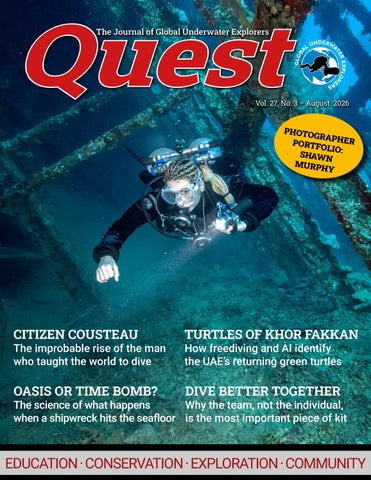
Quest The Journal of Global Underwater Explorers
Vol. 27, No. 3 – August 2026
PHOTO GRAPH ER PORTF OLIO: SHAWN MURPH Y
CITIZEN COUSTEAU
TURTLES OF KHOR FAKKAN
OASIS OR TIME BOMB?
DIVE BETTER TOGETHER
The improbable rise of the man who taught the world to dive
How freediving and AI identify the UAE’s returning green turtles
The science of what happens Why the team, not the individual, when a shipwreck hits the seafloor is the most important piece of kit
EDUCATION · CONSERVATION · EXPLORATION · COMMUNITY
GET THE MOST OUT OF YOUR DIVING
$24.95 €19.95
NEW EDITION AVAILABLE NOW!
Order today at www.GUE.com
Available in English, German, Italian, Spanish, Chinese, and Korean.
EDITOR’S LETTER PASSING IT ON
S
eventy years ago, a French naval officer named Jacques Cousteau pointed a camera at the sea and showed the rest of us what was down there. He did not invent diving on his own, and he was not always an easy man, but he did more than anyone to hand the underwater world to the public. The Aqua-Lung that carried his name into history was co-invented with an engineer, Émile Gagnan. Even the breathing gear was a partnership. Writing his story for this issue (p.46), I kept coming back to one thing: almost none of it was done alone. Cousteau had his divers, his engineers, his Calypso crew. The films that made his name were a group effort dressed up as one man’s adventure. That has not changed. The divers in our Young Divers Program (p.6) spend a week discovering that the diving matters, but the people around them matter just as much. And the team feature (p.60) makes the same case in plain terms: the strongest diver on the boat is the one who plans, communicates, and looks after the person next to them. The rest of the issue is full of people looking closely at things most of us pass over. Isadora Abuter asks what a shipwreck really becomes once it hits the seafloor—an oasis, or a slow-leaking hazard (p.16)? On the UAE’s east coast, researchers are learning to recognize individual green turtles by sight, using freediving and AI instead of tags (p.28). And photographer Shawn Murphy shows what patience and a little light can pull out of a flooded cave (p.40).
Strip away the gear and the technique, and these stories share something simpler. They are about paying attention and about handing what you have learned to the person coming up behind you. None of these divers work alone, and none of them keep what they find to themselves. That is how the knowledge moves—from Cousteau’s crew to a nervous trainee pulling on fins for the first time. Sixty years from now, with luck, someone will still be passing it on. Dive safe and have fun! Jesper Kjøller Editor-in-Chief jk@gue.com
August 2026 · Quest
3
Quest IN THIS ISSUE The Journal of Global Underwater Explorers
Vol. 27, No. 3 · August 2026
Editor-in-chief // Jesper Kjøller Design and layout // Jesper Kjøller Copy editing // Pat Jablonski // Kady Smith Writers // Jenn Thomson // Isadora Abuter // Jon Lapeyra Martin // Jesper Kjøller Photographers // Jenn Thomson // Omar Abou Nader // JP Bresser // Sean Talamas // Jesper Kjøller // Niccolo Crespi // Jon Lapeyra Martin // Shawn Murphy // Julian Mühlenhaus // Julia Golosiy // Bori Bennett // Kirill Egorov // Derk Remmers
6 HQ CORNER // LEARNING TO LEAD
From recreational to cave, CCR, and project divers, GUE’s Young Divers Program unites young people who took very different routes into the water. Here past participants reflect on what it truly means to become a leader.
16 WRECKS // OASES OR TIME BOMBS?
When a vessel sinks, it begins a slow transformation shaped by depth, current, and chemistry. Some wrecks become thriving reefs; others hide threats—from leaking fuel to invasive species. The science behind what makes wrecks tick.
28 AI-POWERED TURTLE ID IN THE UAE
A thriving aggregation of juvenile green turtles returns season after season to the same coastline. At the Sharjah Marine Science Research Centre, researchers identify each one individually—not through tags, but through freediving, photography, and AI.
40 PORTFOLIO // SHAWN MURPHY
From Mexican cenotes to the open ocean, an underwater photographer and author reveals how patience, precision, and artificial light shape emotion, darkness, and depth—turning fleeting moments beneath the surface into images that linger long after.
46 HE TAUGHT THE WORLD TO DIVE
The improbable story of Jacques Cousteau—inventor, filmmaker, and irrepressible showman—who took the underwater world from a handful of pioneers and brought it, in vivid color, into the living rooms of millions the world over.
60 TEAM // DIVE TOGETHER, DIVE BETTER Quest is published quarterly by Global Underwater Explorers 18487 High Springs Main Street, High Springs, Florida 32643 www.GUE.com
4
Quest · August 2026
GUE treats teamwork as a core value, not an afterthought. Shared equipment, shared procedures, and shared situational awareness turn a group of individuals into a resilient unit—long before anyone gears up on the boat.
August 2026 · Quest
5
HQ CORNER
LEARNING TO LEAD
TEXT JENN THOMSON PHOTOS OMAR ABOU NADER, JP BRESSER, JENN THOMSON & SEAN TALAMAS
– Meet the Divers Shaping GUE’s Young Divers Program
From single-tank recreational divers to cave, CCR, and project-focused divers, GUE’s Young Divers Program brings together young people with very different routes into the water. Here, past participants and upcoming candidates share their backgrounds, motivations, and defining moments from a program designed to build confidence, responsibility and leadership. 6
Quest · August 2026
PHOTO JP BRESSER
More than merchandise, the YDP shirt marks a milestone. Five days, of real project work, team challenges, and personal growth.
August 2026 · Quest
7
PHOTO JENN THOMSON
Laughter and last-minute logistics: The group huddles together to see the final result of several media outputs. 8
Quest · August 2026
“
Applicants may come from openwater, technical, cave, or CCR backgrounds, but selection is based on motivation, teamwork, curiosity, and alignment with GUE values. What connects them is not where they are in their diving career, but where they are willing to go next.
G
lobal Underwater Explorers has never been just about diving. It is about what diving can make possible: exploration, conservation, education, documentation, teamwork and, perhaps most importantly, community. The Young Divers Program sits right at the center of that idea. The YDP is a five-day immersive experience that brings together in-water challenges, real project work, and structured leadership development. It is not a training course, and it is not a fast-track route through certifications. Instead, it asks a different question: What happens when motivated young divers are given responsibility, support, and space to grow? Across the week, participants work as a team while taking ownership of meaningful deliverables. These might involve documenting a site, contributing to exploration knowledge, creating educational materials, supporting community outreach, or working on a conservation project. The tasks are real, not simulated. So are the decisions, the pressures, and the lessons.
Built to grow
That is where the character of the program begins to show. YDP is built around a growth mindset, with leadership and resilience developed through practice rather than theory alone.
Participants are encouraged to try, reflect, adapt, and try again, all within a structured environment that gives them the psychological safety to make mistakes and learn from them. George Polykratis, one of the 2025 participants, described that environment as one of the things that stayed with him most. “What stayed with me most was how JP and Dorota handled mistakes. There was no blame and no finger-pointing. They helped us talk through what had happened in a constructive way, so we could learn from it. That’s what a strong team needs. And I keep coming back to what Jenn said: surround yourself with people who want to see each other succeed, who lift each other up, and who keep improving.” The result is a program that values much more than a technical résumé. Applicants may come from open-water, technical, cave, or CCR backgrounds, but selection is based on motivation, teamwork, curiosity, and alignment with GUE values. Some arrive with project experience. Others bring media skills, outreach ideas, scientific interests or simply a strong desire to contribute. What connects them is not where they are in their diving career, but where they are willing to go next.
Looking back
The 2025 group showed just how wide the YDP pathway can be. Participants came from a range of backgrounds, from quantum physics to August 2026 · Quest
9
PHOTO JENN THOMSON
“Learn, Connect, Inspire” isn’t just a slogan on a shirt—it plays out in conversations like this one, between dives. 10
Quest · August 2026
“
There was no blame and no fingerpointing. They helped us talk through what had happened in a constructive way, so we could learn from it. That’s what a strong team needs. Surround yourself with people who want to see each other succeed, who lift each other up, and who keep improving.
August 2026 · Quest
11
2025 participants
2026 participants
George Polykratis, Greek/Cyprius Current focus: Quantum physicist, skydiver, and aspiring cave explorer Diving level: Cave 1
Eason Jiang, UK/China Current focus: Maritime archaeology and underwater scientific projects Diving level: GUE Fundamentals Technical Pass, TDI CCR Advanced Mixed Gas, NSS-CDS CCR Cave trained to 30 m/100 ft
Dabian van der Heijden, Netherlands Current focus: Aspiring project engineer, interested in technical solutions for projects Diving level: Cave 1, Tech 1 Andy Wilson, USA Current focus: Chemical engineer, aspiring GUE instructor in the Bronx, and aspiring Mexican cenote videographer Diving level: Cave 1 Provisional Fabian Gross, Germany Current focus: Scuba professional with an interest in wreck diving Diving level: CCR 1 Floris Van der Est, Netherlands Current focus: Software developer, aspiring GUE instructor and cave explorer Diving level: Cave 1, Tech 1 Alvaro Jimenez, Netherlands Current focus: Scuba repair and maintenance, aspiring GUE instructor Diving level: Cave 2, Tech 1
Bijan Faghfouri, Netherlands/Germany Current focus: Business information management, data science, and project management design; NextGen Trainee Diving level: Cave 1, Tech 1 planned Oana Beatrice Popescu, Romania/Netherlands Current focus: Newer GUE diver with a focus on community Diving level: GUE Basic Fundamentals, single tank Veronika Paulovicova, Slovakia Current focus: Pilot, VR engineer, and aspiring marine scientist Diving level: GUE Performance Diver, single tank, wetsuit Linda Jarkovská, Czech Republic Current focus: Exploration, technical diving and conservation-focused work Diving level: SSI Dive Guide, planning GUE Performance Diver
Omar Abou Nader, Lebanon Current focus: Architect, international dry cave explorer, trainer, and rescuer Diving level: GUE Fundamentals Technical pass
Alicja Ulejczyk, UK/Poland Current focus: Data science, Project Baseline work, and wreck photogrammetry Diving level: GUE Rec 3 (Master Diver), Cave 1 Provisional
Eva Lourau, France Current focus: Environmental engineer, international dry cave explorer, trainer. and rescuer Diving level: GUE Triox (Deep) Primer; drysuit in progress
Youssef Diouri, Morocco/Malaysia Current focus: Underwater photogrammetry, AR/VR, and 3D printing for natural heritage access Diving level: GUE Fundamentals Technical Pass
Thanapol Tantagunninat, Thailand/USA Current focus: Product launch engineer, aspiring underwater roboticist and inventor; NextGen Scholar 2025 Diving level: GUE Fundamentals Technical pass, GUE Rescue Primer Thies Lendfers, Netherlands Current focus: BSc Marine Science, interested in underwater research and project diving Diving level: GUE Advanced Open Water Wesley van Vliet, Netherlands Current focus: Scuba professional, aiming to become a better diver Diving level: Cave 1
12
Quest · August 2026
Hank Wu, Germany/Taiwan Current focus: Aerospace engineering, expanding GUE access for Mandarin-speaking and Asian communities Diving level: CCR Tech 2, TDI Trimix 75 Koen van der Lee, Netherlands Current focus: New to the GUE community and looking for direction, confidence, and leadership development Diving level: GUE Fundamentals Technical Pass Harry Wu, Taiwan Current focus: Learning to be more efficient at leading clean-up projects Diving level: Cave 1
Note: Certification levels listed are at the time of YDP participation.
PHOTO OMAR ABOU NADER
A dockside selfie captures the energy of the 2025 cohort: technical divers and newcomers alike, united by a shared sense of adventure.
engineering, from architecture to environmental work, and software development to diving. Their interests were just as varied: from caves, wrecks, and robotics to conservation, research, and teaching. It made for a group where people were not bringing the same strengths, but complementary ones. Their diving backgrounds covered a broad range too. Some arrived with cave, technical, Closed Circuit Rebreather, or triox experience, while others brought project-based skills or were newer recreational divers. That mix is part of what makes the program so interesting and dynamic. The Young Divers Program is not only about who holds the most advanced diver certification. It is about motivation, teamwork, curiosity, and the ability to contribute something meaningful and useful to the wider diving community.
The 2026 cohort
The 2026 cohort brought together a particularly varied mix of divers. Some were already working at a high technical level with cave, CCR, and trimix experience. Others came in through single-tank, wetsuit, Basic Fundamentals, or Performance Diver pathways. A few even trained specifically so they could take part! Not everyone has arrived from the same place, and not everyone is trying to reach the same destination. What linked them was the desire to use diving for something bigger. There were participants interested in maritime archaeology, data science, photogrammetry, marine science, conservation, and community-building. Some were looking for technical progression while others were looking for confidence-building or a stronger connection to the GUE community. Together, they show that YDP is not just about producing better divers but August 2026 · Quest
13
about helping different kinds of divers become more useful, thoughtful, and active members of a team.
From participation to leadership
Taken together, the 2025 and 2026 groups show what the Young Divers Program is really trying to build. Not one type of diver. Not one route through GUE. Not one idea of what leadership has to look like. Leadership might come from the diver with deep technical experience or the person who knows how to document a wreck, build a 3D model, or repair equipment. Or, it might come from someone who can communicate science, organize a project, or make a new diver feel part of the team. YDP gives young divers a place to take responsibility before they feel completely ready, to contribute before they have all the answers, and to learn that leadership is often built in the space between people.
For some participants, the most important lessons were not the ones they expected. Omar Abou Nader came into the 2025 program with a strong expedition and rescue background, but what stayed with him was the human side of the week. “I came for the technical skills and the technical learning, but what stayed with me was the human adventure. We learned a lot internally, through our interactions, and as a group. Being able to be vulnerable with each other allowed us to grow and move forward as a unit.” That idea runs through the program: the diving matters, but the people matter just as much. A team can have talent, experience, and ambition, but Young Divers Program asks what happens when those things are placed under pressure, shaped by feedback, and directed towards a shared goal.
WATCH THE FIRST PROGRAM – Sardinia 2025 www.youtube.com/watch?v=fXuq3t1MmJE FIND OUT MORE www.gue.com/nextgen-legacy-program
14
Quest · August 2026
PHOTO SEAN TALAMAS
FACT FILE // YOUNG DIVERS PROGRAM Q&A Q: What is it? A: A five-day immersive program combining diving, community projects, leadership development, and character-building workshops. Q: Who is it for? A: Designed for 18-24 year olds but candidates have ranged up to 30 years.
Q: What do participants work on? A: Each participant selects a project focus linked to the location. These may include documentation and media, exploration and site knowledge, education and outreach, community work, or conservation. Q: What makes a strong applicant? A: Motivation, a learning mindset, team orientation, resilience, and alignment with GUE values. The program is not looking only for the most technically experienced diver.
Q: Is it a training course? A: No. YDP is not a certification course and is not designed as accelerated dive training. It is a development program focused on Q: What is the main aim? responsibility, teamwork, resilience, and A: To help develop the next generation of leadership. leaders in diving, exploration, conservation, education, and community-focused projects. Q: Do participants need to be GUE certified? PHOTO JENN THOMSON A: Yes. Applicants must be GUE certified, but they can be at any level. Previous participants have ranged from Open Water to CCR 2. Q: Do applicants need to have been part of the NextGen Program? A: No. Past and current Scholars and Trainees are welcome, but previous involvement in NextGen programs is not required. Q: Can people apply as a pair? A: Yes. Applications may be submitted individually or as a pair.
Jenn Thomson
Jenn is part of GUE’s Executive Committee as the Dive Project Manager, and is also a GUE Open Water and Performance Diver instructor, teaching in Sardinia, Egypt, and parts of Southern and East Africa. She was the 2022-23 NextGen Scholar and used the year to highlight the roles that recreational scuba can play in scientific operations, completing GUE Scientific Diver and GUE AOW. The NextGen Legacy Program was launched in 2023
and continues to expand, including the Young Divers Program. Jenn continues to work at the intersection of project diving, expedition vessel logistics, and space analogs, connecting the space and marine sectors via scuba diving and exploration. Her most recent courses include FSDA’s Polar Scientific Diving course and GUE’s Cave 2 course.
August 2026 · Quest
15
WRECKS
– UNDERWATER OASES OR OR HIDDEN TIME BOMBS?
PHOTO JESPER KJØLLER 16
Quest · August 2026
TEXT ISADORA ABUTER PHOTOS NICCOLO CRESPI & JESPER KJØLLER
Shipwrecks have long captured the imagination of divers—silent relics of human history, draped in coral and alive with fish. But what really happens when a vessel sinks to the seafloor? And is the picture always as idyllic as it looks? The transformation of a wreck into a reef is a slow, complex process shaped by depth, current, chemistry, and chance. Some wrecks become thriving ecosystems; others carry hidden threats—from leaking fuel to invasive species. This article explores the science behind what makes wrecks tick, and what it means for the divers who visit them. August 2026 · Quest
17
The structural complexity of a wreck creates countless microhabitats. Within months of sinking, bare metal becomes a foundation for sponges, soft corals, and encrusting algae.
PHOTOS NICCOLO CRESPI
W
hen a ship or plane sinks, often suddenly, after a storm, collision, or other catastrophic event, it settles on the seafloor as a bare structure of metal or wood. At this stage, it is not yet a reef. It is simply an object resting on sand, mud, or rock, exposed to currents, waves, and the surrounding marine environment. But the transformation begins promptly: The wreck’s surface becomes coated with a thin, invisible layer made of organic molecules naturally present in seawater. This layer, composed of proteins, sugars, and lipids, acts like a kind of biochemical “primer.” It changes the surface properties of the wreck, making it easier for microscopic life to attach. Soon after, microorganisms begin to colonize the surface. Bacteria settle and multiply, 18
Quest · August 2026
forming what is known as a biofilm, a slimy, living coating made up of microbial cells and the substances they produce. Although invisible to the naked eye, this biofilm is a critical foundation: it alters the chemistry and texture of the surface and creates the first true living layer on the wreck. As the biofilm develops, it becomes suitable for slightly larger organisms. Microscopic algae, far smaller than the seaweeds divers typically recognize, begin to grow, giving the surface a slippery coating. At the same time, fine particles from the water column, such as organic debris and sediment, become trapped in this sticky layer. This creates what can be thought of as a “conditioning layer,” further stabilizing the surface and enriching it with nutrients. This newly formed microhabitat allows the next wave of colonizers to settle. Larvae of marine invertebrates, such as barnacles, tubeworms, and bryozoans, attach themselves
Dense gorgonian fans on a mature wreck tell a story of years of succession. This level of growth requires steady currents, stable structure, and time.
to the surface. These organisms are often fast-growing and opportunistic, quickly occupying available space. Small algae and seaweeds also begin to anchor themselves here.
A living reef shaped by time
Over time, this community becomes more complex. Early colonizers modify the environment, making it suitable for larger species. A thicker, more structured biological layer develops, sometimes referred to as macrofouling. This includes encrusting organisms such as coralline algae (which form hard, pinkish crusts), sponges, soft corals, and small reef-building corals in suitable environments. At this stage, the wreck has effectively transformed into a miniature reef ecosystem. Its surface is no longer recognizable as bare metal or wood, but as a living, layered habitat supporting a wide variety of organisms. Fish and mobile species are attracted to this grow-
ing complexity, using the structure for shelter, feeding, and reproduction. This entire process, known as ecological succession, is not linear or identical for every wreck. It depends on factors such as water temperature, depth, currents, material of the wreck, and proximity to other marine life. What begins as a shipwreck gradually becomes something entirely different—a dynamic, living reef shaped by time, biology, and the surrounding sea.
No two wrecks are the same
If you’ve dived more than one wreck, you’ve probably noticed something surprising: they never look alike. That’s because every wreck exists in a unique set of environmental conditions, and those conditions shape the life it supports. One of the most important factors is depth. In shallow water, sunlight reaches the wreck, allowing photosynthetic organisms, including
August 2026 · Quest
19
algae, to grow. These form the base of a food web that supports a wide range of life. In deeper environments, where light cannot penetrate, this changes completely. There, life depends on organic matter drifting down from above or on chemical processes rather than photosynthesis. As a result, deep wrecks often host very different communities, dominated by sponges, worms, and other filter feeders. Currents are another key driver. A wreck exposed to steady water movement tends to be more productive. Currents bring a constant supply of food in the form of plankton and organic particles, which benefits organisms that feed by filtering the water. You’ll often see dense growth of sponges, soft corals, and other suspension feeders in these conditions. In contrast, wrecks in sheltered areas with little water movement may develop more slowly and support fewer species. The material of the wreck also matters. Steel wrecks provide a hard, stable surface that supports a wide range of encrusting organisms. Wooden wrecks, on the other hand, behave very differently. As the wood breaks down, it becomes a food source itself, attracting specialized organisms that bore into and consume it. Over time, this can dramatically alter both the structure of the wreck and the community living on it. Another factor is the shape and complexity of the structure. Wrecks are rarely flat. They have vertical walls, overhangs, holes, and sheltered interior spaces. This creates a variety of microhabitats within a single site. Exposed surfaces facing the current may be dominated by filter feeders, while shaded or sheltered areas can host completely different species. Cavities and enclosed spaces provide refuge for fish and invertebrates, increasing both diversity and abundance. Finally, location and connectivity play a crucial role. A wreck located near natural reefs or other hard structures is more easily colonized, as larvae and mobile organisms can quickly reach it. In contrast, an isolated wreck in a vast sandy area may take much longer to develop a rich community. In some cases, wrecks act like stepping stones, helping species spread across otherwise inhospitable seafloor. All these factors interact in complex ways, meaning that even two wrecks of similar age 20
Quest · August 2026
can look completely different. What divers see is the result of a long and dynamic process shaped by physics, chemistry, biology, and chance.
The halo effect: life beyond the wreck
When divers think about shipwrecks, the focus is usually on the structure itself, the hull, decks, and machinery covered in life. But a wreck’s influence extends far beyond its edges, creating what scientists call a “halo effect.” As currents flow around the wreck, they change direction and speed, reshaping the seabed. This leads to erosion in some areas and sediment build-up in others, turning a flat seabed into a more varied landscape. These physical changes affect biology. Organic material accumulates around the wreck, enriched by both drifting particles and waste produced by organisms living on the structure. This creates nutrient-rich zones in the surrounding sediment. As a result, microbial life becomes more active and diverse, supporting small organisms like worms and crustaceans. Depending on local conditions, this can either increase or reduce biodiversity, but it always creates a patchy, dynamic environment. This influence can extend tens to hundreds of meters from the wreck. Rather than being an isolated structure, the wreck becomes the center of a wider ecological zone. For divers, this means the surrounding seabed is part of the story too. A shipwreck doesn’t just host life, it reshapes the environment around it.
Fish—attraction or production?
One of the first things divers notice on a wreck is the fish. Schools circling above the structure, predators lurking in the shadows, small species darting in and out of holes—it often feels like the wreck is teeming with life compared to the surrounding seabed. But this raises an important question: Do wrecks create new fish populations, or do they simply attract fish from elsewhere? At first, the answer seems obvious. Wrecks provide structure in an otherwise open envi-
“
For divers, this means the surrounding seabed is part of the story too. A shipwreck doesn’t just host life, it reshapes the environment around it.
PHOTO JESPER KJØLLER
The bow of a wreck rising from the seafloor is more than a dramatic sight. It is a vertical reef, offering shelter, feeding ground, and habitat across multiple depth zones simultaneously.
August 2026 · Quest
21
Inside a wreck, light fades and the ecosystem shifts. Shaded and sheltered spaces host entirely different species from the exposed outer hull. 22
Quest · August 2026
“
When you hover above a wreck surrounded by fish, you're seeing a dynamic system shaped by movement, behavior, and ecological interactions. In the end, a wreck is both a magnet and a generator of life.
August 2026 · Quest
23
“
By concentrating fish, wrecks can make them more vulnerable to fishing pressure. Areas rich in life can quickly become targets, which may reduce the very populations that the wreck helps support.
PHOTO JESPER KJØLLER
ronment. On sandy or muddy bottoms, natural shelter is limited, so a shipwreck offers something rare: protection from predators, surfaces for food to grow on, and places to rest or reproduce. It’s no surprise that fish quickly gather around them. This is known as the “attraction effect.” Fish are drawn to the wreck because it concentrates resources. From a diver’s perspective, this is what could make wrecks such exciting dive sites: high numbers of fish in a relatively small area. But there’s more to the story. As the wreck develops into a mature ecosystem, it begins to support its own food web. Algae, sponges, and invertebrates grow on the structure, providing food for grazing and predatory species. At the same time, currents flowing around the wreck bring in plankton and organic material, which support filter-feeding organisms and, indirectly, the fish that prey on them. In this case, the wreck may contribute to production—meaning it helps generate new bio24
Quest · August 2026
mass rather than simply concentrating existing fish. Some species may use wrecks as nursery areas, while others establish territories and remain there long-term. The reality is that both processes—attraction and production—occur at the same time, and their relative importance depends on the location and conditions. In some environments, wrecks mainly act as gathering points. In others, especially where natural habitat is scarce, they can significantly enhance local productivity. There is also a broader ecological implication. By concentrating fish, wrecks can make them more vulnerable to fishing pressure. Areas that are rich in life can quickly become targets, which may reduce the very populations that the wreck helps support. Another interesting feature is how fish use different parts of the wreck. Larger predatory species often patrol the outer edges or hover above the structure, taking advantage of currents and visibility. Smaller fish tend to stay close to the surface of the wreck, using crevic-
A Few years after being deliberately scuttled, this wreck's interior tells the full story of succession. What was once an empty steel corridor has become a functioning habitat. es and overhangs as shelter. Near the seabed, bottom-dwelling species occupy quieter zones where food accumulates. So when you hover above a wreck surrounded by fish, you’re seeing a dynamic system shaped by movement, behavior, and ecological interactions. In the end, a wreck is both a magnet and a generator of life.
The dark side of wrecks
Shipwrecks are often celebrated as thriving artificial reefs, places where marine life flourishes and divers gather to explore. But beneath this vibrant image lies a more complex reality. Not all wrecks are purely beneficial. In some cases, they can pose serious and long-lasting risks to marine ecosystems. One of the most significant concerns is pollution. Wrecks may still contain fuel, oil, or hazardous cargo. As these structures age, corrosion weakens their hulls. What was once safely contained can slowly leak into the surrounding
environment, or, in some cases, be released suddenly. When oil or other pollutants are released, the effects can be severe. Toxic compounds can damage or kill marine organisms, disrupt reproduction, and persist in sediments for years. Wrecks can also release other harmful substances. Paints used to protect ships often contain toxic chemicals, and metal structures may leach elements into the water. In some cases, wrecks carry munitions or unexploded ordnance, which can degrade over time and release additional contaminants into the environment. Beyond chemical risks, there are also physical threats. Fishing activities frequently target wrecks because of the fish they attract. This can lead to the accumulation of lost or abandoned gear. These “ghost nets” can remain entangled on wrecks for years, continuing to trap and kill marine life long after they are lost. They can also damage the structure itself and make dives more hazardous. This is why organizations like
August 2026 · Quest
25
PHOTOS NICCOLO CRESPI
Healthy Seas, together with volunteer divers from Ghost Diving, fight against ghost nets and regularly conduct cleanup dives on wrecks. Another and less visible issue is the spread of invasive species. Because wrecks provide new hard surfaces in areas where such habitat may be limited, they can act as stepping stones for non-native organisms. Once established, these species can spread to nearby natural habitats, competing with native species and altering local ecosystems. Taken together, these factors highlight an important truth: shipwrecks are not just sites of ecological growth, they are also sources of vulnerability.
Wrecks don’t last forever
When you visit a shipwreck, it’s easy to think of it as something permanent, a fixed landmark on the seafloor that will always be there. But in reality, every wreck is slowly disappearing. From the moment it sinks, a wreck begins to change. Saltwater, oxygen, and natural chemical 26
Quest · August 2026
As a structure degrades and new surfaces are exposed, colonization begins again. Wrecks exist as a patchwork of ecological stages, not a single finished reef.
reactions start to break down metal, causing it to corrode, flake, and weaken. Wooden wrecks follow a different path: they are gradually consumed by organisms that feed on wood, while microbes break down their structure from within. Over time, what was once a solid vessel becomes fragile, unstable, and eventually collapses. Nature also plays its part. Storms, strong currents, and shifting sediments can damage or bury parts of a wreck. In some cases, sections break off or become scattered across the seabed. Even the movement of sand can alternately expose and cover different parts of the structure, constantly reshaping the site. Interestingly, living organisms themselves contribute to this process. Some species accelerate decay—wood-boring animals drill into timber, while certain microbes promote corrosion of metals. At the same time, other organisms can have a protective effect. Layers of encrusting life, such as coralline algae or microbial films, may shield parts of the wreck from direct
exposure, slowing down deterioration. The result is a constant balance between destruction and protection. Because of this ongoing change, the ecological community on a wreck is rarely fully stable. Parts of the structure may collapse or shed material, exposing fresh surfaces. When this happens, the colonization process starts again in those areas. Instead of reaching a single “final” stage, wreck ecosystems often exist as a patchwork of different stages of development, some areas mature, others newly formed. Eventually, however, the structure may degrade to the point where it no longer provides the complexity needed to support a rich community. As the wreck flattens and blends into the surrounding seabed, many of the species that depended on it disappear or move elsewhere. In this sense, shipwrecks are temporary habitats. They can support thriving ecosystems for years, decades, or even centuries, but not forever. For divers, this adds another layer of meaning. Every wreck you visit is a moment in time, part of a slow transformation that will continue long after you leave. What you see today may look very different in the future, and one day, it may be gone entirely.
Divers as part of the story
Every diver who visits a wreck becomes part of its story. Although wrecks may seem solid, both the structure and the life growing on them are fragile. Good buoyancy control and avoiding contact are simple but essential ways to protect these sites.
Isadora Abuter
Divers can also play a positive role. By reporting damage, ghost nets, or unusual species, or by taking part in clean-ups and citizen science, they help monitor and protect these ecosystems. With the access divers have comes both responsibility and the opportunity to help preserve them.
More than just a dive site
Shipwrecks are often described as windows into the past, but they are just as much part of the present. They are places where history and ecology meet, where human-made structures are transformed into living systems. Over time, a wreck becomes something entirely new. It creates habitat where none existed, supports complex communities, and even influences the surrounding seabed. At the same time, it remains fragile, subject to decay, disturbance, and, in some cases, environmental risk. This dual nature is what makes wrecks so fascinating. They are both refuges for marine life and reminders of human impact. Some are thriving oases of biodiversity; others carry hidden threats, from pollution to invasive species. For divers, understanding this complexity adds depth to every descent. What may first appear as just an exciting dive site is, in reality, a dynamic and evolving ecosystem, one that is constantly changing and will not last forever. So the next time you descend onto a wreck, take a moment to look beyond the structure itself. You are not just exploring a relic of the past, but witnessing a living system in motion, one that depends, in part, on how we choose to interact with it.
Isadora is a wildlife manager and marine biologist whose work focuses on ocean ecosystems, conservation, and science communication. She combines technical expertise with a strong commitment to translating research into meaningful public engagement. Her interests center on shipwrecks as artificial reefs and the complex communities that form
around submerged structures. At the beginning of her technical diving journey as a GUE Tech 1 diver, Isadora is committed to continuous learning and values the guidance of more experienced divers. She is motivated to further develop her skills and explore the ecological significance of deep wreck environments. August 2026 · Quest
27
THE TURTLE KHOR FA
– AI-POWERED ID ON UAE'S EAST COAS
The east coast of the UAE harbors something unexpected: a thriving aggregation of juvenile green turtles, feeding and returning, season after season, to the same stretch of coastline. At the Sharjah Marine Science Research Centre, researchers are learning to recognize them individually—not through tags or capture, but through freediving, photography, and AI. 28
Quest · August 2026
ES OF AKKAN
TEXT JON LAPEYRA MARTIN PHOTOS JON LAPEYRA MARTIN
ST
By matching the unique scale patterns on each turtle's face and flippers, the team is building a living catalog of a population. Nearly 200 individuals identified. A 50% re-sighting rate. An estimated 350 turtles calling this corridor home. This is noninvasive science at its most precise—and its most human. August 2026 · Quest
29
PHOTO MARWEN FAIDI
30
Quest · August 2026
Freediving, not scuba: Jon Lapeyra Martin's non-invasive approach keeps disturbance minimal and allows turtles to behave naturally during each survey encounter.
T
he east coast of the United Arab Emirates is an underwater marvel. Here, in the Gulf of Oman, a rugged shoreline carved by time combines rocky reefs with coral gardens, sandy bottoms, and scattered seagrass patches. Unlike the shallow Arabian Gulf, this coast is shaped by a higher wave energy, depth, and seasonal upwelling. Nutrient pulses, cooler waters, and complex habitats create a mosaic that feels closer to the Indian Ocean than to the desert just a few kilometers inland. For divers, it is a place of surprises: from a huge diversity of colorful nudibranchs to schooling jacks sweeping past rocky outcrops, soft coral beds full of triggerfish, fusiliers flashing silver over the reefs, and—if you slow down—countless sea turtles gliding while surrounded by patrolling blacktip sharks. At the heart of this coastline stands the Sharjah Marine Science Research Centre (SMSRC) – University of Khorfakkan, a newly established hub dedicated to understanding, documenting, and safeguarding marine life in the Emirate of Sharjah and beyond. Located directly on the shoreline in Khorfakkan, SMSRC is embedded in the very ecosystems it studies. Its mission is marine science with purpose: uniting research, education, and community engagement to build understanding, and from that understanding, lasting respect and care for the sea. One of our flagship initiatives is “Turtles of SMSRC,” a longterm, non-invasive monitoring program designed to answer a deceptively simple question: Who are the turtles that live here?
A global comeback and a local opportunity
Sea turtles are among the most iconic animals on the planet. As ancient mariners of the oceans, they have survived for over 100 million years, navigating shifting continents, changing climates, and mass extinctions. Globally, the green turtle (Chelonia mydas) has recently made headline news: In October 2025, the International Union for Conservation of Nature (IUCN) officially downlisted the species from “Endangered” to “Least Concern” on its Red List of Threatened Species, marking a major milestone after decades of sustained global conservation action. August 2026 · Quest
31
“
This scale composition functions much like a face ID, allowing researchers to reliably identify individuals over time, track residency, and assess site fidelity without tagging or handling the animals.
The unique arrangement of facial scutes around a green turtle's eyes and beak works like a fingerprint—no two individuals are identical. 32
Quest · August 2026
However, this shift does not mean that green turtles are out of danger; many regional populations remain at risk, and the species still faces habitat loss, bycatch, climate impacts, and other pressures. Conservation efforts must continue, as ongoing protection is essential to sustain and extend recovery, ensure healthy ecosystems, and safeguard the futures of turtles, their habitats, and the people who love and depend on our oceans.
From recovery to responsibility
Recovery creates a new challenge: learning how to live alongside returning wildlife and making sure protection efforts truly work. Where do turtles feed? How many individuals visit these waters? Do they stay for months or years, or just pass through? And most importantly, are protected areas really giving them the safe refuge we hope they are? These questions become even more exciting in Qalqali Marine Protected Area (MPA), a newly established sanctuary surrounding our research center. For scientists, this is a unique (and rare) moment in time—the chance to watch a protected coastal ecosystem from its very beginning, building knowledge after the application of a protective mantle. Gathering as much detailed information as possible is essential to truly understand how turtles use this environment over time. To achieve this, we must first recognize individual turtles and follow their presence, behavior, and habitat use through carefully designed approaches. But how do we unfold the hidden lives of these turtles beneath the surface?
Non-invasive methods
Traditional turtle research often relies on largescale, geographically broad methods such as capture–mark–recapture programs, flipper tagging, and satellite telemetry. While powerful, these approaches are expensive, logistically complex, and often invasive. The Turtles of SMSRC project adopts a localized, small-scale monitoring strategy built on rigorous field observations, standardized survey
protocols, and long-term site-based monitoring. By leveraging high-resolution time-series data, the project focuses on understanding turtle residency, habitat use, movement patterns, and site fidelity within a defined coastal system. Each week, trained freedivers survey a fixed stretch of coastline (~1 km/0.6 mi) directly in front of the research center. Moving calmly through the water, divers photograph turtles encountered along the route, focusing on key anatomical features. All observations are uploaded to iNaturalist, a global biodiversity platform that allows us to build a high-quality, open, and verifiable digital photographic collection of sea turtles. This approach transforms individual sightings into long-term scientific records, ensures standardized metadata (date, location, observer), and connects local research to a global community of scientists and conservation practitioners.
A fingerprint in scales
We systematically photograph both the left and right sides of the head (when possible), along with the front and rear flippers of each turtle encountered. Each sea turtle has a unique arrangement of facial scales (scutes) around the eyes and beak, and like fingerprints, no two patterns are the same. This scale composition functions much like a face ID, allowing researchers to reliably identify individuals over time, track residency, and assess site fidelity without tagging or handling the animals. For decades, researchers have used these features to identify turtles manually, often relying on trained experts comparing images by eye. This works, but it is slow. To scale monitoring efforts, we developed a free, open pipeline that combines automated computer vision with targeted expert validation, dramatically increasing efficiency while preserving scientific accuracy.
Here’s how it works
Raw underwater images are downloaded from iNaturalist and first processed through an AI model trained specifically to recognize sea turtles, both above and below the surface. Once August 2026 · Quest
33
Automated matching of facial and front flipper scale patterns for individual turtle re-identification. Two images of the same sea turtle's head captured during different encounters are shown.
an image is uploaded, the system automatically identifies the turtle and isolates the biologically meaningful regions needed for individual recognition: the head, the carapace, and each of the four flippers. Crucially, every flipper is classified by position (front or rear) and side (left or right), ensuring anatomical consistency across thousands of images collected over time. This precision allows reliable comparisons between encounters, even when turtles are photographed from different angles or in varying conditions. The model was trained using a carefully curated set of manually annotated images. In the spirit of open science, both the training dataset and the resulting AI model are freely available online, allowing other research groups to adopt, adapt, and expand this non-invasive approach to sea turtle monitoring worldwide.
Matching body parts across images
Now comes the detective work. Instead of relying on one feature—like the head—our system matches multiple body parts. Facial scale patterns, front flippers, rear flippers—each is compared across a vast image database. No matter if the turtle is photographed from the side or front, in bright sun or shadow, deep-learning algorithms find the matching points that make each turtle unique—like nature’s fingerprint. 34
Quest · August 2026
Similarity scoring and matching
Once a likely match is found, the system scores it. It’s like a confidence meter, telling us how probable it is that two images show the same turtle. The higher the score, the more likely we’ve found a repeat visitor. High-scoring matches are then passed to the next stage. Finally, we bring in the human eye. Experts review these high-scoring pairs in a simple software interface, confirming or rejecting matches. With their decisions, we build a reliable catalog of individual turtles, one identification at a time, making the invisible lives of these turtles visible.
What the numbers are telling us
After six months of continuous weekly surveys along our fixed 1 km/0.6 mi stretch of coastline at the Research Centre, the numbers are beginning to tell a clear and powerful story. With 1,781 minutes spent underwater—representing roughly 30 hours of in-water effort—we applied a negative exponential encounter model to estimate how many individual green turtles are using this coastal corridor. Across our surveys, the validated results by two different scientists revealed close to 200 individual turtles recorded. Of these, 44 to 49 were re-sighted at least once, confirming strong site fidelity within the aggregation.
Colored points and connecting lines indicate corresponding facial scale features automatically identified and matched by deep-learning algorithms.
Predicted individuals (negative exponential model)
350 -
Number of individuals
300 Kostas: estimate Kostas: data Jon: estimate Jon: data Upper bound (identity mapping)
250 200 150 -
The number of identified sea turtles increases with survey effort but gradually levels off, showing that many turtles are being reencountered over time.
100 50 00
250
500
750 1000 1250 Number of encounters
1500
1750
August 2026 · Quest
35
Raw freediving photographs of the same individual captured from complementary angles during separate encounters.
Numbers indicate the model’s confidence score for each detected region (range 0–1), with higher values reflecting greater certainty in correct anatomical assignment. 36
Quest · August 2026
As we can see in the graph on page 37, the orange and red curves rise rapidly at first (validated data by Kostas and Jon, respectively), as expected in any discovery process, then begin to level off. That flattening is important; it suggests we are no longer just discovering new turtles at random but approaching a realistic estimate of the core population regularly using this habitat. Current model projections suggest that approximately 350 individual green turtles may utilize this stretch of coastline. However, this estimate should be interpreted as a model-derived approximation rather than a definitive population size.
Habitat-loyal turtles
What makes this even more compelling is the structure of the population itself. More than 90% of the identified individuals are juvenile green turtles (e), and our re-sighting rate is around 50%. In other words, half of the turtles we encounter are individuals we already know. This is not a transient aggregation. It is a structured developmental habitat—a place where young turtles are growing, feeding, and repeatedly returning. Among these individuals, a particularly fascinating pattern has emerged. We have identified what we now call “habitat loyal” turtles—individuals recorded up to 15 times during just the recent months of continuous surveys. These turtles are not occasional visitors. They show strong site fidelity, appearing again and again within the same coastal corridor. For a diver, that means something remarkable: when you enter the water here, there is a real chance you are swimming alongside a turtle whose life history we are actively documenting, an individual we can recognize through AI-assisted matching of facial and flipper patterns.
Looking ahead
The integration of freediving photo-surveys, structured effort, and AI has transformed what could have been simple wildlife encounters into quantitative population monitoring. Each image contributes to a growing, automated identification system. Each re-sighting strengthens the demographic signal, and each dive adds resolution to our understanding of how these turtles use space and time. As the dataset continues to expand beyond August 2026 · Quest
37
500 documented individuals and grows across seasons, the predictive models will sharpen. A longer time series will allow us to better understand population dynamics within the study area. These patterns are likely influenced by migration behavior and habitat use, as turtles moving in and out of the area or shifting between habitats shape re-sighting trends over time. Extended monitoring will also help detect recruitment pulses, explore fine-scale habitat preferences, and better understand turnover within this juvenile aggregation. What began as a series of swims along a familiar coastline is becoming a high-resolution portrait of a living population. This stretch of water in the Qalqali Marine Protected Area is not simply scenic. It is functioning as a nursery
ground, hosting identifiable, resident juvenile green turtles and supporting individuals that choose to stay. And perhaps the most profound realization is this: the ocean here is not anonymous. The turtles are not anonymous. Through consistent effort and intelligent tools, we are beginning to know them—one individual at a time.
FACT FILE // RESEARCH TEAM Jon Lapeyra Martin, Henrik Stahl & Steve Widdecombe Sharjah Marine Science Research Centre, University of Khor Fakkan, UAE Brendan Godley University of Exeter, UK Lukáš Adam University of West Bohemia, Pilsen, Czech Republic Kostas Papafitsoros Queen Mary University of London, UK
38
Quest · August 2026
“
What began as a series of swims along a familiar coastline is becoming a high-resolution portrait of a living population.
Jon Lapeyra Martin
Dr. Jon Lapeyra Martin is a Spanish marine biologist, assistant professor of marine science at the University of Khorfakkan, and a passionate underwater explorer whose work bridges science, diving, and ocean storytelling. A depth freediver, technical diver, and certified rEvo rebreather diver, Jon combines advanced underwater skills with academic research in marine ecology, coral reefs, plankton, genetics, and biodiversity monitoring.
His career has taken him across the North Sea to the Arabian region and Australia, where he works on marine baseline biodiversity assessments using emerging technologies such as ROVs, eDNA, and AI-assisted habitat monitoring. Whether in the classroom, the lab, or deep below the surface, Jon is driven by a commitment to understanding and protecting the ocean, and to inspiring the next generation of marine scientists and divers. August 2026 · Quest
39
SHAWN MURPHY
S
Mastering liquid light
hawn Murphy is an underwater photographer, dive professional, and photography instructor focused on capturing the hidden worlds beneath the surface, from the flooded caves and cenotes of Mexico to the cold-water shipwrecks of Lake Ontario. Originally from Massachusetts, Shawn’s path into diving began after years working as a chef, eventually leading him through Cozumel, Sicily, the Philippines, the Bahamas, Florida, and the Riviera Maya, where he built his craft around light, composition, and storytelling underwater. He is a PADI MSDT, TDI Full Cave Diver, SSI Advanced Freediver, and has been a GUE diver for the past several years, with training in Mexico that deeply shaped his approach to diving and photo-making. His work is rooted in discipline, aware-
ness, and respect for the environment, but also in emotion—the feeling of descending into a place most people will never see. Shawn is the author of the book “Liquid Light: An Underwater Photographer’s Guide to the Cenotes of the Riviera Maya,” a photography guide dedicated to helping divers understand the creative and technical process behind shooting in overhead environments. Through his workshops, private coaching, and expeditions, he teaches divers how to use natural light, artificial light, diver positioning, and patience to create stronger underwater images. Today, Shawn continues to develop projects that combine photography, education, exploration, and conservation, including shipwreck documentation in the Great Lakes and underwater photography workshops in Mexico, Florida, and beyond.
TITLE Hell's Bells LOCATION Cenote Zapote, Riviera Maya, Mexico CAMERA Canon EOS R7 HOUSING Nauticam LENS Canon RF-S 18-45mm with Nauticam WWL-1B wet wide-angle lens
EXPOSURE 1/20 sec, f/8, ISO 1600 STROBE/LIGHT Kraken Hydra 18K video lights COMMENTS Video lights held by the divers were used to illuminate the background and reveal the Hell's Bells—rare subaqueous speleothems and unique bellshaped calcite formations found in Cenote Zapote.
40
Quest · August 2026
www.shawnmurphymedia.com
TITLE Squid LOCATION Riviera Maya, Mexico CAMERA Canon EOS R7 HOUSING Nauticam LENS Canon RF-S 18-45mm with Nauticam WWL-1B wet wide-angle lens EXPOSURE 1/60 sec, f/11, ISO 1600 STROBE/LIGHT Kraken Hydra 18K video lights + handheld torch from above COMMENTS Some favorite dives include filming hunting reef squid in the shallows of Cozumel. The handheld light from above helped reveal the texture and iridescence of the squid against the dark water.
August 2026 · Quest
41
TITLE Lilies LOCATION Cenote Carwash, Riviera Maya, Mexico CAMERA Canon EOS R7 HOUSING Nauticam LENS Canon RF-S 18-45mm with Nauticam WWL-1B wet wide-angle lens EXPOSURE 1/80 sec, f/11, ISO 800 STROBE/LIGHT One Kraken Solar Flare Mini 12K video light COMMENTS One of the first photos taken in this area. Cenote Carwash is the perfect bridge between the world of reef diving and the new adventure of cenote diving.
42
Quest · August 2026
TITLE Underworld LOCATION Cenote Minotauro, Riviera Maya, Mexico CAMERA Canon EOS R7 HOUSING Nauticam LENS Canon RF-S 18-45mm with Nauticam WWL-1B wet wide-angle lens
TITLE Panchito LOCATION Riviera Maya, Mexico CAMERA Canon EOS R7 HOUSING Nauticam LENS Canon RF-S 18-45mm with WWL-1B wet wide-angle EXPOSURE 1/60 sec, f/6.3, ISO 1600
EXPOSURE 1/40 sec, f/11, ISO 1600 STROBE/LIGHT Kraken Hydra 18K video lights + Spectrum 25K video light as a backlight COMMENTS The backlight was used to frame the diver in the opening and create a strong sense of depth, darkness, and atmosphere.
STROBE/LIGHT Kraken Hydra 18K video lights + Spectrum 25K video light as a backlight COMMENTS The myth, the legend—a favorite creature encountered. Panchito poses gallantly while the backlight technique reveals the scene with drama and atmosphere. August 2026 · Quest
43
TITLE Liquid Light LOCATION Cenote Maravilla, Riviera Maya, Mexico CAMERA Canon EOS R7 HOUSING Nauticam LENS Canon RF-S 18-45mm with Nauticam WWL1B wet wide-angle lens EXPOSURE 1/40 sec, f/6.3, ISO 1600 STROBE/LIGHT None; ambient sunlight balanced with the divers’ torches COMMENTS The natural sunlight beam at Cenote Maravilla was balanced with the divers’ torches to use ambient light in its finest form for this shot. 44
Quest · August 2026
TITLE Cathedral Passage LOCATION Cenote Taak Bi Luum, Riviera Maya, Mexico CAMERA Canon EOS R7 HOUSING Nauticam LENS Canon RF-S 18-45mm with Nauticam WWL-1B wet wide-angle lens EXPOSURE 1/60 sec, f/11, ISO 1600 STROBE/LIGHT Kraken Hydra 18K video lights + Spectrum 25K video light as a backlight COMMENTS The diver and backlight were positioned to create separation inside the passage and reveal the cathedral-like formations overhead.
August 2026 · Quest
45
THE MAN WHO TAUGHT THE WORLD TO DIVE TEXT JESPER KJØLLER PHOTOS THE COUSTEAU SOCIETY
Not many leisure activities can trace their origins as precisely as diving. We can pinpoint the time and place with great accuracy: June 6, 1943, in Bandol, a small Mediterranean town east of Marseille. That morning, three Frenchmen waded into the Mediterranean and changed the world. One of them was wearing a contraption nobody had ever tried before—tanks on his back, a rubber hose, and a mouthpiece. Within minutes he was doing somersaults on the seabed, laughing so hard he could barely breathe. Jacques-Yves Cousteau had just invented scuba diving. What followed was one of the most unlikely careers in the history of exploration. 46
Quest · August 2026
– THE IMPROBABLE STORY OF JACQUES COUSTEAU August 2026 · Quest
47
PHOTO JARROD JABLONSKI
I
Cousteau on the set of "Le Monde du Silence," 1956. The film, codirected with Louis Malle, won both the Palme d'Or at Cannes and the Academy Award for Best Documentary Feature.
PHOTOS NICCOLO CRESPI
happened to be in France on June 25, 1997, the day Jacques-Yves Cousteau (JYC) died, and it was extraordinary to watch the French media go into complete meltdown over the following days. The country was gripped by something close to national mourning. JYC was on the front page of every newspaper and magazine. Special editions were published, and the TV schedules were wall-to-wall tributes and memorial programs. But JYC was 87, so his death was hardly a surprise, and the media was well prepared to clear the front page for a man still regarded today as the most famous and most influential Frenchman who ever lived. And his significance extends far beyond diving. His role as a champion of nature and a communicator of urgent environmental messages—decades before climate change and pollution made it onto the agenda—can hardly be overstated. When it comes to diving, it's especially those of us born in the 1960s who had JYC practically bred into us. I vividly remember his TV 48
Quest · August 2026
series, which ran on Danish public television in the 1970s, and I'm sure there are many in my generation who can trace their interest in diving directly back to “The Undersea World of Jacques Cousteau.” The adventures aboard the expedition ship Calypso were both entertaining and educational. They took place everywhere— at the poles and in the tropics. We went beneath the surface of all seven seas. We were taken to the Nile, the Amazon, and Lake Titicaca, and I learned more about geography and biology watching those programs than I did in twelve years of school! The episodes were 60 minutes long and structured like little films, complete with original and dramatic scores. They were produced with a flair for drama, and watching them today you can't help smiling at the somewhat florid narration style. But the signature elements—JYC's distinctive narrator's voice with its thick French accent; the weathered, bearded divers in red, woolly hats with a Gauloises cigarette hanging from their lips; the exotic vessels and flying saucer-style sub-
Les Trois Mousquemers: Together they pushed the limits of what was possible underwater, and in doing so, invented a sport.
mersibles; the formation swimming with underwater scooters, flares, silver-gleaming wetsuits and yellow helmets—all of it gave the whole thing an almost mythic quality. And for a 12- or 13-yearold boy, “The Undersea World” was simply the highlight of the week on the family's black-andwhite tv. The fascination has never left me.
The beginning
It actually started with a car accident. The young French naval officer Jacques-Yves Cousteau had wanted to be a pilot. And like so many aspiring pilots, he was fascinated by fast cars. One night in 1935, on his way to a friend's wedding, he crashed in the mountains while driving his father's sporty Salmson. Jacques broke both arms and was paralysed down one side. The doctors wanted to amputate his arm, but the young officer flatly refused. While recovering from the accident, he was posted to the naval base in Toulon as a lieutenant. There he met another officer, named Philippe Tailliez, who thought that JYC's injured arm would benefit from swimming.
The two swam in the sea every day and often fell into conversation with a slightly younger spearfisherman who frequented the same beach at Le Mourillon—today a suburb of Toulon. The freediver was named Frédéric Dumas. Didi, as he was known, taught Tailliez and JYC to hunt fish with a spear gun. JYC was 26 when he first looked underwater through a pair of borrowed swimming goggles. That sight changed his life… The three soon became inseparable companions. They called themselves Les Trois Mousquemers (the three sea musketeers), and they grew increasingly ambitious in their exploration of the Mediterranean. They wanted to go deeper and stay down longer; they didn't want to be limited by how long they could hold their breath. First they experimented with oxygen rebreathers, but it nearly went badly wrong—the home-modified units were unsafe and, more to the point, deadly to use below seven or eight meters. Still, it gave them a taste for swimming freely. Hard-hat diving gear and free-flow systems were also tried and eventually discarded.
August 2026 · Quest
49
Something like this, Sir?
They went home somewhat deflated. But after thinking it over, they concluded that the fundamental idea was sound—it was simply that the valve components were positioned incorrectly relative to each other. A new model was built with the inlet and exhaust placed as close together as possible, and it worked perfectly. It was patented in Paris under the name Scaphandre Autonome and in English as the Aqua-Lung.
In the meantime, the Second World War had begun, and JYC had married Simone Melchior. Her father was director of Air Liquide, which was (and still is) one of Europe's largest producers of industrial gases. In their Paris laboratory, Air Liquide was trying to develop cars that could run on something other than petrol, which was being rationed because of the war. The head of this project was Emile Gagnan. He was born in Like Christmas November 1900 and had qualified as an engiAll of France had by now been occupied by the neer in the early 1920s. He was told to collaboGermans, and JYC was active in the Resistance, rate with JYC, and the two met for the first time an effort for which he was later decorated. So it in December 1942. was a little while before the prototype could be JYC told Gagnan that he needed a technical properly tested. solution that could deliver air at ambient presThe three musketeers and their families were sure, but only when the diver inhaled, so that the living together at Villa Barry in Bandol, close air from the tank wasn't wasted. Gagnan listened patiently, made a few notes, then reached to the Mediterranean. They were surviving on beans and meager wartime rations, and they into a drawer and produced a square Bakelite couldn't even be bothered to fish, reckoning it contraption. Gagnan handed it to JYC and cost more calories than the fish were worth. asked, “Quelque chose comme ça, monsieur?” Early in the morning (Something like of June 6, 1943, JYC was this, sir?). Gagnan The three musketeers and their at the railway station in had already develBandol. He was there to oped a demand families were living together at collect a wooden crate valve for cars Villa Barry in Bandol, close to containing the first Aquarunning on cookthe Mediterranean. They were Lung, which Gagnan ing gas, and it was surviving on beans and meager had sent from Paris via close to what JYC wartime rations, and they an Air Liquide delivery. was looking for. He hurried back to Villa Three weeks later couldn't even be bothered to fish, Barry, where Tailliez and they had the first reckoning it cost more calories Didi were waiting. prototype ready. than the fish were worth. The three friends were The Aqua-Lung like small children on was born. Christmas Eve. Inside JYC and Gagthe crate they found three relatively small tanks nan were impatient to test their invention, so mounted side by side. They were connected to they found a quiet stretch of the river Marne the regulator. A thick hose looped out from it, near Paris. After checking there were no Gerwith a mouthpiece in the middle of the loop. mans nearby, JYC waded into the icy water. He They strapped the tanks to JYC's back with later recalled it like this: a harness. The regulator sat at the nape of his “At first the regulator delivered plenty of air without any effort on my part. Then I tried stand- neck. JYC waded into the water at Plage de Barry. He remembered the historic dive like this: ing on my head, but the air stopped completely. “A little gorge opened up below me. It was When I swam horizontally, the air flowed in a perfull of green plants, black sea urchins and white fectly controlled rhythm. But how could we dive if we couldn't operate vertically?” The Aqua-Lung flower-like algae. The sand sloped down into a blue infinity. The sun shone so sharply I had to worked in some positions, but not all.
“
50
Quest · August 2026
“
For divers, this means the surrounding seabed is part of the story too. A shipwreck doesn’t just host life, it reshapes the environment around it.
The Aqua-Lung team in the early days. The blueprint for every open-circuit scuba system that followed. Émile Gagnan, the engineer behind the demand valve that made the Aqua-Lung possible.
Cousteau kitting up in the early 1950s, the corrugated hose and twin tanks unchanged from the PHOTO JESPER KJØLLER prototype tested in the river Marne in 1943.
August 2026 · Quest
51
“
Calypso was transformed into a floating TV studio with an enormous injection of capital from the ABC television network. Silver-coloured wetsuits, yellow helmets with radio communication, and plastic-wrapped Aqua-Lungs gave the whole thing an almost mythic quality.
52
Quest · August 2026
Cousteau aboard Calypso alongside the Soucoupe Plongeante—by the mid-1960s the most famous research vessel in the world. August 2026 · Quest
53
Cousteau filming underwater in the early years of Calypso, from homemade wartime housings to Oscar-winning cinematography. PHOTO JESPER KJØLLER
squint. With my arms at my sides I kicked lazily with the fins and carried on downward. I stopped swimming and glided through the water. When I stopped moving, I slowly emptied my lungs and held my breath. My body's reduced volume lessened the water's buoyancy, and I sank dreamily further down. I inhaled a mouthful of air, and I rose slightly again.” The world's first scuba dive had begun. JYC stood on his head and on one finger. He did somersaults, looped, rolled around, and turned cartwheels. He couldn't stop laughing. It worked! The three musketeers dived morning, noon, and night. They dived on wrecks and shot film footage with homemade underwater camera equipment. Simone dived too, becoming history's first female scuba diver. With their new equipment they were also able to collect lobsters and hunt fish, so their families could finally get enough calories. They gradually gained vast experience with the equipment and began to understand how it worked 54
Quest · August 2026
and what its possibilities and limitations were. JYC and his companions already knew they had to ascend slowly and watch out for decompression sickness, but they were blissfully unaware of oxygen toxicity at higher partial pressures and the effects of nitrogen narcosis—and they learned that the hard way, on dives all the way down to 70-80 m/230-260 ft.
Calypso
After the war, Jacques Cousteau and Philippe Tailliez returned to the French Navy and convinced the leadership of the usefulness of their new toy. They showed their underwater film “Épaves” (Wrecks) to an admiral, and he gave them a budget to establish GERS (Groupe d'Études et de Recherches Sous-Marines). They worked on mine clearance, exploration, and technical and physiological testing. Some of their experiments were utterly mad—among other things, they wanted to find out how close to an underwater explosion a person could survive.
Calypso at sea—a converted British minesweeper kept afloat by book royalties, oil industry sponsorship, and the sheer force of Cousteau's personality.
There was also time for the first civilian expedition aboard the vessel Élie Monnier, where the three musketeers got a taste of the life that would later unfold aboard Calypso. American journalist James Dugan wrote an article in 1947 about JYC and his “Menfish” that generated interest in the new diving technique in the US. Gagnan had emigrated to Canada and began distributing scuba equipment to America, where demand quickly outstripped supply. Scuba was becoming the next big thing in the US. Dugan later became the ghost writer on JYC's first book, “The Silent World,” published in 1953 and a bestseller in the American market. The book covered the period from when the three musketeers first met, through the invention of the Aqua-Lung, to the first Red Sea expedition in 1951. The Élie Monnier was eventually too limiting, and JYC went looking for a new vessel that could sail the world and serve as an expedition ship. He first sought support from the French Navy, but they turned him down. Air Liquide also
wasn't keen to foot the bill, but British millionaire and MP Loel Guinness was prepared to sponsor the project. They found a converted minesweeper in Malta, had her refitted, and christened her Calypso, after the Greek sea goddess.
Fame and fundraising
JYC didn't originally seek the spotlight, but he soon realized his life as an unassuming French naval captain was over. He was granted three years' leave. JYC gradually became a media darling, and everyone fell completely for his charming manner, his humor, and above all his gift for the one-liner—a talent any politician would give their right arm for. Tailliez and Didi, by contrast, stayed in the background and let JYC take centre stage. By the late 1950s JYC had become an international celebrity. His books were selling spectacularly and had been translated into countless languages; he had won Palmes d'Or and Oscars; and his share of equipment sales through Air Liquide's American subsidiary, U.S. Divers, also
August 2026 · Quest
55
Cousteau wearing an early plasticencased Aqua-Lung—the opencircuit system that started it all, dressed up for the camera.
brought in a handsome income (by 1960, one million Aqua-Lungs had been sold). But it wasn't until Prince Rainier of Monaco offered JYC the director's chair at the Oceanographic Museum of Monaco that he finally left the French military, from which he had been on leave but was still drawing a salary. Even so, his income was far from enough to keep Calypso afloat, and much of JYC's energy went into fundraising—a discipline he mastered to perfection.
periods: from Homo sapiens to Homo aquaticus. The underwater habitats Conshelf I in Marseille (1962), Conshelf II in Sudan (1963), and Conshelf III (1965) near Cap Ferrat on the French Riviera were all largely sponsored by the oil industry, which could very easily see the point of having divers living on the seabed for longer stretches. The film about Conshelf II at Shab Rumi in Sudan, “World Without a Sun,” premiered in 1964—and JYC won an Oscar… again. Homo aquaticus In 1966, American TV producer David Wolper The Aqua-Lung's range wasn't enough for JYC— spotted JYC and recognised Calypso's potenhe wanted to go deeper and stay longer. tial as television entertainment. He had seen He designed a submarine that gave greater some Cousteau footage on TV and felt it was reach, and soon the Conshelf projects follike having an aquarium in his living room! JYC lowed—designed to demonstrate that human was immediately on board with the idea of a TV beings could live under the sea for extended series, but after visiting Calypso, Wolper was 56
Quest · August 2026
“
The matching suits also had the production advantage that footage could be edited together without petty concern for where and when it was shot, or who was in it. Everyone looked the same!
Modern underwater cinematography owes a direct debt to Cousteau—the drama, pacing, and spectacle he developed aboard Calypso remain the template today.
August 2026 · Quest
57
rather disappointed. “It looks like shit!”, he said. The whole thing needed to be polished up if it was going to cut it on American TV at a time when clean-cut NASA astronauts in crisp white spacesuits were dominating the schedules. It was therefore Wolper's idea to kit out Calypso and the crew with silver-coloured wetsuits, yellow helmets with radio communication, and plastic-wrapped Aqua-Lungs. The matching suits also had the production advantage that footage could be edited together without petty concern for where and when it was shot, or who was in it. Everyone looked the same! Calypso was transformed into a floating TV studio with an enormous injection of capital from the ABC television network. The first episode of “The Undersea World of Jacques Cousteau” was called “Sharks” and aired in January 1968. The editing and dramaturgy were action-packed with a climax every 10-15 minutes, timed to fit the commercial breaks and keep viewers glued to the channel. A total of 36 episodes were broadcast between 1968 and 1976, and the series won ten Emmy Awards over its run. Philippe Cousteau played an increasingly prominent role as cameraman, producer, and—not least—in front of the camera, with almost as much star quality as his father. It seemed clear that Philippe would follow in Papa Jacques' footsteps. The somewhat less camera-comfortable older brother Jean-Michel Cousteau had a civilian career as an architect. It was therefore a devastating blow for JYC when Philippe was killed in June 1979 after a seaplane crash in Portugal in the Flying Calypso.
Go and see
JYC was a complex and multifaceted person. He was a unique combination of visionary dynamo, divinely gifted storyteller, and shrewd businessman. But there's no question he was a remarkable communicator who understood, far ahead of his time, how the media could be used. That he occasionally cranked up the drama a notch or two—well, you have to forgive him that. In the film “The Silent World,” for instance, there's a sequence from the Red Sea where the dramatic climax is an intensive search for the Thistlegorm, culminating in the triumphant dis58
Quest · August 2026
covery of the legendary wreck. The truth, however, was that finding the wreck was not difficult at all—at the time the masts were still sticking up above the water, and anyone could sail straight up and jump in! But I can easily forgive him—it was in the service of storytelling, and the manipulation he occasionally indulged in goes on every single day in news media around the world. You simply have to learn to take things with a pinch of salt when it comes to JYC. He was a great storyteller more than he was a truthful documentarian, and a dispassionate scientist he certainly was not. I have made several pilgrimages in my life. One was to Plage de Barry in Bandol, where Les Trois Mousquemers made the world's first scuba dive. There is a commemorative plaque on the site. See image below. Another pilgrimage took me to Shab Rumi in Sudan, where you can still see some of the structures from Conshelf II. I have also followed Cousteau's wake to the Britannic in Greece and to Truk Lagoon in Micronesia. And of course, to the mighty Thistelgorm. All were extraordinary experiences that brought me closer to Jacques-Yves Cousteau. His motto was “Il faut aller voir”—you have to go and see. I couldn't agree more. The author at the commemorative plaque at Plage de Barry in Bandol, site of the world's first scuba dive on June 6, 1943.
Jacques with Philippe Cousteau. Philippe's death in a seaplane crash in 1979 was a devastating blow from which JYC never fully recovered.
Jesper began his professional life as a musician but discovered his passion for diving over 30 years ago. He changed careers, becoming a diving instructor in 1994 and a PADI Course Director in 1999—the same year he took on the role of editor for the Scandinavian diving magazine DYK. He became a GUE instructor in 2011, and in 2015, relocated to Dubai to bring his talent for underwater storytelling and imagery to Deep Dive
Dubai as the facility’s Marketing Manager. From his base in Dubai, Jesper travels the globe to teach, contribute to international dive publications, and take part in exploration projects such as the Mars field studies in the Baltic Sea, deep wreck exploration in the UAE and Egypt, or the Battle of the Convoys project in the Southern Mediterranean. In 2021, he became Editor-in-Chief of Quest.
August 2026 · Quest
59
TEAM
– DIVE TOGETHER, DIVE BETTER TEXT THE AUTHORS OF THE FUNDAMENTALS OF BETTER DIVING PHOTOS JESPER KJØLLER, JULIAN MÜHLENHAUS, JULIA GOLOSIY & BORI BENNETT
GUE embraces teamwork as a core value and as a cornerstone of its activities. This belief in teamwork has emerged from the experiences of its founding members during exploratory dive expeditions conducted around the world. All of these ambitious projects relied on a division of tasks and a level of standardization that resulted in everyone being in agreement from the outset. This meant that all of the effort and energy was focused entirely on achieving set project goals. As a result, GUE embraced teamwork as a foundation of all diving practice. It does not matter whether divers are diving on a shallow reef or a deep wreck; diving as a team is much more efficient. It’s also safer and more fun. 60
Quest · August 2026
A GUE team demonstrates the precision and coordination that comes from shared training, standardized gear, and years of diving together.
PHOTO JESPER KJØLLER August 2026 · Quest
61
PHOTO GUE ARCHIVE
Shared equipment, shared procedures, shared situational awareness: the foundation of a GUE team begins long before either diver enters the water.
D
iving as a recreational activity can be relaxing and enjoyable, even with more challenging conditions, complex goals, and ambitious tasks. But careless diving practices can turn into a hazardous endeavor if unpredicted complications and an overload of tasks generates stress levels that might lead to an accident. Diving as a team provides benefits involving growing capacity, increased safety, synergy, redundancy, as well as having more fun.
likely to compromise its own safety because the team correctly identifies and avoids situations beyond its capacity. Two research groups each examined more than 800 dive fatalities documented between 1992 and 2003 and found that more than half of the fatalities involved divers who started without a dive buddy or who were separated from their buddy during the dive. They concluded that “many solo diving fatalities involved circumstances where the presence of a dive buddy may have resulted in a different outcome (e.g., out of air, entanglement)” (Caruso et al., 2003), Safety and “alternate air sources and reliable buddies Team diving significantly reduces risk. When may be useful, as 57 percent of decedents who team members share the same training backbegan with an assigned buddy were separated ground, they establish a basis for predictable be- prior to death” (Denoble et al., 2008). havior. For example, if something does go wrong during a dive, shared equipment and procedures Synergy Synergy is the increased effectiveness that make the emergency response dramatically more efficient. A GUE team diver values training, emerges when individuals work together. The fitness, mental preparedness, varied experience, team is often stronger than the simple sum of its members’ strengths, and individual weakrecent participation, and awareness of personnesses can often be offset by others’ strengths. al limits. Such a mindset makes the team less 62
Quest · August 2026
PHOTOS KIRILL EGOROV
ENE eficial for divers learning PHOTO a new CONSTANTIN discipline that challenges their stable platform, such as drysuits, double tanks, or even rebreathers. Second, learning something new can be hard and frustrating, and a team is a great source of emotional support and encouragement to push through the tough moments. Teammates encourage team members to challenge themselves and spur the desire to seek further training or mentorship in order to reach beyond Redundancy current skill capacity. A team is insulated from missed dives due to Third, defined roles and division of duties can forgotten or broken gear, since standardized aid in learning a new skill by facilitating more equipment means spares are compatible. In the focus on the new task at hand. For example, water, this standard configuration also provides when one member of the team is practicing a backup equipment for the team should an new skill, such as deploying a surface marker element fail. This redundancy extends to other buoy, the other members will take over primary resources, such as gas supply, wherein each responsibility for monitoring position and depth, diver carries enough breathing gas to share providing the practicing diver with a solid visual with a team memreference and reducing ber in case of a their task loading. Adcatastrophic gas ditionally, team diving More than half of the fatalities loss. Finally, the often includes a memteam provides a ber with a specialized involved divers who started system of checks, skill, such as photogwithout a dive buddy or who increased menraphy or surveying. For were separated from their buddy tal capacity, and experienced divers, during the dive, alternate air improved decision this creates an opporsources and reliable buddies making. Should tunity to learn from one diver make an observation, instrucmay be useful. incorrect decision, tion, or mentorship. either in planning, Last, without a team, pre-dive checks, or underwater, the strength of there would be no debrief after the dive. Debriefthe team’s situational awareness and communi- ing after both training and regular dives is one cation empowers other team members to corof the best ways for divers to learn and increase rect the issue before a simple mistake becomes their aptitude. an accident.
Combining the reduced task load afforded by dedicating roles with situationally aware divers makes the GUE team more capable of spotting interesting features of a site, taking better pictures, and otherwise increasing the enjoyment of the dive. A team creates synergy when each member's strengths are combined, leading to the achievement of goals not possible by individuals functioning on their own.
“
Improving skills
Team diving is the optimal way for divers to become better by increasing competence, comfort, and confidence. For both novice and experienced divers learning a new discipline, the support of a team is a great asset. First, team members maintain visual reference with each other for stability and communication. A team of novice divers often has better stability than an individual diver does. Undoubtedly useful for novices, team diving techniques are also ben-
Fun
Teams grow when people recognize they enjoy each other’s company and share common goals and interests. For novice divers, a team prescribes formations and communication that facilitate keeping track of all team members and removes the stress; thus, divers spend more time enjoying the dive. For experienced divers, team diving opens up opportunities for exciting adventures and challenging dives. For all divers, team diving is fun. Much like other team activities, team diving provides an opportunity for
August 2026 · Quest
63
camaraderie and the development of rich friendships that can provide a source of countless unforgettable memories.
The diver in a GUE Team
What experience and skills must individual divers provide to be valuable team players? Among other things, they should be competent, recognize their personal limits, and be familiar with the theory and practice of their teammates (standardization). They should be physically and mentally prepared for the task at hand, be mindful of their equipment, and be well-practiced in the skills necessary for the dive.
comfort level. Going beyond their comfort zone can be the driving force of progress, but it has to be done with great care and consideration for safety. Peer pressure should never be used to force divers to go beyond their established limits. Doing so could jeopardize the safety of the entire team.
Standardization
Individuals diving in concert, sharing the same skills, standards, equipment, and configuration, are better positioned to work synergistically and to come to each other’s aid. Standardization provides a common language that both accelerates dive planning and facilitates underwater tasks Competence and emergencies. In Each team member such a framework, Dives undertaken must be should be individthere is no need within the competence, ually competent, to discuss lengthy confidence, and comfort of each meaning that each communication diver should be protocols, gas sharteam diver. As dives become able to accomplish ing methods, gas more challenging, experience in the required tasks. management, or a specific environment becomes Dives undertaken equipment needs. In more critical. must be within the the context of largecompetence, conscale project diving, fidence, and comstandardization is fort of each team even more critical diver. The success and promotes a of dives and the avoidance of unnecessary risk “plug and play” framework where divers can greatly depend on heeding this caveat. In this function interchangeably and maintain appropriregard, there is no substitute for experience. As ate knowledge and skill level. dives become more challenging, experience in a specific environment becomes more critical. GUE Fitness Divers should each possess cardiovascular/ projects, however effortless they may appear, respiratory endurance, stamina, strength, flexibase their success on years of cumulative expebility, power, coordination, agility, balance, and rience, acquired proficiency, and lessons learned accuracy. This in turn requires them to commit from prior projects. Experience is invaluable in to a regular exercise routine and avoid behavincreasing competence, and there is no substiiors that compromise overall physical capacitute for it. ty—e.g., smoking, excessive alcohol or addictive Personal limitations substances use, poor nutrition. Divers should In addition to being competent, divers who are also commit to an annual medical examination, cognizant of their strengths and weaknesses, preferably with a physician familiar with the and who are willing to articulate these, add tredemands of a hyperbaric environment, to conmendous value to a team by assuming no more firm their fitness for diving, as well as to vet any than they can handle. Responsible team memmedications they may be taking. It is each divbers will speak up and inform their fellow divers er's responsibility to be fit enough to contribute when a plan or dive conditions are beyond their to the goals and safety of the team.
“
64
Quest · August 2026
PHOTO DERK REMMERS
The camaraderie of team diving starts before the water; pre-dive preparation is part of the shared experience.
August 2026 · Quest
65
PHOTOS JULIA GOLOSIY
The culture of a dive team extends beyond the water— shared preparation, laughter, and trust are what make the dives work.
Mental preparation
Divers should be mentally prepared for a dive. They should focus on the task at hand before and during a dive. They should ensure that they are not distracted or preoccupied and that their equipment is well-maintained, functional, and properly assembled. Before they undertake the dive, they should be clear about and in agreement on the dive plan, the role they are to play, and how to manage contingencies. Underwater, these divers should be mindful of their teammates and remain situationally aware. Being mentally prepared for a dive not only prevents a dive from being ruined by forgotten gear, but also keeps the dive safe, allowing the team to enjoy it more.
Maintenance
All dive team members are responsible for maintaining their equipment in optimal condition. Many dives have been ruined by poorly maintained equipment, and dive teams were put at risk because of malfunctioning gear due to poor maintenance. Equipment care should be 66
Quest · August 2026
performed consistently, well ahead of a scheduled dive. Before a dive, each piece of equipment should be examined to determine that it is in good working condition.
Practice
Divers seeking to contribute to a team should be current on their skills. They will best accomplish this by actively conducting experience dives to keep up to date on techniques and cement maneuvers into their minds and muscle memory. All divers should do their best to review what they were taught during their respective training, refine their foundation, and make sure they are able to execute the appropriate emergency procedures. Most importantly, however, divers should go diving. Time in the water is irreplaceable and will go a long way to creating the comfort, confidence, and capability that GUE courses cultivate.
The skills in a GUE team
Even though a team is a combination of individuals, the team is only as strong as its members.
A sound dive plan is the foundation of every successful team dive, with goals, parameters, roles, and contingencies agreed before anyone gears up. How these individuals interact and how they use the skills they possess is what supports group performance and allows the team to perform successful dives.
Communication
Good communication skills are the hallmark of divers who are committed to teamwork. Depending on the environment, the means of communication will include hand signals, light communication, touch contact, and writing in a wetnotes notebook for more complex information exchange. For divers to achieve the synergistic potential of teamwork, they should clearly communicate what the key moments and tasks of the dive are and what (if any) changes are required during the dive. Miscommunication and lack of communication are two of the factors that can lead to increased stress, frustration, and poor decision making.
Positioning
Divers who are mindful of where they are in the water, who maintain consistent position, and
who communicate any changes will allow the other members of the team to monitor each other and keep track of their location. These practices also enable the establishment of a clear distribution of tasks; e.g., who will run a reel in a cave or simply navigate the dive. If faced with reduced visibility, divers who are aware of each other’s positions help reduce the distance between them and can more easily rely on physical contact, if needed. Most diver separation occurs at the beginning of a dive. During the descent, divers should position themselves accordingly to allow clear visibility, communication, and equal descent speeds. On ascent, divers share responsibilities, such as monitoring depth, timing stops, or signaling a dive boat with a marker buoy. Proper positioning remains critical throughout the entire dive.
Situational awareness
For divers to achieve the synergistic potential of teamwork, they should be situationally aware. Each diver should be mindful of available team JULIAN MÜHLENHAUS resources as well asPHOTO any gear malfunctions, August 2026 · Quest
67
gas limitations, and any other capacity loss or reduction. Divers should also be environmentally aware, managing depth, time, navigation, natural landmarks, and changing conditions. Lastly, individuals in a team must pay close attention to each other, always watching for signs of stress, overexertion, or equipment issues, which should be managed quickly and efficiently to prevent an inconvenience from becoming a problem.
The dive plan of a GUE team
The common saying, “plan your dive, dive your plan,” holds up as well today as when it was first developed. The components of a good plan include: defined goals, meticulous research, risk assessment, role assignment, other team players, dive parameters, pre-dive checks, and postdive debriefings.
Goals
Every time a team enters the water, there should be a common goal and aligned expectations in the mind of each diver on the team. These can be as simple as enjoying a shallow reef or as complex as navigating the tight confines of an unexplored cave. As long as the team does not become fixated on achieving a particular objective, a set goal will benefit any dive. Defining a clear and realistic goal allows a team to remain focused throughout all phases of the dive and to maximize their enjoyment. A good team makes sure that all its members agree with the dive’s goal and that all activities planned for the dive are compatible with that goal.
Research
A sound dive plan is based on information; the more information, the more complete the plan. Among other things, information gathering will at least include data on conditions, depths, temperatures, visibility, interesting features, landmarks, effects of tides, entries and exits, hazards, and any notable local regulations. This research could be as simple as listening to the site briefing given by a dive master or emailing a local diver for information. More complex dives or projects will likely require research well in advance of the dive day. Dive trips and projects, particularly in foreign countries, require much 68
Quest · August 2026
more detailed research that will support the realization of the defined goal. Finally, the team must research the available emergency services and procedures of the area.
Risk assessment
All diving involves some risk (we were not designed to breathe underwater, after all), and it is important that team members are aware of the risks and feel comfortable with them. Given differences in competence, what constitutes a risk will vary, as a shallow reef dive could be more dangerous for a novice diver than a deep wall dive would be for an experienced diver. What is critical is that teams assess risk with the weakest team member in mind, and that all team members accept the risks. Failure to properly manage or identify risks is not rare and has led to unfortunate outcomes. The more comprehensive the risk assessment, the better controls can be implemented to reduce it. One of the most important controls to be considered should be a decision to cancel a dive if an unacceptable risk is determined impossible to mitigate.
Roles
Dive teams are composed of individuals with defined roles and responsibilities. More complicated dives require more precise distribution of tasks, and these tasks should relate to each individual’s skill set. Without defined roles and responsibilities, chaotic behavior is unavoidable. Clearly delineating tasks increases safety, improves awareness, and encourages fun. It also prevents any one member of the team from being too task loaded. Regardless of their assigned roles, all divers in a team should be able to perform the critical tasks required of them. In the event a problem prevents one diver from managing their responsibility, other team members should be able to assume those duties. In other words, diving as a team does not excuse divers from individual competency.
Other team members
The dive plan allows a group of divers to come together as a team, to stay safe, to satisfy group goals, and to have fun, but it is vital that divers include non-diving or auxiliary personnel that
PHOTO BORI BENETT
When every diver uses the same configuration, the team gains redundancy, speed, and a shared language that works even in an emergency. impact the realization of the dive objectives. For instance, a boat captain is not seen as a hired boat driver but rather an integral member of the team. The captain is often an expert on local waters and therefore can be a great source of information and locally specific emergency protocols. On more involved dives, additional team players can include representatives of the local dive shop, a fill station operator, surface support, set-up/clean-up divers, support divers, a surface manager, scientists, landowners, and even government representatives. No matter the role, these auxiliary personnel must be considered important parts of the team.
Dive parameters
An integrated dive team uses information gathered from its research to define the parameters of its dive. The team will need to establish and
agree on limits of depth, bottom, and total dive time, as well as minimum gas reserves, gas use strategies, decompression limits and strategies, and feasible contingencies. These parameters and accompanying limits mark decision points and critical phases in the dive to come. Each diver should have the capacity to define the dive parameters, and every member of the team should agree on them.
Debrief
Dive debriefs allow team members to learn from both their successes and their deficiencies. Successes are worthy to note, as this provides validation of the hard work devoted to growing capacity and motivates further training. If something on a dive did not go as planned, a team diver should seek solutions rather than excuses. Any decision or action taken that was August 2026 · Quest
69
Team diving opens up environments and ambitions that no solo diver can access—and makes the journey there safer and more rewarding.
not a part of the initial dive plan is discussed; the team dispassionately analyzes the situation and determines what the best course of action should have been. Any deficient skills or protocol issues are identified. Each dive, if properly debriefed, contributes to increasing experience, thus building up the capacity on future dives. Since communication is a hallmark of a well-functioning team, the dive debrief provides the capstone experience; it is the culmination of effective communication that starts before the dive, continues underwater, and facilitates a productive debrief afterwards. Effective teams are not casual groups; team diving represents a commitment to oneself as well as others. Like most worthwhile activities, team diving is an investment: the dividends reaped are directly proportional to the time spent developing valuable individual and team skills. Nowadays, the diving industry promotes 70
Quest · August 2026
certification-card-based training, where the emphasis falls on completing training in exchange for a certificate. But, for divers, the disconnect between their training and their eagerness to pursue their diving goals results in frustrating and potentially dangerous outcomes. A certification card will not encourage divers to seek more diving adventures or to feed their passion. This should be the role of enthusiastic dive buddies, a capable and competent dive team, a locally active dive group, and a vibrant global diving community. The growth of the GUE community worldwide is testament to the team diving concept. GUE’s teams of divers are regularly engaged in exciting projects in every corner of the globe. These projects include GUE initiatives such as Project Baseline, as well as the wide variety of projects created by individuals and shared by them within their chosen teams.
PHOTO JULIAN MÜHLENHAUS
“
The growth of the GUE community worldwide is testament to the team diving concept. GUE’s teams of divers are regularly engaged in exciting projects in every corner of the globe.
NEXT TIME: GAS PLANNING August 2026 · Quest
71
GUE PREMIUM DIVE CENTERS Area 9 Mastery Diving – Kralendijk, Bonaire www.masterydiving.com
Base1 – Sardinia, Italy www.baseone.it
Deep Dive Dubai – Dubai, UAE www.deepdivedubai.com
Dive Centre Bondi – Bondi, NSW, Australia www.divebondi.com.au
Duikcentrum de Aalscholvers – Tilburg, Netherlands www.aalscholvers.nl
Eight Diving – Des Moines, WA, USA www.8diving.com
Exploration Diver – Hangzhou, China www.facebook.com/qiandaolake
Extreme Exposure – High Springs, FL, USA www.extreme-exposure.com
Islas Hormigas – Cabo de Palos, Spain www.islashormigas.com
Living Oceans – Singapore www.livingoceans.com.sg
Scuba Academie – Vinkeveen, Netherlands www.scuba-academie.nl
Tech Korea – Incheon, South Korea www.divetechkorea.com 72
Quest · August 2026
Third Dimension Diving – Tulum, Q. Roo, Mexico www.thirddimensiondiving.com
Zero Gravity – Quintana Roo, Mexico www.zerogravity.com.mx
DIVE CENTER
2026
PREMIUM
August 2026 · Quest
73
GUE DIVE CENTERS Buddy Dive Resort – Bonaire www.buddydive.com
Dive Alaska – Anchorage, AK, USA www.divealaska.net
Faszination-Tauchsport – Sauerlach, Germany www.faszination-tauchsport.de
GoDiveMex – Playa del Carmen, Mexico www.godivemex.com
Dive in Essen – Essen, Germany www.dive-in-essen.de
KrakenDive – Tossa de Mar, Spain www.krakendive.com
Living Oceans Malaysia – Kuala Lumpur, Malaysia beyonddepth.com
Moby Tek Dive Center – Pahang, Malaysia www.moby-tek.com
Paragon Dive Group – Arizona, USA www.paragondivestore.com
Plongée Nautilus – Quebec City, QC, Canada www.plongeenautilus.com
Scotty's Dive Center – Cebu, Philippines www.divescotty.com
74
Quest · August 2026
Scuba Adventures – Plano, TX, USA www.scubaplano.com
Scuba Seekers – Dahab, Egypt www.scubaseekers.com
Tauchservice Münster – Münster, Germany www.tauchservice.info
Tech Asia – Puerto Galera, Philippines www.techasia.ph
Unique Diving Center – Shanghai, China www.uniquediving.cn
DIVE CENTER 2026 August 2026 · Quest
75