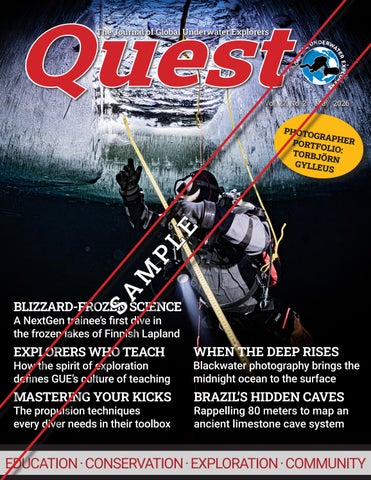
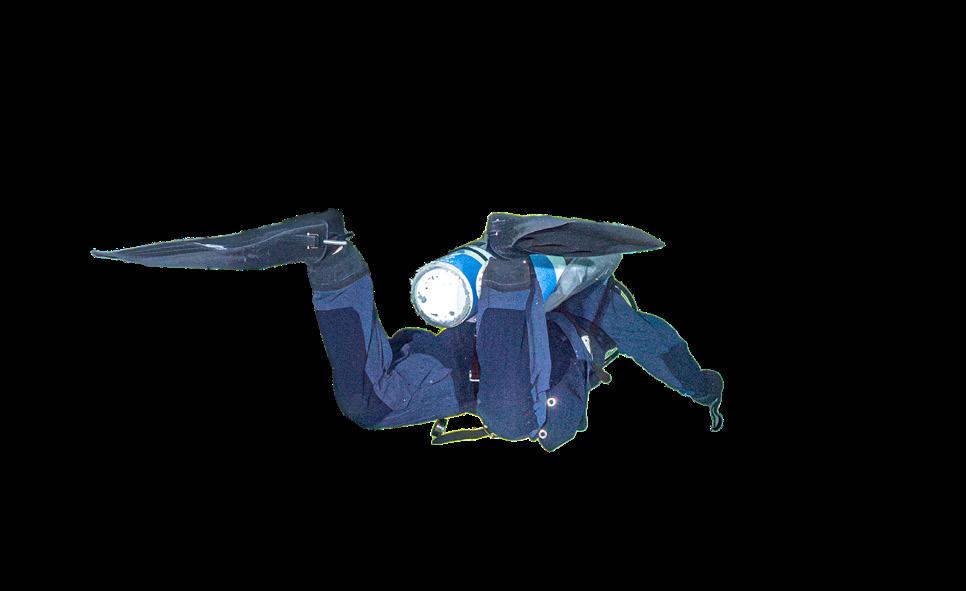
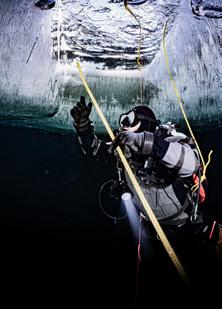
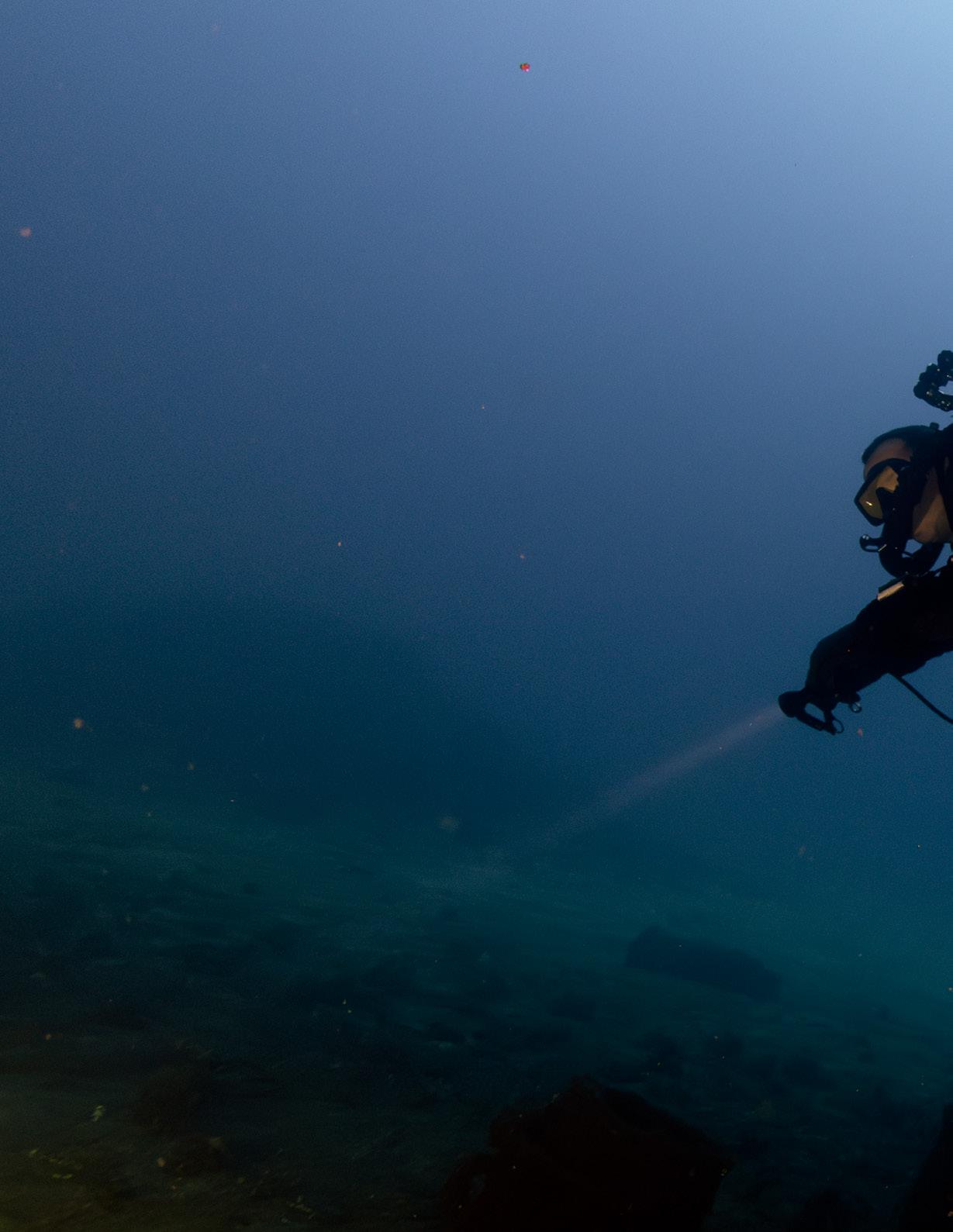
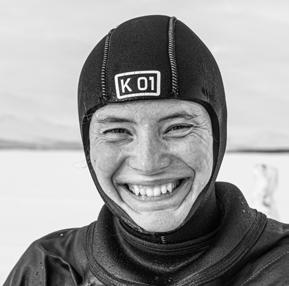
A NextGen trainee’s first dive in the frozen lakes of Finnish Lapland EXPLORERS
WHO TEACH
How the spirit of exploration defines GUE’s culture of teaching
MASTERING YOUR KICKS
The propulsion techniques every diver needs in their toolbox
PHOTOGRAPHER PORTFOLIO: TORBJÖRN GYLLEUS
WHEN THE DEEP RISES
Blackwater photography brings the midnight ocean to the surface
BRAZIL’S HIDDEN CAVES
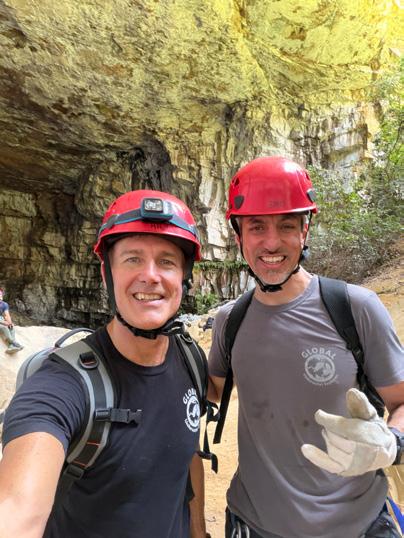
Rappelling 80 meters to map an ancient limestone cave system
EDITOR’S LETTER
EVERY DIVER EXPLORES
There is a version of exploration that most of us recognize immediately. It looks like a diver disappearing into a crack in a cave wall, reel in hand, pushing into darkness that no light has ever touched. It looks like the map that doesn’t exist yet, the passage that has no name, the moment of discovery that belongs entirely to the people who were there.
This issue has some of that. Sergio Schirato and Jarrod Jablonski rappelled 80 meters into a Brazilian sinkhole, hauled their equipment through tight restrictions in December heat, and descended into a fragile, silty cave system to survey passages that had never been properly mapped. The reward was hard-earned and real. (p.28)
But this issue also has Isabell Hentschel, a GUE NextGen trainee who didn’t discover a new cave—she discovered what she was capable of. At -30 °C/-22 °F, with freezing regulators and equipment that refused to cooperate, she found that the most demanding environments have a way of stripping everything back to what matters: the team around you, the limits you didn’t know you had, and the person you become when you push through them. (p.14)
It also has Jialing Cai, GUE’s 2026 NextGen Scholar, who found a way to reach the deep sea without a submersible. She simply waited for night to fall, dropped into the open ocean, and let billions of years of evolutionary behaviour bring the abyss to her. (p.44)
And it has a quieter kind of exploration too—in the propulsion article’s careful examination of how we move through water (p.58), and in Dorota Czerny’s reflection on what
GUE’s tagline “Explorers Who Teach” really means (p.6). Her answer is that exploration is not a qualification or a category. It is a mindset. A willingness to look more closely, go a little further, and remain genuinely curious about what lies beyond what you already know.
That thread runs through every page of this issue. Whether you are pushing a new cave lead, making your first ice dive, or finally mastering your frog kick—you are exploring.
That is what GUE is for.
Dive safe and have fun!
Jesper Kjøller Editor-in-Chief jk@gue.com
Quest
Editor-in-chief
// Jesper Kjøller
Design and layout
// Jesper Kjøller
Copy editing
// Pat Jablonski
// Kady Smith
Writers
// Dorota Czerny
// Isabell Hentschel
// Jialing Cai
// Jarrod Jablonski
// Sergio Rhein Schirato
Photographers
// Kirill Egorov
// Jesper Kjøller
// Jenn Thomson
// Jialing Cai
// Julian Mühlenhaus
// Bori Bennett
// Petr Polach
// Isabell Hentschel
// Pata Degerman
// Steffen Scholz
// Anni Malinen
// Torbjörn Gylleus
// Sergio Rhein Schirato
// Jarrod Jablonski
// Humberto Moran
IN THIS ISSUE
6
HQ CORNER // EXPLORERS WHO TEACH
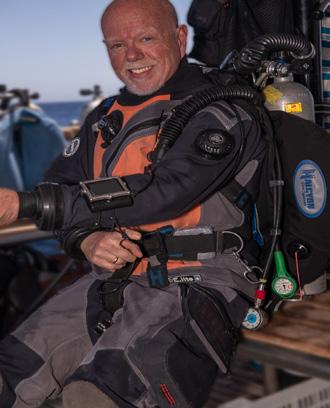
What does it truly mean to be an “Explorer Who Teaches”? Dorota Czerny unpacks GUE’s tagline, revealing three layers of exploration—discovery, guided learning, and the inner journey of self-awareness that shapes every great instructor
14 26 40 46 58
DIVING THE FINNISH ARCTIC
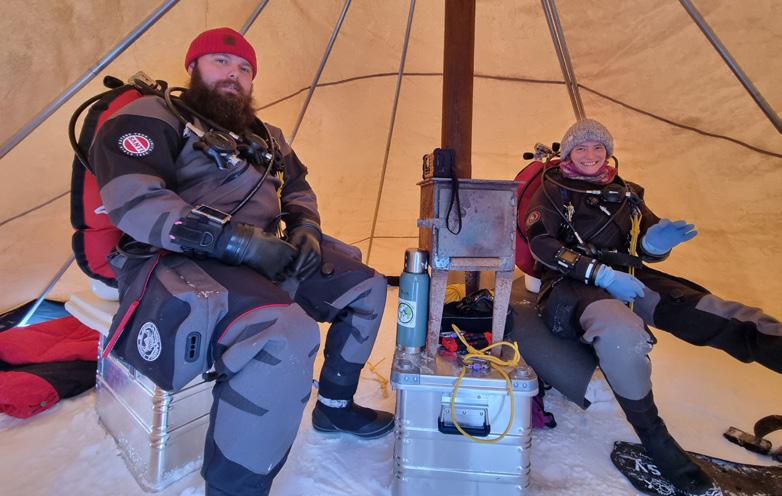
Marine scientist Isabell Hentschel joins GUE’s NextGen program for a nine-day polar diving course in Finnish Lapland—her first-ever ice dive, at -30°C/-22 °F, with freezing regulators and a team growing stronger by the day.
BLACKWATER // WHEN THE DEEP RISES
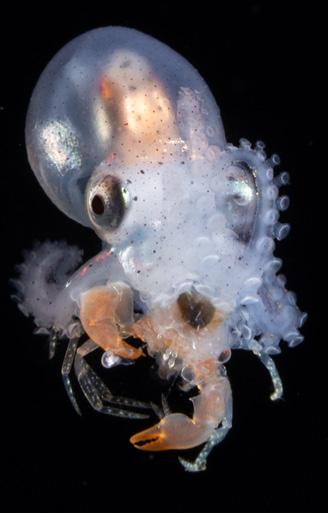
Every night, billions of creatures migrate from the deep sea to the surface. Photographer Jialing Cai dives into the darkness to document this hidden world — and finds the abyss closer than anyone imagined.
PORTFOLIO // TORBJÖRN GYLLEUS
From Baltic wrecks to Mexican cenotes, Swedish photographer Torbjörn Gylleus illuminates the hidden worlds beneath the surface—where artificial light, patience, and precision reveal stories that darkness alone would keep.
EXPLORATION // BRAZIL’S HIDDEN CAVES
Before a single bubble enters the water, the team has already earned it. Sergio Schirato and Jarrod Jablonski rappel 80 meters into Brazil’s Cerrado to survey a remote and fragile underwater cave system.
PROPULSION // KICKS IN YOUR TOOLBOX
From frog to flutter, and back kick to helicopter turn, mastering the right kick for every environment keeps divers efficient, safe, and leaves fragile reefs and silty caves undisturbed.
EXPLORERS WHO TEACH
– Defining our culture
EXPLORERSTEACH
What does it truly mean to be an "Explorer Who Teaches"? In this month’s QC Corner, Dorota Czerny deconstructs GUE’s evocative tagline, moving beyond the literal image of pushing unexplored cave leads. She explores the three essential layers of exploration: the pure discovery of the unknown, the guided outward journey of a student mastering new skills, and the critical inner exploration of one’s own limits and assumptions. By redefining exploration as a mindset of curiosity and humility, this article reveals how every GUE instructor—and student—carries the legacy of those who first ventured into the dark.
TEXT DOROTA CZERNY
PHOTOS PETR POLACH, JESPER KJØLLER & BORI BENNETT
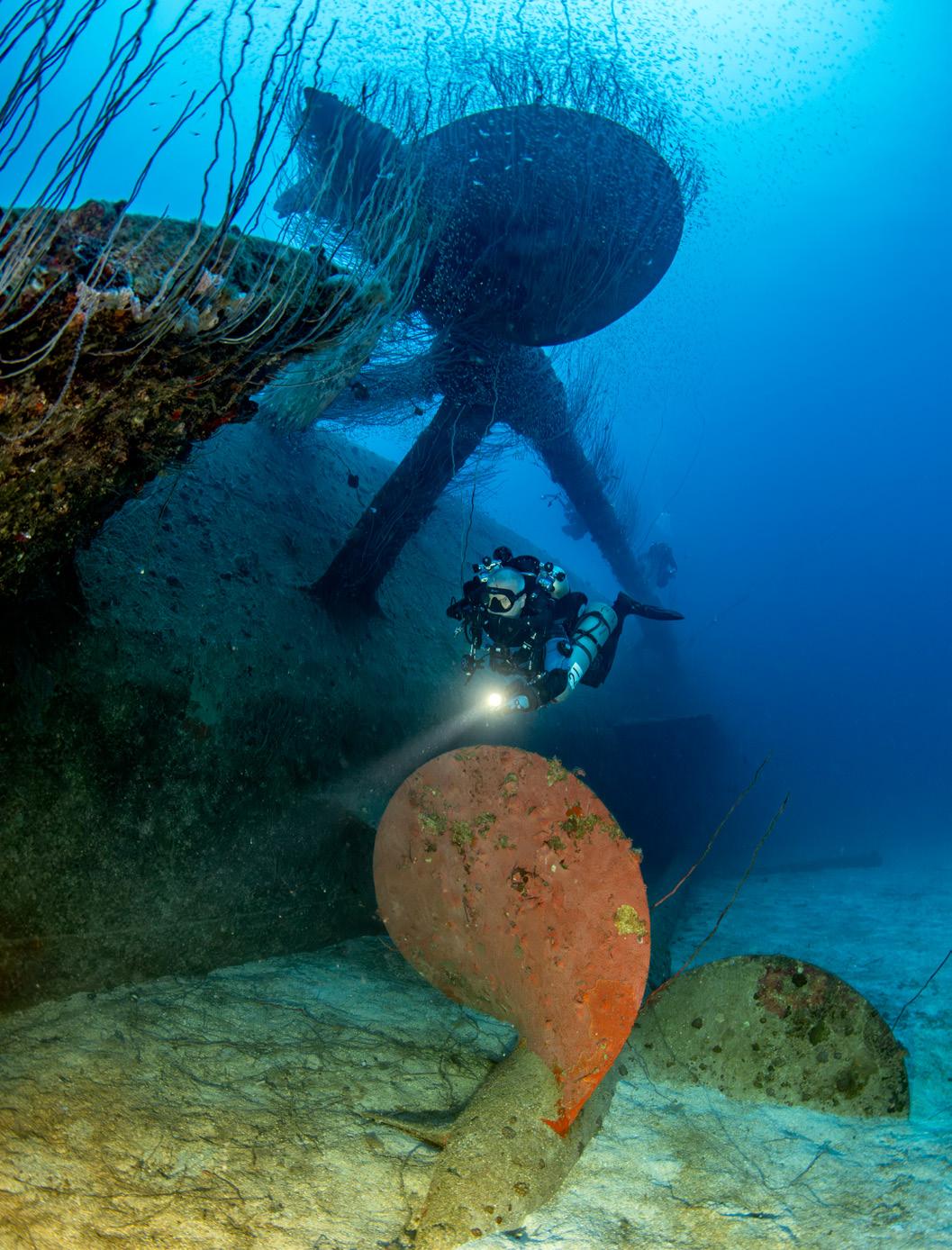
Beyond the rusted steel lies the profound question of what is possible when we look closer and venture further into the unknown.
PHOTO JESPER KJØLLER
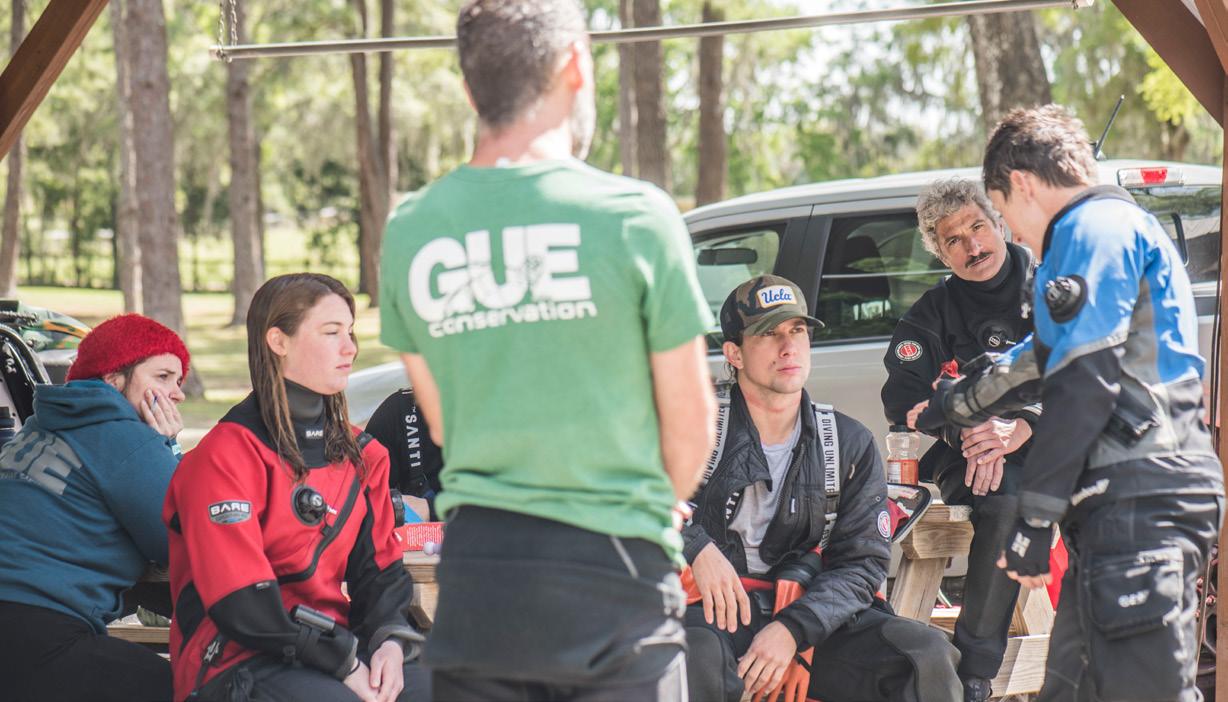
“The organization was shaped by people who represent the purest form of exploration: individuals willing to go farther, prepare longer, question more deeply, and venture into places that were unknown, demanding, and often unforgiving.
GUE was founded by explorers, and that matters. The organization was shaped by people who represent the purest form of exploration: individuals willing to go farther, prepare longer, question more deeply, and venture into places that were unknown, demanding, and often unforgiving. Their work did not simply expand maps or reveal new passages; it built a culture. It established a way of thinking, a standard of preparation, and a belief that exploration is not only about discovering what lies beyond the next corner, but also about developing the discipline, judgment, and character required to go there responsibly. Whether or not each of us becomes an explorer in that most literal sense, we all learn from that legacy and share the responsibility to carry forward what they began. That, in many ways, is what GUE represents.
When we introduced the tagline “Explorers Who Teach,” it sparked a range of reactions. Some people smiled, some laughed, and some immediately questioned whether we should use it at all. After all, not everybody in GUE is an explorer in the literal sense of the word. Not every instructor is actively discovering new caves, surveying unknown systems, or pushing into places no one has seen before. We also have outstanding educators who are not explorers in that literal way, just as we have explorers who are not educators.
Beyond the label
So the question is fair and worth addressing: what do we really mean by “Explorers Who Teach”? For me, this phrase is not about labels, status, or trying to make every instructor fit a heroic image. It is not meant to suggest that every educator in GUE must be engaged in frontier exploration, nor that an instructor’s value can be measured by whether they have discovered something new. Rather, it speaks to a mindset, a culture, and a responsibility. It reflects the belief that teaching in GUE should be informed by the spirit of exploration, because exploration sits at the heart of who we are, how we grow, and what we ultimately hope to inspire in others. At its core, exploration begins with curiosity. Not necessarily curiosity about a cave no one has entered before, or a wreck no one has surveyed, but curiosity in its broader form: What is possible? What lies beyond what I already know? What happens if I look more closely, go a little farther, or ask a better question? That curiosity can take different forms, and when I think about the meaning of “Explorers Who Teach,” I see at least three layers of exploration within it.
Layer 1: Pure exploration
The first layer is the most visible and perhaps the most admired, because it is the purest form of exploration in the literal sense. These are the divers who go where nobody has gone before, who find new cave passages, place new line,
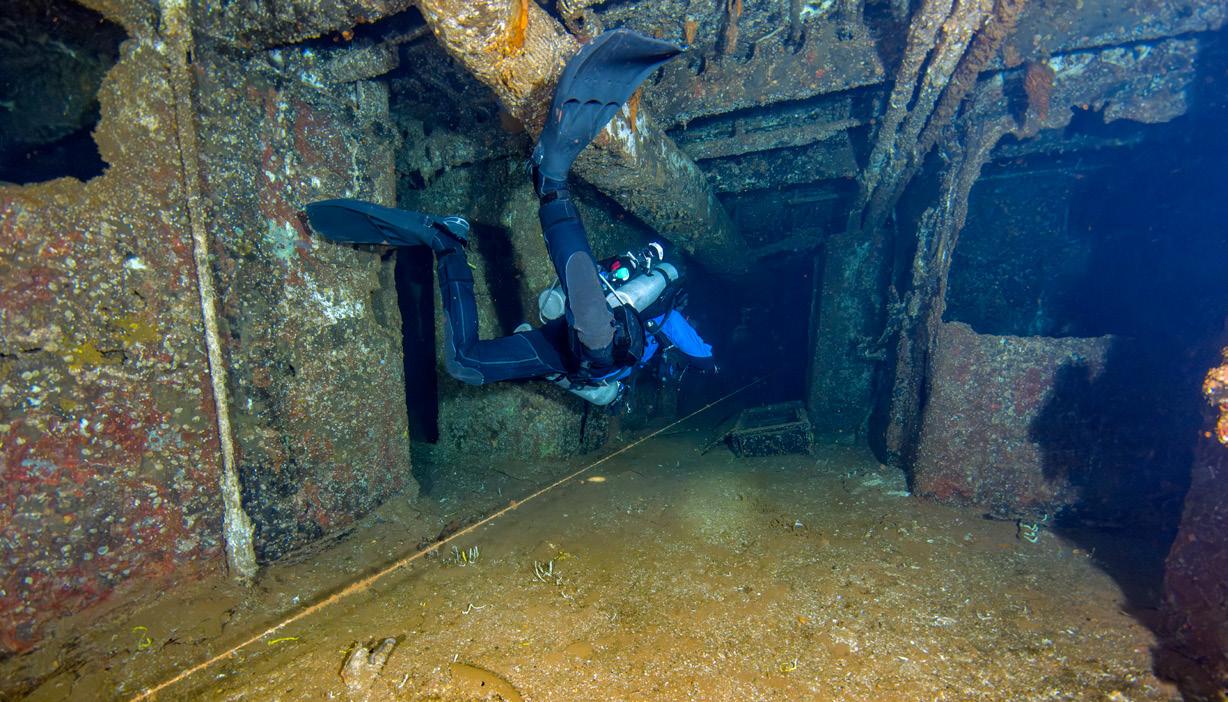
Even on a famous wreck, a student encountering it for the first time still experiences the profound act of personal discovery.
survey unknown wrecks, and willingly step into uncertainty in pursuit of discovery. They organize resources, invest time, travel long distances, prepare relentlessly, and accept that the process will include discomfort, setbacks, and real risk. They do it because they carry that inner pull toward the unknown, that deeply human urge to ask what lies behind the next restriction, beyond the next corner, and what that unidentified mark on a nautical map might be.
What many people see is the result: the stunning image, the new map, the discovered line, the beautiful end product of success. What they do not always see is everything that came before it—the planning, the repetition, the dead ends, the restraint, the uncertainty, and the many moments in which nothing remarkable was found at all. True exploration requires more than courage. It requires humility, because sometimes you go, and there is nothing there. Sometimes you try, and you fail. Sometimes the lesson is not triumph, but patience. This path is not for everybody, and that is entirely ok, because
it calls for a very specific mix of mindset, tolerance for uncertainty, discomfort, acceptance of risk, discipline, and character.
Layer 2: Guided outward exploration
The second layer of exploration is broader, and in many ways more relevant to the work of an instructor. Not everyone will become a literal explorer, but every diver can be invited to move beyond what is currently familiar, comfortable, and known. In that sense, exploration is not only about whether a place is undiscovered; it is also about whether it is new for the individual standing in front of it.
This matters enormously because education is not simply the transfer of knowledge and procedures. Good teaching awakens a willingness to step into something not yet mastered. It creates the conditions in which curiosity can grow into competence, and competence can grow into confidence. An instructor, in this sense, becomes someone who guides exploration rather than merely delivering information. They
PHOTO JESPER KJØLLER
Instructors guide exploration beyond information, opening doors to new perspectives and helping students discover their true potential.
open the door to a new environment, a different perspective, a more demanding task, or a more refined way of thinking. They help students look more, notice more, and test what they are capable of becoming.
This kind of exploration is outward-facing, but it is also personal. It asks a diver to say, I have not done this before, but I am willing to learn; I am willing to be challenged; I am willing to leave the comfort of what I already know. That willingness is deeply aligned with the values we should want to nurture across the organization.
Layer 3: Inner exploration
The third layer is less visible than the first two, but perhaps even more significant in the long term, because it is the exploration that happens within. This is the exploration of one’s habits, assumptions, fears, blind spots, limitations, and possibilities. It is the willingness to ask difficult but necessary questions: Where do I stop myself? What can I improve? How do I respond under pressure? What do I avoid? What kind
of diver, teammate, and educator do I want to become?
This inner dimension of exploration is where growth becomes deeply human rather than merely technical. It requires self-awareness, honesty, and the courage to examine mistakes without becoming defensive. It asks for reflection, adjustment, and the humility to admit that even strong performance does not mean the journey is complete. In many ways, this is what makes the other layers sustainable, because without inner exploration, outward exploration can easily become ego-driven, and technical development can become shallow. To keep growing, we must remain curious not only about the world around us, but also about ourselves.
Exploration and mastery
This is also why the idea of “Explorers Who Teach” connects so naturally to mastery. Mastery is not a fixed state, and it is certainly not a checklist completed once and then left behind. It is a continual process of refinement, reflec-
PHOTO BORI BENNETT
tion, adjustment, and growth. In that sense, mastery is itself an exploratory path, because it requires us to keep asking more of ourselves, to keep noticing what can be improved, and to keep moving beyond the limits of what is merely adequate.
When viewed through that lens, the progression through the curriculum becomes more than a sequence of certifications; it becomes a structured invitation to explore. At the very beginning, a diver is already exploring simply by entering scuba diving at all. An Open Water course is an introduction to a completely new environment, a new set of demands, a new relationship with one’s own body and mind, and a new way of experiencing the world. That first step is already an act of curiosity.
Fundamentals training deepens that process by asking for humility and refinement. It challenges the diver not only to perform, but to examine, to adjust, and to accept that improvement is always possible. The next stages continue this trajectory.
At Level 1, exploration remains guided, but the demands grow. The diver is introduced to a different environment and a different kind of responsibility, and the instructor’s task is not merely to supervise, but to help the student see more than they would see alone. Good instruction at this stage does not simply protect students from difficulty; it introduces them to challenges in a way that invites maturity.
By Level 2, the nature of exploration shifts again. At that point, a diver should already have solid foundational skills, knowledge, and discipline, and the task is no longer only about executing procedures correctly. It becomes about thinking, adapting, responding to the unpredictable, and learning how to operate when not everything unfolds according to plan. This is where the instructor’s role must also evolve. Teaching at higher levels cannot only be about showing what right looks like in clean, controlled conditions. It must also involve mentoring judgment, sharing context, discussing consequences, and helping divers understand the complexity that comes with real-world uncertainty.
The power of experience
That is why experience matters so deeply in advanced instruction. It is not because every instructor must have made major discoveries of their own, but because higher-level teaching requires lived understanding. It requires exposure to complexity, to near misses, to imperfect decisions, to moments where things were not obvious, and to the kind of ambiguity that cannot be fully taught from theory alone. At that level, an instructor should not be holding a student’s hand; they should be mentoring, challenging, and nudging the diver toward increasing independence.
So what does “Explorers Who Teach” mean? It means that, as an organization, we should value educators who do more than deliver content, because teaching in GUE is not simply about transmitting knowledge and skills, but about shaping the mindset, judgment, and character that allow those skills to matter. It means we want our instructors to cultivate curiosity, resilience, humility, and growth, and to understand that diving is not only about doing things correctly but also about learning to think, adapt, reflect, and continue evolving. It means that we recognize exploration as something broader than first discoveries alone.
So no, not everybody in GUE is an explorer in the literal sense. But the spirit of exploration should still run through the entire organization, because without curiosity there is no growth, without growth there is no mastery, and without educators who can spark that process in others, there is no lasting culture of development.
“Explorers Who Teach” is therefore not about claiming that every instructor stands at the edge of the map; it is about affirming that we want to build divers and educators who are willing to move toward the unknown, whether that unknown is found in a cave, on a wreck, in the classroom, in a difficult decision, or within themselves. That is the kind of teaching that carries our legacy forward, and that is why the phrase matters.
True growth is more than technical; it’s a humble, selfaware journey where inner curiosity makes outward success both meaningful and sustainable.
“At that level, an instructor should not be holding a student’s hand; they should be mentoring, challenging, and nudging the diver toward increasing independence.
Dorota Czerny
Dorota Czerny is a highly experienced diver who fell in love with the ocean in 1996. She transitioned from teaching at a university to teaching scuba diving due to her passion for the sport. As Vice President of Global Underwater Explorers, she is highly skilled in technical, cave, and rebreather diving, and is dedicated to developing the organization’s
educational component. Her focus is on creating a new generation of explorers and young scientists with GUE’s NextGen Scholarship program. Dorota’s dedication to diving education extends beyond her work with GUE as she actively explores caves and wrecks around the world.
TEXT ISABELL HENTSCHEL
PHOTOS PATA DEGERMAN, JENN THOMSON, STEFFEN
SCHOLZ & ANNI MALINEN
BLIZZARD-FROZEN
BLIZZARD-FROZEN
SCIENTIFIC
PHOTO
Isabell Hentschel is a marine scientist specialising in greenhouse gas cycling in diverse marine systems, including the Arctic, and is one of GUE's 2026 NextGen Legacy Program (NGLP) Trainees. Her traineeship brought her to the Polar Scientific Diving course run by the Finnish Scientific Diving Academy—hands-on experience in an environment she had studied in school, and her first-ever scuba dive under the ice. The NGLP is GUE's initiative for developing future leaders in exploration and diving, with the NextGen Scholarship providing training-focused grants and accelerated support for aspiring explorers. Read on to find out more about her experience.
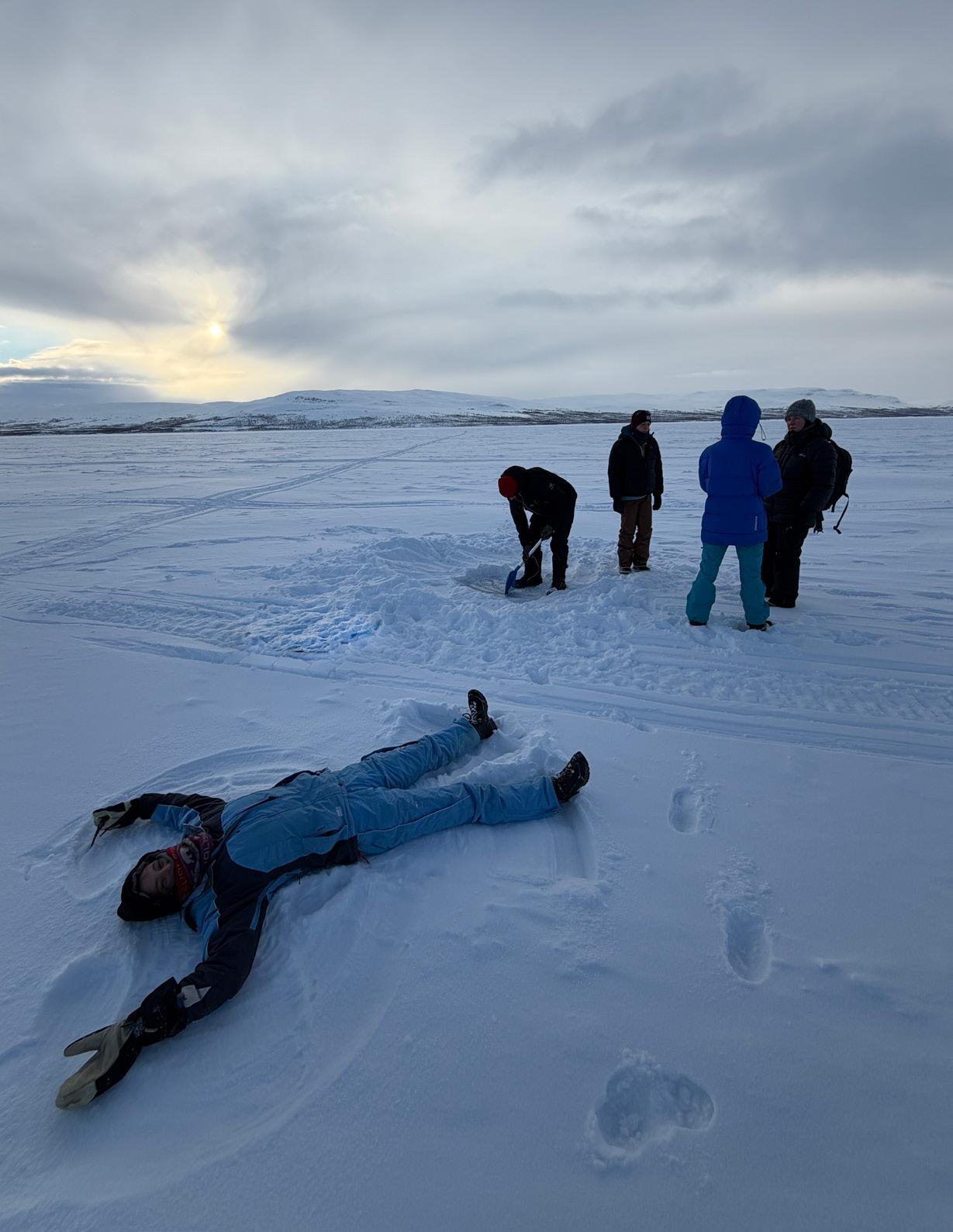
While the team actually prepares for the dive, one of us has clearly identified a more urgent task– making a snow angel.
PHOTO JENN THOMSON,
“
What mattered was to find a solution as a team and to grow together through the process even though we were a very diverse group with different diving experiences and scientific backgrounds.
I’m used to cold-water diving. I learned scuba diving in Germany’s lakes and ponds during my early adolescence and was later introduced to twinset tanks and technical diving during a year abroad at a diving center in Norway. After returning to Germany, I began specializing in marine science and combined my passion for diving and research through scientific diver training. I’m currently based in Kiel, studying greenhouse gases in various marine systems and supporting diving projects ranging from ocean alkalinity enhancement to archaeology.
Having already experienced the harsh Arctic environment the previous year while on Svalbard, Norway, during an ecology and toxicology course abroad, I thought I had a solid understanding of conducting scientific work in extreme conditions. But the nine-day Polar Scientific Diving course at the Biological Station in Kilpisjärvi, northern Finland, run by the Finnish Scientific Diving Academy, was a completely different story. I was able to join thanks to GUE’s NextGen Traineeship.
Building the team
Before the course even began, we were introduced to human factors in diving and “just culture”: individuals are not blamed for decisions or mistakes made within the limits of their experience, while willful violations are not tolerated. Over the program, it became clear how essential this mindset is for the team. In stressful and demanding environments, mistakes are inevita-
ble. What mattered was to find a solution as a team and to grow together through the process even though we were a very diverse group with different diving experiences and scientific backgrounds.
The first three days focused on preparation. Our instructors—Edd Stockdale, Erik Wurz, and Pata Degerman—walked us through everything we needed to know about operating in polar conditions: safety procedures, cold-water rigging, communication with base, the proper clothing (at least three layers, inner layer always wool), setting up camp (different options, but food tent at the end in case of a polar bear attack), hydration (at least 3 liters/0.8 gal per day!), drilling and sawing ice holes (by hand), how to operate the snowmobile, tendering lines and what to do in case of a free flow—which was our constant companion during the first dives.
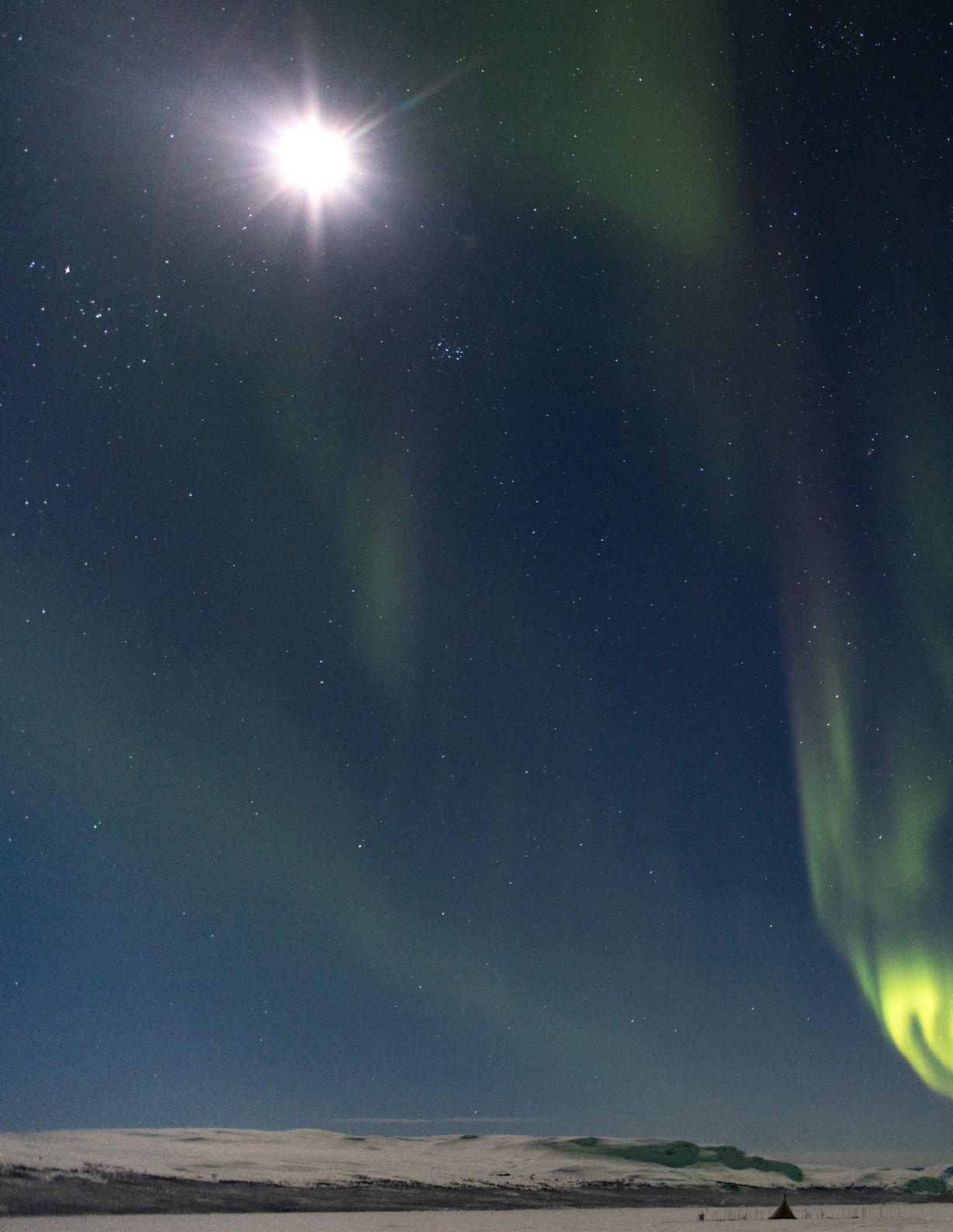
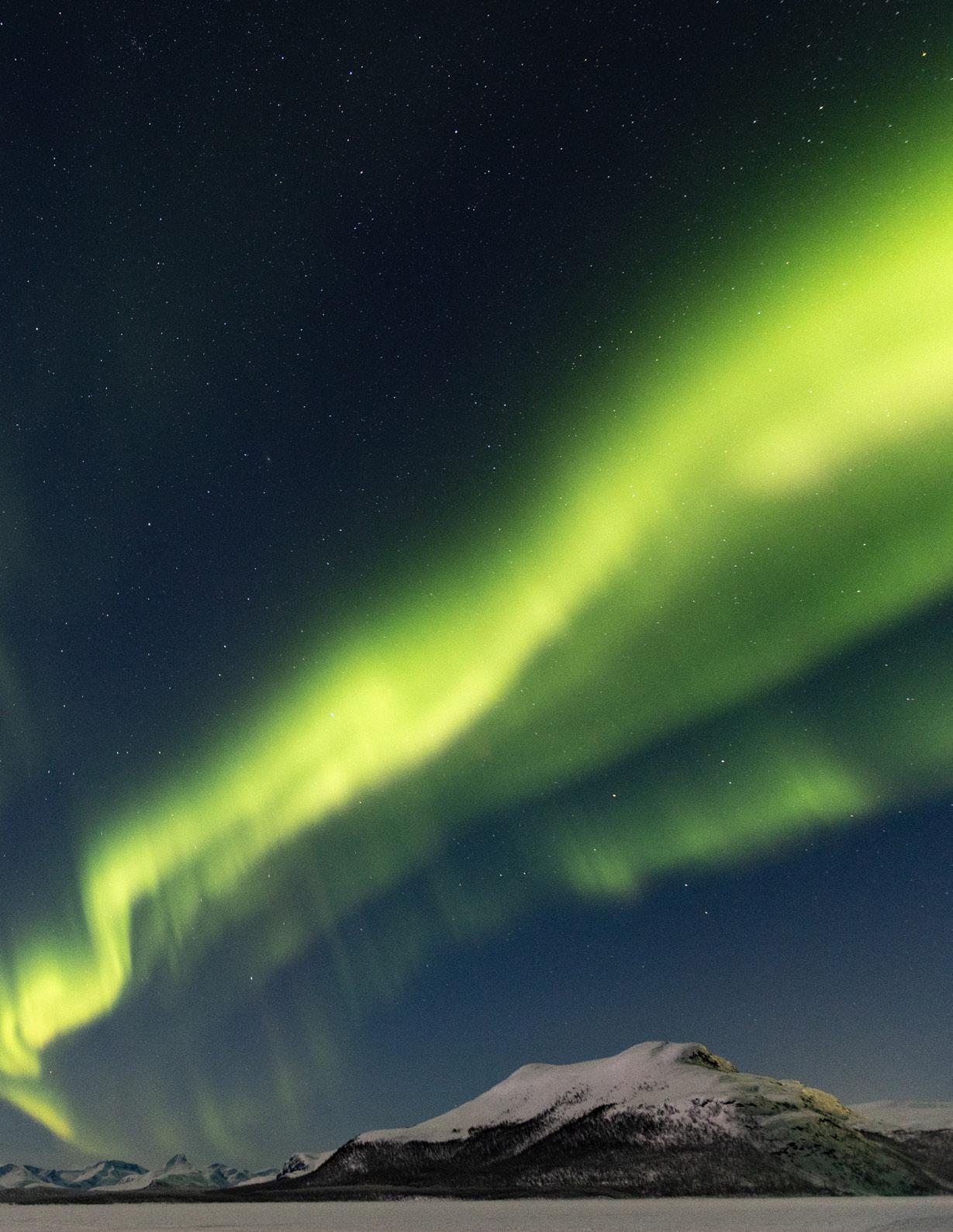
In addition to very long days at the station, we had super strong northern lights over Lake Kilpisjärvi, and I could not help but go skiing with rented equipment from the station while enjoying the breathtaking dancing colors.
Into the hole
Finally on day four we conducted our first check dive. The team was organized into clearly defined roles: supervisor, safety diver, tenders, and divers—with positions rotating between sessions. But with air temperatures around -30 °C/ -22 °F came some logistical problems: in each round, the non-divers had to defrost the holes and prep them with a safety line, stage cylinder,
and tender lines. The diving gear was brought down at the last possible moment with closed but pressurized tanks and, last but not least, the divers.
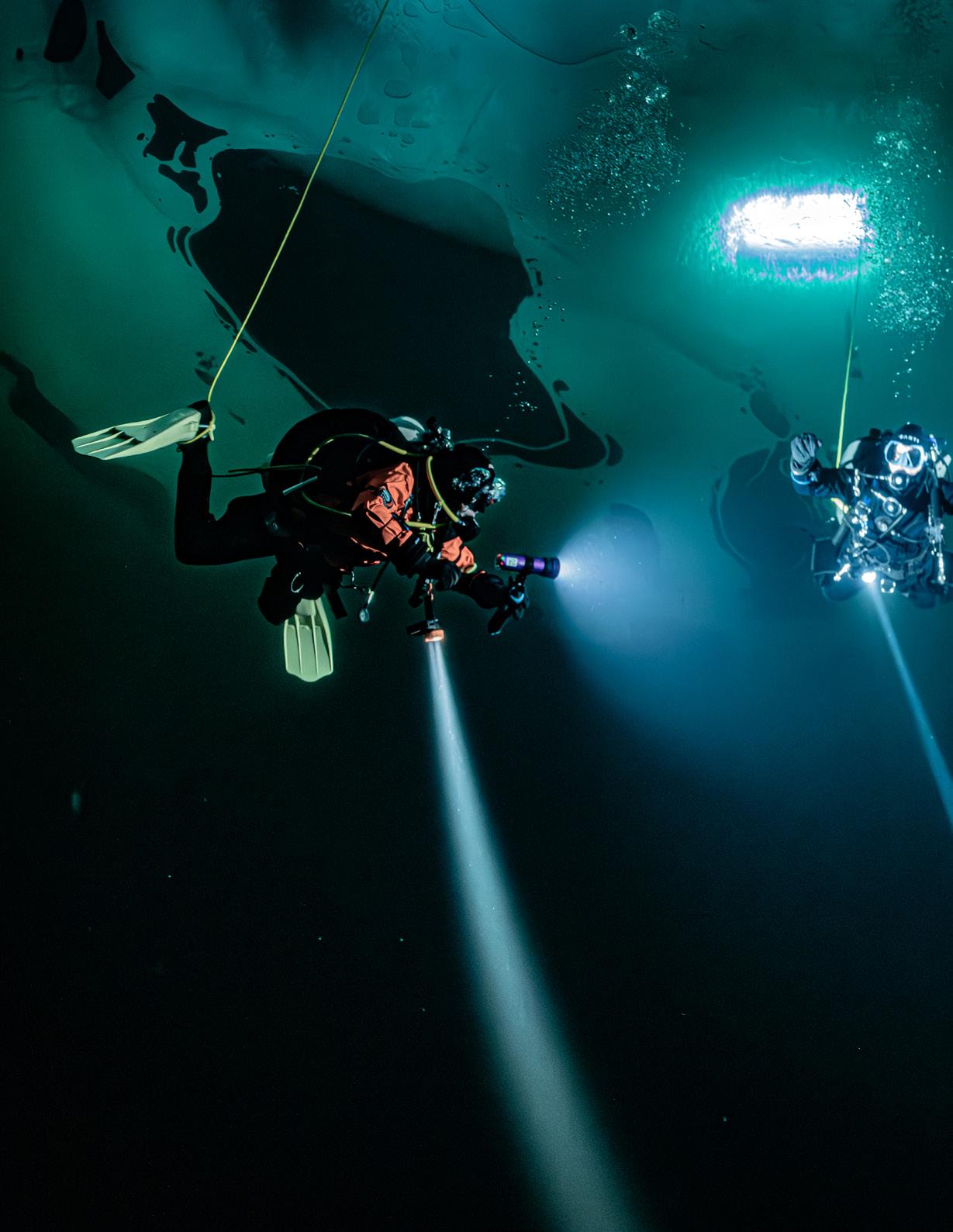
It felt almost surreal to sit in the middle of a pristine white landscape and stare down at a small black hole surrounded by 1 m/3.3 ft thick ice that you are willingly jumping into after the final check. Never breathing through the regulators at the surface was a non-negotiable. Especially piston regulators, as they were free-flowing just by opening the valves. Furthermore, the inflator froze as well, making it impossible to operate the air inlet or outlet.
When everything freezes
The first dive, I struggled with a frozen inflator, then free-flowing primary regulator, and finally a leak in my drysuit slowly flooded my undergarment. We tried our best to defrost equipment at the surface with hot water while divers patiently waited in the hole with submerged regulators. However, during the first check dive only one
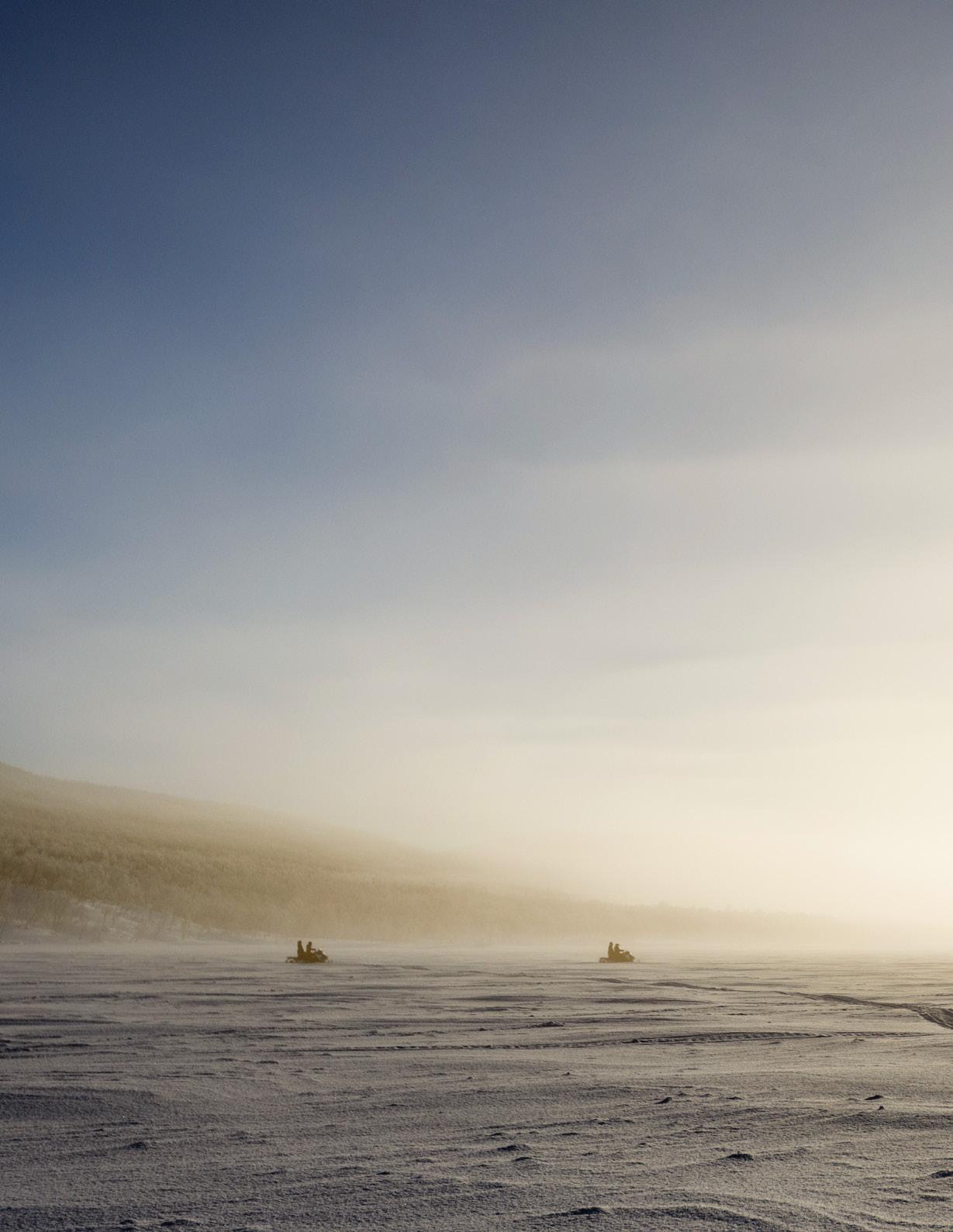
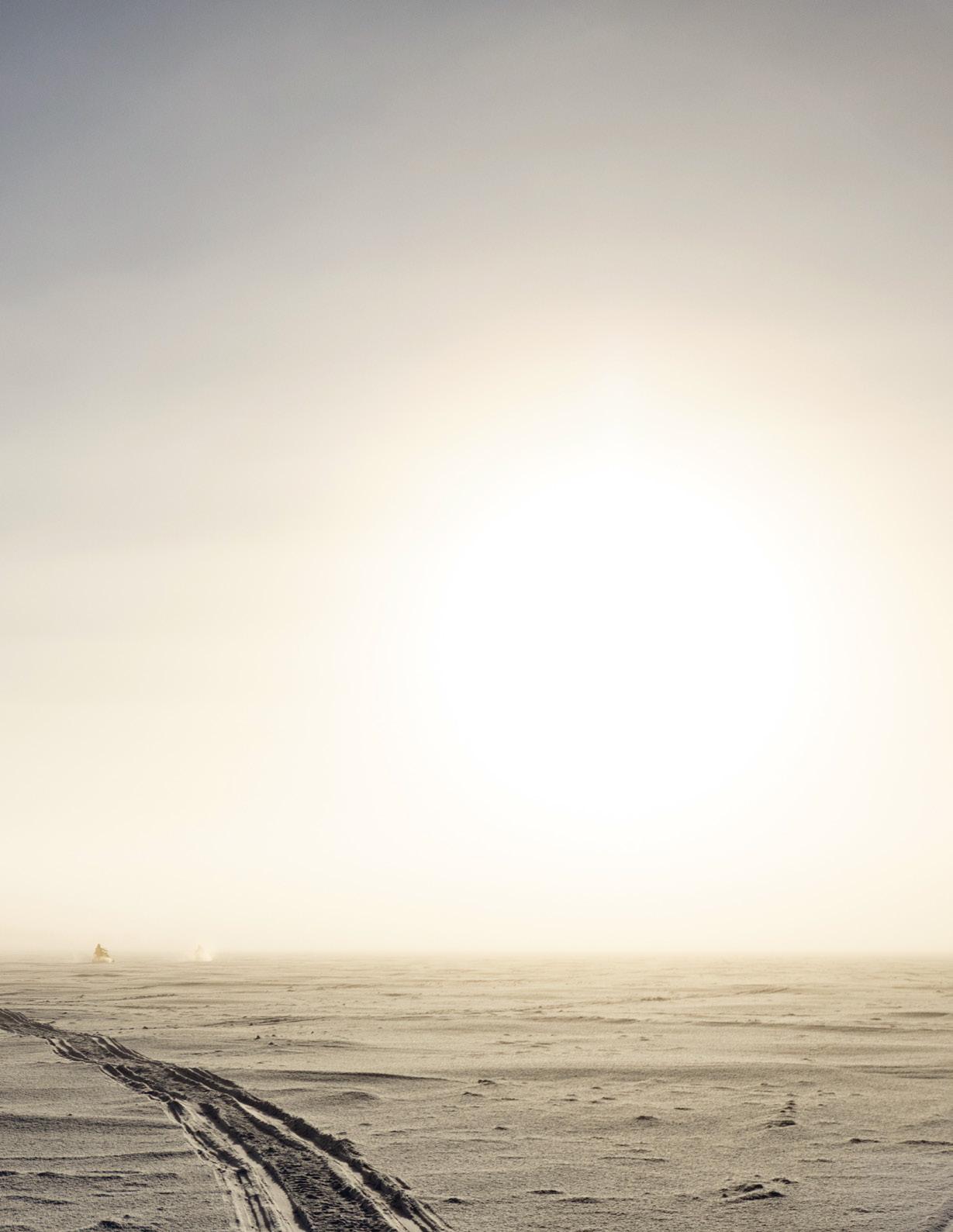
Snowmobiles proved essential for navigating the vast frozen terrain, keeping our transportation and logistics running smoothly.
person out of 11 managed a proper dive. Luckily, we improved our performance over the duration of the course.
It seemed to me that the greatest challenge was to get underwater at the start of the dive so that the equipment could actually thaw in the water. As a result, I deflated my wing completely, exhaled until I was underneath the ice and just kept holding on to the safety line while slowly breathing through my primary.
If that one froze, I changed to the secondary regulator, closed the right valve, and just waited and hoped that my secondary would not freeze as well. Other divers had the uncomfortable experience of finding that valve manipulation is very hard if there is no air in your drysuit (left valve was closed).
If the first stage free-flows, one interesting side effect is that the wing also gets inflated next to the gas coming out of the second stage. In my experience, if only the second stage freezes, you still have plenty of time to close the valve if you stop breathing through the system. For example, the crystals blocking the piston
in the second stage are only forming if the gas stream increases gradually.
However, if the first stage freezes over, or if the inlet inflator button is stuck open, controlling your buoyancy is very hard because your wing inflates uncontrollably and time is limited before you hit the surface—or in our case, a solid ice ceiling.
Another interesting aspect of working in -30 °C/-22 °F air temperature appeared after the dive. Completely soaked divers have to be fast in removing all their gear while being seated; otherwise the equipment a) freezes solid onto your body, or b) you freeze solid onto the ground. Then the divers were transferred to a sledge and towed up with a snowmobile to the station for defrosting.
Luckily temperatures rose up to a cozy -8 °C/18 °F in the second half of the course, and with that the number of problems decreased drastically. In Antarctica they cover the ice holes with tents and install a heating system to keep air temperatures moderate.
Science and saunas
In total we had five diving days. After getting our heads underwater, we conducted scientific tasks such as sediment core sampling, analyzing the sediment thickness with a transect, and collecting ice samples from underwater. As the days passed by, we grew more comfortable as a team and in our daily routines, and everything started to click.
Since we were a very diverse group with some who never dived with twinset cylinders before, I really learned to appreciate standardized diving equipment. It facilitated the pre-dive preparation and improved work efficiency and emergency handling significantly.
Being exposed to this harsh and unforgiving climate, in addition to cold-water diving and functioning as an effective team, was both physically and mentally exhausting. I was consuming nearly three times my normal daily calories, and the delicious food at the station next to pleasant sauna evenings in the warmth definitely helped keep our spirits up!
“
Since we were a very diverse group with some
who never dived with twinset cylinders before,
I
really learned to appreciate standardized diving equipment. It facilitated the predive preparation and improved work efficiency and emergency handling significantly.
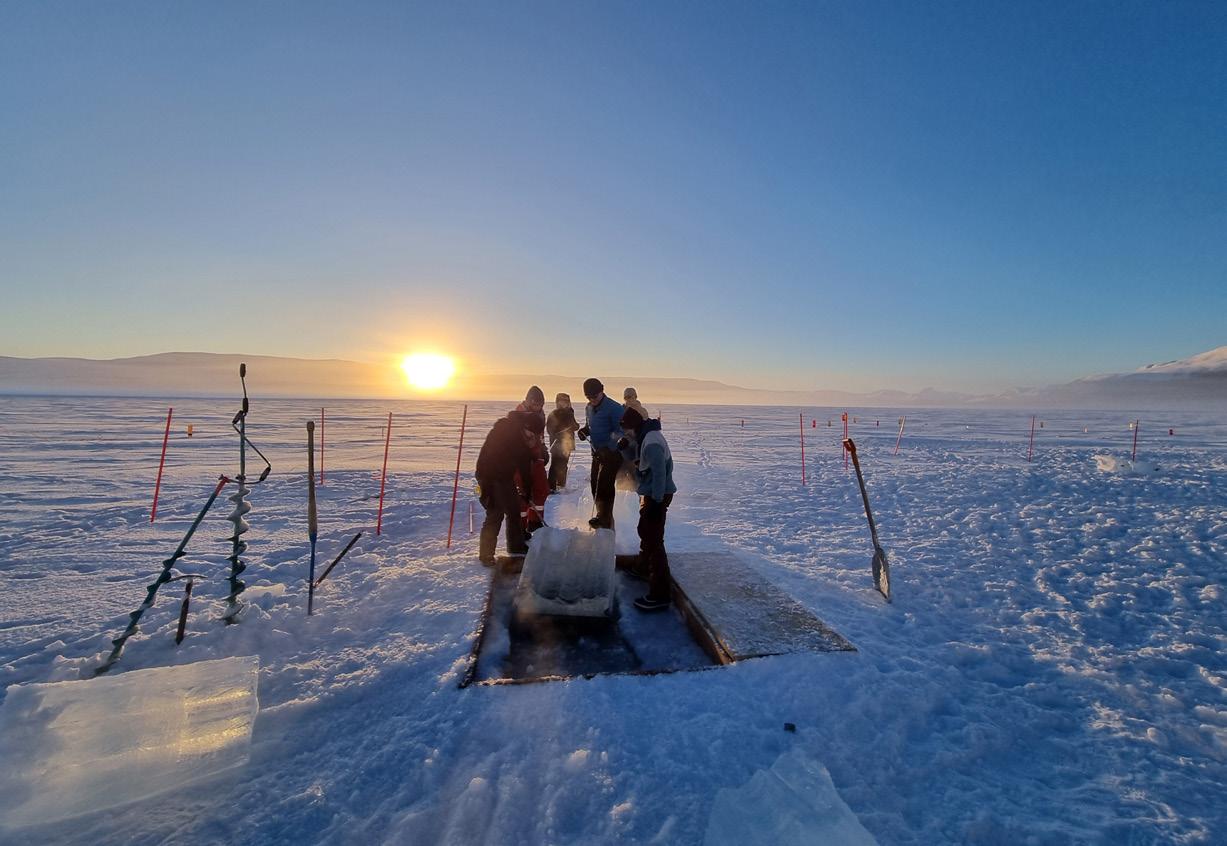
Golden Arctic light sets the scene as the team works the ice hole with the vast frozen landscape behind.
Furthermore, our evenings were enriched by presentations of the instructors’ passion projects. Erik captivated us with his cold-water sponge research in Antarctica, where 2 m/6.6 ft leopard seals could surface in your diving hole out of convenience and curiosity. There, surface temperatures were less of a problem due to the use of a tent, but the water in Antarctica is even colder, below 0 °C/32 °F, and the ice sheet can be up to 3 m/9.8 ft thick.
Lessons from the ice
Edd introduced us to his various cave and mine explorations in Finland at depths below 100 m/328 ft, as well as the mind-blowing sensation of finding new passages, installing a deco habitat, and deciding which movies not to watch while sitting through six hours of decompression.
Pata hooked us with stories about his diving and expedition guiding in the polar regions, includ-
ing a plane crash in Antarctica and throwing salami as a distraction for polar bears in Greenland.
It was a truly enriching experience to be surrounded by so many inspiring personalities, including all of the participants. We had all worked on different projects in the past and experienced challenges with international operations and team members, and it was amazing how strong we grew together in less than two weeks.
I also learned that the most important people on the team and for the whole operation are not necessarily the ones that are exceptional at hard skills, but those that care deeply for other individuals. This was probably the most valuable lesson of the course. In such extreme conditions, there is no point in hiding who you are or trying to be somebody different. So the best way to approach an expedition (and life) is to stay true to yourself, acknowledge your own limits and mistakes, and keep an eye on each individual’s needs.
PHOTOANNI MALINEN
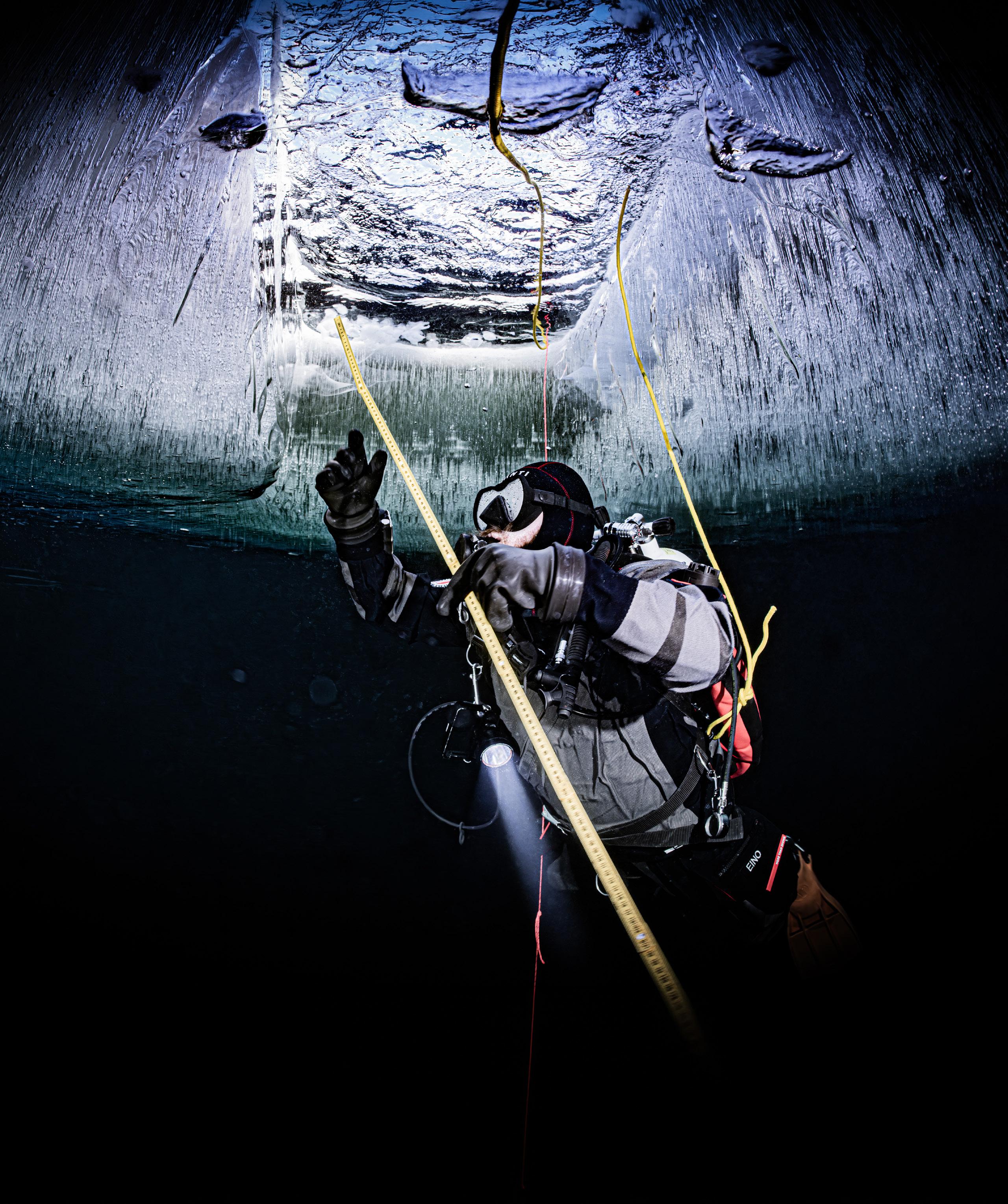
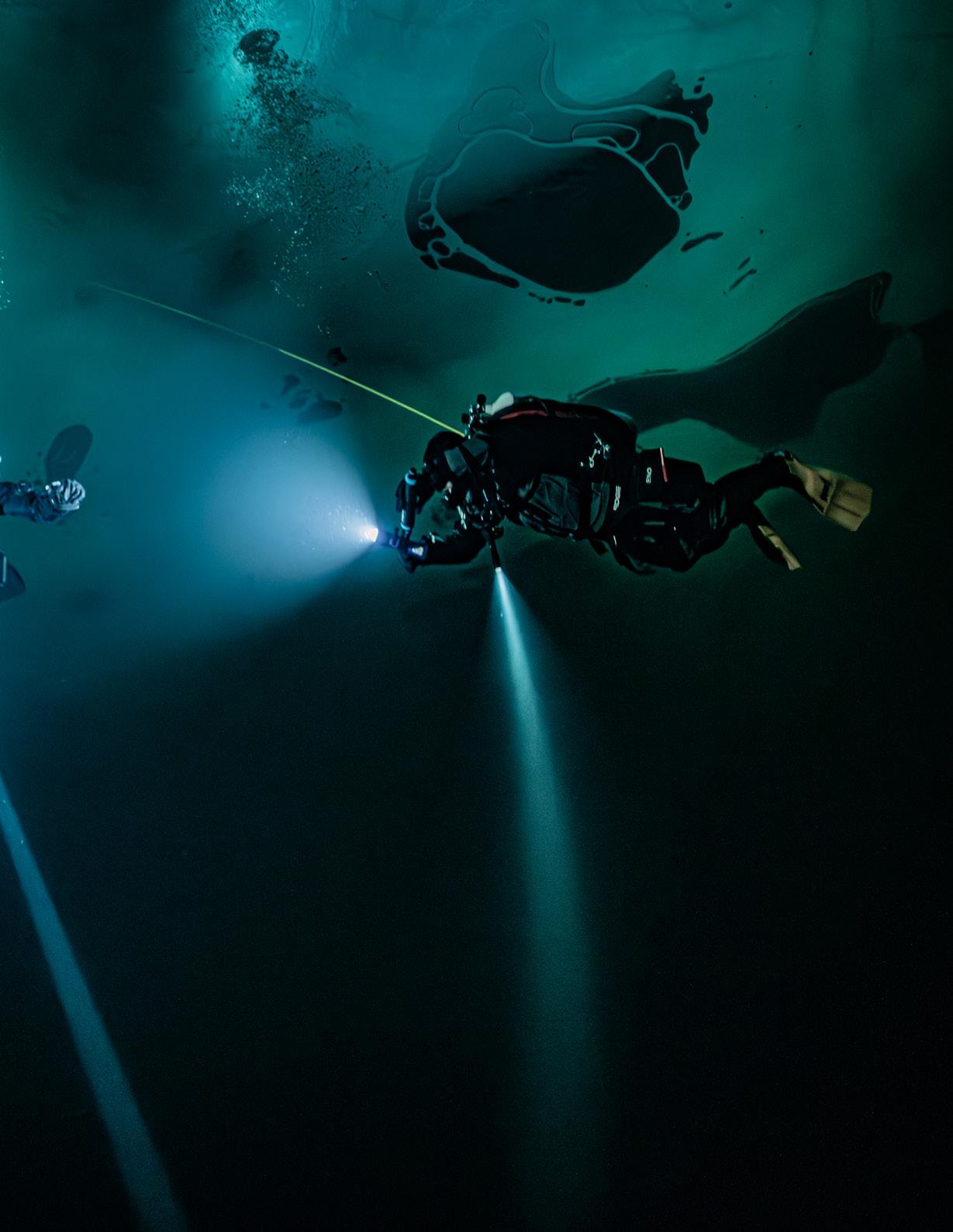
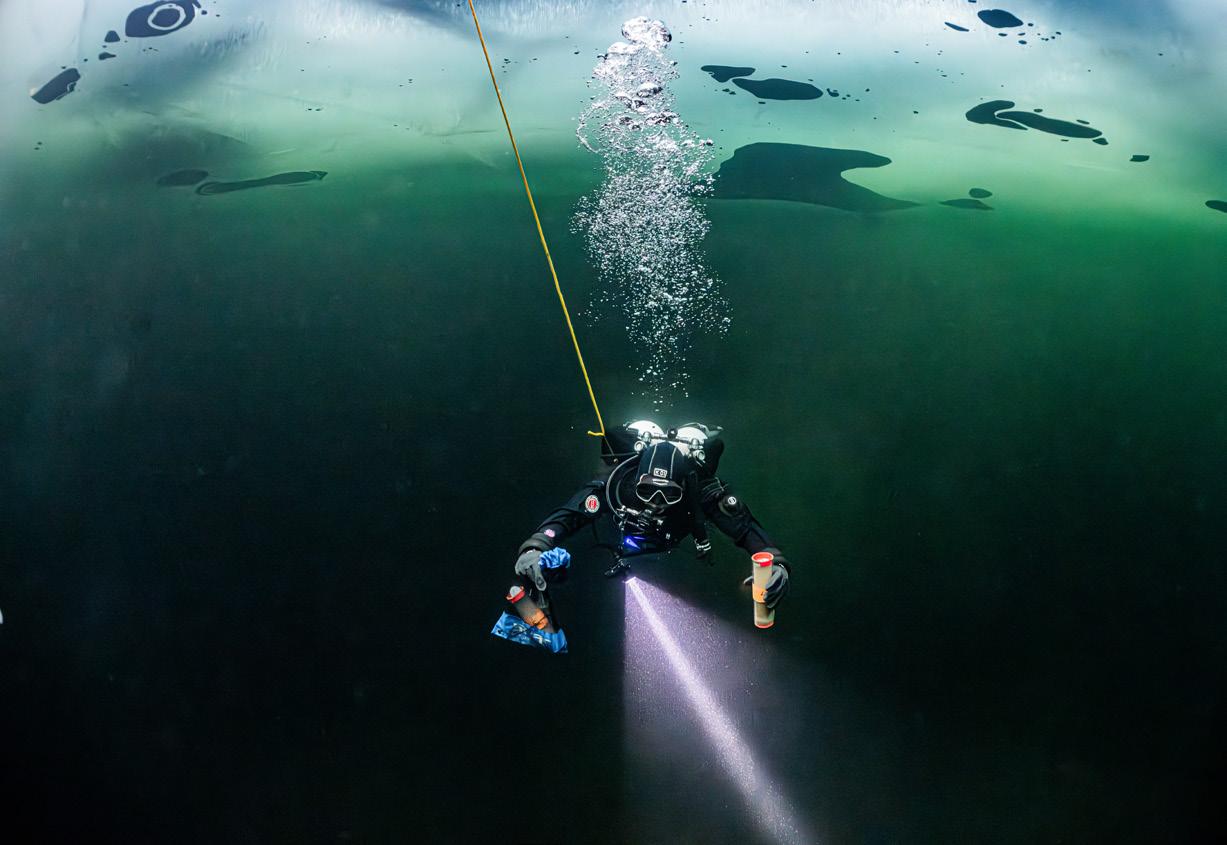
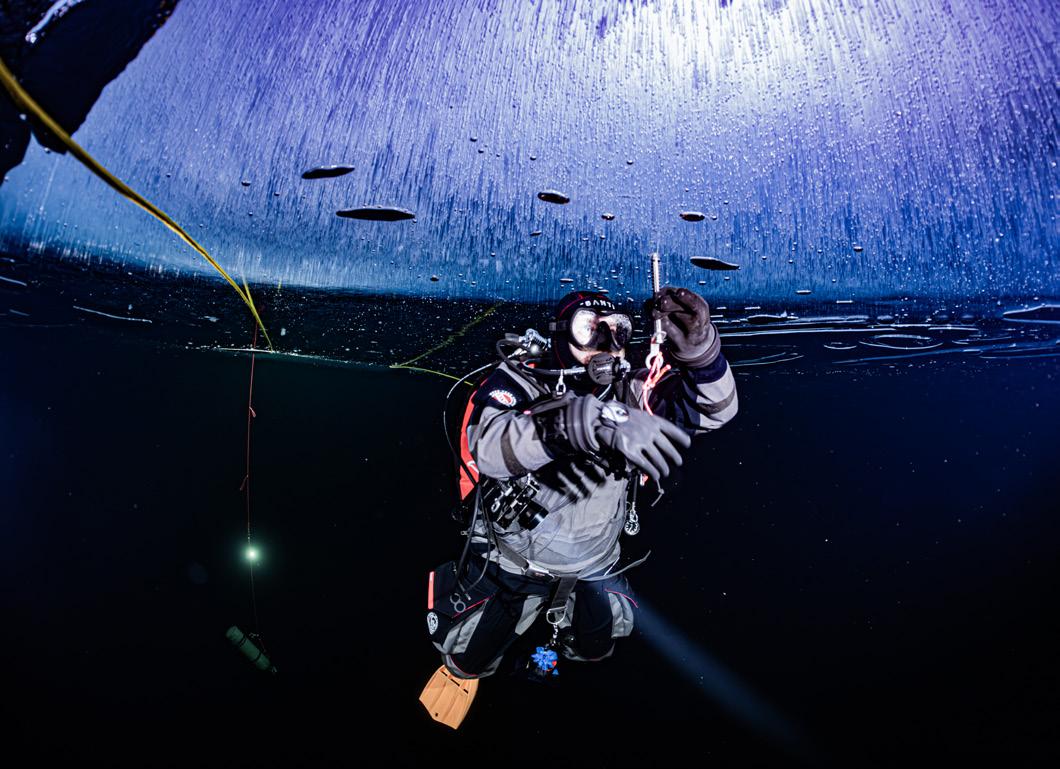
Descending into the eerie green abyss, torch cutting through the darkness – this is what we came for.
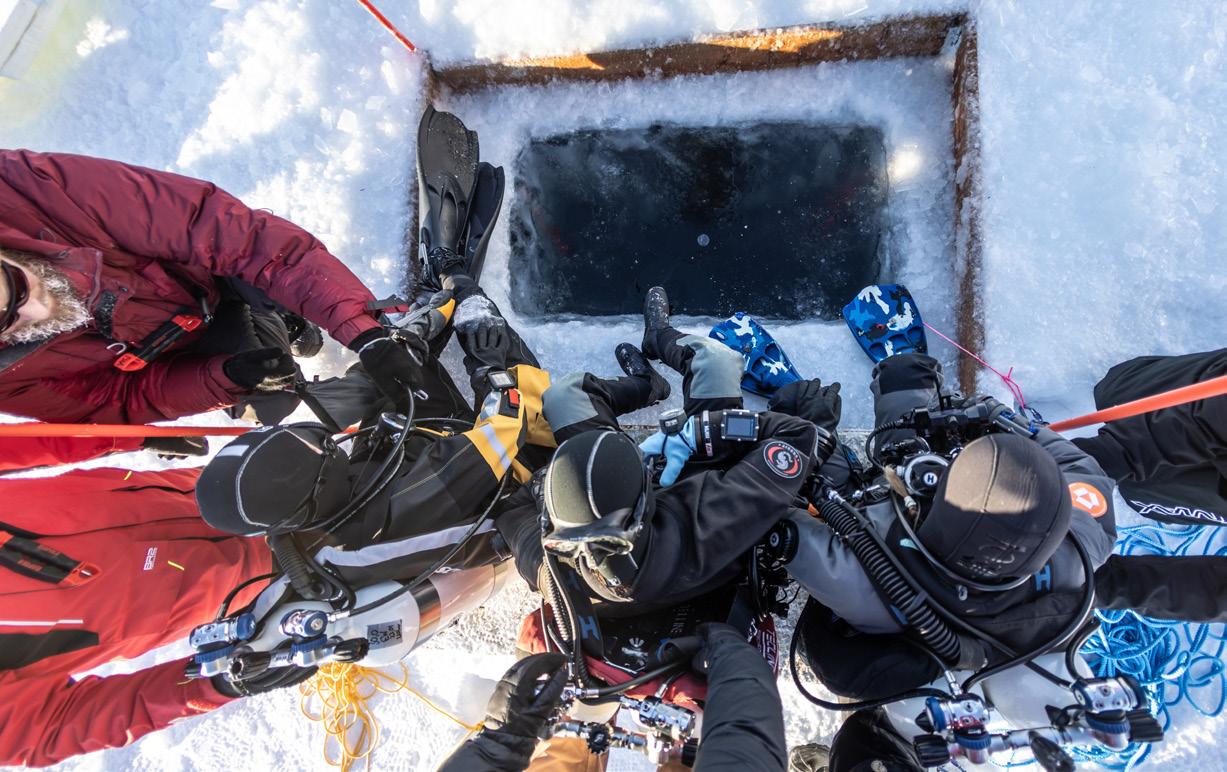
Final kit checks at the ice's edge – once you drop below, there's no room for anything left to chance.
PHOTO STEFFEN SCHOLZ
PHOTO PATA DEGERMAN
“In addition to very long days at the station, we had super strong northern lights over Lake Kilpisjärvi, and I could not help but go skiing with rented equipment from the station while enjoying the breathtaking dancing colors
PHOTO PATA DEGERMAN
The Arctic sky erupts in a breathtaking curtain of northern lights, a reminder of just how wild this place is.
Carrying it forward
Looking ahead, I hope to take part in more polar scientific diving expeditions. In my opinion, courses such as the FSDA Polar Scientific Diving program are essential for learning the skills required to operate in remote and demanding environments, as well as to test your own limitations and reactions to stress. I would also suggest assigning a confidential contact person for each expedition to give everyone the opportunity to speak up if they feel overwhelmed or unsafe. I also really appreciated the “just culture” approach and will try to implement it in future projects.
In addition to the team skills already mentioned, I also learned many technical skills for diving operations in very low temperatures and what can go wrong with equipment when it is free-flowing. I also became much more confident with my valve drills and in handling challenging situations underwater.
I made connections and friendships for life during this course, and the problems encountered and solved during diving will help me in all my future projects. Beyond these personal achievements, I also really enjoyed the breathtaking location and the beauty of the ice with so many frozen gas bubbles inside, which sparked my scientific interest in greenhouse gas production in freshwater lakes. My personal side quest was to reach the station with the lowest possible emissions, which resulted in one flight, eight buses, and one overnight train from Narvik via Kiruna to Stockholm—the iron transport route. Despite the longer journey, I really enjoyed meeting old and new friends and traveling slowly.
I’m deeply grateful to GUE’s NextGen Program and the Finnish Scientific Diving Academy for this opportunity. I’ll carry these lessons forward, and I’ll never forget that under the right conditions, even 1 °C/34 °F water can feel like a spa.
Working beneath the frozen surface, taking precise measurements–science doesn't stop just because it's freezing down here.
PHOTO STEFFEN SCHOLZ
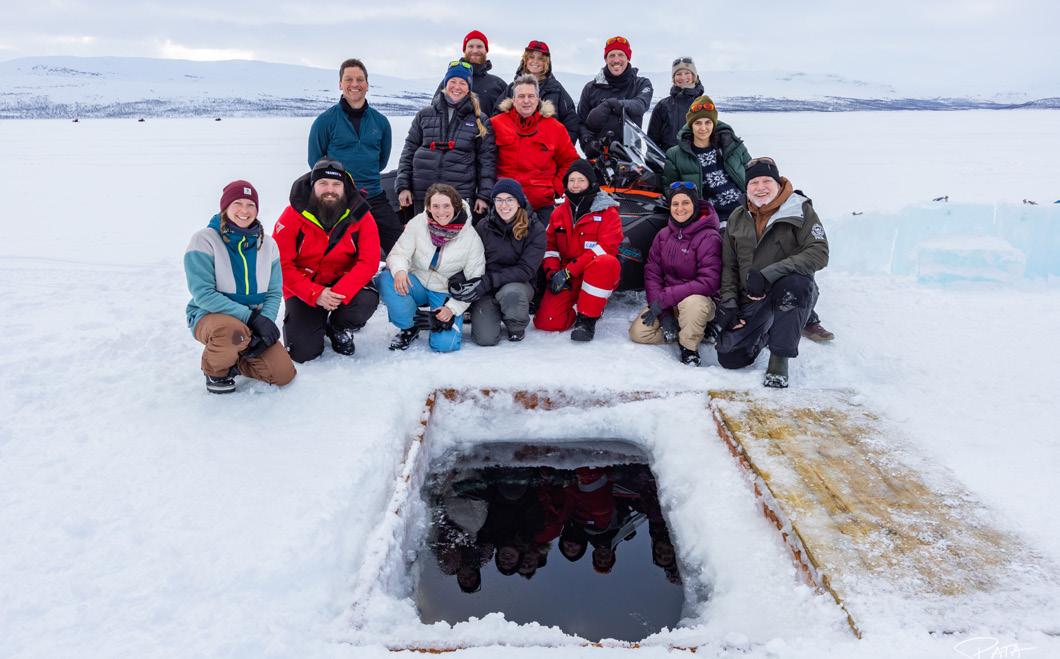
The team gathers around our hard-earned hole in the ice–tired, cold, and utterly proud of what we pulled off.
Isabell Hentschel is a marine scientist focusing on greenhouse gas cycling in diverse marine systems. She is currently based in Kiel, Germany, where she is pursuing a Master of Science in Marine
Geoscience and working at the GEOMAR Helmholtz Centre for Ocean Research Kiel. Alongside her studies, she is a scientific and technical diver enrolled in GUE's NextGen Traineeship in 2026.
Isabell Hentschel
PHOTO
GUE PREMIUM DIVE CENTERS
Area 9 Mastery Diving – Kralendijk, Bonaire
www.masterydiving.com
Base1 – Sardinia, Italy
www.baseone.it
Deep Dive Dubai – Dubai, UAE
www.deepdivedubai.com
Dive Centre Bondi – Bondi, NSW, Australia
www.divebondi.com.au
Duikcentrum de Aalscholvers – Tilburg, Netherlands