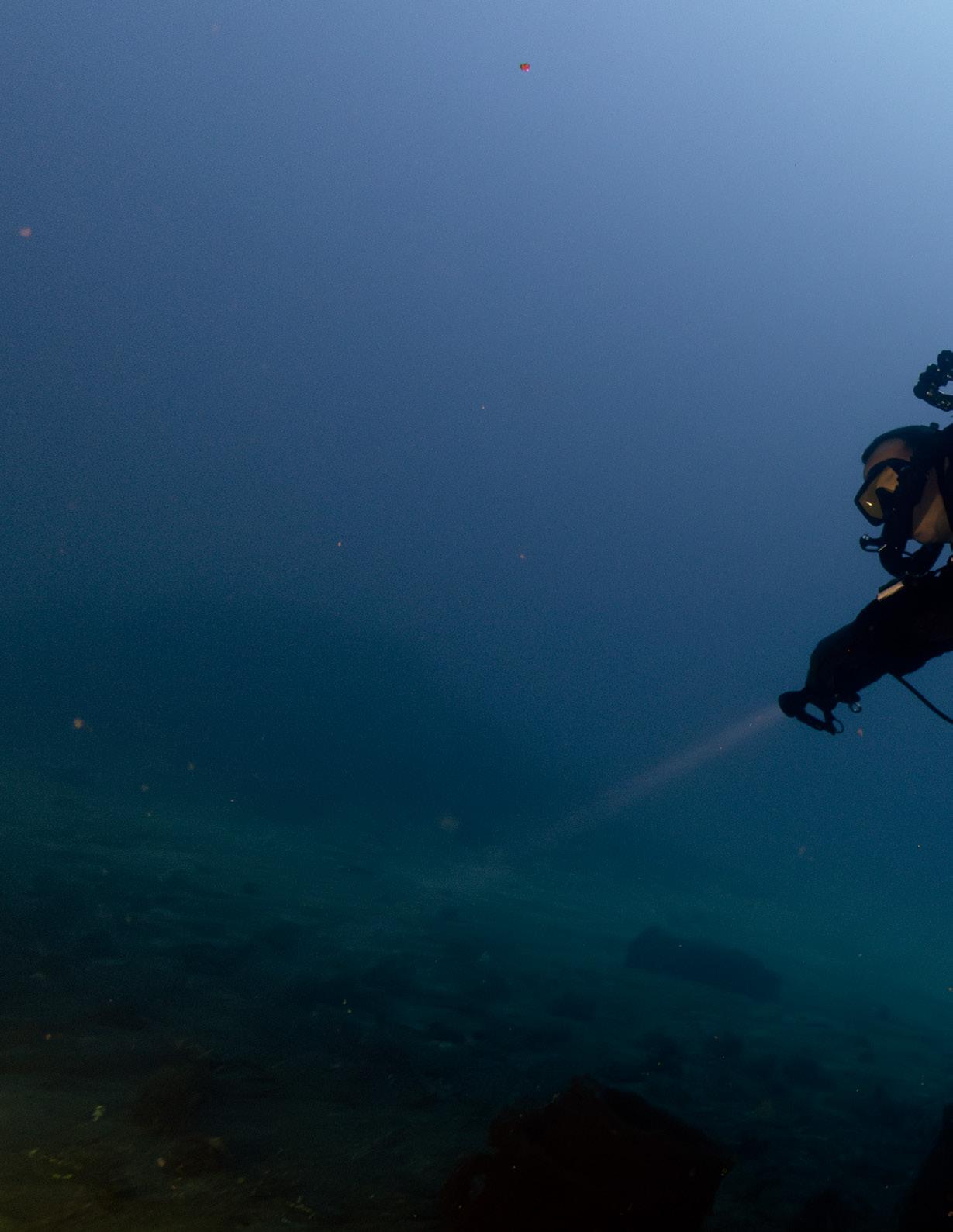
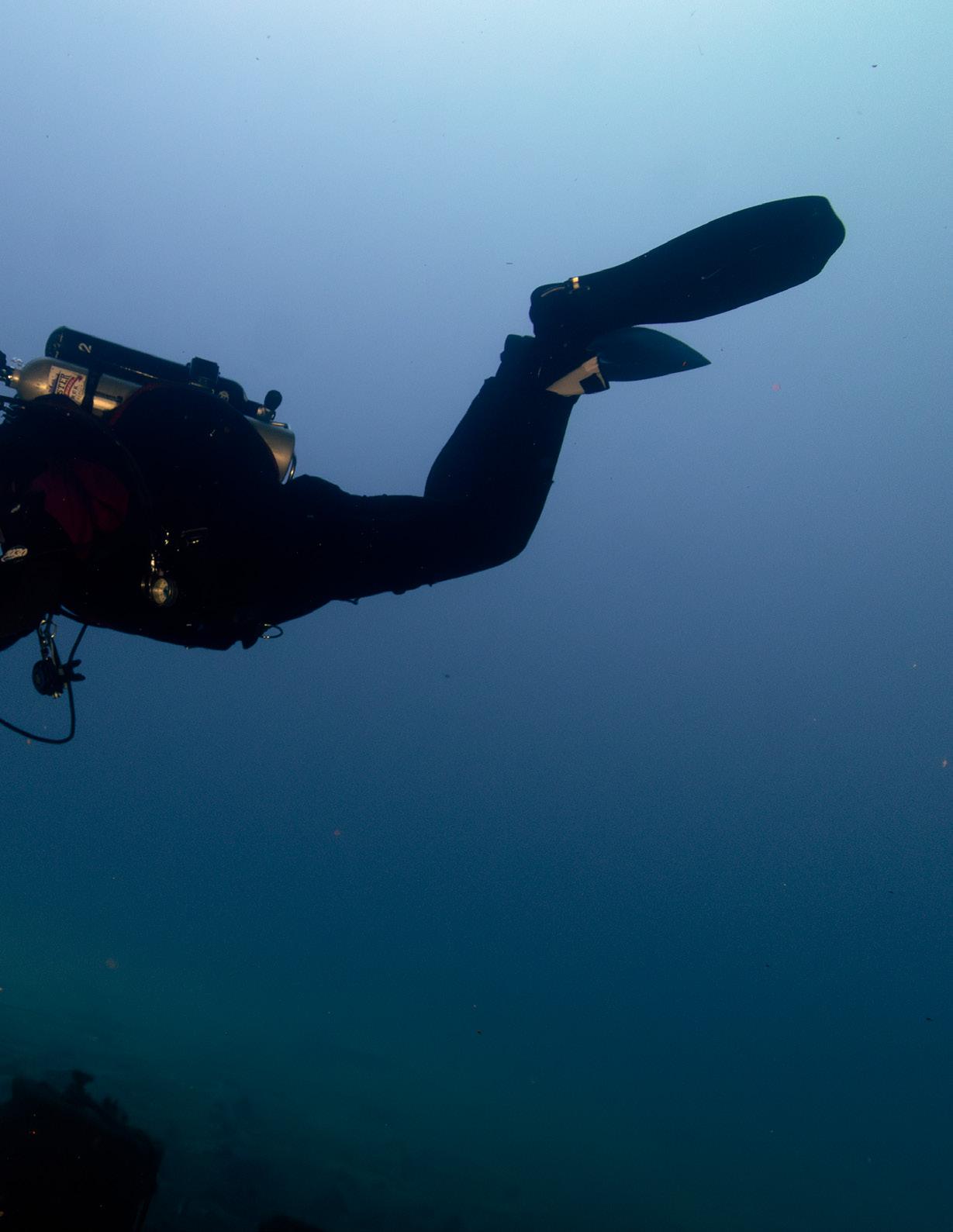
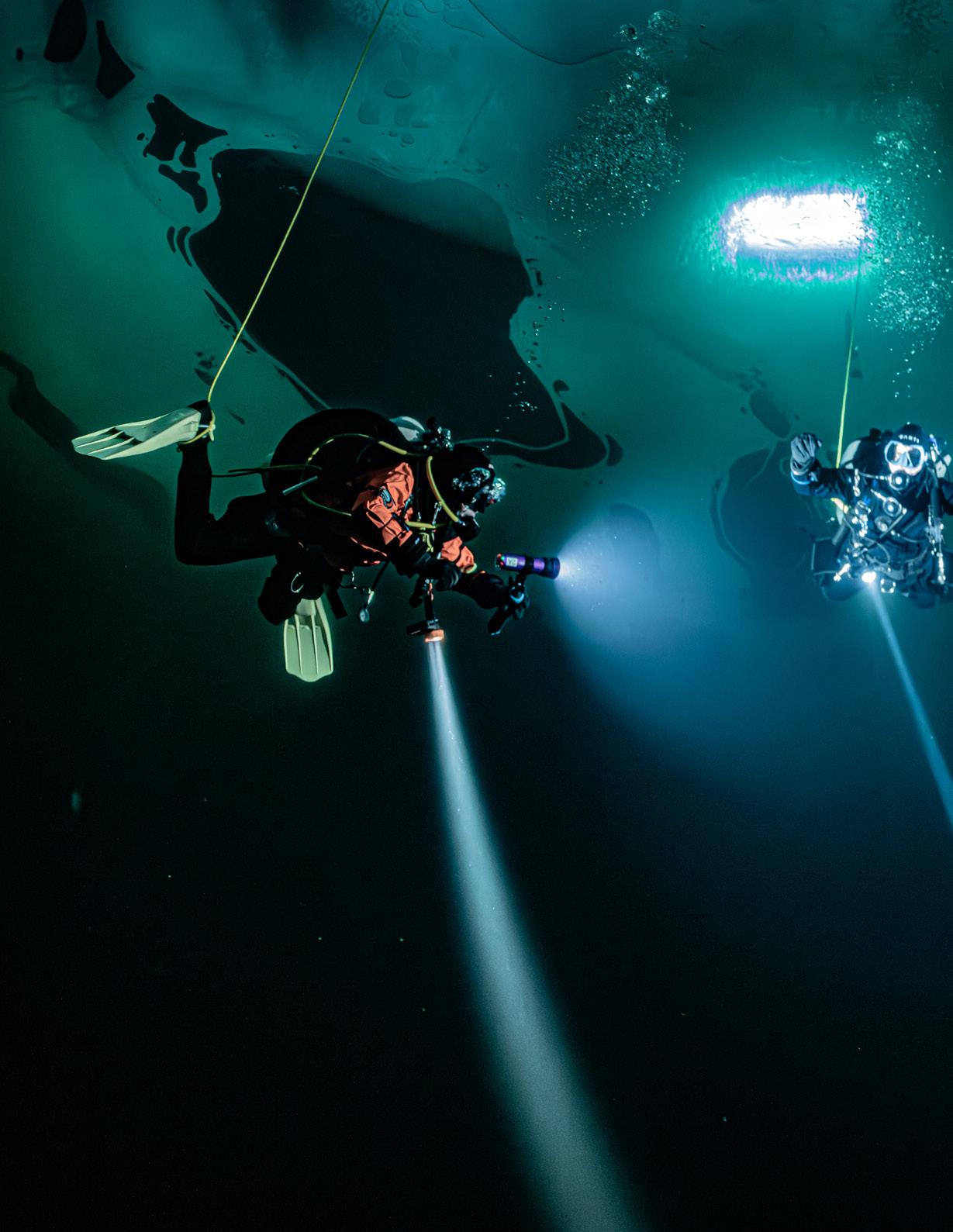
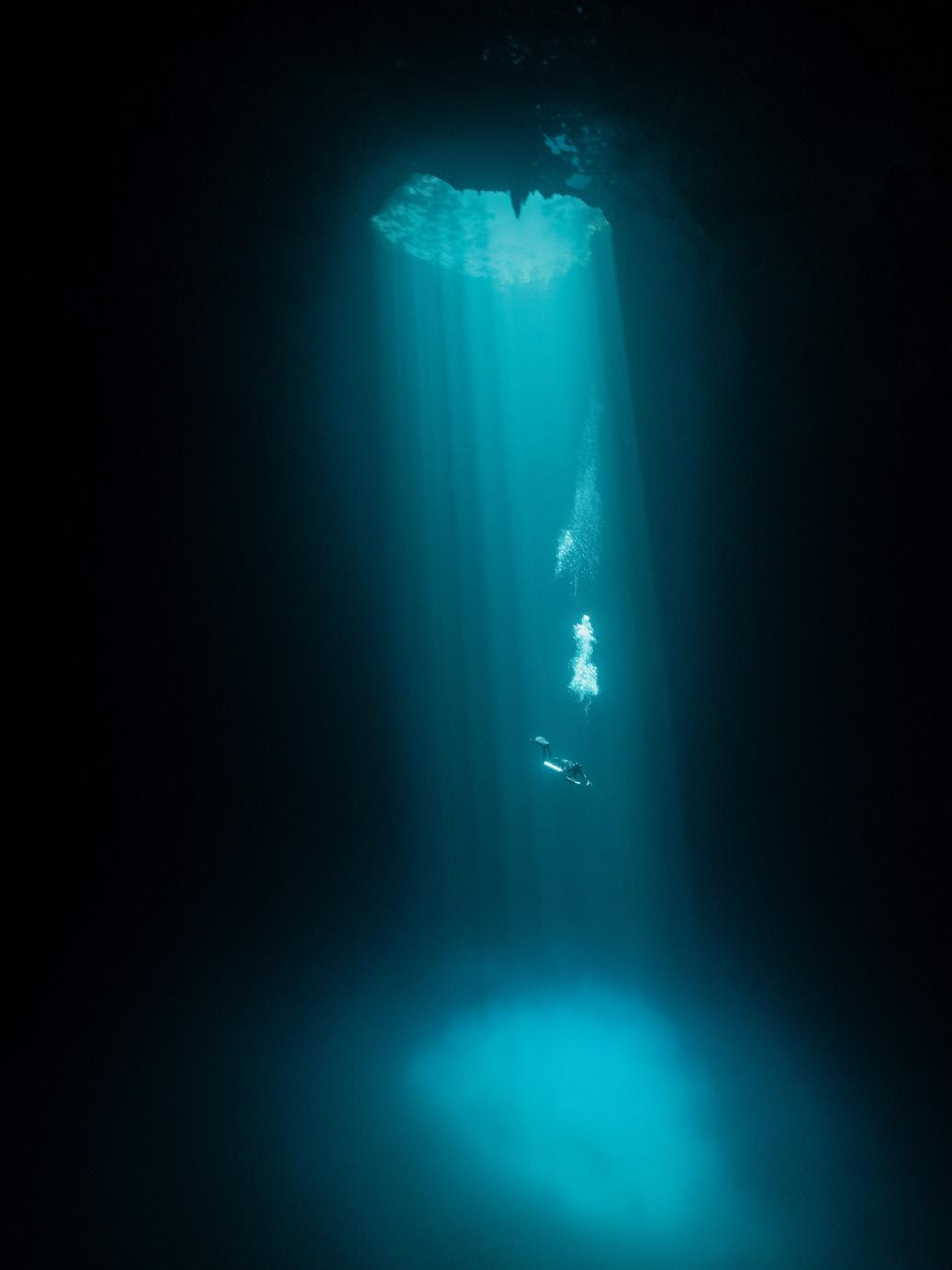
A NextGen trainee’s first dive in the frozen lakes of Finnish Lapland EXPLORERS
WHO TEACH
How the spirit of exploration defines GUE’s culture of teaching
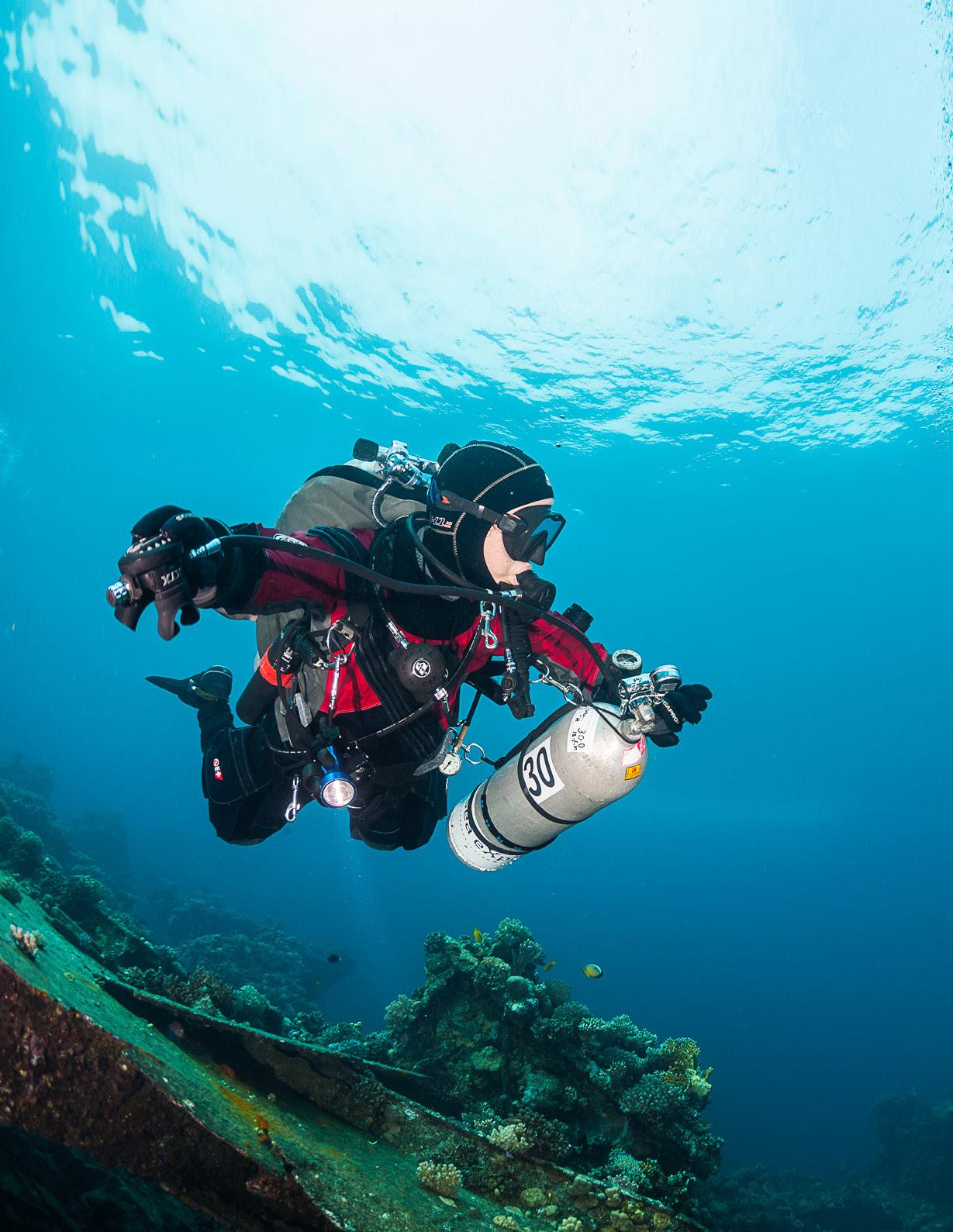
MASTERING YOUR KICKS
The propulsion techniques every diver needs in their toolbox
WHEN THE DEEP RISES
Blackwater photography brings the midnight ocean to the surface
BRAZIL’S HIDDEN CAVES
Rappelling 80 meters to map an ancient limestone cave system
EDITOR’S LETTER
EVERY DIVER EXPLORES
There is a version of exploration that most of us recognize immediately. It looks like a diver disappearing into a crack in a cave wall, reel in hand, pushing into darkness that no light has ever touched. It looks like the map that doesn’t exist yet, the passage that has no name, the moment of discovery that belongs entirely to the people who were there.
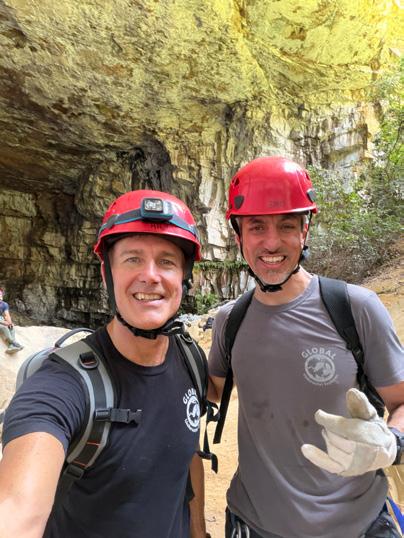
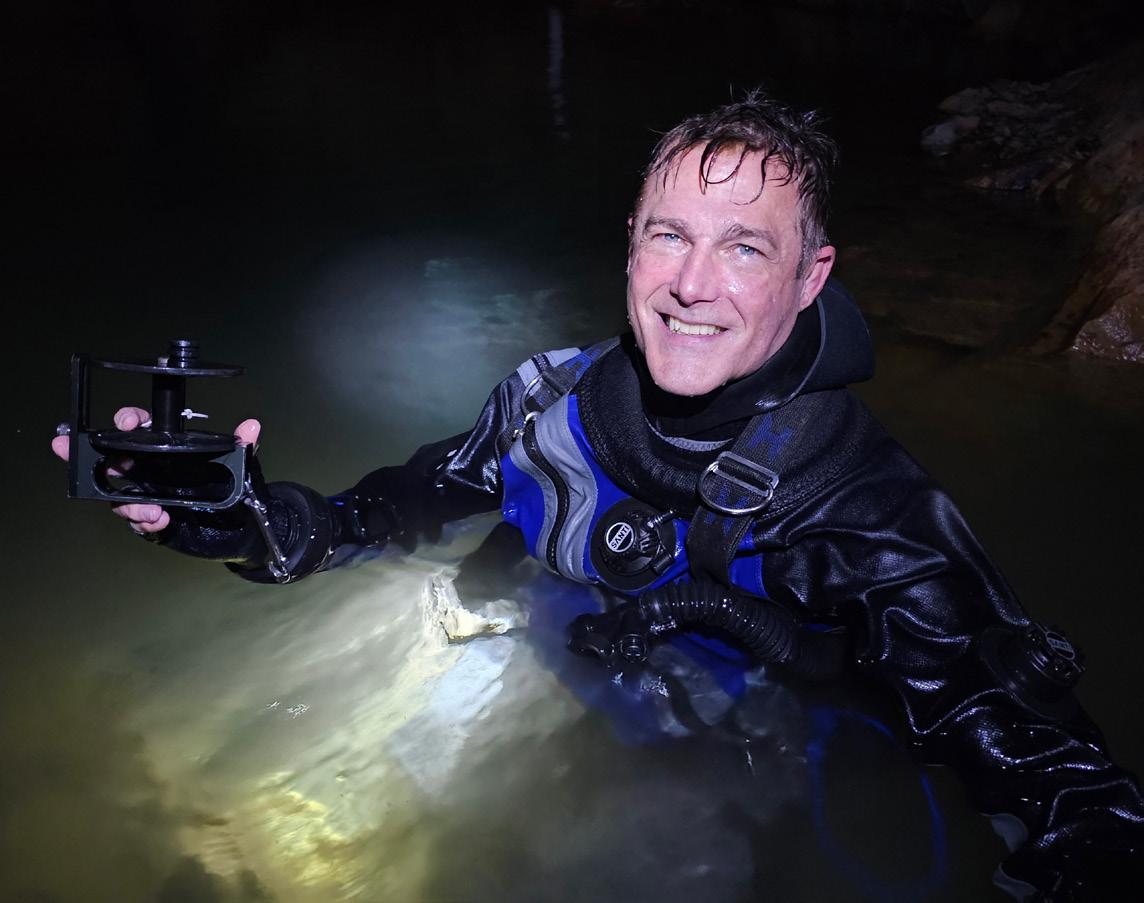
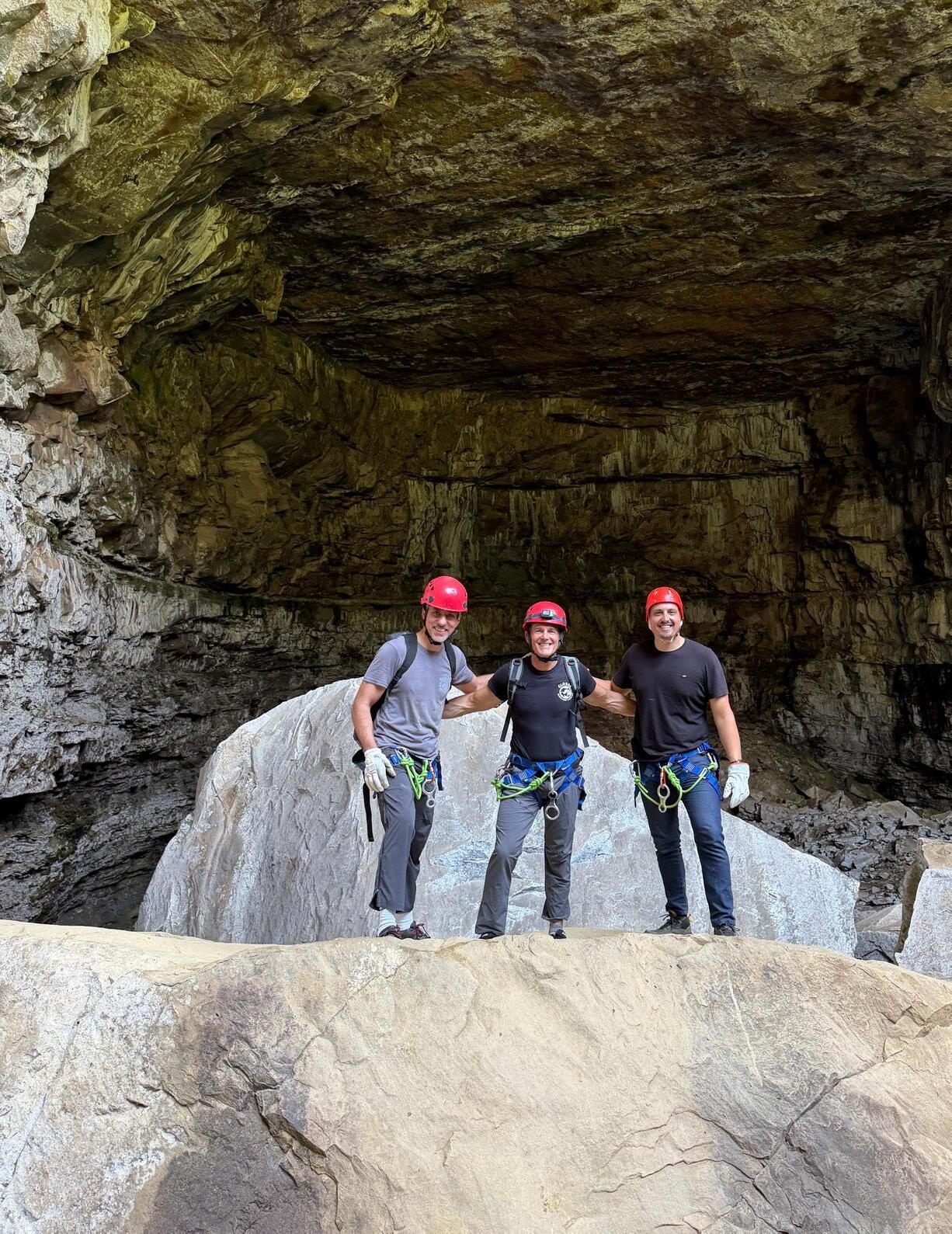
This issue has some of that. Sergio Schirato and Jarrod Jablonski rappelled 80 meters into a Brazilian sinkhole, hauled their equipment through tight restrictions in December heat, and descended into a fragile, silty cave system to survey passages that had never been properly mapped. The reward was hard-earned and real. (p.28)
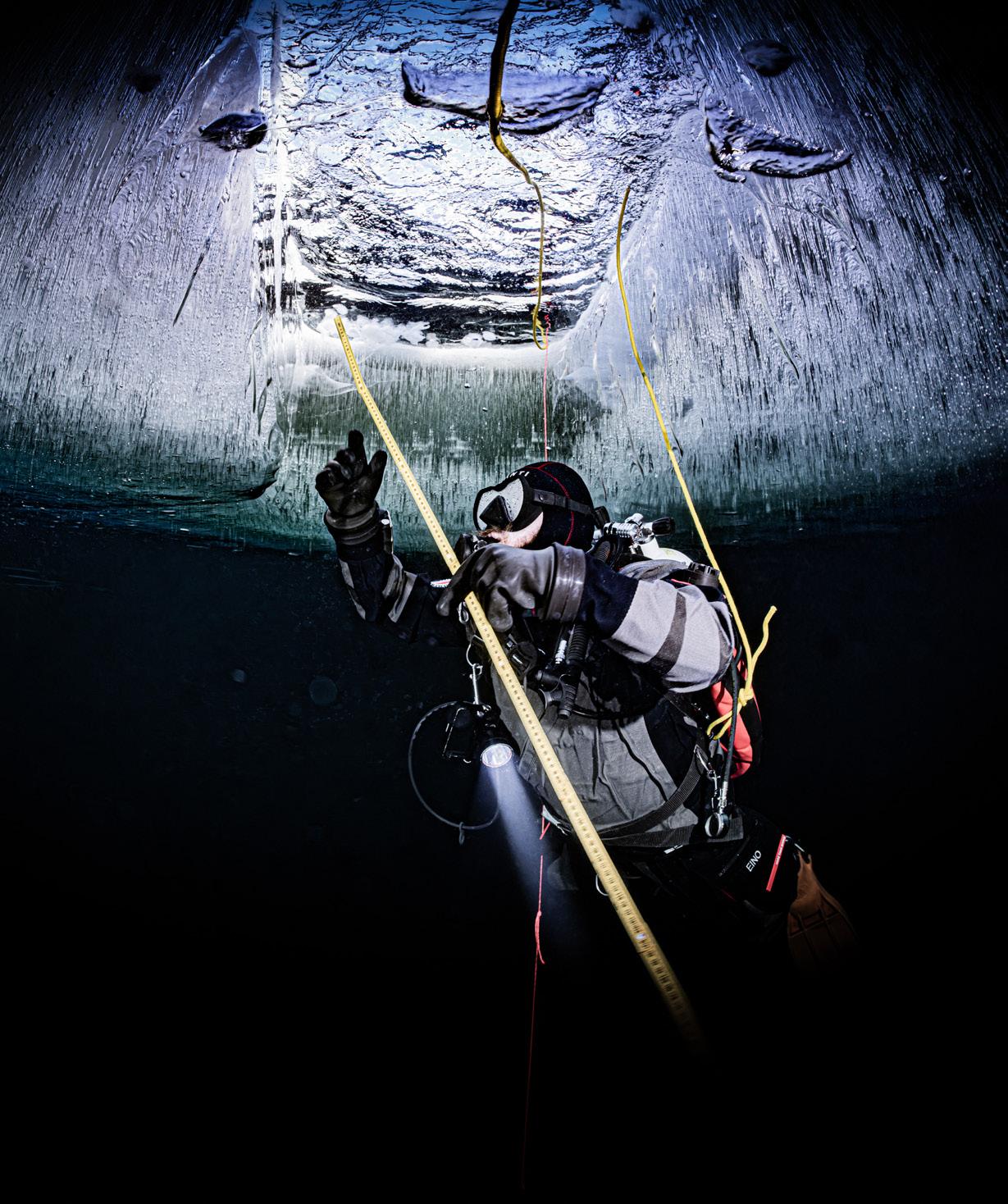
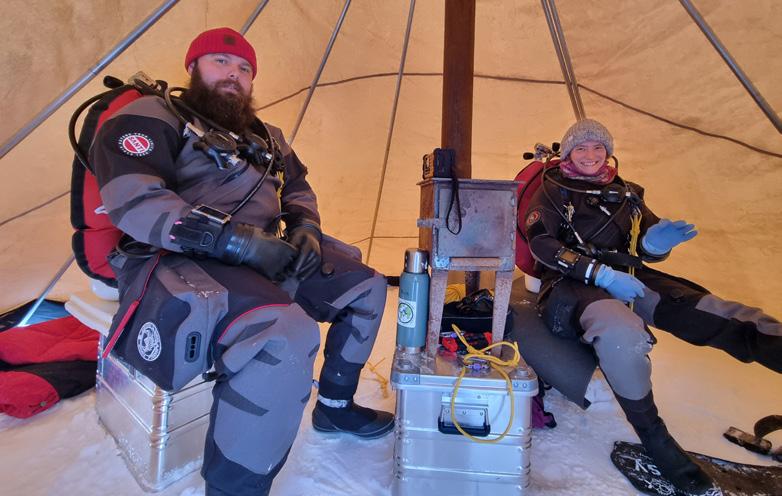
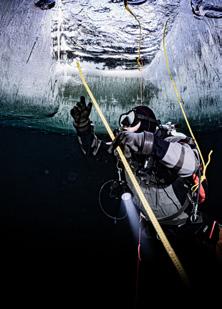
But this issue also has Isabell Hentschel, a GUE NextGen trainee who didn’t discover a new cave—she discovered what she was capable of. At -30 °C/-22 °F, with freezing regulators and equipment that refused to cooperate, she found that the most demanding environments have a way of stripping everything back to what matters: the team around you, the limits you didn’t know you had, and the person you become when you push through them. (p.14)
It also has Jialing Cai, GUE’s 2026 NextGen Scholar, who found a way to reach the deep sea without a submersible. She simply waited for night to fall, dropped into the open ocean, and let billions of years of evolutionary behaviour bring the abyss to her. (p.44)
And it has a quieter kind of exploration too—in the propulsion article’s careful examination of how we move through water (p.58), and in Dorota Czerny’s reflection on what
GUE’s tagline “Explorers Who Teach” really means (p.6). Her answer is that exploration is not a qualification or a category. It is a mindset. A willingness to look more closely, go a little further, and remain genuinely curious about what lies beyond what you already know.
That thread runs through every page of this issue. Whether you are pushing a new cave lead, making your first ice dive, or finally mastering your frog kick—you are exploring.
That is what GUE is for.
Dive safe and have fun!
Jesper Kjøller Editor-in-Chief jk@gue.com
Quest
Editor-in-chief
// Jesper Kjøller
Design and layout
// Jesper Kjøller
Copy editing
// Pat Jablonski
// Kady Smith
Writers
// Dorota Czerny
// Isabell Hentschel
// Jialing Cai
// Jarrod Jablonski
// Sergio Rhein Schirato
Photographers
// Kirill Egorov
// Jesper Kjøller
// Jenn Thomson
// Jialing Cai
// Julian Mühlenhaus
// Bori Bennett
// Petr Polach
// Isabell Hentschel
// Pata Degerman
// Steffen Scholz
// Anni Malinen
// Torbjörn Gylleus
// Sergio Rhein Schirato
// Jarrod Jablonski
// Humberto Moran
IN THIS ISSUE
6
HQ CORNER // EXPLORERS WHO TEACH
What does it truly mean to be an “Explorer Who Teaches”? Dorota Czerny unpacks GUE’s tagline, revealing three layers of exploration—discovery, guided learning, and the inner journey of self-awareness that shapes every great instructor
14 26 40 46 58
DIVING THE FINNISH ARCTIC
Marine scientist Isabell Hentschel joins GUE’s NextGen program for a nine-day polar diving course in Finnish Lapland—her first-ever ice dive, at -30°C/-22 °F, with freezing regulators and a team growing stronger by the day.
BLACKWATER // WHEN THE DEEP RISES
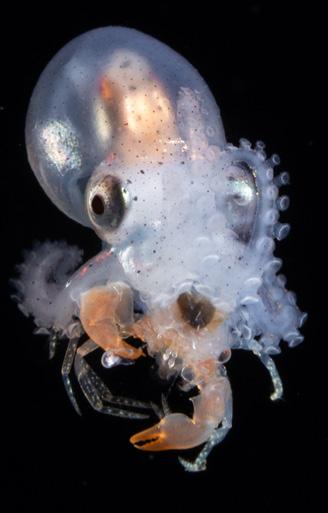
Every night, billions of creatures migrate from the deep sea to the surface. Photographer Jialing Cai dives into the darkness to document this hidden world — and finds the abyss closer than anyone imagined.
PORTFOLIO // TORBJÖRN GYLLEUS
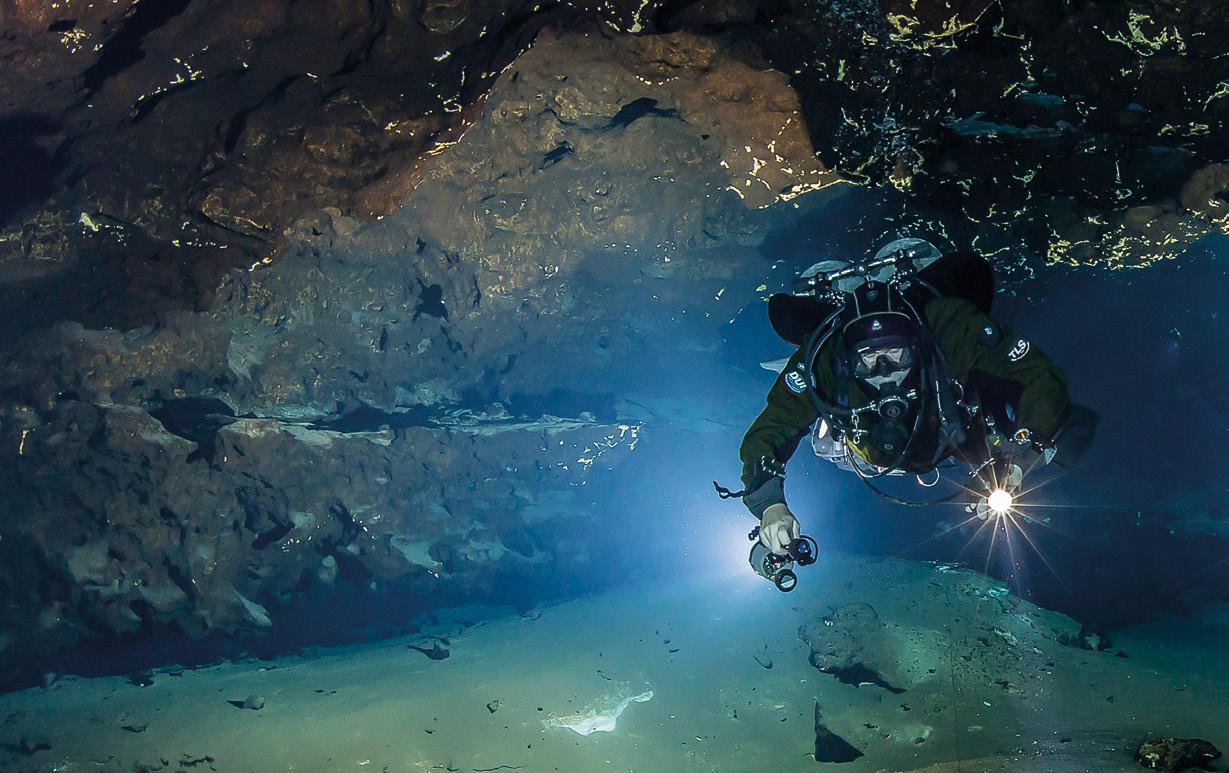
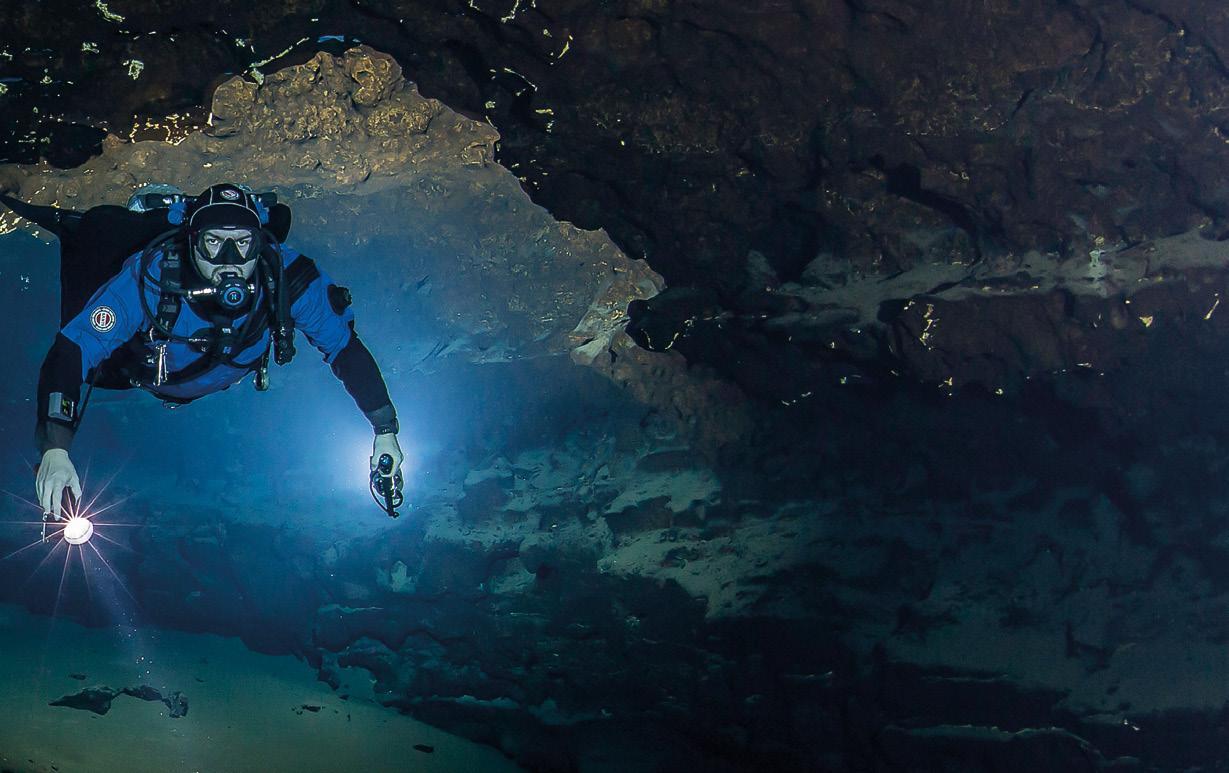
From Baltic wrecks to Mexican cenotes, Swedish photographer Torbjörn Gylleus illuminates the hidden worlds beneath the surface—where artificial light, patience, and precision reveal stories that darkness alone would keep.
EXPLORATION // BRAZIL’S HIDDEN CAVES
Before a single bubble enters the water, the team has already earned it. Sergio Schirato and Jarrod Jablonski rappel 80 meters into Brazil’s Cerrado to survey a remote and fragile underwater cave system.
PROPULSION // KICKS IN YOUR TOOLBOX
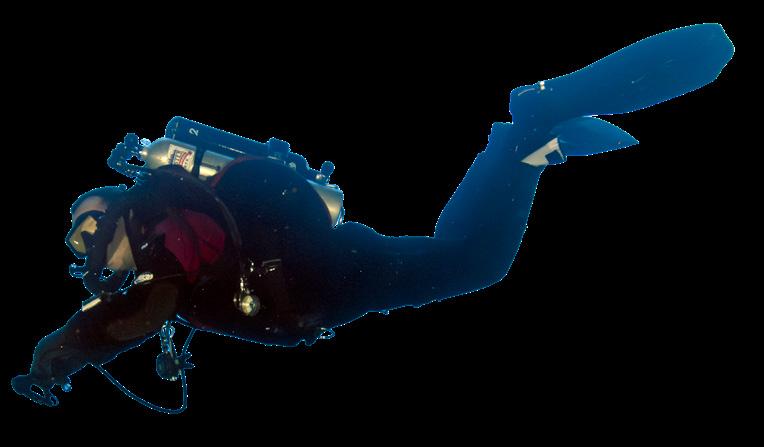
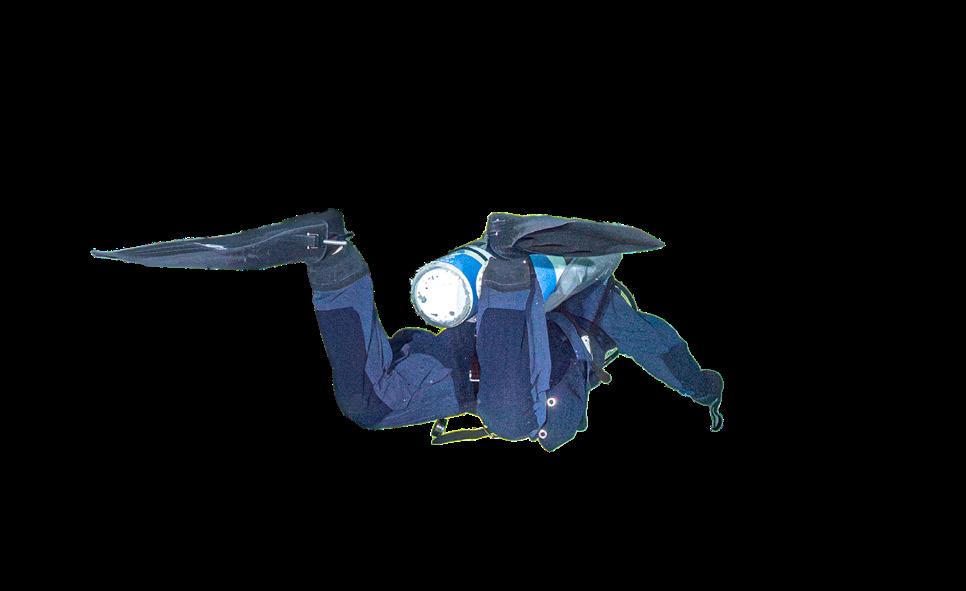
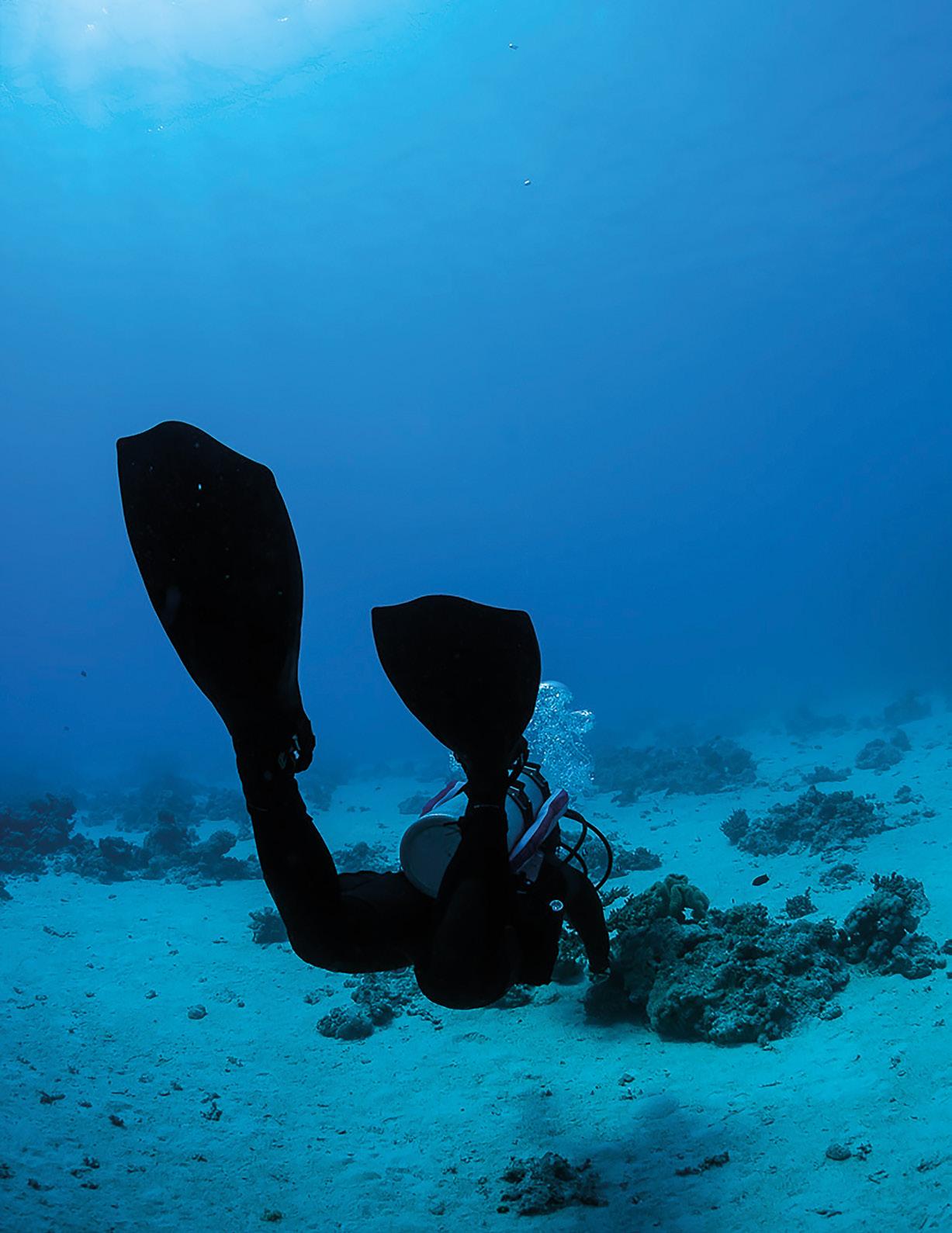
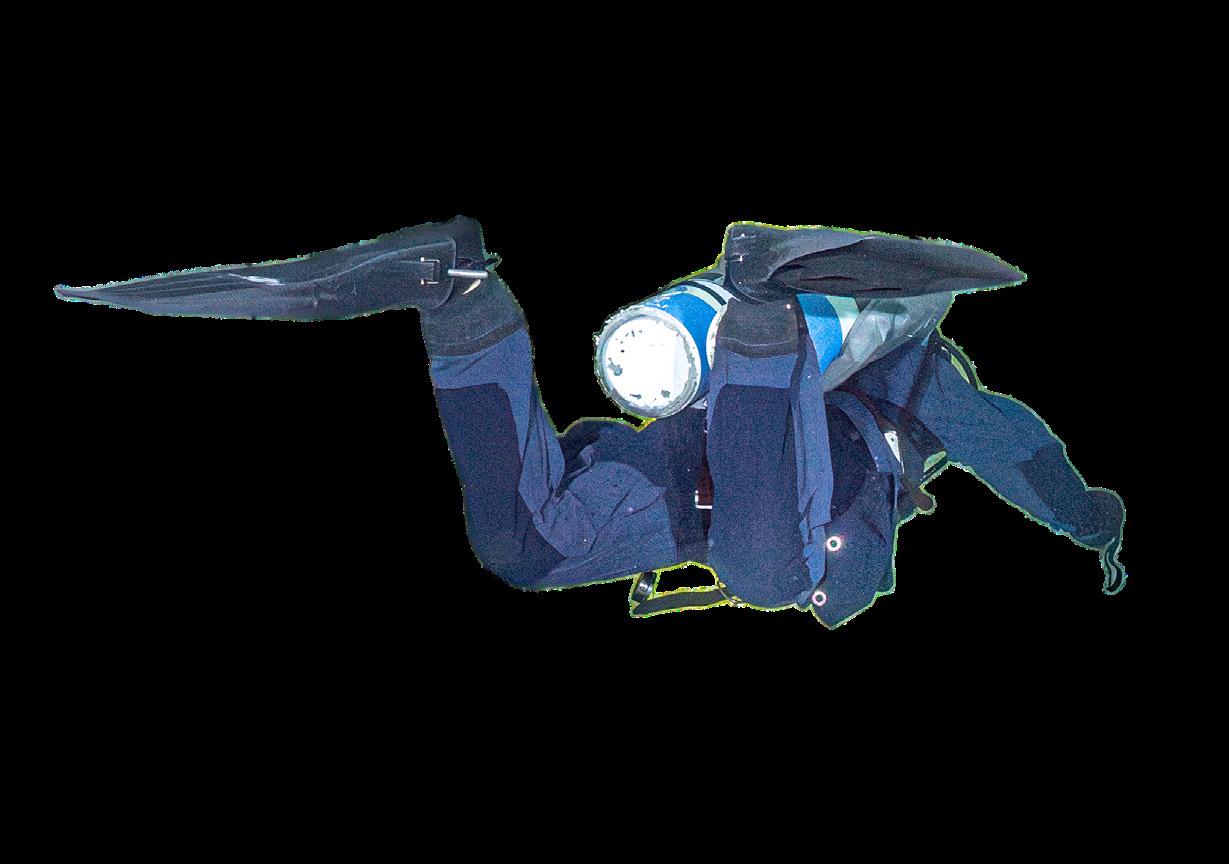
From frog to flutter, and back kick to helicopter turn, mastering the right kick for every environment keeps divers efficient, safe, and leaves fragile reefs and silty caves undisturbed.
EXPLORERS WHO TEACH
– Defining our culture
EXPLORERSTEACH
What does it truly mean to be an "Explorer Who Teaches"? In this month’s QC Corner, Dorota Czerny deconstructs GUE’s evocative tagline, moving beyond the literal image of pushing unexplored cave leads. She explores the three essential layers of exploration: the pure discovery of the unknown, the guided outward journey of a student mastering new skills, and the critical inner exploration of one’s own limits and assumptions. By redefining exploration as a mindset of curiosity and humility, this article reveals how every GUE instructor—and student—carries the legacy of those who first ventured into the dark.
TEXT DOROTA CZERNY
PHOTOS PETR POLACH, JESPER KJØLLER & BORI BENNETT
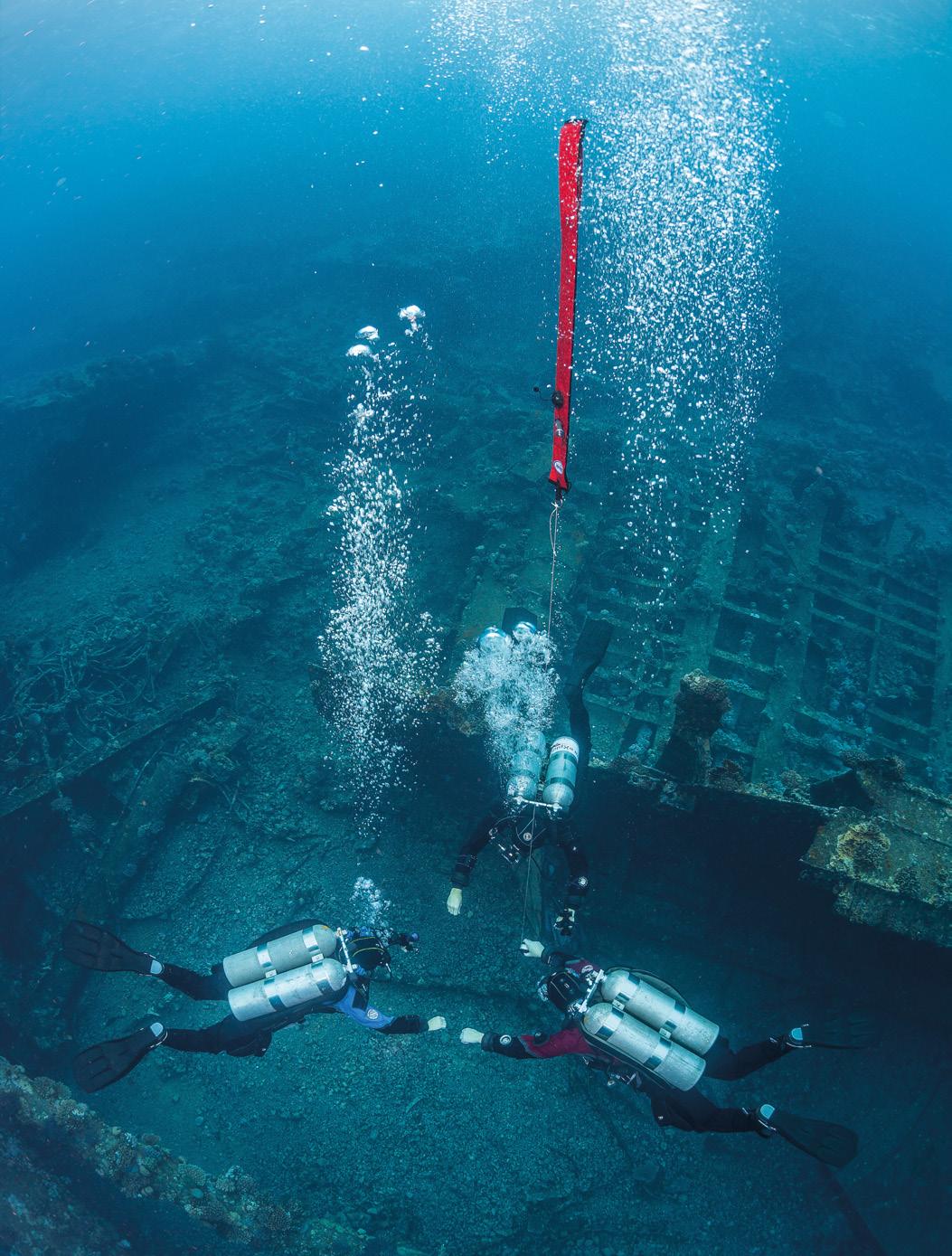
Beyond the rusted steel lies the profound question of what is possible when we look closer and venture further into the unknown.
PHOTO JESPER KJØLLER
“The organization was shaped by people who represent the purest form of exploration: individuals willing to go farther, prepare longer, question more deeply, and venture into places that were unknown, demanding, and often unforgiving.
GUE was founded by explorers, and that matters. The organization was shaped by people who represent the purest form of exploration: individuals willing to go farther, prepare longer, question more deeply, and venture into places that were unknown, demanding, and often unforgiving. Their work did not simply expand maps or reveal new passages; it built a culture. It established a way of thinking, a standard of preparation, and a belief that exploration is not only about discovering what lies beyond the next corner, but also about developing the discipline, judgment, and character required to go there responsibly. Whether or not each of us becomes an explorer in that most literal sense, we all learn from that legacy and share the responsibility to carry forward what they began. That, in many ways, is what GUE represents.
When we introduced the tagline “Explorers Who Teach,” it sparked a range of reactions. Some people smiled, some laughed, and some immediately questioned whether we should use it at all. After all, not everybody in GUE is an explorer in the literal sense of the word. Not every instructor is actively discovering new caves, surveying unknown systems, or pushing into places no one has seen before. We also have outstanding educators who are not explorers in that literal way, just as we have explorers who are not educators.
Beyond the label
So the question is fair and worth addressing: what do we really mean by “Explorers Who Teach”? For me, this phrase is not about labels, status, or trying to make every instructor fit a heroic image. It is not meant to suggest that every educator in GUE must be engaged in frontier exploration, nor that an instructor’s value can be measured by whether they have discovered something new. Rather, it speaks to a mindset, a culture, and a responsibility. It reflects the belief that teaching in GUE should be informed by the spirit of exploration, because exploration sits at the heart of who we are, how we grow, and what we ultimately hope to inspire in others. At its core, exploration begins with curiosity. Not necessarily curiosity about a cave no one has entered before, or a wreck no one has surveyed, but curiosity in its broader form: What is possible? What lies beyond what I already know? What happens if I look more closely, go a little farther, or ask a better question? That curiosity can take different forms, and when I think about the meaning of “Explorers Who Teach,” I see at least three layers of exploration within it.
Layer 1: Pure exploration
The first layer is the most visible and perhaps the most admired, because it is the purest form of exploration in the literal sense. These are the divers who go where nobody has gone before, who find new cave passages, place new line,
Even on a famous wreck, a student encountering it for the first time still experiences the profound act of personal discovery.
survey unknown wrecks, and willingly step into uncertainty in pursuit of discovery. They organize resources, invest time, travel long distances, prepare relentlessly, and accept that the process will include discomfort, setbacks, and real risk. They do it because they carry that inner pull toward the unknown, that deeply human urge to ask what lies behind the next restriction, beyond the next corner, and what that unidentified mark on a nautical map might be.
What many people see is the result: the stunning image, the new map, the discovered line, the beautiful end product of success. What they do not always see is everything that came before it—the planning, the repetition, the dead ends, the restraint, the uncertainty, and the many moments in which nothing remarkable was found at all. True exploration requires more than courage. It requires humility, because sometimes you go, and there is nothing there. Sometimes you try, and you fail. Sometimes the lesson is not triumph, but patience. This path is not for everybody, and that is entirely ok, because
it calls for a very specific mix of mindset, tolerance for uncertainty, discomfort, acceptance of risk, discipline, and character.
Layer 2: Guided outward exploration
The second layer of exploration is broader, and in many ways more relevant to the work of an instructor. Not everyone will become a literal explorer, but every diver can be invited to move beyond what is currently familiar, comfortable, and known. In that sense, exploration is not only about whether a place is undiscovered; it is also about whether it is new for the individual standing in front of it.
This matters enormously because education is not simply the transfer of knowledge and procedures. Good teaching awakens a willingness to step into something not yet mastered. It creates the conditions in which curiosity can grow into competence, and competence can grow into confidence. An instructor, in this sense, becomes someone who guides exploration rather than merely delivering information. They
PHOTO JESPER KJØLLER
Instructors guide exploration beyond information, opening doors to new perspectives and helping students discover their true potential.
open the door to a new environment, a different perspective, a more demanding task, or a more refined way of thinking. They help students look more, notice more, and test what they are capable of becoming.
This kind of exploration is outward-facing, but it is also personal. It asks a diver to say, I have not done this before, but I am willing to learn; I am willing to be challenged; I am willing to leave the comfort of what I already know. That willingness is deeply aligned with the values we should want to nurture across the organization.
Layer 3: Inner exploration
The third layer is less visible than the first two, but perhaps even more significant in the long term, because it is the exploration that happens within. This is the exploration of one’s habits, assumptions, fears, blind spots, limitations, and possibilities. It is the willingness to ask difficult but necessary questions: Where do I stop myself? What can I improve? How do I respond under pressure? What do I avoid? What kind
of diver, teammate, and educator do I want to become?
This inner dimension of exploration is where growth becomes deeply human rather than merely technical. It requires self-awareness, honesty, and the courage to examine mistakes without becoming defensive. It asks for reflection, adjustment, and the humility to admit that even strong performance does not mean the journey is complete. In many ways, this is what makes the other layers sustainable, because without inner exploration, outward exploration can easily become ego-driven, and technical development can become shallow. To keep growing, we must remain curious not only about the world around us, but also about ourselves.
Exploration and mastery
This is also why the idea of “Explorers Who Teach” connects so naturally to mastery. Mastery is not a fixed state, and it is certainly not a checklist completed once and then left behind. It is a continual process of refinement, reflec-
PHOTO BORI BENNETT
tion, adjustment, and growth. In that sense, mastery is itself an exploratory path, because it requires us to keep asking more of ourselves, to keep noticing what can be improved, and to keep moving beyond the limits of what is merely adequate.
When viewed through that lens, the progression through the curriculum becomes more than a sequence of certifications; it becomes a structured invitation to explore. At the very beginning, a diver is already exploring simply by entering scuba diving at all. An Open Water course is an introduction to a completely new environment, a new set of demands, a new relationship with one’s own body and mind, and a new way of experiencing the world. That first step is already an act of curiosity.
Fundamentals training deepens that process by asking for humility and refinement. It challenges the diver not only to perform, but to examine, to adjust, and to accept that improvement is always possible. The next stages continue this trajectory.
At Level 1, exploration remains guided, but the demands grow. The diver is introduced to a different environment and a different kind of responsibility, and the instructor’s task is not merely to supervise, but to help the student see more than they would see alone. Good instruction at this stage does not simply protect students from difficulty; it introduces them to challenges in a way that invites maturity.
By Level 2, the nature of exploration shifts again. At that point, a diver should already have solid foundational skills, knowledge, and discipline, and the task is no longer only about executing procedures correctly. It becomes about thinking, adapting, responding to the unpredictable, and learning how to operate when not everything unfolds according to plan. This is where the instructor’s role must also evolve. Teaching at higher levels cannot only be about showing what right looks like in clean, controlled conditions. It must also involve mentoring judgment, sharing context, discussing consequences, and helping divers understand the complexity that comes with real-world uncertainty.
The power of experience
That is why experience matters so deeply in advanced instruction. It is not because every instructor must have made major discoveries of their own, but because higher-level teaching requires lived understanding. It requires exposure to complexity, to near misses, to imperfect decisions, to moments where things were not obvious, and to the kind of ambiguity that cannot be fully taught from theory alone. At that level, an instructor should not be holding a student’s hand; they should be mentoring, challenging, and nudging the diver toward increasing independence.
So what does “Explorers Who Teach” mean? It means that, as an organization, we should value educators who do more than deliver content, because teaching in GUE is not simply about transmitting knowledge and skills, but about shaping the mindset, judgment, and character that allow those skills to matter. It means we want our instructors to cultivate curiosity, resilience, humility, and growth, and to understand that diving is not only about doing things correctly but also about learning to think, adapt, reflect, and continue evolving. It means that we recognize exploration as something broader than first discoveries alone.
So no, not everybody in GUE is an explorer in the literal sense. But the spirit of exploration should still run through the entire organization, because without curiosity there is no growth, without growth there is no mastery, and without educators who can spark that process in others, there is no lasting culture of development.
“Explorers Who Teach” is therefore not about claiming that every instructor stands at the edge of the map; it is about affirming that we want to build divers and educators who are willing to move toward the unknown, whether that unknown is found in a cave, on a wreck, in the classroom, in a difficult decision, or within themselves. That is the kind of teaching that carries our legacy forward, and that is why the phrase matters.
True growth is more than technical; it’s a humble, selfaware journey where inner curiosity makes outward success both meaningful and sustainable.
“At that level, an instructor should not be holding a student’s hand; they should be mentoring, challenging, and nudging the diver toward increasing independence.
Dorota Czerny
Dorota Czerny is a highly experienced diver who fell in love with the ocean in 1996. She transitioned from teaching at a university to teaching scuba diving due to her passion for the sport. As Vice President of Global Underwater Explorers, she is highly skilled in technical, cave, and rebreather diving, and is dedicated to developing the organization’s
educational component. Her focus is on creating a new generation of explorers and young scientists with GUE’s NextGen Scholarship program. Dorota’s dedication to diving education extends beyond her work with GUE as she actively explores caves and wrecks around the world.
TEXT ISABELL HENTSCHEL
PHOTOS PATA DEGERMAN, JENN THOMSON, STEFFEN
SCHOLZ & ANNI MALINEN
BLIZZARD-FROZEN
BLIZZARD-FROZEN
SCIENTIFIC
PHOTO
Isabell Hentschel is a marine scientist specialising in greenhouse gas cycling in diverse marine systems, including the Arctic, and is one of GUE's 2026 NextGen Legacy Program (NGLP) Trainees. Her traineeship brought her to the Polar Scientific Diving course run by the Finnish Scientific Diving Academy—hands-on experience in an environment she had studied in school, and her first-ever scuba dive under the ice. The NGLP is GUE's initiative for developing future leaders in exploration and diving, with the NextGen Scholarship providing training-focused grants and accelerated support for aspiring explorers. Read on to find out more about her experience.
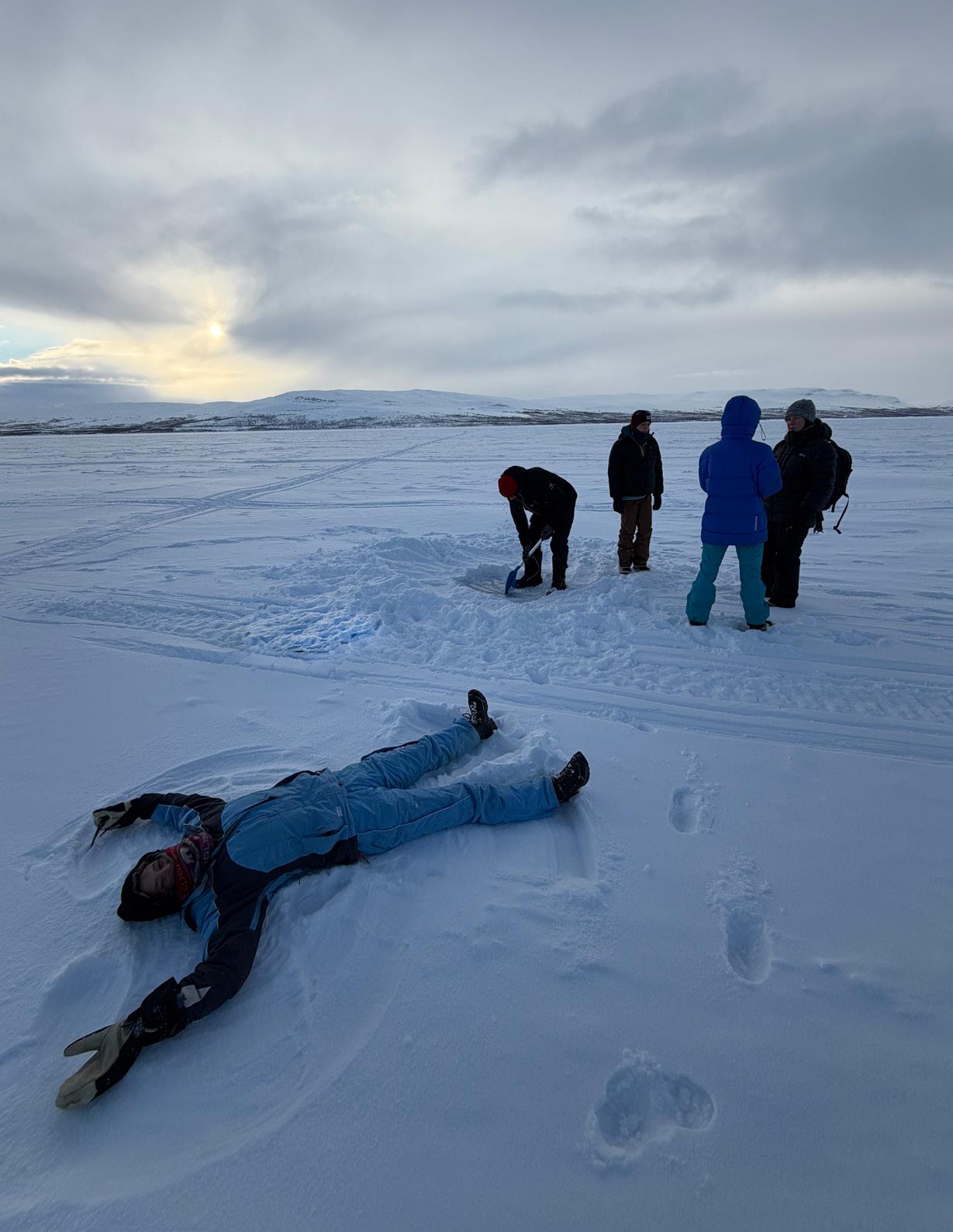
While the team actually prepares for the dive, one of us has clearly identified a more urgent task– making a snow angel.
PHOTO JENN THOMSON,
“
What mattered was to find a solution as a team and to grow together through the process even though we were a very diverse group with different diving experiences and scientific backgrounds.
I’m used to cold-water diving. I learned scuba diving in Germany’s lakes and ponds during my early adolescence and was later introduced to twinset tanks and technical diving during a year abroad at a diving center in Norway. After returning to Germany, I began specializing in marine science and combined my passion for diving and research through scientific diver training. I’m currently based in Kiel, studying greenhouse gases in various marine systems and supporting diving projects ranging from ocean alkalinity enhancement to archaeology.
Having already experienced the harsh Arctic environment the previous year while on Svalbard, Norway, during an ecology and toxicology course abroad, I thought I had a solid understanding of conducting scientific work in extreme conditions. But the nine-day Polar Scientific Diving course at the Biological Station in Kilpisjärvi, northern Finland, run by the Finnish Scientific Diving Academy, was a completely different story. I was able to join thanks to GUE’s NextGen Traineeship.
Building the team
Before the course even began, we were introduced to human factors in diving and “just culture”: individuals are not blamed for decisions or mistakes made within the limits of their experience, while willful violations are not tolerated. Over the program, it became clear how essential this mindset is for the team. In stressful and demanding environments, mistakes are inevita-
ble. What mattered was to find a solution as a team and to grow together through the process even though we were a very diverse group with different diving experiences and scientific backgrounds.
The first three days focused on preparation. Our instructors—Edd Stockdale, Erik Wurz, and Pata Degerman—walked us through everything we needed to know about operating in polar conditions: safety procedures, cold-water rigging, communication with base, the proper clothing (at least three layers, inner layer always wool), setting up camp (different options, but food tent at the end in case of a polar bear attack), hydration (at least 3 liters/0.8 gal per day!), drilling and sawing ice holes (by hand), how to operate the snowmobile, tendering lines and what to do in case of a free flow—which was our constant companion during the first dives.
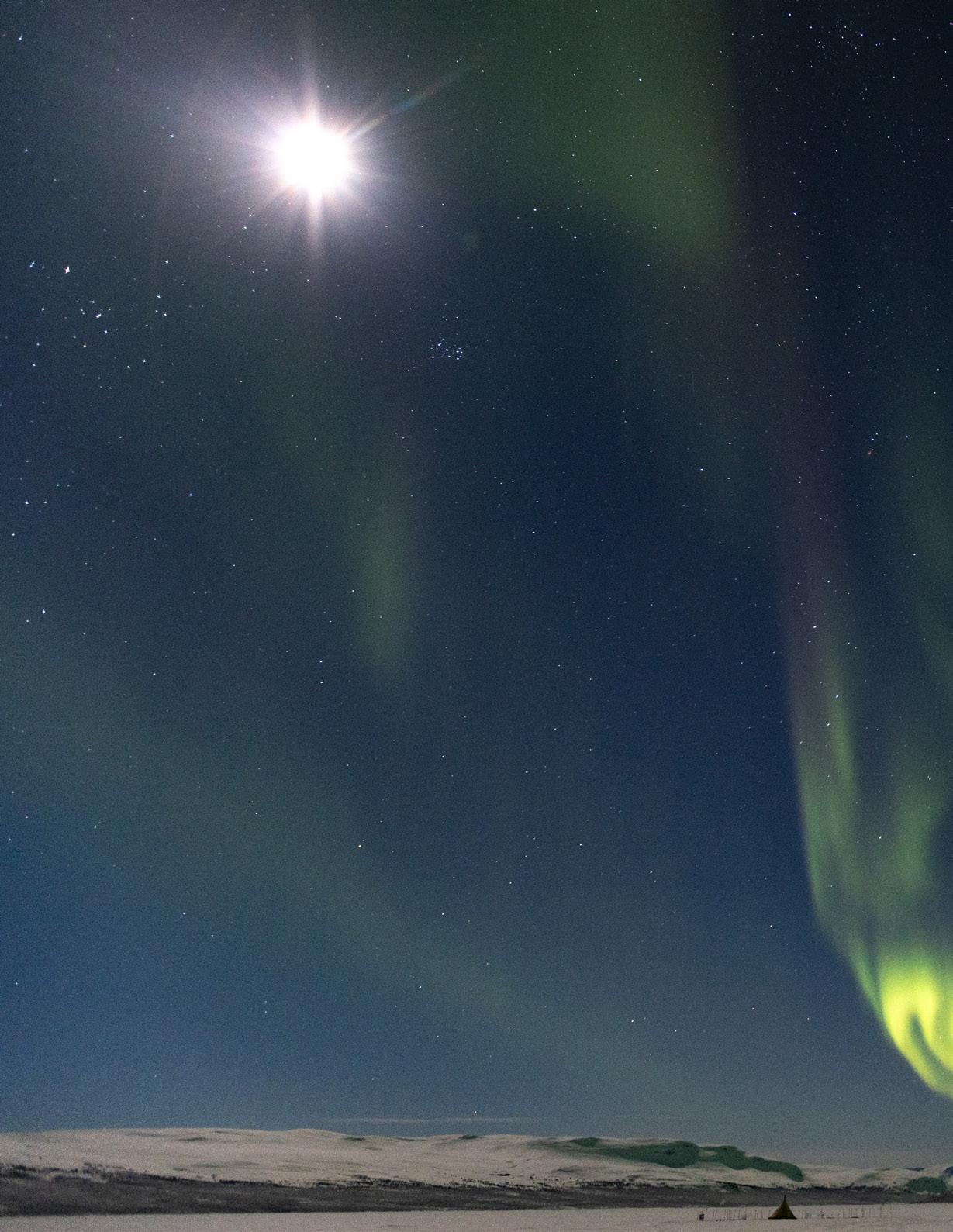
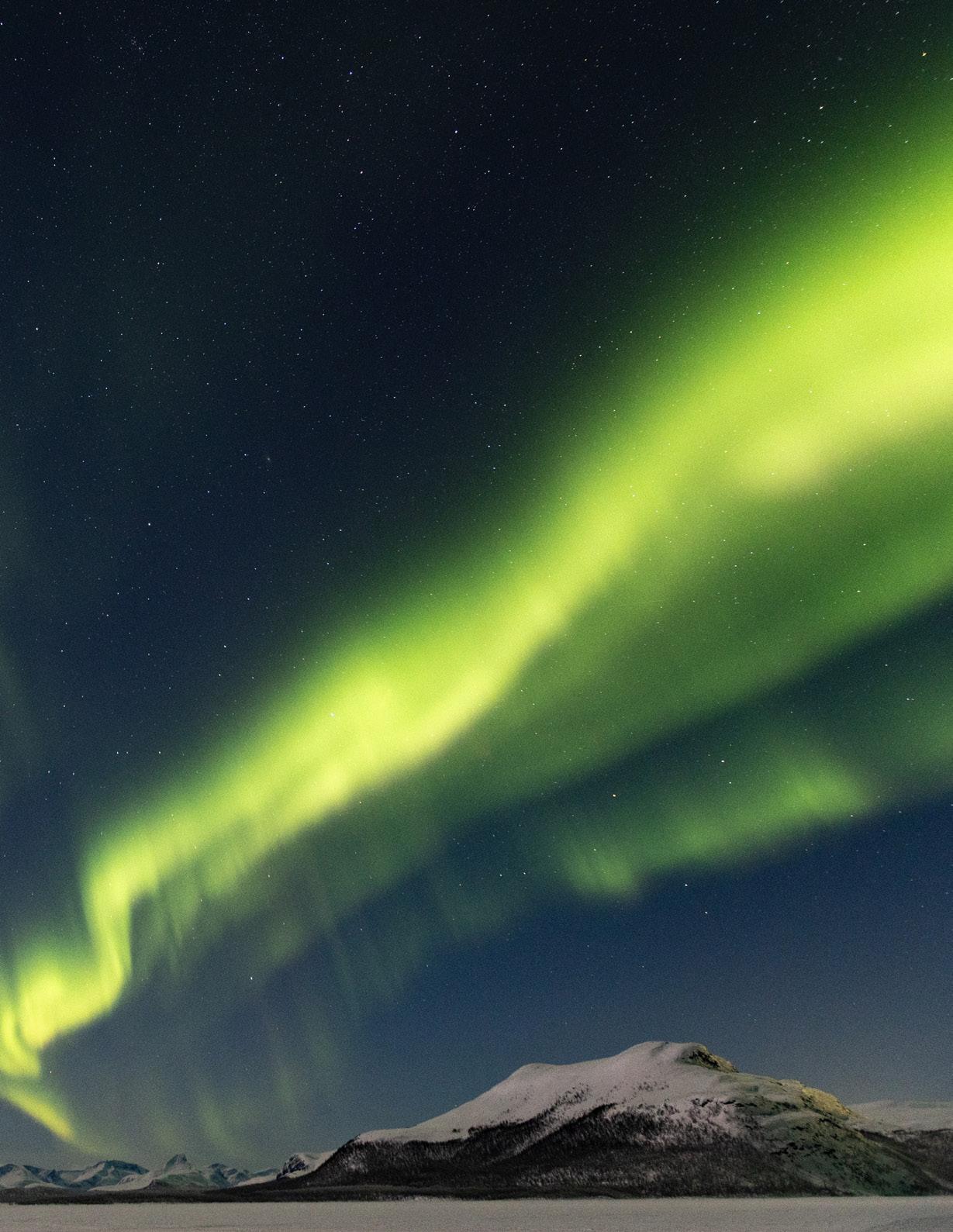
In addition to very long days at the station, we had super strong northern lights over Lake Kilpisjärvi, and I could not help but go skiing with rented equipment from the station while enjoying the breathtaking dancing colors.
Into the hole
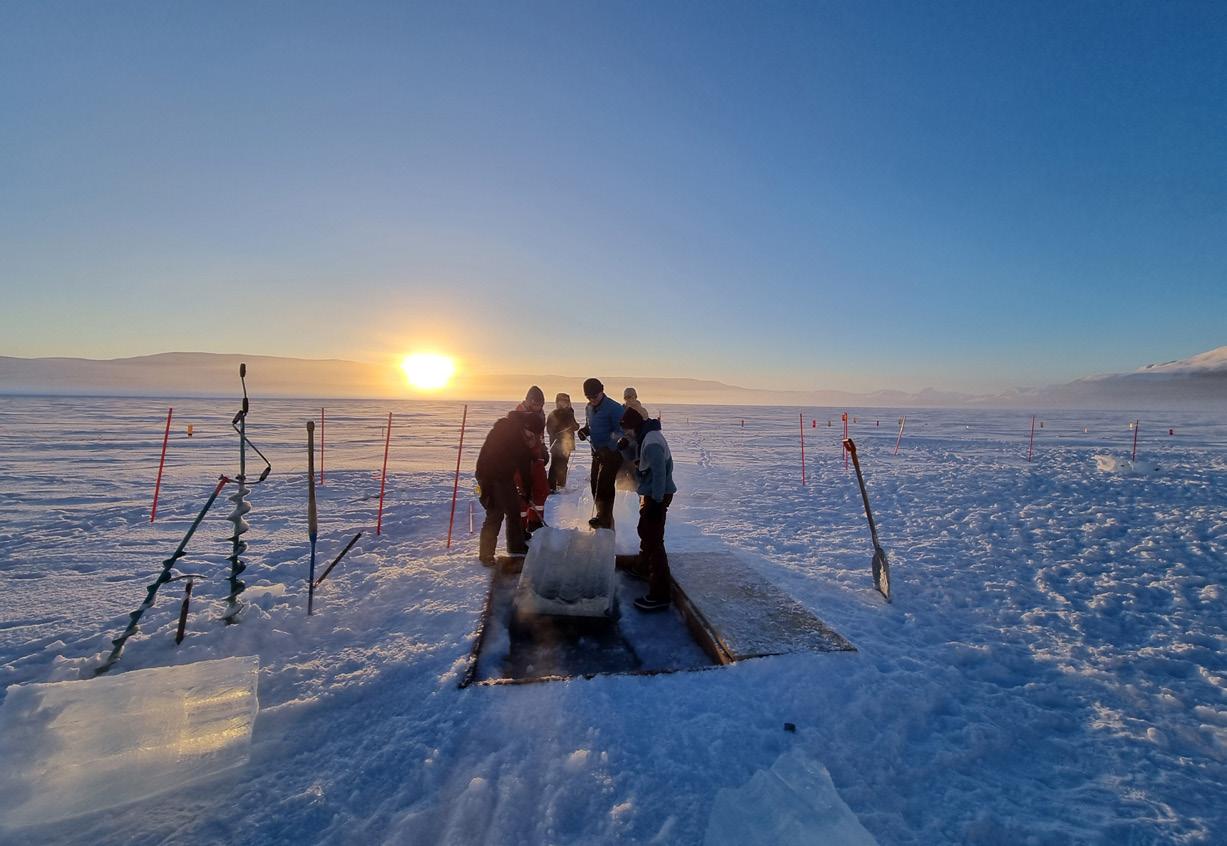
Finally on day four we conducted our first check dive. The team was organized into clearly defined roles: supervisor, safety diver, tenders, and divers—with positions rotating between sessions. But with air temperatures around -30 °C/ -22 °F came some logistical problems: in each round, the non-divers had to defrost the holes and prep them with a safety line, stage cylinder,
and tender lines. The diving gear was brought down at the last possible moment with closed but pressurized tanks and, last but not least, the divers.
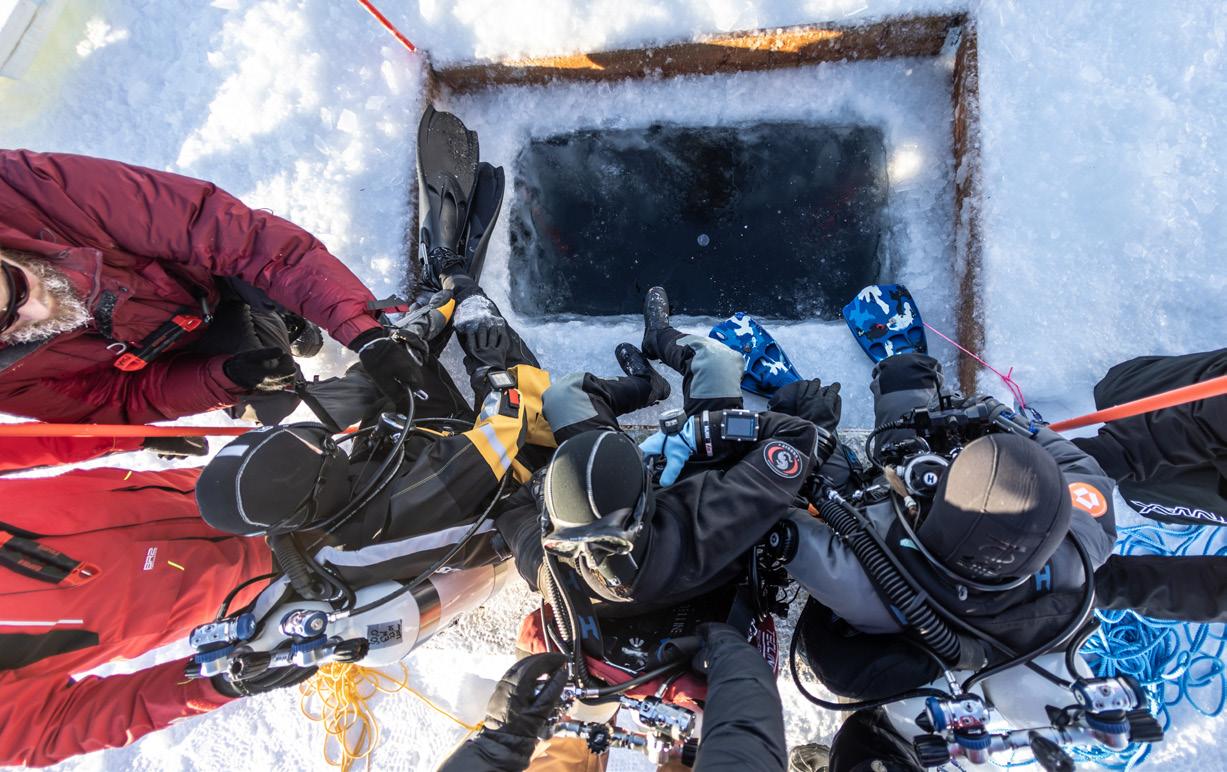
It felt almost surreal to sit in the middle of a pristine white landscape and stare down at a small black hole surrounded by 1 m/3.3 ft thick ice that you are willingly jumping into after the final check. Never breathing through the regulators at the surface was a non-negotiable. Especially piston regulators, as they were free-flowing just by opening the valves. Furthermore, the inflator froze as well, making it impossible to operate the air inlet or outlet.
When everything freezes
The first dive, I struggled with a frozen inflator, then free-flowing primary regulator, and finally a leak in my drysuit slowly flooded my undergarment. We tried our best to defrost equipment at the surface with hot water while divers patiently waited in the hole with submerged regulators. However, during the first check dive only one
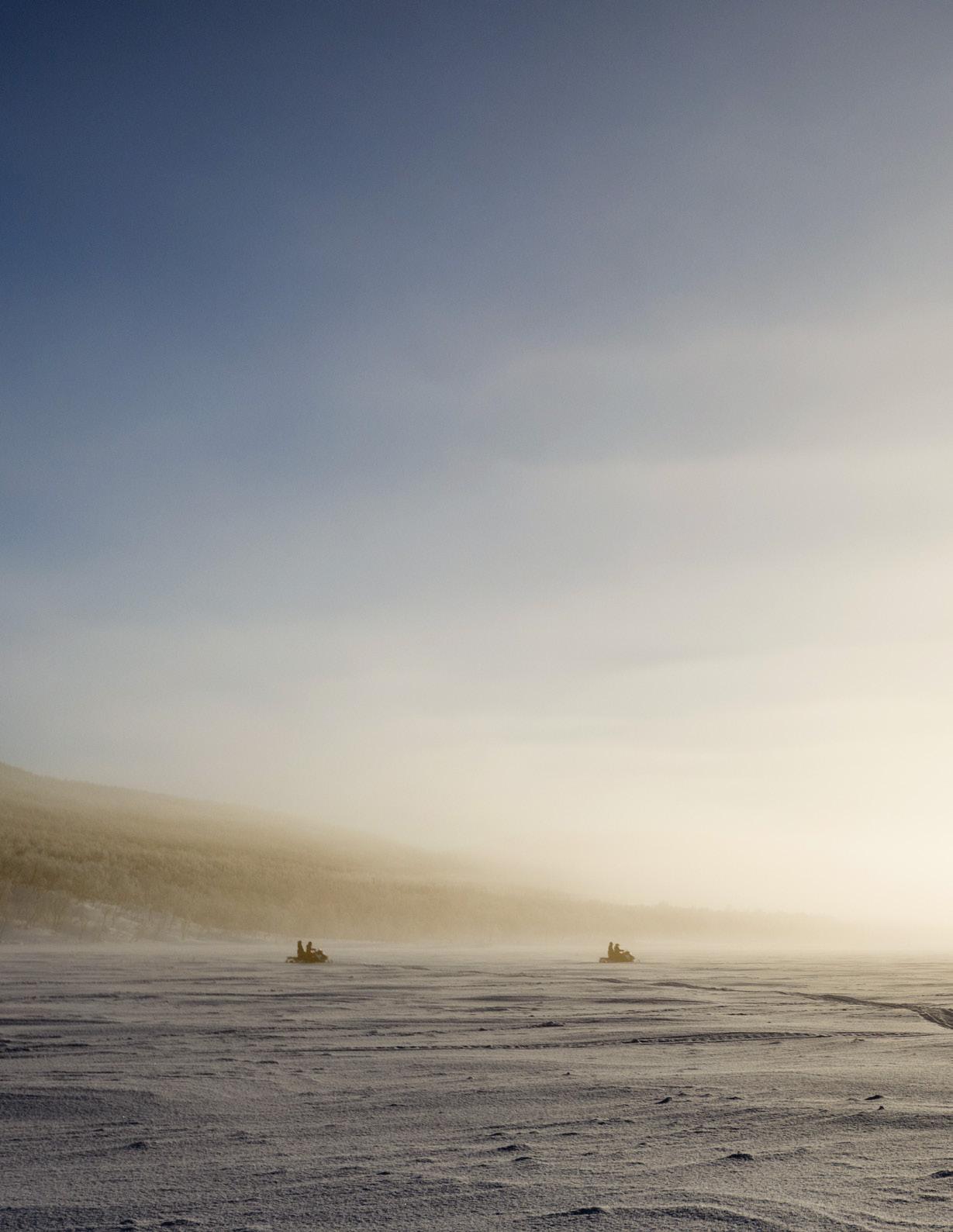
Snowmobiles proved essential for navigating the vast frozen terrain, keeping our transportation and logistics running smoothly.
person out of 11 managed a proper dive. Luckily, we improved our performance over the duration of the course.
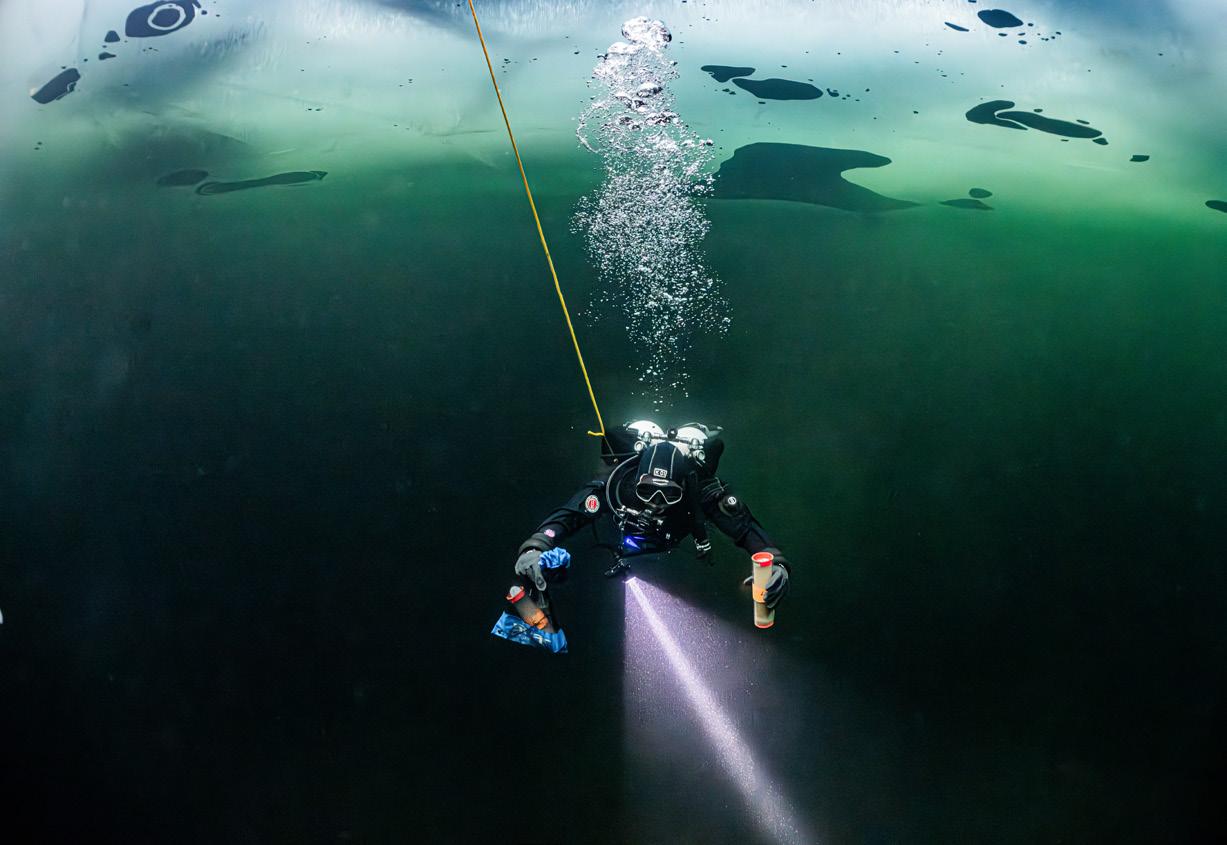
It seemed to me that the greatest challenge was to get underwater at the start of the dive so that the equipment could actually thaw in the water. As a result, I deflated my wing completely, exhaled until I was underneath the ice and just kept holding on to the safety line while slowly breathing through my primary.
If that one froze, I changed to the secondary regulator, closed the right valve, and just waited and hoped that my secondary would not freeze as well. Other divers had the uncomfortable experience of finding that valve manipulation is very hard if there is no air in your drysuit (left valve was closed).
If the first stage free-flows, one interesting side effect is that the wing also gets inflated next to the gas coming out of the second stage. In my experience, if only the second stage freezes, you still have plenty of time to close the valve if you stop breathing through the system. For example, the crystals blocking the piston
in the second stage are only forming if the gas stream increases gradually.
However, if the first stage freezes over, or if the inlet inflator button is stuck open, controlling your buoyancy is very hard because your wing inflates uncontrollably and time is limited before you hit the surface—or in our case, a solid ice ceiling.
Another interesting aspect of working in -30 °C/-22 °F air temperature appeared after the dive. Completely soaked divers have to be fast in removing all their gear while being seated; otherwise the equipment a) freezes solid onto your body, or b) you freeze solid onto the ground. Then the divers were transferred to a sledge and towed up with a snowmobile to the station for defrosting.
Luckily temperatures rose up to a cozy -8 °C/18 °F in the second half of the course, and with that the number of problems decreased drastically. In Antarctica they cover the ice holes with tents and install a heating system to keep air temperatures moderate.
Science and saunas
In total we had five diving days. After getting our heads underwater, we conducted scientific tasks such as sediment core sampling, analyzing the sediment thickness with a transect, and collecting ice samples from underwater. As the days passed by, we grew more comfortable as a team and in our daily routines, and everything started to click.
Since we were a very diverse group with some who never dived with twinset cylinders before, I really learned to appreciate standardized diving equipment. It facilitated the pre-dive preparation and improved work efficiency and emergency handling significantly.
Being exposed to this harsh and unforgiving climate, in addition to cold-water diving and functioning as an effective team, was both physically and mentally exhausting. I was consuming nearly three times my normal daily calories, and the delicious food at the station next to pleasant sauna evenings in the warmth definitely helped keep our spirits up!
“
Since we were a very diverse group with some
who never dived with twinset cylinders before,
I
really learned to appreciate standardized diving equipment. It facilitated the predive preparation and improved work efficiency and emergency handling significantly.
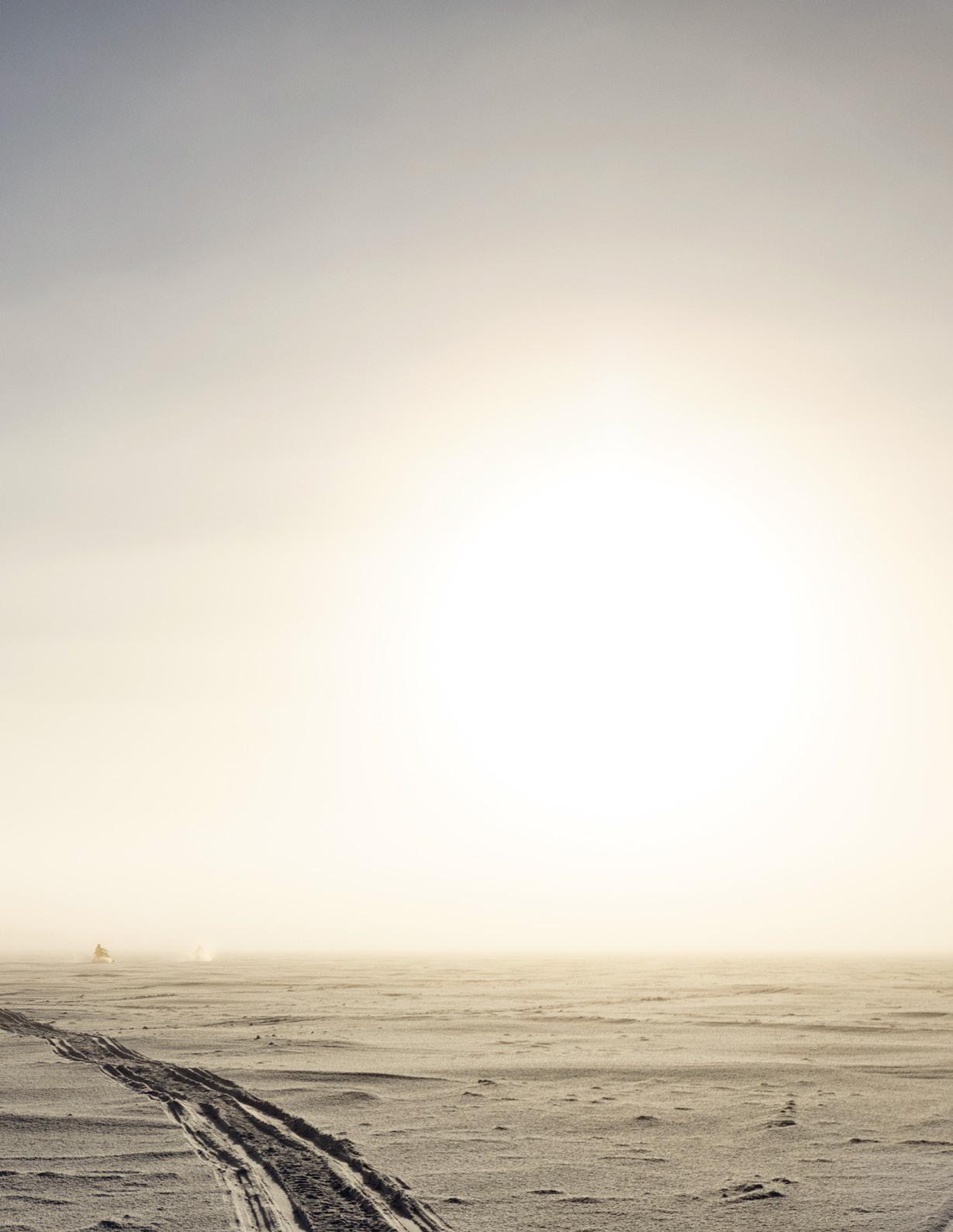
Golden Arctic light sets the scene as the team works the ice hole with the vast frozen landscape behind.
Furthermore, our evenings were enriched by presentations of the instructors’ passion projects. Erik captivated us with his cold-water sponge research in Antarctica, where 2 m/6.6 ft leopard seals could surface in your diving hole out of convenience and curiosity. There, surface temperatures were less of a problem due to the use of a tent, but the water in Antarctica is even colder, below 0 °C/32 °F, and the ice sheet can be up to 3 m/9.8 ft thick.
Lessons from the ice
Edd introduced us to his various cave and mine explorations in Finland at depths below 100 m/328 ft, as well as the mind-blowing sensation of finding new passages, installing a deco habitat, and deciding which movies not to watch while sitting through six hours of decompression.
Pata hooked us with stories about his diving and expedition guiding in the polar regions, includ-
ing a plane crash in Antarctica and throwing salami as a distraction for polar bears in Greenland.
It was a truly enriching experience to be surrounded by so many inspiring personalities, including all of the participants. We had all worked on different projects in the past and experienced challenges with international operations and team members, and it was amazing how strong we grew together in less than two weeks.
I also learned that the most important people on the team and for the whole operation are not necessarily the ones that are exceptional at hard skills, but those that care deeply for other individuals. This was probably the most valuable lesson of the course. In such extreme conditions, there is no point in hiding who you are or trying to be somebody different. So the best way to approach an expedition (and life) is to stay true to yourself, acknowledge your own limits and mistakes, and keep an eye on each individual’s needs.
PHOTOANNI MALINEN
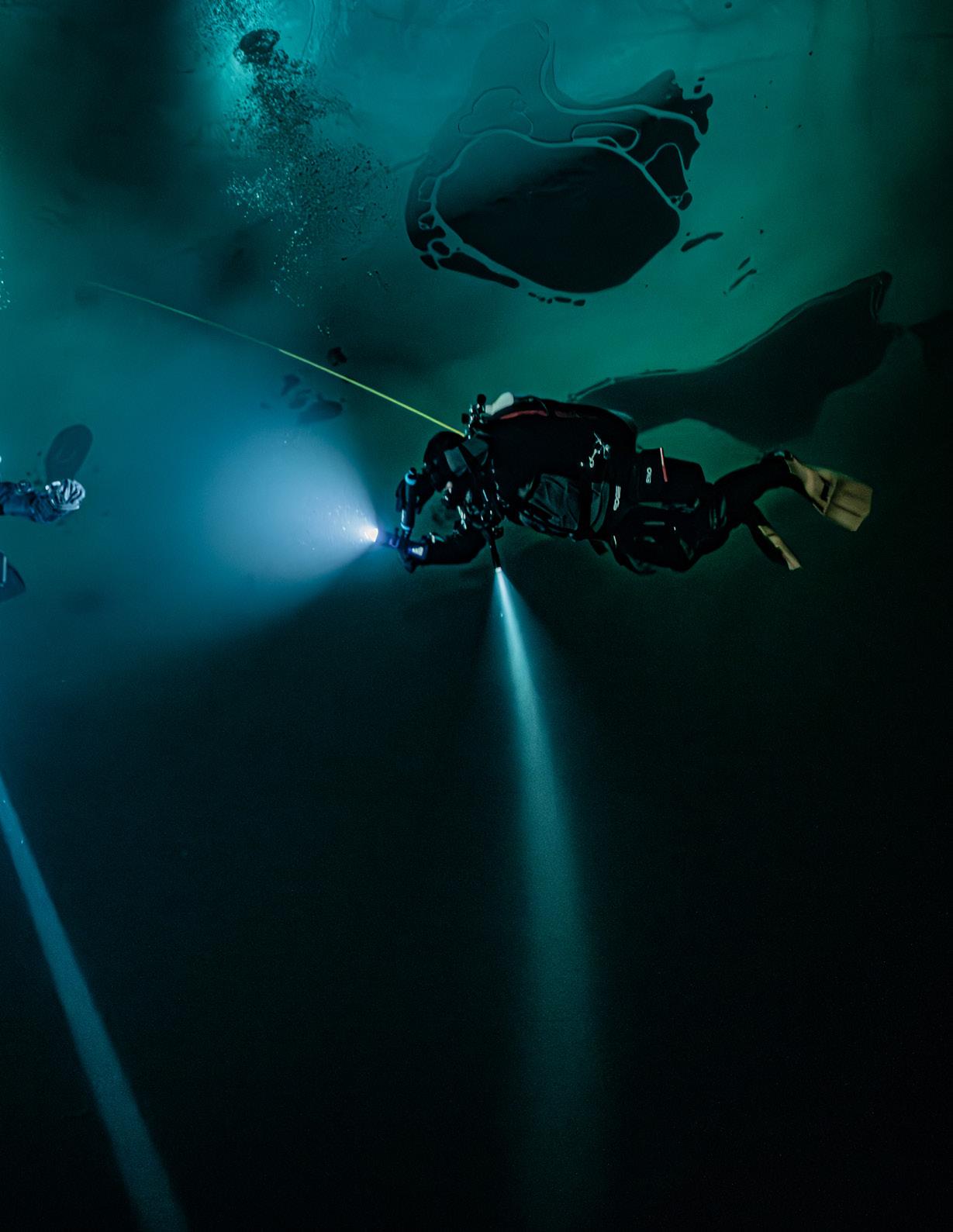
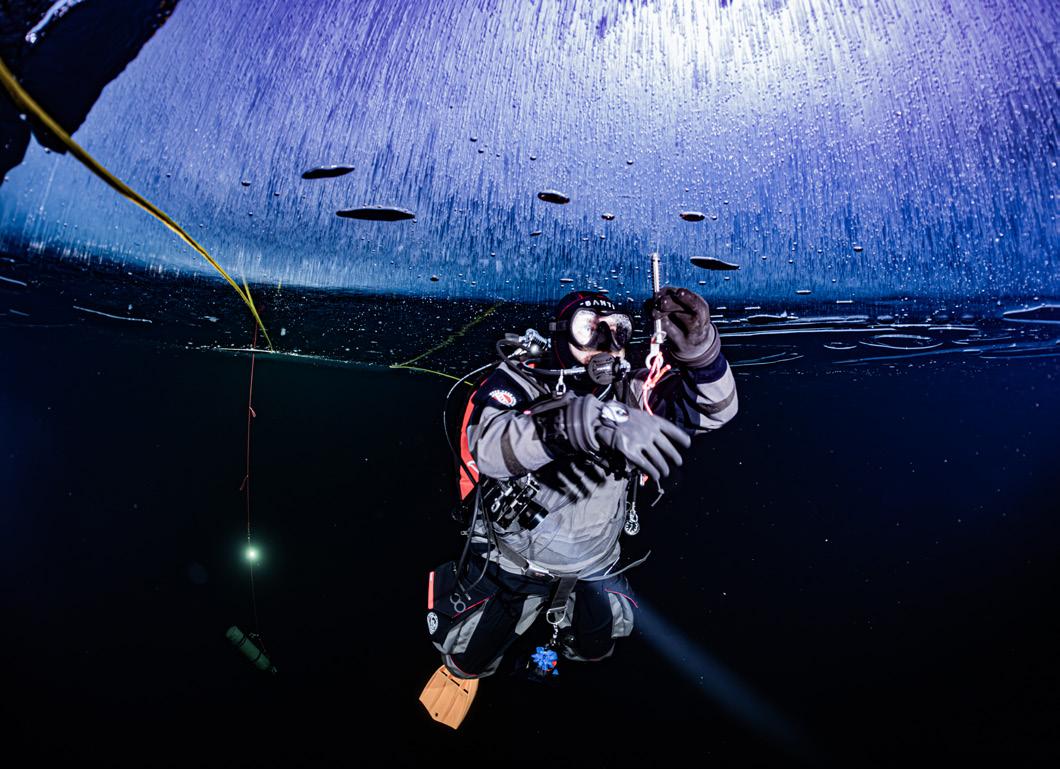
Descending into the eerie green abyss, torch cutting through the darkness – this is what we came for.
Final kit checks at the ice's edge – once you drop below, there's no room for anything left to chance.
PHOTO STEFFEN SCHOLZ
PHOTO PATA DEGERMAN
“In addition to very long days at the station, we had super strong northern lights over Lake Kilpisjärvi, and I could not help but go skiing with rented equipment from the station while enjoying the breathtaking dancing colors
PHOTO PATA DEGERMAN
The Arctic sky erupts in a breathtaking curtain of northern lights, a reminder of just how wild this place is.
Carrying it forward
Looking ahead, I hope to take part in more polar scientific diving expeditions. In my opinion, courses such as the FSDA Polar Scientific Diving program are essential for learning the skills required to operate in remote and demanding environments, as well as to test your own limitations and reactions to stress. I would also suggest assigning a confidential contact person for each expedition to give everyone the opportunity to speak up if they feel overwhelmed or unsafe. I also really appreciated the “just culture” approach and will try to implement it in future projects.
In addition to the team skills already mentioned, I also learned many technical skills for diving operations in very low temperatures and what can go wrong with equipment when it is free-flowing. I also became much more confident with my valve drills and in handling challenging situations underwater.
I made connections and friendships for life during this course, and the problems encountered and solved during diving will help me in all my future projects. Beyond these personal achievements, I also really enjoyed the breathtaking location and the beauty of the ice with so many frozen gas bubbles inside, which sparked my scientific interest in greenhouse gas production in freshwater lakes. My personal side quest was to reach the station with the lowest possible emissions, which resulted in one flight, eight buses, and one overnight train from Narvik via Kiruna to Stockholm—the iron transport route. Despite the longer journey, I really enjoyed meeting old and new friends and traveling slowly.
I’m deeply grateful to GUE’s NextGen Program and the Finnish Scientific Diving Academy for this opportunity. I’ll carry these lessons forward, and I’ll never forget that under the right conditions, even 1 °C/34 °F water can feel like a spa.
Working beneath the frozen surface, taking precise measurements–science doesn't stop just because it's freezing down here.
PHOTO STEFFEN SCHOLZ
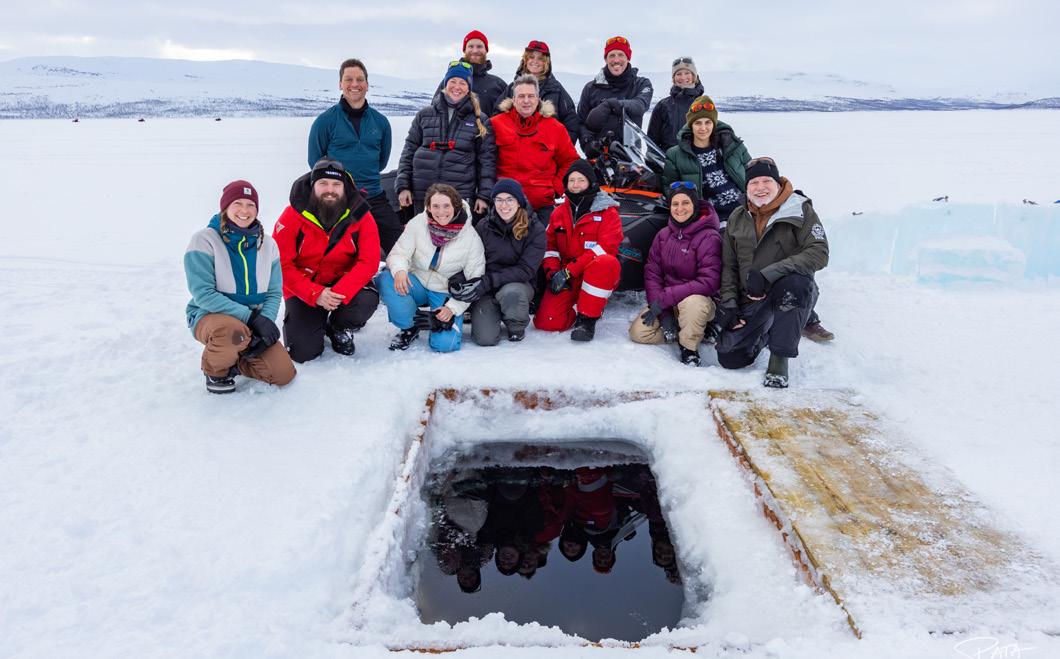
The team gathers around our hard-earned hole in the ice–tired, cold, and utterly proud of what we pulled off.
Isabell Hentschel is a marine scientist focusing on greenhouse gas cycling in diverse marine systems. She is currently based in Kiel, Germany, where she is pursuing a Master of Science in Marine
Geoscience and working at the GEOMAR Helmholtz Centre for Ocean Research Kiel. Alongside her studies, she is a scientific and technical diver enrolled in GUE's NextGen Traineeship in 2026.
Isabell Hentschel
PHOTO
TEXT JIALING CAI
PHOTOS JIALING CAI & JESPER KJØLLER
WHEN THE DEEP SEA COMES TO ME
SEA
–
After night falls, billions of plankton travel hundreds of meters from the deep sea to the shallows, then retreat back into the depths before sunrise. This up-and-down movement, repeated every day and everywhere in the open ocean, is called “the diel vertical migration of zooplankton.” I first heard this simple statement in an introductory marine biology lecture in my second year of college. Somehow, I felt like I was hit by a lightning strike, and I paused to think about the further implications of this ocean phenomenon. My basic assumptions of the world had been challenged.
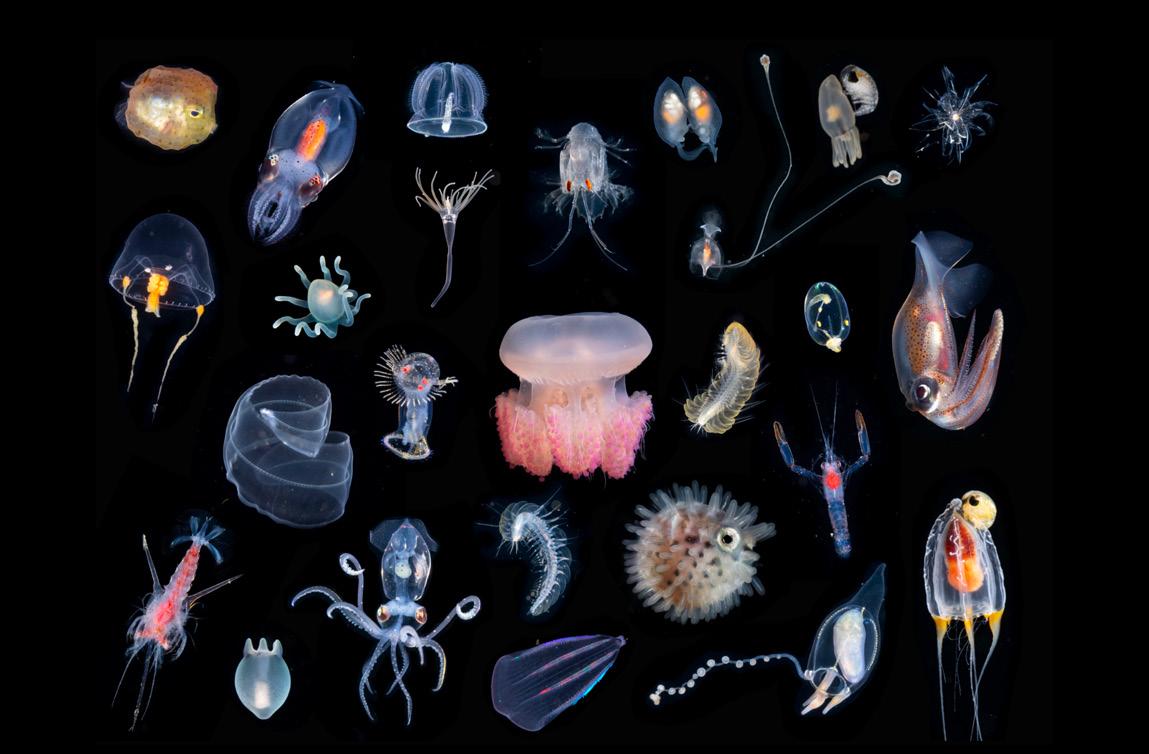
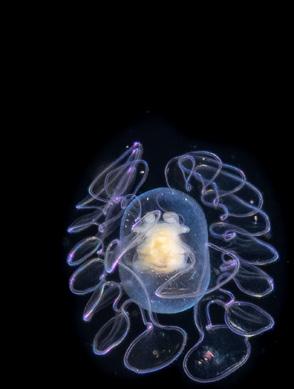
After dark, the abyss exhales, jellyfish, sea angels, armored larvae, hitchhiking octopuses, and glass squid rise silently from the deep, filling the night water with ancient, translucent life before vanishing at dawn.
“As blackwater photographers, we are taking advantage of the diel vertical migration of zooplankton to document them at recreational depths at night.
Iknew that a trained recreational diver could only descend to about 30 m/100 ft. To see deep-sea creatures living hundreds or thousands of meters down with my own eyes, I believed you had to become a billionaire like James Cameron, build your own submersible, or become a deep-sea biologist and, after years of effort, earn the privileged opportunity to hitch a ride on a submersible in the name of scientific research. Yet, I am now told that we ordinary people only need to wait for night to fall, pick any patch of ocean, dive down to twenty, or even just a few meters, then the deep sea will come to me. So I decided to verify this theory for myself. I started frantically researching how to train as a diver, searching worldwide for dive shops that offer diving in the open ocean at night, and pondering how to document those marvelous creatures I hoped to encounter. During this process, I was delighted to discover that there was already a group of people who had long been doing exactly what I wanted to do. They have a name that almost sounds sci-fi: blackwater photographers.
The midnight migration
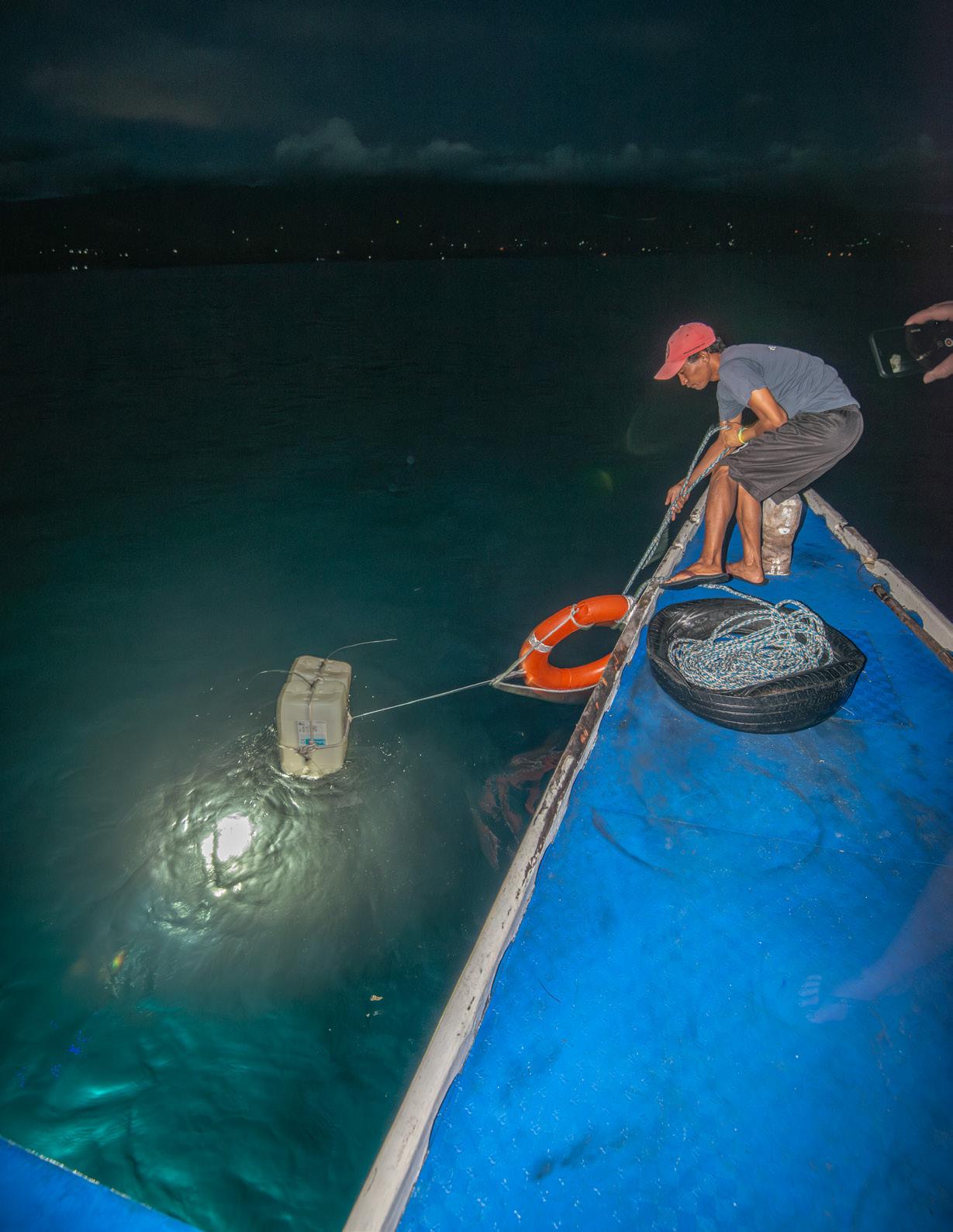
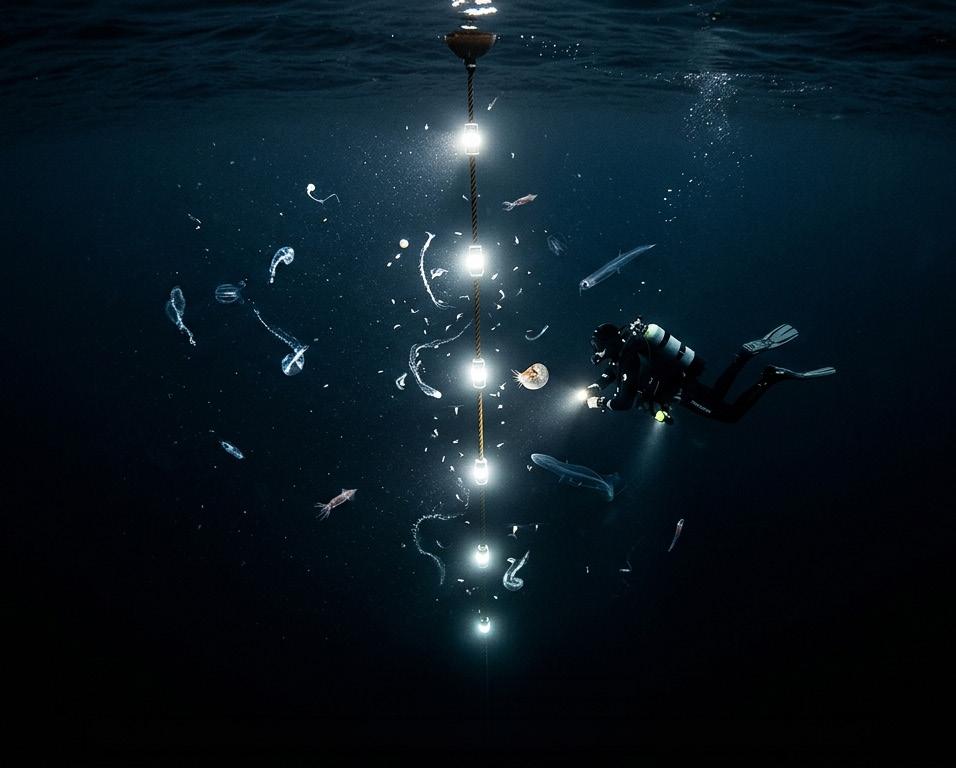
As blackwater photographers, we are taking advantage of the diel vertical migration of zooplankton to document them at recreational depths at night. The exact logistics of blackwater diving vary among different dive shops and dive sites, but in general, divers take a boat out to the open ocean, and the crew will throw a buoy into the water with a sturdy rope tied
beneath it, about 30 m/100 ft long, with lights attached every five meters. This string of lights will attract many plankton, which in turn attract the predators that feed on them, and thus create a space with a high concentration of interesting creatures. At the same time, this chain of lights becomes our most important point of reference in the boundless darkness that guides divers back to the boat. Though the seafloor below may plunge hundreds or even thousands of meters deep, the divers themselves remain within a controlled depth range, usually no deeper than 30 m/100 ft.
After entering the water, I switch on my torch. A single column of light cuts through the darkness and becomes the only clearly defined space in my field of vision. The water column is not transparent in the same way air is. Countless grains of sand and flecks of organic debris hang suspended in the water, softening and scattering the light. And yet, every so often, some of these “particles” flash back at me in a unique way, moving a little closer, and what looks like noise resolves into life. It could be an octopus’s eye staring back, or the reflective scales of a juvenile fish. Gradually, I learn to pick out the subtle distinctive movements that set living bodies apart from the surrounding chaos of drifting matter. Zooplankton are any creatures that can swim or propel themselves to a limited extent but rely primarily on currents to travel long distances. Loosely defined by a way of life rather than by taxonomy, zooplankton form an extraordinarily diverse assemblage of animals.
PHOTO JESPER KJØLLER
“The exact logistics of blackwater diving vary among different dive shops and dive sites, but in general, divers take a boat out to the open ocean, and the crew will throw a buoy into the water with a sturdy rope tied beneath it, about 30 m/100 ft long, with lights attached every five meters.
Blackwater diving uses lit buoy lines to attract pelagic life, providing a reference point for divers in the deep, dark ocean.
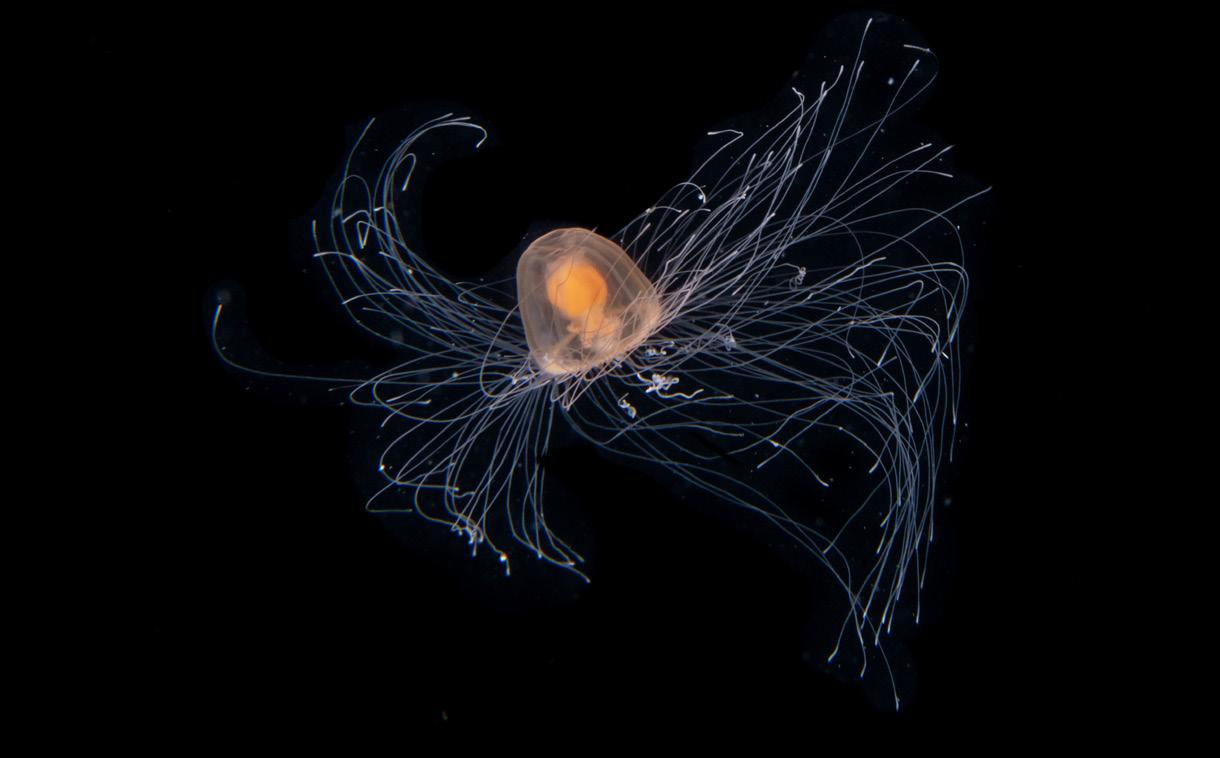
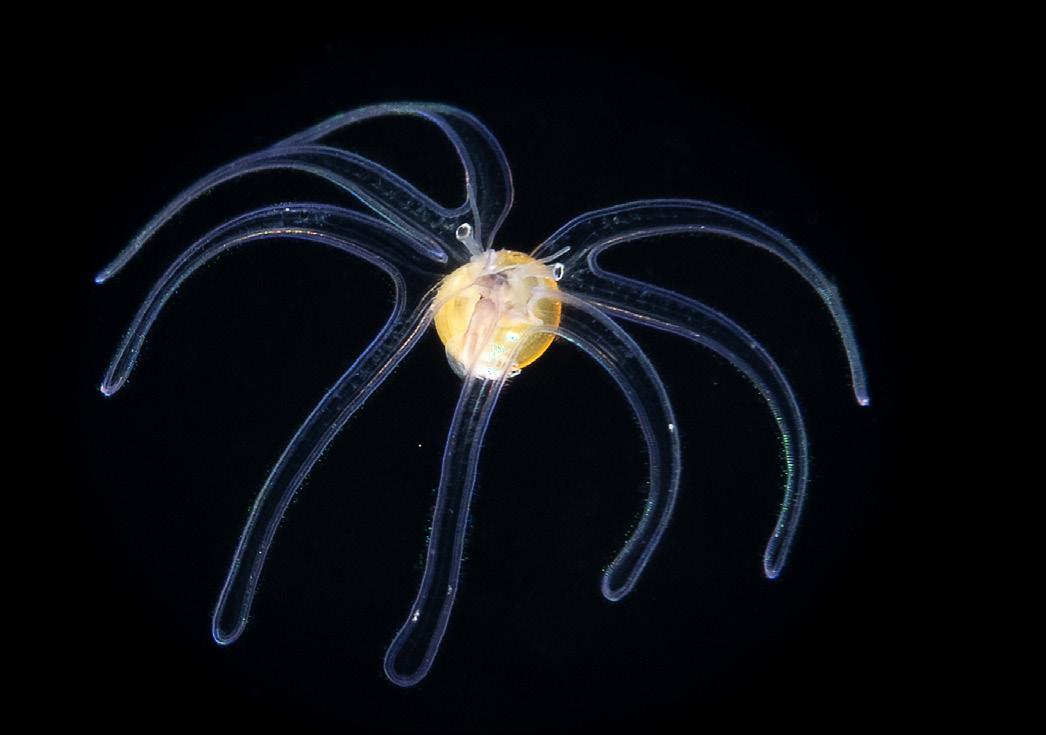
A jellyfish pulsing through open ocean darkness, its trailing tentacles armed with microscopic stinging nematocysts ready to capture prey.
A diverse drifting assemblage
The first plankton that often comes to mind is the jellyfish, with its stereotypical look like a soft, translucent umbrella with wiggling tentacles trailing beneath. They belong to the phylum Cnidaria, with their defining feature being the stinging cells, or nematocysts, embedded along their tentacles, which they use to capture prey. These jellyfish propel themselves through the water by contracting and relaxing their bell. Yet many jellyfish do not swim actively. Instead, they drift quietly in the current, sometimes extending just a single tentacle that resembles a string of pearls. I like to call these “one-armed, asymmetrical jellyfish.” Each “pearl” along the string is a dense cluster of nematocysts, used to ensnare and immobilize anything unlucky enough to touch it.
Sea butterflies, like snails and whelks, belong to the class Gastropoda. Most gastropods live by crawling along sand or reef surfaces, but their open-ocean relatives are more like elves. Their calcareous shells have become semi-transparent, and the foot they normally use for crawling has been specialized into a pair of wing-like structures, hence the name “pteropods,” or wing-footed snails. Another group of pteropods have even completely shed their transparent shells, transforming into what peo-
ple call “sea angels.” Gelatinous zooplankton, like jellyfish and pteropods, are soft and light. For them, it’s not hard to imagine drifting as an effective way to expand their distribution. Yet the ocean is also home to countless seemingly clumsy residents: corals anchored to the seafloor, slow-moving shrimps and crabs, worms wriggling through the mud. How do these sessile and benthic creatures ever expand into a distant territory? Simply crawling and wriggling hardly seems optimal. After billions of years of trial and error, nature has found a genius solution: no matter where the creatures eventually settle, life often gives it a chance to ride the currents, beginning as a tiny planktonic larva.
Nature’s genius larval solutions
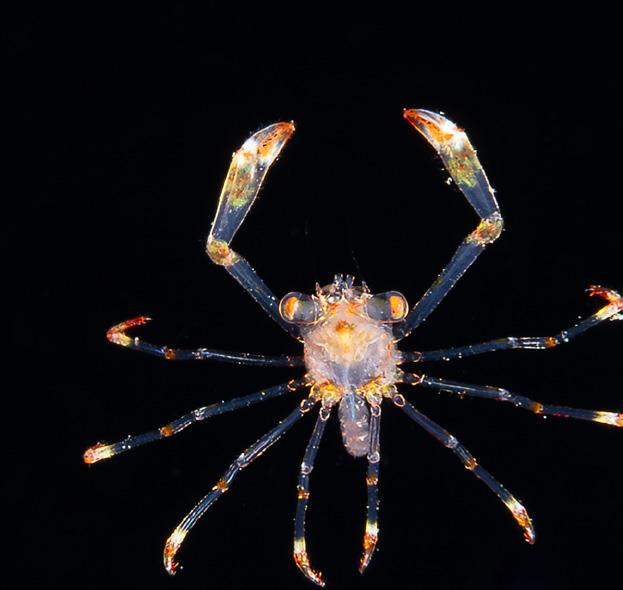
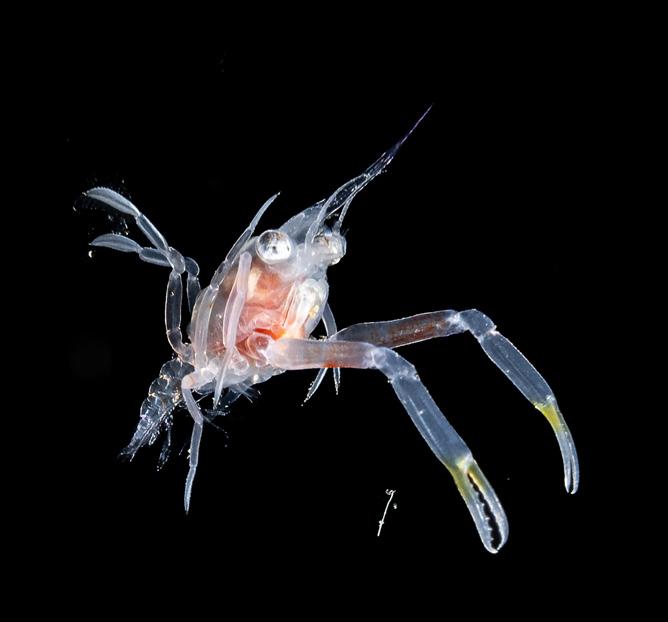
Take crabs, for instance. Their bodies appear short and square, giving them a somewhat clumsy look at first glance. However, crab larvae are nothing short of formidable armored warriors. They typically undergo two planktonic stages. In the first stage, known as the zoea, the carapace is adorned with long spines that can be several times the length of the body. Any predator not careful enough when attempting to take a bite would likely end up impaling itself. In the second stage, called megalopa, the exaggerated spines on the head disappear, and the front
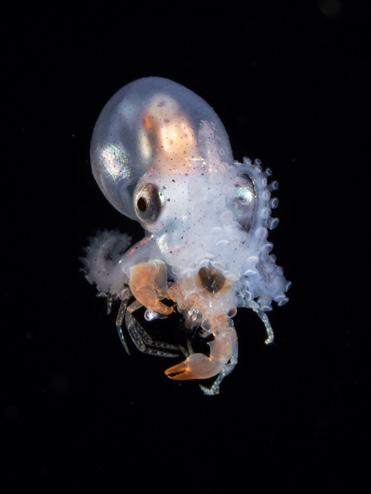
Prominent claws and stalked eyes mark the megalopa stage— already crab-like up front, but still trailing a slender juvenile tail.
half of the body begins to take on the iconic appearance of a crab, with two large protruding eyes and prominent claws in front. Yet, their abdomens remain slender, a tail trailing behind them. Surprising as it may sound, young crabs actually have tails.
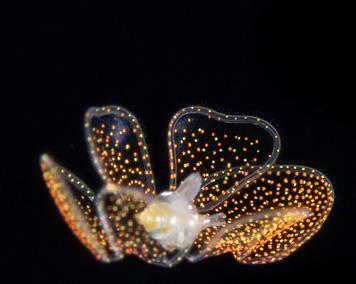
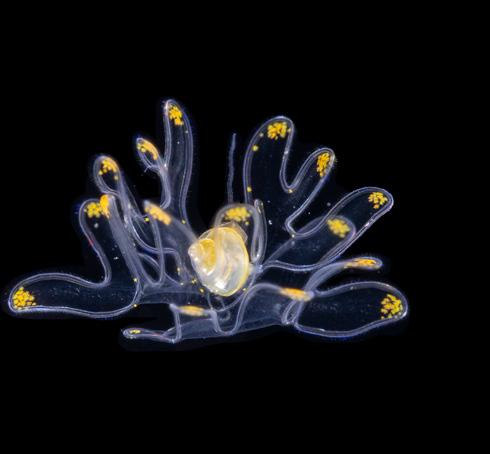
While walking along coastal mudflats, we often encounter snails laboriously dragging their heavy shells. In contrast, their larvae, called veligers, resemble a delicate glass sculpture, and the velum, a structure used for feeding, unfolds like soft, petal-like lobes adorned with dazzling specks of color. These petal-like structures are actually the larval form of the snail’s foot. During the planktonic stage, however, the velum spreads out like a parachute. It increases drag in the water, helping the larva remain suspended in the water column. If the larva senses a threat, it can retract its velum in an instant. With the sudden increase of density inside the shell, the veliger larva will escape into the abyss with the help of gravity.
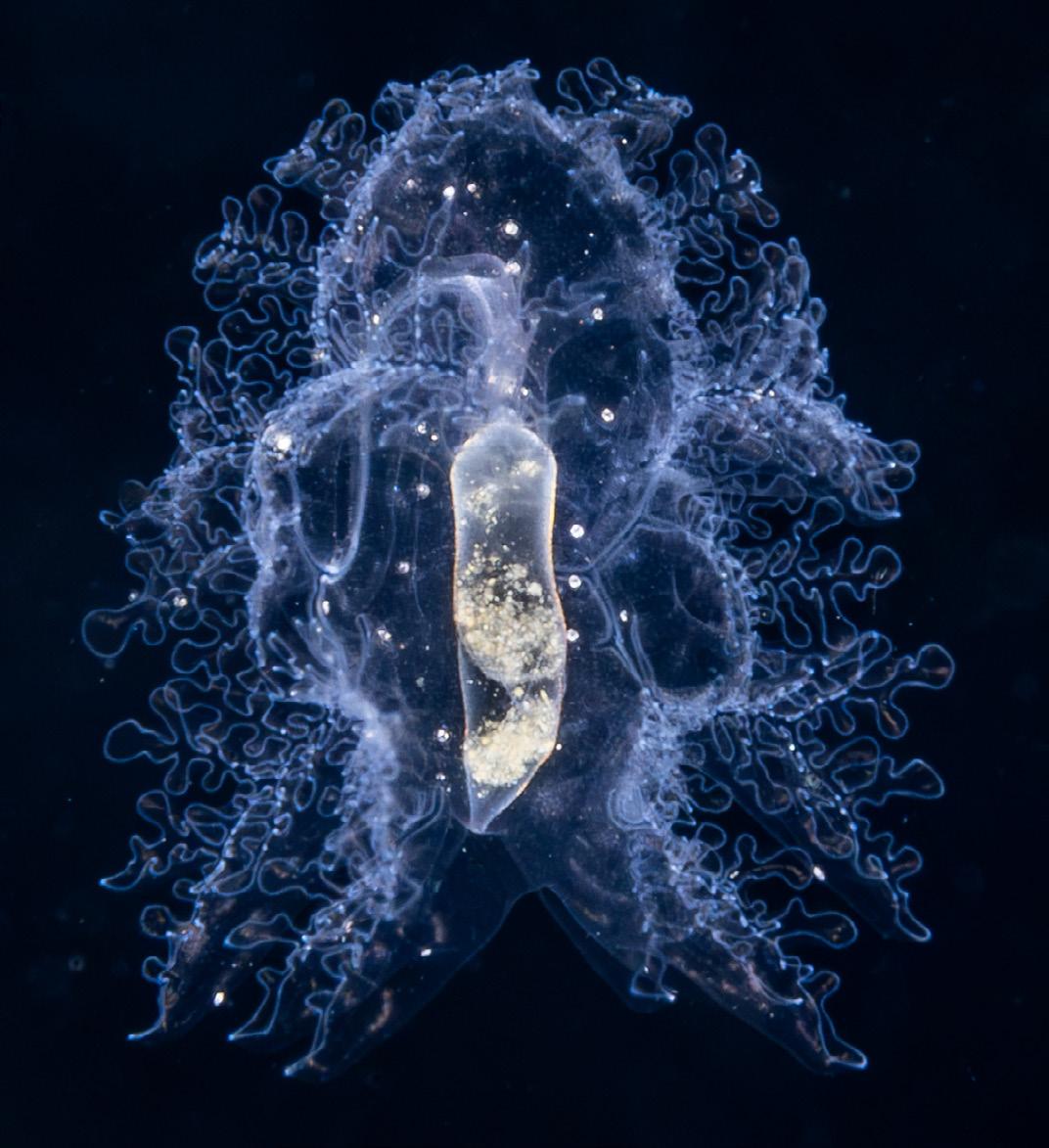
Let me boldly assume that most people are not a big fan of the worms (in the phylum Sipuncula). However, you will have the chance to meet their planktonic babies that look like iridescent bubbles. The most surprising de-
velopmental puzzle I solved recently has to be that of a sea cucumber. While the adult sea cucumbers look like wrinkled sausages on the sea floor, the first planktonic stage of sea cucumbers, the auricularia larva, is almost like a transparent Christmas tree!
The ocean’s giant kindergarten
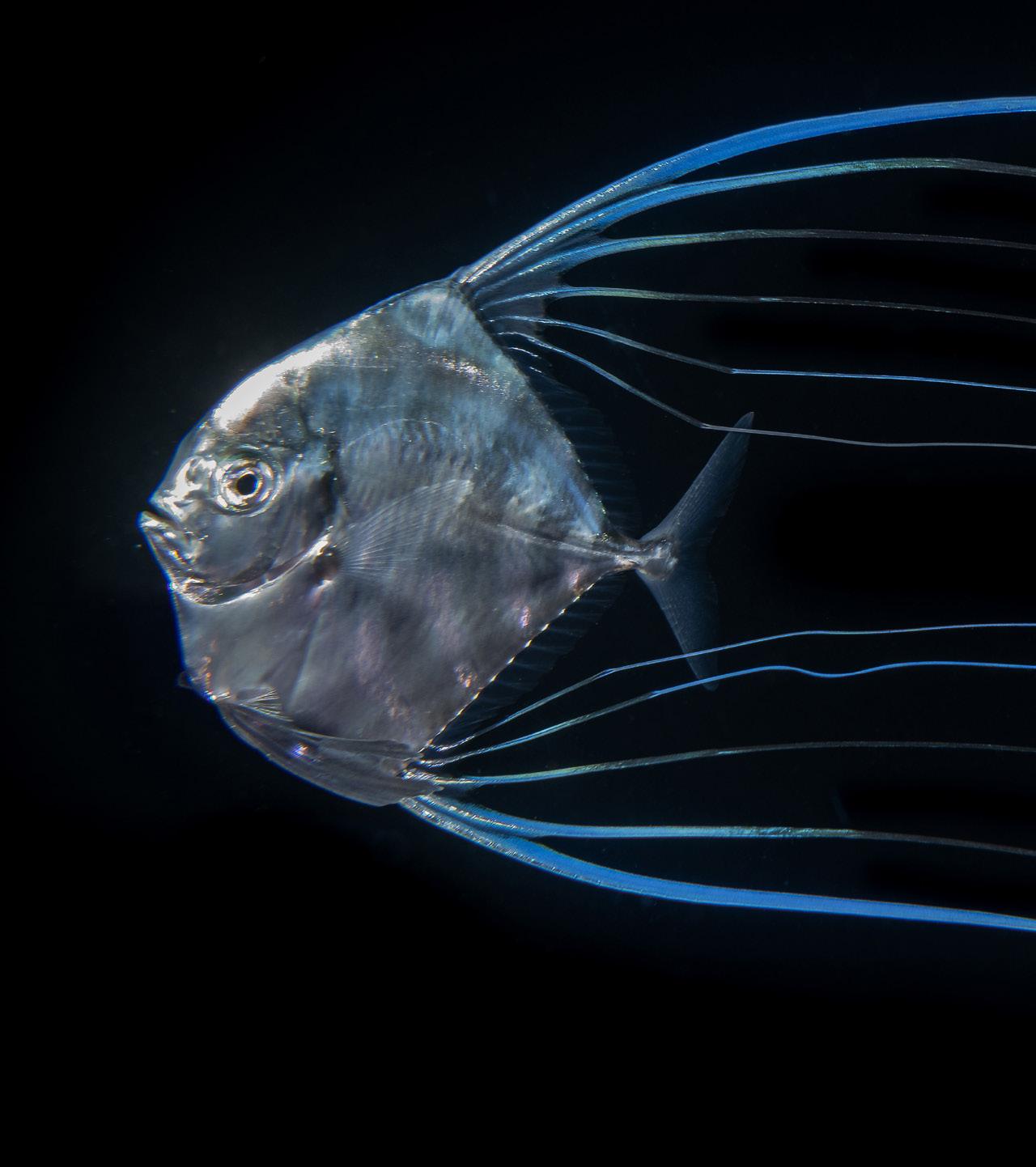
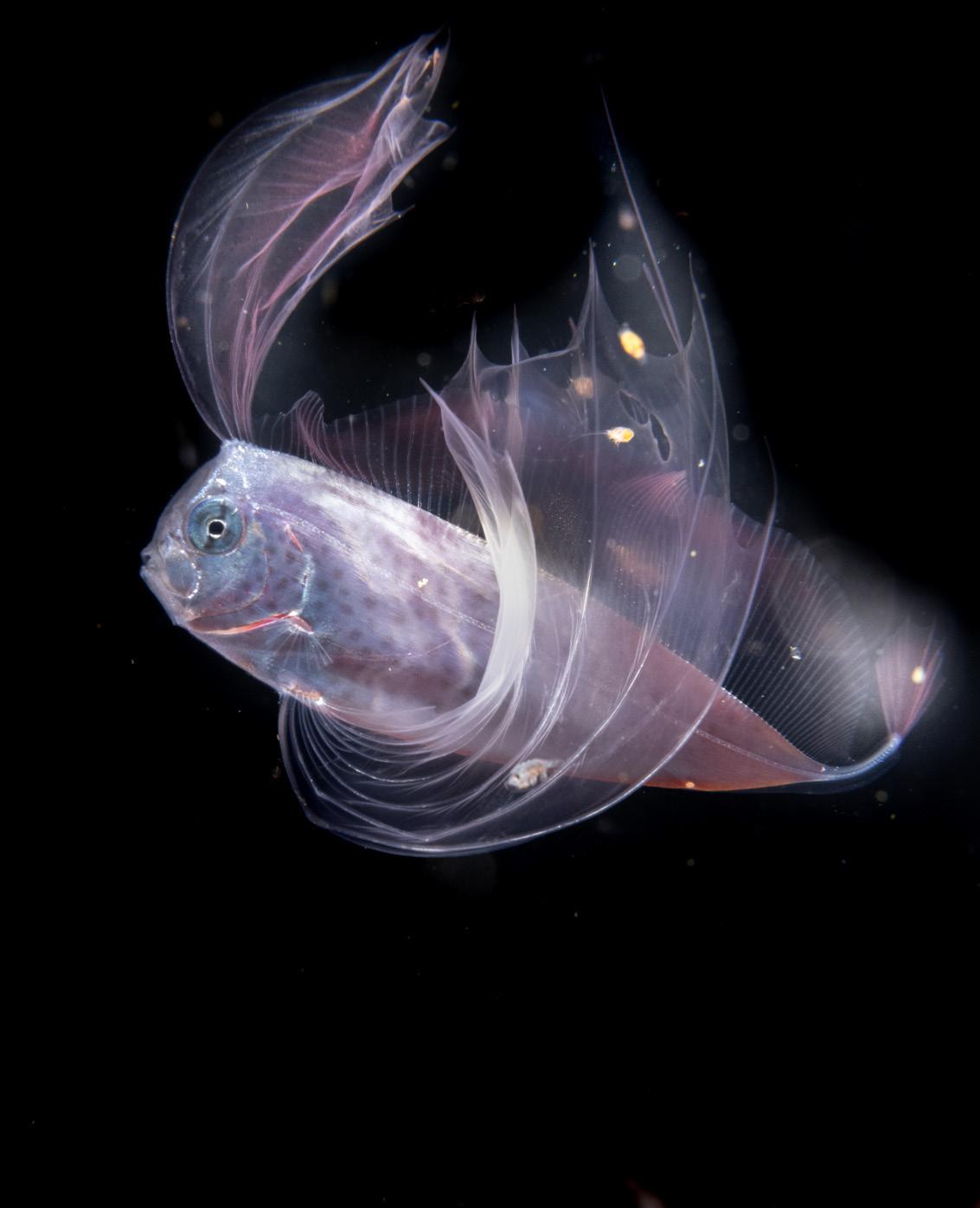
This general rule of dramatic transformation does not only apply to invertebrates, but also to common fish we know. Adult fish typically have sleek, streamlined bodies optimized for efficient swimming, but their larvae drift among the planktonic world with poorly developed muscles and extravagant fins several times longer than their bodies. These exaggerated adornments may confuse predators: “Is this a fish, or a poisonous jellyfish in disguise?” As the juveniles grow, these flamboyant fins are discarded like outdated clothing. In short, most marine animals spend their early development as planktonic larvae. Since these drifters rise into shallower waters at night, the surface of the open ocean becomes a giant kindergarten. Through blackwater photography, we can piece together the hidden childhoods of animals we thought we already knew well.
However, do not mistake this planktonic kindergarten for a cozy playground. It is, in reality, a fully exposed and unforgiving battlefield. Here, nothing remains hidden. Just a faint flashlight beam could reveal everything in its path. Many planktonic creatures are translucent, with their digestive organs on full display. You can observe a baby octopus nibbling a crab or a jellyfish digesting a small fish. To us divers, this transparency is a scientific marvel. To the plankton, it's the brutal and inescapable rule of life. So how do open-ocean dwellers find any shelter at all? For a remarkable answer, look at a group of pelagic octopuses known as argonauts, who spend their entire lives adrift in the water column. The males are tiny—no larger than a pinky nail. Without cover, such a creature would be little more than a convenient, chewy protein gummy. Argonauts are not classified as plankton because of their strong swimming ability,
Veliger Larva of gastropods. Petal-soft lobes unfurl like a glass flower, catching food particles and slowing descent as this snail larva drifts through the current.
yet they feed on plankton. This diet draws them upward each night alongside their prey, making them frequent, vulnerable subjects during blackwater dives.
Survival in the open abyss
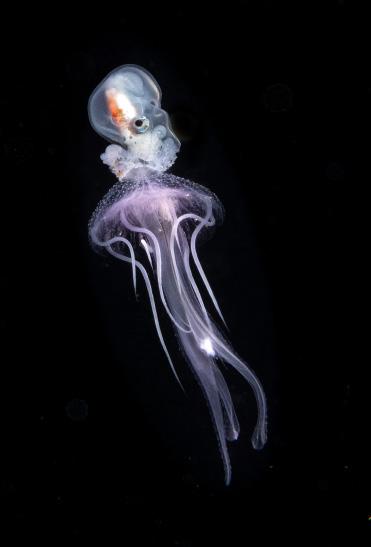
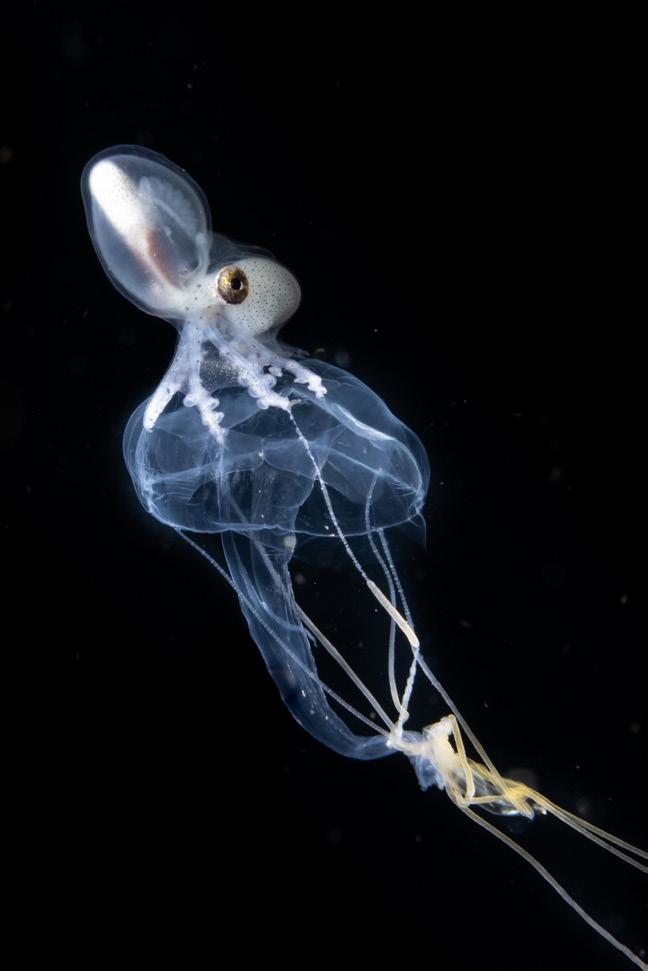
Camouflage is the octopus’s signature survival skill. On a reef, an octopus can alter its skin color and texture to vanish against rocks, corals, or sand. But here, in the water column, their bodies are fully exposed. Argonauts have devised a brilliant alternative: they turn other creatures into shelter. Far from naïve, these small octopuses rarely travel alone. They hitch rides on various “vehicles,” often bullying other planktonic animals in the process. After all, when the ocean offers no physical refuge, your fellow drifters become your moving castles. Their favorite vehicles are jellyfish, which they cling to like elegant gowns. This hitchhiking conserves energy for
Trailing impossibly long, ribbonlike fins, this juvenile African pompano drifts through the water column—a flamboyant larval disguise it will shed upon reaching adulthood.
Quest· May 2026
“Adult fish typically have sleek, streamlined bodies optimized for efficient swimming, but their larvae drift among the planktonic world with poorly developed muscles and extravagant fins several times longer than their bodies.
Weightless in absolute darkness, you hold your breath as ancient creatures drift into your torchlight— visitors from a world that should be unreachable.
swimming and amplifies their apparent size. More cleverly, by attaching their arms to the jellyfish’s bell, argonauts can steer the jellyfish’s stinging tentacles toward would-be predators, turning the jellyfish into both a mobile fortress and a chemical shield.
But in this precarious environment, these octopuses cannot be very picky. They are loyal to no single host and will hop onto anything that floats—whether a veliger larva of a gastropod, a delicate sea butterfly, or even a shared “bus” in the form of a solitary salp. Sometimes, argonauts even travel in a large group, boarding what resembles a “galaxy express,” a long chain of
salps. Each salp is a transparent, gelatinous barrel with a distinct orange-yellow digestive organ. Look closely, and you might spot tiny octopuses nestled inside some of these barrels. Their color and size are nearly identical to those of the salp’s own organs. In the planktonic world, where a pelagic octopus cannot impersonate a rock or coral, it has learned a different kind of mimicry: it becomes part of another creature’s body! Just think of the layers of perception, decision, and intelligence quietly at work in the brains of the tiny creatures. Yet, for all their cleverness, such camouflage is just a fragile defense in a vast, exposed arena.
The juvenile ribbonfish drifts through the blackwater column, its mirrored silver body confusing predators into mistaking it for something far more dangerous.
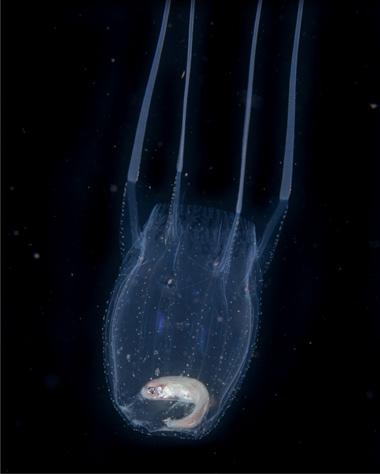
In the blackwater kindergarten, nothing is innocent. A juvenile jellyfish engulfs a fish (left) whole while a baby octopus dismantles a crab with quiet, deliberate precision. (right).
The ultimate game of hide-and-seek
The ultimate survival strategy has to go beyond a trick of disguise, and to participate in an intense game of hide-and-seek. Why do zooplankton undertake such an energy-intensive vertical marathon each day? The answer lies in the basic architecture of marine food webs. Nearly all ocean food webs trace back to the sunlit surface, where phytoplankton, microscopic algae, harness photosynthesis to produce organic matter. To eat, zooplankton must ascend into this sunlit zone. But in daylight, the open ocean offers no shelter, turning them into visible targets for many visual predators. Their evolutionary solution is a mass compromise: by day, they sink into the darker, safer depths; by night, they rise again to feed under the cover of darkness. This vertical migration, repeated across countless lineages over eons, is the finely tuned rhythm that assembles the jellyfish, sea angels,
Tiny argonaut octopuses cling to jellyfish bells, steering stinging tentacles outward—transforming their hosts into bodyguards, vehicles, and weapons all at once.
larval crabs, and octopus hitchhikers to the surface ocean at night.
Life originated in the deep sea hydrothermal vent, a sacred altar separated from the surface world by thousands of meters of distance and billions of years of time. We humans, breathing with lungs and walking on two legs, no longer belong to that abyss. Yet, nature left a secret gift to the explorers through the diel vertical migration. It allows us to take glimpses into the world where our mortal bodies could never reach.
When I encounter the larva of a glass squid at just 20 m/65 ft , whose adult counterpart is often found roughly 200-1,000 m/650-3,333 ft deep by remotely operated vehicles, in that suspended moment, the deep sea is within my reach.
Transparent and branching like a miniature Christmas tree, this sea cucumber larva bears no resemblance to the wrinkled adult it will become.
Jialing Cai
Jialing, the 2026 GUE NextGen Scholar, is an underwater photographer and science communicator from Chongqing, China. For the past eight years, she has been dedicated to documenting the smallest and most overlooked creatures that drift through the open ocean at night—plankton. Her work has been featured on National
Geographic, BBC News, and China Central Television. She started her GUE training with the aim to venture into deeper and colder waters for rarely documented plankton. She is preparing for Scientific Diver, Tech 1, and CCR Fundamentals during the scholarship year to expand her territory of exploration.
May 2026 · Quest
TORBJÖRN GYLLEUS
Illuminating the abyss
An interest in maritime history came before underwater photography. A fascination with shipwrecks brought Torbjörn Gylleus into diving, and growing up in Stockholm made the Baltic Sea a natural place to learn. In the cold, low-oxygen waters, wooden wrecks remain astonishingly well preserved, and each descent can feel like stepping into the past.
Torbjörn had photographed above the surface for years, but underwater photography demanded a new way of thinking. Moving in three dimensions changes composition, and available light affects everything else. The Baltic rarely offers easy conditions, and visibility can vary widely with the season and from day to day. Torbjörn is drawn to images where mood and structure emerge from constraints—balancing faint ambient glow with carefully placed artificial light and letting the water’s texture become part of the story.
That curiosity gradually took him further: into technical diving, deeper wrecks, caves, and flooded mines where natural light disappears completely. In these spaces, artificial light becomes the only illumination, so the workflow becomes methodical—light placement, exposure, and preserving depth and structure are constant considerations. He aims for images that are both informative and atmospheric, while keeping the sense of scale and context that makes each site unique.
Alongside his own work, Torbjörn is editor of the Scandinavian dive magazine DYK , combining images with storytelling—sharing experiences from below the surface and encouraging others to do the same. Diving and photography have taken him to environments he once only imagined, and he continues to look for new sites and stories.
www.gylleus.se
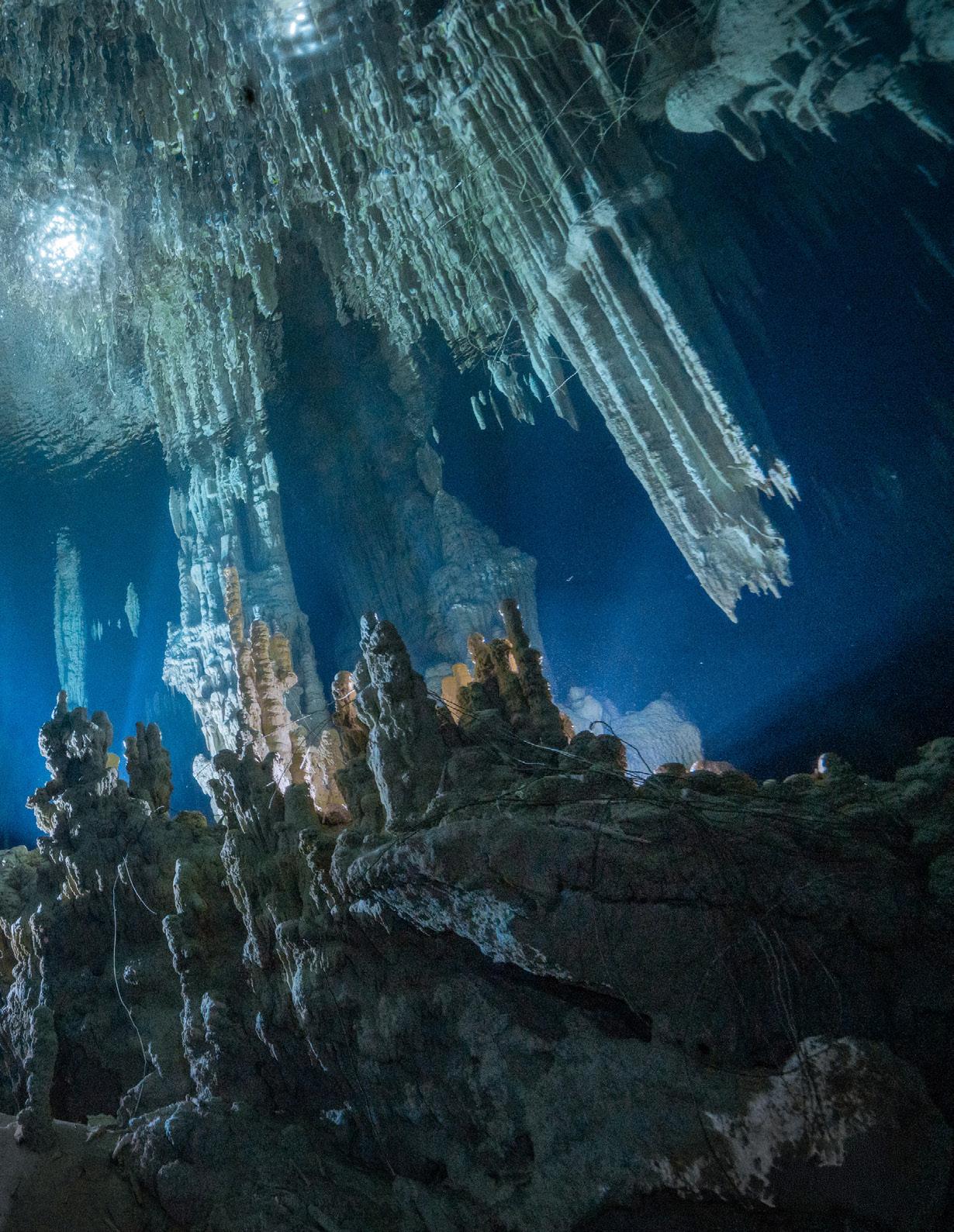
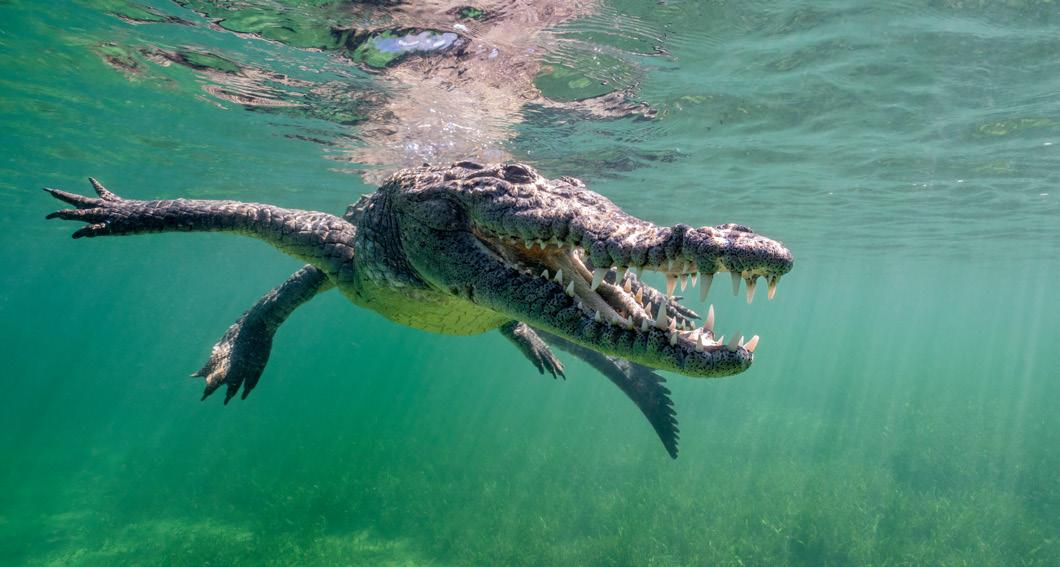
LOCATION Jardines
TITLE Big
CAMERA Sony A7RII
HOUSING Nauticam A7II
LENS Sony FE 16-35mm F4 ZA OSS
EXPOSURE 1/125, F14, ISO 500
STROBE / LIGHT Sea&Sea YS-D2
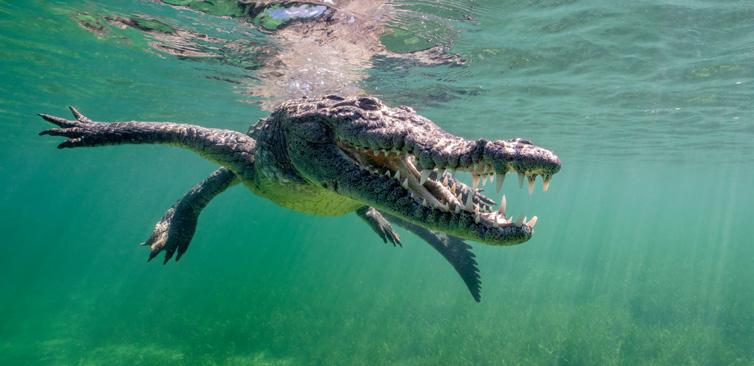
COMMENTS Swimming with American saltwater crocodiles is a pure adrenaline rush.
smile
de la Reina, Cuba
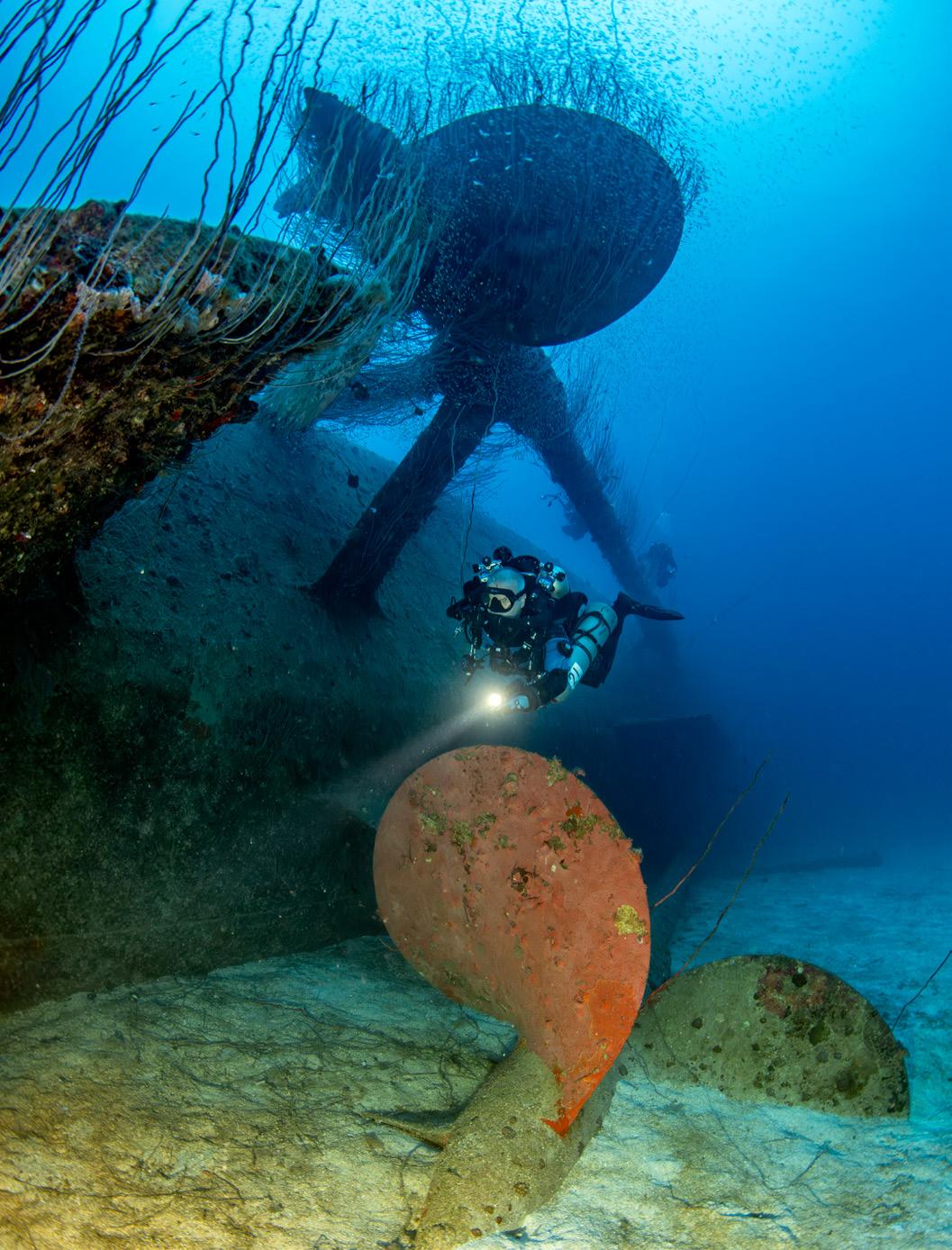
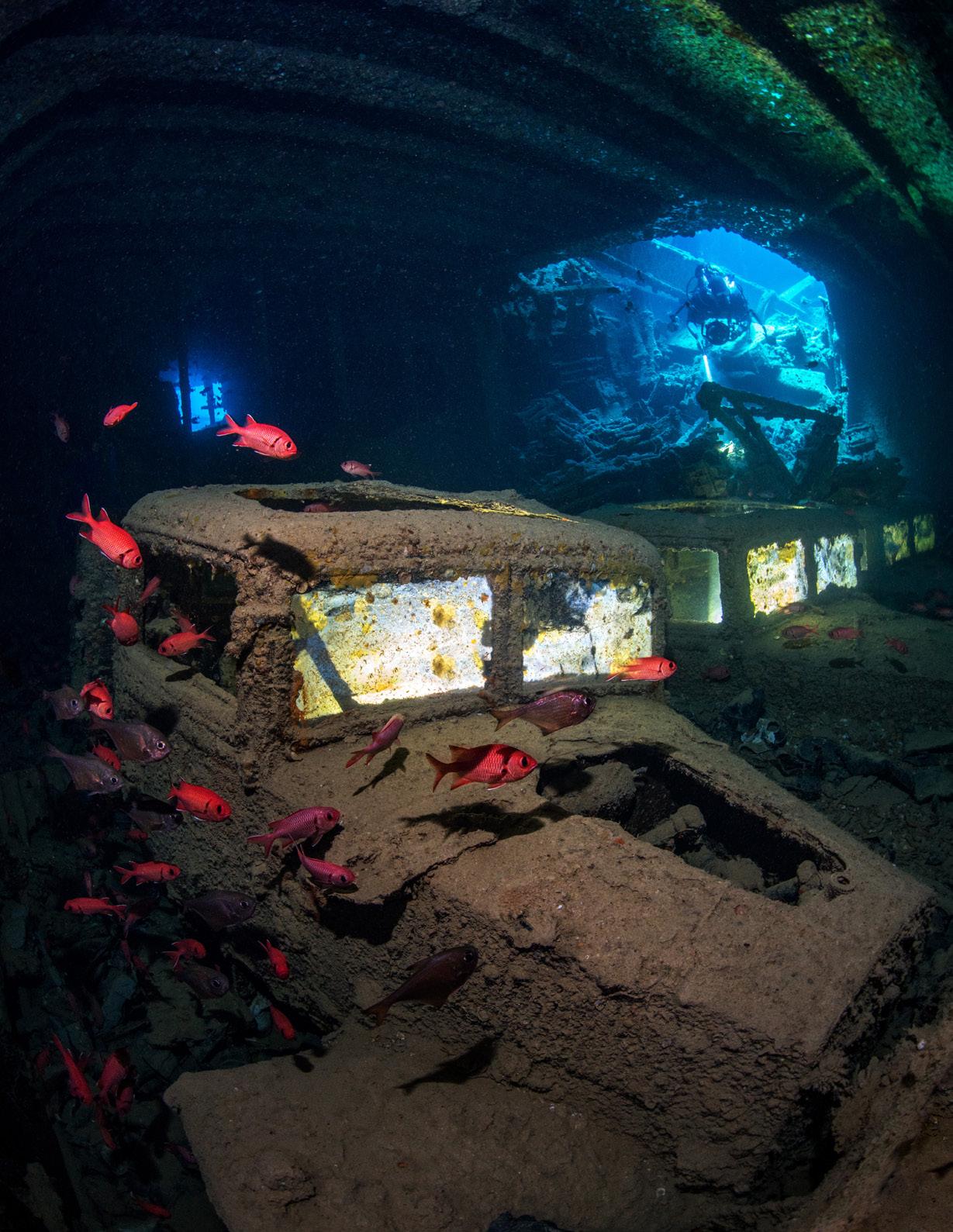
TITLE Truck parking only
LOCATION Shag Rock, The Red Sea
CAMERA Sony A7RII
HOUSING Nauticam A7II
LENS Sigma 15mm f/2.8 EX Fisheye
EXPOSURE 1/10, F9, ISO 2000
STROBE/LIGHTS 2 x Sea&Sea YS-D2, 3 x Bigblue VL15000p
COMMENTS Fordson WOT 3 trucks in the cargo holds of SS Thistlegorm
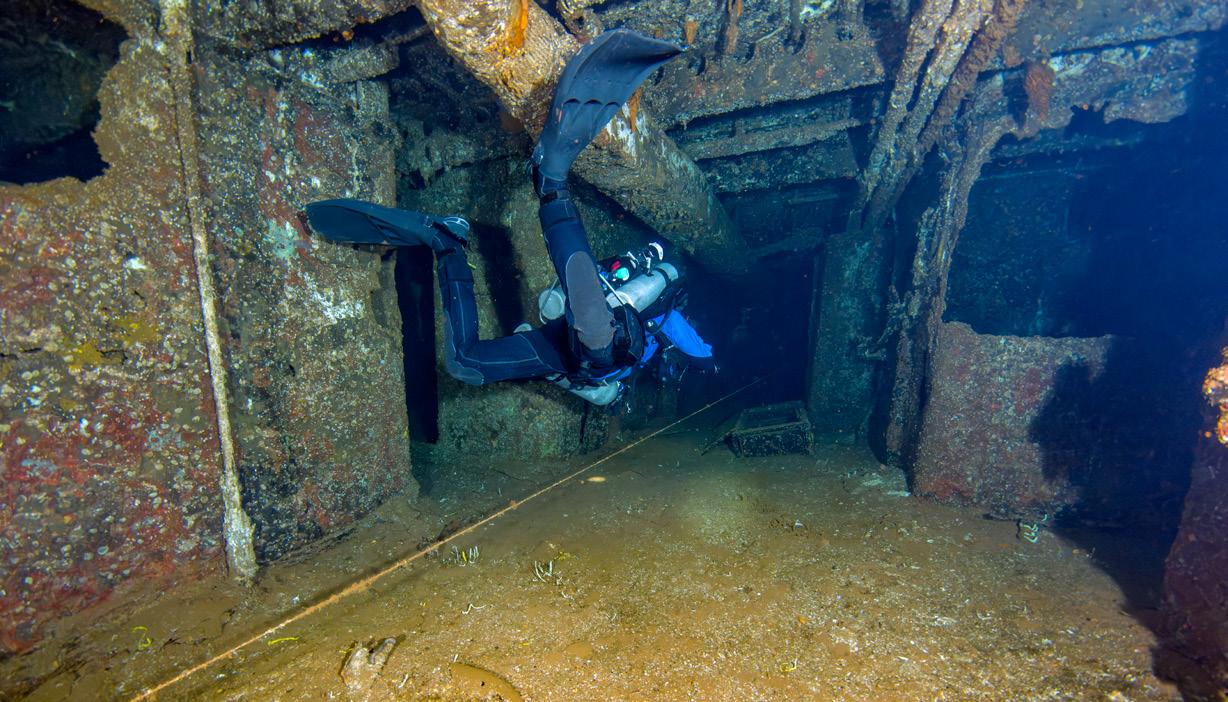
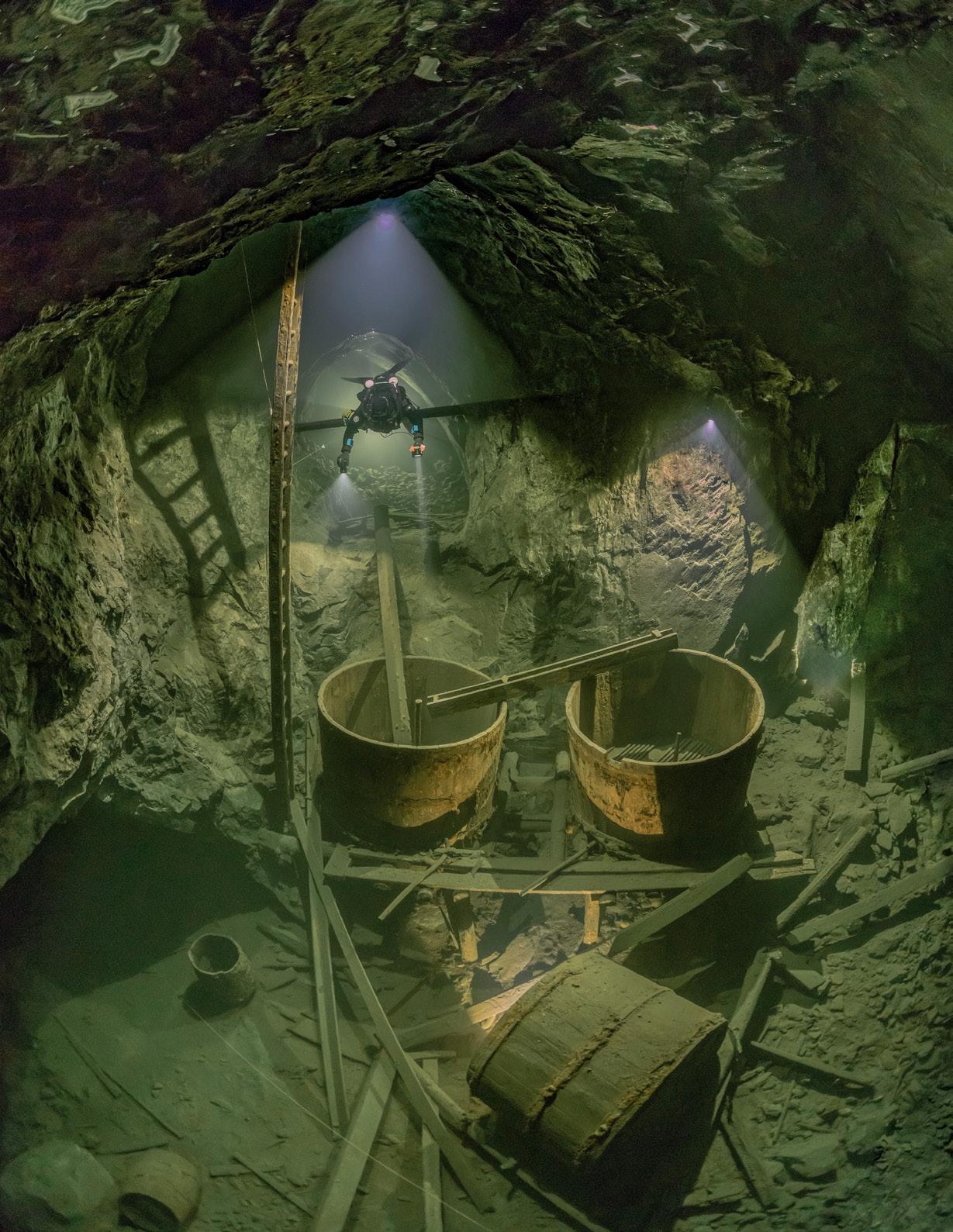
TITLE The Barrel Room
LOCATION Sala Silver Mine, Sweden
CAMERA Sony A7RII HOUSING Nauticam A7II
LENS Sony FE 16-35mm F4 ZA OSS
EXPOSURE 1/25, F5.6, ISO 5000
LIGHTS 2 x Keldan 4X, 2 x Bigblue VL33000p II and 4 x VL15000p
COMMENTS Exploring the barrel room in the Sala Silver Mine — an unforgiving overhead environment in freezing cold water.
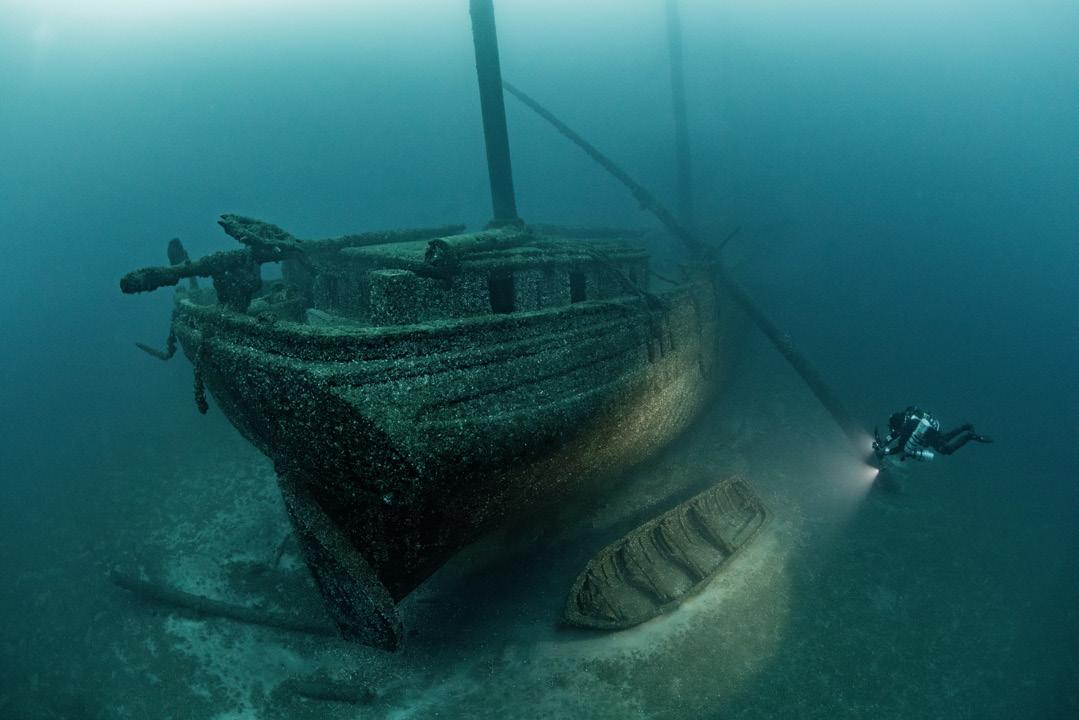
TITLE Cornelia B. Windiate
LOCATION Lake Huron, USA
CAMERA Sony A7RII
HOUSING Nauticam A7II
LENS Canon EF 8-15 Fisheye
EXPOSURE 1/25, F8, ISO 3200
STROBE/LIGHT Ambient light only
COMMENTS A three-masted wooden schooner that vanished in November 1875.
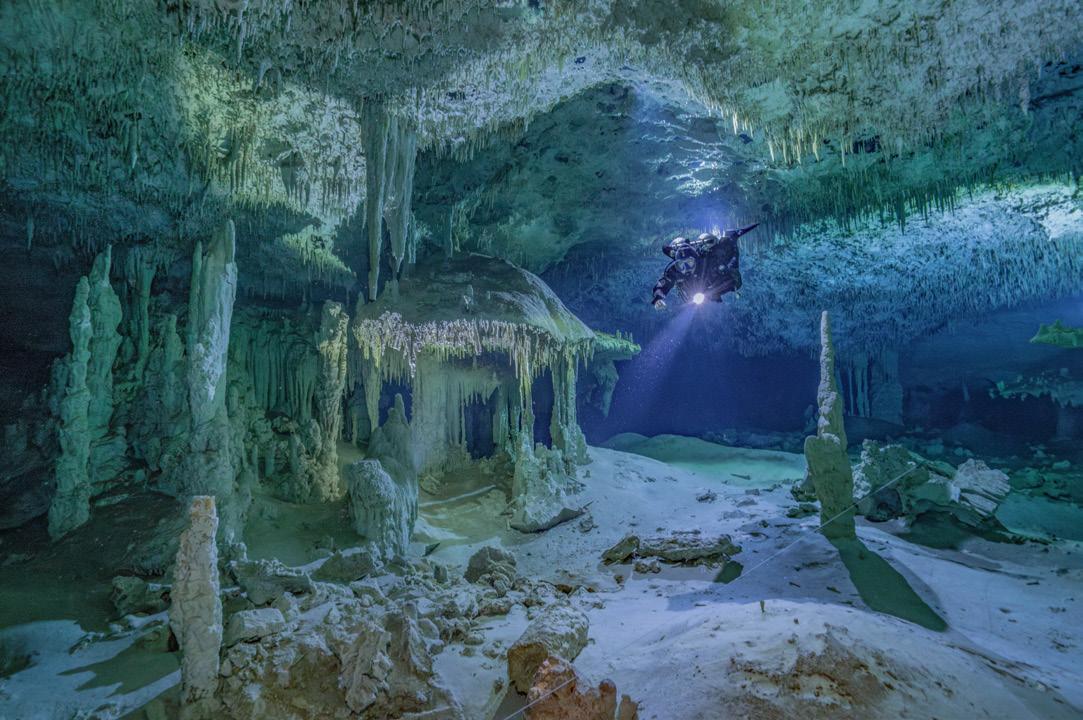
TITLE Underworld
LOCATION Quintana Roo, Mexico
CAMERA Sony A7RII
HOUSING Nauticam A7II
LENS Sony FE 16-35mm F4 ZA OSS
EXPOSURE 1/25, F11, ISO 4000
LIGHTS 2 x Keldan 4X, 2 x Bigblue VL33000p II and 4 x VL15000p
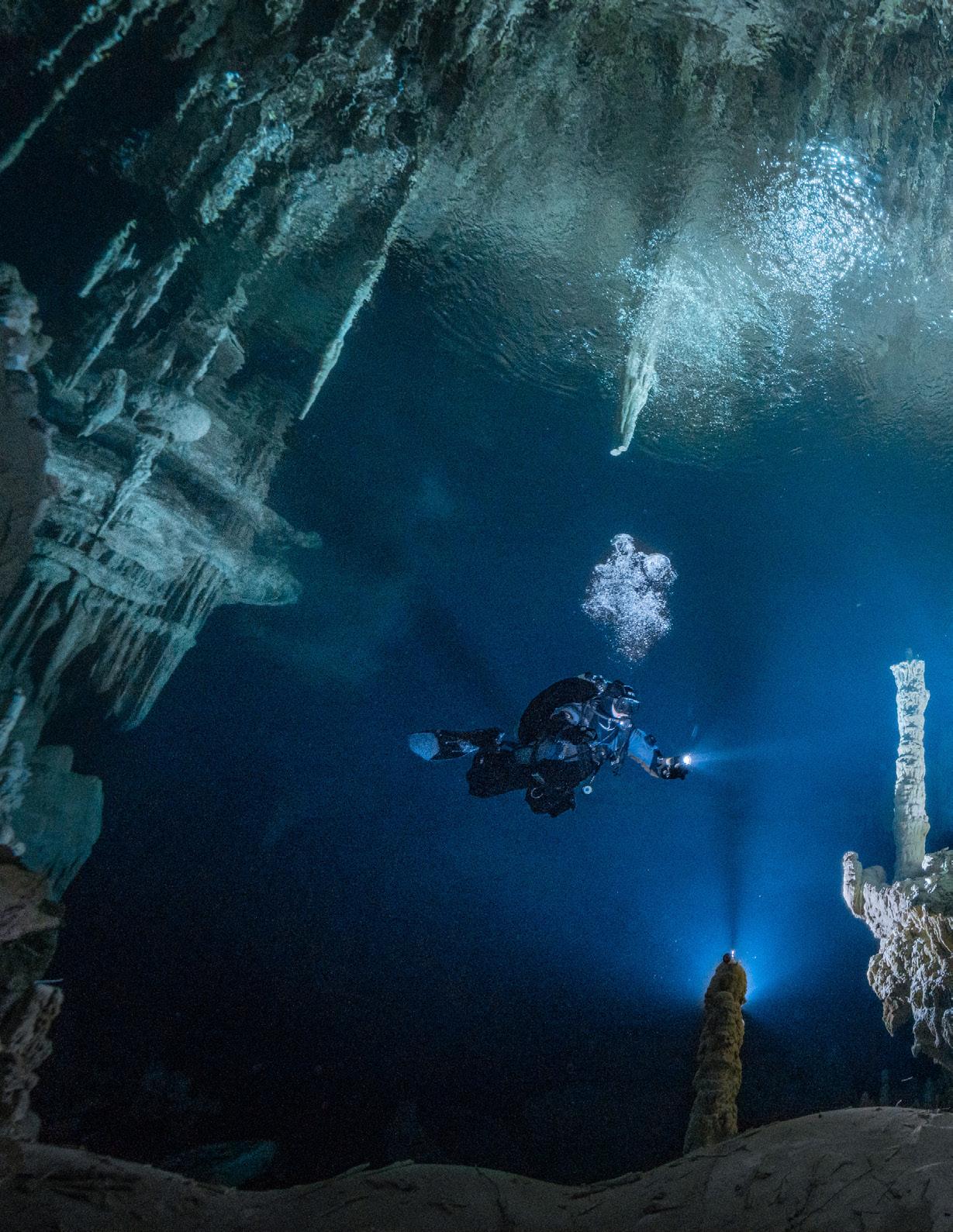
COMMENTS Sistema Nohoch Nah Chich.
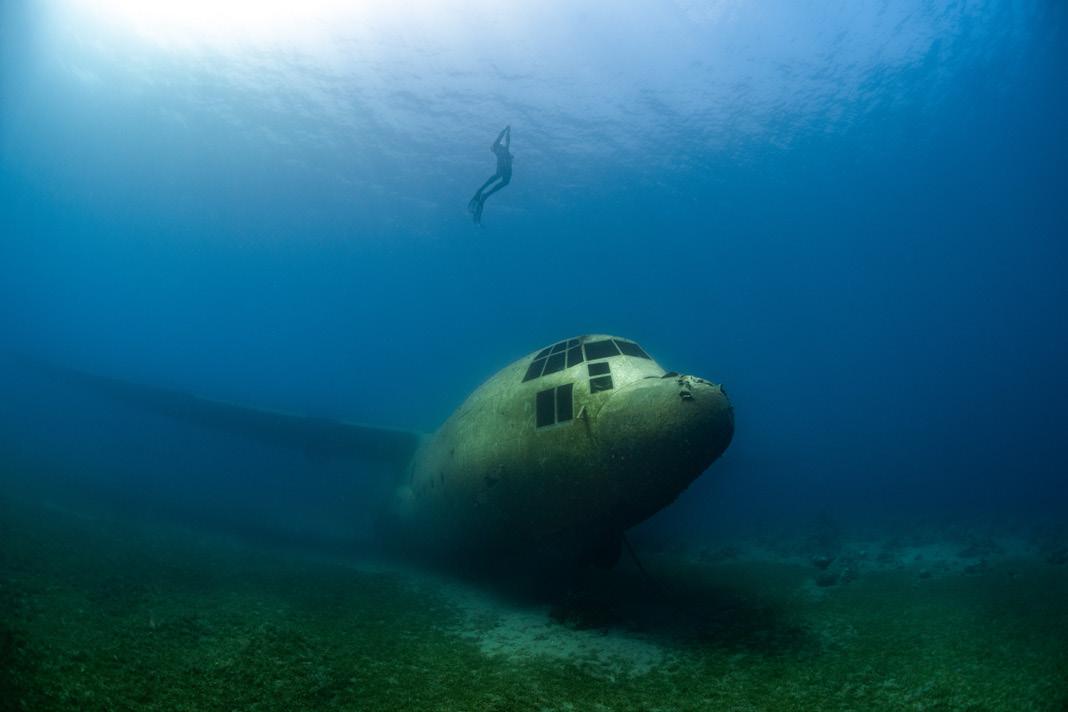
TITLE Airplane Mode
LOCATION Aqaba, Jordan CAMERA Sony A7RII HOUSING Nauticam A7II
LENS Sigma 15mm f/2.8 EX Fisheye EXPOSURE 1/125, F9, ISO 200 STROBE/LIGHT Ambient light only COMMENTS Alex Dawson freediving at the Hercules C-130 plane wreck.
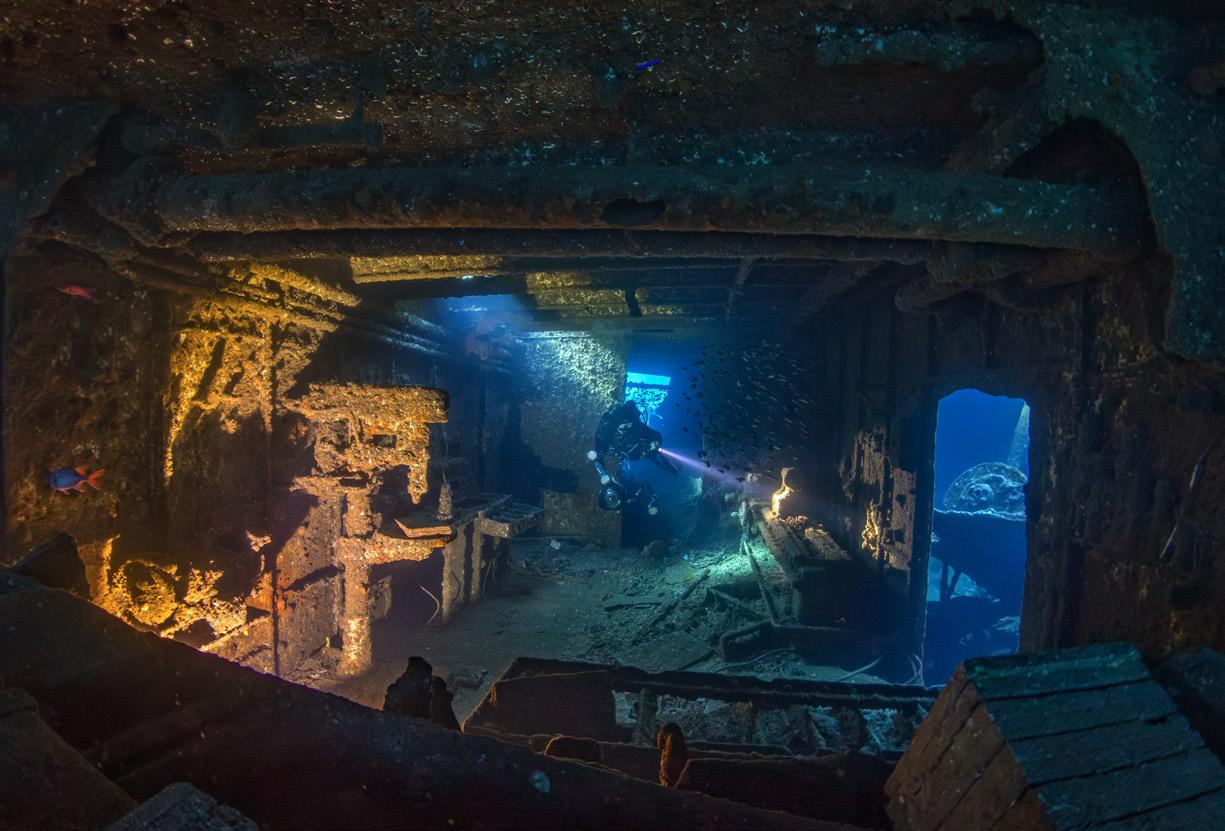
TITLE The workshop
LOCATION Abu Nuhas, the Red Sea CAMERA Sony A7RII HOUSING Nauticam A7II
LENS Sigma 15mm f/2.8 EX Fisheye
EXPOSURE 1/20, F9, ISO 4000 STROBE/LIGHTS 2 x Sea&Sea YS-D2, Bigblue VL15000p
COMMENTS The workshop inside the Chrisoula K wreck.
TITLE Maravilla
LOCATION Quintana Roo, Mexico
CAMERA Sony A7RII
HOUSING Nauticam A7II
LENS Sony FE 16-35mm F4 ZA OSS
EXPOSURE 1/30, F10, ISO 800
STROBE/LIGHT Ambient light only COMMENTS Sunbeams cut through the water like light in a submerged cathedral at Cenote Maravilla.
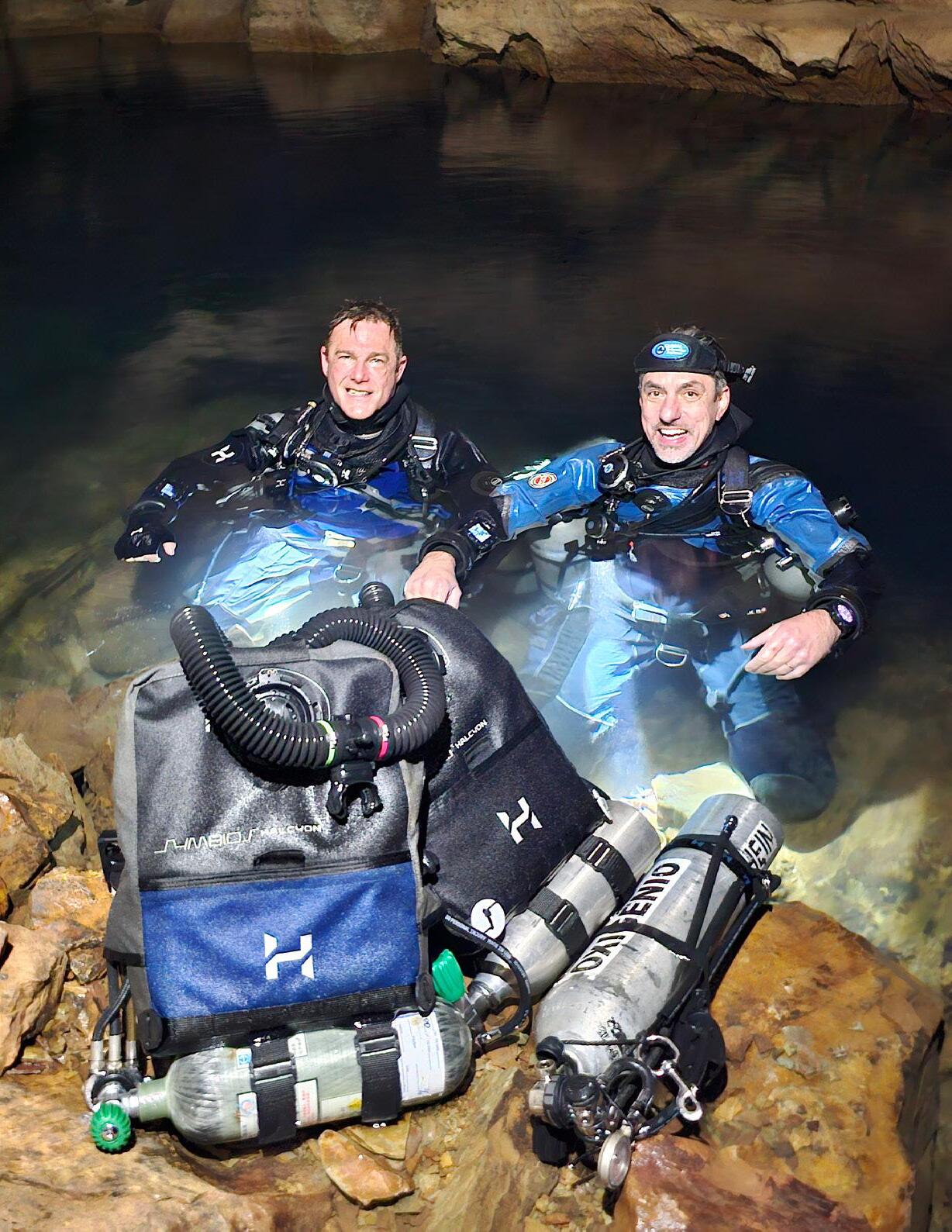
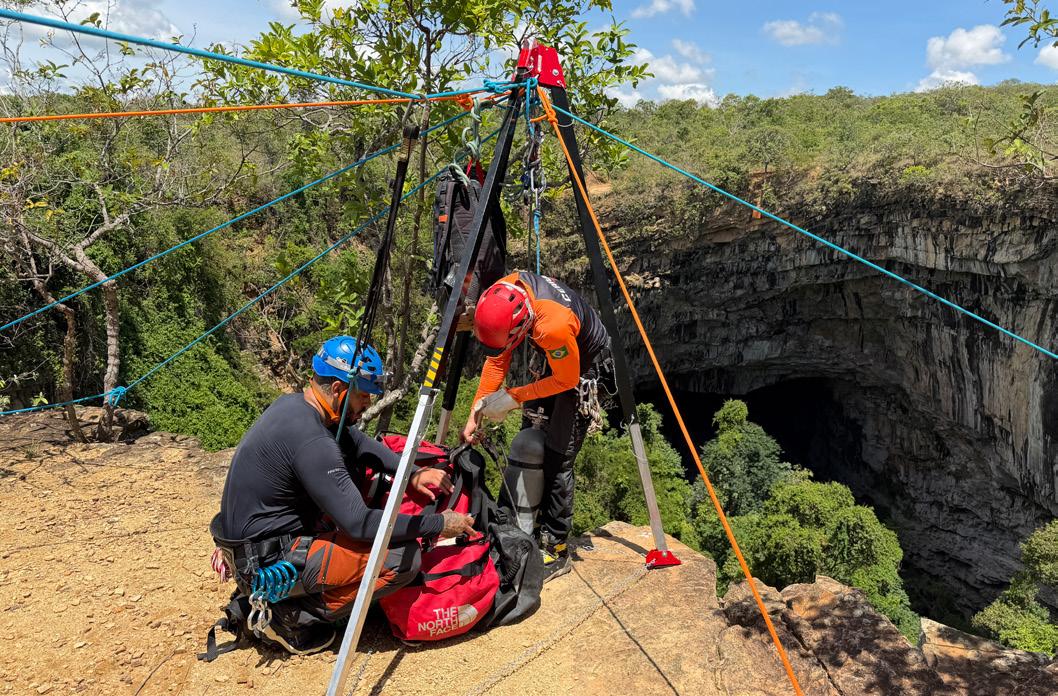
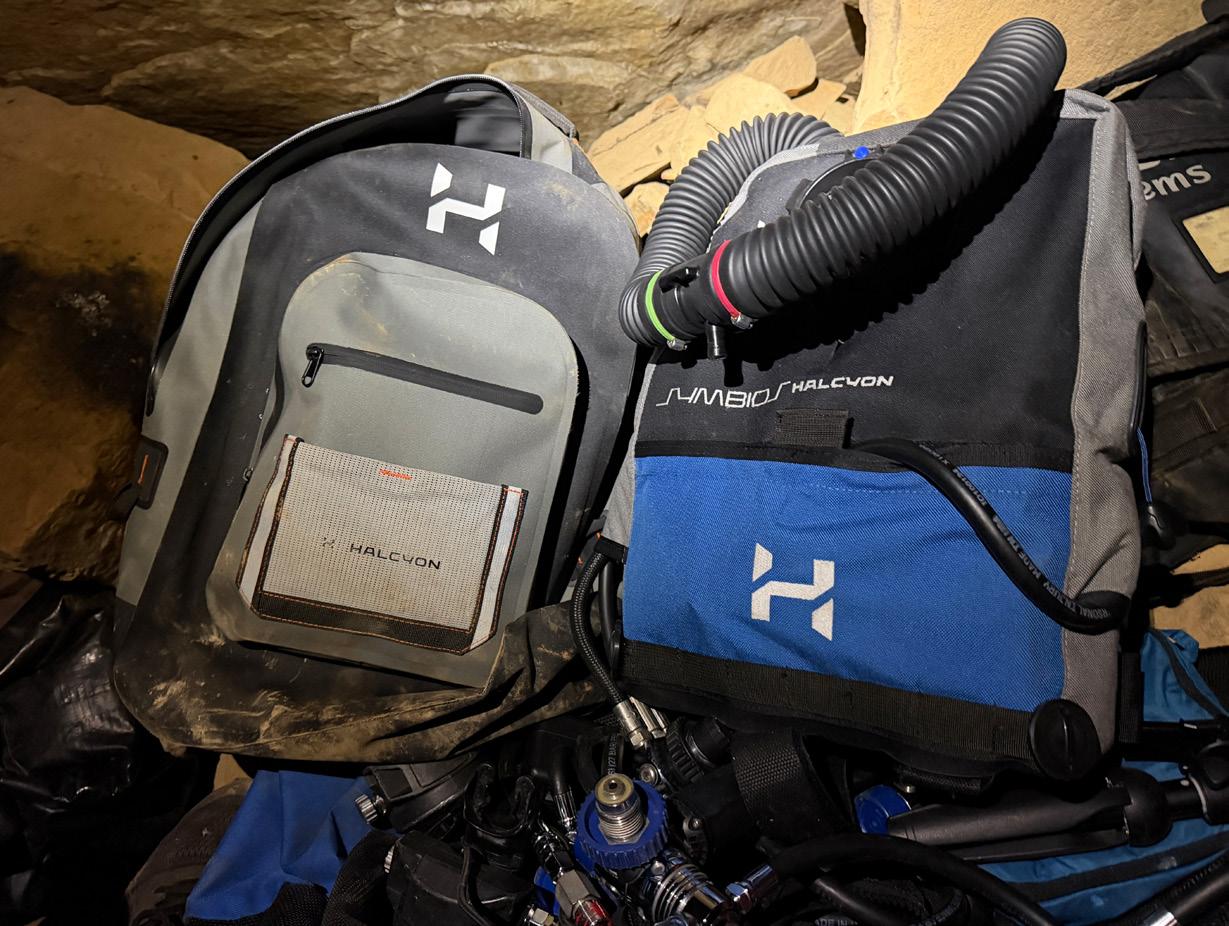
Jarrod and Sergio surface after another push into Dolina dos Maracanãs, their Symbios chestmount units proving a gamechanger for this complex cave.
Brazil is a land of staggering contrast, where vibrant life thrives above ground while a quiet, ancient world remains untouched beneath the surface. With over 150,000 estimated caves, the country represents one of the world's greatest frontiers for subterranean exploration. Near the capital of Brasília lies Dolina dos Maracanãs, the "Sinkhole of the Macaws," a massive limestone depression that drops 80 m/260 ft into the earth. Exploration here is a logistical marathon. Every piece of equipment must be rappelled down sheer walls and hauled through restrictive dry passages before reaching the water’s edge. In December 2025, a GUE team returned to this challenging site, utilizing the Halcyon Symbios chestmount rebreather to navigate fragile, low-visibility chambers and silty ceilings. While the cave revealed itself as a fragmented, storage-dominated system rather than a continuous river, the expedition successfully mapped 722 m/2,370 ft of passage, proving that the true reward of exploration lies in documenting the unknown.
PHOTO JARROD JABLONSKI
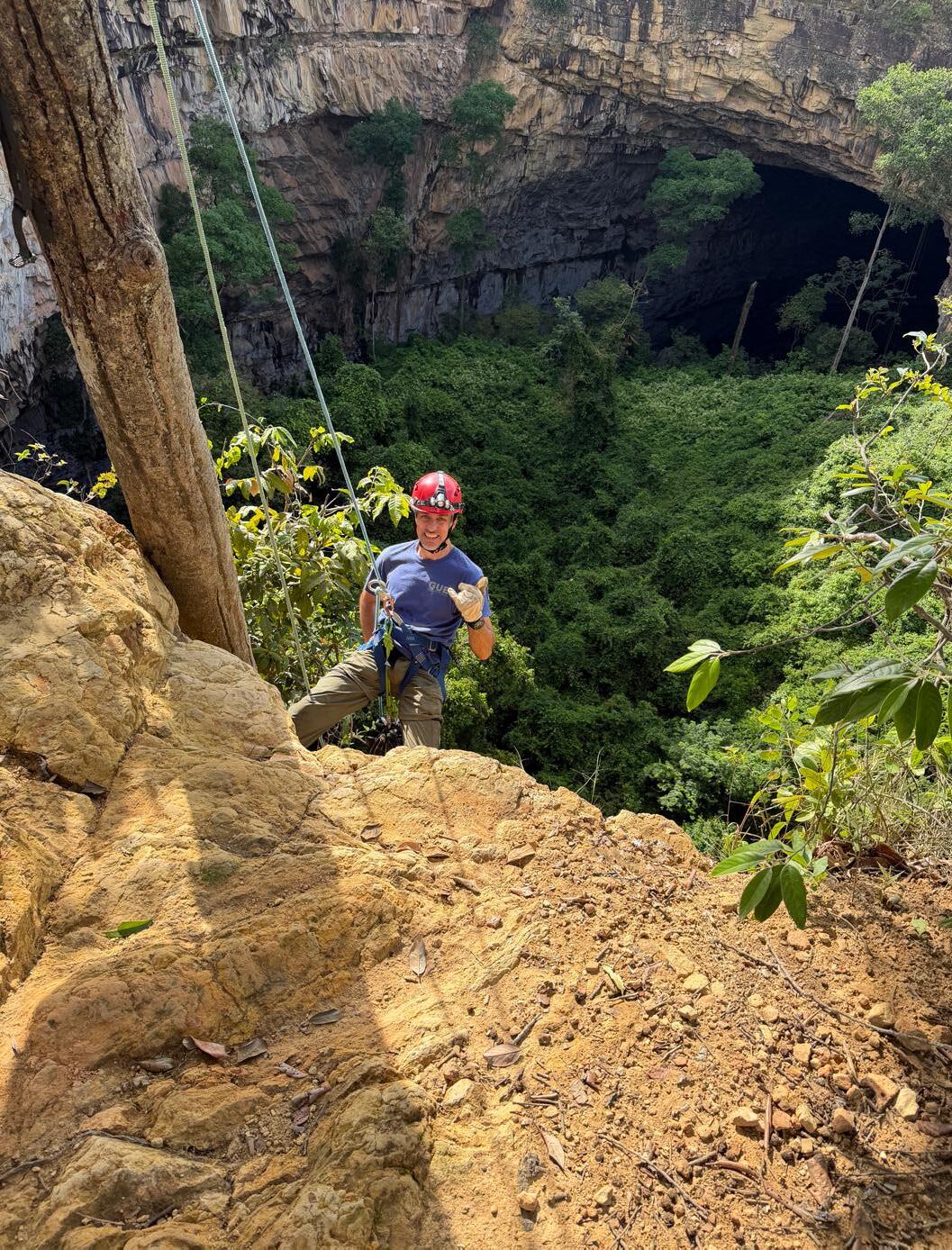
Standing at the threshold of Dolina dos Maracanãs, the massive sinkhole entrance dwarfs everything, and the real challenge hasn't even begun yet.
With more than 6,000 known caves out of an estimated 150,000 existing caves, Brazil has a tremendous potential for cave exploration. Of course, the continental dimensions of the country, areas with less-than-optimal road conditions, and the remoteness of most of the karst regions pose many logistical difficulties, causing exploration to be relatively limited. Additionally, many of the caves are located in state parks or conservation units, whose access requires permits, usually restricted to research projects. In spite of all the difficulties, a few relevant exploration projects are currently going on in the country. Different groups have been making some amazing progress in the western area of the state of Bahia, where thousands of meters of new cave passages have been explored in recent years, as well as in the São Francisco river valley in the state of Minas Gerais. As for the GUE community in Brazil, our efforts over the past few years have been directed to exploring, mapping, and researching very interesting sites in the states of Goias, Tocantins, and Mato Grosso. On top of exploration, one of our goals is to promote the exchange of knowledge with other GUE groups, having received over time our colleagues from CINDAQ, as well as leading explorers from Europe and the USA, as guests in our projects.
Setting up the rigging system at the edge of the sinkhole–all 80 metres of descent and every piece of gear starts here.
Picking the spot
Given the quantity of potential targets for exploration, choosing a location for a new project is never an easy task. It has happened before that, after days of traveling, we simply find that the cave shuts down after a few meters. The fact is that the only way to find out is actually going to preselected locations and checking. In December 2025, Sergio Schirato and Jarrod Jablonski decided to return to Dolina dos Maracanãs, a cave previously explored by the group.
It lies in the state of Goias, about two hours away from the country’s capital, Brasilia. From the surface, it is already striking—a vast depression several hundred meters across, dropping nearly 80 m/260 ft into the earth. Macaws circle overhead, their calls echoing against limestone walls, giving the impression that this place belongs as much to the sky as it does to the underground.
Arguably, the most interesting part of Dolina dos Maracanãs lies far below the circling macaws and far beyond the reach of most visitors.
Testing the waters
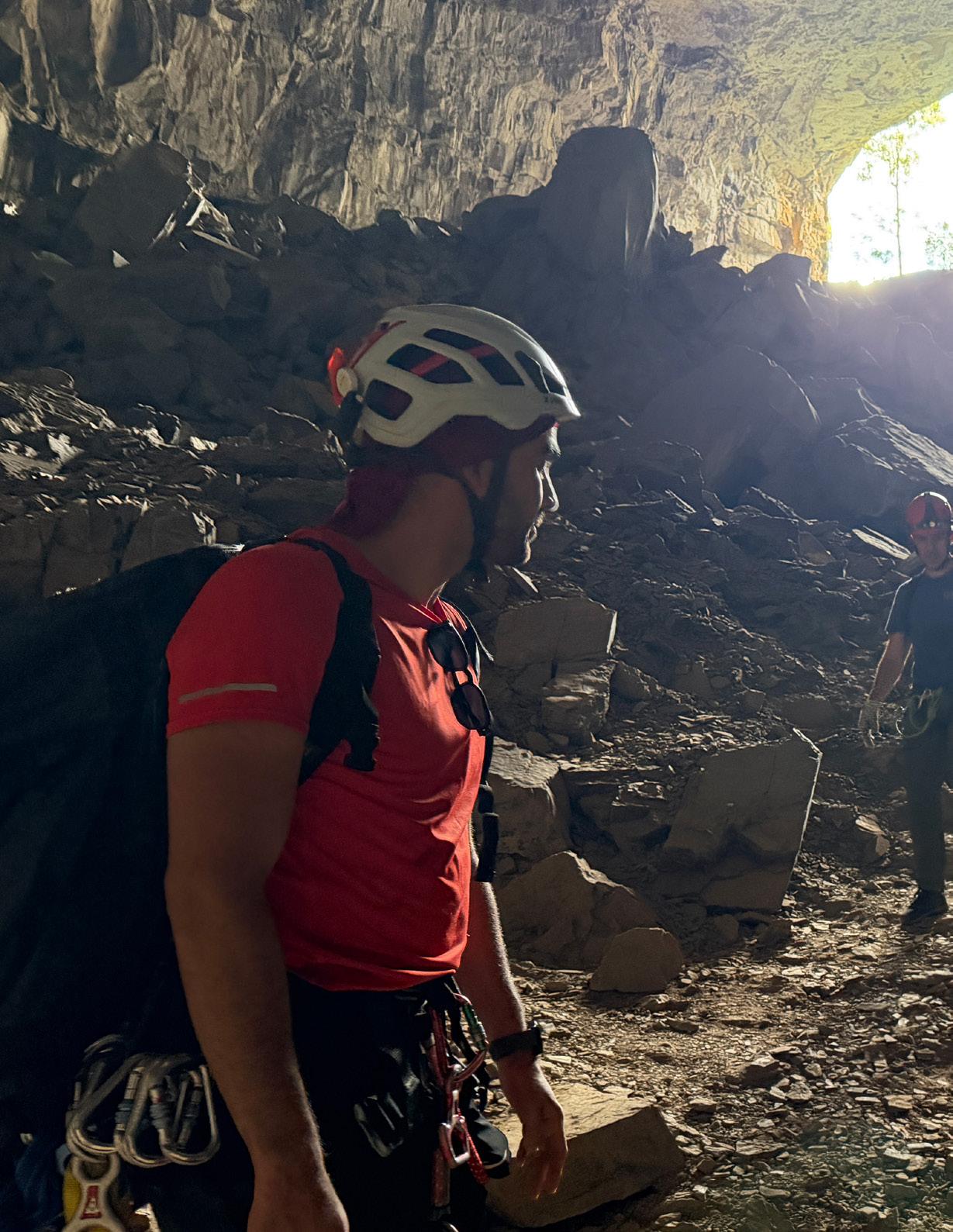
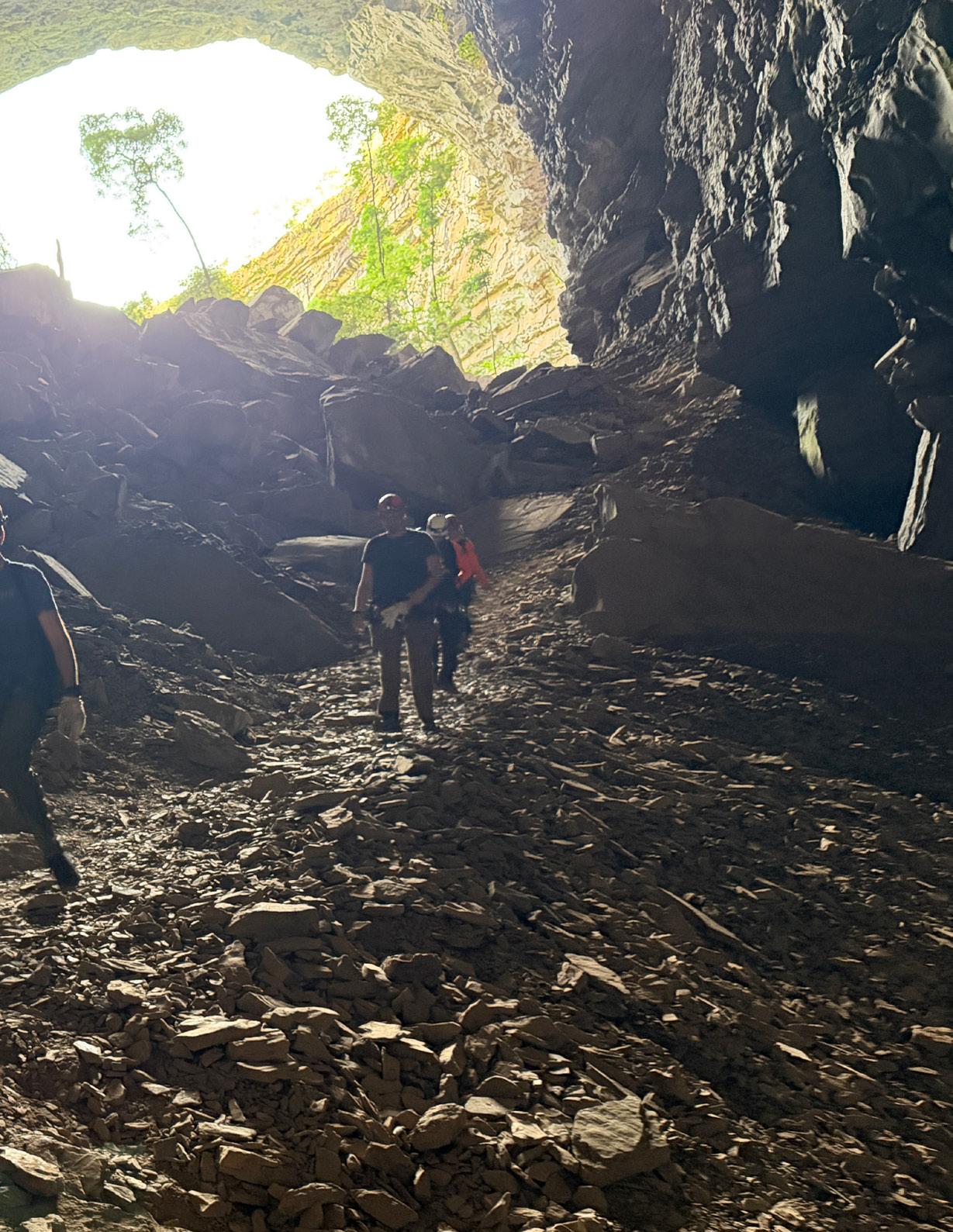
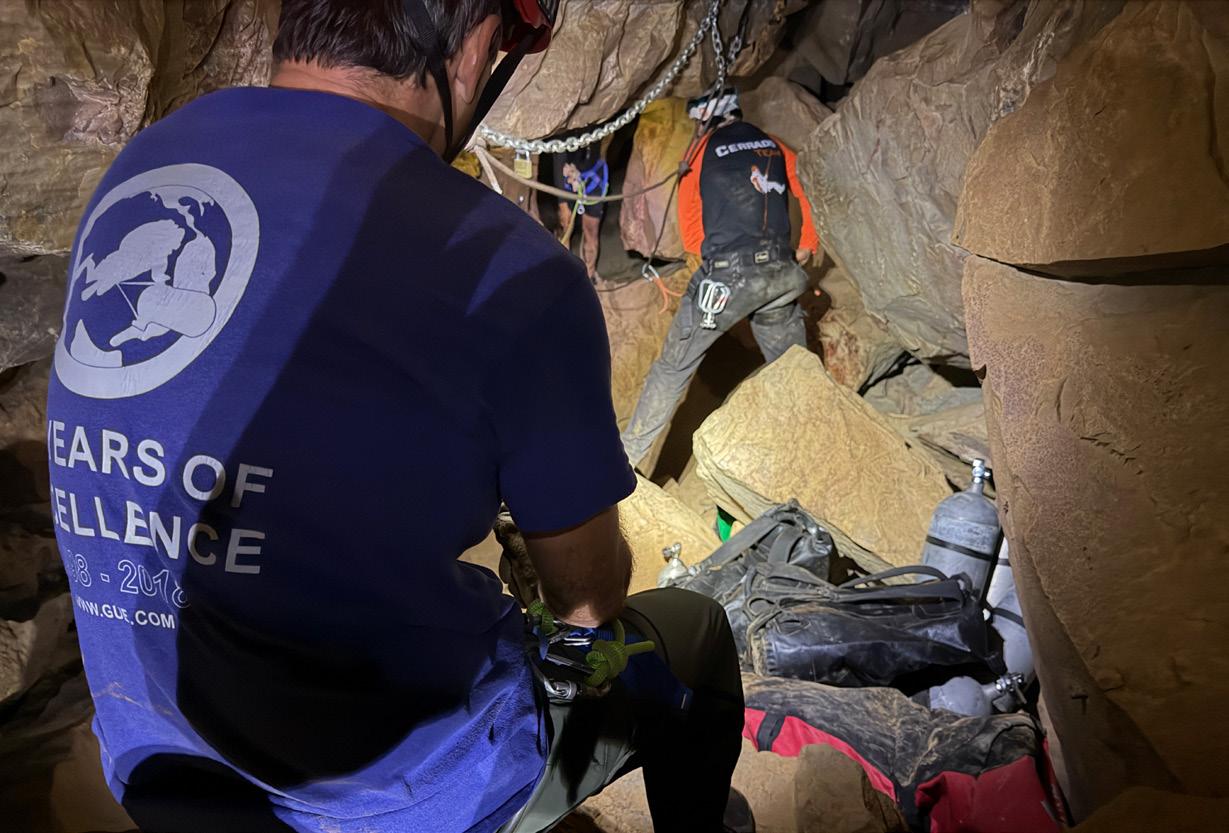
The first challenge in exploring this remarkable site begins with rappelling nearly 80 m/260 ft into the sinkhole. Once at the bottom, all necessary equipment must be lowered piece by piece along the same route. After reaching the base, the gear is transported down the sloping cave floor and through a series of tight restrictions. Sometimes pushed, sometimes lowered, and often carried, each item is passed carefully from one team member to another.
After multiple trips through the dry cave, the team finally reaches a small but encouragingly clear pool of water—accompanied by a resident colony of bats circling nearby.
GUE Brazil’s first exploration effort revealed a cave of notable underwater proportions. Within just 50 m/165 ft of penetration, the cave opened into large chambers where even powerful lights failed to illuminate the far walls. Previously, the cave had been explored by a team led by the Brazilian explorer Rodrigo Severo.
GUE’s first project in the area was led by Sergio and Susanne Schirato many years ago, when
PHOTO JARROD JABLONSKI
the
Dropping into
void, the lush Brazilian Cerrado stretches out behind as descent into Dolina dos Maracanãs begins
PHOTO JARROD JABLONSKI
The Symbios rebreathers are compact enough for tight restrictions, yet powerful enough to unlock the cave's deepest secrets.
Every piece of equipment passed through the restrictions by hand. The real workout happens before you even get wet.
PHOTO JARROD JABLONSKI
PHOTO JARROD JABLONSKI
the dives to explore the potential of the cave were made on open-circuit, which is—given the extremely complex logistics—not optimal, to say the least. Additionally, given the sensitivity of the environment, bubbles exhaled by the divers made navigation very complicated after only a few minutes due to extreme percolation.
A second round of exploration was made a few years later by Sergio and Ricardo Constantino, this time using backmounted JJ-CCRs, where the team had the chance to explore and map approximately 200 m/660 ft of cave. Moreover, during this project, complete measurements of the dry passages were taken and a sketch of the area was produced. Although it was clear that the cave continued, the effort did not translate into sustained exploration progress.
“The cave is coated in ultra-fine sediment, and even minimal movement can reduce visibility to zero. More critically, the ceiling is extremely fragile, composed of thin layers interwoven with clay. Even small bursts of gas can dislodge material, sending sediment raining down and further degrading conditions.
evidence of active water flow at the northern entrance where a connection might have been expected. Nearby sinkholes share similar structures, yet no obvious physical connections were identified.
Third expedition: Reducing complexity
The return expedition in December 2025 introduced a key refinement: the use of the Halcyon Symbios chestmount rebreather in a sidemount configuration.
This change significantly reduced the complexity of transporting equipment from the surface to the water. The compact design of the Symbios made it far easier to manage during the 80 meter/260 ft descent and through the restrictive passages leading to the sump. Once in the water, the system’s flexibility allowed it to integrate seamlessly with sidemount cylinders.
However, a previously overlooked large passage was identified during this phase. As one of the more substantial features within the cave, it initially offered renewed optimism. Yet, consistent with earlier findings, the passage ultimately terminated after a few hundred meters.
Compared to traditional backmounted rebreather systems, this configuration proved far more efficient and better suited to the environment.
With improved logistics and a simplified diving configuration, the team—led by Sergio and Jarrod—was able to dedicate more time to exploration and survey work.
Navigation requires patience, discipline, and restraint.
Passages repeatedly appeared promising, only to close within a few meters. In caves without clear flow, nearly every direction initially suggests continuation—but most terminate quickly. The cave felt vast, yet ultimately elusive.
Still, the expedition yielded meaningful progress. Guidelines were established, potential leads were identified, and new areas were explored. A shallow passage showed promise, but time and resources required postponing further investigation.
Survey efforts revealed the cave trending along a north-south axis, but with no clear
Efforts focused on refining existing guidelines and resurveying the system using the MNemo survey tool, improving both accuracy and efficiency. Previously explored lines were revisited and evaluated, though most yielded limited potential for continuation.
However, a previously overlooked large passage was identified during this phase. As one of the more substantial features within the cave, it initially offered renewed optimism. Yet, consistent with earlier findings, the passage ultimately terminated after a few hundred meters. The cave currently has 722 m/2,370 ft of surveyed passages, and some smaller passages yet to be explored on the eastern side.
Understanding the system
Dolina dos Maracanãs appears to be a storage-dominated system, rather than a flow-dominated one. Limited regional groundwater movement likely erodes chambers within less resistant sediments, with activity increasing during periods of heavy rainfall and diminishing during dry seasons.
These processes are neither continuous nor uniform, which helps explain the fragmented and often disorienting nature of the cave. Unlike the extensive, flow-driven cave systems found further north in Brazil, Dolina dos Maracanãs developed as a series of isolated chambers rather than a single interconnected network.
While every cave explorer hopes to find extensive passage and continuous development, the rewards of exploration are not defined solely by distance.
The opportunity to enter previously unseen environments, to work alongside a dedicated and capable team, to resolve questions of scale and structure, and to fully document a system—all of these remain deeply meaningful outcomes.
As the team paused at the surface, watching the macaws circle above, attention naturally turned to future plans. Exploration continues, and the next chapter will shift focus toward the more extensive cave systems to the north, where larger, flow-dominated passages promise a different kind of challenge.
Jarrod surfaces with an empty reel, a good sign that new passage has been laid and the cave is giving up its secrets.
PHOTO SERGIO RHEIN SCHIRATO
PHOTO JARROD JABLONSKI
he team takes a moment to celebrate, tired legs, big smiles, and more cave still waiting to be explored.
“The opportunity to enter previously unseen environments, to work alongside a dedicated and capable team, to resolve questions of scale and structure, and to fully document a system—all of these remain deeply meaningful outcomes.
FACT FILE // GETTING THERE
Before a single bubble enters the water at Dolina dos Maracanãs, the team has already earned it.
The approach begins at the lip of the sinkhole—a vast, open depression that gives little indication of what lies beneath. The first obstacle is the rappel itself: nearly 80 m/260 ft of descent down limestone walls streaked with moisture and draped in vegetation, the sky shrinking to a circle above as the cave floor rises to meet you. For a single diver carrying personal gear, this would be demanding enough. For a team transporting full cave diving equipment—rebreathers, sidemount cylinders, survey tools, safety gear, and supplies for multiple dives—it becomes a logistical operation requiring careful planning and disciplined execution. Nothing goes down in one trip. Each item is rigged individually and lowered along the rappel line, received at the bottom by a team member and staged for the next phase of the carry. Cylinders, counterlung units, bailout bottles, lights, reels—every piece of equipment makes its own journey into the earth before the diving can begin. On a hot Brazilian December day, with humidity rising from the cave floor below, the physical toll of this process is significant before the first dive even starts.
The challenges do not end at the base of the sinkhole. From there, the team must navigate a sloping cave floor that descends further into the system,
broken by a series of tight restrictions that demand equipment be passed through in stages. Some items are pushed ahead through gaps barely wide enough to accommodate them. Others are lowered carefully down short drops. All of it is done with the awareness that the same gear must make the return journey—and that a damaged cylinder or compromised unit deep in the dry cave is a serious problem far from any support.
What makes this process particularly demanding is the cumulative nature of it. The team is not simply moving equipment— they are making repeated trips through the same passages, carrying different loads, conserving energy for the dives themselves, and doing all of this in conditions that grow warmer and more humid the deeper into the system they travel. By the time the first diver reaches the pool at the base of the cave, the work has already been considerable. This physical reality shapes everything about how exploration at Dolina dos Maracanãs is planned. Dive time is a finite resource, but so is energy. Every minute saved on logistics through better equipment choices, smarter staging, or refined team coordination translates directly into more time underwater—more passage surveyed, more leads investigated, more of the system understood. It is a calculation that experienced expedition divers make instinctively, but one that is easy to underestimate from the outside.
Sergio Rhein Schirato is a passionate diver and a GUE instructor based in Miami. He is an active explorer who has been organizing expeditions to different parts of Brazil for many years. He has also been actively promoting GUE in Brazil by organizing events for the local community. Sergio holds a PhD in biosciences and a master’s in applied math and finance.
Sergio Rhein Schirato
PROPULSION
TEXT THE AUTHORS OF THE FUNDAMENTALS OF BETTER DIVING
PHOTOS JESPER
KJØLLER, JULIAN MÜHLENHAUS & KIRILL EGOROV
Building upon the foundations of buoyancy and trim, this article explores the "propulsion toolbox"—a versatile set of kicking techniques essential for every skilled diver. While basic training often neglects efficient movement, GUE emphasizes precision to prevent overexertion and environmental damage.
From the powerful frog and flutter kicks to the refined control of back kicks and helicopter turns, mastering these methods ensures divers can navigate silty caves or fragile reefs with minimal impact. By matching the right kick to the environment, divers enhance their safety, team coordination, and overall underwater enjoyment.
PROPULSION
– THE KICKS IN YOUR TOOLBOX
Good propulsion techniques allow divers to move through the water with maximum efficiency and minimum impact on the environment.
PHOTO JULIAN MÜHLENHAUS
When done correctly, the frog kick will not disturb silty floors. That makes it a popular choice with cave divers.
In the previous article on stability, we thoroughly outlined the value of solid buoyancy control alongside proper body position (balance and trim). You can now hopefully appreciate the importance of this foundation, as it provides a critical level of stability for divers by supporting in-water comfort, confidence, and capability. Upon establishing in-water stability, divers must be able to move efficiently through the water, using as little energy as possible while also remaining aware of the movement of their fins and body and the turbulence associated with this movement.
This latter aspect becomes especially critical in silty environments where errant movement or careless kicks can quickly reduce or even eliminate visibility when sediments are disturbed. Even in non-silty conditions, divers must learn to move with precision. Delicate environments, such as coral reefs, can be quickly damaged with even the most imperceptible flick of a fin.
It is common to see training offered to divers that does not emphasize the importance of efficient propulsion. This lack of dedicated propulsion training produces an inefficient technique, resulting in overexertion and increased stress levels, which can lead to potentially dangerous physiological manifestations like CO2 retention. These divers will struggle to support their dive buddies or will be unable to keep pace with teammates; they might also ruin visibility in silty environments or damage sites that are pristine and fragile. Almost certainly, these divers will find it more difficult to enjoy being underwater because of undue exhaustion and stress. All these negative aspects are eminently resolvable, making propulsion refinement a critical aspect of all diver training.
The propulsion toolbox
All tools are designed for a particular function; likewise, diving skills might be viewed as a series of tools to be used by divers in various situations. Divers with a limited set of tools are at a
“There are four primary propulsion techniques that are used for power, precision, or positioning. Each of the four main techniques has a wide range of intensity.
great disadvantage. A large part of GUE training envisions a robust set of skills that are largely the same for all divers but adjusted in scope and refinement depending upon the need.
There are a variety of propulsion techniques available to divers. An experienced, aware, and responsible diver alternates between different types of kicks to reduce muscle cramping and to meet the demands of diverse diving environments. With proper body position, a feet-up swimming profile, and reasonable buoyancy control, divers can safely travel in silty or fragile environments with little or no trace of their presence. GUE incorporates a variety of propulsion methods into its curriculum, establishing basic proficiency in beginning classes and refining these throughout divers’ training.
Types of propulsion techniques
Having proper propulsion technique means the ability to move through the water in an efficient manner and to have access to a variety of appropriate kicks, switching as needed to maintain
comfort and adjusting as needed within a given environment. Divers should be particularly careful not to lose awareness of body position and buoyancy while using these kicks. It is common for individuals to use propulsion in an attempt to overcome weakness in buoyancy and/or body position, which can cause many more problems than it solves. Divers should ensure a solid platform and neutral buoyancy by stopping from time to time and evaluating their position in the water.
There are four primary propulsion techniques that are used for power, precision, or positioning. Each of the four main techniques has a wide range of intensity. Kicks are typically practiced in two forms: 1) powerful, i.e., about 80 percent of maximum intensity, or 2) modified, i.e., about 20 percent of maximum intensity. Common types of kicks used in diving include the frog kick, flutter kick, helicopter turn, and back kick. The intensity and type of kick should be chosen to suit the diver’s needs and the environment. For example, one might use a frog kick
PHOTO KIRILL EGOROV
PHOTO JESPER KJØLLER
Mimicking the breaststroke, the frog kick uses a gliding phase to maintain momentum, offering divers superior control while minimizing turbulence.
silty floor.
Power kicks: the frog and the proper flutter kicks
The frog kick resembles the kicking action of a swimmer’s breaststroke. This kick offers refined control over the direction of thrust coming from a diver’s fins and is a favorite of cave and technical divers. As with all kicks, it can be performed more dynamically or with reduced intensity (usually called a modified frog kick). One of the key components of an effective frog kick is the gliding phase, where the diver uses momentum created by the working phase of the kick to glide, intermittently resting between the kicks. If the loading phase of the kick is precise, it will not stop the forward glide, and the next loading phase will begin as momentum declines. The frog kick gives divers significant control over the turbulence coming from their fins and usually stirs up less silt than traditionally found with other propulsion methods.
it quite a wide kick. It is therefore not appropriate when swimming in close proximity to an object such as the wall of a delicate reef, an artifact of a wreck, or another diver. It is also not ideal when a sudden burst of energy is required or when constant kicking against strong current is needed to move forward. It is best used for building a steady rhythm of low energy and highly efficient swimming.
The proper flutter kick is the most powerful kick for divers. It can create a sudden, intense burst of power, providing the fastest and most powerful way of moving through the water. Recreational divers are often instructed to use a strong swimmer’s flutter kick, focusing on kicking with straight knees from the hips. When properly executed, this kick produces reasonable power, but also generates significant downward turbulence. Unlike the swimmer’s flutter kick, the proper flutter kick directs all the energy of the kick backwards to promote linear movement, making it a powerful and efficient propulsion technique.
While using a proper flutter kick, divers bend their knees and kick from the knee, using the whole surface of the fin blade to move water backwards and upwards. Their knees and thighs should not drop excessively past the horizontal line of their bodies, though the most powerful expression of this kick will result in some thigh motion. Most of the power is generated from the hamstrings and some from the gluteus muscles. The loading phase includes pulling their heels toward their tanks, and the working phase
“
Competent divers should be able to perform an appropriate kick according to the situation at hand, be aware of their body movements, and modify on the fly as needed. When combined with positioning techniques, the precision kicks will create confident divers who will excel in their in-water efficiency.
not require a separation between the fins, which makes it ideal for moving in close proximity to objects. The proper flutter is the kick of choice for any situation where fast, immediate energy is required, or when persistent energy is required, such as swimming against a current or toward a diver in need.
Precision kicks: modified frog and flutter kicks
All divers should be able to adjust propulsion techniques to the demands of a particular environment, situation, and/or task. Modified kicks are important tools that allow divers to adapt to changing surroundings and challenges. They allow for precise, subtle, and conscious finning in silty or delicate environments, whether cave, wreck, or reef. The mechanics of these precision kicks are the same as power kicks (frog kick and proper flutter kick), but the range of movement and energy used is much less.
The movement is articulated mainly from the diver’s ankles, and the thrust is directed upward
and backward. The range of movement can vary from extremely minute movement, which would aim to maneuver a diver out of a sensitive environment (such as moving between delicate cave formations), to an efficient, precise forward kick (while swimming side by side when assisting an out-of-gas diver). The easiest way to think about the intensity of these kicks is to relate them to a volume control, such that power kicks are near the high end of the volume control, and precision kicks are near the low end. Practicing these kicks tends to occur around 80 percent and 20 percent intensity, respectively. At the low end, the mechanics of the kick can appear different, though this is more the result of a greatly reduced range of motion. For example, an extremely small modified flutter would show only fin movement with no obvious leg and very little ankle articulation (sometimes called a shuffle kick); the smallest of the modified frog kick is sometimes called sculling. However, one should not become fixated on the various names but instead focus on the mechanics of the kicks, adjusting intensity as called for by the environment or situation. Competent divers should be able to perform an appropriate kick according to the situation at hand, be aware of their body movements, and modify on the fly as needed. When combined with positioning techniques, the precision kicks will create confident divers who will excel in their in-water efficiency.
Positioning kicks: back kick and helicopter turns
Positioning techniques are the closing chapter to forward propulsion swimming techniques. Often undervalued, but critical to master, they provide the ultimate control over a diver’s positioning in the water at every stage of a dive. They are performed without any hand move -
“The back kick is not the easiest to grasp, but with proper body position (solid trim, buoyancy, balance, and body tension), as well as precise and slow movements of the fins, it can be mastered by any diver.
ments, making them useful and very effective and important tools.
The back kick allows divers not only to move in an opposite direction without turning around, but it also allows them to keep their position when performing tasks like surveying, shooting video, ascending along an up-line, or simply regrouping within the dive team. The application of this kick allows for better team control and awareness, as divers will be able to move away from each other while maintaining eye contact or back off from an object without turning around and jeopardizing team awareness. It is also an invaluable tool for instructors, allowing them to move between students easily in all dimensions and directions.
The back kick is not the easiest to grasp, but with proper body position (solid trim, buoyancy, balance, and body tension), as well as precise and slow movements of the fins, it can be mastered by any diver. It is generally a reverse frog kick, but requires much more focus and precision. It will never match the speed of any forward propulsion, but it will increase the effectiveness of underwater positioning enormously.
Turning around in the water can often lead to instability. In an attempt to change or reverse direction, divers will often twist in the water, get out of trim, and stir up the bottom while turning around in a vertical position. The helicopter turn provides an effective way to change direction without affecting buoyancy control, trim, or awareness, all the while protecting visibility and underwater structures.
The helicopter turn uses both frog kick and back kick techniques. One leg uses a frog kick
movement and the other a back kick movement, alternating and generating a force that turns divers around on their central axis in a horizontal plane. The helicopter turn is not just for hovering still in the water and spinning in circles; it can be used to change the angle of a swim, to reposition, or to turn toward a team member needing attention.
One of the main goals of GUE training is to provide motivated divers with a variety of tools to help them pursue their passion. Fixed stability and a range of properly implemented propulsion techniques are vital tools for enthusiastic divers who are moving efficiently in the water while attaining their goals in the underwater realm.
Pull and glide
In some environments (e.g., small and silty or high flow), kicking of any kind will a) be ineffective or b) will destroy the visibility and damage the environment. In such environments, careful use of the hands might be appropriate. For example, when diving into the current on a wreck or in spring flow (such as in a cave), the most effective propulsion technique can often be pull and glide, where the neutrally buoyant diver can pull on an outcropping to generate forward motion, glide as far as possible, and, when the glide begins to slow, pull on the next outcropping. This pulling technique can be incorporated with the use of flutter or frog kicks as dictated by the environment. This strategy can be effective, but care must be taken not to damage the environment.
NEXT TIME: TEAM
The back kick is vital during ascents, allowing divers to maintain stable team formations and eye contact without breaking trim.
PHOTO JULIAN MÜHLENHAUS
GUE PREMIUM DIVE CENTERS
Area 9 Mastery Diving – Kralendijk, Bonaire
www.masterydiving.com
Base1 – Sardinia, Italy
www.baseone.it
Deep Dive Dubai – Dubai, UAE
www.deepdivedubai.com
Dive Centre Bondi – Bondi, NSW, Australia
www.divebondi.com.au
Duikcentrum de Aalscholvers – Tilburg, Netherlands