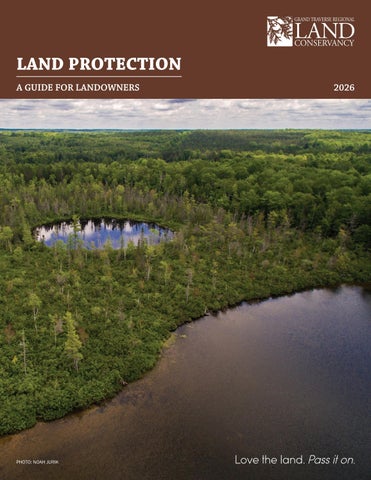
LAND PROTECTION A GUIDE FOR LANDOWNERS
PHOTO: NOAH JURIK
2026
PROTECTING YOUR L AND
Protecting your land is an act of generosity that leaves a lasting legacy for your family, your community and the natural world. By choosing to protect your land, you ensure that its unique qualities—such as important wildlife habitat, scenic views, water resources and productive farmland—can be enjoyed by future generations. The Grand Traverse Regional Land Conservancy (GTRLC) works with landowners who wish to protect their land in Antrim, Benzie, Grand Traverse, Kalkaska and Manistee counties. There are many ways to preserve your property, from donating or selling it to GTRLC, to placing a conservation easement or exploring other land protection strategies that meet your goals. Our staff is here to guide you through your options, answer questions and help you find a conservation solution that best suits your life and your vision for the land. Below is an overview of the two main ways we protect land.
DONATING OR SELLING LAND
CONSERVATION EASEMENTS
GTRLC acquires certain properties from landowners to protect and steward them as nature preserves, sanctuaries, or ecologically managed forests which are open to the public. Should your land be protected as a nature preserve, it will become a place where visitors can explore trails, learn about the land from informational signage and enjoy other amenities that facilitate access to nature. As a nature sanctuary, your property’s exceptionally sensitive, rare or rich natural features will largely remain as they are today, without any trails or infrastructure. Meanwhile, our ecologically managed forests are landscapes that retain their diversity and resilience through sustainable forest management.
A conservation easement is a voluntarily-initiated agreement between GTRLC and a landowner that permanently restricts development on a piece of privately owned property, regardless of the future owner. They can protect working farms and forestland, wildlife habitat, shorelines and scenic views.
Landowners may preserve their land through a variety of methods—land donation, bargain sale, traditional land sale, life estate or by allowing the Conservancy a right of first refusal. Donating or selling is attractive to landowners who: • Want to leave a legacy by preserving their land for future generations. • Own land with significant conservation values and who do not have heirs, or whose heirs can’t or won’t protect it. • Own property they no longer use. • Own highly appreciated property that would be subject to significant capital gains taxes. • Have substantial real estate holdings and wish to reduce estate tax burdens. • Would like to be relieved of the responsibility of managing and caring for land that they otherwise treasure.
The terms of each easement are carefully tailored by the landowner and the Conservancy to safeguard the land’s conservation values and meet the landowner’s needs. The agreement details permitted uses, restrictions and responsibilities of both parties and, once finalized, is recorded with the county register of deeds office. The Conservancy is responsible for regular monitoring to make sure the terms of the easement are upheld. Conservation easements offer several advantages, including: • The property remains under the ownership of the landowner, who may continue to live on it, sell it or pass it on to their heirs. • Conservation easements significantly lower estate taxes, sometimes making the difference between heirs being able to keep land in the family and needing to sell it. • Easements can also provide the landowner with financial and property tax benefits. • They can be written to meet the needs of the landowner while protecting the property’s natural resources. • They are permanent, remaining in place when the land changes hands.
TA X AND FINANCIAL CONSIDERATIONS If you choose to protect your land, you may be eligible for a wide range of tax and financial benefits. Depending on your financial situation and the land protection tool you choose, you might be able to take advantage of income and estate tax deductions, capital gains tax reductions or reduced property taxes. The Conservancy does not provide legal or financial advice and highly recommends you consult with your own professional advisors to understand any financial implications.
NO
ARE YOU THE CURRENT L ANDOWNER?
GTRLC only works with willing landowners.
ARE YOU INTERESTED IN PROTECTING YOUR LAND? YES
DO YOU WANT TO RETAIN OWNERSHIP OF THE L AND?
YES Contact GTRLC and ask about a conservation easement for your land.
NO
YES
DO YOU WANT TO MAINTAIN PRIVATE USE OF THE L AND?
Contact GTRLC and ask about a donation by will or life estate.
NO
To learn more about protecting your land, complete the “Interested Landowner” form at GTRLC.ORG/contact-us or call (231) 929.7911
Contact GTRLC and ask about land donation or sale.
LAND PROTECTION CONSERVATION EASEMENTS
2025
A conservation easement is a lasting commitment to protect the land you love. It’s a voluntarily-initiated legal agreement that permanently limits certain uses to safeguard the land’s natural, scenic or agricultural values. By placing a conservation easement on your land, you are ensuring these qualities are protected for generations to come while remaining in private ownership. The terms of each easement are carefully tailored by the landowner and the Conservancy to safeguard the land’s conservation values and meet the landowner’s needs. The agreement details permitted uses, restrictions and responsibilities of both parties and, once finalized, is recorded with the county register of deeds office. GTRLC protects the following types of land with conservation easements: NATURAL LAND GTRLC focuses on protecting areas that support ecologically significant wildlife habitat and connected natural corridors. We also work to protect property with important surface and groundwater features, as well as functioning wetlands that help safeguard water quality. FARMLAND GTRLC preserves the generations-old tradition of farming in our region through private agricultural conservation easements. We also provide technical assistance to local government units in administering farmland purchase of development rights (PDR) programs. FORESTLAND Healthy forests provide habitat for diverse wildlife, store carbon and support our region’s ecological resilience. The Conservancy works to protect the most significant forest resources at the landscape level. Additionally, GTRLC encourages the management of these properties in an ecologically sensitive and financially sustainable manner.
ACCEPTANCE CRITERIA AND FEASIBILITY Any land the Conservancy protects must meet specific acceptance criteria. GTRLC primarily accepts easements on farmlands, forestlands, ecologically rich areas and lands with scenic value. We prioritize protecting large parcels with high conservation value that, while privately owned, offer clear public benefit if preserved. There are many considerations that GTRLC makes when deciding whether to pursue a conservation easement, including: • The quality of the land’s ecological features
• Unacceptable easement terms
• Fundraising need and capacity
• Severed mineral rights and mortgages
• Activities on neighboring parcels that may compromise the conservation values of the property
PLEASE NOTE Even when a property meets our criteria, we may decide not to pursue a proposed project. Such decisions are never a reflection on the landowner or the property itself. Rather, they represent a careful judgment about whether a proposal fully aligns with the Conservancy’s mission and long-term goals.
EASEMENT DETAILS
STRUCTURE AND FUNCTION When you own land, you also possess many rights associated with that property. These rights include the ability to develop the land, subdivide it, harvest timber, build structures, grow crops and so on, all subject to federal and state laws, zoning and other restrictions. When you grant a conservation easement to the Conservancy, you permanently give up some of those rights while retaining others. For example, you might relinquish the right to build additional structures while keeping the right to grow crops or harvest timber. You continue to own the property and its remaining rights, while the Conservancy is responsible for enforcing the easement through regular inspections. Future landowners are also bound by the easement’s terms, since the agreement lasts in perpetuity. A common misconception about conservation easements is that they allow the public to access your property. This is not true—conservation easements do not require public access to your land.
ALLOWABLE USES Conservation easements are a powerful way to protect the character and integrity of natural and agricultural lands for generations to come. By voluntarily limiting certain future uses, landowners can ensure that their property’s ecological, scenic or agricultural values remain intact over time. Each conservation easement is unique and carefully written to reflect the property’s individual features, the specific resources being protected, and the landowner’s current uses and long-term goals. Most easements restrict future residential development and subdivision, as these activities often harm wildlife habitat and disrupt natural landscapes. Other large-scale changes, such as mining or extensive road construction, are also typically limited. At the same time, most conservation easements are designed to be flexible. They often include an area for a residence and generally allow for ongoing farming, forestry and habitat management practices. This balance ensures that the land remains both productive and ecologically healthy, preserving its natural beauty and purpose well into the future.
ENFORCEMENT When the Conservancy accepts a conservation easement, we assume the legal responsibility of perpetually enforcing its terms. Working collaboratively with the landowner, the Conservancy commits to upholding the restrictions of each conservation easement, and thereby ensuring the protection of the conservation values specific to each property. Strong relationships, transparency and good communication are in the best interest of the land, the landowner and the Conservancy. We encourage landowners to meet with us and walk the property during our annual visits.
FINANCIAL CONSIDERATIONS
PROTECTING YOUR L AND
DONATING OR SELLING AN EASEMENT
GTRLC works with landowners to protect land while meeting the property owner’s goals. Placing an easement on your land typically includes the following steps:
Most landowners donate conservation easements because they wish to protect their property for their lifetime and for future generations. They may also benefit from potential tax deductions. In some cases, for especially high-priority properties and when funds are available, the Conservancy may facilitate the purchase of the conservation easement. Often, when easements are purchased, the landowner receives a partial cash payment in combination with a partial donation, known as a bargain sale.
The landowner contacts GTRLC to express interest in protecting their land with a conservation easement.
GTRLC and the landowner meet at the property to learn about it, review its current uses and discuss whether potential future uses are compatible with a conservation easement.
COSTS TO LANDOWNERS Some expenses associated with placing a conservation easement on the property may be incurred. If a landowner claims a tax deduction and the easement is worth more than $5,000, they are required to hire a qualified appraiser to determine the value of the conservation easement. In addition, the Conservancy invites conservation easement owners to make a financial contribution to the Conservancy’s Easement Endowment Fund. Your gift directly supports the protection of this important land, helping to cover the immediate costs of establishing the easement and ensuring its stewardship for generations to come. While a contribution to the endowment fund is not required, your generosity is appreciated and will make a lasting impact.
HOW ARE EASEMENTS VALUED? The value of a conservation easement is determined by a third-party appraiser, who assesses the unrestricted fair market value of the property along with the restricted value. The difference between the two is the value of the conservation easement.
The Conservancy determine whether the land meets our acceptance criteria, reviews the title, collects necessary legal information and determines the project’s financial feasibility.
The landowner decides whether to proceed with the conservation easement process and is encouraged to seek independent legal and financial advice.
Easement terms are negotiated, ensuring they reflect both conservation priorities and the landowner’s needs.
GTRLC’s Board of Directors makes a decision on whether to accept the proposed conservation easement.
The landowner reviews and signs off on baseline documentation that describes the property’s condition, which serves as a reference for future monitoring.
SAMPLE VALUATION: Unrestricted Property Value: – Restricted Property Value: Conservation Easement Value:
$1,000,000
The easement terms are reviewed by both parties’ lawyers.
$600,000 $400,000 The easement is signed and recorded, then GTRLC assumes responsibility for annual monitoring to ensure the agreement’s terms are upheld in perpetuity.
A letter acknowledging your gift or bargain sale of the easement is provided to you by the Conservancy.
IRS REGUL ATIONS
To claim a charitable income tax deduction for donating a conservation easement, the landowner must donate to a qualified conservation organization, such as GTRLC, and have the value determined by a qualified appraiser. The easement must also be permanent and apply to all future owners. Additionally, the appraisal must meet IRS requirements and be completed by an independent, qualified appraiser. The Conservancy can provide a list of local appraisers who specialize in conservation easements.
TAX IMPLICATIONS INCOME TAXES If a conservation easement meets the requirements of the IRS, the value donated to the Conservancy may be considered a “non-cash gift” that can potentially be deducted from the donor’s income taxes. IRS regulations allow the landowner to deduct a percentage of their adjusted gross income (AGI) each year over a period of time. Eligible conservation easement donors can deduct up to 50% of their AGI. This deduction can be spread over up to 16 years. Qualified farmers can deduct up to 100% of their AGI over this timeframe. While GTRLC can provide guidance on how we interpret conservation easements meeting the IRS code, the landowner bears the burden of proof should they be audited. Therefore, it is crucial for landowners to consult their personal tax advisors and a qualified appraiser before deciding whether to pursue a federal income tax deduction.
PROPERTY TAXES In Michigan, vacant lands protected with a conservation easement can now be transferred without causing a “pop-up” in property taxes. This means that when the land is sold, donated or inherited, property taxes will remain capped, and the new owner will pay property taxes based on what the original landowner was paying. For properties with houses or other improvements that contribute value to the property, the value of the land will remain capped, but the value of the improvements will uncap, resulting in a partial uncapping of the property taxes. In some cases, the conservation easement may reduce the value of the property to a level less than the current taxable value. This could translate to lower property taxes for the landowner who donates the conservation easement. GTRLC recommends working with your township or local unit of government to understand if a conservation easement may impact your property taxes.
ESTATE TAXES It is often difficult for families to pass land from one generation to the next. For instance, when a landowner passes and leaves land to their children, the value of that land may have appreciated dramatically since it was purchased. Due to its development potential, the land’s fair market value could be worth millions of dollars. The federal estate tax is based on fair market value, not the land’s original purchase price or on its current use. Often, selling all or part of the land for development is the only way for heirs to pay this estate tax. A conservation easement can change this scenario. By placing an easement on the land that restricts future development, the fair market value most often decreases, thereby reducing the estate tax burden on the heirs.
DISCLAIMER It is important to note that the Conservancy does not provide tax or legal advice; all tax and legal issues ultimately fall under the responsibility of the landowner. The information provided in this document is subject to change, and because each property and situation is unique, it is crucial for the landowner to consult with a tax professional and attorney for financial and legal advice.
GRAND TRAVERSE REGIONAL L AND CONSERVANCY 2846 3 MILE RD. N, TRAVERSE CITY, MI 49686 | (231) 929.7911 | GTRLC.ORG/CONTACT-US
LAND PROTECTION DONATING OR SELLING LAND
2025
The protection and stewardship of significant natural, scenic and farm lands is the Conservancy’s mission. GTRLC focuses on protecting ecologically significant wildlife habitat and corridors, critical watersheds, unique high-quality farm lands and valuable forestland. Always in partnership with willing landowners, GTRLC protects and stewards the following types of land: NATURE PRESERVES
FARMLAND
These are properties that are protected, owned and managed by GTRLC. They are open to the public, and visitors can expect to find recreational trails, maps and kiosks on these properties.
The Conservancy (or a partner organization) owns and manages farmland to demonstrate sustainable farming practices that offer holistic solutions for agricultural production and land use. These practices are designed to support the land’s ecological health, protect critical ecosystem services, enhance soil fertility and productivity and be both financially viable and replicable.
NATURE SANCTUARIES These properties contain exceptionally rare or rich natural features. While public access is allowed, it is not encouraged to protect these sensitive natural lands. As a result, no trails or infrastructure are present. ECOLOGICALLY MANAGED FORESTS The Conservancy designates certain natural lands as ecologically managed forests, where the primary goal is to demonstrate and promote the responsible stewardship of forested lands by implementing sustainable practices.
COMMUNITY ASSIST PROJECTS The Conservancy often plays a crucial role in protecting land that will eventually be owned and managed by a local unit of government for public use. We partner with townships, counties and the State of Michigan, providing technical resources, expertise and fundraising support. This includes pursuing grant funding and assistance with landowner relations to help protect land for public use.
ACCEPTANCE CRITERIA AND FEASIBILITY In general, any land the Conservancy acquires must meet specific acceptance criteria. Some factors we consider are projects that:
Several additional factors are taken into account when deciding whether to pursue a land acquisition project, including: • The ability to raise sufficient funding to cover the cost.
• Enhances regional geographic and ecological representation of conserved land in our service area.
• Activities on neighboring parcels that may compromise the conservation values of the property.
• Is adjacent to other protected areas and contains significant habitat or hydrological features.
• Significant challenges in managing the natural resources.
• Requires restoration and active management, with GTRLC being the most suitable organization for its care. • Offers exceptional recreational, educational and scenic benefits to the public.
• The presence of severed mineral rights that pose risks. • The possibility of achieving conservation objectives through alternative means.
PLEASE NOTE Even when a property meets our criteria, we may decide not to pursue a proposed project. Such decisions are never a reflection on the landowner or the property itself. Rather, they represent a careful judgment about whether a proposal fully aligns with the Conservancy’s mission and long-term goals.
TOOLS FOR L ANDOWNERS
DONATING YOUR LAND Donating land to the Conservancy is one of the most meaningful legacies a person can leave for future generations. Our community benefits from protected land today because of the foresight and generosity of landowners who chose to donate their land. Giving land is an incredibly generous act—and it may not be as financially burdensome as you think. Most land donations meet federal tax code requirements and can qualify as tax-deductible charitable donations. When you donate your land to the Conservancy, you may be able to claim an income tax deduction equivalent to the land’s current fair market value. On the other hand, if you sell the land, you may incur a capital gains tax on the appreciated value of the property. Donating land also removes its value from your estate, which can help reduce estate taxes. Be sure to consult with a tax professional to understand the potential tax benefits you may qualify for. OUTRIGHT DONATION Land that has conservation value and meets GTRLC’s acceptance criteria can simply be donated to the Conservancy to permanently protect. NON-CONSERVATION LAND DONATION Sometimes, the Conservancy accepts a property that doesn’t have conservation value with the understanding that this land can then be sold to generate funds for other Conservancy projects. These types of donations also qualify a landowner for many of the tax benefits described earlier. LIFE ESTATE A life estate allows you to donate your land to GTRLC now while retaining the right to reside at and enjoy the property for the rest of your life. This approach enables you to secure your gift during your lifetime and ensures the land’s preservation for the future.
SELLING YOUR LAND If you want to sell your land, and the Conservancy has available funds, we may be able to purchase land that provides considerable conservation value and public benefit. IRS regulations prohibit us from purchasing land for more than its current fair market value. BARGAIN SALE A bargain sale combines elements of both a traditional sale and a donation. In this arrangement, landowners sell their land to the Conservancy for less than its fair market value. This makes the land more affordable for the Conservancy while providing the landowner with some cash and potential charitable income tax benefits that can help offset capital gains tax. FAIR MARKET VALUE SALE Because the Conservancy is a nonprofit with limited funds, we can seldom match what developers would pay and reserve full-price purchases for exceptional properties facing immediate development threats. A fair market value sale often yields less profit for the landowner than expected once capital gains taxes and selling costs, such as realtor commissions, are deducted—especially for owners in higher tax brackets or with highly appreciated land. RIGHT OF FIRST REFUSAL If you are not ready to commit to selling your land, you may grant the Conservancy a right of first refusal. This gives the Conservancy an option to purchase the property before it is sold to another buyer. Granting a right of first refusal does not obligate GTRLC to purchase the land but ensures that we have the opportunity to protect it.
DISCLAIMER It is important to note that the Conservancy does not provide tax or legal advice; all tax and legal issues ultimately fall under the responsibility of the landowner. The information provided in this document is subject to change, and because each property and situation is unique, it is crucial for the landowner to consult with a tax professional and attorney for financial and legal advice.
FINANCIAL CONSIDERATIONS
PROTECTING YOUR L AND
If you choose to sell or donate land to the Conservancy, you may be eligible for a wide range of tax and financial benefits. Depending on your financial situation and the land protection tool you choose, you might be able to take advantage of income and estate tax deductions, capital gains tax reductions, and in some cases reduction in property taxes. The Conservancy does not provide legal or financial advice and highly recommends you consult with a professional to understand any financial implications.
GTRLC works with landowners to protect the conservation values of the land while meeting the property owner’s goals. The typical process includes the following steps:
FEDERAL INCOME TAX DEDUCTION If a land donation meets the requirements of the IRS, the value donated to the Conservancy may be considered a “noncash gift” that can potentially be deducted from the donor’s income taxes. IRS regulations allow the landowner to deduct a percentage of their adjusted gross income for each year over a period of time. Eligible land donors can deduct up to 30% of their adjusted gross income (AGI). This deduction can be spread over up to 16 years. Although the Conservancy makes every effort to ensure that the technical and substantive requirements of the tax code are met, the Conservancy cannot guarantee that a tax deduction will result from your donation or bargain sale. The Conservancy will continue to do its best to guide you through the process, but does not provide tax or legal advice, and all tax and legal issues are ultimately the sole responsibility of the landowner. As each property and each donor’s situation are different, you should consult your own accountant and attorney for tax and legal advice.
The landowner contacts the Conservancy to express interest in protecting their land.
The Conservancy conducts a site visit to become familiar with the property and assess its suitability before negotiating the terms of a donation or sale.
The Conservancy commissions a title search to identify mortgages, liens, mineral rights ownership or other exceptions that need to be rectified.
The Conservancy commissions an independent appraisal. The landowner will need to commission their own appraisal to pursue a tax deduction.
GTRLC prepares a budget to cover the acquisition, organizational and stewardship costs, ensuring responsible long-term stewardship of the property.
The Conservancy determines whether a project is financially feasible, ensuring that they have the time and resources necessary to complete the project.
COSTS TO LANDOWNERS To claim a federal income tax deduction for a gift of property worth more than $5,000, you must obtain a “qualified” appraisal as defined by the IRS. The appraisal’s effective date must be no earlier than 60 days before closing, and you must receive it before filing the tax return where you first claim the deduction. The Conservancy can provide names of local qualified appraisers if you need them. In addition, the landowner is generally responsible for customary “sellers” closing costs associated with the sale.
To ensure that the property is suitable for future public use, GTRLC hires a consultant to conduct an environmental site assessment of the property.
A report outlining the project details is submitted to the Conservancy’s Board of Directors, who must approve all land protection projects.
A title company facilitates the closing, at which time all required documents are executed and the property officially transfers to the Conservancy.
A letter acknowledging your gift or bargain sale of the easement is provided to you by the Conservancy.
GRAND TRAVERSE REGIONAL LAND CONSERVANCY 2846 3 MILE RD. N TRAVERSE CITY, MI 49686 (231) 929.7911 | GTRLC.ORG
GTRLC Land Protection Team: Chris Sullivan, Director of Land Protection Claire Herman, Land Protection Specialist Charlie MacDonald, Land Protection Specialist Will Manty, Farmland Protection Specialist Sharcy Ray, Land Protection Team Assistant Mike Okma, Manager of Easement Stewardship Erin Dodd, Conservation Easement Steward Jenna Scheub, Conservation Easement Steward
ANTRIM
BENZIE
MANISTEE
GRAND TRAVERSE
KALKASKA
GTRLC SERVICE AREA
When you’re ready to speak with Conservancy staff about protecting your land, please complete the “Interested Landowner” form at GTRLC.ORG/contact-us or call (231) 929.7911