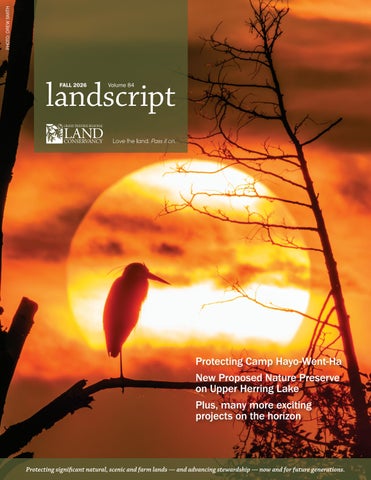
PHOTO: DREW SMITH
landscript FALL 2026
Volume 84
Protecting Camp Hayo-Went-Ha New Proposed Nature Preserve on Upper Herring Lake Plus, many more exciting projects on the horizon
Protecting significant natural, scenic and farm lands — and advancing stewardship — now and for future generations.
A Letter from Glen Chown Dear Friends, and more than a mile of Torch Lake frontage. A shoreline that will never be developed.
A particular light falls across our preserves this time of year. This long, golden and unhurried light makes you want to stop walking and just stand still for a while. I found myself standing still quite a bit this year. Thirty-five years will do that to a person. It makes you want to look back before you look forward.
Here's what moves me most about this one: the camp itself made the first gift, discounting the purchase price of the easement by $3 million because they believe in this as much as we do. That's the kind of partnership you dream about.
In 1991, a small group of visionaries who loved this region looked around and decided they weren't going to sit back and watch it get carved up and developed one parcel at a time. They decided to do something about it. And thanks to every one of you—and thousands more who have stood with us along the way—that wild idea has grown into something truly special. I am proud to share that the Grand Traverse Regional Land Conservancy has now permanently protected 50,000 acres of natural, scenic and farm land across our five-county service area. When we started, such a number was unthinkable. Today it's real, it's permanent and it's yours—it is your legacy, every one of you who has ever given, volunteered, advocated and cheered us on. Of all the work in front of us right now, one project has taken hold of my heart in a particular way. For more than 120 years, generations of kids have spent their summers along the shores of Torch Lake at YMCA Camp Hayo-Went-Ha— paddling, hiking and making the kind of lifelong friendships that can only happen at camp. This year, we are partnering with the camp to place a permanent conservation easement on 354 acres of that property: scenic, forested high ridges
We announced this opportunity publicly after securing $10 million in gifts and pledges. With $4.5 million dollars to go, we hope that everyone who loves Torch Lake—everyone who has ever watched a loon disappear beneath its clear water or paddled out at dusk to catch the last light on the hills—will help us carry this the rest of the way home. (Learn more on pages 4-9.) As part of this year's Priority Landscapes Learning Series, we welcomed Dr. Marc Berman, author of Nature and the Mind: The Science of How Nature Improves Cognitive, Physical, and Social Well-Being, for a conversation that stayed with me long after it ended. What struck me most was how closely his research echoed what we hear, again and again, from you. In a recent survey, we asked why people use our preserves and natural areas. The answers, overwhelmingly, pointed to greater happiness and life satisfaction, improved physical health, reduced stress and improved mental health. But it was the words behind the numbers that stayed with me: "Recently, I catch myself 'noticing' the world around me a bit more."
COVER PHOTO: DREW SMITH | GREAT BLUE HERON (ARDEA HERODIAS) AT ARCADIA MARSH NATURE PRESERVE 2 FALL 2026 | VOL 84
"I paddleboard along the area every summer and it always feels magical. The loons, deer and turtles love it, too. No matter what is going on in my life, this space has infinite peace, beauty and stillness to offer." "Awestruck. It's not often during our day that we are able to experience this. Especially on our last trail hike when an owl flew close and stole all the sound into its wings. We were amazed." This is the part of our work that never shows up in an acreage count. Land, once protected, gives something back—quietly, patiently, to anyone who walks through it. That owl didn't know it was making someone’s year. The land didn't know it was healing anyone. It simply did what land does, when it's left intact. Thirty-five years ago, a handful of people decided this place was worth fighting for. Today, that fight has become 50,000 acres, 162 miles of shoreline, 128 miles of trail and a partnership on Torch Lake that will keep one more stretch of it wild for the next 120 years of kids at camp and beyond.
PHOTO: TRAVIS GELINAS | BARRED OWL (STRIX VARIA)
None of it happens without you. Not the acres, not the trails, not the moment someone stands on a trail and feels–for the first time or the thousandth time—awestruck. Thank you for thirty-five years of believing this region is worth protecting. Here's to the next chapter—and to the future generations who haven't discovered this land yet but will. With gratitude,
Glen Chown, GTRLC Executive Director
GTRLC.ORG
3
Camp Hayo-Went-Ha: Protecting, Preserving and Passing It On CONSERVATION EASEMENT SET TO PERMANENTLY PROTECT THE LARGEST UNDEVELOPED PROPERTY ON TORCH LAKE
For those who live on Torch Lake, Camp Hayo-Went-Ha needs no introduction. The roughly 494-acre property features a distinct, forested ridge and more than a mile of frontage that has defined the eastern shore for generations. Every summer, Tom and Susan Palmer take their boat past the YMCA camp, which, today, offers both boys’ overnight camping and a co-ed day camp. Every time, he points out the places he recalls from his years there as a camper and counselor: the dining hall, the “point,” the swim dock. Once, 4
FALL 2026 | VOL 84
walking through the boathouse together, they found an old paddle with a name carved into it: Tommy Palmer. “It’s an iconic property for the lake,” said Tom, “and really critical to its future, as it has been to its past.” Susan didn’t attend camp herself, but it has grown close to her heart. “It’s stunningly beautiful,” she said, describing the view from the water. “The foliage, the mix of trees and underbrush are just gorgeous all along the beach…it’s so full and so untouched. It’s really quite spectacular.”
PHOTO: STONE HUT STUDIOS
The camp’s pristine shoreline is beautiful, but its significance extends well beyond scenery. Its forested slopes filter rain, slow runoff and help keep the water that flows into the Elk River Chain of Lakes watershed, and eventually Lake Michigan, clean. Its forests are part of a long, largely undisturbed woodland corridor that supports plants and wildlife that depend on large, unbroken tracts of land. Now, thanks to a collaboration between GTRLC and YMCA Hayo-Went-Ha Camps, this land is poised to be
permanently protected. The organizations are working to place a conservation easement on roughly 72% of the camp’s 494 acres, including 6,058 feet of undeveloped Torch Lake shoreline. With its most ecologically significant areas protected forever, the camp will remain privately owned, continuing the mission it has carried out for more than 122 years.
Setting Roots
No Other Place Like It
In the summer of 1904, a group of boys set up camp for the first time on a grassy slope beside Torch Lake—a landscape nearly unrecognizable from the shoreline we know today. The towering trees had been felled, leaving the hillside bare and vulnerable to erosion. Still, Camp Hayo-Went-Ha founders Lincoln E. Buell, William Gay and Charles Wagner envisioned a place where young people would build character, forge lifelong friendships and discover a deep love for the natural world.
Today, Camp Hayo-Went-Ha ranks in the top six percent of the more than 11,000 properties GTRLC has evaluated for protection and is the largest remaining stretch of undeveloped private shoreline on Torch Lake. “I can’t recall a time when the camp wasn’t on our radar,” said Chris Sullivan, GTRLC’s director of land protection. “There are so few properties with this much undeveloped shoreline left on Torch Lake—it’s kind of a unicorn.”
Buell spent much of his life making that vision a reality, planting an estimated 200,000 trees on the property. “I pray to God no one takes them out,” longtime Camp Director Cliff “Cap” Drury said in his 1964 talk, regaling the camp’s history. “They are testimony to him, and to the vision he had that boys and trees should grow up together…today we have as beautiful a campsite—because of its trees—as there is in this world.”
A largely intact, closed-canopy northern mesic forest, the property’s ridgeline provides the type of unfragmented habitat that has become increasingly rare in the region—and that GTRLC’s forest protection efforts are designed to preserve.
GRAND TRAVERSE BAY SUBWATERSHEDS
CHARLEVOIX
PROJECT AREA Grand Traverse Bay
ANTRIM
LEELANAU
KALKASKA GRAND TRAVERSE
Elk River Chain of Lakes
6
FALL 2026 | VOL 84
Other Grand Traverse Bay Subwatersheds
“We still have gaps to connect, but it’s mostly unbroken, contiguous protected land,” Sullivan explained. Anchored by Kiessel Ridge Farm to the north and extending south through the proposed Davock Road Forest and Torch Ridge Farm easements to the Torch Lake Nature Preserve, GTRLC is working to build a connected corridor where wildlife can move, feed and find shelter throughout the year. The property also directly impacts water quality in Torch Lake and the Elk River Chain of Lakes watershed, which ultimately flows into Grand Traverse Bay. A stream flows from the camp property into the lake, while groundwater seeps emerge from the steep hillside. As precipitation falls, the forest acts as a recharge area, absorbing water into the soil, replenishing OTSEGO groundwater and reducing runoff that would otherwise carry sediment and nutrients into the lake. Conversely, removing forest cover and adding impervious surfaces like driveways and patios disrupts this protective process—runoff flows faster and in greater volume, delivering contaminants directly into the water and accelerating streambank erosion. “Right now, there’s no sewer system out there,” Sullivan said. “Any houses built would introduce septic systems, plus the potential for rain and snowmelt to wash fertilizer, pesticides and pet waste down the hillside, with nothing to catch it.” In Central Lake, an unzoned township without density limits, protecting the property now is critical; once those natural filtration systems are
PHOTO: RICK KANE
A pathway winds through the forested shoreline at Camp Hayo-Went-Ha on Torch Lake. lost, the water quality impacts can be difficult—and often impossible—to reverse.
Reaching Common Ground For years, Sullivan and his team fielded questions from the Torch Lake Community about the camp’s future. “Everyone on Torch Lake wanted to know what was happening with the camp,” he recalled. Yet those early conversations struggled to gain traction; a project of this scale was out of reach for a land trust whose highest-priced conservation easement to that point had cost about $1 million to fund. As community interest continued to grow, GTRLC Executive Director Glen Chown and Director of Development Marissa Garrock were invited to the camp to make their case. “We shared what we felt were really the wins for the Conservancy, as well as for the camp and the community,” Garrock said. “That really shifted the momentum.”
After careful consideration, Hayo-Went-Ha’s board of trustees concluded that the benefits of protection far outweighed the risks, and they gave the project the green light. “As trustees, we are the camp's temporary stewards,” stated Board President John Kelley in his address to alumni. “For a brief moment in time, we have the privilege, and the responsibility, of caring for something that belongs just as much to future campers as it does to us.” The resulting agreement was designed to protect the land without constraining the camp’s ability to thrive. The easement covers 354 acres of the most ecologically significant land while intentionally leaving 140 acres, where most of the camp’s historic cabins and buildings sit, outside its terms. “We’re preserving what we can while leaving the camp flexibility to operate successfully,” Sullivan said. “We didn’t want a situation where we’re enforcing terms that make the camp nonviable in the long-term.”
GTRLC.ORG
7
Two additional safeguards, a Right of First Offer and a Perpetual Option to Purchase, were negotiated as a second layer of protection for the remaining acreage, giving GTRLC an ironclad way to purchase any portion of the property in the unlikely event it’s ever sold. The organizations agreed on a $13 million price for the easement, with the camp generously discounting the $16 million appraised value of the development rights by $3 million—considering it a gift to the community. Hayo-Went-Ha Camps CEO John Carlson called the project a win-win. “The areas included in the easement are places we have always hoped to preserve,” he said. “At the same time, the easement provides significant resources that allow us to strengthen the camp financially and invest in the facilities, programs and experiences that will serve future generations of campers.” A significant portion of the proceeds will be placed into long-term investments to support the organization well into the future. “We want to be the premier wilderness camp in the country,” Carlson said, “and this is only going to strengthen us.”
Investing in the Future Momentum toward that goal is already building. During a quiet fundraising phase, GTRLC reached a $10 million milestone, thanks to lead gifts from Tom and Susan Palmer and the Cook Family Foundation, alongside generous contributions from many others in the Torch Lake community. The full project carries a fundraising goal of $14.5 million, covering the purchase price, plus appraisals, legal fees and dollars needed to monitor, enforce and defend the easement in perpetuity. The agreement is structured as a series of annual installment payments made to the camp through 2030, each formally unlocking a portion of the easement— and giving donors the flexibility to spread their support across multiple tax years. GTRLC intentionally saved the best piece for last: the waterfront. “People will see how far we have come and think a small gift might not have a big impact,” Garrock said, noting that the last dollars are often the most difficult to raise, “but it will take everyone who cares about Camp Hayo-Went-Ha and Torch Lake to get us to the finish line.” Susan Palmer, who serves on GTRLC’s board of directors and currently sits on the land committee, has watched development reshape northern Michigan for years. “We wanted to be part of the story that is told—the protection of the land and water,” she said. “Just as the
8
FALL 2026 | VOL 84
camp’s founders had a vision for the future, there needs to be a new vision—so that people look back at this time and say development was stopped here, and the natural land was allowed to thrive.” Tom and Susan view the project as a product of the momentum established by pillars of conservation within the Torch Lake community. “This is a culmination of a sweep on the eastern side of the lake. People like Terry Malone, Dottie Gerrity, and the Kiessel, Richards and Rowe families set an example—they created this sense that people who care about conservation can come together and make a real, transformational difference,” Tom said. “Our hope is that our gift inspires others to do the same.”
Protecting, Preserving and Passing It On For current and future campers, the conservation easement invests in the experiences that shape the people they’ll become. Hayo-Went-Ha teaches kids to embrace the fun of life’s challenges. Programming builds year over year, including overnights at Sleeping Bear Dunes National Lakeshore, backpacking on Isle Royale and, eventually, 21-day expeditions in Alaska. Along the way, campers portage canoes over long carries, push through exhaustion and discover what they’re capable of. Through it all, they practice the values the camp has long stood for: responsibility, inclusion, caring, honesty, teamwork, environmental stewardship and respect. “Alumni do not simply remember being at camp. They remember this place,” said Carlson. “The experience of camp becomes part of who they are.” For Carlson, the easement embodies the three commitments that have guided the camp: protecting, preserving and passing it on. “Protecting the land is a way of recognizing its history while taking responsibility for the future. It allows us to help ensure that this special place remains available for future generations,” he said, “and that is an extraordinary legacy.”
GTRLC has until December 31, 2030, to reach our fundraising goals to protect Camp Hayo-Went-Ha. The conservation easement will not go into effect until the fundraising is complete. To learn more or support this project, contact Marissa Garrock at (231) 929.7911 or mgarrock@gtrlc.org.
Mapleview Valley
Quin Sig A Mond
!
Kiessel
Greenwood School
Camp
2 1
3 4
Sunset Hill
5
E as
6
9
7
t To rch La
ke
8
Torch Lake
Ea
MAP LEGEND Camp Hayo-Went-Ha (493.66 acres / 7,618.91’ shoreline) Camp Hayo-Went-Ha: Easement Areas (354.20 acres / 6,057.90’ shoreline)
st
To rc h
La
ke
CAMP L ANDMARK / BUILDING KE Y 1
L.E. Buell Chapel
6
Old Dining Hall
2
Dow Environmental Education Building
7
Director’s Cabin
3
Drury House
8
Kresge Lodge (K.P. Rode Dining Hall)
4
Bonbright Lodge
9
Main Office
5
Boat House
GTRLC.ORG
9
Conservation Easements, Explained GTRLC AND PRIVATE LANDOWNERS WORK TOGETHER TO PROTECT THOUSANDS OF ACRES OF NORTHERN MICHIGAN FORESTS, FARMLANDS AND SHORELINES THAT BENEFIT US ALL Time and time again, landowners across northern Michigan describe how their love for the land took root: picking fruit at a local farm, summers at the family cottage, exploring woods walked by the same family for generations. Those experiences leave a lasting imprint, and often, a desire to pass that connection on. Conservation easements allow landowners to do just that. This legal tool permanently protects a property’s conservation values while permitting landowners to continue owning, living on and enjoying their land. The unsung heroes of land protection, conservation easements account for nearly half of the land GTRLC has preserved. They’re also among the most misunderstood conservation tools: What can landowners do with their easementprotected properties? What activities does GTRLC restrict? How does an easement actually work?
PHOTO: NOAH JURIK
1. LOVE THE LAND
2. MEET THE CRITERIA
3. CRAFT THE AGREEMENT
Although every conservation easement is different—because each property and property owner’s needs are unique—they all with 2026 a deep connection to and | VOL 10start FALL 84 love of the land.
After a landowner expresses a desire to protect their land, GTRLC evaluates whether the property meets its protection criteria, such as overall size, habitat types and adjacent land use.
GTRLC and the landowner then work together to establish mutually agreeable terms that protect the land they both value. This agreement becomes a conservation easement.
Director of Easement Stewardship Mike Okma has spent 20 years answering those questions. “I love conservation easements,” Okma said. “They’re a great tool for private landowners to create a positive environmental impact long after they’re gone.”
What Is a Conservation Easement? A conservation easement is a voluntary legal agreement between a landowner and GTRLC. The landowner keeps title to the property and can continue living on it, farming it or otherwise using it, and can sell or pass it on as they choose. In most cases, what changes is the land’s development potential: the easement permanently limits subdivision and new construction to protect the natural, agricultural or scenic features that make the land worth preserving. Each easement is unique, and its terms are negotiated to reflect both the property’s conservation values and the landowner’s goals. An agricultural easement could keep land in production while ruling out future subdivision. An easement on forest, wetland or river frontage might allow continued timber management or non-motorized trail use while keeping sensitive habitat undisturbed. Commercial activity is typically limited to uses consistent with the land’s conservation purpose. “Sometimes easements restrict development in areas like wetland zones or stream buffers. Others have scenic viewshed components. These are all negotiated to meet the landowners’ goals and the Conservancy’s mission,” Okma said.
Once recorded, an easement’s terms stay with the property or "run with the land,” not with the person who created it. The land can be sold, inherited or gifted, but the protections— and GTRLC’s role in upholding them—remain in place.
How Conservation Easements Benefit All of Us GTRLC prioritizes protecting lands with high conservation value, including high-quality agricultural land and large blocks of intact habitat, such as forests, wetlands and river frontage. Properties adjacent to other protected lands are especially prized, since they help maintain wildlife corridors and enhance ecosystem services across a larger landscape. Currently, Okma and his team monitor around 330 easements totaling over 23,000 acres, 75 miles of shoreline and over 12,000 acres of farmland. Some of Okma’s favorite easements are located on rare parcels of undeveloped Lake Michigan shoreline or Manistee River frontage. These shoreline, wetland and riparian properties protect vital freshwater ecosystems. “Even though easements are private property and aren’t open to the public, they go a long way towards safeguarding water quality, fish and wildlife habitat and scenic views,” he said. Because private lands usually lack trails, infrastructure and heavy foot traffic, they offer a level of undisturbed habitat that even nature preserves can’t match—making them critical for wildlife species that require safe spaces to feed, find shelter and raise their young.
DEED
4. MAKE IT LAST FOREVER Once an agreement is reached, it is legally bound to the property deed through a conservation easement, ensuring the property is permanently protected, regardless of changes in ownership. The property remains
privately owned, while GTRLC is legally responsible for enforcing the easement terms through regular monitoring visits and ongoing communication with the landowner.
GTRLC.ORG
11
Conservation easements also create a shared stewardship model, allowing GTRLC to direct its resources toward protecting more land. Landowners continue caring for their properties while GTRLC monitors and enforces each easement’s terms, permanently. That legal commitment means the public benefits of protected land will always be upheld, no matter who owns it or what development pressures arise.
Each year, Okma and his team visit landowners to offer assistance and confirm that the easement’s terms are being honored. “We get requests for guidance on property enhancements, and we’re here to help landowners reach their goals while complying with easement terms,” he added. Working with GTRLC, landowners have access to environmental professionals who help maintain the ecological health of their property—a resource most private landowners wouldn’t otherwise have.
Why do landowners protect their land? For most landowners, protecting their property comes down to one goal: keeping the land the way it is, forever. There are also financial incentives. Restricting a property’s development potential reduces its market value, however landowners who donate a conservation easement may be eligible to claim that lost value as a tax deduction. “Sure, the land you love might be more monetarily valuable as a subdivision,” Okma explained. “But a farmer or a family can receive the value of those development rights in the form of tax benefits or cash payments without selling to a developer. Plus, they know the land they’ve stewarded won’t change after it’s no longer theirs.” Some property owners worry an easement might scare away future buyers, but Okma sees the opposite: large, intact parcels are increasingly rare, and the qualities an easement protects—clean water, healthy habitat and open land—are what many buyers want.
“Easements are great tools to make a permanent impact and work with a trusted organization to safeguard what you love about your land,” Okma said.
INTERESTED IN AN EASEMENT? Landowners interested in exploring a conservation easement can start with our Guide for Landowners at GTRLC.ORG, which covers potential tax benefits, the easement process, acceptance criteria and more. From there, landowners can contact GTRLC’s land protection staff to discuss their goals and determine whether an easement is the right fit.
T HE PUBLIC BEN EFIT OF PRIVAT E E A SEMENT S
HEALTHY HABITATS
12
FALL 2026 | VOL 84
CLEAN WATER
LOCAL FARMS AND FOOD
CLEAN AIR
SCENIC VIEWSHEDS
Of the approximately 50,000 acres and 162 miles of shoreline GTRLC has protected since 1991, over 23,000 acres (46%) and 75 miles of shoreline (46%) are protected with conservation easements.
PHOTO: JENNA SCHEUB, SKUNK CABBAGE (SYMPLOCARPUS FOETIDUS)
The properties pictured here and on page 10 represent nearly 420 acres of land protected forever by conservation easements in Benzie and Manistee Counties.
GTRLC.ORG
13
PHOTO: KATIE AUWERS
The Wonder of Wonder at Whip-poor-will Hill NEARLY TWO DECADES AFTER PROTECTING 150 ACRES WITH A CONSERVATION EASEMENT, THREE GENERATIONS OF THE MARTINEBERHARDT FAMILY CONTINUE A LEGACY OF LAND STEWARDSHIP. 14
FALL 2026 | VOL 84
Just past Fife Lake, a gravel road winds past a long, unbroken stretch of state forest land, following a tree canopy that narrows as it draws closer to Whip-poor-will Hill. The Eberhardt cabin is easy to miss if you’re not watching for it. Situated on a hillside, it’s a rustic home tucked into a vast, forested landscape of private, protected land that feels like a park system of its own. Inside, Laurie Eberhardt and her family—husband Peter Martin and children Ellie and Sylvie—can be found throughout the year, enjoying the view from a large front window that overlooks the land their family has known for more than 65 years. The room is part of the original structure that Laurie’s parents, Arthur and Marion, started building the year she was born. "This place has been part of my life, my whole life," Laurie said, “so it’s very important to me.” In 1959, a few years before building the cabin, Art and Marion bought the first 80 acres of what would become their 150-acre property in Kalkaska County. The cabin itself came together in stages, too, built by hand—without power tools—using windows and hardware collected from garage sales. Laurie’s older siblings, both adolescents at the time, helped where they could. A passion for education ran through both sides of the family, as did an unmistakable love for the natural world. Art taught for nearly 40 years at what is now Trine University in Angola, Indiana, while Marion, a Lansing native, was teaching in Petoskey when the two first met. Art read Thoreau, Emerson and Sigurd Olson, and spearheaded one of the first Earth Day celebrations at his university in 1970, where an environmental center now bears his name. For decades, he organized an annual tree-planting festival at a nearby nature preserve and helped local forests through his board service with ACRES Land Trust. A wooded parcel in Angola is named Marion’s Woods, in honor of his wife, thanks to his advocacy. Marion, for her part, ran a small nature-craft business, led Girl Scouts and Brownies, and was, in Laurie’s memory, always ready to pack a bag and head for the woods. When they bought the Kalkaska property, it was largely open canopy woodlands, home to Whip-poor-wills, Bluebirds, Tree Swallows, smooth green snakes and other oak savanna species. Laurie recounted her father capturing birdsongs and sounds of nature using a reel-to-reel tape recorder, and as a family, collecting seedlings from the state park and along roadsides, growing them at home before planting them across their new
property. “I remember flats of seeds and vermiculite in the refrigerator when I was growing up,” Laurie laughed. “You opened the fridge, and it was all seeds!” Over the following decades, the Eberhardts planted well over a thousand trees on the property, transforming the open land they’d purchased into the thriving, mature forest that stands there today. “Now there are Red-eyed Vireos, Scarlet Tanagers and things that weren’t there then,” Laurie said, describing the land’s natural progression, “so it’s really just shifted.” In 2007, when an estate tax change prompted the Eberhardts to seriously consider the land’s future, Art was already familiar with the concept of a conservation easement through his work with ACRES Land Trust. Beyond the tax incentive, what mattered most, Laurie said, was “keeping the land in one big piece and not developed.” She recalled the day a land protection specialist with the Conservancy walked the property with her father. “He was so appreciative and so excited about protecting the land,” Laurie said. “That really, clearly helped my dad feel like ‘This is right, and somebody appreciates what I like.’” In December that year, her parents donated the value of a conservation easement on the property to GTRLC, permanently protecting its forests, wetlands and the natural springs that feed a tributary of the Manistee River. While Art passed in 2020, and Marion a decade earlier, the easement they signed is still at work nearly 20 years later, now perhaps more than ever. Laurie and Peter regularly field calls and letters from buyers, including gas companies interested in drilling. “We probably get a couple of solicitations a week to buy this place,” Laurie said. “It’s very easy to answer those: ‘No, this land is protected. [It] has a conservation easement.” Laurie credits her parents’ reverence for the land and nature as having influenced her own professional calling. A professor of biology at Valparaiso University in Indiana, she has spent much of her career studying the relationships between plants and animals, from the behavior of birds around the plants they depend on to how microplastic pollution now shapes the behavior of aquatic organisms. “That kind of land ethic—that Aldo Leopold land ethic ran through the family for sure,” she explained. Referring to a small stream that her family named Eberhardt Creek, which starts in the property’s swamp and feeds into the Manistee River, she said, “I always felt we’re part of that, helping the Manistee stay clean.” She also thinks about the carbon that the maturing forest has absorbed over the decades. “It’s our little carbon bank here.”
GTRLC.ORG
15
That same passion for studying the natural world has carried into the next generation. Sylvie recently completed a dissertation studying pitcher plants at GTRLC’s Upper Manistee Headwaters: The Milock Family Preserve, not far from the family cabin. “We used a wheelbarrow to carry all our stuff,” Laurie said, describing a day she joined Sylvie in the field. The opportunity to help with their research, in a protected bog— decades after her parents protected their family’s land—felt like coming full circle. “We had a blast. It was very lovely for me to have that.” Today, the cabin remains a constant in the family’s lives. A favorite New Year’s tradition is lighting lanterns and sledding down the old two-track behind the cabin. Summer days are spent paddling the Manistee, followed by games around the table and pizza from a clay oven the family built themselves.
There aren’t trails at Whip-poor-will Hill—an intentional choice Art and Marion made that the family has kept. “I think that is part of the love of the land—not designing things to get to your destination quickly, but to appreciate where you are and wandering about,” Laurie reflected. “That was an important family value. The journey is the important part.” Peter, who also spent his career teaching, recalled his first few visits to the cabin. Laurie had oriented him to the hill and used landmarks to explore the land, like the oak tree that still marks the way to the swamp. "There was no need or desire to go the same way twice,” he said. “It wasn't because you took that path to get there, because there was no path.” Laurie added, "It was just sort of the wonder of wonder… and this was a place to immerse ourselves in that.”
PHOTO: KATIE AUWERS
Abby, the Martin-Eberhardt family's dog, exploring the woodlands and sedges at Whip-poor-will Hill.
Luring Them In
SYLVIE MARTIN-EBERHARDT’S DISSERTATION RESEARCH REVEALS HOW THE CARNIVOROUS PITCHER PLANT BENEFITS FROM USING MULTIPLE SIGNALS
In middle school, Sylvie Martin-Eberhardt fell in love with Heliamphora, a pitcher plant species that grows in the mountains of Venezuela and Guyana. Years later, they encountered one of its evolutionary cousins, Sarracenia purpurea, for the first time at Cowles Bog in Indiana Dunes National Park. “I was blown away,” Sylvie said. “It was amazing to think that these amazing and unique plants—their leaves are cups! They eat insects!—could grow right here in the Midwest.” Pitcher plants not only eat insects, but they are also pollinated and eaten by them. Some camouflaged spiders lie in wait to steal the plant’s prey, while certain fly species use their cupped leaves as private pools for developing larvae. Sylvie, then a PhD candidate at Michigan State University’s Kellogg Biological Station, turned that fascination into a dissertation question: how does a single plant manage so many interactions with different species at once? To answer this question, Sylvie and a small team built roughly 100 artificial purple pitcher plants out of small tubes fitted with plastic hoods, handpainted to mimic a real plant’s coloring and outfitted with different combinations of signals, including nectar, scent and color.
For Sylvie, there’s a personal element to this work. Their grandparents protected a 150-acre property in Kalkaska County with a conservation easement nearly 20 years ago—a place that nurtured Sylvie’s curiosity about the natural world. “Time in the woods, both on the land my grandparents protected and on public lands I visited with my family, gave me the opportunity to observe and get a sense for the rhythms and quiet surprises of forests and wetlands,” they said—along with, they added, a fairly high tolerance for mosquitoes, heat and ticks that has proved invaluable in their line of work. Sylvie is now starting a postdoctoral position at the New York Botanical Garden, studying the photosynthetic solutions that understory plants have developed to deal with low light on the forest floor. “It’s hard to imagine a workplace more different from northern Michigan than New York City,” they said, “but plants are everywhere, and so are the people who are fascinated by them.” Living collections like the Botanical Garden's are an extraordinary resource for ecologists, Sylvie added, but so is direct access to intact, natural ecosystems, like those protected by the Conservancy. "Both serve an important, complementary role in our work as plant biologists.”
The team set out the models in four peat bogs where pitcher plants grow and recorded the invertebrates they captured over 24 hours. One of the bogs was located at Upper Manistee Headwaters: The Milock Family Preserve. Home to a large and reliable population of pitcher plants, the preserve was easily accessible and welcomed researchers, making it an ideal fit for the study. Pitcher plants are sensitive to disturbances, like shifting water levels or nutrient runoff, Sylvie explained, and a site with a diminished population or a declining insect community simply wouldn’t have supported the work. “Protecting land from major land-use changes like logging, mining and urbanization is critical for slowing that decline,” they said. The research found that pitcher plants using a wider variety of signals attracted a more diverse set of insects, which may help the plant take advantage of seasonal flushes of prey or get a balanced diet of macro and micronutrients. They were also more likely to draw in a major food source: Myrmica lobifrons, a bog specialist ant. Their findings may even help design better lures for trapping pest insects in agricultural settings.
PHOTO COURTESY OF LAURIE EBERHARDT
GTRLC.ORG
17
PHOTO: MICHELLE FIELSTRA
Our summer interns, from left to right: Tatem Bottrell, Kate Taylor, Casimir Heiman, Elli Tiesworth, Lilly Mendels and Cedric May.
The Next Generation of Conservation Leaders GTRLC’S SUMMER INTERNSHIP PROGRAM OFFERS DIVERSE EXPERIENCES AND FOSTERS FUTURE LEADERSHIP IN CONSERVATION This year, we welcomed our largest summer internship community to the Conservancy, with six participating students representing Kalamazoo College, Michigan State University, Northern Michigan University and the University of Michigan. They came from programs in parks and recreation, wildlife management, and sustainability and ecology, along with interdisciplinary specialties incorporating sociology and anthropology with environmental studies and, interestingly, oceanography. Each had family roots in our service area, and their past experiences on farmland, woods and water inspired their career aspirations. They came with ideas for research projects, questions about their
18
FALL 2026 | VOL 84
possible academic next steps, energy, enthusiasm, a touch of nervousness and an eagerness to learn. GTRLC’s summer internship experience is open to collegelevel students in the last two years of undergraduate work or the first year of a graduate program. Over the 12-week season, participants engage in as many aspects of Conservancy work as we can schedule for them. Interns spend a significant percentage of time on stewardship projects, working side-by-side with staff and volunteers as they rotate through invasive species removal, native plant identification, seed collection and documentation and trail
building. This year’s interns had opportunities to engage with guest researchers, take a hand at making biochar at Misty Acres: The Borwell Preserve, conduct trail user interviews at five nature preserves and, of course, get to really know the goats at Mitchell Creek Meadows: The Don and Jerry Oleson Nature Preserve. Tatem Bottrell, now back at Michigan State, quickly connected with stewardship staff members Samantha Griffin and Fields Ratliff, helping integrate data on the goats at Mitchell Creek Meadows and their effectiveness in managing invasive autumn olive. As part of her project, she developed a GIS-based tool to help tell the story. Along with fellow intern Lilly Mendels, who is starting her junior year at the University of Michigan, the first impressions of GTRLC’s daily culture were deeply meaningful. “Welcoming” was Lilly’s word to describe the experience. “Feeling like I’ve really been a part of this,” Lilly said at the end-of-season debrief. For Casimir Heiman, who just graduated from Northern, this was an opportunity to think about graduate school and refine his ideas about future career options. Early on, he was pleasantly surprised by the care and attention given to personalizing thank-you notes for gifts large and small at his first Gratitude Gathering, a volunteer opportunity hosted by GTRLC's fund development staff. “Genuine” was his word.
housing alongside seasonal crew members at one of GTRLC’s facilities, Cedric had an opportunity to see the communitybuilding effect from a few different lenses and noted, “We formed connections really quickly, because we saw that everyone felt like part of something bigger.” As a new graduate student at the University of Michigan School for Environment and Sustainability, Kate Taylor was impressed to discover the range of restoration work taking place throughout GTRLC. She was especially intrigued by the initial efforts to assess the effectiveness of prescribed fire for invasive plant management, one of her areas of interest for future research. Feeling encouraged to ask questions, seek advice, share ideas and bring observations to a conversation were sentiments shared by the entire group, and perhaps best summed up by Kate’s observation: “Being welcomed and being part of a team almost right away has been more than special.” The Conservancy’s internship and summer seasonal crew programs have had the opportunity to expand through the generous support of our donors. Understanding the urgency and importance of these opportunities for young adults, we hope to continue providing meaningful technical and organizational experiences for the next generation of conservationists. We’re excited for 2027! Interested in interning with GTRLC? We are accepting applications for the summer of 2027 beginning in November! Check our website at GTRLC.ORG for internship position openings and more information.
Two of our interns, Cedric May and Elli Tiesworth, returned to Kalamazoo College this fall to complete their respective interdisciplinary degree programs. Elli is focusing on the social and cultural impact of engagement with the environment and how it shapes communities, while Cedric is interested in the development of environmental policies and the conditions that favor successful implementation. Helping collect survey data on trail use at many of our properties was particularly impactful, as the project aligned with their interests in social engagement and the outdoors. They also assisted with GTRLC’s Preservation Celebration and events such as researcher and author Dr. Marc Berman’s presentation on the relationship between nature and well-being, experiences that underscored the diversity of the Conservancy’s work. Elli felt the summer “reaffirmed my commitment to environmental justice.” Cedric noted the importance of understanding how so many parts work together in one organization to further the mission. Sharing Senior conservation ecologist, Angie Bouma, with interns Casimir and Kate at the proposed Kirkland Woods Nature Sanctuary conducting a botany inventory.
Finding Community, Planning a Legacy DRAWN NORTH BY A LIFELONG LOVE OF NATURE, VANGUARD SOCIETY MEMBERS HELP ENSURE THAT THE LANDSCAPES THEY CHERISH REMAIN WILD On a hot July afternoon, Nancy McCullick dove into the tranquil waters of Arbutus Lake. After clocking a satisfying swim, she rolled onto her back and floated in the sun, eyes closed against the brightness of the day. Hearing the sound of movement an arm’s length away, she opened her eyes and found herself face-to-face with one of the lake’s Common Loons. They gazed intently at each other for a moment before the loon dove out of sight. Close encounters with nature are not a rarity for Nancy and her husband, Ron, who live amongst the trees at the lake’s edge and spend as much time as possible recreating outdoors. This confidently “self-propelled” couple paddle board, kayak and row. On land, they hike with their dog, Sheldon. Nancy grew up treasuring summers spent on her grandparents’ dairy farm downstate, and she fondly remembers family trips to Traverse City, awash in ripe cherries and fudge. Ron also enjoyed a free-range childhood in the Grand Rapids area, punctuated with monthly Boy Scouts camping trips that frequently brought him north and got him “hooked on nature.” Vacationing here with their families as children–and later, as a couple–seeded the McCullicks’ dream of calling this magical place home. “We were always trying to get back somehow,” Nancy smiled. “We finally made it.” Ten years ago, when Ron accepted a job offer in the Cadillac area, they knew it was their opportunity to move, starting with a commute before his planned retirement. They found a wooded lot for sale on the western shore of Arbutus Lake 3—so densely forested, in fact, that they didn’t even know the property had lake frontage until they walked it. Arbutus Lake–a serene, nearly 400-acre body of water composed of five lakes connected by channels, starting with Lake 1 in the south and ending with Lake 5 in the north— has long been a popular destination. Known for its clean, clear water and excellent fishing, its bounty has drawn nesting pairs of Common Loons and Bald Eagles in addition to anglers. Since 1914, generations of girls have made memories at the YMCA’s Camp Arbutus overnight camp on its eastern shores. As they built their home, the McCullicks were careful to nestle it amongst the trees. “We made a decision that even small gestures help,” Ron explained. “So on our land, we take about a third of it for the house and some [native] 20
FALL 2026 | VOL 84
landscaping, and leave about two-thirds of it natural and wild.” Nancy added with a good-natured laugh, “Try native plantings–the deer love them!” From their front door, the McCullicks can see GTRLC’s Turtle Cove Nature Preserve—the 117 acres encompassing Turtle Cove, a large, shallow inlet off of Lake 4 that provides habitat for myriad fish, reptile, amphibian and invertebrate species. Only a few years ago, the McCullicks heard from neighbors that Turtle Cove was at risk of being developed into as many as 240 homes, which caused concern about runoff affecting the water quality. “I read a story in The Ticker about how some neighbors got together and were able to engage with the Conservancy to save an area near Mitchell Creek,” Nancy remembered. “And I thought, well, if they can do it, we can do it.” This fundraising project was the McCullicks’ introduction to GTRLC, and to many of their neighbors. Anchored by a few lead gifts, Turtle Cove was brought across the finish line in December 2023 by a group of caring community members—including the McCullicks—who gave generously, even sacrificially, to preserve the unspoiled land and water they loved. “It was almost like a Christmas miracle, right at the deadline,” Nancy said. “It never would have happened without the many people that cared so much and stepped up—lake residents and community residents, we all came together and the dream came true. That property is not only precious to the people that live on the lake, but to the community. It’s used every day.” While they enjoy walking Sheldon on the nature preserve’s recreational trail regularly, Turtle Cove is also meaningful to the McCullicks on another level. The property is immediately adjacent to two other protected parcels–Pines Park, a natural area owned by East Bay Township, and DNR land, where a State Forest Campground is sited, combining to create a wildlife corridor of hundreds of acres. As animals and plants face the reality of increasingly fragmented habitats, GTRLC’s focus on landscape-level conservation resonates deeply with them. An avid birder for more than thirty years, Ron is now Vice President of the Traverse City Audubon Society and keenly
aware of the crisis confronting our avifauna. Ron noted a 2019 landmark study published in Science that found that the total number of birds in North America has decreased by about 30% since 1970, and the loss is not limited to rare species. Habitat conservation, Ron explained, is one antidote to further decline, and he sees evidence of it at Turtle Cove. “We see Scarlet Tanagers, Warbling Vireos, Baltimore Orioles, Red-Headed Woodpeckers and Indigo Buntings–birds that need some space, and need woods, to nest,” Ron explained. “Where they nest one year, you can probably find them the next year. So it’s important to us to help conserve for future generations those natural areas and the diversity of species.” “We like that the Conservancy looks at creating corridors wildlife can use,” Nancy said, “and we see them using it!” In addition to birds, bobcats, bears, porcupines, deer, foxes and even an otter have made appearances in the preserve. After witnessing the power of community united behind GTRLC’s mission, the McCullicks decided to invest generously beyond their own backyard: they included the Conservancy in their legacy planning. As members of GTRLC’s Vanguard Society, the McCullicks joined a bus tour last spring to learn about the Conservancy’s work more broadly, in this case, on Old Mission Peninsula. Nancy doesn’t take Traverse City’s farm views for granted— in fact, they’re part of what drew her to this area. She and Ron were excited to learn about GTRLC’s key role in helping Old Mission Peninsula preserve its farms through the establishment of the PDR program in 1994. The Purchase of Development Rights (PDR) program allows Peninsula Township to “buy” the development rights for eligible properties from the landowners—a millage-funded, voluntary program that relieves financial pressure facing farmers while permanently preserving working farms, scenic views and water quality. Having watched her grandparents’ farm get swallowed up by development, Nancy appreciates that the PDR program is giving farms in this area a chance to thrive. Being Vanguard members allows the McCullicks to support GTRLC’s mission–land protection and stewardship, now and for future generations–in a way that aligns with their values of generosity and conservation. “We were raised to share, and this is one way to share with the community,” Ron said. Nancy agreed, “It’s a way of giving back to the community that has been so kind to us and has been willing to give when it was time. It’s a way to make sure that the cause continues.” If you would like to learn more about legacy giving, contact Barb Heflin at bheflin@gtrlc.org or call (231) 929.7911. More information is also online at gtrlc.org/donate/legacy-giving/.
PHOTO COURTESY OF THE McCULLICKS
Ron and Nancy McCullick, with their dog, Sheldon, on a hike at Turtle Cove Nature Preserve. GTRLC.ORG
21
PHOTO: RICK KANE
Herring Creek Hills: A Historic Farm’s Next Chapter PROPOSED NATURE PRESERVE ALONG HERRING CREEK SAFEGUARDS WATER QUALITY, HABITAT AND RURAL CHARACTER IN BENZIE COUNTY
There are still a few places in our region where time seems to have stood still. Along Upper Herring Lake’s eastern shore, the water is rimmed by rolling orchards and forested ridges. Nearby protected lands—Green Point Dunes, Fruithaven and Arcadia Dunes Nature Preserves, along with the historic Watervale Resort—give the landscape a natural, storybook quality that’s grown increasingly rare. With the proposed Herring Creek Hills Nature Preserve, GTRLC has a chance to protect more than 100 acres of property critical to water quality, wildlife habitat and the scenic character that defines this corner of Benzie County. Blackbird Farm, the property’s inactive fruit orchard, sits high on a ridge overlooking Upper Herring Lake. The Smeltzer family has owned and worked the farm since
22
FALL 2026 | VOL 84
World War II. “The land is wonderfully diverse: wetlands, high hills and all of the typical northern Michigan microenvironments,” said Don Smeltzer, who grew up on the property and lives in the original farmhouse. He explained that the land’s story dates to the glacial era. “If you went back thousands of years, this [property] sat along the edge of Lake Algonquin,” he said, referring to the ancient glacial lake that once covered much of what is now the Great Lakes. “We discovered gravel eight to ten feet below the surface…washed into this valley as the glaciers melted.” Rows of apple and cherry trees give way to northern mesic and boreal forests, including stands of exceptionally large oak and eastern hemlock. Some of the oldest trees predate the farm itself, according to Smeltzer, survivors of the lumbering
era that swept through the region around the time the farmstead was established in the 1870s. “They are remnants from the lumbering days,” he said. “White pine was the premium wood back then, and hardwood wasn’t considered as valuable—it went into railroad ties. So the trees that weren’t cut back then are still standing.” Angie Bouma, GTRLC’s senior conservation ecologist, was struck by the towering oaks lining the ridgetop, along with specialist plants like wood betony. “These are trees and plants you just don’t find much anymore,” she said. Early ecological assessments also turned up sensitive plants such as beechdrops and American brooklime, and a spring visit found jack-in-the-pulpit blooming amid a chorus of birds and amphibians. Bald Eagle, whitetail deer, American Redstart and Ovenbird provide a snapshot of the wildlife the land already supports. Of all the reasons to protect this land, safeguarding water quality is among the most consequential. The property includes significant Upper Herring Lake frontage and 3,500 feet along Herring Creek. Comprising the northern branch of Herring Lake Swamp, the land was identified as a priority conservation area in the Herring Lakes Watershed Protection Plan. Northern wet meadow, southern shrub-carr and rich conifer swamp wetlands serve as natural filters, gradually absorbing and purifying runoff before it reaches Herring Creek, which flows through both Upper and Lower Herring Lake, on its way to Lake Michigan.
a dozen house sites with shared beach access. While that plan never moved forward, future appraisals made clear how much the waterfront lots would be worth on their own. Selling them off, though, would have left the rest of the farm’s future uncertain. “I knew the Conservancy would take good care of the property,” Smeltzer said. He came to know the organization through his years as township supervisor, watching it protect land nearby, including the Upper Herring Lake Nature Preserve, which sits across from the farm on the west side of the lake. Wanting the farm to stay whole, Don and his sister Ann Henning, co-trustees of the Helen H. Smeltzer Trust, are now working with the Conservancy to preserve the land. The family is offering the property to GTRLC at a bargain sale, generously agreeing to part with it below market value to make its protection possible. Sharcy Ray, GTRLC’s land protection team assistant working on the project, said the risk of future development remains real without that protection. “I have no doubt that the ridgeline would be developed,” she said. “Maybe not right away, but as time passes, that would absolutely happen.” Protecting the land also opens the door to a variety of restoration initiatives. Stewardship plans call for controlling invasive species such as autumn olive and garlic mustard, with a long-term goal of promoting forest connectivity
“Its forested habitats and wetlands buffer the north branch of Herring Creek, which ultimately flows into Lake Michigan,” said Bouma. “The benefits reach far beyond this one property.” Properties like this, with sweeping views, open fields and significant waterfrontage, rarely stay undeveloped for long once they’ve changed hands—making this parcel a prime target for residential development that would fragment habitat, degrade water quality and permanently alter the area’s rural character. After Don Smeltzer’s father passed away in 2004, he began exploring what the family might do with the farm, including a plan to grow grapes and open a winery. A design firm drew up plans that included a vineyard, a tasting room and roughly
PHOTO: RICK KANE
Herring Creek flows through the proposed preserve's forests and wetlands on its way to Upper Herring Lake, Lower Herring Lake and eventually to Lake Michigan, helping safeguard water quality in the creek as well as the lakes downstream.
and the growth of native plants to support pollinators and healthy ecosystems. “This is a great place for the forest to heal itself and connect the disparate woodlots into a canopy that stretches across the current fields and orchards," Bouma said. "It will take years of monitoring so it doesn't become an autumn olive thicket, but there is a lot of opportunity here.” Once protected, the land would be open to the public for the first time. Preliminary plans call for one to two miles of sustainably built trail through forest, including an overlook with scenic views of Upper Herring Lake and the surrounding landscape. “The view is pretty remarkable,” said Ray, “and there are fewer and fewer opportunities for people to enjoy places like this as northern Michigan's landscapes become more developed.” The sale terms are still being finalized, but current plans call for a portion of the property, including the farmhouse
where Don grew up, to remain in the Smeltzer family. While Don feels sad about this chapter coming to an end, he hopes others will experience the land as he has. "I love walking in nature—it's calming. You can sort your thoughts out," he said. "It makes me realize that I'm just a tiny speck in the big scheme of things. All of my problems, whatever is bugging me, I come back not so worried. I hope future generations can walk this farm, see remnants of a previous life that existed, take a retreat from the cares of the world and figure out the important things in life—the things that last—then come back refreshed." "Knowing it will be preserved forever gives me a lot of satisfaction,” he added.
Visit GTRLC.ORG for more information. To support this project, contact Senior Charitable Giving Specialist Kate Pearson at kpearson@gtrlc.org or (231) 929.7911 ext. 305.
PHOTO: RICK KANE
This proposed preserve is home to a tapestry of orchards, open fields and beautiful maple-beech forests with wetlands that flow into Herring Creek.
24
FALL 2026 | VOL 84
Betsie Dunes Nature Sanctuary Sagaser Nature Sanctuary Eden Hill Woodland
Nana’s Woods & Elisabeth Parr Nature Sanctuaries Proposed Woodfern Moraine Nature Sanctuary
Railroad Point Natural Area
Crystal Lake Frankfort Proposed Elberta Waterfront Community Conservation Project
Maple Hill Ecologically Managed Forest
Elberta
Beulah
Trapp Farm Nature Preserve
Benzonia Elberta Dunes South Natural Area
High Bluff Dunes Nature Sanctuary
Bets ie Ri ver
Fruithaven Nature Preserve
Green Point Dunes Nature Preserve
Upper Herring Lake Nature Preserve
Lower Herring Lake
Lake Michigan
Proposed Herring Creek Hills Nature Preserve
Upper Herring Lake
Arcadia Dunes: The C.S. Mott Nature Preserve
BENZIE MANISTEE
Misty Acres: The Borwell Preserve
Arcadia
Arcadia Marsh Nature Preserve
N
Proposed Chamberlain Creek Headwaters Nature Sanctuary
.
LEGEND GTRLC’s Proposed Projects
GTRLC Nature Preserves–Publicly Accessible
GTRLC Protected Land–Privately Owned
State and Other Protected Land–Publicly Accessible
Other GTRLC Protected and/or Managed Lands–Publicly Accessible GTRLC.ORG
25
Project Roundup Across our five-county service area, GTRLC’s work to protect our significant lands and waters continues at a breakneck pace. From the forested ridges overlooking our favorite lakes to the farmlands that provide fresh, local food, each project reflects our commitment to preserving and stewarding these incredible landscapes, now and for generations to come. The following pages offer a glimpse into our latest efforts, including recent land protection victories and other critical projects underway. For a complete list of our active projects, turn to the map on page 34, and visit GTRLC.ORG to learn more about our work and how you can support our mission. 26
FALL 2026 | VOL 84 PHOTO: STONE HUT STUDIOS | THE RIDGE NATURE PRESERVE
The Ridge Nature Preserve Total Project Cost: $11,092,252 Fantastic news—the 306-acre Ridge Nature Preserve (pictured left) has been permanently protected! Not long ago, a proposal for more than 1,100 homes threatened this forested ridge, home to an active Bald Eagle nest, 7,100 feet of stream frontage and 64 acres of water-filtering wetlands that are critical to our region’s drinking supply. This major win wouldn’t have been possible without East Bay Township, which secured a $4.8 million grant from the Michigan Natural Resources Trust Fund to purchase a conservation and public use easement on the property, as well as our community of supporters, who stepped up for our lands and waters when it mattered most.
larger network of protected lands that spans from Elk Lake’s southern shore to the Torch River. This significant wildlife corridor supports black bears, bobcats and other animals that need expansive areas to roam, breed and find food and shelter, as well as numerous bird species. Paired with this project are long-awaited trail improvements at the Battle Creek Natural Area. Working with Whitewater Township, our stewardship team has designed a plan to replace the existing trail system with a longer, more sustainable trail and install a boardwalk spur leading to a new viewing platform near Elk Lake’s shoreline. Additionally, plans call for finally connecting the Battle Creek Trail to the Lossie Road Nature Trail with a boardwalk connector trail and installing a new footbridge across Battle Creek.
While the preserve is not yet open to the public, a SEEDS crew and a group of outstanding volunteers have made significant progress building a trail system that will offer four miles of hiking through varied terrain and sweeping views of Grand Traverse Bay and beyond. Stay tuned for an update on the preserve’s opening in 2027. We look forward to seeing you out there soon! Fundraising complete!
Mabel Creek Nature Sanctuary Total Project Cost: $1,845,286 We have an extraordinary opportunity to build on a legacy of conservation within the Elk River Chain of Lakes watershed—the largest subwatershed of Grand Traverse Bay. The roughly 265-acre proposed Mabel Creek Nature Sanctuary (pictured right) ranks in the top 1% of properties GTRLC has evaluated for protection. It features nearly 9,000 feet of coldwater stream frontage along Mabel and Battle Creeks, winding through rich conifer swamp before reaching Elk Lake and delivering an estimated six billion gallons of clean water every year. In addition to safeguarding water quality, the property’s wetlands and streams provide essential habitat for native fish such as brook trout and numerous waterfowl, amphibians and reptiles. Adjacent to the Battle Creek Natural Area, the proposed sanctuary creates a contiguous, more than 500-acre block of protected land, and is part of a
PHOTO: NATE RICHARDSON | PROPOSED MABEL CREEK NATURE SANCTUARY GTRLC.ORG
27
PHOTO: RICK KANE | PROPOSED WOODFERN MORAINE NATURE SANCTUARY
Woodfern Moraine Nature Sanctuary
Kirkland Woods Nature Sanctuary
Total Project Cost: $1,255,065
Total Project Cost: $617,177
This mature 20-acre forest (pictured above) rising above Crystal Lake’s south shore is poised to be permanently protected. The steep, mesic northern forest is home to towering maple, beech and hemlock trees, and a lush understory thick with ferns, sedges and diverse woodland plants. Serving as a natural buffer for Crystal Lake and the Betsie River watershed, the forest stabilizes soil and filters runoff with its deep roots and rich understory. Situated within a known migratory corridor, the proposed sanctuary supports diverse wildlife, including migrating songbirds traveling along Lake Michigan’s shoreline. GTRLC is now fundraising for the costs associated with the property’s protection and long-term stewardship.
GTRLC is close to meeting our fundraising goal for the protection of this 70-acre nature sanctuary. Situated on a forested ridge between Crystal and Platte Lakes, it is adjacent to Sleeping Bear Dunes National Lakeshore and ranks in the top 6% of properties GTRLC has evaluated for protection. Benefits range from water quality protection to supporting a vital wildlife corridor, which extends a contiguous block of protected forest between these two beloved Benzie County lakes.
28
FALL 2026 | VOL 84
Thanks to a generous challenge gift from Cliff and Norma Fox, donations for this project are currently being matched dollar-for-dollar up to $55,000.
Elberta Waterfront Community Conservation Project Total Project Cost: $27,582,277 Two years ago, our community came together to save this 35acre property along the shores of Lake Michigan and Betsie Bay. Today, a new vision for the property is taking shape in the project’s second phase, transforming the site into a thoughtfully balanced mix of protected natural land, public recreational spaces and community-focused redevelopment. Over the summer, GTRLC’s stewardship team conducted ecological surveys at the Cedar Scarp Nature Sanctuary, and a design firm was hired to create a plan for a publicly accessible natural area called “Terminus Park” along Lake Michigan’s beautiful shoreline. Low-impact improvements, such as extending the Beach-to-Beach segment of the Betsie Valley Trail, are planned to enhance passive recreation opportunities at the park while allowing for the restoration of sensitive natural dune habitats. Meanwhile, nine acres east of the Village’s Waterfront Park that were transferred to the State Land Bank Authority have been set aside for redevelopment by Artemis Companies, a Michigan-based developer selected for their expertise, values and genuine investment in northern Michigan’s future. Over the summer, Artemis and the Elberta Commons Partner Group invited the community into the planning process through webinars, focus groups and surveys, culminating in a three-day design charrette at the historic Life Saving Station in September. Input from the charrette (which took place after the time of this writing) will help guide redevelopment plans for the site. Follow along and see details on the status at elbertacommons.com.
PHOTO: RICK KANE | PROPOSED MISSION ACRES CONSERVATION EASEMENT
Mission Acres Conservation Easement Total Project Cost: $526,574 We have an opportunity to protect roughly 58 acres (pictured below) near the Old Mission Peninsula’s northwestern corner. This parcel sits adjacent to over 100 acres of preserved farmland at a neighboring apple orchard, extending an already significant corridor of protected land. Its forests and wetlands sequester carbon, support wildlife movement and habitat while safeguarding water quality in Grand Traverse Bay. Much of the site was an active fruit orchard until recently, leaving productive soils well-suited to farming again. Without protection, current zoning would allow up to 11 new home sites—a likely outcome, as parcels this size on the Peninsula are prime targets for residential development.
Railroad Point Natural Area Addition Total Project Cost: $510,035 Thanks to a generous, anonymous donor, this four-acre property has been permanently protected as an addition to Railroad Point. Located near Railroad Point’s main entrance along Mollineaux Road, this addition is surrounded by protected land. Under current zoning, the property could have been divided into as many as ten residential lots, fragmenting wildlife habitat and fundamentally altering visitors’ experiences. This addition preserves part of a vital wildlife corridor from Crystal Lake to the Betsie River. While not yet open to the public, once restoration is complete, its protection will enhance the experience of exploring Railroad Point, from the moment guests arrive, for generations to come.
PHOTO: STONE HUT STUDIOS | PROPOSED DAVOCK ROAD FOREST CONSERVATION EASEMENT
Davock Road Forest Conservation Easement
Blair Lake Wetlands Conservation Easement
Total Project Cost: $434,494
Total Project Cost: $497,567
Efforts continue to secure a conservation easement on this roughly 175-acre forest (pictured above), which is among the largest remaining undeveloped properties in the Torch Lake watershed. The property is part of a nearly continuous stretch of undisturbed habitat along Torch Lake’s eastern shore that GTRLC has been working to protect, which includes the Torch Lake Nature Preserve, Camp Hayo-Went-Ha and other protected private land (see page 4). It features highquality northern mesic forest, a three-acre wet meadow fed by converging streams and agricultural areas that support wildlife habitat while sustaining the area’s rural character. Protecting this property supports forest connectivity while safeguarding water quality and scenic views of the ridgeline from Torch Lake.
Thanks to our generous community of supporters, we have protected roughly 80 acres of wetlands and forests that play a critical role in sustaining water quality, biodiversity and habitat connectivity in the Elk River Chain of Lakes watershed. The property's diverse wetlands buffer nearly 1,300 feet of Cedar River frontage, prized for its coldwater fish habitat, while absorbing runoff and mitigating flooding downstream. Bordering the Cedar River Natural Area and other protected land, it extends a roughly 530-acre corridor of unfragmented habitat—a landscape where native wildlife and plant life can thrive. Using our Buy-Restrict-Resell model, GTRLC purchased the land, placed a permanent easement on it and is currently listing it for sale. The easement will stay with the property, regardless of future ownership, ensuring it remains protected for generations to come. Fundraising complete!
30
FALL 2026 | VOL 84
PHOTO: RICK KANE | EMBAYMENT LAKES NATURE PRESERVE ADDITION
Mitchell Creek Meadows: The Don and Jerry Oleson Nature Preserve
Embayment Lakes Nature Preserve Addition
Total Project Cost: $1,162,342
Total Project Cost: $236,578
GTRLC is partnering with Conservation Resource Alliance this fall to restore two vital tributaries in the Mitchell Creek watershed. Crews are re-meandering straightened sections of Vanderlip Creek and the West Branch of Four Mile Creek, removing outdated stream crossings and installing large woody debris to rebuild fish habitat, stabilize banks and slow the flow of water across the property. In all, the project will enhance nearly a mile of stream that had previously been channelized. Meanwhile, volunteers have been planting native seedlings grown in the preserve's own greenhouse, helping to restore native habitats on this impacted landscape.
This 11-acre addition (pictured above), which is critical for water quality, sustaining biodiversity and supporting thriving ecosystems, has been protected! This property features 217 feet of undeveloped frontage along Long Lake in the Platte River watershed, a warm and shallow lake that is particularly sensitive to the effects of development. The addition safeguards high-quality wetlands that naturally filter sediment and nutrients from reaching the lake, as well as critical nesting and foraging habitat. Within the larger landscape, the proposed addition prevents the fragmentation of contiguous wetland and forest habitats in an area prioritized for protection. Fundraising complete!
GTRLC.ORG
31
Upper Manistee Headwaters: The Milock Family Preserve Addition Trailwork that began in August is wrapping up this fall, in preparation for opening the brand-new Perch Lake Trailhead at this gorgeous Kalkaska County preserve (pictured below). GTRLC’s stewardship crew and dedicated volunteers have been building roughly 1.75 miles of sustainable, thoughtfullyrouted trail, designed to guide visitors through this special property while protecting its most sensitive habitat. A new parking area is also taking shape, making this area easy to explore. We’re excited to welcome the public to this beautiful addition this fall—stay tuned for the official opening!
Visit the active projects page at GTRLC.ORG for a complete list, to learn more about our work and how you can support our mission.
Fundraising complete!
PHOTO: FIELDS RATLIFF | UPPER MANISTEE HEADWATERS: THE MILOCK FAMILY PRESERVE – PERCH LAKE TRAILHEAD
32
FALL 2026 | VOL 84
We welcome everyone to experience the natural wonder of the Grand Traverse region at our many protected properties that are open to the public.
128
miles of trail
+85
properties open to the public
N AT U R E P R E S E RV E S Protected, owned and managed by GTRLC. Visitors can expect to experience similar trails, signage and parking areas at these properties. PA R KS & N AT U R A L A R E A S Property, or property additions, that GTRLC protected on behalf of local units of government who own and manage after protection. Trails, signage, parking areas and management may vary depending on ownership. N AT U R E S A N C T U A R I E S Protected, owned and managed by GTRLC, sanctuaries are especially sensitive natural lands—no trails or infrastructure are present. EC O LO G I C A L LY M A N AG E D FO R E ST S Protected, owned and managed by GTRLC to demonstrate sustainable forestry practices while safeguarding ecosystem health. Trails, signage and parking areas vary. Forestry operations may be active.
ACC E S S F OR A L L Some preserves and natural areas feature universally accessible (UA) amenities. Trail users will find accessible water access locations and more than four miles of UA trails at eight preserves and natural areas. These trails, boardwalks, water access and other amenities provide health and wellness benefits for everyone, from those who use mobility devices to parents pushing strollers and people of all ages who need the assurance of stable footing.
PHOTO: DREW SMITH
2026 PROJECTS
board approved
2026 complete
AS OF SEPTEMBER 10th PLEASE NOTE •
The projects indicated with red circles are “in progress,” so the numbers, while always based on the latest and most accurate information, are subject to change as negotiations, surveys and other official documents are completed.
•
All “easement” properties are privately owned and not open to the public.
•
“Total Project Cost” may not represent GTRLC’s total fundraising need for a variety of reasons, including public funding, property bargain sales, etc. Funding status for each project with a private fundraising need is updated on our website at www.gtrlc.org.
•
$ symbol indicates projects where some public funding is involved.
Total Project Cost
1
BASS LAKE FARM EASEMENT 74.8 acres
$543,244
0.00 mi shoreline
This farm in Long Lake Township, a community facing development pressure, is adjacent to other farmland and has soils well-suited to hay, corn, dry beans and potato production. The proposed easement also allows the land to revert to forest under sustainable forestry management.
2
$105,025
BAYSHORE NORTH EASEMENT 10 acres
KIRKLAND WOODS
8 9
0.00 mi shoreline
This project builds upon GTRLC’s previous efforts on Bayshore Drive and connects a wildlife corridor with two existing conservation easements to the north, and one to the south. The property consists of mesic northern forest and wetlands.
3
CAMP HAYO-WENT-HA EASEMENT 354.20 acres
4
$17,585,820
79.3 acres
6
176 acres
16
4 Bear Lake
$
Bear Lake
11
0.55 mi shoreline
Kaleva
Onekama PortageLake
M A N I S T
* an additional 9 acres is set aside for economic development
HERRING CREEK HILLS NATURE PRESERVE 122 acres
B
Arcadia
GTRLC is working with the Village of Elberta to ensure their shoreline remains one of Michigan’s most beautiful stretches of globally unique coast while achieving other recreational and economic goals. This land protection will contribute to a thriving future and preserve quality of life for this community.
7
6
Bear Creek
$27,516,127
Beulah Benzonia
7
0.38 mi shoreline
27.37 acres*
10
15
$434,494
ELBERTA WATERFRONT COMMUNITY CONSERVATION PROJECT
17
7
This primarily high-quality northern mesic forest property is located on a prominent ridge running along the east side of Torch Lake, close to GTRLC-protected land and Camp Hayo-Went-Ha. Two unnamed streams converge on the property before flowing westerly into Torch Lake.
6
8
Little Platte Lake
Honor
$468,116
The land features steep ridges of mesic northern forest and wetland areas. Multiple seeps emerge on the property, feeding into the headwaters of Chamberlain Creek, which flows through GTRLC’s Sandhill Farm property eventually becoming Richley Creek, which in turn flows into Arcadia Marsh.
5
3
Frankfort Elberta
0.00 mi shoreline
DAVOCK ROAD FOREST EASEMENT
Du
ep
Sle
Crystal Lake
9
1.15 mi shoreline
CHAMBERLAIN CREEK HEADWATERS NATURE SANCTUARY
ar
Be
re
ho
es
ak
lL
na
tio
Na
Platte Lake
This project aims to protect 354.20 acres of the nearly 490-acre Camp Hayo-Went-Ha, a youth camp operating since 1904. The highly developable property includes high-quality natural lands and 6,057.90 feet of Torch Lake frontage. Its protection will help safeguard habitats and water quality.
4
ing
s ne
$2,588,028
0.21 mi shoreline
The property includes diverse wetlands, mature hardwood forests and frontage on Herring Creek and Upper Herring Lake. Protecting these natural areas and restoring former orchards and fields will help maintain and improve water quality in the lake and downstream.
Pi
Manistee
ne C
East Lake
Lit
tle
MORE PROJECTS
M
an
ist ee
Ri
ve r
re e
k
Ellsworth
2 Eastport
Central Lake
3
Elmira
5 1
Bellaire
12
A N T R I M
Lake Bellaire
Kewadin Elk Rapids
13 West Arm Grand Traverse Bay
5
Alden
serviced by Leelanau Conservancy
Rapid City La
ke S
Traverse City
14
ke ge m og
10
Acme
Manistee Lake
12
Williamsburg
Lake Ann
Kalkaska
11
Lake Ann Long Lake
an
1
er Platte Riv
B
dm oar
R ay taw
r ive
Ot
rC
Grawn
ree k
K A L K A S K A
South Boardman
2
Duck Lake
ee ist
Angling
Tay lo
r ve
Ri
an
M Black Creek
LEELANAU COUNTY
Elk Lake
EastArm Grand Traverse Bay
Mancelona
Torch Lake
r Po
eC
tag
ree
Green Lake
Be
Li
r
ive
e eB
Kingsley
Cr e ek
eR
tsi
Fife Lake
Ja xo n
E N Z I E
G R A N D T R A V E R S E
r ve
Ri
ie
ts
Fife Lake
ttl
istee
Man
River
PROTECTION TYPES
Copemish
Bi
gB
ea
rC
re e
k
Thompsonville
Since 1991 GTRLC has protected:
49,475 total acres
162 total miles of shoreline (rivers, lakes & streams)
Ma
nis
tee
Riv er
But it’s not enough. As development pressure and other factors, like our changing climate, put increased pressure on our natural resources and signature landscapes, we must accelerate the pace and scope with which we respond.
T E E
LEGEND GTRLC Nature Preserves Other Public Land Protected and/or Managed by GTRLC
Pi
ne R
ive
r
Privately-owned GTRLC Protected Lands, including Farmland (not open to the public) Other Protected Land
Natural & Forest Land Protection
We have identified properties that simply must be protected. Much is under immediate threat of development.
Farmland Protection
Our goal is that the region maintains a large land base of protected farmland and provides opportunities for viable farms and the next generation of farmers.
Community Conservation and Universal Access Municipalities in all five counties have requested our support and expertise to leverage natural resources and provide access to nature to enhance the economic viability of, and draw to, their community. Discussions with community partners and an inventory of our own preserves has established a vision of placing universally accessible infrastructure in several locations so that people of all abilities may enjoy nature.
k
2026 PROJECTS
board approved
2026 complete
AS OF SEPTEMBER 10th
8
KIRKLAND WOODS NATURE SANCTUARY 70 acres
$617,178
0.00 mi shoreline
17
KIRKLAND WOODS NATURE SANCTUARY - WILCOX ADDITION 82.30 acres
0.00 mi shoreline
MABEL CREEK NATURE SANCTUARY 264.36 acres
1,550.05 acres
$1,845,286
1.66 mi shoreline
1
This project will protect 265 acres of our highest-priority natural land as the Mabel Creek Nature Sanctuary. It will also upgrade the nearby Lossie Trail by upgrading bridges, adding new trail and boardwalk and linking to the adjacent Battle Creek Natural Area trails and parking area.
11
MARGARET AND LEWIS FLORMAN NATURE SANCTUARY 38.60 acres
$2,638,762
0.19 mi shoreline
MISSION ACRES FARM EASEMENT 59.86 acres
$526,574
0.00 mi shoreline
2
PYATT LAKE NATURE PRESERVE - PHASE III TRAIL EXPANSION 0 acres
$514,251
0.00 mi shoreline
3
RAPID RIVER HIGHLANDS NATURE PRESERVE 160 acres
$1,266,474
0.00 mi shoreline
4
STRAWBERRY FIELDS EASEMENT 11.26 acres
$97,642
0.00 mi shoreline
5
UPPER HERRING LAKE INFRASTRUCTURE IMPROVEMENTS 0 acres
$524,460
0.00mi shoreline
This infrastructure project aims to enhance recreation and viewing opportunities while reducing negative impacts to the “island” area of the preserve. Three new viewing platforms will offer unique perspectives not previously available at this property and 200 linear feet of aggregate trail will be installed over saturated soils, improving access and reducing impacts to a sensitive area.
BROWN BRIDGE QUIET AREA - SPRING 228.33 acres
1.23 mi shoreline
CRYSTAL BEACH FOREST EASEMENT 69 acres
0.00 mi shoreline
EMBAYMENT LAKES NATURE PRESERVE 10.80 acres
0.04 mi shoreline
KELLY ORCHARD EASEMENT 100.03 acres
0.00 mi shoreline
Cherry orchard within the Peninsula PDR prog identified priority viewshed. Protection helps m adjacent farms in an area under developmen
6
Bordering state land and two high-priority parcels, this property provides habitat for several species of special concern. Protecting this small piece is a key step in preventing residential development and further disturbance in an area prioritized for conservation.
16
0.49 mi shoreline
This property is largely a continuation of the h preserve, which is important for water quality. buffer between a Bald Eagle nesting site and
Adjacent to Seven Bridges Natural Area, this 160-acre property permanently protects northern mesic forest along the Rapid River, safeguards water quality and expands recreation—building on previous local conservation efforts.
15
80 acres
The property consists of contiguous closed-ca upland forest on the south side of Crystal Lake protection. The property is well-suited to, and
This project will provide additional Universally Accessible components to connect the Peninsula Drive trailhead with the existing trailhead on Pyatt Rd. It will also formalize a social trail that extends south from the southern observation platform, providing access to neighbors from Peninsula Drive.
14
BLAIR LAKE WETLANDS EASEMENT
This City of Traverse City assist protects nearly protected land by connecting the Brown Bridg easement, and further connects the Brown Bri
Protecting this property will preserve wildlife habitat, water quality in Grand Traverse Bay and the area’s scenic agricultural character. The conservation easement also keeps productive farmland available for future agricultural use while limiting residential development.
13
4.14
This property consists primarily of a mixture of southwestern portion of the property, with app river key for protecting water quality in the Ch
This property consists of forest, wetland and dune habitats, including 960 feet of Lake Michigan shoreline and wetlands fed by a small perennial stream. It is part of a critical corridor for protection, linking many high-priority properties. The property also contains high-quality bird habitat.
12
0.00 mi shoreline
$641,966
This 76-acre addition to the sanctuary is situated on a ridge between Platte Lake and Crystal Lake. Its protection will permanently preserve ecologically rich mesic northern forest, safeguard water quality and expand a contiguous block of protected forest between these two beloved lakes.
10
20 acres
This steep, forested ridge rises from Crystal La 20 acres of mesic northern forest that safegua supporting a remarkable diversity of wildlife.
Situated between Platte Lake and Crystal Lake and bordered on two sides by Sleeping Bear Dunes National Lakeshore, this property’s ecologically rich mesic northern forest and rich conifer swamp provides habitat, water quality protection and is an important link to previously protected areas.
9
WOODFERN MORAINE NATURE SANCTU
LOVE FOREST EASEMENT 47.29 acres
0.00 mi shoreline
A primarily successional forest property with a of a larger, connected landscape of forestland connectivity and resilience, with the entire nor
7
MAPLE HILL ECOLOGICALLY MANAGED 40 acres
0.00 mi shoreline
This wooded ridge property between Crystal maple and black cherry trees. The property ha west wildlife corridor on the south side of Crys
UARY
$1,255,065
8
ake’s south shore. The project will permanently protect ards water quality and provides critical microhabitats
TOTALS
miles shoreline
$59,168,512
MEDENBROOK NATURE SANCTUARY - SAFFRON FOREST ADDITION 143 acres
$559,996
0.00 mi shoreline
Located adjacent to the Medenbrook Nature Sanctuary and state-owned land encompassing the Deadstream Swamp, protecting this property builds on a wildlife corridor linking these high quality habitats to Sleeping Bear Dunes National Lakeshore. This addition also improves public access.
9
NANA’S WOODS SANCTUARY - BRAUN ADDITION 29.79 acres
$862,020
0.00 mi shoreline
Protecting this property will conserve nearly 25 acres of globally rare open dune and high-quality forest habitat. Its preservation will strengthen a critical dune ecosystem, support rare species, enhance ecological connectivity and prevent development that could degrade these sensitive natural areas.
$497,567
10
of wetland types. The Cedar River flows through the proximately 1,300 feet of frontage on both sides of the hain of Lakes and providing critical riparian habitat.
LAKE ADDITION
$2,866,466 $
anopy woodland, part of a high-priority block of e that is critical for habitat, water quality and viewshed d has a long history of, sustainable forest management.
E ADDITION
11
$ 11,092,252 $
THE RIDGE 312 acres
1.34 mi shoreline
This property plays a significant role in maintaining water quality in East Grand Traverse Bay, the primary source of drinking water for the Traverse City area. This largely forested property contains 26 acres of rich wetlands and breathtaking views along the ridge.
12
UPPER MANISTEE HEADWATERS - PERCH LAKE ADDITION 340.21 acres
$1,362,045
1.44 mi shoreline
This acreage includes the only practical access to the NW portion of existing preserve and the entirety of Perch Lake. The property is a mix of mesic northern hardwood forest, early-successional forest and mature pine plantation to be converted to more natural forest over time.
$237,284
hardwood swamp habitat at the northern end of the . It also protects critical habitat and creates an essential two potential residential lots to the north.
$510,035
0.00 mi shoreline
This four-acre property is surrounded on three sides by the Railroad Point Natural Area. Current zoning would allow for up to 10 splits of the property for residential home lots. That type of development could have a negative impact on habitats and user experience at Railroad Point.
y all of 43-acre Spring Lake and expands contiguous ge Quiet Area to the Camp Arbutus conservation idge Quiet Area to the adjacent Camp Greilick easement.
$1,129,241
RAILROAD POINT NATURAL AREA - REDDER ADDITION 4 acres
TOTALS
1,404.45 acres
4.54 miles shoreline
$21,587,707
$ 1,914,000 $
gram. Adjacent to other protected farmland and within maintain agriculture as a viable landuse here and on nt pressure.
$318,152
a 2.5-acre open area located in the southwest. It is part d extending west to Crystal Lake, providing ecological rth side of the property bordering the Betsie Valley Trail.
D FOREST
$238,649
Lake and the Betsie River consists of primarily sugar has a lengthy history of silviculture and is part of an eaststal Lake that aids species movement and biodiversity.
PLEASE NOTE Not shown on this map are nearly 30 high-priority projects encompassing over 1,500 acres and nearly 3 miles of shoreline in various stages of our process leading up to board approval. New opportunities continue to arise, and we carefully evaluate and prioritize each potential project.
Beacons in the Forest— Art Inspired by the Land LOCAL VISUAL ARTIST DANA FALCONBERRY SHARES THE STORY BEHIND HER NEW GTRLC ARTIST SERIES COLLABORATION PHOTO: MICHELLE FIELSTRA
Nestled in the Peshawbestown forest, Dana Falconberry’s home studio looks out on a burst of color amidst the hemlocks, pines and birches: a spring-fed pond lies just steps beyond her windows, where magenta waterlilies host a chorus of bullfrogs and insects. It’s a scene reminiscent of Monet, one of many views that inspire the artist’s ethereal representations of the region’s landscapes, flora and fauna. Falconberry, whose work is regularly shown at V Gallery in Omena and at several other galleries around the country, was captivated by Northwest Michigan at an early age through summers spent in Empire. “Every day I find something new that makes me more in love with this land,” Falconberry said. After more than a decade as a professional musician in Austin, Texas, where she toured and recorded with her band, Falconberry decided to take an indefinite hiatus from the music industry. She joined her friend’s embroidery studio, Fort Lonesome, which specializes in custom Western wear. Falconberry learned to create intricate custom designs with “Dolly,” an original hand-crank Singer chainstitch sewing machine that’s been working “9 to 5” since 1951. From there, Falconberry developed her unique artistic practice that blends acrylic painting with chainstitching, creating pieces she calls paint-stitches. In West Texas, where she still enjoys the bloom of an early desert spring each year, Falconberry still felt that a piece of the puzzle was missing. “It sounds cheesy, but it was like the 38
FALL 2026 | VOL 84
trees were calling,” she explained. “And it just got deafening to the point that I had to move here.” As the 2026 featured artist for GTRLC’s Artist Collaboration Series, Falconberry was commissioned to create original artwork inspired by The Ridge, an ecologically rich 306-acre parcel—now protected forever—that will open to the public in 2027. A crown jewel of East Bay Township, the Ridge Nature Preserve will continue to safeguard water quality and wildlife habitat, and will soon offer a recreational hiking trail leading to breathtaking views of Grand Traverse Bay. In addition to shining a light on the natural wonders of our region, proceeds from the sale of the original artworks support the artist and the Conservancy’s future Artist Series collaborations. To kick off the creative process, Falconberry hiked The Ridge with GTRLC staff on a crisp morning in April. “The hike at The Ridge was the most pivotal moment in the whole process,” she recalled. “Nothing was even blooming, but it was so magical already.” Hunting for a conceptual linchpin along the way, her ears perked up when Senior Conservation Ecologist Angie Bouma pointed out an indicator species—a key plant, animal or microbe whose presence within an ecosystem shows the health of its environment. “I had this vision of these indicator species as little lighthouses out in their specific ecosystems— tiny beacons of hope in the shadowed dark of the forest,” Falconberry explained.
PHOTO: RICK KANE
Dana Black (pictured left) interviews Dana Falconberry (pictured right) at the opening reception and artist talk. At first, she tried to imagine which plants would have appeared in each ecosystem in its most pristine era–whether past, present or future. “But as I was working on it, the idea became impossible in my head,” she explained, “Like, which ‘true’ time? That doesn’t exist.” She had a similar epiphany about the season she would depict—are the trilliums blooming or are the pinesap flowering? Both, the artist decided, because her art isn’t meant to be a snapshot—it’s meant to capture a feeling, her dream of each landscape. And so, in one of her luminous paint-stitches, “goldenrod and bee balm dance together overlooking the bay,” while in her large-scale tapestries, “lupine and pine drops stand proud and tall as sentinels showing us what’s possible—candles illuminating the way.”
On August 26, Dana Falconberry unveiled her commissioned paint-stitches and tapestries at “The Composition of Habitat: Ecological Sentinels as Art,” an opening reception and artist talk with guest host Dana Black. Original artworks, prints and merchandise—including t-shirts and notecards are available for purchase at the Conservation Center and online while supplies last.
A detail of "Summer Soiree at The Ridge" to show the intricate chainstitching of bee balm and goldenrod.
A Letter from the Board Chair Dear Friends, When we broke ground on the Conservation Center a few years ago, we didn’t fully grasp the transformational nature of what we were building. We knew we needed more space and greater efficiency. What we have today is so much more. Native plants growing under our own greenhouse roof, volunteers shoulder to shoulder with staff, partners walking through our doors with new opportunities almost weekly. I smile every time I drive up and see the parking lot full on a Tuesday morning. That kind of activity doesn't happen by accident. Neither does a strategic direction. For the past year, the board and staff have been doing the patient work of asking hard questions: Who are we now? What does the region need from us? And—maybe hardest of all—what will it take to still be doing this work with excellence fifty years from now, not just five? I spend a good portion of my time at a loom, and I can tell you that a strong tapestry isn't the work of a single pass of the shuttle. It's hours of careful planning for the thousands of interlacements of individual threads, each one placed with intention, that only reveal their pattern once you step back. That's what Strategic Direction: 2026–2031 is to me, a beautiful, purposeful pattern finally visible after a great deal of thoughtful, thread-by-thread work. And what a pattern it is. We're doubling down on restoring what's been harmed, especially in the Mitchell Creek watershed. We're connecting more people to the land, because a preserve nobody visits isn't fulfilling its purpose. We're taking natural climate solutions seriously, in our own forests and fields. We're sharing what we've learned so that the communities around us can grow thoughtfully instead
40
FALL 2026 | VOL 84
of by accident. And because the dismantling of AmeriCorps has closed a door for so many young people who might have found their way into this field, we're opening new ones ourselves, investing in the next generation of conservation leaders right here at the Conservation Center. This milestone arrives alongside another one I still can't quite believe: we've now protected 50,000 acres. Fifty thousand. When I think about the visionaries who started this organization in 1991 with far less certainty than we have today, I imagine they would recognize this as the fulfillment of what they began, and I hope they'd be as excited as I am that we're not slowing down. None of this happens without you. The threads of our tapestry are the landowners who trust us with their family land, the donors who make quick action possible when a rare property comes to market, the volunteers who show up rain or shine. Our strategic plan is ambitious because our region deserves ambition, and it's only possible because so many of you have already said yes to this work in ways both big and small. I invite you to read the full strategic direction on our website at GTRLC.ORG/about/mission-values. And I hope, as you do, you'll see your own place in it because we'd love for you to join us as we weave the story of our next five years. It will be magnificent. With gratitude, Linda Cline GTRLC Board Chair
BOARD OF DIRECTORS Grand Traverse Regional Land Conservancy The Grand Traverse Regional Land Conservancy has protected and cared for the region's natural, scenic, farm and forest lands since 1991. With the help of our supporters, volunteers and friends, 50,000 acres of land and 162 miles of shoreline have been protected along the region's exceptional rivers, lakes and streams. Fully accredited by the Land Trust Alliance, the Conservancy is a 501(c)3 non-profit organization with by-laws, policies, board, budget and staff. GTRLC's Directors support our mission through giving hundreds of hours of their time, sharing their considerable talents and generous dedication. GTRLC.ORG/about/board/ Linda Cline, Chair
Caitlin Falenski
Terrie Taylor, Vice-Chair
Clifford G. Fox
Greg Seman, Treasurer
Kathleen Guy
John Bercini, Secretary
Jim Huckle Ray Kendra
Cathie Ballard
Koffi Kpachavi
Richard (Mack) Beers
Chip May
Alena Bowman
Paul Moyer
Jeff Braun
Barbara Nelson-Jameson
Margie DeVine
Susan Palmer
Rebecca Ewing
Kevin Russell
ADVISORY COMMITTEE MEMBERS Betsy Calcutt
Royce Ragland
Don Coe
Kevin Russell
John Collins
Maureen Smyth
Dr. Steven Kraft
PHOTO: TRAVIS GELINAS | MT. MINNIE NATURE PRESERVE
Cool research alert! Each year, GTRLC approves special use permits for researchers interested in gathering information from our nature preserves that benefits the flora and fauna of our region, or contributes to greater understanding of protected natural features or processes. Recently, Sleeping Bear Wildlife Fund has been on a number of our protected lands studying bumblebees, monarch butterflies and carrion beetles. They are pictured here conducting the first comprehensive baseline assessment of carrion beetle communities in northern Michigan while keeping a careful eye our for the federally endangered American burying beetle (Nicrophorus americanus). Once widespread throughout Michigan, the American burying beetle has not been confirmed in the state for decades and is currently considered extirpated (locally extinct). However, the persistence of large tracts of intact forest, grassland and shrubland habitat suggests that suitable habitat may still exist, warranting systematic surveys. For more information, visit sleepingbearwildlife.org.
Are you interested in conducting research on Conservancy land? Find more information and submit a request at GTRLC.ORG/contact-us
Thank you. The work of the Conservancy simply could not happen without passionate advocates for our natural world. Your generous support is what makes this work possible. Your 2026 contributions will be gratefully acknowledged with a listing in our annual report, which will be published in early 2027. Your donations help protect significant scenic, natural and farm lands from development, ensuring that the most critical lands will continue to provide local food, open space, clean water and healthy habitat, now and for future generations. You can donate with confidence, knowing that you are contributing to an accredited, effective and fiscally responsible organization.
O PP OR T UN I T I E S TO GI V E : • Support the Conservancy Fund • Support land protection and stewardship projects • Gifts in memorial or honorarium • Become a Land Champion with a monthly gift • Join the Vanguard Society by making an estate gift • Donate stocks and securities • Make a gift of land • Unlock a matching gift from your employer • Donate from your retirement accounts • Volunteer your time and talents
A MARK OF DISTINCTION
PHOTO: SAM VAN WINGEN
This seal affirms national quality standards are met. Sound Finances
Strong Transactions
Excellent Land & Easement Stewardship
Effective Governance
GTRLC.ORG
43
NON-PROFIT ORG. US POSTAGE PAID TRAVERSE CITY, MI 49684 Permit No. 306
2846 3 Mile Rd. N Traverse City, MI 49686-8490
PHOTO: RICK KANE
(231) 929.7911 | GTRLC.ORG
FA L L VO LU N T E E R DAYS We get it—between school, work and everything else, fall gets busy fast. That’s why GTRLC has built a few volunteer sessions this fall outside regular school and workday hours: pulling invasive species, planting wildflowers and collecting seeds for next year’s plantings. It’s a great fit if you’re interested in conservation, need community service hours, or are meeting a class requirement. These special workdays are designed with student schedules in mind, but they are open to everyone! To sign up and see everything else happening at GTRLC this fall, visit GTRLC.ORG.