Here, Now and Light
Channel Islands - Puglia Artistic Exchange 2025
Cartographies / p 2 Cartografie Seasons / p 3 Stagioni
Towards an open sea / p 4 Verso un mare aperto
Landfalls / p 6 Approdi
Casting off / p 7 Mollando gli ormeggi
Katie Bastiman / p 8 The Year of the Artist Mariangela Conte / p 12 La distanza si fa materia Alberto Curci / p 16 Die Illusion der Zeit Oliver Le Gresley / p 20 Graffi (sul sole) Emily Linane / p 24 Mother Island Pasquale Oa Dentro un cielo terso / p 28 Other routes / p 32 Altre rotte Lighthouses / p 34 Fari Produced by ArtHouse Jersey Guernsey Arts Puglia Culture in collaboration with AVL studios With the support of Channel Islands Brussels Office (CIBO) Government of Jersey Regione Puglia Comune di Tremiti Puglia Culture 2
Here, Now and Light
Channel Islands - Puglia Artistic Exchange 2025
Seasons Stagioni
1
2
May 2025 Jersey ― Guernsey
August 2025 Foggia ― Tremiti
3
December 2025 Jersey ― Guernsey
Exhibition
27 August Tremiti Music Festival San Domino / Tremiti 42°06’52.6”N 15°29’28.8”E 13 December Castle Cornet St Peter Port / Guernsey 49°27’11.0”N 2°31’35.4”W
17 December Greve de Lecq Barracks St Mary / Jersey 49°14’45.4”N 2°11’58.1”W
Puglia Culture The cooperation between Puglia and the Channel Islands began in 2024, during the European Week of Regions and Cities in Brussels, where the regional offices jointly promoted a panel on sustainable economic development. From there, the desire arose to deepen the dialogue through shared cultural initiatives. Puglia Culture is involved in the cooperation with the Channel Islands as an active partner and promoter of the international artistic residency project. It is the co-organizer of the residency along with ArtHouse Jersey and Guernsey Arts. The project involves six artists—three from Puglia and three British —in a path of co-creation and cultural exchange between Italy and the British Isles. The second session of the residencies took place on the Tremiti Islands, during the Tremiti Music Festival promoted by Puglia Culture with the support of the Puglia Region and in collaboration with the Municipality of the Tremiti Islands. The mission of Puglia Culture in this context is focused on the development of the cultural and creative sector, supporting the Apulian Cultural and Creative Industries (CCIs) and live performance productions, and fostering their internationalization. Also included in this context is the enhancement of Cultural Heritage through the promotion of the shared material and immaterial heritage between the two regions: the insular and coastal identity, minority languages, the medieval Norman heritage, and a rich historical and archaeological stratification. These elements are the source of inspiration for the works produced during the residencies. Finally, the mission also involves strengthening European and international cooperation through the development of partnerships with EU and non-EU countries for projects that pursue public interest goals in the sectors of live performance, arts, and cultural heritage promotion. 4
We are very happy to be an active part of the Channel Islands project and to have hosted, at the Tremiti Music Festival last August, the second stage of the international artistic residency that unites Puglia and the Channel Islands. This project, born from the valuable collaboration between Puglia Culture, Regione Puglia, ArtHouse Jersey, Guernsey Arts, and the fundamental support of the Municipality of the Tremiti Islands, is much more than a simple cultural exchange: in an age of over-information where digital noise risks generating isolation, the islands are perceived not only as physical places, but become a powerful contemporary metaphor for the human condition. These are spaces that, by their very nature, become privileged places of connection, dialogue, and mutual understanding. Puglia Culture will continue to support initiatives that use culture as an essential bridge to break down barriers, weaving new threads of dialogue between different national and international realities. Paolo Ponzio President, Puglia Culture
Guernsey Arts Guernsey Arts is a not-for-profit organisation, established in 2008. It aims for the Bailiwick of Guernsey to be the most vibrant, artistic community it can be, across all aspects of the Arts. With the strapline, “promote, support, inspire”, the team aims for everyone, regardless of age or background to have access to the arts. Through meaningful cultural exchange, Guernsey Arts supports artists in reaching their full potential, developing friendships and enriching the lives of our communities.
Towards an open sea Verso un mare aperto
Guernésiais is the language of Guernsey Guernsey Arts est énne organisâtiaon à but sàns profit, établlie en 2008. Ch’est qu’sa seule fin est qu’lé Baïlliâge dé Guernesi seit la pus meutaenne c’meunautaïe artistique possiblle, dans tous les détaïls d’s Arts. Atout la lignie, “Poussaï en d’vànt, Soutni, Inspiraï”, la giaine s’dérume à seule fin qué châtcheun, n’y a pas d’souogn s’n âge et s’n oraene, peuve joui des Arts. Grâce és échànges tchulturaels, nou-z-aïgue les Artistes à achvaï laeux tout grànd possiblle, à devloppaï d’s omitis et à abiannaï les vies d’nos c’meunautaïes. Guernsey Arts are proud to be working with Arthouse Jersey and Puglia Culture. This unique body of work celebrates the cultural differences and similarities between Islands. It also shows that artistic collaboration across jurisdictions can create bridges of understanding that policy alone cannot build. Enabling these artists to develop their professional competencies has been insightful and as European organisations, we have also learnt a lot from each other. We look forward to building upon this exchange over the years to come.
ArtHouse Jersey ArtHouse Jersey is a charity that serves its Island community and international audiences by investing in artists from Jersey and across the world to create ambitious work. The art we support has been shown in galleries, cinemas, online and performance venues all over the world as well as in schools, carehomes and parish halls. ArtHouse Jersey works to present the best of contemporary art from across the world to its local audiences; to produce new work to bring Jersey’s historic and contemporary culture
to stages and platforms internationally; to nurture ideas, artistic practice and sustainable creative careers; and to enable the conditions through public investment, sponsorship, partnerships and a mixed-funding model for this work to grow and inspire others. Jèrriais is the language of Jersey. Today Jersey is an island with a diverse community which continues to be enriched by the presence and experiences of different cultures, languages and nationalities including for example Portuguese, Polish, Romanian and Kenyan alongside its predominantly English-speaking British identity as a Crown Dependency. Lé Jèrriais est la langue dé Jèrri. Aniet Jèrri est eune île auve eune c’meunauté divèrsifiée tch’est tréjous à s’enrichi atout la présence et l’s expéthiences dé difféthentes tchultuthes, langues et nâtionnalités, et chenna auve par exempl’ye les Portûndgais, les Polonnais, les Roumains et les Kényans, au ras d’sén identité Britannique majoritaithement angliophône dé Dépendance dé la Couronne. Jersey and the region of southern Italy share a common heritage dating back almost a millennium: the expansion of Norman culture left its mark with what are now the still visible remnants of Norman / Romanesque architecture that can be traced across both the Channel Islands and Puglia. Here, Now and Light offered a rare space to re-connect many centuries later, retracing these steps, reflecting upon contemporary relationships between these two regions’ cultures, archaeological traces, architectures, and social histories. The gestures, technologies, vibrations of sound, presence and disappearance - how such things remain the same and speak of different times across changing light.
6
Landfalls Approdi
Casting off Mollando gli ormeggi
Katie Bastiman
The Year of the Artist – L’anno dell’artista - L’An de l’Artîste Circling Skyward – Ruotando verso il cielo - Tournant vers l’Siel
Over the course of this year, I have been privileged to get to know the other artists, learn about their work, and spend time developing our ideas together. I have really enjoyed the collaborative spirit of the exchange which has seen us all help to shape each other’s work. For instance, during our residency in Puglia, we devised a performance showcasing each of our disciplines and interests. Bringing our work to life during rehearsals and during the final performance was an enlightening and valuable experience. As well as allowing us to focus intensely on developing our projects, our time in Italy included a number of cultural visits around Puglia. We visited museums and castles, picturesque villages and impressive cities, and watched live performances in piazzas and Roman amphitheatres. All of this provided ample inspiration and an insight into the beauty and history of the Puglia region. I arrived in Italy knowing I wanted to write a collection of poetry, but I purposefully did not begin to work on it until the residency began, allowing the exchange to influence what I created. Various poems in the collection have their roots in stories, sights, and memories from the residency. I wrote the “Title Poems” during the first week, and Emily and I performed them together in San Domino. Each line of these poems becomes the title for another poem in the collection. I set myself an unusual and enjoyable challenge by working in this way, as I knew all the titles of the poems in the collection before I had written the poems themselves. I 8
Landfalls Approdi
was struck, as I read out the line “The house is light” during our evening performance in the Tremiti Islands, by the sight of the lit-up houses across the water on the next island. This experience inspired the text of that poem, written after the performance: Across the bay, Where cosmic needles stitching have left holes In the fabric of the sleeping sky, The glow is bleeding through. The Year of the Artist is my debut collection, into which I have woven several strands of inspiration. Alongside the memories from our time in Puglia, the collection draws heavily from personal experience and from my favourite work of Italian literature - La Divina Commedia by Dante Alighieri. This is one of the most influential European works of all time, and one that I have been fortunate to study in depth over the past seven years. The Commedia is divided into three parts called canticles – Inferno, Purgatorio, and Paradiso – and thanks to Dante’s invented rhyme scheme of ‘Terza Rima’, each rhyme sound across the 14,233 lines of his poem appears three times. There are thirty-three cantos (similar to chapters) in each canticle, plus one introductory canto in Inferno to bring the total to one hundred. Borrowing from Dante’s interest in the number three, The Year of the Artist consists of thirty-three poems divided into three sections - ‘Circling Downwards’, ‘Climbing Up’, and ‘Into the Light’. Inspired by the one hundred cantos comprising Dante’s poem, there are one hundred syllables in each
poem of ‘Circling Downwards’, one hundred lines of poetry in this first section, and one hundred words in each poem of ‘Climbing Up’. Another element of Dante’s work which I have sought to emulate is in the way in which his cantos relate to each other. The Commedia tells a story and should be read in order – starting with Canto 1 of Inferno, through to Canto 33 of Paradiso. However, you can also read the cantos anew in a different order (i.e. ‘vertically’): taking Canto 1 of Inferno, Purgatorio, and Paradiso as a set to be read in dialogue with each other, then Canto 2 of each section, and so on. Reading the cantos “vertically” as sets of three reveals fascinating new insights into this 700-year-old text. In keeping with my enjoyment of this feature of Dante’s poem, The Year of the Artist can also be read “horizontally” (approaching the poems in the order in which they appear in the collection) or ‘vertically’. There are phrases, images, ideas and motifs which transcend the divisions between the three sections and thread the corresponding poems together. I hope that a vertical reading will reveal these connections and enrich the experience of reading the collection. For our December residency, I wanted to present the poems in an installation piece which evokes the circular structure of Dante’s Hell, Purgatory, and Paradise, whilst also facilitating a vertical reading of the corresponding poems of each section. “Circling Skyward” is the result of that ambition – a suspended structure of three wooden rings displaying the poems depicted
as manuscript pages. The Inferno-inspired poems of “Circling Downwards” appear on the lowest ring, with the corresponding poems of “Climbing Up” and “Into the Light” directly above their infernal counterparts. The experience of reading Dante is made significantly smoother (to my mind) by editions of the text with explanatory notes after each canto. Transposing this idea onto a much smaller scale, I have provided some notes on the intertextual references and thematic threads weaving between each set of corresponding poems at the back of the hard copy of the collection. The first section, Circling Downwards, consists of ten ten-line sonnets which explore many of the themes and emotions of Inferno, including stasis, grief, and desperation. The tight metrical forms of these shortened sonnets intended to evoke the claustrophobia of Dante’s Hell. The second section, Climbing Up, is inspired by the landscape and inhabitants of Dante’s Purgatorio - a liminal realm where souls must work their way up the mountain of Purgatory in a long and difficult journey of self-betterment. The third section, ‘Into the Light’, takes inspiration from Paradiso. Just as Dante’s blessed souls have gone beyond the human, so have these poems transcended the limitations of form found in the preceding two sections. The poems circle around the themes of authority, identity, and freedom.
10
Landfalls Approdi
Katie Bastiman
The Year of the Artist
Mariangela Conte La distanza si fa materia
My recent artistic residency, developed across the islands of Jersey, Guernsey, and the Tremiti Islands, was an experience of profound human and professional intensity. The project, structured in multiple stages, offered me the opportunity to explore the theme of distance as a form of relationship, transforming travel and isolation into tools of artistic and poetic inquiry. The residency took shape as a shared laboratory, where the individual dimension of creation intertwined with the collective one. Daily exchanges with other artists, curators, and professionals inspired new ways of thinking and dialogue, fostering encounters between diverse languages and sensibilities. This continuous interaction deepened my understanding of art as a space for listening, presence, and connection. The insular context, suspended between isolation and openness, had a decisive influence on the creative process. Living and working surrounded by the sea meant engaging with slowness, silence, and the power of the landscape as active elements of research. Light, sound, wind, and the constant presence of water became conceptual materials, capable of suggesting rhythms and directions. The experience restored to art a more essential and contemplative dimension, centered on the relationship between body, space, and perception. At the heart of this journey lies the video art work La distanza si fa materia (Distance Becomes Matter), which also includes a small live performance during its presentation. The work explores distance not as absence but as absolute presence — an invisible fabric connecting bodies and places. Through suspended landscapes, interrupted gestures, and rarefied images, the video transforms
12
Landfalls Approdi
emptiness into connection and silence into language. In this perspective, distance becomes shared space, a common breath, a place of both stillness and tension. Using a minimal and poetic visual language, the piece invites us to reimagine absence as a fullness to inhabit. Throughout the residency, reflection matured organically, finding within the natural rhythm of the islands an authentic tempo. Observation, listening, and dialogue guided the creative process, turning every encounter and every shift of light into an integral part of the work. Slowness revealed itself as a generative condition, opening spaces for attention and depth. Beyond its artistic dimension, the project also offered an important opportunity for personal and professional growth. The journey, the collaboration with other artists, and the relationship with the places generated a space of genuine exchange, built on trust, curiosity, and shared experience. The residency’s thoughtful organisation created a fertile environment for experimentation and collective reflection. In conclusion, this experience was not merely a moment of production, but a transformative journey that redefined my relationship with art, the landscape, and others. The passage between the islands made distance tangible as a form of presence, suggesting that true connection arises in the intermediate space between separation and union. La distanza si fa materia thus becomes not only the title of a work, but the synthesis of a lived experience — an invitation to dwell in silence, to perceive the invisible, and to recognize in distance the most authentic possibility of contact.
14
Landfalls Approdi
Mariangela Conte
La distanza si fa materia
Alberto Curci Die Illusion der Zeit
Die Illusion der Zeit (The Illusion of Time) was born in 2021 as a theoretical research project developed in parallel between art and science, attempting to answer some of my own questions: how much is the human being influenced by what they hear, and how much are dancers’ movements and choreographic creation influenced by sound? Are there natural reactions to sound that unite us all and can they be organized into a choreographic method? I believe that everyone perceives and experiences reality in a personal way, and that this perception is strongly influenced by sound waves. Why then Die Illusion der Zeit? If each of us perceives reality through what we sense and not through what it objectively is, how can time truly exist? During this collaboration I wanted to make visible what had previously been expressed only theoretically. For me it was a very complex process to visually express ideas so abstract and invisible in our everyday Life. Being able to dedicate time to this concept allowed me above all to deepen and try to understand the reality of those who live on an island and its duality: the proud independence and the desire to interact with the outside world. I was truly fascinated by the islands — their history, culture, and legends — and pleasantly surprised to discover how much they have in common even if geographically distant. Personally, I felt an almost immediate connection with the Channel Islands, also thanks to the stories and experiences lived firsthand by my grandmother during the Second World War. Returning to Puglia after so long allowed me to breathe the air of home and the art that
16
Landfalls Approdi
arises from the small and simple experiences of everyday life. Jersey, Guernsey, and San Domino each contributed, with their own “character,” to broadening my vision, creating that mix of fascination, curiosity, and memory that I felt I needed. Given my recent research on the possible communication between plants and human beings through sound, I wanted to merge the two ideas to create a performance that was also an interactive installation usable by the public. Using the technologies at my disposal, I created an immersive experience in spacetime, where movement generates alteration, intention generates change, and different dimensions come into contact through mutual emotions. Everyone lives their own reality and dimension, but when a connection unites us, our times beat in unison. What happens over a very long span of time may in fact have occurred within a few seconds — what defines its duration is the emotion of the one who experienced it. Through Die Illusion der Zeit I understood that time, more than a physical dimension, is an emotional and collective construction. Every intention or desire can modify the perception of what we experience, creating an invisible network that connects performer, audience, and environment. This research continues today through new experiments with sensors, natural frequencies, and living organisms, with the aim of making the connection between art and science tangible. What interests me is not just presenting a work, but generating a space in which the audience can recognize themselves as part of a single system of shared perceptions — a place where time dissolves and only connection remains.
18
Landfalls Approdi
Alberto Curci
Die Illusion der Zeit
Oliver Le Gresley Graffi (sul sole) A moth, swims sunward, observed from your mud house. Comfort, spiralling, towards a thorny nest. This scratch, a conquest, upon decisive walls. Two legs, stay a thought, yet displaced by a breath. Placid, confluence, noise of silence exposed. Dense heat, hissing wind, on a hilltop a glance. Still dawn, thin grey light, obfuscates the darkness. Storm-blown, glass fragments, our existence diffracts. The dance, where we met, holds nothing together.
20
Landfalls Approdi
Graffiti on stone: Basilica di Santa Maria Maggiore di Siponto, Italy Video stills: San Domino, Isole Tremiti, Italy Graffiti on sand: L’Ancresse Bay, Guernsey
22
Landfalls Approdi
Oliver Le Gresley
Graffi (sul sole)
Emily Linane Mother Island
24
Landfalls Approdi
Isola Domino - Inspirations The island was part of a National Park, and one morning at around 6:30 a.m. I decided to go and explore the park and see what parts I can explore on foot. I spent two and a half hours in the park exploring the grottos, different trees and also the faro (lighthouse), or should I say the disused lighthouse that was part of the park. The terrain was rocky, there were really clear pathways, but the roads that had been laid were crumbling from the tree roots pulling them apart. To get to the lighthouse, there was a side path that went down the cliff. Along these side paths were mounds of wild rosemary, growing free and strong. They were covered by lizards that were of sandy and green shades and full of troops of ants, clearly on their day’s work. Once I reached the lighthouse, I realised Oliver was there; he too had taken an early morning walk and was filming these troops of ants for his project. I went for a closer inspection of the lighthouse, which was left there for nature to run its course. It was on the cliff’s edge, and then I rather precariously looked down to see the replacement, the new installation of multiple light beacons in the sea, big yellow, triangle cone-shaped beacons that now warn the ships of the rocks and hazards. The lighthouse was disused, yet there was still a need for warning passing ships. The lighthouse has similarities to the lighthouse on the breakwater at Castle Cornet. It had a similar height and was also placed on the edge of the land. It made me think whether any of the ships going past this tiny lighthouse many years ago also went past the lighthouses in Alderney and in Guernsey, delivering cargo and goods. The northern part of the island was full of grottos, which could either be accessed by walking down or by boat, but never both. I sat for a while on top of the cliff, listening to the sea slapping and slopping against the inner walls of the grotto.
Our Work / My Work What I quickly discovered was that whenever people talked about the islands - Tremiti Islands, the Bailiwick of Guernsey and Jersey - it seemed to fill people up with excitement and wonder. They are like loved jewels of the community. When we were in Foggia, everyone we spoke to about the Tremiti islands replied with jealousy and either showed us their photos or a place we must visit while we were there. I feel like I do not need to speak about the passion I have for the Channel Islands - so trust me, it is there! I wanted to create a piece of work that showed my care and love, which is universally felt for these islands. I felt the symbol of “mother” encapsulates our universal adoration. In the 18th and 19th centuries, some views of “mother” in folk songs in the United Kingdom had harsher connotations. It can be used as an adjective to describe a haggard, old-fashioned and poor old woman. This was definitely not the meaning I wanted to explore with my piece Mother Island. I felt in this work the mother was strong, caring, powerful, and holder of nature, truth and community. I believe that Mother Island is a song that reflects everyone’s love for the islands, the past, the present, and the need to look after them for the future. For many islands around the world, change is imminent; climate change is significantly impacting many island communities. These changing coastlines remain a constant thought in my life - Where does an island begin? Where does the sea end? This song will hopefully remind us or reconfirm the importance of the islands. Working with all the artists on the exchange has impacted my creative life as a composer. Sometimes, creating art and music is a solitary experience; you are sitting in a room or studio working on your craft. This exchange allowed me to work with other artists - run through ideas, create edits and improvements, and experiment with sound 26
Landfalls Approdi
in a new way. Whilst we were in Foggia, we recorded Katie’s poems, which focused on abstracting her poem through sound, chopping tiny milliseconds of recording to create an abstract view of her poem. To reflect on the inspiration Katie draws from Dante, I abstracted the sounds in groups of threes and nines (these are important numbers to both Katie and Dante) on music editing software. This audioscape was performed in Tremiti and represented to me the essence of this exchange. Interacting with Pascquale’s “dentro un cielo torso” highlighted to me the importance of participation within our works through artist to artist, but also culture to culture. For me, the main highlight was the late evening pizza, and discussions on Italian sayings, dialects, beers, ’moon water’, historical places and caves created a bond between our group of artists. P.S. Please look up the stele in Manfredonia - they are mysterious and awe-inspiring! I just want to end on a big thank you to The Guernsey Arts, ArtHouse Jersey and Puglia Culture for this incredible exchange. Thank you.
Emily Linane
Mother Island
Pasquale Oa Dentro un cielo terso
I have loved the Greve de Lecq Barracks in Jersey since my very first day of residency. Staying there to think and reflect was wonderful! The trip to Guernsey was also magnificent and, beyond the places themselves, meeting amazing people and artists for whom I have deep admiration was of indescribable importance. Meeting again later on the Tremiti Islands was just as magnificent. Altogether, the working environment made this experience extremely precious to me — one of great growth and, inevitably, among the most meaningful I have ever had. I arrived in the Channel Islands carrying with me a fragment of an earlier work, “allegorie dell’azzurro, an homage to Saint Lucy — a performance about the unseen, in which two people are invited to interact with a blue luminous cable. They stand facing each other, each holding one end of the cable, and as they slowly move closer, they wind the cable around their eyes. As they approach, the light on their faces grows stronger, yet their ability to see diminishes — and things begin to happen within the inner world. Then we went to Guernsey. I carry with me a vivid memory of our visit to Castle Cornet, which had a deep impact on me — particularly the Royal Guernsey Light Infantry Regimental Museum. Beyond the many reflections on the theme of Peace, I was struck by the display of posters that narrated, from an external perspective, the alliance between Italy and Germany during the war. Seeing headlines like “Rapid Advance Italians”, “Italy Prepares for Three Years’ War”, and “Italy and Turkey Declaration of War Expected” — all retrieved from newspapers of the time — deeply moved me. I believe that was the moment when a new phase of this wonderful experience began.
28
Landfalls Approdi
Following the thread of the ‘unseen’, I revisited the sacred icon of Foggia — the Madonna dei Sette Veli — which, though shrouded in veils, is still carried in procession, hidden from view. I reopened a project I had only begun to sketch out about the Quadrilli, a local tradition linked to the Madonna, and I felt a calling to reconnect with an older work of mine about the Via Crucis. From these elements, and thanks to this residency, a project about Angels was born, something I had long wished to develop. It takes the form of boxes, containers, guardian angels that protect and envelop a person. Conceptually, it is as if — about the unseen — this work carries the idea of disappearing, of losing oneself in a clear sky: pure, intimate, personal. I believe this brings the reflection on the visible to a deeper level. I probably would never have been able to design this work without spending full, intense time with wonderful people, on an island. So I wrote this short description of the work: coincide alla forma il contenuto custode del tempo e dello spazio come in cielo – quel respiro azzurro – così in terra form coincides with content guardian of time and space as in sky — that azure breath — so on earth Like a guardian angel that becomes an inner, intimate space — a serene place. Designed and custom-made, these are blue-painted cardboard boxes, alternating between resting and hanging. They can be lightly touched and in turn brush against the surrounding space, opening up other “interiors,” as if composing a personal empyrean where form and content coincide.
30
Landfalls Approdi
Pasquale Oa
Dentro un cielo terso
Katie Bastiman Katie Bastiman is a writer, teacher, and musician from Jersey. As a scholar of Italian literature, she regularly offers evening classes on Dante’s Divina Commedia. Last year, she delivered a paper at a University of Warwick conference titled ‘Dante’s Global Female Public’, speaking about the growing community of Dante enthusiasts in Jersey. She is a regular contributor to the Jersey Festival of Words, giving annual talks about Medieval and Renaissance Italian literature. Katie’s poetic works have previously appeared in print in the Pocket Island Poetry collection published to mark the Island Games in 2023, and in La Tèrre et Nous: Poetry, a booklet of poems in Jèrriais and in English created by ArtHouse Jersey in 2024. As well as teaching literature, Katie enjoys delivering creative writing workshops, and has done so locally on behalf of the Government of Jersey LGBTQ+ Network and the Wine and Write workshop series. Katie studied French and Italian at Somerville College, University of Oxford, graduating with a First-Class Honours Degree. She stayed at Somerville to undertake her Masters in Italian literature, from which she graduated with Distinction. During her time as a choral scholar, she organised a sold-out interdisciplinary concert exploring Dante’s Purgatorio. Alberto Curci Alberto Curci was born in Foggia, Italy, and trained with renowned artists such as Giorgia Maddamma, Lamine, Lesdema, Mr. Wiggles, Kataklò, and Elisa Barrucchieri, collaborating with numerous international performers and choreographers. In 2015, with the Alexis Arts team, he became World Champion at FISM (Fédération Internationale des Sociétés Magiques) in Stage Illusions. His collaborations include Le Plus Grand Cabaret du Monde (France 2), China Magic Festival (Shanghai), RTL Germany, Pact Zollverein, MaschinenHaus Essen, and RedSapata Linz. In 2018, Alberto choreographed the interactive multimedia performance Il figlio di mio figlio, created in honor of the archaeological ruins of Faragola. In 2021, he obtained the EU qualification as Technician for choreography and artistic performance. In 2022, Alberto received the German Ministry of Culture Award for his research Die Illusion der Zeit, exploring how sound can alter the perception of reality within stage space-time. In 2023–24, he developed Hic et Nunc in collaboration with Pact Zollverein, later presented at Expo Osaka, 2025 with the Vrijheid Global Art Community and SonnenSteinLoft. Now a guest artist for ArtHouse Jersey and Guernsey Arts, he is also the founder of Kollektiv Zeitgeist, currently based in North Rhine–Westphalia (NRW), Germany, where he works as a teacher, researcher, and artistic director bridging art, science, and technology. Emily Linane Emily Linane is a composer and performer from Guernsey who is inspired by creating works about identity, Guernsey’s cultural heritage and place-based pieces. Her work is based around abstracting ideas about her life and relationship with local places on Guernsey and finding ways to express this heritage through composition and performance. Many of her works are audiovisual and ‘diary-like’, while other works are modern tales from local people. In 2023, Emily graduated from Trinity Laban with distinction and was supported by Trinity College London, Havilland Willshire and Gareth Neame Scholarships. In 2021, Emily graduated from the University of York with a first-class degree in Music, where she fell in love with composition thanks to the new music ensemble Chimera. She is currently a Northern Bridge Consortium PhD researcher, funded by the Arts and Humanities Research Council (AHRC) at Newcastle University. Her research focus is on reimagining Guernsey’s cultural heritage through creative practice.
32
Other routes Altre rotte
Mariangela Conte Mariangela Conte was born in Foggia in 1984. From an early age, she cultivated a deep passion for theatre and later moved to Rome to attend the Accademia di Arte Drammatica “Sofia Amendolea”, where she trained as a stage actress. After completing her studies, she returned to her hometown and, together with a group of colleagues, founded and currently manages Teatro della Polvere, an independent “off space” dedicated to theatrical experimentation and artistic research. Throughout her career, Mariangela has established herself not only as an actress but also as a director, staging numerous productions. Among her most notable works are Inferno, inspired by Dante’s Divine Comedy, and Shakespeare’s Much Ado About Nothing, as well as socially engaged projects such as Gino, a play based on the true story of Luigi Pinto and the Brescia bombing. Alongside her theatrical work, Mariangela explores the language of performance art, collaborating with several contemporary collectives and institutions. In particular, she works with the Collettivo Mediante, a group devoted to performance, installation, and video art. Among the projects that feature her as a performer are A Voce Alta, Omissis, and Parabellum — works that reflect her ongoing pursuit of new expressive languages and her artistic sensitivity. Oliver Le Gresley Oliver Le Gresley is a visual artist whose work traverses mediums including installation, video, and performance. Le Gresley studied at University College Falmouth graduating in 2009, BA Hons Fine Art, and in 2010, MA Textile Design, in 2011 he apprenticed for a period under a Master silk weaver in Japan. Le Gresley’s work has explored relationships between craft, ruralism, place, folk culture and ideas of utopia. The hands of a craftsperson hold knowledge, employing precise movement and sensitivity towards a material. The process and motion of making is often repetitive and extends over hours or days, as is the manual movement and rhythm explicit in use of agricultural hand tools; ephemeral and perhaps performative. Le Gresley uses, as an informant, an idealised image of the peasant; the embodiment of someone who depends on, and has deep knowledge of the land; culturally rich, honest, and restrained. Pasquale Oa Pasquale Oa lives in Foggia. He completed his studies in industrial design in Pescara in 2013 with the thesis io rifiuto l’in-utile raccolta per un design differenziato, with Lúcio Rosato as his supervisor. He founded the Collettivo Mediante to deal with visual, audiovisual, and performing arts, with which in 2024 he created, in collaboration with the University of Foggia, the permanent installations, essere forma pensiero, Italia, metafore della riflessione and the performances allegorie dell’azzurro and come una morta gora. He exhibited at s.l.m.00 the installation dell’entusiasmo (2024), dirigente (2024) and sono uno che passa (2021). In 2022, he created the project omissis - e tutte le altre cose with Mariangela Conte in collaboration with Associazione Giovanni Panunzio. In 2020, he participated in the artistic residency Officine Ideali - Residenze In Transito with Parabellum - una parola per la guerra. At Usomagazzino Per Altre Architetture he exhibited modelli del pensiero, in the exhibition gherigli (2015). He created un cassetto lungo una vita (2018). He collaborated as an assistant set designer for the films La Nuit, Dark Matter, and Storia di un Riscatto, written and directed by Stefano Odoardi.
Here, Now and Light
Channel Islands - Puglia Artistic Exchange 2025 ArtHouse Jersey Amy Baker Programme Coordinator James Tyson Head of Programme Guernsey Arts Russ Fossey Head of Arts Development Puglia Culture Le Pelley Paolo Louise Ponzio Partnership Development Executive Chairman Sante Levante Director Claudia Sergio Regional Projects Manager Lino Manosperta Project Office Manager Alberto Iurilli Social and Media Communication Office Anna Stasi Secretary for the planning, organization, and administration of territorial cooperation projects Alessandra Bisconti Technical and administrative assistance for Regional Projects Paola Troia Head of Communications Office Regional Projects Luciano Rutigliano Press Office AVL Studios Marcello Strinati Director 34
Lighthouses Fari
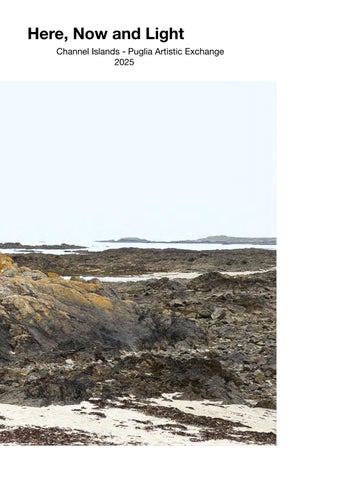
Designed in Foggia by Pasquale Oa and printed in Jersey in November 2025 Front cover: Guernsey shoreline Back cover: Tremiti, San Nicola Chapel Image: Pasquale Oa
Qui, Ora, Luce
Ichîn, Achteu, la Lueu Ichin, Achtaeure et du Lum 36