PAST, PRESENT, PALACE
L La Veranda, 1959
a Veranda, part of our restaurant,
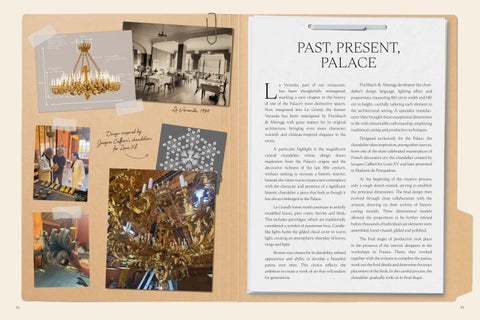
Fischbach & Aberegg developed the chan-
has been thoughtfully reimagined,
delier’s design language, lighting effect and
marking a new chapter in the history
proportions, measuring 180 cm in width and 140
of one of the Palace’s most distinctive spaces.
cm in height, carefully tailoring each element to
Now integrated into Le Grand, the former
the architectural setting. A specialist manufac-
Veranda has been redesigned by Fischbach
turer then brought these exceptional dimensions
& Aberegg with great respect for its original
Design inspired by iers Jacques Caffieri’iss XchIandel for Lou
architecture, bringing even more character, warmth and château-inspired elegance to the room. A particular highlight is the magnificent central
chandelier,
whose
design
draws
inspiration from the Palace’s origins and the decorative richness of the late 18th century, without seeking to recreate a historic interior. Instead, the vision was to create a new centrepiece
traditional casting and production techniques. Designed exclusively for the Palace, the chandelier takes inspiration, among other sources, from one of the most celebrated masterpieces of French decorative art: the chandelier created by Jacques Caffieri for Louis XV and later presented to Madame de Pompadour. At the beginning of the creative process,
with the character and presence of a significant
only a rough sketch existed, serving to establish
historic chandelier a piece that feels as though it
the principal dimensions. The final design then
has always belonged to the Palace.
evolved through close collaboration with the
Le Grand’s forest motif continues in artfully modelled leaves, pine cones, berries and birds. This includes partridges, which are traditionally considered a symbol of passionate love. Candlelike lights bathe the gilded cloud cover in warm light, creating an atmospheric interplay of leaves, twigs and light.
58
to life with remarkable craftsmanship, employing
artisans, drawing on their archive of historic casting moulds. Three dimensional models allowed the proportions to be further refined before thousands of individual cast elements were assembled, hand-chased, gilded and polished. The final stages of production took place in the presence of the interior designers in the
Bronze was chosen for its durability, refined
workshops in France. There, they worked
appearance and ability to develop a beautiful
together with the artisans to complete the patina,
patina over time. This choice reflects the
work out the final details and determine the exact
ambition to create a work of art that will endure
placement of the birds. In this careful process, the
for generations.
chandelier gradually took on its final shape.
59