MEMBERS OF COUNCIL AND EXECUTIVE PRESIDENT
Prof D. H. Green, Uni Tasmania HON SECRETARY
Mr P. W. Baillie, Geological Survey Of Tasmania, PO Box 56, Rosny Park, Tas 7018
Tel: (002) 30 8334
Fax: (002) 44 2117
HON TREASURER
Dr D. E. Leaman, Leaman Geophysics SENIOR VICE-PRESIDENT
Mr I. R. Johnson, CRA Exploration JUNIOR VICE-PRESIDENT
Mr P.J. Legge, Geopeko, Vic HON EDITOR
Dr B. Jones, Uni Wollongong,NSW HON ADMINISTRATIVE OFFICER
Mr D. H. Probert, Geol Surv NSW COUNCILLOR OF EXECUTIVE DIVISION
Dr C. F. Surrett, Uni Tasmania
EX-OFFICIO COUNCIL MEMBERS
HON EDITOR-SPECIAL PUBLICATIONS
Mr P.J.G. Fleming, Geol Surv Qld HON EDITOR-THE AUSTRALIAN GEOLOGIST
A/Prof B. J. Franklin, UTS, NSW NATIONAL COMMITTEE FOR SOLID EARTH SCIENCES
Dr K. Lambeck, RSES, AN U PUBLIC OFFICER
Dr K. R. Walker, BMR, ACT
STANDING COMMITTEE CONVENOR$ STRATIGRAPHIC NAMES
Mr C. G. Gatehouse, SADME
GEOLOGICAL MONUMENTS
Mr E. B. Joyce, Uni Melbourne
GEOLOGICAL EDUCATION
Dr L. H. Hamilton, QUT, Qld
AUSTRALIAN COMMITTEE FOR GSCP
A/Prof K.A.W. Crook, ANU, ACT
GSA REPRESENTATIVES
PROXY FOR SENIOR VICE-PRESIDENT t.b.a.
PROXY FOR JUNIOR VICE-PRESIDENT t.b.a.
AUSTRALIAN GEOSCIENCE COUNCIL
Dr G. F. Taylor, CSIRO, Syd NSW 9th INTL BASEMENT TECTONICS CONF
Dr P. F. Wellman, BMR, ACT 2ND INTL DYKE CONF
Dr P. C. Rickwood, Uni NSW LFB91
A/Prof B.J.Franklin, UTS, NSW
ASEG-GSA CONF 1991
Dr G. F. Taylor/Ms L. Tuckwell
BUSINESS OFFICE
Ms L. Tuckwell
606 ANA Hou~e, 301 George Street, Sydney, NSW 2000
Tel: (02) 290 2194
Fax: (02) 290 2198
CHAIRMEN AND SECRETARIES
COMMONWEALTH TERRITORIES
Chairman: Dr I. H. Campbell, RSES, ANU
Hon Sec: Dr T. P. Mernagh, BMR NEW SOUTH WALES
Chairman: Dr B. Hensen, UNSW
Hon Sec: Dr I. Roberts, UNSW QUEENSLAND
Chairman: Mr J.E. Siemon, GSA Qld Div
Hon Sec: Mr T.P.T. McLennan, CSIRO Geomech SOUTH AUSTRALIA
Chairman: Mr I. F. Clark, SACAE, Salis.
Hon Sec: Mr J. H. Cann, SACAE, Salis. TASMANIA
Chairman: Dr C. F Surrett, Uni Tasmania
Hon Sec: Dr T. Falloon, Uni Tasmania VICTORIA
Chairman: Mr R. C. Dalgarno, Geol Surv, DITR
Hon Sec: Mr A A Finlayson, Vic College, Rusden WESTERN AUSTRALIA
Chairman: Dr S.A. Wilde, Curtin UT
Hon Sec: Dr R. Mazzucchelli, GSA WA Div BRANCH CHAIRMEN AND SECRETARIES HUNTER VALLEY
Chairman: Ms V. Smith, Resource Plan.
Hon Sec: Dr P.K. Seccombe, Uni Newcastle BROKEN HILL
Chairman: Mr B.P.J. Stevens, Geol Surv NSW
Hon Sec: Mr I. Willis, Aberfoyle
SPECIALIST GROUP CHAIRMEN AND SECRETARIES ECONOMIC GEOLOGY (SGEG)
Chairman: Dr M. Solomon, BMR
Hon Sec: Dr K. McQueen, Uni Canberra GEOCHEMISTRY, MINERALOGY AND PETROLOGY (SGGMP)
Chairman: Dr W. Collins, Uni Newcastle NSW
Hon Sec: t.b.a. SEDIMENTOLOGY {ASG)
Chairman: Dr D. A Feary, ANU
Hon Sec: Dr P. de Deckker, ANU TECTONICS AND STRUCTURAL GEOLOGY (SGTSG)
Chairman: Mr J. Baxter, Continental Resources, WA
Hon Sec: Dr R Horwitz, CSIRO, WA PALAEONTOLOGY
Chairman: Dr K. McNamara, WA Museum
Hon Sec: Dr J. A Long, WA Museum COAL GEOLOGY (CGSC)
Chairman: Dr A Hutton, Uni Wollongong
Hon Sec: Mr J. Bemberry, Geol Surv NSW ENGINEERING GEOLOGY (EGSG)
Chairman: Mr N. Hiern, SA Chamb ME
Hon Sec: Mr S. Barnett, SADME EARTH SCIENCES HISTORY (ESHG)
Chairman: Dr D. F. Branagan, Uni Sydney
Hon Sec: t.b.a. SOLID EARTH GEOPHYSICS (SGSEG)
Chairman: Dr F.E.M. Lilley, RSES, ANU
Hon Sec: Mr K. F. McCue, BMR,
NEWSLETTER EDITOR
A/Prof Brenda Franklin, Department of Applied Geology University of Technology, Sydney PO Box 123, Broadway, NSW 2007 Tel:(02) 20930 ext 9570 (02) 218 9951 {message) Fax:{02) 211 4449
Publication of The Australian Geologist During 1990
The Hon Editor is away from her place of employment on Study Leave at present Regular contributions may still be addressed or faxed to the usual address
People needing to urgently speak with the Hon Editor may ring her at home (preferably between 6pm and 8pm) during the months of October-December, on (02) 971 7596.
CLOSING DATE FOR CONTRIBUTIONS FOR THE DECEMBER ISSUE OF THE AUSTRALIAN GEOLOGIST IS THE END OF OCTOBER, 1990
Contributors who make use of a computer word processing system which is IBM compatible can submit their copy on disc in an unformatted version (this means no margins, no right justification, no tabs, no centring, no page breaks, etc) Your copy should be stored as an ASCII file without coding for line or paragraph spacing etc. The ASCII files are virtually universal and can be translated by the printer for almost any word processing language.
This type of submission would be particularly appreciated for long items. The editor can handle both 5-1 /4 and 3-1 /2 inch discs. Please specify whether your disc has been formatted in AT or XT.
A hard copy of the text must also be submitted. Discs will be returned to the contributor following publication of the magazine.
Editorial enquiries - The Hon Editor
Enquiries re all other matters - e.g advertising rates, change of address, inserts - The Business Manager.
The views expressed in this magazine are not necessarily those of the Geological Society of Australia Inc nor the Hon Editor. The Geological Society of Australia Inc is a learned society and neither adopts nor supports positions of advocacy. The Australian Geologist is a forum provided by the GSA for its members.
Geological Society of Australia Inc, 606 ANA House, 30 l George Street, Sydney, NSW 2000
Tel: (02) 290 2194; Fax: (02) 290 2198
Newsletter No. 7 6 26th September, 1990
Recently, the Minister for Resources, Mr Alan Griffiths, launched BMR's new strategy statement, entitled "Geoscience for Australia's Future", designed to establish the directions and responsibilities of BMR through the 1990s In framing this strategy the Government clearly seeks to combine a desire to at least maintain national levels of material wealth with actions to address growing concerns with degradation of our natural environment. This is a positive and optimistic approach, and only a cynic would say that the Government wishes to have its environmental cake and develop it too. The BMR program is prefaced by a quotable statement from the Brundtland report - Our Common Future: World Commission on Environment and Development (1987), as follows : "Humanity has the ab ility to make development sustainable - to ensure that it meets the needs of the present without compromising the ability of future generations to meet their own needs".
The BMR strategy picks up this concept and puts it in the context of earth sciences and earth resources: "Australia's future well-being requires the development of our natural resources in a sustainable and environmentally responsible way. This needs better understanding of our natural environment and its endowment of resources. The Bureau of Mineral Resources, Geology and Geophysics, will play a leading role in contributing essential geoscientific knowledge of:
(i) the nation's mineral, petroleum and groundwater resources; (ii) the environmental impacts of resource development and usage;
(iii) natural hazards."
This is a very "rational strategy", one that should draw support from conservation groups and minerals and energy industries alike, and one with which most members of the Society would agree However, does it usher in a period of co-operation in which the undoubted excellence of Australian earth science is able to reconcile politically or ideologically disparate parties to practical and rational decisions on vital questions of land use or resource exploration? Current events suggest not - rather, that scientific half-truths and selective use of science are still being used to bolster ambit claims or expand power bases.
Let me give two examples - one solved and one at impasse. As I write, the research vessel Joides Resolution is drilling on leg 133 of the Ocean Drilling Program with Dr Peter Davies of BMR as CoChief Scientist, in off-shore north-east Australia and in part within the Great Barrier Reef Marine Park. The two major objectives include response to global sea level change in the late Cenozoic, and understanding of influences of palaeochemistry, palaeoclimate and palaeoceanography on the initiation, growth and demise of carbonate platforms, particularly the GBR The scientific
preparation for the leg, the processes of evaluation, scientific, bureaucratic and political approval, etc, have been carried through over many years and through many man-hours. The co-operative, rational strategy noted above was used to achieve objectives which were in this case in line with BMR' s environmental rather than resource location objectives, and with Australian participation in the major global earth science program of the '80s and '90s.
On the eve of the program beginning, there was some advocacy for petroleum exploration permits in the general area of the Great Barrier Reef, and sufficient media and political coverage was generated to invoke Prime Ministerial statements on drilling in the region. There was a real risk that the media would fail to distinguish between the purposes and methodologies of ODP drilling from Joides Resolution and conventional oil exploration drilling The environment and conservation lobbies, although fully informed, consulted and supportive of the ODP project might be drawn into a confrontationist situation under pressure to reverse their stance Conversely, some elements in the petroleum industry considered the use of the approvals for ODP drilling to make the case that" drilling was a safe,.no-risk activity" - using scientific halftruths to achieve a political or economic objective. Many days of travel, many telephone calls, many memos, etc, resulted for those most closely involved. The "rational strategy" of obtaining the maximum and best-quality scientific information won through in this situation. There will be additional reasons for Australian interest in the Townsville port-call by Joides Resolution in October.
A second example is being played out in Tasmania on the question of access to land areas in Western and Central Tasmania for current and future mineral exploration. Conservationist and forestry interests in Tasmania claim to have reached an accord on designation of land areas not to be used for forestry purposes, and the mining industry, including Government departmental representation, is pressured to categorise land areas as "nonprospective", and thus prohibited to access for mineral or energy resource exploration. Those close to the scene know that this negotiation is not being played by the rules required for a "rational
strategy" on a question in which scientific information and judgement is basic to any decision.
In the minerals and energy context, sustainable development is underpinned by exploration {I refer readers to excellent articles on this theme in the July 1990 issue of The Mining Review}. The position adopted by environmental extremists is a blanket ban on mineral exploration in any area considered to have "wilderness" or "natural environment" heritage values. It is worth quoting a letter to me {Jan 1990) from DASETT on this question - "Contrary to public perception, World Heritage listing does not automatically preclude mining, exploration, or any other activity in listed areas". On the contrary, there is an obligation for Governments sponsoring World Heritage listings to carry out geological research and data gathering to document and characterise such areas to the fullest extent.
In its theme for the 1990s, "Geoscience for Australia's Future", the Bureau of Mineral Resources, Geology and Geophysics is at the centre of national debate and decision-making on these important questions of sustainable development. At the centre of BMR is the quality of its science and the ability of its scientists to advise and inform government. In the 1990s this advice will flow through the traditional path of the appropriate bureaucracy and minister, but because that advice and information is science-based, and about doing science, it will be equally important to advise and inform the Government's new Chief Scientist and new Science Council.
A major danger for BMR {and for State geological surveys, and CSIRO} is that the advice prepared on the basis of a sustainable development policy is subverted by two attitudes all too prevalent among political power structures and their bureaucracies. The two principal dangers may be expressed as:
"If it doesn't win votes {for my party, ideology, religion ) then suppress it or ignore it", or, "If it doesn't make money then it is not worth doing".
The BMR has adopted a strategy which goes beyond either of these viewpoints - it will need every support it can get to implement that strategy.
This paper was presented by Professor R. W . Hutchinson at the R.L. Stanton Symposium "Frontiers in Ore Deposit and Exploration Studies" during the 10th Australian Geological Convention in Hobart in February this year. The symposium was held in recognition of the outstanding contribution by Professor Stanton to ore deposit research and exploration philosophy.
Professor Hutchinson has been the Charles F. Fogerty Professor of Economic Geology at the Colorado School of Mines since 1983. From 1964 to 1983 he taught at the University of Western Ontario. He is former President of the Society of Economic Geologists, and served for 5 years as the Society's Regional Affairs Vice-President. He is currently a Councillor of the Geological Society of America.
Abstract
Uncertainty in earth science results from the many complex and inter-related qualitative factors that must be considered, and from evolutionary changes in them through time. Quantification is therefore difficult and these inherent deficiencies call for strict adherence to scientific method.
Interpretive hypotheses about the past processes that have shaped the earth are inevitably imperfect, but their failings are too often overlooked and they are accepted as fact, so that they become conventional and dogmatic. Research then becomes introverted in attempting to demonstrate the validity and universality of the established concepts. Scientific progress is impeded because the inherent failings of the conventional interpretation are obscured and perpetuated, rather than corrected by these approaches.
Unconventional thinking provides different insights and new ways of looking at old information. Stanton's ideas about synvolcanic origin for certain massive base metal sulphide ores, Darwin's about evolution of species through natural selection and Wegener's about continental drift were examples. All three caused reconsideration and re-evaluation of the established concepts of their time, and prompted a search for new evidence. Their own errors as well as those of the conventional views were thereby revealed. But unconventional ideas represent a challenge to accepted conventionalism which too often seeks to suppress them and to relegate their proponents to scientific obscurity. They must be evaluated on the basis of fact alone, not by comparison with established interpretations, for they will inevitably conflict with the latter.
Earth science is an imperfect attempt to explain, as accurately and completely as possible, the phenomena that have affected the earth as we know it. Conventionalism, through willingness to accept the favoured hypothesis as uniquely and totally correct should be avoided. Unconventional thinking promotes evaluation of multiple hypotheses and thereby contributes to scientific progress It merits acceptance and recognition, not rejection and suppression.
Introduction
It is a privilege to contribute a paper to this Symposium in honour of a highly respected scientist, colleague and friend, R.L. Stanton, who, during a distinguished career, has contributed significantly through unconventional thinking, to earth science and to the study of mineral deposits.
The natural sciences are intrinsically inexact; less quantifiable, with fewer immutable laws than the physical sciences, and the earth sciences are, perhaps, the least so of all. Quantification in the earth sciences is rendered difficult by its fewer readily measurable parameters, and by the many complex, inter-related and often widely variable factors, themselves fundamentally qualitative, that play a part in the processes that shape the earth. It is additionally complicated by evolutionary changes, both gradual and abrupt, through four billion years of earth history. The results are many interpretive explanations for the causes and processes that have generated observed geological relationships; but too often the most favoured of these 1s accepted as fat. Unconventional thinking in earth science, therefore; provides an important means toward essential continued re-evaluation of all possible hypotheses.
In the late 1950's R.L. Stanton (1959), one of a handful of workers that included Haddon King in Australia and Christofer Oftedahl (1958) in Norway, challenged the conventional view that volcanogenic massive sulphide (VMS) deposits were structurally controlled and had formed by epigenetic hydrothermal replacement, probably from magmatic fluids that were generated, and derived their dissolved metals during late stages of granitic crystallisation. Hundreds of published papers, theses and studies had shown it to be so. It was orthodoxy. But Stanton's observations of their stratigraphically controlled distribution in volcanic rocks of an early Palaeozoic island arc near Bathurst in the Lachlan Fold Belt of New South Wales led him to an unconventional idea.
In 1956-1958 Stanton also visited North America and observed similar geological relationships and deposits near Bathurst, New Brunswick; an unexplained and fortuitous geological coincidence that, nevertheless, strengthened his views. At that time North America was the "cold bed" of conventionalism on this subject, insofar as "hot beds" and conventionalism are, by definition, mutually exclusive! Stanton suggested, instead, that these deposits were stratigraphically controlled due to their syn-sedimentary origin by a process related to the island arc volcanism that had formed their host rocks. Here indeed, was unconventional thinking! Stratigraphic rather than structural control? Syn-sedimentary rather than epigenetic emplacement? A volcanic rather than granitic affiliation? These ideas were roundly attacked and widely rejected; they were suspect at best, denigrated at worst Their proponent was labelled an iconoclast; an unreasonable man.
The reasonable man adapts himself to the world. The unreasonable man persists in trying to adapt the world to himself. Therefore all progress depends on the unreasonable man." G.B. Shaw - appendix on "Reason" in Man and Superman.
But the ideas were ahead of their time. It is relevant and interesting to recollect that they preceded, by about a decade, the oceanographic investigation of the sea floor that subsequently and convincingly demonstrated the validity of these ideas.
It is entirely normal that when an astonishingly new idea comes off somebody's mental assembly line, it will take a while before other people's assembly lines tool up sufficiently to deal with it " Robert Ardry - The Territorial Imperative.
It is one thing to observe, measure, and from direct experience on the present sea floor to deduce the nature of the generative processes for these ores. But it was quite another in the late 1950' s, reasoning only from the observed geological relationships that reflect the results of both the past generative processes, but also the overprints of multiple and complex later, superimposed processes, to first distinguish the latter from the former and second, by inductive reasoning to deduce and comprehend the ancient ones that formed the ore. The details and complexities of this reasoning however, are not the main issue here; the fundamental impact, significance and reception of a new and unconventional idea are the key points to be considered.
Charles Darwin faced an orthodoxy of a different nature, not so much scientific but broader, perhaps more fundamental for it was societal and rooted in religious belief. Nevertheless, like epigenetic hydrothermal replacement, creation of earth and man in 4004 BC had been established - in this case by careful mathematical calculation. The uncertainties of their discipline render geologists loath to take issue with, even awed by numerical calculations. F.T. Thwaites, a distinguished geomorphologist and Pleistocene geologist at the University of Wisconsin often pointed out, in his lectures in the early 1950' s, that numerical calculations are valid and reliable only so far as their underlying assumptions are correct and applicable. His specific wording was "figures don't lie, but liars can figure".
As in Stanton's case, Darwin's new observations of life forms during his voyage on The Beagle had led him to question the orthodox, conventional view, and it is clear from his own writings that this forced a painful re- evaluation. The latter led to doubt, doubt to disbelief and the disbelief to new insight and an unconventional idea. Evolution of life through natural selection was a radical challenge to creationism, and was hotly opposed by established society of that time. It is still opposed in rare instances today. It is amazing how long the "tooling up" referred to by Ardry sometimes requires, and surprising how long compelling new evidence can be ignored! Early in the 20th century Alfred Wegener, a geographer and climatologist used simple data from these disciplines to formulate and advance the new idea of continental drift. Here again, was inductive reasoning and unconventional thinking! Ignoring politics, a united worldPangeia - was simply attainable by eliminating the oceans and pushing the continents together like a jig saw puzzle. But once again there was a troublesome mathematical and geophysical objection. Sir Harold Jeffery of the Royal Society, calculated the magnitude of the crustal tidal force suggested by Wegener as the possible cause for drifting continents. His results showed that this was a quite impossible explanation, and so the idea was relegated to obscurity. Yet it was not without geological support. On the contrary, it was supported by paleontological evidence of matching lower Palaeozoic faunal zones on opposite sides of the North Atlantic, by stratigraphic evidence of similarly matching lithostratigraphic sequences, by comparable mineral deposit types and host terranes on opposite margins of the South Atlantic and by paleogeographic and paleoclimatic evidence in the same region. But geophysical orthodoxy of the time used _ integral calculus - the ultimate confounding argument to geologists - to prove that the earth's crust was simply not pushable! Not by any known process, by anything, by anybody and certainly not by Alfred Wegener who, by this time, was long dead, having left behind a troublesome and unconventional idea to bedevil his successors. The idea was rejected, Wegener labelled a geofantacist. Orthodoxy prevailed until, as in the case of Stanton, mature re- evaluation and new information established the validity of his ideas.
All three of these examples share a number of similar elements. The unconventional ideas were subjected to a storm of negative and largely destructive criticism, albeit of differing intensity and from differing sources. They were to varying degrees rejected, set aside for years, in some cases and circles even suppressed by conventionalism. Their proponents were ignored at best, excluded
from the main stream of scientific dialogue, ridiculed at worst. Conventionalism prevailed, until new evidence and mature reevaluation led to gradual, then widespread although still not universal acceptance of the unconventional views.
"The obstacles to discovery - the illusions of knowledgeare also part of our story. Only against the forgotten backdrop of the received common sense and myths of their time can we begin to sense the courage, the rashness, the heroic and imaginative thrusts of the great discoverers. They had to battle against the current facts and dogmas of the learned." Daniel J. Boorstin - The Discoverers
The fundamental benefits to earth science of these ideas are, in hindsight, abundantly clear. All three advanced new, alternative hypotheses to accepted, conventional, orthodox views. In so doing all offered new innovative insights, new perceptions and understanding, new ways of looking at old evidence. And all identified new dimensions and directions for investigation. These, in turn, prompted the search for additional evidence that would, hopefully, be definitive of one explanation, or would deny another. Thus it was the discovery of magnetic striping in the oceanic crust that finally confirmed Wegener's idea, and it was observations of sea floor hydrothermal discharges from which metallic sulphides were precipitated that finally substantiated Stanton's unconventionalism. The ideas together with this new evidence forced a thorough reconsideration of all data and a mature reevaluation of fundamental concepts including all possible explanations, the new and unconventional as well as the old and orthodox.
"A mind - - - - endowed by nature with the desire to seek, patience to doubt, fondness to meditate, slowness to assert, readiness to reconsider, steadiness to set in order and neither affecting what is new nor admiring what is old and hating all kinds of imposture." Francis Bacon - The Scientific Mind
Bacon's definition emphasises the importance of a measured and mature approach. In earth science this is often lacking in its response to unconventional thinking which is commonly met with one of two undesirable extremes, premature acceptance or premature rejection, the latter much more serious than the former. The danger in premature acceptance arises because a new and unconventional idea is certain to be partly wrong and/or incomplete. It is simply not possible to advance a broad and innovative new hypothesis that includes thorough and comprehensive explanations for all its aspects and ramifications. These develop only from mature study, extensive reconsideration and additional investigation as outlined by Bacon. Darwin himself could not prove the line between man and apes and recognised this deficiency in his theory (Eisley, 1956). And Jeffery's calculation of the crustal tidal force as inadequate to cause rifting and separation showed Wegener's initial explanation to be incorrect. But neither of these deficiencies, nor their use as bases for broader attacks on the fundamental unconventional theories were sufficient to disprove the latter - they merely questioned (and rightly) specific aspects. There is a useful lesson here; although unconventional ideas must be constructively criticised and evaluated, they should not be prematurely rejected because, when advanced, they fail to explain everything, or because, their explanation for some specific aspect is deficient. It does not necessarily follow that, because they are inadequate or incorrect in one or even a few details, they are more broadly or fundamentally wrong. Instead, they must be judged on their totality considering their ability to explain all, not a few relevant aspects, and in comparison with the similar ability of alternative explanations.
Moreover, the degree of correctness of an unconventional idea is not its fundamentally most important consideration. Whether right or wrong, or as is so often the case in earth science, partially both, the new idea forces the thorough re-evaluation of all alternatives, and the search for new definitive evidence that are the stepping stones toward improved understanding and scientific progress. The degree of validity of the unconventional, as well as that of the
conventional view will, ultimately, be determined by these considerations which the former, but not the latter induces.
"A scientist has the right to be wrong. It is a right approximating an obligation, for if a scientist becomes more concerned with being right than with expressing the convictions of his judgement, then he violates a public trust." Robert Ardry - African Genesis
Too often earth science rushes to a premature, and therefore faulty judgement in its eagerness to decide between right and wrong. This leads to premature rejection of the unconventional idea, often through an inappropriate, too narrow and too rigid contrast with orthodox conventionalism. But disagreement is inevitable here, as well as healthy. If the accepted view is to be the basis for evaluation of the unconventional one, then the latter is inevitably doomed at the outset to unwarranted, premature rejection and even suppression. Premature rejection is the most serious danger because it perpetuates conventionalism. It prevents the very reevaluation of all alternatives and the search for new evidence that is the greatest benefit of the unconventional idea. Thus it is a fault that cannot be corrected. At the other extreme lies premature acceptance of the unconventional idea, often through its too enthusiastic introduction, overly comprehensive application and unjustifiably definite espousal. An undesirable consequence might be termed the "bandwagon approach, also not uncommon in earth science.
"Getting carried away with a good idea is human, forgivable, perhaps even necessary if anyone is going to listen." Robert Ardry - The Social Contract
This is the less serious extreme because it will be corrected through the very re-evaluation of alternative explanations and the search for new evidence that it, itself, generates; it is self-correcting, not self - perpetuating.
In re-evaluation of all alternative hypotheses it is vitally important to distinguish between fact and interpretation. Fact is real, measured, observed and largely objective, but it is also incomplete and therefore inadequate. Interpretation on the other hand, is perceived or deduced from fact, experience and understanding. It is therefore subjective, partly incorrect and similarly inadequate. what we KNOW = fact (but we don't know everything) = incomplete what we deduce/infer from fact = interpretation (i.e. what we THINK WE KNOW) = partly incorrect In evaluating an unconventional idea, facts must be emphasised for they must be explained by any and all hypotheses. But interpretations must be de-emphasised because they are partially incorrect. Moreover, by definition and inevitably, the conventional, orthodox view will conflict and disagree with the new explanation. The former cannot therefore be used as prima facie evidence to disprove or reject the latter. Moreover the fundamental significance of facts must be logically evaluated. Unfortunately in earth science, groups of facts - or data sets as they are currently designatedare seldom uniquely definitive of a single cause or process. On the contrary, they are commonly explainable by two or even more causes or processes, or more complex still, by combinations of differing processes that were superimposed on one another at different times, like the primary genetic and superimposed later metamorphic characteristics distinguished by Stanton in the VMS deposits. In such cases the facts are definitive of no single cause or process, but are permissive and equally supportive of two or more. For example, circular shape, fallout debris, raised rims and central uplifts are all characteristics common to both meteoritic impact craters and explosive, subaerial, continental volcanic calderas. In the absence of additional definitive criteria such as active plumes in the latter, these characteristics are proof of neither but support both equally. Yet they have commonly been interpreted as favouring one or the other, most recently meteoritic impact in both terrestrial and extra-terrestrial geological environments. Many currently favoured geochemical and light stable isotopic data are comparably ambiguous (Patterson et al., 1981; Hutchinson, 1982).
Too often in earth science one explanation is favoured over
another that is equally possible, considering the available facts, on the subjective grounds of personal preference, experience or understanding. This lacks scientific objectivity. It is necessary in interpretation of course, to select and prefer the best amongst the alternative possibilities - that which accounts for most of the facts leaving least unexplained. But it is also important to recognise that the preferred explanation remains an interpretation, and to therefore retain the others, perhaps downgrading them, for future reconsideration in the light of new evidence and perceptions.
In all three examples orthodox perceptions and interpretations, not facts alone, were applied to the unconventional ideas. When this occurs, the inevitable resulting conflict and rejection of the unconventional idea tends to convert orthodoxy into dogma. The favoured interpretation thus becomes fixed, closed, and restricted within defined limits. Dogma is then an inhibitor of, whereas the hypothesis is no longer a means toward, scientific progress.
"The ruling passion, be it what it will, the ruling passion conquers reason still." Alexander Pope - Epistle to Lord Bathurst
Dogma has two main aims. The first is self-protection from dissenting views, which is pursued by their rejection and even suppression, as it was with Galileo who was forced to recant his views by the Inquisition. The second aim is self-propagation and selfperpetuation which are attempted through further substantiation and extension of applicability to demonstrate universality. The means by which both these aims are pursued are serious abuses of scientific method.
Unfortunately, self-protection is commonly pursued by personal attack on proponents of the unconventional. As in the examples, the unconventionalists are ignored at best, outcast from scientific dialogue, ridiculed at worst. Fortunately, threats of physical violence like those directed at Galileo are no longer employed but the effects of scientific ostracism and ridicule may be equally damaging in their psychological consequences, and equally effective in suppression of the idea. In this manner the unconventional views are discredited. They are cast not only as incorrect but as unwelcome and negative, as disruptive and destructive criticism of orthodoxy and of the scientific establishment. They are no longer accepted as positive alternatives aimed at improved understanding. These practices are both a sad injustice to proponents of the ideas and a serious disservice to science itself.
On occasion, the unconventional idea is discounted and discredited on a "popularity" basis. By definition this criticism is a truism, for a new idea can only be advocated by one or a few in comparison to majority support for the conventional view. A multitude of mineral deposits geologists and a myriad of published papers and theses supported the epigenetic hydrothermal replacement hypothesis for origin of VMS deposits when Stanton and a few others advanced their unconventional explanation. Fortunately, truth in earth science, unlike elections, is not decided by majority vote. The popularity argument, although always true, is without scientific merit. It is merely a "safety in numbers" defense of the conventional.
Unfortunately, current evaluation procedures in earth science permit, and even foster the abuses of self-protection and selfpropagation. This is possible through peer review rejection of manuscripts submitted for publication, and of applications for research grant funding, by careful screening in selection of invited speakers and of submitted abstracts for scientific conferences, and by bias in academia in the granting of promotion and tenure.
"Conventional peer review has a disturbing potential of preventing publication of highly original, and truly innovative and revolutionary ideas." Teichert - Peer Review
These procedures, although valuable, necessary and the best available, are predisposed toward suppression of the unconventional. Manuscripts, funding applications, invitations and promotion-tenure submissions are commonly directed to established earth scientists in the relevant fields as referees. But these referees represent the conventional views, have in many instances published on, and helped shape them. To a considerable and undesirable
degree this sets the fox to guard the chickens! It places a scientific and ethical obligation on referees to act with thorough objectivity and impartiality. Clearly, this is impossible to achieve totally because scientists, as individuals, are subject to the full gamut of human failings. Nevertheless the obligation of a referee must not be ignored or taken lightly. Criticism must be constructive and positive, not destructive and negative. It should emphasise factual content, its reliability, adequacy and presentation but should not focus on interpretation, for here disagreement is inevitable and desirable. A sincere effort toward objective and impartial judgment, free of personal bias, opinion and preference, is mandatory. Referees should seek and recognise innovative new ideas and directions, not reject or suppress them on grounds of their personal views. If these requirements cannot, in full conscience be met, then the request to review should be declined. It would promote objectivity and impartiality if reviewers routinely identified themselves to authors and applicants (Teichert, 1989).
Self-propagation and self-perpetuation have equally undesirable consequences in earth science by trivialiing research. Research turns inward and becomes self-centred, concerned with its own rightness, self-justification. It seeks to further validate what has already been demonstrated and recognised. In order to confirm the conventional, it applies similar approaches and data to more and more examples, and in ever greater detail. The broad, fundamental issues become obscured, lost sight of, in a mass of often multiinterpretable data. New insights and directions in research are thereby inhibited, and scientific progress is retarded.
"Science, after all, is fundamentally about process; learning why and how things happen is the soul of our discipline. You can't abandon the search for cause in favour of a dry documentation of pattern. You must take risks of uncertainty in order to probe the deeper questions, rather than stopping with sterile security." Stephen Jay GouldDarwinism defined: the distinction between fact and theory. In this work, Gould explores the important distinction between fact and theory that is emphasised above, and in this quote he also cites the risks of uncertainty - the probability of being wrong, at least in part. As previously discussed, this must be accepted, for the alternative is unthinkable!
To escape criticism do nothing say nothing be nothing" Elburt Hubbard
The most rewarding and stimulating benefits of unconventional thinking are the new insights that it provides, the new ways of looking at things that it offers and the resulting enlightenment that it casts. Perhaps the ideas of Darwin on evolutionary change, of Wegener on global tectonics and of Stanton on the origin of VMS deposits have not yet been directed down all the possible avenues along which they may be signposts and which they might elucidate
The new global tectonics have revolutionied earth science and provided an invaluable extension and elaboration of Wegener's unconventional idea. But, as may be inevitable in all scientific thinking, they have developed a dogma of their own. Thus, current orthodoxy in new global tectonic theory attempts to apply modern tectonic mechanisms and processes, as measured and recognised at present plate boundaries, directly to the ancient Archean earth. But is this logical? Or do the modern ones instead, point the way back in time through a long sequence of evolutionary changes in tectonic processes toward those of Archean time, the sequential changes culminating in those of the modern earth? To pose the question in Uniformitarian terms, is the present a key - or is it identical - to the past? The two concepts are fundamentally different.
The essence of Darwinism is evolutionary change, in the case he studied of earth's life forms through natural selection. But geology provides evidence of similar time-dependant changes in earth's atmosphere and hydrosphere (Holland, 1978; Cloud, 1968), and in its ore deposits and ore-forming processes (Hutchinson, 1981 ).
What changes then, may have occurred through 4 billion years in the thickness and composition of the earth's crust, mantle and core; and in its temperature and heat flow? Has it heated or cooled? These basic parameters govern tectonic processes. Did the earth expand, as Carey - another unconventional thinker - suggested (1976), and if so, when? Global expansion in mid-Proterozoic, rather than in Permo-T riassic time, might accommodate both Carey's evidence and that of the new global tectonics, and might also explain some enigmatic aspects of mid-Proterozoic geology (Hutchinson, 1981).
•
Stanton's ide~s about sea floor metal deposition open some new directions for investigation. In addition to their high content of the base metals, most VMS deposits contain many other metals including gold and silver, felsic-affiliated tin and tungsten, maficaffiliated cobalt, nickel and chromium. Their ubiquitous presence albeit usually in minor amounts, is simple but compelling evidence that all these metals too, are mobilised by, transported in and deposited from the same generative sea floor hydrothermal fluids that form these ores.
Orthodoxy holds that tin deposits are uniquely related to the crystallisation and fractionation of S-type, or ilmenite-series granites. Yet granites of any kind are lacking during formation of the tinenriched VMS deposits, one of which, Neves-Corvo in Portugal, contains 2.7 million tonnes of ore grading 2.8% tin within a much larger orebody of 32 million tonnes grading 8.5% copper (Tin International, 1989). Moreover tin, in amounts greater than 0.15%, has recently been found in samples of both sulphidic sediment and polymetallic massive sulphide from the outer wall of a sulphide chimney, all dredged from a large body of pyrrhotite-rich massive sulphide on the sediment-covered floor of the Escanaba Trough of the southern Gordo Ridge in the east Pacific ocean (Koski et al., 1988). In this setting too, needless to say, granite of either S-, or any other type is absent; yet tin has been enriched, apparently in this case by extensive sub-sea floor interaction between turbiditic sediment and evolved hydrothermal fluid. This new evidence indicates a need for revision of the orthodox view concerning formation of tin deposits. The current understanding must be broadened to accommodate both early, syn-sedimentary sea floor hydrothermal stages and processes of tin enrichment, in addition to the well documented later ones of granitic activity. Additional studies may show that both, not one or the other, are essential aspects of tin metallogeny and the development of the world's great tin fields. And it will identify the criteria that permit distinction between deposits formed by the differing processes during the two stages, as well as those that result from superimposition of the later on the earlier processes.
Analogous considerations apply to the presence of gold, nickel and chromium in VMS deposits. The particular conditions of fluid chemistry and processes in sea floor hydrothermal systems by which these elements are carried, and might be enriched to profitably mineable levels are potentially fruitful fields for research. This would provide new insights into the origin and metallogeny of their ores, and perhaps require a broadening of current orthodox views.
All greenstone-hosted gold lodes are currently interpreted as structurally controlled, and of epigenetic metamorphogenic origin (Colvine et al., 1988; Groves and Phillips, 1987). And the uniquely magmatic generation of nickel sulphide and chromite deposits has been orthodoxy for decades. Tale-carbonate rock closely associated with the many of the gold, nickel and chromite deposits has been considered uniquely as an alteration product of their ultramafic host rocks, thereby confirming their magmatic origin. Yet it has been suggested that a few sediment-affiliated nickel occurrences in ferruginous sedimentary rocks (Candela et al., 1990), as well as some sediment-affiliated ones of the komatiite-hosted type (Robinson and Hutchinson, 1982; Bavinton, 1981; Lusk, 1976), and also rare chromite deposits like Selukwe, Zimbabwe (Cotterill, 1969) are not readily explainable by these conventional views. Moreover, talc occurs in the footwall of the Matagami Lake VMS orebody (Costa et al., 1983), and has been recently recognised in sea floor hydrothermal deposits of the Guaymas Basin (Koski et al., 1985)
and the Escanaba Trough (Koski et al., 1988) where ultramafic rocks are absent. Clearly, the presence of talc is not uniquely definitive of the ultramafic intrusive environment. Considering all this, the conventional views concerning the origin of some of these gold, nickel and chromite deposits must be broadened. The alternative and unconventional possible role of sea floor hydrothermal processes in forming them must be considered.
Recently Stanton has applied new understandings of hydrothermal alteration processes and effects in VMS deposits to advance an innovative and controversial interpretation of the conventional Barrovian regional metamorphic sequence (Stanton, 1989). As in the case of his earlier VMS work, this has been less than enthusiastically received. Some of the same abuses have followed. But the new interpretation, right, wrong or partly both, integrates hydrothermal metasomatic processes with regional metamorphic ones in a manner that offers new insights and directions for investigation in both these fields. The ideas might provide improved understanding of both the complex, controversial and highly metamorphosed deposits of the Broken Hill field in New South Wales. It merits thorough consideration and prompts re-evaluation of both the new and old ideas.
Earth science , is an attempt to explain, as accurately and completely as possible, the phenomena that have affected and shaped the earth as we know it. But we know it imperfectly and our explanations are therefore only partly correct. It is immensely broad, embodying its own many specialiations as well as those of other sciences. It is four-dimensional and especially concerned with evolutionary changes through time. Consequently it is mainly qualitative; less amenable than some other sciences to measurement and quantification.
It must therefore remain open to questioning and re-evaluation to accommodate new concepts, insights and evidence. Conventional thinking serves this requirement inadequately, and when it is converted to orthodoxy and ultimately to dogma it inhibits scientific progress and is an abuse of scientific method. The major advances in earth science have come not from conventionalism and increasingly detailed studies of what is already largely understood, but from unconventional, new and innovative ideas, and from the new data that they generate by the thorough re-evaluation that they prompt. And not infrequently they come from nonprofessionals.
"No matter how far back we go in the history of science, it seems that an extraordinary number of great discoveries were made by dilettantes, amateurs, outsiders - the self-taught who were driven by an obsessive idea, unequipped with the brakes of professional training and the blinkers worn by the specialists, so that they were able to leap over the hurdles set up by academic tradition." C.W. Ceram (Maree) - Gods, Graves and Scholars
Briefly stated, "left lateral leaps" in geological thinking are valuable. Such new ideas however, are inevitably controversial, partly erroneous and incomplete but should not be prematurely discarded on these grounds.
Unconventionalism is to be fostered and encouraged, not rejected and suppressed. Its proponents merit recognition and acceptance, not discouragement and ostracism. Unconventional thinking is essential for major new advances and improved understanding in earth science. It forces re-evaluation of all alternative hypotheses and points the way toward the search for new evidence. Its very advancement, not its validity, error or degree thereof is the true merit of unconventionalism.
"Be thou the first true merit to befriend.His praise is lost who waits 'til all commend." Alexander Pope - An Essay on Criticism
The writer has greatly benefitted from discussion of unconventional ideas in geology with many friends and colleagues,
particulary R L. Stanton and S.W. Carey, and these discussions have been helpful du ri ng preparation of th is paper S S Adams and G.G. Snow suggested use of some of the quotations that appear above. Sincere thanks are extended to Dr. R R. Large for his invitation to participate in the Stanton Symposium, and to the Symposium's organisers for support that allowed the writer to attend the meetings in Hobart, Tasmania where it was held
References
Bavinton, O A., 1981, The nature of sulfidic metased iments at Kambalda and their broad relationsh ip with associated ultramafic rocks and nickel ores : Econ Geol, v76, p 1606-1628
Candela, P A., Wylie, A.G. and Burke, T.M , 1989, Genesis of the Ultramafic, Rock-Associated Fe-Cu-Co-Zn-Ni Deposits of the Sykesville District, Maryland Piedmont: Econ Geol, v84, no3, p663-675.
Carey, W .S., 1976, The Expanding Earth: Developments in Geotectonics 10, Elsevier Sci Pub Co, 488p.
Cloud, P., 1968, Atmospheric and hydrospheric evolution on the primitive earth: Science, v 160, p729-736.
Colvine, A.C., Fyon, J.A., Heather, K.B., Marmont, S., Smith, P M. and Troop, D.G., 1988, Archean Lode Gold Deposits in Ontario: Ontario Geological Survey Misc Paper 139, l 36p Costa, U.R., Barnett, R.L. and Kerrich, R., 1983, The Mattagami Lake Mine Archean Zn-Cu sulfide deposit, Quebec:hydrothermal co-precipitation of talc and sulfides in a sea-floor brine poolevidence from geochemistry and mineral chemistry: Econ Geol, v78, p 1144-1203.
Cotterill, P., 1969, The chromite deposits of Selukwe, Rhodesia: in Wilson, H D.B., ed, Magmatic Ore Deposits: Econ Geol Mono 4, p 154- 186.
Eisley, L.C., 1956, Charles Darwin: in Gingrich, 0., ed,
Scientific Genius and Creativity: Readings from Scientific American, New York, W.H. Freeman and Co, p67-75.
Groves, D I. and Phillips, G N, 1987, The genesis and tectonic control on Archean gold deposits of the western Australian shielda metamorphic replacement model: Ore Geology Reviews, v2, p287-322.
Holland, H.D., 1978, The Chemistry of the Atmosphere and Oceans: New York, John Wiley and Sons, 351 p.
The Kintore Opencut, at Broken Hill, NSW, is continuing to provide rare and unusual mineral species Systematic collecting by geologists from the operating company Minerals, Mining and Metallurgy Limited has yielded nearly one hundred species from this portion of the oxidized zone. Most of these are arsenates, phosphates or sulphates of Cu, Pb, Zn, Al and Fe.
The latest find is a new lead iron zinc arsenate mineral with a chemical formula Pb (Fe 1.5 Zn0 .5) (AsO4)2 (OH) 1 5 (H2O)0.5. It occurs as reddish brown crystals, up to l or 2mm long, and often forming sparkling crusts. The new mineral has been described jointly by Dr Allan Pring and Ms E Maud McBriar from the South Australian Museum, and Dr Bill Birch at the Museum of Victoria. The description of the mineral has been published in the NovemberDecember 1989 issue of American Mineralogist
The authors were pleased to be able to name the mineral mawbyite, after Sir Maurice Mawby, who was a major figure in the development of Australia's post-war min ing industry Si r Maurice was born and educated in Broken Hill and rose to become Chairman of CRA. He was also a keen mineral collector and throughout his life maintained a fascination for the mineralogical riches of the Broken Hill orebody.
Hutchinson, R.W , 1981, Mineral deposits as guides to supracrusta l evolution: in O'Connell, R. and Fyfe, W.S., ed, Evolution of the Earth: AGU-GSA Geodynamics Series, 5, p 120-140.
Hutchinson, R.W., 1982, Discussion: Geologic setting and genesis of cassiterite-sulfide minera lization at Renison Bell, Western Tasman ia : Econ Geol, v77, p 199-202.
Koski, R.A., Lonsdale, P.F., Shanks, W.C., Berndt, M.E. and Howe, S.S., 1985, Mineralogy and Geochemistry of a Sediment-Hosted Hydrothermal Sulfide Deposit from the Southern Trough of Guaymas Basin, Gulf of California: Jour of Geophysical Research , v90, noB8, p6695-6707.
Koski, R.A. , Shanks, W.C. Ill, Bohrson, W.A. and Oscarson, R.L., 1988, The composition of massive sulfide deposits from the sediment-covered floor of the Escanaba Trough, Gordo Ridge: implications for depositional processes: Can Mineralogist, v26, p655-673.
Lusk, J., 1976, A possible volcanic -exhalative origin for lenticular nickel sulfide deposits of volcanic affiliation, with special reference to those in Western Australia: Can Jour Earth Sci, v 13, p451-458.
Oftedahl, C., 1958, A theory of exhalative-sedimentary ores: Geol Faren Stockholm Forh, v80, Ptl, no492, pl-19.
Patterson, D.J. , Ohmoto, H and Solomon, M., 1981, Geologic setting and genesis of cassiterite-sulfide mineralization at Renison Bell, Western Tasmania: Econ Geol, v76, p393-438.
Robinson, D.J and Hutchinson, R.W., 1982, Evidence for a volcangenic-exhalative origin of a massive nickel sulphide deposit at Redstone, Timmins, Ontario: in Hutchinson, R.W., Spence, C.D and Franklin, J.M., ed , Precambrian Sulphide Deposits, H.S. Robinson Memorial Volume: Geol Assoc Can Spee Paper 25, p2l l-254
Stanton, R.L., 1959, Mineralogical features and possible mode of emplacement of the Brunswick Mining and Smelting orebodies, Gloucester County, New Brunswick: Can Inst Min and Metal/ Bull, v52, no570, p631-643.
Stanton, R.L., 1989, The precursor principal and the possible significance of stratiform ores and related chemical sediments in the elucidation of processes of regional metamorphic mineral formation: Phil Trans Royal Soc, London, A 328, p529-646. Teichert, C., 1989, Peer Review: Geology , v 17, p l 067. Tin International, Go ahead for Portuguese Mine, January, 1989: p4.
The last issue of the Australian Geologist contained a fascinating article by Dick Henley on Australian science In this article a quote from Rudyard Kipling's "Elephant's Child" was effectively used by Dr Henley to illustrate one of his points. In this quote he referred to the "satiable curtiosity" of the Elephant's Child" -a spelling which was automatically corrected by the editor, whose Kipling is limited to "Rikki Tikki Tavi". The spelling as shown above is the correct one as 'she was writ' by Kipling, not as it appeared.
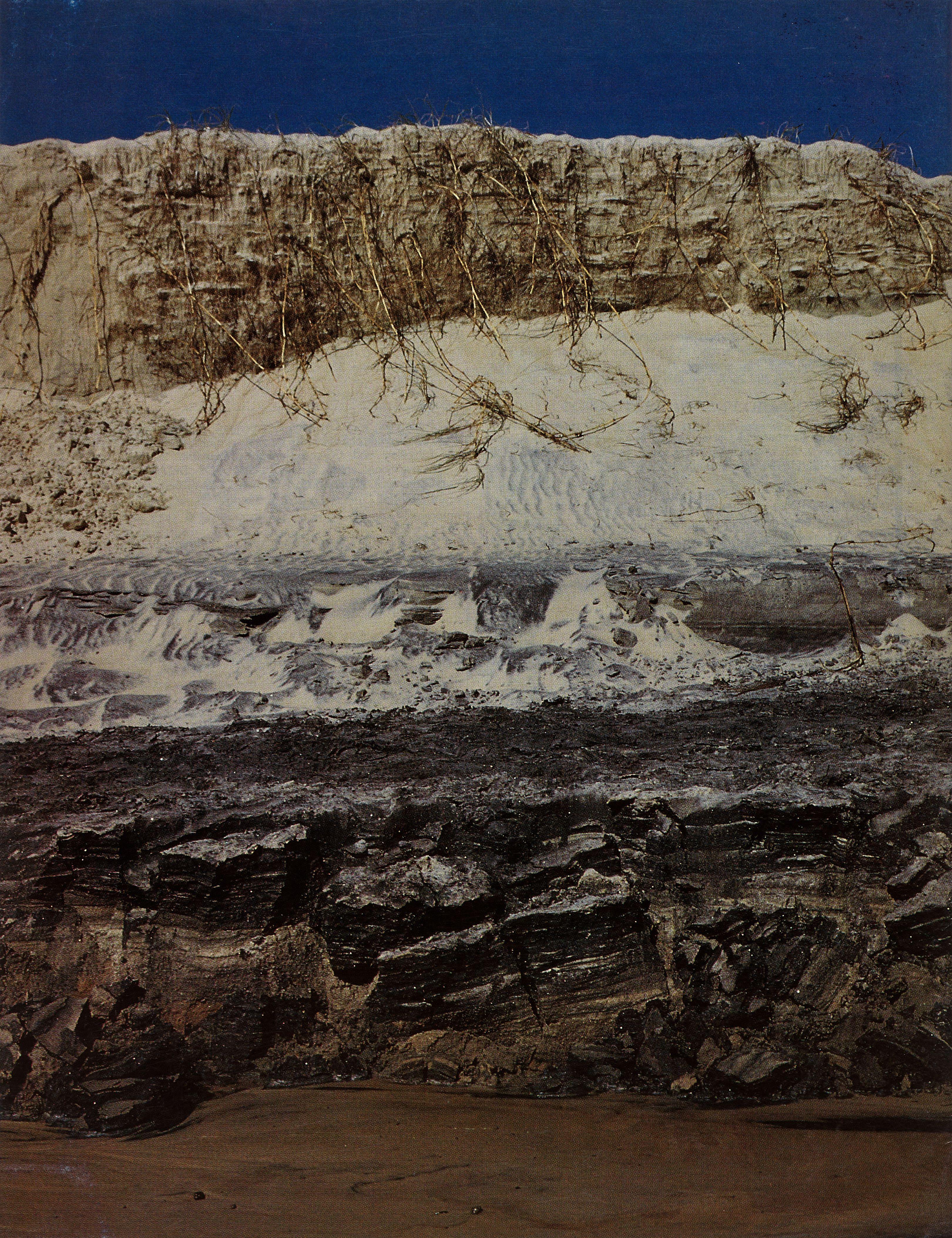
A cliff of unconsolidated Recent beach and dune sand, on the landward edge of the beach at Sunshine Beach near Noosa Queensland. This photo was taken in May, 1989. An interesting feature are the blocks of stratified sand with heavy mineral layers at the base of the cliff. In January, 1990 the dune was levelled out by heavy seas and the whole exposure has completely disappeared.
Special Offer from Cambridge University Press
50% Discount on normal prices!
How can you get 50% discount on the Geological Magazine?
If you're a member of the Geological Society of Australia, then you are already elig ible for our sp ecial discounted rates on normal subscriptions. A saving of over £50!
Established in 1864, Geological Magazine, is one of the oldest and best known periodicals in earth sciences. With essay reviews, articles, original scientific papers by leading authors, numerous diagrams and maps, it covers the complete spectrum of geological topics and is essential for any serious geologist.
An important feature of Geological Magazine is the book review section . Useful for choosing new publications, it contains the latest reviews of recent books and essays.
With Geological Magazine you'll be up-to-date with the latest opinions and research in earth sciences. Why not apply now for your special discounted subscription rate. You can subscribe to Volume 127 (6 issues, 1990) for only £50.00 (normally f 101 ). For full subscription details or for a proforma invoice simply send in or fax the coupon below to: Journals Department, Cambridge University Press, The Edinburgh Building, Shaftesbury Road, Cambridge CB2 2RU, England. Fax: 001144 223 315052.
I am a member of the Geological Society of Australia
Please invoice me at the special discounted rate of £50.00 (normally f 101) for Vol 127 of Geological Magazine
Please send me further information about Geological Magazine
We accept all major credit cards for your convenience. Airmail is available at £25.50 per year extra.
Name ...................
Address ........................ . ............
Please return this form to: Journals Publicity Department, Cambridge University Press, The Edinburgh Building, Shaftesbury Road, Cambridge, CB2 2RU, England.
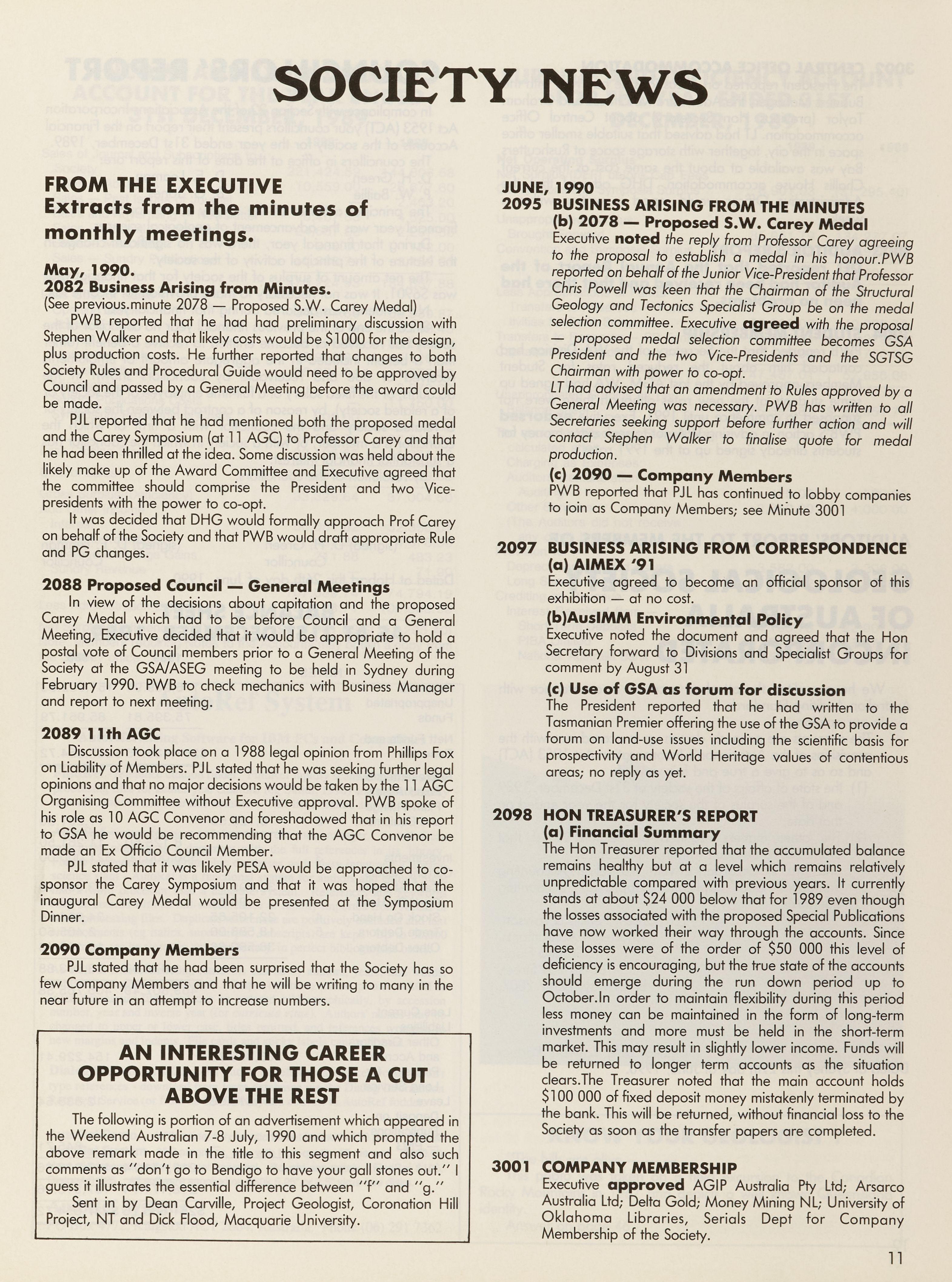
Extracts from the minutes of monthly meetings.
May, 1990.
2082 Business Arising from Minutes.
{See previous.minute 2078 - Proposed S.W. Carey Medal)
PWB reported that he had had preliminary discussion with Stephen Walker and that likely costs would be $1000 for the design, plus production costs. He further reported that changes to both Society Rules and Procedural Guide would need to be approved by Council and passed by a General Meeting before the award could be made.
PJL reported that he had mentioned both the proposed medal and the Carey Symposium {at 11 AGC) to Professor Carey and that he had been thrilled at the idea. Some discussion was held about the likely make up of the Award Committee and Executive agreed that the committee should comprise the President and two Vicepresidents with the power to co-opt.
It was decided that DHG would formally approach Prof Carey on behalf of the Society and that PWB would draft appropriate Rule and PG changes.
Proposed
In view of the decisions about capitation and the proposed Carey Medal which had to be before Council and a General Meeting, Executive decided that it would be appropriate to hold a postal vote of Council members prior to a General Meeting of the Society at the GSA/ASEG meeting to be held in Sydney during February 1990. PWB to check mechanics with Business Manager and report to next meeting.
Discussion took place on a 1988 legal opinion from Phillips Fox on Liability of Members. PJL stated that he was seeking further legal opinions and that no major decisions would be taken by the 11 AGC Organising Committee without Executive approval. PWB spoke of his role as 10 AGC Convenor and foreshadowed that in his report to GSA he would be recommending that the AGC Convenor be made an Ex Officio Council Member.
PJL stated that it was likely PESA would be approached to cosponsor the Carey Symposium and that it was hoped that the inaugural Carey Medal would be presented at the Symposium Dinner.
PJL stated that he had been surprised that the Society has so few Company Members and that he will be writing to many in the near future in an attempt to increase numbers.
The following is portion of an advertisement which appeared in the Weekend Australian 7-8 July, 1990 and which prompted the above remark made in the title to this segment and also such comments as II don't go to Bendigo to have your gall stones out. 11 I guess it illustrates the essential difference between 11 f 11 and 11 g."
Sent in by Dean Carville, Project Geologist, Coronation Hill Project, NT and Dick Flood, Macquarie University.
2095 BUSINESS ARISING FROM THE MINUTES (b) 2078 - Proposed S.W. Carey Medal
Executive noted the reply from Professor Carey agreeing to the proposal to establish a medal in his honour.PWB reported on behalf of the Junior Vice-President that Professor Chris Powell was keen that the Chairman of the Structural Geology and Tectonics Specialist Group be on the medal selection committee. Executive agreed with the proposal - proposed medal selection committee becomes GSA President and the two Vice-Presidents and the SGTSG Chairman with power to co-opt.
LT had advised that an amendment to Rules approved by a General Meeting was necessary. PWB has written to all Secretaries seeking support before further action and will contact Stephen Walker to finalise quote for medal production.
PWB reported that PJL has continued to lobby companies to join as Company Members; see Minute 3001
Executive agreed to become an official sponsor of this exhibition - at no cost.
(b)AuslMM
Executive noted the document and agreed that the Hon Secretary forward to Divisions and Specialist Groups for comment by August 31
(c) Use of GSA as forum for discussion
The President reported that he had written to the Tasmanian Premier offering the use of the GSA to provide a forum on land-use issues including the scientific basis for prospectivity and World Heritage values of contentious areas; no reply as yet.
The Hon Treasurer reported that the accumulated balance remains healthy but at a level which remains relatively unpredictable compared with previous years. It currently stands at about $24 000 below that for 1989 even though the losses associated with the proposed Special Publications have now worked their way through the accounts. Since these losses were of the order of $50 000 this level of deficiency is encouraging, but the true state of the accounts should emerge during the run down period up to October.In order to maintain flexibility during this period less money can be maintained in the form of long-term investments and more must be held in the short-term market. This may result in slightly lower income. Funds will be returned to longer term accounts as the situation clears.The Treasurer noted that the main account holds $100 000 of fixed deposit money mistakenly terminated by the bank. This will be returned, without financial loss to the Society as soon as the transfer papers are completed.
Executive approved AGI P Australia Pty Ltd; Arsarco Australia Ltd; Delta Gold; Money Mining NL; University of Oklahoma Libraries, Serials Dept for Company Membership of the Society.
The President reported on discussions he had had with the Business Manager, the Administrative Officer and Graham Taylor (previous Hon Secretary) about Central Office accommodation. LT had advised that suitable smaller office space in the city, together with storage space at Rushcutters Bay was available at about the same cost as the current Challis House accommodation. DHG advised that the Administrative Officer would report in writing within a week.
DEL reported that the Annual Report of the Auditor had been received and that there had been no problems.
PWB reported that the Secretary of the WA Division had contacted him about the reduced rates for Student Members approved by the last AGM. WA had signed up some students at the new rates although these were not supposed to commence until 1991. Executive endorsed PWB'S action in advising WA not to seek extra money for students already signed up at the 1991 rates.
AUDITORS' REPORT TO THE MEMBERS OF
We have audited the attached accounts in accordance with Australian Auditing Standards. In our opinion:
The accounts are properly drawn up in accordance with the provisions of the Association's Incorporation Act 1953 (ACT) and so as to give a true and fair view of:
(1) the state of affairs of the society at 31 st December, 1989 and of the surplus of the society for the year ended on that date;
(2) The other matters required by Section 22 of that ordinance to be dealt with in the accounts; and are in accordance with Australian Accounting Standards and applicable approved accounting standards.
Green, Penklis & Lawson, Chartered Accountants, Ground Floor, 86-90 Bay Street, Broadway, NSW 2007.
(signed) D.M. Lawson, Partner
Dated at Sydney this 29th day of June, 1990.
In compliance with Section 22 of the Associations Incorporation Act 1953 (ACT) your councillors present their report on the Financial Accounts of the society for the year ended 31 st December, 1989
The councillors in office at the date of this report are:
D. H. Green D. E. Leaman
P. W. Baillie
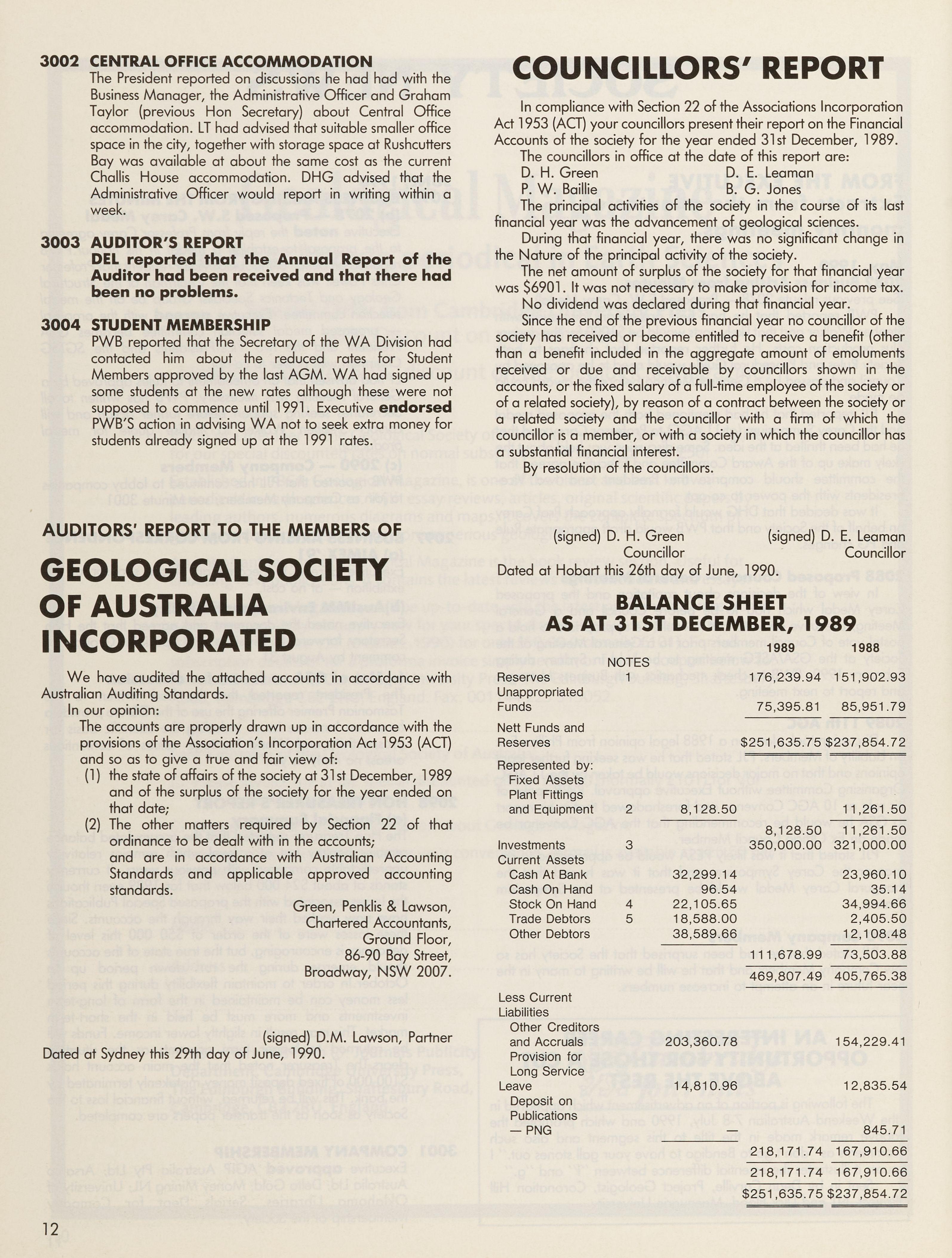
B. G. Jones
The principal activities of the society in the course of its last financial year was the advancement of geological sciences.
During that financial year, there was no significant change in the Nature of the principal activity of the society.
The net amount of surplus of the society for that financial year was $6901 It was not necessary to make provision for income tax.
No dividend was declared during that financial year.
Since the end of the previous financial year no councillor of the society has received or become entitled to receive a benefit (other than a benefit included in the aggregate amount of emoluments received or due and receivable by councillors shown in the accounts, or the fixed salary of a full-time employee of the society or of a related society), by reason of a contract between the society or a related society and the councillor with a firm of which the councillor is a member, or with a society in which the councillor has a substantial financial interest.
By resolution of the councillors. (signed) D.
H. Green Councillor
(signed) D. E. Leaman Councillor
Dated at Hobart this 26th day of June, 1990.
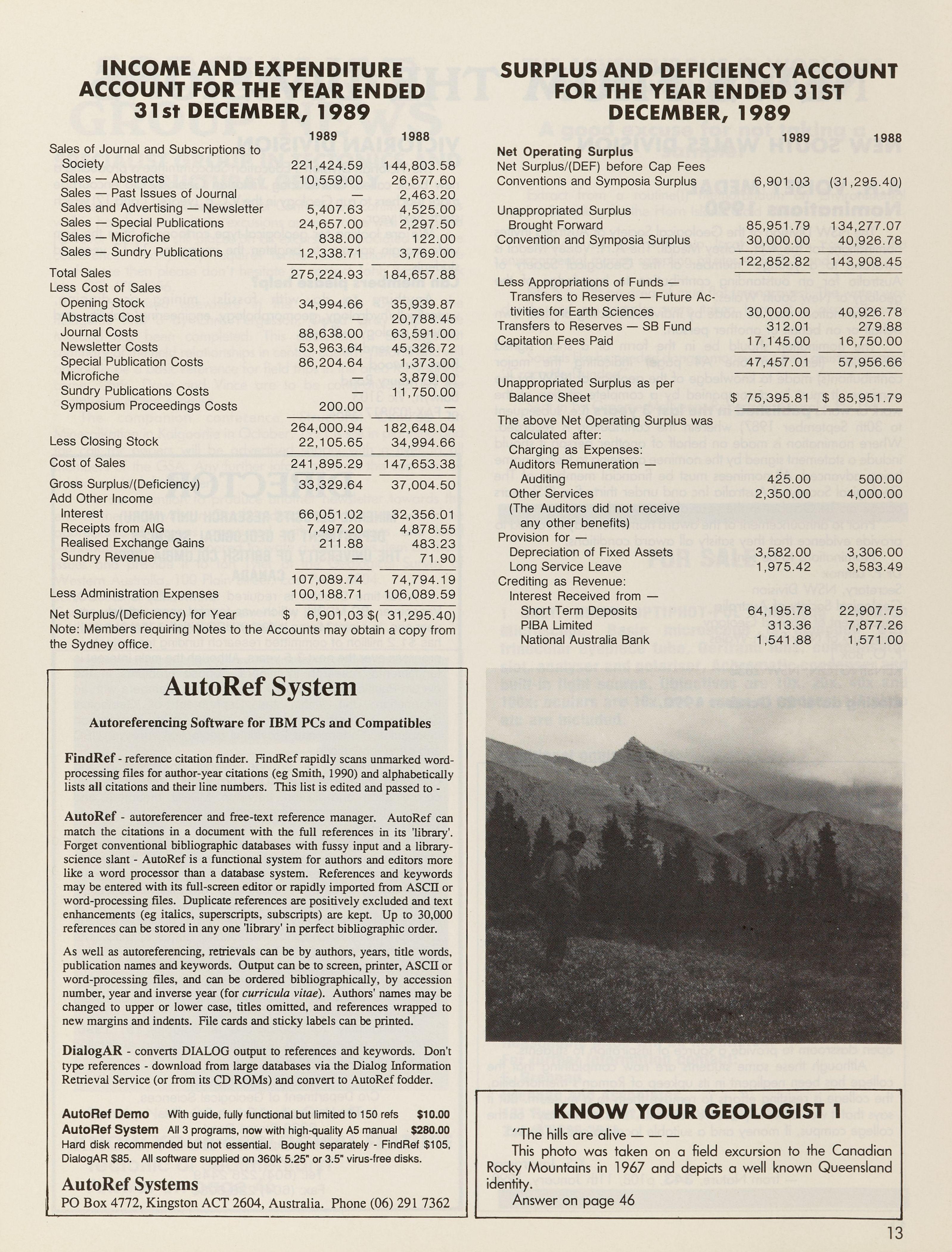
Note: Members requiring Notes to the
AutoreferencingSoftwarefor IBMPCsand Compatibles
FindRef - reference citation finder. FindRef rapidly scans unmarked wordprocessing files for author-year citations (eg Smith, 1990) and alphabetically lists all citations and their line numbers. This list is edited and passed to
AutoRef - autoreferencer and free-text reference manager. AutoRef can match the citations in a document with the full references in its 'library'. Forget conventional bibliographic databases with fussy input and a libraryscience slant - AutoRef is a functional system for authors and editors more like a word processor than a database system. References and keywords may be entered with its full-screen editor or rapidly imported from ASCII or word-processing files. Duplicate references are positively excluded and text enhancements (eg italics, superscripts , subscripts) are kept. Up to 30,000 references can be stored in any one 'library' in perfect bibliographic order.
As well as autoreferencing , retrievals can be by authors, years , title words , publi cation names and keywords. Output can be to screen, printer, ASCII or word-processing files , and can be ordered bibliographically, by accession number, year and inverse year (for curricula vitae). Authors' names may be changed to upper or lower case , titles omitted, and references wrapped to new margins and indents. File cards and sticky labels can be printed.
DialogAR - converts DIALOG output to references and keywords. Don't type references - download from large databases via the Dialog Information Retrieval Service (o r from its CD ROMs) and convert to AutoRef fodder.
AutoRef Demo With guide , fully functional but limited to 150 refs $10.00 AutoRef System All 3 programs , now with high-quality AS manual $280.00 Hard disk recommended but not essential. Bought separately - FindRef $105 , DialogAR $85 All
AND
Net Operating Surplus
Net Surplus / (DEF) before Cap Fees Conventions and Symposia Surplus
Unappropriated Surplus Brought Forward Convention and Symposia Surplus
Less Appropriations of FundsTransfers to Reserves - Future Activities for Earth Sciences Transfers to Reserves - SB Fund Capitation Fees Paid
Unappropriated Surplus as per Balance Sheet
The above Net Operating Surp lus was calculated after : Charging as Expenses: Auditors Remunerat ionAuditing Other Services (The Auditors did not receive any other benefits) Provision forDepreciation of Fixed Assets Long Service Leave Crediting as Revenue : Interest Received fromShort Term Deposits PIBA
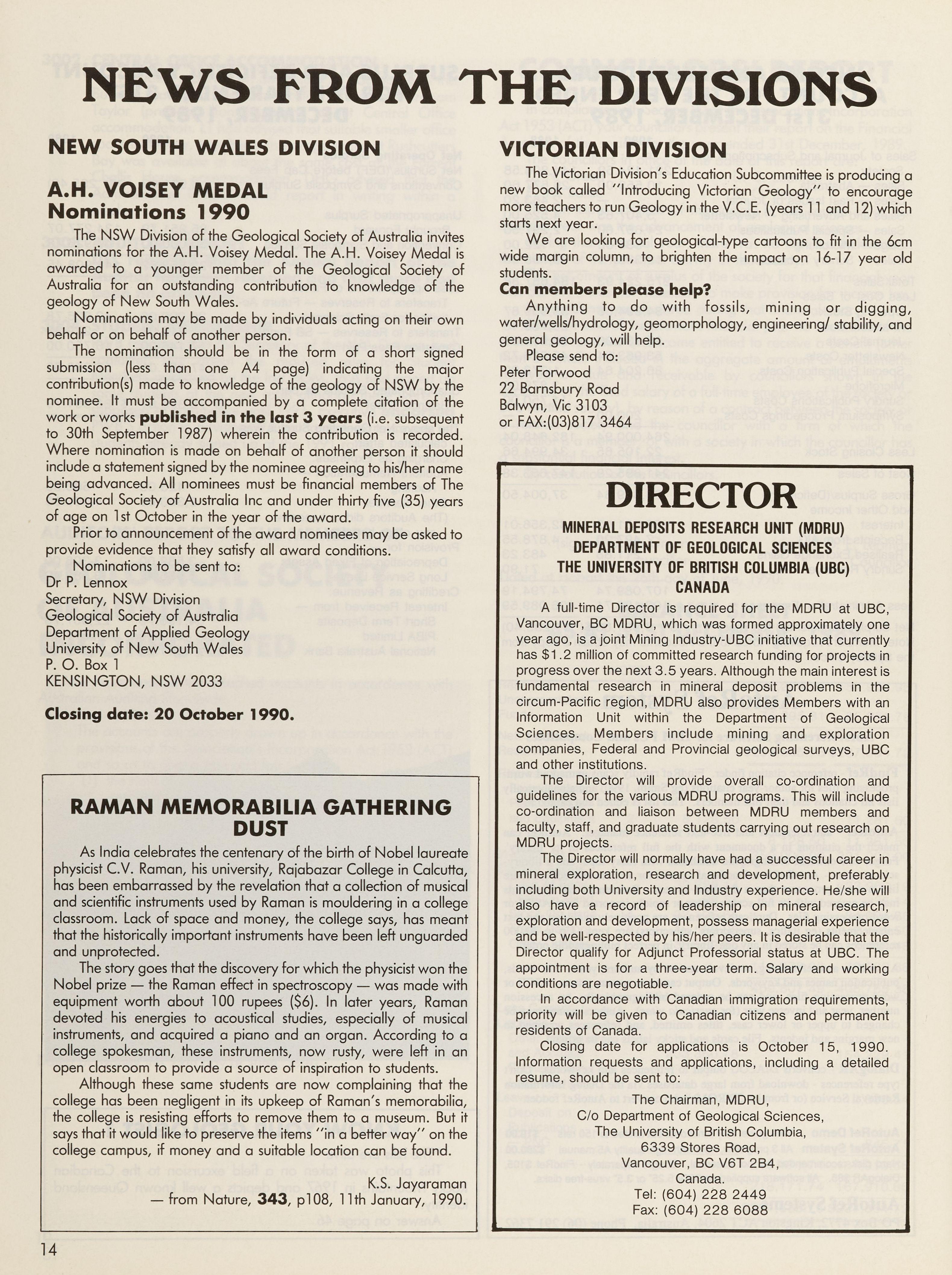
The NSW Division of the Geological Society of Australia invites nominations for the A.H. Voisey Medal. The A.H Voisey Medal is awarded to a younger member of the Geological Society of Australia for an outstanding contribution to knowledge of the geology of New South Wales.
Nominations may be made by individuals acting on their own behalf or on behalf of another person
The nomination should be in the form of a short signed submission (less than one A4 page) indicati ng the major contribution(s) made to knowledge of the geology of NSW by the nominee It must be accompanied by a complete citation of the work or works published in the last 3 years (i.e subsequent to 30th September 1987) wherein the contribution is recorded Where nomination is made on behalf of another person it should include a statement signed by the nominee agreeing to his/her name being advanced. All nominees must be financial members of The Geological Society of Australia Inc and under thirty five (35) years of age on 1st October in the year of the award
Prior to announcement of the award nominees may be asked to provide evidence that they satisfy all award conditions.
Nominations to be sent to: Dr P Lennox Secretary, NSW Division Geological Society of Australia Department of Applied Geology University of New South Wales P. 0. Box 1 KENSINGTON, NSW 2033
Closing date: 20 October 1990.
As India celebrates the centenary of the birth of Nobel laureate physicist C.V. Raman, his university, Rajabazar College in Calcutta, has been embarrassed by the revelation that a collection of musical and scientific instruments used by Raman is mouldering in a college classroom. Lack of space and money, the college says, has meant that the historically important instruments have been left unguarded and unprotected.
The story goes that the discovery for which the physicist won the Nobel prize - the Raman effect in spectroscopy - was made with equipment worth about 100 rupees ($6). In later years, Raman devoted his energies to acoustical studies, especially of musical instruments, and acquired a piano and an organ . According to a college spokesman, these instruments, now rusty, were left in an open classroom to provide a source of inspiration to students.
Although these same students are now complaining that the college has been negligent in its upkeep of Roman's memorabilia, the college is resisting efforts to remove them to a museum. But it says that it would like to preserve the items "in a better way" on the college campus, if money and a suitable location can be found.
K.S. Jayaraman - from Nature, 343, p 108, 11 th January, 1990
The Victorian Divis ion's Education Subcommittee is producing a new book called "Introducing Victorian Geology" to encourage more teachers to run Geology in the V C.E. (years 11 and 12) which starts next year.
We are looking for geological-type cartoons to fit in the 6cm wide margin column, to brighten the impact on 16-17 year old students.
Can members please help?
Anything to do with fossils, mining or digging, water/wells/hydrology, geomorphology, engineering/ stability, and genera l geo logy, wi ll help.
Please send to:
Peter Forwood 22 Barnsbury Road Balwyn, Vic 3103 or FAX:(03)817 3464
DEPARTMENT OF GEOLOGICAL SCIENCES
THE UNIVERSITY OF BRITISH COLUMBIA (UBC) CANADA
A full-time Director is required for the MDRU at USC, Vancouver , BC MDRU, which was formed approximately one year ago , is a joint Mining Industry-USC initiative that currently has $1.2 million of committed research funding for projects in progress over the next 3 5 years. Although the main interest is fundamental research in mineral deposit problems in the circum-Pacific region , MDRU also provides Members with an Information Unit within the Department of Geological Sciences. Members include mining and exploration companies , Federa l and Provincial geological surveys, USC and other institutions.
The Director will provide overall co-ordination and guidelines for the various MDRU programs This will include co-ordination and liaison between MDRU members and faculty , staff , and graduate students carrying out research on MDRU projects.
The Director will normally have had a successful career in mineral exploration , research and development, preferably including both University and Industry experience. He / she will also have a record of leadership on mineral research, exploration and development, possess managerial experience and be well -respected by his / her peers. It is desirable that the Director qualify for Adjunct Professorial status at USC. The appointment is for a three-year term. Salary and working conditions are negotiable
In accordance with Canadian immigration requirements, priority will be given to Canadian citizens and permanent residents of Canada.
Closing date for applications is October 1 5, 1990. Information requests and applications, including a detailed resume , should be sent to :
The Chairman , MDRU , C / o Department of Geological Sciences, The University of British Columbia, 6339 Stores Road , Vancouver, BC V6T 284 , Canada.
Tel: (604) 228 2449
Fax: (604) 228 6088
Planning for the Margaret River Conference is continuing and is well in hand. At present the excusions appear to be well supported however there are still places on all excursions associated with the conference. If anybody requires further information about the conference then please don't hesitate to contact John Baxter, Fax No. (09) 470 3956.
As advertised elsewhere in the Australian Geologist the fieldguide No. 3 by Chris Fergusson, David Gray and Vince Morand has been completed. This document is an excellent summary of the field relationships in central eastern Victoria and will obviously be a basic reference for field trips in the area for years to come. Chris, Dave and Vince are to be congratulated on the completion of the exercise.
The companion conference, Structural Controls on Mineralisation in Kalgoorlie in October, 1991 is still in planning and the call for papers will be advertised shortly with a flyer to all members of the GSA. Any further information on this can also be addressed to John Baxter
It is our intention to produce another newsletter towards the end of the year with an October deadline for copy. It would be appreciated if groups associated with conferences and local workshops would be prepared to write a short news item on these issues and provide it to Ian Tyler at the Geological Survey of Western Australia, 100 Plain Street, East Perth 6004.
John L. Baxter (Chairman) Continental Resources Management Pty Ltd. Tel (09) 362 6555 Fax (09) 470 3956.
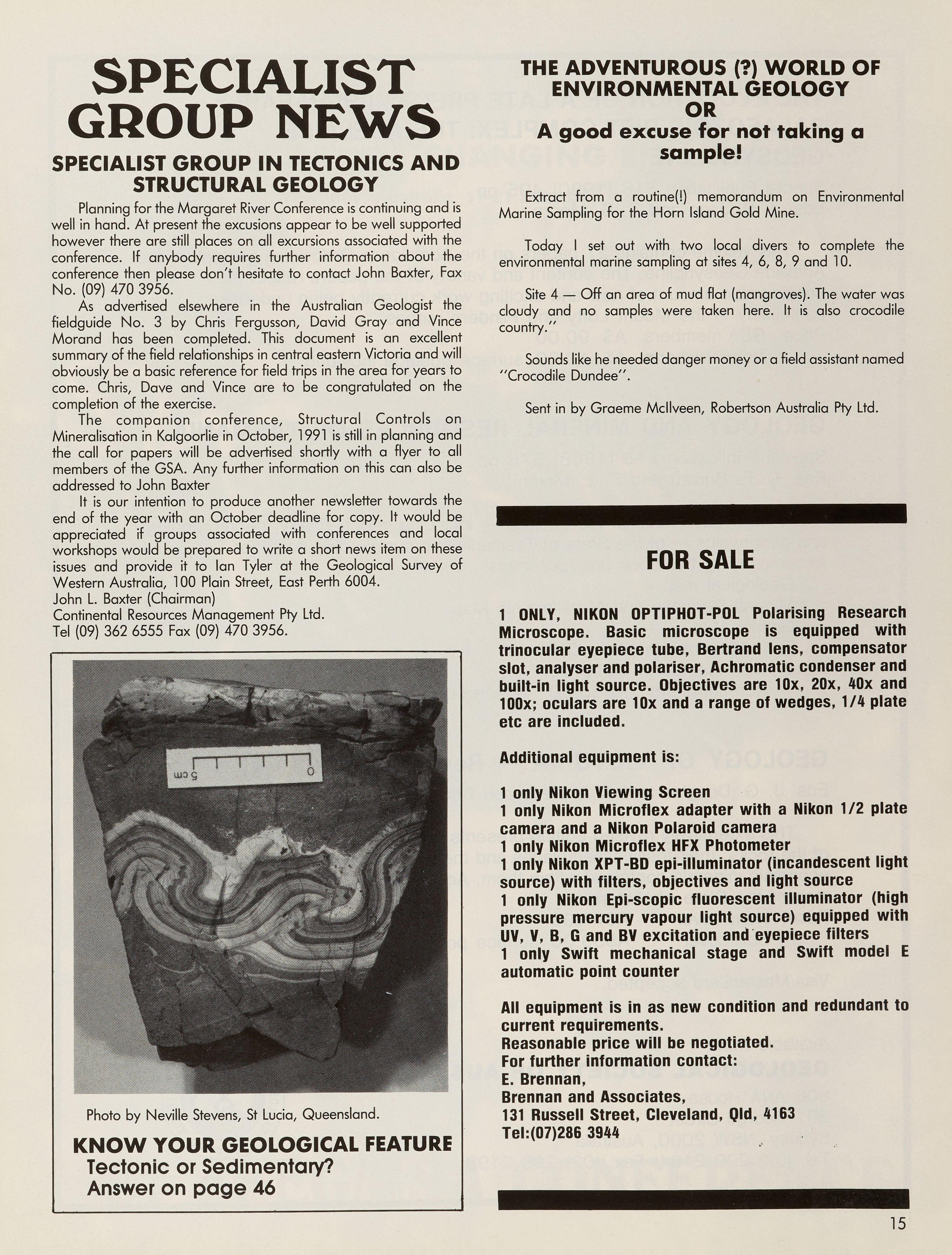
KNOW YOUR GEOLOGICAL FEATURE Tectonic or Sedimentary? Answer on page 46
Extract from a routine(!) memorandum on Environmental Marine Sampling for the Horn Island Gold Mine.
Today I set out with two local divers to complete the environmental marine sampling at sites 4, 6, 8, 9 and 10.
Site 4 - Off an area of mud flat (mangroves). The water was cloudy ?,nd no samples were taken here. It is also crocodile country.
Sounds like he needed danger money or a field assistant named "Crocodile Dundee".
Sent in by Graeme Mcllveen, Robertson Australia Pty Ltd.
1 ONLY, NIKON OPTIPHOT-POL Polarising Research Microscope. Basic microscope is equipped with trinocular eyepiece tube, Bertrand lens, compensator slot, analyser and polariser, Achromatic condenser and built-in light source. Objectives are 1Ox, 20x, 40x and 1OOx; oculars are 1Ox and a range of wedges, 1/ 4 plate etc are included.
Additional equipment is:
1 only Nikon Viewing Screen
1 only Nikon Microflex adapter with a Nikon 1/2 plate camera and a Nikon Polaroid camera
1 only Nikon Microflex HFX Photometer
1 only Nikon XPT-BD epi-illuminator (incandescent light source) with filters, objectives and light source
1 only Nikon Epi-scopic fluorescent illuminator (high pressure mercury vapour light source) equipped with UV, V, B, G and BY excitation and eyepiece filters
1 only Swift mechanical stage and Swift model E automatic point counter
All equipment is in as new condition and redundant to current requirements.
Reasonable price will be negotiated. For further information contact:
E. Brennan, Brennan and Associates, 131 Russell Street, Cleveland, Qld, 4163
Tel:(07)286 3944
Special Publication #16 (1990) 495 pp
Eds: J. B. Jago and P. S. Moore
This volume contains 2 7 papers on the Adelaidean-Ordovician geology of the Adelaide Geosyncline. The content and variety of the papers reflect the considerable amount of new and exciting work currently being undertaken, particularly in the Mount Lofty and Flinders ranges.
Price: GSA members A$ 90.00
Non-members A$11 0. 00 surface postage included
Special Publication #15 (1988) 575 pp
Eds: C. F. Surrett and E. L. Martin
A major publication of the geology - including geochemistry, geomorphology and geophysics - of the State of Tasmania and surrounding sea floor. Accompanying the book are four maps:
Geological map
Mineral Deposits and Metallogenic Map
Gravity Map
Total Magnetic Intensity Contours
Price: GSA members A$55.00
Non-members A$85. 00 surface postage included
Eds: J. G. Douglas and J. A. Ferguson 663 pp
This extensively revised edition presents detailed epoch by epoch descriptions of the rocks, their fossil assemblages and the gold, oil, coal and many other econo.mic minerals contained within them. Accompanying the book is a geological map of the State of Victoria.
Price: Hard cover A$77 .00
Soft cover A$59.00 surface postage included
Visa / MasterCard accepted.
Available from:
Overseas airmail + A$30. 00 per book.
GEOLOGICAL SOCIETY OF AUSTRALIA INC
606 ANA House
301 George Street
Sydney, NSW 2000, Australia
Tel: (02) 290 21 94; Fax: (02) 290 2198
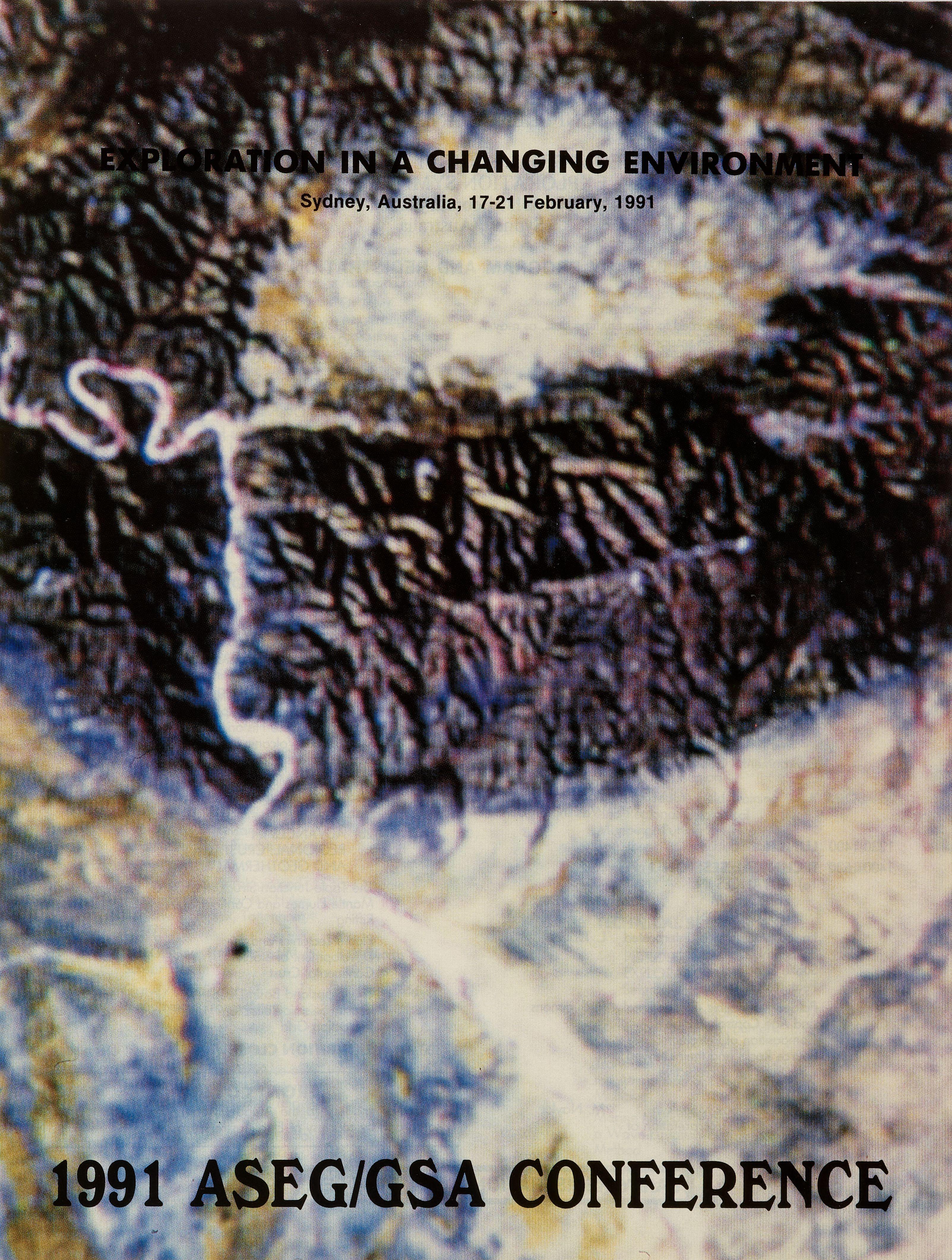
ralia, 17-21
THE AUSTRALIAN SOCIETY OF EXPLORATION GEOPHYSICISTS
8TH CONFERENCE AND EXHIBITION and
THE GEOLOGICAL SOCIETY OF AUSTRALIA EXPLORATION SYMPOSIUM
17th-21st February, 1991 Sydney, Australia
PRELIMINARY PROGRAM AND REGISTRATION FORM
NOTE: Sessions may be reallocated to different time slots, as may
lb) ADVANCES IN COAL, individual papers within sessions. GROUNDWATER AND Additional Papers will be included.
MONDAY
18 February, 1991
ENGINEERING
Groundwater and Salinity
Management in New South
Wales: An Overview
Geophysical Techniques for 0800 EXHIBITS OPEN
Detailed Examination of Coal
0900-1020 PLENARY SESSION I
Mine Seams in Advance of Opening Remarks
Conference
Chairman ASEG & GSA
Mining
A New Direct Non-Invasive Presidents
Conference Opening Keynote R. Champion de
Groundwater Detection
Technology for Australia Speaker Crespigny
1530-1600 AFTERNOON TEA
Executive
1600-1730 TECHNICAL SESSION 2 Chairman Normandy and
2a) ADVANCES IN MINERAL Poseidon Group EXPLORATION
Airborne Mineral Mapping with the GERIS and GEOSCAN 1020-1100 MORNING TEA
1100-1230 PLENARY SESSION II
Exploration and Environmental Dr Reg C. Sprigg
Airborne Scanners for Mineral
Exploration and Mapping
Polymetallic Massive Sulphide Co-existence Director
Exploration Case Histories Arkaroola Pty Ltd
Mt Windsor Volcanic Belt, Environmental Geoscience Dr Stan H. Ward North Queensland
Geophysical
The Scuddles Massive Sulphide Consultant
Discovery: An Exploration Case Washington USA History
1230-1400 LUNCH
26) ADVANCES IN REGIONAL, CRUSTAL 1400-1530 TECHNICAL SESSION 1 AND GEOTHERMAL la) ADVANCES IN
The Triple-Junction Structure of PETROLEUM
Mantle Plumes and Continental EXPLORATION
Image Processing of Interpreted L. Tilbury
Rifting
Plume Tectonics and the 3D Seismic Data to Enhance
Development of Stable Subtle Structural Continental Crust Features/Lineations
The Gippsland Basin Deep- Palaeogeographic, Depositional R. Summons
Crustal Seismic Reflectionand Age Controls on the Refraction Grid Composition of Petroleum
1800 EXHIBITION CLOSE Source Rocks and their Derived Oils: Basis for a Predictive Model
Role of Sandbox Models in M. Naylor
Landsat imagery to the Amadeus Basin, Palm Valley area. Aiding Seismic Interpretation of (Photograph by courtesy of Esso Australia Ltd.) Fault Patterns
TUESDAY
19 February, 1991
0715 CONFERENCE BREAKFAST Invited Speaker
- Optional Harry Butler Convention Centre,
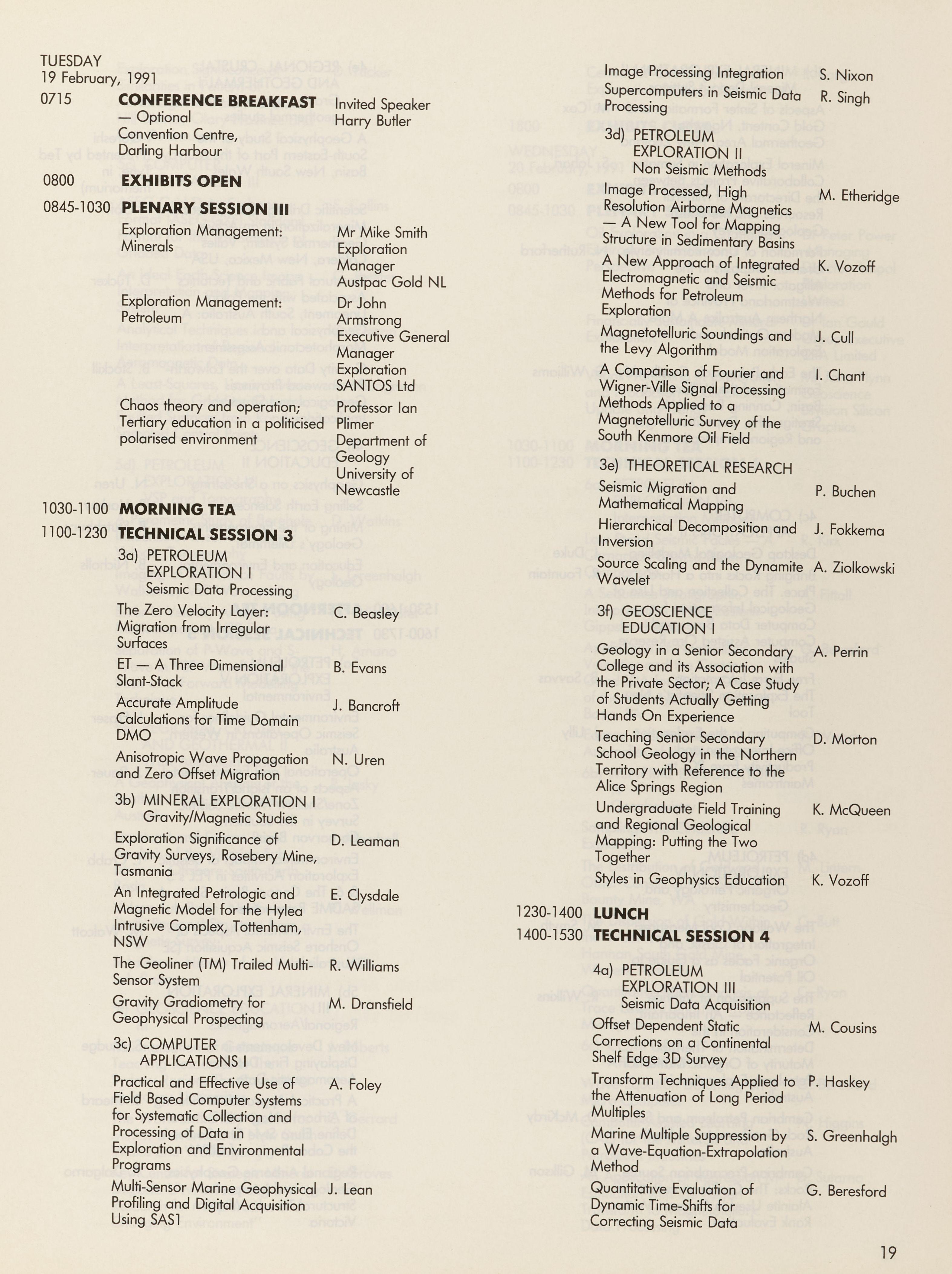
Image Processing Integration S. Nixon
Supercomputers in Seismic Data R. Singh Processing
3d) PETROLEUM
Darling Harbour EXPLORATION 11
0800 EXHIBITS OPEN
0845-1030 PLENARY SESSION Ill
Exploration Management: Mr Mike Smith
Non Seismic Methods
Image Processed, High M. Etheridge
Resolution Airborne Magnetics
-A New Tool for Mapping Minerals
Exploration
Manager
Austpac Gold NL
Exploration Management: Dr John Petroleum
Structure in Sedimentary Basins
A New Approach of Integrated K. Vozoff
Electromagnetic and Seismic
Methods for Petroleum
Armstrong Exploration
Executive General
Magnetotelluric Soundings and J. Cull Manager the Levy Algorithm
Exploration
A Comparison of Fourier and I. Chant SANTOS Ltd Wigner-Ville Signal Processing
Chaos theory and operation; Professor Ian
Methods Applied to a Tertiary education in a politicised Plimer
Magnetotelluric Survey of the polarised environment Department of South Kenmore Oil Field Geology
University of Newcastle
l 030-1100 MORNING TEA
1100-1230 TECHNICAL SESSION 3
3a) PETROLEUM
3e) THEORETICAL RESEARCH
Seismic Migration and P. Buchen
Mathematical Mapping
Hierarchical Decomposition and J. Fokkema
Inversion
Source Scaling and the Dynamite A. Ziolkowski EXPLORATION I Wavelet Seismic Data Processing
The Zero Velocity Layer : C. Beasley
3f) GEOSCIENCE Migration from Irregular EDUCATION I Surfaces
Geology in a Senior Secondary A. Perrin
ET -A Three Dimensional B Evans College and its Association with Slant-Stack the Private Sector; A Case Study
Accurate Amplitude J. Bancroft of Students Actually Getting Calculations for Time Domain Hands On Experience
DMO
Anisotropic Wave Propagation N Uren
Teaching Senior Secondary D Morton
School Geology in the Northern and Zero Offset Migration Territory with Reference to the Alice Springs Region
36) MINERAL EXPLORATION I
Undergraduate Field Training K. McQueen Gravity/Magnetic Studies and Regional Geological
Exploration Significance of D Leaman
Mapping : Putting the Two Gravity Surveys, Rosebery Mine, Together Tasmania
Styles in Geophysics Education K. Vozoff
An Integrated Petrologic and E. Clysdale
Magnetic Model for the Hylea
1230-1400 LUNCH Intrusive Complex, Tottenham, 1400-1530 TECHNICAL SESSION 4 NSW
The Geoliner (TM) Trailed Multi- R. Williams
4a) PETROLEUM Sensor System EXPLORATION Ill
Gravity Gradiometry for M. Dransfield
Geophysical Prospecting
3c) COMPUTER
Seismic Data Acquisition
Offset Dependent Static M. Cousins
Corrections on a Continental APPLICATIONS I Shelf Edge 3D Survey
Practical and Effective Use of A. Foley
Transform Techniques Applied to P. Haskey
Field Based Computer Systems the Attenuation of Long Period for Systematic Collection and Multiples
Processing of Data in
Marine Multiple Suppression by S. Greenhalgh Exploration and Environmental a Wave-Equation-Extrapolation Programs Method
Multi-Sensor Marine Geophysical J Lean
Quantitative Evaluation of G Beresford Profiling and Digital Acquisition
Dynamic Time-Shifts for Using SASl Correcting Seismic Data
46) MINERAL EXPLORATION I I
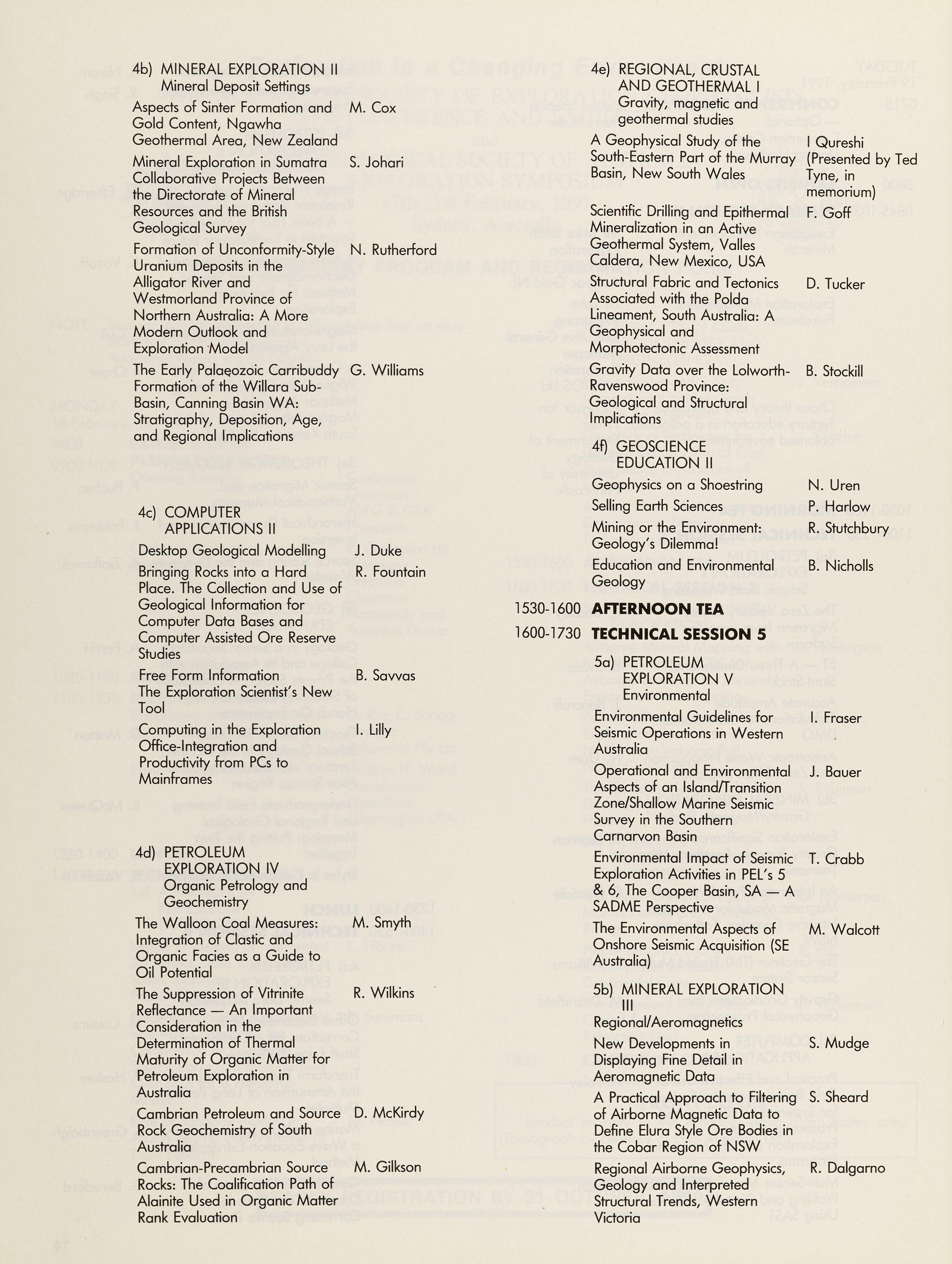
4e} REGIONAL, CRUSTAL
Mineral Deposit Settings AND GEOTHERMAL I
Aspects of Sinter Formation and M. Cox
Gravity, magnetic and Gold Content, Ngawha geothermal studies
Geothermal Area, New Zealand
A Geophysical Study of the I Qureshi Mineral Exploration in Sumatra S Johari
South - Eastern Part of the Murray (Presented by Ted Collaborative Projects Between Basin, New South Wales Tyne, in the Directorate of Mineral memorium} Resources and the British
Scientific Drilling and Epithermal F. Goff Geological Survey Mineralization in an Active Formation of Unconformity-Style N Rutherford
Geothermal System, Valles Uranium Deposits in the Caldera, New Mexico, USA
Alligator River and
Structural Fabric and Tectonics D Tucker Westmorland Province of Associated with the Polda Northern Australia: A More Lineament, South Australia : A Modern Outlook and Geophysical and Exploration Model Morphotectonic Assessment
The Early Pala~ozoic Carribuddy G Williams
Gravity Data over the Lolworth- B Stockill Formation of the Willara Sub- Ravenswood Province : Basin, Canning Basin WA: Geological and Structural Stratigraphy, Deposition, Age, Implications and Regional Implications
4f) GEOSCI ENCE
EDUCATION 11
Geophysics on a Shoestring N. Uren
4c} COMPUTER
Selling Earth Sciences P. Harlow APPLICATIONS 11
Desktop Geological Modelling J Duke
Bringing Rocks into a Hard R Fountain
Mining or the Environment: R. Stutchbury
Geology's Dilemma!
Education and Environmental B Nicholls Place. The Collection and Use of Geology Geological Information for 1530-1600 AFTERNOON TEA Computer Data Bases and 1600-1730 TECHNICAL SESSION 5 Computer Assisted Ore Reserve Studies
Sa} PETROLEUM Free Form Information B. Sawas EXPLORATION V
The Exploration Scientist's New
Environmental Tool
Environmental Guidelines for I. Fraser Computing in the Exploration I. Lilly Seismic Operations in Western Office-Integration and Australia Productivity from PCs to
Operational and Environmental J. Bauer Mainframes
Aspects of an lsland/fransition Zone/Shallow Marine Seismic Survey in the Southern Carnarvon Basin
4d) PETROLEUM
Environmental Impact of Seismic T. Crabb EXPLORATION IV Exploration Activities in PEL' s 5 Organic Petrology and & 6, The Cooper Basin, SA -A Geochemistry SADME Perspective
The Walloon Coal Measures: M. Smyth
The Environmental Aspects of M. Walcott Integration of elastic and Onshore Seismic Acquisition (SE Organic Facies as a Guide to Australia} Oil Potential
The Suppression of Vitrinite R. Wilkins
Sb} MINERAL EXPLORATION
Reflectance - An Important Ill Consideration in the Regional/Aero magnetics
Determination of Thermal New Developments in S. Mudge
Maturity of Organic Matter for Displaying Fine Detail in Petroleum Exploration in Aeromagnetic Data
Australia A Practical Approach to Filtering S. Sheard
Cambrian Petroleum and Source D McKirdy of Airborne Magnetic Data to Rock Geochemistry of South Define Elura Style Ore Bodies in Australia the Cobar Region of NSW
Cambrian-Precambrian Source M. Gilkson
Regional Airborne Geophysics, R. Dalgarno
Rocks: The Coalification Path of Geology and Interpreted
Alainite Used in Organic Matter
Structura l Trends, Western Rank Evaluation
Victoria
Exploration Significance of D. Tucker
Centre for Ore Deposit and R. Large Similarities in Pattern of Exploration Studies, Unversity of Aeromagnetic Data in Broken Tasmania Hill District, Olary Province and 1800 EXHIBITS CLOSE Eyre Peninsula
WEDNESDAY Sc) COMPUTER
20 February, 1991 APPLICATIONS Ill
ASEG Grid Data Exchange S. Collins
Format (ASEG-GXF) Standard
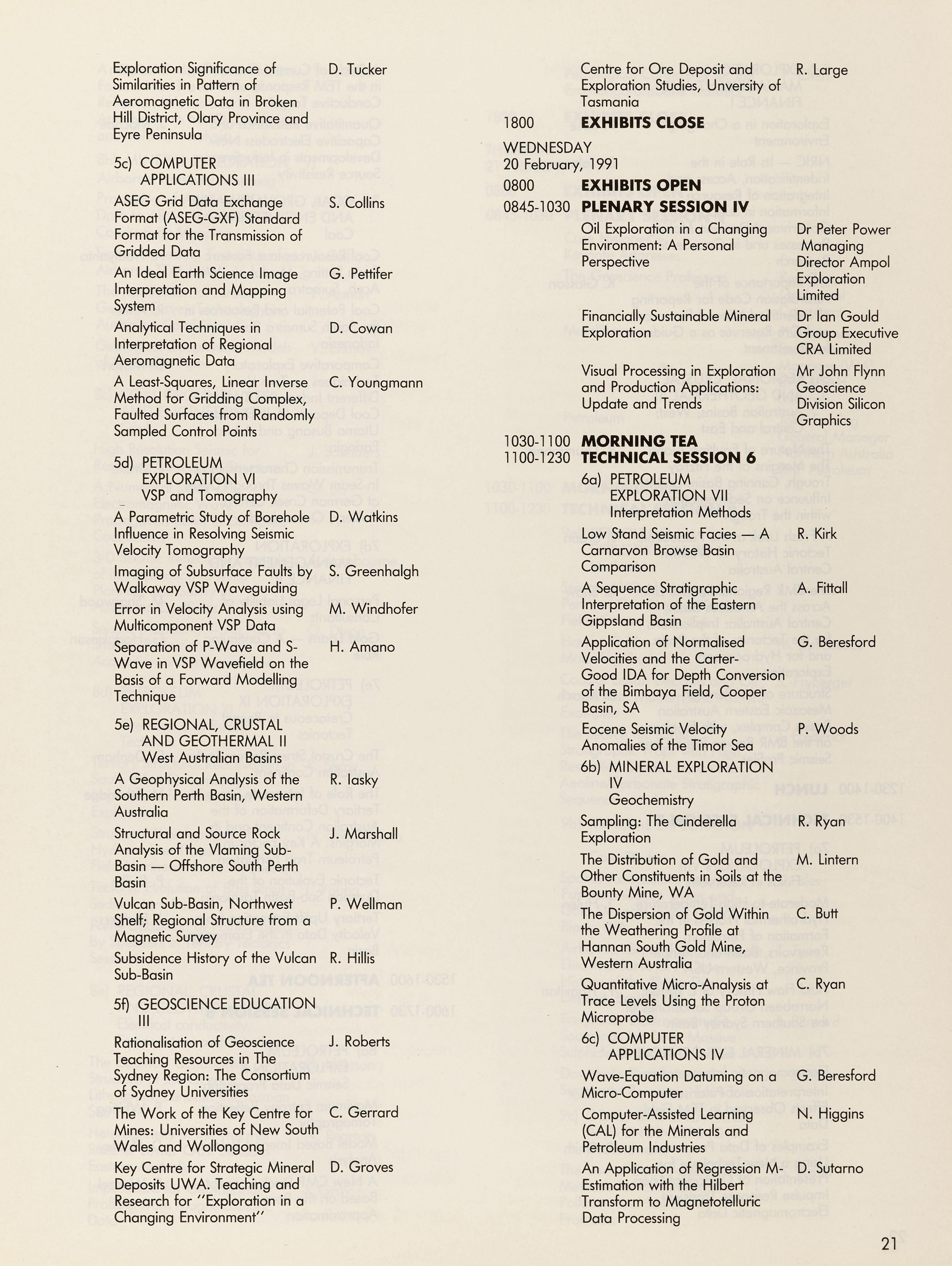
0800 EXHIBITS OPEN
0845-1030 PLENARY SESSION IV
Oil Exploration in a Changing Dr Peter Power Format for the Transmission of Gridded Data Environment: A Personal Managing
An Ideal Earth Science Image G. Pettifer Perspective Director Ampol Exploration Interpretation and Mapping Limited System
Financially Sustainable Mineral Dr Ian Gould Analytical Techniques in D. Cowan Exploration Group Executive Interpretation of Regional CRA Limited Aeromagnetic Data
Visual Processing in Exploration Mr John Flynn
A Least-Squares, Linear Inverse C. Youngmann and Production Applications: Geoscience Method for Gridding Complex, Update and Trends Division Silicon Faulted Surfaces from Randomly Graphics Sampled Control Points
1030-1100 MORNING TEA
5d) PETROLEUM 1100-1230 TECHNICAL SESSION 6 EXPLORATION VI
A Parametric Study of Borehole D. Watkins
6a) PETROLEUM VSP and Tomography EXPLORATION VI IInterpretation Methods
Influence in Resolving Seismic
Low Stand Seismic Facies -A R. Kirk Velocity Tomography Carnarvon Browse Basin
Imaging of Subsurface Faults by S. Greenhalgh
Comparison Walkaway VSP Waveguiding
A Sequence Stratigraphic A. Fittall Error in Velocity Analysis using M. Windhofer
Interpretation of the Eastern Multicomponent VSP Data Gippsland Basin
Separation of P-Wave and S- H. Amano
Application of Normalised G. Beresford Wave in VSP Wavefield on the Velocities and the CarterBasis of a Forward Modelling Good IDA for Depth Conversion Technique of the Bimbaya Field, Cooper Basin, SA
Se) REGIONAL, CRUSTAL
Eocene Seismic Velocity P. Woods AND GEOTHERMAL II
Anomalies of the Timor Sea West Australian Basins
66) MINERAL EXPLORATION
A Geophysical Analysis of the R lasky IV Southern Perth Basin, Western Geochemistry Australia
Structural and Source Rock J. Marshall
Analysis of the Vlaming Sub -
Sampling: The Cinderella R. Ryan
Exploration
The Distribution of Gold and M. Lintern Basin - Offshore South Perth Other Constituents in Soils at the Basin Bounty Mine, WA
Vulcan Sub-Basin, Northwest P Wellman
Shelf; Regional Structure from a
The Dispersion of Gold Within C. Butt Magnetic Survey the Weathering Profile at Hannan South Gold Mine, Subsidence History of the Vulcan R. Hillis
Western Australia Sub-Basin
Quantitative Micro-Analysis at C. Ryan
sn GEOSCIENCE EDUCATION
Trace Levels Using the Proton Ill Microprobe
Rationalisation of Geoscience J Roberts
6c) COMPUTER
Teaching Resources in The APPLICATIONS IV Sydney Region: The Consortium
Wave-Equation Datuming on a G Beresford of Sydney Universities Micro-Computer
The Work of the Key Centre for C. Gerrard
Computer-Assisted Learning N. Higgins Mines: Universities of New South (CAL) for the Minerals and Wales and Wollongong Petroleum Industries
Key Centre for Strategic Mineral D Groves
An Application of Regression M- D. Sutarno Deposits UWA. Teaching and Estimation with the Hilbert Research for "Exploration in a Transform to Magnetotelluric Changing Environme nt" Data Processing
6d) EXPLORATION
A Study of Current Channelling M. Asten MANAGEMENT AND in the TEM Response of FINANCE I Conductive Targets
Exploration in a Changing P. Rose
Quantitative Resistance and J. Macnae Environment
Capacitive Electrodes: New NRIC - Its Role in the D. Johnston Developments in Inductive lndentification, Access and Source Resistivity Integration of Resource
le) COAL, GROUNDWATER Information in Support of AND ENGINEERING I Government Decision Making Coal Processes and in Geoscientific
Coal Resources in a Forearc A. Hadiyanto Research
The Importance of the K. Glasson
Basin Setting, Meulaboh, West Aceh, Sumatra Australasian Code for Reporting
Coal Potential and Resources in R. Amier of lndentified Mineral Resources and Ore Reserves as a Guide the South Sumatra Basin, for Investment Indonesia
Comparative Exploratory D. Mason 6e) REGIONAL, CRUSTAL Techniques on Two Very AND GEOTHERMAL Ill Different Indonesian Tertiary Australian Basins; West; Coal Deposits Multi Harapan Central and East Utama Busang and Adaro
The Nature of Faulting Along B. Drummond
The Margins of the Fitzroy
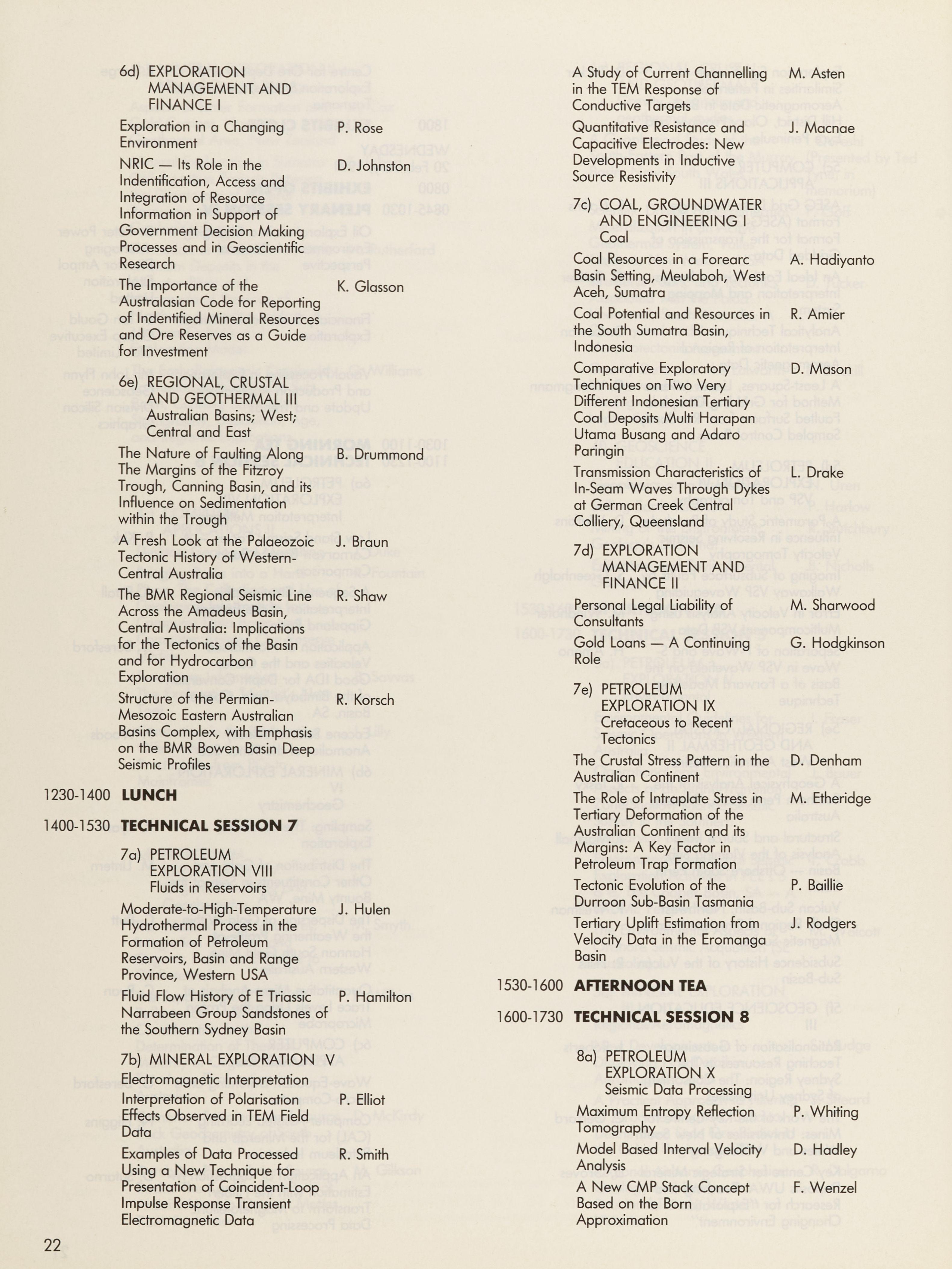
Paringin
Transmission Characteristics of L. Drake Trough, Canning Basin, and its In-Seam Waves Through Dykes Influence on Sedimentation at German Creek Central within the Trough Colliery, Queensland
A Fresh Look at the Palaeozoic J. Braun
7d) EXPLORATION
Tectonic History of WesternMANAGEMENT AND Central Australia FINANCE II
The BMR Regional Seismic Line R. Shaw
Personal Legal Liability of M. Sharwood Across the Amadeus Basin, Central Australia: Implications Consultants for the Tectonics of the Basin Gold Loans -A Continuing G. Hodgkinson and for Hydrocarbon Role Exploration
7e) PETROLEUM
Structure of the Permian- R. Kersch EXPLORATION IX Mesozoic Eastern Australian Cretaceous to Recent Basins Complex, with Emphasis Tectonics on the BMR Bowen Basin Deep
The Crustal Stress Pattern in the D. Denham Seismic Profiles Australian Continent
1230-1400 LUNCH
1400-1530 TECHNICAL SESSION 7
7a) PETROLEUM
The Role of lntraplate Stress in M. Etheridge
Tertiary Deformation of the Australian Continent a.nd its
Margins: A Key Factor in EXPLORATION VII I Petroleum Trap Formation
Fluids in Reservoirs
Moderate-to-High-Temperature J. Hulen
Tectonic Evolution of the P. Baillie
Durroon Sub-Basin Tasmania
Hydrothermal Process in the Tertiary Uplift Estimation from J. Rodgers Formation of Petroleum Velocity Data in the Eromanga Reservoirs, Basin and Range Basin Province, Western USA
Fluid Flow History of E Triassic P. Hamilton Narrabeen Group Sandstones of
1530-1600 AFTERNOON TEA
1600-1730 TECHNICAL SESSION 8 the Southern Sydney Basin
76) MINERAL EXPLORATION V
8a) PETROLEUM Electromagnetic Interpretation EXPLORATION X
Interpretation of Polarisation P. Elliot Seismic Data Processing Effects Observed in TEM Field
Maximum Entropy Reflection P. Whiting Data Tomography
Examples of Data Processed R. Smith
Model Based Interval Velocity D. Hadley Using a New Technique for Analysis Presentation of Coincident-Loop
A New CMP Stack Concept F. Wenzel
Impulse Response Transient Based on the Born Electromagnetic Data Approximation
A Higher Order Approximation Y. Ashida
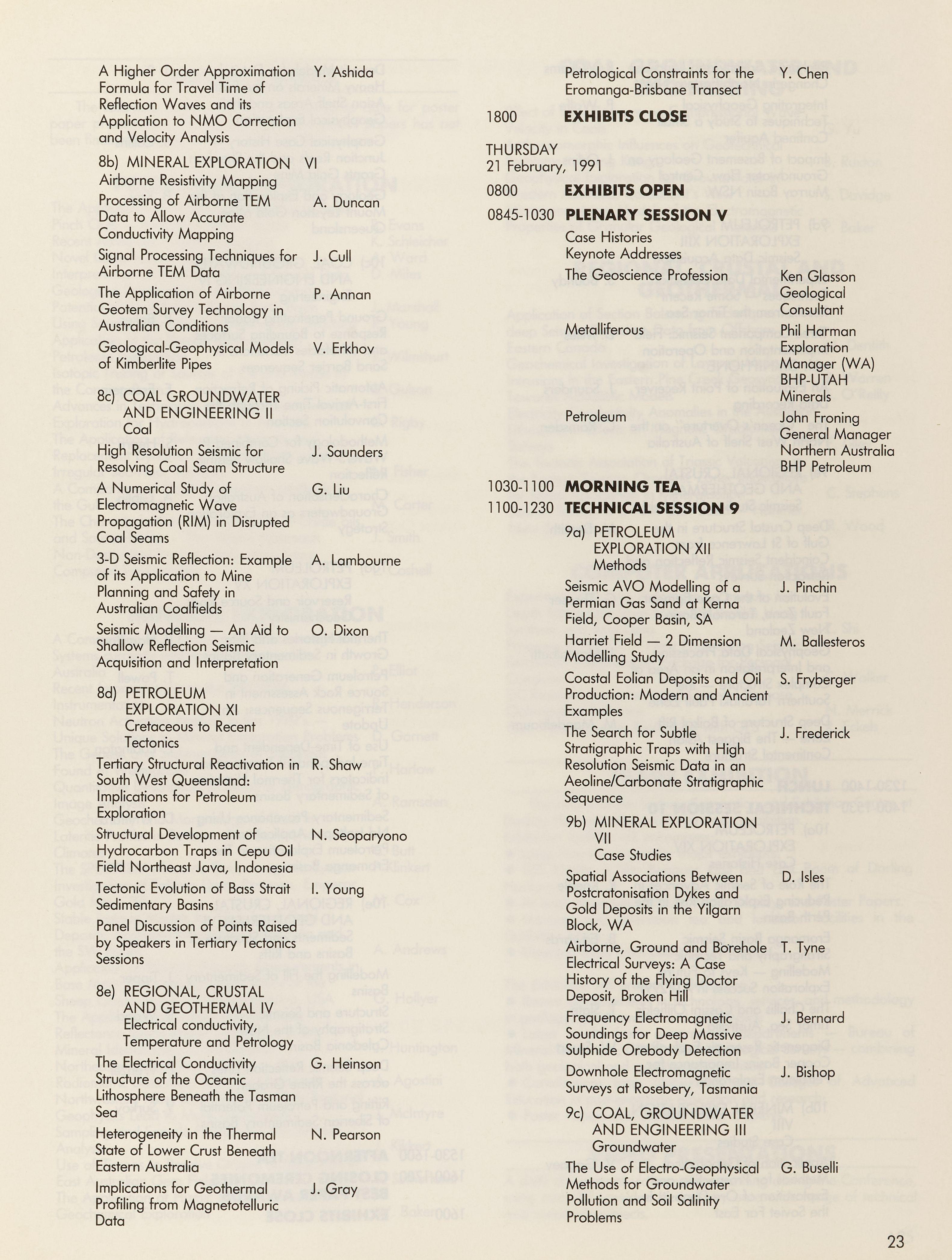
Petrological Constraints for the Y. Chen
Formula for Travel Time of Eromanga-Brisbane Transect Reflection Waves and its 1800 EXHIBITS CLOSE Application to NMO Correction and Velocity Analysis
86) MINERAL EXPLORATION VI
Airborne Resistivity Mapping
Processing of Airborne TEM A. Duncan
THURSDAY
21 February, 1991
0800 EXHIBITS OPEN
Data to Allow Accurate 0845-1030
Conductivity Mapping
Signal Processing Techniques for J. Cull
PLENARY SESSION V
Case Histories
Keynote Addresses Airborne TEM Data
The Geoscience Profession Ken Glasson
The Application of Airborne P. Annan Geological Geotem Survey Technology in Consultant
Australian Conditions
Geological-Geophysical Models V. Erkhov
Metalliferous Phil Harman
Exploration of Kimberlite Pipes Manager (WA) BHP-UTAH
8c) COAL GROUNDWATER
Minerals AND ENGINEERING II
Petroleum John Froning Coal General Manager
High Resolution Seismic for J. Saunders
Northern Australia Resolving Coal Seam Structure BHP Petroleum
A Numerical Study of G. Liu
1030-1100 MORNING TEA
Electromagnetic Wave 1100-1230 TECHNICAL SESSION 9
Propagation (RIM) in Disrupted
9a) PETROLEUM Coal Seams EXPLORATION XII
3-D Seismic Reflection: Example A. Lambourne Methods of its Application to Mine
Seismic A VO Modelling of a J. Pinchin Planning and Safety in Permian Gas Sand at Kerna Australian Coalfields Field, Cooper Basin, SA
Seismic Modelling - An Aid to 0. Dixon
Harriet Field -2 Dimension M. Ballesteros Shallow Reflection Seismic
Modelling Study Acquisition and Interpretation
Coastal Eolian Deposits and Oil S. Fryberger
8d) PETROLEUM
Production: Modern and Ancient EXPLORATION XI Examples
Cretaceous to Recent
The Search for Subtle J. Frederick Tectonics Stratigraphic Traps with High Tertiary Structural Reactivation in R. Shaw
Resolution Seismic Data in an South West Queensland: Aeoline/Carbonate Stratigraphic Implications for Petroleum Sequence Exploration
96) MINERAL EXPLORATION
Structural Development of N. Seoparyono VII
Hydrocarbon Traps in Cepu Oil
Case Studies Field Northeast Java, Indonesia
Spatial Associations Between D. Isles Tectonic Evolution of Bass Strait I. Young
Postcratonisation Dykes and Sedimentary Basins
Gold Deposits in the Yilgarn Panel Discussion of Points Raised Block, WA by Speakers in Tertiary Tectonics
Airborne, Ground and Bo rehole T. Tyne Sessions
Electrical Surveys: A Case
8e) REGIONAL, CRUSTAL
History of the Flying Doctor Deposit, Broken Hill AND GEOTHERMAL IV
Frequency Electromagnetic J. Bernard
Electrical conductivity, Soundings for Deep Massive Temperature and Petrology
The Electrical Conductivity G. Heinson
Sulphide Orebody Detection
Downhole Electromagnetic J. Bishop
Structure of the Oceanic Surveys at Rosebery, Tasmania Lithosphere Beneath the Tasman Sea
9c) COAL, GROUNDWATER
Heterogeneity in the Thermal N. Pearson AND ENGINEERING Ill State of Lower Crust Beneath Groundwater
Eastern Australia
Implications for Geothermal J. Gray
Profiling from Magnetotelluric
The Use of Electro-Geophysical G. Buselli
Methods for Groundwater
Pollution and Soil Salinity Data
Problems
Recharge, Salinity and Land-Use R Williams
Change in North-Eastern NSW
Integrating Geophysical P. Wolfe
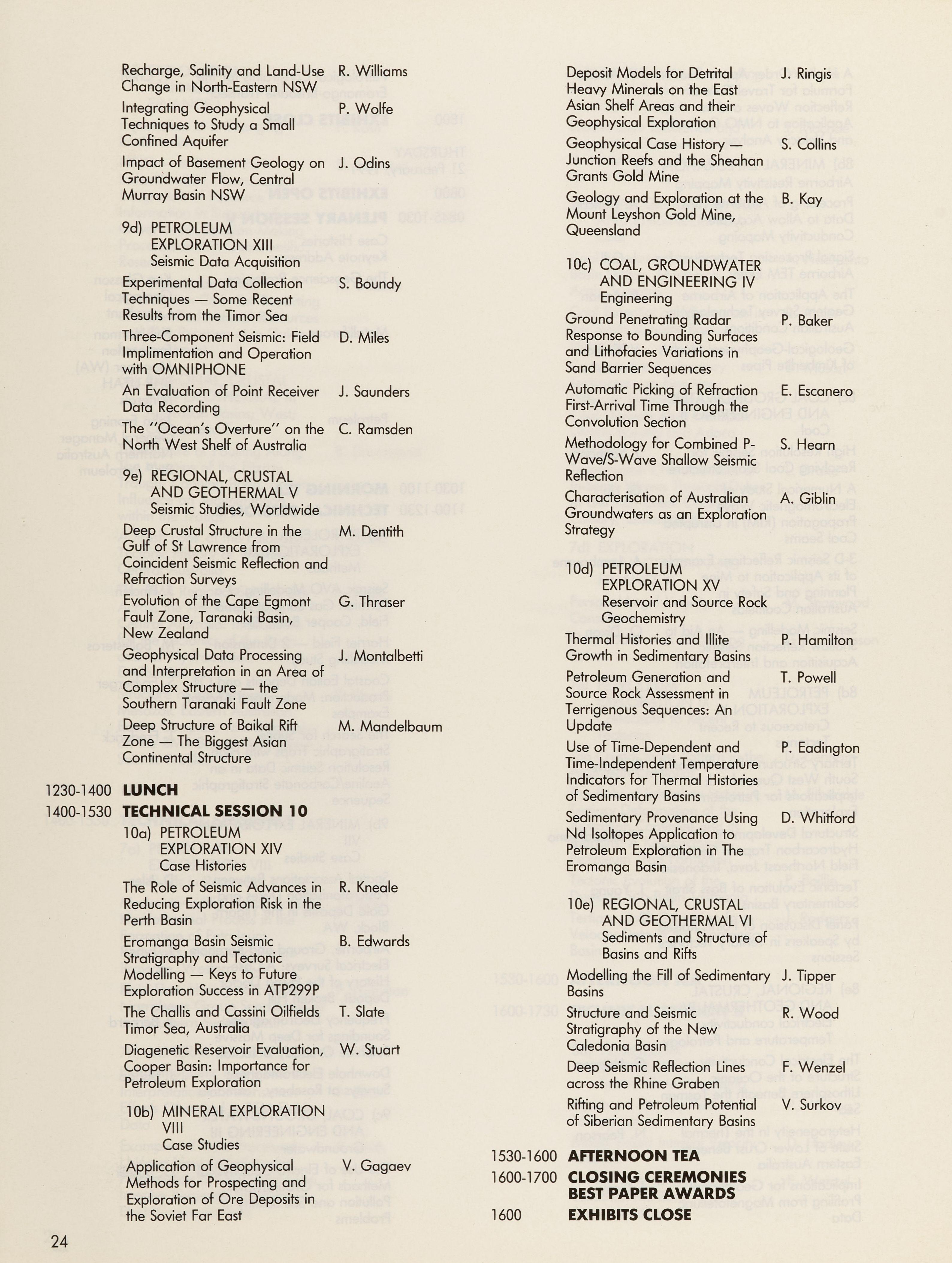
Deposit Models for Detrital J. Ringis
Heavy Minerals on the East
Asian Shelf Areas and their Techniques to Study a Small Geophysical Exploration
Confined Aquifer
Impact of Basement Geology on J Odins
Geophysical Case History - S Collins
Junction Reefs and the Sheahan Groundwater Flow, Central Grants Gold Mine
Murray Basin NSW
Geology and Exploration at the B Kay
Mount Leyshon Gold Mine, 9d) PETROLEUM Queensland EXPLORATION XIII
Seismic Data Acquisition
10c) COAL, GROUNDWATER
Experimental Data Collection S. Boundy AND ENGINEERING IV Techniques - Some Recent Engineering Results from the Timor Sea
Three-Component Seismic : Field D. Miles
Ground Penetrating Radar P Baker
Response to Bounding Surfaces lmplimentation and Operation and Lithofacies Variations in with OMNIPHONE
An Evaluation of Point Receiver J Saunders
Sand Barrier Sequences
Automatic Picking of Refraction E Escanero Data Recording First-Arrival Time Through the The "Ocean's Overture" on the C. Ramsden
Convolution Section North West Shelf of Australia
Methodology for Combined P- S. Hearn
Wave/S-Wave Shallow Seismic 9e) REGIONAL, CRUSTAL
Reflection AND GEOTHERMAL V
Characterisation of Australian A. Giblin Seismic Studies, Worldwide Groundwaters as an Exploration Deep Crustal Structure in the M. Dentith Strategy Gulf of St Lawrence from Coincident Seismic Reflection and
10d) PETROLEUM Refraction Surveys EXPLORATION XV
Evolution of the Cape Egmont G. Thraser
Reservoir and Source Rock Fault Zone, Taranaki Basin, Geochemistry New Zealand
Thermal Histories and lllite P Hamilton Geophysical Data Processing J. Montalbetti
Growth in Sedimentary Basins and Interpretation in an Area of
Petroleum Generation and T. Powell Complex Structure - the Source Rock Assessment in Southern Taranaki Fault Zone
Terrigenous Sequences : An Deep Structure of Baikal Rift M. Mandelbaum
Update Zone - The Biggest Asian
Use of Time - Dependent and P. Eadington Continental Structure
Time-Independent Temperature Indicators for Thermal Histories
1230-1400 LUNCH of Sedimentary Basins
1400-1530 TECHNICAL SESSION 10
Sedimentary Provenance Using D Whitford 1Oa) PETROLEUM Nd lsoltopes Application to EXPLORATION XIV
Petroleum Exploration in The Case Histories Eromanga Basin
The Role of Seismic Advances in R Kneale Reducing Exploration Risk in the
10e) REGIONAL, CRUSTAL Perth Basin AND GEOTHERMAL VI
Eromanga Basin Seismic B. Edwards
Sediments and Structure of Stratigraphy and Tectonic Basins and Rifts
Modelling - Keys to Future
Modelling the Fill of Sedimentary J. Tipper Exploration Success in ATP299P Basins
The Challis and Cassini Oilfields T. Slate
Structure and Seismic R Wood Timor Sea, Australia
Stratigraphy of the New Diagenetic Reservoir Evaluation, W Stuart Caledonia Basin Cooper Basin: Importance for Deep Seismic Reflection Lines F Wenzel Petroleum Exploration across the Rhine Graben
106) MINERAL EXPLORATION
Rifting and Petroleum Potential V Surkov VIII of Siberian Sedimentary Bas i ns
Case Studies
1530-1600 AFTERNOON TEA Application of Geophysical V. Gagaev 1600- 1700 CLOSING CEREMONIES Methods for Prospecting and Exploration of Ore Deposits in
the Soviet Far East
The following papers have been selected to date for poster paper presentation. The scheduling of the poster papers has not been finalised, contingent on review of other papers.
The Application of Numerical Modelling to Sand Pinch Outs - Surat and Bowen Basins
Recent Advances in Seismic Imaging Novel Observations from A YO Studies
Interpretation of Three Component Seismic Data
Geological Development and Hydrocarbon Potential of the Offshore North Perth Basin Using Seismic Wavetest for Determining Structure Application of the Raman Microprobe in Petroleum Exploration
Isotopic Tracing of Sources of Oil and Metals in the Canning Basin
Advances in Techniques of Surface Geochemical Exploration for Hydrocarbons in Australia
The Application of Refraction Methods and Replacement Dynamics to Seismic Data over Irregular Sea-Floor Surfaces
A Comparison of Depth Conversion Methods in the Gulf of Mexico
The Characterisation and Evaluation of Crude oils and Source Rocks - The Alkane Approach
Non-Destructive Core Analysis using X-ray Computed Tomography
B. Evans
K. Schleicher
A. Ward
D. Miles
J. Marshall
R. Young
J. Wilmshurt
B. Gulson
D. Rigby
N. Fisher
M. Carter
J. Smith
L. Coshell
A Comparisc;m of TEM (Transient Electromagnetic) Systems currently and most widely used in Australia
Recent Improvements to the SIROTEM Instrumentation
Neutron Activation Analysis in the 1990' sUnique Solutions to Mineral Exploration Problems
The Genesis and Sedimentation of Sapphires Found at Wellingrove
Quantitative Description of Shape in Petrographic Image Analysis
Geochemistry and Morphology of Gold in Lateritic Profiles in Savanna and Semi-Arid Climates
The SPECTREM Airborne Electromagnetic System Investigation of Tailings Dams Reserves, Emperor Gold Mine, Fiji
Stable Isotope Models for High Level Gold Deposits: Examples from Eastern Australia and the SW Pacific
Application of Physical Property Measurements in Base Metal Exploration: Case History of the Sheep Creek Deposit, Central Montana, USA
The Application of a New Field-Portable Reflectance Spectrometer (PIMA) for In-Situ
Mineral Identification in Exploration
Northeastern New South Wales - Can Radiometric Data Map Different Granitoids
Northwestern New South Wales - Can Regional Geophysics Lead to More Exploration?
Sampling and Sample Preparation for Mineral Analysis
Use of Zircons to Resolve Origins of Sapphires in East Australian Gem Fields
The Application of Humic Substances to Soil Geochemical Exploration
Effect of Pore Pressure on Compressional Wave Velocity in Coals
Anthropomorphic Influences on Geotechnical Problems in Hong Kong
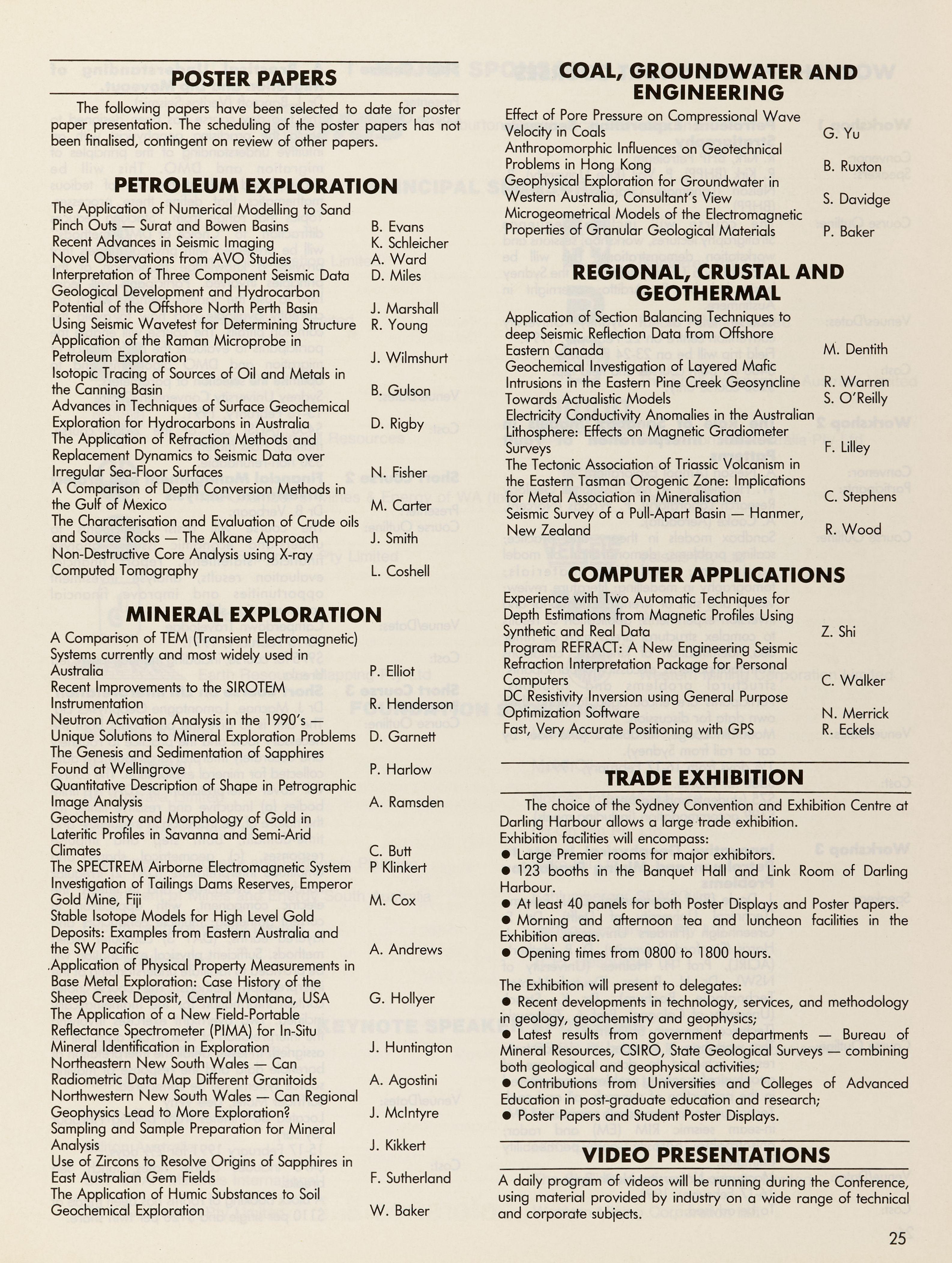
P. Elliot
R. Henderson
D. Garnett
P. Harlow
A. Ramsden
C. Butt
P Klinkert
M. Cox
A. Andrews
G. Hollyer
J. Huntington
A. Agostini
J. McIntyre
J. Kikkert
F. Sutherland
W Baker
G. Yu
B. Ruxton
Geophysical Exploration for Groundwater in Western Australia, Consultant's View S. Davidge
Microgeometrical Models of the Electromagnetic Properties of Granular Geological Materials P. Baker
Application of Section Balancing Techniques to deep Seismic Reflection Data from Offshore Eastern Canada
Geochemical Investigation of Layered Mafic Intrusions in the Eastern Pine Creek Geosyncline Towards Actualistic Models
Electricity Conductivity Anomalies in the Australian Lithosphere: Effects on Magnetic Gradiometer Surveys
The Tectonic Association of Triassic Volcanism in the Eastern Tasman Orogenic Zone: Implications for Metal Association in Mineralisation
Seismic Survey of a Pull-Apart Basin - Hanmer, New Zealand
M. Dentith
R. Warren
S. O'Reilly
F. Lilley
C. Stephens
R. Wood
Experience with Two Automatic Techniques for Depth Estimations from Magnetic Profiles Using Synthetic and Real Data
Program REFRACT: A New Engineering Seismic Refraction Interpretation Package for Personal Computers
DC Resistivity Inversion using General Purpose Optimization Software Fast, Very Accurate Positioning with GPS
Z. Shi C. Walker
N. Merrick R. Eckels
The choice of the Sydney Convention and Exhibition Centre at Darling Harbour allows a large trade exhibition. Exhibition faci1ities will encompass:
• Large Premier rooms for major exhibitors.
• 123 booths in the Banquet Hall and Link Room of Darling Harbour.
• At least 40 panels for both Poster Displays and Poster Papers.
• Morning and afternoon tea and luncheon facilities in the Exhibition areas.
• Opening times from 0800 to 1800 hours.
The Exhibition will present to delegates:
• Recent developments in technology, services, and methodology in geology, geochemistry and geophysics;
• Latest results from government departments - Bureau of Mineral Resources, CSIRO, State Geological Surveys - combining both geological and geophysical activities;
• Contributions from Universities and Colleges of Advanced Education in post-graduate education and research;
• Poster Papers and Student Poster Displays.
A daily program of videos will be running during the Conference, using material provided by industry on a wide range of technical and corporate subjects.
Workshop 1
Convenor: Speakers:
Course Outline:
R. Kirk, BHP Petroleum
R. Kirk (BHPP), P. Vail (Rice University), R. Nelson (Landmark Graphics), P. Arditto (BHPP)
The course will include Sequence Stratigraphy lectures, workshop, sessions and workstation demonstrations. This will be followed by a 1½ day field trip to the Sydney basin led by P. Arditto; overnight in Austin mere.
Presenter:
Course Outline:
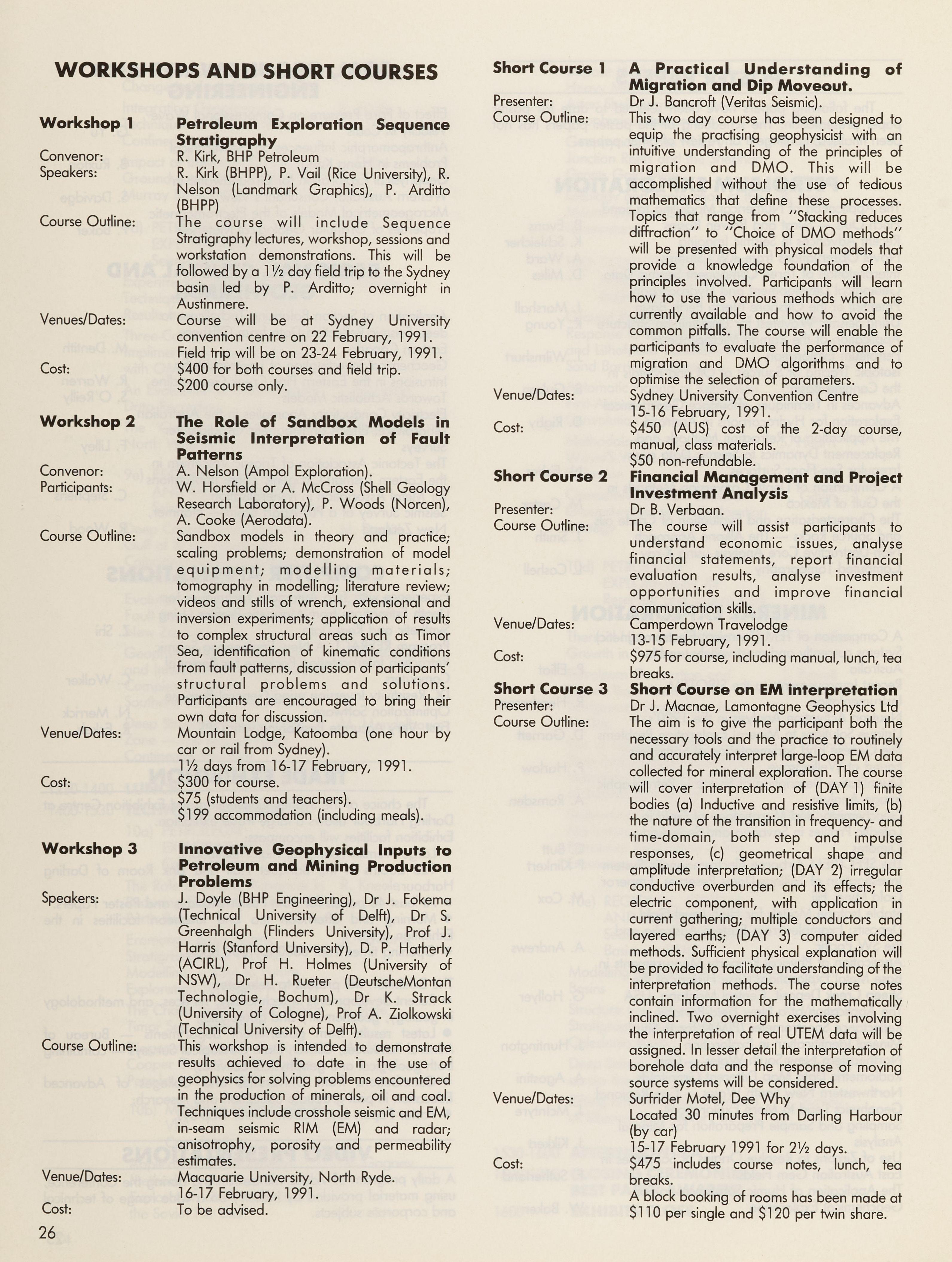
Venues/Dates:
Cost:
Workshop 2
Convenor: Participants:
Course Outline:
Course will be at Sydney University convention centre on 22 February, 1991.
Field trip will be on 23-24 February, 1991.
$400 for both courses and field trip.
$200 course only.
A. Nelson (Ampol Exploration).
W. Horsfield or A. McCross (Shell Geology Research Laboratory), P Woods (Noreen), A. Cooke (Aerodata).
Sandbox models in theory and practice; scaling problems; demonstration of model equipment; modelling materials; tomography in modelling; literature review; videos and stills of wrench, extensional and inversion experiments; application of results to complex structural areas such as Timor Sea, identification of kinematic conditions from fault patterns, discussion of participants' structural problems and solutions. Participants are encouraged to bring their own data for discussion.
Venue/Dates:
Cost:
Short Course 2
Presenter: Course Outline:
Dr J. Bancroft (Veritas Seismic).
This two day course has been designed to equip the practising geophysicist with an intuitive understanding of the principles of migration and DMO. This will be accomplished without the use of tedious mathematics that define these processes. Topics that range from "Stacking reduces diffraction" to "Choice of DMO methods" will be presented with physical models that provide a knowledge foundation of the principles involved Participants will learn how to use the various methods which are currently available and how to avoid the common pitfalls. The course will enable the participants to evaluate the performance of migration and DMO algorithms and to optimise the selection of parameters.
Sydney University Convention Centre 15-16 February, 1991.
$450 (AUS) cost of the 2-day course, manual, class materials.
$50 non-refundable.
Dr B. Verbaan.
The course will assist participants to understand economic issues, analyse financial statements, report financial evaluation results, analyse investment opportunities and improve financial communication skills.
Venue/Dates:
Cost:
Workshop 3
Speakers:
Course Outline:
Mountain Lodge, Katoomba (one hour by car or rail from Sydney).
1½ days from 16-17 February, 1991.
$300 for course.
$75 (students and teachers).
$199 accommodation (including meals).
J. Doyle (BHP Engineering), Dr J. Fokema (Technical University of Delft), Dr S. Greenhalgh (Flinders University), Prof J. Harris (Stanford University), D. P. Hatherly (ACIRL), Prof H. Holmes (University of NSW), Dr H. Rueter (DeutscheMontan Technologie, Bochum), Dr K. Strack (University of Cologne), Prof A. Ziolkowski (Technical University of Delft).
This workshop is intended to demonstrate results achieved to date in the use of geophysics for solving problems encountered in the production of minerals, oil and coal. Techniques include crosshole seismic and EM, in-seam seismic RIM (EM) and radar; anisotrophy, porosity and permeability estimates.
Venue/Dates:
Cost:
Presenter:
Course Outline:
Venue/Dates:
Cost:
Macquarie University, North Ryde. 16-17 February, 1991.
To be advised.
Venue/Dates:
Cost:
Camperdown Travelodge 13-15 February, 1991.
$975 for course, including manual, lunch, tea breaks.
Dr J. Macnae, Lamontagne Geophysics Ltd
The aim is to give the participant both the necessary tools and the practice to routinely and accurately interpret large-loop EM data collected for mineral exploration. The course will cover interpretation of (DAY 1) finite bodies (a) Inductive and resistive limits, (b) the nature of the transition in frequency- and time -domain, both step and impulse responses, (c) geometrical shape and amplitude interpretation; (DAY 2) irregular conductive overburden and its effects; the electric component, with application in current gathering; multiple conductors and layered earths; (DAY 3) computer aided methods. Sufficient physical explanation will be provided to facilitate understanding of the interpretation methods. The course notes contain information for the mathematically inclined. Two overnight exercises involving the interpretation of real UTEM data will be assigned. In lesser detail the interpretation of borehole data and the response of moving source systems will be considered
Surfrider Motel, Dee Why
Located 30 minutes from Darling Harbour (by car) 15-17 February 1991 for 2½ days.
$475 includes course notes, lunch, tea breaks.
A block booking of rooms has been made at $110 per single and $120 per twin share
Halliburton Geophysical Services, Inc.
Ampol Exploration Limited
Ashton Mining Limited
Bridge Oil Limited
Bureau of Mineral Resources
The Chamber of Mines & Energy of WA (Inc)
CRA Exploration Pty Limited
Digicon
Earth Resource Mapping Pty Ltd
Aerodata Holdings
BHP Petroleum
BP Australia Limited
Classic Laboratories Ltd
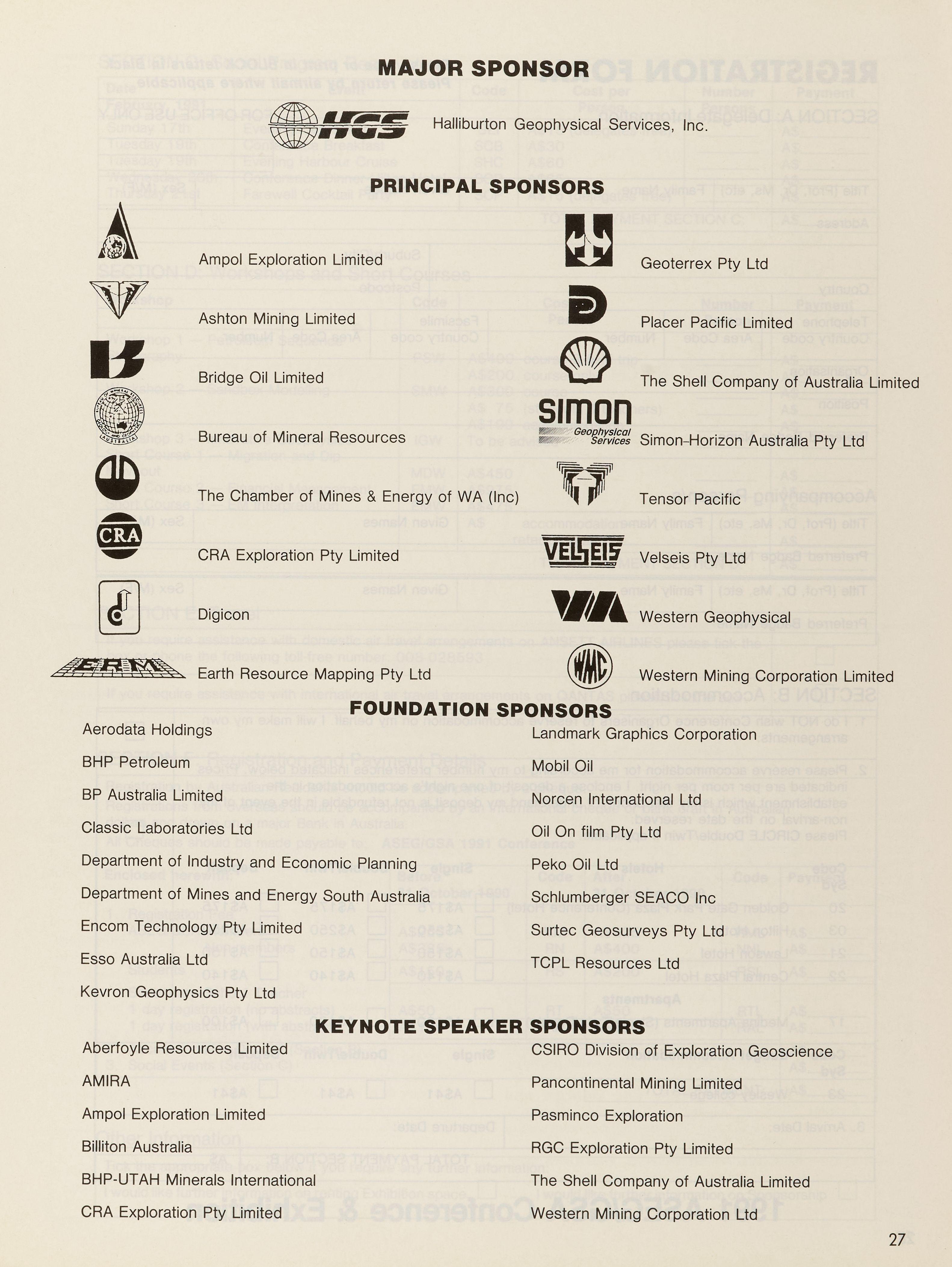
Geoterrex Pty Ltd
Placer Pacific Limited
The Shell Company of Australia Limited
Geo{lhys/cat Services Simon-Horizon Australia Pty Ltd
Tensor Pacific
Velseis Pty Ltd
Western Geophysical
Department of Industry and Economic Planning
Department of Mines and Energy South Australia
Encom Technology Pty Limited
Esso Australia Ltd
Kevron Geophysics Pty Ltd
Aberfoyle Resources Limited
AMIRA
Ampol Exploration Limited
Billiton Australia
BHP-UTAH Minerals International
CRA Exploration Pty Limited
Western Mining Corporation Limited
Landmark Graphics Corporation
Mobil Oil
Noreen International Ltd
Oil On film Pty Ltd
Peko Oil Ltd
Schlumberger SEAGO Inc
Surtec Geosurveys Pty Ltd
TCPL Resources Ltd
CSIRO Division of Exploration Geoscience
Pancontinental Mining Limited
Pasminco Exploration
RGC Exploration Pty Limited
The Shell Company of Australia Limited
Western Mining Corporation Ltd
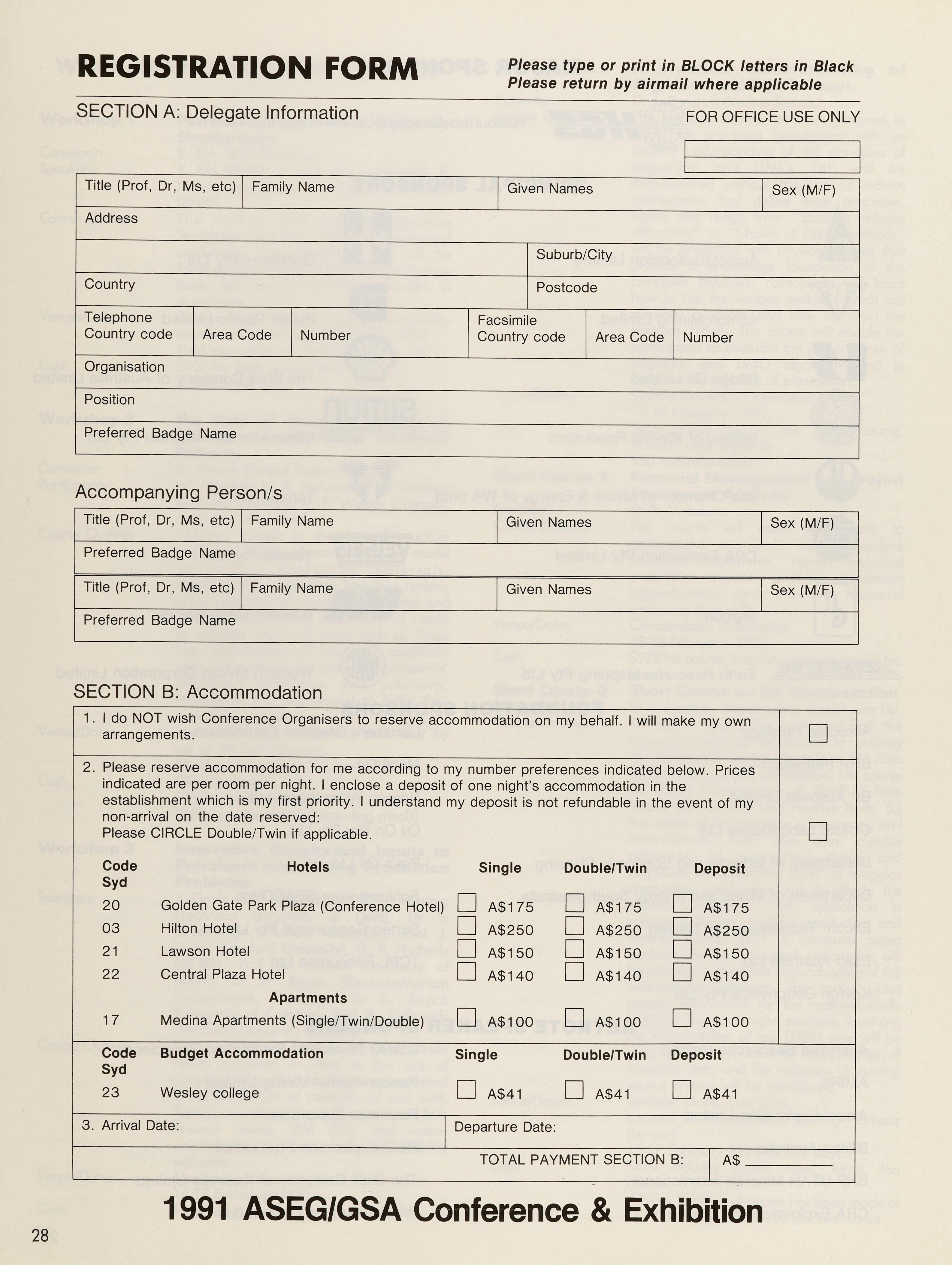
Please type or print in BLOCK letters in Black
Please return by airmail where applicable
Title (Prof , Dr , Ms , etc) J Family Name J Given Names
Address
Suburb / City Country Postcode
Telepho ne Facsimile Country code Area Code Number Country code Area Code Number
Organisation
Positi o n
Preferred Badge Name
Accompanying Person/s
Title (Prof , Dr , Ms, etc) I Fam ily Name I Given Names
Preferred Badge Name
Title (Prof , Dr , Ms, etc) J Family Name J Given Names
Preferred Badge Name
1 . I do NOT wish Conferen ce Organisers t o re se rve accommodation on my beha lf. I will make my own arrangements
2 Please reserve accommodation for me according to my number preferences indicated below Prices indicated are per room per night. I enclose a deposit of one night's accommodation in the establishment which is my first priority. I understand my deposit is not refundable in the event of my non-arrival on the date reserved: Please CIRCLE Double / Twin if applicable.
Date Event Code
February, 1991
Sun day 17th Eve ning Ic e break e r SEI
Tue s day 1 9th Conference Breakfas t SCB
Tuesda y 1 9th Evening Harb o ur Cruise SHC
Wedne s day 20th Conferen c e Dinner-Hilt o n Ho tel
Thursday 21 st Farewell Cocktail Party
Wo rkshop 1 - Petro leum Sequence
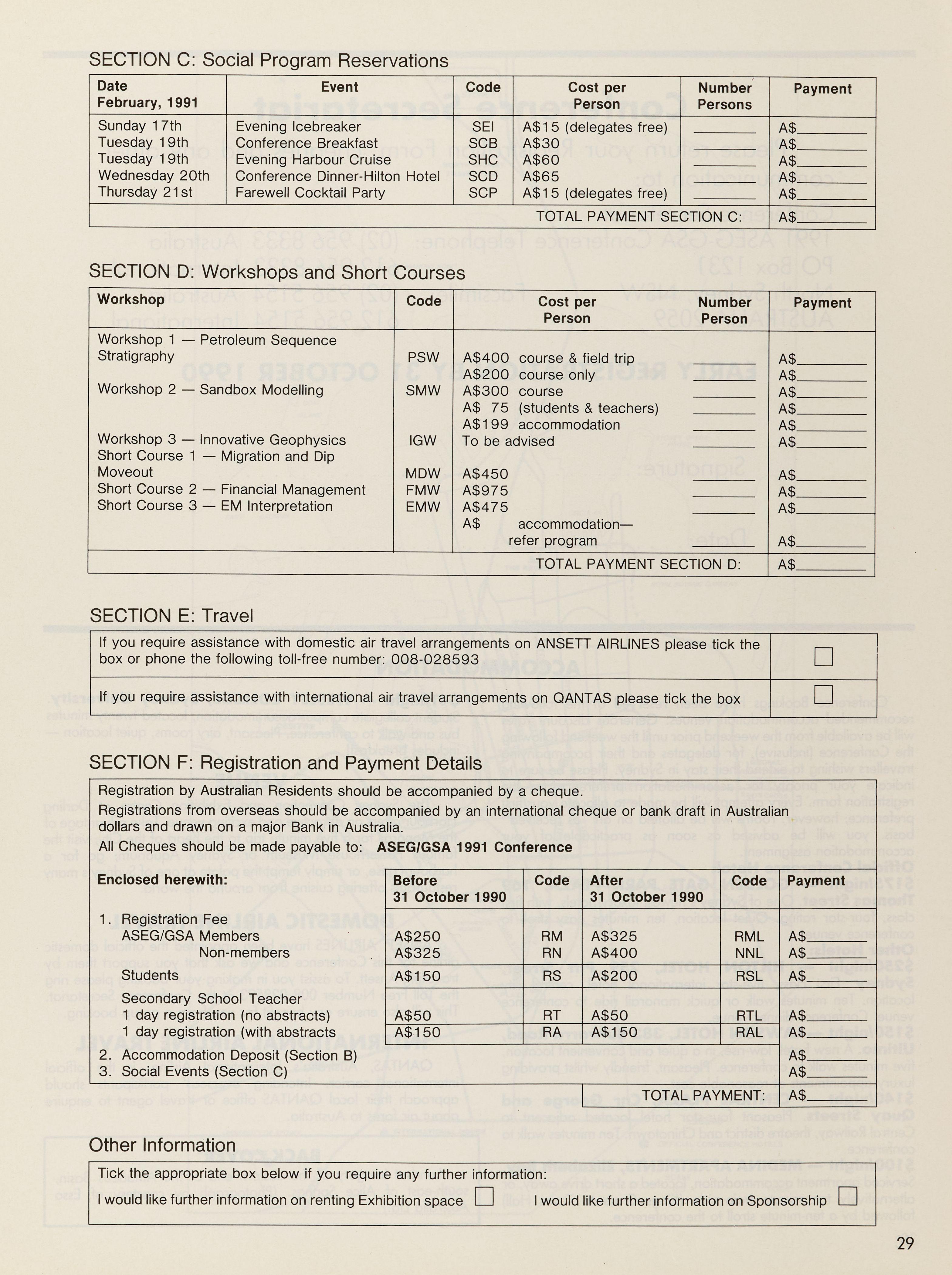
30
0
(d e le gate s fr e e)
A$1 5 (del e gates fre e ) TOTAL PAYMENT SECTION C :
Stratigraphy PSW A$40 0 co urs e & field trip A$2 00 c ourse o nly
Wo rkshop 2 - Sandb o x Modelling SMW A$ 3 00 c o urse A$ 75 (s tudent s & teachers) A$199 ac commodation
Worksh o p 3 - Innovative Geoph ys ics IGW To be advised
Short Co urse 1 - Migration and Dip
Mov eo ut
MOW A$450
Short Course 2 - Financial Management FMW A$975
Short Course 3 - EM Interpretation EMW A$475 A$ acc omm o
If you require assistance with dome s tic air travel arrangements on ANSETT AIRLINES please tick the box or phone the following toll-free number: 008-028593
If y o u require assistan c e with international air travel arrangements o n QANTAS please tick the bo x
SECTION F: Registration and Payment Details
Registrations from overseas should be accompanied by an international cheque or bank draft in Australian dollars and drawn on a major Bank in Australia. All Cheques should be made payable to: ASEG/GSA 1991 Conference
School Teach er
Other Information
Please return your Registration Form, cheques and any other communication to:
Conference Secretariat
1991 ASEG-GSA Conference Telephone : (02) 956 8333 612 956 8333 (02) 956 5154 6129565154 Australia International Australia International PO Box 1231 North Sydney, NSW AUSTRALIA 2059
Facsimile:
Signature:
Date:
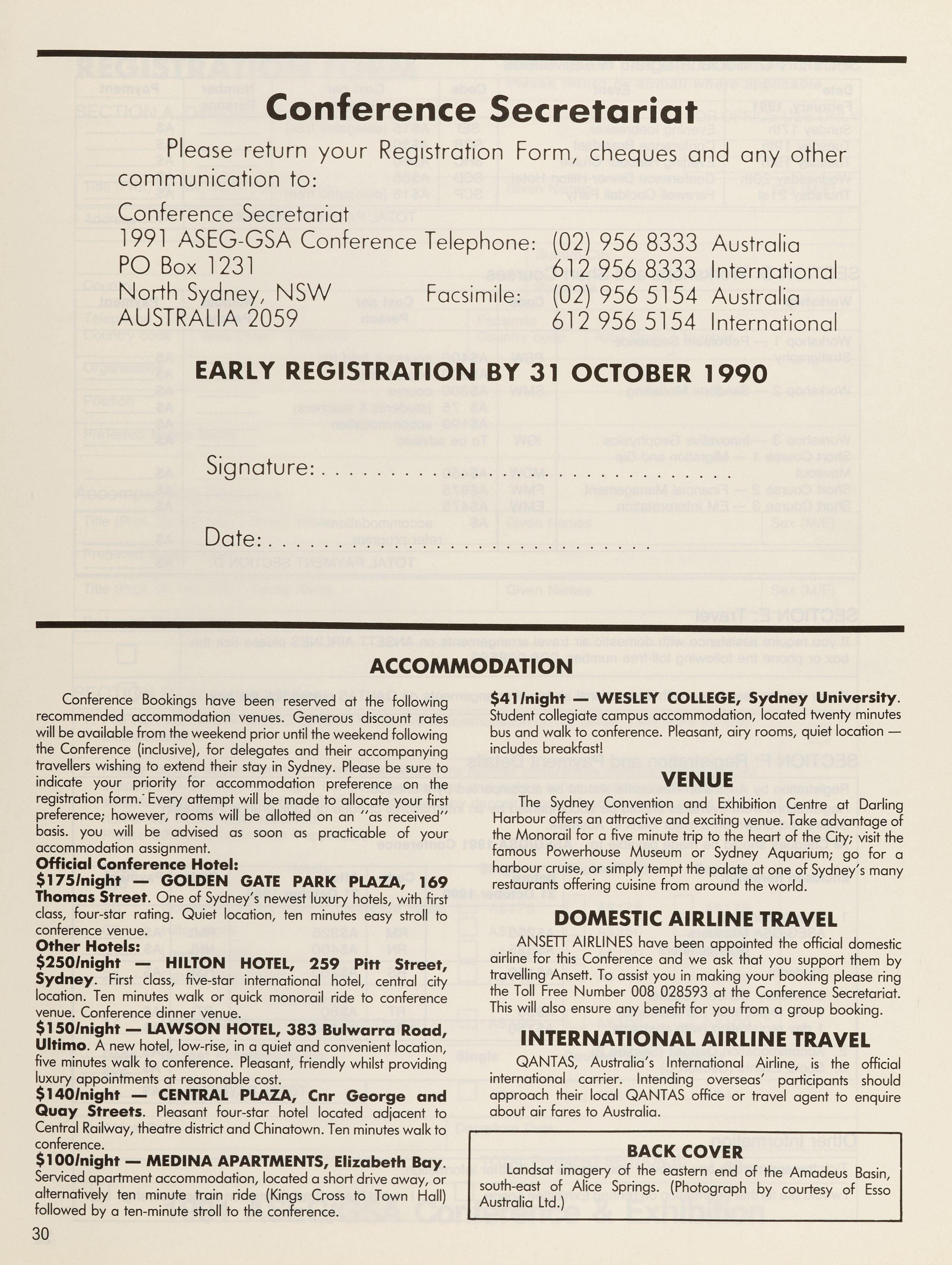
Conference Bookings have been reserved at the following recommended accommodation venues. Generous discount rates will be available from the weekend prior until the weekend following the Conference (inclusive), for delegates and their accompanying travellers wishing to extend their stay in Sydney. Please be sure to indicate your priority for accommodation preference on the registration form.- Every attempt will be made to allocate your first preference; however, rooms will be allotted on an "as received" basis. you will be advised as soon as practicable of your accommodation assignment.
Official Conference Hotel:
$175/night - GOLDEN GATE PARK PLAZA, 169 Thomas Street. One of Sydney's newest luxury hotels, with first class, four-star rating. Quiet location, ten minutes easy stroll to conference venue.
Other Hotels:
$250/night - HILTON HOTEL, 259 Pitt Street, Sydney. First class, five-star international hotel, central city location. Ten minutes walk or quick monorail ride to conference venue. Conference dinner venue.
$1 SO/night - LAWSON HOTEL, 383 Bulwarra Road, Ultimo. A new hotel, low-rise, in a quiet and convenient location, five minutes walk to conference. Pleasant, friendly whilst providing luxury appointments at reasonable cost.
$140/night - CENTRAL PLAZA, Cnr George and Quay Streets. Pleasant four-star hotel located adjacent to Central Railway, theatre district and Chinatown.Ten minutes walk to conference.
$100/night - MEDINA APARTMENTS, Elizabeth Bay. Serviced apartment accommodation, located a short drive away, or alternatively ten minute train ride (Kings Cross to Town Hall) followed by a ten-minute stroll to the conference.
$41 /night - WESLEY COLLEGE, Sydney Unive~sity. Student collegiate campus accommodation, located twenty minutes bus and walk to conference. Pleasant, airy rooms, quiet locationincludes breakfast!
The Sydney Convention and Exhibition Centre at Darling Harbour offers an attractive and exciting venue Take advantage of the Monorail for a five minute trip to the heart of the City; visit the famous Powerhouse Museum or Sydney Aquarium; go for a harbour cruise, or simply tempt the palate at one of Sydney's many restaurants offering cuisine from around the world.
ANSETT AIRLINES have been appointed the official domestic airline for this Conference and we ask that you support them by travelling Ansett To assist you in making your booking please ring the Toll Free Number 008 028593 at the Conference Secretariat. This will also ensure any benefit for you from a group booking .
QANTAS, Australia's International Airline, is the official international carrier. Intending overseas' participants should approach their local QANTAS office or travel agent to enquire about air fares to Australia.
Landsat imagery of the eastern end of the Amadeus Bas in , south-east of Alice Springs. (Photograph by courtesy of Esso Australia Ltd.)
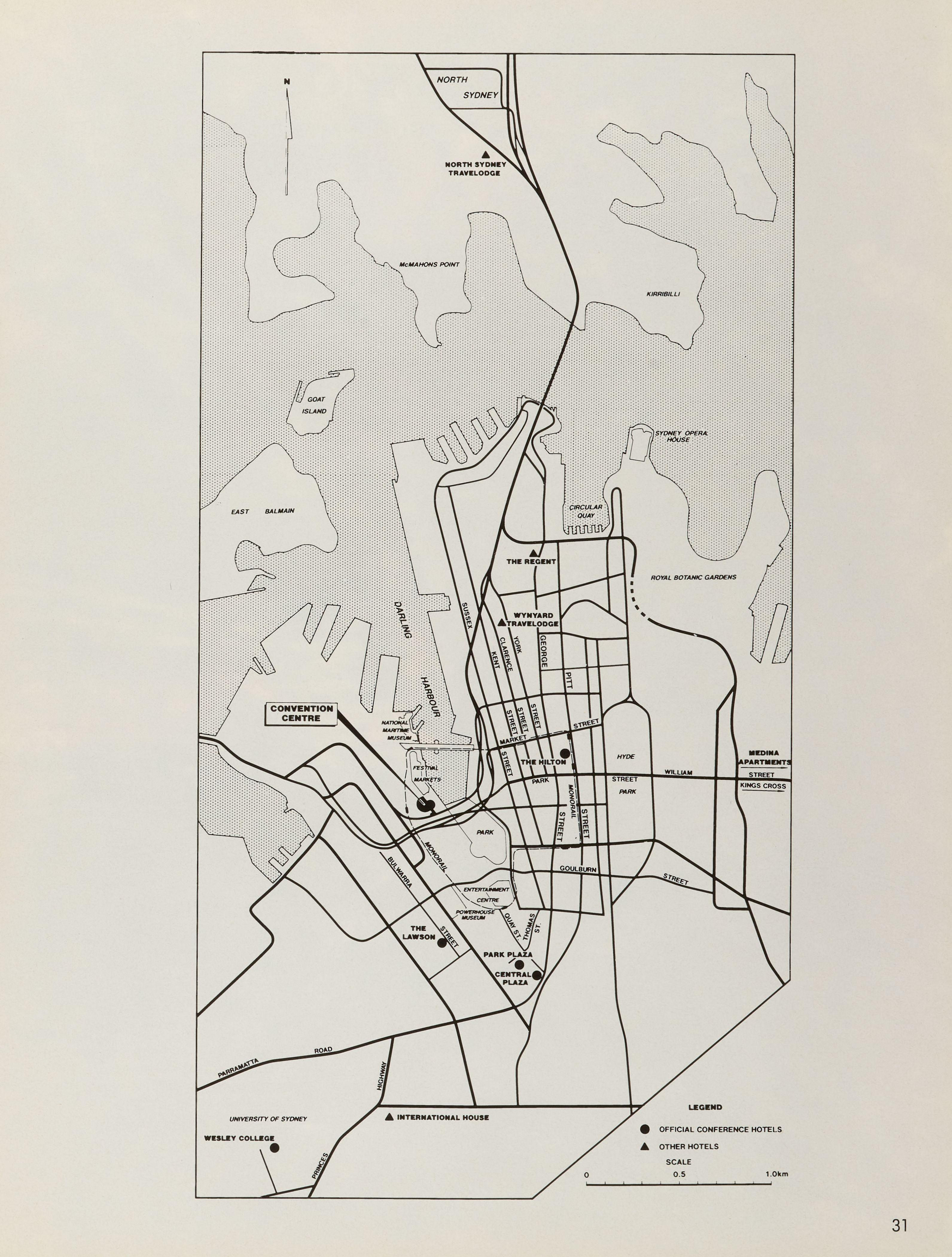
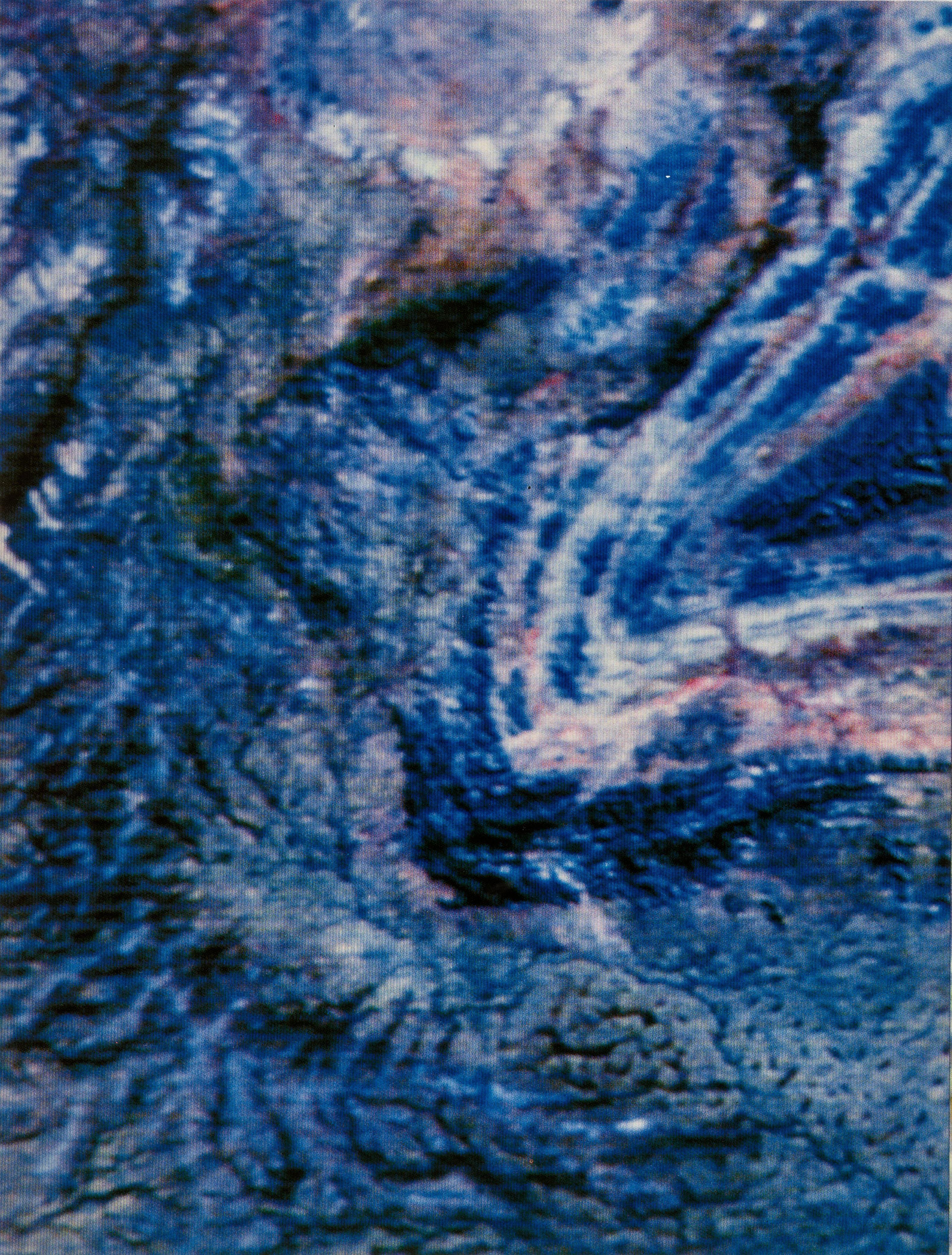
6-10 April, 1992, University of Karlsruhe, FRG, Germany
Sponsored by the International Research and Training Centre on Erosion and Sedimentation (/RTCES) and the International Association for Hydraulic Research (/AHR)
The International Symposium on River Sedimentation (ISRS) to be held in Karlsruhe in the spring of 1992 will be the 5th in a highly successful series of Symposia. The series was initiated by the International Research and Training Centre on Erosion and Sedimentation (IRTCES) and held in Beijing, China, in 1980. In a three year sequence followed symposia in Nanjing, China; Jackson, Mississippi, USA and again in Beijing in 1989. Each ISRS resulted in valuable, comprehensive proceedings and a significant exchange on the personal level.
The aim of the 5th ISRS is to provide a forum for scholars, researchers and practitioners to exchange ideas and the information on the broad subject "Sediment Management". In order to extend the theme to encompass environmental impact of sediments carrying e g. heavy metals, a topic "sediment quality" has been incorporated.
Theme
SEDIMENT MANAGEMENT" was selected to be the theme of the 5th ISRS and to contain the following preliminary topics:
• Sediment management in reservoirs
• Modelling methodologies: physical and mathematical
• River morphology and its management
• Strongly graded bed materials and armouring
• Hydraulic structures: scouring and deposition control
• Environmental aspects of sediment management
• Sediment quality and its measurement
5th ISRS
TRL
Universitat Karlsruhe
D-7500 Karlsruhe
FDR Germany
8-11 July, 1991
Perth WA
Supported by IAGOD-Commission on Ore Deposits in Mafic and Ultramafic Rocks
Location and Date
The Sixth International Platinum Symposium will be convened at the University of Western Australia, Perth, Western Australia from July 8 to 11, 1991. The Symposium is supported by the IAGOD Commission on Ore Deposits in the Mafic and Ultramafic rocks.
Scientific Programme
The Symposium will address the geology, mineralogy and geochemistry of Platinum Group Element deposits, their exploration and exploitation.
Delegates may reserve accommodation at the University (guest rooms or student rooms are available) or at nearby hotels.
A post-symposium field excursion will visit several important PGE occurrences, layered mafic complexes, komatiite lavas, and magmatic ore deposits throughout Western Australia.
Contributions for oral presentation or poster display are invited to cover the fields of petrology (descriptive, experimental), mineralogy, geochemistry, ore genesis exploration and metallurgy. Oral presentations will be limited to 20 minutes and all contributions must be made in English. Abstract instructions will be included in the second circular. An abstracts volume will be compiled for the Symposium; papers for publication must be submitted at the time of the Symposium.
Dr R.E.T. Hill
Sixth Platinum Symposium
CSIRO Private Bag PO Wembley, WA 6014
2-5 October, 1990
Mt Isa, Queensland
The North-West Queensland Branch of the Australasian Institute of Mining and Metallurgy is to conduct a conference specifically designed for mine geologists and geological managers. The conference will provide the venue for the presentation and discussion of practical aspects of mine geology and will include addresses by the following distinguished guests:
Conference Opening Address - Sir Bruce Watson, Chairman and Chief Executive Officer, MIM Conference Keynote Address - Dr Max Richards, Managing Director, Aberfoyle Ltd
Conference Dinner Guest Speaker - Mr Trevor Sykes, Editor-in-Chief, Australian Business
TECHNICAL PAPERS
Data Collection and Processing
Mapping and logging practices at Hellyer Mine. R. Downs
Underground downhole geophysics at CSA Mine Cobar. A Doe, J. Carswell, C. Smith, M. Erickson
Deephole directional drilling. T. Brown and P. Mullens
Computer aided core logging at Broken Hill. I. Cook
Close range photogrammetric mapping of open pit mine wall failures. C. Orr and R. Campbell
Application of geology in underground mining at Norseman. G. Hopkins and K. Johnson
Ground support in strongly faulted rocks at Woodlawn Mines NSW. M. Bouffler
Short term mine management system for open pit iron ore mines. G. Feitz
The basement contact fault at Mount Isa Its influence on mine design planning. M. Brook and M. Struthers
Computer applications at Hellyer. G. McArthur
State of the art geology for mining - Mt Newman. S. Kale
Grade control and ore accounting practice at Hellyer Mine. H. Kirth and A. Kuipers
Slope design and grade control at Olympic Dam, South Australia. R. Watt
Metal allocation and grade control at Kambalda - A multi ore source operation. S. Cowles
Effective low cost grade control at Toms' Gully Mine NT. R. Crookes and S. Hitchman
Grade control for gold mining at Mt Magnet, Reedy, Rothsay and Youanmi in the Murchison District WA. W. Shaw
Grade distribution and ground control procedures, Great Lady Gold Deposit, Eastern Goldfields WA. S. Devlin
Geotechnical studies for open pit- mines - West Australian operating experience. C. Swindells
Metal zoning and ore reserve modelling in the Elura Deposit. I. Kelso, K. Lawrie, T. Leschke
Rosebury - Ore reserve estimation, past and present. J. Farquhar
Ore reserves at Renison the old and the new. C. Cannard
Mining geology for lead-zinc ore bodies at Mount Isa. S. Bartrop, D. Sims, A. Ryan
Tonnes, grade and economics - The ZC Mine experience 1985-88. D. MacKenzie
G eology and ore reserve estimation at Renco Mine, Zimbabwe. M. Armitage
Geological modelling for geostatistical ore reserve estimates, Porgera. J. Porterfield
General
The Fitzpatrick Orebody Broken Hill -A case history. J. Hinde and C. Wood
Copper mineral bulk analyser. P. Dietrich
Twenty five million tons of ore and ten metres of rain. P. Jones and A. Maconachie
A small reef mine in the Hodgkinson Basin. R. Stagg Geological and geotechnical applications to coal mining in Newlands - Eastern Creek Coalfield. S. Peou
Conference Tours
Isa Mine Copper Orebodies
Surface Geology - Mount Isa
Isa Mine Silver/Lead/Zinc Orebodies
Isa Mine Core Shed Display
Hilton Silver/Lead/Zinc Orebodies
Integrated Mine Planning System
Selwyn Mine - Cyprus Gold
Post Conference Tour
Thalanga - Pan Continental Mining
Ravenswood - Carpentaria Gold
Pajingo - Battle Mountain Australia
Mt Leyshon - Pan Australia Mining
Peter Dietrich Conference Secretary Mine Geologists Conference P.O. Box 567
Mount Isa, Qld 4825
Tel:(077)44 2417; Fax:(077)43 9858
29 August - 3 September, 1992, Kyoto, Japan
For first circular and details: IGC-92 Office PO Box 65, Tsukuba lbaraki 305, Japan
11TH AUSTRALIAN GEOLOGICAL CONVENTION
EARTH SCIENCES, COMPUTERS AND THE ENVIRONMENT
The 11 th Australian Geological Convention will be held in the historic goldmining centre of Ballarat between 20th-24th January, 1992.
Specialist groups of the Geological Society of Australia are organising symposia around the convention's theme of Earth Sciences, Computers and the Environment. Presentations not directly related to the official theme will also be welcome. Papers may be presented orally or as posters.
Symposia titles will fall in the following broad groupings:
1. Computer applications in the earth sciences, eg remote sensing; image processing.
2. Environmental geology, eg environmental considerations in engineering geology; prediction and reduction of geological hazards.
3. General geology, eg palaeontology, regional geology, volcanology, economic geology
We invite you to submit the title of your intended presentation. Please complete the form below and send to:
Bloomsbury Conference Services Pty Ltd, 232 Bridge Road, Richmond, Victoria 3121.
You will subsequently be advised of when to submit abstracts.
Name Dr/Mr/Ms
Address
Postcode
Phone ( )
Oral /Poster presentation (please circle one)
Title
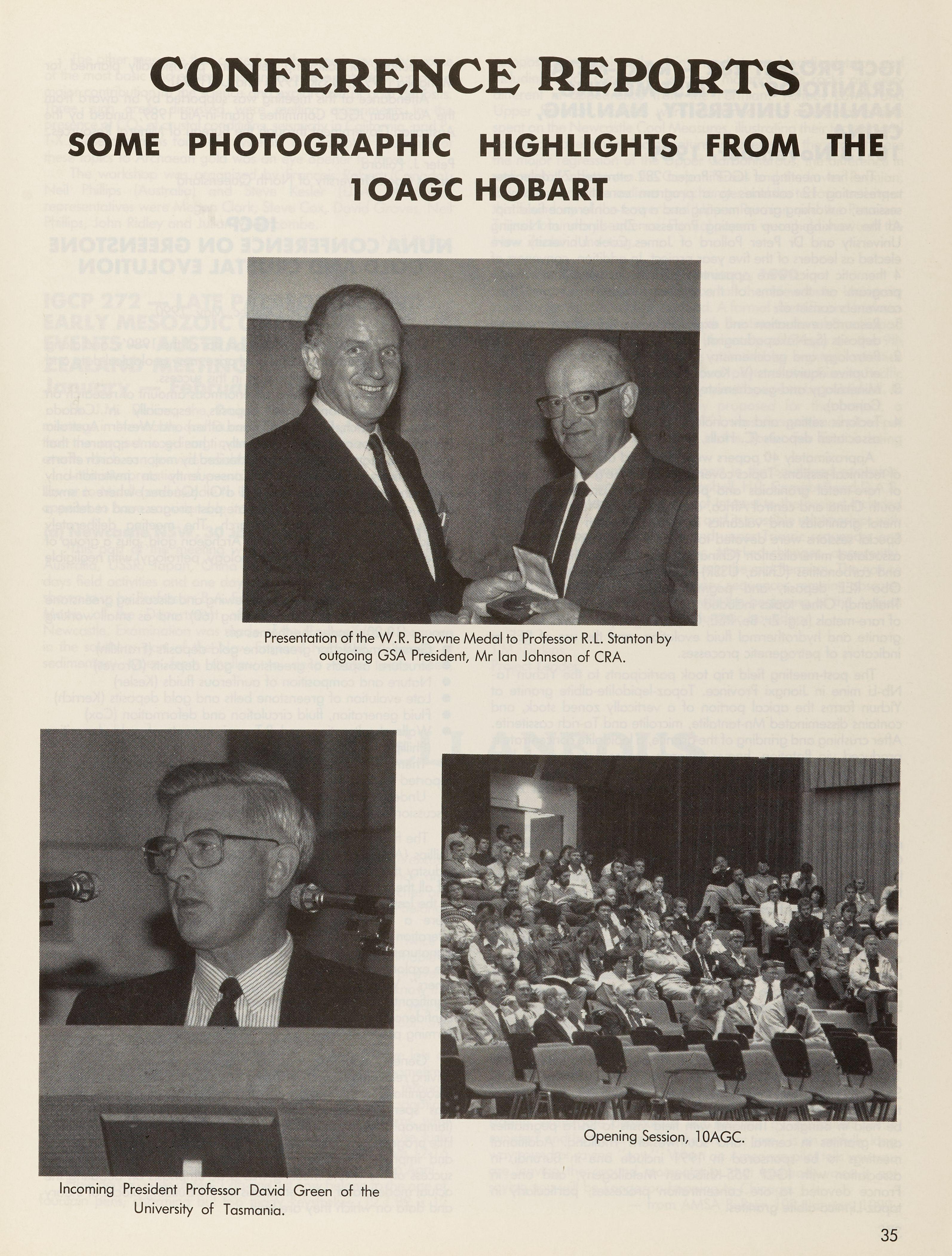
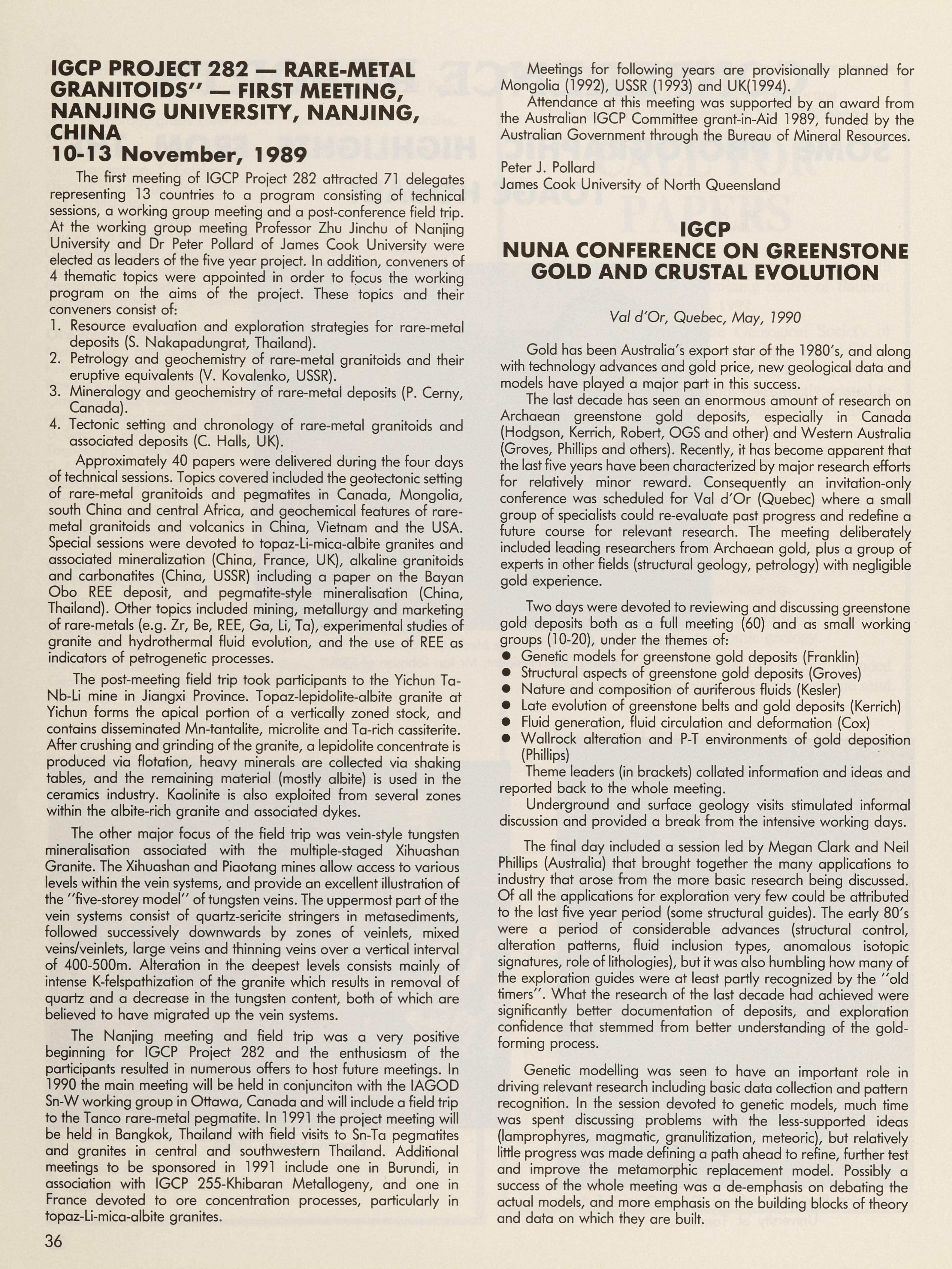
10-13 November, 1989
The first meeting of IGCP Project 282 attracted 71 delegates representing 13 countries to a program consisting of technical sessions, a working group meeting and a post-conference field trip. At the working group meeting Professor Zhu Jinchu of Nanjing University and Dr Peter Pollard of James Cook University were elected as leaders of the five year project. In addition, conveners of 4 thematic topics were appointed in order to f9cus the working program on the aims of the project. These topics and their conveners consist of:
1. Resource evaluation and exploration strategies for rare-metal deposits (S. Nakapadungrat, Thailand).
2. Petrology and geochemistry of rare-metal granitoids and their eruptive equivalents {V. Kovalenko, USSR).
3. Mineralogy and geochemistry of rare-metal deposits (P. Cerny, Canada).
4. Tectonic setting and chronology of rare-metal granitoids and associated deposits (C. Halls, UK):
Approximately 40 papers were delivered during the four days of technical sessions. Tepics covered included the geotectonic setting of rare-metal granitoids and pegmatites in Canada, Mongolia, south China and central Africa, and geochemical features of raremetal granitoids and volcanics in China, Vietnam and the USA. Special sessions were devoted to topaz-Li-mica-albite granites and associated mineralization (China, France, UK), alkaline granitoids and carbonatites (China, USSR) including a paper on the Bayon Obo REE deposit, and pegmatite-style mineralisation (China, Thailand). Other topics included mining, metallurgy and marketing of rare-metals (e.g. Zr, Be, REE, Ga, Li, Ta), experimental studies of granite and hydrothermal fluid evolution, and the use of REE as indicators of petrogenetic processes.
The post-meeting field trip took participants to the Yichun TaNb-Li mine in Jiangxi Province. Topaz-lepidolite-albite granite at Yichun forms the apical portion of a vertically zoned stock, and contains disseminated Mn-tantalite, microlite and Ta-rich cassiterite After crushing and grinding of the granite, a lepidolite concentrate is produced via flotation, heavy minerals are collected via shaking tables, and the remaining material (mostly albite) is used in the ceramics industry. Kaolinite is also exploited from several zones within the albite-rich granite and associated dykes.
The other major focus of the field trip was vein-style tungsten mineralisation associated with the multiple-staged Xihuashan Granite. The Xihuashan and Piaotang mines allow access to various levels within the vein systems, and provide an excellent illustration of the "five-storey model" of tungsten veins. The uppermost part of the vein systems consist of quartz-sericite stringers in metasediments, followed successively downwards by zones of veinlets, mixed veins/veinlets, large veins and thinning veins over a vertical interval of 400-S0Om. Alteration in the deepest levels consists mainly of intense K-felspathization of the granite which results in removal of quartz and a decrease in the tungsten content, both of which are believed to have migrated up the vein systems.
The Nanjing meeting and field trip was a very positive beginning for IGCP Project 282 and the enthusiasm of the participants resulted in numerous offers to host future meetings. In 1990 the main meeting will be held in conjunciton with the IAGOD Sn-W working group in Ottawa, Canada and will include a field trip to the Tanco rare-metal pegmatite. In 1991 the project meeting will be held in Bangkok, Thailand with field visits to Sn-Ta pegmatites and granites in central and southwestern Thailand. Additional meetings to be sponsored in 1991 include one in Burundi, in association with IGCP 255-Khibaran Metallogeny, and one in France devoted to ore concentration processes, particularly in topaz-Li-mica-albite granites.
Meetings for following years are provisionally planned for Mongolia (1992), USSR (1993) and UK(l 994)
Attendance at this meeting was supported by an award from the Australian IGCP Committee grant-in-Aid 1989, funded by the Australian Government through the Bureau of Mineral Resources.
Peter J. Pollard
James Cook University of North Queensland
Val d'Or, Quebec, May, 1990
Gold has been Australia's export star of the 1980' s, and along with technology advances and gold price, new geological data and models have played a major part in this success.
The last decade has seen an enormous amount of research on Archaean greenstone gold deposits, especially in Canada (Hodgson, Kerrich, Robert, OGS and other) and Western Australia (Groves, Phillips and others) Recently, it has become apparent that the last five years have been characterized by major research efforts for relatively minor reward. Consequently an invitation-only conference was scheduled for Val d'Or (Quebec) where a small group of specialists could re-evaluate past progress and redefine a future course for relevant research. The meeting deliberately included leading researchers from Archaean gold, plus a group of experts in other fields (structural geology, petrology) with negligible gold experience.
Two days were devoted to reviewing and discussing greenstone gold deposits both as a full meeting (60) and as small working groups (10-20), under the themes of:
• Genetic models for greenstone gold deposits (Franklin)
• Structural aspects of greenstone gold deposits (Groves)
• Nature and composition of auriferous fluids (Kesler)
• Late evolution of greenstone belts and gold deposits (Kerrich)
• Fluid generation, fluid circulation and deformation (Cox)
• Wallrock alteration and P-T environments of gold deposition (Phillips)
Theme leaders (in brackets) collated information and ideas and reported back to the whole meeting.
Underground and surface geology visits stimulated informal discussion and provided a break from the intensive working days.
The final day included a session led by Megan Clark and Neil Phillips (Australia) that brought together the many applications to industry that arose from the more basic research being discussed. Of all the applications for exploration very few could be attributed to the last five year period (some structural guides). The early 80's were a period of considerable advances (structural control, alteration patterns, fluid inclusion types, anomalous isotopic signatures, role of lithologies), but it was also humbling how many of the exploration guides were at least partly recognized by the "old timers". What the research of the last decade had achieved were significantly better documentation of deposits, and exploration confidence that stemmed from better understanding of the goldforming process.
Genetic modelling was seen to have an important role in driving relevant research including basic data collection and pattern recognition. In the session devoted to genetic models, much time was spent discussing problems with the less-supported ideas {lamprophyres, magmatic, granulitization, meteoric), but relatively little progress was made defining a path ahead to refine, further test and improve the metamorphic replacement model. Possibly a success of the whole meeting was a de-emphasis on debating the actual models, and more emphasis on the building blocks of theory and data on which they are built.
The other message that came from the meeting was that some of the most basic and esoteric research had the potential to make a major contribution to the science and exploration of gold deposits. Three such areas discussed were melting experiments in the presence of CO2 at crustal conditions, seismicity in California, and PT-X phase diagrams for mafic systems. The potential relevance of these topics to Archaean gold was an eye opener to most.
The workshop was organized by Francois Robert (Canada), Neil Phillips (Australia) and Steve Kesler (USA). Australian representatives were Megan Clark, Steve Cox, David Groves, Neil Phillips, John Ridley and Julian Vearncombe.
Neil Phillips
January - February, 1990
Dr J.M. Dickins, the Project Leader, reports that project meetings in Newcastle and Dunedin were successful. He comments that the project is gaining momentum, and is concentrating on events which can provide reliable time control.
Little interpretation of events has been done previously on the Lower to Middle and Middle to Upper Triassic boundaries, and this appears to have considerable interest and value.
(a) Newcastle NSW, 30 January- 2 February, 1990
This part of the meeting was attended by 10 scientists from Australia, USSR, Japan, China and Thailand. It comprised three days field activities and one day discussion. The field geology was shown to us by Professors B.A. Engel, C.F.K. Diessel and Dr Noreen Morris of the Department of Geology of the University of Newcastle. Examination was made of the Carboniferous sequence in the southern part of the New England Fold Belt. A variety of sedimenta ry types from shallow to deep water were seen,
composed predominantly of intermediate and acidic detritus and including much pyroclastic volcanic material. The rocks are very different in appearance from the Permian. Various Lower and Upper Permian localities were examined and considerable time spent on the Newcastle Coal Measures, illustrating their tectonic and volcanic provenance. Main features of interest to the project were the major regression of the Upper Carboniferous, the difference in sedimentation between the Carboniferous and the Lower Permian, the character of the sedimentary changes and the tectonic activity at the boundary of the Lower and Upper Permian and the PermianTriassic boundary sequence. Formal papers were held over until the New Zealand meeting.
The group with the exception of the Newcastle University scientists moved on to New Zealand. A formal scientific and business meeting was held in association with the International Brachiopod Congress and sponsored by the University of Otago on the 9th February 1990. This meeting was attended by eighteen scientists from twelve countries from different parts of the Circum-Pacific region. Formal papers given at this meeting are to be published. In addition to the meetings already proposed for the project, a meeting in Thailand, probably in 1991, was discussed and plans put in hand. In addition, a meeting in the Soviet Far East is being considered.
IGCP participants then took part in the Southland excursion, 10-14 February, with Drs J.D. Campbell, H.J. Campbell and D.A.B. Macfarlane as leaders. Features of interest to the project included examination of the Upper Permian and its possible relationships with the Lower Permian, the Middle and upper Triassic sequences and their relationships with the Jurassic. Marked changes, apparently, associated with the ophiolites, occur in the mid-Permian. The nature of the Permian to Triassic boundary sequences remains obscure. Important events are associated with the beginning of the Anisian and the Camion and the Triassic-Jurassic boundary.
J.M. Dickins Project Leader
Nowadays you can't turn up late to a meeting with the excuse that your watch was slow; no one believes you. Science and technology have ensured even our $5 Mickey Mouse watches are dead accurate. But the language we use to talk about time belongs to a more leisurely period.
Bimonthly can mean either "every second month" or "twice a month". The word is beyond redemption (flammable/inflammable is another hopeless one). So write two-monthly or two weekly or every two months/weeks; don't use fortnight, as few Americans know it.
Biannual means "twice a year" (biennial "every two years), but it is suffering the same fate as bimonthly. Semi-annual, sixmonthly and every two years avoid the problem.
" until Monday" and "from 12 to 16 April" leave lots of latitude for misunderstanding. Crack of dawn Monday? Sometime Monday? Up to or including 16 April? The Americanism through (not, please, thru) is unambiguous and, I think, well worth adopting (since we uncritically adopt so many unlovely Americanisms, why not adopt something really useful?). The alternative is to use such phrases as, "We took five samples in all; one each day from 12-16 April" or "We took a sample a day for five days from 12-16 April."
How do you write dates? 12th and 1st now belong to the age of fountain pens; charming but too many keystrokes. 12.1.89 is 12
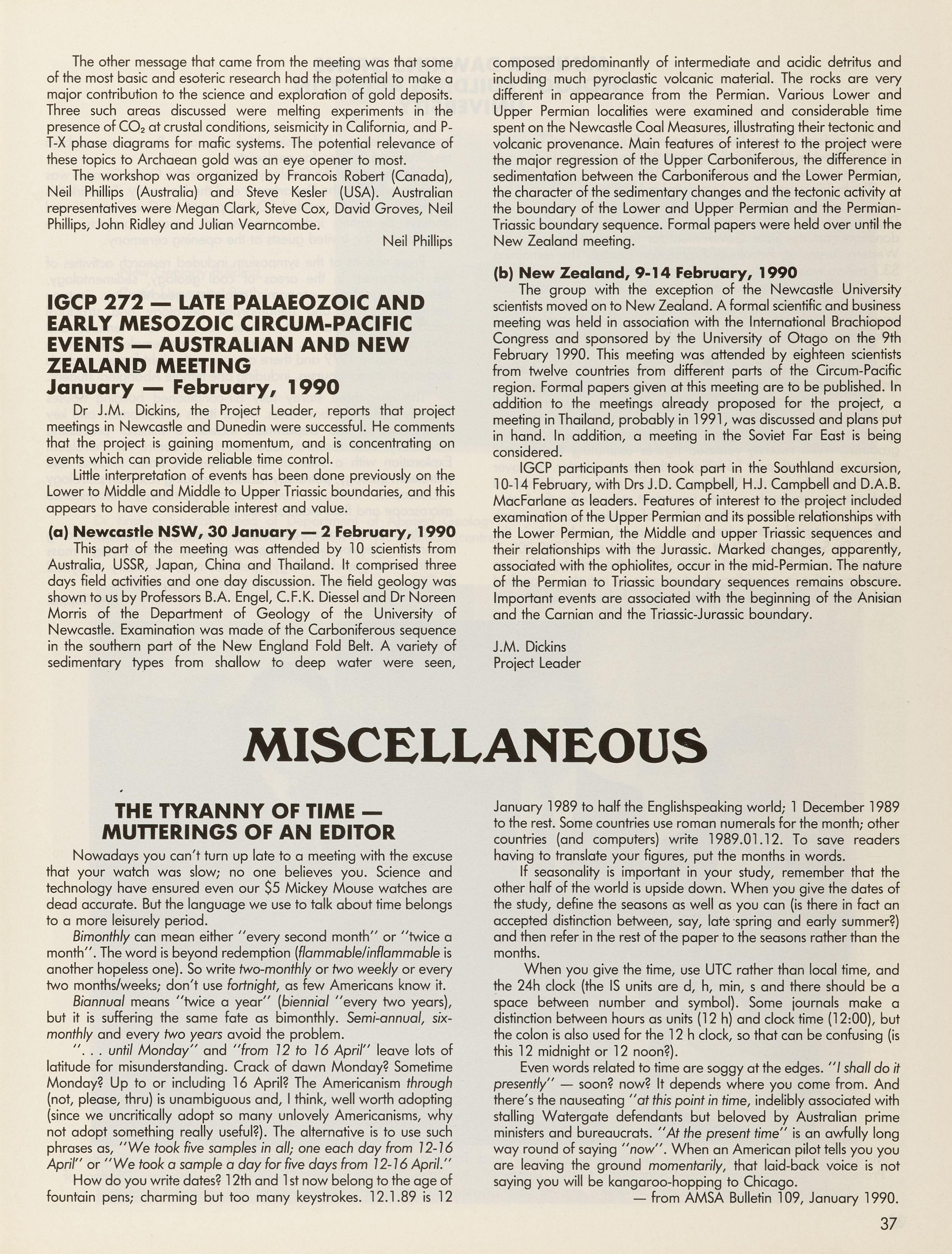
January 1989 to half the Englishspeaking world; 1 December 1989 to the rest. Some countries use roman numerals for the month; other countries (and computers) write 1989.01.12. To save readers having to translate your figures, put the months in words.
If seasonality is important in your study, remember that the other half of the world is upside down. When you give the dates of the study, define the seasons as well as you can (is there in fact an accepted distinction between, say, late ·spring and early summer?) and then refer in the rest of the paper to the seasons rather than the months.
When you give the time, use UTC rather than local time, and the 24h clock (the IS units are d, h, min, s and there should be a space between number and symbol). Some journals make a distinction between hours as units (12 h) and clock time (12:00), but the colon is also used for the 12 h clock, so that can be confusing (is this 12 midnight or 12 noon?).
Even words related to time are soggy at the edges. "/ shall do it presently" - soon? now? It depends where you come from. And there's the nauseating "at this point in time, indelibly associated with stalling Watergate defendants but beloved by Australian prime ministers and bureaucrats. "At the present time" is an awfully long way round of saying "now". When an American pilot tells you you are leaving the ground momentarily, that laid-back voice is not saying you will be kangaroo-hopping to Chicago.
- from AMSA Bulletin 109, January 1990.
The Federal Minister for Employment, Education and Training, Mr John Dawkins MP, officially opened the new geology building at Curtin University on Friday 15th June, 1990.
The building project was completed in 1988 at a total cost of just over $4 million," according to Dr Krishna Sappal, Head of the Department of Applied Geology. "This included a $550,000 donation from the State Government for the establishment of the Western Australian Petroleum Exploration Centre. The remaining $3.7 million was from the Federal Government."
With 25 students graduating a year, the University produces 50 percent of the State's geology graduates. Graduates are keenly sought by employers, many of them being offered positions well before they graduate.
The geology programs are unique in that they emphasize exploration and applied geology. Curtin is the only tertiary Institution in the State offering courses in petroleum geology.
The Department maintains very close links with the mineral industry through its Geology Advisory Committee so that the students meet the requirements of the industry as soon as they graduate. With recently released figures estimating the mineral industry to be worth over $6 billion in the March quarter, and over 40 percent of this is from Western Australia, professionally trained geologists are obviously a vitally important resource for the State.
Over the last l O years the number of academic and research staff and postgraduate students has increased considerably in the area," Dr Sappal said. "Last year we raised over $300,000 in external support for research projects from the industry. We are also very active in providing short courses to industry in applied geology and petroleum geology and in helping neighbouring
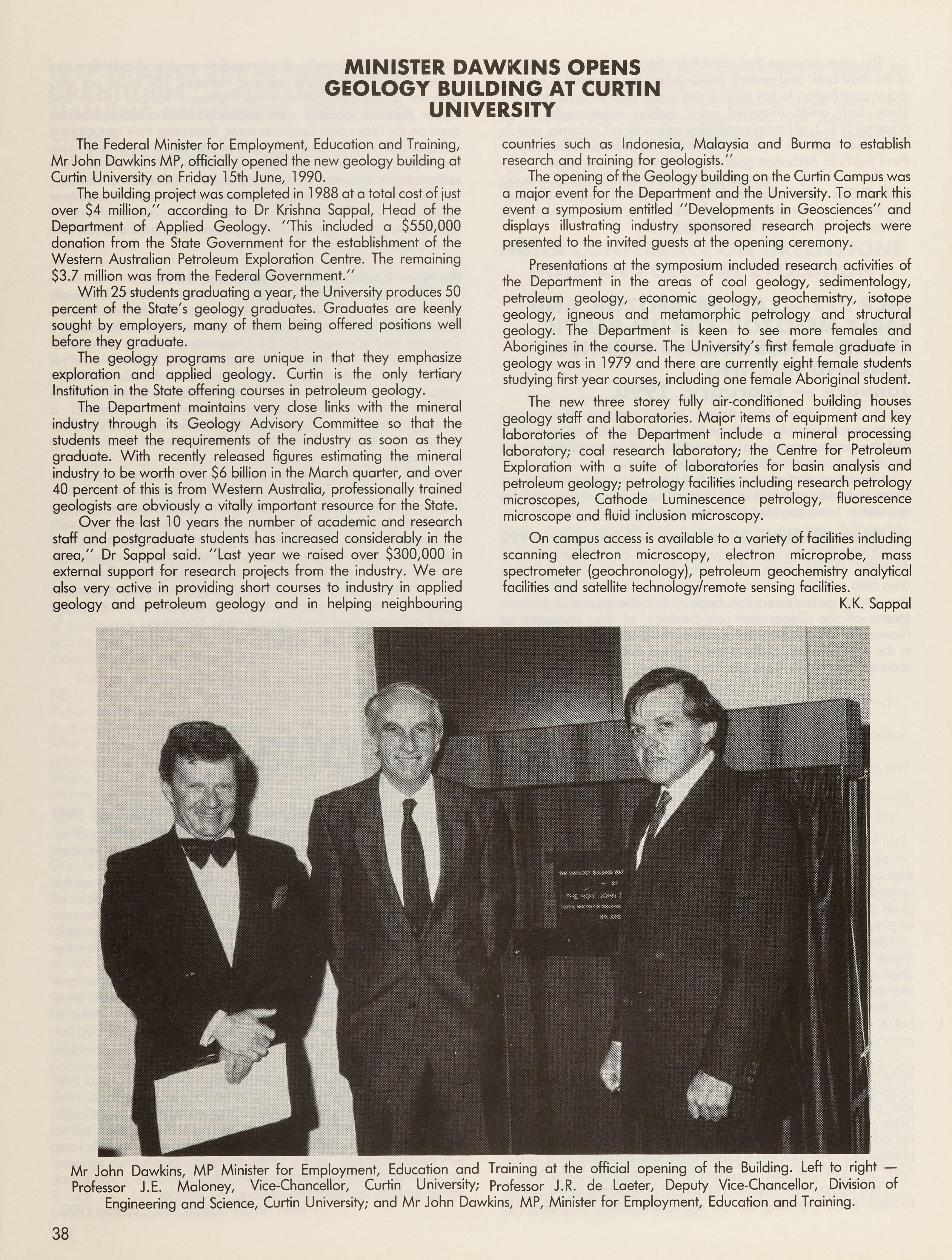
countries such as Indonesia, Malaysia and Burma to establish research and training for geologists."
The opening of the Geology building on the Curtin Campus was a major event for the Department and the University. To mark this event a symposium entitled "Developments in Geosciences" and displays illustrating industry sponsored research projects were presented to the invited guests at the opening ceremony.
Presentations at the symposium included research activities of the Department in the areas of coal geology, sedimentology, petroleum geology, economic geology, geochemistry, isotope geology, igneous and metamorphic petrology and structural geology. The Department is keen to see more females and Aborigines in the course. The University's first female graduate in geology was in 1979 and there are currently eight female students studying first year courses, including one female Aboriginal student.
The new three storey fully air-conditioned building houses geology staff and laboratories. Major items of equipment and key laboratories of the Department include a mineral processing laboratory; coal research laboratory; the Centre for Petroleum Exploration with a suite of laboratories for basin analysis and petroleum geology; petrology facilities including research petrology microscopes, Cathode Luminescence petrology, fluorescence microscope and fluid inclusion microscopy.
On campus access is available to a variety of facilities including scanning electron microscopy, electron microprobe, mass spectrometer (geochronology), petroleum geochemistry analytical facilities and satellite technology/remote sensing facilities.
New Geology Building, Curtin University, Perth.
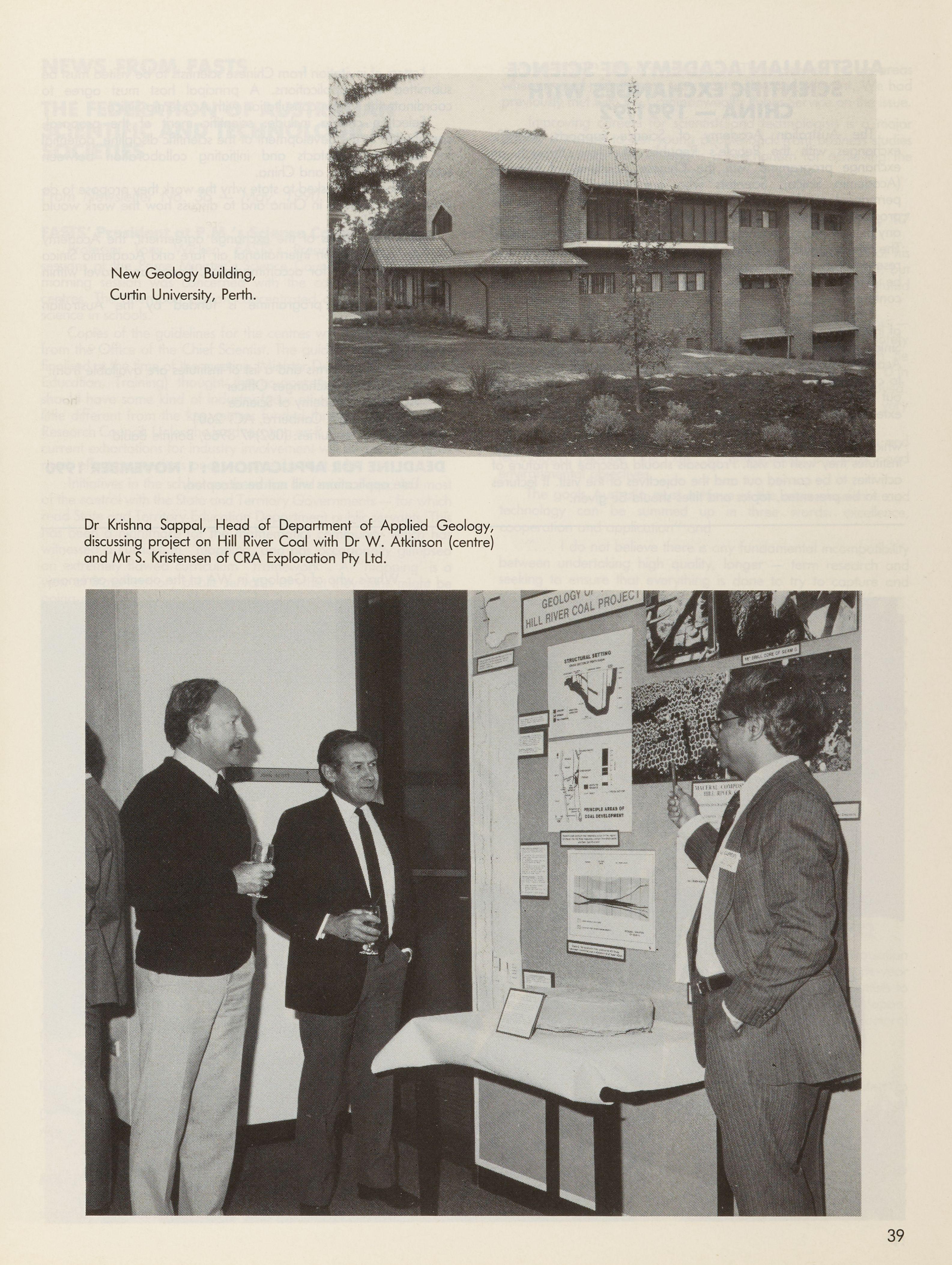
Dr Krishna Sappal, Head of Department of Applied Geology, discussing project on Hill River Coal with Dr W. Atkinson {centre} and Mr S. Kristensen of CRA Exploration Pty Ltd.
The Australian Academy of Science supports scientific exchanges with the People's Republic of China through an exchange programme with the Chinese Academy of Sciences (Academia Sinica). Scientists who are Australian citizens or permanent residents are invited to apply to participate in the programme between l July 1991 and 30 June 1992. Proposals in any field of natural science, basic and applied, will be considered. The primary purpose of the programme is to support collaborative research between Australian and Chinese scientists. Support will not be given when the primary purpose of the visit is to attend a conference.
Proposals must focus on visits to Academia Sinica institutes. A list of institutes is available from the Academy. Visits to non-Academia Sinica institutes are not encouraged and are subject to approval by Academia Sinica. Proposals may be for short-term visits (3 -6 weeks) to collaborate with Chinese scientists or longer-term visits to carry out more extensive research projects. Due to financial restrictions extensive travel and field surveys in China are difficult to arrange.
Applicants should propose a scientific programme or project, which has been developed in consultation with scientists in the institutes they wish to visit. Proposals should describe the nature of activities to be carried out and the objectives of the visit. If lectures are to be presented, topics and titles should be given.
Letters of invitation from Chinese scientists to be visited must be submitted with applications. A principal host must agree to coordinate the visit in consultation with Academia Sinica.
Selection criteria include: scientific merit of the proposal, contribution to the development of the scientific discipline, potential for expanding contacts and initiating collaboration between scholars of Australia and China.
Applicants are asked to state why the work they propose to do would best be done in China and to discuss how the work would benefit Australia.
Under the terms of the exchange agreement, the Academy provides an excursion international air fare and Academia Sinica arranges and pays for accommodation, board and travel within China.
The exchange programme is funded by the Australian Government.
Applications forms and a list of institutes are available from: International Exchanges Officer Australian Academy of Science GPO Box 783, Canberra, ACT 2601
Telephone enquiries: (062)47 3966, Bonnie Bauld
Late applications will not be accepted.
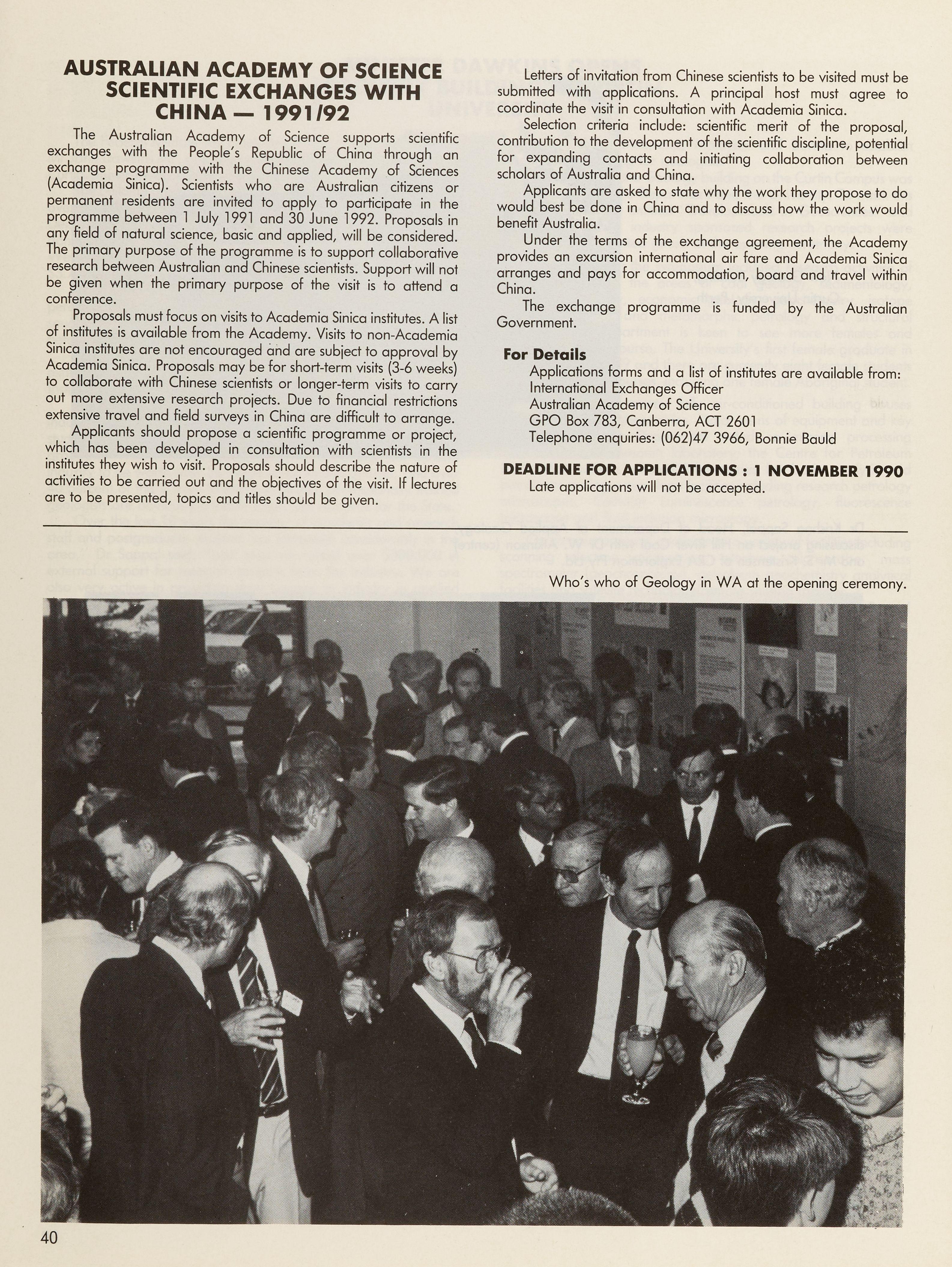
Who's who of Geology in WA at the opening ceremony.
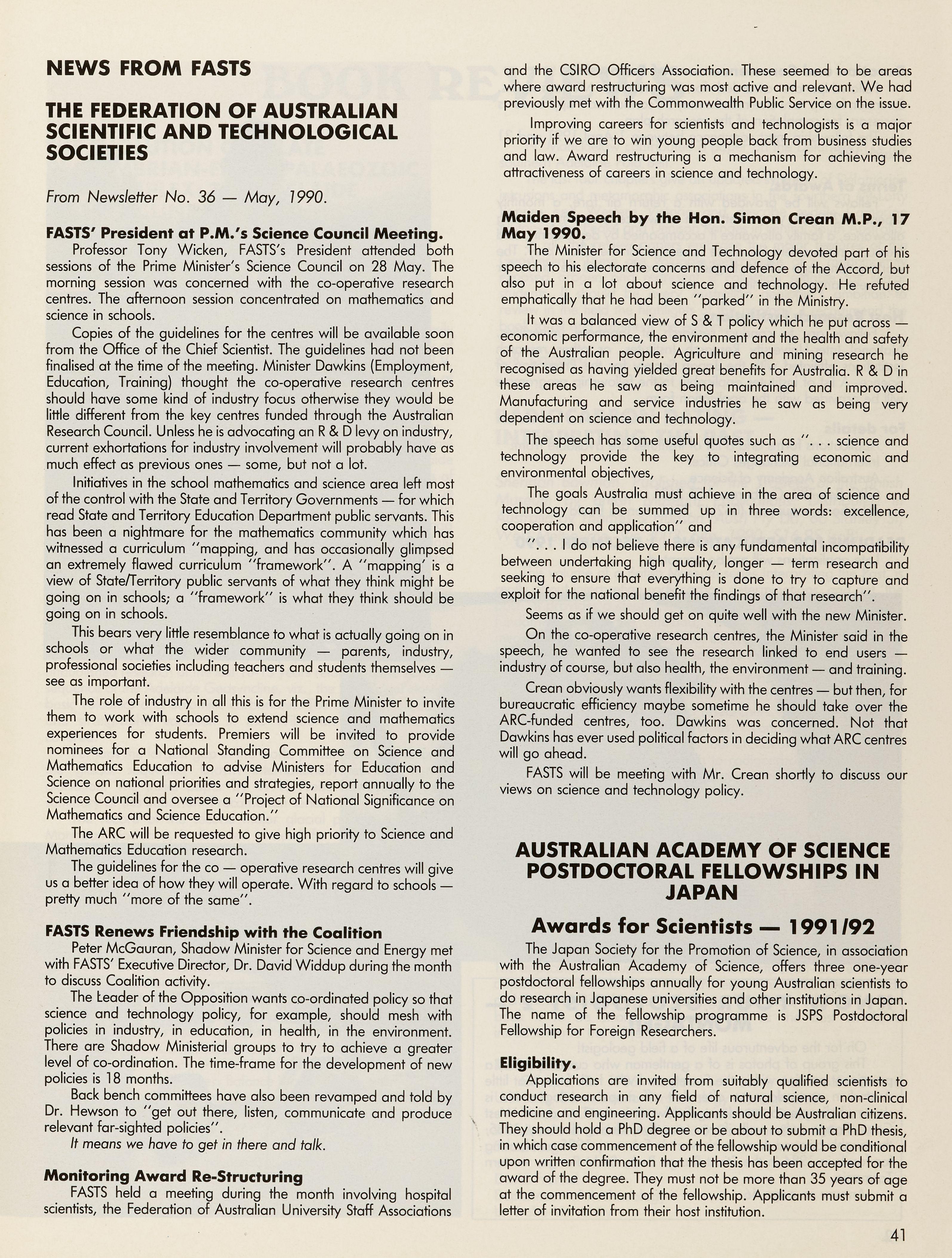
From Newsleffer No. 36 - May, 1990 .
FASTS' President at P.M.'s Science Council Meeting.
Professor Tony Wicken, FASTS's President attended both sessions of the Prime Minister's Science Council on 28 May The morning session was concerned with the co-operative research centres. The afternoon session concentrated on mathematics and science in schools.
Copies of the guidelines for the centres will be available soon from the Office of the Chief Scientist. The guidelines had not been finalised at the time of the meeting. Minister Dawkins (Employment, Education, Training) thought the co-operative research centres should have some kind of industry focus otherwise they would be little different from the key centres funded through the Australian Research Council. Unless he is advocating an R & D levy on industry, current exhortations for industry involvement will probably have as much effect as previous ones - some, but not a lot.
Initiatives in the school mathematics and science area left most of the control with the State and Territory Governments - for which read State and Territory Education Department public servants. This has been a nightmare for the mathematics community which has witnessed a curriculum "mapping, and has occasionally glimpsed an extremely flawed curriculum "framework" A "mapping' is a view of State/Territory public servants of what they think might be going on in schools; a "framework" is what they think should be going on in schools.
This bears very little resemblance to what is actually going on in schools or what the wider community - parents, industry, professional societies including teachers and students themselvessee as important.
The role of industry in all this is for the Prime Minister to invite them to work with schools to extend science and mathematics experiences for students. Premiers will be invited to provide nominees for a National Standing Committee on Science and Mathematics Education to advise Ministers for Education and Science on national priorities and strategies, report annually to the Science Council and oversee a "Project of National Significance on Mathematics and Science Education."
The ARC will be requested to give high priority to Science and Mathematics Education research.
The guidelines for the co - operative research centres will give us a better idea of how they will operate. With regard to schoolspretty much "more of the same"
Peter McGauran, Shadow Minister for Science and Energy met with FASTS' Executive Director, Dr. David Widdup during the month to discuss Coalition activity.
The leader of the Opposition wants co-ordinated policy so that science and technology policy, for example, should mesh with policies in industry, in education, in health, in the environment. There are Shadow Ministerial groups to try to achieve a greater level of co-ordination. The time-frame for the development of new policies is 18 months.
Back bench committees have also been revamped and told by Dr. Hewson to "get out there, listen, communicate and produce relevant far-sighted policies"
It means we have to get in there and talk.
FASTS held a meeting during the month involving hospital scientists, the Federation of Australian University Staff Associations
and the CSI RO Officers Association. These seemed to be areas where award restructuring was most active and relevant. We had previously met with the Commonwealth Public Service on the issue. Improving careers for scientists and technologists is a major priority if we are to win young people back from business studies and law Award restructuring is a mechanism for achieving the attractiveness of careers in science and technology.
Maiden Speech by the Hon. Simon Crean M.P., 17 May 1990.
The Minister for Science and Technology devoted part of his speech to his electorate concerns and defence of the Accord, but also put in a lot about science and technology. He refuted emphatically that he had been "parked" in the Ministry.
It was a balanced view of S & T policy which he put acrosseconomic performance, the environment and the health and safety of the Australian people. Agriculture and mining research he recognised as having yielded great benefits for Australia. R & D in these areas he saw as being maintained and improved. Manufacturing and service industries he saw as being very dependent on science and technology.
The speech has some useful quotes such as " science and technology provide the key to integrating economic and environmental objectives,
The goals Australia must achieve in the area of science and technology can be summed up in three words: excellence, cooperation and application" and
" I do not believe there is any fundamental incompatibility between undertaking high quality, longer - term research and seeking to ensure that everything is done to try to capture and exploit for the national benefit the findings of that research".
Seems as if we should get on quite well with the new Minister.
On the co-operative research centres, the Minister said in the speech, he wanted to see the research linked to end usersindustry of course, but also health, the environment - and training.
Crean obviously wants flexibility with the centres - but then, for bureaucratic efficiency maybe sometime he should take over the ARC-funded centres, too. Dawkins was concerned. Not that Dawkins has ever used political factors in deciding what ARC centres will go ahead.
FASTS will be meeting with Mr. Crean shortly to discuss our views on science and technology policy.
The Japan Society for the Promotion of Science, in association with the Australian Academy of Science, offers three one-year postdoctoral fellowships annually for young Australian scientists to do research in Japanese universities and other institutions in Japan. The name of the fellowship programme is JSPS Postdoctoral Fellowship for Foreign Researchers.
Applications are invited from suitably qualified scientists to conduct research in any field of natural science, non-clinical medicine and engineering. Applicants should be Australian citizens. They should hold a PhD degree or be about to submit a PhD thesis, in which case commencement of the fellowship would be conditional upon written confirmation that the thesis has been accepted for the award of the degree. They must not be more than 35 years of age at the commencement of the fellowship. Applicants must submit a letter of invitation from their host institution.
Duration and Commencement of Fellowship.
Fellowships are awarded for a period of twelve months. Extension for up to twelve months may be considered if approved as necessary for completion of the research plan.
The fellowship must commence between l April 1991 and 31 March 1992.
Terms of Awards.
Fellows will be provided with a return air fare, a monthly stipend of 270,000 yen, a settling-in allowance, a monthly housing allowance, a family allowance if accompanied by dependants, and medical and accident insurance coverage for the fellow only. The working language will be English but provision will be made for Japanese language training.
Host Research Institutions.
Fellows are to conduct research at Japanese universities, National Inter-University Research Institutes, or other research institutions affiliated with the Japan Society for the Promotion of Science. A list of institutes applicable to the fellowship programme will be provided with the application form.
For details
Applications forms and a list of institutes are available from:
International Exchanges Officer
Australian Academy of Science
GPO Box 783, Canberra, ACT 2601
Telephone enquiries : (062)47 3966, Bonnie Bau Id
DEADLINE FOR APPLICATIONS: 1 DECEMBER 1990
Late applications will not be accepted.
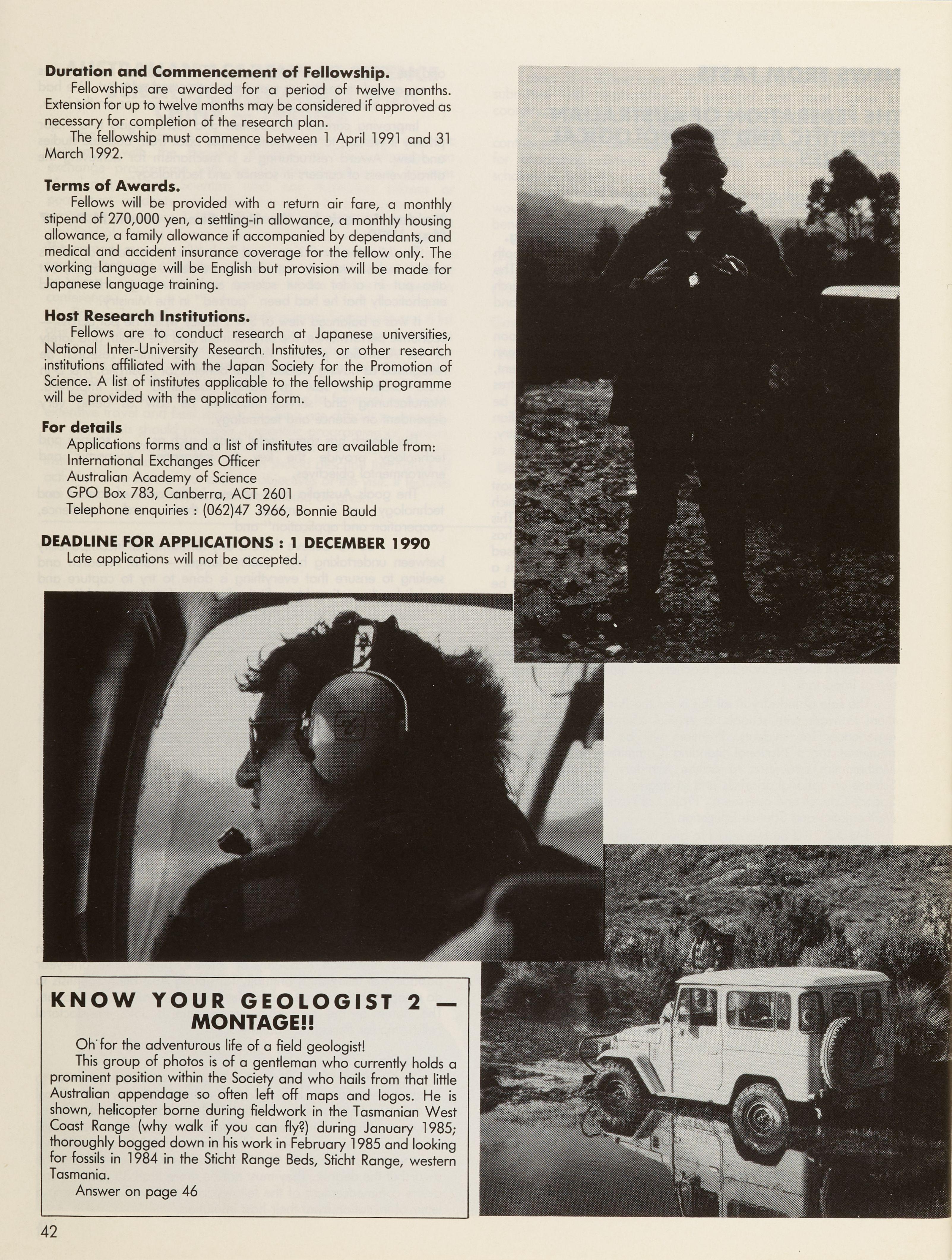
Oh· for the adventurous life of a field geologist!
This group of photos is of a gentleman who currently holds a prominent position within the Society and who hails from that little Australian appendage so often left off maps and logos. He is shown, helicopter borne during fieldwork in the Tasmanian West Coast Range (why walk if you can fly?) during January 1985; thoroughly bogged down in his work in February 1985 and looking for fossils in 1984 in the Sticht Range Beds, Sticht Range, western Tasmania.
Answer on page 46
Edited by J B Jago and P.S.Moore Special Publication 16, Geological Society of Australia Inc, 495p, 1990. $90.00 GSA Members, $710 Non GSA Members (soft)
This volume, dedicated to the late Dr Brian Daily, is easily confused with the recent Bulletin 53 of the Geological Survey of South Australia "The Adelaide Geosyncline" compiled by W V. Preiss The two very similar oblique aerial views on the covers of these volumes add to this difficulty
The Daily Memorial Volume, as it might be distinguished, is the last Specia l Publication of the Geological Society of Australia Inc.
The contributors represent the bulk of knowledge on the late Precambrian and early Palaeozoic geology of the Adelaide Geosyncline A tribute to Brian Daily is the fact that the interests of his former students grouped with papers by some colleagues, range across the entire spectrum of the geology preserved in this classic fo ld belt. It is a further inspiration to find contributions by Reg Sp r igg and Bren Thompson and sadly, posthumously, by his mentor the late Professor M.F. Glaessner. In addition there is included a completed paper on York Peninsula from Brian's effects.
There is a good balance amongst the 27 contributions to this publication between the Precambrian geology and Cambrian sequence, structure, and metamorphism.
The collection of papers commences with an excellent overview by W V Preiss The following 6 papers bring together the · unpublished research of the last 10-15 years relating to the early rift sequence of the Adelaide Geosyncline, viz , the pre-glacial elastics, basic volcanics and dolomitic carbonates. The complex sub-basins and stratigraphic variation in the W illouran Ranges are well covered
Perhaps the largest gap in the works presented is in relation to the glacial sequence, known internationally as the Sturtian glaciation. The initial paper by W .V . Preiss however offers a summary of this important Precambrian series
The record of the second major glacia l period, that of the Marinoan glaciation, is discussed in detail for the central Flinders Ranges Doily's interest in the inter-regional and inter-continental value of these Precambrian tillites for correlation purposes leaves some disappointment that there is no paper bringing together the present ideas on this subject
A very good paper on late Proterozoic carbonate sequences in the central and southern Flinders Ranges by PW. Haines is followed by a series of contributions on carbonates of the early Cambrian and some of their contained early Cambrian fossils The late Professor Glaessner summarised Brian Daily' s contribution to the problem of the base of the Cambrian System in South Australia and this is placed in context with the situation globally A group of papers explores the relationship of the Kanmantoo group to the more fossiliferous Cambrian successions of Kangaroo Island and York Peninsula, the study of which involved a considerable period of Brian Doily's working career. Balance is provided by a summary of the origin of redbeds of middle Cambrian age in the northern Flinders Ranges, York Peninsula and Kangaroo Island by P.S. Moore.
A work by R J F Jenkins is included which involves a stratigraphic and tectonic reappraisal of the Mt Lofty Ranges and Kangaroo Island region. This includes some contentious ideas but his tectonic appraisa l and mechanisms for basin formation and compression warrant detailed study
N. Mancktelow contributed a paper on the Delamerian of the southern Adelaide Fold Belt
The last four chapters give an updated synthesis of Delamerian intrusions and metamorphic associations in the sourthern Mt Lofty Ranges and Western Victoria and describe middle Cambrian plutons in the Peake and Denison Ranges in central South Australia.
In all, the review papers embrace the major features of the Geosyncline These are valuable descriptions of a magnificently exposed orogen and represent a collection suitable for senior students. It should be every Australian geologist's ambition to r eview in the field the highlights of this geology. I recommend the book to all and comment the editors.
C.R. Dalgarno
Sheridan Bowman. Published_ for the Trustees of the British Museum by British Museum Publications. Distributed in Australia by Thames & Hudson (Aust) Pty Ltd, 86 Stanley St, West Melbourne, Vic 3003, 64p, 1990. $76.95 (soft)
This volume of a British Museum series Interpreting the Past, is really about interpreting radiocarbon determinations, and not 'the past'. It provides a clear, concise and authoritative account of the fundamentals of the method, the different techniques of measurement and the problems of using results. Although oriented toward archaeologists it will be valuable for others as well.
The format is somewhat deceptive. While seemingly designed for a more general readership the material covered makes this very suitable for tertiary students and researchers who use, but do not really understand, radiocarbon dates. I cannot comment on the quality of geological applications, but archaeologists all too often adopt a rather cavalier approach to radiocarbon determinations This book leaves little excuse for continued misunderstanding and abuse.
Although two relatively recent handbooks (Mook and Waterbolk 1985, Gillespie 1986) cover much the same ground, Sheridan Bowman's presentation and discussion is far more lucid and easier to follow. She takes the reader through all the thorny problems of accuracy, precision and calibration
It is only a pity that the publisher's format did not allow the book to be a little longer, so that the author could have moved beyond the essentially technical to a more complete treatment of the application and meaning of radiocarbon chronologies in prehistory. The applications discussed are concerned with short-term events or objects rather than the long-term processes which characterise much prehistoric archaeology and geology. This aside, Bowman's short book is to be strongly recommended as the best available introduction to the subject.
Gillespie, R. 1986. Radiocarbon user's handbook. Oxford University Committee for Archaeology Monograph 3
Mook, W.G. and H.T. Waterbolk 1985 . Radiocarbon dating. Handbooks for archaeologists No 3, European Science Foundation, Strasbourg.
David Frankel
Department of Archaeology
La Trobe University
Edited
by R. W. LeMaitre and published by Blackwells Scientific Publications Ltd, UK. Distributed in Australia by Blackwells Scientific Publications (Aust) Pty Ltd, 107 Barry St, Carlton, Victoria, 3053; 200p + wall chart, 1989 . $62 .00 (hard).
My initial reaction when this book arrived on my desk was --aahh at last! It brings together the results of over 20 years of investigations and deliberations. Having been a keen user of the work of this particular IUGS Subcommission since the initial Streckeisen definitions appeared in Geotimes in 1973 I was very pleased to see it all come together. Since the book arrived I have been using it exclusively in all my Igneous Petrology classes at the University of Technology and thus feel that I am able to assess the value of the total classification and its interpretation by both junior and senior undergraduate students
This book IS an international classification of igneous rocks -a classification devised by consensus - a scheme which "bridges linguistic, cultural and political boundaries". A total of 419 people from 49 countries participated in the final formulation of the official recommendations - in oral and written comments, criticisms, working parties, committees, meetings, etc.
One instance of the difficulties faced by the subcommission (and probably the most well known). was that which arose over the nomenclature of the term "granite" where the most frequent "granites" were named "adamellite" in England and "quartz monzonite" in the United States. Despite the logical outcome to this dilemma, one which has led to the total disuse of "adamellite" and the restriction of "quartz monzonite" to the field 8* (monzonite) of the IUGS triangular QAPF diagram, many eastern Australian petrologists still insist on the use of the term "adamellite" on maps and in publications - so much for consensus in operation!
Another type of problem dealt with by the subcommission was that arising with volcanic rocks as to whether their classification and nomenclature should be based •on mineralogical or chemical parameters, with strong arguments on both sides. Again this dilemma was resolved by consensus and the TAS chemical classification of volcanic rocks, to be used ONLY if a mineral mode cannot be determined forms a section in the book.
The book is essentially in two main parts.(l) Classification and nomenclature of the igneous rocks containing a summary of all the previously published recommendations made by the subcommission, together with some new ones.
This part first defines the principles on which the classification is based; describes the choice and selection of modal parameters; indicates the approved nomenclature, including such features as the use of 'root names', together with appropriate qualifiers and when suffixes and prefixes are required.
Several separate classifications are presented, each of which is applicable to a certain group of rocks and one has to decide which is appropriate to the rock in question. To help one make a selection in a consistent manner a hierarchy was agreed and the following sequence is recommended - pyroclastic, carbonatite, lamprophyre, melilite-bearing, charnockite, plutonic, volcanic.
A large wall chart supplied with the book clearly illustrates how to go about the sequence of selection diagrammatically.
It is not proposed to go into details of each of the the separate classifications in this review. Most readers will be familiar with at least the plutonic QAPF triangular diagram of the subcommission, which has been about for a number of years. Useful additional
features in the book are figures which illustrate the use of the prefixes leuco- and mela- with respect to naming plutonic rocks.
2) This part comprises a Glossary of Terms and a Bibliography The Glossary is an awesome contribution to the igneous literature containing what is almost certainly the largest number of igneous rock names ever published -a total of 1586 terms of which 297 (19%) have been approved and defined by the subcommission.
For each term the following information is given any alternative spelling a brief petrological description author, year and page number of source reference origin location of term in three standard texts (Johannsen, Troger and Tomkeieff et al.).
The bibliography gives full details of the 787 references together with the names of the rocks that each contains.
While work for a volume such as this is only made possible by the dedication of a very large number of people, it is marvellous to see an Australian editorship, with full responsibility for compiling and producing the volume.
Undoubtedly this classification really works! It does not pretend to be the be-all end-all. After all, new rock types and the appreciation of new features of igneous geology is a continuous and evolving process. Some special areas (i.e. the potassic rocks, the basalts) are inadequately covered by nomenclature at present.
In the meantime, to all users of igneous classifications and to all those trying to put a name to an igneous rock - BUY THIS AND USE IT.
Brenda Franklin, University of Technology, Sydney
Edited by A.J Crawford. Published by Unwin Hyman ltd London and distributed in Australia by Allen and Unwin Australia, Pty Ltd, Napier St North Sydney, NSW, 465pp, 1989. $190.00 (hard).
In the past 15 years "boninites" have been generally rediscovered by petrologists and geochemists, having languished as a recognized rock type of unusual genesis in the occasional compilation (Johannsen, 1937, A Descriptive Petrography of the Igneous Rocks, Univ of Chicago Press, 174), since their discovery at the end of the last century (Petersen, 1891, Jahrb Hamburgischer Wiss Anst 8,30).
Then in the l 960's the acute petrographic skills of Wally Dallwitz of the Bureau of Mineral Resources were employed in the recognition of the rare terrestrial mineral clinoenstatite, in a rock suite from Cape Vogel in Papua (Dallwitz et al., 1966, J Petrol 7, 375) that was subsequently shown to be of boninite character. A return by Japanese petrologists to the prime locality in the Bonin Islands (now recognized as the Ogasawara forearc), l 000km south of Tokyo, documented the nature of this rock type in more detail (Kuroda and Shiraki, 1975, Rep Fae Sci Shizuoka Univ 10, 145). A spate of discoveries of boninite-like rocks have been made since in the forearc of the Marianas, various Phanerozoic ophiolite terrains, and invoked as magma types involved in the formation of the world's major, Precambrian layered intrusions (e.g. the Bushveld and Stillwater).
The distinctive characteristics of boninites are high MgO content (8wt%) at intermediate SiO2 contents ( -53-60wt%), high content of ferromagnesian silicate-compatible trace elements like Ni, high eruption temperature manifest by the presence of clinoenstatite (inverted from protoenstatite), phenocrysts of highly magnesian olivine and low-Ca pyroxene, and highly refractory (high Cr/AI) spinel.
In fact, compositions like this were synthesized in the early
1970's during an international controversy over the nature of the products of wet melting of peridotite. Considerable acrimony accompanied that debate, and in retrospect, the experimental petrology group at the Australian National University clearly produced the right answer, although not recognizing their synthetic compositions as being equivalent to natural boninite (Nicholls and Ringwood, 1973, J Geol 81, 285: Green, 1973, Earth Planet Sci Lett 19, 37). Later experimental studies have confirnmed that boninite can only be produced by the wet melting of clinopyroxene-poor lherzolite to harzburgite protoliths under the conditions of high temperature ( l 200oC) at very low pressures ( 1 GPa) in the upper mantle.
If you know nothing about these rocks, then this book is the best place to start learning. As emphasized in the preface, the book can serve as a source rather than review volume, and thus suffers from an overall lack of ordered progression through definition, occurrence, data presentation aand synthesis. Such is often the case with multi-authored texts, but I suspect in this example the editor suffered from the absence of promised manuscripts by the press deadline.
There are however,some excellent individual contributions here with the opening chapter by Crawford, Falloon and Green laying the foundations for understanding the remainder of the book. Other chapters focus on Tertiary arc occurrences in the Marianas, Bonins, New Caledonia and north Tonga, ophiolite associations from the Troodos (Cyprus), Appalachians and Tasmania, high-Mg intermediate-SiO2 types in the early Proterozoic of the Vestfold Hills (Antarctica) and the Bushveld, and the boninite-like (but in fact crustally-contaminated komatiite) compositions of Archean and early Proterozoic terrains. Two chapters are specifically concerned with experimental petrologic studies, and three others document variants on the boninite theme, particularly magnesian "andesites" with higher alkali contents than boninites from the type locality.
There is agreement amongst the contributing authors that the formation of boninites sensu stricto requires: 1) a refractory uppermost mantle source, previously depleted of a basaltic melt fraction; 2) low-pressure and high-temperatures; 3) influx of water from a subducted oceanic lithosphere; 4) influx of various hydrophile trace elements such as alkalis and alkaline earths; and 5) variable introduction of high-field-strength trace elements such as Zr and Hf, most plausibly in a low volume melt.
This is quite a demanding recipe and the conditions are not often met. Times of subduction initiation (e.g. cannibilisation of a pre-existing transform by a nascent subduction zone), or episodes of back arc spreading and forearc rifting are some of the suggested environments.
One of the lessons I take from this book and other recent research is that boninites appear in many ophiolites both as lavas and sheeted dyke swarms. The demonstrable subduction zone signature in these rocks suggests that island arc basement can be formed at active, so-called compressive/destructive margins but in extensional environments (e.g. Pearce et al., 1984, Geol Soc Lond Special Pub 16, 77), such as those that prevail in many of the nonaccretionary arcs of the western Pacific.
The quality of production is generally high. Inevitably however, there are some typographic errors, mistakes and omissions. For example, the configuration of the spreading zone in the Manus Basin (Figure 2.8) is incorrect. There is a c in the Bismarck Sea and Plate (p.67) and the synthetic melts must contain 59-60% SiO2 rather than H 2O (p.116). The legibility of Figures 1.8 and 1.9 is poor and Figure 5.1 is incomplete. Experimental run tables do appear in Chapter 5 but should also have been published in Chapter 4. And finally, the Stillwater Complex is in Montana, not Wyoming (Figure 6.2).
There are many good ideas presented in this book and much data. It is worthwhile reading for specialists other than petrologists and geochemists, for despite their comparative rarity, the occurrence of boninites is indicative of specific tectonic environments and physical conditions.
Richard J. Arculus, University of New England.
Edited by J.G.Douglas and J.A.Ferguson. Published by the Victorian Division of the Geological Society of Australia, 664p, 1988. $70.00 plus $7.00 postage (hard), $52.00 plus $7.00 postage (soft). Available from Victorian Division, GSA, GPO Box 2355V, Melbourne, Vic, 3001.
This paperback volume is an extensive revision and enlargement of the original "Geology of Victoria" published in 1976 (which has been out of print for some years). The result is an extremely comprehensive volume covering all aspects of Victorian geology, which comes complete with a folded copy of the most recent 1: 1 000 000 coloured geological map of Victoria.
A chapter outlining the basic structural and tectonic framework of Victorip is followed by an extensive stratigraphic section, generally one chapter to a system. Emphasis is placed on stratigraphic nomenclature and biostratigraphic correlation, with less detailed discussion of depositional environments. A useful chapter on geomorphology is followed by a chapter covering the petrology of granites and Cainozoic volcanics (other igneous rocks are described in less detail in the appropriate stratigraphic section). The final quarter of the book is devoted to "Economic Geology" and it is pleasing to find that this includes items such as geothermal energy and groundwater as well as the more obvious metallic, fuel and industrial mineral deposits. Gold is given prominence in this chapter, largely due to the euphoria surrounding gold exploration in 1987 and 1988. Although the gloss has since been rubbed off by a low gold price and even lower share prices, gold deserves its prime place because of its historical importance in Victoria. However, the inclusion of prospects which were little more than geochemical anomalies (and almost certainly still are) shows the enthusiasm of the time. A section on specimen minerals would be considered excessively detailed by all but the most ardent mineralogist.
The editors have done a marvellous job in producing a readable, coherent volume from the contributions of around 70 authors, and are to be congratulated on their feat. The text is clear and presumes no special knowledge of the particular topic being covered. There are amazingly few typographical errors. I found the
Anyone wishing to review any of the following should contact the editor. As usual, the policy is first come first served and the reviewer gets both the Editor's heartfelt thanks and (more fittingly) the book to keep.
Reviewers should keep their reviews short and be prepared to complete the review within a reasonable time.
(1) Hillslope Form by A.J. Parsons. Published by Routledge and distributed in Australia by The Law Book Co Ltd, 1990, $89.95.
(2) The Encyclopedia of Igneous and Metamorphic Petrology, edited by D.R.Bowes. Published by Van Nostrand Reinhold and distributed in Australia by Thomas Nelson, 1990, $282. 95.
(3) The Encyclopedia of Solid Earth Geophysics, edited by David E. James. Published by Van Nostrand Reinhold and distributed in Australia by Thomas Nelson, Australia, 1990, $319. 95.
(4) On-Site Stormwater Management-Applications for Landscape Engineering by Bruce Ferguson and Thomas Debo. Published by Van Nostrand Reinhold and distributed in Australia by Thomas Nelson, Australia, 1990, $99.95 (book and software).
(5) The Concise Oxford Dictionary of Earth Sciences by Ailsa and Michael Allaby. Published by Oxford University Press, 1990, $59.95.
(6) Soils of the Past, An Introduction to Paleopedology by G.J. Retallack. Published by Unwin Hyman and distributed in Australia by Allen and Unwin Aust Pty Ltd, North Sydney, NSW, 1990.
frequent font changes within the text slightly irritating, but presumably they were necessary to allow the revision to be completed within a reasonable time-frame The diagrams are of a high standard and generally clearly labelled and easy to understand. Black and white and colour photographs are also used to illustrate the text where appropriate. There is a comprehensive reference list and no less than three indices -a locality index, a structural and stratigraphic index, and a palaeontological index.
This is an excellent reference work which sets a high standard for similar volumes. Minor suggested improvements to the third edition (I am sure that demand will necessitate a third edition) include an increase in the number of location maps, particularly in the industrial minerals section, and an increased number of crossreferences within the volume, particularly from the economic section to the stratigraphy. This book is probably most useful to nonVictorians like myself, who occasionally work in Victoria, but its scope is such that all geologists studying or working in Victoria will find it useful, if not invaluable.
Sue Border, UTS, Sydney
This is John Jell from the Department of Geology and 1 Mineralogy, University of Queensland on a gentle(?) field excursion following the First International Conference on the Devonian System, held in Calgary, Alberta, Canada.
Photo, Pat Conaghan, Macquarie University.
All the photos are of course of Peter Baillie of the Tasmanian Geological Survey and currently the Secretary of the Society. The editor is told that the main reason for Peter' s big smile in one photo is that he had just found a fossil which proved the age of the Sticht Range Beds. He was less successful in getting his bogged vehicle , moving, despite the winch on the vehicle and had to be eventually I towed out.
Photos by Pat Coaghan, Macquarie University
TECTONOSTRATIGRAPHIC TERRANES, FOLD-THRUST ZONES AND REGIONAL METAMORPHICS IN THE PALAEOZOIC OF CENTRAL-EASTERN VICTORIA
C.L. Fergusson , D.R. Gray , V.J . Morand
Specialist Group in Tectonics and Structural Geology FIELD GUIDE #3.
Price : $23.00 postage/handling included
Available from: Geological Society of Australian Inc, 606 ANA House , 301 George Street , Sydney, NSW 2000
- where we are now and where we are going
AIG Bulletin #9
A collection of papers and directory of computer resources and trade exhibits presented at AIG Seminar #7, Perth, 13-14 November, 1989.
Price: $25.00 postage/handling included
Available from: Australian Institute of Geoscientists, 606 ANA House, 301 George Street, Sydney , NSW 2000
Oroclinally deformed volcanogenic sediments, which might be varves, from the Late Carboniferous Currabubula Formation at the southern end of the Werrie Basin, northern NSW. "These mesostructures resemble the macro-scale oroclines of the New England Fold Belt''.
Sent in by Larry Harrington, Canberra.
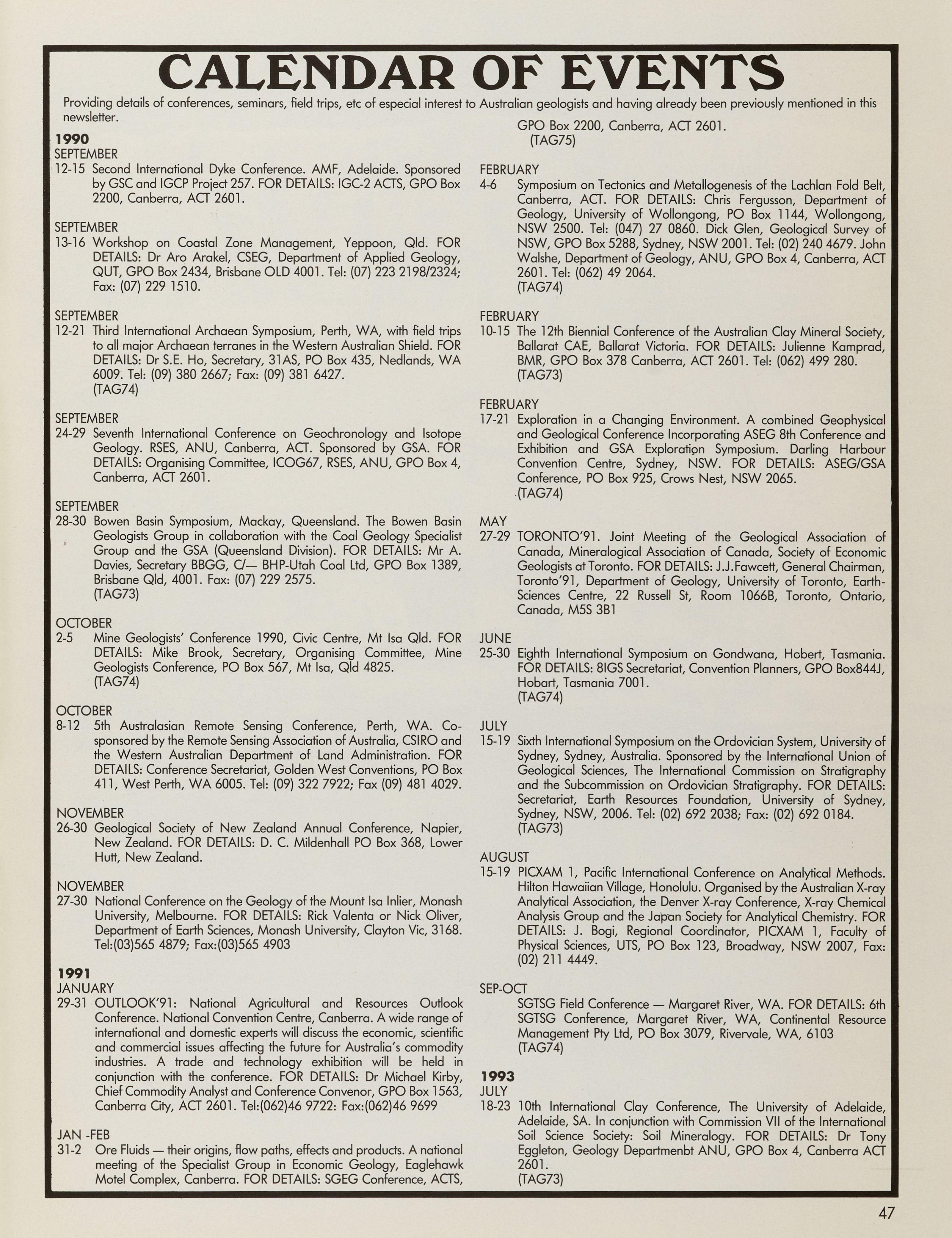
Provid ing details of conferences, seminars, field trips, etc of especial interest to Australian geologists and having already been previously mentioned in this news letter
1990
SEPTEMBER
12-15 Second International Dyke Conference. AMF, Adelaide. Sponsored by GSC and IGCP Project 257 FOR DETA ILS: IGC-2 ACTS, GPO Box 2200, Canberra, ACT 2601.
SEPTEMBER
13-16 Workshop on Coasta l Zone Management, Yeppoon, Qld. FOR DETA ILS: Dr Aro Arake l, CSEG, Department of Applied Geo logy, QUT, GPO Box 2434, Brisbane OLD 400 1 Tel : (07) 223 2198/2324; Fax: (07) 229 1510.
SEPTEMBER
12-21 Third Internationa l Archaean Symposium, Perth, WA, with field trips to all major Archaean terranes in the Western Australian Shield. FOR DETAILS : Dr S.E. Ho, Secretary, 3 1AS, PO Box 435 , Nedlands, WA 6009. Tel : (09) 380 2667; Fax : (09) 381 6427 (TAG74)
SEPTEMBER
24-29 Seventh International Conference on Geochronology and Isotope Geology. RSES, ANU, Canberra, ACT. Sponsored by GSA. FOR DETA ILS: Organising Committee, ICOG67, RSES, ANU, GPO Box 4, Canberra, ACT 260 l
SEPTEMBER
28-30 Bowen Basin Symposium, Mackay, Queensland. The Bowen Basin Geologists Group in collaboration with the Coal Geology Specialist Group and the GSA (Queensland Division). FOR DETAILS: Mr A. Davies, Secretary BBGG, Cl- BHP-Utah Coal Ltd, GPO Box 1389, Brisbane Qld, 4001 Fax: (07) 229 2575. (TAG73)
OCTOBER
2-5 Mine Geologists' Conference 1990, Civic Centre, Mt Isa Qld. FOR DETAILS: Mike Brook, Secretary, Organising Committee, Mine Geologists Conference, PO Box 567, Mt Isa, Qld 4825. (TAG74)
OCTOBER
8-12 5th Australasian Remote Sensing Conference, Perth, WA. Cosponsored by the Remote Sensing Association of Australia , CSI RO and the Western Australian Department of Land Administration. FOR DETAl LS : Conference Secretariat, Golden West Conventions, PO Box 411, West Perth, WA 6005. Te l: (09) 322 7922; Fax (09) 481 4029
NOVEMBER
26-30 Geologica l Society of New Zealand Annual Conference, Napier, New Zealand FOR DETAILS: D. C. Mildenhall PO Box 368, Lower Hutt, New Zealand.
NOVEMBER
27-30 National Conference on the Geology of the Mount Isa Inlier, Monash University, Melbourne. FOR DETA ILS: Rick Valenta or Nick Oliver, Department of Earth Sciences, Monash Un iversity, Clayton Vic, 3168 Tel:(03)565 4879; Fax:(03)565 4903
1991
JANUARY
29-31 OUTLOOK'91: National Agricultural and Resources Outlook Conference National Convention Centre, Canberra . A wide range of international and domestic experts will discuss the economic, scientific and commercial issues affecting the future for Australia's commodity industries A trade and technology exhibition will be held in conjunction with the conference. FOR DETA ILS: Dr Michael Kirby, Chief Commodity Analyst and Conference Conveno r, GPO Box 1563, Canberra City, ACT 2601. Tel:(062)46 9722 : Fax:(062)46 9699
JA N -FEB
31-2 Ore Fluids - their origins, flow paths, effects and products. A nati ona l meeting of the Specia list Group in Economic Geology, Eag lehawk Motel Comp lex, Canberra. FOR DETAILS: SGEG Conference, ACTS,
GPO Box 2200, Canberra, ACT 2601. (TAG75)
FEBRUARY
4-6 Symposium on Tectonics and Metallogenesis of the Lachlan Fold Belt, Canberra, ACT. FOR DETAILS: Chris Fergusson, Department of Geology, University of Wollongong, PO Box 1144, Wollongong, NSW 2500. Tel: (047) 27 0860. Dick Glen, Geologicctl Survey of NSW, GPO Box 5288, Sydney, NSW 2001. Tel: (02) 240 4679. John Walshe, Department of Geology, ANU, GPO Box 4, Canberra, ACT 2601. Tel: (062) 49 2064. (TAG74)
FEBRUARY
l 0-15 The 12th Biennial Conference of the Australian Clay Mineral Society, Ballarat CAE, Ballarat Victoria. FOR DETAILS: Julienne Kamprad, BMR , GPO Box 378 Canberra, ACT 2601. Tel: (062) 499 280. (TAG73)
FEBRUARY
17-21 Exploration in a Changing Environment A combined Geophysical and Geological Conference Incorporating ASEG 8th Conference and Exhibition and GSA Exploratipn Symposium. Darling Harbour Convention Centre, Sydney, NSW. FOR DETAILS: ASEG/GSA Conference, PO Box 925, Crows Nest, NSW 2065. (TAG74)
MAY
27-29 TORONTO'91. Joint Meeting of the Geological Association of Canada, Mineralogical Association of Canada, Society of Economic Geologists at Toronto. FOR DETAl LS: J.J. Fawcett, General Chairman, Toronto'91, Department of Geology, University of Toronto , EarthSciences Centre, 22 Russell St, Room l 066B, Toronto, Ontario, Canada, M5S 3Bl
JUNE
25-30 Eighth International Symposium on Gondwana, Hobert, Tasmania.
JULY FOR DETAILS: 8IGS Secretariat, Convention Planners, GPO Box844J, Hobart, Tasmania 700 l. (TAG74)
15-19 Sixth International Symposium on the Ordovician System, University of Sydney, Sydney, Australia. Sponsored by the International Union of Geological Sciences, The International Commission on Stratigraphy and the Subcommission on Ordovician Stratigraphy. FOR DETAILS: Secretariat, Earth Resources Foundation, University of Sydney, Sydney, NSW, 2006. Tel: (02) 692 2038; Fax : (02) 692 0184. (TAG73)
15-19 PICXAM l, Pacific International Conference on Analytical Methods. Hilton Hawaiian Village, Honolulu. Organised by the Australian X-ray Analytical Association, the Denver X-ray Conference, X-ray Chemical Analysis Group and the Japan Society for Analytical Chemistry. FOR DETAILS : J. Bogi, Regional Coordinator, PICXAM l, Faculty of Physical Sciences, UTS, PO Box 123, Broadway, NSW 2007, Fax: (02) 211 4449.
JULY
SGTSG Field Conference - Margaret River, WA. FOR DETAILS: 6th SGTSG Conference, Margaret River, WA, Continental Resource Management Pty Ltd, PO Box 3079, Rivervale, WA, 6103 (TAG74)
18-23 l 0th International Clay Conference, The University of Adelaide, Adelaide, SA. In conjunction with Commission VII of the International So il Science Society: Soil Mineralogy. FOR DETAILS: Dr Tony Eggleton , Geo logy Departmenbt ANU, GPO Box 4, Canberra ACT 260 1 (TAG73)