Newsletter No. 53
Newsletter No. 53
MEMBERS OF COUNCIL AND EXECUTIVE PRESIDENT
Prof J. B. Waterhouse, Uni Queensland SENIOR VICE-PRESIDENT
Dr M J. Rickard, ANU, Canberra JUNIOR VICE-PRESIDENT Vacant HON TREASURER
Dr H. K. Herbert, Uni Queensland HON SECRETARY
Dr G. W. Hofmann, Geol Survey, Qld HON EDITOR
Dr R. W Le Maitre, Uni Melbourne HON ADMINISTRATIVE OFFICER
Mr D. H. Probert, Geol Survey, NSW COUNCILLOR OF EXECUTIVE DIVISION
Mr G. P Moore, Goldfields Expl, Qld
EX-OFFICIO COUNCIL MEMBERS
HON EDITOR - SPECIAL PUBLICATIONS SERIES
Mr P J G. Fleming, Geol Survey, Qld HON EDITOR - THE AUSTRALIAN GEOLOGIST
Dr B. Franklin, NSWIT, Sydney NATIONAL COMMITTEE FOR SOLID EARTH SCIENCE
Prof J. F Lovering, Uni Melbourne PUBLIC OFFICER
Dr K. R. Walker, BMR, Canberra
STANDING COMMITTEE CONVENORS STRATIGRAPHIC NOMENCLATURE COMMITTEE
Mr H.R.E. Staines, Geol Survey, Qld
GEOLOGICAL MONUMENTS COMMITTEE
Mr E. B. Joyce, Uni Melbourne GEOLOGICAL EDUCATION COMMITTEE
Mr F. Canavan, Camberwell, Vic
DIVISIONAL CHAIRMEN AND SECRETARIES
NSW DIVISION
Chairman
Dr Brenda Franklin, NSWIT, Sydney Hon Sec
Dr C. R. Ward, UNSW, Sydney Hunter Valley Branch
Chairman
Dr D. R. Mason, Uni Newcastle Hon Sec
Dr P. K. Seccombe, Uni Newcastle Broken Hill Branch
Chairman cl- GSA, Broken Hill QUEENSLAND DIVISION
Chairman
Dr L. H. Hamilton, QIT, Brisbane Hon Sec
Dr J .M.W. Rynn, Uni Queensland SOUTH AUSTRALIAN DIVISION
Chairman
Dr A. J. Parker, Dept Mines Energy, Adel H on Sec
Mr P. C. Smith, Dept Mines Energy, Adel WESTERN AUSTRALIAN DIVISION
Chairman
Mr J. Myers, cl- GSA, Perth Hon Sec
Mrs S. Thornett, BHP Exp I Perth VICTORIAN DIVISION
Chairman
Mr J. Cramsie, cl- GSA, Melbourne Hon Sec
Ms K. Orth, cl- GSA, Melbourne
TASMANIAN DIVISION
Chairman
Dr G Green, Dept Mines, Hobart Hon Sec
Mr C. E. Sharples , Dept Mines, Hobart COMMONWEALTH TERRITORIES DIVISION
Chairman
Dr J. B. Angus, Goldfields Exp I, ACT Hon Sec
Dr P. N. Southgate, BMR, ACT
SPECIALIST GROUP CHAIRMEN AND SECRETARIES
ECONOMIC GEOLOGY
Chairman
Dr N. Williams, Carpentaria Expl, Qld Hon Sec
Dr G M. Derrick , Derrick & Assoc, Qld PALAEONTOLOGY
Chairman
Prof B. Runnegar, UNI New England, NSW Hon Sec
Ms S. Turner, Qld Museum, Qld SEDIMENTOLOGY
Chairman
Dr B. G. Jones, Uni Wollongong, NSW Hon Sec
Dr A. C. Hutton, Uni Wollongong, NSW TECTONICS & STRUCTURAL GEOLOGY
Chairman
Dr B. E. Hobbs, CSIRO, Vic Hon Sec
Dr D. R. Gray, Monash Uni, Vic COAL GEOLOGY
Chairman
Dr C. W. Mallett, CSIRO, Qld Hon Sec
Mr L. Grimstone, Grimstone & Assoc, Qld ENGINEERING GEOLOGY
Chairman
Mr J. C. Brumley, SEC, Vic Hon Sec
Mr A. S. Power, Chisholm IT, Vic GEOCHEMISTRY, MINERALOGY & PETROLOGY
Chairman
Prof T. H. Green, Macquarie Uni, NSW H on Sec
Dr I. Slansky, Mining Museum, NSW EARTH SCIENCES HISTORY
Chairman
Dr B. J. Cooper, Dept Mines Energy, SA Hon Sec
Mr C. G. Gatehouse, Dept Mines Energy, SA SOLID EARTH GEOPHYSICS
Chairman
Dr D. Denham, BMR, ACT Hon Sec
Dr B. Drummond, BMR, ACT
BUSINESS OFFICE
Ms Laurel Tuckwell, 10th Floor, Challis House
10 Martin Place, Sydney, NSW 2000. Tel: (02) 231 4696
The Australian Geologist is produced five times a yearMarch, May, July, October and December. Deadlines for submission of copies to issues of the newsletter are {hopefully?) by the 12th of the month preceding publication.
Please Note: The views expressed by contributors are not necessarily those of the Editor or the Geological Society of Australia.
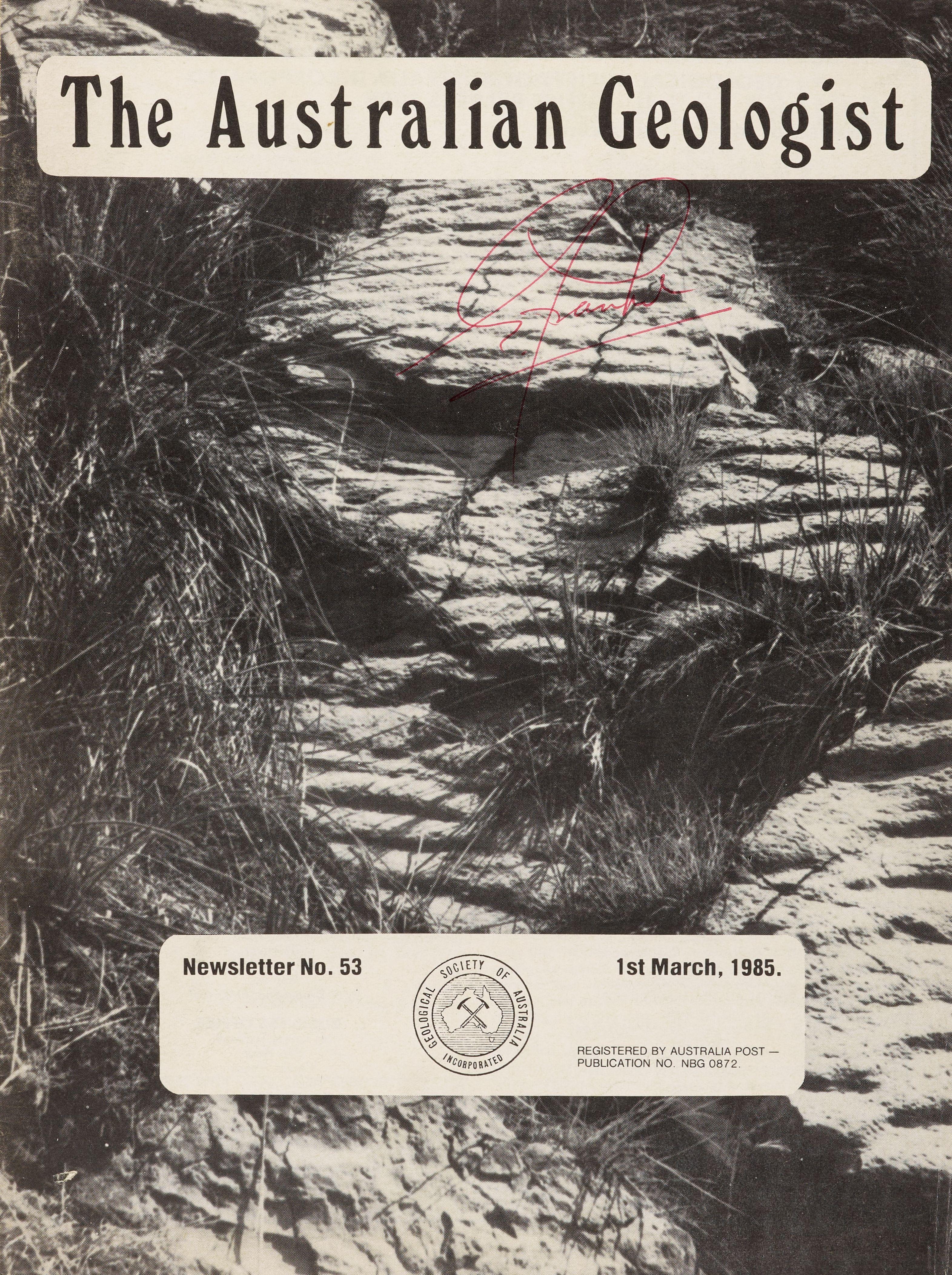
Ripple marks in Late Devonian quartzites - located between Charbon and Colless's dam, southwest of Kondos, NSW. - Photo Andrew Waltho.
Note from Neville Stevens, University of Queensland re cover photo Australian Geologist No. 50, July 1984 of block slide, Black Mountain near Cooktown.
The black cover is not due to lichens but to a blue-green alga.
Details of cover photo Australian Geologist No. 50 or 51, October 1984 {lost in previous editor's Precambrian and kindly remembered by the photographer). A biotite shear zone in Archaean migmatoid gneiss from a quarry near Northam in the Jimperding Metamorphic Belt, Yilgarn Block, Western Australia The quarry contains quartz-feldspar-biotite-hornblende gneiss and mesocratic adamellite gneiss both intruded by granitic veins and both containing discrete biotite schist lenses {Wilde, 1980). The biotite schist lens in this photo is clearly a shear zone since it displaces granite veins intruding mesocratic gneiss. However, a long history of progressive deformation and recrystallisation within the shear zone is evident from folding of the biotite schistosity and overprinting of a later biotite schistosity. Both biotite schistosities were formed by concomitant deformation and recrystallisation within a single progressive event and note that the fold sense is sympathetic with the sense of shearing indicated by the displaced granite veins. Progressive deformation and recrystallisation such as displayed in this photo are characteristic of many mylonite zones and shear zones.
Wilde, S. A., 1980. Excursion Guide: The Jimperding Metamorphic Belt in the Toodyay Area. Geol Soc Aust {WA Division), 41 pp.
A. J. Parker, SA Department of Mines & Energy.
EDITOR
Dr Brenda Franklin Dept of Applied Geology, NSW Institute of Technology, PO Box 123, Broadway, NSW 2007. Tel: (02) 218 9570
Appalling figures: 100 and 450, the first said to be a rather optimistic estimate of the number of new jobs for geologists in Australia this year, and 450 the number of folk graduating from Tertiary institutions in late 1984. The accuracy of these figures is hard to verify, and perhaps we should be grateful for the inefficiency that prevails in our statistics - for the truth might be more frightening! Even if we twist the figures, it is clear that we have a problem. The causes are not hard to find. Mining in trouble, and not always helped by our government; coal under pressure and with great overseas loans incurred for development that will take a lot of paying back; mineral prices soft; even gold contracting. University positions rare indeed and seldom justified anyway on student numbers; government positions {with bright exceptions), also rare, rather unfairly in view of all the tax revenue generated through mining. No incentive for students to do higher degreeswhat would be the use? Few research positions, for don't we do less research in science than virtually every other Western Country?
And will the position improve? In the past we have depended on short-term cycles of good times and bad, to even out into some sort of uneasy stability in employment in geology, with spasms of unemployment followed by panic importation of overseas geologists. But times may be changing and new homeostatdepressants may be emerging.
The massive indebtedness of Third World countries, a new phenomenon, may well ensure preferential development of Third World minerals to help pay off those debts. Brazil for example, is seeking 15 years to repay $US57 billion - that virtually must be repaid from exports - and coffee alone will not suffice. Efficiency and cost no longer may be prime factors: the US and other banks want their money, and must be expected to favour Third World mining for export. Secondly, Third World countries, leaner and hungrier than we are, are striving much harder to become more efficient, and on the one hand favour their primary industries such as mining, and also press hard with scientific - and technological training - and research. According to Professor Colin Apelt, one Australian student is doing a full-time PhD in Engineering at the University of Queensland - and nine overseas students are doing full-time PhD in Engineering. The long-term implications are obvious. So will the ups and downs, that we have found to cope with over the years, finally flatten out, in favour of a somewhat subdued trough?
Bruce Waterhouse
The observant reader will have noted the changes in size, format and print style for this issue of the Australian Geologist. This does not mean to imply that any of the previous issues were of lesser quality. Many of the changes you see here, were in fact, suggested by the previous editor. The main innovation has been to dispense with the burden of having to get material into camera-ready form for offset printing {which means begging the overworked Department typist for lots of time and work}. Instead the whole newsletter is being professionally typeset by the printer. Thus as long as contributions are clearly written or typed they can be handed directly to the printer with very little extra effort. With the print run we currently have for the newsletter (about 3300) the costs are roughly equivalent.
Taking over this job from someone as well known and widely knowledgeable as Dave Branagan is no easy task. The new editor hopes not to antagonise too many readers too often. For instance, the problem of giving a number to this issue was almost insurmountable, the previous_three issues being numbered 50, 50 {corrected to 51} and 51. The solution to this problem was influenced by a delightful letter from Alan Moore (see Letters to the Editor}.
On a more serious note, there seems no doubt that scientists {geologists} and the scientific community as a whole (whether they be academics or industrially based} have slipped seriously in their capacity to influence governments. This is despite the fact that many members of the present Federal Government have a high level of academic qualifications. Dr Peter Pockley, the Adviser in Public Affairs to the University of NSW brought this home recently in a program on ABC radio.
Dr Pockley urges us to plan and work together to retrieve our position. He would like to see us become more assertive and to press our claims directly to politicians and bureaucrats and to use the media, to win over the general populace. He says not to forget that other people gain their perspective of scientists mainly through popular channels and that we shouldn't only approach the media for a sympathetic ear when our government funded grants are cut but also to regularly explain to them what on earth we are doing and why.
He feels that we should also make politicians aware that results of our research or industrial development can often help further political ambition or ministerial portfolio. They are in fact partly dependent on us for that!
The points Dr Pockley makes are indeed of interest to us as geologists and raise some issues we should perhaps think about. If we believe in the necessity for research and development then let us not hesitate in saying so.
NIKON Labophot Pol (Model YBP-11) Microscope
Comes with a NI KON Episcopic illuminator for reflected light work, and has 4 X, l OX, 20 X, 40 X and l 00 X objectives. All components are in excellent condition as it has been used very little since purchase in 1981. Seller is prepared to discuss price with any interested purchaser, but would like about $3200. If you are interested contact Alan Moore, The BHP Company Ltd, Minerals Division - Exploration Department, PO Box 6062, Perth, Hay Street East, WA, 6000. Tel (09) 325 1366.
•WILD Ortholux II Pol Binocular Research Microscope.
If you are interested in this microscope please contact J. F. Gilfilan and Associates, PO Box 422 Lane Cove, NSW 2066. Tel. (02) 957 l 056.
Dear Sir,
I enclose a copy of the nicest refusal letter a young job-seeking geologist could ever wish to receive.
The author's name and company have been deleted, but I hope he recognises it. What a shame other companies do not show as much consideration
enclosure: Dear Cindy-Lee, Cindy-Lee Cox, Ballarat.
As my mother was a Lee; my wife's father was a Cox, my grandfather had a business in Ballarat in the early 1900s and Fred Duncan who had the timber yards was a cousin, I would love to offer you a position!
Unfortunately we are a very small company and there isn't anything we can do which would help you.
Keep interested in Geology, however, no one knows at this stage what will turn up.
Kindest regards, Yours sincerely Director.
Sir,
It takes little imagination to realise that the Universities and CAE' s etc, are producing too many geologists. As we enjoy a free {so-called} enterprise economy, freedom of choice is our way of life and a brief chat to geologists in the so-called centrally planned economies makes one realise how precious our freedom is. Freedom to choose is and must always be the right of every man and woman, a geologist or not.
Having said that I would comment that any student entering the geological sciences has a right to be informed (fully} of the pitfalls. And how does one find out? Obviously through the teachers during induction week at university.
My questions and answers please! How many university teachers tell their geological students of the tank traps ahead?
John lvanac, Cairns, Qld.
Dear Sir,
I must take exception to the inclusion in issue No. 51 of "The Australian Geologist" of publicity material for Geocongress '86 to be held in Johannesburg, South Africa.
As you are aware, South Africa practises a particularly odious and blatant form of racism, the apartheid system. Various sections of our society from the individual level right up to Federal Government level, and internationally the League of Nations and the UN, have unanimously condemned the oppressive apartheid system.
In order to make these views known to the South African government and attempt to precipitate change in that country's racist policies, governments t he world over have imposed sanctions against South Africa. Our own government has imposed diplom(ltic and sporting sanctions, a policy common to both the Hawke and Fraser governments.
In an attempt to counter these moves the South African Government tries to attract sporting personalities, entertainers, tourists and people of high standing in the community (such as geology professionals) to give some legitimacy to apartheid.
Rather than pandering to such efforts GSA should be openly opposing such a system. It is noteworthy that a vast number of occupation-based organisations (trade-unions, professional bodies, etc) have taken a stand on this issue. Why then is GSA so spineless in this respect?
Dear Editor,
Gordon Taylor,
The geological profession, like any other, should take action to counter the South African apartheid system, and deny them the legitimacy they seek in the world.To remain insensitive to racism, as this society has been, must be seen as covert approval of that racism.
BMR, Canberra.
(Editor's comment: GSA is an academic society. The question is whether or not we should inhibit or suppress the exchange of geological information among scientists from ANY part of the world or ANY nation).
Please note that the numbering system of TAG is becoming more chaotic. If we remove the 51 on p 39 of the issue numbered 51 and put it on the second issue that was previously numbered 50 then, apart from leaving Dr Branagan with no connected legs, we create two issues numbered 51 . We are therefore no better off than we were when we had two issues numbered 50. Perhaps an "A" could be used - as when No. 28 was ignored and we had 29 and 29A!
Alan Moore, BHP Exploration, WA.
Editor's comment: Feeling that enough fresh air had already been blasted into these pages, the editor has taken the coward's way out and made this issue No. 53. This leaves it to individuals to cross out the previous two numbers if they wish (neatly of course!) and make No. 50 (October) into No. 51 and No. 51 (December) into No. 52.
At the ASSG Business Meeting, held during the 7th Australian Geological Convention in Sydney, the following were appointed to hold office until 1986:
Dr B. G. Jones Chairman
Dr A. C. Hutton
Dr P. S. Roy
Dr C. Herbert Secretary/ Treasurer Newsletter Editor
Dr A. P. Belperio Editors, ASSG
Dr N. Harvey Field Guide Series
Dept Geology, University of Wollongong
Dept Geology, University of Wollongong
NSW Dept Minerals & Energy
Methane Drainage Pty Ltd, Sydney SA Dept Miners & Energy SA Dept Environment & Planning
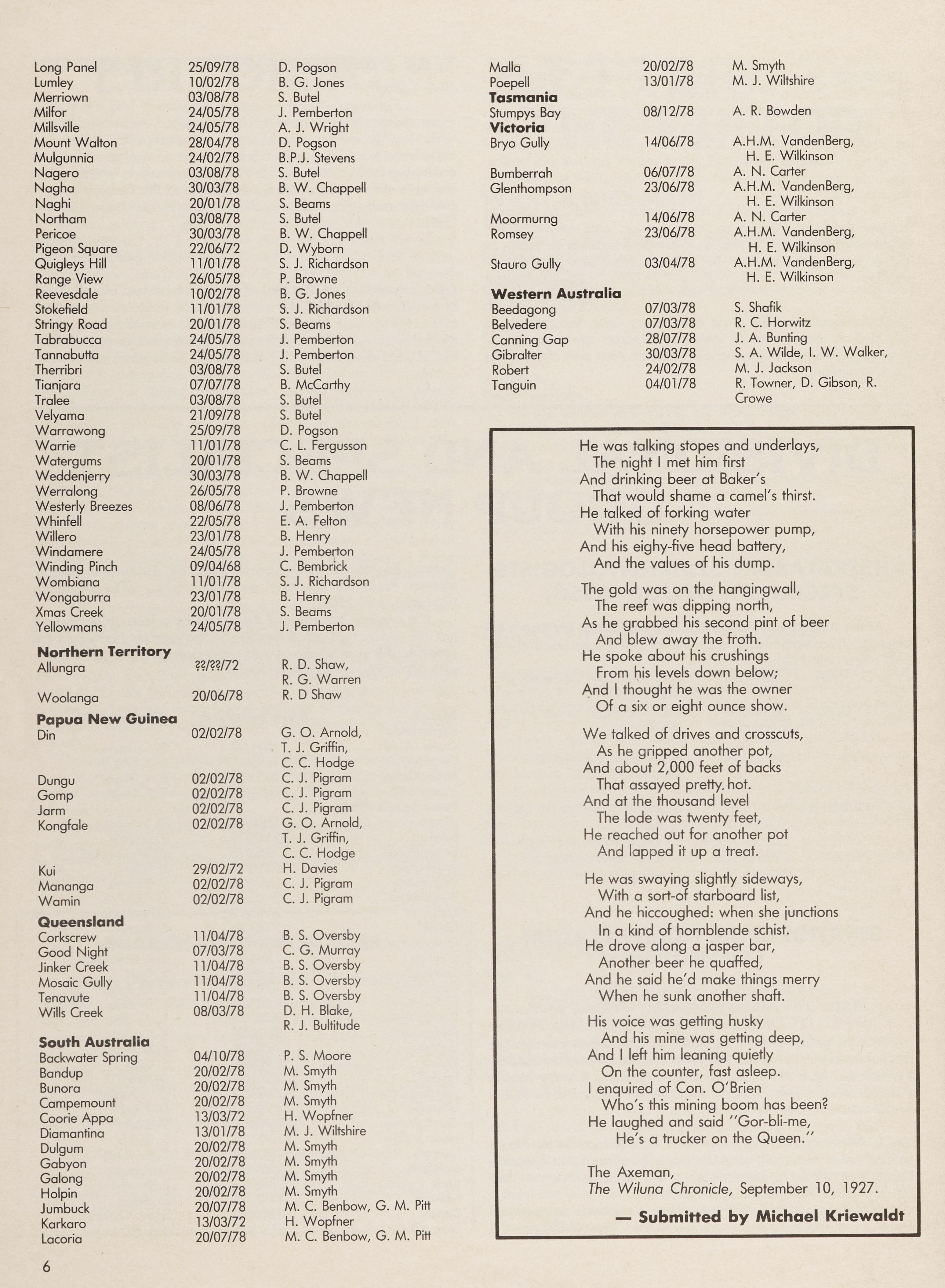
DELETION LIST NO. 11 (1984) DELETIONS FROM RESERVED NAMES INDEX OF NAMES RECORDED FOR MORE THAN FIVE YEARS
It is the policy of the Stratigraphic Nomenclature Committee that reserved names held for five years and not yet published should be removed from the index of reserved names, thereby freeing them for other enquirers, unless the original reserver indicates that he still intends to use the name.
A list of names held for five years or more is attached. The list is sent to those organisations which receive the Bi-monthly Variations List and not to authors. It would therefore be appreciated if readers would draw the list to the attention of any author with whom they are in contact whose name appears herein.
Authors who would like these names to remain in the reserved names index should write immediately to the Officer-in-Charge, the
Central Register of Australian Stratigraphic Names, Bureau of Mineral Resources Geology and Geophysics, GPO Box 378, Canberra, ACT 260 l
It is possible that some of the names have been published but not indexed in the Central Register of Stratigraphic Names. In this case the Officer-in-Charge would appreciate advice on where any such published names can be found.
Name Date Reserved Reserved by
Antarctica
Crohn Massif ??/11/72 R. J. Tingey
Fisher Massif ??/11/72 R. J. Tingey
Mount Collins ??/11/72 R. J. Tingey
Mount Willing ??/ 11/72 R. J. Tingey
New South Wales
Alandoon 19/06/78 D. J. Pogson
Beloka 26/05/78 P. Browne
Bingie Bingie 30/03/78 B. W. Chappell
Bollol Creek 03/08/78 S. Butel
Bulgundara 26/05/78 P. Browne
Bungarabee 24/05/78 G. MacRae
CBC 24/05 / 78 J. Pemberton
Carlyle 20/01/78 S. Beams
Chapmans Creek 08/06/78 J. Pemberton
Cowriga 11/01/78 S. J. Richardson
Cranleigh 18/09/78 S. Butel
Devils Pulpit 10/02/78 B. G. Jones
Dimboola 26/05/78 P. Browne
Double Tank 20/02/78 E. A. Felton
Dungowan 03/10/78 P. Cawood
El Paso 26/05/78 P. Browne
Flixton 03/08/78 S. Butel
Fonthill 23/01/78 B. Henry
Fountain Dale 19/06/78 D. J. Pogson
Gleninga 25/09/78 D. Pogson
Gundawarra 03/08/78 S. Butel
Howe Range 20/ 01 / 78 S. Beams
lnverary 10/02/78 B. G. Jones
lnverleith 25/09/78 D. Pogson
Kara 26/05/78 P. Browne
Kilfeacle 24/05/78 S. Hickey
Llanelly 30/03/78 B. W Chappell
Long Hill 11/01/78 S J. Richardson
Long Panel 25/09/78 D. Pogson
Lumley 10/02/78 B. G. Jones
Merriown 03/08/78 S. Butel
Milfor 24/05/78 J. Pemberton
Millsville 24/05/78 A. J. Wright
Mount Walton 28/04/78 D. Pogson
Malla 20/02/78 M. Smyth
Poepell 13/01/78 M. J. Wiltshire
Tasmania
Stumpys Bay 08/12/78 A. R. Bowden
Victoria
Bryo Gully 14/06/78 A.H.M. VandenBerg, Mulgunnia 24/02/78 B. P.J. Stevens H. E. Wilkinson
Nagero 03/08/78 S. Butel
Nagha 30/03/78 B. W. Chappell
Bumberrah 06/07/78 A. N. Carter
Glenthompson 23/06/78 A.H.M. VandenBerg, Naghi 20/01/78 S. Beams H. E. Wilkinson
Northam 03/08/78 S. Butel
Pericoe 30/03/78 B. W. Chappell
Moormurng 14/06/78 A. N. Carter
Ramsey 23/06/78 A.H.M. VandenBerg, Pigeon Square 22/06/72 D. Wyborn H. E. Wilkinson
Quigleys Hill 11/01/78 S. J. Richardson
Stauro Gully 03/04/78 A.H.M. VandenBerg,
Range View 26/05/78 P. Browne H. E. Wilkinson
Reevesdale 10/02/78 B. G. Jones
Stokefield 11/01/78 S. J. Richardson
Stringy Road 20/01/78 S. Beams
Tabrabucca 24/05/78 J. Pemberton
Tannabutta 24/05/78 J. Pemberton
Therribri 03/08/78 S. Butel
Tianjara 07/07/78 B. McCarthy
Western Australia
Beedagong 07/03/78 S. Shafik
Belvedere 07/03/78 R. C. Horwitz
Canning Gap 28/07/78 J. A. Bunting
Gibralter 30/03/78 S. A. Wilde, I. W. Walker,
Robert 24/02/78 M. J. Jackson
Tanguin 04/01/78 R. Towner, D. Gibson, R.
Tralee 03/08/78 S. Butel Crowe
Velyama 21/09/78 S Butel
Warrawong 25/09/78 D Pogson
Warrie 11/01/78 C. L. Fergusson
Watergums 20/01/78 S. Beams
He was talking stopes and underlays,
The night I met him first Weddenjerry 30/03/78 B. W. Chappell
And drinking beer at Baker's Werralong 26/05/78 P. Browne
That would shame a camel's thirst. Westerly Breezes 08/06/78 J. Pemberton
He talked of forking water
Whinfell 22/05/78 E. A. Felton
Willero 23/01/78 B. Henry
With his ninety horsepower pump, Windamere 24/05/78 J. Pemberton And his eighy-five head battery,
Winding Pinch 09/04/68 C. Bembrick And the values of his dump.
Wombiana 11/01/78 S. J. Richardson
The gold was on the hangingwall, Wongaburra 23/01/78 B Henry
Xmas Creek 20/01/78 S. Beams
The reef was dipping north, Yellowmans 24/05/78 J. Pemberton
As he grabbed his second pint of beer
Northern Territory And blew away the froth.
Allungra ??/??/72
R. D. Shaw ,
He spoke about his crushings R G. Warren
From his levels down below; Woolanga 20/06/78 R. D Shaw And I thought he was the owner
Papua New Guinea Of a six or eight ounce show.
Din 02/02/78
Dungu 02/02/78
Gomp 02/02/78
Jarm 02/02/78
Kongfale 02/02/78
Kui 29/02/72
Mananga 02/02/78
G. 0. Arnold,
We talked of drives and crosscuts, T. J. Griffin,
As he gripped another pot, C. C. Hodge And about 2,000 feet of backs
C. J. Pigram
C. J Pigram
C. J. Pigram
G. 0. Arnold,
That assayed pretty. hot.
A nd at t he thousand level
The lode was twenty feet, T. J. Griffin, H e reac hed out for another pot
C. C. Hodge
H. Davies
C. J. Pigram
An d lap p ed it up a treat
He was swaying slightly sideways, Wam in 02/02/78
C. J. Pigram
With a sort-of starboard list,
Queensland And he hi ccoughed : when she junctions
In a kind of hornblende schist.
Corkscrew 11/04/78
Good Night 07/03/78
B S 0versby
C. G. Murray
He drove along a jasper bar, Jinker Creek 11/04/78
B S. 0versby
Another beer he quaffed, Mosaic Gully 11/04/78
Tenavute 11/04/78
Wills Creek 08/03/78
South Australia
B S. 0versby
B. S. 0versby
D. H. Blake,
R. J. Bultitude
And he said he'd make things merry
When he sunk another shaft.
H is voice was getting husky
And his mine was getting deep, Backwater Spring 04/10/78
Bandup 20/02/78
Bunora 20/02/78
Campemount 20/02/78
Coorie Appa 13/03/72
P. S. Moore
M Smyth
M. Smyth
M. Smyth
H. Wopfner
And I left him leaning quietly
On the counter, fast asleep.
I enquired of Con. O'Brien
Who's this mining boom has been?
He laughed and said "Gor-bli-me, Diamantina 13/01/78
Dulgum 20/02/78
Gabyon 20/02/78
Galang 20/02/78
Halpin 20/02/78
Jumbuck
Karkaro
20/07/78
13/03/72
Lacoria 20/07/78
M. J. Wiltshire
M. Smyth
M. Smyth
M. Smyth
M. Smyth
M. C. Benbow, G. M. Pitt
H. Wopfner
M. C. Benbow, G. M. Pitt
He's a trucker on the Queen."
The Axeman,
The Wiluna Chronicle, September 10, 1927.
- Submitted by Michael Kriewaldt
A meeting of this Commission was held in Moscow on 10th August, 1984 during the IGC. Following are a number of extracts taken from the minutes of this meeting.
The next IMA meeting is to be held in 1986 at Stanford University, California, USA and it was agreed that formal symposia on gemstones should be sponsored by the Commission for this meeting. Topics such as synthetic materials, amber and noncrystalline gem materials, genesis of gemstone deposits and descriptions of individual deposits were suggested. The importance of reporting information on non-commercial occurrences was emphasised as these often yield data of considerable scientific and gemmological importance. National representatives to the commission are to explore the possibilities of producing a map of gem material localities of their own countries.
There remain many problems with nomeclature of gem materials, arising partly from the clash between the rigid rules laid down by the IMA for mineral names, and traditional use in the gemstone industry. The Commission is presently canvassing opinion as to whether measurements of physical standards such as colour should be a matter for study by the Commission. A separate entry, specifically for gemmology is to be made in the Thesaurus of Earth Sciences.
Anyone wishing to obtain more information about the Commission on Gem Materials should contact:
Dr Lin Sutherland, Australian Representative for the Commission on Gem Materials, The Australian Museum, 6-8 College St, Sydney NSW, 2000.
Extracts from Newsletter November, 1984
Current members of the Sub-Committee are:
Dr I. McDougall (Chairman), Australian University; Assoc. Prof. R.J. Blong, Macquarie University; Dr A. Ewart, University of Queensland; Dr R.W. Johnson (Newsletter items), Bureau of Mineral Resources; Dr R.W. Le Maitre, University of Melbourne; and Assoc. Prof. P.J. Stephenson, James Cook University of North Queensland.
The Royal Society of New Zealand and IAVCEI are sponsoring an International Volcanological Congress to be held in Auckland, Hamilton, and Rotorua, on 1-9 February, 1986 to coincide with the centenary of the 1886 Tarawera eruption. Calls for papers in six symposia, many of which will be of considerable interest to Australian petrologists, geochemists, and volcanologists, will be included in the Second Circular. (See notice this issue of The Australian Geologist). Interested Australians are urged to attend what will be the largest volcanological meeting in our region since the 1965 IAVCEI meeting in New Zealand.
A well -attended meeting of the Australian International Lithosphere Program Working Group on "lntraplate igneous activity in Australasia" was held during the 7th Australian Geological Convention in Sydney. Chapter coordinators of a book on the mainly Cainozoic intraplate volcanism of eastern Australian and New Zealand reviewed progress, and there was general
discussion on the format and future development of the book which is scheduled for publication in 1988.
The Circum-Pacific Council for Energy and Mineral Resources ran a workshop entitled "Pacific volcanology: forecasting eruptions", at Hilo, Hawaii, from 9 to 11 June 1984, which was attended by 35 invited participants from more than 20 countries. The workshop aimed to review current monitoring and forecasting techniques, to identify areas in international volcanological programs that should be strengthened, and to propose ways in which CPCEMR could assist with existing volcanological programs. A workshop report is planned for distribution, and a further workshop on "Volcanoes and the economic development of Circum-Pacific countries" is being planned for 1986 to be held in Singapore.
Catania is the venue for the next IAVCEI Scientific Assembly, to be held 16-21 September 1985. Two symposia are being organised: one on potassic volcanism, magma-chamber modelling, and geothermal exploration; the other on magma generation and eruption at Etna. Eruption prediction and volcanic-hazard assessment will also be discussed at both symposia. The Organising Committee Secretaries are Ors G. Frazzetta and G. Lanzafame, both of the Institute lnternazionale di Vulcanologia, V. le R. Marsherita, 6, Catania, Italy.
Readers are reminded that the PEASESAT volcanology seminar series, using NASA's ATS- 1 satellite, is still being run, and that there are eight PEACESAT ground stations in Australia (University of Sydney, University of Western Australia, Australian National University, Educational Technology Centre (Adelaide), Australian Maritime College (Launceston), Darwin Community College, Darling Downs Institute of Advanced Education); and there are many more KANGAROO Net ground stations in Australia that can be used to take part in PEACESAT exchanges. Write to Dr J.W. Cole at the Department of Geology, Victoria University of Wellington, if you wish to be put on the PEACESAT mailing list and receive notification of PEACESAT sessions.
The Executive Council of the International Mine Water Association (IMWA) met in Madrid between 10th and 14th September 1984 to make preparation for the IMWA Mine Water Congress scheduled for Granada, Spain, between 17th and 21 st September 1985.
The International Mine Water Association was founded in Spain in 1978 to focus attention, and provide a forum for discussion and dissemination of information on all matters relating to water flows in, around or emanating from mines. In keeping with the truly internationl status of the association councillors attended from America, Australia, Hungary, Poland, Spain and from Russia.
Stephen Hancock of Australian Groundwater Consultants Pty Ltd attended in his capacity as a member of the Council and has reported that the congress will be a real feast for engineers and hydrogeologists working or researching in the field of mine water , control technology.
The Technical Committee reviewing the abstracts received to date has reported that the abstracts indicate that papers will be presented of a high standard and covering a wide range of topics.
Mr Hancock reports that many of the abstracts accepted to date are very pertinent to Australian mining conditions and, since a number draw on extensive periods of data collection, .coupled with thorough analysis, they will represent major references in future
mine planning submissions, especially to government. He feels strongly that mining engineers and hydrogeologists from both private enterprise and government regulatory organisations would benefit by attending the Congress.
In addition to discussing the Granada Congress in 1985, IMWA is also moving to organise a Conference with the International Association of Hydrogeologists on the Hydrogeology of Mineral Deposits. This conference is tentatively scheduled for 1987 in Poland and is an idea which emerged from the International Geological Congress held in Moscow earlier this year.
At the end of the formal council meetings the councillors visited several major mining operations in north-western Spain. Most notable of these were the l 3MT/y open cut lignite mine at Puentes and the under ground Rubiales base metal mine. Both mines lie in a high rainfall region and have their share of mine water problems. Those at Puentes relate to slope stability and water quality both from in-pit discharge and from overburden dump runoff.
At Rubiales, the mine has always been quite dry, but until recently they suffered problems with waters rejected from their stabilised mine backfill aggravating geotechnical problems in the
highly broken mining environment. This problem has been resolved, and now it is the tailings dam which is their main cause of concern, especially since the mine lies well inland in a verdant and intensiv~ly farmed region.
Discussions between the IMWA councillors and the mine staff at the various mines visited were very stimulating and beneficial to both groups. They typified the advantages which derive from contact with other professionals working in common interest disciplines. Stephen Hancock felt that Australians have much to learn from contacts in the European mining industry amongst others, even as they have from us.
IMWA continues to seek new members and is expanding its quarterly journal distribution. Australian companies and individuals working in this field of mine water problems or the environment are urged to join. This now can be done directly in Australia though:
Mr. Stephen Hancock
International Mine Water Associaiton
Cl- Australian Groundwater Consultants Pty Ltd
26 Wellington St,St Kilda Vic. 3182.
NINETEENTH NEWCASTLE SYMPOSIUM ON ADVANCES IN THE STUDY OF THE SYDNEY BASIN
June 17, 18 and 19, 1985
University of Newcastle, Newcastle, NSW
For details contact: A/Prof Konrad H. R. Moelle, Convenor, Department of Geology, University of Newcastle, NSW 2308. Tel (049) 68 5228 or (049) 68 5229.
THE HORN/BROOK SYMPOSIUM
December 3-5, 1985 (technical sessions)
December 6-9, 1985 (field trip) at the University of Canterbury, Christchurch, NZ. Sponsored by: Association of Australasian Palaeontologists and Geological Society of New Zealand
Specific themes include:
1. Trans-Tasman correlations and historical biogeography.
2. Permo-T riassic of the Southwest Pacific.
3. Evolutionary principles and patterns as exemplified by the Australasian biota.
4. Biological approaches to palaeoecology.
Excursions include the Permian-Triassic of Southland, OamaruSouth Canterbury and North West Nelson Early Palaeozoic. Enquiries to convenor: Dr Margaret Bradshaw, Canterbury Museum, Christchurch, NZ.
University of Sydney
For information contact the Science Faculty Office, University of Sydney, NSW, 2006. Tel (02) 692 327 4.
March 20-21, 7985, Mi/sons Point, Sydney. Organised by The Australian Geomechanics Society and The Institution of Engineers, Sydney Division.
The symposium is based on a series of invited papers that together form a book. Delegates will be given copies of the book. FOR DETAILS: The secretary, The Institution of Engineers Australia, Sydney Division, PO Box 138, Milsons Point, NSW 2061. Tel. (02) 929 8544.
February 1-9, 1986
Auckland-Hamilton-Rotorua, New Zealand
Sponsored by the International Association of Volcanology and Chemistry of the Earth's Interior (IAVCEI) and Royal Society of New Zealand Second Circular and Call for Papers
The scientific session will begin with a symposium on Cenozoic Volcanism in New Zealand. Other symposia are:
1. Pyroclastic flow deposits and their eruptive mechanisms.
2. Phreomagmatic eruptions and the role of water in explosive volcanism.
3. Geochemistry of eruptive magmas - tectonic controls on petrogenesis (see special Call for Papers notice this issue).
4. Volcanic hazards - prediction and assessment.
5. Metallogenesis in volcanic terranes and water-dominated geothermal systems.
6. Tectonics, geophysics and volcanism at plate margins.
A wide spectrum of field trips are offered as part of the Congress. These range from specialist intensive excursions covering one or two volcanoes to general excursions covering an entire volcanic region.
FOR DETAILS: Dr John Gamble, Secretary Organising Committee IVC 1986, Department of Geology, Victoria University of Wellington, Private Bag, Wellington, NZ.
March 20-21, 1985
Sponsored by the Bureau of Minera l Resources, Geology and Geophysics.
The programme is as fo ll ows:
WEDNESDAY MARCH 20, 1985
World Petroleum Overview (Industry Speake r )
Recent Developments in Australian Petroleum Policy (D. IvesDepartment of Resources & Energy)
Austral ian Petroleum Exploration and Deve lopme nt Overview (Mr J White - BMR)
Australian Petroleum - Future Demand and Supply (Department of Resources & Energy Speake r and D J. Foreman - BMR)
Enhanced Oil Recovery (V. Pinczewski - Uni v ersity of NSW)
Oil Shale as a Future Source of Liquid Fuels (N PatersonSouthern Pacific Petroleum)
Uranium Resources and Supply (G. Battey - BMR)
Australian Coal Industry Performance and Outlook
• Industry Performance and Activity (M Huleatt - BMR)
• Policy Developments in the Coal Industry (B. Hill - DRE)
• Competitiveness of Australian Coal Industry (D. Barnett Macquarie University)
• Industry View and Outlook (R. Marshall - MIM Holdings)
THURSDAY MARCH 21, 1985
Australian Mineral Industry Overview (J. Ward - BMR)
Australian Industry Financ ial Performance and Outlook (R. HoodCoopers and Lybrand)
Gold - Target for Exploration (R. Dodson - BMR)
Australian Diamonds in a World Context (T. J. Appleby - Argyle Diamond Mines)
Industrial Minerals and Mineral Sands (A. Driessen - BMR and R. Towner - BMR)
Tin - Future Glut or Famine (I. McLeod - BMR)
Australia - a World Source of Tantalum (J. Linden - Greenbushes Tin)
Copper, Lead, and Zinc in Australia (D. Perkin - BMR and M. Roarty - BMR)
Iron Ore Industry - Future Technological Developments and their Significance to Australia (/. Burston - Hamersley Iron Pty Limited)
Nickel and Alumina in Australia (B. Elliott- BMR and N. KnightBMR)
Mineral Prices in 1985 (W. Davies - Metals and Minerals Research Services)
FOR DETAILS: Ms Evelyn Young, Senior Information Officer, BMR, GPO Box 378, Canberra, ACT, 2601. Tel (062) 49 9623.
April 28-May 2, 1985 in Toronto, Canada. Sponsored by: The Association of Exploration Geochemists.
The technical programme includes the following topics: Bedrock geochemistry - Intrusive/extrusive environments - Sedimentary basins
Regional surveys and case histories
Overburden geochemistry
Biogeochemistry
Environmental geochem istry
New approaches - Sampling and analytical methods
Interpretation and statistics
There will also be several two -day workshops and selected field trips. FOR DETAILS: The Organising Committee. 11th IGES, PO Box 523 (Metro Toronto ) Rexda le, Ontario , Canada M9W5L4
May 14-15, 1985, CANBERRA
Sponsored by : Specialist Group on Solid Earth Geophysics, of the Geological Society of Australia
Co-organised by: Bureau of Mineral Resources, and Australion National University
Purpose: To pro vi de a forum for informa l discussions on studies of the geomagnetic field and related applications.
Format: A programme of oral presentations (10-15 mins) on key note topics will be selected to provide a framework for d iscussions. A compi lation of extended abstracts will be published prior to the Workshop. Although only limited opportunities will be allowed for formal oral presentations, participants are encouraged to submit abstracts, including figures, for publication in the compiled volume, and also to bring display material which may be useful during discussions.
Scope: The theme of the Workshop will be the nature and origin of the geomagnetic field (GMF) and applications of geomagnetic observations. Relevant topics include:
Quiet and disturbed variations of the GMF (solar, lunar, pulsations )
Coastal effects
Use of geomagnetic variations for modelling crustal and sub-crustal conductivity structures
Modelling and charting the GMF
Satellite observations of the GMF
Role of magnetic observatories and geomagnetic indices
Magnetic anomalies: land, sea, air and space - observations and interpretations
Origins of the geomagnetic field - internal and external
Description and modelling of the ancient GMF
Correlation between geomagnetic and other phenomena, eg atmospheric C-14 variations, biological behaviour, extinctions, climate and weather
Observation and analytical methods
Historical aspects of geomagnetism.
Registration: If you are interested in participating, please complete and return the attached form to Charlie Barton. A registration fee of $28.00 will be charged ($20.00 for students and members of the Specialist Group on Solid Earth Geophysics) , which includes a free copy of the published abstracts.
Additional copies of the abstracts will be available for $20.00.
Return to Charlie Barton, (Geomagnetic Workshop) Bureau of Mineral Resources, PO Box 378, CANBERRA ACT 2601. Tel: (062) 49 9611
Name: . ....
Address ...... .
Please tick the appropriate box.
D I would like to receive future circulars only.
D I am interested in participating
D I intend to submit an extended abstract on the following subject
Resume required by May l, 1985 First Circular or further information from: Secretary, Organising Committee 3ICGI , Australian Mineral Foundation, PB97, Glenside, South Australia 5065 (See Calendar of Events th is issue)
This Department is planning a reunion of students, staff and friends, both past and present, on Saturday and Sunday May 4-5. For details: John Pemberton , Department of Geo logy, University of Wollongong, PO Box 1144 NSW, 2500. Tel (042) 27 0815.
Symposium No. 3: Geochemistry of eruptive magmastectonic controls on petrogenesis.
Conveners: Steve Weaver (Department of Geology, University of Canterbury, Private Bag, Chri stchurch, New Zealand Address until June 30 1985: Go British Geological Survey, 64 Grays Inn Road, London WCl X 8NG, England.
Wally Johnson (Bureau of Mineral Resources, Geology and Geophysics, GPO Box 378, Canberra, ACT 2601, Australia).
This symposium is co-sponsored by the International Lithosphere Programme Working Group on "Intra-plate Activity in Australasia". There will be two general themes:
{l) Volcanic geochemistry associated with modern tectonic settings, including geochemically transitional volcanic suites and the volcanic geochemistry of evolving tectonic environments. Tectonic controls on magma genesis.
(2) The validity of a uniformitarian approach in the deduction of petrogenetic schemes and tectonic settings for ancient volcanic rocks.
Contributions are expected to fall into one or more of the following categories:
(a) lntraplate volcanism in New Zealand, Australia and other continental environments.
(b) Arc-trench settings: island arcs and continental margins.
(c) Mid-ocean ridge, ocean island and other oceanic settings.
(d) Archean and Proterozoic volcanotectonic belts.
A special issue of a geological journal is planned for papers contributed to this symposium. Manuscripts should be prepared in the style of the Journal of Volcanology and Geothermal Research; these will be sent out for review and revised manuscripts collated by the editors before submission to the journal. Publication schedule is as follows:
October 30, 1985: Manuscripts to be sent to the editors for processing and review.
February 1-9, 1986: Oral or Poster presentation of papers at Congress and reviewed manuscripts returned to authors.
March 31, 1986: Revised final vers ions of manuscripts to the editors. For further information regard ing manuscripts and any enquiries contact the editors.
Rocks are often given long and sometimes unpronounceable names Usually after a locality, textural peculiarity or process of formation. However, there is one rock which was named after a domestic pet.
Do you know it? (Answer on last page).
Professor Bruce Thom of the Department of Geography, University of Sydney is interested in establishing a Quaternary Discussion Group in the Sydney metropolitan area. He is hoping to hold regular sem inar-type meetings once a month beg inn ing in March.
Anyone interested in joining this group should contact Professor Thom on (02) 692 2886.
In a previous edition of the Australian Geologist (No. 51-52, December, 1984) the editor commented that perhaps the mineral collections from the Australian Museum might be sent to the recently reprieved Geological and Mining Museum in the "Rocks" area of Sydney in return for some fossils. However, it appears that planning associated with the upgrading of the new Geological and Mining Information Centre has reached a stage, where, in order to fulfil the concept upon which NSW Premier:, Neville Wran approved the continued existence of the museum, all the space available will need to be devoted to promotional activities.
This means that some of the functions, operations and facilities currently housed at the Museum for convenience, might need to be relocated in the short and medium term. Such units concerned include laboratories, offices and storages, fossil petrology and mineral collections, marine geology facility. Possible relocation sites mentioned are Lidcombe and Londonderry.
So, don't take your rocks or fossil collection to the Geological and Mining Museum. It might be relocated!
Eve n if a large d iamond such as the Cullinan (3, 124 carats) awaits discovery in the Argyle AKl lamproite pipe, due to come into production later this year, the chances of it being recovered are slim.
The AKl mine is expected to treat three million tonnes of ore a year for the output of four or five tonnes of diamonds (20 to 25 million carats). However, as most of the stones are smaller than coffee sugar crystals , the ore will have to be crushed to a size which will pulverise any d iamond bigger than 75 carats - Sydney Morning Herald
(Editor's footnote: A 34 carat diamond has already been found by the Argyle joint venture.)
A 1984 Supplement to the Australian Thesaurus of Earth Sciences and Related Terms, 2nd ed, 1979, has been published. The Supplement has 2240 records with 1400 entry terms - 550 being new descriptors.
The complete and updated Thesaurus is available on magnetic tape.
Thesaurus Creation Software: Software for Thesaurus Creation maintenance and up-dating which is considered reasonabl; portable is also now available from the Australian Mineral Foundation. The programmes cater for the usual BT, NT, RT, USE, U F and NOTE formats with automatic generation of reciprocal entries and Hierarchical and Permuted Listings.
The Australian Earth Sciences data base, AESIS, has as of January 1985 about 34,700 records in the public file on AUSINET, with open-file company exploration reports, Geological Survey unpublished reports and many University theses back to 1973 and earlier - giving AESIS a better than 12 year depth, especially in the area of unpublished material.
There are now 16 special cross-indexed reference lists in this AESIS series, many of them with successive up-dates and supplements. The series covers topics such as: Uranium, Gold, Petroleum, Coal, Copper, Tin and Tungsten, Silver, Environmental Protection, Mineral Economics, Policy and Legislation, Hydrogeology, Gemstones, Remote Sensing, Geostatistics, Computer Applications, and Theses recorded in AESIS. The series is produced in type-set format each with up to six associated indexes, as composite documents. Lists No. 1 to No. 6 from The Retrospective Input Programme, covering 1965-1975, have also been released for public acquisition.
A 16-minute video tape on AMF operations, with an emphasis on the information services, is available for loan to member companies and at a nominal cost for acquisition by educational institutions.
AMF now has a Book Shop as an adjunct to the Library, catering principally for publications of learned societies and institutions in the earth sciences. The Book Shop opened in January 1985 with a large complement of MPG publications. For details: Information Services Manager, AMF, Private Bag 97, Glenside, SA, 5065. Tel (08) 79 7821.
In Chester, northwest England, anthropologists dug up a human skull near a secluded cottage. The cottage owner admitted to killing his wife there 23 years ago and was subsequently charged with her murder. Tests later showed that the skull is nearly 2,000 years old. The man has now pleaded not guilty and the trial is continuing.
- from News of the World
In a recent initiative, the New South Wales Department of Mineral Resources and the University of Sydney have entered into an arrangement to promote the evaluation of geological resources in coastal and nearshore marine areas in the State. The initiative is a response to, on the one hand, a growing need for geological advice in these regions of the State and, on the other, for a rationalisation of resources in the Government.
Involved are the Departments Geological Survey Branch and the Coastal Studies Unit of the Universities' Marine Sciences Centre and the Department of Geography. Dr Peter Roy, Senior Research Scientist and marine geologist with the Department of Mineral Resources has been appointed Research Affiliate in the Department of Geography whose new Professor of Physical Geography is Professor Bruce Thom. The appointment will allow Dr Roy to underta'ke coastal and marine geological investigations using the combined resources of the Government and University.
The new collaborative initiative arose from Roy and Thom's long-standing association and mutual interest in Quaternary coastal geology and its role in the evolution of the continental margin of southeastern Australia. Programs will be developed to explore the geology of coastal and nearshore marine areas in the State and to evaluate their geological resources. There is also strong interest in developing and using new technologies to assess mineral resources in marine environments. This will include the use of ultra sensitive, multi-element measurements of trace elements, sensitive detection techniques for very small amounts of detrital rare metals, remote sensing methods of geological mapping, mineral tracing using various techniques of tagging samples, and new methods of radioisotopic dating which will extend the time scale for absolute dating of Quaternary sediments.
Studies are currently underway to delineate very large masses of sand on the sea-bed off the South Sydney coast. These represent potentially valuable resources of industrial and construction sand for the Sydney Metropolitan area. Long-term plans for the future include detailed mapping of the coastal plain and adjacent sea bed to provide a framework for resource and environmental assessment and development planning.
The title of a paper appearing in Volume 1 (1980) of the Alaskan Journal of Pre-Pleistocene Vertebrate Palaeontology by P. McClellan is "Does the Alaskan record of land vertebrate fossils substantiate or contradict the long postulated existence of a Bering land bridge before the Pleistocene."
After that mouthful the Abstract is rather unexpectedly briefconsisting of one word: "No".
Roger Mackay, a former geologist from WA, who turned to golf for a living after being out of work, led Australia's top professionals after the first round of the $60,000 Victorian Open yesterday.
Mackay is convinced that he made the right decision to turn pro 15 months ago. It was his wife who urged him to take the step. - Sydney Morning Herald, February 8, 1985. (Mackay eventually finished equal eigth for $1704 prizemoney.)
- with profuse apologies to Karl K. Darrow, the originql author, the American Physical Society and the eminent people mentioned in this article.
Consider an actor in a hit show on Broadway, and contrast him with a geologist addressing the 7 AGC last August. The actor has all the advantages. He is speaking lines written for him by a master of the art. He has a gift for acting, otherwise he would not be in the cast. Even so, he is not allowed to speak his lines in any way that occurs to him. Every phrase, every inflection, even the position that he is to take on the stage, has been tested by a professional director, who does not hesitate to give him mandatory instructions, or even to alter lines if they seem ineffective.
Ample intermissions are provided. Usually the theatre has comfortable chairs and is well ventilated, or even air-conditioned. All this is provided to induce people to come to a play for the comprehension of which, with rare exceptions, no intellectual effort is demanded.
Now consider the geologist. He has thought out his own lines, and is not always proficient in this art. He has little or no training in the art of elocution, and no director has rehearsed him. His subject requires a considerable amount of mental effort on the part of his listeners. The listeners themselves are usually uncomfortable and sometimes acutely so. This may be because the chairs are uncomfortable, or because the room is hot and stuffy, or because the program has already been running for an hour or more without a break. Laurence Olivier or Glenda Jackson might well quail at the prospect of having to sway an audience under such conditions. Under these highly unfavourable circumstances, does the geologist strive to put on a reasonable facsimile of Olivier or Jackson? It may be conjectured that frequently he does not.
Often during the Conference the members are to be found in the corridors or on the lawn instead of listening to the speakers.
Can anything be done to amend this situation? Very little, I am afraid; but the following suggestions point in the right direction.
Speak loudly enough to be heard in the remotest part of the room. Some people sincerely believe that their voices are too weak to achieve this. No doubt this is sometimes the case, but I venture to believe that most of them are wrong. I do not think that I could manage a speech in the Opera House without a microphone but a geologist is not likely to be asked to speak in so large a hall, and, if he were he could count on its presence. In a hall seating 300 persons or fewer, this aid ought to be unnecessary except in pathological cases. If there is a microphone present, do not expect it to transform a conversational tone into a loud one. It is better to go to the opposite extreme, and pretend to yourself that the microphone is not there.
The trick recommended by those who instruct speakers is to look at and speak to the people in the rear row. This is often made difficult by the fact that some of the prominent people in the audience are sitting in the front rows; this is particularly common in university colloquia. If this situation exists, ignore it. If Ted Ringwood is sitting in the front row and Fred Dagg in the rear row, speak to Fred Dagg. Ringwood will hear you.
Write out your speech in advance, and commit it to memory. I have heard only one objection {from the viewpoint of the audience) raised against this procedure, and it seems to me groundless. It has been contended that a written speech is dull and lifeless; the implication is that an unwritten speech glitters with sparkling impromptus. But the presence of a manuscript need not prevent the speaker from substituting a sparkling impromptu for something that he has written; and if the impromptu fails to occur to him, the manuscript is there to carry him along.
There are some who think that it is better to hear an unprepared geologist groping for what he wants to say than a prepared geologist saying what he wants to say. It would be fascinating to see
this theory given a trial by the Australian Ballet, but nobody ever will. For an advanced student of the dance it may be instructive to see a dancer fall on her face, pick herself up, and resume her part in the ballet; but for practically everyone else it is acutely embarrassing.
If you cannot memorise your manuscript, read it aloud.
This bit of advice will probably be resented, for we have all suffered from dre9ry speeches poorly read. There is, however, no compelling reason why a manuscript should be poorly read. Lady Macbeth has to read a letter aloud in an early scene of the play; it is one of the high points of the drama.
The trouble is largely that most readers glue their eyes to the manuscript for seven-eighths of the time, lifting their eyes from time to time to steal a glance at the audience as though to make sure that it is still there. Reverse the ratio.
For a manuscript which you have composed yourself, it should be extremely easy. Try it and see.
Situate your topic in the general frame work of geology at the beginning, and summarise your conclusions at the end. Even in a 10-minute paper, a minute at the beginning and a minute at the end are not too much to reserve for these purposes. Do not fear to repeat your main points.
Time yourself. Although some speakers are very careful, others are still apt to overrun. This is particularly serious when the closing bell rings and the speaker still has to give the conclusions that are the incentive for the paper. The speaker naturally does not want to omit the climax of his speech, and the chairman is seldom ruthless enough to insist.
This is where a manuscript is particularly useful. Timing marks can be inserted at the end of each page or along the margin, and the speaker will then know when he is running behind and will be able to catch up by leaving out relatively dispensable passages. Allow for 20 seconds of silence after you make each of your different points. These gaps will give the audience a chance ot think about what you have said; there are no laws requiring a speaker to talk all of the time at his disposal.
Aim your discourse toward the average of the audience, not towards the topmost specialists. Too many young petrologists speak as though they were instructing Alan White; too many tectonicists as if they were addressing Mike McElhinny; too many palaeontologists as though the audience consisted of Dorothy Hill and so it goes. This is not quite so flagrant a fault as it was in the days before the advent of Specialist Groups and the Society splintered into simultaneous sessions, each attracting its own specialists, but it is still an error. There is one specious argument for the procedure which I am deprecating here. The speaker may think that the topmost specialist is also the prime job-giver, and therefore is the man whom it is urgent to impress. But in the first place, it seems plausible to suppose that the topmost specialist forms his opinions of people from their writings and from personal contacts; and in the second place, the job-giver in the audience is usually an Exploration Manager or Departmental Head whose own speciality lies elsewhere, and who is going to assess the speaker by his lucidity and not by his profundity.
The problem of slides. Most people who show slides at all, show too many and show them too fast. {I suspect that this is often because the speaker has prepared too long a speech and tries to compensate by racing through the slides). Rare is the slide which can be properly apprehended in less than 30 seconds, though exceptions do occur. It is impossible to assign a r igid maximum to the number of slides which can be shown effectively. I suggest seven for a 10-minute paper, but I make exception for the cases in which the argument is shown on slides instead of on the blackboard.
The problem of the "jargon". Some people ascribe the difficulty of understanding science to what they call the "jargon". This seems to imply that geologists use long technical terms out of perversity, when they could just as well use short familiar words. This is absurd.
If I am giving a speech on a subject involving oligotrophic lakes or on ophiolites, less than nothing will be gained if I avoid the word oligotrophic or the word ophiolite by some cumbrous paraphrase or by some vivacious popular word which does not mean the same thing. An oligotrophic lake is an oligotrophic lake, and an ophiolite is an ophiolite and there is no synonym for either. On the other hand there is nothing to prevent me from giving a brief definition of either. It does not have to be a complete definition.
One may object that a person who does not know in advance what these words mean is unable to profit by the discourse. This view fails to take account of the fallibity of human memory. The listener may have forgotten what the word means; he may even be able to recover the meaning during a few seconds of groping, but during these few seconds the speaker will go so far ahead that the gap cannot be closed. I have often observed that the place at which I lost contact with a speaker was the place at which he used a word that made me stop and ponder. It seems worthwhile to avoid such dangers as far as possible.
There is a sense in which geology is afflicted by what may be called jargons, though I should prefer to call them private languages. This is a phenomenon of recent years. Formerly geologists were few and far between, and one who did not make himself understood to his fellow-geologists l 000 miles away did not make himself understood to anybody. Nowadays many geologists do team work in large groups. In every such group a private language arises, characterised first of all by omissions. Relevant facts and even essential steps in an argum ent can safely be omtted within the group, because everybody knows them. In addition, the group invents all sorts of abbreviations, nicknames, and pet names for things. No dictionary contains these terms; they travel by word of mouth, and often they do not travel fast enough. When they are spilled out before a large, diversified group, disaster may ensue if they are not defined.
Style. Textbooks of style advise th e writer, and therefore inferentially the speaker, to strive for a proper proportioning of long words with short, and of words of Greek, Latin and French origin with words of Saxon origin. Now, a scientific article is perforce overloaded with words which are both long and of Greek or Latin
According to a study, nearly 60 per cent of audiences at medical conferences either day-dream or fall asleep.
The audience tends to remember little or none of the lecture and often pays more attention to casual distractions. The British study, reported in the Australian pharmaceutical newsletter Impulse, claims the medical profession has to find far more interesting ways to present lectures if they want conferences to be effective.
Women speakers were found to attract a more attentive audience.
The audience members who paid most attention to a speaker were either rivals of the speaker or co-authors.
- Daily Telegraph, November 7984
Editors comments: If you substitute "geological" for "medical" in the above article it somehow seems familiar
The earth's slowly shrinking equatorial "bulge" due to continent redistribution explains why modern scientists find ancient eclipses recorded by Babylonian and earlier civilisations to be at the wrong time. A dwindling bulge at the equator results in an acceleration of the Earth's rotation which in turn changes the length of the day. Allowing for a change in the length of the day makes these observations acurate.
- reprinted from Geolog Vol 13 pt. 3 .
origin. This suggests that whenever the speaker has an opinion, he should choose the short word over the long and the Saxon word over the Greco-Latin. If a sentence contains such words as thermoremanence or eucaryotic or stromatoporoidal - not to speak of the atrocious quaquaversal - it is really amazing how much the sentence will gain in grace and fluency if all the other words are colloquial and short. This policy also tends to bring out the necessary long word in bold relief.
A suggested experiment I have proposed, inter alia, that a speaker should speak slowly, show his slides slowly, define his private-language terms, and repeat his main points. To anyone who deprecates this advice I suggest the following experiment. Choose an article in The Australian Journal of Earth Sciences, and make it one in your own field lest the result of the experiment to be too frightful. Sit down in an uncomfortable chair, and read the article - but read it according to the following prescriptions. Read straight through from beginning to end at the rate of 160 to 180 words per minute. Never stop to think over anything, not even for five seconds. Never turn back, not even to refresh your memory as to the meaning of a symbol or the form of a cross-section. Never look at'an illustration until you get to the place where it is mentioned in the text; and when you get to that place, look at the illustration for l O or 15 seconds and never look at it again. If this is not the way that your listeners will apprehend you when you give a paper, you are an outstanding speaker.
( Editor's Note: Karl K. Darrow was secretary to The American Physical Society from 1941 to 1967 during which time the Society expanded from less than 4,000 to almost 25,000 members. As the size of Society meetings expanded it became obvious that most physicists were not coming across very well in presenting papers. Darrow, who was an excellent public speaker, was persuaded to write a set of instructions which were first published in 1951 and reprinted several times, the most recent being in "Physics Today, December, 1981," in time for Darrow's 90th birthday. The editor feels that most of his instructions today are still appropriate as when they were written, whether to a physicist or a geologist. She has however, taken the liberty of shortening and "geologising" the article.)
The National Waterwell and Drilling Association of Australia (NWDA) will be releasing soon a documentary-promotional film called "Follow That Hat" about the drilling industry in Australia.
The film will be made available to high schools, technical colleges, and other educational institutions as well as career advisors, the Department of Trode and to drilling firms for in-house training.
The purpose of the film is to increase people's awareness of the wide scope of drilling operations and their contribution to the development of Australia's resources.
The film will feature drillers at work on a construction site, developing groundwater and mining and exploration drilling.
FOR DETAILS: J. R. Mills, Executive Secretary, NWDA, PO Box 187, St Ives, NSW, 2075. Tel (02) 449 3382.
J .J. Veevers, Editor, Oxford University Press $99.00
(See advertisement this issue)
Now here is a book with which you will all have to contend no matter what your professional interests may be. What is more, it is a book with which all active geologists will wish to contend because it contains so many interesting, informative and arguable syntheses of so many different aspects of the geology of the continent. It is not a conventional continental geology in any sense. In fact, I suspect that no other continent has been subjected to similar treatment in such an extended published form. It contains little in the way of raw data. Almost everything is interpreted in terms of developmental models, which range from concepts of passive margin disruption to Lester King's morphotectonic cycles. This makes for interest and fluency, but there is bound to be criticism that the work is too closely tied to current hypotheses. Of course any author attempting a work on such a scale has to decide to concentrate on the data base or its interpretation, and the present authors have chosen the latter approach tempered with copious references to original sources. This has been a wise decision because a great volume of material on the data bases for the various States and regions has appeared during the last 20 years, and even more will appear with the publication of the B.M. R' s Bicentenary Project. From the point of view of most geologists, inside and outside the country, the present need is for a synthesis that will provide an intelligible conceptual framework within which detail can be organised and from which new frameworks can be developed.
Three other general points are worth mentioning. A high proportion of the book is devoted to the geology of the continental margins, both divergent and convergent. This means that Australia is very properly considered within its stable, ancient Gondwana matrix and its developing northern orogenic margins. This adds considerably to the value of the book, especially for non-Australian readers. The second point is that the authors depend heavily on a comparative approach. Most plate tectonic concepts have been constructed for other continents, other seas, and so it is not surprising to find frequent reference to overseas analogues. Finally, the figures are remarkable in their number and variety. In a book of 418 pages there are 246 figures, a high proportion of them occupying more than half a page and some as much as two pages. Emphasis is on maps and time-space diagrams. These simplified visual summaries are well documented and provide valuable introductions to complex geological situations. I have nothing but praise for this approach. It appeals not only to students and overseas workers who have to grasp broad patterns quickly, but also to experienced Australian research workers who can obtain ready access to detail via the listed sources, this access being modulated by well thought out hypotheses.
The structure of the book is simple, the major sections being Global Setting, Lithospheric Structure, Morphotectonics of the Platform and Margins, Phanerozoic History, and Summary.
The Chapter on Global Setting analyses the positions of the continent estimated from continental palaeomagnetic and sea-floor spreading data; palaeoclimates and palaeobiogeographies are then discussed within this framework. Of particular value are the palaeolatitude maps for the whole Phanerozoic, which show a pattern generally consistent with that derived from other sources. The southeastern part of the continent is shown as having a variety of orientations in a polar or sub-polar position from the Late Carboniferous to the Cretaceous after a long period in the tropics or sub-tropics. A series of 13 maps shows the development of the sea floor from the Jurassic to the Recent, and these give an excellent
synoptic view of the complex movements involved in the generation of the Indian Ocean, as well as the tempora l relationships between these movements and the opening of the Tasman and Coral Seas. An important innovation in this chapter is the attempt to produce a history of palaeoclimates and palaeobiogeography for the whole Phanerozoic. This coordinates widely scattered information, and culminates in excellent discussions of the development of arid Australia and its biota
The short chapter on Lithospheric Structure is not successful. It attempts to bring together a description of the gross structure of the continent, recent earth movements and their effect on Cainozoic volcanism in eastern Australia. The material could have been incorporated into subsequent chapters with much greater effect.
The chapter on Morphotectonics of the platform and margins occupies a little more than a quarter of the book, and even then it deals wih only some aspects of the topic. For the platform, emphasis is placed on the highlands and the plateaus. By way of contrast, the Murray, Gippsland and Otway basins are briefly treasted but only insofar as they contribute to an understanding of the tectonic episodes forming the highlands. The main part of the Artesian Basin is largely ignored, which is unfortunate since that structure occupies an enormous area and its morphotectonics have a great deal to teach us about platform behaviour.
In this chapter the various regions are subjected to very different treatments. For example, the Eastern Highlands and their attendant basins are described physiographically and geologically, and then this information is interpreted in terms of the plate tectonics of eastern Australia since the Jurassic. On the other hand, the treatment of the divergent continental margins begins with a plate tectonic model that controls all the subsequent presentation. Of course, the morphotectonics of any region ultimately depend on basement structure, but this has a variable overlay depending on its character and to global position Consequently a third approach is used in the discussion of the Western Plateaus, which depend so much for their form on the original geometry and Palaeozoic disruption of the Precambrian blocks. This variety will stimulate some readers, particularly those with an interest in scientific method. But it has one unfortunate result. Discussion of the Palaeozoic development of the Perth, Carnarvon, Canning and Bonaparte Gulf basins becomes more or less incidental to the elaboration of the morphotectonics of the Western Plateaus. This lack is not redressed elsewhere because their stratigraphy and structure are dealt with briefly only as they illustrate the failed-arm stage of the western margins {pp. 189-192), and as part of the Phanerozoic history of the continent. In comparison with the depth of treatment given to many other topics, these basins may well be considered to be ill-served, especially as the senior author has spent more time than most elucidating their geology.
Australia's Phanerozoic History is the title of the last major chapter, which occupies 128 pages. It will provide the focus of interest for a high proportion of Australian geologists and I suspect that they will not be disappointed with what they find. Is the Tasman Orogen underlain by Precambrian sedimentary and igneous rocks? What is the latest on the significance of the Tumut Trough? What are we to make of those troublesome transverse structural zones in central Australia? How does the development of the Sydney-Bowen basin relate to the inception of the internal continental basins? Has Cainozoic deposition really been cyclic? Answers to all these questions and more await your consideration.
To reduce the material to manageable dimensions, three Phanerozoic and one Late Precambrian "regimes" are identified. These are named as follows: Potoroo {Late Cretaceous - Recent), lnnaminka {Late Carboniferous - Late Cretaceous), Uluru {Cambrian - Middle Carboniferous), and Adelaidean {Late
Proterozoic). The regime concept is not discussed; nor are the features defining the regimes outlined. We are launched straight into the Potoroo Regime after an eight line paragraph. It transpires that the defining events, beginning with the most recent, are (a) initiation of spreading to form the Southern Ocean, (b) regional and marginal subsidence to form Gondwana-type basins, and (c) continental break-up on both eastern and north-western margins at the end of the Proterozoic. The effects of these events may be sufficiently pervasive to warrant the significance attached to them, but it would be good to see a case argued.
This chapter deals primarily with the continent from the Adelaide orogen eastwards and it is full of new and reworked insights on the evolution of that region. Palaeogeographic maps, cartoon sections, time-space diagrams and summary tables are used to great effect. Almost everybody will find something here to whet his appetite or sharpen his teeth.
The final short chapter is a summary of events in the form of charts and palaeogeographic maps.
What can we say, then, of the book as a whole. There is nothing quite like it available for Australia or anywhere else, and it chalks up a notable first for which we can all be grateful. It meets a tremendous need in that there is no alternative text through which interested persons can be introduced to the geology of the continent. The voluminous literature published since 1964 is thoroughly reviewed, and the list of references will be valuable despite improved library accession techniques. Although it is too large and too expensive to use as an undergraduate textbook, especially taking into account the need to go elsewhere for a discussion of the Precambrian, it certainly makes a very valuable reference book for students as well as professional geologists and physical geographers. One imagines a generation of Australian graduates having their views of the continent moulded by it. It is unlikely to appeal to the informed layman, but scientific workers in fields outside earth science - biologists in particular - will find ready access to much useful material. Though we will all find gaps that we would like to have filled, or interpretations at variance with our preferred views, or data that we consider to be incorrect, we now have a broadly-based, standard-setting account from which and on which we can work. The authors, who are either members of the staff of Macquarie University or have been associated with that university, are to be warmly commended.
What reviewer could resist a final comment of the price of $100 for a book that many of us had hoped would be readily available to students? If it had contained large numbers of colour photographs there may have been some excuse, but the frontispiece is the only example. Nor are there any half-tones. Surely a university publisher that accepts such a book and prices the first hard cover issue in this way has an obligation to produce a soft cover edition for about one-third this price within a year.
K.S.W. Campbell
(Editor's Note: This review is longer than those usually published in The Australian Geologist. However, to quote the reviewer, "The book is a major one for Australian geologists so I crave indulgence ")
Proceedings of the GSA/PESA Canning Basin Symposium held in Perth, WA, June 27-29, 1984. P. G. Purcell, editor. Published by the Geological Society of Australia Incorporated, and the Petroleum Exploration Society of Australia Limited, $35.00 plus airmail postage
"Everything you wanted to know about the Canning Basin (except for the locations of the still-to-be-discovered oilfi8'ds)" could be an alternative title for this comprehensive, authoritative volume.
This thick (582 pp) , hard-backed, quarto volume is more than just a random collection of papers presented at the Perth
symposium: as well as papers dealing with previously little-described portions of the southern and eastern Canning Basin, the volume is rounded out by papers outlining the history of exploration in the basin, regional geology, regional geophysics, and papers detailing the evolution of the basin with special emphasis on the history of those parts of the section containing adequate source rocks. The volume concludes with papers on the environmental impact of oil exploration operations on the fragile arid zone ecosystems, and on the current legal status of Aboriginal Land Rights legislation as it affects the Canning Basin and the various Aboriginal communities living within and marginal to the basin.
This is such a well-rounded volume that it should prove most useful to teachers of sedimentary geology and petroleum geology because it contains a very detailed synthesis of most of the aspects of the development of this complex basin throughout the Phanerozoic together with thorough discussion of the geological and geophysical data on which the theories of this development are based.
As one who was intimately associated with the "West Australian Petroleum P/L (WAPET)" period of exploration (1953 to 1974, when virtually the whole basin was held under permit by that company), I am amazed at the wealth of new data which has come from improved geophysical techniques and increased drilling in the "Post- WAPET" (1976-1984) period. The subdivision of WAPET's huge holdings into small parcels held by a number of companies led to greatly increased geophysical and drilling activity. It is primarily the remarkable increase in the quality of seismic data which has led to the recognition of such things as wrench faulting in the Gregory Sub-basin (papers seven and eight) with all of the implications of reinterpretation of the structural history of the basin that this new data requires.
It is not possible in a short review to list the titles of all of the 45 papers in this volume, much less to comment on each of them individually. However the papers fall into distinct groups which have been highlighted by the editor: -
1. An overall introduction to the history of exploration in the area and the developing philosophies of oil explorers through time.
2. A section on Basin Geology (five papers) which covers the outcrop, subsurface, and geophysical data in the basin and gives an overview history of basin development.
3. The East Canning Basin (two papers).
4. The South Canning Basin (two papers).
5. The Central Canning Basin (three papers).
6. The Devonian Reef Complexes which outcrop so magnificently along the northern margin of the basin are described in seven papers, three or which give results of intense shallow drilling for lead-zinc mineralisation in the Pilbara Range. Also in this group is a most important paper detailing the geology of the basin's only producing oilfield - Blina.
7. Geophysics (four papers). These cover gravity, magnetic, ~nd seismic techniques and results.
8. Geochemistry (seven papers). At last this vital part of the concept of oil maturation and migration is starting to be covered clearly and succinctly. This section also includes papers on various palaeothermometers used in studying the temperature history of the basin, and also a paper on localised hydrocarbon generation in the vicinity of any igneous intrustion.
9. Palaeontology is represented by only two papers covering advances in age dating using palynology and conodonts. Most of the palaeontology of the basin has been published elsewhere.
10. Mineralisation (five papers) covers exploration for the nonpetroliferous minerals in the basin - lead-zinc, diamonds, and uranium.
11. Two papers on Exploration Methods discuss interpretation of logging and drilling techniques.
12. Remote Sensing as an exploratory tool is covered in 3 papers which show that parts of the sand-covered Canning
Basin provide an ideal area for such studies.
13. The volume concludes with the two papers covering the environmental and social impact of oil exploration discussed earlier.
The editor and his co-workers are to be commended on the production of this well-balanced review of the Canni_ng Basin with i!s many excellent diagrams and photographs (some 1n colour). Their hard work is even more commendable when it is realised that the volume was produced in time for distribution to participants at the conference.
Copies of "The Canning Basin" are available from Ms Sue Thornett, BHP Exploration Ltd, Merlin Centre, Plain Street, EAST PERTH, WA 6000.
Murray Johnstone
Editors L.G. Medaris, D.M. Mickelson, C. W. Byers, W. C. Shanks. Geological Society of America Memoir 161, pudlished 1983, 324 pages, US$49.
Editor L.G. Medaris. Geological Society of America Memoir 160, published 1983, 148 pages, US$28
These two impressive volumes result from an International Proterozoic Symposium held at University of Wisconsin in 1981, which some notable Australian geoscientists attended and contributed to. The two volumes are quality publications in the familiar GSA Memoir style - burgundy hard cover with gold lettering, attractively presented, and containing a small ration of editorial blemishes.
The larger volum e contains 23 papers of wid e, global appeal, all by well known authors, covering the broad topics of tectonics, magmatism - metamorphism, mineral deposits, life-water-air, and glaciation.
Windley opens the book with a tectonic review of the Proterozoic, asserting a substantial role for plate movements, accretion and subduction, and alludes to the difficulty in using palaeomagnetic data. Piper then reaffirms, with new data on the APW path, the integrity of the Proterozoic supercontinent, and discusses the relationship (or more precisely the lack of it) between hairpins and tectonomagmatic cycles. Conversely, Baer, in examining the episodic nature of Proterozoic orogeny seems to correlate hairpins with "violent readjustment of plate geometry", consequent on convective overturn of the upper mantle. He concludes that subduction is an "artifact of the cooling earth in the 1st 700 m. y. ". This is an ideal springboard for Kroner once again to present the A-subduction model. Whilst most of the authors reject Proterozoic Wilson cycles, S.L. Anderson and Burke castigate the ad hoe models of some Proterozoic plate tectonicists. They set out in search of sutures, and seem to find several.
Andrew Glikson gathers together quite a lot of geochemical and isotopic data in solid support of ensialic environments for Proterozoic orogenies, and then ponders the size, nature and distribution of the oceanic crust. Taylor and McLennan represent their perceived contrasts in REE patterns between Proterozoic and Archaean sediments, and their inferences that these data bear on crustal evolution. J.L. Anderson presents much new data in a
comprehensive documentation of the petrogenetic evolution of anorogenic magmas. Finally, on the theme of crustal evolution, R. St. J. Lambert examines the problems in deducing thermal gradients from metamorphic P-T, and other data, and concludes with an argument in favour of basaltic underplating.
In the section on mineral deposits, five papers are presented. Sawkins slots all important Proterozoic mineral deposits into rift settings, which seems plausible for most deposits, but is stretching things a little for the Hamersley iron formations. Gale examines a large suite of exhalative massive sulphide deposits in both volcan~c and sedimentary environments, and makes a case for magmatic hydrothermal contribution, along with circulating seawater and expulsed connote water. Ian Lambert succinctly reviews five of the world's major Pb-Zn deposits and resumes the discussion on the syngenetic vs diagenetic origin of the McArthur deposit. Kimberley sets out to further constrain the constraints on models for iron formations, and to complete the suite, Langford neatly relates various types of uranium deposits to the evolving Precambrian atmosphere.
Four papers relate to the air-water-life theme of th_e Proterozoic. Cloud emphasises the importance of the anaerobic blue-green algae (which in Preston's eyes is more corr ect than using the fad-word ~yanobacteria) and refines his earli er estimates of oxygen/time curve with the comforting observation that the "preponderance of new data has been more supportive than otherwise". Perry and Ahmad discuss whether low 180 lev~ls in Precambrian chemical sediments signify precipitation from hot oceans, or chemically variable oceans that reflect tectonic episodes.
Four papers on glaciation complete the volume. Harland produces a listing of Proterozoic glacial occurrences, and both Crowell and Schermerhorn address the enigma of equitorial glaciation in the circa 0.8 b.y. period. The former ~uthor_ appeals to rapid oscillatory drift between polar and equatorial latitudes, and the latter appeals to fault horsts that penetrated the tropical palaeosnowline.
Clearly this is a most useful volume, and indeed, is one of the few modern volumes on this part of the Precambrian. Two general criticisms can be made. It is not a truly comprehensive coverage, as it deals little with mechanical and sedimentary aspects of rift basins, which is surprising in that rift tectonics is an omnipresent theme running through the volume. Secondly, many data and ideas have already appeared in print. However, one m~st P:~sumably accept that symposia, that need the patronage of 1dent1t1es, als':' are the nurturing grounds for scientific literature. It is emphasised that compared with other outrageously priced volumes (Geol. Soc. Aust. Archaean Geology excepted of course} on Precambrian tectonics, this book (Memoir 161) is certainly value for money.
Memoir 160 is a companion volume and seems to include the remainder of papers that were thought to have a more restricted or regional interest. It contains two papers that review th~ Penoke~n orogeny and interestingly, propose different mec~?rns~s for its development. Then follow five regional papers detailing, in a_ most readable manner, the sedimentation, volcanism and deformation of segments of the Penokean fold _belt. The volume finis_hes with a description of post-Penokean sedimentary and magmatic events.
In truth, this smaller companion volume may be of more lasting value than its larger brother, for it has a wealth of data put together by the people who have actually worked for many years in !his classical geological area. In fact it goes some way towa_rd meeting Preston Cloud's plea for "more pre-Phanerozoic sed1mentology and geologic mapping".
Both books can be obtained, postage free, from GSA Book Sales, PO Box 9140, Boulder, CO 80301, USA.
Dennis Gee
It is 22 years since the publication of Compton's Manual of Field Geology (Wiley) and, as so often happens, the lack of recent books has been met by a rush of new titles; four are reviewed here.
(by F. Ahmed and D. C. Almond. George Allen and Unwin. 72p. $9.95)
This is an excellent simple account of how to approach a geological mapping assignment for the beginner, useful for High School and First Year students. There are the expected chapters on general procedures, field observations and interpretation, measurements, and production of final map and report with appendices on field equipment and map symbols.
Although the authors have a wide experience in mapping in Africa and the Middle East, the text is less appropriate for Australia. It explains in detail how to measure and record data, what lithological and structural features to describe, collection of samples, establishment of map units, and introduces the important concepts of multiple working hypotheses, extrapolation and the distinction of fact and interpretation. It unfortunately does not deal adequately with the use of airphotos as base maps and lacks depiction of the metamorphosis from field sheet to final map.
J. W. Barnes. Halstead Press/The Open University Press. 112p. $14.95 _
This pocket-sized handbook is companion to the Geological Society of London Series on Sedimentary, Metamorphic and Igneous Rocks. As the title implies it is a basic guide to field mapping, with chapters on equipment, geological maps and base maps, methods of mapping, field measurement techniques, describing rocks, field maps and notebooks, fair copy maps and illustrations, cross sections and three dimensional diagrams, with appendices on field safety and adjustment of a compass traverse. It does not deal with report writing.
It emphasises European-style mapping, where 1 :250 000 scale is treated as reconnaissance. There are detailed accounts of position finding by various methods of compass resection, the "Canadian" paced traverse and plane-table mapping. Direct positioning by use of air photos as base map is only mentioned briefly. The excellent technique, taught to me by Gilbert Wilson, of using cross section traverses for unravelling complex areas is described. Gridding procedures for large-scale detail are illustrated but the standard grid-mapping techniques used for mineral exploration are not mentioned.
The importance of mapping surficial deposits, the difficulties of dealing with float, and the mapping of outcrops as distinct from interpreted boundaries are emphasised.
I can never understand why students are taught to measure dip and strike when modifiers such as dip quadrant or adherence to "right-hand rule" are necessary to clarify the reading. It is simpler to use the dip and dip direction method; an added advantage is that dip and plunge readings are then consistent.
There are useful tips on measuring folds, faults and joints, collecting and recording specimens and photographs, describing rocks and mineralisation, making sedimentary logs, keeping notebooks and plotting maps, even on panning. I disagree that measurements don't need to be written into the notebook; plotting them only on the map results in clutter, confusion and loss of data, and anyway it is unsuitable with the air photo base maps commonly used in Australia.
The Canadian Geological Survey practice of producing twotone final maps depicting outcrop and inferred unit boundaries provides a better treatment than the interpreted solid geology map
advocated by Barnes. Apart from this there is good advice on the preparation of maps suitable for theses or reports.
I strongly recommend this handbook for courses in Field Geology and it is to be hoped that the series will include similar handbooks on photogeology and remote sensing.
F. Moseley. Published by W. H. Freeman. 211p. $21.00
Have you ever wondered what to do with all those left over field sketches and photographs after publishing a paper? Frank Moseley's solution has been to publish them along with a series of notes and reminiscences, and this book makes interesting reading for students with some previous experience. The first part of the book (70p) outlining field methods is followed by a series of case histories (l 38p) on different geological terrains: Carboniferous sediments, Palaeozoic volcanics, and glacial sediments from England, Alpine structures in Spain, coastal mapping of Tertiary sediments in Cyprus, ophiolite complexes in SE Arabia, reconnaissance mapping in Greenland, East Africa, and Libya and mapping of metamorphic terrains.
For a book aimed at the more advanced student it contains much introductory material, moreover, many examples of techniques, short cuts and useful tips are made less useful by being scattered throughout the text and in places repeated. It is also strongly biased towards university work with examples of mapping at the extremes of very large or very small reconnaissance scales. There is a useful chapter on preparing a degree thesis but no help with the difficult task of reducing field notes to a scientific paper or company and survey reports, and no treatment of the exploration and mining plans or survey maps that students will confront on graduation.
There is one incredible howler in this book; reconnaissance mapping is advocated for remote areas such as Central Australia where large-scale topographic maps do not exist! The excellent BMR technique, now more than 10 years old in Australia, of mapping on large-scale coloured air photos and plotting on enlarged orthophoto maps seems to be unknown in Europe since none of the books reviewed mentioned it. This technique is the "only way" to map for the modern field geologist!
In spite of these criticisms this is a useful book to dip into, interesting and nicely presented and illustrated. Nevertheless, I would not recommend it as a teaching text, rather it provides good supplementary reading.
D. A. Berkman. Australian Institute of Mining and Metallurgy Monograph Series 9. Second Edition, 301 p. $25.00.
Like its forerunner, the 1982 second edition is not intended to be a "how to do it" book, rather it provides a handy almanac for most types of geological fieldwork. It provides lists of minerals with descriptions, formulae and tests, data on geochemical sampling and analytical methods, classifications of rocks and commercial factors for ores. Under Geological Mapping it presents an index of maps with magnetic declinations, suppliers of maps, geological time scales, mapping symbols, stratigraphic code (the old fourth edition) and classifications of faults and folds.
There are similar chapters on Geometric and Surveying Data, Engineering Geology, Geohydrology and Geophysics. It doesn't tell you how to survey a prospect or map area, but it provides all the information such as slope gradients, peg spacing, and stadia tables - all the kinds of data you might need but could never remember or find. There are numerous useful tables and formulae from apparent dips, to compound interest, and conversion charts for everything to anything else. There are useful sections on ethics, and
company and stock exchange requirements for report writing. New sections on Reporting Ore Reserves and Guidelines for Environmental Care are worthwhile additions. This is not a text book for the learner but it would make an excellent graduation present; no professional geologist should be without it!
None of the textbooks reviewed go sufficiently beyond the type of mapping needed for university research. Some instruction is needed in mapping for industrial and survey purposes and in the cooperation between geologist and draughtsperson in the production of maps, and some indication of what is involved in preparing a map for publication. Geological survey mapping is generally constrained by time and field costs, and it is a sad reflection on our economic priorities that for many published maps the quality of the cartography is considerably better than the geology.
Compton's classic contains much more than these books and the sketches of likely geological forms and arrangements of various types of rock are particularly usefu l. Although out of date, the book is still in print and would be my choice if castaway in some remote place. Unfortunately the outrageous price of $47.00 puts it beyond the pocket of most students
Mike J. Rickard
W. W.-S. YIM Editor, Geological Society of Hong Kong, Bulletin No. 1, 177p, 1984, $ 15 00
The highlights of this Bulletin are several excellent papers on colluvium and marine geology, both areas where extensive engineering work is going on at the present time. The classification of the colluvium on bulk density which appears to increase with age is interesting. Of interest to Australians is the use of land system principles to produce detailed geotechnica l land use maps at 1 :20,000 and 1:2,500 scales which have been extensive ly used in urban planning. Land system methodology is unpopu lar at present here.
The presence of lower marine beds on Lantau and High Island is cause for great excitement to the Hong Kong Marine Studies Group though care should be used in extrapolation from externa l seas. One would like to see much more research in Hong Kong to build up a complete local picture.
A paper on natural tunnel erosion introduces the novel idea that many landslides may be caused by the blocking of pipes! Certainly landslides are a major worry in Hong Kong and a paper on landslide hazards is welcome too.
It is interesting that Hong Kong with its splendid solid rock geology should launch its first Bulletin in Surficial Geology which is so often much more difficult and speculative. Apart from a few very poor papers they are to be congratulated on the result and may more follow.
Orders for this publication may be placed with the Publication Secretary, Geological Society of Hong Kong, d- Dept. of Geography and Geology, University of Hong Kong, Pokfulham Rd, HONG KONG.
Bryan P. Ruxton
Abstracts No. 13: Recent sediments in Eastern Australia - marine through terrestrial.
This is an extended abstract volume arising from an interdisciplinary symposium on Quaternary sedimentary deposits in Eastern Australia. A total of 38 papers were presented describing processes that are taking place at present, or in recent geological past in a wide range of continental, coastal and offshore environments.
Copies are available from the Society office in Sydney at $5.00 if you pick them up or $7.00 posted.
Some drill and bore the solid earth, And from the strata there Extract a register, from which we learn That he who made it, and revealed its date to Moses Was mistaken in its age.
William Cowper (1731- 1800)
Publications for Sale
ASSG Miscellaneous Publications
R. G. Walker {1981) Course Notes on Clastic Sedimentary Facies and Depositional Models
S. Djin Nio (1983) Course Notes on Clastic Tidal Deposits
B. G. Jones & A. C. Hutton {ed} {1984) Fluviodeltaic Systems: Facies Analysis in Exploration
B. G. Jones & A. C. Hutton {1984) Excursion Notes on Fluvio-deltaic and Coal Sequences in the Northern lllawarra District, NSW.
ASSG Field Guide
No. l P. G. Flood (1984) A Geological Guide to the Northern Great Barrier Reef $10.00 Prices include surface mail Orders, with cheque payable to "Geological Society of Australia" should be sent to:
Miss L. C. Tuckwell or Dr A. C. Hutton, Business Manager, Department of Geology, Geological Society of Australia, l O Martin Place, Sydney, NSW 2000
University of Wollongong, PO Box 1144, Wollongong, NSW 2500.
Providing details of Conferences, seminars, field trips, etc of special interest to Australian Geologists and previously mentioned in this newsletter (eg AG 49).
MAY
13-18 Field Symposium on Minerals & Metamorphism, Broken Hill, NSW.
JULY Specialist Group in Geochemistry, Mineralogy and Petrology (SGGMP). Combined technical and field sessions, with invited keynote speakers. FOR DETAILS: E. Slansky, Geological and Mining Museum, 36 George St, Sydney, 2000 Tel (02) 241 3662 or T. Green (02) 88 9108.
(AG5 1, December)
l 0-12 Conference on Stable Isotopes and Fluid Processes in Mineralisation, University of Queensland, Queensland. University of Queensland, Department of Geology and Mineralogy. Technical Sessions and field excursions. FOR DETAl LS : Dr Hugh Herbert, (07) 377 2377 or Dr Jack Rynn (07) 377 2552
AUGUST
{AG 50, October)
26-29 Third Circum Pacific Terrane Conference, University of Sydney, Sydney.
Sponsored by the Circum Pacific Council for Energy and Mineral Resources Meeting and Field Trip. FOR DETAILS: Malcom J. Lennox, Secretary, 3rd CPTC, Earth Resources Foundation, Edgeworth David Building, University of Sydney, Sydney 2006. Tel {02) 692 2038 {AG 50, October- 1st Circular).
SEPTEMBER
9-12 Fourth Geophysical Conference and Exhibition, Hilton Hotel, Sydney. Australian Society of Exploration Geophysicists. Technical sessions and workshops on all aspects of exploration geophysics. FOR DETAILS: The ASEG Secretariat, Conference Action Pty Ltd, PO Box 402, Roseville, NSW 2069 or Joe Odins (02) 922 0121 or Peter Gunn (02) 922 3499.
OCT-NOV
{AG 50, October - l st Circular).
28-1 1985 International Conference on Coal Science, Hilton Hotel, Sydney.
Sponsored by member countries of the International Energy Agency. FOR DETAILS: Mr R. W. Hinde, Executive Secretary, CSIRO Division of Fossil Fuels, PO Box 136 North Ryde, NSW, 2113. {AG 50, July).
16-2 1 Eighth Australian Geological Convention {8AGC), "Earth Resources in Time and Space", Flinders University, Adelaide.
1-5 Geological Society of Australia. Technical Sessions and Excursions. FOR DET Al LS: Dr Colin Branch, Convenor, PO Box 292, Eastwood, SA 5063. Tel (08) 274 7500.
{AG 50, October - more to come)
Third International Conference on Geoscience Information"Geoscience Information as a Resource", AMF Adelaide, SA Sponsored by the Australian Geoscience Information Association, Australian Mineral Foundation and Bureau of Mineral Resources. The aim is to encompass information issues covering the full spectrum of the geosciences. FOR DETAl LS: The Secretary, Organising Committee, Third ICGI, AMF, Private Bag 97, Glenside, SA 5065. {AG 49 - l st Circular).
AUGUST
11-15
Fourth International Kimberlite Conference, University of Perth, WA Sponsored by Geological Society of Australia, WA Department of Mines, University of WA and Bureau of Mineral Resources. Technical sessions and excursions. FOR DETAILS: Mr J. D. Lewis, Secretary, Geological Survey of WA, Mineral House, 66 Adelaide Terrace, Perth, WA 6000, Tel (09) 325 0161. {AG 50 October - l st Circular)
AUGUST
24-30
Twelfth International Sedimentological Congress, "Sediments DownUnder", Australian National University, Canberra. Sponsored by the International Association of Sedimentologists, Geological Society of Australia, Geological Society of NZ and Bureau of Mineral Resources. Technical sessions on a broad range of sedimentological topics, specialist symposia and field trips. FOR DETAILS: 12th ISC, ACTS, GPO Box 1929, Canberra, ACT260l. Tel (062) 49 8015.
(AG 51 December - l st Circular)
SEPTEMBER
Date to "Shallow Tethys 2" - an International Symposium, Riveriila College be of Advanced Education, Wagga Wagga NSW. fixed Hosted by Riverina CAE. FOR DETAILS: Dr K. G. McKenzie, Riverina CAE, PO Box 588, Wagga Wagga, NSW 2650 {AG 50, July- l st Circular).
The rock name is "dalmatianite!" It is used for a striking spotted rock from Noranda, Quebec, Canada.
Contributions by: P. J. CONAGHAN. R. H. FLOOD, B. D. JOHNSON. J. G. JONES, K. L. McDONNELL, C McA. POWELL, S. E. SHAW, - Edited by : J. J. Veevers, Associate Professor in Earth Sciences, Macquarie University.
J. A. TALENT, J. J. VEEVERS, S. Y. WASS and M.A.]. WILLIAMS, School of Earth Sciences, Macquarie University; B.J.J. EMBLETON, CSIRO Division of Mineral Physics; and P. G. QUILTY, Antarctic Division, Dept Science & Technology.
This up -to -date and comprehensive Phanerozoic earth history of Australia focuses on morphotectonics hy relating ancient configurations to the modern plate-boundary systems of divergent rifted arches and convergent magmatic arcs, accompanied by changes in latitude, climate, and biogeography, thus providing
for Australia's fossil fuels and other :::::· FORM
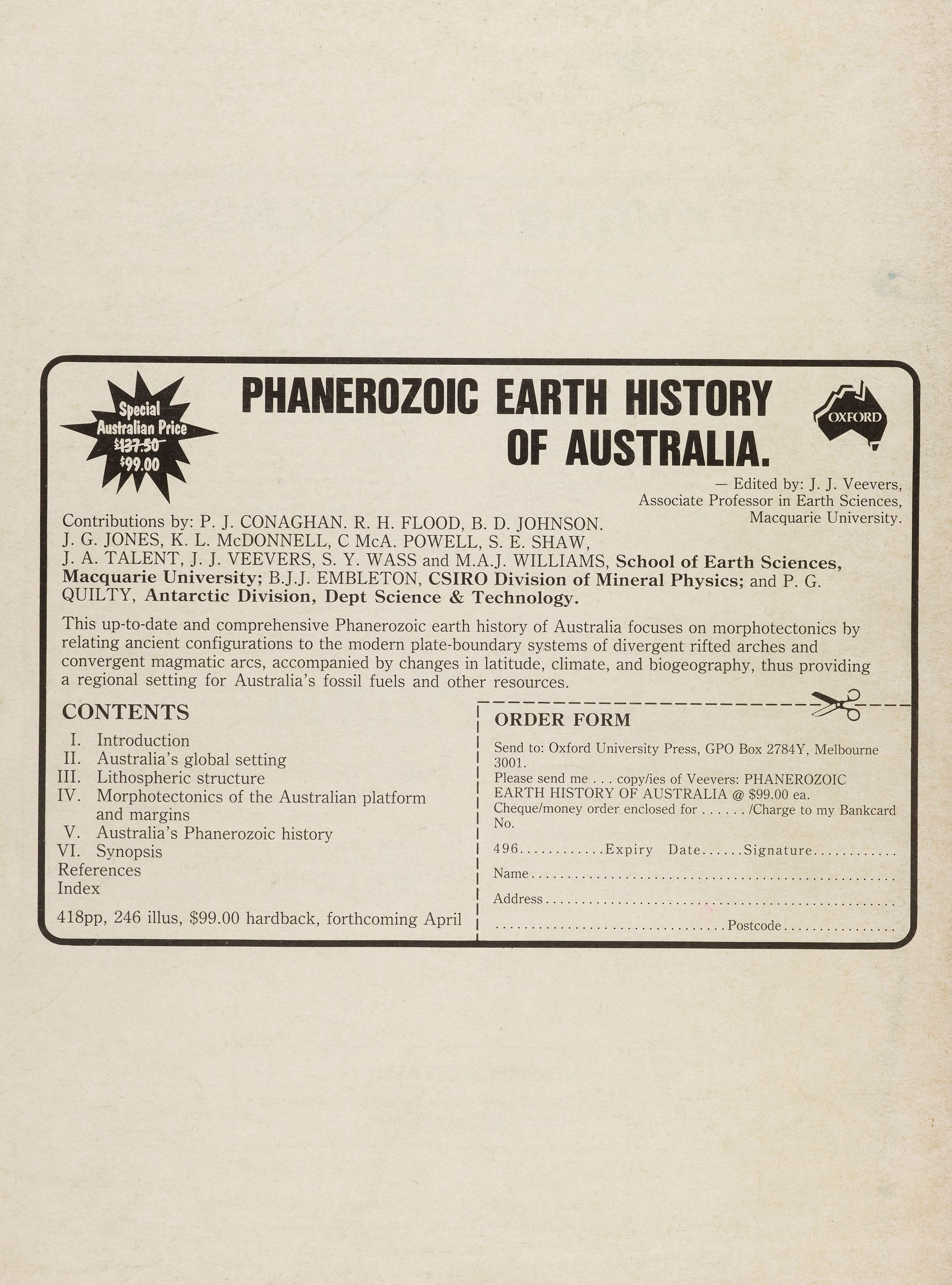
I. Introduction
II. Australia's global setting
III. Lithospheric structure
IV. Morphotectonics of the Australian platform and margins
V. Australia's Phanerozoic history
VI. Synopsis References
Index
418pp, 246 illus, $99.00 hardback, forthcoming April
Send to: Oxford University Press, GPO Box 2784Y, Melbourne 3001 . Please send me copy/ies of Veevers: PHANEROZOIC EARTH HISTORY OF AUSTRALIA@ $99.00 ea Cheque/money order enclosed for /Charge to my Bankcard No.
496 . . . . ... Expiry Date .. Signature Name ................