The Australian Geologist
Newsletter Editor :
D.F. Branagan
Dept of Geology & Geophysics
The Unive r sity of Sydney NSW 2006
Ph: Sydney 692 2358 or 692 29 12
Society Office
Business Manager
Miss L. Tuc kwe ll Suite 9, 6th Floor
Perpetual Trustee Bui lding
39 Hunter Stree t SYDNEY NSW 2000
Ph: Sydney 231 4696
THE PRESID ENT'S PAGE
The primary purpose of the founders of this Society was the publication of a Journal. Previous l y Australian geologists pub. li shed in the severa l Royal Societies, the A.I.M M., the bulletins and reports of the geological surveys, or in overseas journals. So the Journal wa s born Its silver jubil ee is an appropriate time to ask whe th er the Journal has measured up to the aspirations of its creators Do es it meet the needs of the second g~neration? It consumes ha lf of the Society ' s i ncome, on top of ex tens ive unpaid contribution by t he editor and his board. Is this too much, or too little? The Society has always aimed at a prestige journal. If members wanted it , the same matter could be printed in cheaper forma t Do al l members want to receive all papers, or only those in their own field? A couple of centuries ago most scientists maint a ined familiarity with id eas across th e whole of science. A century ago most geo l ogists kept abreast with developments throughout the whole of geology, and this l ed to solely geological journals. During the recent decades of increasing specialization, journals in narrow fields of geology have multiplied. What is the role of our journ al in thi s evolution, now and throug h the years ahead? A questionnaire to poll members is in preparation.
The prese nt pri nting contract with Graphic Services of Adela id e expires at the end of 197 8 , and althoug h the exec utiv e will have transferred to Me l bourne s hortl y before this date, the new contract should be neg otiat ed before, and confirmed at the Townsville council meeting The executive set up a committee to review the Society ' s pub l ications general l y, not with any specific changes in mind, but to review right across the board to see whether changes were necessary. We would welcome opinions or criticisms.
We also seek a new editor. Professor Brown has served the Society genero usl y and extreme l y well. He picked up the burden a second time to relieve the late Ken Townley . The Society has been very fortunate with its editors. The job is very onerous, and responsible, and one of the suggestions is that we pay an honorarium This would suffer much , less tax cut in the hands of a recently retired person with the necessary qua liti es and experie nce . If any member has any perso nal suggestions to offer please write to me confidentiall y
The Australian Geologist has been a valuab l e addition to the g lu e which holds the Society together. Its success is due in l arge measure to the hard work of its editor David Branagan. Some have proposed an increase from quarterly to month l y. This s ubmi ssion was well conceived, but i mpleme nt ation is quite bey ond our financial and manpower capacity. Each issue costs some $400, a nd the willing editoria l horse and supporting office staff are already extended to the l imit However the committee is examining the possibility of increasing from four to five or six per year. Even this may be beyond us, and could only be done if most of the material reached the editor camera-ready
I am talking about your newsletter, your journal, and your Society The exe cutive is dedicated to implem e ntin g your collective will. Our bri ef is to crystalli ze that wil l from communications we rec e ive.
S Warren Ca r ey
The Australian Geologist
Newsletter No. 15
Editorial - Are we at risk?
September 1977
As I write,earthquakes are very much in the ground, the August 19th Indonesian earthquake having been well and truly felt by many society members in the west, while Adelaide members received a milder reminder of earth movement just a few days later.
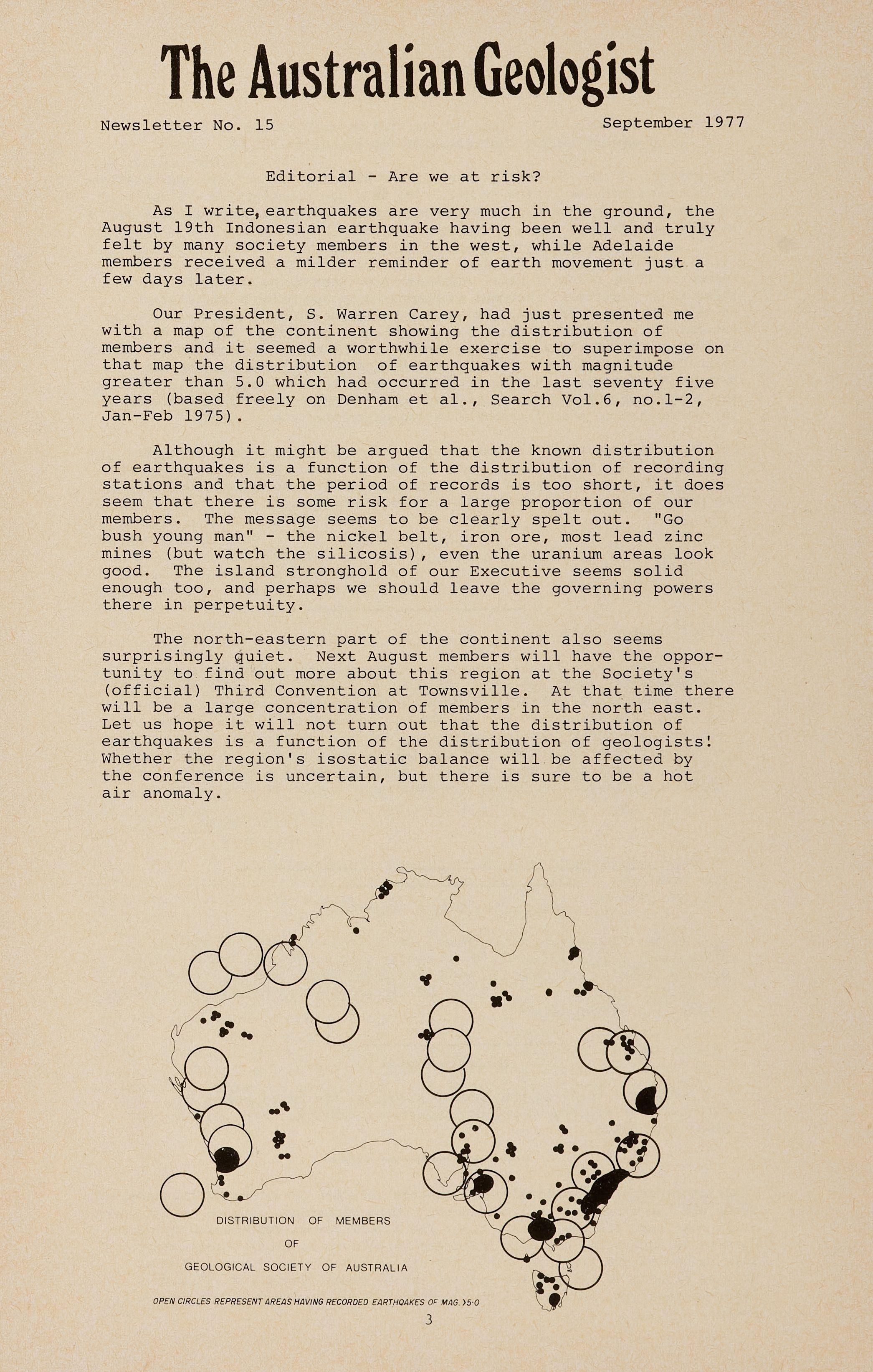
Our President, S Warren Carey, had just presented me with a map of the continent showing the distribution of members and it seemed a worthwhile exercise to superimpose on that map the distribution of earthquakes with magnitude greater than 5.0 which had occurred in the last seventy five years (based freely on Denham et al . , Search Vol.6, no.1-2, Jan-Feb 1975) .
Although it might be argued that the known distribution of earthquakes is a function of the distribution of recording stations and that the period of records is too short, it does seem that there is some risk for a large proportion of our members The message seems to be clearly spelt out. "Go bush young man" - the nickel belt, iron ore, most lead zinc mines (but watch the silicosis), even the uranium areas look good . The island stronghold of our Executi v e seems solid enough too, and perhaps we should leave the governing powers there in perpetuity.
The north-eastern part of the continent also seems surprisingly g uiet . Ne x t August members will have the opportunity to . find out more about this region at the Societ y 's (official) Third Convention at Townsville. At that time there will be a large concentration of members in the noith east. Let us hope it will not turn out that the distribution of earthquakes is a function of the distribution of geologists: Whether the region's isostatic balance will . be affected by the conference is uncertain, but there is sure to be a hot air anomal y .
Sir,
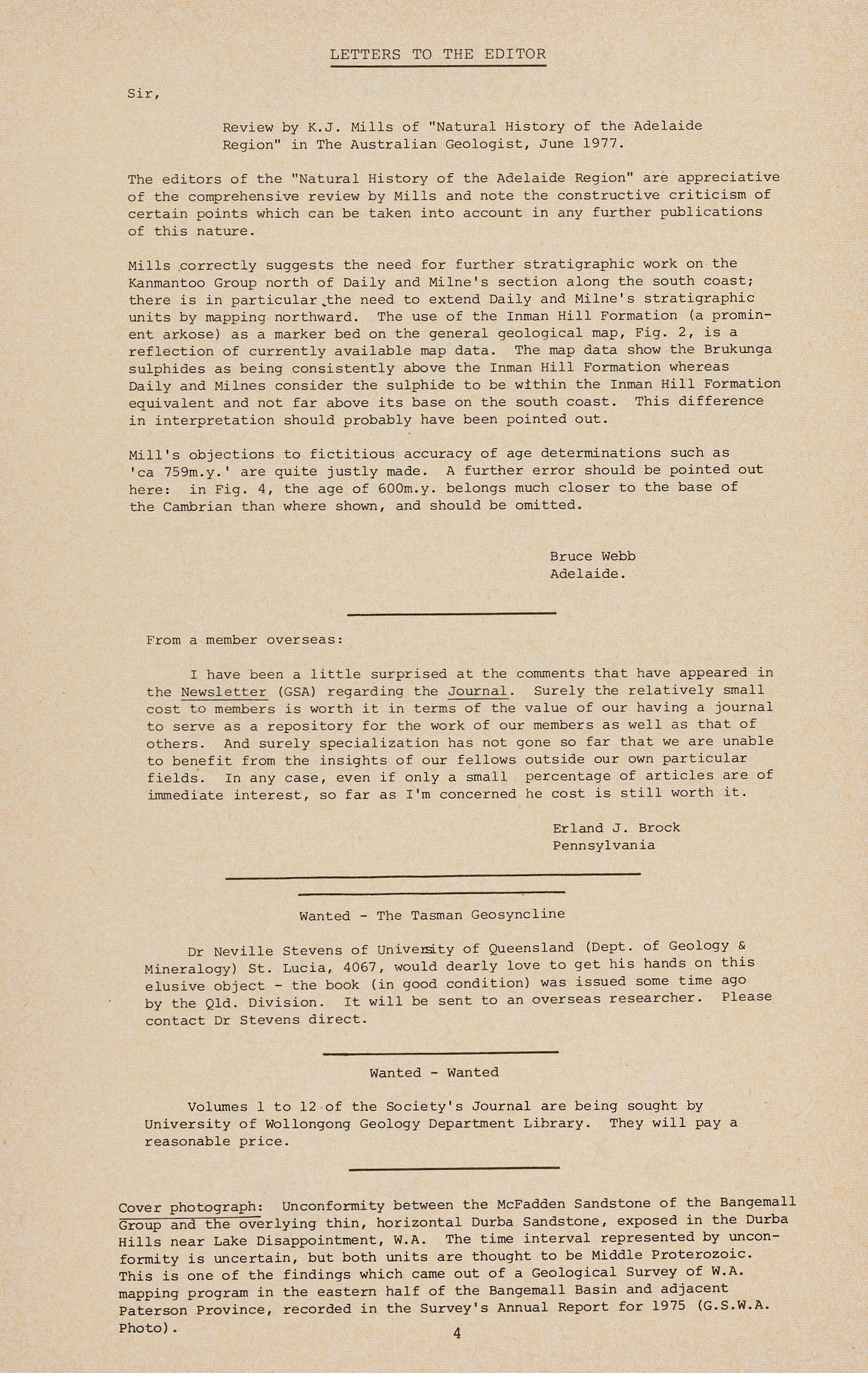
Review by K.J. Mills of "Natural History of the Adelaide Region" in The Australian Geologist, June 1977.
The editors of the "Natural History of the Adelaide Region" are appreciative of the comprehensive review by Mills and note the constructive criticism of certain points which can be taken into account in any further publications of this nature.
Mills correctly suggests the need for further stratigraphic work on the Kanmantoo Group north of Daily and Milne's section along the south coast; there is in particular,the need to extend Daily and Milne's stratigraphic units by mapping northward. The use of the Inman Hill Formation (a prominent arkose) as a marker bed on the general geological map, Fig. 2, is a reflection of currently available map data. The map data show the Brukunga sulphides as being consistently above the Inman Hill Formation whereas Daily and Milnes consider the sulphide to be within the Inman Hill Formation equivalent and not far above its base on the south coast. This difference in interpretation should probably have been pointed out.
Mill's objections to fictitious accuracy of age determinations such as 'ea 759m.y.' are quite justly made. A further error should be pointed out here : in Fig. 4, the age of 600m.y. belongs much closer to the base of the Cambrian than where shown, and should be omitted.
Bruce Webb Adelaide.
From a member overseas:
I have been a little surprised at the comments that have appeared in the Newsletter (GSA) regarding the Journal. Surely the relatively small cost to members is worth it in terms of the value of our having a journal to serve as a repository for the work of our members as well as that of others. And surely specialization has not gone so far that we are unable to benefit from the insights of our fellows outside our own particular fields. In any case, even if only a small percentage of articles are of immediate interest, so far as I'm concerned he cost is still worth it.
Erland J. Brock Pennsylvania
Wanted - The Tasman Geosyncline
Dr Neville Stevens of Universi.ty of Queensland (Dept. of Geology & Mineralogy) St. Lucia, 4067, would dearly love to get his hands on this elusive object - the book (in good condition) was issued some time ago by the Qld. Division. It will be sent to an overseas researcher. Please contact Dr Stevens direct.
Wanted - Wanted
Volumes 1 to 12 -of the Society's Journal are being sought by University of Wollongong Geology Department Library They will pay a reasonable price.
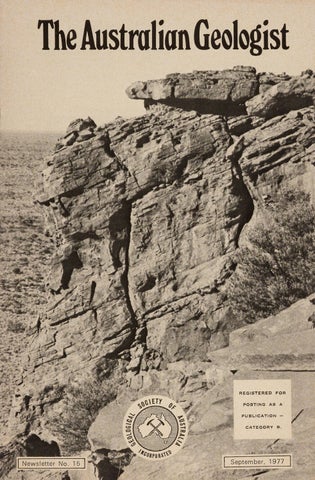
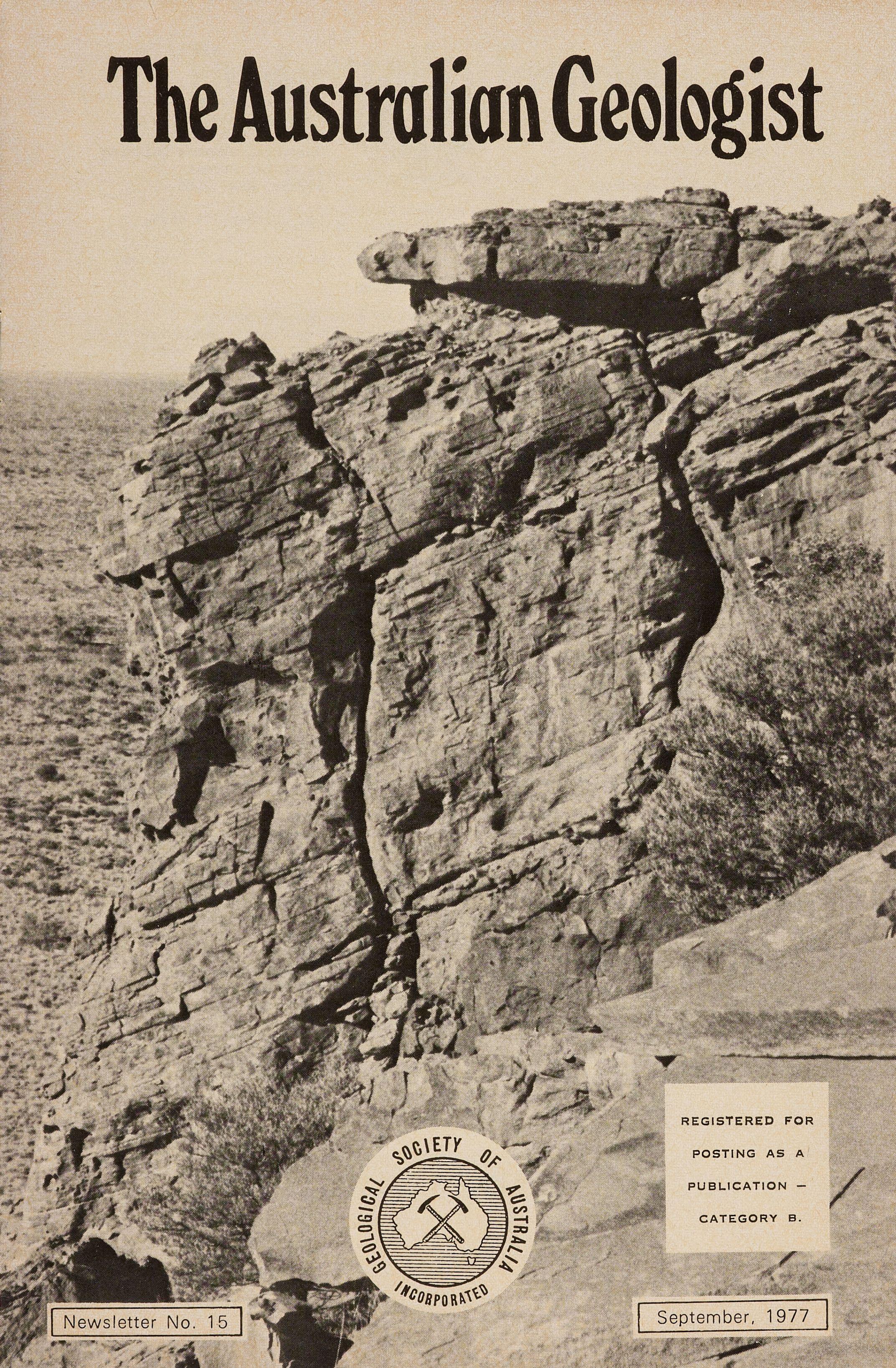
Cover photograph: Unconformity between the McFadden Sandstone of the Bangemall Group and the overlying thin, horizontal Durba Sandstone, exposed in the Durba Hills near Lake Disappointment, W.A. The time interval represented by unconformity is uncertain, but both units are thought to be Mi ddle Proterozoic. This is one of the findings which came out of a Geological Survey of W A. mapping program in the eastern half of the Bangemall Basin and ad j acent Paterson Province , recorded in the Survey's Annual Report for 1975 (G.S.W.A. Photo).
THE USE OF STREAM SEDIMENT SURVEYS BY GOVERNMENT AGENCIES IN AUSTRALIA
C.R.M. Butt, CSIRO Division of Mineralogy, Wembley, Western Australia, 6014.
State Geological Surveys and Federal Institutions were asked to give brief details of their usage of stream sediment surveys for the year 1976. The particulars requested were:
a) Type of material collected.
b ) Size fraction most commonly used.
c) Usual sampling density for regional surveys.
d) Usual sampling density for detailed surveys.
e) Elements commonly determined.
f) Usual analytical techniques.
g) Estimate of numbers of samples collected during the year, with figures for 1975 and estimate for 1977 if markedly different.
The organisations asked were:
Australian Atomic Energy Commission Bureau of Mineral Resources
CSIRO Division of Mineralogy Geological Survey of New South Wales Mines Branch, Department of the Northern Territory Geological Survey of Queensland Department of Mines, South Australia Department of Mines, Tasmania Mines Department, Victoria Geological Survey, Western Australia (AAEC) (BMR) (CSIRO) (NSW) (NT) (QLD) (SA) (TAS) (VIC) (WA)
For comparison, the same particulars were asked of a company working in the Kimberley Region of Western Australia.
The level of activity is very low, the total number of samples used by Government agencies in 1976 being approximately 4240. Since the BMR, the major user, do not propose to collect any samples in 1977, the level of activity will decline. There are a number of reasons for this lack of activity, the major ones being:
a) Most of the Government agencies do not themselves have a direct exploration role, although they may conduct regional or detailed orientation surveys from time to time. In general, relatively little research has been conducted in many areas of Australia into the use of stream sediments and the interpretation of the data. There is little evidence that the level of usage by Government agencies will rise until the applicability of stream sediments for mapping or exploration purposes has been more successfully demonstrated. Nevertheless, stream sediment surveys are used where appropriate by many companies in suitable areas. The information from just one company operation in north-western Australia shows a level of usage of stream sediments almost as great as all the Government agencies together. Although no data are available, the amount of stream sediment work conducted by the Universities is minimal.
b) The number of geochemists employed by the State surveys is not very high and they work over a range of geochemical problems; the level of interest in this type of work is low. In Queensland, for example, some regional surveys have been carried out in the past, but ceased in 1975 with the resignation of the only geochemist. In Western Australia, a regional survey will be carried out in 1977, but orientation has yet to be done, hence the configuration of the survey is not yet established.
c) In some arid areas, stream sediments are of limited use; there are often few streams, and those that there are flow intermittently, are often incompetent and at low density, and are often subject to contamination by aeolian materials. Thus, in South Australia, relatively high activity in the eight or nine years up to 1975 has been reduced due to the poor development of streams in the areas currently under investigation Nevertheless, stream sediment surveys may be more applicable in arid terrains than is generally realised, particularly if analytical techniques (for example, lower detection limits for 'pathfinder' elements) and interpretational techniques are refined.
This report was compiled to provide information for a review paper on the worldwide status of stream sediment geochemistry to be presented by W T Meyer, P .K. Theobald and H. Bloom at the Exploration 77 Symposium in Ottawa . The assistance of the various Government agencies in providing details of their activities in this field is gratefully acknowledge9 .
ARCHIVES
ARCHIVES of the Geological Society are housed in the Adolph Basser Library , Canberra, by courtesy of the Australian Academy of Science. The Basser Library serves as a centre for the study of the history of science in this country. Its purpose is two - fold. Firstly , it is a specia li st library of published ma terial relating to the history of Australian science , includ i ng Australian scientific publications. Secondly, it collects and prese r ves archival material and records the whereabouts of such material.
Archival material may consist of such things as draft manuscripts, laboratory day - books, field notes , notes of experiments , personal diaries, letters, photographs , autobiographical notes , memoirs, minutes of meetings, unpublished reports , etc The Basser Library has professional staff to advise on the suitability of material and the best form and location for its storage
The Basser Library also maintains an Australia - wide catalogue of scientific manuscripts preserved by other libraries and institutions together with a biographical card index of Australian scientists from early settlement to the p resent day . It publishes " Records of the Australian Academy of Science " as well as reports and articles based on historical material
Ge ologists are invited to help in tracing potential archival material and to mak e this available for permanent storage and future reference. Contributions and enquiries should be dir e cted to:
The Librarian
Adolph Basser Library
Box 216, Civic Square Canberra ACT 260 8
"Why not use an Aboriginal Name?"
I had a problem! As a geologist working on the classic Cainozoic succession of Maslin and Aldinga Bays, 30km south of Adelaide, not only did I have to face derision from friends over working on a nudist bathing beach, but nowhere on a map could I find a suitable geographic name to us e for a stratigraphic unit.
Maslin, Aldinga, Tortachilla, Willunga and so on had all been used by past workers on these superb coastal exposures. And when I thought Snapper Point was the answer, I found that some geologists over in the east had preoccupied the blessed name. My new unit was a very distinct one too. For over a decade, the chert nodules of this member had provided a useful marker bed over a large area of the St. Vincent Basin. I had to persist!
A colleague suggested, "Why not use an aboriginal place name?"
My excuses came in thick and fast to this proposal as I had seen almost every map of the area and I thought all place names had been used. Some of these names were obviously aboriginal names too.
"But", he persisted, "why not contact the Curator of Anthropology at the South Australian Museum anyway?" "He might suggest something and you have nothing to lose".
Somewhat grudgingly I agreed, muttering some thing about any available native names being long and unpronounceable.
The phone call to the South Australian Museum was a surprise. As normal practice apparently, they provide a service of searching out aboriginal place names for any enquiring members of the public.
And more surprising was the revelation, one week later. The actual stratotype of my proposed unit was widely known as a spring to former aboriginal inhabitants of the area. The water wasn't that good so the place was known as "Ruwarung " meaning brackish watering place - a new name!
And so my problem was solved and the new unit now goes by the name of Ruwarung. People grumble about pronouncing it, but I ignore them.
Perhaps Anthropologists in other parts of the country provide a similar service , which can assist the inadequate stratigrapher when everything else fails.
P.S This note does not constitute formal proposal of the Ruwarung Member of the Port Willunga Formation.
Barry Cooper Geological Survey of South Australia
Financ e and Publication Committees
Executive has set up two committees assist e d by outside experts to review these as p ects of the Society ' s affairs. The Finance Committee has met and having r e viewed t h e Societ y ' s financial position has agreed that it is sound and well conducted Some recommendations regarding investment policy and the leve l of reserves will be brought to the att e ntion of Council at the first opportunity.
The Publications Committee has met twice and all aspects of the Society ' s activitie s ip this field are und e r scrutiny. This is a complex task whi c h will not be c omp lete d hastil y The most important aspe ct is to determine the views of members in thes e matters In orde r to do this a questionnaire is included i n this issue to solicit the o p inion of me mbers Your o p inion is sought. Pl ease respond
The Ge ne r a l Pr oceed ings vo lum e of t he 25th I. G .C. has been p u b l is h ed I t is a useful summ ary of the mee t i ngs , scie n t i f i c programm e , e xcur s i ons a nd membe r sh i p Registrants shou ld have received copies Ad ditio n al co pi es a r e poss i b l y avai l able from t he Au stra l ian Academy of Sc i e n ce
SOCIETY NEWS
The journal celebrates its 25th Anniversary shortly. Have a look through your copies and assess its value. Any nominations for the best paper which has appeared?
On behalf of the Society the Executive sent a submission to the Review Committee of the BMR activities. Divisional and Specia li st Group Secretaries have copies available for perusal.
~pire builders diary :
Executive takes the following path - Victoria 1978-80, S. Aust. 1980-81, w. Aust. 1982-83 , ACT 1983-85, Qld 1985 - 86.
Disbursment of IGC funds.
The proposals put to the Academy by the Society as outlined in the last issue were not accepted However thanks to strong personal action by the President the final result is likely to be better. There will be further details in our next issue when the matter has been res~lved.
Procedural Guide
7he revised procedural guide was completed in May by Robin Wass. Divisional and Specialist Group officers are urged to read the guide and to pass it on to incoming officers. The Society and its members willbenefit greatly
The President has been having a busy round of meetings with Divisions in South Australia , Victoria , NSW, Qld and Tasmania. The 'house-full sign' was up at his talks in most places.
The fourth convention of the Society will be hosted by the Tasmanian Division in Hobart, early 1980 -(probably January) Further details in due course.
Miss Laurel Tuckwell, formerly Assistant Secretary, has been reclassified as Business Manager, a title which more correctly indicates the work she does.
Ken Mosher, former Administrative Officer to the Society, has resigned. His work for the Society was formally acknowledged by the Executive through the President. W.E. (Bill) Foskett has taken over as Hon. Administrative Officer. Don Gregg of the Tasmanian Museum and Art Gallery will act as his proxy at Executive Meetings.
Donations large and small are invited to the W.R. Browne Fund. Designs for the W.R. Browne medal are being studied at the moment.
The South Australian Division will hold a field conference on Kangaroo Island, October 8-10. Contact Wayne Harris, S.A. Dept of Mines (08 272-5711) for details.
The Queensland Division 1977 Field Conference Guidebook is available at $6 00 plus 60~ postage (overseas postage extra). It covers Lady Elliot Island - Fraser Island - Gayndah - Biggenden and is edited by R.W Day
Recent Geological Research Relating Low-temperature Aqueous Geochemistry to Weathering, Ore Genesis and Exploration.
In December 1976 the CSIRO Division of Mineralogy combined with the Geology Department of the University of Western Australia, in co-operation with the University Extension Service, to present a seminar relating lowtemperature aqueous geochemistry to weathering, ore genesis and exploration. The seminar was attended by 110 registrants, and its strong economic bias is shown by the following titles of presented talks:
J.B. La~bert: The genesis of low-temperature, hydrothermal base-metal deposits,
A.W. Mann: Nature and origin of uranium deposits in calcrete, R.E. Smith: Hydrothermal alteration and copper mineralization in Proterozoic volcanic formations,
S.S. Michael & D.I. Groves: The origin of the Northampton hydrothermal Pb-Zn deposits,
E.H. Nickel: Oxidation and supergene enrichment of sulphide ores,
C.R.M. Butt: ~he weathered expression of serpentinites containing disseminated nickel sulphides at Mt. Keith.
A 59 page summary of the presented material, including diagrams and literature references, was edited by J.E. Glover and D.I. Groves, and issued in bound, off-set type format for registrants. In view of its favourable reception, a number of additional copies has been run off. Those who wish to receive a copy should send $5 to the Extension Service, University of Western Australia, Nedlands 6009, to cover printing and postage costs. Cheques should be crossed and made payable to University of Western Australia - Extension.
Attention all net bu y ers!
Please note that the Dual Stereographic nets offered for sale in the last issue are made by McAulay Enterprises. This company is not related to Macquarie University, nor to Professor Ron Vernon. Intending purchasers please make out cheques to McAulay Enterprises not to Ron Vernon, nor to MacQuarie University.
Members of the Queensland Division who attended a course in structural geology late last year can now determine with ease whether or not it is s 3 The course was organised by the Divisional Committee, following a suggestion by Mr. K.R. Warner, and conducted by Dr. R.J. Holcombe of the University of Queensland. Eight hours of lectures with copious xeroxed notes concentrated on aspects of structural geology most likely to be useful to exploration and field geologists. Theory was put into practice on two excursions to examine areas within the "Brisbane Metamorphics" which are the subject of current research by Dr. Holcombe, and which display the effects of up to four generations of folding.
Overall the course was voted an overwhelming success, and participants agreed that they got their money's worth for the $10 fee. It is hoped to hold further courses on other aspects of geology in the future.
THE GREAT BARRIER REEF COMMITTEE
POSTGRADUATE RESEARCH GRAN TS, 1977
Applications are called for "The Great Barrier Committee Postgraduate Research Grants" intended primarily to encou rage field work on the Great Barrier Reef as part of the st ud y for a higher degree at a recognized tertiary institution in Australia.
Each award is of $A300 per yea r. It is tenable for one year but may be renewed. Usually three students will be awarded grants. The University of Queensland and Great Barrier Reef Committee Heron Island Research Station will provide free accommodation and bench space at Heron Island for the grantees.
Any postgraduate student enrolled or about to be accepted for a higher degree (Master's or Ph.D. programme) to work on any scientific aspect of the Great Barrier Reef at an Austra lian University or Institute of Advanced Education is eligible. The applicant must have or anticipate having the normal institutional and supervisor support
Closing date for receipt of application is 30th September, 1977.
Appl i can ts shou ld write to the Honorary Secretary of the Great Barrier Reef Committee (Dr Peter F Sale, School of Biological Sciences, University of Sydney, Sydney, N.S.W. , 2006) for further particulars
New England (Australian model)
Lea , D.A.M., Pigram, J.J.J., and Greenwood, L. (eds) 1977. An Atlas of New England, 2 Vols. Volume 1, 5lpp. Format 44cms x 4lcms. Volume 2, Commentaries 340pp. Format 16cms x 23cms. Maps and commentaries cover a range of subjects including relief, soils, slope, geology, soil erosion , climate, water resourc es , pre - historic settlement, population, landuse, forests, mineral resources, manufacturing, transport, tourism, education, helath services and housing. Geological map at 1:1,000,000 and explanatory chapter in the text by H.J. Harrington
Published by the Geography Department, University of New England and available for $22 (surface post paid) from the Secretary, Geography Department, University of New England, Armida le. 2351.
Dr . N H. Fisher will be taking part in a "study and contact tuur" by the International Union ' of Geological Science to the People ' s Republic of China beginning September 15th. The main objective is to achieve closer cooperation between Chinese and other geologists, to find the particular fields in which cooperation would be most fruitful, and how Chinese geologists can best take part in the activities of the I.U.G S., including the International Geological Correlation Program .
SGIGOD NOW SGEG
The " Specialist Group in the Genesis of Ore Deposits" (SGIGOD) has now been officially renamed "Specialist Group in Economic Geology" (SGEG) The gro u p has expanded its activities and is now also involved with all aspects of Economic Geology including Economic and Mining Geology, and Exploration Geology, Geophysics and Geochemistry GSA members, who are not already members of SGIGOD (now SGEG), are invited to join SGEG , and all members are also reminded of the forthcoming SGEG-AEG symposium on " Current Commodity Trends in Mineral Exploration and Evaluation " with Reference to Uranium, Tin, Tungsten , Chromium and Manganese ". For further information please contact Mr P.G . Moeskops , Secretary/Treasurer , SGEG , C/- Amdel , Flemington Street , Frewville , South Australia 5063.
Book Rev iew
Laterite and Landscape, by M.J. McF arlane
Academic Press - London - 1977 ; 151 pages; £5.80 $21.75
This review of laterit e is intended as a systematic discussion of the s ubject for geomorphologists The first two chapters review earlier work and definitions of lateri te The next five chapters evaluate the factors that control later ite formation (bedroc k, topography, climate , vegetation) and the "laterite profile". After discuss i ng laterite structure (i.e. fabric ), chemical composition and genesis , a final chapter deals with the author's own work in Uganda.
Despite the clarity of the ove rall plan it becomes evident that, as one delves into the book, the degree of confusion is considerable. This seems to e manate from the fact that , after 180 yea rs of u se and misuse of the term laterite, it is possibl e to find s upport within the literature for practically any point of view In trying to avoid this pitfall the author , to make clear what is being discussed, has adopted a particular definition of laterite Unfortunate l y the definition that is us ed (t hat of Sivarajasingham et al., 1962) i s too generalized to be useful.
The acceptance of this expedient implies that the author believes that , while ideas on the formation of laterite might have changed with time, the material referred to has always been the same. This is not so. For instance, the different materials and the different ideas implied in the use of the word laterite by Buchanan , Voysey , Newbold and Medl i cott , and Blandford show that both change together. This is a major ca us e of confusion throughout the book, for it is fal lacious to in terpret laterite lit erature in term s of a present - day definition. A typica l examp l e is from the first p ag e of chapter 6 where reference is mad e to Harrassowitz (1930), d ' Hoore (1954), Nye (1 955 ), Harrison and Reid (1910), Nagell (1962), Buchanan (1807), Babington (1 82 1), Newbold (1 846 ) and Oldham (18 93 ), as though all were talking about the same material, which is very definitely not the case.
It is unfortunate that , when this book is examined in greater detail , errors continue to obtrude. In chapter 2 , where the alumina content is being considered with regard to the definition of laterite, McFarlane writes that "The earliest analyses demonstrated the presence of the hydrates of alumina (Bauer, 1898; ", but as long ago as 1936 Fox demonstrated that the method of analysis used in Bauer ' s investigation did not differentiate between free and combined aluminuim and that , in fact , the clay mineral produced by the alteration of the Seychell es granites was kaolinitic
Chapter 9 deals with the chemica l constituents of laterite. In this the author demonstrates a notable lack of any form of min e ralogica l kno·.11ledge. There is no sign that the difference between an element and a mineral is appreciated. The sections are headed I Iron, II Aluminium , III Ma nganes e , IV Titanium , and then V Zircon (zirconium is surely the name of the element) . Section VI deals with chromium, and begins with the statement "This is an extremely resistant mineral".
It is, however, in Section XII , on silica , that the ultimate in confusion is achieved • The 17 plates contribute little to the book.
I cannot recommend this book either to any serious research worker or to anyone requiring a reasonable introduction to this subject.
T.R. Paton
Current Broken Hill Geo logical Research
A list of workers still carrying out research in the Broken Hill region has been prepared by Ian Plimer It can be obtained on request to: Dr. I R P limer , University of New South Wales , P O. Box 334 , Broken Hill . 2880.
SPECIALIST GROUP IN ECONOMIC GEOLOGY with A SYMPOSIUM ON THE ASSOCIATION OF EXPLORATION GEOCHEMISTS
CURRENT COMMODITY TRENDS IN MINERAL EXPLORATION AND EVALUATION
with reference to URANIUM, TIN, TUNGSTEN, CHROMIUM AND MANGANESE
Decernbe"r 5 to 7, 1977
The Australian Mineral Foundation , Adelaide
Papers are invited for this Symposium. Contributors are asked to submit titles of proposed papers , accompanied by a brief synopsis , to Dr. P G Moeskops , C/- Australian Mineral Development Laboratories, Flemington St , Frewville, S . A. 5063, as soon as possible. Contributors wi ll ha ve 30 mins for presentation of papers, with a further 10 mins for disucss ion Shorter contributions of up to 20 mins will also be accepted. Abstracts of all papers accepted must be submitted by November 1, 1977.
The aim of the Symposium is to bring together geo logi sts wi t h various interests in the broad field of Economic Geology to discuss some commodities that are of current economic signif i cance but which may have received little attention in recent symposia, conferences or literature. The organisers hope that the Symposium will provide discussion over a wide range of issues associated with these commo dities, including exploration , eva luation , market trends , ore genesis, etc.
INTERNATIONAL ASSOCIATION ON THE GENESIS OF ORE DEPOSITS
SNOWBIRD , NEAR SALT LAKE CITY, UTAH AUGUST 7-25TH, 1 978.
The programme includes pre - and post -mee tin g excursion s and the following major topics: ore deposits rel ated to cratonic volcan i c and sub - vo l can i c p r ocesses (main theme), deposits related to plate tectonics, and stratabound deposits in sediments.
All SGEG and SEG members will receive circulars but others should seek furthe r information from the regional counc illor for IAGOD: Dr. M. Solomon, Department of Geo logy , University of Tasmania, Hobart, Tasmania, 7005.
FOR THOSE WITH THEIR HEADS IN THE SAND
The Tenth International Congress on Sedimentology is scheduled for Jerusa l e m, July 9 - 14, 1978 All correspondence and requests for scientif ic information should be addressed (by airmail) to:
Dr G. Gv i rtzman, Geological Survey of Israel, 30 Malkhei Israel Street, Jerusalem 9550 1, Israel.
Registration and requests for other information should be addressed to: secretariat, Tenth International Congress on Sedimentology, P.O Box 16271, Tel Aviv , I srae l
A Symposium on " Sedimentary Basins and The Origin of Fossil Fuels " is organized as part of the 10th International Congress on Sedimentology. It ' s aimed at presenting new data and/or critical reviews and opinions on the formation of all types of fossil fuels in relation to sedimentology. For further information please write to:
Arie Nissenbaum , Isotope Research Department , Weizmann Institute of Science , Rehovot , Israel.
BAILEY, D. K. and MACDONALD, R. (Editors): The Evolution of the Crystalline Rocks. Academic Press: London , New York , San Francisco. 1976.
Six distinguished petrologists provide here a set of review essays on various , chiefly experimental, aspects of the study of metamorphic and igneous rocks. The first part, of rather fewer than 100 pages, is by D. K . Bailey and deals generally with experimental methods. Matters of technique come into it but, importantly, one also finds a lucid discussion about interpretation of results, both as run - products and the construction of phase diagrams. The remaining 350 or so pages make up Part II, on experimental petrology . Metamorphic rocks (Section A), for a change (no joke!), get decidedly fuller treatment than do the igneous (Section B). In fact , only two problem areas in experimental igneous petrology are covered - granitic rocks (by W. C. Luth) and alkaline rocks (Bailey). Each is a valuable summary of present knowledge though it has to be admitted they add up to a curiously cyclopean view of igneous petrology. Metamorphism is treated more handsomely in three essays that deal, respectively, with metamorphic reactions at high pressures (R. C Newton & W S Fyfe), at moderate temperatures and pressures (H.J Greenwood), and at low pressures and high temperatures (W. Schreyer) These authors have collected a comprehensive set of data and summarized them in excellent diagrams. Of course , th e ill-defined subdivisions of P and T lead to areas of overlap in treatment. Some of the overlaps are revealing. Perhaps the best example arises from that bloodied field, the Al -si licates Greenwood and Schreyer both tackle the problem, Greenwood concluding with a preference for the Holdaway (1971) picture whereas Schreyer , arguing along equally critical lines, prefers Richardson, Gilbert & Bell (1969). Perhaps the editors might have done more to reconcile the differences though the two contrasted discussions are each informative and, indeed, Greenwood himself offers what seems to this reviewer an intelligent compromise based on petrological commonsense.
This is a book that can be recommended without reserve to the advanced student and researcher seeking a careful· and up-to-date review of that part of experimental petrology dedicated to the crysta ll ine rocks. The only problem about its poss ible adoption as an advanced text is like ly to be economic ; the local price is not indicated but the book sells in the U.K. for £16 ($35 in the U. S.A.).
T G. Vallance.
WORLD DIRECTORY OF MINERAL COLLECTIONS Second Edition 1977
The Commission on Museums announces the publication of the second , great l y enlarged edition of the World Directory of Mineral Collections Thanks to the enormous co-operation of IMA members the second edition contains much new information from countries which have not been represented in the f ir st edition , and equally from countries hardly mentioned in it. Thirty-two countries and 455 collections are included in the new edition, whereas the first edition included 231 collections from 22 countries.
For each collection, on a separate page, the description includes the name of the owner, the location, the name of the person in charge, the total number of specimens, the number of minerals, rocks, ores, gems, and meteorites, the specialities and uses of the collection , the availability of specimens for study, loan or exchange, the admission hours, and miscellaneous notes
The price of the volume is U.S $10.00, including surface mail all over the world.
Copies may be ordered from Dr Ole V. Petersen, Geological Museum , Oster Voldgade 5-7, DK-135 0 Copenhagen K, DENMARK. Please, send your remittance with the order and make cheques or money orders payable to the International Mineralogical Association.
Economic Geology of Australia and Papua New Guinea 4 Industrial Minerals and Rocks (39200. l Edited C L. Knight
$ 2 9 00 to AusIMM members, $35.00 non-members
This book is a companion volume to those published on Metals, Coal and Petroleum by th e Australasian Institute of Mining and Metallurgy However it diffe r s from the other volumes in its treatment. The various substances, some 28 commodities, ranging from Asbestos to Talc, are discussed alphabetically, state by state, and are grouped according to age of occurrence and lithology. Almost all the authors have been drawn from the state surveys This arrangement of information devised by editor Clem Knight makes the book us e ful as a reference to particular commodities and occurrences, but lessens its value for teaching, or as an interesting book to read. In this last respect only the chapte r on the Ge orgina Phosphate province would rate h ighl y ; and it is this chapter which is most generously illustrated by maps, sections and photographs.
Elsewh.e re in the book illustrations are sparse and it might be best r e garded as consisting of plenty of dry facts with few (pictorial) figures, and there aren't as many tables as one might expect. The locality index howe v er is more than adequate.
Overall this book is a bit disap pointing I f e el the e ditor has been let down by the contributors in many c ases, or was it a policy decision by the Institute or th e various surve ys to gather and present the information as it was done?
Lik e most books p ublished in Australia it i s expensive. When one co ns i ders that t h e authors have contribute d their information free and no r oya lti es h ave be e n pa i d it should be possible for Prof e ssional bodies to make suc h public a tions available at much lower prices e specially to their o wn me mbers. The present p ricing polic y for this book and its companion volume s se e ms to be aimed at putting them only into librari e s .
David Branagan
SYMP OSI YM ON MI NERAL EXPLORATION
Geolog i cal fac t o r s , ca s e histories , techniq ues an d ne w app r oaches , wi th pa r t i cular r eference to We s te r n Tas man i an - type o r e b od i es and t e r r ai n
Ven u e : Times
Sponsors :
Organising Committee :
Address :
Queenstown , Tasmania
Saturday October 22 , 1 9 7 7
Ge o log i ca l Society of Au s tra li a I nc (Ta s ma n ian Di v i si o n ); Spec i alist Gro u p i n Economic Geo l ogy ; Australian Society of Ex p l o r ation Ge o p h ys i c i s ts (Tasmanian Branch ).
K. D. Corbett , G.R Green , J.E. Shirley , K.O Re i d Depa r tment of Mines , Box 124B , GPO , Hoba r t
This is a symposi um dea li ng with e x plo r at i on tec h n i ques releva n t t o Wes~ern Tasmanian type o r ebodies , terra i n , c l i ma t e ect.
Reqistration fee wi ll be $ 4 .00 , payable i n a d vance or at t h e meetinq
A post- sympo s ium dinner will be he l d
I n t ending part i cipant s should inform Dr K D Corbett no la t er than 7th Octo ber , and sho u ld i ndicate whether they wi l l be attend i ng the d i nner.
RODERICK NEVILLE ( ROD) COPE
Dr Rod Cope , 47 , Production Geo logi st with the Pe trol e um Bran ch of the Western Australian Mines Department, die d in Per th on 28th May
Dr Cope studied at the Universities of Manchester and Liverpool He joined the Nigerian Geological Survey in 1955. Rod Cope ' s interests in stratigraphy and structure were a pp li e d during the first systematic examination of the stratigraphy of the older basement of Nigeria.
In 1958 he joined the Shell Oil Company and , worked in New Zealand and Nigeria
Rod accepted the post of Senior Geo logist with the Sedimentary Division of the Ge ological Survey of Western Australia in 1969. He was co - author of parts of Memoir No.2 , The Geo logy of Western Australia His interests in petroleum geology continued and he 1-1as appointed Production Geologist.
Dr Cope was active on the committee of the Geological Society (W.A Division) and was Divisional Treasurer for a number of years
Unknown to colleagues and associates, Rod became unwell, and bore illness for some years with a fortitude and cheerfulness which will be missed.
In 1957 he married Pauline. They had four sons.
FREDERICK WILLIAM BOOKER
Fred Booker (or " Freddie " as he is still remembered by his close associates ) died on 22nd May, 1977 after a long period of ill health
Freddie joined the Geological Survey of Mew South Wales as Cadet Geologist in 1924 and rose through the ranks to become head of the Survey in 1954. He graduated B.Sc from the University of Sydney in 1925 and from his studies _ on Permian brachiopods , he gained his M Sc in 1932 .
Freddie ' s record of a c ademic achievement must be without parallel in the annals of this country ' s Public Service At a time of his career when some men would be content to rest on laurels and enjoy the status accorded the Government Geologist of New South Wales , Freddie astounded his colleagues th r oughout the 1950 ' s by embarking upon a sustained burst of academic endeavour For his studies on sedimentation and stratigraphy in the Permian of New South Wales and the Pannsylvanian of Illinois , he was awarded his Ph.D. in 1954 and D Sc in 1957 from the University of Sydney
His studies ushered in an era of more detailed investigations in coalfi eld sed i mentology and he was a significant influence in initiating st udies of a type and standard that are now taken for granted
Not everyone would know of his essential kindness and consideration to those in need and those of more junior standing. Freddie was an unforgettable character in more ways than these few lines could possibly portray - but whenever geologists of the old school gather there are always anecdotes fondly recounted of Freddie ' s wit and wisdom , sometimes profound, often intriguing but always memorable.
Cliff McElroy
James Cook University of North Queensland
Townsvil le
August 28-31, 1978
General Convention Theme "The Geology and Geophysics of North Eastern Australia"
VOLCANISM IN AUSTRALASIA - A REVIEW
"Tony" Taylor was a quiet, unassuming man who struck one as being dull and uninteresting on first meeting. Those of us who had the privilege of knowing him, found beneath his surface cover, a strong, brave, resourceful man. He was also a volcanologist of international repute (H. Kuno , pers comm., 1962) who had experience and interests ranging across the broad field of volcanism. Beneath the dull, uninteresting dust cover of this Taylor Memorial Volume, edited by Wally Johnson, are twenty-eight excellent papers, most of international standing and contributed by specialists in volcanic studies with a wide range of interests. The strength of the papers lies in the wealth of new data: these papers are not "pot boilers" or "rehashes of old stuff" but new papers that would be accepted in good journals anywhere. My own interest in chemical data was satisfied by more than one hundred new chemical analyses of rocks of the region and these are mostly representatives of the more voluminous data shown in diagrams.
As expected in a memorial volume to Taylor, the majority of papers are concerned with volcanics of P~pua-New Guinea where Taylor did most of his work. There are eight papers on volcanology of various active volcanoes. A dozen or so papers give petrological as well as field data on volcanic rocks ranging from Cambrian basalts of northern Australia to recently extinct volcanoes of the Papua-New Guinea highlands. For the petrologist, the account of rocks of the transitional basalt-trachyte-peralkaline rhyolite association from the D'Entrecasteaux Islands by Ian Smith and the brief description of high-K, low Ti , undersaturated alkaline rocks from the islands off the coast of New Britain by Wally Johnson, are of particular interest . It was very good to see papers on various geophysical topicsfrom gravity anomolies at Mt. Porndon, Victoria, to the plate tectonics of the Bismarck Sea - in a collection of papers on volcanism. On the other hand, I thought that there could have been more than two papers with an emphasis on economic geology.
A map and list of all the active volcanoes of the region would have added to the book - the map of Australia and the surrounding regions on the page before the preface adds nothing. This is the only criticism I can find of an otherwise flawless piece of editing.
A.J.R. White Melbourne
FROM THE GEOLOGICAL SOCIETY OF LONDON
'At the last meetinq of the Education Committee, concern was expressed at the number of newly-qualified graduates who find great difficulty in identifyinq hand - specimens of common rocks when thin sections are not available. The Committee is drawing the attention of Fellows to this problem because they consider it is a matter for wide and immediate attention.'
Of course this doesn't apply in Australia.