alagist
Newsletter Editor:
D. F. Branagan, Department of Geology & Geophysics, The University of Sydney, N.S.W. 2006.
Phone: Sydney 692 2358 or 692 2912
Assistant Secretary: Miss L. Tuckwell, Suite 9, 6th Floor, Perpetual Trustee Building, 39 Hunter St., Sydney, 2000. Phone: Sydney 231 4696
SOCIETY NEWS
A General Meeting of the Society was held in Sydney on August 24, 1976. The following points of interest emerge.
Special Publication 6, Dynamic metamorphism; processes and products in Devonian carbonate rocks, Canning Basin, Western Australia by B. W. Logan and V. Semeniuk, had been published prior to I.G.C. Copies are available from the Society's office, price to members is $10 Aust., to non-members $15 Aust., surface postage is included.
The Index to the Society's Journal, Volumes 1-22 became available during I.G.C Along with the membership list, the first since 1971, it should be distributed with the Australian Geologist. Special thanks are due to Professor D. A. Brown who arranged for typing of the membership list in his department.
The 3rd Australian Geological Convention will be held at Townsville in late August-early September, 1978. The main theme of the meeting will probably be Nortneastern Australian geology. The meeting is being organized by Associate Professor P. J. Stephenson; field trips are being organized by Dr. W. Sugden.
Rule 8, sentence 2, was changed to read: Subscriptions for each year are due on 1 November of each preceding year and a surcharge or late fee, as determined by Council, shall be charged on subscriptions not received before the first day of February of each year in respect to which the subscription is paid. Many members notify the Society of their change of address when fees are due. Previously, this notification was received after the appearance of Part 1 o f the Journal. Therefore members with address changes had to be forwarded copies of Part 1 at the single postage rate, far in excess of the bulk rates. This amendment hopefully will result in a saving for the Society.
A recommendation that a new category of membership be included in Rule 4 was accepted. This category is termed Joint Membership and is open to a member/ spouse with spouse being undefined. Joint membership for member/spouse will be available if both have the qualifications for full membership. Both will have full voting rights, receive only one copy of the Journal between them and the subscription will be that of a Member plus Associate Member not subscribing to the Journal.
(Continued bottom of page 3)
DON'T FORGET
THE SECOND AUSTRALIAN GEOLOGICAL CONVENTION
Venue: Monash University Wellington Road Clayton. Victoria 2nd-4th February 1977
Closing date for Registration: 29th October, 1976.
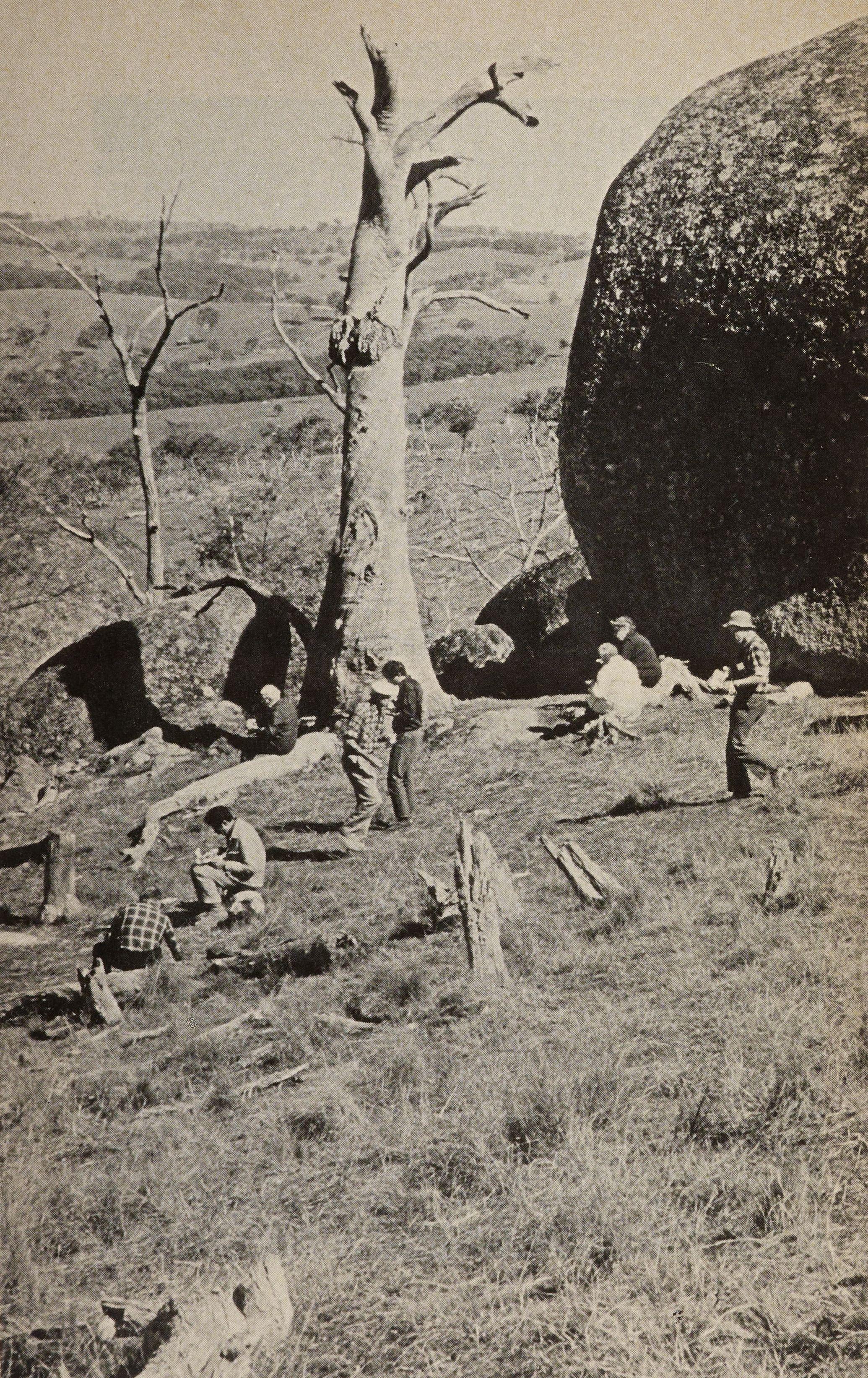
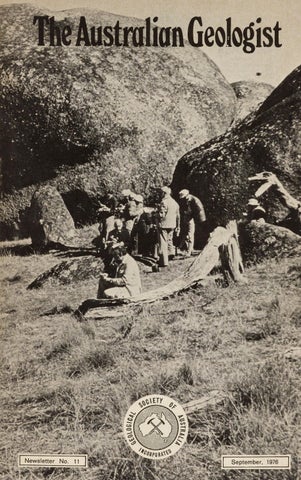
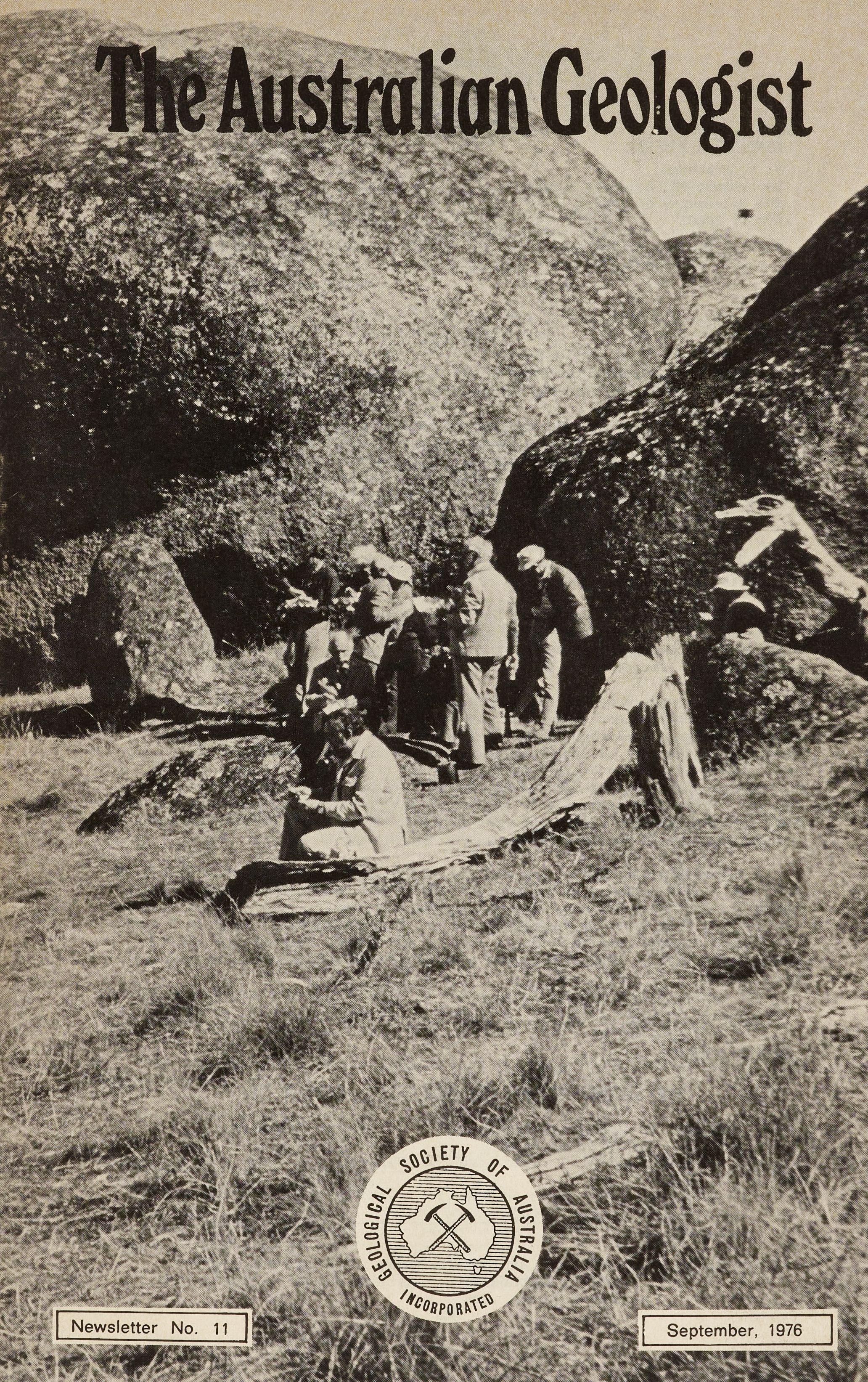
Cover Photo: Lunch-time at the Marbles; western edge of the Bathurst Batholith. Excursion 4B - 25th I.G.C.
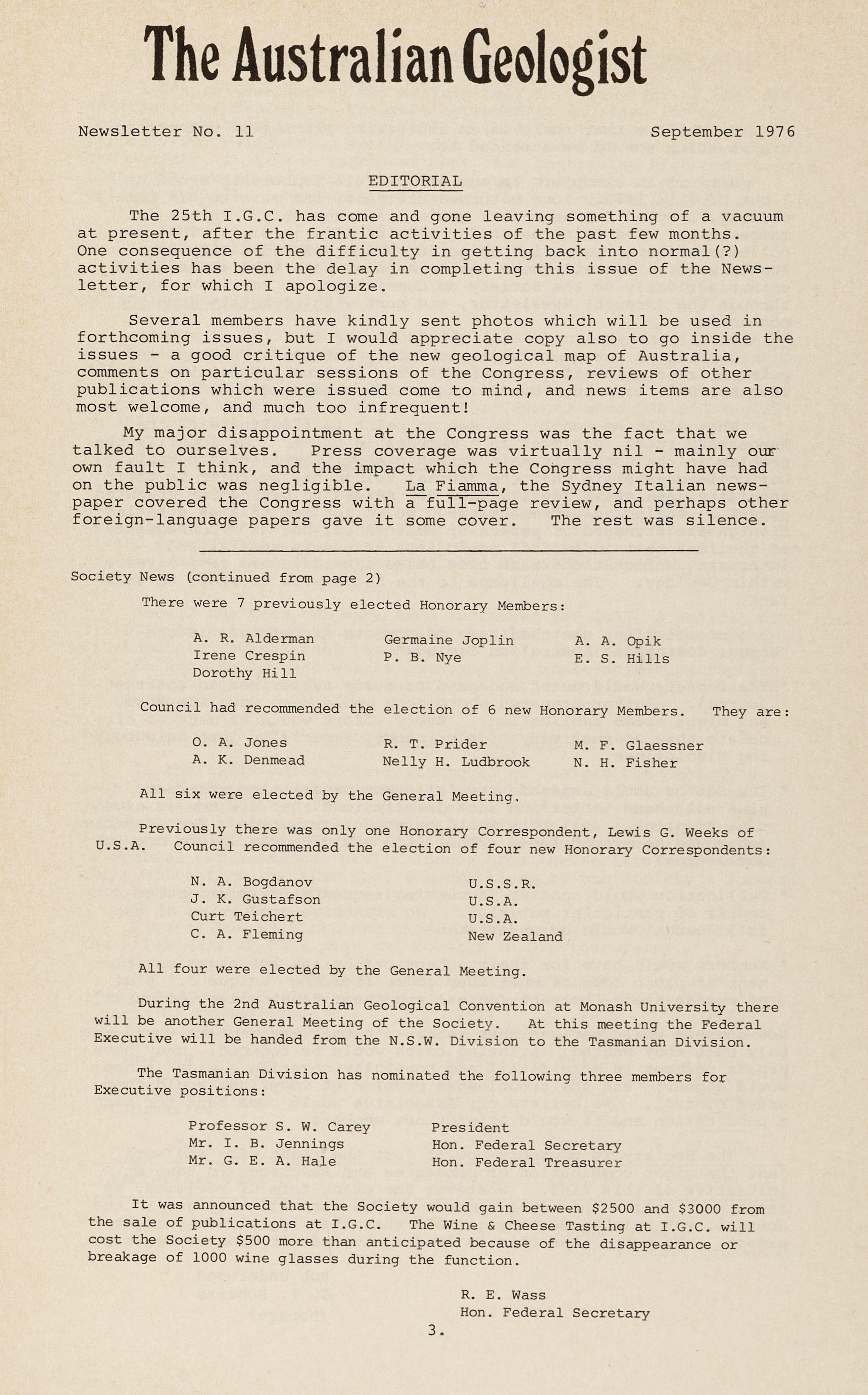
The Australian Geologist
Newsletter No. 11 September 1976
EDITORIAL
The 25th I.G.C. has come and gone leaving something of a vacuum at present, after the frantic activities of the past few months. One consequence of the difficulty in getting back into normal(?) activities has been the delay in completing this issue of the Newsletter, for which I apologize.
Several members have kindly sent photos which will be used in forthcoming issues, but I would appreciate copy also to go inside the issues - a good critique of the new geological map of Australia, comments on particular sessions of the Congress, reviews of other publications which were issued come to mind, and news items are also most welcome, and much too infrequent!
My major disappointment at the Congress was the fact that we talked to ourselves. Press coverage was virtually nil - mainly our own fault I think, and the impact which the Congress might have had on the public was negligible. La Fiamma, the Sydney Italian newspaper covered the Congress with afull-page review, and perhaps other foreign-language papers gave it some cover. The rest was silence.
Society News (continued from page 2)
There were 7 previously elected Honorary Members:
A. R. Alderman
Irene Crespin
Dorothy Hi 11
Germaine Joplin
P. B. Nye
A. A. Opik
E. S. Hills
Council had recommended the election of 6 new Honorary Members.
0. A. Jones
A. K. Denmead
R. T. Prider
Nelly H. Lua.brook
All six were elected by the General Meeting.
M. F. Glaessner
They are:
N. H. Fisher
Previously there was only one Honorary Correspondent, Lewis G. Weeks of U.S.A. Council recommended the election of four new Honorary Correspondents:
N. A. Bogdanov
J. K. Gustafson
Curt Teichert
C. A. Fleming
U.S.S.R.
U.S.A.
U.S.A.
New Zealand
All four were elected by the General Meeting.
During the 2nd Australian Geological Convention at Monash University there will be another General Meeting of the Society At this meeting the Federal Executive will be handed from the N.S.W. Division to the Tasmanian Division.
The Tasmanian Division has nominated the following three members for Executive positions:
Professor S. w. Carey
Mr. I. B. Jennings
Mr. G. E. A. Hale
President
Hon. Federal Secretary
Hon. Federal Treasure r
It was announced that the Society would gain between $2500 and $3000 from the sale of publications at I.G.C. The Wine & Cheese Tasting at I.G.C. will cost the Society $500 more than anticipated because of the disappearance or breakage of 1000 wine glasses during the function.
R. E. Wass
Hon. Federal Secretary
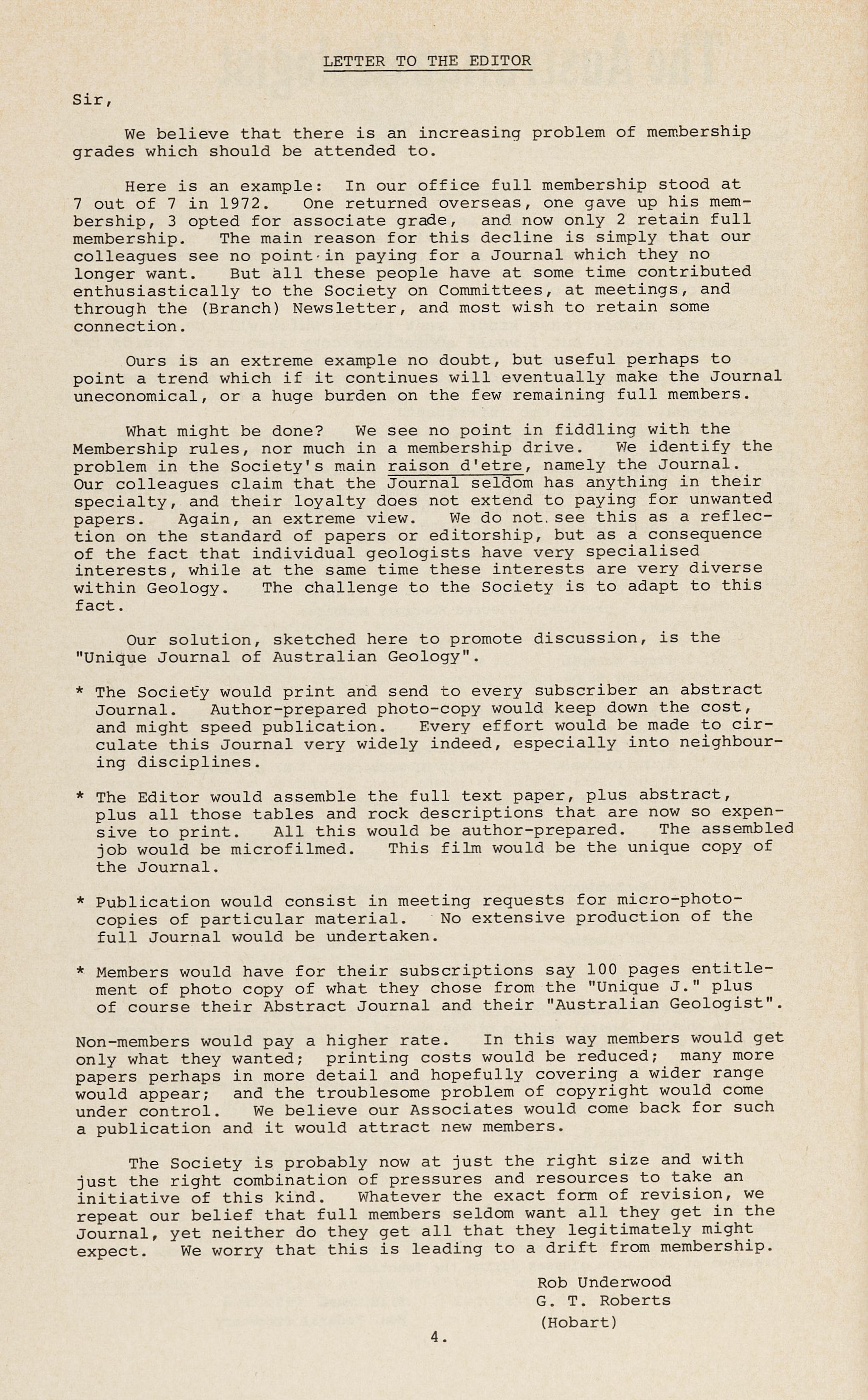
Sir,
We believe that there is an increasing problem of membership grades which should be attended to.
Here is an example: In our office full membership stood at 7 out of 7 in 1972. One returned overseas, one gave up his membership, 3 opted for associate grade, and now only 2 retain full membership. The main reason for this decline is simply that our colleagues see no point - in paying for a Journal which they no longer want. But all these people have at some time contributed enthusiastically to the Society on Committees, at meetings, and through the (Branch) Newsletter, and most wish to retain some connection.
Ours is an extreme example no doubt, but useful perhaps to point a trend which if it continues will eventually make the Journal uneconomical, or a huge burden on the few remaining full members.
What might be done? We see no point in fiddling with the Membership rules, nor much in a membership drive. We identify the problem in the Society's main raison d'etre, namely the Journal. Our colleagues claim that the Journal seldom has anything in their specialty, and their loyalty does not extend to paying for unwanted papers. Again, an extreme view. We do not see this as a reflection on the standard of papers or editorship, but as a consequence of the fact that individual geologists have very specialised interests, while at the same time these interests are very diverse within Geology. The challenge to the Society is to adapt to this fact.
Our solution, sketched here to promote discussion, is the "Unique Journal of Australian Geology".
* The Sociefy would print an·d send to every subscriber an abstract Journal. Author-prepared photo-copy would keep down the cost, and might speed publication. Every effort would be made to circulate this Journal very widely indeed, especially into neighbouring disciplines.
* The Editor would assemble plus all those tables and sive to print. All this job would be microfilmed. the Journal.
the full text paper, plus abstract, rock descriptions that are now so expenwould be author-prepared. The assembled This film would be the unique copy of
* Publication would consist in meeting requests for micro-photocopies of particular material. • No extensive production of the full Journal would be undertaken.
* Members would have for their subscriptions say 100 pages entitlement of photo copy of what they chose from the "Unique J." plus of course their Abstract Journal and their "Australian Geologist".
Non-members would pay a higher rate. In this way members would get only what they wanted; printing costs would be reduced; many more papers perhaps in more detail and hopefully covering a wider range would appear; and the troublesome problem of copyright would come under control. We believe our Associates would come back for such a publication and it would attract new members.
The Society is probably now at just the right size and with just the right combination of pressures and resources to take an initiative of this kind. Whatever the exact form of revision, we repeat our belief that full members seldom want all they get in the Journal, yet neither do they get all that they legitimately might expect. We worry that this is leading to a drift from membership.
Rob Underwood G. T. Roberts (Hobart)
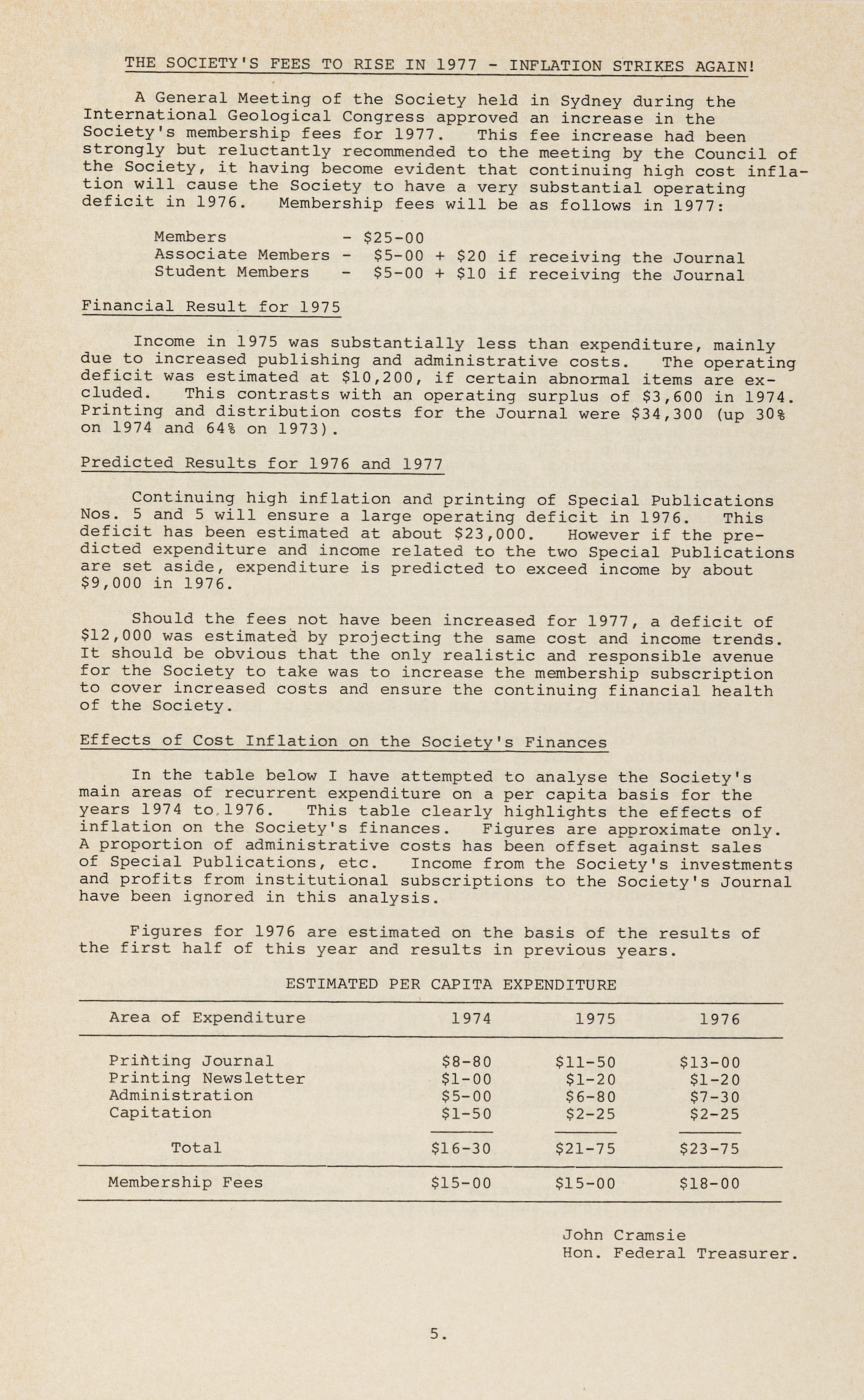
THE SOCIETY'S FEES TO RISE IN 1977 - INFLATION STRIKES AGAIN!
A General Meeting of the Societ y held in Sydney during the International Geological Congress approved an increase in the Society's membership fees for 1977. This fee increase had been strongly but reluctantly recommended to the meeting by the Council of the Society, it having become evident that continuing high cost inflation will cause the Society to have a very substantial operating deficit in 1976. Membership fees will be as follows in 1977:
Members
Associate Members
Student Members
Financial Result for 1975 - $25-00
$5-00 + $20 if receiving the Journal
$5-00 + $10 if receiving the Journal
Income in 1975 was substantially less than expenditure, mainly due to increased publishing and administrative costs. The operating deficit was estimated at $10,200, if certain abnormal items are excluded. This contrasts with an operating surplus of $3,600 in 1974. Printing and distribution costs for the Journal were $34,300 (up 30% on 1974 and 64% on 1973).
Predicted Results for 1976 and 1977
Continuing high inflation and printing of Special Publications Nos. 5 and 5 will ensure a large operating deficit in 1976. This deficit has been estimated at about $23,000. However if the pre- dicted expenditure and income related to the two Special Publications are set aside, expenditure is predicted to exceed income b y about $9,000 in 1976.
Should the fees not have been increased for 1977, a deficit of $12,000 was estimated by projecting the same cost and income trends. It should be obvious that the only realistic and responsible avenue for the Society to take was to increase the membership subscription to cover increased costs and ensure the continuing financial health of the Society.
Effects of Cost Inflation on the Society's Finances
In the table below I have attempted to analyse the Society's main areas of recurrent expenditure on a per capita basis for the years 1974 to 1976. This table clearly highlights the effects of inflation on the Society's finances. Figures are approximate onl y. A proportion of administrative costs has been offset against sales of Special Publications, etc. Income from the Society's investments and profits from institutional subscriptions to the Society 's Journal have been ignored in this analysis.
Figures for 1976 are estimated on the basis of the results of the first half of this y ear and results in previous years.
ESTIMATED PER CAPITA EXPENDITURE
Area of Expenditure
Printing
John Cramsie Hon. Federal Treasurer.
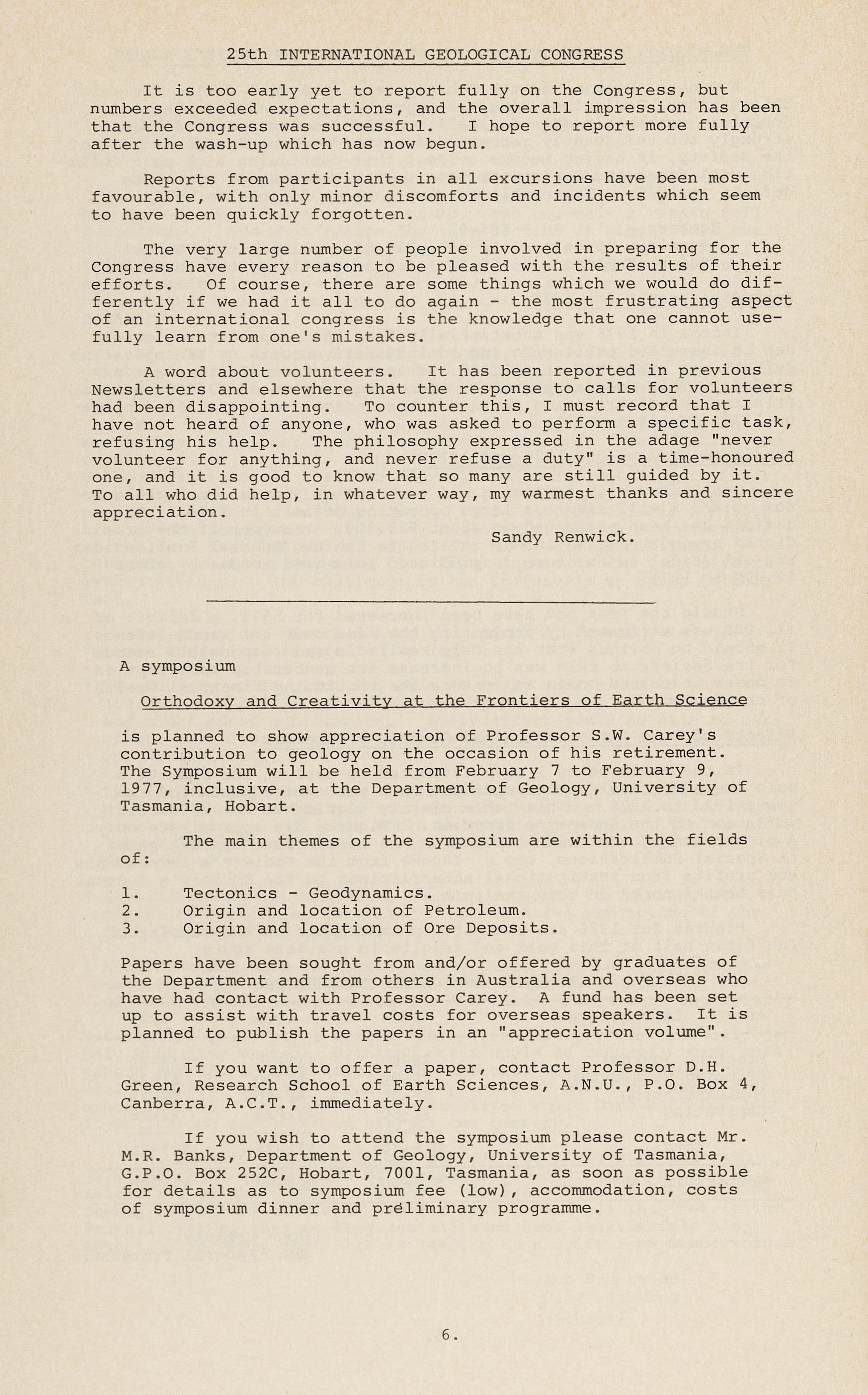
It is too early yet to report fully on the Congress, but numbers exceeded expectations, and the overall impression has been that the Congress was successful. I hope to report more fully after the wash-up which has now begun.
Reports from participants in all excursions have been most favourable, with onl y minor discomforts and incidents which seem to have been quickl y forgotten.
The very large number of people involved in preparing for the Congress have every reason to be pleased with the results of their efforts. Of course, there are some things which we would do differentl y if we had it all to do again - the most frustrating aspect of an international congress is the know ledge that one cannot usefull y learn from one 's mistakes.
A word about volunteers. It has been reported in previous Newsletters and elsewhere that the response to calls for volunteers had been disappointing. To counter this, I must record that I have not heard of anyone, who was asked to perform a specific task, refusing his help. The philosophy expressed in the adage "never volunteer for anything, and never refuse a duty" is a time-honoured one, and it is good to know that so many are still guided by it. To all who did help, in whatever way, my warmest thanks and sincere appreciation.
Sand
y Renwick.
A symposium
Orthodoxy and Creativity at the Frontiers of Earth Science is planned to show appreciation of Professor s.w. Carey's contribution to geology on the occasion of his retirement. The Symposium will be held from February 7 to February 9, 1977, inclusive, at the Department of Geology, University of Tasmania, Hobart.
The main themes of the symposium are within the fields of:
1. Tectonics - Geodynamics.
2. Origin and location of Petroleum.
3. Origin and location of Ore Deposits.
Papers have been sought from and/or offered by graduates of the Department and from others in Australia and overseas who have had contact with Professor Carey. A fund has been set up to assist with travel costs for overseas speakers. It is planned to publish the papers in an "appreciation volume".
If you want to offer a paper, contact Professor D.H. Green, Research School of Earth Sciences, A.N.U., P.O. Box 4, Canberra, A.C.T., immediately.
If you wish to attend the symposium please contact Mr. M.R. Banks, Department of Geology, University of Tasmania, G.P.O. Box 252C, Hobart, 7001, Tasmania, as soon as possible for details as to symposium fee (low), accommodation, costs of symposium dinner and preliminary programme.
INTERNATIONAL GEOLOGICAL CORRELATION PROGRAMME
The endorsement by Unesco in 1973 of a greatly expanded IGCP, previously an exclusively IUGS (International Union of Geological Sciences) - sponsored program, reflects the concern on the part of international bodies and of governments for energy and resources problems. It constitutes an attempt by these organisations to extend material and technical support into selected priority areas of geoscience research which hold promise of discovery of new economic deposits and to understand their distribution in time and place. Emphasis is placed on the promotion of international co-operation, development of new methods and ideas and the refinement of existing ones.
To implement the program a permanent IGCP secretariat (Mr. E. von Braun, Secretary) has been established in the Unesco Division of Earth Sciences, Paris and an IGCP Board of 15 members (chaired by Sir Kingsley Dunham-UK) and four scientific committees each consisting of eight specialists were appointed jointly by Unesco and IUGS. Each country participating in the program has established its own National Committee for IGCP; 57 countrjes now have National Committees, and a further 41 have official contact addresses - thus of 136 member states of Unesco, 98 have a positive interest in IGCP. The cost of running the Secretariat, Board and Scientific committees is met by Unesco, that of convening the National Committees met by the respective governments, and that of individual projects partly by Unesco but mainl y by the participating countries themselves.
Instead of defining specific projects, the IGCP Board decided in 1973 to outline four general priority areas, inviting project submissions from individuals and institutions in the participating countries. Thus, the course IGCP would take will be determined by proposals by individuals and organisations, as expressed in the Board's first report - "It is expected that projects submitted will largely determine the course to be followed by the program as a whole". The four priority areas are titled:
(a) Ordering the past - refining the geological calendar with methods of time determination (i.e. stratigraphy and geochronology);
(b) In the beginning - evolution of the earth's crust with special emphasis on the Precambrian;
(c) Man's home - his geological environment (i.e. Quaternary geology);
(d) Man's needs - Sources of energy and minerals (i.e. economic geology).
The four scientific committees are respectively concerned with
(1) Time and Stratigraphy;
(2) Major geological events in time and space, and their implications in·environmental processes (includes priority areas (b) and (c));
(3) Distribution of mineral deposits in space and time, and the relation of ore formation processes to other events in earth histor y ;
(4) Quantitati v e methods and data processing in geological correlation.
The Australian representative on the international IGCP organisation includes a member of the board (Professor M. F. Glaessner),
and two members on scientific committees (Dr. N. H. Fisher and Dr. E. A. Rudd). An Australian National Committee for the IGCP has been formed, with Professor M. F. Glaessner as chairman, and a Secretariat attached to the Australian National Commission for Unesco, Department of Education, PO Box 826, Woden, ACT, 2606telehone 897078 - to whom all IGCP-related enquiries can be referred.
In its second session, held in Vienna on 22-26 April 1974, the IGCP Board considered a large number of project submissions which it classified in terms of four categories, denoted:
Key projects; (A) (B) (C) Potential major projects; and (D) Projects capable of development into IGCP projects, Deferred projects.
Of the 55 projects approved under categories (A) and (B), those which may fall within the sphere of interest of Australian geoscientists, include the following:
Accuracy in Time; Project Ecostratigraphy; Precambrian-Cambrian Boundary; Ophiolites; Circum Pacific Plutonism; Neogene-Quaternary Boundary; Holocene Sea Level Changes; Ore Deposits separated by Continental Drift: Metallic Deposits separated by Continental Drift; Metallic Deposits related to Acid Magmatism; Genesis of Kaolins; Archaean Geochemistry; Stratigraphic Correlations of Sedimentary Basins in the ECAFE region; Mesozoic Chronostratigraphy; PrePleistocene Tilloids; Mid Cretaceous Events; Metallogeny in the Precambrian; Standards for computer applications in Resource studies; Lexique Tectonique International; Global correlation of epochs of folding; Siliceous deposits in the Pacific region; Genesis of manganese ore deposits; Geological correlation of the Precambrian sequences in stable zones; Permo-Triassic stage of geological evolution; Evolution of the Pacific-Indian plate boundary; Upper Precambrian correlations; Lateritization process; Iron formations of the Hamersley Basin; LateCainozoicmagnetostratigraphy; Remote sensing and mineral exploration; a new method of quantified biostratigraphic correlation; Biostratigraphic datum planes of the Pacific Neogene; River flood and lake level changes.
Most of these projects are open to Australian participation. Those interested may obtain further details by writing to the Secretary of the Australian Unesco Committee for the IGCP, who will forward contact addresses. They should then request information, including details of the responsibilities and advantages of part icipation in a particular project from the Project Leader.
Australian proposed Projects which to date have been endorsed by the IGCP Board are:
Arc haean Geochemistry
The Evolution of the Pacific-Indian Plate Boundary
Basins of Iron Formation and Deposition
Originall y pr oposed by Dr. A. Y. Glikson of the Bureau of Mineral Resources and now led by Dr. A. M. Goodwin of the University of Toronto
Original proposal made by Dr. G. H. Packham University of Sydney.
Original proposal made by Dr. A. F. Trendall Geological Survey of Western Australia.
No firm ground rules have as ye t been laid out by the IGCP Board and national Committees as to the procedures for individual project development following endorsement. Proposers of projects approved under categories (A) or (B) may receive assistance to convene a meeting of a project working group, in which work plans and a calendar of project activities are formulated . It is hoped that the se activities would receive some material and logis~ic support from governmental and other institutions who participate in the IGCP, although no such support can be guaranteed. To a major (concluded bottom of page 10) 8.
BOOK REVIEW - FIELD GEOLOGIST'S MANUAL, COMPILED BY D.A.
BERKMAN, EDITED
BYD.A.
BERKMAN
AND
W.R. RYALL
Published by the Australasian Institute of Mining & Metallurgy, P.O. Box 310, Carlton South, VIC. 3053
Eight Crown paper measures 57½" x 413/4" or 1461 x 1060mm. It is also called B5. Total world production of magnesium metal was about 290,000 sho~t tons in 1974. For general calculations lm Km2 contains 1.4 x 10 t of coal. The flame colour of phosphates after moistening with sulphuric acid is pale green, but a better test involves the use of nitric acid and ammonium molybdate. The average uniaxial compressive strength of Schist is 177.9MPa and the fourth of July 2012 will be a Wednesday (if we're still going). All these snippets of information and many, many more are yours for the dipping into this book.
Although the recital of these facts might give the impression that the text is a hotch-potch of data, it is in fact a well-organized, logical presentation in twelve separate sections beginning with the important topics of Ethics and reporting, followed by mineral & rock information, geochemistry, mining & economic geology, geological mapping geometric and surveying data, engineering geology, geohydrology, geophysics, drilling, miscellaneous (indispensible!) and finishing with mathematical tables and conversion factors.
This book takes off where the A.G.I. Looseleaf notes, first issued in the late 1950s,left off; it updates Forrester, McKinstry, Lahee and others, but it does not completely replace such important guides.
As Don Berkman, the compiler, says in his preface 'This is not intended to be another textbook or recipe book, as in many cases the preliminary steps are not explained and a standard of training or scholarship is assumed'.
In each section important factual information and standard test methods are set out and the source of the classification, method or numerical data given. Every specialist will of course look for his own favourite information and may be slightly disappointed on occasion, but there will be many fringe benefits to fill such a gap. Specialist groups have helped in the compilation of the book but as the compiler admits, there is some personal bias. Perhaps the most obvious gap is the absence of mention of the Munsell colour scheme in the description of sedimentary rocks. I would also have liked to see the Burgess rock mass classification appear in the engineering geology section but this is a mere quibble.
Editing by Bill Ryall and Don Berkman backing up the reviewing of the first draft around the countryside has left few factual errors that I could detect. I suspect that the Victorian Geological Survey has moved (p.261), and that the reference to Aust. Geomechanics Journ. on page 202 should be 75 not 65. Perhaps also other Tertiary Institutions might be added to the Universities in the address list.
It is a curious thing that none of our state surveys (topo or geological - addresses given) seeks wide outlets for their maps. Such maps are readily available in many overseas countries, including New Zealand in newsagencies etc., but here we seem to make it as difficult as possible to buy them, or to let people know they exist.
There is no doubt that this book owes its origin and ultimate production to Don Berkman. His careful selection based on wide experience, and his attention to detail have ensured excellent coverage of a wide field of practical geology.
I have no doubt that the Aust. I.M.M. has produced a bestseller.
David Branagan.
BOOK REVIEW
SHORT COURSE IN MICROBEAM TECHNIQUES (1976), 186pp.
edited by D G. W. Smith ; available from Mineralogical Association of Canada, Royal Ontario Mu s eum, 100 Queen ' s Park, Toronto, Canada, MSS 2C6. Price $(Can.)7-50 (approx. $A6-00) soft cover.
The last few years have seen the publication of a number of books on electron-probe microanalysis, but this bcok deserves special mention because of its low price and practical orientation. The main part of the book consists of six papers on various aspects of electron microprobe analysis, prepared for a workshop on the subject held at Edmonton, Canada in May 1976.
The necessary background for microprobe analysis is provided by three of the papers. One , by J.C. Rucklidge, deals with instrumentation; another, by G. Springer, is concerned with correction procedures; and the third, by D. G. W. Smi th , is devoted to a field of particular current interest - quantitative energydi s persive microanalysis. The other three papers give examples of the practical application of electron-probe microanalysis in mineralogy (A. G. Plant), petrology (D. B. Clarke) and economic geology (D. C. Harris). Seven Appendices provide tables of practical value, including the characteristic X-ray spectra of the elements, mass absorption coefficient formulae, and statistical error curves. The text is amply illustrated, the type is clear, and the paper is of good quality.
The book is intended primarily for beginners in the art of microprobe analysis, and should serve particularly well as a textbcok in courses on microprobe analysis. Even for the seasoned operator, however, this user - oriented bcok contains much practical information. Its low price in these days of escalating publishing costs is an added attraction.
E. H. Nickel.
GEOCHEMICAL JOURNAL
Authors within the broad areas of Geochemistry and Cosmochemistry are invited to consider Geochemical Journal as a possible medium of publication.
This, the English-language periodical of the Japanese Geochemical Society, is currently being "internationalized", and is actively seeking contributions from overseas authors. As a latest step, it has been included among the journals indexed by "Current Contents".
Manuscripts may be submitted directly to the Executive Editor, Prof. A. Masuda, Department of Earth Sciences, Kobe University, KOBE 657, JAPAN, or, within Australia, via Dr. J.R. Richards, R.S.E.S., A.-N.U., Box 4 P.O. Canberra, A.C.T., 2600.
IGCP Correlation Programme (continued from page 8)
degree, the extent of goodwill shown by these organisations towards projects would determine the success or otherwise of IGCP, t~e other principal factor being the initiati~e and_hard work_which members of project working groups invest in their respective proJects.
Australian Unesco Committee for I.G.C.P.
GEOSATISFACTORY
A series of satellite systems dedicated to the geological exploration of the earth is being proposed by a group of industrial and research laboratory geologists.
The proposed systems would be called, appropriately, Geosat and would be used to provide high resolution imagery and photography of the earth as well as stereoscopic cover, infrared colour images, radar images, thermal infrared information and other spectral data invaluable for exploration, engineering and environmental geology.
The geological satellite systems will supplement the National Aeronautics and Space Administration's present widely used series of agriculturally-oriented satellites called Landsat.
Representatives of 17 oil, gas and mineral companies as well as laboratory researchers met Aug. 10 in Denver to form the Geosat Committee. The non-government group will seek industry-wide support and will make specific recommendations to NASA for the implementation of the Geosat missions.
At the meeting, representatives from the following organizations met to outline the Geosat programme:
AMAX Exploration Ltd.,; ASARCO, Inc.; Barringer Research Ltd.; Bethlehem Steel Co.; Chevron Oil Field Research Co.; Cities Service Oil Co.; Exxon Production Research Co.; Gulf Energy and Minerals Co.; Michel T. Halbouty; Itek Co.; Jet Propulsion Laboratory; Kennecott Exploration, Inc.; Lawrence Berkeley Laboratory; Newmont Exploration, Ltd.; St. Joe Minerals Co.; Shenandoah Oil Co.; Standard Oil Co. of California; Superior Oil Co.; Texasgulf, Inc.; Trollinger Geological Associates, Inc.; U.S. Geological Survey; and Utah International Co.
The geologists agree that industry could support and would benefit from the recommended geologically dedicated remote sensing satellite missions which are not currently being offered by NASA.
The Geosat Committee will carry out a number of feasibility, economic, information, management, and implementation studies. The initial programme calls for the formation of five subcommittees to be staffed by December 1976.
The Geosat Committee will operate for one year with a budget of approximately $400,000. The participating companies have agreed to support the first three months' efforts of the committee. More than 150 natural resource companies have already expressed an interest in an industry-based Geosat concept. These companies are expected to become the source of additional funding for the Geosat Committee. This wide-based industrial support is considered crucial in efforts to establish Geosat as an industrial tool for geological remote sensing from space.
A Geosat workshop, he l d in May in Flagstaff, Arizona, outlined most of the present committee's objectives and recommended missions. A report on this workshop will be published by Lawrence Berkely Laboratory. Copies will be available in early October.
The Geosat Committee consists of the following officers:
Michel T. Halbouty, consulting geologist, chairman; Frederick B. Henderson, III, Lawrence Berkeley Laboratory, executive secretar y ; R. T. Fetters, Exxon, mission evaluation subcommittee chairman; R. L. Brown, ASARCO, missions economics subcommittee chairman; Leo J. Miller, Texasgulf, programme development subcommittee chairman; G. D. Mathews, Superior Oil, missions organization subcommittee chairman; R. A. Barker, AMAX, Geosat implementation subcommittee chairman. 11.
PUBLICATIONS FOR SALE
The following items, which were on display during the 25th International Geological Congress at the joint exhibition stand of the Geological Society of London and the Institution of Mining and Metallurgy,- are for sale at the prices given (plus postage, where necessary):
Geological Society of London
"Mesozoic-Cenozoic Orogenic Belts", by A. M. Spencer (Ed.) (Special Publication No. 4, 1974). 46 articles describing comprehensively the geology and geophysics of selected segments of the Mesozoic-Cenozoic systems. $45-00.
"Correlation of the Rocks of the British Isles":
1. Silurian (1971)
3. Ordovician (1971, reprint 1976)
5. Permian (1974)
6. Precambrian (1975)
(Special Reports, nwnbered as above)
$1-35
$4-90
$3-70
$9-00
"Sources of Information for the Literature of Geology" byJ. w. MacKay (1974)
$2-60
Official U.K. contribution to the International Geological Correlation Programme.
A few copies of the 'Journal of the Geological Society' and the 'Quarterley Journal of Engineering Geology', and of the 'Newsheet'
Institution of Mining and Metallurgy
Proceedings of the 9th Commonwealth Mining & Metallurgical Congress 1969: Vol. 1: Mining and Petrolewn Technology Vol. 2: Mining and Petrolewn Geology
"Geochemical Exploration" (1972)
"Prospecting in areas of Glacial Terrain" (1973)
"Minerals and the Environment" (1975)
A few copies of the Transactions A, B, and C.
$18-45
$12-45
$18-45
$15-00
$37-50
Anyone wishing to examine the publications before purchase may do so at the office of the Geological Society of Australia, 39 Hunter Street, Sydney. To order, phone Pat Lapworth on 358-1658, or write her at 8 Buena Vista, Elizabeth Bay Crescent, Elizabeth Bay, N.S.W. 2011.
COAL PRICES SUi.SHED
Learn something about the seamy side of life
Australian Black Coal, known affectionately as the A.B.C., and reviewed in our last issue has been reduced in price despite (or because of?) the huge demand for it.
Replace prices in the last issue by $A20-00 (incl. postage)
Students $Al0-00 (incl. postage). Orders at the student price should be accompanied by suitable evidence of student status.
Read this notice in conjunction with the notice on page 21 of Newsletter 10.
I hope this isn't too confusain.
The sixth BMR Symposiwn will be held on 3 and 4 May 1977 at the Australian Academy of Science Building, Canberra.
SECOND INTERNATIONAL KIMBERLITE CONFERENCE
September - October 1977: SW USA
This conference, on the petrology, geochemistry and structure of kimberlites and the relevance of this information to upper mantle studies, will be in four parts:
1) One-day informal visit to the diamondiferous kimberlite at Murfreesboro, Arkansas. September 24, 1977.
2) · Field trip along the Colorado-Wyoming border (camping, motels) with facilities for collection of samples; diamondiferous kimberlite and a wide range of ultramafic nodules (which will remain the property of the US National Museum), September 24 - October 2; maximum 60 persons.
3) Scientific meeting near Santa Fe, New Mexico, October 3 - October 7. Accommodation for 130 persons.
4) Field trip, again with facilities for sample collection (motels), October 70ctober 10, 1977; basalt nodules in various localities in the American southwest, El Paso to Grand Canyon. Numbers not quite so restricted.
Estimated cost: Registration $90, 1) $50, 2) $320, 3) $225, 4) $215.
Total $900 (US)
For enquiries, applications, write - Kimberlite Conference, Sylvia-K Inc., 5671 Blue Sage Drive, Littletown, Co., 80123, USA.
SAY IT IF YOU CAN - SECOND CPEMRC
The Circum-Pacific Council for Energy and Mineral Resources second conference will be held July 30-August 4, 1978 at the Hilton Hawaiian Village, Honolulu, Hawaii. This conference is sponsored by The American Association of Petroleum Geologists, The Committee for Coordination of Joint Prospecting for Mineral Resources in Asian Offshore Areas, The Pacific Science Association, The American Mining Congress, and the University of Hawaii. It is supported by more than fifty geological and geophysical societies [including the Geological Society of Australia, Inc.]. •
This Conference will follow the general pattern of the successful 1974 Conference by presenting approximately 120 papers by outstanding international scientists and statesmen on the energy and mineral potential of this vast region. These papers will focus on future needs and potential for petroleum, oil shale, tar sands, coal, geothermal energy, nuclear energy, minerals, ores, and ground water. A special seminar on environmental geology will be offered during the Conference. The 1974 Conference papers are being published this summer in a special A.A.P.G. Memoir, and it is the intention that the 1978 Conference papers will be similarly published.
Pre- and post-Conference geological field trips similar to those in 1974 will be conducted on the islands of Kauai, Oahu, Maui, and Hawaii by experts from the University of Hawaii and the U.S. Geological Survey. Hopefully the Kilauea volcano will cooperate with its usual volcanic activity.
In addition, consideration is being given to holding a subsurface-methods workshop during the week prior to the Conference. This will be designed primarily for international students but others will be welcome.
Invitations to participate in the Conference have been extended to all Circum-Pacific Countries and most including the Soviet Union already have responded favourably.
For information write to: 1978 Circum-Pacific Conference, c/o AAPG, P.O. Box 979, Tulsa, Oklahoma, USA 74101
£PISODES OF QUATERNARY SAND ACCUMULATION ON THE SOUTHEAST QUEENSLAND COAST.
SUMMARY of a talk by W. T. Ward, C.S.I.R.O. Division of Soils, Brisbane.
The sand dunes of the southeast Queensland coast formed over an interval of perhaps one million years. Nine main periods of dune-building can be distinguished. The oldest deposits are the most weathered, and depths of leaching increase with increasing age. With due safeguards, these depths can be used to identify individual sands. Wind-bedding continues below sea level, showing that the sands were ernplaced in glacial times. The beach deposits which occur among the dunes show that seas as high as the present one alternated with the episodes of blowing.
The three youngest sand-blows are related to the so-called "Little Ice Ages". Equivalent blown sands occur in Victoria and New Zealand, and it follows that the common opinion - that the recent sand movements were produced by man's interference with the natural environment - has no substance. Aboriginal man might have caused local blowouts, but it stretches coincidence to suppose that unco-ordinated acts produced blowing at the same times in places separated by thousands of miles of land and sea.
The wind directions preserved in the dunes in Queensland imply that the southeast trades did not move north in glacial ages. If anything, there was a slight shift to the south. Widespread evidence for remobilization of sands previously held by vegetation supports the view that the winds were stronger then because of the greater temperature difference between equator and poles. Changes in the vigour of the atmospheric circulation in the last few thousand years caused the surface winds to waver above and below sand-moving speeds.
THE SYDNEY BASIN
an outline of the geology and geomorphology
by David Branagan, Chris Herbert and Trevor Langford-Smith, is available from Department of Geology & Geophysics, University of Sydney, N.S.W. 2006.
Price is $2-00 posted, $1-80 if you call at the Department.
I believe that copies of 'Geological Elements of National Estate in Queensland' (de Jersey, Stevens & Wilmott, editors) may be obtained by the privileged few who write quickly to the Queensland Division.
MASTER OF APPLIED SCIENCE COURSES
The University of New South Wales, School of Applied Geology advises that two courses leading to the degree of M.App.Sci. are currently being offered in Engineering Geology-Hydrology and in Mineral Exploration. Applicants for these courses should possess a Bachelor's degree in geology or engineering awarded after four years of study. Three-year graduates may also be eligible if they have had relevant professional experience. The courses are of one year's duration with lectures and laboratory work in Session 1, and a project plus supporting work in Session 2.
Further information may be obtained from Professor F. C. Beavis, Head, School of Applied Geology, University of New South Wales, Box 1, Kensington, N.S.W. 2033.
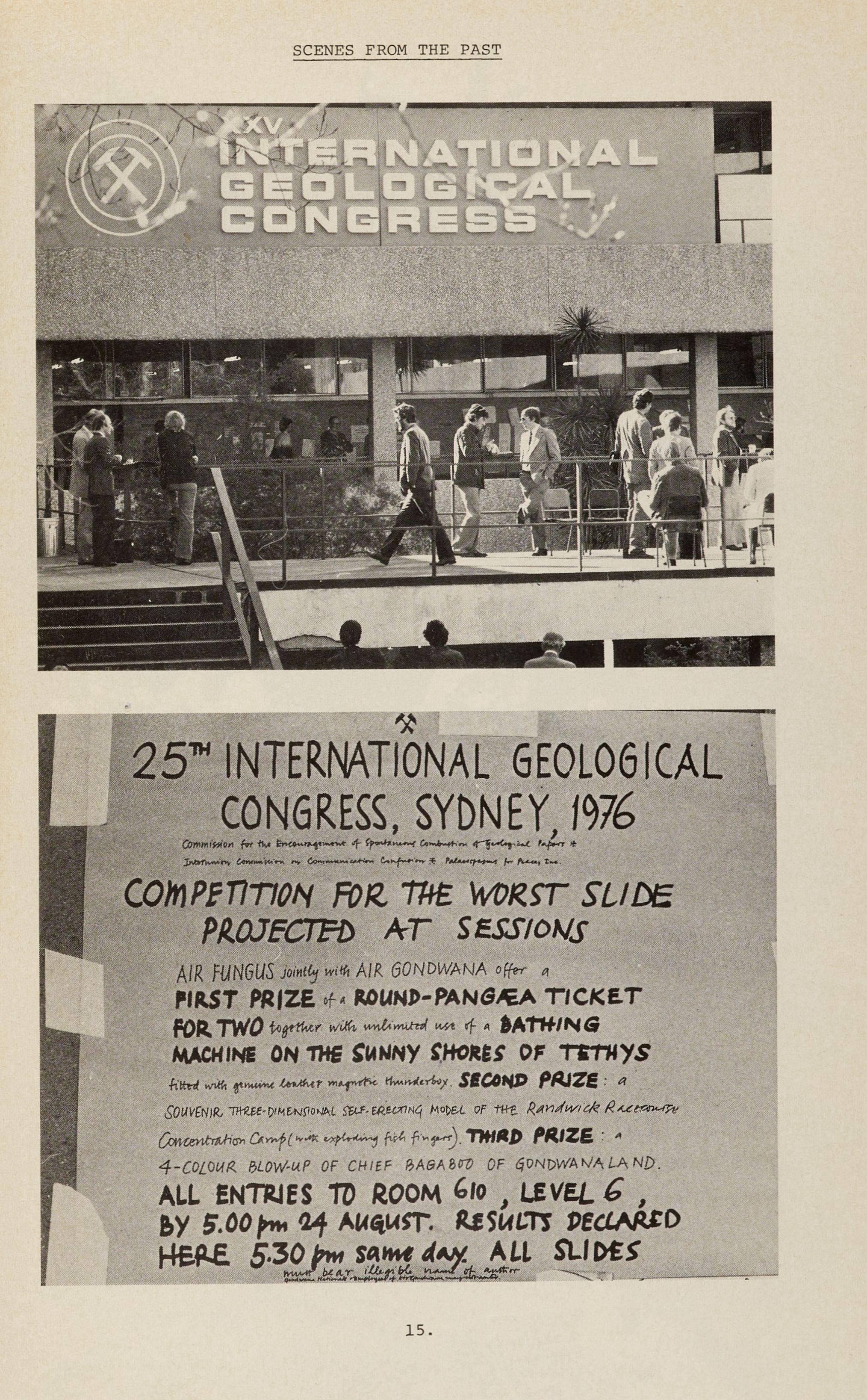
25,., INTERNATIONAL GEOLOGICAL CONGRESS, SYDNEY, 1~76
C.0,,,1n1ff<O,, pt ti,, ~- 1-- ~- "'-- <11~- ,..,_.,. ~·.-c.,·-. ,..,. Go....._.......,._ e.....,...... ._~ ,.,..,,,.,...,_. tCOJtJPfTTTI0N FOR. 11f£ wtJRST Slll:E PP..OJECIFD A-T SE.SSIOWS AIR FUNGUS JoiHtfJ wilft AIR GONDWANA offe-r er ,,ur MIZE of-,; ICOUH)-PANG~ ilCl<E.T FOR. TWO t-O~r w.:i» ~ -....rn< 1- 11 &A'tfflN G MACHINE ON 1MS ,wMNY ~HOie£$ OF -rn-uys film( r~ ~r ,.,~ 11,,.....c,.-£,,1 SICOflU) PAJ'ZE : SOUV£NJR, ~-r;,~wfloNAL ~-f-R.W'1Nti Mo~ Of ff+f. R.,mtJ/wi'ck l<,<.ur~ CoM-e>1NJicrnD.""f("'-« .,,,~ fi"r'") . .,.,.,Ill) PR.IZ&. : " 4-COLOUR.. P;LOW-U.P OF CHIEF P;AGA81TO OF qDNT)WAI-JALAND. ALL ENTRJE S 1l) R.OOM &lo , LEVEL 6 , &Y s.oo /'ttt 'lJf, AUttwrr. lt!SUL.TS 1'Ed.AA£0 HEP-£ 5-3~7:.~~~;~L ~Dts_____ 15.