President:
Hon. Federal Secretary
Dr. R. E. Wass, Department of Geology & Geophysics, The University of Sydney, N.S.W. 2006.
Divisional Office Bearers 1975-76
A.C.T.
Chairman: M. J. Rickard
Sec.: Miss V. L. Passmore
N.S.W.
Chairman: P. F. Howard
Sec. : A. Kleeman
Queensland
Chairman: K. R. Warner
Sec.: c. G. Murray
South Australia
Chairman: R. W. Nesbitt
Sec.: P. K. Seccombe
Graeme Philip
Newsletter Editor
Dr. D. F. Branagan, Department of Geology & Geophysics, The University of Sydney, N.S.W. 2006. 'phone: 692-1122, ext. 2912 or 2358.
Tasmania
Chairman: D. E. Leaman
Sec.: P. L. F. Collins
Victoria
Chairman: J. Harms
Sec. : M. Garratt
Western Australia
Chairman: R. D. Gee
Sec.: M. MacLeod
SOCIETY NEWS
Unbound copies of 'The Geology of New South Wales' are available from Central Office, price $7-50 including postage.
Dr. A. A. Day, University of Sydney, has been appointed Society representative on the National Committee on Earthquake Engineering.
The Australian Government Minister for Science has been approached by the President concerning the absence of a geoscientist from the Australian Science and Technology Council.
D. F. Branagan has been appointed convener of a sub-committee to prepare a specific proposal on television programmes to coincide with the 1976 I.G.C. meeting.
The Society wishes to encourage the deposit of historical files of Divisions, Branches, groups and members with the Basser Library (Aust Acad. of Sci.). The Librarian is Peter Vallee, P.O. Box 216, Civic Square, A.C.T. 2608.
The Honorary Editor, K. A. Townley is recovering well from a recent heart attack.
Marc Marsden and David Toleman of Melbourne University were injured during a fatal car smash while on a field trip to Westernport. Both are re covering.
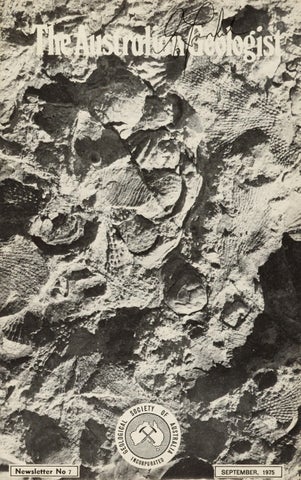
Cover Photo: Permian fossils from Mulbring, Hunter Valley, N.S .W. Scale x~ approximatel y
EDITORIAL
The recent proposal to split CSIRO and put part of it under the control of the Minister for Minerals & Energy in a new body including the Atomic Energy Commission and the Bureau of Mineral Resources caused apprehension to a great number of Society members, and many felt that the Society should have made some comment at the time.
The situation emphasises once again that the Society has a split personality, that of learned pedant, combined with go-ahead businessman, and isn't quite sure which way it should look or which mouth should speak or bite the hand which feeds it. Will it harm those of its members in government strongholds if it criticizes our great leaders, will it earn the plaudits of those on the other side of the situation? What effect will it have on the Society itself.
The political implications of the use of atomic energy, peaceful or otherwise, make it essential that it be kept separate from other mining and geological activities as far as possible. A repetition of the scurrilpus accusations made by politicians against David Rivett and the CSIR back in the 1940's is certainly to be avoided.
It is interesting that New Zealand made an almost opposite move many years ago by transferring the geological survey from the Ministry of Mines to the care of the Department for Scientific & Industrial Research (DSIR). I'm not sure what reaction there was amongst N.Z. geologists at the time, but it seems to have paid dividends since, for the geological work of the country.
The Bureau of Mineral Resources has been able to work for many years in a wide field of geology and it would be a pity to see it become a mere producer of data for short-term mining purposes. The mere fact that no director has yet been appointed (even at the miserable salary offered) suggests that it is being used in a political game. Things have likewise remained fairly quiet on the CSIRO scene.
It seems to me to be bad for the country as a whole, and certainly not good for the geological scie~ces. Perhaps we need an institute of geology which embraces the functions of the Bureau and the Mineral Investigation side of CSIRO, somewhat along the lines of the British Institute of the U.S. Geological Survey, but whatever we have should have some independence from the sort of political and other fiddling which has been taking place lately.
Perhaps the Society can't have a voice but individual geologists surely can speak for themselves. The Society, their own organizations or the politicians must be told what the individuals feel about what has been going on. It would even be good to know what has really been happening Does anybody have any facts on the present situation? This journals has so far received no comments whatever.
If we don't get off our tails soon and so something the future might be even less rosy than the present. Geologists surely believe their work ' is important. Why not tell the community that it is?
QUEENSLAND DIVISION FIELD CONFERENCE - 1975
The Queensland Divisiorls annual Field Conference was held over the Queen's Birthday long weekend, 14th to 16th June, in the Mt. Isa district. Daily excursions were conducted to the Duchess phosphate deposits, the Mammoth Mine at Gunpowder, and the Mary Kathleen open cut.
Of the 40 participants 25 (5 students) came from Brisba.,e and Toowoomba, 6 (5 students) travelled from Townsville, and 9 registered at Mt. Isa. This conference, perhaps even more than its predecessors, was a very successful gap-bridger, allowing academics and students, government employees and industry geologists to come together for discussion at the outcrop, as well as providing an opportunity for geologists outside the capital city to participate in Society affairs.
For the second year in succession the conference was run at a lossinflation catches up with us all. As usual the Division is indebted to the many companies who provided financial support, particularly to those companies whose properties were visited, and to Mt. Isa Mines Ltd. for the provision of accommodation for student participants.
The excursion guidebook, which includes geological descriptions of the mines visited and summaries of N.W. Queensland geology with some previously unpublished radiometric dating data, can be purchased from the Queensland Division Honorary Secretary (G.P.O. Box 1820, Brisbane, Q. 4001) at a cost of $4, postage included.
Sir:
Professor Prider is to be congratulated for offering his Honours students a 'Readi ng , Seminar and Language Course ' (Newsletter No. 6 , p. 10) .
In the School of Applied Geol ogy at the South Australian Institute of Technology we have as one of the stated aims of our first-degree course that 'graduates should have an ability to express themselves fluently, but concisely, both orally and in writing'.
To assist our students achieve an acceptable standard of scientific writing we provide both an external standard and editorial guidance. The Journal of the Geological Society of Australia is the standard to which all students are referr ed. The editorial guidance is offer ed in two ways.
1. First-year undergraduates are requ ired to write three reports during the year At least three weeks before each report is due they submit a draft report for preliminary editing of both scientific content and expression. This initial editorial guidance allows students to perceive the standards required without penalty. Students in s ubs equent years do not submit draft reports and their standard of expression i s i nc l uded in the report assessment , but they still receive detailed editorial comment when their reports are returned.
2. Second- year students undertake a first - term unit entitled 'Scientific Report Writing' similar to the course offered at the University of W.A. In addition, I give a short practical unit in critical geological editing, based on a course given by Mr K. A. Townley to geologists in the Bureau of Mineral Resources several years ago.
To achieve fluency in oral pre s entation, every student in second and third year presents a tu t orial each fortnight. Tutorial ses s ions are conducted under condi ti ons simi lar t o those a t a g eologic al congress, and str i ct time limits are ma intained for pre s entation. Each studen t' s performance is criticised (or prai s ed) by both staff and stud ents; some sessions are videotaped so that students may be self-critical.
Colin Branch S.A. Institute of Technology.
Sir,
Having been faced with almost all the possible alphabetic permutations I have a great deal of sympathy for Mr. Ian W. Reid (Newsletter No 6) over his initial problems, and promise to continue, as far as possible, my practice of spelling out names, with the acronym in parentheses, the first time reference is made to an organization in publications of the 25th International Geological Conference (25 IGC).
However, I would like to warn Mr. Reid and other readers of a practice which has come to my notice and which could, if it becomes general, be as controversial as some recent bowling styles.
The ploy is to retain the acronym but to change the other letters of one or more of the words from whose initials it is formed. I will refrain from naming the one organization which I know to have done this, but alert readers who compare the Second 25 IGC Circulars with the Third (when it is published in March, 1976) will be able to identify it I ask you, Sir , is it cricket? It does seem to me to be most damnably like it .
A. Renwick Secretary - General 25th
INTERNATIONAL
GEOLOGICAL CONGRESS
Mr. Reid's appeal has struck a responsive cord. At least 35 such abbreviations appeared in the Society's last Council meeting minutes. I hoped to give a comprehensive list in this issue but the task has proved beyond me and is postponed to Newsletter No 8. Editor.
The Tasman Bridge disaster and consequent need to improve communications between the eastern shore and Hobart have made available a bonanza of bones. Widening of the Old Beach Road allowed the recovery of about 50 tonnes of rock containing the bones of Early Triassic fish, amphibians and reptiles (over 200 million years old).
The bones were discovered a little more than 10 years ago by Miss Helen Hughes (now Mrs. P. G. Quilty) and the rock containing them partly excavated by Dr. John Cosgriff during his tenure of a research fellowship at the Geology Department from 1964 to 1967 and subsequently by Dr. Cosgriff and Mr. T: Djiewa (Wayne State University) early in 1971. As a result of these activities which involved removal of about five cubic metres of rock, over five hundred fossils were recovered varying in nature from complete small specimens of freshwater fish to fragments of reptilian skull and limb bones and including complete and incomplete skulls and lower jaws of several amphibians. It is interesting to note that the fossil fish included lung fish. Three species of extinct genera of amphibians were described from this locality by er. Cosgriff in a Special Paper (149) of the Geological Society of America published during 1974.
The bones are contained in a bed of clay-pellet conglomerate, representing a gravel deposited in the channel of a small stream draining in an area of clay pans and silty and sandy flood plains. One may envisage an area, part of an ext~nsive river system, rather like the Channel Country of south-west Queensland today. Animals which lived in and near the rivers and ponds, died and their bones were swept, together with fragments of clay and silt, downstream during a flood to come to rest in the deeper part of the stream channel. Imbrication of the clay pellets indicates that the stream came from the north-west. The size (up to 40 ems) of the clay pellets indicates a stream of considerable velocity. The recent excavations have shown that the bed lensed out and passed into sandstone to the east as it did also to north and south along the cliffs of sandstone beside the Old Beach Road. The bones seem to have been concentrated near the base and the eastern margin of the gravel bed.
The fossils discovered to date allow some reconstruction of the life in and around the ponds and streams. Small conchostracans flourished in the ephemeral ponds and were eaten probably by small fish, themselves prey for larger fish. The fish were in turn pursued and eaten by amphibians swimming in the streams or lurking on the river banks. Fossi} excreta full of fish scales have been found in the clay-pellet conglomerate. Fish and probably some of the smaller amphibians were eaten by reptiles, a skeleton of one of which has been found in slightly younger beds on Knocklofty. This reptile was almost a metre long and the amphibians so far described from Old Beach were probably mostly 30 to 50 cm long. However, the recent excavations revealed one piece of bone about 15 cm long. The animal from which this came is likely to have been well over a metre long and such a size has also been suggested by Dr. Cosgriff for some of the amphibians.
The similarity of this vertebrate fauna to contemporary faunas in Western Australia, Antarctica, India and South Africa suggests close proximity of Tasmania and Australia to those other areas at the time. Oddly enough the Tasmanian fossils are also related to fossils which occur in Spitzbergen and Greenland, suggesting land connections between the northern and southern continents.
The prospects of getting more fossil material from the clay pellet bed to allow a more detailed reconstruction of the fauna and relationships of the Early Triassic has been attractive since the deposit was first worked. It has, however, also been dimmed by the necessity for removing 10 to 15 metres of solid sandstone overburden over a length of 30 metres and to an unknown distance into the cliff. As the bed itself is only about 0.6 metres thick, something like 15 cubic metres of unfossiliferous sandstone would have to be removed for every cubic metre of fossiliferous roe~, the latter containing about 100 bones or bone assemblages per cubic metre. Such an undertaking was beyond the financial resources of the Geology Department. We had, therefore, made an arrangement with the Brighton Council that when the planned widening of Old Beach Road took place we were to be kept informed so that we could collect any fossiliferous material thus made available. The Tasman Bridge disaster changed that arrangement.
In mid-January we heard that the Old Beach Road was to be widened immediately. Negotiations between Mr. N. Kemp, Mr. Banks and Professor Carey on the one hand and the Public Works Department and Police Departments on the other resulted in an arrangement whereby we could collect and remove the fossiliferous material and the P.W.D. give some help with bulldozers, bucket loaders and trucks. The balloon went up earlier than expected and by January 23rd we knew we not only could but had to operate in strength on the following Sunday, January 26th. On that day twenty people from the Museum, the Geologica l Survey, Matriculation Colleges, the Education Department and from the Anatomy and Geology Departments at the University with help from other interested people chopped, wedged, blasted and otherwise broke rock, carried it and loaded it. Few bones were seen but a couple of jaws with teeth and some other bone fragments were sighted. A twelve tonne truck well-loaded was sent back to dump its load on the University grounds on Mt. Nelson Later, either the quality of the rock improved or people got their eyes in and acquired collecting skills. The following Sunday over thirty tonnes of fossiliferous material was removed and on later occasions about another ten tonnes, so that now approximately fifty tonnes of fossiliferous material has been stored a.t the University. At about 100 specimens to the tonne, there is in prospect a collection of about 5,000 specimens , a rich, one of the richest, collections of vertebrates from beds of that age or any age The obvious bones are stored in the rock store at the Geology Department. Several hundred such bones have been collected and include probably a couple of dozen recognisable jaw bones as well as skull, vertebral and limb fragments, some of them or considerable size.
Thus this inter-departmental, inter-institutional rescue operation h?s allowed the recovery and preservation of a veritable bonanza of ancient bones, a bonanza to be exploited, it is hoped , through study by students from this University and State as well as by overseas experts. Associate Professor Cosgriff, now of Wayne State University, v isi ted the Univers ity during April to examine the new material, advise on work on it and lecture on fossil vertebrates , especially the groups present in the Old Beach collection, to geology and other students and other interested parties.
M. R Banks.
PERMIAN VALLEY GLACIATION IN THE BENDIGO REGION, VICTORIA.
Mr. Frank Robins of Bendigo has spent over twelve years investigating the Permian glaciated region between Bendigo and Heathcote. His particular interest has been the glaciated pavements and in conjunction with his friend, Mr. Jack Kellam, developed a simple but effective technique for excavating and photographing striated and polished surfaces. Most of the better examples have been recorded b y colour stereographic pictures. Well in excess of 100 pavements have been recorded in the Spring Plains-Derrinal Area, including large roches moutonnees, demonstrating beyond reasonable doubt that the Ordo vician bedrock in this area has been ice carved, and that the exposures underneath and adjacent to the Permian deposits are exhumed Permian subglacial surfaces .
Remapping of the Permian boundaries by E. Wilkinson has shown that the contacts are highl y irregular, and revealed many more pavements. Several of the fault contacts shown on present geological maps do not exist , thus post Permian tectonic activity has not had a major influence on present distribution of the glac ial deposits.
"CONSERVATION AND EXPLORATION
"
G. S A. (Inc.) Tas. Division Inst. of Eng . Aust, Tas. Division 1973
A limited number of additional copies of this Symposium publication is now available from the Secre tary, Mr. P. L. F. Coll ins, Department of Mines , G P O. Box 124B, Hobart , Tasmania 7001. The cost remains at $3 - 00 per copy (inc. postage).
A series of indurated, aragonite and Mg- carbonate sub-fossil stromatolites has been discovered in a Holocene gypsum lake (Marion Lake) on southern Yerkes Peninsula, South Australia. Similar living s tromatolitic structures occur in a nearby lake (Inneston Lake) where the processes of their formation can be studied in detail.
Marion Lake is situated near the township of Stenhouse Bay. It contains several metres of Holocene sediment overlying shelly, calcreted Pleistocene sediments.
The stratigraphic sequence reflects progressive restriction, by barrler formation, of an elongate lagoon-like embayment formed during the postglacial sealevel rise. Deepest sediments overlying the Pleistocene unit are seagrass bank facies, skeletal muddy sands with root fibres. These pass up into a 2-3 metre thick gypsum sequence comprising massive crystal gypsum overlain by sandsize gypsum crystals with ripple and cryptalgal structures. The gypsum sequence is intercalated with thin (1-2 mm) finely - laminated aragonite layers which in some areas, particularly marginal to the lake, form stromatolite heads.
The 100-200 metre wide marginal flat of Marion Lake is covered with indurated stromatolites, up to 20 cm in relief , which include laterally-linked types as well as oncolites. These have been on-lapped with carbonate sediment. In one area within the lake, stromatolite heads up to 1 metre in he i ght occur, partly buried in seed-sized gypsum sediment.
A typical stromatolite from Marion Lake (see photograph*) includes a central core of carbonate having an irregular fenestral fabric. Occasional gypsum crystals occur in this core, although it is dominantly composed of finely crystalline aragonite and Mg-calcite with a clotted texture. This core is surrounded by a zone, up to several centimetres in thickness, of finely-laminated aragonite and Mg- calcite with several light and dark laminae per millimetre.
Preliminary observations in the zone of active stromatolite growth at nearby Inneston Lake suggest that the irregular core observed in the sub- fossil stromatolites results from carbonate replacement of pre-existing gypsum "stromatolite" structures. These are densely covered with algae during their growth in Inneston Lake. It is uncertain whether the algae play an active or a passive role in moulding these gypsum structures, however the irregular fenestral fabric is produced at this stage.
This central core is ultimately covered by a growth of smooth mat , which either traps or precipitates aragonite. This grows possibly in response to a progressive change in the chemical and physical environment.
It is assumed that complete induration, by aragonite growth, occurs when the stromatolites are stranded by regressive processes During this time, the central gypsiferous core is largely replaced by aragonite and Mg-calcite, preserving its original fabric.
Chris von der Barch , Earth Sciences, Flinders University, S. A.
*The Cover of our last issue featured a photo of one of these stromatolites, measuring abcut 10 ems across
NEW APPOINTMENT
Dr. John Bruce Waterhouse, holder of the Dorothy Hill Chair of Palaeontology and Stratigraphy at the University of Queens land, has been appointed Head of the Department of Geology and Mineralogy
Professor Waterhouse graduated B.Sc. (1952) and M.Sc Hons. I (1954) (University of New Zealand). He took his Ph.D. at Cambridge University in 1958 (Emmanuel College and the Sedgwick Museum).
His main interest, Palaeozoic brachiopods and their stratigraphic significan ce , has involved him in fieldwork in the Canadian Arctic and the Himalayas.
Title of Project
Accuracy in Time
Ecostratigraphy
Precambrian-Cambrian Boundary
Correlations in the Precambrian in Mobile Zones
Precambrian in Younger Fold Belts
Ophiolites
Circum-Pacific Plutonism
Neogene-Quaternary Boundary
Quaternary Glaciations in the Northern Hemi sphere
Holocene Sea-Level Changes
Ore Deposits separated by Continental Drift
Metallic Deposits related to Acid Magmatism
Genesis of Kaolin s Archaean Igneous Geochemistry
The Caledonian Orogeny
Stratigraphic Correlations of Sedimentary Basins in the ECAFE Region
Mesozoic Chronostratigraphy
South-West Pacific Basement Correlation
Upper Palaeozoic of South America
Upper Triassic of the Tethys Realm
Stratigraphic correlation TethysParatethys Neogene
Pre-Pleistocene Tillites
Eastern European Platform
Mid-Cretaceous Events
Metallogeny of the Precambrian
Correlation of Caledonian Stratabound Sulphides
Base Metals in Eastern Europe and the Mediterranean
Terminologia Geocienfifica en America Latina
INTERNATIONAL GEOLOGICAL CORRELATION PROGRAMME (IGCP)
Present Project Participation by Australia
Participation?
Not forseen
Confirmed
Confirmed
Not forseen
Not forseen
Confirmed
Confirmed
Planned
Not forseen
Confirmed
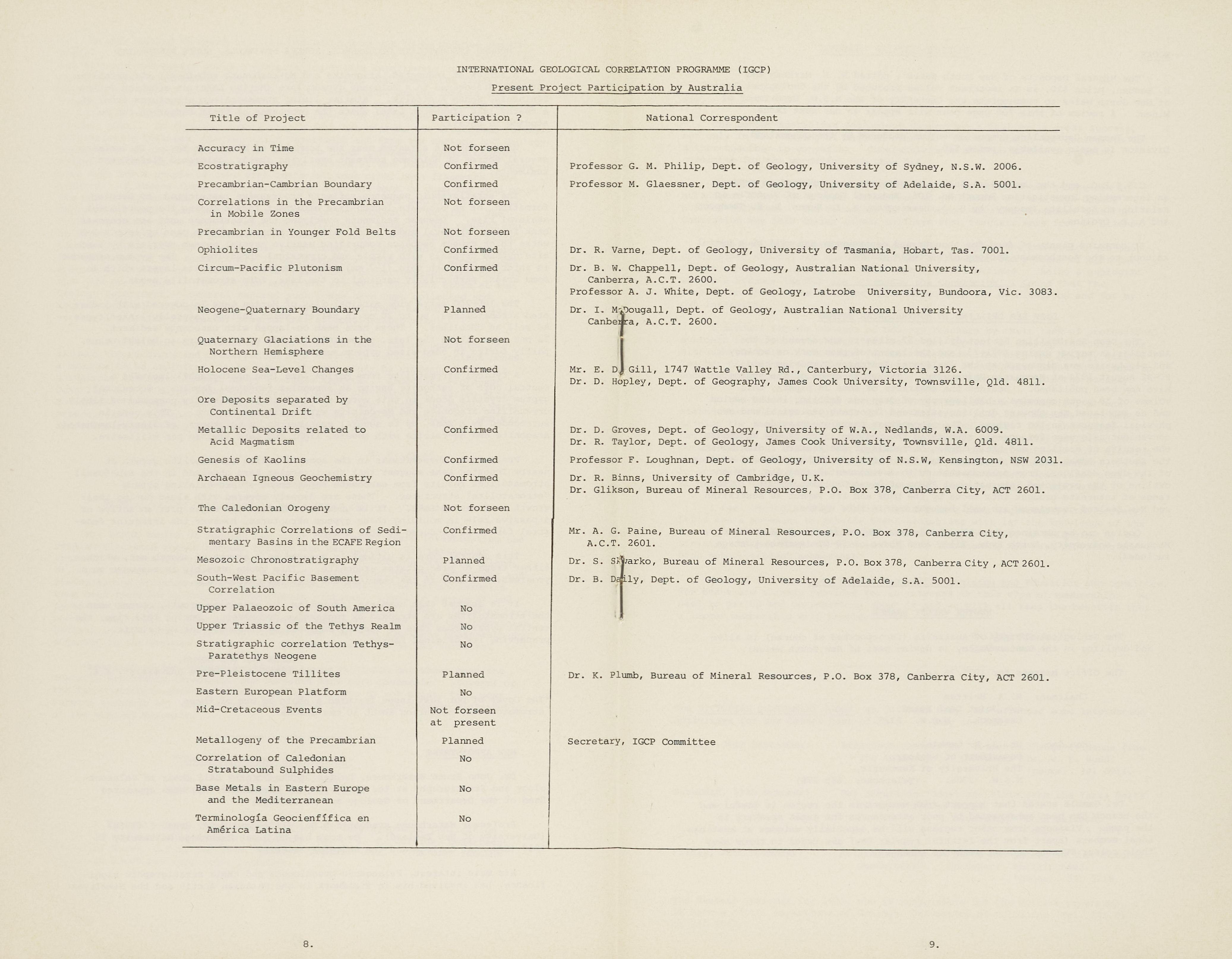
National Correspondent
Professor G. M. Philip, Dept. of Geology, University of Sydney, N.S.W. 2006.
Professor M. Glaessner, Dept. of Geology, University of Adelaide, S A. 5001.
Confirmed
Confirmed
Dr. R. Varne, Dept. of Geology, University of Tasmania, Hobart, Tas. 7001.
Dr. B. W Chappell, Dept. of Geology, Australian National Univers ity, Canberra, A.C.T. 2600.
Professor A. J. White, Dept. of Geology, Latrobe University, Bundoora, Vic. 3083.
Dr. I. Mf-')ougall, Dept. of Geology, Australian National University Canbe a, A.C.T. 2600.
Mr. E. DLill, 1747 «atHe Valley Rd., Canterbury, Victoria 3126.
Dr. D Hopley , Dept. of Geography, James Cook University, Townsville, Qld. 4811.
Dr. D. Groves, Dept. of Geology, University of W.A. Nedlands, W.A. 6009.
Dr. R. Taylor , Dept. of Geology, James Cook University, Townsville, Qld. 4811.
Professor F. Loughnan, Dept. of Geology, University of N.S.W, Kensington, NSW 2031.
Dr. R. Binns, University of Cambridge, U.K.
Dr. Glikson, Bureau of Mineral Resources , P.O. Box 378, Canberra City, ACT 2601.
Mr. A. G. Paine, Bureau of Mineral Resources, P O. Box 378, Canberra City, A.C.T. 2601.
Dr. S. Slarko, Bureau of Mineral Resou~ces, P.O. Box 378, Canberra City, ACT 2601.
Dr. B. D l l y , Dept. of Geology, Unoversoty of Adelaide, s.A. 5001.
Dr. K. Plumb , Bureau of Mineral Resources, P.O. Box 378, Canberra City, ACT 2601.
Secretary, IGCP Committee
BOOKS
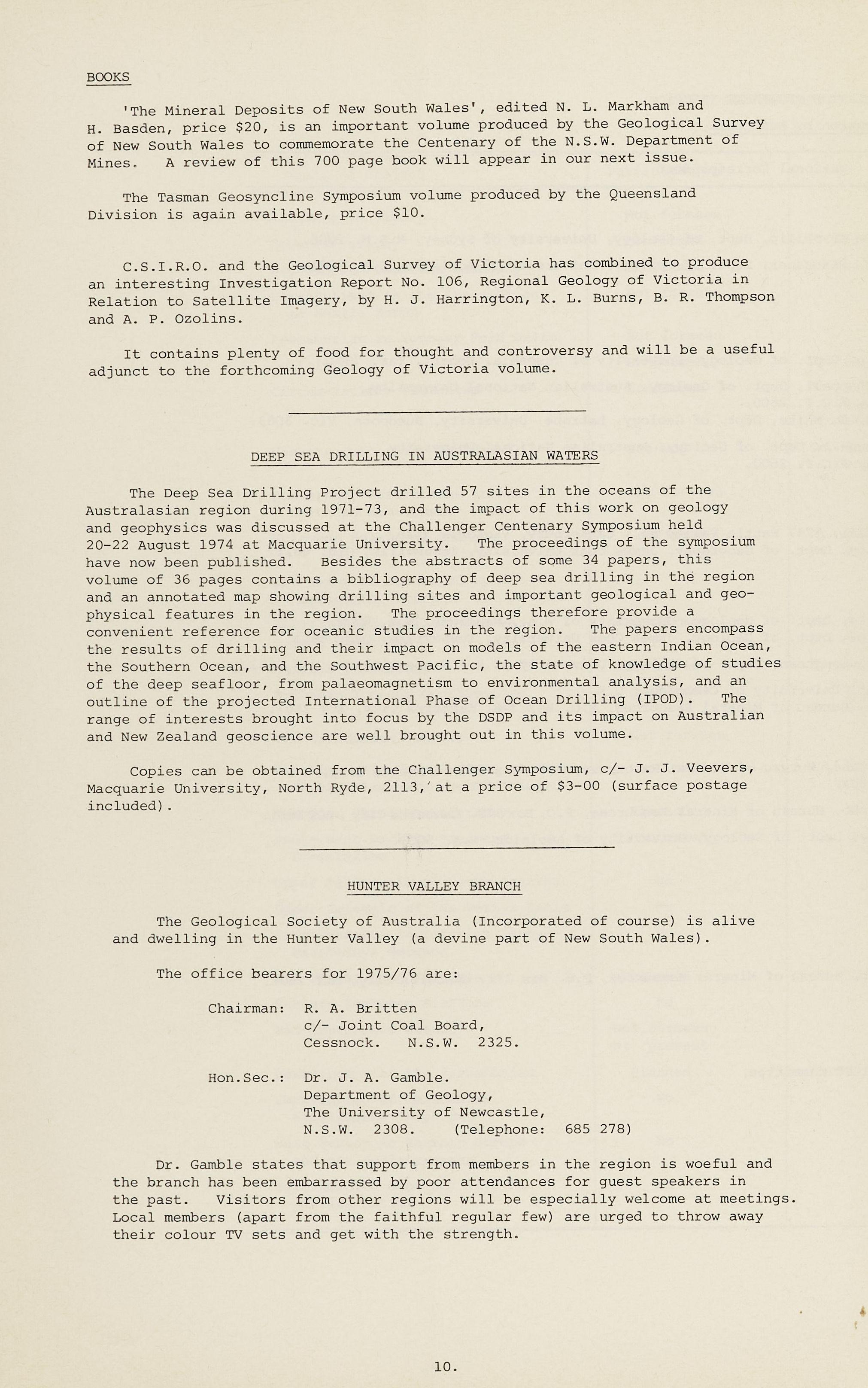
'The Mineral Deposits of New South Wales', edited N L Markham and H. Basden, price $20, is an important volume produced by the Geological Survey of New South Wales to commemorate the Centenary of the N.S.W. Department of Mines. A review of this 700 page book wil l appear in our next i ssue.
The Tasman Geosyncline Symposium volume produced by the Queensland Division is again available, price $10
C.S.I R O. and the Geological Survey of Victoria has combined to produce an interesting Investigation Report No. 106, Regiona l Geology of Victoria i n Relation to Satel l ite Imagery , by H.J. Harrington , K. L Burns , B. R. Thompson and A. P . Ozolins.
It contains plenty of food for thought and controversy and will be a useful adjunct to the forthcoming Geology of Vi ctoria volume.
DEEP SEA DRILLING IN AUSTRALASIAN WATERS
The Deep Sea Drilling Project drilled 57 s i tes in the oceans of the Australasian region during 1971- 73 , and the impact of this work on geology and geophysics was discussed at the Chal l enger Centenary Symposium held 20- 22 August 1974 at Macquarie University The proceedings of the symposium have now been published Besides the abstracts of some 34 papers , this volume of 36 pages contains a bibliography of deep sea drilling in the region and an annotated map showing drilling sites and important geological and geophysical features in the region. The proceedings therefore provide a convenient reference for oceanic studies in the region. The p apers encompass the results of drilling and their impact on mode l s of the eastern Indian Ocean , the Southern Ocean , and the Southwest Pacific , the state of knowledge of studies of the deep seafloor, from pa laeomagnetism to environmental analysis , and an outline of the projected International Phase of Ocean Drilling (IPOD) The range of interests brought into focus by the DSDP and its impact on Australian and New Zealand geoscience are well brought out in this volu me.
Copies can be obtained from the Challenger Symposium, c/- J. J. Veevers , Macquarie University , North Ryde, 2113 , ' at a price of $3- 00 (surface postage included)
HUNTER VALLEY BRANCH
The Geological Soc i e ty of Australia (Incorporated of course) i s a l ive and dwelling in the Hunter Valley (a devine par t of New South Wales).
The office bearers for 1975/76 are:
Chairman: R A. Britte n c/- Joint Coal Board , Cessnock. N.S.W . 2325.
Hon Sec.: Dr. J. A Gamble
Department of Geology , The University of Newcastle , N.S W 2308. (Telephone: 685 278)
Dr. Gamble states that support from members in the region is woeful and the branch has been embarrassed by poor attendances for guest speakers in the past. Visitors from other regions will be especially we l come at meetings. Local members (apart from the faithful regular few) are urged to throw away their colour TV sets and get with the strength.
Sir,
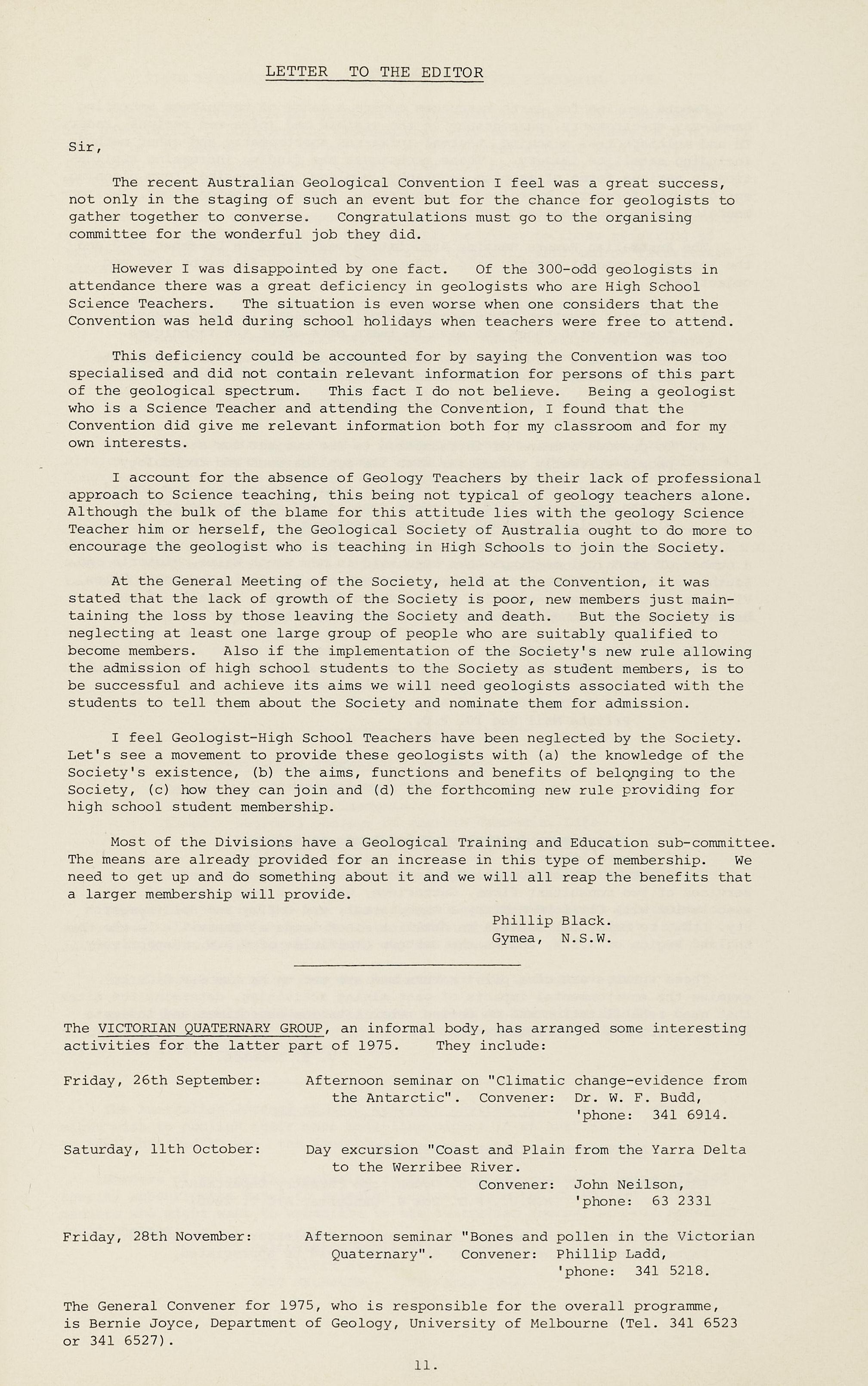
The recent Australian Geological Convention I feel was a great success, not only in the staging of such an event but for the chance for geologists to gather together to converse. Congratulations must go to the organising committee for the wonderful job they did.
However I was disappointed by one fact. Of the 300- odd geologists in attendance there was a great deficiency in geologists who are High School Science Teachers. The situation is even worse when one considers that the Convention was held during school holidays when teachers were free to attend.
This deficiency could be accounted for by saying the Convention was too specialised and did not contain relevant information for persons of this part of the geological spectrum. This fact I do not believe. Being a geologist who is a Science Teacher and attending the Convention , I found that the Convention did give me relevant information both for my classroom and for my own interests.
I account for the absence of Geology Teachers by their lack of professional approach to Science teaching, this being not typical of geology teachers alone. Although the bulk of the blame for this attitude lies with the geology Science Teacher him or herself, the Geological Society of Australia ought to do more to encourage the geologist who is teaching in High Schools to join the Society.
At the General Meeting of the Society , held at the Convention , it was stated that the lack of growth of the Society is poor , new members just maintaining the loss by those leaving the Societ y and death. But the Society is neglecting at least one large group of people who are suitably qualified to become members. Also if the implementation of the Society 's new rule allowing the admission of high school students to the Society as student members, is to be successful and achieve its aims we will need geologists associated with the students to tell them about the Society and nominate them for admission
I feel Geologist-High School Teachers have been neglected by the Society. Let's see a movement to provide these geologists with (a) the knowledge of the Society's existence, (b) the aims, functions and benefits of belo~ging to the Soc iety, {c) how they can join and (d) the forthcoming ne w rule prov idi ng for high school student membership.
Most of the Divisions have a Geological Training and Education sub- committee The means are already provided for an increase in this type of membership. We need to get up and do something about it and we will all reap the benefits that a larger membership will provide.
Phillip Black. Gymea, N. S W.
Afternoon seminar on " Climatic change-evidence from the Antarctic" Convener: Dr. w F. Budd, 'phone: 341 6914.
Day excursion "Coast and Plain from the Yarra Delta to the Werribee River Convener: John Neilson, 'phone: 63 2331
The VICTORIAN QUATERNARY GROUP , an informal body, has arranged some interesting activities for the latter part of 1975. They include : Friday, 26th September: Saturday, 11th October: Friday, 28 th November :
Afternoon seminar " Bones and pol len in the Vi ctorian Quaternary ". Convener : Phillip Ladd , 'phone : 341 5218.
The General Convener for 1975, who is responsible for th e overall programme, is Bernie Joyce, Department of Geolog y , University of Melbourne (Tel 341 6523 or 341 6527).
RE!-10TE CONTROL
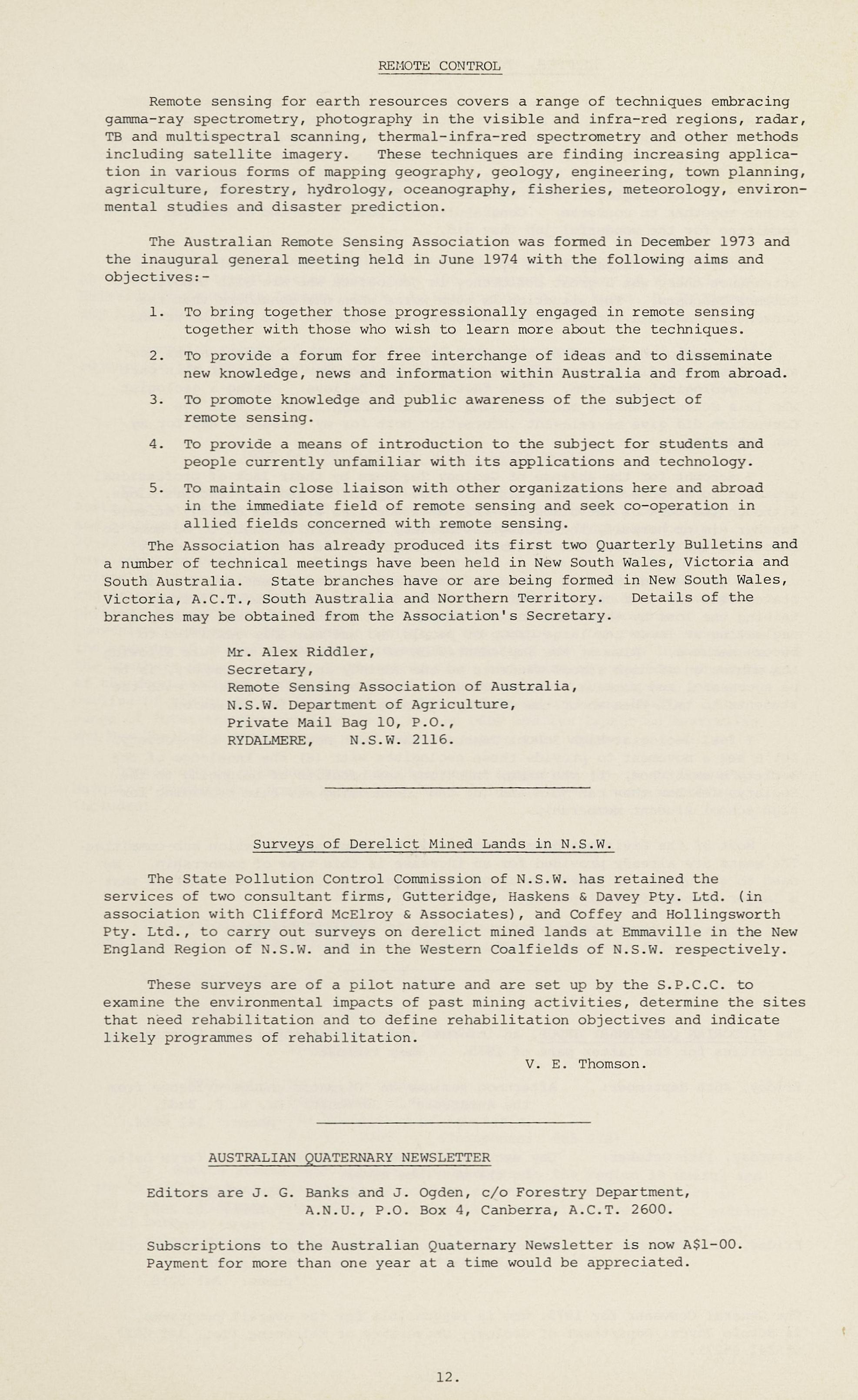
Remote sensing for earth resources covers a range of techniques embrac ing gamma-ray spectrometry, photography in the visible and infra-red regions , radar, TB and multispectral scanning, thermal-infra-red spectrometry and other methods including sate llite imagery. These techniques are finding increasing application in various forms of mapp ing geography , geology, engineering, town planning, agriculture, forestry, hydrology, oceanography , fisheries, meteorology, environmental studies and disaster prediction.
The Australian Remote Sensing Association was formed in December 1973 and the inaugural general meeting held in June 1974 with the following aims and objectives:-
1. To bring together those progressionally engaged in remote sensing together with those who wish to l earn more about the techniques.
2 To provide a forum for free interchange of ideas and to disseminate new knowledge, news and information within Australia and from abroad
3. To promote knowledge and public awareness of the subject of remote sensing.
4. To provide a means of introduction to the subject for students and people currently unfamiliar with its applications and technology
5. To maintain close liaison with other organizations here and abroad in the immediate field of remote sensing and seek co- operation in allied fields concerned with remote sensing.
The Association has already produced its first two Quarterly Bulletins and a number of technical meetings have been held in New South Wales , Victor ia and south Australia. State branches have or are being formed in New South Wales, Victoria , A.C.T ., South Australia and Northern Territory. Details of the branches may be obtained from the Association's Secretary.
Mr. Alex Riddler, Secretary, Remote Sensing Association of Australia , N S.W. Department of Agriculture, Private Mail Bag 10, P.O., RYDALMERE, N S.W 2116.
Surveys of Derelict Mined Lands in N S W.
The State Pollution Control Commission of N.S.W. has retained the services of two consultant firms, Gutteridge , Haskens & Davey Pty Ltd. (in association with Clifford McElroy & Associates), and Coffey and Hollingsworth Pty Ltd ., to carry out surveys on derelict mined lands at Emmaville in the New England Region of N.S.W. and in the Western Coalfields of N.S W. respectively.
These surveys are of a pilot nature and are set up by the S.P.C.C. to examine the environmental impacts of past mining activities , determine the sites that need r e habilitation a n d to define rehabilitation objectives and indicate likely programmes of rehabilitation.
V E. Thomson
AUSTRALIAN QUATERNARY NEWSLETTER
Edito rs are J. G. Banks and J. Ogden, c/o Forestry Department, A.N.U., P.O. Box 4, Canberra, A.C.T. 2600.
Subscrip tions to the Australian Quaternary Newsletter is now A$1-00. Payme nt for more than one year at a time would be appreciated.
SIXTH INTERNATIONAL GEOCHEMICAL EXPLORATION SYMPOSIUM, 1976.
The Sixth International Geochemical Exploration Symposium, organised by the Association of Exploration Geochemists, will be hel d in Sydney, N S.W. Australia , in August 1976, as part of the 25th Internati onal Geological Congress The Symposium will occupy three full days during the first week of the Congress and is open to all Congress registrants.
Contributions to the Symposium, in English, are invited on all aspects of geochemical exploration, but preference will be given to those referring to exploration for non-outcrvpping deposits in tropical, arid and/or lateritised terrains.
Contributions in the following categories are particularly welcome:
Advances in geochemical exploration for massive sulphides, porphyry copper deposits, uranium, hydrocarbons; regional geochemical surveys in selection of areas of potential mineralisation; isotope geochemistry in mineral exploration; primary dispersion studies; evaluation of data processing techniques.
Intending contributors should follow the general proceduLeS for submission of papers given in the second circular of the International Geological Congress. Descriptive synopses, upon which paper selection is based, should be submitted by October 1st, 1975, stating fields to be covered, the treatment of the subject and studies upon which it is based. Material should be original, contain new facts or conclusions and be of general rather than lo~al interest Such synopses can be sent to Dr. C. R. M Butt, Division of Mineralogy, C.S.I.R.O. Wembley, Western Australia 6014, from whom further information regarding technical and other arrangements for this symposium can be obtained.
All details regarding registration, accommodation, field excursions, social functions and other Congress technical sessions are given in the Congress Second Circular, available from The Secretary-General, 25th International Geological Congress, P O Box 1892, Canberra City, A.C T., 2601.
WEST COAST SYMPOSIUM - TASMANIA
Date: Venue: Scope:
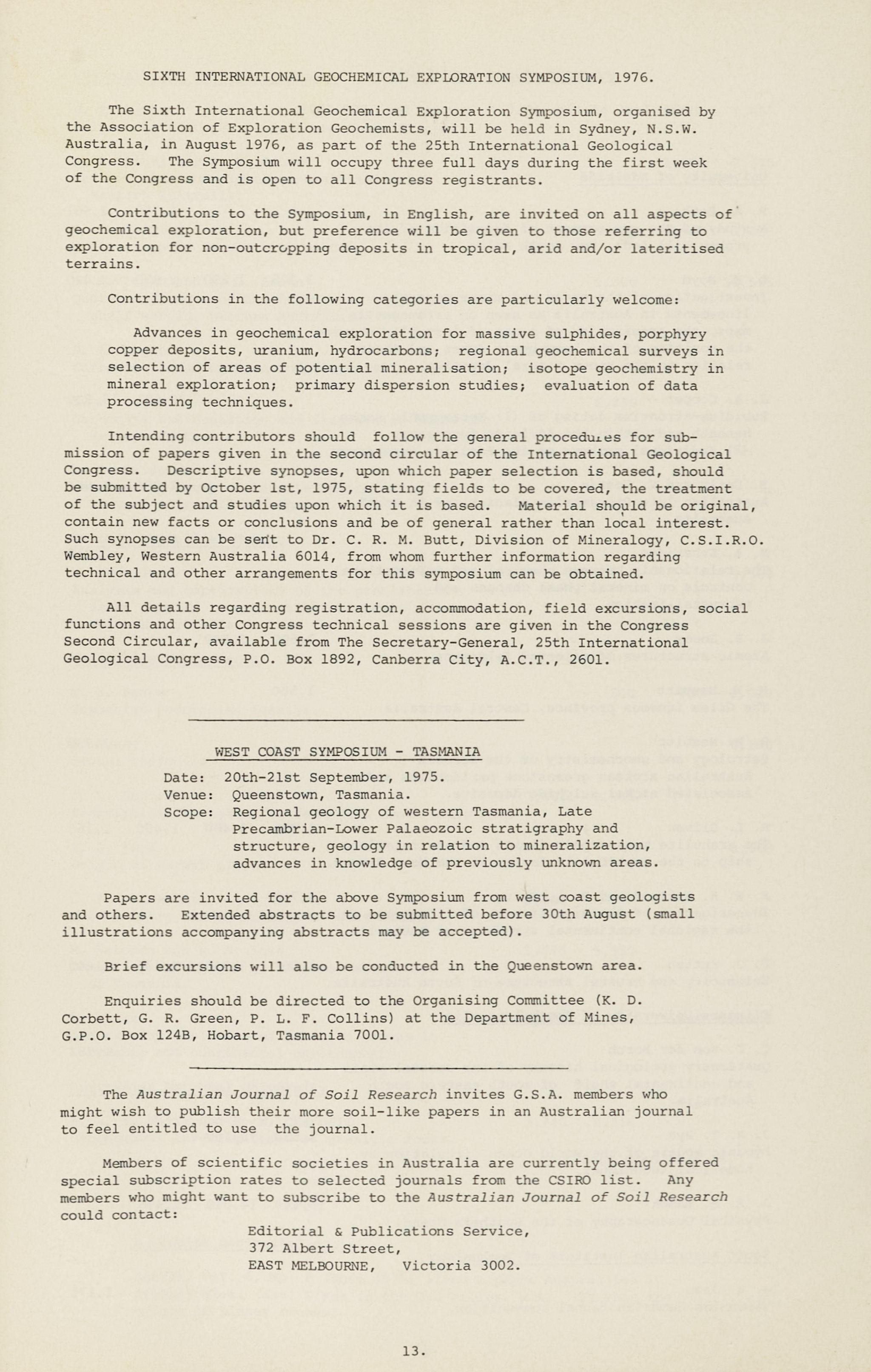
20th-2lst September, 1975.
Queenstown, Tasmania
Regional geology of western Tasmania , Late Precambrian-Lower Palaeozoic stratigraphy and structure, geology in rel a tion to mineralization, advances in knowledge of p r eviously unknown areas.
Papers are invited for the above Symposium from west coast geologists and others. Extended abstracts to be submitted before 30th August (small illustrations accompanying abstracts may be accepted).
Brief excursions will also be conducted in the Que e nstown area.
Enquiries should be directed to the Organising Committee (K. D. Corbett, G. R. Green, P. L. F. Collins) at the Department of Mines, G P.O. Box 124B, Hobart, Tasmania 7001.
The Australian Journal of Soil Research invites G.S.A. members who might wish to publish their more soil- like papers in an Australian journal to feel entitled to use the journal.
Members of scientific societies in Australia are currently being offered special subscription rates to selected journals from t he CSIRO list. Any members who might want to s ubscribe to the Austral i an Journal of So i l Re s e arch could con tact:
Editorial & Publications Service, 372 Albert Street, EAST MELBOURNE, Victoria 3002.
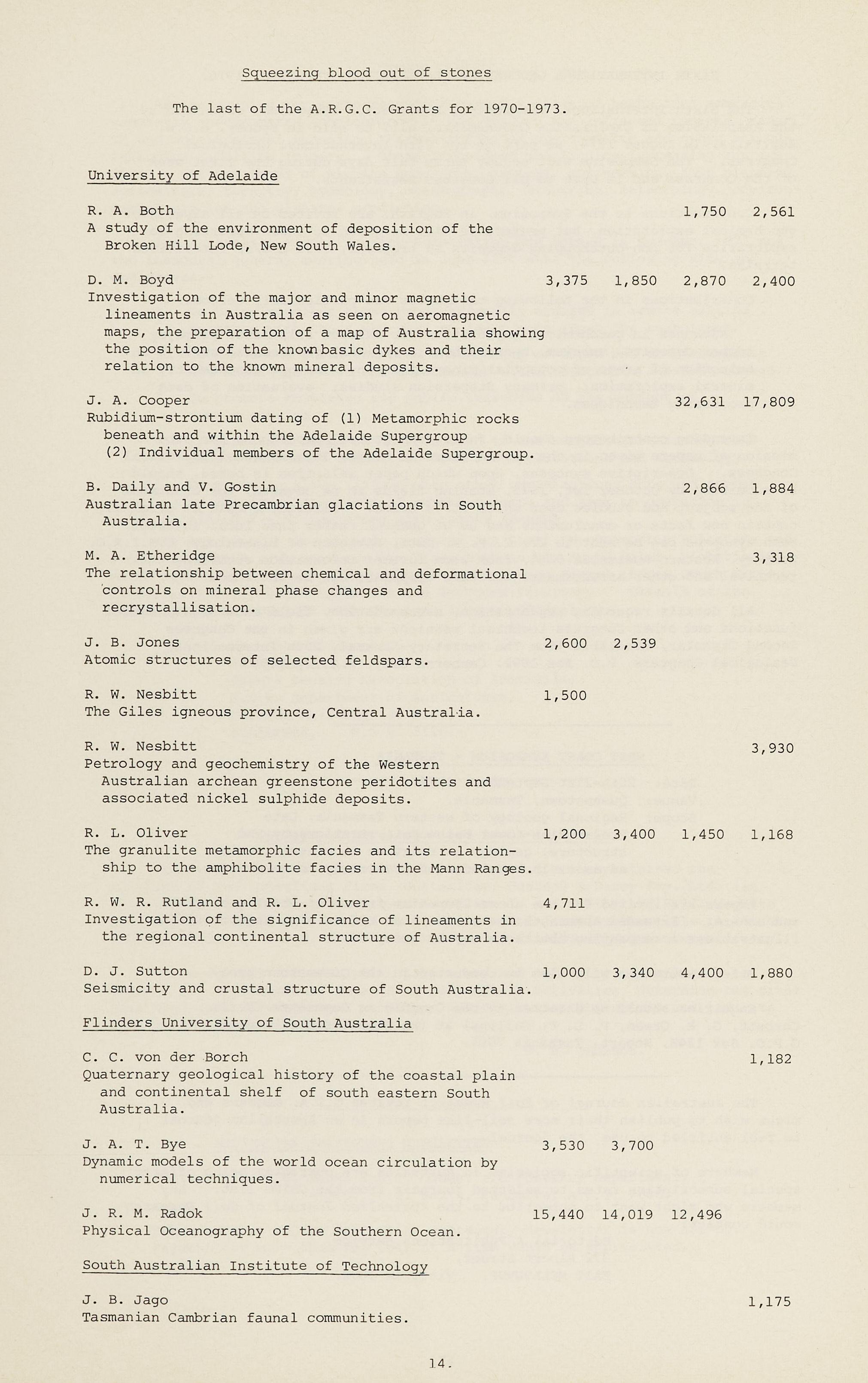
Squeezing blood out of stones
The last of the A R.G C Grants for 1970-1973 .
University of Adelaide
R. A. Both
A study of the environment of deposition of the Broken Hill Lode, New South Wales.
D. M. Boyd
Investigation of the major and minor magnetic lineaments in Australia as seen on aeromagnetic maps, the preparation of a map of Austral ia showing the position of the knoWlbasic dykes and their relation to the known mineral deposits.
J. A Cooper
Rubidium-strontium dating of (1) Metamorphic rocks beneath and within the Adelaide Supergroup (2) Individual members of the Adelaide Supergroup.
B. Daily and V. Gostin
Australian late Precambrian glaciations in South Australia.
M.A. Etheridge
The relationship between chemical and deformational ·controls on mineral phase changes and recrystallisation.
J. B. Jones
Atomic structures of selected feldspars.
R w. Nesbitt
The Giles igneous province , Central Austral-ia.
R. w. Nesbitt
Petrology and geochemistry of the Western Australian archean greenstone peridotites and associated nickel sulphide deposits.
R. L. Oliver
The granulite metamorphic facies and its relationship to the amphibolite facies in the Mann Ranges
R. W R Rutland and R L. Oliver
Investigation of the significance of lineaments in the regional continental structure of Australia
D. J. Sutton
Seismicity and crustal structure of South Australia
Flinders University of South Australia
C C von der Borch
Quaternary geological history of the coastal pla in and continental shelf of south eastern South Australia.
J. A. T . Bye
Dynamic models of the world ocean circulation by numerical techniques.
J R. M. Radok
Physical Oceanography of the Southern Ocean.
South Australian Institute of Technology
University of Western Australia
B. E. Balme
Palynology of Upper Permian and Lower Triassic
R. A. Binns and D. I. Groves
Metamorphism and nickel mineralisation in Western Australia.
P. M. Jeffery
Noble gases in terrestrial matter.
B. W. Logan and R. G. Brown
Quaternary sequence and sediments, continental shelf margin, Western Australia.
B. w. Logan
Carbonate sedimentation and diagenesis.
B. w. Logan
Carbonate sedimentation and diagenesis, Shark Bay, Western Australia.
R. T. Prider
Geochemical study of leucite lamproites of Western Australia and Spain.
Western Australian Museum
D. Merrilees
Analysis and implications of the prehistoric fauna sampled in excavations in Devil's Lair, Western Austral ia
University of Tasmania
M. R. Banks
Tasmanian Ordovician fossils.
s. Carey
Global tectonics
J. L. Davies
Geographical variation in Tasmanian beach sediments.
R. J. Ford
Origin of Darwin glass
c. F. van Moort
Geochemistry and mineralogy of diagenesis
M. Solomon and R. J. Ford
Chemistry and origin of the base metal ores of Tasmania.
R. Varne
Genesis and evolution of basaltic magmas in oceanic and continental environments.
Australian National University
A. J. R. White and B. W. Chappell
Geochemical investigations of granitic rocks. A Complex geological cycle?
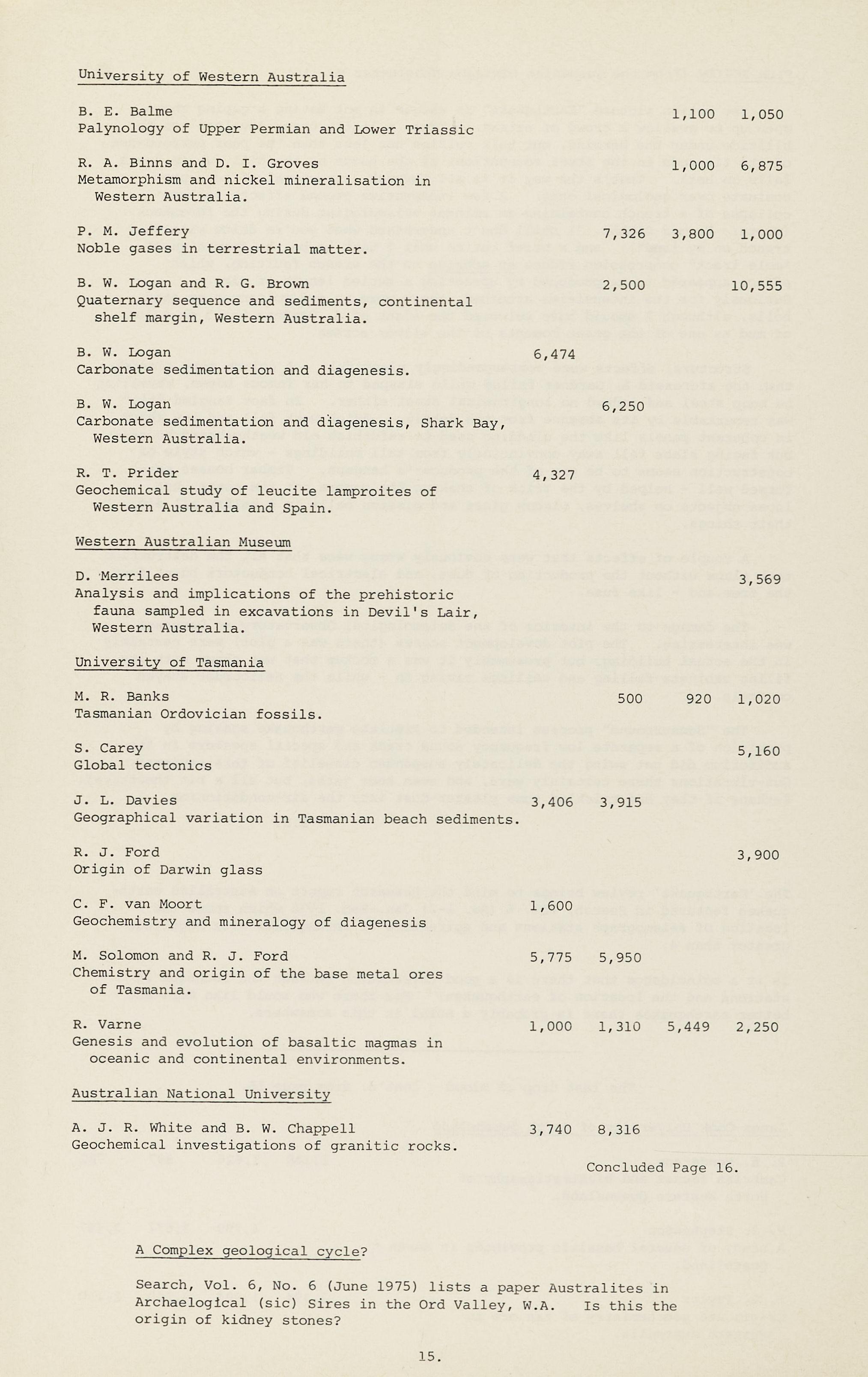
Concluded Page 16.
Search, Vol. 6 , No. 6 (June 1975) lists a paper Australites in Archaelogical (sic) Sires in the Ord Valley, W.A origin of kidney stones?
Is this the
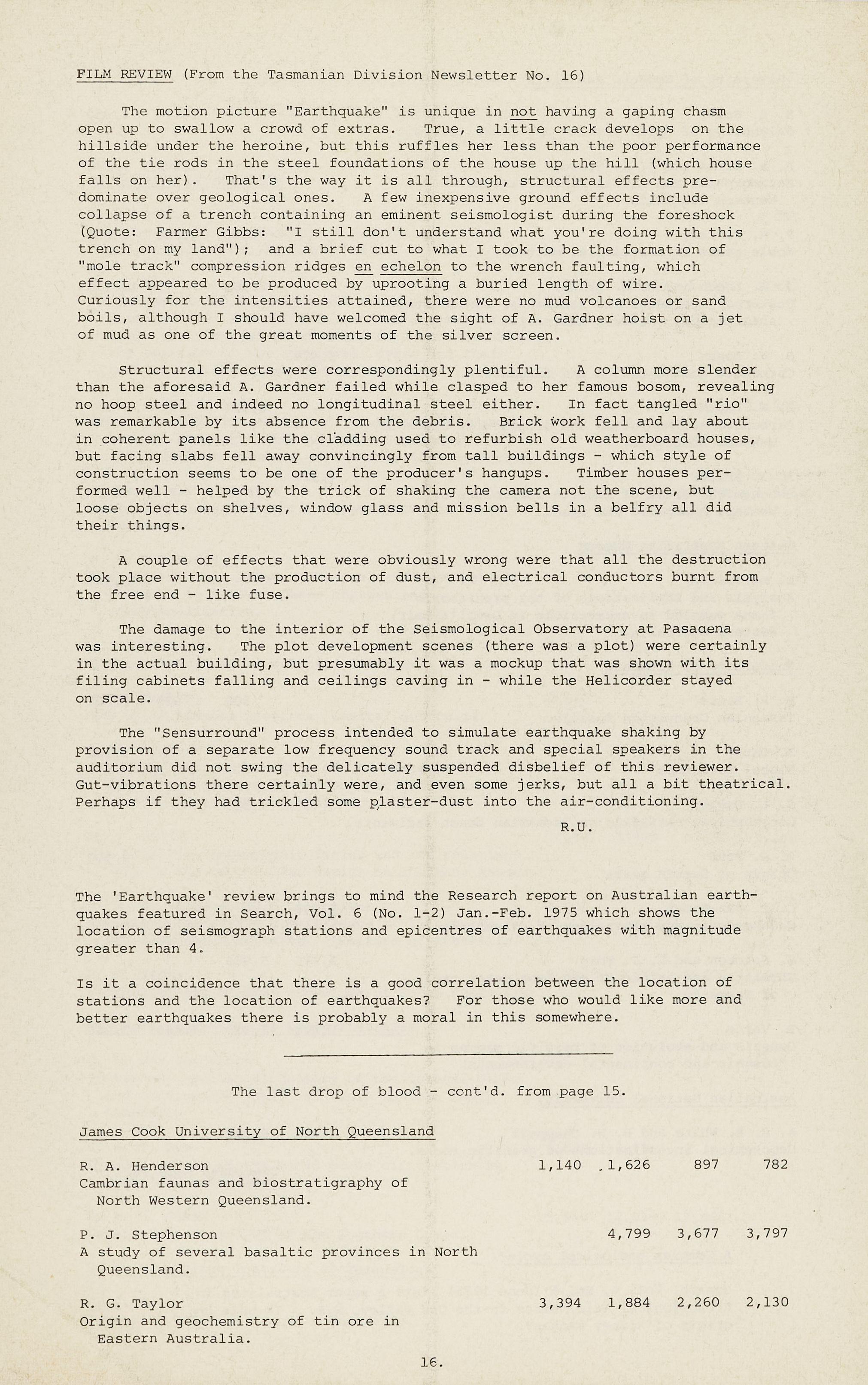
The motion picture "Earthquake" is unique in not having a gaping chasm open up to swallow a crowd of extras. True, a little crack develops on the hillside under the heroine, but this ruffles her less than the poor performance of the tie rods in the steel foundations of the house up the hill (which house falls on her). That's the way it is all through, structural effects predominate over geological ones. A few inexpensive ground effects include collapse of a trench containing an eminent seismologist during the foreshock (Quote: Farmer Gibbs: "I still don't understand what you're doing with this trench on my land"); and a brief cut to what I took to be the formation of "mole track" compression ridges en echelon to the wrench faulting, which effect appeared to be produced byuprooting a buried length of wire. Curiously for the intensities attained , there were no mud volcanoes or sand boils, although I should have welcomed the sight of A. Gardner hoist on a jet of mud as one of the great moments of the silver screen.
Structural effects were correspondingly plentiful. A column more slender than the aforesaid A. Gardner failed while clasped to her famous bosom, revealing no hoop steel and indeed no longitudinal steel either. In fact tangled "rio" was remarkable by its absence from the debris. Brick work fell and lay about in coherent panels like the cladding used to refurbish old weatherboard houses, but facing slabs fell away convincingly from tall buildings - which style of construction seems to be one of the producer's hangups. Timber houses performed well - helped by the trick of shaking the camera not the scene, but loose objects on shelves, window glass and mission bells in a belfry all did their things.
A couple of effects that were obviously wrong were that all the destruction took place without the production of dust, and electrical conductors burnt from the free end - like fuse.
The damage to the interior of the Seismological Observatory at Pasaaena was interesting. The plot development scenes (there was a plot) were certainly in the actual building, but presumably it was a mockup that was shown with its filing cabinets falling and ceilings caving in - while the Helicorder stayed on scale.
The "Sensurround" process intended to simulate earthquake shaking by provision of a separate low frequency sound track and special speakers in the auditorium did not swing the delicately suspended disbelief of this reviewer. Gut-vibrations there certainly were, and even some jerks, but all a bit theatrical. Perhaps if they had trickled some P,laster-dust into the air-conditioning.
R.U.
The 'Earthquake' review brings to mind the Research report on Australian earthquakes featured in Search, Vol. 6 (No. 1-2) Jan.-Feb. 1975 which shows the location of seismograph stations and epicentres of earthquakes with magnitude greater than 4.
Is it a coincidence that there is a good correlation between the location of stations and the location of earthquakes? For those who would like more and better earthquakes there is probably a moral in this somewhere.
The last drop of blood - cont ' d. from .page 15.
James Cook University of North Queensland
R. A. Henderson
Cambrian faunas and biostratigraphy of North Western Queensland.
P. J. Stephenson
A study of several basaltic provinces in North Queensland.
R. G. Taylor
Origin and geochemistry of tin ore in Eastern Australia.