Laurel Tuckwell 10th floor, Challis House, Martin Place, Sydney (02) 231 4696
Sitting in Alice Springs away from it all is a good place to muse on the organization of the Society. What do we get from the GSA and is this what we want?
The Society offers monthly notes, and meetings of divisions and branches, quarterly newsletter (The Australian Geologist), a journal, soon to be quarterly again, discounted special publications, and regular conventions. This seems good value for $35 (1984). For a small addition, there is also Membership of several Specialist Groups with their wide range of activities (some more active than others). It is pleasing to see the moves to form new ·sG's and there are several other possibilities - what about hydrogeology?
It seems that the 'sharp edge' of the Society is moving towards Specialist Groups, with a close association of topic interests. The Members away from capital cities the SG's may be more attractive.
It is not that divisions are inactive and they are certainly not redundant, offering as they do an interdisciplinary forum. The Society would not benefit by changing to a federation of Specialist Groups; but perhaps we should question whether the divisional structure is the best arrangement, perhaps smaller regional divisions or branches would be more efficient in caterinq for the needs of isolated geologists. Two branches have been operating for some timedo these function well?
•
I will shortly avail myself of the presidential privilege of visiting divisions and it would be useful to discuss the above other matters with Committees before the next Council Meeting.
Now that we are moving to a new journal it is a good time to write to the Editor: Dr. R. Lemaitre, Department of Geology, University of Melbourne, Parkville Vic 3052, with suggestions about format, content etc. The journal represents one of the Society's major efforts. Many Members probably read 10% or less of the journal, but most are happy to support the publication of Earth Science in Australia in this way.
I understand that only about 50% of geologists in Australia are Members of our Society. If each Member recruited one other Member we would have 100% coverage! We also have Company Members - organizations willing to help the Society by paying a voluntary higher subscription. We offer special benefits to such Company Members and we would welcome interest from other Companies not already Members.
An enlarged Membership would allow us to offer more benefits, run more symposia, publish more and offer better student discounts.
As always the geology of 'the Centre' is fantastic - there should be scope for a geological photo atlas of Australia, why not for the bicentennial?
M.J. Rickard President
Newsletter No.46
The Australian Geologist
October 3rd, 1983
Editorial
The Present has caught up
This issue finds the President camped at Alice Springs, the Editor rushing frantically (and possibly futilely) around New South Wales, and most Members apparently hard at work in the field, on research projects, writing papers for symposia and forthcoming conferences.
There are signs that metalliferous mining has begun a swing back to profitability and geologists are likely to be in demand again - for how long, who knows?
All this means that Members have not exactly inundated me with articles and correspondence, so this issue is by way of being a somewhat mark time affair.
Two significant historical events have just occurred which serve to remind us of the part which geology has played and will continue to play in community affairs. The Centenary of the discovery of the Broken Hill ore body has been marked not only by celebrations in that fair city, but by a fine display mounted at the Geology and Mining Museum in Sydney. The presence of the Minister for Minerals and Energy, Mr Kevin Stewart, at the opening, and the formation of an enthusiastic Friends Society suggests that the future of the Museum is safe at least for the forseeable future. However, judging by comments I have heard, the restructuring of the sections (including the Geological Survey) within the New South Wales Department of Minerals and Energy seems not to be in the best interests of geology in this state. Are there significant and similar changes taking place in the various other state surveys? If so are they likely to affect the quality of work done by geologists, or to push people into rather narrow specialist fields? Some comments on these and associated topics by Members would be welcomed.
The second historical event of note was the Centenary of the eruption of Krakatoa, remembered in newspapers and on television. A paper in Nature last year somewhat downgraded the event, in volcanological terms, but few text books between 1883 and the present have ignored it. Such events capture the public imagination and are suitable bases on which to tell the public what geology is all about.
This month a new textbook for schools Perspectives of the Earth is being published by the Australian Academy of Science. Many Members have contributed to this Australian enterprise. A suitable follow up by the Society would be some special publications for popular consumption. Any Division or Specialist Groups interested?
Special Publication No. 9
LATE PROTEROZOIC TO DEVONIAN SEQUENCES OF THE SOUTHEASTERN AUSTRALIA, ANTARCTICA AND NEW ZEALAND AND THEIR CORRELATION Ed. R.A. Cooper & G.W. Grindley $17.50
Special Publication No. 10
PALAEOGEOGRAPHIC AND TECTONIC DEVELOPMENT OF THE LACHLAN FOLD BELT, SOUTHEASTERN AUSTRALIA by R. Cas .... $12.00 GSA members (surface post included)
ENGINEERING GEOLOGY SPECIALIST GROUP
As part of the 7th Australian Geological Congress, the E.G.S.P. will be organising a programme under the general theme of "Engineering and Environmental Geology in the Service of Man".
The proposed programme will cover tunnelling for sewerage schemes, environmental and general engineering geology, a half-day excursion and the annual meeting of the E.G.S.P.
All enquiries should be made to the local Convenor, Dr. M.J. Knight, School of Applied Geology, University of New South Wales, P.O. Box 1, Kensington, 2033.
"TERTIARY WORKING GROUP - It is proposed to include a Session for this new specialist group in the 7th Australian Geological Convention in August 1984 in Sydney. Convention papers are invited, particularly on Neogene biostratigraphy and correlation. Interested persons are asked to write to Dr. A.N. Carter, School of Applied Geology, University of N.S.W., P.O. Box 1, Kensington, N.S.W. 2033".
CSIRO DIVISION OF MINERALOGY RESEARCH REVIEW, 1983
A review of current and recently completed research activities of the Division of Mineralogy was published during late June, 1983. The review comprises some 120 short articles that illustrate the Division's application of mineralogical, geochemical and other geoscientific disciplines to the development of improved concepts and techniques for mineral exploration.
Contributions to the Research Review have come from staff at the Floreat Park, North Ryde and Baas Becking Laboratories of the Division and have been grouped under Mineral Deposits and their Environments, Exploration in the Weathered Environment, and Research Methods - Techniques and Applications. The Research Review was edited by Wilf Ewers, who recently retired from the Floreat laboratories of the Division of Mineralogy.
Copies of the Research Review are being distributed to geoscientists in Universities, Government Departments and in Mining and Exploration Companies. A limited number of additional copies will be available for distribution to interested geoscientists. These can be obtained by writing to -
Dr. D.R. Hudson
Research Review, 1983, CSIRO Division of Mineralogy, Private Bag, P.O. Wembley, Western Australia 6014.
CSIRO
OUTLINES NEW DIRECTIONS' FOR GEOLOGICAL REMOTE SENSING
In a new research proposal submitted to the Australian Mineral Industries Research Association (AMIRA), the CSIRO Division of Mineral Physics has outlined some of its remote sensing research plans and goals for the next three years.
The Division of Mineral Physics' Remote Sensing Group, through two earlier industry-supported projects, pioneered the digital enhancement of Landsat imagery, digital image display and integration of geophysical, geochemical, geological and remote sensing data, and new remote sensing techniques for exploration in the post-Landsat era.
The new research proposal, entitled "Spectral Properties of Australian Terrain", is a development of an earlier project that showed the considerable potential for remote mapping of specific minerals and rock types from aircraft and satellite altitudes. It is expected to be applicable to world-wide exploration problems, not just those of Australia, and to highlight the role of remote sensing in solving some of these.
The theory of spectral discrimination of rocks and minerals in the visible, short wave-length infrared and mid-infrared has been known from laboratory work for some years. However, only recently, as a result of interest in the Thematic Mapper data from Landsat-4 and previous Thematic Mapper simulator data in the United States, has renewed effort been put into developing operational remote sensing systems by transferring this laboratory knowledge to the Australian exploration scene.
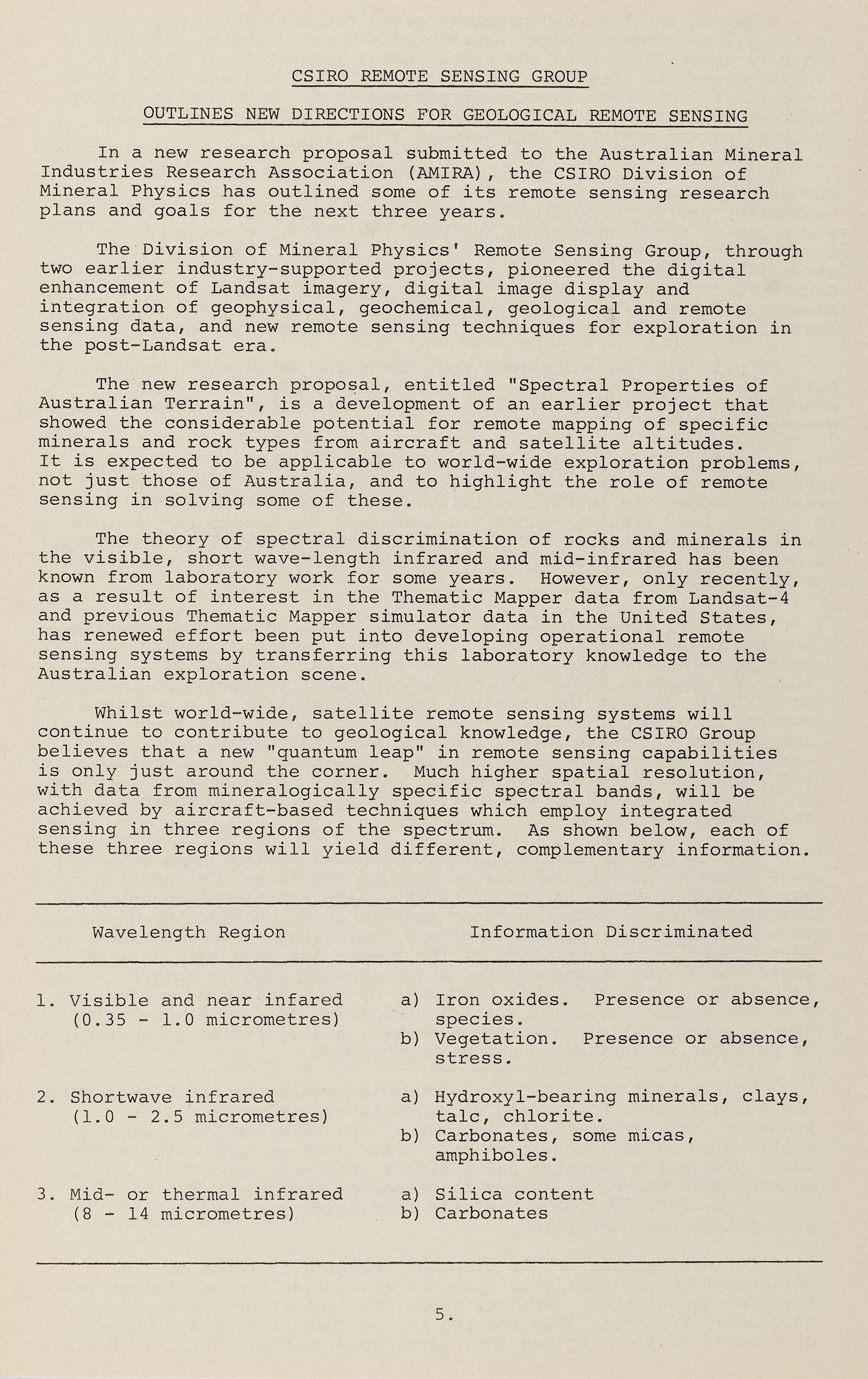
Whilst world-wide, satellite remote sensing systems will continue to contribute to geological knowledge, the CSIRO Group believes that a new "quantum leap" in remote sensing capabilities is only just around the corner. Much higher spatial resolution, with data from mineralogically specific spectral bands, will be achieved by aircraft-based techniques which employ integrated sensing in three regions of the spectrum. As shown below, each of these three regions will yield different, complementary information.
Wavelength Region
1. Visible and near infared (0.35 - 1.0 micrometres)
2 Shortwave infrared (1 . 0 - 2.5 micrometres)
3. Mid- or thermal infrared (8 - 14 micrometres)
Information Discriminated
a) Iron oxides. Presence or absence, species.
b) Vegetation. Presence or absence, stress.
a) Hydroxyl-bearing minerals, clays, talc, chlorite.
b) Carbonates, some micas, amphiboles.
a) Silica content
b) Carbonates 5.
A lot of interest has centred around the ability to map clays in the 2.2 micrometre, short wave-length infrared region, because of the clay association with the hydrothermal alteration of many mineral deposits. However, CSIRO's current research has shown that the potential of these spectral regions goes far beyond this simple application, with many other minerals being discriminated in both outcropping and residual soil-covered areas (Fig 1).
Figure 1 shows the short wave-length infrared spectra of a number of clays, carbonates and sulphates found in alteration zones, weathering profiles and fresh rocks. The variations in the positions of their absorption features indicates the scope of discrimination possible with systems with several, narrow, very carefully positioned filters. Indeed the Mineral Physics' Remote Sensing Group has been able to conduct significant primary mineralogical/rock-type mapping in all its three main test sites in Australia, using field and aircraft spectro-radiometric measurements.
It will also be recognised that the three wave-length regions cited above yield information (on iron oxides, clays and silica mineralogy) vital to an understanding of weathering and geomorphological processes.
The planned three-year research effort will expand the current programme of determining spectral characteristics of fresh and weathered rocks, in metallogenically significant environments, so as to specify what spectral bands are necessary for incorporation into aircraft scanner systems. The Group, and some other CSIRO Divisions, is developing high-resolution scanner and spectro-radiometric systems for this purpose.
However, there is also a need for sound, background, spectral and geological research. It is not just a matter of flying a scanner with bands chosen in an "ad hoe" way. For example, in the past eighteen months the Mineral Physics' research group has extensively revised the spectral band requirements of a scanner system, as a result of spectral analysis of local rock types (as opposed to US laboratory powders) from Australian mineralised terrains. So far, the research has concentrated on the visible and shortwave infrared wavelengths. The new research will continue this work and extend data collection to the middle or thermal infrared region.
New, primarily aircraft, remote sensing systems that could revolutionise surface geological mapping and target delineation are a likely outcome of the research. Like aerial photography, the attraction of remote sensing systems is the uniformity of their coverage, as opposed to ground traversing. Further, the more mineralogical character of the images and maps that will be generated by the systems of the future should lead to better targeting, a more efficient placement of exploration resources, a better understanding of spatial variations of some mineralogies (for example, facies, alteration zones), and a clearer understanding of patterns of weathering and geomorphology.
Unlike most other geological remote sensing research programmes, the CSIRO Mineral Physics/AMIRA projects emphasise very close industry involvement in all aspects of the research and subsequent utilization of the techniques developed. For example, its earlier image processing research had a direct influence upon the considerable number of Australian resource companies, who have installed their own image analysis facilities for Landsat and geophysical data analysis.
Further details of the proposed research or terms of collaboration are available from the Australian Mineral Industries Research Association, Citicorp House, 63 Exhibition Street, Melbourne, Victoria, 3000, Australia, or The Chief, CSIRO Division of Mineral Physics, PO Box 136, North Ryde, N.S.W., 2113, Australia.
PEDOLOGY by P. Duchaufour, translated by T.R. Paton 1982, Allen & Unwin, 448p., paperback $34.95.
Duchaufour's Precise de pedologie was an outstanding textbook on soils It is therefore heartening to see Prof. Paton's translation of the first volume of an updated and expanded version of this work. The focus of the first volume is on processes and classification rather than on soil properties, which will be dealt with in the next volume. Duchaufour emphasises the need for a thorough understanding of the physicochemical processes of pedogenesis, and gives a highly detailed account of weathering and clay formation, of the dynamics of organic matter, and of the movement of ma~erials in soils He proceeds from outlining a general model of soil genesis to a co n sideration of the criteria for soil classification and to an analysis of the processes which have produced each major class of soil. I think it no exaggeration to say that this is the most encyclopedic e x position of those processes to appear in English. For this reason alone the book should undoubtedly be in all earth science research libraries.
It does have weaknesses. Like so many French works, its horizons become somewhat vague south of Senegal. Australian pedologists may be surprised, and even concerned to see how little attention Duchaufour has given to their research. They have made no great contribution, one might well assume from this book, even in the study of long cycles of soil formation. Whatever h appened to Butler, Walker, Mulcahy, van Dijk and company? - sic Transit ... ! Of course these gentlemen might have a quiet laugh when the y learn that an "old soil" is one developed over a period of more than 10,000 y ears
This book reall y is for the e x pert. It is neither a textbook for beginners nor even . an easily-read reference for those with a reasonable acquainta n ce with the subject; the original Precise was, in this regard, far superior. I refer here not just to the depth of anal y sis, but also to the difficulty of keeping hold of the structure of the book while wading through a daunting array of highly detailed informatio n. The terminology, moreover, is hi ghl y complex, even for a pedolog y book . If ever a glossary was needed it surel y was here. The use of some terms seems inconsistent. F or instance, Duchaufour has apparently replaced the well-known "lessivage" with Paton's "pervection", but still talks of "lessived" soils. The book is unquestionably packed with valuable information; the trick is to e xtr act it.
R . W. Young
Now available:
" Ophiolitic and related Melanges ". Edited by G.J.H. McCa ll. Benchmark Series of Readings in Geology, v.66 , 446pp. , Hut chinson and Ross, Stroudsburg , Pennsylvania.
The Emerald, Its Occurrence, Discrimination and Evaluation b y Ivan A . Mumme, 1982 (Mumme Publications , Pt Hacking, N . S . W. ) , Price $21. 00 .
In the preface, the author states that this is a book written for the "gem" geologist as well as the gemmologist and serious lapidar y. Along with the major discover y of diamonds in W A and the large-scale mining of opal and sapphires which has occurred over the last few years in eastern Australia, there has been a recent (1980) re-opening of the Aga Khan emerald mine in W A All of these things should be enough to whet the appetite of any "gem" geologist - after all , really fine qualit y emerald is worth more than diamond.
The first and largest section of the book deals with the world-wide occurrence of emeralds For each location the author outlines a history of the development and mining methods, together with a locality, or if possible, a geological sketch map .
The geology of each deposit , including the mode of formation and emplacement of the emeralds and their host rocks, is given , where possible, in a plate tectonic framework. The geological descriptions are varied in their quality . Some are detailed and thoroughly up-to-date, while others are rather "erratic" and even fanciful. The reason for this variability becomes clear when the author explains how several of the classic emerald localities have either not been visited by geologists in recent times - to visit Cleopatra's mines in Egypt requires a "full - scale expedition" of several weeks duration, or is positively dangerous - if one is luck y enough to obtain permission to visit the Muzo mines in Colombia (highly unlikely) an armed guard as a protection against the "Esmeraldos" or emerald bandits, is an essential The local mine geologists at Muzo also work with an armed guard
The author gives an extremely detailed, up-to-date account of Australian emerald. It is undoubtedly one of the best and most comprehensive descriptions of the Australian deposits.
The second section of this book looks at the scientific aspects of emerald . It discusses such topics as chemical composition and crystal structure, physical and optical properties , fluorescence and absorption spectrum There is a particularly interesting section on inclusions in emeralds , relating them to geographic occurrencea nearly infallible method of finding out where your emerald reall y comes from
Later sections in the book include a description of other green gems which can be used to imitate emerald and there is a detaile d discussion on synthetic emeralds - their s y nthesis and a comparison of their properties with natural stones The book concludes with a short section on the cutting and polishing of emerald and its valuation
THE EMERALD is readable, geologically compete n t and a good , quick reference on the occurrence and properties of this mineral The localit y and specimen photographs are disappointing , the y are small and not of enormous interest. Those illustrating inclusions in emerald are somewhat bett e r , although not as fine as in man y gemmological reference books . Although a paperback, the book is well bound and a ver y reasonable price
Br enda J . F ran k lin
Geomorphological Techniques, edited by Andrew Goudie, 1981, George Allen and Unwin, 395 pp Hardback $70.00, Paperback $35.00.
Geomorphological Field Man ual, by R.V. Dackounke and V. Gardiner, 1983, George Allen and Unwin, 254 pp. Hardback $44.00, Paperback $19.95.
These two books are presented as self-contained but companion volumes, whose stated aims are to concentrate on the large number of geomorphological techniques which are not covered adequately by handbooks from other disciplines (Techniques), and to act as an aide memoire containing information essential for efficient fieldwork (Field Manual).
The Techniques volume is much more successful than the Field Manual, largely as a result of the almost encyclopedic coverage provided by its 34 contributiors. These contributors, seven of whom formed the editorial board headed by Andrew Goudie, drew on well over 1000 bibliographical references in their wide-ranging discussion of geomorphological techniques under the broad headings of Form (morphometry and mapping), Material Properties (physical and chemical properties of materials), Process (observation and measurement) and Evolution (radiometric dating, lichenometry, lake sediments, raised shorelines and palaeosols). As might be expected, the Process section is about twice as long as the others which receive about equal treatment.
The wide coverage and extensive bibliography are the most valuable aspects of the Techniques volume which is generally well-illustrated by nearly 200 line drawings. As well as covering the full range of more traditional procedures, many relatively recent techniques, such as palaeomagnetism, the use of radioactive isotopes such as Caesium 137 in erosion studies, and the use of K-Ar dating (particularly relevant in Australia where many of our landscapes date from the Mesozoic) are treated well, but several techniques receive treatment which to Australian eyes might seem disproportionate. The full chapters given to Raised Shorelines and to Glacial Processes, for example, contrast with the complete absence of any treatment of river terraces As well, I found it inconvenient that authors are listed only in the table of contents, and not with their respective sections of text. These shortcomings aside and despite its relatively high price ($35.00 in paperback) the Techniques volume is highly recommended for purchase by libraries and by earth scientists who need a compendium of the many techniques and associated references currently used in geomorphology.
The same cannot be said for the Field Manual. This small, but overpriced, volume ($44.00 for the hardback edition which would probably be necessary to withstand the rigours of field work) presents and uneven coverage of field techniques used by geomorphologists. Many of the field techniques traditionally used by geomorphologists (slope profiling, geomorphic mapping, determination of river discharge, grain size analysis and so on) are summarise d with computational aids , particularly nomograms, where necessary; some of the techniques, such as those used in the study of glacial processes, would not generally be relevant to the bulk of geomorphologists who work in Australia. Unlike the Techniques volume, the Field Manual has extensive treatment of field techniques which would generally be considered part of geology (more than one quarter of the text pages ), not that this is by any means a shortcoming , but its 31 pages of geophysical techniques, for example, could arguably have been better devoted to other " geo logical" field techniques more relevant to geomorphologists in general, such as measuring and analysis of palaeocurrent data and the use of stereo nets. Some of the sedimentological and pedological techniques presented, especially the use of triangular diagrams, depend on laboratory analysis of data and hence are not appropriate for a field manual, while the inclusion of other techniques, especially the many programs available for hand-held calculators and designed for use at the outcrop, would have improved the manual . For these reasons and its high price, the purchase of the Geomorphological Field Manual can not be recommended.
Paul Bishop
UNIVERSITY OF NEW SOUTH WALES School of Applied Geology
GEOLOGICAL SOCIETY OF AUSTRALIA N.S.W. Division
AUSTRALIAN SOCIETY OF EXPLORATI.ON GEOPHYSICISTS
PUBLIC LECTURE
The Fifth J . J. FRANKEL MEMORIAL LECTURE will be delivered by DR. M. W. McELHINNY, F.A.A.
Chief, Division of Geophysics, Bureau of Mineral Resources.
Title: GEOPHYSICS: A key to understanding the geology of Australia.
There is no charge for the lecture The cost of buffet dinner and drinks is $15 . 00 per person and payable to the School of Applied Geology. Please send your names, addresses and cheques to the Senior Administrative Officer, School of Applied Geology, University of New South Wales, Box 1, Kensington, N.S.W. 2033, by FRIDAY, 30 September 1983. In view of limited places an earl y booking is advisable.
EDUCATION, TRAINING AND EMPLOYMENT
The High er Education Re sea r ch and Development Society of Australasia i s organising a Conference on the above topic to be held in Sydney, May 11 -14, 1984 The issues to be add re ss ed include:-
* To te ach basic principles of skills?
Appropriate responses i n the c urriculum and classroom to changes in job prospects and participation in past secondary education.
The acc redit a tio n of courses.
Liberal education and socia l responsibilities in professional edu c ation and training.
Prac ti tioner dev el opment, updating and retr ainin g in education institutions.
Postitive discrimination and access to vocationally oriented ed uc ation and training.
Offers of p ap ers and wo rk shops are invited from partic ip ants in CAEs , uni versit ie s , TAFE , professional societies and from other i nte rested persons; closi n g date for abstracts December 15, 1983.
Fur ther information:-
Dr. A. Prosser, School of Metallurgy , Un i versity of N S.W. , P.O. Box 1 , KENSINGTON. N.S W.
2033
CANNING BASIN SYMPOSIUM
The Western Australian branches of the Petroleum Exploration Societ y of Australia and the Geological Society of Australia will hold a three day symposium on the Canning Basin at the Sheraton Hotel, Perth, on June 27-29, 1984.
The Canning Basin is the largest basin in Western Australia covering 450,000 square kilometres onshore and extending into the offshore region. This vast intracratonic basin between the Kimberley and Pilbara shields contains over 10,000 metres of Phanerozoic sediments, predominantly of Palaeozoic age.
The basin is best known for the spectacular outcrops of Upper Devonian reef complexes along the northeast margin. These reef complexes are also present in the subsurface and have been the main objective of most petroleum e x ploration in the basin in recent years. Small amounts of oil have also been recovered from Carboniferous and Ordovician sediments in recent wells.
This drilling has been preceded by extensive seismic surveys and supplemented by geochemical and other studies. It is now timely to integrate as much of this work as possible as a foundation for ongoing exploration and research efforts.
OBJECTIVES
The aim of this Symposium is to develop a current and comprehensive summary of the geology of the Canning Basin with particular emphasis on the Palaeozoic sediments and their hydrocarbon potential.
The Symposium will combine the results of past work with present concepts and programmes into a guide for future exploration and research in this ex citing basin. The social and environmental issues related to petroleum exploration in the basin will also be addressed.
To achieve this overview the Symposium must cover a very broad range of subjects, from Plate Tectonics to Palaeontology, Lopatin to Logistics, Landsat to Land Rights. Correspondingly it must draw contributions, larg e and small, from the broadest possible range of earth scientists in Government, Education and Industry. It must also draw contributions and comments from Government Leaders, Public Agencies, Private Organisations and individuals involved in the Canning Basin area.
CONTRIBUTIONS
The aims of this Symposium and th e broad rang e of subjects it will cover require a fle x ible format. As a working scheme the following range of contributions is proposed:
Keynote Address: Major papers reviewing aspects of the geology or the exploration in the basin. One hour will be allowed for presentation and discussion. Several of the Keynote ~peak~rs will be nominated b y the Committe e but contributions in this cate g or y are invit ed.
Standa~d Pa per ~: P a pers on all subj ec ts relevant to the Symposium and in v ol ving p resentation time of 20 minutes only. In particular circumstances where the subject warrants a~ ext~a 10 minutes may be allowed. Ten minutes discussion ' time will be scheduled.
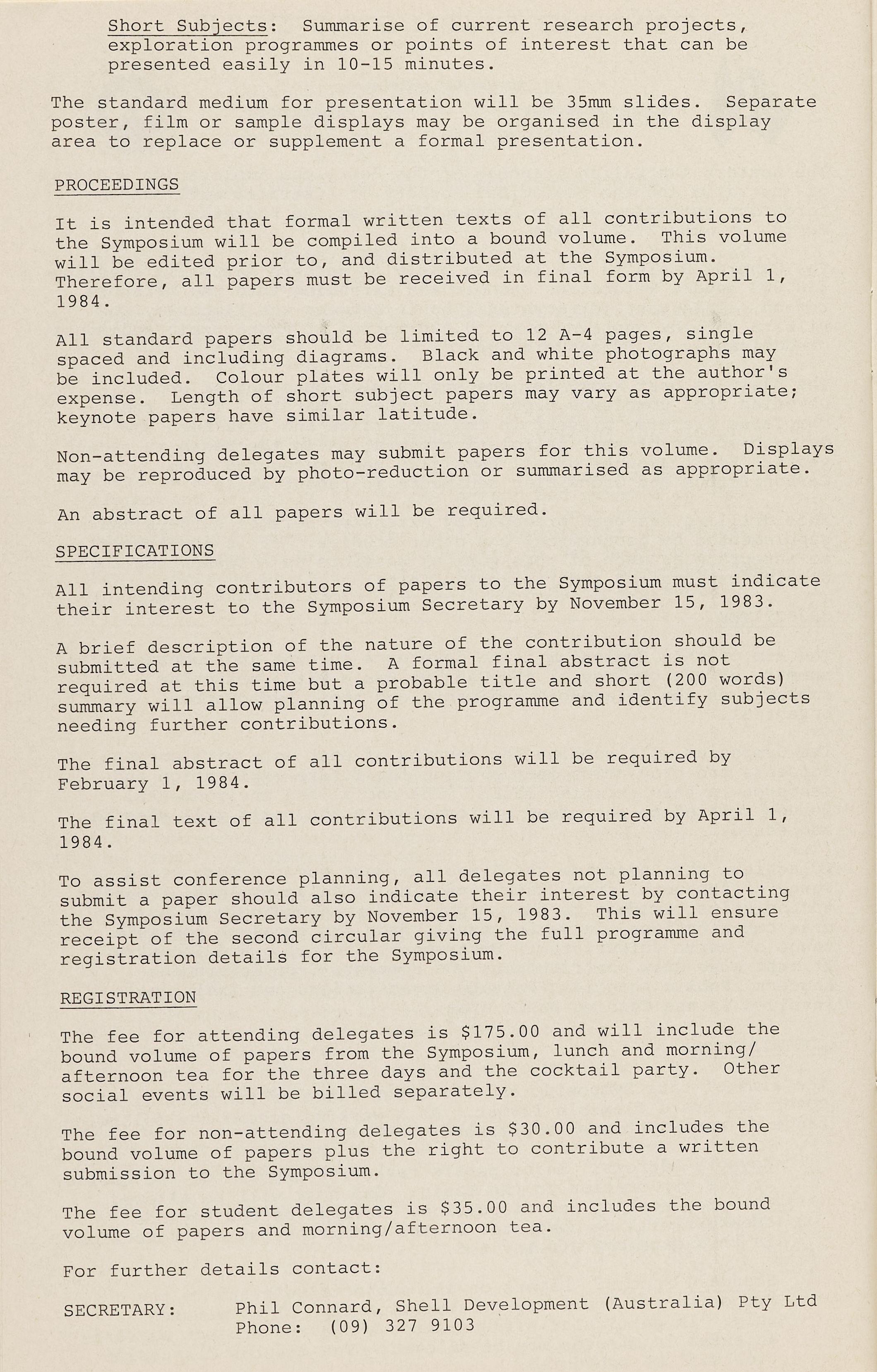
Short Su~jects: Summarise of current research projects, exploration programmes or points of interest that can be presented easily in 10-15 minutes.
The stand~rd medium for ~resentation will be 35mm slides. Separate poster, f ilm or sample displays may be organised in the display area to replace or supplement a formal presentation.
PROCEEDINGS
It is intended that formal written texts of all contributions to the Symposium will be compiled into a bound volume. This volume will be edited prior to, and distributed at the Symposium Therefore, all papers must be received in final form by April 1, 1984.
All standard papers should be limited to 12 A-4 pages, single spaced and including diagrams. Black and white photographs may be included. Colour plates will only be printed at the author's expense. Length of short subject papers may vary as appropriate; keynote papers have similar latitude.
Non-attending delegates may submit papers for this volume. Displays may be reproduced by photo-reduction or summarised as appropriate.
An abstract of all papers will be required.
SPECIFICATIONS
All intending contributors of papers to the Symposium must indicate their interest to the Symposium Secretary by November 15, 1983.
A brief description of the nature of the contribution should be submitted at the same time. A formal final abstract is not required at this time but a probable title and short (200 words) summary will allow planning of the programme and identify subjects needing further contributions.
The final abstract of all contributions will be required by February 1, 1984.
The final text of all contributions will be required by April 1, 1984.
To assist conference planning, all delegates not planning to submit a paper should also indicate their interest by contacting the Symposium Secretary by November 15, 1983. This will ensure receipt of the second circular giving the full programme and registration details for the Symposium.
REGISTRATION
The fee for attending dele gate s is $175.00 and will include the bound volume of papers from the Symposium, lunch and morning/ afternoon tea for the three days and the cocktail party. Other social events will be billed separately .
The fee for non-attending delegates is $30.00 and includes the bound volume of papers plus the right to contribute a written submission to the Symposium.
The fee for student delegates is $35.00 and includes the bound volume of papers and morning/aft ernoon tea.
For further details contact:
SECRETARY: Phil Connard, Shell Dev elopment (Au stralia) Pty Ltd Phone: (09) 327 9103 •
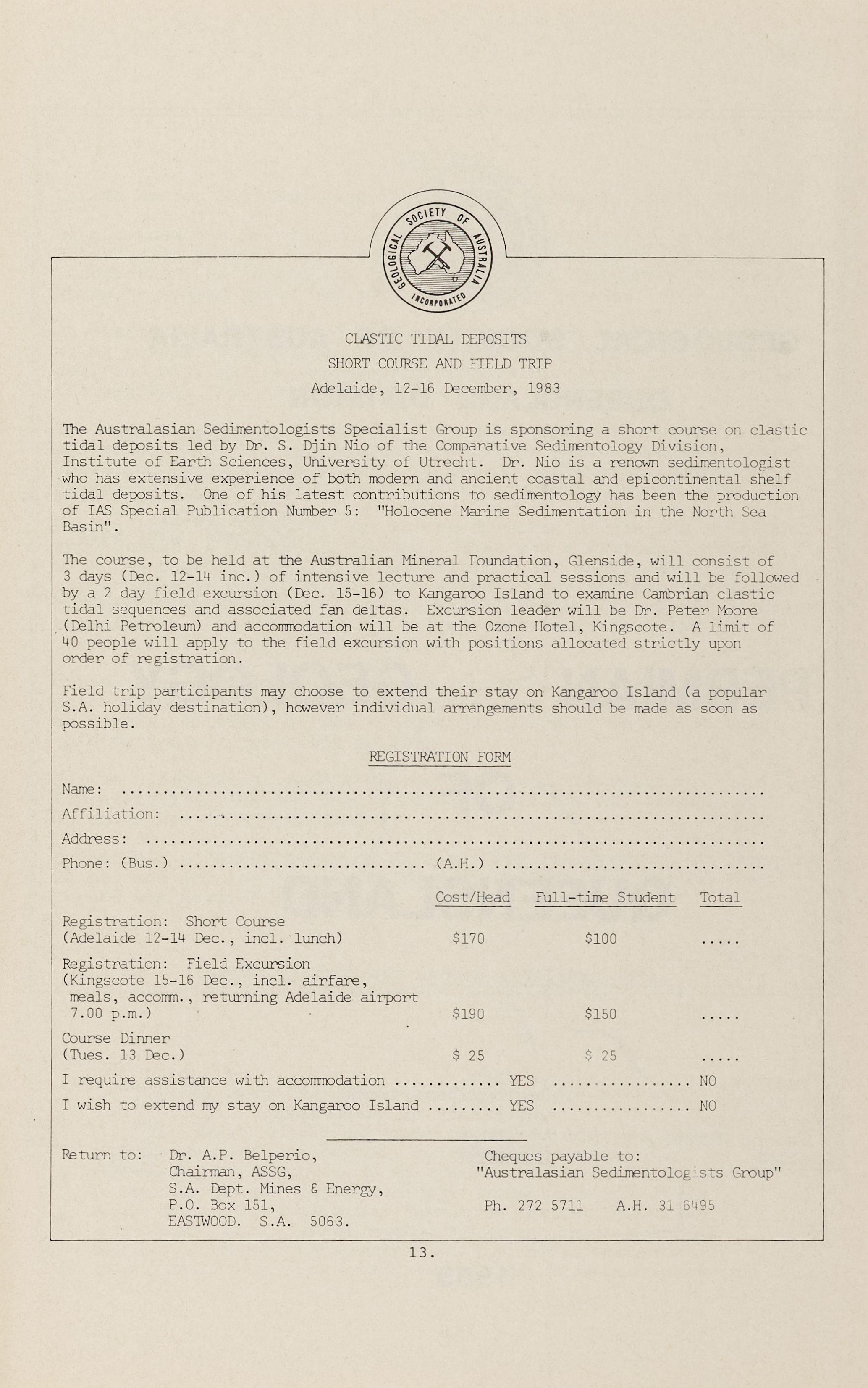
CLASTIC TIDAL DEPOSITS
SHORT COURSE AND FIELD TRIP
Adelaide , 12 - 16 December, 1983
The Australasian Sedimentologists Specialist Group is sponsoring a short course on elast ic tidal deposits led by Dr S. Dj in Nio of the Comparative Sediirentology Di vision, Institute of Earth Scie nces, University of Utrecht Dr Nio is a renown sedimentologist who has extensive experience of both modern and ancient coastal and epicontinental shelf tidal deposits One of his latest con tributions to sediirentology has been the pr duction of IAS Special Publication Number 5: " Holocene Marine Sediirentation in the North Sea Basin ".
The COlLY'Se , to be held at the Australian Mineral foundation , Glenside , will consist of 3 days (Dec 1 2- 14 inc .) of intensive lecture and practical sessions and will be followed by a 2 day ield excursion (Dec 15 - 16) to Kangaroo Island to examine Cambrian elastic tidal sequences and associated fan deltas Excursion leader will be Dr Peter M re ( Delhi Petroleum) and accomrodation will be at the Ozone Hotel , Kingscote . A limit of 40 people will apply to the field excursion with positions allocated strictly upon order of registrat i on
Field trip participants may choose to extend their stay on Kangaroo Island (a popular S . A. holiday destination), hcwever individual arrangeirents should be made as soon as possible
REGISTRATION FORM
aire :
Affiliation :
Address :
Phone : (Bu s . ) ...... (A H )
Registration : Short Course (Adelaide 12 - 14 Dec ., incl. lunch)
Re gistration : Field Excursion ( Kingscote 15- 16 Dec , incl. airfare , ireals , accomm , returning Adelaide airport 7 . 00 m )
Course Dinner (Tues 13 Dec )
I req ire ass istance with accomrodation .......... YES .. NO
I wish to extend my stay on Kangaroo Island . . .... YES NO
Return to : • Dr A P Belperio , Chairman, ASSG, S A Dept Mines Energy , P O Box 151 , EAS1WOOD S A 5063 13. Cheques payable to : "Australasian Sediirentolog sts Gro up " Ph . 272 5711 A. H. 31 649:i
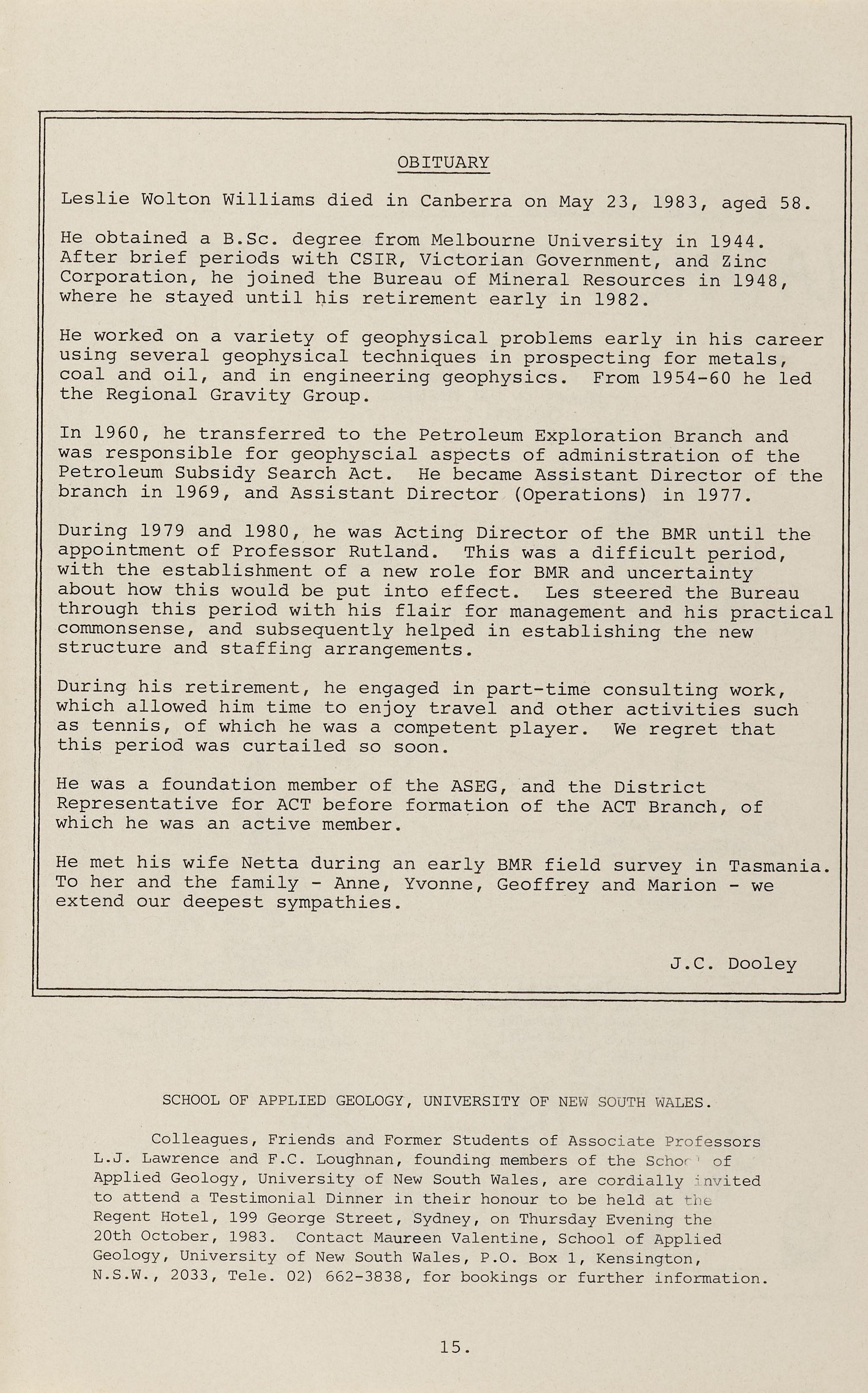
OBITUARY
Leslie Walton Williams died in Canberra on May 23, 1983, aged 58.
He obtained a B.Sc. degree from Melbourne University in 1944. After brief periods with CSIR, Victorian Government, and Zinc Corporation, he joined the Bureau of Mineral Resources in 1948, where he stayed until 0is retirement early in 1982.
He worked on a variety of geophysical problems early in his career using several geophysical techniques in prospecting for metals, coal and oil, and in engineering geophysics. From 1954-60 he led the Regional Gravity Group.
In 1960, he transferred to the Petroleum Exploration Branch and was responsible for geophyscial aspects of administration of the Petroleum Subsidy Search Act. He became Assistant Director of the branch in 1969, and Assistant Director (Operations) in 1977.
During 1979 and 1980, he was Acting Director of the BMR until the appointment of Professor Rutland. This was a difficult period, with the establishment of a new role for BMR and uncertainty about how this would be put into effect. Les steered the Bureau through this period with his flair for management and his practical commonsense, and subsequently helped in establishing the new structure and staffing arrangements.
During his retirement, he engaged in part-time consulting work, which allowed him time to enjoy travel and other activities such as tennis, of which he was a competent player. We regret that this period was curtailed so soon.
He was a foundation member of the ASEG, and the District Representative for ACT before formation of the ACT Branch, of which he was an active member. •
He met his wife Netta during an early BMR field survey in Tasmania. To her and the family - Anne, Yvonne, Geoffrey and Marion - we extend our deepest sympathies.
J.C Dooley
SCHOOL OF APPLIED GEOLOGY, UNIVERSITY OF NE W SOUT H WALES.
Colleagues, Friends and Former Students of Asso ciate Pro fe ssors L.J. Lawrence and F.C. Loughnan, founding members of the Scho r' o f Applied Geolog y , University of New South Wales, are cordially ' n v ited to attend a Testimonial Dinner in their honour to be held a t the Regent Hotel, 199 George Street, Sydney, on Thursd ay Evening the 20th October, 1983. Contact Mau reen Valentine, School of Applied Geology, University of New South Wales, P .O. Box 1, Kensington, N.S.W., 2033, Tele. 02) 662-3838 , for bookings or further information.