The Australian Geologist
Newsletter No. 41 11 October 1982.
EDITORIAL
This issue is largely devoted to a review of the Society's publication policy, prepared by the executive committee. This is an important matter and it is to be hoped that members will read it and put forward constructive criticisms.
Notices of meetings and other items in the 'Australian Geologist' show that the Society is active in many ways, so it is not absolutely true that the Society must publish or perish. However it is certainly the case that many members regard the Journal as their reason for belonging to the Society, while special publications have their supporters. Outside Australia the Society's publications, although not as widely known as we might like, do represent what we have been doing for the past thirty years.
Although the Journal may have catered 'more for authors than readers' I have found it a useful source of information and ideas on a wide variety of geological topics. The suggestion that issues be devoted to specific themes certainly has merit, but a compromise ensuring a section in every issue containing some papers not related to the major theme might prove successful.
It is also suggested in the review that quarterly publication is warranted. Are there enough significant results being produced to warrant such a rate of publication? I don't know and only time can tell. Certainly man y good (and some bad) papers go to overseas' journals, and it would be good if we could attract these.
As the review says, an upgraded publication programme will require greater expenditure and increased subscription rates, but most particularly something approaching a full-time editorship.
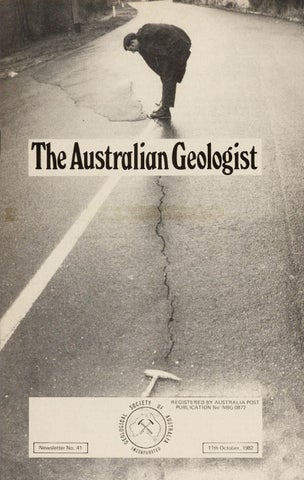
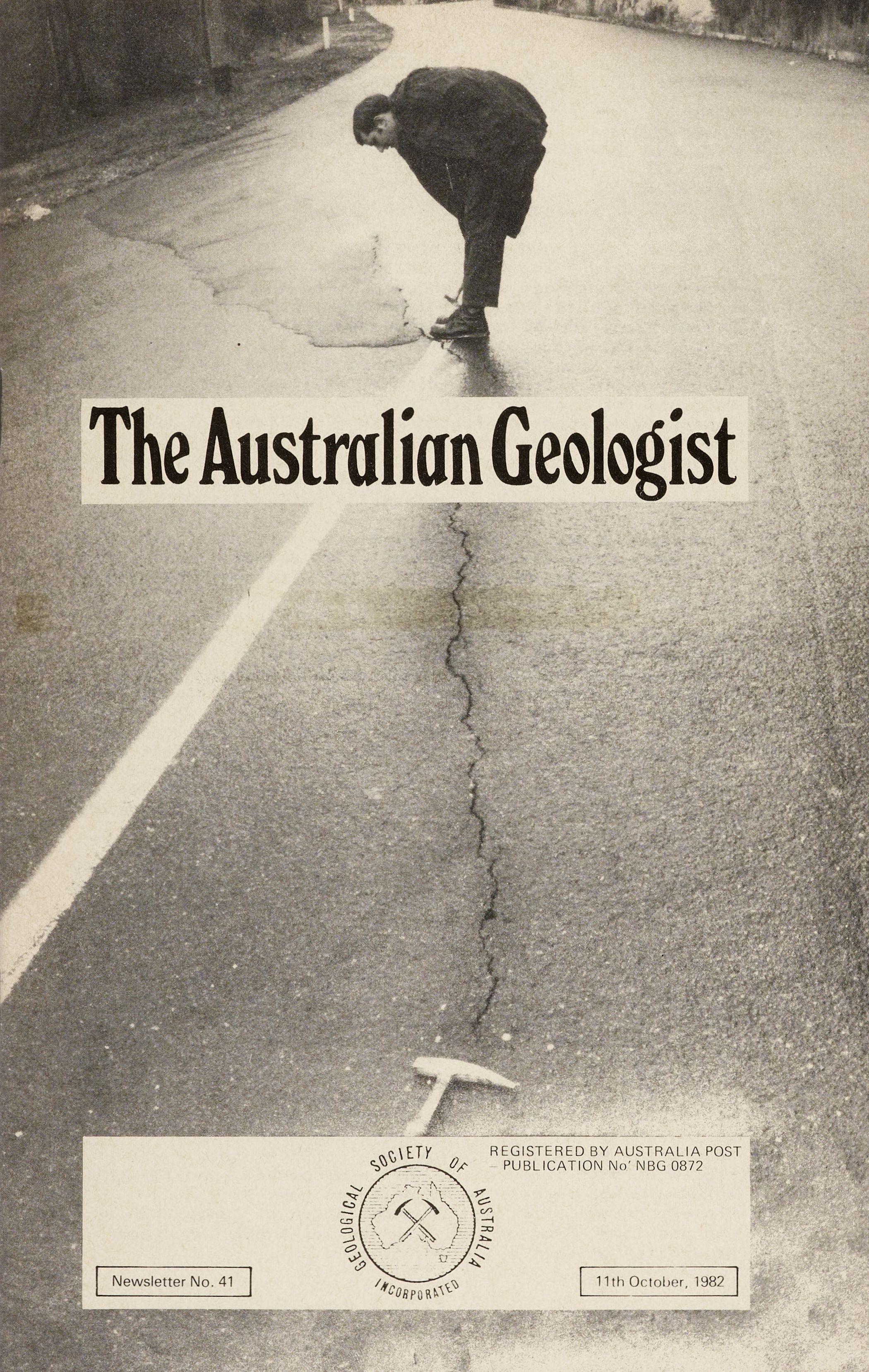
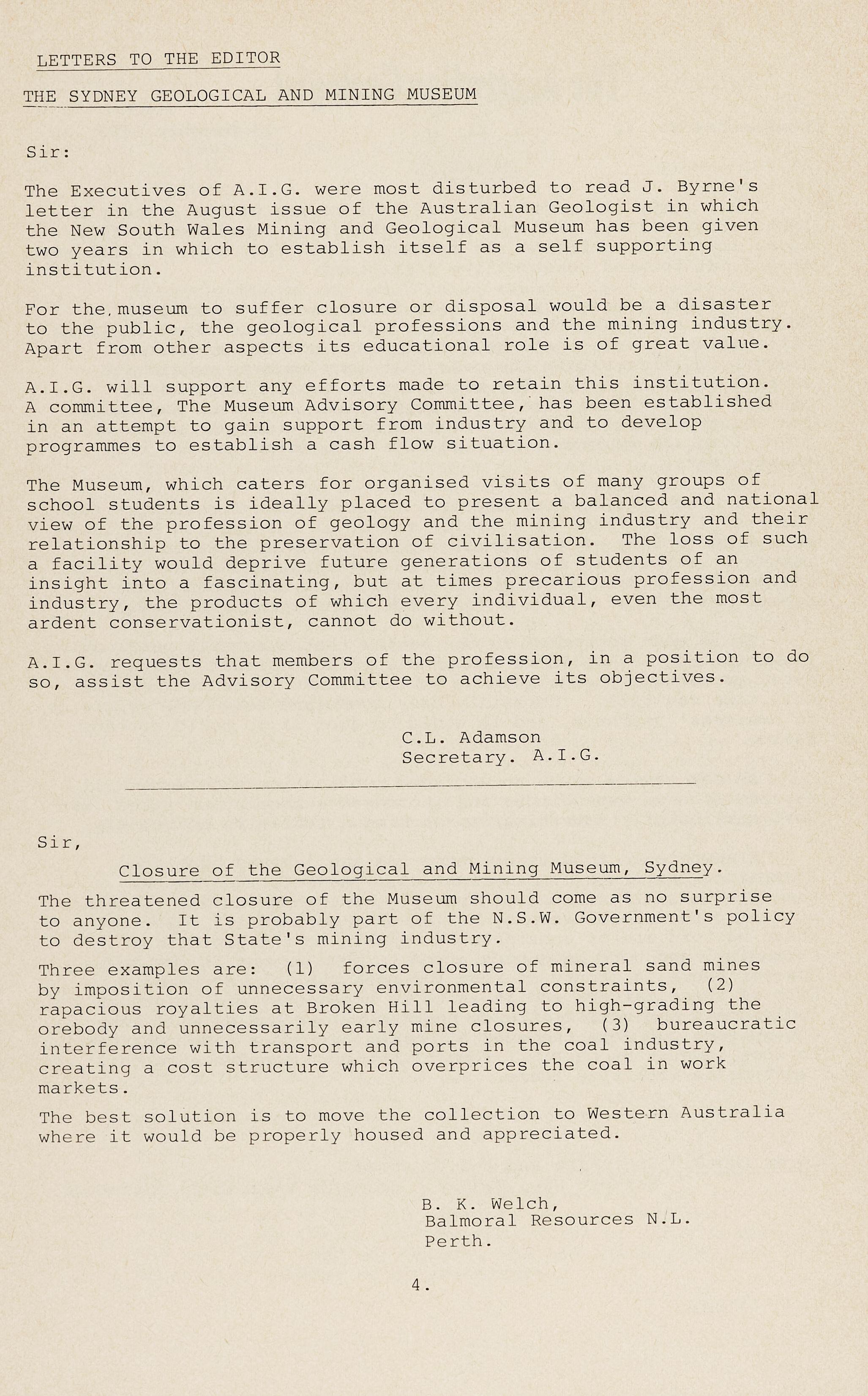
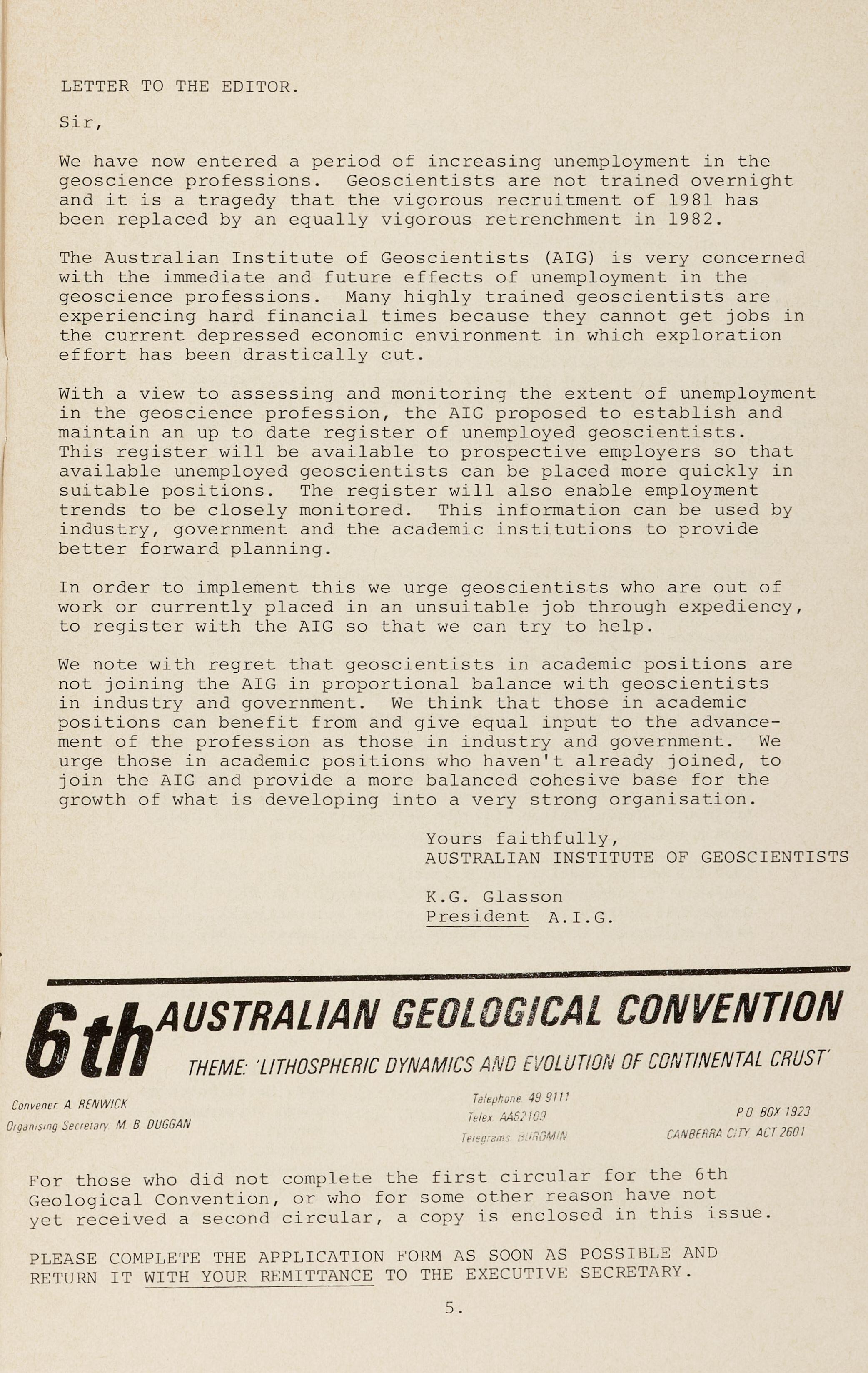
Elsewhere in this issue there are two letters from the Australian Institute of Geoscientists, one referring to the attempted slow(?) killing of Sydney's Mining Museum and the oth e r outlining the steps taken by A.I.G. on unemplo y ment. Both of these matters are of considerable concern to the geolo g ical community, and both have been aired to some e x tent in th e me dia. However there is plenty of room for more public discussion on both of these matters and it is to be hoped that geolo g ists as individuals and active through representative bodies will tak e our science out into the general community rather t h an contin ue to look inwards as usual. Some of the corr e s p ondenc e i n t hi s issue deals with this theme. Cover Photo: Be g innin g a n d e nd to e ro de ? Bonnett Ba y , Sy
THE SYDNEY GEOLOGICAL AND MINING MUSEUM
Sir:
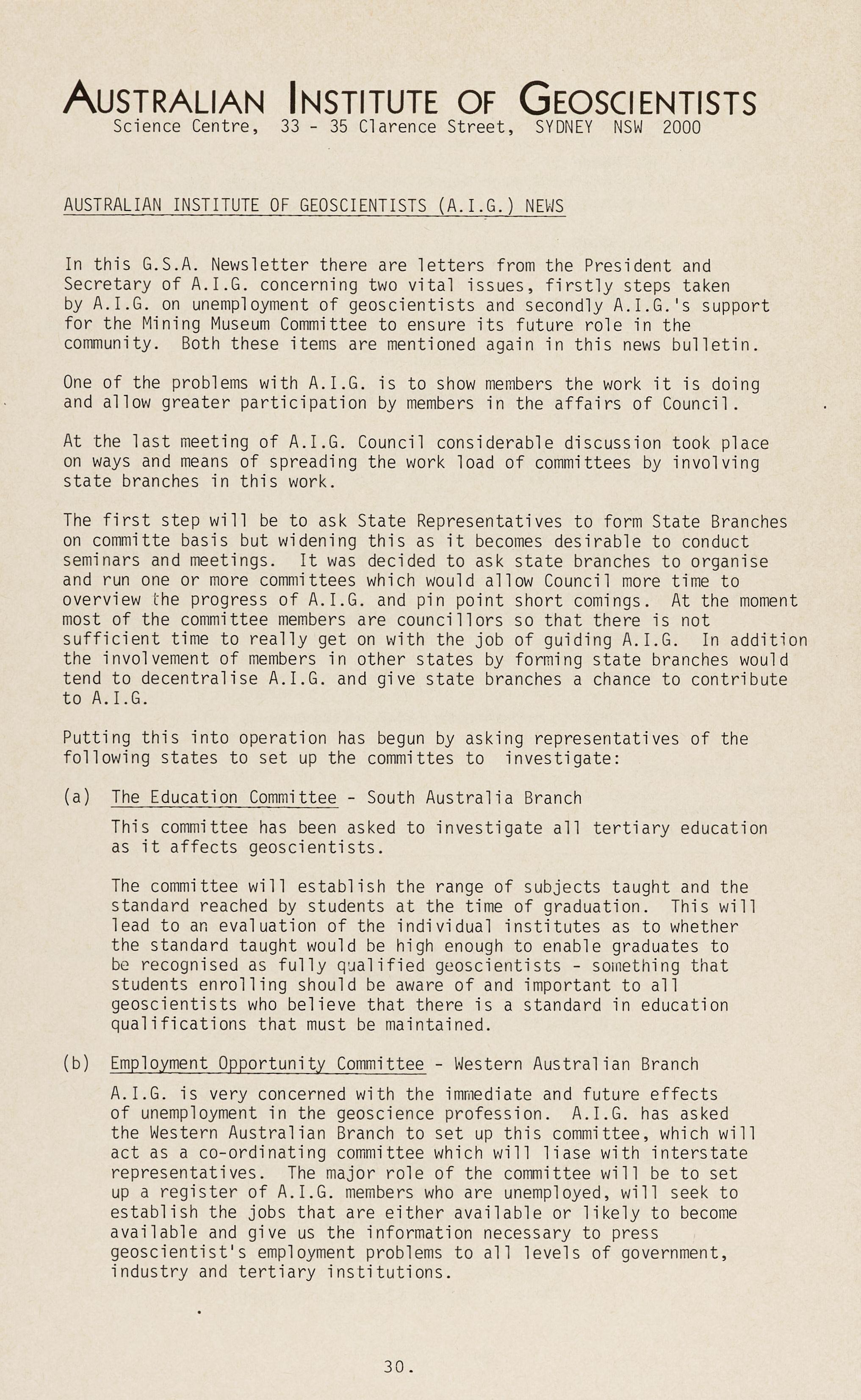
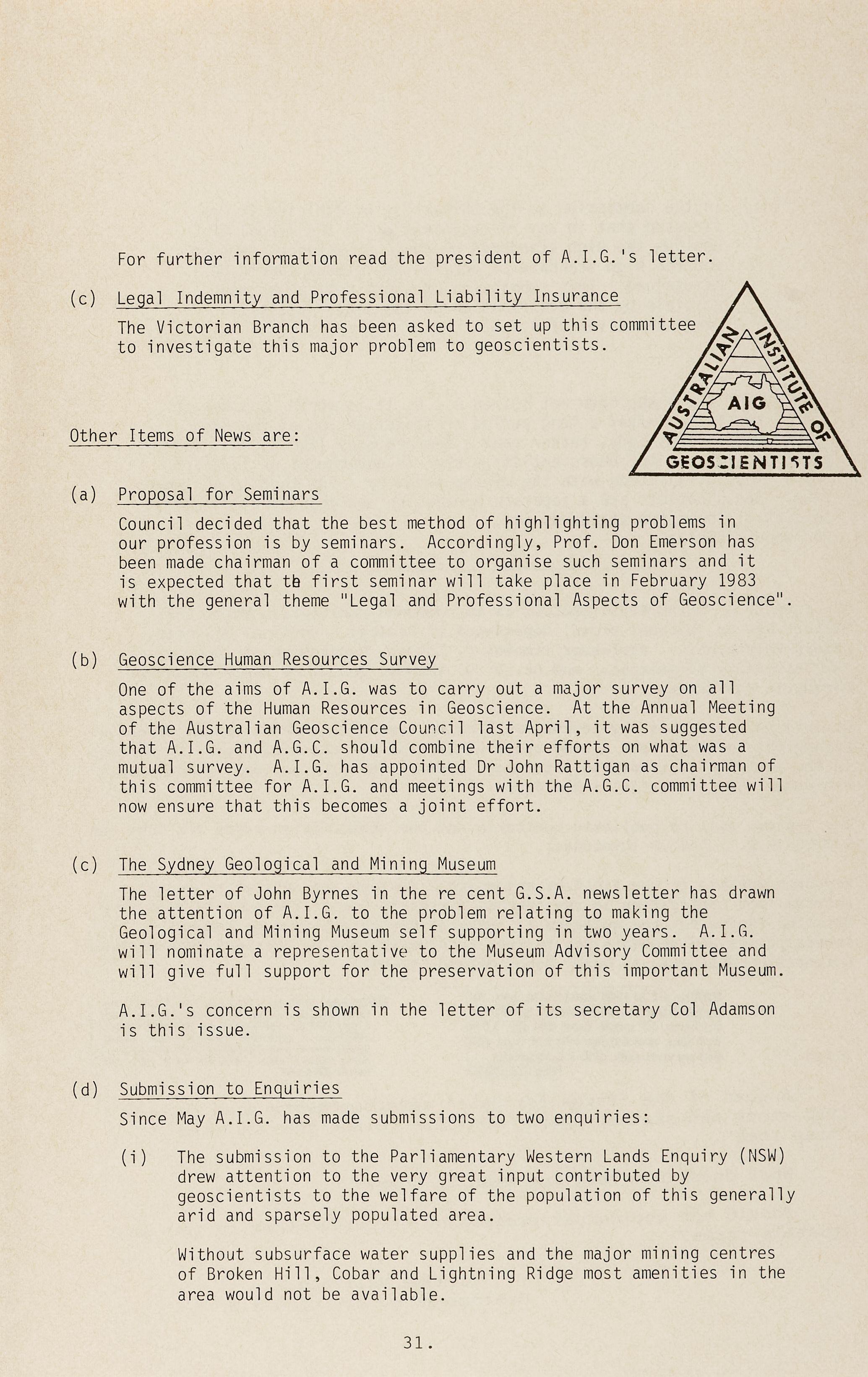
The Executives of A.I.G. were most disturbed to read J. Byrne's letter in the August issue of the Australian Geologist in which the New South Wales Mining and Geological Museum has been given two years in which to establish itself as a self supporting institution.
For the.museum to suffer closure or disposal would be a disaster to the public, the geological professions and the mining industry. Apart from other aspects its educational role is of great value.
A.I.G. will support any efforts made to retain this institution. A committee, The Museum Advisory Committee, has been established in an attempt to gain support from industry and to develop programmes to establish a cash flow situation.
The Museum, which caters for organised visits of many groups of school students is ideally placed to present a balanced and national view of the profession of geology and the mining industry and their relationship to the preservation of civilisation. The loss of such a facility would deprive future generations of students of an insight into a fascinating, but at times precarious profession and industry, the products of which every individual, even the most ardent conservationist, cannot do without.
A.I.G. requests that members of the profession, in a position to do so, assist the Advisory Committee to achieve its objectives.
C.L. Adamson Secretary. A.I.G.
Sir,
Closure of the Geological and Mining Museum, Sydney.
The threatened closure of the Museum should come as no surprise to anyone. It is probably part of the N.S.W. Government's policy to destroy that State's mining industry.
Three examples are: (1) forces closure of mineral sand mines by imposition of unnecessary environmental constraints, ( 2) rapacious royalties at Broken Hill leading to high-grading the orebody and unnecessarily early mine closures, (3) bureaucratic interference with transport and ports in the coal industry, creating a cost structure which overprices the coal in work markets.
Th e b e st solution is to move the collection to Western Australia wh e re it would be properly housed and appreciated.
B.
K. Welch,
Balmoral Re sources N.L. Perth.
Sir,
We have now entered a period of increasing unemployment in the geoscience professions. Geoscientists are not trained overnight and it is a tragedy that the vigorous recruitment of 1981 has been replaced b y an equall y vigorous retrenchment in 1982.
The Aus tralian Institute of Geoscientists (AIG) is very concerned with the immediate and future effects of unemplo y ment in the geoscience professions. Many highly trained geoscientists are experiencing hard financial times because the y cannot get jobs in the current depressed economic environment in which exploration effort has been drastically cut.
With a view to assessing and monitoring the e x tent of unemp lo yment in the geoscience profession, the AIG proposed to estab lish and maintain an up to date register of unemployed geosci e ntists. This register wil l be available to prospective emplo ye rs so that available unemployed geosc i entists can be placed more quickly in suitable positions. The register will also enable employment trends to be closely monitored. This information can be used b y industry, government and the academic institutions to provide better forward p lannin g.
In order to implement this we urge geoscientists who are out of work or currently placed in an unsuitable job through e xped i e nc y , to register with the AIG so that we can tr y to he l p.
We not e with regret that geoscientists in academic p ositions are not joining the AIG in proportional balance with geoscientists in industr y and government. We think that those in academic positions can benefit from and give equal input to the advancement o f the p rof e ssion as those in industr y and government. We urge those in academic positions who haven 't already joined, to join the AIG and provide a mor e balanced cohesive base for the growth o f what is developing into a very strong organisatio n
Yours
faithfully , AU ST RALI AN INSTITUTE OF GEOSCIENTISTS
K .G. Glasson President A . I. G .
RENWICK Orgdn,sing Serre1ary M 8 DUGGAN
For those who did not complete the fir st circular for the 6 t h Geo logical Convention, or who for some other rea son_ha ve _n o t y e t re c eived a second circu l ar , a copy is enc los ed in this issue.
Convene r A
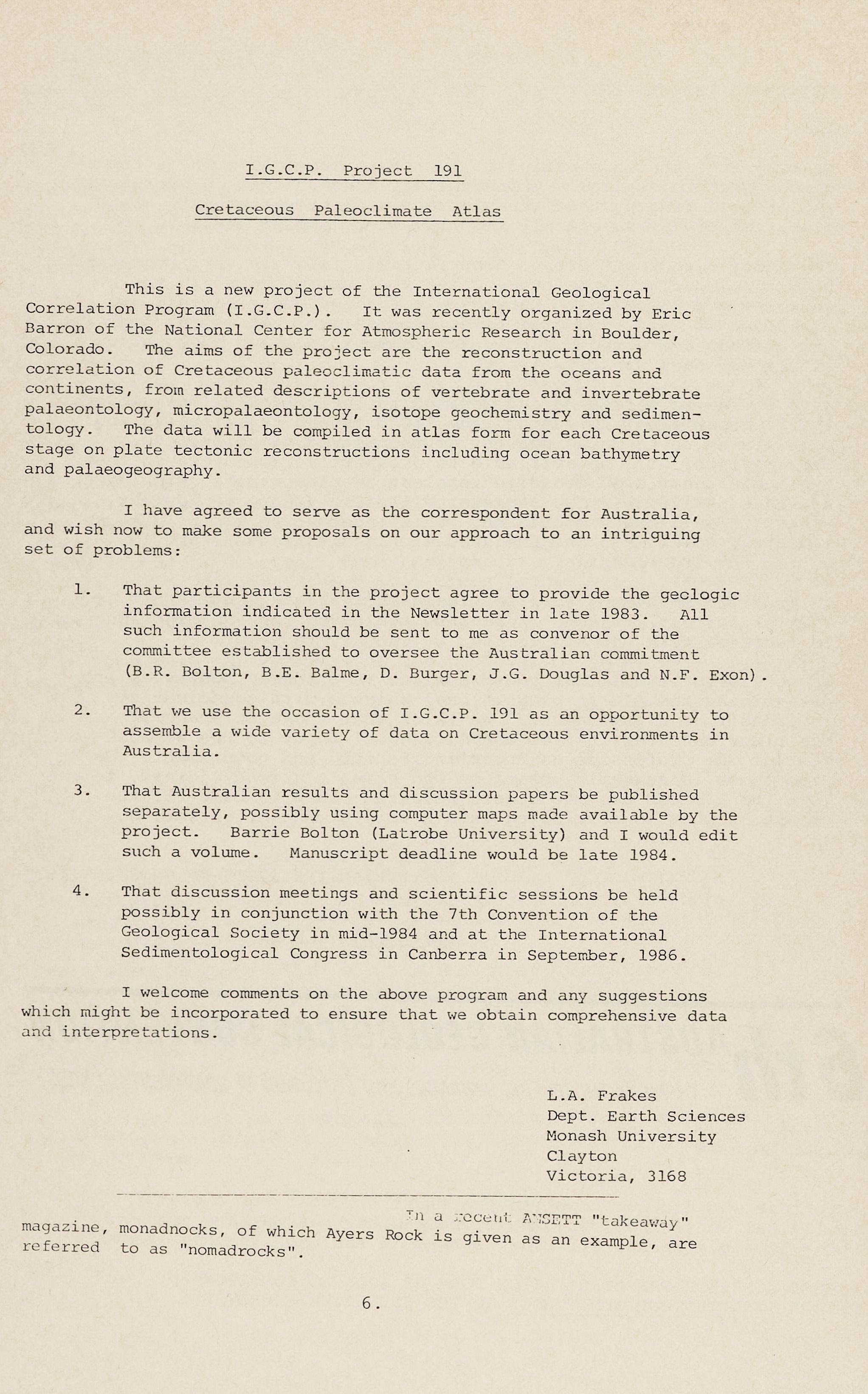
I.G.C.P . Project 191
Cretaceous Paleoclimate At l as
This is a new project of the International Geo lo gical Corre lation Program ( I G.C .P.). It was r ecently organized by Eric Barron of the National Center for Atmospheric Research in Boulder, Colorado. The aims of the project are the r econstr uction and correlation of Cretaceous paleocl imati c data from the oceans and continents , from related descriptions of vertebrate and invertebrate palaeontology, mi cropalaeontology, isotope geochemist ry and sedimentology . The data will b e compiled in at l as form for each Cretaceous stage on plate tectonic r econstructions including ocean bathymet ry and palaeogeography .
I have agreed to serve as the correspondent for Australia, and wish now to make some proposals on our approach to an intriguing set of problems:
1. That participants in the project agree to provide the geologic information indicated in the Newsletter in late 1983. Al l such informat ion should b e s en t to me as convenor of the committee established to overs ee the Australian commitment (B. R. Bo lto n , B.E. Balme , D Burge r , J. G. Douglas and N.F. Exon).
2 That we us e the occasion of I.G.C.P. 191 as an opportunity to assemble a wide v a riety of data on Cretaceous envirorunents in Australia.
3. That Australian r es ults and discussion papers be published separate l y , possib l y u s ing comp uter maps made available by the project Barrie Bolton (La trobe University ) and I would edit such a volume. Manuscript deadline would be late 1984.
4. Th at discussion meetings and s cientific sessions be held possibly in conjunction with the 7th Convention of the Geo l ogical Society in mid - 1984 and at the Internationa l Sedimen tological Congress in Canberra in Se ptember, 1986.
I we l come comments on the above program and any suggestions which might be incorporated to ensure that we obtain comprehensive data and interpretations
L.A. Frakes Dept. Earth Sciences Monash University Cl ay to n Victori a , 3168 Tn u ~.-cc<.:::1 1t J\- ~~r:TT " ta k ea \•1i:iy 11 ma gaz ine , monadnocks, of which Ayers Rock is given r e f er red to as " nomadrocks " as an example ' are
INTROD UC'rIO N
REVIE~J OF THE: OF THE GCOLOGICAL
PUBLICATION SOCIETY OF POLICY AUSTRALIA.
At Pert h , the Council directed t hat "the E xecutive, in conjunction with th e Honorary Edi tor and the Editorial Board to re view th e pub lication policy of the Society, and if major changes are considered nece ss ary to submit their recommendations to a postal vote of Council Membe rs".
This d irecti ve was given in the context of a p ro p osal to discontinue the Journal, and support th e inc ep tion of a national earthsciences journal , in collaboration wit~ other organisations, in particular, BMR. AEter consi de rin g p revious written material an d verbal comment on the Eu tur e of the Journal, it became evident th at the review had to consider the whol e of the Society's functions, and its financial structure. This in turn requir ed considerable r esearch throu gh back r ec or ds , a nd the ga the r in g o f factual data.
The most surprising thing to emerge was t ha t t he Society does not have a stated publ ic3tion p olicy, bu t th e r e exis t many p rec edents, some of which ar e mutually conflictin g .
11EMBt":RSriI P OF TIIC sac IETY
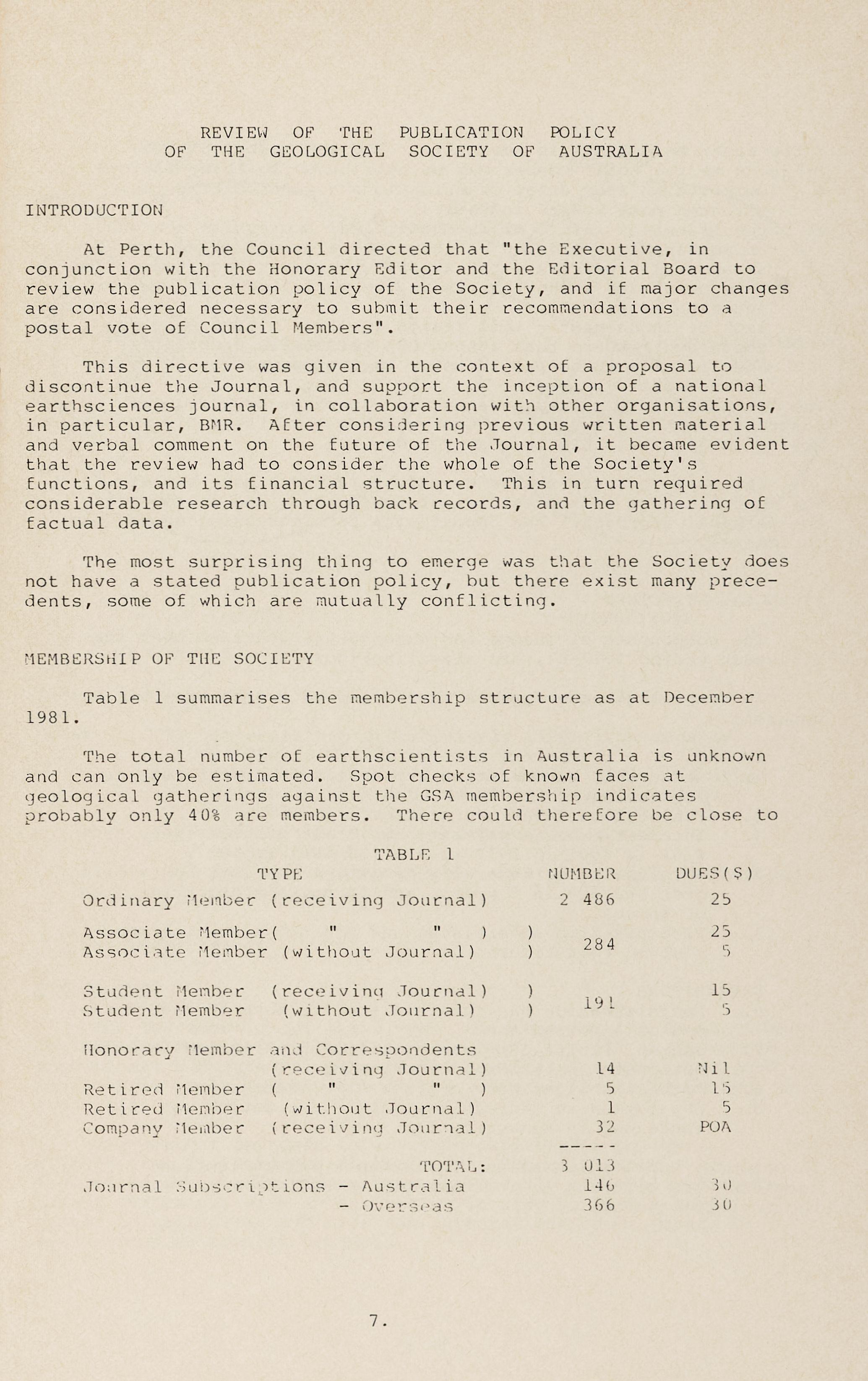
Table 1 summarises t he membership s tru c tur e as at Decembe r 1981.
The total number of ear t h sci en ti s t s in A.us tr alia is unknown an d can only be es timated. Spot check s of known fac es at 9eol o g ical c3a th ec in gs agai nst the GSA membership indic a t es probably only 40 % are membe r s The r e could therefore be close to
TABLE: l TYPE
Or-di nary i1•=1'lber ( rece i ving Jour-nal)
Associa t e Me mbe r( Assoc i ,1 te i1e1'lber ( w i tho ,Jt Journal)
S t uc'len t i1enb,;, c Student i l ember (receivin0 Journdl) (without ,Journal)
flono r-a ry ilemb e r a, 1,i Cor-responden ts (r ece iv in g Journ a l)
Ret i red i1err1be r ( 11 11 ) Ret i red i1 er.1bc:: r (w i thout ,J ou rn al ) Co mpany i"le,nber ( cec e i v in<J ,Jot1r-1a.L)
TOT.\ L : ,l o ,1r:1 al :-, ul )-:;,:: ci 0 )t1ons - l\ustc.:ilia - ( Jyer-:~,.:.as
tJUME31:::R DUBS($) 2 4 86 2S 25 28 4 c, lS 19 L ~)
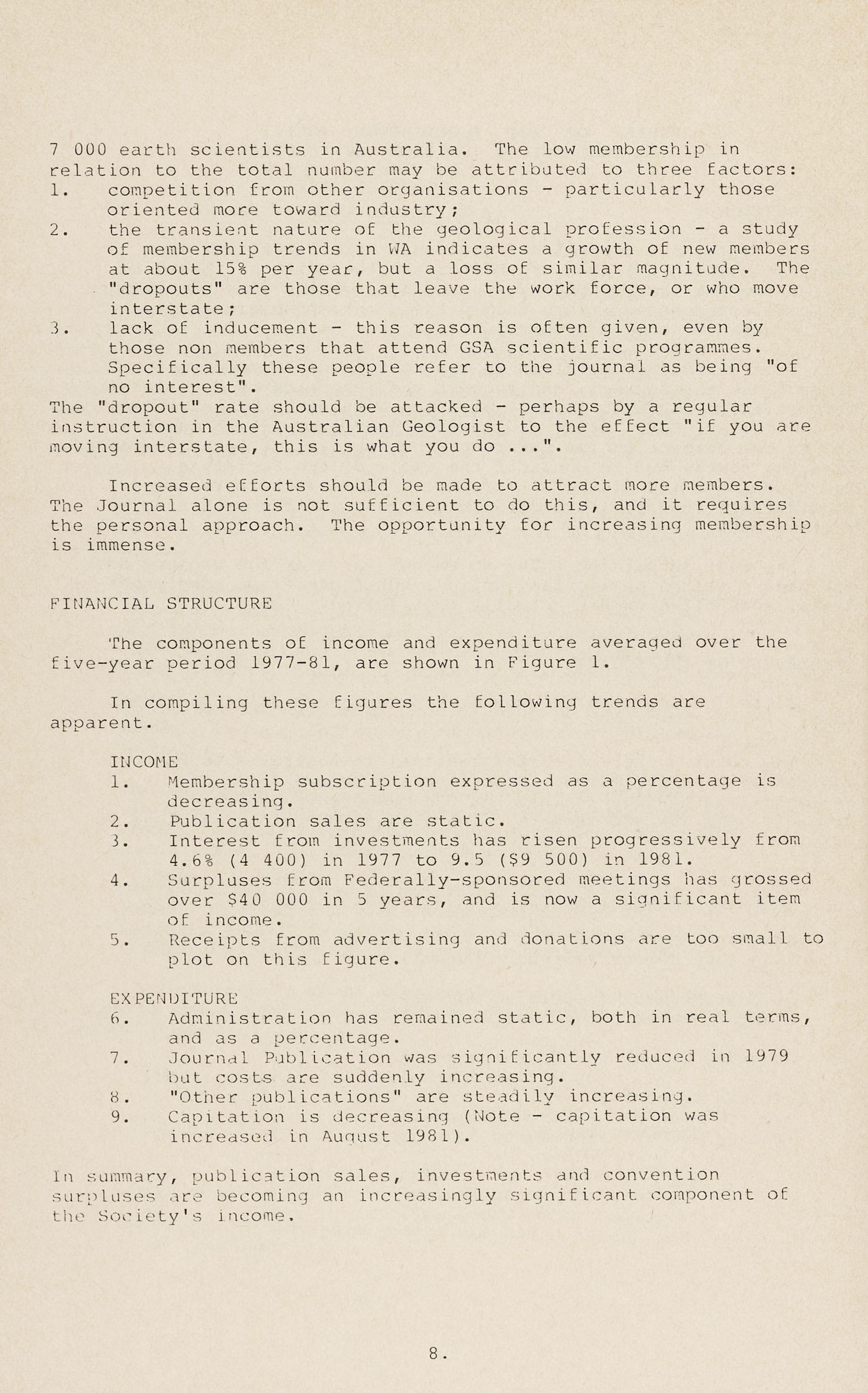
7 000 earth scientists in Aus tr a lia. The low membership in relation to th e tot al numb e r may be a tt r i buted to thr ee facto rs: 1. com pe tition fro m other or ga nis at ion s - pa rticularly thos e ori en t ed moce to ward in d u s try;
2. th e t rans i en t nature oE the geological pr ofession - a s tudy o f membership t re n ds in ~JA in rl ic ates a g rowth of n ew me mbers a t ab out 15 % per y ea c, b ut a loss oE similar magnitude. The " d ro p outs " are thos e t ha t l eave the work force, or who move interstate;
3 . lack o f induce men t - this reason is often given, even by thos e non members that attend GSA s cientific programmes. Specifically these pe ople refer to the journ al as be in g "o f no interest".
The "dcopout" rate should be attacked - per-haps by a regular instruction in the Australian Geologist to the eEEect "if you are moving int e rstate, this is what you do ".
In creased effo rt s should be made to a ttra ct more members. The J ourn al alone is not sufficient to d o this, and it re q uir es th e pe r s onal approach. The o pp ortunity foe incr ea sin g membership is immense.
P I NANC I AL STRU CTURE
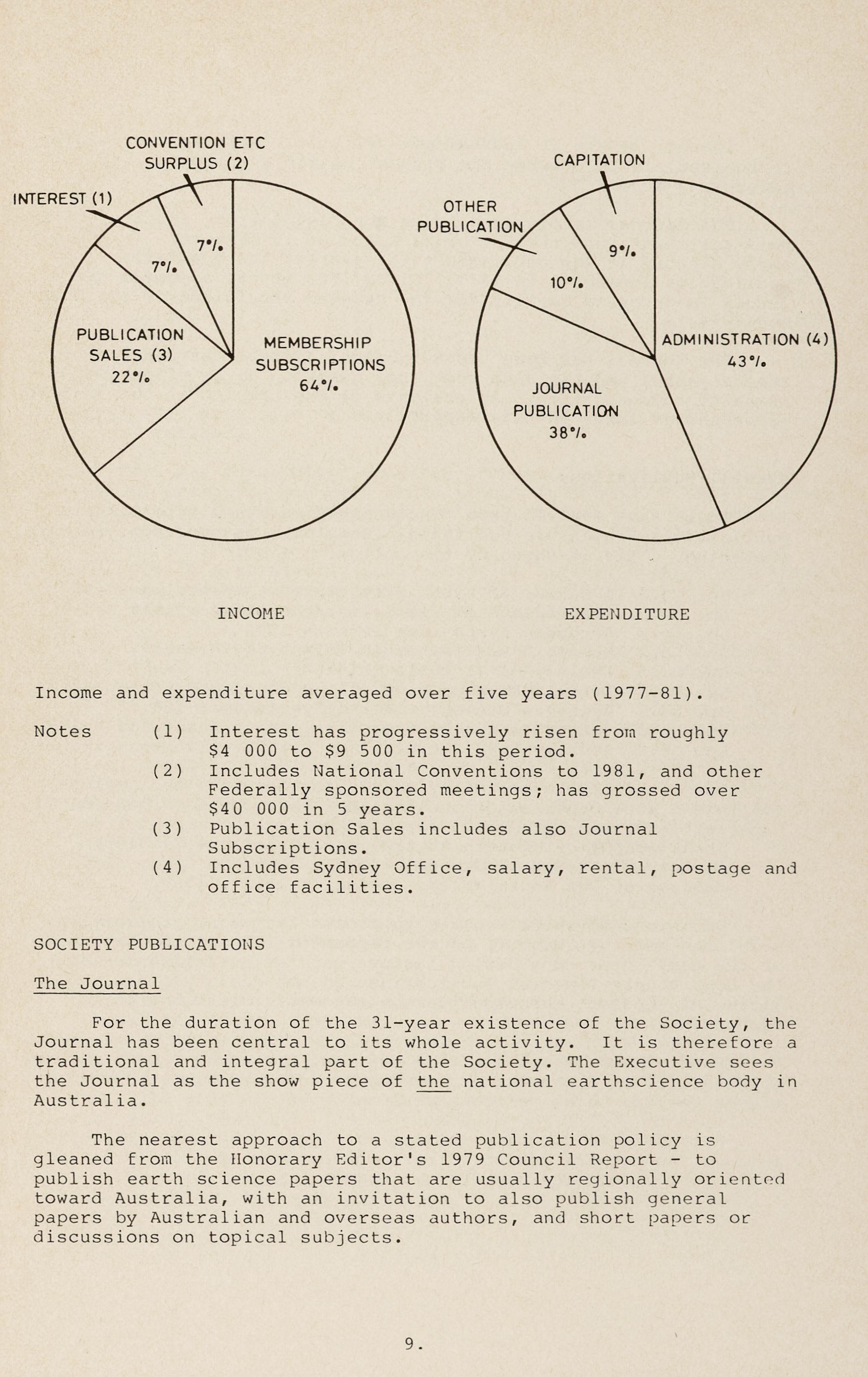
The components oE income a nd expenditure ave ra ged o ver the five - year pe riod 1977 - 81 , are shown in Figure 1.
In compiling t hese f ig u r es the Eollo win g tr e nds are apparent .
rncm1E
1 Membersh i p s u bscr i p tion expressed as a pe rcent age i s decreasing.
2 . Publication sales are static.
3 . Int e r es t fr om inv estmen ts has risen p ro g ressi ve ly f com 4. 6 % ( 4 4 0 0 ) in 19 7 7 to 9. 5 ( $ 9 5 0 0 ) in 19 8 1 .
4. Su c p lus es fr o m Fede r a lly - sp onsor ed mee tin gs h as CJ ro ssed over $ 4 0 000 in 5 years, and is now a significant item of income.
5 . Receipts from advert i s in g and donatio ns are to o small to plo t on thi s f igure.
EX PEN UITURT::
6 has r ema in ed s t a ti c , both in r eal terms, and as a percentage
7 Journ,.-il P, Jbli.<: at i on was s i gn i Ei cantly reJuc ed in 1979 hut cost.s a ce sudderi.ly in creas in g
8 . " Ot hec L)ubl i cations " are steadi l y incr eas in g.
9 . Cap it at ion is Jecreas in g (Note - capitation was incr eased in Auriust 1981).
ln ~umm'::l.r.y , publ i c3t ion sales , invest ;-:\ents ,::1nd convention suq)luses .,r-2 becominq an incr-easingly sign ifi ca nt corriponent of the So,·iety ' s in,.:orne
CONVENTION ETC
SURPLUS (2)
CAPITATION
MEMBERSHIP
SUBSCRIPTIONS
64°/.
INCOME
EXPENDITURE
Income and expenditure averaged over five years (1977-81).
Notes (1) Interest has progressively risen from roughly $4 000 to $9 500 in this period.
(2) Includes National Conventions to 1981, and other Federally sponsored meetings; has grossed ov er $40 000 in 5 years.
(3) Publication Sales includes also Journal Subscriptions.
(4) Includes Sydney Office, salary, rental, postage and office facilities.
SOCIETY PUBLICATIONS
The Journal
For the duration o f the 31-year existence of the S oci ety, the Journal has been central to its whole activity. It is therefore a traditional and integral part of the Society. The Executive sees the Journal as the show piece of the national earthscience body in Australia.
The nearest approach to a stated publication pol i cy is gleaned from the Honorary Editor's 1979 Council Report - to publish earth science papers that are usually regionally orient0.ct toward Australia, with an invitation to also publish general papers by Australian and overseas authors, and short papers or discussions on topical subjects.
Anoth er aspec t of Journ a l policy , albe i t unstated but wid e ly r ec ognised , is to obs e rv e th e highest p ossible edi t ori al anrl r eEe reein g standards.
The Journa 1 is prepared by an Honorary Editor , assisted by a pa i d assistant , and the Editorial Boar d o f 19 members. In i ts ea rly h istory it was published twic e y early , and quarterly pub lication commenced in 1971. Since 19 80 it has ap pea red halfy ear ly in ord e r to q u al ify for the cha nged p ro v isions of the aook Dounty l\.ct .
The Journal has come un de r in creas in g financial pressure in recent years, and has also come into question as an effec tive mea ns of communication An analysis of the p robl e~ oE the Journal is p r e s e nted later in this r ep ort.
Special Publ i cations
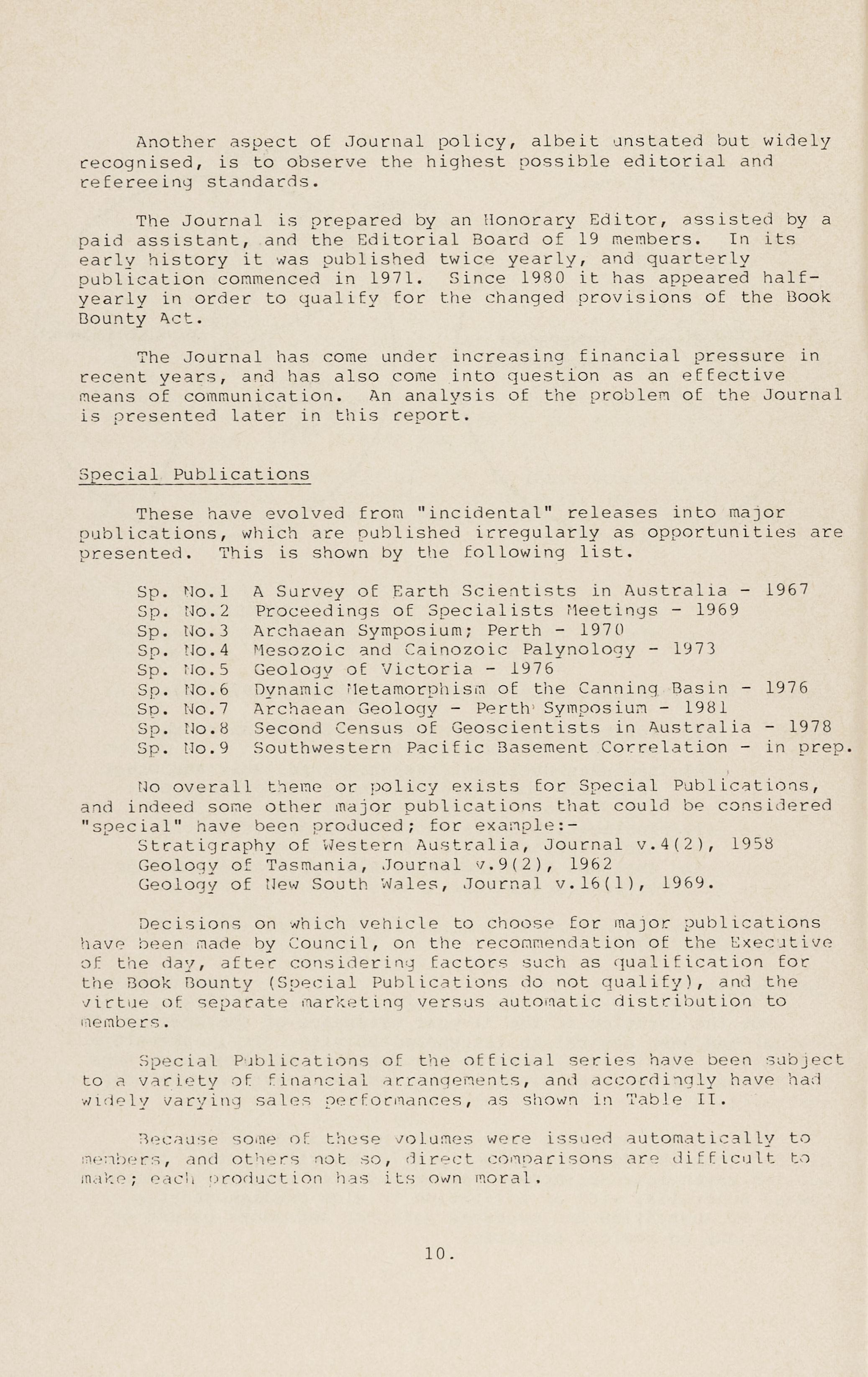
These h ave ev olv ed from "incidental" releases into maJor pub lications , whic h are pub lished irregularly as opportunities are presen t ed This is shown by th e f ollowin g list.
Sp . no.l
Sp . t~o. 2
Sp. Uo.3
Sp tl o 4
Sp no 5
Sp . l'Jo.6
Sp . No . 7
Sp tl o 8
Sp lo 9
A Survey oE Ba rth Scientists in Australia - 1967
Proceedin gs oE S pe e ial ists r1eet in g s - 19 6 9
Archa ea n Symposium; Perth - 1970
Mes ozoic and Ca inozoic Palynolo g y - 197 3
Geology oE Victoria - 1976
Dynamic iletamo r phisi:-t oE th e Canning Basin - 1976
Archaean Geology - Pe rth ' Symposiu,1 - 1981
Se con d Census oE Geoscientists in Australia - 197 8
Southwestern Pacific Basemen t Corr.el at ion - in p re p
t Jo over a 11 t'1eme or pal i cy exists Eor Spee ia l Publ i.cat ions , and in deed s o me other major p u b li cations t ha t could be consi de red " spec i al " ha v e been prod uc ed ; fo r exaMi_'.>le : -
S tr at i g r-a ph y of Western Au s tr al i a , Journal v.4(2), 1958
Geology o .E Tasmdn i a , ,Journ a l v . 9 ( 2) , 1962
GeoloC)y o f llew South Wales , ,Journ al v .16(1), 1969
Dec ision s o n which vehicle to choosP fo r maJor Jubl1ca tions hav~ been raacie by Council, on t he recom~endation ot t he ExecJ ti ve af t he day , af tec considering fac tor s such as ~ual i Eic ation tor the Bo o k Bounty (Special Publications do not q uality) , and t he vi.r-tue of separ-ate ,"la r k,~ ti.n g versus a.ut o ,!la ti c distcibution to ,,,embers
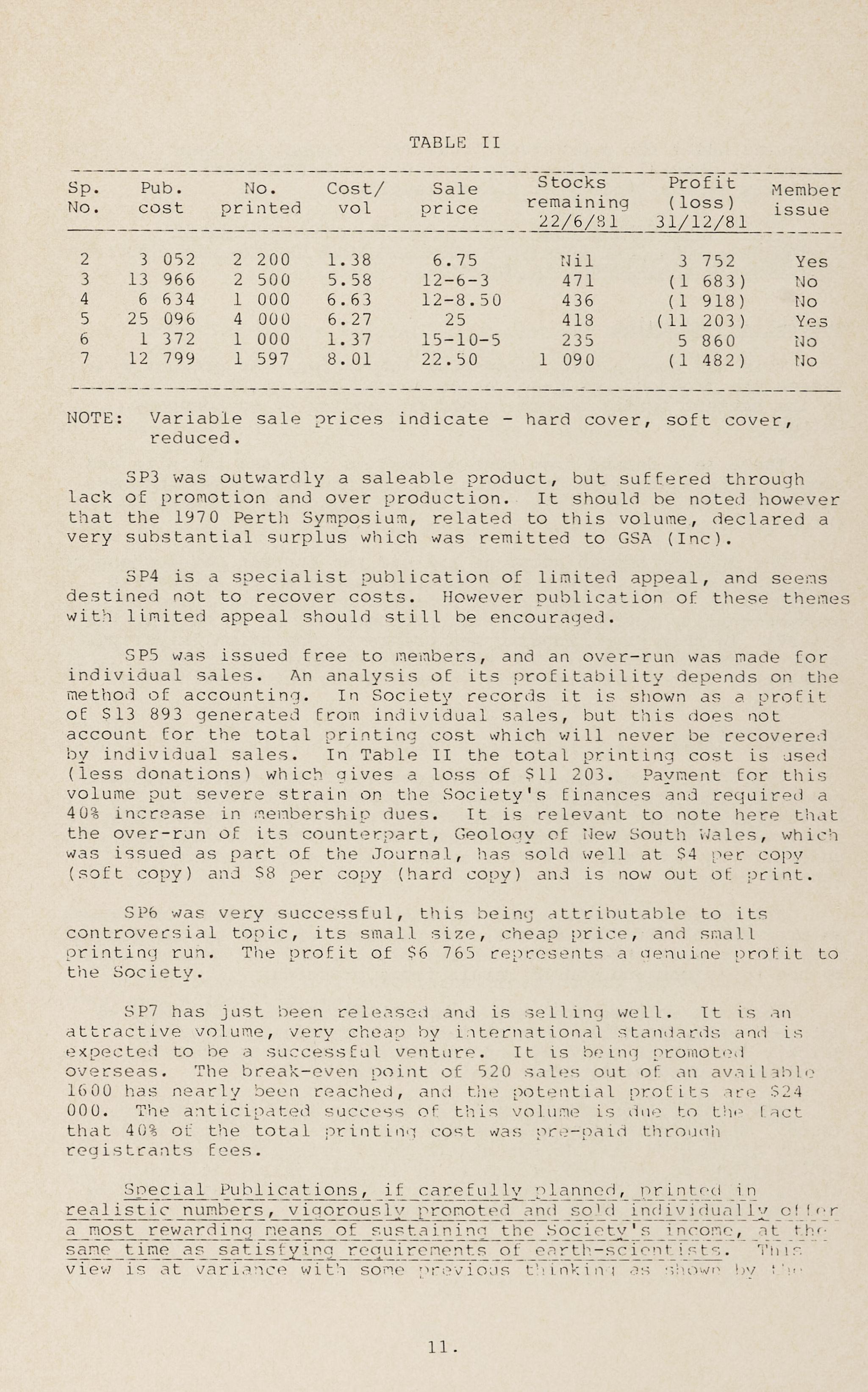
St)ecial P·Jblicat1ons of t he of.Eicial ser. i es hav e been :3 ubJect to R variety of. Fi n a~cial a r.canqen e nts , a nd acc or:-ni, gly have harl ,ndely varying sales :::,ecfoc111c1n c es , as show n i!, "i'abJe IT.
:1 •:~~au•;e so,'.le 0f. t:1ese volu mes wer-e i. -su erl au tomatic3l ly to ::ic<1 : Jl°1r-::; , c1ncl ot l,e r-s not ,-,o , dir•?ct co,Y\oacisons are: JiEF.i. cult t0 :nc1\-:e ; 0c1cl1 ur n ducti.on h 3s its own 1'loral
TABLE II
Sp . Pub No
tJo
NOTE : Variable sal e ~rices indica t e - hard cover , soft cover , r ed uced .
SP3 was outwar d ly a saleabl e product , but suEEere d throu gh lack of pro~otion and over p rodu c tion. It should be not ed h ow eve r that the 1970 Pert h Symposiu m, relat ed to this volume , declared a very substan t ial surplus which was remitted to GSA (Inc)
SP4 is a s9ecial ist 9ub lication of linit ed appeal , and des tine d not to recover co s ts . Ho1-1ever pub l ic a '::ion o f th ese the1nes wit ~ liAit ed appeal should still be encouraged .
S PS was i ss u ed free to me~bers , a nd an ov e r - run was na de [or ind i vidual sales An analysis oE its p ro fitab ilit y depends on the rne tho <1 of: acc o untin g In Society r ec ords it i s shown as a pr o f.it oE S13 893 g ener ated Ero m in d i v i dual sales, but this rloes not account Eor th e total p ri nt in g cost whic h will n ever be r ec o vererl by indi v idual sales. In Table II the total p-rinting cost i s used (l e ss donations) wh ich gives a lo ss of $ Ll 203 . Pa yn e nt Eor thi s volume pu t sever e strain on th e Society ' s f in a nc es and r eq uir Ptl a 40 % increase in ~enbersh i 9 due s It is relevant to note here thJt th e over- - rJn of it s c ount ei:-pa rt , Ge olo q y of ilew South iJales , whic-!1 was issu ed as pa-rt o f th e aournal , has s old 1ve ll at $ 4 l)e r copy (soft copy) and S8 pe r cop y (hard co p y) anJ i s now out ot pr int .
SP6 .,,.,as very successful , t his be in tJ c1ttributablc to its c ontro ve r s i a l to p ic, its small s i ze , cheap p ri ce , and s~all (-:> ,intin<J run . The p ro f it of S6 765 r ei_) r cse nt s a ne:.uine [) t:"Otit to th e Society
SP7 has just been r- ele,~s2 d a nd i.s , - ell. 1n <J well. It i.s ,"I n a ttr ac tiv e v olu 1"le , ver:v chearJ bv i , tec n a ti. onal sta ndards and i. s f?xpe cted to be ;3 succe~sEul ~e nt l1re . It is bf?i.nq !>l'.' O,not, ~, l over-seas . The br'."eak - even p o in t of 520 sales out of ,,n av.:iil"lhl, • 1600 has ne;,rly bee n r.-eached, arhi t.h ~~ l_) Ot 8ntia l pr:-o[i.ts .,ce '.324 000 The a:1ti cipated s u ccess of t hic; v olu ;:1(? i.s d, 1,- to t:i,, I r1c th at 40 % ot the tot al ;)ri. nti.n ,1 cost was pr ,) - pn1d t:h r-oun h re g i stcants Eees
Sr:iecia l Publications , i f careEullv •)la nn erl , ri ri ntr•cl in realist i s=._ num be ~~' v i aorous] , r- ronot Prl a~cl -~<2_~<~ _-h_;~~i_".._i_c_!_~,2_!_1~ _<::_ ! ! , ~r a most rewa r dinq nea ns o sustaininn t he Socirtv ' s inco~c , ,t th•· sane_tir.ie ac:_satis~i..ra r cC'!u ir cne. ts of c.:-i~t1, - s,ir 11ti_sts 'i't11, vie·,, is a t vc1r.i.,-:i ·1cr" vJit'1 sonc :):- ,:s vio; 1s ti,1.nki,11 ,):-; ·; : !1)41' !J'I : ·,
following quote for a previous Treasurer's report to Council - "the absence of special publications assisted in maintaining the liquidity of the Society at a high level".
It is recommended that future special publications be encouraged, that they should be produced to a budget, and there be no automatic entitlement to members.
Australia~ Geologist
This has been a most successful innovation. At present five issues are produced per year, at an annual cost of $8 275 (1981). In its present format it can (just) be handled by an honorary Editor.
There is a demand from some members to increase the size and scope of the Australian Geologist, to include news items and more scientific notes. The Editor has sought Council's guidance on future policy.
The Society should adopt as its aim the further development of this publication. Support from advertisements is an attractive possibility, and some commercial publishing-firms are known to produce quality publications, with photographs, at no cost to the client. In this case, funding and printers commission is derived solely from advertising. The Executive, together with the Newsletter Editor are p resently investigating this possibility.
Abstract Volume
The Society now has a standard series of Abstracts which are produced from scientific meetings sponsored at the Federal, Divisional, Branch or Specialist Group level. The Federal body acquires an interest in these volumes by providing covers, and underwriting the cost of over-runs for later sale through its central office.
The present executive has recommended to Organising Committees an over-run of 200-300 volumes, the purchase of half by the Federal body for re-sale throu gh the central office, and the balance sold by the Divisions who should retain those proceeds.
Abstract volumes are very cheap ($5-$7.50) but curiously do not sell well, possibly through lack of promotion. Abstracts quickly lose their currency and therefore need to be promoted vig orously immediately after their release.
Th e publication status of these volumes is still a doubtful issu e. Undoubtedly they make useful reference works, but there is a body of opinion that is opposed to their recognition as publications as they are basically of interim va lue, and are without supp orting data. Their status is basically determined by the way geol ogists refer to them in print.
12.
Divisional Publications
Divisions, Branches and Specialist Groups produce and sell Excursion Guides, Abstracts, and generally small thematic v olumes. Their activities should be encouraged by the Federal body. Recent Federal involvement in abstracts should be see n as encouragement o f standar d isation, facilitatin g distri b ution, and assistance in financin g .
An e x ception to the gen e ral small-scale o f Divisional publications is Queensland's p roduction of the proceedin g s of the Third Con v ention - "Geology and Geophysics of Northeastern Australia". This was financed and is being sold solely by the Qu e enslan d Di v ision. The Queensland Di v ision's Annual Report f or 1980 shows that publication costs had been reco v ered and stock on hand was valued at $3 578.
The initiative of the Que e nsland Division is to be commen d e d , and they have in fact shamed the Fe d eral body. The Geological Society as a whole, must decide wh e ther it wishes its Divisions to accept the responsi b ility an d the rewards of major publications of national importance. In view of the pressing need to augment revenue in order to implement recommendations in this report, th e Executive believes that the F ederal body shoul d accept a financTal responsibility for major publications in the earth-sciences. It follows that it must ensure that funds are made available to underwrite printing costs.
It is a sad in d ictment t h at the Society as a whol e has not been able to inte g rate its two major functions - that of stagin g National Co n v entions and publishing g e ological liter a ture.
For major publications of "Special Publication" st a tus that arise out of Divisional enterprises, the F ederal b ody should also assist mat e rially in pu b lications, and d e cid e on a for mul a for profit-sharing.
A clear statement of policy is r eq uire d on this issue.
PROBLEM WIT H THE JOURNAL
Curr e nt p robl em s fall into thr ee ar e as; cost, editori a l b urden, an d scienti f ic style.
Cost
Th e p rint-run o f the j o u r na l i s t he s u m o f membe rs h i p e ntit leme nt, su bsc ri p tio ns , a n d a n o ve r-ru n f o r ba ck sa l es (norma l ly ab out 200). Th e tot a l co s t of p u b li s hin g , which in c lu des p rintin g an d d i s tri bu tion costs, has been rema r kably c on s t a nt o ve r t he la st Ei ve y ea rs, de s p it e st ead y i ncr eases i n p o s t age and p r i nt e r s ' charges Ec onomi es h a v e b ee n e Efe cte d b y t he ad o pt ion o f a mor e co mpa ct f orma t in 1979, a n d t he de ci s ion in 19 80 to p ubli sh s i x - mont hl y, r ather t han quar t e rly. No fur t her econ o mi es are ev i dent wi t h o u t s ubs t an t ial ly d own- g r ad in g t he q u al it y of t he J o u r nal . Unl i ke t he pas t five y ea rs, we ca n expe ct to see r eal incr ea s es in p u b lis h in g c o s t s
substantially down - grading the quality of the Journal. Unlike the past five years, we can expect t o see real increases in publishing costs.
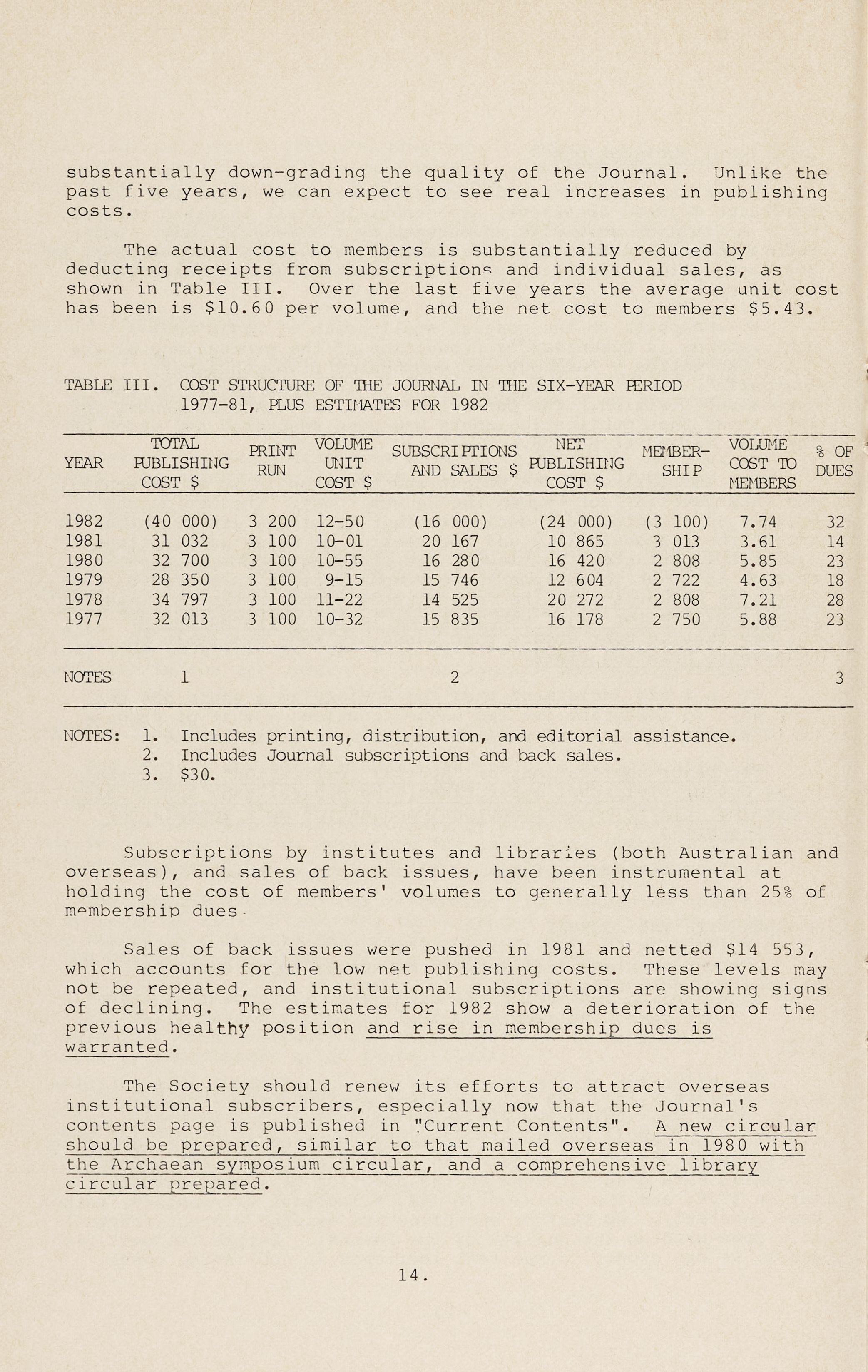
The actual cost to members is substantially reduced by deducting receipts from subscription~ and individual sales, as shown in Table III. Over the last five years the average unit cost has been is $10.60 per volume, and the net cost to members $5.43.
TABLE
III. COST STRUCTURE OF 'IHE JOURNAL IN THE SI X- YEAR FERIOD 1977-81, PLUS ESTIMATE.S FOR 1982
NITTES : 1. Includes printing, distribution, and editorial assistance. 2. Includes Journal subscriptions and back sales. 3. $30.
Subscriptions by institutes and librartes (both Australian and overseas) , and sales of back issues, have been instrumental at holding the cost of members' volumes to generally less than 25 % of m0 mbershio dues
Sales of back issues were pushed in 1981 and netted $14 553, which accounts for the low net publishing costs. These levels may not be repeated, and institutional subscriptions are showing signs of declining. The estimates fo~ 1982 show a deterioration of the prev ious healthy position and rise in membership dues is warranted.
The Society should renew its efforts to attract ov e rs eas institutional subscribers, espec ially now th at the Journal's conte nts page is p u blished in ~Current Co nt en ts". A new circular sh ould be prepared, similar to that mailed o ve rseas in 1980 with the Archaean symposium circular, and a comprehensive library circular prepared 14.
Editoria l burden
Traditionally the Society has relied on the voluntary and honorary services of its editors. tlot only is that person a sc i en tific ed itor, bu t a lso a managing ed itor for the Journal as well as other publications . It is a demanding and responsible p osition that is half -wa y to being a full - time job . The Society has been well served by its editors but we can expec t increasing difficulties to attract a competent and dedicated person , especially if promotional opportunities are to be developed .
editorial assist a nce has been paid ' to the value of $2 500 pa. If th e Journal is to continue , the Societv nust be prepa r ed to continue to provide ed itorial assistance at whatever level i s necessary. I n th e long-term, th e Soci e ty nay also hav e to appoint a full -ti me Managin g Editor , who would perform the e d itorial and promo tional duties, and be responsibl e to an ilonorary Ed itor \1ith"' p redominantly supervisory role.
Content of the Journal
Despit e the high editori~l and scientific standards , there is ev i dence of a general feeling th at t he Journal is inadequate to service the needs of earth scientists in Australia , and unsucc e ssful in attract in g new nenbers because of a feel in g of loyal ty to their national earth sci e nc e body. Thi s i s a tern1ou s s it ua tion an d stron g er bond s ar e r e suir ed
In p r a ctice , th e Journal preJominantly con s ists of d e scri p ti ve and analyti c al a ccount s oE th e g e olo g y o E r e9 ions of Austr a lia. It is lar ge ly a r ep ository f or r e 9ionally - oriente d rese a r c h by a c a demics Although th e r e is a definit e need for an outlet for suc h pa p e r s , t he r e is a not ab l e defici e ncy in the nor e e a g erly sou g ht papers such as:
(1) contributions to curr e nt p ro b l c~ s , (2) r ~ view articl es in sp e ci a li s t Ei e l rls , ( 3 ) coll a tion of o ri g in a l ~~s ear c h b y J? ro n in e nt aut h ors , (4) ec ono mic a lly o ri e nt ed p a pe r s , ( 5 ) r eg ional synt he s es .
I n s hort, it c,<1 t e r s r.1or e fo r au t :1ocs t ha n r eade r s , and i s not a s tron g induc e me n t [ or p ros pe cti ve 8e m e r s
T h i s i s not ed i to ri a l po l.i. c y - it i s a c o 11seque nc e o f t he p a pe r s th <lt a r e su bn itt eo .
\,J i t h t his i na<Je , t he ,T o u r na l ~nco un t e r s a f ur the r ;Yco b l et:1t ha t o f. fa ilin g to c1 ttr ac t t ht: nore i 1.1p ort a nt na nu sc ci p t s f ro n l, ~acl in g 1-mt- kc r s i. n t he i1~ f i el d t1 a n y l\u s t:. "l li ,,n s !XeEc r t o p ,-1 b l ish in o ve r seas j o u rn a l s beca u se :
( 1) th ey [ ee l th e i. r: pa p r s r e c e i v0 tJcea t cr c,.: co 9n itio n i. n ;we::-sca~, jo' rn a l s , (2) r i:J e r ec i.n --J is ,"\or e str in '-ten t for tr1 :ro 1rnal , t 11ar, for ,ian~, ove r seas j o u rn a l s , 15.
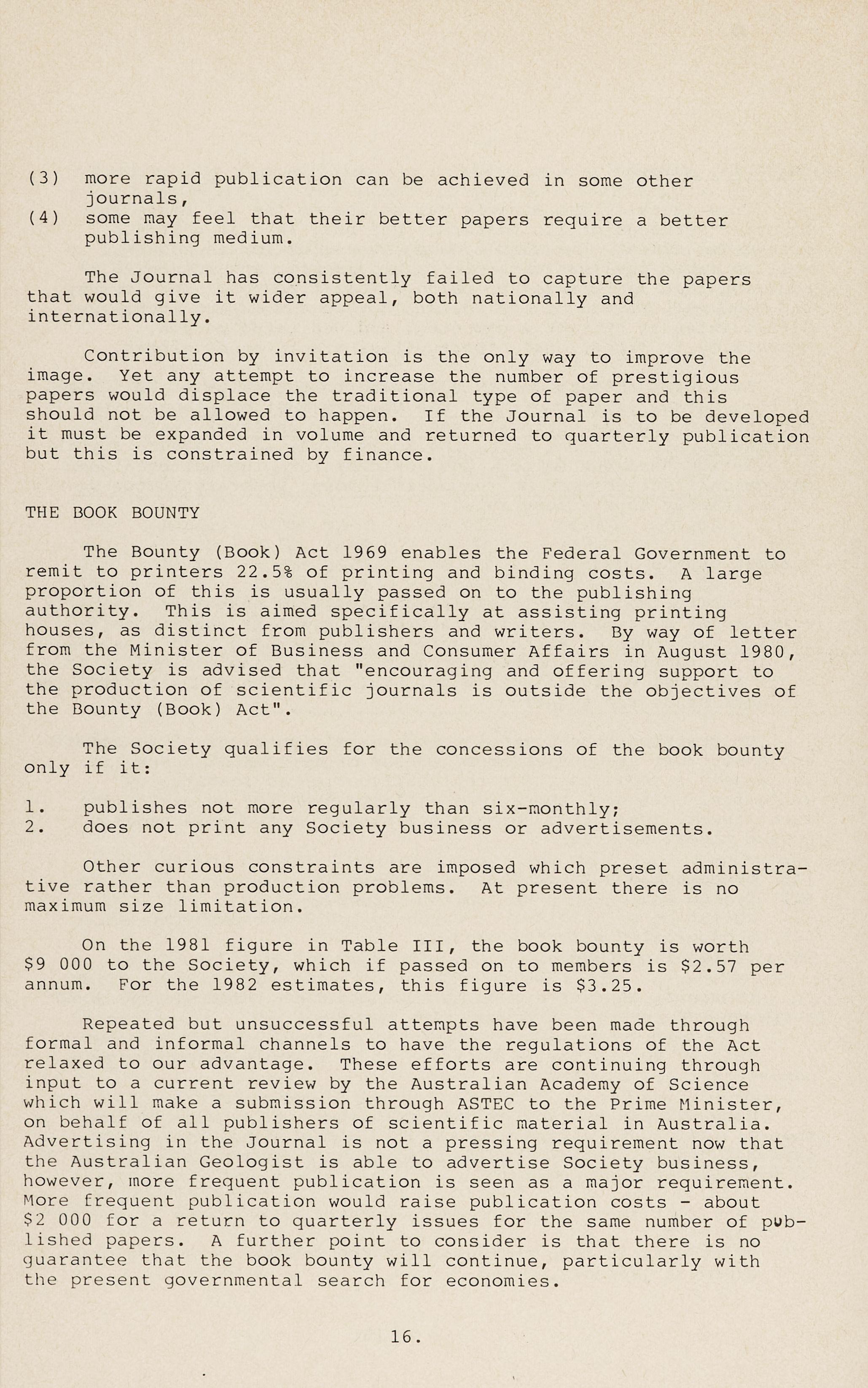
(3) more rapid publication can be achieved in some other journals,
(4) some may feel that their better papers require a better publishing medium.
The Journal has consistently failed to capture the papers that would give it wider appeal, both nationally and internationally.
Contribution by invitation is the only way to improve the image. Yet any attempt to increase the number of prestigious papers would displace the traditional type of paper and this should not be allowed to happen. If the Journal is to be developed it must be expanded in volume and returned to quarterly publication but this is constrained by finance.
THE BOOK BOUNTY
The Bounty (Book) Act 1969 enables the Federal Government to remit to printers 22.5% of printing and binding costs. A large proportion of this is usually passed on to the publishing authority. This is aimed specifically at assisting printing houses, as distinct from publishers and writers. By way of letter from the Minister of Business and Consumer Affairs in August 1980, the Society is advised that "encouraging and offering support to the production of scientific journals is outside the objectives of the Bounty (Book) Act".
The Society qualifies for the concessions of the book bounty only if it:
1. publishes not more regularly than six-monthly; 2. does not print any Society business or advertisements.
Other curious constraints are imposed which preset administrative rather than production problems. At present there is no maximum size limitation.
On the 1981 figure in Table III, the book bounty is worth $9 000 to the Society, which if passed on to members is $2.57 per annum. For the 1982 estimates, this figure is $3.25.
Repeated but unsuccessful attempts have been made through f ormal and informal channels to have the regulations of the Act relaxed to our advantage. These efforts are continuing through input to a current review by the Australian Academy of Science which will mak e a submission through ASTEC to the Prime rtinister, on b e half of all publishers of scientific material in Australia. Ad v e rtising in the Journal is not a pressing requirement now that t he Austr a li a n Geolo g ist is able to advertise Society business, how e v e r, more frequent publication is seen as a major requirement. Mor e f requent p ublication would raise publication costs - about $2 000 f or a return to q uarterly issues for the same number of publ i shed p ape rs. A further p oint to consider is that there is no 9 u a r a nt ee th a t the book bounty will continue, particularly with th e p r e s e nt g overnm e ntal s ea rch for economies.
Abandonment or loss of the book bounty could therefore cost the Society approximately $12 000 pa, or about $4 per member.
PROPOSALS TO DISCONTHJUE THE JOURt~AL
In recognition of the above problems, two recent suggestions have been made which amount to abandonment of the Journal in its present form.
Production on microfiche
This option had currency of few years ago, but has clearly not gained favour with members. It is not intended to resurrect this option, except to make two points.
Firstly the financial attractions of this same option induced the Geological Society of America to release some of its papers on microfiche. A universal reaction against microfiche forced that Society to quickly discontinue the experiment. It is noteworthy that following a further review of their publication policy, the Geological Society of America then opted for a separation of the different products available to members, and a drastically reduced Bulletin subscription fee, such that it is now only about 50% more than that of our Society.
Secondly, the proposal in Australia lapsed because it would have stripped the Society of its raison d'etre.
Amalgamation with other b odies
This proposal had its origin in a suggestion in 1979 that the Australian Academy of Science and CSIRO support the production of a new publication provisionally entitled "Austra l ia n Journal of Earth Sciences". With the recognition of the fnancial and editorial burdens facing the Society, and aided by a dearth of manuscripts submitted to the Journal at that time, fears were expressed that we may be swallowed by a new journal, particularly if it had a strong backing.
Unilateral proposals along this line have now been widely publicised (e.g. Australian Geologist No.33, 1981) and take the following form:
The Society ceases to publish the Journal, and formally chooses as its official medium of publication the A.J.E.S. BMR could discontinue their "Journal of Australian Geology and Geophysics", and also contribute to A.J.E.S.
CSIRO, ASEG , and PESA may also contribute to A.J.E.S.
BMR could provide a full-time, permanent editor for A.J.E.S. A.J.E.S. would be managed by an Editorial Board which would have representation from GSA, BMR, etc.
GSA would provide par t-ti me editorial or secretarial ass ist ance.
Printing of A.J.E.S. would be controlled by the Australian Government Publication Service. 17.
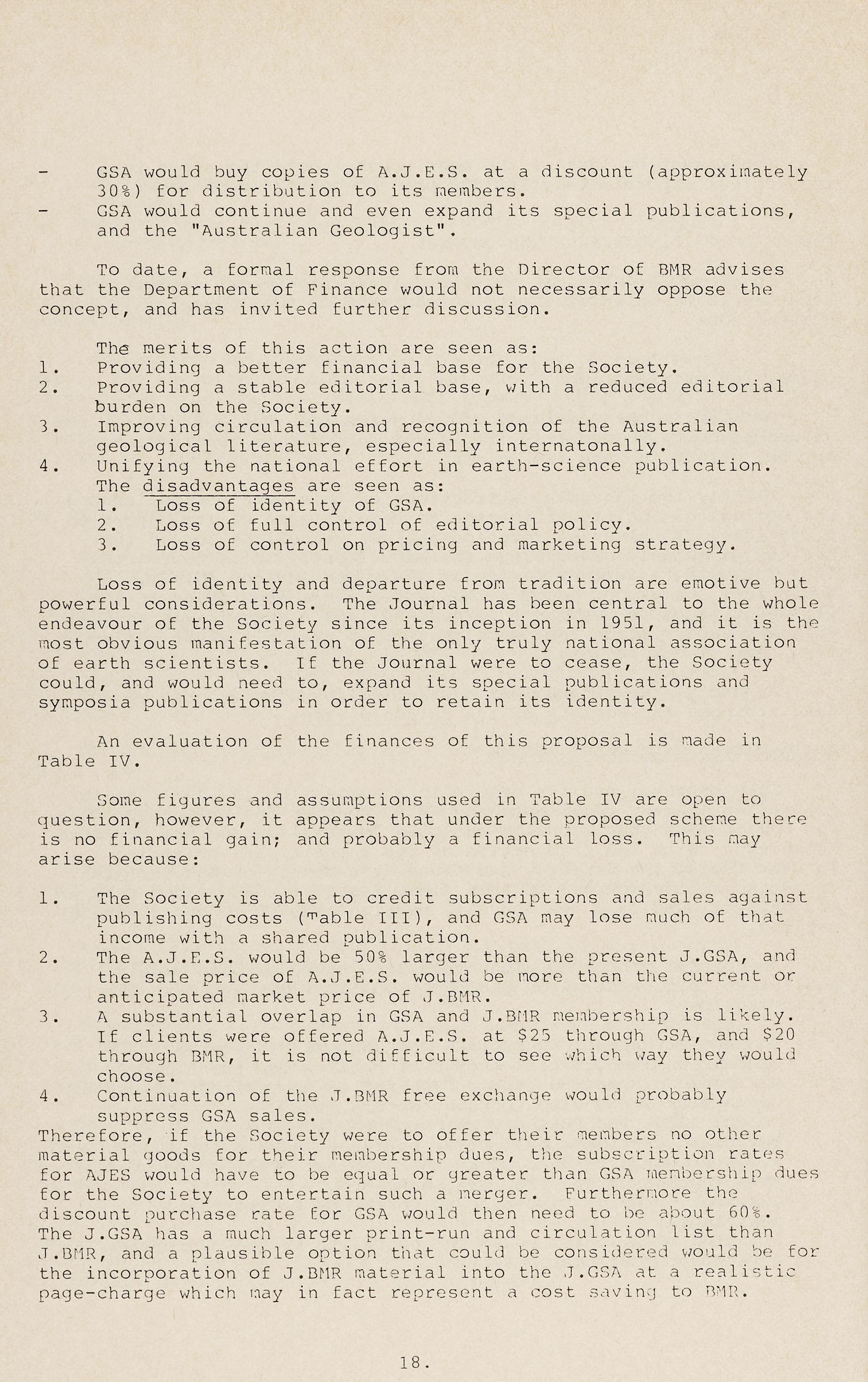
GS A would b uy copies of A.J.E.S. at a discount (approximat e ly 3 0 %) for distribution to its Dernb e rs.
CSA would continu e and e ven expand its special publications, and the "Austr a lian Geologist".
To da t e , a formal r esp ons e from th e Director of BMR advises th at th e Department of F inance would not necessarily oppose th e concept, and has invit ed f urther discussion.
The merits of this action are seen as:
1. Providing a be tt e r financial base for the Society.
2. Providing a stable editorial base, with a reduced editorial burden on the Society.
3. Improving circulation and recognition of the Australian geological liter a ture, especially int e rnatonally.
4. Unifying the nation a l effort in earth - science publication. The disadvantages a re seen as:
1. Loss of identity of GSA.
2. Loss of full control of editorial policy.
3
Loss of control on pricing and ma rk e tin g str a t egy
Loss of identity a nd departure from tra d ition a r e em otiv e bu t powerful considerations. The Journal has been centr a l to the whole e n deav our of the Society since its inception in 1951, and it i s the most o b vious manif es t at ion of the only truly national association of ea rth scientists. I f the Journal were to cease, the Society could, and would need to, exp and its special publications and symposi a publ ications in or de r to retain its i de ntity.
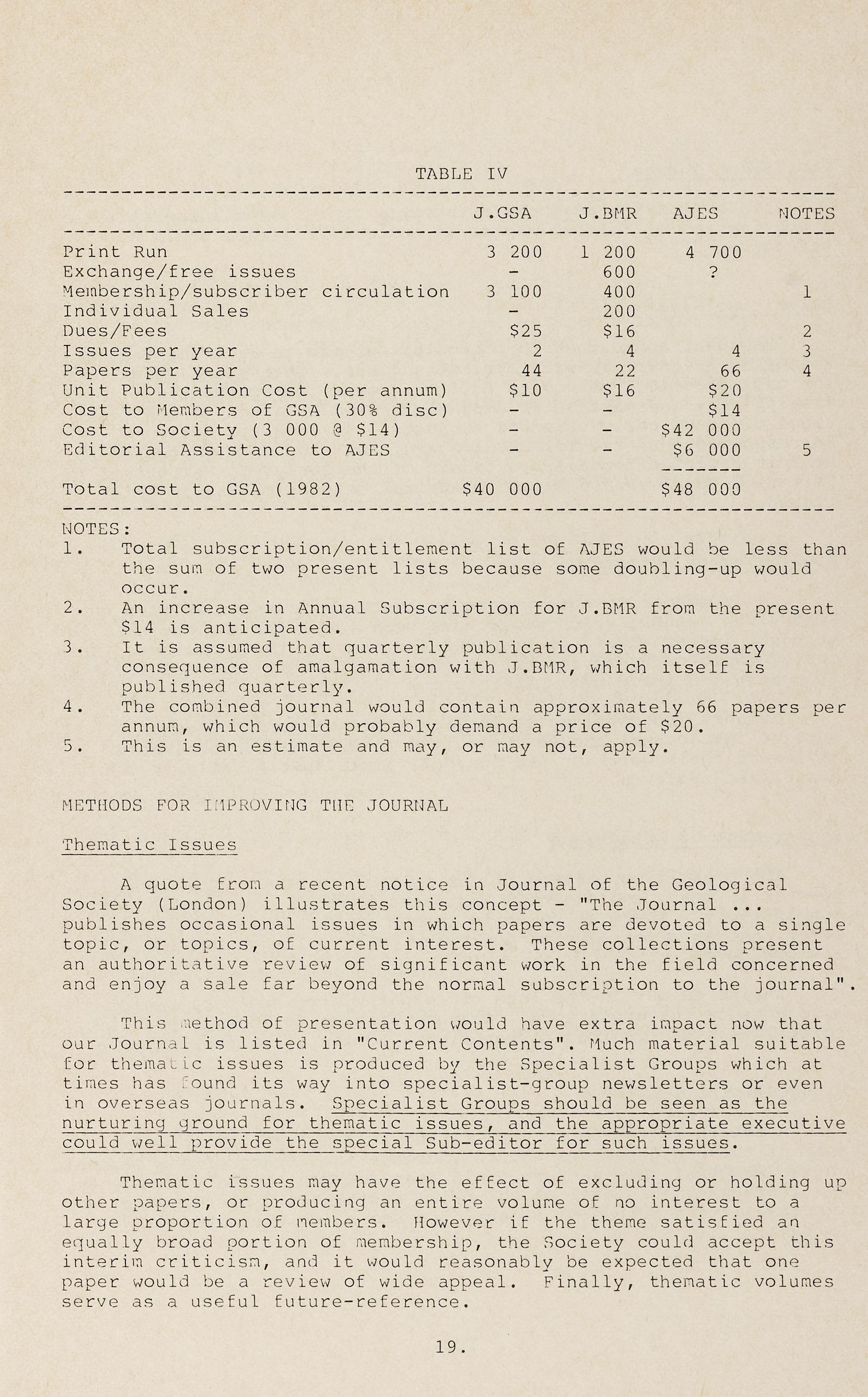
An eval uation o f t he f in ances of t his prop os al is made in Ta ble IV.
S om e figures a n d assumptions used i n Table IV are open to q uestion, however, it appears th a t un der th e p ropos ed scheme there i s no financial gain; a nd probably a financial loss. This r.1ay arise because:
1. The Society is able to credit subscriptions and sales against p ublishing costs (~abl e III), and GSA may lose much of th at income with a shared p u b lic a tion.
2 . Th e A.J.E.S. would be 50 % lar ger th an the present J.GSA, and t he sale price of A.J. E . S . would be or e t ha n the current or an tici pa ted marke t pr ic e of J.BMR.
3 A substantial o ve rla p in CSA and ,J.B[lR nenbersh i p is l i k e ly If clients were offered A.J.E.S. a t $25 through GSA , and $20 through mm , it i s not d iEEicu l t to see ,Jhicl-i 11ay t hey \JOulcJ choose.
4. Contin ua tion of t he .1.mrn free exchanqe wou l d pr o bably suppress GSA sa l es Therefore, if t he Soc i ety were to o ffer their no other ma t e rial <Joods for their r1e1:ibership dues , the sub sc ri p tion rat e s for AJES would hav e to be equal or yrea t er than GSA rn en b e r s hi p clu es for t he Socie ty to en t ertain such a nerger Fur t hermor e th e d i scoun t purchase r- a te for GSA ,JOuld then need to b e ab out 6 0 % The J GSA has a much l arger prin t-r un a nd circul a tion list th a n .1. l.3 f1R , a n d a plaus i b le ortion t i,d t c e>ulJ be consid e r ed woul d i e f ot· the incor- p or a tio n o f J . mm ma t e r i al into the ,J GSl\ 2t. a r e 21li s tic: page - charg e wh ic h 1:1ay i n fac t repres e nt a co s t SclV in ] to rv- m.
Tl\BLE IV
Print Run
Exchange/free issues
Membership/subscriber circulation
Indi v idual Sales
Dues/Fees
Issues per year
Papers per year
Unit Publication Cost (per annum)
Cost to i-lembers of GSA (30 % disc)
Cost to Society (3 000 @ $14)
Editorial Assistance to AJES
Total cost to GSA (1982)
NO T ES :
1. Total subscription/entitlement list of l\JES would 8e less than th e sum of two present lists because some doubling - up would occur.
2. An increase in Annual Subscrip t ion for J.BMR from the present $14 is anticipated.
3. It is assumed t ha t quarterly publication is a necessary consequence of amalgamation with J.BMR, which itself is pub lished quarterly.
4. The combined journal would contain approximately 66 pape rs per annum, which would p roba b ly demand a p rice of $20.
5. This is an estimate and may , or may not, apply.
METl-!ODS FOR l '. 1P RU VIfl <3 T[]E JOURUAL
'Thematic Issues
A quote from a recent notice in Journal of the Geological Society (London) illustrates this concept" The ,Journal publishes occasional issues in which pape rs are devoted to a single topic, or topics , of current interest. These collections presen t an authoritative review of significant work in the fi e ld concerned and enjoy a sale far beyond the non:ial subscription to th e journal".
This .:1e tho d of p resentation 1Jould have ex tra ir.1pact now that our: Journ a l is listed in " Cur:r:en t Contents". Much material suitable for thema L i c i ssues is produced by th e Specialist Groups which at ti mes has : ound its way into specialist - group newsletters or even in overseas journals Specialist Groups should be seen as th e nurturing ground fo r the ma tic issues, and the appropriate executive could well prov i de the special Sub-editor for such issues.
Thematic issues nay have the effect of excluJ in g or holding up other papers , or: producing an ent ir e volume oE no interest to a large proportion of 11embers. Howe ver if th e theme satisfied an equally broad portion of membersh i p , the Society could accep t this inter:im cri ti cisn , and it would reasonably be expe ct ed th at on e paper would be a review of wi de appeal . F inally, thematic volumes serve as a useful future -r: efe rence.
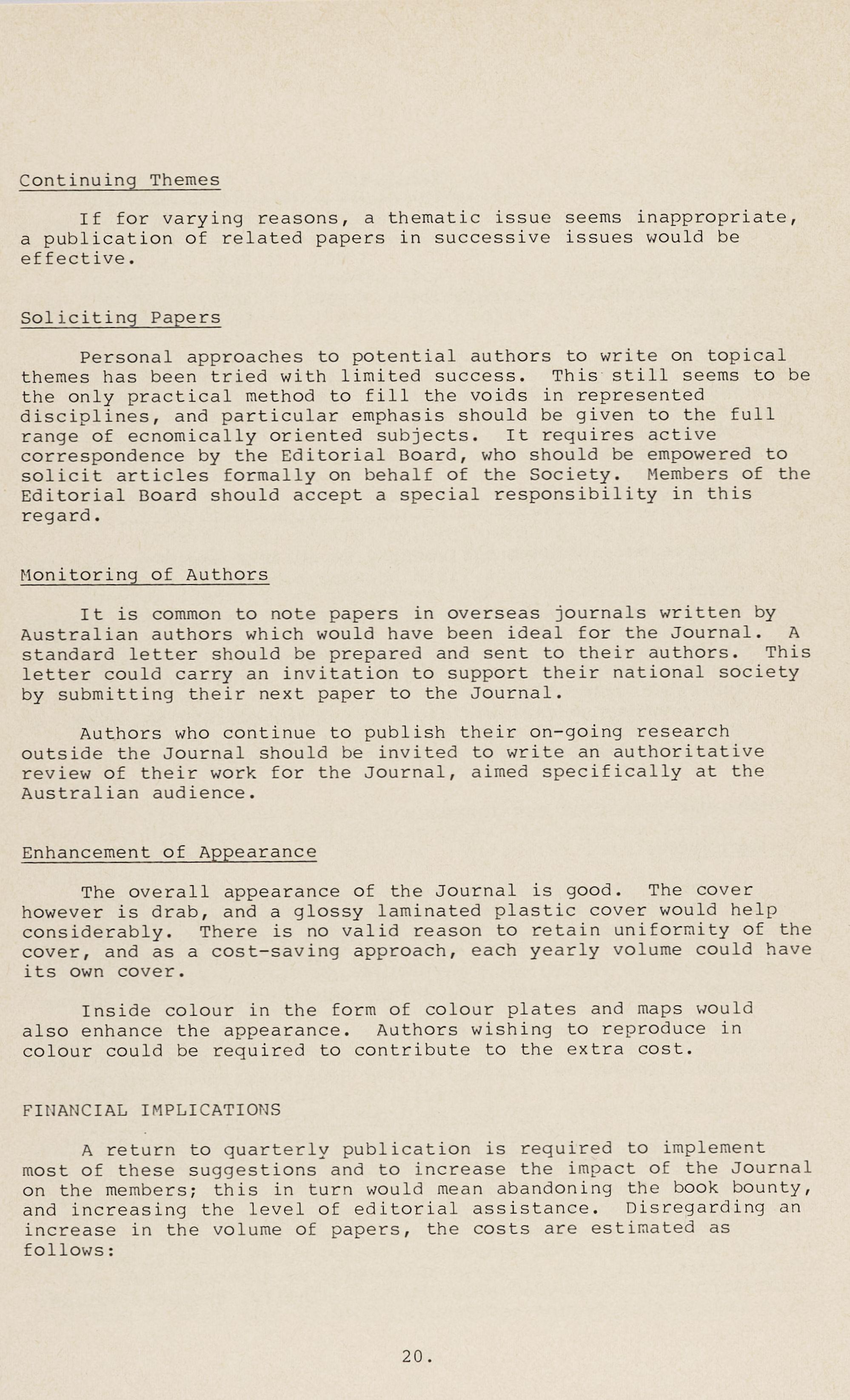
Continuing Themes
If for varying reasons, a thematic issue seems inappropriate, a publication of related papers in successive issues would be effective.
Soliciting Papers
Personal approaches to potential authors to write on topical themes has been tried with limited success. This · still seems to be the only practical method to fill the voids in represented disciplines, and particular emphasis should be given to the full range of ecnomically oriented subjects. It requires active correspondence by the Editorial Board, who should be empowered to solicit articles formally on behalf of the Society. Members of the Editorial Board should accept a special responsibility in this regard.
Monitoring of Authors
It is common to note papers in overseas journals written by Australian authors which would have been ideal for the Journal. A standard letter should be prepared and sent to their authors. This letter could carry an invitation to support their national society by submitting their next paper to the Journal.
Authors who continue to publish their on-going research outside the Journal should be invited to write an authoritative review of their work for the Journal, aimed specifically at the Australian audience.
Enhancement of Appearance
The overall appearance of the Journal is good. The cover however is drab, and a glossy laminated plastic cover would help considerably. There is no valid reason to retain uniformity of the cover, and as a cost-saving approach, each yearly volume could have its own cover.
Inside colour in the form of colour plates and maps would also enhance the appearance. Authors wishing to reproduce in colour could be required to contribute to the extra cost.
FINANCIAL IMPLICATIONS
A return to quarterly publication is required to implement most of these suggestions and to increase the impact of the Journal on the members; this in turn would mean abandoning the book bounty, and increasing the level of editorial assistance. Disregarding an increase in the volume of papers, the costs are estimated as follows:
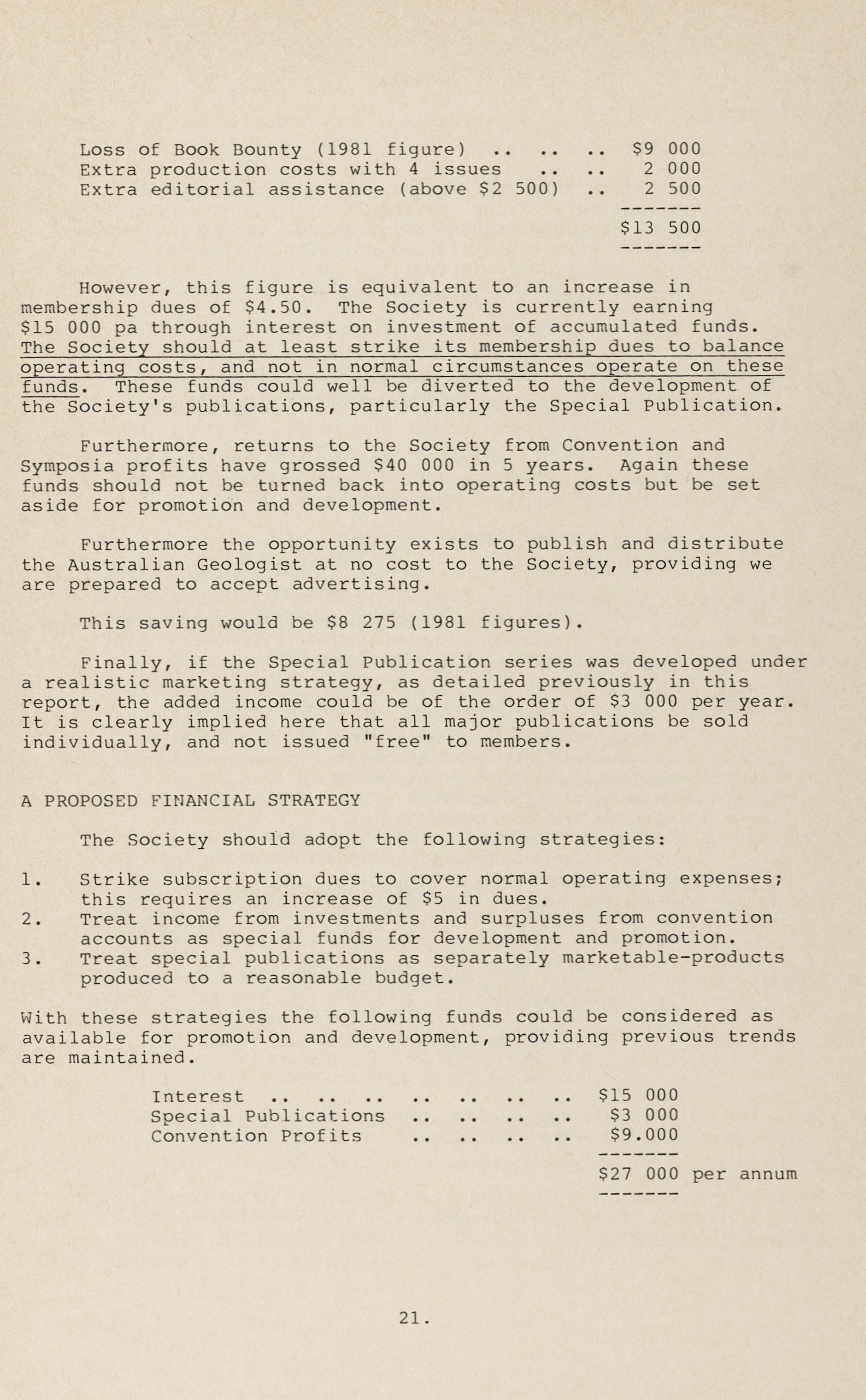
Loss of Book Bounty (1981 figure)
Extra production costs with 4 issues
Extra editorial assistance (above $2 500) $9 000 2 000 2 500 $13 500
However, this figure is equivalent to an increase in membership dues of $4.50. The Society is currently earning $15 000 pa through interest on investment of accumulated funds. The Society should at least strike its membership dues to balance operating costs, and not in normal circumstances operate on these funds. These funds could well be diverted to the development of the Society's publications, particularly the Special Publication.
Furthermore, returns to the Society from Convention and Symposia profits have grossed $40 000 in 5 years. Again these funds should not be turned back into operating costs but be set aside for promotion and development.
Furthermore the opportunity exists to publish and distribute the Australian Geologist at no cost to the Society, providing we are prepared to accept advertising.
This saving would be $8 275 (1981 figures).
Finally, if the Special Publication series was developed under a realistic marketing strategy, as detailed previously in this report, the added income could be of the order of $3 000 per year. It is clearly implied here that all major publications be sold individually, and not issued "free" to members.
A PROPOSED F INANCIAL STRATEGY
The Society should adopt the following strategies:
1. Strike subscription dues to cover normal operating expenses; this requires an increase of $5 in dues.
2. Treat income from investments and surpluses from convention accounts as special funds for development and promotion.
3. Treat special publications as separately marketable-products produced to a reasonable budget.
With these strategies the following funds could be considered as available for promotion and development, providing previous trends are maintained.
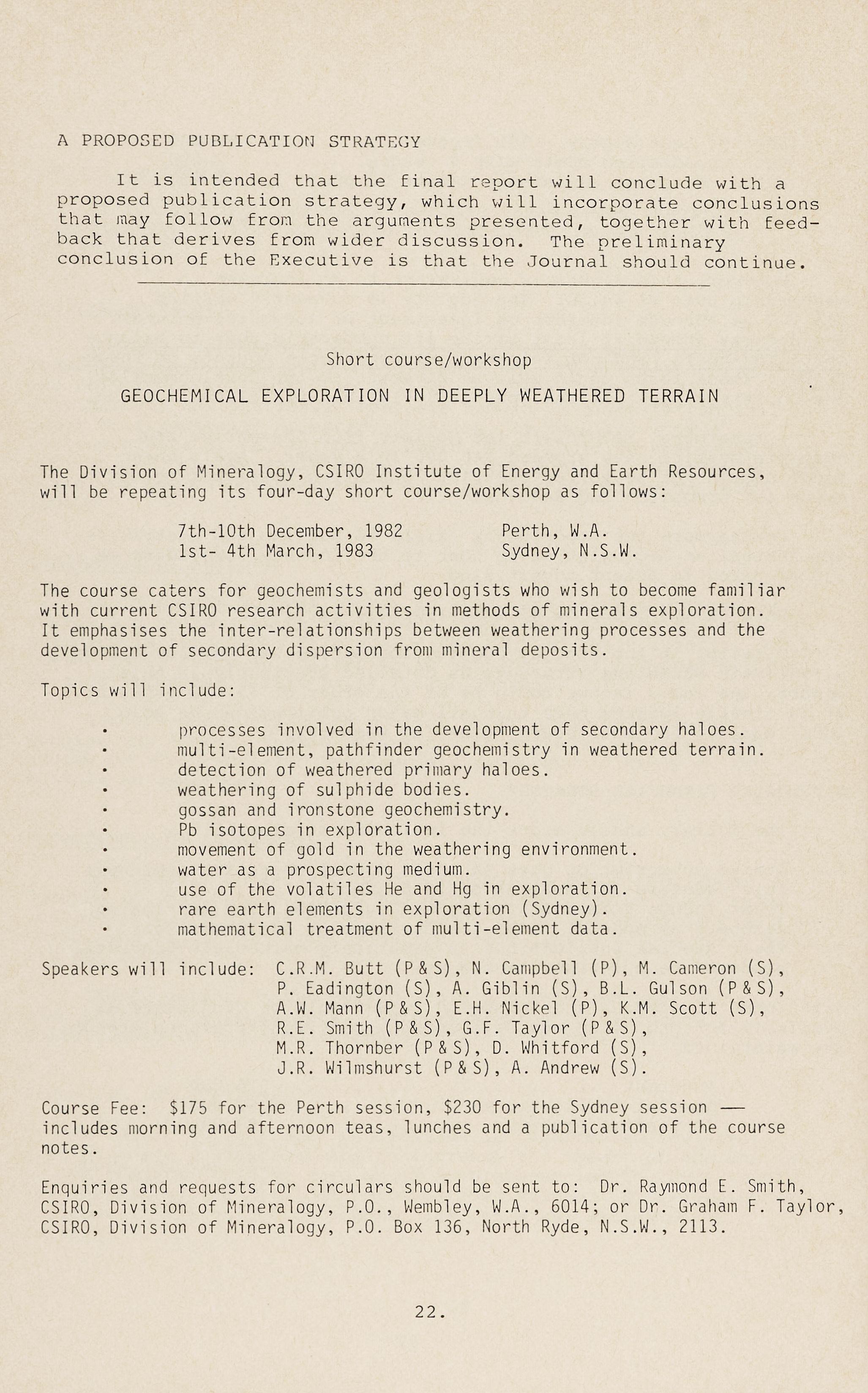
A PROPOSED PUBLICATION STRATEGY
It is intended that the f in al report will conclude with a proposed publication strategy , which will incorporate conclus ion s that may foll o w fror:1 the arg um en t s presented , together wit h feedback that derives from wider discussion. The prel i minary conclusion of the Executive is that the J ourn al should continue.
Sho rt co urse/workshop
GEOCHEMICAL EXPLORATION IN DEEPLY WEATHERED TERRAIN
The Division of Mineralogy, CS I RO Inst itu te of Energy and Earth Resources, will be repeating its four-day short course/workshop as follows :
7th-10th December, 1982 lst- 4th March, 19 83
Perth, W.A. Sydn ey, N.S.W.
The course caters for geochem i sts and geolog i sts who wish to become fam ilia r with current CSIRO research activities in methods of minerals exploration. It emphas ises the inter-relationships between weathering processes and the development of secondary dispersion from min era l depos i ts.
Topics will inc lu de:
processes involved i n the development of secondary haloes . multi - element, pathf inder geochemistry in weathered terra i n detection of weathered primary haloes. weathering of sulphide bodies. gossan and ironstone geochemistry. Pb i sotopes in exploration. movement of gold in the weathering e nvironm ent. water as a pr ospect in g medium. use of the vo l atiles He and Hg in exp l orat i on rare earth elements in exploration (Sydney) . mathematical treatment of mult i- element data.
Speakers will include : C.R.M. Butt (P&S), N. Campbell (P), M Cameron (S), P. Eadington (S), A. Giblin (S), B.L. Gulson (P&S), A.W . Mann (P&S), E.H. Nickel (P), K. M . Scott (S), R. E Smith (P&S), G.F. Tay l or (P&S), M.R. Thornb er (P &S), D Wh i tford (S), J.R. Wil mshurst (P &S), A. And rew (S) .
Course Fee : $175 for the Perth session, $230 for the Sydney session includes morn in g and afternoon teas, lunches and a publ ication of the course notes
Enquirie s and requests for c irculars sho uld be sent to: Dr. Raymond E. Sm ith, CSIRO, Div i s ion of Mineralogy, P. O. , ~Jembley, W.A . , 6014; or Dr Graham F. Taylor, CSIRO, Division of Mineralogy, P.O. Box 136, North Ryde, N.S.W . , 2113 .
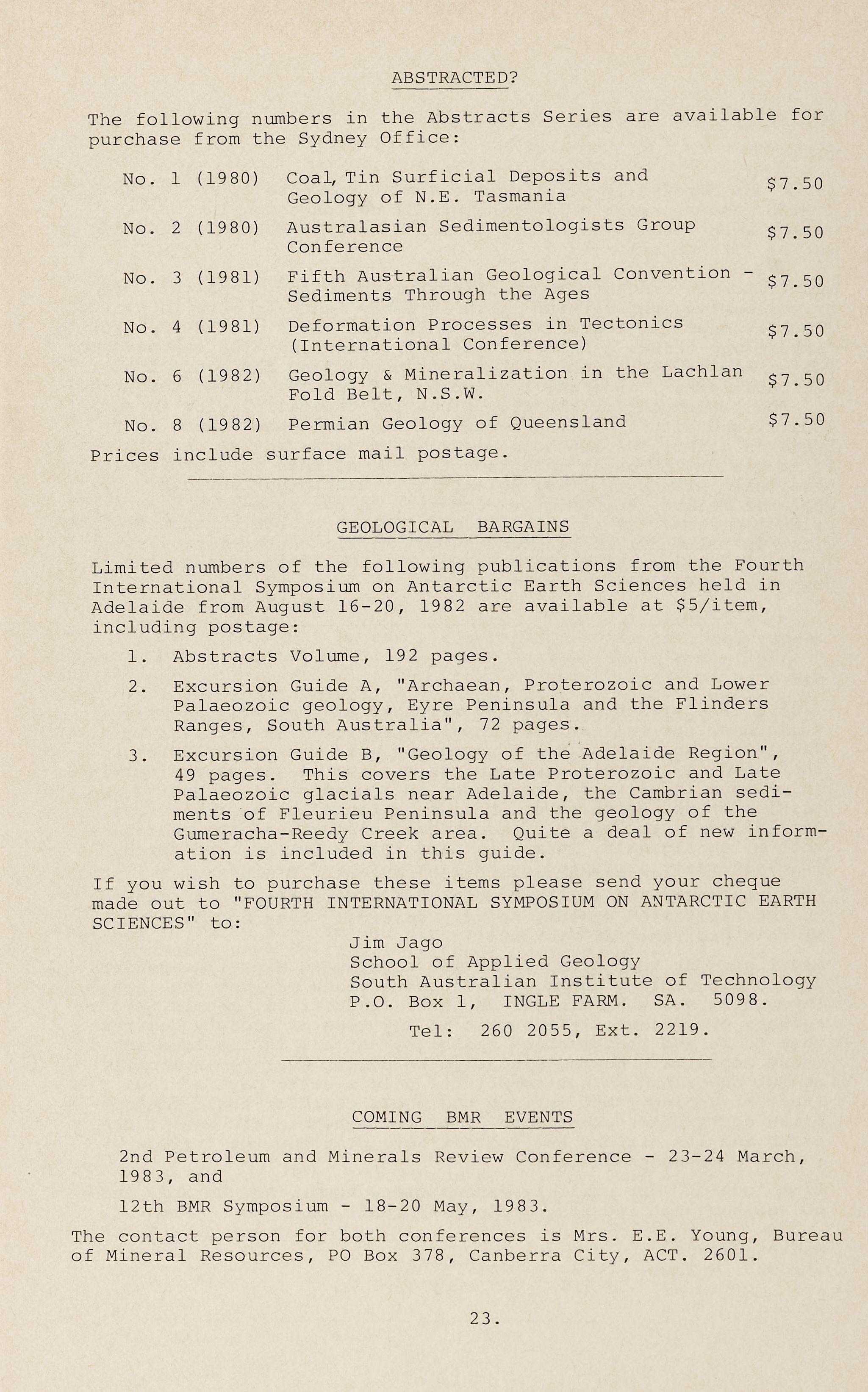
ABSTRAC TED?
The following numbers in the Abstracts Series are available for purc hase from the Sydney Office:
No. l ( 19 80) Coal, Tin Surficial Deposits and $7.50 Geology of N.E. Tasmania
No. 2 ( 1980) Australasian Sedimentologists Group $7.50 Conference
No. 3 ( 1981) Fifth Australian Geological Convention$7.50 Sediments Through the Ages
No. 4 (1981) Deformation Processes in Tectonics $7.50 (International Conference)
No. 6 ( 1982) Geology & Mineralization in the Lachlan $7.50 Fold Belt, N.S.W.
No. 8 ( 19 82) Permian Geology of Queensland $7.50
Prices include surface mail postage.
GEOLOGICAL BARGAINS
Limited numbers of the following pub l ications from the Fourth Internationa l Symposium on Antarctic Earth Sciences held in Ade laid e from August 16-20, 198 2 are available at $5/item, including postage:
1. Abs tracts Volume, 192 pages.
2. Excursion Guide A , " Archaean , Proterozoic and Lower Palaeozoic geology, Eyre Peninsula and the Flinders Ranges, South Australia", 72 pages.
3. Excursion Guide B, "Geolo gy of the Ade laid e Region ", 49 pages. This covers the Lat e Proterozoic and Late Palaeozoic glacials near Ade laid e , the Cambrian sediments of Fleurieu Peninsu la and the geology of the Gumeracha-Reedy Creek area. Quite a deal of new information is included in this gu id e.
If you wish to purchase these items please send your cheque made out to "FO URTH INTERNATIONAL SYMPOSIUM ON ANTARCTIC EARTH SCIENCES" to:
Jim Jago
School of Applied Geo lo gy South Australian Institute of Technology P.O. Box 1, INGLE FARM. SA. 5098. Tel: 260 2055 , Ext. 2219.
COMING BMR EVENTS
2nd Petroleum and Minerals Review Conference - 23 - 24 March , 1983, and 12th BMR Symposium - 18-20 Ma y , 1983.
The contact person for both conferences is Mrs . E.E . Young, Bureau of Mineral Resourc e s, PO Box 378, Canberra City , ACT. 2601.
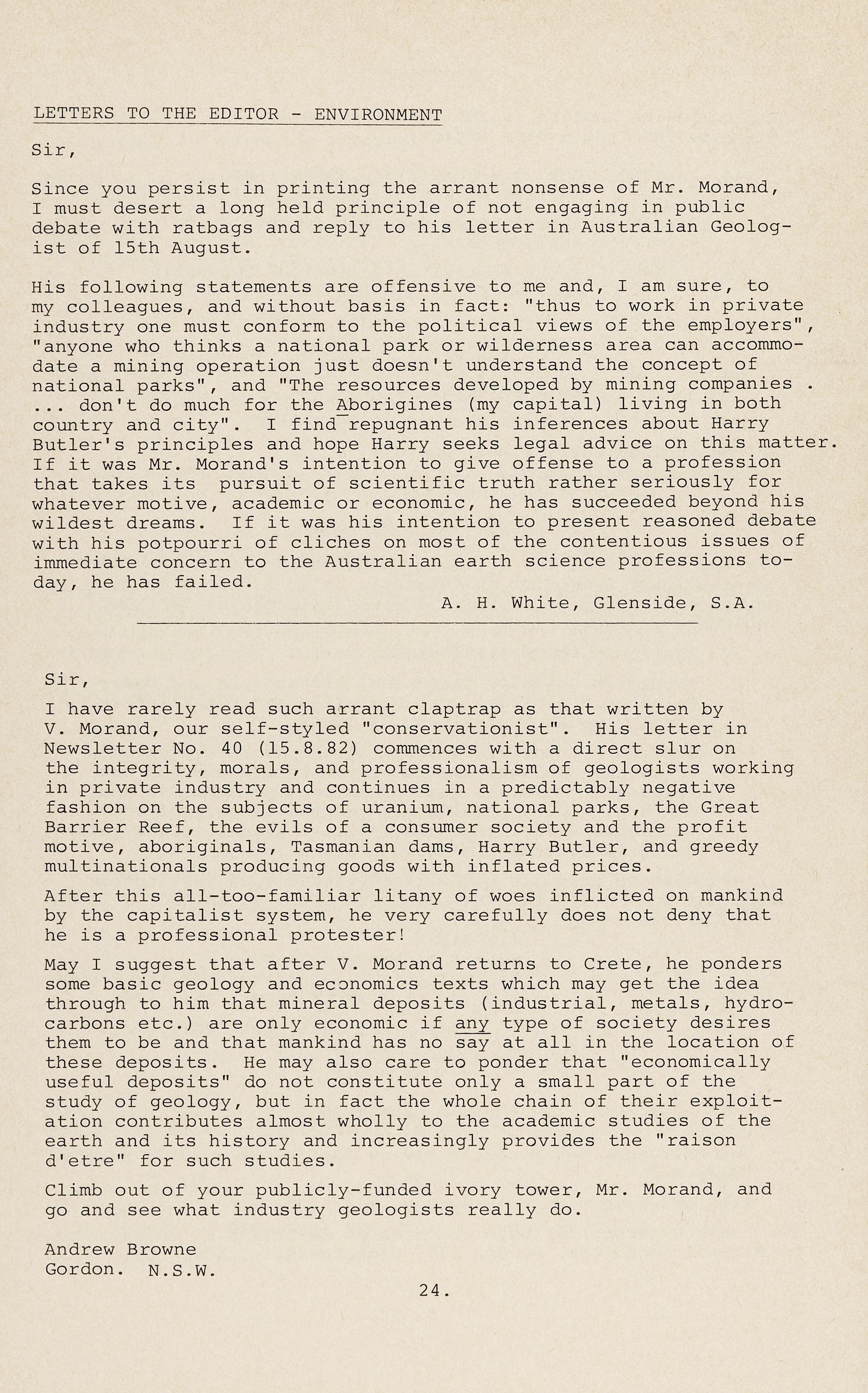
LETTERS TO THE EDITOR - ENVIRONMENT
Sir,
Since y ou persist in printing the arrant nonsense of Mr . Morand, I must desert a long held principle of not engaging in public debate with ratbags and reply to his letter in Australian Geologist of 15th August.
His following statements are offensive to me and, I am sure, to my colleagues, and without basis in fact: "thus to work in private industry one must conform to the political views of the employers", "anyone who thinks a national park or wilderness area can accommodate a mining operation just doesn't understand the concept of national parks", and "The resources developed by mining companies don't do much for the Aborigines (my capital) living in both country and city". I find-repugnant his inferences about Harry Butler's principles and hope Harry seeks legal advice on this matter If it was Mr. Morand's intention to give offense to a profession that takes its pursuit of scientific truth rather seriousl y for whatever motive, academic or economic, he has succeeded beyond his wildest dreams . If it was his intention to present reasoned debate with his potpourri of cliches on most of the contentious issues of immediate concern to the Australian earth science professions today, he has failed .
A . H. White, Glenside, S.A.
Sir,
I have rarel y read such a~rant claptrap as that written by V. Morand, our self-styled "conservationist". His letter in Newsletter No. 40 (15 8.82) commences with a direct slur on the integrity, morals, and professionalism of geologists working in private industry and continues in a predictably negative fashion on the subjects of uranium, national parks, the Great Barrier Reef, the e v ils of a consumer society and the profit motive, aboriginals, Tasmanian dams, Harr y Butler, and greedy multinationals producing goods with inflated prices .
After this all-too-familiar litan y of woes inflicted on mankind b y the capitalist system, he very carefully does not deny that he is a professional protester !
May I suggest that after V. Morand returns to Crete, he ponders some basic geology and ec8nomics texts which may get the idea through to him that mineral deposits (industrial, metals, hydrocarbons etc.) are onl y economic if any type of society desires them to be and that mankind has no say at all in the location of these deposits . He ma y also care to ponder that "economicall y useful deposits" do not constitute onl y a small part of the stud y of geolog y , but in fact the whole chain of their e x ploitation contributes almost wholl y to the academic studies of the earth and its histor y and increasingl y p rovides the "raison d' e tre" for such studies
Climb out of y our publicl y -funded i v or y tower, Mr Morand, and go a n d see what industr y g e ologists reall y do.
Andre w Browne
Gordon. N . S . W.
24.
Sir,
I have tried o ver several hours to write in reply to V. Morand's political paper which appeared in your Newsletter No. 40. However, his composition is so long and has so many false statements mixed with irrelevancies and some truth that I find it impossible to make comment on the points he makes at a length acceptable for publication.
So I have decided not to point out the (at least seventeen) false statemnts, to ignore his emotional diatribe against company geologists, to ignore his intolerance to differently thinking honorable men (eg. Harry Butler), not to quote evidence for the millions of dollars being reaped by aboriginals, not to quote cases where mines are safely working in national parks overseas, not even to point out the obvious that ore minerals must be mined where they occur, and so on. Instead, let me make only three comments.
First, I feel it incumbent on me to defend mining companies, despite their many faults, against the accusation of political interference of applicant geologists. In dozens of interviews in Australia and overseas, in over twenty years, I have never been asked my political views by a company - but I have by government departments. The companies have ranged from Morand's bogey men multinational companies to two-man affairs. On this matter " I dips me lid" to them.
Secondly, may I say that Morand's composition shows an intolerance which shocks me, coming as it does from a supposed scientist and educated man. It reads as if the brand of conservation he espouses is his religion and it displays all the marks of bigotry expected of a narrow sect. It may be unpalatable to Morand but it is true that his views are in most cases only opinions, not fact. Others just as intelligent and knowledgeable as he, perhaps even more so, have different opinions. For example many people, geologists included, can see ma ny grounds for building a da m on the Franklin River and, furthermore, there are may geologis ts who will help in its construction unintimidated by insults, defa ma tion and threats.
Lastl y , let me state my summing up of his composition. I find it is a collection of falsities, misstatements, and irrelevancies, mixed with sufficient truths and half-truths to make it sound p lausible to thos e outside the discipline of economic geology. It is, however, very skilfully written indeed to appeal to the emotions and to swamp reason and must have taken some time to construct. In this, and this alone, I envy Morand his skill.
Frank Lee Melbourne.
C.R. CLARK wants to purchase for a reasonable price a copy of BMR Bulletin No. 38, "The 1951 eruption of Mount Lamington, Papua" by G A. Taylor (with apendices) - published in 1958; write to him at the fo llowin g address stating the condition of the copy and the asking price :
Cliffs International, Inc. GPO Box Pl224, PERTH. WA. 6001.
Sir,
Contrary to most of your correspondents, I find I am in agreement with many of Vince Morand's comments, and commend your editorial in Newsletter 40.
It has been my experience that many company geologists are less sensitive to environmental matters than, say, geological educators and certain sectors of the public service. I think it inevitable that persons without a biological component in their training have less understanding of environmental issues. Geologists involved in the search for metalliferous and industrial minerals or operating mines generally do not have such training - it isn't appropriate for the work they are doing, and I see no point in being critical of their attitudes Companies required to carry out environmental work generally recognize the restrictions of their geological exploration staff and employ or hire people with suitable geomorphic or biological background.
What I do object to is the 'pioneering' mentality still dominating Australian thinking. Pioneering by 'western' societies and their derivatives seems synonymo u s with 'tame' and 'exploit'. We see this in its worst form in such schemes as deve l opment of hydroelectric resources in Tasmania, procedures in South Australia to remove soil conservation clauses from pastoral lease agreements, wasteful use of water from the Murray River and its bas i n, clearfelling of forests, and so on. Thinking about such endeavours, mining malpractice seems relatively insignificant when compared with the massive effects of agriculture.
In relation to this it is heartening to see so many geologists, particularly geomorphologists, sedimentologists, hydrogeologists and palynologists, becoming involved in Quaternary studies , surface processes, remote sensing, and other fields pertaining to land - use. However, such people are largely employed by University, CSIRO and environmental consultants; rather than in land-use within government departments, where they should be working alongside peop l e in departments of lands , agriculture, etc. I see a need to shift away from short-term exploitation into long term land-use.
I agree with Vince Morand's admonition to geologists not to work towards destruction of wilderness areas like the Franklin River. I think it is essential to man's survival that the options for survival are not reduced. Thus arises the idea of preservation of diversity. Every single reduction of an area of scrub results in loss of ability of a particular species to survive. Thereby the reservoir of useful plants and animals is reduced, and the ability of such communiti e s to buffer adverse natural and human changes declines.
In practice, those who have entered the work f orce and chosen to have dependants must usually compromise to some extent on environmental matters. Idealism isn't much help if you cannot get another job. Besides every employer will at sometime encourage or carry out environmental actions with which one disapproves. As an e x ample, in many public service jobs (such as I have), the object is to provide information without prejudice and assist certain defined activities. Supplying geological information to uranium companies is one such example. However, this does not prevent active support as a private individual of groups opposed to some aspects of uranium use.
Most people are not likely to be working for organizations that are completely at odds with their personal views. Someone working on the Franklin dam is likely to be convinced he or she is doing the best for family and the community. Even if such a person has a fund of knowledge permitting rational assessment of ecological arguments against the dam, other factors may be regarded as more important. Those with a short t e rm view of life, mistrusting predictions of the future, may feel it is enough for a considerable number of people to benefit during such a construction, even i f its future benefit is uncertain.
Conservationists need to demonstrate that such a view is short-sighted, and may lead to serious problems. They need to argue from general principles, rather than pointing to specifics like a particular species that may be destroyed. Those principles must be clearly defined, and the way in which they benefit future societies should be demonstrated. I'd particularly like a response from those who do not agree with the principle of preservation of diversity, and from those with other basic ideas to expr e ss.
Roger Callen, Eden Hills, S.A.
AUSTRALIAN NATIONAL COMMITTEE FOR THE INTERNATIONA L LITHOSPHERE PROJECT (ILP)
ANN OU NCEMENT - GRANT TO ATTEND IUGG 1983
The Australian Acade my of Science has agreed to set aside a s u m of $2000 from the John Conrad Jaeger fund to assist a prom i sing yo u ng geophysicist with interests in the ILP to attend the IUGG Assemb l y to be held in Hamburg from 15 - 27 August 1983
Applicat i ons are invited for this grant from persons under t he age of 36 as at 1 5 Aug u st 1983 , and should include their curricu lum v it ae and list of publications t ogether with an outline of their in terest in the ILP and the IU GG General Assembly . Applican ts themselves sh o ul d arra n ge for s upporti ng letters from at least two referees t o be send dire c t t o the Academy. The closing data for the receipt of applica ti ons and referees reports is 15 February 1983 These should be addressed t o Mr . P . O ' Conno r, Assistant Secretary , Australian Academy of Science , P .O. Box 783 , Canberra , A C T. 2601 .
.
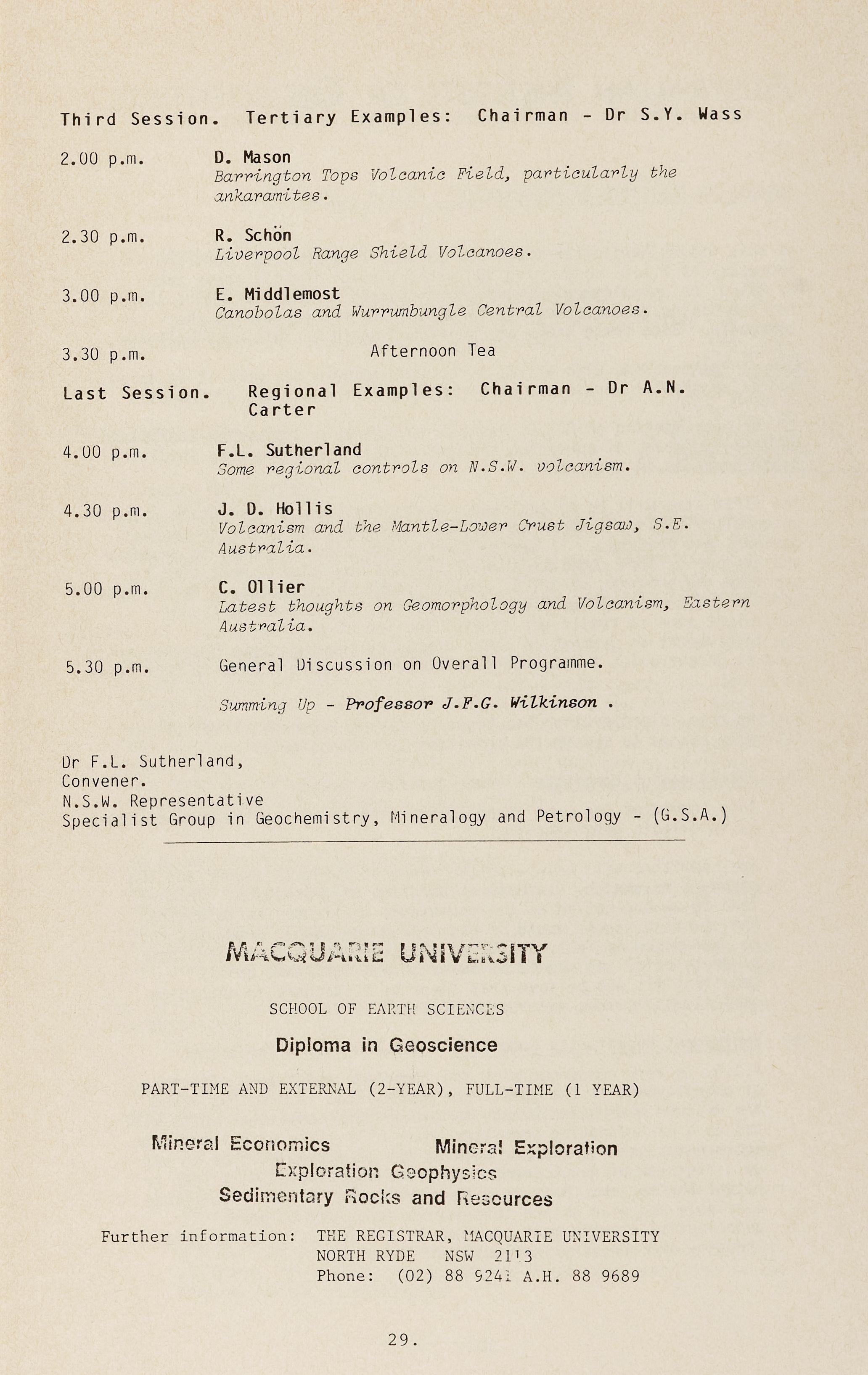
SYMPOSIUM ON VOLCANISM IN EASTERN AUSTRALIA WITH CASE HISTORIES FROM N.S.W.
This will be held on Monday 15 November 19 82 in the Hallstrom The a tr e , The Australian Museu m, 6- 8 College St. Sydney beginning at 9.00 a. m It is being sponsored joi ntly by the Mu seu m and G.S.A. The progra mm e i s set out below. _ The registration fees are $20 .00 for ,ne mbers, $30 .00 for non-members an d $10.00 for st udents. This includes lunch, morning and afternoon teas and an abstra cts volu me.
In conjunction with the Symposium, the Education Sub-commit tee is organising an excursion to Bomba Quarry on the South Coast near Kiama. It will take place on Sunday 14 November.
PROGRAMME
8 . 30 a. m. Re gistration (enter Mu seu m via Willia m Street).
9.00 a.m. Introduction. Dr Des Griffin, Di rector, The Australian Museum, and Dr F.L. Suth e rland, Convenor.
First Session. Palaeozoic Examples. Chairman - Emeritus Professor Alan Voisey
9.10 a.in. R.H. Flood, S.E. Shaw & G.H. Riley
The r> elati/Jnship bettJeen the Bindook Volcanic Comple:::, and the Ma"Y'lllan Batholith : Sr> ·isotope evi de nce ·
9.4 0 a. m.
10.10 a.in.
10.40 a. m.
11. 10 a. rn
E. Scheibner , L. M . Barro n & D. ~J . Suppel. The Mount Hope volcanic comple x and comagmat ic intr>usions •
S. Shaw, i R.H . Flood
Pe r> m·i an Volcanism associated with the Ne :J J,.,ngland Batholith
P. Carr
Per>m ian Shoshonitic Volcam:s-n , So uth e r> n Syd n ey Bas1'. 11. .
Morning Tea
Second Session. Mesozoic - Tertiary Examples. ChairmanDr R.A. Binns
11. 30 a. Ill
12 00 noon
12. 30 p. m.
1. 00 p. m.
B. Embleton , P W Sc hmi dt a nd D.A. Clar k Ceochr>onology and Palaeomag 1.etisrn of some It:pieou.s Hock Deposits of the Syd>iey lJ"J.sin. •
D. Martin
A laye r> ed intr>:A.s1:on fr>om t}ze Scone ar><d .i, 'f,Anter> Va.7, 7.ey •
O. French
Jajof' ~tement 'Yze n-:atr>y of the Al"i<.1l i11.e (;.'lnY! e. foh Cornple;r;
Lu nch , Rooftop Ca f et e ri a .
Third Session. Tertiary Examples: Chairman - Dr S.Y. Wass
2. 00 p.rn.
2.30 p.m.
3. 00 p.rn.
3.30 p.m.
Last Session.
4.00 p. m
4.30 p.m.
5.00 p.m.
5.30 p.m.
D. Mason
BaY'Y'ington Tops VoZcanic Field , pa r- ticular>ly the ankaY'arn-i tes
R. Schifo
Live r> pool Range Shield Volcanoes
E. Mi ddl emost
Canobolas and Wuy, y, umbungle Central Volcanoes
Afternoon Tea
Regional Examples: Chairman - Dr A.N. Carter
F.L. Sutherland
Some y,egfonal contY'ols on N . S ri ,y;lcanism .
J. D. Hollis
Volcani sm and the Mantle - Lower' Cr>ust Jigs01.J , S . E. AustMlia .
C. Ollier
Latest thoughts on GeomoY'phology and Volcanism , fuste r> n Aust r- alia
General lJiscussion on Ov e rall Programme.
Summing Up - Pr>ofessor J.F.G . Wilkinson
lJr F.L. Suth e rland, Convener.
N. S. W Representative Specialist Group in Geochemistry, Mineralogy and Petrology - ( G.S.A.)
SCHOO L OF EARTH SC I ENCES
Diploma in Geoscience
PART-TI ME AND EXTERNAL ( 2- YEAR ), FULL -TIME ( 1 YEAR)
Mir! e ral Eco n omics
Minc ra : E~plorafion
[>,pl ora ti on Ge cphys 1cs
Sedim en t.:i ry E ock s and Hescurces
Furt her i nforma t ion : THE REGISTRAR , t!ACQUARIE U~IVERS ITY
NORTH RYDE NSW 2 11 3
Ph on e : (02 ) 88 924~ A H. 88 9689