The Australian Geologist
NE \·1S1.ETTER OF THE GEOLOGICAL SOCIETY OF AUSTRALIA HICORPORATED
EDITORIAL
October 1980
The Editor's mail bag proves a sensitive index of prosperity in the profession. Full (& more) employment in the private sector means that geologists have little or no time to voice complaints, set out their ideas on matters of professional concern or even to write up their findings for an eagerly awaiting readership.
It probably also means that there are fewer members of the Society who read this journal while there are more important geological publications demanding study. However the proposed professional institute, shortly to be incorporated (see elsewhere in this issue) will have its own section of the newsletter, and its messqges will no doubt be read and will, at times, invoke some response.
The va lue of geological publications and particularly those from official sources is certainly not always appreciated by the general public as is exemplified by recent Canadian happenings. A member of the Canadian Parliament felt that the Government was wasting money publishing such items as 'Taxonomy of Upper JurassicLower Cretaceous microplankton from the Richardson Mountains, District of McKenzie, Canada', commenting that only 54 copies had been sold, while 165 were given away! This story was taken up (refined somewhat) by Readers Digest in its December 1979 issue.
As Graham Williams points out in Geolog this work has been of considerable value to the oil companies and asks 'how many experts does it take to make an oil discovery?' The companies apparently felt the author had something as he has now left government employ to work in industry. However the public needs to be made aware of the truth of such matters and only the geological profession can explain to the layman the value of such a publication.
It is specially important that in a boom period geologists do not speak only to each other. The public still doesn't really know what we do so we need to get our messages into the public sector. This requires time and effort, but the rewards are probably worth it.
"GRE ATCOATS OFF - GREATCOATS ON!"
Many of us have suffered the changing decisions of bureaucracy - military and otherwise. We are about to suffer again. Please cancel part of my notice in the last issue of "The Australian Geologist". True, we will be publishing the Journal every six months in future, and on the dates stated. But the powers in Canberra have just relented to the extent that we can now have only one vo lume per year instead of four, and we can divide each volume up into numbers (not parts! Why? I don't know; I just work here).
So our future schedule is:
30 September 1980: Vol. 27, nos. land 2 (all we have time for this year, unfortunately)
31 March, 1981: Vol. 28, nos. land 2
30 September, 1981: Vol. 28, nos. 3 and 4.
I fervently hope that this will be the last alteration i...u uuJ.. 1--'lau:::,,.
:~on Vernon Hon Editor.
BOYS OWN GEOLOGY
Publication of Tony Eggleton's Geode reminded Ian McLeod of Canberra of A. J. Boyd's Earth History for Boys: or Geology in Verse, published in Brisbane in 1889.
Ian adds:
"The stratigraphy and palaeontology is European oriented, except for an occasional recognition of Australian features such as that on p. 29; coal is portrayed as Carboniferous.
The doggerel goes on for 48 pages, of which Recent occupies 6, the Elements (mineralogy) take 5 and Rocks and Rock Structures (including mineral veins) take 8.
There is also a stratigraphic table (European), a glossary and several pages of sketches, of fossilsmostly the more spectacular vertebrates.
On reading the preface, I wonder whether the author's hapless pupils had to learn the whole epic off by heart!"
The book is dedicated to 'The Schoolboys of Queensland'. For your first lesson learn
'Igneous rocks are lowest downGranite, Sy'nite, Porph'ry brown; Gneiss comes next, then Mica-schist, Above these Clay slates,~you wist.'
PRICE-WISE
Prize for the neatest, nearest-to-correct answer goes to Geology & Geophysics of North-Eastern Australia available from Hon. Secretary, Qld. Division, ~eological Society of Australia Inc., GPO Box 1820, Brisbane 4001, can probably be yours for $18.50 (soft cover) $26.50 (hard) with postage thrown in. You might get it cheaper if you go to Brisbane. This is believed to be the final attempt to establish the price - most variations apparently being affected by postage rates.
Try a little porphyry with your pudding-stone
John Cramsie (N.S.W. Dept. of Mineral Resources) is looking forward to culinary delights on future field trips. The careers guide published by the illustrious Sydney Morning Herald (Aug. 5, 1980) suggests the course of study and minimum period of training for a (real) ' geologist is the Food Technology Course at several technical colleges (4 yrs part-time or 1 year full-time, two years part-time)
John wonders if thi,s is an attempt to solve the supply/ demand situation for geologists and hopes we will have an influx of French Cooks to fill the gap. Although they might be able to handle the bread and butter aspects of geology they won't find every problem a piece of cake.
There is however some hope for us. Applied geologists can be supplied by Uni. of N. S. W. the guide tells us.
AUSTRALIAN IGCP CORRESPONDENT:
For project 61, Holocene sea-level changes, E. D. Gill is now replaced by:
Professor D. Hopley, Department of Geography, James Cook University of North Queensland P.O. James Cook, Townsville Qld 4811.
4
PROJECT TO COMBAT EARTHQUAKE RISKS IN BALKANS GETS UNDER WAY
The recent catastrophic earthquake in the Republic of Montenegra, Yugoslavia, resulted in damage estimated at several billions of U.S. dollars, accompanied by the complete breakdown of most economic activities for a significant period of time. This earthquake has shown that seismic hazard plays one of the most important roles in the development of the countries concerned, and if not appropriately taken account of in the planning, design and construction could create even more serious impacts on the national economy in the future.
In the light of the fact that the many stron~ and destructive earthquakes have taken and will undoubtedly take place in the Balkans, due attention should be paid to research related to seismic zones in which no dramatic events were recorded in the last 30-50 years, but their occurrence in the near future is very probable. In these zones particular attention should be paid to earthquake risk reduction, especially with regard to existing buildings and constructions.
A $1,500,000, three-year project to reduce loss of life and damage from earthquakes in the Balkan region began in mid-September with the meeting of a five-country co-ordination committee in Istanbul, Turkey. The countries involved are Bulgaria, Greece, Romania, Turkey and Yugoslavia.
The project, financed by the United Nations Development Programme (UNDP) and executed by the United Nations Educational, Scientific and Cultural Organization (Unesco), will assist governments in establishing a regional network of seismic observation stations linked by a computerized communication system for rapid data transmission and analysis. In addition, it is designed to encourage regional co-operation in research and training in the fields of seismology and earthquake engineering, and to help develop the basis for physical planning and building in order to reduce damage from future earthquakes.
The new project is designed as a regional project to satisfy simultaneously the long-term needs of the whole region and the immediate needs of the S.R. of Montenegro, whose economic development has been drastically set back by the recent catastrophic earthquake.
In the new project, initial activities will be concentrated in Montenegro during the first year, but will be largely decentralized afterwards. Due to the wide scope of the project, each participating institution will have the opportunity to take the leadership in a specific field, according to its degree of expertise, for the benefit of the whole network of institutions. A coordinating committee, assisted by a c hief technical adv iser and international consultants, when required, will ensure the smooth distribution and supervision of the project activities among the participating institutions.
Recognizing that achievement of the long-term objectives will require more time and considerably ~ore funds, both national and international, the project seeks to accomplish a number of more limited immediate objectives by the end of 1982. These concern the evaluation of seismic hazards, assessment of the vulnerability of structures, methodology of applying seismic risk criteria to physical planning and building, earthquake-resistant design methods, education and public information for disaster preparedness, research on earthquake prediction and improvement in equipment for monitoring, recording and processing earthquake data in the participating countries.
Co-operation in the field of seismology in the Balkan region has been promoted by Unesco for a long time. With UNDP financing, a survey of seismicity in the region was undertaken from 1970 to 1976, involving the same five countries. Albania also participated in some of the activities. This project strengthened and improved the existing national networks of seismological stations and prepared seismic hazard maps on a regional scale.
Even before that, however, following the catastrophic earthquake in Skopje in 1963, a UNDP project helped establish the Institute of Seismology and Earthquake Engineering in that city. Similarly, following the 1977 earthquake in Vrancea, assistance was given to Romania in the form of $800,000 worth of equipment from the National Centre of Earthquake Engineering and the national seismological network.
In 1979, the disastrous earthquake which hit Montenegro led to a demand for immediate aid followed by urgent measures to enable re-building to take place in such a way as to reduce risks from future tremors to a minimum. Unesco Director-General Amadou Mahtar M'Bow visited the damaged areas and sent three experts to Montenegro to make recommendations for the safe reconstruction of the country. Later the Unesco Executive Board asked the Director-General to examine, in consultation with the member states concerned, the possibility of creating a regional network of seismic observations stations and the present project is a step forward toward this end.
Unesco points out the national character of the project:
1. Operational projects, benefiting from Unesco assistance,are national projects and it is up to the beneficiary countries to assume responsibility for directing the project as well as ensuring its proper implementation.
2. The national authorities will also be responsible for the utilization of equipment including supplies and ve hicles, as far as the activities defined in the project document are concerned.
(continued on bottom of page 12)
INTERNATIONAL SEMINAR ON LATERITISATION PROCESSES
This meeting, the first major activity of the IGCP Project 129 Laterites and Lateritisation Processes,was held in Trivandrum, in southern India, on llth-14th December 1979. Trivandrum is the capital of the state of Kerala, where laterite was first described and named by Francis Buchanan in 1800. The seminar was attended by some 230 delegates, about 60 being from outside India (including 7 Australians but no U.S. representatives!) There were 45 papers - with a further 75 papers available as abstracts only. Many papers dealt with largely descriptive aspects of various lateritic deposits (especially bauxites), with, perhaps, rather too much emphasis and reliance on depth functions, often of only one or two profilesthere being a tendency to present these as the goal of geochemical investigations, rather than just the beginning.
There were a number of most interesting papers on topics as diverse as nomenclature, micromorphology, mineralogy, geochemistry, distribution, genesis, lateritic mineral deposits, analysis, mineral exploration in lateritic terrain and agriculture. Some particularly interesting papers included those by Melfi, Trescases and de Oliveira (Nickeliferous laterites in Brazil), Schmidt-Lorenz (Lateritization alias plinthitization, a main process in soil formation), Chukrov (On transformation of iron oxides in chemogenic eluvium) and Aleva (Bauxitic and other duricrusts on the Guyana Shield). It is hoped to publish the Proceedings by the end of 1980.
The thorny topic of nomenclature was largely evaded in the formal sessions; those who arrived with clea-r convictions as to what 'lateri tes' are remained unmoved and the rest became, if anything, more confused. However, a small working group was formed, led by Dr. w. Schellman (Federal Geosciences Institute, Hanover) in an attempt to propose some acceptable definitions. Dr. Schellman's own definition is, approximately "Laterites are rocks that are products of intense subaerial weathering, the Fe- and/or Al-contents of which are greater than in merely kaolinized parent rocks. They consist predominantly of kaolinite, goethite, hematite, gibbsite and quartz : "
There were three excursions associated with the seminar. All were excellently organized and participants found them both enjoyable and interesting. The pre-session excursions visited (1) bauxites and nickel laterites on the east coast, including Galiconda and Sukinda, and (2) laterites and bauxites in Tamil Nadu, at altitudes ranging from 30m near Madras to over 2200m in the Western Ghats. In the latter, the
bauxite s are preserved as cappings on precipitously sided hills, approached by somewhat nerve-racking roads. It was demonstrated that Indian drivers, aided by small shrines and incense burning on the d~shboard and a hand constantly on the horn, can j udge distances to the nearest millimetre, even at midnight when confronted by buses or trucks on hairpin bends with torrential rain, l andslips and visibility of less t han l0m adding to the problems!
The post-session excursion ' visited t he l ow- l evel laterites of Kerala, including the type area of Angadipuram. Here, the Geological Survey o f India have erected a national Geological Monument for Laterite, the opening ceremony of which was attended by participants on the excursion.
It was unfortunate that there could not have been greater Australian participation at the meeting, for on many topics, Australian experience has great relevance to problems caused by laterites in many countries of the Third World. Australia is, after all, one of the few 'developed' countries where lateritic terrains are extensive.
The next Seminar is to be held i~ Sao Paulo, Brazil, in 1981.
C. R. M. Butt
Australian Correspondent: IGCP Project 129.
ABSTRACTS OF UNPUBLISHED THESES
The Federal Executive has recently deci de d against publishing the prop o sed G.S.A. compi l a tion of theses' abstracts. This service {s covered by the "AESIS Quarterly" published by the Austra l ian Mineral ,Foundation in Adelaide and all Society members are encouraged to make full use of the AESIS facilities.
AESIS (Australian Earth Sciences Information Service) was developed by the A.M.F., with the cooperation of the B.M.R., state Geol o g i cal Surveys and many other organisations, to cover a l l Australian-generated published and unpubl i shed material over the full range of earth sciences.
Earth Science workers and organisations in Australia are encouraged to register all mater i al with AESIS. For unpublished works (such as theses ) this may be done on the "Data Transmission Sheets" a copy of which is enclosed with each quarterly issue. AESIS is also available for retrospective computer searches through the A.M.F.
For further information contact: Manager, Information Services, Australian Mineral Foundation, ' P.O. Box 97, GLENSIDE ~ South Australia 5065.
Telephone: Adelaide (08) 79 7821
Telex: AA82520
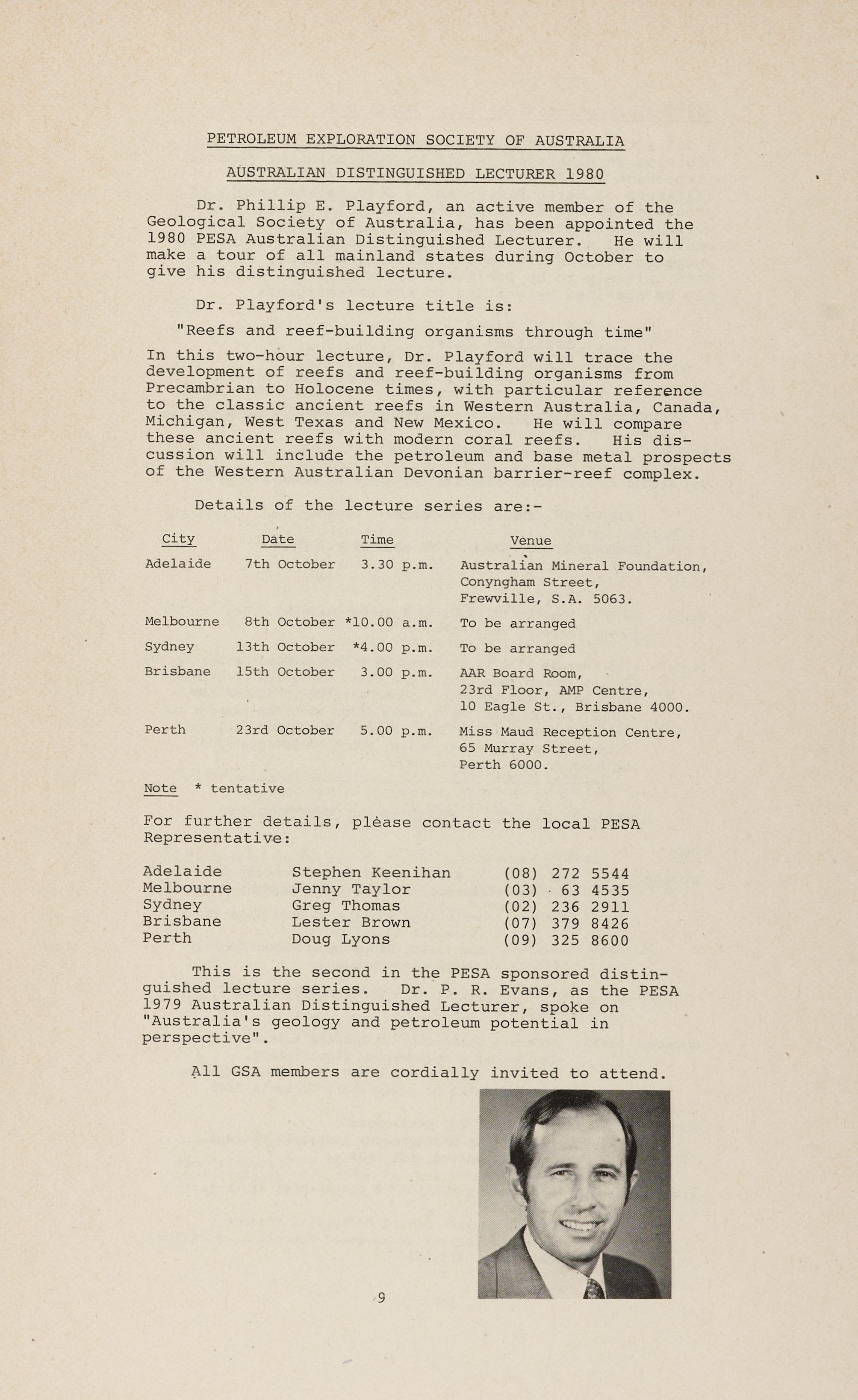
PETROLEUM EXPLORATION SOCIETY OF AUSTRALIA
AUSTRALIAN DISTINGUISHED LECTURER 1980
Dr. Phillip E. Playford, an active member of the Geological Society of Australia, has been appointed the 1980 PESA Australian Distinguished Lecturer. He will make a tour of all mainland states during October to give his distinguished lecture.
Dr. Playford's lecture title is:
"Reefs and reef-building organisms through time"
In this two-hour lecture, Dr. Playford will trace the development of reefs and reef-building organisms from Precambrian to Holocene times, with particular reference to the classic ancient reefs in Western Australia, Canada, Michigan, West Texas and New Mexico. He will compare these ancient reefs with modern coral reefs. His discussion will include the petroleum and base metal prospects of the Western Australian Devonian barrier-reef complex.
Details of the lecture series are:-
City Date
Adelaide 7th October
Melbourne 8th October
Sydney 13th October
Brisbane 15th October
Perth 23rd October
Note * tentative
Venue
Australian Mineral Foundation, Conyngham Street, Frewville, S.A. 5063.
To be arranged
To be arranged
AAR Board Room, 23rd Floor, AMP Centre, 10 Eagle St., Brisbane 4000.
Miss Maud Reception Centre, 65 Murray Street, Perth 6000.
For further details, please contact the local PESA Representative:
Adelaide Melbourne
Sydney
Brisbane
Perth
Stephen Keenihan
Jenny Taylor
Greg Thomas
Lester Brown
Doug Lyons (08) (03) (02) (07) (09)
272 5544
63 4535
236 2911
379 8426
325 8600
This is the second in the PESA sponsored distinguished lecture series. Dr. P. R. Evans, as the PESA 1979 Australian Distinguished Lecturer, spoke on "Australia's geology and petroleum potential in perspective".
~11 GSA members are cordially invited to attend.
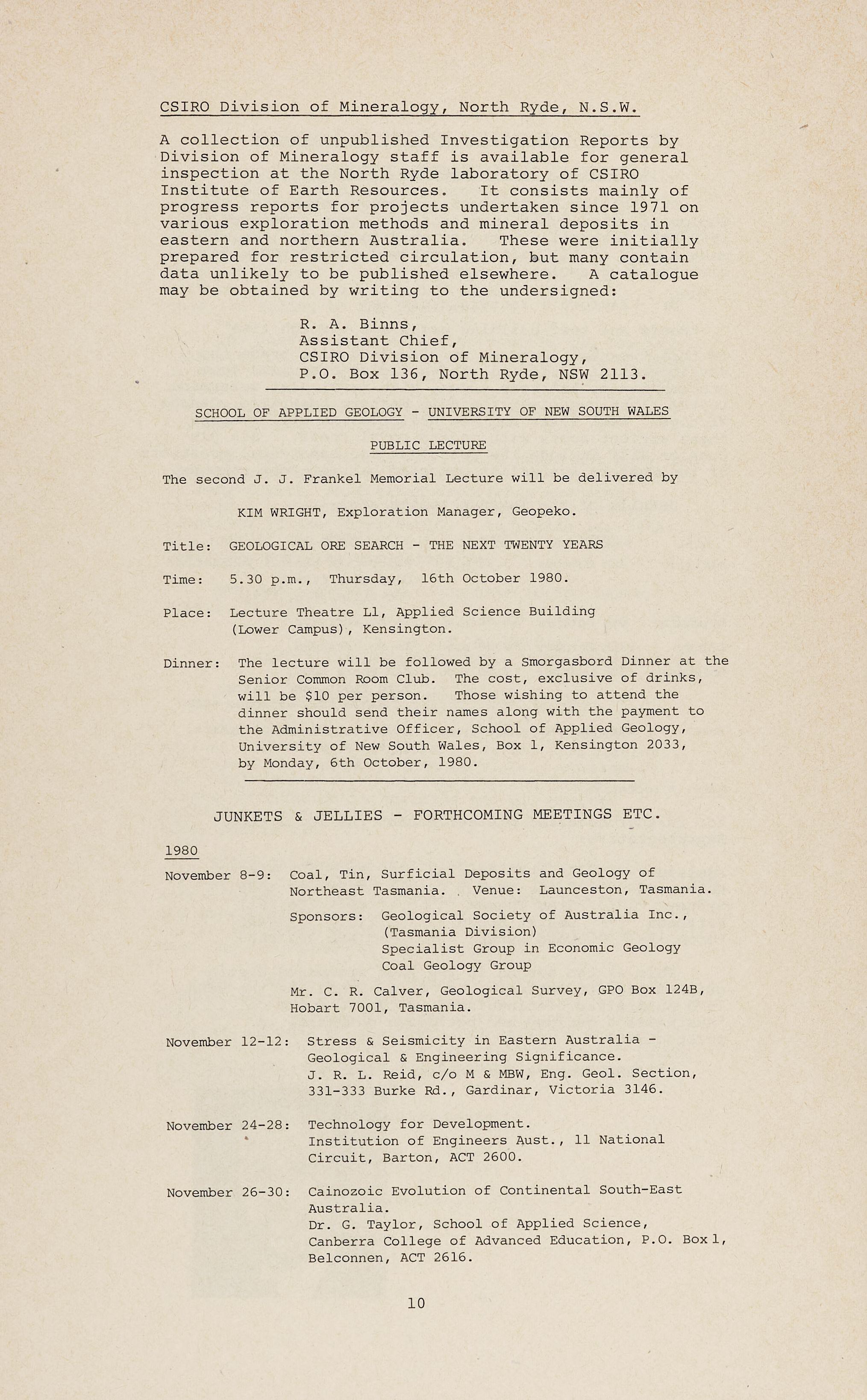
CSIRO Division of Mineralogy, North Ryde, N.S.W.
A collection of unpublished Investigation Reports by Division of Mineralogy staff is available for general inspection at the North Ryde laboratory of CSIRO Institute of Earth Resources. ·rt consists mainly of progress reports for projects undertaken since 1971 on various exploration methods and mineral deposits in eastern and northern Australia. These were initially prepared for restricted circulation, but many contain data unlikely to be published elsewhere. A catalogue may be obtained by writing to the undersigned:
R. A. Binns, Assistant Chief, CSIRO Division of Mineralogy, P.O. Box 136, North Ryde, NS~ 2113.
SCHOOL OF APPLIED GEOLOGY - UNIVERSITY OF NEW SOUTH WALES
PUBLIC LECTURE
The second J. J. Frankel Memorial Lecture will be delivered by
KIM WRIGHT, Exploration Manager, Geopeko.
Title: GEOLOGICAL ORE SEARCH - THE NEXT TWENTY YEARS
Time: 5. 30 p.m., Thursday, 16th October 1980.
Place: Lecture Theatre Ll, Applied Science Building (Lower Campus), Kensington.
Dinner: The lecture will be followed by a Smorgasbord Dinner at the Senior Common Room Club. The cost, exclusive of drinks,
1980 will be $10 per person. Those wishing to attend the dinner should send their names along with the payment to the Administrative Officer, School of Applied Geology, University of New South Wales, Box 1, Kensington 2033, by Monday, 6th October, 1980.
JUNKETS & JELLIES - FORTHCOMING MEETINGS ETC.
November 8-9: Coal, Tin, Surficial Deposits and Geology of Northeast Tasmania. Venue: Launceston, Tasmania.
Sponsors: Geological Society of Australia Inc. , (Tasmania Division) Specialist Group in Economic Geology Coal Geology Group
Mr. C. R. Calver, Geological Survey, .GPO Box 124B, Hobart 7001, Tasmania.
November 12-12: Stress & Seismicity in Eastern AustraliaGeological & Engineering Significance. J. R. L. Reid, c/o M & MBW, Eng. Geol. Section, 331-333 Burke Rd., Gardinar, Victoria 3146.
November 24-28: Technology for Development. Institution of Engineers Aust., 11 National Circuit, Barton, ACT 2600.
November 26-30: Cainozoic Evolution of Continental South-East Australia.
Dr. G. Taylor, School of Applied Science, Canberra College of Advanced Education, P. 0. Box 1, Belconnen, ACT 2616.
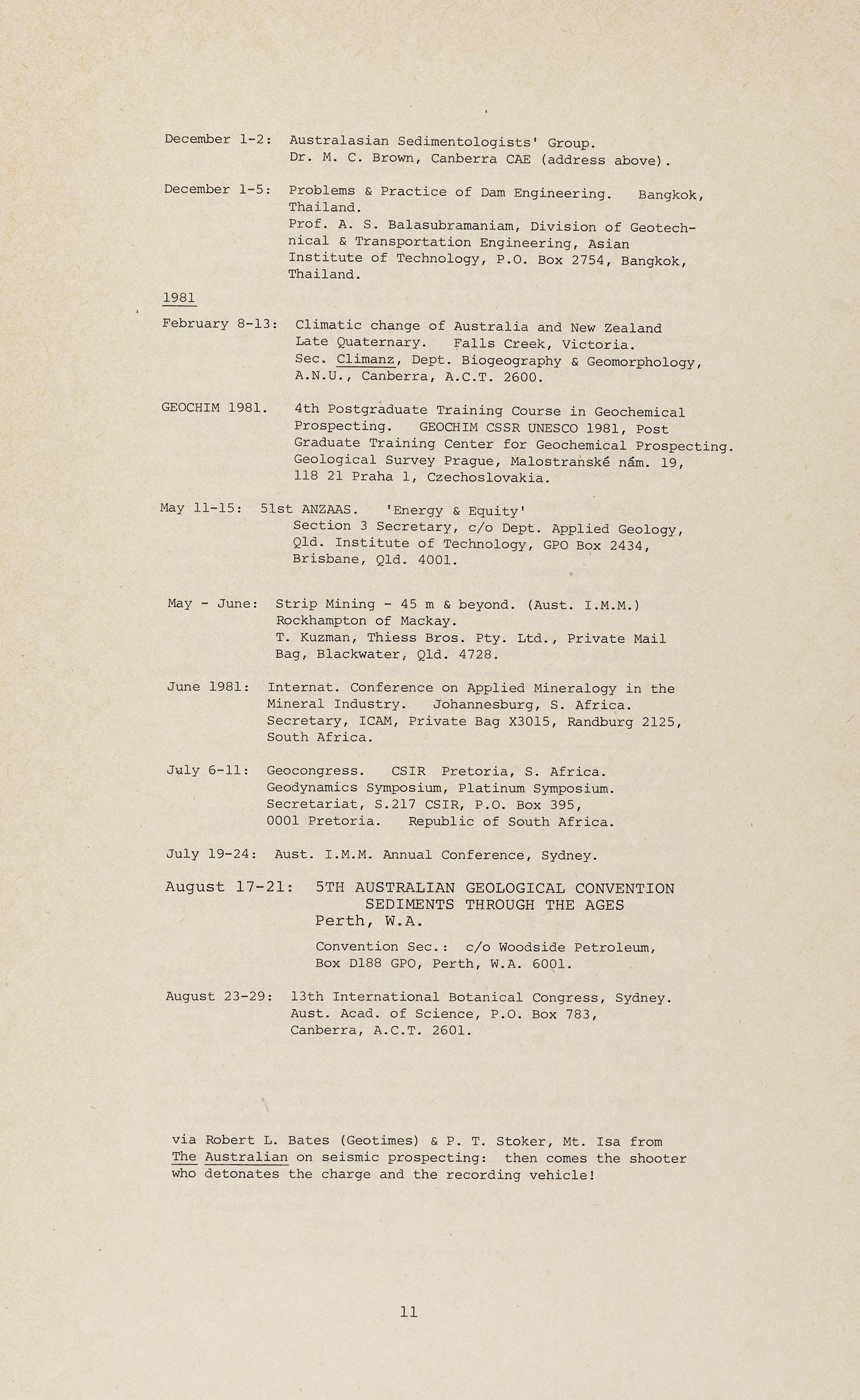
December 1-2: Australasian Sedimentologists ' Group. Dr. M. C Brown , Canberra CAE (address above)
December 1-5: Problems & Practice of Dam Engineering. Bangkok , 1981 Thailand
Prof A. S. Ba l a subramaniam , Division of Geotechnical & Transportation Engineer i ng , Asian Institut e of Technology , P O. Box 2754 , Bangkok , Thailand
February 8 - 13 : Cl imat i c change of Australia and New Zea l a n d
GEOCHIM 1981. Late Quaternary fa ll s Creek , Victoria Sec. Climanz , Dept Biogeography & Geomorpho l ogy , A.N U. , Canberra , A.C T. 2600
4th Postgraduate Training Course in Geochemi cal Prospecting. GEOCHIM CSSR UNESCO 1 981 , Po st Graduate Training Center for Geochemi cal Prospect i ng. Geological Su rvey Pra gue , Mal o s transke nam. 19 , 118 21 Praha 1 , Czechoslovakia.
May 11- 15: 51st ANZMS . ' Energy & Equity ' Secti on 3 Secretary , c/o Dept Appl ied Geo l ogy, Qld Institute of Technology , GPO Box 2434 , Brisbane, Qld 4001.
May - June: Strip Mi ning - 45 m & beyond. (Aust. I .M.M ) Rockhampton of Mackay T. Kuzman , Thiess Bros Pty. Ltd ., Private Mai l Bag , Bl ackwater, Ql d 4728.
June 1981: Internat. Conference on Appl i ed Mineralogy in the Mineral Industry Johannesburg , S Africa Secretary , ICAM , Pr i vate Bag X3015, Randburg 2125, South Afr i ca
J\lly 6 - 11: Geocongress CSIR Preto r ia, S. Africa. Geodynami cs Symposi um, P l atinum Symposium. Secretariat, S 217 CSIR , P.O Box 395 , 0001 Pr etoria. Republic of South Africa .
July 1 9- 24: Aust. I.M.M. Annua l Conference , Sydney.
Au g ust 1 7- 21 : 5TH AU STRALI AN GE OLOGICAL CONVENTION SEDI MEN TS THROUGH THE AGE S Perth, W.A.
Convention Sec.: c/o Woodside Petroleum, Box Dl88 GPO , Perth , W.A 6001.
August 23 - 29: 13th International Bo tanical Congress, Sydney. Aust Acad. of Sc i ence , P.O Box 783 , Canberra, A.C.T 2601.
via Robert L Bates (Geotimes) & P T St oker, Mt Isa from The Australian on s eismic prospecting: then comes the shooter who detonates the charge and the recording vehicle!
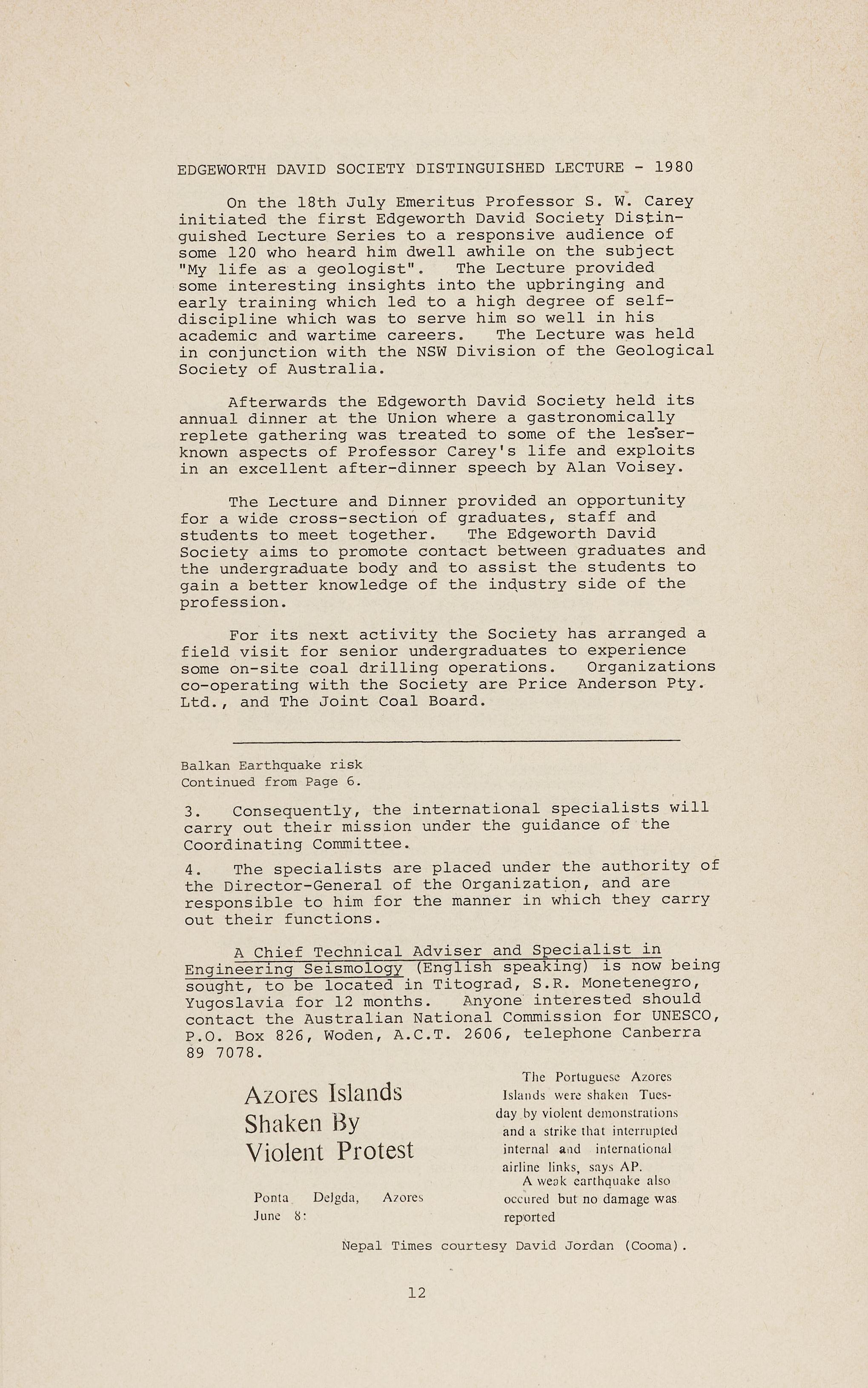
EDGEWORTH DAVID SOCIETY DISTINGUISHED LECTURE - 1980
On the 18th July Emeritus Professor S. w: Carey initiated the first Edgeworth David Society Distinguished Lecture Series to a responsive audience of some 120 who heard him dwell awhile on the subject "My life as a geologist". The Lecture provided some interesting insights into the upbringing and early training which led to a high degree of selfdiscipline which was to serve him so well in his academic and wartime careers. The Lecture was held in conjunction with the NSW Division of the G~ological Society of Australia.
Afterwards the Edgeworth David Society held its annual dinner at the Union where a gastronomically replete gathering was treated to some of the lesserknown aspects of Professor Carey's life and exploits in an excellent after-dinner speech by Alan Voisey.
The Lecture and Dinner provided an opportunity for a wide cross-section of graduates, staff and students to meet together. The Edgeworth David Society aims to promote contact between graduates and the undergrailuate body and to assist the students to gain a better knowledge of the in~ustry side of the profession.
For its next activity the Society has arranged a field visit for senior undergraduates to experience some on-site coal drilling operations. Organizations co-operating with the Society are Price Anderson Pty Ltd., and The Joint Coal Board.
Balkan Earthquake risk
Cont inued from Page 6
3. Consequentl y , the international specialists will carry out their mission under the guidance of the Coordinating Committee.
4. The specialists are placed under the authority of the Director-General of the Organization, and are responsible to him for the manner in which the y carry out their functions.
A Chief Technical Adviser and Specialist in Engineering Seismology (English speaking) is now being sought, to be located in Titograd, S.R. Monetenegro, Yugosla v ia for 12 months. Anyon~ interested should contact the Australian National Commission for UNESCO, P.O. Box 826, Woden, A.C.T. 2606, telephon e Canberra 89 7078.
Azores Islands Shaken By Violent Protest
Pont a D elgda , Azo re, June 8:
The Portuguese Azores Isla nd s were shaken Tuesday by vioknt demo nstration s and a strik e that interrupted int ernal a ,1d int ernat io nal airline link s, says AP. A weok earthquake also oce ured but no damage was repmted
Nepal Times courtesy David Jordan (Cooma).
LAMONT YOUNG
CENTENARY
On October 10th 1880, Lamont Young, a geologist with the N.S.W. Department of Mines, his · field ass i stant Max Schneider and three Bermagui locals, Messrs Casey, Towers and Lloyd, disappeared under mysterious circumstances. A small boat in whi ch they were known to be tr11velling was found holed on the beach in a small cove, now known as Mystery Bay, south of Na r o oma. Despite extensive investigations their disappearance has never been satisfactorily explained but the evidence would suggest foul play.
To commemorate the disappearance it is proposed to st a ge a "centenary we ekend" on the 11 th and '12th October this ye a r, in the Narooma a rea. At this late stDge the "weekend" will be a low key a ff a ir i nvolving a b a rbecue (or cold meat8 if fire ba ns are on) on :::aturday night (11th ) fl t, or neflr, Mystery Bc1 y. Contact Lindsay Gilliga n ( N S .14. Geolo e-ical Survey 240 4196) if anyone wa nts a plensant weekend a way down the South Coast.
AUSTRALIAN GEOMECHANICS SOCIETY - VICTORIA GROUP
GEOLOGICAL SOCIETY OF AUSTRALIA - VICTORIA DIVISION/ENG GEOL SP GRP)
SEMINAR on STRESS AND SEISMICITY IN EASTERN AUSTRALIA - GEOLOGICAL AND ENGINEERING SIGNIFICANCE.
WEDNESDAY, 1 2 NOVEMBER 198 0 , at Clunies Ross House, 191 Royal Pde., Parkville , 10.3- a.m - 6 00 p m.
COST: Member of LE.Aust., Aus.I.M.M. , A.G.S., or G. S .A. - $30 Non - members - $35 (lunch and refreshment are in c luded)
The seminar will be divided into 3 sessions to provide an outline of Quaternary and Recent stress and seismicity in Eastern Australia , a rev iew of the effects of stress and seismici ty on engineering structures and a floor discussion on the requirements a nd recommendations. The seminar will be addressed by a number of eminent speakers in the field and Professor D. Stapledon will prov i d e a c oncluding summary. Further details may be obtained from the Secretary , Institution of Engineers, Australia, Victoria Division, 191 Roy al Parade, Parkville, Vic tori a 305 2 Te lephon e : (0 3 ) 34 7-1088
OBITUARY - OWEN ARTHUR JONES
Owen Arthur Jones, former Reader in Geology at the University of Queensland, died on July 21, 1980. Owen Jones graduated with Honours in Geology from the same university in 1926 . His early geological interests were in Palaeozoic corals, which he studied at Cambridge University. In the 1930's he worked on his own account as a consultant, mainly on economic mineral deposits, but kept in contact with the University of Queensland, and in the early 1940's he joined the Staff of the Geology Department and for a time taught palaeontology. Shortly before Professor Richards' death in 1947, Owen Jones took over the teaching of economic geology, which he continued until his retirement in 1969. About the beginning of this period Dr. Jones was awarded the D.Sc. degree for his studies of ore genesis in Queensland.
Dr. Jones followed his father's interests in the sea, and in taking an active part in the Great Barrier Reef Committee - he was Treasurer 1942-55 and Chairman 1956-67. During this time he spent much time and effort in furthering the development of the Heron Island Research Station, for which he was instrumental in obtaining a substantial Rockefeller Grant.
Another interest which took up Dr. Jones' time was the University of Queensland Seismological Station, of which he was Director for many years, taking over from Professor Bryan in 1953.
During this latter period Dr. Jones took a keen interest in regional and local geology, producing 'The Geological History of Queensland, a Stratigraphical Outline', and a series of papers on Brisbane geology with Professor Bryan.
His interest in the Department of Geology and Mineralogy and in the Great Barrier Reef did not wane after his retirement and he remained a firm friend of both staff and students. He will probably be best known internationally for the four volumes on Barrier Reef Biology and Geology which he edited with Robert Endean, during the later years of his retirement.
(N. C. Stevens)
OBITUARY - ANNIE VERA MATTERS
Mis s Matters will be remembered by many of the more senior members of the geological profession, particularly those from New South Wales.
For thirty years (1929-1959) she served as ClerkLibrarian in the Geological Survey of New South Wales. In this position, for practically the whole period, she alone performed all the typing, library and clerical duties for the Survey.
As a dedicated public servant she was at all times helpful, gracious and diplomatic. Her attributes are well remembered by those who had the honour of working with her. At the age of eighteen she commenced work in the Department of Public Health on 13th October 1915, and then after two year s she transferred to the Forestry Commission where she spent 12 years· before joining the Geological Survey.
After her retirement in April 1959 she lived a healthy, full and happy life at Avalon where she devoted herself to her garden and its numerous bird population, the Red Cross and her friends and relatives.
She died on 26th August 1980 after a very brief illness.
(C. L. Adamson )