Two editorial commentaries in the January issue of Geotirnes prompt me to write about education for this my penultimate page. Reporting on the Geological Society of America Presidential address, Robert Haney notes that irrespective of the size and develo~rnent of a country there is one geologist for every $50 mill. of GNP, and that the require- ment for geologists increases in proportion to the total economic production; even when the mineral sector is static the demand in industrial and service sectors grows along with production. Australia's GDP is $163,857 mill. so there should be some 3300 geologists at work; since there are 3000 members of the GSA and an estimated 7000( !) geologists in Australia we would appea r to be oversupplied.
Two important and conflicting statements on education appeared in the Weekend Australian newspaper (April 14-15). A report by the former Minister for Education, Mr. Kirn Beazley, recommended (inter alia) the ending of "the excessive influ ence of universities on schools" while the Minister for Science and Technology, Mr. Barry Jones, in presenting his strategy for the development of hi - technology, advocates "a doubling of the ratio of students entering tertiary education by 1995". How will these extra students cope when there is this trend towards less preparation fo r tertiary study in the high schools, and how will the tertiary institutions cope when the Minister for Education, Senator Susan Ryan, has threatened that there will be no increase in resources?
The National Research Council (USA) has recently stressed the 'relevance and basic importance of teaching earth-science subjects to children, through secondary school' (Geotirnes, 1984 Jan. p.17). The Academy's 'Persp ectives in Earth Science' will help at high-school level but what is being done about teaching our basic science at lower secondary levels?
In the USA it "takes at least 5 years o f und erg raduat e and graduate school to prepare most geo-scientists for their first job" (Haney -G eo tirn es , 1984 Jan. p .7). The customary Australian 3 or 4 yea rs training co mmonl y without graduate studies , is woefully inad e quat e. Moreover, to prepare for a hi - tech. more indtistrially - or i ented f uture we should Look to some change in e mphasis towards Engineering and Computer Geol o gy . Since most teaching institutions are stretched to the limit b y economic constraints, the most eff ici e nt way to achieve g reat er flexibility is to build up differ e nt specialist courses in the di ffe rent institutions and to enco urage mor e student mobility for post - grad u ate training.
Our universiti es should play a major role not only in training professional and res ea rch geoscientists for the future, but also in promulgating pure and applied research. Since the GSA has as its principal object 'th e advancement of geological science' the health
continued Page 4
Newsletter No.49
The Australian Geologist
EDITORIAL
Too many, Too much?
21 May, 1984.
The President's page poses the question - are there too many geologists in Australia? Elsewhere in this issue the W.A. Division gives us a fascinating profile of how the qualifications of its geologists have changed in the past forty years, and we can note particularly the virtual demise of the Ph.D.
It might be argued that government policies on post - graduate education, particularly the below-the-poverty line living allowances they must endure, have forced potential post-graduate students to work with basic qualifications and it is now too late to retrieve the situation. I believe this is an important factor in the pattern shown in the graphs.
Firms have of course always carried out on-the-job training but I suspect we may be moving into quite a new field of education. Some of the large mining and exploration firms have now established research organizations which are undertaking very sophisticated programmes of a type which were formerly the province of Universities and governmental bodies and many company geologists gain high quality training in this way. This seems to have happened quietly in the last ten years or so, and is perhaps a reflection of dissatisfaction with the direction the Universities have taken as well as a result of economic circumstances.
The March issue of Episodes carries an interesting article on Geological education in the USSR where there are now nearly 200 000 trained geoscientists approximately half being geologists, the other half geological technicians. About 6000 geologists graduate each year from more than 50 colleges after a five year course.
There are some 7000 doctorates in geology in Russia, 300 new ones being added each year. So it seems that 1 in 20 or 5% continue on to higher degree work. I suspect the figure is similar in the United States. Our pattern seems to be very different.
If the WA figures are valid for the whole country should students still be encouraged to undertake higher degrees?
What is a Ph.D. worth?
What does it cost?
The forthcoming 7th Geological Convention has as part of its programme workshops and short courses on a variety of subjects. These appear to be popular and no doubt offer the chance for geologists to get up-to-date on various topics. This type of continuing education deserves success and I believe will become an integral part of future conventions.
Well do we have too many geologists in Australia? If many can't get work in this field the answer might have to be yes, and the trend in grade of qualification may be giving the same answer. However if the demand for specialists has been filled the need for basic general geological education within society as a whole is still urgent. Perhaps that's where our attention in education needs to be directed in the coming years. I can only echo the report of the Board on Earth Sciences (U.S. Natnl. Academy of Sciences) 'If society is to benefit fully from the potential of geoscience, the concepts should be included in the general education of our citizens during elementary - and secondary - school years'.
This ideal contrasts with the U.S. reality - potential earthscience teachers at college in 1971 were 2569, in 1980 536 and in 1982 350. This is the depressing pattern which we can match. There is clearly much work for our education committees to do.
President's Page (from page 2).
of the universities and the leadership provided by them is of vital concern. It is interesting to look at the subject coverage of the 24 teaching professors: Economic Geol. -5, Petrology - 5, Geochem. -2, Geophys.-3, Palaeo.-3, Sediment.-2, Engineering, Structure, Hydrology and Coal Geology one each. Two are vacant at present. There is clearly an unbalanced coverage, and the over-emphasis on petrologygeochemistry is increased if the professors of the RSES at ANU are included. In spite of the plate-tectonic revolution, there are none in Geodynamics or Tectonics and none in Computer Geol., Petroleum Geol., or Mineralogy! With regard to leadership, several professors play leading roles in the GSA or geoscience generally and publish inspiring and important research, others unfortunately make little impact. Selection procedures are clearly at fault and an improvement might be effected if those in a position to do so insisted on a higher proportion of geoscientists on appointment committees.
Some of the larger universities have only one Chair, and most have suffered from the loss of junior and technical staff, and the uncertainties of temporary appointment. These and other factors have created heavy teaching and administrative loads that leave little time for research. Furthermore, without financial support from industry, especially for equipment, the universities' proper research function would collapse. Only urgent government action can remedy this situation and allow the universities to play a leading role in preparing the nation for the 21st century.
To conclude, I would like to thank the Tasmanian, Victoria, South Australian and Western Australian Divisions for receiving me so well on my recent visits; our discussions indicate that the Council meeting in August will be lively and productive.
M.J. Rickard.
"After more than two decades of rewritten theses, rejected scientific manuscripts, unsuccessful job applications and retrospective salary cuts; times when fellow geologists turned a deaf ear when I spoke, a blind eye when I pointed, washed themselves when I touched them; through all such adversities indeed I did not lose faith: I knew that some day I would be recognized, that one day Society would mete out my just rewards".
Dr K J Kemezys Curtin A.C.T.
(Winner of the $100 prize in the poster competition to attract new members to the Geological Society).
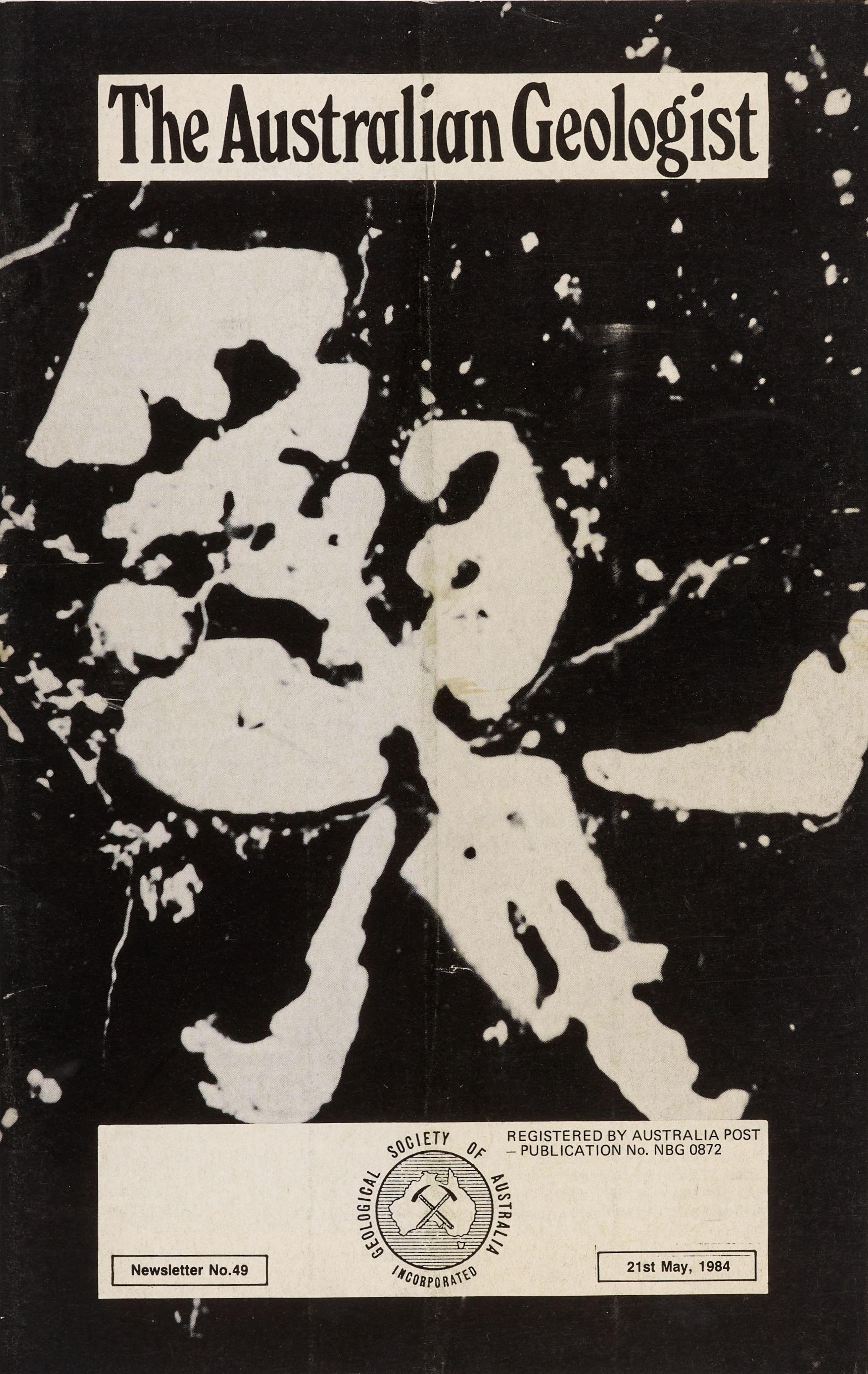
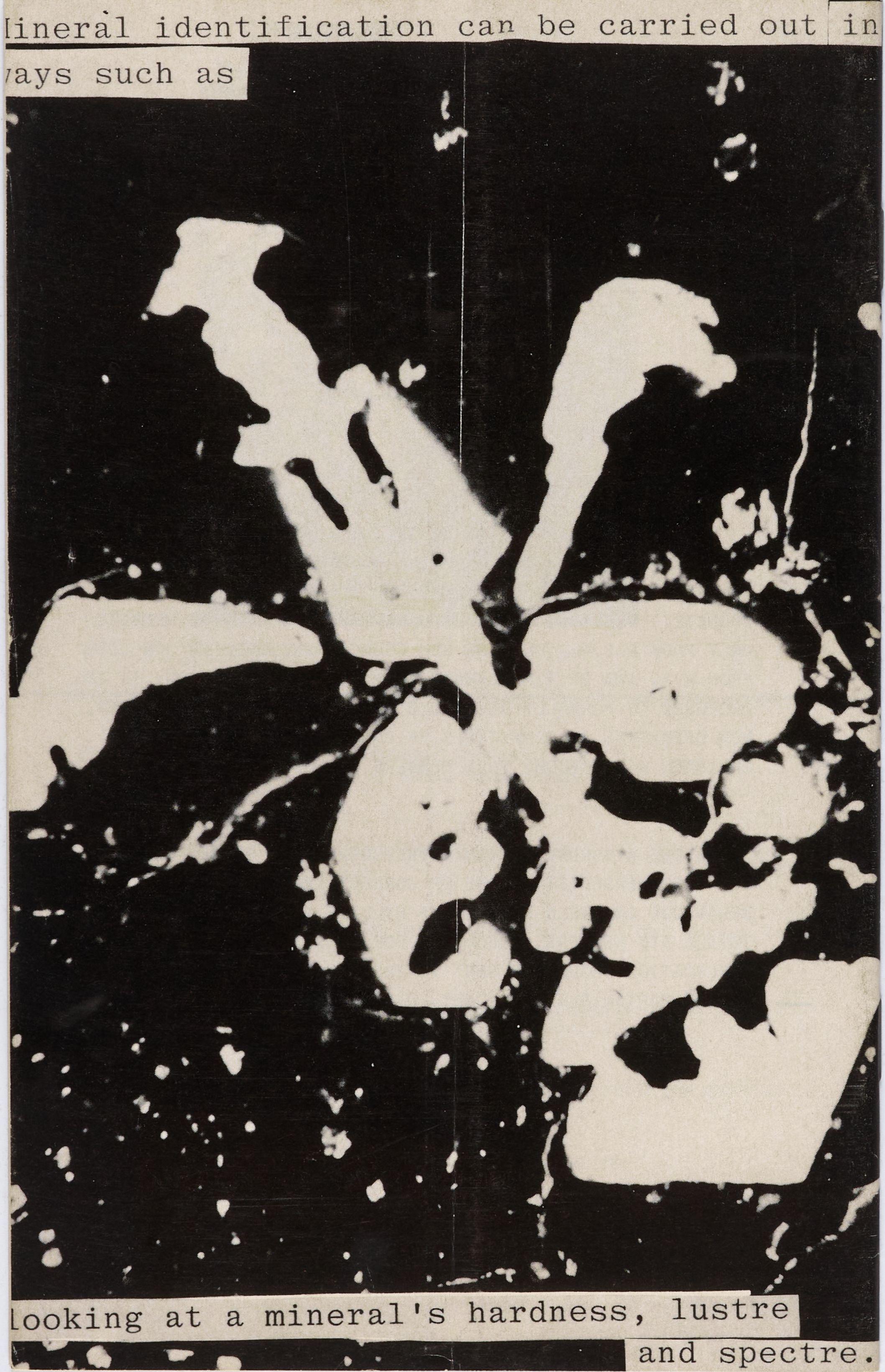
Cover Photo: Skeletal magnetite crystallite (98 µm long) from a basalt 1000 metres beneath the Nullarbor Plain, S.A. (Mallabie No. 1, Cook-Coompana Area)
Magnetite is undergoing incipient replacement by haematite with minute internally-reflecting iron oxide crystals on the margins. (These changes can only be seen effectively on colour photos).
Photo and notes
D.J. Gilbert B.H.P. Melbourne.
IN QUEST OF QUALITY, QUANTIFY.
Census/Questionnaire of WA Division Members
During 1983 the WA Division designed and conducted a comprehensive census of members. Forms were distributed in the November 1983 and February 1984 monthly notes and to the end of March 1984 approx 40% (216) of the members had responded. A preliminary analysis of the results has been made and the data plotted onto the following graphs.
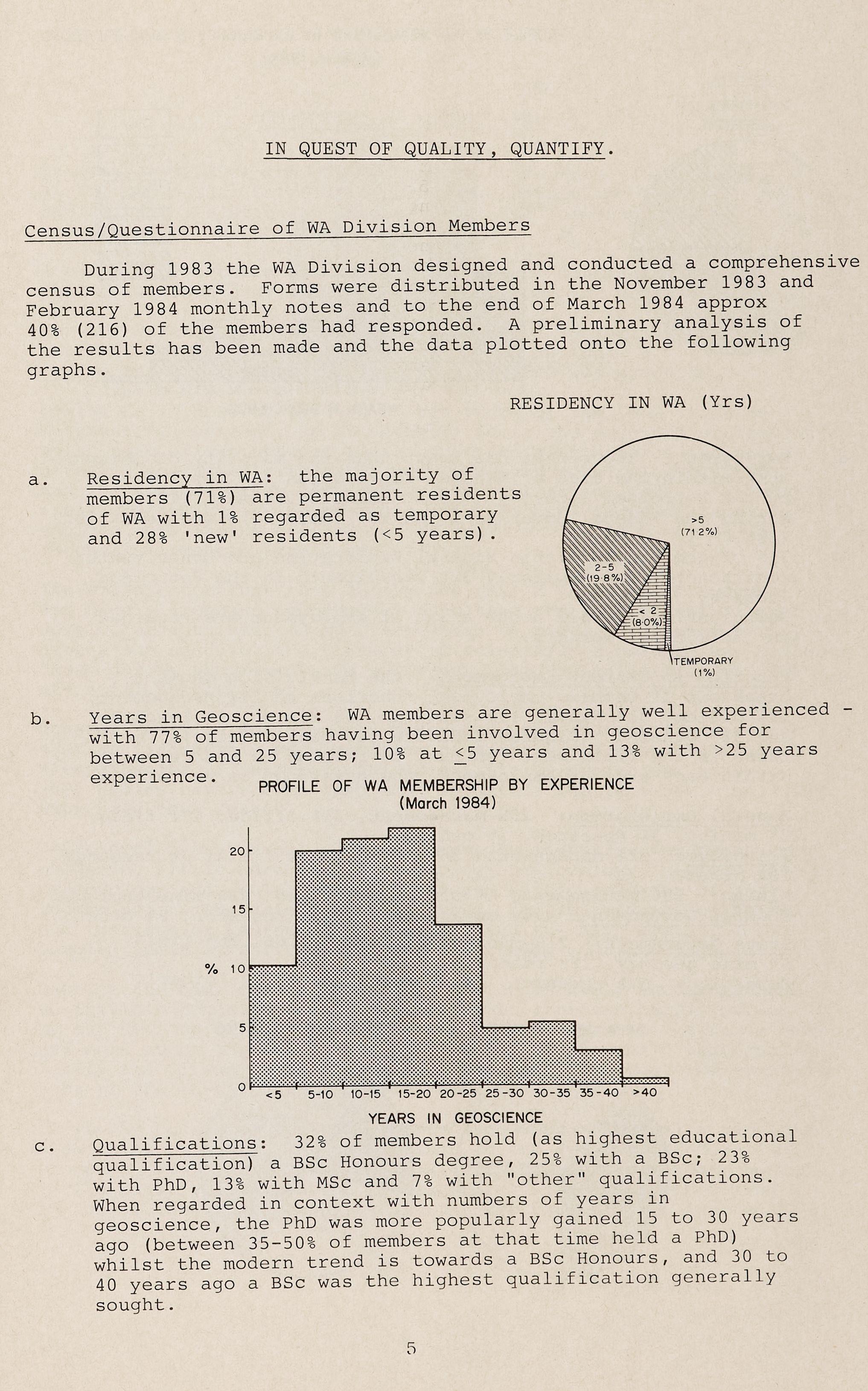
RESIDENCY IN WA (Yrs)
a. Residency in WA: the majority of members (71 %) are permanent residents of WA with 1% regarded as temporary and 28% 'new' residents ( < 5 years).
b. Years in Geoscience: WA members are generally well experiencedwith 77% of members having been involved in geoscience for between 5 and 25 years; 10% at 2 5 years and 13 % with >25 years experience.
PROFILE OF WA MEMBERSHIP BY EXPERIENCE ( March 1984)
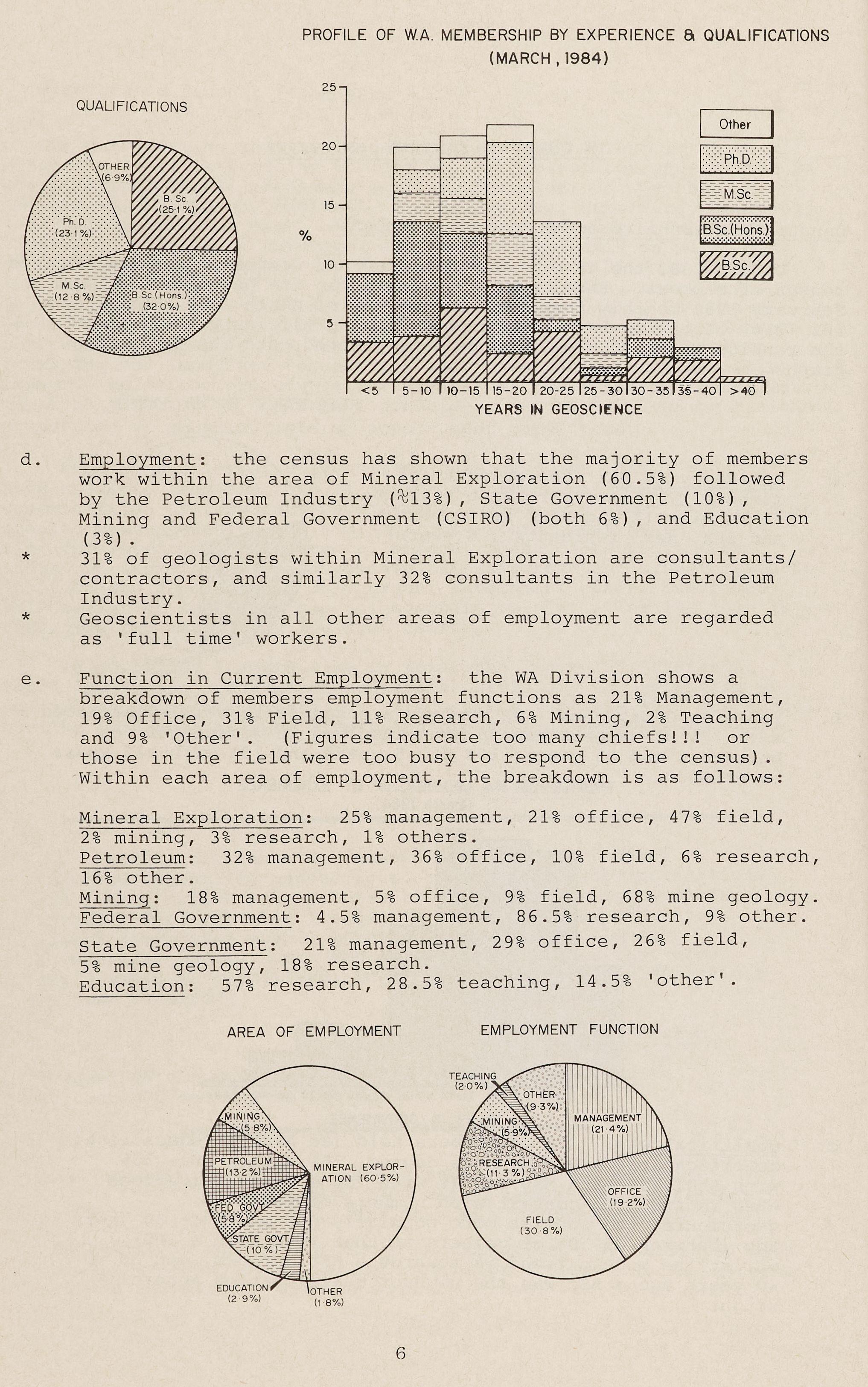
c. Qualifications: 32 % of members hold (as highest education a l qualification) a BSc Honours degr ee , 25 % with a BSc; 23 % with PhD, 13 % with MSc and 7 % with "oth e r" qualifications. When regarded in conte x t with numb e rs of y ears in geoscience, th e PhD was mor e popularl y g ain e d 15 to 30 yea rs ago (between 35-50 % of members at that tim e h e ld a P hD) whilst the mod e rn trend is towards a BSc Honours, an d 30 t o 40 years ago a BSc was th e hi g h e st qu a li f ic a ti o n ge n e r a ll y sou g ht.
Employment: the census has shown that the majority of members work within the area of Mineral Exploration (60.5%) followed by the Petro leum Industry (%13%), State Government (10%), Mining and Federal Government (CSIRO) (both 6%), and Education (3%) .
31% of geologists within Mineral Exploration are consultants/ contractors, and similarly 32% consultants in the Petroleum Industry.
Geoscientists in all other areas of employment are regarded as 'full time' workers.
Function in Current Employment: the WA Division shows a breakdown of members employment functions as 21% Management, 19% Office, 31% Field, 11% Research, 6% Mining, 2% Teaching and 9% 'Other'. (Figures indicate too many chiefs!!! or those in the field were too busy to respond to the census). Within each area of employment, the breakdown is as follows:
Education: 57% research, 28.5% teaching, 14.5% 'other'• AREA OF
CO-OPERATION IS THE NAME
In October 1983 at the UNESCO General Conference, IGCP, known as the Geological Correlation Program, changed its name, replacing Correlation by Co-operation, and foreshadowing a broadening of the program.
A variety of reports has appeared in recent months indicating that many aspects of IGCP are alive and some are quite well.
For the Paris Conference a special issue of Geological Correlation entitled Science Resources and Developing Nations, a review and a look into the future 1978-1982 was produced.
Coming as it does at the end of ten years of the IGCP it is an interesting document, as it squarely faces the problems of tension which have arisen between those concerned with science and those directly concerned with earth resources and developing nations, and the document asks 'Are research activities on today's scientific frontiers basically incompatible with the more immediate need for applied work in the developing nations?' or 'Is IGCP trying to reconcile irreconciliable goals?'
The writers conclude that during the past 5 years the Programme has been a 'tenuous compromise', and that the involvement of most developing countries is much less than it might be. However they stress the need for the transfer of scientific knowledge and methodology during programmes and point out that the activities of IGCP are still poorly known.
However positive achievements have been: good scientific r e search over an 'incredibly wide spectrum of earth science specialities', strengthening of international scientific co -op eration, other IUGS bodies have become involved, important publications including maps have been issued.
Deficiencies have been: no involvement by industry, few geophysical projects, little work involving geology and biology, geology and meteorology and geology with hydrology, little transfer of high technology to the developing countries, little research on petroleum, uranium or geothermal resources, and the high cost of a complex administrative system which consumes too man y fund s
Despite the name change the Program is desperately short of funds to initiate projects, and particularly to increase participation by the developing countries, for 'we are in danger of learning mor e and more about the relatively small areas of the world that geolog- ically are already well-known, and less and less about the gr e ater part of the Earth that is poorly known'.
Of the 20 countries listed for Asia and Oceani~ Australia particip- ates in 51 projects, India 31, Japan 26 and Ne w Zealand 24. Two projects 32 (Stratigraphic Correlations between s e dim e ntary ba s in s in the ESCAP region)and 156 (Phosphorites) r e ceiv e support from 18 and 15 countries respectively, ten ar e ex clusive to Austra1i a
The Australian participation is discussed in some detail in the Australian IGCP Committee's 1983 Annual report - the first to be issued formally.
This lists the projects and Australian correspondents and shows the wide range of work being covered. The committee is keen that the work of IGCP be better known and understood in Australia and there is clearly room for interested workers in many of the projects.
A third volume indicating what has been done so far is the second volume of the (1978-1982) IGCP Catalogue prepared with the help of the American Geological Institute and particularly its GeoRef Information System. Researchers will find this particularly valuable as papers emanating from each of the 197 projects is listed first under the projects, then cross-referenced under subject, and then by author.
This invaluable bibliographic aid (and its earlier companion) should be in your library. If not contact the Australian National Commission for UNESCO., P.O. Box 826, Woden ACT 2606. The same address or Canberra phone 89 7078 will enable you to ask for the other two publications. They provide information and much room for thought.
SECOND PRIDER LECTURE
The second Prider Lecture was delivered by Dr John de Laeter (Division of Engineering and Science, WA Institute of Technology) to two audiences, each of approximately 200 senior high school students, on 2nd and 9th April, 1984. The students came from twenty-five Perth metropolitan high schools to hear Dr de Laeter talk on the topic "Radioactivity and the Age of Rocks".
Dr de Laeter, a physicist with wide experience in mass spectrometry and a leader of the geochronology research group in Perth, captured the attention of the young audience with three striking demonstrations. To demonstrate that radiation is a stream of charged particles, he used the actual apparatus used by Lord Rutherford when he was in Perth in 1905. This was followed by the measurement of the half-life of 137Ba, an isotope with half-life of 2.6 minutes. Finally, he showed how an ion beam can be deflected by a magnetic field, setting the scene for the measurement of isotope abundances on the mass spectrometer.
Students followed Dr de Laeter's account of the development of the mass spectrometer - the time-machine of geochronologyfrom primitive instruments such as the "water pipe" instrument made in the University of WA Physics Department in the 19S0's, to the ANU ion-probe and the $350,000 instrument being set up as WAIT as he was speaking.
Dr de Laeter showed applications of geochronology to geological problems, particularly regional geology and mineral exploration. A spectacular photomicrograph of Mt Narryer zircons, showing pits where they had been "zapped" in the ANU ion-probe, brought the Prider Lecture to a close with the exciting news that the oldest known rocks of the Earth are exposed in Western Australia.
L R Davidson Convenor, Vocation & Education Subcommittee Geological Society of Australia (WA Division) .
NEWS FROM THE WA DIVISION
Ore Targets in Exploration Course
A very successful short course with the above title was conducted by Professor Charles Meyer of Arizona in Perth on March 20 and 21 and supported by 95 registrants. The Division also assisted with organisation of a repeat of the course at the WA School of Mines in Kalgoorlie on March 26 and 27 for more than 60 registrants.
Eastern Goldfields Excursion Guide
The special publication printed for the Eastern Goldfields Geological Field Excursion (held in September 1983) is out of print and the WA Division would like to run a reprint if there is sufficient demand. The excursion consisted of a one day symposium of invited papers held at the WA School of Mines in Kalgoorlie, followed by two days of examining key outcrops along two traverses in the Kalgoorlie/Kambalda district. Speakers at the symposium discussed a wide range of topics including regional Archaean geology, greenstones belt evolution and geomorphology in the Yilgarn Block, and detailed accounts of stratigraphy, structure and mineralisation in the Kambalda, Kalgoorlie, Leonora and Laverton areas.
The 54 page volume containing extended abstracts of papers and the detailed excursion guide was edited by Peter Muhling. It is illustrated with a number of maps and diagrams, and the excursion stops are sufficiently well described and located to enable individuals to repeat the excursion using their own transport.
If you are interested in purchasing a copy please contact either Mike Hall (Chairman) or Sue Thornett (Secretary), WA Division GSA, . c/- BHP Exploration, 37 St George's Terrace, Perth 6000. Phone: (09) 325 9633. Price $10.00.
New WA Divisional Award - Gibb Maitland Medal
The WA Divisional Committee announces the creation of an important Divisional award - the Gibb Maitland Medal.
This award will recognise individuals who have made substantial contributions to geoscience in Western Australia. Particular consideration will be given to contributions that relate to the occurrence or discovery of mineral resources.
A recipient will normally be actively engaged in his or her career and have made an important contribution to geology, or to one of the related geosciences, in Western Australia.
Achievements relating to the documentation of known mineral resources; or to the discover y of new mineral resources, within the State, will receive special consideration. It is expected that recipients will include geoscientists from industry, academic and government institutions.
Andrew Gibb Maitland was the founder and father of the Geological Survey of WA. He was appointed Government Geologist in 1896 and occupied the position for 30 years until his retirement in 1926. He stated the 'the ultimate objective of any such survey is undoubtedly the development of the natural resources of the country' and he laid down a set of objectives in 1896 that are still applicable today. Ninety-one bulletins were compiled under his leadership and these include much of the early geological information on the WA Goldfields that is widely used today.
COAL GEOLOGY WORKSHOP, PERTH
The first Coal Geology Workshop in Western Australia was held in Perth on Tuesday, 13th December at WAIT House of the Western Australian Institute of Technology, the workshop theme being "Depositional Environments and Concepts in Modern Coal Exploration". The workshop was co-ordinated by Dr Krish Sappal on behalf of the Geological Society of Australia Incorporated, WA Division.
The workshop was presented by Dr Claus Diessel, Associate Professor of Geology, University of Newcastle, and it was well attended (30 participants) and attracted a cross section of geologists from industry, state energy commission, government and tertiary institutions.
The topics covered in the workshop included asp·ects of coal geology, depositional models, exploration targets and exploration methods. The lecture notes were provided by Dr Claus Diessel to all participants. The main workshop was followed by a discussion session and a sundowner for participants and visitors.
The
third
International Conference on Geoscience Information
l st-5th June , 1986. Adelaide Australia in South Australia's Sesquicentennial Year.
The theme of the Conference is 'Geoscience Information as a Resource' , to cover the full spectrum of data and information cycles from generation, storage, retrieval, manipulacion, use and further generacion - with emphasis on source data and the impact of new technologies.
An outline of the Conference programme and call for papers will be released in June 1984.
Further information can be obtained from the Conference Secretariat 3ICGI, C/- Australian Mineral Foundation, Private Bag 97, Glenside, South Australia, 5065, Australia.
Michael Page, Western Mining reports: ICAM 84
ICAM 84, held in Los Angeles, California, had delegates from 26 countries, including representatives from the USSR and Poland. In general the Conference was a success, with a good crossfertilization of ideas. This was particularly due to the fact that the Conference preceded the AIME Annual Meeting, thus attracting metallurgists and processing engineers. However, attendance was down 50% and author participation was down 20%. Without doubt the recession and down-turn in the mineral industries of the world has had a major impact.
Papers presented at the Conference covered a wide variety of fields including benefication, methodology, image analysis mineralogy/ore genesis, precious metal mineralogy, process mineralogy at high and low temperatures, and a special session on the appl i cation of mineralogy to medicine.
Benefication sessions were highlighted by numerous papers describing contributions by mineralogy to processing problems at Ardlethan, the Starke heavy mineral deposits in Florida, Ni - Cu recovery from the Duluth Gabbro of Minnesota. The Plenary Lecture by David Carson of Noranda Exploration Company, Canad~ presented good examples of mineralogical contributions to ore exploitation, both successes and examples where the mineralogy arrived too late. An emphasis was placed on a need for simplified mineralogical studies and data presentation, particularly in a plant situation.
Image Analysis was a very popular session during the Congress, attracting distinguished speakers and large audiences. Dr Alan Reid presented results of work on the CSIRO QEM*SEM system, Prof M P Jones of Imperial College reviewed electron optics and image analysis, and a number of authors covered optical systems, stressing the requirement by all workers for simplified data presentation and more rapid analysis.
Ore mineralogy sessions described applied mineralogy and volcanogenic massive sul pt ides, an excellent review of the Polish Zechstein stratiform copper deposits with their associated platinoids and gold, sulphide concentrations in salt domes, and the mineralogical distribution of Ni, Co and Ag in lead deposits of southeast Missouri.
Talks on precious metals included recovery of gold in Witswatersrand gold deposits, platinum-group elements at Sudbury and review of the mineralogical character of the Peublo Veijo gold orebody in the Dominican Republic.
The high temperature process mineralogy group heard a plenary lecture on the progress in organic petrology by Dr G H Ta y lor of CSIRO. Other papers covered thermal processing in indurated phosphate deposits, roasting of arsenical concentrates, and iron in the sintering of dinnerware porcelain.
Low temperature process mineralogy sessions contained papers on argento- and plumbo-j arosi tes and mineral processing, effects of iron contents on the leaching of sphalerite, gold scavenging of pregnant cyanide solutions at Carlin, Nevada, and the mineralogy of leach residues at the Midwest Lake uranium deposit, Canada.
International Council on Applied Mineralogy
This Council exists in order to promote the use of applied mineralogy mainly through the convening of ICAM Congresses. This year major decisions were taken with regard to future meetings and the relationship with the International Mineralogical Association (IMA).
The next ICAM will be held in 1987 in Orleans, France. Professor Victor Gabis will be chairman of the organizing committee. Australia has been nominated to host the 1991 ICAM.
Lengthy discussions were held with the IMA representatives, Peter Wyllie (Vice-President), Stephan Hafner (Secretary), and Tony Naldrett, (Acting Chairman, Commission on Applied Mineralogy). It was agreed to co-operate and co-ordinate with IMA and then have mutual sessions at each others meetings. Regular communication would e x ist between ICAM and IMA, thus eliminating the necessity of establishing another association and establishes ICAM as the main international forum for applied mineralogy. No dues will be required and no decision was taken on a journal, although most committee members were against establishing another journal.
The name of the Committee was changed to the International Council on Applied Mineralogy in order to facilitate relationships with IMA and other organisations. The Council is made up of representatives authorized by their home countries and at present includes members from South Africa, United States, Canada, Australia, France, Poland and the USSR. In the future the Council will be expanded to include other countries.
THE MINERALS OF THE MALDON GOLDFIELD
This is the first publication b y the Mineralogical Society of Victoria, and highlights the State's most mineralogicallyprolific goldfield. Compiled by J.C. Haupt, the booklet begins with sections on the history of discovery of the Maldon field, the general geology and descriptions of the mines and major reef-lines. Of most interest, however, is the listing of the minerals recorded from the mines and surrounding country rock, with over 80 species described. The occurrence of each is detailed and the original reference provided. Doubtful species and discarded names are also listed for completeness. A section on the personalities most o f ten associated with Maldon (including George Ulric h , who first descr i bed maldonite) follows the mineral listing. A comprehensive biblio g raphy and a detailed new map of the goldfield showing all known reefs are also included as valuable reference sources.
The book consists of 36 pages, is printed on good quality gloss y paper and is well illustrated with appropriate black and white photographs. It is a model for other small, relatively low budget publications on prolific Australian mineral localities.
Av ailable f rom: The Secretar y Mineralogical Society of Victoria PO Bo x 146 Collins Street MELBOURNE VIC 3000
(Cost, $7.95 incl. postage)
FISSION IS GOOD AT TOWNSVILLE
Geology Department, James Cook University announces a FISSION TRACK DATING WORKSHOP, September 4 to 6, immediately after the Sydney Convention and an international meeting in the U.S.
The conveners are Andrew Gleadow (Melb. Uni.) and Jon Sephenson (James Cook), with other speakers including Paul Green (Melb., formerly Birmingham), John Lovering (Melb.), John Kleeman (New England), Peter Zeitler (ANU, formerly Dartmouth), Sohan Koul (CSIRO).
Contact Jon Stephenson, Geology, James Cook University, Townsville, Qld. 4811. (Tel. (077) 814546) or
for circulars (cost: students $60, others $120 or less if numbers increase).
AUSTRALASIAN SEDIMENTOLOGISTS GROUP - PUBLICATIONS
Limited numbers of course notes and accompanying excursion guides sponsored by the Australasian Sedimentologists Group are available for sale.
1. Course Notes on elastic Tidal Deposits by S. Djin Nio et al. (1983) $14
2. Field Guide to the Northeast Coast of Kangaroo Island (Clastic Tidal Deposits) by P.S. Moore (1983). ... $5
3. Course Notes on elastic Sedimentary Facies and Depositional Models by Roger G. Walker (1981). $16
4. Pluvial Sedim~ntology Field Excursion to the Whyalla-Corunna-Depot Creek Area by N. Lemon and V. Gostin (1983). ... $5
If you wish to purchase these items please send your cheque made out to: "AUSTRALASIAN SEDIMENTOLOGISTS GROUP" to:-
Tony Belperio, Chairman, A.S.G., c/- S.A. Dept Mines & Energy PO Box 151 Eastwood, S.A. 5063.
Ph. (08) 274 7617.
A review of some books concerned with Man and Society.
Geology and Man
Janet Watson
George Allen & Unwin
Industrial Geology Oxford edited J.L. Knill
$ 41.50 (hardback) 18.95 (paperback) f 9.50
Collected Case Studies in Engineering Geology, Hydrogeology, Environmental Geology. edited M.J. Knight, E.J. Minty & R.B. Smith, Geological Society of $29.50 (incl. postage) Australia. $19.50 G.S.A. member
These books might almost represent a 'Gradus ad Parnassum' over the varied terrain of applied geology.
It is interesting indeed to find an academic geologist of the calibre of Janet Watson acknowledging the 'fascination of applied geology' and setting out to provide a readable account of the broad aspects of the subject for the non - specialist reader, be he student or interested layman.
In nine short chapters Professor Watson discusses the relation between human needs and geological resources, the formation and utilization of water, energy, metalliferous and non - metallic resources. Aspects of geology related to civil engineering, geology and the biosphere, and a final chapter 'man in a geolog- ical context', in which she stresses the role of man as a geological agent.
While the emphasis in references and diagrams is naturally on British examples, North America, Continental Europe, Asia and Australia get much more than mere mentions.
The author has assumed some familiarity with geological principles and terminology and suggests that the book might best serve students undertaking an introductory applied geology course.
She places much emphasis on the numerous tables and figures and many of these are very informative.
While the text is always readable, the occasional undefined term creeps in (e.g. piezometric page 19, Albian - Cenomanian page 39, fixed carbon page 43, rank page 44), and there are some contradictions in the definition and explanation of terms (e.g. water table page 13), while in the discussion of duricrusts (page 110) there is no mention of the laterites. Figure 2.1 showing the hydrologic cycle lays no emphasis on the maritime air mass as the major contributer to precipation, and the attribution of the failures shown in figure 6.2 to creep (page 86) is also somewhat misleading. There are few typographical gremlins (Ammonia CH 3 on
page 10 is an important one) and the photographs and other diagrams are generally clear and informative.
As one who works in the applied geology field I found this an interesting book. It certainly covers a wide area and covers it well. However I'm not sure where i t would fit in Au stralian courses in geology. There is probably more in it than would be covered as a section on applied geology in an introductory course, and there isn't enough for more specialist courses.
I see it as an excellent curative dosage for some jaundiced academics who feel that applied geology is for the duds. It will also certainly be of great value to teachers of geology, particularly those at secondary level, as a source book. Would that it could be made required reading for decision - makers at all levels of government. This Geological Society could make a significant contribution and put this book to its best use by seeing that it gets into parliamentary hands, via donation, and into as many public libraries as possible. That is where it will serve its purpose and our profession best.
It must be doubted that the additional $22 for the hardback version is warranted. If you have the money buy two paperbacks and give one to your nearest minister for resources.
Industrial Geology, which has been around for three or four years, deserves a mention here, as a contrast - not in the contents, which in summary are remarkably similar to Professor Watson's book, but in the methods and level of presentation.Based on a series of lectures given to intermediate and senior geology undergraduates at Oxford in the 1970s it summarizes the experience of thirteen specialists. There is useful material here in the case histories of, for instance, geological hazards, but the emphasis is essentially on British examples. The Australian mentions, four in the index,five in the text are lightweight, the extra being Noel Gray holding down a large core of Hawkesbury Sandstone at Warragamba.
Although I found the book interesting and informative it can only be regarded as supplementary reading for students, for those interested in the various applied fields, but perhaps more particularly for those who aren't aware of the variety of work in this field and don't believe it holds any challenges.
Nearer to home is the recently produced Case history volume, multiedited and authored by members of the Engineering Geologist Specialist Group of this Society.
One of the common frustrations for the applied geologist, specially for one involved in teaching the subject, is to obtain information about what really went right (or wrong) at such-and-such a site. The hurried notes taken in the dark as slides are shown at a conference, informative tit-bits garnered at after-session drinks, and site visits after the evidence has been securely obscured, tend to restrict teaching examples to well - worn case histories or thos e in which one has been directly involved.
This volume provides a welcome addition to the stock -i n-trade, with a variety of papers on sites mainly i n New South Wales and Victoria. The authors are predominantly from government instrumentalities which perhaps tends to give the papers too much weighting from the Principal's viewpoint.
The six environmental papers cover topics from road subsidence caused by mining to beach erosion and three could have been considered as falling under the engineering or hydrogeology headings.
The papers on aggregate and sand resources by Baker, Wallace and Hoffman are more broadlyenvironmental but it is a pity that they were not complemented by a paper on geology in Environmental Impact Statements, an area of concern to many practicising geologists.
One cannot ask that case histories do more than present the author's approach to gathering information and assessing its importance in making engineering decisions. This in itself is useful for other practicians, but there is also often the added bonus of tabular data on the properties of particular rocks, soils or groundwater, which cautiously used, can facilitate other projects in specific localities.
Two of the papers however seem to go beyond the mere analysis of data, and therefore deserve further comment. They are G.W. Won's Rock Slope Stability Analys i s of Road Cuttings , and Rock Mass Workability by E.J. Minty and G.K. Kearns.
Won describes a graphical method used to give a quantitative estimate of rock slope stability, with respect to wedge failure in large cuttings in the Hawkesbury Sandstone. Based on the use of stereographic projection of the joint sets he uses probability distribution theory to determine the conditions for wedge failure, coming up with a predictive curve showing the relation between batter angle and number of unstable wedges.
As the author points out, he has not considered the 'inverted wedge failures' which occur as a result of preferential weathering of shale bands within the sandstone, but apart from that he believes his results are conservative. As a geologist who has a built - in suspicion of the inflexibility of mathematical theory in relation to the behaviour of rocks I found the arguments generally persuasive, and look forward to a comparison between the actual and predicted results when the expressway is completed in the next few years.
The paper by Minty and Kearns again contains a predictive aspect. The authors point out that the prediction of rippability using the 'Caterpillar Charts' of seismic velocity is not always satisfactory because there is not enough allowance for geological factors. Their paper is concerned therefore with quantifying rock weathering, rock strength, groundwater conditions, and the nature of discontinuties. These factors are then combined with seismic wave velocity to develop a graphical technique for determining rock rippability.
This is an important paper as it continues the attempts made over a number of years to quantify the behaviour of rock masses, and while, as the authors admit, there is still much work to be done to refine the method, I suspect it will be rapidly adopted by industry. This work is a fitting conclusion to the research on rock material and rock mass carried out by E.J. Minty and his associates during the past thirty years.
While the last two papers alone make this volume worth the price for practising engineering geologists, its value is doubly enhanced by the opening invited paper by D.H. Stapeldon, The Geotechnical Specialist and Contractual Disputes. Professor Stapledon examines four cases in detail and discusses the highlights of another six.
His main conclusion that most disputes are the result of inadequate site investigation is not unexpect ed, but he mak es the further point that such sub standard work is 'often aggravated by the poor standard of factual geotechnical data made available to tenderers'.
Some disputes have occurred when the quality of both site investigation and factual data presented have been good. Here Professor Stapledon treads on more controversial ground by suggesting that the tenderers should also have received interpretiv e data 'preferably provided by competent geotechnical specialists in the emp lo y of the Principal'. While I agree with him fully on this point, it will be some time, I am sure, before industry, and specially its legal advisers, will accept this sensible suggestion.
This paper should be required reading for all practising and aspiring geotechnical personnel, and it would be of benefit to all those geologists who have any contact with the real world.
The volume contains a few grammatical infelicities and occasional errors in references, but it is clearly set out and well illustrated, although the quality of some photographs has suffered in reproduction.
The Specialist Group and its editors deserve congratulations for an excellent first effort. This book will be widely used and referred to. It is to be hoped that further volumes will follow, and that the consultants and individual researchers will b e enthused to present other viewpoints on the fascinating field of applied geology.
David Branagan
Sapphires are found on the Anarchy fields. The specimen shows metallic lust.
The angle of dip is the angle that a strike dips.
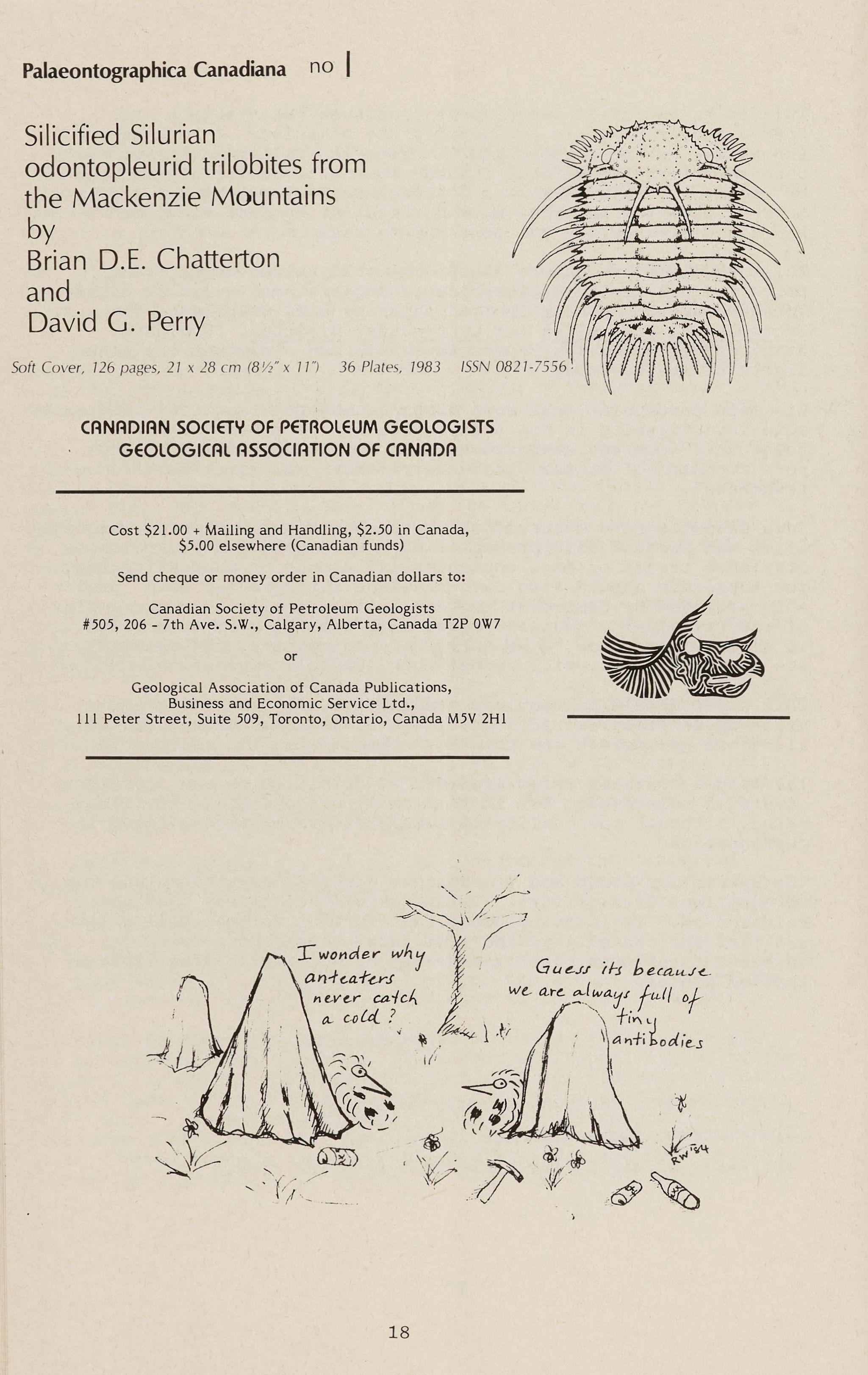
Silicified Silurian odontopleurid trilobites from the Mackenzie Mountains
by
Brian D.E. Chatterton and David G. Perry
Soft Cover, 726 page, 27 x 28 cm (8 ½" x 77"J 36 Plat es, 79 83 !SS 0827 -7556 ·
CANADIAN SOCIETY OF PETROLEUM GEOLOGISTS GEOLOGICAL ASSOCIATION OF CANADA
Cost $21.00 + Mailing and Handling, $2 50 in Canada , $5.00 elsewhere (Canad ian funds)
Send cheque or money order in Canadian dollars to:
Canadian Society of Petroleum Geologists #505, 206 - 7th Ave. S W , Calgary, Alberta, Canada T2P 0W7 or
Geologi c a l Assoc iat ion of Canada Publications, Business and Economic Service Ltd., 111 Peter Street , Suite 509, Toronto, Ontario , Canada M5V 2H l
EARTH SCIENCE JOURNALS FREE FOR THE ASKING
The following volumes of earth science journals are being discarded from a personal library. Rathar than dispose of them permanently this is an offer to libraries, institutions and private individuals to obtain any or all of the volumes FREE OF CHARGE. The only condition is that any interested party must be prepared to cover the costs of packaging and freight from Brisbant to their address.
Journal of Geological Research (Red):
Geological Research Letters:
Geological Society of American Bulletin:
New Zealand Journal of Geology and Geophysics:
Reviews of Geophysics:
Tectonophysics:
Contact: Dr JM W Rynn
Vol 75 (1980) through Vol 84 (1979).
Vol 1 (1974) through Vol 6 (1979).
Vol 83 Nos 7-12; Vol 84 (1973) through Vol 86 (1975) all Nos 1-12.
Vol 15 (1972) through Vol 21 (1978).
Vol 8 (1970) through Vol 12 (1974).
Vol 16019 (1973); Vol 21 ( 1974)
Department of Geology & Mineralogy
University of Queensland ST LUCIA QLD 4067
Telephone: (07) 377 2552
(or after working hours (07) 378 7701).
FOR SALE
Leitz Ortholux Pol microscope, in excellent condition. A complete outfit for transmitted and incident light procedures; with a wide range of accessories, as well as photomicroghraphic, photometric and hardness testing equipment. Replacement value $30,000. Sell for $7,000. Full details on request to Dr. A.W.G. Whittle, 55 Hillcrest Drive, Eden Hills, 5050. Tel. 08 277 8694.
GOLD IN QUEENSLAND
One-Day Symposium Tuesday, 12 June 1984
Dept of Geoiogy and Mineralogy, University of Old. St Lucia Old 4067
FEE: $25 - includes morning and afternoon tea, lunch, BBQ and copy of abstracts.
PROCEEDINGS VOLUME: $10 each .....
EARTH RESOURCES FOUNDATION
Workshops and Short Courses for the remainder of 1984
Minerals Exploration Courses
"Epithennal Gold" October 2-5, 1984.
Venue: Holme Building, the University of Sydney.
Presented by: Dr F. Reid , KRTA Limited , Auckland; Dr. J. Hedenquist , DSIR Wairakei , NZ.
Outline. The course covers the theoretical and practical aspects of epithermal systems and the factors relevant to precious and base metal mineralisation. The physical chemistry and wall rock alteration of mineralised systems will be discussed and criteria for recognising these processes in the fossil record presented. Modern mineralised geothermal systems in New Zealand and the Philippines will be related to the classic epithermal deposits of the Pacific and general exploration models developed. Specific mineragraphic and petrological techniques for use in exploration will be discussed.
Fees. Non Members $800; ERF Members $650 .
"Massive Sulphides" October 24-26 , 1984, Perth; December 3-5, 1984, Sydney. Presented by: Professor Steven D. Scott, University of Toronto.
Outline. This course examines the tectonic setting, character and genesis of a wide ranging suite of massive sulphide deposits backed up by practical work on representative rock suites and maps. Examples are gathered from a variety of geological settings and ages from all continents. The features observed in the ancient record are compared with modern processes especially Professor Scott's current research on "black smokers". The course incorporates the most recent research by Scott and his colleagues and includes studies of Kuroko and Kieslager-type deposits of Japan, Canadian volcanogenic massive sulphide deposits, shale hosted lead-zinc deposits , Cyprus-type deposits , the metamorphic camouflage of massive sulphides , modern sea floor deposits, physical geochemistry of hydrothermal fluids, geological and chemical guides for exploration.
Fees. Non Members $450 ; ERF Members $350 .
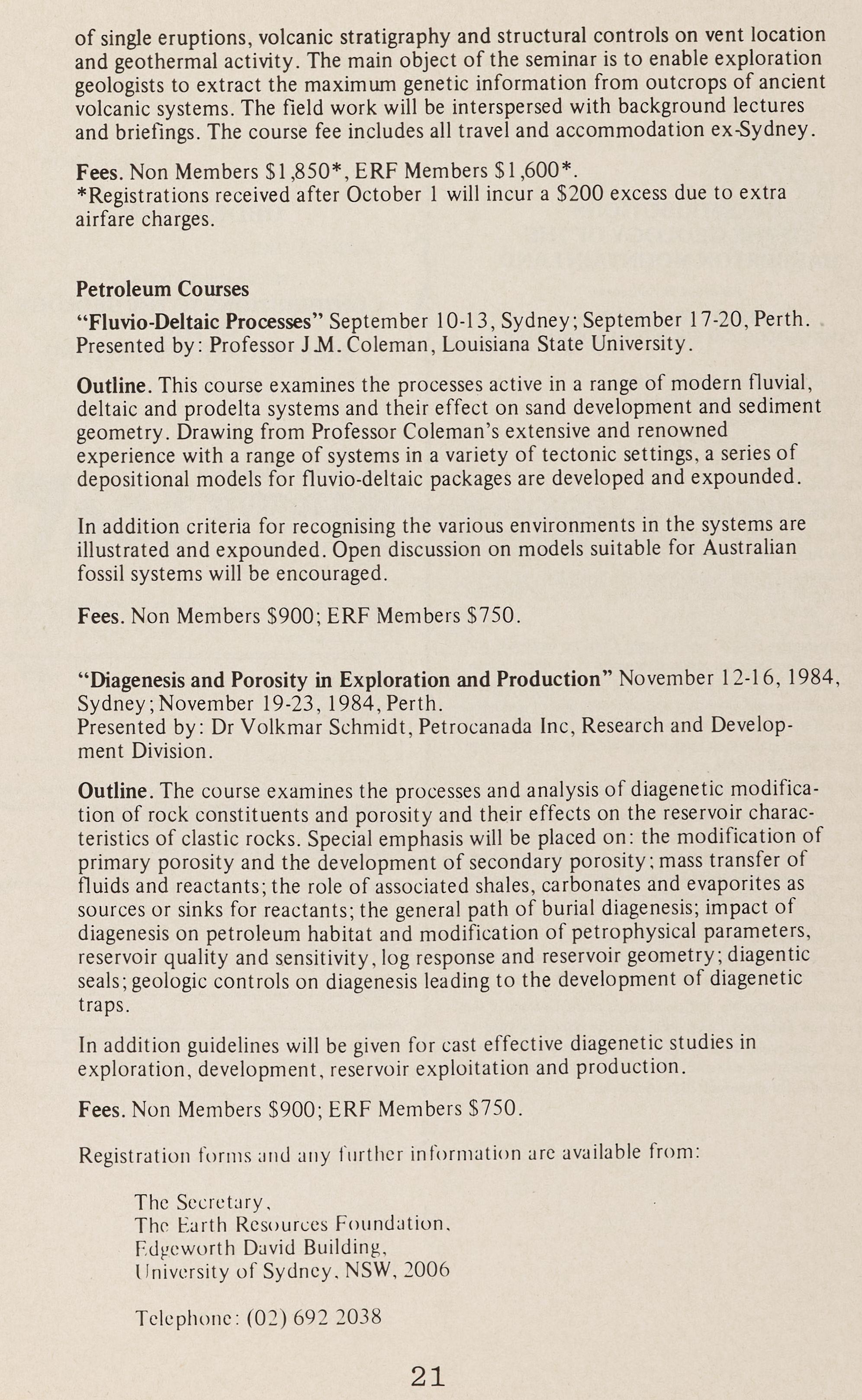
"Modern Volcanism and Associated Hydrothermal Mineralisation" November 18-29 , 1984.
A Field Seminar led by: Dr Bruce Houghton , DSIR NZ; Associate Professor Pat Browne, Geothermal Institute , Auckland.
Outline. This field seminar examines a variety of modern volcanic processes in the field and the relationship between structure, volcanism and geothermal activity . Currently active geothermal systems and their attendant mineralisation will be visited. Particular emphasis will be placed on proximal and distal facies
of single eruptions , volcanic stratigraphy and structural controls on vent location and geothermal activity. The main object of the seminar is to enable exploration geologists to extract the maximum genetic information from outcrops of ancient volcanic systems. The field work will be interspersed with background lectures and briefings. The course fee includes all travel and accommodation ex-Sydney.
Fees. Non Members $1,850* , ERF Members $1,600*.
*Registrations received after October 1 will incur a $200 excess due to extra airfare charges.
Petroleum Courses
"Fluvio-Deltaic Processes" September 10-13, Sydney; September 17-20 , Perth
Presented by: Professor JM. Coleman , Louisiana State University.
Outline. This course examines the processes active in a range of modern fluvial, deltaic and prodelta systems and their effect on sand development and sediment geometry . Drawing from Professor Coleman's extensive and renowned experience with a range of systems in a variety of tectonic settings , a series of depositional models for fluvio-deltaic packages are developed and expounded.
In addition criteria for recognising the various environments in the systems are illustrated and expounded Open discussion on models suitable for Australian fossil systems will be encouraged.
Fees. Non Members $900; ERF Members $750.
"Diagenesis and Porosity in Exploration and Production" November 12-16, 1984 , Sydney; November 19 -23 , 1984 , Perth.
Presented by : Dr Volkmar Schmidt , Petrocanada Inc , Research and Development Division.
Outline. The course examines the processes and analysis of diagenetic modification of rock constituents and porosity and their effects on the reservoir characteristics of elastic rocks. Special emphasis will be placed on: the modification of primary porosity and the development of secondary porosity: mass transfer of fluids and reactants; the role of associated shales , carbonates and evaporites as sources or sinks for reactants; the general path of burial diagenesis; impact of diagenesis on petroleum habitat and modification of petrophysical parameters , reservoir quality and sensitivity , log response and reservoir geometry; diagentic seals; geologic controls on diagenesis leading to the development of diagenetic traps.
In addition guidelines will be given for cast effective diagenetic studies in exploration , development , reservoir exploitation and production .
Fees. Non Members $900; ERF Mem bers $750.
Registration forms ;111<l any fmth c r information arc available from:
The Secretary, Th e Earth Re source s F oundation. F, J~cworth David Building , University of Sydney. NSW, 2006
Telephone: (02 ) 692 2038
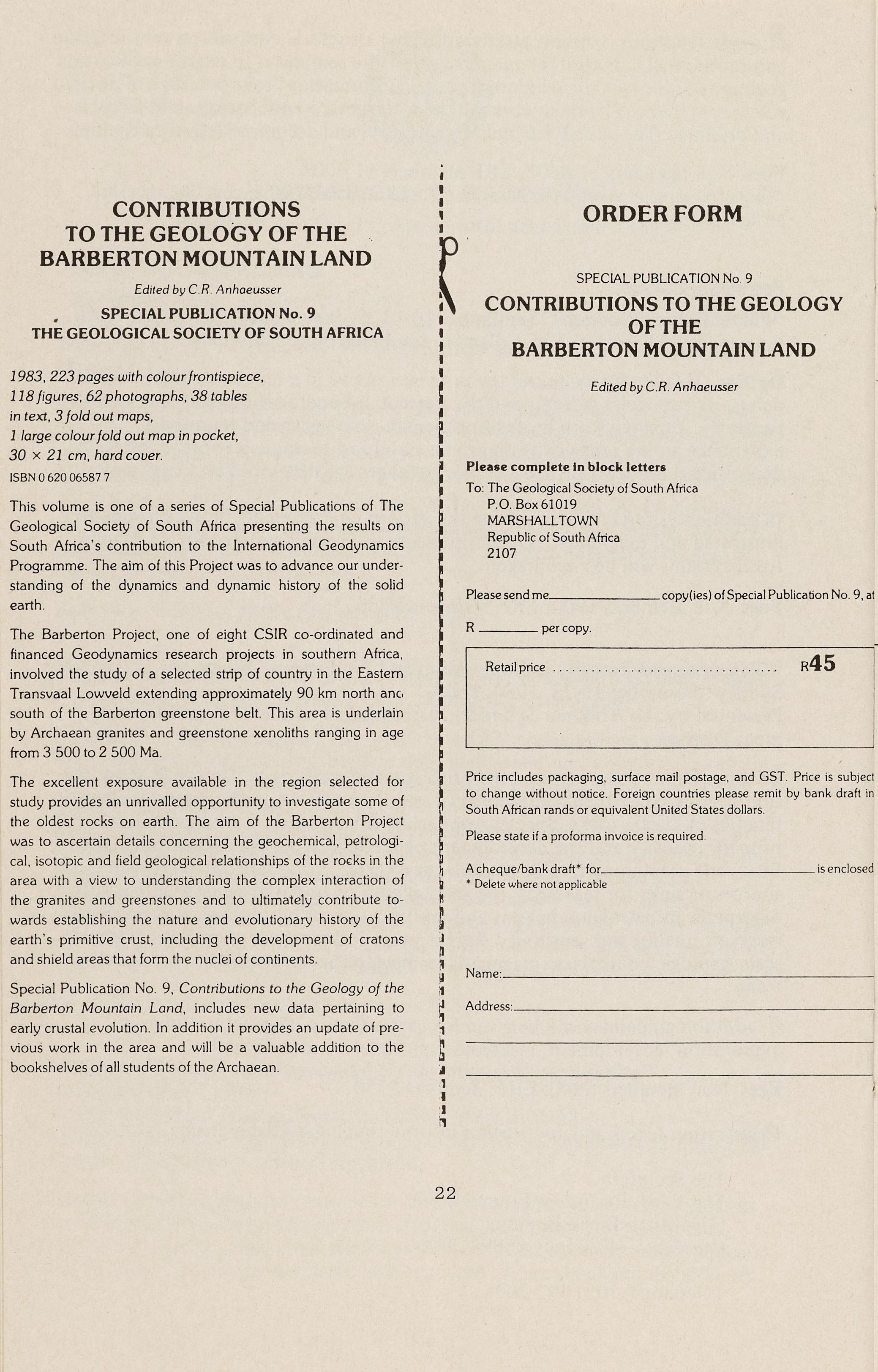
ORDER FORM
BARBERTON MOUNTAIN LAND
Edited by C.R. Anhoeusser
SPECIAL PUBLICATION No. 9
THE GEOLOGICAL SOCIETY OF SOUTH AFRICA
1983, 223 pages with colour frontispiece, 118 figures. 62 photographs, 38 tables in text. 3 fold out maps, 1 large colour fold out map in pocket, 30 x 21 cm, hard couer.
ISBN 0 620 06587 7
This volume is one of a series of Special Publications of The Geological Society of South Africa presenting the results on South Africa's contribution to the International Geodynamics Programme. The aim of this Project was to adv~nce our understanding of the dynamics and dynamic history of the solid earth.
The Barberton Project , one of eight CSIR co-ordinated and financed Geodynamics research projects in southern Africa , involved the study of a selected strip of country in the Eastern Transvaal Lowveld extending approximately 90 km north anc, south of the Barberton greenstone belt. This area is underlain by Archaean granites and greenstone xenoliths ranging in age from 3 500 to 2 500 Ma.
The excellent exposure available in the region selected for study provides an unrivalled opportunity to investigate some of the oldest rocks on earth. The aim of the Barberton Project was to ascertain details concerning the geochemical , petrological. isotopic and field geological relationships of the rocks in the ar ea with a view to understanding the complex interaction of the granites and greenstones and to ultimately contribute towards establishing the nature and evolutionary history of the earth 's primitive crust , including the development of cratons and shield areas that form the nuclei of continents
Special Publication No. 9. Contributions to the Geology of the Barberton Mountain Land , includes new data pertaining to early crustal evolution. In addition it provides an update of previous work in the area and will be a valuable addition to the bookshelves of all students of the Archaean.
SPECIAL PUBLICATION No 9
BARBERTON MOUNTAIN LAND
Edited by C.R. Anhoeusser
Please complete In block letters
To : The Geological Society of South Africa P.O. Box61019 MARSHALLTOWN Republic of South Africa 2107
Please send m~ _____ copy(ies) of Special Publication No 9, at R per copy.
Retail price
R45
Price includes packaging, surface mail postage , and GST Price is subject to change without notice. Foreign countries please remit by bank draft in South African rands or equivalent United States dollars
Please state if a proforma invoice is required A cheque/bank draft * for _ is enclosed • Delete where not applicable
Name:
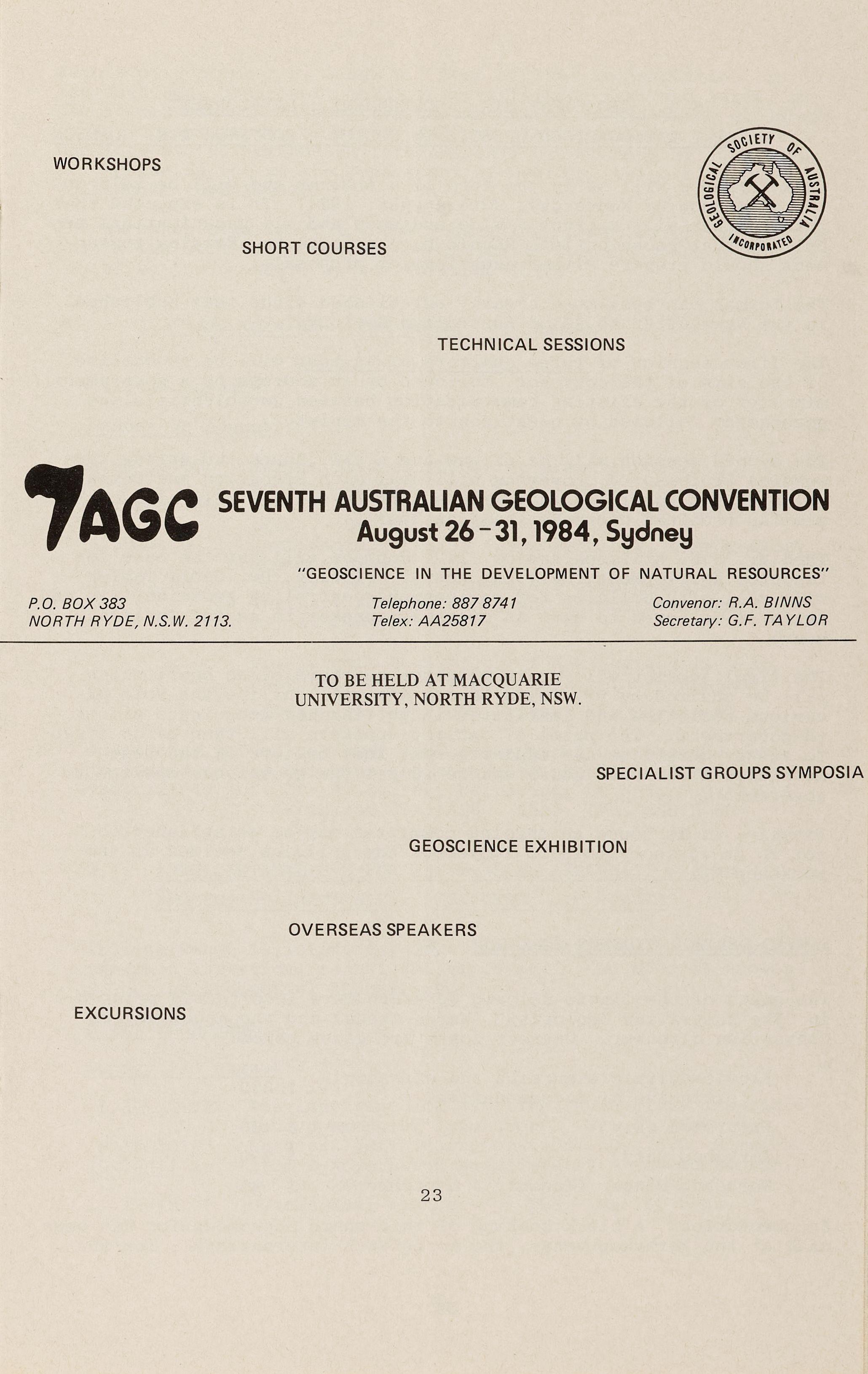
WORKSHOPS
SHORT COURSES
TECHNICAL SESSIONS
SEVENTH AUSTRALIAN GEOLOGICAL CONVENTION
August 26 - 31, 1984, Sydney
"GEOSCIENCE IN THE DEVELOPMENT OF NATURAL RESOURCES"
P.O. BOX 383
NORTH RYDE, N.S.W. 2113
Telephone: 887 8741
Telex: AA25817
TO BE HELD AT MACQUARIE UNIVERSITY , NORTH RYDE, NSW.
Convenor: R.A. BINNS
Secretary : G.F. TAYLOR
EXCURSIONS
SPECIALIST GROUPS SYMPOSIA
GEOSCIENCE EXHIBITION
OVERSEAS SPEAKERS
W 1. GEOSCIENTISTS - GOVERNMENT DEVELOPMENT OF A RATIONALISED GEOSCIENCE POLICY - CONVENOR K.R. GLASSON
This workshop will be in the form of a seminar and will be held on the afternoon of Wednesday, 29th August, 1984. It is expected that this seminar will attract a wide audience and all geoscientists who believe that geoscientists should have a voice in advising government should prepare either questions or proposals.
The format has been more clearly established since that published in the Newsletter No.48 of Australian Geologist.
The first session of three quarters of an hour will be an outline of the aims of the convenor, followed by an address by a · government minister of the existing communication between geoscientists and government followed by questions to the minister.
The second session will be of one and a half hours and during this session Professor J. Lovering will deal with Education and Research policies and hopefully an overseas keynote speaker will also outline similar problems overseas (half an hour).
Then Mr. J.N. Elliston and Dr. T.P. Hopwood will put the case for resource development (half and hour). Finally, Dr. Geoff Taylor will deal with policies for environment control by geoscientists and again it is hoped to have an overseas speaker to ass ist (half an hour).
The final session will again be three quarters of an hour, which will be chaired by Dr. Colin Branch who will outline the role of various societies and institutes in putting any geoscience policy to government. The panel of earlier speakers will then be on stage to answer questions and indicate what they believe is the best method in their particular sphere to get the geoscience message to government.
Finally, it is hoped an ongoing committee may be established to act in an advisory role to implement any policies decided at the workshop.
FLUVIO-DELTAIC SYSTEMS WORKSHOP - W2
The costs of the fluvio-deltaic workshop were incorrectly printed in "The Australian Geologist" (March issue) and the accompanying Convention circular. Correct costs are given below:
Fluvio-deltaic excursion and workshop $ 280 (exclusive of accommodation)
E x cursion only
Workshop only
Workshop Dinner (Tuesday 4 September)
$ 60
$ 230
$ 25
Accommodation: A block bookin g of twin-share accommodation has been made at the Workshop venu e , the Northbeach International, for the
nights of September 2, 3 and 4. Cost of this accommodation, which included bed, breakfast, morning and afternoon teas and lunch, is $49.50 per night. Alternative accommodation is available elsewhere in Wollongong at approximately $40 per night excluding all meals. Bookings at the Northbeach International can be made by contacting Dr. Adrian Hutton at the Department of Geology, University of Wollongong (042 270832).
The workshop organizers and the organizing committee of the Seventh Australian Geological Convention apologise for any inconvenience caused by the omission of the workshop costs.
W3 TERTIARY GEOLOGY CONVENOR: A. CARTER
Draft Programme
Sunday 26 August
8.30-10.00
10.30-12.30
1.30-3.00
3.30-5.30
Marine Studies (Biostratigraphy, eustasy, sedimentology). Dr. V. Palmieri Physical Studies (Palaeomagnetism, geophysics, etc.). Dr. D. Denham Continental Studies (Geomorphology, hydrogeology Sedimentology). Dr. G.M. Taylor Plenary Session to consider future status of Tertiary Working Group and future meetings. Dr. A. Carter
Dr. Norcott Hornibrook of New Zealand is also expected to participate as a keynote speaker. (Coffee/tea provided; lunch not provided).
Additional papers on these topics can still be accepted for inclusion in the sessions and abstracts should be forwarded immediately to - Dr A. Carter, University of NSW, P.O. Box 1, Kensington. NSW 2033 (Ph. 662 3760).
W 4: CHEMICAL ANALYSIS FOR THE MINERAL EXPLORATION AND PROCESSING INDUSTRIES. CONVENOR J.C. EAMES
This workshop is intended to outline and critically evaluate the main analytical techniques employed in the mineral exploration and processing industries.
Draft Programme
Sunday, 26 August
8.30- 9.15
9.15-10.00 10.30-11.15
11.15-12.00
The importance of sampling and quality assurance to a commercial laboratory. Mr. D. Patterson. Gold anal y sis in exploration. Dr. E.D. Bumstead. Atomic absorption spectrometry - the workhorse. Mr. B. Lannon Geochemical analysis by XRF. Mr. G. Dunn.
12.00-12.45
1.45- 2.30
2.30- 3.15
3.45- 4.30
4.30- 5.15
5.15- 6.00
Plasma analysis through the looking glass. Mr. J.C. Eames
Applications of an electron microprobe to exploration and geochemical analysis. Dr. D.R. Cousens. The lead isotope method as applied to the mineral exploration industry. Dr. M. Vaasjoki. Quantitative XRD as used at Kambalda nickel opration. Mr. L. Mitchell.
Sampling and analytical error constraints on data processing. Dr. C.Y. Chork.
An integral part o f this workshop is discussion and after each presentation question and discussion time has been allocated. This workshop will foster a better understanding between the geologist and the chemist; necessary if maximum information is to be gained from analyt ical data.
This workshop will bring you up to date with the analytical techniques currently used and highlight their benefits and shortcomin gs.
W5 - AGID ILP WORKSHOP - GEOSCIENCES FOR DEVELOPMENT: DEVELOPING COUNTRIES NEEDS AND THE AUSTRALIAN ROLE IN ASIA AND THE PACIFIC.
SPONSORED BY AGID, ADAB, SPECIAL MINISTER OF STATE, COMMONWEALTH, UNESCO.
The aim of this Workshop is to identify the geoscientific needs of the developing countries in the region, especially in Southeast Asia and the Southwest Pacific, and how Australia can best meet these needs. About 25 overseas delegates from developing countries in Asia and the Pacific region are expected to attend and actively express their views on these needs. Four Workshop topics have been identified as being relevant to the needs of these developing countries; onshore mineral and energy resources, offshore mineral and energy resources, geological hazards and engineering geology/groundwater. Keynote speakers will criticall y review the Australian and other international geoscience aid programs in SE Asia and the SW Pacific and these addresses will be followed by panel discussions and working group sessio ns. Each Working Group will have convenors, rapporteurs and panelists made up of local and overseas participants. Special talks within Working Group sessions will be arranged by the convenors.
PROGRAM
MONDAY, AUGUST 27th - AFTERNOON KEYNOTE ADDRESSES
1.00-2.00 - The Australian Experience in Geoscientific Co-operation with Developing Countries
2.05-2.25 - Energy and Mineral Resources of the SW Pacific
2.30-3.20 - Panel Discussions and Working Group on Onshore
3.50-5.30 Mineral and Energy Resources
TUESDAY, AUGUST 28th - AFTERNOON
KEYNOTE ADDRESSES
1.40-2.00 - AGID'S Programs in SE Asia
2.05-2.25 - UN's Role in the Development of the Geosciences in the SE Asia and the SW Pacific
2.30-3.20 - Panel Discussions and Working Group on Offshore
3.50-5.30 Mineral and Energy Resources
THURSDAY, AUGUST 30th - AFTERNOON
1.40-3.20 - Working Group on Geological Hazards
3.50-5.30 - Working Group on Engineering Geology/Groundwater
Convenors and Rapporteurs will meet afterwards to prepare a report of recommendations that will be distributed to all participants and potential Australian and other international geoscientifically oriented aid agencies. The keynote addresses, Working Group talks and other contributions from local and overseas participants will be published in the Workshop Proceedings.
The seven short courses to be held at various venues on August 25 and 26 have been well publicized. A short explanation of each course may help you in making a decision.
Fl: Thermodynamics and Application to Ore Genesis
To introduce and demonstrate to those in exploration and those teaching exploration geology the power of thermodynamics, as a tool, in ore deposits studies. A previous knowledge of thermodynamics is not essential.
F2: Gemstones - colour modification, synthesis, detection and identification, and fingerprinting
The course will provide an introduction to commercially available (and other) methods of gemstone modification, synthesis and authentication. The course will comprise a series of alternating lectures and "hands on" techniques with the participants divided into small groups of 5 persons per instructor.
F3: Petroleum generation and migration
The course comprises an outline of recent work on the formation of oil and gas as determined by source rocks, maturation and generation principles, and migration processes. The course is directed at geologists in the oil industry and geologists in other fields that wish to improve their awareness of oil formation.
F4: The geology of the Sydney Basin - an update
To comprise lecture and discussion sessions together with detailed examination of maps and specimens. Specialist research workers will be used, but the course content will be particularly suited to interstate visitors and those teaching geology to high school students.
FS: Geology in coastal management
To provide an advanced treatment of the geological input in coastal management. The course is directed at engineering and quaternary geologists, civil engineers and environmental scientists working in the inter-disciplinary field of coastal management. The course will be intensive and will contain substantial field component.
F6: The mechanical and chemical (re) mobilization of metalliferous mineralization
This will comprise a moderately high level exposition of remobilization principles and uncertainties in low and high grade structure-metamorphic settings. Examples of the processes will be discussed. The course is directed at company and academic geologists concerned with exploration and ore forming processes.
F7: Geological remote sensing - digital processing, integrated data bases and applications
This course explores the ways in which remotely sensed data may be enhanced, analysed and displayed by computer. Illustrations of the computer-aided analysis of structural data, the display and integration of geochemical data, and the use of geological information retrieval systems will be used to demonstrate the value of integrated data systems and likely trends for future developments. The course will be of interest to all practising geologists; prior knowledge of remote sensing beyond that possessed by most field geologists is not required.
SPECIALIST GROUP SYMPOSIA
Planning and organisation of the Specialist Group Symposia are well advanced. Interesting and varied programs are being arranged and some programs are full.
Sl - "ORE DISCOVERIES - THE INTERPLAY OF GEOSCIENCE AND DIVINE INTERVENTION".
Convenor: N. Williams, CEC, Brisbane
Sl is essentially a "who's who" of significant ore discoveries in Australia over the last ten years or so. Papers will address the discovery aspects of case histories on Telfer, Paddington, Red Dome, Kidston, Balcooma, Conjuboy Que River, Renison, Greenbushes, Frieda, Kambalda, Argyle and Olympic Dam. Several other case histories are being canvassed and there will also be an historical view by Alan Voisey and a theory vs practice paper by Ross Large.
S2 - "GOLD IN EASTERN AUSTRALIA"
Convenor: G. Lowder, Pancontinental, Sydney
The S2 program conta in s a mix of case history and research papers; additional contributions are invited. The program
currently includes:
E.M. Baker - A review of gold bearing breccia pipes with reference to north Queensland.
H. Mustard - Bracciation and mineralisation at Kidston.
G. Morrison - Styles of bulk tonnage gold mineralisation in north Queensland
T.H. Donnelly, A.H. Green, R.R. Keays - Gold bearing veins in dykes of the Woods Point dyke swarm, Victoria.
K.G. McQueen, I.R. Gordon, T. Potter - Epithermal gold mineralisation at Cowarra, south - eastern N.S.W.
A.F. Wilson, S.D. Golding - The application of stable isotopes to the genesis of gold deposits in eastern Australia.
A.C.M. Laing - Gold occurrences in the Sambas gold mine, Harrietville, N.E. Victoria.
M. Garman - The London-Victoria mines, Parkes, N.S.W.
L. Gilli gan - The relationship between intrusive rocks and gold mineralisation in New England.
S3 - "RECENT ADVANCES IN PETROLOGY"
Convenor: D. Green, Tas. Dept. Mines, Hobart.
A full program has been arranged, including the following papers:
D.J. Ellis - Keynote speaker - Geothermom etry and Geobarometry.
A.L. Jaques et al - Geochemistry of the diamondiferous ultrapotassic rocks of the West Kimberley r egion, W.A.
T.H. Green and N.J. Pearson - Stability of REE-acceptor minerals at high pressures and temperatures.
W.A. Sawka and B.W. Chappell - Plutonic zoning by doublediffusive boundary layer differentiation.
S. Kuehner and D.H. Green - Use of mafic dyke suites as a means of monitoring the evolution of Archaean basement terranes.
J.M.T. Downes and V.J. Wall - The origin of quartzofeldspathic segregations in a high grade metamorphic terrain, Broken Hill, N.S.W.
B.J. Hensen and R.G. Warren - Fluid evolution in granulites from the Arunta Block, Central Australia.
L.R. Rayner - Geology of Ruby Hill and other breccia-fill diatremes at Bingara, N.S.W.
C.K. Baker - Geothermometry in rocks of the Barrington Tops metamorphic aureole using phytoclast reflectance.
I.E. Smith and C.J.N. Wilson - Processes in silicic magma chambers - evidence from rhyolite eruptives in the Taupo Volcanic Zone, New Zealand.
E.J. Mikucki and V.J. Wall - The Mt. Macedon dacite: origin and evolution of a weakly aluminous, silica poor magma.
R.C. Price, R.W. Johnson, C.M. Gray and F.A. Frey - The geochemistry of phonolites and trachytes from the summit region of Mt. Kenya.
J.A. Gamble and P.A. Morris - Cainozoic and Recent volcanism on the Campbell Plateau: Geochemistry of volcanic rocks and an assessment of the sub-continental mantle.
R.C. Price, M.R. Sneeringer and F.A. Frey - Geochemistry of basalts from the West Indian Ocean triple junction - evidence for primary magmas and magma mixing at an active ridge system.
R. Varne - Involvement of subcontinental mantle in arc petrogenesis: evidence and implications.
W. Birch - Late-stage crystallisation trends in basic and alkaline volcanic rocks.
S. Foley and W. Taylor - Origin and conditions of eruption of olivine leucitite/lamproite magmas.
G. Eberz, I.A. Nicholls and V.J. Wall - Mechanical interaction and mixing of magmas in a bimodal pluton, Swift's Creek area, Victoria.
S4 - "APPLICATION OF MICROBEAM TECHNIQUES TO GEOCHEMISTRY AND MINERALOGY II
Convenor: A. Eggleton, A.N.U., Canberra
The format of S4 is designed to show geologists the usefulness of microbeam methods to geological investigations in general. The old view of minerals as homogeneous equilibrium phases is being challenged by the results of microbeam methods, and this symposium will describe some of the techniques and results.
Program outline:
Ion Probe: micron-scale isotopic analysis. Transmission Electron Microscopy: from grain boundaries to atoms.
Analytical Electron Microscopy: analysing the unit cell. Laser Raman Spectroscopy: micro-inclusion spectra. Back Scattered Electrons: atomic number contrast. Microprobe Analytical Applications: combining the techniques.
PERCEPTION, PEOPLE AND PRACTICE - EVOLUTION OF THE GEOSCIENCES IN AUSTRALASIA
One afternoon session with the following tentative programme.
2.00-2.20
2.20-2.40
2.40-3.00
3.00-3.20
3.20-2.40
3.20-4.00
4.00-4.20
4.20-4.40 4.40-5.20
Australian Geology, some lessons from history. B.J. Cooper Geology in South Australia the early years 18361860. D.W. Corbett
A biographical study of A.R. Selwyn. D.F. Branagan. Development of a New Guinea Gold Mine, circa 1900. W.A. McGee Spare Session
Coffee
Was the Imperial Geophysical Experimental Survey (1928-1931) really necessary? A.A. Day South Australian Geology, 1940-1970. B.J. Cooper Geologists from 1930-1980, some personalities and their contributions. A.H. Voisey.
S6 - 11 METALL OGE NY AND TECTONIC DEVELOPMENT OF EASTERN AUSTRALIA"
Convenor: E. Scheibner, N.S.W.G.S., Sydney. Invited speakers will systematically describe metallogeny of the Tasman Fold Belt System in the region of individual states. Other lectures will deal with specific problems of tectonics and metallog eny in Eastern Australia. The provisional program is as follows:
P.L.F. Collins - Metallogeny and Tectonic Development of the Tasman Fold Belt System in Tasmania. R. Ramsay and F. VandenBerg - Metallogeny and Tectonic Development of the Tasman Fold Belt System in Victoria.
P. Degeling, L.B. Gilligan, E. Scheibner and D.W. SuppelMetallogeny and Tectonic Development of the Tasman Fold Belt System in New South Wales.
C. Murray - Metallogeny and Tectonic Development of the Tasman Fold Belt System in Queensland.
J. Parker - Metallogeny and Tectonic Development of the Tasman Fold Belt System in South Australia.
C.R. Nash - Tectonic Evolution and Metallogenesis, Rockhampton-Maryborough area, Queensland.
J.M.W. Rynn and E.J. Heidecker - Geomorphology, Seismology and Mineral Targets - An Exploration Approach?
P.W. Baillie - A Major Allochthonous Terrane in South-Eastern Gondwanaland.
K. Dadd - Geology and Palaeogeography of the Eden-ComerongYalwal Rift Zone.
B.P.J. Stevens - Tectonic Aspects of the Willyama Supergroup.
S. Webster - Geophysics of Granitoid Related Mineral Deposits.
A.M. Bramall and I. Qureshi - A Preliminary Investigation of the Gravity Anomalies in the Gunnedah-Tamworth Area.
R. Stephenson and K. Lambert - Uplift of the South Eastern Highlands, Australia.
J.W. Creasey and S. Veitch - Brittle Deposition Associated with Joints and Ironstone Veins in Narrabeen Group Sandstones, Sydney Basin.
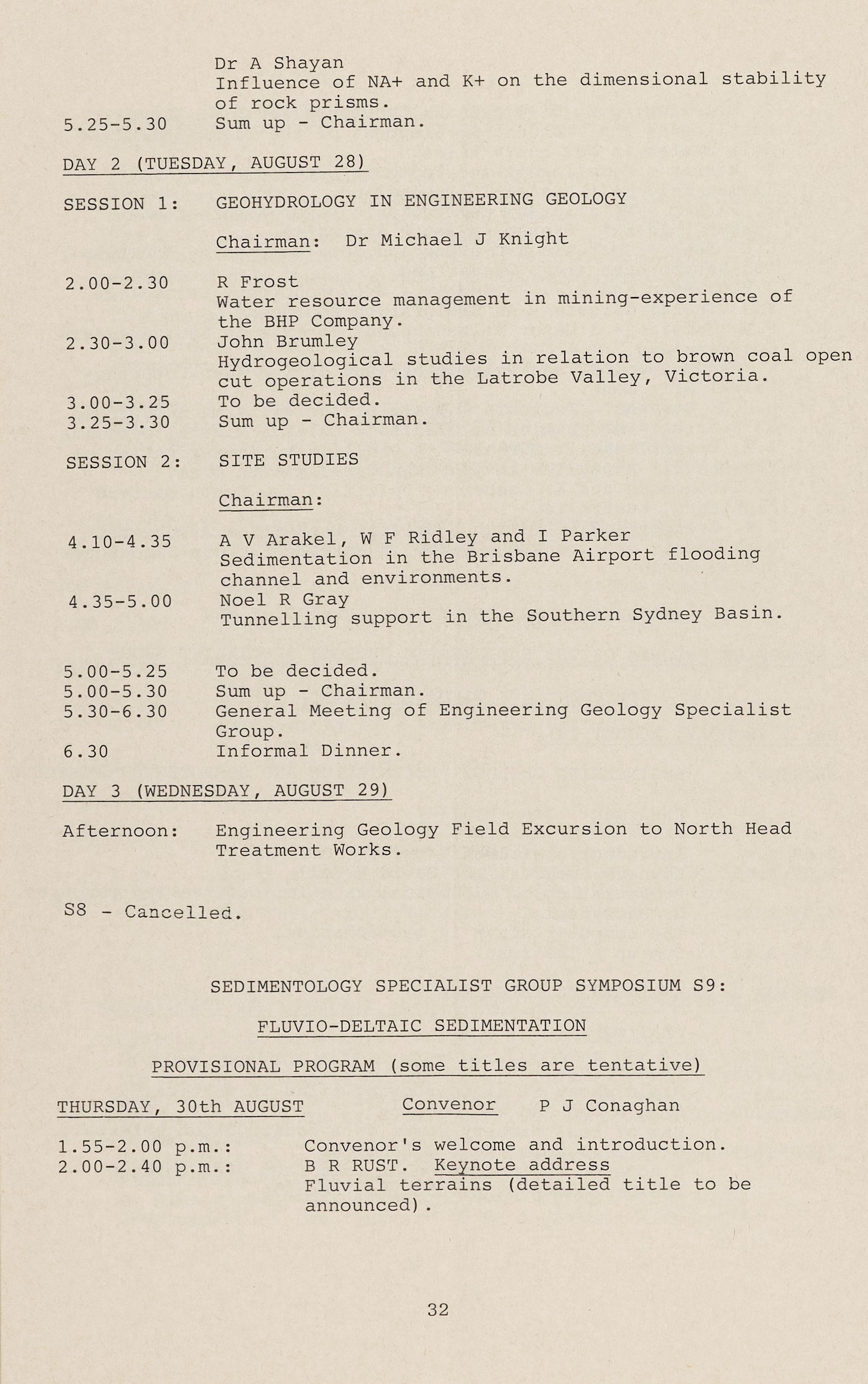
S7 ENGINEERING GEOLOGY IN THE SERVICE OF MAN
SYMPOSIUM PROGRAM OF THE ENGINEERING GEOLOGY SPECIALIST GROUP
Convenor: Dr Michael J Knight
DAY 1 (MON DAY , AUGUST 2 7 )
SESSION 1:
2.00 p.m.
2.05-3.05
3.05-3.35
3.35-3.40
SESSION 2:
4.10-4.35
4.35-5.00
5.00-5.25
ENGINEERING GEOLOGY PRESENTATION AND COMPUTERAPPLICATIONS
Chairman: John Brumley
Introduction - John Brumley
Keynote Speaker: Dr David H Bell
Presentation of geological data for engineering purposes. Dr Baczynski
The computer slave in geomechanics. Sum up - Chairman.
ENGINEERING MATERIALS
Chairman: Dr A Shayan
Rapid decay of slate roofing tiles in service. Greg W Won and Reg Hodgins use of coal washery waste as a construction material. Dr Bill F Cole and CJ Lancucki
A note on the formation of talc from mica through the breakdown of pyrrhotite. And/or
5.25-5.30
Dr A Shayan
Influence of NA+ and K+ on the dimensional stability of rock prisms. Sum up - Chairman.
DAY 2 (TUESDAY, AUGUST 28)
SESSION 1:
2.00-2.30
2.30-3.00
3.00-3.25 3.25-3.30
SESSION 2:
4.10-4.35
4.35-5.00
5.00-5.25
5.00-5.30
5.30-6.30
6.30
GEOHYDROLOGY IN ENGINEERING GEOLOGY
Chairman: Dr Michael J Knight
R Frost
Water resource management in mining-experience of the BHP Company.
John Brumley
Hydrogeological studies in relation to brown coal open cut operations in the Latrobe Valley, Victoria. To be decided. Sum up - Chairman.
SITE STUDIES
Chairman:
AV Arakel, W F Ridley and I Parker Sedimentation in the Brisbane Airport flooding channel and environments.
Noel R Gray
Tunnelling support in the Southern Sydney Basin.
To be decided. Sum up - Chairman. General Meeting of Engineering Geology Specialist Group. Informal Dinner.
DAY 3 (WEDNESDAY, AUGUST 29)
Afternoon: Engineering Geology Field Excursion to North Head Treatment Works.
S8 - Cancelled.
SEDIMENTOLOGY SPECIALIST GROUP SYMP OSIUM S9: FLUVIO-DELTAIC SEDIMENTATION
PROVISIONAL PROGRAM (some titles are tentative)
THURSDAY, 30th AUGUST
1.55-2.00 p.m.: 2.00-2.40 p.m.:
Convenor P J Conaghan
Convener's welcome and introduction. BR RUST. Keynote address Fluvial terrains (detailed title to be announced).
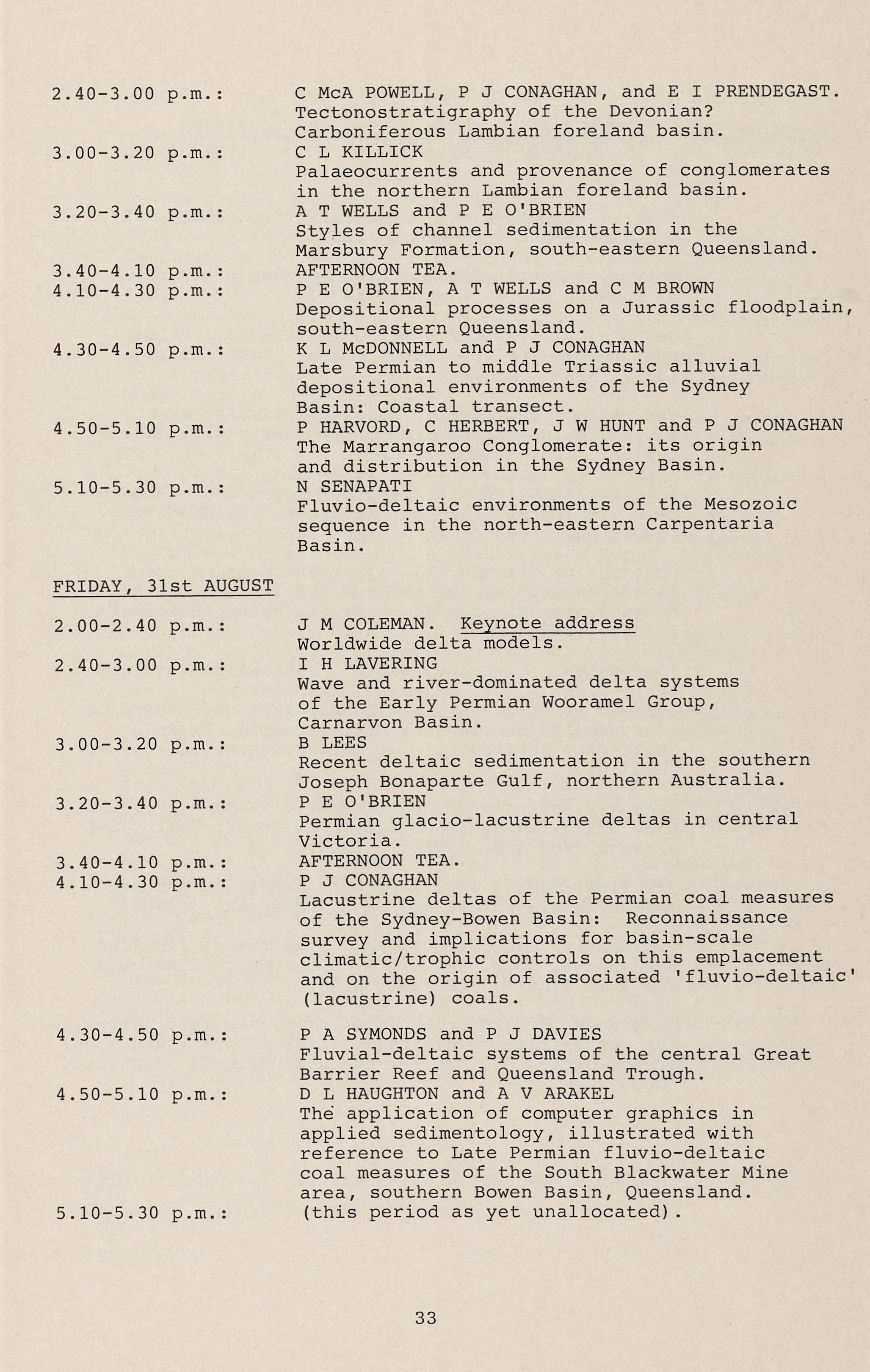
2.40-3.00 p.m.:
3.00-3.20 p.m.:
3.20-3 . 40 p.m.:
3.40-4.10 p.m.: 4.10-4 30 p.m.:
4.30-4.50 p.m.:
4.50-5.10 p.m.:
5 10-5.30 p.m.: FRIDAY, 31st AUGUST
2.00-2.40 p.m.:
2.40-3.00 p.m . :
3.00-3.20 p.m.:
3 20-3.40 p.m.:
3.40-4.10 p.m.:
4.10-4.30 p m.:
4.30-4.50 p.m.:
4.50-5.10 p.m.:
C McA POWELL, P J CONAGHAN, and EI PRENDEGAST.
Tectonostratigraphy of the Devonian?
Carboniferous Lambian foreland basin.
CL KILLICK
Palaeocurrents and provenance of conglomerates in the northern Lambian foreland basin.
AT WELLS and PE O'BRIEN
Styles of channel sedimentation in the Marsbury Formation, south-eastern Queensland.
AFTERNOON TEA.
PE O'BRIEN, AT WELLS and CM BROWN
Depositional processes on a Jurassic floodplain, south-eastern Queensland.
KL McDONNELL and P J CONAGHAN
Late Permian to middle Triassic alluvial depositional environments of the Sydney Basin: Coastal transect.
P HARVORD, C HERBERT, J W HUNT and P J CONAGHAN
The Marrangaroo Conglomerate: its origin and distribution in the Sydney Basin.
N SENAPATI
Fluvio-deltaic environments of the Mesozoic sequence in the north-eastern Carpentaria Basin.
JM COLEMAN. Keynote address Worldwide delta models.
I H LAVERING
Wave and river-dominated delta systems of the Early Permian Wooramel Group, Carnarvon Basin.
B LEES
Recent deltaic sedimentation in the southern Joseph Bonaparte Gulf, northern Australia.
PE O'BRIEN
Permian glacio-lacustrine deltas in central Victoria.
AFTERNOON TEA.
P J CONAGHAN
Lacustrine deltas of the Permian coal measures of the Sydney-Bowen Basin: Reconnaissance survey and implications for basin-scale climatic/trophic controls on this emplacement and on the origin of associated 'fluvio-deltaic' (lacustrine) coals.
PA SYMONDS and P J DAVIES
Fluvial-deltaic systems of the central Great Barrier Reef and Queensland Trough.
D L HAUGHTON and AV ARAKEL
5.10-5.30 p.m.:
The application of computer graphics in applied sedimentology, illustrated with reference to Late Permian fluvio-deltaic coal measures of the South Blackwater Mine area, southern Bowen Basin, Queensland. (this period as yet unallocated).
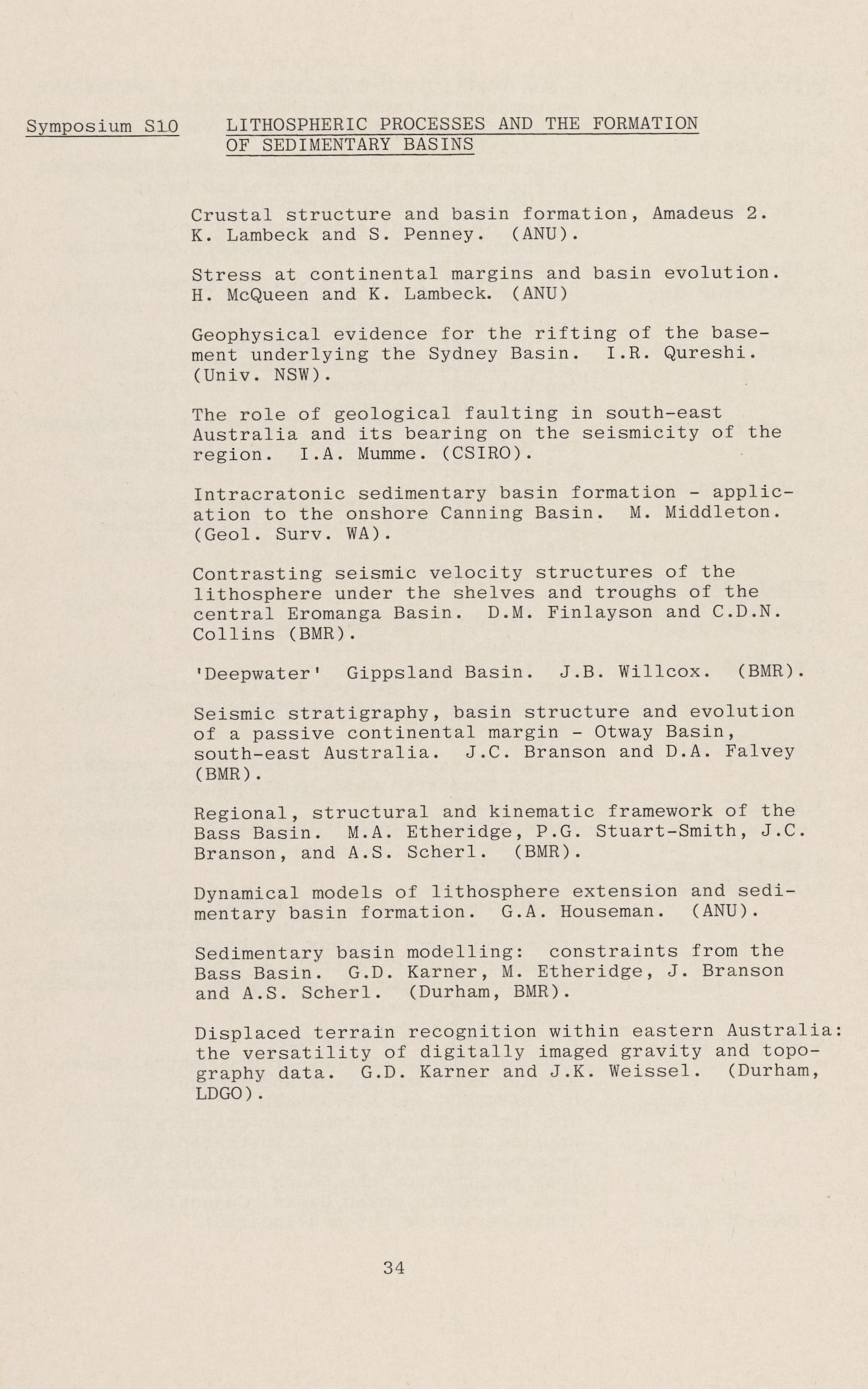
Symposium
SlD LITHOSPHERIC
PROCESSES AND THE FORMATION OF SEDIMENTARY BASINS
Crustal structure and basin formation, Amadeus 2. K. Lambeck and S. Penney. CANU).
Stress at continental margins and basin evolution. H. McQueen and K. Lambeck. CANU)
Geophysical evidence for the rifting of the basement underlying the Sydney Basin. I.R. Qureshi. (Univ. NSW).
The role of geological faulting in south-east Australia and its bearing on the seismicity of the region. I.A. Mumme. (CSIRO).
Intracratonic sedimentary basin formation - application to the onshore Canning Basin. M. Middleton. (Geol. Surv. WA).
Contrasting seismic velocity structures of the lithosphere under the shelves and troughs of the central Eromanga Basin. D.M. Finlayson and C.D.N. Collins (BMR).
'Deepwater' Gippsland Basin. J.B. Willcox. (BMR).
Seismic stratigraphy, basin structure and evolution of a passive continental margin - Otway Basin, south-east Australia. J.C. Branson and D.A. Falvey (BMR).
Regional, structural and kinematic framework of the Bass Basin. M.A. Etheridge, P.G. Stuart-Smith, J.C. Branson, and A.S. Scherl. (BMR).
Dynamical models of lithosphere extension and sedimentary basin formation. G.A. Houseman. CANU).
Sedimentary basin mod e lling: constraints from the Bass Basin. G.D. Karner, M. Etheridge, J. Branson and A.S. Scherl. (Durham, BMR).
Displaced terrain recognition within eastern Australia: the versatility of digitally imaged gravity and topography data. G.D. Karner and J.K. Weissel. (Durham, LDGO).
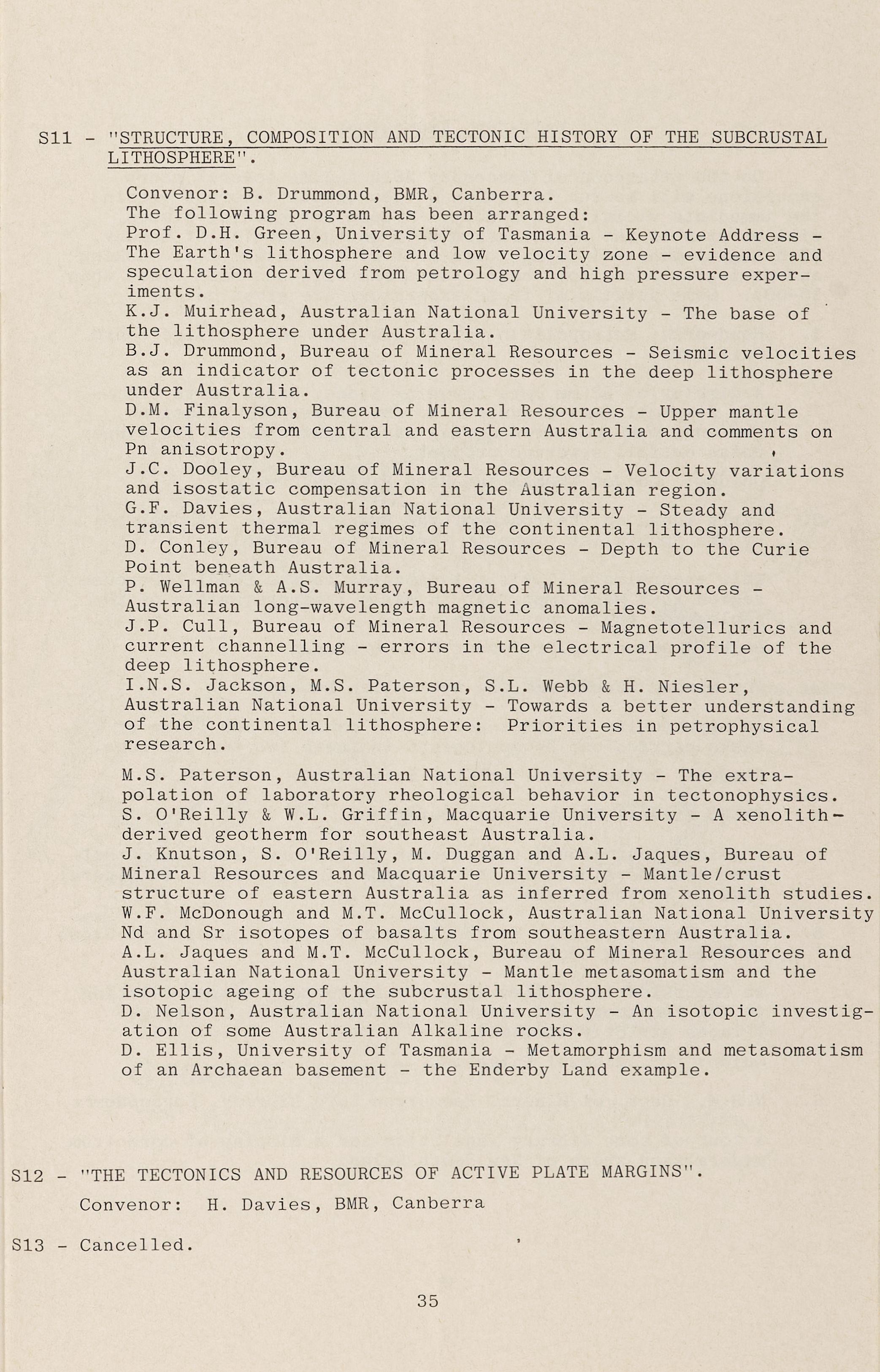
Sll - "STRUCTURE, COMPOSITION AND TECTONIC HISTORY OF
THE SUBCRUSTAL LITHOSPHERE".
Convenor: B. Drummond, BMR, Canberra. The following program has been arranged:
Prof. D.H. Green, University of Tasmania - Keynote AddressThe Earth's lithosphere and low velocity zone - evidence and speculation derived from petrology and high pressure experiments.
K.J. Muirhead, Australian National University - The base of the lithosphere under Australia.
B.J. Drummond, Bureau of Mineral Resources - Seismic velocities as an indicator of tectonic processes in the deep lithosphere under Australia.
D.M. Finalyson, Bureau of Mineral Resources - Upper mantle velocities from central and eastern Australia and comments on Pn anisotropy.
J.C. Dooley, Bureau of Mineral Resources - Velocity variations and isostatic compensation in the Australian region.
G.F. Davies, Australian National University - Steady and transient thermal regimes of the continental lithosphere.
D. Conley, Bureau of Mineral Resources - Depth to the Curie Point be nea th Australia.
P. Wellman & A.S. Murray, Bureau of Mineral ResourcesAustralian long-wavelength magnetic anomalies.
J.P. Cull, Bureau of Mineral Resources - Magnetotellurics and current channelling - errors in the electrical profile of the deep lithosphere.
I.N.S. Jackson, M.S. Paterson, S.L. Webb & H. Niesler, Australian National University - Towards a better understanding of the continental lithosphere: Prior i ties in petrophysical research.
M.S. Paterson, Australian National University - The extrapolation of laboratory rheological behavior in tectonophysics.
S. O'Reilly & W.L. Griffin, Macquarie University -A xenolithderived geotherm for southeast Australia.
J. Knutson, S. O'Reilly, M. Duggan and A.L. Jaques, Bureau of Mineral Resources and Macquarie University - Mantle/crust structure of eastern Australia as inferred from xe nolith studies.
W.F. McDonough and M.T. McCullock, Australian National University Nd and Sr isotopes of basalts from southeastern Australia.
A.L. Jaques and M.T. McCullock, Bureau of Mineral Resources and Australian National University - Mantle metasomatism and the isotopic ageing of the subcrustal lithosphere.
D. Nelson, Australian National University - An isotopic investigation of some Australian Alkaline rocks.
D. Ellis, University of Tasmania - Metamorphism and metasomatism of an Archaean basement - the Enderby Land example.
S12 - "THE TECTONICS AND RESOURCES OF ACTIVE PLATE MARGINS".
Conv enor: H. Davies, BMR, Canberra
S13 - Canc elle d.
Half-day Excursions
On the afternoon of Wednesday 29th August several short excursions will be run to places of geological interest within the immediate vicinity of Sydney. A desk for booking places will be open in the registration area on the morning of Monday, 27th August when all formalities must be completed (i.e. booking and paying). Costs for these excursions will be small (less than $5-00). Some details of these excursions are given below:
1. Headworks, Metropolitan Water, Sewerage and Drainage Board Guildford.
A display of 83 mm core covering Sydney Basin units from the Stanwell Park Claystone to the Hawkesbury Sandstone. The c o re was rec o vered d u ring investigat i ons for the Sydney Ocean outfall sewerage project.
Guides: Gordon Thomas and Greg Hawkins.
2. Early ideas o n the rocks of the Sydney Bas i n. (Sponsored by the Specialist Group in the History of Geology).
This excursion will visit localities in the Bondi-LaPerouse region that were important in early interpretations of the ge o logy of the Sydney Basin.
Guide: Associate-Professor D.F. Branagan.
3. The Mining Museum and the Australian Museum.
An o pportunity to visit geological exhibits and learn of tasks carried out by geologists in these two institutions.
Guides: Brian Garner and Lyn Sutherland.
4. CSIRO Mineral Research Laboratories.
A guided tour around the diverse laboratory facilities that have been developed in the Division of Mineralogy and Mineral Physics at North Ryde.
5. North Head Treatment Works (Sponsored by the Specialist Group in Engineering Geology).
An ex c ursion to examine engineering geology issues relating to the treatment and offshore tunnel disposal of sewage. (Places strictly limited).
Guide: Dr. Michael Knight.
6. N.S.W. Dept. of Mineral Resources Core Library, Londonderr y .
A tour of core library facilities and a display of core from mineralised areas of New South Wales.
a.r+ifa..e.-/-J or- an:; ok.. e r o.bje.c 4" 1d.r,I- a+ -IG_
GEOA~-r EXl-\lBlT/ON
7~ AuJ-1-rtdt~h. Ged~tc~ Conve.11,f/~
TERRANE JUMPING
SOME STUDENT HOWLERS from David O'Connell (Qld. Inst Technology)
The wave breaks and the upward surge of water is called squash.
A glacier is a large, slow moving piece of i ce that gorges its way down valleys.
A good kaolinite can be used in ceramics especially in toilet bowls etc because of its anaesthetic properties
Isotopes have the same number of plutons, but varying numbers of neutrons.
Pebbles of rock faceted by the wind GIBLETS.
The layer of the earth betwe e n the crust and the core MENTAL.
NEW COUNCIL
BY THE TIME THIS ISSUE OF THE AUSTRALIAN GEOLOGIST WILL BE PUBLISHED, THE AIG WILL HAVE HELD ITS ANNUAL GENERAL MEETING AND CONFIRMED THE COMPOSITION OF A NEW COUNCIL, PREVIOUS COUNCILS HAVE INCLUDED ELECTED MEMBERS ONLY FROM N,S,W,, BUT THE NEW COUNCIL INCLUDES MR JOE LORD FROM W,A, AND DR TIM HOPWOOD FROM S,A, IN ADDITION, IT IS PROPOSED TO FORMALLY RECOGNIZE THE VARIOUS STATE BRANCHES NOW OPERATING AS COMMITTEES OF COUNCIL, SO THAT THEIR CHAIRMEN WILL BECOME FULL MEMBERS OF COUNCIL, EX-OFFICIO,
THE AIG PUBLICATION "FIELD OPERATORS GUIDE" SETTING OUT RECOMMENDED STANDARDS OF CORRECT PROCEDURES AND BEHAVIOUR IN FIELD OPERATIONS WILL BE POSTED IN EARLY MAY TO ALL AIG MEMBERS, REQUESTS FOR FURTHER COPIES OF THE PUBLICATION SHOULD BE SENT TO THE HON, SECRETARY, AIG c/- 10 MARTIN PLACE, SYDNEY, N,S,W, 2000,