In this first issue of 1984 I would like to wish all members a very prosperous new year. My page this time is being written during the SGTSG symposium. Over 100 participants, several from overseas and including most of the Structural Geology lecturers in Australia, met in the small fishing village of Bermagui, N.s.w. to listen, argue, discuss and inspect all kinds of folds and foliations. Chris Powell and Dick Glen and the committee members are to be congratulated on organizing a magnificent and valuable 'State of the Art' symposium. The proceedings will be published in a special issue of the Journal of Structural Geology. overseas visitors were financed through grants from the 25IGC fund and loans from GSA which will be repaid from profits. Several mining companies also made generous contributions, but, disappointingly, company geologists were conspicuous by their absence.
It is appropriate at this time to discuss our relations with industry and industrial geologists. I have heard it said, quite often, that the Society has little relevance to industry. I personally doubt the validity of this view. It may be true that our publications do not adequately reflect the interests of a large proportion of our members but the Society has published several items of industrial interest, particularly on Coal and Engineering Geology, and a special publication on the Eromanga Basin is in preparation. To a large extent the solution to this problem lies with Specialist Groups particularly that in Economic Geology. The outlets are available if members write papers and groups initiate Special Publications or Field Guides etc. The Society can, perhaps, best contribute by organizing meetings and our increasing interest in Economic Geology is reflected in the theme of the 7th Australian Geological Convention in Sydney this August - 'Geoscience in the development of natural resources'. As on many occasions in the past, the organizing committee report great interest and assistance from companies. We are grateful for this support and I suggest that the next Council meeting takes the opportunity to revise and advertize more widely the benefits of Company Membership in our Society.
On the horizon are other conventions of economic interest. The 4th International Kimberlite Conference in Perth 1986 and an International Symposium on Gold in Victoria in 1987, moreover the 12th International Sedimentology Congress in 1986 will not be without economic significance.
A letter (this issue) reports the vigorous activity of the Queensland Division, it also suggests that 'the advancement of geological science' (the principal object of the Soc iet y) should be extended to include the practice and application of geologica l science and representation of professional geologists. While our objects should be under continuous review, and few could quibble with the sentiments expressed in the Queensland lett er, I must point out that the G.S.A. initiated the Australian Institute of Geoscientists specifically to deal with professional matters and I think that our industrial brethren wil l be best served by the Society and its members giving this fledgling organization their strongest support.
Before closing, I must apologise to the Engineering Geology Specialist Group for not realizing that hydrogeology was included in its scope (AG46). Finally, Executive would be pleased to hear from any member regarding a possible successor t o Dave Branagan as Newsletter Editor. Few oE us realize just how much the Society owes to his enthusiasm for the Newsletter that was reluctantly started ten years ago and has now become such a successful feature as it approaches issue no. 50.
M. J. RICKARD
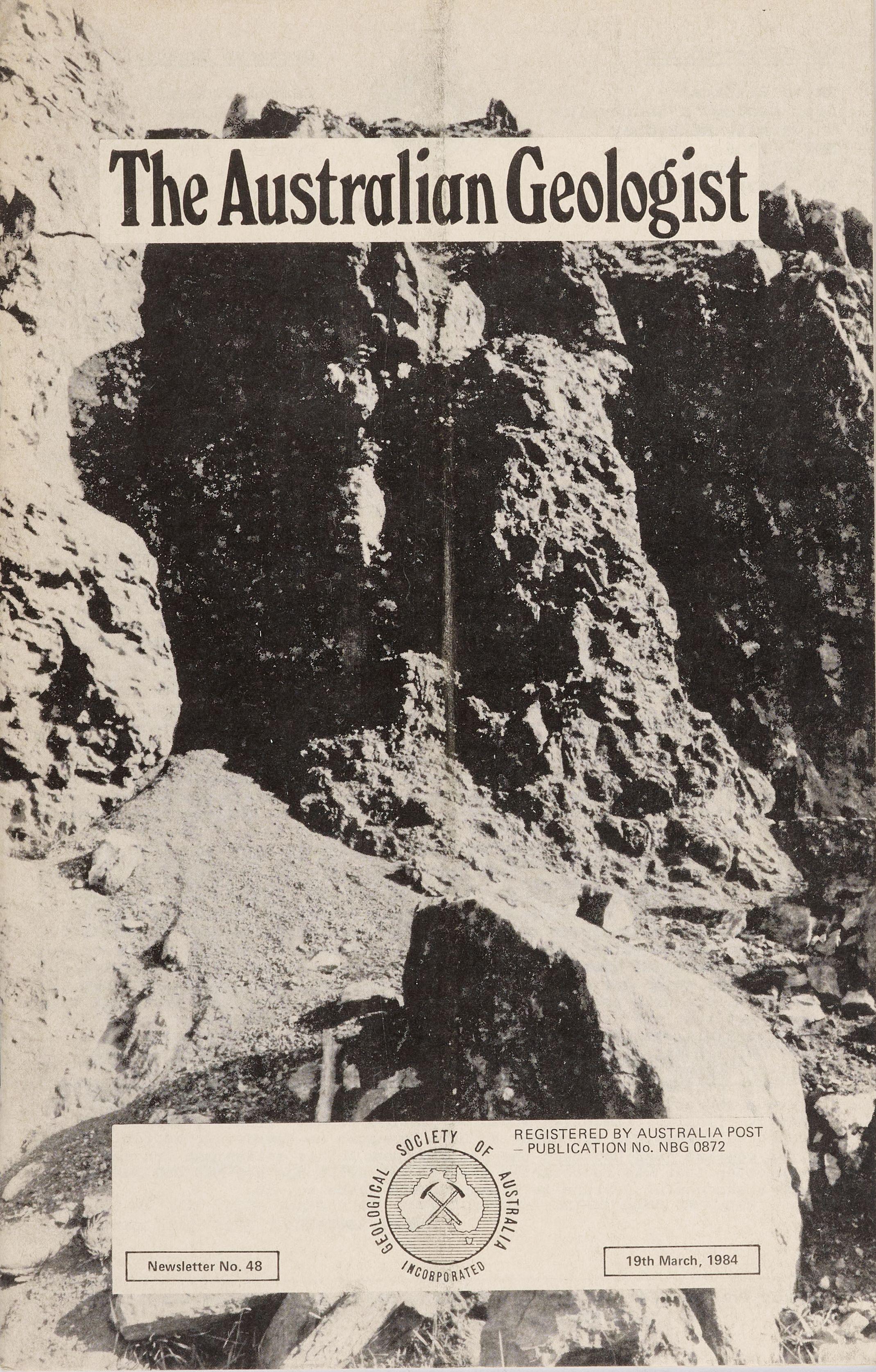
Cover Photo:
No. 48 1j March, 1984
EDITORIAL COVER UP
The cover of the previous issue of the Australian Geoloiist provoked a mixed reaction from members. Some were amused while others were frankly outraged and expressed themselves so. This is as was to be expected in that the practice of geology includes persons with a wide spectrum of tastes and attitudes.
Several expressed the opinion that the cover would be damaging to the profession of geology and I would be sorry if that were so. While I can agree that persons who feel personally affronted should express themselves freely it seems regrettable that a manifest absurdity should cause a reader reaction, while matters of, to me, greater import to the profession receive little or no comment.
The executive felt that I had made an error in judgement in using the material and I bow to its decision.
I WISH THEREFORE TO OFFER HEARTFELT APOLOGIES TO THOSE WHO WERE OFFENDED, AND TRUST THEY WILL FORGIVE MY LAPSE OF TASTE.
One final point needs to be made. One reader made the comment that the editorial board should be chastised for its part in the proceedings. The Society's editorial board is not, and has never been, involved in the Australian Geologist . and the sole responsibility rests with the editor.
It is a matter of some concern that members are unaware of this, but perhaps the time is ripe for the board to become involved.
This is a matter I foreshadowed in my report to Council in February 1983 when discussion was taking place about changes in the journal publication.
There is so much to be said for the newsletter editor being a free and independent spirit, as I have been for the past ten years or more, but the growth of the society and the increase in its range of activities means that the newsletter is expected to cover an increasingly broader spectrum and the editor needs to be, as he has not to date, an official Member of Council. This anomaly is an indication of the way the Society has grown, somewhat haphazardly, and we clearly need to be constantly reappraising our aims and methods.
David Kershaw of the Queensland Division discusses the matter of newsletter changes and others in his letter on another page. These are worth taking up by other members. Council meets in August and forward thinking is essential. Now read on.
Because of the large amount of copy for this issue some reviews have been held over till the next.
NOMINATIONS FOR W.R BROWNE MEDAL
The W. R. Browne medal is awarded at each General Meeting of the Society to a per son distinguished for contribution to the geological sciences in Australia.
The award is not confined to Australian residents but is made in regard to contributions to Austral ian geological sciences The contributions are normally through publication of original research but contributions to education or administration in earth sciences or any combinations of these ma y be relevant to the award. In general, the award is to be made to a senior person with recognised service to geology in Australia.
Nominations for the award, accompanied by a written justification which ma y be used as a basis for citation, should be directed to the President, Dr M.J. Rickard, at the Department of Geology, Australian National University, by 31st May 1984. Nominations remain current for a period of five years.
Now availableABSTRACTS No. 10:
Symposium ADELAIDE GEOSYNCLINE SEDIMENTARY ENVIRONMENTS AND TECTONIC SETTINGS - Adelaide December 9, 1983.
Price: $7.50 posted - or $5.00 if collected from either the Sydney office or from John Parker or Richard Smith at the South Australian Department of Mines.
NOTICE
Copies of the reprinted volume "The Geology and Geophysics of North-East Australia" are now available at a cost of $20.00 plus $6.00 postate and handling from:-
The Secretary
Queensland Division Geological Society of Australia
GPO Box 1820
BRISBANE QLD 4001 STATE CIRCLE CUTTING
Members feeling any concern about the fate of the State Circle cutting on Capital Hill should rest assured that the Geological Monuments Subcommittee is keeping a close watch on the situation and is maintaining close contact with NCDC. An undertaking has been given that it will be preserved and the Subcommittee is satisfied that this is being done.
Sir,
President Rickard (Australian Geologist 3/10/83) observed the 'sharp edge' of the Society moving towards the Specialists Groups and questioned whether the divisional structure is the best arrangement.
Queensland Divisional Committee, in preparing to hand over to the 1984/85 Committee, reflected on its aims and aspirations, achievements and failures during 1983/84 season.
The Committee was initially stuck by its ignorance of the specific aims of the Society and its role and relationship to the science and its practice. In particular, COMMUNICATION between members, divisions, branches and group needs to be improved. "The Australian Geologist" is the obvious medium to improve communication between the various groups and divisions. Should each of these groups appoint liasion officers to keep the full membership informed of the activities of the various groups? Should membership fees be increased to accommodate paid assistance for the Newsletter Editor?
The specific aims set by the Queensland Division during 1983 were improved communication with increased content of the Monthly Report and a membership drive.
The membership drive involved requesting existing members to forward names of non-member geologists who were forwarded a 'showbag' containing a recent Australian Geologist, a specially prepared brochure listing the offerings and activities of the Society
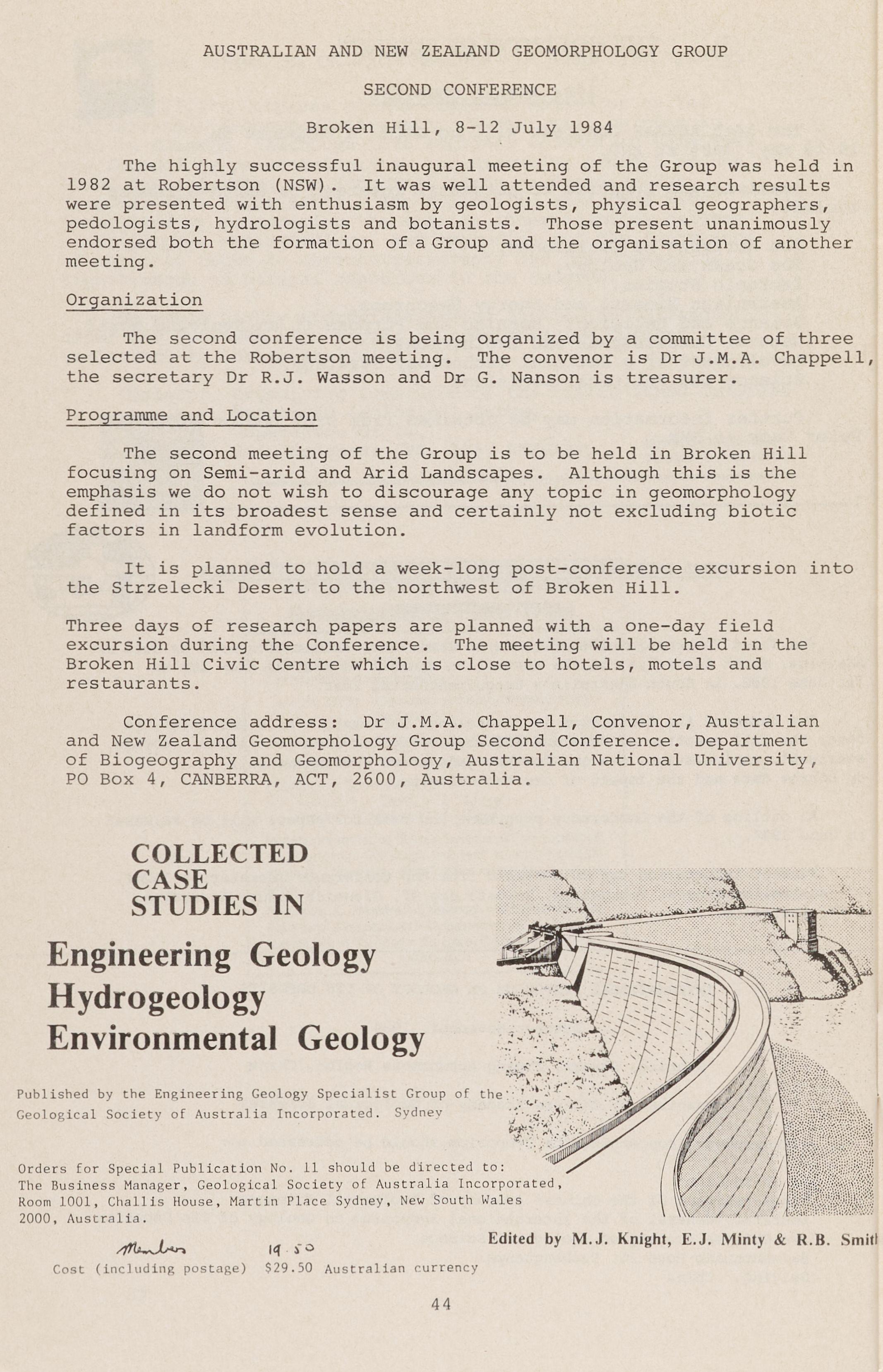
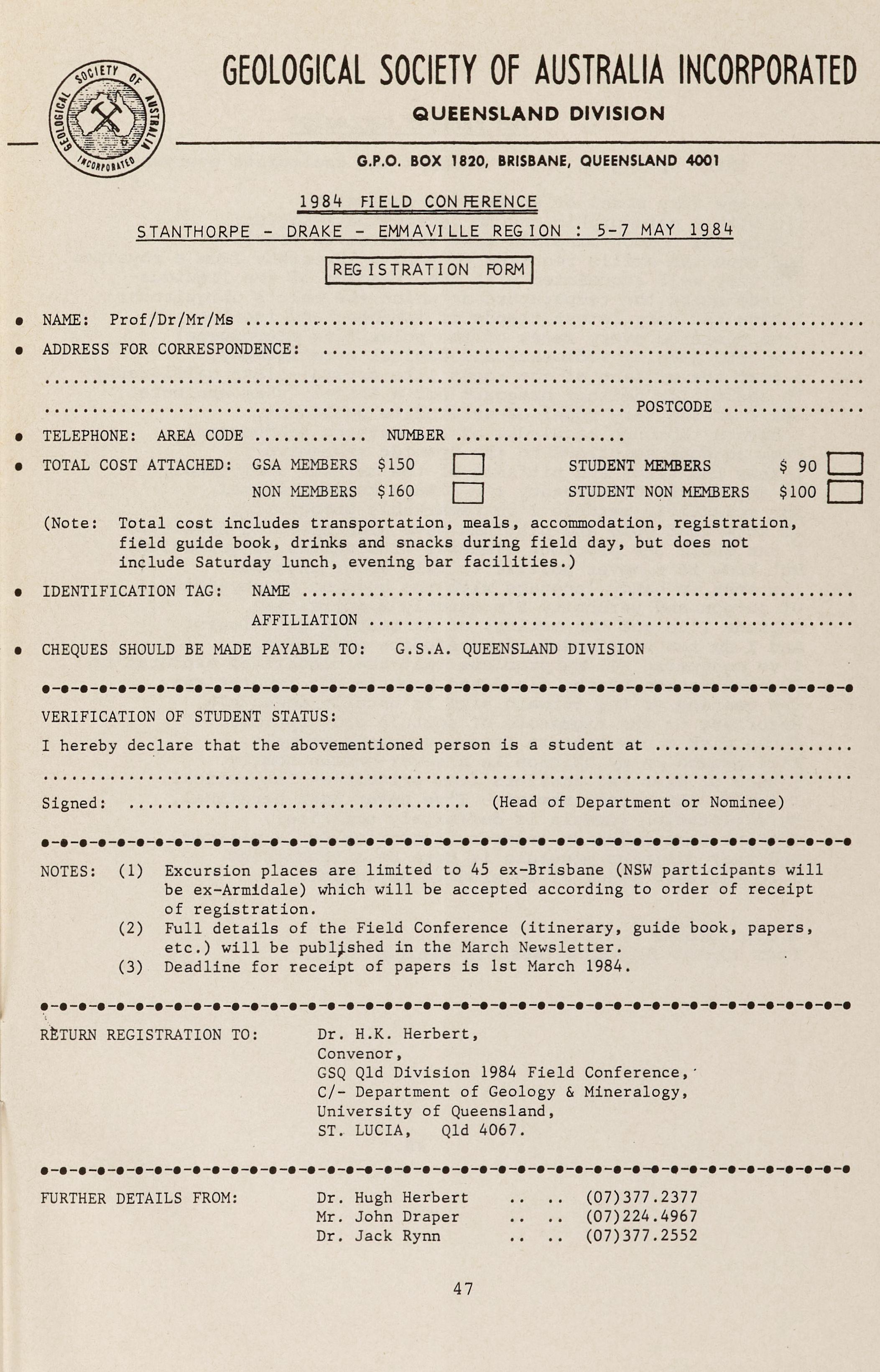
Significant achievements during 1~83/84 included the publishing of the 442 page volume "Permian Geology of Queensland", and reprinting of the popular volume, "Geology and Geophysics of North East Australia". The annual field conference was held in the Maura-Cracow Area and the field conference will be during May in the Stanthorpe-Drake-Emnaville Region. The inaugural "G.S.A. Student Prize" (a medal) was awarded to four tertiary studen ts and one secondary student. The Geological Monuments sub-committee proceeded with further identification and documenta tion of geological monuments. · Unfortunately, attempts to have State Government involvement in their management and protection has been unsuccessful, however, the Brisbane City Council is embarking upon the preparation of a conservation Atlas for the city, with the long term aims of preparing guidelines for management and rehabilitation of particular landscape units.
1984 would be an appropriate year for the Society to review its object: "the advancement of the geological sciences" and extend this to include the practice and application of geological science and representation of professional geologists.
Since the Soci ety was established some thirty years ago, the practice of geology has expanded and is applicable to banking, stockbroking, financial ma nagement, journalism, exploration, consulting, public administration, engineering and environmental planning, and many other human endeavours, and yet, as a practising profession, it is poorly organized or represented in geological research and teaching institutions, let alon e in the community at large.
David Kershaw
Queensland Divisional Co mmi ttee 5
It is sad to find that the BMR is departing from the scene of regional geological mapping-a function they carried out supremely well. Unfortunately, they depart the scene with their task incomplete because many existing 1:250,000 state geological maps, nicely colour printed though they may be, are mere rapid compilations of previous geological work, the compiling geologist having been given inadequate time to complete his task. It would not be so bad if the states were given adequate money to revise their 1:250,000 geological maps but they have not and in the existing order of things will not. In any case Australia will be the only major-size country in the world without a nation~l geological survey. There are too many geological anomalies at the state boundaries. To name only a few:
a) The Devonian-Lower Carboniferous of Adavale Infrabasin and Drummond Basin Queensland compared to the Devonian of NSW.
b) The Proterozoic of South Australia finishes at the South Victorian State Border.
c) The Grampian Ranges in Victoria are mapped and considered differently from a number of features identical, topographically and lithologically in western NSW.
d) The nomenclature of the northern NSW part of the Great Artesian Basin compared to lithologically similar rocks in southern Queensland.
In the Victorian Geological Survey we were greatly hampered • in studying half only of the Murray Basin until there was a joint study started with NSW and the BMR.
What concerns me also is the reduction in geological mapping. Geology is not, academics to the contrary, a science that can adequately be learned from books and the top Australian geologists of today are the regional mapping geologists of yesterday.
As an economic geologist endeavouring to acquire information, often initially in the office, for those parts of Australia which I have not personally mapped and even for some parts which I have, I find more truthful expression of what is really there in the unpublished BMR records and the unpublished state survey reports because they express without the censorship of referees and viewers what the geologist saw exactly, not what reviewers and referees thought in the light of existing geological theories that they should see.
In my opinion many unpublished BMR records and some state unpublished reports, as well as many published Bulletins and reports, rank far above most PhD theses in the value of their contribution to Australian geology. It is long past the time when we should grapple with the completely unrealistic
separation between those who observe geology in the field and those who study it in textbooks or in samples of rocks collected in haste, and then teach the results.
For nearly 30 years working with recent geological graduates, I have to teach each one to forget the theories he was taught, just observe what is actually there and record it.
A.C.M. Laing Melbourne Sir,
LITHODEMES
Silence can also be a signal! I suggest that there is a clear message to the Stratigraphic Nomenclature Committee in the stunned silence that is reported (No.47) to have followed publication of the extraordinary gobbledegook extracted from the North American Stratigraphic Code and published in The Australian Geologist No.44. I had not realised, until the later issue, that the request really was meant to be taken seriously, and have now responded in fairly unequivocal terms.
A.F. Trendall Perth
Sir,
I refer to the President's comments in the October 1983 edition of "The Australian Geologist".
He remarked on the possibilities of formation of new Specialist Groups and particularly mentioned one in hydrogeology.
The Engineering Geology Specialist Group has a constitution which explicitly covers this discipline. Its full title was to be "The Engineering Geology, Hydrogeology and Environmental Geology Specialist Group", but this was abbreviated for obvious reasons.
I'm very conscious of this because I am an environmental geologist (yes, officially). Other members are employed as environmental consultants. The more specialist groups there are, the more we multi-disciplinarians will have to join!
Graeme Mcilveen Arcadia, NSW.
MULTUM in PARBO
The Victorian Division held its Annual Dinner at the Staff Club, Monash University on Thursday, December 1. Seven t y six members and friends were present and a number formed their own tables, including a two-table contingent of Western Mining supporters led by Doug Haynes.
The official table included the Chairman, Professor BE Hobbs and his wife Robyn; the guest speaker Sir Arvi Parbo, Chairman and Managing Director Western Mining Corporation, and Lady Parbo; the President of GSA and his wife Dr and Mrs Rickard; the Director of the Victorian Geological Survey and his wife Mr and Mrs J Cramsie; and the Secretary to the Department of Minerals and Energy Dr W Russell.
The after-dinner address wa s given by Sir Arvi Parbo, Chairman and Managing Di rector, Western Mining Corporation Holding s Ltd, and was titled, " A Mining Engineer's View of Exploration " .
I think that I should f i rst establ i sh my credentials for talking about mineral exploration.
I was trained as a mining engineer and worked as an underground surveyor, mining engineer, and mine manager before moving over the general manag e ment. In all these various capacities I have been in close contact with mineral exploration and vitally interested in its success over some thirty odd years. My comments are therefore frqm someone who has been more than just an interested bystander, although I could not claim personal expertise in exploration.
Geology as a science useful for finding new mineral deposits, locating extensions of known mines, and helping with the task of economic production of minerals, is a relatively recent phenomenon. When the company I work for, Western Mining Corpora tion, was established fifty years ago, it did the then almost unheard of thing in Australia of engaging a group of geologists to reconnoitre Western Australia for gold deposits. This was a novel approach.
Hard-bitten mine managers in those days relied on good luck and their own intuitive powers to follow orebodies and did not consider "jogilists", as they were disparagingly called, as worth feeding. Prospectors, not geologists, were the traditional finders of new mines. Geophysics and geochemistry as practical applied sciences are eve n more recent. It .is really only during my working life that they have come to be accepted as useful exploration tools.
The early mining developments in Australia were, of course, based on orebodi es e ither literally sticking out of the ground, or capable of being located without too much science, such as the South Australian copper deposits where rabbits digging th eir holes had brought bright green copper minerals to the surface. Th e South Australian copper shafts were located by the mine captain throwing a pick after swinging it about his head and the crews digging where it landed. For the record, these were highly successfu l mines which for quite some time produced 10% of the world's copper.
Whil e it is not impossible that major outcropping orebodies may be found today, the odds are against it The successful explor ers of 1983 must be able to look into the ground , and for this scient ific methods are indispensable.
Coming back to Western Mining Corporation, its first effort in 1933 included an aerial survey of the Eastern Goldfields in Western Australia. Such a surve y was a radical undertaking indeed. It was carried out by two aircraft owned by the Company which were ceremoniously launched and named the "Golden West" and the "Gay Prospector".
The press release on the occasion makes interesting reading. It describes in great detail the way i n which the pilot will remain in contact with his ground headquarters by "wireless telegraphy" and stresses how useful it was for the pilot to know where he was at an y time It also made the prophetic statement "It . should be clearly understood that the air photographs cannot show where the gold is".
The aerial survey didn't result in the finding of new gold mines but the photographs taken were used until quite recently by Western Mining geologists as an aid for reconnaisance and mapping . The whole undertaking, as I said, was a most unusual enterprise in those days and for quite some time Western Mining Corporation was nicknamed in the Eastern Goldfields the "Wasting Money Corporation" .
some of the other early work brought better rewards. In 1935, 48 years ago, Western Mining acquired what wer e then considered worked out gold properties at Norseman in Western Australia. Central Norseman gold Corporation was formed and has been producing gold from these worked out properties for the past 48 years, never with more than 3 to 4 years o -f proven ore reserves . It undoubtedly has tens more years of life ahead of it.
This is an example which shows how little validity there is, certainly in the case of underground ore occurrences in highly mineralised districts, in the sort of calculations that mathematically minded people do about the life of a mine or the supply of a mineral on the basis of the information known at a given time Such calculations omit vital factors which cannot be quantitifed One of these factors is that persistent application of continuously improving geological knowledge of an ore environment invariably turns up more ore as the result of new thinking and new insights. Another is that an improvement in the real price of a mineral opens up large additional supplies.
The central Norseman experience, while by no means unique, is a good example of these influences It is particularly pertinent today when lawyers and mathematically inclined economists, who infest so much of Government, are prone to want to force mineral industry activity into a format familiar to themselves, but of little relevance to the practicalities of the industry
By the time I first started work as a mining graduate in 1956, geology was a well established profession in the mining industry, both in surface and underground exploration and mining. In those days, however, there was still a good deal of rivalr y between the mining and geological departments. The miners complained that the geologists only wanted to find ore regardless of how or when it could be mined, and the geologists charged that all the good high grade ore they found finished up much poorer in grade by the time the miners did all the wrong things with it.
Toda y we would not dream of operating a mine without high quality geological input or looking for orebodies other than through professional exploration teams.
Over the years the initial rivalr y between mining engineers and geologists has changed into a close working relationship. This has been the result of recognition of the value of geological input to mine operation and has been
helped greatly by organisational arrangements where mining engineers and geologists on an operation work together as a team instead of as groups with separate interests.
The story of Central Norseman mentioned earlier confirms the adage that the best place to look for new ore is in the vicinity of known ore positions. Sir Lindesay Clark often used to say "the place to look for rabbits is in rabbit country". Persistent search in highly mineralised districts invariably yields far more ore than anybody is likely to predict. Persistence is the key, and by that I don't mean continuing the search for a year or two; sometimes it literally means continuing for tens of years.
Stawell, in Victoria, is a case in point. Western Mining started to look for gold at Stawell in the 1940's and it will be next year, some forty years later, that the first gold is likely to be produced. Most of the time during the 40 years, accountants could have made a very strong case for abandoning the search. The results of the final accounting, of course, remain to be seen, but with a reasonable level of gold prices and reasonable success in future exploration, it should turn out to be an economically worthwhile operation.
There are many other examples where persistence in mineral exploration has been an essential ingredient in ultimate success. I might just mention the search for copper by Western Mining Corporation which started at Tarraji River in the north-west of Western Australia in 1958, moved to Moonta-Wallaroo in South Australia in the early 1960's, and eventually - seventeen years later - resulted in the discovery at Roxby Downs in 1975. The work in the three locations formed a part of a sequence without which the final discovery probably would not have been made.
Incidentally, exploration at Moonta-Wallaroo is still continuing after some 20-odd years and I would not be at all surprised if it resulted in an economic discovery in that district one of these days.
One of the things I have learnt over the years is the importance of amateurs not interfering with strictly exploration decisions, even if you think they are wrong. I always remember the Kambalda nickel discovery in this context.
Western Mining was going through a very difficult financial patch in t965-66 due to the depressed state of the gold mining industry, when Roy Woodall was alerted to the Kambalda nickel potential through a sample of the Kambalda outcrop taken years earlier by prospectors in search of uranium.
In the previous 70 years gold had been the only worthwhile mineral found in the Eastern Goldfields. The thought that the area could also be a major world nickel province did not sit easily with most people. Roy was one of the few who believed it could.
Roy's proposal that Western Mining should spend 20,000 of its scarce pounds on investigating nickel at Kambalda was, in the circumstances, more than bold I often wonder what the outcome would have been had the decision been left to me. Fortunately, it went right up to the Board, which approved.
Mineral exploration, I suggest, is still as much of an art as a science, although it has come a long way in the thirty years I know about. Much progress is being made and no doubt thirty years from now the speaker at this Society's dinner will be able to tell stories about how little we knew in the 1980's. Finding new orebodies is, however, not the major challenge of the mineral industry today. How to turn new finds into successful mines has become the key question.
There are many orebodies, discovered in the late 1960's and in the 1970's, still awaiting development The obstacles are numerous: depressed markets, nationalistic ambitions, competition from uneconomic government-owned operations in other countries, unrealistic expectations of government "talce", anti-everything protest movements, lack of government and community understanding and so on.
None of these problems are technical: most are man-made, the problems are not unique to Australia: most o~ the western democracies (with some exceptions) are in similar circumstances.
At the bottom of the problem is that governments have created expectations amongst their populations which are quite unrealistic and, in one way or another, result in the consumption of more wealth than is being created. The rational solution is, of course, to reduce or at least level off consumption until wealth generation catches up. This comes in conflict with the political desirability of promising more, not less. Also, particular interest groups can now get most of what they want by demanding it loudly enough, preferably through the modern democratic medium of ten thousand yelling demonstrators.
The expedient solution is to extract more from the wealth-generating sector, even if it is at the cost of its longer term health. If I may borrow from a recent paper by my colleague, Hugh Morgan," the wealth-generating activities on which the well - being of the community depends have come to be treated much like the Mediterran e an donkey which, as you may know, is an essential but much abused beast of burden in that part of the world. Ill-treated, fly-blown, over-laden and ill-nourished but always expected to carry more and go further. Its main pre-occupation is necessarily with survival. What we need is a healthy and fit wealth-generating sector, able to grow and thus provide for the increasing demands of other sectors, not something which is sagging at its knees and in danger of toppling over.
We do not need erudite economic studies and batteries of computers to tell us what to do to get back on the path to prosperity. The problem is not in knowing what to do but in how to do it. So far there are not many examples of strong and resolute action . Meanwhile, how to turn mineral discoveries into successful mines remains on top of the industry's problem list.
I would like to conclude by quoting the last paragraph of Sir Lindesay Clark's recently published book "Built on Gold" - Sir Lindesay's recollections of Western Mining. He says:
"There have naturally been many changes in the industry during the life of the Company but I have observed that one characteristic persists - every miner is a prospector at heart, and every prospector is perforce an optimist".
I think that sums it up perfectly.
Co ngratulati o n s to Eric Rudd of Ad e laid e and Ke n Mosher of Sy dne y honoured in Australia Day Aw ards .
REGOLITH IN AUSTRALIA
Regolith is presently a fashionable topic in earth science. In March 1982, the Geological Society of London held a meeting devoted to Residual Deposits: an International Colloquium on Petrology of Weathering and Soils was held by CNRS in Paris during July 1983: one of the themes of the 27th International Geological Congress in Moscow in August 1984 is Regoliths and Mineral Resources: and in November 1983 a Symposium on Regolith in Australia: Genesis and Economic Significance was held at the Academy of Science, Canberra.
The latter Symposium was jointly sponsored by the .Bureau of Mineral Resources, Geology and Geophysics and by CSIRO Institute of Energy and Earth Resources. It attracted participants from industry (37%), tertiary education (22%), government agencies (6%) as well as from BMR (15%) and CSIRO (21%). In many respects it was a successor to the 1981 Symposium on the Cainozoic Evolution of Continental Southeast Australia and three recent workshops on Geochemical Exploration in Deeply Weathered Terrain run by CSIRO Division of Mineralogy.
The term 'regolith' is used to describe the layer or mantle of fragmental and unconsolidated rock material, whether residual or transported, that nearly everywhere forms the surface of the land and overlies the bedrock. It includes saprolite, alluvium, aeolian deposits, soil and other surficial materials.
After an introduction by Professor E.S. Hills, F.R.S., F.A.A., the symposium started with an Australia-wide overview and then moved into regional studies from Western Australia, Queensland, South Australia and Victoria (although all states received some mention in subsequent papers). Much interest centred on the age of weathering and its relationship to landscape development. Concepts of etchplains and erosion surfaces prevail, but a keen attempt is evident to achieve a strict time frame relating landscapes and their regolith by means of stratigraphy, radiometric dating or palaeomagnetism. One topic that brought forth considerable controversy was the origin and nature of duricrusts and there was an extended debate on the origin of silica and rate of formation of silcrete. A lot of new information was provided which shows that old models are not valid, but satisfactory new models are yet to be developed.
Application of new techniques to the understanding of the regolith in Australia and to mineral exploration occupied the second half of the symposium. These included palaeomagnetism; lead, sulfur, oxygen and hydrogen isotope studies; various remote sensing techniques; and many geochemical studies. •
It is c1ear that our knowledge of the Australian regolith has not advanced greatly over the past twenty years and there are still major disagreements over such commonplace matters as the nature of erosion surfaces, the processes of landscape evolution, the chemistry of duricrust formation, and even the descriptive vocabulary necessary to pursue regolith studies.
Most of the min eral deposits i n Australia were discovered b y recognition of their gossanous outcrop Considerable research effort has led to a better understandi n g of gossan formation and techniques of evaluation As more outcropping and near - surface deposits are discovered , the greater is the need to e x plore for concealed mineralization Although no papers were submitted from exploration companies, it is evident that they are vitally concerned with regolith research to assist in their search for mineralization below the deepl y weathered zone which covers much of Australia .
In a concluding forum a number of views appeared to achieve consensus : there should be a further meeting in 18 months; the ne x t meeting should be in Western Australia; it might better be structured as a field-oriented workshop ; that several test areas might be identified for detailed studies prior to the ne x t meeting ; and that any such studies should be multidisciplinary .
Following the symposium , one - day field trips were held to study the Cainozoic Geology of the Monaro region south of Canberra and Lake George to the east
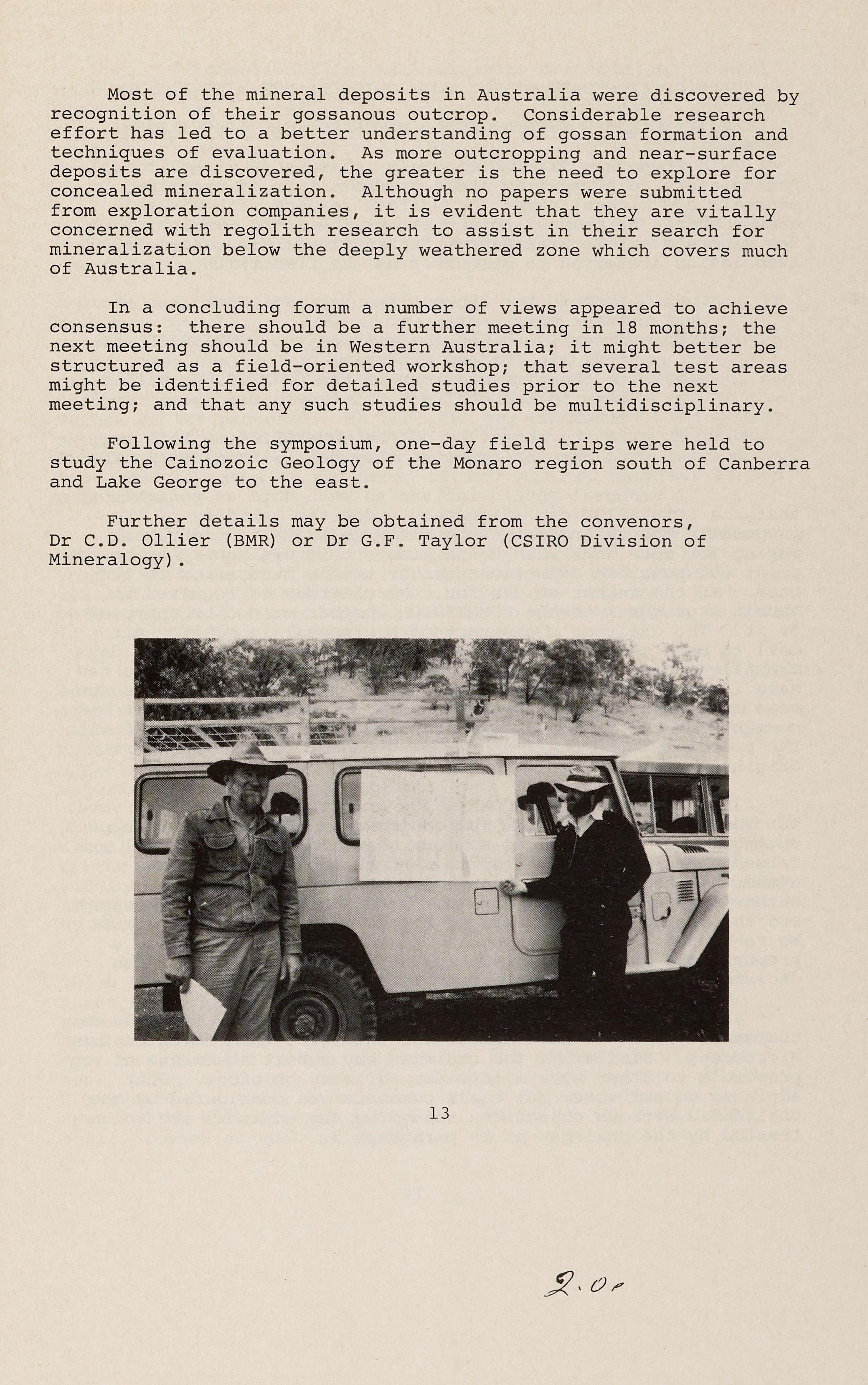
Further details may be obtained from the convenors, Dr C . D. Ollier (BMR) or Dr G F Taylor (CSIRO Division of Mineralogy) . 1 3
RULES
MINERAL-NAMES INTERNATIONAL MINERALOGICAL ASSOCIATION
1. Proposals for new minerals, changes in mineralogical nomenclature, discrediting and/or redefinition of existing minerals and mineral names, or matters dealing with mineral groups should be brought to the attention of the Commission on New Minerals and Mineral Names, International Mineralogical Association (referred to hereafter as the COMMISSION),
a. through the appropriate National Committee where these exist, or
b. directly to tne chairman of the COMMISSION, if they are for new minerals; or
c. to the vice chairman of theCOMMISSION, with a copy to the chairman, if they are for existing minerals; or
d. to the secretary of the COMMISSION, with a copy to the chairman, if they deal with mineral groups.
2. A proposal should include as much data as possible so that the COMMISSION can adequately judge the validity of the proposal. The chairman is authorized to write to the author asking for more data when he considers this desirable, or he may point out possible objections either to the mineral or to the name. If the author so desires, the chairman is required to submit a proposal to the COMMISSION whether or not he approves of it. The chairman's abstract of a proposal is sent by air mail to each member of the COMMISSION and approximately 60 days are allowed for receipt of voting papers. In cases where a new name is proposed to replace an old one, the proposer of the new name must write to the original namer, if alive, and obtain his comments on the re-naming. These comments must be supplied with the proposal. The chairman may also choose to correspond with original namers.
3. Members of the COMMISSION are urged, not only to vote, but to comment in detail. The chairman is authorized to suspend voting if, in his opinion, serious objections to a proposal are raised. He is then required to send the objections to the author of the proposal for a reply. After receiving the author's reply, the chairman must send copies of the objections and the reply to the members of the COMMISSION and voting must be re-opened. Any member of the COMMISSION who objects to a proposal may ask the chairman to use this procedure, but the decision to suspend voting rests with the chairman.
4. Abstracts of proposals dealing with "ore" minerals are customarily sent to some members of the IMA's Commission on Ore Microscopy. Similarly, the chairman may submit abstracts of any proposals to other specialists for advisory opinions. Such advisers do not vote, but their comments are considered by the chairman. Serious objections raised by any advisers are to be treated by the chairman as in paragraph 3.
5. Proposals dealing with minerals belonging to mineral groups for which subcommittees have been organized by the COMMISSION may be sent to the appropriate subcommittee chairman for circulation among the subcommittee members if the COMMISSION chairman thinks such action is advisable. Subcommittee members are invited to submit opinions and serious objections raised by them are treated by the chairman as in paragraph 3.
6. If two or more proposals for the same new mineral are received by the chairman, the proposal which arrived first in the chairman's office will have priority.
7. A proposed new mineral will be considered approved if at least two-thirds (2/3) of the members who vote on the proposal vote yes. A proposed name will be considered approved if at least one-half (1/2) of the members who vote on the proposal vote yes. After voting on a proposal is completed, the chairman sends the results to the COMMISSION members and to the author of the proposal. He includes any comments on the voting members, but the votes of individual members are not disclosed. The COMMISSION may publish the results of votes, but publishing non-approved names or the names of non-approved minerals is not permitted.
8. In the case of proposals handled by the vice-chairman or secretary (as defined in paragraphs le and ld) the results of voting shall be sent to the chairman who will then send the results to the COMMISSION members and to the authors. Such votes require the same majorities of the members voting as given in paragraph 7 in order to receive approval.
9. Reconsideration of adverse votes can be requested by an author at any time if new data or new interpretations are obtained. If a mineral is approved, but not the name, a new name should be requested by the chairman when he notifies the author of the voting results. In cases of repeat voting, approvals of the mineral and the name require the same majorities as given in paragraph 7.
10. Authors of proposed new minerals must publish their descriptions within two years of being notified of the approval by the chairman. If a mineral description is not published within that time, the mineral and name are no longer considered as approved. Any extensions of this deadline must be approved by the chairman.
11. Priority reservations for authors of those countries which have a national committee for new minerals and mineral names shall be maintained for one year only if the priority reservation is requested by the chairman of the respective national committee. At that time a complete detailed abstract must be submitted to the chairman of t h e COMM I SSION who will send copies (with the date of priority) to all members of the COMMISSION for their informat i on onl y . If the proposal is approved b y the national committee, · voting b y the COMMISSION shall proceed as soon as possible.
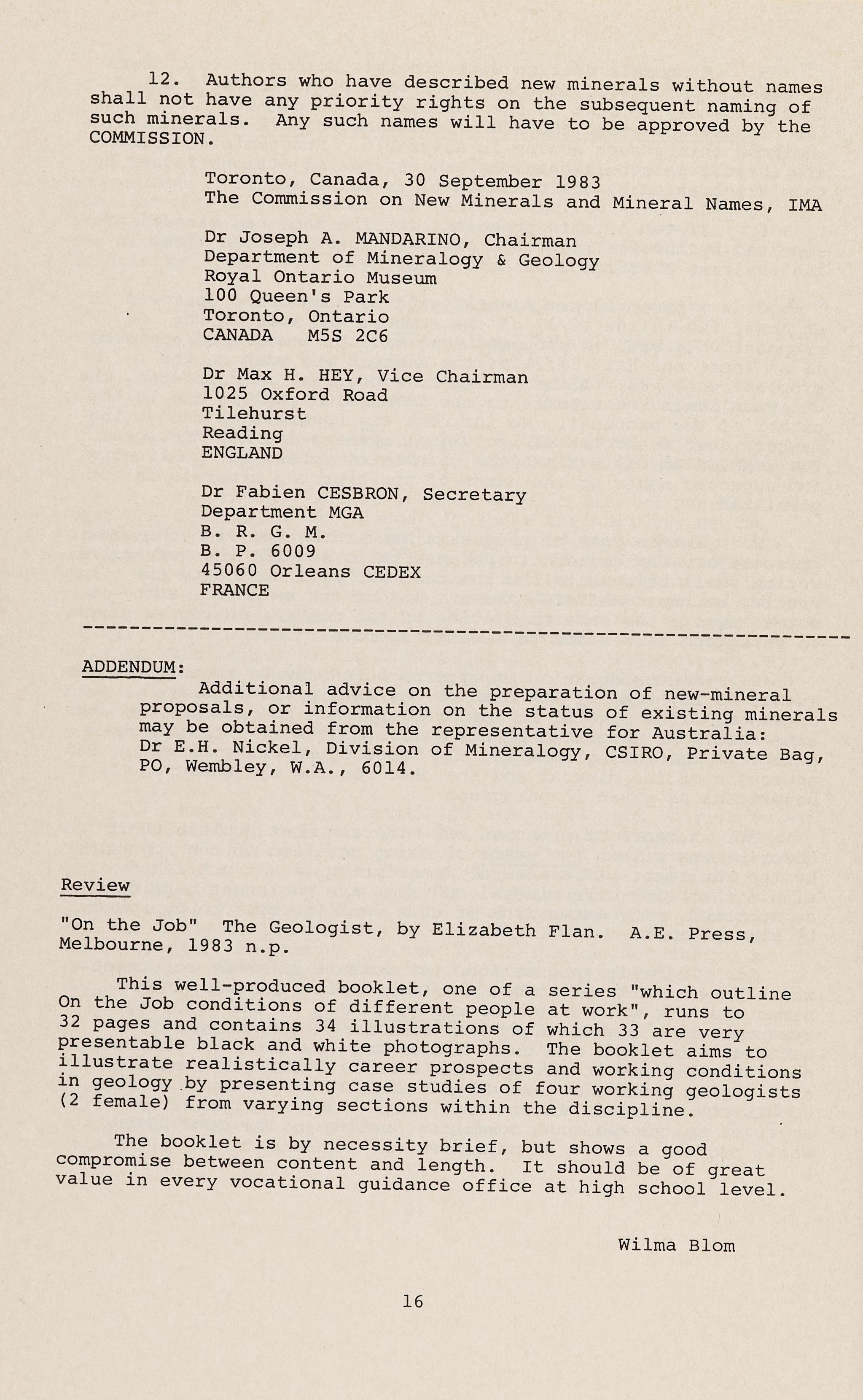
12. Authors who have described new minerals without names shall not have any priority rights on the subsequent naming of such minerals. Any such names will have to be approved by the COMMISSION.
Toronto, Canada, 30 September 1983
The Commission on New Minerals and Mineral Names, IMA
Dr Joseph A. MANDARINO, Chairman Department of Mineralogy & Geology Royal Ontario Museum 100 Queen's Park Toronto, Ontario CANADA M5S 2C6
Dr Max H. HEY, Vice Chairman 1025 Oxford Road Tilehurst Reading ENGLAND
Dr Fabien CESBRON, Secretary Department MGA
B. R. G. M. B. P. 6009 45060 Orleans CEDEX FRANCE
ADDENDUM:
Additional advice on the preparation of new-mineral proposals, or information on the status of existing minerals may be obtained from the representative for Australia: Dr E.H. Nickel, Division of Mineralogy, CSIRO, Private Bag, PO, Wembley, W.A., 6014.
Review
"On the Job" The Geologist, by Elizabeth Flan. A.E. Press, Melbourne, 1983 n.p.
This well-produced booklet, one of a series "which outline On the Job conditions of different people at work", runs to 32 pages and contains 34 illustrations of which 33 are very presentable black and white photographs. The booklet aims to illustrate realistically career prospects and working conditions in geology by presenting case studies of four working geologists (2 female) from varying sections within the discipline.
The booklet is by necessity brief, but shows a good compromise between content and length. It should be of great value in every vocational guidance office at high school level.
Wilma Blom
NORTH RYDE, N S.W. 2113
August 26 - 31, 1984, Sydney "GEOSCIENCE IN THE DEVELOPMENT OF NATURAL
Telephone: 887 8741
Telex : AA25817
Convenor: R A. BINNS
Secretary : G.F TAYLOR
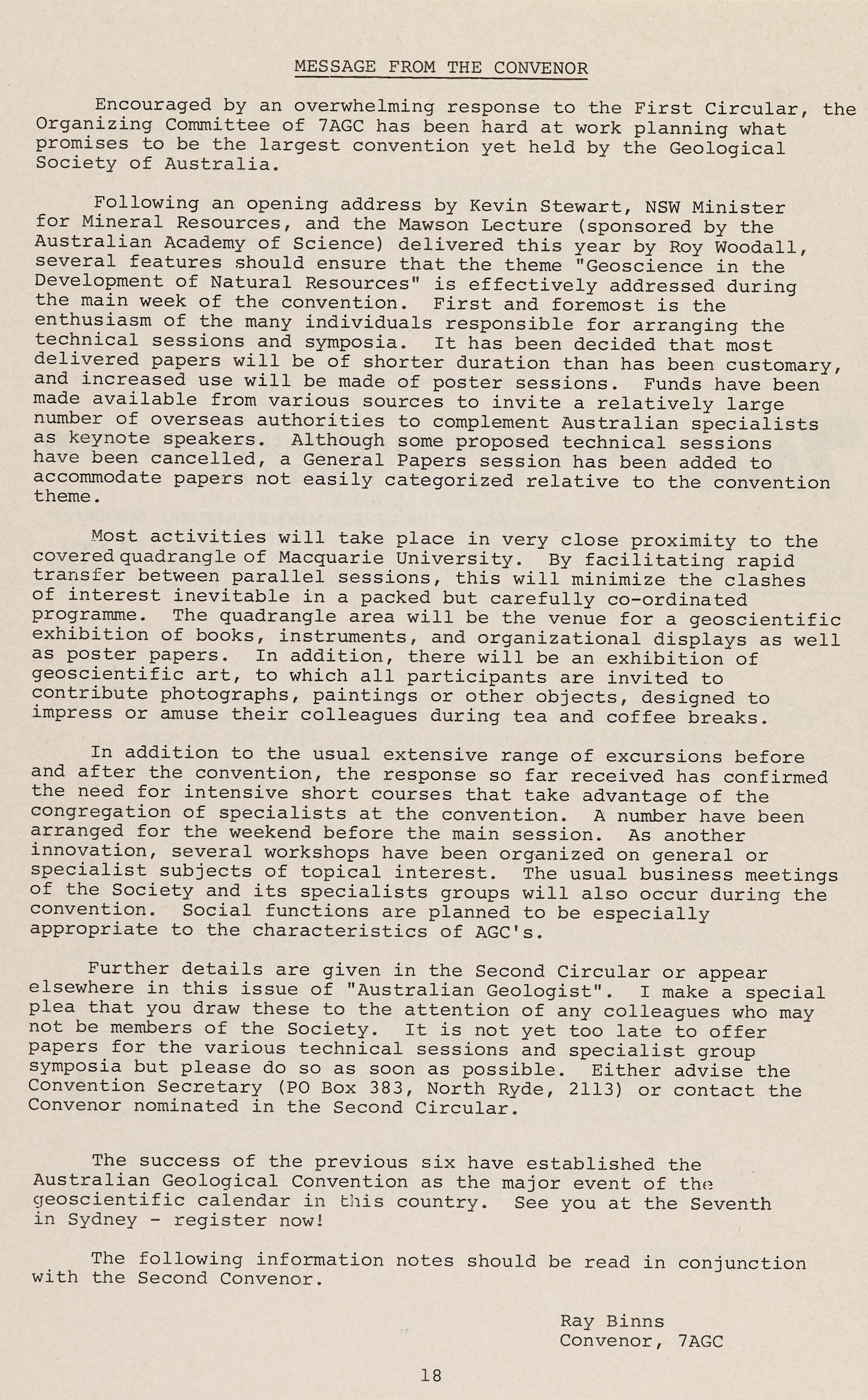
MESSAGE FROM THE CONVENOR
Encouraged by an overwhelming response to the First Circular, the Organizing Committee of 7AGC has been hard at work planning what promises to be the largest convention yet held by the Geological Society of Australia.
Following an opening address by Kevin Stewart, NSW Minister for Mineral Resources, and the Mawson Lecture (sponsored by the Australian Academy of Science) delivered this year by Roy Woodall, several features should ensure that the theme "Geoscience in the Development of Natural Resources" is effectively addressed during the main week of the convention. First and foremost is the enthusiasm of the many individuals responsible for arranging the technical sessions and symposia. It has been decided that most delivered papers will be of shorter duration than has been customary, and increased use will be made of poster sessions. Funds have been made available from various sources to invite a relatively large number of overseas authorities to complement Australian specialists as keynote speakers. Although some proposed technical sessions have been cancelled, a General Papers session has been added to accommodate papers not easily categorized relative to the convention theme.
Most activities will take place in very close proximity to the covered quadrangle of Macquarie University. By facilitating rapid transfer between parallel sessions, this will minimize the clashes of interest inevitable in a packed but carefully co-ordinated programme. The quadrangle area will be the venue for a geoscientific exhibition of books, instruments, and organizational displays as well as poster papers. In addition, there will be an exhibition of geoscientific art, to which all participants are invited to contribute photographs, paintings or other objects, designed to impress or amuse their colleagues during tea and coffee breaks.
In addition to the usual extensive range of excursions before and after the convention, the response so far received has confirmed the need for intensive short courses that take advantage of the congregation of specialists at the convention. A number have been arranged for the weekend before the main session. As another innovation, several workshops have been organized on general or specialist subjects of topical interest. The usual business meetings of the Society and its specialists groups will also occur during the convention. Social functions are planned to be especially appropriate to the characteristics of AGC's.
Further details are given in the Second Circular or appear elsewhere in this issue of "Australian Geologist". I make a special plea that you draw these to the attention of any colleagues who may not be members of the Society. It is not yet too late to offer papers for the various technical sessions and specialist group symposia but please do so as soon as possible. Either advise the Convention Secretary (PO Box 383, North Ryde, 2113) or contact the Convenor nominated in the Second Circular.
The success of the previous six have established the Australian Geoloqical Convention as the major event of th~ geoscientific caiendar in this country. See you at the Seventh in Sydney - register now!
The following information notes should be read in conjunction with the Second Convenor
Ray Binns Convenor, 7AGC
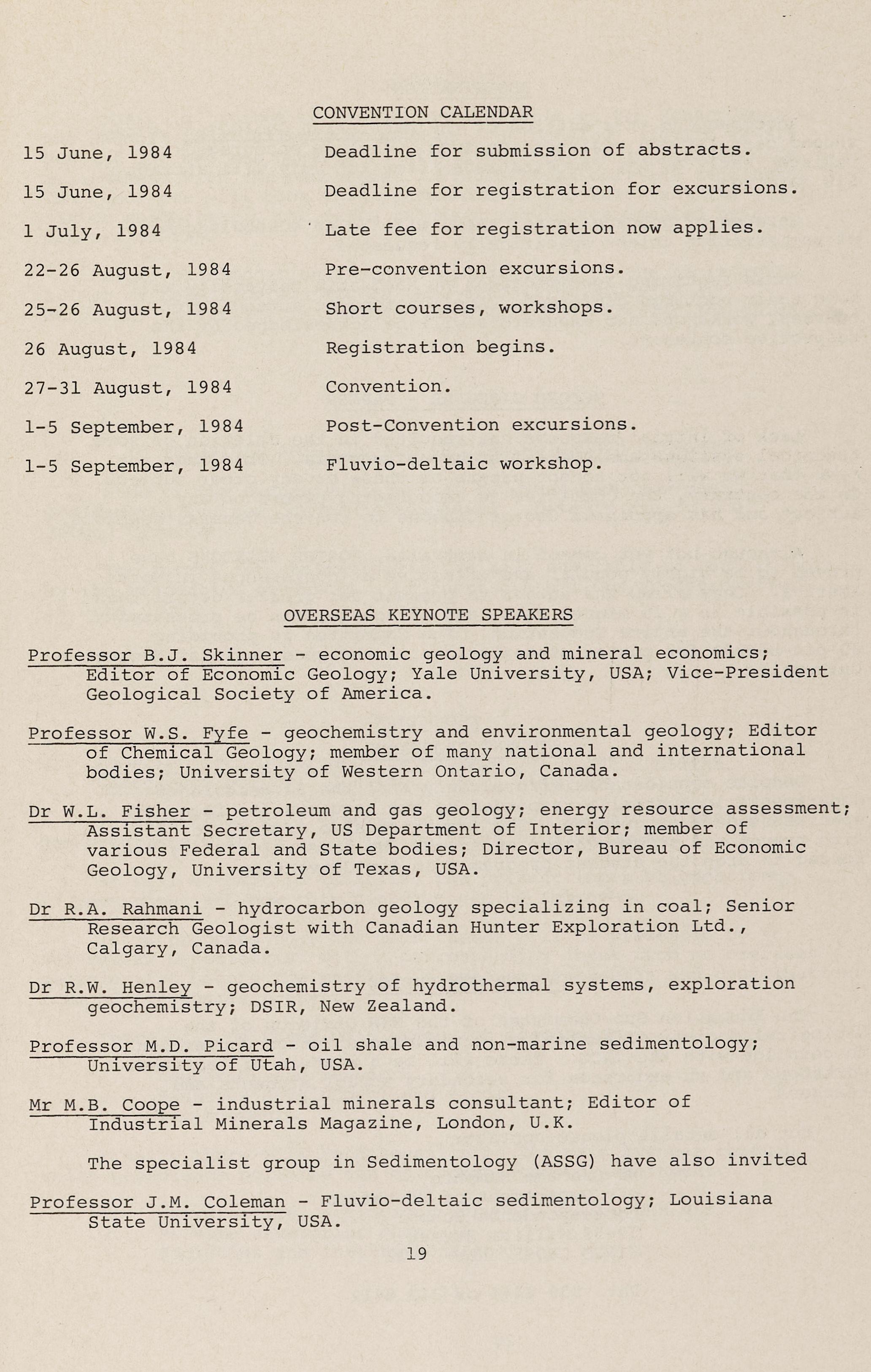
15 June, 1984
15 June, 1984
1 July, 1984
22-26 August, 1984
25-26 August, 1984
26 August, 1984
27-31 August, 1984
1-5 September, 1984
1-5 September, 1984
CONVENTION CALENDAR
Deadline for submission of abstracts.
Deadline for registration for excursions.
Late fee for registration now applies.
Pre-convention excursions.
Short courses, workshops. Registration begins. Convention.
Post-Convention excursions.
Fluvio-deltaic workshop.
OVERSEAS KEYNOTE SPEAKERS
Professor B.J. Skinner - economic geology and mineral economics; Editor of Economic Geology; Yale University, USA; Vice-President Geological Society of America.
Professor W.S. Fyfe - geochemistry and environmental geology; Editor of Chemical Geology; member of many national and international bodies; University of Western Ontario, Canada.
Dr W.L. Fisher - petroleum and gas geology; energy resource assessment; Assistant Secretary, US Department of Interior; member of various Federal and State bodies; Director, Bureau of Economic Geology, University of Texas, USA.
Dr R.A. Rahmani - hydrocarbon geology specializing in coal; Senior Research Geologist with Canadian Hunter Exploration Ltd., Calgary, Canada.
Dr R.W. Henley - geochemistry of hydrothermal systems, exploration geochemistry; DSIR, New Zealand.
Professor M.D. Picard - oil shale and non-marine sedimentology; University of Utah, USA.
The specialist group in Sedimentology (ASSG) have also invited
Professor J. M. Coleman - Fluvio-deltaic sedimentolog y; Louisiana State University, USA.
REGISTRATION
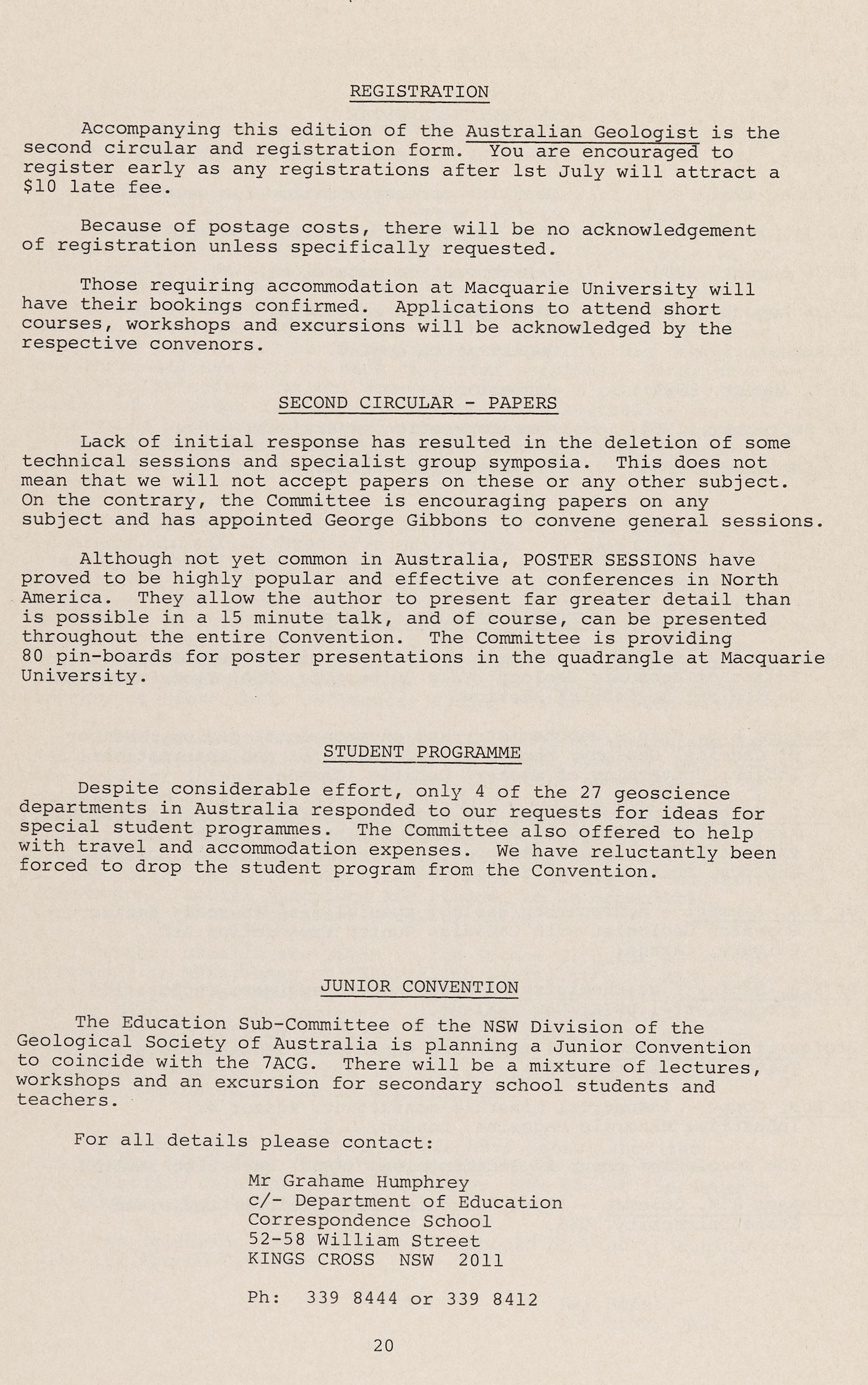
Accompanying this edition of the Australian Geologist is the second circular and registration form. You are encouraged to register early as any registrations after 1st July will attract a $10 late fee.
Because of postage costs, there will be no acknowledgement of registration unless specifically requested.
Those requiring accommodation at Macquarie University will have their bookings confirmed. Applications to attend short courses, workshops and excursions will be acknowledged by the respective convenors.
SECOND CIRCULAR - PAPERS
Lack of initial response has resulted in the deletion of some technical sessions and specialist group symposia. This does not mean that we will not accept papers on these or any other subject. On the contrary, the Committee is encouraging papers on any subject and has appointed George Gibbons to convene general sessions.
Although not yet common in Australia, POSTER SESSIONS have proved to be highly popular and effective at conferences in North America. They allow the author to present far greater detail than is possible in a 15 minute talk, and of course, can be presented throughout the entire Convention. The Committee is providing . 80 pin-boards for poster presentations in the quadrangle at Macquarie University.
STUDENT PROGRAMME
Despite considerable effort, only 4 of the 27 geoscience departments in Australia responded to our requests for ideas for special student programmes. The Committee also offered to help with travel and accommodation expenses. We have reluctantly been forced to drop the student program from the Convention.
JUNIOR CONVENTION
The Education Sub-Committee of the NSW Division of the Geological Society of Australia is planning a Junior Convention to coincide with the 7ACG. There will be a mixture of lectures, workshops and an excursion for secondary school students and teachers.
For all details please contact:
Mr Grahame Humphrey c/- Department of Education Correspondence School 52-58 William Street KINGS CROSS NSW 2011
Ph: 339 8444 or 339 8412
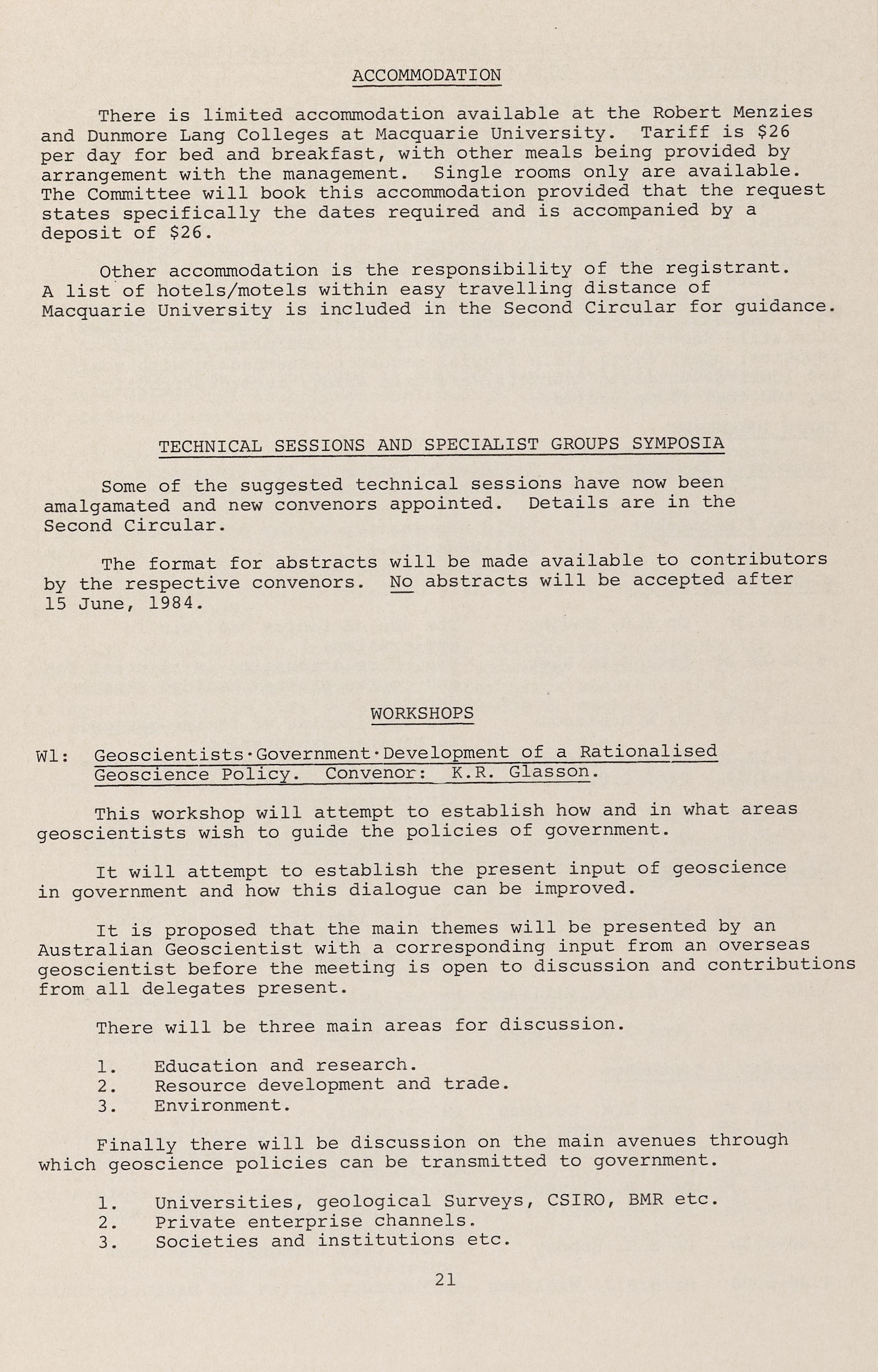
ACCOMMODATION
There is limited accommodation available at the Robert Menzies and Dunmore Lang Colleges at Macquarie University. Tariff is $26 per day for bed and breakfast, with other meals being provided by arrangement with the management. Single rooms only are available. The Committee will book this accommodation provided that the request states specifically the dates required and is accompanied by a deposit of $26.
Other accommodation is the responsibility of the registrant. A list . of hotels/motels within easy travelling distance of Macquarie University is included in the Second Circular for guidance.
TECHNICAL SESSIONS AND SPECIALIST GROUPS SYMPOSIA
Some of the suggested technical sessions have now been amalgamated and new convenors appointed. Details are in the Second Circular.
The format for abstracts will be made available to contributors by the respective convenors. No abstracts will be accepted after 15 June, 1984.
WORKSHOPS
Wl: Geoscientists·Government·Development of a Rationalised Geoscience Policy. Convenor: K.R. Glasson.
This workshop will attempt to establish how and in what areas geoscientists wish to guide the policies of government.
It will attempt to establish the present input of geoscience in government and how this dialogue can be improved.
It is proposed that the main themes will be presented by an Australian Geoscientist with a corresponding input from an overseas geoscientist before the meeting is open to discussion and contributions from all delegates present.
There will be three main areas for discussion.
1. Education and research.
2. Resource development and trade.
3. Environment.
Finally there will be discussion on the main avenues through which geoscience policies can be transmitted to government.
1. Universities, geological Surveys, CSIRO, BMR etc.
2. Private enterprise channels
3. Societies and institutions etc.
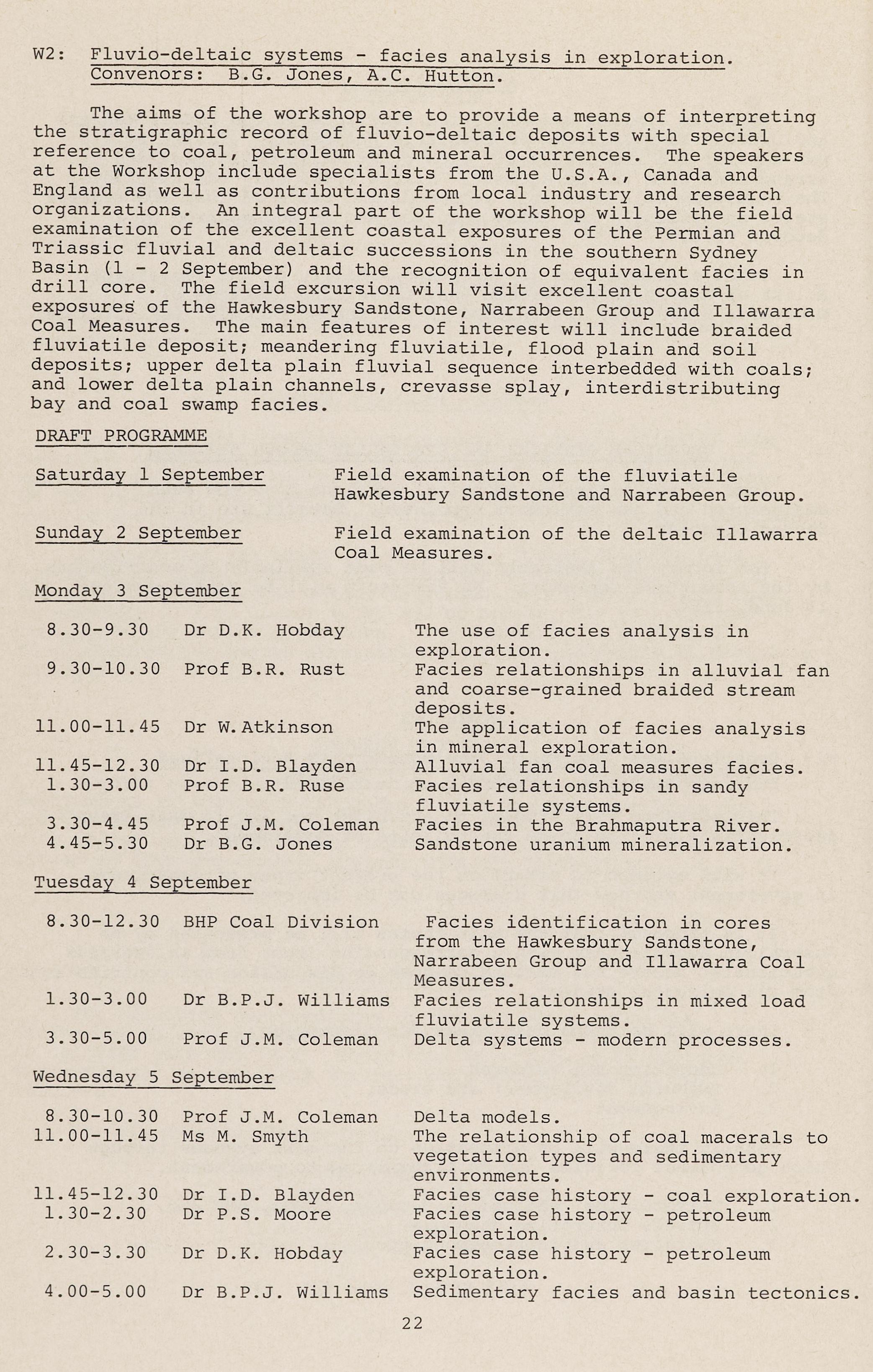
W2: Fluvio-deltaic systems - facies analysis in exploration.
Convenors: B.G. Jones, A.C. Hutton.
The aims of the workshop are to provide a means of interpreting the stratigraphic record of fluvio-deltaic deposits with special reference to coal, petroleum and mineral occurrences. The speakers at the Workshop include specialists from the U.S.A., Canada and England as well as contributions from local industry and research organizations. An integral part of the workshop will be the field examination of the excellent coastal exposures of the Permian and Triassic fluvial and deltaic successions in the southern Sydney Basin (1 -2 September) and the recognition of equivalent facies in drill core. The field excursion will visit excellent coastal exposures of the Hawkesbury Sandstone, Narrabeen Group and Illawarra Coal Measures. The main features of interest will include braided fluviatile deposit; meandering fluviatile, flood plain and soil deposits; upper delta plain fluvial sequence interbedded with coals; and lower delta plain channels, crevasse splay, interdistributing bay and coal swamp facies.
DRAFT PROGRAMME
Saturday 1 September
Sunday 2 September
Monday 3 September
8.30-9.30
9.30-10.30
11. 00-11. 45
ll.45-12.30 1. 30-3. 00
3.30-4.45 4.45-5.30
Field examination of the fluviatile Hawkesbury Sandstone and Narrabeen Group.
Field examination of the deltaic Illawarra Coal Measures.
Dr D.K. Hobday
Prof B.R. Rust
Dr W.Atkinson
Dr I.D. Blayden
Prof B.R. Ruse
Prof J.M. Coleman
Dr B.G. Jones
Tuesday 4 September
The use of facies analysis in exploration.
Facies relationships in alluvial fan and coarse-grained braided stream deposits.
The application of facies analysis in mineral exploration. Alluvial fan coal measures facies. Facies relationships in sandy fluviatile systems. Facies in the Brahmaputra River. Sandstone uranium mineralization.
8.30-12.30 BHP Coal Division Facies identification in cores from the Hawkesbury Sandstone, Narrabeen Group and Illawarra Coal Measures.
1.30-3.00 Dr B.P.J. Williams Facies relationships in mixed load fluviatile systems.
3.30-5.00
Prof J.M. Coleman Delta systems - modern processes.
Wednesday 5 September
8.30-10.30 11. 00-11. 45
11.45-12.30 1. 30-2. 30
2.30-3.30
4.00-5.00
Prof J.M. Coleman Ms M. Smyth
Dr I.D. Blayden
Dr P.S. Moore
Dr D.K. Hobday
Dr B.P.J. Williams
Delta models. The relationship of coal macerals to vegetation types and sedimentary environments.
Facies case history - coal exploration. Facies case history - petroleum exploration.
Facies case history - petroleum exploration. Sedimentary facies and basin tectonics.
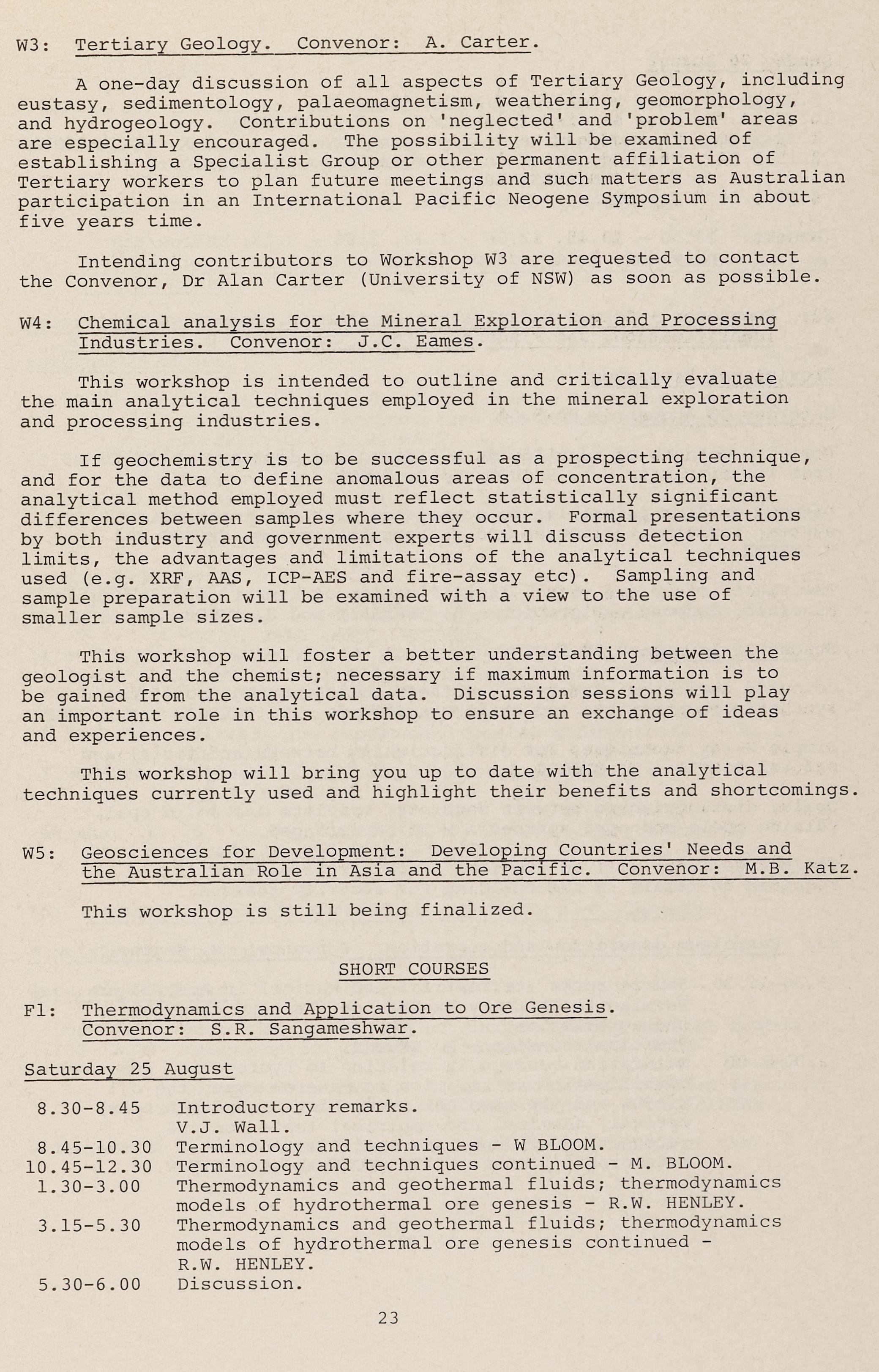
W3: Tertiary Geology. Convenor: A. Carter.
A one-day discussion of all aspects of Tertiary Geology, including eustasy, sedimentology, palaeomagnetism, weathering, geomorphology, and hydrogeology. Contributions on 'neglected' and 'problem' areas are especially encouraged. The possibility will be examined of establishing a Specialist Group or other permanent affiliation of Tertiary workers to plan future meetings and such matters as Australian participation in an International Pacific Neogene Symposium in about five years time.
Intending contributors to Workshop W3 are requested to contact the Convenor, Dr Alan Carter (University of NSW) as soon as possible.
W4: Chemical analysis for the Mineral Exploration and Processing Industries. Convenor: J.C. Eames.
This workshop is intended to outline and critically evaluate the main analytical techniques employed in the mineral exploration and processing industries.
If geochemistry is to be successful as a prospecting technique, and for the data to define anomalous areas of concentration, the analytical method employed must reflect statistically significant differences between samples where they occur. Formal presentations by both industry and government experts will discuss detection limits, the advantages and limitations of the analytical techniques used (e.g. XRF, AAS, ICP-AES and fire-assay etc). Sampling and sample preparation will be examined with a view to the use of smaller sample sizes.
This workshop will foster a better understanding between the geologist and the chemist; necessary if maximum information is to be gained from the analytical data. Discussion sessions will play an important role in this workshop to ensure an exchange of ideas and experiences.
This workshop will bring you up to date with the analytical techniques currently used and highlight their benefits and shortcomings.
W5: Geosciences for Development: Developin~ Countries' Needs and the Australian Role in Asia and the Pacific. Convenor: M.B. Katz.
This workshop is still being finalized.
SHORT COURSES
Fl: Thermodynamics and Application to Ore Genesis. Convenor: S.R. Sangameshwar.
Saturday 25 August
8.30-8.45
8.45-10.30
10.45-12.30
1.30-3.00
3.15-5.30
5.30-6.00
Introductory remarks. V.J. Wall. Terminology and techniques -W BLOOM. Terminology and techniques continued - M. BLOOM.
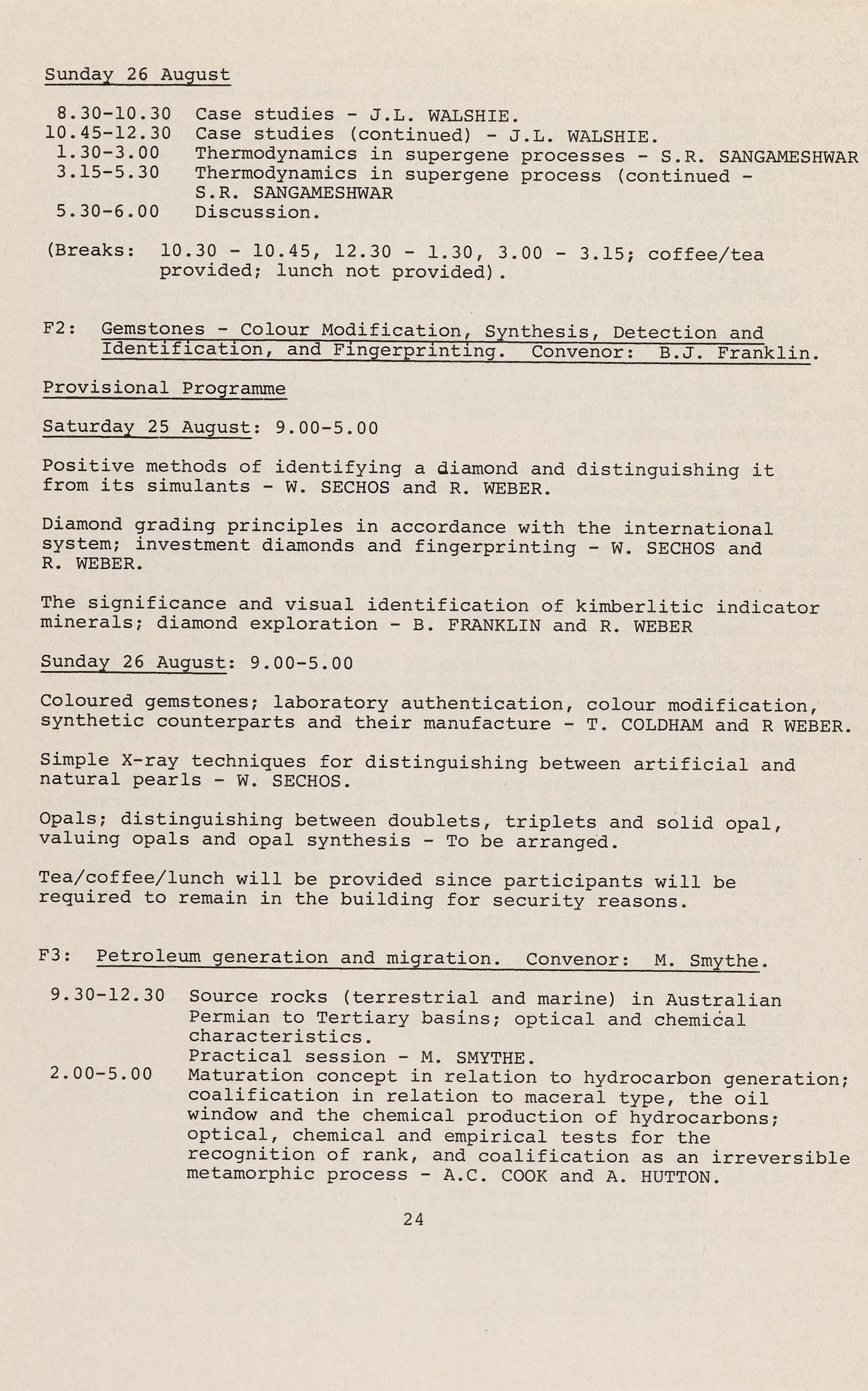
Thermodynamics and geothermal fluids; thermodynamics models of hydrothermal ore genesis - R.W. HENLEY. Thermodynamics and geothermal fluids; thermodynamics models of hydrothermal ore genesis continuedR.W. HENLEY. Discussion.
Sunday 26 August
8.30-10.30
10.45-12.30
1. 30-3. 00
3.15-5.30
5.30-6.00
Case studies - J.L. WALSHIE. Case studies (continued) - J.L. WALSHIE. Thermodynamics in supergene processes - S.R. SANGAMESHWAR Thermodynamics in supergene process (continuedS.R. SANGAMESHWAR Discussion.
F2: Gemstones - Colour Modification, Synthesis, Detection and Identification, and Fingerprinting. Convenor: B.J. Franklin. Provisional Programme
Saturday 25 August: 9.00-5.00
Positive methods of identifying a oiamond and distinguishing it from its simul'ants - W. SECHOS and R. WEBER.
Diamond grading principles in accordance with the international system; investment diamonds and fingerprinting - W. SECHOS and R. WEBER.
The significance and visual identification of kimberlitic indicator minerals; diamond exploration - B. FRANKLIN and R. WEBER
Sunday 26 August: 9.00-5.00
Coloured gemstones; laboratory authentication, colour modification, · synthetic counterparts and their manufacture - T. COLDHAM and R WEBER.
Simple X-ray techniques for distinguishing between artificial and natural pearls - W. SECHOS.
Opals; distinguishing between doublets, triplets and solid opal, valuing opals and opal synthesis - To be arrang~d.
Tea/coffee/lunch will be provided since participants will be required to remain in the building for security reasons.
F3: Petroleum generation and migration. Convenor: M. Smythe.
9.30-12.30 Source rocks (terrestrial and marine) in Australian Permian to Tertiary basins; optical and chemical characteristics.
Practical session - M. SMYTHE.
2.00-5.00 Maturation concept in relation to hydrocarbon generation; coalification in relation to maceral type, the oil window and the chemical production of hydrocarbons; optical, chemical and empirical tests for the recognition of rank, and coalification as an irreversible metamorphic process - A.C. COOK and A. HUTTON.
Sunday 26 August
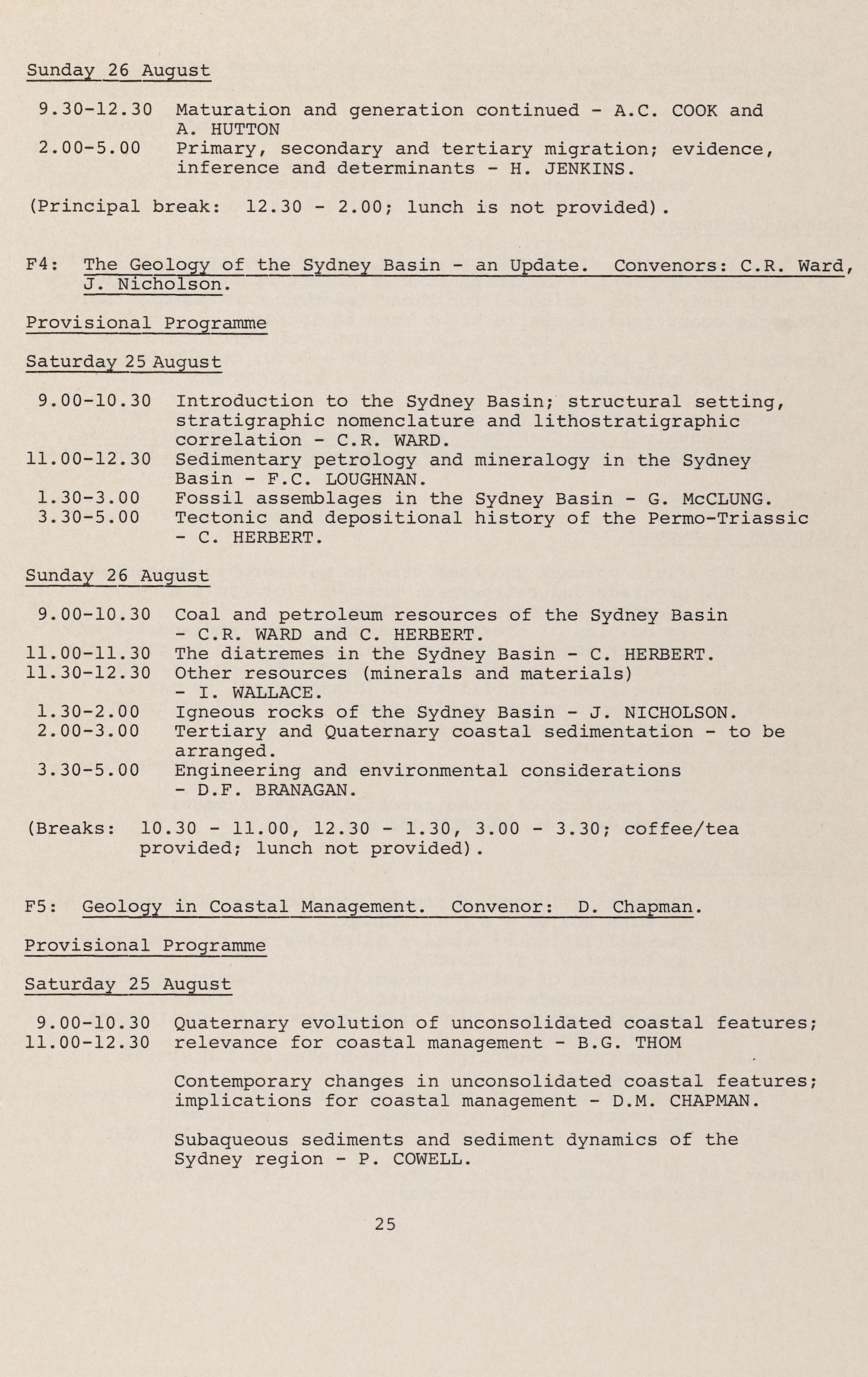
9.30-12.30 Maturation and generation continued - A.C. COOK and A. HUTTON
2.00-5.00 Primary, secondary and tertiary migration; evidence, inference and determinants - H. JENKINS.
(Principal break: 12.30 - 2.00; lunch is not provided).
F4: The Geology of the Sydney Basin - an Update. Conveners: C.R. Ward, J. Nicholson.
Provisional Programme
Saturday 25 August
9.00-10.30
11. 00-12. 30
1. 30-3. 00
3.30-5.00
Introduction to the Sydney Basin; · structural setting, stratigraphic nomenclature and lithostratigraphic correlation - C.R. WARD.
Sedimentary petrology and mineralogy in the Sydney Basin - F.C. LOUGHNAN.
Fossil assemblages in the Sydney Basin - G. McCLUNG. Tectonic and depositional history of the Permo-Triassic - C. HERBERT.
Sunday 26 August
9.00-10.30
11. 00-11. 30
11.30-12.30
1.30-2.00 2.00-3.00
3.30-5.00
Coal and petroleum resources of the Sydney Basin - C.R. WARD and c. HERBERT. The diatremes in the Sydney Basin - C. HERBERT. Other resources (minerals and materials) -I WALLACE.
Igneous rocks of the Sydney Basin - J. NICHOLSON. Tertiary and Quaternary coastal sedimentation - to be arranged. Engineering and environmental considerations - D.F. BRANAGAN.
F5: Geology in Coastal Management. Convenor: D. Chapman.
Provisional Programme
Saturday 25 August
9.00-10.30 11.00-12.30
Quaternary evolution of unconsolidated coastal features; relevance for coastal management - B.G. THOM
Contemporary changes in unconsolidated coastal features; implications for coastal management - D.M. CHAPMAN.
Subaqueous sediments and sediment dynamics of the Sydney region - P. COWELL.
25
1.30-3.00
3.30-5.00
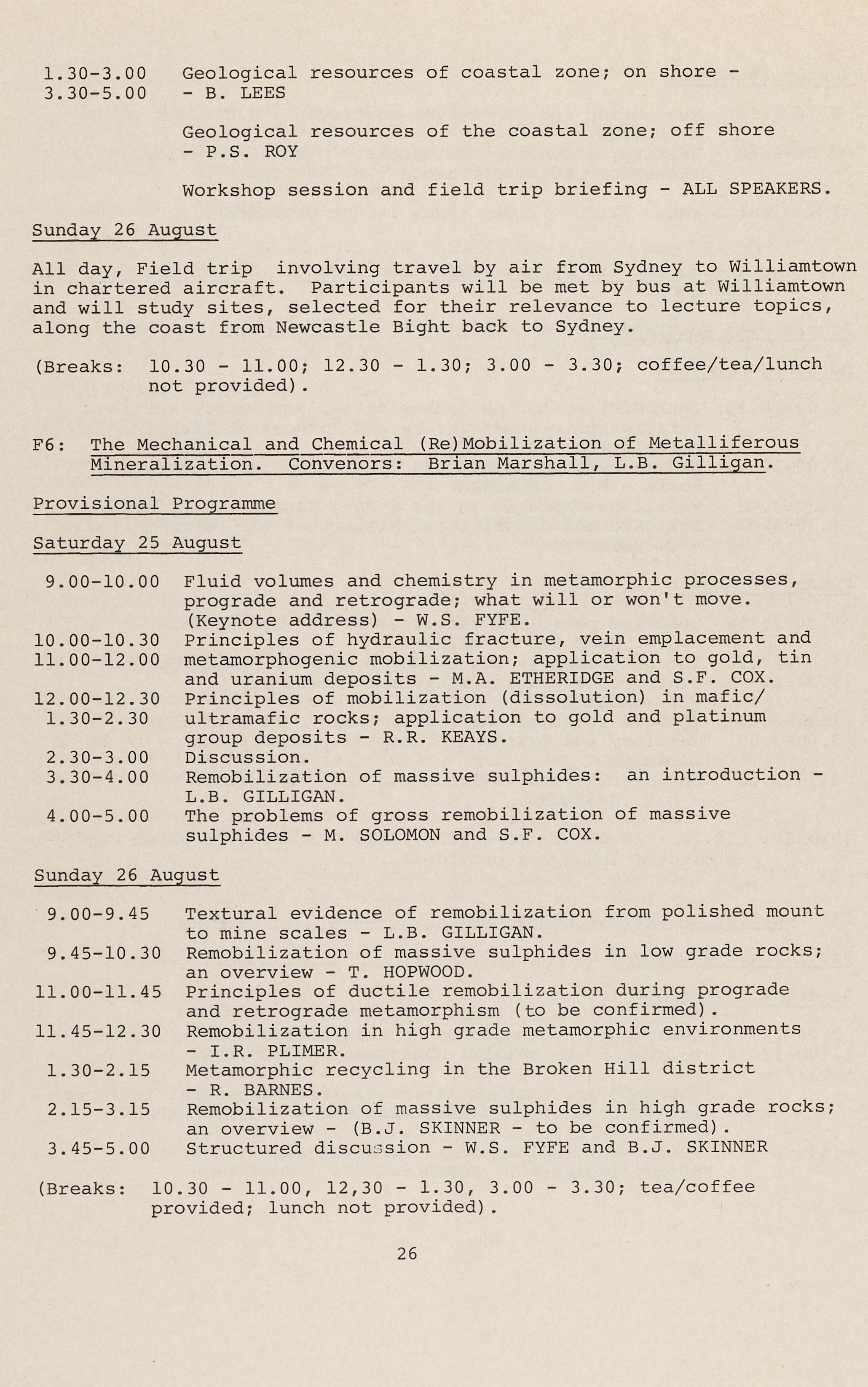
Geological resources of coastal zone; on shore- B. LEES
Geological resources of the coastal zone; off shore - P.S. ROY
Workshop session and field trip briefing - ALL SPEAKERS.
Sunday 26 August
All day, Field trip involving travel by air from Sydney to Williamtown in chartered aircraft. Participants will be met by bus at Williamtown and will study sites, selected for their relevance to lecture topics, along the coast from Newcastle Bight back to Sydney.
F6 : The Mechanical and Chemical (Re)Mobilization of Metalliferous Mineralization. Convenors: Brian Marshall, L.B. Gilligan.
Provisional Programme
Saturday 25 August
9 . 00-10 . 00
10.00-10.30
11.00-12.00
12.00-12 30
1.30-2.30
2.30-3.00
3.30-4.00
4.00-5.00
Fluid volumes and chemistry in metamorphic processes, prograde and retrograde; what will or won ' t move . (Keynote address) - W.S. FYFE. Principles of hydraulic fracture, vein emplacement and metamorphogenic mobilization; application to gold, tin and uranium deposits - M.A. ETHERIDGE and S.F. CO X Principles of mobilization (dissolution) in mafic/ ultramafic rocks; application to gold and platinum group deposits - R.R. KEAYS. Discussion. Remobilization of massive sulphides: an introductionL.B. GILLIGAN.
The problems of gross remobilization of massive sulphides - M. SOLOMON and S.F. COX.
Sunday 26 August
9.00-9.45
9.45-10.30
Textural evidence of remobilization from polished mount to mine scales - L.B. GILLIGAN.
Remobilization of massive sulphides in low grade rocks; an overview - T. HOPWOOD.
11.00-11.45 Principles of ductile remobilization during prograde and retrograde metamorphism (to be confirmed).
11 .4 5-12.30 Remobilization in high grade metamorphic environments - I.R. PLIMER.
1.30-2.15
2 .1 5-3.15
3.45-5.00
Metamorphic recycling in the Broken Hill district - R. BARNES.
Remobilization of ma ssive sulphides in high grade rocks; an overview - (B.J. SKINNER - to be confirmed).
Structured discu s sion - W.S. FYFE and B . J. SKINNER
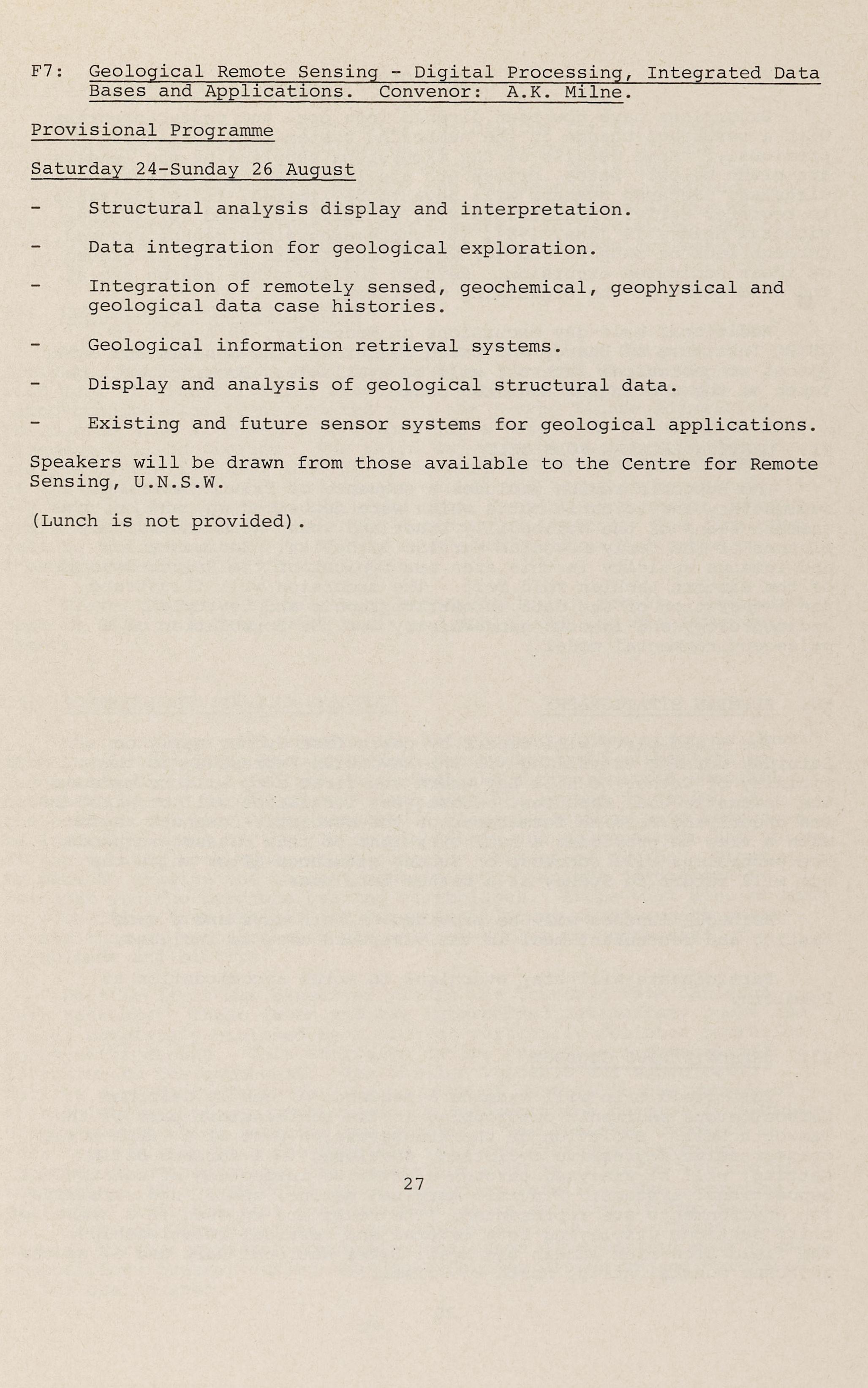
F7: Geological Remote Sensing - Digital Processing, Integrated Data Bases and Applications. Convenor: A.K. Milne.
Provisional Programme
Saturday 24-Sunday 26 August
Structural analysis display and interpretation.
Data integration for geological exploration.
Integration of remotely sensed, geochemical, geophysical and geological data case histories.
Geological information retrieval systems.
Display and analysis of geological structural data.
Existing and future sensor systems for geological applications.
Speakers will be drawn from those available to the Centre for Remote Sensing, U.N.S.W.
(Lunch is not provided).
EXCURSIONS
. Excursions have now been divided into pre- and post-Convention, with a resultant change in the numbering system from that used previously. Some details of the excursions supplied by the leaders are given below. Dates, prices etc are indicated in the Second Circular. Because numbers will have to be limited, it is advisable t~ register early. Registrants will be fully refunded (a) if they withdraw before 14 June, 1984, (b) where excursions cannot proceed through lack of support and (c) where registrants cannot be placed on their nominated excursion. Refunds for any other reason are at the discretion of the Organising Committee.
Additional half-day excursions on Wednesday, 29 August to CSIRO Institute of Energy and Earth Resources, The Museums and other places of geological interest will be available. Bookings will be taken at the Convention Register Desk.
Yl: EASTERN LACHLAN FOLD BELT
The Bungonia region includes a sequence of Siluro-Devonian sedimentary and volcanic rocks which were deposited in, and on, the eastern flank of the Wollondilly Tract and which were intruded by plutons of the Early Devonian Marulan Batholith. Sedimentation and igneous activity in this area are typical of the Siluro-Devonian of the Eastern Lachlan Fold Belt. The excursion will illustrate the integration of age data (biostratigraphic and isotopic), sedimentology and igneous geochemistry for the formulation of a palaeoenvironmental model.
Y2: PERMIAN STRATIGRAPHY
The field party will depart by coach from Sydney early on Saturday morning travelling via the Newcastle Expressway to the vicinity of Catherine Hill Bay where the first stop will be made on the Newcastle Coal Measures. Subsequent localities will be sited in the underlying Permian formations of the Newcastle-Cessnock region with a view to providing a full oversight of this classic sequence. The excursions will conclude on Sunday afternoon after which the bus will return to Sydney at a rather late hour.
Barbeque lunches will be provided on both days and a wine tasting and restaurant meal in the vineyward area is included.
Participants will stay overnight in motel accommodation at Pokolbin.
Y3: CARBONIFEROUS GEOLOGY
This field trip will examine a sequence of gently deformed Carboniferous sediments outcropping in the southeastern part of the Tamworth Belt. Evolution of the transgressive part of a large-scale transgressive/regressive cyclothem, developed in a forearc basin setting, will be analysed through a detailed inspection of constituent depositional systems. Fluvial, marginal marine, shelf, and submarine fan environments are represented. The rocks are exposed in a number of cliff sections displaying both lateral and vertical relationships. The field area lies within the Myall Lakes National Park and along the adjacent coastal strip, north to Forster.
Y4:
GEOLOGY
This 7xcursion will leave_Sydney by minibus for Burrinjuck where we will be accommodated in cabins. The low cost of this excursion means that self-help is required (i.e. meals have to be cooked!). It is proposed to examine the volcanic and sedimentar y sequ 7nces exposed on both sides of Burrinjuck Dam where extensive mappi~g has been carried out in recent years. In particular, the relations between the Devonian limestones and red beds are worthy of attention as is the structural regime.
YS: NEW ENGLAND MINERALIZATION
The Excursion is to leave Sydney at 2 p.m., and drive to Armidale, with overnight stop in Armidale. On the second day we will look at mineralization associated with the Gilgai Granite, a leuco -gra nite closely associated with the I-type Tingh a Adamellite. The Conrad Mine at Howell, Mt Topper and a very nice tin greisen at Elsemore will be visited. The third day will be on the Mole Granite and its mineralization, looking at features which show the nature of its emplacement, and development of tin and tungsten mineralization. Day four will be spent in the Drake area, looking at a number of gold and silver prospects of Aberfoyle Exploration Limited. The final day will be the return trip to Sydney with a stopover at Hillgrove to look at antimony-gold mineralization.
Travel is to be by bus, with accommodation in motels. Estimated cost is $350 on a twin-share basis and meals with the exception of dinner.
Zl: SOUTHERN NEW ENGLAND GRANITES
The excursion will examine the Walcha Road pluton which is zoned from quartz monzonite through K-feldspar megacrystic adamellite to leuco adamellite. K-feld spar megacryst and mi crogra nitoid xenolith orientations are margin parallel and parallel to the foliation in the contact schists. Measurements of these foliations have been used to infer the shape of the pluton with depth and to constrain the volume of the various rock types which comprise this zoned pluton. Stops will be made to examine the contact schists which include cordierite-Kfeldspar and two pyroxene-bearing assemblages. Stops will also be made at localities that exhibit the large oscillatory zoned augite phenocrysts that on reaction with the melt give rise to aggregates of hornblende and biotite.
Dacitic lavas are preserved within the Terrible Vale cauldron near Kentucky. These lavas and the interbedded sedimentary rocks are almost completely enclosed by a ring of vertically foliated intrusive porphyritic dacite. This intrusive dacite grades into a tonalitic intrusion to the southwest. The chilled volcanic and subvolcanic dacites provide evidence for the paucity of restite in the magmas of this volcanic/plutonic complex and by inference the chemically similar Uralla pluton which intrudes the complex. The observed range of rock types within both the Terrible Vale cauldron and the zoned (diorite to granodiorite) are consistent with an inferred tilting of the region (SW up; NE down) since the Upper Permian. The excursion will also visit the vast dyke swarm which is emplaced in the Balala and Yarrowyck Granodiorites to the northwest of Uralla. These dykes provide further evidence co ncerning the range of magma and melt phase compositions present during the Upper Permian plutonism and volcanism in the Uralla area.
Z2: FLUVIO-DELTAIC AND COAL SEQUENCES
This field excursion will form a preliminary part of the fluvio-deltaic workshop to be held in Wollongong on 3-5 September, but other participants are welcome.
The excursion will visit excellent coastal exposures of the Hawkesbury Sandstone, Narrabeen Group and Illawarra Coal Measures. The main features of interest will include braided fluviatile deposit; meandering fluviatile, flood plain and soil deposit; upper delta plain fluvial sequence interbedded with coals; and low e r delta plain chann e ls, crev a sse splay, interdistributing bay and coal swings facies.
Z3: NEW ENGLAND GEMSTONES
Origins of zircon, sapphire and diamond.
The as s ociation between zircon, sapphire and alkali basalts will be demonstrated, arising from the problems of origin of these gemstones. Are they cognate megacrysts or accidental xenocrysts? Do they come from the crust, mantle or both? What do they tell u s of the concealed lithosphere of New England? Diamond origins pose a similar enigma, with apparent association with alkali volcanics. Some recent advances in diamond exploration theories will be discussed.
This excur s ion will cover gemstone localities near Nundle, Uralla, Walcha, Glen Innes, Inverell, Bingara and Copeton. Accommodation will be in hotels offering dinner, bed and breakfast probably at Tamworth, Glen Innes, Inverell and Bingara. Participants should be prepared for cold weather and waterproof footwear is recommended.
Z4: PALAEOZOIC FELSIC VOLCANICS
The excursion will examine the character of Palaeozoic felsic volcanic rocks of the Southern Highlands and their possible genetic relationships to associated ore deposits. Visits are planned to Captains Flat and Woodlawn as well as to several smaller prospects.
ZS: COOLAC OPHIOLITE
An opportunity to stand on the MOHO!
This excursion is to the Gundagai - Tumut area of southern New South Wales, where a sedimentary trough sequence formed a marginal basin of Western Pacific type during th e Early Palaeozoic. The basin initially developed as an extension-produced graben along the continental edge which widened to form a true marginal basin, floored partly by new oceanic crust and into which calcalkaline, tholeiitic and boninitic lavas were erupted.
The ophiolite res~lting from this oceanic crustal development is very well exposed in the Coolac area, 20 km north of Gundagai. It is petrologically complete, with the base a 56 km long alpine-type serpentinite belt, overlain by cumulus ultramafics - wehrlites and clinopyroxenites, massive gabbros, diorites and plagiogranites, capped by pillow lavas and a small, but co nvin cing, sheeted dolerite dyke swarm.
Structurally, various magmatic features - primary layering and cumulus textures are well developed. In addition, two to three phases of penetrative tectonic foliation and gneissosity are present in most units of the ophiolite. The contact between the basal serpentinite unit of the ophiolite and the Late Silurian, S-type Young Granodiorite is a particularly good example of a complex and composite tectonic - intrusive relationship.
Podiform chromitite bodies, including the largest deposit of this type in Australia, have formed in cavities along conduits in the tectonic harzburgite unit of the ophiolite. Texturally, the chromitite illustrates both primary layering with a magmatic flow lineation and crystal settling, and structural deformation where the chromitite has been transported within the harzburgite as autoliths and has developed a fracture foliation.
Cu-Fe sulphides have developed in over 20 localities within the ophiolite. Some of the occurrences are notable for the diverse mineral assemblage, and particularly the abundance of cubanite. Sulphide-bearing rocks are located, either in reaction zones adjacent to the serpentinite belt of in Cyprus-t y pe environments in fault zones at the base of pillow lavas within the ophiolite.
Travel associated with this excursion will be in a 14-seater minibus and accommodation will be arranged in an older style, but comfortable hotel in Gundagai. Notes and maps will accompany the excursion. Participants should expect to do a moderate amount of walking with some steep hill climbing.
Z6: DIATREMES OF THE SYDNEY BASIN
There are well over a hundred diatremes in the Sydney Basin. Several of these are quarried for road base aggregate in close proximity to Sydney. These quarries provide the best exposures of diatremes to be found anywhere in the world.
The Sydney Basin diatremes, locally known as volcanic necks, were originally thought to be intrusive. However, they have recently been re-interpreted to be the roots of maar volcanoes. Maar volcanoes are tiny (1-2 km) crater-like explosive volcanoes which often occur in great numbers in classic areas such as Germany and also in Western Victoria (e.g. Mt. Gambier and Tower Hill).
Diamonds are thought to occur only in diametremes with a kimberlitic composition. However, these non-kimberlitic diatremes are a marvelous opportunity to examine well-exposed models showing the same physical attributes that would occur in diamond-bearing diatremes. Xenoliths other than di amonds may be found!
Two quarried diatremes of Jurassic age will be examined. Among the many features to be observed - one will show beautiful basinal layering (reflecting the original crater shape) in the volcanic breccia, often with base-surge crossbedding displayed, while the other will show vertical to chaotic layering and a well preserved 31 ring-fault zone. The excursion will travel by bus and occupy a single day.
SOCIAL PROGRAMME
A welcoming cocktail party on Sunday 25 and the Convention Dinner on Wednesday 29 August will give Convention delegates the opportunity of meeting old friends Greg Pooley has ensured a gastronomical delight at both functions
We know that geoscientists like to keep fit. In addition, to all the sporting facilities at Macquarie University (tennis, squash, gymnasium, keep fit classes etc) the Committee is organizing a FUN RUN . Two courses, one for amateurs and the other for professionals, will be set in the Lane Cove National Park adjacent to Macquarie University. The entrance fee of $6 will entitle competitors to a suitably e n scribed singlet.
All geoscientists have photos, paintings, drawings, artifacts on other object d'art related to their work. Enter your exhibition in the GEOART EXHIBITION and be eligible to win a small prize in any of a number of categories.
INVITATION
All geoscientists are invited to participate in the Seventh Australian Geological Convention. Its success will ensure future relations between the Geological Society of Australia and industry. Corresponence and enquiries should be addressed to:
Dr G.F. Taylor Secretary,
7AGC
PO Box 383 NORTH RYDE NSW
Ph: (02) 887 8741
2113
ASPECTS OF MICROPALAEONTOLOGY
Edited by F. T. Banner and A. R. Lord George Allen & Unwin, London, 1982.
This neatly produced volume constitutes a collection of papers presented to Professor Torn Barnard on the occasion of his retirement from a personal chair in rnicropalaeontology at University College, London. As a Festschrift it brings together eight papers within the b~oad field of rnicropalaeontology which are otherwise unrelated beyond being authored by former students, colleagues and friends of Professor Barnard. Given the recent spate of British rnicropalae- ontological publications, mainly emanating from, and including the journal of, the British Micropalaeontological Society, a question that arises is whether such Festschriften serve a function in the dissemination of science which is not better achieved by other publi- cation vehicles It may be that such volumes as this attract a higher standard of research paper than does, say, a new journal or perhaps allow more discursive treatment of a topic than would an established journal. In this book the average length of contribution is 37 pages. The longest, Banner's treatment of the biostratigraphic- ally priceless Globigerinacea, runs to 83 pages, plus references. Its scope will doubtless make it indispensable wherever planktonic forarninifera are systematically studied . The reviewer, however, feels some qualms over the inclusion of such major systematic papers in a 'one off' publication such as this. Given that nowadays a central problem in any major branch of palaeontology is the sheer volume of published data and the scattered bibliographic sources of such data, is it not desirable that at least the major contributions to systematics should appear in regular series of publications rather than as chapters of an amorphously titled book, however meritorious that book? This question could, without doubt, be debated at length.
Six of the eight contributions concern forarninifera, one is on ostracods and the last deals with palynofacies. In view of Barnard's pioneering work on Jurassic coccoliths the absence of any paper(s) on calcareous · nannofossils is at first sight a little strange; it seems to be accounted for by the publication in 1982, also under the editorship of A. R. Lord, of A stratigraphical index of calcareous nannofossils, another in the series of topic volumes from the seemingly hyperactive British Micropalaeontological Society.
The first paper, Brasier's on architecture and evolution of the forarniniferid test both requires and justifies a careful reading. It attempts to interpret the immense variability of forarniniferal skeletal form chiefly in terms of two internal measurements for which the dystectic acronyms MinLOC and MaxLOC are proposed. The former neologism, defined as the minimum distance from the proloculus to the nearest external aperture, is regarded as a critical dimension whose evolutionary minimisation in septate forarniniferids leads through a number of geometrical solutions (biserial, planispiral, trochospiral, etc.) to the familiar architectural diversity of the group. Whereas others recently have looked at fossil morphology as a clue to mechanical relationships between the organism and its environment, Brasier's argument concerns itself almost entirely with d i sta n ce relationships within the sarcodinid test. This is a
commendably fresh approach to a refractory subject . Frequent references to ecological and evolutionary e x amples contain much relevant and interesting information but tend to disrupt the main theme of the paper . The statement (p 5) comparing surface areas of spheres and biconical (60°) spindles is incorrect; the word 'multiocular ' (p . 1) is a rare proof-reading lapse whose etymological rectitude could conceivably mislead, or at least puzzle , the uni n formed.
Mid-Cretaceous arenaceous foraminiferids of the Ata x ophragmiidae, a long-time interest of Barnard, here fittingly receive detailed systematic revision from C . Frieg and R J. Price Their SEM illustrations range in quality from very good to indifferent . Larger foraminifera, nummulitids of the genus Assilina from Iran, are the subject of the third paper, by Fatollah Mojab A morphometric method is used to describe and validate three new species and one new variety . P G Edwards reports on the distribution of benthonics from an area off Lewis in the Outer Hebrides . He points out an unfortunate limitation of the study, imposed by the nontreatment of the fresh samples with a protoplasmic stain, so that specimens that inhabited the sample site cannot positively be distinguished from those transported thereto . Nevertheless Edwards provides distribution maps for the common species and suggests correlations with sedimentological and hydrological parameters.
F. T Banner's authoritative revision of the superfamily Globigerinacea incorporates an annotated list of 118 available generic and subgeneric names, for each of whose type species two to four line drawings are provided . A useful adjunct is a discriminatory key to the genera The paper ends with a discussion of the origin and phylogeny of the Globigerinacea and fourteen pages of references . This contribution clearly embodies an accumulation of research data and e x pertise such as requires many years of sustained effort.
Dennis Curry contributes a well-written account of differential preservation of foraminiferids in chalk , based largely on differing taxonomic frequencies between chalk and adjacent flints whose cavities contain partly silicified but diagenetically protected sediment. Here is much of general and cautionary interest, especially for those studying distributions of calcareous and siliceous microfossils .
Mesozoic metacopine ostracods are reviewed by co-editor Lord who documents their e x tinction in the early Toarcian, during a regional ano x ic event The last chapter is an application b y Batten of the relatively new approach of pal y nofacies anal y sis to Purbeck and Wealden strata of southern England . Non - mari n e dinoflagellates are recorded for the first time at this stratigraphic level.
The book is separately inde x ed fo r general terms and ta x onomic names and includes a list of Barnard ' s p ast and present students At Aust.$69.95 the book is good value for foraminiferal special~sts and would be a useful addition to libraries of tertiar y institutions where micropalaeontology is taught and those of e x ploration oil companies
T B H Jenki n s .
SLEADS WORKSHOP 1983
Some 65 persons , including representatives from each Australian state and from the USA, Israel, Switzerland, China, France , Japan and India attended the third annual SLEADS (Salt Lakes , Evaporites and Aeolian Deposits) workshop at the Research School of Earth Sciences, the Australian National University on October 17 - 18 , 1983 · The theme of the meeti n g was "Salt Lakes in Arid Australia : hydrology , stratigraphy and palaeoenvironment" A one - da y e x cursion to Lakes George and Bathurst , organised by Jim Bowler , Joe Jennings and Gurdip Singh attracted 20 participants.
A limited number of summary volumes of the workshop are available, and may be obtained from A R Chivas , RSES, ANU or P De Deckker , RSPacS, ANU (both GPO Bo x 4, Canberra ACT 2601).
OLD WORLD CALLING OLDER
Dr G J H McCall , formerly of the University of Western Australia and now a Fellow of Liverpool University, is at present commencing a definitive text summarising the present state of knowledge concerning the Archaean . He would be interested in receiving reprints of new publications on any aspect of this very broad topic from Australian geologists : he would also be interested in contacting geologists who intend to participate in excursions 023 Ukraine, 037 Baikal and 103 Anabar of the Moscow 27th I . G . C . His address is 27 Venns Lane , Hereford , HRl lDE England or Geology Department, Liverpool University , Merseyside
FOR SALE
Back copies of p rofessional p ublications, Mineralogical Abs. 76-82; Min . Mag . 76 - 82; Jour . Geochemical Exp . 78 - 82; Jour . Geol . Soc . Aust . 75-82; Aus . Imm . Bull . 78-83; Jour. Geol . Soc . (UK) 78-82; Im . M. M Jour . Some copies missing.
$250 ono for the lot . Ph : Peter Moeskops (02) 638 4175 (a/h)
ARTHUR JOHN GASKIN
The many friends and colleagues of Arthur Gaskin, recently retired Chief of the CSIRO Division of Mineralogy, will be saddened to learn of his death in Perth on 4 February 1984 after a prolonged illness An obituar y will appear in the ne x t "Australian Geologist"
COAL
IMPORTANT NOTE TO INTENDING PARTICIPANTS
CHANGE OF DATE OF MEETING GEOLOGY GROUP
During the planning of the above functions it was not realised that on the same weekend Newcastle will be host to the National Junior Netball Championships for which all available accommodation has already been booked as far afield as Maitland and Swansea. Therefore it has been decided with considerable regret to hold the Symposium and Coal Geology Group meeting Department o f Geolog y , The University o f Newcastle, A/Prof. Claus F. K. Diessel,
ONE WEEK EARLIER N. s . w. 2308
The organisers apologise for any inconvenience this action might cause but it is hoped that the change in date to
28th APRIL -1 MAY, 1984
will present fewer problems to participants and delegates than to face an intolerable degree of bioturbation in a rather restricted environment.
Further details will be given in the Second Circular
COME-
LE.-r ME: /.lOJ..)> You NO\/J
ANJ> LIKE A WOMAN BY J>EJ/RE. AlMJJEJ> ')
ANJ> I WILL. BE -lH.Ac.K. LUM P OF
5LACK LUMP OF COAL
BE\llNJ) YOlfR. SENSLIOI./J SHII-WJ6 FACE-. LIE. MY.JteRIE.S 77+E HIN_]) OF MAIJ CAN S(AkCE lliJAC,/ijE.. ON E. KtSS OF F/.AME ANJ) You ',JILL BE C-01-JSUME.J> p.w' i'J
SOCIETY OF EXPLORATION
The ASEG (WA Branch), in conjunction with the University of Western Australia, is to hold a one day seminar of 3rd May, 1984 at the University of Western Australia entitled: "GEOPHYSICAL EXPLORATION for PRECAMBRIAN GOLD DEPOSITS"
Cost, about $50, includes lunch and the seminar papers.
For information contact: H Doyle, Department of Geology, University of Western Australia, Nedlands, 6009. Phone (09) 380 2676.
EXPLORATION
GEOLOGIST
LOCATION: PERTH WJ. I with a vigorous exploration effort aimed at acquiring gold and base metal resources ITwo positions are now available in our W A. regional office which will form part of a highly professional team of geoscientists involved..il:!.i!i!!!l. in the search for gold deposits in the Yilga~
F rom weekend Australian September 17-18, 1983 via Jenny Birch.
An Australian Chapter of the Society of Petroleum Well Log Analysts (SPWLA) has been formed in Perth with the title of "The Formation Evaluation Society of Western Australia".
The parent society (SPWLA) has 3,900 members worldwide and fosters discussion and professional excellence in all areas of formation evaluation, including wireline logging, mudlogging, coring and testing.
The Western Australian Chapter has about 60 members and has held 3 meetings to date. Members are predominantly from the petroleum industry but non-petroleum geologists interested in formation evaluation are welcome.
Interested party's should contact:
Gerry McGann (President), c/- Australian Occidental, 28 Esplanade
PERTH WA 6000
ONE DAY SYMPOSIUM - GOLD IN QUEENSLAND
CALL FOR PAPERS
The Department of Geology and Mineralogy of the University of Queensland is planning to hold a one-day symposium, on Tuesday, June 12, 1984, entitled :
"GOLD IN QUEENSLAND"
Papers relevant to this theme are now invited. Persons interested in submitting papers should forward a resume to:
Convenor - Gold in Queensland Symposium, Department of Geology & Mineralogy, University of Queensland ST LUCIA QLD 4067
no later than February 29th, 1984. Papers presented should be available for publication.
SUPPLEMENTARY INFORMATION
Registration: Registration will be $A25 00 (Students $Al0.00) and will cover Volume of Abstracts, morning and afternoon teas and a Smorgasbord Lunch Bar facilities will be available
Papers: A selection of invited and contributed papers will be ---p-resented covering diverse aspects of gold in Queensland, e.g. geology, geophysical and geochemical exploration, economics etc.
Publication: Publication of refereed papers will be as a special issue of Papers Department of Geology, University of Queensland.
Dinner: A sponsored barbeque and drinks will follow the Symposium ---at a Campus venue.
Second Notice: This will take the form of a programme with accompanying registration form and will be mailed early March, 1984
ENQUIRIES All enquiries should be directed to:
Dr Hugh K. Herbert (Convenor)
Tel: (07) 377 2377 or
Dr John M.W. Rynn (Hon . Sec . )
Tel: (07) 377 2552
at the above address 38
STRUCTURAL
ANALYSIS TECHNIQUES AND APPLICATIONS
IN THE BROKEN HILL DISTRICT
Under the auspices of the CENTRE FOR ADVANCED STUDIES IN GEOSCIENCES
La Trobe University
He 1bourne University Monash University
This is a field oriented course intended for those who want to upgrade their knowledge of the principles of modern structural analysis. Lectures will cover recognition of superimposed deformations, interpretation of geometrical data and the three- dimensional analysis of geological structures. These will be augmented by extensive field exercises using structural techniques with stratigraphic and metamorphic studies in order to interpret structural evolution in crustal regions. Particular attention will be paid to the techniques used to interpret the structure of the Broken Hill region.
COURSE LEADERS
DATES VENUE
ELIGIBILITY
COST
Professor Bruce Hobbs (Monash University)
Dr Chris Wilson (Melbourne University)
Dr David Gray (Monash University)
4-12 May, 1984
Broken Hill. Accommodation has been arranged at the Silverton Youth Camp.
The course will be aimed primarily at field geologists from th~ exploration industry and government surveys. A few places will be reserved for postgraduate students. Numbers will be restricted to 35 people.
$400 includes accommodation, food and transport in the Broken Hill region (reduced rate for students). A deposit of $150 is required by 16th March, and final payment of $250 is required by 11th April, 1984. Cheques payable to "Structural Analysis".
TRANSPORT TO BROKEN HILL This will be the participants own responsibility and they should arrange to be in Broken Hill on the evening of Friday, 4th May.
RETURN REGISTRATION FORM TO : Dr C.J.L. Wilson, Department of Geology, University of Melbourne, Parkville, Vic. 3052. Telex: AA35185 Telephone: (03) 341 6526 or 341 6520
REGISTRATION FORM
NAME
ADDRESS
TELEX
PREVIOUS
DEADLINES : Registration plus deposit $150 March 16th 1984 Final payment April 11th, 1984
PETROLEUM AND MINERALS REVIEW CONFERENCE 1984
PROGRAM
Wednesday, March 21
Registration
Opening and introductory remarks by the Minister for Resources and Energy, Senator the Honourable Peter Walsh, Secretary of the Department of Resources and Energy, Mr A J Woods, and the Director of the Bureau of Mineral Resources, Dr R WR Rutland.
World petroleum overview and outlook - RB Mitchell, West Australian Petroleum Pty Ltd
Australian petroleum exploration and development - JAW White, BMR
Australian petroleum resources and future supply - BG McKay, Esso Australia Ltd, and DJ Forman, BMR
Options for development of Australia's remote gas resources
- Economic aspects and cost trends -J D Tysoe, Department of Resources and Energy
- Industry view of the future -J Yoewart, Australian Coal Association
Thursday, March 22
Mineral exploration in Australia - 1983 review and outlook
D H Mackenzie, CRA Exploration Ltd
Mineral processing in Australia -a Government perspectiveK P McHugh, Department of Resources and Energy
Gemstones -R G Dodson, BMR
Phosphate -A J B Driessen, BMR
Iron and steel - 1983 review and industry outlookCR Pratt, BMR; MD Gregson, The Broken Hill Pty Co Ltd
Tin -I R McLeod, BMR
Tantalum - ND Knight, BMR
Aluminium -T K McDonald, Comalco Ltd
Gold D W Morley, Western Mining Corporation Ltd
Copper - DJ Perkin, BMR
Nickel - BG Elliott, BMR
Lead, zinc, and silver -M J Roarty, BMR; KA Richards, North Broken Hill Holdings Ltd
Mineral prices -W S Etheridge, Mining Investment
Services Pty Ltd
Mrs E.E. Young, Bureau of Mineral Resources, GPO Box 378, Canberra, 2601.
THIRD INTERNATIONAL GRAPTOLITE CONFERENCE
The Third International Conference of the Graptolite Working Group of the International Palaeontological Association will be held in Denmark on Monday 26th to Saturday, 31st August 1985. It will take place at the conference centre "LO-skolen" at Helsing~r (Elsinore), 40 km north of Copenhagen.
The conference title is "Palaeobiological Aspects and Geological Use of Graptolites".
The presented papers will be divided into topical sessions on the following themes: biostratigraphy; taxonomy and classification; evolution, relation to geological events; palaeobiological and ecological aspects; a diverse group including investigation methods.
In addition workshops will be held on: ultrastructure; diplograptid classification; graptolites and lithofacies; graptolite classification in 3-D and flattened preservation; dendroid/graptoloid transition; computer application on graptolites. Facilities will also be available for participants to exhibit and demonstrate their graptolite material and scientific results.
Proceedings of the conference will be published in the Bulletin of the Geological Society of Denmark.
There will be two field meetings associated with the conference:
1. Sunday, 25th August in the Oslo area, Norway, mainly for collecting Ordovician graptolites at Slemmestad. Departure by boat from Copenhagen Saturday, 24th August and arrival back in Copenhagen by boat Monday, 26th August (special travel offer half price).
2. Field meeting Saturday, 31st August and Sunday, 1st September in Scania, Sweden for visiting classical Ordovician and Silurian graptolite localities and study of the type collections of the University of Lund. Monday, 2nd September visit to the island of Bornholm, Denmark, to see exposures with well preserved Ordovician and lower Silurian graptolites.
Circular 3 with abstract forms will appear in early 1984. For the Circulars and further information, costs etc., please write to Ulla Thanning (scientific secretary, Organizing Committee) or to Dr M Bjerr e skov, (chairman, Organizing Committee), Institute of Historical Geology and Palaeontology, University of Copenhagen, 0ster Voldgade 10, DK-1350, Copenhagen K, Denmark. 41
The VIIIth Congress of the Regional Committee on the Mediterranean Neogene Stratigraphy /RCMNS/ will be held in 1985 in Hungary. Although this Regional Scientific Committee was founded by paleontologists, the Executive Council of the RCMNS has requested the Hungarian party to organize the Congress on a wider basis. The scientific aims have been formulated by considering the special interrelations between stratigraphy, sedimentology, and tectonics and the importance of volcanic rocks in chronostratigraphy and the commercial significance of natural resources in the Neogene .
We would highly appreciate having Australian colleagues among the speakers with topics on comprehensive Neogene geohistory and basin analysis.
Contact: Organizing Committee of the VIIIth RCMSN Congress Hungarian Geological Survey Nepstadion ut 14.
1442 Budapest, Pf. 106, HUNGARY
September 15-22, 1985
4th International Platinum Symposium & Field Trips
This symposium will be held in Canada and the USA in July-August, 1985 The tentative programme Is:
• July 27-31 Convene at the Stillwater complex for field trip
• August2-4 Symposium, University of Toronto
• August 5-7 Field trip, Sudbury, Ontario
Organizing Committee:
RA Alcock , L J. Cabri, J.H. Crocket, A.J Naldrett (Chairman), N.J Page
Papers presented at the conference will be published in Economic Geology , subject to prior critical reviews Th0se who wish further information , please write to:
Professor A.J. Naldrett, Chairman • 4th International Platinum Symposium • Department of Geology • University of Toronto • Toronto, Ontario • MSS 1A1 •Canada•
THEHOIDZONSOFSCIBNCE
1984 ANZAAS CONGRESS
The 54th ANZAAS Congress will be held in Canberra on 14-18 May, 1984 at ANU.
Sessions and Symposia of potential interest to earth Sciences include:
The Horizons of Geoscience, The Ocean and Geology, Isotopic Studies, Australian Mineral and Energy Resources, Science and Religion: Meaning and Purpose in an Evolving World, Natural Catastrophes and Extinctions, Development of a National Technology Strategy, Science and Political Decisions.
Further information may be obtained from Dick Dodson or Peter Cook at BMR.
THIRD INTERNATIONAL CONFERENCE ON GEOSCIENCE INFORMATION
FIRST ANNOUNCEMENT
CThe Third International Conference on Geoscience Information will be held in Adelaide, South Australia, at the Australian Mineral Foundation from 1st to 5th June 1986, in South Australia's Sesquicentennial Year.
The theme of the Conference is 'Geoscience Information as a Resource', to cover the full spectrum of data and information cycles from generation, storage, retrieval, manipulation, use and further generation - with emphasis on source data and the impact of new technologies.
An outline of the Conference programme and call for papers will be released in June 1984.
Further information can be obtained from the Conference Secretariat 3ICGI, C/- Australian Mineral Foundation, Private Bag 97, Glenside, South Australia, 5065, Australia.
INTERNATIONAL SYMPOSIUM ON GEOLOGY OF TIN DEPOSITS
October-November, 1984
Nanning, Guangxi Zhuang Autonomous Region, China
Organised by Ch in ese Academy of Geological Sciences
All correspondence concerning the Symposium should be addressed to:
Mr Zhang Sihui vice-President of the Chinese Academy of Geological Sciences secretary -General of t he International Symposium on Geology of Tin Deposits c/- Chinese Academy of Geological Scien c e Baiwanzhuang Road 26, Fucheng u enwai Be i jing, China
SECOND CONFERENC E
Broken Hill, 8 - 12 July 1984
The highly successful inaugural meeting of the Group was held in 1982 at Robertson (NSW). It was well attended and research results were presented with enthusiasm by geologists, physical geographers, pedologists, hydrologists and botanists. Those present unanimously endorsed both the f o r mation of a Group and the organisation of anoth e r meeting.
Organization
The se c ond conference is being organized by a committee of three selected at the Robertson meeting. The convenor is Dr J.M.A Chappell, t he secretary Dr R.J. Wasson and Dr G. Nanson is treasurer.
Programme and Location
The sec o nd meeting of the Group is to be held in Broken Hill focusing on Se mi-arid and Arid Lan dscapes. Although this is the emphasis we do not wish to discourage any topic in ge o morphology defined in its broadest sense and certainly not excluding biotic factors in landform evolution.
I t is planned to hold a week-long post-conference excursion i n t o the Strzelecki Desert to the northwest of Broken Hill.
Three days of research papers are planned with a one-day field excursion during the Conference. The meeting will be held in the Broken Hill Civic Centre wh ic h is close to hotels, motels and restaur a nts.
Conference address: Dr J.M.A. Chap p e ll , Convenor, Australian and New Zealand Geomorphology Group Second Co nference. Depar t ment of Bi o g e ography and Geomorphology, Australian National Univ e rsit y, PO Box 4 , CANBERRA , ACT, 2600, Aust ra lia
COLLECTED CASE STUDIES IN Engineering Geology
Hydrogeology Environmental Geology
, , :,_, .; .... , .. / :'~<-\.
Published by the Engineering Geology Specialist Group of the·· 7 ••-.' Geological Society of Australia Incorporated Sydnev ;.;;~~:)
Orde r s for Special P u bl i ca ti o n No. 11 sho uld be direc t ed t o: The Business Ma n age r, Geologica ] Socie t y of Au s tr al i a In co r porated , Room 1001, Chall i s Ho u se , Mart in P l.1ce Sydney , New Sou t h Wales 2000, Australia.
Edited by M. J. Knight , E.J . Mint y & R.B . S mitt Cost ( inc] ud ing postage) $29. 50 Au s tralian rurrency
I'{ fO
REGISTRATION INFORMATION
If you wuJld like further i nf o r mation on any of t hese Luurs,·s cJn reC_J1stratIon fo r ms when they become available, p lecJsA fill In this fo r m and mai l to:
T tie St:?cretar y
Tlw E:art h Resou r ces Fo u nda ti o n
E.Li<J,wo rt h Dav i d B ui ld in g u111versi ty of Syd ney NSW 2006
Address.
~I t It•, trur agnetIcs In Mineral Explorauon
LJ E:p1thermal Gold - Model for Exploration
0 Co1nput,'rs In Explorat io n
0 Structural Geology for Petro leum Exp lo rauon
0 Mo ern Volcanism and Associated Hydrothermal M1nPr alisauon
0 Massive Sulp ides
lJ Exploration Models in Delta 1c Environments
J Geophys1Lal Methods In Str atigraphic Trap t: xplrn a11on
COURSE MANUAL AND PUBLICATION ORDER FORM
Please sen d the publications indi cat ed be low t o
Name
A ddr ess.
Postcode
Course Manuals
0 Adv an ced Petro leum Geo logy of T er r ige nous Depos i tional System s
Concepts and Methods in Seismic Explo r at i o n
0 Intr o du cti on to Th ermal Geoh i stor y Ana lysis App licati on to Petroleu m
Coal Economics and Assess ment
Explo ration M o d els in Carb o nate En v ironm ent s ( 1983)
0 A ssessi ng Pet ro leum Invest me nts
Pu bl ications
0 A ust r alia's Min era l Ene rgy Re sou r cesAss essment and Pot ent i al
D Australi an M es o zoic Din o f laoe l lat es
0 Th e Ex pan ding Ear th
$25 00
I enclo se a cheque or orde r fo r $ be1nQ the price of each Item pl us $ 1 00 per item for postaQe and packing.
Pl ease not e. Should an y of t he above items be ou t of pri n t w hen th e ord er i s r ece ive d yo u r mo ney w i l l be re f unded.
(T he ad d ress f or mail i n g is o n t he rPversP s1dP of this forn1. I
LOCATION MAP
INTERNATIONAL VOLCANOLOGICAL CONGRESS
Auckland-Ham i lton-Rotorua
NEW ZEALAND
1-9 FEBRUARY 1986
On 10 Jun~ .1886 Mt. :J"arawer.a- 25km SE of ,f; Rotorua - burst into actMty. The eruption • ; lasted for less than 4 ½ hqurs.but during that time , • 0.7km 3 of basaltic tephra cqv~red the country- _. side. Many deep crate rs , formed th~ Tar.~wera ., Rift, the famous Pink and White Terraces had •:h been destroyed and at leas(l,15 peop)e kilted, m; · • • ) ,' .,,,; , · f
1986 will mark the -centenary' of the Tarawera ,' •~ , e~~ption.
SPONSORED BY
International Associat ion of Volcanology and Chem istry of the Earth ' s Interior
Royal Society of New Zealand
OFFICIAL CARRIER "a,r nEw zEai.ana
INDIAN PLATE
Congress Venues O Active Volcanoes • Main Centres a
For your reference: date first circular returned to Organising Committee.
All correspondence should be addressed to iercre~~YG~~ti~ising Committee
International Volcanological Congress 1986 Department of Geology
The congress will be of a general nature but projected symposia are as follows:
Pyrocl~~tic Flow Deposits - Generation and L!.J Depos1t1on.
@J Phreatomagmatic Eruptions and the Role of Water in Explosive Volcanism.
@] Volcanic Geochemistry associated with Specific Tectonic Environments.
[!] Volcanic Hazards - Prediction and Assessment. rs, Metallogenesis in Volcanic Terranes and Water L2.J Dominated Geothermal Systems.
[ID Tectonics, Geophysics and Volcanism at Plate Margins.
GEOLOGICAL SOCIETY OF AUSTRALIA
QUEENSLAND DIVISION
G.P.O. BOX 1820, BRISBANE, QUEENSLAND 4001
• NAME: 19 84 FI ELD CON FERENCE
STANTHORPE - DRAKE - EMMA VILLE REG ION
jREGISTRATION FORM!
• ADDRESS FOR CORRESPONDENCE: 5-7 MAY 1984
Prof/Dr/Mr/Ms
• TELEPHONE: AREA CODE NUMBER . , ..... . ......... .
• TOTAL COST ATTACHED: GSA MEMBERS $150 NON MEMBERS $160 D D
POSTCODE
(Note: Total cost includes transportation, meals, accommodation, registration, field guide book, drinks and snacks during field day, but does not include Saturday lunch, evening bar facilities.)
• IDENTIFICATION TAG: NAME .......... ..............................................
AFFILIATION ............
• CHEQUES SHOULD BE MADE PAYABLE TO: G.S.A. QUEENSLAND DIVISION
VERIFICATION OF STUDENT STATUS:
I hereby declare that the abovementioned person is a student at .................... .
Signed: (Head of Department or Nominee)
NOTES: (1) Excursion places are limited to 45 ex-Brisbane (NSW participants will be ex-Armidale) which will be accepted according to order of receipt of registration.
(2) Full details of the Field Conference (itinerary, guide book, papers, etc.) will be published in the March Newsletter
(3) Deadline for receipt of papers is 1st March 1984
Rt?,TURN REGISTRATION TO: Dr. H.K. Herbert, Con venor, GSQ Qld Division 1984 Field Conference, · C/- Department of Geology & Mineralogy, University of Queensland, ST . LUCIA, Qld 4067
FURTHER DETAILS FROM: Dr. Hugh Herbert
Mr. John Draper
Dr. Jack Rynn
THE ERUDITE GEOLOGIST
(With apologies to W S Gilbert and geologists everywhere.)
I am the very model of an erudite geologist, I'm both a metamorphic and an igneous petrologist; I know the common minerals from andesine to cryolite, And have the skills required to tell a limestone from a rhyolite. I'm very well acquainted with the freezing of the liquidusI understand the temperature at which the melt's ubiquitous; I know the very latest trends of isochron and isotope, I've mastered every facet of the polarizing microscope! I'm very good at sediments and basinal stratigraphy, I read the writing of the rocks like crystal-clear calligraphy; In short, I'm neither braggart nor a falsely sham apologist, But I am the very model of an erudite geologist. I have a thorough knowledge of all matters geochemical, From aqueous solutions to the cyanide systemical; I know the flaws and pitfalls of the methods analytical, Of any slight dis c repancy I'm always super-critical. For scientific methods I've remarkable propensity, (I know that gold and platinum have high specific density), I can quote the precious elements from silver to germanium, But know it's never politic to talk about uranium! I'm keen to bandy language with the budding geophysicist, Of jargon and verbosity I'm quietly a quizzicist Because I've got t he makings of an amateur philologist, And I am the very model of an erudite geologist, I've conquered all the problems that are classified explorat'ry, By observation in the field and back in the laborat'ry; The meaning of the outward sign is usually deducible, Resorting to the rigmarole of spatula and crucible. I can pick a new bonanza from a spurious anomaly, I'll preach on my opinion in ·a never-ending homily. I know of ores and aquifers from principles theoretical, I follow the establishment - I've never been heretical. My exploration formula is definitely empirical, I think that sulphide genesis is nothing but a miracle, And that divining minerals is done by a theologist. I am the very model of an erudite geologist.