GEOSCIENTISTS IN AUSTRALIA
How many geoscientists are there in Australia? What are they doing and who employs them? How were the y trained, and how do they keep up-to-date? What do the y think about their careers? What is the balance of suppl y and demand now? ... and in the foreseeable future?
The Australian Geoscience Council has initiated a study of these and many other questions about the training, employment and careers of geoscientists. The study is being carried out by Dr Morgan Sant, a geographer at the University of New South Wales.
Most of the data-gathering is being done by a series of postal surveys. Employers were the first to receive questionnaires, early in December Every private and government organization known to employ geoscientists was contacted and asked a set of questions about its geoscience personnel, recruitment, training programmes, and so on. The first round of responses accounted for about 2,500 geos c ientists working for private companies and in Commonwealth and State government. No one knows exactly how many there should be, but the 1976 census reported only about 1,600 qualified geologists and earth scientists in these sectors, so the last few years appear to have shown quite rapid growth before the present difficult economic climate began.
Valuable as census data are, there is no substitute for specially designed surveys of geoscientists. Hence the Council's survey also includes a survey of individua l scientists. This will take us below the bare statistics of a census and will inquire about training (and retraining), employment histories, unemployment, and career attitudes. Analysis of this information will give a good picture of the professional development and needs of geoscientists. This survey also includes questions on the issue of professional registration (supplied by the Australian Institute of Geoscientists) and on the relationships between careers and family life.
Why go to all the trouble of large surveys and complicated analyses? The answer lies in the objectives and responsibilities of the Australian Geoscience Council, which is a forum of representatives of Australian geoscientific organizations co-operatively working together to encoura g e th~ development of the earth sciences in the best interests of the nation and of the members of the geoscientific profession. Amongst the objectives are: the promotion of earth science education and manpower planning; the provision of informed comment on matters of public interest; and assisting Government in the development of sound policies in the earth sciences. None of these can be done effectively without a thorough survey of human resources in the earth sciences.
So, if you receive a questionnaire asking for information about yourself or your organization, please regard it as your contribution to a better understanding of the opportunities and needs of earth scientists.
AN AUSTRALASIAN REGIONAL REFERENCE CENTRE ESTABLISHED FOR DEEP SEA DRILLING PROJECT SEDIMENTS AND MICROFOSSILS AT THE NZ GEOLOGICAL SURVEY, LOWER HUTT, NEW ZEALAND.
For more than a decade the Deep Sea Drilling Project (DSDP) has been sampling the world's ocean floors and publishing the immediate results as "Initial Reports". The Project has also provided samples to numerous investigators on the understanding that the results of their studies will be published. But until now there has been no easy means of access to DSDP materials for workers whose primary aim is simply to compare their samples with those obtained by the Project.
To remedy this situation the Project is now setting up seven regional repositories with identical sample splits representative of every major fossiliferous lithology and age encountered in the majority of the more than 550 sites, drilled to date. These materials will be available for study in the form of lithologic smear slides, foraminiferal residues and calcareous nannofossil, diatom and radiolarian strewn slides, amounting eventually to several thousand preparations.
The Australasian Reference Centre, the only such repository proposed for the southern hemisphere, has just been established at the NZ Geological Survey, PO Box 30368, Lower Hutt, New Zealand (TeTephone Wellington 699 059; telex GEOSURV NZ 31348; telegrams Geological Lower Hutt). It is housed in the NZGS's Micropaleontology Section which is situated on the 3rd floor of the State Insurance Building, Andrews Avenue in central Lower Hutt. The Curator is Mr. A.R. Edwards.
To date only lithologic and nannofossil smears from drillhole sites 1 to 12, 62 to 84 and 155 to 167 are available for study, but sufficient foraminiferal and other preparations should be accessible by February 1983 to form a body of materials useful to visiting researchers. Preparations of opaline microfossils will follow later.
The obligations of the Curator include making the collection available for examination under supervision. No lending is permitted - researchers may only examine the slides at the institution housing the collection. Each Centre will have a complete set of the DSDP Initial Report volumes.
The S.E.P.M. Special Publication no. 32 The Deep Sea Drilling Project - a Decade of Progress summarises an important era of geological exploration. U.S. $28 ($22 to SEPM members). P.O. Box 4756, Tulsa, Oklahoma 74104 U.S.A.
A survey of major Library Collections in the Geosciences in Victoria by Rosalind Walcott contains tables, information about the libraries and recommendations. Excellent value at $3.00 from Secretary A.A. Cobs, C/- National Library of Australia, Canberra ACT 2600.
PATRIARCH OF THE EXPANDING EARTH.
AWARD OF THE FOURTH W.R. BROWNE MEDAL TO PROFESSOR EMERITUS SAMUEL WARREN CAREY
The W.R. Browne Medal was inaugurated in 1979 and is presented by the Geological Society to persons distinguished for their contributions to the geological sciences in Australia. It is the highest and most prestigous award the Society can make, and has previously gone to Professor E.S. Hills, Professor Dorothy Hill and Dr. N.H. Fisher. The fourth award of the Medal to Professor Carey will certainly enrich the traditions of the Geological Society.
Samuel Warren Care y was born on November 1, 1911, at Campbelltown, on the outskirts of Sydney. After secondary education at Canterbury Boys' High School he entered the Faculty of Science at the University o f Sydney in 1929, where the staff of the Department of Geology at that time included W.R. Browne. He graduated with first class honours in 1932, winning the Deas Thomson Scholarship for Mineralogy, which made it possible for him to go on to a M.Sc. This was awarded in March 1934 for a thesis on the stratigraph y and structure of the Werrie basin in northern N.S.W. On graduation Carey joined Oil Search Limited in Papua and New Guinea and later was senior geologist with the Australasian Petroleum Company there from 1938 to 1942.
The period in New Guinea fostered an interest in the tectonics of the region, and even more importantly, in the little-accepted hypothesis of continental drift. This interest bore fruit initially in the award of a D.Sc. in 1939, for a thesis entitled "Tectonic Evolution of New Guinea and Melanesia".
Following a distinguished war record Dr. Carey took up appointment as Government Geologist of Tasmania. Within a ye ar Dr. Carey had absorbed the Tasmanian geological literature, examined the known critical exposures, added new information. He then wrote a unifying account of the geology and mineralisation of Tasmania. Many of the concepts put forward in that 1945 account have stood the test of time and it remains today as a model of clear, perceptive geological analysis.
Dr. Carey was awarded the Chair of the newly created Department of Geology at the University of Tasmania in 1946, which he held until his so-called retirement at the end of 1976. During t hat 30 years he built a vigorous teaching and research school in geology and geophysics while making important creative and influential scientific contributions.
Professor Carey's most influential contribution has been his advocacy of continental drift based on a masterly geological synthesis, in which he domonstrated re-assemblies of continental fragments. This remains today as pertinent and stimu lating as when first proposed. Those scientists who have been fortunate enough to have a copy of the record of the 1956 "Continental Drift - a Symposium" (1958) on their shelves will have appreciated the very great influence of Carey in the "Revolution in the Earth Sciences" of the early 1960s. 9
Carey foresaw the importance of the ocean basins as preserving a record of continental displacement, particularly emphasizing their rift character and the importance of "hot spot" traces in reassembling continents. His papers, and his major book in 1977, remain outstanding affirmations of the contribution of geological knowledge gained by mapping and interpretation of the emergent land surface, to the total picture of the present and past behaviour of the earth. In seeking the cause of continental drift, he has moved beyond plate tectonics, subduction and convection, to advocate an expanding earth The willingness to challenge orthodox views, to question accepted limitations and • to stimulate the vigour of debate and enquiry, remain characteristics of S. Warren Carey and were taken as the theme for a Symposium "Orthodoxy and Creativity at the Frontiers of Earth Science", held in his honour in Hobart in 1977.
He is an Honorary Life Member of the Royal Society of New South Wales and an Honoroary Foreign Life Member of the Geological Society of London. A long interest in the Australian and New Zealand Association of the Advancement of Science was climaxed in 1970 when he was President of the Association for the Port Moresby meeting.
The Christien Mica "Gondwanaland Gold Medal" was awarded to Professor Carey for contributions to the study of Gondwanaland (1957-59) and the Alberta Society of Petroleum Geologists invited him to deliver the Fourth Annual Honorary Address in May, 1960.
He has been Visiting Professor at both Yale University (1959 - 60) and at the University of Western Ontario (1967-68).
In 1977 Professor Carey was made a Member of the Order of Australia for "distinguished academic service of a high degree in the field of Geology".
He was elected President of this Society in February 1977 and held the post till August 1978. His period in office is best summed up by his successor who said "Our immediate past President Sam Carey, is indeed a hard act to follow. The stimulus and sense of purpose he gave our Society is a legacy which must not be allowed to dissipate".
LAMINGTONS GALORE
Sandy Renwick notes with reference to Mr. C.R. Clark's search for a copy of BMR Bulletin 38, the 1951 eruption of Mount Lamington, Papua, it may be of interest to other readers also to know that we shall be producing a second edition of the Bulletin this financial year. Readers who do not already receive our quarterly list of publications should as k to be put on the distribution list.
Write to: Publication & Information Section Bureau of Mineral Resources, Geology & Geophysics
P.O. Box 378, Canberra City , ACT 2601
AUSTRALIAN ACADEMY OF SCIENCE
Annual Report 1982
Two meetings of the NCSES were held during 1982 - a full meeting on 6 August 1982 and a limited meeting on 3 May 1982 - and other matters were handled by the Chairman after consultation with Committee members by mail. Support was given to the President's negotiation to government over the Russian visa affair.
The following recommendations were made to Council of the Academy
1. Grants from 25th IGC Fund
(i) A grant of $1420 to Dr. G. Winterer and a further grant of $2080 to help named overseas contributors attend the 6th Australian Geological Convention in Canberra during February 1983.
(ii) A block grant of $2000 towards the costs of attendance of four of the invited speakers to the Symposium on Evolution and Biogeography of Early Vertebrates.
(iii) A grant of $1000 towards the expenses of three eminent overseas speakers in attending the Third Biennial Conference of the Australian Society of Exploration Geophysicists.
2. Mawson Lecture
The NCSES recommended that Dr. M.W. McElhinny deliver the Mawson Lecture for 1982 at the 6th Australian Geological Convention in Canberra in February 1983.
During 1982, the NCSES continued close co-operation with the Australian Geoscience Council (AGC), the Geological Society of Australia (GSA) and the Australian National Committee for the IGCP (ANCIGCP). Future activities to be undertaken with these bodies include a Symposium on the Geological Aspects of Radioactive Waste Disposal (with AGC), the 12th International Sedimentological Congress (with GSA) and a Workshop on the Role of Australia in strengthening the Geosciences in Developing Countries (with ANCIGCP).
The NCSES recommended to Council that approval in principle be given for ari enquiry into a National Seismological Network and that Council support Australian participation in the Advanced Ocean Drilling Program.
The Committee continues to give strong support to its subcommittee for the International Lithosphere Program (ILP).
The NCSES plans to examine the need for national laboratories to support research in the geosciences using items of expensive equipment and the role of Australia in participating in international co-operative geoscientific research programmes.
Membership of the Committee in 1983 was discussed at the meeting on 6 August 1982 and the following recommendations were made to Council:
1) Dr. Denham and Dr. McElhinny should be appointed for a further term
2) Professor G.H. Packham (Department of Geology and Geophysics, The University of Sydney) to replace Professor Veevers
3) Dr. A. Ewart (Department of Geology and Mineralogy, University of Queensland) to replace Professor Stacey
4) Dr. M.J. Richard, (Department of Geology, Australian National University and President Elect of the Geological Society of Australia) to replace ex officio the retiring President (Dr. Gee).
J.F. Lovering Chairman.
Geological Conservation
A Workshop on Geological Conservation in Australia was held in Canberra on 17th and 18th November 1982. Notes by Bernie Joyce (University of Melbourne).
I believe we had a most successful meeting. We began, with some surprise, to realize the differences in approach of each Division, and also the differences in their expectations and results. Among the interesting administrative points raised were the different ways in which grants have been paid out, and the legality (or illegality) of the contracts we have made with consultants.
A draft of a detailed report is in preparation and will be forwarded to each Division for comment, and it has been discussed at the 6th Geological Convention.
We have turned up quite a few ideas for the future. I think we can now look forward to work on what we called at the Workshop an "Interim Analysis" on geological conservation in Australia, in which we will attempt a formal listing of sites or features of International and National significance, and perhaps begin their comparative documentation. A further workshop to consider this document could be held in, say, two years time. We understand that such documentation and the subsequent discussion meeting would have the support of, and perhaps funding from, the Australian Heritage Commission.
We owe a debt of thanks to the staff of the Australian Heritage Commission, and I would like to thank Max Bourke, the Director, and Mike O'Brien and Peter Matthews, for the great help they gave in making the two days of the Workshop so productive. We can also thank the local ACT Subcommittee members, especially Mac Dickins and Mike Owen, for the help in local, travel, and the visit to the State Circle site.
Proposed History of Earth Sciences Specialist Group
During the past decade there has been increasing interest in the history of earth sciences in Australia. Old photographs and well researched books are now being published in a field once limited to obituaries and reminiscences. My own employer, the South Australian Department of Mines and Energy, has recently published three history books during its centenary year.
As a consequence of these trends, I believe that there may be sufticient interest in the Society to form a specialist group that deals with the history of our profession. This letter seeks to canvass interest in the proposal.
In addition to gathering together interested parties, the proposed group could also act as a source of information on items of historical interest per taining to the earth sciences, i.e. photographs, books, archives etcetera.
The subject matter considered by such a group could be very broad. There is the history of organizations ranging from mining companies, geological surveys to teaching institutions. Biographical studies of prominent geologists are also important. With a different perspective, local and international influences on . the profession may be examined.
The formation of such a group seems to be appropriate in so much as it could foster a sense of tradition within our profession at a time when national bicentenaries and state sesquicentenar ies are fast approaching.
Please fill in and return the enclosed form if you have any interest in this proposal. An indication of interest is critical at this early stage if a specialist group is to be formed.
Dr. B. J. Cooper
S.A. Department of Mine s and Energy P.O. Box 151
EASTWOOD
S.A. 5063
Barry Cooper (08) 272 5711
I am intere sted in the prop osal to form a Specialist Group within the Geological Society of Australia whi c h deals with History of Earth Sciences.
NAME ...................................................
ADDRESS ................................................ SIGNED
INAUGURAL PRIDER LECTURE
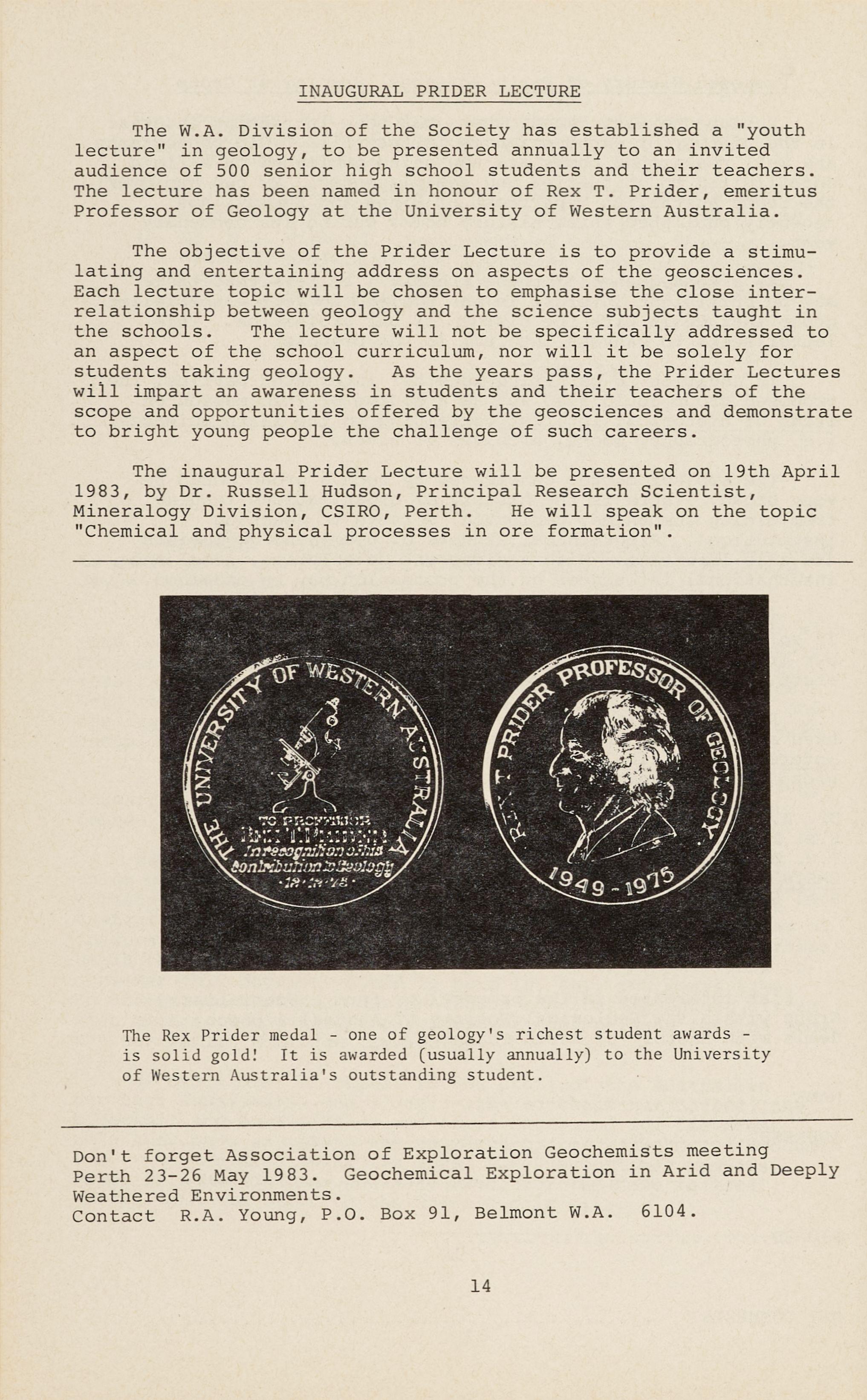
The W.A. Division of the Society has established a "youth lecture" in geology, to be presented annually to an invited audience of 500 senior high school students and their teachers. The lecture has been named in honour of Rex T. Prider, emeritus Professor of Geology at the University of Western Australia.
The objective of the Prider Lecture is to provide a stimulating and entertaining address on aspects of the geosciences. Each lecture topic will be chosen to emphasise the close interrelationship between geology and the science subjects taught in the schools. The lecture will not be specifically addressed to an aspect of the school curriculum, nor will it be solely for students taking geology. As the years pass, the Prider Lectures wiil impart an awareness in students and their teachers of the scope and opportunities offered by the geosciences and demonstrate to bright young people the challenge of such careers.
The inaugural Prider Lecture will be presented on 19th April 1983, by Dr. Russell Hudson, Principal Research Scientist, Mineralogy Division, CSIRO, Perth. He will speak on the topic "Chemical and physical processes in ore formation".
The Rex Prider medal - one of geology's richest student awardsis solid gold! It is awarded (usually annually) to the University of Western Australia's outstanding student.
Don't forget Association of Exploration Geochemists meeting Perth 23-26 May 1983. Geochemical Exploration in Arid and Deeply Weathered Environments.
Contact R.A. Young, P.O. Box 91, Belmont W.A. 6104.
Geological Society of Australia Inc. SPECIALIST GROUP
CHAIRMAN : Or C McA POWELL
VICE -CHAIRMA N : Dr R H VE RN O N
TELEPHONE :
TELEX :
SECRETAR Y : Or R A
Schoo l o f Ea rth Sc iences Macquar ie Un ivers ity NORTH RYDE, NSW 21 13 (02) 88 9498 (POWELL ) (02) 88 9503 (VERNON) MACOUNI AA22377
MULTIPLE DEFORMATION and FOLIATION DEVELOPME T
4 February - 10 February 1984
B E R M A G U I S W. SOUTH COAST
First Circular Feb r u ary 19 83
A field-oriented conference over six working days (Sunday 5 February to Fri day 10 Febr u ary) will be held at Bermagui on the . S . W South Coast Papers wil l be i n terspersed with discussions on outcrops, many of which a r e within walking or short-driving dista n ce of the conference hall The outcrops lend themselves to practi c a l de mo nstration o f the problems of unravelling multiply - deformed terrains and the mechanisms of foliation development A full - day field trip during the conference will include spec t acula r en - echel on vei n i n g a n d quartz fibres i n Upper Devonian redbeds as well as other aspects of mildly deformed rocks and i ncipie n t cleavage . After the conference there will be an optional two-day excursion to the Cooma Metamorphic Complex (11 and 12 February) led by Ron Vernon and Bruce Hobbs
A CALL FOR PAPERS IS OW BEING ISSUED
Papers dea l ing with any aspect of multiple d eformation and foliation development will be conside r ed, but papers re l evant to the keynote themes (below) are especially welcome
Keynot e themes: Cleavages and fractures in moderately and weakly deformed rocks
En -echelon veins
Struct ures in accre t ionary prisms
Th e natur e of bedding-parallel foli a tions
Origin of crenulation cleavage
Transected folds and the XY plane
Experimental deformation of analogous materials
Problems of correlation in mul t ipl y - deformed ter r ains
Several of these themes will be reviewed in keynote addresses to be given by international visitors. Papers offered may be of two types: (1) normal spoken presentations of 20 minutes' duration with 10 minutes' discussion; and (2) poster/practical demonstrations, during which thinsections and small hand-specimens can be projected with TV video equipment.
The organizers hope to provide as much opportunity for discussion as possible, so that brief, to-the-point presentations will be solicited.
An edited volume of selected papers will be published in the Journal of Structural Geology in early 1985. It will be essential for the papers to be submitted at the conference to meet publication deadlines.
CONTRIBUTORS SHOULD SEND THE TITLE OF THEIR PROPOSED PAPER AND A SYNOPSIS TO Dr C. McA. Powell BY 31 JULY 1983. School
of Earth Sciences
Macquarie University NORTH RYDE NSW 2113 Australia
ABSTRACTS of accepted papers will be requested by 30 SEPTEMBER 1983 in a camera-ready format to be advised.
ACCOMMODATION will be of three types:
(1) regular motel; (2) holiday cottage (one week's rental); (3) camping.
A limited number of holiday cottages have been reserved and will be allocated on a first-come-first-served basis. Most cottages house from three to five persons, and are suited to family groups. Some on-site caravans are available in the camping area, as is tent space.
People wanting to occupy holiday cottages should contact Dr Powell with their requirements as soon as possible. A 25% deposit on rental charge will be required by 30 June 1983.
SECOND CIRCULAR: A second circular will be sent later in 1983 to all people replying to this circular.
1983 ASEG Biennial Conference
From 31st October - 4th November 1983, geophysicists, geologists, and people generally interested in geophysical exp loration will gather in Brisbane for the Third Biennial Conference of the Australian Society of Exploration Geophysicists.
The theme is RESOLUTION and ACCURACY.
For further details contact: Rob Murdoch , Publicity Officer Phone : (071) 433922 or 433178.
13th GENERAL MEETING OF THE INTERNATIONAL MINERALOGICAL ASSOCIATION
The 13th general meeting of the IMA was held in Druzhba, a Black Sea resort , 10km north of the city of Varna, Bulgaria, between 19-25 September, 1982. Between 400 and 500 delegates from 32 countries attended , with 8 Australians present.
The Conference itself was reasonably wel l organized, but technical sessions were, on the whole, disappointing. With only a few exceptions, the standard of presentation, particularl y the use of slides and other visual aids, was poor to mediocre. The programme was thrown into chaos by the non-arrival of many delegates from the U.S.S.R. who were listed to speak. No translation facilities were available, even though English is supposedly the official IMA language. (One speaker announced to a grateful audience that because her English was not so good, she would deliver her address in Russian!)
Like most conferences however, the technical sessions were secondary to the informal discussions and socializing with old friends and colleagues. In that respect at least, this IMA was no different from previous meetings.
At the main business meetings, the new IMA Council was elected by the voting delegates (63 in all -3 from Australia).
It is a tribute to Dr . Ralph Segnit's international reputation that he topped the poll for the five councillor positions and became the first Australian elected to the IMA Council since Australia affiliated in 1 970 . The new Council consists of:
President: Adademician Prof. Ivan Kostov (Bulgaria)
First Vice-President: Prof. P. J. Wyllie (U.S A.)
Second Vice-President: Prof. D. C. Coombs (N.Z.)
Secretary: Prof. S. Hafner (West Germany)
Treasurer: Dr. P. C. Zwaan (Netherlands)
Councillors: Dr. E. R . Segnit (Australia)
Prof. G. Gottardi (Italy)
Prof. N . V. Sobolev (U.S.S.R.)
Prof. D. G. W. Smith (Canada)
Prof. R . Vochten (Belgium)
Commission and Working Group officers for the ne x t four years were also elected Some of the main points of interest to come from the Commission and Working Groups reports were:
1. An author may have two years in which to publish his or her description of a new mineral after the date of approval by the New Minerals & Mineral Names Commission After that, the priority will be regarded as lost.
2 . In 1981, 66 new mineral names were approved, compared to 103 in 1980
3 . Classification and nomenclature of micas and sulphosalts were being reviewed
4 . It was recommended that type specimens should be lodged in national museum collections.
5. A monograph of structural classification of minerals should be completed by the end of 1982.
6. An 8th Dana edition is planned.
The IMA Council has decided that there will be no formal general meeting in 1984, when the IGC will be held in Moscow. The next full meeting will be at Stanford University, California, from July 13-18, 1986. A copy of the first circular may be obtained by writing to IMA 1986, P.O. Box 183, Stony Brook, New York 11790, U.S.A.
Following the general meeting, several excursions were held, mainly in the Rhodoppe Mountains close to the Bulgarian-Greek border. While these did not provide exciting collecting or mind- boggling geology, the four days were enjoyable in scenic surround- ings and magnificent weather.
Further information on the IMA meeting and excursions may be obtained from Dr. Ralph Segnit (CSIRO, Division of Mineral Chemistry, P.O. Box 124, Port Melbourne, Victoria 3207; or Dr. Bill Birch, National Museum of Victoria, 285 Russell Street, Melbourne, 3000). Bill Birch.
Water-freshening in progress
An Australian Quaternary Association has been formed. Its initial role will be to provide a successor to the Australian Quaternary ewsletter. The Association and Newsletter are intended to cover a broad geographic area, encompassing New Zealand, New Guinea and the Pacific as well as Australia.
An interim committee has been formed to set up the Association. It is anticipated that a conference, possibly run as a field workshop, will be held within the next 18 months to formalise the Association and to elect office-bearers.
Until then, a new newsletter, Quaternary Australasia, will be published from the School of Earth Sciences, Macquarie University. Membership of the Association will entitle you to receive two issues of the Newsletter each year.
The first issue of Quaternary Australasia is expected to appear in May 1983. Research reports, news items, and short notes and articles are invited. These should be forwarded to the editor, Assoc. Prof. M.A. J. Williams, School of Earth Sciences, Macquarie University, North Ryde, NSW 2113.
Quaternary Australasia represents a fresh start. It will only be sent to paid up members of AQUA. Send your money, $15 (individual) $20 (institutional), to Dr. S. J. Riley, Business Manager, Quaternary Australasia, School of Earth Sciences, Macquarie University, North Ryde, SW 2113.
The Interim President of AQUA is Dr. Jeannette Hope, Dept of Prehistory, Research School of Pacific Studies, Australian National University, Canberra, ACT 2600.
JENNINGS TRAVEL AWARD
When Dr. J. H. Jennings retired from his position as Professorial Fellow in the Department of Biobeography and Geomor- phology at the Australian National University, Martin Williams and Jack Davies edited a volume of contributed papers, Landform Evolution in Australasia, to honour the occasion. The editors and contributors agreed that all royalties from the book should be paid into a Trust Fund and used for the furtherance of geomorphology in this part of the world.
The Jennings Travel Award has now been instituted with the intention to make the first such award in 1983.
The first award will be to the value of at least $200 but probably not much more. It is a modest amount which in relative terms will depreciate over the year s to come. It is hoped that potential applicants will value the honour associated with the award as well as the money, but it would clearly be preferable to be able to offer a larger sum. With this in mind anyone who would like to do so is invited to contribute large or small amounts, all of which will be gratefully received, acknowledged and used to increase the capital invested. Cheques should be made payable to "Jennings Trust Fund" and sent to Professor J. L. Davies, School of Earth Sciences, Macquarie University, North Ryde, 2113.
Even if you feel unable to unwilling to contribute directly , you could help by asking your local public library to put a copy of Davies and Williams (eds) Landform evolution in Australasia, ANU Press 1978 on their shelves. So far there have not been enough copies to obtain Public Lending Right payments and these could represent a useful annual contribution.
The Jennings Travel Award is to be made annually to the value of at least $200. Rules of the Award are as follows:
1. Applications must be made by 31 March in the year in which the award is offered.
2. Applicants must be students of geomorphology residing in Australia who have completed a Bachelors Honours programme or its equivalent in the year previous to application.
3. The award is to be used for travel relevant to the applicant's studies or for the furtherance of a research project.
4. Applicants will need to:
(a) detail their experi8nce and achievements and to ask at least one referee to provide a confidential report. Preferably this should be a member of staff familiar with the work of the applicant.
(b) put forward a viable and appropriate proposal for the use of the award. It may incorporate a small research project but this is not necessary.
5. The Trustees shall appoint a selection committee annually for the purpose of making the award and no Trustee shall be on the selection committee.
6. If in the opinion of the selection committee there is no sufficiently worthy applicant in a given year, the award shall not be given.
Symposium of the 6th International Association of Genesis of Ore Deposits, Tbilisi, Georgia U.S.S.R
I would like to draw attention to I.A . G.O.D, which is very active in providing an international forum for the discussion of the genesis of ore deposits. I.A G.O D arranges symposia once every two years, one meeting at each International Geological Conferences, (next in Moscow, 4-14th August, 1984) and the other in some significant metal district .
I A.G.O . D. Symposia usually have a series of pre- and postconference excursions which provide an e x cellent and efficient opportunity to observe and discuss metal deposits in the region of the symposium . Previous symposia have been held in Japan, Bulgaria and Utah.
The 6th I.A.G.O.D. Symposium was held in September 1982 in Tbilisi in Georgia, U.S.S.R, with excursions organised to Cu, Pb-Zn. W deposits in the Caucasian Mountains of Georgia and to Samakand and Tashkent regions of Uzbekstan (southern U.S.S.R.) . This symposium was a good fore runner of the likely degree of organisation for the International Geological Congress in the U.S . S . R . in 1984
I attended the A2 e x cursion (Caucasian Volcanogenic Cu, Pb, Zn, Ba, deposits) and C2 e x cursion Cu, Pb-Zn and W deposits of Uzbekstan, and both of these trips were well worthwhile . Vistis to individual mines were very well organised and geologists of each mine site gave us a very professional presentation of the geology of the deposits (within the framework allowed) The organisers of the conference ,went to considerable trouble to provide translators (both efficient and charming) on the e x cursion, and during the sympsoium in Tbilisi.
However as a general comment for those planning to visit the U. S.S.R . at the I.G.C in 1984 I would offer the following advice:
1) be prepared to be patient and persistent when dealing with the bureaucracry . 2) adopt an attitude of stoicism and "when in Rome etc . " when things turn out not e x actly as you had anticipated
As a general comment, we found that Russians on an individual level were e x tremel y friendl y and hospitable , that the country is remarkably diverse culturall y , and certainly the visit we had there , we well worth some of the difficulties encountered .
The International Association of Genesis of Ore Deposits is only a relatively small group (582 members world - wide) but is very active, and a good wa y to meet various specialists in Ore Genesis . The 7th Sy mposium for I A G O.D. is planned for Sweden in August 1986 For anyone interested in details please contact me at the address below (I A G O D membership cost %5.00 p . a . )
Tim Hopwood (Australian Representative I . A . G . O . D. ) PO Bo x 158 , NORTH ADELAIDE , SA 5006. 20
Sir:
Parts of the GSA Review on Publication Policy (Newsl. 41) have given this old member quite a bit of mental indigestion. I find it downright scandalous that out of 7000 or so geological scientists in Australia only 40% actively support our national society and its journals by contributing what still is, for what you get, probably the lowest members' fee in the world.
I had always assumed that for every graduate it would be a matter of course and of pride to belong and pay full fee to the Society the moment he gets a job. After all, particularly salaries for beginners are - over and above all inflationincomparably higher than when we old hacks started our careers. Yet I suspect the supporting percentage in the mid-1950s was probably nearer to 80% - or the GSA would never have been born! What's gone wrong? Is it the curse of specialization? Or just plain greed? Or both?
The three main factors given for the deplorable situation are to my mind lame excuses, and I regard the mentioned attitudes of that 60% of the "fraternity" as ridiculous.
1. Competition from other organisations (Australian?).
What have we? And what does it all cost? Journal GSA, Alcheringa GSA, Proc.Aus.IMM, Bull.Aus.IMM, Journal APEA/PESA, SEARCH, Journal BMR - the lot costs no more per annum than what you pay through the year for a daily newspaper at 35~! In fact, for the price of your second daily you can throw in all the Royalsocs and the Linnean! Competition? Ridiculous.
2. The "transient" nature of the geological profession.
That is a particularly lame excuse. Since the great majority of local graduates anyway (I suspect) spend most of their working lives in Australia and/or nearby, everything geological, geo- physi~al, geochemical, mineral-explorational published in and about Australia ought to interest them~ priori. Moreover, precisely because of the transient employment circumstances, geoscientists should always endeavour to build up their very own private library which can be brought along to wherever the working place is. Except in unusual situations it is also unjust to expect the employers to provide such a personalized literature backup simply to keep people abreast of their science. That is and should remain the duty of the individual, all the more as I am confident that no decent employer will refuse to ship an employee's library to whatever location he is likely to need it. Employers should be happy and proud to have the services of such keen and well read personnel.
3. Lack of inducement - Journal uninteresting.
Well, let's face it. There is no journal in the world, even the most specialized one, which is so superior as to contain exclusively "interesting" papers - not even Penthouse manages that feat. In my book our GSA Journal is of rather more general
interest than e.g. The Bull. and the Proc. of the Aus.IMM, or GEOLOGY and Bull.G.S. Amer., the Bull.AAPetrol.Geol., and a.o. the Bull.Swiss Petrol.Geol. Eng. In terms of general interest our GSA Journal ranges with the J.GeoLSocLondon, the Eclogae Geol.Helv., the French Comptes Rendus, and the Geol Rundschau, all of which have a balanced melange of more and or less specialized papers. After going through all abstracts I find, on the average over the last ten volumes, that in the Journal and its kindred publications some 50% of the contributions are worth reading in full. In the other mentioned publications my interest is aroused by only 10-20% of the contents. This is, incidentally, not seldom the fault of authors who fail to, or don't know how, to present their work in the light of and as a contribution to a subject of more general interest.
Geological work always means discoveries of one sort or another. All these have their place in a wider context which the author mu s t - to some extent already in the abstract - highlight in order to stir the interest of us lesser mortals. Provided one keeps the authors on their toes in that sense and our editors have been pretty good at this, I claim our Journal is as good and as informative as the best among them, and it deserves the full support of ALL Australian geoscientists. Not of only 40% of them!
Is it re a lly that difficult to get the measly 359/day out of the pockets of the other 60%? What about a sharp poster campaign in every relevant university department and in every exploration and exploitation company's office? Something like the famous "Uncle Sam needs you!" - pointed index finger displayed straight over the receptionists' desk - so that those greedy 60% get a naggy bad conscience!
Rudi 0. Brunnschweiler Canberra - Deakin 2600
[Apropos Rudi's comments on a Campaign for membership, The Geological Society of New Zealand mounted a very good (transportable) display at the Pacific Science Conference in Dunedin setting out the history, activities and publications of the Society and inviting membership. We could do something similar here with some success I believe. Ed.]
International Symposium on Recent Crustal Movements of the Pacific Region. February 9-14, 1984. Wellington, N.Z. Contact Dr. H.M. Bibby, Geophysics Division, D.S.I.R. P . O. Box 1320, Wellington, N.Z.
Geostatistics for Natural Resources Characterization, September 4-17, 1983 Stanford, Sierra Lodge, Fallen Leaf Lake California. Contact Applied Earth Sciences Department, Stanford, California 94305 U.S.A.
Letter to the Editor
Sir
Dr Wo lfgang Preiss (Australian Geologist, 20/12/82) has introduced a welcome note of rationality into what promises to be yet another round of debate on the subdivision and nomenclature of Precambrian time and rocks, occasioned by the current proposals of the International Subcommission on Precambrian Stratigraphy (Australian Geologist, 18/6/82). As Preiss points out with exemplary restraint, these legislatively decreed "bourtdaries" are not particularly suitable for Australia.
I agree with Preiss that a national solution for Australia would be preferable. However, I have an alternative suggestion to a separate Precambrian chronostratigraphy for the Australian continent based on classical Phanerozoic procedures. The suggestion would at the same time involve less work, be more in keeping with national traditions, and improve the financial position of our Society.
The Geological Society should run a sweepstake and associated lottery to establish a subdivision for the Australian Precambrian. Twenty-seven numbers, from 800 to 3 400 m.y. at intervals of 100 m.y., would represent the horses, and prizes would be given to the holders of the three winning numbers selected by computer. Separate lotteries could then be held, with each winner having the right to name one of the four consequent sections of Precambrian time. As the history of Precambrian stratigraphy is strewn with the debris of discarded names (Algonkian, Dimetian, Laurentian, Nullaginian, Pebidian, to cite a handful) such events could be repeated at intervals of, say, four years. This would give harmless pleasure to a greater number of fortunate winners, and would impede research on the Precambrian no more than the present arid debate on its formal stratigraphic subdivision.
A.F. Trendall Perth.
International Association of Engineering Geology IAEG
The name and address of the Editor of the Bulletin of I.A.E . G - who is at the same time Secretary General of the Association - have changed to:
Dr. Louis PRIMEL
Secretary General of I.A.E.G.
Laboratoire Central des Ponts et Chaussees 58, boulevard Lefebvre 75732 PARIS CEDEX 15 - FRANCE.
Letter to the Edito r
Sir ,
I am one of the 50 % who read y our editorials I am also one of the staunchest supporters of "The A ustralian Geologist", even though I live in Canada and have never visited y our co u ntr y. Th e mai n reason I e n jo y y our Soc i ety 's newsletter is b ecause of the humour Does this impl y that I too am childish or paroc h ial? I tr u st (hope is out since I read Strunk) this is not the case , although man y of my friends would d ispute my r eason i ng . That pales into insignificance, however , wh en comp ared with the possibilit y of h umourless issues of " The A ust r alian Geologist" . That would reall y be a down Down Under (or whatever the correct phase is in relatio n to Canada) .
Grah am L . Williams Head , E astern Petroleum Geolog y Geol Sur v. Canada , Dartmouth No v a Scotia.
PROCEEDINGS of Coal Gro u p Sy mpos ium:
COAL RESOURCE S - Or igin Exploration and Utilization in Australia Melbourne , November 1982
Price : $30.00 (postage incl uded)
Price: $ 7 .50 each (postage included)
The above are all available from the Sydney office .
ABSTRACTS
No. 5 - The Eromanga Basin Symposium , Adelaide, November 1982. No 7 - Symposium, Volcanism in Eastern Australia with cas e histories from New Sou th Wales , Sydney , November 1982.
S p eci al Pub licatio n No. 9
S .W . Paci fic Ba s in Correl a t io n may al so sti l l be a v a i la ble. Try y our l uc k.
WANTED TO PURCHASE
One copy of the Societ y "s Journal , Vol.29 Pts. 1/2. Any member wishing to sell this now out of print issue please contact -
Mr. N.C. Brown, 8 Evans Avenue , Mitcham, S.A. 5062.
The Specialist Group in Tectonics and Structural Geology of the Geological Society of Australia has initiated a field-guide series of which the first volume was published in January 1983. The policy of the Group is to encourage the preparation of guides, either specialized or broad-ranging, falling within the general field of structural geology and tectonics.
Field-guides published by the Group will have as their primary role the location, description and interpretation of outcrops. Although it is hoped that they will present the field evidence on which new and controversial concepts are based, the guides are not regarded as a suitable medium for the detailed presentation and discussion of such concepts. They may be initially prepared for a conference or workshop but must be sufficiently informative to allow independent use by professional geologists, including overseas visitors. There is no impediment to guides including information for several field excursions linked geographically or by related themes, nor to guides prepared jointly with specialists in other fields of geology and geophysics, provided there is a substantial content of structural geology or tectonics.
The cost of prin~ing guides cannot be covered by the recurrent funds of the Group, and pr0spective contributors should discuss the financing of publication with the committee of the Group at an early stage. Detailed editorial advice should also be sought before production of maps, figures, etc.
All prospective guides will be independently refereed, and the referees will be acknowledged in the field-guide.
The first field-guide is:
GEOLOGY OF THE N.S.W. SOUTH COAST AND ADJACENT VICTORIA, WITH EMPHASIS ON THE PRE-PERMIAN STRUCTURAL HISTORY,
by
C. McA. POWELL,
and the 118-page A4-format book may be obtained from : Laurel Tuckwell Business Manager Geological Society of Australia Room 1001, Challis House 10 Martin Place SYDNEY NSW 2000 at a cost of $10.00, which price includes surface postage.
A review of this guide will appear in the next issue of the Australian Geologist.
You're too late for the Bureau Min's Petroleum & Minerals Review Conference 1983 - Canberra 23-24 March. The programme looked good but nobody told us early enough. How did it go?
Book Review: Where are you Ernie, Bill, Lar r y, Harold, Paul?
The Field Description of Sedimentary Rocks
Maurice E Tucker Price t4.95 Geological Society of London & Open University
I once had the temerity to call the eminent trio, Dapples, Krumbein and Sloss, the Mar x Brothers of geology; a tribute not to their humour, although they were personally not short of that, but to their close association, which brought together so many facets of the newly-emerging field of sedimentary geology in the 1950s.
Twenhofel, Kuenen, Wanless and Weller were others who contributed mightily in this area, too.
It is a natural tribute to change and, in many senses, progress too, that these pioneers receive no mention in Maurice Tucker's very useful little book, the second in the rejuvenated Geological Society of London's Handbook Series (not forgetting the participation of the Open University).
This book of 112 pages contains eight chapters devoted essentially to field techniques, sedimentary rock types, texture, structures and geometry, fossils in the field, palaeocurrent analysis and facies identification and analysis. Although designed essentially as an aide -m emoire for the developing student of sedimentary rocks, it is, in a sense, a succinct statement of the state of the art of sedimentary geology.
Because of this attempt of Tucker's to combine two aspects of the whole matter of sedimentary rocks, it probably goes just a little far in the sub-division in the field of limestones, and ideas on sedimentary structures, palaeocurrent analysis and facies identification analyses may prove somewhat too sophisticated for many undergraduate students.
On the positive side for these students there are some very useful tables and if students can be encouraged to use these and become systematic in their approach to the examination of outcrops they will be well on the way to becoming very competent f ield geologists. However, they should try notebooks with water-proof paper and graph paper (great for graphic logs).
The illustrations are generally well chosen, but I can't be convinced that Fig.4.4 shows clear evidence of the direction of transportation as the caption claims.
This h andbook no . 2 maintains the h igh standard set by no.1 and I feel will be wide ly used. Poor students will find it essential and good students probably even more so.
David Branagan
Mining in South Australia: A Pictorial History
Compiled by John F. Drexel
South Australian Dept of Mines & Energy, Adelaide, A$19-95.
This is an outstanding "first" in publication by a State Mines and Geological Survey. South Australia's vibrant mining history is recapitulated in nostalgic sequences of photographs that show the pervasive influence of prospecting and mining in moulding the State's progress.
The Glen Osmond silver-lead mines, almost within the suburbs of Adelaide, we are reminded, were the very cradle of Australian mining. The discovery of rich copper at Burra soon after, in 1845, virtually rescued the State from bankruptcy and quickly trebled the State's population. By 1860, Burra was the world's largest producer of copper, only to be eclipsed soon after by Wallaroo-Moonta, and now by the potentially enormous copper-golduranium deposits of Roxby Downs.
John Drexel's skilful selection and annotation of archival photographs has graphically recaptured the spirit of the times, the hardship and hopes of the early pioneers, and the outstanding contribution that mining has made to the State's progress, education and export earnings. Patterns of early immigration were grossly influenced in the process, and much of the early sociological development related back to the stabilising influence of Cornish and Welsh miners.
The reader-viewer is led in turn through the boom-and-bust gold rushes and a range of less spectacular metallic mineral mining to the establishment of the Port Pirie "silver-lead-zinc" smelters. These continue to handle much of the wealth of Broken Hill to this day. The rather unspectacular beginnings of iron-ore mining in the Middleback Ranges contrasts with the subsequent virtual removal of whole mountains and the establishment of an important steel industry and finally ship construction yards.
Opal fields, the world's largest and richest, have brought new immigration to the desert outback and bred a new race of rugged individualists complete with "dug-out" living and the development of radically new "gouging" technology. The newly discovered Cowell jade deposits offer new entry to the South East Asian gemcutting industry at a time when jade supply from other world sources is steeply declining.
The struggle to establish an indigenous coal mining industry based on low grade material is brught out clearly. To a State historically deficient in "energy" minerals, that is except for uranium, the more recent (1960's) discovery of the continent's largest onshore oil and gas fields is a major achievement.
The Album has made a range of almost forgotten photographs openly available to laymen and historians alike. Each photo is worth more than pages of words, and each is a study it itself. The highest commendation must go to all behind the presentation. One can only hope that other States follow suit.
Reg Sprigg.
Book Review
The Poetry of Geology edited by
Robert M Hazen
George Allen & Unwin, London, 1982 Hardback rec. price
$13.95
As the pages of the Australian Geologist, Geotimes Geolog and other similar journals show, present day geologists are not averse to trying their hand at prosody (thank you G.S.!), generally in a rather light-hearted vein. The Americans seem to be less shy in this respect than others as witness an American ex-serviceman who did Geology I with me. Hank constructed and learnt verses designed to help him memorize the names of the numerous fossils we had to study. He spent so much time on his verses he didn't have time to learn the geology so failed the course . We were thus robbed of the anticipated pleasure of seeing how he dealt with optical crystallography. Last year we were reminded (Australian Geologist ) of some 19th century Australian verses designed to help Australian schoolboys understand the mysteries of geology and student year books abound with samples of bad verse at various levels.
This well-produced book reminds us that there has been a long tradition of geological poetry in the English language and Robert Hazen is to be commended for gathering together this material unearthed during his researches in the hi stor y of geology.
I must confess to enjoying most John Scarfe's unpretentious granitogony, geological cookery and a poetical geognosy of 1820. These poems reveal a sense of humour and a timelessness which makes them well worth reading and even quoting at appropriate functions. Dorothea Hemans' offering, 'Epitaph on a mineralogist', is in similar vein and well removed from her usual style.
The more serious efforts are less successful, are usually somewhat pretentious and have rarely worn well. A little Tennyson or GM Hopkins shows what can be done in this regard.
However, all in all this book is a pleasure to read and perhaps it will prove a precursor of a series. My only regret is that its relatively high price (for only 98 pages) will prevent its becoming a best-seller within the profession. Ask for it as a present, and make sure it gets into your local library.
D.F. Branagan.
12th World Mining Congress, November 19-23, 1984
New Delhi, India. Contact organizing secretary, C/- Institution of Engineers (India), 8 Gokhale Road, Calcutta 700 020 India. Telex: 21 7885 IEIC IN.
Computer Applications in the Earth Sciences - an update of the 70s. Edited by Daniel F. Merriam; Plenum Press, New York, 1981, 385 pp. $45.00.
This book summarises the contributions to the 8th Geochautauqua held at Syracuse University in October, 1979 {allowing interesting comparison with a similar meeting held ten years earlier and reported in an earlier volume in the same series). A distinguished group of 18 contributors reported on computer applications in fields ranging from biostratigraphy and palaeoecology through structural geology, photo-interpretation, and petrology to various facets of resource exploration and appraisal. From relatively rudimentary beginnings, mostly concerned with comparatively simple problems of statistical analysis, computer applications in earth sciences have mushroomed to a point where very few geologists and probably no geophysicists now work in fields where computers have not made some significant impact, and this remarkable transition is well documented in this volume.
However, the greatest problem with summaries of this type is the question of their practical value. With an average length of about 20 pages to each review article, it is clear such a book is unlikely to serve as a practical handbook for dedicated practitioners on the one hand, or as a textbook for novices on the other. Trend surface analysis, for example, is treated in two paragraphs in one article and one paragraph in another; the problem of analysis if irregularly distributed {as opposed to regularly gridded) data is mentioned only as a problem with interesting possibilities. G.S. Koch's 18-page review of "Computer Applications in Exploration and Mining Geology: Ten Years of Progress" could spare only one page for the combined efforts of the Matheron school and of Krige and co-workers.
These comments are not intended to be critical of the individual reviews, but only to emphasise the problems inherent in review compilations of this type. How could Matheron's work over 10 years be effectively summarised in 18 pages or less? One concludes that the book will find its audience either in diligent students willing to work assiduously through the useful bibliographies {while recognising that even these can hardly pretend to be comprehensive), or in geoscientists seeking a cursory overview of the subject as a secondary interest. In the latter context, I for one found it to be interesting and {mostly) reasonably easy reading.
Projections for the next decade or two stress not only expected improvements in hardware, but also more subtle shifts in orientation. We may expect less of a tendency for earth scientists to "borrow" computer techniques from other disciplines {sometimes disastrously), and more of the d~velopment of v.alid approaches by earth scientists who are computer-literate. The early stages of development of a computer language that can express geological concepts in a computer-recognisable notation are already with us, and we may expect advances in simulation techniques, complex modelling, and iterative methods which can do much to help with the problem of geological time. It will be interesting to read update for the 80s - if it can be fitted into three volumes or less!
Ken Williams.
MARINE GEOLOGY by James P. Kennett. Prentice Hall Inc.
US price $24.95
Aust " $51.00
"Marine Geology" is the first comprehensive survey of the y oungest of the fields of geology, a field which has had much impact on geological thought through the development of the concept of plate tectonics. Few other texts in science draw the bulk of their data from original publications of the past decade.
The 800 page book, well illustrated by numerous diagrams, is divided into four parts. Firstly the structure and oceanographic setting covering the geophysics and morphology of the oceans, ocean stratigraphy and correlation methods such as tephrochronology, biostratigraphy, magnetistratigraphy, geochronological methods in the marine environment. These introductory chapters lead up to the development of the concept of plate tectonics. The final chapter of the first section provides basic data on ocean circulation and water characteristics.
The second section of the book provides a comprehensive outline of continental margins from shoreline processes to the continental slope. The continental margins are discussed in relationship to their tectonic origin; divergent, convergent and translational. This section stresses the evolutionary processes of continental margins and provides a wealth of world wide data.
Section three deals with ocean sedimentation processes, sediment mineralogy and biogenic and authigenic sediments of the ocean basins. Chapter fifteen in particular will dispose of any concepts of the ocean bottom being devoid of significant currents or sediment transport processes as it provides information on deep sea bedforms and sediment transports. No coverage of deep sea sediments would be complete without reference to microfossils and an e x cellent well-illustrated summary of the ocean sediment microfossils is given in Chapter 17.
The final section of the book, Ocean History - Palaeoceanograph y, inlcudes "studies of the development of the surface circulation, history and effects of bottom-water circulation patterns, planktonic and benthonic biogeographic development and rates o f organic evolution. The history of biogenic productivity and its effects on sediment-distribution and the history of calcium carbonate and silica deposition and dissolution". The history of each ocean is described in these terms with a final chapter providing an overview of critical events in ocean history.
Marine Geology provides a student in this field with an excellent survey of a diverse subject with a comprehensi ve list of references for further study.
C.V.G. Phipps University of Sydney.
Geological Features of the National Estate in Victoria advertised in the December issue. If you want it y ou must pay the postage ($1.50-$1.80 appro x.) as well as $10 charge. Dept. of Minerals & Energy, Sale of Publications, 140 Bourke Street, Melbourne Victoria 3000.
VICI'ORIAN DIVISION
140 Bourke Street GPO Box 1683P
MELBOL'RNE VIC 3001
Phone: 665 0555
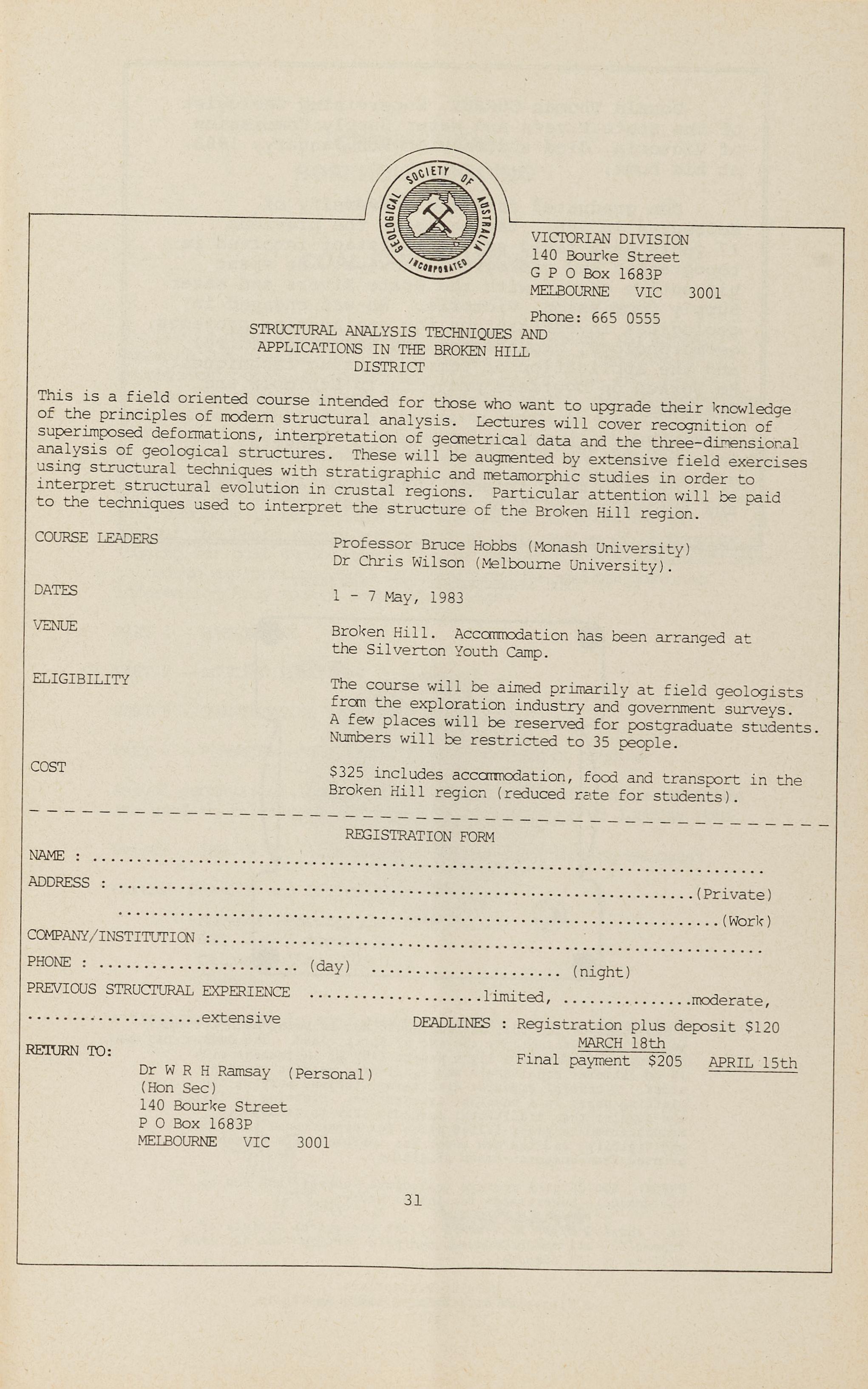
STRUCTURAL ANALYSIS TECHNIQUES AND APPLICATIONS IN THE BROKEN HILL DISTRICT
This is a field oriented course intended for thosE who want to upgrade their knowledge of the principles of modem structural analysis Lectures will cover recognition of superimposed deformations, interpretation of geanetrical data and the three - dir-1ensior.al analysis of geological structures . These will be augmented by extensive field exercises using structural techniques with stratigraphic and metamorphic studies in order to interpret structural e volution in crustal regions. Particular attention will be paid to the techniques used to interpret the structure of the Broken Hill region
COURSE LEADERS
DATES
VENUE
ELIGIBILITY
COST
Professor Bruce Hobbs (Monash Universit y) Dr Chris Wilson (Melbourne University).
1 - 7 Ma y , 1983
Broken Hill. Accanmodation has been arranged at the Silverton Youth Camp.
The course will be aimed primarily at field geologists from the exploration indus try and government surveys. A few places will be reserved for postgraduate stedents Numbers will l::e restricted to 35 people.
$325 includes accarmodation, food and transport in the Broken i-iill region (reduced rate for students )
REGISTRATION FORM
NAME :
ADDRESS
COMPANY/ INSTITUTICN
PHONE
: Registration plus deposit $120 MARCH 18th
RETURN TO: Final payment $205 APRIL 15th
Dr WR H Ramsay (Personal) (Hon Sec) 140 Bourke Street PO Box 1683P MELBOURNE VIC 3001
Donald Thomas CURREY , Supervising Geologist of the State Rivers and Water Suppl y Commission of Victoria , died suddenly on 9th January , 1983 , at his home
Don graduated from the University of Melbourne in 1961, having spent the previous 17 years as a field survey assistant involved in topographic and geological surveys . He spent his entire career with the State Rivers and Water Supply Commission, Victoria . He was engaged in geological investigations for engineering projects , geomorphology, groundwater and salinity control , and the application of remote sensing techniques . He worked on overseas projects in Ethiopia and Thailand
Don is survived by his widow, Janetta.
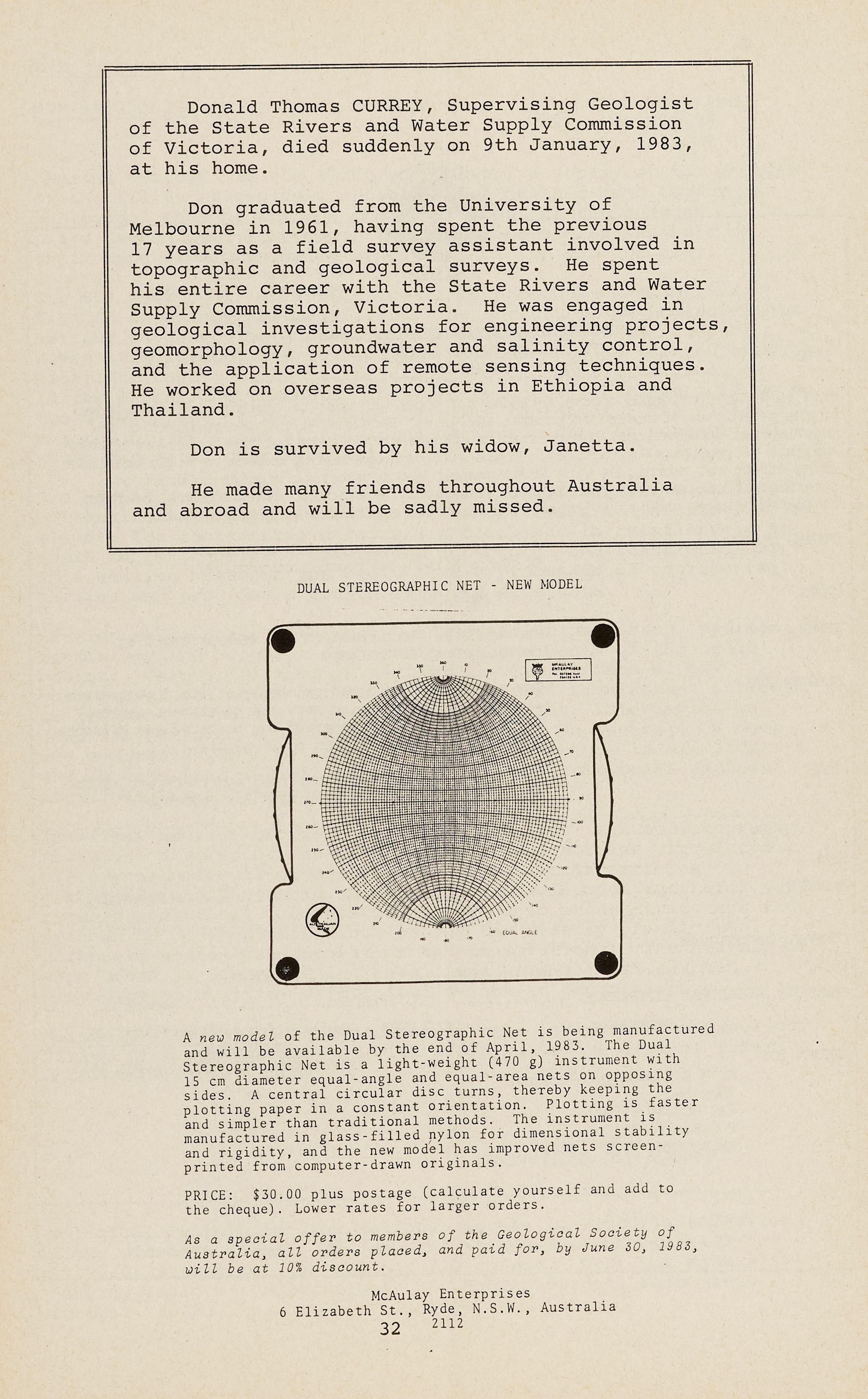
He made many friends throughout Australia and abroad and will be sadly missed DUAL STEREOGRAPHIC NET - NEW ~JODEL
A new model of the Dual Stereographic Net i s being manufactured and will b e available by the end of April , 1983 The Dual Stereograph i c Net is a light - we i ght (470 g) instrument with 15 cm diameter equal-angle and eq ual-area n ets on opposing sides. A central c ir c ul ar disc turns, thereby k eeping the plotting paper in a constant o r ientation. Plotting is faster and simple r than trad i tional methods The instrument is manufactured in glass-fi ll ed pylon for dimensional stability and rigidit y , and the new model has improved nets screenprinted from computer - dra wn originals.
PRICE : $30.00 p l us postage (cal\:ulate yo u rself and add to the chequ e) Lower r at es for l arger orders.
As a special offer to members of the Geological Society of Au s tralia , all orders placed , and paid for , by June 30 , 1983 , wi ZZ be at 10% discount.
Mc Aulay Enterprises
6 Elizabeth S t. , Ryde , N S.\v., Australia
32 2112