The Australian Geologist
Newsletter Editor
D F Branagan, Dept Geo log y & Geophys ics, Un i ve rsit y of Sydne y , NSW 2006.
phone : ( 02 ) 692 2358 692 2912
Secretary Dr. R. E. Smith
CSIRO Division of Mineralogy , P rivate Mail Bag, P O Wemb]ey , WA 6014.
THE PRESIDENT Is PAGE
This edition of the Australi an Geologist is a special one. It carries a succinct summary of an exciting new project that will be of interest to all members. It is an international project with a sound administrative base Gesigned to bring to bear the diverse disciplines that characterise our science, on to a study of the nature, dynamics, origin and evolution of that part of planet Earth that we have spent our lives grappling with - the lithosphere.
I commend all members, whether they be potential active participants, or interested observers, to study the document on the International Lithosphere Project as it will indicate the direction of research that will take place in this country. In particular all Divisions, Specialist Groups, and other tearr.s should note the invi tation of the Australian Committee to receive proposals for staging symposia or workshops together with requests for their funding. I recently had occasion to tally the number of Society-sponsored symposia in the firm planning stage - it numbers eight and shows that our Society is very acti v e. Organising Committees could well examine their themes and consider what actions they could take.
The Executive is in the middle of a daunting task of reviewing the publication policy of the Society. Australian participation in the Lithosphere Project presents an excellent opportunity for the Society to bring current developments to the attention of its members through publication of position papers, progress reports and symposia proceedings.
Transforming the Journal into a medium of wider appeal will undoubtedly require money. Our income is derived from membership subscriptions, sale of publications, and in reality, staging conventions. Our Executive has strong view s on the latter, which I have con veyed to you in earlier President's Pages and we hope to obtain some reaction to those views. By way of aside, the Executive has just received a cheque for $27 000 from organising committees in Western Australia, about which I will tell you more later. The second source of revenue is a "Catch 22" situation. On the matter of membership, the Executive has recently written to Divisions outlining a campaign aimed primarily at industry geologists. The only cost to the Society will be station ery, postage and membership forms Through prudent management by previous executives, the Society is financially sound in accumulated funds , but Treasurer Krish Sappal tells us that were it not for an anticipated $12 000 from investments, we would fini sh with an operating loss in 1982. The need for new members is more pressing than it ever has been in the past
The commission to review the publication policy opens up a can of worms!
Dennis Gee
The Australian Geologist
Newsletter No. 38 12th March 1982
EDITORIAL
This issue of the newsletter is unusual for a nwnber of reasons.
Firstly it contains the largest article we have used so far, prepared by Mike McElhinny and others on the International Lithosphere Program and Australian participation in it.
Geologists who do not become directly involved with the project will nevertheless be encouraged to come to grips with the topic at the next Conference of the Society scheduled for 1983 in Canberra on Lithospheric dynamics and evolution of Continental Crust.
Whether the ten - year project really achieves much , or just becomes a convenient catch - all for the usual run of research topics being carried out in the country's halls of learning remains to be seen. A recent visit to some of the mines on Tasmania ' s west coast convinced me that geologists from industry can make a signi fican t contribution to such a project with both facts and ideas. It is to be hoped that they will do so.
Whatever the future, in this issue industry geologists have put pen to paper in an unprecedented way to defend their attitudes on environmental and conservational matters. Would that the editor could similarly stir the readership in every i ss ue. I t has been refreshing indeed to receive letters of protest an d proves that members do read the newsletter and can be provoked into action.
Our colour cover on the last issue also earned comment, mostly f avourable, and a request from Ru ssell Hudson for a colour centre-fold in this issue (copy supplied!). However in this male - dominated profession it has been deemed wiser to allow the furore to die down an d readers will have to curb their impatience until the Society's fund s recover and we can use colour again.
Finally this issue carries a significant nwnber of pages dealing with the affairs of the Australian Institute of Geoscientists Ltd. A wide range of geologists and geophysicists is joining the Instit ut e and it seems set to play a significant role in the future of the earth sciences in Austr alia. Its healthy growth and the successful establishment of the Au stralian Geoscience Council augur well fo r the profes sio n However much is still up to the individual geoscientist The average Fred Nurk doesn't have a clue what we do. Perhaps each of us should tell him.
L E T T E R S
Sir:
The President's Page in No. 37 of The Australian Geologist, in drawing attention to the surplus made by the organisers of the symposium on Cainozoic Evolution of S.E. Australia, suggests the establishment of a "Special Fund" into which all surplus moneys from Division and Specialist Group-sponsored events should be placed. This suggestion again touches on the now discredited proposal of centralized accounts, which was dismissed by the Council in January 1980.
The distribution of surplus moneys among cosponsors of symposia has not posed any apparent problems in the past, and any surplus was a welcome addition to the funds of Divisions and Specialist Groups, which otherwise had to tailor their activities according to their income from capitation fees.. As chairman of one of the smaller Specialist Groups within the Society, I am very much aware how an insufficient financial base hampers attempts at launching a national symposium. Incidentally, the organisers of the above-mentioned symposium specified in Agenda Item 15 for the Council Meet ing in Perth, that their surplus was to be spent on future Cainozoic meetings and related studies.
The functions of the suggested "Special Fund", name l y to float meetings, invite speakers and publish proceedings, are handled quite ably by our more active and efficient groups using their own assets. To deny these groups their freedom of decision would stifle their initiatives of revenue raising and cost reducing, and would ultimately lead to a further erosion of our membership due to lack of local activities.
Further to this, one hopes that the financ~s of future symposia will not be encumbered by the request for half the printed run of abstracts from Division and Specialist Group -sponsored events to be handed free of charge to the central office.
Our Society's strength lies in its Divisions, and it would be foolish to dampen the enthusias~ of the honorary committees by the continued suggestion of a central financial bureaucracy.
Gerhard Hofmann Chairman, Queensland Division.
[The problem with the Cainozoic Symposium however seems to have been that it had no official sponsor such as a Specialist Group - see a lso page 33 in this issue re the Quaternary Research Newsletter. Ed.]
PALAEOCENE VS. PALEOCENE
The case of Palaeocene vs. Pa l eocene (Callen, 1981; Brunnschweiler, 1981) is essentially a problem for Britishers because it does not exist in other countries where the spelling is uniformly "paleo", with appropriat~ suffixes, as in Paleocene (French), Paleozan (Ger.), Paleocene (Amer., Ital.), Paleoceno (Span.), paleotsen ( Russ.), paleoccen (Dan.), paleoceen (Dutch), etc . The 2nd edition of Ancient Australia (1969) to which Rudi Brunnschweiler has recourse in Newsletter No. 35 can hardly be called a primary source of information, so let's dig a little deeper.
W. P Schimper (1874), who coined the term , is of little help, because he wrote in French, and his spelling, paleocene , has been preserved unchanged in that language. The question is, did Schimper have in mind "pal eo - eocene " or simply "pal eo -cene"? Ala s, he does not seem to have explained the term, if one can rely on Wilmarth's translation (1972; I have not seen Schimper's book), but an indication may perhaps be found in the standard French Traite de Geologie by grand old man Emile Haug (1920, p.1397) who interpreted Paleocene as " Eocene ancien; Schimper, 1874." Since Haug was born in 1861 and Schimper died in 1880, it is just possible (both were born and raised in Alsace and connected with the Un iversity of Strasbourg) that the two knew each other and that Haug correctly interpreted Schimper's meaning : Eocene ancien + paleo - eocene paleocene. This i s apparently also what Brunnschweiler has in mind, although he is thoroughly mistaken in regarding pala as a permis- sible abbreviation of palaios. The ai in this word is a diphthong, just like ei in Brunnschweiler, and how would Rudi like to have his name separated as Brunnschwe-iler? The correct abbreviation of n aAa 1 0 is , of course , either naA or naAa 1 0 s .
The real trouble lies in the Roman transliteration of the Greek diphthong a 1 In modern English, this is usually rendered as ae and this usage is sanctioned in the International Code of Zoo logical Nomenclature, Appendix B . However, the matter is not quite so simple, for the original transliteration of a 1 was not ae , butce which is a single letter known as a digraph (or ligature). The history of this letter which is still preserved in contemporaneous Danish and Norwegian, and which is the equivalent of German umlaut a, is explained in some detail in the Oxford English Dictionary. According to this source, this symbol " died out " in the development of Middle English, but was reintroduced in the 16th century , specifically as transliteration of Greek a 1 ; subsequently, "whenever a word became thoroughly English, the ae or ce was changed into simple e , as edify, ether ." In scientific usage the ce survived well into our times. The first translation of Paleo cene into English was by
Duncan ( 1 877) who wrote Pa1Eocene(not Palaeocene) and this spellin g is fo und as late as 19 31 in Cissarz and Jones (19 31 , p.49-50) who jux ta po se d German and English Paleozan and Pareocene.
It seems clear then that the correct sequence of transliterations in English mind you, wa s na Aa 1 0 pal:Eo paleo, correctl y abbre v iated pal. So it does not matter whether Schimper, or whoever, meant paleo - eocene or paleo - cene, the correct final spelling is Pa leocene. Where and when and by whom the incorrect spelling Palaeocene was first introduced , I shall leave to somebod y else to find out. In conclusion, I am pleased to call attention to Ager (1980) who , in his de li g htful Geology of Europe , uses Paleocene throughout (except for some lapsus calami b y his draftsman, as on p. 521).
To question the spelling o f such English terms as Palaeozoic, palaeontology, Kainozoic, and man y others would open a P andora's Box which I do not intend to do. Rather, I would like to repeat advice recently given (Teichert , 1981): In questions of spelling of technical terms let sleepin g dogs lie and follow usage.
Curt Teichert
Dept o f Geo logical Sciences
Un i ve rsit y of Ro c hester Rochester, N.Y . 14627, U.S A
References
Ager , D V , 1981. The geology of Europe : John Wiley & Sons , New Yo rk , xix + 535p.
Brunnschweiler, R ., 1981 Palaeocene , se ma ntics , education and all that : Austral Geologist , Newsletter No.35 , p 4 , 10
Callen , R., 1981. Cene this semantic snippet? Austral Geologist , News l etter No 34 , p 9 - 10
Cissarz, A ., & Jones , W R , 1 931 . German - English geological terminology. Thomas Murb y & Co , London x vii + 250p
Du ncan , P.M ., 1877. Anniversa r y address of the President : Geol Soc London , Quart.Jour , v 33 , Proc p 41 - 88
Haug , E . , 19 20 Traite de geo lo gie , v.2 , fasc 3 , p 1 397 - 2024 . Armand Colin , Paris
Sch imper , W P , 1974 Traite de paleontologie vegetale , v.3 , p 680 - 682 . (Not seen)
Teichert , C ., 1981. Benthic-si; nektic , planktic - no!: Jour Paleontology , v 55 , no .5, p 997 - 998
Wilmarth, M. G., 1925 The geologic time classification of the Uni ted States Geo logi ca l Survey compared with other classifications and accompan ied by the original definition of Era , Period and Epoch Terms: U S Geol.Surv.Bull. 769 , 138p
Letter to the Editor
Sir:
When I read the letter from Vince Morand, University of Sydney (Australian Geologist No. 37) I did not know whether to laugh or cry. Was it a joke, or is Vince Morand serious? He accuses company geologists of being anti-conservation, mercenary monsters who are not prepared to speak out against proposed developments and "issues " . Perhaps he has forgotten about the role of geologists in our society.
I have been a geologist for 25 years, working for government and industry, and throughout that time it has always been my philosophy that my role in society was to discover and develop the resources required to maintain the standard of living expected by every Australian (including Vince Morand) and to improve the standard of living in less developed countries. In addition as Australia's first full-time environmental consultant, before there was even any "environmental" legislation to guarantee me a living, I have spoken out on many occasions about environmental issues of importance to our society. However, my role here was to educate the public, the government agencies and the company decision - makers into their alternatives and responsibilities if a particular development was to proceed.
I believe that most geologists, whether in government, industry or academia are in fact "conservationists " They understand and associate more closely with the environment than the vast majority of the poulation. They understand the need to discover, develop and manage our resources. However, sir, they are not "preservationists". If that were the case, where would the resources come from to provide the vehicles and the energy to transport the Vince Morands of the world to their protest meetings, the power to light the venue and to run the printing presses to print their protest brochures?
I am heartily fed up with these professional protesters who are supported by the rest of society, and who expect all of the benefits that the mining industry provides without any mining! Reality is apparently a difficult thing for Vince Morand and his associates to grasp, but sooner or later reality must prevail. Everything they touch has a source or component derived from mining, and there, sir, is where our social conscience lies - we must ensure that our society is provided with the resources it needs, and we must do that in the most environmentally, economically and socially acceptable way possible. That includes uranium, oil, titanium, sand and gravel, limestone and all of the other products that we as geologists must provide for the rest of society. It is also our role to develop and promote the compromises necessary to produce them from aboriginal land, national parks, Great Barrier Reefs, beaches and anywhere else that nature has seen fit to put them. 7.
As you can see, I am quite prepared as a geologist to speak out in public; but I speak out in support of the role that geologists must play in the discovery and development of resources, the role, presumably, for which society trains them and expects them to fulfil, providing that it can be done in a manner acceptable to the majority of people in our society.
Graham Brown, North Sydney.
Sir,
Vince Morand, University of Sydney, in his letter in the 'Australian Geologist' No. 37, commented on the public impression of geologists and went on to single out the industry geologist as the 'bad guy'. Mr. Morand has raised so many issues that it would be impossible and improper to deal with them here.
I would suggest one of the reasons for industry geologists not being more vociferous than many would like is that the issues are not simply a matter of one being for or against the issue - Mr. Morand seems to think that industry geologists are against everything! The issues are complex, emotive and require a balanced approach. Most of the issues have occupied the minds of many geologists and others in industry for some time and will continue to do so. One combined effort has resulted in the formulation of statements on points of concern affecting aborigines, the environment and other matters, which are contained in a public document entitled "A Declaration of Policy 1981", issued by the Australian Mining Industry Council.
Industry geologists are very conscious of their role in public relations as their work takes them onto the public arena more so than other professions. They are continually explaining their aims to farmers, local shopkeepers, shire councils, forest commissions and others who find it difficult to grasp what exploration is all about and in particular the relationship between exploration and mining. The task is not easy and is full of pitfalls, but I believe geologists in industry have come a long way since the 'Poseidon Days' and are fully aware of the need to continually explain to the public their role and the nature of· their work programmes in relationship to the issues arising from the activities of our expanding industries. 8.
D. A. White Canberra.
Sir:
The letter from Vince Morand in No.37 issue is at once elitist, naive, condescending and insulting. It reads as if written by one who believes that the world would be a better place if we could create an instant post-Industrial Utopia overnight and all live the life of Lotus-eaters with somebody else paying the bills.
As a 'Harr y Butler' type I have worked happily for the one company for 25 years. I have found no impediment put in my way in maintaining my interests in natural history, conservation and Heritage matters. What I have found has been active encouragement, both moral and financial, from this same organization. When I have felt that their resources could help in the furtherance of parti- cular projects which I have judged to be of merit in the above fields, much of this help has been substantial, not just a token.
I have found no impediment to my speaking out about certain issues which ha v e affected the mining industry. However, I am not 'agin everything' as Morand appears to be. Working in the commercial sphere gives, I am certain, the average industrial geologist a much better feel for the art of the possible. Much can be done by speaking to the people who make decisions, rather than filling the TV screen with one-sided opinions. Gathering and supplying hard data to government organizations, rather than berating the bureaucrats for making ill-considered decisions, can lead to involvement in absorbing projects to fill one's spare time. Talking about the pros and cons of mining to organizations and individuals rather than preaching a negative philosophy can lead to interesting debate and contacts.
What is wrong with supporting the mining of uranium? I do, because I feel that our continued use of fossil fuels contains just as much long-term danger as does the nuclear fuel cycle. Has Morand ever talked to aborgines in the bush and found out their individual perceptions of mining, its possible drawbacks and benefits? He might find a much greater spread of views than he might think, as I have. Has he investigated the present situation of the 'exploitative role of large oil and mining companies in third world countries'? He might find that the major share of the take doesn't go out of the country.
It saddens me to thin k that in the academic world we ha v e people so ignorant of the potential employers of a large percentage of their students that they can express such e x treme one-sided opinions. It may be that it is not onl y 'the pu b lic who knows nothing about academic geolo g ists; it is also a lot of industry geologists who don't.
Finally, the Fred Nurks of this world would be rightly indignant if they read Morand's Letter. Has Morand ever sat down and talked to Mr. & Mrs. Australia or offered his services to talk to organizations and groups who are always looking for intelligent explanations of the wor ld around us? If he did, he might find himself a more humb le person.
Don Reid, Unley, S.A.
[It may be inferred from the above that Mr . Morand is on the staff at Sydney Uni v ersity This is not so. Ed.)
Sir:
The letter by Vince Morand (Australian Geologist, No. 37) requires a response, even if to show that not all industry geologists are apathetic as he suggests.
Geologists in industry, by and large, spend considerable amounts of time in the Australian bush and, in my experience, are far more aware of the natural environment than the average Australian. Indeed, many I know have an excellent knowledge of the flora and fauna in the areas where they work and are "Harr y Butler's" in their own right - even to the beard!
The reason that many industry geologis ts do not unquestioningly support all conservation issues, is, I believe, because they are realists, unlike some of their academic brethren. We cannot escape the fact that the world requires minerals (including uranium for power generation), and to obtain these inevitably involves some cost. The object always must be to strike a balance, whereby human and environmental costs are minimized. Who else but the "exploitive" corporations can provide the risk and development capital for the discovery and development of mineral resources? I doubt that our conservation friends are any more willing than I to donate extra taxes to the Federal Government for this purpose. The very fact that this Society actively supports the concept of Geological Monuments demonstrates that geologists as a group are not a destructive pickwielding bunch.
I submit that industry geologists have a more informed social conscience on these matters than most people, simply because they are so close to the realitie s of the situation.
Chris Giles (consultant) Mt . Pleasant , S.A.
10.
Sir,
I was concerned to read the letter by Vince Morand (Aust. Geol., 37, 1981, p.4). It contains an unqualified statement that geo logists are not conservationists. That statement is not true.
The implied or stated criticisms in Morand's letter are directed particularly to 'company geologists'. I was a company geologist for many years and, from my knowledge of company attitudes and from discussions with present colleagues, I believe that geologists, including company geo lo gists , are conservationists.
Much depends on what is meant by the term 'conservationist'. I do not accept that the word should describe a person who insists that there should be absolutely no interference with 'nature', 'ecology ' or 'our heritage'. It is unreasonable to expect that damage from mining can be avoided absolutely, but it is unr easonab le that any country, fortunate enough to have mineral deposits, should ban mining abso lutel y .
The work that is done by a company geologist, whether concerned with exploration or mining, is not itself likely to have much effect on the environment.
Morand's concept seems to be that geologists are not conservationists because they do not campaign against mining operations, such as those he lists in his third paragraph.
Why should they? What is wrong with producing oil or minerals? Has Morand thought of the effect on the countries of the World, including Australia, of cessation of mining? It is interesting to list the people who would be affected if, to take a small example, mining were stopped at Nauru Island.
Morand 's reference to Harry Butler misses the poin t that Colin Branch made. His point was that the public wou ld have a better appreciation of, and interest in, geology if some geologist with the persona lit y of Butler were to present a TV series comparable with 'I n the Wild'. Butler epitomised an enthusiast in his subjects, biology and botany. His interest in conservation followed automatically, but it is not pertinent to Colin Branch's comments.
Away from his well known TV series, Butler consults for several major mining companies to ensure minimum disturbance to the environment by mining. This is a sensible and workable arrangement.
Company geo lo gists should heed the advice of such people as Butler , but none of them can be expected to play the advisory role of Butler, except perhaps in so far as the conservation of geological monuments and the like are concerned.
Morand is indulging in shallow thinking. The l evel of his approach seems to be 'show me a place where you want to mine, and I will give you an environmental reason why you shouldn't'.
The real issue is one of rights: on the one hand, the right of the people to enjoy the products of mining; on the other hand, the right of people to enjoy the undisturbed land.
The right to the products of mining is so vast that it is almost overlooked. The right to undisturbed land, 'the environment', is far less important that the right to minerals. If it came to a choice between these two rights, one or the other , which would Morand choose? or, m~re significantly , which would the people choose? The choic~ d~es not arise; mining must be given precedence because it is essentia l to civilised life. However it should be recognised that undisturbed land is enjoyable and the land should not be disturbed more than necessary dur ing mining.
F. Canavan.
Sir,
I was most interested to read the comments of Vince Morand (Australian Geologist No. 37) concerning Colin Branch 's presidential address to the Geologica l Convention. Quite frankly , I am astounded at his assertion that industry geologists do not have a "s ocial conscience" (whatever than might mean - yet another buzz - word in the environmental debate).
It has been my experience throughout many years as a practising industry geologist that the average geologist employed in industry has a far greater awareness of his responsibility to the environment of this country than the general public or even the shrill " environmentalists" with their so - called "s ocial consciences". The average industry geologist most certainly is not solely concerned with the acquisition of material wealth; this sort of thing is left to the promoters and entrepeneurs.
The rabid "environmentalists" who describe mining as raping the earth or desecrating the wilderness, are the biggest hypocrites of all as they quite happily enjoy the benefits of the mining industry. They drive home in their cars containing a variety of metals and glass , powered and lubricated by petroleum products, along smooth roads which have had a far greater impact on the environment than the mining industry. They then enter their homes made of bricks and tiles (or galvanised iron) and containing all manner of materials such as copper wiring , plumbing etc. obtained by raping the earth. They then settle down in front of their T.V. sets powered by electricity , generated from coal obtained by raping the earth, to watch Harry Butler ' s programme.
To say that company geologists have no concern for the environment is utter rubbish. We too have a "social conscience " which obviously differs from Vince Morand ' s. Our "s ocial conscience" enables us to provide a service to the community to make available the vast range of products obtained initially by mining, without with our society and our standard of living could not survive.
Colin Branch was quite right to express concern for the public perception of geologists. The rabid environmental voice (as opposed to the rational view) has made itself heard so loudly and persistently recently that it has even affected Vince Morand, for he is beginning to sound like one of them.
Jim Bowering
;:Ii.
c::._ Jl/ THE INTERNATIONAL LITHOSPHERE
~ -C!:~ ' I /:i"F"t<:\, PROGRAM / n~ ,_, '. , -' 2' -'--c~ '_ 'l ~ ,-~_/ Dynami c s and Evolution of the Lithosphere :
The framework for Earth Resources and the Reduction of Hazards
A summary of the international program for the decade 1 981 - 1990 and proposa l s for Austral i a n participat i on presented by :
Australian Nat i onal Commi tt ee fo r the So l id - Earth Sc i ences
Sub - Comm i ttee for the Lithosphere Program
Dr M W McElh i nny (Chairman ) , RSES , Aus t ral i an National University , PO Box 4 , Canberra , ACT , 2600
Dr R D Gee , Geolog i cal Survey of WA , 66 Adelaide Terrace , Pe rt h , WA . , 6000
Professor K Lambe c k , RSES , Austral i an Nat i ona l Universi t y , PO Box 4 , Canberra , ACT , 2600 .
Dr J R Philip , CSIRO , Instit~te of Phys i cal Sciences , PO Box 225 , Dickson , ACT , 2602 .
P r ofes s o r R . W. R Rutland , Bureau of Mineral Resources , PO Box 3 7 8 , Canberra City , ACT 2601
Dr S . R . Taylor , RSES , Austra l ian National Univers i ty , PO Box 4 , Canberra , ACT 2600
Professor J J Veeve r s , School of Earth Sciences , Ma c quar i e Unive r s it y , North Ryde , NSW , 2113
Copies of this program outline may be obta i ned from the Austral i an Academy of Science , P O Box 783 , Canberra Ci ty , ACT 2601
The International Lithosphere Program is a new international interdisciplinary research program in the solid earth sciences that has been established by the International Council of Scientific Unions (ICS) at the joint request of the International Union of Geodesy and Geophysics (IUGG) and the International Union of Geological Sciences (IUGS) Its goal is a better understanding of the development of the Earth , particularly those aspects upon which human society depends for its wellbeing
The International Lithosphere Program (ILP) is a natural sequel to a series of international cooperative projects in the geosciences which began with the International Geophysical Year in 1957 - 58 and cont i nued with the Upper Mantle Project in the 1960 ' s and the International Geodynamic s Project (IGP ) in the 1970 ' s In 1977 IUGG and IUGS established an Inter - Union Task Group to consider the poss i bility of a successor to the IGP for the 1980's. The Task Group , under co - chairmen Carl Kisslinger (Cooperative Institute for Research in Environmental Sciences , University of Colorado), Foreign Secretary of the American Geophysical Union , and J. Henning Illies (Geophysical Institute , University of Karlsruhe , Federal Republic of Germany) , invited suggestions and comments from the two unions and the national committees in the member countries. Their report, which was completed late in 1978 , proposed a new project on the dynamics, origin, and evolut i on of the lithosphere This proposal was approved by the IUGS Executive Committee in December 1979 and by the IUGS Council in June 1980 An Inter - Union Steering Committee, established in 1979 under the joint chairmanship of Profs Kisslinger and Illies , developed the organizational framework and constitution of the new program. These were approved by resolution of the ICSU Governing Board in September 1980 , and the Inter - Union Commission on the Lithosphere (ICL) was established to implement the program National members of ICSU were urged to establish national committees and to develop internal programs for the new International Lithosphere Program
Scientific Objectives
The main objective of the program is the elucidation of the nature , dynamics, origin, and evolution of the lithosphere, with special attention to the continents and their margins Investigations of the lithosphere beneath the oceans , and of the parts of the Earth below the lithosphere , are also included in order to meet the scientific objectives of the program The problems to be investigated are global and interdisciplinary in scope , and they require international cooperation involving the coordinated efforts of geophysicists , geodesists, geologists , and geochemists Moreover , the full scientific potential of the program can only be attained with the active participation of scientists who are concerned primarily with applications of the geosciences disciplines, and of scientists from developing count~ies
As a result of the great strides made in geodynamics in recent years, the Earth Sciences are approaching for the first time a consistent, comprehensive perception of how the Earth works The Earth is now seen as a dynamic body , undergoing convection which is driven by its internal heat, and which is expressed at the surface
as movement and deformation of the tectonic plates at re l ative velocities for a few centimeters per year , which can produce very large effects over long intervals of time Thus it has been concluded that new ocean floor is being created cont i nuously where hot buoyant mantle material rises to the surface and spreads laterally , and that old ocean floor is being destroyed where co l d lithosphere sinks back into the mantle. Continents , split by rifts , drift apart as oceans form between them ; and they grow by accretion as intervening oceans disappear The oceanic lithosphere , which underlies about 70% of the Earth ' s surface , i s viewed as the upper thermal boundary layer that cools , contracts , and subsides as it flows away from the zone of upwelling This simple mode l readily accounts for the variations in heat flow, elevation , and age of the ocean floor rocks , and also for the otherwise perplexing conclusion that virtually all of the ocean floor is less than 200 million years old and therefore was formed during the last 5% of the Earth ' s history
Although our understanding of the ocean basins is far from complete , the success of this elegant model has focussed attent i on on the continents , which because of their composition and resultant lower mean density , are more buoyant , and survive over major po r tions of Earth history .
If the old oceanic lithosphere has vanished forever, it is the continents that preserve what remains of the first 95% of the Earth ' s history However , because the continents commonly contain the superimposed records of multiple discrete episodes of deformation , metamorphism , and magmatism , the evolutionary history of cont i nental lithosphere is complex , and is much less well understood than even the imperfect history that has been outlined for oceanic lithosphere One of the principal motives behind the new program is the desire to fill this great gap in our knowledge of the part of t he earth that has provided virtually all of our known mi neral and energy resources , and the space in which we live Thus the central theme of the new program is the understanding of the current state , the origin , the evolution , and the dynamics of the lithosphere , with special attention to the continents and their margins. Further investigation of the suboceanic lithosphere will also be included , as requ i red by the objectives of the program ; moreover , it is obvious that a full understanding of the lithosphere will depend on further research on the structure and composition of the deep interior of the earth , and on the processes that operate there
One of the principal objectives of the program is a better understanding of what the lithosphere is. The lithosphere has been defined on the basis of seismic , thermal , and petrological properties , and on the basis of the parameters of isostatic flexures produced by surface loads It remains to be established how these different perspectives can be related to one another A related objective is to define and explain the essential differences , physical and geochemical , between continental and oceanic lithosphere , and the underlying asthenosphere and mesosphere, to determine the depth to which these differences persist, and to account for the maintenance of these differences as the plates move. A related objective is the elucidation of differences in the lithosphere among the various tectonic provinces in the continents Al l of these problems require a combined application of a variety of geological , geophysical , geochemical , and geodetic techniques , and effective international cooperation
Another fundamental objective is to determine directly the contemporary relative motions of various parts of the earth 's surface , and to develop quant itative dynamic models of plate motions and intraplate deformation New geodetic technology involving satellites and high - frequency microwave radio interferometry will have to be combined with geophysical , geological , and geomorphic analyses of near -s urface phenomena , and geochem i cal and geophys ical studies of magmas and other samples of the deep interior
The physical and chemical processes that characterize the interaction of the lithospheric plates along their common boundaries present several fundamental problems : How does the deformation at these boundaries occur? How is elastic strain accumulated and released? How do conditions along the plate boundary change ~ith time? The answer to these questions are essential to the application of pla te tectonics to earthquake prediction
The mechanism whereby magmas are generated , extruded , and intruded at convergent and divergent p late boundaries and within plate s is poorly understood , yet this understanding is fundamental to understanding both the deformat i on of the earth ' s crus t, and many of its mineral deposits , as well as the eventual predict io n of volcanic eruptions
The process of subduction is still more of an enigma Almost nothing is known about how subduction begins , in comparison with the initiation of rifting The fate of the oceanic sediments and of the subducted slab of lithosphere itsel f are matters of conjecture The mechanical and thermal state within the slab and the adjacent mantle , as well as the chem ical and mineralogical changes that accompany subd uction , are problems of fundamental importance. The term " subduction" may have acquired a familiar ring , but in spite of all the simple cartoons depicting cross -s ections of subduction zones , the process itself is still basically a mystery
None of these problems is more p ressing and more important than clarifying the nature , origin , and evolution of the cont inental lithosphere The uniformitarian d ic tum that " the present is the key to the pa st" provide s an important starting point in this task , but another important starting point is comparative planetology , and the application of the recent lessons learned from the study of nearby planets to the analysis of the early stages in the evolut io n of the earth The identification and analysis of continental lithosphere that dates from earlier Precambrian time is a particula r challenge that is of considerable practical significance It offers the pro spect of determining whether metallogenic provinces reflect ancient chemical heterogeneities in the continental lithosphere The establishment of sound a nd comprehensive models of the thermal , tectonic , and geochemical evol uti on of the Earth has been a primary goal of the geosciences from their earliest stages. F urther progress toward this elusive goal will require the careful integration of geophysical studies of the crust and deeper lithosphere with geochemical and geological studies of the surface rocks.
The strengthening of communication and mutual cooperat ion between geoscientists whose activities are primarily in the applied fields , and those in basic research , is a special objective of the
International Lithosphere Program . Sc i entists whose i nterests lie primarily in earth science applications have been active in the planning of the Program , and are involved in its implementation
In addition to purely scientific achievements , the research can be expected to contribute knowledge and techniques needed in the search for additional supplies of non - renewable energy and mineral resources , and in their optimum utilization Detailed knowledge of the nature and evolution of the outer part of the Earth ' s lithosphere has been accumulated in the course of exploration for and development of mineral and energy resources , a n d the r esearch program will benefit from this knowledge.
The assessment , prediction , and mitigation of geological , geophysical , and geochemical hazards - both natural and induced by human activities - is another of the principal areas of immediate application of the research to be conducted under this prog~am
The research can be expected to contribute to the development of improved methods for assessing the most likely location of future great volcanic eruptions , earthquakes, tsunami , landslides , and other similar hazards Human activity has become a prom i nent geological force , and the impact of man on the surficial portion of the lithosphere is now comparable with the results of natural geological processes . The rational use and protection of the environment requires a full understanding of the intricate re l ationships between the component parts of the lithosphere , hydrosphere , biosphere, and asthenosphere, and of the influence of human activity on these The research planned as part of the Lithosphere Program will contribute to this understanding The program will provide the framework within which force systems , hazards , and environmental problems are investigated and understood .
Another area of special concern to the International Lithosphere Program is the strengthening of geology , geophysics , geochemistry , and geodesy in the developing countrie s. Because the earth scienc e s contribute to society in essential ways , especially with regard to resource development and environmental management , it is important that these disciplines be encouraged in countries str i ving toward full development Th e research in the Lithosphere P r ogram will require data and analysis from all parts of the world , and therefore the coordination and integration of facilities and talents in diverse disciplines from many countries, including those in which the earth sciences are not yet fully developed Specific projects that will contribute to the achievement of the program goals will be designed to be carried out within the technical and financial capabilities, and the national interests , of the developing countries
The activities of the International Lithosphere Program are organized around national committees and international working groups and coordinating committees National committees are responsible for coordinating activities in the individual participating countries
The nine international working groups that have been established to pursue the scientific objectives of the program are each responsible for a reseach topic or problem that requires , in an essential way , an interdisciplinary approach Eight coordinating committees have been established to implement those aspects of the program that draw upon the activities of several working groups , to ensure the overall integration of the program on a regional and a global basis, and
to foster participation from developing countries
The Inter - Union Commission on the Lithosphere (ICL) , establ ish ed by ICSU and the two cooperating unions , is responsible for planning and coordinating the implementation of the Lithosphere Program The Commission consists of the Chairmen of the Working Groups , the Chairmen of the Coord i nating Committees , representatives of the As sociated Unions and ICSU Committees , and a seven - member Bureau wh ich was appointed jointly by IUGG and IUGS and which is responsible for the administration of the Commission Bureau members appointed by the two unions , to serve terms ra n ging from three to five years , are :
Pres i dent : Raymond A Price , Geological Survey of Canada , Ottawa (IUGS)
Secretary - General : Edward A Flinn , NASA Headquarters , Washington DC USA (IUGG)
Eug e ne Artyushkov , Institute of Physics of the Earth , Moscow, USSR (IUGG)
Umberto G Cordani , Institute of Geosciences , University of Sao Paulo , Brazil (IUGS)
J Henning Illies , Geological Institute , University of Karlsruhe , Federal Republic of Germany (IUGS)
Kurt Lambeck , Research School of Earth Sciences , Australian National University , Ca nberra (IUGG)
Seiya Uyeda , Earthquake Research Institute , University of Tokyo , Japan) (joint representative of IUGG and IUGS) .
The Secretariate of ICL is housed at NASA Headquarters in Washington , DC and is supported by several agencies of the United States Gove rnment through the National Academy of Sciences/National Research Council , Geophysics Research Board , Geodynamics Committee (the US Nat i onal Committee for the Lithosphere Program ).
The initial organizational meeting of the Bureau was held in Washington , D C , in December 1980 The terms of reference for the Working Groups and Coordinating Committees , as established at the meeting , are described in ILP Repor t No. 1 (April 1981) The first meeting of the Inter - Union Commission on the Lithosphere was held in London , Ontario , Canada , in July 1981 , at the time of the General Assembly of the International Association of Seismology and Physics of the Earth ' s Interior (IASPEI) The membership of the Working Groups and Coordinating Committees established at that meeting are reported in the f irst i ssue of the ILP Newsletter, which is now in prepara tion A summary accoun t of the Working Groups and Coordinating Committees follows:
Working Group 1 : Recent Plate Movements and Deformation
Chairman : K. Kasahara (Earthouake Research Institute , University of Tokyo , Tokyo , Japan)
Vice - Chairman : P Vyskocil (International Centre on Recent Crustal Movements, Prague , Czechoslavakia)
Australian Members : J Chappell (AU) , M Nak ibo glu (Univ of Oueensland ) , A Sto lz ( Un iversity of NSW)
The objectives are to measure the gross motion and deformation of the plates , both at the present time and in the recent geological past; to establish the distribution of stress and strain in the lithosphere and to develop models for the way these are concentrated ; and to provide the basic data required for modelling the internal mechanisms responsible for driving the plates Polar motion and variations in the earth ' s rotation are to be studied , to determine possible relationships between these quantities and geophysical phenomena such as earthquakes and volcanic eruptions. A wide variety of geophysical , geodetic , and geological data will be used
Working Group 2 : Phanerozoic Plate Motions and Orogenesis
Chairman : R Van der Voo (University of Michigan, Ann Arbor , Mich igan, USA ) ;
Vice - Chainnan : J Monger (Geological Survey of Canada , Vancouver , Canada .
Austra lian Member : E Sche ibne r (Geol Survey of NSW).
The objectives are to clarify the basic patterns of internal structure of Phanerozoic orogenic belts from the surface to upper mantle depths , to study their kinematic evolution and their relationships to relative motion of the plates ; to elucidate the interactions of thermal regime, magmatic , metamorphic , and deformational processes , and vertical and horizontal movements; and to assess the implications of Phanerozoic orogenesis for the generation and evolution of the lithosphere , the continental crust , and the upper mantle
Working Group 3: Proterozoic Lithospheric Evolution
Chairman : A Sidorenko (Institute of the Lithosphere , Academy of Sciences of the USSR , Moscow , USSR)
Vice - Chairman : A Kroner (University of Mainz , Mainz , Federal Republic of Germany)
Australian Members : D Finlayson ( BMR ) M W McElhinny ( ANU ) , R W R Rutl a n d (BMR ) .
The principal tasks are to clarify the origin and evolution of the Proterozoic rocks and the magmatic, metamorphic , and deformational processes involved in their evolution; to elucidate the basic patterns of structure and composition of the Proterozoic lithosphere and the implications for problems of growth of continents and the d i fferentiation of the mantle and crust; to characterize Proterozoic tectonic regimes , including the kinematic evolution of Proterozoic orogenic belts; and to evaluate the role of plate tectonics in Proterozoic orogenesis and lithospheric evolution . Specific topics to be studied include the structure and composition of the lithosphere in Proterozoic provinces, Proterozoic thermal evolution of the Earth, determination of Proterozoic paleomagnetic polar wandering curves , the origin and evolution of Proterozoic granites and related rocks , characterization of the Proterozoic sedimentary environments (with special emphasis on evidence of ancient life).
Working Group 4 : The Archean Lithosphere
Chairman : B Windley (University of Leicester , Leicester , England) .
Vice - Chairman : R. Hargraves (Princeton University , Princeton , New Jersey , USA).
Australian Members : R D. Gee (Geol. Survey WA) , W Compston (ANU ).
The principal tasks are to outline the nature and dynamics and the magmatic and metamorphic processes of the Archean in order to explain the origin of the lithosphere and to reconstruct the earlier stages of its evolution; to clarify the physical and chemical processes that prevailed during the initial phases of the Earth ' s history; and to elucidate the origin of the Earth ' s atmosphere and hydrosphere through investigation of processes of weathering , erosion , and sedimentation during the Archean. Comparative planetological studies will be an important part of the activities of this group.
Working Group 5: Intraplate Phenomena
Chairman: D Roberts (Institute of Oceanographic Sciences, Godalming , Surrey , England).
Vice - Chairman : C Beaumont (Dalhousie University , Halifax , Nova Scotia, Canada)
This group is concerned with clarification of the nature and origin of intraplate phenomena such as zones of subsidence marked by sedimentary basins in the continents and their margins , plateau uplifts , oceanic plateaus, seamounts , intracontinental rifts , zones of intraplate crustal compression and faulting , seismicity , and volcanism
Working Group 6 : Nature and Evolution of the Oceanic Lithosphere
Chairman : J Francheteau (Centre Oceanologique de Bretagne , Brest , France)
Vice - Chairman: R Larson (University of Rhode Island , Kingston , Rhode Island , USA).
The working group will investigate the structure and composition of the oceanic lithosphere , the processes involved in the generat i on and evolution of oceanic lithosphere , and the implications of these processes for the geochemical evolution of the Earth . Valuable information on metallogenesis will be provided by investigations of magmatic and hydrothermal activity at spread i ng centers Emphasis will be placed on the older parts of the oceanic plates , and the nature and origin of such oceanic features as aseismic ridges , oceanic plateaus, and microcontinents will be studied.
Working Group 7: P aleoenvironmental Evolution of the Oceans and Atmosphere
Chairman : K Hsu (Federal Research Institute , Zurich , Switzerland)
Vice-Ch a irman : V. Krashininnikov (Institute of Geology ,
Academy of Sciences of the USSR , Moscow , USSR)
The objectives of this working group are to outline the global record of evolving paleoenvironments and paleocirculation of the earth ' s oceans and atmosphere during the Cenozoic and Mesozoic , as preserved under the oceans ; to integrate these studies with the stratigraphic record that is preserved on the continents ; to extend these s tudies back through time as far as possible ; and to as s ess t he implications of this globa l reco r d for the evolution of the hydro s phere and the atmosphere , and the impact of human activities on them
Work in g Group 8 : Subduction , Collision , and Accretion
Chairman : K. Kobayashi (Ocean Research Institute , University of Tokyo , Tokyo , Japan )
Vice - Chairman : H Gn ibidenko (Sakhalin Comp l ex Scientific Research Institute , Novoalexandrovsk, Sakhalin , USSR)
Australian Member : I McDougall (ANU )
The principal task of th i s working group is to clarify the geodynamical processes that occur at convergent plate boundaries , and to s tudy their i mplications for g l obal tectonics and the evo l ut i on of the earth Specif i c investigat i ons inc l ude : the structure , c o mposit i on , mechani c al and thermal state , and the ult i ma t e fa te of the subd u ct i ng and overr i ding lithospher i c plates ; related seismicity , crustal deformation , internal movements , magma t ism , me tamorphism , metallogenesis , and geothermics of subd u ct i ng s l abs ; proce s ses in the deeper mant l e related to subductionchemical different i ation , phase tran s formations , convection in the mantle; processes controlling the initiation and termination of subduction , includ i ng integrated geological , geophys i cal, and geochemi c al studies of paleo - subduction zones; the nature and significance of the collis i on - accretion process , including integrated geophy s ical and ge o logica l invest i gations of present - day accretion and co l lision zones , and of the terranes that have been accreted to continental plates during the geolog i cal past
Working Group 9 : Processes and Properties in the Earth that Govern Lithospheric Evolution
Chairman : C Froidevaux (University of Paris , Orsay , France )
Vice - Chairman: N Sobolev (Institute of Geo l ogy and Geophysics , Academy of Sciences of the USSR , Novosibirsk , USSR)
Australian Members : I N S Jackson (AIU ) , F D Stacey (Univ . of Qld )
The main tasks are to study the properties of mantle rocks and minerals under conditions of pressure and temperature appropriate to the interior of the earth ; to investigate the internal composition and thermodynamical state of the earth; and to study the deepseated physical and chemical processes that govern the generation and evolution of the lithosphere This work will involve coordinating laboratory and theoretical investigations , including the measurement of many physical and chemical properties. Mechanisms of magma generation , extrusion , and intrusion will also be studied 2 1.
Coordinating Committee 1 : Environmental Geology and Geophysics
Chairman : V Magnitsky (Institute of Physic s of the Earth , Academy of Sciences of the USSR , Moscow , USSR)
Vice - Chairman : M Arnould (Ecole Nationale Superieure des Mines , Paris , France)
The principal task of this committee is to develop effective communication and cooperation between appropriate scientific Working Groups in the ILP and those individuals and organizations concerned primarily with the application of scientific knowledge to the assessment, prediction , and mitigation of geological and geophysical hazards , whether natural or induced by human activities As with other coordinating committees , the membership is drawn largely from the ILP Working Groups Specific areas of concern are volcanic eruptions , earthquakes , tsunami, landslides, flash floods , climatic changes , the gradual subsidence of coastal areas , and slow deformation of the foundations of engineering structures
Coord i nating Committee 2 : Mineral and Energy Resources
Chairman: R Hutchinson (University of Western Ontario, London, Ontario , Canada).
Vice - Chairman: D H Welte (Institute o f Chemistry , Julich, Federal Republic of Germany)
Australian Member : R.W R. Rutland ( BMR ).
The principal task is to ensure the effective collaboration within the ILP between scientific working groups and those scientists who are concerned primarily with exploration for mineral and energy resources. The search for mineral and energy resources , upon which our modern human society depends , has produced a vast body of new concepts , scientific technology, and scientific data that is of fundamental importance to ILP; conversely , the work of ILP working groups will produce advances in scientific understanding of the earth that will be useful to the exploration scientists.
Coordipating Committee 3 : Geosciences Within Developinq Countries
Chairman : D E. Ajakaiye (Ahmadu Bello Universit y , Zaria , Nigeria) .
Vice - Chairman : P. Nutalaya (Asian Institute of Technology , Bangkok, Thailand)
The principal tasks of the committee are to develop mechanisms for the participation in ILP by earth scientists from developing countries on the basis of scientific interests shared by those countries and ILP , and to provide effective liaison between the ILP and those specific commissions , committees, and other organizations that are concerned with strengthening the effectiveness of earth sciences in the developing countries.
22.
Coordinating Committee 4: Evolution of Magmatic and Metamorphic Processes
Chairman : V Sobolev (Institute of Geology of Ore Deposits , Petrography , Mineralogy, and Geochem is try , Academy of Sciences of the USSR , Moscow , USSR)
Vice - Chairman: H Zwart (Institute of Earth Sciences , University of Utrecht , Utrecht , The Netherlands)
The objective of this committee is to integrate and synthesize the results of studies of magmatism and metamorphism in a global context and on a time scale that includes the whole history of the earth Topics to be studied are t~e patterns of variation in time and space of different kinds of magmatic and metamorphic rocks , and the mineralogical , petrochemical , and isotopic characteristics of these rocks
Coordinating Committee 5 : Structure and Composition of the Lithosphere
Chairman: K Fuchs (Geophysical Institute , University of Karlsruhe , Karlsruhe, Federal Republic of Ge rmany) .
Vice - Chairman : T H Jordo n (Scripps Institute of Oceanography , La Jolla , California , USA)
This committee will coordinate investigations whose object ive is to establish the detailed structure and composition of the lithosphere and asthenosphere on the basis of their mechanical , thermal , and geochemical properties ; the essential differences between continental and oceanic lithosphere; and the nature and significance of lateral variations in these properties to the evolution of the earth . A wide variety of disciplines is involved : seismology , rheology , thermal state , geodesy , geoche mistr y , and electromagnetic sounding
Coordinating Committee 6 : Continental Drilling
Chairman : H. Vidal (Geological Survey of Bavar ia , Munich , Federal Republic of Germany ) .
Vice - Chairman : N Laverov (Ministry of Geology, Moscow, USSR) .
The objectives of this committee are to develop mechanisms for international and interdisciplinary communication in the scientific utilization of opportunities for continental deep drilling, and the results of measurements made in connection with such drilling, to investigate the possibilities offered by new instrumental technology for scientific measurements in deep boreholes, and to encourage international collaboration in deep drilling in the continents .
Coordinat in g Committee 7 : Data Centers and Data Exchange
Chairman : M A Chinnery (MIT Lincoln Laboratory , Cambridge , Massachusetts , USA)
The tasks of this committee are : to provide a channel of communication for he working groups , other program part i cipants , and national committees on geoscience data management , for the
exchange of information and project requirements concerning data management ; to prepare and regularly update a directory of data centers and data catalogs for the use of ILP and the international geosciences community; to bring to the attention of ICL any data management matters which may require action or recommendation to other bodies ; and to consider the possibility of establishing under i nternational support several major data centers to which investigators might come as guest workers in order to have access both to large data sets and to computational facilities for the analysis of these data
Coordinating Committee 8 : Coordinating Committee of National Representatives
This committee will consist of representatives of the national committees for ILP; it will meet during meetings of ICL, participate as observers in business meetings of ICL , and report to the ICL and to other national representatives on national activities relevant to the Lithosphere Program The committee will take advantage of opportunities for coordinating national research activities, as well as for developing cooperative research programs within individual regions or on special topics that are of mutual interest to several countries
AUSTRALIAN PARTICIPATION IN THE
LITHOSPHERE PROGRAM
The Sub - Comm~ttee for the Lithosphere Program in Australia has proposed that there be four major areas of emphasis with respect to Australian participation in the program Each major area will be co - ordinated by a Chairman with corresponding members constituting a Working Group at large from around Australia Details of these four major areas of emphasis are given below .
1. Litho s phere Transect Studies of the Australian Continent (LITSAC)
(WG2 , 3, 4 of the ILP)
Chairman : Professor R.W R Rutland
A national interdisciplinary program is proposed built around deep se i smic reflection profiling and draw i ng on expertise in all i nterested organisations It now appears that this may be part of an international effort: -
' The purpose of this effort would be to explore the third , or depth , dimension of large and important structures of the continental crust , a major frontier of modern earth science. Such observations should lead to a basic understanding of the crust and its evolution , and hence provide a sound basis for enlightened utilisation of this portion of the earth by mankind .' - Jack Oliver , 21 October 1981
Jack Oliver has also observed that seismic reflection profiling studies:2 4 .
' are providing a new and surprising perspective on the continents. COCORP studies , for example , have traced Palaeozoic sediments beneath the Appalachians to document thin - skinned thrust i ng with displacements of hundreds of kilometres , followed faults from the surface to depths of 25 km , mapped a mid - crustal magma body, identified rocks of sedimentary origin deep in the crust , found former oceanic crust buried within the continents , and illustrated the complexity and diversity of the crust - mantle transition. Similar efforts elsewhere have produced comparable results Almost every new survey produces fresh and unexpected information on that site. One can safely anticipate a time , some years hence , when features of the continental basement will be known , mapped , named , understood and familiar to all earth scientists , just as features of the ocean floor and the planets have been discovered and become widely known within the last few decades. '
In Australia , a substantial nucleus of expertise and logistic support is available in the Bureau of Mineral Resources (BMR) where one study across the Eromanga Basin is well advanced
An Interim Steering Committee for an Australian Continental Reflection Profil ing Program (ACORP) has been established and a workshop is planned for 11 - 13 May , 1982
It i s expected that proposals will be' developed at that workshop and that working groups involving all interested parties will be established in each State to carry responsibility for the multi-disci plinary studies of each transect . It is also expected that a national working group will be established with representatives from each State working group , as well as an ACORP management group , to deal with the logistics of the seismi c reflection profiling
Studies across major geosutures at the boundaries of tectonic provinces are likely to be of particular interest, but some struc ture s within tectonic provinces will also be of high priority , especia ll y where the y are relevant to metallogenesis or petroleum occurrence Supporting geological studies in stratigraphy, structure and petrology will be required , as will geochemical studies and geophysical studies in seismic refraction, magnetotellurics , gravimetry , heat flow and palaeomagnetism
A timetable for agreed priorities will be developed at the workshop and subsequently , but some possibilities for discussion are:-
(1) Canning Basin - Fitzroy Graben - Kimberley Basin; (2) Kimberley Basin - Halls Creek domain; - Ord Basin ;
(3) Pilbara Craton - Hamersley Basin - Yilgarn Craton ; (4) Norseman - Wiluna nickel belt; (5) Yilgarn Craton - Eucla Basin;
(6) Arunta Block - Amadeus Basin - Musgrave Block; (7) Stuart Shelf - Adelaide Fold Belt - Murray Basin; (8) Darling Basin - Willyama Block; (9) New England-Tamworth rrough - Sydney Basin; (10) Geogetown Block - Hodgkinson Basin;
(11) Tumut Trough region - Lachlan Belt; (12) north margin of Otway Basin; (13) Rocky Cape - Dundas Trough - Tyennan Geanticline; (14) Eromanga Basin - Anakie High - Bowen Basin-Yarrol Fold Belt ; (15) Mount Isa Block - Eromanga Basin.
If appropriate funds are available , it is expected that two deep seismic reflection profiling projects could be undertaken each year
2. Intra - plate igneous activity in Australasia (WGS of the ILP )
Chairmen : Dr R W. Johnson and Dr S R Taylor
The origin of magmas that manifest themselves in volcanic activity and igneous intrusions away from , rather than at the edges of , lithospheric plates continues to be one of the more cha l leng i ng problems of earth science. Whereas plate - boundary igneous act i vity can be related to energy released where plates move relative to one another , the cause of melting within and below the presumed ' rigid ' central parts of the plates remains unknown The problems of in t raplate igneous activity are global, but are highlighted in eastern Australia where Cainozoic volcanism has taken place throughout a broad zone stretching 4000 km from Torres ~trait to Tasmania , extending westwards into South Australia and eastwards into the Tasman Sea The volcanism is of intra - plate character , and in p l aces it has continued to within a few thousand years of the present day
The Cainozoic volcanism is apparently r - lated to the tectonic evolution of the eastern highlands of Australia and may be related in some way to intra - plate deformations Is th i s deformation , and is this volcanism , related to the development of marginal basins in the Tasman and.Coral seas? If so, to what extent is the east Australian intra - plate volcanism a back-arc feature related to the development of arc - trench systems in the southwest Pacific? What is the thermal significance of the so - called ' hot spot ' lines defined by central - type volcanoes of different ages? Answers to questions such as these are critical to an understanding of the physical nature of the lithosphere beneath eastern Australia
Clues to the chemical nature of the lithosphere can be obtained from the mineralogy and geochemistry of the volcanic rocks themselves Furthermore , the magmas have brought up with them a direct sample of the mantle and deep crust beneath eastern Australia in the form of ultramafic and crustal xenoliths Fragments of the deep l i t h osphere are also to be found in the kimberlite pipes (some of Cainozoic age ) of provinces throughout southeastern Australia
The working group will attempt to integrate these different aspects of intra - plate igneous activity in eastern Australia , and aims to provide an overview of the character and development of the lithosphere Studies of other intra - plate igneous activity , in particular other kirnberlite occurrences will also be included in the working group activities It is expected that a working group will be established at the Workshop for East Australian Volcanic Studies held in December , 1981
3
Recent plate movements and deformations in the Australasian region (WGl , 5 of the ILP)
Chairman : Professor K Lambeck
The ultimate test of the plate tectonics model will come from geodetic measurements of the relative motions of the plates. In many parts of the world , including the Australasian region , the predicted motions are such that they can be measured in principle by modern geodetic techniques using extra terrestrial reference points ; either artificial satellites , the Moon , or radio stars Laser range measurements to satellites can now be obtained with accuracites of about 1 - 2 cm while directions to radio sources can be measured with accuracies of about 0 001 arc sec Corresponding accuracies can also be obtained for the relative positions of suitably located tracking stations Two high - precision laser ranging stations now operate in Australia and the poss i bility of i ntroducing a third station is being explored . A first ge o detic experiment for radio interferometry is planned for March 1982 involving three stations
Perhaps of more fundamental importance are observat i ons of the deformations along plate boundaries and within plate interiors
The plate tectonics model assumes that the plates are rigid entities , a hypothesis that needs to be verified by geodetic measurements Observations of intra - plate deformations are also of considerable importance in understanding the rheology of the crust and mantle and in understanding the forces operating within the Earth Such observations can in many instances be made by terrestrial geodetic techniques
The purposes of this working g r oup are :
(i) to examine evidence for recent inter - and intra - plate motions , both horizontal and vertical , using a variety of observat i ons , geodetic , seismic and geologic;
(ii) to formulate a program for such measurements in critical areas ;
(i i i ) to interpret these observations with a viewpoint to reaching a better understanding of the rheology of the Earth , and to providing better force models .
4 Oceanic Lithosphere Studies around Australia (WG6 of the ILP)
Chairman: Professor J J Veevers
The oceanic lithosphere around Australia is distinctive in three ways : (1) it is covered by a very thin layer of sediment , including its boundary with the continental lithosphere , thus affording easy access to the surface of layer 2 , unimpeded by a thick pile of sediment as elsewhere ; (2) the oceanic lithosphere south of Australia is anomalously deep , and is coupled with topographic depressions on the adjacent continents ; the first phase of spreading was probably anomalously slow , and this is reflected in the rugged topography of the Diamantina Zone; (3) the oceanic
lithosphere west and east of Australia is littered with submarine plateaus .
Studies of these features could be made by two projects : (1) geophysical transects across the continent - ocean boundary using standard methods would be augmented by the seismic refraction method for determining the depth to the M- discontinuity; deeper structure would be determined by studies of the gravity field and the dispersion of surface seismic waves This project would complement the studies of the working g roup s concerned with intra - plate igneous activity in Eastern Australia and deep seismic reflection profiling to the continent, and would provide the necessary site surveys for the project that follows (2) Direct sampling of the l i thosphe r e beneath the ocean would be done by coring and dredging f r om ships or by drilling from the Glomar Challenger as part of the IPOD Project
Both projects would p rovide information on the resource potent i al of the oceanic lithosphere as well as supporting work being done on the resource assessment of the continental margins
The Working Group , drawn from COGS and the BMR , would attempt to formulate a prog ram to effect these studies .
New proposals and funding
Emphasis on t he four areas above does not in any way exclude other areas of the lithosphere program Suggestions for other areas of emphasis would be welcomed by the Sub - Committee
The Sub - Committee suggests that the most appropr iate way in which Australian participation in the Lithosphere Program can be highligh t ed is through its sponsorship of Symposia and Workshops within Australia and in sponsorship of Australian participation in overseas Symposia related to the Program The Australian Academy of Science has reques t ed that the Sub - Committee consider ways of funding Australian part i cipation from the income from the John Conrad Jaeger Fund
The Sub - Committee therefore invites proposals for Symposia or Workshops to be held in Australia with requests for their funding Requests for support for Australians to attend overseas symposia a nd work ing group meet i ngs are also invited The annual amounts ava i lable are limited , but it should be possible to support two or three proposals annually In the first instance the Sub - Committee has agreed to support a Workshop on Deep Seismic Pro iling to be held in Canberra during May , 1982. In addition , it has agreed to support the attendance of an Australian scientist at two IPOD meetings in the USA during November , 1981 All p roposals should be addressed to Australian Academy of Science , P O Box 783 , Canberra City , ACT , 2601
AUSTRALIAN GEOSCIE NC E COUNCIL
In one of the potentially most important developments for the future of the Earth Sciences in Australia, the Australian Geoscience Council was formed at an inaugural meeting in Adelaide on Friday, 11th September. The meeting was attended by representatives from the Geological Society of Australia; Australasian Institute of Mining and Metallurgy; Australian Geomechanics Society; Petroleum Exploration Society of Australia; Austra lian Society of Exploration Geophysicists; Association of Exploration Geochemists; and the Australian Society of Soil Science, which comprise the Council Members: together with representatives from the Bureau of Mineral Resources; CSIRO: Government Geologists' Conference; Academy of Science; Academy of Technological Sciences; Institute of Geographers; and the Australian Mineral Foundation. In all, the Council represents about 7,000 members of the geoscientific community throughout Australia.
The first executive of the Council is Mr. B. P. Webb (President), Professor G. J. S. Gavett (Vice President), Dr. C. D. Branch (Secretary), Dr. P. Walker (Treasurer), and Dr. D. King and Mr. M. Cadart (Executive Members).
The Council has been formed in recognition of the vita l contribution that the geosciences make to many sectors of the economic and social structure of the nation. The Australian Geoscience Council is a forum in which members meet to co-operatively encourage the development of the geosciences in the best interests of the Nation and the members of the geoscientific profession. Amongst its other objectives are: the provision of geoscientific advice without political o~ industrial bias; the promotion of geoscientific education and manpower planning; the provision of informed opinion on matters of public concern relating to the earth sciences; and the publishing of periodic reviews and assessments of the vitality of Australian geoscience.
APPLICATIONS FOR GRANTS
25TH INTERNATIONAL GEOLOGICAL CONGRESS FUND
Income from this Fund is to be devoted to support of scientific meetings other than international congresses, and to public lectures to be held in Australia in the subject area of Earth Sciences.
The Australian Academy of Science's National Committee for Solid-Earth Sciences will meet in August 1982 to disburse funds for use during the calendar year 198 3.
Organisations, institutions and individuals are invited to submit applications for grants for use in 1983. Information should be supplied on the particular scientific meeting or activity to be supported and a brief description of the role of the scientist(s) for whom a grant is sought. In the case of public lectures, details of the proposed speaker, who should be from overseas, the topic for presentation and the pr oposed venues should be given.
Further information on the format applications should take is available from the Ex ecutive Secretary, Australian Academy of Science, PO Box 783, Canberra City, ACT 2601.
Applications sho uld be recei ve d by 1 July 1982.
The Di v ision o f Mi n e ralogy, CSI RO Institute of Ener gy an d Earth Resources, will be holding a four-day short course /w orkshop on "GEOCHE MICAL EXPLORATION IN DEEPL Y WE ATHERED TE RRA IN", June 15-18, 1982, in Perth, Western Australia.
The course will cater for geochemists and geologists who wish to be trained in or become familiar with CSIRO geochemical appr o aches to minerals exploration.
Topics will include:
processes involve d in the de v elopme nt of secondary haloes multi-element, pathfinder geochemistry in laterite terrain water as a prospecting medium the volatil e s He and Hg Pb isotopes in exploration mathematical treatment of multi-element data
Speakers: C.R. M Butt, N. Campbell*, B.L. Gulson, J. A Hallberg, A.W. Mann, E.H. Nickel, R .E. Smith, M.R. Thornber & J.W. Wilmshurst.
*D i v Mathematics & Statistics.
Course Fee : $175 - includes morning and afternoon teas, lunch and a publication of the course notes
P articipation is limited to 30 people.
Enquiri e s and requests for the first circular should be sent to the Course con v enor, Dr. Raymond E. Smith, CSIRO, Di v ision of Mineralogy, P.O., Wembley, W. A . 6014, Australia.
Nickel Sulphide Field Con f erence - IGCP Projects 161 and 91 - Western Australia, 24 May - 3 June, 1982. This conference will include visits to all available Ni-Cu deposits in Western Australia including Kambalda (two ore shoots), Agnew (Perse v erance), Mount Keith, Windarra, Widgiemooltha, Nepean and Scotia. For further details contact Professor David Gro v es, Geology Department, Uni v ersit y of Western Australia, Nedlands, W. A. 6009.
Australian Ge omecha ni cs Society - Vi cto ri an Gro up
Wednesday , 2 1 st April 1 982 , "Wo rksh o p o n Geotechnica l Loggi n g of Boreho l es ". 3 sess i ons . Start i ng a t 1. 45 p .m. Fi nish ing at 6 00 p .m. $20 for AGS membe r s , $ 4 0 for noQ-me mb ers
Reg i ster wi th Secretary , I E Au st ., befo r e 3 1 s t Ma r c h, 1 982
Granite Conference Post Mortem
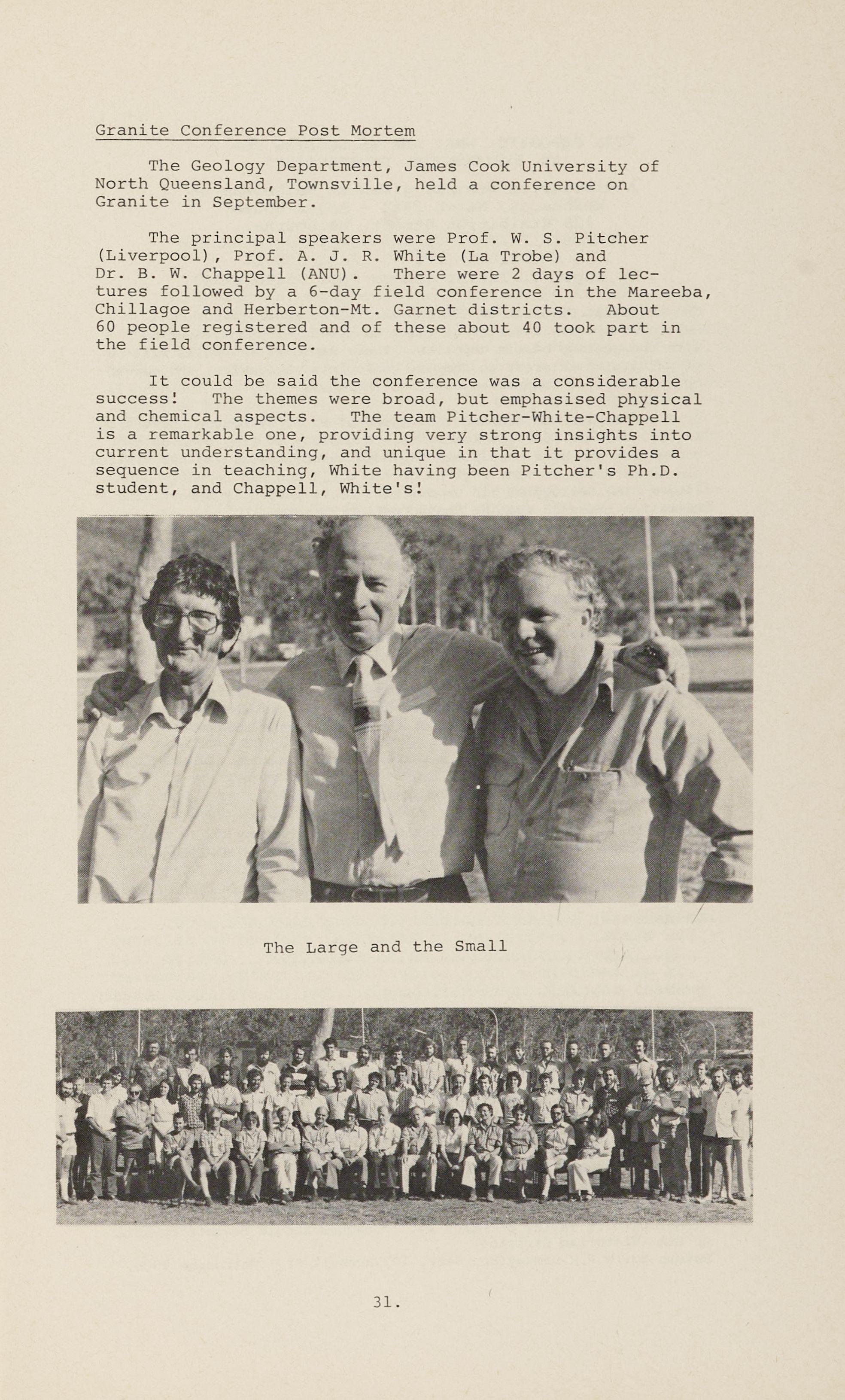
The Geology Department, James Cook University of North Queensland, Townsville, held a conference on Granite in September.
The principal speakers were Prof. W. S. Pitcher (Liverpool), Prof. A. J. R. White (La Trobe) and Dr. B. W. Chappell (ANU). There were 2 days of lectures followed by a 6-day field conference in the Mareeba, Chillagoe and Herberton-Mt. Garnet districts. About 60 people registered and of these about 40 took part in the field conference.
It could be said the conference was a considerable success! The themes were broad, but emphasised physical and chemical aspects. The team Pitcher-White-Chappell is a remarkable one, providing very strong insights into current understanding, and unique in that it provides a sequence in teaching, White having been Pitcher's Ph.D. student, and Chappell, White's!
The Large and the Small 31.
"TIN
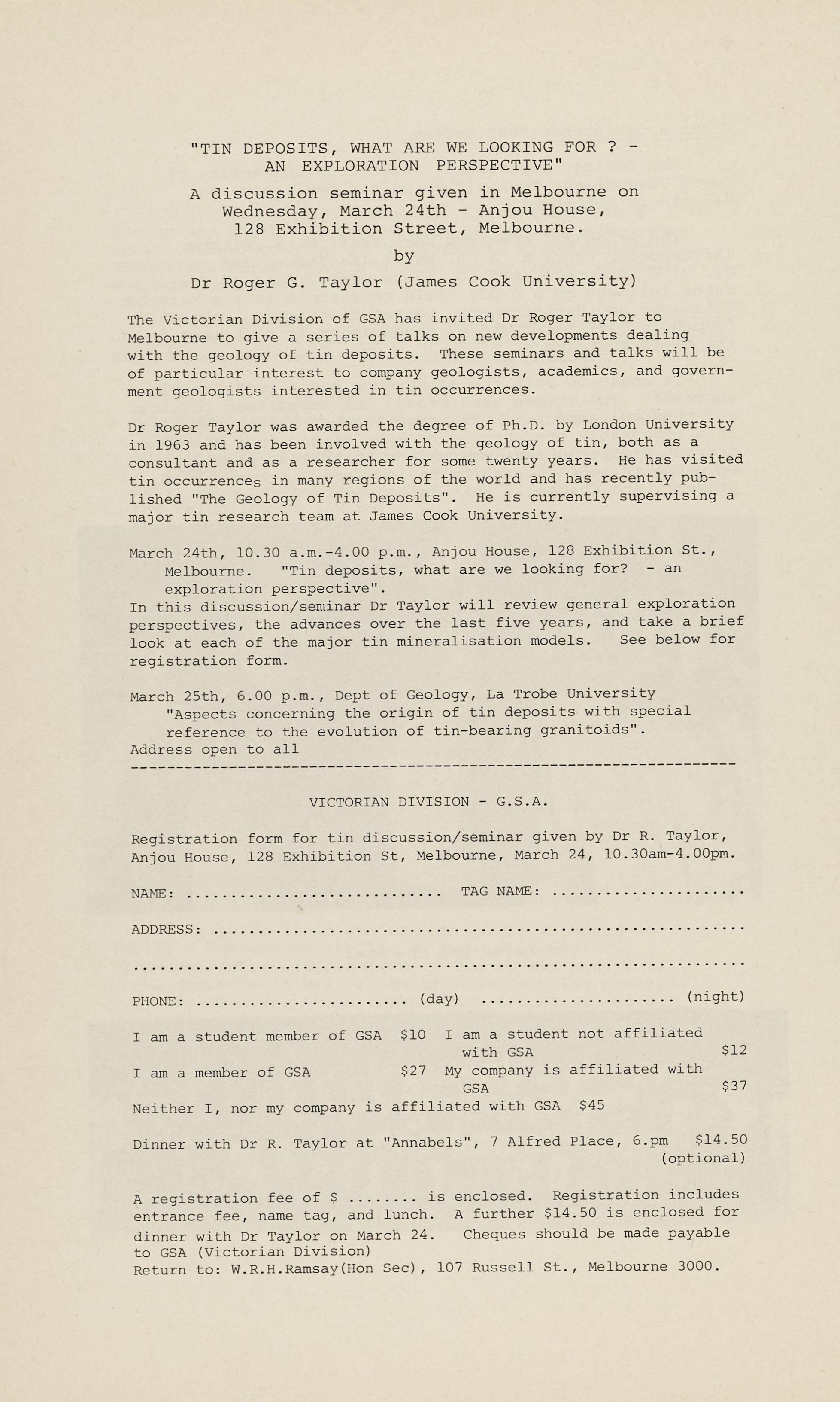
DEPOSITS, WHAT ARE WE LOOKING FOR?AN EXPLORATION PERSPECTIVE "
A discussion s em i nar g i ven in Melbourne on Wednesday , March 24th - Anjou House , 128 Exhibition Street , Me l bo u rne. by
Dr Roger G. Taylor (James Cook Univer s ity)
The Victorian Division of GSA has invited Dr Roger Tay l or to Melbourne to give a series of talks on new developments dealing with the geology of tin deposits. These seminars and talks will be of particular interest to company geologists, academics , and government geologists interested in tin occurrences
Dr Roger Taylor was awarded the degree of Ph.D. by London University in 1963 and has been involved with the geology of tin , both as a consultant and as a researcher for some twenty years He has vis i ted tin occurrences in many regions of the world and has recently published "The Geology of Tin Deposits" He is currently supervising a major tin research team at James Cook University .
March 24th, 10 30 a.m. - 4 00 p m., Anjou House, 1 28 Exhibition St ., Melbourne. "Tin deposits , what are we looking for? - an exploration perspective"
In this discussion/seminar Dr Tay l or wil l review general exploration perspectives, the advances over the last five years, and take a brief look at each of the major tin mineralisation models. See below for registration form
March 25th , 6.00 p.m. , Dept of Geology, La Trobe University " Aspects concerning the origin of tin deposits with special reference to the evolution of tin - bearing granitoids " Address open to all
VICTORIAN DIVISION - G.S.A
Registration form for tin discussion/seminar given by Dr R. Taylor , Anjou House , 128 Exhibition St, Melbourne , March 24 , 10.30am- 4.00prn.
NAME: TAG NAME: ... ..
ADDRESS: ....... .......... .....
PHONE: . . . (day) . . . (night)
I am a student member of GSA $10 I am a student not affiliated with GSA $12
I am a member of GSA $27 My company is affiliated with GSA $37
Neither I, nor my company is affiliated with GSA $45
Dinner with Dr R. Taylor at "Annabels" , 7 Alfred Place , 6.pm $14.50 (optional)
A registration fee of$ ... ... is enclosed Registration includes entrance fee , name tag , and lunch A further $14 50 is enc l osed for dinner with Dr Taylor on March 24 Cheques should be made payable to GSA (Victorian Division)
Return to: W R H.Ramsay(Hon Sec) , 107 Russell St. , Melbourne 3000
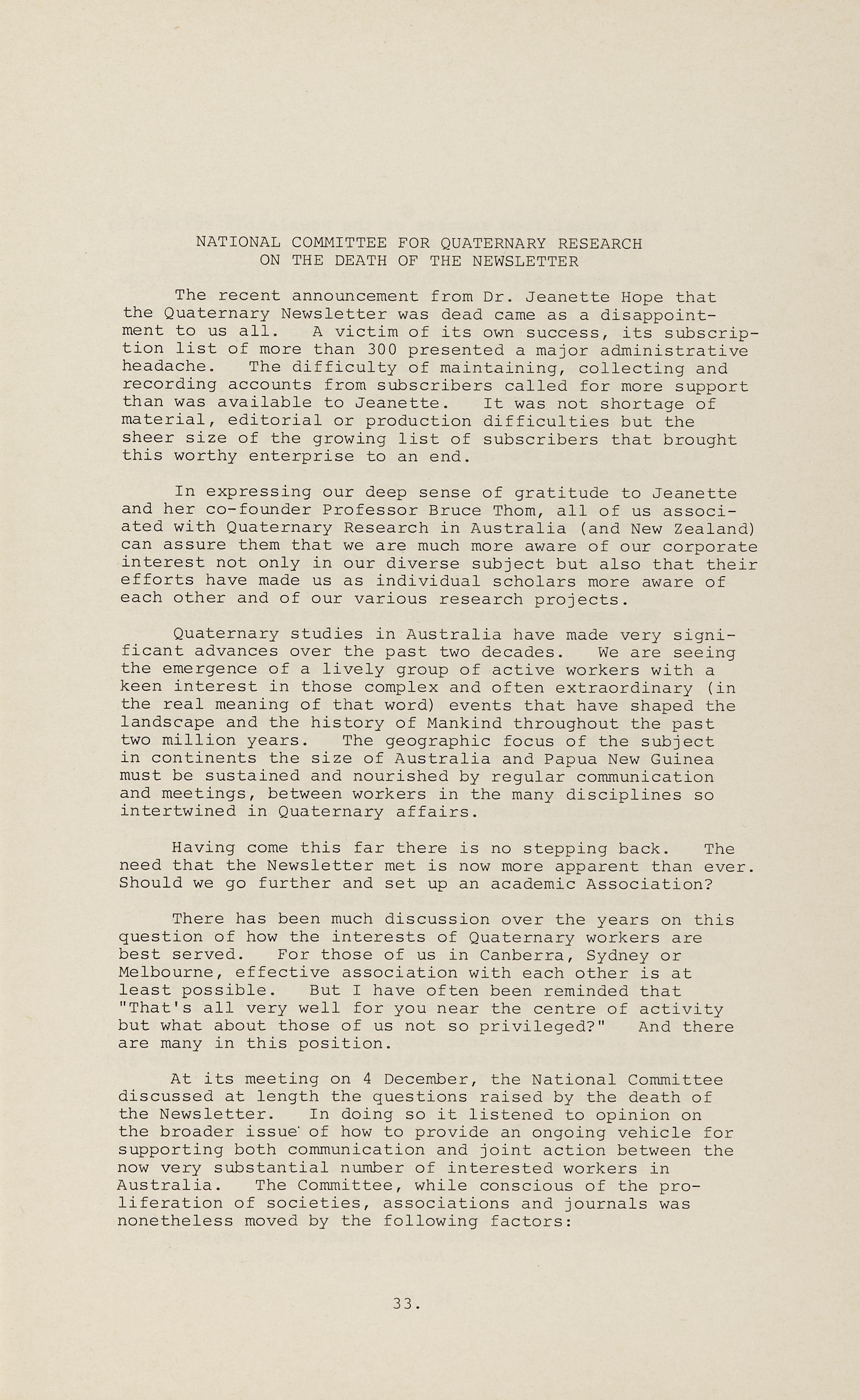
NATIONAL COMMITTEE FOR QUATERNARY RESE ARCH ON THE DE ATH OF THE NEWSLETTER
The recent announcement from Dr. Jeanette Hope that the Quaternary Newsletter was dead came as a disappointment to us all. A victim of its own success, its subscription list of more than 300 presented a major administrative headache. The difficulty of maintaining, collecting and recording accounts from subscribers called for more support than was available to Jeanette. It was not shortage of material, editorial or production difficulties but the sheer size of the growing list of subscribers that brought this worthy enterprise to an end.
In expressing our deep sense of gratitude to Jeanette and her co-founder Professor Bruce Thom , all of us associated with Quaternary Research in Australia (and New Zealand) can assure them that we are much more aware of our corporate interest not only in our diverse subject but also that their efforts have made us as individual scholars more aware of each other and of our various research projects.
Quaternary studies in Australia have made very significant advances over the past two decades. We are seeing the emergence of a lively group of active workers with a keen interest in those comp l ex and often extraordinary (in the real meaning of that word) events that have shaped the landscape and the history of Mankind throughout the past two millio n years. The geographic focus of the subject in continents the size of Australia and Papua New Guinea must be sustained and nourished by regular communication and meetings, between workers in the many disciplines so intertwined in Quaternary affairs.
Having come this far there is no stepping back. The need that the Newsletter met is now more apparent than e v er. Should we go further and set up an academic Association?
There has been much discussion over the years on this question of how the interests of Quaternary workers are best served. For those of us in Canberra, Sydney or Melbourne, effective association with each other is at least possible. But I have often been reminded that "That's a ll very well for you near the centre of activity but what about those of us not so privileged? " And there are many in this position.
At its meeting on 4 December, the National Committee discussed at l ength the questions raised by the death o f the Newsletter. In doing so it listened to opinion on the broader issu~ of how to provide an ongoing vehicle for supporting both communication and joint action between the now very substantial number of interested workers in Australia. The Committee , while conscious of the proliferation of societies, associations and journals was nonetheless moved by the following f actors:
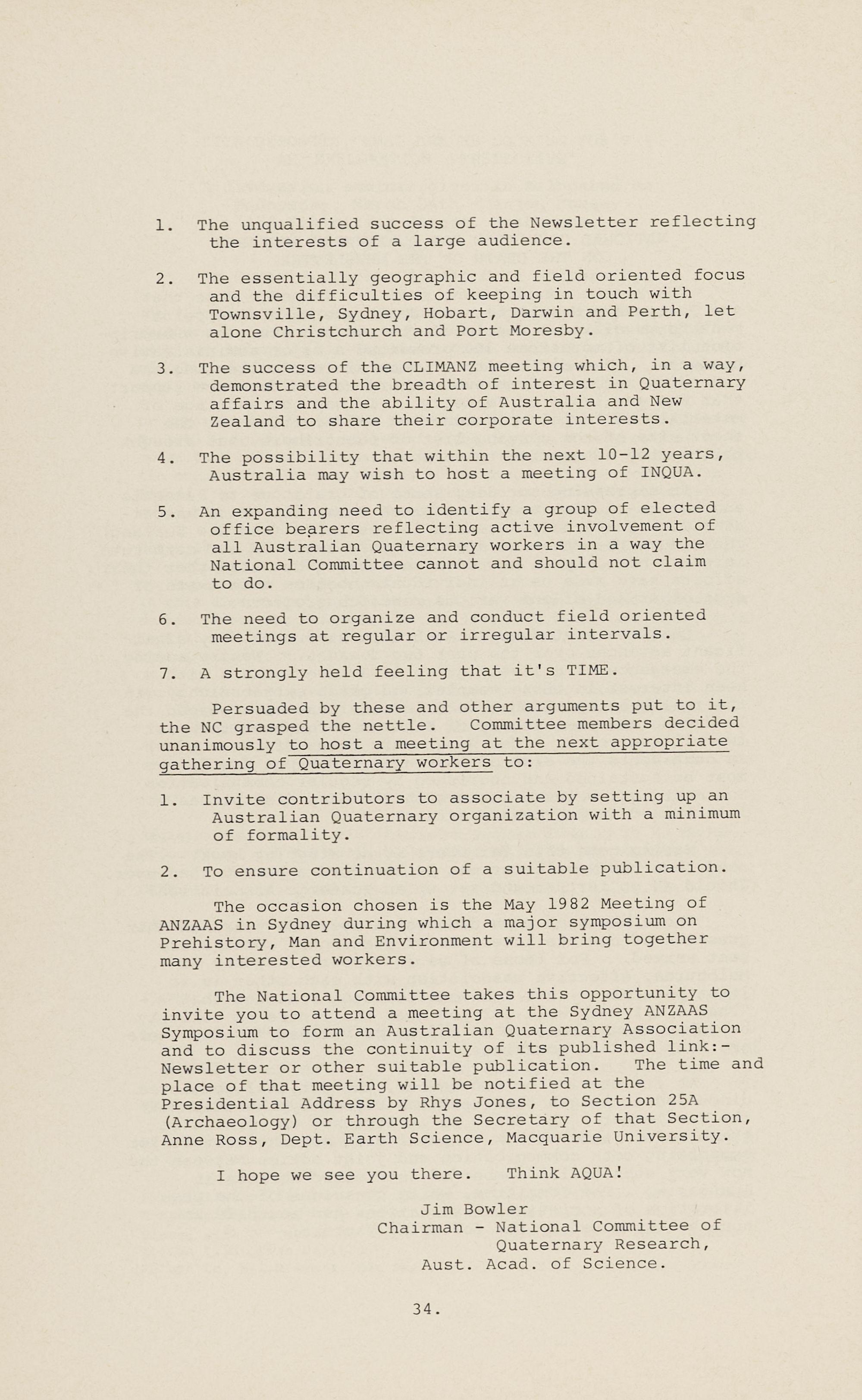
1. The unqualified success of the Newsletter reflecting the interests of a large audience.
2. The essentially geographic and field oriented focus and the difficulties of keeping in touch with Townsville, Sydney, Hobart, Darwin and Perth, let alone Christchurch and Port Moresby.
3 . The success of the CLIMANZ meeting which, in a way, demonstrated the breadth of interest in Quaternary affairs and the abi l ity of Australia and New Zealand to share their corporate interests.
4. The possibility that within the next 10-12 years , Australia may wish to host a meeting of INQUA.
5. An expanding need to identify a group of elected office be~rers reflecting active involvement of all Australian Quaternary workers in a way the National Committee cannot and should not claim to do.
6. The need to organize and conduct field oriented meetings at regular or irregular intervals.
7. A strongly held feeling that it ' s TIME.
Persuaded by these and other arguments put to it, the NC grasped the nettle. Committee members decided unanimously to host a meeting at the next appropriate gathering of Quaternary workers to:
1 . Invite contributors to associate by setting up an Australian Quaternary organization with a minimum of formality.
2. To ensure continuation of a suitable publication.
The occasion chosen is the May 1982 Meeting of ANZAAS in Sydney during which a major symposium on Prehistory , Man and Environment will bring together many interested workers.
The National Committee takes this opportunity to invite you to attend a meeting at the Sydney ANZAAS Symposium to form an Australian Quaternary Association and to discuss the continuity of its published link :Newsletter or other suitable publication. The time and place of that meeting will be notified at the Presidential Address by Rhys Jones, to Section 25 A (Archaeology) or through the Secretary of that Section, Anne Ross , Dept. Earth Science , Macquarie University.
I hope we see you there . Think AQUA!
Jim Bowler
Chairman - Nati onal Committee of Quat ernar y Research, Aust. Acad of Science.
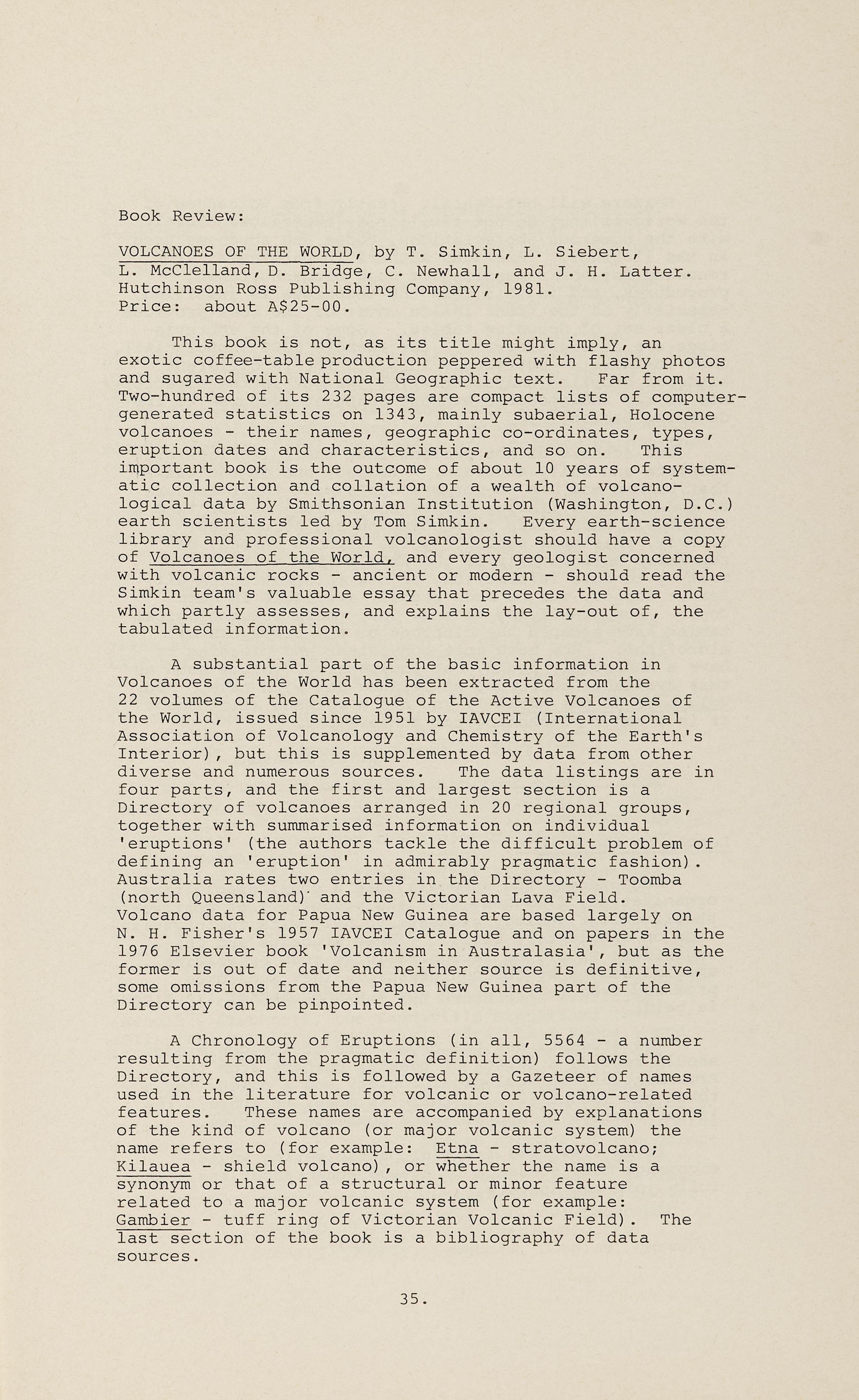
Book Review:
VOLCANOES OF THE WORLD, by T. Simkin, L. Siebert, L. McClelland, D. Bridge, C. Newhall, and J. H. Latter. Hutchinson Ross Publishing Company, 1981.
Price: about A$25-00.
This book is not, as its title might imply, an exotic coffee-table production peppered with flashy photos and sugared with National Geographic te xt. Far from it . Two-hundred of its 232 pages are compact lists of computergenerated statistics on 1343, mainly subaerial, Holocene volcanoes - their names, geographic co-ordinates, types, eruption dates and characteristics, and so on. This important book is the outcome of about 10 years of systematic collection and collation of a wealth of volcanological data by Smithsonian Institution (Washington, D.C.) earth scientists led by Tom Simkin. Every earth-science library and professional volcanologist should have a copy of Volcanoes of the World, and every geologist concerned with volcanic rocks - ancient or modern - should read the Simkin team's valuable essay that precedes the data and which partly assesses, and explains the lay-out of, the tabulated information.
A substantial part of the basic information in Volcanoes of the World has been extracted from the 22 volumes of the Catalogue of the Active Volcanoes of the World, issued since 1951 by IAVCEI (International Association of Volcanology and Chemistry of the Earth's Interior), but this is supplemented by data from other diverse and numerous sources. The data listings are in four parts, and the first and largest section is a Directory of volcanoes arranged in 20 regional groups, together with summarised information on individual 'eruptions' (the authors tackle the difficult problem of defining an 'eruption' in admirably pragmatic fashion). Australia rates two entries in the Directory - Toomba (north Queensland)" and the Victorian La v a Field. Vo lcano data for Papua New Guinea are based largel y on N. H. Fisher's 1957 IAVCEI Catalogue and on papers in the 1976 Elsevier book 'Volcanism in Australasia', but as the former is out of date and neither source is definitive, some omissions from the Papua New Guinea part of the Directory can be pinpointed.
A Chronology of Eruptions (in all, 5564 - a number resulting from the pragmatic definition) follows the Directory, and this is followed by a Gazeteer of names used in the literature for volcanic or vo lcano-related features. These names are accompanied by explanations of the kind of volcano (or major vo lcanic system) the name refers to (for example: Etna - stratovolcano; Ki lauea - shield volcano), or whether the name is a synonym or that of a structural or minor feature related to a major volcanic system (for example: Gambier - tuff ring of Victorian Volcanic Field). The last section of the book is a bibliography of data sources.
Readers will not benefit greatly from Volcanoes of the World if they do not familiarise themselves closely with the numerous abbreviations, codes and acronyms used in the listings. American authors in particular are renowned for their passion for such word-shortening procedures, and in this case the technique is justified, especially as the front inside cover of the book provides a clear set of decoding tables. Some of the abbreviations are straightforward - for example SUBG (subglacial), CALD (caldera) - but single initials for 20 different kinds of eruption characteristics set out in the Directory are fairly indigestible without constant recourse to the decoding tables.
The authors do not pretend that their listings are complete and fully accurate. Indeed, one of the tasks that Simkin and his co-workers would want their readers to undertake is finding errors and ommissions for them so that their data files in Washington can be updated. Clearly, this book should, as the authors intend, be reprinted periodically as the need arises so that the most up-to - date information, or new information on different topics, can be made readily available in hard copy. How gratifying to know that these volcanological tables have escaped the clutches of the purveyors of microfiche. How much more convenient and pleasing to have a handsomely bound, but inexpensive, volume such as this available to peruse at leisure and with ease. Buy Volcanoes of the World if you are a volcano aficionado. It is a major volcanological achievement.
R. W. Johnson.
Letter to the Editor
Conferences and symposia take a considerable time in organization, I suggest that the organizers of conferences should enlist geology students to help with the organization on a voluntary basis. These students and the organizers should be recognizable as such by wearing special badges at the conference. They should be promised free registration and a dinner ticket (if dinner is held).
The students and the organizers of the conference should receive a letter of thanks, perhaps from the President of the Geological Society and a cheque for a token sum (about $20) if there is money to spare; the latter coming, of course, as a complete surprise.
In my view this fruitful participation would encourage more students to attend conferences and hopefully join the Society. 36.
I. R. Qureshi Sydney.
The Geology and Geophysics of Northeastern Australia. Henderson, R. A. and Stephenson, P. J. (Eds), 1980. Geological Society of Australia, Queensland Division, Brisbane.
Price: Hardback Paperback
$26.50 +post
$18.50 +post
This is an impressive volume. Northeastern Australia in the general context of the title covers that part of the emergent continent north of the Tropic of Capricorn and east of about 132°E longitude although some of the constituent articles range more widely. In addition the Gulf of Carpentaria and the eastern continental margin (and the Coral Sea Basin) are included within the scope of the book.
In the preface editors Henderson and Stephenson state that the volume 'sets out to review the regional geology and geophysics of northeastern Australia'. This aim is most adequately fulfilled in the succeeding 467 pages and it must be considered the standard reference on the geology of the region.
The publication derives from a series of papers given at the Geological Convention held in Townsville in 1978 but the authors, all active investigators in the region, were able to draw on much information then unpublished or in press. What emerges is a summation of the understanding of the geology and geophysics of northeastern Australia at the end of the 1970's, a great achievement for a book published by July 1980.
The volume can be broken into four parts. The first comprises review articles summarising the geological development (Henderson) and crustal structure (Cooley) of the whole region, and the evolution of its eastern margin (Mutter & Karner). Accounts of the general Precambrian geology of the McArthur River-Mount Isa region (Plumb, Derrick & Wilson) and the Georgetown Inlier and Cape York (Withnall, Bain & Rubenach) and accompanying papers on mineralization in these regions (Williams and Bain & Withnall respectively) make up the second section. Palaeozoic geology dominates the third section with descriptions of the Georgina Basin (Shergold & Druce), the Broken River and Hodgkinson Provinces (Arnold & Fawckner), the Townsville hinterland (Wyatt & Jell), the northern Bowen Basin (Staines & Kappe), and the Galilee Basin (Evans), Palaeozoic granitic rocks (Richards) and Late Palaeozoic continental volcanism (Oversby, Black & Sheraton), mineralization in the Broken River and Hodgkinson Provinces (Gregory, Taylor & White), a compendious summary of Tasman Fold Belt mineralization in Queensland (Lacy) and an account of the deformation history of the northeast of the region (Bell). The final section concentrates on post-Triassic geology with articles describing the Jurassic-Cretaceous basins (Smart & Senior), Tertiary geology (Grimes) Cainozoic volcanism (Stephenson, Griffin & Sutherland), the Quaternary (Coventry, Hopely, Campbell, Douglas, Harvey, 37.
Kershaw, Olive r, Phipps & Py e), the Gre at Barrier Reef Pro v inc e (Orme & Flood) and groundwater r esources (McEniery).
In spite of having 47 authors, involved in the preparation of 23 articles, "The Geolog y and Geophysics of Northeastern Australia" is assuredly not anoth e r collection of di ve rse papers deri v ing a suspect coherence from being geographically circumscribed. Efforts b y authors and editors hav e produced a pleasi ng and readable regional geolog y . Bu y it It will lon g remain the starting point for an y e nquir y into th e geology and geophysics of the northeastern quadrant of Australia, a region of more than 2.7 million krn 2 that has a histor y e x t e nding back more th a n 2000 million ye ars .
Evan C Leitch
Australian Mineral Foundation
Australian Earth Sciences In f ormation Syst e m
The Foundation wishes to ke e p its i n f ormation o n thes e s up-to- d ate. It would b e helpful if Te rtiar y institutions could send the rele v ant information to D. A Tellis, Manager - In f ormation Ser v ices, P O. Bo x 97, Glenside, SA 5065.
AMF pref e rs to recei v e details of theses on the AESIS Data Transmission Sh ee ts - a spe cime n copy of which is included with e ve r y issu e of AESIS Quarterl ybut copies of the Contents p age an d th e ab stract, an d , if possibl e , the Introduction and Conclusion of a the s is are quite acc e ptable. Wher e appro p riat e , the L:250 000 o r 1:100 000 map sh e et r efe re n ce s h oul d a lso b e inclu de d. Lists of th e ses ar e not he l pf ul as th ey c an not b e us ed for inde x ing at th e requir ed depth.
THE ED I TOR MUST GO ! (b ut on l y a t a p ri ce )
EDITI NG - IN A CHANGING ENVIRONMENT
A wor ksh o p for edi t o r s of scien t ifi c, technica l and medica 1 jo urnals
When 1 1-1 5 Ju l y 1 982
Where Cl yde Cameron Co ll ege , Wodonga
Cost expected to be around $240 t o $260 (including accommo da t i o n )
Overa ll Objectives - to improve the e xpertise of those who are asked to ed i t pub li cati o ns - often as an addition to normal professional duties
I F THIS PROGRAM INTERESTS YOU PLEASE INFORM :
B. J F James ( Mr.) of the Dept of Continuing Education , Univers i ty of New England , Armidale 235 1. Phone ( 067)7 2 29 1 1
BOOK REVIEW
Illustrations of New Zealand Fossils: A New Zealand Geological Survey Handbook. Compiled by I. G. Speden & I. W. Keyes. N.Z. DSIR Information Series, No. 150. 109pp. Wellington, 1981.
Australian geologists have cause to envy their Ki wi colleagues on having available such an excellent guide to the palaeontology of New Zealand. The only comparab l e series of publications on the local scene were prcxluced between 1964 and 1973 by the Queensland Palaeontographic Society. Hopefully, publications arising from several projec t s now under way, notably in Tasmania and Victoria , wi ll equal the high standard set by the NZ handbook.
Illustrations of New Zealand Fossils includes 32 plates (originally published in The Geology of New Zealand: Suggate, Stevens, & Te Punga (eds) 1978, depicting representative and biostratigraphically significant fossils ranging in age from Cambrian to Pleistocene. However, because of the nature of the geological record in NZ, no Silurian or Carboniferous fossils are shown (due to their rarity) whilst Mesozoic and Quaternary faunas make up the majority of those illustrated. In the handbook, which is dedicated to distinguished palaeontologist Sir Charles Fleming , the plates are preceded by line diagrams depicting simplified geological maps of NZ, a general geological time scale, and detailed biostratigraphical subdivisions employed in NZ, with their international equivalents. The plates are arranged on a chronological theme, although some illustrate distinctive biogeographic assemblages. All are accompanied by captions on facing pages indicating scientific names, ages, and magnifications. For a "picture book" approach to identifying species this would probably be adequate. But what makes this handbook really useful to the specialist or student is an appendix giving extended captions to each illustration. Additional i nf ormation provided in this RppP.ndix includes phylum or class attribution, preservational details, type status, specimen catalogue number and repository, details of locality (where available) and precise age. For most specimens, reference is given to the source of original illustrations used in the handbook; these citations are collated into an accompanying comprehensive bibliography. There is a separate short list of more general references on NZ palaeontology. An index of fossil genera and species illustrated in the handbook completes the appendices.
Despite some minor tonal variations within occasional plates (to be expected as individual figures were compiled from an extensive range of publications spanning most of this century) the illustrations are generally excellent. Typographical errors are very rare, and the layout of the appendices (apparently produced from camera-ready copy) is efficient and pleasing. 39.
"Handbook" describes this volume better than "field guide " . The 20 mm x 29 mm format precludes its u s e as a pocket identification aid on the outcrop. However, it is s t urdily hard-bound and should see many years of useful laboratory and library life. The price is not known to this reviewer; however, being a government publication destined for wide circulation amongst both the geological community and general public , and with the current favourable exchange rate, it undoubtedly represents good value.
Ian G. Percival.
The Fourth International Symposium on Antarctic Earth Sciences will be he ld at the University of Adelaide from 16 - 20 August 1982. The main topics wi ll be:
Precambrian East Antarctic craton (petrology structure , geochemistry , geochronology , geophysics).
East Antarctica - West Antarctica boundary and the Ross Oro ge n , including North Victoria Land.
Beacon Supergroup and associated igneous activity.
West Antarctica
Scotia Arc and Antarctic peninsula . Marine geology
Antarctic resources.
Glacial geology and geomorphology
Crustal structure of Antarctica ( so lid earth geophysics)
Cainozoic tectonics and climatic record (on shore and offshore evidence).
Subantarctic islands
Antarctica in Gondwanaland
Plate tectonics - marine geophysical and geological surveys
Antarctic meteorites.
Cainozoic igneous activity
Review papers on a number of these topics have been invited.
THE MAWSON LECTURE under the sponsorship of the Australian Academy of Science will be delivered by Prof . D. H. Green during the Symposium
There are both pre - and post-con ference excursions information contact:
J B. Jago,
School of App li ed Geo log y , South Au stra lian Institute of Technology, P O Box 1, INGLE FARM , South Australia 5098.
SEDIMENTARY AND DIAGENETIC PROCESSES IN PRECAMBRIAN METALLOGENESIS
N T E R N A T I O N A L M E E T I N G L O N D O N M A Y 1 9 8 2
I G C.P. 91 : Meta llo geny of the Precambrian I.G C P 160: Precambrian Exogenic Processes
Dates : 13th-14th May 1982.
For further Venue: Geological Society of London , Burlington House , London. 40.
6th AUSTRALIAN GEOLOGICAL CONVENTION CANBERRA 20-25 FEBRUARY, 1983
Theme: 'LITHOSPHERIC DYNAMICS AND EVOLUTION OF CONTINENTAL CRUST'
Scientific Sessions: Meetings of Specialist Groups: Excursions: Social Program: Accompanying Members' Program.
The Organising Secretary, c/o BMR, P.O. Box 378, Canberra City, A.C.T. 2601.
Dates:
Venue:
AUSTRALIAN SEDIMENTOLOGISTS GROUP MEETING
18th-22nd May inclusive
"Coonawarra" Station, Glenaladale, eastern Victoria.
Format: Informal - mixture of papers, local field trips.
Papers: Oral and poster. Abstract deadline19th Ap ril.
Papers wanted on: elastic, non-elastic, volcaniclastic sedimentation and the sedimentology of economic resources.
Costs:
ASG Members: $125; Students: $50; Non -ASG: $150.
Regi stration: Enquiries to: ASG Committee, c / o Department of Earth Sciences, Monash University, Clayton, Vic. 3168.
16th NEWCASTLE SYMPOSIUM
The 16th Newcastle Symposium on the geology of the Sydney Basin and surrounding region, sponsored by the Geology Department, will be held at The University of Newcastle April 30, May 1- 2 , 1982.
Registration forms and particulars from:
Dr. R. Offler, Convener, 16th Newca stle Symposium, Department of Geology , The University of Newcas tle, NEW SOUTH WALES. 2308.
Telephone: (049) 685 332 or 685 229.
EXPLORATION DATA
ANALYSTS PTY. LIMITED
GEOPH Y S ICAL CONSULTAN TS
GRAVITY AND MAGNETIC FIELD SURVEYS
DATA REDUCTION AND ANALYSIS
INTERPRETATION AND HODEL STUDIES COMPUTER SOFTWARE DEVE L OPMENT
4 4 1 The Causeway Ma""'Ouoi-a Sydney SW 203 5 A..Jsve a P h [02) 344 5192
Aksheyo Kumar co , SUlTI -... C C£0PHYSICIST 41.
SOC. REP. REQ'D
CIRCUM-PACIFIC ENERGY AND MINERAL RESOURCES CONFERENCE AUGUST 22-28, 1982 - HONOLULU
Any member attending this junket and prepared to act as GSA representative is asked to contact secretary Ray Smith or the Editor.
The Conference will be held in the Hilton Hawaiian Village, a large beautiful property on Waikiki Beach. Technical sessions will be held Monday through Friday, August 23-27, pre-conference workshops on August 21-22, geological field trips and post-conference tours to other Hawaiian Islands the week following the meeting.
contact:
AAPG Convention Department, PO Box 979, Tulsa, Oklahoma, USA 74101. phone: 918-584-255. Telex No. 49-9432 or Cable AAPG TUL.
CIRCUM-PACIFIC COUNCIL FOR ENERGY AND MINERAL RESOURCES
Five new plate-tectonic maps of the Circum-Pacific region have been published by the American As sociation of Petroleum Geologists. Covering more than half of the surface of the earth , these full-color maps depict active plate boundaries, plate motion ve ctors, major intraplate faults , seismic epi centers, Holocene volcanic activity, and magnetic lineations. Accretionary terrane along the Pacific rim is shown on the Northea st map sheet.
The Plate -Tectonic Maps are available from the AAPG Bookstore, P .O. Box 979, Tulsa, Oklahoma 74101 at $(US)8 or $(VS)26 for a set of all five maps. Also available are full -color Geographic Maps at $(US)l2 each of $(US)30 for a set of 6 map s and black and white Base Maps with 2° grids for plotting purposes, at $(US)6 each or $(US)20 for a set of 6 maps. The maps are rolled, measure 52 by 40 inches, and are shipped postpaid in a tube.
ANZAAS - Macquarie University , North Ryde , NSW. May 10 - 14, 1982.
Section 3 , Geology and Mining contains the following sessions:
Monday, 9.45 - 1 p.m. Non-metallics & Industrial Minerals. Tuesday, 9.15, Presidential Address - Roy Woodall, WMC: 10.45 Mineral Policy Discussion. Wednesday, 9.15 -10.45 Water quality and management, 11.15-12.45 Uranium, 11.15-12.45 Mining & Resource development. Thursday, 9.15-12.00 Geophysics, geology & chemistry at the mineral exploration interface, K. G. McCracken, keynote plus panel discussion, or 9.15-12.45 Remote sensing. Friday, 9.15-12.45~Future trends in exploration geochemistry. For full details contact section secretary Blair Hostetler, Earth Sciences, Macquarie University. 42.
Putting it together
Despite the news, newspapers have a way of telling us how it all happens.
Compare the two ads which appeared side by side in a Sydney daily. Another Sydney daily carried the other small extract.
Department of Mineral Resources N.S.W.
(SENIOR PETROLEUM GEOLOGiSJ)
Geological Survey of N.S.W.
Position No: MR 81 /l ~ / / 1 s,1ary: $22.652rans~ , : /; 4- ,-,
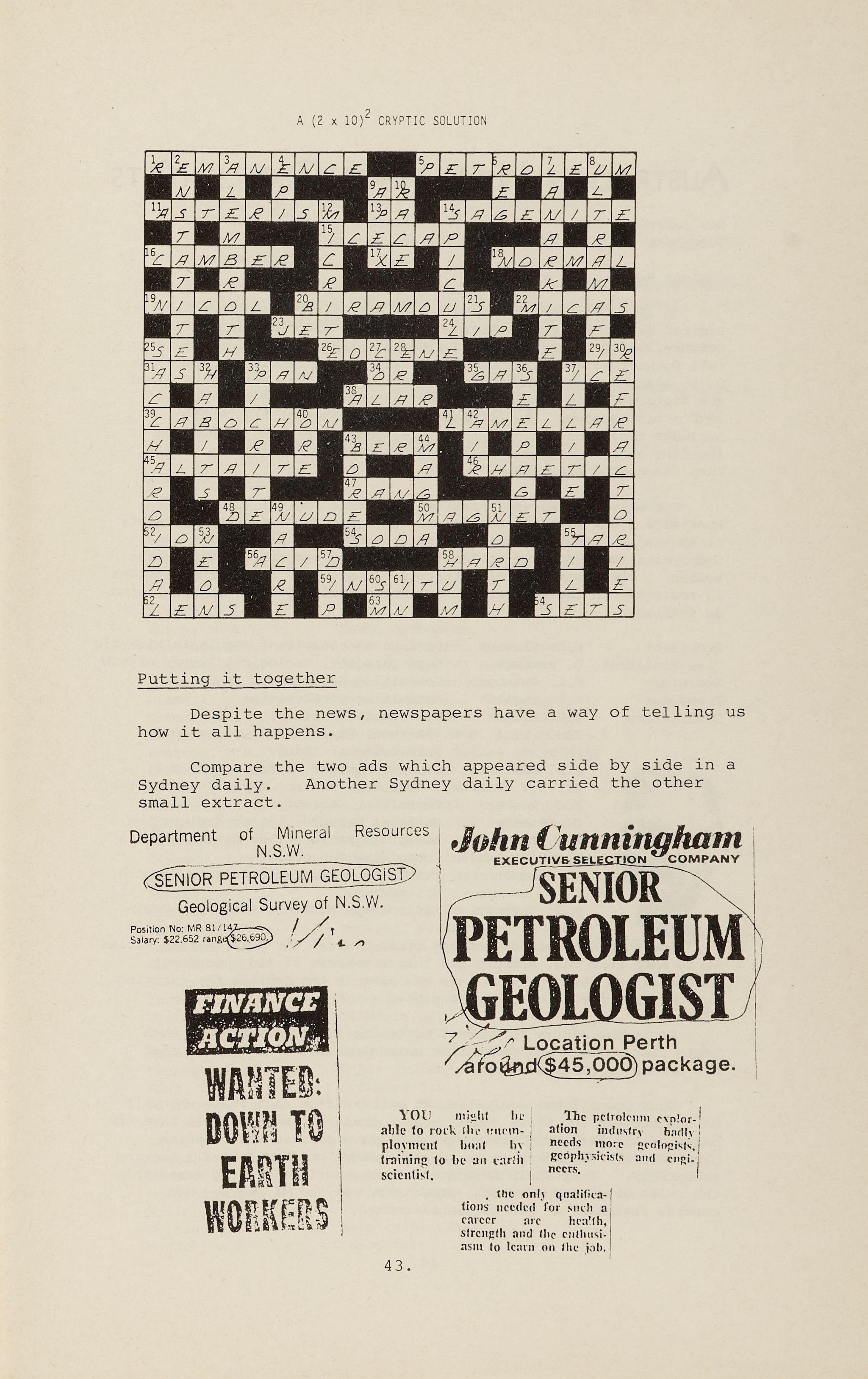
,.__ /' Location Perth
package.
mi<>hl hL· alilc lo rork 11~,, i,n1·1n- j: ploymcnl ho.ii 1,y lrninin[! lo he :itt •·:irl h I scicn ti~I. ! 43. lio n~ :t~~d:~\0; 11 ;~;'. 1 ;,""; I rn r ccr :1rr hr:i'.lh, I slrcnglh and 1hr r1111t11,ins 111 to learn on 11,r j;1h.
AUSTRALIAN INSTITUTE OF GEOSCI ENT ISTS
New address : Telephone : Science Centre , 35 Clarence St , Sydney , NSW 2000 (02) 29 7747.
Co un ci l Meeting and News
On 22nd December 198 1, the Australian Institute of Geoscientists Limited held it s first general meeting since incorporation on 20th October 19 8 1. After operating with an interim Co u ncil, the first full Counci l of AIG was installed at the meeting which was opened by C L Adamson , the foun dati on President of AIG , who briefly outlined the h is tory of the fo rmati o n of the Institute , dating back to the 1 960 ' s minin g boom. He stressed the broad base of AIG , which includes g e ological scientists of a ll specialties , and e mphasised the fact that AIG would act as a unif ying agent in what has been a much fragmented profession
Formation of AIG was initiated by the Geo l ogical Society of Austra l ia (GSA ) with the support of t he Petroleum Exploration Society of Austra l i a (P ESA) and the Australian Society of Explorati on Ge ophy sicists ( ASEG) and wi ll maintain active cooperation with these bod ies The broad base of interests exhibited by these organisations is reflected in the pe opl e comprising the newly elected Co uncil li sted as follows :
P resident
Vice - P r esident
Secretary
Treasurer
Councillors
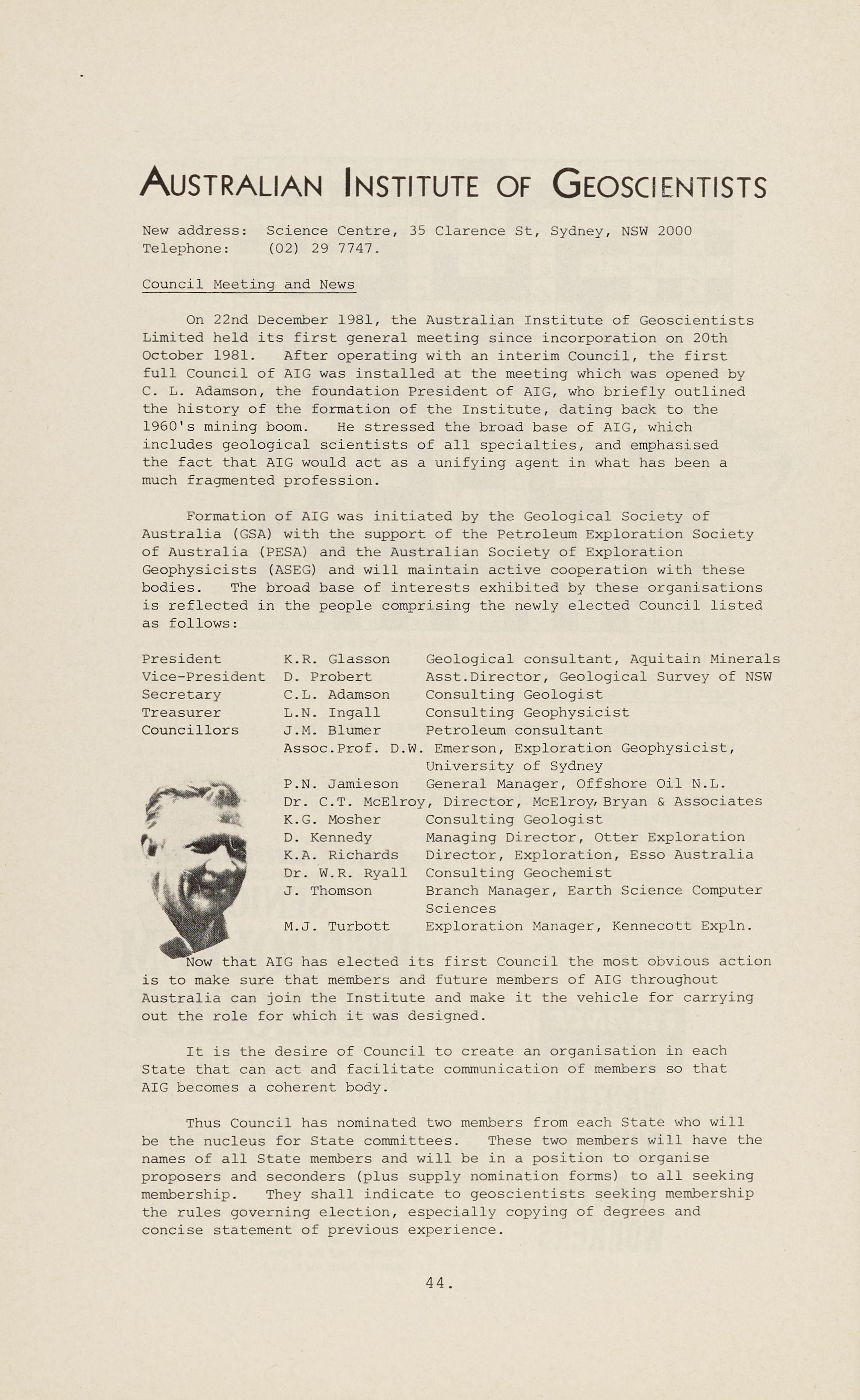
K R Glasson
D. Probert
C.L. Adamson
L.N. Ingall
J.M. Blumer
Geo logical consu lta nt , Aquita in Minera l s Asst.D i rector , Geological Survey of NSW Consu lting Geo logist
Consulting Geophysicist
Petroleum consultant
Assoc.Prof. D.W. Eme rson, Explorat io n Geophysicist , University of Sydney
P .N. Jamieson General Manager , Offshore Oil N L
Dr C T McElroy , Director , McE l roy, Br yan & Associates
K. G . Mosher
Consulting Ge ologist
D. Kennedy Managing Director , Otter Exploration
K . A. Richards Director , Exploration , Esso Austral ia
Dr W R. Ryall Consulting Geoche mist J Thomso n
M.J. Turbott Branch Manager , Ear th Science Computer Sciences Exploration Manager , Kennecott Exp l n
AI G has e l ected its first Council the mo s t obvious action is to make sure that member s and future memb ers of AIG throughout Australia can join the Institute and make it the vehicle for carrying out the ro l e for which it was designed.
It is the desire of Council to create an organisation in each State that can a ct and fa cilitate communication of members so that AIG becomes a coheren t body
Thus Council has nominated two members from each State who wi ll be the nucleus for State committees. These two members will have the names of all State members and will be in a position to organise proposers and seconders (plus supply nomination forms) to all seeking members hip Th ey shall indicate to geoscientists seeking membership the rules governing e l ection , especiall y copying of degrees and concise statement of previous experience
What are AIG ' s immediate aims and priorities?
{a) To get the membership up so that it is able to carry out its role as a professional Institute .
(b) To organise a close relationship with the various stock excha nges so that it acts in the capacity of advisor in al l matters of stock exchange reporting and listing in the mineral industry.
(c) To promote the situation where AIG can speak on behalf of its members in all matters dealing with the profession .
(d) To organise within the profession close cooperation and fellowship amongst geological scientists in Australia.
LIST OF MEMBERS AND GRADUATES AT FEBRUARY 1 5 , 1 982
New South Wales
Adamson , C L
Baker, C.J.
Bayly, K. W.
Blumer , J.M
Brooks , P
Brownlow , J W
Bryan , Dr J H
Bunny , M.R
Cameron , R . G.
Chesnut , W.S
Cook , Prof A C.
Cramsie, J N
Crouch , A.C.
Edgerley , D W
Emerson , D W.
Etheridge, L T
Foskett , W.E
Gersteling , R.
Gibbons , Dr G.S.
Gilligan, L.B
Glasson , K R Gray , N.
Henley, H F
Hann , J . M.
Hanna , P
Haskins, P.G.
Horton , D J
Howland-Rose, A. W.
Ingall , L N
Jamieson , P .N
Jones, Dr . B.
Kater , G N
Kennedy , H D.
King, D W
Lancaster, C.G
Lawrence, M Laws, R.
Leggo , Dr M D.
Lindner , A
McElroy, Dr. C . T.
Miller , G M.
Mollan , R
Mosher , K G
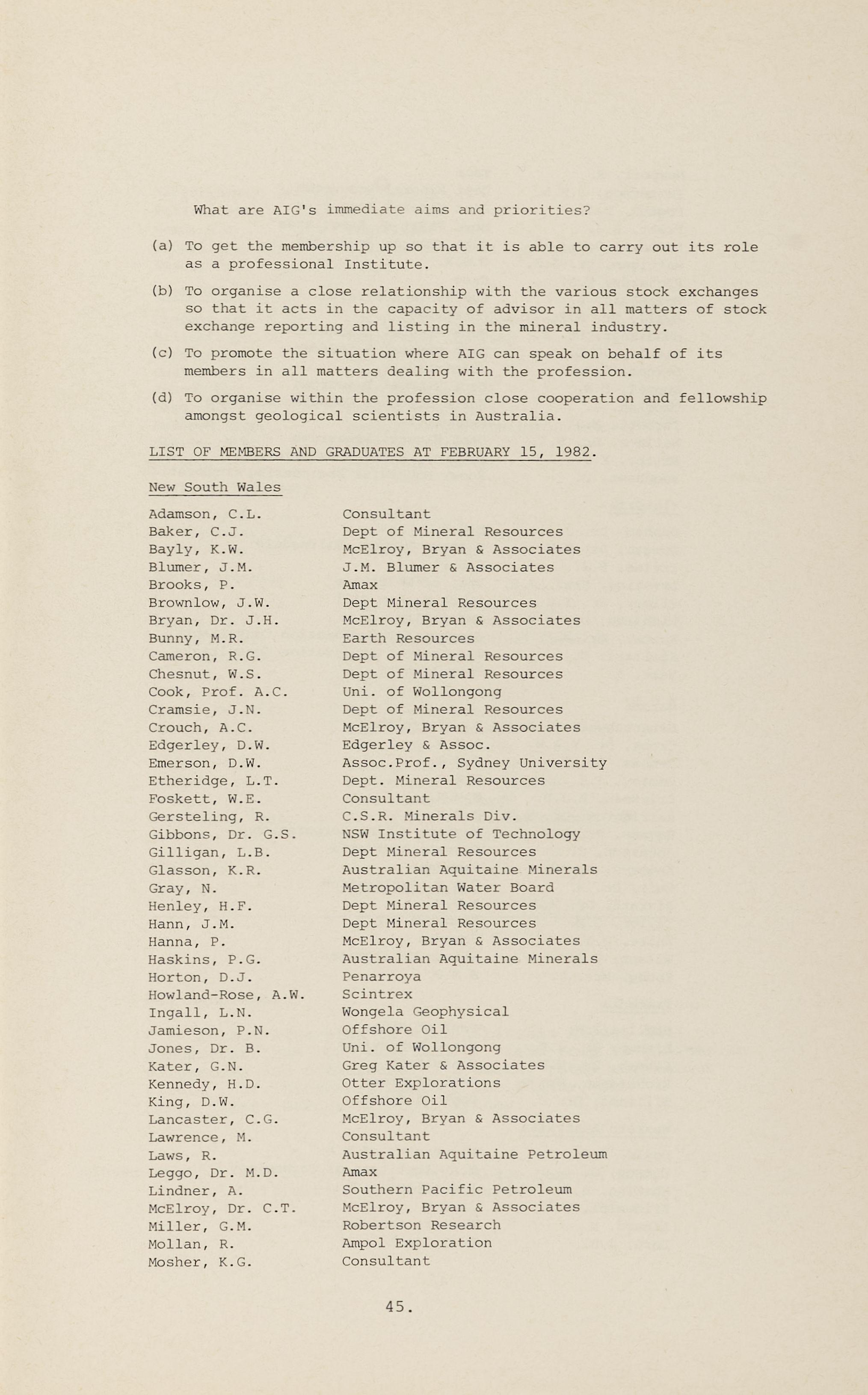
Consultant
Dept of Mineral Resources
McElroy, Bryan & Associates
J M Blumer & Associates
Amax
Dept Minera l Resources
McElroy , Bryan & Associates
Earth Resources
Dept of Mineral Resources
Dept of Mineral Resources
Uni. of Wollongong
Dept of Mineral Resources
McElroy , Bryan & Associates
Edgerley & Assoc
Assoc Prof , Sydney University
Dept Mineral Resources
Consultant
C S R Minerals Div
NSW Institute of Technology
Dept Mineral Resources
Australian Aquitaine Minerals
Metropolitan Water Board
Dept Mineral Resources
Dept Mi neral Resources
McElroy , Bryan & Associates
Australian Aquitaine Minerals
Penarroya
Scintrex
Wongela Geophys ical
Offshore Oil
Uni. of Wollongong
Greg Kater & Associates
Otter Explorations
Offshore Oil
McElroy, Bryan & Associates
Consultant
Australian Aquitaine Petroleum
Amax
Southern Pacific Petroleum
McElroy , Bryan & Associates
Robertson Research
Ampol Exploration
Consultant
Newport, R
Patterson, I B.L.
Pogson , D J.
Pratt , B J
Probert , D. H.
Rattigan , Dr. J H
Richards, K.A
Rodenhuis , P.
Ryall, Dr. W.R .
Scheibner , Dr E
Stanley, C D.
Street, G J.
Suppel , D. W.
Thomson , J.
Turbott , M J.
Wall ace , Dr R I
Whitby , K J.
Woodhams , D.
Victoria
De nham, Dr J I
Duncan , Dr D.M.
I r v i ne , R J
Lovering , Prof. J.F.
Plimer, Dr. I . R.
Richards , Dr. S.M.
Rutter , Dr H.
Staltari , G.
ValE: , K.
A. C T
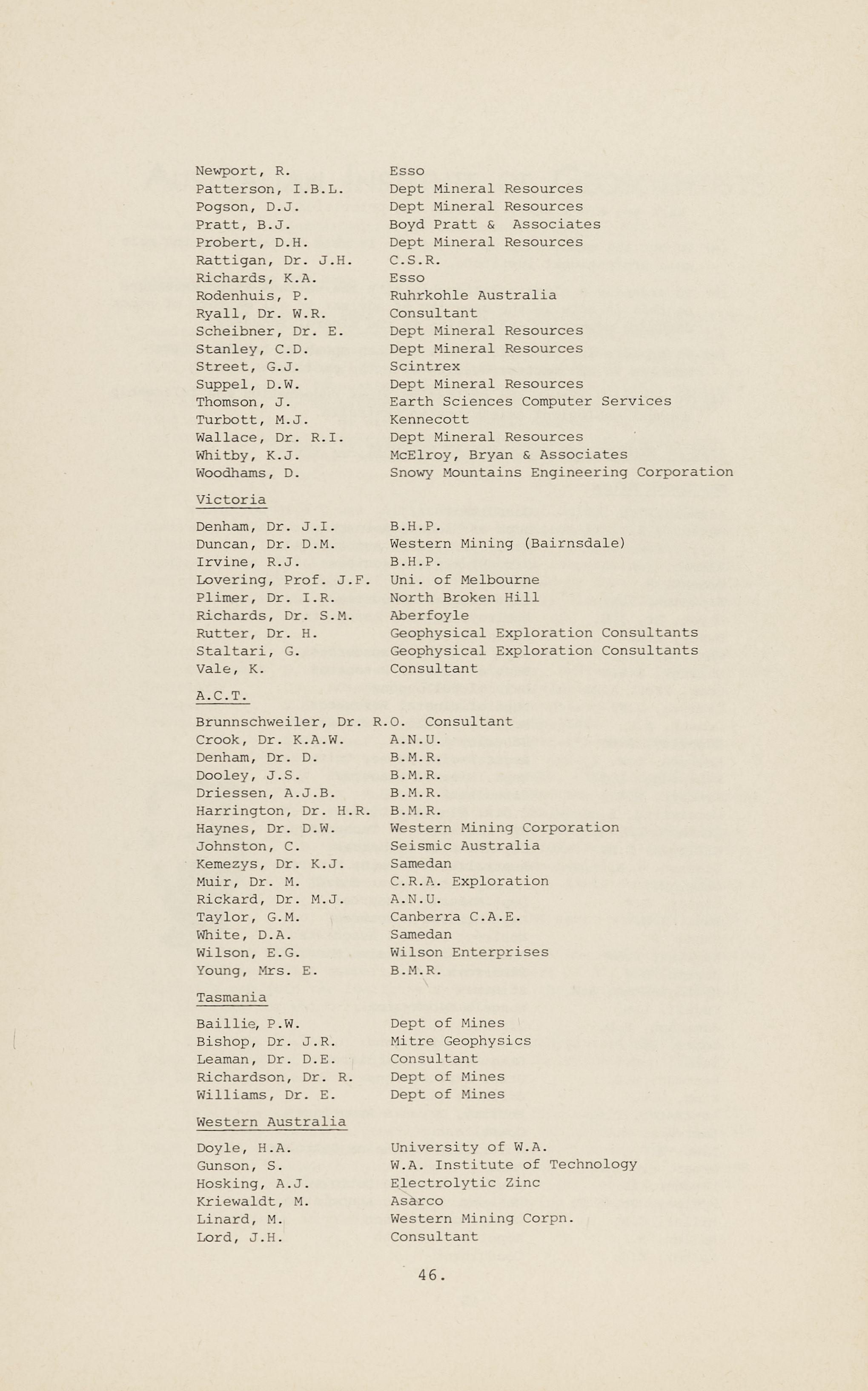
Esso Dept Mineral Resources
Dept
Mineral Resources
Boyd Pratt & Associates
Dept
Mineral Resources
C.S.R
Esso
Ruhrkohle Australia
Consultant
Dept Mineral Resources
Dept
Mineral Resources
Scintrex
Dept
Mineral Resources
Earth Sciences Computer Services
Kennecott
Dept
Mineral Resources
McElroy, Bryan & Associates
Snowy Mountains Engineering Corporation
B H.P . Western Mining (Bairnsdale)
B.H.P
Uni of Melbourne
North Broken Hill
Aberfoyle
Geophysical Exploration Consultants
Geophysical Exploration Consultants Consultant
Brunnschweiler, Dr. R.O. Consultant
Crook, Dr K A.W. A.N.U
Denham , Dr. D B . M.R .
Dooley, J S . B.M.R
Dr i essen , A J.B. B M.R.
Harrington, Dr. H R. B.M.R
Haynes, Dr. D.W. Western Mining Corporation Johnston, C Seismic Australia
Kemezys , Dr K.J Samedan
Muir , Dr. M C R.A Exploration
Ri ckard , Dr M.J A. N.U .
Tay l or , G.M . Canberra C A.E.
White , D.A. Samedan Wilson, E G Wilson Enterprises Young, Mrs E. B.M.R.
Tasmania
Baillie , P W.
Bishop , Dr J R
Leaman , Dr. D E.
Richardson , Dr. R
Williams, Dr. E.
Western Australia
Doyle , H . A. Gunson, S
Hosking , A.J
Kriewaldt, M
Linard, M.
Lord , J H.
Dept of Mines
Mitre Geophysics Consultant
Dept of Mines
Dept of Mines
University of W.A W.A. Institute of Technology
Electrolytic Zinc
Asarco
Western Mining Cor p n Consultant
Marjoribanks, Dr . R W. Anaconda
Peters, W.A.
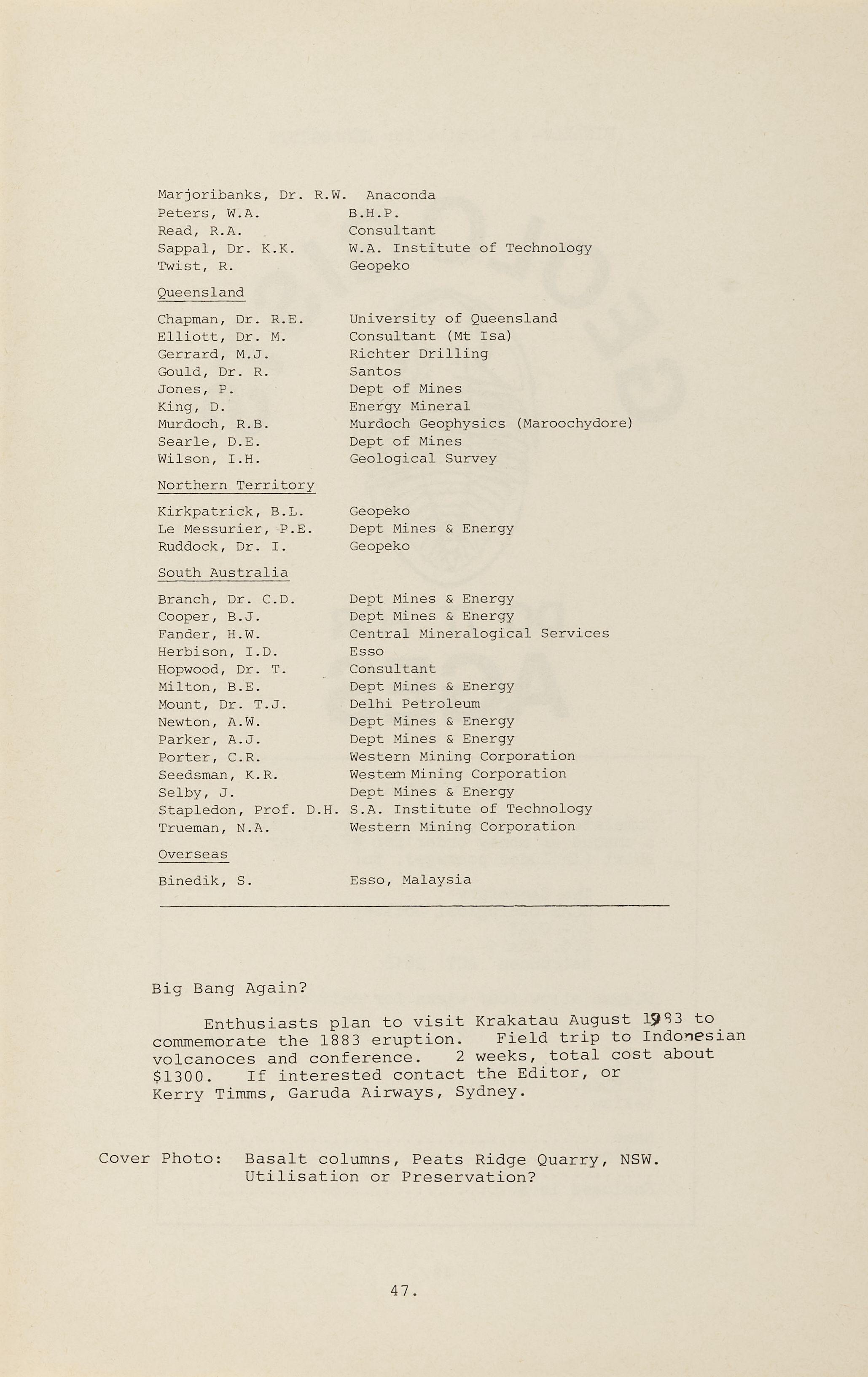
B.H . P.
Read, R A Consultant
Sappal , Dr. K.K.
Twist, R.
Queensland
Chapman , Dr. R E.
Elliott , Dr. M.
Gerrard , M.J.
Gould , Dr. R.
Jones, P
King , D
Murdoch , R.B.
Searle , D.E
Wilson, I.H.
Northern Territory
Kirkpatrick , B L.
Le Messurier , P E.
Ruddock, Dr. I
South Australia
Branch , Dr C.D
Cooper, B.J
Fander , H W
Herbison , I D.
Hopwood, Dr T.
Milton, B.E.
Mount, Dr T.J.
Newton , A .W.
Parker, A J. Porter, C.R.
W.A. Institute of Technology Geopeko
University of Queensland Consultant (Mt Isa)
Richter Drilling
Santos
Dept of Mines
Energy
Mineral
Murdoch Geophysics (Maroochydore)
Dept of Mines
Geological Survey
Geopeko
Dept Mines & Energy Geopeko
Dept Mines & Energy
Dept Mines & Energy
Central Mineralogical Services
Esso
Consultant
Dept Mines & Energy
Delhi Petroleum
Dept Mines & Energy
Dept Mines & Energy
Western Mining Corporation
Seedsman , K.R. Westen1 Mining Corporation
Selby, J
Dept Mines & Energy
Stapledon , Prof. D H. S A. Institute of Technology
Trueman , N A.
Overseas
Binedik , S Big Bang Again?
Western Mining Corporation
Esso , Malaysia
Enthusiasts plan to vi sit Krakatau Augu st 1993 to commemorate the 1883 eruption. Field trip to Indo~esian volcanoces and conference. 2 weeks, total cost about $1300. If in terested contact the Editor, or Kerry Timms, Garuda Airways, Sydney.
Cover Photo : Basalt columns, Peats Ridge Quarry, NSW. Utilisation or Preservation? 47.
Complete
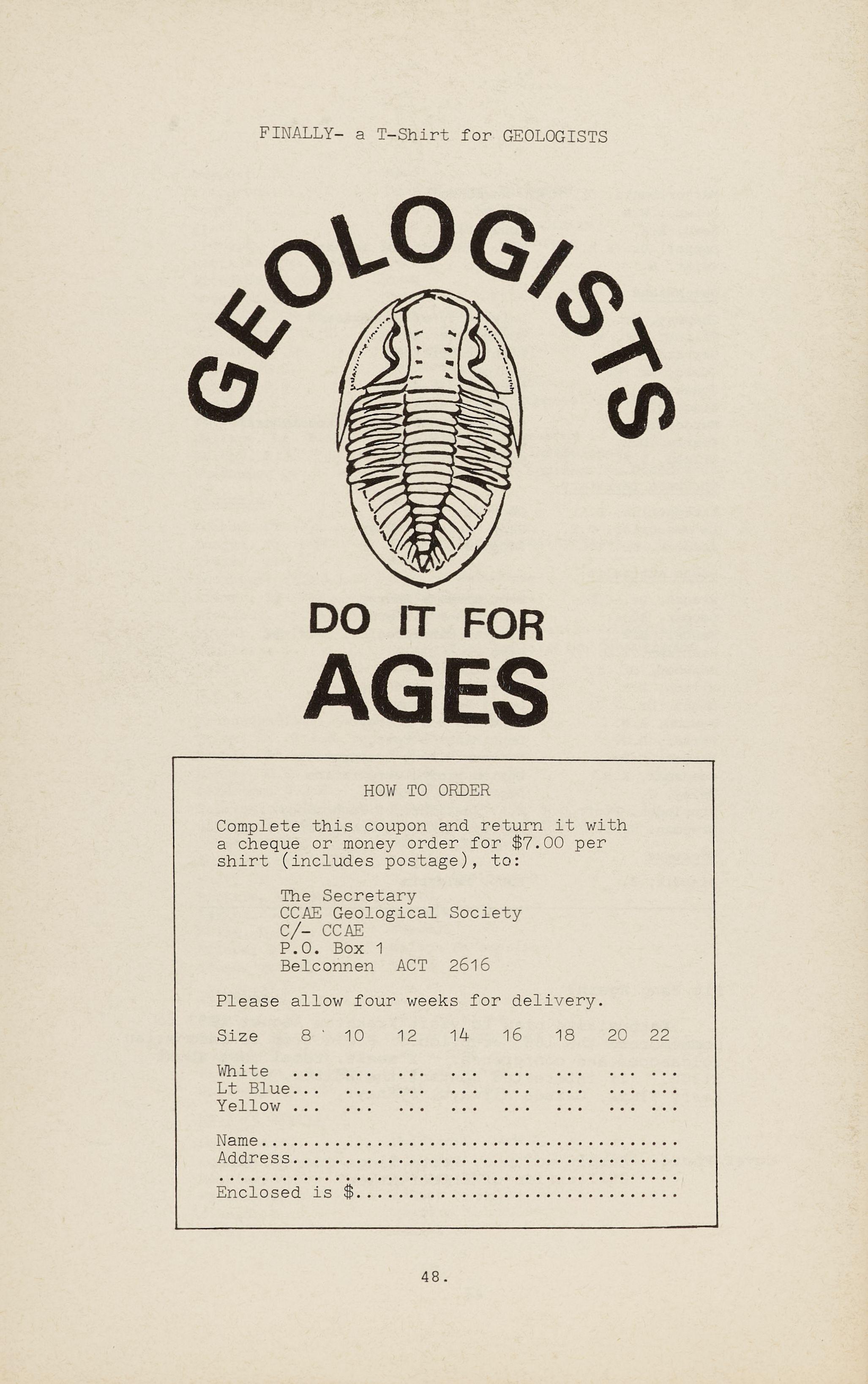
Please