Newsletter Editor
D.F. Branagan
Dept. Geology/Geophy si cs
University of Sydney NSW. 2006.
Phone: (02) 692 2358 or 692 2912
Secretary
Bridget Yo ungs
Dept. Mines & Energy
P.O. Box 151
Eastwood, S.A. 5063
Phone: (0 8) 272 5711
THE PRESIDENT'S PAGE
If a simple example is needed of why an Australian Geoscience Council would benefit us all, then the second week in May provides the evidence. At this time three conferences coincide, each competing for a geoscientific audience: the Archaean Symposium in Perth, the ANZ Geomechanics Conference in New Zealand, and ANZAAS in Adelaide! However, while it is important to ensure conferences do not clash, I consider it more important to ensure collaboration between conference organisers so that we, the conference goers >are not spread thinly across the calendar. In addition, collaboration across scientific interfaces can lead to a more meaningful assemblage of topics and speakers, so let us aim for cooperation through the Geoscience Council in the eighties.
The strength of a Society comes from its members, and it was disappointing to hear at the Hobart Council meiting that our membership is declining at a time when the minerals industry is buoyant. It behoves each of us to set a goal to bring at least one new member to the Society this year. I think you will find that when geologists hear of our low membership fees, see the quality of our publications, and learn of the success of our conferences you will have no problem in convincing them to join.
It is with regret that the Ex ecutive recently accepted the resignation of Dr. John Truswell as Honorary Editor for the Society after a most innovative and efficient term of office; but it is well understood that his new position with the Federal Government will allow neither the time nor the opportunity for him to maintain the high editorial standards he established. We welcome Associate Professor Ron Vernon as the new Honorar y Editor and offer him our full support for the future
COLIN D. BRANCH.
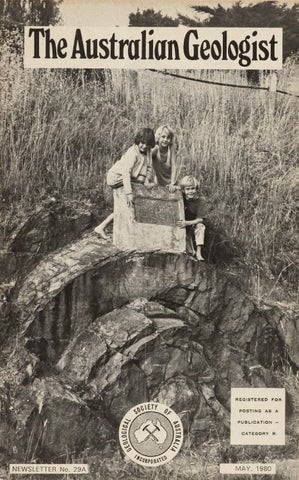
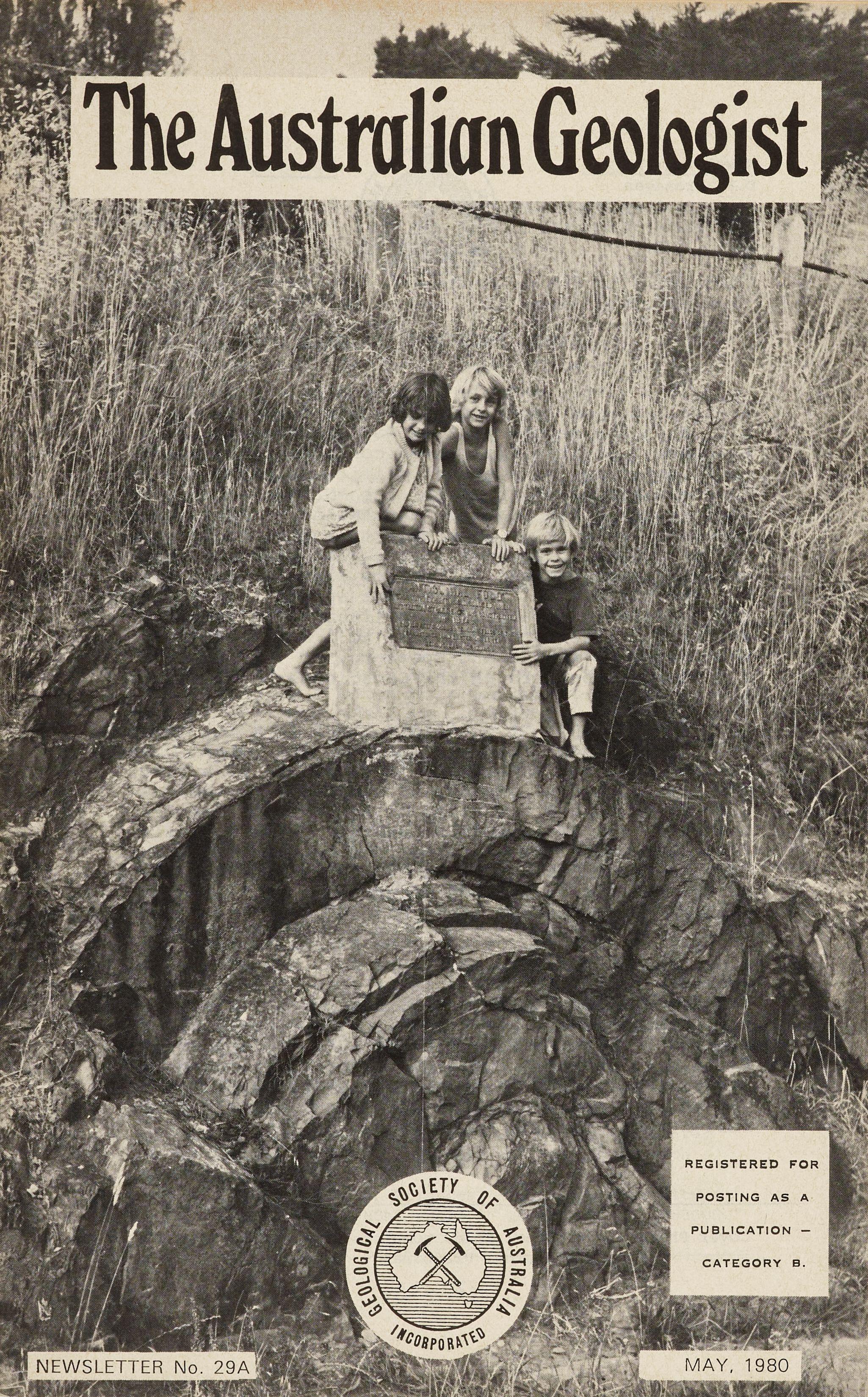
Cover Photo: Anticlinal fold, complete with ornate keyston e . Castlernaine, Victoria.
Newsletter No. 29 A May,
A Editorial
The flood of protests from observant readers has caused the curious numbering of this issue. The number 28 somehow was not used on our last number, and to produce an even better bilbiographer's nightmare it seemed best to declare this issue number 29 A. We hope the next will be correctly numbered 30.
Numbers are part of the IGCP scheme which receives some mention in this Newsletter. Many of these projects are producing worthwhile results and I am grateful to members who have sent summary reports which I hope to use in forthcoming issues. The numbers game certainly also plays a part in the developing Antarctic scene which is now attracting some attention. Finally our structural geologists herein suggest various ways of numbering ancient syns. Will others take the plunge? Better late than? queries one non-upper class correspondent.
While geologists may be able to figure prominently, are they literate? Tony Eggletoris Ge-ode (pp.23-24), which is a sine qua non for ANU students, suggests they are, at least in our ancient capital. Is there any truth in the rumour that it wi11· form the basic lyrics for a new mineral-musical to be performed with appropriate specimens (both human and natural) at the next Aust. Geol. Conference? This sort of thing must be minimised. Act now to get it barred!
AMENDMENT OF SOCIETY RULE
Society members of at least 10 years standing and who are over 60 who have retired from active geological work can pay reduced membership fees of $15 (incl. journal), $5 (without journal). Contact your Divisional Secretary.
Future issues of The Austra lian Geologist are scheduled for August 1, October 3 and December 5. Copy required by the editor at least one calendar month earlier.
Honorary Editor G.S.A.
As from May 31st Ron Vernon takes over as the Hon.Editor of the Society's Journal. Bombard the new editor with manuscripts at: School of Earth Sciences, MacQuarie University, North Ryde. NSW. 2113. Telephone (02)8888000.
Letter to the Editor
Lower, Upper Early, Late
Sir,
E.K. Carter ("The Australian Geologist", December 1979) sets out very . clearly the distinction between "Early, Late" and "Lower, Upper". He comments also that editors and readers may be hard put to decide whether an author is writing about a tim e interval or a rock interval, and I think the author himself would sometimes be uncertain. Is it, then, worth preserving a distinction that is more academic than useful? I have yet to find a geologist who was inconvenienced by the old usage of "Lower" and "Upper" for both time and rock divisions. The sense in which these words were used either didn't matter or was made obvious by the context. On some current geological maps the units laid down during the Early Devonian, for example, are listed in the legend as "Early Devonian" but are marked on the map with the symbol "Dl" meaning Lower Devonian. If we changed "Dl" to "De", we would also have to change the symbol for the Upper Devonian units from "Du" to "Dl", thus confusing any readers not already confused. Moreover, the logic of such a change would be questionable.
The problems we now face are compounded by a widespread belief that "Upper" and "Lower " are obsolete and have been superseded by "Early" and "Late". The only bright spot in the new system is its gravest weakness: it does not distinguish between "Middle" as a time division and "Middle" as a rock division.
Summing up, I regard the new rules as an unsuccessful attempt to solve two-thirds of a non-existent problem.
W.H. OLDHAM, Canberra.
Sir,
Some time ago, there was correspondence about difficulties experienced in getting tax rebates on conference excursion expenses. This study is related to the word excursion - a journey taken for pleasure, hardly a concept that would appeal to the tax man's better nature. Surely we should instigate the practice of calling field trips by some less direct name if we want to get at the tax people; what about field sympos·ium for example. The original meaning fits the bill very nicely I think
R.J. TINGEY, Canberra.
THE AUSTRALIAN INSTITUTE OF GEOSCIENTISTS
Announcement of the Formation
In January, 1980 the Council of the Geological Society of Australia passed a resolution approving the formation of a professional organisation for geoscientists.
As a result, the following Provisional Committee has been formed to establish the Institute (A I G).
Chairman Secretary Treasurer Committee
C.L. Adamson
J.C. Cramsie
L.N. Ing all
Geological Consul t ant Geological Survey of NSW Geophysical Consultant
Assoc.Professor D.W. Emerson, University of Sydney
W.E. Foskett Hon.Admin. Officer, GSA
K.R. Glasson Geological Consultant
P.N. Jamieson Offshore Oil N.L.
Dr. C.T. McElroy Geological Consultant
K.G. Mosher Geological Consultant
Professor G.M. Philip University of Sydney
K.A. Richards Essa Australia Limited
M.J. Turbott Kenecott (Aust) Limited
E.D. Tyne
Dr. A.H. Voisey
Geological Survey of NSW Sedimentary Uranium N.L.
The formation of AIG is supported by GSA, ASEG (Australian Society of Exploration Geophysicists) and PESA (Petroleum Exploration Society of Australia) all of which have representatives on the committee. Liaison with these bodies will be maintained.
AIG will not compete with existing learned and academic geoscience organisations, but will confine its activities to those which affect the geoscience profession in its day to day relationships with the public, industry, academic institutions and government Although the welfare of the profession will be one of its interests it will not perform the functions of a trade union.
At present three Sub-Committees support the Provisional Committee These are:
A. Constitution and Membership - at present preparing Memorandum and Articles of Association
B. Legislation - at present examining the influence of mining legislation on the geological profession. Also, the question of registration of geologists in the light of the recent upsurge in exploration is being re-examined.
C. Public Relations
The committee of FOGG is fully co-operating and assisting in the formation of AIG and funds contributed to FOGG will be used to assist in the formation of AIG. The support 0£ the contributors to FOGG is gratefully acknowledged. A total of $380 was contributed and expenditure to dat e totals $110.
The provisional Committee wishes to thank the Council and• successive Executive Committees of GSA for their initiation of the formation of AIG and we look forward to continuing support by and a fruitful association with our parent body. As AIG cannot yet accept membership subscriptions, the Provisional Committee would welcome contributions to cover legal and administrative costs connected with the formation of the Institute. Contributions can be sent to the Treasurer at GPO Box 4883, Sydney, NSW. 2001.
C.L. Adamson
Chairman, Provisional Committee Australian Institute of Geoscientists.
APPLICATIONS FOR GRANTS (1 98 1)
25TH INTERNATIONAL GEOLOGICAL CONGRESS FUND
The Australian Academy of Science 's Nationa l Committee for Geo lo gical and Geochemical Sciences will meet in August 1980 to disburse funds for use during the calendar year 1981. Organisations, institutions and individuals are invited to submit applications for grants for use in 1981. Applications will require details of the particular scientific meeting and a brief description of the role of the scientist(s) for whom a grant is sought, or include details of the other purposes for which financial support is sought. In the case of public lectures, details of the proposed speaker, who should be an overseas speaker, the topic for presentation and the proposed venues should be given. Applications should be made on the official form, which is available from the Executive Secretary, Australian Academy of Science, PO Box 783, Canberra City, ACT, 2601. Applications should be received by l June 1980.
25TH INTERNATIONAL GEOLOGICAL CONGRESS FUND COMMITTEE REPORT
1. Establishment of Mawson Lecture
This lecture has been established as a memorial to Sir Douglas Mawson, FAA, FRS, who was a Foundation Fellow of the Academy and a member of its first Council. In setting up this lecture, the committee was concerned to note that little in the way of a scientific memorial exists to commemorate this distinguished geologist and polar exp lorer.
It is intended that this lecture will normally be delivered by a prominent earth scientist at each of the Geological Society of Australia's Conventions. It is also intended that the lecture .shal l be published. The Mawson Lecturer will be awarded a bronze medal and an honorarium of $200 . The Mawson Lecturer shall be appointed by the Council of the Australian Academy of Science on the recommendation of a committee consisting of the President of the Geological Society of Australia, the Chairman of the Academy's National Committee for Geological and Geochemical Sciences , and a member appointed by the Council of the Academy of Science. It is intended to hold the first Mawson Lecture at the Geological Society of Australia Convention in Perth in August 1981.
2. Donations to Fund
The Committee wishes to acknowledge a donation of $708 . 26 from the Organising Committee of CUMSEA (which was partia ll y funded from the 197 9 IGC Fund). This sum was included in the amount which was distributed for assistance to promising young geologists to attend the 26th IGC meeting in Paris in 1980.
The Committee wishes to alert conference organisers, who may be burdened with surplus funds, that the 25th IGC Fund will welcome such donations.
3 . Awards for special projects
Two awards were made in this category:
$1,000 was awarded to Dr M J Russell to support his attendance at the Geological Society of Australia Convention in Hobart in January 1980. Dr Russell is a world authority of Irish lead- zinc deposits and he will deliver the keynote address in the session organised by the Specialist Group in Economic Geology on "Stratiform Base Metal Deposits".
$600 each was awarded to two Canadian economic geologists, Drs J.M. Franklin and P.J. MacGeehan, to enable them to attend International Archaean Symposium in Perth in May 1980.
4. Grants to Australian geologists for attendance at the 26th International Geological Conference, Paris, July 1980
A total of $8,650 was allocated from the Fund to enable the following geologists to attend this meeting:
Dr W. Birch, Curator of Minerals, National Museum of Victoria - $1,000 •
Dr R.A.F. Cas, Department of Earth Sciences, Monash University - $1,000
Mr G.M. Derrick, Bureau of Mineral Resources, Canberra- $1,000
Dr D.A. Falvey, Department of Geology & Geophysics, University of Sydney - $850
Dr M.F. Middleton, Department of Geology, University of Melbourne - $1,000
Dr G.N. Phillip, Department of Geology, University of Western Australia - $?00
Dr I.R. Plimer, University of New South Wales, Broken Hill - $1,000
Mr W.H.R. Ramsay, Department of Geolo gy , University of New England - $1,000
Dr E.M. Truswell, Bureau of Mineral Resources, Canberra$1,000
(For further information: Dr R. Taylor - Ph. (062) 49.3406)
W.R. BROWNE MEDAL
Nom ination s are invited for the W.R. Browne Medal. They may be submitted by Divisions, Specia list Groups or members . Each nomination should. be accompanied by a written justification , which can be used as a basis for the citation, and nominations should be received by 31st August, 1980. Further information from Colin Branch or Bridget Yo un gs on ( 08) - 272 . 5711.
GEOLOGICAL MAP SYMBOLS
Recent independent mapping in multiply-deformed terrains in Soutb Australia and New South Wales have indicated the need for minor improvements to the B M R. code of Symbols used on Geological Maps (B.M . R. 1978) These improvements mainly relate to differentiating between folds, foliations and lineations of different generations on map legends.
During our map compilations we have examined numerous methods of representing different generations of structures . Colour is one way to depict structures of various generations, but there are many times when multiple colour facilities are unavailable. For cases such as these we have agreed on a common system outlined below.
We present this system for discussion and hope eventually that a supplement can be made to the existing B.M.R code which will encourage a greater uniformity in geological map symbolism, particularly when applied to structural maps .
Please contact us with your comments :
R.A. Glen; Geological Survey of N.S W., Box 5228, G.P.O., Sydney, N.S W , 2001
FOLDS (cf BMR code Section 4)
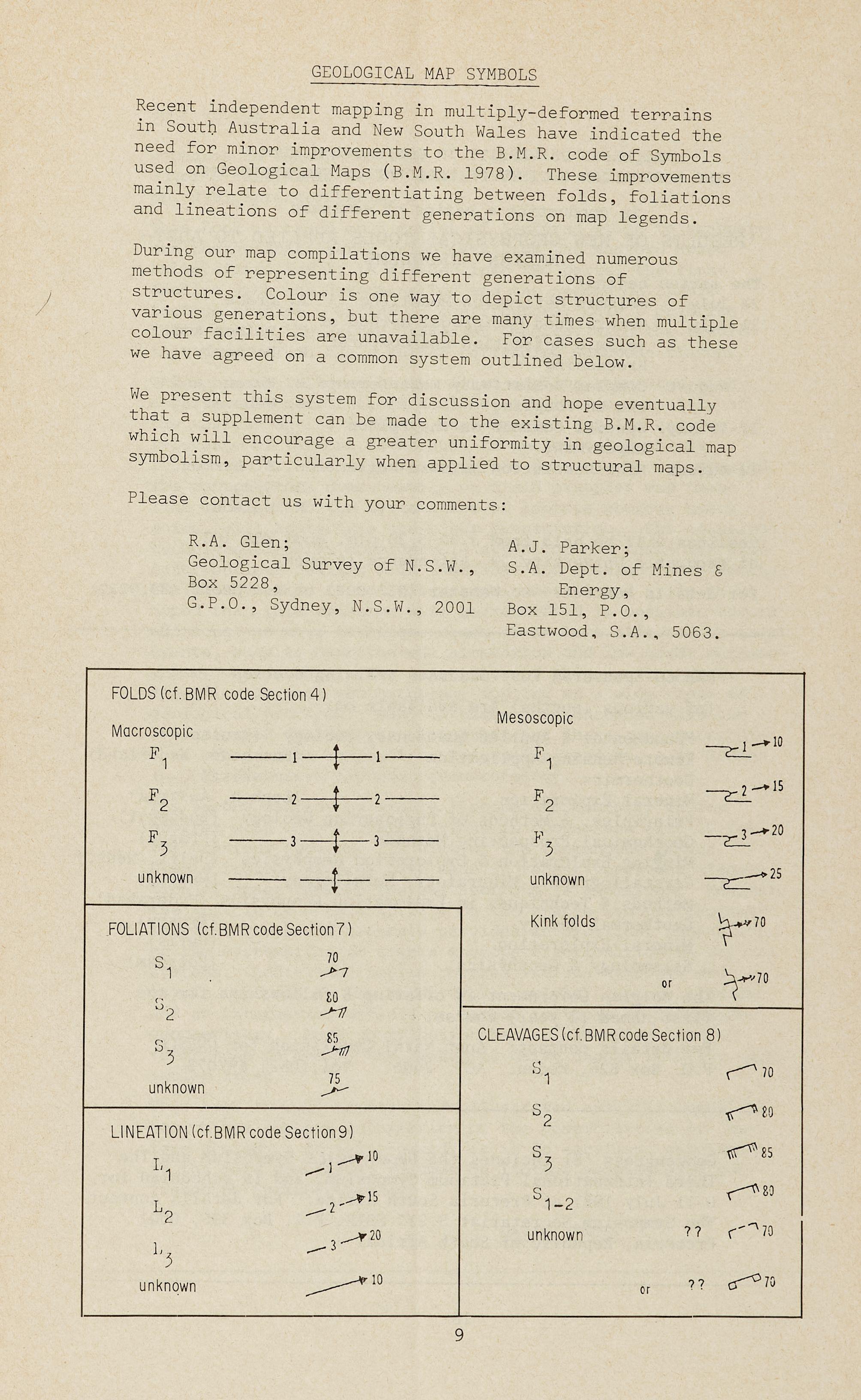
BMR code Section9)
A. J . Parker; S.A. Dept. of Mines & Energy, Box 151, P.O . , Eastwood, S . A., 5063
MACQUARIE UNIVERSITY IN CONJUNCTION WITH THE AUSTRALIAN SOCIETY OF EXPLORATION GEOPHYSICISTS
is conducting a series of seminars
'RESULTS OF NEW GEOPHYSICAL TOOLS APPLIED TO AUSTRALIAN PROBLEMS'
The series begins:
24 July Seismic Reflection Modelling
31 July Generalized Reciprocal Method of Seismic Refraction and Computer Processing
7 August. Complex Resistivity Measurements and EM Coupling
12-13 Aug. Special Seminar on the Pelton Experiment
L. Drake
D. Palmer and P Hatherly
R. Haren and s. Webster
14 August High Resolution Seismic Reflection P. Harmon, D. King
R. Nelson
Meetings will be held from 3.30-5.30 p.m. Room WSA 103 at Macquarie University Attendance is open.
For details contact: S. Webster (231 0922 or K. Vozoff (88.9220)
UNESCO-Sponsored Post Graduate training courses (of various lengths) Are available on:
Fundamental &Applied Quaternary Geology (Brussels)
Remote Sensing Application (Enschede, Nederland)
Geothermics (Pisa)
Mineral Exploration (Leoben, Austria)
Principles &Methods of Engineering Geology (Budapest)
Geochemical Prospecting Methods (Prague)
Min,lp.ng Exploration & Exploration Geophysics (Delft, Neds.)
Crystallography, Mineralogy, Metallogeny (Madrid)
Methods &Techniques in Exploration Geophysics (Hyderabad)
Geothermal Energy (Kyusbu)
Mineral Exploration (Paris)
Seismology &Geophysics (Potsdam)
The BeJgian Government is offering 8 fellowships for the first named (2 year) course.
For details contact: P.O. Box 826, Woden.
Aust.Natnl Commission for UNESCO ACT. 2606. Tel. (062) 897078.
Geocongress '81 includes the Geodynamics Symposium and The Third International Platinum Symposium, and is scheduled for 6-11 July 1981 at Pretoria South Africa. For details contact The Symposium Secretariat S . 217 CSIR, P.I. Box 395, 0001 Pretoria, Republic of South Africa.
BOOK REVIEW
Lectures in Isotope Geology
Jager E and Hunziker JC (eds.) 1979
pp 329, Springer-Verlag
This book is based on a series of lectures given to graduate and postgraduate earth scientists from the Western Swiss Universities and it is divided into two parts, the first dealing with age determination and the second on stable isotope studies. Of the 17 contributors, only 5 practise their art in the United States of America, with the result that this volume has a rather refreshing European flavour.
The approach followed in the first section commences with a series of contributions dealing with the fundamentals of the various ' dating methods, experimental details and the relevance of various techniques to geological problems in particular, the ways in which the data can be interpreted. The contributors draw heavily on field examples and those like me who find the systematics of isotope geology heavy going, will appreciate the clear presentation. The classical techniques receive considerable attention but there are also contributions dealing with 40Ar/39Ar and fission track dati n g. The Sm-Nd method is not discussed in detail and it is to be hoped that this omission will be rectified in possible future editions, as this technique seems to be less affected by later events, such as hydrothermal alteration and low grade metamorphism, than others. The later part of this section deals specifically with geochronology applied to a wide range of geological problems. Many of these are concerned with the evolution of the European Continent but there are contributions of specific interest to Australian readers, e . g. Dodson (p.207) discusses Archaean geochronology.
The second section on stable isotope geochemistry is far shorter with only 4 contributions in comparison with 20 for the previous section. In view of the tremendous impact stable isotope studies have made in recent years the allocation of space between the two sections is anomalous. However, the article by O'Neil (p.235) on the stable isotope geochemistry of rocks and minerals provides an excellent foundation on the systematics of stable isotope fractionation in natural systems. Additional topics covered include h y drogen and oxygen isotopes in the water cycle, sulphur isotope studies and an interesting article on carbon isotopes in petrol e um geochemistry. Each contribution has an extensive list of references to enable the reader to delve deeper into any p articular facet.
This book is well written and illustrat e d and will appeal to geologists seeking information on the p ossibilities of isotope geology. In this regard, it is an e x c e lle n t supp l e me nt to the more specialist volumes on isotope g e ochemistry p ublished by Spring e r-Verlag.
DAV ID HE NDRY
BOYD, F. R. & MEYER, H. O. A. (Eds) , 1979. Proceedings of the Second International Kimberlite Conference.
Vol. I. Kimberlites, diatranes, and diamords: Their geology, petrology and geochemistry. Pp. 400.
Vol. II. The mantle sample: Inclusions in kimberlites and other volcanics. Pp. 424. Am. Geophys., Washington, D.C ..
These volumes contain a wealth of information on the abundance, distribution, composition, origin and evolution of both kimberlites and their mantle-derived inclusions. In the first volume one discovers that at present the dominant hypothesis for the origin of kimberlite is that such a magma can he generated by a small degree of partial melting of a phlogopite-dolomite lherzolite (Wyllie, I, p.319) that contain H2o and CO or other species in the subsystem H-C-O, at pressures 6etween 30 to 55 kb, and temperatures between 1075 and 1225°c. Eggler and Wedland (I, p.337) propose that kimberlitic magmas may be relatively corrmon in the mantle. They ascribe their rarity at the surface to the lack of tectonic environments that are conducive to their movement through the lithosphere.
Anderson (I, p.344) examines the nature of the process that transports kimberlitic materials from their source to the surface. The main constraint on the emplacement of diamond-bearing material, is preventing the diamonds from changing into graphite. According to Anderson this can be accomplished if the kimberlitic material is transported rapidly (i.e. 7 m/sec. to 20 m/sec.) through the lithosphere. Such speeds can be obtained if a low viscosity fluid accLinulates at the tip of a propagating crack and the fracture grows as fast as the fluid can flow into the channel provided by the crack. Once the crack breaches the surface, the kimberlitic material is emplaced as a fluidized system. During ascent the fluid in the crack undergoes decompression and this would have a significant quenching effect on the diamords and other kimberlitic materials.
Ferguson and Sheraton (I, p.140) describe the kimberlitic rocks of southeastern Australia and they demonstrate that the Jurassic pipes from Walloway, South Australia contain kimberlite (sensu stricto).
A series of papers describe the rocks that occur in association with kimberlites, and they include carbonatites ( sensu la to) am potassic lamprophyres. Mc Iv er and Ferguson (I, p.111) describe a p3.rticularly interesting suite of rocks from southern Africa that includes kimberlites, melilitites, trachytes and carbonatites. All of these rocks are considered to have originated from a primary kimberlitic magma.
The second volume is mainly concerned with the mineralogy and chemistry of xenoJ.i th s Erom the upper mantle. It does,
however, contain much information that is of general interest; for example, Jordan (II, p.l) demonstrates that once the bas al tic fraction has been removed from fertile garnet lherzolite, the latter becomes less dense and floats on the remainin::J undepleted mantle material; ard Robinson (II, p.50) records that some eclogite xenoliths contain more than 10,000 times as much diamord as normal kimberlite, however the stooy of inclusions in diamonds shows that eclogite-derivro diamonds are not the most abundant type of diamond found in kimberl i tes.
These volumes are essential readirq for all "hard rock" geologists. Ho~ver, they do not contain the answer to the vexed question of how to define kimberlite. The only definition proffered is in the Ahstracts to the conference, in which Clement, Skinner ard Scott prop'.)se that "kimberlite is a volatile-rich, p'.)tassic, ul trabasic, igneous rock which has a distinctly inequigranular texture resultin::J fran the presence of macrocrysts set in an essentially micro:[X)rphyritic matrix. The matrix contains as praninent primary phenocrystal and/or groundmass constituents, olivine and several of the following minerals: phlogopite, calcite, serpentine, diopside, monticellite, apatite, spinels, perovskite and ilmenite. Other primary minerals may be present in accessory amounts. The macrocrysts belong almost exclusively to a suite of anhedral, cryptogenic, ferranagnesian minerals which include olivine, phlogopite, picroilmenite, magnesian garnet, chromian d iops ide and enstati te. 01 ivine is extremely abundant relative to the other minerals which need not all be present. In addition to microcrysts smaller grains belorqirq to the same suite also occur".
Eric Middlemost.
The Engineering Geology Specialist Group has just published "Engineering Geology Specialist Group Papers, Series No.l" The publication contains the following papers:
ACCELERATED WEATHERING TEST N.M. Gray
LANDSLIDING AS A CONTRIBUTING FACTOR TO THE DEGRADATION OF AGRICULTURAL LAND IN THE LOCKYER VALLEY, SOUTH-EAST QUEENSLAND G.W. Hofman
THE APPLICATION OF GEOLOGICAL TECHNIQUES TO ROUTE LOCATION STUDIES CARRIED OUT BY THE DEPARTMENT OF MAIN ROADS, NSW R.B. Smith
TEXTURE CHANGES IN ROAD BASE MATERIALS IN SERVICE - L.J. Wylde
SELECTION OF SKID RESISTANT AGGREGATES BY PETROLOGICAL METHODS - E.J. Minty
Copies may be obtained from G.S.A. Business Manager at a cost of $3 (post paid).
REVIEW
Geology for Civil Engineers
A. C. McLean & C. D. Gribble
George Allen & Unwin, 1979. 310p
Hardback A$27-50
Paperback A$14-95 (U.K. £5.95)
As a practising geologist assisting with the provision of engineering geological advice to civil engineers during the investigation, design, construction and maintenance phases of \\Qrks, my ex~rience has been that the Engineer's need of a sufficient knowledge of geology is matched only by the geologist's need for a knowledge of the basic concepts of ergineerirg practice.
1 This book presumably is aimed at providing the engineering undergraduate with basic geological knowledge, some knowledge of site investigation practice, subsurface investigation and probably construction techniques, and concepts on 'Rocks and Civil Engineering' . It covers the 'Geology for Engineers' syllabus at the University of Glasgow.
As always in this type of generalist publication the problem of what to incltrle has to be faced. The chapter · on minerals concentrates on crystallography - which by the way is not indicated by the contents - to an extent that the reader skips on to the next, much more practical chapter on rocks. Physical geology/geomorphology (except glaciology) and palaeontology, get scant mention, while excessive attention is given to the theory of geophysical interpretation (all methods) - again not evident from the contents . Detailed reading of the entire book is required, as snippets, e.g. igneous intrusives, are included here am there.
'Ihe last few chapters are of an applied nature and are without doubt the best quarter of the book for the learner engineering geologist. Australian engineers could be distracted by the fact that it is the geology of the U.K. that is discussed, while most site examples are Scottish, and a 'case history' described has not proceeded past the feasibility invest:gation stage.
The book is neither a basic geology nor an engineering geology text. Not having made a survey of texts currently nominated for reading by student civil engineers at Australian uaniversities, I am unable to compare this book with those presently available, which may have attempted the same dual role. If any are available, a'm of Australian origin, they are likely to be of more value than this volLITie. Ho1M9ver, it would be interesting to hear a civil ergineer' s view on this matter, since 'the y ' are the species aimed at in this book.
W. Chesnut
SYMPOSIUM ON THE GAWLER CRATON (December, 1979)
Extended Abstracts
compiled by A.J. Parker
During the past decade, tremendously important advunces have been made in our understanding of the geology of the Gawler Craton which occupies in area about one third of South Australia. This book in extended abstract form presents some of the new data and concepts that have emerged and covers various topics related to geochronology, stratigraphy, structure, metamorphism, plutonism and volcanism of the Archaean, Early Proterozoic and Middle Proterozoic rocks. It contains 13 papers.
Available from: Geological Society of Aust. Inc. (S.Aust.Division), C/- P.O. Box 151, EASTWOOD. SA.5063. Cost: $3.00 per copy, postage included.
The Australasian Sedimentologists' Group (ASG) of the Geological Society of Australia Inc. is planning a meeting in Canberra in the first week of December 1980, immediately following a meeting on the Cainozoic Evolution of Continental South Eastern Australia, at the same venue.
Tentative arrangements are as follows:
Venue Format Canberra College of Advanced Education 1st and 2nd December - presentation of papers and business meeting. 3rd, 4th and 5th December - excursions.
Papers will be invited on the following themes:
Quaternary temperate near-shore and shelf sediments (Chairman, P. Roy).
Epeiric sea sedimentation (Chairman, B. Radke).
Tasman Geosyncline sedimentation (Chairman, R. Cass).
Saline lake sedimentation (Chairman, J. Bowler).
Two excursions are planned - on Siluro-Devonian volcanoclastic sedimentation in the La chlan fold belt (leaders, M. Owen and R. Cass), and Fermo-Triassic sedimentation in the southern Sydney Basin (leader, B. Jones).
A circular, giving further details, and a registration form are being prepared and will be sent to ASG members. Other members requiring further information should contact the convener: Dr. M.C. Brown, Canberra College of Advanced Education, P.O. ffox 1, Belconnen, ACT., 2616. Phone (062)52-2133.
The 13th International Botanical Congress takes place 23-29th August, 1981 at Sydney University. There will be various sessions of interest to some geologists. For further information write to the Congress at Australian Academy of Science, P.O. Box 783, Canberra, ACT. 2601.
SEMINAR ON STRESS AND SEISMICITY IN EASTERN AUSTRALIAGEOLOGICAL AND ENGINEERING SIGNIFICANCE
The Geological Society (Victorian Division and Engineering Geology Group) and the Australian Geomechanics Society (Victorian Group) are jointly sponsoring a seminar on the above topic to be held in Melbourne on Wednesday 12 November, 1980. Laboratory inspections are planned for the 13th.
The. anticipated programme comprises -
1. An outline of Quaternary stress/seismicity in Eastern Australia.
2. A review of the effect of stress and seismicity on engineering structures through a case history approach.
3. A review giving reference to requirements and recommendations for work in this field.
A detailed programme and registration forms will be issued by June 1980. Interested parties can contact Mr. J.R.L. Reid (Convener) C/- M. & MBW Engineering Geology Section, 331-333 Burke Rd., Gardiner, Victoria, 3146.
HAPPY BIRTHDAY, ALFRED
Emeritus Professor S. Warren Carey of the University of Tasmania was appointed official delegate by the Society and the Australian Academy of Science to the Alfred Wegener Centenary Birthday Symposium held in Berlin, 25-29th February this year.
The symposium attracted an impressive list of delegates and many interesting papers. Professor Carey writes:
'The titles of the symposium papers are listed below. I am prepared to send to any member of the Society who sends a stamped addressed envelope, photo-copies of the abstracts of any of these papers. For the papers in German and the one in French I will send my translation into English if that be required. I will add from the registration list the postal address of the authros of each abstract. Include one 59 postage stamp for each abstract or translation requested, to cover cost of photo-copying.'
[Space precludes the publication of the 5 pages of titles Those interested in obtaining the list should contact the editor.]
The Second Int. Congress of IGCP Project 115 - Siliceous Deposits in the Pacific region is scheduled for Tokyo, August 21-27, 1981. For details contact: Dr. M. Utada, Geol. Instit., University of Tokyo, Hongo, Tokyo 113, JAPAN.
THE CAINOZOIC EVOLUTION OF CONTINENTAL SOUTH-EAST AUSTRALIA
26th - 30th November, 1980
Canberra College of Advanced Education
This symposium has been organised following the encouraging response to the preliminary notice sent out late last year. Participants are expected to be those who are working on, or interested in Cainozoic Geology of the southeastern Queensland, eastern NSW, Victoria, eastern SA and Tasmania area. It is also hoped that all those with an interest in the Cainozoic from other parts of the country will attend.
There are 4 facets to the Symposium: - general sessions - workships - poster sessions - two field trips.
Presentations are expected in the following areas of the Cainozoic with special emphasis on the Tertiary: - Stratigraphy & Sedimentation - Geomorphology - Magmatism, Tectonics & Geophysics - Tertiary Chronology- Palaeontology - Economic Aspects (inc. coal, metals, building materials, water, etc.)
General Sessions will be held on 26th and 27th followed by one day of Workshops.
The meeting will be followed by two field trips to the Upper Shoalhaven and the Cooma-Kiandra areas.
For further information contact:
Dr. G. Taylor CECSEA '80 School of Applied Science, Canberra College of Advanced Education, P.O. Box 1, BELCONNEN. ACT. 2616
Mr. R. Abell CECSEA '80 Bureau of Mineral Resources P.O. Box 378, CANBERRA CITY. ACT 2601.
CALL FOR PAPERS ON PROCESS MINERALOGY
The committee on "Process Mineralogy" of the Metallurgical Society invites the submission of abstracts, not to exceed 200 words, of proposed papers for presentation at the 1981 Annual TMS-AIME Meeting in Chacago, Illinois, February 2226, 1981.
Topics for sessions on "Process Mineralogy" should include applications of mineralogy and petrograp hy to problems in exploration, sampling, mining and processing of ores, involving the beneficiation, hydro- and pyrometallurgy of base and precious metals, as well as other metallic and non-metallic ores, including coal and oil shale.
Authors are requested to submit abstracts on TMS abstract forms by August 1, 1980, to D. M. Hausen, Newmont Exploration Ltd., P.O. Box 310, 44 Briar Ridge Road, Danbury, Connecticut. 06810. U.S.A. Tel : (203) 743-6784.
For the Premier (?First, ?Waratah, etc . ) Staters
Geol. Surv N. S.W. Report GS1978/100 dated 1978 (June), believe it or not, is a review of Industrial Minerals and Rocks in New South Wales. Holmes, Dishnum am Clakes have prepared a very useful volume covering the whole range of non-metallics from Abrasives to Zeolites including such matters as sea shells and waste materials. There is discussion on alternative materials am potential for future deposits and production and a good array of references for each material in the section 'comnodity review' which makes up the bulk of the book.
This is preceded by an excellent introduction which discusses the variety of problems beset by this essential 'industry', such as alternative lam use pressures, pollution control, health risks. It sets out an order of priority for additional work required in the state, the major problans being related to the three commodities clays, construction materials and silica. No additional work seems to be required at present concerning bromine, graphite, vermiculute am the ubiquitous sea shell.
This volt.roe supplanents the geological data included in 'Industrial Minerals & Rocks' (Econ. Geol. of Aust. & Papua N.G. No. 4, edited C. L. Knight), published by Aust.I.M.M. in 1976.
Journal of the Mineralogical Society of New South Wales. Volune 1, 1979.
Anyone who sees this well produced publication will be impressed by what this society has achieved in the four brief years since it came into being. Editor Richard Depledge of Macquarie University has gathered together an interesting variety of articles am news which will fascinate the avid or even the tepid mineral collector. Priced at $3.50 including postage, it is presently to be produced annually, but more frequent publication is envisaged if the demand warrants it. An eye-opener to me was the new mineral gallery at Orange. It: is v-JOrth travelling a long way to see. Those wanting more details of the Society should write to P.O. Box R35, Royal Exchange, Sydney 2000.
For Sale:
THE GEOLOGY OF I NDONESIA by Van Bemmelen - published 1947 two volumes plus map portfolio availahle from - Bill McGee
3 Winsome Avenue North Balgowlah NSW 2093 phone (02) 949.5228
Best offer accepted.
From the June 1979 MfG Bulletin
WI-fl.T GOOD IS AN ETHICAL CODE?
Talking alx>ut ethics always makes people uneasy. If you have them, you don't talk about them. If you don't have them, there's no point in talking alx>ut them.
Ever since Watergate, heightened ethical sensitivity, coupled wi tl:'l the intensified ..search for energy resources ard the public demands for solutions to a myriad of social economic, and political problans has increased the pressures on all the professions for high ethical standards and clearly ethical behav ior. To meet these pressures, two very different solutions have been offered.
The first suggested solution stresses the need for professional self-government. As a recent full page ad in many of the nation's newspapers stated, "When honesty ard ethics sink down, centralized authority and coercive regulations rise up." We could call this the "do it yourself or someone else will do it for you" argunent.
The secord suggested solution stresses the need to apply public concerns to a professional ethical code. We could call this the "do it for others, or they' 11 do it for you" argunent.
These t'M'.) suggestions are probably the ones most corrmonly held ¼hen considering the need for a professional ethical code. They a re al so, to my mind, the two least important argunents. The only real argunent is that ethical standards are crucial to the credibility of a professional ard, witrout credibility, the professional ceases to exist in any real sense.
Without credibility, a scientist ceases to be a scientist. We must be able to believe witrout question in a scientist's word about his data, his interpretation of those data, ard his methodology. Once that credibility slip;, once the public - whether the layman, the scientific community, or his employer - doubts his professional ethics, his work might just as well never have been done.
For our employers, belief in our credibility determines huge investments, comp:my profitability, and even survival. They have to be able to trust that our recorrrnerdations are in their interest and that YX)rk done for them is proprietary to them - when done, as well as at all times in the future.
For our investors, belief in our credibility determines their willingness to invest in our project. They must be able to trust that their investment, risky enough under the best of conditions, is reasonably sourd Exaggeration ard unwarranted statements must be avoided carefully.
For our professional peers, belief in each other's credibility is vital for mutual scientific reliance. Moreover, as in any group, the loss of credibility in anyone affects all of us. Try telling someone that you are an ethical used car dealer, for example. For the public at large, belief in our credibility is vital if we in the MPG want to have sane voice in public policy-makifB in areas which concern us most. We must be viewed as the source of objective, reasoned, soundly based, arrl unbiased information as to p:>licy p:>sitions. Without credibility, we are no more than another self-interest pressure group.
Ethics and credibility, then, have practical consequences. But why is a code necessary? A code is a way of stating our ethical standards so the world can judge our conduct. A code is also a firm support for those under pressure to bend ethical standards.
Is the existence of an ethical code enough? No, for the code itself must be credible and it can only be credible if it can be, and is, enforced in sane real manner. We in the MPG enforce our code. We are actively searching for violations of the ethical code, and we enforce sanctions against transg ressors.
Ethics arrl ethical standards are important to each of us in a very practical way. Upholding those standards determines whether or not we can do our jobs, further our science, teach our youth, and be allo~ to lead the nation in critical times. Ethics are an irrlividual obligation; they are also an individual necessity.
Robert Gunn.
UNDERWATER MINING INSTITUTE
11th Annual Underwater Mining Institute is planned for 11-13 November, 1980 in Savannah, Georgia at the Downtwon Motor Inn. Tentative topics of this year's Institute include: 1. ridge sulfides and metal-bearing muds, 2. sand, gravel and coastal mineral resources, and 3. supply and demand for deep sea nodule constituents.
Further information concerning the program and accommodation is available from the Institute Conference Coordinator: Barbara J. Arnold, University of Wisconsin, Sea Grant Advisory Services, 1815 University Avenue, Madison, WI 53706. Telephone: (608) 262-2814.
CLIMANZ CONFERENCE - FIRST CIRCULAR, FEBRUARY 1980
CLIMATIC CHANGE OF AUSTRALIA AND NEW ZEALAND - LATE QUATERNARY EVENTS, THE LAST 40,000 YEARS.
Sponsored by the Australian Academy of Science (joint sponsors h ip with the Royal Society of New Zealand is being sought)
Date: February 8 - 13th, 1981
Place: Howmans Gap, National Fitness Camp, Falls Creek.
Theme
The reconstruction of Late Quaternary Australian and New Zealand environments in discrete time zones.
The conference will bring together data from a wide area, from tropics to Southern Ocean and from Western Australia to New Zealand. Data will be assembled into five time zones covering the period from 5000-35000 BP. By focusing on
1 periods of climactic extremes, and 2. transitional periods between extremes, we aim to provide a spatial array of data critically evaluated in terms of chronology and environmental interpretation.
Seen in terms of the different climatic and physiographic regions represented, such an evaluation provides a first step towards the reconstruction of changes in the general circulation over this large region of the Southern Hemisphere.
Contributors are asked to submit papers from any of four regions:
1. Tropical Australia and Papua New Guinea (summer rainfall region)
2. Southern Australia and Tasmania (winter rainfall region)
3. New Zealand
4. Tasman Sea and Southern Ocean to Antarctica.
Call for papers
Deadline for extended abstracts - 1 November 1980. Abstracts received after that date may not be distributed to all delegates before the meeting, thus defeating the purpose of the exercise. All intending participants are asked to fill in the form included and return it not later than 30th August. For further details contact: Secretary, CLIMANZ Organizing Committee, Dept. of Biogeography &Geomorphology, Australian National University, CANBERRA, ACT. 2600.
On 20th March the report of the Antarctic Research Policy Advisory Committee (ARPAC) was tabled in Federal Parliament following the examination by Cabinet. The Committee was formed by the Department of Science and the Environment (DOSE) to examine Australia's scientific effort in Antarctica and is headed by Professor D. Caro of the University of Tasmania. Earth scientist members were Larry Frakes of Monash University and Roy Woodall of Western Mining; Mr. L. Williams, Acting Director BMR, also attended meetings as an observer.
The ARPAC report calls for the appointment of co-ordinators in various disciplines. Bob Tingey has this job for the marine and terrestrial earth sciences. If anyone has any ideas on what they would like to do or see done by Australia in these disciplines in Antarctica please contact him. There will also soon be an advertisement sent around asking for Antarctic research proposals for the 1981/82 field season. The proposals will be reviewed by independent assessors and it then will be his job to put a programme together. Bob hopes to induce wider participation in Antarctic programmes than hitherto. Even . now, earth scientists from seven Australian universities and the BMR are active in Antarctica.
Bob Tingey produced an informative Antarctic Geology Newsletter in March. If you want to be kept on ice contact Bob at Bureau Min. Resources, P.O. Box 378 Canberra, ACT. 2601. Phones: (062) 499428 A.H.: 302322.
I.G.C.P. The 1979 Annual Report of the Australian IGCP Comittee lists 157 Projects and Australian correspondents for those of relevance to Australian geology. We seem to have no correspondent for Project 118 Upper Precambrian Correlations. This seems an extraordinary omission.
A special session "8 years of IGCP' is scheduled for the Paris I.G.C. Space prevents the inclusion of remarks on various interesting projects being studied in Australia.
Those interested in learning more should contact IUGC C/UNESCO Office, Canberra.
0 I UNESCO AN INTERNATIONAL SYMPOSIUM ON METALLOGENY OF MAFIC AND UL TRAMAFIC COMPLEXES: THE EASTERN MEDITERRANEANWESTERN ASIA AREA, AND ITS COMPARISON WITH SIMILAR METALLOGENIC ENVIRONMENTS IN THE WORLD
S
OCTOBER9-11, 1980
ATHENS, GREECE.
c/o Prof. S.S. AUGUSTITHIS
NATIONAL TECHNICAL UNIVERSITY-DEPARTMENT OF MINERALOGYPETROGRAPHY-GEOLOGY. 42, OCTOBER 28th St. P.O. BOX 1482, ATHENS GREECE TEL. 3628988-3608863
Ge - Ode
Minerals form in the rocks throughout time Here are some grown in a geode through rhyme
Chalcophile atoms with sulphur combine, Minerals formed are metallic, and shine.
Cubes of galena are heavy with lead, Sphalerite may be called zinc-blende instead.
Chalcopyrites has copper, like brass, Pyrite fools gold, and is rather low class, Marcasite forms like a cock's-comb in growth, Fes 2 is the content of both.
Pyrrhotite, bronze, carries nickel, with luck, Arsenopyrite smells garlic when struck.
Trivalent oxides, hydroxides occur Mostly in dirt from exposure to air. Limonite rusty, and hematite red, (Ruby is simply corundum well bred).
Want aluminium? Bauxite is round, Magnetite points where there's iron to be found Ilmenite's heavy, and stays on the beach, Rich in titanium, easy to reach.
Put to the acid test, carbonates bubble, Calcite's refraction shows everything double.
Siderite, dolomite, calcite can be Cleave rhombohedrally, hardness is 3.
Blue copper, azurite; malachite green,
Lead-bearing cerussite, adamantine.
Gypsum is calcium sulphate hydrated, Glossy barytes is heavily weighted.
Hungry for more? Have a big apatite?
Calcium phosphate is good for a bite.
Fluorite fluoresces, and cleaves very well, Halite, in cubes, is just NaCl.
Next, ortho-silicates, each of them own Si0 4 tetrahedra a lone. 2]
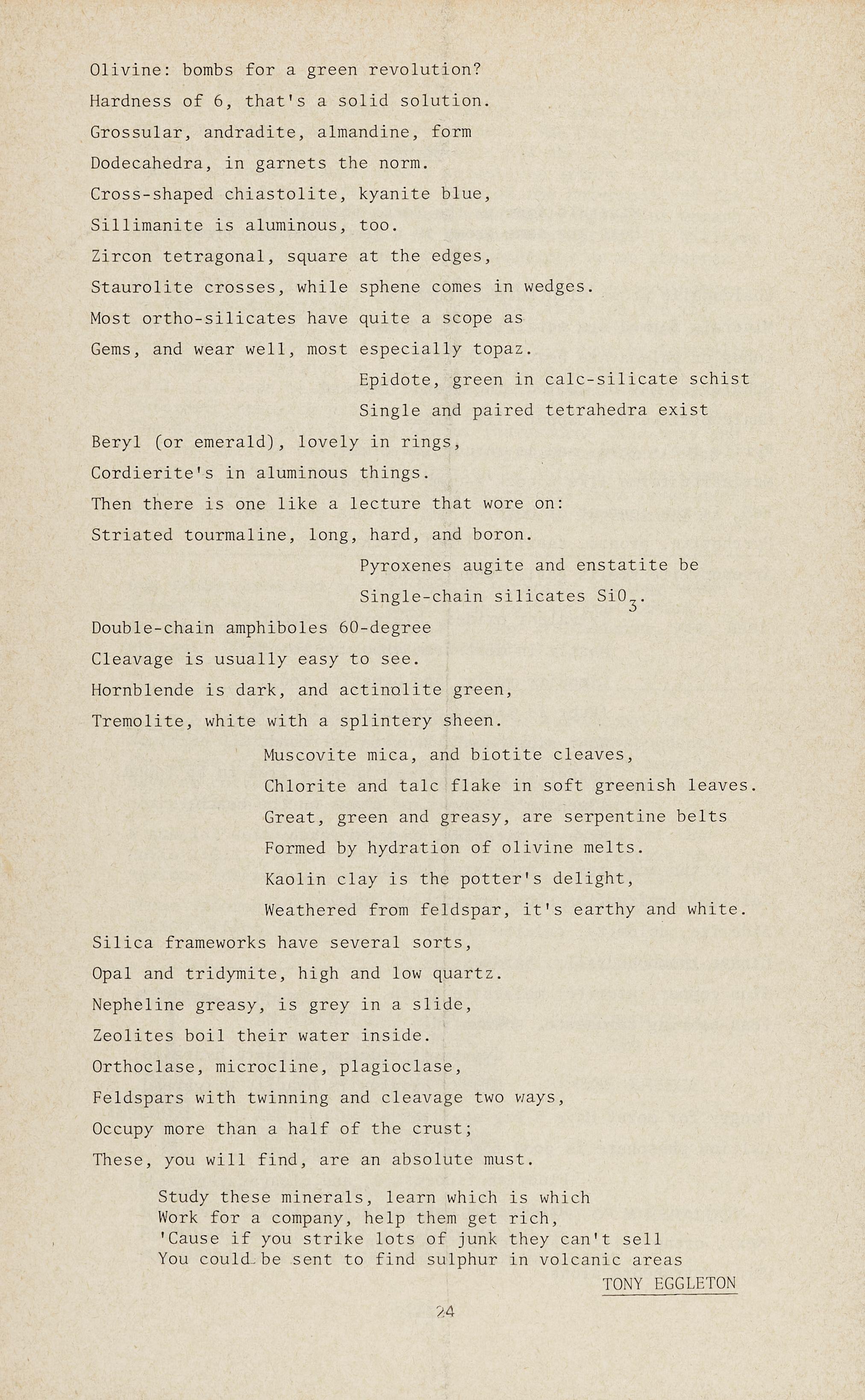
Olivine : bombs for a green revolution?
Hardness of 6, that ' s a solid solution.
Grossular, andradite, almandine, form Dodecahedra, in garnets the norm.
Cross - shaped chiastolite, kyanite blue,
Silli manite is a l umi n ous, too.
Zircon tetragonal, square at the edges, Stauro l ite crosses, while sphene comes in wedges.
Most ortho - si l icates have quite a scope as Gems, and wear well, most especially topa z .
Epidote, green in calc-silicate schist
Single and paired tetrahedra exist
Beryl (or e mera l d), lovely in rings, Cordierite ' s in aluminous things.
Then there is one like a lecture that wore on:
Striated tourmaline, long, hard, and boron.
Pyroxenes augite and enstatite be
Single - chain silicates Si0 3
Double - chain amphiboles 60-degree
Cl eavage is usual l y easy to see.
Hornblende is dark, and actinolite green, Tremolite, white with a splintery sheen.
Muscovite mica, and biotite cleaves, Chlorite and talc flake in soft greenish leaves.
Great, green and greasy, are serpentine belts
Formed by h ydration of olivine melts.
Kaolin clay is t h e potter's delight,
Weathered from feldspar, it's earthy and white.
Silica frameworks have several sorts,
Opal and tridymite, high and low quartz.
Nepheline greasy, is grey in a slide, Zeolites boi l their water inside.
Orthoclase, microcline, plagioclase, Fe l dspars wit h twinning a nd cleavage two ways, Occupy more than a half of the crust; These, you will find, are an absolute must.
Study these minerals, learn which is which Work for a company, help them get rich, 'Cause if you strike lots of junk they can't sell You could- be sent to find sulphur in volcanic areas
TONY EGGLETON ?,4