Newsletter Editor
D. F. Branagan Dept Geology/Geophysics
University of Sydney
NSW 200f5
Phone: (02)692 2358 or 692 2912
v..elcome to Incanirg Secretary
Brigid Youngs Dept Mines & Energy
P.O. Box 151
Eastwood, S.A.5063
Phone: (08)272 5711
THE PRESIDENT'S PAGE
It is my pleasure to maintain the excellent tradition established by the tv.D previous Presidents of using this page to inform you of highlights of the Society's activities, and to encourage you to express your opinions on matters of concern.
As foreshadov.Bd by John Lovering in the December 1979 President's page, discussion at the Council meetirg held on 13 January 1980, in conjunction with the Fourth Australian Geological Convention in Hobart, brot..ght into focus two major issues which have concerned the Society for the past several years, and clear directives for future action have now been agreed upon.
First, it has been decided that the Society will actively pursue the creation of an Australian Geoscience Council, with the initial a im of generatirg co-operation between the various societie s r epresenting the broad spectrum of geoscience in this country. Although the Canadian Geoscience Council is still the model on ¼hich Australian initiatives will be based, it is acknowledged that our situation is different. This is particularly so in relation to the Australian Academy of Science, whose recently enlarged National Committere for Geological and Geochemical Science now has the additional function to foster geological, geochemical and related sciences in Australia, together with its traditional role of serving as an effective link between Australian and overseas scientists. Nevertheless, it was enco ur ag ing to hear Professor David Green , representirg the National Corrmi ttee, express the view that he saw a complementary role for the Geoscience Council to play in Australia. However, before a geoscience council may speak authoritatively on topics of national significance, it must first establish its credentials. Hence, we, hopefully, are about to embark on a [continued page 19) 2
EDITORIAL
Pla(te ) time
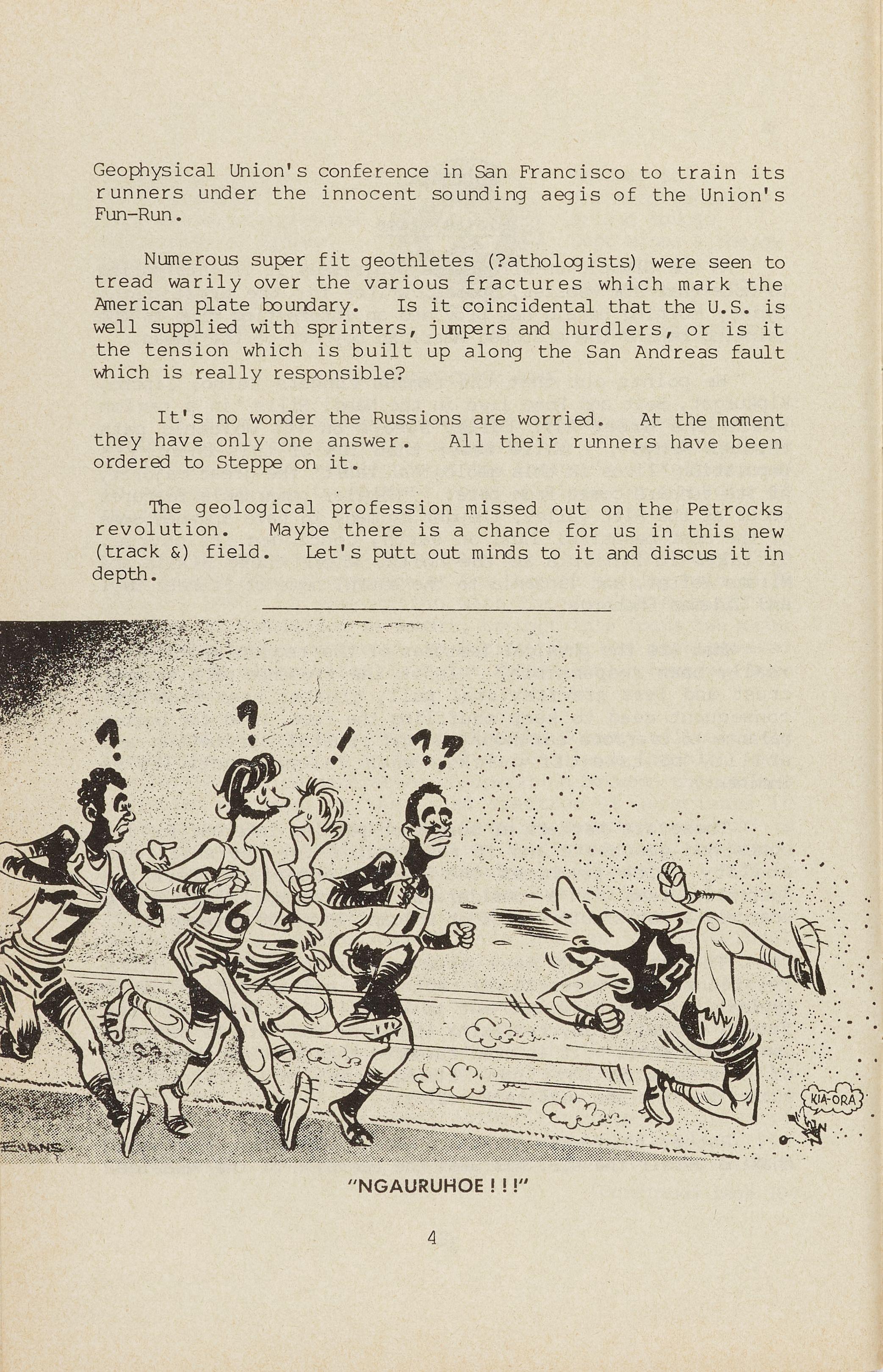
As the Olympic on-off debate progresses it is interesting to note that Jim Webster, Sports' writer for the prestigious Sydney Mornirg Herald has provided an interestirg clue to the thinking behind the proposed American boycott of the games.
He points out that the famous runners Keino, Jipcho, Kipkurgat, Boit and Rono live i n the Nandi Hills' in a region where the Great Rift Valley sweeps on its volcanic path through Kenya'. While fewer than 10% of this country's population 'lives in this geological fault' the great majority of its runners comes from here. 'Similar remarkable features occur as the Rift Valley, thought by many to have sp:iwned sane of the most beautiful land on earth, continues its course. It takes in Ethiopia to the north, where Abebe Bikila and Miruts Yefter, and Tanzania to the south, home of Filbert Eayi and Gidemas Shaharga'.
What are the physical features of the region which have really been responsible? Is it the presence of a thinner crust and less gravitational pull, greater heat flow and consequent need to keep shufflirg the feet, need for better balance to overcome earthquakes and crustal stretching and ability to take off quickly when volcanic activity is imminent?
These are matters of more than passirg interest for the concerned geothlete and if responsible for the skill and ability which produces the olympic champions leave the Australian team with a considerable disadvantage, there being scarcely a satisfactory rift or volcano in sight herearouts.
The Americans have apparently got wind of this relationship between plate tectonics and athletics and in typical fashion have set out to exploit its potential for future competition, realizirg it may be too late to save the Games this year. It is even rumoured that through the agency of Congressman Harrison Schmidt they have coined and authorized the new \vOrd tectlectics.
Rather than make too much publicity about this world shaking affair the U.S. has used the occasion of the American
Geophysical Union's conference in San Francisco to train its runners under the innocent sounding aegis of the Union's Fun-Run.
Numerous su:per fit geothletes (?athologists) were seen to tread warily over the various fractures which mark the Pmerican plate roundary. Is it coincidental that the U.S. is well supplied with sprinters, jun:pers and hurdlers, or is it the tension which is built up along the San Andreas fault vklich is really responsible?
It's no wonder the Russions are worried. At the manent they have only one answer. All their runners have been ordered to Step:pe on it.
'Ihe geological profession missed out on the Petrocks revolution. Maybe there is a chance for us in this new (track&) field. Let's putt out minds to it and discus it in depth.
"NGAURUHOE ! ! !"
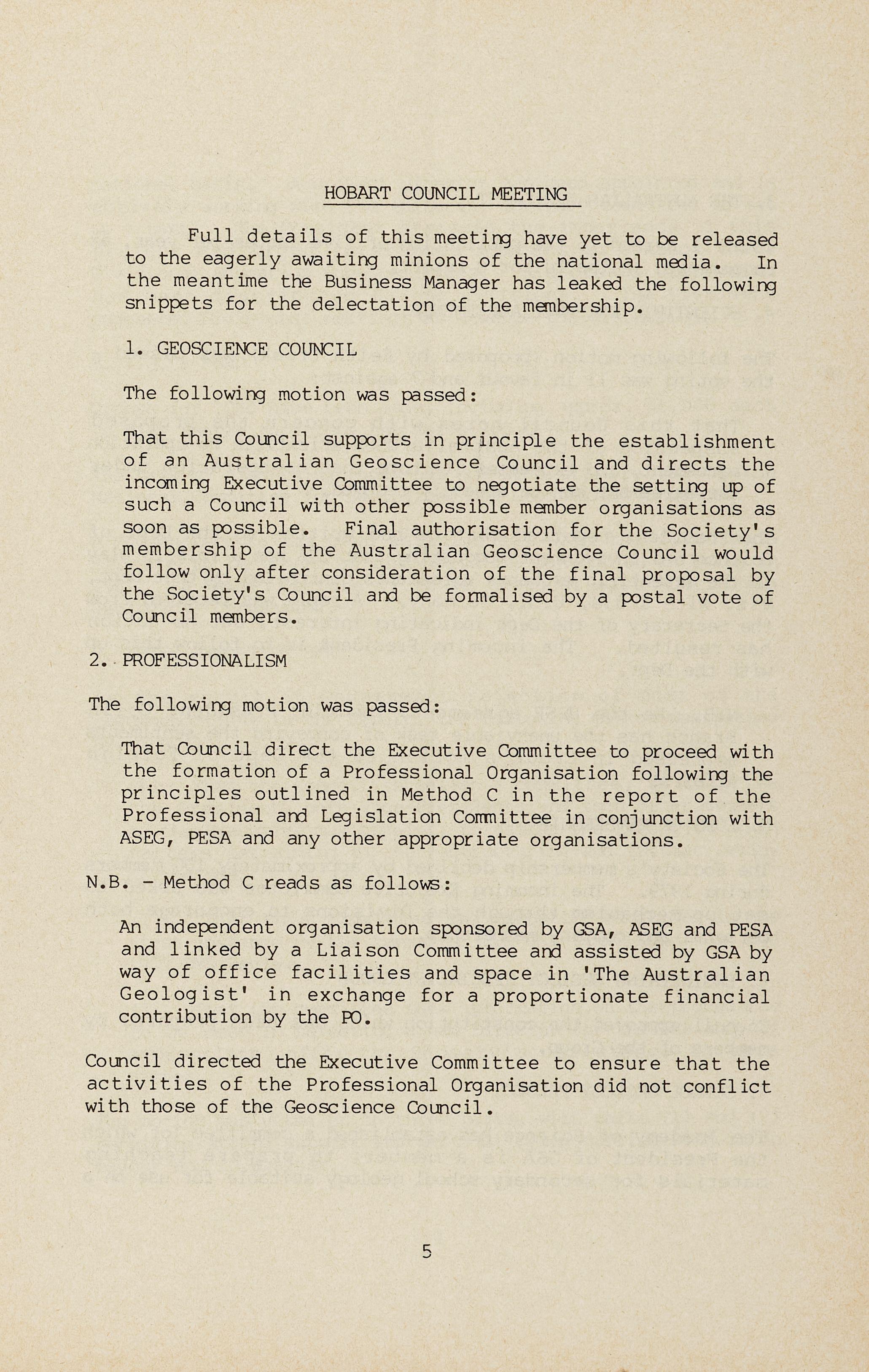
HOBART COUNCIL MEETING
Full details of this meeting have yet to be released to the eagerly awaiting minions of the national media. In the meantime the Business Manager has leaked the following snippets for the delectation of the membership.
1. GEOSCIEJ.'-K:E COUNCIL
The following motion was p:1ssed:
That this ColIDcil supp:>rts in principle the establishment of an Australian Geoscience Council and directs the incoming Executive Committee to negotiate the setting up of such a Council with other p:,ssible member organisations as soon as p:,ssible. Final authorisation for the Society's membership of the Australian Geoscience Council would follow only after consideration of the final proposal by the Society's ColIDcil ard be formalised by a p:,stal vote of ColIDcil members.
2 . . PROFESSIONALISM
The following motion was p:1ssed:
That ColIDcil direct the Executive Committee to proceed with the formation of a Professional Organisation following the principles outlined in Method C in the report of the Professional ard Legislation Conmittee in conjunction with ASEG, PESA and any other appropriate organisations.
N.B. - Method C reads as follows:
An independent organisation sp:>nsored by GSA, ASEG and PESA and linked by a Liaison Committee ard assisted by GSA by way of office facilities and space in 'The Australian Geologist' in exchange for a proportionate financial contribution by the ro.
C0Ln1ci1 directed the Executive Committee to ensure that the activities of the Professional Organisation did not conflict with those of the Geoscience ColIDcil.
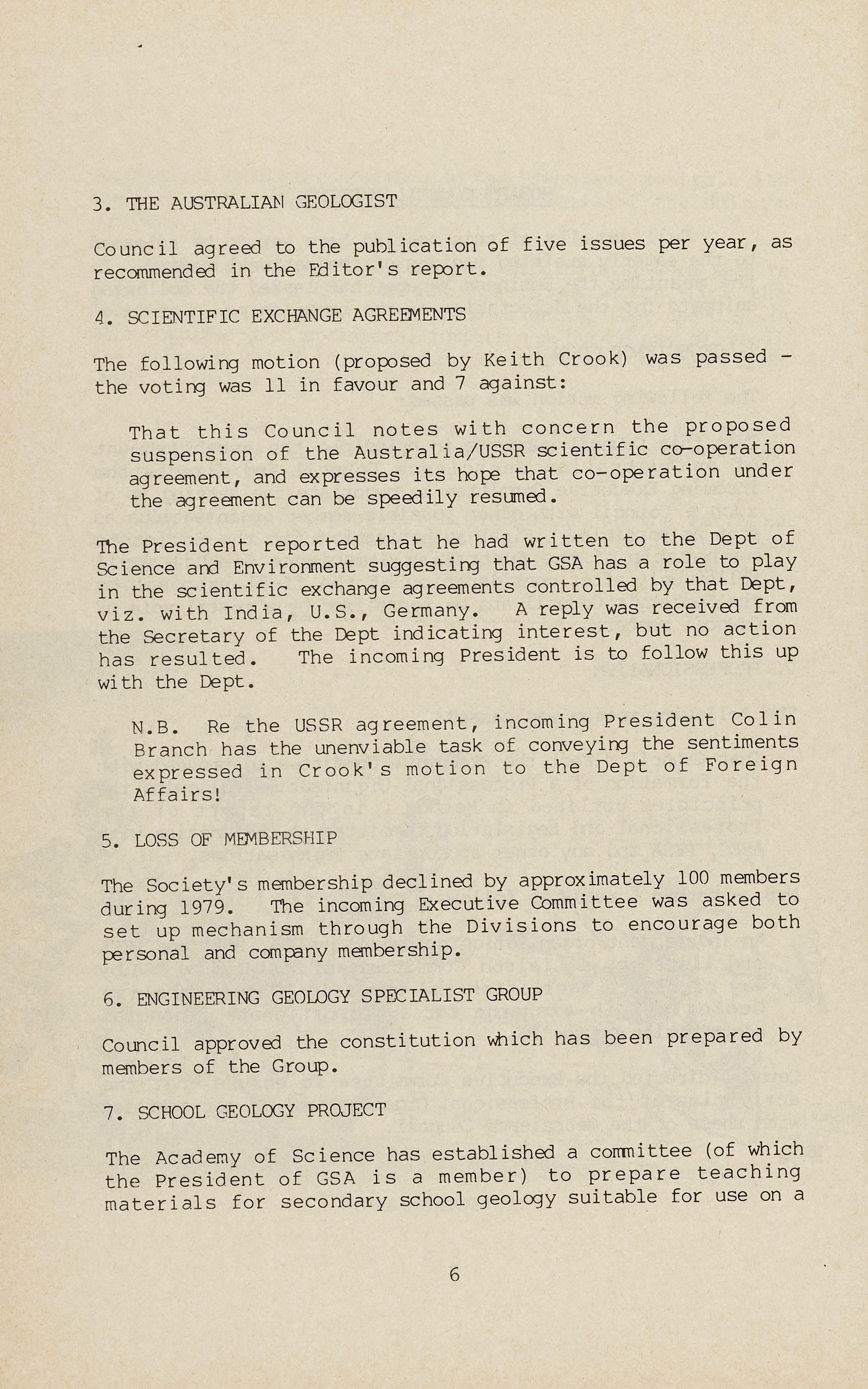
3. THE AUSTRALIAN GEOLCGIST
Council agreed to the publication of five issues per year, as recommended in the Editor's re)X)rt.
4. SCIENTIFIC EXCHANGE AGREEM.ENTS
The following motion (prop'.)sed by Keith Crook) was passedthe votirg was 11 in favour and 7 against:
That this Council notes with concern the proposed suspension of the Australia/USSR scientific co-operation agreement, and expresses its hoJ_:e that co-operation under the agreement can be speedily resumed.
1he President reported that he had written to the Dept of Science ard Environment suggestirg that GSA has a role to play in the scientific exchange agreements controlled by that Iept, viz. with India, U.S., Germany. A reply was received from the Secretary of the Iept indicating interest, but no action has resulted. The incoming President is to follow this up with the Iept.
N.B. Re the USSR agreement, incoming President Colin Branch has the unenviable task of conveyirg the sentiments expressed in Crook's motion to the Dept of Foreign Affairs!
5. LOSS OF MEMBERSHIP
The Society's membership declined by approximately 100 members during 1979. The incoming Executive Committee was asked to set up mechanism through the Divisions to encourage both rersonal and cornp:my membership.
6. ENGINEERING GEOLOGY SPECIALIST GROUP
Council approved the constitution which has been prepared by members of the Group.
7. SCHOOL GEOLCGY PROJECT
The Academy of Science has established a comnittee (of which the President of GSA is a member) to prepare teaching materials for secondary school geology suitable for use on a
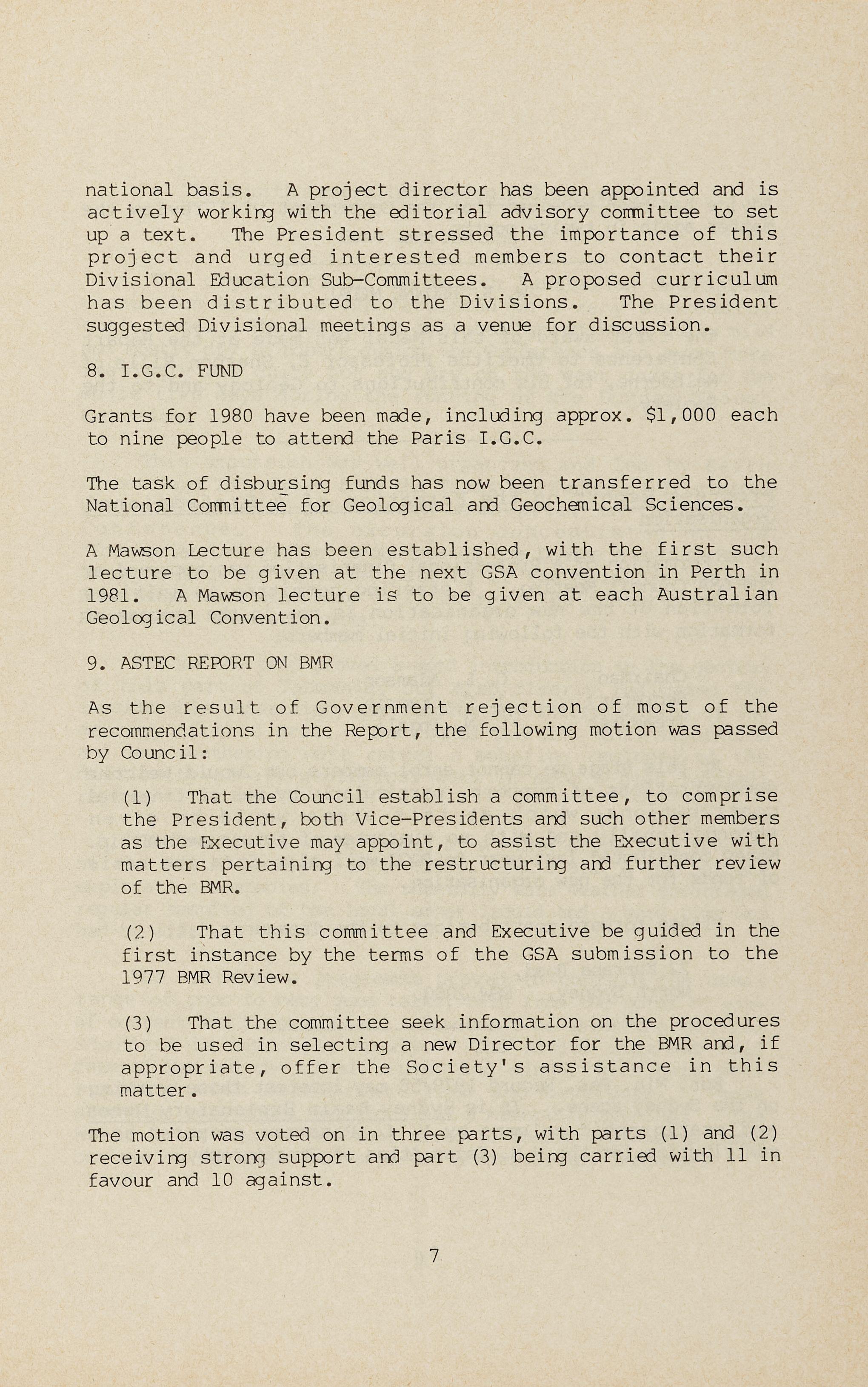
national basis. A project director has been appointed and is actively working with the editorial advisory corrmittee to set up a text. The President stressed the importance of this project and urged interested members to contact their Divisional Education Sub-Committees. A proposed curriculum has been distributed to the Divisions. The President suggested Divisional meetings as a venue for discussion.
8. I. G. C. FUND
Grants for 1980 have been made, including approx. $1,000 each to nine people to attend the Paris I.G.C.
The task of disbursing funds has now been transferred to the National Corrmittee for Geological and Geochemical Sciences.
A MavJSon Lecture has been established, with the first such lecture to be given at the next GSA convention in Perth in 1981. A MavJSon lecture is to be given at each Australian Geological Convention.
9. ASTEC REFORT ON BMR
As the result of Government rejection of most of the recommendations in the Rep'.)rt, the following motion was p:3ssed by Council:
(1) Thc1t the Council establish a committee, to comprise the President, both Vice-Presidents and such other members as the Executive may appoint, to assist the Executive with matters pertaining to the restructuring and further review of the BMR.
(2) That this committee and Executive be guided in the first instance by the terms of the GSA submission to the 1977 BMR Review.
(3) That the committee seek information on the procedures to be used in selecting a new Director for the BMR and, if appropriate, offer the Society's assistance in this matter.
'Ihe motion was voted on in three p:3rts, with p:3rts (1) and (2) receiving stron:J support am p:3rt (3) being carried with 11 in favour and 10 against.
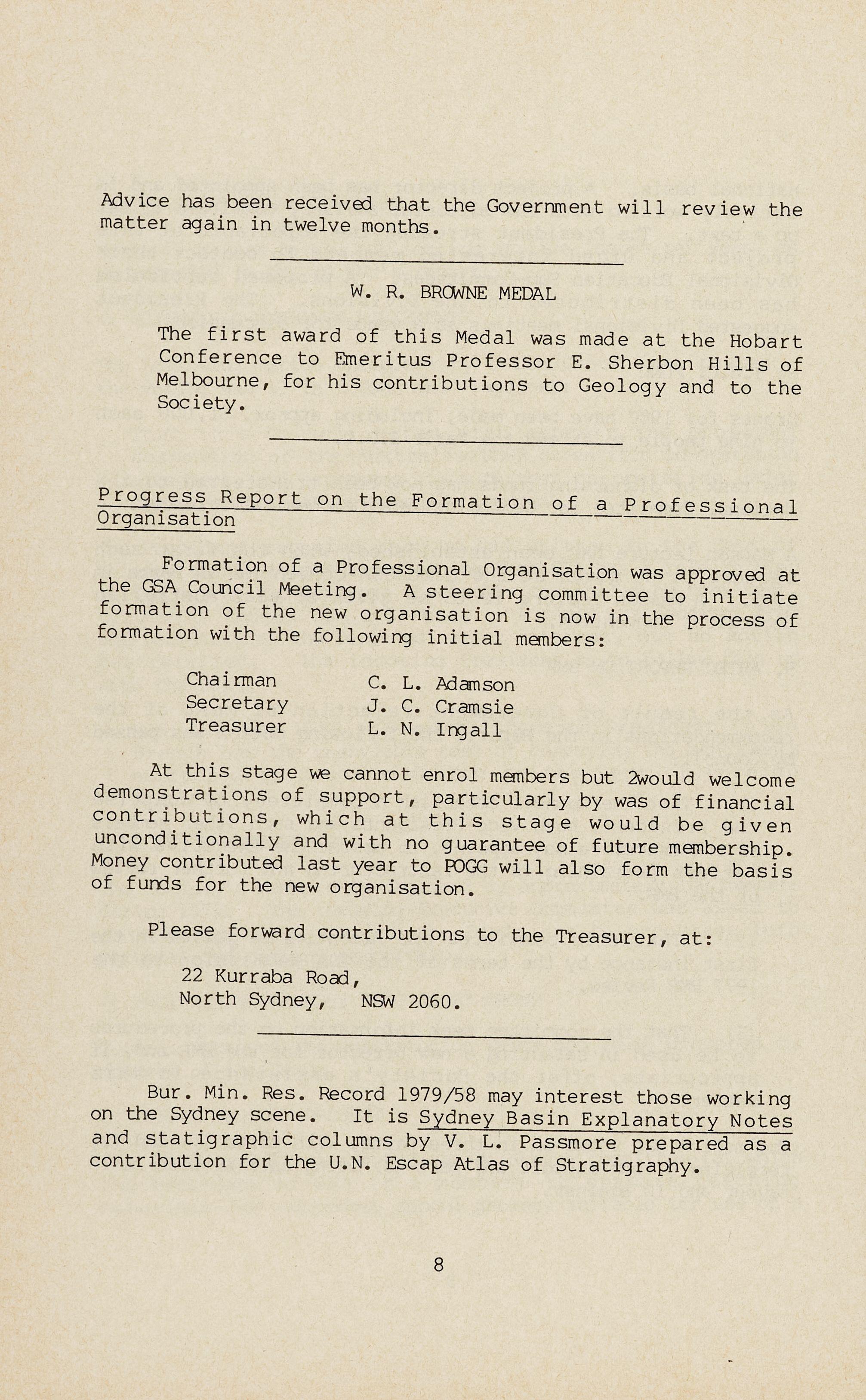
Advice has been receivoo that the Government will review the matter again in twelve months.
W.R. BRCWNE MEDAL
The first award of this Medal was made at the Hobart Conference to Emeritus Professor E. Sherbon Hills of Melbourne, for his contributions to Geology and to the Society.
Progress Report on the Formation of a Professional Organisation
Formation of a Professional Organisation was approvoo at the GSA Council Meeting. A steering committee to initiate formation of the new organisation is now in the process of formation with the following initial members:
Chairman Secretary Treasurer
C. L. Adamson
J. c. Cramsie
L. N. Ingall
At this stage we cannot enrol members but 2would welcome demonstrations of support, particularly by was of financial contributions, which at this stage would be given unconditionally and with no guarantee of future membership. Money contributed last year to FOGG will also form the basis of furrls for the new organisation.
Please forward contributions to the Treasurer, at:
22 Kurraba Road, North Sydney, NSW 2060.
Bur. Min. Res. Record 1979/58 may interest those working on the Sydney scene. It is Sydney Basin Explanatory Notes and statigraphic columns by V. L. Passmore prepared as a contribution for the U.N. Escap Atlas of Stratigraphy.
The Fourth Australian Geological Convention
Some impressions
The organisers of the Fourth Australian Geological Convention are to be congratulated on a very successful conference. The weather co-operated by renainirg quite mild and mostly dry in Hobart during the Conference and even more amazingly was quite hot and dry on the west coast for the whole five days during the running of the Dundas Trough Excursion.
This excursion was well organised and led by Keith Corbett arrl Tony Brown fran the Tasmanian Survey. It visited the Burnie-Zeehan-Queenstown area prior to the Hobart Conference. The excursion concentrated on the "Eocambrian-Ordovician" sequences of the Dundas and Dial Range Troughs and the regional setting of the main ore bodies. Some stops were also made to illustrate the features of the Precambrian basement rocks.
For me the trip proved a good introduction to the geology of this part of Tasmania, but also clearly indicated the considerable tmcertainty surrounding any interpretation of the geology of this area. The rugged terrain, thick vegetation and deep weathering were rather a sobering reminder of the difficulty of all geological work in such a high rainfall reg ion.
The excursion was of the State Surveys, exploration canpanies. regular sampling of the had by all.
atterrled by a mixed group fran several BMR, CSIRO, CAE's and a number of The tmusually warm weather encouraged local amber 1 iquid and a good time was
'The conference programme proved to contain the usual range of p:>or to very good talks, both fran the p:>int of view of content and presentation. However I do think the general standard is improving slowly. The social side was well catered for and the river cruise and dinner were both well supplied with appropriate food and beverages. Those attending both these functions had a menorable evening. The Wrest Point Casino was well sited to absorb any excess furrls but one or t~ stalwarts rep:>rted a satisfactoy increase.
The one l.Il1Satisfactory aspect of the conference was the rather poor food served at the University residential college (Hytten Hall). Ho~ver, even this had its compensations as it encouraged greater sampling of the beautiful local seafood.
Dennis J. Pogson, Geological Survey of NSW
."b...s is usual, -it was a mixed bag covering investigations from the ivory towers of academic institutions to the practical geologist; there was sorneth ing for everyone from fission track datin:J to darn site problsns. My main comnents refer, hotwever, to the engineering geology sessions and the excursion.
The engineering geology papers were grouped into 3 sessions of similar topics but each group covered a wide range. The first session covered grourdwater ard lardslide problems in Queensland, New South Wales and South Australia. The second considered roads; the 3 papers presented had a more academic or laboratory approach than the more practical approach of the other sessions. The third session dealt with more classical engineering geology of darn site investigations in New South Wales aril Tasmania. In all a variety of papers well presented .
A general meeting of the E.G.G. was also held at which one of the major matters discussed was the publication i:olicy. The Group's first publication, "En:Jineerin:J Geology Specialist Group Papers, Series No. l" was issued at the meeting to members.
A most interesting special lecture was given by Professor W. R. Dearman of Newcastle upon Tyne, in which he discussed designations of rock quality.
The en:Jineerin:J geology excursion to parts of the Pienan hydro-electric scheme of the H.E.C. and the landslide problems along parts of the north-west coast ard the Tamar valley was most enjoyable. Bastian, Mackintosh and Murchison Dams were in various stages of construction, aril sane of the problens being met and overcome were examined in detail by the participants. The last 2 days were spent on examining various landslide areas vklere some of the slides took place at very low angles. Our thanks to the excursion leaders.
[ continued page 16]
ON THE USE OF NAMES, PREFIXES AND SUFFIXES, AND ADJECTIVAL MODIFIERS IN THE MINERAIDGICAL NCMEN:IATURE
In mineralogical nomenclature two kinds of terms are currently used; names and adjectival mcx:1ifiers.
A name may be used for :
A: a group of minerals, e.g. "mica".
B: a mineralogical s~cies of the end-member that is dominant in a mineral (names should not be given to end-members that are never dominant); examples are "tremolite", "glaucophane".
C: a variety of mineral s~cies; e.g "kunzite".
Mineral names may be prefixed or suffixed. A prefixed name is a name that may be split into two parts, the last being a mineral name by itself; the first p:irt is then called a prefix. The meaning of the prefix may be crystallographic, 1 ike"c 1 i no" in " c 1 i no en s ta t i t e" , o r may have uni g ue implication, 1 ike "meta", "p:ira" or "a)?'.)" , but more commonly its meaning is chemical, like "ferro" in "ferroglaucophane". In what follows the use of chemical prefixes only is discussed.
A chemical prefix should only be used when the element named is daninant in an isanorphic series, and its use implies a distinct s~cies. For minor substitutions an adjectival mcx:1ifier (see below) smuld be used. The chemical prefix may be the name of an element ( or ionic complex) 1 i ke "zinc" in " z i n c a 1 um i n i t e" : o r the short form for the name o f an element, like "ferro" in "ferroglaucophane" or "chlor" in "chlorapatite". The Latin-derived prefixes must be used whenever possible. The use of double prefixes, as in "magnesio-al umino-tschermaki te" is allowed. In index irq, the prefix must be treated as an insep:irable p:irt of the name.
Please note that in the recently approved "nanenclature of amphiboles", the word prefix is used with a somewhat different and wider meaning; this discrepancy has been cleared up in the Addendum by Leake and Hey which appeared in Miner. Mag. Q (1978), 561-563. 11
A mineral name may be also suffixed. A suffix is a symbol, a chernical or a crystallographic one, which follows a mineral name and is attached to it by a hyphen. The suffix gives some particular additional information; for example "monazi te- (La) ", which means a monazi te where La is dominant among the rare earths; another example is "graphite- (2H) ", which names a special polytype of graphite. The name may always be used without a suffix to denote the species in its broadest and unrestricted sense.
An adjectival modifier is an adjective that gives some information on the chernistry of the mineral. Examples are: in English "sodian", "sodium-rich", or "sodium-bearing"; in French "ferrifere"; in German "manganhaltig", or "manganreich". As adjectives, these are not an essential part of the name, ard soould be ignored in the first stages of in~xing; thus while "ferroglaucophane" (which implies Fe >Mg) i4 indexed under F, "fer roan glauccophane" (which implies Fe <fvg) is indexed under G
The New Minerals and Mineral Names Commission is concerned only with the mineral names, prefixed or not, suffixed or not, no matter whether they are used for a group of minerals~ for a mineral species, for an end-member, or for a variety (but a new varietal name has never been approved by the Commission), and is not concerned with adjectival modifiers properly used. The Commission invites all mineralogists to pay attention in distinguishing prefixes ( as here defined) from adjectival modifiers, so as to avoid the publication without prior approval of the Commission of a new prefixed name, which is considered by the author as an old mineral name with a modifier (which would not be subject to the approval of the Commission). On the other hard every mineralogist should take care not to confuse the meaning of words like "ferroglaucophane" with terms like "ferroan glaucophane".
IMPORTANT NOTE: In some larquages, for instance in English, nouns can be used in an adjectival form, so that the word "sodium", when precedifB wi trout a hyphen a mineral name, may signify either "sodium-rich" or also "the sodium equivalent of" or "the sodium analogue of" or something of the kird. This latter use should be avoided in the future, by using a true adjective for a minor substitution or a properly prefixed name, approved by the Commission, for a dominant substitution.
[continued page 16]
ADVICE TO BEGINNER REFEREES
The Problem and how to Solve It
The number of scientific papers subnittro for publication is increasing exfX)nentially, as the vJOrld statistics maintain. (D. J. Price, Little Science, Big Science, Columbia University Press, New York-London, 1963)
The number and the bulk of scientific journals are also increasing, but moch more slowly. In such circLIT1stances, the Referee acquires a peculiar function. The author of this paper has obtained a good idea about that kind of activity, for various reasons, am he wishes here to offer his advice to the beginners, by way of recommendations v.hich may prove to be useful.
It does not take much even for a naive beg inner to understand he can kill two birds with one stone by side-tracking the paper: get vacant space for another one and make a staunch friem of the roi tor. In a really tight case he may recommend further work to the author, by way of fX)lishirg up what he's already got.
'Ihe efficient way here is to delay the refereeing. By such means, you may fray the author's nerves without committing yourself in writing. However, do not bend your stick too much lest it snaps, inasmuch as the editors may decline your services hereafter. Look for the golden mean.
Methods
1. Without reading or even lookirg at the paper, tell the author to shorten it by 30-40%. This will raise your stamirg with the roitors am will assure their good will from then on.
2. ProfX>se to the author a change in the title for one of the following reasons:
a) the title has nothing to do with the substance of the paper;
b) the title is too broad for the substance;
c) the title is too obscure for the substance; if everything else fails, d) the title is altogether too banal.
3. Make a short digest of the paper, but be sure to alter its meaning so as to create doubts with regard to its sense and/or timeliness and also reliability of the methods employed by the author.
Have no fear. The editors generally do not bother about the sense and the authors prefer not to argue, in the belief that the referee's position is impregriable. They compromise
4. Tr y to find an error o r a t y po in the paper, hang onto it, show sympath y and sorrow, and endeavour to co n v ince the editors o f the author's ignorance an:1 incanpetence.
5. Ho¼Bver, if the author is too indolent to make errors and there is nothing for you to nag about, never min:1. Fish out any phrase and then, with citations from the authorities, report that the author's assertion contradicts the generally accepted view. It is better to quote from unpublished writings of well known foreign scientists; this will mean that you know them r:ersonally and the author wi 11 keep quiet for his own good. Quoting from reports of any praninent Soviet scientists, unpublished, of course, is not a bad idea, either.
6. And here is an exquisite and professional device. Accuse the author of neglect of some kin:1 of factor in ehe phenomenon he examined (for example, the effect of one or more elements on properties of an alloy). Your choice is wide, for there are more than 100 elements in the periodic system. As a rule, it is not easy for the author to fin:1 a plausible answer to that.
7. Finally, the referee must state one of the following three (or a combination thereof);
a) the author's conclusions do not proceed at all from the results he obtained; b) a part of the conclusions contradicts • the established view;
c) one of the conclusions is self-evidentin other v.Drds, a common-place.
All these reconmen::lations may be corducive to makirg the author hopping moo vklich is by no means the best state of mind for his rebuttal to the referee.
Supplementary
In evaluations of factual data, it is guite sensible to raise guestions on reliability of the exP=rimental methods and hence r eliabilit y and trustworthiness of the data so obtained.
It must be pointed out that the tables take too much space and that some of them should be v-Drked into the text by the author. Conversely, some of the text should be reorganized into tabular form.
It smuld be pertinent also to remark that one (or more) of the figures prove the opposite of ¼hat the author says they do. If the experimental data do not fit the curve which is meant to represent a relationship, it is worthwhile to call attention to:
a) disagreement of exP=riment with theory, or b) unacceptability of the author's interpretations which are . devoid of any basis in theory.
In case the data fit the curve, the author may be reproached for insufficient guantity of his exP=rimental data or inadeguate documentation of the relationship in guestion.
And here is the best. Bibliography may be a blessing for the critic. In case the author cites many papers, his own paper is essentially compilative, as one may reasonably remark. If the b ibl iog raphy is short, the author may be accused of weak background or of other conceit, depending on circumstances. If the number of the citations is the optimun, it must be remarked that the p:ipers cited are either obsolete or unoriginal or untrustworthy, or, finally, they represent viewpoints ¼hich failed to gain recognition.
The beginner will learn his job quickly by followi~ this advice. Cnly one difficulty remains for which there is no rE!Tledy: today's author may be your referee tomorrow.
E. P. Ma tsnev Moscow
[I am grateful to dissident comrade wally Dallwitz, formerly of the BMR, Canberra, for pointi~ out that a sense of hunour lurks behind the Fe-( ?2) cur ta in. He provided me with the delightful and very relevant article by E. P. Matsnev, Advice to Beginner Referees which comes from Priroda via V. P. Sokoloff via Int. Geol. Review via J. E. Glover]
Hobart conclt.rled [fran page 10]
The conference was v.iell organised and our congratulations are extended to those of the organising committee. The v.ieather could have been kinder but this in no way reflects on the comnittee. Apart fran the boat trip and the dinner, both of which v.iere excellent in many ways, at which participants' wives attended, no visits or inspections were arra~ed for our spouses. I feel these could have been arranged with little difficulty and v.0uld have been of great value and have been much appreciated by our wives. Perhap:;, future convention organisers might take note.
Hobart well done!
Noel Gray Sydney
Nomenological Mineralclature [from page 12]
Similarly in German, it is important to distinguish e.g. between "Ma~antrE!Tlol it" and "ma~anhal tiger TrE!Tlol it".
(Sutrnitted by E. H. Nickel, representative for Australia on the Commission on New Minerals and Mineral Names, Internat. Min. Assocn. prepared by M. H. Hey & G. Gottardi)
Irene Crespin (1896-1980)
Irene Crespin died suddenly in Canberra on 2nd January 1980 at the age of 83 after a short systemic illness.
Irene was born in Melbourne on 11 November 1896. She graduated in geology at the University of Melbourne and made palaeontology and micropalaeontology her lif~long interest, career and fascination.
Her long and distinguished career really began in December 1927 with her appointment as Assistant Palaeontologist to the late Frederick Chapnan of the National Museum in Melbourne, whom she succeeded as Commonwealth Palaeontologist in January 1935, transferring £ran Mellx>urne to canberra. She gradually focussed her main attention on micropalaeontology, including foraminifera, ostracoda, conodonts and diatoms, and for some years was the only professional micropalaeontologist on the Australian mainlard. Her scientific contributions included studies on the systematics and palaeogeography of Tertiary larger foraminifera, fundamental studies on Australian Permian and Early Cretaceous foraminifera, the first record of conodonts from Australia, and a study of Australian diatomites. She became greatly interested in the Tertiary foraminifera, esf€cially larger foraminifera which 1M=re at that time being used by the Dutch micropalaeontologists for stratigraphic purr:oses in the Inda-Pacific region. Ho'M:!ver, she also built a furdamental knowledge of Permian ard Cretaceous foraminifera dLE to the then current interest in search for oil, coal and water in the different parts of Australia.
In the period between 1927 and 1935 much basic palaeontological work was carried out in unsatisfactory premises and with r:oor equipnent. Irene reminisced in her "Ramblings of a Micropalaeontologist": "To wash friable samples it was necessary to go down tv.Q flights of stairs to the basement or take the risk of using the first hydraulic lift". Despite these early handicaps she studied many thousands of samples and during her career published over 70 publications in her own name, and 23 additional items in co-operation with other authors, chiefly Frederick Chapnan. Her office became a mecca f--or many geologists and
palaeontologists from all parts of Australia and overseas, mostly those associate::! with the search for oil.
Irene' s "Canberra erau (1935-1975) was marked with successes despite the two disastrous fires in which she lost thousands of slides and a valuable, onl y just completed manuscript of a Catalogue of part of Chapman' s Librar y of Foraminifera for publication in America, together with r:art of Chapman's historic slides and belongings of historic and sentimental value.
During these years Irene became involve::! in scientific activities in Canberra. She joined the Royal Society of Australia, later name::! the Royal Society of Canberra, of which she was elected President in 1957.
When the Geological Society of Australia was fourdoo in 1954, Irene was Honorary Secretary for the Territories Division in Canberra for one year. She was elected Chairman of this Division in 1957. In 1964 she was name::! an Honorar y Member of the Society.
She receive::! many awards including the Clarke Medal (Roy. Soc. N.S.W.), Award of Merit (Comn. Pub. Off. Assoc.), Hon. Fellow (Roy. Mic. Soc., London) and D. Sc. ( hon. caus.) , Uni v. of Melbourne. The greatest honour Irene received during her lo11<J career as Palaeontologist to the Cornmonv.ealth Government was the Order of the British Empire (O. B. E.) conferred on her by Her Majesty Queen Eliza b eth II.
In honour of her 80th birthday frierds am colleagues prer:ared 'Ihe Crespin Volume, edited by D. J. Belford and Viera Scheibnerova, ard published by the Society.
Irene Crespin' s brief autobiography "Rambiings of a Mic ropalaeon to log i st" is witty ard highly descriptive of the relatively difficult beginnings of Micropalaeontology in Australia. What she does not emphasize are her many contributions towards a better state of affairs and the fact that her long career was that of a tireless worker, a dedicated innovator and a dependable colleague.
Viera Scheibnerova D. J. Bel ford
President's Page continlEd.
path follo~ by the canad ians eight years ago: there it was fourrl that "after resp::msible delegates had sat arourrl a table together for a couple of years many differences were resolved and a spirit of co-operation emergoo which has borne fruit in many ways for the societies involvoo" (E.R.W. Neale in letter of 3 October, 1979 to Professor Gerry Gavett) . Let us hope that this will be true in our Austrralian experience.
Secord, the Society is preparoo to sponsor the formation of an independent professional association which ideally should represent all facets of the geoscience profession. Ho~ver, CoLU1ci1 also recognises the real situation, where at the time of our meeti[B stro[B support was given by ASEG and PESA, but 'Ihe Aust. I.M.M. had decided in December that it would require membershihp of the Institute as a requirement for membership of a "Consultant Body" established within the Institute. I sincerely believe that it would be most inappropriate for any professional association to form at this time which was not representative of the entire mineral and petroleum industry, and I trust the Institute CoLU1cil will see its way clear to continue discussion on this most important issue. Mr. Colin Adamson is convenor of our committee deali[B with this matter, and he is keen to hear of your ideas and offers of assistance.
Last, I WJuld like to canpliment all those involvoo with the organisation of the Hobart Conference. The arrangements were efficient; the social side was satisifying; but most importantly, in every scientific session I at tended the content of the papers and their presentation were of such a high standard that this was a conference attended for its scientific value, not for the social discussion. Let us continue to maintain this standard in the future.
Colin D. Branch
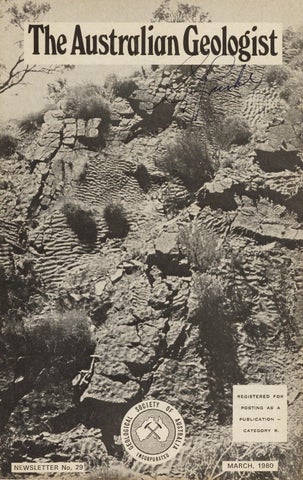
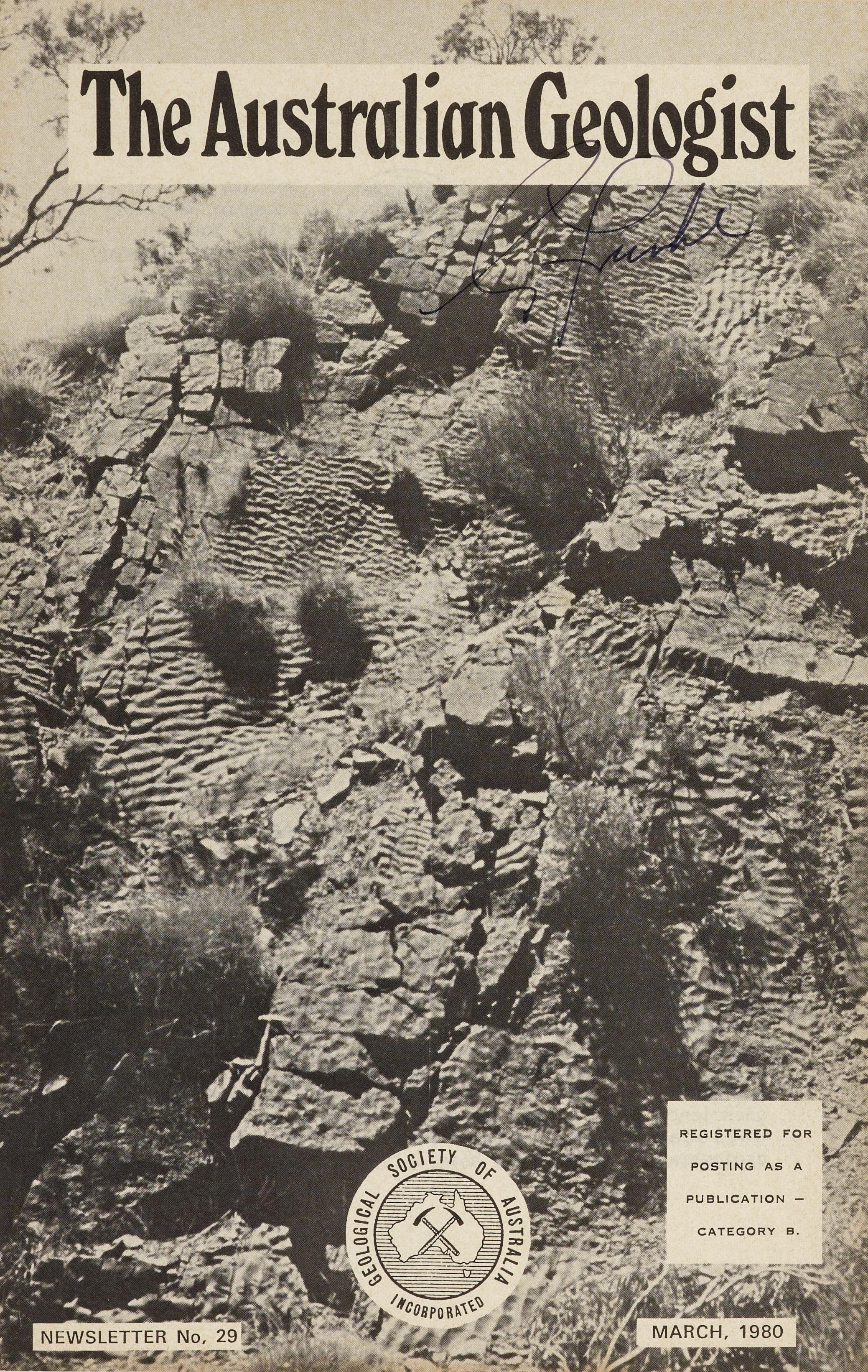
Cover Photo: A.B.C. RafBe Quartzite, Wilpena Group (Marinoan age), Flirders Ra[Bes, Sth Australia. Photo: M. J. Freeman (N . T. Ge.o 1. Survey) .
THE
.EARTH
RESOURCES FOUNDATION
announces the short course CQ.b.L EXPLORATION AND ASSESSMENT
May 19-31, 1980
Course fee: Non-members $980: Members $880
Venue: The University of Sydney
This course is designed for graduate geologists interrling to seek a career in the coal industry. Course quota: 20.
Course leaders inclt..rle:
Sedimentology - Dr John Conolly, ERA South Pacific
Coal petrology - Ms Michelle 9nythe, CSIRO
Coal chemistry and testing - Dr ~nis Tompkins, cargo Superinterrlents
Coal field geophysics - Dr David King, Earth Resources Fourrlation
Prospect assessment - Dr John Bryan, McElroy Bryan & Associates
Other topics will inclt..rle comp.iter applications, geotechnical studies, mine planning and statutory and legal requirements.
The final three days of the course will involve an excursion to the Hunter Valley.
Further details: The Secretary, E.R.F., Edgeworth David Building
The University of Sydney
NStl 2006. Ph: (02) 692 2038
MURRAY BASIN HYDRCGEOLCGICAL PROJECT
The first quarterly report on this project, September 1979, has been issued by the Bureau of Mineral Resources, Geology & Geophysics, Record 1979/72. If you wish to receive this and subsequent quarterly rep::>rts, write to:
Assistant Director (Geology) Bureau of Mineral Resources
P.O. Box 378, CANBERRA CITY A.C.T.2601
Sir,
I would like to suggest that under the heading of "Functions" of the incipient A.P.G. two aspects be more specifically stated.
1. Tue A.P.G. 's involvement in the area of education. In particular I consider the A.P.G. should function in the same way as the Institution of Engineers in determining the length and structure of geol~y courses at tertiary level and act in an advisory ca:p,acity in terms of the developnent of under-gra:iuate an::1 post-gra:iuate studies in geol~y on a national basis. In ot h er words it should set the qualification standards required for professional geol~ists and spell these out clearly and precisely to the adninistrators of our tertiary institutions.
2. Tue A.P.G. should protect the professional status of geologists in the industry and strive for greater promotional opportunities for geologists in an industry dominated by engineers. It should prevent the ad hoe retrenchments of geologists at the whims of company administrators. It should set up schemes or devise mechanisms whereby severe and extensive unemployment of geologists does not occur (again). There is no doubt a large n umber of unemployed geologists in the community lowers the status and image of geol~ists in the eyes of the layman and more :p,articularly in the eyes of students seeki119 stable and secure careers.
To conclude on a lighter note I wondered for a short moment when I read the point about choosi119 a name for the association why the title Association of Professional Earth Scientists was not considered until I realized the acronym for this was APES! On second thoughts perhaps this is appropriate from the point of view of our palaeontol~ ical colleagues who by and large support the Darwinian view as to the origin of man.
Deric David son W.A. School of Mines
Sir,
The Professional an:::1 Legislation Corrmittee is wastinJ its time: I do not intend to P3Y to establish my reputation! A professional reputation is not established by a fee, _nor is it established by membership of some organisation, it is determined by the attitude of one's peers. I know of geologists who have international reputations of the highest quality, but are not members of any Australian professional geological group ( or any overseas one, to my knowledge) . I also object to the qualifications for membership: there are a number of geologists, again includinJ sane of high repute, who do not have tertiary qualifications. These people will continue to contribute, and act as consultants, because their reputations have been established in the only manner J?)Ssible: viz. by actively producing w:::irk of high quality, as recognized by their associates and the people for whan they have worked. The r:eople that are aware of a r:erson' s value to the community are those with whom he works, not some distant comnittee. The informal referee system deals quite adequately with the field that APG interns to cover.
I therefore inform APG that if its efforts should be successful (an:::1 I don't think they will), I certainly won't be a member!
Roger Callen Eastwood, S.A.
Francly speaking
The notice advertising the position of Director of the Division of Earth Sciences (UNESCO) reached us too late to be of any use to J?)tential applicants - sorry at.out that.
We couldn't advertise Robert Woodtli's seminar on 'Mineral Prospection' at the Ecole des Mines in Paris for the same reason, for v.hich further apologies are in order.
Those Francophiles feelinJ frustrated can probably still make it to the historic 25th I.G.C. ho'M=ver. Mrs Ann Bateson of Mary Rossi Tours, 90 Pitt Street, Sydney is still happy to receive applications from those v.ho can find the francs or v.ho have not been too foolish with futures of the gold variety.
E.G.G'S CURSION
The comnittee of the recently formed Engineering Geolcqy Specialist Group conducted a field trip to the Gosford district of New South Wales over the weekend 17th-18th November 1979.
Twenty-five p:iying participants along with various family members assembled at Peats Ridge and travelled in convoy to visit Mangrove Creek Damsite (80m high, rock-fill); Gosford-Terrigal sewerage tunnels and ocean outfall site; progress on the Kangy Angy and Mardi road cuttings on the Ne\1/Castle Expressway; and the various major construction activities for cooling water canals and tunnels etc. for Eraring Power Station.
The weather was fine, the guides were in fine voice, the 15 or so vehicles made the various inter-site journies safely and those that partook of the Chinese Banquet in Gosford on the Saturday night enjoyed an evening's eating and talking. The trip ended at a relaxing barbecue at Rathrnines on the shores of Lake Macquarie with people remarking on how they hadn't realized so much large scale construction activity ( some $1000 mill ion v-.Drth) was going on so close to Sydney.
14th NE1'1JCASTLE SYIV1FOSILJ!Vl
The fourteenth Newcastle Symposium on the geology of the Sydney Basin and surrounding reg ion, sponsored by the Geology Department, University of Ne\1/Castle, will be held on May 2-4, 1980. Papers will still be considered - please contact the Convener irrrnediately.
Registration forms and P3rticulars from:
Dr P. K. Seccombe, Convener, 14th Ne\1/Castle Symposium, Deparbnent of Geolcqy,
The University of Ne\1/Castle, NS~ 7.308
Telephone: (049) '.185 230 or G85 229. 23
Second International
ARCHAEAN SYMroSIUM and Excursions
University of Western Australia, Perth 12 - 16 May 1980
70 pa~rs - over 30 authors from overseas
Excursions to Pilbara, Northeast, East and Southwest Yilgarn Block.
ENROL NCM! Dr. J. Hallberg ((092) 387 4233)
Secretary, Archaean Symp::,sit.nn
CSIRO Private Bag
WEMBLEY Western Australia 6014
If you are working or interestErl in Archaean geology either economically or acadenically you cannot afford to miss this Symp::,si un.
If 1980 doesn't suit, try '81. Scholarships are offered by the French Governnent for scientists arrl others to work in France for 3 to 6 months. A monthly allowance and the fare home is paid plus a few other ~rks. Applicants must have reached the sage age of 25, have some knowlErlge of French and some idea of why they want to go. For 1981 applications close 2 June 1980 with the Secretary (French Govt Scientific & Professional Scholarships), Dept of F.ducation, P.O. Box 826, Woden, ACT 2606.
SITUATION VAC'f!>.NT
We require an ex~riencErl geologist to carry out ad hoe consultations and field ¼Drk on a retainer basis
Please apply with details of age, qualifications, etc. to:-
'Ihe Manager,
International Minit"B Corporation N.L. P. o. Box Q62, Queen Victoria Bldgs., New South Wales, 2000. 24