Acting Editor:
Dr. E. A. K. Middlemost, Dept. Geology & Geophysics, The University of Sydney, N.S.W. 2006.
Phone: Sydney 692-2067.
Society Office:
Business Manager, Miss L. C. Tuckwell, Suite 9, 6th Floor, Perpetual Trustee Building, 39 Hunter Street, Sydney. N.S.W. 2000.
Phone: Sydney 231 4969.
THE PRESIDENT'S PAGE
CONSTITUTIONS are formal documents amended from time to time by due process to bind members and officers alike. Conventions take root without formal resolution and become the working mode. A good constitution with poor conventions and officious officers yields discord and chaos. A poor constitution operated by wise offic-ers and sound conventions yields harmony and order.
This Society has managed to forge a good constitution with wide flexibility leaving much latitude for the discretion of Council, as befits the broad distribution and communication problems of our membership.
Some members have questioned the present convention whereby the committee of the Division next but one to be the Executive Division nominates the future president who then serves as Junior Vice-President, then as President and subsequently as Senior Vice-President. They would prefer the election of the President by a poll of all members not long before he is to take office, to add honour and lustre to the high office.
There is nothing in the constitution to prevent this (except that at present the Council not the total membership elects the President). In practice it is really essential that the President, the Secretary, and Treasurer reside in the city of the Executive Division, and the Executive Division needs a year of notice to come to Council with an effective panel of proposed officers. It would certainly be good if the Editor were also from the Executive Division, but this is not practicable because the Editor, by good convention, normally holds office for a longer period than the other officers. However I think the Editor should be able to attend most Executive meetings. I propose to recommend this to my successors in office.
The present convention has worked well. There is justice in the suggestion that the President and the Executive Division should come more frequently from those Divisions with a large proportion of members. There is nothing to inhibit this. Victoria or New South Wales could be the Executive Division twice or thrice for every turn for Tasmania. To achieve this needs no more than a resolution of Council in designating the Executive Division. However this should still be done a couple of years ahead. The executive city could rotate between say Sydney, Newcastle, and Armidale.
Another way to achieve better balance of this kind would be for a new division to be formed for Northern New South Wales based on Newcastle, and perhaps a good deal later a further budding to form a New England Division based on Armidale. The constitution already provides for such developments, as andwhenthey appear appropriate. Perhaps the time is ripe for one such step.
think it would be useful for each division and each specialist group to look introspectively so that a particular specialist group might home itself with a particular division where i.ts special interest is inherently strong.
S. Warren Carey
NEWSLETTER No. 17. March, 19 78.
EDITORIAL
In the foreword to the first issue o f the Australian Geologist Prof. Dorothy Hill sta ted that "anyth ing that interests you is sure to interest others; let u s have your new s and view s as quickly and as succ in ct ly as you can". This proposition is as true today as it was in January 1974, so please write and let us know what is happening, or what is about to happen, in your particular "geological environment" If you suffer from writer's cramp, o r any s imilar incapacitating affliction, send a photograph that you consider suitable for use on our covers.
Remember 1st April 1978 i s the closing da te for th e return of the questionnaires con tained in the first circular of the 26t h International Geological Congress in Pari s. (Secr~tariat G~n~ral du 26e Congr~s G~ologique International, Mai son de la G~ologie 77-79, rue Cl aude-Bernard, F 75005 Paris, France).
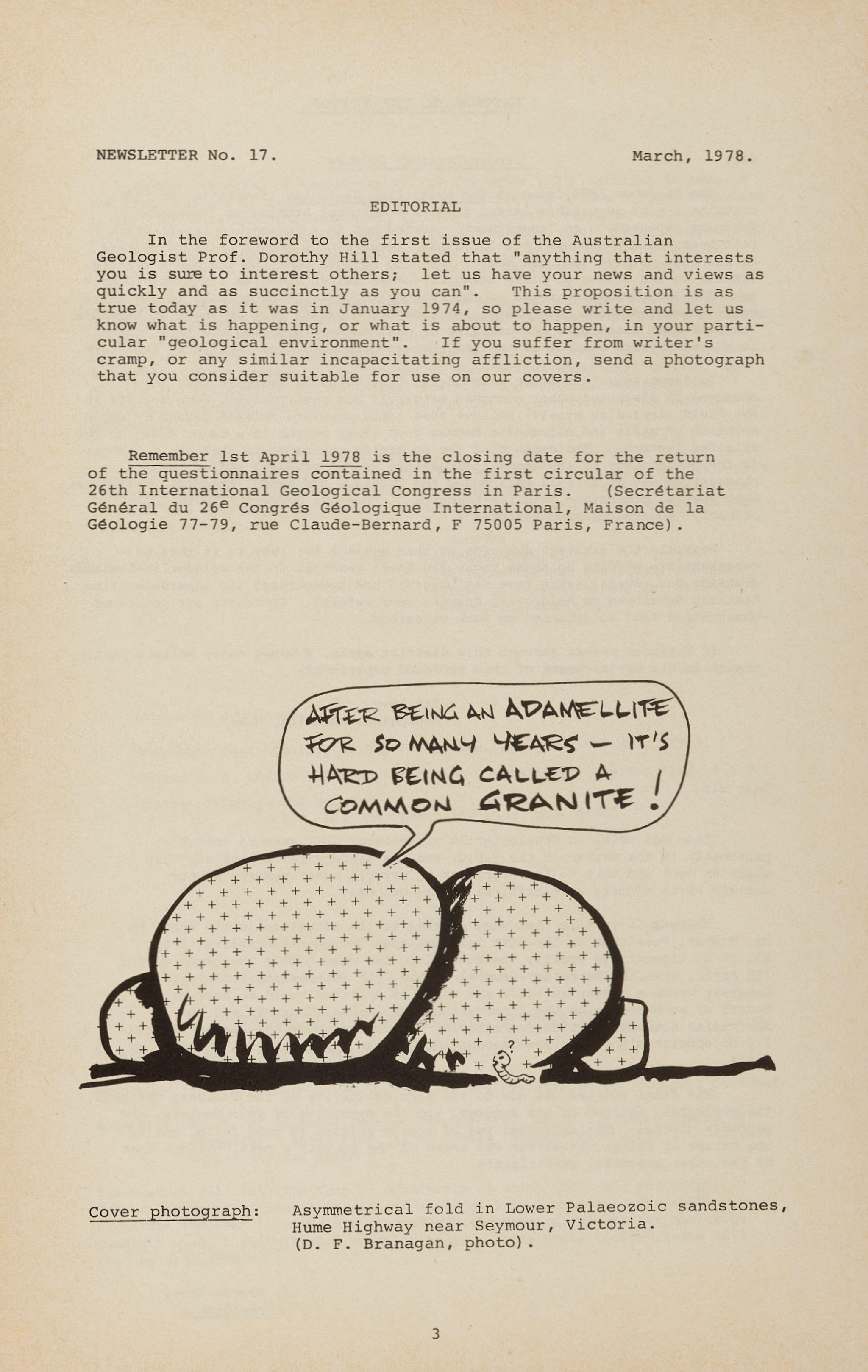
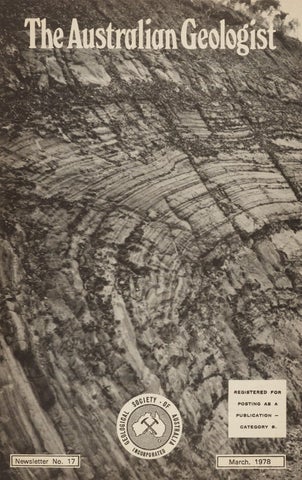
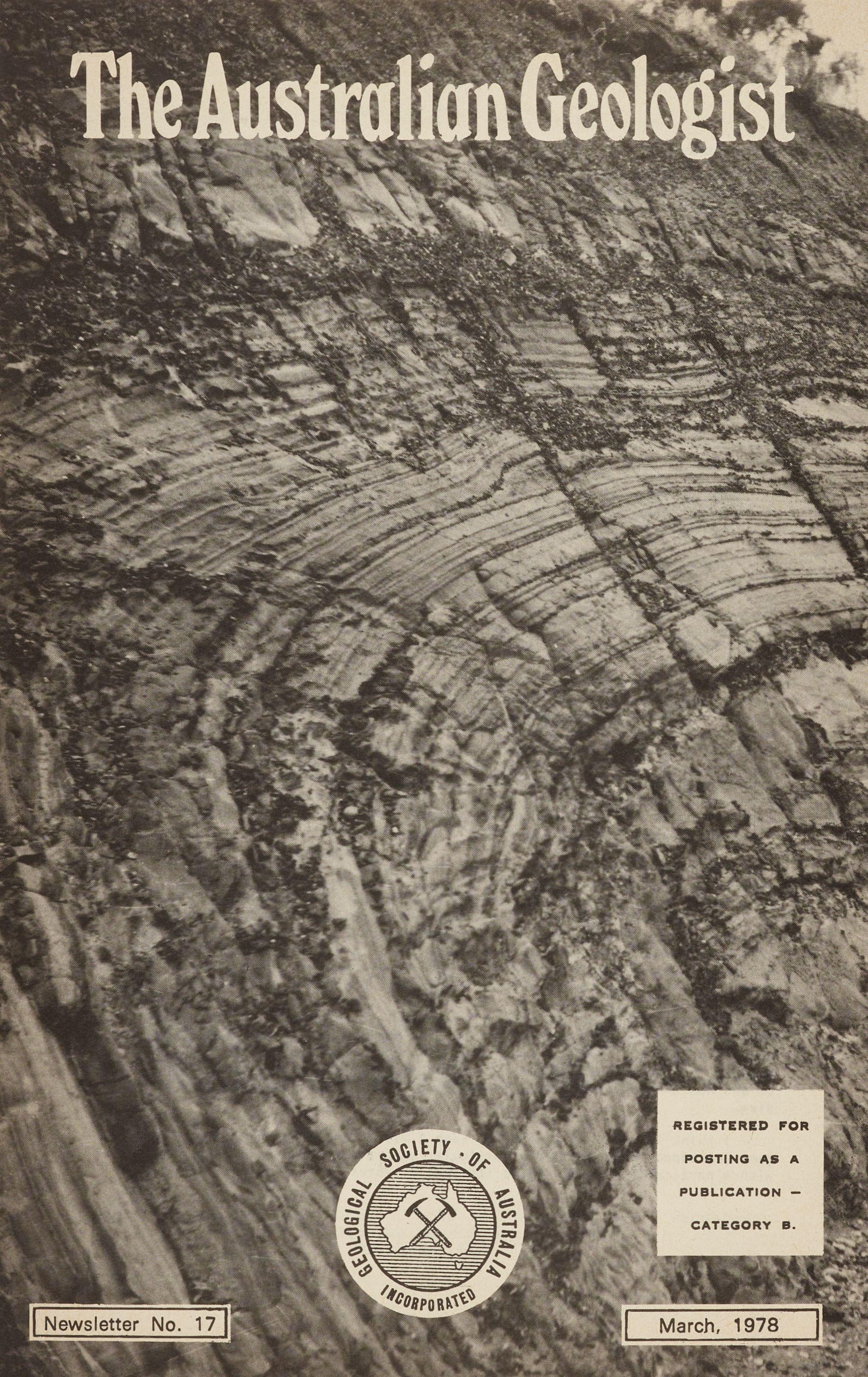
Co ver pho tograph: Asymmetrical fold in Lower Palaeozoic sandstones, Hume Highway near Seymour, Victoria. (D. F. Branagan, photo).
Sir,
LETTERS TO THE EDITOR.
'Supersaturated' Coldies?
The December 1977 issue of The Australian Geologist (Newsletter No. 16) contains a most remarkable letter from an individual signing as 'Tosspots'. Tosspots reported on an 'experiment' carried out in a Kalgoorlie tavern where cold beer rapidly produced ice 'crystals' because of a sudden pressure-release as the beer erupted from the keg. He also noticed that the ice had a texture similar to the bladed or platy textures (often called spinifex textures) found in mafic and ultramafic rocks in the Kalgoorlie district especially in the ultramafic sequences which host nickel sulphide ore deposits such as those at Kambalda. Tosspots then questioned the validity of most authors applying the term 'quench' to these textures because of -the temperature-drop mechanism implied by that term.
In answering, it ·must be pointed out that spinifex textures have been observed in slags · and other quenched materials but nevertheless, some workers in the -field (including myself) believe that rapid pressure release caused by rapid eruption of mafic and ultramafic magmas from great depths is a major cause of the spinifex _ texture. The essence of the mechanism envisaged is that rapid changes in the environment of the magma (temperature -and/or pressure and/or chemical changes) causes it to fall well ~elow the liquidus and rapid, skeletal crystallization ensues, generating spinifex textures, Thus the correct term to apply is probably "supersaturation textures"?
Possibly the greatest question on this subject is: why is it that we geoscientists working on these rocks and their textures in the Kalgoorlie-Kambalda district for several years have not observed and appreciated the supersaturation textures developed on Kalgoorlie draught beer before? Obviously our powers of observation tend to diminish on such occasions.
If Tosspots passes through this district again, I would enjoy being a participant in his re-enactment of this profound experiment.
Ian Levy, Geologist, Kambalda, W.A.
Dear Sir,
Your editorial in Newsletter 16 of December 1977 gav e me credit personally in the matter of the I. G. C. and the Academy far beyond any that might be due, and this to the detriment of several other members of our Society whose efforts were critical to the outcome.
Whereas it is true that when alerted to the situati on in mid April by Dr. Fisher, President of the 25th International Geological Congress, I did all in my capacity to rectify the situation, the real battle was begun on the 7th April, when the Secretary-General of the 25th Internati onal Ge ol og ical Congress wrote a letter as stiff and blunt as a letter could be between two bodies of such status as the International Geological Congress and the Australian Academy of Science, following the rejection by the Academy of the I.G.C. committee's formal recommendations for the application of the surplus funds.
The final outcome was due to the firm solidarity of the Congress officers, the geological fellows of the Academy, and the executive of your Society, and probably others. The editorial was of course written in good faith, but by the nature of things the editor was aware of the Society's part, but not that of the other essential participants.
s. Warren Carey President
Sir:
In the editorial of Newsletter No, Hi (December 1977) , mention is made of the final outcome of negotiations regarc;ling the funding of the balance remaining in the 25th International Geological Congress account. This report does not accurately represent the events which make up the story and, whilst I agree that "the full story cannot be told here" - indeed it is known to only a very few people -a little more of it needs to be told to straighten the record.
The foundation for the fund which is now being established was laid by the Organizing Committee of 25IGC. When its original recommendations were rejected by the Council of the Academy of Science, it was the united stand taken by the Organizing Committee in support of its Chairman which ensured Council's reconsideration of the proposals, and it was he who rallied additional forces, comprising the Officers of the Geological Society, the National Committee for Geological Sciences, and earth scientist Fellows of the Academy, to back the proposals.
It is in this context that the Geological Society's President played his important role in supporting the Organizing Committee's proposals, and in working towards a compromise with the Council of the Academy. It was by no means the least of his many major contributions to geological interests in Australia and throughout the world.
A. Renwick
Secretary-General
25th International Geological Congress (Bureau of Mineral Resources, Geology & Geophysics, Canberra)
WANTED TO PURCHASE:
Reference Text 'Geology of Australian Ore Deposits', Volume 1, 1953.
Edited A. B. Edwards (5th Empire Mining & Metallurgy Congress Aust. & N.Z.)
Please contact: Tim Hopwood, P.O. Box 158, North Adelaide, S.A. 5006.
AUSTRALIAN GEOMECHANICS SOCIETY: VICTORIA GROUP
1'A REVIEW OF LABORATORY STRENGTH TESTING OF SOILS"
Wednesday, April 12, 1978, 2.00- 6.00 p.m., Clunies Ross House; Cost $5 per head.
Speakers: Dr. I. W. Johnston (Monash University), Mr. M. C. Ervin (Coffey & Partners), Assoc.Prof. I. B. Donald (Monash University)", Dr. J. R. Morgan (Golder Assoc.)
The meeting will take the form of a workshop in which the basic philosophies behind laboratory strength testing of soils will be examined. The meeting will highlight the need for, the use of, and the shortcomings of the various tests commonly used in geotechnical practice today. More sophisticated tests will also be discussed.
SEVENTH BMR SYMPOSIUM
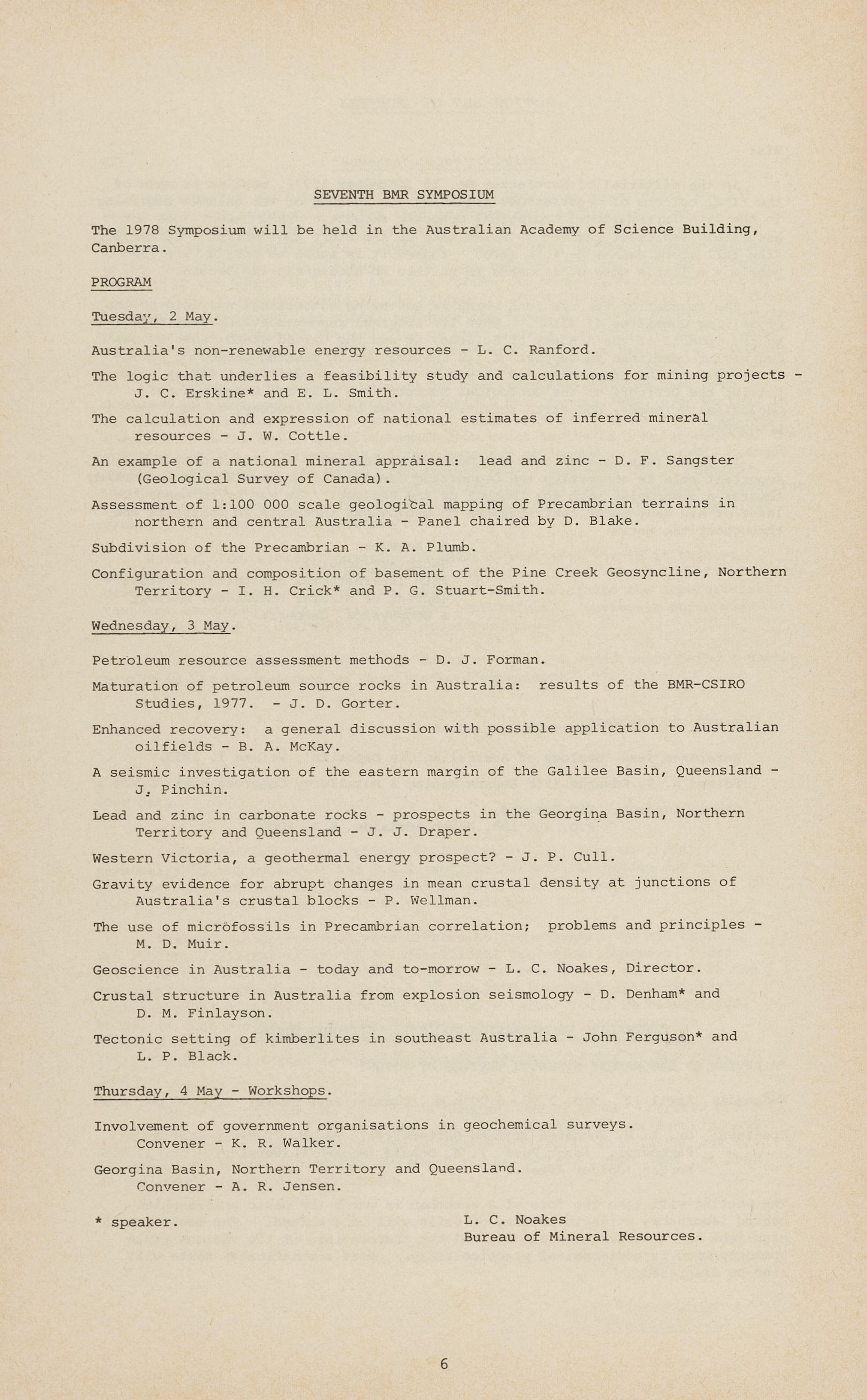
The 1978 Symposium will be held in the Australian Academy of Science Building, Canberra.
PROGRAM
Tuesda;•, 2 May.
Australia's non-renewable energy resources - L. C. Ranford.
The logic that underlies a feasibility study and calculations for mining projectsJ.C. Erskine* and E. L Smith.
The calculation and expression of national estimates of inferred mineral resources - J. W Cottle.
An example of a national mineral appraisal: lead and zinc - D. F Sangster (Geological Survey of Canada).
Assessment of 1 : 100 000 scale geological mapping of Precarnbrian terrains in northern and central Australia - Panel chaired by D Blake.
Subdivision of the Precarnbrian - K. A Plumb.
Configuration and composition of basement of the Pine Creek Geosyncline , Northern Territory - I. H. Crick* and P. G. Stuart-Smith.
Wednesday, 3 May.
Petroleum resource assessment methods - D. J. Forman.
Maturation of petroleum source rocks in Australia: results of the BMR- CSIRO Studies, 1977. - J. D. Gorter.
Enhanced recovery: a general discussion with possible application to Australian oilfields - B. A. McKay.
A seismic investigation of the eastern margin of the Galilee Basin, Queens l andJ, Pinchin.
Lead and zinc in carbonate rocks - prospects in the Georgina Basin , Northern Territory and Queensland - J. J. Draper.
Western Victoria, a geothermal energy prospect? - J P. Cull
Gravity evidence for abr upt changes in mean crustal density at junctions of Australia ' s crustal blocks - P. Wellman.
The use of microfossils in Precarnbrian correlation; problems and principlesM. D. Muir
Geoscience in Australia - today and to-morrow - L C Noakes, Director
Crus tal structure in Australia from explosion seismology - D. Denham* and D. M. Finlayson.
Tectonic setting of kirnberlites in southeast Australia - John Ferguson* and L. P Black.
Thursday, 4 May - Workshops.
Involvement of government organisations in geochemical surveys. Convener - K. R. Walker.
Georgina Basin, Northern Territory and Queensland. Convener - A. R. Jensen.
* speaker. L. C. Noakes Bureau of Mineral Resources.
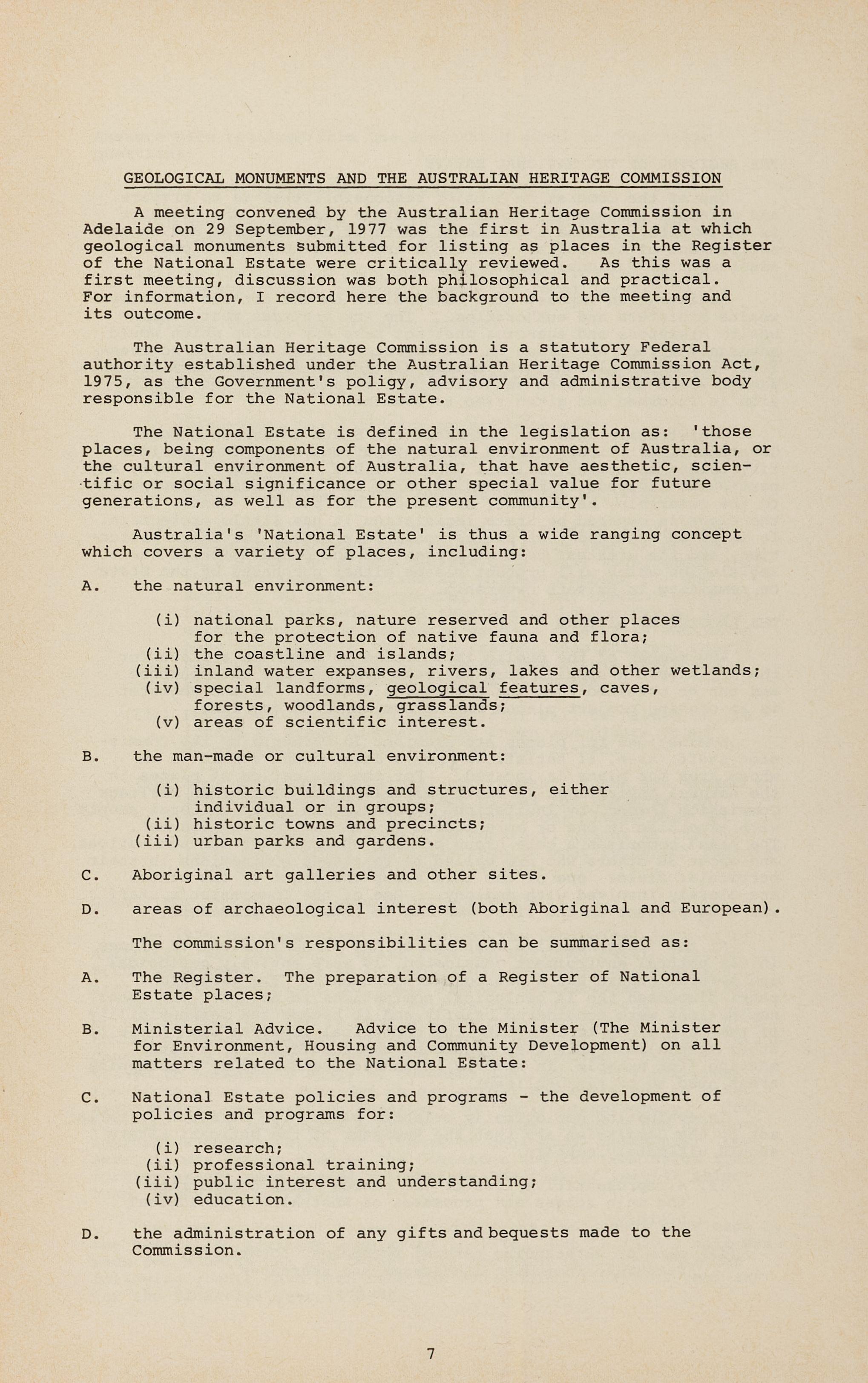
GEOLOGICAL MONUMENTS AND THE AUSTRALIAN HERITAGE COMMISSION
A meeting convened by the Australian Heritage Commission in Adelaide on 29 September, 1977 was the first in Australia at which geological monuments submitted for listing as places in the Register of the National Estate were critically reviewed. As this was a first meeting, discussion was both philosophical and practical. For information, I record here the background to the meeting and its outcome.
The Australian Heritage Commission is a statutory Federal authority established under the Australian Heritage Commission Act, 1975, as the Government's poligy, advisory and administrative body responsible for the National Estate.
The National Estate is defined in the legislation as: 'those places, being components of the natural environment of Australia, or the cultural environment of Australia, that have aesthetic, scientific or social significance or other special value for future generations, as well as for the present community'.
Australia's 'National Estate' is thus a wide ranging concept which covers a variety of places, including:
A. the natural environment:
(i) national parks, nature reserved and other places for the protection of native fauna and flora; (ii) the coastline and islands; (iii) inland water expanses, rivers, lakes and other wetlands; (iv) special landforms, geological features, caves, forests, woodlands, grasslands; (v) areas of scientific interest.
B. the man-made or cultural environment:
(i) historic buildings and structures, either individual or in groups; (ii) historic towns and precincts; (iii) urban parks and gardens.
C. Aboriginal art galleries and other sites.
D. areas of archaeological interest (both Aboriginal and European).
The commission's responsibilities can be summarised as:
A. The Register. The preparation of a Register of National Estate places;
B. Ministerial Advice. Advice to the Minister (The Minister for Environment, Housing and Community Development) on all matters related to the National Estate:
C. National Estate policies and programs - the development of policies and programs for:
(i) research; (ii) professional training; (iii) public interest and understanding; (iv) education.
D. the administration of any gifts and bequests made to the Commission.
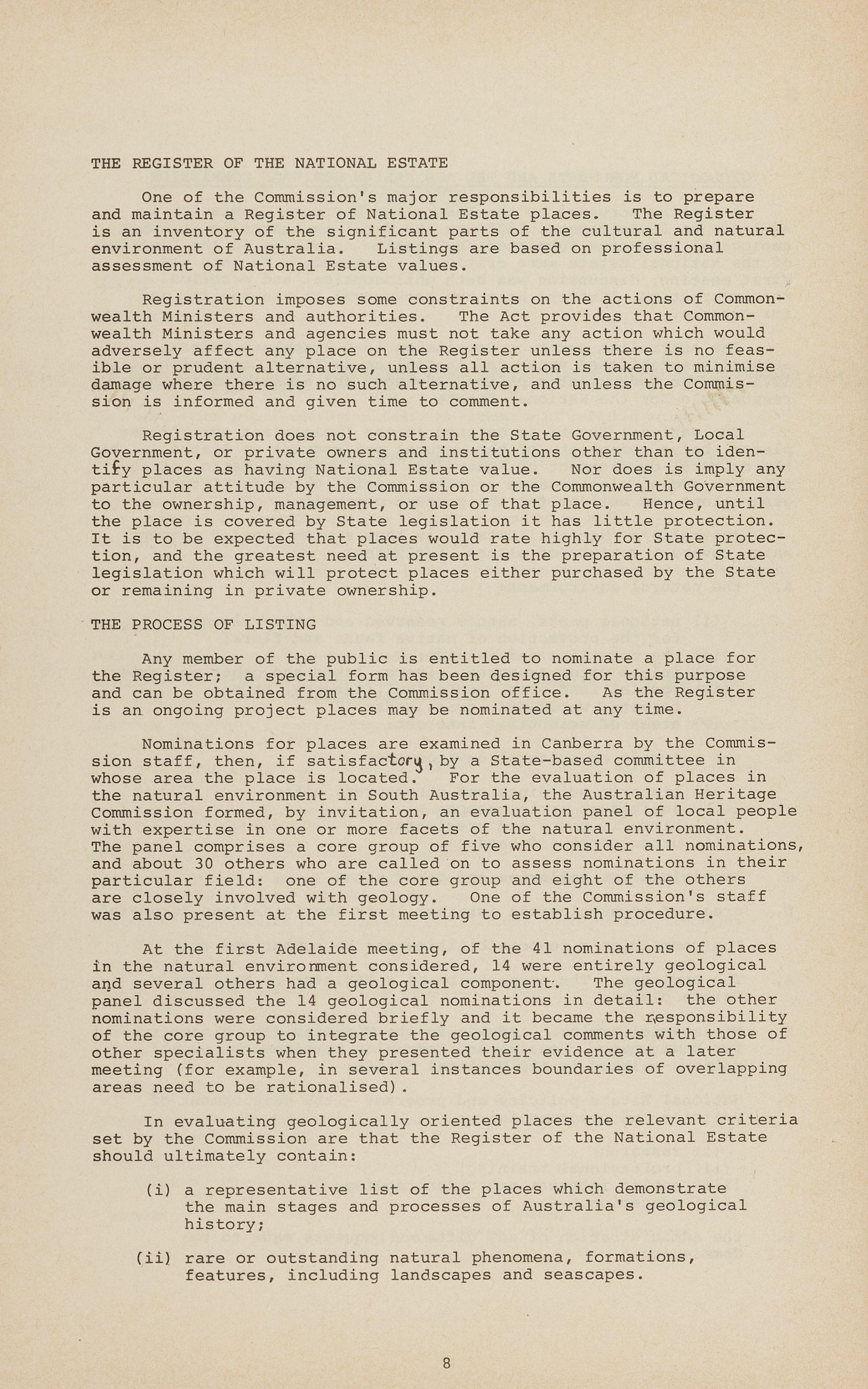
THE REGISTER OF THE NATIONAL ESTATE
One of the Commission's major responsibilities is to prepare and maintain a Register of National Estate pla ces. The Register is an inventory of the significant parts of the cultural and natural environment of Australia. Listings are based on professional assessment of National Estate values.
Registration imposes some constraints on the actions of Commonwealth Ministers and authorities. The Act provides that Commonwealth Ministers and agencies must not take any action which would adversely affect any place on the Register unless there is no feasible or prudent alternative, unless all action is taken to minimise damage where there is no such alternative, and unless the Commission is informed and given time to comment.
Registration does not constrain the State Government, Local Government, or private owners and institutions other than to identify places as having National Estate value. Nor does is imply any particular attitude by the Commission or the Commonwealth Government to the ownership, management, or use of that place. Hence, until the place is covered by State legislation it has little protection. It is to be expected that places would rate highly for State protection, and the greatest need at present is the preparation of State legislation which will protect places either purchased by the State or remaining in private ownership.
THE PROCESS OF LISTING
Any member of the public is entitled to nominate a place for the Register; a special form has been designed for this purpose and can be obtained from the Commission office. As the Register is an ongoing project places may be nominated at any time.
Nominations for places are examined in Canberra by the Commission staff, then, if satisfactor~ 1 by a State-based committee in whose area the place is located. For the evaluation of places in the natural environment in South Australia, the Australian Heritage Commission formed, by invitation, an evaluation panel of local people with expertise in one or more facets of the natural environment. The panel comprises a core group of five who consider all nominations, and about 30 others who are called on to assess nominations in their particular field: one of the core group and eight of the others are closely involved with geology. One of the Commission's staff was also present at the first meeting to establish procedure.
At the first Adelaide meeting, of the 41 nominations of places in the natural envirornnent considered, 14 were entirely geological aDd several others had a geological component-. The geological panel discussed the 14 geological nominations in detail: the other nominations were considered briefly and it became the ~esponsibility of the core group to integrate the geological comments with those of other specialists when they presented their evidence at a later meeting (for example, in several instances boundaries of overlapping areas need to be rationalised).
In evaluating geologically oriented places the relevant criteria set by the Commission are that the Register of the National Estate should ultimately contain:
(i) a representative list of the places which demonstrate the main stages and processes of Australia's geological history;
(ii} rare or outstanding natural phenomena, formations, features, including landscapes and seascapes.
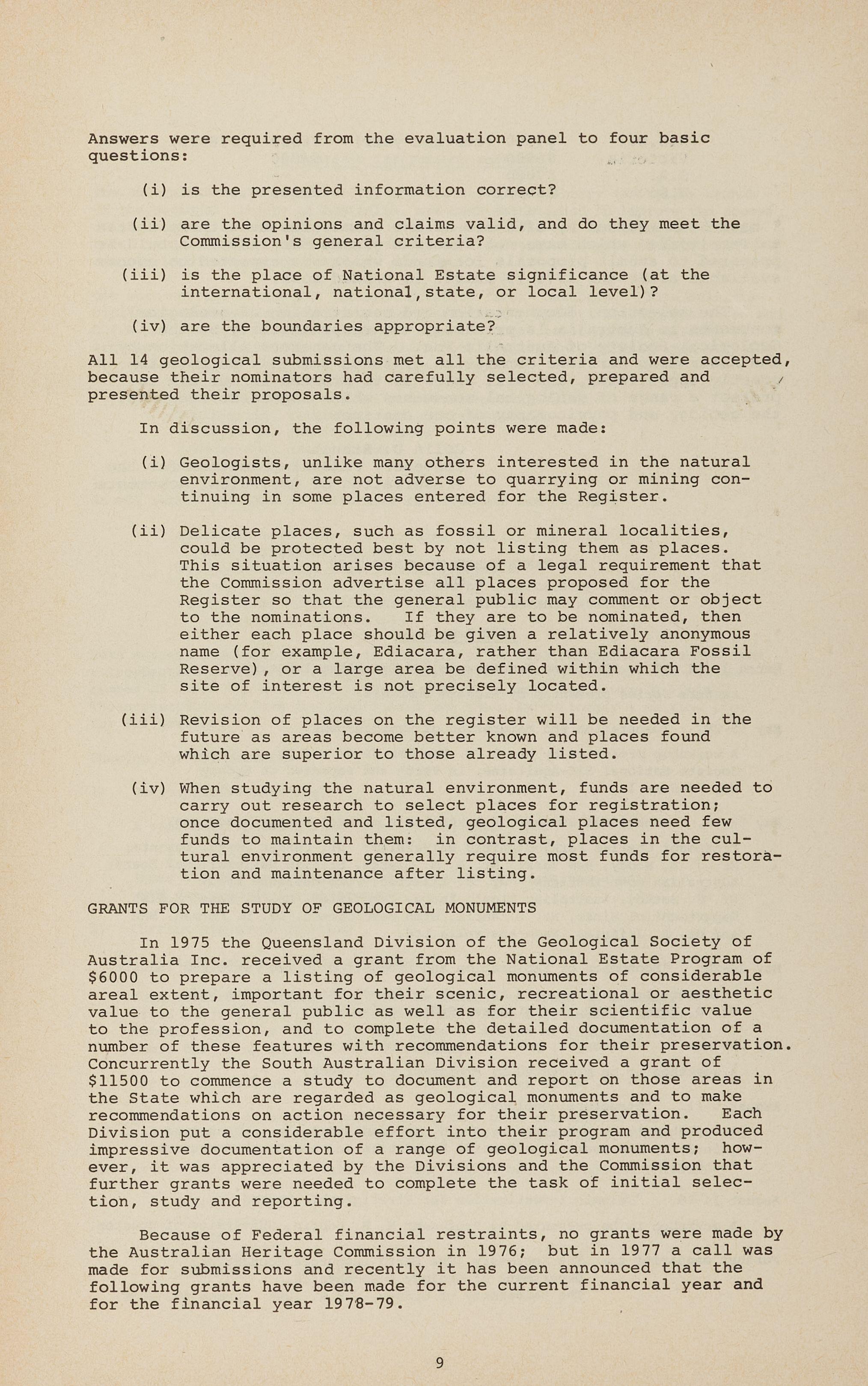
Answers were required from the evaluation panel to four basic questions:
(i) is the presented information correct?
(ii) are the opinions and claims valid, and do they meet the Commission's general criteria?
(iii) is the place of National Estate significance (at the international, national,state, or local level)?
(iv) are the boundaries appropriate?
All 14 geological submissions met all the criteria and were accepted, because their nominators had carefully selected, prepared and presented their proposals.
In discussion, the following points were made:
(i) Geologists, unlike many others interested in the natural environment, are not adverse to quarrying or mining continuing in some places entered for the Register.
(ii) Delicate places, such as fossil or mineral localities, could be protected best by not listing them as places. This situation arises because of a legal requirement that the Commission advertise all places proposed for the Register so that the general public may comment or object to the nominations. If they are to be nominated, then either each place should be given a relatively anonymous name (for example, Ediacara, rather than Ediacara Fossil Reserve), or a large area be defined within which the site of interest is not precisely located.
(iii) Revision of places on the register will be needed in the future as areas become better known and places found which are superior to those already listed.
(iv) When studying the natural environment, funds are needed to carry out research to select places for registration; once documented and listed, geological places need few funds to maintain them: in contrast, places in the cultural environment generally require most funds for restoration and maintenance after listing.
GRANTS FOR THE STUDY OF GEOLOGICAL MONUMENTS
In 1975 the Queensland Division of the Geological Society of Australia Inc. received a grant from the National Estate Program of $6000 to prepare a listing of geological monuments of considerable areal extent, important for their scenic, recreational or aesthetic value to the general public as well as for their scientific value to the profession, and to complete the detailed documentation of a number of these features with recommendations for their preservation. Concurrently the South Australian Division received a grant of $11500 to commence a study to document and report on those areas in the State which are regarded as geological monuments and to make recommendations on action necessary for their preservation. Each Division put a considerable effort into their program and produced impressive documentation of a range of geological monuments; however, it was appreciated by the Divisions and the Commission that further grants were needed to complete the task of initial selection, study and reporting.
Because of Federal financial restraints, no grants were made by the Australian Heritage Commission in 1976; but in 1977 a call was made for submissions and recently it has been announced that the following grants have been made for the current financial year and for the financial year 197 8-79.
N.s.w. Victoria
S.A.
W.A.
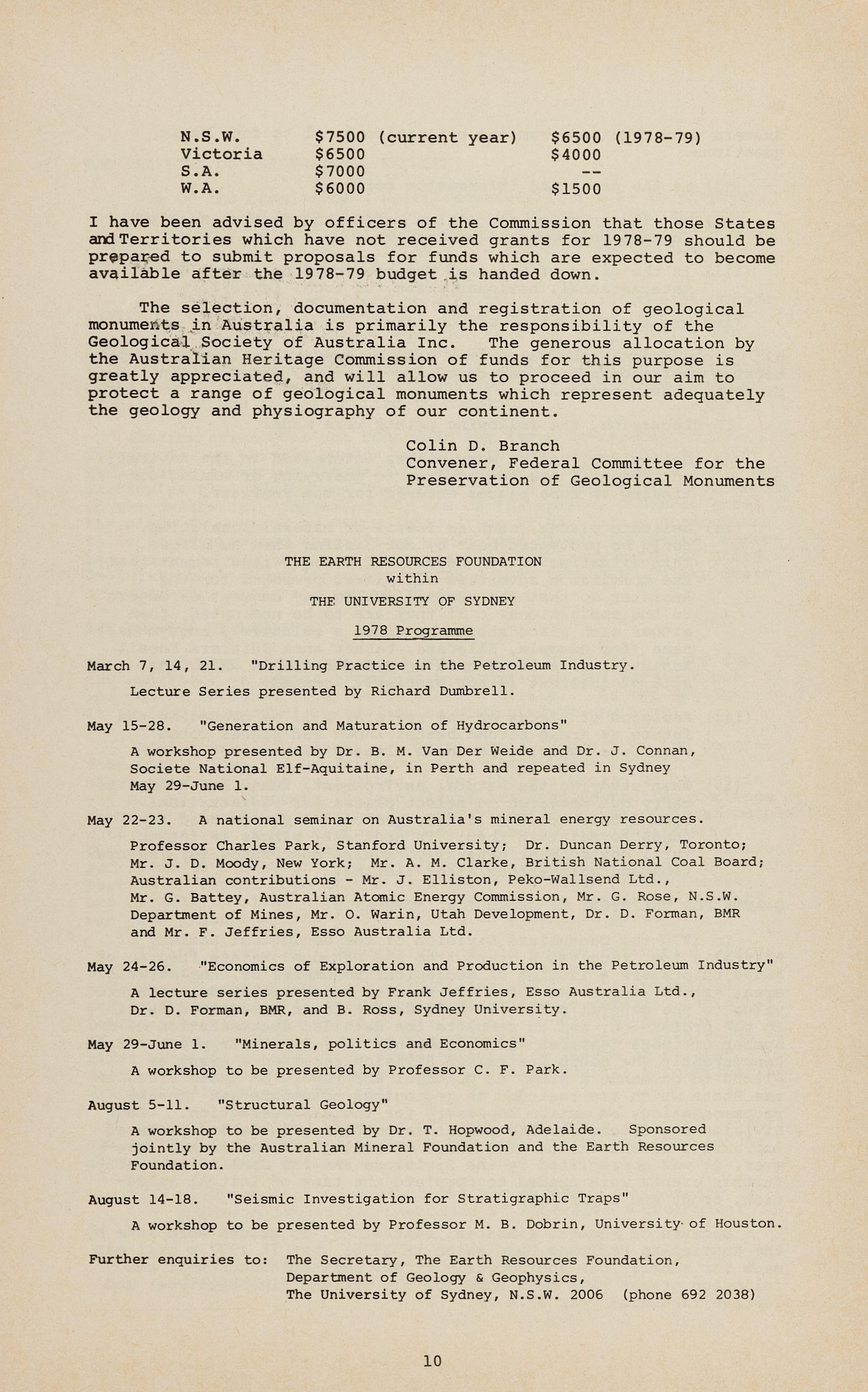
$7500 (current year)
$6500
$7000
$6000
$6500 (1978-79)
$4000
$1500
I have been advised by officers of the Commission that those States am.Territories which have not received grants for 1978-79 should be pr~pa~~d to submit proposals for funds which are expected to become available after the 1978-79 budget is handed down.
The selection, documentation and registration of geological monume n~s j.n Australia is primarily the responsibility of the Geologica,l , Society of Australia Inc. The generous allocation by the Australian Heritage Commission of funds for this purpose is greatly appreciated, and will allow us to proceed in our aim to protect a range of geological monuments which represent adequately the geology and physiography of our continent.
Colin D. Branch Convener, Federal Committee for the Preservation of Geological Monuments
THE EARTH RESOURCES FOUNDATION within THE UNIVERSITY OF SYDNEY 1978 Programme
March 7, 14, 21. "Drilling Practice in the Petroleum Industry. Lecture Series presented by Richard Dumbrell.
May 15-28. "Generation and Maturation of Hydrocarbons"
A workshop presented by Dr. B. M. Van Der Weide and Dr. J. Con nan, Societe National Elf-Aquitaine, in Perth and repeated in Sydney May 29-June 1.
May 22-23. A national seminar on Australia's mineral energy resources.
Professor Charles Park, Stanford University; Dr. Duncan Derry, Toronto; Mr. J. D. Moody, New York; Mr. A. M. Clarke, British Nationa l Coal Board; Australian contributions - Mr. J. Elliston, Peko-Wallsend Ltd., Mr. G. Battey, Australian Atomic Energy Commission, Mr. G. Rose, N.S.W. Department of Mines, Mr. O. Warin, Utah Development, Dr. D. Forman, BMR and Mr. F. Jeffries, Esso Australia Ltd.
May 24-26. •"Economics of Exploration and Production in the Petroleum Industry"
A lecture series presented by Frank Jeffries, Esso Australia Ltd., Dr. D. Forman, BMR, and B. Ross, Sydney University.
May 29-June 1. "Minerals, politics and Economics"
A workshop to be presented by Professor C. F. Park.
August 5-11. "Structural Geology"
A workshop to be presented by Dr. T. Hopwood, Adelaide. Sponsored jointly by the Australian Mineral Foundation and the Earth Resources Foundation.
August 14-18. "Seismic Investigation for Stratigraphic Traps"
A workshop to be presented by Professor M. B. Dobrin, University· of Houston.
Further enquiries to: The Secretary, The Earth Resources Foundation, Department of Geology & Geophysics, The University of Sydney, N.S.W. 2006 (phone 692 2038)
Scientific information services
The Australian National Scientific and Technological Library (ANSTEL) a branch of the National Library of Australia, has been established to improve the access of the Australian community to the world's scientific and technological literature. To this end, ANSTEL has developed a wide range of services based on computerized information retrieval systems.
One such service is the SCI (Science Citation Index) database. This multidisciplinary database is produced by the Institute for Scientific Information in the U.S.A. in the form of weekly magnetic tapes. These tapes contain details of articles from nearly 4000 of the world's most significant journals from over 100 disciplines in the following broad subject areas:
Agricultural, biological and environmental sciences
Engineering, technology and applied sciences
Physical and chemical sciences
Medical and life sciences
Behavioural sciences
An SCI search tailored to individual requirements can retrieve: all works with titles containing specific key words or combinations of key words all papers citing a particular reference all papers citing works published by a particular author all works by scientists or technologists associated with a particular organization
Both current awareness searches in the form of 52 bibliographies per annum, and retrospective literature searches are available. Until recently the maximum number of users who could subscribe to the SCI service was severely limited. These restrictions have now been lifted and there is no longer a waiting list for SCI services.
Charges for SCI services:
1) Retrospective searches
A search of the data base from 1974 to date - $50 May 1976 to date $20
(More complex searches may cost more, and are undertaken only with the requester's agreement)
2) Current awareness searches
(A) Information Bulletins (monthly)
This service is designed to provide general coverage of a number of broad subject areas, e.g. Air pollution, Food engineering, Lasers. Subscriptions cost $10 p.a. per title. A list of topics covered by these bulletins is available on request.
(B) Individual profiles (52 bibliographies per annum)
This service provides searches which have been tailored to the individual requirements of the subscribers. Subscriptions cost $75 p.a.
For further information on this and other ANSTEL services please contact:
Chief Librarian
SCI Service
ANSTEL P.O. Box E333 CANBERRA. ACT 2600.
BOOK REVIEW
The Permian and Triassic Systems and Their Mutual Boundary
Edit. A. Logan and L. V. Hills. Can. Soc. Petrol. Geol., Mem. 2, 1973, 766 pp.
Available from: Stacs Data Services Ltd, 801 - 10th Ave S .W., Calgary, Alberta, Canada, T2R OB4.
Price: $23-50 (Canadian), including mailing and handling.
This volume contains 52 papers presented at the International PermianTriassic Conference held during August 1971 at the University of Calgary, Alberta. Contributions cover the fields of stratigraphy, sedimentology, palaeontology, palaeoclimatology, palaeomagnetics, and radiometric chronology. Particular attention is paid to the nature of the erathem boundary. Authors include many international authorities on the Permian and Triassic systems. Compilation of their knowledge on this geologic interval provides -a definitive work which, although published some time ago, remains a major reference.
Contributions are grouped into five sections. The first contains an introductory paper by Newell examining 'the very last moment of the Palaeozoic era', followed by an analysis of Phanerozoic biotic crises by McAlester.
In the second and largest (21 papers) section, entitled biostratigraphic evidence: northern continents, Kumrnel & Teichert report on continued investigations into classic boundary sequences of central Tethys, and Greenland. Sarjeant describes Triassic acritarchs (including 6 new species) and Tasmanitids from Pakistan. Contributions (in English) from Soviet geologists are wellrepresented, comprising one-quarter of all papers in the volume. Especially note-worthy are accounts of the Permian (Stepanov) and Triassic (Kiparisova et al.) systems in the USSR, including correlations with world-wide successions-:-Anew stage, the Dorashamian, succeeding the Dzhulfian and claimed to represent the youngest Permian strata in Transcaucasia, is defined by Rostovtsev & Azaryan. Kanmera & Nakazawa investigate upper Permian and lower Triassic sequences in Japan, China, and South-East Asia. Other papers similarly describe successions in North Africa, Italian Alps, Western Europe, British Isles, Canadian Arctic,• Western USA and Texas.
Part III, biostratigraphic evidence: southern continents, contains 5 papers of interest to Australian geologists. Schopf contrasts Permian and Triassic floras within Gondwanaland, and with those of Northern Hemisphere deposits. Macro- and micro-floral modifications at the Permian-Triassic boundary in Australia are investigated by Balme & Helby. Dickins provides a concise overview of the geological sequence and Permian-Triassic boundary in Australia and New Guinea. Waterhouse examines the systemic boundary in New Zealand and New Caledonia, and related worldwide patterns of diversification and extinction of Permian marine faunas to climatic fluctuations. Further afield, Rocho-Campos proposes a preliminary correlation scheme for the upper Palaeozoic and lower Mesozoic of South America.
Part IV documents palaeontolcigic data. Contributors include Tappan & Loeblich on protistans, Colbert (tetrapods), Schaeffer (fishes), Toriyama (fusuline forams), Wiedmann, Tozer, Kumrnel (ammonoids), Grant & Cooper (brachiopods), Batten (gastropods), Nakazawa & Runnegar (bivalves), Kier (echinoderms), Sweet (conodonts), and Meyen (plants). Furnish discusses current concepts and correlations (based on ammonoid zonation) of Permian stages. Dabis & Ustritsky, and Radczenko et al. examine biological changes within marine and non-marine environments, respectively, during late Permian and early Triassic time. Conclusions reached by many of these researchers as to the nature of the much-quoted biotic crisis at the erathem boundary are contrary to the generalised assertions of McAlester in Part I.
The final section (in the editors' words) 'attempts to synthesise the data and provide answers to the questions, How? and Why?' Included are papers on the Permian-Triassic radiometric time scale (Banks), palaeomagnetism (Nairn & Peterson), and red beds (Waugh). Using integrated palaeontologic and palaeomagnetic zontaions, Forsh et al. correlate red bed sequences of the Russian
Platform. Ustritsky's analysis of Permian climatae from a Northern Hemisphere viewpoint is at variance on several points with that of Waterhouse in Part III. Three papers speculate on the How? and Why? of the postulated biotic crisis; two of these (Olson & Leyden; Valentine & Moores) contemplate possible relationship between plate-tectonics and extinction/origination/diversification phases, while Meyerhoff attributes mass biotal extinctions to eustatic sea-level lowering and climatic perturbation intensified by influence of galactic motions.
My major criticism is that indexes - stratigraphic, locality, palaeontological - which are almost obligatory in such a compilation of wo.rld-wide data were not provided. Minor typographical errors such as mis-spelt words are in evidence in several of the papers. The reference list in the a;ticle by Dagis & Ustritsky is glaringly incomplete. The paper by Balme & Helby appec\_rS to have suffered more than most, a line is missing from p. 437 (first paragraph), and Plate 1 (p. 444) was reversed and figure numbers removed during publication. From top left corner and proceeding clockwise, the correct sequence is 7, 6, 4, 1, 2, 3, 5. For this information I am indebted to Robin Helby.
COBAR REGION GEOLOGICAL EXCURSION
A five day geological excursion, conducted by the Geological Survey of New South Wales, wa-s held in the Cobar region from 28th November to 2nd December, 1977, inclusive. The purpose of the excursion was to introduce the newly published Cobar 1:100,000 geological sheet, and to publicise the adjacent Canbelego and Bobadah 1:100,000 geological sheets, on which field work is complete and which will be published in 1978. An important corollary of the trip was the assessment of reaction to new interpretations of the geology of the area by the major users of Geological Survey mapping, namely mining and exploration companies, tertiary education institutions and government organisations. The sixty geologists taking part in the trip represented 32 user organizations.
The convoy got under way to a "cacophony" of slamming doors and crunching gears as it moved off along the Bourke road to the first · of 49 stops, carefully selected to demonstrate significant features of the regional geology.
The first two days were spent bo~h to the north and south of Cobar, examining rocks of the "Cobar Trough". These rocks are now regarded as a deep-water facies of the newly named Cobar Supergroup. The relationships between this Supergroup and the underlying basement metasediments were also examined. On the Wednesday the excursion moved on to Canbelego and Nymagee to see the shallow volcanosedimentary facies of the Cobar Supergroup.
After a sumptuous dinner of barbecued lamb, pavlova and beer, hand-coloured compilations of the Bobadah, Canbelego, Cobar and contiguous parts of Wrightville, Nymagee and Gindoono 1:100,000 geological sheets were displayed for comment. Discussions raged until midnight, demonstrating the considerable interest in the Survey's mapping programme.
Further aspec~s of Cobar Supergroup geology to the south-east of Nymagee were examined during the next two days. The excursion ended at Mineral Hill, where consultant Ken Glasson proposed a vote of thanks.
Due to the success of the Cobar excursion, it is intended to conduct further field trips to other areas where the Survey's work has contributed substantially to geological knowledge of the State. Future field trips will be widely advertised.
Ann Felton Geological Survey of N.S.W.
Stratigraphic Nomenclature
Stratigraphic nomenclature of Australian rock units is administered by the Stratigraphic Nanenclature Committee of the Geological Society in Australia. I,n each State there is a Divisional Subcommittee, which considers matters relating specifically to its own State.
The Central Register of Australian Stratigraphic Names is mai n t aine d b y the Bureau of Mineral Resources, in Canberra. The Register i s an index of all stratigraphic names that have been published, or reserved for use, i n Austral i a and its Territories.
The present Convener of the Committee is not stationed in Canberra, and therefore enquiries about stratigraphic nomenclature should be direc ted as follows:
1. Reservation of proposed names, or requests for information from the Central Register of Stratigraphic Names regarding specific stratigraphic n ames:
Assistant Director (Geology), Bureau of Mineral Resources, P.O. Box 378, CANBERRA CITY. A. C. T. 2601.
-2. Enquiries about, or interpretation of, the Australian Code of Stratigraphic Nomenclature, or the International Stratigraphic Guide, and general matters of stratigraphic nomenclature:
Mr. H. R. E. Staines, Convener, Stratigraphic Nomenclature Committee, c/o Geological Survey of Queensland. 2 Edward Street, BRISBANE. Queensland 4000.
3. Definitions of units should be submitted for approval before publication to the Convener of the Stratigraphic Nomenclature Subcommittee for the State or Territory in which the unit occurs. The present State Conveners are as follows:
Mr. W. T. Ward, Convener, Stratigraphic Nomenclature Subcommittee (Qld) , C.S.I.R.O. Cunningham Laboratories, Mill Road, ST LUCIA. Queensland 4067.
Mr. J. Hawke, Convener, Stratigraphic Nomenclature Subcommittee (NSW), Geological Survey of N S.W., Mines Department, State Office Block, Phillip Street, SYDNEY. N.S .W. 2000.
Mr. A. T. Wells, Convener, Stratigraphic Nomenclature Subcommittee (Terr.), Bureau of Mineral Resources, Geology & Geophysics, P.O. Box 378, CANBERRA CITY. A.C.T. 2601.
Mr. A. C. M. Laing, Convener, Stratigraphic Nomenclature Subcommittee (Vic.) , Department of Minerals and Energy, East Tower Princes Gate, 151 Flinders Street, MELBOURNE. Victoria 3000.
Mr. P. W. Baillie, Convener, Stratigraphic Nomenclature Subcommittee (Tas.), Department of Mines, G.P.O. Box 124B, HOBART. Tasmania 7001.
Mr. C, G. Gatehouse, Convener, Stratigraphic Nomenclature Subcommittee (S .A.) Department of Mines, P.O. Box 151, EASTWOOD. South Australia 5063.
Mr. M. J. Johnstone, Convener, Stratigraphic Nomenclature Subcommittee (W.A.), WAPET, G.P.O. Box Cl580, PERTH. Western Australia 6001.
H. R. E, Staines, Geological Survey of Queensland.
THIRD AUSTRALIAN GEOLOGICAL CONVENTION
Venue: James Cook University.
Dates: 28th-3lst August, 1978 (inclusive). Closing date for registration 31st May, 1978.
Two new specialist group themes (not mentioned in the first notice) (1) Engineering Geology (2) Quaternary Studies.
Sent your completed registration forms and/or inauiries to:
Convention Committee, Geology Department, James Cook University, Townsville 4811, Queensland.
Telephone: 077 814111 Telex: Unitown AA47009.
Vanishing crystals of ice
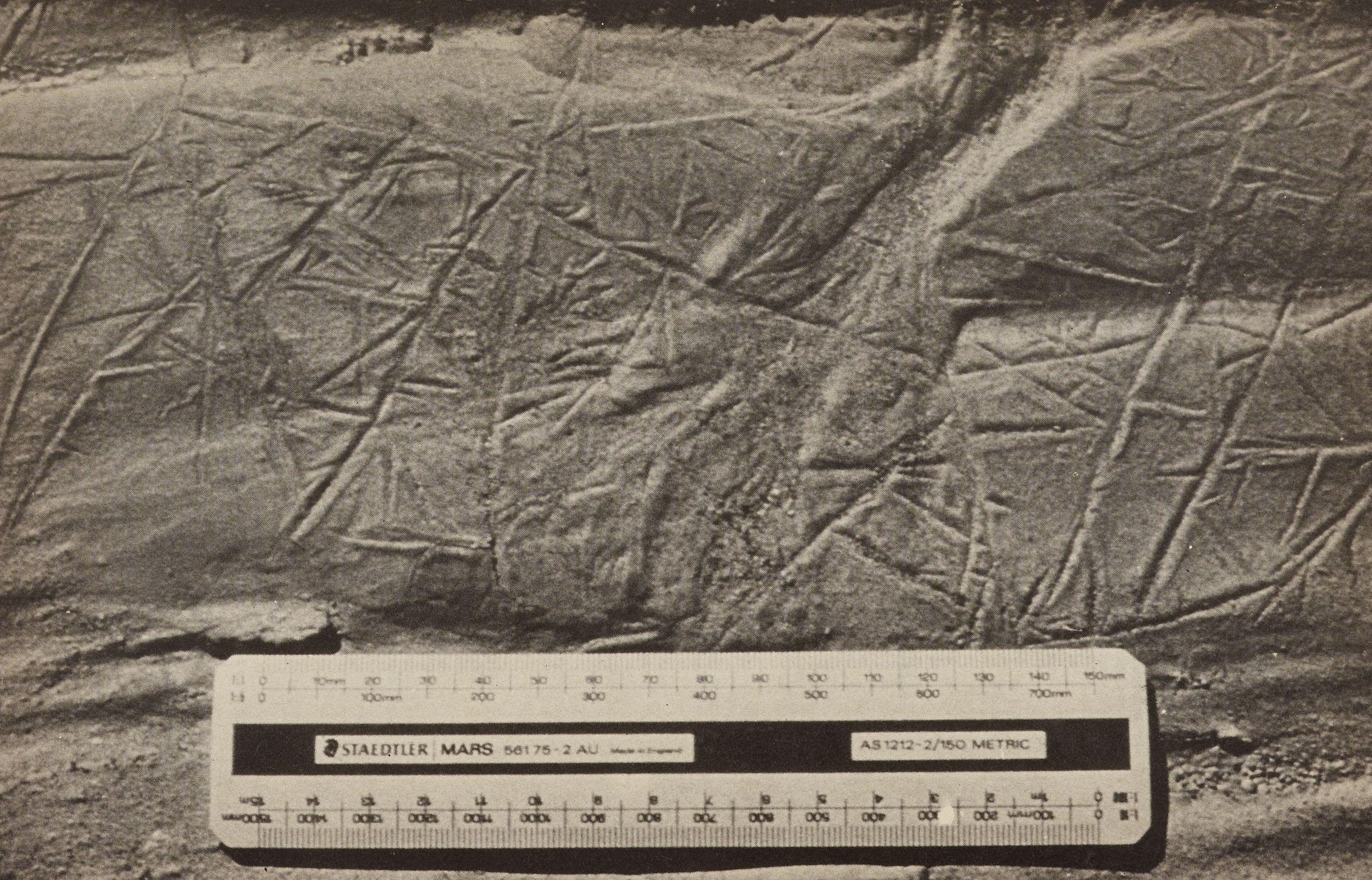
The photograph on the back cover depicts growth markings of ice crystals in fine sand and coarse silt in a small drainage channel. Ice crystals grew in the sediments during the night but the ice had disappeared by the time the photograph was taken. The photograph was taken by G. R. Baglin of Samedan of Australia \ in August ]977 on the shores of Lake George, a few kilometres east of Collector, N.S.W.