The Australian Geofogist
Newsletter No. 13
March 1977
Editorial
This issue contains a considerable amount of information about matters discussed at the February Council Meeting. It gives details of what the Society has been doing and where it might be heading.
In the 25 years since the Society's inception it has certainly gained in numerical strangth and its achievements have been considerable. Its journal has standing, it has produced a wide range of specialist publications, workers in specialties are being brought into contact with each other through the formation of groups, meetings and conventions. The tectonic maps, field guides, field trips and State geology compilations have been produced by the co-operative efforts of members in every division. Despite occasional gripes communication between geologists throughout the country has, I believe, improved, notwithstanding the growth in our membership.
Our partnership (a senior one) in the p hysical organ- isation of the I.G.C. was a firm indication of our growth and it is doubtful if we could have undertaken such a commitment ten years ago.
A sign of our maturity has been the Society's in v olvement in discussions about Antarctic research (see report in this issue) and Deep Sea Drilling, our campaign for registration of geologists, and the interest of the Society in the proposed examination of the structure of the B.M.R.
There are important implications in the recent establishment of several new committees, and in the acti v ities of sub-committees such as that dealing with geological monume nts. The latter, through divisional activity, has produced important data for the National Heritage Commission and our opinions are being treated seriously in this field.
The newly established group to e x amine our publications' policy may result in a radical change in the dissemination of information, and 'Alcheringa' is, I b e lieve,making a minor mo ve in the direction of microfiche in its next issue. A re d uction in publication costs could help us to spread our material more widel y , and allow the Society to offer a wider range of services A comparison of our activities and products with those of other Australian societies shows that we do gi v e v alue for money.
The results of Ken Warner's survey (reported herein) pos e perhaps even more important questions for the Soci e ty. Some 20 % of membership answered the questionnaire. Hal f of this group feels there is the need for the Society to become Professional, the other half not. This is going to be followed up in the corning y ear. What direction will we finall y g o? Perhaps the other 80 % might like to e x press an opinion.
A pe r sonal reflect i on on the Coun c i l meeting -
The r e was on l y on e c oun c ill o r f r o m ind ustr y a mo n g the ho r des of academics and pub li c servants ma k ing dec i sions a b o u t t h e Soci e ty This doesn 't r e fl ec t ou r me mb e r shi p Pe rh aps Div isi on s coul d l ook to this matter befor e t he n ext Cou nc il meet in g
Letters to the Editor
ANOTHER CAUTIONARY TALE
Col Simpson's warning (The Australian Geologist, Dec. '76) has come a little late. I had a similar experience at Cracow (Q'ld) in 1934, only my chip didn't fly so fast, and I believe it was much smaller (I have only seen it in the flesh). Actually it lodged in the index finger, and it is still there.
The hammer was of a distinctive design; it had, i n fact, been issued to one of my predecessors in the Geo l ogica l Survey of Queensland about the turn of the century, and when I retired in 1967 I retained it, with the approval of the then Chief Geologist.
Some few months ago, upon learning that the Queensland Museum was interested in collecting geological antiquit i es I offered the hammer to the Director, Alan Bartho l emai. I felt bound to point out that the hammer was not complete, and I showed him the black intumescence where the chip is still embedded. He is now putting pressure on me to bequeath the finger to the Museum upon my demisea course which is strenuously opposed by my wife.
The state of indecision in which I now find myself is no less pa i nful than the plight of Col Simpson's hypothetical geologist with a severed artery in a remote field site.
Alan Denmead Brisbane
Sir,
I have been referred to you by the National Geographic Society of Washington D.C. U.S.A. concerning a discussion on the D.N.A. molecule, evidence of the occurrence of which I found in some of the ancient rocks of Western Australia. This evidence was the occurrence of Graphite Schists in those rocks.
I found those Graphite Schists in various locations in those rocks, in ancient sediments, and clearly they were of neither primary nor secondary mineralisation. It was clear to me they were evidence of a primordial life form, evidencing the presence of the D.N.A. molecule.
In the Londonderry Pegmatite, near Coolgardie, W.A., Muscovite found was age dated at 3,500 m.y. It was obviously evidence of the presence of water in the ancient earth.
I would find pleasure in further discussion of this matter by your membership.
Kelvin C.B. Green, P.O. Box 593, Cairns. 4870
[Perhaps some interested member could take this matter up with Mr. Green]
REPORT OF THE HON. FEDERAL SECRETARY, 1976/7 presented to Council February, 1977.
This report covers a period of a little more than six months from the time of the last Council meeting. As well as conducting the routine business associated ~ith the Society's affairs, the following points of note have been considered by Executive.
Compilation of the terms of reference of geological committees was completed, they have been circulated to all divisions, specialist groups and conveners.
Redrafting of the Procedural Guide has also been conpleted and it is hoped that after minor amendments are effected, it can be used by all bodies.
Special Publications 5 and 6 have appeared as well as the Index and Table of Contents and the new Membership list. It is most worthy of note that publication costs of Special Publication 6 were covered by donations. Credit for this must be given to the President, Professor G.M. Philip.
Executive set new prices for back issues of Journals and Special Publications. These were available during the I.G.C. and appear in the Index.
Many of the Society's members assisted in the organization of the XXV I.G.C. at the University of Sydney. This was very successful as was the Wine & Cheese Tasting organized by the Society. To all people who assisted with these functions, Executive is grateful.
Organization of the proposed convention in Townsville in August, 1978 is well in hand. Review titles for the theme of the meeting, pre- and post-sessional field trips and social functions have been proposed.
The long overdue formalization of Sedimentary Basin, Structural and Geophysical Nomenclature is at last reaching the Committee stage. Suggestions for convener have been Dr. M.J. Rickard, at present on study leave, _ and Dr. E.C. Leitch with Ors. A. Grady and E. Williams as committee. It is hoped that the Tasmanian Federal Executive can assist the proposed committee through its formative stages.
The cost of publishing the Society's Journal has come under scrutiny. It has been proposed that the Society publish an extended summary of each paper and that the documentation of the paper be available on microfiche (either on request or sent to all members). A recommendation is made to Council to form a working group to study the publication problem. (See Council Meeting Report)
The Society has now reached a large size, having more than 2,500 members, seven divisions, one branch, five specialist groups and five committees. The liaison between these bodies and the Central Office in Sydney and the Federal Executive has presented many problems. Because of this, the Federal Executive noted (meeting 1976/5, 8.7) that if these bodies are to enjoy the sponsorship of the Society then they are obliged to follow the Society's rul e and procedures. If the rules and procedures are not followed, then the Society cannot run efficiently and is of little use to the members.
It may be of interest to note that only two weeks prior to the Council Meeting a full list of Councillors is not known, six out of sixteen reports and four out of twelve balance sheets have been received. Numerous reminders have been sent to those bodies who have not complied. (By the time of the meeting the situation had improved - but numerous gaps still existed - see Council Meeting report Ed.)
In this situation, liaison between different sections of the Society is virtually impossible and efficient organization of the Society cannot be effected.
In conclusion I would like to thank the President who put the secretarial staff of his department at my disposal during my term of office. Miss S.M. Binns has been unfailing in her efforts to assist me in my duties.
Miss L.C. Tuckwell, Ass istant Secretary, is to be thanked for her co-operation on all matters of Society business.
R.E. Wass Hon~ Federal Secretary (to Feb 1, 1977)
DIVISIONS AND SPECIALIST GROUPS
Divisional reports showed that a wide range of activities was being undertaken by the Society. Although formal talks were the commonest feature , field trips, special projects on geological monuments, guide book preparation and social functions were common
The W.A Report did not reach the Council meeting , but is due to arrive by slow camel.
Although the Society has continued to encourage the growth of specialist groups (there are two or three more in the offing) the absence of reports from SGIGOD (Ore Deposits), SGGM (Geochemistry and Mineralogy) and SGTSG (Tectonic and Structural Geology) suggests that these groups do not yet function as efficiently as they might, and as the longer-established divisions do
It is to be hoped that the variou s secretaries will take to heart the revised procedural guide which has been drawn up by the retiring Federal Secretary. Attentio n to this guide wil l greatly lighten the load on the incoming Federal Secretary, Ian Jennings.
The Council unanimously voted an interest free loan of $3000 to the Assocn of Australasian Palaeontologists to enable it to establish ' Alcheringa ' by publishing two issues per year.
The Australasian Sedimentation Group has a meeting scheduled for August 22 -23, '77, at the University of Qld. The main theme is "Quaternary sediments and sedimentation. Field trips are scheduled to Stradbroke Island-Moreton Bay and Heron Island (Grt. Barrier Reef). If you want to talk, listen or learn at this meeting contact :
P.G. Flood, Dept. of Geology , University of Queensland, ST. LUCIA. QLD. 4067
REPORT BY HONORARY FEDERAL TREASURER
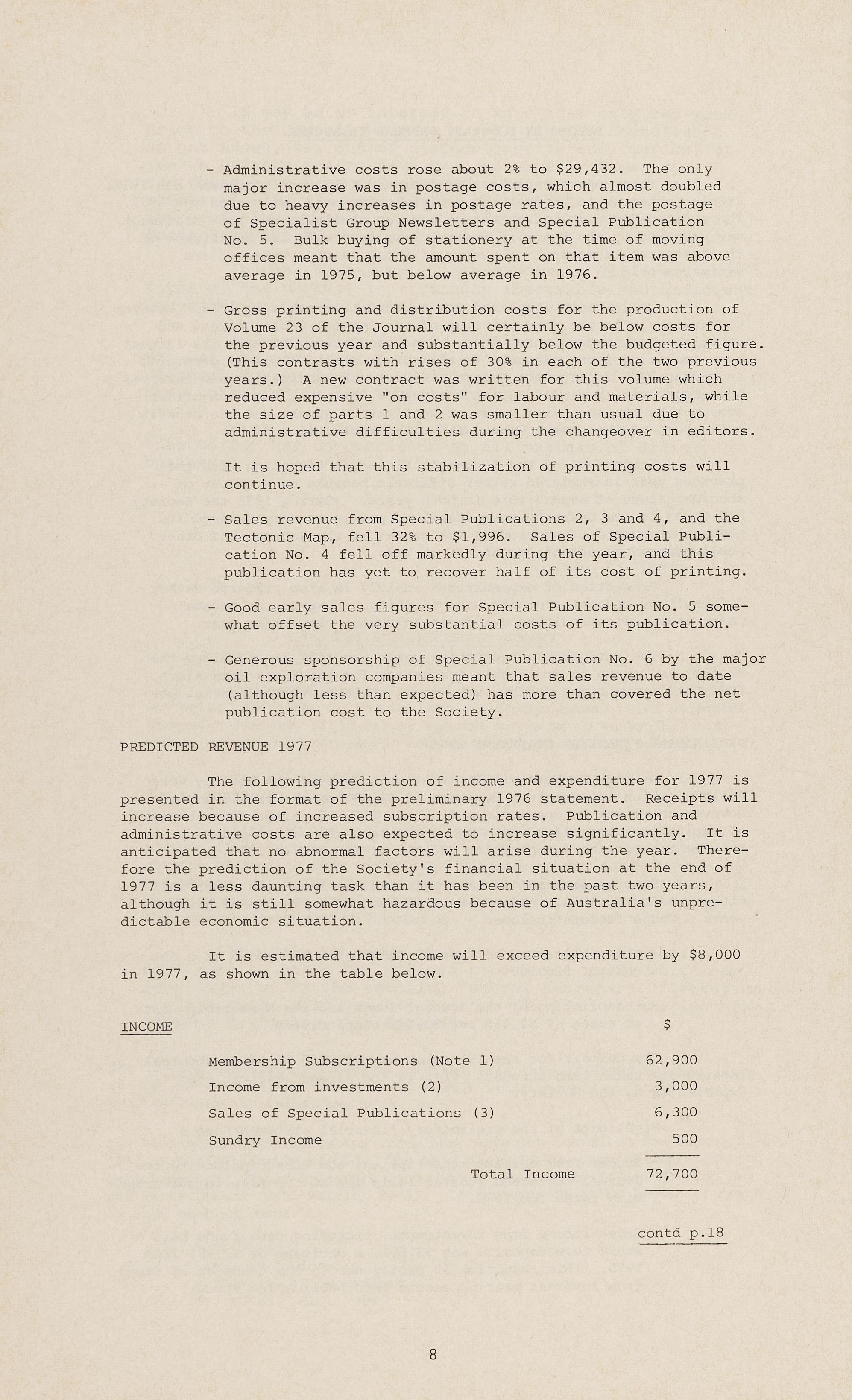
This report reviews a preliminary financial statement for 1976 It also attempts to predict the Society's financial situation for 1977. The audited financial statement is not yet available and this statement was prepared by the Honorary Federal Treasurer with the assistance of the Assistant Secretary. A number of items in the statement are estimates only.
The Society increased its subscription rates i n 1976. However continuing inflation, the printing of two Special Publications, and other abnormal expenditures have caused the Society to have its largest ever operating loss. Happily this loss was not as large as predicted in my May 1976 Treasurer ' s Report. However the Society's cash reserves have been heavily eroded during the year. This loss has been offset somewhat by the increased value of publication stocks and the benefit to members of the gratis issue of Special Publication No. 5.
Comparison of the Society's financial situation with the previous year is rendered rather difficult because of a number of abnormal items of expenditure in both years (During 1975 the Society had moved to its current, more adequate , premises , computerised its membership records, and brought its stocks of the Journal and other publications to account for the first time )
Prediction of expenditures in 1977 is also rendered rather difficult by present economic uncertainties However , no unusual major items of expenditure are foreseen during the coming year
The increased subscription rates for 1977 should ~llow the Society to return to profitable operations for the f i rst time since 1974, and prevent any further erosion of the Society ' s financial position.
PRELIMINARY FINANCIAL STATEMENT 1976
At 31st December , 1976, the net assets of the Society were $55 , 476 , which represents a decrease of $2,397 on the previous year However there was an operating deficit of $13,313, after distribution of capitation fees, if certa i n abnormal items are not considered. This contrasts with an operating deficit of $10 , 210 in 1975.
Several abnorma l factors affected the Socie t y ' s financial situation during 1976, inhibiting comparison with results of previous years. These factors included -
- the publication of Special Publications 5 and 6 at a net cost of $26,300
- the printing of the Journal Index and the Membership List at costs of $2 , 065 and $2,140 respectively.
The deficit for the 1976 year was $16 , 200 if these abnormal factors are taken into account. This is the largest deficit ever experienced by the Society
Highlights of the preliminary financial statement are -
- Income from members subscriptions and subscriptions to the Journal increased substantially due to the rise in subscription rates for 1976
- Gross income from investments , including cash funds held o short term deposit, was $3,651, a decrease of $1 , 391 from 1975. This reduction is partly due to the transfer of funds from interest bearing assets into publication stocks.
- Administrative costs rose about 2% to $29,432. The only major increase was in postage costs, which almost doubled due to heavy increases in postage rates, and the postage of Specialist Group Newsletters and Special Publication No. 5. Bulk buying of stationery at the time of moving offices meant that the amount spent on that item was above average in 1975, but below average in 1976.
- Gross printing and distribution costs for the production of Volume 23 of the Journal will certa inly be below costs for the previous year and substantially below the budgeted figure. (This contrasts with rises of 30% in each of the two previous years.) A new contract was written for this volume which reduced expensive "on costs" for labour and materials , while the size of parts 1 and 2 was smaller than usual due to administrative difficulties during the changeover in editors.
It is hoped that this stabilization of printing costs will continue.
- Sales revenue from Special Publications 2 , 3 and 4 , and the Tectonic Map, fell 32% to $1 , 996. Sales of Special Publication No. 4 fell off markedly during the year, and this publication has yet to recover half of its cost of printing.
- Good early sales figures for Special Publication No. 5 somewhat offset the very substantial costs of its publication.
- Generous sponsorship of Special Publication No 6 by the major oil exploration companies meant that sales revenue to date (although less than expected) has more than covered the net publication cost to th e Society.
PREDICTED REVENUE 1977
The following prediction of income and expenditure for 1977 is presented in the format of the preliminary 1976 statement. Receipts will i ncrease because of increased subscription rates. Publication and administrative costs are also expected to increase significantly It is anticipated that no abnormal factors will arise during the year Therefore the prediction of the Society ' s financial situation at the end of 1977 is a less daunting task than it has been in the past two years, although it is still somewhat hazardous because of Australia's unpredictable economic situation.
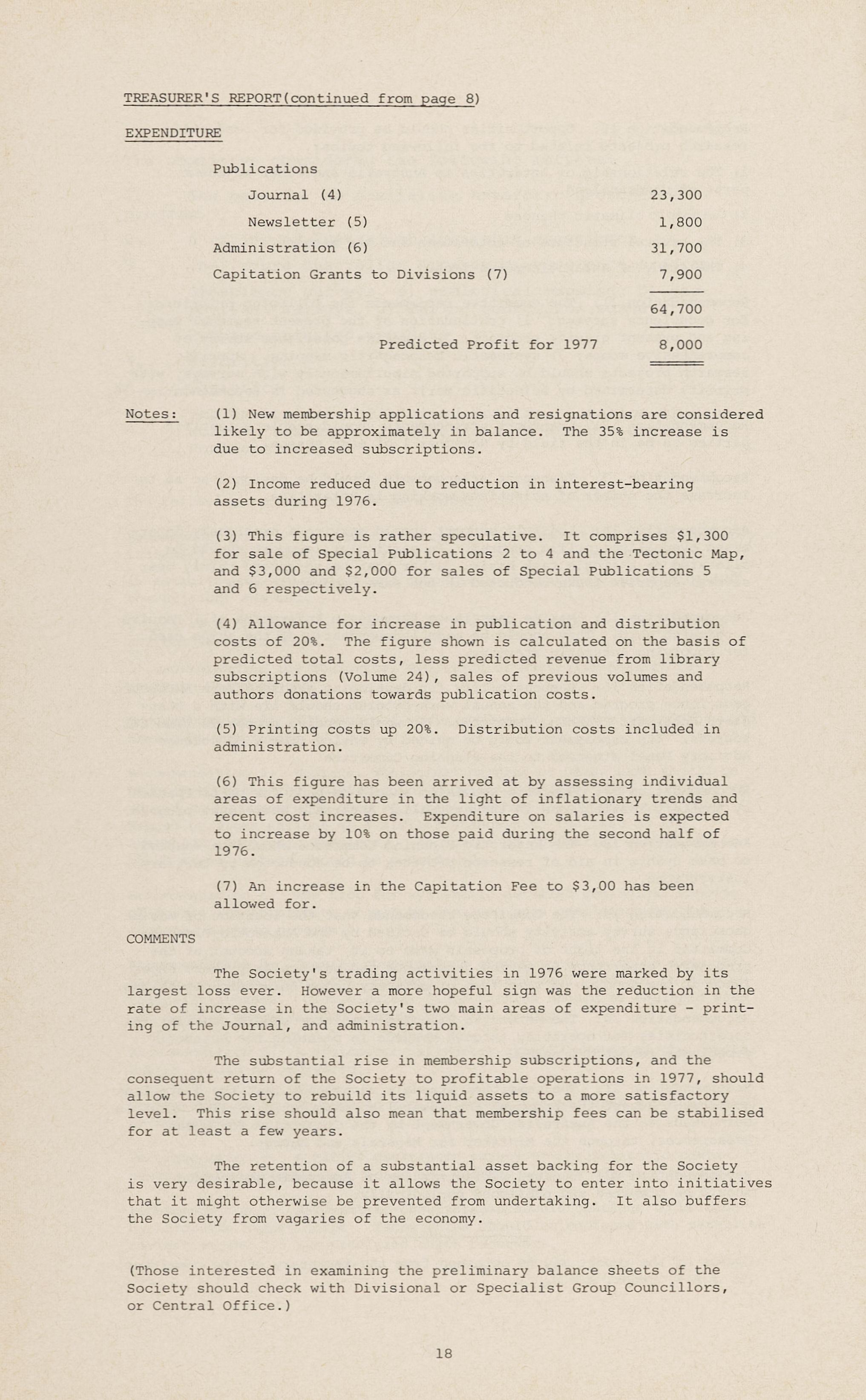
It is estimated that income wi ll exceed expenditure by $8,000 in 1977, as shown in the table below. Membership Subscriptions (Not e 1) Income from investments (2)
Geological Legislation and Professional Representation
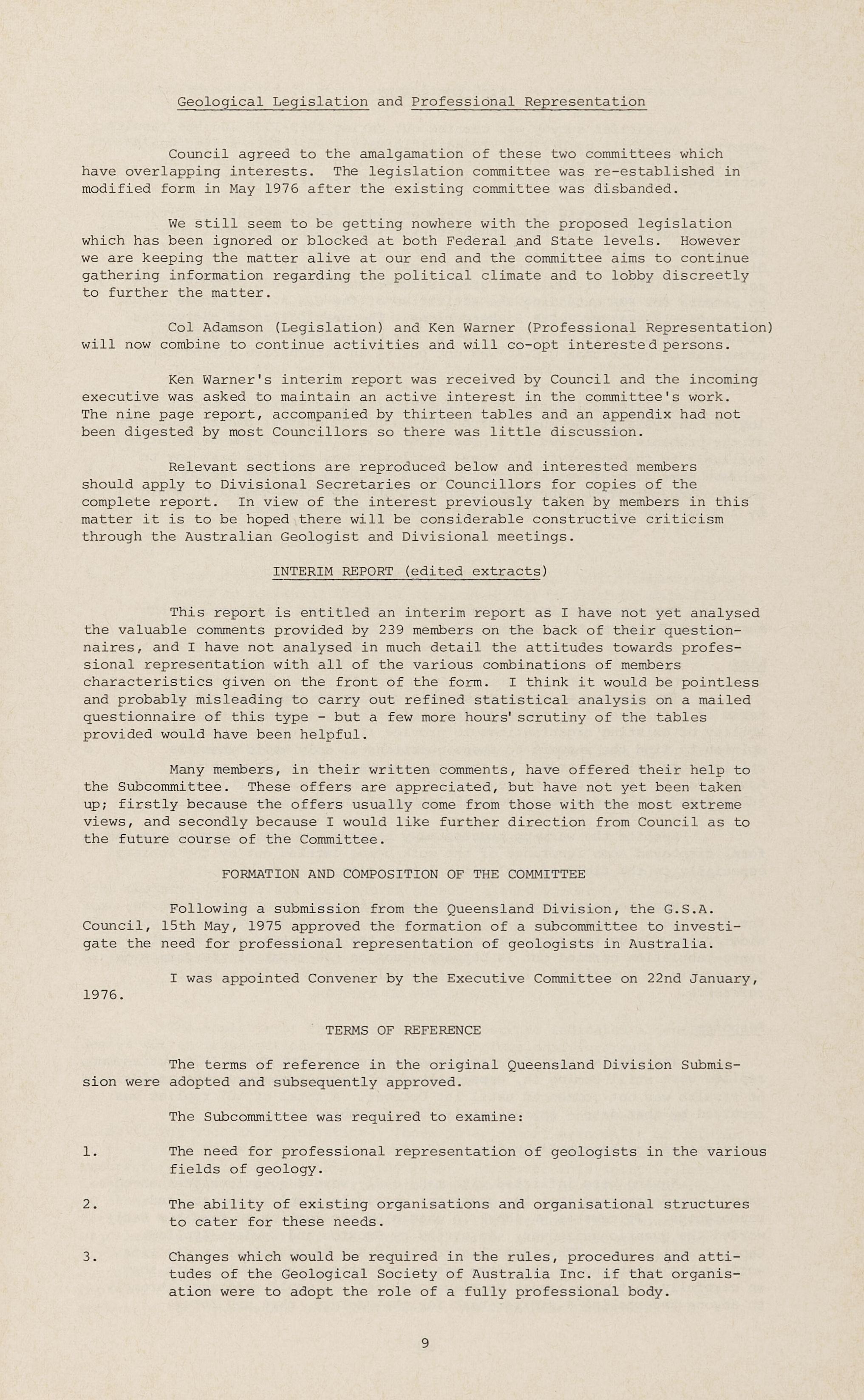
Council agreed to the amalgamation of these two committees which have overlapping interests. The legislation committee was re-established in modi fied form in May 1976 after the existing committee was disbanded.
We still seem to be getting nowhere with the proposed legislation which has been ignored or blocked at both Federal and State levels. However we are keeping the matter alive at our end and the committee aims to continue gathering information regarding the political climate and to lobby discreetly to further the matter.
Col Adamson (Legislation) and Ken Warner (Professional Representation) will now combine to continue activities and will co - opt interested persons.
Ken Warner's interim report was received by Council and the incoming executive was asked to maintain an active interest in the committee ' s work. Th e nine page report , accompanied by thirteen tables and an appendix had not been digested by most Councillors so there was little discussion.
Relevant sections are reproduced below and interested members should apply to Divisional Secretaries or Councillors for copies of the comp l ete report. In view of the interest previously taken by members in this matter it i s to be hoped there will be considerab l e constructive criticism through the Australian Geo l ogist and Divisional meetings.
INTERI M REPORT (edited extracts )
This report is entitled an interim report as I have not yet analysed the valuable comments provided by 239 members on the back of their questionnaires, and I have not analysed in much detail the attitudes towards professional representation with all of the various combinat io ns of members characteristics given on the front of the form. I think it would be pointless and probably misleading to carry out refined statistical analysis on a mailed questionnaire of this type - but a few more hours ' scrutiny of the tables provided would have been helpful
Many members, in their written comments, have offered their help to the Subcommittee. These offers are appreciated, but have not yet been taken up; firstly because the offers usually come from those with the most extreme views , and secondly because I would like further direction from Council as to the future course of the Committee.
FORMATION AND COMPOSITION OF THE COMMITTEE
Following a submission from the Queensland Division, the G.S.A. Council , 15th May, 1975 approved the formation of a subcommittee to investigate the need for professiona l representation of geologists in Australia .
I was appointed Convener by the Executive Committee on 22nd January, 1976.
TERMS OF REFERENCE
The terms of reference in the original Queens l and Division Submission were adopted and subsequently approved.
The Subcommittee was required to examine :
1. The need for professional representation of geologists in the various fields of geology.
2. The ability of existing organisations and organisational structures to cater for these needs.
3 Changes which would be required in the rules , procedures and attitudes of the Geological Society of Australia Inc. if that organisation were to adopt the role of a fully professional body
PREVIOUS SURVEY
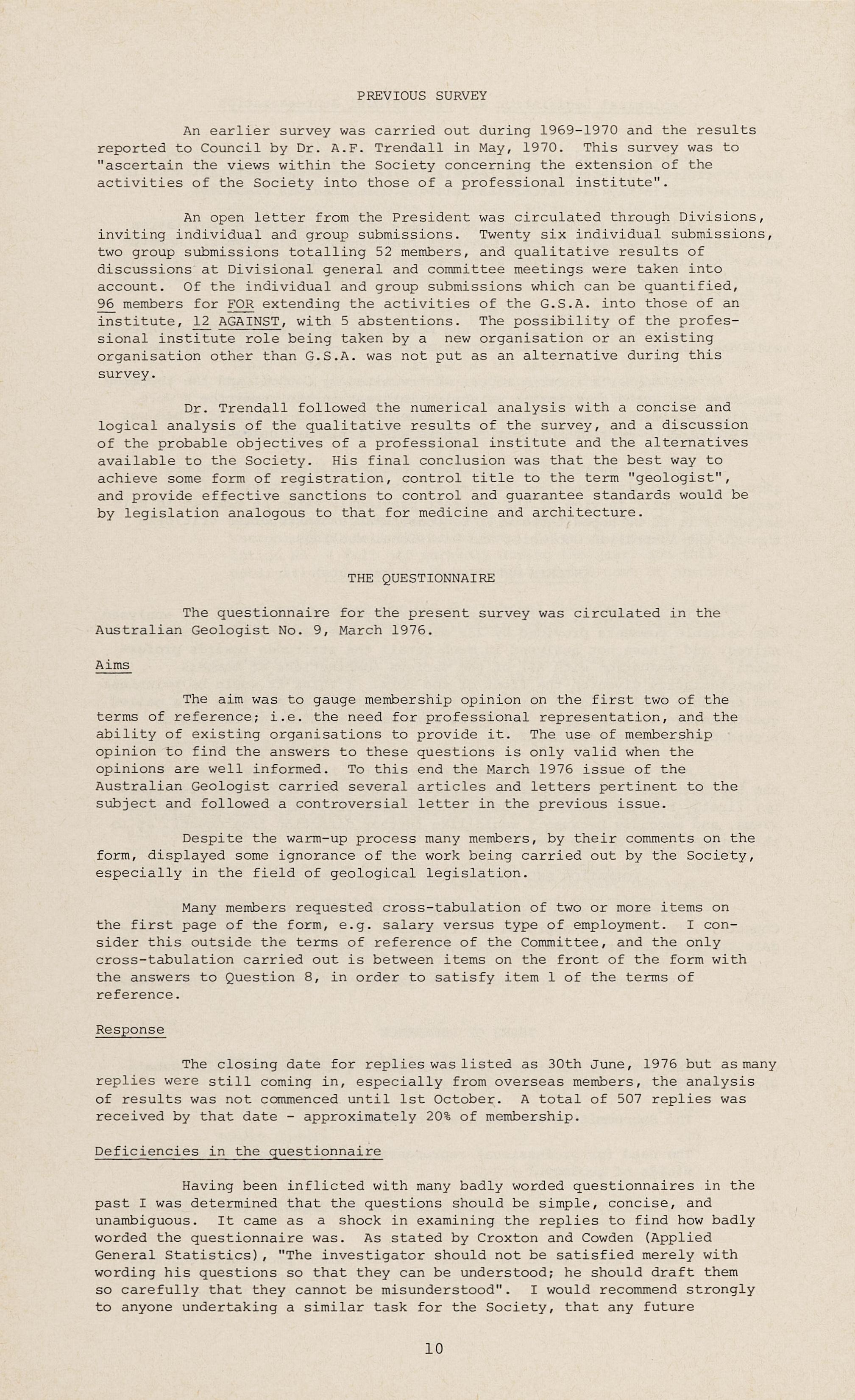
An earlier survey was carried out during 1969 - 1970 and the results reported to Council by Dr. A.F. Trendall in May, 1970 This survey was to "ascertain the views within the Society concerning the extension of the activities of the Society into those of a professional institute "
An open letter from the President was circulated through Divisions , inviting individua l and group submissions. Twenty six individual submissions , two group submissions totalling 52 members , and qualitative results of discussions at Divisional general and committee meetings were taken into account Of the individual and group submissions which can be quantified, 96 members for FOR extending the activities of the G S A into those of an institute, 12 AGAINST, with 5 abstentions The possibility of the professional institute role being taken by a new organisation or an existing organisation other than G.S.A . was not put as an alternative during this survey
Dr. Trendall followed the numerical analysis with a concise and logical analysis of the qualitative results of the survey , and a discussion of the probable objectives of a professional institute and the alternatives available to the Society. His final conclusion was that the best way to achieve some form of registration , control title to the term "geologist ", and provide effective sanctions to control and guarantee standards would be by legislation analogous to that for medicine and architecture.
THE QUESTIONNAIRE
The questionnaire for the present survey was circulated in the Australian Geologist No. 9 , March 1976.
Aims
The aim was to gauge me mb ership opin i on on the first two of the terms of reference ; i.e the need for professional representation , and the ability of existing organisations to provide i t. The use of membership opinion to find the answers to these questions is only valid when the opinions are well informed. To this end the March 1976 issue of the Australian Geologist carried several articles and letters pertinent to the subject and fo l lowed a controversial letter in the previous issue.
Despite the warm- up process many members , by their comments on the form , displayed some ignorance of the work being carried out by the Society , especially in the field of geologica l l egislation.
Many members requested cross - tabulation of two or more items on the first page of the form, e.g. salary versus type of employment. I consider this outside the terms of reference of the Committee , and the only cross - tabulation carried out is between items on the front of the form with the answers to Question 8, in order to satisfy item 1 of the terms of reference
The closing date for replie s was listed as 30th J u ne , 1976 but as many replies were sti ll coming in, especia l ly from overseas members , the analysis of results was not commenced until 1st October A total of 507 replies was received by that date - approximately 20% of membership.
Deficienc i es in the questionnaire
Having been inflicted with many badly worded quest i onnaires in the past I was determined that t he questions should be simp l e , conc i se , and unambiguous It came as a shock in examining the replies to find how badly worded the quest i onnaire was As stated by Croxton and Cowden (Applied General Statistics) , " The i nvestigator should not be satisfied merely with wording his questions so that they can be understood ; he should draft them s o carefully that they cannot be misunderstood". I would recommend strongly to anyone undertaking a similar task for the Society , that any future
questio n naire be tried first on a sample of 20 to 30 people representing as wide a cross - section of the population to be sampled as possible
The main faults in the questionnaire are listed below:
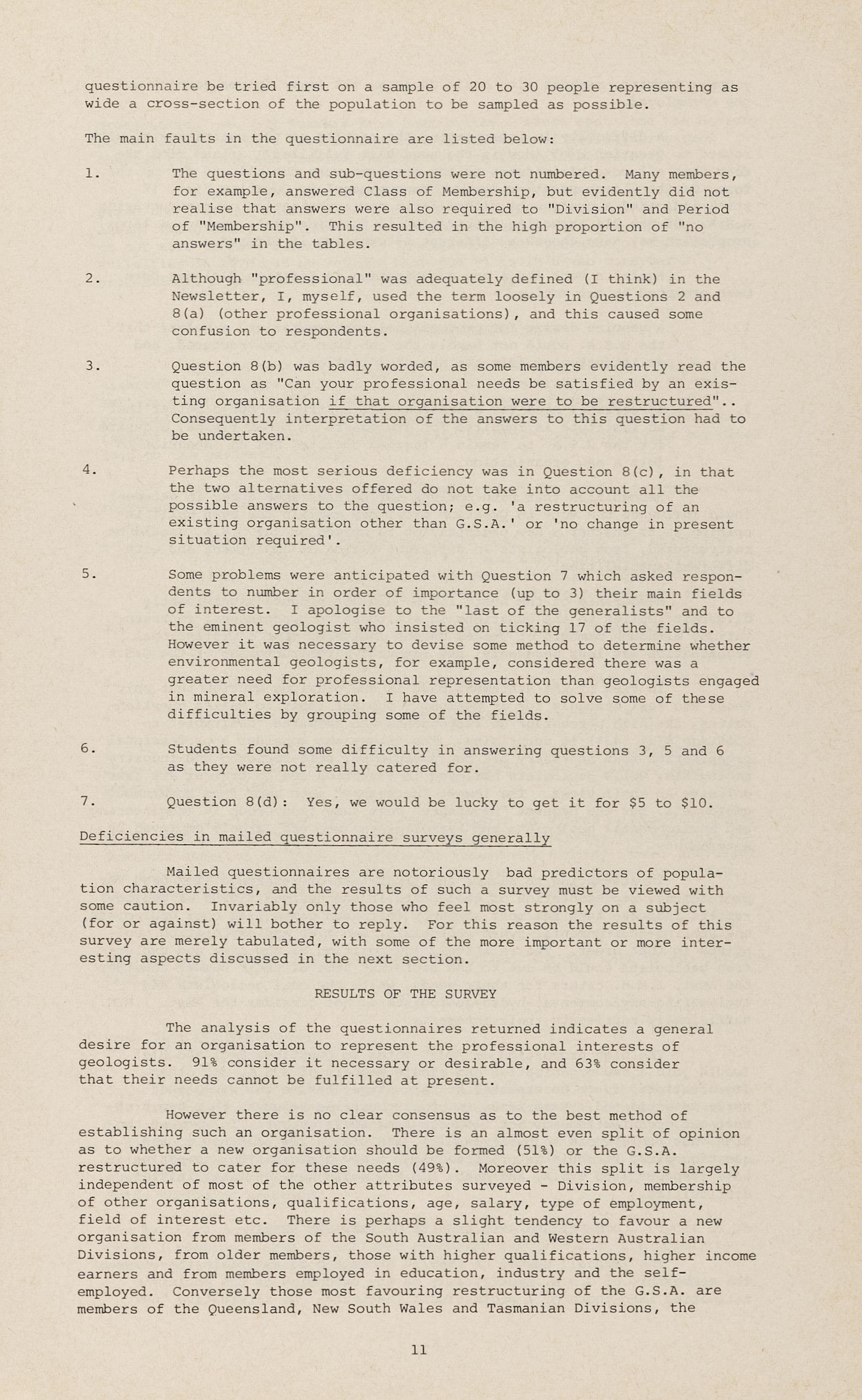
1. The questions and sub-questions were not numbered . Many members, for example , answered Class of Membership , but evidently did not realise that answers were also required to " Division " and Period of " Membership". This resulted in the high proportion of " no answers " in the tables.
2 Although " professional" was adequately defined (I think) in the Newsletter, I, myself, used the term loosely in Questions 2 and 8(a) (other professional organisations) , and this caused some con fusion to respondents
3 Question 8(b) was badly worded, as some members evidently read the question as " Can your professional needs be satisfied by an existing organisation if that organisation were to be restructured" Consequently interpretation of the answers to this question had to be undertaken.
4 Perhaps the most serious deficiency was in Question 8(c) , in that the two alternatives offered do not take into account all the possible answers to the question ; e g ' a restructuring of an existing organisation other than G S A.' or ' no change in present situation required'.
5 Some problems were anticipated with Question 7 which asked respondents to number in order of importance (up to 3) their main fields of interest. I apologise to the "last of the generalists" and to the eminent geologist who insisted on ticking 17 of the fields. However it was necessary to devise some method to determine whether environmental geologists , for example , considered there was a greater need for professional representation than geologists engaged in mineral exploration I have atte mpted to solve some of these difficulties by grouping some of the fields.
6 Students found some difficulty in answering questions 3 , 5 and 6 as they were not really catered for
7. Question 8(d): Yes , we would be lucky to get it for $5 to $10.
Deficiencies in mailed questionnaire surveys generally
Mailed questionnaires are notoriously bad predictors of population characteristics , and the results of such a survey must be viewed with some caution. Invariably only those who feel most strongly on a subject (for or against) will bother to reply For this reason the results of this survey are merely tabulated, with some of the more important or more interesting aspects discussed in the next section.
RESULTS OF THE SURVEY
The analysis of the questionnaires returned indicates a general desire for an organisation to represent the professional interests of geologists. 91% consider it necessary or desirable, and 63% consider that their needs cannot be fulfilled at present
However there is no clear consensus as to the best method of establishing such an organisation. There is an almost even split of opinion as to whether a new organisation should be formed (51%) or the G.S.A. restructured to cater for these needs (49%). Moreover this split is largely independent of most of the other attributes surveyed - Division, membership of other organisations , qualifications , age, salary , type of employment , field of interest etc. There is perhaps a slight tendency to favour a new organisation from members of the South Australian and Western Australian Divisions, from older members, those with higher qualifications, higher income earners and from members employed in education , industry and the selfemployed Conversely those most favouring restructuring of the G.S.A are members of the Queensland, New South Wales and Tas manian Divisions , the
younger members, members with basic degrees, the lower income earners and the unemployed.
A difficulty in interpreting the results of the questionnaire with regard to Question S(c) (How is the need best fulfilled?) arises from the fact that all possible answers to the question were not allowed for on the form. Of the 43 respondents answering " Unnecessary " to Question 8 (a) , 12 still indicated a preference either for a new organisation or restructuring G S.A. Of the 214 answering "Des irable " to Question S (a), perhaps a large proportion may have chosen a different alternative if offered.
Again, a vote for a new organisation in Question S{c) may have been prompted by two motives -
1. a genuine desire for professional representation, a belief that the G.S.A. could not handle the job even if restructured, and an intention to join the new organisation.
2. no personal need for a professional institute, but a belief that an institute is required for geologists in other fields, a desire for the G.S.A. to remain a learned society, and no intention to join a new organisation.
Recognition that both motives (or perhaps some other in between) could influence the vote to Question S(c), may explain the even split in opinion as to whether a new organisation is needed or the G S.A. should be restructured, from geologists in different fields of employment and with different specialities.
Membership of the Aust. I M.M. did not produce significantly different replies to the questions on attitudes to professional representation, although members of Trades Unions indicated that a professional organisation was less necessary , and favoured a restructuring of the G.S .A.
In view of the statement made in the previous section that only those who feel strongly for or against a subject reply to mailed questio nnaires, the high percentage of respondents who answered " desirable " to Question S(a) (43%) is surprising . The groups who consider a professional organisation most necessary are the unemployed, self-employed and industry geologists, while geologists employed in education and government are less definite in their views. The lowest "necessary" vote came from government geologists, but the highest "necessary" vote came from Group IV (engineering and environmental geologists and hydrologists) who are largely employed by governments.
In attempting to answer the first term of reference (the need for professional representation of geologists in the various fields of geology) results indicate that the most strongly felt need comes from coal geologists, engineering-environmental-hydro - geologists , and mine and exploration geologists in that order. The relatively low position of the mine and exploration geologists could be due to the fact that some of thei~ number consider the Aust. I M.M caters for their needs , while the coal geologists and engineering - environmental-hydro-geologists do not consider the Aust. I.M . M. sufficiently represents their interests.
The high proportion of "yes" votes to Questions S(d) and S(e) (would join a new organisation and remain members of G.S.A. and other organisations) is to be expected at this stage, before the hip-pocket nerve is activated. Experience in other countries suggests that ne~ professional organisations do not flourish from their outset. In view of the high "desirable" vote to Question S(a), and only a 20% response to the questionnaire , it could be predicted that a new organisation, competing in some respects with G S.A and Aust. I.M.M ., would have at least initial difficulties.
COMPARISON WITH RESULTS OF PREVIOUS SURVEY
The Trendall survey of 1969/70 attempted to ascertain the views of the membership of G.S.A. specifically on the extension of the Society's activities into those of a professional institute. No alternative "new
organisation" was put forward as a possibility. Since that time the Society has attempted to have legislation for registration of geologists passed through the State and Federal Parliaments, so far without success .
Despite the changes which have occurred in the six to seven years since the previous survey , and the differences in the form of questions asked, the overall attitudes of members towards professional representation do not seem to have altered. The 13% against the extension of the Society's activities in 1970 can be equated with the 9% in 1976 who consider a professional organisation unnecessary.
CONCLUSIONS AND RECOMMENDATIONS
My intention as Convener was to us e the questionnaire to provide answers to the first two terms of reference. Membership opinion on these metters would have guided study of the third term of reference by an expanded Committee. However the questionnaire replies do little more than reflect an opi nion that "something should be done ", without giving any clear lead on the preferred course
The alternatives in the Trendall report for achieving professional representation of geologists still apply -
1. Formation of an "Australian Geological Institute" to which the G.S.A. , Aust. I.M M. and A.P.E.A. and other inter ested organisations could affiliate, and delegate the joint responsibility of furthering the professional interests of their geologist members
2. Formation of a new and independent Australian Institute of Professional Geologists
3. Formation of a Professional Geologists Group within the G S A.
4. Assumption of institute responsibilities by the G.S.A
Whichever of the alternatives is undertaken the professional organisation would be eno rmousl y aided by legislation similar to that proposed by the Society
Numerical data from the questionnaire is stored on computer punch cards, and is available to Council if required. Following the analysis of comments referred to above I propose to remove and destroy names , addresses and sigpatures on the top and bottom of the forms, as promised in my note in Australian Geologist No. 9, and store only the comments
[Th e Society owes Ken Warner considerable thanks for the work he has put into this survey.]
More Good and Bad Council
Council discussion on the Stratigraphic Nomenclature Committee brought out the feeling that the specialist groups should in general be represented on the corranittee , but that the biostratigraphic lobby might need to form a separate sub-committee The August '7 6 meeting of the committee agreed in principle that the International Stratigraphic Guide should be adopted in Australia and that a booklet for field use based on the International Guide sho uld be prepared.
The National Committee for Geological Sciences did not make a report to the Council meeting . Some councillors expressed surprise that the committee had not met since the I G.C
HONORARY EDITOR 'S REPORT
A wide variety of papers continues to come forward , sufficient in number to ensure quarterly publication of parts of approximately 128 pages. The printing contractors , Messrs Graphic Services Pty Ltd of Adelaide (Mr. Ian Murray) have been most helpful and cooperative , and the journal parts are being issued close to their scheduled times . Every endeavour is being made to keep down costs within the contract schedule, and authors are now being asked whether they are able to provide financial contributions towards the co s t of publishing text-figures, tables, etc. The surrender of copyright to the Society has also been formalized.
I should like to record my thanks to the Society 's Editorial Advisors who have undertaken a great deal o f vetting of pape rs, including preparation for publication
A special note of thanks is due to Professor F .C. Beavis who has acted as my proxy at Executive Meetings held in Sydney during the past year.
D A. Brown
Arising from David Brown ' s report a motion was passed that the Editor investigate the possibility of obtaining the book bounty for the journal This would involve slight modification to the journal format, but would be worth the effort, saving some thousands of dollars The journal in its present format will continue till the end of 1978
The e xe cutive had set up a co mmit t ee of three to consider the future of the journal and this move was confirmed by the Council. However it was pointed out that the three members - D.A. Brown , G M Philip , B D. Webby - were palaeontologists and that some hard - rock representatives were ne e ded These will be added Prof. Brown indicated that he would not b e unhappy to be off the committee as the proposed reorientation of the Society ' s publishing called for a fresh approach He f e lt that geologists from non - academic fields were particularly required on the committe e
When Professor Rex T Prider retired at the end of 1975 as Head of the Department of Geology in the University of Western Australia, his colleagues and former students made donations for the establishment of a gold medal to honou~ his long service to geology The medal has Professor Prider 's likeness on one side , and an illustration of a . polarizing microscope on the other . It is to be presented annually to the Honours student in geology showing the greatest aptitude for research.
The inaugural presentation of the Rex T Prider Medal was made in December 1 976 to Mr. Roger Buick , who submitted an Honours thesis entitled " Fauna! assemblages of the Newmarracarra Limestone (Bajocian) , Geraldton district , Western Australia"
Inaugural Presentation of the Rex T Prider Medal
REPORT OF THE ADVISORY COMMITTEE ON
THE ANTARCTIC GEOSCIENCE PROGRAM
(This report was tabled at the Society's Council Meeting in Febru ary.)
The Advisory Committee on the Antarctic Geoscience Program was established by the Minister for Science and Consumer Affairs through an invitation to the President of the Geological Society of Australia.
Terms of Reference
Having regard to (a) Australia's commitments under the Antarctic Treaty, (b) past and present involvement by Australian geoscientists in international scientific programs in Antarctica, and (c) the resource potential and environmental characteristics o f Antarctica.
1. To review past and current Australian geological and geophysical research in Antarctica, and provide an assessment of it comparable to that given by ACAP for other disciplines in Vol 1 of the ACAP Report.
2. To recommend priorities for new and continuing geological and geophysical research by Australia in Antarctica and its adjacent seas.
3. To make recommendations on the future of detailed geological mapping in Antarctica.
4. • To advise on the extent to which other organisations In addition to the Bureau of Mineral Resources could contribute to suggested research, and how this contribution could best be secured.
5. To comment, from the geoscience viewpoint, on the prospects and problems of using Antarctic ships to research platforms.
Membership
G.M. Philip (Chairman) (Uni Syd.) - palaeontology; K. Crook (Secretary) (A.N.U.) - surficial geology; L. Frakes (Monash Uni ) - marine geoscience; A. Hales (A.N U.) - geophysics; J Lovering (Uni. Melb )geochemistry; B. McKelvey (New England Uni ) - sedimentology; R. Oliver (Uni. Adel.) - petrology; R. Tingey (B.M.R.) - regional geology; R. Varne (Uni . Tas.) - petrology ; P. Wellman (B.M . R.) - geophysics.
The committee was greatly assisted by discussions at a workshop on Antarctic geoscience held at the A.N. U on 17 October , 1975 which was attended by twenty-five geoscientists, most with Antarctic experience . The committee was assisted throughout its deliberations by I. McLeod, Chairman of the Geology Subcommittee of ANCAR.
The committee considered the following matters:
1. The need for an Australian Antarctic geoscience program.
2. A rev i ew of Australian Artarctic geoscience
3. The future Australian Artarctic geoscience program
Geoscience surveys a) geologica l mapp i ng, b) geophysical surveys, c) marine geoscience surveys
Prob l em-oriented projects
4. Priori ties
5. Logistics
6. Implementation: Planning, Funding, Location o f geoscience research, Internationa l contributions, Publication.
The following recommendations were made :
Recommendation 1: The committee submits that the national need requires increased earth science research in Antarctica directed towards :
1) establishing the geology and geophysical features of Antarctica and the adjacent sea - bed.
2) active delineation of the mineral resource potential of Antarctica and the southern ocean
3) understanding the geological evolution of Australia~AntarcticaSouthern Ocean region.
Recommendation 2: The regional scale geological mapping of Enderby Land should be completed.
Recommendation 3: Regional geological mapping of Oates Land should be programmed after the completion of mapping of Enderby Land. However it should be proceeded with only if Oates Land has not by that time been mapped by other nations at a similar standard to the rest of the Australian Antarctic Territory Inclusion of Australian geologists in NZ - US field parties should be considered.
Recommendation 4 : The need for systematic detailed geological mapping of Australian Antarctica should be reviewed upon completion of the regional mapping program.
Recommendation 5 : Gravity observations should cont i nue to be made (a) in the course of geological mapping of Enderby Land, and (b) on glaciological traverses. Glaciological field parties should be equipped with one or mor~ geoceivers to improve position finding.
Recommendation 6 : A systematic helicopter gravity survey of the coastal region should be commenced
Recommendation 7 : Systematic regional - scale aeromagnetic mapping should be undertaken
Recommendation 8: A marine geoscience survey of the Antarctic continental margin between Cape Adare and Enderby Land is urgently needed
Recommendation 9: Bathymetric observations should continue to be made by Antarctic supply ships. These ships should be equipped with satellite navigation and 3.5 kHz precision depth recorders.
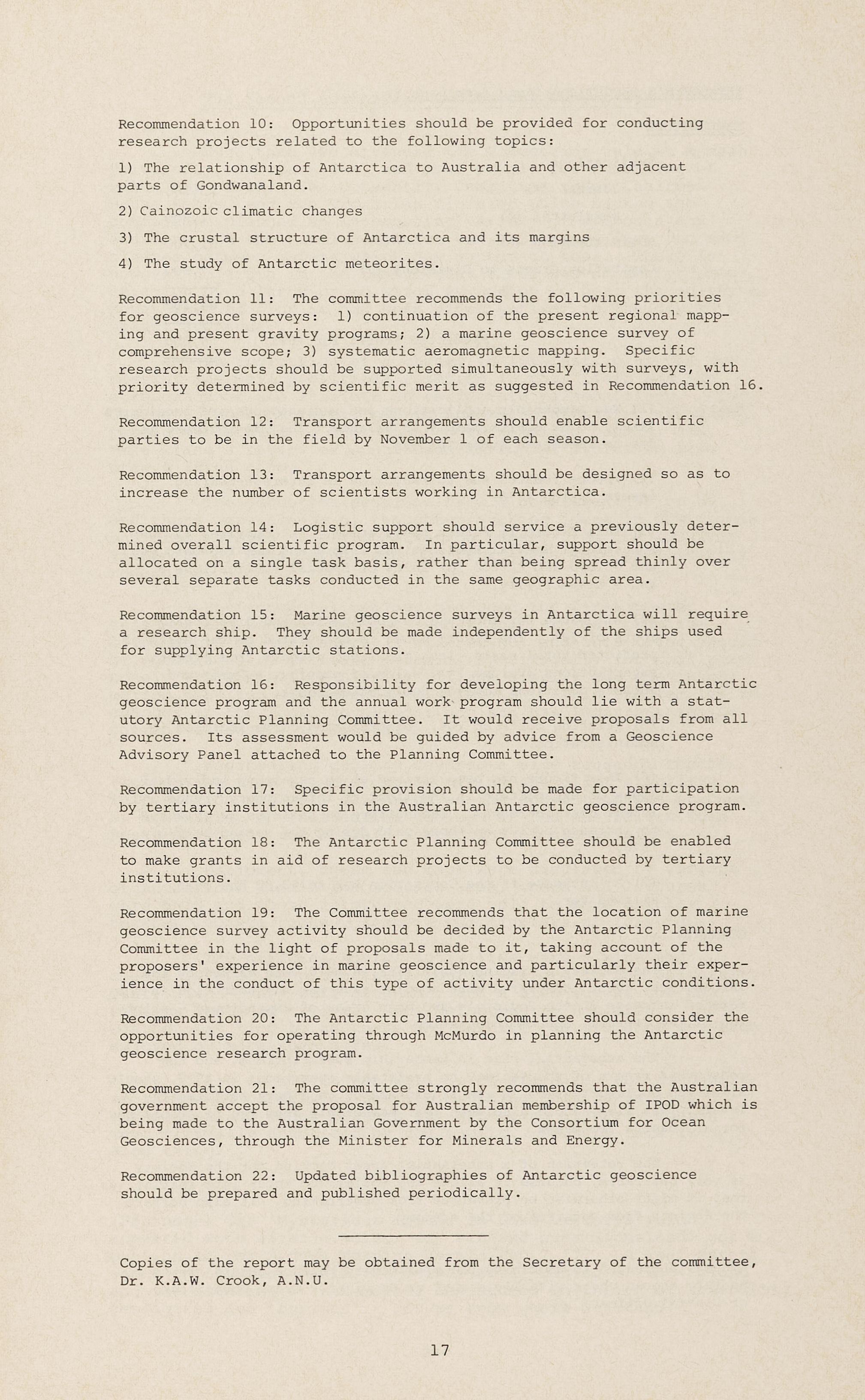
Recommendation 10 : Opportunities should be provided for conducting research projects related to the following topics :
1) The relationship of Antarctica to Australia and other adjacent parts of Gondwanaland
2) Cainozoic climatic changes
3) The crustal structure of Antarctica and its margins
4) The study of Antarctic meteorites
Recommendation 11 : The committee recommends the following priorities for geoscience surveys: 1) continuation of the present regional mapping and present gravity programs ; 2 ) a marine geoscience survey of comprehensive scope; 3) systematic aeromagnetic mapping. Specific research projects should be supported simultaneously with surveys , with priority determined by scientific merit as suggested in Recommendation 16.
Recommendation 1 2 : Transport arrangements should enab le scientific parties to be in the field by November 1 of each season.
Recommendation 13 : Transport arrangements should be designed so as to increase the number of scientists working in Antarctica
Recommendation 14: Logistic support should service a previously determined overall scientific program. In particular , support should be allocated on a single task basis , rather than being spread thinly over several separate tasks conducted in the same geographic area
Recommendation 15: Marine geoscience surveys in Antarctica will require a research ship. They should be made independently of the ships used • for supplying Antarctic stations
Recommendation 16: Responsibility for developing the long term Antarctic geoscience program and the annual work - program should lie with a statutory Antarctic Planning Committee. It would receive proposals from all sources. Its assessment would be guided by advice from a Geoscience Advisory Panel attached t o the Planning Committee.
Recommendat ion 17 : Specific provision should be made for participation by tertiary institut ions in the Australian Antarctic geoscience program
Recommendation 18: The Antarctic Planning Committee should be enabled to make grants in aid of research projects to be conducted by tertiary institutions.
Recommendation 19: The Committee recommends that the location of marine geoscience survey activity should be decided by the Antarctic Planning Committee in the light of proposals made to it, taking account of the proposers ' experience in marine geoscience and particularly their experience i n the conduct of this type of activity under Antarctic conditions.
Recommendation 20: The Antarctic Planning Committee should consider the opportunities for operating through McMurdo i n planning the Antarctic geoscience research program
Recommendation 21: The committee strongly recommends that the Australian government accept the proposal for Australian membership of IPOD which is being made to the Australian Government by the Consortium for Ocean Geosciences , through the Minister for Minerals an d Energy.
Recommendation 22: Updated bibliographies of Antarct i c geoscience should be prepared and published periodically
Copies of the report may be obtained from the Secretary of the committee , Dr. K.A.W. Crook , A . N.U.
TREASURER'S REPORT(continued from page 8)
EXPENDITURE
Publications
Journal (4)
Newsletter (5)
Administration (6)
Capitation Grants to Divisions (7)
COMMENTS
(1) New membership applications and resignations are considered likely to be approximately in balance. The 35% increase is due to increased subscriptions
(2) Income reduced due to reduction in interest- bearing assets during 1976
(3) This figure is rather speculative. It comprises $1,300 for sale of Special Publications 2 to 4 and the Tectonic Map, and $3,000 and $2,000 for sales of Special Publications 5 and 6 respectively
(4) Allowance for increase in publication and distribution costs of 20%. The figure shown is calculated on the basis of predicted total costs , less predicted revenue from library subscriptions (Volume 24) , sales of previous volumes and authors donations towards publication costs.
(5) Printing costs up 20% Distribution costs included in administration.
(6) This figure has been arrived at by assessing individual areas of expenditure in the light of inflationary trends and recent cost increases Expenditure on salaries is expected to increase by 10% on those paid during the second half of 1976
(7) An increase in the Capitation Fee to $3,00 has been allowed for.
The Society's trading activities in 1976 were marked by its largest loss ever However a mor e hopeful sign was the reduction in the rate of increase in the Society's two main areas of expenditure - printing of the Journal, and administration
The substantial rise in membership subscriptions, and the consequent return of the Society to profitable operations in 1977, should allow the Society to rebuild its liquid assets to a more satisfactory level This rise should also mean that membership fees can be stabilised for at least a few years
The retention of a substantial asset backing for the Society is very desirable, because it allows the Society to enter into initiatives that it might otherwise be prevented from und ertaki ng It also buffers the Society from vagaries of the economy
(Those interested in examining the preliminary balance sheets of the Society should check with Divisional or Specialist Group Councillors, or Central Office )
The
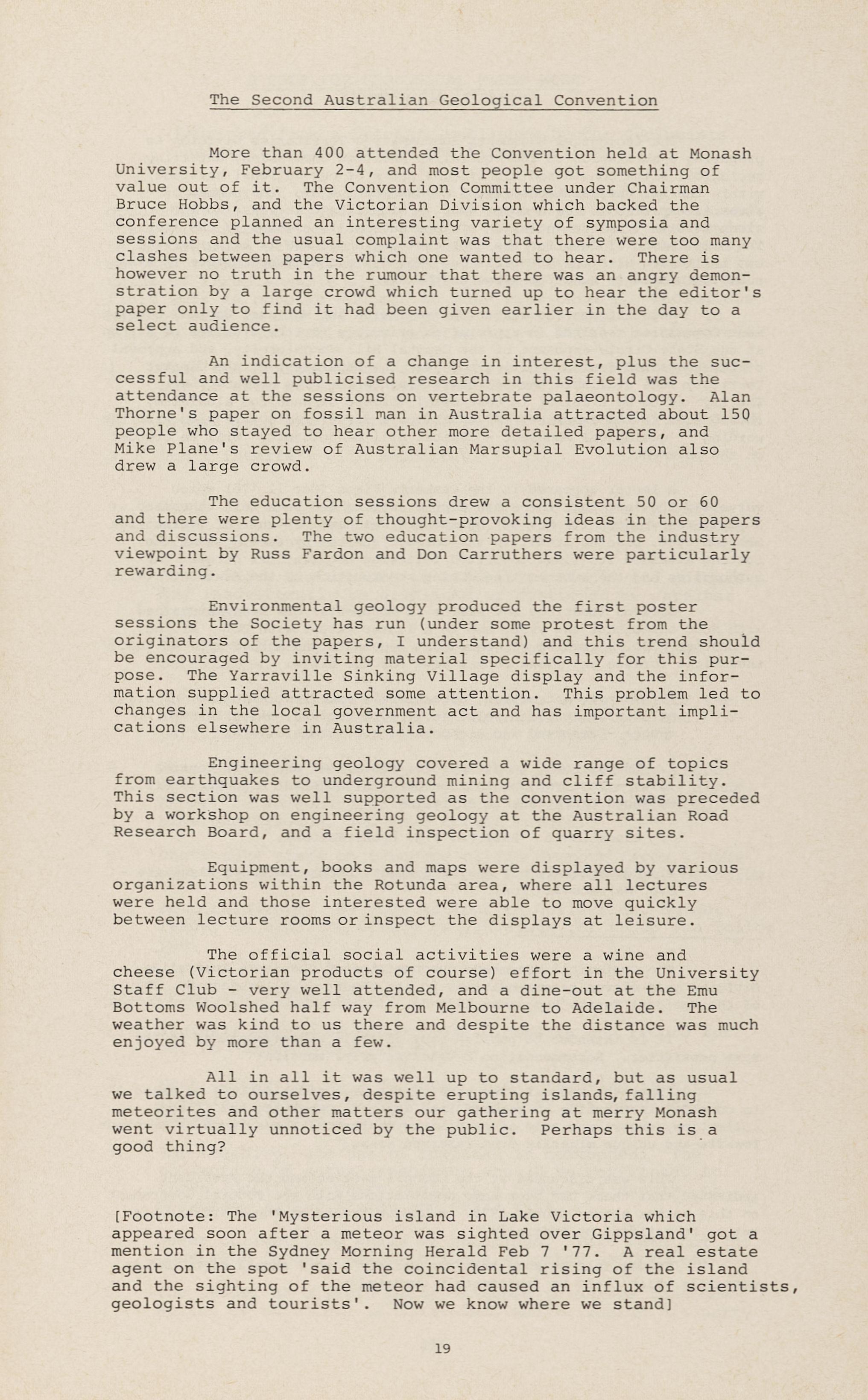
More than 400 attendzd the Convention held at Monash University, February 2-4, and most people got something of value out of it. The Convention Committee under Chairman Bruce Hobbs, and the Victorian Division which backed the con ference planned an interesting variety of symposia and sessions and the usual complaint was that there were too many clashes between papers which one wanted to hear. There is however no truth in the rumour that there was an angry demonstration by a large crowd which turned up to hear the editor's paper only to find it had been given earlier in the day to a select audience.
An indication of a change in interest, plus the successful and well publicised research in this field was the attendance at the sessions on vertebrate palaeontology. Alan Thorne's paper on fossil man in Australia attracted about 150 people who stayed to hear other more detailed papers, and Mike Plane 's review of Australian Marsupial Evolution also drew a large crowd.
The education sessions drew a consistent 50 or 60 and there were plenty of thought - provoking ideas in the papers and discussions. The two education papers from the industry viewpoint by Russ Pardon and Don Carruthers were particularly rewarding.
Environmental geology produced the first poster sessions the Society has run (under some protest from the originators of the papers, I understand) and this trend should be encouraged by inviting material specifically for this purpose. The Yarraville Sinking Village display and the information supplied attracted some attention. This problem led to changes in the local government act and has important implications elsewhere in Australia.
Engineering geology covered a wide range of topics from earthquakes to underground mining and cliff stability. This section was well supported as the convention was preceded by a workshop on engineering geology at the Australian Road Research Board, and a field inspection of quarry sites.
Equipment, books and maps were displayed by various organizations within the Rotunda area, where all lectures were held and those interested were able to move quickly between lecture rooms or inspect the displays at leisure.
The official social activities were a wine and cheese (Victorian products of course) effort in the University Staff Club - very well attended, and a dine-out at the Emu Bottoms Woolshed half way from Melbourne to Adelaide. The weather was kind to us there and despite the distance was much enjoyed by more than a few.
All in all it was well up to standard, but as usual we talked to ourselves, despite erupting islands, falling meteorites and other matters our gathering at merry Mona sh went virtually unnoticed by the public. Perhaps this is_a good thing?
[Footnote: The 'Mysterious island in Lake Victoria which appeared soo n after a meteor was sighted over Gippsland' got a mention in the Sydney Morning Herald Feb 7 '77. A real estate agent on the spot 'said the coincidental rising of the island and the sighting of the meteor had caused an influx of scientists, geologists and tourists'. Now we know where we stand)
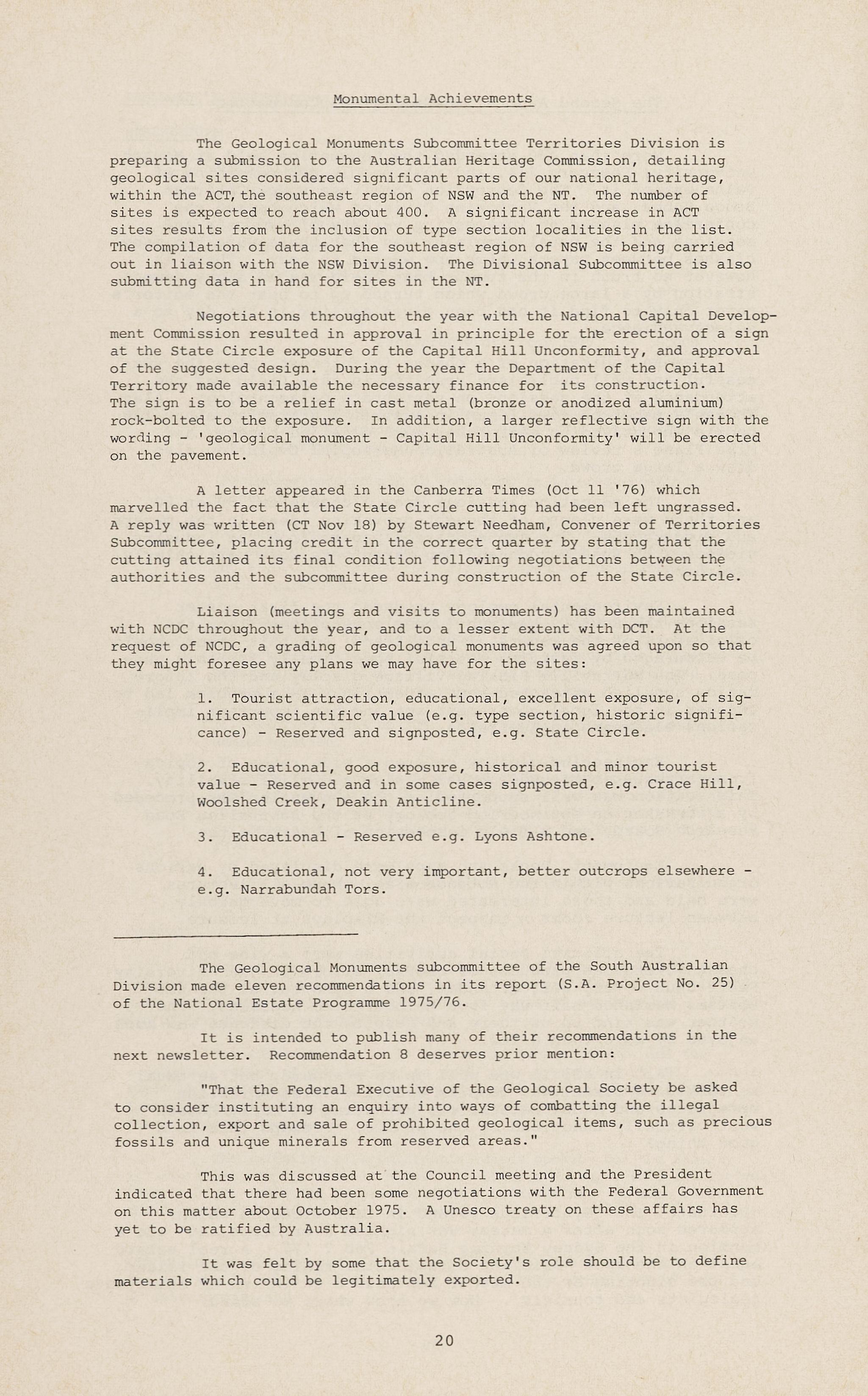
Monumental Achievements
The Geological Monuments Subcommittee Territories Division is preparing a submission to the Australian Heritage Commission , detailing geological sites considered significant parts of our national heritage, within the ACT, the southeast region of NSW and the NT. The number of sit es is expected to reach about 400. A significant increas e in ACT sites results from the inclusion of type section l oca lities in th e list. The compilation of data for the southeast region of NSW is being carried out in liaison with the NSW Division. The Divisional Subcommittee is also submitting data in hand for sites in the NT
Negotiations throughout the year with the National Capital Development Commission resulted in approval in principle for the erection of a sign at the State Circle exposure of the Capital Hill Unconformity, and approval of the suggested design During the year the Department of the Capital Territory made available the necessary finance for its construction The sign is to be a relief in cast metal (bronze or anod iz ed aluminium) rock - bolted to the exposure . In addition , a larger reflective sign with the wor ding - 'geo logi cal monument - Capital Hill Unconformity ' will be erected on the pavement
A letter appeared in the Canberra Times (Oct 11 ' 76) which marvelled the fact that the State Circle cutting had been left ungrassed. A reply was written (CT Nov 18) by Stewart Needham , Convener of Territories Subcommittee, placing credit i n the correct quarter by stating that the cutting attained its final condition following negotiations between th~ authorities and the subcommittee during construction of the State Circle.
Liaison (meetings and visits to monuments) has been maintained with NCDC throughout the year , and to a lesser extent with DCT. At the request of NCDC , a grading of geological monuments was agreed upon so that they might foresee any plans we may have for the sites :
1. Touri st attraction , ed ucational , exce llent exposure , of significant scientific value (e.g type section , historic significance) - Reserved and signposted, e.g. State Circle.
2 Educational, good exposure , hi storical and minor tourist value - Reserved and in some cases signposted, e.g. Crace Hill , Woolshed Creek , Deakin Anticline.
3. Educational - Reserved e.g. Lyons Ashtone.
4 Educational, not very important, better outcrops elsewheree . g . Narrabundah Tars.
The Geological Monuments subcomm itt ee of the South Australian Division made eleven recommendations in its report (S.A. Project No. 25) of the National Estate Programme 1975/76
It is intended to publish many of their recommendations in the next newsletter Recommendation 8 deserves prior mention:
"That the Federal Executive of the Geological Society be asked to consider instituting an enquiry into ways of cornbatting the illegal collection, export and sale of prohibited geological items , such as precious fossils and unique minerals from reserved areas "
This was discussed at th e Council me eting and the President indicated that there had been some negotiations with the Fe deral Government on this matter about October 1975. A Unesco treaty on these affairs has yet to be ratified by Austra lia
It was felt by some that the Society's role should be to define materials which could be legitimately exported
A CODE FOR GEOLOGICAL FIELD WORK
(Reprinted from a brochure published by the Geologists Association with slight modifications.)
A Geological code of conduct' has become essential if opportunities for field work in the future are to be preserved. The rapid increase in field studies in recent years has tended to concentrate attention upon a limited number of localities, so that sheer collecting pressure is destroying the scientific value of irreplaceable sites. At the same time the volume of field work is causing concern to many site owners. Geologists must be seen to use the countryside with responsibility; to achieve this, the following general points should be obser ved.
1. Obey the Country Code, and obse rve local by-laws. Remember to shut gates and leave no litter.
2. Always seek prior permission before entering private land.
3. Don't interfere with machinery.
-1. Don! t litter fields or roads wi tn rock fragments which might cause injury to livestock, or be a hazard to pedestrians or vehicles.
5. Avoid undue disturbance to wildlife. Plants and animals may inadvertently be displaced or destroyed by careless actions.
6. On coastal sections, be sure you know the local tide conditions.
7 When working in mountainous or remote areas, follow the advice given in pamphlets on 'Mountain Safety', and, in particular, inform someone of your intended route.
B. When exploring underground, be sure you have the proper equipment, and the necessary experience. Never go alone. Report to someone your departure, location, estimated time underground, and your actual return.
9. Don 't take risks on insecure cliffs or rock face s. Take care not to dislodge rock, since other people may be below.
10. Be considerate. By your actions in collecting, do not render an exposure untidy or dangerous for those who follow you.
Collecting and Field Parties
1. Students should be encouraged to observe and record but not to hammer indiscriminately.
2. Keep collecting to a minimum. Avoid removing in situ fossils, rocks or minerals unless they are genuinely needed for serious study.
3. For teaching, the use of replicas is commended. The collecting of actual specimens should be restricted to those localities where there is a plentiful supply, or to scree, fallen blocks and waste tips.
4. Never collect from walls or buildings. Take care not to undermine fences, walls, bridges or other structures.
5. The leader of a field party is asked to ensure that the spirit of this Code is fulfilled, and to remind his party
of the need for care and consideration at all times. He should remember that his supervisory role is of prime importance. He must be supported by adequate assistance in the field. This is particularly important on coastal sections, or over difficult terrain, where there might be a tendency for parties to become dispersed.
Visiting Quarries
1. An individual, or the leader of a party, should have obtained prior permission to visit.
2. The leader of a party should have made himself familiar with the current state of the quarry. He should have consulted with the Manager as to where visitors may go, and what local hazards should be avoided.
3. On each visit, both arrival and departure must be reported.
4. In the quarry, the wearing of safety hats and stout boots is recommended.
5. Keep clear of vehicles and machinery.
6. Be sure that blast warning procedures are understood.
7. Beware of rock falls. Quarry faces may be highly dangerous and liable to collapse without warning.
8. Beware of sludge lagoons.
Research Workers
1. No research worker has the special right to 'dig out' any site.
2. Excavations should be back-filled where necessary to avoid hazard to men and animals and to protect vulnerable outcrops from casual collecting.
3. Don't disfigure rock surfaces with numbers or symbols in brightly coloured paint.
4. Ensure that your research material and notebooks eventually become available for others by depositing them with an appropriate institution.
5. Take care that the publication of details does not lead to the destruction of vulnerable exposures. In these cases, do not give the precise location of such sites, unless this is essential to scientific argument. The details of such localities could be deposited in a national data centre for Geology.
Societies, Schools and Universities
1. Foster an interest in geological sites and their wise conservation. Remember that much may be done by collective effort to help clean up overgrown sites (with permission of the owner, and in consultation with the appropriate authorities).
2. Create working groups for those amateurs who wish to do field work and collect, providing leadership to direct their studies.
3. Make contact with your local conservation groups to ensure that there is coordination in attempts to conserve geological sites and retain access to them.
CHINA TO PUBLISH GEOLOGICAL MAPS OF CHINA AND ASIA
(The following announcement from the Hsinhua (Hong Kong Weekly) is published in full. My initial editorial cuts are in small type.)
Peking, January 4, 1977 (Hsinhua) - Three geological maps edited by the Chinese Academy of Geological Science in cooperation with departments concerned will soon be on sale in China and abroad. They are the "T ectonic System Map of the People's Republic of China", the "Ge ological Map of the People's Republic of China" and the 11 aeological Map of Asia".
The publication of these geological maps shows the tremendous achievements of China's geological work since the founding of the People's Republic. It is of great significance to the development of China's socialist revolution and construction and to geological research in China and Asia.
The "Tectonic System Map of the People 's Republic of China" (one to four million in scale) was edited in line with the theory and method of geomechanics formulated by the late Li Ssu-kuang, China's distinguished geologist. It reflects in a fairly comprehensive way the basic features of the three systems of China's geological structure and their formation, development and interrelationships. It will be helpful to the study of the geological structure of other parts of the world.
The "Geological Map of the People's Republic of China " (one to four million scale) crystallizes the achievements of China's geological work since the founding of the People's Republic, the Great Proletarian Cultural Revolution in particular. It shows the new present level China has attained in geological research.
In old China, under Kuomintang reactionary rule, geological surveys were never conducted in more than half of the regions in China. Consequently, to draw up a comprehensive geological map of the country was out of the question.
After liberation, under the leadership of Chairman Mao and the Party Central Committee, regional geological surveys recon naissance surveys and prospecting were carried out throughout the country. By studying and applying Chairman Mao's philosophical thinking and working in cooperation with the masses, the geologists made gratifying achievements during the Cultural Revolution.
Geological surve y s have now been completed in the main throughout China. This has provided necessary geological data for socialist construction and made it possible to compile a comprehensive geological map for use in industrial production, teaching and scientific research.
The " Geological Map of Asia" (one to five million in scale) was drawn on the basis of the "G eological Map of the People 's Republic of China " plus fairly up-to-date geological data available from other Asian countries and regions, of which a comprehensive analysis was made in accordance with dialectical-materialist views and methods. The map gives a clear picture of the geological features and tectonic framework of Asia. It is a fairly comprehensive geological map
of Asia now available in the world. Its publication will help break the monopoly by the two hegemonic powers , the Soviet Union and the United States, of the compilation of worldwide geological maps and is a credit to the people of China and the third world at large.
The publication of these geological maps is a victory for China's geological workers in studying and applying Mao Tsetung Thought and carrying out the principle of "maintai ning independence and keeping the initiative in our own hands and relying on our own efforts". In fulfilling the task, the scientific research institutes cqncerned implemented the principles of combining production, teaching and scientific research and of combining the old, the. middle-aged and the young. They had the support of over thirt y units in various provinces, including geological bureaus, research institutes and institutions of higher education.
Printed by the China Geological Map Printing House and published by the Cartography Publishing House, the maps are up to advanced standards in the printing of similar maps by other countries.
(For price and availability write to the Publishing House, Peking.)
[P.S. To preserve international harmony and to indicate the editor's good taste he has resisted the temptation to head this article "Bull in a China Shop". Grateful thanks are extended to 'Haggis' for this news item.)
Last Gasps from the Council
Dr. Fisher felt that the Secretary ' s report to Council (see this issue) seriously understated the Society's role in I.G.C activities. An addition on this subject is being cooked up for the record by the retiring President
Victorian Division Councillors expressed considerable dissatisfaction with the handling of sales , publicity and general business arrangements concerning the ' Geology of Victoria ' by the Executive. These matters were discussed at length at the Council Meeting and some misunderstandings cleared up Sales are steady in Melbourne at present and the Victorians are sure a reprint will be called for.
rn our next issue: The great diatomite mystery.
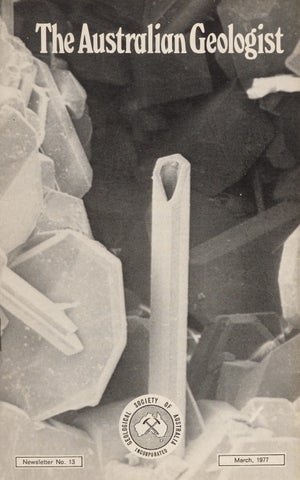
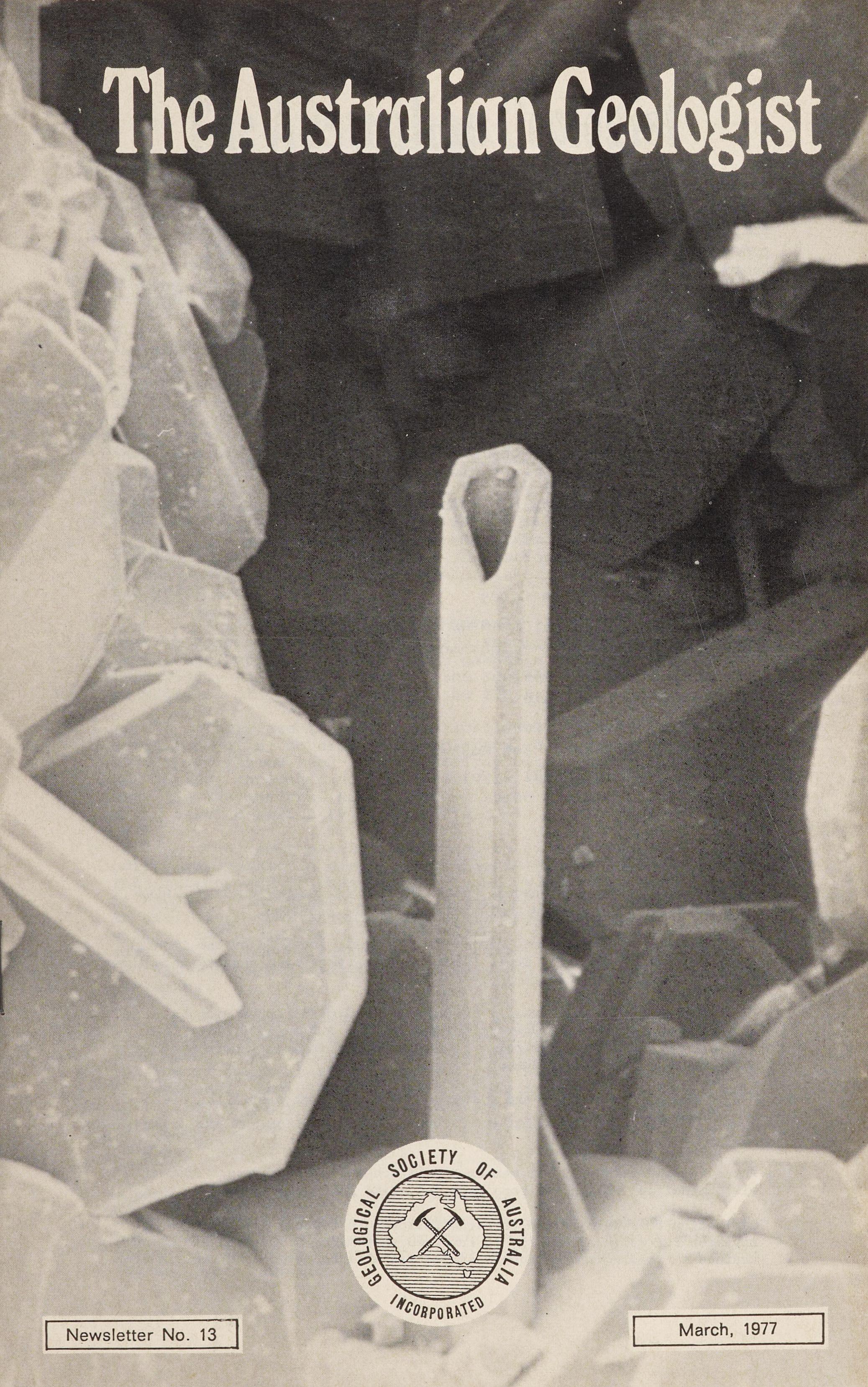
Cover Photo: A hollow aenigmatite crystal with soda-sanidine crystals from a vein in a trachyte near Turritable Falls , Victoria (collected by Dr. R.W. Le Maitre) The diameter of the aenigmatite crystal is about 50 micron and, surprisingly, it is hollow most of the way down. Photo, Angus Ferguson , Uni.of Melbourne.