he Australian Geologist
President:
Hon. Federal Secretary
Dr. G. Playford, Dept. of Geology & Mineralogy, University of Queensland, ST. LUCIA. Queensland 4067.
SOCIETY NEWS
Dorothy Hill
Newsletter Editor
Dr. D. F. Branagan, Dept. of Geology & Geophysics, The University of Sydney, N.S.W. 2006. 'phone: 692 1122, extn. 2358 or 2912.
Our Central Office has recently moved to more pleasant and accessible quarters (and more expensive too!). The new address is:
Suite 9, 6th Floor, Perpetual Trustee Building, 39 Hunter Street, SYDNEY, 2000.
The telephone number is: Sydney 231 4696.
This office is in the same building as the Mining Club so we look forward to seeing more members dropping in to see what their dues are doing, and to purchase the odd or ordinary publication.
Proponents of mathematical geology will reJoice that office operations are to become computerized with data processing being carried out on the DatecKembla Coal and Coke computer. Although such machines are known to be infallible some lucky member in Kalgoorlie (any geologists still there?) can look forward to a delivery of 5000 tonnes of choice coking coal rather than his monthly notice. Contact Laurel Tuckwell at Central Office about such problems as the Society has kept a human for emergencies.
Records of the Society were sorted by a trained archivist, Miss Lapworth, before the move. Material not currently used has been deposited in Basser Library (Academy of Science, Canberra), for the use of future historians.
Mike Rickard of A.N.U. has made a second draft of the revised rules of the Society following comments by divisions and specialist groups. By the time this appears notice will have been given that they are to be presented at the general meeting in May for ratification by the Society. The three principles he has tried to follow in drafting the rules have been, 1) Logical ordering and grouping, 2) Simplification to basics by removing procedural details which will appear in a separate Procedural Guide, 3) to reflect as far as possible ideas about the Society's mode of organization as expressed at recent Council and General Meetings.
Elsewhere in this issue will be found details of forthcoming Society meetings, particularly the Geological Convention in Adelaide in May.
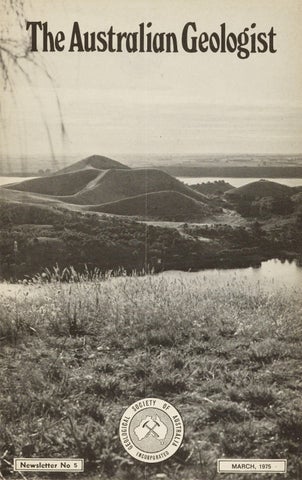
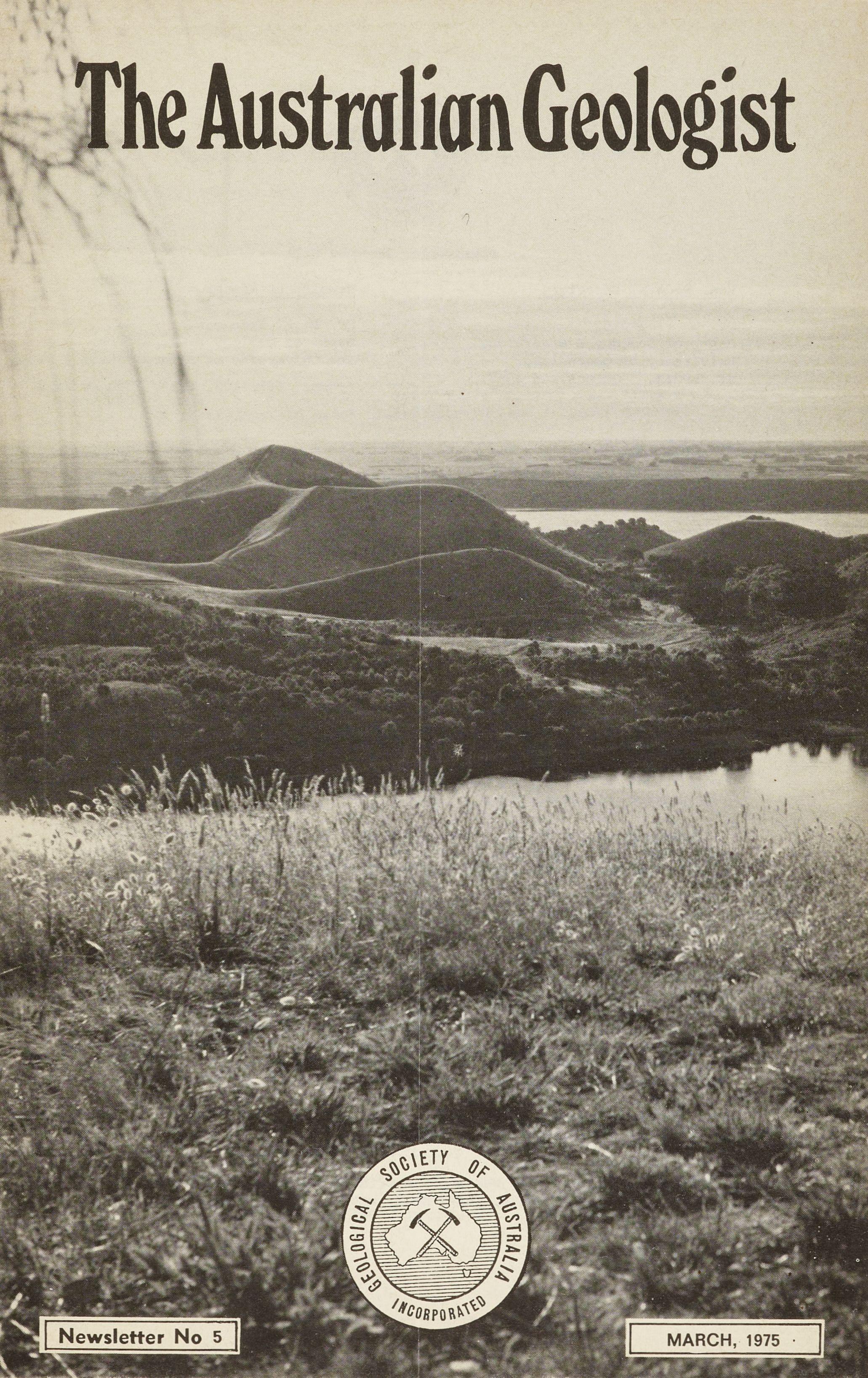
Cover Photo: Tower Hill, Western Victoria, not a caldera as the local tourist blurbs state, but a maar, with nested scoria cones.
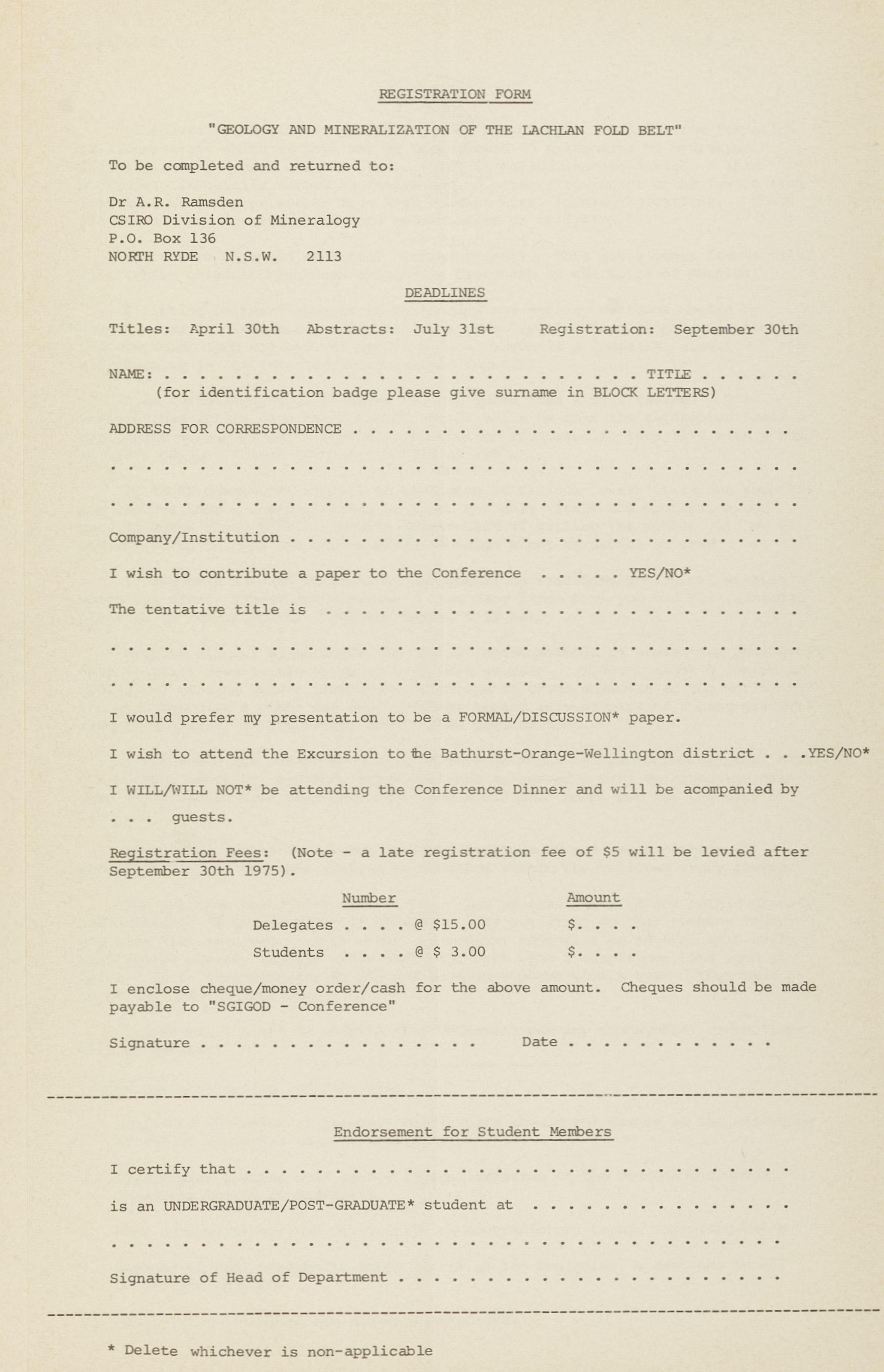
REGISTRATION FORM
"GEOLOGY AND MINERALIZATION OF THE LACHLAN FOLD BELT"
To be completed and returned to:
Dr A.R. Ramsden
CSIRO Division of Mineralogy
P.O. Box 136
NORI'H RYDE N.S.W. 2113
DEADLINES
Titles: April 30th Abstracts: July 31st Registration: September 30th
NAME: • • • • • • . TITLE (for identification badge please give surname in BLOCK LETTERS)
ADDRESS FOR CORRESPONDENCE ..
Company/Institution
I wish to contribute a paper to the Conference YES/NO*
The tentative title is
I would prefer my presentation to be a FORMAL/DISCUSSION* paper.
I wish to attend the Excursion tofue Bathurst-Orange-Wellington district YES/NO*
I WILL/lvILL NOT* be attending the Conference Dinner and will be acompanied by guests.
Registration Fees: (Note - a late registration fee of $5 will be levied after September 30th 1975).
I enclose cheque/money order/cash for the above amount. Cheques should be made payable to "SGIGOD - Conference"
Signature ........... Date ...........
Endorsement for Student Members
I certify that is an UNDERGRADUATE/POST-GRADUATE* student at
Signature of Head of Department
* Delete whichever is
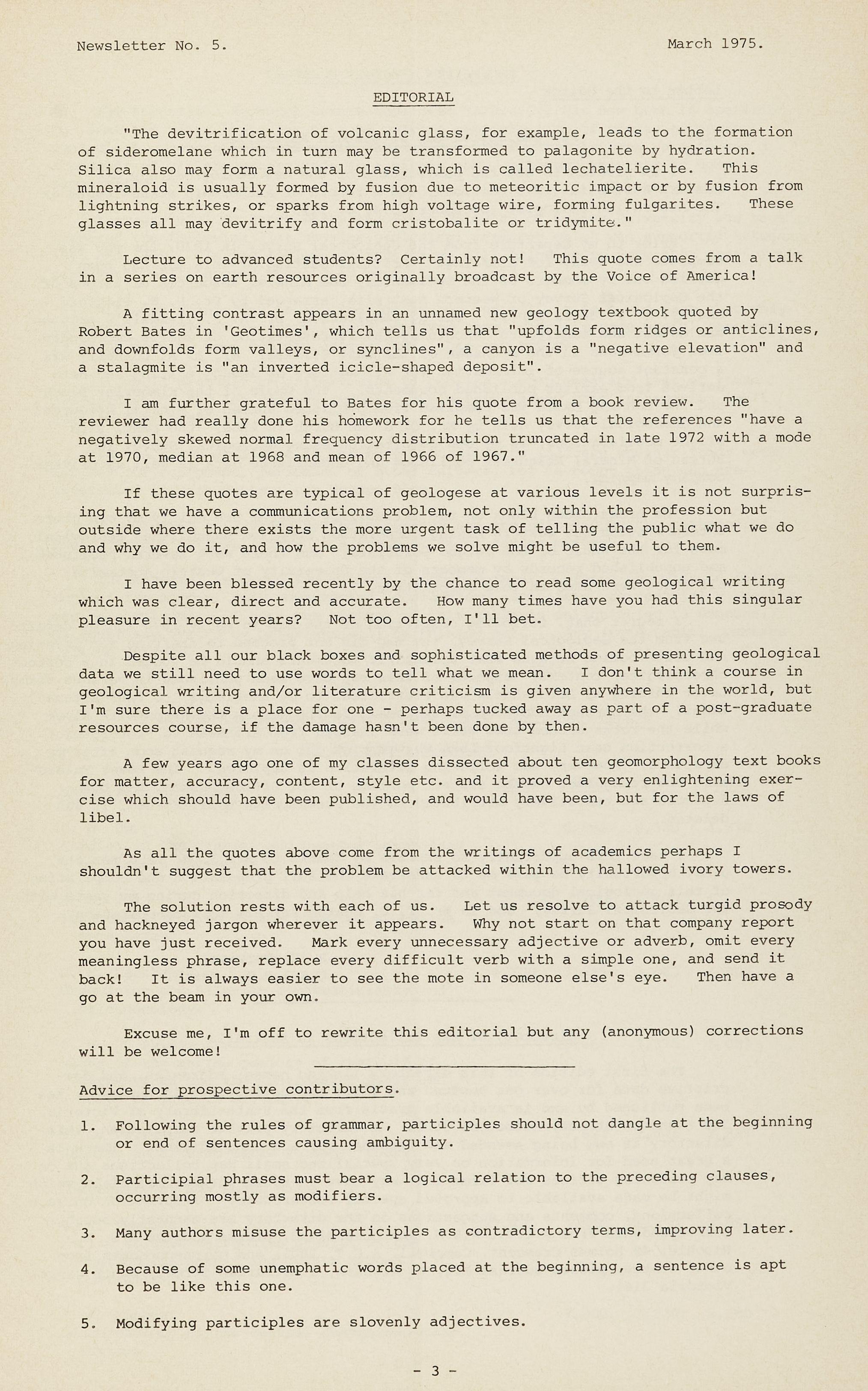
EDITORIAL
"The devitrification of volcanic glass, for example , leads to the formation of sideromelane which in turn may be transformed to palagonite by hydration. Silica also may form a natural glass, which i s called le chatelierite. This mineraloid is usuall y formed by fusion due to meteoritic impact or by fusion from lightning strikes, or sparks from high voltage wire, forming fulgarites. These glasses all may Bevitrify and form cristobalite or tridymite:. "
Lecture to advanced students? Certainly not! This quote comes from a talk in a series on earth resources originally broadcast by the Voice of America!
A fitting contrast appears in an unnamed new geology textbook quoted by Robert Bates in 'Geotime s', which tells us that "upfolds f orm ridges or anticlines, and downfolds form valleys, or synclines", a canyon is a "negative elevation " and a stalagmite is "an inverted icicle-shaped deposit".
I am further grateful to Bates for his quote from a book review. The reviewer had really done his homework for he tells us that the references "have a negatively skewed normal frequency distribution truncated in late 197 2 with a mode at 1 970, median at 1968 and mean of 1966 of 1967."
If these quotes are typical of geologese at various levels it is not surprising that we have a communications problem, not only within the profession but outside where there exists the more urgent task of telling the public what we do and why we do it, and how the problems we solve might be useful to them.
I have been blessed recently by the chance to read some geological writing which was clear, direct and accurate. How many times have you had this singular pleasure in recent years? Not too often, I'll bet.
Despite all our black boxes and sophisticated methods of presenting geological data we still need to use words to tell what we mean. I don't think a course in geological writing and/or literature criticism is given anywhere in the world, but I'm sure there is a place for one - perhaps tucked away as part of a post-graduate resources course, if the damage hasn't been done by then.
A few years ago one of my classes dissected about ten geomorphology text books for matter, accuracy, content, style etc. and it proved a very enlightening exercise which should have been published, and would have been, but for the laws of libel.
As all the quotes above come from the writings of academics perhaps I shouldn't suggest that the problem be attacked within the hallowed ivory towers.
The solution rests with each of us. Let us resolve to attack turgid prosody and hackneyed jargon wherever it appears. Why not start on that company report you have just received Mark every unnecessary adjective or adverb, omit every meaningless phrase, replace every d ifficult verb with a simple one, and send it back! It is always easier to see the mote in someone else's eye. Then have a go at the beam in your own.
Excuse me, I'm off to rewrite this editorial but any (anonymous) corrections will be welcome!
Advice for prospective contributors.
1. Following the rules of grammar, participles should not dangle at the beginning or end of sentences causing ambiguity.
2. Participial phrases must bear a logical relation to the preceding clauses, occurring mostly as modifiers.
3. Many authors misuse the participles as contradictory terms, improving later.
4. Because of some unemphatic words placed at the beginning, a sentence is apt to be like this one.
5 Modifying participles are slovenly adjectives.
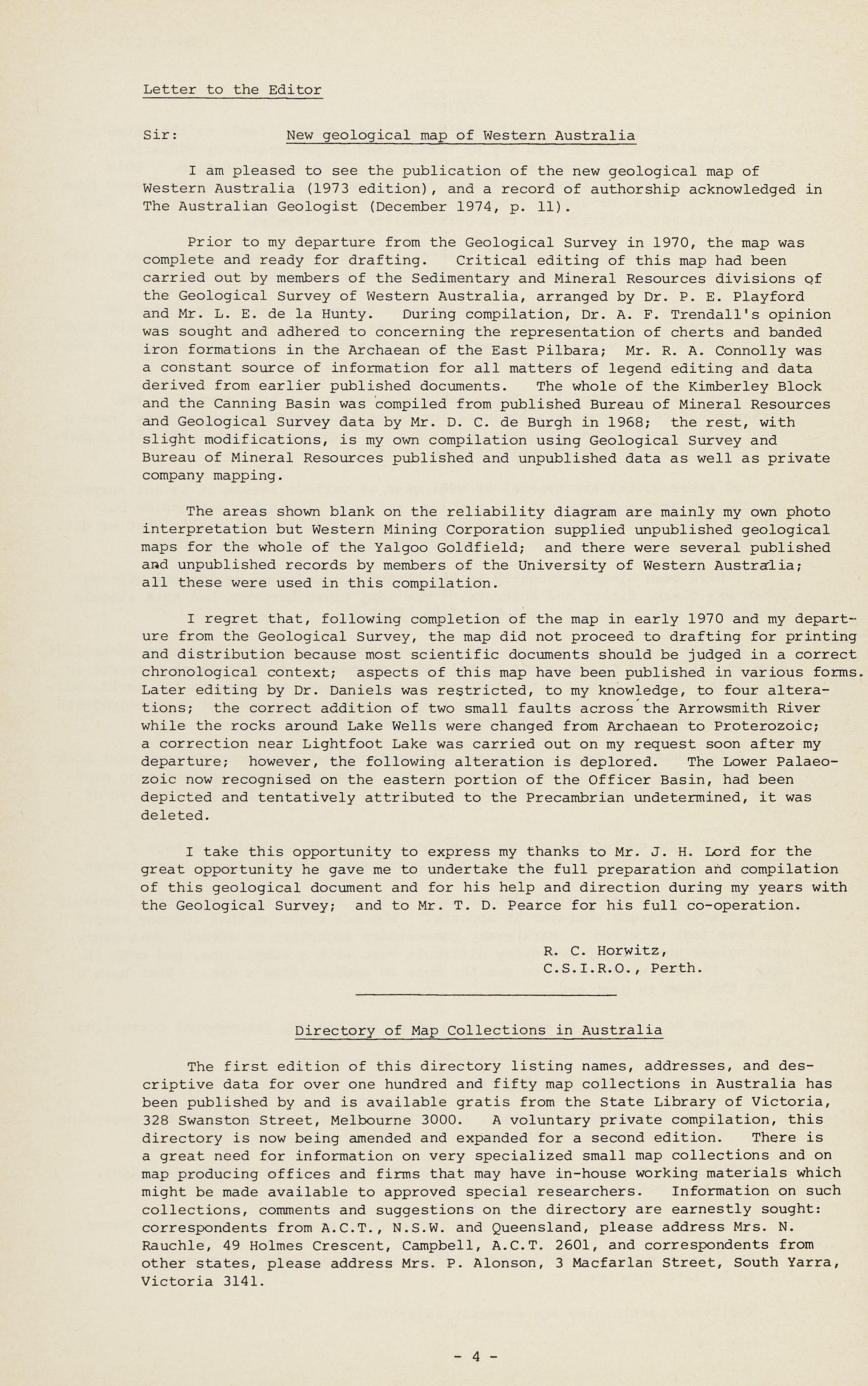
Sir: New geological map of Western Australia
I am pleased to see the publication of the new geological map of Western Australia (1973 edition), and a record of authorship acknowledged in The Australian Geologist (December 1974, p. 11).
Prior to my departure from the Geological Survey in 1970, the map was complete and ready for drafting. Critical editing of this map had been carried out by members of the Sedimentary and Mineral Resources divisions of the Geological Survey of Western Australia, arranged by Dr. P. E. Playford and Mr. L. E. de la Hunty. During compilation, Dr. A. F. Trendall's opinion was sought and adhered to concerning the representation of cherts and banded iron formations in the Archaean of the East Pilbara; Mr. R. A. Connolly was a constant source of information for all matters of legend editing and data derived from earlier published documents. The whole of the Kimberley Block and the Canning Basin was compiled from published Bureau of Mineral Resources and Geological Survey data by Mr. D. C. de Burgh in 1968; the rest, with slight modifications, is my own compilation using Geological Survey and Bureau of Mineral Resources published and unpublished data as well as private company mapping.
The areas shown blank on the reliability diagram are mainly my own photo interpretation but Western Mining Corporation supplied unpublished geological maps for the whole of the Yalgoo Goldfield; and there were several published and unpublished records by members of the University of Western Australia; all these were used in this compilation.
I regret that, following completion of the map in early 1970 and my departure from the Geological Survey, the map did not proceed to drafting for printing and distribution because most scientific documents should be judged in a correct chronological context; aspects of this map have been published in various forms. Later editing by Dr. Daniels was re~tricted, to my knowledge, to four alterations; the correct addition of two small faults across.the Arrowsmith River while the rocks around Lake Wells were changed from Archaean to Proterozoic; a correction near Lightfoot Lake was carried out on my request soon after my departure; however, the following alteration is deplored. The Lower Palaeozoic now recognised on the eastern portion of the Officer Basin, had been depicted and tentatively attributed to the Precambrian undetermined, it was deleted,
I take this opportunity to express my thanks to Mr. J. H. Lord for the great opportunity he gave me to undertake the full preparation and compilation of this geological document and for his help and direction during my years with the Geological Survey; and to Mr. T. D. Pearce for his full co-operation.
R. C. Hor)'l'itz, C.S.I.R.O., Perth.
Directory of Map Collections in Australia
The first edition of this directory listing names, addresses, and descriptive data for over one hundred and fifty map collections in Australia has been published by and is available gratis from the State Library of Victoria, 328 Swanston Street, Melbourne 3000. A voluntary private compilation, this directory is now being amended and expanded for a second edition There is a great need for information on very specialized small map collections and on map producing offices and firms that may have in-house working materials which might be made available to approved special researchers. Information on such collections, comments and suggestions on the directory are earnestly sought: correspondents from A.C.T . , N.S.W. and Queensland, please address Mrs. N. Rauchle, 49 Holmes Crescent, Campbell, A.C.T. 2601, and correspondents from other states, please address Mrs. P. Alonson, 3 Macfarlan Street, South Yarra, Victoria 3141.
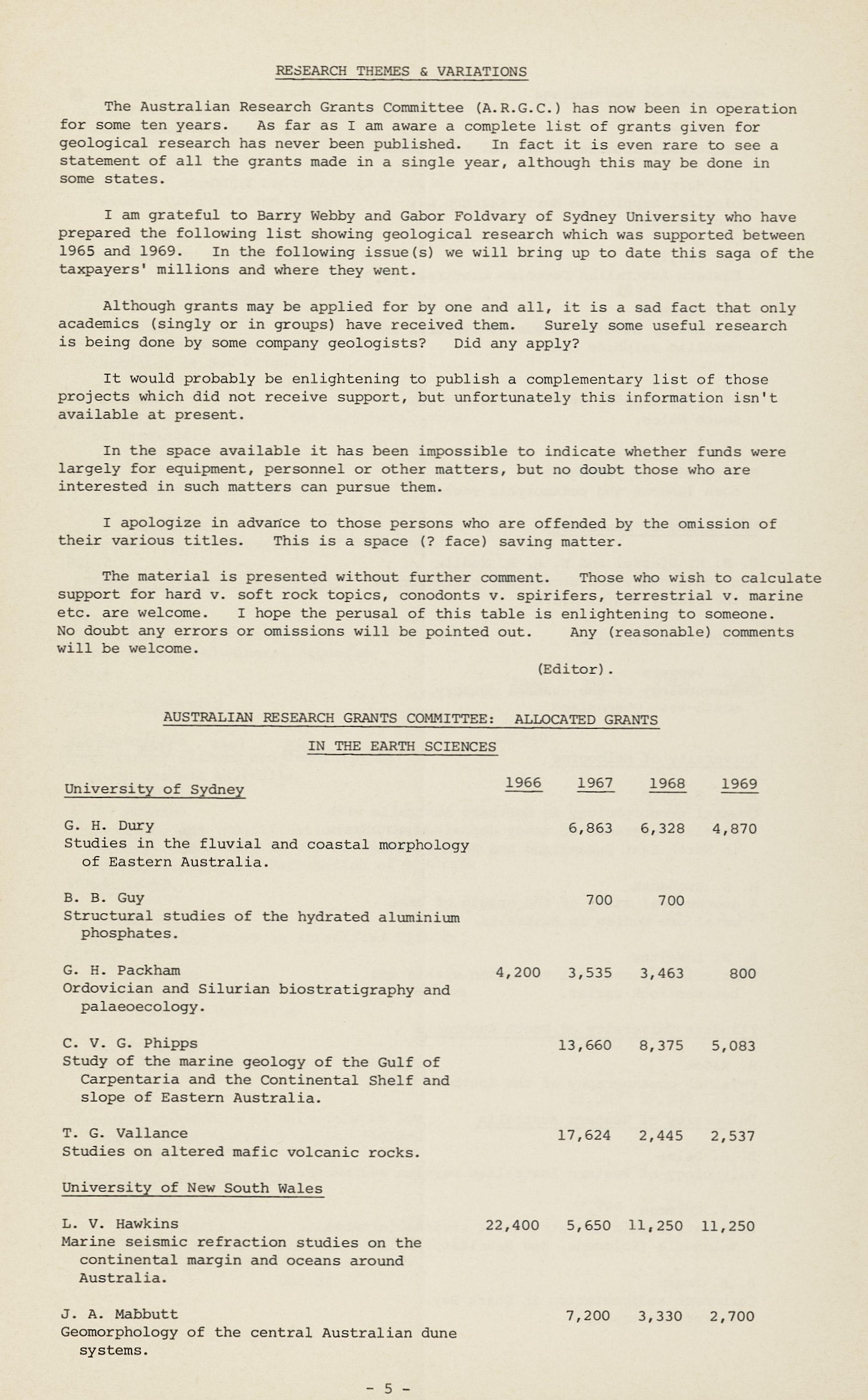
RESEARCH THEMES & VARIATIONS
The Australian Research Grants Committee (A.R.G.C.) has now been in operation for some ten years. As far as I am aware a complete list of grants given for geological research has never been published. In fact it is even rare to see a statement of all the grants made in a single year, although this may be done in some states.
I am grateful to Barry Webby and Gabor Foldvary of Sydney University who have prepared the following list showing geological research which was supported between 1965 and 1969. In the following issue(s) we will bring up to date this saga of the taxpayers' millions and where they went.
Although grants may be applied for by one and all, it is a sad fact that only academics (singly or in groups) have received them. Surely some useful research is be ing done by some company geologists? Did any apply?
It would probably be enlightening to publish a complementary list of those projects which did not receive support, but unfortunately this information isn't available at present.
In the space available it has been impossible to indicate whether funds were largely for equipment, personnel or other matters, but no doubt those who are interested in such matters can pursue them.
I apologize in advance to those persons who are offended by the omission of their various titles. This is a space (? face) saving matter.
The material is presented without further comment. Those who wish to calculate support for hard v. soft rock topics, conodonts v . spirifers, terrestrial v marine etc. are welcome. I hope the perusal of this table is enlightening to someone. No doubt any errors or omissions will be pointed out Any (reasonable) comments will be welcome. (Editor).
AUSTRALIAN RESEARCH GRANTS COMMITTEE: ALLOCATED GRANTS IN THE EARTH SCIENCES
University of Sydney
G. H. Dury
Studies in the fluvial and coa stal morphology of Eastern Austral ia.
B. B. Guy
Structural studies of the hydrated aluminium phosphates.
G. H Packham
Ordovician and Silurian biostratigraphy and palaeoecology.
C. V. G. Phipps
Study of the marine geology of the Gulf of Carpentaria and the Continental Shelf and slope of Eastern Australia.
T. G. Vallance
Studies on altered mafic volcanic rocks.
University of New South Wales
L. V Hawkins
Marine seismic refraction studies on the continental margin and oceans around Aus tralia.
J A. Mabbutt
Geomorphology of the central Australian dune systems.
University of New England
R. A. Binns
Hydrothermal studies 0£ natural hornblendes.
H. J. Harrington
Geological mapping in North-Eastern New South Wales.
G. M. Philip
Eastern Australian Devonian biostratigraphy
R. L. Stanton
Experimental studies of microstructures in metallic sulphide ores.
A. H. Voisey
Geological mapping of North Eastern New South Wales.
J. F. G Wilkinson
Geological and petrogenetic studies of some igneous and metamorphic rocks
University of Newcastle
C. F K. Diessel and K. H. R. Moelle
The sedimentary and structural evolution of the Sydney Basin, N.S.W.
Macquarie University
J. J. Veevers
Sedimentology of the channel country , south- west Queensland.
University of Melbourne
E C. F. Bird
Coastal geomorphology in Northern Australia with special reference to sandy depositional coasts in North-East Queensland and Arnhem Land.
A. S. Buchanan
A geochemical study of the origin of base metal ore bodies in Australia.
R W. LeMaitre
Statistics of chemical variation within and between rock series.
Flinders University of South Australi a R. Radok
Physical oceanography of the Southern Ocean.
University of Western Australia
B. E. Balme
Palynology of Western Australian Permian sediments.
P. J. Coleman
Biostratigraphic and structural studies in outer Melanesia (Solomons, New Hebrides, Fiji).
B w. Logan
Carbonate sedimentation in Shark Bay, Western Australia.
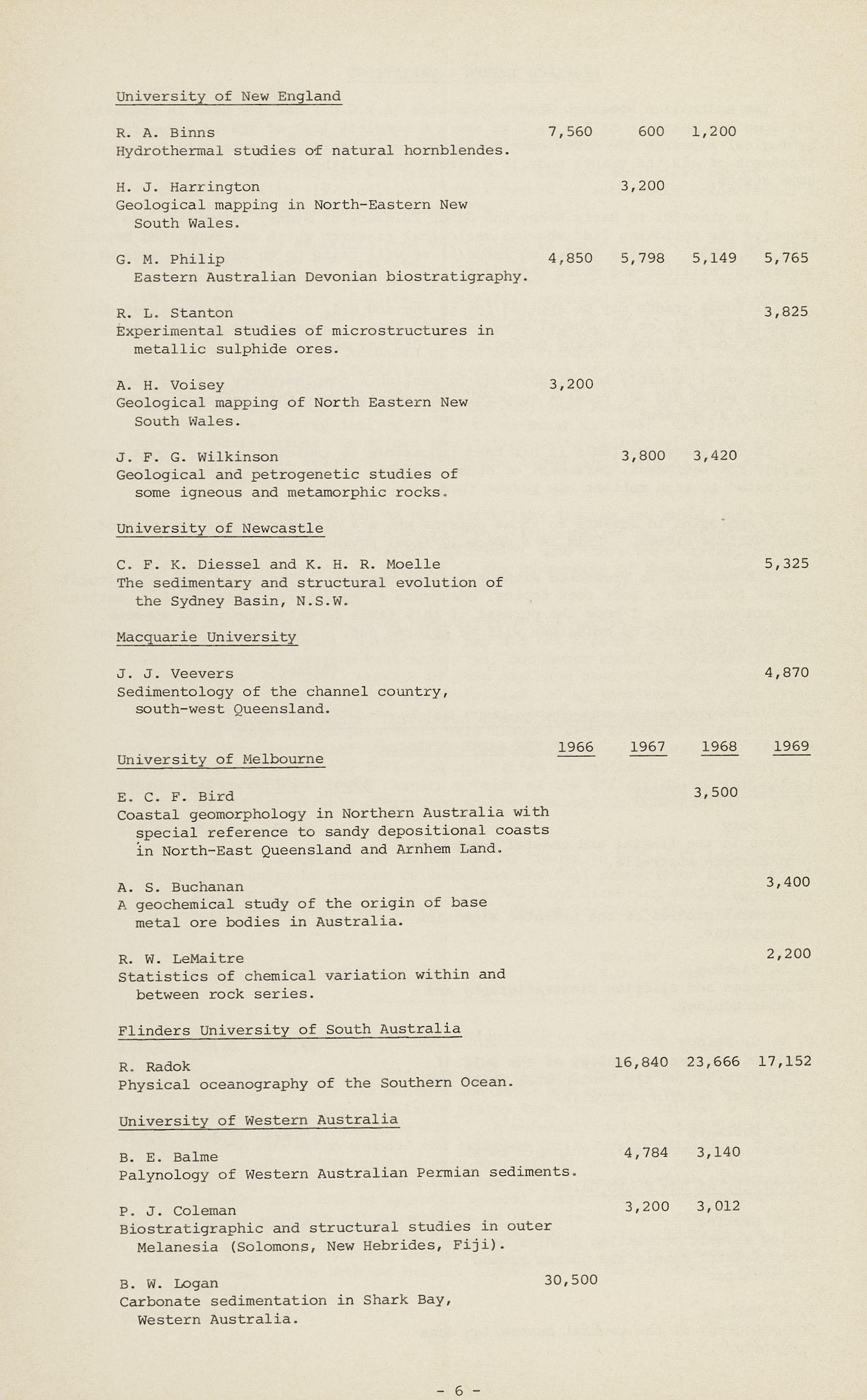
3,200 3,012
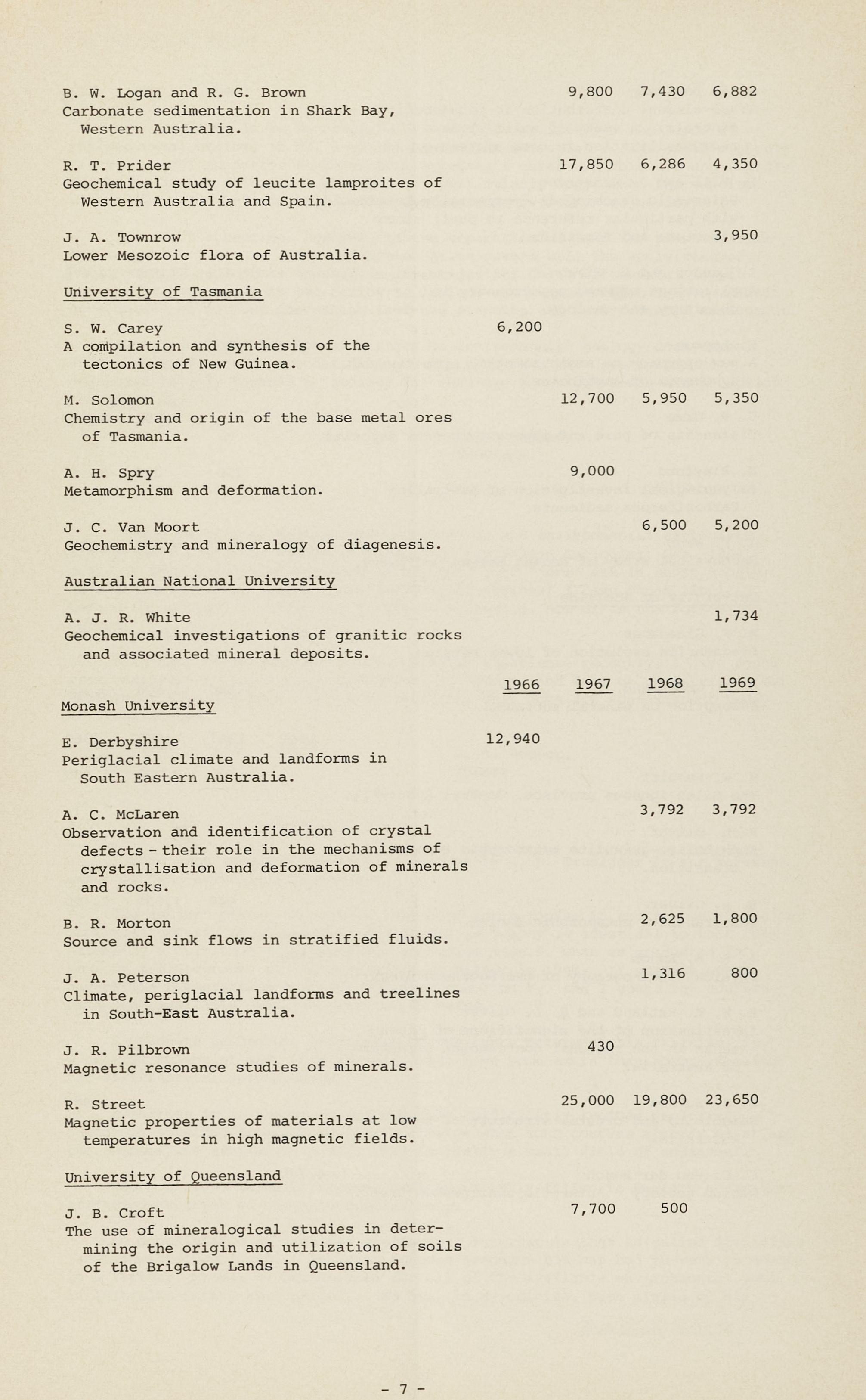
B. w. Logan and R. G. Brown
Carbonate sedimentation in Shark Bay, Western Australia.
R. T. Prider
Geochemical study of leucite lamproites of Western Australia and Spain.
J. A. Townrow
Lower Mesozoic flora of Australia.
University of Tasmania
s. w. Carey
A compilation and synthesis of the tectonics of New Guinea.
M. Solomon
Chemistry and origin of the base metal ores of Tasmania.
A. H. Spry
Metamorphism and deformation.
J. c. Van Moort
Geochemistry and mineralogy of diagenesis.
Australian National University
A. J. R. White
Geochemical investigations of granitic rocks and associated mineral deposits.
Monash University
E. Derbyshire
Periglacial climate and landforms in South Eastern Australia.
A. C. McLaren
Observation and identification of crystal defects - their role in the mechanisms of crystallisation and deformation of minerals and rocks.
B. R. Morton
Source and sink flows in stratified fluids.
J. A. Peterson
Climate, periglacial landforms and treelines in South-East Australia.
J. R. Pilbrown
Magnetic resonance studies of minerals.
R. Street
Magnetic properties of materials at low temperatures in high magnetic fields.
University of Queensland
J.B. Croft
The use of mineralogical studies in determining the origin and utilization of soils of the Brigalow Lands in Queensland.
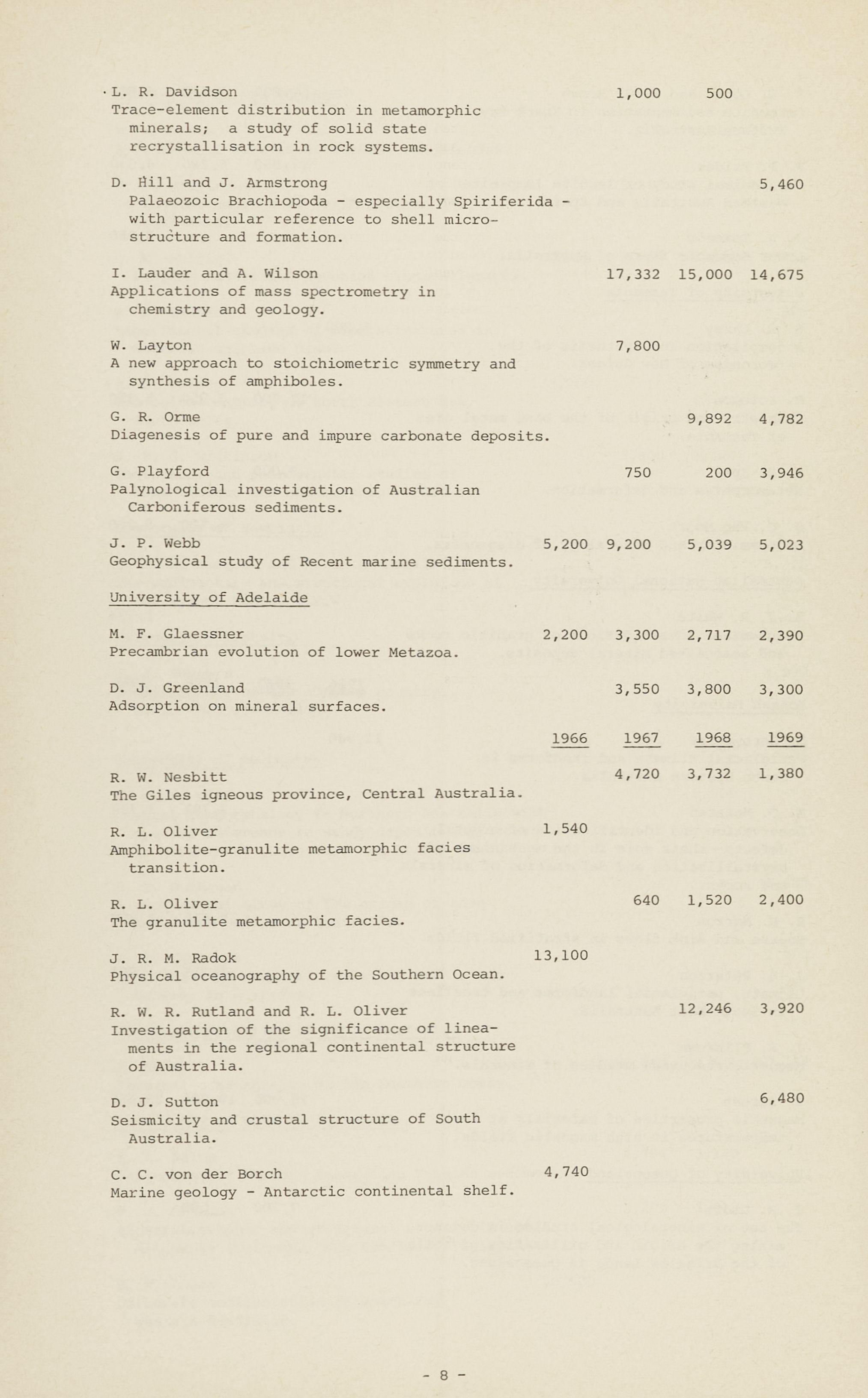
• L. R. Davidson
Trace-element distribution in metamorphic minerals; a study of solid state recrystallisation in rock systems.
D. Hill and J. Armstrong
Palaeozoic Brachiopoda - especially Spiriferidawith particular reference to shell microstructure and formation.
I. Lauder and A. Wilson
Applications of mass spectrometry in chemistry and geology
w. Layton
A new approach to stoichiometric symmetry and synthesis of amphiboles.
G. R. Orme
Diagenesis of pure and impure carbonate deposits.
G. Playford
Palynological investigation of Australian Carboniferous sediments.
J P. Webb
Geophysical study of Recent marine sediments.
University of Adelaide
M. F. Glaessner
Precambrian evolution of lower Metazoa.
D J. Greenland
Adsorption on mineral surfaces.
R w. Nesbitt
The Giles igneous province, Central Australia.
R. L. Oliver
Amphibolite- granulite metamorphic facies transition.
R. L. Oliver
The granulite metamorphic facies.
J. R. M Radok
Physical oceanography of the Southern Ocean.
R. W. R. Rutland and R. L. Oliver
Investigation of the significance of lineaments in the regional continental structure of Australia.
o. J. Sutton
Seismicity and crustal structure of South Australia
c . c. von der Borch
Marine geology - Antarctic continental shelf
Sir:
Mr. Trudinger is to be congratulated for having broached the topic of environmental geology in No. 4 of the Australian Geologist. The article should prove a useful guide for students contemplating a career in this new and rapidly expanding branch of applied geology. I particularly appreciate the concise distinction made between engineering geology and environmental geology
I can not subscribe , however, to the separation of land-use planning from environmental geology. The definition given covers well the activities of environmental geologists engaged in investigations for Environmental Impact Statements, but would be too narrow to include environmental geologists advising governments on matters concerning land - use planning and environmental management
A review of the conceptual history of environmental geology does reveal ardent disagreement on its definition. In practice , this discipline has developed largely towards a "geology for land - use planning" since its inception t en years ago.
G. W. Hofman , Brisbane .
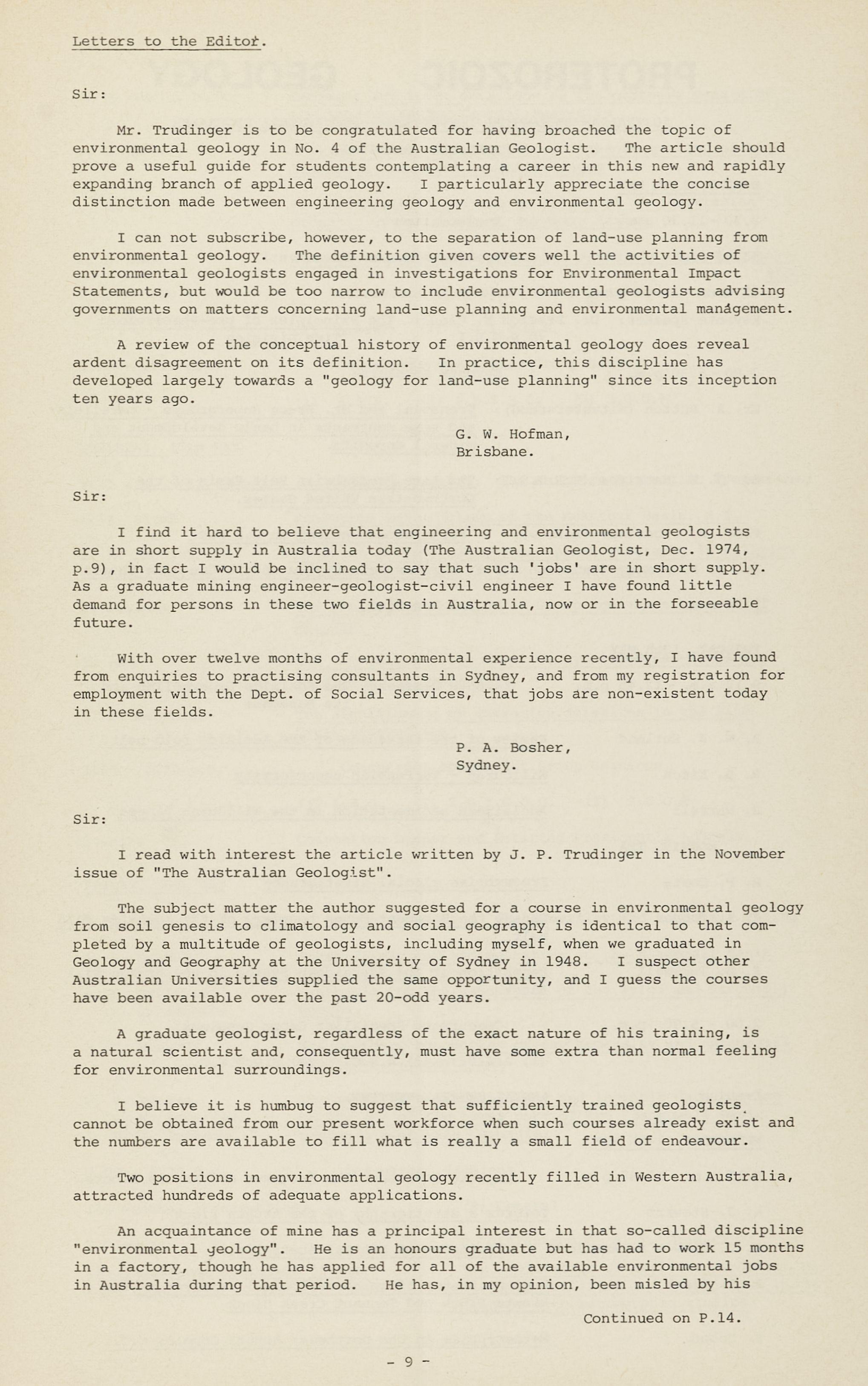
Sir:
I find it hard to believe that engineering and environmental geologists are in short supply in Australia today (The Australian Geologist, Dec 1974, p.9), in fact I would be inclined to say that such 'jobs ' are in short supply. As a graduate mining engineer-geologist- civil engineer I have found little demand for persons in these two fields in Australia, now or in the forseeable future.
With over twelve months of environmental experience recently , I have found from enquiries to practising consultants in Sydney, and from my registration for employment with the Dept. of Social Services , that jobs are non- existent today in these fields.
P.A. Bosher, Sydney.
Sir:
I read with interest the article written by J.P. Trudinger in the November issue of "The Australian Geologist"
The subject matter the author suggested for a course in environmental geology from soil genesis to climatology and social geography is identical to that completed by a multitude of geologists , including myself , when we graduated in Geology and Geography at the University of Sydney in 1948 . I suspect other Australian Universities supplied the same opportunity, and I guess the courses have been available over the past 20-odd years.
A graduate geologist, regardless of the exact nature of his training , is a natural scientist and, consequently, must have some extra than normal feeling for environmental surroundings.
I believe it is humbug to suggest that sufficiently trained geologists_ cannot be obtained from our present workforce when such courses already exist and the numbers are available to fill what is really a small field of endeavour
Two positions in environmental geology recently filled in Western Australia , attracted hundreds of adequate applications.
An acquaintance of mine ha s a principal interest in that so-called discipline "environmental geology". He is an honours graduate but has had to work 15 months in a factory, though he has applied for all of the available environmental jobs in Australia during that period. He has, in my opinion, been misled by his
Continued on P.14.
PROTEROZOIC GEOLOGY
AUSTRALIAN GEOWGICAL CONVENTION: PROVISIONAL PROGRAMME ADELAIDE, MAY 1975.
MONDAY, 12th MAY
9. 30 - 11. 30 a.m. Registration
ll. 45 a.m.
12 noon - 12. 45 p. m.
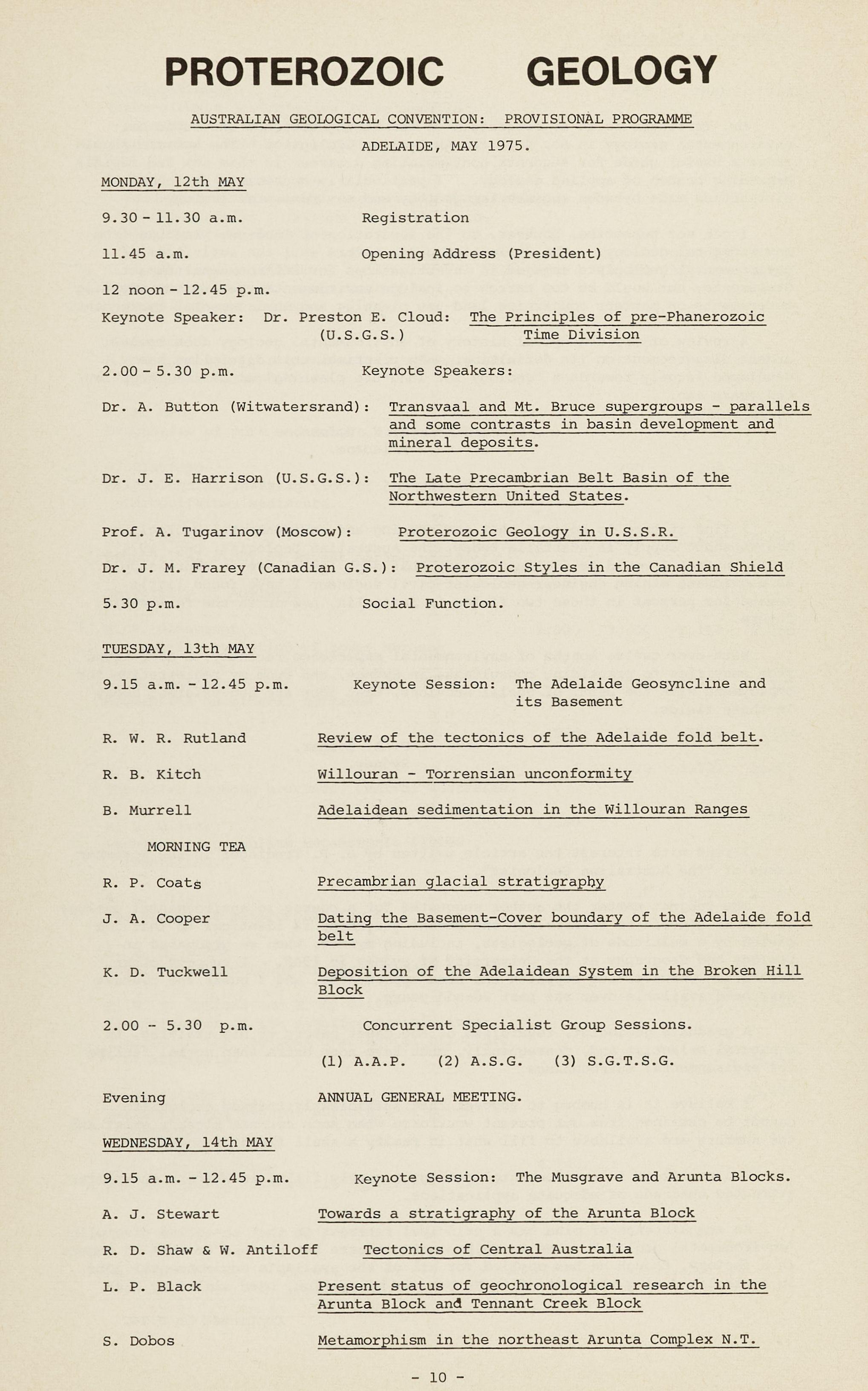
Opening Address (President)
Keynote Speaker: Dr. Preston E. Cloud: The Principles of pre-Phanerozoic (U.S.G.S.) Time Division
2.00- 5.30 p.m.
Keynote Speakers:
Dr. A. Button (Witwatersrand): Transvaal and Mt. Bruce supergroups - parallels and some contrasts in basin development and mineral deposits.
Dr. J.E. Harrison (U.S.G.S.): The Late Precarnbrian Belt Basin of the Northwestern United States.
Prof. A. Tugarinov (Moscow): Proterozoic Geology in u.s.s.R.
Dr. J.M. Frarey (Canadian G.S.): Proterozoic Styles in the Canadian Shield
5. 30 p.m.
TUESDAY, 13th MAY
9.15 a.m. -12.45 p.m.
R. w. R. Rutland
R. B. Kitch
B. Murrell
MORNING TEA
R. P. Coats
J. A. Cooper
K. D. Tuckwell
2.00 - 5.30 p.m.
Evening
WEDNESDAY, 14th MAY
9.15 a.m. -12.45 p.m.
A. J. Stewart
Social Function.
Keynote Session: The Adelaide Geosyncline and its Basement
Review of the tectonics of the Adelaide fold belt.
Willouran - Torrensian unconformity
Adelaidean sedimentation in the Willouran Ranges
Precarnbrian glacial stratigraphy
Dating the Basement-Cover boundary of the Adelaide fold belt
Deposition of the Adelaidean System in the Broken Hill Block
Concurrent Specialist Group Sessions.
(1) A.A.P. (2) A.S.G. (3) S.G.T.S.G.
ANNUAL GENERAL MEETING.
Keynote Session: The Musgrave and Arunta Blocks.
Towards a stratigraphy of the Arunta Block
R. D. Shaw & w. Antiloff Tectonics of Central Australia
L. P. Black
s. Dobos
Present status of geochronological research in the Arunta Block and Tennant Creek Block
Metamorphism in the northeast Arunta Complex N.T.
R. W. Marjoribanks
R. L. Oliver
c. H. Conor
R. B. Major
2.00 - 5.30 p.m.
7.00 - 9.30 p.m.
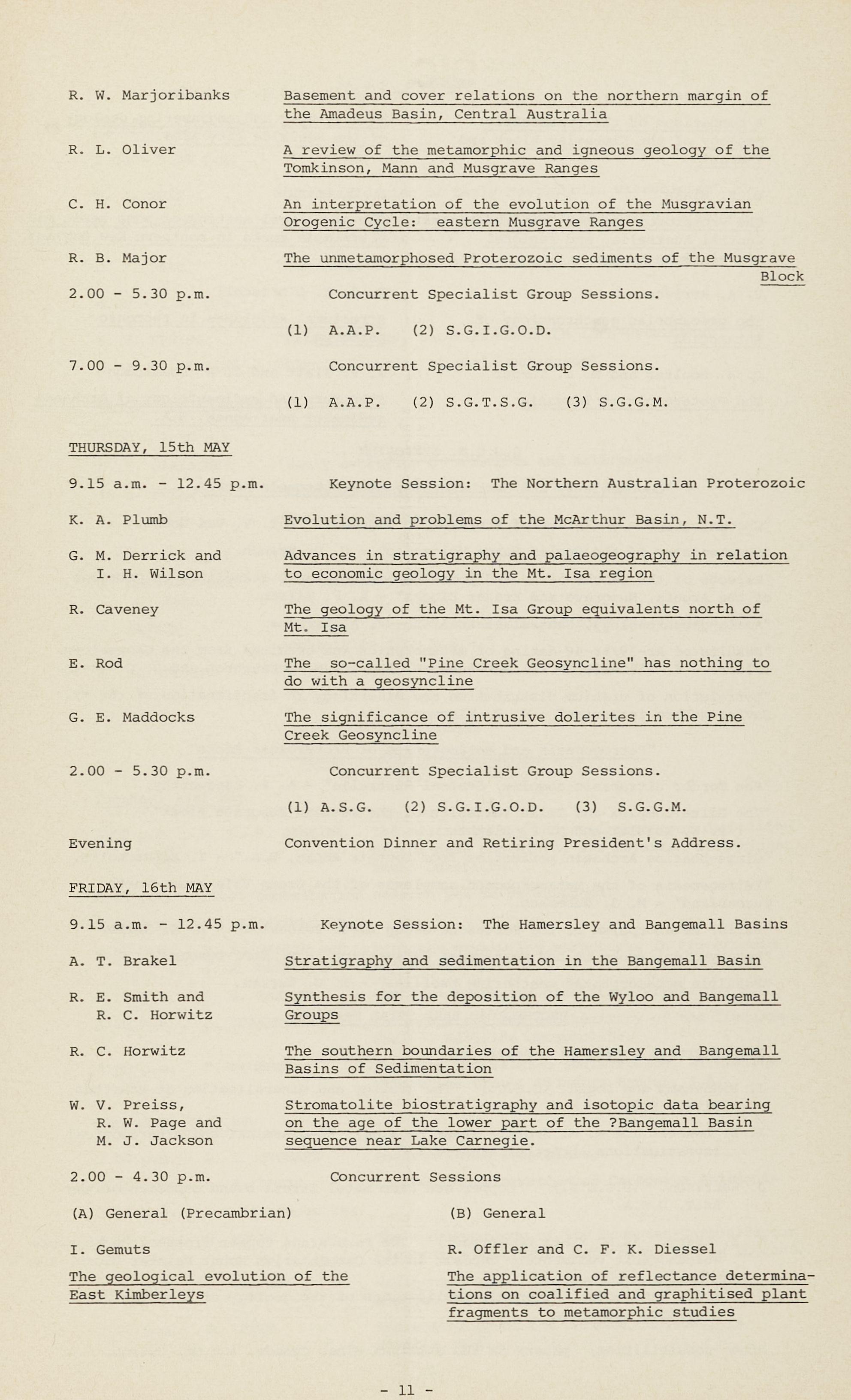
THURSDAY, 15th MAY
9.15 a.m. - 12.45 p.m.
K. A. Plumb
G. M. Derrick and I. H. Wilson
R. Caveney
E. Rod
G. E. Maddocks
2.00 - 5.30 p.m.
Evening
FRIDAY, 16th MAY
9.15 a.m. - 12.45
A. T. Brakel
R. E. Smith and R. c. Horwitz
R. c. Horwitz
w. V. Preiss, R. w. Page and M. J. Jackson
2.00 - 4.30 p .m. p.m.
Basement and cover relations on the northern margin of the Amadeus Basin, Central Australia
A review of the metamorphic and igneous geology of the Tomkinson, Mann and Musgrave Ranges
An interpretation of the evolution of the Musgravian Orogenic Cycle: eastern Musgrave Ranges
The unmetamorphosed Proterozoic sediments of the Musgrave Block
Concurrent Specialist Group Sessions.
(1) A.A.P. (2) S.G. I.G.O.D.
Concurrent Specialist Group Sessions.
(1) A.A.P. (2) S.G.T.S.G. (3) S.G.G.M.
Keynote Session: The Northern Australian Proterozoic
Evolution and problems of the McArthur Basin, N.T.
Advances in stratigraphy and palaeogeography in relation to economic geology in the Mt. Isa region
The geology of the Mt. Isa Group equivalents north of Mt . Isa
The so-called "Pine Creek Geosyncline" has nothing to do with a geosyncline
The significance of intrusive dolerites in the Pine Creek Geosyncline
Concurrent Specialist Group Sessions.
(1) A.S.G. (2) S.G.I.G.O.D. (3) S.G G.M.
Convention Dinner and Retiring President's Address.
Keynote Session: The Hamersley and Bangemall Basins
Stratigraphy and sedimentation in the Bangemall Basin
Synthesis for the deposition of the Wyloo and Bangemall Groups
The southern boundaries of the Hamersley and Bangemall Basins of Sedimentation
Stromatolite biostratigraphy and isotopic data bearing on the age of the lower part of the ?Bangemall Basin sequence near Lake Carnegie.
Concurrent Sessions
(A) General (Precambrian) (B) General
I. Gemuts
The geological evolution of the East Kimberley s
R. Offler and C. F. K. Diessel
The application of reflectance determinations on coalified and graphitised plant fragments to metamorphic studies
R. Hall igan
A compar ison of the Proterozoic geology of the Kimberley Block and Tanzania
D. H. Blake
The Proterozoic of the Granites-Tanami, Central Australia, and regional correlations
P. A. Arriens
The precambrian geochronology of Antarctica
C. A Boulter and M. J. Turner
The Proterozoic of Tasmania
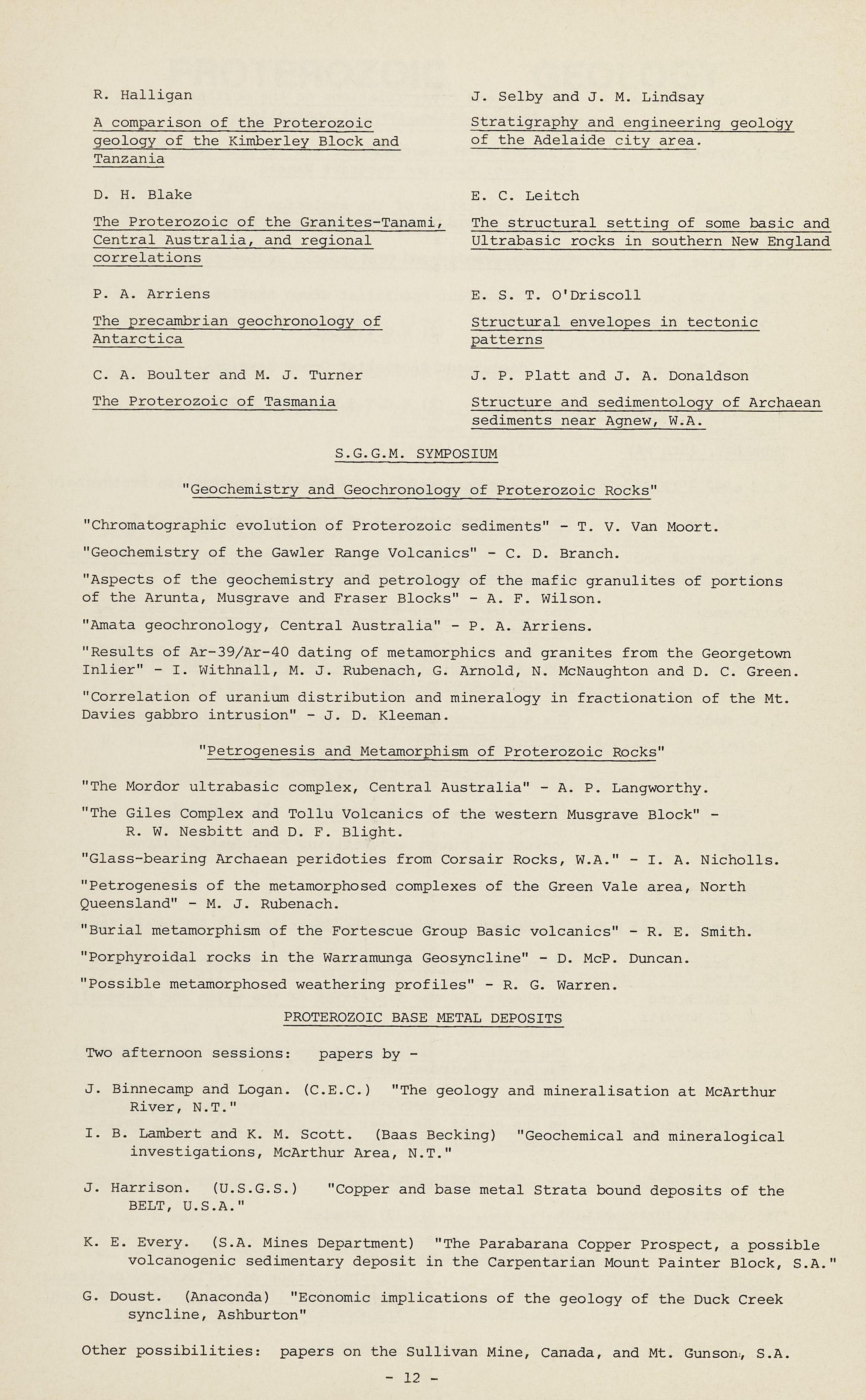
J. Selby and J.M. Lindsay
Stratigraphy and engineering geology of the Adelaide city area.
E. C. Leitch
The structural setting of some basic and Ultrabasic rocks in southern New England
E. S. T. O'Driscoll
Structural envelopes in tectonic patterns
J. P. Platt and J. A. Donaldson
Structure and sedimentology of Archaean sediments near Agnew, W.A.
S.G.G.M. SYMPOSIUM
"Geochemistry and Geochronology of Proterozoic Rocks "
"Chromatographic evolution of Proterozoic sediments" - T.V. Van Moort.
"Geochemistry of the Gawler Range Volcanics" - C. D. Branch.
"Aspects of the geochemistry and petrology of the mafic granulites of portions of the Arunta , Musgrave and Fraser Blocks" - A. F. Wilson.
"Amata geochronology, Central Australia " - P.A. Arriens.
"Results of Ar-39/Ar-4O dating of metamorphics and granites from the Georgetown Inlier" - I. Withnall, M. J. Rubenach, G. Arnold, N. McNaughton and D. C. Green.
"Correlation of uranium distribution and mineralogy in fractionation of the Mt. Davies gabbro intrusion" - J. D. Kleeman
"Petrogenesis and Metamorphism of Proterozoic Rocks"
"The Mordor ultrabasic complex , Central Australia" - A. P. Langworthy.
"The Giles Complex and Tollu Volcanics of the wes tern Musgrave Block"R. W. Nesbitt and D. F. Blight.
"Glass-bearing Archaean peridoties from Corsair Rocks, W.A." - I. A. Nicholls.
"Petrogenesis of the metamorphosed complexes of the Green Vale area, North Queensland" - M. J. Rubenach.
"Burial metamorphism of the Fortescue Group Basic volcanics" - R. E. Smith.
"Porphyroidal rocks in the Warramunga Geosyncline" - D. McP. Duncan.
"Possible metamorphosed weathering profiles" - R. G. Warren.
PROTEROZOIC
BASE METAL DEPOSITS
Two afternoon sessions: papers by -
J. Binnecamp and Logan. (C.E .C.) "The geology and mineralisation at McArthur River, N.T."
I. B. Lambert and K. M. Scott. (Baas Becking) "Geochemical and mineralogical investigations, McArthur Area, N.T."
J. Harrison. (U.S.G.S.) BELT, U.S.A ."
"Copper and base metal Strata bound deposits of the
K. E. Every. (S.A. Mines Department) "The Parabarana Copper Prospect, a possible volcanogenic sedimentary deposit in the Carpentarian Mount Painter Block, S.A."
G. Doust. (Anaconda) "Economic implications of the geology of the Duck Creek syncline, Ashburton"
Other possibilities: papers on the Sullivan Mine, Canada, and Mt. Gunson,, S.A.
Tuesday, 13th May
2.00 - 3.30 p.m.
M. J. MUIR
M. R. WALTER
C. J. PEAT
4.00 - 5.30 p.m.
W. V. PREISS
R. J. F. JENKINS
Wednesday, 14th May
2.00 - 3.30 p.m.
M. F. GLAESSNER
Yu A. ROZANOV
J. B. JAGO
4.00 - 5.30 p.m.
B. RUNNEGAR and P. JELL
R. MAWSON
A. J. WRIGHT
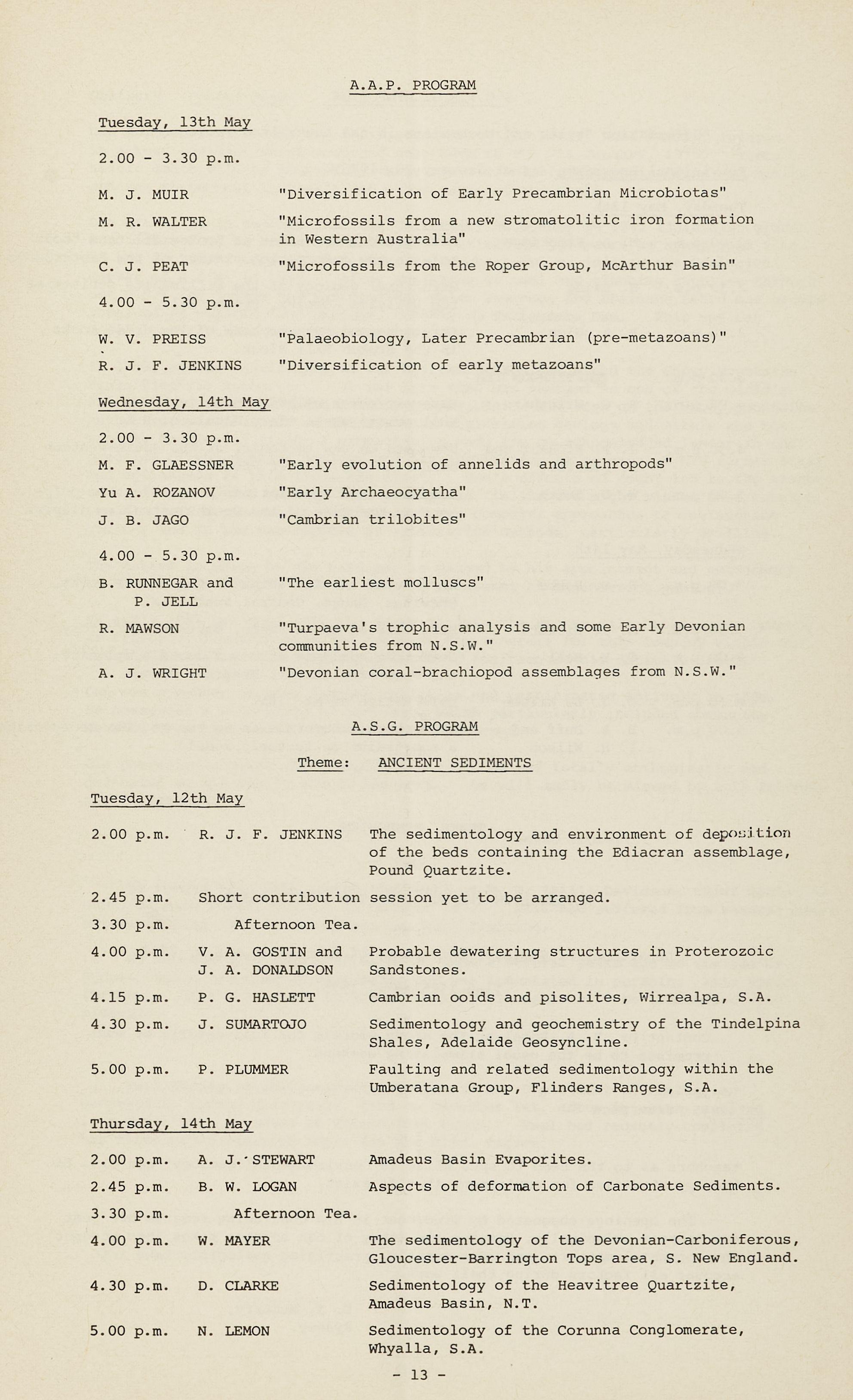
Tuesday, 12th May
2.00 p.m.
2.45 p.m.
3.30 p.m.
4.00 p.m.
4.15 p.m.
4.30 p.m.
5.00 p.m.
A.A.P. PROGRAM
"Diversification of Early Precambrian Microbiotas"
"Microfossils from a new stromatolitic iron formation in Western Australia"
"Microfossils from the Roper Group, McArthur Basin"
"Palaeobiology, Later Precambrian (pre-metazoans)"
"Diversification of early metazoans"
"Early evolution of annelids and arthropods"
"Early Archaeocyatha"
"Cambrian trilobites"
"The earliest molluscs"
"Turpaeva's trophic analysis and some Early Devonian communities from N.S.W."
"Devonian coral-brachiopod assemblages from N.S.W "
A.S.G. PROGRAM
Theme: ANCIENT SEDIMENTS
R. J. F. JENKINS The sedimentology and environment of deposition of the beds containing the Ediacran assemblage, Pound Quartzite.
Short contribution session yet to be arranged. Afternoon Tea.
V. A. GOSTIN and Probable dewatering structures in Proterozoic J. A. DONALDSON Sandstones.
P. G. HASLETT Cambrian ooids and pisolites, Wirrealpa, S.A.
J. SUMARTOJO Sedimentology and geochemistry of the Tindelpina Shales, Adelaide Geosyncline.
P. PLUMMER Faulting and related sedimentology within the Umberatana Group, Flinders Ranges, S.A.
Thursday, 14th May
2.00 p. m
2.45 p.m.
3.30 p.m.
4.00 p.m.
4.30 p.m.
5.00 p.m.
A. J. • STEWART
B. W. LOGAN
Afternoon Tea.
W. MAYER
D. CLARKE
N. LEMON
Amadeus Basin Evaporites. Aspects of deformation of Carbonate Sediments.
The sedimentology of the Devonian-Carboniferous, Gloucester-Barrington Tops area, S. New England.
Sedimentology of the Heavitree Quartzite, Amadeus Basin, N.T.
Sedimentology of the Corunna Conglomerate, Whyalla, S.A.
S.G.T.S.G. SYMPOSIUM
"Deformation Styles and Mechanisms in the Australian Proterozoic"
Provisional Programme (as at January 20, 1975)
Tuesday, May 13th
2.00 p.m.
2.30 p .m.
3.00 p.m.
3.30 p.m.
4.00 p.m.
4.30 p.m.
5.00 p.m.
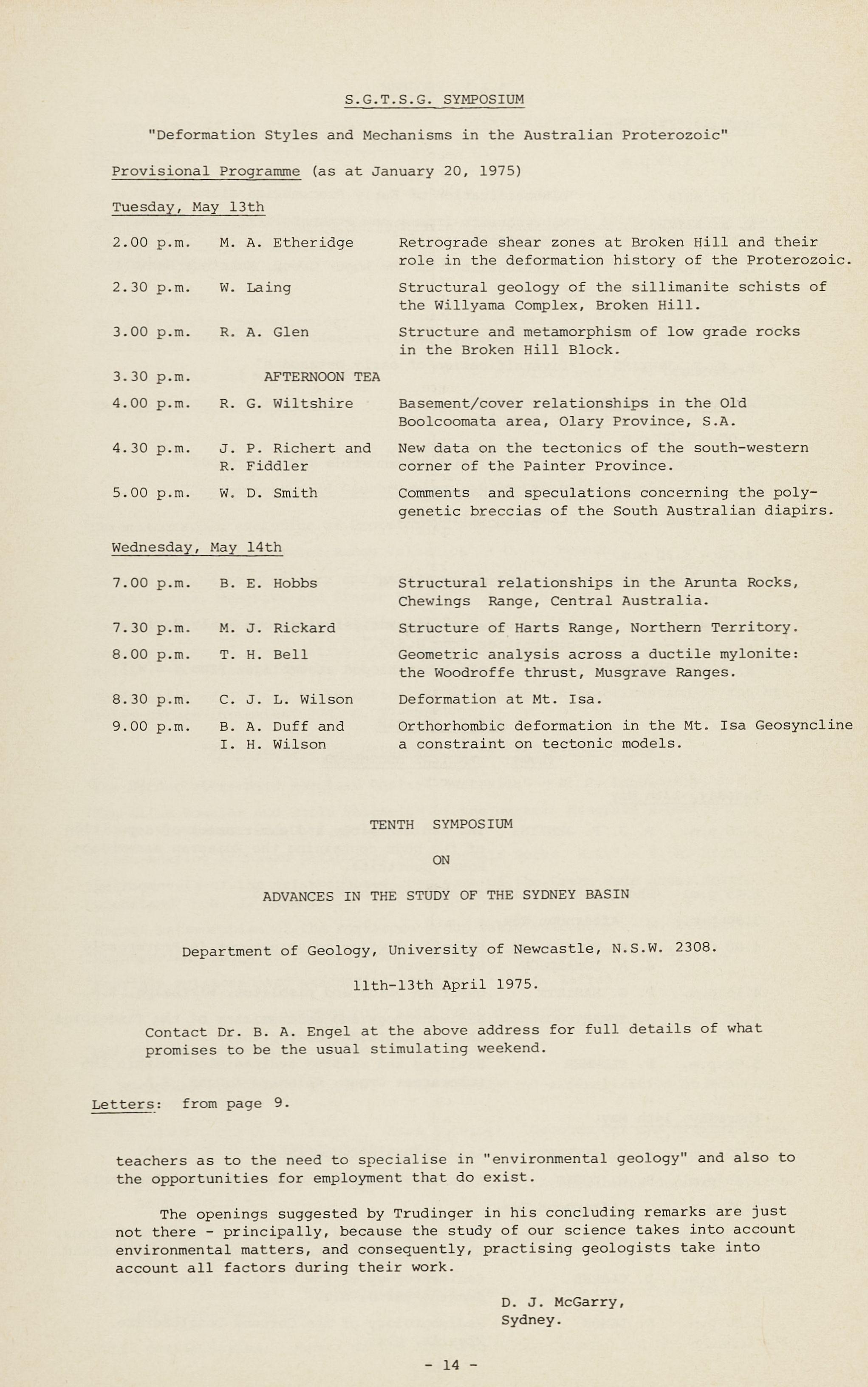
M. A. Etheridge
w. Laing
R. A. Glen
AFTERNOON TEA
R. G. Wiltshire
Retrograde shear zones at Broken Hill and their role in the deformation history of the Proterozoic. Structural geology of the sillimanite schists of the Willyama Complex, Broken Hill.
Structure and metamorphism of low grade rocks in the Broken Hill Block.
Basement/cover relationships in the Old Boolcoomata area, Olary Province, S.A.
J. P. Richert and New data on the tectonics of the south-western R. Fiddler corner of the Painter Province.
W. D. Smith
Wednesday, May 14th
7.00 p.m.
7.30 p.m.
8.00 p.m.
8.30 p.m.
9.00 p m.
B. E. Hobbs
M. J. Rickard
T. H. Bell
C. J. L. Wilson
B. A. Duff and I. H. Wilson
Comments and speculations concerning the polygenetic breccias of the South Australian diapirs.
Structural relationships in the Arunta Rocks, Chewings Range, Central Australia.
Structure of Harts Range, Northern Territory.
Geometric analysis across a ductile mylonite: the Woodroffe thrust, Musgrave Ranges.
Deformation at Mt. Isa.
Orthorhombic deformat i on in the Mt. Isa Geosyncl i ne a constraint on tectonic models.
TENTH SYMPOSIUM ON
ADVANCES IN THE STUDY OF THE SYDNEY BASIN
Department of Geology, University of Newcastle, N.S.W. 2308.
llth-13th April 1975.
Contact Dr. B. A. Engel at the above address for full details of what promises to be the usual stimulating weekend.
Letters : from page 9.
teachers as to the need to specialise in "environmental geology" and also to the opportunities for employment that do exist.
The openings suggested by Trudinger in his concluding remarks are just not there - principally, because the study of our science takes into account environmental matters, and consequently, practising geologists take into account all factors during their work.
D. J. McGarry, Sydney.
Obituary, Daniel Moye
Dan Moye, his wife Joan and their youngest child, Helen, were fatally i n jured in a road accident which occurred near Eden on the 7th January, 1975. Their tragic death will be mourned b y their many friends in the engineering and mining spheres throughout Australia and other parts of the world.
Dan graduated in geology from the University of Sydney in 1941 (Joan also graduated in geology in 1939 from Sydne y). During the war years he spent some time in the munitions supply laboratory, Melbourne prior to joining the Geological Survey of N S W. in 1945. After assisting in coal and planning supplies throughout N.S.W. he joined the Metropolitan Water Sewerage and Drainage Board and became involved in construction geology, notably on Warragamba Dam. This was Dan Moye's contribution to engineeri ng· geology.
In 1949, at the instigation of Sir William Hudson he joined the Snowy Mountains Hydro Electric Authority. It was here that Dan emerged as one of the world's eminent and outstanding engineering geologists. His work on the Snowy Mountains Authority, particularly in the field of engineering geology and within the now rapidly developing field of geomechanics made him an acknowledged leader in the practice of engineering geology and its application as so many of his former staff and colleagues in this field can atest . Dan's efforts no doubt led to the acceptance of engineering geology as a discipline in its own right within this country Dan also was a pioneer in mathematical and computer approaches to engineering geology and in the development of exploration methods, particularly drilling
The esteem in which he was held may be gauged by his appointment and secondment to Berkeley in 1962 to 1967 as interim professor of engineering geology.
In early 1967 Dan Moye left the Snowy to Join the Broken Hill Proprietary Company as director of exploration and research for minerals for this Company within and o u tside Australia. He was occupying this position at his untimely death.
Dan was a member of many learned societies and participated actively in them. He possessed a wide range of interests which particularly included community service organisations. He was a keen fisherman.
Dan possessed a quiet and friendly nature dedicated to his family and to his work. and colleagues
He was totally enthusiastic and He will sadl y be missed by both friends
David Probert.
We record also with regret the death of W. H. (Bill) Davidson, Chief Geologist, Dept. of Main Roads, N.S.W , in October 1974. Bill had suffered from several heart attacks during )973-74 but always came back fighting.
He successfully completed an M. Sc. thesis several years ago on the use of Sydney region breccias as aggregates and was interested in pursuing this topic further. Bill's· kindness to his fri P.nds of all rank s will be remembered with pleasure.
Paul Keaney, a post-graduate student in the Department of Geology and Geophysics, Sydney University, died on December 1st, after injuries received in a motor bike accident at Amaroo Park track. Paul had recently completed his first major research topic for the M Sc. degree.
Talbragar : The Watchdogs Reply.
Sir ,
Dr Brunnschweiler (Aust Geologist, 3, p.14) has quite correctly brought to the attention of the NSW Stratigraphic Nomenclature Subcommittee the glaring homonymy that has appeared in the literature regarding the use of the term " Talbragar ". The watchdogs of this subcommittee are somewhat embarrassed , but take consolation in the fact that Dr. Dulhunty sneaked his term in via the back door , rather than through the effic i ently guarded front entrance. Like the rest of the geological fraternity , they were unaware of this nomenclatorial wipe - out unti l after it had appeared in print
The Australian Code of Strat i graphic Nomenclature (reprinted in J.geol.Soc Aust. , 20(1), pp.105- 112) requires that the name of a new rock unit should be available (i e. should not have been previously used) and that the unit be correctly def i ned. The availabil i ty of the name is best checked, and the name reserved for the author's use by a telephone call or letter to the Centra~ Registry of Stratigraphic Names at the B M.R in Canberra . The definition should then be checked with the appropriate State Stratigraphic Nomenclature Subcommittee prior to publication. If he had checked with the Central Registry , Dr . Dulhunty would have been given a list of 13 previous references to the term " Talbragar " dating back to its introduction by Anderson in 1889 (Rec geo l. Surv.N.S W. , 1, p 137) Although it has been used informally in all of these cases , the term is nevertheless well established , a n d under Artic l e 12 of the Code it should not be used for any other stratigraph i c hor i zon.
The present situation is best reso l ved by substituting a new geographic name for the Triassic " Talbragar Formations" (J geol. Soc Aust ., 20 (3) , pp. 319328) before it , too becomes entrenched in the literature, as its use in thi s way is completely i nvalid. This new name should be checked with the Central Registry for availability , and the def i nition lodged with the N S W. Subcommittee for check i ng and eventual f i ling in Canberra.
Unfbrtunately Dr Dulhunty i s one of many authors who do not make use o f these facilities. Du ring 1974 a tot al of 110 new Australian stratigraphic names were pub l ished which had not prev i ously been checked o r reserved , compared with 250 that had been If this example makes i ntending authors aware of the complications that may arise with strati graphic names born on t h e wrong s i de o f the blanket , I hope we can l ook fo r ward t o a s ub stantial red u c ti on i n th i s figure f o r 1975.
Co lin R. Ward , Convener , NSW Stratigraph i c Nomenclature S ubcommittee , N S W Institu te of Techno l ogy , Broadway , N. S . W.
S.G I.G O D CONFERENCE
GEOLOGY AND MINERALIZAT I ON OF THE LACHLAN FOLD BELT
8 - 1 0th DECEMBER 19 7 5
Macquarie Unive r s i ty, North Ryde , N.S W
The Keynote Th eme - "Geology and Minerali z ation" - see ks to b r ing togeth er the results of recent and current research work i n th e Lachlan Fold Belt dire cted towards b e tter understanding the r elationships betwee n t h e geologi cal develop me n t of the f old belt and the patterns of mine r al iz ation with in i t.
CALL FOR PAPERS : Persons wishing to con tribute to the Confere11ce are inv ited to submit titles and return the completed Registration Form not later than April 30th, 1975, t o the Organising Committe e:
C/ -Dr A.R . Ramsden
CSIRO Di v ision of Mineralogy P O Box 136 North Ryde N.S W. 21 1 3 - 16 -