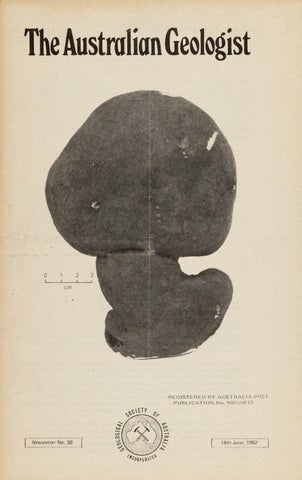
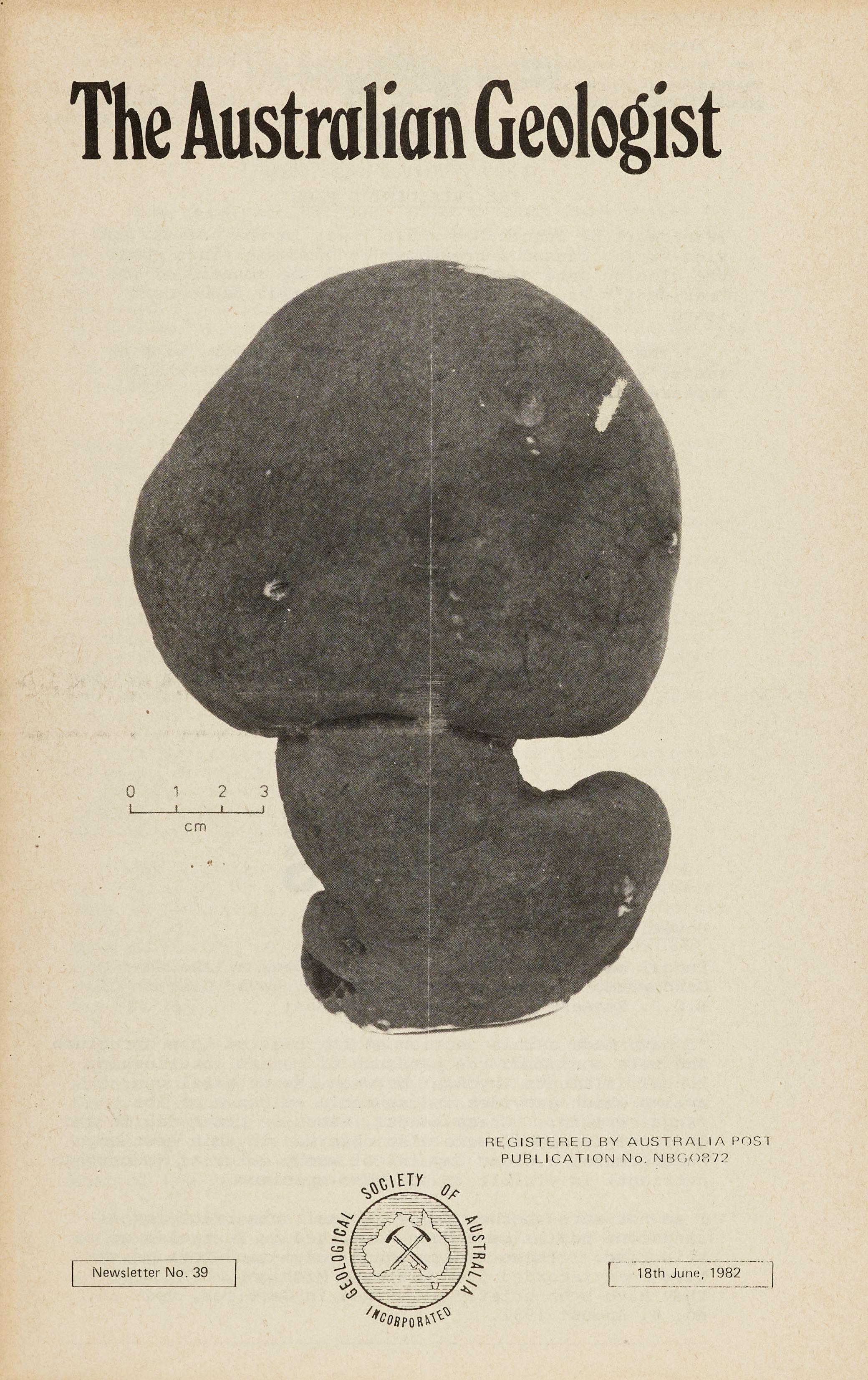
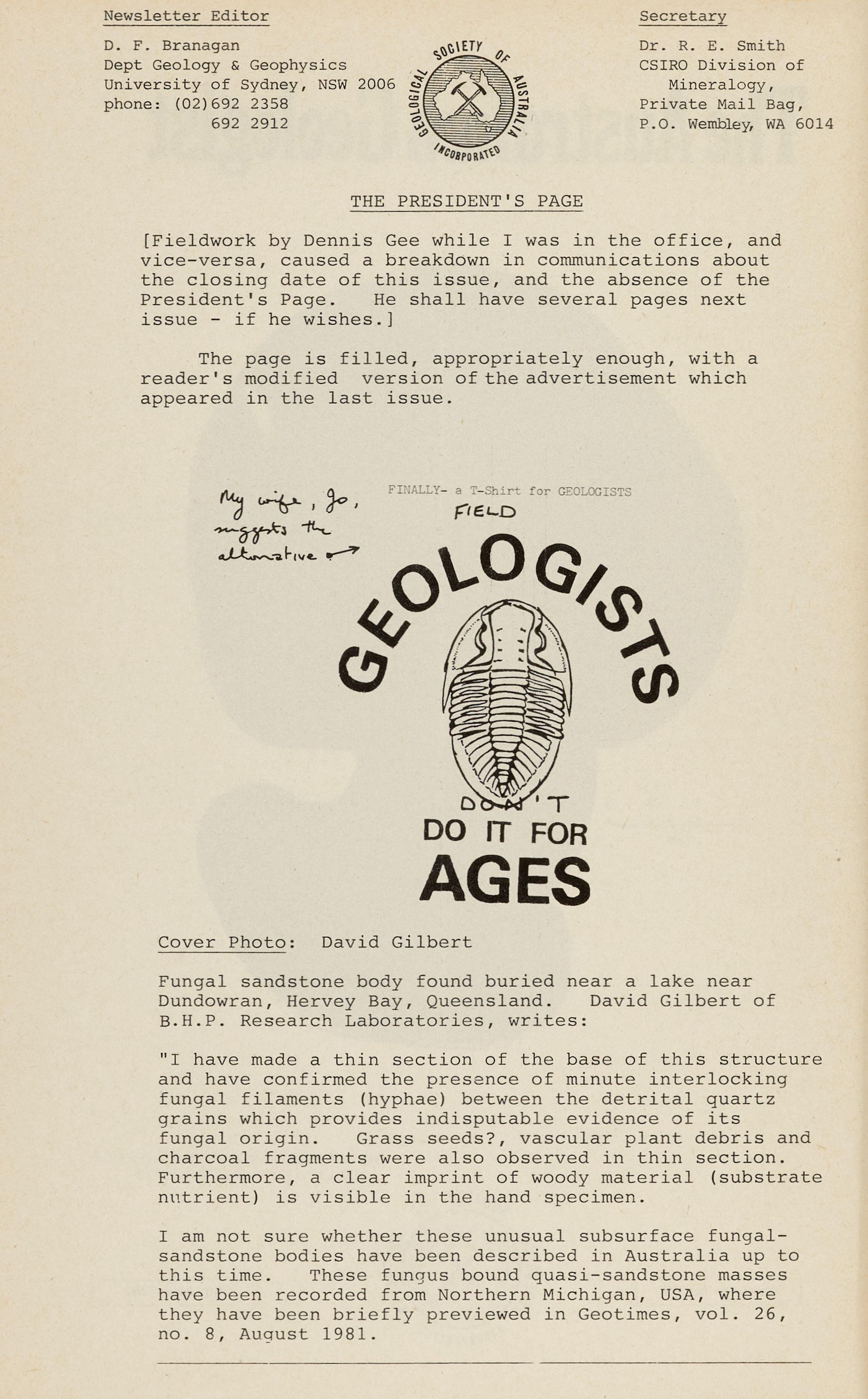
The Australian Geologist
Newsletter No. 39 June 18th 1982
Editorial:
ROSS SEA, ROSTSEA, RUSTY
This newsletter arrives about a month late thanks to a variety of causes. The major reason has been the late deliv ery of the previous issue because of take overs in the printing indu str y and a computer which managed to wipe out our addr es s list. This ca used several items to be out-of-date, part icularl y the ad verti sem ent by the Victorian Division for its sym posium on Tin Mineralisation. My apologies are offered to the Victorians and members who might have wished to attend. I have yet to hear if the symposium was adversely affected.
It seemed reasonable to allow some time between issues so that matters brought up in No. 38 could be discussed or further ventilated in this issue, but I hope to bring production up-to-date in the next two issues.
This newsletter brings together three very different articles, all dealing with matters which go beyond Austral i an shores, and which indicate that we are playing a significant part in international ge ological matters. The first considers the recent expedition to . the Antarctic which seems to have produced some interesting results. The second discusses the need for a training institute for volcanologists in the South-east Asia area and the t hird outlines propo s als for the sub - divi s ion of the Proterozoic, the period during which our major iron ore depo s its were formed.
It is interesting that Australia has a bod y devoted to study of the Antarctic regions and may become involved in one dealing with volcanology, yet has not had a specific organization to study its arid regions where many of our major ore deposits are found.
The question of the establishment of an institut e for the study of arid regions arose recently at a conference in Broken Hill where the Robinson Colleg e is shortly to be closed. The major emphasis at the colle ge has been on mining, but the recent dismissal of the whole staff of exploration geologists and other technical staff at North Broken Hill marks a change in emphasis for the region.
Although one might expect much of the stud y of arid regions to be devo~ed to biological matters, a considerable input must (and has in the past) come from the earth sciences. In retrospect it may have been unwise for the emphasis at Robinson College to have been almost solely dir ec ted to mining and as an undergraduate institution it is clearl y too late for it to diversify. What of the re search possibilities?
Does Australia need such an Institute, could the earth sciences make a useful contribution and would Broken Hill with its diminishing and rusting poppet heads be an appro pr iat e centre for it?
Sir,
Our President's recent comments (The Australian Geologist 5/12/81) regarding financial implications and repercussions from conferences 'sponsored' by subdivisions of the Society touch on some potentially sensitive issues. As the South Australian Division is presently jointly (with P.E.S.A.) organising a symposium on the Eromanga Basin, we have given these issues some consideration. The comments made below are given on behalf of the committee of the S.A. Division in the hope that the specific issues and their wider implications may be fully considered before a final decision is made by the Society's Council .
1. Financial responsibility. This should be borne by the organising group. Where more than one group is involved, there should be a clearly established, equitable sharing of responsibility, to be determined well before the function is held. Operating costs, profits or losses should be shared according to pre-existing agreements.
2. "Within-G.S.A." ownership of profits/losses. This is clearly the most sensitive aspect of these issues. We recognise merit in arguments advanced regarding the need for some procedural guide for the organising of such conferences, and in the concept of some form of centralised conference fund. On the basis of the relatively meagre information available to us, we are not impressed by comments concerning fragmentation of Society auditing. Providing the conferences, meetings, etc. in question are organised by established subdivisions of the Society (presumably Divisions or Specialist Groups), there need be no further "fragmentation" of auditing than presently exists. This could be controlled by a possible procedural guideline, e.g. each 'conference' using the Society's name will be the responsibility of either the Federal Executive and/or more of the Divisions or Specialist Groups.
In regard to possible procedures concerning profits from conferences organised by Divisions/Specialist Groups, we would like to make the following comments .
(a) There should be opportunity for recognisable reward for enterprise and effort. A successful conference or field workshop, etc. requires considerable effort in planning and e x ecution. We should not establish procedures which remove, or even only appear to remove, the financial rewards for such labours from these subdivisions of the Society invol v ed in the endeavour. To do so would run risks of dampening enthusiasm for such endeavours.
(b) Any procedures constructed should be such as to encourage profitable (however modest) endeavours and to actively discourage unprofitable ones. Thus the Society should not act to remove all "conference" profits from the direct control of the Division/Specialist Group involved. At the
same time the Society would be unwise to create an environment in which Divisions/Specialist Groups could organise "conferences" which would be certain financial disasters, with the confident expectation of being "bailed out" by the Society later.
(c) All Divisions of the Society run active annual programmes of meetings, workshops and field excursions involving expensive outlays for visiting speakers, transportation, accommodation and numerous other organisational costs. The Division's share of members' subscriptions is not always enough to support a very active programme. Income from financially successful conferences seems a most appropriate source of financial support for such activities.
(d) Some conferences attract very valuable financial support from industry (e.g., the forthcoming Eromanga Basin Symposium). The importance of this interest and support should not be understated. One of the fundamental philosophical ideas in industrial activities is that rewards for effort or responsibility for failure should rest primarily with those who are directly involved. If we erect a system whereby either 'conference' profits go to the central organisation or financial failures are automatically rescued by the central organisation, we are likely to rapidly see the last of any financial support from industry.
(e) This whole issue also raises other questions concerning Division/Specialist Group income and assets.
(i) What should the situation be concerning other kinds of income generated from within the Division/Specialist Group, e.g., possible profits from meetings, dinners, field trips, sale of excursion guides etc? Should these also be placed under the direct control of the central organisation?
(ii) What of any assets/investments presently under the control of Divisions/Specialist Groups? Should these also be transferred to the control of the central organisation?
It seems to us that the whole question requires fairly careful consideration and consultation before any decisions are taken.
It is our opinion that the Society's Divisions and Specialist Groups should be able to carry out their normal activities in an environment which stimulates effort and enterprise. If such groups generate income (presumably modest) and establish investments and assets, much of the income, investments and assets should remain under their direct control. At the same time, such a philosophy could also include provision for contributions to a central Special Fund, under the control of the Federal Executive.
As to the details of procedures for such contributions, at present we f avour one which would allow Divisions/Specialist Groups for each 'conference' to retain all profits up to $1000, pl u s half of any amount in excess of $1000 up to a ma x imum retained sum of $2000 (these figures should be inde x ed to keep pace with inflation); all of the remainder to go to the Central Special Fund. At the same time we would suggest that the Divisions/Specialist Groups be responsible in a similar way for financial losses resulting from each unprofitable 'conference' -they might organise.
Such a fund should be concerned with financing e x cursions, field workshops, conference workshops and other like learned/educational activities as well as conferences. We would like to be consulted regarding the details of such a fund should the Society decide to proceed further in establishing one.
Ale x. E. Grad y
Chairman South Australian Division
Sir:
Rece nt is su es of the newsletter have contain ed discussion r el atin g and alludin g to the dispersement of surplus f un ds from the S y mp osium on Continental Evolution o f S.E. Australia (CECSEA) held in November 1980. Following th ese discussions and comments I feel it is t ime to air some of my views and correct some statements.
You, in comments added to G. Hofmann's recent l e tter, referred to "Th e pr obl em with the Cainozoic Sympo sium ... " There was no problem with the Symposium, in fact, it was extremely succ e ss ful. Yo u also state that it had no official s po nsors. This stat ement is totall y incorrect; it wa s co-s p onsor ed by the Commonwealth Territories Division and BMR. Th e problem you refer to is related specifically to how to disperse the prof it which accrued due to the lar ge number of registrants.
The CECSEA Committee discussed thes e problems with the President in Perth after t he 5th Congress and as a resu lt of t hose and discussion with the C.T. Division have developed a prop osal wh ich was acc epted at the C.T. Division A.G.M. on 20 April 1982. This decisio n will be notified to Council by the C.T. Division.
I hope that this is t h e end of discussion on the CECSEA profits, but I think there are several lessons to us all to com e out of CECSEA, not the least of which is that public comment through y our pages without continual liaison with concerned parties has made resolution o f the matter more difficu lt .
In conclusion I support the comments of Gerhard Hofmann ( p.4, issu e 38 ), particularly his sentiment that it would be foolish of the GSA to dampen the enthus iasm of th e honorary commit t ees by a continued su ggest io n of central financia l bureaucracy. It will be a lo ng time b e fore my e nthusiasm is dry enough to go again.
Graham Taylor, Canberra.
YOU AND THE INTERNATIONAL GEOLOGICAL CORRELA~ION PROGRAMME (IGCP)
The tenth session of the Board which monitors the achievements and future directions of the various projects currently making up the IGCP was held in Paris from 8 - 12 February 1982. Australia is unique among the middle group of nations in the international community in that it has one member on the Board of the IGCP (myself) and one member on the Board's Scientific Committee (Professor Roye Rutland) which carries out a scientific evaluation of each existing and proposed IGCP project on behalf of the Board.
Australian geologists are participating, at various levels of commitment, in 39 of the 61 projects currently underway and they have been the driving force behind three very successful projects - 132: Basins of iron formation deformation (Dr. A. F. Trendall), 156: Phosphorites (Dr. P. J. Cook and Dr. J. H. Shergold) and 184: Palaeohydrology of low-latitude deserts (Dr. C. R. Lawrence). The Australian National Committee for the IGCP plays a part in stimulating the participating of Australian geologists in the IGCP because we believe that many benefits arise to the Australian geological community from this participation. Accordingly we would encourage you to contact directly project leaders of those IGCP projects in which you are actively interested. Lists of the projects and the names and addresses of project leaders are printed in Geological Correlation Number 9 which should be available in all geology libraries or from Mr. J. H. Elsom, Secretary IGCP National Committee, Australian National Commission for Unesco, P.O. Box 826, WODEN, A.C.T. 2606.
At the recent Board meeting the following new projects were accepted for IGCP support:
Project No. 187: Siliceous Deposits of the Pacific and Tethys Regions. Dr. James R. Hein, U.S. Geological Survey, 345 Middlefield Road, MS 99, Menlo Park, California 94025, U.S.A.
Pruject No. 191: Cretaceous Palaeoclimate Atlas. Dr. Eric Barron, National Center for Atmospheric Research, P.O. Box 3000, Boulder, Colorado 80307, U.S.A.
Project No. 192: Cambro - Ordovician Evolution of Continental Borders in Latin America. Dr. Bruno Baldis, San Lorenzo 1742, 1636-Olivos, Argentina.
Project No. 192: Siluro-Devonian of Latin America with Reference to Mineral and Energy Resources. Dr. M.A. Hunicken, Tomas de Irobi 790, 5008 Cordoba, Argentina.
Project No. 195: Ophiolites and Lithosphere of Marginal Seas. Professor N. A. Bogdanov, Institute of Lithos p h-ere, Staromonetny 22, Moscow 109180, U.S.S.R.
Project No. 196: Metallogeny of Ophiolites. Professor S. Karamata, Faculty of Mining and Geology, University of Belgrade, Djusina 7, 11000 Beograd, Yugoslavia.
If you wish to participate in any of the new projects then you should initially contact the project leaders.
If you then decide to play an active role in the project it would be appreciated if you would let Mr. Elsom know. We would also like to hear any comments you have on the IGCP and Australian participation.
J. F. Lovering Chairman, Australian National Committee for the IGCP
c/o Dept of Geology, University of Melbourne, Parkville, Victoria 3052.
BOOK REVIEW
Basic Geological Mapping - by John W. Barnes. Geological Society of London Handbook Series in association _ with the Open University Press. £4.95.
Having just recently been involved in examining and commenting on the field notebooks of senior students I can only agree with John Barnes that in many cases they are deplorable. My own certainly leave much to be desired as I received, when a student, little or no instruction on how to compile geological data in the field or how to record it effectively.
The excellent but somewhat cumbrous Field & Mining Geology of Forrester, the equally detailed Mining Geology by McKinstry and Lahee's trusty Field Geology, somewhat more compact than the others, helped to guide me and many generations of potential field geologists.
More recently Kottlowski's Measuring Stratigraphic Sections has provided a very useful pocket-sized guide which must have aided numerous budding stratigraphers.
This book is what it says it is - a sturdy pocketsized guide meant to be taken into the field by the student for assistance in th e various aspects of mapping. It describes equipment, maps (topographic, geological, field and fair copies), field measurements and techniques, rocks (briefly), cross-sections and safety in the field.
The Handbook series also conta ins a published Field Description of Sedimentary Rocks, whi le companion volumes on metamorphic and igneous rocks are in prep aration. If these much-needed publications are as useful as Barnes on mapping they will do well. I wish I had had Basic Geological Mapping when I was a student.
ANTARCTIC GEOSCIENCE VOYAGE SUMMARY
An Australian Antarctic expedition which has collected important data on the structure and evolution of the Earth's sedimentary basins off-shore from Antarctica returned to Hobart on the research and supply vessel M.V. Nella Dan on 15 March after an eleven-week marine geoscience cruise. The expedition involved personnel from many organisations, and is one of the most significant research projects ever undertaken by Australian scientists in Antarctica.
Two of the geologically least-known areas of the world - the Prydz Bay region between the Australian Antarctic stations Davis and Mawson, and the GaussbergKerguelen Ridge north of Davis were studied.
Geologists have long been interested in both areas as they believe that their evolution is closely allied with that of Australia, Antarctica and India through continental drift. The areas studied by the expedition over the past two months lie in the region where the three continents split apart in two phases, one about 125 million years ago (Early Cretaceous) and another around 55 million years ago (Early Tertiary).
While it is too early to evaluate the results in detail, one finding already suggests that scientific theories of just how the Gaussberg-Kerguelen Ridge was formed may have to be revised.
The expedition program called for an investigation of a series of seamounts supposed to occur just off the Gaussberg-Kerguelen Ridge south-east of Heard Island, as they were an important element in the "hot spot" hypothesis for the origin of the Gaussberg-Kerguelen Ridge. It had been thought that these were extinct volcanoes, and dredg- ing by and on behalf of Melbourne University personnel was to have taken place along their sides. However despite an extensive search no evidence of the seamounts was found.
The earlier records of shallow seafloor in the area (including Gribb Bank) are apparently spurious and may be due to reflections from fish concentrations recorded by shallow penetration echo sounders. The depths (260-900m) are too great to be krill or phytoplankton. During the cruise several other examples of apparent shallow seafloor features were shown with little doubt to be krill or phytoplankton.
The expedition's main function was to conduct a seismic/magnetometer survey of Prydz Bay and the continental shelf between Cape Darnley and Mawson. Over 6000 km of airgun seismic and 8000 km of magnetometer line were recorded by scientists from the Bureau of Mineral Resources. These data, after analysis, will provide new data on the distribution and gross structure of the sediment prism in Prydz Bay. It is hoped results will be in publishable form in about 12 months.
Another, shorter, seismic line was run across the southern end of the Gaussberg-Kerguelen Ridge and showed some rather surprising structures.
In addition samples of submarine sediments and organisms were dredged from about fifty locations around the region. As well as providing organisms for study by biologists, the dredged samples may also yield clues to the type of rocks buried beneath the vast Antarctic ice sheet.
A further magnetometer program was conducted between Australia and Antarctica as part of a long term project designed to delineate accurately the magnetic lineation pattern between the continents. So far 20000 km of line have been recorded for BMR personnel on Nella Dan. -----
Other routine programs included three-hourly sampl- ing for water temperature, salinity, oxygen content, and phytoplankton abundance, and studies of the physical structure of the ocean to depths up to 2,000 m.
The research program was conducted under the auspices of the Australian National Antarctic Research Expeditions (ANARE) and involved scientists from the Bureau of Mineral Resources in Canberra, who ran the seismic and magnetometer surveys on board, researchers from the University of Melbourne and Antarctic Division personnel who conducted the bottom sampling program, and a scientist from the People's Republic of China.
Although the program was the first of its kind undertaken by Australia, and was of necessity a prelim- inary exercise with restricted objectives, the results will have a direct bearing on the assessment of the mineral resources potential of the region, particularly off-shore petroleum of this part of Antarctica. Follow up programs are being designed already.
The Leader of the expedition was Dr. Patrick Quilty, Deputy Director (Research) of the Antarctic Division. He feels that the multidisciplinary cruise was very successful scientifically, and again demonstrated the ability of Australian scientists to conduct such programs with limited resources in the inhospit- able conditions of the seas around the Australian Antarctic Territory.
S. R. (Ross) Ta y lor of th e Research School of Earth Sciences, A.N U. , was recently honoured by election as a Foreign Honorary Member of the Geological Society of London.
PRECAMBRIAN DIVIDED?
IUGS Subcommission on Precambrian Stratigraphy
The objective of the Subcommission on Precambrian Stratigraphy has been the development of a chronologic subdivision of the Precambrian. Most of the early discussion centred on principles of subdivision; majority agree- ment has now been achieved. Recent activity has centred on a choice of boundaries. These deliberations have been reported by James (Precambrian Research, 7: 193-204, (1978); Episodes 4: 34, (1979)) and Sims (Precambrian Research, 13: 379-380 (1980)), who have invited public criticism and comments to the Secretary (P. K. Sims, U.S. Geological Survey, MS912, Federal Center Box 25046, Denver, CO 80225, U.S.A.).
The Subcommission plans to finalise its decisions on subdivision of the Precambrian at its Sixth Meeting in Egypt, 1-11 November, 1982.
Principles
James (1978) has elegantly reviewed this problem.
It is critical to recognise that all that is being sought is a convention, or series of conventions, that will simply facilitate international discourse. We are not seeking to solve a strictly scientific problem. Any subdivision must be a compromise, and its application arbitrary and problematic in some areas.
Five basic models for Precambrian time-classification have been considered in terms of the following essential criteria:
a) The classification should be the simplest possible that will meet immediate needs;
b) The classification of time embodied in the classification should reflect major events in Earth history, yet not be in such a form as to inhibit critical review of that history;
c) The classification must be acceptable to most students of the Precambrian;
d) The nomenclature should not be identified closely with one particular region;
e) The subdivision scheme should be accompanied by operational criteria, so that assignment to th e classification will be guided by objective rather than theoretical considerations.
The models are:
1) Subdivision by equa l-unit numerical division of time; 11.
2) Subdivision keyed to stratotypes;
3) Subdivision based on major magmatic-tectonic cycles or orogenies, and keyed to tectonotypes;
4) Subdivision based on concepts of earth evolution;
5) Subdivision based on breaks in the geologic record, with boundaries defined by isotopic age.
The subcornrnission has, by majority decision, selected Model 5 as the model which best meets the greatest number of essential criteria above.
Discussion: For the foreseeable future, the onl y truly common denominator available for interregional correlation is isotopic age. Biostratigraphy, magnetostragigraphy, or other properties of the rock record only seem capable of coarse subdivision for some time yet and are not applicable to all terrains; at the present time they depend upon isotopic dating to place them in a time framework. Major geologic events are largely diachronous.
The subcornrnission sees no justification for extending the basis of the Phanerozoic time-scale, and the endless confusion it has caused, into the Precambrian. Indeed it questions, in retrospect, whether the same scheme would have evolved under the present state of geologic knowledge and wisdom.
Ample illustration is provided by the collapse of the local system of Dunn, Plumb and Roberts (1966). Despite Dunn et al's clear intention of defining units only by reference and correlation to stratotypes, subsequent users have almost universally applied the scheme only by reference to the superseded, and now grossly incorrect, isotopic ages (2300, 1800, 1400 Ma) which reflected the state of the art in 1966. Additionally, since the revised time ranges of the type sequences only occupy a fraction of their equivalent chronostratigraphic units, they hardly meet the criteria of stratotypes.
The subcornrnission has applied Model 5 by selecting units on the basis of temporal positions of the more important geologic events in as many regions of the e arth as possible. From current time-correlation charts of all the major Precambrian shields of the world, boundaries have been chosen so as to interrupt as few as poss ible continuous sequences of sedimentation, igneous e mplac eme nt, or orogeny (it is naive to expect an y boundary to be equally applicable everywhere). Boundaries are defined solel y by chronostratigraphic age. No implication of world-wide s yn chroneity of major geol ogic events is implied.
Provisional Subdivision
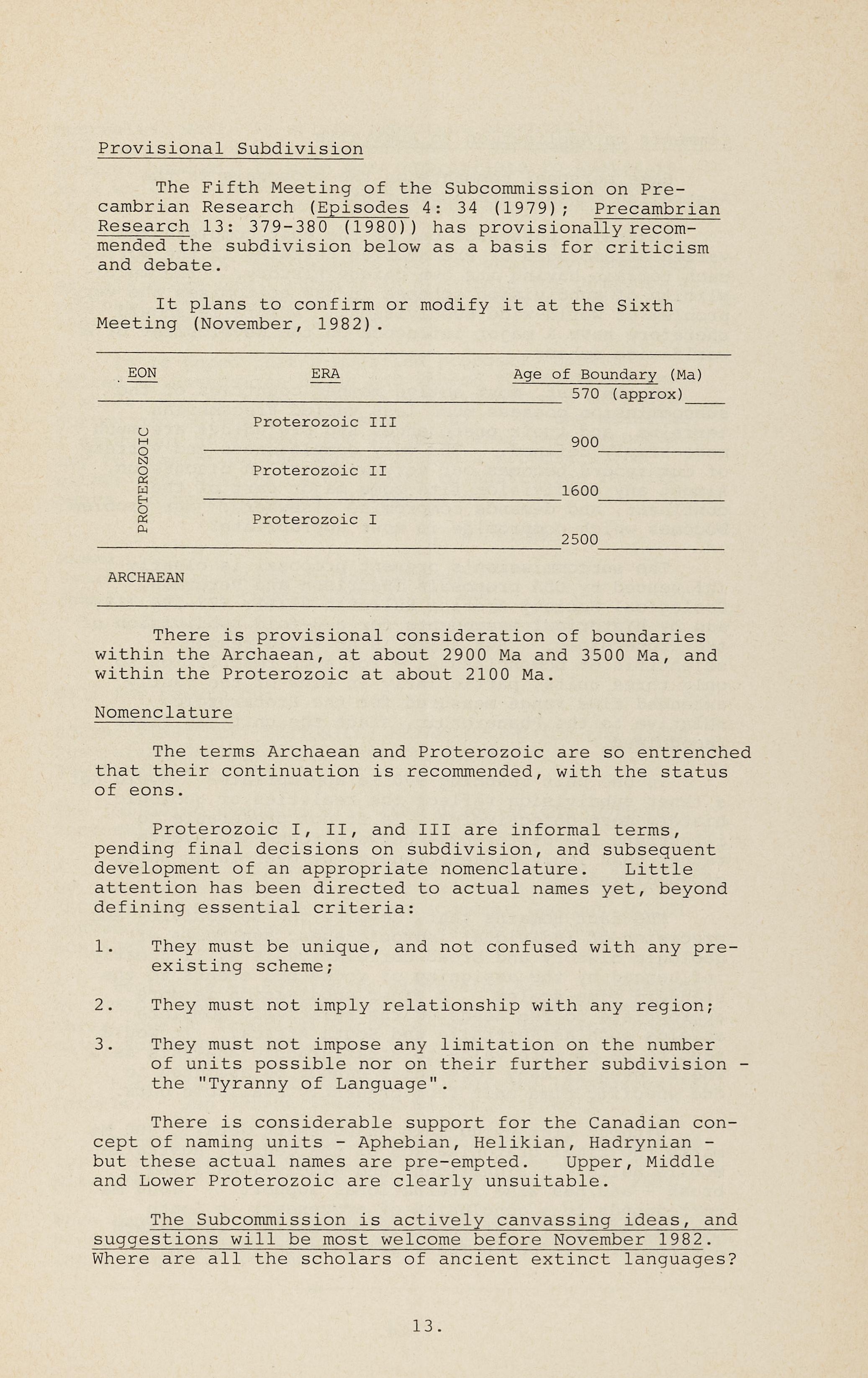
The Fifth Meeting of the Subcornmission on Precambrian Research (Episodes 4: 34 (1979); Precambrian Research 13: 379-380 (1980)) has provisionallyrecommended the subdivision below as a basis for criticism and debate.
It plans to confirm or modify it at the Sixth Meeting (November, 1982).
570 (approx) EON
Age of Boundary (Ma)
Proterozoic III 900
Proterozoic II 1600
Proterozoic I
ARCHAEAN
There is provisional consideration of boundaries within the Archaean, at about 2900 Ma and 3500 Ma, and within the Proterozoic at about 2100 Ma.
Nomenclature
The terms Archaean and Proterozoic are so entrenched that their continuation is recommended, with the status of eons.
Proterozoic I, II, and III are informal terms, pending final decisions on subdivision, and subsequent development of an appropriate nomenclature. Little attention has been directed to actual names ye t, beyond defining essential criteria:
1. They must be unique, and not confused with any preexisting scheme;
2. They must not imply relationship with any region;
3. They must not impose any limitation on the number of units possible nor on their further subdivisionthe "Tyrann y of Language".
There is considerable sup port for the Canadian concept of naming units - Aphebian, Helikian, Hadrynianbut these actual names are pre-empted. Upper , Middle and Lower Proterozoic are clearly unsuitable.
The Subcornmission is actively canvassing ideas, and suggestions will be most welcome before November 1982. Where are all the scholars of ancient extinct languages?
Comments on Application to Australia
Some personal comments on the proposals in the Austra lian context are appropriate.
Australia possesses one of the most complete and varied assemblages of Precambrian terrains in the world, each terrain having its own unique history. The multiplicity of subdivision schemes in use epitomises the very problem of world-wide subdivision. Australia should therefore have a major influence on the development of a world-wide scheme.
In contrast, most active member countries of the subcommission possess much less varied Precambrian terrains, and their preferences and prejudices are much more simply defined. The very completeness and variety of our record becomes our very weakness in discussion. Almost any subdivision fits some major part of the continent, and demands compromise elsewhere; our problem becomes which compromise is most appropriate?
The subcommission's present proposal is clearly influenced by USA propo sals (Harrison and Peterman, Geological Society America Bulletin 91(1): 377-380 (1980), and by historical precedents for a 3-fold subdivision of the Proterozoi c. But there is no valid reasonscientific or nomenclatural - for such restriction to only three units, particularly in view of the vastly extended time range measured for the Proterozoic, relative to the Phanerozoic, since the unit was first recognised.
Is one unit spanning 900 Ma appropriate? Would not a finer subdivision reflect the realities of geologic history more objectively? Is it not preferable to illustrate the differences between rocks and events rather than imply contemporaneity by over-large units of subdivisions?
The fact remains that, despite the objectivity and precis ion of individual isotopic ages, synthesis of geolog ic history and broad correlation is still greatly influenced by the assigning of rocks and events to the standard time-scales. A finer subdivision is more appropriate to the needs of the relatively complete shields such as Australia and South Africa. It would seem to be of more value to stratigraphic analysis as a whole, even if many rock units cannot be assigned to one specific time unit from presently available data.
Without digressing into unnecessary detail, 900 Ma marks the final cratonisation of the Central Australian Mobile Belts -a significant and widely identified break - and has wide international support. 1600 Ma corresponds to a conclusion of orogenesis in South Australia, but is not entirely appropriate in Western Australia . It poses major problems in Northern
Australia, ~here it splits important essentiallycontinuous Carpentaria successions. An older or younger boundary is much more appropriate to Australia as a whole. There is a need for distinction between the earliest Proterozoic events and later ones around 2000-1800 Ma.
My personal preferences are not entirely finalised at this stage but I submit, as a vehicle for comment, a proposal with boundaries at 2500 Ma, 2200 Ma, 1800 or 1700 Ma, 1400 Ma, and 900 Ma.
It is hoped that a modified proposal, better suited to Australian needs and indeed to the world as a whole, may be formulated at a Working Group of State Survey geologists in September, 1982. In the meantime, I draw your attention once again to this last opportunity to comment on the Subcommission's proposals, to either Paul Sims or, with regard to Austr alian requirements, to myself at the address below.
K. A. Plumb.
Member, Subcornmission on Precambrian Stratigraphy, BMR, P O Box 378, CANBERRA CITY, A.C.T. 2601.
Call for papers on:
COBAR: STRUCTURE: TECTONICS: METAMORPHISM for the sixth Australian Geological Convention, Canberra, 20-25 February 1983.
The following symposia will take place at the Canberra Convention:
* Structure and Ore Genesis at Cobar, N.S.W. sponsored by Specialist Group in Tectonic and Structural Geology (SGTSG) and Specialist Group in Economi c Geology (SGE G) Convenor - Dick Glen, Geological Surv ey of N.S.W., Box 5288 GPO, Sydney, 2001.
* Evolution of Fold Belts (symposium le). Sponsored by SGTSG. Any papers on any aspects to the convenor, Chris Powell, School of Earth Sciences, Macquarie University, North Ryde, NSW 2113.
* Metamorphism and Geothermal Gradients (s ymposium ld). Convenor - Ron Vernon (address as for C. Powell).
* Tectonics of Cratons and Platform Covers (symposium lg ). Sponsored by SGTSG. Convenor - Ken Plumb (and Mike Rickard) BMR, PO Box 378, Canberra City, ACT 2601.
When sending in your reply/title (as soon as possible ) please indicate whether you would be interested in publishing a symposium volume.
The Geology Department at James Cook University has recently launched an Economic Geology Research Unit within the department. This unit contains a Resource Centre for the use of visiting industry and academic geologists, part of which will comprise a small library facility. The library will contain mostly duplicates of material which is also housed in the main University Librar y collection, and will concentrate on periodicals specialising in Australasian geology and mining together with a number of the major international journals. The department would appreciate hearing from anyone who might be prepared to provide cheap or donation copies of back nu mbers of appropriate journals for the Research Unit's use. Costs of packing and postage to Townsville would be refunded. Please address any offers to Professor R. M. Carter, Acting-Director EGRU, Geology Department, James Cook University, Townsville, Q.4811, or phone him on 814536.
GRADUATE DIPLOMA IN INDUSTRIAL MINERAL SCIENCE
Recognizing the significant role played by nonmetallic minerals and - related materials in Australian industry, the Department of Applied Geology at the New South Wales Institute of Technology has recently introduced a Graduate Diploma Course in Industrial Mineral Science. Believed to be the first of its kind in Australia, this interdisciplinary course caters specifically for geologists, chemists, material scientists and engineers engaged in the testing, evaluation, production and use of non-metallic minerals and natural construction materials.
The course program is of a strongly interdisciplinary nature, with a large d egree of flexibility. Individual programs are tailored to suit the educational background, work experience and p rofessional needs of each student, with a common core of subject matter covering topics such as clay mineralogy, mineral determination, mineral processing, quarrying and materials handling. Advanced elective subjects and project investigations are also incorporated.
Standard admission requirements are a degree or equivalent in science, engineering or other appropriate discipline, but a limited number of non-graduates with suitable work experience may also be admitted.
To cater for students already employed in the industry, the course has been designed to run over two years with a part-time attendance pattern. No tuition fees are payable under present arrangements.
Further details may be obtained from Dr. C.S. Gibbons, Head, Department of Applied Geology (218-9457) or Dr. C. R. Ward, Senior Lecturer (218-9647).
Candidates wishing to commence the course in e ith er July 1982 or February 1983 should enrol by J u l y 14th, 1982. It will assist development of course programs if one of the above staff members can be contacted as early as possible.
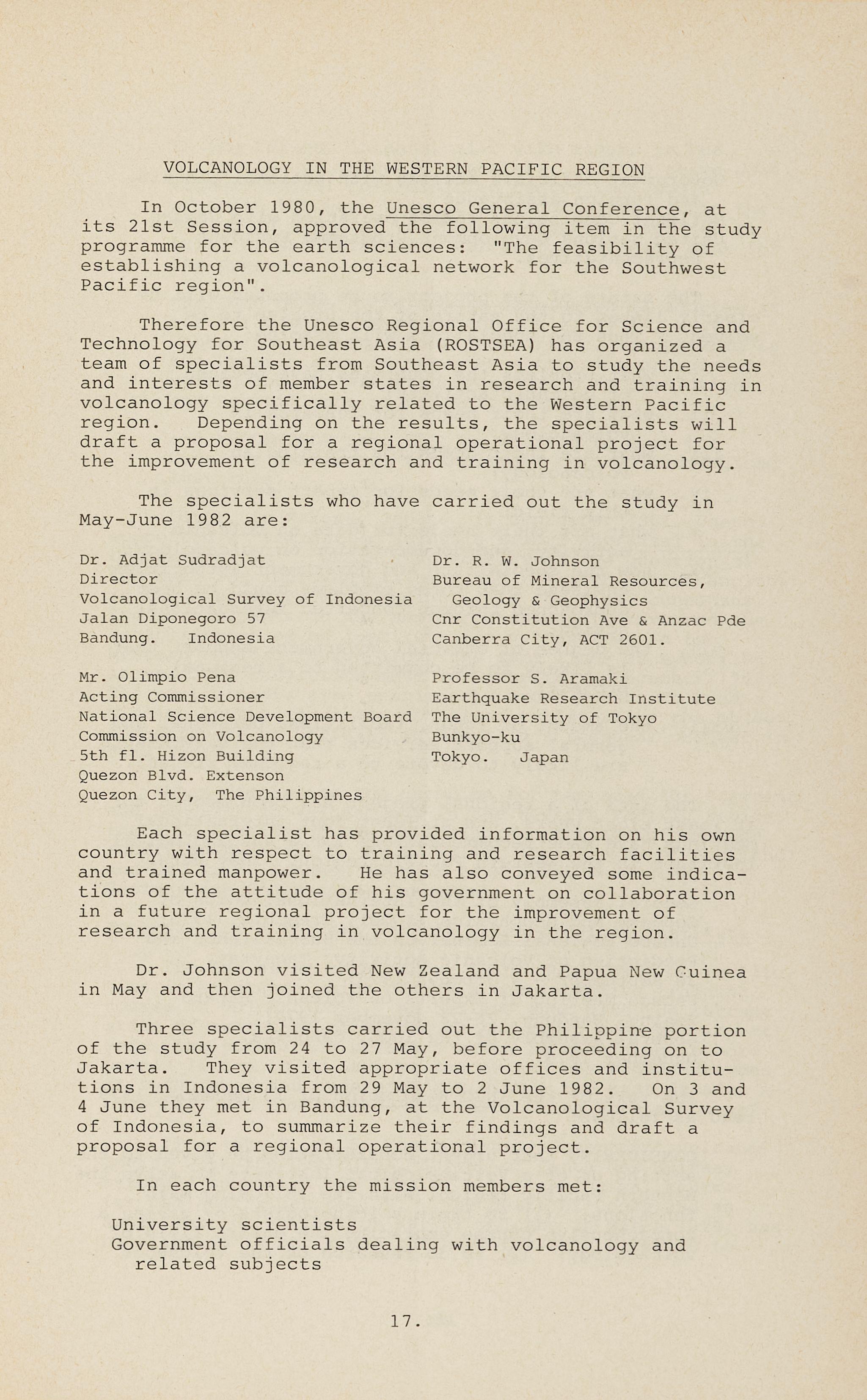
VOLCANOLOGY IN THE WESTERN PACIFIC REGION
In October 1980, the Unesco General Conference, at its 21st Session, approved the following item in the study programme for the earth sciences: "The feasibility of establishing a volcanological network for the Southwest Pacific region".
Therefore the Unesco Regional Office for Science and Technology for Southeast Asia (ROSTSEA) has organized a team of specialists from Southeast Asia to study the needs and interests of member states in research and training in volcanology specifically related to the Western Pacific region. Depending on the results, the specialists will draft a proposal for a regional operational project for the improvement of research and training in volcanology.
The specialists who have carried out the study in May-June 1982 are:
Dr. Adjat Sudradjat
Director
Volcanological Survey of Indonesia Jalan Diponegoro 57 Bandung. Indonesia
Mr. Olimpio Pena
Acting Commissioner
National Science Development Board Commission on Volcanology 5th fl. Hizon Building Quezon Blvd. Extenson Quezon City, The Philippines
Dr. R. W. Johnson
Bureau of Mineral Resources, Geology & Geophysics
Cnr Constitution Ave & Anzac Pde Canberra City , ACT 2601.
Professor S. Aramaki
Earthquake Research Institute
The University of Tokyo Bunkyo-ku Tokyo. Japan
Each specialist has provided information on his own country with respect to training and research facilities and trained manpower. He has also conveyed some indications of the attitude of his government on collaboration in a future regional project for the improvement of research and training in volcanology in the region.
Dr. Johnson visited New Zealand and Papua New Guinea in May and then joined the others in Jakarta.
Three specialists carried out the Philippine portion of the study from 24 to 27 May, before proceeding on to Jakarta. They visited appropriate offices and institutions in Indonesia from 29 May to 2 June 1982. On 3 and 4 June they met in Bandung, at the Volcanological Survey of Indonesia, to summarize their findings and draft a proposal for a regional operational project.
In each country the mission members met:
University scientists Government officials dealing with volcanology and related subjects 17.
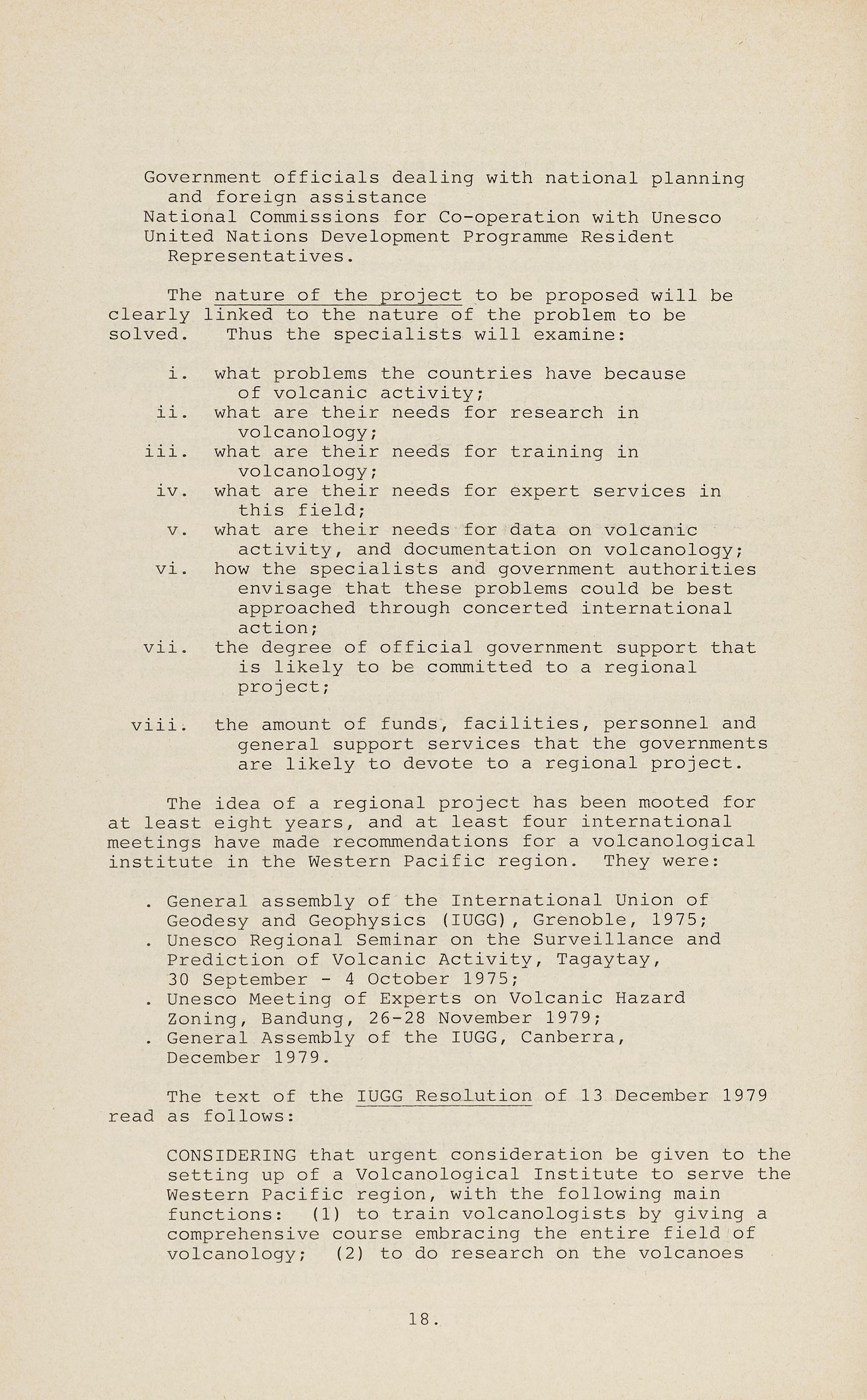
Government officials dealing with national planning and foreign assistance
National Commissions for Co-operation with Unesco United Nations Development Programme Resident Representatives.
The nature of the project to be proposed will be clearly linked to the nature of the problem to be solved. Thus the specialists will examine:
i. what problems the countries have because of volcanic activity;
ii. what are their needs for research in volcanology;
iii. what are their needs for training in volcanology;
iv. what are their needs for expert services in this field;
v. what are their needs for data on volcanic activity, and documentation on volcanology;
vi. how the specialists and government authorities envisage that these problems could be best approached through concerted international action;
vii. the degree of official government support that is likely to be committed to a regional project;
viii, the amount of funds, facilities, personnel and general support services that the governments are likely to devote to a regional project.
The idea of a regional project has been mooted for at least eight years, and at least four international meetings have made recommendations for a volcanological institute in the Western Pacific region. They were:
General assembly of the International Union of Geodesy and Geophysics (IUGG), Grenoble, 1975; Unesco Regional Seminar on the Surveillance and Prediction of Volcanic Activity, Tagaytay, 30 September -4 October 1975;
Unesco Meeting of Experts on Volcanic Hazard Zoning, Bandung, 26-28 November 1979; General Assembly of the IUGG, Canberra, December 1979.
The text of the IUGG Resolution of 13 December 1979 read as follows:
CONSIDERING that urgent consideration be given to the setting up of a Volcanological Institute to serve the Western Pacific region, with the following main functions: (1) to train volcanologists by giving a comprehensiv e course embracing the entire field of volcanology; (2) to do research on the volcanoes
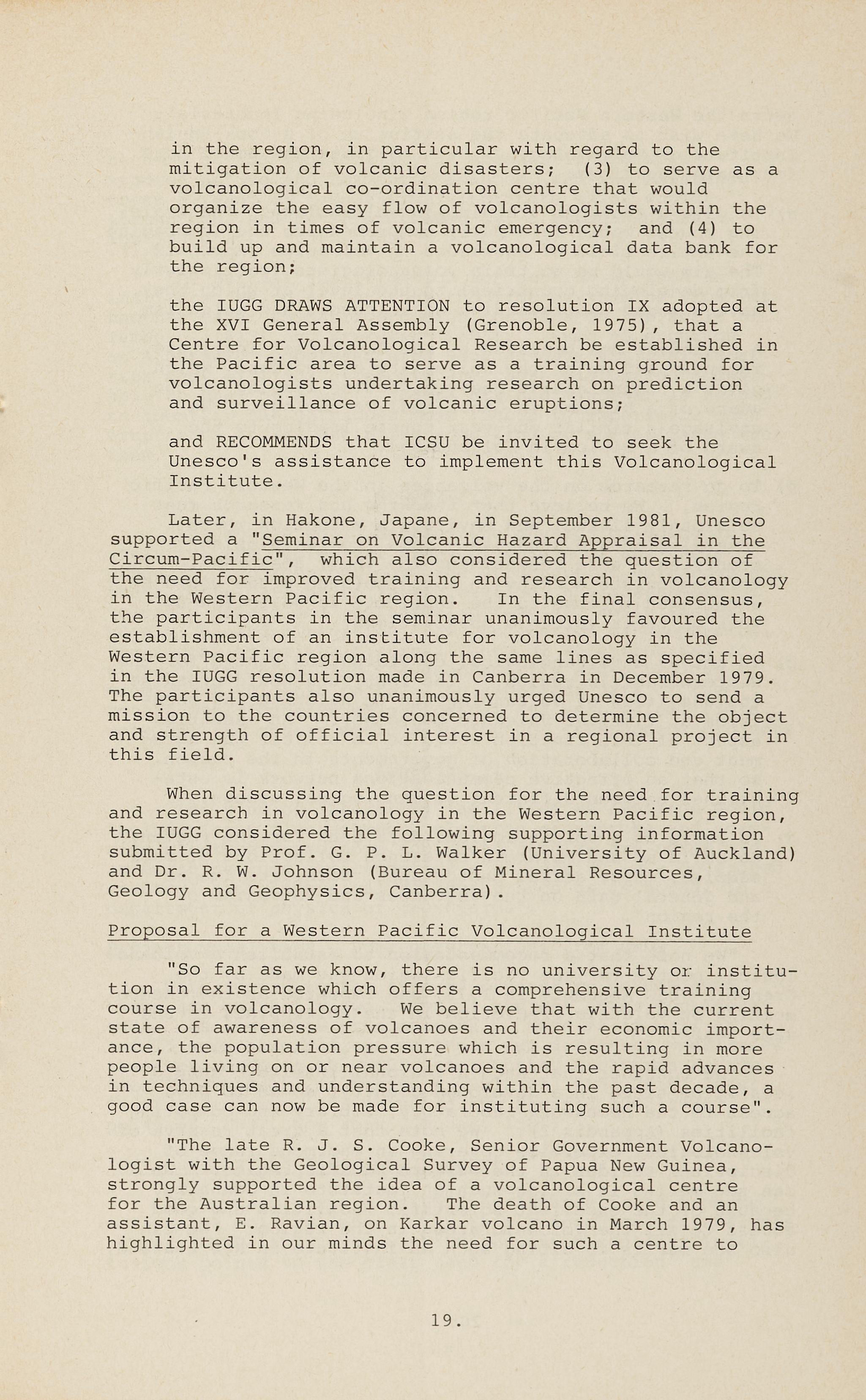
in the region, in particular with regard to the mitigation of volcanic disasters; (3) to serve as a volcanological co-ordination centre that would organize the easy flow of volcanologists within the region in times of volcanic emergency; and (4) to build up and maintain a vol canological data bank for the region;
the IUGG DRAWS ATTENTION to resolution IX adopted at the XVI General Assembly (Grenoble, 1975), that a Centre for Volcanological Research be established in the Pacific area to serve as a training ground for volcanologists undertaking research on prediction and surveillance of volcanic eruptions;
and RECOMMENDS that ICSU be invited to seek the Unesco's assistance to implement this Volcanological Institute.
Later, in Hakone, Japane, in September 1981, Unesco supported a "Seminar on Volcanic Hazard Appraisal in the Circum-Pacific", which also considered the question of the need for improved training and research in volcanology in the Western Pacific region. In the final consensus, the participants in the seminar unanimously favoured the establishment of an institute for volcanology in the Western Pacific region along the same lines as specified in the IUGG resolution made in Canberra in December 1979. The participants also unanimously urged Unesco to s end a mission to the countries concerned to determine the object and strength of official interest in a regional proje ct in this field.
When discussing th e question for the need for training and research in volcanology in the Western Pacific region, the IUGG considered the following supporting information submitted by Prof. G. P. L. Walker (University of Auckland) and Dr. R. W. Johnson (Bureau of Mineral Resources, Geology and Geophysics, Canberra).
Proposal for a Western Pacific Volcanological Institute
"So far as we know, there is no university or institution in existence which offers a comprehensive training course in volcanology. We believe that with the current state of awareness of volcanoes and their economic importance, the population pressure which is resulting in more people living on or near volcanoes and the rapid advances in techniques and understanding within the past decade, a good case can now be made for instituting such a course".
''The late R. J. S. Cooke, Senior Government Volcanologist with the Geological Survey of Papua New Guinea, strongly supported the idea of a volcanological centre for the Australian region. The death of Cooke and an assistant, E. Ravian , on Karkar volcano in March 1979, has highlighted in our minds the need for such a centre to
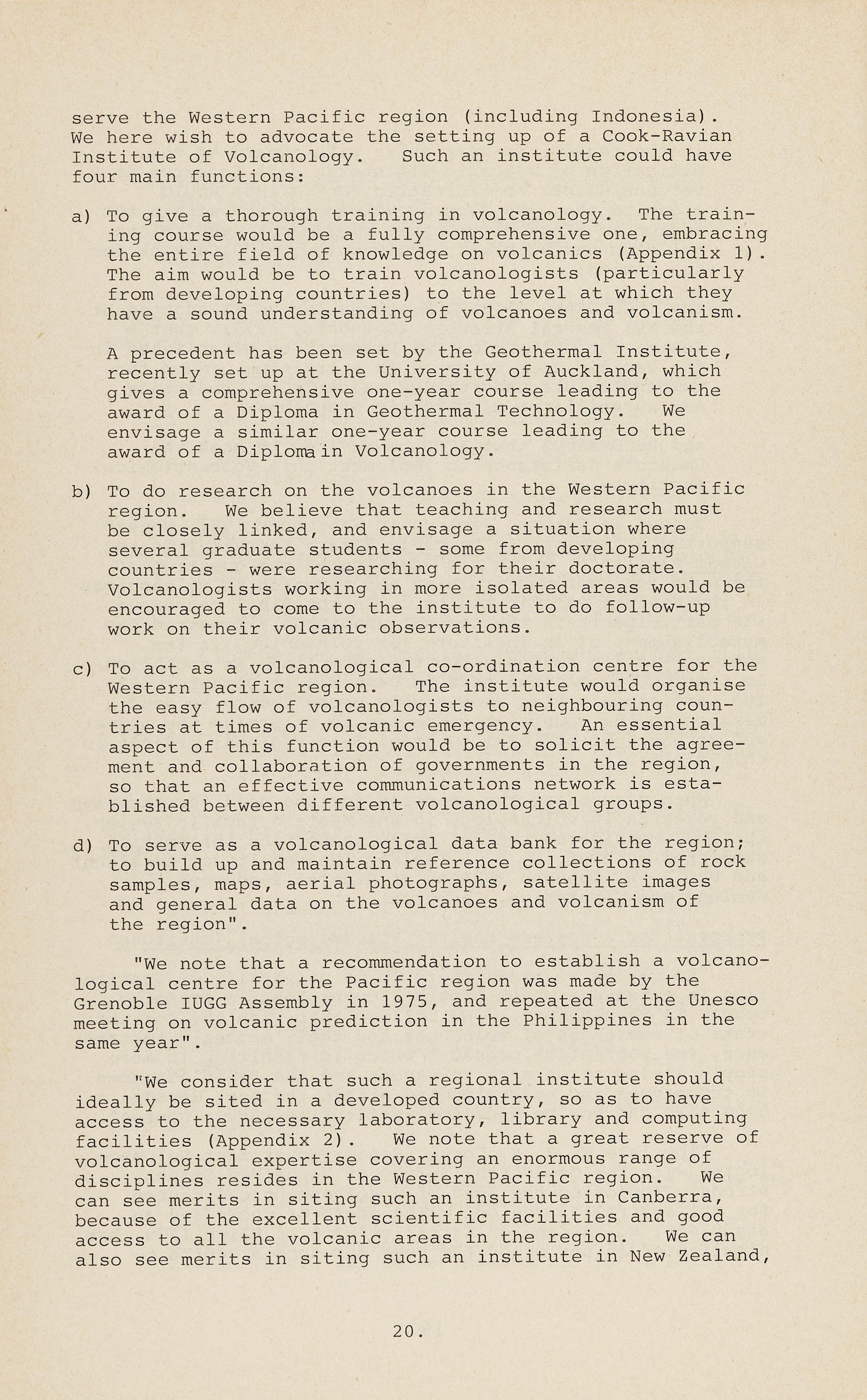
serve the Western Pacific region (including Indonesia). We here wish to advocate the setting up of a Cook-Ravian Institute of Volcanology. Such an institute could have four main functions:
a) To give a thorough training in volcanology. The training course would be a fully comprehensive one, embraci~g the entire field of knowledge on volcanics (Appendix 1). The aim would be to train volcanologists (particularly from developing countries) to the level at which they have a sound understanding of volcanoes and volcanism.
A precedent has been set by the Geothermal Institute, recently set up at the University of Auckland, which gives a comprehensive one-year course leading to the award of a Diploma in Geothermal Technology. We envisage a similar one-year course leading to the award of a Diplorrain Volcanology.
b) To do research on the volcanoes in the Western Pacific region. We believe that teaching and research must be closely linked, and envisage a situation where several graduate students - some from developing countries - were researching for their doctorate. Volcanologists working in more isolated areas would be encouraged to come to the institute to do follow-up work on their volcanic observations.
c) To act as a volcanological co-ordination centre for the Western Pacific region. The institute would organise the easy flow of volcanologists to neighbouring countries at times of volcanic emergency. An essential aspect of this function would be to solicit the agreement and collaboration of governments in the region, so that an effective communications network is established between different volcanological groups.
d) To serve as a volcanological data bank for the region; to build up and maintain reference collections of rock samples, maps, aerial photographs, satellite images and general data on the volcanoes and volcanism of the region".
"We note that a recommendation to establish a volcanological centre for the Pacific region was made by the Grenoble IUGG Assembly in 1975, and repeated at the Unesco meeting on volcanic prediction in the Philippines in the same year".
"We consider that such a regional institute should ideally be sited in a developed country, so as to have access to the necessary laboratory, library and computing facilities (Appendix 2). We note that a great reserve of volcanological expertise covering an enormous range of disciplines resides in the Western Pacific region. We can see merits in siting such an institute in Canberra, because of the excellent scientific facilities and good access to all the volcanic areas in the region. We can also see merits in siting such an institute in New Zealand,
because of the availability of accessible and wellstudied active and dormant volcanoes, and the existence there already of a Geothermal Institute which would strengthen, and be strengthened by, a volcanological institute".
"As partial justification for setting up such an institute, we point out that the time may now be ripe for another major volcanic eruption, perhaps on the scale of Tamboro (1815) and Krakatau (1883). Such an eruption in a densely populated area such as Java would place at · risk many millions of people and cause disruption comparable to that by a war. Extra trained manpower is needed to identify the volcanoes most liable to experience such eruptions, and to establish some kind of surveillance over them.
Appendix I
"The course would embrace the physics of volcanic activity, the geological study of volcanoes and their products, tephrochronology, the structure of volcanoes and their roots, air photo interpretation, the assessment of volcanic hazard and geothermal potential, soils, water supply, hazard mitigation, the application of geophysical techniques to maintain surveillance of volcanoes and to probe their roots, and the geochemistry and petrology of magmas and volcanic rocks. An important part of the course would consist of geological and geophysical field work, and the course would also include independent projects".
Appendix II
"The kind of laboratory facilities we envisage would include X-ray fluorescence, electron microprobe and scanning electron microscope equipment such as are normal in an earth-science department of a university in a developed country, and geophysical equipment such as is normal in a department of physics or geophysics".
Project modalities: Some observations from UNDP
With regard to the type of project to be designed, there are currently two forms of project under consideration: an institute or a network. Here it is well to recall some observations on these two different modalities that were made at the UNDP Intercountry Programme Review held in New Delhi in February 1981 (cf. "The Draft InterCountry Programme for Asia and the Pacific 1982-1986", pp.45-46, UNDP, New York, January 1981).
Institutional vs Programme Support
"A primary purpose of UNDP assistance is to promote collective self-reliance. In this connection, an analysis of past UNDP experience with UN-supported regional institutions points to the clear need for a reduction and 21.
consolidation of UN-supported regional institutions and for a move towards more direct support of specific programmes of those institutions which are truly intergovernmental in character".
"In the past, a number of regional projects has taken the form of central institutions, essentially created and run by organizations of the UN system. There is now widespread agreement that this type of project - often characterized by the token participation of large numbers of countries in the region - has generally outlived its usefulness. The network approach seems to be a more viable alternative as a means of bringing more direct benefits to the participating countries".
"However, to the extent that the Governments have the readiness and capacity to co-operate and assume responsibility for regional institutions, support to them on a specific and time-bound basis should not be excluded. There is also a justification for an economy-of-scale approach when training needs can be met more economically by a regional or sub-regional centre or institution serving a group of countries".
"The long-term viability of regional institutions depends on the financial contributions of participating governments. UNDP assistance will increasingly focus on the development and support of programme activities of regional institutions in priority areas. This will permit UNDP to develop and support only those programmes which are tailored to meet clearly identified needs and to evaluate them in line with their stated objectives".
"Progress in this direction should also help to solve the perennial problem of UNDP financing associated with the traditional regional projects, i.e. the neverending dependency syndrome created by UNDP's assumption of institutional costs. If such costs are borne by the governments, it will be both easier and much more acceptable to UNDP to finance technical support costs".
Networking arrangements
"Networking arrangements involve technical cooperation among several national institutions or projects to achieve common goals. This form of regional institutional co-operation has the advantage that Governments are likely to be more directly involved since such a network gives then concrete benefits from the regional programme, in addition to opportunities for external co-operation. It can facilitate, in a much more direct way, Technical Co-operation among Developing Countries. A major portion of its support from intercountr y resources should thus go directly into strengthening the participating na tional institutions linked together in a regional network. The networking of associated national centres in the Asian Programme of Educational Innovation in Developm e nt is a successful example".
Summary
In summary, several international groups of scientists have recommended that international action be taken to improve the training and research in volcanology in the Western Pacific region, and to build up services for volcanological information and readily available expertise.
The Unesco General Conference has supported these recommendations by including an item for a study of the needs and project possibilities in this field for the Western Pacific region.
Although the non-governmental organization has come out in favour of an institute to meet the needs in training, research, information, and expertise, one must give serious thought to the current thinking of international financing institutions which is along the lines of more flexible network-type arrangements which endeavour to make maximum use of the existing facilities and specialized manpower to solve the problems faced by a particular region. An innovative project design which could meet the need for training, research, information, and readily available expertise in volcanology, by drawing on or expanding the capacity of existing facilities and specialists would be most welcome at this stage.
It is hoped that after having determined and analysed the needs of the Member States in the Western Pacific region, in the field of volcanology, the specialists convened by Unesco will draft an appropriate project that will correspond to the modes of project design that are most likely to receive favourable consideration by the funding organizations which traditionally finance the operational projects sponsored by the Specialized Agencies of the UN system.
Jakarta, 1982.
ANNOUNCING
Belt Symposium II
Department of Geology, University of Montana will sponsor a second symposium on the Belt Supergroup and related rocks to be held in Missoula, Montana, from October 9 through 16, 1983. The meeting will focus on the advancements in Belt geology since the first symposium held a decade ago.
Attendance will be limited to 250 participants: preference given to invited speakers, active workers in Belt rocks and other invited participants. Registration is expected to cost between $300 and $400, which will include a shared room, lunches, dinners, and a program with extended abstracts. Field trips will be extra.
Belt Symposium II c/o Western Experience, 745 Gilpin Drive, Boulder, Colorado 80303, U.S.A.
BOOK REVIEW
The Ordovician system in Australia, New Zealand and Antarctica; correlation chart and explanatory notes. Compiled and edited by B. D. Webby. IUGS Publ. 6: 69 pp. 1981.
This che~ply produced volume - initially disappointing in its style of presentation - contains a comprehensive survey of the Ordovician stratigraphy of these regions of Gondwana and represents the combined efforts of 12 research workers actively engaged in the topic. The synthesis provided brings together the fruits of labour of many years both of the authors and those of preceding decades.
After a succinct introduction by B. D. Webby on the geological setting of the Ordovician sequences of the three regions, the volume appropriately contains a concise summary of the globally significant Ordovician graptolite zones of Victoria (by A.H.M. VandenBerg). Other biostratigraphic schemes, utilizing many fossil groups are then outlined by B. D. Webby for the rest of mainland Australia and by M. R. Banks et al. for Tasmania. Again the summaries are concise and bring together the results of recent works in diverse fields.
Brief sections on correlations with British and North American subdivisions and on Systemic Boundaries provide a useful frame of reference.
The volume ends with a substantial (though not exhaustive) bibliography and as an added bonus general maps of Australia, New Zealand, a chart of the ranges of key Victorian graptolite species and maps and stratigraphic columns of Antarctica.
The appended chart (or rather charts) is well set out with clearly numbered and headed columns. The printing is clear with even the finest lettering crisp.
In summary, the volume is an invaluable compilation and contribution; the only detraction being the presentation of the notes. Headings are not clear and the text appears crammed. Presumably the style was decreed by costs. The volume should find a place in the library of all "Ordovician workers" and others as well. Readers who use the volume often will need to strenathen the covers. J
N. W. Archbold
The 6th Australian Geological Convention (Convenor Sandy Renwick, Organising Secretary M. B. Duggan), sporting the theme 'Lithospheric Dynamics & Evolution of Continental Crust' has its own Post Office box, P.O. Box 1923, Canberra City, ACT 2601 , to which correspondence should be addressed. 24.
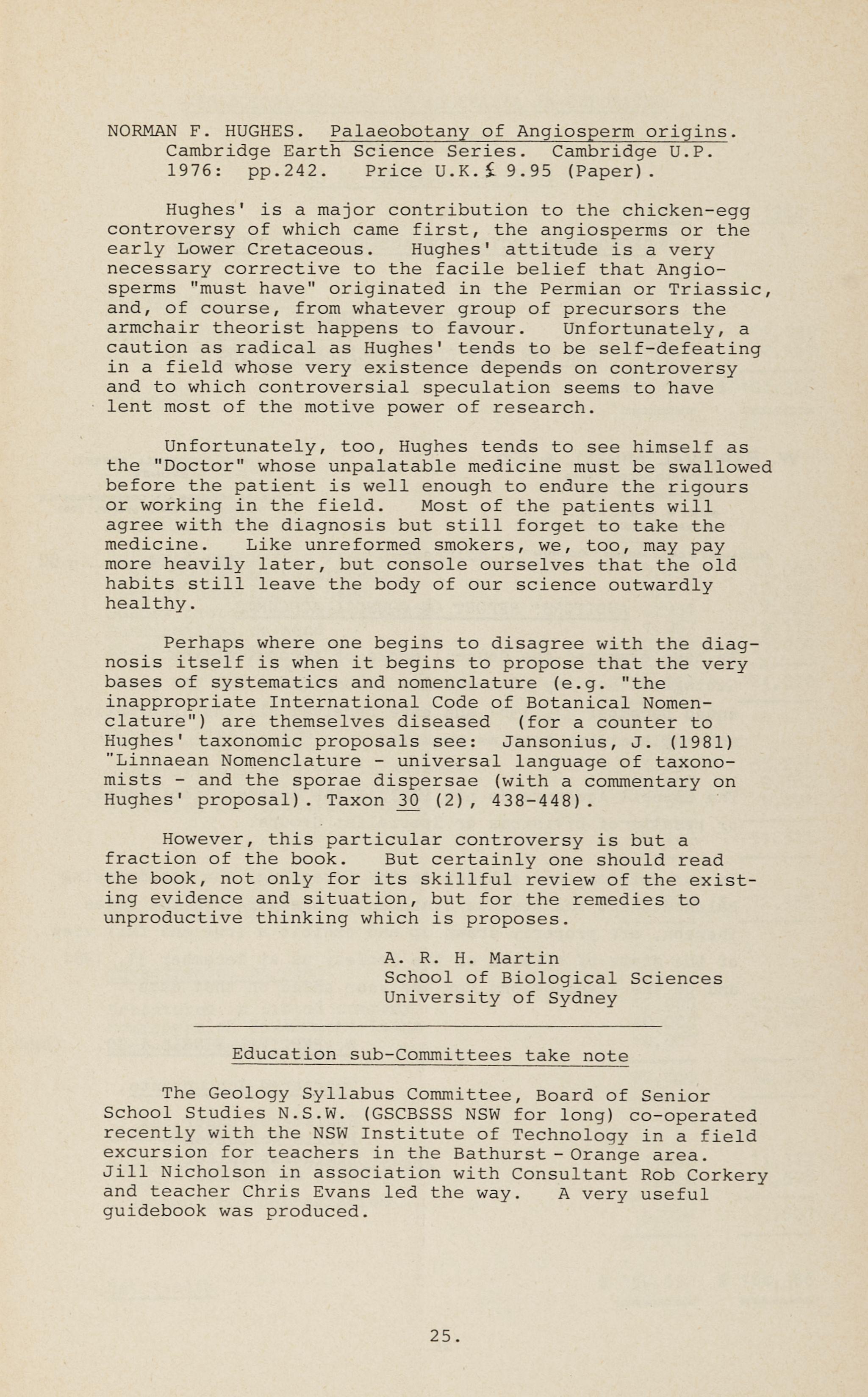
NORMAN F. HUGHES. Palaeobotany of Angiosperm origins. Cambridge Earth Science Series. Cambridge U.P. 1976: pp.242. Price U.K. ~ . 9.95 (Paper).
Hughes' is a major contribution to the chicken-egg controversy of which came first, the angiosperms or the early Lower Cretaceous. Hughes' attitude is a very necessary corrective to the facile belief that Angiosperms "must have" originated in the Permian or Triassic, and, of course, from whatever group of precursors the armchair theorist happens to favour. Unfortunately, a caution as radical as Hughes' tends to be self-defeating in a field whose very existence depends on controversy and to which controversial speculation seems to have lent most of the motive power of research.
Unfortunately, too, Hughes tends to see himself as the "Doctor" whose unpalatable medicine must be swallowed before the patient is well enough to endure the rigours or working in the field. Most of the patients will agree with the diagnosis but still forget to take the medicine. Like unreformed smokers, we, too, may pay more heavily later, but console ourselves that the old habits still leave the body of our science outwardly healthy.
Perhaps where one begins to disagree with the diagnosis itself is when it begins to propose that the very bases of systematics and nomenclature (e.g. "the inappropriate International Code of Botanical Nomenclature") are themselves diseased (for a counter to Hughes' taxonomic proposals see: Jansonius, J. (1981) "Linnaean Nomenclature - universal language of taxonomists - and the sporae dispersae (with a commentary on Hughes' proposal). Taxon 1Q (2), 438-448).
However, this particular controversy is but a fraction of the book. But certainly one should read the book, not only for its skillful review of the existing evidence and situation, but for the remedies to unproductive thinking which is proposes.
A. R. H. Martin School of Biological Sciences
University of Sydney
Education sub-Committees take note
The Geology Syllabus Committee, Board of Senior School Studies N.S.W. (GSCBSSS NSW for long) co-operated recently with the NSW Institute of Technology in a field excursion for teachers in the Bathurst - Orange area. Jill Nicholson in association with Consultant Rob Corkery and teacher Chris Evans led the way. A very useful guidebook was produced.
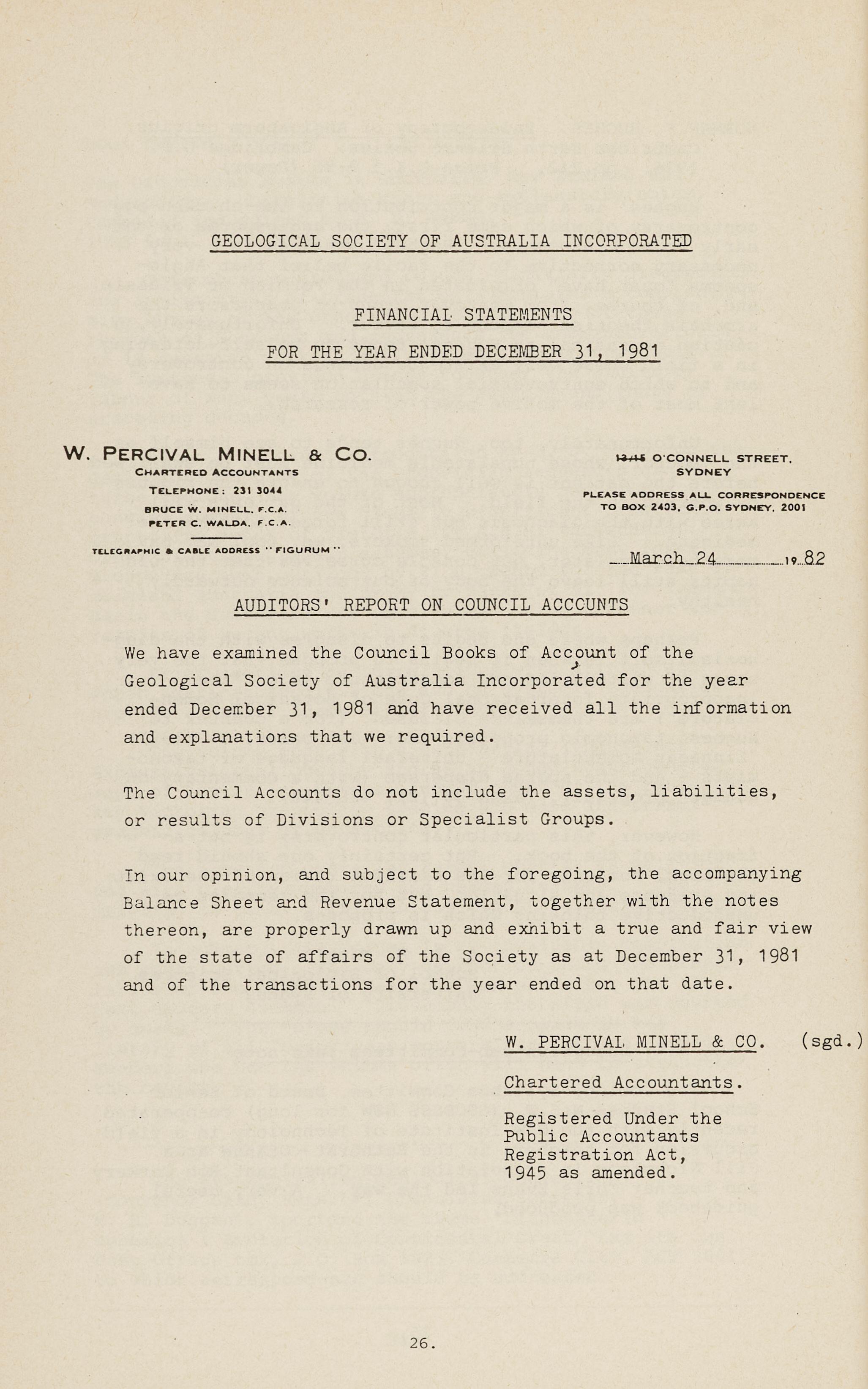
GEOLOGICAL SOCIETY OF AUSTRALIA INCORPORATED
FINANCIAL STATEMENTS FOR TH E YEAR ENDED DECEMBER 31, 1981
W. PERCIVAL MINELL & Co.
O'CONNELL STREET , SYDNEY CHARTERED ACCOUNTANTS
TELEl"HONE , 231 304'
BRUCE w. MINELL. r c A
ll"E.TER C WALCA F , C A
HIC • CABLC ADDRESS ,. FIGURUM •· _ M.arch _ 24 _ _ 19 ..8.2
AUDITORS' REPORT ON COUNCIL ACCOUNTS
We have examined the Council Books of Account of the .,. Geological Society of Australia Incorporated for the year ended Decerr.ber 31, 1981 arid have received all the information and explanatioLs that we required.
Th e Coun c il Accounts do not incl u de t h e assets, liabilities, or re s ults of Di vis i ons or Specialist Groups.
I n ou r opinion, and subject to the foregoing, the accompanying Ba lance Sh eet ar..d Revenue Statement, toget h er with the notes th ereon, are properly drawn up and e xn ibit a true and fair view of t h e state of affairs of the S ociety as a t December 31, 1 981 an d of the transactions for the year ended on that date.
W. PERCIVAL MINELL & CO. Ch a rtered Accountants.
Registered Under the Public Accountants Registration Act, 194 5 as amended . (sgd. )
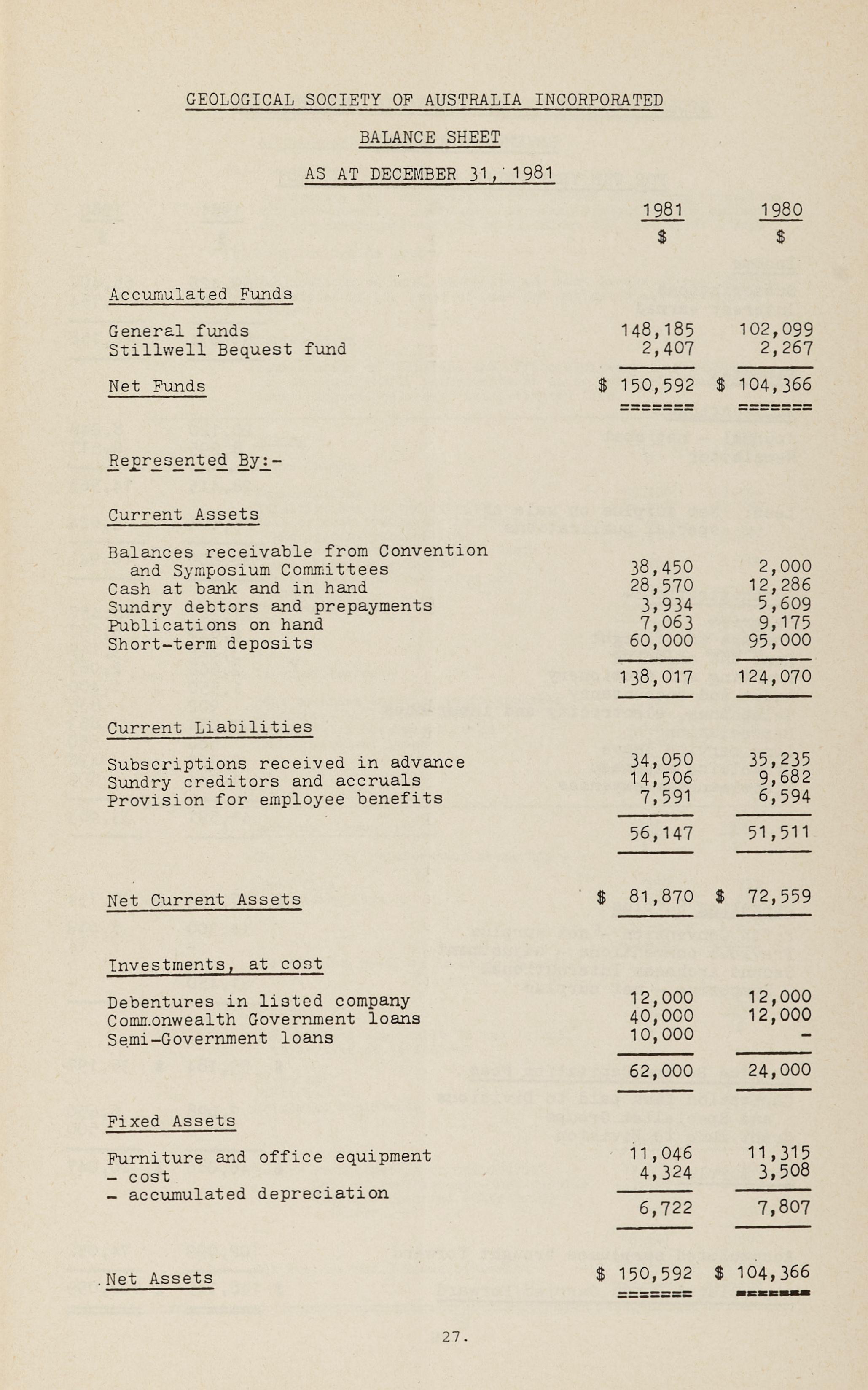
BALANCE SHEET
AS AT DECEMBER 31, · 1981
Accumulated Funds
General funds
Stillwell Bequest fund
Net Funds
Current Assets
Balances receivable from Convention and Symposium Committees
Cash at bank and in hand
Sundry debtors and prepayments
Publications on hand
Short-term deposits
Current Liabilities
Subscriptions received in advance
Sundry creditors and accruals
Provision for employee benefits
Net Current Assets Investments, at cost Debentures in listed company
Comrr.onweal th Government loans
Se.mi-Government loans Fixed Assets
and office equipment
148,185 2,407 $ 150,592
38,450 28,570 3,934 7,063 60,000 138,017 34,050 14,506 7,591 56,147 102,099 2,267 $ 104,366 ======= 2,000 12,286 5,609 9,175 95,000 124,070 35,235 9,682 6,594 51,511 $ 81,870 $ 72,559 12,000 40,000 10,000 62,000 11 '046 4,324 6,722 12,000 12,000 24,000 11,315 3,508 7,807 $ 150,592 $ 104,366
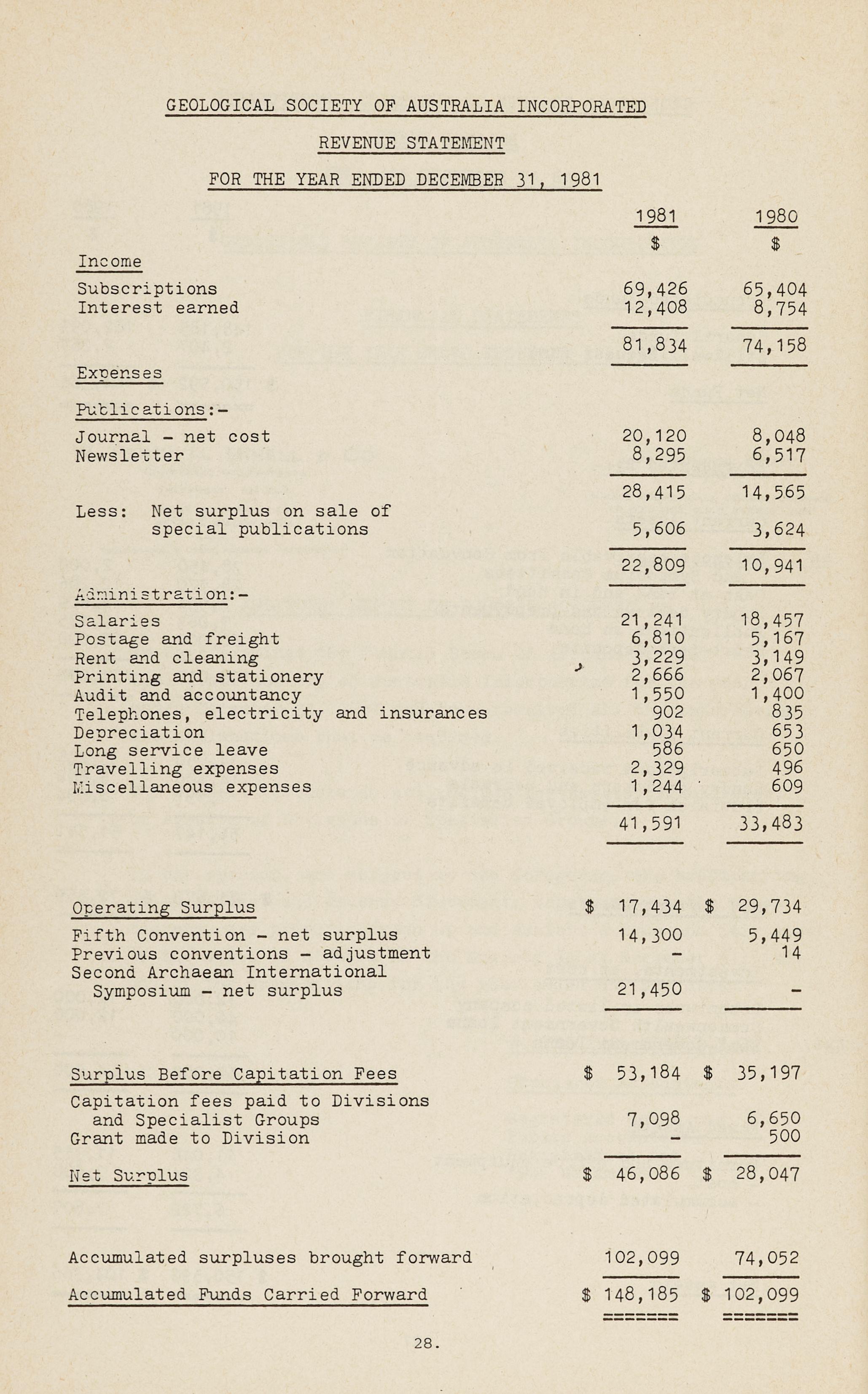
REVENUE STATEMENT
FOR THE YEAR ENDED DECEMBER 31, 1981
Income
Subscriptions
Interest earned
Expe:r:ses
Pt:.tlications:-
Journal - net cost Newsletter
Less: Net surplus on sale of special publications
~d~inistration:-
Salaries
Postage and freight
Rent and cleaning
Printing and stationery
Audit and accountancy
Tel ephones, electricity and insurances
Denreciation
Long service leave
Travelling expenses
r,:iscellane ous expenses
Operating Surplus
Fifth Convention - net surplus
Previous conventions - adjustment
Second Archaean International Symposium - net surplus
Surpius Before Capitation Fees
Capitation fees paid to Divisions and Specialist Groups
Grant made to Division
Accumulated surpluses brought forward
Accumulated Funds Carried Forward
. .), $ $ $ $ 1981 $ 69,426 12,408 81,834 20,120 8,295 28,415 5,606 22,809 21,241 6,810 3,229 2,666 1,550 902 1,034 586 2,329 1,244 41,591 17,434 14,300 21,450 53,184 7,098 46,086 102,099 148, 185 ======= $ $ $ $ 1980 $ 65,404 8,754 74,158 8,048 6,517 14,565 3,624 10,941 18,457 5,167 3,149 2,067 1,400 835 653 650 496 609 33,483 29,734 5,449 14 35,197 6,650 500 28,047 74,052 102,099 =======
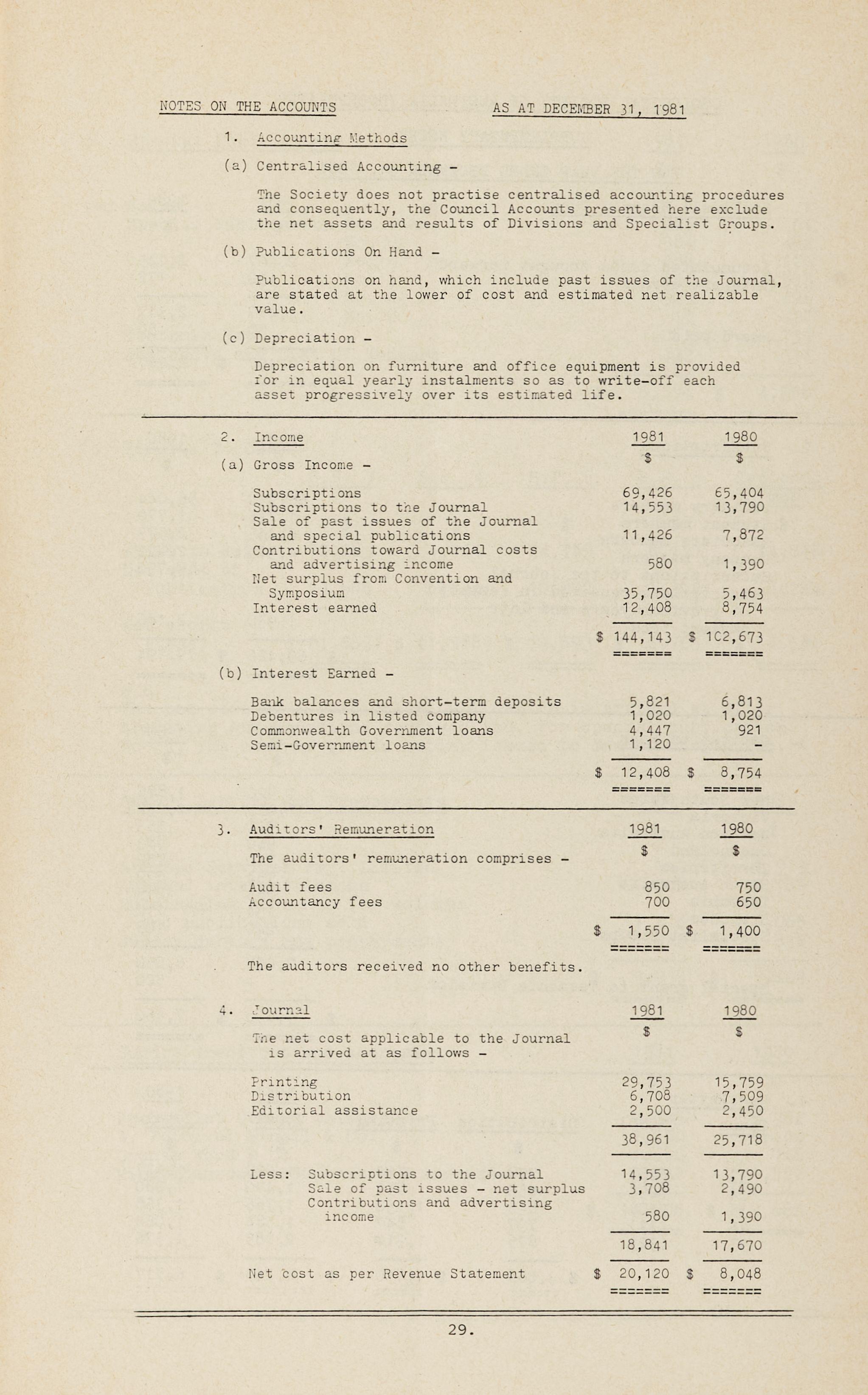
1 hccountine- !•!ethods
(a) Centralised Accounting -
'!'he Soc i ety does not practise centralised accounting procedures and consequently, the Council Accounts presented here exclude the net assets and results of Divisions and SpeciaEst G'.oups
(b) Publications On Hand -
Public ati o:1s on hand , which include past issues of t:ie Jou rn al , are stated at the lower of cost and estimated net r ea lizable value
( c) Depreciation -
Depreciation on furnitur e and office equipm ent is provided for in equal yearly inst al ments so as to write - off each asset progressively over its estirr:ated li fe
2 Income
(a) Gross Inco meSubsc ript ions
ubscriptions to the Journal
Sale of past issues of th e Journal and special publicat i on s
Contributions towar d Journal cos ts and advertising ::.ncome
!let surplus from Convention a.11d Sy mpo si um
Interest earned
( b) Int er es t Ea r ned -
Bank balance s c.nd short - term deposits
Deben-t:ur es in listed company Commonwealth Government loans Semi - Government loans
3 Aud itors ' rlemuneration
The auditor s' re muneration comprises -
The auditors re ceived no other
'lne net cost applicable to the Journal is arrived at as followsPnnt~ng
Less : Subscriotions to the Journal Sra.le of.cast issues - net surolus
and advertising·
Net cost as per Revenue Statement
.
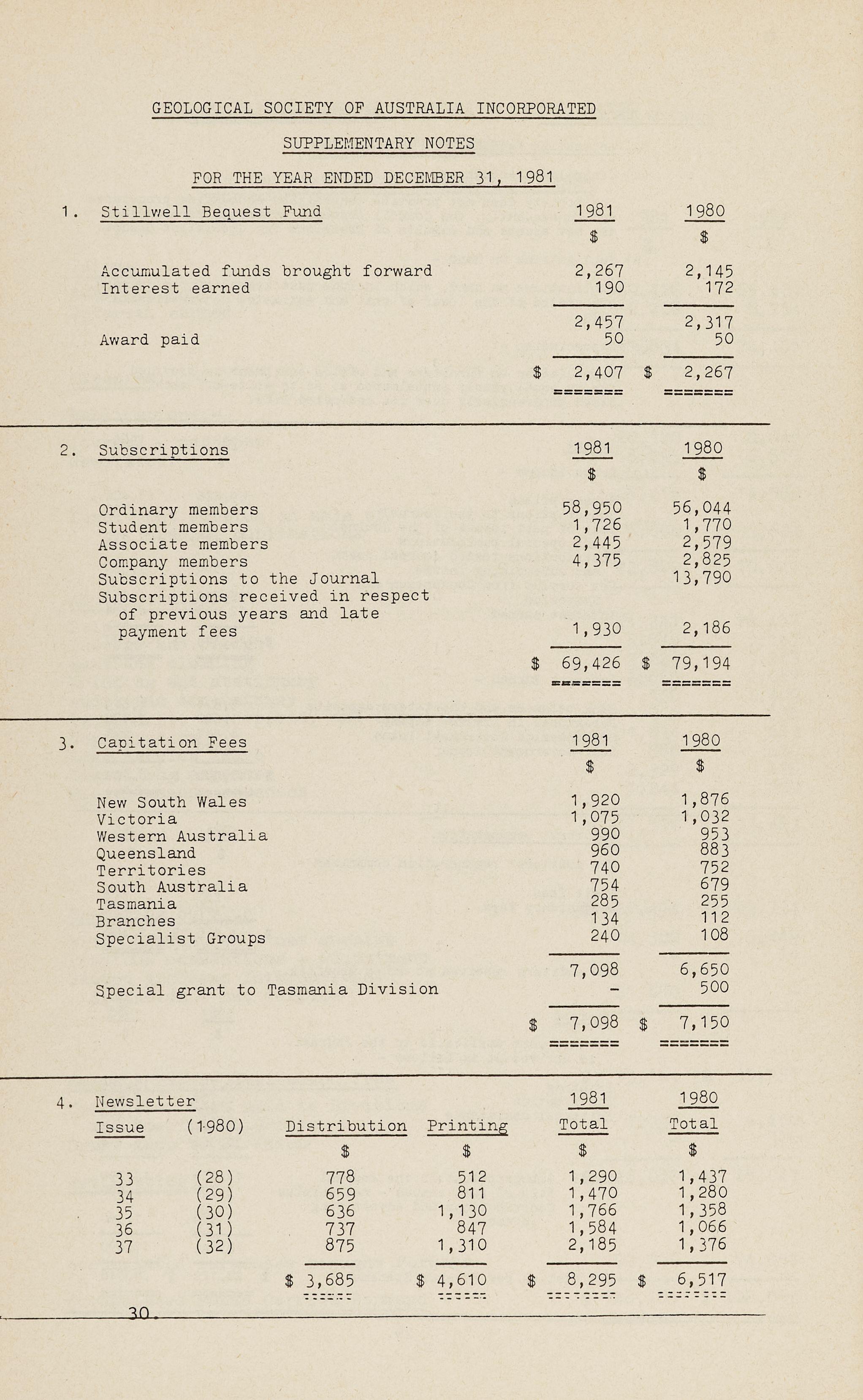
FOR THE YEAR ENDED DECEMBER 31, 1981
1 . Stillwell Bequest Fund
Accumulated funds brought forward Interest earned Award paid
2. Subscriptions
Ordinary members
Student members Associate members
Company members
Subscriptions
3. Capitation Fees
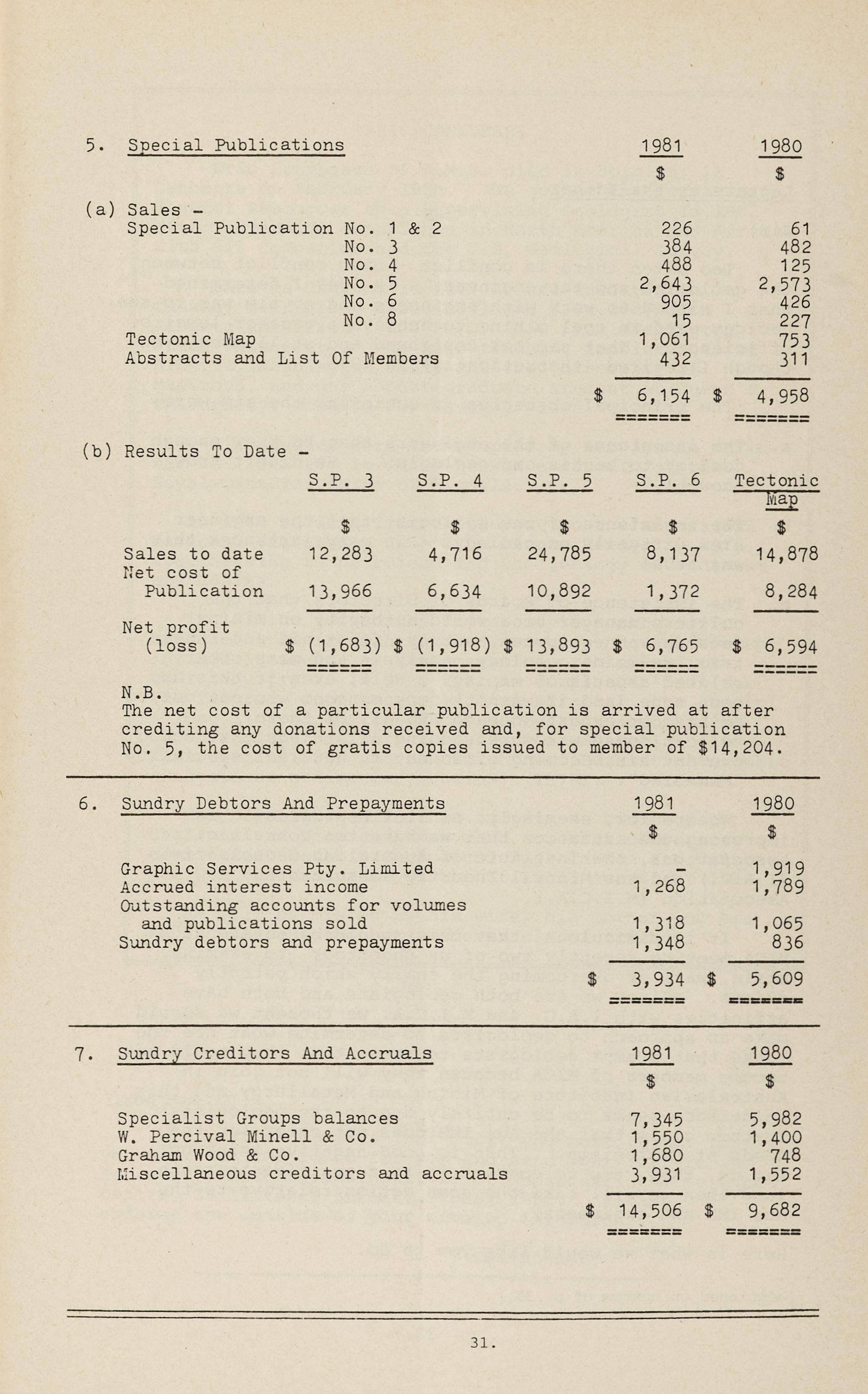
5. Special Publications
(a) Sales · -
Special Publication No. 1 & 2 No. 3 No. 4 No. 5 No. 6 No. 8
Tectonic Map Abstracts and List Of Members
Results To Date -
profit (loss) $ (1,683) $ (1,918) $13,893
The net cost of a particular publication is arrived at after crediting any donations received and, for special publication No. 5, the cost of gratis copies issued to member of $14,204.
6. Sundry Debtors And Prepayments Graphic Services Pty. Limited Accrued interest income
accounts for volumes and publications sold Sundry debtors and prepayments
7. Sundry Creditors And Accruals
Specialist Groups balances W. Percival Minell & Co. Graham Wood & Co. r,1iscellaneous creditors and accruals
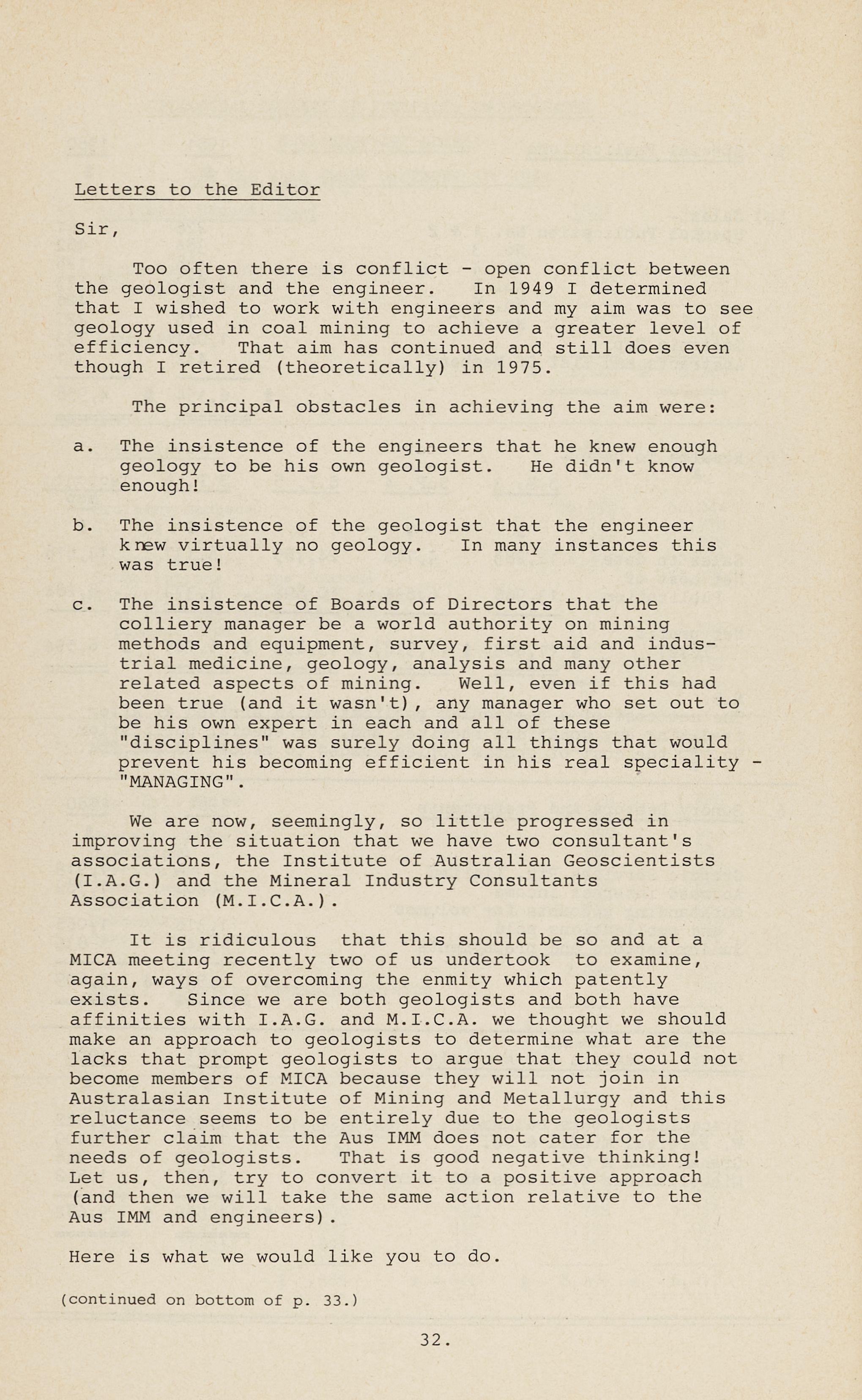
Letters to the Editor
Sir,
Too often there is conflict - open conflict between the geologist and the engineer. In 1949 I determined that I wished to work with engineers and my aim was to see geology used in coal mining to achieve a greater level of efficiency. That aim has continued and still does even though I retired (theoretically) in 1975.
The principal obstacles in achieving the aim were:
a. The insistence of the engineers that he knew enough geology to be his own geologist. He didn't know enough!
b. The insistence of the geologist that the engineer krew virtually no geology. In many instances this was true!
c. The insistence of Boards of Directors that the colliery manager be a world authority on mining methods and equipment, survey, first aid and industrial medicine, geology, analysis and many other related aspects of mining. Well, even if this had been true (and it wasn't), any manager who set out to be his own expert in each and all of these "disciplines" was surely doing all things that would prevent his becoming efficient in his real speciality"MANAGING".
We are now, seemingly, so little progressed in improving the situation that we have two consultant's associations, the Institute of Australian Geoscientists (I.A.G.) and the Mineral Industry Consultants Association (M.I.C.A.).
It is ridiculous that this should be so and at a MICA meeting recently two of us undertook to e x amine, again, ways of overcoming the enmity which patently exists. Since we are both geologists and both have affinities with I.A.G. and M.I.C.A. we thought we should make an approach to geologists to determine what are the lacks that prompt geologists to argue that they could not become members of MICA because they will not join in Australasian Institute of Mining and Metallurgy and this reluctance seems to be entirely due to the geologists further claim that the Aus IMM does not cater for the needs of geologists. That is good negative thinking! Let us, then, try to convert it to a positive approach (and then we will take the same action relative to the Aus IMM and engineers).
Here is what we would like you to do.
(c o nt in ued o n b o tt o m of p. 3 3. )
ERIC CONYBEARE
Eric Conybeare of A.N.U. died in hospital in Canberra on February 19th. He joined the Bureau of Mineral Resources as a Supervising Geologist in 1962 after extensive experience in North America and Africa with Oil Companies and the U.S. Geological Survey.
Born in England in 1917 he was educated in Canada, graduating B.Sc. 1941 and M.Sc.1947 from Alberta University, and Ph.D. 1950 from Washington State University. He held teaching appointments at Alberta, Washington State and the University of Manitoba, and was a post-graduate student at Queen's University, Ontario for several years.
His studies were interrupted by service in World War II (1941-45) in which he was a captain of the Royal Canadian Corps of Signals.
In 1964 he went from the Bureau to the Australian National University where he became Reader in 1972 specialising in petroleum and the geology of sedimentary basins.
In 1978 he joined the University's Centre for Resource & Environmental Studies where he was developing his interests in . environmental problems of the coal industry. In June 1981 he completed 'Fuel for the future: Coal resources of Australia', the last of a long line of distinguished monographs and papers, which include his very readable 'Oil Search in Australia' (1980) and the weightier 'Lithostratigraphic analysis of sedimentary basins' (1970).
Eric contributed to this society as Divisional Chairman and Vice-chairman, and a member of various committees, notably Geological Legislation and Census, and was the recipient of the Stilwell Award for 1970.
He will be missed by his wife, his mother and his four children, and by a wide circle of friends.
(from page 32)
Write (that implies that first you must think) what you want Aus IMM to do for you and send your list to the Secretary, Australian Institute of Geoscientists, Science Centre, 35 Clarence Street, SYDNEY 2000. Please endorse the outside of your envelop "AIG/MICA".
Ken Mosher.
33.