The Austmli nGeologist
Newsletter Editor:
D F. Branagan
Dept of Geology & Geophysics
The University of Sydney NSW 2006
Ph: Sydney 692 2358 or 692 2912
Society Office
Assistant Secreta~y: Miss L. Tuckwell
Suite 9 , 6th F l oor
Perpetual Trustee Bui l ding 39 Hunter Street
SYDNEY NSW 2000
Ph : Sydney 231 4696
THE PRESIDENT ' S PAGE
EFFECTIVE COMMU NICATION is the perennial problem of this Society Compared with almost any other national geological society , the l:ectarcs -·per-·member ratio , or mean ki l ometres from member to executive , are abnormally high This p l aces a special burden on the federa l officers individua ll y to do al l poss i ble to integrate the So ci ety , and strengthen the bonds between the divisions . We share a common journal , we share a news l etter , and our specialist groups link col l eagues between divisions Council meetings , when they convene , do bring together at least one counc i llor from each division and specialist group.
My impression is that communication within the Society is weakest with our members in the mineral industry. Less of them serve on the divisional committees and on the council , probably because of the frequency and non - p r edictability of their fie l d commitments. Less of their work emerges as papers i n the jo u rnal mainly because much of it is restricted within their o r ganizations Yet they make up a vital sector of our membership What sho u ld the executive be doing to improve this situation?
The administrative threads are also diffuse Whereas the executive revolves through the capitals , the administrat i ve office and all society records and archives , and the newslette r edi t or are necessarily in Sydney Our Public Officer is necessari l y in Canberra . We bank in Sydney , but all accounts have to be authorized and cheques signed in Hobart. Our editor is currently i n Canberra , and the journal is printed in ~de l aide and distributed thro u gh Sydney Su ch dispersion throughout Au stralia (although note that Queensland and the west are currently bare ) is an ideal for a national society , but it does demand a conscious effort from a l l for integrat i on and coherence I am persona l ly extreme l y grateful for the efficienc y and loyalty of our only full - time staff member , Miss Tuckwell in Sydney , for with a weak link there the Socie t y. would quickly deteriorate
The executive has sought further avenues to unify the Society , and would welcome suggestions from the membership. The Federa l Secretary has commenced sending to each divisional secretary and specia l ist group secretary a summary of business before the executive , in a form suitable for direct inclusion in the divisional newsletters , because there have been comp l aints that although the min u tes go promptly to the division secretaries , the ordinary members have no idea of what is going on. The executive pleads for positive feedback from the divisions and groups.
I hope to visit each division during my presidency , and during that visit attend a meeting of the divisiona l committee , and to address a general meeting of the division , so that each member attending may have opportunity for direct personal contact to the Federal Execut i ve . I hope to do this without cost to the Society by fitting such visits with other travel.
S . Warren Carey
GEOLOGICAL SOCIETY OF AUSTRAL I A
39 Hunter St ., Sydne y, NS W 2 000
COAL GEOLOGY GROUP (C G G )
MEMBERS HI P APPL I CATION FORM I, ............... ........................................ .
Add r ess , ................................................... .
Post Code ....... .
* am a member / associate member/student member of the Geological Societ y of Australia , and would like to become a member of the Coal Geology Group .
*am appl y ing to become a member/associate member/student membe r of the Geological Societ y of Australia , and , if successful, would like to become a member of t h e Coal Ge ol ogy Group (separate Societ y app l ication for m will be forwarded) .
Please bill me for $5 00 , in addition to my ordinar y 1978 Societ y account , for enrolment i n the Coa l Geolog y Group .
I e n c l ose deta il s , on a separate s h eet , of my present act ivi ties a nd in terests , an d am wil ling for t h is i n fo r mat i on to b e circu l ated
Signat u re :
Date :
*de l ete wh ic h e v e r n ot ap pli ca ble.
Newsletter No. 14
The Australian Geologist
EDITORIAL -----
This issue contains an important innovation, the President's page, which it is hoped will impro ve the link between the executive and the widespread membership.
Reports of executive decisions and actions are being transmitted regularly to divisions and specialist groups a nd these are already appearing in the monthly bulletins, in some divisions at least. Members wishing to go further into any matters of interest can obtain the minutes of executive meetings from their divisional secretary.
The executive continues to pursue the topic of geological legislation but movement is slow. The matter is appearing on the agenda of meetings of the Australian Minerals and Energy Council, but no action seems to be forthcoming from that august body.
Another topic of interest to the Society and its members is the proposed review of the activities of the B.M.R. A draft submission prepared on the Society's behalf by the executive received constructive criticism from some members and is being amended. Divisional secretaries now have copies of this document and y our comments are specially called for. However time is short and any matters you wish to go through the Society need to be with Secretary Ian Jennings before June 20. Those who prefer to act individually could go directly to the Minister concerned.
It is interesting that a similar review is taking place at pre sent in the New South Wales Geologica l Survey and some members have been can vassed about this review, which I believe is being undertaken by a committee which does not contain a geologist. One key person in the proceedings is said to have commented that the sur vey was not now really necessary as the State was already mapped - all the li250,000 sheets having now been published! Members in other states can no doubt look forward to similar in vestigat ions in the not-so-distant future.
Geologists have certainl y failed to sell their skills if this attitu~e can prevail in the halls of power.
Society News
The Third Convention of the Society is scheduled for Aug ust 1978 at Townsville with the proposed topic 'Geology & Geophysics of No rth Eastern Australia'. The next Society Council Mee ting will be held in conjunction with the Convention unless urgent matters require an earlier meeting.
Members will have received parts 1 & 2 of Vo lume 24 of the Journal. There will be · 8 parts this yea r. This rearran gement en ables the Society to apply for the Commonwealth book bounty and could sa ve the Society $7,000 or more.
The Society's finan cial position is rather better than expected, thanks mainly to earlier payment of subscriptions. However executive will pro ceed with a review of financial polic ies to see if any chan ges are necessary or desirable.
Other news items may be found e lsewher e in this issue .
Sir ,
Large mining companies are often accused of having little interest in , or time for, academic research. We would like to acknowledge publicly the assistance of one such company, Utah Development Co . Ltd., to the Palaeontology Department of the Australian Museum.
In the course of their coal operations at Blackwater, central Queensland, Utah have occasionally uncovered rich fossil deposits. In 1969 the y assisted one of us (A . R.) in the recovery of numerous, well-preserved fossil fish of late Permian age, a period of Australian h istory from which very few fossil vertebrates have bee n recovered The fish were all new to science, they show interesting resemblances to related forms from Africa and Europe and the find was obviously of major scientific importance. A request w?s made to the company for their staff to keep a watch for other similar finds as the mine operations progressed.
In January 1977 the dragline operations uncovered another layer containing abundant, beautifully preserved fossil fish in the overburden above the coal seam and the firm informed The Museum immediatel y. In the absence of A.R , overseas, R.J. went to the site, assisted considerably by transport and facilities provided by Utah Development Co ., and recovered a considerable quantity of material
At least five or si x different types of fish appear to be present in the Permian fauna; the y are similar to, but in certain respects better preserved than, the earlier finds from the same area The material is now safely back in the Museum being prepared and ~tudied and seems certain to yield valuable scientific information about the Permian ve rtebrates of Australia and their links with those of the other Gondwanaland continents.
The Blackwater site seems certain to produce more such material at inter v als and perhaps even Permian amphibian or reptile remains, which are v irtually unknown in Australia. However the recovery of such material depends heavily on the information and co-operation of firms such as Utah. The fossil material is very delicate and disintegrates rapidl y when e x posed on tip heaps and rapid recovery operations are essential.
We wish to express our thanks to Utah and to draw the attention of other companies involved in mining and quarrying operations that the y too have an opportunity - and a responsibility - to help state museums sal v age unique palaeontological material which is vital to a full understanding of Australia's geological and biological history. A phone call to the nearest museum or universit y department may well lead to a find of world-significance with considerabl y public relations v alue . The pro vi sion of technical and financial assistance for such projects ma y achieve major advances in scientific knowledge for very little cost to the company involved.
Alex Ritchie
Robert K. Jones Australian Museum, Sydney
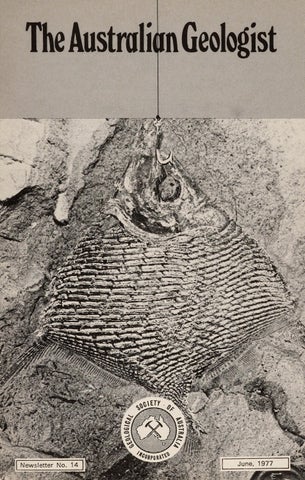
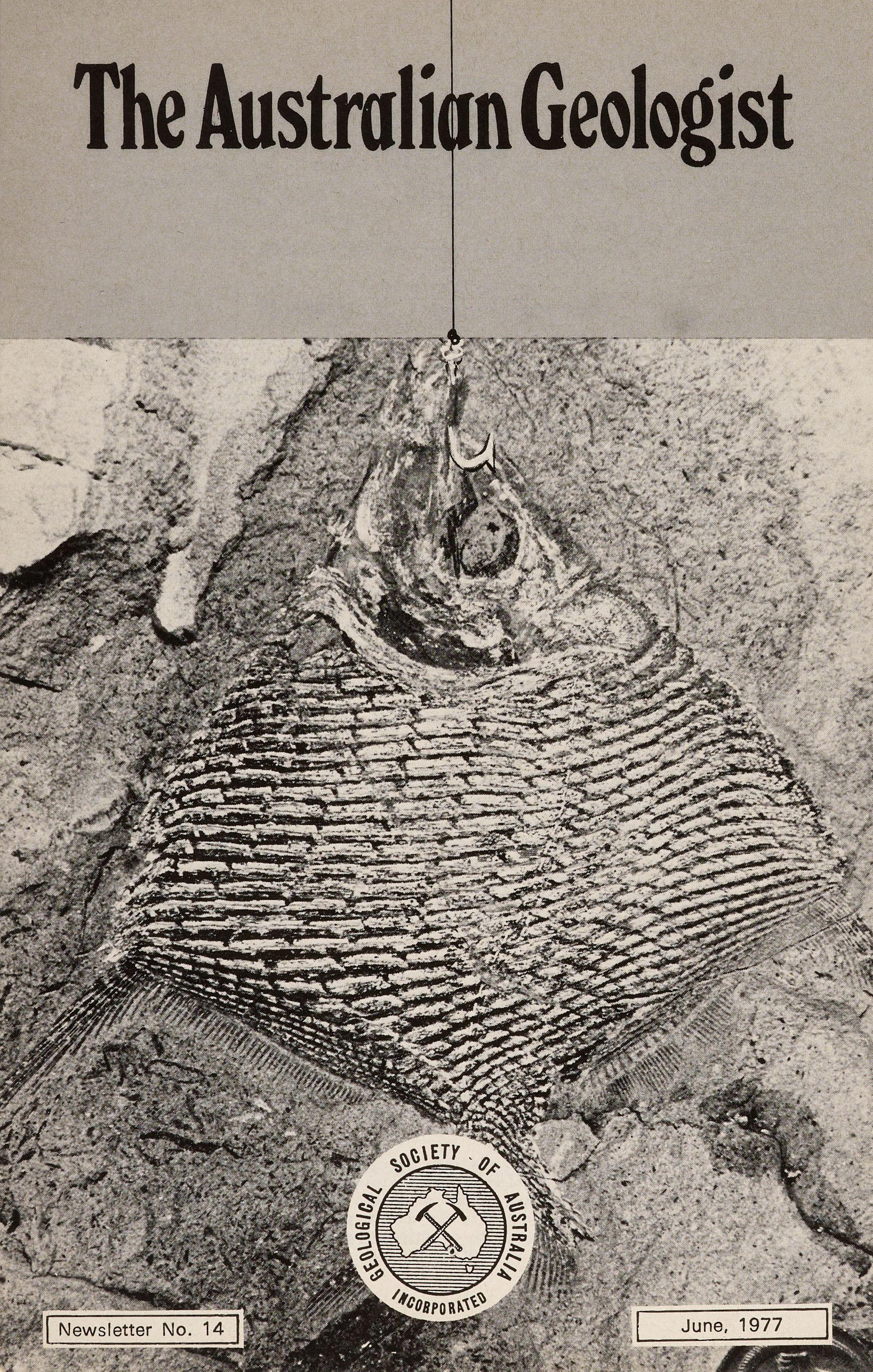
Cover Photo: Unnamed fish, probably a new Palaeoniscidgenus related to Cheirodop sis (Upper Carboniferous) From Blackwater , Qld.
The Hon. Fed. Secretary is I B Jenn i ngs , Geological S ur vey of Tasmania , GPO Box 124B, Hobart, Tas, 70 01.
The last Lays of the 25th I.G.C.
The Organising Committee had its final meeting on March 16.
Matters discussed included the publication of the General Proceedings which are now being issued and should be soon received by all I.G.C. registrants.
Congress accounts will be closed at the end of June by which time it is hoped Conventions Unlimited (and apparently unpaying) will have paid up for bookings it made on behalf of some American registrants.
Not all the money offered by companies was required and third subventions are to be refunded. Excursion moneys held in Papua-New Guinea ($700) and New Zealand ($2500) will be used to defray expenses incurred there during preparation of the excursions.
The Geological Society has been paid $2000 in respect of the Tectonic map copies provided for I.G.C. members and $3000 to assist with publications, with special consideration to Alcheringa.
The surplus which remains will probably be in the order of $45,000. This sum is essentially the result of much higher occupancy rate on excursions than was budgeted for, plus the unexpected large number of late membership applications.
The committee recommended to Council of the Academy that $35,000 be voted for establishing 'The 25th International Geological Congress Awards for Geological Studies Fund'. This fund is to be used to assist promising geologists from Australia and New Zealand to attend future International Geological Congresses or geologists nominated by the host country of the current International Geological Congress to visit Australia or New Zealand to carry out geological studies.
It was also recommended to the Council that the residue (approx. $10,000) be transferred to the Conference General Reserve Fund for supporting , specially in their early days, Australian scientific conferences, and especially those dealing with the earth sciences.
In reviewing the Congress the committee agreed -
1. that the Sydney University venue had proved excellent for the occasion, because of both suitable facilities and the interest of staff, officials and students.
2. the quality of papers was variable but possibly a little better than at previous conferences.
3. public relations were a wash out, and that a P.R. committee should have been established.
4. the Auld Lang Syne party should have been free (here, here) and not at the same place as the opening reception (here, here, here).
5. the greatest saving had been in printing costs by not publishing the full text of papers.
6. the Hospitality Room had been an outstanding success and contributed enormously to the atmosphere of - friendly informality. Such a room is a 'must' for every conference and congress.
Sir,
The publ ic debate on uranium appears to have degenerated into a reiteration of diametrica ll y opposed " facts " by the two sides, but one topic which is causing concern to many of those interested in this debate is the storage of nuclear waste.
Since this is in the first instance a technical problem , it is the geological community 's role to enlighten the public about the probability of safe underground storage of liquid or solid nuclear waste. The stony silence with which geologists have treated the debate is surprising in view of their usual vociferousness when talking amongst themselves, and more so when one considers the l arge number of potential stab l e repositories which spring to mind after a little thought
To avoid the charge of vested interest being levelled at any such study , I suggest that, as a matter of urgency, a small group of university-based geologists , including structural, sed imentary and ha~~ock experts, form a study group to pinpoint the potential burial grounds. Their recommendations cou ld be presented to government or to the A.A.E.C with the request for funds to test these sites
I am not advocating waste burial in Australia as an adjunct to uranium mining , but it would be a change to see the problem tackled and some public assurance given that waste disposal is not an insurmountable obstac l e in the nuclear power program.
B. W. Hawkins, Woollahra , N S.W.
Sir ,
I was interested in your Editorial Note in the December issue of " Australian Geologist" regarding geological principles and techniques in criminology I thought you might be interested in a case in which I was involved in 1952.
An early model safe was stolen from the Royal Canberra Golf Club and was found later blown open in the bush on Black Mountain. It was insulated with diatomite. The A.C.T police approached the Chief Geologist to see if BMR could help in their investigations. He asked me to undertake the examination of the diatomite. During the war , I had mad e a study of all known depostis of diatomite in Australia and elsewhere (see BMR Bull 7, Miscellaneous Series , 1949).
The police brought along small samples of the material from the safe , from the truck used and from the cuffs of the trousers worn by the suspected culprit , who of course said he had not been out that night I recognised that this diatomite in question showed no resemblance to any Australian deposit
The head of the Scientific Squad , Sydney CIB came to discuss the matter with me , and said it would not be necessary for me to appear in court Unfortunately that was not the case. I had to appear and what an ordeal it was The defendant ' s solicitor pestered me with questions , such as how did I know it didn ' t come from a deposit at Bunyan, near Cooma. So I decided to let them have all my scientific knowledge regarding diatomite. I was exhausted , I fortunately had pictures of types of diatomite in Australia, and one of that in the safe. The culprit got 3 years.
Irene Crespin
Ainslie , ACT
Mr. L . W. Parkin retired on December 31 , 1976 as Director of The Australian Mineral Foundation. Mr D.S Crowe has been appointed to this post from January 1, 1977. Mr. Crowe was earlier Manager-Administration of the Foundation
WILFUL DESTRUCTION , A PHOTOGRAPHIC RECORD
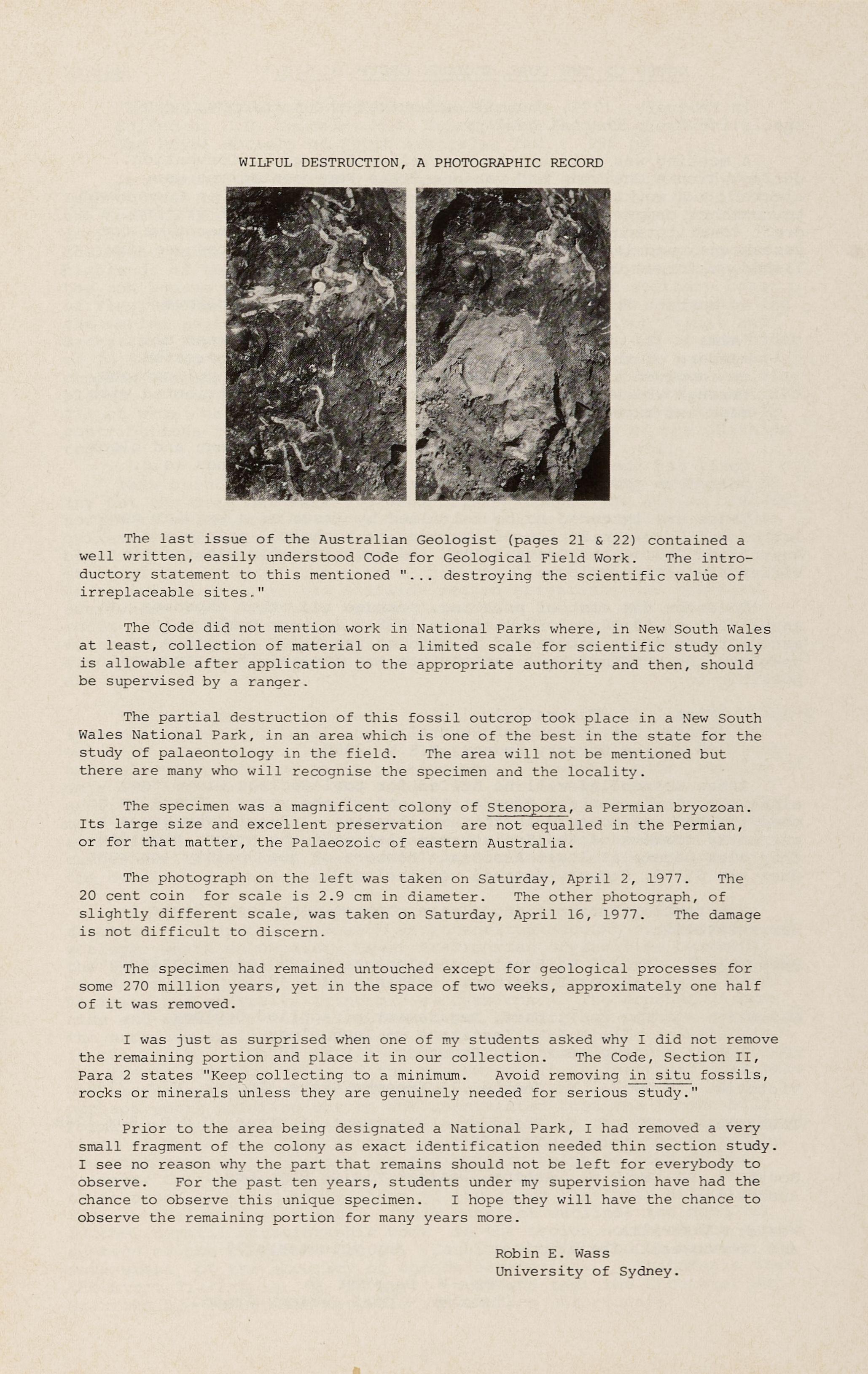
The last issue of the Australian Geologist (pages 21 & 22) contained a well written, easily understood Code for Geological Field Work. The introductory statement to this mentioned" destroying th e scientific value of irreplaceable sites "
The Code did not mention work in National Parks where , in New South Wales at least , collection of material on a limited scale f or scientific study only is allowable after application to the appropriate authority and then, should be supervised by a ranger.
The partial destruction of this fossil outcrop took place in a New South Wales National Park, in an area which is one of the best in the state for the study of palaeontology in the field. The ar ea will not be mentioned but there are many who will recognise the specimen and the locality
The specimen was a magnificent colony of Stenopora , a Perm ian bryozoan. Its large size and excellent preservation are not equalled in the Permian , or for that matter, the Palaeozoic of eastern Australia.
The photograph on the left was taken on Saturday, April 2, 19 77. The 20 cent coin for scale is 2.9 cm in diameter. The other pho tograph, of slightl y different scale, was taken on Saturday, April 16, 197 7 The damage is not difficult to discern.
The specimen had remained untouched e xce pt for geological processes for some 270 million years , yet in the space of two weeks, approximately one half of it was removed.
I was just as surprised when one of my students asked why I did not remove the remaining portion and place it in our collection. The Code, Section II , Para 2 states "Keep collecting to a minimum Avoid removing in situ fossils, rocks or minerals unless they are genuinely needed for seriousstudy ."
Prior to the area being designated a National Park, I had removed a very small fragment of the colony as exact identification needed thin section study I see no reason why the part that remains should not be left for everybody to observe. For the past ten y ears, students under my supervision have had the chance to observe this uni que specimen. I hope they will have the chance to observe the remaining portion for many years more.
Robin E. Wass University of Sydney.
NOTES ON THE COAL GEOLOGY GRODP (C.G.G.)
In February, 1977, Council authorized the setting up of a Specialist Group in coal geology.
A meetina was held at the Au stralian Geological Convention, during which; Chairman and variou s State Representatives were elected. A working coI!lP1ittee was subsequently formed in Queensland, to commence organisation of the Group. At the time of writing, a draft Constitution is beina forwarded to the Federal Executive for assessment, and it is hoped that, by the time these notes are published, a formal Constitution will be completed.
An extract from the draft Constitution reads as follows:-
"Aims - (i) To provide an avenue for liaison between all members of the Geological Society of Australia interested or involved in the study of coal geology and its applications, through which information can be obtained and distributed with ease and expedience.
(ii) To pro!T'.ote research on Aust ralian brown and black coals and their invol ver:i.ent with related disciplines (e.g. petro leum geology, sedimentology etc.) "
These are intended to be fulfilled by issue of a regular newsletter and by organization of appropriate technical sessions at Australian Ge ological Conventions. Suggestions for other activities are always welcome.
To cover the cost of printing, postage and other expenses, an annual fee of $5-00 is proposed for 1978. Society members (or associate members) interested in joining the Group are asked to complete the attached application form and forward it as soon as possible to:
Miss L. c. Tuckwell, Geological Society of Australia, 39 Hunter Street, Sydney, N.S.W. 2000.
Those responding will be billed for Coal Geology Group fees along with their Society dues at the end of the year. There is no need to send any mone y with this application. People who are not currently members of the Society may also join the group, provided they also becoJY\e at least Associate Member s of the Society (current dues are $5-00, Society Journal not included).
For further information, please contact your local State Representative.
Queensland: N. S.W .:
Victoria: Tasmania: South Australia:
Mr. J. W. Beeston, Geological Survey of Queens land, Mines Department, Redbank, Qld. 4301.
Dr. C. R. Ward, Department of Applied Geo lo gy, The N.S.W. Institute of Technoloay, P.O. Box 123, Broadway, N.S:t,J. 2007.
Mr. A. M. George, 15 Kyeamha Grove, Toorak, Vic. 3142.
Mr. v. M. Threader, Department of Mines, G.P.O. Box 124B, Hoba rt, Tas. 7001.
Mr. S. Ash ton, Western Mining Pty. Ltd.,
Western Au stralia and Commonwealth Territories: any volunteers???
James W. Beeston Chairman - Coal Geology Group.
"Natural Histo~y of the Adelaide Region"
Edited
by
C.R. Twidale,
M.J. Tyler and B.P. Webb. 1976. The Royal Society of South Australia Inc. 189 pp.
To commemorate the 1976 centenary year of publication of the Transactions of the Royal Society of South Australia the Council of the Society has commissioned the preparation of a special publication dealing with the natural history of the Adelaide region. The Adelaide region is diffusely defined as that area encompassing the highlands of the Mount Lofty Ranges south of the Barossa Valley and the contiguous western plains, the shorelines of the southern coast of Fleurieu Peninsula and the eastern coast of Gulf St. Vincent, and the marine region of the Gulf St . Vincent, Investigator Strait and Backstairs Passage. There can be but few small regions of the order of 15,000 2 in Australia, or indeed the world, where such a wide and complex variety of physical features and biological habitats are displayed. This publication combines the efforts of some 28 scientists, all of whom have a considerable interest in, or have made valuable contributions to a knowledge of the natural history of the Adelaide region.
This brief volume is not a popular account likely to appeal to any but the most enthusiastic naturalists amongst the general public, nor is it an exhaustive ency clopedic work likel y to satisfy the requirements of specialists, but it does succeed in presenting in board outline an authoritative and li v ely account of the present state of knowledge of the natural history of the Adelaide region. As an introduction to the Adelaide region scientists and students everywhere will find this volume invaluable and the 400 odd references to published studies on the region will form useful leads to further reading. Scientists working in the Adelaide region will find particular interest in being informed of what their colleagues are up to.
The editors have succeeded in bringing together ideas and results from many diverse disciplines and have produced a very attractive volume The book is liberally illustrated with both line drawings and selected black and white photographs. However, some locality maps are inadequate, and the reader not intimately familiar with geographical localities near Adelaide should be prepared to consult more detailed goegraphic maps if some of the finer details are to be appreciated. The provision of an index, although necessarily cumbersome, might have been useful particularly for searching out the overlap of subject matter betwefn chapters.
After an introductory preface the book is divided into 14 chapters Chapter 1 presents an integrated account of the land geology, which encompasses Lower Precambrian crystalline basement, the Upper Precambrian Ad elaidean succession, the Cambrian Normanville and Kanmantoo Groups, a beautifull y preserved Early Permian glacial heritage and extensive Cainozoic successions. The account is concise and generally well illustrated but brevity has perhaps concealed the numerous geological problems which still beg to be investigated in the region. There has long been a dual stratigraphic terminology for the folded rock units of the ranges and it is fortunate that this has been largely suppressed in this publication. However, it is pe~haps worth pointing out to the uninitiated that the 'Inman Hill Formation' of Fig. 2 is supposedl y equi v alent to the 'Tapanappa Formation' of Table 1. This divergence in terminology is not helped b y the statement on p. 17 that the sedimentar y sulphide beds of the Talisker Cale-siltstone were formerly exploited at Brukings, when these deposits are clearly shown to lie above the Inman Hill Formation on most published maps. This conflict outlines the need for further careful strati gr aphic work in the region north of the type section of the Kanman too Group. Caution should also be used in the assessment of the accur ac y of age determinations. Statements that the Sturt Tillite is ' ea 759 m. y.' (p .8 ) and that the Encounter Bay Granites are 'about 506 m .y. old' (p.17) are unfortunate.
The geomorphological evolution of the region is described i n Chapter 2. The earliest landforms are exhumed Permian glacia l features. A deeply weathered Mesozoic lateritic summit surface is still well-preserved on parts of the ranges. More complex and varied landforms were generated in erosive cycles initiated by intermittent Cainozoic fault block movements and there are numerous problems involving the effects of Quaternary climatic and eustatic sea level changes.
The Adelaide region has provided the impetus for many significant advances in soil science ( Chapter 3) and the continu i ng s t udy of the enormous range of soil types (at least 24 princ i pal prof ile f or ms have been recognised) will provide interesting problems for the soil scientist for many y ears to come. The unique climatic factors of the Adelaide region are outlined in Chapter 4 and several suggestions are made for the improvement of the Adelaide urban environment. A number of unfavourable climatic factors are indicated for the Monarto site. In Chapter 5 groundwater usage in the region is outlined. At present about 10% of the total water used is local groundwater, mostly for irrigation, but in dry seasons there has been extens i ve pumping of groundwater into the city mains. It is a little alarming that the withdrawal of groundwater from the Adelaide Plains has exceeded the estimated recharge rate for the past 15 years, and the present rate of withdrawal is about 3 times the estima t ed recharge rate. A reconstruction of the water balance in the -coasta l plains and swamps west of Adelaide, prior to man's interference , is attempted in Chapter 6.
The advent of man has greatl y changed the natural vegetation (Chapter 7). There is a need for the careful preservation of nature reserves and for records to be made for future access. There are many problems concerning the prehistory of the Adelaide vegetation the solution to which must await more detailed palaeobotanical data. The aboriginal inhabitants of the area (Chapter 8) are believed to have had a considerable influence in modification of the environment. A broad introduction to the major components of the terrestria l fauna and aquatic vertebrates is given in Chapter 9. The fauna l listing is not exhaustive. A simple taxonomic key for t he use of the enthusiastic naturalist interested in freshwater invertebrates is provided in Chapter 10.
Chapters 11-14 are concerned with the Gulf St. Vincent and adjacent straits and shorelines. Recent advances in the understanding of the physical oceanography of the Gulf are reviewed in Chapter 11. Chapter 12 outlines the nature of the substrate and sediments, and the subtidal ecology in the Gulf, a pre-eminent carbonate province. The last two chapters deal with the intertidal ecology of the coastal -zone and marine fishes and mammals. Some 216 species of fish have been verified in the Gulf. The Gulf is the type locality for 26 speqi es of which 7 are apparently endemic. Few data are available concerning the impact on fish stocks of the steadily increasing pressures of the amateur fisherman, or of the env i ro n menta l changes being wrought by man.
Chapters dealing with human geography and the spread of the urban environment, the impact of European culture on the natural environment, the seismicity of the region and natural disasters might well have been included. Nevertheless this volume will provide a logical basis for the future growth and development, and improvement, of the urban environment. It emphasises the need for further careful investigations of the impact of man's activities if those features of the natural environment and biological ecosystems, so unique to the Adelaide region, are to be preserved for the enjo ym ent and enrichment of future generations.
Volumes ma y be purchased from the Society's rooms, State Library Building, North Terrace, Adelaide, S.A. 5000. Price approximately $6- 0 0.
BOOK REVIEW
The Ea rt h's Density. By K.E . Bullen, F R S. London : Chapman and Hall. 420pp. 1975.
The general character o f the Eart h 's internal densit y distribution is now consi d ered to be known. Only local d etail in the radial and more especially lateral direction s remains to be worked out . That thi s is so is due in large measure to the fo ur decades ' labour whi ch Professor Bul l en devoted to d e t erminin g a satisfactory model for the Earth The fascination with wh ic h this task engrossed him in evitably emerges in his characteristic style of presentation .
The boo k begins with a historical account of e arly i d eas on the size, mass and densit y of the Eart h Then f ollows an account of the seismic evidence and a descr i ption an d anal y sis of Bu llen's A- and B- type motlels, ad d itio n al e v idence from surface waves and free vibrations is introduced, l e ading to the HB models . The contributions to the sub j ect by such leading American workers as Anderson , Birch , Gilbert and Press , and by others, is referred t o. There is an interesting discus s ion of ' optimum ' and 's tandard ' Earth model s, and a final chapter on the internal properties of the other planets and the Moon
S ome of the mathema tica l details and dis cussi on o f seismic theory in chapters 3 to 9 seems su perfluous , being well covered in the author's standard work on seismology. There is , however , little about the origin or formation of the Earth and the geochemical interpretation of the values of density and other properties is given scant treatment indeed. This is not a book for a geologist or geochem i st seeking an authoritative guide to the probable 'meaning ' o f all the numbers Indeed Bullen's intellectual di f ficult y with the characteristic geological ~pproach to interpretation is made clear on page 214 , where , having referred briefl y to the extensive work of others on the possibility th at one or more pha s e transformations and compositional changes occur i n the upper mantle, he states : " attempts to work out the fine structur e of the region C (and other parts of the Earth's interior) through arguments base d on geochemi s tr y and results f rom laboratory experiments are currently fashionable, but a ten d enc y for workers in t h ese f i e lds to be black and white rather than probability minded in th e ir arguments makes i t difficult to attach appropria t e d egrees o f precision to their detailed findings."
Bullen is no longer with us but we can be grateful that h e ha s l eft us this luci d and absorbing book .
A.A Da y
FIRST WORLD CONGRE SS ON RESOURCE DEPLETIONS , ENE RGY ALTERN AT I VES , AND THE QUALITY OF LIFE IN THE YEAR 2000
Sp o ns ore d by : In t e r n ati o n a l As socia tion for Adv ance me n t o f Ear th an d Envi r o nmental Science s and The Uni v ersity of Riya d h - Saud i Ar ab ia To be held on Mar ch 26 - 30 1978 , Universi t y of Riyadh - Riyadh , Saud i Arabia
Organizer and Chai rma n o f Congre ss : Dr Musa Qutub , Dept o f Geography & Environ men t al Studie s, No r theaste r n Illinoi s Universi t y , Bryn Mawr at St . Louis Ave ., Ch i cago , IL 60625 , USA , Ph 312 - 583 - 4050 e xt. 7 89 or 7 35 A limite d numb e r of P ar r arna tta Riv e r Bathyme tri c Map s ( $2 00 + postage ) i s a va i labl e f rom the De p artment of Geo l ogy & Geophysics , University of Sydne y, NSW 2006
DUAL STEREOGRAPHIC NET
McAulay Enterprises annou nces th e re lease of a lightweight ( 470 grams) precision i:nstrument incorporating two stereographic nets, one equal-angle, the other eq ual-a rea.
The DUAL STEREOGRAPHIC NET which operates by turning a central circular disc on which the nets (15 cm diameter) are printed one on each side, is manufactured from glass-filled nylon - a material selected for its excellent dimensional stability, high rigidity, very high he a t-disto rtio n temperature and excellent resistance to su rface abr asion The equal- area side is figured below. Four rubber feet each side of the net provide friction wh en it is operated on a flat surface, and protect the underside fr o m s c ratching. The nets , screen-printed in black - ink dye permanently etched into the white nylon surface, are suitable for use by students and professional s cientis ts in both the la boratory and the fi eld. The double -sid ed design makes the DUAL STEREOGRAPHIC NET par ti cularly versatile
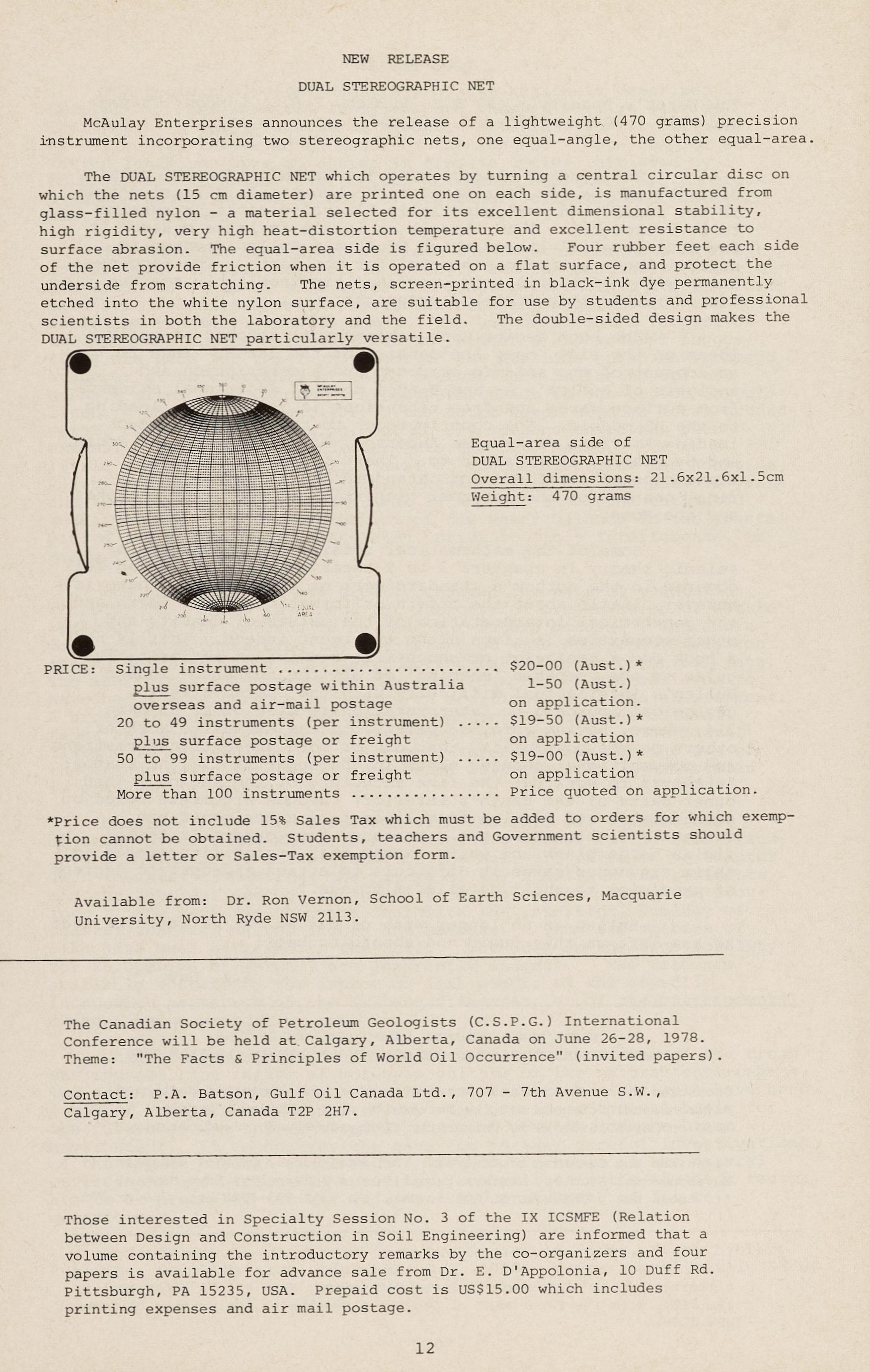
Equal - area side of DUAL STEREOGRAPHIC NET
Overall dimensions: 21 . 6x21 6xl .5 cm
Weight : 470 grams
PRICE:
Sin gle instrument ...... .....
$20 - 00 (Au s t.)* plus surface po stag e within Australia overseas and air - mail po sta ge
20 to 49 instruments (per instrument) plus surfac e postage or freight
50 to 99 instruments ( per ins trument) plus surfa ce po stag e or freight
More than 100 instruments .
1-50 (Aust.) on application.
$19 - 50 (Aust.)* on application
$19-00 (Aust.)* on application
Price quoted on app li cation
*Pri ce does not include 15% Sales Tax which must be added to orders for which exemption cannot be o b tained. Students, teacher s and Government scientists should provide a letter or Sales - Tax exemption form.
Avail abl e from : Dr Ron Vernon , School of Earth Sciences, Macquarie University, North Ryde NSW 2113 .
The Canadian Society of Petroleum Geologists (C S P G ) International Conference will be held a t Calgary , Alberta, Canada on J une 26-28, 1978. Theme : "The Fact s & Principles of World Oil Occurrence" (invited papers).
Contact: P A. Batson, Gulf Oi l Canad a Ltd , 707 - 7th Avenue S .W., Calgary , Alberta, Canada T2P 2H7
Those interested in Specialty Session No 3 of the IX ICSMFE (Relation between Design a nd Const ru ction in Soil Engineering) are informed that a volume containing the introductory remarks by the co-organizers and four papers is available for advance sale from Dr. E. D'Appolonia, 10 Duff Rd Pittsbu r gh, PA 15 235 , USA Prepaid cost is US$15 00 which includes printing expense s and air mail postage.
CAREY APPRECIATION
Over 180 people enrolled for the Carey Appr eciation Symposium held in the Geology Department, Un iversity o f Ta sma nia from February 7 - Febru ar y 10, 1977. The Symposium had been arranged to express the appreciation of the g eolo gic al community for the contributions made to geological sc ien ce b y S. Warren Care y People came from se veral continents to attend the Symposium and make their contribut i on. Gradu ates of the Geology Dep artment, University of Tasmania, came from as far afield as London, Trinidad and Srinagar and assoc iates of Professor Care y such as Pro fe ssors H. Wynne-Edwards, B. C. Burchfield, D. B. Stone and J. Denni s, Dr. Warren Hamilton and other s came from the North American continent. There were of course many participants from other part s of Au stralia and a strong local contingent. In all 104 graduates of the Departm e nt attended. The conference ope ned with an introductory statement b y Ian Jenning s of the Tasmanian Geological Surve y followed by a biographic al statement on Dr. Carey from Dr. Alan Voisey , a long~time friend and colleague. Fifty-two papers were presented, mostly in the field o f tectonics but with significant contributions in the field of petroleum geology and in the area of economic geology. Subjects varied from microscale (The Place of Boiling in Ore Deposit ion ) to the mac ro-scale with a pap er on "Origin of the Moon - a Pr oble m in Geodyn amics". A collection of pap ers arising from the Sympos ium will be published as a s pecial issue of Tectono phy sics in earl y 1978.
On the lig ht er side it may be recorded that the Symposium opened with a cricket match between the Natives (graduates who are still working in Tasmania) and the Expatriates (those graduates who were working in other places). The natives not onl y had a home ground advantage but had y outh on their side and won quit e convincingly. Th e umpire s we re S. Warr en Carey and Al a n Voisey. A Symposium dinner arranged for the even ing of the 10th wa s very well attended and judging from the fa ct that the diner s had to be almo st f orcibl y ejected at 12.30 a.m. may be regarded as reasonably successful. Not so successful perhaps were some of the post-dinner parties at th e Casino. One o f the highlights of the Symposium was the rendition by it s autho r of a poem composed as he travelled on the ferries to and from the eas te rn shore . Professor Wynne-Edwards' poem is prin te d herewith.
Despite so me diff i culties ar isi ng on the fin al day from a putative air controllers' strike the Symposium seems to h ave been regarded as successful in the social sense and stimulating in the intellectual se nse.
DONATIONS INVITED
The W.R. Browne Med al to be awarded annu all y for disting uis hed services to geological sciences in Australia ha s been established by the Society
The awa rd will not be confined to persons resident in Australia but is to be made in regard to contributions to Australi an geological sciences. The form of t he contributions may be through publication, through servi c es to industry, education or administration or any comb inati on of these The medal may not be shared.
The design and s ~riking of the medal will cos t some $500. Thereafter no expen s es will be in cur red by the Society in regard to th e medal. Members are i nvited to dona t e to this fund to establish the award. Cheques should be sent to the Societ y made out to 'W.R. Browne fund'.
48th ANZAA S CO GRESS - MELBOURNE ' 77
Aug 29 - S e p 2
Section 3 : Geology & Mining
Plane tar y Stud ies ; M i n i ng co sts Ve r s u s Be n efi t s ; Histor y of th e Aus tr alasian P l ate ; Earth Science E d uca t ion ; Ev ir onmenta l /Engine ering Geology
Contact: Dr Lindsay Thomas , Dept of Geology , University of telbourne , Parkville, Victoria , Australia , 3052
PALAEOBOTANY : THE STUDY OF FOSSIL PLA NTS
Sep 5 - Sep 9 1977
A Residential School at The University of ew England , Armi dale SW 2351
Contact: Dr Rod Gould , Senior Lecture r, Geology Department u E
· I ERAL EXPLORATIO TECH JIQUES I TROPICAL RAI FORESTS
An International Conference and a Field Training Course , o r ganised by the Association of Geoscientists for International Development , in co - operation with : The Ministry of Mines and Hydroc arbons of Venezuel a; The S oci e t y of Venezuelan Geologist s; The Central Un i v ersity of Venez u ela; wi ll be held ovember 20 - Decembe r 1 2 , 1977 at Car acas , Venez u e la.
Contact: Dr Alirio Bellizzi a, AGID Conve ner , MMH - Direcc i 6n de Min as, To r re orte , Piso 20 , CBS , Ca ra cas , Vene zuela
CIRCUM - PACIFIC ENERGY A D MINERAL RESOURCES
Edited by 1ichel T Halbo u ty , J o hn C Maher , and Harold M Lian ; co n ta in s 126 papers f r om the 1974 conference on coal , geothermal energy , hyd ro carbon s, hydrogeology , minerals and general subjects
It is AAPG :-emoir 25 available from : The Americ a n As sociation of Petr oleum Geologists , PO Bo x 9 7 9 , Tulsa, Oklahoma 74101
MPG & SEP I Members $32 00 orunembers $ 4 0 00
I G C (continued from pg 5)
Tributes we re p a id to Dr. F isher f or his Ch airmanship of th e committee and P res i dency of the Congress, and to Sandy Renwick's work as Secretar y -General. In reply they paid tribute to t h e work of the S yd ney Committe e , and o f all who had been in volved i n org anisi ng t he Con gress.
At thi s point the Commit tee agree d to di so rg an i se.
7he fir st paper s fr o m I. G C wh i c h I h a ve seen pub lis h e d ap pe a r in the Decemb e r 1 97 6 (n o. 1 4 ) i ss u e of t he Bulletin of the Inte r national Association o f Engineering Geology. The y consis t of material from Section 13 and Symposium 113 ( ge o l o gy a n d th e e nv iron men t and ge ological ha z ar d s ) There ar e som e very intere s ting pape rs.
Fifty y e ars ag o, in 19 2 7 , the e arliest s eed s were so wn from wh i ch t h e p r ese nt B .M. R . o rgan i za tio n ( f o r med i n 1 946 ) had its root s.
In 1926 the Commonwealth government passed the Petroleum Prospe c ting Act, to encourag e the search in oil in Australia Thi s event was followed in June 1927 of the cr eation of the Geological Branch, with a palaeontological se ction, within t he then Dept of Home a nd Territorie s. In June 19 27 Dr W S Wo o lnough was app oi nted the first Commo nwealth Geolo g ical Advi ser, with P Ho s sfe l d as h i s as si stant and wi t h he adq u ar t ers in Canberra
In October 1927 Frederick Chapman wa s appointed fir s t Co mmonwe a lth Pal a eontologist and in De c ember of that year Irene Cr espinbe c ame hi s assistant , with their headqu a rters at the Na tional Museum Melbourne All appointments we re on a t e mporary basi s.
Hoss fe ld r es i g n ed in 1 935 . I n 19 40 H.G. Ragg a tt was ap poin t e d assi s t a nt to Dr. Woolnough and when LJoolnough retired in 1941, he was s ucceeded by Raggatt Chapman retired in December 1935. He was succeeded in Jan 1936 by Irene Crespin who in February 1936 was transferred, with the entire Commonwealth Palaeontological Collection, to Canberra She retired from B M.R in 1961 and still resides in Canbe r ra
Calli n g a ll Cryst allographers -
Courses, etc . are scheduled as follows :
UNIVERSITY OF NEW HAMPSHIRE (U.S A ), July 10 - 16 1977 , 3rd International Summer School on Crystal Growth.
Information: Dr K Nassau , Bell Labs , MURRAY HILL, N.J. 07974, USA.
LONDON ( Imperia l College?) , July 11 -1 5 , 1977 , Appl i ed Polarised Light Microscopy . I nformation : 2 Mccrone Mews, Belsize Lane , LONDON NW3 5BG, U K
LONDON (Imperial College), July 25 - 29, 1977 , Two courses in Identification of Asbestos
Information: 2 Mccrone Mews , Belsize Lane , LO DON NW3 5BG, U K.
ERICE (Sicily), Sept 5 - 16 , 1977 , Teaching Crystallography for today's Sciences.
Information: Pr A. Authier , Lab Mineralogie Cristallographie , 4 Place Jussieu , tour 16 , 75230 PARIS CEDEX 95 , France .
CORFU (Greece) - Grand Hotel Glufada , Sept 25-0ctober 8, 1977, Advanced Study Institute (Summer - school) on "High Pressure Chemistry"
Information : Pr H. Kelm, Inst Physical Chemistry
KARLSRUHE , Sept. 26 - 0ct 1 , 1977, Symmetrie - Beziehungen Zwischen Verwandten Kristal l strukturen: Anwendungen der Kristallographischen Gruppentheorie in d er Kr i stallo c h e mi e .
In f o r mation : Pr Dr H . Wondratscheck , Inst . f li r Kristallographie und Inst filr Anorganische Chemie II der Universitat(TH), Kaiserstr 12 , D 75000 KARLSRUHE (West Germany).
AACHEN, October 3 - 10, 1977 Rontgenographische Untersuchungen ach der Pulvermethode
Information: Pr Dr lv. Bronger, Inst Ano-ganische Chemie und Inst. Kristallographie der Technischen Hochschule Aachen, Professor Pirletstrasse 1 , 5100 AACHEN (West Germany).
DARM STA DT , October 1977 , Einfuhrung in die Rontgenstrukturanalyse
Information: Pr Dr Wlilfel , Inst. filr Physikal i sche Chemie Strukturforschung, Technische Hochschule, D 6100, DAru'STADT (West Germany)
BELOW THE OROGENIC BELT
"Did my pleas ing construction lead me to subduction?Oh tell me Doctor please, There's a persistent spine down my orocline And I've got the IAT's."
"Tell me the story and try to not worry", The kindly doctor frowned:
"Were you ever led to a pillowed bed 'Neath forams floating down?"
"Did turbidites stroke your palaeoslope? ·Do you have a marked sole? Did a million nights of sheeted dykes Cause yo ur spreading limbs to glow?"
"Did yo u let calc-alks or some plain basalts Intrude your HAB'S?
Did you take delight when an ophiolite Rose shining from the seas?"
"Were you overthrust by obducting crust? Did you cross the suture line? Was your modesty swayed by blueschist and jade, Or did you stop your drift in time?"
"Well Doctor dear, my Asthenosphere Was in constant agitation, And I got hot spots and mafic clots All up and down my craton."
"But no rigid plate was ever my mate, No island arc accretion; I was never a wench for an ocean trench, In spite of my declination."
"I have to think," said the Doctor's wink, "That your age precludes this mating, Being Proterozoic is quite heroic, But much too old for dating."
"The trouble lay quite another way, Your sialic crust's reworking. Your spreading girth? Just expanding Earth. And I find it quite provoking ."
H. R. Wynne-Edwards 10/2/1977
As presented at the Carey Appreciation Symposium
Peter Jell (University of Queensland) comments on the interesting mud island which appeared overnight in Lake Victoria in February .
"I have just noticed a paper by W.G. Woolnough in the Proceedings of the Royal Society of Victoria , volume 42 for 1930 (pp. 221-234) describing the occurrence of a similar phonomenon during 1928. I must say that I find his explanation far more plausible and indeed pleasantly simpler. If I remember correctly the site is a lm ost identical with the recent appearance - off Pe lican Point in Lake Victoria I am sure some older Victorian geologists will be aware of the phenomenon and so my revelation may not be news at all."
Woolnough concludes that his island owed its or igin to upheaval of the lak e floor, by lateral squeezing of a sub - surface layer of plastic clay from beneath an area overloaded by recent accumulation of sand.