The Australian Geologist Newsletter of the Geological Society of Australia Inc
News l ette r Edi t or D F Branagan, Department of Geology & Geophysics , Th e Un i ve rsit y of Sydney , N S W 2006 . Phone : ( 02) 692 2358 or 692 2912
Assistant Secretary
Miss L Tuckwell , Suite 9 , 6th Floor , Perpetual Trustee Building , 39 Hunte r S t., Sydney , 2000
Phone : ( 02 ) 231 4696
SOCIE TY NEWS
Council met in S y dney on May 1~ to consider Society affairs. Reports of Office bearers, Divisions, Specialist Groups and Committees were received and discussed. Membe rs wishin g to obtain full details should contact their divisional secr e taries or councillors.
Among matters wh ich arose were the problems of communication between executive and d i v isions, such as those concerning arrangements for the Second Australian Geological Convention, whi ch will now be held in F eb ruar y , 1977 at Monash University , Melbourne, s pon sored by the Victorian Divis~on. A p olic y wa s outli ned for the planning of future Conventions, to ensure adequate preparation, suitable timing and location, and s p o n sorshi p by Divisions.
The Society has agreed to host a Wine and Che e se tasti ng pa rt y at the Geological Congress, on August 20th.
Robin 1'7ass (Hon. Fed Sec.) has compiled an Index to the Journal (Vols. 1 - 22) which will be published and issued with a new membership list. Also scheduled for p ublication is Special Publication No. 6, Dynamic Metamorphism; p rocesses and products in Devonian carbonate rocks, Canning Basin, Wes tern Australia, by B. Logan and V. Semeniuk (p rice to members $10 - 00).
The Geology of Victoria (Special Publication No. 5) will a lso be forthcoming in the next month or so. This will be a 500 p lus page volume which will be free to members. How eve r incr eased printing charges for this handsome volume will deplete the Society's coffers more than somewhat (even if a book bounty is obtain ed ) and Treasurer John Cramsie received (? reluctant) support for his motion that a fee increase be approved to keep the Society out of the hands of the receivers. The proposed a nnual membership fee is $25-00. This proposal ha s to be approved by the next genera l meeting of the Society, of course, and this mee ting is nc he duled for 1730 hours, 24th Aug ust (during I.G. C. ).
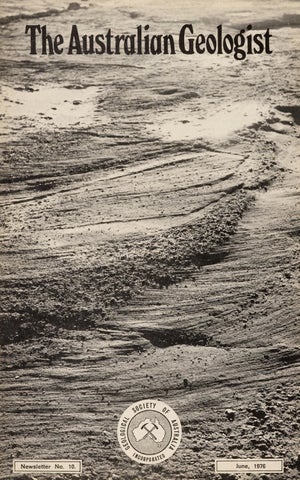
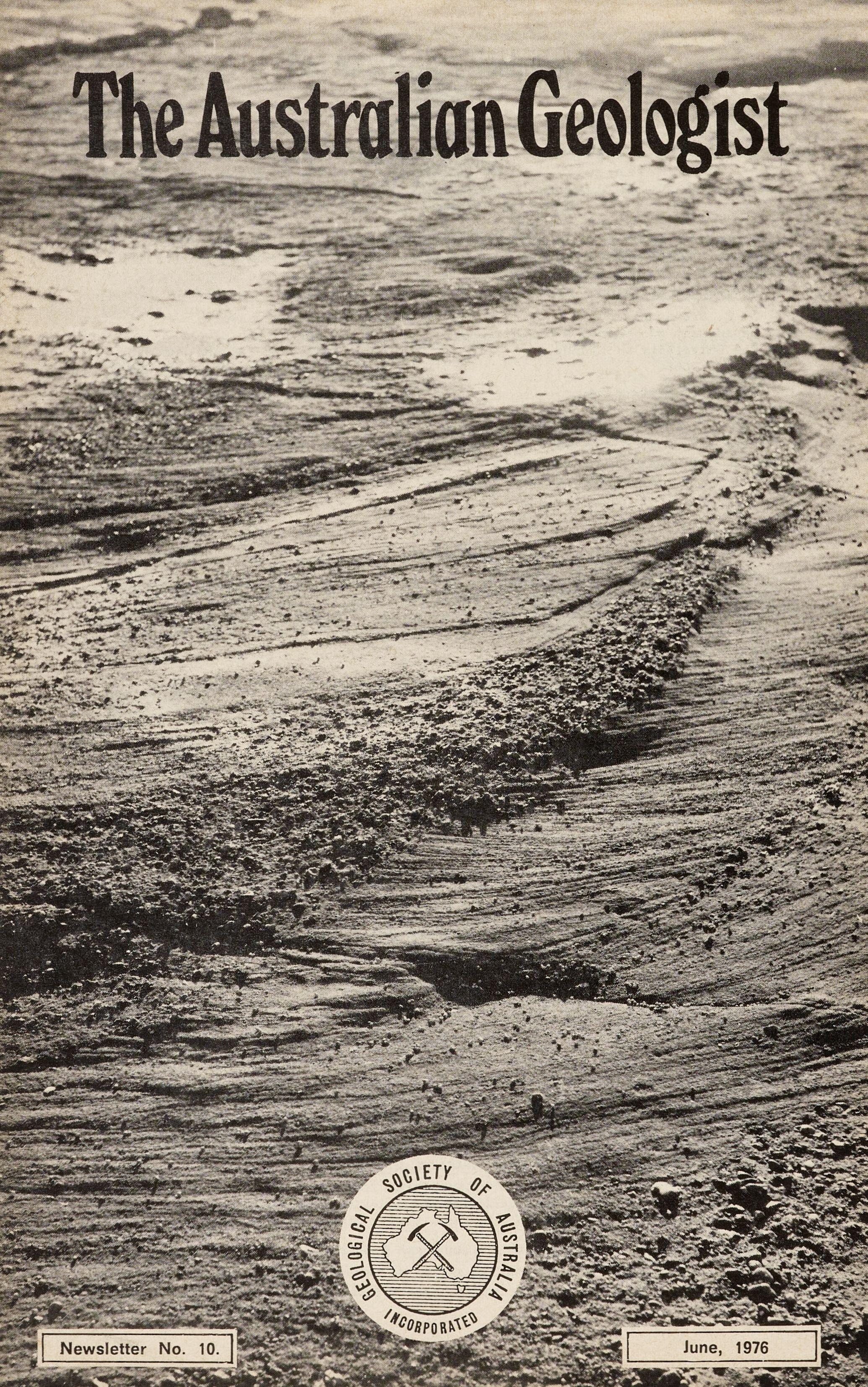
Cover Photo : Cross - bedd i ng in the Munmorah Conglomerate ( Narrabeen Group)
Tria ss i c age
Rock p latform at Norah Head , N S W
Newslet~er No. 10.
The Australian Geologist
EDITOR IAL
June 1976.
This issue, apart from containing a final review of preparations for I.G.C. and a desperate (see page 24) call for assistance, includes reports on various international activities which in the past have perhaps been obscure to most members.
Australia has been represented on many of the internationa l committees and no doubt will continue to be so. Meetings of the various commissions will take up a considerable time for some congress members, time which they might have used for more social gatherings.
Although one might sometimes doubt the wisdom of certain organizational activities, some useful projects have been brought to fruition. The geological map of the world is one such international venture, and the ocean floor studies are another.
The growth of I.U.G.S. as a healthy offspring of I.G.C. is to be commended , and we can only hope that despite the problems of natural and linguistic barriers it will continue to grow and serve both the geological profession and mankind in general.
Society News (continued)
The treasurer pointed out that members were getting good value for their money including the ' Geology of Victoria' and capitation fees to Divisions. The predicted loss for 1976 is $24 ,600 following an operating deficit of ~10,000 for 1975. This loss rate cannot be maintained without serious consequences.
Stocks of Society publications will be offered for sale during I.G . C. at reduced prices and it is hoped that cash reserves wi ll consequently be substantially increased. The paperba ck 'Geology of New South Wales' is now selling steadily at $7-50
Other points from the Treasurer's report were : (i) the cost of transferring membership records to Computer was $6 , 37'2; ( ii) gross income from investment was $5 , 042 an increas e of $1 , 118 f ro m 1974; (iii) the market value of the investment portfolio rose by $1,652; (iv) administrative costs rose 72% to $27,4 7 6 - partly caused by the move to new and be tter o ffice s; (v) printing and distribution rose considerably for prin ting; Vol. 22 cost ~34 , 259 ( $11 - 42 per volume copyJ; (vi) Printing of The Australian Geologist cost $1519 (nos. 5 -8 inclusive) , distribution $14 7 9 !
The Hon. Editor , David Brown re ported a steady flow of papers offered for the Journal and a good spread of topics - of 47 pape rs in Vol. 22 and 23(1) eleven are petrological followed closely by geochemistry-geochronology 9 and structural geology 8. Geomorphology, oceanography and mineralo~y are on the lean side - one each, while palaeontology is represented by only 2 papers, a noticeable decrease. This is, of course , attributable to the appearance of Alcheringa. The Edit or recommends that page costs be supported by authors whenever possible
Divisional reports indicate healthy society activ ity - a wide variety of talks, field trips and seminars. Specialist group activity has been more sporadic but some important meetings and excursion s have been held Further groups are mooted, but no firm steps have yet been taken to form them (however , see p a ge 4 concerning a proposed coal geology group). Sub-committees for specific prob lems (l egislation, ~onuments, education , nomenclature) have likewise been active - with varying levels of intensity , and reports elsewhere in this issue deal with some of these matters.
The Council approved by vote the election of Honu~Rry members and Correspondents. These will be nominated for ratificati0n by the Augus t General Meeting.
Sir ,
I refer to the editorial in Newsletter No 9 concerninq attendance at , and interest in , the forthcoming I G.C
I wonder whether it has occurred to the editor (and possibly others in academic circles) , that there is probably a substantial number of geologists who for various r easons are q uit e unable to take an active interest in the I.G C ; for these the remarks in the third paragraph of the editorial are callous , if not offensive
News must have penetrated even to the "ivory towers " that all is no t well with many of our geological colleag ues , those who are fighting fo r a living or hav e been forced to take employment outside their chosen field
There is little po int in mentioning "renewal of contacts " and similar lines of re aso ning. We all know that in a conference of any size , contacts of that kind are minimal and , on the whole , superficial
I fear that for me the I G.C is an unattainable luxury , both in terms of time and th e cost involved
Let ' s be a little more understanding and sympathetic towards those members of the fraternit y who cannot devote time (or money) to become involved in the I G.C.; such people do not require the application of halite to their tensiongashes We might find those features widening into rift-valleys , followed by a gradual drifting away.
H. W. Pander Adelaide
rUnfortunately Mr Pander has misunderstood the thrust directed towards unemployed or impecunion geologists. who are well situated (even possibly in ivory towers) e g.
of my attack It was not, It was intended for those and yet do nothing . Ed.
Sir ,
In accordance with Rule 12 of the Geological Society of Australia , I would like to canvass interest in the formation of a Specia list Group in Coal Geology.
The role of such a group would be to provide a forum for geological res ea rch being undertaken in the field of coal , which has hitherto been confined in isolated institutions , or amongst overwhelming amounts of coal technological data
The proposed Specialist Group would confine its function to research in coal geology , and supply an avenue for co - operation and involvement among the numerous individua l s associated with it.
To assess the viability of such a group , comment is invited from the large number of scientists associated with coal geology, many of whom are pos sibl y not present members of the Society . Your response to the follow ing question s is requested:
(al Is there a need for a Specialist Group in Coal Geology?
(b ) I f so , wo u ld you be interested in membership?
(c ) I f you are not p r esently a member of the Society , would the formation of a Spec i alist Group in Coal Geology result in your membershi p in both?
(d) What should such a Group provide , e . g . meetings , symposia, a journal etc?
The geologists of Australia have shown a keen interest in the planning and organization of the Congress, and this has been very much appreciated by the Organizing Committee and by the small Secretariat which serves it .
Many have had a part in planning and organization, and they with others still have an important role to play during the Congress. They do not all come from Canberra rand the S ydney area , although this is necessarily where the greatest numbers are resident. But the pre - and post - Congress excursions form a very important part of the event , and most of the work on these ha s been done by excursion leaders and by Regional Excursion Committees in every state and in the Northern Territory , as well as in our neighbouring countries - New Zealand and New Guinea. In s pite of this, there are inevitably a large number of geologi sts who, whilst willing enough to give time and energy to the Congress, have not been in a position to do so. First by Information Bulletins, and later, when these became too expens ive to produ ce and distribute, through the Newsletter , I have attempted to outline general organizational progress to supplement the information given in the Congress Circulars. These notes have, of necessity , been brief , but the Editor has allowed me to spread myself more in this the last number before the event.
The groundwork for the Congress started many years ago with the prepara tion of Austra lia's invitation to host the Congress. Having stood down in favour of Canada when invitations for the 24th Congress were considered in Prague in 1968, because 1972 was the Centenary of the Geological Survey of Canada, Australia was allowed the rare privilege of being unopposed in its invitation to host the 25th Congress. Before that invitation was issued, an Advisory Committee had been appointed by the Australian Academy of Science on the recommendations of the National Committee for Geological Sciences. The Committee is composed of geologists from all over Australia and from the various fields in which geologists practice . From it, a smaller Organizing Committee was formed. A preliminary budget was drawn up, and Government approval was obtained for the invitation to be made.
It was evident at the 24th Congress that many people were concerned at the rising cost of holding the Congress, and a clear mandate was given to Australia to reduce the cost. At the same time, a Commission was appointed to review the "Statutes" of the Congress and to prepare amendments to resolve the problems created by the increasing number of disciplines represented at the Congress. The Organizing Committee has at all times been very conscious of its responsibilities in both these areas The first has not proved easy at a time of international inflation, and a number of c hanges in the arrangements for the Congress had to be made. These are incorporated in the new proposed "Regulations" for the I.G .C. which the Commission will propose to the preliminary Council meeting should replace the old "Statutes". It is hoped that these will be approved by Council and ratified by the first General Assembly. The proposed "R egulations " were first drafted in Australia and codify in this respect the thinking of the Organizing Committee.
In round figures, and excluding the ex curs ions which are in all cases designed to be financially self-supporting, the budget for the 24th Congress was Can. $1.4 million , whilst that for the 25th is Aust $0.25 million. Minor, but significant economies have been made by early buying of many obviously needed itemsalthough this practice, to be successful, requires some lucky guesswork on the quantities that will be required. Others have been achieved by keeping meetings to the minimum - the Organizing Committee , for example , has only met eleven times so far and, unless
an emergency arises, hopes that its next one will be after the Congress. But the major economies have arisen from decisions such as the one not to pre-publish the full texts of papers - a decision which has had much support, and little if any opposition.
am , often told that a lot of people want to know what they get for their $60-00 (now $75-00) Membership·fee. I put the point this way because I have seldom been asked it directly, and over 2,000 people have paid the fee. But I think the question deserve~ an answer. It is this. Slightly more than half the ~60-00 go~s· in di:r:ect services to members - brief cases, name badges, abstracts, programmes, proceedings, and the reception and bu£fet dinner on the evening of the Opening Day. The remainder contributes to the cost of administration, including the printing and distribution of the three Circulars, (13,000, 8,000 and ~,000 respectively), Secretariat staff salaries, telephones, postage, and facilities at the Congress. The higher rate from 1st March .this year is justified because several of the goods supplied to la,te applicants have to be bought at a higher price, and we have pot had the benefit of working capital from them whi ch earlier applicants gave us. The organizers of the 24th I.G.C. considered a fee of $100 realistic. , While on the subject of finance, I would like to record again our appreciation of the contributions made by the mining and petroleum industries, and by the Commonwealth and New So~th Wales Governments.
I have previously recorded the regret with which the Organizing Committee came to the decision last year to cancel a number of excursion runs. Almo st all of those which were retained have proved to be popular, and I have ev.ery hope that all of them will run successfully. Only those who have been intimately concerned with the problems of itineraries , logistics and costing for the excursions, will fully appreciate all tbat is involved, especially in the,,e , inflatiopary times. We are fortunate that half the excursions are being offered at the same price or less than that e.stimate~ in the Second Circ;:ular which went to press in December 1974, and that, of the remainqer only three runs cost more than $50 above tnB estimate - a rise in the most extreme case of just over 10 %. Th.e mo st expensiv e excursions have, incidentally, been amongst the most popular.
Demand for the Junior Congress, and applications for Accompanying Membership have been below expectation - a reflection, obviously, of . the world economic crisis for it is in these areas also that the gr~F.l t est · number of cancellations have taken place
The rem~inder had only a small number of places left when applicat~ons clo?~d.
I ,have not attempted to ,cover all the ground - for there is much information also in the Congress Circulars (co pies of ~he 3rd are still available for anyone who was not on the distribution list)but I hope that I have g~ven a useful indication of what has been (concluded bottom of P .1 3)
REGISTRATION OF GEOLOGISTS
Introductory Comments
As members are aware, the Committee for Geological Legislation has been working since 1971 to achieve the establishment of Registration Boards.
It is appropriate at this time to review the Committee's activities and also restate the objectives of the Society's Council in regard to legislation.
In view of recent discussion and a questionnaire about professional representation (Australia Geologist No. 9, March 1~76) it can be clearly stated that there is no conflict between the existence of Begistration Boards and a Professional Society. One would complement the other.
The Need for Registration
During the mining boom several years ago it became obvious to the Geological Society of Australia (the matter having been originally raised in Council by a letter from the Hunter Valley Branch) that control ot the activities of both non-geologists and geologists was an urgent matter. In the years that followed various enquiries and press reports down-graded the public confidence in the profession and statements were made that the activities of geologists needed to be controlled.
It is n o idle comment that if vigorous control over geological - and so-called g eological reporting had been exercised at the time of the boom its effects and aftermath would have been less severe.
The Society concluded that the establishment of Registration Boards was the only way to exercise the required control, particularly over non-members of the Society or other institutes. In addition, the Society estabLished that, in law, it had very little control over its members without exposing itself to possible law actions. Registration by a Board established by an Act of Parliament is the only solution.
Registration would act in the same way as it does for various other professions, e.g., medicine, dentistry, architecture, surveying, accountancy etc. Registration of geologists is already established in some places overseas, particularly North America.
History of the Committee's Activities
The Committee for Geological Legislation was established early in 197°1 under Dr. A. F. Trendall, Convener. The Committee consisted of sub-committees for each State and the CoITL~onwealth Territories. These sub-committe es were composed of four members, each chosen from the following four categories: government, tertiary education, companies, independent consultants.
By the end of 1971 formal submissions, including outlines for proposed legislation, had been submitted to the State Ministers for Mines and the then Minister for National Development for consideration at their consultation body, the Australian Minerals Council (AMC) which met in May 1972.
At this meeting approval, in principle, for legislation was given and the Crown Law Department of ~- Australia was assigned the task of preparing a draft Bill for submission to the next meeting of A.M.C. and then distribution to the various Ministers.
In 1972, the Feder~l Government changed and Mr. ~onnor became the Minister of Minerals and Energy (AMC was always convened by the appropriate Federal Minister). During his term as Minister, which ended in late 1975, no meeting of AMC was convened. During this
period of frustration the States eventually held unofficial AMC meetings and finally the State Mi nisters decided to proceed individual l y with legis l ation following disagreement about important details of the legislation .
Action proceeded farthest in N.S.W , where with the support of the Minister for !lines, it was submitted for approval of Cabinet which decided to defer action for the time being.
In April, 1976 , the AMC was re-convened , but in the backlog of more pressing business the subject of legislation for geologists was of very low priority and the su~ject was not pursued.
At the present , after an initial year of good progress and four years at frustration the Society has not achieved its objective. At this point tr ibute should be paid to Dr. Trendall who did so much in t he initia l stage s when most of the work was done .
Princiual Features of Proposed Legislation
It is hoped that similar legislation will be introduced eventually in the various States . The Acts would establish Registration Boards for Geologists Salient features of proposed legislation would include the following items :
1 . The use of the term Registe r ed Geologist would be restricted to qualified people who are registered .
2 . A geologist could not be registered until he had acquired a specified period of experience
3 . Geological work for reward would only be permitted by a Registered Geo l ogist or a geologist under the direction of a Registered Geologist
4 The Acts would not mean gove r nmental control of geologists, but ~ould mean control of the status and standards of the profe s sion in a similar way to that exercised by Boards controlling doctors , dentists , architects , surveyors and many others One government representative would sit on the Board which would consist of several members.
5 With the establishment of Boards the G.S.P.. would step out of the picture as the active force
6. Penalties including de-registration , fines and g oal sentences would be applicable for offences under the Registration Acts. These would include unauthorised use of the title of Registered Geologist , and geological consulting work by persons not regi s tered
7 Provis i ons would be included to allow persons of established reputation and talent , but lacking the required formal qualifications , to be registered
8 . Geophysicists and geochemists would be covered by the Act.
9 Recioroca l arrangements between States would provide for uniform-rules regarding qualifications and other deta il s
10 . Registration would act in a double way . It would protect the s tatus of the profession and it would protect the public from imposters and improper practices.
The Future
Owing to the changed situation , G.S.A. Council at its May meetin q , re s olved to disband the existing Committee of four representatives from each Division and reform the Committee with two from each
(conclude d pag e 21)
THE I ~TER~TIO
AL UlION OF GEOLOGICA L SCIENCES (IUGS)
International geological meetings began with the first International Geological Congress (IGC) in Pari s in 1878 and Congresses have been held at 3 or 4 years intervals ever since except for the y e ars of the two World Wars
The organisation of the Congresses passed from one country to the next host country and there was no continuing administration of international geology , although from time to time various Commissions, Associations , Unions etc were established by the IGC to study different aspects ot geology on an international basis. The need for a continuing boay to be responsible for the organization of geology internationally and to give guidance in the co-ordination of international research programmes in geosciences was di scussed at several International Geological Congresse~ and at the 21st Congress in Copenhagen in 1960 , a proposal was adopted to establish an International Union of Geological Sciences. A special meeting was he ld the following year (1961) at Unesco House in Paris to found this latecomer among the international Scientific Union s, which a few months later became a member of the International Council of Scientific Unions (!CSU) .
The IUGS Coun cil, com posed of one representative of each member country, met for the first time in Rome in 1963 and adopted statutes and bye -la ws
The IUGS is a voluntary, non-profit making organization , whose chief aims and objects are:
(a) to facilitate and encourage the study of problem s perta i ning to geological sciences;
(b) to facilitate international co-operation in geology and related sciences;
(cl to provide continuity in internatio nal co-operation in geology and related sciences;
(d) to assist the International Geological Congress , it being understood that the long established activities of the Congresses shall be safe - guarded
The governing body of IUGS is the Council . Il is composed of one delegate per member country The adher in g bodie s in the member countries are either National Committees for Geological Sciences , National Academies , Geological Surveys or other Nation al Agencies which are concerned \ith fundamental and a pplied geol ogy. There are eight categories of membership , with contributions ranging at pre sent from $150 per annum in Category 1 to $9000 per annum in Category 8 . Member countries themselves select the level of membershi p at whi c h they are prepared to contribute .
IUGS is now one ot the three largest international scientific unions , with 78 member countries, of which 37 are in category 1, 18 in catego ry 2 , 8 in category 3 , 4 in category 4 , 3 in category 5, 1 in category 6, 4 in category 7 and 3 in categor y 8
The executive body of the IUGS is the Executive Committee, which is composed of the President , the Past President, six to eight Vice -Pres idents representing the principal geographical subdivisions of the globe , the Secretary-General, the Treasurer, and a member of the Organizing Committee of the next session of the IGC as an exofficio member.
The Council of IUGS meets only at the International Geological Congresses , but, in addition , the Executive Committee meets annually to review the progress being made by the constituent organizations and consider any problems whi ch have arisen , and to allocate the available funds. These consist of national contributions , yearly grants - in-aid from UNESCO through !CSU , contracts for special
purposes and studies, and donations. The day -to- day work of the IUGS between Executive Committee meetings is carried out by the office of the Secretary-General.
The ultimate geological working units of IUGS are the Commissions, Committees and affiliated International Associations. Members of the Commissions and Committees are chosen amongst the wor ld's leading experts and appointed by the Council after·recommendation by National Committes or the Executive Committee. Commissions with their Subcommissions, Regional Committees and Working Groups, are bodies wh ich co-ordinate scientific research in the various disciplines of geological sciences covering both fundamental or academic and industrial or economic aspects. Committees are bodies which carry out organizational or methodological work in the fields of documentation, editing policies, geologica l data, geology teaching, history or geological sciences, etc Much of the work of the Commissions and Committees is conducted by correspondence, but it is obviously necessary, for effective co-operation, to convene at intervals, preferably once in two years. To promote such meetings IUGS may grant travel and per diem allowances to the members of these Commissions and Committees with the understanding that normally part of the expenses is defrayed from home sources.
In addition to its Commissions and Committees, there are a number of Associations affiliated to IUGS which are actively engaged in special fields of work in the geosciences.
IUGS takes part i n multidisciplinary research through its membership of such bodies as the Interunion Commission on Geodynamics and the Interunion Commission for Studies of the Moon. Its principal activity at the present time is the International Geological Correlation Programme, a joint enterprise wi t h UNESCO.
Following is the list ot the constituent and affiliated bodies of the IUGS, many of which were taken over from the IGC. Acomplete Directory of these bodies , with contact addresses , is published, together with other relevant information about international geological activities, in the IUGS Geological Newsletter which is published quarterly.
LIST OF IUGS COMMISSIONS, SUBCOMMISSIONS , COMMITTEES , AND AFFILIATED ORGANISATIONS.
COMMISSIONS
Commission for Marine Geology
Commission on Meteorites
Commission on Str atigraphy
Subcommission on Precambrian Stratigraphy
Subcomrnission on Cambrian Stratigraphy
Subcommission on Ordovician Stratigraphy
Subcommission on Silurian Stratigraphy
Subcommission on Devonian Stratigraphy
Subcommission on Carboniferous Stratigraphy
Subcommission on Gondwana Stratigraphy
Subcommission on Permian Stratigraphy
Subcommission on Triassic Stratigraphy
Subcommission on Jurassic Stratigraphy
Subcornrnission on Cretaceous Stratigraphy
Subcommission on Palaeogene Stratigraphy
Subcommission on Neogene Stratigraphy
Subcommission on Quaternary Stratigraphy
Regional Committee on Stratigraphic Correlation for the ECAFE Region
Subcommission on Stratigtaphic Classification
~ubcommission on Geochronology
Subcommission on Magnetic Polarity Time Scale
Commission on Systematics in Petrology
Commission on Experimental Petrology at High Pressures and Temperatures
Commission on Structural Geology
(Con tin ued o n P a g e 23)
PROTECTION OF SITES FROM COLLECTORS
M. R. Banks
The despoilation of sites where rare or particularly good or abundant geological specimens , be they mineral, rock or fossil, are obtainable is a world - wide phenomenon which has led to prohibition of entry to some known sites where despoilation is at an ear l y stage, or to suppression of knowledge of iuch sites by the discoverer thereof, or to restriction of such knowledge to a small group. None of these resultant actions is to the long term benefit of education in geology at any level or of the science · of geology itself
Such despoilation is not unfortunately the action of amateurs (such as lapidarists or collectors) , commercial interests (suc'h as gem and specimen selling businesses) and students alone but some professional geologists also remove or spoil specimens from sites beyond a necessary minimum.
Such sites should be widely known in the interests of general education of the public of the advancement of geological science and they should be readily accessible for e,ducational and sci'errtific purposes including, in the latter case at leasi, the refuoval of material (including rare material) for further det~il~d study in the laboratory . Yet the sites should be adequateli protected against despoilation. The protectioh should be effective enough to prevent despoilation and to encourag e the discoverer to mak e his discovery pub l ic without f-ear that the site will be uselessly or avariciously ruined , but oot so testricte~ thaf the discoverer feels that he or properly trained and responsible people will be denied access under conditions which allow fruitful study
Preservation oi such sites when discovered is, in principle at l east , a relatively simple matter. However , reservation simply calls th~ att~ntion of all and sundry to the ~ite and ~ cou l d thus be dangerous in the absence of adequate protection Adequate protection is by no means easy to ensure and would, in almost every case , be a public expense unless the site· was used for public display and a viewing fee charged Such protection may well preclude or inhibit further study of the site and thus itself become counter-productive
A period when much damage can be done to this type of site is that between discovery and the time when enough is \<nown about it to allow a case for reservation to be ~ade prope+ly. During this time word gets about , unless the discoverer is extraordinarily discrete , the site is not. protected and may be irreparably damaged It may be possible, if desirable, to make provisions for simplified process leading to a temporary reservation which may or may not be finally confirmed or it may be better through' educational processes to convince potential discoverers of the value of a discrete silence. Th1:s latter course will take some of the excitement out of a new discovery and may well delay the· prog r ess of the science It is , in essence , contrary to one of the main tenets of the scientific method which is public debate on explanations of natural phenomena and on the evidence on which" such explanations are based.
Any legislation for protection of such areas must also take into account the possibility in some cases of legitimate commercial exploitation of the site by removal of specimens for sale to educational authorities and perhaps to others. Gem collecting, in person , by barter or by purchase has been a human activity, probably since Man began, and is not likely to disappear rapidly. This activity raay mean that Mines Departments and conservation
authorities may have to agree that some types of sites will be exempt from Mining Acts and other types exempt from conservation or reservation activities. It might seem reasonable to preserve that site which snows a particular feature (or features) or scientific interest especially well but having done this to allow other similar sites, even though they ma y also show the feature(s) very well to be used for private exploitation. The first site should come under the control ot the National P arks and lvildlife Service (or similar organisation) [e. g under clause 13d of the National Parks and Wildlite Act 1970 (Tasmania)) and other sites under the control of a Tourist Authority or Mines Department.
An intermediate category of sites might be e nvisaged - the site available for exploitation in the form of specimen collection by the amateur, e.g. student or lapidarist. For exam9le, collection of single specimens of fossil shell, Eurydesma cordatum, from the quarries at Fossil Cliffs, Darlington, Maria Island, Tasmania , is unlikely to result in despoilation as there are literally mil l ions of these specimens , nor is collection of fossils at Fossil Bluff, Wynyard, Tasmania, deleterious in any but the shortest term view because of the great abundance of fossils there and renewal of the cliff face by marine erosion. Collection of petrified wood , agates and other semi-precious stones from selected sites by lapidarists and gem collectors may well be regarded as a legitimate, useful recreation leading to aest h etically pleasing results. To control such exploitation to some extent it may be reasonable to grant collecting rights to those with some form of licence or perhaps to financial members ot recognised clubs , such rights to be conditio n al on personal retention of the products or limited sale or exchange of them. There is no known provision for such sites , which may perhaps be referred to as "amateur collecting site s ", either under a Mining Act which allows exploitation but requires that work of a certain value be done on the site each year, or under the National Parks and Wildlife Act which precludes or discourages any but visual exploitation.
Thus sites based on geological materials or phenomena may be categorised a s :
(a) Fully commercially exploitable sites (covered by Mining Acts).
(b) Temporary reserves (not covered as far as is known); to give protection during study to determine proper utilisation.
(c) Amateur collecting sites (not covered as far as is known).
(d) Scientific sites (partly covered by National Parks and Wildlife Act in Ta s mania): freely available for study be accredited respons i b l e scientists with the right to remove material for further s t u dy but perhaps with a provision of final lodgement in a public museum or research institution.
(e) Sites with exploitation limited to visual exploitation (covered by National Parks and Wildlife Act in Tasmania).
Of these only (a) and (e) are at present properly covered by legislation in Tasmania ; provision should be made for the others. It seems app r opriate that (a) and (c) be dealt with under Mining Acts, but that (b) , (d) and (eJ come within the scope of the National Parks and Wildlife Service.
Congratulations go to members of the Tasmanian Division for a well-organized Geological programme at the recent ANZA.AS Conference in Hobart. The weath e r was generally superb and visitors found much to interest them
INTERNATIONAL STRATIGRAPHIC GUIDE , Edited by H. D. Hedberg. 1976 , 200 pages, Aust.$11-40 (Price in U.S.A ., $9-85).
John Wiley and Sons.
The publication of this 'Guide to Stratigraphic Classification , Terminology and Procedure' is an important milestone in the development of the science (or art) of stratigraphy and in achieving international agreement on stratigraphical concepts, definitions and procedures. For more than 20 years Professor Hollis Hedberg , Chairman of the International Subcommission on Stratigraphic Classification, has laboured painstakingly , collecting, sifting and evaluating opinions and information from the 86 Individual Members and 39 Organizational Members of the Subcommission, distributing circulars (51 so far) with the progress results achieved and seeking further opinions, 'bringing together the diverse views on stratigraphic principles, classification and terminology , developed from many different backgrounds, and building them into a single set of practical terms and guidelines to which almost all can in large measure subscribe. '
After an introductory chapter, principles of stratigraphic classification are dealt with , and this is followed by chapters on definitions and procedures, stratotypes, lithostratigraphic units , biostratigraphic units, chronostratigraphic units, and finally the relation between the different kinds of units. At the end of the volume proper are , inter alia , a list of national or regional stratigraphic codes and a very comprehensive bibliography of literature on strat i graphic c l assification and terminology.
This is a book which must be in every geological library and should be available to every geologist who is carrying out systematic geological mapping or who is concerned with geological publishing . The Guide is full of useful information and although the author mentions that many special or newly-developed fields of stratigraphy need further study and will be presented in future edit i on s, and igneous and metamorphic rocks are not specifically dealt with , t here are comparatively few prob l ems that confront a fie l d s tratigrapher for which he will not find solutions , guidance or helpful advice
The Stratigraphical Nomenclature Committee of the Geological Society of Au s tralia is an Organizational Member of the Subcommission I can best conclude this review by commending to the Committee the remark of the author in referring to the useful part that national or regional codes have played in the development of stratigraphic usage , that ' the time is perhaps approaching when nations should prefer to concentrate on improving a single body of international rules rather than on developing numerous more or less·conflicting local or national codes '
N. H Fisher .
The 25th I . G.C (from page 6)
going on on behalf of the geologists of Australia ; the hosts of the 25th Session of the International Geological Congress, whose efforts and interest have so supported the Organizing Committee and the Secre t ariat.
A. Renwick Secretary - General
STRATIGRAPHIC NOMENCLATURE
The 4th edition of the Australian Code of Stratigraphic Nomenclature has provided the guidelines for the definition and naming of stratigraphic units for some eleven years now It has proved a most useful document and proposals several years ago to revise it completely, involving the adoption of some fundamentally new principles , were not proceeded with.
Meanwhile, the deliberations of geologists throughout the world, under the aegis of the International Subcommission for Stratigraphic Classification and the able leadership of Professor Hollis Hedberg , were being brought together in a draft International Guide to Stratigraphic Classification , Terminology and Usage. An Introduction and Summary was proposed in Lethaia and distributed to participants in the 24th International Geological Congress, (I.S S.C , 1972) The completed draft guide was distributed to I.S.S . C members in 1974, and has now been published commercially by John Wiley, N Y , after revision and editing (see review on page 13).
The Society ' s Stratigraphic Nomenclature Committee in August 1973 authorized Dr D. L Strusz to prepare a revision of the lithostratigraphic part of the 4th edition of the Australian Code to b r ing it, as far as possible , into line with the International Guide and to take account of difficulties which had been experienced with the 4th edition Mr. B H Flinter also agreed to prepare a report on the applicability of the Code to the naming of igneous rock units.
Dr Strusz ' draft and Mr Flinter's report were considered by the Stratigraphic Nomenclature Committee in January 1975, and discussed at a public meeting the same week. As a result of the meetings Dr. Strusz revised his draft and two sub- committees were set up : one, under Mr. Flinter's chairmanship, to further consider the stratigraphic nomenclature of igneous rocks; the other (which Dr M A Etheridge subsequently agreed to convene) to consider the stratigraphic nomenclature of metamorphic rocks
The final report of the Sub-committee for the Stratigraphic Nomenclature of Igneous Rocks prepared by Mr. Flinter is printed below Copies of Dr Strusz ' revision of the lithostratigraphic part of the 4th edition of the Code - a larger document - may be obtained by writing to Dr D. L. Strusz, c/o Department of Mineral Resources, P O Box 378 , Canberra City , A C T 2601. The report of the metamorphic subcommittee , when it becomes available , will be published in a later issue of " The Australian Geologist"
It may not appear appropriate to produce at this stage a new edition of the Australian Code. There are , however , reasons why the International Guide should not simply be adopted in Australia as a complete substitute for the Australian Code Among the reasons are -
(1) The International Guide is concerned with principles, some of which are couched in such general terms in order to achieve a consensus that they do not provide practical guidelines to field geologists and stratigraphers faced with specific nomenclatural problems Supplementary interpretations will be needed and it appears appropriate that such interpretations be made by national bodie~ to serve national needs and maintain continuity with past practice.
(2) The Guide does not help in the matters concerning the stratigraphic nomenclature of igneous and metamorphic rocks
(3) Procedures for administration of the Guide need to be determined by the formal organization of the earth sciences in each country
(4) The Guide is a large and expensive document and is not likely to be readily available to all field geologists.
The correct course for the Society to follow would probably be to accept the International Guide in principle. It could then issue a new edition of the Australian Code in conformity with the Guide , but perhaps containing additional provisions, such as those set out below Alternatively it could replace the Australian Code by a small manual , which would (a) contain practical extracts from the Guide , e . g . the lithostratigraphic section; (b) contain interpretations and supplementary provisions (either from the 4th edition of the Code , or new ones) not in conflict with the Guide , and (c) set out procedures for adm:inistration of stratigraphic nomenclature matters
Another matter may interest readers In Vo} 17(1) of the Society ' s Journal the Subcommittee for Soil - Stratigraphic Nomenclature published a discussion paper In it the authors (Brewer, Crook & Speight, 1970) made a recommendation that their proposals , as modified in the light of comments received be incorporated in the Code of Stratigraphic Nomenclature. The Stratigraphic Nomenclature Committee considered that the proposal should be endorsed by soil stratigraphers as well as by geologists, before adoption. As little support for the proposal has been forthcoming from any quarter the Committee has decided not to adopt the Subcommittee ' s recommendation This decision , however , does not preclude the use by authors of the principles developed or of the term "pododerm ". Substantial use by authors would be an indication that the proposals are acceptable to soil stratigraphers and ought to be incorporated in the formal code of stratigraphic nomenclature
Comment is invited on (a) whether the Society should adopt the International Guide in toto, (b) if so, what Society publication(s), if any, is needed to supplement the Guide for Australian users, (~) the report of Mr Flinter ' s subcommittee and Dr. Strusz ' draft , (d) any other matters relevant to orderly development and maintenance of stratigraphic nomenclature in Australia
Comment should be sent to me at B M.R , P O Box 378 , Canberra City , A C. T 2601.
References
Sub- Committee for Soil - Stratigraphic Nomenclature, R Brewer (Convener), K A. W Crook, J G. Speight, 1970 Proposal for soil - stratigraphic units in the Australian Stratig raphic Code Report , with discussion of comments on draft report on soil stratigraphic nomenclature . J . geol. Soc. Aust . 1 7( 1) , 103 - 111 .
Australian Code of Stratigraph~c omenclature , 4th ed 1974 J geol Soc Aust 99(1), 165- 171 Reprinted, with corrigenda and additional notes J. geol Soc Aust 20(1), 1973, 105 - 112
International Subcommission for Stratigraphic Classification, 1972 : An international guide to stratigraphic classification , terminology and usageintroduct i on and summary. Report No. 7, Publ in Lethaia 5(3) , 283 - 323
E K Carter
The Stratigraphic Nomenclature of Igneous Rocks
It is recommended that the Australian Code of Stratigraphic Nomenclature be modified throughout , where necessary, to accommodate the following requirements f or the igneous rocks, which should appear in the Code as a separate Section
Section
(1) The igneous rocks require two sets of terms :
(a) Formal lithological terms
(b) Informal form terms.
Rider : The consideration of form terms is outside the scope of this Subcommittee but , in view of the review of form terms being undertaken by the IUGS Working Group on Correlation between Granitic Areas , it is recommended that an Australian Sub- committee be convened to consider acceptable form terms suitably defined , for possible future elevation to formality. In the meantime , form terms should not be used with a capital initial letter, e g. Bathurst Granite batholith; NOT Bathurst Batholith
(2) Three types of lithological terms are recognized :
(a) A formation equivalent , for which the term Fundamental Lithological Unit (F.L.U) is proposed It is derived by the combination of a geographic na me and a rock type name , e g Bathurst Granite (See also (2) (cl (vi).
(b) Sub-units of the F L U.
(i) A term app licabl e to variations in li hology The formal term ' Member' (Capital 'M') is proposed , and the rock type must be included , e .g Shannonvale Granodiorite Member of the Wards Mistake Adamellite
Where mappably discrete bodies, e g aplites , pegmatites, occur within the F L U., these should be considered as separate F L U ' s where poss ible.
(ii) A term applicable to geographically separate outcrops of the F L.U The informal terms ' mass ' or ' outcrop' (small ' m ' or ' o ' ) are proposed , thereby avoiding implications of a specif i c form, e g Tingha Adamellite (Tingha mass/outcrop) and Tingha Adamellite (Mount Duval mass/outcrop)
(iii) Other sub - units may be proposed
(c) Associations of the F L.U
(i) A collection of F.L U ' s showing some cha r acteristic similarity , not necessarily lithological The informal term ' suite ' (small ' s ' ) is proposed , e g Hillg rov e suite (comprising the Hillgrove Adamellite , Abroi Adamellite and Kookabookra Granodiorite) ; Bundarra suite (comprising the Banalasta Adamellite , Ashfo rd Granite and Tilmunda Adamellite)
(ii) Where a suite consists of a single outcrop of similar F .L. U ' s , this is considered to be equivalent to a Group and in this situation the use of the formal term ' Group ' (capital ' G ' ) may be justifiably adopted
A group term cannot have the same geographic name as any of its constituent F L.U ' s , e g Bundarra Group ; Rawbell Group : NOT Hillgrove Group
(iii) A collection of F L U ' s for which the lithology and/or form of some or al l are incompletely known The informal term ' comp l ex ' (small ' c ' ) is proposed
NOTE: As components of a complex become formally-defined F.L .U's, they no longer form part of the complex , which decreases in size and may eventually disappear In this event , the geographic name originally used may be retained to describe the outcrop , e g Abroi comp l e x may become Abroi Group or Abroi batholith/pluton , etc , depending on form
(iv) The following qua lifiers may be used for informal association terms: igneous , plutonic and volcanic (small ' i' , ' p ' , and 'v')
(v) The informal terms ' plutonic ' and volcanics (small ' p ' and ' v ' ) may be used as alternatives to ' plutonic complex ' and ' volcanic complex '
(vi) Where the lithology and/or form of a volcanic or pluton i c unit is considered to be too variable for all individual co mponents to ever be mapped , it may be raised to formality , with the status of an F.L U , and capital initial letters used , e g. Main Range Volcanics ; Armidale P lutonics
(3) Requirements for the definition of lithological terms are :
(a) The establishment of a formal igneous F L U. requires publication in some recognized scientific medium of a definition that includes :
(i) a statement of intention to designate a formal unit , (ii) name ,
(iii) a petrological description , indicating permissible range in composition and texture Chemical and modal analyses should be given , if possible ,
(concluded Page 20)
OOCUMENTATION OF IMPORTANT GEO LOGICAL FEATURES IN QUEENSLAND
by N. J de Jersey Geological Survey of Queensland
In recent years , the Queensland Division (through its Geological Monuments Sub- Committee) has been compiling data on geological features in the State , considered worthy of preservation. Initially , the project was prompted by the fact that some exposures, of particular value for teaching and/or research p urpos es , had eithe r been lost or were endangered by land development , urbanization , or other activit i es Such features were of limited areal extent and generally close to , or within , urban are a s. However , it has also become clear that larger features , not necessarily under threat from development , should be considered for preservation because of their scenic , tourist and educational value.
Features in the latter category have been listed under "Category A"; their inclusion in National Pa rks could add a geological dimension to the faunal , floral and land-form criteria previously providing the basis for preservation of particular areas Features cove ring smaller areas have been listed as " Category B" ; they have been selected as specific examples of interest for stratigraphic , palaeontologic, or other reasons. As many of these " Category B" features are in urban areas their preservation poses problems which have yet to be fully resolved , in that it does not appear to be adequately covered by any existing legislation
On a spare··time bas is, and with the assistance of interested geologists , the Queensland Sub-Committee has prepared lists of " Category A" and " Category B" features and in addition , detailed submissions on three " Category A" features , proposed for inclusion in National Parks. The recent announcement of a grant of $6000 to the Division under the 1975 - 1976 National Estate programme is most timely , as it will markedly accelerate progress To this end , a consultant has been engaged to document some of the remote " Category A" features (in the Mt . Isa and Charters Towers regions) and to suggest reservations for their protection Other features in the southeastern part of the State will be documented by members of the Sub- Committee , with assistance from other geologists After completion of the field investigation, the balance of the g rant will be used to defray the cost of publ ishing an appropriately illustrated booklet , fo r distribution to Government Departments and to the genera l pub li c
With this welcome injection of Commonwealth funds , documentation of Queensland geological features , favoured for preservation , should be well advanced by the end of the current financial year However , it must be emphasised that much remains to be done in documenting the " Categor y B" and remaining " Category A" features Members are urged to contact the Queensland Division with suggestions and detailed particulars concerning geological features in the State which they regard as worthy of prese rvati on The current membership of the Division ' s Geological Monuments Sub ·-Committee comprises : Dr. N C. Stevens (Univ of Queensland) (Convener) , Dr A. Bartholomai (Qld Museum) , Dr J Stephenson (James Cook Univ ) , Dr N J. de Jersey (Geol Survey of Qld .) and Mr W F Willmott (Geol. Survey of Qld )
In the guidebook , various authors describe aspects of the geology of the Duchess phosphate deposits , the geology and geochronology of the Proterozoic rocks of the Xount Isa - Cloncurry region, and the geology of the Mammoth copper mine and Mary Kath l een ura nium mine.
Available from : Geological Society of Aust r alia Inc ., Queensland Division , G P O Box 1820 , BRISBANE Queensland 4001
Price : $4- 00 including pos t a g e
A Benchmark Volume on the Geology of Australia?
Professor Rhodes Fairbridge writes that he is seeking a volume editor to organize a " Benchmark " volume of collected reprints on the continent of Australia (plus New Guinea, but minus S.W. Pacific and New Zealand). Readers are probably aware of the Benchmark series (produced by the firm of Dowden , Hutchinson and Ross and distrib·,Jted in Australia by John Wiley) Some 30 volumes have been issued and around 50 more are in various stages of preparation Fairbridge is organizing a series of "Continent" volumes: Africa , Asia, and South America are already in the works. He is planning separate ones also for New Zealand and S W Pacific, and for Antarctica. He needs an editor for each The editor gets a royalty (and out of pocket expenses ) and has the job of selecting and organiz ing the contents.
The idea of these benchmarks is to bring scattered papers together , so that people can possess a portab le collection of existing fundamental articles on any sort of special ized topic. Usually the volumes have a historical approach and reproduce numbers of ancient but valuable out - of-print reports, step- by - step bringing the reader up to the p resent day. They are designed both for students and the general reader . Inasmuch as Australia receives many overseas visitors thirsting for knowledge, this book could also be a useful introduction for them Anyone interested in the job should drop a line to R.W.F. at Columbia University, New York, N Y. 10027, U S.A.
OPEN DAYS - CSIRO MINERALS RESEARCH LABORATORIES
Visitors to the International Geological Congress in Sydney this August can avail themselves of either an arranged excursion or an informal visit to these laboratories at North Ryde '. The Commonwealth Scientific and Industrial Organization (CSIRO) is celebrating its 50th Anniversary this year and many of its laboratories are putting their work on show to the public
The Minerals Research Laboratories were formed in 1971, when several CSIRO Divisions doing research of interest to the mining industry were grouped together There are now five Divisions in this group - Chemical Engineering , Mineral Chemistry , Mineral Physics, Mineralogy and Process Technology. The three latter Divisions are all represented at North Ryde.
The Open Days are on August 12th (invitation only), 13th, 14th and 16th. Congress visitors are particularly welcome on Monday 16th and a special excursion has been arranged for Tuesday 17th
Displays of interest to geologists include structural analysis ; palaeomagnetism; remote sensing; geochemical and electromagnetic exploration techniques; mineralization in the Lachlan Fold Belt, North- west Queensland and the Willyama Block ; petroleum exploration ; coal characterization and a selection of mineralogical and analytical techniques used in all these studies.
The laboratories are situated on Delhi Road, North Ryde, next door to Channel 10 TV Station. For further information ring Miss Jennifer North , 888 - 1666, or write to Box 136 P.O., North Ryde , N S.W. 2113.
You haven't a hope of getting your car into the grounds of Sydney University for I.G C. Streets adjacent to City Road and the Engineering Schools can be used; otherwise use the Seymour Centre Parking Station or the Station near Women ' s College (off Carillon Avenue), or publ i c transport!
The National Water f·lell Associa-tion of Australia offers a 250 page DRILLERS TRAINING AND REFERENCE MANUAL , covering basic drilling techniques, methods , equipment for cable tool and rotary drilling Price per copy for non-members, $28-00, from Executive Sec r etary , NWWA , P O. Box 91 , St . Ives , N S.W 2075
NEW ENVI RONME TAL MAPS I '.'1. A.
The Geological Survey of Western Australia has added to its traditional role of producing 1:250 000 geological maps with the production of the first two of a series of Urban Geology sheets at a scale of 1 : 50 000 These maps aim to provide information for planners and designers concerned with aspects of urban , rural, industrial , transport or raw material and water supply development, as well as for geologists and related scientists . The intention is to point out geological factors which may affect planning , on a broad, rather than a specific basis In other words it is hoped that the maps will not only be used by geologists but will prove helpf u l to town planners , civil engineers , housing developers , farmers , Shire councils and many more
As the name implies , urban geology maps cover areas which are in or adjacent to existing urban areas of Western Australia but the plan is also to include areas which are expected to undergo increased urbanisation during the next few years or perhaps decades. Data depicted on the map are surface geology , location and type of quarries and mineral occurrences , deep borehole locations, metric contours and man - made features such as roads, railways and towns Where present in our mainly dry climate, surface drainage is also shown Alongside the map are text panels describing the lithology of rock units in the area , their engineering ·geology properties and mineral potential , the distribution , quality and quantity of groundwater and reference to environmental geology aspects such as water pollution risks from waste disposal. A stratigraphic column is supplied and a geological cross - section will be included in future editions It i s not intended that these maps will replace specific site investigation work but that they will provide a usef u l framework for such work
The preliminary sheets were published , in 1975 , in outline colour only - black for geological boundaries and unit symbols , brown for topography and blue for drainage - but this was found to be slightly confused in use and it is intended to issue future sheets in full colour The areas chosen to commence the series were around Gingin and Guilderton on the Moore River to the north of the Perth metropoli t an area , adjoining previously- published geology - only sheets of Perth and environs Currently the two sheets to the south of Perth , covering Mandurah and Pinjarra , are bei,g mapped and should be published late this year Future programmes will probably include the environ s .of Dampier , Karratha , Wickham , Roebourne and Port Hedland in the northwest and Bunbury and Busselton in the southwe s t .
Evan Biggs
Sinical Goings-on
During ovember and December of last year , a party of six Quaternary scientists from the Australian National University visited China at the invitation of Academia Sinica A full account of the visit will be published in the next i? s ue of Australian Quaternary Newsletter
As in other parts of the world , so also in China many disciplines contribut e to Quaternary reserch However , for much of its time in laboratories and in the field , the Australian p a r t y was in the company of geologists , most of them members of the Academia Sinica ' s Institute o f Geology in Peking and its Institute of Geochemistry in Kweiyang and of the Geological Museum in Peking
On several occasions the party was asked to convey to Australian geologist s the fraternal greetings of their Chinese colleagues This we most willingly do and believe that Australian geologists visiting China can be assured of an instructive time and a warm welcome from their Chinese counterpa r ts
Members of the party were - D. \'1alker (Leader) , palynology; J. M. Bowler, stratigraphy and sedimentology; Jeannette H. Hope, vert~brate palaeontology; J N Jennings, geomorphology; I llcDouqall, geochronology; A. G. Thorne, human palaeontology.
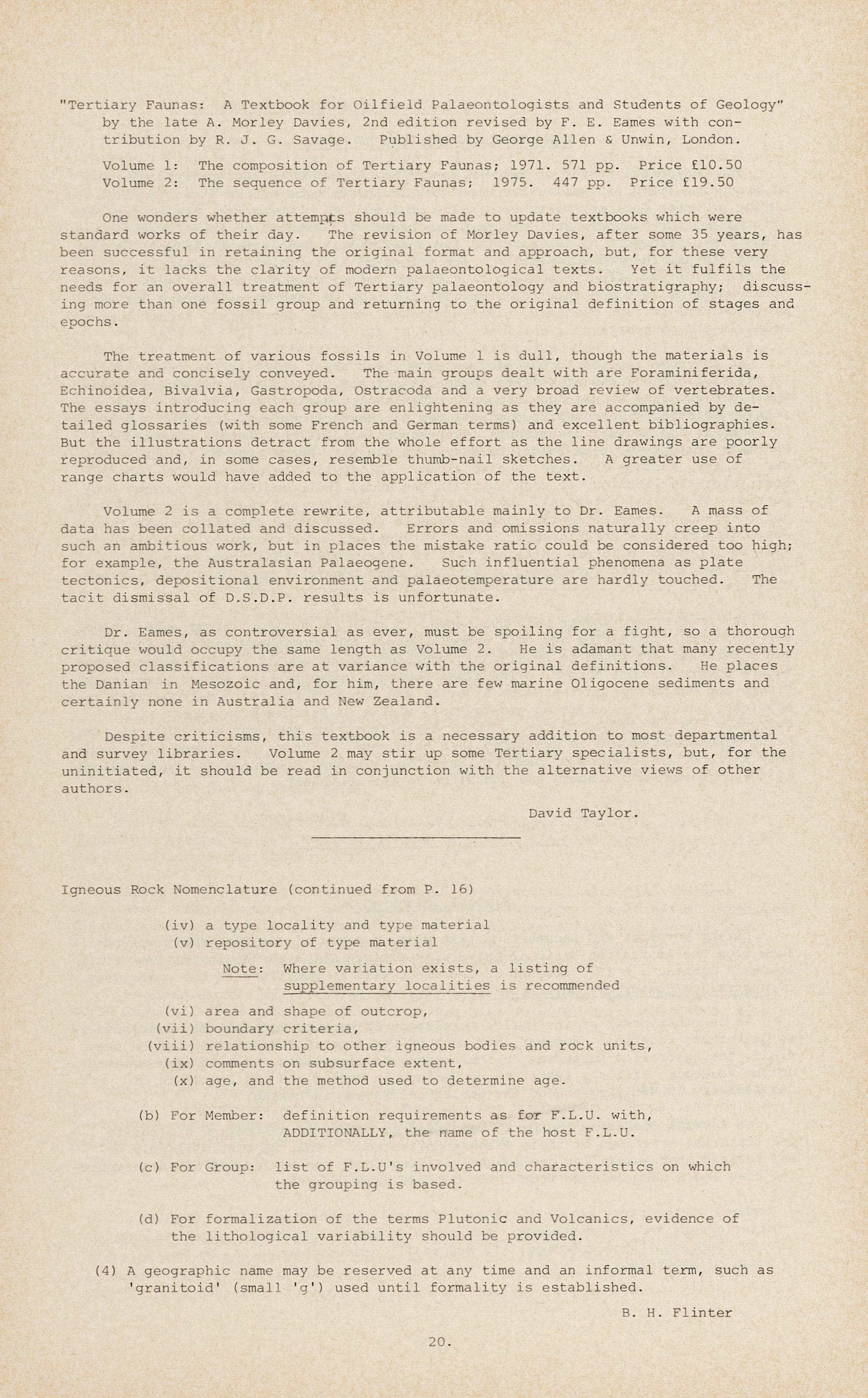
"Tertiary Faunas: A Textbook for Oilfield Palaeontologists and Students of Geology " by the late A. Morley Davies, 2nd edition revised by F E. Eames with contribution by R. J . G. Savage. Published by George Allen & Unwin , London
Volume 1 : The composition of Tertiary Faunas ; 1971 . 571 pp Pr i ce [1 0 50
Volume 2 : The sequence of Tertiary Faunas; 1975 447 pp P r ice [19 50
One wonders whether attemp!:s should be made to update textbooks which were standard works of their day. The revision of Morley Davies , after some 35 years , has been successful in retaining the original format and approach , but , for these ve r y reasons , it lacks the clarity of modern palaeontological texts. Yet it fu lfils th e needs for an overall treatment of Tertiary palaeontology and biostratigraphy ; disc u ssing more than one fossil group and returning to the original defin i tion of stages and epochs
The treatment of various fossils in Volume 1 is dull , though the mate r ials i s accurate and concisely conveyed. The main groups dealt with are Foramini fe r ida , Echinoidea , Bivalvia, Gastropoda , Ostracoda and a very broad review of ve r teb rate s. The essays introducing each group are enlightening as they are accompan i ed by detailed glossaries (with some French and German terms) and excellent bibliographies But the i l lustrations detract from the whole effort as the line drawings a re poorl y reproduced and , in some cases , resemble thumb - nail sketches A greater use of range charts would have added to the app l ica t ion of the text
Volume 2 is a complete rewrite , attributable mainly to Dr Eames A mass of data has been collated and discussed Errors and omissions naturally creep into such an ambitious work , but in places the mistake ratio could be considered too high; for example , the Australasian Palaeogene Such influential phenomena as plate tectonics , depositional environment and palaeotemperature are hardly touched The tacit dismissal o f O.S O P results is unfo r tunate
Dr Eames , as controvers i al as ever , mu s t be spoi l ing for a fight , so a thorough critique would occupy the same length as Volume 2 He is adamant that many recent l y proposed classifications are at variance with the original definitions He places the Oanian in Mesozoic and , for him , there are few marine Oligocene sediments and certainly none in Australia and ew Zealand
Despite criticisms , this textbook is a necessary addition to most departmental and survey libraries . Volume 2 may stir up some Tertiary specialists , but , fo r t he uninitiated , it should be read in conjunction with the alternative views o f other authors
David Taylor
Igneous Rock Nomenclature (continued from P 16)
(iv) a type locality and type material (v) repository of type material
Note : Where variation exists, a listing of supplementary localities is recommended
(vi) area and shape of outcrop , (vii) boundary criteria , (viii) relationship to other igneous bodies and rock units , (ix) comments on subsurface extent , (x) age , and the method used to determine age.
(b) For Member : definition requirements as for F L U wi t h , ADDITIONALLY , the name of the host F L U
(c) For Group : list of F.L U ' s involved and characteristics on which the grouping is based.
(d) For formalization of the terms Plutonic and Volcanics , evidence of the lithological variability should be provided .
(4) A geographic name may be reserved at any time and an informal te rm , s u ch as ' granitoid ' (small ' g ' ) used until formality is established
B H. Flinter
Book Review
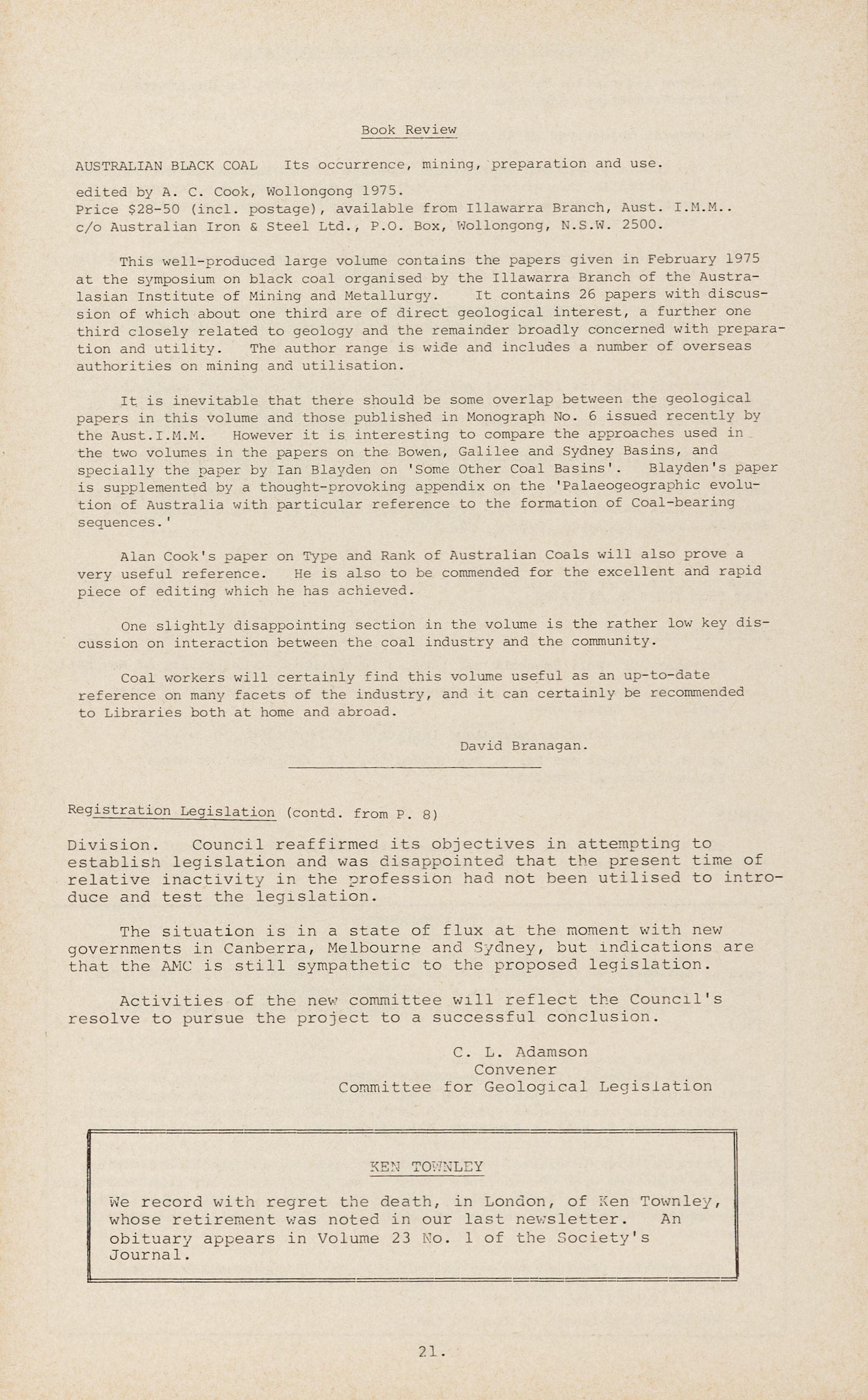
AUSTRALIAN BLACK COAL Its occurrence , mining, preparation and use edited by A C Cook, Wollongong 1975.
Price $28-50 (incl postage) , available from Illawarra Branch , Aust I M M c/o Australian Iron & Steel Ltd. , P O Box , Wollongong , S .lv. 2500
This well - produced large volume contains the papers given in February 1975 at the symposium on black coal organised by the Illawarra Branch of the Australasian Institute of Mining and Metallurgy. It contains 26 papers with discussion of which about one third are of direct geological interest , a further one third closely related to geology and the remainder broadly concerned with preparation and utility The author range is wide and includes a number of overseas authorities on mining and utilisation
It is inevitable that there should be some overlap between the geological papers in this volume and those published in Monograph No 6 issued recently by the Aust.I.M.M However it is interesting to compare the approaches used in the two volunes i n the papers on the Bowen , Galilee and Sydney Basins , and specially the paper by Ian Blayden on ' Some Other Coal Basins ' Blayden ' s paper is supplemented by a thought-provoking appendix on the ' Palaeogeographic evolution of Australia with particular reference to the formation of Coal-bearing sequences . '
Alan Cook's paper on Type and Rank of Australian Coals will also prove a very useful reference He is also to be commended for the excellent and rapid piece of editing which he has achieved
One slightly disappointing section in the volume is the rather low key discussion on interaction between the coa l industry and the community
Coal workers will certainly find this volume useful as an up-to-date reference on many facets of the industry, and it can certainly be recommended to Libraries both at home and abroad
David Branagan.
Registration Legislation (contd from p _ 8)
Division Council reaffirmed its objectives in attempting to establish legislation and was disappointed that the present time of relative inactivit y in the ?rofession had not been utilised to introduce and test the legislation .
The situat i on is in a state of flux at the moment with new governments in Canberra , Melbourne and Sydney , but indications are that the AfiC is still sympathetic to the proposed legislation
Activities of the new committee will reflect the Council ' s resolve to pursue the project to a successful conclusion.
C L Adamson Convener Committee for Geological Legislation
We record with regret the death, in London, of Xen Townley , whose retirement was noted in our last newsletter. An obituary appears in Volume 23 o 1 of the Society 's Journal. 21.
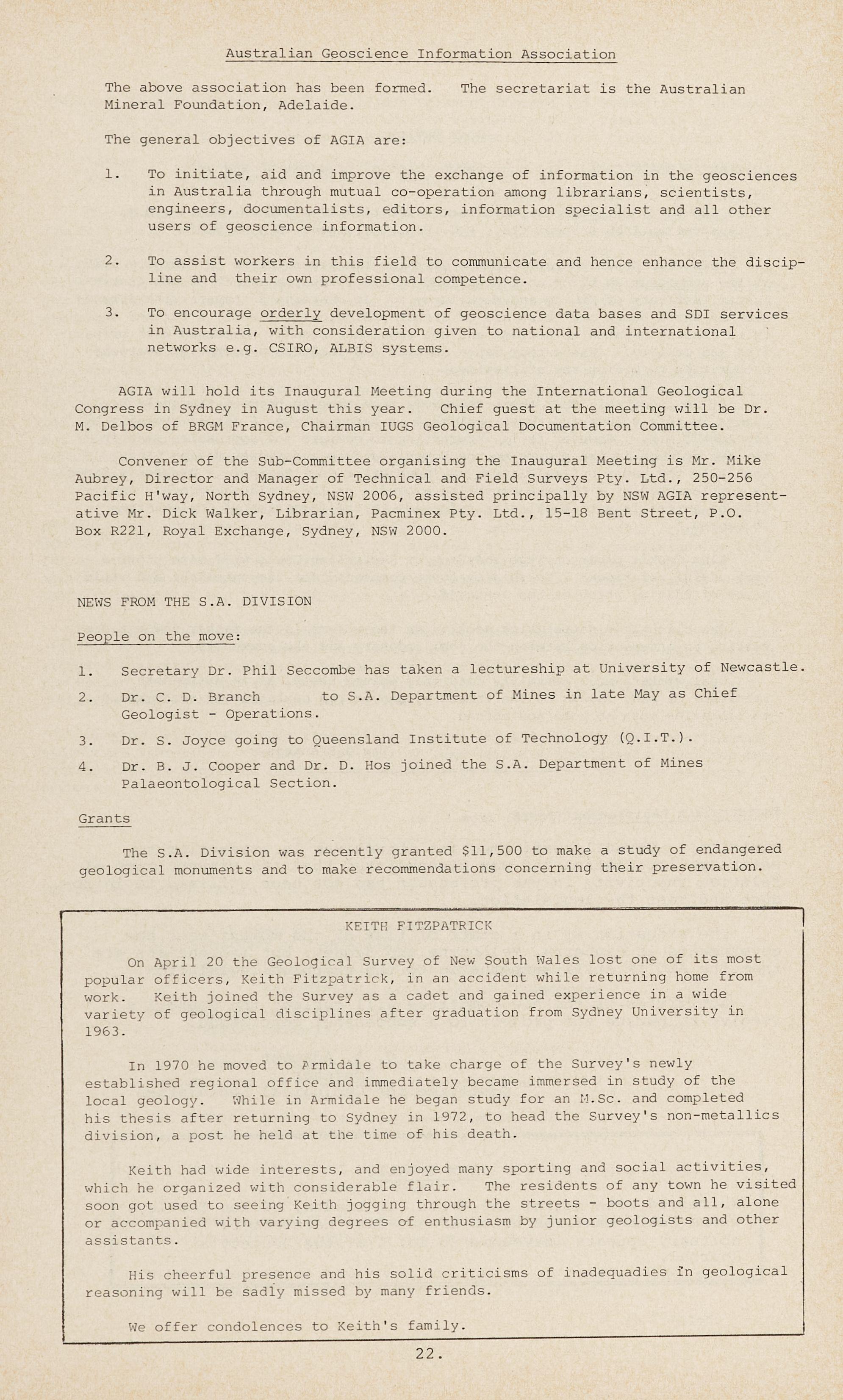
The above association has been formed Mineral Foundation , Adelaide.
The general objectives of AGIA are:
The secretariat is the Australian
1 To initiate, aid and improve the exchange of information in the geosciences in Australia through mutual co -operation among librarians; scientists , engineers, documentalists , editors , information soecialist and all other users of geoscience information.
2. To assist workers in this field to communicate and hence enhance the discipline and th~ir own professional competence
3 To encourage orderly development of geoscience data bases and SDI services in Australia , with consideration given to national and internationa l networks e.g CSIRO , ALBIS systems.
AGIA will hold its Inaugural Meeting during the International Geological Congress in Sydney in August this year Chief guest at the meeting will be Dr. M Delbos of BRGM France , Chairman IUGS Geological Documentation Committee
Convener of the Sub- Committee organising the Inaugural Meeting is Mr Mike Aubrey , Director and Manager of Technical and Field Surveys Pty Ltd ., 250- 256 Pacific H ' way , North Sydney , NSW 2006 , assisted principally by NSW AGIA representative Mr . Dick Walker , Librarian , Pacminex Pty Ltd ., 15 - 18 Bent Street , P O Box R221, Royal Exchange, Sydney , NSW 2000
NEl~S FROM THE S A. DIVISION
People on the move :
1 Secretary Dr. Phil Seccombe has taken a lectureship at University of Newcastle.
2 Dr. C. D Branch to S .A. Department of Mines in late May as Chief Geologist - Operations
3 Dr. s . Joyce going to Queensland Institute of Technology (Q I T .).
4 Dr B J Cooper and Dr D. Hos joined the S.A. Department of Mines Palaeontological Section
Grants
The S A Division was recently granted $11 ,5 00 to make a study of endangered geological monuments and to make recommendations concerning their preservation
KEITH FITZPATRICK
On April 20 the Geological Survey of New South Nales lost one of its most popular officers, Keith Fitzpatrick , in an accident while returning home from work Keith joined the Survey as a cadet and gained e xperience in a wide variety of geological discip lin es after graduation from Sydney University in 1963.
In 1970 he moved to Prmidale to take charge of the Survey ' s newly established regional office and immediately became immersed in study of the local geology \~hile in Armidale he began study for an H Sc and completed his thesis after returning to Sydney in 1972 , to head the Survey ' s non - metallics division , a post he held at the time of his death.
Keith had wide interests , and enjoyed many sporting and social activities , which he organized with considerable flair. The residents of any town he visited soon got used to seeing Keith jogging through the streets - boots and all , alone or accompanied with varying degrees of enthusiasm by junior geologists and other assistants
His cheerful presence and his solid criticisms of inadequadies in geological r eason ing will be sadiy missed by many friends.
We offer condolences to Keith ' s family 22.
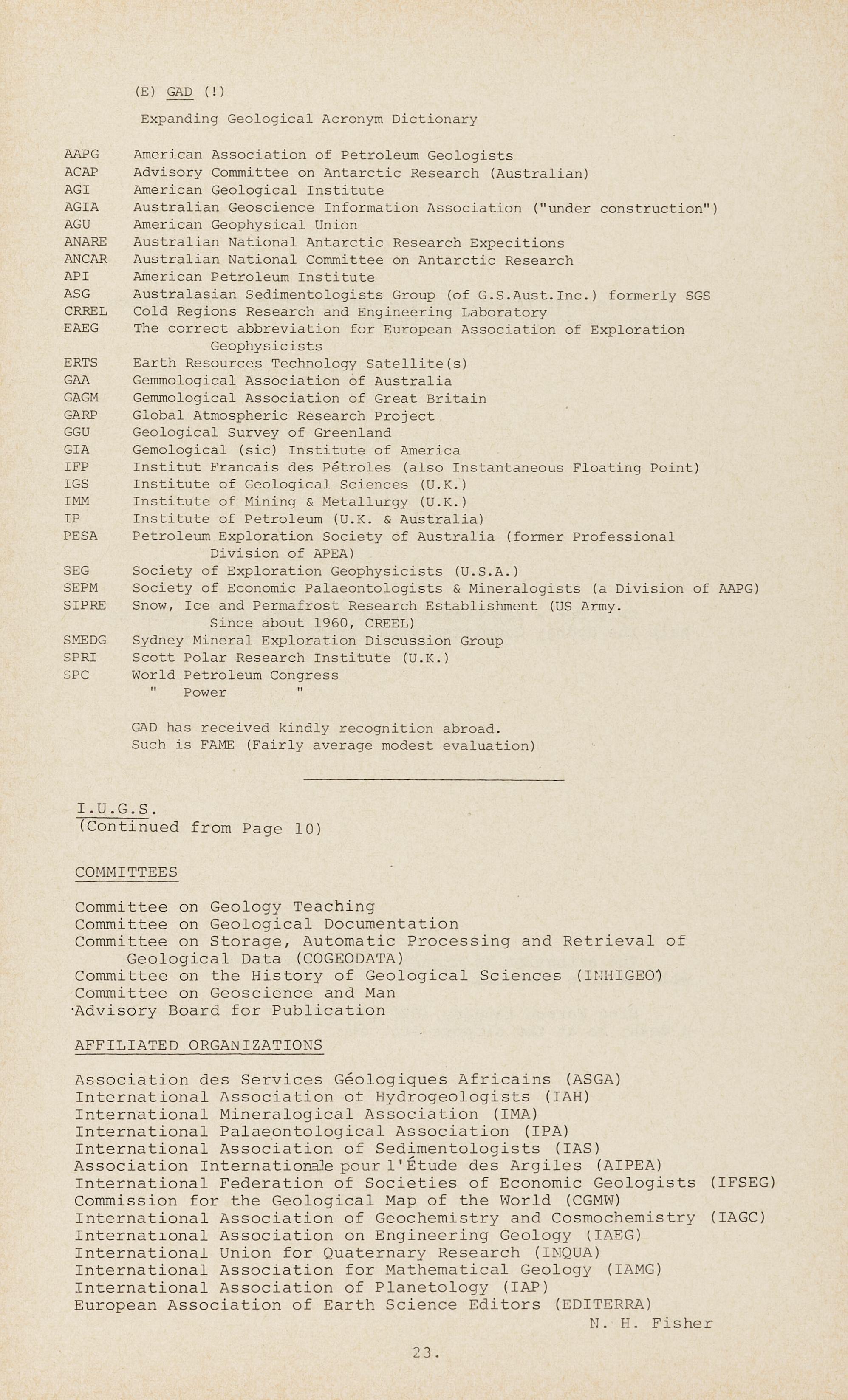
(E) GAD ( ! )
Expanding Geological Acronym Dictionary
AAPG American Association of Petroleum Geologists
ACAP Advisory Committee on Antarctic Research (Australian)
AGI American Geological Institute
AGIA Australian Geoscience Information Association ( " under construction " )
AGU American Geophysical Union
ANARE Australian National Antarctic Research Expecitions
ANCAR Australian National Committee on Antarctic Research
API American Petroleum Institute
ASG Australasian Sedimentologists Group (of G.S.Aust Inc.) formerly SGS
CRREL Cold Regions Research and Engineering Laboratory
EAEG The correct abbreviation for European Association of Exploration Geophysicists
ERTS Earth Resources Technology Satellite(s)
GAA Gemmological Association of Australia
GAGM Gemmological Association of Great Britain
GARP Global Atmospheric Research Project
GGU Geological Survey of Greenland
GIA Gemological (sic) Institute of America
IFP Institut Francais des Petroles (also Instantaneous Floating Point)
IGS Institute of Geological Sciences (U K.)
IMM Institute of Mining & Metallurgy (U K )
IP Institute of Petroleum (U . K. & Australia)
PESA Petroleum Exploration Society of Australia (former Professional Division of APEA)
SEG Society of Exploration Geophysicists (U S.A.)
SEPM Society of Economic Palaeontologists & Mineralogists (a Division of AAPG)
SIPRE Snow, Ice and Permafrost Research Establishment (US Army. Since about 1960, CREEL)
SMEDG Sydney Mineral Exploration Discussion Group
SPRI Scott Polar Research Institute (U K.)
SPC World Petroleum Congress Power
GAD has received kindly recognition abroad
Such is FAME (Fairly average modest evaluation)
I.U.G.S
(Continued from Page 10)
COMMITTEES
Commit t ee on Geology Teaching
Commit t ee on Geological Documentation
Committee on Storage , Automatic Processing and Retrieval of Geological Data (COGEODATA)
Committee on the History of Geological Sciences (HlHIGEO')
Committee on Geoscience and Man
·Adviso ry Board for Publication
AFFILIATED ORGANIZATIONS
Assoc i ation des Services Geologiques Africains (ASGA)
International Association ot Hydrogeologi s ts (IAH)
Internat i ona l Mineralogical Association (IMA)
International Pa l aeontological Association (IPA)
Internationa l Association of Sedimentolog i sts (IAS)
Asso c iat i on Internatiora!e pour l' Etude des Argi l es (AIPEA)
Internationa l Federation of Societies of Economic Geologists (IFSEG)
Co mmi ssion for the Geological Map of the World (CGMW)
International Association of Geochemistry and Cosmochemistry (IAGCJ
International Association on Engineering Geology (IAEG)
International Union for Quaternary Research (INQUA)
Internat i onal Association for Mathematical Geology (IAMG)
International Association of Planetology (IAP)
European Association of Earth Science Editors (EDITERRA) N. H. Fisher
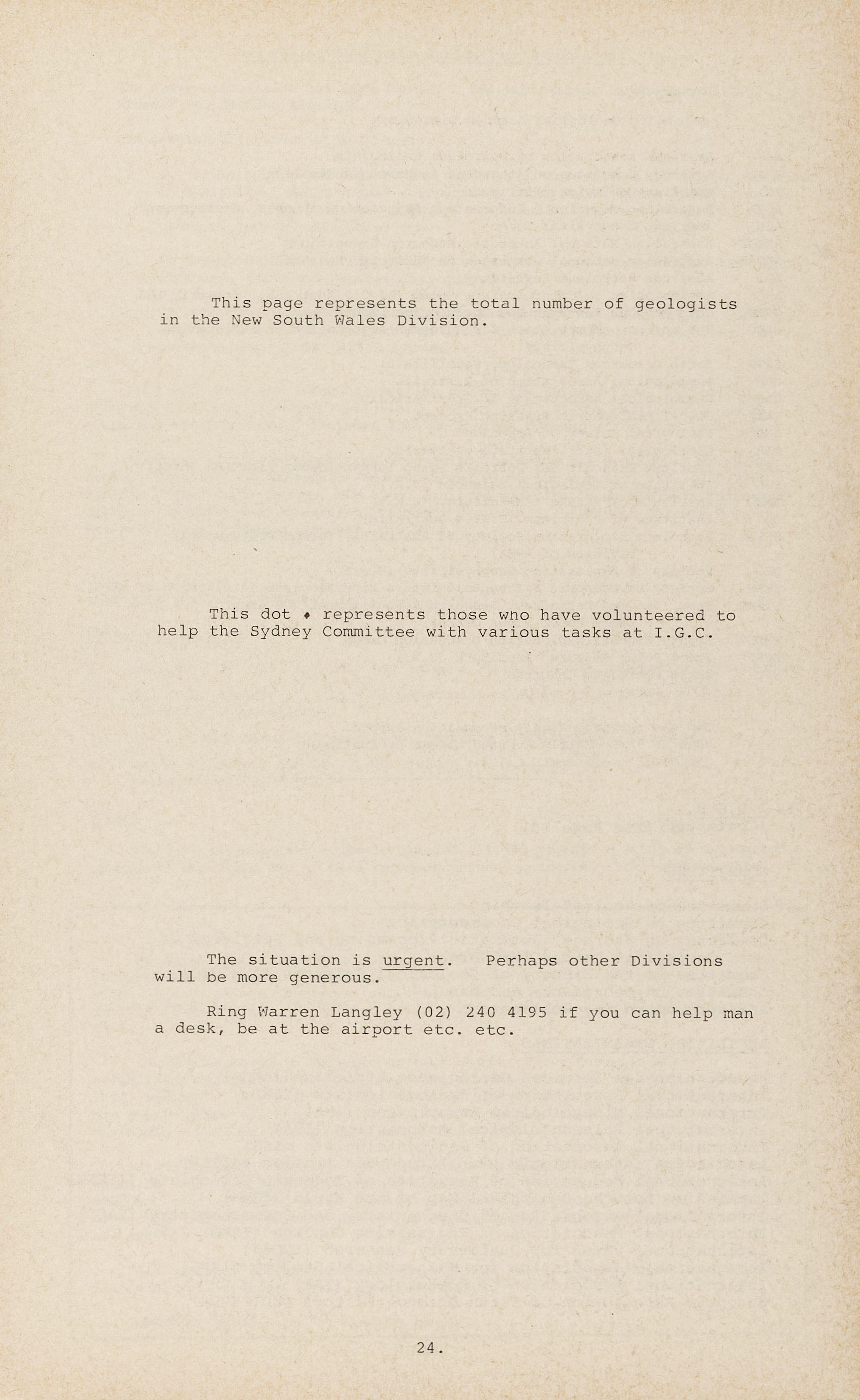
This page represents the total number of geologists in the New South Wales Division
This dot• represents those who have volunteered to help the Sydney Committee with various tasks at I G C.
The situation is urgent. will be more generous.---
Perhaps other Divisions
Ring Warren Langley (02) 240 4195 if you can help man a desk, be at the airport etc etc.