Execu~ive (1975-76)
President: Graeme Philip
Vice-Presidents:
Hon. Federal Secretary
Dr. R E Wass
Deparcment of Geology & Geophysics, The University of Sydney, N S.W. 2006.
Hon. Editor
K A. Townley
Executive Division
New Souch Wales.
Society Office
Dorothy Hill s. W. Carey
Hon Federal Treasurer
J. N. Cramsie, Geological Survey of New South Wales, A.D.C. House, Kent Street , Sydney , N.S.W. 2000.
Hon. Administrative Officer
K. G Mosher
Newsletter Editor
Dr . D. F. Branagan, Depar~ment of Geo l ogy & Geophysics, The University of Sydney, N.S.W. 2006.
'phone: 692 1122 , ext. 2912 or 2358.
Suite 9, 6th Floor , Perpetual Trustee Building , 39 Hunter Street, Sydney, N. S.W . 2000. Telephone: Sydney 231 4696.
Assistant Secre·cary : Miss Laurel Tuckwell.
SOCIETY NEWS
Following the Adelaide Council Meeting, tne executive organisation passed from Queensland to New South Wales, which will operate till January 1977 over the period of the I.G.C. to be held in Sydney, August 1976. As present arrangements stand it is foreshadowed that the Tasmanian Division will take over the day-to-day matters of the Scciety in 1977 with the present Junior Vice-President Professor S. W. Carey a s President.
The arrangement of transfer from Division to Div i sion has worked well in the past but there are some moves afoot to have an executive elected directly by the members. The implication s of such moves are far reaching and deserve considerable examinati o n. One obvious problem of having an executive spread around the Commonwealth (is this word still allowed?) is tne cost of communication involved. However such a scheme offers some advantages to the Society and should be looked at.
The new rules drafted so well oy Mike Rickard were approved by Council with minor changes, and passed by the General Meeting.
Professor Dorothy Hill in her retiring Presidential address summarised past activities of the Society. It is interesting tha t although most members are probably employed in industry the direction of the society has been determined largely by University and Government employ ed g eologists. Only one of our past fourteen presidents was f rom i n dust r y , and only one secretary (o f 13).
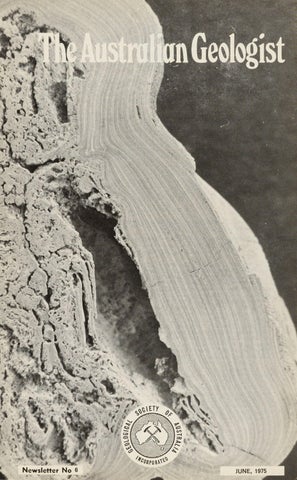
Cover Photo: The Ade laide Convention fea ured Proterozoi c stromatolite s. Our c o ver feature s a recently- aiscovered i ndura ted aragonite and Mg-carbonate s ub-fos s i l stroma t oli t e f rom Mar i on Lake (a Ho locene g y psum lake), York es Peninsula, Sou th Au s t ralia. Mor e deta i l s wil l appea r in our next issue. Photo
EDITORIAL
The First Australian Geological Convention has come and gone. It is discussed elsewhere in this issue. Although it attracted nearly 400 geologists only about 50 turned up for the Society's general meeting, at which some important rule changes were voted, and the past and future activities of the Society were discussed.
Our presence in Adelaide went unnoticed by the news media, and the Convention was essentially inward-looking. During the time of the Convention there were at least ten articles in the Adelaide papers on geological topics, one specifically concerning preservation of the Hallett Cove geological site but we did not become involved.
At a time when the Society is seeing itself moving towards a professional organisation while maintaining its academic interests there is an urgent need for us to establish contact with the public and make our ideas known. In the field of secondary education we can contribute greatly. So far we have done very little. The conservation-exploitation area could be a difficult one for the Society and some aspects of this are spelt out elsewhere in this issue.
The Rae Report made a specific criticism of some geologists for their lack of ethics and the Society's relatively new code of ethics still seems to have very little legal strength. Can our Society have a code of ethics which is viable? Do the members care? These are some of the issues which face the incoming executive.
Society News (continued)
Two presentations of the Stilwell Award were made at the Annual Meeting, to W. V. Preiss (1973) and P. Wellman and I. McDougall (1974) for papers published in the Journal.
The Society's auditors expressed reservations about the Society's accounts in that Divisional and Specialist group accounts were not audited by them and a total view of our funds was not obtained. They recommended a single society account from which all activities of the Society could be funded. Council reaffirmed the Society's policy of relative autonomy of divisions and specialist groups but called for audited accounts from these bodies to be forwarded on time at the end of February. Such timing is vital if our affairs are to be kept in order.
Council gave its support to a submission being made in Victoria for a grant to upgrade the secondary school geology syllabus in that state (but with implications for improvements elsewhere).
The Geology of Victoria is to be published as a special volume (not part of the journal). It will be about 500 pages and should be published early next year. Final editing is almost completed. It will be issued free to members.
Council considered the case for a fee rise submitted by the Treasurer R. A. Paten and reluctantly approved in view of the heavy rise in costs.
At the gener al meeting fee rises were voted for. Ordinary membership in 1975 will be $18, Associa tes $4 (plus $14 for journal), Students $4 (plus $6 for journal). Institution fees for the journal were also increased.
Divisions have been asked to consider names for election to Honorary and Corresponding membership categories.
_Council received and considered the various reports of divisions (noting the absence of a Hunter Valley Branch report), Specialist Groups and Society Committees. The most recently established Committee, Preservation of Geological Monuments, (Convener c. D. Branch, S. Aust.) presented a lengthy report which showed there had been activity in all states, and that the Society has participated in the National Estate enquiry to a considerable extent. This work,which is continuing was warmly commended by Council.
The final action of Council wa s to pay tribute to the work of the retiring executive, particularly the triumvirate of President Dorothy Hill, Treasurer Dick Paten and Secretary Geoff Playford.
THE AUSTRALIAN MINERAL FOUNDATION AND GEOSCIENCE INFORMATION
The Foundation based in Adelaide p ublishes a monthly current information bulletin called "Earth Science and Related Information - Selected Annotated Titles". The 25 issues to date have contained 3398 entries. About 160 journals and serials are scanned including such material as BMR Records. The serv i ~e is provided to member companies and is available to libraries a nd similar institutions at an annual subscription of $50.
In collaboration with CSIRO the Foundation is acting as the agency for input of Australian geoscience information to international databases, such as GEOREF (American Geological Institute - Bibliography and Index of Geology). A similar role for the UK-based Geosystem's database GEOARCHIVE is envisaged. SDI (Selective Dissemination of Information) services in Australia based on these databases benefit considerably from more comprehensive input of Austra lian material. It is therefore in the interest of all professional organisations, other publishers of information in the geosciences and even authors themselves, to ensure that cop i es of publications/papers/proceedings etc. are made available to the Foundation for processing. The Foundation is working within the Australian National Library's information network concept to ensure that national interests are catered for.
The Australian Thesaurus of Earth Science and Related Terms being developed by the Foundation in collaboration with the BMR , CSIRO, National Library and other participating companies and organisations, is now undergoing final corrections and editing before working copies become generally available by the end of the year The Director of the Foundation, Mr. L. W. Parkin, is the Australian representative for the international IUGS/ICSU- AB Working party on the development of a multi-lingua l thesaurus for geology.
The development of a referral service for continu ing work in the Earth Science, Mini ng and Metallurgy departments in Universities and Colleges of Advanced Education, and for recording of theses, is in progress and some Universities and CAEs have already commenced sending information to AMF.
A referral scheme for unFublished reports (mainly open-file material) is also encouraged and some participation has commenced The Foundation has developed a special Data Transmission Sheet for this purpose.
The Geoscience Information Seminar held at the Foundation, in March 1975, strongl y encouraged the role of the Foundation as a centre and focus for Geoscience Information. Proceedings of the Seminar, a document of some 450 pages, identifies for the first time in one folder all major Austra lian geoscience information resources and systems, and is available for sale at the Foundation. ($15.00 plus po stage)
At the Seminar an Australian Geoscience Information Association was mooted and a committee s e t up to i n vestigate feasibility. Those interested can get further i nformation fr o m the Fo unda tion.
THE FIRST GEOLOGICAL CONVENTION
The Society's first Convention held recently in Adelaide marked an important step in our activities. It brought together nearly 400 geologists, most of whom were Society members. Although the bulk of the meeting consisted of those interested in hard rock geology and attendant mineralisation, there was a fair sprinkling of sedimentologists and palaeontologists to soften the hash.
Organization of accommodation, transport, registration, social activities, etc. was proficient and Alan ~vebb and his associates deserve our thanks for their hard work. The A.M.F. site proved a very satisfactory venue for the Conference, even if the small theatres occasionally were stretched to capacity.
There was the usual mixed reaction to the papers which were presented. Some thought most of them were marvellous, others thought they weren't worth listening to. Some felt that their own papers were good but the others were poor; others that the papers they had offered would have been more interesting than those which were accepted.
In other words it was a typical conference at which those who wanted to learn something could do so, while those who had nothing to learn could renew old acquaintances in salubrious surroundings.
One cause for complaint was the scheduling of the stromatolite papers in sedimentological and palaeontological sessions which ran almost concurrently. This topic could have been run over several afternoons instead.
The keynote papers were, I felt, lacking in provocation, but they were useful for those wanting an overall summary of facts. The organisers forgot one golden rule of geological conferences. This rule states than 'any individual Russian speaker must be scheduled for the last slot in any session'. This rule obviates the need for filling in. A corollary is 'If numerous Russian speakers are scheduled, assign them all to one day'. This way you are likely to get a block of free time.
Many of the speakers used very-well prepared illustrative material, and in this respect the presentation showed a marked and pleasing improvement over past conferences. I only hea~d one speaker tell us 'you won't be able to see this from the back'. There is no doubt the improved presentation originated some time ago with company-supported geologists, but it has now been taken up by government bodies and even the academics are showing signs of being affected!
As one who believes that the main function of conferences is to encourage personal contact the Adelaide meeting was an excellent opportunity to meet a wide cross-section of Australian geologists. One learned colleague remarked sadly "I just don 't know any of them anymore", and the same applied to me. Whether such a comment merely indicates a generation gap or would be true for most members I'm not sure. How man y geologists do you know personally?
If conventions do no more than establish personal links between members they achieve an important function for the society The society's aims, aspirations and actions must inevitably become clearer.
FOR SALE
Geology Book s a nd a f ew r eprints, in c lud i ng Geo lo gy o f Austr a l ian Or e Deposits, Life o f W. B. Cl a rke , Anci e n t Au s t r a li a
Con t a c t the Ed i tor f o r a f ul l l i s t.
AGIDATION
A new association devoted to promoting earth sciences in international development known as the ASSOCIATION OF GEOSCIENTISTS FOR INTERNATIONAL DEVELOPMENT (AGI D) has been formed.
The purpose of the new association is to provide a continuing forum for the exchange of ideas, experiences, and information among all persons concerned with th e role of the geoscien c es and of the geoscientist in international development. What have we lea rned from the successes and failures of pas t aid programmes? How can we avoid a repetition of the many mistake s of the past and pr oceed more effectively? AGID does not pretend to know the answers to all of these problems, nor to have the a bili t y of provide insta ntane ous solution s, but its members are convinced of the need for pract ic al and constructive action. AGID proposes to s p are no effort in exploring ways and me ans b y which impr ov ement s can be achieved.
The following objectives were agreed u p on in 1974:
1) To encourage communication amon g all individual, societies, agencies and corporations interested in international aid in t he earth sciences.
2) to encourage and promote acti vitie s in the earth sciences which are related to the needs of developing countries.
3) To emphasize to both donor and recipient countries the fundamental role of the earth sciences in international development.
4) To promote regional co-operation among countries with similar earth sc i en ce pr ob lem s .
5) To study mec hani sms and evolve guidelines for t he training of earth science professional and technical personnel of less developed countries for service in their own countries
6) To evolve criteria for the s elect ion of personnel for international service and to encourage donor countries to second able people to recipient countries with complete retention of their status upon their return.
7) To encourage the establishment of information centres on manpower, available expertise, past activities and results, and on other aspects of earth science aid.
8) To develop the necessary criter ia for the adequate evaluation of individual programmes a nd to encourage the publication of results.
9) To provide for a regular publicat ion and disse mi n ation of information on the a b ove and relat ed matters.
It is planned to hold a general meeting at the IGC in 1976 and Australian interest and participation is encouraged. Ther e has been up till now, a general poor response from Australia and a membership list to December 31, 1974 sho ws onl y 1 me mber (Michael B. Katz) out of 75.
Any one who is interested in more detailed information or wishe s to become a member (U.S. $5.00/year) should contact Dr. Katz, School of App li e d Geolog y, University of New South Wales , P.O. Box 1, Ken si ng ton, N.S.W 2033, or Dr. A. R. Berger, Department of Geology, Memorial University, St Johns, Newfoundland, Ca nad a
The Comparative is so weak that one should write more positively.
GEOLOGICAL RESEARCH IN NATIONAL PARKS
The Ta smanian Division Research in National Parks. the February '75 Newsle tter other geologists. Readers this topic.
Banks writes: has been having a long look at Geological A summary of ideas by M. R. Banks in has provoked a strong reaction from elsewhere mioht also be interested in
Legitimate and responsible research within park boundaries should be permitted under such conditions that the research is poss- ible and useful and that damaqe to the park is minimised.
Cases can be made for several cateoories of Research workers:
(a) professional officers of government deefartrnents;
(b) professional officers of semi-government instrumentalities, e.g. H.E.C., museums, other Commissions;
(c) qualified people from independent research organizations such as Universities, Colleges of Advanced Education and perhaps other tertiary and secondary education bodies;
(d) qualified unattached research workers who can demonstrate their qualifications, interest and independence from any exploitive organization.
No person who is a permanent or temporary employee of, or consultant to, an exploitive or extractive organization such as a mining company, quarrying company or oil company, should have access to a park for research or investigation purposes.
Research is not to be restricted except for
(a) research which would cause immediate or long term damage to the park;
(b) research on a directly exploitable commodity, e.g. coal seam, mineral vein, clay deposit etc., such research involving largely or entirely the measurement of that coI!IIl'odity.
Cor,di tions for entry.
(a) Access - times and point s of access, and particularly the means of access (foot, horse, bike, 4-wheel drive, bombardier, etc.) would need to be specified and possibly restricted. Also the means of accommodation, siting of camps, nature of camp facilities (e.g. sources of heat, methods of waste disposal), length of stay in park.
(b) Types of observations, scope of observations and their geographic spread would need to be known and agreed upon. Destructive observations, e.g. digging of soil pits, blast holes etc., might need to be limited.
(c) Specimen collection - the methods would need to be controlled, also the size and number and geographic spread would need to be kept to a minimum. The case of rare specimens would need careful consideration - some of these could perhaps be removed if their position and environment are carefully recorded and they are deposited in a public collection.
(d) Availability of results and collections to park authorities and the general public - (i) specimens and preparations therefrom should be lodged immediately or within 5 years in a public collection (museum, government or semi-government instrumentality) where there is already a collection of the same type of material and qualified staff are available to curate the material; (ii) park authorities should receive a copy of any report, manuscript, thesis or paper incorporating observations
on material within or collected from the park, such report to be forwarded within a reasonable period, say five year s, after completion of the work within the park.
[The suggested Procedures section which follows is omitted for lack of space.]
Reaction from Readers includes:
L. A NEWNHAM (28th February 1975)
I take exception to "No person who is a permanent or temporary employee of an exploitive or extractive organization, etc ."
This would suggest that a scientist from a free enterprise company is in some way inferior to a public servant in undertaking research.
There seems to be a widely held belief that company research involves bulldozers, backhoes, drills etc. That in my view is not research but exploitation.
I could imagine the situation where a geologist based at an operating mine 20 kms from a National Park might be researching the depositional environment of the sedimentary rocks in the mine area and in order to do this properly, it might be advantageous to study similar formations in the nearby Park. This might only involve mapping traverses with a map and a geology pick. Why should access be refused for such research purposes?
C. C. J. BURTON (22nd April, 1975)
My interpretation of his (Mr. Banks) proposals are that mining companies do not undertake bona fide research and that their employees cannot be trusted to set foot in a National Park with a pick because a bulldozer and a mechanical shovel inevitably follow. Mining companies have for years actively and most generously supported research projects, many of which bear no relation to immediate economic gain. It is totally unjustifiable to exclude employees of mining companies from undertaking geological investigations within National Parks.
My advice is to discard these guidelines, lock, stock and barrel and start afresh with a straightforward simple code which can be readily adhered to by prospector, student, exploration geologist and palaeontologist alike.
Our National Parks were created for all, for their recreation, for their enjoyment and for scientific research.
D. J. JENNINGS (30th April, 1975)
I disagree strongly with some aspects of Mr Banks' paper on Geological Research in National Parks....... To advocate that collection of informationthe acquisition of knowledge , from National Parks should be allowed to some and denied to others is a dangerous doctrine....... . It vests in the authorising body an undesirable and dictatorial power of discrimination readily open to abuse.
In summary my attitude is:
(a) Acquisition of information should be unrestr icted.
(b) Conditions should be rigorously applied.
(c) Results should be made public.
The Australian Advisory Council on Bibliographical Services is interested in Australian bibliography. It wishes to set up a register of subject bibliographies (either completed or in progress) and to offer a referral service for such a register. Anyone engaged in such work , or aware of subject bibliographies being compiled should contact:
D. H. Borchardt, The Library, La Trobe University, Bundoora Victoria 3083.
NEW GEOLOGICAL MAP OF QUEENSLAND AT 1:2,500,000
A geological map of Queensland at 1:2,500,000 scale is being prepared by the Geological Survey of Queensland. The new map will incorporate information from the now statewide coverage of geological maps at 1:250,000 scale.
A feature of the map will be a schematic diagram showing the stratigraph ic and areal relationships of all surface rock units, together with a conventional rock unit listing and an inset map of the state's major structural unit s.
It is anticipated that the map and accompanying explanatory notes will become avail a ble during 1976.
CONSORTIUM FOR OCEAN GEOSCIENCE OF AUSTRALIAN UNIVERSITIES
During the first Australian Geological Convention in Adelaide the Consortium for Ocean Geoscience of Australian Universities (COGS) held its first meeting on 12th May. Delegates from fifteen of the seventeen earth science departments of Australian universities were present, together with invited participants from the Bureau of Mineral Resources and WAPET. The organization defined as its aims (1) the pursuance of Australian participation in the International Program of Oce a n Drilling, (2) the cataloguing of marine data around Australia, the co - ordination of university marine research and co - operation in marine research programmes with other agencies and industry, and (3) the assessment of requirements of ocean going geoscience of Australian Universities with particular reference to research vessels.
Committees were elected to collect information and prepare reports on the three aims of COGS. It is proposed to meet again in August.
Gordon Packham Chairman
NEW APPOINTMENT
Professor Peter G. Harris of the University of Leeds has been appointed Professor of Geology at the University of Western Australia and will take up his appointment at the beginning of third term this year. Professor Rex T. Prider will continue as Department Head until he retires at the end of 1975
Since 1955 Professor Harris's chief research interests have been in the origin and behaviour of magmas and in the application of geochemistry to magmatism. This has led to work on vulcanology and on the nature and composition of the earth's interior, especially the mantle.
Professor Harris graduated B.Sc. and M.Sc. from the University of New Zealand: Ph.D. from the University of Leeds in 1952 and D.Sc. from Victoria University (Wellington) in 1972.
Was a geological mind behind the following ad. which appeared at the ANZAAS Conference in January? 'Third Smolletson memorial lecture by Dr. W. E. L Morrie-Buntt, Bassenthwaite professor of Geller tectonics in the University of Strathclyde, Scotland'. Topic 'Ultra- persistory rambunction processes'. Professor Morrie-Buntt has isolated a new element epi - thalamium from compounds found in unusual clay deposits in eastern Essex and the Friesian Islands. 'The new element in the form of its chloride appears to be a catalyst in the reduction of macro-enzyme molecules and in this respect will be immediately valuable in assisting colonic irrigation in territories of the third world'.
GEOLOGICAL, MINING & METALLURGICAL SAMPLING. Editor : M. J. Jones. Published by the Institution of Mining and Metallurgy, 44 Portland Place, London , WIN 4BR, June 1974. Price (including surface mail) is £s.
This publication provides a lead in bridging the widening information gap between textbooks and professional papers. The textbook format can be used to present information in a comprehensive integrated form. Unfortunately textbooks date over lengthy preparation and printing-run periods. On the other hand papers provide recent information, but as small elements in mixed contexts. The approach followed by the editor has been to group loosely, rather than to integrate, 23 recent papers spanning the burgeoning field of geoscience sampling. The coverage is thus comprehensive yet up to date.
The papers have been arranged in 3 groups, each of which is followed by comprehensive discussions. These groups display a common emphasis on sampling for the purposes of discrimination and decision making. Statistical tools need to service this modern emphasis are developed.
The first section deals with topics pertinent to geological exploration, including: structured populations, non-Gaussian mineralogical distributions, Poisson probability distribution applied to low concentrations, geochemical sample preparation and size fractions, and case histories.
A mine sampling section considers: minimization of estimation variances for ore panels , selection of payable blocks, autocorrelation of successive assays, grade-ton curves, rolling means for trend analysis, sampling intervals , random high s, cut - off theory, and specific studies of sampling gold, diamonds , and base metals.
The third section deals with the mechanics, checks, and integration procedures of metallurgical sampling practice. Consideration is paid to consignments and stockpiles, also milling, concentrating, and smelting systems.
E J. Heidecker
Letter to the Editor
Sir,
I refer to your editorial in Newsle tter No 5, p. 3, para. 7, in which you say you don't think a course in geological writing is given anywhere. I should inform you that a short course in geological writing has been given to senior students in my Department for some years by Dr. J. E. Glover (who, incidentally, has in the past, been the Society's Editor and also Hon. Editor of the Royal Society of Western Australia).
This course, accompanied by assignments, was never a popular one, but was, I believe, of considerable value to the stude nts. It is not until much later in their professional careers that many students have any real appreciation of the material offered to them in the course of their academic training.
In the reorganization of our Geology courses in this University we intend offering a sub-u nit G25: Reading, Seminar and Language Course, part of the Handbook entry for which is:
"A 2-segment sub-unit designed for all Honours students. Introductory course in librar y and wr iting techniques, critical appraisal of scientific literature, reading and organisation of semi nars in a prescribed area of research; translation (with the aid of a dictionary) of a short geological paper in a language other than English.
Candidates are required to prepare a short review paper(s) dealing with their reading topic(s)".
Rex T. Prider University of W.A.
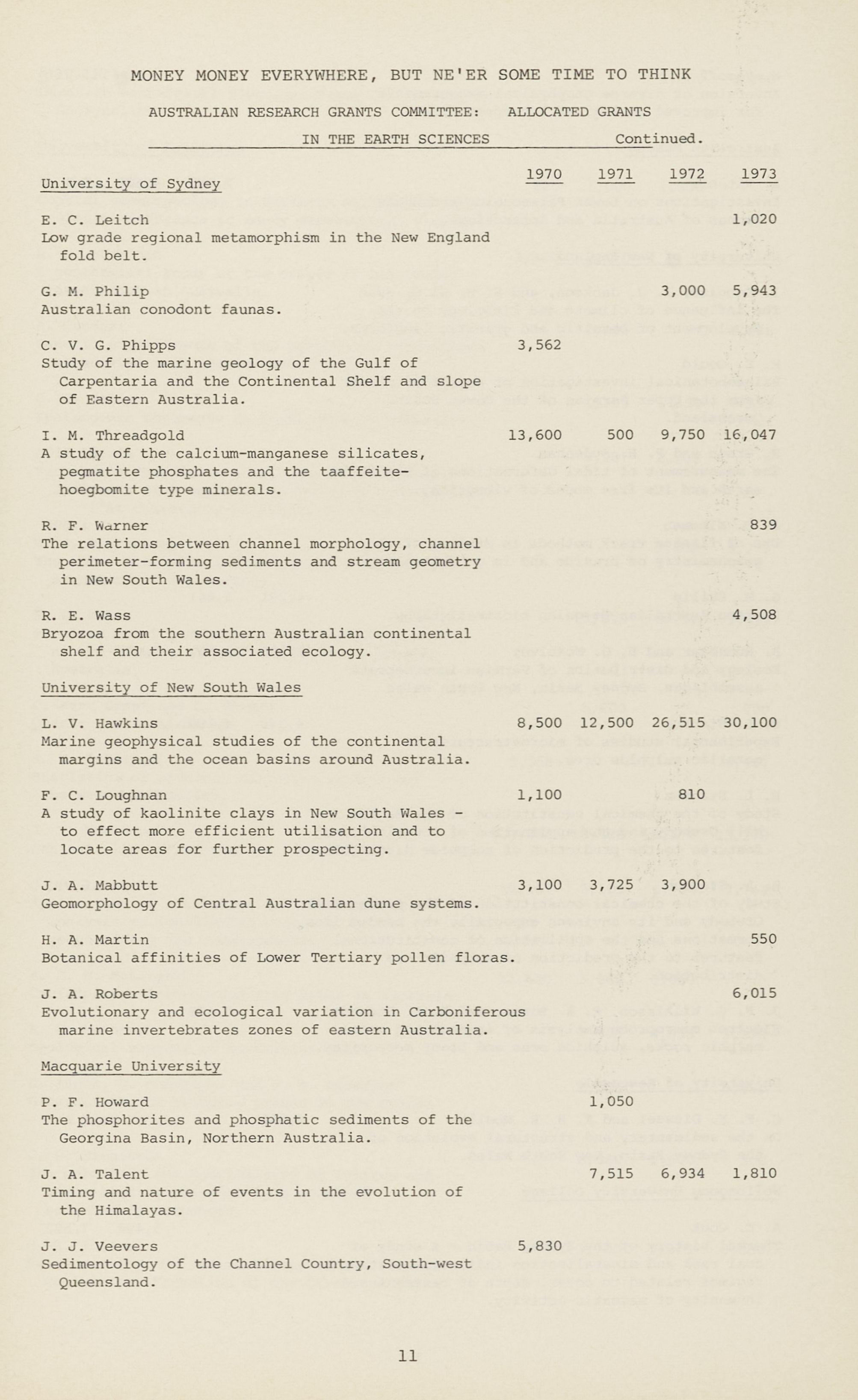
AUSTRALIAN RESEARCH GRANTS COMMITTEE: ALLOCATED GRANTS IN THE EARTH SCIENCES Continued.
University of Sydney
E. c. Leitch
Low grade regional metamorphism in the New England fold belt.
G. M. Philip
Australian conodont faunas
C. V. G. Phipps
Study of the marine geology of the Gulf of Carpentaria and the Continental Shelf and slope of Eastern Australia.
I. M. Threadgold
A study of the calcium-manganese silicates, pegmatite phosphates and the taaffeitehoegbomite type minerals.
R. F. Warner
The relations between channel morphology, channel perimeter-forming sediments and stream geometry in New South Wales.
R. E. Wass
Bryozoa from the southern Australian continental shelf and their associated ecology.
University of New South Wales
L. V. Hawkins
Marine geophysical studies of the continental margins and the ocean basins around Australia.
F. C. Loughnan
A study of kaolinite clays in New South Walesto effect more efficient utilisation and to locate areas for further prospecting.
J. A. Mabbutt
Geomorphology of Central Australian dune systems.
H. A. Martin
Botanical affinities of Lower Tertiary pollen floras.
J A. Roberts
Evolutionary and ecological variation in Carboniferous marine invertebrates zones of eastern Australia
Macquarie University
P. F Howard
The phosphorites and phosphatic sediments of the Georgina Basin, Northern Australia.
J. A Talent
Timing and nature of events in the evolution of the Himalayas .
J. J Veevers
Sedimentology of the Channel Country, South-west Queensland.
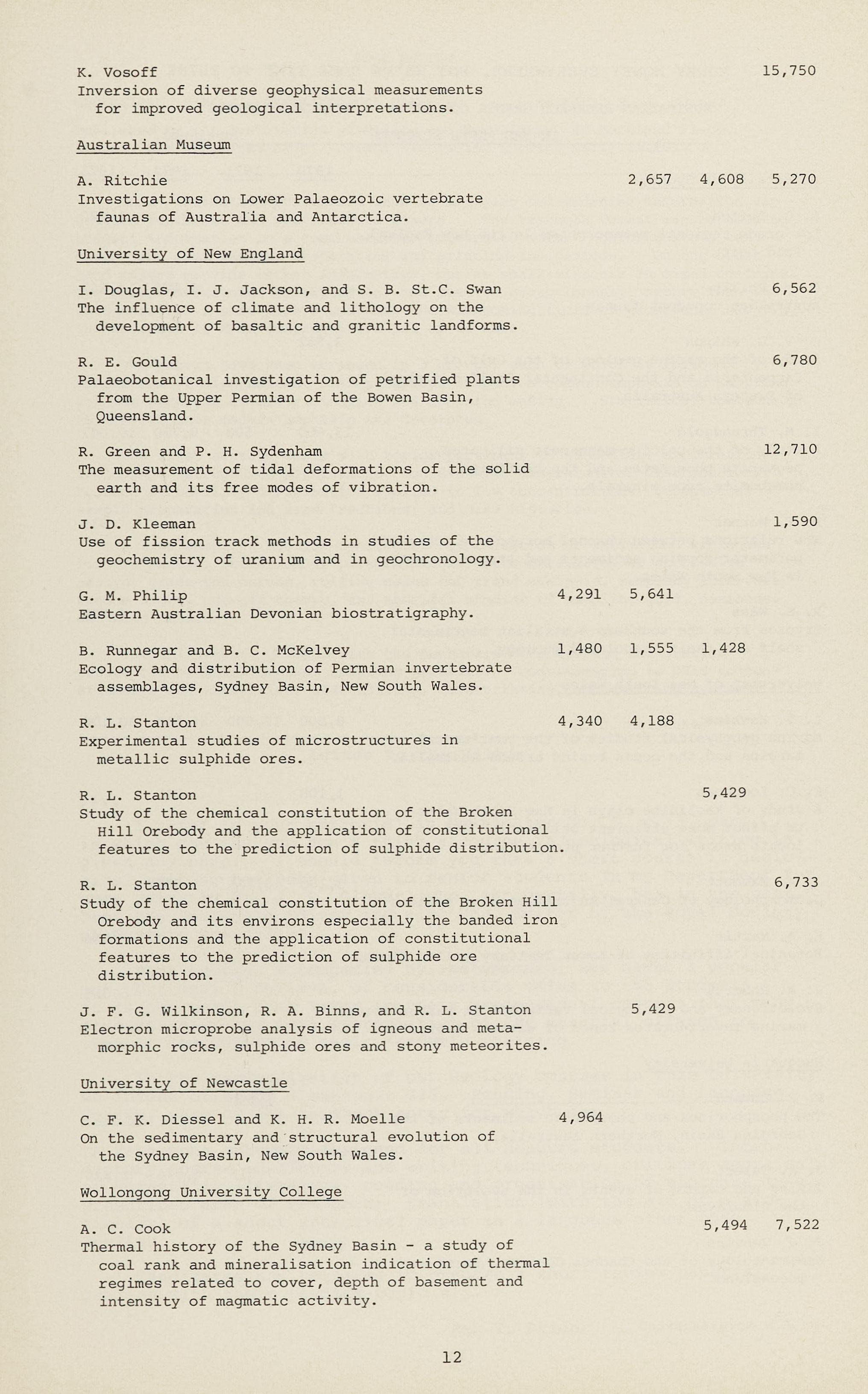
K. Vosoff
Inversion of diverse geophysical measurements for improved geological interpretations.
Australian Museum
A. Ritchie
Investigations on Lower Palaeozoic vertebrate faunas of Australia and Antarctica.
University of New England
I. Douglas, I. J. Jackson, and s. B. St.C. Swan
The influence of climate and lithology on the development of basaltic and granitic landforms.
R. E. Gould
Palaeobotanical investigation of petrified plants from the Upper Permian of the Bowen Basin, Queensland.
R. Green and P. H. Sydenham
The measurement of tidal deformations of the solid earth and its free modes of vibration.
J. D. Kleeman
Use of fission track methods in studies of the geochemistry of uranium and in geochronology.
G. M. Philip
Eastern Australian Devonian biostratigraphy.
B. Runnegar and B. C. McKelvey
Ecology and distribution of Permian invertebrate assemblages, Sydney Basin, New South Wales.
R. L. Stanton
Experimental studies of microstructures in metallic sulphide ores.
R. L. Stanton
Study of the chemical constitution of the Broken
Hill Orebody and the application of constitutional features to the prediction of sulphide distribution.
R. L. Stanton
Study of the chemical constitution of the Broken Hill Orebody and its environs especially the banded iron formations and the application of constitutional features to the prediction of sulphide ore distribution.
J. F. G. Wilkinson, R. A. Binns, and R. L. Stanton
Electron microprobe analysis of igneous and metamorphic rocks, sulphide ores and stony meteorites.
University of Newcastle
C. F. K Diessel and K. H R. Moelle
On the sedimentary and structural evolution of the Sydney Basin, New South Wales.
Wollongong University College
A. c. Cook
Thermal history of the Sydney Basin - a study of coal rank and mineralisation indication of thermal regimes related to cover, depth of basement and intensity of magmatic activity.
4,964 15,750 2,657 4,608 5,270 6,562 6,780 12,710 1,590 5,641
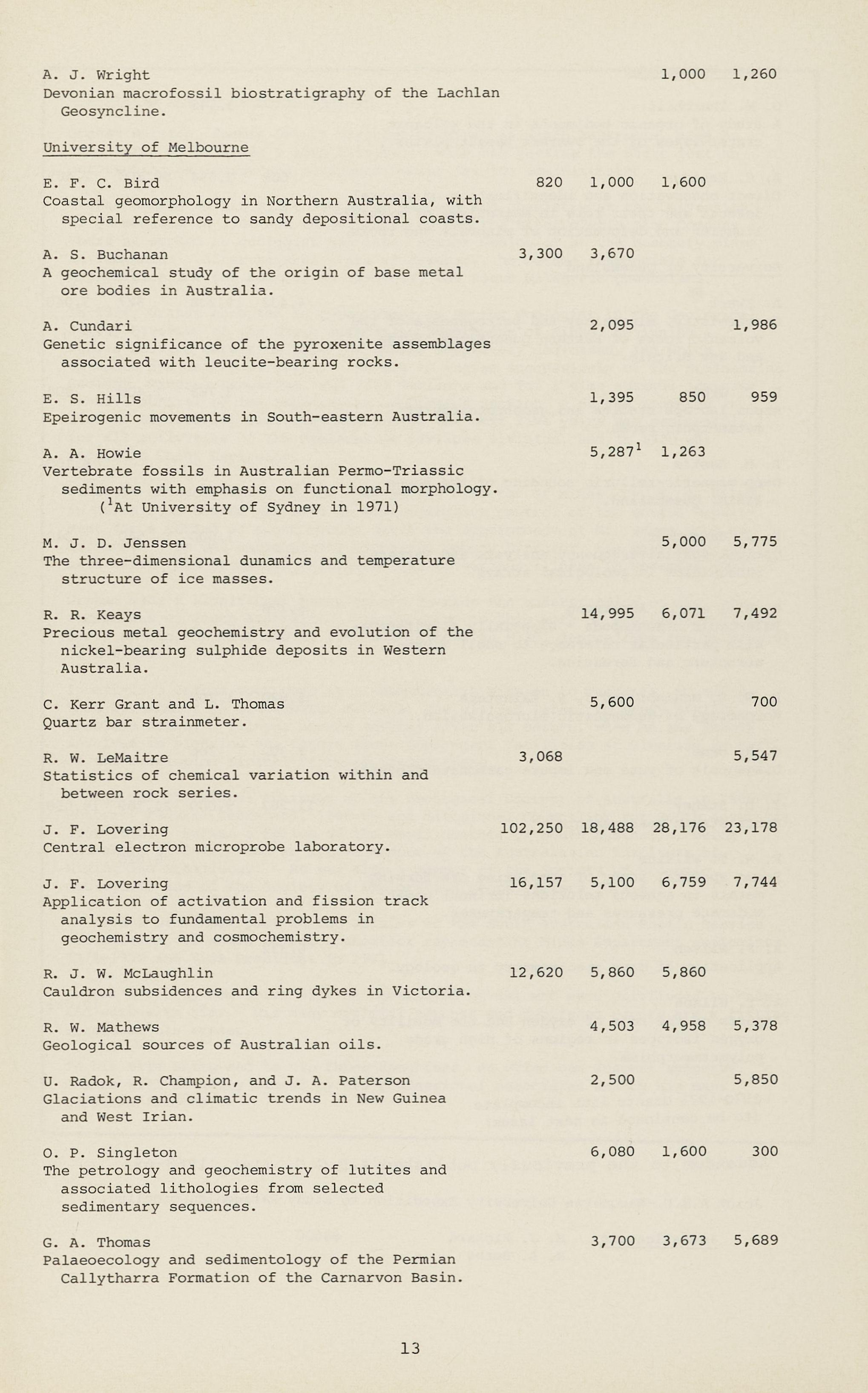
A. J. Wright
Devonian macrofossil biostratigraphy of the Lachlan Geosyncline.
University of Melbourne
E. F. C. Bird
Coastal geomorphology in Northern Australia, with special reference to sandy depositional coasts.
A. s. Buchanan
A geochemical study of the origin of base metal ore bodies in Australia.
A. Cundari
Genetic significance of the pyroxenite assemblages associated with leucite-bearing rocks.
E. S. Hills
Epeirogenic movements in South-eastern Australia.
A. A. Howie
Vertebrate fossils in Australian Fermo-Triassic sediments with emphasis on functional morphology.
( 1At University of Sydney in 1971)
M. J. D. Jenssen
The three-dimensional dunamics and temperature structure of ice masses.
R. R. Keays
Precious metal geochemistry and evolution of the nickel-bearing sulphide deposits in Western Australia.
C. Kerr Grant and L. Thomas
Quartz bar strainmeter.
R. W. LeMaitre
Statistics of chemical variation within and between rock series.
J. F. Lovering
Central electron microprobe laboratory.
J. F. Lovering
Application of activation and fission track analysis to fundamental problems in geochemistry and cosmochemistry.
R. J. W. McLaughlin
Cauldron subsidences and ring dykes in Victoria.
R. w. Mathews
Geological sources of Australian oils.
U. Radok, R. Champion, and J. A. Paterson
Glaciations and climatic trends in New Guinea and West Irian.
0. P. Singleton
The petrology and geochemistry of lutites and associated lithologies from selected sedimentary sequences.
G. A. Thomas
Palaeoecology and sedimentology of the Permian Callytharra Formation of the Carnarvon Basin.
Monash University
D. M. Churchill
A study of organic sediments in the volcanic crater-lakes of the western basa lt plains.
A. C. McLaren
Dire ct observation and identification of crystal defects and their role in mechanisms of crystallisation and deformation of minerals and rocks.
University of Queensland
A Ewart
Geochemistry, mineralogy and petrogenesis of the volcanic rocks of East ern Queensland, Tonga and New Britain.
D. C. Green
Argon isotope studies and geochronology of metamorphic rocks.
L. M Ha stie
Deep magnetic-telluric sounding of the Bowen Basin, Queens land.
E. J. Heidecker
Optical spatial-frequency analysis and pattern recognition in geological arrays.
D. Hill and J. Armstrong
Palaeozoic brachiopoda - especially spiriferidawith part icular reference to shell microstructure and formation.
R. w. E. McNicol and J. s. Mainstone
Morpho logy of geomagnetic micropulsation.
G. R. Orme
Diagenesis of pure and impure carbonate deposits
F. D. Stacey
Earth strain measurements
R. W. T. Wi l k ins
Raman spectral study of complexing ore - form ing metals in aqueous solutions (brines) under moderate pressures and temperatures.
A. F. Wilson
Applicat ion of mass spectrometry in geology.
A. F. Wilson
Aspects of the role of oxygen and the mobility of oxygen isotopes in regions of high grade polymetamorphism.
1970-1973 Grants list incomplete (to be continued in next issue) 6,625 6,332
Addendum to the previously published A.R.G.C. list, 1968-69.
Joint A.N U. - ~Bcquarie University Expedition to study Patagonian orocline.
Investigators M J. Rickard K. L. Burns $4500
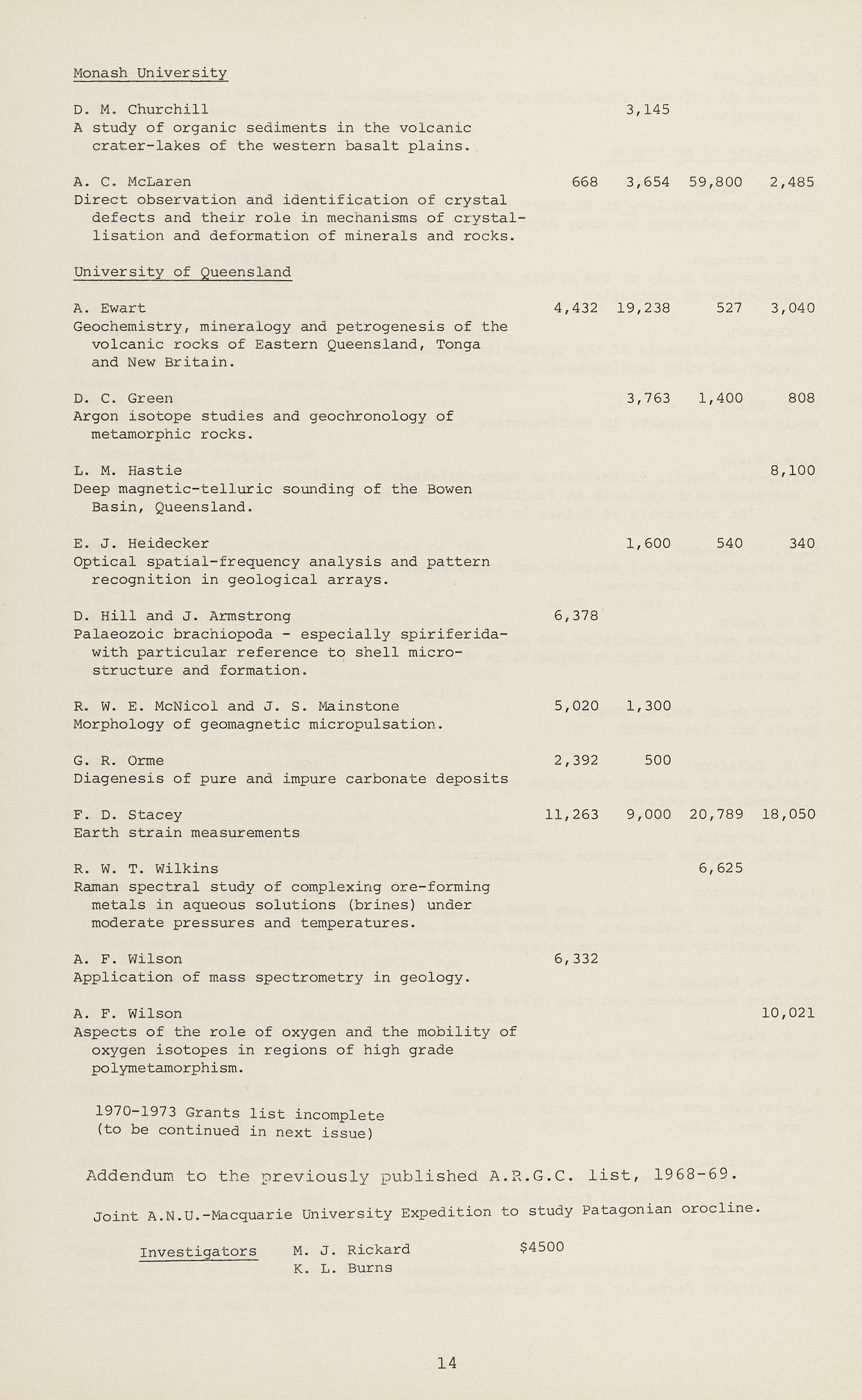
10,021
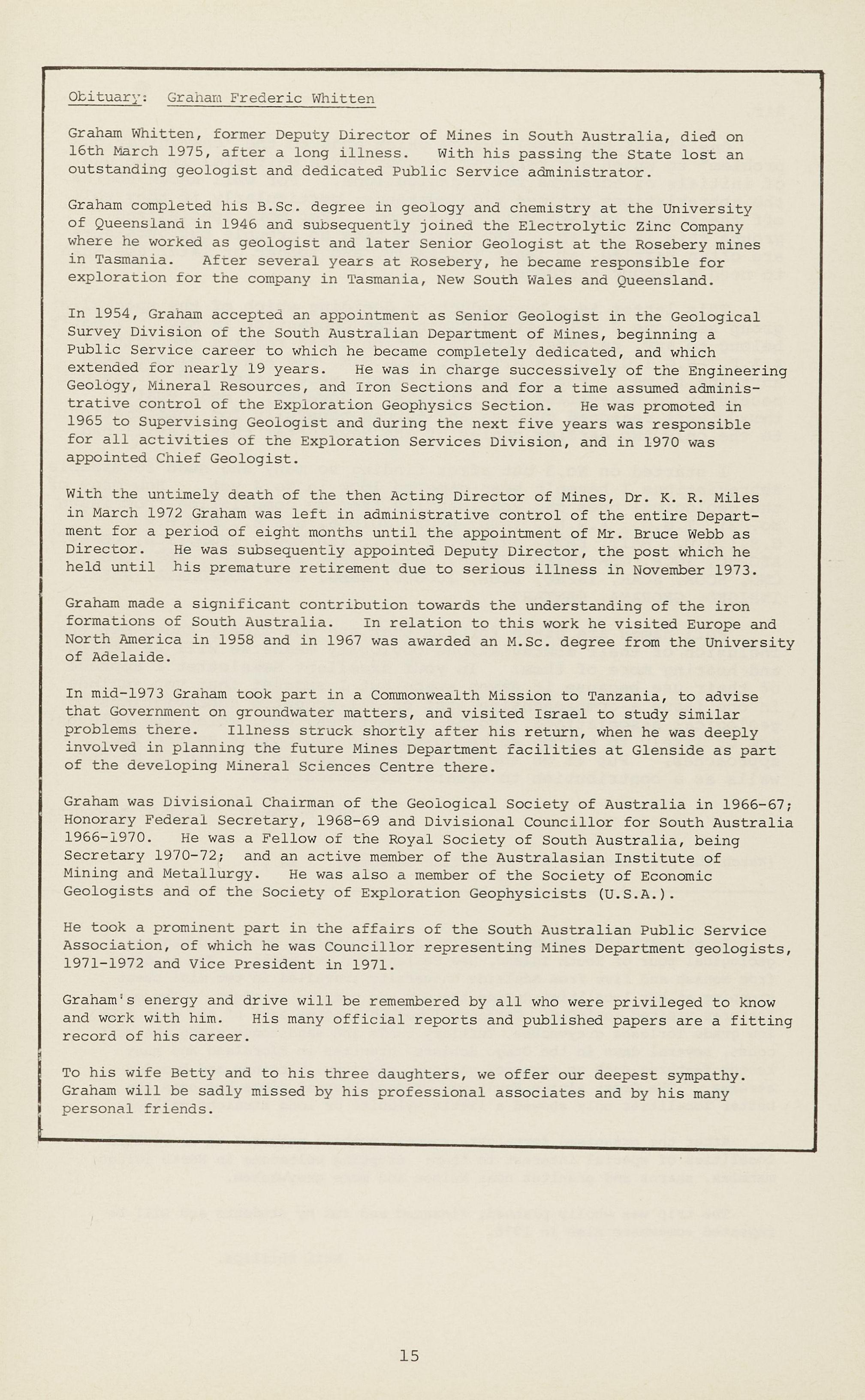
Ol:,ituary: Graham Frederic Wh itten
Graham Whitten, former Deputy Director of Mines in South Australia, died on 16th March 1975, after a long illness. With his passing the State lost an outstanding geologist and dedicated Public Service administrator.
Graham completed his B.Sc. degree in geology and chemistry at the University of Queensland in 1946 and subsequently joined the Electrolytic Zinc Company where he worked as geologist and later Senior Geologist at the Rosebery mines in Tasmania. Af~er several years at Rosebery, he became responsible for explora~ion for the company in Tasmania, New South Wales and Queensland.
In 1954, Granam accepted an appointment as Senior Geologist in the Geological Survey Division of the South Australian Department of Mines, beginning a Public Service career to which he became completely dedicated, and which extended for nearly 19 years. He was in charge successively of the Engineer i ng Geology, Mineral Resources, and Iron Sections and for a time assumed administrative control of the Exploration Geophysics Section. He was promoted in 1965 to Supervising Geologist and during the next five years was responsible for all activities of the Explor ation Services Division, and in 1970 was appointed Chief Geologist.
With the untimely death of the then Acting Director of Mine s , Dr. K. R. Mi les in March 1972 Graham was left in administrative control of the en tire Dep a rtment for a period of eight months until the appointment of Mr. Bruce Webb as Director. He was subsequently appointed Deputy Director , the post which he held until his premature retirement due to serious illness in November 1973.
Graham made a signi ficant contribution towards the understanding of the iron formations of South Australia. In relation to this work he visited Europe and North America in 1958 and in 1967 was awarded an M.Sc. degree from the University of Adelaide.
In mid-1973 Graham took part in a Commonwealth Mission to Tanzan i a , to adv i se that Government on groundwater matters, and visited Israel to study similar problems there. Illness struck shortly after his return , when he was deeply involved i n planning the future Mines Department facilities at Glenside as part of the developing Mineral Sciences Centre there.
Graham was Divisional Chairman of the Geological Society of Australia in 1966-67; Honorary Federal Secretary, 1968- 69 and Divisional Councillor for South Au stralia 1966-1970. He was a Fellow of the Royal Society of South Austra l ia , being Secretary 1970- 72; and an active member of the Australasian Institute of Mining and Metallurgy. He was also a member of the Society of Economic Geologists and of the Society of Exploration Geophysicists (U.S.A.).
He took a prominent par t i n the affairs of the South Australian Public Service Association, of which he was Councillor representing Mines Department geologists , 1971-1972 and Vice President in 1971.
Graham ' s energy and drive will be remembered by all who were privileged to know and work with him. His many official reports and published papers are a fitt i ng record of his career.
To his wife Betty and to his three daughters, we offer our deepest sympathy. Graham will be sadly missed by his profess ional associates and by his many personal fri ends.
Letter to the Editor
Sir,
One almost universal custom which adds to the "communications problem" to which y ou referred in your Mar ch editorial is the use of initials or acronyms for orga niz ations. For well known bodies the abbreviations achieve wide currency, particularly if they roll off the tongue and are well understood. For more specialized groups thi s is not so. The erudite have no trouble but outsiders are often baffled, at least initially, and sooner or later are sure to n ee d a memor y refresher.
This letter is a by-product of deciding which of the specialist group sessions I will attend during the Convention in May. I don't belong to any, perhaps I should , but on first reading the initials A.A.P., S.G.I.G.O.D., S.G.T.S.G., S.G.G.M. and A.S.G. didn't mean anything to me. Fortunately the papers were listed and it was not necessary to understand the initials. However, I made what I thoughtwere reasoned guesses and turned hopefully for confirmation to the only two earlier copies of the Newsletter that I still had.
I started on No.3 but after finding so many and such formidable abbreviations I haven't been game to look in No.4 y et. How many of the geologica l ones can you identify from my compilation from issue No. 3: I.G.C., A.N.U., IPOD, DSDP, JOIDES, G.S.A., M.M.B.W., C.S.I.R.O., WAIT, ERTS, ANZAAS, H.E.C., I.A.M.G., IUGS, ICG, CEPHPT, AZOPRO, IGCP, GSA-SGTSG, EFSEG, IAGOD, IAS, SEPM, IPA, APG, CMB, CMG, SCOR, SCAR, IAPSO, ECOR, ICOGEO, ASEG, AEG, COGEODATA, AESE, INHIGEO, GEORAMA, QANTAS?
Full names are given for all that are not widely known but the inclusion of their abbreviations obviously means we will be seeing and hearing more of them. In your excellent Newsletter I approve of their use because it saves space but I suggest that you include in one issue a comprehensive list of all accepted abbreviations of geological associations, groups, committees, etc. which are relevant now or likely to become so to Australian geologists as the IGC approaches. Put it on the centre pages and we can pin it on our wall s as a contribution to clearer communications.
Ian W. Reid. B.H.P. Melbour ne
[Watch the next issue of the Australian Geologist. Ed ]
In February 1975 the Mona sh University Geological Society organised a geological tour of South Island , New Zealand for two week s. Ten students from Monash and five fr om Adelaide University travelled in two mini buses stopping at key localities during the day and camping at night. The main features visited included: Tertiary limestone ba s ins east of the main Alps, low gr ade Torlesse greY"1ackes, Tertiary coals and sandstones along the west coast, several days in the Otago Schists, granites in Fiordland and many recent features such as terraced valleys, glaciers, moraines and braided streams. The Great Alpine Fault was crossed several times but even the better localities only showed a little mylonite or long straight valleys.
After the organised fortnight, several members returned to or visited localities of special interest to them : erupting volcanoe s in North Island, marbles, skarns and granites near Nelson and more greywackes.
The trip was wholly planned, financed and run by students and will be repeated somewhere else in 1976
Neil Phillips.