Acting Editor: Dr. Eric Middlemost,
Dept. Geology & Geophysics,
The University of Sydney
N. S. W 2006
Phone : Sydney 69 2-206 7
Society Office: Business Manager, Miss L.C. Tuckwell, Suite 9, 6th Floor, Perpetual Trustee Building, 39 Hunter Street, SYDNEY. N. S. W
Phone: Sydney 231-4696.
THE PRESIDENT'S PAGE
ELECTRONIC DATA PROCESSING technology has detonated this decade, figuratively outrunning the velocity of sound. Applications have sprouted like Jack's beanstalk in every field of geology, such as information storage and retrieval, plotting of maps and transformation of projections, visual presentation of geological and mine data, increased sophistication of geophysical interpretation, and the computation of physical and chemical properties of complex ore-forming fluids. Few areas of geology will remain untouched, not excluding this Society's own administration. Hence your executive has been considering whither, when, and how our procedures should be modified.
The Society's rolls, member status, circulation, and accounts have been machine - processed for some time, through the efforts of our Business Manager, Miss L.C. Tuckwell, and the former Administrative Officer, Mr. K G. Mosher, with the generous help of Kembla Coal. I offer tribute and thanks to all three. More could easily be done. Our membership roll could be published annually, cross-listed alphabetically, by domicile, by fields of specialisation, and by employment in surveys, academic, mineral industry, consultants, institutions , or retired, with divisional and specialist group lists.
To be worthy of our salt we should also be riding the detonation wave to maximise potential efficiency and economy. Hence a year or so ago Miss Tuckwell, Dr R J.G Lewis, and Professor K.L. Burns helped me in taking stock of the situation, whence I asked Professor Burns to prepare a preliminary report. Executive then requested the Administrative Officer, Mr. W.E. Foskett, to convene a committee with Miss Tuckwell and Mr. S. Kemp (of Kembla Coal) to follow up the Burns review, and prepare a report for Executive and the Townsville meeting of Council.
Meanwhile, since taking up his appointment in New York State, Professor Burns has fed this committee with masses of data on the current state of the art at the front. Notwi thstanding the generally depressed economy, the expected invasion of the small business market by microprocessors has proceeded apace; off-line floppy discs and hard discs are replacing unit record cards, magnetic tapes, cassette, and punched paper tape; visual display, even plasma display, with keyboard data entry, is universal; minimum memory is increasing to 32K and 64K and beyond; batch operations have been replaced by interactive systems; however, internal processing speeds of a million operations per second are still handicapped by slower data transfer and output.
Integrated circuits with 10,000 transistors in a single chip are now available in off-the-shelf small ($5,000) central processing units which offer a package including: 16K words metal-oxide-semiconductor memory; dual diskette drive; video terminal; two serial asynchronous ports, disc port, and parallel ports for printers and other interfaces; multifunction operation with Basic, Fortran, and Assembler. To this would need to be added $2,400 for a hard copy unit. This miniature machine offers more than the $100,000 machine of only a decade ago, in a small fraction of the space and power consumption.
Clearly the administration of even quite small organizations such as ours will be radically different a decade hence. Your executive has prepared the ground for those that follow to a timely harvest.
S Warren Carey
NEWSLETTER NO. 19. JULY, 1978
EDI'IDRIAL
I am constantly surprised by the number of acronyms that appear in letters sent to " The Australian Geologist" The following are some of those that appear in this copy of TAG : AGID , AIP , ASTEC , BMR, CLAIR , IGBA , IUS , NGO , RKNFSYS and UNCSTD Perhaps one of the first copies of the new journal "Open Earth " (See letter by Peter Smith) should carry a glossary of the acronyms used in the Earth Sciences
Dear Editor,
A recent workshop at the Sydney Science Centre , under the auspices of the Department of Foreign Affairs, considered the role of non - government organizations in assisting international development as part of Australia ' s preparations for the U. N. Conference on Science and Technology for Development. The Association of Geoscientists for International Deve lo pment is planning to submit a paper on the role of geosciences in development to the UNCSTD meeting to be held in Vienna in August 1979 As a counciller for AGID representing Australia and the Pacific region , I would be interested to hear from various non-government organizations, including the Geological Society of Australia , on their opinions and ideas related to the utilization of the geosciences for the benefit of the developing world. It is anticipated that a draft proposal will be prepared at the forthcoming AGID Council Meeting in Bangkok in November 1978 , after the 3rd Regional Conference of Geology and Mineral Resources of Southeast Asia
Yours sincerely,
Dear Sir ,
Dr M B Katz , School of Applied Geology
The University of New South Wales , P.O. Box 1 , Kensington , N S .W. 2033.
Pal inspastic Illustrations
The figure in front of me is from a reputable publication issued in 1 9 7 6 Four so - ca ll ed palinspastic maps of the Gondwanic continents around Australia are presented in this figure Map " A" shows the configuration during the Adelaidean, map " B " during the late Vendian and early Cambrian , map "C" shows the conditions in early Ordovician time and map "D" in late Ordovician through early Devonian On all four maps Timor Island and PapuaNew Guinea are shown in the position they occupy today despite the fact that the author is well aware that the rock masses building up Timor had not yet been deposited and were not finally emplaced before the beginning of the Cenozoic He is also wel l aware that the Coral Sea opened in early Eocene time, and moreover, that the neck of the bird ' s head in western West Irian was bent in Tertiary or later times.
It i s common practice to show the present general outline of large continental areas on palinspastic maps just to facilitate orientation , but islands and we ll defined crustal blocks can easily be eliminated , modified or moved i nto their correct position
A geologist watching a movie of Ceasar and Cleopatra would be horrified to see Ceasar ca ll ing Rome by radio-telephone , Cleopatra staring into a television screen , or waterskiing on the Ni l e behind a powerful motorboat
Dozens of "monstrosities " called palinspastic maps are published every year. It is suggested that the geolog i sts should spend as much time researching their reconstructions as the film makers spend researching their epics.
Emile Rod, 9 Minns Road, Gordon. N. S W 207 2
Dear Sir , Forensic Petrology
After reading Peter Meoskop ' s letter in the last issue of "The Australian Geologist" I wish to inform yo:.: that the Specialist Services and Applied Research Section of the Geological Survey of New South Wales in Sydney are , sometimes heavily, Jnvolved in forensic geology , or rather forensic petrology and mineralogy. This type of work is done · mostly by Dr. J .G Brynes , our sedimentary petro logist, and partly by myself in the capacity of a mineralogist.
It may well be that this "facinating field of endeavour" (as Peter Meoskop puts it) is on the increase , be it because of the increase in crime , or because the criminologists are increasingly aware of what we can do for them. A getting - together of interested geoscientists would not perhaps be such a bad idea.
Yours sincerely ,
Dr. Ervin Slansky Specialist Services & Applied Research Section
Geological Survey of N S W 36 George St , Sydney, 2000.
Dear Sir ,
Australian Institute of Geologists? - No
I wish to draw to the attention of my fellow earth scientists some of the unhappy consequencies that I foresee will arise with the introduction of a professional institute for geologists in Australia
I am a professional physicist and have been a member of the Australian Institute of Physics (AIP) for about 10 years. Before that , I observed the "brawls" between supporters of the UK Institute of Physics and the Physical Society. Through my subject speciality in geophysics and employment with the Bureau of Minerl Resources , Geology and Geophysics , I am very pleased to be a member of the GSA
From my observation of the AIP, it seems that its greatest weakness is its conservative rigidity of structure and preoccupation with " suitable " qualifications The nature of science these days requires interdisciplinary and specialist studies and the AIP has failed to accommodate specialist groups whose members are not "pure" physicists.
I cite as examples the demise of the Geophysics Group , the Biophysics Group and the Education Group from the AIP in recent years The members of these groups transferred their allegiance to other professional associations that had more flexible charters and similar professional standing What the AIP lost, the Australian Society of Exploration Geophysics , the Australian Society of Biophysics, the Australian Association of Physical Scientists in Medicine and the Australian Science Teachers Association gained.
I therefore appeal to the GSA membership not to divide the earth science population in Australia which is small compared with Europe and North America Being from UK myself , let us not mindlessly follow the " antics " of scientists in other countries and repeat their mistakes By all means have an internal reorganisation; I believe the GSA can quite easily accommodate all the worthy objectives outlined in Clive Nicholas ' s article in the May 1978 Australian Geologist I hope the conservative members of the GSA will not obstruct those changes which are necessary to achieve these objectives so that the Society will thrive and flourish in the real world.
Doug Finlayson , Bureau of Mineral Resources , Geology and Geophysics , Canberra, A C.T.
Dear Sir,
I am writing to you in my capacity as Chairman of the Australian Geomechanics Society , regarding the moves to form a Specialist Group in Engineering Geology within the G.S A.
The A G.S is worried about these moves , and would prefer that the authors of them devoted their energies to improving the geological content of Geomechanics Society activities. The Australian Geomechanics Society is affiliated with The International Association for Engineering Geology , The International Society for Rock Mechanics, and The International Society for Soil Mechanics and Foundation Engineering. It is recognised by each of these 3 bodies as being the National Group for each particular discipline
As you will see from the Statutes of the I.A.E.G. (attached) the A.G. S. therefore " represents the interests of Engineering Geology " in Austra lia. We do not think that the i nterests of engineering geologists would be served by their cutting themselv es off from the international community, which would be the effect of their withdrawing from their National Group If individual engineering geologists feel that A.G S activities are too "mechanical", the answer surely is for them to become more vocal in putting their views to the relevant committees At present there are 4 or 5 geologists on the National Committee and 5 on th e Victorian group committee , so that their interests should be well protected
I had conversations last year in Sweden with Professor Arnould , the President of the I.A.E.G. He has been concerned that there were 2 - rival bodies in U. S A (The Association of Engineering Geo logists, and The Engineering Geology Group of The Geological Society of America), neither of them affiliated with the I A.E.G. I understand that successful negotiations are in progress , to affiliate members of both bodies to the I.A.E.G. It would seem to be a retrograde step for Australians to be departing from the I.A E G when the largest single group of " hold - outs" is returning to the fold"
I would suggest that discussions between the Executive s of the G S A. and the A G S be resumed; this seems particularly appropriate , considering that later this year they will both be based in Melbourne. In the meantime I would respectfully suggest (as a member of the Geological Society of Australia of 15 years standing) that moves to form a specialist g-roup in engineering geo logy be deferred.
Yo urs sincerely,
W.E Bamford , Senior Lecturer in Rock Mechanics Dept of Mining & Metallurgy , University of Melbourne
Dear Sir,
It is requested that urgent consideration be given to the establishment of an Engineering Geologists Specialist Group which can affiliate with the International Association of Engineering Geology. At pre sent, affiliation is only possible through the Australian Geomechanics Society Members of the Institution of Engineers , Australia , and the Australasian Institute of Mining and Metallurgy are accepted in the Geomechanics Society at a reduced rate, but members of the Geological Society are not.
The Geomechanics Society is dominated by Engineers and it is not representative of Engineering Geologists. I am particularly concerned about this matter as thi.s Department employs 33 Scientific Officers of whom 24 are Engineering Geologists.
If further information is required, I can be contacted at the Department of Main Roads on 20933 , Extension 457, or 309 Castlereagh Street , Sydney.
Yours faithfully ,
E J. Minty. Dept. of Main Roads , N S. W.
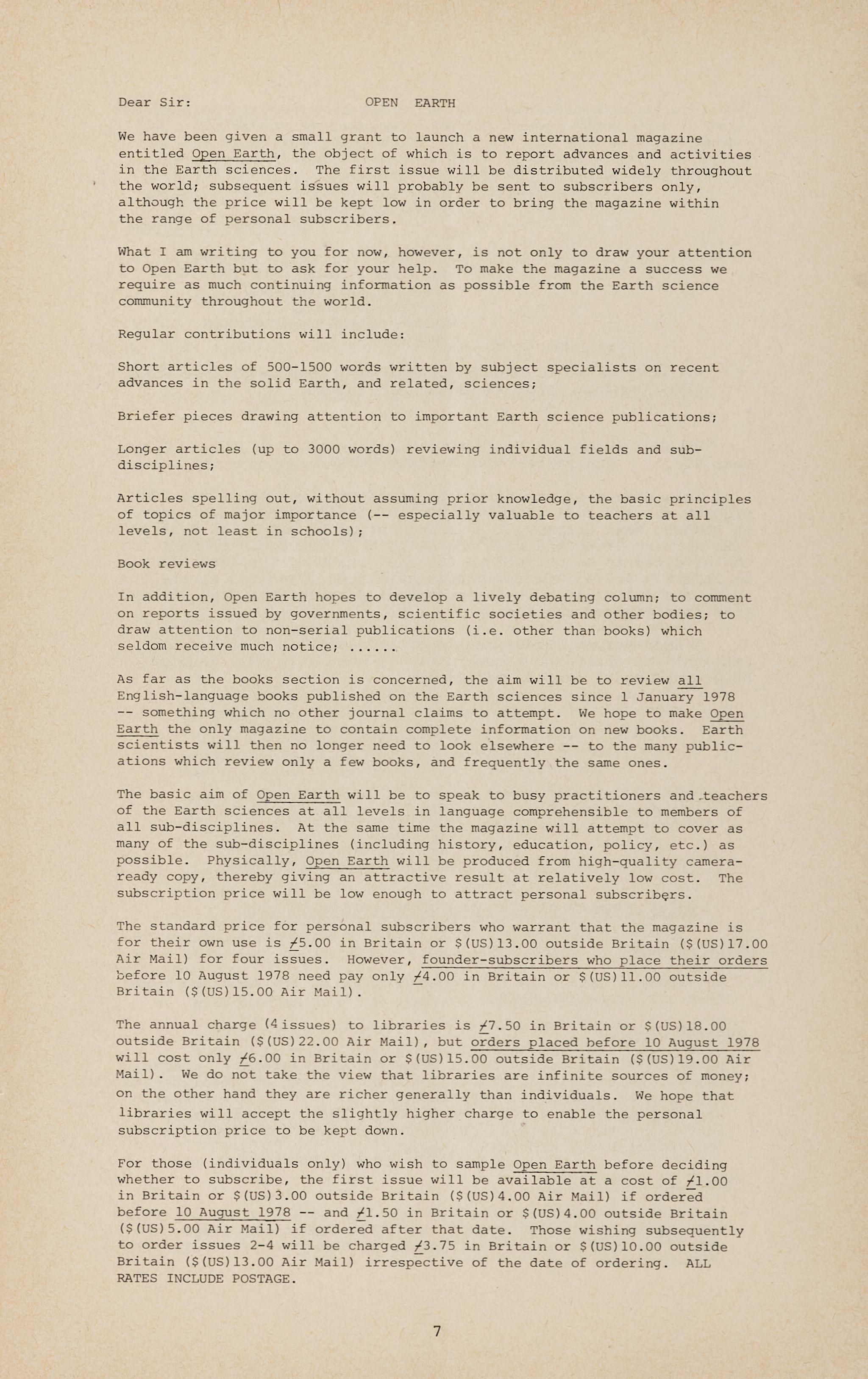
Dear Sir : OPEN EARTH
We have been given a small grant to launch a new international magazine entitled Open Earth , the object of which is to report advances and activities in th e Earth sciences
The first issue will be distributed widely throughout the world; subsequent issues will probably be sent to subscribers only , alth0ugh the price will be kept low in order to bring the magazine within the range of personal subscribers.
What I am writing to you for now , however, is not only to draw your attention to Open Earth but to ask for your help. To make the magazine a success we require as much continuing information as possible from the Earth science community throughout the world.
Regular contributions will include:
Short articles of 500 - 1500 words written by subject specialists on recent advances in the solid Earth , and related, sciences;
Briefer pieces drawing attention to important Earth science publications ; Longer articles (up to 3000 words) reviewing individual fields and subdisciplines;
Articles spelling out , without assuming prior knowledge , the basic principles of topics of major importance ( especially valuable to teachers at all levels, not least in schools) ;
Book reviews
In addition , Open Earth hopes to develop a lively debating column; to comment on reports issued by governments , scientific societies and other bodies ; to draw attention to non - serial publications (i.e other than books) which seldom receive much notice;
As far as the books section is concerned , the aim will be to review all English - language books published on the Earth sciences since 1 January1978 something which no other journal claims to attempt We hope to make Earth the only magazine to contain complete information on new books Earth scientists will then no longer need to look elsewhere to the many publications which review only a few books , and frequently the same ones
The basic aim of Open Earth will be to speak to busy practitioners and teachers of the Earth sciences at all levels in language comprehensible to members of all sub - disciplines. At the same time the magazine will attempt to cover as many of the sub-disciplines (including history , education, policy , etc.) as possible Physically , Open Earth wi 11 be produced from high - quality cameraready copy , thereby giving an attractive result at relatively low cost. The subscription price will be low enough to attract personal subscribE;?rs.
The standard price for personal subscribers who warrant that the magazine is for their own use is t_5.00 in Britain or $(US)13 00 outside Britain ($(US)l7 00 Air Mail) for four issues However , founder - subscribers who place their orders before 10 August 1978 need pay only i_4.00 in Britain or $(US)ll.OO outside Britain ($(US)15.00 Air Mail).
The annual charge (4issues) to libraries is /7 50 in Britain or $(US)l8 00 outside Britain ($ (US) 22.00 Air Mail), but o~ders placed before 10 August 1978 will cost only /6.00 in Britain or $(US)l5 00 outside Britain ($(US)19.00 Air Mail). We do n~t take the view that libraries are infinite sources of money; on the other hand they are richer generally than individuals We hope that libraries will accept the slightly higher charge to enable the personal subscription price to be kept down.
For those (individuals only) who wish to sample Open Earth before deciding whether to subscribe , the first issue will be available at a cost of fl.00 in Britain or $(US)3 00 outside Britain ($(US)4.00 Air Mail) if order;d before 10 August 1978 and fl. 50 in Britain or $ (US) 4. 00 outside Britain ($ (US) 5 00 Air Mail) if order;d after that date. Those wishing subsequently to order issues 2-4 will be charged f3 75 in Britain or $ (US) 10.00 outside Britain ($(US)13.00 Air Mail) irresp;ctive of the date of ordering. ALL RATES INCLUDE POSTAGE
Would you please note that the whole run of the first issue will be distributed; in other words, issue 1 will not subsequently be available as a back issue
Thank you again,
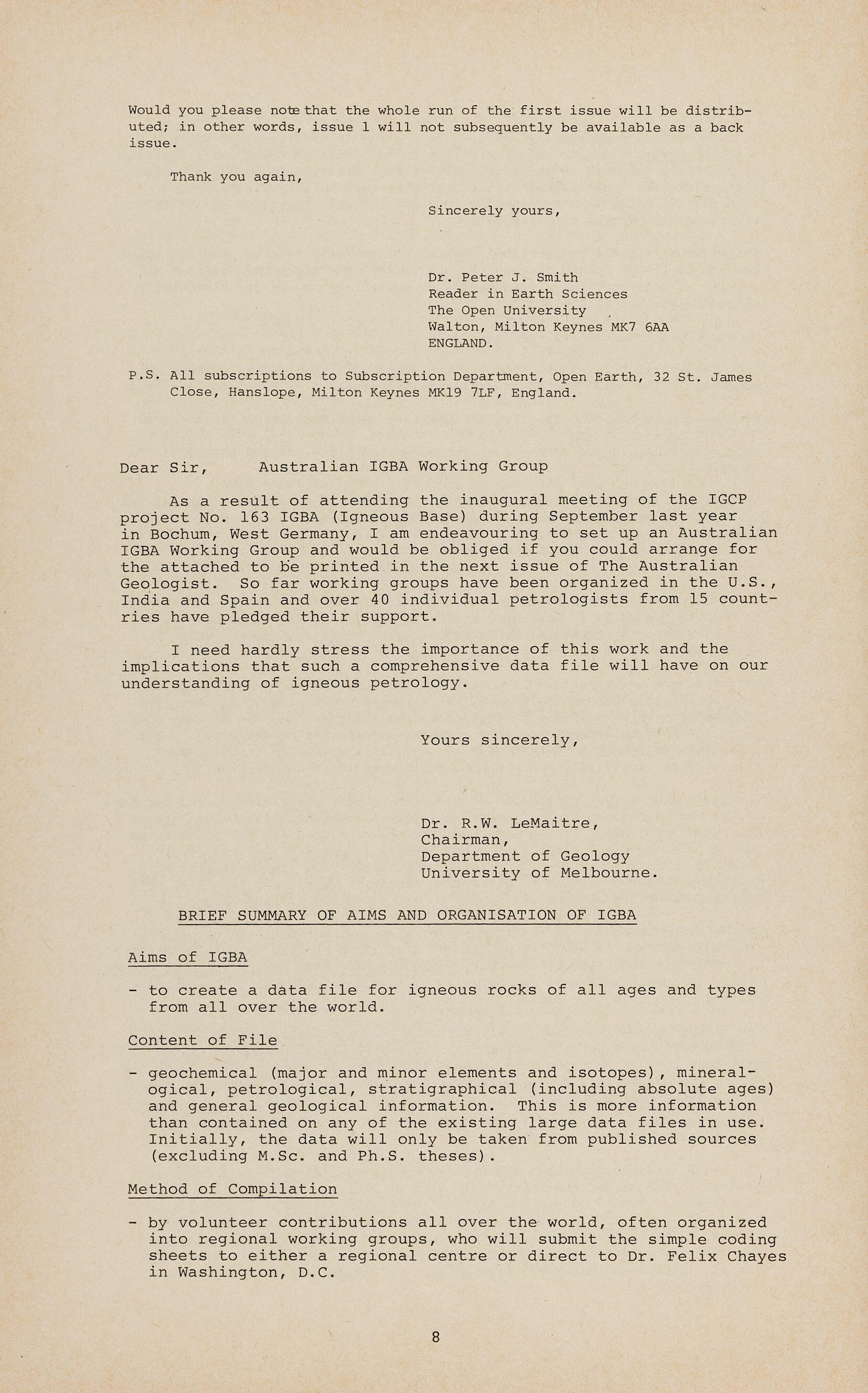
Sincerely yours,
Dr. Peter J. Smith Reader in Earth Sciences
The Open University Walton, Milton Keynes MK7 6AA ENGLAND.
P S All subscriptions to Subscription Department, Open Earth , 32 St James Close , Hans lope, Milton Keynes MK19 7LF, England.
Dear Sir, Australian IGBA Working Group
As a result of attending the inaugural meeting of the IGCP project No. 163 IGBA (Igneous Base) during September last year in Bochum, West Germany, I am endeavouring to set up an Australian IGBA Working Group and would be obliged if you could arrange for the attached to be printed in the next issue of The Australian Geologist. So far working groups have been organized in the U.S., InJia and Spain and over 40 individual petrologists from 15 countries have pledged their support.
I need hardly stress the importance of this work and the implications that such a comprehensive data file will have on our understanding of igneous petrology.
Yours sincerely,
Dr. R.W. LeMaitre, Chairman, Department of Geology University of Melbourne.
BRIEF SUMMARY OF AIMS AND ORGANISATION OF IGBA
Aims of IGBA
- to create a data file for igneous rocks of all ages and types from all over the world.
Content of File
geochemical (major and minor elements and isotopes), mineralogical, petrological, stratigraphical (including absolute ages) and general geological information. This is more information than contained on any of the existing large data files in use. Initially, the data will only be take~ from published sources (e xcluding M.Sc. and Ph.S. theses).
Method of Compilation
- by volunteer contributions all over the · world, often organized into regional work ing groups, who will submit the simple coding sheets to either a regional centre or direct to Dr. Felix Chayes in Washington, D.C.
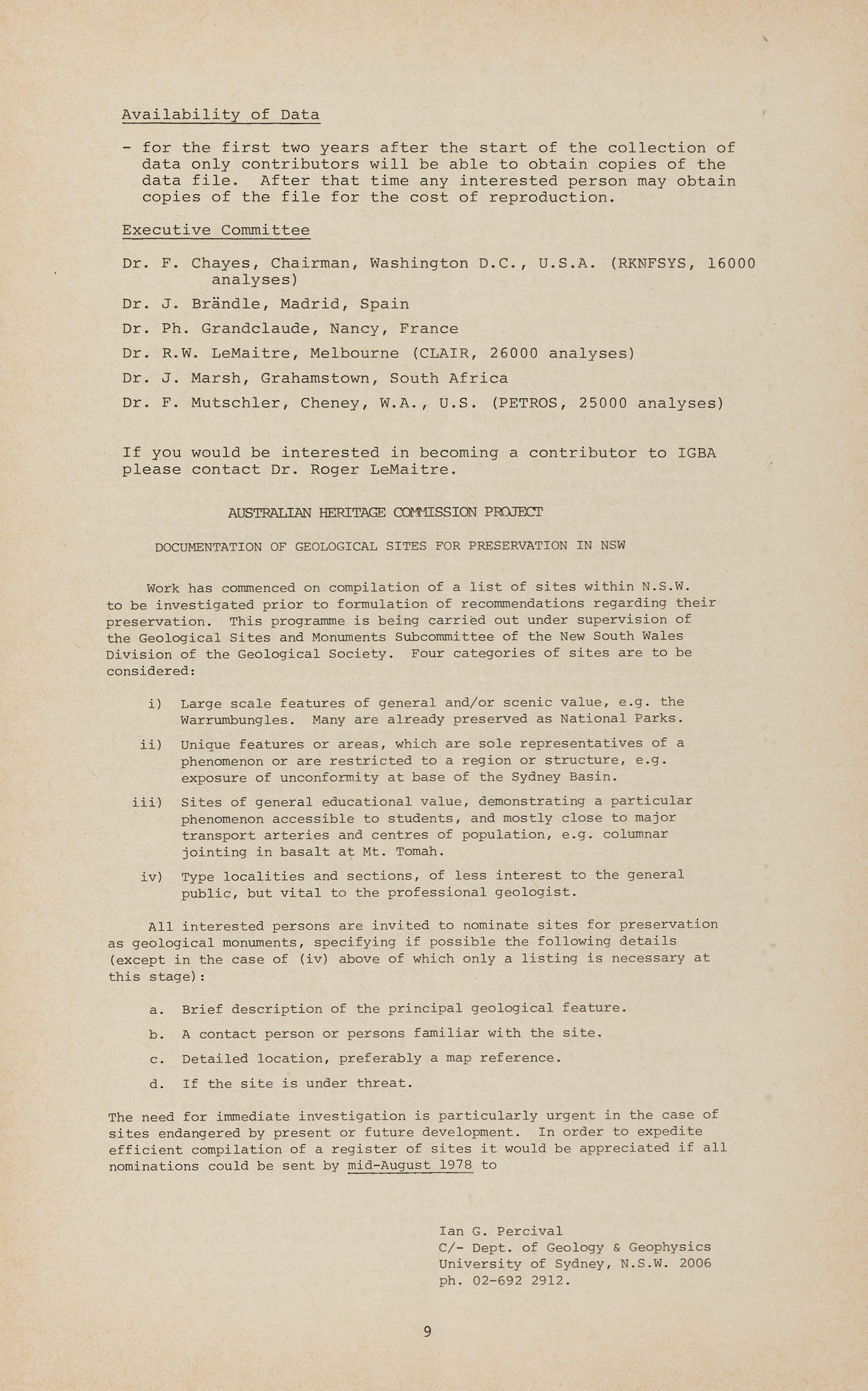
Availability of Data
- for the first two years after the start of the collection of data only contributors will be able to obtain copies of the data file. Af t er that time any interested person may obtain copies of the f il e for the cost of reproduction.
Executive Committee
Dr. F. Chayes, Chairman, Washington D.C., U.S.A. (RKNFSYS, 16000 analyses)
Dr. J. Brandle, Madrid, Spain
Dr. Ph. Grandclaude, Nancy , France
Dr. R.W. LeMaitre, Melbourne (CLAIR, 26000 analyses)
Dr. J. Marsh, Grahamstown, South Africa
Dr. F. Mutschler, Cheney, W.A., U.S. (PETROS, 25000 analyses)
If you would be interested in becoming a contributor to IGBA please contact Dr. Roger LeMaitre.
AUSTRALIAN HERITAGE CCH'!ISSION PIDJECT
DOCUMENTATION OF GEOLOGICAL SITES FOR PRESERVATION IN NSW
Work has commenced on compilation of a list of sites within N S W to be investigated prior to formulation of recommendations regarding their preservation This programme is being carried out under supervision of the Geological Sites and Monuments Subcommittee of the New South Wales Division of the Geological Society Four categories of sites are to be considered:
i) Large scale features of general and/or scenic value, e g the Warrumbungles Many are already preserved as National Parks.
ii) Unique features or areas , which are sole representatives of a phenomenon or are restricted to a region or structure, e g exposure of unconformity at base of the Sydney Basin.
iii) Sites of general educational value, demonstrating a particular phenomenon accessible to students, and mostly close to major transport arteries and centres of population , e.g. columnar jointing in basalt at Mt Tomah
iv) Type localities and sections , of less interest to the general public , but vita l to the professional geologist.
All interested persons are invited to nominate sites for preservation as geological monuments , specifying if possible the following details (except in the case of (iv) above of which only a listing is necessary at this stage) :
a. Brief description of the principal geological feature.
b. A contact person or persons familiar with the site.
c Detailed location , preferably a map reference
d. If the site is under threat.
The need for immediate investigation is particularly urgent in the case of sites endangered by present or future development In order to expedite efficient compilation of a register of sites it would be appreciated if all nominations could be sent by mid-August 1978 to
Ian G. Percival C/ - Dept. of Geology & Geophysics
University of Sydney, N S. W. 2006 ph 02-692 2912
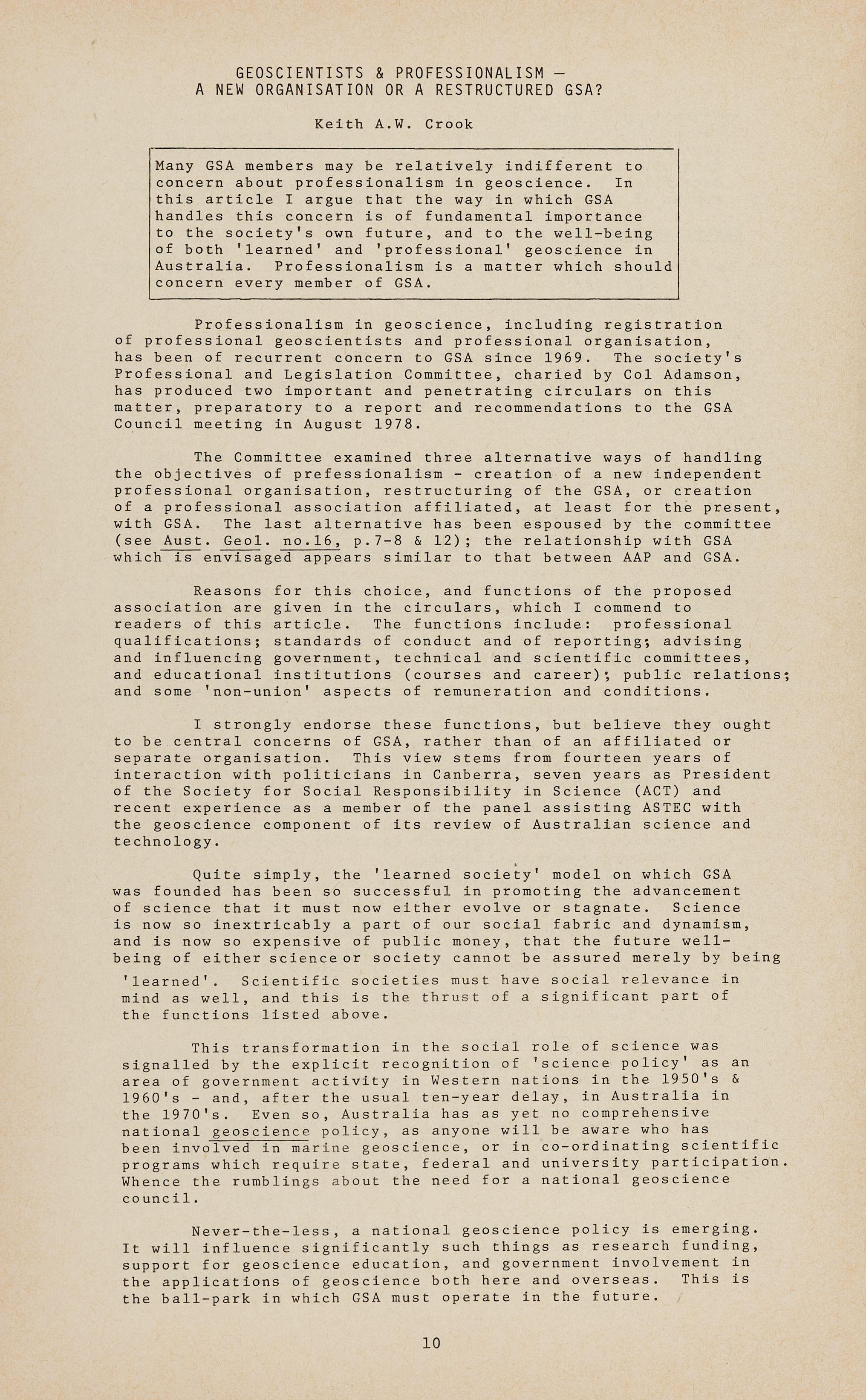
GEOSCIENTISTS & PROFESSIONALISMA NEW ORGANISATION OR A RESTRUCTURED GSA?
Keith A.W. Crook
Many GSA members may be relatively indifferent to concern about professionalism in geoscience. In this article I argue that the way in which GSA handles this concern is of fundamental importance to the society's own future, and to the well-being of both 'learned' and 'professional' geoscience in Australia. Professionalism is a matter which should concern every member of GSA.
Professionalism in geoscience, including registration of professional geoscientists and professional organisation, has been of recurrent concern to GSA since 1969. The society's Professional and Legislation Committee, charied by Col Adamson, has produced two important and penetrating circulars on this matter, preparatory to a report and recommendations to the GSA Council meeting in August 1978.
The Committee examined three alternative ways of handling the objectives of prefessionalism - creation of a new independent professional organisation, restructuring of the GSA, or creation of a professional association affiliated, at least for the present, with GSA. The last alternative has been espoused by the committee (see Aust. Geol. no.16, p.7-8 & 12); the relationship with GSA which---rs-envisaged appears similar to that between AAP and GSA.
Reasons for this choice, and functions of the proposed association are given in the circu lars, which I commend to readers of this article. The functions include: professional qualifications; standards of conduct and of reporting; advising and influencing government, technical and scientific committees, and educational institutions (courses and career); public relations; and some 'non-union' aspects of remuneration and conditions.
I strongly endorse these functions, but believe they ought to be central concerns of GSA, rather than of an affiliated or separate organisation. This view stems from fourteen years of interaction with politicians in Canberra, seven years as President of the Society for Social Responsibility in Science (ACT) and recent experience as a member of the panel assisting ASTEC with the geoscience component of its review of Australian science and technology.
Quite simply, the 'learned society' model on which GSA was founded has been so successful in promoting the advancement of science that it must now either evolve or stagnate. Science is now so inextricably a part of our social fabric and dynamism, and is now so expensive of public money, that the future wellbeing of either science or society cannot be assured merely by being 'learned'. Scientific societies must have social relevance in mind as well, and this is the thrust of a significant part of the functions listed above.
This transformation in th e social role of science was signalled by the explicit recognition of 'science policy' as an area of government activity in Western nations in the 1950's & 1960 1 s - and, after the usual ten-year delay, in Australia in the 1970's. Even so, Australia has as yet no comprehensive national geoscience policy, as anyone will be aware who has been involved in ma r i ne geosc ience, or in co -ordin ating scientific programs which requi re state, federal and university participation. Whence the rumblin gs a bout the need for a national geoscience council.
Never-the-less, a national geoscience policy is emerging. It will influence significantly such things as research funding, support for geoscience education, and government involvement in the applications of geoscience both here and overseas. This is the ball-park in which GSA must operate in the future.
An effective national geoscience policy requires effective involvement of geoscientists in its formulation. This can best be achieved through the aegis of an active and authoritative GSA which is both ' learned' and ' professional ' or, as I prefer to put it, both expert and socially relevant
Many questions on which geoscience advice should be sought will involve hard decisions about allocation of resources. I anticipate significant diversity of views among geoscientists on some of these questions, correlating with their predominantly academic or predominantly applied work experience. GSA has the choice : to contain this diversity within itself and seek for a creative synthesis, or to confine itself to the academic viewpoint, leaving the applied viewpoint to a professional association that would, after the fir?t major difference of views, be effectively, if not actually, independen t of GSA .
I know of no better method to encourage inaction or inappropriate action by politicians than to confront them with conflicting expert advice. Geoscientists have a responsibility to both their science and their society to sort out their own priorities and their justifications before seeking their adjudication in a wider forum
Successive GSA Councils and Executives have, in recent years, grappled increasingly with issues that extend well into realms professional Success has varied, but it is apparent that present arrangements - constitutional, financial . and proceduralare often a hindrance. The principal problems arise from difficulties of communication, infrequent meetings of Council and Committees and the amount of time which can be devoted by honorary office-bearers, however dedicated. Effective handling of many 'professional' questions demands pro'mpt action, a spate of STD phone calls and travel by one or two key people to various places. This points up the twin needs of finance and time, though people have a great capacity to find the time if the issue is immediate enough and the way to effective action is open
To overcome these difficulties and to meet the needs described above, GSA will have to be restructured, and I suggest the following changes as a basis for discussion.
1 Enlargement of the society's aims and functions to include those identified by the Professional and Legislation Committee.
2. Three levels of memberships: Associate (as now); Ordinary (present full membership) and Professional. Dues for the first two would be as now exclusive of subscription for the Journal Pro f essional dues would be present dues less Journal subscription plus $10 - $15. All members would pay separately for the Journal if they wished to receive it.
3 Application of the increased income to further the enlarged aims and functions, including its use to improve speed and effectiveness of communication by greater use of telephones, travel by society officers and committee members and special meetings of the GSA Council.
4. Direct election of the President (as President-designate) followed 2 years later by direct election of rest of the executive, nominations for secretary and perhaps some other officers being limited to members of the incoming President's division.
5. More frequent publication of 'The Australian Geologist ' supported by paid editorial assistance.
Whatever the views of GSA members on professionalism, the issues it raises appear to require discussion, and possibly plebiscite, by the whole membership of the society.
K.A.W.C. I Dept. Geology, A N.U.; Canberra.
49th ANZAAS CONGRESS
New Zealand Geology Tour
The 49th Congress of ANZAAS will be held in Auckland, 22 - 26 January, 1979.
The Geology and Mining Section of the Congress, with the assistance of the N.Z. Geological Survey, is arranging various field excursions and these include a volcanological - geothermal tour lead b y Dr. David Skinner of the Otara (Auckland) office of hlle Surve y The excursion is designed specifically for professional geologists
Details of the e x cursion are listed here:
ANZAAS TOUR Gl (Volcanology , geothermal, mineralisation)
Leader: D.N.B. Skinner
with assistance from the Rotorua and Lower Hutt offices of N.Z. Geological Survey.
Limit: 38 persons
The tour will be 7 days , Auckland to Auckland , and will co ve r the Cenozoic volcanic and geothermal histor y of the central and north - eastern North Island of New Zealand (Central and Hauraki Vo lcanic Regions ) from e arl y Miocene to the present day; this will include sub - vo lcan ic plutonism , hydrothermal alteration and the gold/silver/base metal epitherma l mineralisation of the Coromandel region , the geothermal resource at Wairakei, the Quaternary se quen ces of Rotorua/Taupo , and the active vo lcanoes of Central North Island. A scenic flight is planned over Mayor Island-White Island-Tarawera - Tongariro-Ruapehu-Ngaururhoe, and there will be an opportunity to climb Raupehu (tramping boots and parka are necessary). Accommodation will be in motels and moderately priced hotels e xcept at Ruapehu and Waitomo where N.Z. Tourist Hotel Corporation hotels wil l be used. Costing is on a twin share basis, but motels can take up to 4 per room. Cut lunches will be provided where necessar y Air New Zea land quotes for the scenic flight are about $40/person for two hours, limited to 38 passengers plus 2 guides. Distance is about 1400 km. Cost estimated to be about NZ$250 but this could be more or less depending on inflation and bulk booking rates in 1979. All meals are included in the estimate but some dinners may be a la carte.
HOBART 1980
Arrangements are we ll in hand for the Convention after the Townsville meeting. Wit h only sixteen months between Conventions it is necessa r y fo r acco mm odation bookings to be made prior to the rece i pt of first c ir c ular replies The 4th Convention will be held from Monday 4th January to Friday 18th January , 1980. This period is at the very peak of Tasmania ' s tour i st season and accommodation is e xceptionall y difficult to arran ge in Hobart at that time, consequently booking s have to be made well in advance
All those who are likely to come to this Convention are therefo re asked to fill out the fo rm p r ovided as it is possible that a limi t wi ll have to be placed on attendance. Replies shou ld be in to the Secretary by 1 3t h September , 1978 :
Name : Mr. P R William s , Geol ogi cal Survey of Tasma n i a , G P O Box 1 24B , HOBART
Tasmania 70001
I wish to attend the 1980 Convention i n Hobart and will be accompanied by others I/We prefer Hotel/Motel/ University College , accommodat i on .
INTERNATIONAL URANIUM
SUMPOSIUM ON THE PINE CREEK GEOSYNCLINE
SYDNEY , AUSTRALIA
JUNE 4-8 , 1979
ORGANISED BY:
The Pine Creek Geosyncline Study Group
SPONSORED BY:
The Bureau of "liner al Resources , Geology & Geophy sir-s, The Minerals Research Laborator ies of C.S.I.R.O.
IN CO - OPERATION WITH :
The International Atomic Energy Agency , Vienna
PURPOSE OF THE SYMPOSIUM :
Of the western world ' s Reasonably Assured Resources of uranium over 20% is located in the Pine Creek Geosyncline in the Northern Territory of Australia. This fact prompted an intensive co - ordinated study by the Bureau of Mine ral. Resources , Geology and Geophysics {BMR) , Minerals Research Laboratories {MRL) of the Commonwealth Scientific and Industrial Research Organization {CSIRO) , and certain companies involved in the uranium industry.
The Pine Creek Geosyncline Study Group was formed with a representative from BMR , CSIRO and Industry to co - ordinate these research activities during the past three years This group constitutes the Organizing Committee for the Symposium
SCIENTIFIC SCOPE & CONTRIBUTED PAPERS :
It is expected that over 40 papers on original work on the Geosyncline and uranium occurrences will be presented at the Symposium. These papers are the result of studies of geology , geophysics , tectonics and geochemistry of the Lower Proterozoic Pine Creek Geosyncline and the uranium orebodies.
Topics covered in papers to be presented include:
a regional and local geology
b geophysics
c geochemistry
d tectonic setting
e . petrology
f. exploration techniques.
Contributed papers on original work on the above areas and papers dealing with Lower Proterozoic uranini te deposits in other parts of the world , revelance to exploration in other parts of the world , and search for natural fission reactors in the Pine Creek Geosyncline will be welcome
The final scientific sessions will be devoted to panel discussions of the work presented and to summarize the proceedings
Authors submitting papers relating to the purpose of the Symposium must forward a title and short abstract (250 - 300 words) by 1 December , 1978 , for consideration This abstract will be used as a guide by the Organizing Committee in assessing whether a proposed paper can be accepted for presentation. Final edited extended abstracts from approved contributors will be required by 1 March , 1979 A full text of the final paper must be presented with illustrations on the first day of the Symposium
PROGRAMME OUTLINE :
Sunday June 3 Registrations - Wentworth Hotel
Monday June 4
Tuesday June 5
Wednesday June 6
Registrations
Official Opening First Scientific Session, followed by Cocktails & Dinner - Sydney Opera House
Scientific Sessions
Scientific Sessions
Thursday June 7 Scientific Sessions "Australian Bush Evening " - dinner & entertainment
Friday June 8 Scientific Session
Summation and Conclusion
POST SYMPOSIUM - Field Trip
June 9 - 13
Depart Sydney 2 p m. for Darwin to tour Pine Creek Geosyncline area and uranium deposits , finishing Darwin on 13 June
REGISTRATION FEE will be A$250 (A$60 for accompanying guest s) provided that the Registration is received before l February, 1979. Thereafter, the Registration Fee will be A$275
ENTITLEMENTS Those who pay the full Registration Fee will be e nt.t Le d to :
Receive a bound volume of extended abstracts on registration in Sydney
Attend the Offic ial Opening followed by cocktails & dinner at the Sydney Opera House.
Attend all Symposium sessions. Morning and afternoon coffee and lunch Tuesday to Friday
Attend the "Australian Bush Evening " featuring Australian catering , wine s, beer , cheeses and entertainment
Receive a bound copy of the Record of Proceedings to be mailed after the Symposium
SYMPOSIUM SECRETARIAT :
For information on all aspects of the Symposium ' write to:
The Executive Secretary , I. U.S on Pine Creek Geosyncline, P .0. Box 387 , Grosvenor Street , SYDNEY N S W 2000
AUSTRALIA
SYMPOSIUM ORGANIZING COMMITTEE :
Dr. John Ferguson , BMR
Dr Geoff H. Taylor , CSIRO
J C Rowntree , Pancontinental Mining Limited
V L.R. Furlong , Executive Secretary
S YMPO S IUM
THE CR UST AND UP PER MAN T LE OF SOUT HEA S T AUST RA LIA 1 3 - 14 Feb ru a r y 1979 , Can berra
This symposium seeks to bring together the results of recent and current work on the structure , composition and tectonic development of the crust and upper mantle in southeast Australia.
Persons wishing to contribute to the symposium should submit titles and return a completed registration form to the organising committee not later than 28 September 1978. Abstracts will be called for after the papers have been accepted
A three - day excursion l ed by Dr Bruce Chappell will be conducted on 15 - 17 February 1979 Final details are not yet available , but the approximate itinery is: 15 Feb Jubiong Kimberlite , Snowy Mountains Highway, Cooma ; 16 Feb Cooma Complex , Kosciusko Batholith ; 17 Feb Berridale Batholith. The excursion cost will depend on the number of participants
. Registration for ms are available fro m c/ - Dr D Denham , Bureau of Minera l Resources , P O Box 378 , CANBERRA , ACT 2601
The symposium is sponsored by : the Department of Geology , Australian National University ; the Bureau of Mineral Resources , Geo log y and Geophysics ; and the Geological Society of Australia
FOR SALE
Varian-Techtron AA4 Atomic Absorption Spectrometer. Unit includes Ducting, Exhaust fan, a range of burners and other ancillary equipment. Sale price approximately $2,500,00. For details contact
The Director, W.S. & L.B. Robinson University College
P.O. Box 334 BROKEN HILL, N.S.W. 2880 Telephone (080) 6022.
GONDWANA GEOLOGY
A meeting, devoted to recent contributions to Gondwana geology, was held by the Soci€t€ Geologique du Nord on the 8th December 1977 at Lille University (France). It was jointly organised and presided over by Dr. Guy BLANT of the Societe Nationale Elf-Aquitaine and Prof. Michel WATERLOT of Lille University. More than twenty papers were presented to an audience of some one hundred scientists. The meeting centred around three main topics
Palaeogeography and Tectonics Paleo zoology Paleobotany
These works will be published in July 1978 in a special edition of the -Annales de la Societe Geologique du Nord-, and can be obtained from Societe Geologique du Nord, Sciences de la Terre, B.P. 36 - 59650 Villeneuve D'Ascq., France.
Project 156
PHOSPHORITES, Proterozoic - Cambrian International field workshop and seminar Mount Isa area August 14-20 Magnetic Island August 21 - 23
Conveners: P.J. Cook , Research School of Earth Sciences, ANU, Canberra and J.H. Shergold, Bureau of Mineral Resources, Geology and Geophysics, Canberra, A.C.T.
VICTORIAN QUATERNARY GROUP
Friday 28 July 1978 2. 30 pm Department of Geography, Monash University Seminar "Evidence of Late Quaternary Climate and Vegetation from Palynological Studies in the Southeastern Highlands and Gippsland area" Speakers: Peter Kershaw, Phil Ladd and others. Convener: Peter Kershaw 541 0811
Friday 15 September 1978 2. 30 pm Department of Geology, University of Melbourne Seminar "Recent Lake Studies in Southeastern Australia" Speakers: Jim Bowler, Girdip Singh, Phil Macumber and others Convener; Bernie Joyce 345 1844.
AUSTRALIAN GEOMECHANICS SOCIETY (Victoria Group)
Forum on "Liability in Geomechanics" 6.00p.m., August 9, Clunies Ross House, Parkville, Victoria.
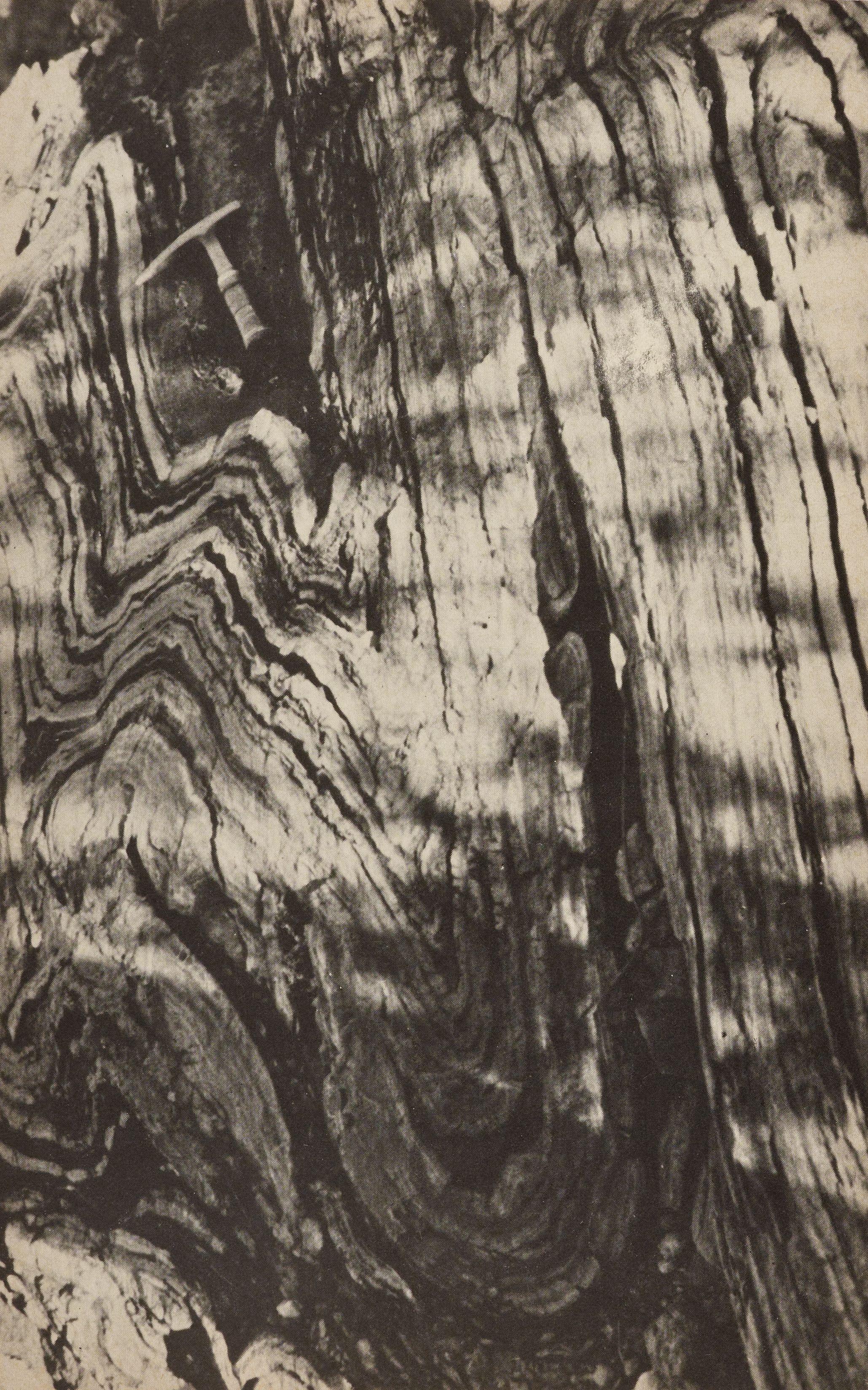
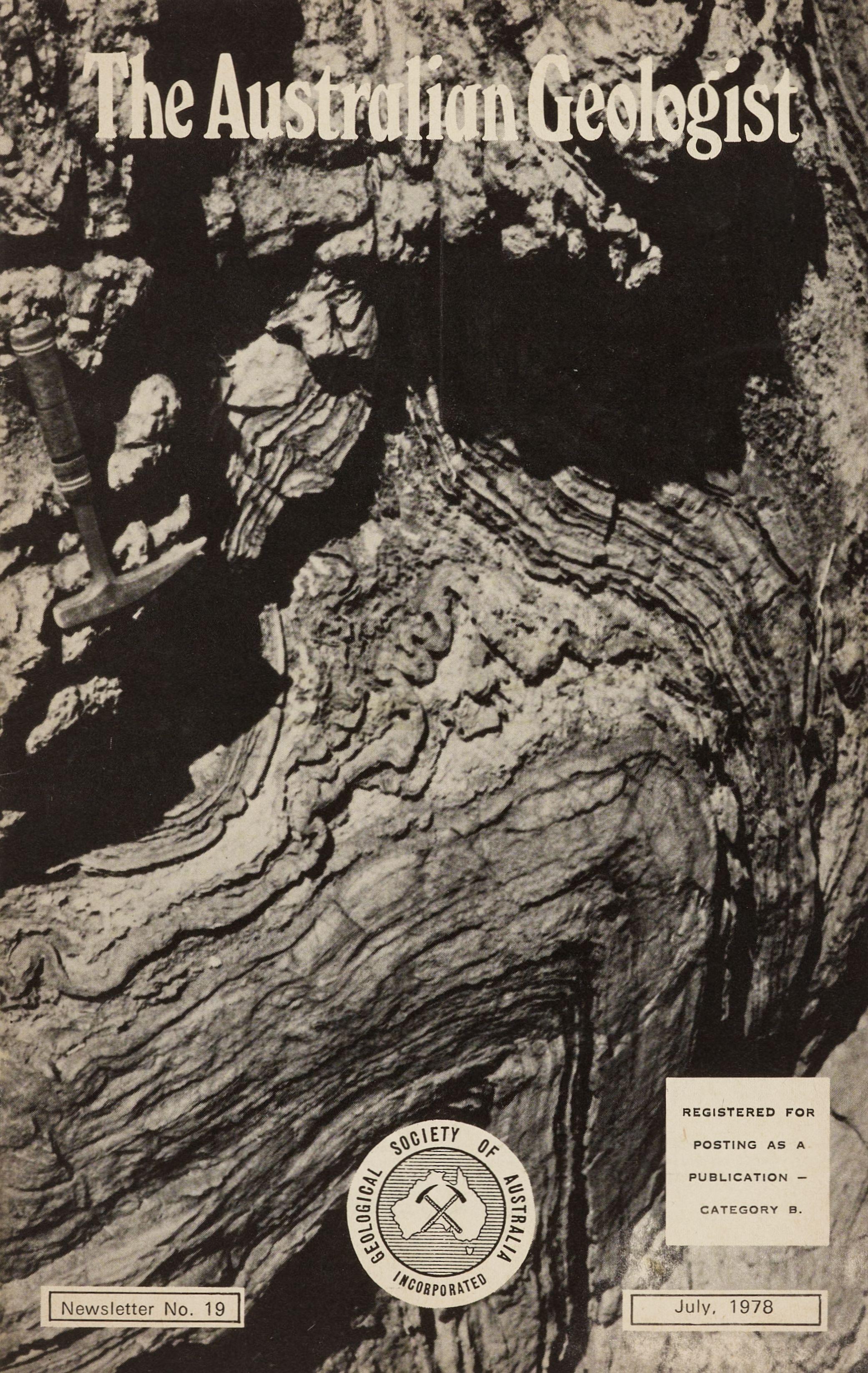
Cover photographs: Folding in the calc-silicate rocks of the Wickstead Cr e ek Beds, Arunta Complex, Central Australia• ( Pe ter W Green, phot o l .