-The Australian Geologist
EXEC UTIVE 1973-1975
Ho n Federal Se cr e tary
G P la y ford
Hon. r:ditor
K A Townley
Soci ety Offic e
Gemmo l ogy Hou s e, 24 Wen tworth Av e nu e , Sydne y , 2010
Miss Laurel Tuckwell, Assistant Secre tary.
' p hon e : 61-9504.
Ne ws lett e r Editor
David Branagan,
Pre sident
Dorothy Hill
Vice Presidents
D. A. Brown G. ~1. Philip of Geology and Geophysics, University of Sydney, Sydn ey , N S .W. 2006.
Hon. Federal Treasurer
R. J. Paten
Hon. Administrative Officer
K. G. Mosher
Councillors Qld. Division
J. S . Jell
K. R. Warner
' p hone : 660-0522, extn. 2350 or 2912.
I OU R COVER PHOTO - II ·
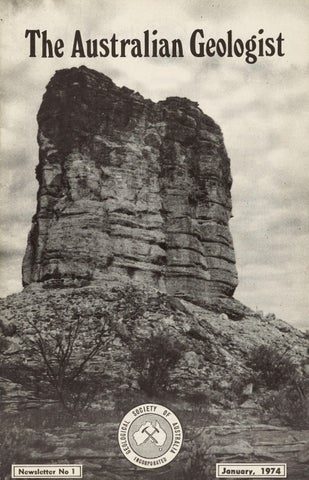
Chambers Pillar, N.T., was seen by John MacDougall Stuart on 6 April 1862 when he found himself making toward 'a remarkable hill which at this distance has the app earance of a locomotive with its funnel'.
'It is a p illar of sandstone, standing on a hill upwards of 100 feet in height From the base to the top of the pillar it is 105 feet, twenty feet wide by ten feet deep, and quite perp endicular, with two peaks on the top. This I have named Chambers's Pillar, after James Chambers, Esq., of Adelaide, one of the promoters of all my expeditions. To the N. and N.E. of it are a number of remarkable hills, which have the appearance of old castles in ruins, and ar e standing in the midst of sandhills.'
Chambers Pillar is an outcrop of the Santo Sandstone of Upper Devonian to Carboniferous age. It consists of cross-bedded white poorly sorted pebbly sandstone with minor claystone bands. It is about 130 kms. south-south west of Alice Springs and is shown on the Rodinga 1:250,000 geological map covering p art of the Amadeus Basin.
The Australian Geologist
Newsletter of the Geological Society of Australi a Incorpo rat ed
No. 1. January 1974
FOREWORD
This n ew venture is intended to carry short items and artic l es of interest to Aust ralian geologists. We hope it will bring news of interest to geologists and the things they are doing and discussing far mor e quickly and authentically than the curren t grape - vine which depends largely on th e travels of those who know this or that item, and on their soc iabi lit y in passing on their knowledge. Four issu e s a year is our present aim, and this should mean that non e of us will be more than three months out of date with our Australian geological awareness.
Anything that int e r e st s yo u is s ur e to interest othe r s : let us have your news and views as q uickl y and as s uccinctl y as you can
Council is undertaking consideration of ways in which the Specialist Groups -can strengthen Australian geology and the Society , and in which the So ciety can he l p the Groups , and the Newsle tt e r will c arry news of group activiti e s. So we pa rticularl y solicit such items.
Good news is particularly welcome, and news of developments which might offer re-placement jobs to those di~placed by the current re - orientations wi ll be r ece ived with p l easure Anyone who has succeeded in p i onee rin g a new use for geology in Australi a , or in expanding an old one, is asked to send us a note on how he would expect it to d eve lop So far, r e lative l y few geologists have exp loited their knowledge in foundations and dam eng ine er ing ; in water s uppl y for gra z iers, agriculturalists and industrialists; in th e l egal aspects of the profession , in secondary school teaching; in the arm e d services; in th e tourist industry; or in ecological appraisal or control.
We have been fortunate in having Dr. David Branagan ag r ee to be our first Hon. Editor for the Newslet ter. He will undoubtedly work very hard, but I scarcely need to remind you that its success lies ultimately in your hands. Un l ess he receives from you the information which you feel to he of interest to the Aus tralian geologist, this newsletter cannot flourish. Please send your material through your divisional news re p res entative, or direct to Dr . Branagan , at the Department of Geology and Geophysics , University of Sydney , N S.W. 2006
Dorothy Hill President.
Profile on the President
Professor Dorothy Hill graduated with first - class honours in Geology & Mineralogy in 1928 at the University of \)ueensland She spent seven years from 1 930 at Cambridge, taking her Ph.D. in 1932 and working successive l y at Newnham College and the Sedgwick Museum She return ed to Brisbane to t ake up a C. S .I.R. Research Fellowship during which her first major studi e s on rugose cora l s were carried out. Apart from war service she has sperit all her working life at th e University of Queensland where sh e is now Research P rofessor. In 1965 she was elected F. R. S Among her many awards are the Lyel l Meda l (Geol. Soc. London), Clarke Medal ( Roy Soc. N .S.W.) and the Mueller Meda l (ANZAAS). She has been in the Geological Soc i ety of Australia since its inception.
The fate of most newsletters seems to be preordained. After a bright and enth usiastic launching they soon show signs of debility and go into a state of nervous decline, somewhat along the lines of the extinction of certain phyla.
However although often pronounced dead, newsletters seem to have the power of resurrection and this newsletter is no exception.
The Geological Society of Australia (not then blessed by Incorporation) launched a News letter on its members - then amounting to about 200 members in March 1953, less than 2 yea rs after the formation of the Society at the 1951 Brisbane ANZAAS meeting.
Under the edito rship of Dr Brian Glenister and then Dr. Emil den Tex about 10 issues appeared till late 1956.
These small pamph l ets are now in the way of being rare hooks and they co ntain a considerab l e amount of information about the infant society, which today makes interesting reading. They give a permane nt record of the day-today activities of the Society which is not available for more recent times.
So •.-,hat ? You may say Are we trying to create a source book for the future historian nf science or is the present Newsletter going to be any use to me now·?
Two imm e diat e uses come to mind - the first and most obvious is the listing of scheduled meetings in all divisions and special meetings of interest to me mbers. Geo lo gists are by way of being a mobil e profession and even if the ~00 or so members resident in Sydney don't attend local meetings they might we l come the or,port unity of meeting geoloqists when interstate. ~he second, less obvio u s, but I believe equally important use of the Newsletter is that it su rv es as a tangible sign of the Society and its activities and it will, hopefully, help to unify the di verse membership of the Society.
What will the~ Newsletter contain"? This depend$ larqely on reader r<)action to our early issues anrl the material which is mad e available from memb(irs
J We would welcome qood photos for our covers - no payment just the ho nour and glory at present'.
2. We need regular inform ation about branch activities - mainly in advance.
1 Siqnificant geological doings by members are also worthy of noteprizes , awards, scholarships, and noteworthy appointments should be r eco rd ed
t\ St,ec ialist cirou[) comm ent, controversial or otherwise, is a must.
5. We would like to report specific publications such as large scale geological maps and major reports. We will review selected books, and there is one such review in the present issue.
6 If we could find someone of _the calibre of Robert Bates who writes in ' Geotimes ' to do a regular li~ht-hearted column we would be very glad to enqaqe him - no fee of course'.
7. It is our intention to publish review articles giving us an idea of 'th e state of the art' as it is practised in Australia.
8 Finally letters. Comments on aspects of geology and professional matters will be welcome, specially if they are succinct.
David Branagan Newsletter Editor.
by DAVID BRANAGAN
Every profession feels the need to form a guild or association to further the interests of its members, to spread knowledge of the subject and to create and maintain standards of skill and behaviour within the profession.
Geology is no exception to this rule and today most professional geologists in Australia belong to the Geological Society of Australia.
PREDECESSORS OF THE GEOLOGICAL SOCIETY
In 1852 the first att e mpt to form a geological societ y too k p lac e in Melbourne. This was call e d the "Victorian Geological Soci ety ". A list of members shows that it was an amateur body only, comp osed of g e ntl e me n interested in discussing rocks and showing their collections. It soon faded into oblivion
In the 1850's the beginnings were made of the pr e s e nt Roya l Socie ty of New South Wales and the Royal Society of Victoria, and a n ev e n e arli er soci e t y was active in Tasmania (short-lived groups existed earlier). Mo s t o f th e scientists of the day joined these groups, while maintaining th e ir interests and affiliations with overseas groups. Official publications in Vi c toria and N.S.W. in the 1860's and '70's disseminated much valuable data
In 1885 another cieological society was founded in Melbourn e Although instigated b y an enthusi~stic amateur it was soon supp orted b y J ames Stirling, then Government Geologist of Victoria, who proceeded to enlarg e its me mbershi p , persuading many professional geologists in Australia, New Zealand and furth e r afield to join. The Society was called The Geological Soci e t y of Australa~ia and it functioned until about 1904. During its period of activity it issued a number of useful publications, a library was opened, and funds were vot e d for research and scholarship. The members were entitled to use the lett e rs F.G.S.A. after their name.
The Geological Society of Australasia faced strong opposition in its early years from the established scientific societies which covered a wide spectrum of science interests. The leaders of the established bodies feared that formation of the Geological Society would be but the beginning of fragmentation which would harm the cause of science.
However, it was another event that led to the wane of the Geological Society of Australasia. The great mining developments in Australia in the 1880's and '90's brought many professional mining men to Australia and led to experiments and development in the fields of geology, mininq and metallurgy. New schools of mines were set up and the older ones invigorated. Through the leadership of Uriah Dudley the Australian Institute of Mining Engineers was set up in Broken Hill in 1896. The mining confraternity rallied to its banner and despite some set-backs it strengthened rapidly. Thanks to James Stirling's support in 1898 it moved to Melbourne, where it had rooms in the same huildin9 as the Geological Society. The Institute soon established annual conferences, moving from one mining centre to another, and combining theoretical discussions with practical fi e ld observations. Geological survey geologists from each state and those few field geologists then emp loyed by mining compani e s supp ort e d the institute and have continu e d to do so.
Other more "academic" asp e cts of g e ology tended to remain the province of the established Royal Societies or similar bodies in each state, but we re also catered for by the growth of the Australian and New Zealand Association for th e Advancement of Science (founded as the Aust. Assocn. Adv. Sci. in 1887).
From 1900 till World War II the relative ly small number of geologists in Australia (pe rhaps 200) was catered for by the societies mentioned above.
The post-war boom brought many developments in mining and geology. State Surveys expanded rapidly (for instance the N.S.W. Geological Survey doubled its
staff in 1950), and a n ew Commonwealth body, the Bureau of Mineral Resources, was set u p in 1946 to survey Commonwea lth territories and co-operate with the s t a t e surveys in various projects. Demand for geologists also increased grea tl y among minin g companies and one or two private con s ulting firms were even set up about 1955.
The rapid expansion in geological knowledge (both world-wide and Australian) and the increased status of geologists indicat ed th e need to form a specialist Geo lo g i ca l Soc i e ty devoted solely to this science. Many Australian geologists, while retaining membership of the local sci ent ifi c and mining bodies, were members of overseas g r oups such as the Geol. Soc London, Geo l Soc of America, Amer i can Assocn of Petro leum Geo lo gis ts, Soc i e t y of Economic Geologists, Palaeontology Soci ety , etc ., de pend in g on their specialty interests within geo log y
THE FORMATION OF THE GEOLOG ICAL SOCIETY
The idea of fo rming a ge ologica l soci ety in Australia had been in the minds a nd discussions of a few geologists in the late 1940's , and a committee was set up by Section Cat the 1 94 7 ANZAAS Conference in Perth.
In 195 1 the final moves were made to create a formal organisation
A meeting of geologists h e ld at the ANZAAS Con ference in Brisbane in May 1 95 1 voted to form a geo logical society in Aust r a lia and from this meeting the prese nt Geo lo gic al Socie ty has evo lved. It now has over 2000 members and is growing steadily.
One of th e r eso luti ons of the first meeting - that those p res e nt be entit l ed to ca ll themselves Foundation Fellows - though enth usiastically passed on t he voices , did not survive!
The Society has three individual grades - full member sh i p which r equires r ofess i onal qualifica tions (d egree or diploma) a nd work in the geological profession (generally regarded rather b roadl y ); associate status for those unq ualifi ed b ut interest ed in geo logy; and student membershi p for those proceeding to fo rmal q ualifications. In addition, company membershi p is open to organ isati ons interested in geology.
An interim committee consisting of E. S Hills (Chairman) , C. Teichert (Secretary), 0 A. Jones (Treasur er ), M F Glaessner (Ed itor) and B. F Gl enis t er (Newsletter Ed itor) spent 1951 drafting a constitution a nd in 1952 the Society was officially constituted.
COUNCIL AND EXECUTIVE
!he Soc i ety is directed by a Co uncil which meets at least annuallyusually for r1arathon two day sessions! Until 1 9 73 the Council was composea esse ntially of councillors representing each Division (each State and the A.C T . ), but recently it was aqreed that the separate specialist groups should be represented by Co uncillors. To avoid enlarging the Council unduly, Divisional r epre sentation has been adjusted. Each division with fewer than 300 members has one councillor , those above 300 have two councillors. Specialist groups with more than 50 members have council representation.
The Council, headed by the society ' s President, defines Society po l icy and sets guide lines for its operation. The Council has two vice-presidents: the senior vice-president is the immediate past president, the junior vice-president is the p otential president-elect The Secretary and Treasurer of the Society are, of course , councillors, and come from the same division as the President.
The day - to-day affairs of the society are handled by the Federal Execut i ve, which consists of the P resident , vice-presidents, secretary and treasurer, edi tor , and local councillors. The Executive moves from division to division
about every two years There are constitutional restraints on th e Execut iv e perpetuating itself, but these are reall y unnecessary as no geo lo gist in his right mind would sadd le himself with th e amoun t of work involved beyond the minimum tim e set down'.
Continuity of organ isation i s maintained between successive execut i ves through an executive officer (which, for as long as I can remember , · has been Ken Mosher) and a small office in Sydney , most capably operated by assistant secretary Laurel Tuckwell.
We also have the curious post of Public Officer whose funct i on is, I believe, tied up with our incorporation in the A C T This post i s held by Dr. Fishe r.
THE DIVISIONS
Naturally e nough the early growth of the Society took place through meetings of geologists in local centres, particularly the capita l cities where s urv eys , universities and compan i es are represented. Consequently the divisions grew and their limits, for various reasons, we re defined by the q u ite unnatural Stat e boundaries.
Ear l y in the piece the numerous geologists of the Hunter Va ll ey region kicked up a mild fuss and a branch within the N S W Division was set up. This Branch has continued to the presen t as an active body , and is our on l y branch, although there is provision in the constitution for others to be set up.
At recent Council meetings there have been proposals to read j ust the divisions so that they cut across State boundaries in some cases , but the status quo preva ils. Although there are signs of change , I think it is true to say that the old Counc il policy 'Th e strength of the Society is in the Divisions' is still strongly maintained.
Each division r ece iv es capitation fe es ($1 - 50 per member in the division) from th e annual subscriptions for runnin g costs. The ordinary affairs of the division are run by a chairman and small committee e l ected annual l y which organises the yea rly p rogramme of regular me et ings, local sympos ia, field trips and social activities. There is no need to dw e ll on this pa rt of society ac tivities as member s are well a~are of them, eve n if most take little active interest. It is worth noting that the small est division, Tasmania, has by far the best p roportional attendance of members at its monthly me et ings.
The divisions have small sub-committees to look after such matt ers as r egis tration of geologists, geological education, conservation, storage of data, etc. Some of these bodies belong to Federal sub-committees which r eport directly to Council.
To be concluded in our n ext issue.
THE 25TH I.G .C.
The twenty-fifth International Geological Congress is scheduled to take place in Sydney in August 1976; not as far off as it seems. The first circular is prese ntly being circulated to about 10,000 geologists around the world.
All Society members should by now have r eceived a copy of the first information bulletin being issued by the Congress executive. If you have not, writ e to The Secretary General (A. Renwick), P.O. Box 1892, Canberra City, A.C.T., 2601. Telephone 499111.
The Minutes of the Council and Executive ~eetings of the Geological Society reveal that our interest in hosting the Congress goes back to August 1962 and that we were active prior to the 22nd Congress in India in sowing the seeds for 1976. The notice we gave in Delhi of our intention to have a congress firmly committed the Society to action. Many members are already involved in preparations.
NEWS FROM THE DIVISIONS
An excellent 'Regional Guide to Victorian Geology', edited by John Mc~ndrew and Mark A. H. Marsden, has recently been published by the School of Geology , University of Me lbourne. It is a revised, rearranged and slightly expanded version of the 1967 ANZAAS Conference Guide. Priced at $Aus.5 - 00 (including surface postage ) it is of great value for anyone visiting Victoria , or interested in the geology thereof. It can be ordered from :
The Admin istrative Assistant, School of Geology, University of Melbourne, Parkville. Victoria 3052.
The t, S \v Geological Survey has recently publis hed a new geological map of the State. The map is in two large sheets (old fashioned scale about l" = 15 miles) accompanied by two similarly sized sheets correlating the geo logy across the sheet and showing the stratigraphy in great detail. Denis Pogson , geologist in charge of this job, is to be complimented on the wonderful achievement. Worth every cent of the $6 - 00. Obtainable from The Geological Survey of N S.W., P.O. Box R216, Roya l Exchange, Sydney, N S .1,7. 2000
Members of the Department of Geology and Geophysics at the University of Sydney are in the process of. equipping the newly launch ed "boat", the ' Harry Messe l' which wi l l take part in pollution surveys of Sydney Harbour, and sedimentology studies of the Fly River and other esoteric localities , The ' Harry '1esse l' is chartered by the Marine Studies Centre of the University , an interdepartmental body, from the Science Foundation for Physics.
The Department of Geology at Sydney University held a farewell dinner to mark the retirement of Professor Charles Marshall on November 28th. On this occasion Professor Marsha ll was presented with specia ll y bound copies of the book ' Rocks - Fossils - Profs ', a history of the Department of Geology and Geophysics , which has been publ ished with funds subscribed by graduates and friends of the department. The residue of the funds is being put towards a C E Marshall Scho larshi p in Geology.
Copies of the limited issue of 'Rocks - Fossils - Profs ' - a bound, illustrated book of 200 pages, may be pu rchas ed for $8 - 50 (including postage ) by writing to the Secretary , Department of Geology and Geophysics , The University of Sydney , Sydney, N S .W. 2006 .
The new Chairman of the Department of Applied Geology at the University of New South Wales and Australia ' s first Professor of Engineering Geology, Frank Beavis , is plann in g a number of co - operative f i eld research projects with civil and mininq engineers in various parts of N S .W.
George Seddon, geologist, phi losoph er and historian is vacating the chair of History and Philosophy of Science at Uni. N.S.W. to take up a post at Melbourne University designed to link var iou s studies on the environment which are being made on the campus
Dick Evans , palaeontologist of note, has recently become Manager, Central Division, Exploration Department of Esso Austra lia Ltd
The South Australian Division's annual field day was held at the Burra Copper Mine, 100 miles north of Adelaide on 28th October. Owing to the shortage of petrol caused by striking refinery operators,attendance was lower than anticipated.
The event was arranged by the S.A. State divisional committee with the permission of the Chief Geologist of Samin Ltd., John Roberts. Garry Hooper, a geologist with the company prepared the report and also was available during the field day for discussion and questions.
Copper was first discovered in the district in 1843; underground operations commenced in 1845 by the S.A. Mining Association. By closure in 1877 2.35 x 10 5 tons of ore had been extracted. Morphetts shaft had by then been sunk to 600 ft. below ground level. More recent investigations by the S.A. Department of Mines, Mines Exploration Pty. Ltd. and Samin Ltd. now indicate reserves at 3.14 x 10 6 tonnes at a grade of 1.55% copper. The oxidised copper ore occurs in two bodies in a soft brown shale with minor limestone. Minerals encountered are malachite, axurite, chrysocolla, with minor amounts of cuprite, and rarely native copper. Below the oxidised zone sulphide minerals are present.
The mine gates were opened at 11.0 a.m. to admit a group of enthusiastic gem, mineral and geology club members armed with hammers and collecting bags of all shapes and sizes. By the end of the day some 120-150 visitors had inspected the safer areas of the open cut.
Overall the field day was considered a success and was enjoyed by all those who could attend.
After seeking action for many years, members of the S.A. Division were delighted to learn that the areas in Sturt River gorge of particular geological importance for the occurrence of Sturt Tillite, and its contact with the Tapleys Hill Slate, have been preserved.
It was announced in the Government Gazette, 4/10/73, that the Sturt Gorge Recreation Park has been constituted from Sections 625 and 674, Hundred of Adelaide and Sections 1549, 1556 and 1561, Hundred of Noarlunga, subject to easements to the Ministry of Works. The area is 131 hectares. (324 ac).
In reply to questions in Parliament, the Minister of Environment and Conservation (Hon. G. R. Broomhill) declared that in due time a management plan for the whole area would be prepared to determine what facilities, such as car-parks, toilets, recreation. facilities, would be provided.
Perhaps some members, especially lecturers and teachers who take students to the area, would like to write to the M{nister (or to the Geological Monuments Sub-Committee (M. McBriar)) giving their personal views about what developments should take place there. For.those who have never visited the area, there are marvellous outcrops of Sturt Tillite in the picturesque gorge and the usual access is by a very steep walking track down from the bottom of the loop of the newly constructed Gorge Road, Bellevue Heights.
The Tasmanian Division continues to produce its own inimitable newsletter, often complete with geological cross-word puzzle. The newsletter will, I feel, be a fruitful source for borrowings of material for this more widely disseminated publication.
The Hon Editor r eports that the content of economic geology papers in the journal is sh0wing an increase. Papers on engineering geology, hydrology , environmental geology and geophysics would be specially welcome.
The Central Office holds large stocks of reprints of various papers. Do any members wish to purchase copies? If so, contact Miss Tuckwell. If there is no interest they will be offered en masse to the booksellers. The list of available reprints covers several pages.
Members are r emi nded that the new membership subscription rates come into effect in 1974: Ordinary Membership - $15-00 p .a ., Associate Membership (without Journa l) - $3-00 p.a., Associate Membership (with Journal) - $15 -00.
Those who pay their subscriptions by banker's order should notify their banks of this change. When p lacing your new banker's order do not forget to cancel the existing one. At the same time please inform your bank that payments should be made to the Main Account of the Geological Society of Australia Inc. at the National Bank of A 'asia Ltd. , Oxford Square, 55 Oxford Street, Sydney , 2010 , and not to the National Bank at 340 George Street , Sydney, as was previously the case.
Assistance needed for Classification Work
The National Trust of N.S .W. has adopted a new system of classification which enables natural as well as man-made parts of the physical environment to be classified
In order that this important work might be expedited, additional help is needed. Trust members and others possessing appropriate skills, time or interest are invited to submit their nan,es and qualifications in writing to the Acting Dir ector
The data collection phase requires people with spare time during week days
The field investigation phase requires people with and without skills in the earth sciences who ar·e available, say, six weekends a year to undertake field exploration by car and/or on foot and to record information on film, in writing and on maps.
People skilled in land tenure, planning, cartography, engineering and the earth sciences will also be required on a consultative basis at less regular intervals. Others ~ay, from time to time, be required for secretarial or cataloguing work.
Conferences
A one day s~posium on Seismicity and Earthquake Risk in Eastern Austral ia was held at the Bureau of Mineral Resources in Canberra on December 5th. Abstracts of the papers might still be available from the organising secretary , Dr . David Denham, Obse rvatory Group, B.M.R., P . O . Box 378, Canberra City , A.C.T. 2601.
What looks to be an interesting conference will be held January 8-lOth, 1974 in the U.K ., on Biological clocks and changes in the earth's rotationgeophysical and astronomical consequences.
Keynote speakers include K. M Creer, J. A. Jacobs, S. K. Runcorn.
For details write to:
W. F. Mavor, Administrative Assistant, School of Physics, The University, Newcastle upon Tyne, NEl 7RU, England.
The Specialist Group in Palaeontology and Biostratigraphy is in the process of change At the August meet ing Council , by adopting a draft constituti o n, approved of the setting-up of a specialist group in palaeontology , by amalgamation of the Sepcialist Group in Palaeontology and Biostratigraphy (SGPBS) and the Queensland Palaeontographical Society.
The amalgamation will be formally recommended at a symposium being organised jointly by the present S . G.P B.S and the Queensland Palaeontographical Society
The symposium ' Precision in Correlation ' is scheduled for 4th - 8th February 1974 , at the University of Tasmania , Hobart
Registration fee is $5-00 , with an additional $5 deposit required from those wishing to reserve accommodat i on in a University hal l of residence. Closing date for regist r ation is Decembe r 1 0th
Contact M. J Clarke , P 0. Box 124R , Hobart , Tasmania , 7001 .
The new group proposes to publish a journa l, consisting of one issue per year , which will be subject to the editorial standards of the Society ' s Journal Membership of the group will be $10 - 00 p a ., in addition to the minimum Associate Member ' s fee for affiliation with the Geological Society
The Specialist Group in Tectonics and Structural Geology produced its second newsletter in July 1973, the first appeared in August 1972 This second effort is a 57 page job including a five page list of members of the specialist qroup . The co - editors , Kerry Burns and Erwin Scheibner , are to be complimented on thjs publication which contains data of interest to most Australian geologists. In particular the fifteen pages devoted to discussion of the 1971 Tectonic Map published by the Society and suggestions for future work in this fie l d are most stimulating Those seeking information about this specia l ist group should write to Dr. A E Grady (see page 14 for address).
S.G.I G.O.D. has been the instigator of the Specialist Groups Meeting planned for July 1974 in Brisbane (see page 16 ). Members who wish to contribute to the symµosium on ' Volcanism and Ore Genesis ' should contact Brian Hawkins (address on page 16) or Ron Tucker, c/o Pacminex , 30 Jeays Street, Bowen Hills, Qld 4006.
'l'he Sedimentologists are in the process of producing newsletter No 4, which gives news about activities in this field by research workers in all states .
The 9th International Congress of Sedimentology is scheduled to be held in Nice , France, July 6 - 13 , 197 5.
The ma i n the me is ' Comparison of fossil and recent sedimentary environments by means of all types of models'
For details contact
Professeur J. Ph. Mangin, SEDIM - NICE 75
48 avenue Jean - Lorrain 06300 NICE ( FRANCE )
The offic i al brochure says ' let us reco mmend the knowledge of a minimum of french language - people you wi l l meet , here and there in France , use generally of this language up to now'
COMMONWEALTH TERRITORIES
Chairman: Secretary:
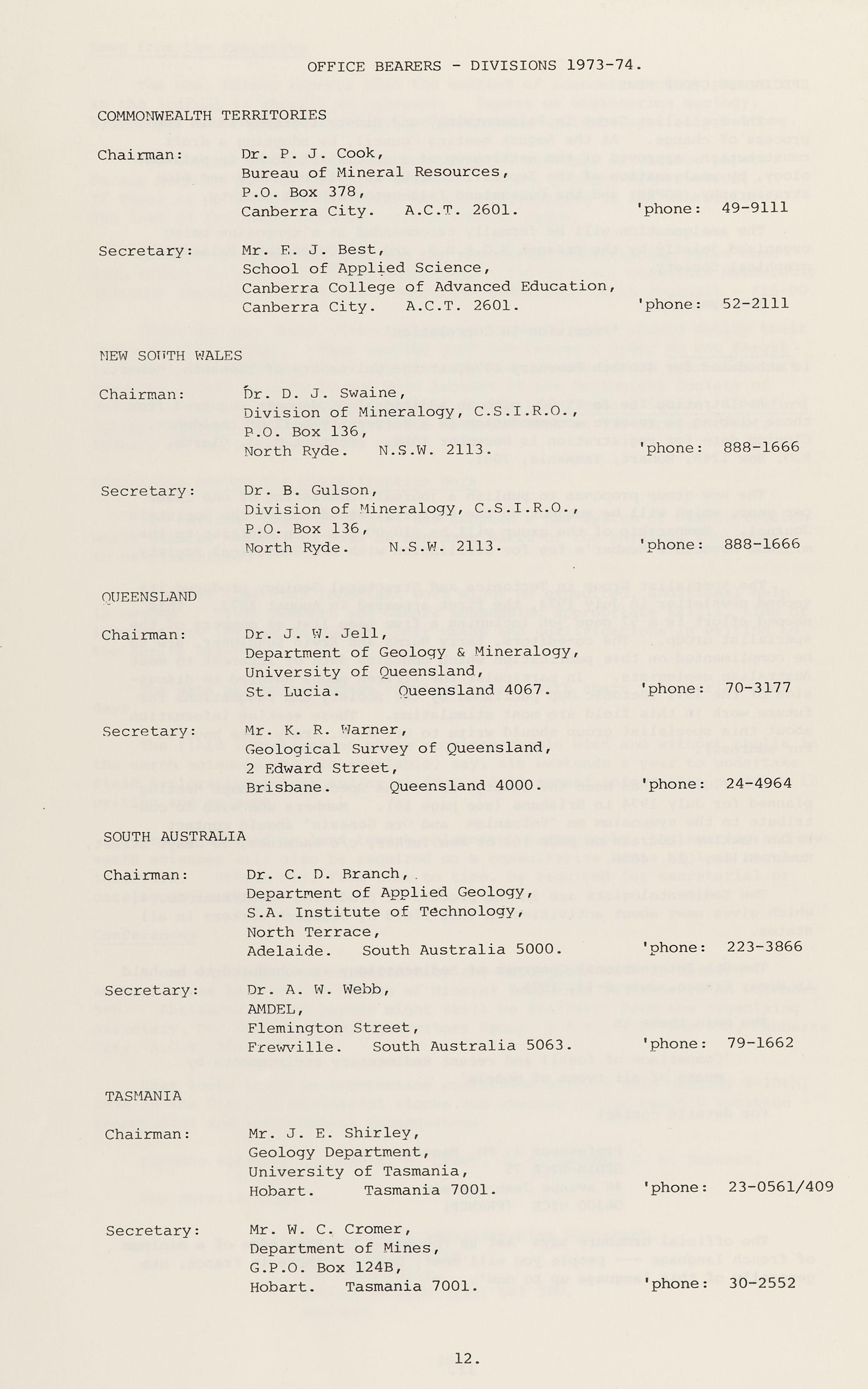
Dr. P. J. Cook, Bureau of Mineral Resources, P.O. Box 378, Canberra City. A.C.1'. 2601.
Mr . E. J. Best, School of Applied Science, Canberra College of Advanced Education, 'phone: 49-9111 Canberra City. A.C . T. 2601. 'phone: 52-2111
MEW SOTiTH WALES
Chairman : Secretary :
QUEENSLAND
Chairman: Secretary:
Dr. D. J. Swaine , Division of Mineralogy, C.S.I.R.O., P O. Box 1 36, North Ryde. N.S.W. 2113.
Dr. B. Gulson, Division of Mineralogy, C.S .I. R.O., P O Box 136, North Ryde. N S .'1-1. 2113.
Dr. J. W. Jell, Department of Geology & Mineralogy, University of Queen sland, St. Lucia. Queen sland 4067.
Mr K. R. Harner , Geological Survey of Queens land, 2 Edward Street, Brisbane. Queensland 4000.
SOUTH AUSTRALIA
Chairman: Secretary: TASMANIA
Chairman : Secretary:
Dr. C. D. Branch, Department of Applied Geology, S .A Institute of Technology, North Terrace, Adelaide . South Australia 5000.
Dr. A. W. Webb, AMDEL, Flemington Street, Frewville South Australia 5063.
Mr. J. E. Shirley, Geology Department, University of Tasmania, Hobart. Tasmania 7001.
Mr. w. C. Cromer, Department of Mines , G.P.O. Box 124B, Hobart. Tasmania 7001.
'phone: 888 -166 6 'phone: 888-1666 'phone: 70-3177 'phone: 24-4964 'phone: 223-3866 'phone: 79-1662 'phone: 23-0561/409 'phone: 30-2552
VICTORIA.
Chairman:
Secretary:
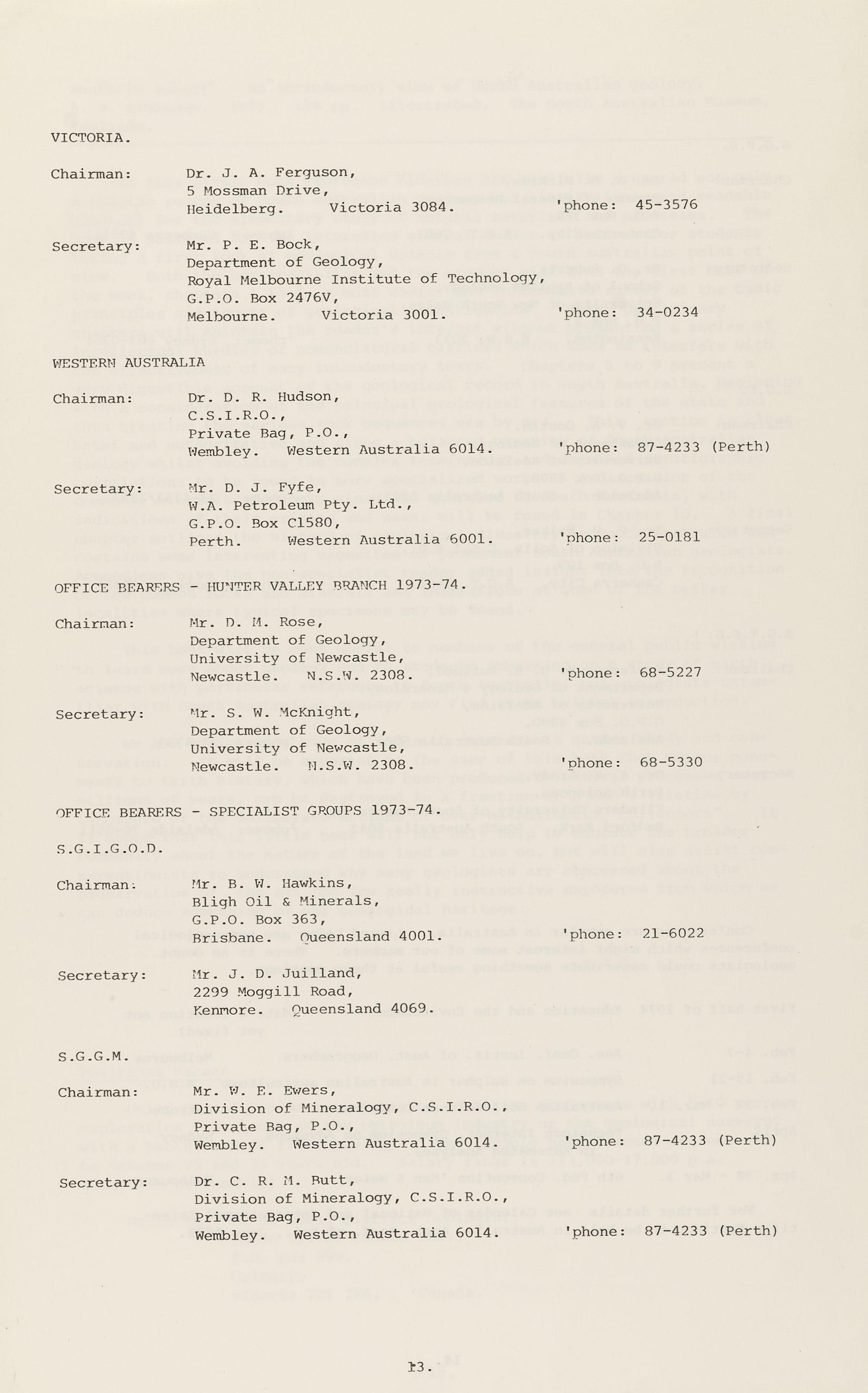
Dr. J. A. Ferguson, 5 Mossman Drive, J~idelberg. Victoria 3084.
Mr. P E . Bock, Department of Geology , Royal Melbourne Institute of Technology, G.P.O. Box 2476V, Melbourne. Victoria 3001.
WESTERN AUSTRALIA
Chairman: Secretary: Dr. D. R. Hudson, C.S .I .R.O., Private Bag, P.O. , Wembley. vie stern Australia 6014.
,•,lr. D. J. Fyfe, W.A. Petroleum Pty. Ltd ., G.P.O. Box Cl580, Perth. Western Australia 6001.
OFFICE BF.ARF.RS - HU'J'!'ER VALLEY BRANCH 1973-74.
Mr. n. 11. Rose, Department of Geology, University of Newcastle, Newcastle. l'il S !'1. 2308.
Secretary:
'-lr. S. W. '1cKnight, Department of Geology, University of Ne~castle, Newcastle. N.S.W. 2308.
0FFICE BEARERS - SPECIALIST GP.OUPS 1973-74.
S.G.I.G O.D.
Chairman, Secretary:
S.G.G.M.
Chairman: Secretary :
Mr. B. W. Hawkins, Bligh Oil & ~inerals, G.P.O. Box 363, Brisbane. (?ueensland 4001.
Mr. J. D. Juilland, 2299 ~oggill Road, Kel1I'lore. Queensland 4069.
Mr. w. E. Ewers, Division of Mineralogy, C.S.I.R.O., Private Bag, P.O., Wel'lhley. Western Australia 6014.
Dr. c. R. 11. Rutt, Division of Mineralogy, C.S.I.R.O., Private Bag , P.O., Wembley. Western Australia 6014.
'phone: 45-3576
'phone: 34-0234
'phone: 87-4233 (Perth)
'phone: 25-0181
' phone: 68-5227
' phone: 68-5330
'phone: 21 - 6022
'phone: 87-4233 (Perth)
'phone: 87-4233 (Perth)
S G P B
Chairman :
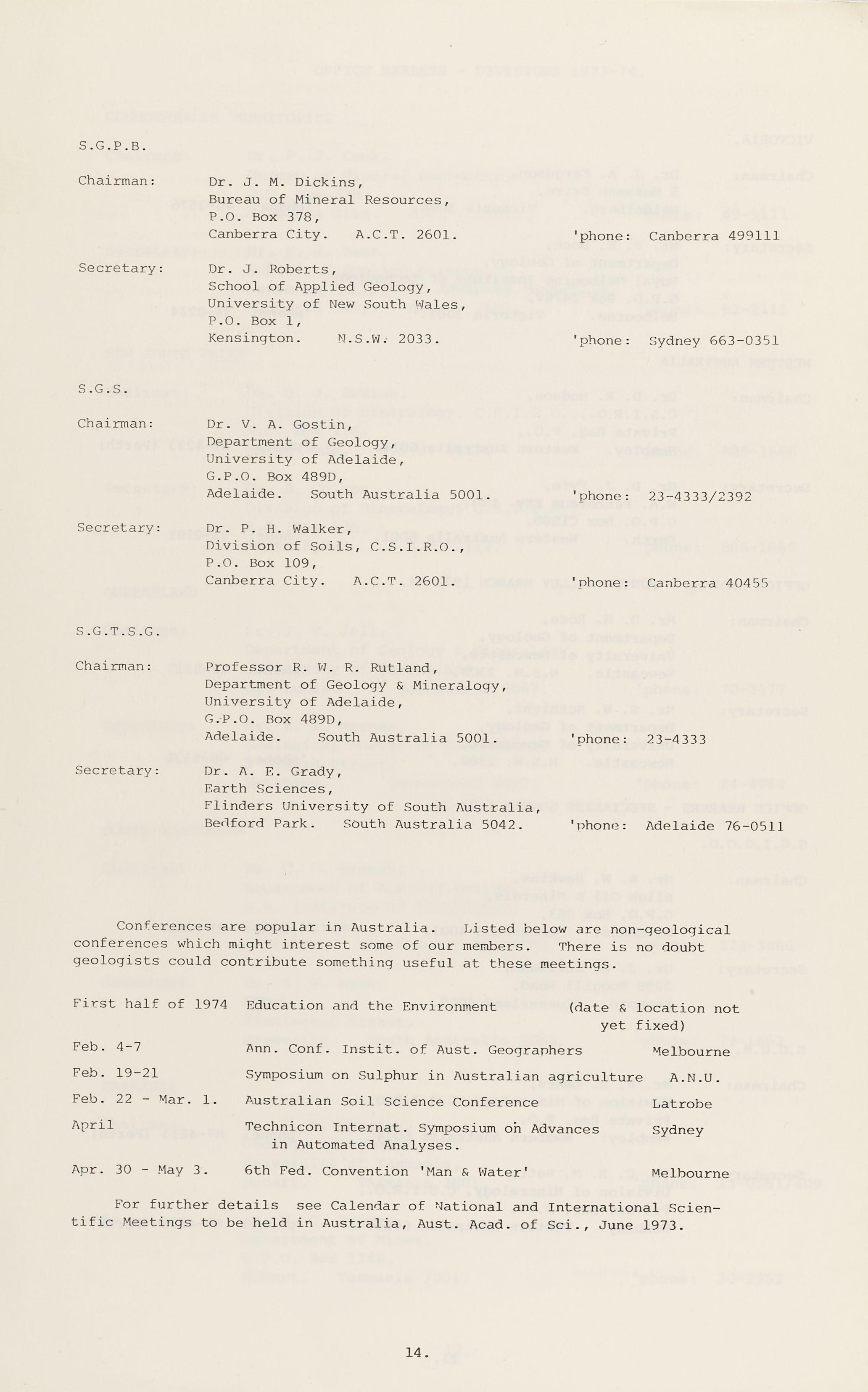
Se cret ary :
S G S
Cha irman:
Secre ta ry :
Dr. J M. Dickins, Bureau of Mineral Resources, P.O. Box 378, Canberra City. A C . T. 2601
Dr. J Roberts, School of Applied Geology , University of New South Wales , P O . Box 1, Kensington. N S.W : 2033
'phon e : Canberra 499111
S . G . T S G
ChairJTJan :
Dr V. A. Gostin , Department of Geology , University of Ade laide , G P O Box 489D, Adelaide. South Australia 500 1.
Dr P.H. Walker, Division of Soils , C S I R.O ., P O Box 109, Canberra City A C.T. 2601
'phone : Sydney 663-0351
Sec r e tary :
Prof essor R vl. R. Rutland, Department of Geology & Mineralogy, University of Adelaide , G,P O Box 489D , Adelaide. South Australia 5001
Dr. A. F. Grady , Earth Sci ences , Flinders University of South Australia, Bedford Park . So uth Australia 5042
' p hon e : 23-4333/2392
'phone : Canberra 4045 5
'phone : 23-4333
'phone : Adelaide 76 - 0511
Conferences are popular in Australia. Listed below are non - g eo logical conferenc es which might interest some of our members '!'he re is no doubt geolog ists could contribute something useful at these meetings.
F iest half of 1974 Education and the Environment (date & location not yet fixed )
Feb 4 -7
Ann. Conf . Ins tit of Aust. Geographers "1elbourne
Feb 19-21 ymposium on Su lph ur in Australian agriculture A N U
Feb 22 - "1ar 1. Australian Soil Science Conference Latrobe
April Technicon Internat Symposium on Advances Sydney in Automated Analyses
Apr 30 - May 3 6th Fed. Convention ' Man & Wat e r' Melbourne
For further details see Calendar of 'lational and International Scientific Meet ings to be held in Australia , Aust Acad of Sci ., June 19 7 3.
Southern Aspect: A. R. Alderman. Adelaide.
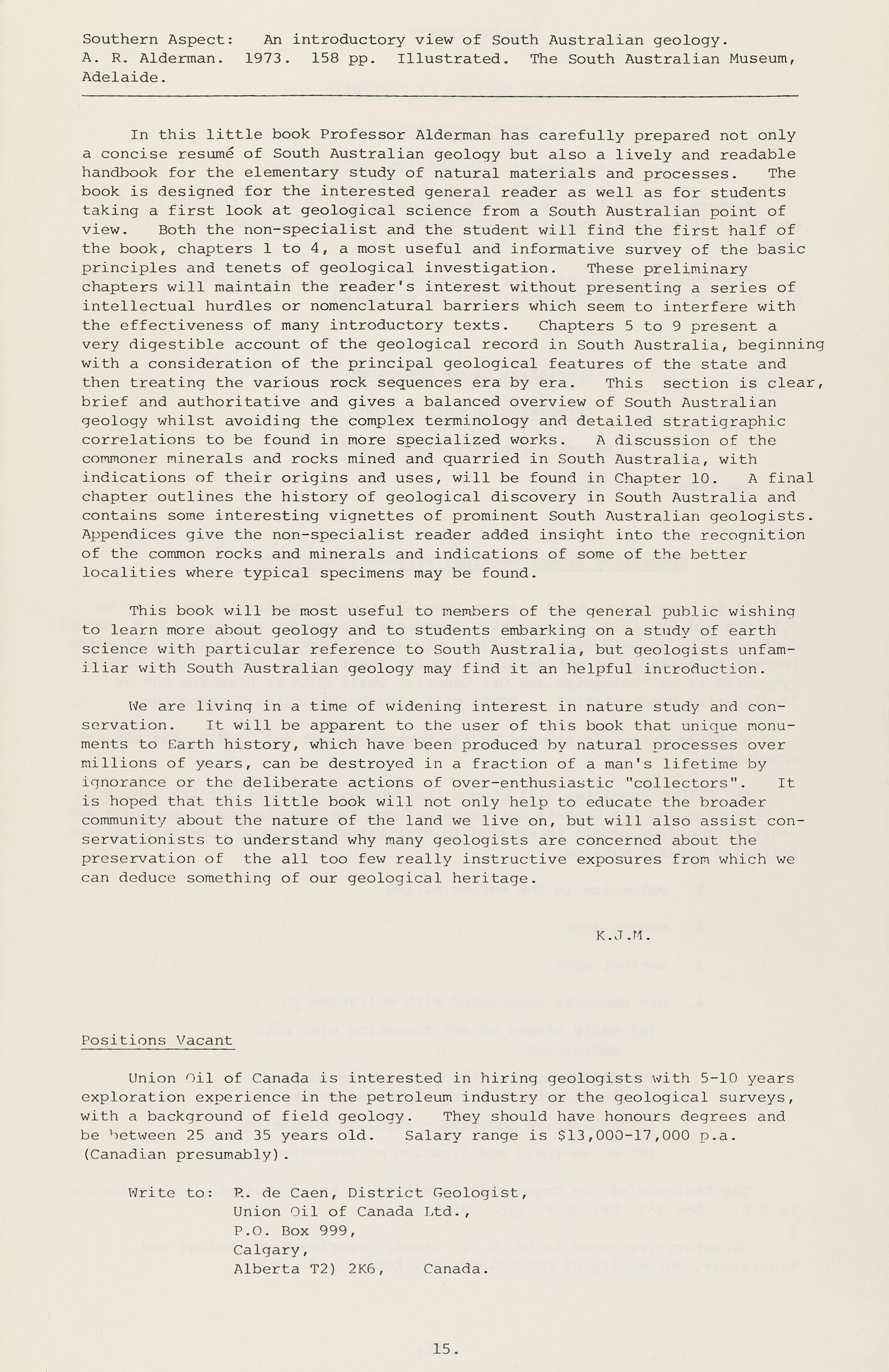
An introductory view of South Australian geology. 1973. 158 pp. Illustrated. The South Australian Museum,
In this little book Professor Alderman has carefully prepared not only a concise resume of South Australian geology but also a lively and readable handbook for the elementary study of natural materials and processes. The book is designed for the interested general reader as well as for students taking a first look at geological science from a South Australian point of view. Both the non-specialist and the student will find the first half of the book, chapters 1 to 4, a most useful and informative survey of the basic principles and tenets of geological investigation. These preliminary chapters will maintain the reader's interest without presenting a series of intellectual hurdles or nomenclatural barriers which seem to interfere with the effect iveness of many introductory texts. Chapters 5 to 9 present a very digestible account of the geological record in So uth Australia , beginning with a consideration of the principal geological features of the state and then treating the various rock sequences era by era. This section is clear, brief and authoritative and gives a balanced overview of South Australian geology whilst avoiding the complex terminology and detailed stratigraphic correlations to be found in more s pecialized works. A discussion of the coJTlJlloner minerals and rocks mined and quarried in So uth Australia, with indications of their origins and uses, will be found in Chapter 10. A final chapter outlines the history of geological discovery in South Australia and contains some interesting vignettes of prominent South Australian geologists Appendices give the non - specialist reader added insight into the recognition of the common rocks and minerals and indications of some of the better localities where typical specimens may be found.
This book will be most useful to members of the general public wishing to learn more ahout geology and to students embarking on a stndy of earth science with particular reference to South Australia, but geologists unfamiliar with South Australian geology may find it an helpful incrodu ction .
Ne are livinq in a time of widening interest in nature study and conservation. It will be apparent to the user of this book that unique monuments to Earth history, which have been produc ed by natural processes over millions of years , can be destroyed in a fraction of a man's lifetim e by iqnorance or the deliberate actions of over - enthusiast ic "colle ctors ". It is hoped that this little book will not only help to educate the broader community about the nature of the land we live on, but will also assist conservationists to understand why many geologists are concerned about the preservation of the all too few really instructive exposures from which we can deduce something of our geological heritage.
Positions Vacant
Union 0i l of Canada is interested in hiring geologists with 5-10 years exploration experience in the petroleum industry or the geological surveys , with a background of field geology. They should have honours degrees and be ~etween 25 and 35 years old. Salary range is $13,000-17,000 p .a (Canadian presumably).
Write to: P. de Caen , District Geologist, Union Oil of Canada Ltd ., P.O Box 999, Calgary , Alberta T2) 2K6, Canada.
Geological Society of Australia Council Meeting
Brisbane - July 6th-7th, 1974
Members wishing to have matters discussed should bring them to the notice of Councillors , State committees or the Hon. Federal Secretary in plenty of time.
Provision has been made for a General Meeting of the Society in Brisbane on the evening of July 8th should one be warranted.
Specialist Group Symposium
'Preci~ion in Correlation'
Hobart - February 4th-8th 1974
See Page 11 for details
Specialist Groups Meeting , Brisbane, July 1974
It is proposed to hold a joint Specialist Group meeting in Brisbane on July 8th and 9th 1974, a time which immediately precedes the Aus. I.M.M. Annual Conference to be held from 10th-12th July at the same venue. This will allow interstate visitors to get double value for their travel noney. ~he SGIGOD S}'Mposium is on "Volcanism and Ore Genesis" while SGGM is planning one on " Exploration Geochemistry". SGTSG will also be arranging a symposium.
No field trips are planned by the Committee, but Aus. r.r•t.M. has several scheduled
The SGIGOD Committee will choose the eventual speakers for its symposium on Volcanism an~ Ore Genesis but would welcone the opportunity to consider any contribution from people interested in discussinq this broad concept under the follmving general outline.
1. volcanism in the marine milieu
2 . nod e rn arcs
3 anc ie nt arcs
4. ore de p o s its associated with volcanisn in (a) early s tages of arc fornation e g. with ophiol i t e s
(bl d e velop ment of the calc alkal e suite leading to porphyry copp r deposits
(c l e xhal a tiv e andesit e - rh yo lit e vol c ani s m
(d) metamorphic mod ificat io n of orebod ie s.
The Chairman of the 0rganisi n g Comm ittee is Br ia n Hawki ns. is G P O Rox 363 , Arisbane , Qld ., 400 1.
His a ddr e ss
~ecretary-Treasurer is Dr D C Green , Department of Geology and Mineraloqy , University of OUeensland , St Lucia , Qld ., 4067 .