Newsletter Editor:
D. F. Branagan,
Department of Geology & Geophy sics,
The University of Sydne y ,
Society Secretary:
S. M. Bye, Exploration Department, Broken Hill Pty Co. Ltd., G.P.O. Box 86A, N.S.W. 2006.
Pho'ne: (02) 692 2358 or 692 2912
THE PRESIDENT'S PAGE Melbourne, Victoria 3001.
This President's Page is being written in the United States where geoscience graduates are at a premium in a renewed surge of exploration activity. It is a refreshing change from our own sluggish employment opportunities but perhaps it heralds the dawning of a new "Golden Age" for geoscientists in Australia. The fields most in demand here include geophysics, stratigraphy, sedimentology and tectonics while supporting training in physics, chemistry and mathematics is most important. An increasing number of exploration companies expect their geoscientists to be able to use computers in a variet y of ways in their work so that our profession as a whole must also begin to face up to the insistent demands of the technological revolution. The signposts to the future are fairl y clearly marked at least here in the United States Those of us concerned with geoscience education in Australia should not ignore what is already evident here but should be re-examining the rather traditional structure of the majority of our courses to prepare our students (and ourselves!) for the future.
Just before I left Australia I received a copy of the ASTEC report on the Bureau of Mineral Resources. Although it is not clear at this early stage how many of the far-reaching recommendations made in the report will be accepted by the government , it is clear that the BMR cannot ever be the same again. Your Executive will be study ing the re port in detail and consulting with all Divisions and Specialist Groups for their considered opinions on the effect that this report must have on the geosciences in Australia. Make it your business to read the report and see that your views get considered within the Society. Time is short so do it now!
The success of The Australian Geologist in bringing our membership closer to the Society and its activities has been recognized by council and in 1979 the number of issues will be increased to six per year. This has thrown an extra burden on the Editor, Dave Branagan, and the Assistant Editor, Eric Middlemost, but they have both agreed to accept the load increase with some enthusiasm. We are all indebced to them for their important contribution to our Society.
The editor of our Journal, David Brown1 retired from the editorship at the end of 1978. He has given a major part of his life to the very demanding role of editor of the Journal but I am sure it must give him great pleasure to know that the Journal has consolidated its position as a ma ior geoscience publication on the international scene. On behalf of the Societ y I would like to record our great appreciation of the work he has done for us and to wish him well for the future.
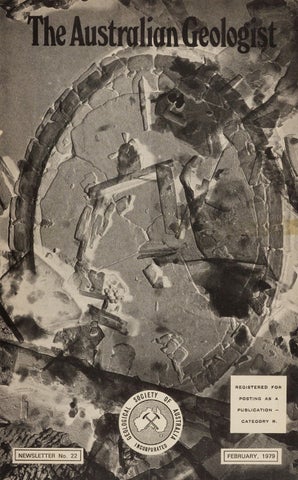
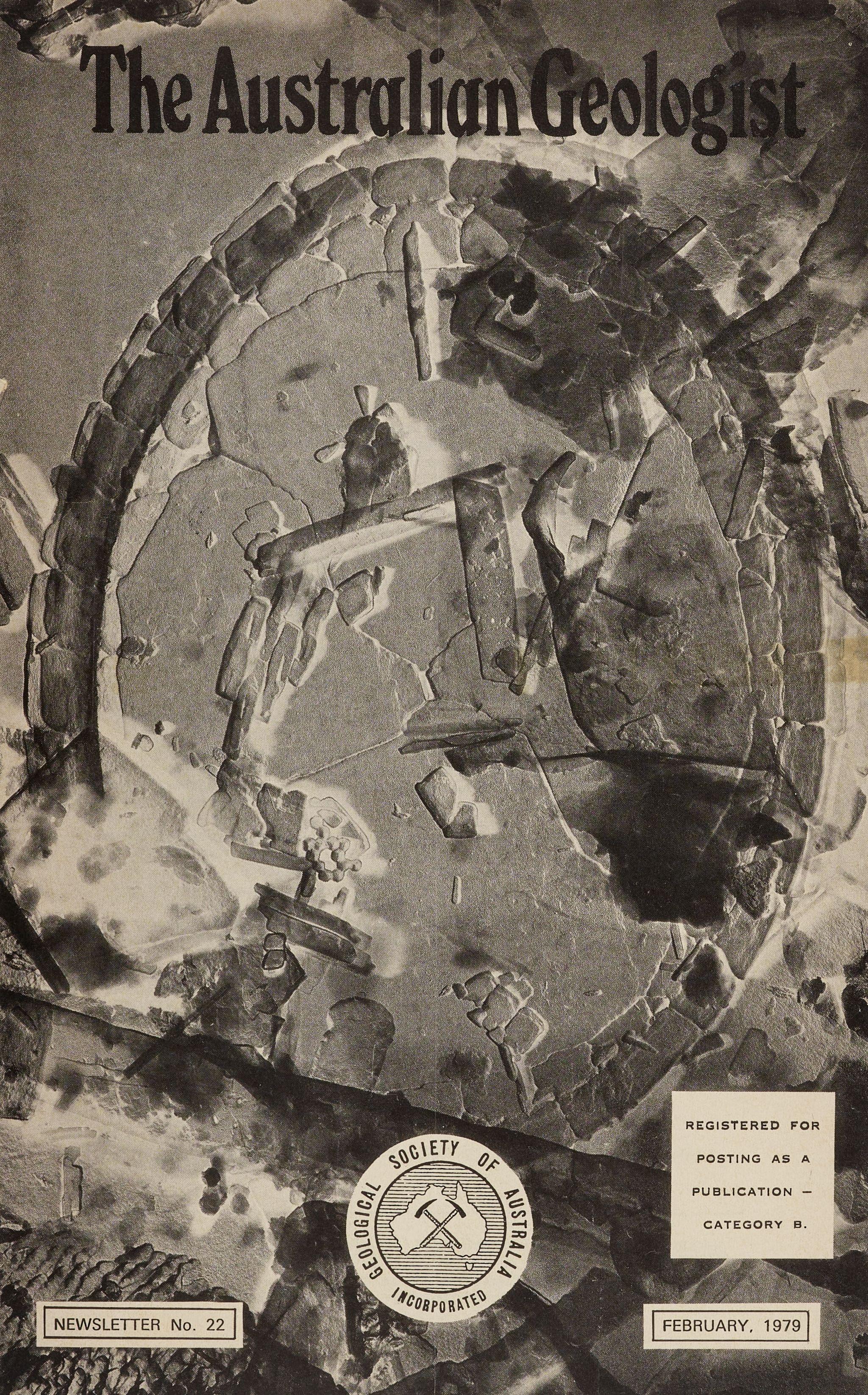
COVER PHOTO. John Lovering A coccoli th - Helicosphaera wallichi (Lohmann) , Okada & McIntyre from the Coral Sea. Magnification is vast. Electron microscope Photo by Steven Conley.
EDITORIAL
The President refers in this issue to the ASTEC report on the Bureau of Mineral Resources which will certainly change the pattern of activities of that body during the coming year or two.
Our own Society draft statement on Geological Science Policy, referred to in the last issue, is also likely to have some impact on the geological profession in the future. Some members have asked that the draft statement be made available through the pages of this publication, in the hope that there will be fruitful discus&ion.
Although it is long I intend to publish it in the next issue, and hope it will provoke at least some comments.
The Nuclear Debate has scarcely ruffled the pages of this august magazine. I had hoped to remedy such matters in this issue but various factors intervened. However breakdown of isotopes continues and perhaps it will not be too late one day in the future
It is i nteresting t o note however the continuing interest in the topic by various newspapers, and presumably by the public.
Professor Ted Ringwood's 'Safe Disposal of high level nuclear reactor wastes: a new strategy ' first published last July and reprinted in August set off cons i derable discussion, not least in the U.S where various academics and White House advisers felt they were being upstaged.
Since then there seems to have been some acceptance that Synroc (particularly Synroc B) differs somewhat from earlier substances. This productive line of research has been funded for 1979 and may yield more useful results.
The whole topic has been thrown into some confusion by the January notification by a U.S. Committee on Nuclear Power Station safety that it has withdrawn its support for its own previously issued statement on safety. This aspect is of course a long way from geological matters but we are part of a chain of which many members form links. Should we get more involved in the matter or leave it to others?
REMINDER
THE SOCIETY'S OFFICE HAS NOW MOVED TO ROOM 1001, 10TH FLOOR, CHALLIS HOUSE, MARTI N PLACE, SYDNEY, 2000.
BUSINESS MANAGER
REMINDER
LAUREL TUCKWELL can be contacted on (02) 231 4696
Sir:
LETTER TO THE EDITOR
The undersigned are members of the Geological Society of Australia Professional and Leoislation Committee which submitted a report to the GSA Council in August, 1978 at the Townsville meeting. A report on the current situation subsequent to this Council meeting has been prepared by the Committee Chairman, C. L. Adamson, and this is being submitted for publication in both The Australian Geologist and the Bulletin of the Australian Society of Exploration Geophysicists.
We are greatly concerned that the GSA Council failed to adopt the recommendations of the Professional and Legislation Committee for the formation of a professional organisation of geologists and geophysicists, which would have enhanced the status of the profession. The Council requested instead that the Committee prepare a new submission and present it to Council in January, 1980.
Exploration activity in both hardrock and softrock areas is increasing rapidly, and we believe that a boom scene is developing. The geologists and geophysicists engaged in the industry must have an organisation which can safeguard the interests of members of the geological and geophysical profession and members of the public.
We believe that an independent organisation associated with the GSA and the ASEG is the best way to implement this objective. This approach is described in the Professional and Legislation Committee Report to the Council under Method C of setting up an organisation.
In view of protracted time delays associated with submissions to the Council, and the rapidly expanding exploration activity now taking place in Australia we think that the geologists and geophysicists, interested in safeguarding the integrity of their profession and protecting members of the public, must take positive steps now to form a professional organisation.
We propose that an organising committee be established now, and a Memorandum of Articles of Association be p~epared. A professional organisation could be operating by the time that the GSA Council meets again in January, 1980.
If geologists and geophysicists are interested in enhancing the status of their profession, and safeguarding the members of their profession and members of the public from unethical or unprofessional conduct, please act on the following:
1. Write to Lindsay Ingall, 22 Kurraba Road, North Sydney, N.S.W. 2060, and tell us that you support the establishment of a professional organisation for geologists and geophysicists in Australia.
2. Send $5 payable to The Professional Organisation for Geologists and Geophysicists.
The money will be used to defray expenses connected with the establishment of a Professional Organisation, including legal fees for the preparation of a Memorandum and Articles of Association.
Ken R.Glasson Geologist, Member G.S.A.
Lindsay N. Ingall Geophysicist, Member A.S.E.G . & G.S.A.
GEORGETOWN
REVISITED: OR HOW TO BECOME VENERABLE (VULNERABLE?)
IN YOUR OWN LIFETIME
by Colin Branch, (Dept of Mines & Energy, S .Aust.)
August 1978, and there I was standing where, 21 years l::.efore, I had commenced geological mapping for the Bureau of Mineral Resources. I was in the middle of that large open cut which comprises the Greenvale nickel mine in North Queensland, and I thought how different it looked from the virgin bushland that Dave Green and I had traversed when first mapping the outcrops of silicified serpentinite and associated rocks now being mined.
But this revisit was just a quick stop on the way to join the Georgetown Safari arranged by the BMR and the Geological Survey of Queensland as a prelude to the Third Australian Geological Convention in Townsville. As I travelled with Bob Major in his Subaru on the new bitumen road that mining development had brought to the area, I wondered whether or not the recent 1:100 000 scale mapping of the Georgetown Inlier had completely overturned the concepts proposed by Dave White and his cohorts during our 1:250 000 scale mapping in the mid-fifties: after all, twenty years and new hypotheses about plate tectonics (despite Sam Carey trying to tell us about it earlier) should provide some stimulus for change.
Into Einasleigh where, as dusk fell, four-wheel drive vehicles sporadically appeared out of the eastern gloom and congregated at the one and only pub. The locals had arranged a barbecue and dance in our honour (such was the fame of certain BMR geologists!) so by general consent the pre-excursion briefing was abandoned.
Sunday dawned bright and clear. Amazingly, by 8 a.m., 16 vehicles were in line occupied by 30 geologists who only an hour or so before had been scattered in their swags over a considerable length of the banks of the Copperfield River (with the distance from the hotel being inversely proportional to the lateness in leaving the dance). Our intrepid leaders, John Bain, Brian Oversby, Ian Withnall and Doug MacKenzie, were there handing out excellent excursion guides,maps and advice: then we were away.
I had been especially looking forward to this, the first day of the six-day safari, when Brian was to lead us through the geology of the Carboniferous Newcastle Range Volcanics. These were the volcanics which I had mapped with a 'broad-brush' approach during two weeks in 1957, and which had inspired me to map the North Queensland volcano-plutonic province over six 1:250 000 sheet areas during the following four years, thus becoming deeply involved in the problems of the genesis of these rocks.
The first stop was at the crossing of Big Stockman Creek. There in a spot of clear sunlight amongst the dappled shade of tall gums, Brian started to introduce us to his understanding of the petrology and structure of the Newcastle Range Volcanics as a result of several years of careful and detailed mapping.
And this was when I started to appreciate some of the problems faced by many geologists in the twentieth Century: that with the present rate of mapping, areas are remapped by different people in a relatively short period of time, so that the 'previous workers in the area' need not be very 'previous'; and that concurrently geological dogma may change radically leading to new concepts that were unthinkable previously.
For Brian commenced by quoting Leichhardt who in 1847 traversed the area and reported first on the volcanics, then Jack and Etheridge (1892), Cameron (1900), and Branch! It brought me up with a start to be named amongst the venerable gentlemen of the past, and to have my work called 'pioneering' That was when I felt
vulnerable, because there I was in an audience about to hear the conclusions of the latest detailed mapping program , vulnerable to t he efflux of time and of change.
Brian re assured me that most of my geological boundaries were still e x tant, although he had added sev eral more. And he had modi- fied and e x tended my hy potheses, not o v erthrown them. As he dis- cussed his own conclusions I could onl y agree with the new concepts he proposed , as with hindsight and more e x perience they now seemed logical.
Hence in this instance the meeting of the 'pioneer' and the current worker was amicable . But I know of several instances where earlier workers believed unrealisticall y that their conclu- sions were absolute and would not accept that frequently younger and sometimes less e x perienced workers ma y , in the light of more recent research, radicall y change previously held facts. So friend- ships are broken , and our science does not advance harmoniously, which are t y pical symptoms of those affected by Toffler's future shock.
Perhaps this unyielding attitude is often engendered by early learning experience at secondary and tertiary levels where most things are taught as facts ; and people are not made aware that in reality absolute facts are rare, so that one should always remain curious and ready to change opinions as new information comes along. This is especially so in a science such as geology where factual observations are few and informed inference is dominant. Is this incurious attitude also partly responsible for the generally low attendances at scientific meetings, where people now commonly attend onl y when the topic is 'relevant' to their current interest?: what rot!, the whole spectrum of geolog y plus many other sciences are relevant to geologists if the y wish to really understand and advance the subject chosen for their professional career .
The large group on the Georgetown safari were there because they were curious and wished to learn more about the evolution of this complex segment of the earth's crust. For this reason the group was recepti v e, interested, and responded to the well - informed field leaders who each day took us through a diverse array of Pre- cambrian geological environments ranging over Sand I-type grani- toids; migmitite zones; regions of amphibolite-grade metamorphics where we were assured D6 was visible; multiply folded carbonaceous sediments; spilites; copper, uranium, gold, tin, and lead/zinc mineralization (the generosity of the Getty personnel in putting on a barbecue for us in their oasis at the Maureen Prospect was greatly appreciated); and so on. At night around the camp fires discussion ranged widely from the latest concepts of ore genesis to one memor- able occasion when someone raised the provocative issue on what maps are needed now, and discussion ended at 3 a.m . only because the suppl y r an out of wood for the fir e
So it was a dusty , tired, friendly, and better informed group who returned on the si x th da y to Einasleigh, with warm and sincere thanks to John, Brian, Ian, Doug and others who had ensured the success of the safa r i: and on the sev enth da y they rested.
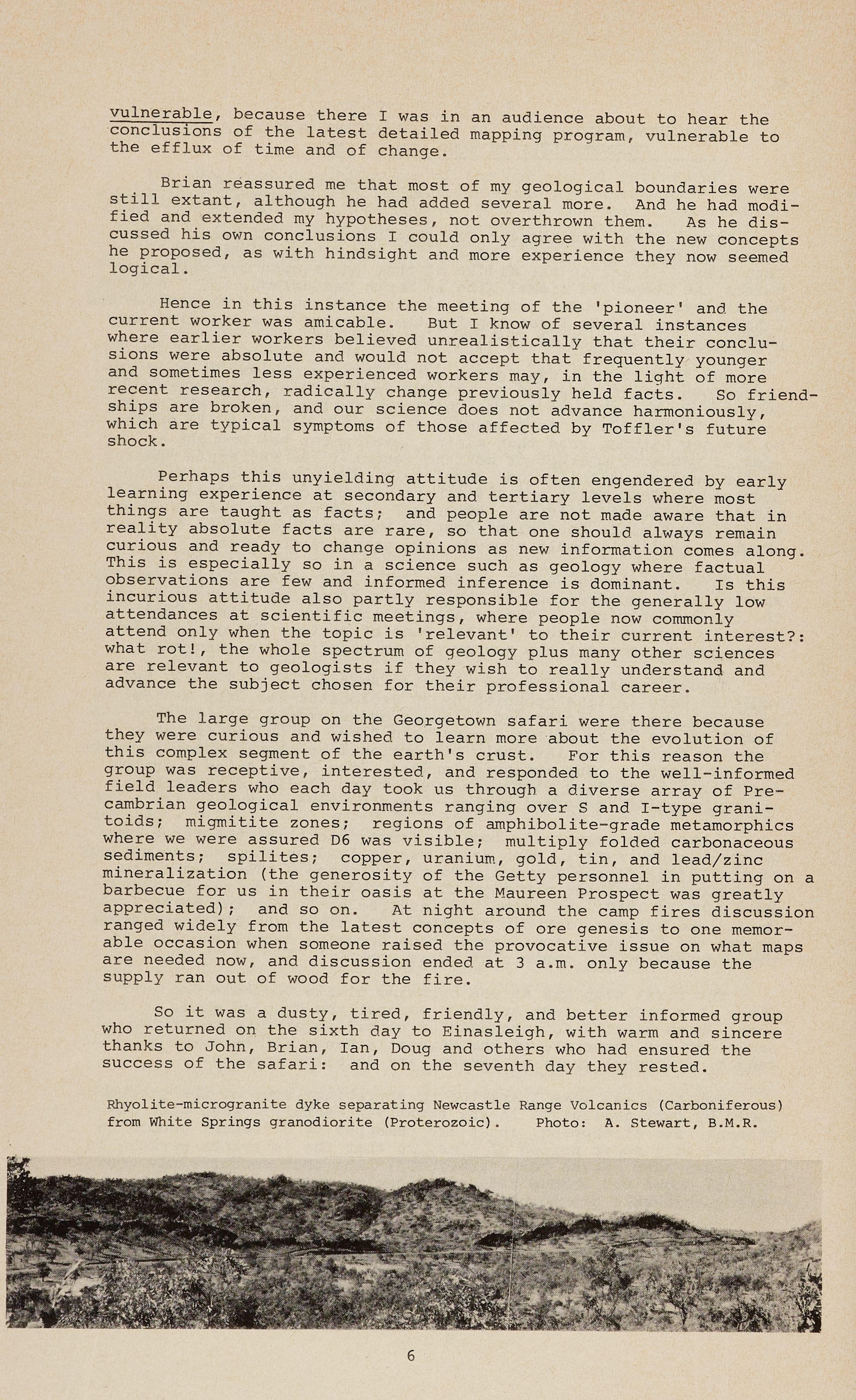
Rhyolite -microgranite d y k e separat i ng Newcastle Range Vo lcan ics (Carboniferous) from White Springs g ranodiorite (Proterozoic) . Photo: A. Stewart, B.M.R.
A PROFESSIONAL ORGANISATION?
THE SOCIETY'S COMMITTEE REPORTS
During the mining boom of the late 1960's it became obvious to the Geological Society of Australia (GSA) that control of the activities of geologists and persons posing as geologists was a matter of considerable concern from the aspects of ethics, professional standard, professional status and public interest.
The Council of GSA resolved in 1969 to investigate means of promoting professionalism in geology and in 1970 decided to attempt to achieve State and Federal legislation to establish Geologists' Registration Boards (similar to those controlling the professional activities of architects, surveyors, dentists, etc.). By 1977 this project, for various reasons, had failed.
In 1977 the Council of GSA formed the Professional and Legislation Committee in order to pursue its original resolution of 1969. One of the principal aims of this committee was to formulate a method for establishing a professional organisation for geologists and geophysicists.
At the GSA Council Meeting in Townsville in August 1978, the Professional and Legislation Committee submitted its Report on the formation of a Professional Organisation (PO) for Australian geologists and geophysicists.
This Report has been distributed to all Divisional and Specialist Group Committees and is available for study by GSA members from these sources.
The Report suggests three ways in which a PO could exist. These are -
Method A -A completely independent organisation with no affiliations with existing bodies.
The Report considered this method to be impractical, mainly due to problems of establishment.
Method B -A restructured GSA .
This method was not favoured by the Report for several reasons such as, GSA membership conditions not adequate for a Professional Organisation, and a considerable body of geophysicists may not wish to join such an organisation.
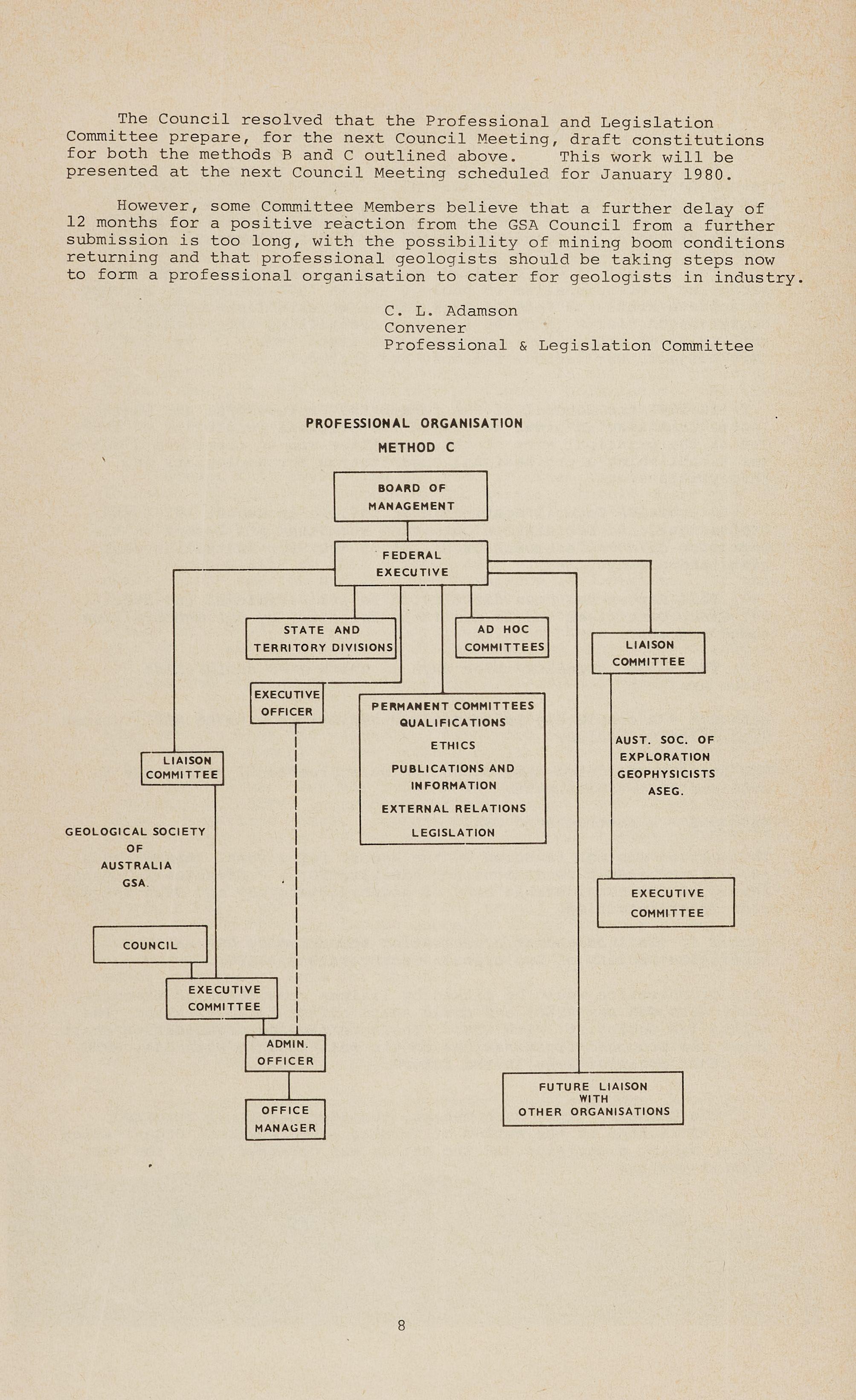
Method C - An independent organisation sponsored by GSA and The Australian Society of Exploration Geophysicists (ASEG).
This organisation would be linked by liaison committees at Executive level with GSA and ASEG, and could share office facilities and 'The Australian Geologist' with GSA. The accompanying organisation chart shows the proposed organisation and its relationship with GSA, ASEG and other organisations in the future
The Council, after much debate, considered that it required more information on the method of forming a Professional Organisation before making a decision and the matter was deferred until the next Council Meeting.
The Council resolved that the Professional and Legislation Committee prepare, for the next Council Meeting, draft constitutions for both the methods Band C outlined above. This work will be presented at the next Council Meeting scheduled for January 1980.
However, some Committee Members believe that a further delay of 12 months for a positive reaction from the GSA Council from a further submission is too long, with the possibility of mining boom conditions returning and that professional geologists should be taking steps now to form a professional organisation to cater for geologists in industry.
C. L. Adamson Convener
Professional & Legislation Committee
PROFESSIONAL ORGANISATION
METHOD C
LIAISON COMMITTEE
GEOLOGICAL SOCIETY OF AUSTRALIA GSA COUNCIL
STATE AND TERRITORY DIVISIONS
EXECUTIVE OFFICER PEl'IMANENT COMMITTEES QUALi FICATIONS ETHICS
PUBLICATIONS AND INFORMATION EXTERNAL RELATIONS LEGISLATION
LIAISON COMMITTEE
AUST. SOC. OF EXPLORATION GEOPHYSICISTS ASEG
EXECUTIVE COMMITTEE
FUTURE LIAISON WITH OFFICE MANAGER OTHER ORGANISATIONS
INTERNATIONAL
SECOND CIRCULAR
In 1980 it will be I O years since an Archaean symposium was last held in Perth. This location is appropriate for a second symposium since Western Australia contains one of the world's largest Archaean cratons - the Yilgarn Block, and also some of the world's oldest well-preserved greenstone belts. The 1980 Symposium will cover all aspects of Archaean geology and will provide an authoritative statement on current knowledge of the early history of the Earth
CONTENT
Technical sessions: May 12-16, 1980.
Proposed technical sessions :
I. What is ·the Archaean? How can it be defined?
2 Geochronology
3. Economic Geology
ii. Air, water and life
5. Tectonic and metamorphic aspects
6 Crustal evolution
(a) Regional reviews of major Archaean terrains
(b) Geology-geochemistry of gneisses, granitoids and supracrustals •
(c) Conceptual models
(d) Interaction with the Proterozoic
Keynote or review papers for each section will be given by invited international speakers.
Excursions :
Before : Pilbara Block (6 days)
During : W Yiigarn Block (1 day)
After: SW Yilgarn Block (2 days)
NE Yilgarn Block (6 days)
The Pilbara excursion will examine older and younger • supracrustal sequences, syn- and posttectonic granitoids, volcanogenic base metal deposits , and geochronological sites. The W and SW Yilgarn excursions deal with a complex array of high-grade gneisses, granitoids and largely metasedimentary supracrustal remnants
The NE Yilgarn excursion will inspect nickel deposits and their enclosing komatiitic sequences, younger conglomerates and ultrarnafic elastics, a mineralized felsic volcanic pile, and the Yeelirrie uranium deposit.
CALL FOR PAPERS IN TITLE
Intending contributors should supply : (i) a title, (ii) a statement (max 100 words) of the scope of the paper, and (iii) should indicate which section the paper is intended for.
This information should reach the secretary no later than March 1st, 1979.
EXTENDED ABSTRACTS
Contributors of accepted papers will then be asked to supply an extended abstract (500-700 words), which must be received no later than September 1st, 1979 . These abstracts will be compiled and made available at the symposium to all registrants
PUBLISHING OF PAPERS
Full papers in their final form must be submitted no later than March 1st, 1980. In general these papers should not exceed 10 printed pages (7500 words). Papers meeting the final deadline will be edited and published in a high quality volume, which should be mailed to all registrants about six months after the symposium
THIRD AND FINAL CIRCULAR
This will contain a registration form, and details of the technical sessions and excursions Accommodation and travel information will also be supplied The third circular will be distributed to all those who responded to the first or second circulars
Interested persons (who did not respond to or see the first circular) who would like to receive the third circular should write to:
Dr. J .A Hallberg
Secretary, Archaean Symposium
CSIRO Division of Mineralogy Private Bag P O. Wembley, W.A . Australia, 6014.
Mr Gordon Beavis , Supervising Draftsman , Exploration Department , B.H P ., G.P .O. Box 86A, Melbourne , Vic tori a 3001, who has a long career in geological drafting , has p r epared some useful compilations for geologists on this topic, wh ich he has circu l ated amongst many i;stitutions. Mr Beavis would , I am sure , welcome enquiries and disc u ss i on on the topic.
BACK TO THE MOTHER LODE
The Geological Survey Branch of the New South Wales Department of Mineral Resources and Development is proposing to conduct an excursion to the Broken Hill area. The excursion is designed to demonstrate current stratigraphic interpretations of the Willyama Complex and to show a number of the types of mineralization present in the Broken Hill Block. (An in-depth study of such aspects as deformation effects and metamorphic zoning wtll not be part of the programme).
Geological Survey geologists have been mapping the Willyama Complex rocks for several years, at a scale of 1:12,000. Emphasis has been placed on lithological mapping, accompanied by metallogenic mapping (including inspection of metalliferous deposits); The lithological data have been used as the major basis for stratigraphic interpretation. The mapping and interpretation have now reached a stage where the Survey thinks that exploration geologists will be interested, and that other opinions will be of considerable value to the geologists involved in the project.
The excursion is tentatively scheduled for Monday, April 23rdFriday, April 27th. 4-wheel drive transport will be required, and your own accommodation in Broken Hill each night.
Further excursion details, including an itinerary, will be forwarded to organisations which express an interest in the excursion. For further information please contact Brian Stevens (Sydney 240 4578), or John Cramsie (Sydney 240 4587), of the Geological Survey.
The lighter side
We were treated to one amusing slice of geological life - the fumigation of fossil plants - in the last issue but many other similar vignettes fail to reach the public eye or ear which is a great pity.
One source of amusement which might be spread further if it could be tapped is the Student Society journals which appear more or less annually in our various Tertiary institutions. Although much is naturally of local interest only there are occasional items which deserve wider circulation. We could do with a central storehouse for such ephemera and the editor would be happy indeed to receive any such publications.
I am indebted to Don Berkman for the delightful letter by N. S. Haile published in Nature 14th July 1977, on how an unacceptable manuscript can be transformed into one acceptable by leading scientific journals. The original manuscript entitled 'Ozymandias' by one P. B. Shelley begins, 'I met a traveller from an antique land who said: Two vast and trunkless legs of stone stand in the desert ' It was judged too short, with an inadequate title containing no keywords. The referees also felt that as the paper appeared to be based on field observations of another geologist, joint authorship would be appropriate. Dimensions were also required to be given in SI units.
The referees recommended the manuscript be re-written with a new title 'Twin limb-like basalt columns near Wadi Al-Fazar and their relationship to plate tectonics' by Ibn Batuta & P. B. Shelley. The keywords of the revised summary are: plate tectonics, subduction, obduction, hotspots, mantle plume, triple junction, transform fault, trunkless leg, shattered visage.
A Short Course on the used of Diatoms, in stratigraphic analysis, will be given June 4-9, 1979, by Walter Wm. Wornardt, Ph.D., at the University of Redlands, Redlands California 92373. Write to Dr. Wornardt if you seek more information.
STRATIGRAPHIC NOMENCLATURE
The International Stratigraphic Guide was published in 1976, after more than 20 years' work by the International Subcommission on Stratigraphic Classification. It considers the principles, definitions, and procedures involved in stratigraphic classifica- tion, and contains chapters on lithostratigraphic, biostratigraphic, and chronostratigraphic units.
The Stratigraphic Nomenclature Committee of the Society, after examining the Guide, recommended to Council that it be adopted as the standard for stratigraphic nomenclature in Australia. Although the proposal met with some opposition, mainly from biostratigraphers, it was agreed to by a majority of Council at its August 1978 meeting in Townsville. The Stratigraphic Nomenclature Committee met fol- lowing the Council meeting, and decided that implementation of Council's decision would take effect as far as possible on manu- scripts submitted after p ublication of the decision in the "Australian Geologist".
A brief announcement of the Council decision was made in the December issue of the "Australian Geologist". Stratigraphic nomen- clature in Australia should therefore follow the provisions of the International Stratigraphic Guide rather than the Australian one, from now onwards.
Geologists using the I.S.G. will find few major differences between the two systems of nomenclature. The I.S.G. considers a number of matters which the Code treats only briefly or not at all, and in some respects it is less restrictive than the Code. There are only two matters on which an actual change in policy has occurred:-
(i) The Australian Code required that a group should consist entirely of named and defined formations. The Guide relaxes this requirement and allows a group to contain strata not formally defined as formations.
(ii) The Australian Code uses the formal term "Beds" for a poorly known unit which has not been precisely defined. In the I.S.G. the informal term "beds" is used for this type of unit, and the formal term "Bed" is introduced for a precisely defined formal unit below "Member" in rank; "Beds" is a collection of these.
It 'is planned to supplement the I. S. G. with an Australian booklet which will incorporate the lithostratigraphic part of the I.S.G. and sections covering igneous and metamorphic rock units, interpretations and extensions of the Guide, and Australian proce- dures for reserving names and defining units.
Whatever weaknesses the Guide may be considered to have, it is a well prepared document which deserves to be tried in practice. If it is found to be deficient there is provision for amending it in a subsequent edition. Correspondence regarding interpretation or application of the Guide shouid be addressed to the Convener of the Stratigraphic Nomenclature Committee, Mr H. R. E. Staines, Geological Survey of Queensland, Mineral House, 2 Edward Street, Brisbane, Qld 4000.
Putting Some System into the Triassic
This has been the task of Max Banks who has prepared a very useful publication 'Correlation Chart for the Triassic System of Australia'. This was published in December 1978 as Bulletin 156C of the Bureau of Mineral Resources. Apart from references it contains a bibliography of 638 papers on the Australian Triassic covering 1953-1973 plus 7 late additions. Gondwanaists will devour it with greed, and it seems to be priceless (but I doubt it).
The FIFTH GONDWANA SYMPOSIUM will be held at the Victoria University, Wellington, New Zealand, 11-16 February 1980, organised under the auspices of The Royal Society of New Zealand and the International Union of Geological Sciences.
Five sections are planned:
I. The reconstruction of Gondwanaland from geological and geophysical evidence.
II. Stratigraphy, paleontology and paleogeography of Gondwana cratonic sequences.
III. Evolution of the continental margin of Gondwanaland.
IV. The early break-up history of Gondwanaland.
V. Applications of Gondwana geology to earth resources.
For information about the Conference contact the Secretary:
Dr C. J. Burgess, Fifth Gondwana Symposium, Victoria University of Wellington, Private Bag, Wellington, New Zealand
or Dr. R. E. Wass, Dept. of Geology and Geophysics, University of Sydney, N.S.W. 2006.
JOBS FOR THE PERSONS?
Faculty Positions in Soil Engineering, Engineering Geology, Rock Mechanics and Mining, are available in the Division of Geotechnical and Transportation Engineering, Asian Institute of Technology.
Candidates will be responsible for teaching graduate courses, supervising student research, and developing research in their own areas of specialization.
The Institute is located 42 km to the north of Bangkok on a 400 acre campus. The present faculty and senior staff of the Division come from a wide geographic basis.
The faculty appointments are of two· types, direct hire and seconded. The direct hire faculty are hired from the direct operational funds of the Institute, while the seconded faculty are financially supported by ·several donor countries. The donor countries of the Institute include Japan, Korea, Taiwan, Australia, Philippines, Thailand, France, Germany, Switzerland, Belgium, Austria, Denmark, U.K., U.S.A., Canada, Israel, etc.
Potential candidates for appointments in the Division should send their resume and ask for more details from:
Dr. A. S. Balasubrarnaniarn, Associate Chairman & Associate Professor of Geotechnical Engineering P.O. Box 2754, Bangkok, Thailand.
Present Shock
An Atlas on seismicity and volcanism has been published by Kummerly & Frey, Hallerstrasse 6-10, 3001 Berne, Switzerland.
The coloured maps show five zones relative to earthquake occurrences, the distribution of modern and historic earthquakes and the location of young volcanoes.
The price is quoted as 36 Swiss franks.
A Review of
Molybdenum in New South Wales, Mineral Resources 43 Geological Survey of N.S.W . Department of Mines
When asked to review this N. S . W Mines Dept. publication by C.R . Webber, I. B L Paterson and D J. Townsend, I accepted with some reserv ations. How would it compare with Mineral Resources No . 24 prepared by E C. Andrews and published in 1916-? The authors in their preface were similarly aware of this comparison stating "We have attempted to live up to the standard set by ~ndrews" They are to be congratulated on their efforts even ~hough there has been a complete change in emphasis and approach.
I first read Andrews' Mineral Resources No. 24 on Molybdenum some thirty years ago and at that time it had already been published thirty years. What always impressed me with Andrews was the working knowledge he hatl of all the deposits, sketches or minor or major geological features, maps which would act as an accurate field guide to any deposit, where a sha-ft , costean or open pit could readily be located with reference to a fence, lease boundary or hut.
One felt that all the available knowledge on any deposit had been collected and presented. The emphasis was directed to the potential of the deposit and was virtually a mine geologist's handbook.
In the present M.R.43 the emphasis is somewhat more academic with ' how it got there' rather than ' how much is there' approach. However the present bulletin is much more methodical in its approach - the deposits are described in relation to major tectonic divisions rather than alphabetically as in M.R.24 (Andrews). The individual deposits are located by reference to a 1:250,000 scale Map Sheet, then by grid reference plus portion number, Parish & County. This is an excellent reference for locating the deposits The work carried out on the deposits is referred to the excellent list of references in the back of the bulletin. Where the reference is a Mines Department reference I think it would have been an advantage to give it associated with the description i . e. GS.1974/101 etc.
One realises that there has been a tremendous amount of e x plora- tion in the past two decades. Thus it is necessary to produce a bulletin which will give as much detail as possible on significant deposits and restrict minor occurrences to name and location only. I feel this has not been done .
Thus on pages 72/73 Grants Den (Watson's Creek) is dealt with including exploration details by Austmine x & Bounty Oil In the latter programme a drill hole of 228m intersected 45cms of 1 . 44 % Sn In the fina:).. paragraph it is stated: "None of the group's workers recorded the presence of any mol y bdenite at Grant's Den--- " Thus this deposit should have been listed as a tin deposit where minor/rare Molybdenite has been recorded .
Similarly with Broken Hill almost two pages including a map is devoted to the fact that mol ybdenite has been described from the main orebodies at Broken Hill This also includes a paragraph on the origin of the Broken Hill Lode which is entirely superfluous and even open to conjecture
The section on geochemistry is good b ut I feel that details of geochemical prospecting on individual prospects could hav e been included in the indiv idual reports for the de p osits . Similarly drill sections where important should hav e been included with the description of the deposit Thus with Mt Tenn y son (Yetholme) p 136 reference is made to Metals Ex ploration having put down a v ertical drill 313 m, penetrating 216m of metasediments and dolerite before entering the q uart z diorite . Surel y a detailed log, its e x act location and its implication on the position of the mine r alisation i s warranted.
Finally it is not a criticism of the authors or the Mines Department, but I feel that thought might be given in future M.R: Bulletins to eliminate such chapters as "Other Important Australian Deposits" and "Some important Overseas Deposits". One doe~ not go to M.R. 43 for a description of Climax! These M.R. Bulletins should be directed to the N.S.W. deposits and as much space as possible should be directed towards them.
K. R. Glasson
DAVID THOMAS
Our sympathy is .extended to the family of the late Dr. D. E. Thomas, F.A.A., formerly Director of the Geological Survey of Victoria. Dr. Thomas passed away on 27 November, aged 76. He gained his initial degree at the University College of Wales, Aberystwyth, in 1923 whilst working in the South Wales coal mines. A spare time activity at this time was athletics, Dave becoming spring champion of Wales.
In 1926 he came to Victoria and joined the Education Department where he taught at Kennedy's Creek in the Otways. In 1927 he joined the Mines Department and first worked in Dartmoor where he out-classed several local boxing champions. He then worked in the Bairnsdale ,· Kerrie, Ramsey, Lancefield and Heathcote areas before going to Castlemainein 1937.
While there he made an exhaustive study of the Lower Palaeozoic rocks of Central Victoria, collaborating with Dr. W. J. Harris and R. A. Keble. He was awarded the degree of Doctor of Science by the University of Melbourne for this and other published work in 1940.
In 1942 he was appointed as Government Geologist in Tasmania. After a short but active period in Tasmania he returned to Victoria where he worked with the State Rivers & Water Supply Commission on the Eildon Dam Project. His classic geological investigations are embodied in Memoir 16. · In 1945 he returned to the Mines Department as Chief Government Geologist and became Director when that title was revived in 1957.
His scientific publications and maps number 105 and during his career he maintained lengthy correspondence with overseas authorities, on structural geology, stratigraphy, economic geology, geomorphology and palaeontology. He was an acknowlecl.ged world authority on graptolites.
Following his retirement he kept a keen interest in geology until a severe and protracted illness confined him more and more to his home.
His passing marks the end of a colourful career and closes the door on a fountain of mining information.
[modified from "Minerals and Energy News", issue 12, 1978 (Staff newsletter of the Dept. of Minerals and Energy, Victoria) ]
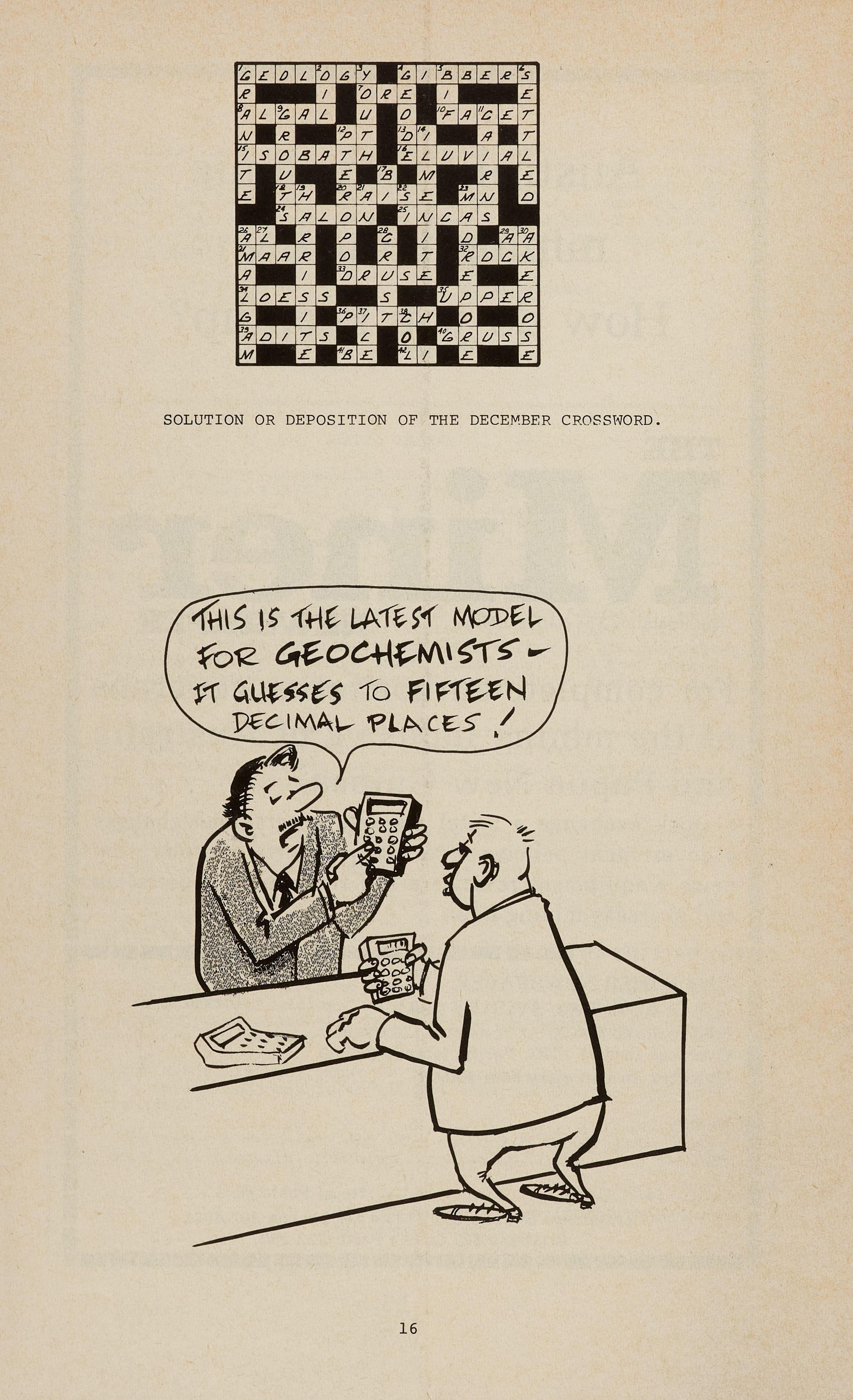
SOLUTION OR DEPOSITION OF THE DECE~BER CROSSWORD.
1tH 5 l~ 1".rt~ L.A1t S'1 l..-f"o12- ~o~~W\\~,.--~ ......~1' ".U~,,~s 10 Flf1UN 1)€C-IN\A~ 'PlP-..C~S I