The Australian Geologist
THE PRESIDENT'S PAGE
On my recent visit to the centre I was impressed by the National Parks, not only by the scenery and obvious good effects that Park management has had on tidiness and facilities but by the general geological accounts incorporated in park guides. The N . T. Geological Sur v ey have clearly done an excellent job in providing the park authorities with geological material . From the questions we were asked by some other tourists there could well be an interest in some g eological details at specific sites, such as cross sections through gorges etc. In our concern to gain public awareness of geology it would seem important for those in a position to do so to cooperate and where necessary to persuade Park managers to put more effort into e x plaining geological features. In many parks, rocks are neglected compared with fauna and flora. Perhaps the Society's Education Sub-Committees could assist here, especially by persuading local Colleges of Advanced Education to include more geology in Ecology and Resource Management courses .
The geological event of the decade, that will no · doubt have an impact on geological teaching even greater than the advent of Plate Tectonics, is the launching by the Academy of Science of ' Perspectives of the Earth'. Some minor criticisms aside this is an excellently produced and spectacular book; the editors Ian Clarke and Barry Cook deserve our congratulations and the Academy's foresight and large financial commitment are praiseworthy I am told that the book is aimed at those students not intending to proceed to Tertiary studies in geology. Nevertheless, it is certain to encourage many students to continue, and all first-year students would be well advised to read this book . Personally I predict that its greatest sale potential will be as an introductory first-year text Many of us old timers will find much of instruction and inter e st in its pages too 'Perspectives' is likely to force the restructuring of many Tertiary introductory courses or create difficulties where some large proportion of students may have already covered the basic first-year material; schools may also face difficulties in upgrading their courses to match the te x t-book. Perhaps here also there may be a useful role for our State Education subcommittees to play in liaison between schools and tertiary institutions.
I have recentl y represented the Society on two National Committees - I.G . C.P. and N . C.S.E.S. Australian geologists have actively participated as Conveners and Correspondents in the UNESCO-sponsored old International Geological Correlation Program (now to be Cooperation Program) and there is a possibility that Mecke~ing (W . A . ) may be chosen as a special study site for intra - plate seismicity We congratulate Professor R W R Rutland on his election as Chairman of the Scientific Committee and Professor J Lovering on election as Board member of this large and important International undertaking. The most important result of the Academy of Science National Committe e for Solid Earth Sciences meeting was the disbursement of Funds from the 25th I.G.C. Fund Since there were some $64 000 of requests for an available $15 000, there are bound to be some disappointments The Committee did its best to distribute the grants to promising y oung scientists spread evenly across the disciplines a n d geographically . The G.S . A . received grants for the Tectonics Group meeting and the 7th A G C (Cont i nu e d p age 4 )
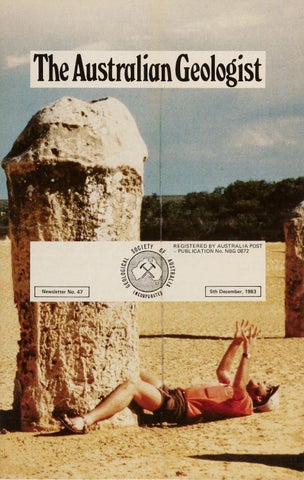
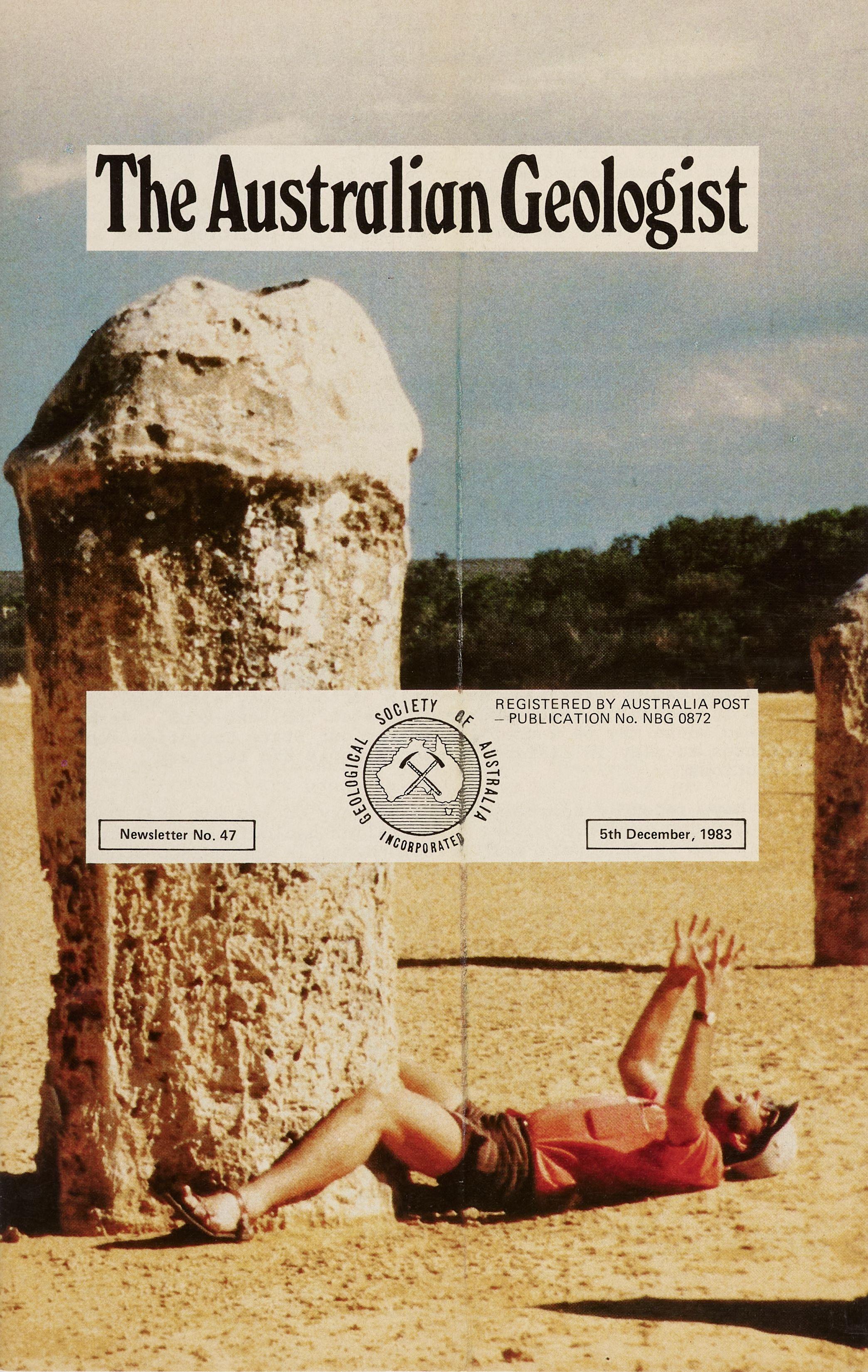
Co ve r P ho to: Natu r al p h e nom enon, Pi n nacl e s Des e rt , Nambu n g P a r k W.A.
The Australian Geologist
EDITORIAL
As this edition hits the newstands some geologists are gathering in Sydney to study one of the earth's and Australia's most precious resources - groundwater. A small but dedicated group of hydrogeologists in this country has worked in this field but it has not had the attention it deserves from the geological profession. Perhaps this international Conference will help to attract more recent graduates into a practical research field of great significance for Australia's future.
The much more newsworthy topic of the use and abuse of uranium has recently exercised the minds of geologists and engineers at a one-day symposium on safe disposal of radioactive waste. There is a wide divergence of opinion among the populace at large and among scientists on this topic and it is good to see geologists deeply involved in such socially significant matters.
An increased social awareness amongst geologists is clearly indicated in the programme for the forthcoming Seventh Convention (August 1984) where environment and resource management, and third world development are to be discussed in technical sessions, workshops and short courses.
Our increased involvement in such matters can only help the geological profession , giving it an 'improved image ' and possibly even more opportunities for a wider range of employment. A wider base is essential if we are to lessen the effects of the 'cyclic wave' pattern of employment which we suffer through our links with the basins and ranges of the mining stock market, a topic which has just been examined in detail by the Australian Institute of Geoscientists.
Australian geologists may be short of jobs at present but they are not short of words. An almost frightening array of meetings is scheduled: elastic tidal deposits , Canning Basin, fractures and ve ins, any old fossils, accretionary prisms, drainage basin erosion, higher e ducation, petroleum and minerals review, Landsat, structural deformation , feet (or metres) of clay, gran it oids and possib ly even humanoids all receive separate treatment, while the standard classics ANZAAS (Canberra May) Newcastle's Sydney Basin Confer ence (also May) provide solace for the weary in the month s leading to the Society's major meeting in August 1984.
Fortunately the mess of po tage is softened by exposure to real exposures - many of the meetings are based on field excursions and the evidence of the earth . Th is is as it should be . We cannot be a profession with its head in the clouds.
For many society members 1983 has been a hard year May 1984 prove better for one and all . Best wishe s to our readers for Christmas and the New Year .
(President's Page continued from p.2)
Canberra has been isolated for a month by a mail strike that has caused a time warp in our business dealings. By the time this page is published the last part of Volume 30 of the Journal for 1983 should be out; progress on the new Journal is well advanced, it will be a little brighter but recognizable continuation of its distinguished predecessor and will continue the sequence of volume numbers. Editorial policy (see this newsletter) will be finalized at the next Council meeting in Sydney in August 1984.
Special Publication No. 11 on Engineering Geology case studies is now in press and the Eromanga Basin Symposium in being edited. How is- the drive for new members going?
M. J. Rickard
Australian Geologist Schedule 1984
Irate comments concerning the cover or contents of this issue, and articles of consequence should reach the editor before February 7th for the March 19, 1984 issue (No. 48).
Later issues No. 49 No. 50 No. 51 No. 52 May 21 July 30 Oct. 1 Dec. 3
Copy required April 21 June 30 September 1 November 1
Sir,
Re: Newsletter No. 45, 1st August 1983
THE BALLAD OF B.M.R. - THE OLD AND THE NEW
but we got the data in, And published it in map sheet, Report or Bulletin.
Where are the pencils of yesteryear Which 'cised the words that pain the ear? Methought that editors near or far Would always know that data "are".
Anon ( 'e be)
PROFESSOR CAREY
We are sorry to hear that Sam Carey has had a long period in hospital following a serious operation. We hope he is soon fighting fit and back on the lecture circuit.
THE JOURNAL OF THE GEOLOGICAL SOCIETY OF AUSTRALIA IS CHANGING ITS NAME TO Australian Journal of Earth Sciences
EDITORIAL STATEMENT
A new era is beginning in the life of the Society's Journal, as from the start of next year it will be published for the first time by a professional publisher i.e. Blackwell Scientific Publications (Australia). This organisation, which already publishes seven other scientific journals in Australia, will also promote and advertise our Journal world-wide. However, overall control will remain entirely with the Society. One major benefit of this new arrangement is that the workload of the Editor will be reduced as many of the time-consuming tasks such as layout and proof-reading, will be performed by Blackwell staff. This means that in the future the Editor will be able to concentrate more on scientific matters.
To promote a better international image , the Journal will be renamed the Australian J ournal of Earth Sciences and will hav e the new ISSN number 0812-0099 Four issues will be published each year, but the existing volume numbering system will be continued, so that the four issues to appear in 1984 with the new title will be vol um e 31 Libraries are being advised of these changes. The cover of th e Journal will also b e redesigned and b e of slightly heavie r quality. The body of the Journal will be printed on a matt white paper, which is ideal for the high quality r ep roduction of photographs.
A n ew Notice to Contributors is b e in g produced along the lines of other Blackwell journals. The main differences with th e ex istin g procedur es are that all the Tables will again b e typ eset and that a preferred styl e of l ette rin g and presentation of maps a nd diagrams, as indicated by me a ns of two examples, will be enc our aged . The style of references will remain v irtually the same. Fold -out maps and diagrams a nd coloured photographs will continue to b e considered, if thought to b e scientifically necessary, but will be at some cost to the aut h or. The number of free reprints has al so b een inc re ase d to fifty.
There will b e no immediate major changes to the edito r ial policy a s the first issue is full from papers a lr eady submitted and accepted for publication. How ever , th e long term aim is to try to widen th e sco p e of the Jo urnal and to make it somewhat less parochial The l atter aspect, of course, is related to the old c hi cken and egg problem. People tend to send their b est papers t o international journals as they feel that our Journa l is rather paro c hi al Our Journal tends to b e rath e r parochial because people do not send their best papers to it! If we can b eak th is nexus we hav e th e potential for crea tin g a n excellent journal wit h an international r ep u tation Papers of the type we are seeking are ce rt ai nl y b eing produced b y ma n y peopl e in Au s tr a li a - wha t we have to do is to get mor e of them publish ed in the Aus tralia n Journal of Earth Scie n ces . This co ul d be don e over th e n ext few years, for exam pl e, if aut h ors considered sending even one or two of their papers to our Journal rath e r than to overseas journ a l s This coupled with the sales driv e of Blackw e ll co uld certai nl y c lw nge our imag e overseas
This is not to say that the Journal will no l o nge r uc:ce pt locally orient e d papers. To the contr:iry - pa p e r s on lo ca l i ss u es mus t always have a place in our Journ a l a nd 1 . i.ll a l1. a ys b L' 1, P l co l'le as lon ;: as they are o f go od quality
Speed of publication has always been a problem with most journals. One of the things we hope to achieve is the relatively fast publication of short papers. With four issues a year the only hold-up should be the refereeing time. In an attempt to reduce this for all papers the refereeing procedure is being streamlined by using the Editorial Board members as advisers in selecting the most suitable referees. Thereafter, the referees will communicate directly with the Editor rather than through the Editorial Board member. Then only in the case of conflicting referees reports would the Editorial Board member need to be consulted again.
R.W Le Maitre, Editor.
7AGC - UPDATE
In addition to technical sessions and specialist groups symposia, it is proposed to have a number of afternoon sessions devoted to oral and poster presentations of papers which do not readily fit elsewhere. We hope that these sessions will attract non-resource geologists to the 7AGC.
An additional short course on "Remote Sensing" will be offered.
Response to the First Circular has been most encouraging, and the Committee is using the information to plan the 7AGC. Please remember to return your reply slip together with synopses of the papers you wish to present. Additional information can be obtained from:
Dr Graham F. Taylor or phone (02)8878741.
Secretary - 7AGC, P.O . Box 383, NORTH RYDE, N.S.W. 2113
EASTERN GOLDFIELDS GEOLOGICAL FIELD CONFERENCE (1983)
A capacity audience of 175 crammed the Hob son Lecture Theatre of the Western Australian School of Mines to hear eight well presented papers from invited speakers at the inaugural Eastern Goldfields Geological Field Conference (1983). The highly successful venture was jointly sponsored by the Western Australian Division of the Geological Society of Australia and the Eastern Goldfields Geological Discussion Group, and comprised a one day symposium followed by two days examining key outcrops along two traverses through the greenstone successions in the Kalgoorlie-Kambalda area.
Account s of regional Archaean Geology were presented by Dennis Gee, Jack Hallberg and Tim Griffin. Dennis outlined the major features of greenstone distribution and evolution in the Yilgarn Block and highlighted the major problem of apparent overall synchroneity of greenstone belts and granites. Jack's paper described the geological evolution of the Leonora-Laverton area, and concluded with some comments on the importance of penetrating deformation associated with major linear tectonic zones in providing favourable sites for hydrothermal gold mineralization. Tim and his co-authors questioned the two cycle models for greenstone evolution in the south Eastern Goldfields, and suggested that geological evidence could be interpreted in terms of a sin gle cycle model.
David Groves outlined the metallogenic associations of Archaean greenstone terrains, and emphasised the importance of the contrasting platform-phase and rift-phase greenstone environments in controlling the nature and distribution of mineralization. This paper, described by the author as "an unashamedl y arm-waving point of view", set the scene for more detailed accounts of mineralization in the Eastern Goldfields. Neil Phillips emphasised the importance of iron-rich host rocks in locating hydrothermal gold deposits, Geoff Hopkin s gave a detailed review of the stratigraphy and structure of the Kal0oorlie Goldfield, and Phil Agnew described the mineralization and stratigraphy of the pro x imal volcanogenic massive sulphide deposit at Teutonic Bore.
Bryan Smith completed an excellent series of papers with a description of the geomorph ical history of the Yilgarn Block and its significance to exploration.
The Organizing Committee of David Harley , Jeff Vaughan, Mike Donaldson, Tim Griffin and Peter Muhling, together with many other willing helpers, thoroughly earned the appreciation of all participants. Field excursions were ably led by Tim Griffin, Mike Hunter, Bill Keats and Dave Quick.
A 54-page volume, containing extended abstracts of papers and the detailed excursion guide, was edited by Peter Muhling. It is illustrated with a number of maps and diagram s, and the excursion-stops are sufficiently well-described and located to enable individuals to repeat the e xcursion using their own transport. The volume is available from Jeff Vaughan, W.A. School of Mine s, Ka lgoorlie at $10.00 per copy, but supplies are limited.
In closing the symposium, Russell Hud son commented on the quality of presentation of papers, the clear evidence of excellent collaboration between companies and research workers and the high level of enthusiasm and interest shown by the audience. The meeting noted with regret ti-1at the Chairma n of the W.A. Di v isim,, Jim Ross, was unable to attend , and expressed their gratitude to him for initiating yet another successful GSA venture.
It is planned to hold further such conferences at Kalgoorlie and other regional centres. These will continue to provide both a stimulus and a suitable forum for geologists to present results of their projects and research work.
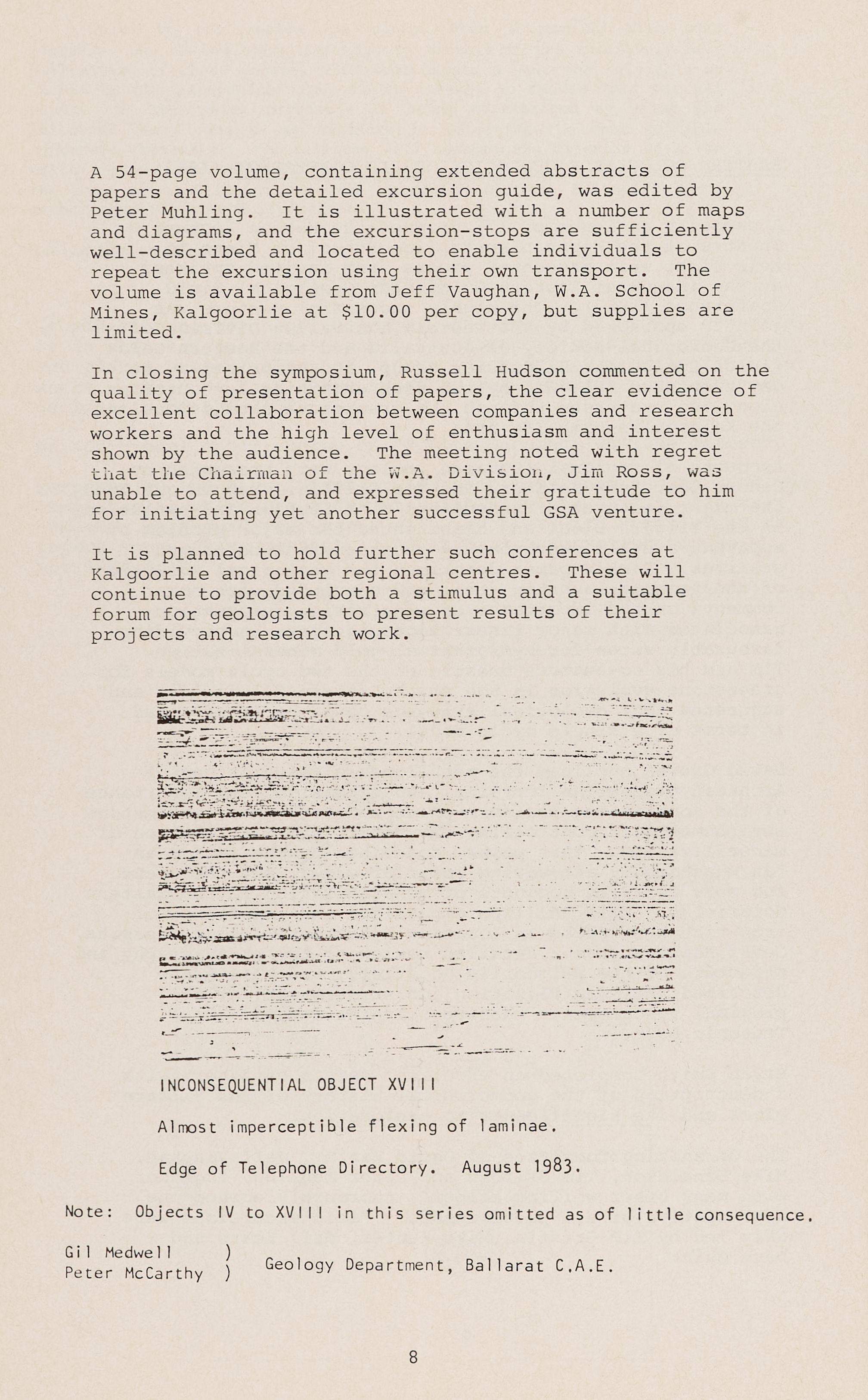
INCONSEQUENTIAL OBJECT XVI I I
Alrrost imperceptible flexing of laminae. Edge of Telephone Directory. August 1983. . _ ___. !.
Note: Objects IV to XVI 11 in this series omitted as of 1 ittle consequence. Gi 1 Medwe 11
Peter McCarthy Geology Department, Ballarat C,A.E.
FIELDTRIPS FOR MEMBERS or LOOKING and LOVING at the LOOK DOWN
The 1982 survey of N.S.W. members conducted by the Education Sub-Committee showed that not only were many in favour of one-day excursions, but that there was also a great interest in weekend excursions. In response to this, the first two-day excursion was organised during October by the Education Sub-Committee to Bungonia. It was led by members Paul Carr and Brian Jones (Wollongong University) who have worked extensively in the area and used it as a venue for students' excursions.
At first it seemed somewhat surprising that so many would be interested in spending a weekend in the field when they no doubt spend a considerable amount of their working time doing just that. It seemed even more surprising that Paul Carr, Brian Jones and Ruth Mawson (Macquarie University) would be willing to give up their free time to show fellow-members the area in which they work. However, when it is considered that all members of the G.S.A. must have, at the very least, geology in common, and further that all must have done some training in geology, then the interest in the excursion shouldn't have come as such a surprise.
No doubt some also share a great interest in the work of others and to have the opportunity to spend a weekend in the field learning what their fellow-members are up to would be a further incentive, particularly at a time when most people are beginning to realise that not only is learning an ongoing process through life, but that it can also be quite pleasurable.
Once these aspects were given some thought, the actual organistion of the excursion became less fraught with imagined problems. However, although the common interest in geology could be seen as the key to success, a passage from an article "Mere hiccups in the history of time" written by Richard Fifield (New Scientist 9 June 1983, p. 704) gave rise to a further bout of gross apprehension.
The passage stated" The problem now for the scientists from each of the contributing areas (of geology) is how to make their work understandable and accessible to others. Attitudes, not just semantics, are involved because geolo~ists, like pet owners, tend to take on something of the character of their charges. They vary from the hard core, to the volatile, the explosive, the fractious, to the intrusive. All of them become territorial and when the boundaries are breached there can be some lively interchanges. What is proof to the physicist may not be to the stratigrapher ... or the palaeontologist How can common ground be established?"
How can it indeed?
It is well known that "what's good for the academic need not be good for the man from industry". The list of applicants did nothing to allay the new found fears. Of the forty members who applied, 17% were school teachers, 33% were from the various universities and a staggering 49 % were from industry. Further within these figures there was a huge range of individual interests.
How could the interest of such a diverse group be satisfied by a two-day fieldtrip? Would there be a breach of territorial boundaries. Would the hard core control the intrusive, or would the whole weekend be explosive? As it turn e d out the results should
have been predictable. It would have been sufficient to stay with the original premise - that all G.S.A. members have an interest in, and even an enthusiasm for, geology. Not only did Bungonia offer e x citing and very diverse geology, the three who gave up their weekend to allow members the privilege of a look-behind-the-scenes at their respective areas, showed what e x acting and intricate tasks they had been involved in.
Those who attended the e x cursion not only appeared to enjoy the geology that was offered, they also seemed to enjoy each other's compan y - thus dispelling the myth that the G.S . A. is rifted by the opposing forces of the academic geologists and those from industry.
Robyn Stutchbury
THE INTRUSION COMES LATER
FIELD WORKSHOP ON GRANITOIDS, RELATED VOLCANICS, AND MINERALISATION
Thredbo, New South Wales
Please note that this workshop will be held on 23rd-26th February, 1984, not 13th-16th as inadvertently given in "The Australian Geologist", n~45, p 23.
There has been a good initial response from companies, universities, and government surveys to the workshop, and details of a v aried programme of talks/discussion sessions and short field e x cursions are being finalised. Although the workshop will be based at the Thredbo Alpine Hotel for one evening (23/2) and two full day (24-25/2) sessions, relevant field localities will be e x amined on the outward and return journeys from/to Canberra (23/2 and 26/2 respectively), and intending participants should plan on that basis.
Cost per person for the full time should not exceed $200; f a cilities provided by the Thredbo Alpine Hotel (accommodation, all standard meals, teas, use of conference facilities, but not taking into account liquor and any special dietary requirements) will amount to $168 per person, twin-share basis (alternative is $ 2 13 sin g le; $10 p er da y terrace room surcharge and $40 p e r day VI P surcharge also apply, if required). Transport costs will account for the remainder of the total.
To secure a final firm reservation, send cheque or equivalent f or $2 5 , pa y abl e to KOSCIUSKO GRANITES WORKSHOP, to Brian Oversb y , c /o BM R , Bo x 378, Canberra City, A.C.T. 2601, b y 31st December; re main ing monies can be paid at the workshop itself. Unless spe ci f icall y requ e sted otherwise, all accommodation will be allocat e d on standard twin-share basis. Notice of any special dietary, or o t her , re quir e ments must be received in advance.
PERSPICUOUS GEOLOGY?
BOOK REVIEW
Geological Science: Perspectives of the Earth
Edited I.F. Clark and B.J. Cook (xi, 650 pp)
Australian Academy of Science, Canberra 1983
($29.95 + freight)
The foreward to this weighty tome (1766 grms, even with flexible covers) tells us it is 'part of a set of teaching materials designed primarily for use with senior geology courses in Australian schools in the 1980s.' The title page tells us that 'integral with this v olume are: Student's Manual--, Teacher's Guide - -.'
Perhaps it is a commentary on our education system, but a knowledge of the contents of these separate offerings is essential to a reasonable appraisal of this text book and how it should be used. This touches on the fundamental notion of what a text - book is all about - a matter to which I shall return later in this review.
One's first impressions of the book are good; it is well set out and handsomely illustrated with many fine coloured photographs and diagrams, some black and white photographs, and numerous line drawings in brown and black . While the last-named are clear, many are re - drawings with little imaginative modification from illustrations in ea rli er texts or references and one is tempted to play the game of 'spot the source'.
The contents are divided into five main parts. Part one looks at the earth from afar, beginning with the univer se and stars, the solar system, the moon, and the earth ' s envelopes of air and water, ending with the water which gets into the ground (99 pages in all). Part two considers the mater ia l s of the earth: minerals and crystals, igneous activity, sedimentary environments and the resulting rocks, and metamorphism (145 pages). Part three examines fossils, relative and numerical time (93 pages). Part four discusses the earth's structur e and development (137 pages), and Part five deals with the applications of geology (138 pages) .
There is a useful glossary of terms and a twenty page appendix which describes and illustr ates what are somewhat optimistically labelled common Australian fossils. Hands up those who have recently found Glaessnerina, Wyndhamia, Pseudotcites or even your garden variety of Platypterygius?
The contents, size (650 pages) and arrangement of the book are, I believe, indications of the main problems which geological educators face in the high schools, and which have confronted the editors.
Firstly they have had the unenviable task of preparing a book which caters for the syllabi (take buses if you prefer) of all the various states. The bulk of readers may naively believe there is a corpus of geological knowledge which high school students might reasonably be expected to know. Hands up again those who know what a Widmanstatten structure is, how to prepare stress trajectories, who can recite the series/ stages of the European and North American Ordovician, dunce's hats in the corner for those who don't know the Bouma sequence or where the Curnamona Craton is.
Perhaps some of the syllabi specify these matters - some of the authors clearly believe they are important, and the book is packed with such information.
I doubt if i t is really appropriate for the majority of H.S.C. geology students, who - according to the statisticsare unlikely to study geology at the tertiary level, as the editors point out in their Teachers' Guide.
They also point out that 'the existence of this extensive set of materials must be treated with caution by teachers'. While there are many good teachers of geology able to present this material effectively I am concerned that the many less-skilled teachers will see the text as a panacea for their deficiencies and will hand it over undiluted to their students. This may well be disastrous both for the students and the cause of geological education.
It is inappropriate to dwell upon minor deficiencies and errors in the book - these are inevitable in a work of this size involving numerous authors. For comment the time scale has suffered somewhat (end-papers and page 65), figure captions recommended for careful study are not always informative (e.g. page 46 encke's comet, page 192 karst topography, page 212 figure 9.23 paleocurrent map, page 230 figure 10.l0a cleavage) or suffer from the constraints of a rigid page layout.
What about lavger matters of concern? While satellite e x ploration is i mpo~tant and fascinating to many people I believe it is - peripheral to geology. I would therefore argue it isn't where a geology text should begin. Likewise we shouldn't begin at the opposite end where matters minuter than microscopic require sophisticated equipment and a measure of belief remote from the human experience.
Wh y not star t at person-size scale, with the evidence of geolog y immed ia tel y around us?
In this respect there are for me two notable deficiencies in the content. Firstly the attention given to landscape development is slight and not well-balanced, clearly the result of syllabus demands, together with abdication in this area in favour of the geographers - mare's the pity.
The second and more contentious is the almost completely exploitive attitudes expressed in the well-presented part five. Geology and geologists have made many important contributions to the conservation movement in Australia (just look at some of the National Parks) and the Geological Society continues to be involved in such matters. The reader of this text would get no inkling (perhaps the inkliest) of these happenings.
I am sorry to find no discussion of what geological maps are all about. Granted there are numerous mapping problems in the Manuals, but some idea of the concepts inherent in geological mapping is very important and should feature in a text of this nature.
In consequence of such additions I would be happy to see reductions in the sections dealing with structural geology, palaeontology, mines and the market, and much of part one, to name just a few matters. I would also try to reduce the amount of terminology introduced.
The text, probably deliberately, is almost referenceless. A major requirement in science is the personal checking of sources of information. The reader of this text would be hard put to check the material contained therein, or to pursue topics which might interest him. I believe this should be an important facet of science education, and should be a must for future offspring from this book, even though it hasn't been customary in many high school science books.
My verdicts - High School text? No , University text? Maybe (some organizations already say yes) , reference and source book for secondary and tertiary teachers (and the brighter students)? Yes.
I don't believe this book - the dedicated work of the last five years - gets to where it was intended However it will have achieved its purpose as a landmark in geological education in Australia if it stimulates the Academy's Committ ee and the Geological Society's education sub-committees to prepare a single syllabus for Australian schools (ranging possibly even from primary and junior high school to the H S C. level).
I believe the major cause of the weaknesses I discern in this book is the too large input by academics, who have quit e unreal levels of expectation about high school students a nd teaching.
The editors h a ve bravely faced the awesome geological monster, thus created, with the equanimity of Empedocles. Unfortunately, I believe they have suffered the same fate.
If it is to be hoped that like Jules Verne's intrepid Professor Lidenbrock they will be brought unharmed out of the hollow earth where they can continue their herculean task of conquering Cerebrus - a creature with two terrifying heads, Academia and Syllabus.
Perhaps the second edition will solve not only the high school teachers' problems but the Lerna's also.
David Branagan
[Many readers will probably feel the abcve is scarcely a book review but a polemic in which I expound my warped views on the matter of geological education in secondary schools. I suspect this book and review will provoke a variety of strong opinions and will be delighted if other reviewers, authors, editors, and the ordinary geologists in the field wish to express their opinions in forthcoming issues: Ed.]
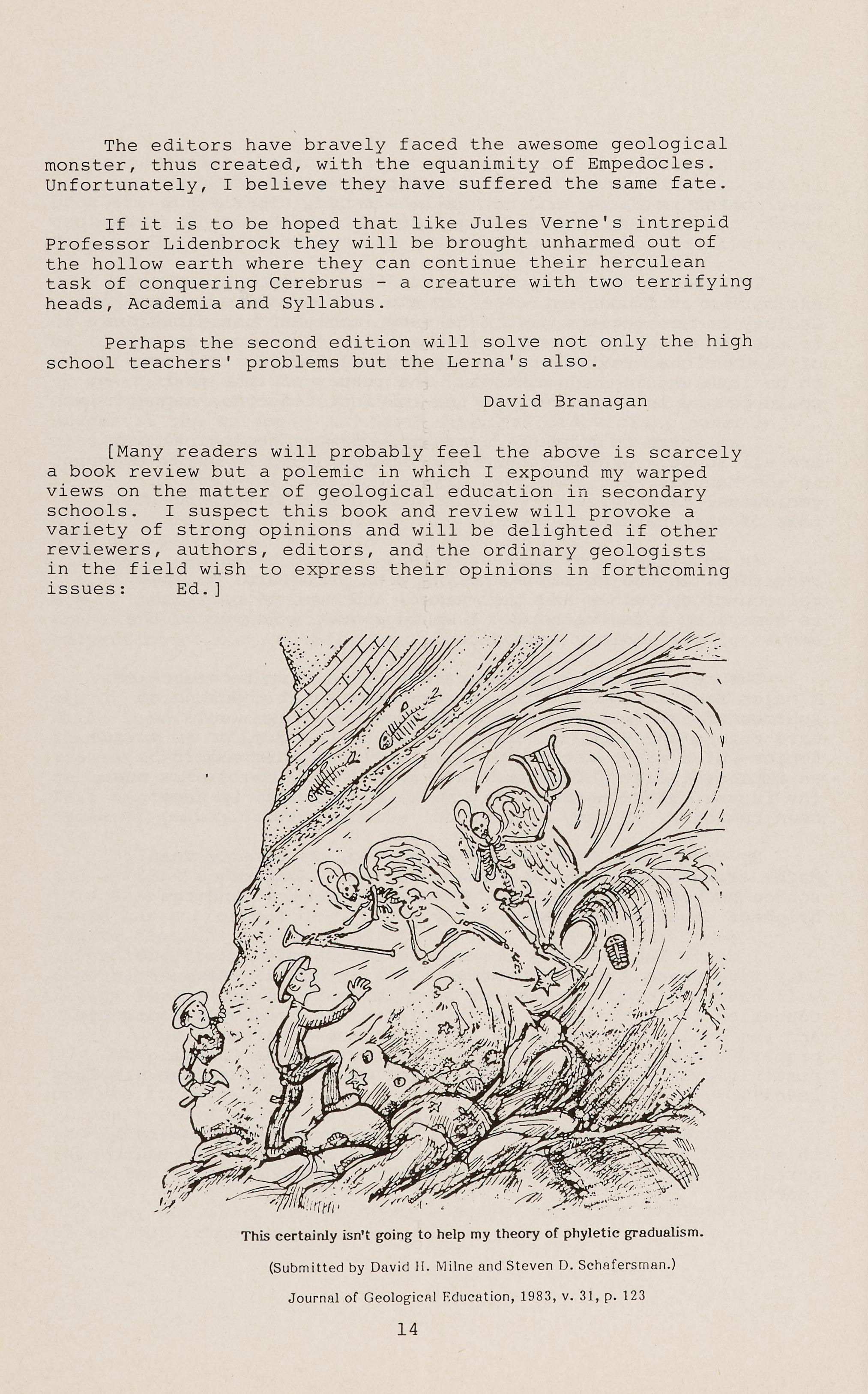
This certainly isn't going to help ·my theory of phyletic gradualism. (Submitt ed by David II. Miln e and Steven D Sch af er s man.)
CRUSTASIAN STUDIES
Dr. Ken McKenzie of Riverina College of Advanced Education recently made a working visit to the Peoples Republic of China under the terms of the Scientific Exchange Agreement between the Australian Academy of Science and Academia Sinica. He spent about 3 weeks at the Institute of Geology and Palaeontology of Nanjing, and a day at the Institute of Geological Sciences, Beijing.
Dr. McKenzie gave a series of lectures on Cretaceous-Recent Ostracoda (Crustacea) which were attended by workers from several petroleum and coal research institutes in China as well as by ostracode specialists. He also examined comparative material of Cretaceous-Recent age from all over China (Yunnan, Tibet, Xinjiang, Guizhou, Jiangsu, Bohai)representing recently completed or current research by the Nanjing Ostracoda group. Palaeozoic and early Mesozoic Ostracoda (Leperditicopida, Entomozoacea, Darwinulacea, 'Thuringia' facies) were examined at Nanjing; and TriassicCretaceous Darwinulacea, Cytheracea and Cypridacea of the Shanganxiang Basin, in the Collections at the Institute of Geological Sciences, Beijing.
The taxa reviewed briefly during his visit amounted to some 2000 species of Ostracoda and about 500 species of other Crustacea. The highlight of his period at Nanjing was the opportunity to study for a whole day several beautifully preserved specimens of Kazacharthra (Triassic-Jurassic) a crustacean group with affinities to Notostraca and endemic to western China and Siberia.
Important discussions were held with specialist colleagues at Nanjing on Cretaceous-Tertiary correlations between China and Australia and the other 'provinces' of Tethys; also, on the proposal to publish (over 5 years) an 'Atlas of Indopacific Ostracoda' in which 1500-1750 ostracode species (mainly Cretaceous-Cainozoic) would be described and figured.
The opportunity was taken to visit Beijing University and to have some ancillary discussions with representatives of the South China Agricultural College.
It is hoped there will be visits by Chinese Ostracoda (!) and other crustacean specialists to Australia in 1984/85; and a Chinese delegation to the 'Shallow Tethys 2' conference being organised at Riverina C.A.E. for 1986.
Ken McKenzie writes:
My working visit to the Peoples Republic of China was certainly very worthwhile in a professional sense. Although I had not expected to do so much lecturing, the need to prepare a set of lectures helped organise my thinking in several areas of current research. I saw an incredible amount of material - several times more in the one month than I have ever had to cope with in a normal year. This immediate experience is more enduring and exact than several searches of the relevant literature would have been. (In this case, the relevant literature relates to about 3,000 species of Ostracoda and about 500 species of other crustaceans!).
It was also clear that my visit was a professionally positive experience for Chinese colleagues especially at Nanjing. Mainly this was due to the fact that their background and training is almost exclusively palaeontologic, taxonomic and biostratigraphic whereas mine includes about a quarter century of experience with the ecology of living faunas (marine, estuarine, continental), plus expertise in dissection techniques and in functional interpretation stemming from my years at the British Museum (Natural History). A common factor was our mutual interest in petroleum exploration which provides a powerful economic incentive for ostracode research. I was able to indicate several avenues for more detailed environmental interpretation based on features of the ostracode carapace: including shape, sex dimorphism, muscle scars, ornamentation.
The need/demand for ostracode studies in China has been matched by a growth in the Ostracoda group at Nanjing from one (Prof. Hou) in the early S0's to the present dozen workers, including a doctoral research student. If the whole of China is considered, this growth is far greater since I was assured that there are now about 100 ostracode specialists.
This explosive growth is matched in other areas of palaeontology. Before 1949 there were fewer than 30 palaeontologists in China (they included Profs. Mu and Chang of the Nanjing Institute) now the number is well over 1000 (Geol. Soc. America Spee. Pap. 187, publ. · 1981). Australian palaeontology certainly deserves a phase of such growth in order to serve the exploration industry more effectively.
The richness of the palaeontological materials available in China is truly impressive. I was assured that when I next revisited the Institute at Nanjing they would have as much new material to show me as on this visit. Much of this material is collected by field geologists, for example, all Assoc. Prof. Chen's material of Kazacharthra was collected by a field party. Clearly, such field geologists are well trained.
My hosts regularly invited my critical comments and suggestions for improvement in their training, procedures and facilities.
i) I was very impressed by the good state of the type collections at Nanjing; and also by the fact that every specimen I examined carried a museum or field number.
ii) On the other hand, exhibits at the small museum in the Nanjing Institute were not well displayed and there is room for improvement in this field.
iii) The preparation laboratories were well set up and efficient. I was impressed by the technique for treating limestone (outlined earlier) and gave Prof. Hou an outline of my own technique (sodium hexametaphosphate plus sodium bicarbonate) for breaking down marls which apparently give their prepators some problems. Dr. Wang's dielectric separation method (Beijing) was excellent for mudstones and transitional facies. At Beijing, too, some other technique, such as mine, would be required for marls.
iv) Chinese palaeontologists specialising in Crustacea generally lack expertise with living faunas and would profit by
opportunities to acquire this expertise through further training. It can be applied in more detailed palaeoenvironmental interpretations for which there is a solid economic incentive in China's coal and petroleum industry (Ostracoda, Chonchostraca); also in its phospherite exploration program (Bradoriida) .
Both the Vice-Director at the Institute of Geology and Palaeontology, Nanjing, Prof. Mu Enzhi, and the President of the Institute of Geology, Beijing, Prof. Shen Qiren, conveyed through me their good wishes to all Australian colleagues, in particular those who have visited the Peoples Republic of China under the aegis of the Scientific Exchange Agreement.
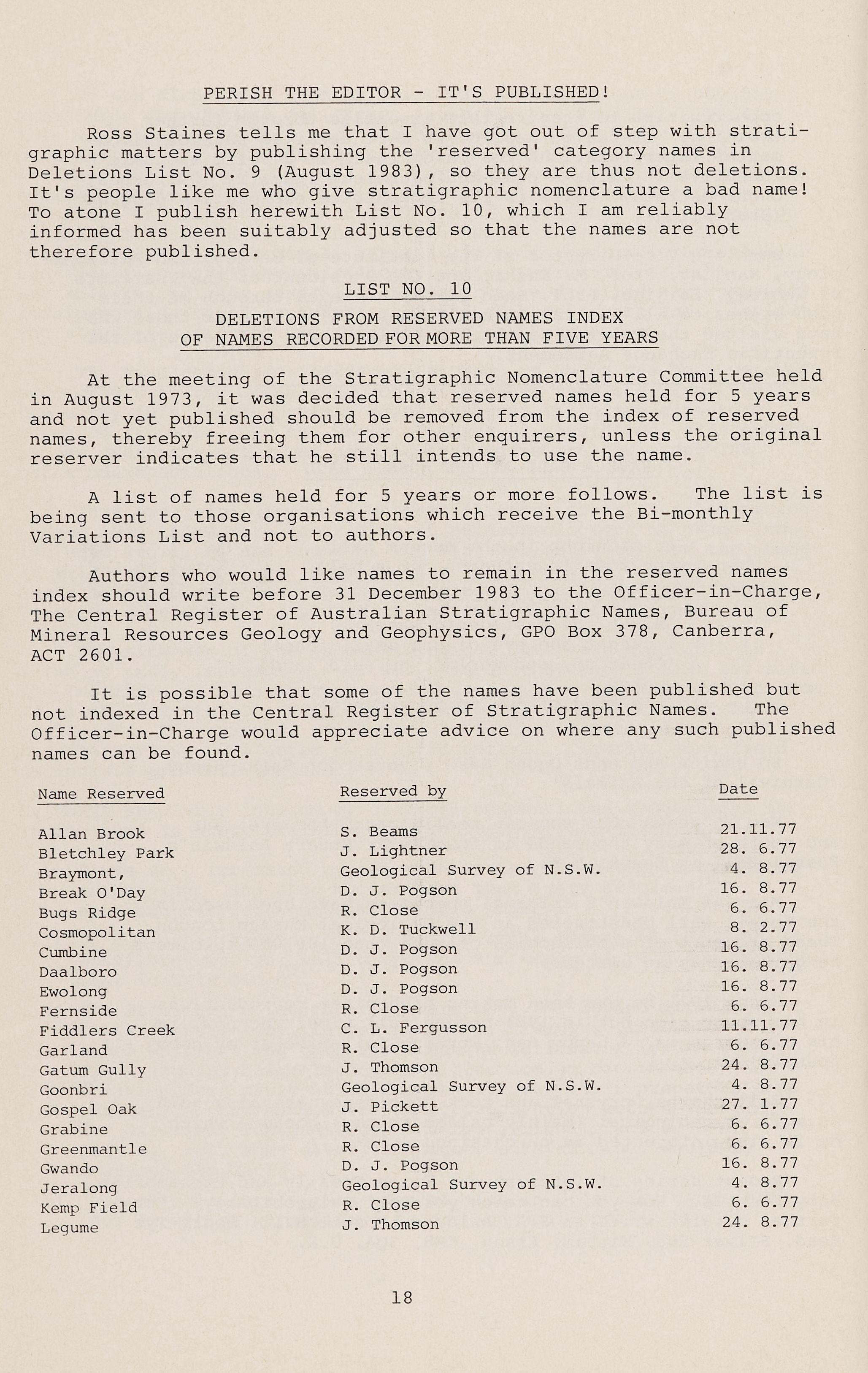
HAVE A BALL AT THE FOSSIL HAUL
At midnight in the museum hall the fossils gathered for a ball
Amidst the mastodonic wassail I caught the eye of one small fossil 'Cheer up, sad world', he said, and winked ... It's kind of fun to be extinct'.
So begins and ends Ogden Nash's verse for Saint-Saens 'Carnival of the Animals'.
Now it seems that you can really catch the eye, ear and tooth of many thousands of fossils at Stuart Baldwin's Fossil Hall in Essex, U.K.
Many of Baldwin's original specimens have been used in the fossil wall constructed at the Geological Museum London. These are part of a collection of more than 100,000 specimens he gathered as an amateur.
Since 1971 he has been making high class reproductions in his spare time but in 1981 became full time, and now, in his own words is 'a happy man, working full-time at my hobbyfossils'.
Wall charts, crystal and rock specimens, are also sold as well as geological (mainly palaeontology) books - which he is also interested in purchasing.
Recent series of interest are Trace Fossils and Precambrian Body Fossils. Now you can teach yourself Palaeontology! For further details write to S.A. Baldwin, Fossil Hall, Boars Tye Road, Silver End, Witham, Essex, CMS, 3QA, U.K.
PERISH THE EDITOR - IT'S PUBLISHED!
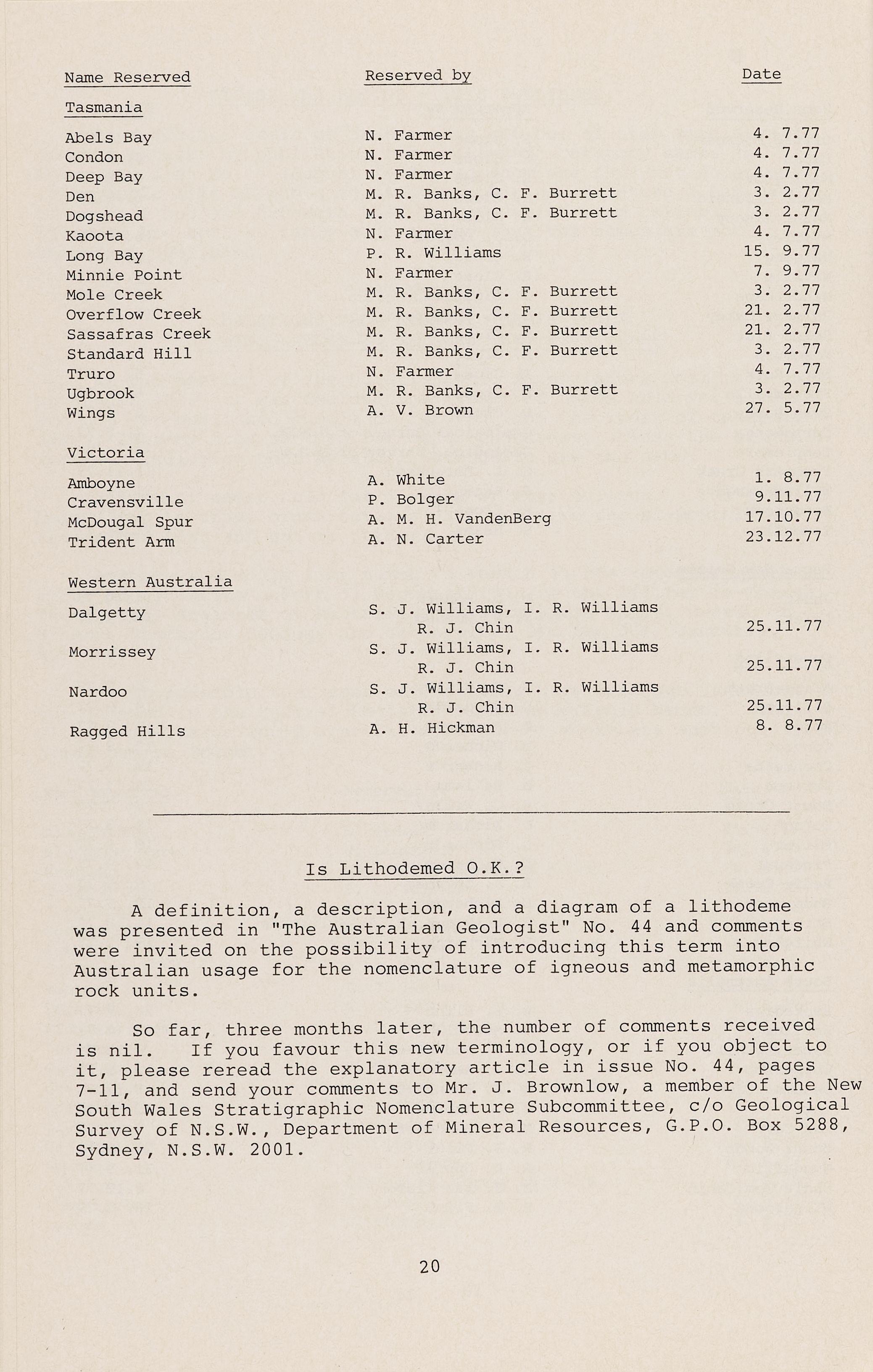
Ross Staines tells me that I have got out of step with stratigraphic matters by publishing the 'reserved' category names in Deletions List No. 9 (August 1983), so they are thus not deletions. It's people like me who give stratigraphic nomenclature a bad name! To atone I publish herewith List No. 10, which I am reliably informed has been suitably adjusted so that the names are not therefore published.
LIST NO. 10
DELETIONS FROM RESERVED NAMES INDEX OF NAMES RECORDED FOR MORE THAN FIVE YEARS
At the meeting of the Stratigraphic Nomenclature Committee held in August 1973, it was decided that reserved names held for 5 years and not yet published should be removed from the index of reserved names, thereby freeing them for other enquirers, unless the original reserver indicates that he still intends to use the name.
A list of names held for 5 years or more follows. The list is being sent to those organisations which receive the Bi-monthly Variations List and not to authors.
Authors who would like names to remain in the reserved names index should write before 31 December 1983 to the Officer-in-Charge, The Central Register of Australian Stratigraphic Names, Bureau of Mineral Resources Geology and Geophysics, GPO Box 378, Canberra, ACT 2601.
It is possible that some of the names have been published but not indexed in the Central Register of Stratigraphic Names. The Officer-in-Charge would appreciate advice on where any such published names can be found.
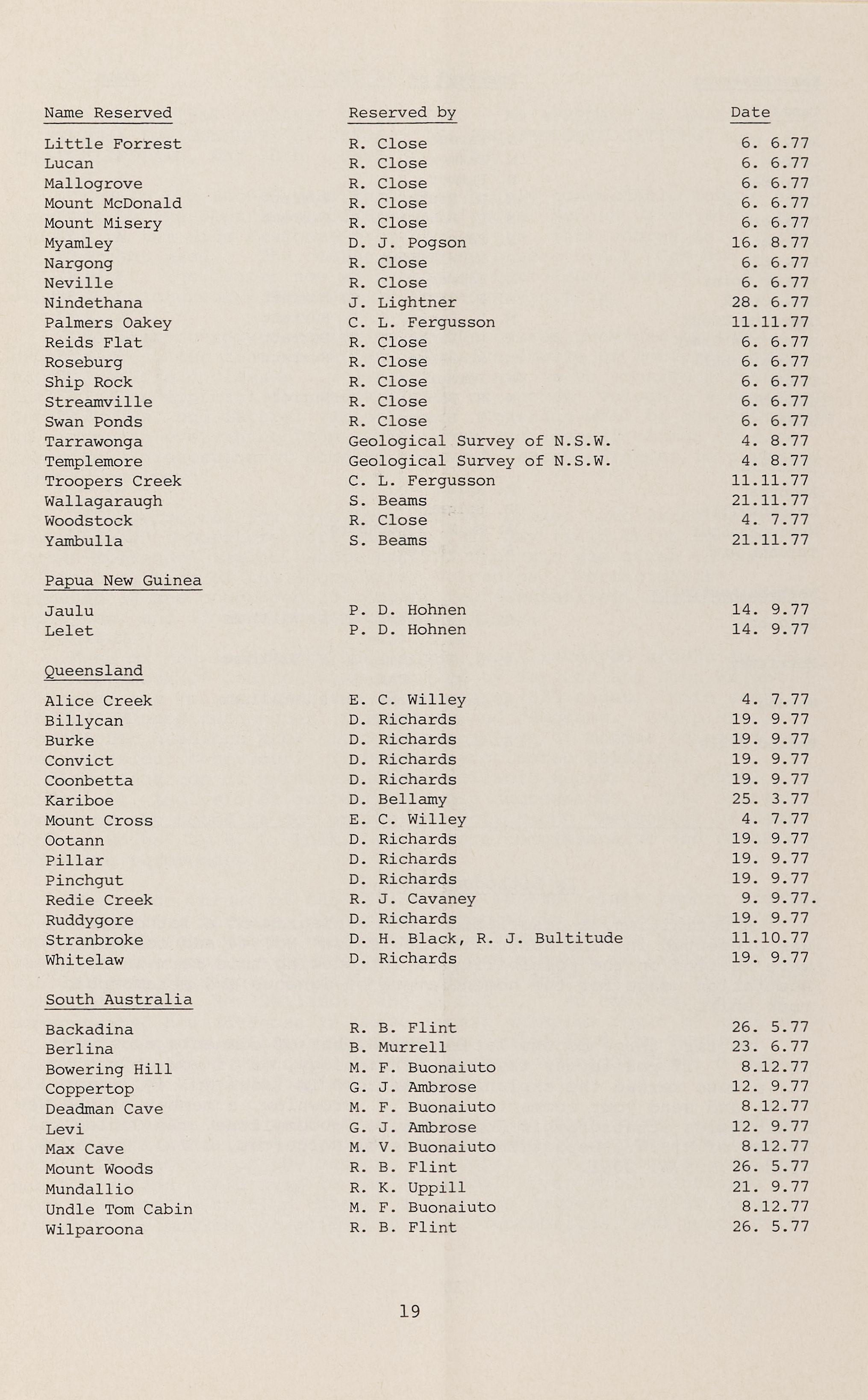
Papua New Guinea
Is Lithodemed O.K.?
A definition, a description, and a diagram of a lithodeme was presented in "The Australian Geologist" No. 44 and comments were invited on the possibility of introducing this term into Australian usage for the nomenclature of igneous and metamorphic rock units.
So far, three months later, the number of comments received is nil. If you favour this new terminology, or if you object to it, please reread the explanatory article in issue No. 44, pages 7-11, and send your comments to Mr. J. Brownlow, a member of the New South Wales Stratigraphic Nomenclature Subcommittee, c/o Geological Survey of N.S.W., Department of Mineral Resources, G.P.O. Box 5288, Sydney, N.S.W. 2001.
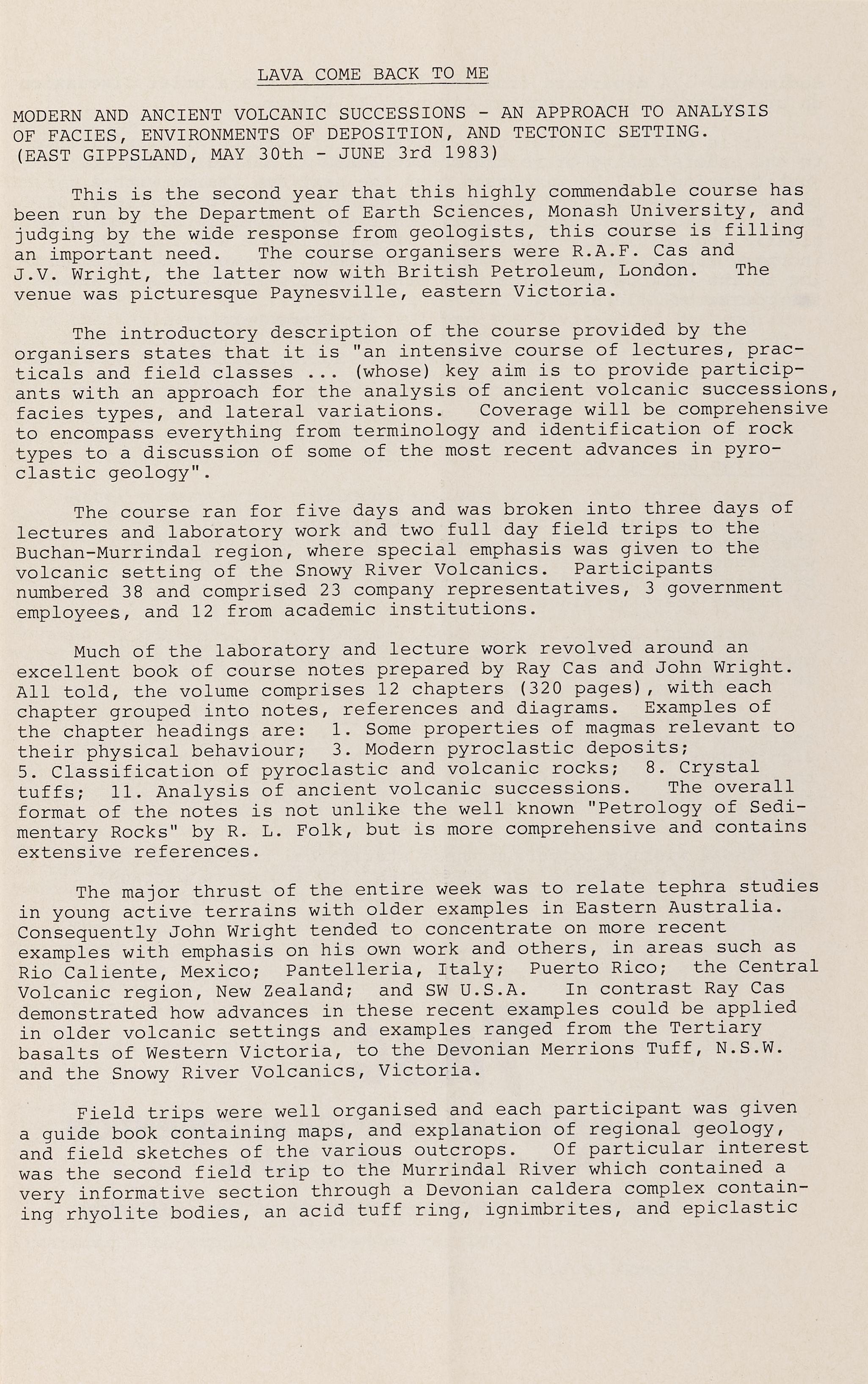
MODERN AND ANCIENT VOLCANIC SUCCESSIONS - AN APPROACH TO ANALYSIS OF FACIES, ENVIRONMENTS OF DEPOSITION, AND TECTONIC SETTING. (EAST GIPPSLAND, MAY 30th - JUNE 3rd 1983)
This is the second year that this highly commendable course has been run by the Department of Earth Sciences, Monash University, and judging by the wide response from geologists, this course is filling an important need. The course organisers were R.A.F. Cas and J.V. Wright, the latter now with British Petroleum, London. The venue was picturesque Paynesville, eastern Victoria.
The introductory description of the course provided by the organisers states that it is "an intensive course of lectures, practicals and field classes ... (whose) key aim is to provide participants with an approach for the analysis of ancient volcanic successions, facies types, and lateral variations. Coverage will be comprehensive to encompass everything from terminology and identification of rock types to a discussion of some of the most recent advances in pyroclastic geology".
The course ran for five days and was broken into three days of lectures and laboratory work and two full day field trips to the Buchan-Murrindal region, where special emphasis was given to the volcanic setting of the Snowy River Volcanics. Participants numbered 38 and comprised 23 company representatives, 3 government employees, and 12 from academic institutions.
Much of the laboratory and lecture work revolved around an excellent book of course notes prepared by Ray Cas and John Wright. All told, the volume comprises 12 chapters (320 pages), with each chapter grouped into notes, references and diagrams. Examples of the chapter headings are: 1. Some properties of magmas relevant to their physical behaviour; 3. Modern pyroclastic deposits; 5. Classification of pyroclastic and volcanic rocks; 8. Crystal tuffs; 11. Analysis of ancient volcanic successions. The overall format of the notes is not unlike the well known "Petrology of Sedimentary Rocks" by R. L. Folk, but is more comprehensive and contains extensive references.
The major thrust of the entire week was to relate tephra studies in young active terrains with older examples in Eastern Australia. Consequently John Wright tended to concentrate on more recent examples with emphasis on his own work and others, in areas such as Rio Caliente, Mexico; Pantelleria, Italy; Puerto Rico; the Central Volcanic region, New Zealand; and SW U.S.A. In contrast Ray Cas demonstrated how advances in these recent examples could be applied in older volcanic settings and examples ranged from the Tertiary basalts of Western Victoria, to the Devonian Merrions Tuff, N.S.W. and the Snowy River Volcanics, Victoria.
Field trips were well organised and each participant was given a guide book containing maps, and explanation of regional geology, and field sketches of the various outcrops. Of particular interest was the second field trip to the Murrindal River which contained a very informative section through a Devonian caldera complex containing rhyolite bodies, an acid tuff ring, ignimbrites, and epiclastic
sediments. A departure from the first course was a brief discussion on ore deposits and volcanism given by I. Plimer
It is our belief that this course is of particular significance to the understanding of volcanic successions in Australia and its justification will be witnessed over the next few years, with a renewed interest in, and better understanding of volcanic facies, modes of pyroclastic emplacement, and the relationship between pyroclastic and epiclastic deposits. Of significance was the wide industry support and all were unanimous that they would be recommending to the various companies that other staff members be sent should the course be held again.
A. VandenBerg
W. R. H. Ramsay Geological Survey Division of Victoria
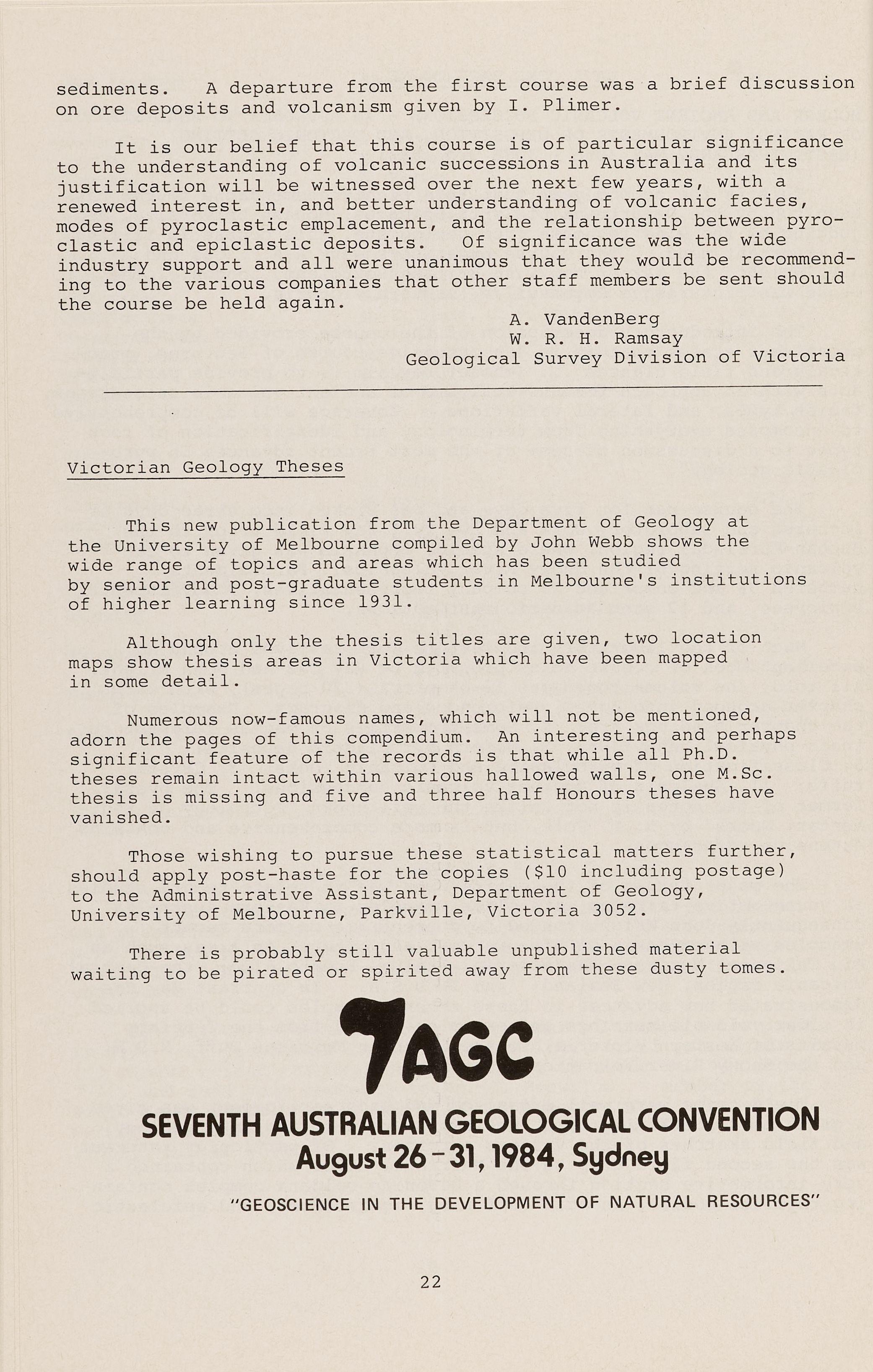
Victorian Geology The ses
This new publication from the Department of Geology at the University of Melbourne compiled by John Webb shows the wide range of topics and areas which has been studied by senior and post-graduate students in Melbourne's institutions of higher learning since 1931.
Although only the thesis titles are given, two location maps show thesis areas in Victoria which have been mapped in some detail.
Numerous now-famous names, which will not be mentioned, adorn the pages of this compendium. An interesting and perhaps significant feature of the records is that while all Ph.D. theses remain intact within various hallowed walls, one M.Sc. thesis is missing and five and three half Honours theses have vanished.
Those wishing to pursue these statistical matters further, should apply post-haste for the copies ($10 including postage) to the Administrative Assistant, Department of Geology, University of Me lbourne, Parkville, Victoria 3052.
There is probably still valuable unpublished material waiting to be pirated or spirited away from these dusty tomes.
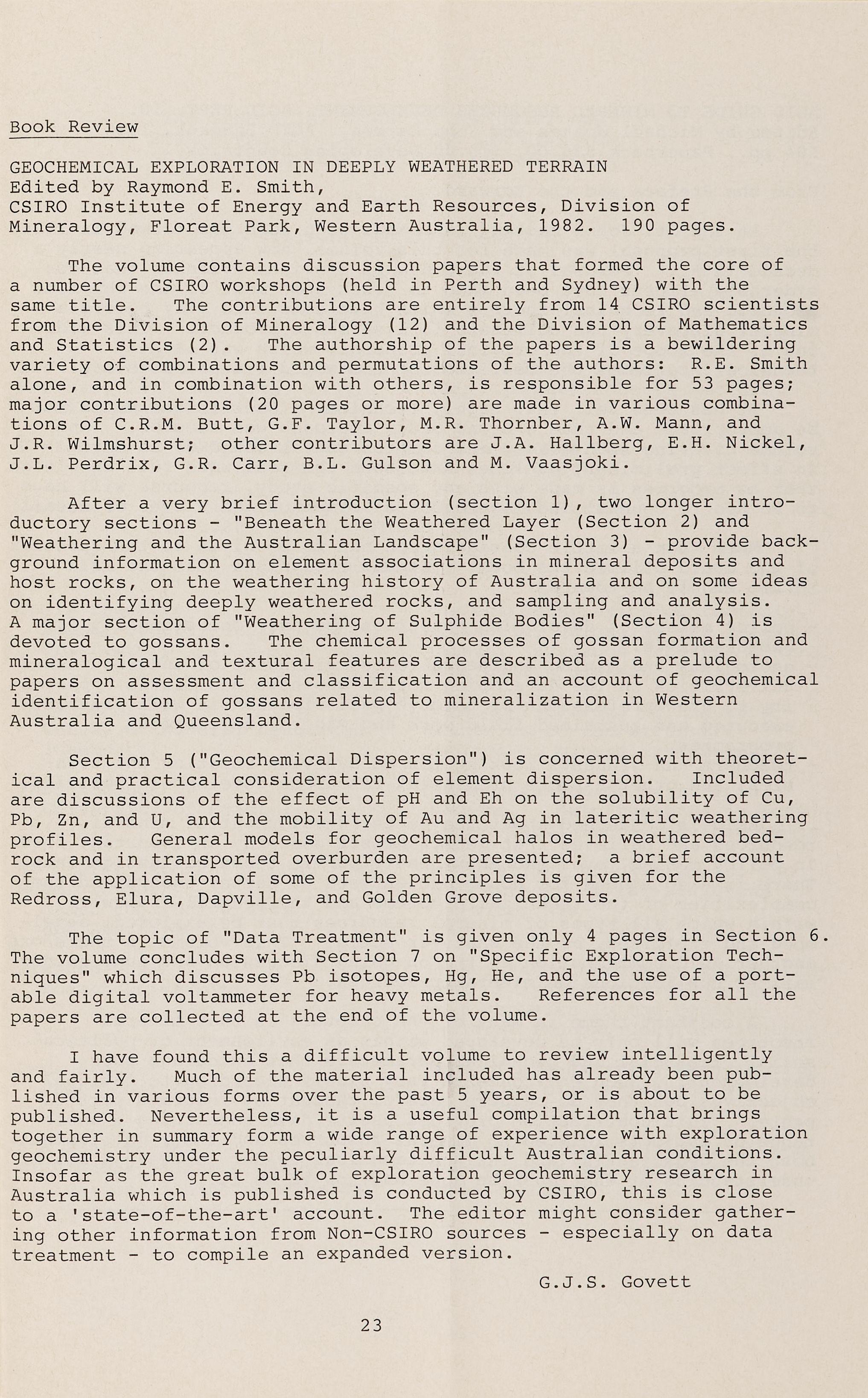
Book Review
GEOCHEMICAL EXPLORATION IN DEEPLY WEATHERED TERRAIN
Edited by Raymond E. Smith, CSIRO Institute of Energy and Earth Resources, Division of Mineralogy, Floreat Park, Western Australia, 1982. 190 pages.
The volume contains discussion papers that formed the core of a number of CSIRO workshops (held in Perth and Sydney) with the same title. The contributions are entirely from 14 CSIRO scientists from the Division of Mineralogy (12) and the Division of Mathematics and Statistics (2). The authorship of the papers is a bewildering variety of combinations and permutations of the authors: R.E. Smith alone, and in combination with others, is responsible for 53 pages; major contributions (20 pages or more) are made in various combinations of C.R.M. Butt, G.F. Taylor, M.R. Thornber, A.W. Mann, and J.R. Wilmshurst; other contributors are J.A. Hallberg, E.H. Nickel, J.L. Perdrix, G.R. Carr, B.L. Gulson and M. Vaasjoki.
After a very brief introduction (section 1), two longer introductory sections - "Beneath the Weathered Layer (Section 2) and "Weathering and the Australian Landscape" (Section 3) - provide background information on element associations in mineral deposits and host rocks, on the weathering history of Australia and on some ideas on identifying deeply weathered rocks, and sampling and analysis. A major section of "Weathering of Sulphide Bodies" (Section 4) is devoted to gossans. The chemical processes of gossan formation and mineralogical and textural features are described as a prelude to papers on assessment and classification and an account of geochemical identification of gossans related to mineralization in Western Australia and Queensland.
Section 5 ("Geochemical Dispersion") is concerned with theoretical and practical consideration of element dispersion. Included are discussions of the effect of pH and Eh on the solubility of Cu, Pb, Zn, and U, and the mobility of Au and Ag in lateritic weathering profiles. General models for geochemical halos in weathered bedrock and in transported overburden are presented; a brief account of the application of some of the principles is given for the Redross, Elura, Dapville, and Golden Grove deposits.
The topic of "Data Treatment" is given only 4 pages in Section 6. The volume concludes with Section 7 on "Specific Exploration Techniques" which discusses Pb isotopes, Hg, He, and the use of a portable digital voltarnrneter for heavy metals. References for all the papers are collected at the end of the volume.
I have found this a difficult volume to review intelligently and fairly. Much of the material included has already been published in various forms over the past 5 years, or is about to be published. Nevertheless, it is a useful compilation that brings together in summary form a wide range of experience with exploration geochemistry under the peculiarly difficult Australian conditions. Insofar as the great bulk of exploration geochemistry research in Australia which is published is conducted by CSIRO, this is close to a 'state-of-the-art' account. The editor might consider gathering other information from Non-CSIRO sources - especially on data treatment - to compile an expanded version.
G.J.S. Govett
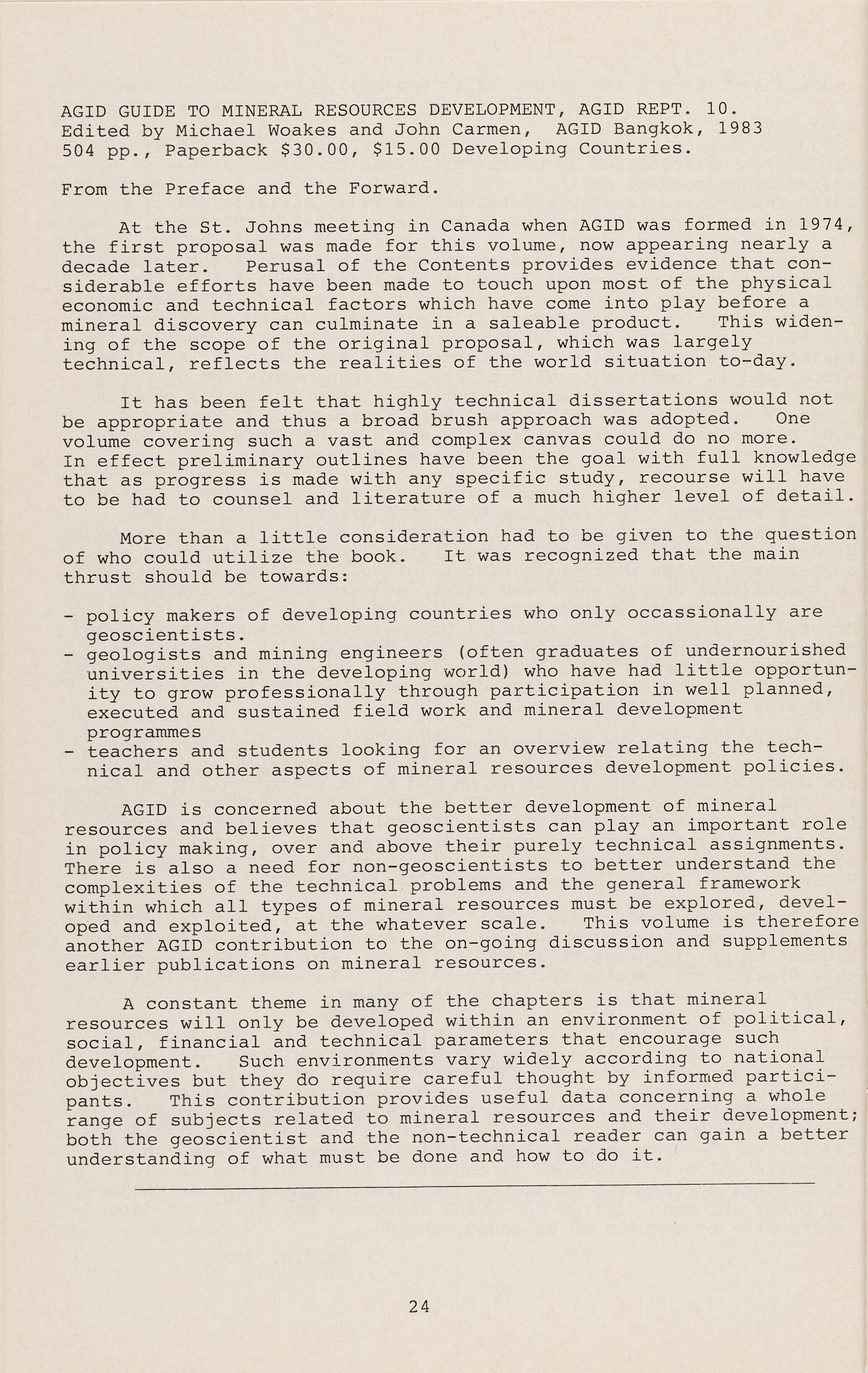
AGID GUIDE TO MINERAL RESOURCES DEVELOPMENT, AGID REPT. 10.
Edited by Michael Woakes and John Carmen, AGID Bangkok, 1983 504 pp., Paperback $30.00, $15.00 Developing Countries.
From the Preface and the Forward.
At the St. Johns meeting in Canada when AGID was formed in 1974, the first proposal was made for this volume, now appearing nearly a decade later. Perusal of the Contents provides evidence that considerable efforts have been made to touch upon most of the physical economic and technical factors which have come into play before a mineral discovery can culminate in a saleable product. This widening of the scope of the original proposal, which was largely technical, reflects the realities of the world situation to-day.
It has been felt that highly technical dissertations would not be appropriate and thus a broad brush approach was adopted. One volume covering such a vast and complex canvas could do no more. In effect preliminary outlines have been the goal with full knowledge that as progress is made with any specific study, recourse will have to be had to counsel and literature of a much higher level of detail.
More than a little consideration had to be given to the question of who could utilize the book. It was recognized that the main thrust should be towards:
- policy makers of developing countries who only occassionally are geoscientists.
- geologists and mining engineers (often graduates of undernourished universities in the developing world) who have had little opportunity to grow professionally through participation in well planned, executed and sustained field work and mineral development programmes teachers and students looking for an overview relating the technical and other aspects of mineral resources development policies.
AGID is concerned about the better development of mineral resources and believes that geoscientists can play an important role in policy making, over and above their purely technical assignments. There is also a need for non-geoscientists to better understand the complexities of the technical problems and the general framework within which all types of mineral resources must be e x plored, developed and exploited, at the whatever scale. This volume is therefore another AGID contribution to the on-going discussion and supplements earlier publications on mineral resources.
A constant theme in many of the chapters is that mineral resources will only be developed within an environment of political, social, financial and technical parameters that encourage such development. Such environments vary widely according to national objectives but they do require careful thought by informed participants. This contribution provides useful data concernin g a whole range of subjects related to mineral resources and their development; both the geoscientist and the non-technical reader can gain a better understanding of what must be done and how to do it.
THE SPECIALIST GROUP IN TECTONICS AND STRUCTURAL GEOLOGY AND THE NSW DIVISION OF THE GEOLOGICAL SOCIETY OF AUSTRALIA
present
TWO STATE-OF-THE-ART SYMPOSIA and
FIELD TRIP
Two 'state-of-the-art' symposia will be held in Sydney on February 16th and 17th, 1984. Venue: Stephen Roberts Lecture Theatre, University of Sydney.
SYMPOSIUM 1: FRACTURES AND VEINS: THEIR FORMATION AND ECONOMIC IMPORTANCE (16.2.84)
Convenor: Dr. R. A. Glen, N.S.W. Geological Survey, Box 5288, G.P.O., SYDNEY 2001.
PROGRAMME
Terry Engelder Lamont-Doherty Geological Observatory (U.S.A.)
Mike Etheridge Bureau of Mineral Resources (Canberra)
Paul Hancock University of Bristol (U.K.)
D. Clarke, Rod Patterson, Roge~ Taylor
James Cook University and Aberfoyle Ltd.
Stephen Cox Monash University
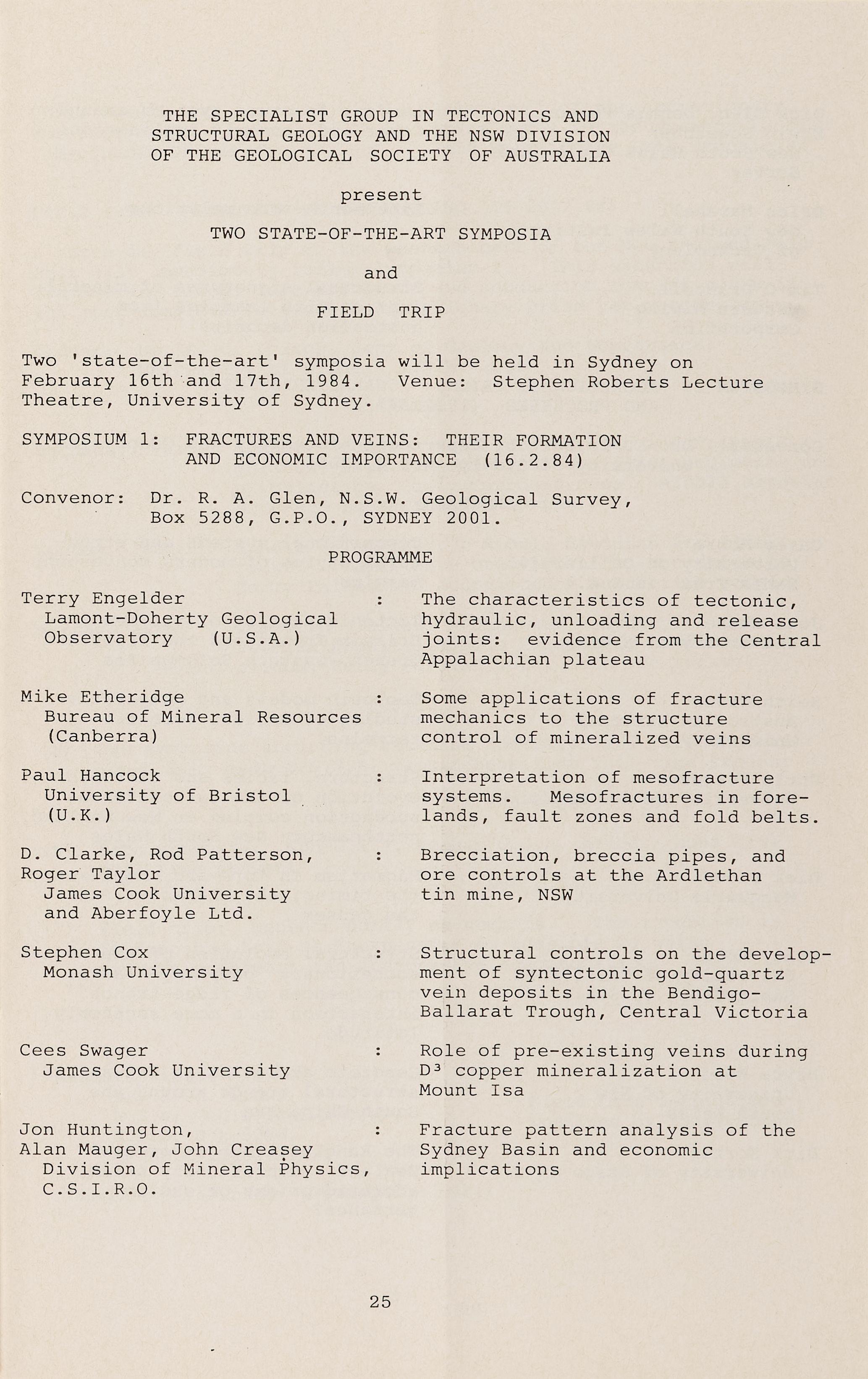
Cees Swager
James Cook University
Jon Huntington, Alan Mauger, John Creasey Division of Mineral Physics, C.S.I.R.O.
The characteristics of tectonic, hydraulic, unloading and release joints: evidence from the Central Appalachian plateau
Some applications of fracture mechanics to the structure control of mineralized veins
Interpretation of mesofracture systems. Mesofractures in forelands, fault zones and fold belts.
Brecciation, breccia pipes, and ore controls at the Ardlethan tin mine, NSW
Structural controls on the development of syntectonic gold-quartz vein deposits in the BendigoBallarat Trough, Central Victoria
Role of pre-existing veins during D3 copper mineralization at Mount Isa
Fracture pattern analysis of the Sydney Basin and economic implications
Dick Glen, Dennis Pogson, Erwin Scheibner
New South Wales Geological Survey
Brian Marshall
New South Wales Institute of Technology
Tim O'Driscoll Western Mining Corporation
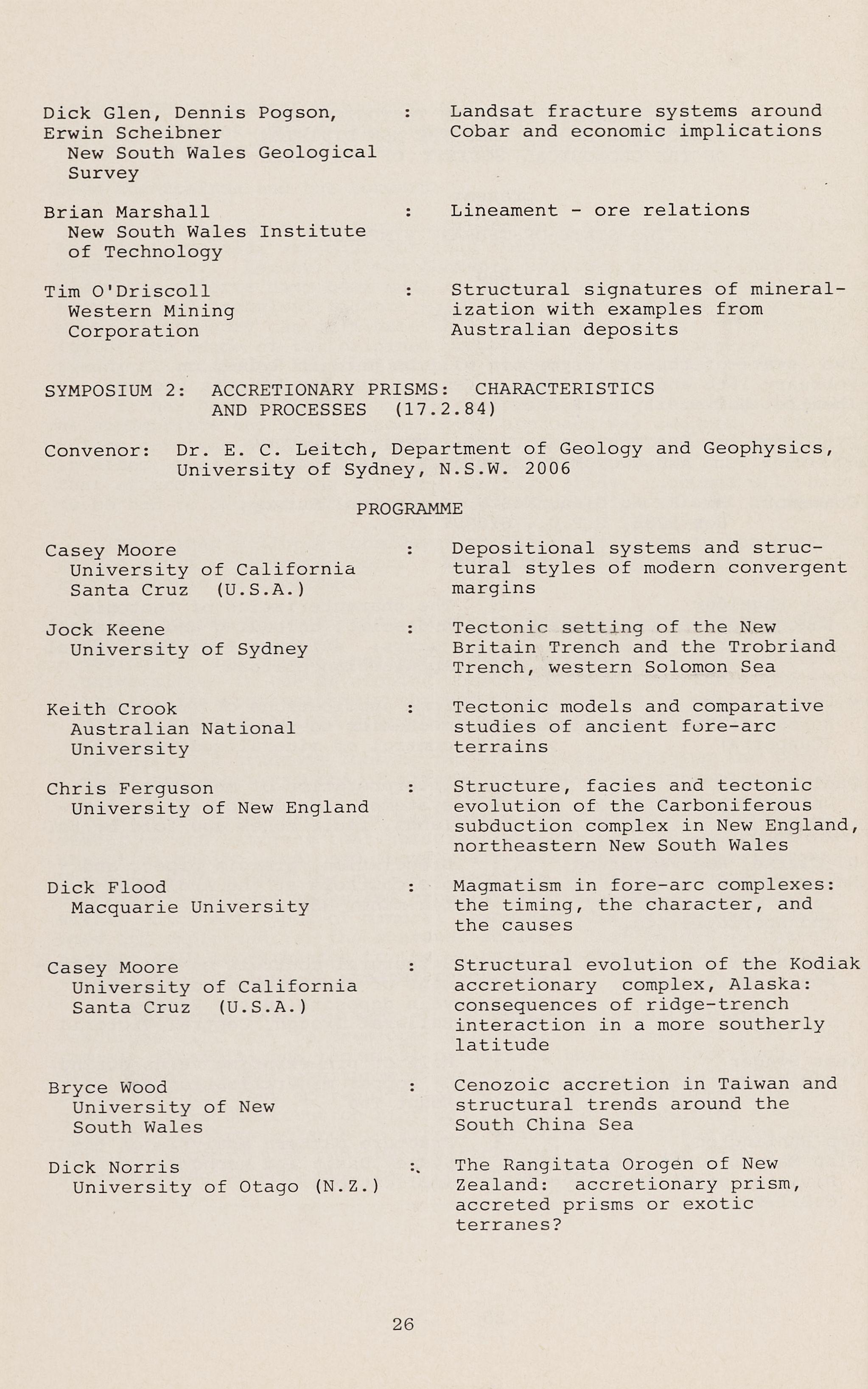
Landsat fracture systems around Cobar and economic implications
Lineament - ore relations
Structural signatures of mineralization with examples from Australian deposits
SYMPOSIUM 2: ACCRETIONARY PRISMS: CHARACTERISTICS AND PROCESSES (17.2.84)
Convenor: Dr. E. C. Leitch, Department of Geology and Geophysics, University of Sydney, N.S.W. 2006
PROGRAMME
Casey Moore
University of California Santa Cruz (U.S.A.)
Jock Keene University of Sydney
Keith Crook Australian National University
Chris Ferguson University of New England
Dick Flood Macquarie University
Casey Moore University of California Santa Cruz (U.S.A.)
Bryce Wood University of New South Wales
Dick Norris
University of Otago (N.Z.)
Depositional systems and structural styles of modern convergent margins
Tectoni c setting of the New Britain Trench and the Trobriand Trench, western Solomon Sea
Tectonic models and comparative studies of ancient fore-arc terrains
Structure, facies and tectonic evolution of the Carboniferous subduction complex in New England, northeastern New South Wales
Magmatism in fore-arc complexes: the timing, the character, and the causes
Structural evolution of the Kodiak accretionary complex, Alaska: consequences of ridge-trench interaction in a more southerly latitude
Cenozoic accretion in Taiwan and structural trends around the South China Sea
Th e Rangitata Orogen of New Zealand: accretionary prism, accreted prisms or exotic terranes?
Chris Powell and Pat Conaghan
Macquarie University
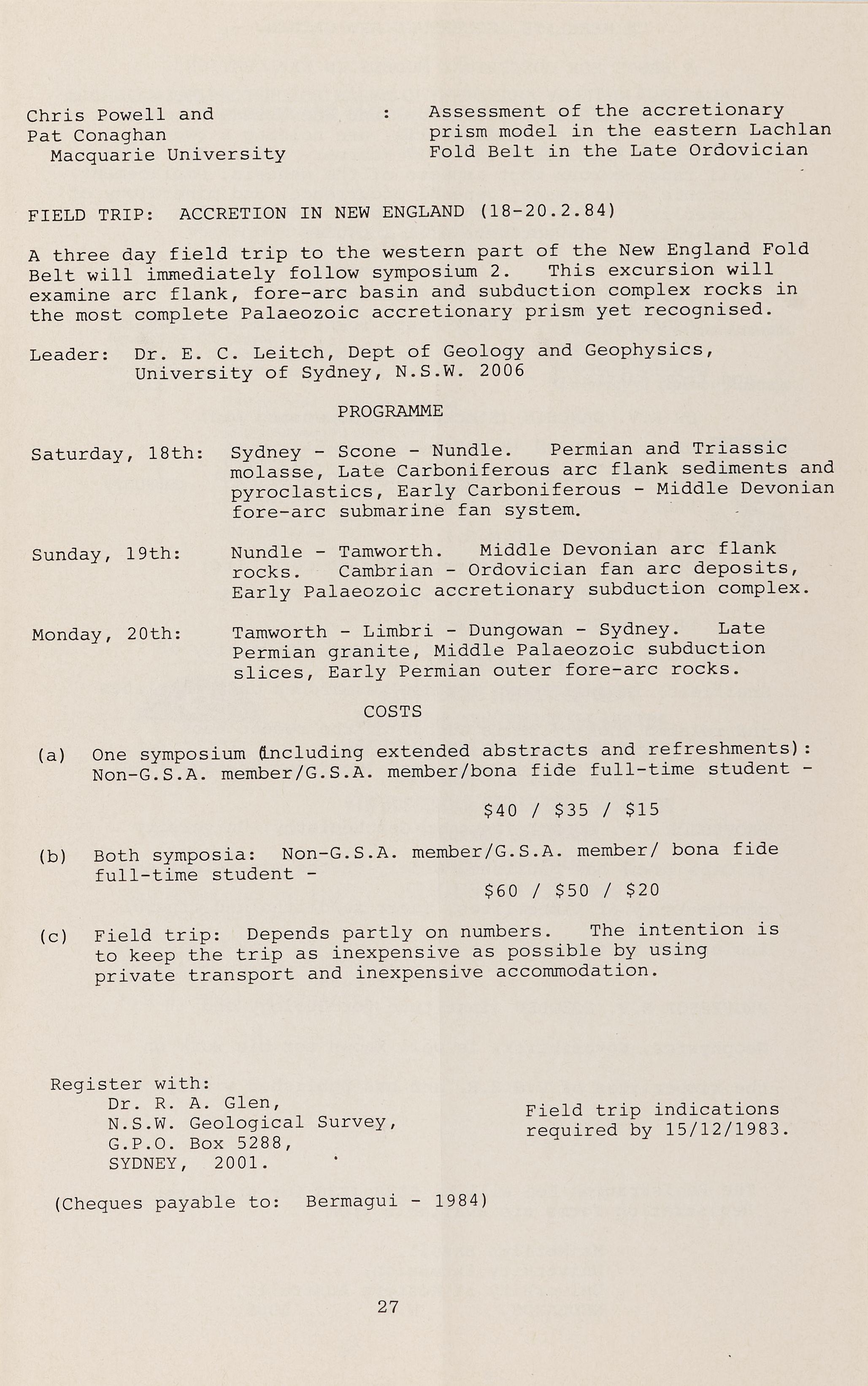
Assessment of the accretionary prism model in the eastern Lachlan Fold Belt in the Late Ordovician
FIELD TRIP: ACCRETION IN NEW ENGLAND (18-20.2.84)
A three day field trip to the western part of the New England Fold Belt will immediately follow symposium 2. This excursion will examine arc flank, fore-arc basin and subduction complex rocks in the most complete Palaeozoic accretionary prism yet recognised.
Leader: Dr. E. C. Leitch, Dept of Geology and Geophysics, University of Sydney, N.S.W. 2006
PROGRAMME
Saturday, 18th: Sydney - Scone - Nundle. Permian and Triassic molasse, Late Carboniferous arc flank sediments and pyroclastics, Early Carboniferous - Middle Devonian fore-arc submarine fan system.
Sunday, 19th: Nundle - Tamworth. Middle Devonian arc flank rocks. Cambrian - Ordovician fan arc deposits, Early Palaeozoic accretionary subduction complex.
Monday, 20th: Tamworth - Limbri - Dungowan - Sydney. Late Permian granite, Middle Palaeozoic subduction slices, Early Permian outer fore-arc rocks.
COSTS
(a) One symposium [ncluding extended abstracts and refreshments): Non-G.S.A. member/G.S.A. member/bona fide full-time student -
$40 I $35 / $15
(b) Both symposia: Non-G.S.A. member/G.S.A. member/ bona fide full-time student -
$60 I $SO I $20
(c) Field trip: Depends partly on numbers. The intention is to keep the trip as inexpensive as possible by using private transport and inexpensive accommodation.
Register with: Dr. R. A. Glen, N.S.W. Geological Survey, G.P.O. Box 5288, SYDNEY, 2001.
(Cheques payable to: Bermagui - 1984) 27
Field trip indications required by 15/12/1983.
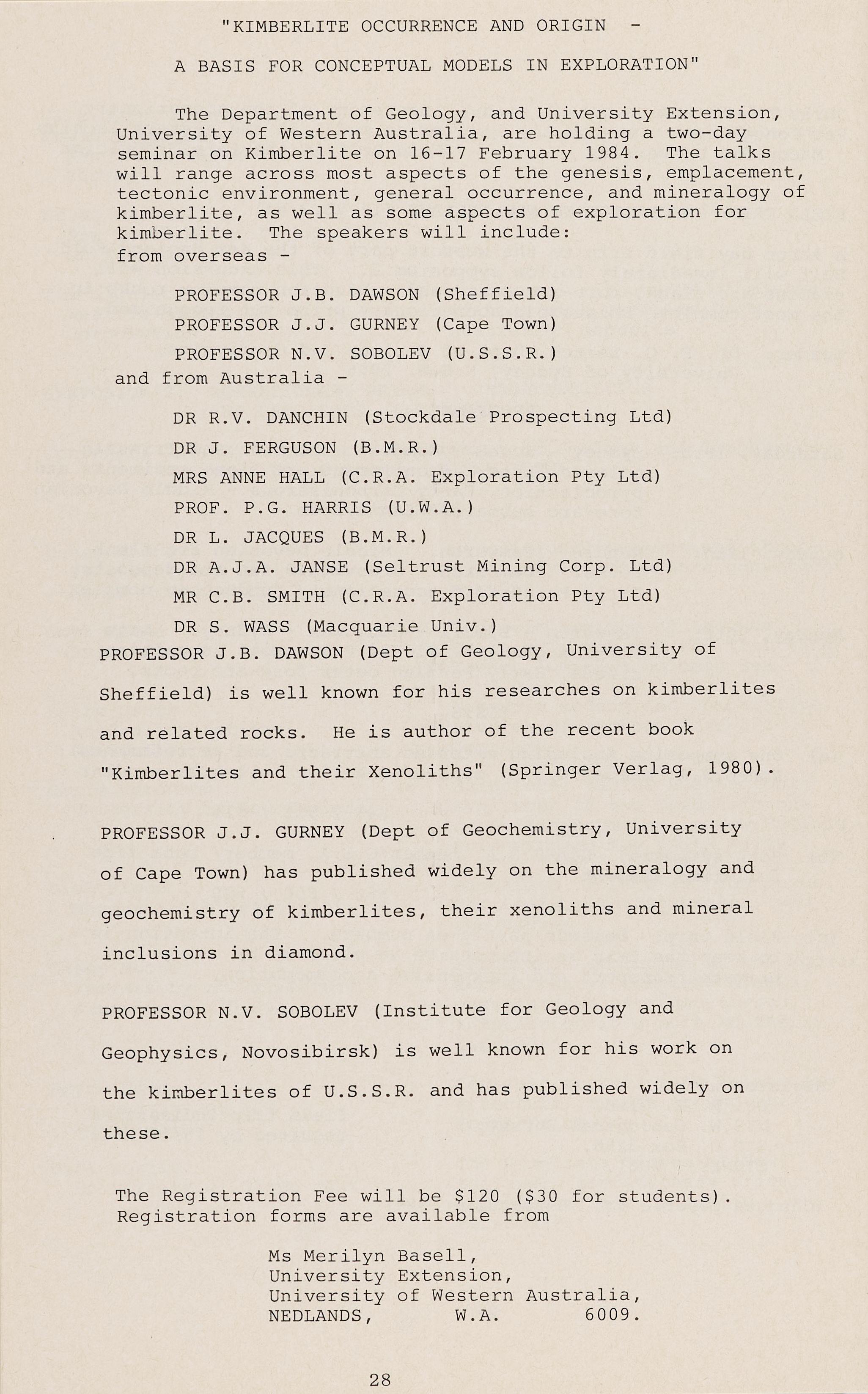
A BASIS FOR CONCEPTUAL MODELS IN EXPLORATION"
The Department of Geology, and University Extension, University of Western Australia, are holding a two-day seminar on Kimberlite on 16-17 February 1984. The talks will range across most aspects of the genesis, emplacement, tectonic environment, general occurrence, and mineralogy of kimberlite, as well as some aspects of exploration for kimberlite. The speakers will include: from overseas -
PROFESSOR J.B. DAWSON (Sheffield)
PROFESSOR J.J. GURNEY (Cape Town)
PROFESSOR N.V. SOBOLEV (U.S.S. R.) and from Australia -
DR R.V. DANCHIN (Stockdale Prospecting Ltd)
DR J. FERGUSON (B.M.R.)
MRS ANNE HALL (C.R.A. Exploration Pty Ltd)
PROF. P.G. HARRIS (U.W.A.)
DR L. JACQUES (B.M.R.)
DR A.J.A. JANSE (Seltrust Mining Corp. Ltd)
MR C.B. SMITH (C.R.A. Exploration Pty Ltd)
DRS. WASS (Macquarie Univ.)
PROFESSOR J.B. DAWSON (Dept of Geology, University of Sheffield) is well known for his researches on kimberlites and related rocks. He is author of the recent book "Kimberlites and their Xenoliths" (Springer Verlag, 1980).
PROFESSOR J.J. GURNEY (Dept of Geochemistry, University of Cape Town) has published widely on the mineralogy and geochemistry of kimberlites, their xenoliths and mineral inclusions in diamond.
PROFESSOR N.V. SOBOLEV (Institute for Geology and Geophysics, Novosibirsk) is well known for his work on the kirwerlites of U.S.S.R. and has published widely on these.
The Registration Fee will be $120 ($30 for students). Registration forms are available from Ms Merilyn Basell, Universit y Extension, University of Western Australia, NEDLANDS, W.A. 6009.
ARCHAEAN AND PROTEROZOIC BASINS OF THE PILBARA, WESTERN AUSTRALIA: EVOLUTION AND MINERALIZATION POTENTIAL One-Day Seminar 15 February 1984
A presentation of new data on Archaean and Proterozoic sediments and volcanics by the Department of Geology, University o f W este rn Australia
ORGANIZING COMMITTEE
Assoc Prof. D I. Groves,
Department of Geology University of Western Australia and Mr T .S. Blake (Geology Department, U . W.A.)
Mr P T Seaman, Ms M. Basel! (University Extension, U W A.)
FEE: $40 per head - includes morning
ENQUIRIES: and afternoon teas, lunch and a copy of the subsequent pub l ication. Abstracts available at registration. Students $20
Academic : Assoc. Prof David Groves (09) 380 2685
Administration : Merilyn Basel! (09) 380 2433
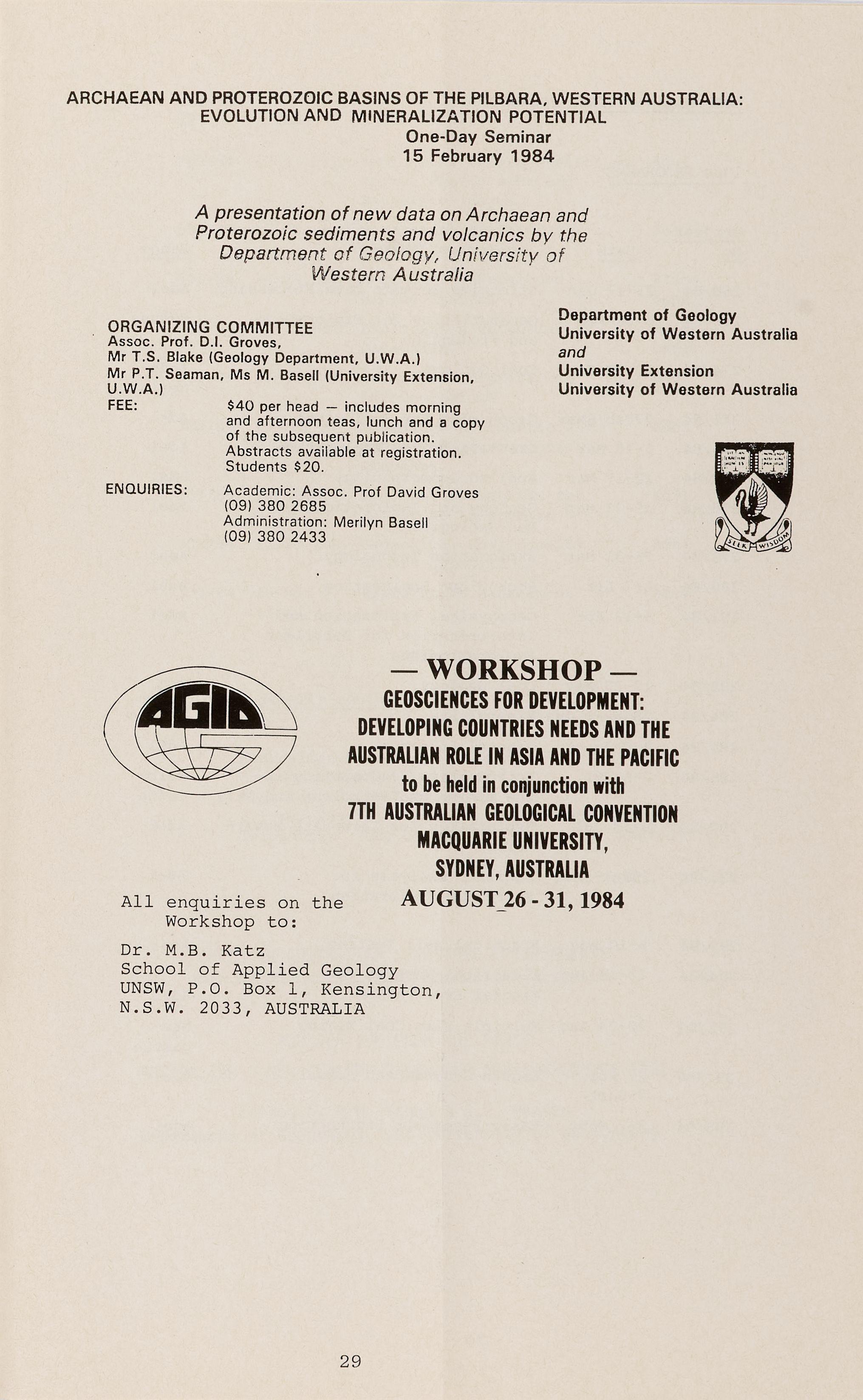
University Extension University of Western Australia
All enquiries on the Workshop to:
Dr. M.B. Katz
-WORKSHOPGEOSCIENCES FOR DEVELOPMENT:
DEVELOPING COUNTRIES NEEDS AND THE AUSTRALIAN ROLE IN ASIA AND THE PACIFIC to be held in conjunction with 7TH AUSTRALIAN GEOLOGICAL CONVENTION MACQUARIE UNIVERSITY, SYDNEY, AUSTRALIA
AUGUST 26 - 31, 1984
School of Applied Geolog y UNSW, P.O. Bo x 1, Kensington, N . S W 2033, AUSTRALIA
1984 PROGRAMME
Project No. 268/84
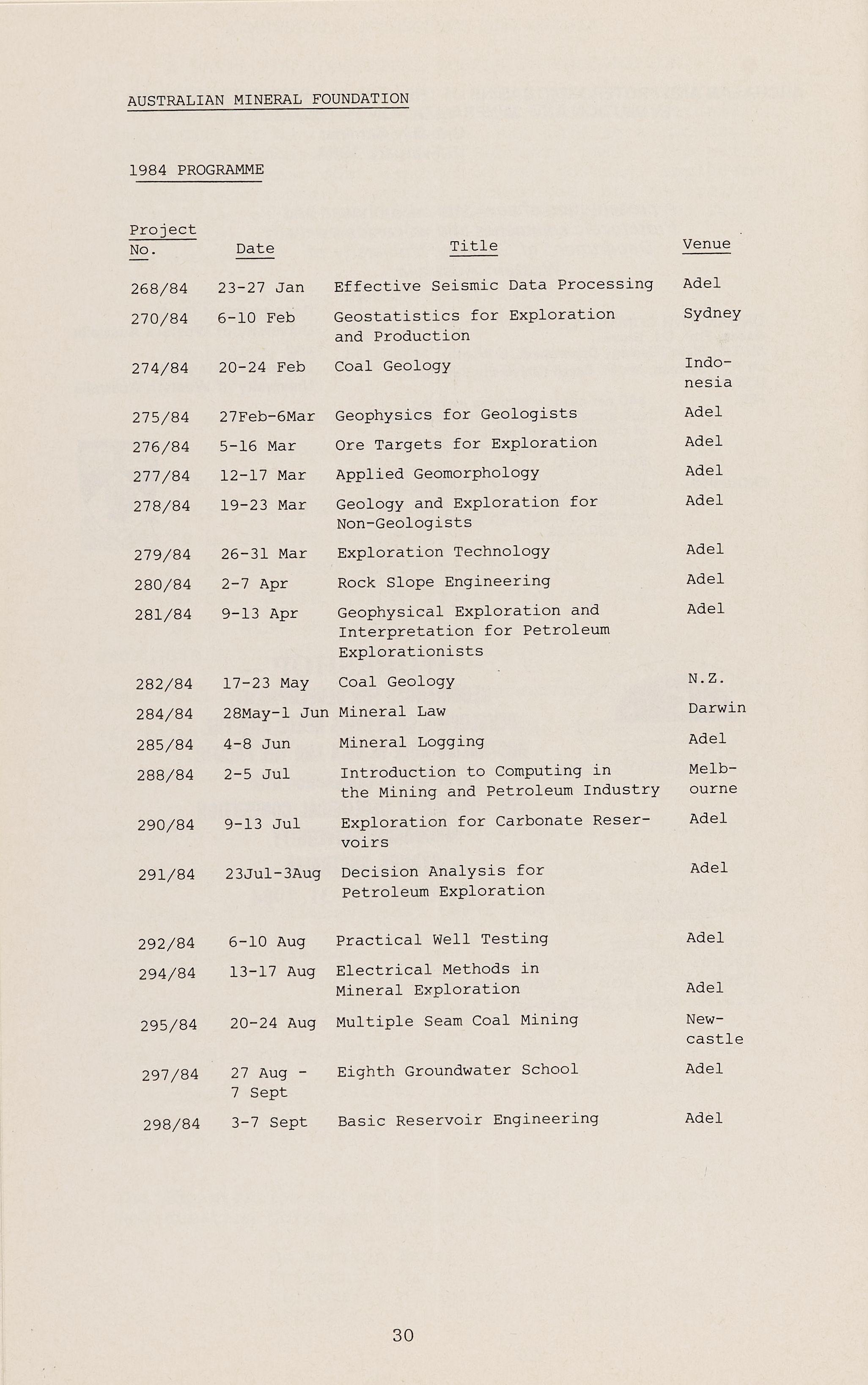
Date 23-27 Jan
6-10 Feb 20-24 Feb 27Feb-6Mar 5-16 Mar 12-17 Mar 19 - 23 Mar 26-31 Mar 2-7 Apr 9 - 13 Apr 17-23 May
Title
Effective Seismic Data Processing
Geostatistics for Exploration and Production
Coal Geology
Geophysics for Geologists
Ore Targets for Exploration
Applied Geomorphology
Geology and Exploration for Non-Geologists
Exploration Technology
Rock Slope Engineering
Geophysical Exploration and Interpretation for Petroleum Explorationists
Coal Geology
28May-l Jun Mineral Law
4-8 Jun 2-5 Jul 9-13 Jul
23Jul-3Aug
Mineral Logging
Introduction to Computing in the Mining and Petroleum Industry
Exploration for Carbonate Reservoirs
Decision Analysis for Petroleum Exploration
6-10 Aug Practical Well Testing 13-17 Aug Electrical Methods in Mineral Exploration 20-24 Aug Multiple Seam Coal Mining
27 Aug7 Sept 3-7 Sept
Eighth Groundwater School
Basic Reservoir Engineering
Project No. Date Title
299/84 10-21 Sept Geological Interpretation Aerial Photographs and Satellite Images
300/84 17-26 Sept Management Training for Senior Geologists
301/84 24-29 Sept Design of Underground Mining Systems
303/84 11-12 Oct Exploration PotentialQueensland
305/84 22-26 Oct Seismic Interpretation for Geologists
306/84 29 Oct - Formation Evaluation 19 Nov Basic and Intermediate Concepts
307/84 12-16 Nov Exploration Methods for Sandstone Reservoirs
308/84 12-23 Nov Geological Environments of Ore Deposits
309/84 28 Nov - Exploration Management 14 Dec
For further details contact:
Australian Mineral Foundation Conyngham Street Glensi9e, South Australia
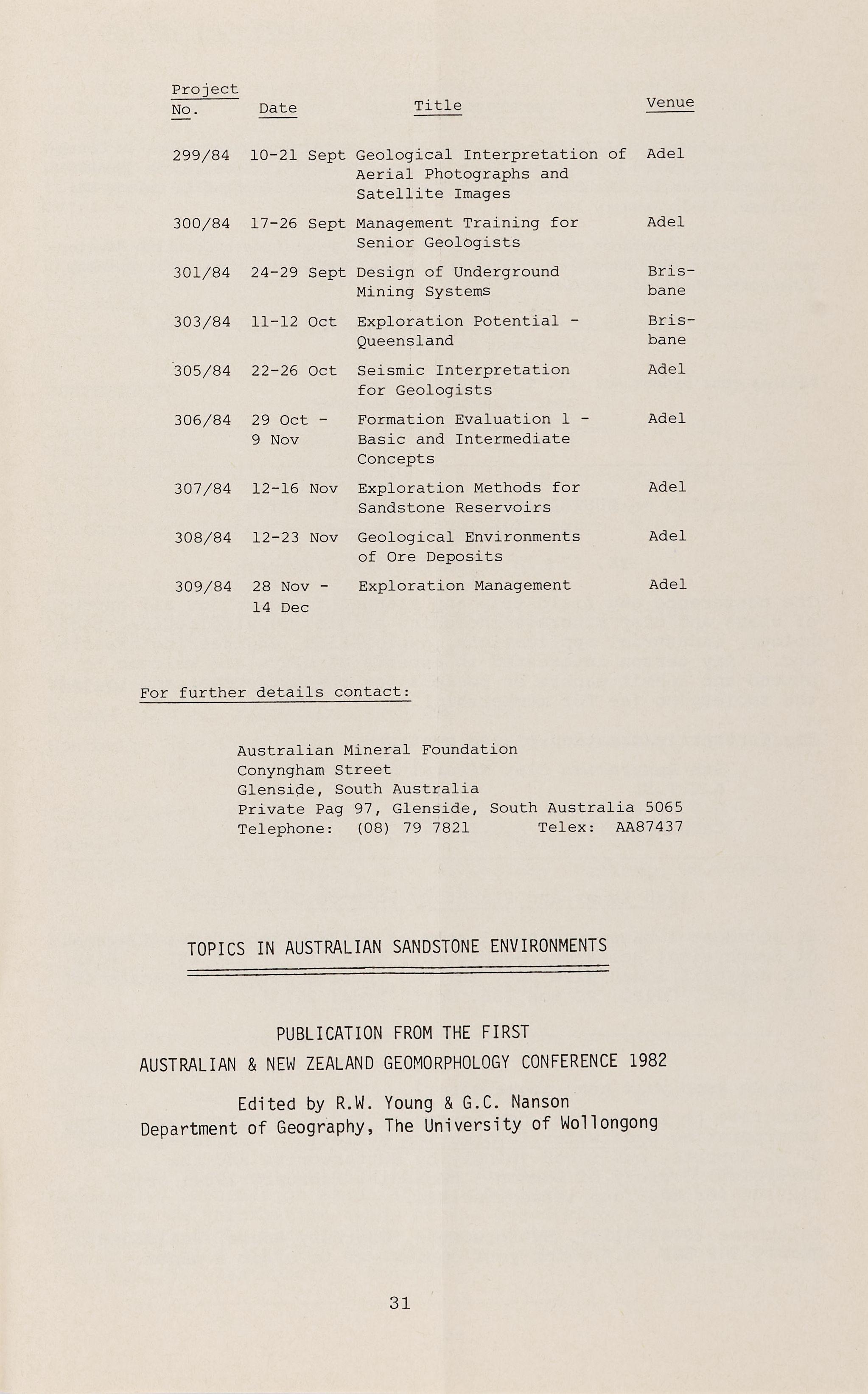
of Adel
Private Pag 97, Glenside, South Australia 5065 Telephone: (08) 79 7821 Telex: AA87437
TOPICS IN AUS TRALIAN SANDSTONE ENVIRONMENTS
PUBLICATION FROM THE FIRST AUSTRALIAN & NE\~ ZEALAND GEOMORPHOLOGY CONFERENCE 1982
Edited by R.W. Young &G.C. Nanson Department of
Geography, The University of Wollongong
PROCEEDINGS ON SALE
Proceedings of the Workshop on Geoscience Curriculum Development in Southeast Asia organized by Southeast Asia Regional Network of Geosciences (SEARNG) and Association for Geoscientists for International Development in Chiang Mai, Thailand, 30-31 January 1983.
Contains papers on geoscience education and geoscience curriculum development in Australia, Hong Kong, Indonesia, Japan, Korea, Malaysia, Philippines, Singapore, Thailand and Vietnam.
Price: US.$25.00 (Airmail postage and packing is included, but prepayment is required).
Address your orders to: Dr. T. Thanasuthipitak, Dept of Geological Sciences, Chiang Mai University, CHIANG MAI 50002. Thailand.
AUSTRALIAN CLAY MINERAL SOCIETY 9TH BIENNIAL CONFERENCE
26, 27&28 November 1984, Canberra
The conference and field trip and planned to cater for all aspects of clays and clay minerals including origin, identification, technology, industrial applications, exploration, engineering aspects, etc. Any person interested in aspects of clays are welcome to attend and submit papers or posters for the conference and to join the society(no fee for membership).
For further information please contact:
9th Australian Clay Mineral Conference
A.C.T.S.
G.P.O. Box 1929, CANBERRA CITY. A.C.T. 2601.
13th Lunar and Planetary Science Conference
By accident I have received 3 sets of 13LPSC Proceedings (Journal of Geophysical Research, Supplements to Vols. 87 and 88). With JGR approval I can give away the two surplus sets. Requests to R.A. Binns, CSIRO, PO Box 136, North Ryde, 2113).
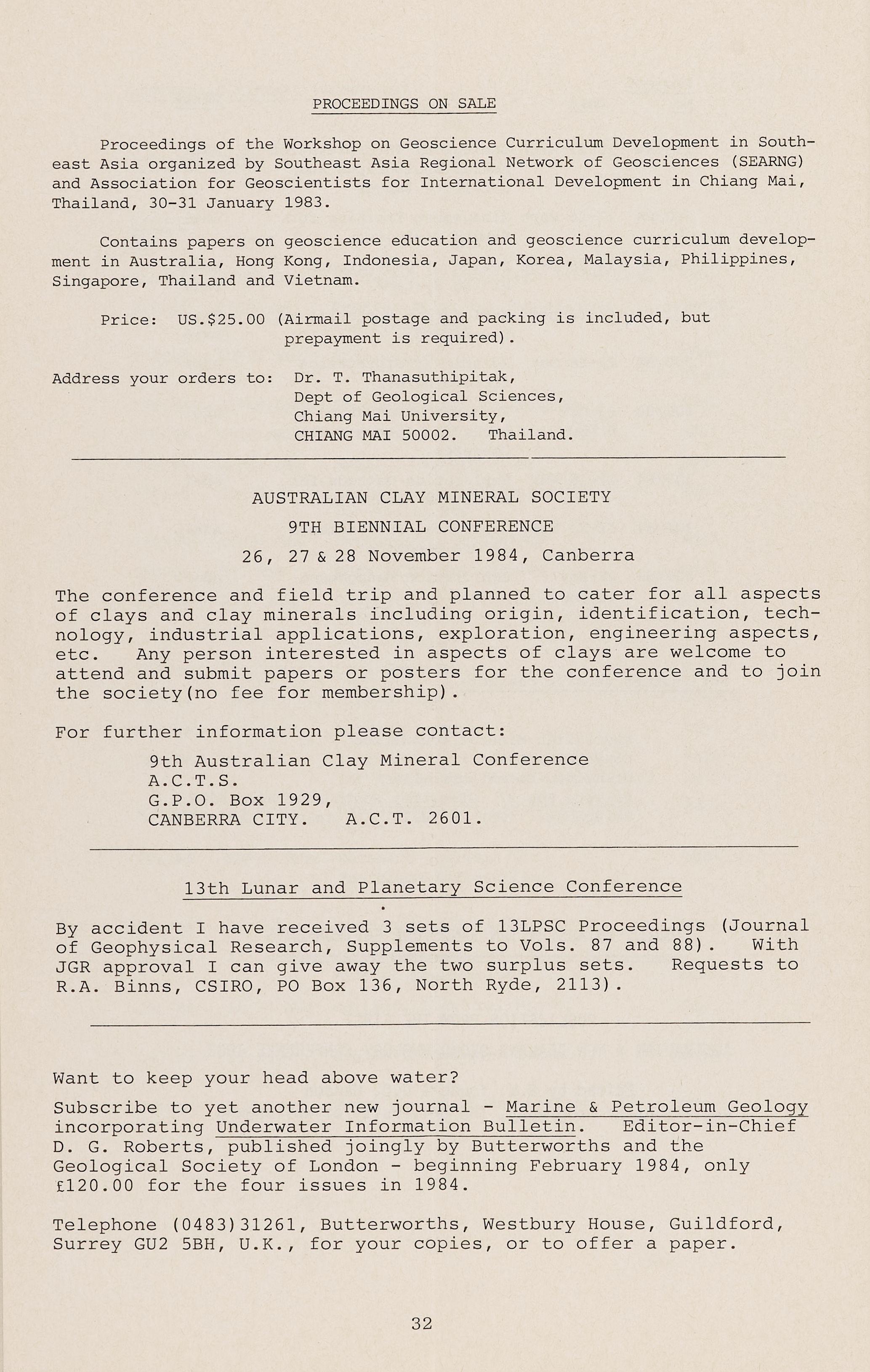
Want to keep your head above water?
Subscribe to yet another new journal - Marine & Petroleum Geology incorporating Underwater Information Bulletin. Editor-in-Chief D. G. Roberts, published joingly by Butterworths and the Geological Society of London - beginning February 1984, only El20.00 for the four issues in 1984.
Telephone (0483)31261, Butterworths, Westbury House, Guildford, Surrey GU2 SBH, U.K., for your copies, or to offer a paper.
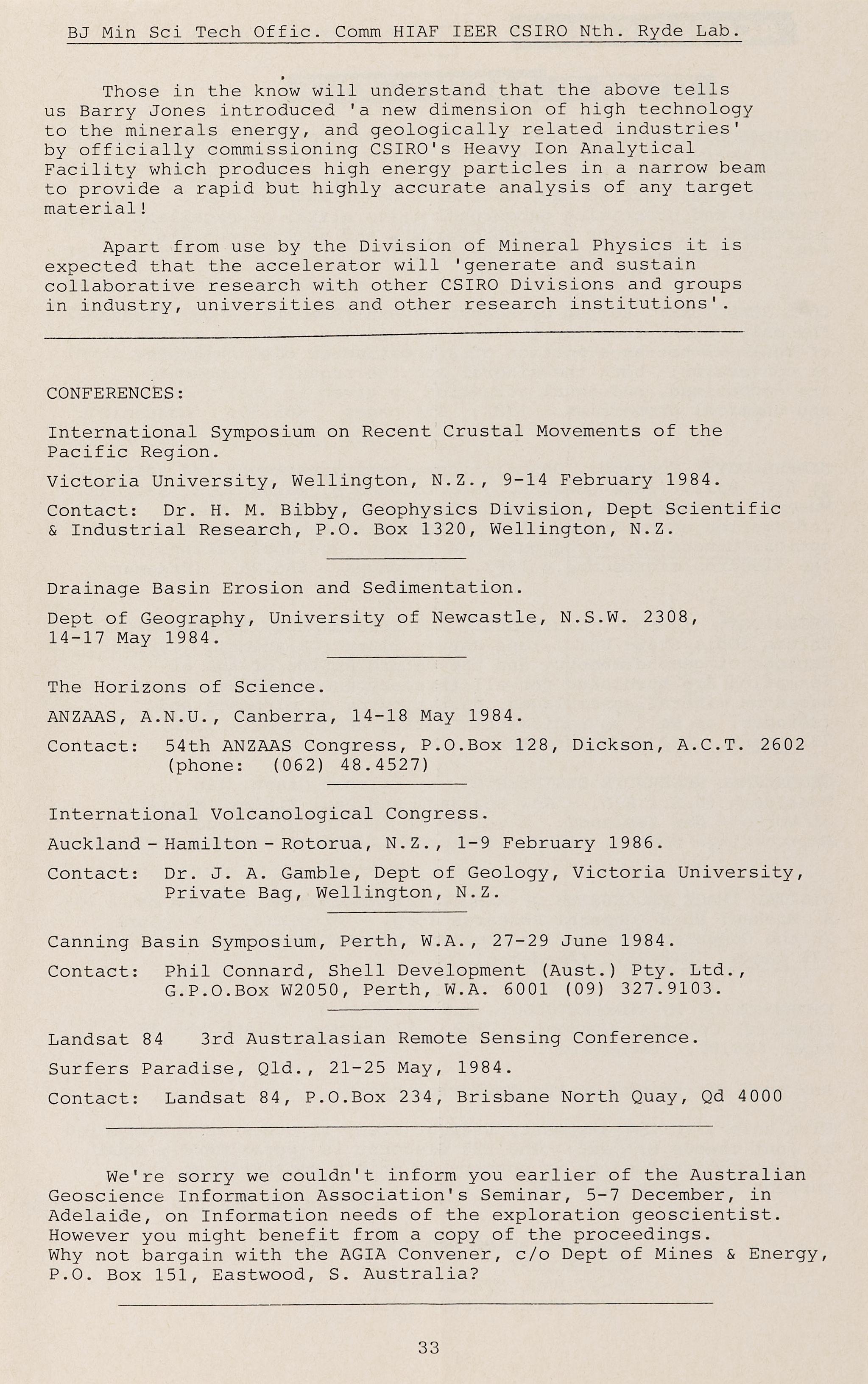
Those in the know will understand that the above tells us Barry Jones introduced 'a new dimension of high technology to the minerals energy, and geologically related industries' by officially commissioning CSIRO's Heavy Ion Analytical Facility which produces high energy particles in a narrow beam to provide a rapid but highly accurate analysis of any target material!
Apart from use by the Di v ision of Mineral Physics it is expected that the accelerator will 'generate and sustain collaborative research with other CSIRO Divisions and groups in industry, universities and other research institutions'.
CONFERENCES:
International Symposium on Recent Crustal Movements of the Pacific Region.
Victoria University, Wellington, N.Z., 9-14 February 1984.
Contact: Dr. H. M. Bibby, Geophysics Division, Dept Scientific & Industrial Research, P.O. Box 1320, Wellington, N.Z.
Drainage Basin Erosion and Sedimentation.
Dept of Geography, University of Newcastle, N . S.W. 2308, 14-17 May 1984.
The Horizons of Science.
ANZAAS, A.N.U., Canberra, 14-18 May 1984.
Contact: 54th ANZAAS Congress, P.O.Box 128, Dickson, A.C.T. 2602 (phone: ( 0 6 2) 4 8. 4 5 2 7)
International Volcanological Congress. Auckland-Hamilton-Rotorua, N.Z., 1-9 February 1986.
Contact: Dr. J. A. Gamble, Dept of Geology, Victoria University, Private Bag, Wellington, N.Z.
Canning Basin Symposium, Perth, W.A., 27-29 June 1984.
Contact: Phil Connard, Shell Development (Aust.) Pty. Ltd., G.P.O.Box W2050, Perth, W. A. 6001 (09) 327.9103.
Landsat 84 3rd Australasian Remote Sensing Conference. Surfers Paradise, Qld., 21-25 May, 1984.
Contact: Landsat 84, P.O.Box 234, Brisbane North Quay, Qd 4000
We'r e sorry we couldn't inform you earlier of the Australian Geoscienc e Information Association's Seminar, 5-7 December, in Adelaide, on Information needs of the exploration geoscientist. However you might benefit from a copy of the proceedings. Wh y not bargain with the AGIA Convener, c/o Dept of Mines & Energy, P.O. Box 151, Eastwood, S. Australia?
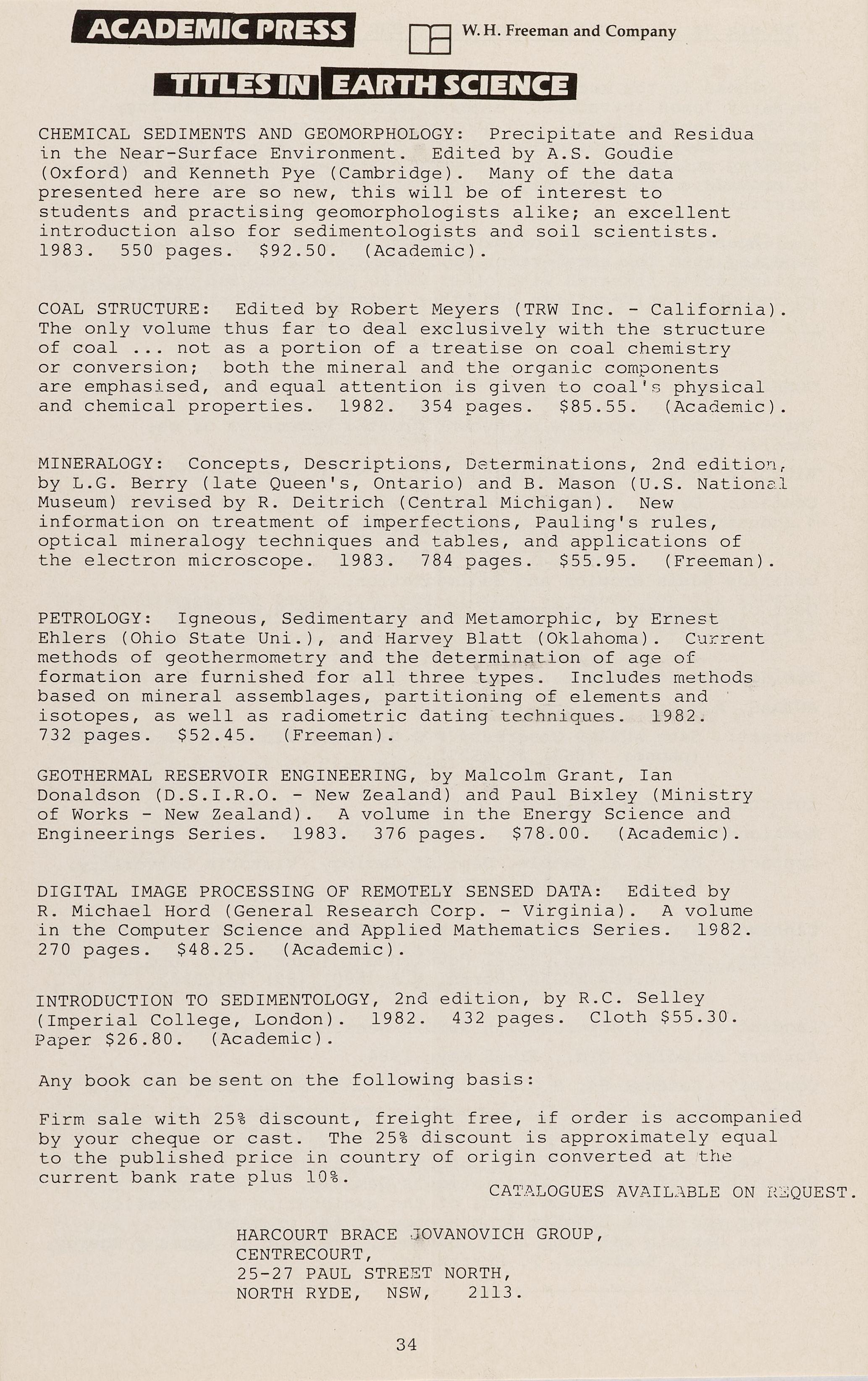
• i i i ::f 1 ,l 11 =t;, rf i :113 '3 C3 :J
CHEMICAL SEDIMENTS AND GEOMORPHOLOGY: Precipitate and Residua in the Near-Surface Environment. Edited by A S. Goudie (Oxford) and Kenneth Pye (Cambridge). Many of the data presented here are so new, this will be of interest to students and practising geomorphologists alike; an excellent introduction also for sedimentologists and soil scientists. 1983. 550 pages. $92.50. (Academic).
COAL STRUCTURE: Edited by Robert Meyers (TRW Inc - California). The only volume thus far to deal exclusivelv with the structure of coal not as a portion of a treatise ;n coal chemistry or conversion; both the mineral and the organic components are emphasised, and equal attention is given to coal' s physical and chemical properties. 1982. 354 pages. $85. 55. (Academic).
MINERALOGY: Concepts, Descriptions, Determinations, 2nd editio n , by L.G. Berry (late Queen's, Ontario) and B. Mason (U.S. Nation a l Museum) revised by R. Deitrich (Central Michigan). New information on treatment of imperfections, Pauling's rules, optical mineralogy techniques and tables, and applications of the electron microscope. 1983. 784 pages. $55.95. (Freeman).
PETROLOGY: Igneous, Sedimentary and Metamorphic, by Ernest Ehlers (Ohio State Uni.), and Harvey Blatt (Oklahoma). Current methods of geothermometry and the determination of age of formation are furnished for all three types. Includes methods based on mineral assemblages, partitioning of elements and isotopes, as well as radiometric dating - te chn i q ues. 1982. 732 pages. $52.45. (Freeman).
GEOTHERMAL RESERVOIR ENGINEERING, by Malcolm Grant, Ian Donaldson (D.S.I.R.O. - New Zealand) and Paul Bixley (Ministry of Works - New Zealand). A volume in the Energy Science and Engineerings Series. 1983. 376 pages. $78.00. (Academic).
DIGITAL IMAGE PROCESSING OF REMOTELY SENSED DATA: Edited by R. Michael Hord (General Research Corp. - Virginia). A volume in the Computer Science and Applied Mathematics Series. 1982. 270 pages. $48. 25. (Academic).
INTRODUCTION TO SEDIMENTOLOGY, 2nd edition, by R.C. Selley (Imperial College, London). 1982. 432 pages. Cloth $55.30 . Paper $26. 80. (Academic).
Any book can be sent on the following basis:
Firm sale with 25% discount, freight free, if order is accompanied by your cheque or cast. The 25% discount is approximately equal to the published price in country of origin converted at the current bank rate plus 10 %.
CAT ALOGUES AVAIL BLE ON UZ QUEST.
HARCOURT BRACE J OVANOVICH GROUP, CENTRECOURT, 25-27 PAUL STREET NORTH, NORTH RYDE, NSW, 2113.
ISOCHRONIC
Attributed to R Miller, formerly a PhD student at the University of Alberta.
Although it yields the date you lacked (Or any other date in fa c t), Don't ever base a paper on The single-datum monochron. ( some wag has added '' or moronchron 11 )
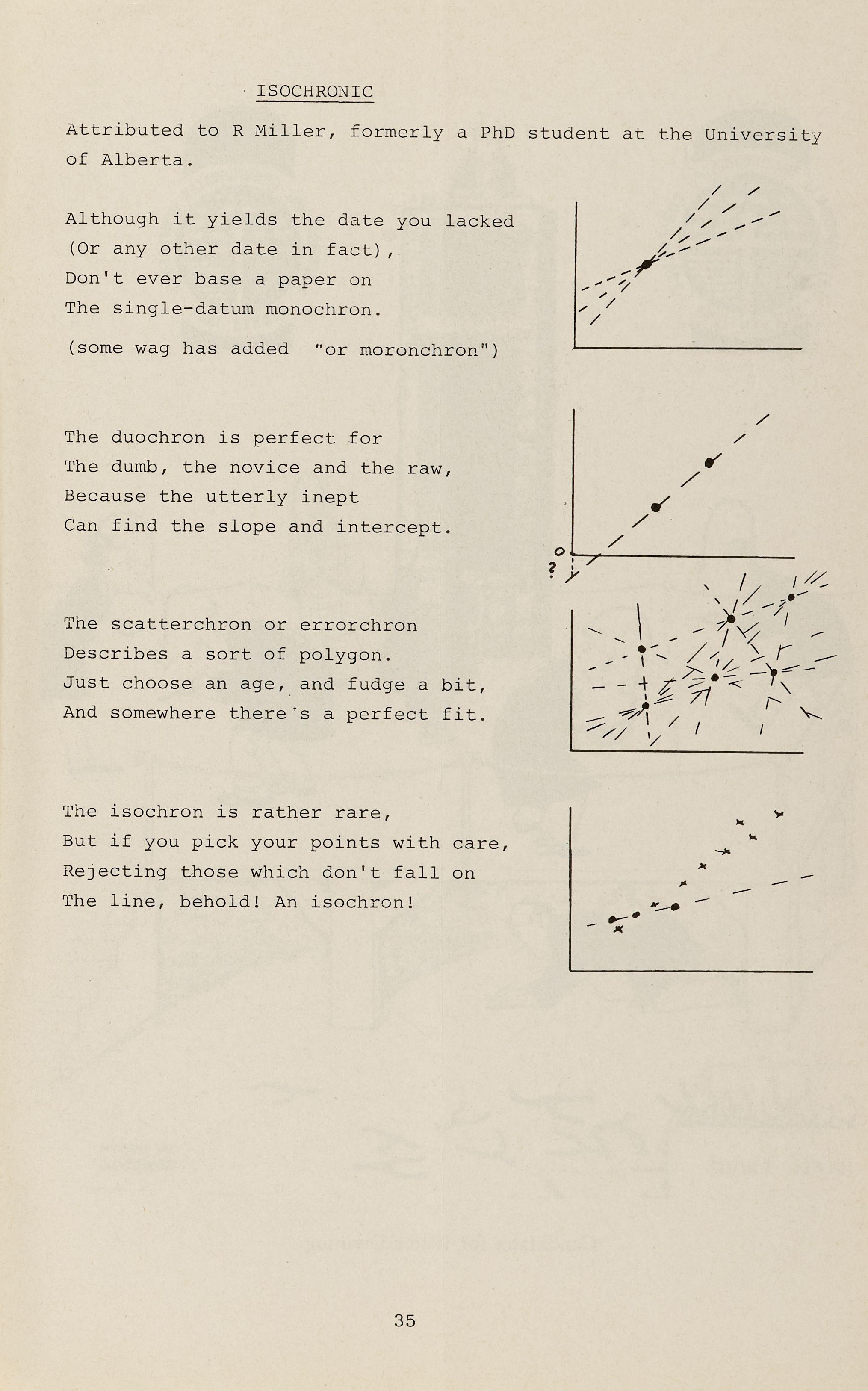
The duochron is perfect for The dumb, the novice and the raw, Because the utterly inept Can find the slope and intercept.
The scatterchron or errorchron Describes a sort of polygon. Just choose an age, _ and fudge a bit, And somewhere there · s a perfect fit.
The isochron is rather rare, But if you pick your points with care, Rejecting those which don't fall on The line, behold! An isochron!