The Australian Geologist
EDITORIAL
December 1980
The past year has been a busy one for most Society members. The Society itself has been somewhat hamstrung by the various changes in mind of the Book Bounty Board which has rather disorganised our Journal publication schedule, but smoother waters seem to be ahead there. The professional institute supported by the Society seems to be almost a reality, but it remains to be seen how the hastily hatched MICA, an association of consultants under the wing of the Aust.I.M.M., will affect matters on that front. Perhaps they will eventually cleave together.
Speaking of co-operative ventures it is clear that there are many of these taking place on the economic front in geology. This is specially true in the Asian region. The I.G.C.P. programme also shows that there is some co-operation on the research front. So far, however, there has been little involvement by Australian geoscientists in the Geosciences Network for Southeast Asia, sponsored by UNESCO, and described in Newsletter 26 (October 1979). There is scope for Australian support in this scheme, specially by Tertiary institutions. There is obviously room for co-operative research ventures (for instance Asia is providing present day models for many Australian rock sequences), and while Australian geology students are not over-abundant at present, perhaps we can look again at outside sources to lift student numbers. While there are difficulties in raising finance for this latter purpose here, we stand to gain much by way of goodwill, something we may well need in the future.
Best wishes for Christmas and 1981. The next issue is scheduled for March 1981. Please send any brickbats before January 25th 1981.
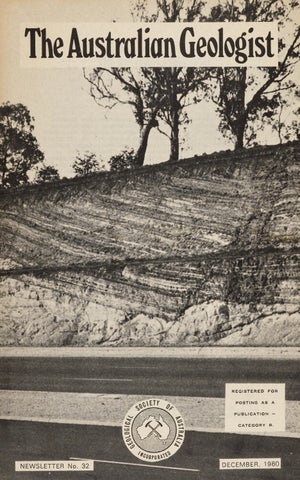
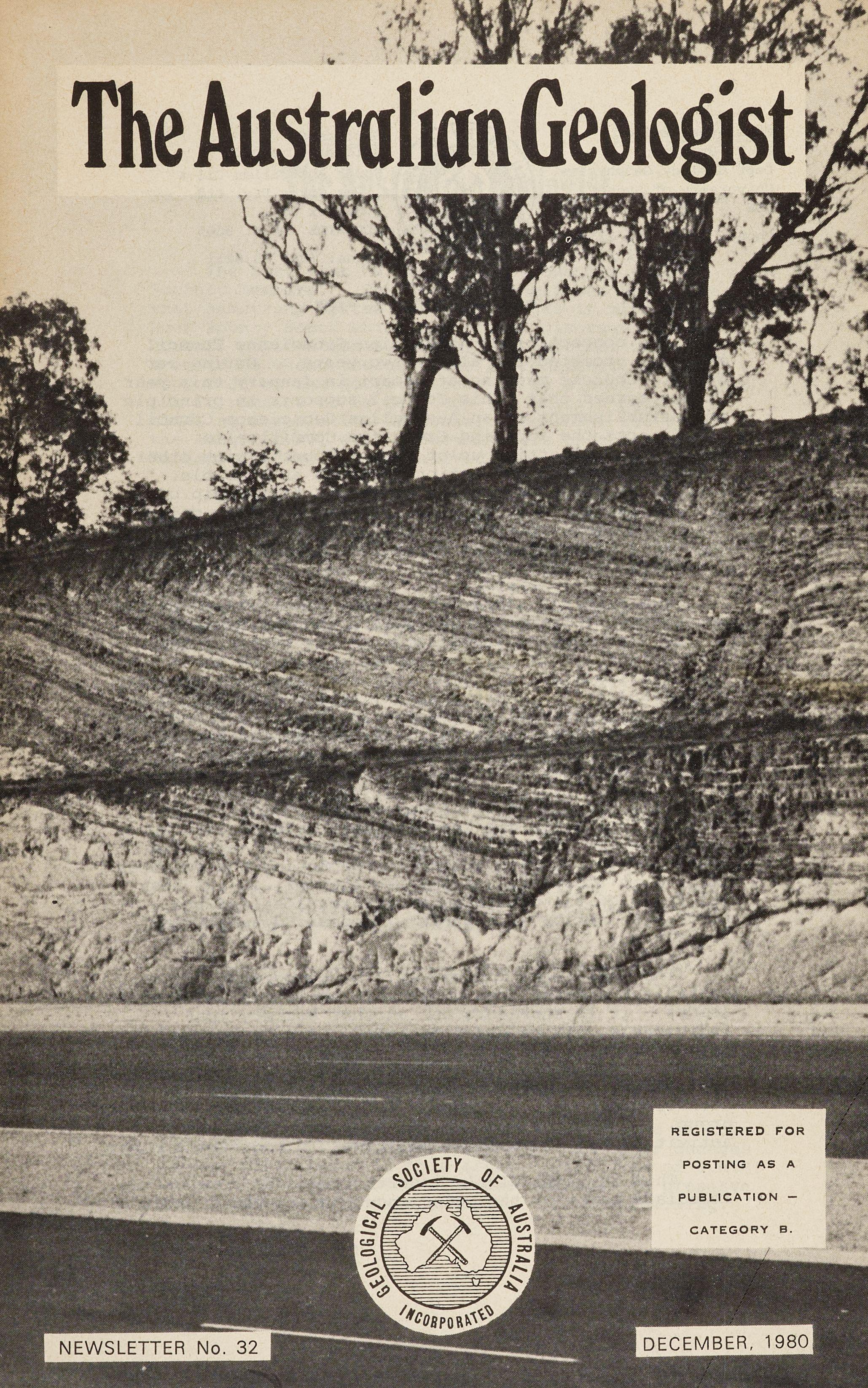
Cover photo: State Circle, Canberra, where the Lower Silurian State Circle Shale (white) is overlain unconformably by the Camp Hill Sandstone (Middle to Upper Silurian).
Construction of the new Parliament House on top of Capital Hill involves overpasses and other changes to the road system in this area. Mike Owen of B.M.R. Canberra is leader of a vigorous campaign to preserve the unconformity and progress to date is promising.
3.
LETTER TO THE EDITOR
Sir:
It is of some concern to see an apparent necessity for the establishment of separate journals by Specialist Groups of the Society. My own professional area, environmental geology, requires me to be in touch with a wide range of current geological research (for example: a paper in trace elements in coal might relate to the hydrogeochemistry of coal mining areas), and I feel I may not be seeing papers I ought to see.
What is the solution? Should I join every likely Specialist Group? Is the role of the main journal relevant?
Perhaps one positive suggestion would be for the "Australian Geologist" to list the tables of contents of all the Specialist Group journals and special publica- tions, published in the intervening interval?
G. R. Mcilveen Geological Survey of New South Wales
The President's Page and a Half
Continued from page 2.
a) formulation of a national policy statement, especially on matters of geoscientific research and education;
b) determine geoscientific manpower demand for Australia, and propose means of achieving an appropriate supply in terms of numbers, level of qualification and discipline;
c) prepare an annual report on the status of geoscience in Australia.
In this regard I am encouraged by a comment made by Sir Geoffrey Badger in a recent conversation that he could see merit in the formation of the Australian Geoscience Council particularly in providing advice to the Geoscience and Mineral Research Advisory Committee of ASTEC.
I commend to·you the proposal to form an Australian Geoscience Council and strongly recommend that you discuss this topic with your Society Council members so that the outcome of the postal ballot to be undertaken will truly reflect the opinion of the members of our Society.
COLIN D. BRANCH
4.
DO YOU WANT T'BET?
An historic meeting took place in Peking during Ma y 1 980 - the multidisciplinary Symposium on QinghaiXizang (Tibet) Plateau . For the first time a major international scientific meeting was held within the People ' s Republic of China A wealth of new scientific data from previously little-known Tibet was released . The meeting represented a rare, or even unique attempt, to address ten separate scientific disciplines to a single problem - the evolution of the Tibet Plateau The subsequent field trip was even more exciting - a 10 - day and 950km journey from Lhasa, across previously out-of-bounds Tibet, with a exit to Kathmandu
Participation was by invitation. The significance of the meeting can be gauged by the official receptions. In Peking we were received in the Great Hall of the People by Vice-Chairman Deng Xiou-ping and Vice-Premier Fang Yi; in Lhasa by several VicePremiers of the People's Autonomous Government. Participants from Australia were Mac Dickins and Ken Plumb (BMR), Lyn Plumb (Baas Becking Laboratory) and Chris Klootwyk (ANU).
79 non-Chinese scientists from 18 countries and 205 Chinese scientists presented 259 papers in geology, geophysics, geochemistry, stratigraphy and palaeontology , zoology, botany, physiology, geomorphology, geography, and meteorology . Most papers (150) were in earth sciences or related fields.
The Tibet Plateau cove~s 2.4 million km 2 , one quarter of China, and has an average altitude of 45005000m . Along with the adjacent Himalays it lies in a key position in the Alpine-Himalaya Chain. The Yarlung-Zangbo (or Indus) Suture, site of the classical India-Eurasia collision, is magnificantly exposed for 2500km across Tibet. As well as the Plateau's significance to geotectonic theory its height, area, and rapid rise make it of great importance to many other sciencesbiological evolution, meteorolog y , physiology, and so on.
Research in the past has been limited but, since 1965, some 400 scientists and technicians from Aaademia Sinica have been involved in field ' expeditions to Tibet, and some 1200 in laboratory work In geology/geophysics the main thrust has been : 1) palaeontology and stratigraphy; 2) geochemistry of granitoid rocks; 3) petrology of ophiolites; 4) megastructure and uplift of the Plateau; 5) seismology ; 6) geothermal studies. The results are confirming man y of the recent models proposed b y foreign scientists , working in the more comple x regions aroun d the peripher y of Tibet .
The highlights? The lasting impressions are of the treasure-house of ancient Tibetan culture in the Potala Palace and other monasteries, now largely pre- served as museums, and the fierce independence and overwhelming friendliness of the Tibetan people. We soon appreciated the rigours of fieldwork at 3500-S000m altitude: at least 15% of visitors suffered acute mountain sickness: 3 were evacuated with respiratory problems; there was one mild heart attack. And finally, the tremendous effort by our Chinese hosts in accommodating and transporting 200 people in such an inaccessible country.
Geological highlights? Palaeoclimates derived from palaeobotany, the Hipparion vertebrate fauna, soils, palaeokarst, planation surfaces, lake deposits, and clay minerals, all show that the Tibet Plateau and Himalayas have risen 4000m in only 1 million years; parts are still rising at 10 mm/yr. Faunal evidence in Tibet supports an early Palaeozoic Pangea, while the Kangdese-Nyainqentanghla Block, north of the Yarlung- Zangbo Suture Zone, was part of Gondwanaland in the Late Palaeozoic. Southern Tibet beautifully displays an overall simple history since Palaeozoic: Tethys opening in Triassic, late Cretaceous-Eocene convergence and subduction; Eocene-Oligocene collision; Tertiary intracontinental convergence; and Quaternary uplift. A 450km long explosion seismic profile has delineated the crustal structure beneath Tibet. The overwhelming majority seemed to prefer the Dewey and Burke (1973) model of continental collision, rather than that of Powell and Conaghan (1973). The experience has prompted me to look again at the features and mechanisms of Precambrian mobile belts.
In other sciences, I was impressed with the integration of all studies with the history of uplift of the Plateau. Biologists can relate the evolution of many species to uplift and the isolation of habitats by the uplift. The Plateau is a major influence on weather systems throughout Asia; we learnt that it may even influence climates as far afield as North Africa and the Rocky Mountains. Physiologists were surprised to learn that, after being stationed in Tibet for 5-year postings, lowland Chinese suffer reverse reactions and have to readapt to low elevations.
A 2000-page Proceedings Volume, of all papers in all sciences, is in press. This wealth of new data will be a significant contribution to scientific literature. I have assessed the results of the meeting in detail in BMR Record 1980/65.
K. A. Plumb Bureau of Mineral Resources Canberra
DAHLEM WORKSHOP ON BIOSPHERIC EVOLUTION AND PRECAMBRIAN METALLOGENY, BERLIN, SEPTEMBER 1980
Alec Trendall
During the first week of September 1980 seven Australian scientists were among the participants at a conference on "Biospheric Evolution and Precambrian Metallogeny" held in Berlin. The conference was the 23rd Dahlem Workshop, organized by Dahlem Konferenzen, and I was sufficiently impressed by the unusual style and format of the meeting to offer this report to the Australian Geologist, in the hope that it may interest others dissatisfied with the effectiveness of the present standard conference structure.
First, what is a Dahlem Workshop? Dahlem Konferenzen was founded in 1974 and has as one of its two main objectives the organization of interdisciplinary, problem-oriented workshops on topics in science that are of contemporary international interest. The workshops differ from standard conferences in that participants are discouraged from presenting the results of their own recent findings and are expected to think more about what they don't know than what they do know, as a basis for defining priorities for future research. The id2a is really to jolt scientists out of the tunnel vision of their specialized interests and to encourage them to evaluate their own activities in a broader perspective - especially one which considers longer term objectives that may be shared b y workers in other disciplines The language of all workshops is English, which is regarded as the lingua franca of science.
Dahlem Konferenzen is funded by the Stifterverband fiir die Deutsche Wissenschaft (Donors Association for the Promotion of Sciences and Humanities), a foundation created in Berlin in 1921 and supported by German trade and industry to support basic research in the sciences; its 6000 annual contributors include individuals as well as large and small companies The Deutsche Forschungsgemeinschaft (German Science Foundation) and the Senate of the City of Berlin are co-sponsors of Dahlem Konferenzen . Dahlem is a district in Berlin with a long scientific tradition
Dahlem Konferenzen emplo y s a small (and highl y efficient) e x ecutive staff to run the workshops, under the control of a Director, Dr med. Silke Bernhard Silke Bernhard ~as associated with the establishment of the workshops and has very special e x pertise in the second main Dahlem objecti v e - to de v elop and test different models conduci v e to more effecti v e scientific meetings The format for the September meeting was one which evolved through the e x perience of the 22 prec e ding workshops, and in our case, which ma y be descr i bed as a standard e x ample, it worked as follows
The goal of the workshop was 'to define evolutionary relationships among biological processes, the ocean-atmosphere system, and the formation of sedimentary mineral deposits'. The 44 invited participants were divided into 4 groups:
Group l - Sedimentary iron deposits, evapori tes and phosphorites
Group 2 - Stratified sulphide deposits
Group 3 - Reduced carbon compounds in sediments
Group 4 - Biochemical evolution of ocean atmospheric systems.
Each group contained a mix of specialists with relevant expertise, either geological, chemical, biological, or any two (or all three) of these in combination; each also had a designated Chairman (called Moderator) and Secretary (called Rapporteur). Sixteen of the participants had written, before a mid-June deadline, a total of thirteen 'background papers' which reviewed some special field related either to the group topics or generally to the workshop goal. All these papers were circulated to participants two months before the meeting, and everyone was expe~ted both to have read them and to have written down any resultant questions and comments before the workshop.
After a plenary session on Monday morning at which the philosophy and format of the meeting was explained each group met and formulated for itself al¼ day programme of specific discussion topics directed towards the goal of the workshop. These programmes were typed up and distributed at a further plenary session on Monday. On Tuesday Groups land 2 began their discussions separately, and the members of Groups 3 and 4 were free to sit in on either, or to move from one to the other and could join the discussion if asked. Late Wednesday morning the roles were reversed: Groups 3 and 4 began their programmed discussions and Groups l and 2 sat in on these as observers. After coffee on Thursday morning each group reconvened separately to establish the layout and content of a report on its discussion. Thursday afternoon was free for all except the Rapporteurs, who wrote up their ' group reports and worked with the Dahlem staff into the small hours to get them typed up and duplicated for distribution to all participants on Friday morning. Everyone then had two hours to read the four reports, and to comment on that of his own group. At a plenary session before lunch each Rapporteur presented the report of his own group, and this was followed by open discussion. After lunch each group individually discussed the final form of its report, and a last plenary session debated publication procedures. 8
This brief account of procedural mechanics omits one vital element of interdisciplinary communication. All participants stayed at two neighbouring hotels close to the conference centre, and the discussion at all meals and coffee breaks continued unabated in a totally unstructured form within and between the groups. Meals included (long) evening visits as a group to a number of excellent Berlin restaurants. In effect the whole week was spent in continuous and exhaustive discussion, by a group of enthusiasts, of a topic (or more correctly a number of inter-related topics) close to their hearts. There was no tedious presentation of illegible tables of dat~, there were no speakers droning on repetitively about irrelevant details, and there was no shortage of opportunities to talk in a congenial atmosphere with any other participant. Perhaps the biggest difference from the standard conference format was that the in~ensively structured cross-examination eliminated any possible pretension of knowledge not possessed. Everyone joined in laying his (or her) scientific cards openly on the table in an atmosphere in which the competition was with ignorance, rather than with one another - science as a team sport!
The participants from Aus tralia were Peter Cook (ANU), Malcolm Walter (BMR) and myself (GSWA), all in Group 1, Phil Trudinger (B-B) and Neil Williams (ANU), in Group 2 (NW being Rapporteur), David McKirdy (SADME), in Group 3, and John Langridge (CSIRO) in Group 4. Six of us contributed background papers. Other participants came from Canada, Germany, Israel, Sweden, UK, and USA. The Workshop Report, comprising the 13 revised background papers and the 4 group reports, will be published by Dahlem Konferenzen about April 1981 and should interest a wide cross-section of geologists in Australia.
Can anything be said on the debit side? Firstly, you have to have access to solid funding to contemplate events of this kind. All participants' travel and expenses are paid for by Dahlem so that logistic worries are reduced to a minimum; that is an essential part of the operation. Secondly, it concerns me in principle that attendance is restricted and by invitation; however, I do not know whether this philosophical objection to the format can be overcome. Silke Bernhard i~ adamant that from her (very extensive and thoughfully analyzed) experience a discussion group must have less than about 12 members to work properly , and that if you want to run a bigger meeting you must continue to use this small group as a unit. From my September experience I respect her judgement: that workshop was the most stimulating and fruitful scientific meeting I have attended in over 30 years. Whether a compromise can be found between this structure and that of the standard paper-reading confer~nce, open to all, time alone will tell.
One f i n al note, and here I quote directl y from Dahl em literature: "Dahlem Konferenzen encourages internationall y recognized scientists to suggest topics" which are "of contemporary international interest, timel y , interdisciplinary in nature and problemoriented" "and to propose members for a Program Adv isor y Committee, which is responsible for the scientif i c p rogram. Once a y ear the topic suggestions are submitted to a scientific board for approval. The members of this board include the president of the German Scie n ce Foundation, the former Director of the Ciba Foun d ation, and representatives of the universities, industr y and commerce". I think the seven Australian participants at the 23rd Dahlem Workshop made an eff e cti v e contribution to it, which reflected the signif ica n ce of the topic for Australian geoscience and the mine r als industr y . Perhaps there are other such topics?
BOOK REVIEW :
Antarct i c Gl acia l Hi st o ry and Wor l d Pa l ae o env i ronmen ts. ed i ted E . M. Van Zi nderen Bakk er . A. A. Balkema / Rotterd am, 1978 $ 3 4-00.
Th i s book reports the p r oceedings of t he Au gust 19 77 Internat i onal Co u nc il of Sc i e nti f i c Unions Sc i e nti f i c Co mmitt e e on Antarc ti c Researc h Symp osium.
(The above mouthfu l be i ng one o f t he r eason s why I h a ve take n so long to rev i ew this book ! )
It f oll o ws t wo e ar li er vo lume s prepa red b y the Antarcti c Research Group ( 1 969 & 1 973 ).
The t i t l e does not clear l y i nd i cate t he wide range o f t op i cs discus s ed . These include a compariso n of Antarct i c and Arct i c Climate s, Gl ac i al his to ry o f New Ze ala nd , La te Cai n o z oi c palaeoenviron ments of southe rn Afr i ca , and Mes oz oi c an d Tertia ry pa l aeoenvironment s of th e Sahara
The papers conta i n a g r eat a mo u nt of st i mu l at i ng ma ter ia l (most suitable f o r setting c h a l leng ing exam papers !). The final paper on Gl acial a g e enviro nments i n sou t her n Aus tr ali a (an d e l sew h ere) by Jim Bowl er of A N U i s an exce ll en t pre se n tati o n indeed .
There are a few i nfel i cities of st: 1 l e in Dr . Ba k k e r' s English , b ut the s e are minor def i ciencies i nde ed i n an e x cell e nt volume Would that all sympos ia vo l u mes had s o mu ch t o off e r.
Antarctic research r us hes on apace but t his vo l ume will be referred to by many researchers (and othe r s t u dent s of t he Cainozo i c and ear l ier ) we ll i nto the f u t u re D. B
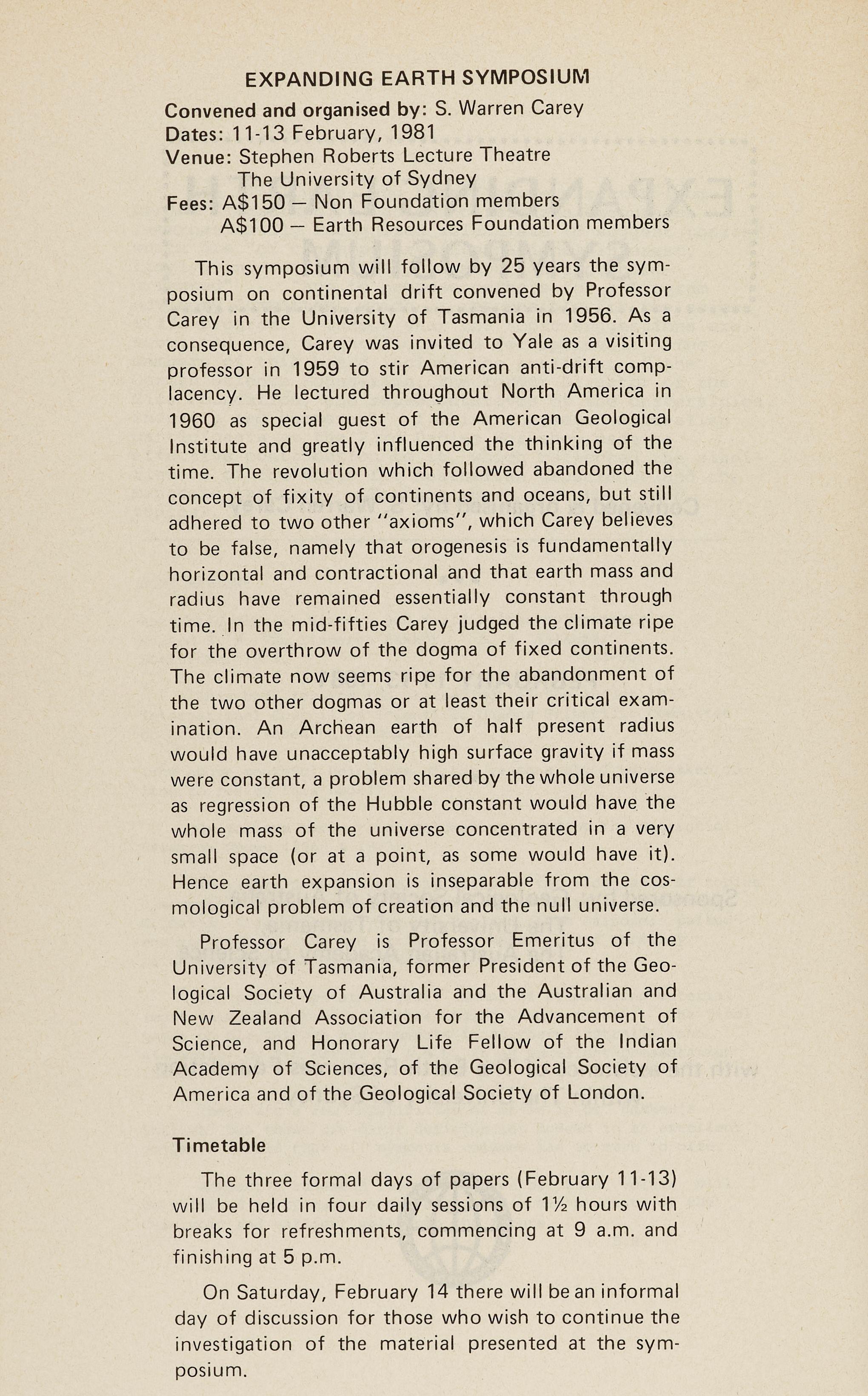
EXPANDING EARTH SYMPOSIUM
Convened and organised by: S. Warren Carey
Dates: 11-13 February, 1981
Venue: Stephen Roberts Lecture Theatre
The University of Sydney
Fees: A$150 - Non Foundation members
A$100 - Earth Resources Foundation members
This symposium wi ll follow by 25 years the symposium on continental drift convened by Professor Carey in the University of Tasmania in 1956. As a consequence, Carey was invited to Yale as a visiting professor in 1959 to stir American anti-drift complacency. He lectured throughout North America in 1960 as special guest of the American Geological Institute and greatly influenced the thinking of the time. The revolution which followed abandoned the concept of fixity of continents and oceans, but sti 11 adhered to two other "axioms", which Carey believes to be false, namely that orogenesis is fundamentally horizontal and contractional and that earth mass and radius have remained essentially constant through time. In the mid-fifties Carey judged the climate ripe for the overthrow of the dogma of fixed continents. The climate now seems ripe for the abandonment of the two other dogmas or at least their critical examination . An Archean earth of half present radius would have unacceptably high surface gravity if mass were constant, a problem shared by the whole universe as regression of the Hubble constant would have ·the whole mass of the universe concentrated in a very small space (or at a point, as some would have it). Hence earth expansion is inseparable from the cosmological problem of creation and the null universe.
Professor Carey is Professor Emeritus of the University of 'iasmania, former President of the Geological Society of Australia and the Australian and New Zealand Association for the Advancement of Science, and Honorary Life Fellow of the Indian Academy of Sciences, of the Geological Society of America and of the Geological Society of London.
Timetable
The three formal days of papers ( February 11-13) will be held in four daily sessions of 1½ hours with breaks for refreshments, commencing at 9 a .m. and finishing at 5 p.m.
On Saturday, February 14 there will be an informal day of discussion for those who wish to continue the investigation of the material presented at the symposium.
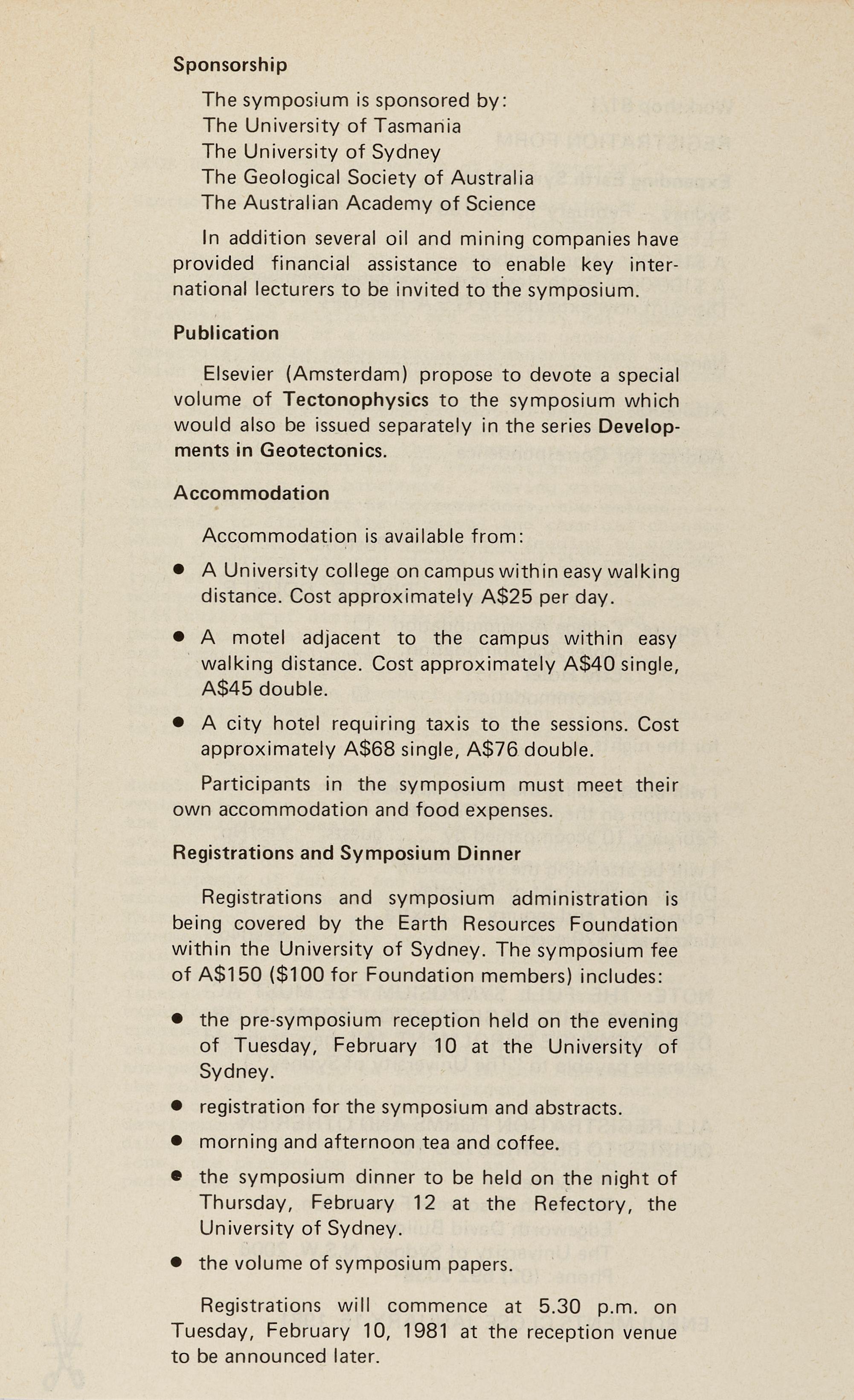
Sponsorship
The symposium is sponsored by:
The University of Tasmania
The University of Sydney
The Geological Society of Australia
The Australian Academy of Science
In addition several oil and mining companies have provided financial assistance to _enable key international lecturers to be invited to the symposium.
Publication
Elsevier (Amsterdam) propose to devote a special volume of Tectonophysics to the symposium which would also be issued separately in the series Developments in Geotectonics.
Accommodation
Accommodation is available from:
• A University college on campus within easy walking distance. Cost approximately A$25 per day.
• A motel adjacent to the campus within easy walking distance. Cost approximately A$40 single, A$45 double
• A city hotel requiring taxis to the sessions. Cost approximately A$68 single, A$76 double.
Participants in the symposium must meet their own accommodation and food expenses.
Registrations and Symposium Dinner
Registrations and symposium administration is being covered by the Earth Resources Foundation within the University of Sydney. The symposium fee of A$150 ($100 for Foundation members) includes:
• the pre-symposium reception held on the evening of Tuesday, February 10 at the University of Sydney.
• registration for the symposium and abstracts.
• morning and afternoon tea and coffee.
• the symposium dinner to be held on the night of Thursday, February 12 at the Refectory, the University of Sydney.
• the volume of symposium papers.
Registrations will commence at 5.30 p.m. on Tuesday, February 10, 1981 at the reception venue to be announced later.
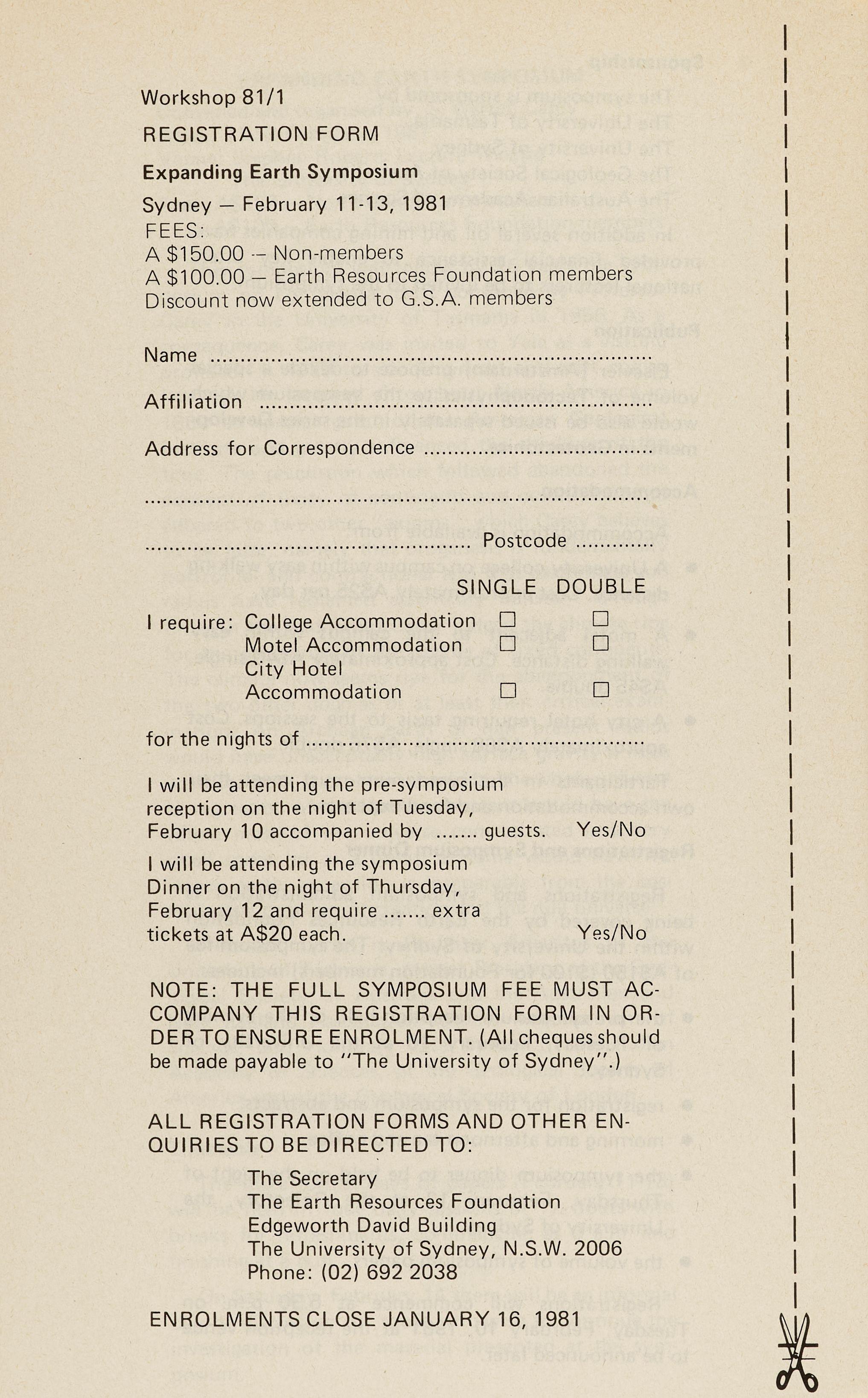
Workshop 81/1
REGISTRATION FORM
Expanding Earth Symposium
Sydney - February 11-13, 1981
FEES:
A $150.00 Non-members
A $100.00 - Earth Resources Foundation members
Discount now extended to G.S.A. members
Name .........
Affiliation .........................................
Address for Correspondence
SINGLE DOUBLE
I require: College Accommodation Motel Accommodation City Hotel Accommodation for the nights of
I will be attending the pre-symposium reception on the night of Tuesday, February 10 accompanied by ....... guests. Yes/No
I will be attending the symposium Dinner on the night of Thursday, February 12 and require extra tickets at A$20 each. Yes/No
NOTE: THE FULL SYMPOSIUM FEE MUST ACCOMPANY THIS REGISTRATION FORM IN ORDER TO ENSURE ENROLMENT. {All cheques should be made payable to "The University of Sydney".)
ALL REGISTRATION FORMS AND OTHER ENQUIRIES TO BE DIRECTED TO:
The Secretary
The Earth Resources Foundation
Edgeworth David Building
The University of Sydney, N.S .W. 2006
Phone: (02) 692 2038
ENROLMENTS CLOSE JANUARY 16, 1981
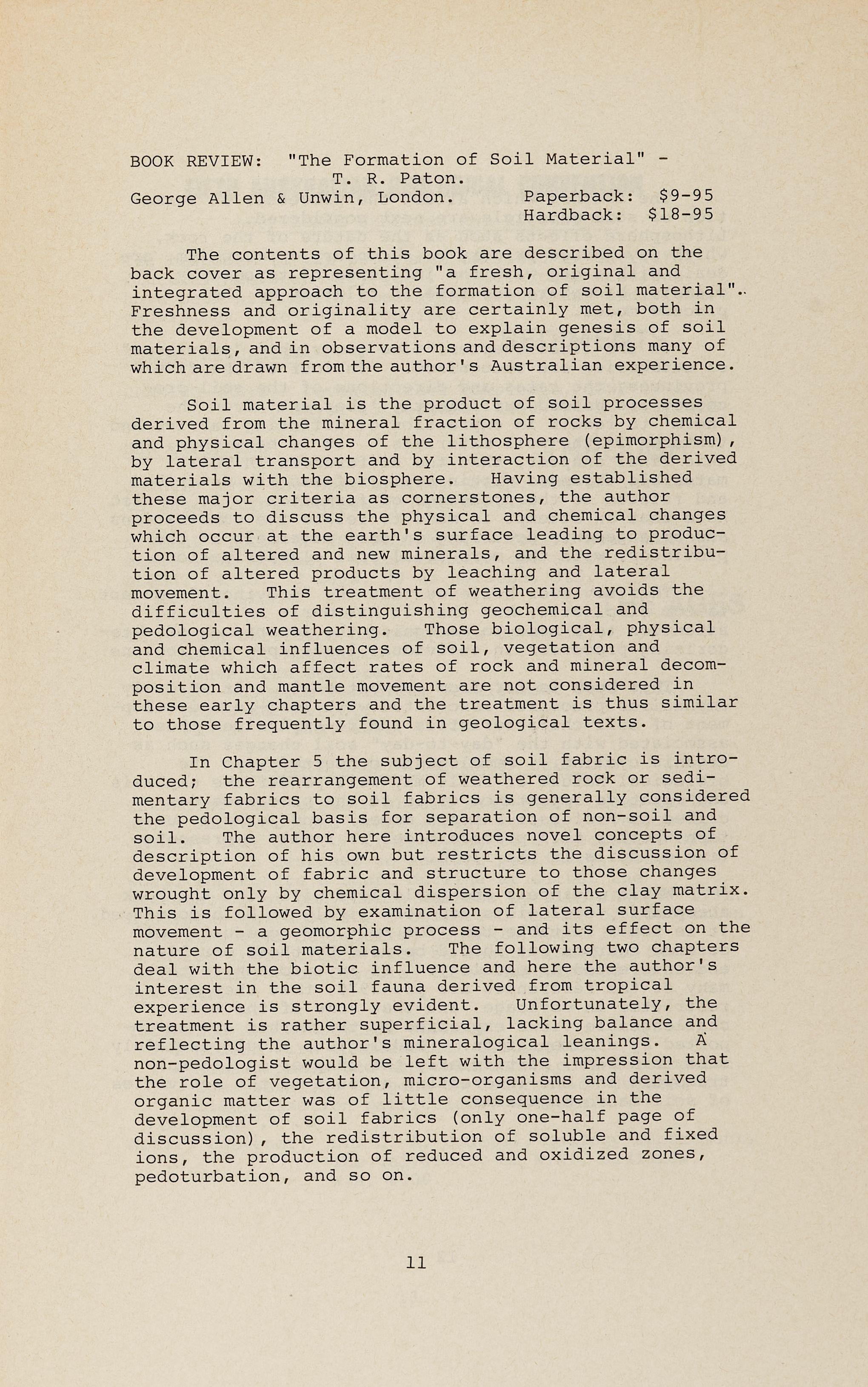
BOOK REVIEW: "The Formation of Soil Material"T R . Paton.
George Allen & Unwin, London. Paperback: Hardback: $9-95 $18-95
The contents of this book are described on the back cover as representing "a fresh, original and integrated approach to the formation of soil material" Freshness and originality are certainl y met, both in the development of a model to explain genesis of soil materials, and in observations and descriptions many of which are drawn from the author's Australian e x perience
Soil material is the product of soil processes derived from the mineral fraction of rocks by chemical and physical changes of the lithosphere (epimorphism), b y lateral transport and by interaction of the derived materials with the biosphere. Ha v ing established these major criteria as cornerstones, the author proceeds to discuss the physical and chemical changes which occur , at the earth's surface leading to production of altered and new minerals, and the redistribution of altered products by leaching and lateral movement . This treatment of weathering avoids the difficulties of distinguishing geochemical and pedological weathering. Those biological, ph y sical and chemical influences of soil, vegetation and climate which affect rates of rock and mineral decomposition and mantle movement are not considered in these early chapters and the treatment is thus similar to those frequentl y found in geological texts.
In Chapter 5 the subject of soil fabric is introduced; the rearrangement of weathered rock or sedimentar y fabrics to soil fabrics is generally considered the pedological basis for separation of non-soil and soil The author here introduces novel concepts of description of his own but restricts the discussion of development of fabric and structure to those changes wrought onl y b y chemical dispersion of the clay matri x. This is followed b y examination of lateral surface movement - a geomorphic process - and its effect on the nature of soil materials. The following two chapters deal with the biotic influence and here the author's interest in the soil fauna derived from tropical e x perience is strongly evident . Unfortunately, the treatment is rather superficial, lacking balance and reflecting the author's mineralogical leanings . A non-pedologist would be left with the impression that the r ole of v egetation, micro-organisms and derived organic matter was of little consequence in the de v elopment of soil fabrics (onl y one-half page of discussion) , the redistribution of soluble and fi x ed ions, the production of reduced and o x idized zones, pedoturbation , and so on
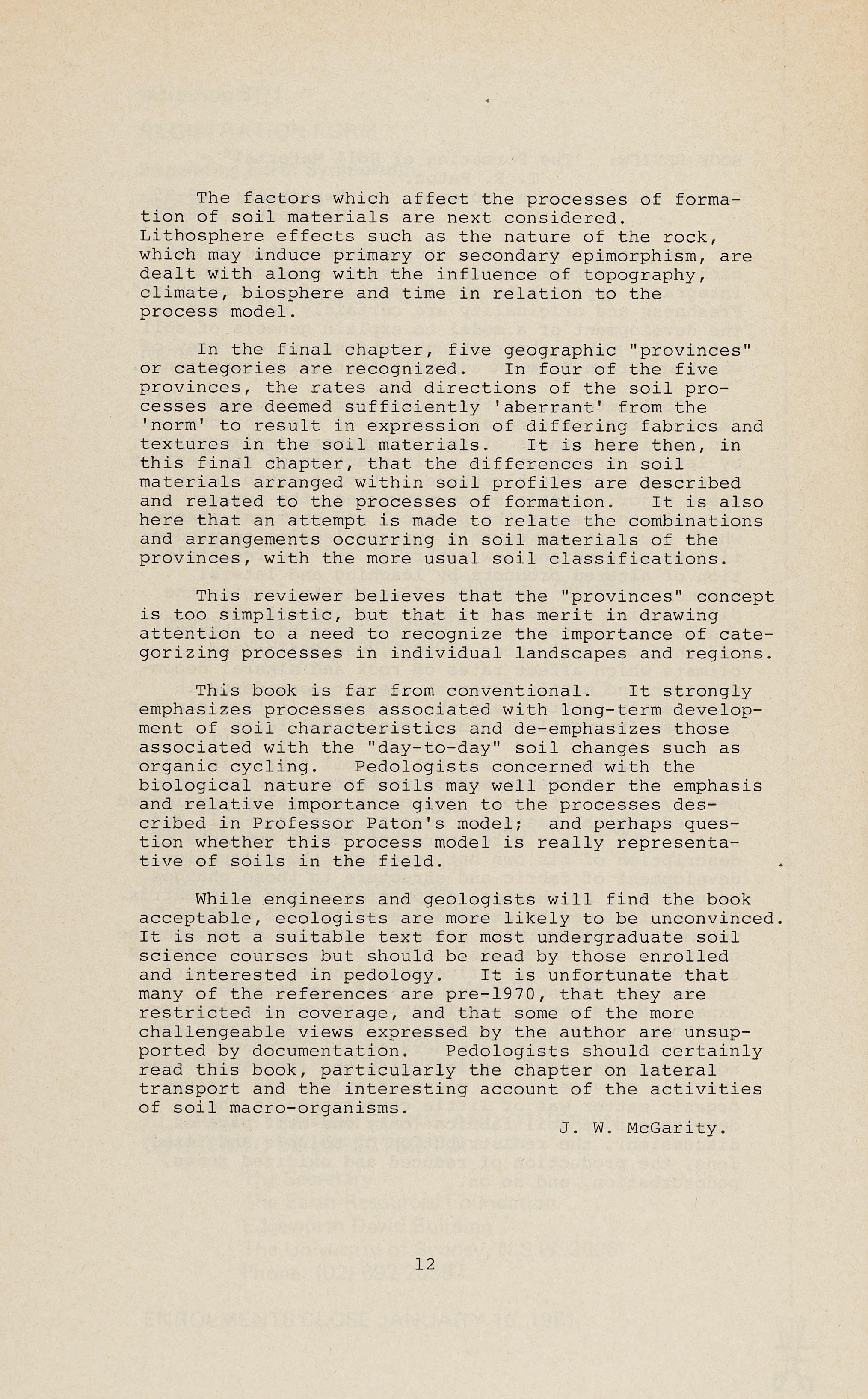
The factors which affect the processes of formation of soil materials are next considered. Lithosphere effects such as the nature of the rock, which may induce primary or secondary epimorphism, are dealt with along with the influence of topography, climate, biosphere and time in relation to the process model.
In the final chapter, five geographic "provinces" or categories are recognized. In four of the five provinces, the rates and directions of the soil processes are deemed sufficiently 'aberrant' from the 'norm' to result in expression of differing fabrics and textures in the soil materials. It is here then, in this final chapter, that the differences in soil materials arranged within soil profiles are described and related to the processes of formation. It is also here that an attempt is made to relate the combinations and arrangements occurring in soil materials of the provinces, with the more usual soil classifications.
This reviewer believes that the "provinces" concept is too simplistic, but that it has merit in drawing attention to a need to recognize the importance of categorizing processes in individual landscapes and regions.
This book is far from conventional. It strongly emphasizes processes associated with long-term development of soil characteristics and de-emphasizes those associated with the "day-to-day" soil changes such as organic cycling. Pedologists concerned with the biological nature of soils may well ponder the emphasis and relative importance given to the processes described in Professor Paton's model; and perhaps question whether this process model is really representative of soils in the field.
While engineers and geologists will find the book acceptable, ecologists are more likely to be unconvinced. It is not a suitable text for most undergraduate soil science courses but should be read by those enrolled and interested in pedology. It is unfortunate that many of the references are pre-1970, that they are restricted in coverage, and that some of the more challengeable views expressed by the author are unsupported by documentation. Pedologists should certainly read this book, particularly the chapter on lateral transport and the interesting account of the activities of soil macro-organisms.
J. W.
McGarity.
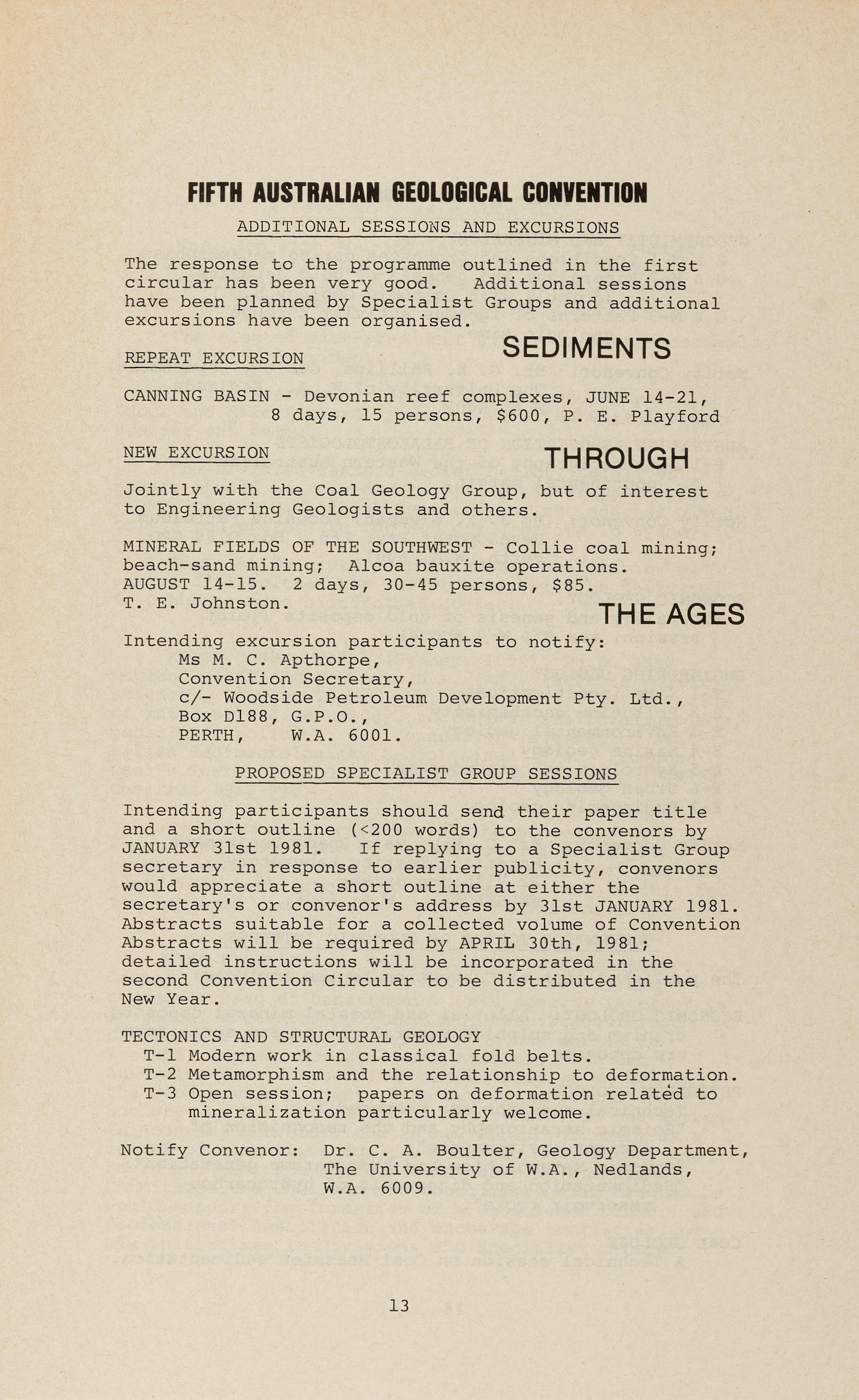
FIFTH AUSTRALIAN GEOLOGICAL CONVENTION
ADDITIONAL SESSIONS AND EXCURSIONS
The response to the programme outlined in the first circular has been very good. Additional sessions have been planned by Specialist Groups and additional excursions have been organised.
SEDIMENTS
REPEAT EXCURSION
CANNING BASIN - Devonian reef complexes, JUNE 14-21, 8 days, 15 persons, $600, P. E. Playford
NEW EXCURSION
THROUGH
Jointly with the Coal Geology Group, but of interest to Engineering Geologists and others.
MINERAL FIELDS OF THE SOUTHWEST - Collie coal mining; beach-sand mining; Alcoa bauxite operations. AUGUST 14-15. 2 days, 30-45 persons, $85.
T. E. Johnston.
THE AGES
Intending excursion participants to notify: Ms M. C. Apthorpe, Convention Secretary, c/- Woodside Petroleum Development Pty. Ltd., Box Dl88, G.P.O., PERTH, W.A. 6001.
PROPOSED SPECIALIST GROUP SESSIONS
Intending participants should send their paper title and a short outline ( <200 words) to the convenors by JANUARY 31st 1981. If replying to a Specialist Group secretary in response to earlier publicity, convenors would appreciate a short outline at either the secretary's or convenor's address by 31st JANUARY 1981. Abstracts suitable for a collected volume of Convention Abstracts will be required by APRIL 30th, 1981; detailed instructions will be incorporated in the second Convention Circular to be distributed in the New Year.
TECTONICS AND STRUCTURAL GEOLOGY
T-1 Modern work in classical fold belts.
T-2 Metamorphism and the relationship to deformation.
T-3 Open session; papers on deformation related to mineralization particularly welcome.
Notify Convenor: Dr. C. A. Boulter, Geology Department, The University of W.A., Nedlands, W.A. 6009.
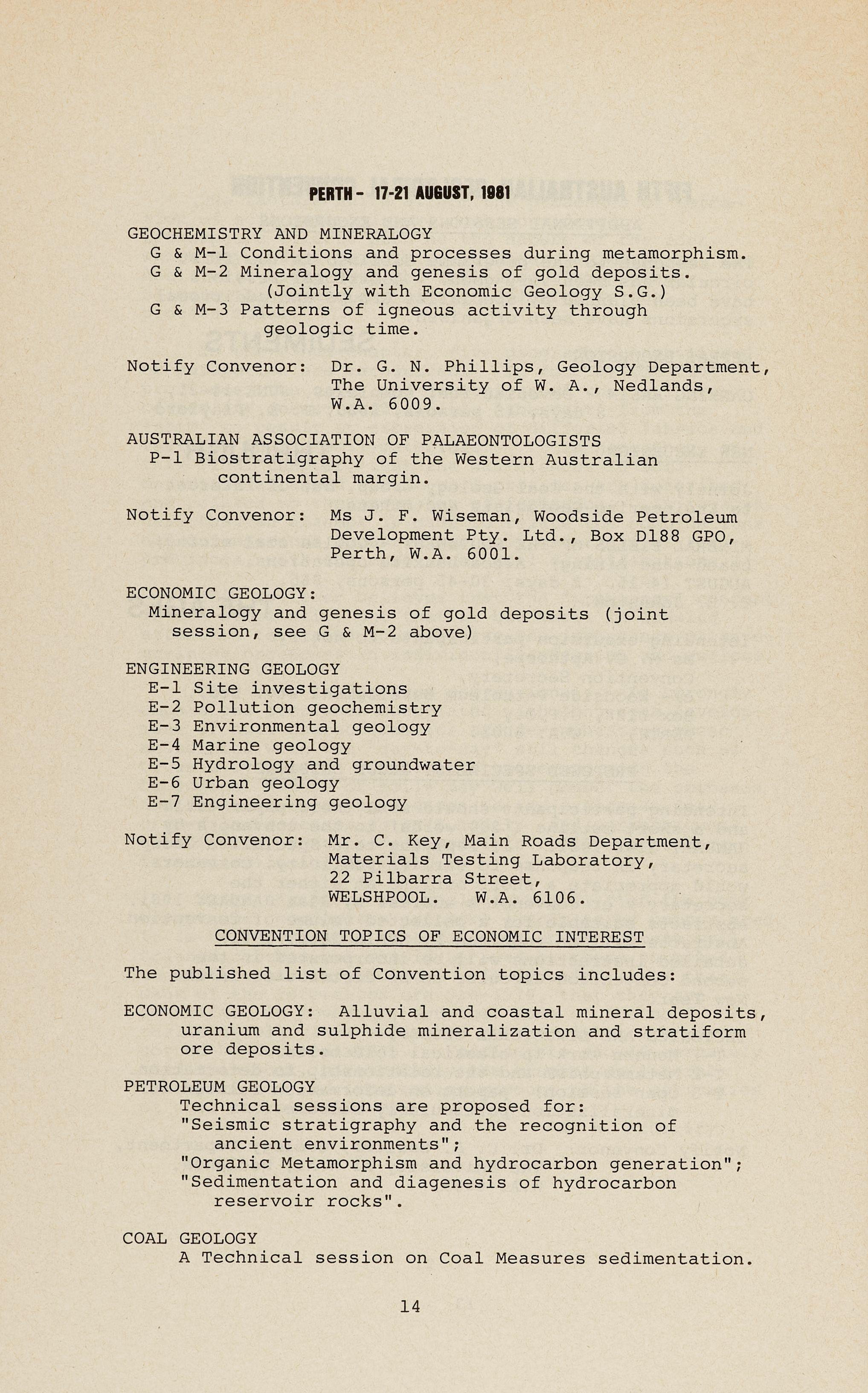
PERTH- 17-21 AUGUST, 1981
GEOCHEMISTRY AND MINERALOGY
G & M-1 Conditions and processes during metamorphism.
G & M-2 Mineralogy and genesis of gold deposits. (Jointly with Economic Geology S.G.)
G & M-3 Patterns of igneous activity through geologic time.
Notify Convenor: Dr. G. N. Phillips, Geology Department, The University of W. A., Nedlands, W.A. 6009.
AUSTRALIAN ASSOCIATION OF PALAEONTOLOGISTS
P-1 Biostratigraphy of the Western Australian continental margin.
Notify Convenor: Ms J. F Wiseman, Woodside Petroleum Development Pty. Ltd., Box Dl88 GPO, Perth, W.A. 6001.
ECONOMIC GEOLOGY : Mineralogy and genesis of gold deposits (joint session, see G & M-2 above)
ENGINEERING GEOLOGY
E-1 Site investigations
E-2 Pollution geochemistry
E-3 Environmental geology
E-4 Marine geology
E-5 Hydrology and groundwater
E-6 Urban geology
E-7 Engineering geology
Notify Convenor: Mr. C. Key, Main Roads Department, Materials Testing Laboratory, 22 Pilbarra Street, WELSHPOOL. W.A. 6106 .
CONVENTION TOPICS OF ECONOMIC INTEREST
The published list of Convention topics includes:
ECONOMIC GEOLOGY: Alluvial and coastal mineral deposits, uranium and sulphide mineralization and stratiform ore deposits.
PETROLEUM GEOLOGY
Technical sessions are proposed for: "Seismic stratigraphy and the recognition of ancient environments"; "Organic Metamorphism and hydrocarbon generation"; "Sedimentation and diagenesis of hydrocarbon reservoir rocks".
COAL GEOLOGY
A Technical session on Coal Measures sedimentation.
A Vote for? is a vote for?
Enclosed with your Society subscription renewal you will find a ballot paper for election of a Vice-President of the Society which is being held under the auspices of the Territories Division.
The elected vice-president will - in time - become the Society's President.
Policy statements (?) of the two candidates Keith Crook and Mike Rickard (please note alphabetical order) are set out below.
The Division wants a secret ballot, so all voting papers should be returned in 'the plain wrapper' please, either to the Divisional Secretary at the address given, or, if you prefer, to the Society's office in Sydney.
There is no truth in the rumour that in view of postal difficulties the latter votes will be delivered to Canberra by a blindfolded donkey.
KEITH CROOK, M.Sc. (Sydney, 1956), Ph.D. (New England, 1959) in geology, B.A. (ANO, 1967) in political science. Reader in Geology, ANO (since 1970). Fields of interest sedimentology, tectonics, surficial geology, geoscience policy. GSA Councillor (elected by Australian Sedimentologists Group) since 1974. Commonwealth Territories Division GSA, Vice-Chairman 1979-80, Chairman 1980-81.
My foremost concern is for the promotion of Australian geoscience by the Geological Society in concert with the Australian Geoscience Council and the Australian Institute of Geoscientists; and to this end for improved communication between Divisions.
MIKE RICKARD is a Reader in the Department of Geology at the Australian National University and currently Head of Department. His special interest is in global tectonics, particularly the structure and development of orogenic belts. He has worked in Ireland, Canada, Norway, South America, Fiji and Australia and is Australian representative on WG9 on the Geodynamics Project. An active member of the Society and C.T. Division for many years, he has served as Honorary Secretary and is now Public Officer, as a member of committees for the Tectonic Map, Rules, and Basin and Tectonic Nomenclature, also on Divisional Committees, as Chairman and Councillor. If elected he would support the formation of a Geoscience Council and Professional Association and encourage activities and new initiatives in Divisions and Specialist Groups.
Publicat i ons of 2nd International Archaean Symposium, Perth 1980
Due to repeated requests from within Western Australia, the W. A Di v ision of the Societ y intend to reprint Ex tended Abstracts and Ex cursion Guides published for the Second International Archaean Symposium in Perth , Ma y , 1980.
The following five publications are available at a cost of $7 . 00 each (including postage). All fi v e publications together are available at a special price of $24 00 including postage . Orders with cheques made out to Geological Society of Australia -W A. Division should be sent to the Chairman of the W. A. Di v ision of G S.A., W. Morgan, Geology Department, WAIT, Hayman Rd., Bentley, W A. 6102 .
The publications are :
1. Ex tended Abstracts Volume edited by J E. Glover and D. I . Groves
2. Ex cursion Guide : Arc h aean Geology of the Pilbara Block b y A H. Hic k man with contributions b y R D. Horwitz, J. S. R Dunlop and R Buick .
3 Excursion Guide : The Jimperding Metamorphic Belt in the Toodyay Area and the Balingup Metamorphic Belt and Associated Granitic Rocks of the SW Yilgarn Block b y S . A Wilde .
4. Ex cursion Guide: Archaean Geology of the LeonoraLaverton Area by J . A . Hallberg .
5. Ex cursion Guide: Regional Geolog y and Mineral Deposits of the Kalgoorlie- Norseman Region by D. I. Groves and R D. Gee.
Geological Correlation No . 8 issued in Jul y 1980 is a report (in English) on the IGCP Programme. It is a comprehensi v e document discussing the progress of the numerous projects, and contains useful lists of the papers relevant to the indi v idual projects
For copies and other information contact the IGCP Secretariat, Di v ision of Earth Sciences, UNESCO, Place de Fonteno y , 75700, Paris, France
The Na tion a l Mu se um of Victor i a has iss ue d a fac simile re prin t o f George Ul r i ch 's " Con t r ibu tion s t o th e Mi ner alogy o f Vi cto ria" o r i g i na ll y p ubli shed i n 1 870 . Co p i e s can be obta in ed from t h e Admi n i s t r a t i ve Of f i cer , Nat i ona l Muse um of Vi c to r ia, 285 - 32 1 Russe ll S tr ee t, Me l bourne , fo r $2 00 eac h p l us 40 ce n ts p os t a ge
BOOK REVIEW:
Industrial Geo log y, edited J. L. Knill. Oxford University Press. £9-50.
This book discusses the application of geology in a wide range of industrial settings. It is theworkof some thirteen highly qualified geologists and is largely based on a series of lectures given by them in the Department of Geo logy & Mineralogy at Oxford University.
It is the intention of the book its authors and publishers that it supply a geological undergraduate with an outline of the practical work which a geologist does in various economic fields, and that it might therefore stimulate the student and guide hi~ in choosing a satisfactory career.
The variou s authors have packed a considerable amount of useful and interesting information (including detailed tables and diagrams) into the book. While the emphasis is naturally on English matters, the subjects are not treated parochially and there are numerous references to topics (aggregates, groundwater, darns, pipelines, etc.) in many parts of the world.
The book would form a good reference basis for a series of lectures on Industrial Geology. Though not exciting in format it is a well-produced book from which teachers as well as students can benefit. The non-industrial geologist might well be surprised by the breadth of geological 'know-how' which exists in this field.
D.B.
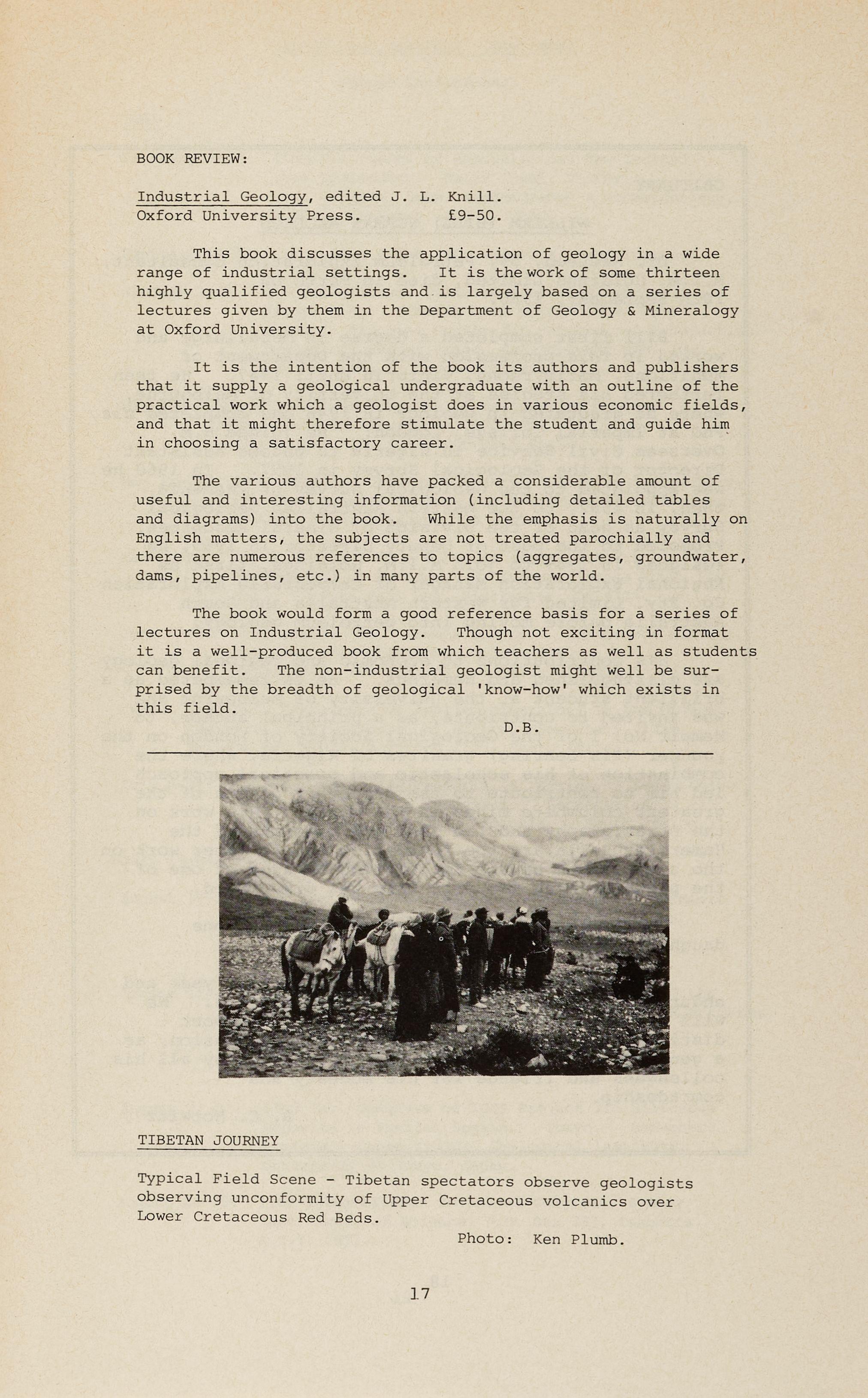
Typical Field Scene - Tibetan spectators observe geologists observing unconformity of Upper Cretaceous vo lca nics over Lower Cretaceous Red Beds.
Photo : Ken Plumb.
TIBETAN JOURNEY
OBITUARY
WILLIAM (BILL) NORMAN MACLEOD
Dr. MacLeod, 59, Petroleum Exploration Consultant, M.I.M. Holdings Limited, died in Perth on 10th September, 1980.
Bill first completed a degree in metallurgy and worked in this profession with the Department of Munitions, Maribyrnong, Victoria until 1947. He then furthered his studies at the University of Melbourne, where he graduated in geology in 1948 and completed his Pho at Imperia~ College, London. He joined H.M. Overseas Civil Service in Nigeria to become Assistant Director of the Geological Survey in 1957. In 1960 he was appointed to the Geological Survey of Tasmania, then, in 1962, to the Western Australian Geological Survey as head of the Division of Mineral Resources. Promoted to the post of Deputy Director in 1965, he resigned in 1969 to join M.I.M. Holdings, first as Regional Exploration Manager of Carpentaria Exploration Co. Pty. Limited for Western Australia and South Australia before moving into petroleum geology.
His contributions to economic and regional geology are distinguished and numerous. He is remembered as a brilliant student at the University of Melbourne and was invited to contribute, as a principal author, to Memoir No. 1 of the Geological Society of London on the younger (tin bearing) granites of Nigeria, where the combination of his scholastic and practical approach led him to contribute to the discovery of one of the greatest columbite mines in the world. His work on the stratigraphy and the iron ore deposits of the Hamersley Basin are the foundation to all later work on the subject and he was Exploration Manager of one of the partners when Teutonic Bore was discovered.
He married Irene Birks in 1949 and had one daughter, Joy
Bill discovered that he was unwell last year and endured his severe illness with great courage . He will be remembered by all who knew him as a most distinguished member of the geological profession, as a generous, loyal and dependable chief, and by all his colleagues and friends for his modesty and comradeship.
R. C. Horwitz
Expand your horizons - meet more Future Conferences.
1981
February 8-13: Climatic change of Australia and New Zealand Late Quaternary. Falls Creek, Victoria. Sec. Climanz, Dept. Biogeography & Geomorphology, A.N.U., Canberra, A.C.T. 2600.
February 11-13: Expanding Earth (see separate advertisement)
GEOCHIM 1981. 4th Postgraduate Training Course in Geochemical Prospecting. GEOCHIM CSSR UNESCO 1981, Post Graduate Training Center for Geochemical Prospecting. Geological Survey Prage, Malostranske nam. 19, 118 21 Praha 1, Czechoslovakia.
May 4-8: Third Brazilian Congress of Engineering Geology. ABGE Cidade Universitaria IPT/DMGA CEP 05508, Caixa postal 7141 (CEPOlOQO) Sao Paula.
May 11-15: 51st ANZAAS. 'Energy & Equity'. Section 3 Secretary, c/o Dept Applied Geology, Qd Institute of Technology, GPO Box 2434, Brisbane, Qd 4001.
May- June: Strip Mining - 45 m & beyond (Aust. I.M.M.)
Rockhampton or Mackay. T. Kuzman, Thiess Bros. Pty. Ltd., Private Mail Bag, Blackwater, Qd 4728.
June 8-13: Groundwater '81. Kuala Lumpur. Conference Manager, P.O. Box 142, Chatswood, N.S.W. 2067. Telephone: (02)439 1422. Telex AA24051.
June: Internat. Conference on Applied Mineralogy in the Mineral Industry. Johannesburg, S. Africa. Secretary, ICAM, Private Bag X3015, Randburg 2125, South Africa.
July 6-11: Geocongress. CSIR Pretoria, S. Africa. Geodynamics Symposium, Platinum Symposium. Secretaries, S.217 CSIR, P.O. Box 395, 0001 Pretoria. South Africa.
July 19-24: Aust. I.M.M. Annual Conference, Sydney.
August 17-21: 5th Australian Geological Convention. Sediments through the Ages. Perth, W.A. Convention Sec.: c/o Woodside Petroleum, GPO Box Dl88, Perth, W.A. 6001.
August 18-21: Second Biennial Conference and Exhibition of the Aust. Soc. of Exploration Geophysicists. Australian Mineral Foundation, Adelaide, S.A. Contact: Mr. J. Haigh, Conference Chairman, P.O. Box 42, Unley, S.A. 5061.
August 21-27: IInd Int. Congress of IGCP Project 115 Siliceous Deposits in Pacific Region. Tokyo. Convener: Professor Azuma Iijima, Geological Institute, University of Tokyo, Japan.
August 23-29: 13th International Botanical Congress, Sydney. Aust. Acad. of Science, P.O. Box 783, Canberra, A.C.T. 2601.
COMPANY MEMBERS
AAR Ltd. , GPO Box 880 , Brisbane, Qd 4001 .
ABERFOYLE Exploration Pty Ltd ., PO Box 84 , Goodwood, S.A. 5034.
AFMECO Pty. Ltd ., PO Box 526 , West Perth, W.A. 6005.
AMAX Iron Ore Corporation, 55 Macquarie Street Sydney, N.S W. 2000
AMPOL Explorat ion Ltd. , PO Box 907 , North Sydney , N.S.W. 2060.
ANACONDA Australia Inc., PO Box 465, West Perth, W.A. 6005.
AUSTRALIAN Anglo American Ltd., 581 Little Collins Street, Melbourne , Vic . 3000.
AUSTRALIAN Mineral Development Laboratories, The, Flemington Street, Frewville, S A. 5063.
BOND Corporation Holdings Ltd., 26 St. George's Terrace, Perth , W. A. 6000.
BROKEN HILL Pty. Ltd., GPO Box 86A, Melbourne, Vic 3001.
COMALCO Ltd., 95 Collins Street , Melbourne , Vic 3000
CRA Exploration Pty. Ltd., GPO Box 384 0, Melbou rne , Vic. 3001.
CSR Ltd., GPO Bo x 483 , Sydney , NSW 2001.
DELHI Petroleum Pty Ltd., GPO Box 2364, Adelaid e, S.A. 5001.
ESSO Australia Ltd ., GPO Box 4047, Sydney , N.S.W. 2001
GEOPEKO Ltd., PO Box 217, Gordon, NSW 2072.
HOMESTAKE Aust rali a Ltd., PO Box 338 , Norwood , S.A 5067.
MINATOME Australia Pty Ltd ., 61 Macquarie Street, Sydney, N S W 2000
MINES Exploration Pty Ltd ., PO Box 57, St. Marys , SA 5042.
NEWMONT Holding s Lt~ ., 535 Bourke Street, Melbourne , Vic. 3000 .
NORTH Broken Hill Ltd ., 576 St. Kild a Road , Me l bourne , Vi c. 3000.
OILMIN NL Group, PO Box 232 , Brisbane North Quay , Wd 4000.
PANCONTINENTAL Mining Ltd., SO Bridge Street, Sydney, N.S.W. 2000.
STOCKDALE Prospecting Ltd., 60 Wilson Street, South Yarra, Vic. 3141.
URANERZ Australia Pty. Ltd ., PO Box 201 , Subiaco, W A. 6008.
WEST Australian Petroleum Pty. Ltd., GPO Box Cl580, Perth , W.A. 5001.
WESTERN Min ing Corporation Ltd ., PO Box 409, Unley , S.A. 5061
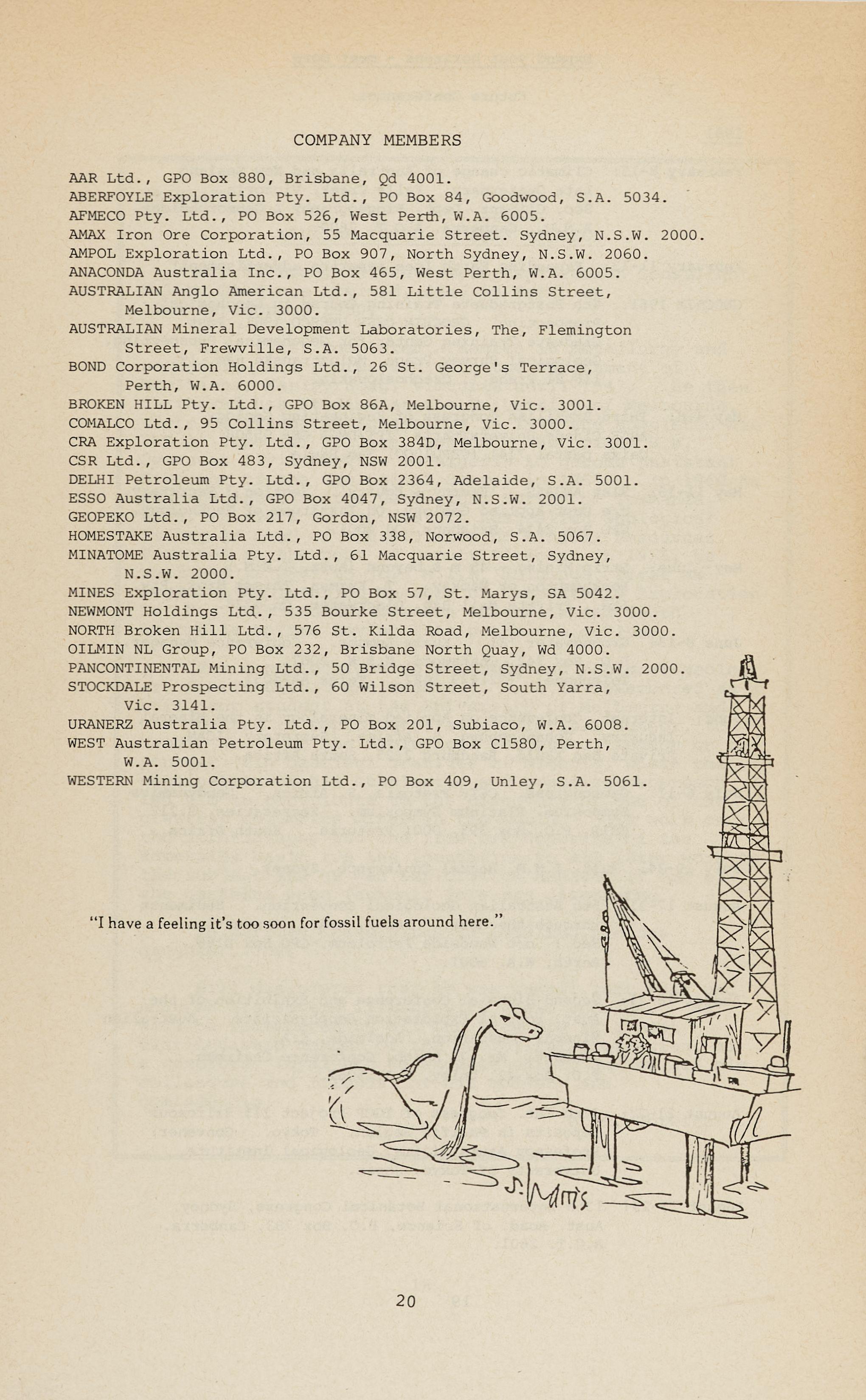
"I have a feeling it's too soon for fo ss il fuels around here ."