Newsletter Editor:
D. F. Branagan
Dept. of Geology & Geophysics
The University of Sydney, N.S.W 2006.
Pho{ie, (02) 692 2358 or 692 2912
THE PRESIDENT'S PAGE
Society Secretary:
S.M. Bye
Exploration Department
Broken Hill Co. Pty. Ltd. G. P.O. Box 86A Melbourne. Victoria. 3001. Phone: (03) 609 3402
ALL the signs indicate we are already in a mini-boom for ore and fuel exploration with final year students suddenly finding themselves with two and even more offers of positions with exploration companies. Those of us involved in training geologists are heartened to see our young graduates in heavy demand after the slack years of the early and middle 70' s. However past experience has shown that boom conditions may lead to problems of ethical conduct within the geological profession. These problems have long concerned our Society and members will have read much in the pages of The Australian Geologist for and against various proposals for the setting up of an association of professional geologists. It is planned that these proposals will form a major discussion item at the next Council meeting of the Society to be held in Hobart on 13 January 1980.
At present there are three distinct proposals. Colin Adamson, the Convener of the Council's Professional and Legislation Committee, will be presenting a proposal that the Society should sponsor the establishment of an independent Association of Professional Geoscientists. This Association would seek governmental registration of qualified geoscientists whose professional activities would be controlled by a Code of Ethics. The Geological Society of Australia would be asked to provide routine office assistance for a suitable fee and the new Association could also contribute to and towards The Australian Geologist. It is envisaged that a Liaison Committee of both organisations would operate to avoid duplication of effort and co-ordinate programmes of mutual interest.
The second proposal comes from Keith Crook (Department of Geology, Australian National University) who has had a long standing involvement with various moves to establish a professional geoscientist body. His proposal is that our Society should create a Professional Division composed of suitably qualified Professional Members. The Chairman of the Professional Division would also be named as "Vice-President (Professional)" of the Society and would be a member of the Executive. The Professional Division would operate under an agreed Code of Professional Ethics, would establish a register of professional geologists and would seek accreditation or other appropriate recognition of Professional Membership by Australian stock exchanges.
A third proposal will develop from an invitation by the Australian Institute of Mining and Metallurgy for the Society to be represented on a Provisional Consultant Committee set up to formulate the rules and structure of a proposed "Association of Registered Consultant ~embers" within the Institute. The Executive appointed Colin Adamson as the Society's representative on the Provisional Consultant Committee and The Society of Exploration Geophysicists and the Petroleum Exploration Society of Australia have also appointed representatives. This proposal has some attractive features provided that membership of such a body is open to suitably qualified members of any one of the four supporting organisations. It is hoped that sufficient progress will have been made on the constitution of such a body for Colin Adamson to present a detailed paper on the proposal for consideration by Council at its Hobart meeting.
I believe that any one of these three proposals could work but Council must now decide which one will work effectively for the future benefit of our profession. Make sure thatyour Division discussed these alternative proposals and that your Divisional representative are fully briefed for the Hobart Council Meeting.
There is no doubt in my mind that the Hobart Council will form a watershed for our Society. It could be that two major new initiativesthe form of support for some sort of Association of Professional Geoscientists and the sponsorship of an Australian Geoscience Council - will be taken at that meeting. It is my view that both initiatives, properly constituted, could only act to strengthen our profession and our Society.
John Lovel'ing
2,
The Engineering Geology Specialist Group proposes to publish a Case History Volume including Case Histories on Engineering Geology, Hydrology, Urban Geology and Environmental Geology. So that the Volume can best fit the requirements of potential readers, advertisers and University courses it is requested that all interested persons complete the following questionnaire.
ENGINEERING GEOLOGY SPECIALIST GROUP QUESTIONNAIRE ON PROPOSED CASE HISTORY VOLUME
What price range do you consider is limiting?
What topics would you particularly like to see covered in such a Volume:
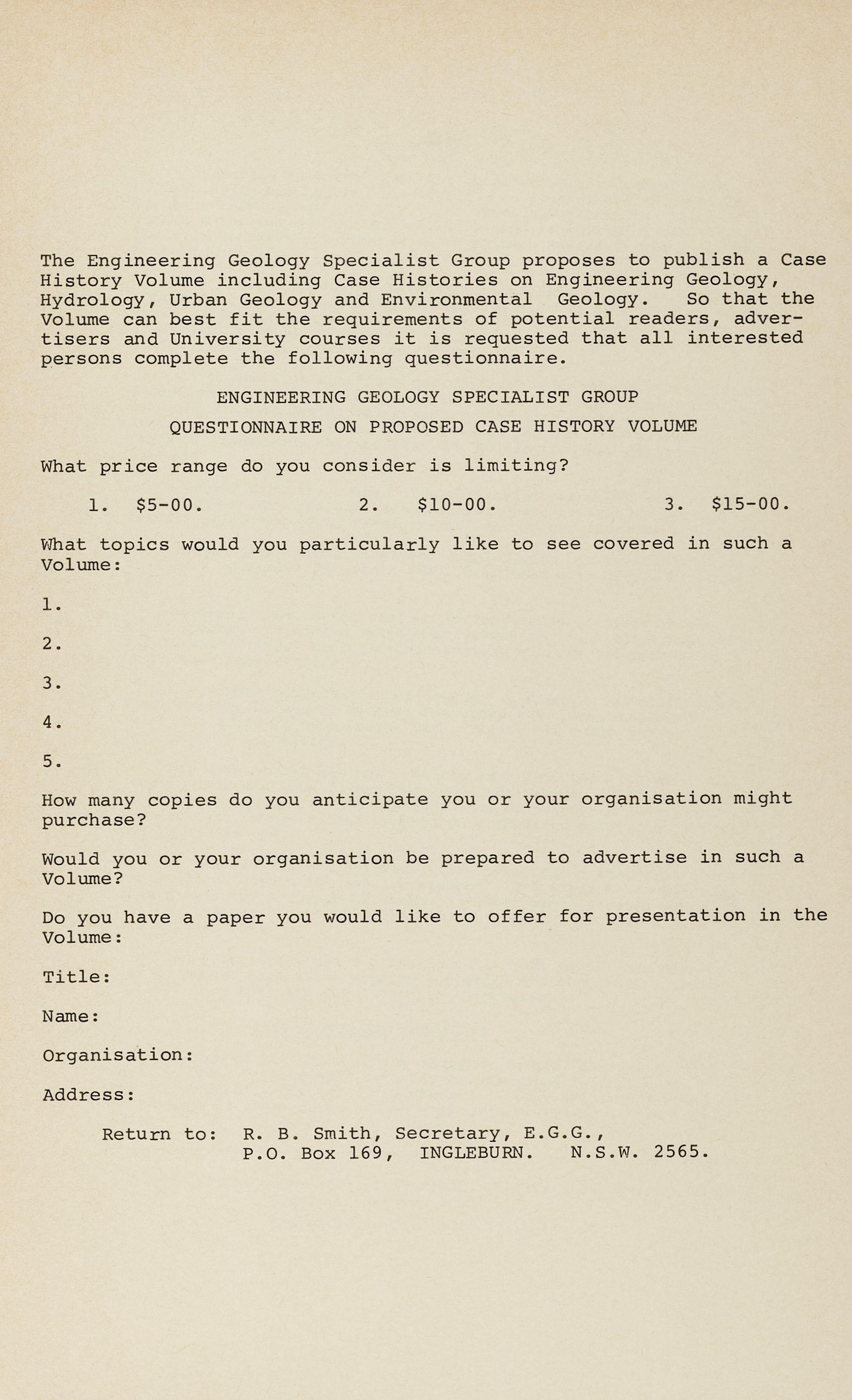
How many copies do you anticipate you or your org~nisation might purchase?
Would you or your organisation be prepared to advertise in such a Volume?
Do you have a paper you would like to offer for presentation in the Volume:
Title:
Name: Organisation:
Address:
Newsletter No. 27. December, 1979.
ADDITORIAL
'Australia is thick' runs the headline in the October issue of Open Earth highlighting the research on crustal thickness which has been carried out at A.N.U., and which shows that the litho- sphere under the central Australian region is something like 240 km thick in contrast with the 34 km in eastern Australia and under the Northwest Shelf.
The article makes the point that Australia is the only stable continental area immediately adjacent to a ·subduction zone in which earthquakes occur with great frequency and asks 'what will happen or is happening to it as it meets the Banda Arc? Will it be sub- ducted or will it override the oceanic plate?'
These exciting questions and no doubt many others will be dis- cussed at the International Union of Geophysics and Geodesy meeting in Canberra this month, which has brought many earth scientists to Aust ralia. More will be visiting us in the new year as the 5th Gondwana Conference is scheduled for Wellington, New Zealand in February.
Judging from the number of papers being presented and results quoted above many geologists in Australia are presumably getting results which are worth talking about and which others want to hear.
These international meetings coupled with our own conferences in Hobart (January) and Perth (May) mean that many people are busy, busy.
Meanwhile out in the real world increasing activity in the broad spectrum of mining means that we may see less involvement of industrial (?rious) geologists in Society matters and perhaps more in professional affairs.
Government organisation of geology is undergoing modification. Plans for the Bureau of Mineral Resources have been announced (-- plus c'est la meme chose) and at least one state survey has lost part of its energy.
How does it all add up? We can take away memories of a full year in 1979 and look forward to added activity in 1980. Society business is likely to multiply (for some divisions at least) and some members may be called upon to do a fraction more if we are to get to square one.
To prepare for such eventualities there are a number of things you might do during the festive season. The first is to get away from it ail for a ccuple of weeks. Forget about erosion while you loll on the beach, , ttend a rock concert or two and have a look at the crystal ball.
Happy Christmas and a prosperous New Year to all our members and do please keep those abusive letters and acrimonious articles rolling in - they are the Australian Geologist.
1980 AUSTRALIAN GEOLOGIST
In view of the overwhelming response several changes will be made in 1980. There will be 5 issues scheduled for March 14, May 23, August 1, October 3, December 5. Copy required 4 weeks in advance of these dates please - Survey Chiefs and others please note!
Society Office: Room 1001, 10th Floor, Challis House, Martin Place Sydney. N.S.W. 2000. Laurel Tuckwell, (02) 231 4696. 3.
Sir:
I must criticise Professor Lovering's use of the President's. page Newsletter No 26 to attack a criticism of "A geological science policy for Australia" by Peter Power. Presumably the policy was published in Newsletter No 23 to receive comment. Not everyone received the circulated material from the executive so not everyone would have had a previous opportunity to comment.
The faats of the matter are that many of Peter Power's comments are valid. There are too many Professors of Geology and geological departments in Australia. Melbourne does not need four, for instance.
The Geological Society historically by pressure from its academic members has resisted efforts to create a professional body for geologists. To say that the Society has been extremely active in promoting the professional interests of the geological community is completely at variance with the facts. To my certain knowledge the Society did nothing about the misuse of the term geologist during the mining boom from 1969-72. Nor did they do anything about the widespread geological unemployment that followed.
I must defend Peter Power's right to put his view in the Newsletter and have it rationally discussed and not be personally attacked by the President of the Society.
A. C. M. Laing Rosanna. Victoria.
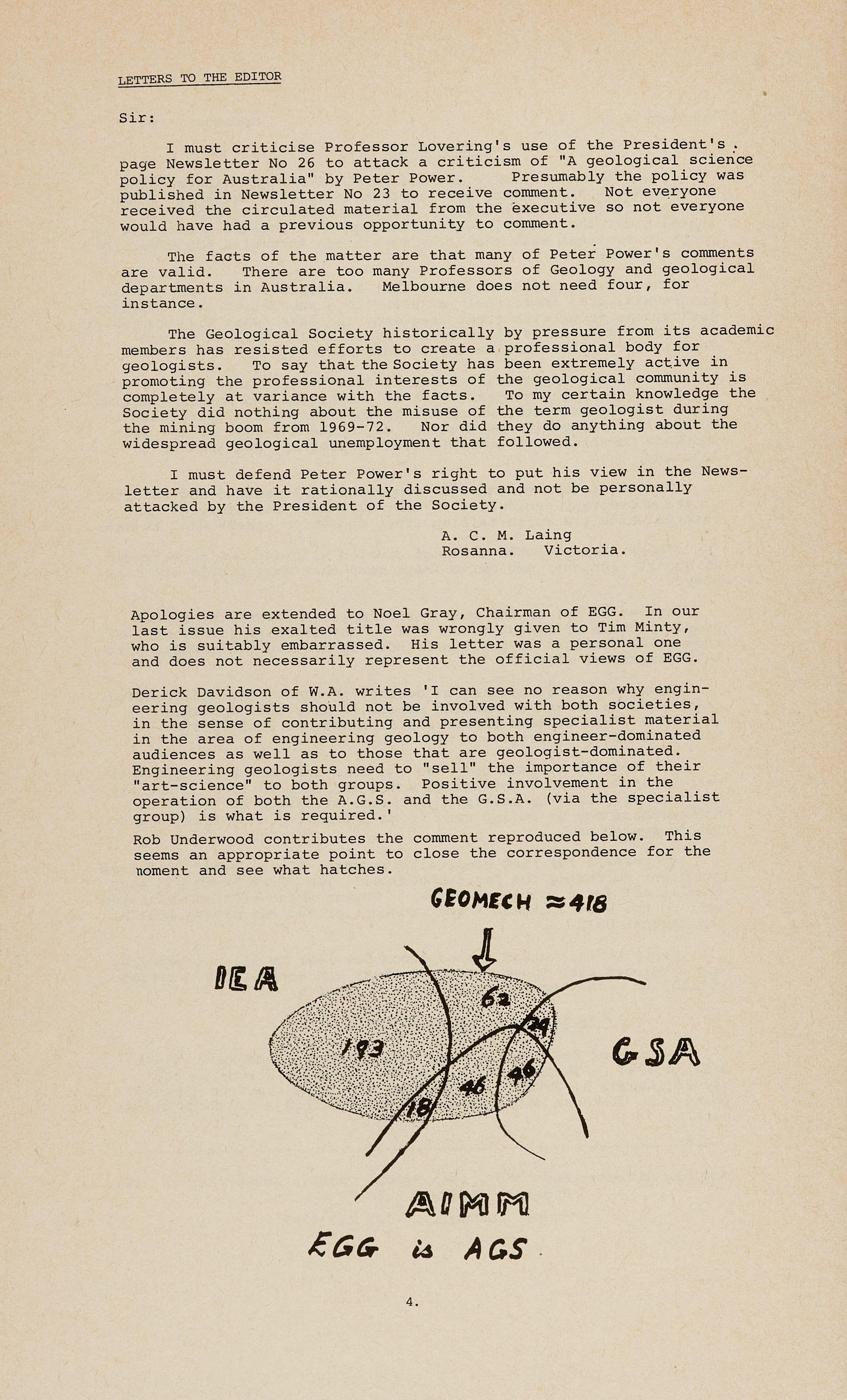
Apologies are extended to Noel Gray, Chairman of EGG. In our last issue his exalted title was wrongly given to Tim Minty, who is suitably embarrassed. His letter was a personal one and does not necessarily represent the official views of EGG.
Derick Davidson of W.A. writes 'I can see no reason why engineering geologists should not be involved with both societies, in the sense of contributing and presenting specialist material in the area of engineering geology to both engineer-dominated audiences as well as to those that are geologist-dominated. Engineering geologists need to "sell" the importance of their "art-science" to both groups. Positive involvement in the operation of both the A.G.S. and the G.S.A. (via the specialist group) is what is required.'
Rob Underwood contributes the comment reproduced below. This seems an appropriate point to close the correspondence for the noment and see what hatches.
HOW TO MAKE GSA BOTH LEARNED AND PROFESSIONAL
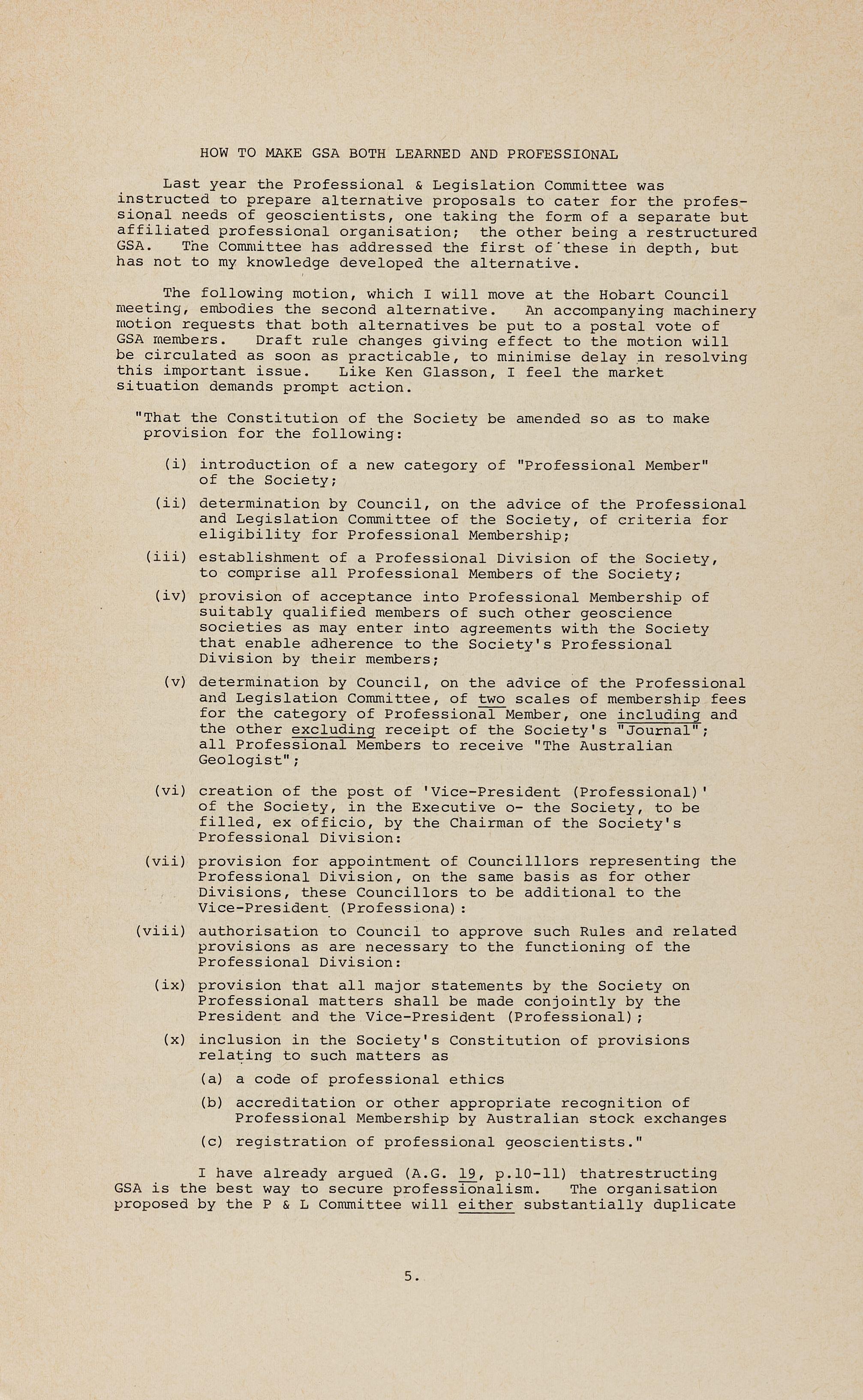
Last year the Professional & Legislation Committee was instructed to prepare alternative proposals to cater for the professional needs of geoscientists, one taking the form of a separate but affiliated professional organisation; the other being a restructured GSA. The Committee has addressed the first of.these in depth, but has not to my knowledge developed the alternative.
The following motion, which I will move at the Hobart Council meeting, embodies the second alternative. An accompanying machinery motion requests that both alternatives be put to a postal vote of GSA members. Draft rule changes giving effect to the motion will be circulated as soon as practicable, to minimise delay in resolving this important issue. Like Ken Glasson, I feel the market situation demands prompt action.
"That the Constitution of the Society be amended so as to make provision for the following:
(i) introduction of a new category of "Professional Member" of the Society;
(ii) determination by Council, on the advice of the Professional and Legislation Committee of the Society, of criteria for eligibility for Professional Membership;
(iii) establishment of a Professional Division of the Society, to comprise all Professional Members of the Society;
(iv) provision of acceptance into Professional Membership of suitably qualified members of such other geoscience societies as may enter into agreements with the Society that enable adherence to the Society's Professional Division by their members;
(v) determination by Council, on the advice of the Professional and Legislation Committee, of two scales of membership fees for the category of ProfessionalMember, one including and the other excluding receipt of the Society's "Journal"; all Professional Members to receive "The Australian Geologist";
(vi) creation of the post of 'Vice-President (Professional)' of the Society, in the Executive o- the Society, to be filled, ex officio, by the Chairman of the Society's Professional Division:
(vii) provision for appointment of Councilllors representing the Professional Division, on the same basis as for other Divisions, these Councillors to be additional to the Vice-President (Professiona):
(viii) authorisation to Council to approve such Rules and related provisions as are necessary to the functioning of the Professional Division:
(ix) provision that all major statements by the Society on Professional matters shall be made conjointly by the President and the Vice-President (Professional);
(x) inclusion in the Society's Constitution of provisions relating to such matters as
(a) a code of professional ethics
(b) accreditation or other appropriate recognition of Professional Membership by Australian stock exchanges (c) registration of professional geoscientists."
I have already argued (A.G. 19, p.10-11) thatrestructing GSA is the best way to secure professionalism. The organisation proposed by the P & L Committee will either substantially duplicate
GSA's interests, or it will be narrowly professional, being chiefly concerned with registration, ethics and industry/stock exchange matters. Few geoscientists could find time to be active in both GSA and an Assoc. of Professional Geoscientists so that a communication gap is likely to grow separating 'industrial' and 'research' geoscientists. Furthermore, an APG will find difficulty in developing the clout necessary to achieve its aims, in the face of new initiatives now emanating from AusIMM. I hope that GSA members will make their views known to Councillors.
Keith A. ,W. Crook, A.N.U.
AUSTRALIAN GEOLOGICAL CONVENTIONS
Members of Tasmanian Division propose that future Australian Geological Conventions of the Geological Society of Australia be held at regular intervals of 24 months and, at the same time, (month, preferably May) of each consectuve year.
The timing of past and future conventions is:-
1st May, 1975 (Adelaide)
2nd February, 1977 (Melbourne)
3rd August, 1978 (Townsville)
4th January, 1980 (Hobart)
5th August, 1981 (Perth)
6th 1983 (Canberra)
20 months after 1st 18 months after 2nd 16 months after 3rd 18 months after 4th
There are at present no time restrictions as to the interval between Conventions. The time and place of each Convention is decided by Council after consultation between the Federal Executive and the host Division. Obviously it is convenient and preferable for the General Meeting of the Society to be held at Conventions. According to the Rules of the Society no more than 30 months shall elapse between General Meetings. Past practice has been for the Federal Executive Committee to change over at the Council Meeting preceding the General Meeting held during the Convention The Federal Executive Committee is elected for a period of Office of approximately two years. We note that the period of 16 months between the Townsville and Hobart Conventions more closely approximates one year than two. Council Meetings may be held at any time. Hence there is no need for Conventions to be held at such close and irregular intervals as 16, 16 or 20 months.
The Conventions fulfil a vital and significant need for communication and contact within the Society and we feel that it would be more convenient for members, allowing them better advance planning (particularly financial -) and it would certainly ensure the functions of the Executive conform more to the Rules of the Society, if future Conventions are held at regular intervals of 24 months.
P. Collins P. Williams '
GEOLOGY AND GEOPHYSICS OF NORTH EASTERN AUSTRALIA.
Publication date for this volume will be January 1980. The volume comprises review papers on the geology and geophysi~s of north_ eastern Australia presented by invitation at the Third Australian Geological Convention held in Townsville in August 1978.
F'or details contact: D. J. Drysdale, Hon. Secretary, Qd Division, Geological Society of Australia Inc., GPO Box 1820, Brisbane, Qd 4001.
PRESS STATEMENT (by the Minister for National Development, Mr. Newman, 25th October, 1979)
BUREAU OF MINERAL RESOURCES
In the course of his major statement on energy policy on 27 June, the Prime Minister announced that the Government would give a new and upgraded role to the Bureau of Mineral Resources (BMR) . He said:
"The Bureau is to be made into a geoscientific research organisation with a substantial capacity to undertake the more sophisticated scientific studies required to support the fullest development of our resources. In this regard it will have an enhanced role in relation to the exploration for and assessment of Australian energy resources."
The decisions which I am announcing today, pursuant to the Prime Minister's statement, follow a review by the Government of the role of the BMR and take into account the advice furnished by the Australian Science and Technology Council (ASTEC) in its report to the Government last year.
The Government has decided that the future role of the BMR wil;t. be:-
(i) to develop an integrated, comprehensive, scientific understanding of the geology of the Australian continent, the Australian offshore area and the Australian Antarctic Territory, as a basis for minerals exploration; this to be done where appropriate in co-operation with State Geological Surveys and other relevant organisations and having reg ard to priori ties for the search for minerals approved by the Minister for National Development;
(ii) to be the primary national source of geoscience data and to Publish and provide information; and
(iii) to undertake mineral resource assessments in accordance with programs and priorities approved by the Minister for National Development with the advice of the BMR.
Through the priorities to be established under (i) and (iii), there will be increasing emphasis by the Bureau in relation to energy resources.
Since its establishment in 1946 the role of BMR has been one of scientific and technological research in support of mineral explora- tion. However, in recognition of tl1e fact that future mineral discoveries will increasingly rely on sophisticated research using the mo st advanced concepts and technologies in geology, geochemistry and geophysics, the BMR must be provided with capacity to undertake more sophisticated scientific studies.
The Government has agreed that the BMR should have a career structure appropriate to its revised role and to the need for more sophisticated research. This will include the provision of Research Scientist classifications in appropriate areas and the introduction of a.merit advancement system ·for Research Scientists.
The Government is not satisfied at this time that the needs of the BNR could only be met by its establishment as a statutory authority and staffing arrangements will be under the Public Service Act. These arrangements will be implemented as soon as the necessary preparatory work is finalised. The arrangements will be reviewed after a period of 12 months operation.
The position of Director BMR has been vacant following the retirement of Mr. L. C. Noakes in March. The salary classification of the position is being reviewed by my Department and the Public Service Board in the light of the Government's decisions. Application for appointment as Director will be widely advertised in the near future.
Concurrently with the appointment of the next Director, a new committee to advise the BMR in the formulation of its research and assessment programs will be established. Representatives of the petroleum industry, the mining industry and the State Geological Surveys will be included in those invited to join this committee.
The new Organisation will continue the high degree of collaboration that currently exists between BMR and other scientific bodies both in Australia and overseas . In particular the Organisation will co-operate with State Geological Surveys whenever appropriate, and will develop further interdisciplinary collaboration and rationalisation of programs with CSIRO.
I acknowledge the substantial contribution made by the BMR over the past 30 years in providing basic scientific data whereby private enterprise exploratory efforts for hydrocarbons and minerals have flourished. As I have said future discoveries will increasingly rely on more sophisticated research and the Bureau will be progressively provided with the capacity to continue its important contribution.
Reference Collections of DSDP Microfossils
The Deep Sea Drilling Project, which has been sampling the ocean floor for ten years now, has made samples widely available for investigations leading to publication, but has not had a mechanism for providing access to its microfossils for purposes of examination not leading to publication. To remedy this situation, we are in the process of establishing five micropaleontological reference collections, one in each large region in which there is active study of DSDP microfossils (North America, western Europe, USSR, the Japanese region, and Australia-New Zealand).
Because of the incidental scientific benefits that will accrue to them, it is anticipated that the institutions housing these reference collections will provide the labor to make microfossil preparations from raw samples, facilities for visitors to examine the collections, and safe custody of the materials based on a solid tradition of curating geological collections. In order that the preparation may be made economically, each participating institution will be responsible for one kind of preparation, in five copies (one for each institution). The preparations will be of foraminifera, radiolarians, diatoms, calcareous nannofossils, and lithological smear slides.
One suggestion for a repository in the Australia-New Zealand region is the N.Z. Geological Survey at Lower Hutt, N . Z. The purpose of this note is to determine whether there are other institutions in Australia or New Zealand that should be considered as candidates.
Please write to: W. Riedel, A-012
DSDP Curator
Scripps Institution of Oceanography La Jolla, Calif. 92093, U.S.A.
SCHOOL GEOLOGY PROJECT
The School Geology Project is one which has been set up by the Australian Academy of Science. The principal object of the Project is to prepare an Australian text book on geology, which should not be confused with a text book on Australian geology, although the former will use Australasian examples where possible.
In the formative stages of the Project it is necessary to define various aims and related matters, which in effect become self-imposed 'terms of reference'. Careful definition of aims is essential to the production of an acceptable and adequate text book. The Project Director (Mr. Ian Clark of the Salisbury C.A.E., South Australia) has provided the 'First Draft' of the Aims of the Project, in the hope that comment can be obtained from as many geologists as possible. Send any comments on the draft direct to:
F.
Canavan, Convener, Education Committee, Geological Society of Australia, Inc., 26 Stanhope Grove, Camberwell. Victoria 3124.
1. Aims of the project
1. To promote the study of geology in Australian secondary schools through the production of relevant teaching materials.
2. To present geology as a coherent body of knowledge which is closely interwoven with all of the areas of sciences.
3. To coordinate the activities of organisations which have an interest in senior secondary school geological education. (e.g. Uni., C.A.E., Ed. Dept., B.M.R., Mines Depts., Mining Industry}.
The first stage is the preparation of a course of study in the form of a text book. This should be accurate, up to aate and should contain relevant Australasian examples. The desirable course should be one in solid-earth geology, but it should include a discussion of planetary, atmospheric and climatic processes insofar as they are related to solid-earth phenomena. Because there is some divergence in the geology and earth science syllabuses in the various states it will be desirable to arrive at a text structure of which about three quarters will be common to the requirements of all states with the remainder adequately covered by options within the text.
Since there is no best order of presenting the various fields of geology, a non-integrated text has merit in that it permits the teacher to rearrange the sequence of material to suit his-her needs without destroying the meaning of the subject matter. An attempt should be made to prepare each section in a way which will be appropriate for years 11 and 12 students in each state.
There should be an attempt to reduce technical vocabulary to a minimum because the majority of the students who will be using the book are students with a limited background in science. These students are unlikely to pursue a tertiary course in geology.
Teachers' Guide and Practical Manual
It will be necessary to prepare a separate practical manual and teachers' guide. These will probably be largely developed at the same time as the text book but their refinement and preparation will come after the publication of the text book.
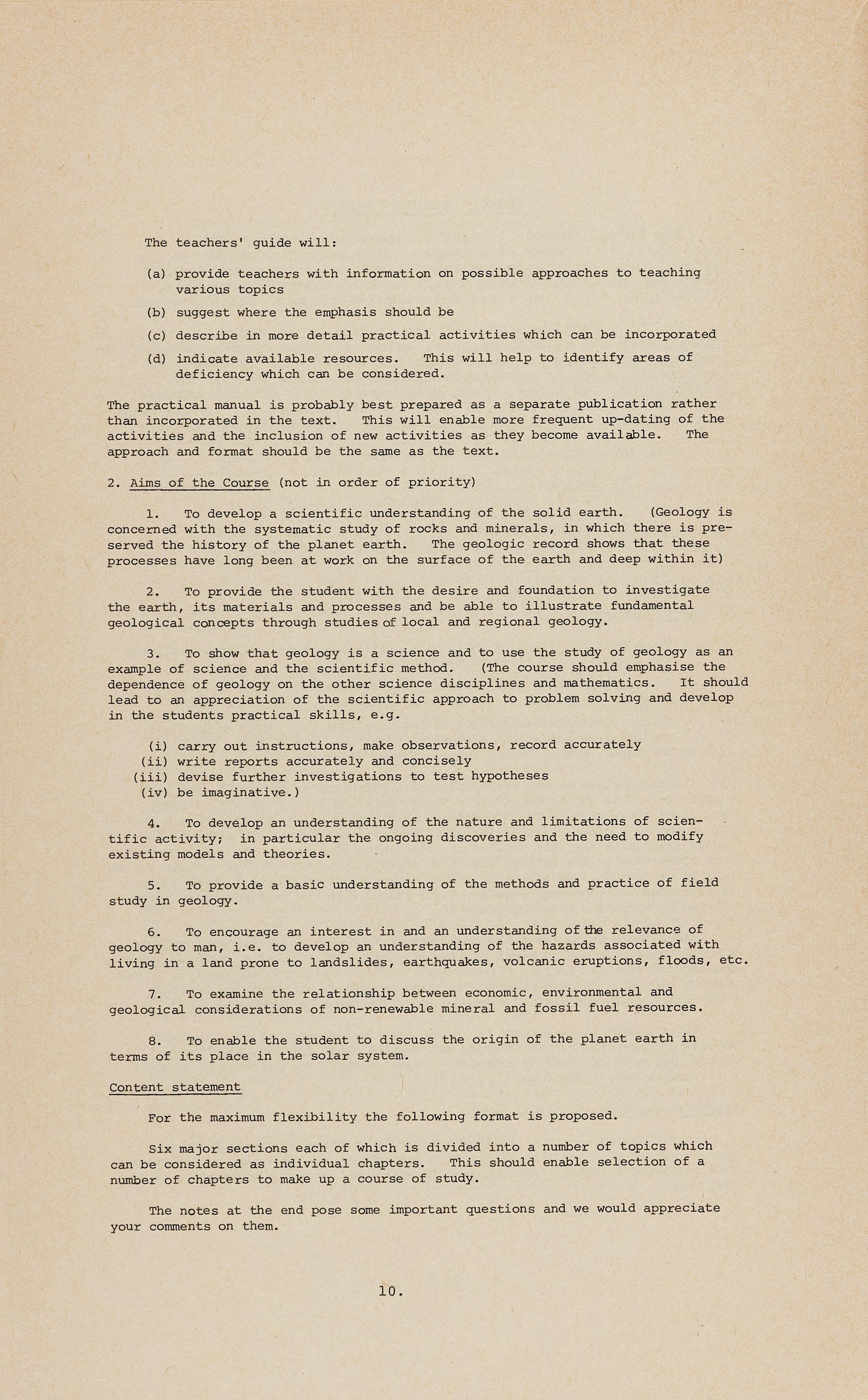
The teachers' guide will:
(a) provide teachers with information on possible approaches to teaching various topics
(b) suggest where the emphasis should be
(c) describe in more detail practical activities which can be incorporated
(d) indicate available resources. This will help to identify areas of deficiency which can be considered.
The practical manual is probably best prepared as a separate publication rather than incorporated in the text. This will enable more frequent up-dating of the activities and the inclusion of new activities as they become available The approach and format should be the same as the text.
2. Aims of the Course (not in order of priority)
1. To develop a scientific understanding of the solid earth. (Geology is concerned with the systematic study of rocks and minerals , in which there is preserved the history of the planet earth. The geologic record shows that these processes have long been at work on the surface of the earth and deep within it)
2. To provide the student with the desire and foundation to investigate the earth, its materials and processes and be able to illustrate fundamental geological concepts through studies of local and regional geology.
3. To show that geology is a science and to use the study of geology as an example of science and the scientific method. (The course should emphasise the dependence of geology on the other science disciplines and mathematics. It should lead to an appreciation of the scientific approach to problem solving and develop in the students practical skills, e.g.
(i) carry out instructions, make observations, record accurately (ii) write reports accurately and concisely (iii) devise further investigations to test hypotheses (iv) be imaginative )
4. To develop an understanding of the nature and limitations of scientific activity; in particular the ongoing discoveries and the need to modify existing models and theories
5 To provide a basic understanding of the methods and practice of field study in geology.
6. To encourage an interest in and an understanding of the relevance of geology to man, i.e. to develop an understanding of the hazards associated with living in a land prone to landslides, earthquakes, volcanic eruptions , floods, etc.
7. To examine the relationship between economic, environmental and geological considerations of non-renewable mineral and fossil fuel resources.
8. To enable the student to discuss the origin of the planet earth in terms of its place in the solar system.
Content statement
For the maximum flexibility the following format is proposed.
Six major sections each of which is divided into a number of topics which can be considered as individual chapters. This should enable selection of a number of chapters to make up a course of study
The notes at the end pose some important questions and we would appreciate your comments on them.
Introduction - The Historical Development of Geological Thought. (Planetary)
Earth Science - Cosmology - the place of the earth in the universe
Planetology - physical and chemical properties of the planets; theories for origin of the solar system
Evolution of the Earth - atmosphere, hydrosphere, geochemical
* Oceanography 1
* Climatolo1y 2
* Astronomy
II Earth Materials - Minerals
Igneous Processes
Volcanism
Igneous Intrusions
Igneous Rocks
Sedimentary Processes
Weathering and soils
Principles of Erosion, Transport and Deposition
* Sedimentary Environments 4
Metamorphic Processes
III Earth History - Palaeontology
Fossils
Organic Evolution
Palaeoecology
Geological Time
Isotopic dating
Other methods of "numerical" dating
Relative and Absolute Time scales
Stratigraphy
IV Earth Structures - Crustal Features: oceans and continents
Physics of the earth: seismology, gravity, magnetism
Internal Structure and Composition of the Earth
Continental Drift
Sea floor spreading and plate tectonics
Deformation of the earth's crust: folds, faults
Orogenesis and joints
V Earth Resources - Energy
Coal and Petroleum
Nuclear, Geothermal and other energy sources
Metals
Non Metals
Construction materials
Water
VI Applied Geology - Exploration and Mining Geology
Engineering Geology
Environmental Geology:
* The Geology of Australia5
FOOTNOTES
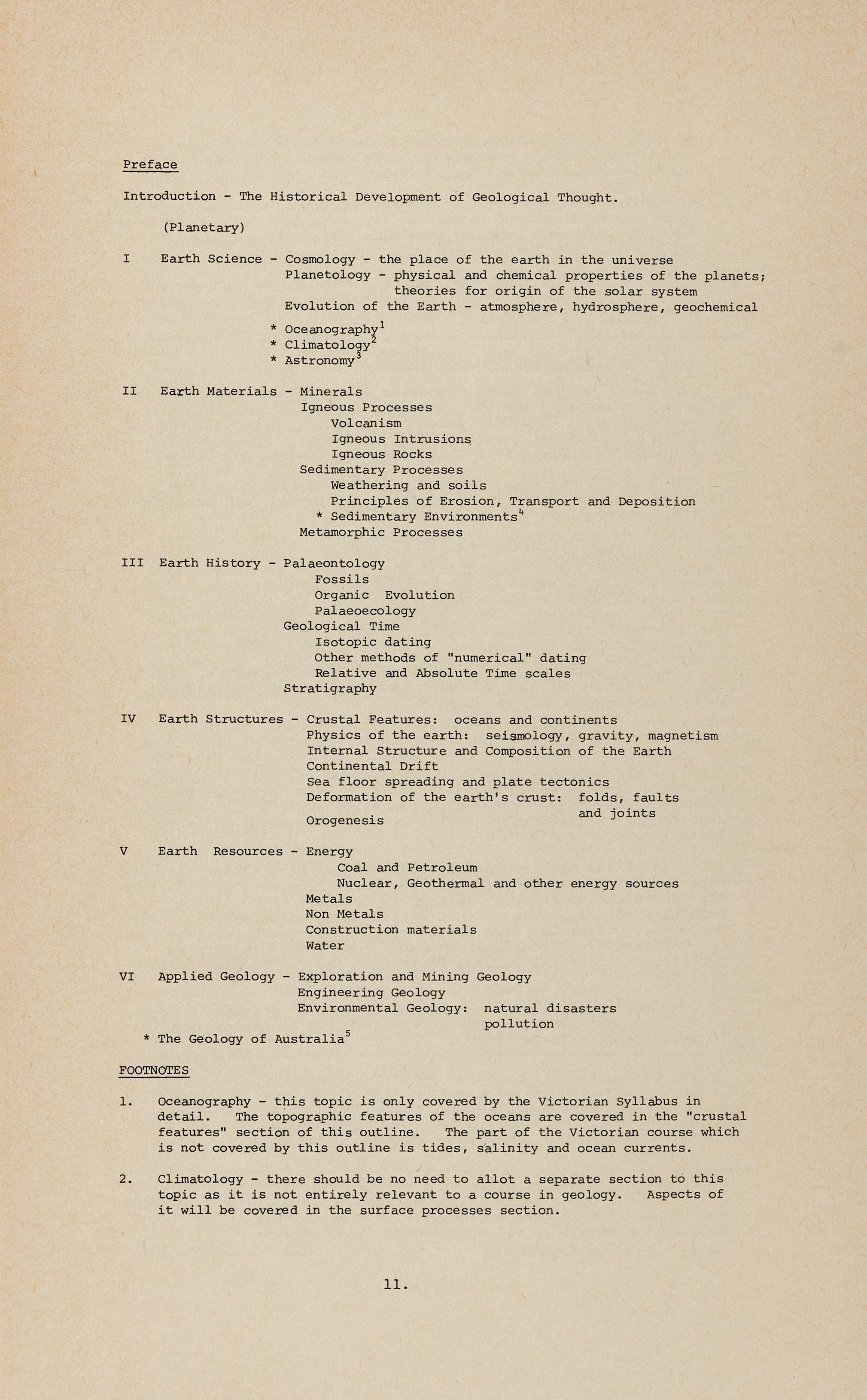
natural disasters pollution
1. Oceanography - this topic is only covered by the Victorian Syllabus in detail. The topographic features of the oceans are covered in the "crustal features" section of this outline. The part of the Victorian course which is not covered by this outline is tides, salinity and ocean currents.
2. Climatology - there should be no need to allot a separate section to this topic as it is not entirely relevant to a course in geology. Aspects of it will be covered in the surface processes section.
3. Astronomy - it is debatable whether this should be covered in a geology course. The topic is well covered in other resources and like 1 and 2 above can be incorporated in part where relevant.
4. Sedimentary Environments - it is intended to cover the environments of wind, water (marine, fluvial and lacustrine) and ice. These· should probably be individual chapters. Although there is an overlap with geography the emphasis will be on the processes rather than the morphology.
5. Geology of Australia - this topic logically fits into the Earth History section but in order to treat it fully a knowledge of all other sections is necessary. It therefore is difficult to place.
CGG - New committee saddles up.
The Surat-Moreton Basin Symposium at Toowoomba, organised by the past Committee of the CGG, was highly successful, with over 150 registrants. 19 papers were delivered and these will soon be published in a special issue , of "Coal Geology:. The symposium was followed by a field trip to Millmerran, Wandoan and Taroom.
The new CGG Chairman, Dr. Colin Ward, was elected at the Symposium, and the rest of the committee nominated, and subsequently elected unopposed, as follows:
Vice-Chairman:
Treasurer: Hon. Editor: Secretary:
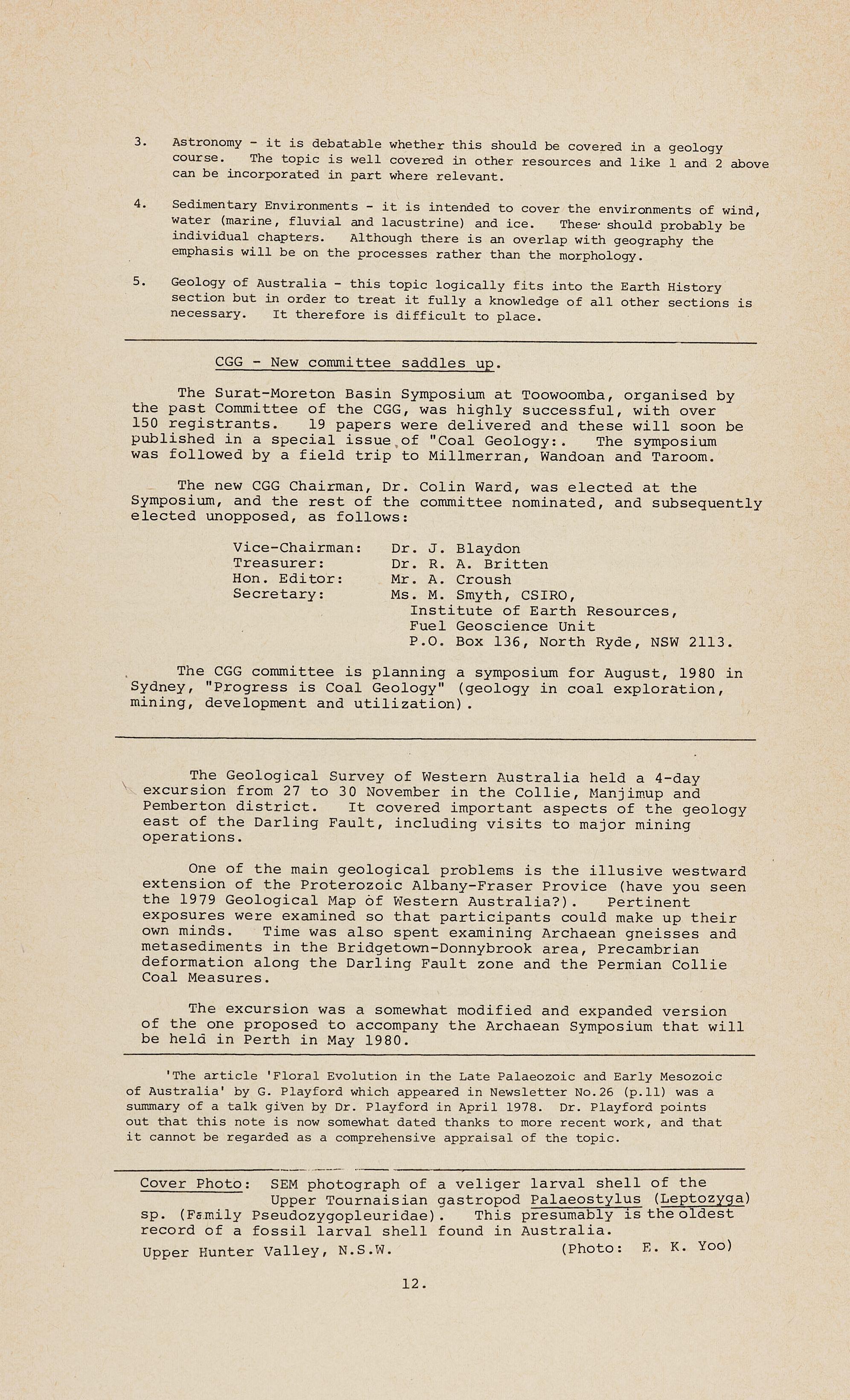
Dr. J. Blaydon
Dr. R. A. Britten
Mr. A. Croush
Ms. M. Smyth, CSIRO, Institute of Earth Resources, Fuel Geoscience Unit P.O. Box 136, North Ryde, NSW 2113.
The CGG committee is planning a symposium for August, 1980 in Sydney, "Progress is Coal Geology" (geology in coal exploration, mining, development and utilization).
The Geological Survey of Western Australia held a 4-day \ excursion from 27 to 30 November in the Collie, Manjimup and Pemberton district. It covered important aspects of the geology east of the Darling Fault, including visits to major mining operations.
One of the main geological problems is the illusive westward extension of the Proterozoic Albany-Fraser Provice (have you seen the 1979 Geological Map of Western Australia?). Pertinent exposures were examined so that participants could make up their own minds. Time was also spent examining Archaean gneisses and metasediments in the Bridgetown-Donnybrook area, Precambrian deformation along the Darling Fault zone and the Permian Collie Coal Measures.
The excursion was a somewhat modified and expanded version of the one proposed to accompany the Archaean Symposium that will be held in Perth in May 1980.
'The article 'Floral Evolution in the Late Palaeozoic and Early Mesozoic of Australia' by G. Playford which appeared in Newsletter No. 26 (p.11) was a summary of a talk given by Dr. Playford in April 1978. Dr. Playford points out that this note is now somewhat dated thanks to more recent work, and that it cannot be regarded as a comprehensive appraisal of the topic.
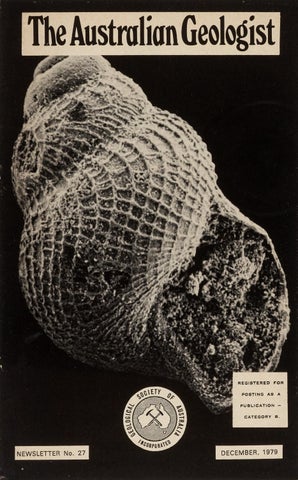
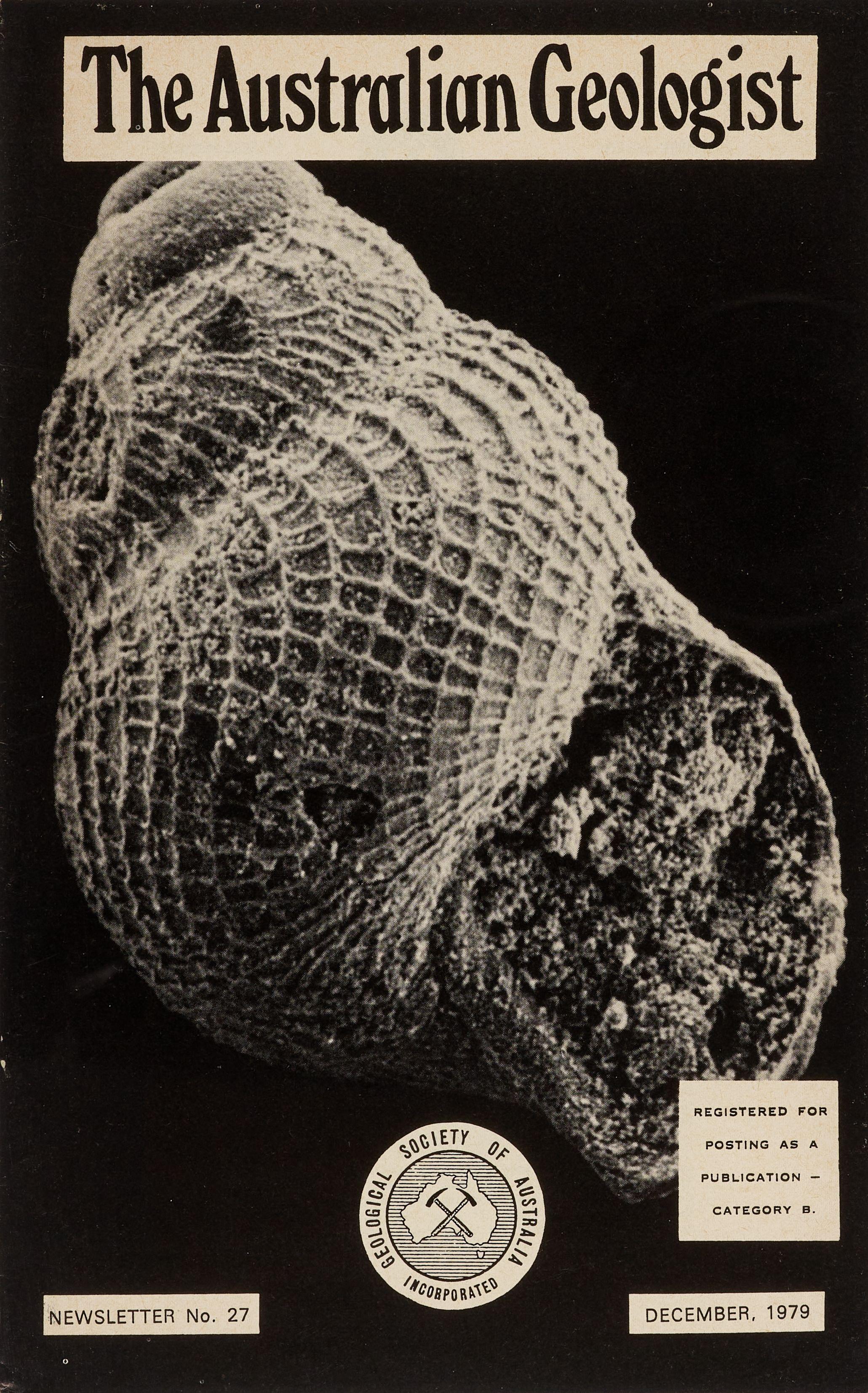
Cover Photo: SEM photograph of a veliger larval shell of the Upper Tournaisian gastropod Palaeostylus (Leptozyga) sp. (Fa.mily Pseudozygopleuridae). This presumably is the oldest record of a fossil larval shell found in Australia. Upper Hunter Valley, N.S.W.
(Photo: E. K. Yoo) 12.
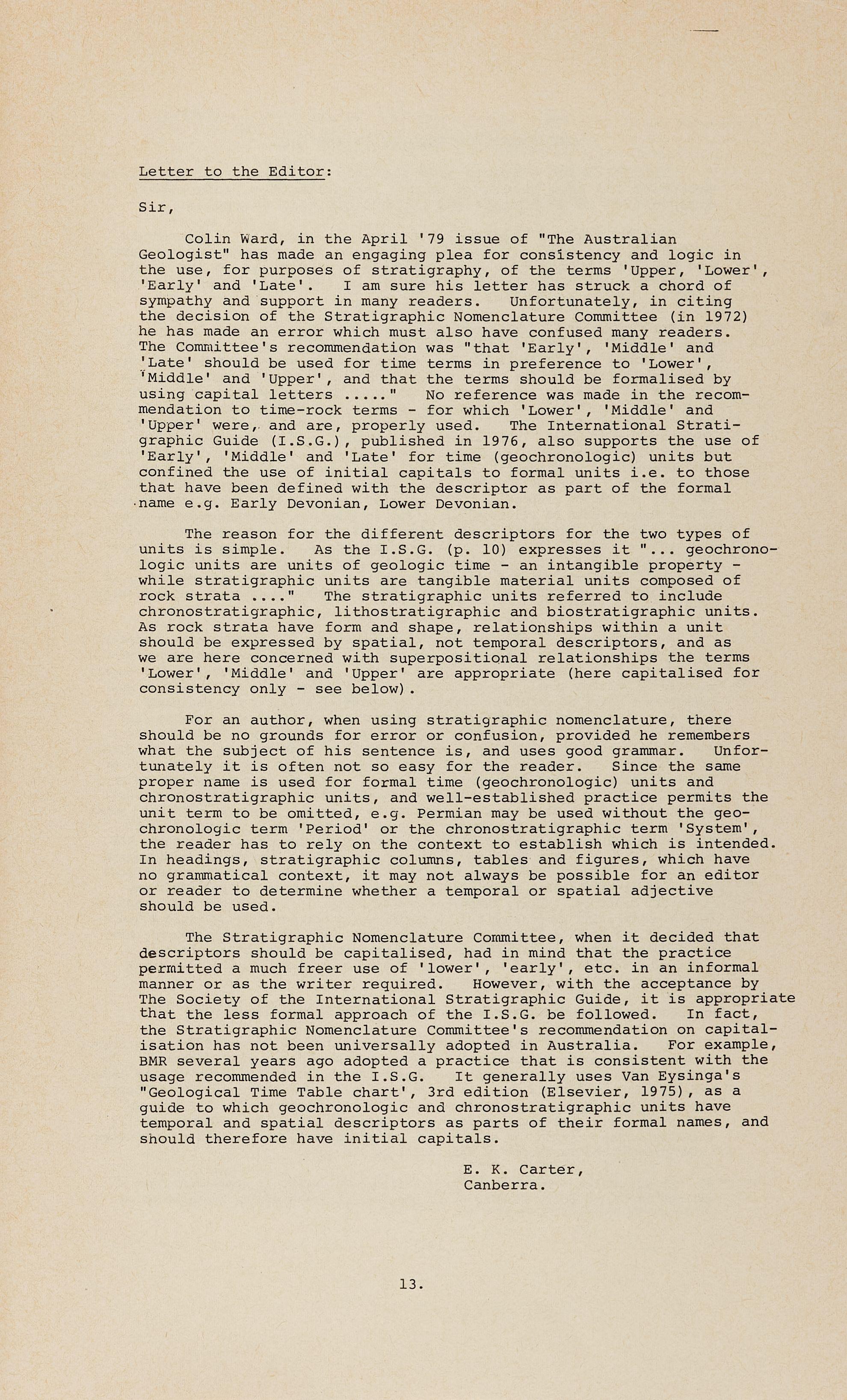
Letter to the Editor:
Sir,
Colin Ward, in the April '79 issue of "The Australian Geologist" has made an engaging plea for consistency and logic in the use, for purposes of stratigraphy, of the terms 'Upper, 'Lower', 'Early' and 'Late ' . I am sure his letter has struck a chord of sympathy and support in many readers. Unfortunately, in citing the decision of the Stratigraphic Nomenclature Committee (in 1972) he has made an error which must also have confused many readers. The Committee's recommendation was "that 'Early', 'Middle' and ' Late' should be used for time terms in preference to 'Lower' , 'Middle' and 'Upper', and that the terms should be formalised by using capital letters " No reference was made in the recommendation to time-rock terms - for which 'Lower', 'Middle' and 'Upper' were, and are, properly used. The International Stratigraphic Guide (I.S.G.), published in 1976, also supports the use of 'Early', 'Middle' and 'Late' for time (geochronologic) units but confined the use of initial capitals to formal units i.e. to those that have been defined with the descriptor as part of the formal -name e.g. Early Devonian, Lower Devonian.
The reason for the different descriptors for the two types of units is simple As the I.S G (p. 10) expresses it" geochronologic units are units of geologic time - an intangible propertywhile stratigraphic units are tangible material units composed of rock strata . " The stratigraphic units referred to include chronostratigraphic, lithostratigraphic and biostratigraphic units. As rock strata have form and shape, relationships within a unit should be expressed by spatial, not temporal descriptors, and as we are here concerned with superpositional relationships the terms 'Lower', 'Middle' and 'Upper' are appropriate (here capitalised for consistency only - see below).
For an author, when using stratig-raphic nomenclature, there should be no grounds for error or confusion, provided he remembers what the subject of his sentence is, and uses good grammar. Unfortunately it is often not so easy for the reader. Since the same proper name is used for formal time (geochronologic) units and chronostratigraphic units, and well-established practice permits the unit term to be omitted, e.g. Permian may be used without the geochronologic term 'Period' or the chronostratigraphic term 'System', the reader has to rely on the context to establish which is intended. In headings, stratigraphic columns, tables and figures, which have no grammatical context, it may not always be possible for an editor or reader to determine whether a temporal or spatial adjective should be used.
The Stratigraphic Nomenclature Committee, when it decided that descriptors should be capitalised, had in mind that the practice permitted a much freer use of 'lower', 'early', etc. in an informal manner or as the writer required. However, with the acceptance by The Society of the International Stratigraphic Guide, it is appropriate that the less formal approach of the I.S.G. be followed In fact, the Stratigraphic Nomenclature Committee's recommendation on capitalisation has not been universally adopted in Australia. For example, BMR several years ago adopted a practice that is consistent with the usage recommended in the I.S.G. It generally uses Van Eysinga's "Geological Time Table chart', 3rd edition (Elsevier, 1975), as a guide to which geochronologic and chronostratigraphic units have temporal and spatial descriptors as parts of their formal names, and should therefore ha v e initial capitals.
E. K . Carter, Canberra.
THE
FINNISTON ENQUIRY IN THE U.K.
The following extracts from the July 1978 number of The British Geologist has some relevance to the formation of a professional organisation of geologists and geophysicists in Australia.
A Committee of Inquiry, under the chairmanship of Sir Monty Finniston, has been set up to enquir into the engineering profession and the Institution of Geologists made a submission to the Inquiry. An extract from John Knill's comments on the Institution's submission is quoted as follows:
The origins of the Finniston Committee are complex but arise essentially from a growing strength of feeling that the professional graduate engineer has not the status that he feels his due. Growing links within continental Europe have demonstrated that the title of "Engineer" can be as respected as "Doctor" and this influence carries through to the scale of take-home pay. Throughout this period the Council of Engineering Institutions (CEI) has been subject to the comment that it was not providing a positive enough lead for the engineering profession as a whole. The different constituent organisations within CEI had diverse views as to the changes which should be made, and only very recently has CEI obtained the supplemental Charter which will enable it to meet some of the criticisms which have been made. The debate was well under way while APIPG was drafting validation proposals. The auguries then were that entry into professional bodies would be stiffened up. The Institution of Electrical Engineers has, for example, announced an up-grading of their own entry requirements within the last few weeks. Whatever critic isms are made of our own v alidation procedure, acceptance for Corporate Membership has real meaning in a professional sense, the standards adopted being comparable to those in the more demanding of the engineering institutions ... we will not be needing to up-grade our own entry requirements.
The consequence of this apparent disarray within the professional engineering institutions led to the suggestion, and then the decision, that the matter should be subject to an inquiry. Sir Monty Finniston, recently retired from the chairmanship of British Steel, was invited to chair the Committee of Inquiry. The Committee's terms of reference include the needs of industry for engineers, the role of the engineering institutions, engineering education, registration and licensing, and the situation which exists in other countries. Superficially, one's reaction may be that this is nothing to do with geologists. On reflElction it is apparent that we are involved most geologists in industry work with or for engineers, and some even employ engineers! Changes to the engineering profession would, in due course, influence the education and work of professional geologists. This, at the very least, had to be said. However, a further point of importance related to the manner in which our own Institution was formed. Many young engineers are critical of the engineering institutions, and the CEI, because it is felt that these bodies have had a duty to advance the engineering profession. In the event it is =re than apparent that effort is concentrated on the "learned society" activities conferences, papers and publications, technical meetings, library ·resources and so forth. All of these are beneficial to the engineering profession but, put simply, do not necessarily yield Brownie points in the eyes of the public or Government and it is the status of their chosen profession that has worried the young Turks! In our case there is a separation between learned society and professional body, and this may _ serve geologists well over the next few years.
Part of the Institution's Submission is quoted below:
1. The Insitution of Geologists was incorporated on 22 August 1977 and is almost certainly the newest professional body to present evidence to the Inquiry . We would like to put forward a statement based on two factors. Firstly, many industrially-based geologists work alongside engineers; any changes which influence the education, training and professional role of engineers will also have an influence on the geological profession. Secondly, it is the geologist who is directly concerned with the search for, and assessment of, the natural resources which provide the feedstock to manufacturing industry.
2 We are of the view that the progressive development of professionalism in geology in this country leading up to the incorporation of the Institution of 14.
Geologists is of relevance. Although geology in this country has been served well over many years by a number of learned societies there was no professional focus The growth of the extractive minerals industry, the successful penetra- tion of the construction industry made by professional geologists, the need for the sophisticated evaluation of coal resources, the implications of pollution and over- abstraction on groundwater supplies and, pre-eminently, the discovery and exploitation of hydrocarbon resources in the North Sea , are all events which have occurred in little more than the last two decades. These developments increased the awareness of many geologists of the complete lack of national voice, seen to represent the profession , together with the recognition of the harsh fact that professionally, geologists were losing out in 'the process. In 1974 a group of professional geologists recognising the urgency of this need for a professional body put in train the events which led to the incorporation of the Institution last year The Institution is inevitably small numerically, but the views of between 5000 and 6000 geologists, in this country and overseas , on the terms of reference of the Inquiry have been solicited by means of our magazine, the BRITISH GEOLOGIST, and the Newsletter of the Geological Society of London.
3. In our opinion, the structure which has now emerged in professional geology by which there is a conscious separation of geology as a science, represented by the learned societies, from geology as a profession , has considerable merits. The Institution, directed by its Memorandum of Association "to advance the pro- fession and practice of geology and allied disciplines", is involved solely with professional body matters. We believe there to be a clear need for such a dis- tinction in function. Geologists who are Corporate Members of engineering instituti ons recognise from their own experiences, or those of their younger engineer colleagues , that the learned society activities of these institutions have tended to predominate at the expense of professionalism. The engineering institutions , by setting strict criteria for the attainment of professional recognition through the medium of Corporate Membership, wil l have a beneficial influence on the early professional life of the engineer However, the role of such institutions appears to become focussed on this single aspect of profes- sionalism to the detriment of wider responsibility and issues It is not , therefore , surprising that the young engineer , on attaining Corporate Membership, becomes progressively disillusioned with the stature of his chosen profession. The senior engineer, by adopting the role of empl oyer or manager, is in risk of forgetting the importance of a maintenance of professional awareness and pride in his own workplace colleagues. During the formative years, prior to the incor- poration of the Institution, we gave particular attention to these problems. It became our intention , by devising within professional geology a conscious separation of geology as a science and a profession, to avoid some well camou- flaged pitfalls. Those who seek to join the Institution, in whatever membership grade , have the common desire to advance the stature of their chosen profession. The structure and philosophy of the Institution has been designed with this objective in mind
4. The Institution is, in effect , a registering body for professional geologists based on providing a rigorous val idation procedure prior to election to Corporate Membership; it is our belief that the membership of the Institution regard this registering function with particular favour In consequence we ac9ept the principle of professional registration and hope that, if a new system is intro- du ced for the engineering profession , it would extend widely enough to recognise the special contribution made by scientists, such as geo l ogists, who work with and for engineers. Many geo l ogists would appreciate the recogn i tion of their professional experience and skills by a body with statutory powers.
INTERNATIONAL CONFERENCE ON ARIDIC SOILS - PROPERTIES , GENESIS AND MANAGEMENT Jerusalem , Israel , March 29 - April 4, 1981 for details write to: P O. Box 3054 , 122 Hayarkon Street, Tel Aviv, Israel.
26th I. G. C. has attracted some interest among the geological dilettanti. Those who still wish to see a second circular can obtain one (or more) from Mrs Ann Bateson, Mary Rossi Tours, 90 Pitt St., Sydney. Amongst the chaos at the Parisian end of the IGC organization it seems generally agreed that dinkum Aussies will receive some sort of favoured treatment re excursion bookings e~en unto the New Year. Deadline for paper abstracts was postponed but has now expired 15.