Newsletter Editor:
D. F. Branagan, Dept. of Geology & Geophysics,
University of Sydney, N S.W. 2006.
phone: 692 2358 or 692 2912
Society Secretary:
S. M. (Mas ) Bye , Exploration Department , Broken Hill Pty. Co. Ltd , G.P.O. Box 86A, MELBOURNE , Victoria 3001.
THE PRESIDENT'S PAGE
OUR immediate past President, Sam Carey, is indeed a hard act to follow. The stimulus and sense of purpose he gave to our Society is a legacy which must not be allowed to dissipate. As your new President I must confess that I will not try to outdo Sam Carey - but I do intend to continue to make the Society's voice heard wherever decisions concerning the geological sciences in Australia are being made.
As President of our Society, I am already an ex officio member of the National committee for the Geological Sciences and the 25th IGC Fund Committee recently established to recommend the annual disbursement of income from the surplus funds from the 25th International Geological Conference. As an individual I am also a member of two of the ten remaining National Committees of the Academy which are concerned with various geological sciences, and Chairman of the Australian Committee for the International Geological Ccrrelation Programme. It is not difficult to understand from all of this why I am particularly aware of the chaotic state of the national and international organisation of the solid earth sciences in Australia. This chaos must not be allowed to continue if the geological sciences are to be developed within our existing limited resources to serve b oth the national needs of Australia and the geological profession within Australia.
The Council of the Society, at its recent meeting in Townsville, instructed the incoming Victorian Executive to investigate the possibility of establishing an Australian Geoscience Council on the model of the highly s u ccessful Canadian Geoscience Council. The Canadian geological sciences had been similarly disorganized until, in February 1972, three separate geological societies set up the Canadian Geoscience Council as a forum in which the major Canadian earth science societies, government and tertiary institutions co-operatively worked together to encourage the development of the geosciences in the best interest of the nation and of the members of the geological profession. It now has eleven societies in full membership with the addition of a powerful group of non- societal groups as Associate Members. These Associate Members include the National Research Council Associate Committee on Geotechnical Research, the Council of Chairmen of Earth Sciences Departments in Canada, the Geological Survey of Canada and the Earth Physics Branch and the Earth Sciences Division of the Royal Society of Canada. With such a broad backin g, the Council is able to make its powerful voice heard and respected on such fundamental issues as the provision of advice to goverments on science policy and its implementation in the geological sciences, the promotion of science education in Canada, the provision of informed opinion on matters of public concern relating to the earth sciences and the publishing of periodic reviews of the state of the Canadian geosciences.
The situation in Australia is already critical and both the Academy and the Australian Science and Technology Council ASTEC are currently reviewing various aspects of the general organisation of science in Australia. The geological sciences are certainly under study by both groups but your Council believes that this Society, which represents most practising geological scientists in Australia, should take the initiative and propose the setting up of an Australian Geoscience Council. What do you think?
John Lovering
EDITORI AL
It is my pleasant dut y to thank Eric Middlemost for his excellent work in producing the last 4 issues of the 'Australian Geologist". Council e x pressed its appreciation of his work at the Townsville meeting and also endorsed the continuing p ublication of this journal. It is proposed to make 6 issues next y ear and Eric has kindly consented to act as assistant in this enlarged endeavour. Issues are planned for February, April, June, Au g ust, October and December and copy must be rec e i v ed before the 15th da y of the pre v ious month for an y particular issue.
In previous times the editors might have been able to conjure up material out of nowhere to fill four or even fi v e issues a y ear. However it will be impossible to fill si x without more effort from the readers. We do not have a professional staff which can sni ff qut stories around the countryside - the mountains, diamond mines, foundation failures and others must come to Mahomet, a not impossible task in this meccanised age.
T.his issue might well be called the symposium special in v ie w of the numerous meetings which are adumbrated in its pages. While there is generally no shortage of requests to advertise proposed meetings, reviews of those which have been successfull y completed are rarely received. Presumably many are eminentl y forgettable Perhaps we should introduce a small amount of blackmail - 'no conference review promised, no conference advertisement!' Perhaps the soul-searching of the reviewer might prompt the question 'was this conference really necessary?' This might in turn ne x t time lead to the question 'is the proposed conference reall y wo r th putting on?'
We could well ask a similar q uestion of this journal, 'are the proposed extra issue s going to serve a useful purpose?' This is, I believe, a matter for the society members. There is no point in maintainin g more issues than we need. It should soon become e v i d ent whether six issues is a waste of time and effort.
This issue sees the first president's page from John Loverin g in Melbourne. We welcome him and support the tribute he has paid to his predecessor in office, Sam Carey. The president's l e tter asks for a response to an important matter, the establishment of an Australian Geoscience Council. Letters or articles on this subject will be welcome, or you may prefer to write directl y to the President.
RE MINDER
REMINDER
THE SOCIETY'S OFFICE IS MOVING LATE J ANUARY TO ROOM 1001, 10TH FLOOR, CHALLIS HOUSE, MARTIN PLACE, SYDNEY 2000. THE TELEPHONE NUMBER 231 4696 REMAINS UNCHANGED, WE HOPE.
Cove r Pho t o
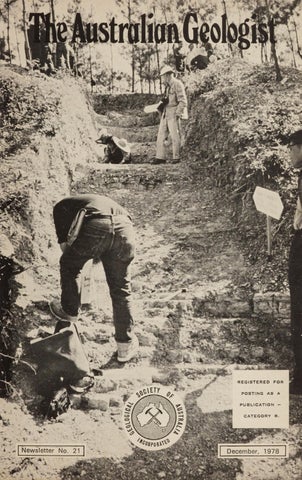
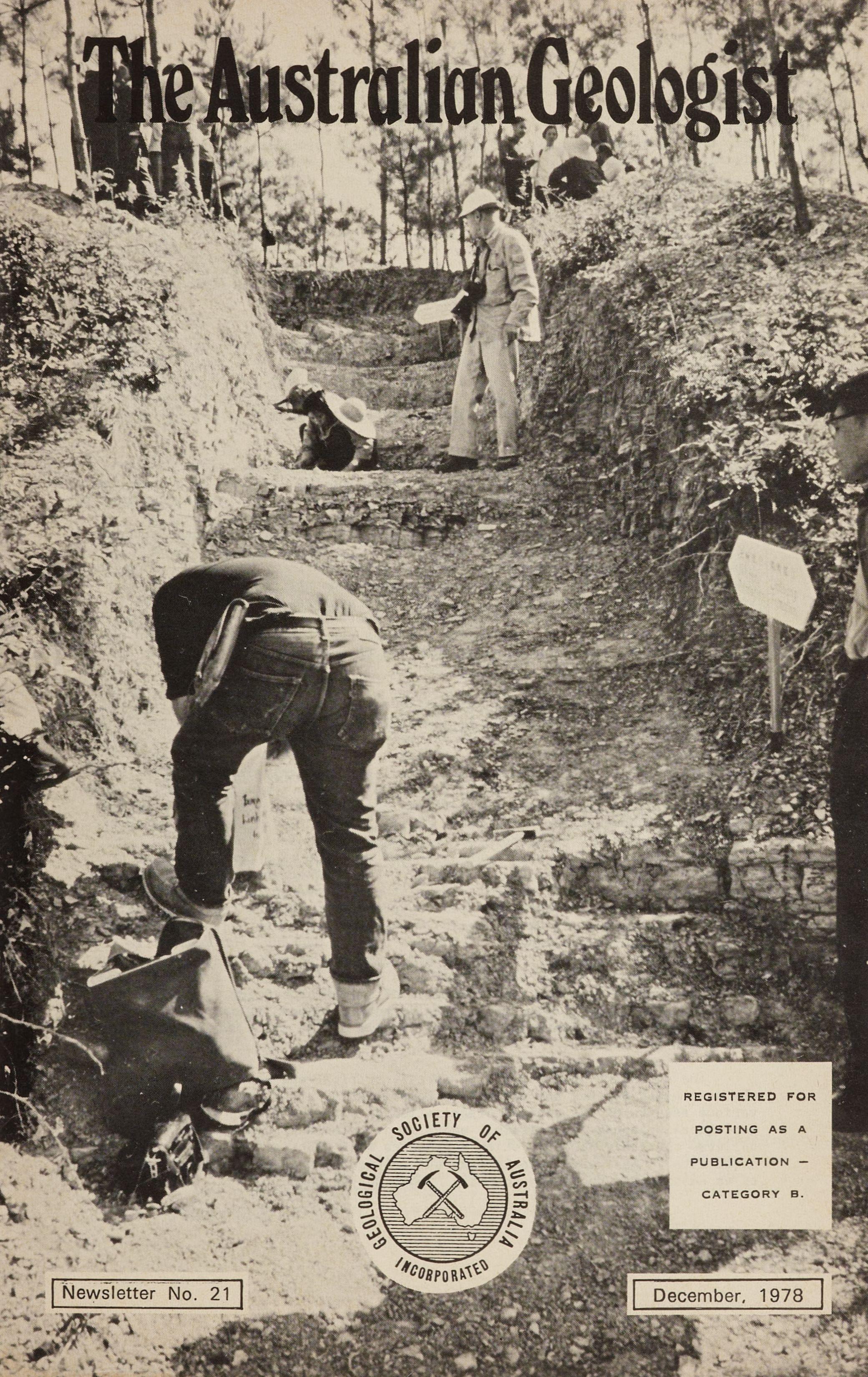
Back to F r o nt, Dr. St ig Bergs t r om s amp l e s the Li nshia n g Fo rmat i o n a t Huanghuac h ang , n o rth o f I c h a n g , Ya n g tz e Go r ges a r e a, Ch ina, pa r t of th e la te Ord ovician sequence spec i a ll y e x c a v at e d a n d sig n po sted for th e v i s it of t he IU GS Ordov i c ian Su bc o mm iss i o n (s ee a rti c l e page 5) Pre sumab l y i t wi ll be p r e s e r v ed for v isit s by h o rd es o f Ame ri c an tour is ts soo n t o in v ade t h e i n scru t abl e ea s t.
Photo : B D. We bb y
Sir:
1 am about to tackle the Commissioner of Taxation on a point which may be of interest to other geologists. In my 1976-77 tax return I claimed for expenses incurred for dry cleaning and laundry of clothing which became soiled during various conference field trips. The amount concerned in my case is trivial, but over a number of years for some geologists could be quite substantial.
The Commissioner disallowed my claim, so I objected, and recently the objection was also disallowed. The next step in this charade is an appeal to the Taxation Board of Review to review the Commissioner's decision.
My contention is that, for geologists, field trips are an integral and essential part of conference programs. Field trips, especially to mines, usually result in some mess to clothing which must also serve to adorn oneself when attending the more formal parts of conferences; therefore, the maintenance of one's apparel is a necessary expense and not of a personal or domestic nature. The same applies in a case such as an overseas trip, the purpose of which is to inspect operating mines and/or geological phenomena such as active volcanoes.
If any readers have factual information or ideas concerning this issue which would assist me in presenting my case to the Board of Review, I would very much appreciate them contacting me. For example, if a geologist is having his expenses paid by a company in such cases, is it normal practice for the company to reimburse expenditure on drycleaning and laundry (which amounts to a de facto recognition of it as a business expense)? Has anyone previously succeeded or failed in a case such as mine, and in either case, what were the grounds for acceptance or rejection?
The winning of this appeal would set a precedent which would undoubtedly assist many of you, and it is for this matter of principle that I have bothered to take the matter so far. Please help win one point in the unending struggie with the Commissioner of Taxation!
David G. Jones P.O. Box 103, Walkerville, 5081 South Australia. (Tel.Adelaide 269 3302)
Sir:
All the letters in the last issue (August, 1978) were deadly serious. Let's change that.
sometime in 1961, a certain eommonwealth field party was returning from North Queensland to Canberra, and reached a gate on a boundary rather south of Brisbane. Here, they were met by some_ bloke carrying a fruit-fly swat. He approached the truck and said: "You got any plants in there?" The field assistant, equally ctumb, said "Yes, fossil plants". They were, in fact, Permian - or perhaps Carboniferous. The honoured gate man went by the book, had the truck emptied, to carry out his (presumably) text-book fumigation procedures.
w. H. Morgan south Bentley,~- A.
ORDOVICIAN SUBCOMMISSION VISIT TO CHINA, OCTOBER 1978
During a 1977 visit to China by a delegation from the International Union of Geological Sciences, the Chinese expressed interest in participating in the work of a number of the subcommissions of the IUGS Commission of Stratigraphy and in various IGCP programmes. The Ordovician Subcommission was one of the first international stratigraphy groups to be invited by the Geological Society of China to visit the People's Republic.
The five-man Ordovician delegation comprising R. J. Ross Jr., Chairman (U.S.A.), S. M. Bergstrom, Secretary (U.S.A.), V. Jaanusson (Sweden), J. K. Ingham (U.K.) and B. D. Webby (Australia) was presented with a very full itinerary for its 15-day visit on its arrival at Kwangchow (Canton) on 11 October 1978. The programme included visits to the Institute of Geology of the Chinese Academy of Geological Sciences in Peking, the Geological Institute of the State Bureau of Geology in Ichang, Hupei Province, and the Institute of Geology & Palaeontology ofAcademiaSinica in Nanking. We had the opportunity to present to the Chinese our lectures on ocir Ordovician speciaiities, and to listen to their lectures on aspects of the Ordovician of China at the various institutions. In addition we were shown the critical Ordovician stratigraphic sections in the Yangtze Gorges area. Our hosts were also keen for us to see much of cultural and historic interest while we were in China. So, while we were in Peking we visited the Great Y,Tall and Ming Tombs, the Summer Palace and the Forbidden City. In Nanking we were taken to see the Sun Yet-sen Mausoleum and the Great Bridge, in Wuhan we visited the Temple of the 500 Buddhas and in Kwangchow, in addition to some sightseeing in the city, we attended the Trade Fair. Four separate banquets were held in our honour - at Ichang, Nanking, Kwangchow and Peking. On two other evenings we were entertained by films. Indeed from the time we crossed the border at Shumchen until we departed 15 days later we were looked after in every possible wa.y. For most of the trip we were fortunate to have as our interpreters, guides and companions, Tsai Wen-yen of the Geological Society of China and Huang Cheng-chih of the Academy of Geological Sciences.
One of the highlights of the visit was undoubtedly the field excursion to the eastern Yangtze Gorges area. In Ichang we were given a comprehensive introductory lecture on the Ordovician geology of China by Wang Hsiao-feng, including the provincial subdivisions, local stages and boundaries of the Ordovician in China, and an outline of the local geology of the Yangtze Gorges region. The next two and a half days were spent in the field, · first in an area some 20-40 km north of rehang, and then in sections on the north bank of the Yangtze River some 60 km west of Ichang. A great deal of work had been carried out by the geologists of the rehang Geological Institute in preparation for our visit. They had marked with signposts all formation boundaries in the sections examined and arranged for large trenches to be dug through a number of the less well exposed graptolitic shale formations above and below the Ordovician/Silurian boundary. The sections we visited west of rehang were reached by boat in a spectacular day trip through the Yangtze Gorges. On these days in the field we were accompanied by in excess of twenty Chinese geological colleagues and interpreters; and even by a doctor. We were permitted to collect as much fossil material as we wished but the time at individual outcrops was too limited to make large collections.
We were given further valuable insights into the present state of knowledge of Ordovician stratigraphy anc palaeontology at Nanking and Peking. In Nanking, Professor Lu Yen-hao and his colleagues gave us lectures outlining the Ordovician biostratigraphy and palaeozoogeography of China, the graptolite succession and the cephalopod distribution, and there were smaller group discussions on the nature of the boundaries at the top o nd bottom of the
Ordovician. A~ Peking, lectures were presentec by Dr Sheng Sin-fu and Lai Chai-geen. Dr Sheng gave an account of progress in compiling the Chinese Ordovician correlation chart and Mr Lai presented an outline of recent work on the upper and lower boundaries of the Ordovician. Since one of the main tasks of the Subcommission is to encourage work on Ordovician correlation charts of various parts of the world, we were delighted to find such progress had been made in China. Not only had a correlation chart for the Ordovician System been compiled, but also a range chart of key fossils, and correlation charts of the Cambrian/ Ordovician boundary sections and the Ordovician/Silurian boundary sections.
The 15-day visit was an educational experience - we found genuine co-operation and friendliness wherever we went. Our hosts presented us with numerous books, reprints and maps, and we learnt of many other important published works which should be (and we hope will now become) better known outside China. Our visit to rehang and Wuhan concluded with a presentation by the Director of the rehang Geological Institute, Chao Hsiang-chan, to Reuben Ross of a beautifully polished slab of cephalopod-bearing Pagoda Limestone from the Yangtze Gorges area, bearing an inscription to the IUGS Subcommission on Ordovician Stratigraphy. We hope this visit will mark the beginning of a new phase of close contact and exchange between the Ordovician specialists of China and those of the rest of the world.
Barry '°'1ebby Department of Geology & Geophysics University of Sydney, 2006.
WHAT TALE DOGS THE WAG?
A Workshop on Antarctic Geology - WAG - is being organised by the Geology sub-committee of the Australian National Committee for Antarctic Research (A..~CAR) for Thursday and Friday, 17th and 18th May 1979 at the School of Earth Sciences, University of Melbourne. Invitations and notices are being sent to individuals but anyone is welcome; please contact Bob Tingey, BMR, Box 378, Canberra 2601 for details (Telephone 062 499428). The intention is to get Australia's Antarctic Geologists together to look at the state of current projects and evolve some ideas for the future, and Australian participation in the proposed International Geological Expedition to North Victoria Land will be an important agenda item. We hope to look at topics ranging from the metamorphic geology of Enderby Land (where Pb-Pb ages of 4 000 m.y. ± are reported by So viet geologists), the petrology of Gaussberg, climatic developments recorded in the Dry Valley sequence, fission track and other geochronological studies. It should be an interesting session, and there is a chance that some !unds may be available to assist with travel and expenses.
The battle of the Folds
Folding isn't such a complex matter if you start about it the right way, according to Glyn Roberts of the Tasmanian Division. He exp lai ned in some detail how a map can be folded for use in the field and has been trying to persuade the Tasmanian Department of Mines to prepare its maps in this way before sale. All to no avail alas. The intransigent islanders refuse to overturn their old system and Glyn is plunged into gloom. Mercury Walch claims it would cost an extra dollar per map to change the system, an argument it is hard to fault. Perhaps the battle should be transferred to the mainland and put on someone else ' s plate
SOCIETY !"I.ATTERS
Council effected the following matters at the August meeting in Townsville:
Moved to set up a Basin, Structural & Tectonic Nomenclature Committee with representation from the Australian Society of Exploration Geophysicists.
Moved to reactivate the Geological Train ing Committee.
Agreed to the formation of a Broken Hill Branch affiliated with the South Australian Division - a brea k with Society tradition but maintaining an historic regional link.
Agreed to formation of a specialist group in Engineering Geology (including hydrogeology and environmental geology), and rejected an offer to become a joint sponsor of the Australian Geomechanics Society at an annual cost of $1000 (max.).
Accepted the tender of Graphic Services Ltd. for printing the Society's journal (1979 - 80).
Recommended modification of the W. R. Browne medal prior to the initial award of this honour.
Made the Stilwell Award for 1977 to G. J. Retallack for his paper 'Triassic palaeosols in the Upper Narr abeen Group of New South Wales.
Adopted a Procedural Guide for Conventions.
Expressed concern at the inactivity of the National Committee for Geological Sciences, ana moved to invite the Australian Academy of Science to join the Society to explore the setting up of a Geoscience Council.
Agreed to rule changes (1) so that full time graduate students may be student members; (2) so that a member and spouse may take a joint subscription.
Moved to investigate the possibility of modifying rule 8 regarding subscription exemptions.
Approved the use of the International Stratigraphic Code in Australia.
Authorized the incoming executive to investigate the apparent lapse of the agreement for exchange of scientists between Australia and U.S.S.R.
Authorized the executive to set up a committee to consider centralisation of the Society's accounts, without loss of Divisional and Group autonomy.
Discussed the finalisation of the 25th I.G.C. Residue Fund. Interest from the principal (appro x $70,000) will be applied as follows: three quarters of each year's interest will be allocated to promotion of prominent overseas speakers, the remaining quarter to assist young geologists of Australia, N.Z. and Papua New Guinea to attend I.G. conferences.
Agreed to issue a Special Publication of the Society on the Second Archaean Symposium (2000 copies at $14,860).
Authorized the executive to investigate if the Society is a cosponsor of the Second Archaean Symposium(!)
Authorized N.S.W. Division to carry out a survey of Geoscientists in Australia.
Rat ified the actions of the outgoing Executive.
Moved votes of thanks to the outgoing Secretary, Ian Jennings; Treasurer, Gordon Hale: President, Sam Carey.
Elected the following to o ffice:
J. F. Lovering
s. w. Car ey
c. D. Branch
s. M. Bye
R. M. L. Elliott
D. A. Brown
President
Vice-President
Hon. Secretary
Hon. Treasurer
Hon. Editor (to 31/12/78)
J. F. Truswell ( from 1/1/79)
w. E. Foskett
M. J. Rickard
G. Hale
w. P. Mine ll & Co.
Hon. Admin. Officer
Publicity Officer
Trustee
Auditors
GEOLOGICAL SCIENCE POLICY
The Society's draft of the above topic - prepared at the request of the Liberal Party of Australia is available for commentDivisional and Group Secretaries, Councillors have copies - look at it now and act if you don't like it rather than beefing when it is too late. The Tasmanian Division Newsletter continues to provide stimulating material on Society matters In the November issue Rob Underwood indicates that only 2 in every 7 geology graduates from Tasmania is a Society member. He suggests that the Society might well spend some effort finding if this ratio is an Australia- wide phenomenon.
Speaking of numbers generally it is interesting that only about 1400 students sat for geology in the N.S.W. Higher School Certificate - compared with 18,000 in Biology, and 10,000 odd in both Chemistry and Physics. The South Australians have done rather be~ter with more than 2000 students (?out of 6-7000). What is it like in the other states?
Cut backs in official surveys, irregularity in company pros- pecting, erratic mining policies etc. will continue in future if we do not ensure that the general community learns at least a little basic geology in primary and secondary school.
Communication is still the major hurdle. An excellent Geology Newsle tter (3 issues so far) produced by Brian & Karen Garner of the Geological and Mining Museum, Dept. of Mines, 36 George St., Sydney 2000, for the Department of Mines and the Education Department has created considerable interest among geology teachers in N.S.W. That is, those it had reached. Although notices were sent to all secondary schools in the state, only half the teachers concerned received them through the system.
The material in these newsletters might well interest all those teachers in Tasmania who aren't joining the Society. Others elsewhere will also probably be interested. Incidentally there is plenty of information in the newsletter useful to University teachers as well.
FIRST INTERNATIONAL MEF.TING ON PROTEROZOIC-CAMBRIAN PFOSPFORITES
The first international field work and seminar of the International Geological Correlation Program Project 156 was helct in Australia in August 1978. Some 58 geologists from 12 different countries attended. Countries represented included Australia, France, India, Malaysia, New Zealand , Pakistan, People's Republic of China, South Africa, Thailand, U .K., U.S.A. and the u.s.s.R. The Field Workshop was held in the Mount Isa district with the main emphasis being placed on examining the Cambrian phosphate deposits and associated sediments of the Ardmore , Duchess and Lady Annie deposits. However , the Mount Isa sequence and the Carpentarian rocks of the Paradise Creek area were also examined. The Seminar was held on Magnetic Island, which proved to be an excellent location, not only because of the pleasant surroundings but because the relativel y isolated nature of the venue led to a mu ch higher level of interaction between scientists. This formula is, of course, used for Penrose and Gordon conferences but has not employed to any great extent in Australia.
Highlights of the conference included the recognition of common patterns of sedimentation in manv of the late ProterozoicCambrian phosphate deposits of Australi~ and Asia; the realization that this phosphogenic zone extended through Australia and Asia into Africa and South America; the release of new information on such little known Cambrian phosphate deposits as those of China, the Mongolian Peoples Republic, and Pakistan; the setting up of a world phosphate data base; and the ictentification of important gaps in our current knowledge of sedimentary phosphate deposits. It is hoped to publish the conference proceedings early in 1979.
Peter J. Cook, Research School of Earth Sciences, Australian National University, Canberra.
John F. Shergold, Bureau of Mineral Resources, Canberra.
Co-project Leaders IGCP Project 156.
" Exploration in the Eighties"
The First A.S.E .G Biennial Conference is sc~eduled for August 7th-9th, 1979 at Australian Mineral Foundation, Adelaide.
Contributions are invited. Pard rock, soft rock, hydrogeological and engineering geophysics papers of high standard will be acceptable; the papers may be of the practical, interpretation, theoretical or case history kind but they must be relevant to exploration or applied studies. Contributors are asked to submit titles of proposed papers together with a brief resume to Dr. Don Emerson (02-692 2031). The general program and social will be handled by Mr. E. D. Tyne (02-240 4169) and ~r. J.E. Webb (08-276 1233) wi ll organize exhibits al'\d instrument displays. The conference should interest many explorationists in the geophysical and geological fields.
Further information is available from Dr. D. W. Emerson, Department of Geology and Geophysics, University of Sydney, N.S.W. 20 0 6, or Dr. D. W. King, Secretary A .S.E.G., Science Centre, 35-43 Clarence Street, Sydney, N.S.W. 2000.
CCOP/SOPAC (?So what)
The Committee for Co-ordination of Joint P rospecting for Mineral Resources in South Pacific Offshore Areas (CCOP/SOPAC) will hold a symposium on the PETROLEUM POTENTIAL IN ISLAND ARCS, SMALL OCEAN BASINS, SUBMERGED MARGINS, AND RELATED AREAS, October (provisional dates 15-18) 1979 in Suva or Nadi, Fiji. The Symposium will include invited and other papers on the following main topics: Geology and Tectonics; Hydrocarbon Generation; Reservoir Types; Geophysical Techniques in Exploration ; State of the Art in Deep Water Offshore Technology; Case Histories. The Sympos ium will commence with a special invited paper on NATIONAL DEVELOPMENT POL ICIES AND LEGAL FRAMEWORK FOR PETROLEUM EXPORATION IN THE SOUTHWEST PACIFIC.
Announcements on field trips and further details will be included in a 2nd circular to be issued in January 1979. Abstracts will be distributed before the meeting and selected papers will be published in the Technical Bulletin series of CCOP/SOPAC.
If interested in submitting a p aper or attending the symposium, send details of your name, professional position , affiliation and address, by airmail, as soon as possible to: CCOP/SOPAC Technical Secretariat, c/o Mineral Resources Department, Private Mail Bag, GPO, Suva, Fiji.
EARTH RESOURCES FOUNDATION
NOW AVAILABLE -
Proceedings of a National Seminar on "Australia's Mineral Energy ResourcesAssessment and Potential ". This occasional publication of the Earth Resources Foundation contains papers presented to a seminar held at the University of Sydney, May 22-23, 1978 , together with panel discussion. Price $15-80 (includes postage).
For further information and order forms please contact:
The Earth Resources Foundation, The University of Sydney, Phone: 692 2038. N.S.W. 2006.
THE GEOLOGICAL CALENDAR
The Geological Calendar , 1979 is now available for sale This Canadian Society of Petroleum Geologists' pub lication is an ideal gift. It contains 12 colou r photographs with explanations of the geology that are instructive for students, teachers and professiorals Naturalists will enjoy it.
Obtainable by a irmail from S tacs Data Service Ltd., 3651 - 23rd Street N.E., Calgary , Alberta, Canada, T2E 6T2, tor $2-50 (Canadian) postpaid anywhere. If 21 or more calendars are ord e red from stacs, the price per copy i s $2-00 each.
Anyone for a black box? or Scientific Data Systems in Australia
A survey on the above has recently been carried out jointl y by the Australian Academy of Science and CSIRO. Resu lts of the survey and other information may be obtained from Dr. G. K. White , FAA., Aust. Academy of Science, P.O. Box 783, Canberra City 2601.
In April 1978 the Geology Department of the University of Western Australia, in co-operation with the University Extension Service, presented a seminar on Archaean cherty ~etasediments. Aspects that were discussed included palaeontology, geochemistry, sulphur-isotope composition, economic significance, and environment of deposition. The seminar was attended by about one hundred registrants, and the following papers were presented:
M. R. Walter:
M. D. Muir:
M. E. Barley:
J. s. R. Dunlop:
(T. s. R. Dunlop
I. B. Lambert:
D. I. Groves, F.
Recognition and significance of Archaean stromatolites.
Occurrence and potential uses of Archaean microfossils and organic matter.
Shallow-water sedimentation during deposition of the Archaean Narrawoona Group, East Pilbara Block, Western Australia.
Shallow-water sedimentation at North Pole, Pilbara, Western Australia.
& D. I. Groves: Sedimentary barite of the Barberton Mountain Land: a brief review. Sulphur-isotope investigations of Archaean mineralization and some implications concerning geobiochemical evolution.
M. Barrett & K. G.McQueen: Geochemistry and origin of cherty metasediments within ultramafic flow sequences and their relationship to nickel mineralization.
D. F. Sangster: Exhalites associated with Archaean volcanogenic massive sulphide deposits.
The papers have been edited by J.E. Glover anQ D. I. Groves, in a bound volume of 92 pages in off-set type format. An addition to the presented papers is "Evidence for Archaean life: a selected bibliography" by R. Buick, which lists 93 references. Copies may be obtained for $6 (incl. postage) from the Extension Service, University of Western Australia, Nedlands, 6009. Cheques should be crossed and made payable to University of Western Australia - Extension.
A very few copies of the Abstracts of the Townsville meeting remain at the office, priced at $7-50. These will give you at least some idea what went on at the Conference and should provide a useful review of the geology of N.E. Australia. The conference received some coverage in 'The Miner Newspaper' of September 18.
Jim Beeston, Chairman of the Coal Geology Group, proposes running a regular column in 'The Australian Geologist' on Coal Geology. This is a most welcome suggestion. Similar proposals from other enthusiastic Specialist Group Chairmen will be more than welcome.
We have had little news from Division Contacts of late although the Divisional Newsletters are a great source of useful information.
Registrations are flowing in for the Auckland ANZAAS, January 22-26, 1979. Among papers to be given in Section 3, Geology and Mining, will be: Plate Tectonics plus Mineral Exploration, E. s. T. O'Driscoll (Tectonic Studies Group, Western Mining); Geology and Mineral Resources Planning, I. E. Newnham (Mineral Research Laboratories, CSIRO); Sedimentation at Oblique Slip Margins, P. F. Ballance (Dept. Geol., Univ. Auckland); Geological Hazards, W. M. Prebble (Dept. Geol., Univ. Auckland); Tectonic Controls of Volcanicity, R. F. Heming (Dept. Geol., Univ. Auckland).
THE HISTORY OF GONDWANA AS SEEN FROM MADAGASCAR
An international symposium is planned on the above topic, September 2-12, 1979, at the Malgache Academy.
Madagascar's geographical position is of critical importance for the solution of many Gondwana geological problems, most particularly for the palaeogeographic reconstruction of the Indian Ocean plates. Its isolation has also had many significant biological consequences.
The role of the colloquium will be to take stock of our present knowledge of the geological, geophysical and biological evolution of Gondwana, with particular emphasis on the relation which has existed between Madagascar and the other ancient parts of Gondwana from South America to Australia by way of Africa and the Indian Ocean.
The principal themes of the symposium:
(a) The crystalline Precarnbrian basement (b) Sedimentary rocks, particularly the Karroo sequence (c) Global geology and tectonism
(d) Stratigraphy, palaeontology, geochronology
(e) Geophysics (palaeomagnetism)
(f) Mineralisation and metallogenic regions
(g) Flora and fauna
Sections and working groups will be finalised, based on the response to this first circular.
The Conference will comprise -
Presentation of papers
Field excursions
Displays of maps, publications and scientific equipment
Papers may be written and presented in either French or English.
Anyone interested in further details can contact the editor, or for preference write directto the Secretary General -
Josoa Rasoarnahenina-Andriarnazoto, Direction del'Industrie et des Mines, Ministere del'Economie et du Commerce, B.P. 322, Tananarive, Madagascar.
Anyone interested in Salt Mines?
The XIV PACIFIC SCIENCE CONGRESS, will be held at Khabarovsk, Eastern Siberia, August 20th - September 5th, 1979.
Obtain details from: Organizing Committee, 12 Zhdanov Street, Moscow 103045, USSR; see your friendly local travel agent for information on buses and other transport facilities.
Dr. N. H. Fisher of 3 Mair Place, Curtin, A.C.T. 2605, is organising symposium BV3, "Regional regularities of distribution of mineralisation and types of ore regions", and seeks papers on this topic.
Dr Noel Kemp has protested about the treatment of his manuscript as printed in the September issue. We apologize for any omissions and amendments. Those wishing to obtain a copy of the original should write directly to him: Curator of Geology, Tasmanian Museum and Art Gallery, G.P.O. Box 1164M, Hobart, Tasmania 7001.
RIGID FLUID INCLUSION CONCLUSIONS?
DON'T BE EXCLUDED
All will be made clear at the three day workshop February 26-28, 1979 at the Department of Geology, La ~robe University, Bundoora, Victoria. The workshop is sponsored jointly by your very own Specialist Group in Economic Geology and the above Department.
In addition to hearing many words of wisdom on Fluid inclusions there will be the opportunity to play with a variety of shapes and sizes of inclusions and their included fluids.
The discussions will be given by invited speake rs and will attempt to summarize each topic. The intended fee for the Workshop is $15-00. Accommodation will be available at Chisholm College, La Trobe University for a pp roximately $18-00 per dall, all inclusive.
South Australia
Dr. Barry Collins, A.M.D.E.L. I Flemington Street, FREWVILLE, 5063.
Telephone: 79 1662
Ext.273.
FOR QUERIES CONTACT: Victoria
Dr. Teunis A. P. Kwak, Department of Geology, La Trobe University, BUNDOORA, 3083.
Telephone: 478 3122
Ext.2649
GROUNDWATER POLLUTION CONFERENCE
New South Wales
Dr. R. Wilkins, Min e ral Research Laboratories, C.S.I.R. O . I NORT H RYDE, 2113.
Telephon e : 888 1666
The Australian Water Resources Council is sponsoring a Groundwater Pollution Conference at the University of Western Australia, Perth, 19-23 February 1979. Objectives of the conference are to provide a forum for discussion of the theory of transport and interaction between solutes and microbiological pollution within aquifers and the application of this theor y to the practical · management of groundwater quality.
For further information and registration forms contact:
Mr. R. J. Hughes, Secretary, Groundwater Pollution Conference Organising Committe e , Department of National Development, P.O. Box 5, CANBERRA. A.C.T. 2600.
Nuffield Foundation Commonwealth travelling Fellowships for 1980 are now being advertised. Geologists 'of high intellectual and personal qualities etc.' interested in spending one year in the U K. should seek information from the Secretary, Mr. J. Deeble, P.O. Box 783, Canberra City 2601, or t e lephone Canberra (062) 48 6011. Applications close Friday , 23 F e bruary 1979.
The first issue of Open Earth advertised in our July issue has appeared in the open. It carries some interesting articles and despite a few repetitions and other minor blemishes (e.g. headline 'World's oldest fossil' for an article on Ordovician jawless fish remains discovered in Wyoming) promises to be a useful review journal. It may indeed prove difficult to keep u p the standard of this first issue. Ian Levy's letter (Aust. Geologist, March '7 8 ) o n Supersaturated geobeer warranted reproduction, as did an article on the Australian Heritage Commission and geological features culled from our columns.
CLUES
Across
1. Short George has timber for ye, without e , for this science.
4. Desert rocks at Little Gibraltar with beryllium to the right and south.
7. Otherwise the east is valuable rock.
8. Aluminous girl pertaining to a common stromatolite type
10. Cut visage to a T.
12 Precious small part.
13. CIPW diopside for short Diane.
15. Ablution after one thus is equally above the water table.
16. Length, "you" and a small bottle is formed from rotten rock.
18. Vowel-less the for this metal.
20. Lift this mine shaft
23. Half mm, nitrogen for "ferrous metal".
24. This fancy room is an ore cavern {in Mexico).
25. Ancient miners of gold in Mexico not out with as after "sea".
26. Little Alan has light metal.
29. Block lava doesn't drink.
31. Ram back holds a for volcanic vent.
32. Swaystone.
33. Employ after a medic has an encrusted cavity.
34. Dust {fine) loses {anag.).
35. Atop a stratigraphic subdivision adjective.
36. Play on this thick petroleum.
39. Short purchase exhortation, short it is for mine entrances.
40. King George on a yank ship with fragmental granite weathering products.
41. Beryl has this and a bee in the orient.
42. 51 in lepidolite.
Down
1. Siliceous rock {intrusive) has tin rage {anag.).
2. Zero, 49, petroleum.
3. Stripling is pre-mature river stage.
4·. For example up with a poem has crystalline cavity.
5. A little lie up is important for iron.
6. Subsided and agreed.
9. Debacle in Gilbert and Sullivan pumps concrete into interstices.
11. Elevation markers have iridium in metal containers.
12. Floating mollusc {small) do topper {anag.).
14. Tile mien {anag.) looks like an opaque mineral.
17. CIPW biotite and native mineral.
19. Railroad aye, aye spread through haste is anorthite peridotite
21. A short plagioclase.
22. Is up in quartz.
23. Mixed dream rope is a branching coral.
26. Twice am about confused gal has a natural alloy.
27. 26 across up is a rare metal.
28. Ultimate lithological layer coating the staff of life.
29. Current CIPW acmite.
30. Mixed-up rake dips zero to southeast CIPW subrang.
37. 99 east is cold
38. Little Colin has a saddle between peaks
Reprinted, with minor modifications, from the journal of the Geological Society of the University of Wollongong {A.M. Depers , Ed.). Prepared by R.A. Facer.
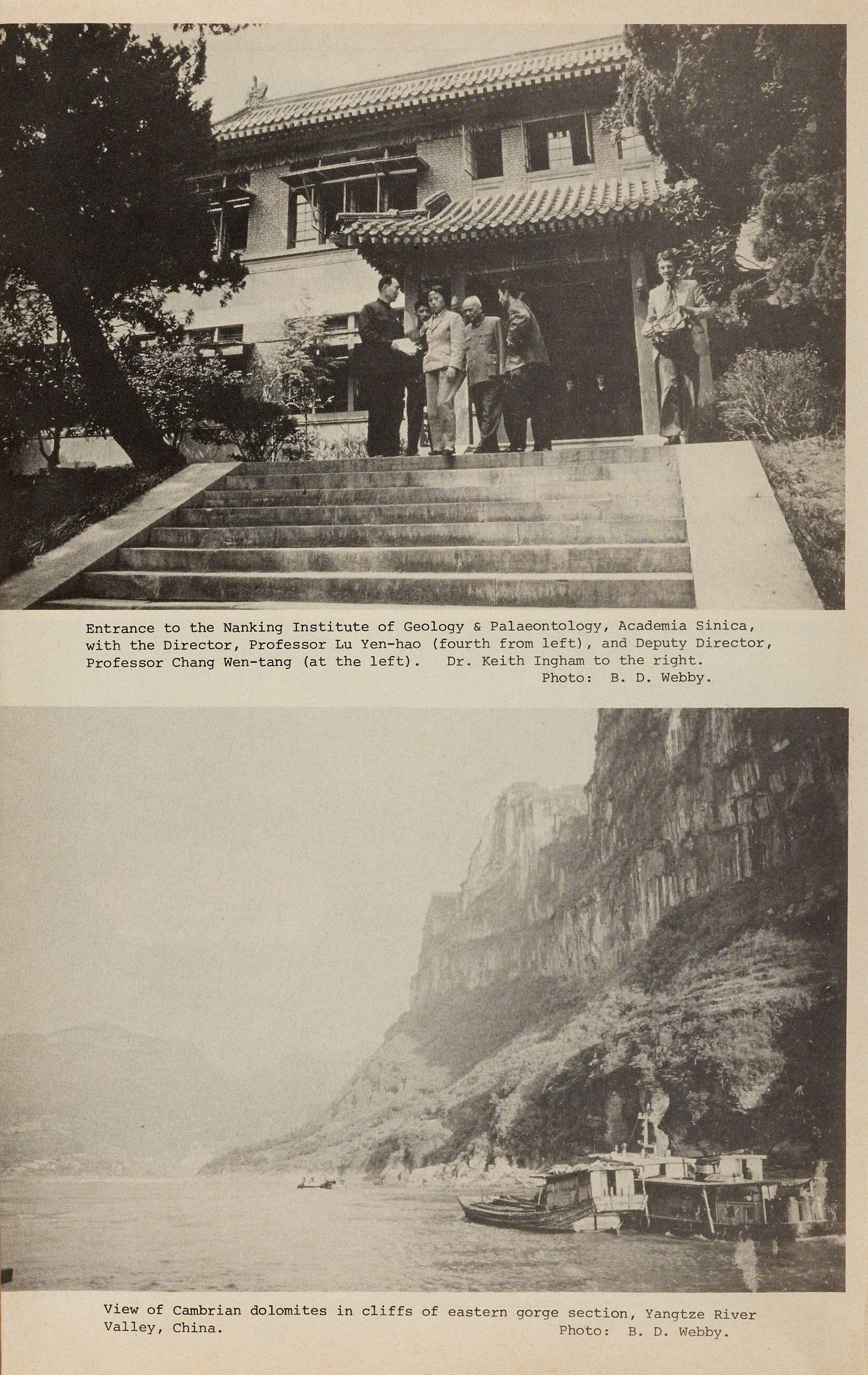
Entrance to the Nanking Institute of Geology & Palaeontology, Academia Sinica, with the Director, Professor Lu Yen - hao (fourth from left), and Deputy Director, Professor Chang Wen-tang (at the left). Dr. Keith Ingham to the right.
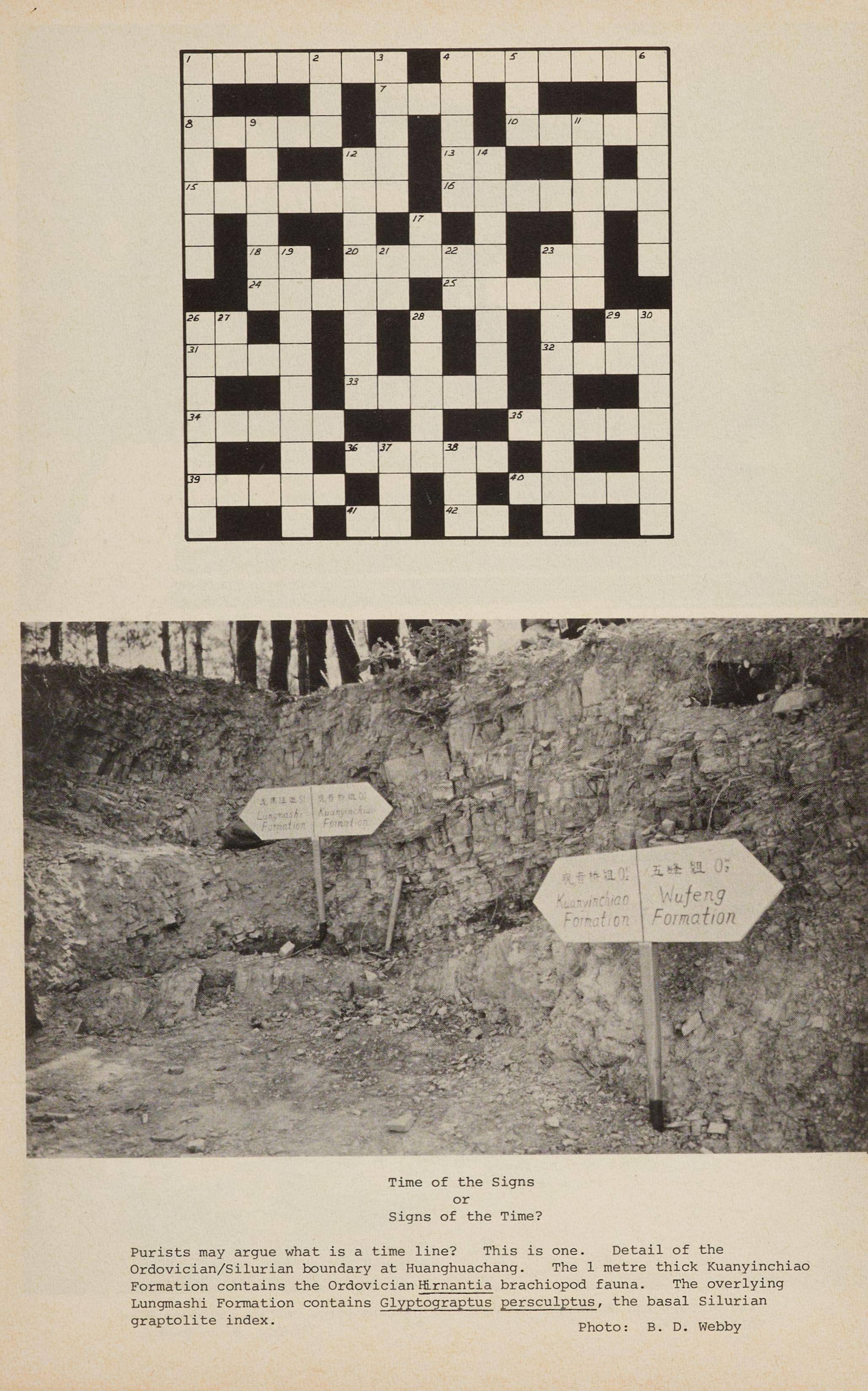
Time of the Signs or Signs of the Time?
Purists may argue what is a time line? This is one Detail of the Ordovician/Silurian boundary at Huanghuachang. The 1 metre thick Kuanyinchiao Formation contains the OrdovicianHi.rnantia brachiopod fauna. The overlying Lungmashi Formation contains Glyptograptus persculptus, the basal Silurian graptolite index .
Photo: B. D Webby