The Australian Geologist
Newsletter No. 12
December 1976
EDITORIAL
Some geologists in the past few years have received criticism for activities which have put them offside with the law. On the other hand it is little known that geology has been used on numerous occasions to solve a wide spectrum of crimes from murder and rape to theft and fraud.
The variety of applications of geological principles and techniques in criminology is outlined in Forensic Geology by R.C. Murray and J.C. Tedron which surprisingly enough discusses several Australian murders and their solutions.
Some Australian police bodies do employ scientists but I know of no geologists. Perhaps this specialist field offers a few places for our unemployed graduates:
A few positions might also be sought in the media. Judging from some of the dri~el about geology which appears in film and T.V. scripts, magazines and newspapers there is considerable scope for improvement.
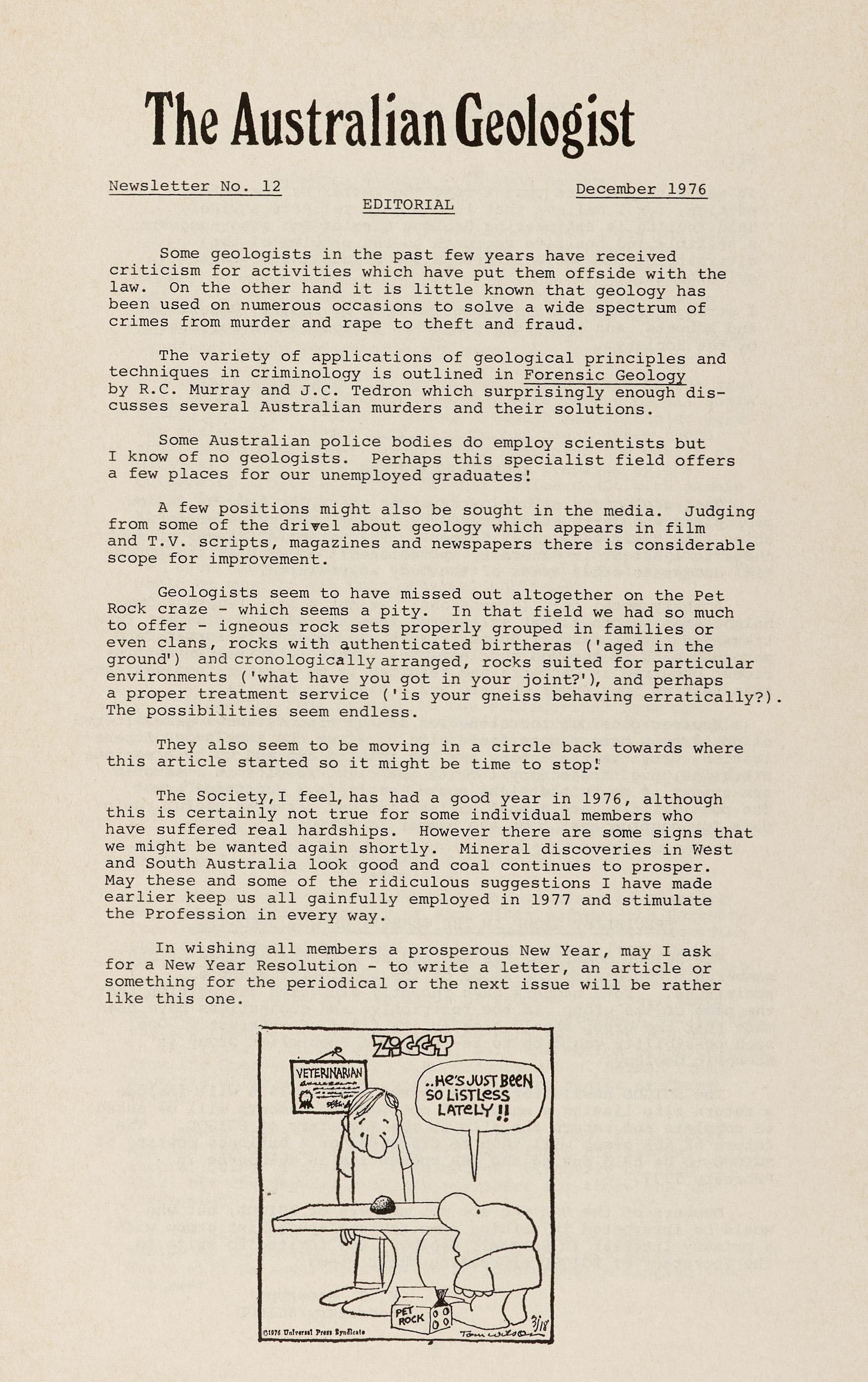
Geologists seem to have missed out altogether on the Pet Rock craze - which seems a pity. In that field we had so much to offer - igneous rock sets properly grouped in families or even clans, rocks with authenticated birtheras ('aged in the ground') and crono logicall y arranged, rocks suited for particular environments ('what have yo u got in your joint?'), and perhaps a proper treatment service ('is your gneiss behaving erratically?). The possibilities seem endless.
They also seem to be moving in a circle back towards where this article started so it might be time to stop!'
The Socie~y,I feel, has had a good year in 1976, although this is certainly not true for some individual members who have suffered real hardships. However there are some signs that we might be wanted again shortly. Mineral discoveries in West and South Australia look good and coal continues to prosper. May these and some of the ridiculous suggestions I have made earlier keep us all gainfully employed in 1977 and stimulate the Profession in every way.
In wishing all members a prosperous New Year, may I ask for a New Year Resolution - to write a letter, an article or something for the period ical or the next issue will be rather like this one.
PUBLICATIONS & MEMBERSHIP
Sir,
It was with pleasure that I read the letter to the latest edition, for I believe that it not only reflects a widely held feeling in Engineering Geology circles but also suggests a sensible and positive approach to the problem of the diversit y of the subjects within the discipline of earth sciences.
I strongly support the suggestions made by Messrs. Underwood and Roberts, and hope that they will be considered seriously by the Society.
John Waterhouse Adelaide.
A CAUTIONARY TALE
Most geologists either carry minor scars, or know of fellow geologists who carry scars caused by flying rock chips or metal chips from their geological hammer. The potential danger of such chips to eyesight is generally appreciated; however is the potential danger to other areas of the body appreciated?
A sharp metal chip (dimensions: weight 0.lg; length 6.5mm; height 4mm; width 1.5mm) splintered from the edge of a hammer face, travelled almost exactly 50 cm, struck the upper left forearm and penetrated 38 mm through muscle fibre. This relatively minor incident occurred in Canberra and resulted in no greater inconvenience than half an hour under surgery and a night in hospital.
However consider the situation if the circumstances were altered slightly to a more remote field site. Given the same type of penetration, vary the trajectory and the results can add up to a serious situation, e.g. trajectory 1 cm to the right results in a severed arm artery, 4 cm to the right would result in a punctured bowel. The possibilities are almost encless but may serve as useful reminders for caution next time the hammer is swung.
Col Simpson
Canberra.
SPECIALIST GROUP IN THE GENESIS OF ORE DEPOSITS
The SGIGOD committee has decided to seek the opinion of the membership concerning the scope of the specialist group's activities. Some members have recently expressed the opinion that the name of the group is too restrictive and suggestions have been made that the group should broaden its field of interest. One such possibility would be to re-form as a Specialist Group in Economic Geology.
The SGIGOD newsletter to be issued late in 1976 will include a return slip listing a number of options and members will be asked to complete and return the slip to the Secretary of SGIGOD. The future of the group will then be discussed at a business meeting of SGIGOD to be held during the GSA convention in Melbourne in February 1977.
Members of the GSA who are not members of SGIGOD, but who would be interested in joining some revised specialist group with a primary interest in Economic Geology, are invited to write to the Secretary of SGIGOD expressing their views.
P. G. Moeskops Secretary/SGIGOD
Backward Glances - ?A Book Review
At I.G.C. there were a few glances back along the paths which Australian geology has followed. There was much of interest in the papers by Bernie Joyce on the volcanic landscapes of south eastern Australia, and David Corbett on Geology in South Australia during the 19th century, while Torn Darragh's discourse on the First Geological Maps of Australia presented many new facts and brought to light some important links and antagonisms among our forebears.
Early Australian geological maps formed part of the display at the Macleay Museum, together with photos on oil shale mining and other historic topics although modern topics were not neglected. Anyone with time on his hands (were there any?) could have spent several da y s examining the wealth of material in the Edgeworth David display prepared by the University archivist Gerald Fischer, which dealt with almost every facet of David's life, and which was taken solely from his papers in the Sydney University Archives. The letters and papers dealing with David's interest in Precarnbrian fossils were specially illuminating and show how difficult it is, even for the famous, to oppose an established system. It would be good to see this material published.
Fisher Library at the University displayed a wide range of classical geological books, ranging from the 16th century onwards and this too was a rewarding display for those who visited it.
A special free handout in the Publications Room came from the Polish Academy and included an article (?inevitable) on Strzelecki and his work in Australia which was quickly sampled by the collectors. In the same room was another tome of some interest. This was 'History and Role of Government Geological Surveys in Australia' edited by R.K. Johns.
It was on sale at the South Australian Geological Survey booth (?about four dollars I think) and presumably is one of their publications although it doesn't say so.
Its title is self-explanatory and consists of chapters devoted to brief histories of each state survey, the Northern Territory and the Bureau of Mineral Resources (not forgetting Geology & Geophysics), each written by authors from the particular organization. As might be expected the quality of information and presentation is variable and some chapters unfortunately give no references or sources for their information. There are 37 photos - mostly of Government Geologists. Perhaps space limitations prevented more but there are gaps in the ranks - Aplin, W.H. Rands, Ball and Morton being omitted from the Queensland story, J.W. Gregory and H. Herman from Victoria while the N.S.W. portrait gallery ceases at Carne (1920).
There are a few typographical errors, Rev. W.B. Clarke has had his last letter ~ased'off, and there are factual errors (Selwyn's arrival in Melbourne, discovery of lead in W.A.) but the general outlines are there for those who are interested.
Probably the most useful feature of the volume is the series of chronological lists of staffs for each survey. These will be invaluable for those interested in digging into the past.
The book is perhaps most notable for what it doesn't sa y. Each chapter is essentiall y a chronolical history which deals with the accomplishment of each survey but there has been little opportunity to develop the personalities of the people involved, the very real clashes between the surve ys and other officials, strife within surveys and between surve ys, although these issues are mentioned in the introduction. The wider and aevelopment -uf g eologica_
deeper issues of the development of geological theory and the place of the surveys in such development have not been touched upon.
This is a useful book which should be read by Australian geologists and - made available to students in schools and Universities. Anyone who wants to pursue the topic further should use as an example the paper 'Origins of Australian Geology' by T.G. Vallance Proc. Linn Soc. N.S.W. Vol.100, pt 1. 1975. pp.13-43. which shows that our geological development hasn't all been plain sailing. Furthermore the book 'Readinf the Rocks' by Morris Zaslow the monumental history of the Geo ogical Survey of Canada, published in 1976 should be studies We have history like that too.
David Branagan.
SLIDING INTO OBLIVION
The following notes from Sir Peter Kent reprinted from the newsletter of the Geological Society of London are still relevant - judging from some I.G.C. experiences.
"It is no compliment to the audience, and a sharp discredit to the speaker, when illegible and ill prepared slides are shown: speakers have too little time to demonstrate their years of work to waste their opportunities in this way.
May I reiterate seven main points?
1. Slides should be kept simple. 15 words is a reasonable maximum per slide, if the audience is to listen rather than spend the time reading.
2. Illustrations for publication (or from publications) are rarely suitable; they should not be used.
3. Tables are usually illegible and should be avoided wherever possible.
4. Lettering should be legible if the slide is held at arms length; it should be not less than 1/40 the vertical height of the slide.
5. Negative slides are the more legible; colouring of lines is relatively simple.
6. All slides must bear a thumb-spot in the bottom left corner as held in reading position .
7. The slides should be put through the projector before the meeting and illegible items discarded, to avoid wasting the time and patience of the audience
One final point. Achievement of an adequate standard depends primarily on the speakers concerned, and on their sense of responsibility for a good presentation. It is a matter for the audience, as well as for the Chairman of the meetings to protest when illegible material is foisted upon them."
THE
EARTH
RESOURCES FOUNDATION - UNIVERSITY OF SYDNEY
On September 6, 1976 the Senate of the University ratified the constitution of the Earth Resources Foundation. The first meeting of the Council of the Foundation was held on September 21, 1976.
Members of the first Council are: K. Richards, Chairman (Essa Aust.); R. Austen (Austen & Butta); Sir He rmann Black (Chancellor, Sydne y University ); J. Dubourdieu (Aquitaine Aust. & N. Z.); J Elliston (Peko-Wallsend); R.J. Helby ; G.M. Philip, Director (Sydne y University); C.V.G. Ph i pp s (S y dne y University); G. Rose (N.S.W. Dept of Mines); Mr J ustice Selby (Sydney Universit y ); M. Taylor (Sydney Un ive rsity); D. Waterland (Shell Devel. Aust.); Prof. B. Williams (Sydney Universi t y ) ; K. Williams (S y dne y University).
The objects of the Foundation as set out in article 3 of its constit u tion are to advise the Senate of the Univ ersit y of Sy dne y and the Vice - Chancellor on matters associated with research in Earth Resources in the Department of Geo lo g y and Geoph y sics with i n the University of Sydney, and without restricting the generality of the foregoing, in particular to, promote, develop and assist research in geology and geophysics in the Department of Geology and Geophysics generally, and especially foster -
(i) research into Australian sedimentary basins with potential to yield economic accumulations of fossil hydrocarbons.
(ii) research into the orig~n and nature of occurrence of ore bodies in Australia.
(iii) research into geophysical geochemical techniques relating to the exploration for mineral deposits and fossil hydrocarbons.
Among other things the Foundation will be organizing workshops, schools and public lectures. Workshops scheduled for May 1977 include:
May 23-27 - "Computer Applications in Coalfield Evalua tio n" by Dr. K.R. Johnson, Earth Science Computer Services Pty. Ltd.,
Ma y 23-26 - "Marine Seismology - The Modern Stratigraphic Tool" by Mr. R.F. Gregory, Essa (Aust.).
The Foundation will be sponsoring a public lecture by Dr. Pete Vail of Exxon entitled "Eustatic Cycles" at 18.00 hrs, lecture room 5, Carslaw Building, Sydney University, on Monday February 14, 1977. Wine and cheese wil l be served after the lecture.
F ull details of the Constitution and other informatio n about the Foundation may be obtained by writing to:
The Director, OR The Earth Resources Foundation, Ed geworth David Building, Univ e r sity of Sy dne y , N .S.W. 2006
Mr. R. Austen, Conv ener, Public Relations Committee , Eart h Resourc e s Foundation, Austen & Butta Ltd., 71 Archer Street, CHATSWOOD. N .S.W. 2067
Isostasy in the Balance?
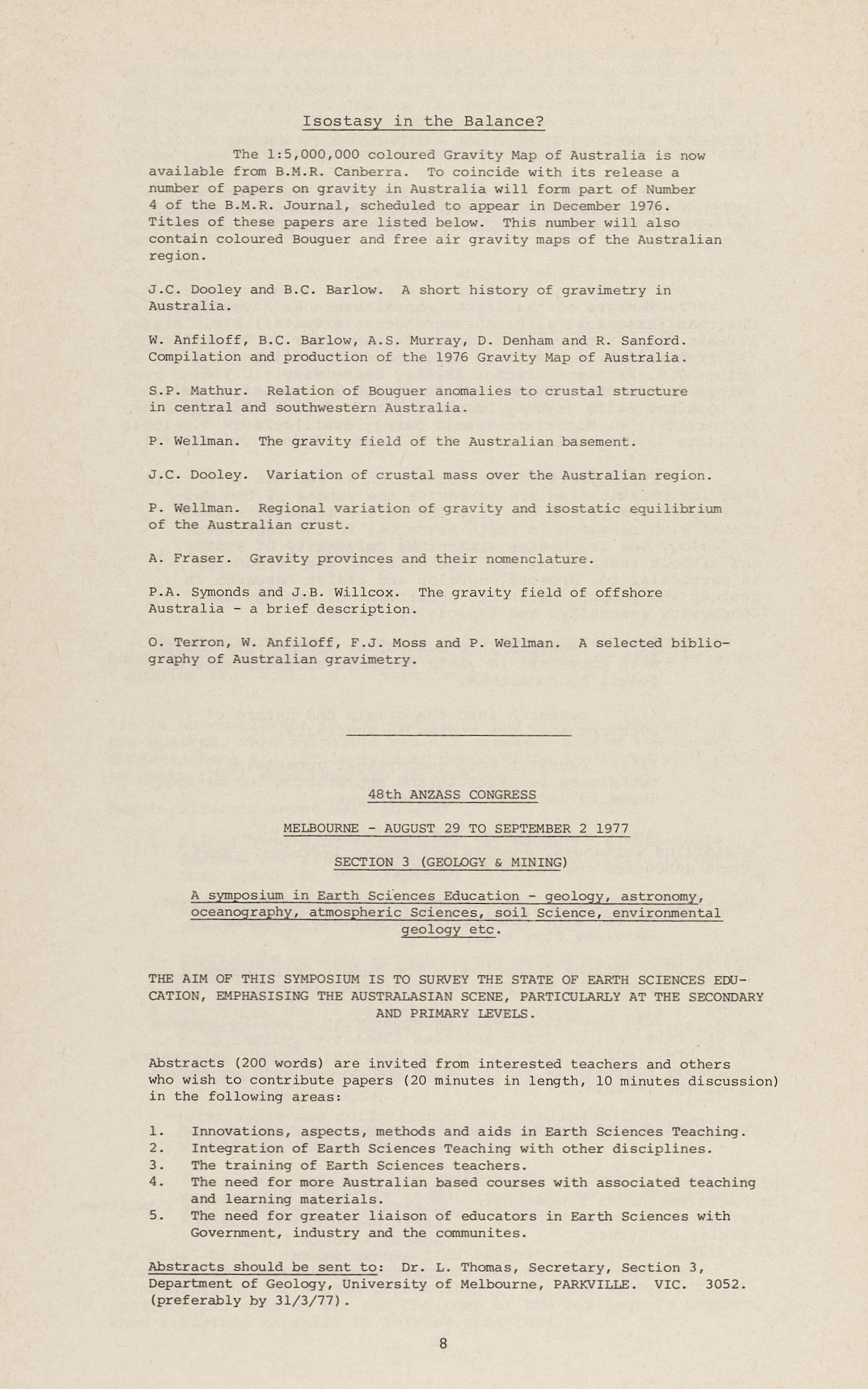
The 1:5,000,000 coloured Gravity Map of Australia is now available from B.M.R. Canberra. To coincide with its release a number of papers on gravity in Australia will form part of Number 4 of the B.M.R. Journal, scheduled to appear in December 1976. Titles of these papers are listed below This number will also contain coloured Bouguer and free air gravity maps of the Australian region.
J .c. Dooley and B.C. Barlow. A short history of gravimetry in Australia.
W Anfiloff , B.C. Barlow, A.S. Murray, D. Denham and R. Sanford. Compilation and production of the 1976 Gravity Map of Australia.
S.P Mathur Relation of Bouguer anomalies to crustal structure in central and southwestern Australia.
P. Wellman. The gravity field of the Australian basement.
J.C. Dooley Variation of crustal mass over the Australian region.
P. Wellman Regional variation of gravity and isostatic equilibrium of the Australian crust.
A Fraser . Gravity provinces and their nomenclature.
P A Symonds and J B. Wi l lcox. The gravity field of offshore Australia - a brief description.
O. Terron, W Anfiloff, F.J. Moss and P. Wellman. A selected bibliography of Australian gravimetry
48th ANZASS CONGRESS
MELBOURNE - AUGUST 29 TO SEPTEMBER 2 1977
SECTION 3 (GEOLOGY & MINING )
A symposium in Earth Sciences Education - geology, astronomy, oceanography, atmospheric Science s, soil Science , environmental geology etc
THE AIM OF THIS SYMPOSIUM IS TO SURVEY THE STATE OF EARTH SCIENCES EOOCATION, EMPHASISING THE AUSTRALASIAN SCENE, PARTICULARLY AT THE SECONDARY AND PRIMARY LEVELS.
Abstract s ( 200 words ) are invited from interested teachers and othe r s who wi sh to cont ri bute paper s ( 20 mi nu tes in le ngt h, 10 mi nu tes disc u ssion ) i n the fo llowing areas :
1. Innova tions, aspects, methods and aids in Earth Sciences Teaching.
2. Integration of Earth Sciences Teaching with other disciplines.
3. The training of Earth Sciences teachers.
4. The need for more Australian based courses with associated teaching and learning materials.
5. The need for greater liaison of educators in Earth Sciences with Government, industry and the communites.
Abstract s should be sent to: Dr. L. Thomas, Secretary, Section 3, Departmen t o f Geology, University of Melbourne, PARKVILLE. VIC 30 5 2. (preferably by 31/3/77)
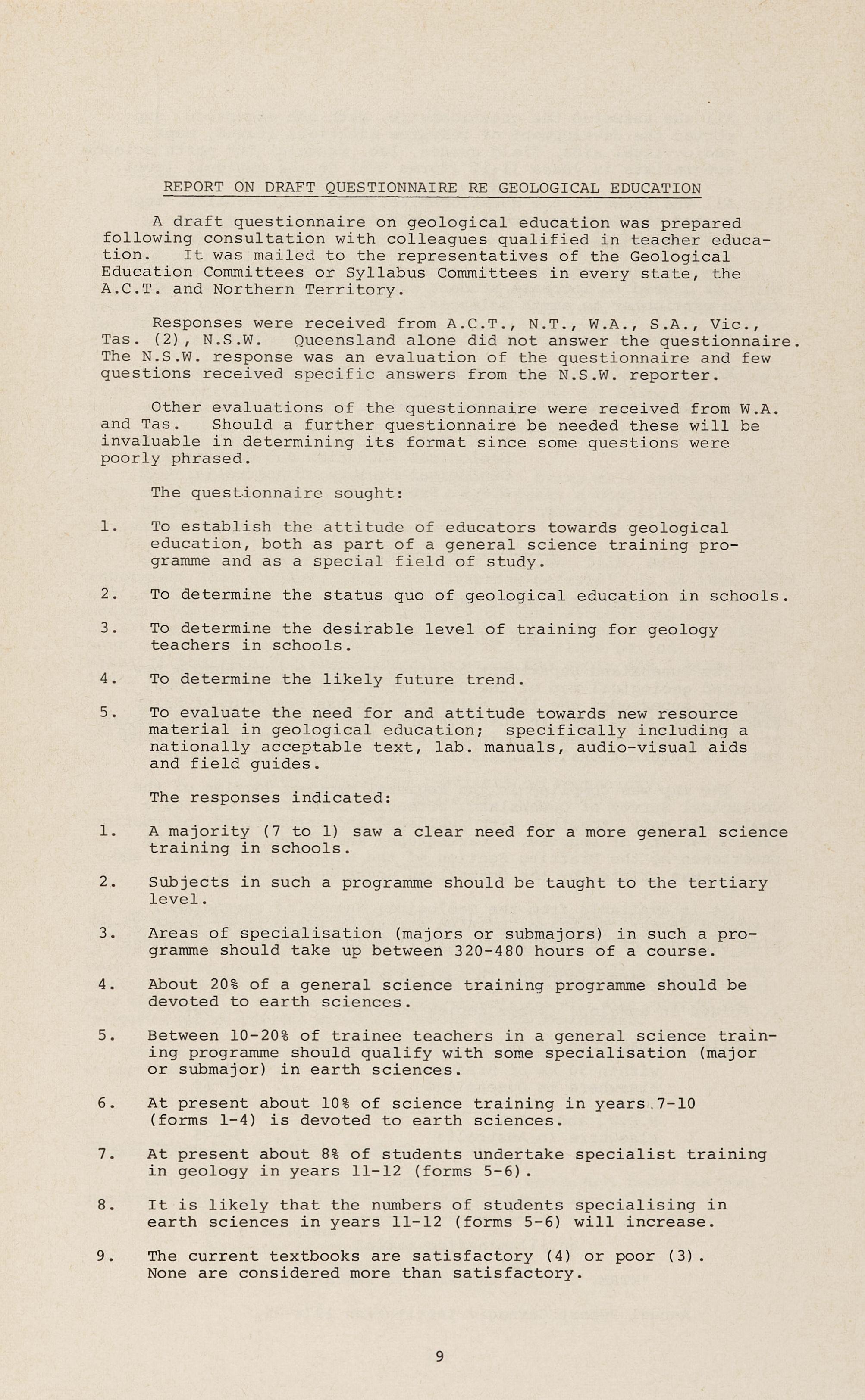
REPORT ON DRAFT QUESTIONNAIRE RE GEOLOGICAL EDUCATION
A draft questionnaire on geological education was prepared following consultation with colleagues qualified in teacher education. It was mailed to the representatives of the Geological Education Committees or Syllabus Committees in every state, the A.C.T. and Northern Territory.
Responses were received from A.C.T., N.T., W.A., S.A., Vic., Tas. (2), N.S.W. Queensland alone did not answer the questionnaire. The N.S.W. response was an evaluation of the questionnaire and few questions received specific answers from the N.S.W. reporter.
Other evaluations of the questionnaire were received from W.A. and Tas. Should a further questionnaire be needed these will be invaluable in determining its format since some questions were poorly phrased.
The quest~onnaire sought:
1. To establish the attitude of educators towards geological education, both as part of a general science training programme and as a special field of study.
2. To determine the status quo of geological education in schools.
3. To determine the desirable level of training for geology teachers in schools.
4. To determine the likely future trend.
5. To evaluate the need for and attitude towards new resource material in geological education; specifically including a nationally acceptable text, lab. manuals, audio-visual aids and field guides.
The responses indicated:
1. A majority (7 to 1) saw a clear need for a more general science training in schools.
2. Subjects in such a programme should be taught to the tertiary level.
3. Areas of specialisation (majors or submajors) in such a programme should take up between 320-480 hours of a course.
4. About 20% of a general science training programme should be devoted to earth sciences.
5. Between 10-20% of trainee teachers in a general science training programme should qualify with some specialisation (major or submajor) in earth sciences.
6. At present about 10% of science training in years.7-10 (forms 1-4) is devoted to earth sciences.
7. At present about 8% of students undertake specialist training in geology in years 11-12 (forms 5-6).
B. It is likely that the numbers of students specialising in earth sciences in years 11-12 (forms 5-6) will increase.
9. The current textbooks are satisfactory (4) or poor (3). None are considered more than satisfactory.
10. All who answered the questionnaire, with one exception, supported the development of resource materials (texts, maps, audio-visual aids, field guides, lab. manuals) for earth science specialists in years 11-12 (forms 5-6) at the national level.
11. All who answered the questionnaire, with one e xc eption, supported the development of an earth sciences t ex t at the national level.
The generally positive attitude of all respo n d e n t s s ug g2s t s there is a need to increase student exposure t o g enP r al sc ienc e and in particular to earth sciences. This can b ~ me t b y:
1. More general science training for traine e tea c her s.
2. More s p ecialisation in earth scien c es fo r tr a ine e teachers.
3. The development of resource material s a t a nati o n a l level.
K. G. McKen z i e
Geologic a l Edu ca ti o n Sub Committee, Geological So cie ty o f Australia, N.S.W. Bra nch
NEW GEOLOGICAL MAP OF QUEENSLAND NOW AVAILABLE
The Queensland Department of Mines recently published a new coloured geological map of the State at a scale of 1:2 500 000. This map supersedes the 1953 edition which has been out of print since stocks were lost in the 1974 Brisbane flood. Advance copies of the map were viewed with interest by many geologists attending the 25th International Geological Congress at Sydney in August.
The map was compiled in the Regional Mapping Section of the Geological Survey of Queensland, primarily from 1:250 000 scale geological maps, together with published and unpublished information from a variety of sources. Cartography and colour design were undertaken by the Drafting Section of the Department of Mines, and the map was printed by the Queensland Government Printer.
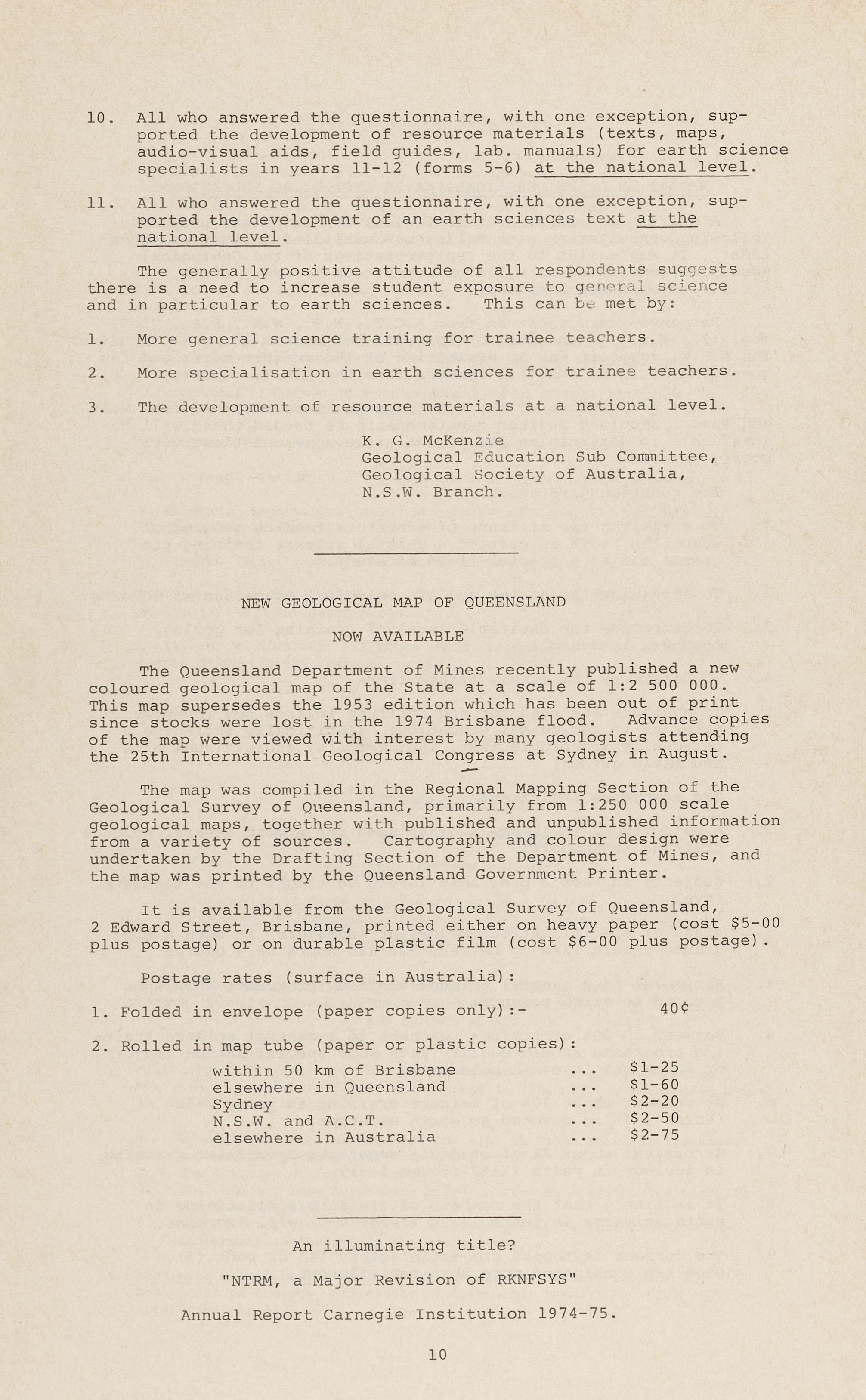
It is available from the Geological Survey of Queensland, 2 Edward Street, Brisbane, printed either on heavy paper (cost $5-00 plus postage) or on durable plastic film (cost $6-00 plus postage).
Postage rates (surface in Australia):
1. Folded in envelope (paper copies only):-
2. Rolled in map tube ( p aper or plastic copies): within 50 km of Brisbane elsewhere in Queensland Sydney N.S.W. and A.C.T. elsewhere in Australia An illuminating title? "NTRM, a Major Revision of RKNFSYS"
Annual Report Carnegi e Institution 1974-75.
EARTH SCIENCE FILMS
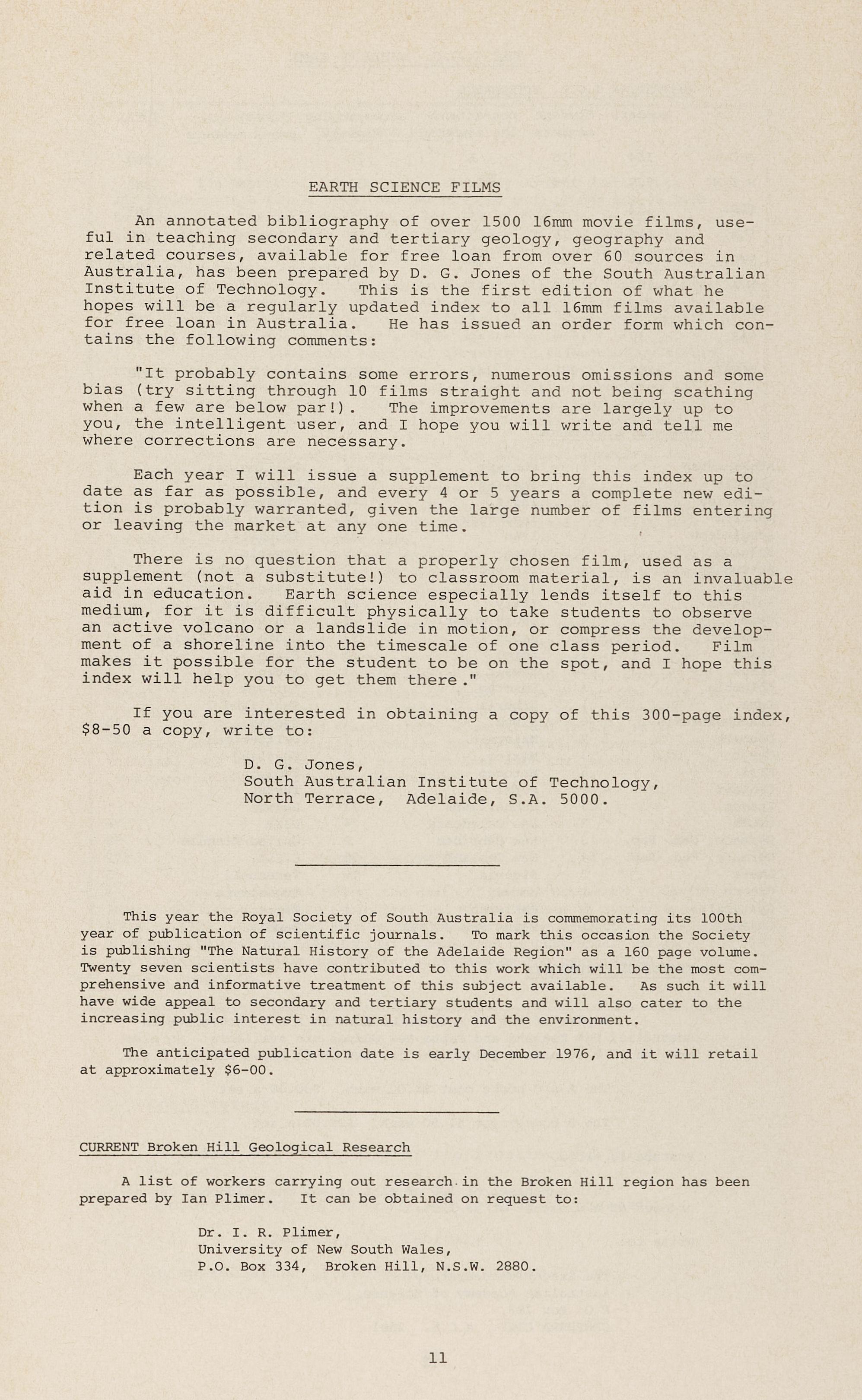
An annotated bibliography of over 1500 16mm movie films, useful in teaching secondary and tertiary geology, geography and related courses, available for free loan from over 60 sources in Austra l ia, has been prepared by D. G. Jones of the South Austra lian Institute of Technology. This is the first edition of what he hopes will be a regularly updated inde x to all 16mm films available for free loan in Australia. He has issued an order form which contains the following comments:
"It probably contains some errors, numerous omissions and some bias (try sitting through 10 films straight and not being scathing when a few are below par!). The improvements are largely up to you, the intelligent user, and I hope yo u will write and tell me where corrections are necessary.
Each year I will issue a supplement to bring this index up to date as far as possible, and every 4 or 5 years a complete new edition is probably warranted, given the large number of films entering or leaving the market at any one time.
There is no question that a prop erl y chosen film, used as a supplement (not a substitute!) to classroom material, is an invaluable aid in education. Earth science especially lends itself to this medium, for it is difficult physically to take students to observe an active volcano or a landslide in motion, or compress the development of a shoreline into the timescale of one class period. Film makes it possible for the student to be on the spot, and I hope this index will help you to get them there."
If you are interested in obtaining a copy of this 300-page index, $8-50 a copy, write to:
D. G. Jones, South Australian Institute of Technology, North Terrace, Adelaide, S.A. 5000.
This year the Royal Society of South Australia is commemorating its 100th year of publication of scientific journals. To mark this occasion the Society is publishing "The Natural History of the Adelaide Region" as a 160 page volume. Twenty seven scientists have contributed to this work which will be the most comprehensive and informative treatment of this subject available. As such it will have wide appeal to secondary and tertiary students and will also cater to the increasing public interest in natural history and the environment.
The anticipated publication date is early December 1976, and it will retail at approximately $6-00.
CURRENT Broken Hill Geological Research
A list of workers carrying out research in the Broken Hill region has been prepared by Ian Plimer. It can be obtained on request to:
Dr. I. R. Plimer, University of New South Wales, P.O. Box 334, Broken Hill, N.S.W. 2880.
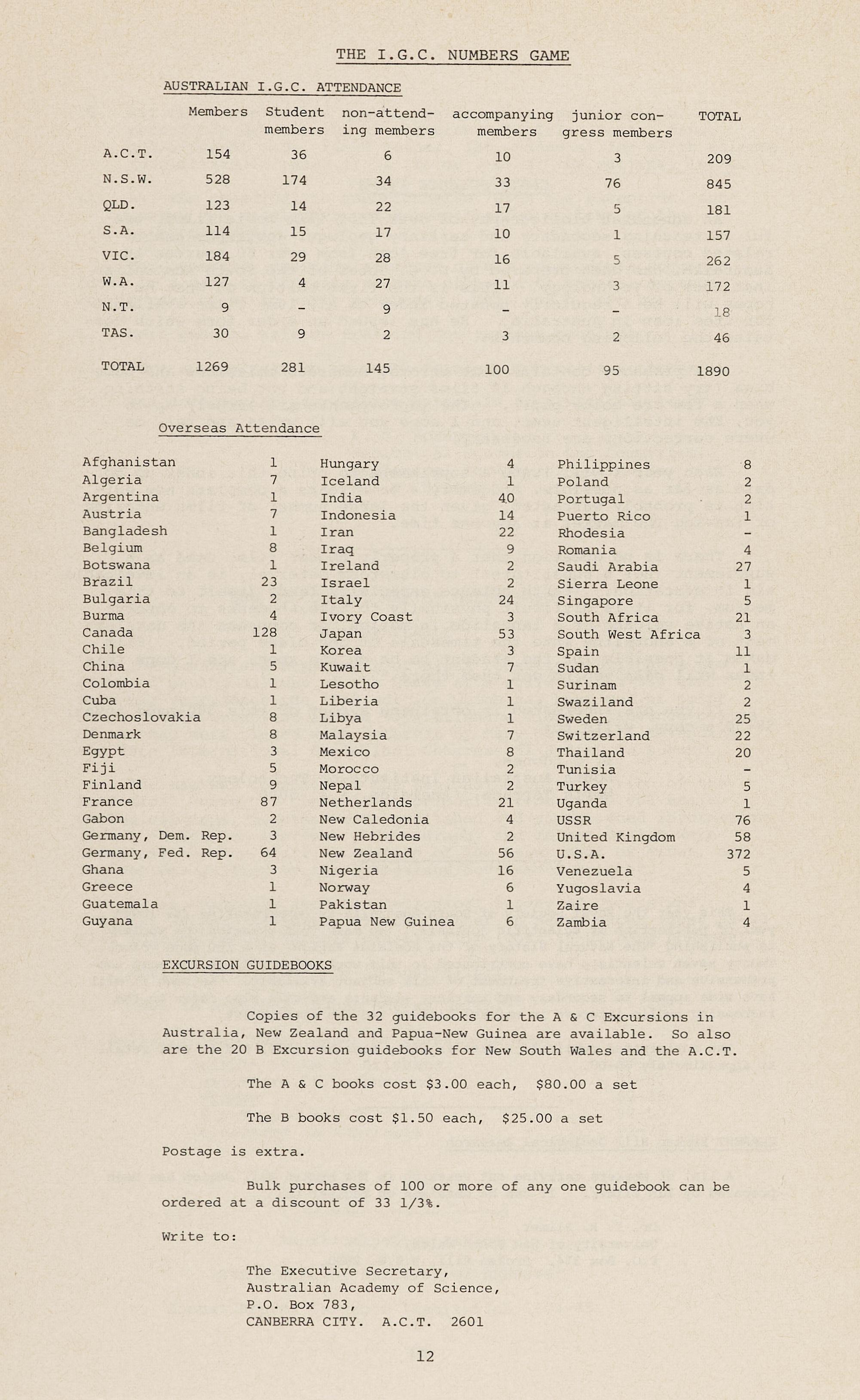
Copies of the 32 guidebooks for the A & C Excursions in Australia, New Zealand and Papua-New Guinea are available. So also ar e the 20 B Excursion guidebooks for New South Wales and the A.C.T.
The A & C books cost $3 00 each , $80 00 a set
The B books cost $1. 50 each , $ 25. 00 a set
Postage is extra
Bulk purchases o f 100 or more of any one guidebook can be orde red at a discount of 33 1/3 % Wr
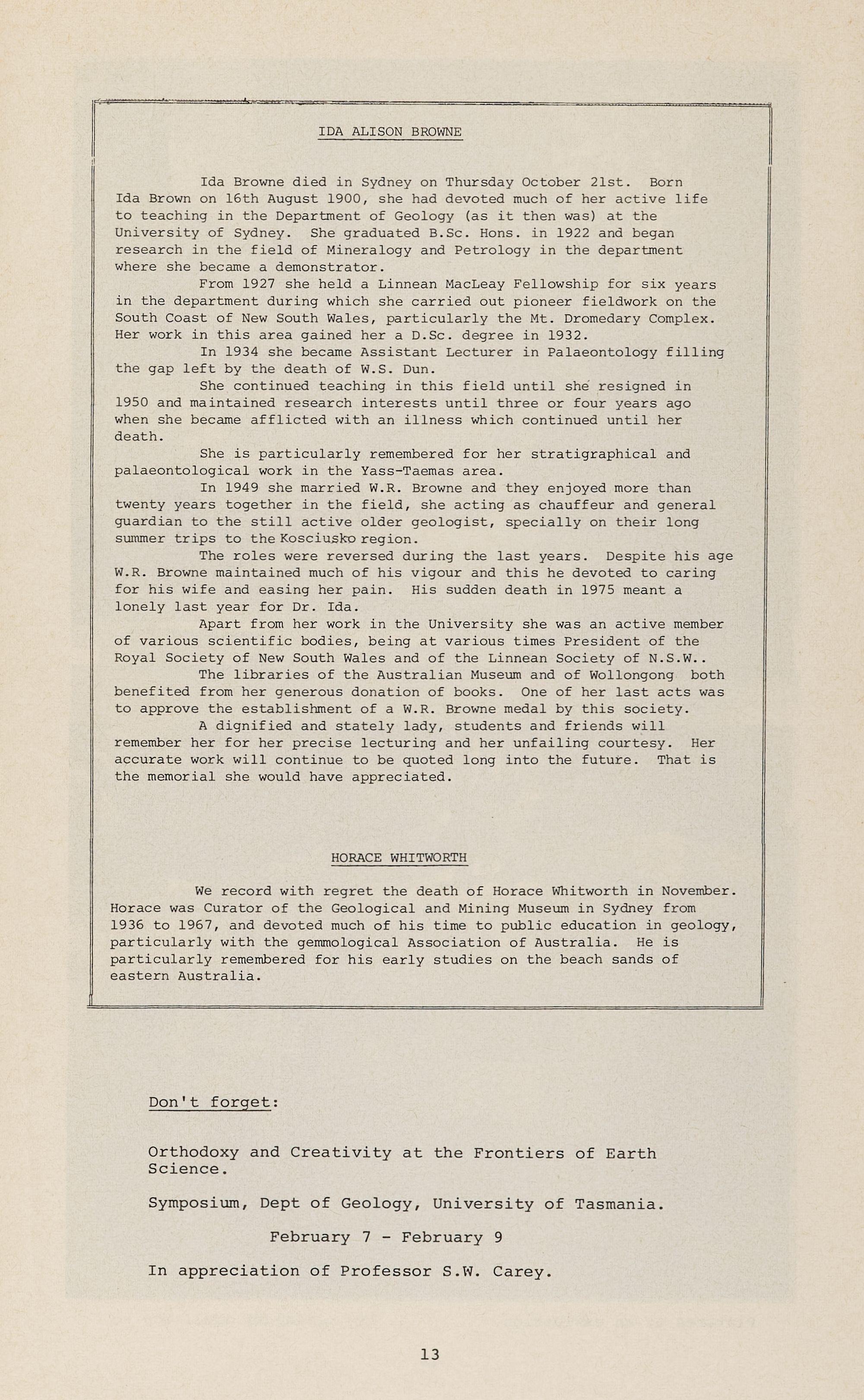
IDA ALISON BROWNE
Ida Browne died in Sydne y on Thursday October 21st. Born Ida Brown on 16th August 1900, she had d e voted much of her active life to teaching in the Department of Geology (as it then was) at the University of Sydney. She graduated B.Sc. Hons. in 1922 and began research in the field of Mineralogy and Petrology in the department where she became a demonstrator.
From 1927 she held a Linnean MacLeay Fellowship for six years in the department during which she carried out pioneer fieldwork on the South Coast of New South Wales, particularly the Mt. Dromedary Complex. Her work in this area gained her a D.Sc. degree in 1932.
In 1934 she became Assistant Lecturer in Palaeontology filling the gap left by the death of W. S. Dun.
She continued teaching in this field until she resigned in 1950 and maintained research interests until three or four years ago when she became afflicted with an illness which continued until her death.
She is particularly remembered for her stratigraphical and palaeontological work in the Yass-Taemas area.
In 1949 she married W.R. Browne and they enjoyed more than twenty years together in the field, she acting as chauffeur and general guardian to the still active older geologist, specially on their long summer trips to the Kosciusko region.
The roles were reversed during the last years. Despite his age W.R. Browne maintained much of his vigour and this he devoted to caring for his wife and easing her pain. His sudden death in 1975 meant a lonely last year for Dr. Ida.
Apart from her work in the University she was an active member of various scientific bodies, being at various times President of the Royal Society of New South Wales and of the Linnean Society of N . S. W..
The libraries of the Australian Museum and of Wollongong both benefited from her generous donation of books. One of her last acts was to approve the establishment of a W.R. Browne medal by this society.
A dignified and stately lady, students and friends will remember her for her precise lecturing and her unfailing courtesy. Her accurate work will continue to be quoted long into the future. That is the memorial she would have appreciated.
HORACE WHITWORTH
We record with regret the death of Horace Whitworth in November. Horace was Curator of the Geological and Mining Museum in Sydney from 1936 to 1967, and devoted much of his time to public education in geology, particularly with the gemmological Association of Australia. He is particularly remembered for his early studies on the beach sands of eastern Australia.
Don't forget:
Orthodoxy and Creativity at the Frontiers of Earth Science.
Symposium, Dept of Geology, University of Tasmania.
February 7 - February 9
In appreciation of Professor S.W. Carey.
PARDON THE INTRUSION
A six year old battle to preserve,for educational purposes,one of the few sills in the Sydney area has just been lost in what is probably a typical fashion.
The site, an exposure in an abandoned quarry at West Pymble, adjoined an oval, Scouts hall and other recreational features. Approaches to the local council by the Society elicited considerable interest and resulted in visits to the site by various mayoral parties, councillors, health, engineering and parks officials.
Society members prepared a map of the quarry showing sites of interest which included the sill (about lm. thick), an associated dyke, contact metamorphosed sandstone (some prismatised), a small anticline - probably expressing the underlying sill, several faults and the junction between the local cross-bedded Hawkesbury Sandstone and the overlying shale unit. All told it was a very suitable spot for school excursions - plenty of easily observed features and away from traffic. What's more the area showed variation in vegetation related to the geology. The plan envisaged by the Society involved preparation of a pamphlet for use by local schools.
Naturally enough this prime site on the salubrious North Shore attracted some interest and was coveted by the local Soccer body as the site for a registered club and by the health service as a suitable garbage transfer station.
Last year the last named seemed inevitable and I visited the site with council members to indicate what could be preserved (most features in fact) for examination if the transfer station was built.
However the open spacers won the day and the area was added to the park, to become an additional oval, not a nature area, but with the provision for the geology to remain accessible.
Early in December the Parks officer went with the Surveyor to mark the areas to be preserved. They were too late. Another arm of the body corporate had blasted the prismatic sandstone and buried the sill beneath a sea of clay! As she sadly remarked there were just too many people involved and communication failed. Whether anything can be salvaged remains to be seen.
Perhaps in 20 years it could be the site of an archaeological dig or a training spot for potential mining students. Who knows?
D.B.
I. YOU. GEE. YES.
Professor Peter Howard of MacQuarie Universit y was elected during I.G.C. to the Executive Committee of I.U.G.S. as a Vice President. This is the first time Australia has been represented at this level, I think. The Executive Committee, formerly strongly European in content now has a wider international representation.