Newsletter Editor:
D. F. Branagan, Department of Geology & Geophysics, The University of Sydney, N.S.W. 2006.
Assistant Secretary Miss L. Tuckwell, Suite 9, 6th Floor, Perpetual Trustee Building, 39 Hunter St., Sy dney, 2000. 'phone : Sydney 231 4696.
INFLATION HITS THE SOCIETY!
John N Cramsie, Honorary Federal Treasurer.
Alon g wi t h mos t ot h er or gani s a tio n s in Australia, t h e Geological So c iet y of Austr ali a is b ei ng seriousl y affected by cost inflation. Essent i al costs r e lating to publication and administration continue to rise proportionall y , or worse, with general inflation. On the other hand income, which comes mainly from membership fees and journal subscriptions, is increasing only marginally.
In view of this situation, the Society 's Council reluctantly recommended a 20 p er ce nt fee rise (from $15 to $18) at its meeting in May. This rise uas appr oved by t h e Annual General Meeting of the Society at t h e Adel a i d e Conve n tion and will come into effect for t h e coming y ear of 1 9 76. It i s understood that a number of divisions have alread y ad vi se d members of this fee rise in their Divisional Notices.
Mr. R. J. Paten, the retiring Honorary Federal Treasurer, reporting to the Society in May 1975, predicted a loss for 1975 of about $8,600, compared with a profit for 1974 of $3,657. It now appears certain that this loss will be exceeded, due to such unforeseen factors as the recent very heavy postage increases, and an increase of nearly 50 per cent in printing and distribution costs for the Journal in the past year.
Rental costs for the Society's Central Office have increased following the move to more appropriate, but certainly not extravagant accommodation. Th ese increased costs for office accommodation have been offset in a small way in that the regular services of a vermin exterminator are no longer re q uired, as \'.TaS the case in the previous rather run down offices.
Members can be assured that the Federal Executive is investigating all avenues of increasing income and cutting costs in an effort to postpone any further fee rises for as long as possible. The most effective way of increasing income is by increasing 1membership, and a number of recruitment initiatives have been taken.
Co n t i nued bottom of Page 3
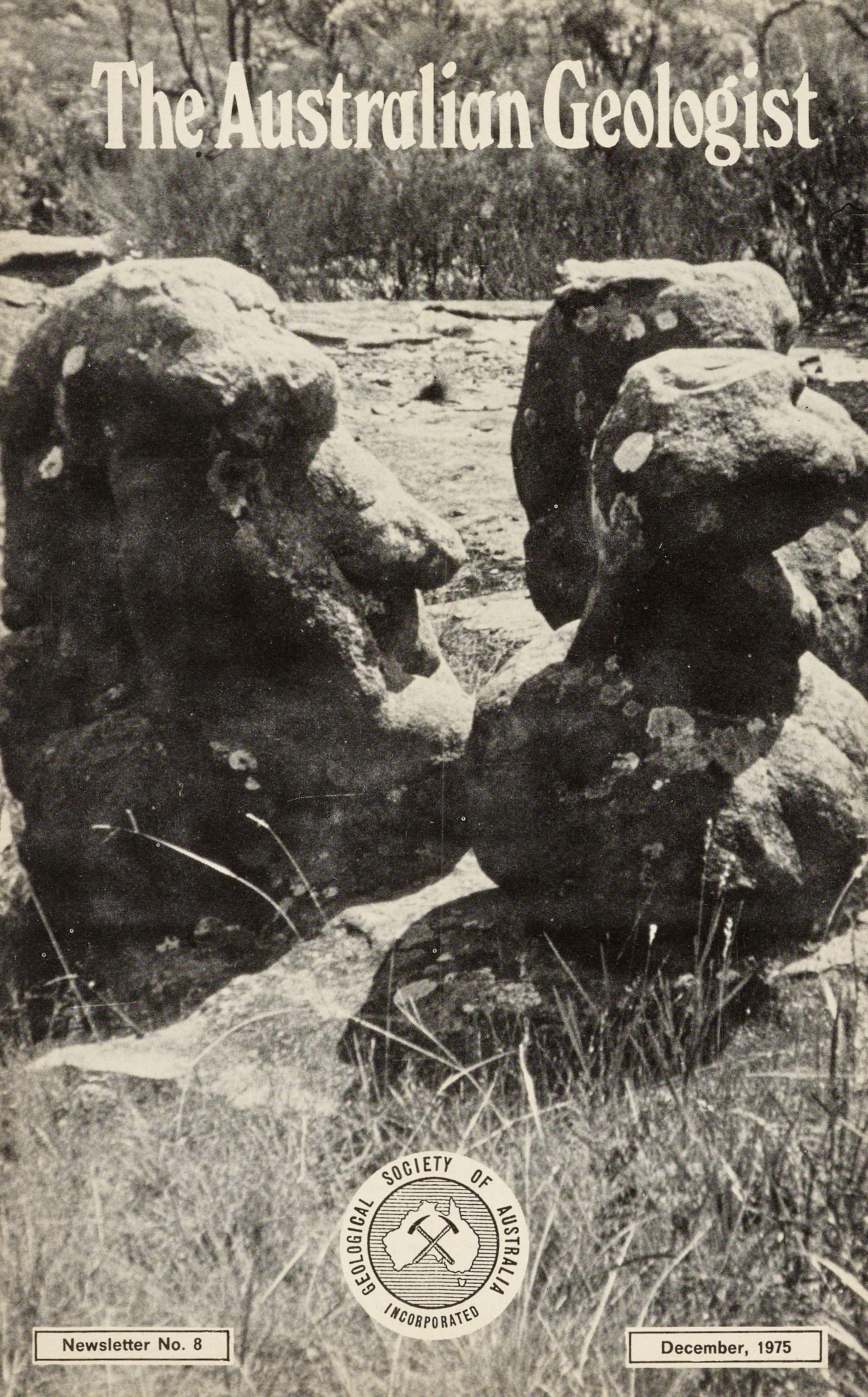
Cover Photo :
No. 8. December 1975.
EDITORIAL
Is it neso ssary?
The last editorial , dealing with proposed changes in Commonwealth (that naughty word) organizations provoked a mild response which is indicated by several letters published in this issue.
In particular it brought to my attention the activities of POA (Professional Officers' Association for the uninstructed) members within the BMR who have produced a series of documents on their ideas about the future organization of Australian geoscience.
The most recent has been pub lished and fa irly widely distributed and will be interesting to many members, part icularly in their role as taxpayers. It is entitled A National Approach to the earth sciences and the future role of the Bureau of Mineral Resources. This paper advocated the formation of two new bodies - an adviso r y National Geoscience Council and an Operational Nationa l Earth Science Organization.
The Council is envisaged as representing 'a broad spectrum of Australian geoscientific organizations, and having advisory, co-ordinating and liaison roles'. The National Earth Science Organization (NESO, if you please) would be a new statutory authority 'governed by an executive council directly responsible to the Minister for Minerals and Energy. The present BMR should form its core, and appropriate elements of CSIRO would be incorporated. It should have an assured bulk budget'.
Members who have not seen this paper should be able to get copies from the BMR Group of P.O.A through the Bureau. It is well worth examination and discussion.
Some of my more academic associates would argue that organizational aspects of geology have little to do with the real progress of science - that the growth of ideas shows little parallel development with government support. This argument may well be true, but there is no doubt that the applications of geology touch many aspects of general living. In this area the provision of geological information, such as geological maps, is certainly a function of government and it is the concern of the profession that such information be made available as efficien tly as possible. The efficient organiza tion of geology in Australia is a matter that we , as a Society, must concern ourselves with.
In concluding this editorial it is my pleasant duty to thank the man y members who have helped me by kind l y comment, critical corrections, information and letters during the past two years. Without these members there would be no Newsletter I look forward to their help in the coming year
Continued from page 2
Member s can save the Society money by forwarding their 1976 subscriptions early in t he yea r, and at least prior to the end of March This ensures that members receive their copies of the Journal 'hot off the press'! When members do not pay their subscriptions on time, their copie s of the Journal have to be packed and posted individuall y at the grossly excessive postal charge of 40 cents per copy (together with wages for package and posting) rathe r than the bulk mailing rate of 15 cents (including packing) when the Journal is mailed direct by the printer.
The Society is still in a good financial position as the assets of the Society were about $54,000 at the end of 1975, including cash reserves of about $23,000. However there is no room for complacency as the operating budget for the Society is about $60,000. There is a real need for cash reserves to be mainta ined so that the ability of the Society to undertake new initiatives is not diminished.
Letter to the Editor.
Sir,
I refer to your editorial in the Society's Newsletter No. 7 (Sept. 1975) which raises three points which are interrelated in a fundamental sense but not in an obvious or superficial sense. These are
* The future of the 'geological' part of the CSIRO
* The future of the B.M.R.
* The recognition of the value of geology in Australia.
To an outsider the future affiliations of the B.M.R. and part of the CSIRO seem to be of little significance provided the functioning of those bodies is not materially affected; in par ticular as affecting the services given to nongovernmental organisations and pe rsons. I include in these services such matters as the provision of low-cost geological maps of the 1:250,000 series, regional records of geophysical surveys, publications concerning mineral economics and studies concerning the origin of orebodies. There are many others.
To the insider, i.e. senior officers of the CSIRO and B.M.R., the affiliation of the respective bodies may be far more important and I should think that such officers are presently concerned with evaluating projec ted moves. It is to these officers, who best know the circumstances, that we must look for an assessment of the position and of any projected moves. There may be legal or personal restraints on public statements by members of the CSIRO and B.M.R., and, in the present state of ignorance of the pub lic, I am not certain that such statements would really help.
Nevertheless I am certain of two points: it would be a disaster if the position of Director of the B.M.R. were given to anyone other than a technical man (geologist, geophysicist etc.) with the ob v ious proviso that he be a capable administrator. The second princ iple seems, to me, to be essential, viz. the retention of the 'service function' which exists between the CSIRO/B.M.R. and the public. For example it wou ld be a retrograde step if the B.M.R. 'clammed up' and adopted the role of a feeder service to the P.M.A., or whatever the body be designated in the future.
I quite agree with your third point, "Geologists surely believe their work is important. Why no t tell the community that it is?" I expressed at some length my v iews on this in a talk, later pub lished in the Society's Journal (Vol. 15, pt. 2, pp. 163-174). To quote myself "It is my firm belief that we, as geologists, are far too retiring and self-effacing". However this is to merel y support your view; the problem is what to do about it. I have given this much thought without corning up with any clear or specific proposal. In a vague, and therefore unsatisfactory way the answer seems to lie in deliberate education of the public. But how? Does it li e in the teaching of geology, and of its economic impact, at the primary and secondary school levels?
F. Canavan.
VERCO MEDAL AWARD
The Royal Society of South Australia (Inc.) has awarded the Verco Meda l for 1975 to Mr. B. P. Thomson for his significant role in research and leadership in the understanding of the regional and stratigraphic geology of South Australia! and for his contribution to Australian Geology as a whole. Bren Thomson has been with the South Australian Department of Mines since 1959 and is at present Supervising Geologist, Regional Geology Division of the Geological Survey Branch, where he has personally undertaken a major part of the State geological mapping programme, and has been responsible through his sta ff for much o f the remainder.
Correction
The secretary of the New South Wales Division is R. A. CREELMAN of Macquarie University. Apo l ogies are tendered for the incorrect information which appeared in earlier Newsletters.
THE 25th INTERNATIONAL GEOLOGICAL CONGRESS
The end of September marked the nominal deadline for two important aspects of Congress organization: the first allocation of places on excursions; and the closing date for receipt of synopses of papers. Some latitude has, inevitably, had to be allowed owing to circumstances such as postal strikes or delays, and the Secretariat has been as sympathetic as the constraints under which it labours will allow.
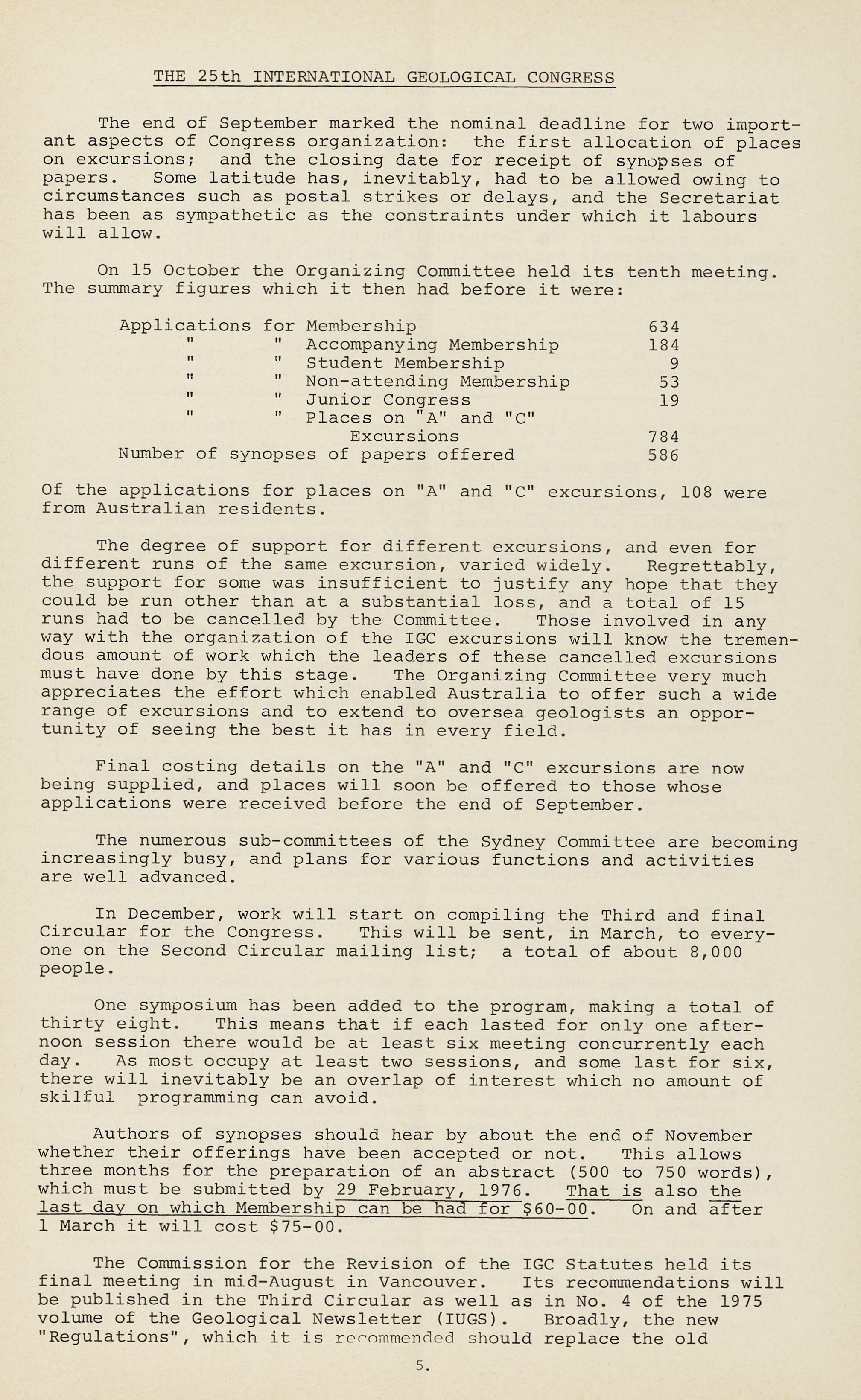
On 15 October the Organizing Committee held its tenth meeting. The summar y figures which it then had before it were:
Applications for Membership "
Accompanying Membership
Student Membership
Non-attending Membership
Junior Congress
Places on "A" and "C" Excursions Number of synopses of papers offered
Of the applications for places on "A" and "C" excursions, 108 were from Australian residents.
The degree of support for different excursions, and even for different runs of the same excursion, varied widely. Regrettably, the support for some was insufficient to justif y any hope that they could be run other than at a substantial loss, and a total of 15 runs had to be cancelled by the Committee. Those involved in any way with the organization of the IGC excursions will know the tremendous amount of work which the leaders of these cancelled e x cursions must have done by this stage. The Organizing Committee very much appreciates the effort which enabled Australia to offer such a wide range of excursions and to extend to oversea geologists an opportunity of seeing the best it has in every field.
Final costing details on the "A" and "C" excursions are now being supplied, and places will soon be offered to those whose applications were received before the end of September.
The numerous sub-committees of the Sydney Committee are becoming increasingly busy, and plans for various functions and activities are well advanced.
In December, work will start on compiling the Third and final Circular for the Congress. This will be sent, in March, to everyone on the Second Circular mailing list; a total of about 8,000 people.
One symposium has been added to the program, making a total of thirty eight. This means that if each lasted for only one afternoon session there would be at least si x meeting concurrently each day. As most occupy at least two sessions, and some last for six, there will inevitably be an overlap of interest which no amount of skilful programming can avoid.
Authors of synopses should hear by about the end of November whether their offerings have been accepted or not. This allows three months for the preparation of an abstract (SOO to 750 words), which must be submitted by 29 February, 1976. That is also the last day on which Membership can be had for $60-00. On and after 1 March it will cost $75-00.
The Commission for the Revision of the IGC Statutes held its final meeting in mid-August in Vancouver. Its recommendations will be published in the Third Circular as well as in No. 4 of the 1975 volume of the Geological Newsletter (IUGS). Broadly, the new "Regulations", which it is r erom me n cled s hould replace the old
"Statutes", take note of changed circumstances such as the growth of I UG S and the increased size of the geological community over recent years.
The Secretary-General of IUGS has written to say that this year ' s seasonal greeting will depict an Australian scene in recognition of this country's hosting of the 25th IGC.
Many members of the Geological Society of Australia, Inc., have shown a considerable interest in the congress organization. This interest is greatly appreciated and highly regarded by the Secretariat.
A. Renwick Secretary-General
IUGS Commission on Systematics in Petrology
The IUGS Subcommission on the Systematics of Igneous Rocks and its working group on effusive and pyroc lastic rocks held a meeting in connection with the IUGG Congress, Grenoble, September 2-4, 1975. The participants were: F. Chayes, (USA), A. Dudek (CSSR), J. Honnorez (USA), R. Ivanov (Bulgaria), M. J. Le Bas (UK), R. W. Le Maitre (Australia), N. P. Mikhailov (USSR), H. de la Roche (France), P. A. Sabine (UK), R. Schmid (Switzerland), A. Streckeisen (Switzerland), P. M. Vincent (France), B. Zanettin (Italy). After discussing the principles of the classification of volcanic rocks, the participants unanimously approved the following recommendations and suggestions.
1. The classification of volcanic rocks should be consistent with the classification of plutonic rocks. Consequently, it should be based in the first instance on mineral parameters, either modal or normative.
2. Further subdivision of any major group (e.g., basalt, andesite, rhyolite, etc.) can be achieved by using supplementary criteria. Suggestions as to suitable criteria would be very welcome.
3. We also feel the need to investigate classifications based on oxides or functions of oxides; these ideally should correspond as closely as possible to classifications by mineral parameters.
4 To test the relationships between modal mineral contents and the various classification methods that are suggested, it is proposed to circulate to interested colleagues sets of chemical and modal data of selected rocks.
5. To further test the viability of any normative calculation or any system of classification based on oxides or functions of oxides, it is proposed to circulate the suggested methods to various centres where volcanic data files exist, to determine their consistency with existing usage of nomenclature.
6. We feel that agreement should be sought to standardize the usage of chemical qualifiers such as, e.g., low-K, high-K, low-Si, etc. Suggestions from colleagues commonly using such terms would be very welcome.
Suggestions may be sent to the chairman, Prof. A. Streckeisen, Mineralog.Petrograph. Institut, Sahlistrasse 6, CH-3012 Berne, Switzerland.
A special working group on pyroclastic rocks has been formed in order to discuss their classification and nomenclature and to prepare suitable recommendations. Interested colleagues may address themselves to the chairman, Dr. R. Schmid, Institut fur Kr istallographie und Petrographie ETH, Sonneggstrasse 5, CH-8006, ZUrich, Switzerland.
SEMINAR ON ARCHAEAN GEOLOGY
About 80 geologists from exploration companies and other geological organisations attended an excellent seminar on "Recent research on the Archaean Terrains" by the graduate group at the University of Western Australia on August 22nd 1975. It was convened by Dr. David Groves and Dr. Rod Marston. In his opening remarks Dr. Groves stated that the object of the research effort was integrated geological, petrological, and geochemical study of certain key areas in the Archaean of W.A.
Leigh Bettenay opened with a 4-fold classification of the granitoids between Southern Cross and Coolgardie. Class I include migmatite and banded tonalite gneiss that occur in linear belts. Class II are syntectonic dome-like granodiorite. Class III are late tectonic porphyritic biotite adamellite with obvious magmatic features. Class IV are p ost-tectonic composite batholiths of leucocratic adamellite.
Nie Archibald outlined the structural and plutonic history of the Widgiemooltha area, concentrating on the evidence for a remobilised sialic basement. This evidence, which relates to Bettenay's Class I is manifest by periods of pen etrative deformation in the Pioneer Dome that pre-date the earliest structural event in the enveloping greenstones.- The idea that some of the gneiss is paragneiss is supported by limited geochemistry (high Na/K, K/Rb, low Rb/Sr) which bears comparison with alleged ancient gneiss in southern Africa. Whilst not conclusive, the arguments of Bettenay and Archibald that these represent pre -greenstone sialic crust are attractive, and also important as they are bas ed upon geological evidence rather than conceptual models.
Lars Anderson presented examples of polyphase deformation at the mesoscopic scale in BIF in the Diemal area. This subject is contentious because the presence of the related rnegascopic folds, which incidentally have not yet been substantiated, would hit hard at attempts at regional stratigraphy.
Mike Gorton presented some surprising Sr/Rb isotopic dates for the Jackson area. Most of the granites give younger isotopic homogenisation dates, and higher initial ratios, than the granites in the Eastern Goldfields. This is surprising as the general feeling is that the granites should get older coming west across the Yilgarn Block. Howeve r Gorton pointed out that the dates probably record a period of thermal metamorphism.
The implication of heterogeneous deformation in the notorious Jones Creek Conglomerate was discussed by Rod Marston. He concludes that stratigraphic relationships are obscured by discrete linear zones of penetrative deformation. Marston showed that the Jones Creek Conglomerate could easily be stratigraphically high. So the conglomerate, which sits unconformably over a large batholith of granite may have gone from low to high! Perhaps the answer lies somewhere between.
Ken McQueen demonstrated a complex metamorphic and structural later history for the Redross nickel deposit. At the contact between the host ultramafic and the footwall rnetabasalts, the following sequence occurs: thrusting of acute slices of nickeliferous ultramafic into basalts, metamorphism and alteration producing tremolite and talc-carbonate rocks, ductile deformation of the talccarlx:indte, brittle fracture forming shears that control the final location of the ore, and finally late stage faulting.
Archaean BIF's* are in vogue at present with a number of exploration companies, and this was reflected in the interest in Martin Gale's outline of the metamorphism of Yilgarn BIF. An * Banded iron formation.
indication of the original nature o f these rocks is given by as s emblages containing greenalite, minnesotaite, stilpnomelane an d magnetite. The classical division into oxide, sulphide and si li cate f ~c ies received little support.
T~e Semin ar finished with two papers outlining preliminary studies of P ilbara mineralisation. GYaham Sylvester presented an elegant reconstruction of the enigmatic felsic volcanic complex at Mons Cupri. Charter Mathison puzzled the audience with him collapsed mushroom shapes of the Mt. Scholl Cu/Ni-bearing pyroxenite.
A great deal of new information and new ideas on many topical questions were brought to light at this successful seminar and the conveners can be complimented. We hope it is the fore-runner of further meetings. Incidentally many people had the pleasure of meeting, for the first time, the new Professor of Geology of W.A., Peter Harris, formerly of Leeds.
Dennis Gee.
NEWS FROM A.C.T. DIVISION
C.T. Division's Field Trip to the South Coast of N.S.W.
During the October long week-end, the chairman of the Commonwealth Territories Division, Mike Rickard, assisted by Ian Smith, led a field excursion to the far south coast of New South Wales.
Braving the threatened petrol shortage and armed with wellcompiled eighteen page guide books, a fair sized group of members together with their families cong regated at Narooma Surf Beach at 10 a.m. on the 4th October to commence a three day examination of the Ordovician cherts, pillow lavas, and deformed flysch, Devonian fluviatile and paralic sediments, and associated igneous rocks and mineralisation of the area between Naro oma and Eden.
Hig h points of the trip included the hunt for Ordovician graptolites near Cobargo, examination of the interrelationships of primary and deformational features in the Ordovician, discovery of fossil fish near Eden, a visit to the Dromedary Hotel, Central Tilba, and an inspection of the Dromedary igneous complex, which we learn was formed either during the first stages of continental riftin g or during the last stages in the stabilisation of the continental margin.
At the Nullica River Bridge the group was augmented by a passing pa rty of Perth-bound Hell' s Angels who enthusiastically joined the search for way-up structures in the Ordovician.
Although the last stop, on Monday afternoon, at the Pambula pyrophyllite mine, managed to attract only the more stalwart members of the party, the varied and we l l organised excursion was enjoyed by all, and particularly by those participants who lead a deskbound existence in BMR. For sorrethis was the first encounter with rocks in their natural state for over two year s.
Member s· wi shi ng to retrace our steps might like to contact Mike Rickard, who still has a few guide boo ks left.
R.V.B.
Ken Mosher long time Hon. Administrative Officer of the Society and general do-gooder in the cause of geology has retired from his e mploym ent with Kernbla Coal & Coke Company.
To fill in the time he is u nd ertakinq a Law deg r ee at Sydney University.
GOOD FISHING ON SOUTH COAST EXCURSION
It is amazing what turns up on geological excursions - new interpretations of exposures, new outcrops and fossil discoveries. During an informal excursion to the south coast of N.S.W. by the A.C.T. Division of the Geological Society, ably led by Mike Rickard (A.N.U.), a new exposure of the Twofold Bay Formation was examined on the Nethercote Road, southwest of Eden. Recent excavations in the course of road widening have exposed a good section through the Bellbird Creek Formation and show the contact with the underlying Twofold Bay Formation. In the road cut, the boundary between the two units is clearly discernible - the white and green coloured supposedly shallow marine deposits of the Bellbird Creek Formation overlying the red bed sequence of the Twofold Bay Formation. While most of the party went off to examine monoclinal folding in the Bellbird Creek Formation, some of the younger members of the party and myself examined the red bed sequence. The outcrop in the cliff face was not examined but rubble left by bulldozing along the roadside was looked over and, the first fossil, a small fragment of a phyllolepid (?) fish plate was found by Ms Perry, daughter of John Perry (BMR). In the same area I unearthed a larger plate (unfortunately now in several pieces) of probable antiarchon affinities. The bone is well preserved in this specimen. The fossil convinced most of the doubters and spurred other members of the party into a further search, and several small finds were made. By far the best discovery was that of a well preserved ?ventral plate from the trunk armour of Bothriolepis sp. by Mike Owen (BMR). The specimen is a case of the external surface of the original plate, no bone is present, and occurred as float. One other small fragment showing characteristic bothriolepid ornamentation was found. Both specimens of Bothriolepis sp. occurred in coarse sandstone. In the finer grained sandstone and siltstone are impressions of plates and fin spines, very tentatively assigned to Phyllolepis sp. because of their characteristic striated ornamentation.
This fauna is significant because it suggests that the upper part of the Twofold Bay Formation is Frasnian in age - previously the determination of the plant Protolepidodendron sp. had only given a late Devonian age. Young (1974) found that in Australia Bothriololepis ranges from possibly Givetian to early Fammenian and this raises the possibility that the Twofold Bay Formation may be as old as Givetian (Middle Devonian). The unit can not be Fammenian since it is overlain by the Frasnian Bellbird Creek Formation (Steiner, 1975).
A further week-end collecting trip is projected later in the year. An attempt to establish the exact position of the fossiliferous bed in the Twofold Bay Formation and the relationship of the unit to the Bellbird Creek Formation will be made. The specimens already collected will be prepared and described at a later dateprobably with some detailed work on the enclosing sediments.
This occurrence of Devonian fish seems to be the first faunal record from the Twofold Bay Formation and probably is the first discovery of fossil fish in the Eden area.
John Carter.
References:
Steiner, J., 1975. area, N.S.W.
The Merrimbula Group of the Eden-Merrimbula J.Proc.Roy.Soc.N.S.W., 108: 37-51.
Young, G. C., 1974. Stratigraphic occurrence of some placoderm fishes in the Middle and Late Devonian. Bur.Miner.Resour. Record 1974/32.
Letter to the Editor.
Sir:
It is high time professional geologists had a body to speak for them in the same way architects, engineers and doctors have.
The function of such a body would be to make representations to the Australian Government or other bodies on employment, salary relativity in relation to other professions, and to deal with ethics and other matters, such as restriction of the term geologist to properly qualified people.
We are losing out badly. In 19 68 when appointed Chief Geologist of Alliance Oil Development Australia N.L. , my salary was the same as that of the City Engineer, City of Heidelberg. By 1972 although getting substantial annual increments I was getting $5,000 less.
As everyone knows the employment opportunities for geologists are most irregular. At times of high metal and mineral prices mining companies hire geologists and start sacking them when prices drop.
If there is a slump in exploration elsewhere in the world we are flooded by overseas geologists, but we are deprived of employment by reason of our nationality in many of these same overseas countries.
During the Rae Senate enquiry the term geologist received a thorough blackening yet we as a body supplied no comment to that enquiry nor did we attempt to enquire into the conduct of those of our members accused.
A professional body would also emphasise the fact that environmental science is really a geological matter. I see in Victoria that despite the expansion in environmental science positions, virtually none are going to geologists: they are going to zoologists, botanists, foresters, agricultural scientists and geographers.
Would the Geological Society circulate a q uestionnaire to all members asking:
(a) If they believe such an association of institute is necessary, i.e. an Australian Institute of Geologists, or Australian Assoc. of Professional Geologists.
(b) If the constitution of the G.S.A. should be altered to give it the powers of such a body.
(cl If they believe the term geologist should be legally registered and protected by the G.S.A., or such a body in the same way a s 'architect', 'engineer' or 'dentist' is?
A. C. M. Laing.
The NEWCASTLE SYMPOSIUM is NOT ON
The Department of Geology, University of Newcastle, 2308, advises that because of the forthcoming International Geological Congress to be held in Australia in August, 1976, and the amount of preparatory work for it, it has been decided not to hold the Eleventh Newcastle Symposium in 1976.
The Eleventh Newcastle Symposium will be held as usual in 1977.
The Convener of this Symposium will be Dr. K. H. R. Moell e so if you have any suggestions or enquiries to make please do not hesitate to write to him.
W. R. BROWNE
William Rowan Browne (W.R.B. or 'Buster' to all who went through the Geology Department of Sydney University) died on September 1st. He was in his ninetysecond year. He was born December 11, 1884, in Lisl ea, Co. Derry, the son of school teacher parents.
W.R.B. came to Australia for the sake of his health after beginning a B.A. course at Trinity College Dublin in 1902. Several years later, after working in country areas of New South Wales, he entered the University where he came under the influence of Edgeworth David, graduating B.Sc. in 1910. Then followed a brief period working at Adelaide Observatory before he returned to the Sydney Geology Department in 1911. In 1912 he was back in Adelaide again, filling-in as lecturer in mineralogy and petro logy for Mawson while he was in the Antarctic.
In 1913 he rejoined the Sydney departmeri:.where he remained for the rest of his working life. In 192 2 he was awarded the D.Sc. for his work on the geology of Broken Hill. Although he retired in 1 950 he continued to work in the department for many years and was completing another paper at the time of his death.
Space does not permit me to write fully of Dr. Browne. His life wi ll be more fully written about in the Records of the Australian Academy of Science, a body of which he became a fellow in 1954, and in the journals of n umerous other societies which he served so generously. He was elected an Honorary Life Member of the Geological Society of Australia in 1957.
Author of more than 80 papers in the fields of petrology, geomorphology and tectonics, he is probably best known to most members as editor of the monumental Geology of the Commonwealth of Australia which was left incomp lete by David's death in 1934.
Those who were privileged to know W.R.B. at close quarters were delighted by his Irish wit, impressed by his tenacity, and honoured by his old world courtesy and charm. He has earned an enduring place in the history of Australian Geology.
D.F.B.
KATHLEEN SHERRARD
Kate Sherrard (ne e Mcinerny) died suddenly at her home in Sydney on 21st August. New South Wales Division members will remember her as a devoted supporter of the monthly divisional me etings from their inception. Her geological interests were wide and her deep alto voice was often heard in discussion periods.
Kate Sherrard graduated B.Sc. from Melbourne University in 1918, the first woman to graduate B.Sc. with Geology as a major subject, and spent some years there in lecturing and research , mainly petrological, related to building stones. She gained the M.Sc. in 1921.
In later years her attention was attracted to palaeontology and despite commitments to her family she carried out research in this field for many years, dealing particularly with the g raptolit es. She published fifteen scientific papers (2 of them as joint author).
She is survived by her husband Howard, and two sons, Max and Owen. remembered by many friends.
D.F.B.
She is
GEORGE BAKER
Dr. George Baker, a foundation member of this Society, and one of its precursors, the Melbourne Geological Club, grew up in Leominster, Herefordshire.
He came to Australia in May 1925, aged 17, and became a technical assistant in the Geology School under Prof. E. w. Skeats. He studied part time and graduated B.Sc. in 1933.
His first paper on the mineralogy and petrology of the You Yangs was published in 1936 in the Proceedings of the Royal Society of Vi ctoria. For this work he was awarded an M.Sc. in 1937. He soon became interested in the australites of the Port Campbell Moonlight Head area and published extensively on these fascinating objects. In later years he became a world authority on australites; indeed the N.A.S.A. organisation in America used George's ideas for their researc t into re - entry conditions for their space vehicles. His unique collection of australites was bequeathed to the National Museum of Victoria despite many lucrative overseas offers to purchase these treasures. Such was George's devotion to scientific interests in his adopted country.
In 1936 he became a demonstrator and in 1941 began the first evening lectures in Geology Part 1 as a Tutor. He collaborated extensively with the late Austin Edwards and in 1944 shared the David Syme Research Prize. In 1948 he resigned as lecturer and joined the Mineragraphic Section of C.S.I.R.O. which was then attached to the Geology School at Melbourne University.
He rose to the rank of Senior Principal Research Scientist before his official retirement at the age of 60 in 1968. Shortly after, he went to live at Mt. Eliza to continue doing the things he liked doing.
To George Baker must go the credit of recognising the Eocene (non Palaeocene) sediments of Pebble Point and the recognition of marine Upper Cretaceous sediments in the Nelson bore.
George was a friendly person always willing to discuss geological problems with anyone. Like the inveterate gold prospector he always carried a near perfect specimen of an australite with him and urged others to look out for these items in the field. He published widely in Australian and overseas scientific journals and was an active member of the Royal Society of Victoria and the Australasian Institute of Mining and Metallurgy.
J.L. K.
BINNERT HAITES
Dr. Binnert Haites died in Brisbane on 22nd October, 1975 after a short illness. Dr. Haites was born in the Netherlands and studied geology at the Universit y o f Amsterdam. He came to Brisbane in 1962 after working for several years in Canada, where he was widely known for his studies of coal petrology in the Nova Scotia c oalfields. In Brisbane he held positions as a consulting geologist with Bullock and Associates from 1962 to 1964, exploration manager for Amalgamated Petroleum from 1964 to 1966, and acted as a consulting geologist from 1966 to the time of his death. In 1972 he was appointed Netherlands Consul for Queens land.
Dr. Haites joined the Geological Society of Australia on his arrival in Brisbane, and was a keen supporte~ of Society functions. It was as a result of suggestions by him and Mr. Carl Olsen that the first field conference of the Queensland Division was held in 1964, and he served on the Field Conference Committee from 1964 to 1966.
Qld. Division Newslett e r.
The Mineral Deposits of New South Wales
edited N. L. Markham & H. Basden.
Geological Survey of New South Wales: $20
This 700 page well - presented volume was prepared in honour of the 100th anniversary of the founding of the N.S.W . Department of Mines in September 1974.
It takes the place long held by E. C. Andre¼~ • The Mineral Industry of New South Wales which appeared in 1928. However , the approach in the present volume is very different from that t aken by Andrews.
Metalliferous and non - me t alliferous deposits are both discussed, although the emphasis is on the former. Three important materials not treated are limestone, groundwater and construction materials. The first is the subject of a separate volume prepared by the Survey, wh i le the second has now become the province of the N S.W. Water Conservat ion & Irrigation Commission which has issued recent reports Construction material st udies were fel t to be inadequate for inclµsion at pre sent.
The grouping of deposits is on a r egional basis, the regional subdivision being based on structural units as defined by Dr . Erwin Scheibner of the Survey Dr. Scheibner contributes an important introductory chapter on the tectonic development of the state , and its relation to mineralization .
Each region is then discussed by various authors (more than twenty) who have worked in the various areas. In f ormation from scattered sources (occasionally not attrib ut ed correctly) has been gathered to give a very good picture of th e stratigraphic and tecton ic environment of each reg ion, and more detailed geological data about the main mining fields and operating mines
There are more than 1000 references (grouped at the back of the volume) , many of them unpublished Survey reports which will prove invaluable to present and future workers. The work is copiously illustrated with line drawings and photos, of which only a few could be cons i dered irrelevant or inadequate , and the layout design is very good.
This book is a fitting anniversary presentation . It brings the mining geology of the state up-to- date, and presents a framework for exploration geologists which will guide them to yet undiscovered ore-bodies. Students and libraries will delight to have such a useful source book on our natural resources.
D.F
Garry Speight (CSIRO, Canberra) contributed the following which he 'concocted with the best of intentions while drafting a paper' .
"It has, in the area studied, proved possible with some confidence to abstract from the geological report for all rock units, whether igneous, metamorphic , or sedimentary, crude values, classes or states of the following attrib utes : ....... "
Unscrambled versions (neatest & shortest) will be gratefully received .
Peter Collins (Tas. Division) suggests that the cover of issue No 7 was printed upside down. This was not meant to indicate an 'overturned Permian succession' in the Hunter Valley Worried stratigraphers should invert their copies of No 7.
Letters to the Editor.
Sir,
Phillip Black's letter published in Newsletter No. 7 raises the question as to whether a Specialist Group in Geological Education should be considered. Such a group could assist and encourage in various ways, geology teachers (and students) at both secondary and tertiary level, not to mention those teachers in primary schools who are attempting to teach aspects of earth science. I believe that geologists are made, not born, and that early and not so early influences in an individual's educational environment lead to creation of interests and ultimately to selection of career. Skilled and dedicated geo l ogy teachers at all levels of the educational scene can only lead to better geologists in both industry and research. I would envisage the special objectives of a Specialist Group in Geological Education as follows:
1. The communication of ideas and philosophy relating to all levels of education in the geological sciences.
2. The exchange of methods and techniques involved in geological education.
3. The development of a system of exchange of materials.
4. The establishment of communication between industry, research and education in gological matters.
5. The formulation of an Annual Conference (either separately or in association with other specialist groups, depending on circumstances) which would allow dissemination of material, both geological and educational, on a more personal level.
I believe, like Phillip Black., there is considerable interest in educational aspects of geology in every State in this country. Now is the time for the G.S.A. to act positively to encourage this interest.
D. Davidson, Western Australian Institute of Technology.
Sir:
I would like to make two comments in relation to your editorial in the September edition of 'The Australian Geologist'. Towards the end of the editorial you suggest that individual geologists should speak for themselves and that the society can't have a voice - is this a case where an 'Australian Institution of Professional Geologists' would have been useful? In the U.K. as in Australia we have a learned society for geologists and we also suffer from the lack of an Institution. Moves are now afoot to set up an Institution of Professional Geologists in the U.K. for the main purposes of giving geology a professional face in line with those of the Civil Engineers, Chemists, etc., and speaking in the political and public arenas on behalf of the science. Perhaps the setting up of an Australian Institution should be given some thought -I hasten to add that such a body should be expected to live beside, and not to replace, existing bodies such as the Geological Society.
My second point is really one of correction. Although the British economy is not, perhaps, thriving we have not yet been bought - or taken \ in fief - by the Americans. I take it that your reference to 'the British Institute of the U.S. Geological Survey' is an overconsolidated reference to the two bodies The Institute of Geological Sciences and the U.S. GeologicaJ Survey (God's frozen people).
J. B. Joseph, Reading , U.K.
(in the sentence referred to, replace 'of' by 'or'. Ed.)
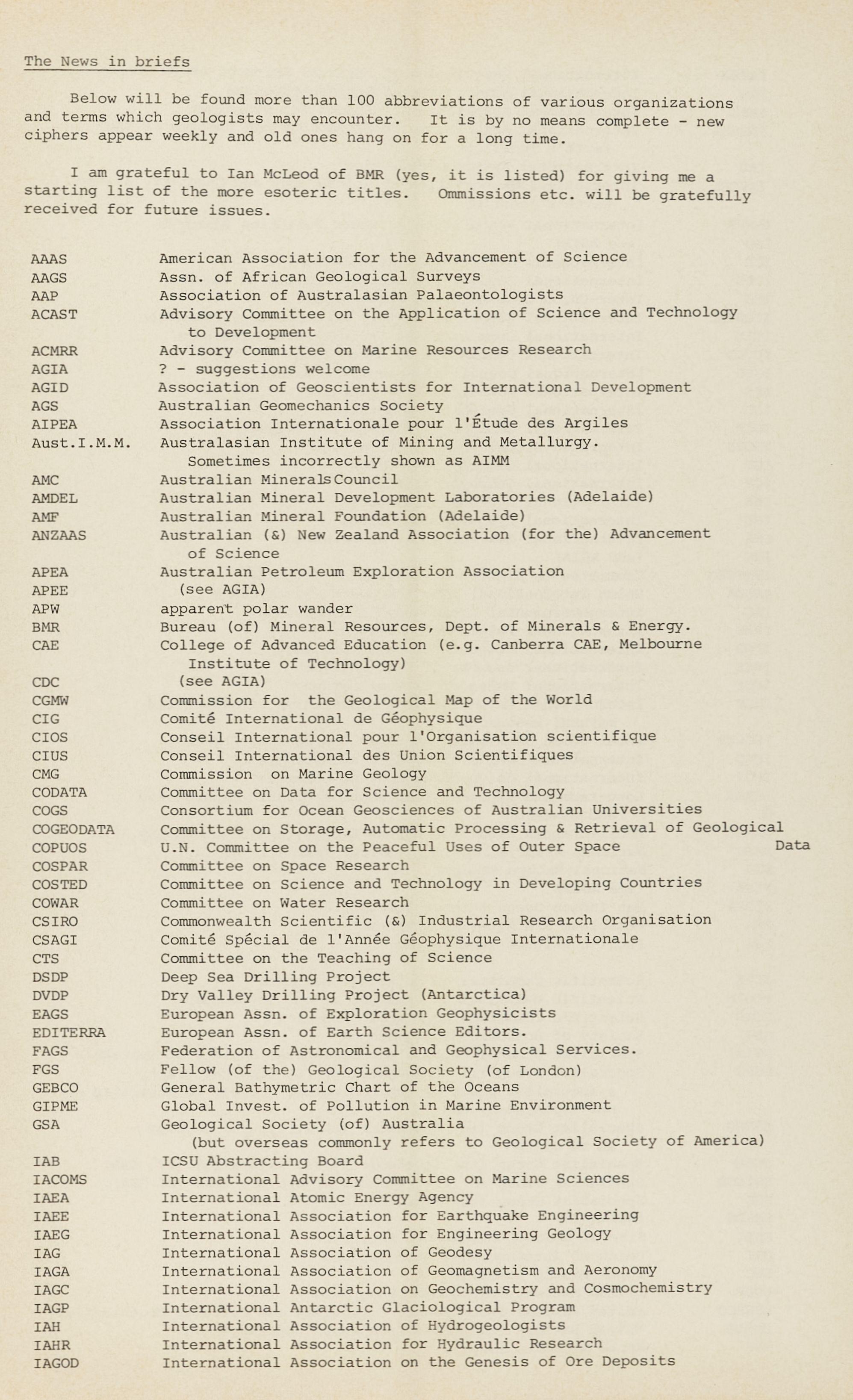
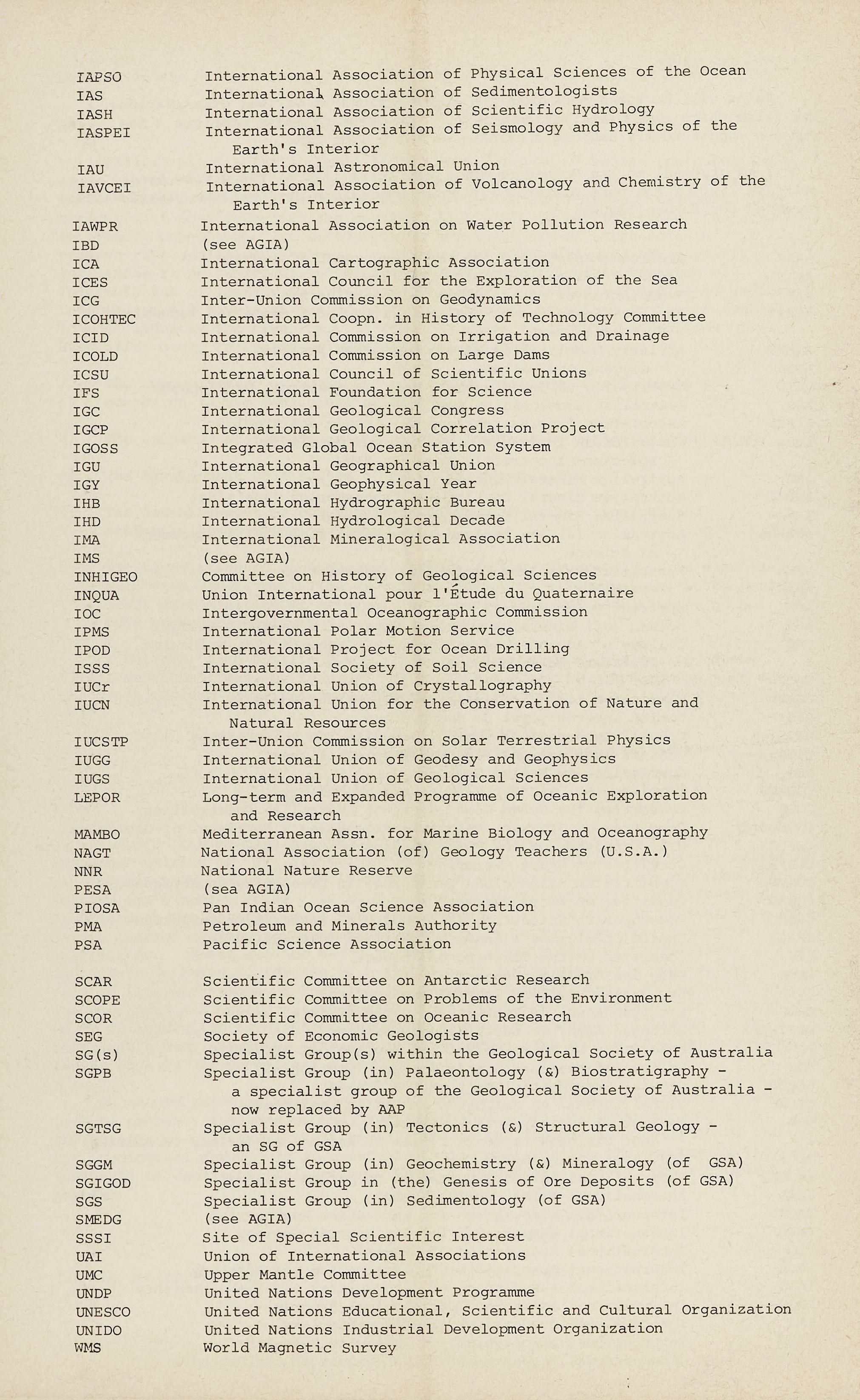
Below will be found more than 100 abbreviations of various organizations and terms which geologists may encounter. It is by no means complete - new ciphers appear weekly and old ones hang on for a long time.
I am grateful to Ian McLeod of BMR (yes, it is listed) for giving me a starting list of the more esoteric titles. Ommissions etc will be gratefully received for future issues.
AAAS
AAGS
AAP ACAST
ACMRR
AGIA
AGID
AGS
AIPEA
Aust.I.M.M.
AMC AMDEL
AMF
ANZAAS
APEA
APEE
APW
BMR
CAE
CDC CGMW
CIG
CIOS
CIUS
CMG
CODATA
COGS
COGEODATA
COPUOS
COSPAR
COSTED
COWAR
CSIRO
CSAGI
CTS
DSDP
DVDP
EAGS
EDITERRA FAGS FGS
GEBCO
GIPME
GSA
IAB
IACOMS
IAEA
IAEE
IAEG
IAG
IAGA
IAGC
IAGP
IAH
!AHR
IAGOD
American Association for the Advancement of Science
Assn. of African Geological Surveys
Association of Australasian Palaeontologists
Advisory Committee on the Application of Science and Technology to Development
Advisory Committee on Marine Resources Research ? - suggestions welcome Association of Geoscientists for International Development
Australian Geomechanics Society
Association Internationale pour l'Etude des Argiles Australasian Institute of Mining and Metallurgy. Sometimes incorrectly shown as AIMM
Australian Minerals Council
Australian Mineral Development Laboratories (Adelaide)
Australian Mineral Foundation (Adelaide)
Australian (&) New Zealand Association (for the) Advancement of Science
Australian Petroleum Exploration Association (see AGIA)
apparen~ po la r wander
Bureau (of) Mineral Resources, Dept. of Minerals & Energy College of Advan ced Education (e.g. Canberra CAE, Melbourne Institute of Technology) (see AGIA)
Commission for the Geological Map of the World Comite International de Geophysique
Conseil International pour l'Organisation scientifique
Conseil International des Union Scientifiques
Commission on Marine Geology
Committee on Data for Science and Technology
Consortium for Ocean Geosciences of Australian Universities
Committee on Storage, Automatic Proces sing & Retrieval of Geological U N Committee on the Peaceful Uses of Outer Space Data
Committee on Space Research
Committee on Science and Technology in Developing Countries
Committee on Water Research
Commonwealth Scientific (&) Industrial Research Organisation
Comite Special de l ' Annee Geophysique Internationale
Committee on the Teaching of Science
Deep Sea Drilling Project
Dry Valley Drilling Project (Antarctica)
European Assn . of Exploration Geophysicists
European Assn. of Earth Science Editors. Federation of Astronomical and Geophysical Services.
Fellow (of the) Geological Society (of London)
General Bathymetric Chart of the Oceans
Global Invest. of Pollution in Marine Environment
Geological Society (of) Australia (but overseas commonly refers to Geological Society of America)
!CSU Abstracting Board
In tern ational Advisory Committee on Marine Sciences
International Atomic Energy Agency
International Associ atio n for Earthquake Engineering
International Association for Engineering Geology
International Association of Geodesy
International Association of Geomagnetism and Aeronomy
International Association on Geochemistry and Cosmochemistry
International Antarctic Glaciological Program
International Association of Hydrogeologists
International Association for Hydraulic Research
International Association on the Genesis of Ore Deposits
IAPSO
IAS
IAS H
IASPEI
IAU IAVCEI
IAWPR
IBD
ICA
ICES
ICG
ICOHTEC
ICID
ICOLD
ICSU
IFS
IGC
IGCP
IGOSS IGU
IGY
IHB
IHD IMA
IMS
INHIGEO INQUA
IOC IPMS
IPOD ISSS IUCr
IUCN
IUCSTP
IUGG
IUGS
LEPOR
MAMBO
NAGT
NNR
PESA
PIOSA
PMA
PSA
SCAR
SCOPE
SCOR
SEG
SG(s)
SGPB
SGTSG
SGGM
SGIGOD
SGS
SMEDG
SSSI
UAI
UMC
UNDP
UNESCO
UNIDO
WMS
Int ernationa l Association of Physical Sciences of the Ocean
International. Association of Sedimentologists
International Association of Scientific Hyd rology
International Association of Seismology and Physics of the Earth's Interior
International Astronomical Union
International Association of Volcanology and Chemistry of the Earth's Interior
International Association on Water Pollution Research (see AGIA)
International Cartographic Association
International Council for the Exploration of the Sea
Inter-Union Commission on Geodynamics
International Coopn. in History of Technology Committee
International Commission on Irrigation and Drainage
International Commission on Larg e Dams
International Council of Scientific Unions
International Foundation for Science
International Geological Congress
International Geological Correlation Project
Integrated Global Ocean Station System
International Geographical Union
International Geophysical Year
International Hydrographic Bureau
International Hydrological Decade
International Mineralogical Association (see AGIA)
Committee on History of Geological Sciences
Union International pour l'Etude du Quaternaire
Intergovernmental Oceanographic Commission
International Polar Motion Service
International Project for Ocean Drilling
International Society of Soil Science
International Union of Crystallography
International Union for the Conservation of Nature and Natural Resources
Inter-Union Commission on Solar Terrestri al Physics
International Union of Geodesy and Geophysics
International Union of Geological Sciences
Long-term and Expanded Programme of Oceanic Exploration and Research
Mediterranean Assn. for Marine Biology and Oceanography
National Association (of) Geology Teachers (U.S.A.)
National Nature Reserve (sea AGIA)
Pan Indian Ocean Science Association
Petroleum and Minerals Authority
Pacific Science Association
Scientific Committee on Antarctic Research
Scientific Committee on Problems of the Environment
Scientific Committee on Oceanic Research
Society of Economic Geologists
Specialist Group(s) within the Geological Society of Australia
Specialist Group (in) Palaeontology (&) Biostratigraphya specialist group of the Geological Society of Australianow replaced by AAP
Specialist Group (in) Tectonics (&) Structural Geologyan SG of GSA
Specialist Group (in) Geochemistry (&) Mineralogy (of GSA)
Specialist Group in (the) Genesis of Ore Deposits (of GSA)
Specialist Group (in) Sedimentology (of GSA) (see AGIA)
Site of Special Scientific Interest
Union of International Associations
Upper Mantle Committee
United Nations Development Programme
United Nations Educational, Scientific and Cultural Organization
United Nations Industrial Development Organization
World Magnetic Survey