POSTING AS A PUBLICATIONCATEGORY B
Newsletter Editor :
D F.
Dept.
Branagan ,
of Geology & Geophysics, The University of Sydney, N S.W 2006.
Phone: (02) 692 2358 or 692 2912
Society Secretar.y
S. M· Bye, Exploration Department , Broken Hill Co Pty. Ltd., G P.O. Box 86A Melbourne . Victoria 3001
Phone: (03) 609 3402
THE PRESIDENT I S PAGE
In a Letter to the Editor in Newsletter No. 25 Dr. P.E. Power makes a number of forcibly expressed criticisms of the document " A Geological Science Policy for Australia " drawn up by the Society Since I have used this page in the 0 pas t to plead wit h members to make their views on Society initiatives known to t h e Society then I can only welcome in principle the publication of his letter. However I must admit to some irritation that the force of his expression is only matched by an apparent lack of appreciation of just what this Society has achieved and is trying to achieve for the benefit of the geological community.
Although the Geological Society of Australia is essentially a learned scientific society, it has been extremely active in promoting the professional interests of the geological community From 1970 until 1977 the Society waged a vigorous and very nearly successful campaign for state and/or federal registration of professional geologists. After these efforts finally failed in 1977 the Society set up a Professional and Legislation Committee with Colin Adamson as Co n vener to examine alternative schemes for the establishment of some form of institute of professional geologists His proposals will be a major item for discussion at the Council Meeting in Hobart in January 1980. Until a professional institute or an even broader Australian Geoscience Council type , of organisation is established, this Society wil l continue to support the interests of our profession - and for that we make no apologies to anyone
If Dr. Power had taken the trouble to learn something of th e background to the geoscience policy document he would have discovered that it was p r epared at the specific request of the Liberal Party Standing Committee on Federal Policy in Science and Technology. The Society's last meeting of Council in Townsville directed that such a policy document should be prepared and sent to the policy committees of each political party represented in the Federal Parliament and in each State Parliamen t. A number of versions were prepared and widely distributed for comment to all Divisions and Specialist Groups. It is of some concern to me that Dr. Power did not make the effo r t at these formative stages to put his point of view forward for considera t ion If he had done so then the result would have been more productive t h a n t he venting of spleen in a Letter to the Editor.
There is probably little to be gained i n getting into a slugging match over every critical point he has made on the basis of his own personal bias or even ignorance. Indeed he has set up suc h a windmill of pun ches t h at it is extremely difficult to · retaliate on all points in the space available h ere But I would want to emphasize the point that every member of the Society has a fundamental right to put forward personal views on Society initiatives. At the same time they also have a responsibility to see that their views are considered either within their own divisional and specialist group affiliations or else within the Executive In this way - and only in this way - the Society will b e able to formulate policies which are as widely representative of membership views as is possible
John Lovering
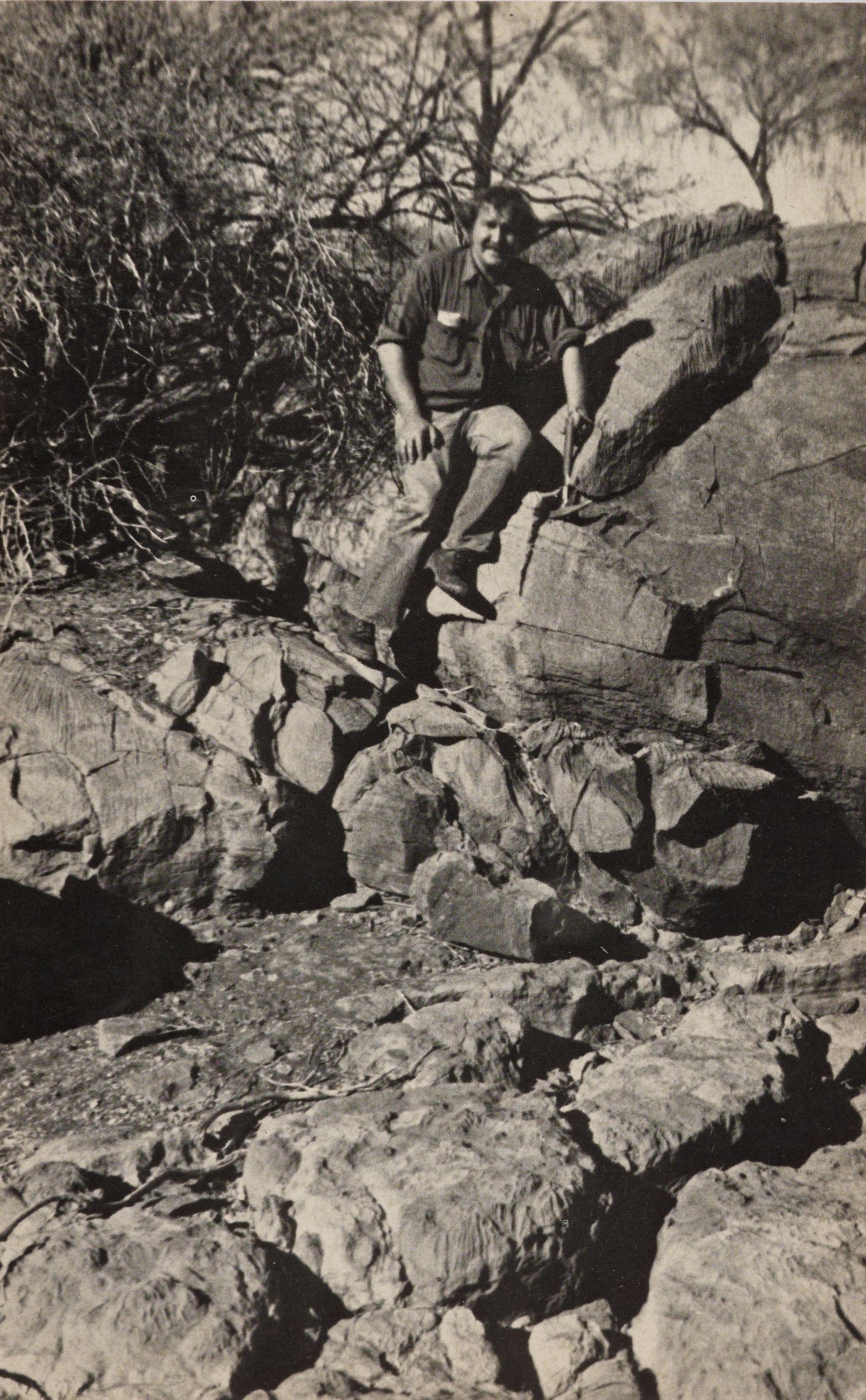
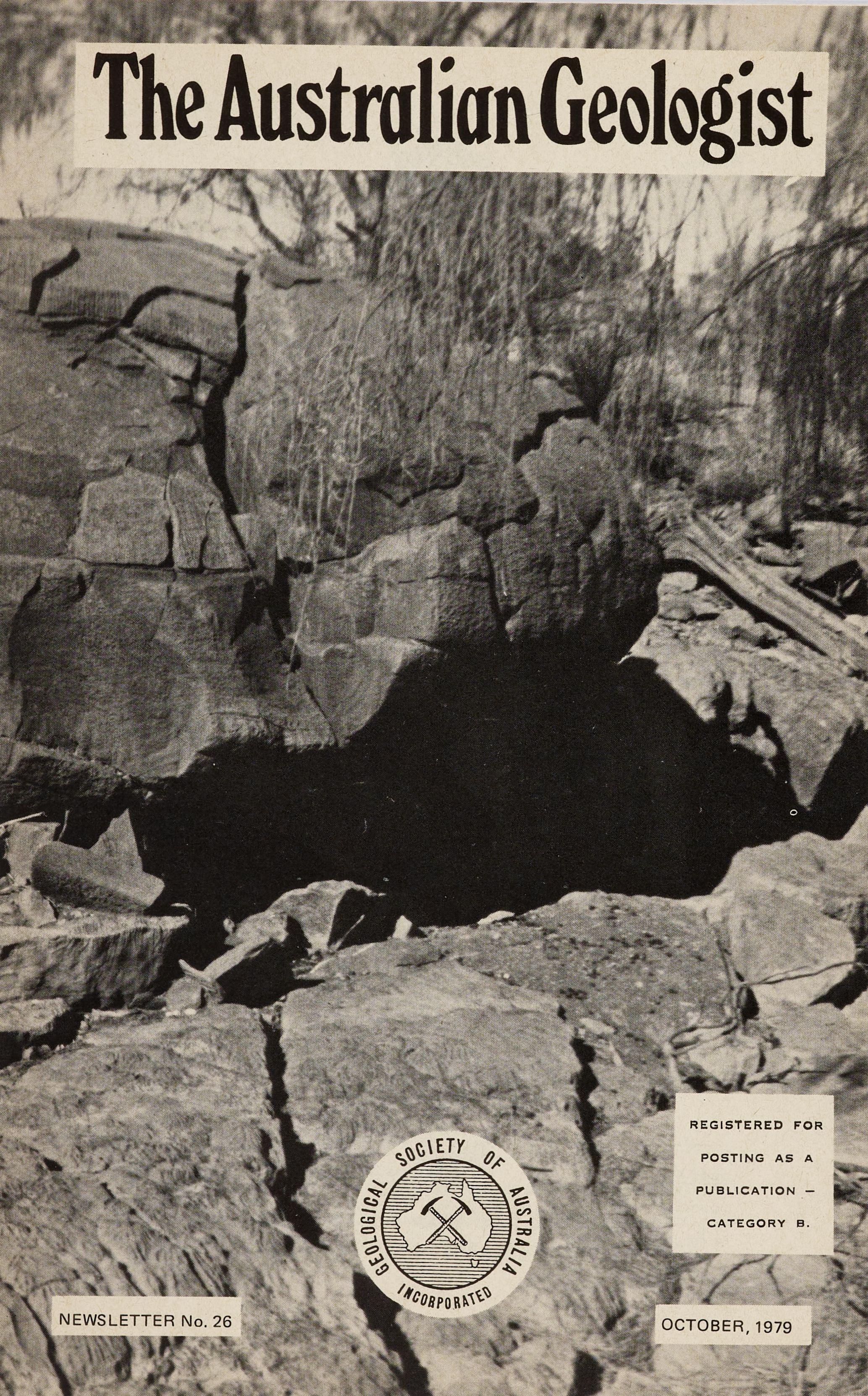
Cover Photo: Single stromatolite colony , weath e red out of the Lower Proterozoic Kulele Creek Limestone, Earaheedy Sub - Basin , 180 km E NE. of Wiluna W.A. (See G.S.W.A Ann Report 1976).
Photo by Jim Reeve who does not identify the weathered vertebrate attached to the colony
Editorial
The President's page points out that the Society has been active for some years now in promoting the professional interests of the geological community. The Australian Geologist has acted as a source of information on such interests but does not seem to have provoked much controversy on these matters .
A number of feop le have apparently poked the propo sed POGG, though not in these pages, and it proposes now to perpetuate itself as APG. A considerable part of this issue is devoted to ideas on the formation of a professional association and it is in the interests of all geologists to evaluate the ideas now, rather than leaving it till it is too late. The editor would welcome what unfortunately can no longer be called POGG feedback, so would the proposers.
John Casey in another article draws attention to a formal geosciences link with other nations in South-east Asia. The net- work offers the opportunity for all branches of geoscience, and speciall y industry, to give help before we get immersed in another boom and bust period.
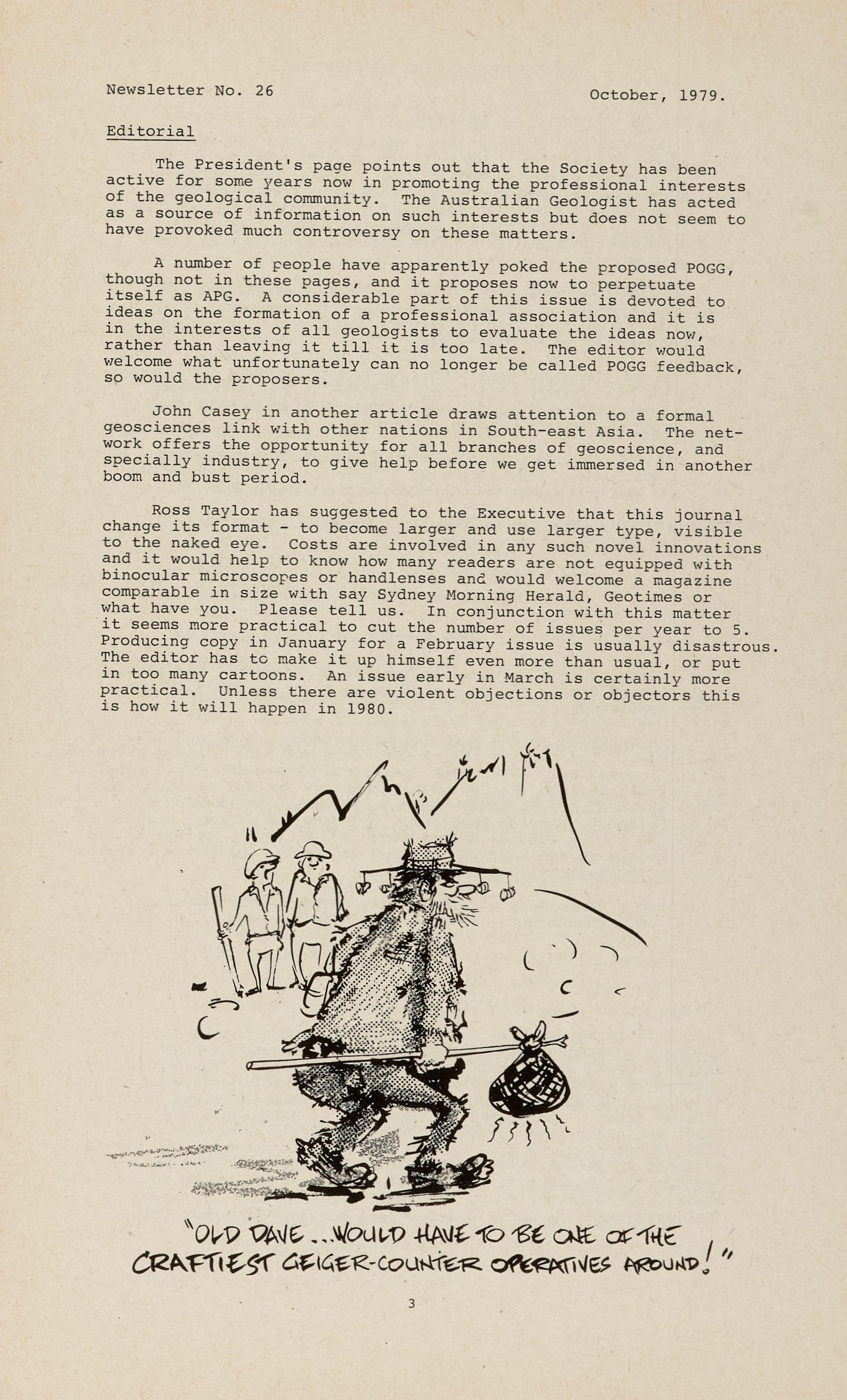
Ross Taylor has suggested to the Executive that this journal change its format - to become larger and use larger type, visible to the naked eye. Costs are involved in any such novel innovations and it would help to know how many readers are not equipped with binocular microscopes or handlenses and would welcome a magazine comparable in size with sa y Sydney Morning Herald, Geotimes or what have y ou. Please tell us. In conjunction with this matter it seems more practical to cut the number of issues per year to 5. Producing copy in January for a February issue is usually disastrous. The editor has to make it up himself even more than usual, or put in too many cartoons. An issue early in March is certainly more practical. Unless there are violent objections or objectors this is how it will happen in 1980.
LETTERS TO THE EDITOR
POGG poor APG approved
With Geologists it's clear that a rose by any other name don't smell the same! One of the criticisms that the Committee has tried to overcome is the fact that the name, P.O.G.G., wasn't appreciated and so, in a truly democratic way, they have suggested that the organization now becomes "Association of Professional Ge oscientists" (A.P.G.) This also means that Geologist, Geophysicist will be replaced by Geoscientist - a term which automatically covers the geochemi st.
The Committee has examined all written suggestions and also, the views expressed at the Seminar at Sydney University on August 9. Thus, the Memorandum and the Articles have been modified and again presented to you for final comment.
The most significant modification has been to include a non corporate grade of membership to be called, Graduate, so that Geoscientists who have obtained the necessary Tertiary Education can join even though they haven't qualified by experience.
You will note that proposed fees are now included in the Articles of Association. Those of you who forwarded $5 to show your interest will have this amount deducted from the first annual subscription.
We thank you for your co-operation and please continue to give your criticism or encouragement.
\ EGG on AGS
K. R. GLASSON BEECROFT. 0 NSW. 2119.
Sir,
I am concerned at your publica.f\on _ of a slanted and incorrect statement of G.S.A . policy contained in F. R. Gord9n's letter (June Newsletter).
The question of the relationship between G.S.A. and A.G.S. is undecided. The fact is that A.G.S. have NOT made a clear statement of their position. When that does occur it should be presented to the Society through the Engineering Geology Specialist Group which has written to A.G.S. seeking their opinions. I challenge F. R. Gordqn to p rovide the names of Geologists who are mewbers of A.G.S. as I have serious doubts about A.G.S. being representative of the v iews of the many Engineering Geologists with whom I correspond on professional matters. ,
Lastly membership of E.G.G. does not preclude membership o f A.G.S. and consequently a more broadminded view by A.G.S. is needed.
E. J. Minty. E.G.G. Chairman
Sir,
AGS on EGG
I full y support Mr. F. R. Gordon's concern that G.S.A. did not become a co-sponsor of the Australian Geomechanics Society, but instead formed a specialist group within G.S.A. The Geomechanics Society is a forum where exper~s in the engineering aspects of earth science - whether en g ineers or geologists - may hear antl read each others' v iews. Too often, in the past, I have heard the statement "that engineers take no notice Of geologists". Perhaps soalthough there are a fair number who do It seems to me that the engineering geologists of our learned Society could become less insular than our mental picture of engineers, and fully support the Australian Geomechanics Society and, perhaps, talk to engineers. The latter are, in fact, qu i te decent and knowledgeable folk.
W. R. MORGAN, Perth (former Vice-President, Australian Geomechanics Society, Perth Branch)
PROPOSED PROFESSIONAL ORGANISATION
PREAMBLE TO SECOND DRAFT OF MEMORANDUM AND ARTICLES OF ASSOCIATION
C. L. Adamson · Convener Professional and Legislation Committee
This second draft of Memorandum and Articles for a professional organisation has been produced after much comment on the first draft b y numerous respondents. The majorit y of respondents agreed in principle with the draft but were critical o f v arious features A minorit y considered that the proposed organisation would be unnecessar y and that the functions could be carried out by G S.A either in its present form or in a restructured form. It obviously has been impossible to satisf y all the critics, and changes have been made where the strongest feelings representing reasonable numbers have been evident. Many of the changes have been minor , but important , and some basic changes are also included
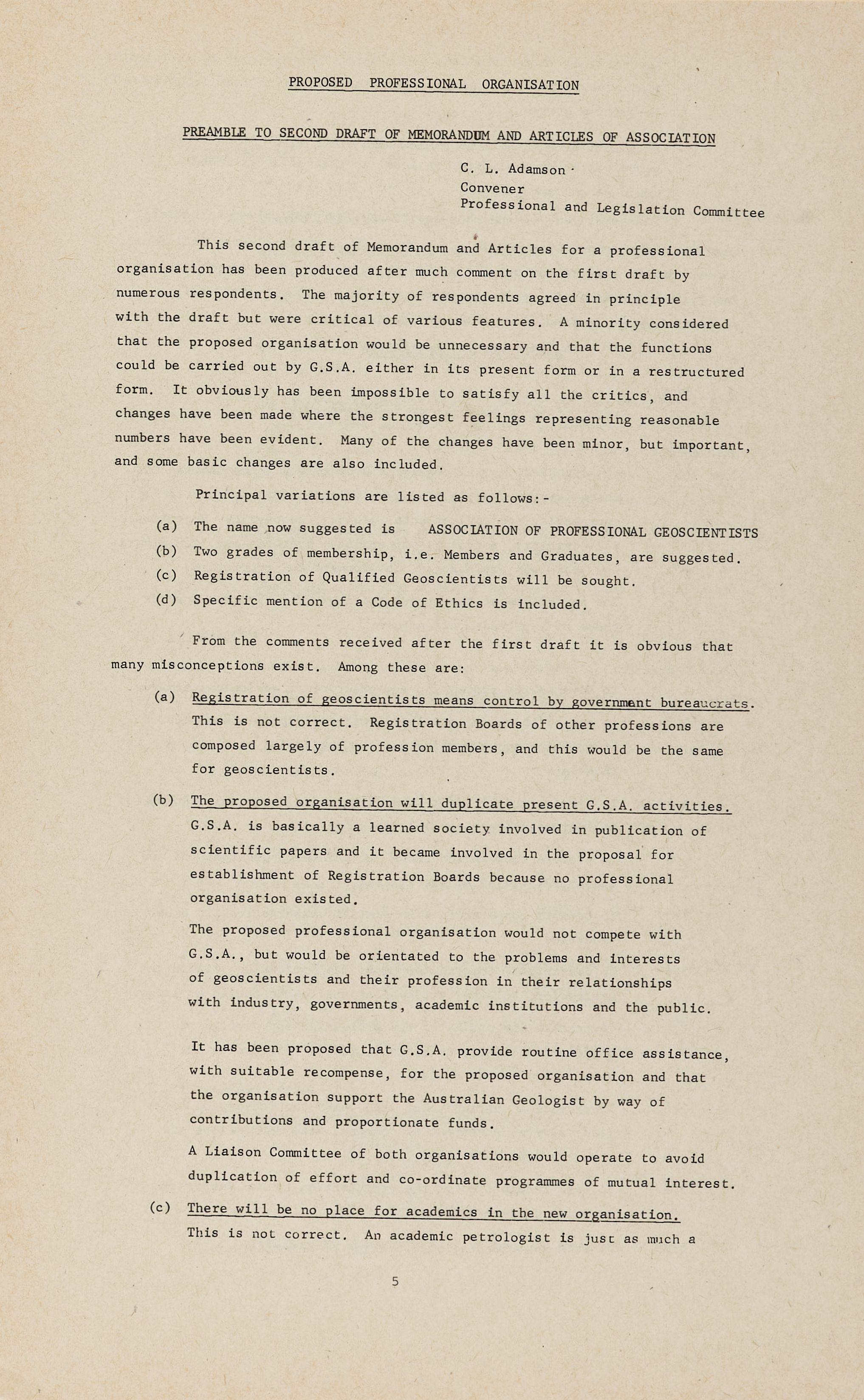
Principal variations are listed as follows : -
(a)
(b)
(c)
(d)
The name now suggested is ASSOCIATION OF PROFESSIONAL GEOSCIENTISTS
Two grades of membership, i.e Members and Graduates, are suggested. Registration of Qualified Geoscientists will be sought. Specific menti o n o f a Code of Ethics is included
' From the comments recei v ed after the first draft it is obvious that many misconceptions exist. Among these are:
(a) Registration of geoscientists means control by government bureaucrats This is not correct. Registration Boards of other pro f essions are composed largely of profess ion members, and this would be the same for geoscientists.
(b) The proposed organisation will duplicate present G.S . A. activities
G.S A is basicall y a learned society involved in publication of scientific papers and it became involved in the proposal for establishment of Registration Boards because no professional organisation e x isted.
The proposed professional organisation would not compete with G.S.A., but would be orientated to the problems and interests of geoscientists and their profession in their relationships with industry, governments , academic institutions and the public.
It has been proposed that G.S A. provide routine office assistance, with suitable recompense, for t h e proposed organisation and that the organisatio n support the Australian Geolo g ist b y way o f contributions and proportionate funds.
A Liaison Committee of both organisations would operate to avoid duplication of effort and co-ordinate programmes of mutual interest.
(c) There will be no place for academics in the new organisation. This is not c o rrect. An academic petrologist is jusc as mnch a
professional as a consultant petrologist. However, it is anticipated that membership will comprise a greater proportion from industry ancl consulting groups.
(d) .!.~--~~~~ir,i,ed to exclude foreign ~~<:..~~t_i:_~~ Any overseas geoscientist of qualifical:ioP. equal to · that of local members would be welcome.
'!'hanks ace due to the many individuals and groups who submitted comments. It has n~!: l.:een possible to answer these letters on an individual basis. In the prep:;iration of this draft there ha ,, been full cooperation with Ken Glassoa a,d Lindsay Ingall and thanks are du •'- to them for strongly representing the applied side oE the p:-:ofession.
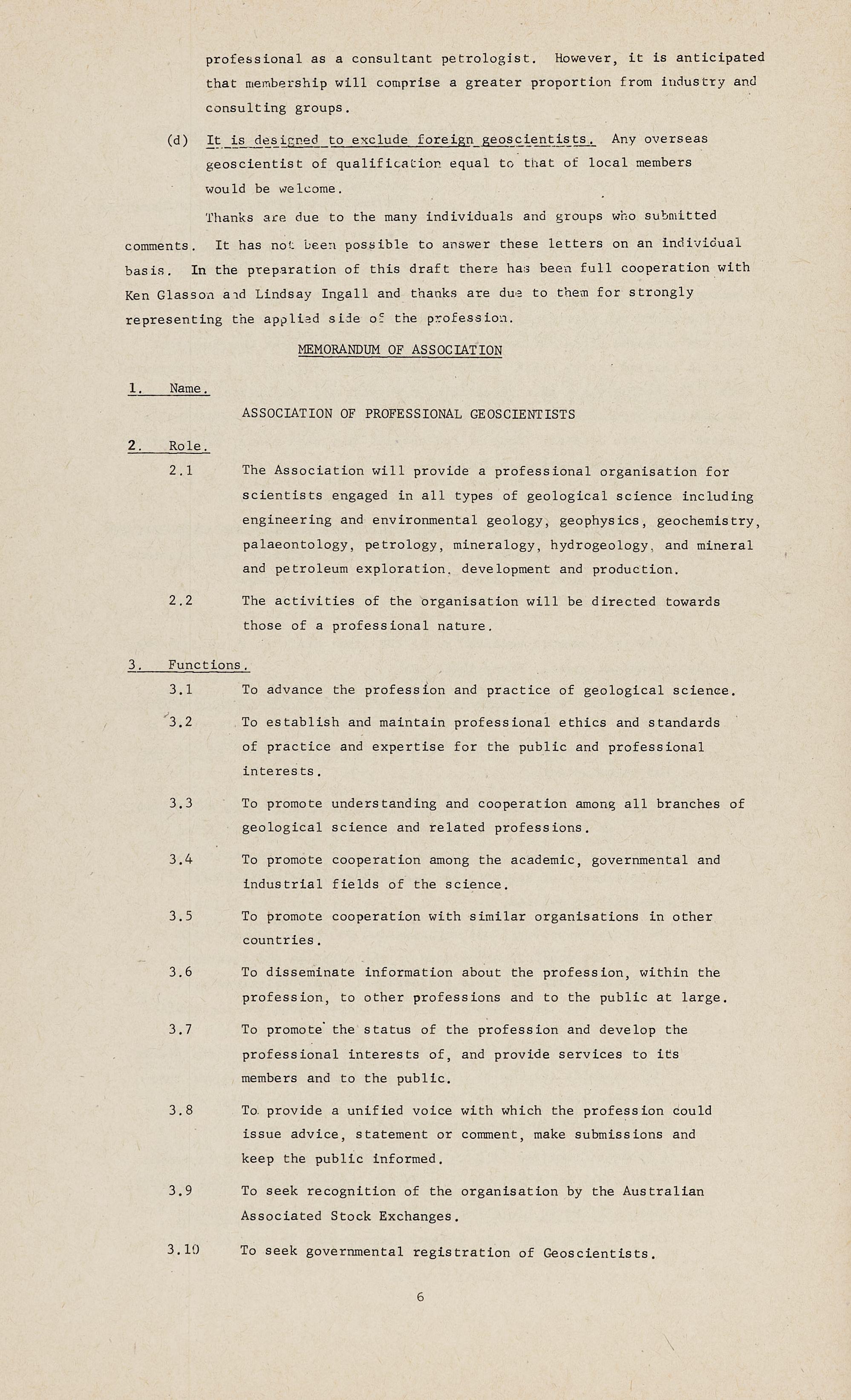
MEMORANDUM OF ASSOCIATION
1. Name.
2. Role.
ASSOCIATION OF PROFESSIONAL GEOSCIENTISTS
2. 1 The Association wil 1 provide a professional organisation for scientists engaged in all types of geological science including engineering and environmental geology, geophysics, geochemistry, palaeontology , petrology, mineralogy, hydrogeology , and mineral and petroleum exploration. development and produc•tion.
2.2 The activities of the organisation will be directed towards those of a professional nature.
3. Functions.
3 .1 To advance the profess ion and practice of geological scienae.
"3.2 To establish and maintain professional ethics and standards of practice and expertise for the public and professional interests.
3.3 To promote understanding and cooperation arnonl?; all branches of geological science and related professions.
3.4 To promote cooperation among the academic, governmental and industrial fields of the science.
3. 5 To promote cooperation with similar organisations in other countries.
3.6 To disseminate information about the profession, within the profession, to other professions and to the public at large.
3. 7 To promote· the status of the profession and develop the professional interests of, and provide services to its members and to the public.
3.8 To provide a unified voice with which the profession could issue advice, statement or comment, make submissions and keep the public informed.
3. 9 To seek recognition of the organisation by the Australian Associated Stock Exchanges.
3.10 To seek governmental registration of Geoscientists. \
ARTICLES OF ASSOCIATION
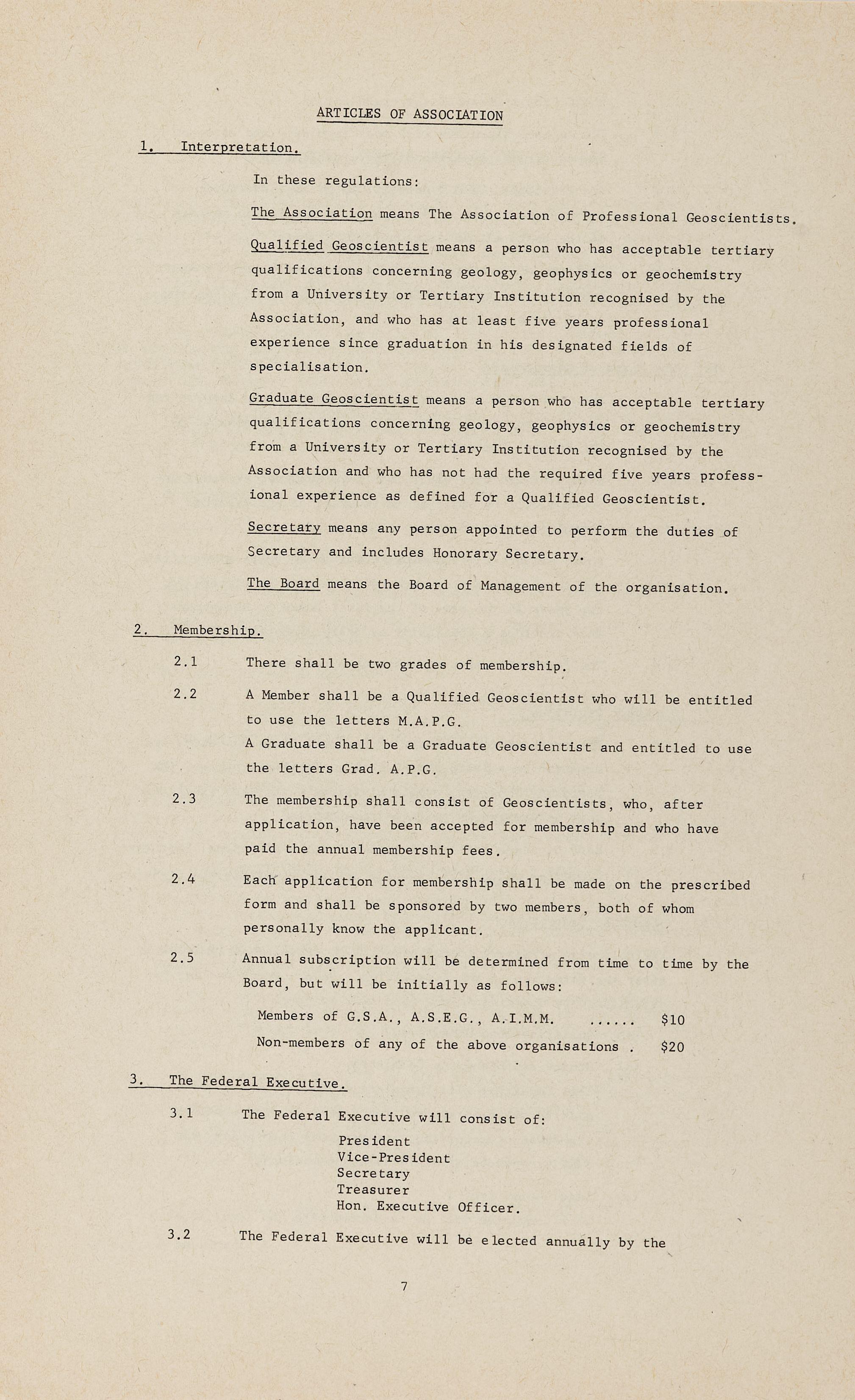
1.
Interpretation.
In these regulations:
The Association means The Association of Professional Geoscientists. ~ified Geoscientist means a person who has acceptable tertiary qualifications concerning geology, geophysics or geochemistry from a University or Tertiary Institution recognised by the Association, and who has at least five years professional experience since graduation in his designated fields of specialisation.
Graduate Geoscientist means a person who has acceptable tertiary qua lif ica t ions concerning geology, geophysics or geochemistry from a University or Tertiary Institution recognised by the Association and who has not had the required five years professional experience as defined for a Qualified Geoscientist.
Secretary means any person appointed to perform the duties of Secretary and includes Honorary Secretary.
The Board means the Board of Management of the organisation.
2. Membership.
2.1 There shall be two grades of membership.
2 2 A Member shall be a Qualified Geoscientist who will be entitled to use the letters M.A P.G.
A Graduate shall be a Graduate Geoscientist and entitled to use the letters Grad. A P.G
2 . 3 The membership shall consist of Geoscientists, who, after application, have been accepted for membership and who have paid the annual membership fees.
2.4 Each' application for membership shall be made on the prescribed form and shall be sponsored by two members, both of whom personally know the applicant.
2. 5 Annual subs_cription will be determined from time to time by the Board, but will be initially as follows:
Members of G.S A., A.S.E.G., A.I.M.M. $10
Non-members of any of the above organisations $20
3. The Federal Executive.
3.1 The Federal Executive will consist of: President Vice-President Secretary Treasurer Hon. Executive Officer.
3.2 The Federal Executive will be elected annually by the
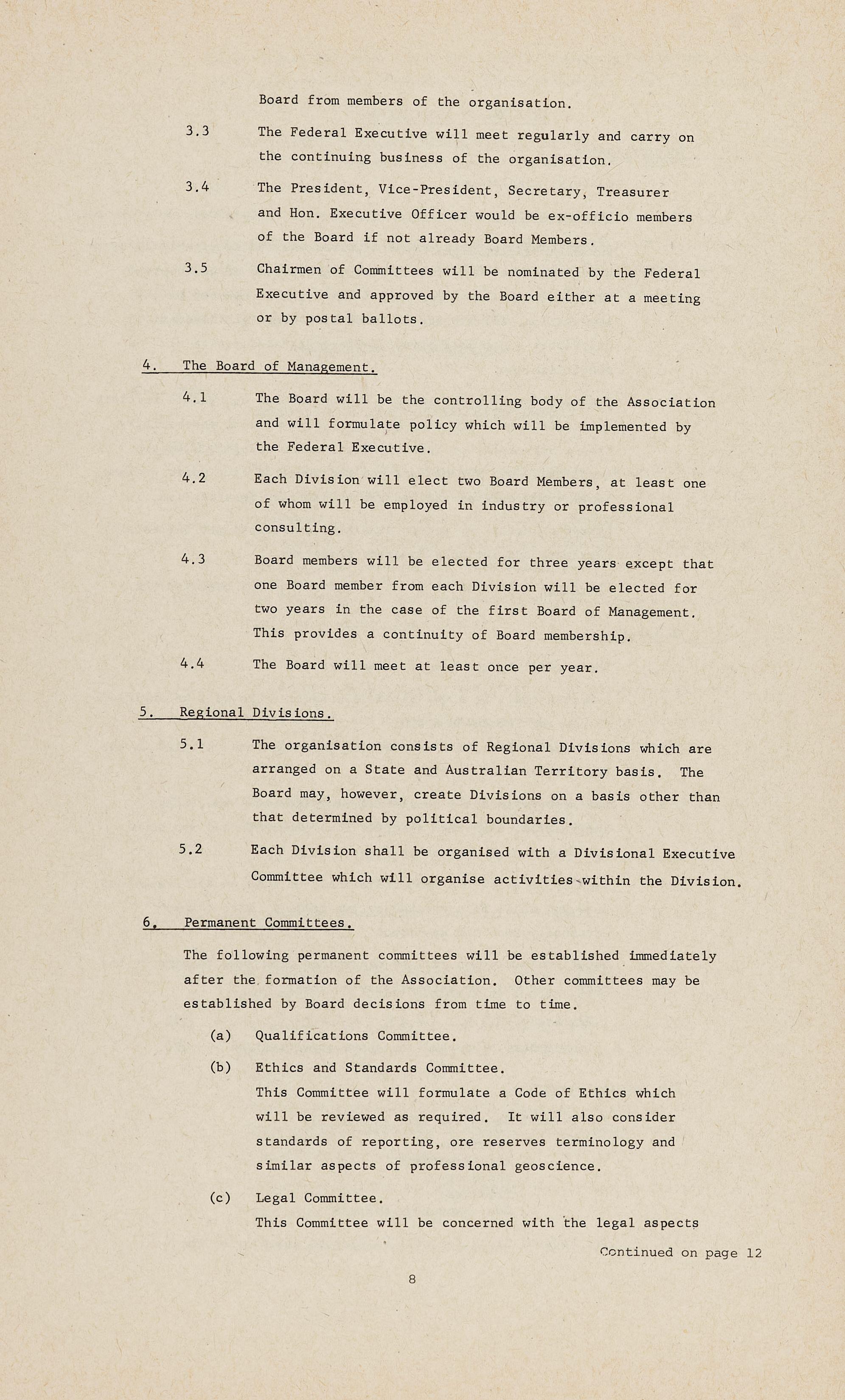
Board from members of the organisation.
3 , 3 The Federal E xecutive will meet regularly and carry on the continuing business of the organisation.
3.4 The President, Vice-President , Secretar y , Treasurer and Hon. Executive Officer would be ex-officio members of the Board if not alread y Board Members.
3. 5 Chairmen of Commit tees will be nominated by the Federal Executive and approved b y the Board either at a meeting or b y postal ballots.
4. The Board of Management.
4.1 The Board will be the controlling bod y of the Association and will formula ,te policy which will be implemented by the Federal Executive.
4 , 2 Each Div ision ' will elect two Board Members, at least one of whom will be employed in industr y or professional consulting,
4. 3 Board members will be elected for three years · e xcept that one Board member from each Div ision will be elected for two years in the case of the f irst Board of Management, This pro v ides a continuity of Board membership,
4 , 4 The Board will meet at least once per year.
5. Regional Div isions.
5. 1 The organisation consists of Regional Divis ions which are arranged on a State and Australian Territory bas is. The Board may, however, create Di v is ions on a bas is other than that determined by political boundaries.
5. 2 Each Div is ion shall be organised with a Divisional Executive Committee which will organise activities - within the Division.
6,
Permanent Committees.
The following permanent committees will be established immediately after the fo rmation of the Association. Other committees may be established by Board decisions from time to time.
(a) Qualifications Committee.
(b) Ethics and Standards Committee. This Committee will formulate a Code of Ethics which will be reviewed as required. It will also consider standards of repor t in g , ore reser v es terminolo gy and similar aspects of professio n al g eoscience.
(c) Leg a 1 Commit tee
This Committee will be concerned with "the legal aspect~ Continu e d on page 12
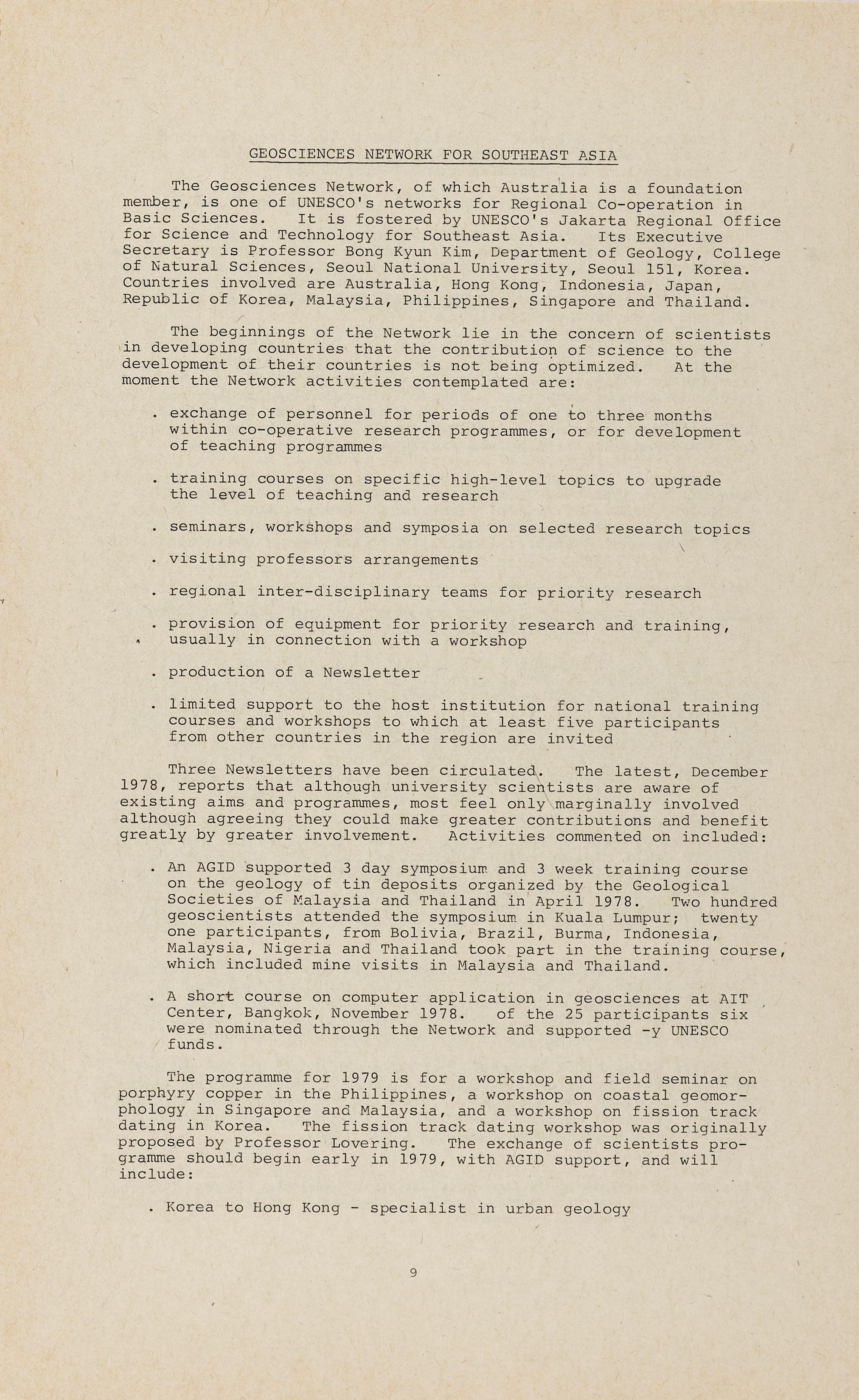
GEOSCIENCES NETWORK FOR SOUTHEAST ASIA
The Geosciences Network, of which Australia is a foundation mewber, is one of UNESCO's networks for Regional Co - operation in Basic Sciences. It is fostered by UNESCO's Jakarta Regional Office for Science and Technology for Southeast Asia. Its Executive Secretary is Professor Bong Kyun Kim, Department of Geology, College of Natural Sciences, Seoul National University, Seoul 151, Korea. Countries involved are Austra l ia, Hong Kong , Indonesia, Japan, Republic of Korea, Malaysia, Philippines, Singapore and Thailand.
The beginnings of the Network lie in the concern of scientists in developing countries that the contribution of science to the development of their countries is not being optimized At the moment the Network activities contemplated are:
exchange of personnel for periods of one to three months within co - operative research programmes , or for development of teaching programmes
training courses on specific high-level topics to upgrade the level of teaching and research
seminars, workshops and symposia on selected research topics \ visiting professors arrangements
regional inter-disciplinary teams for priority research
provision of equipment for priority research and training, usually in connection with a workshop
production of a Newsletter
limited support to the host institution for national training courses and workshops to which at least five participants from other countries in the region are invited
Three Newsletters have been circulate~. The latest, December 1978, reports that although university scientists are aware of existing aims and programmes, most feel only marginally involved although agreeing they could make greater contributions and benefit greatly by greater involvement. Activities commented on included:
An AGID supported 3 day symposium and 3 week training course on the geology of tin deposits organized by the Geological Societies of ~alaysia and Thailand in April 1978. Two hundred geoscientists attended the symposium in Kuala Lumpur; twenty one participants, from Bolivia, Brazil, Burma, Indonesia, Malaysia, Nigeria and Thailand took part in the training course, which included mine visits in Malaysia and Thailand.
A short course on computer application in geosciences at AIT Center, Bangkok, November 1978. of the 25 participants six were nominated through the Network and supported -y UNESCO funds.
The programme for 1979 is for a workshop and field seminar on porphyry copper in the Philippines, a workshop on coastal geomor- phology in Singapore and Malaysia, and a workshop on fission track dating in Korea. The fission track dating workshop was originally proposed by Professor Lovering. The exchange of scientists programme should begin early in 1979, with AGID support, and will include:
Korea to Hong Kong - specialist in urban geology
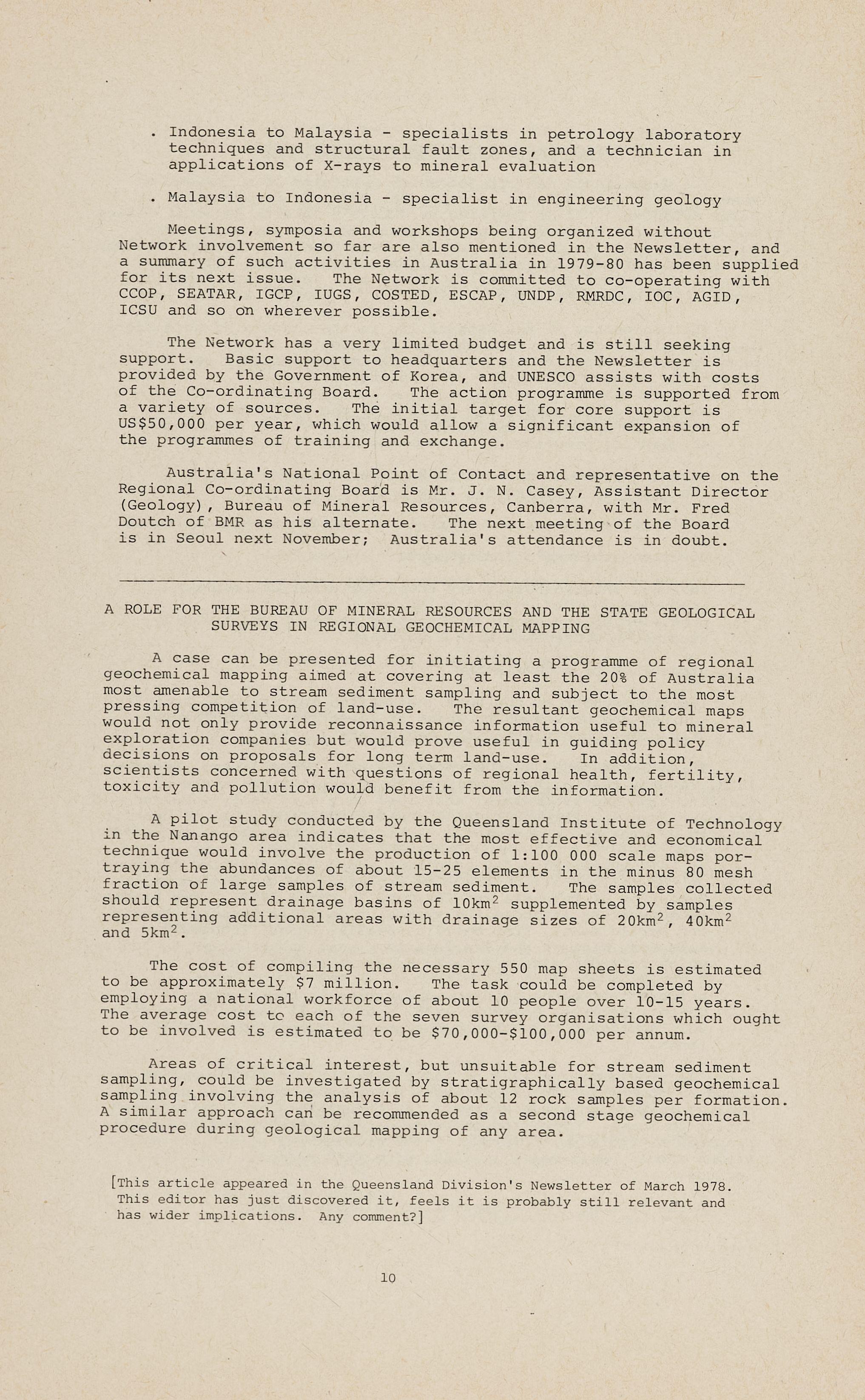
Indonesia to Malaysia - specialists in petrology laboratory techniques and structural fault zones, and a technician in applications of X-rays to mineral evaluation
Malaysia to Indonesia - specialist in engineering geology
Meetings, symposia and workshops being organized without Network involvement so far are also mentioned in the Newsletter , and a summar y of such activities in Australia in 1979-80 has been supplied for its next issue. The Network is committed to co-operating with CCOP, SEATAR, IGCP, IUGS, COSTED , ESCAP, UNDP , RMRDC , roe, AGID, ICSU and so on wherever possible.
The Network has a v ery limited budget and is still seeking support. Basic support to headquarters and the Newsletter is provided by the Government of Korea , and UNESCO assists with costs of the Co-ordinating Board. The action programme is supported from a variety of sources. The initial target for core support is US$50,000 per year, which would allow a significant expansion of the programmes of training and exchange.
Australia's National Point of Contact and representative on the Regional Co-ordinating Boar'd is Mr. J. N. Casey, Assistant Director (Geology), Bureau of Mineral Resources, Canberra, with Mr. Fred Doutch of BMR as his alternate. The next meeting of the Board is in Seoul next November; Australia's attendance is in doubt.
A ROLE FOR THE BUREAU OF MINERAL RESOURCES AND THE STATE GEOLOGICAL SURVEYS IN RE GIONAL GEOCHEMIC AL MAPPING
A cas e can be p resented for initiating a programme of regional g eochemical map p ing aimed at covering at least the 20 % of Australia most amenable to stream sediment sampling and subject to the most pressing competi~ion of land-use. The resultant geochemical maps would not only p rovide reconnaissance information useful to mineral e x ploration companies but would pro v e use f ul in guiding polic y decisions on proposals f or long term land-use. In addition, scientists concerned with questions of regional health , fertility, toxicity and pollution would benefit from the information.
A pilot study c o nducted b y the Queensland Institute of Technolog y in th e Nanango area i n dicates that the most e ff ective and economical t e c h niqu e would in v olve the production o f 1:100 000 scale maps por- tra y ing the abundances o f about 15-25 elements in the minus 80 mesh f raction o f lar g e samples of stream sediment. The samples collected should represent d r ainage basins of 10km 2 supplemented by samples representin g additional areas with drainage sizes of 20km 2 , 40km 2 and 5km 2
The cost o f compilin g the necessar y 550 map sheets is estimated to be approximatel y $7 million. The task could be completed by emplo y ing a nation a l wor kf orce of a b out 10 people over 10 -1 5 y ears. Th e a v erage cost t c ea c h o f t he se ve n sur v e y o r gan i sations whic h ought to b e in v ol v e d is estimated to be $70,000-$100,000 per annum.
Ar eas of c r itical inte rest, but unsuitable for stream sediment sampling, could be in v estigated by stratigraphically based geochemical sampling in v ol v ing the analysis of about 12 rock samples per formation. A simil a r app roac h ca ri b e recommen ded as a second stage g eochemical pro c e du re d u r in g ge ological ma pp in g o f an y area.
[This ar t ic l e appeared in the Qu eens l and Divisi on ' s Newsl e t te r of Ma rch 1 9 7 8 Th i s editor has just d i scove r e d it , fee l s it i s p r o b ab l y sti ll r e l evant and has wider implications Any comment? ] 1 0
FLORAL EVOLUTION IN THE LATE PALAEOZOIC AND EARLY MESOZOIC OF AUSTRALIA
A Summary by G. Playford
Reasonably detailed knowledge of Australia's land-plant succession begins, from both mega- and micro-floral standpoints, in ' the near vicinity of the Devonian-Carboniferous boundary. The actual boundary is well-marked, virtually world-wide, by the exit of a distinctive trilete spore (Retispora lepidophyta , confined to very latest Devonian). The Australian Lower Carboniferous megaflora is l ycopoddominated, conforming with the so-called Lepidodendropsis Flora of Gondwanaland and much of Laurasia. The palynofloras, for instance, contain many spores known from coeval Western European assemblages. The succeeding Pseudorhacopteris Flora, well-developed in MiddleUpper Carboniferous of eastern Australia and· possibly elsewhere in Gondwanaland, is distinct from northern floras both mega- and microscopically, and reflects increasing global floral differentiation. This was probably triggered in part when the Australian sector of Gondwanaland moved polewards, starting in mid-Carboniferous time.
The incoming of the Glossopteris Flora, at or near the beginning of the Perrnian, provides a useful approximation to th e systematic boundary. Its known distribution throughout Gondwanaland corresponds remarkably closely with the immediately prior spread of Gondwanic icesheets that obliterated the Pseudorhacopteris/Gondwanidium Flora at the close of the Carboniferous. The glossopterids dominated the cooltemperate Permian floras of Australia and other southern continents. The Glossopteris Flora differs markedly from those of northern continents,where at least four distinct floristic suites, lacking glossopterids and more diverse, became established. The Glossopteris Flora is a cohesive and well-characterized megaflora of low taxonomic diversity with insignificant representation of lower vascular plants. Recent reconstructions of glossopterid plants indicate distinct gymnospermous (possibly pteridospermous) affinities, and relate the various organs normally found as disjunct entities (leaves, wood, reproductive structures, pollen grains). The pollen grains are highly distinctive and, not unexpectedly, are major components of concomitant assemblages of dispersed palynomorphs. The paradoxical contrast between taxonomically restricted megafloras and exceedingly diverse microfloras probably reflects the specialized habitat (swamp, flood-plain) of the former and the more comprehensive or heterogeneous floral representation afforded by the palynofloras. A major difficulty is relating the two lines of evidence; i.e., determining the precise botanical affinities of the majority of the spores arid pollen. The rich and varied spore-pollen sequence of Australian Permian successions enables detailed biostratigraphic zonation for eastern and Western A_µstralia; and the zonation is also applicable in some respects elsewhere in Gondwanaland.
At or near the Permian-Triassic boundary (placement also debatable), and approximately coincident with drastically altered geographic/ climatic circumstances, the Glossopteris Flora was replaced by one characterized by other seed ferns (Family Corystospermaceae), particularly Dicroidium (hence Dicroidium Flora). Initially (in Early Triassic), the lycopod , Pleuromeia was conspicuously represented; it formed mangrove-like coastal thickets and produced distinctive microspores (Aratrisporites) that are characteristic of the Austra lian Triassic. The Dicroidium Flora became stablized and essentially mature by Middle Triassic time, and is abundantly represented in Late Triassic coal measure sequences. The flora persisted virtual l y unchanged in its gross character until the Early Jurassic when more advanced gymnosperms (e.g. conifers, cycadophytes) gained ascendancy. Some regional differentiation in the later Triassic composition of the Dicroidium Flora is, however, indicated by palynological analyses within Australia and elsewhere in Gondwanaland.
Continued from page 8
8. of professional practice, influence of legislation on the profession and its work, and achievement of registration of geologists.
7.
Processing of Membership Applications.
7 .1
7 .2
Each application shal l be submitted to the Secretary who will forward it to the Qualifications Committee for report. The Qualifications Committee will forward the application and its recommendation to the Federal Executive for decision.
Each applicant shall be advised by the Secretary of the result of his application. If his application is successful, the applicant i_s automatically elected to membership and the applicants name will be entered in the Register on receipt of the membership fe~.
7 ,3 Applicants no~ approved by the Qualifications Committee and the Federal Executive may a ppeal to the Board.
Cessation of Membership.
8.1 Any member may resign from the organisation by notice to the Secretary in writing, but shall be liable for any unpaid annual subscription monies due at the time of resignation.
8. 2 The name of any member who is in arrears with payment of annual subscriptions for more than twelve months may, by resolution of the Board, be removed from the Register of Members.
8. 3 The name of any member may be considered for removal from the Register of Members by resolution of two-thirds of the Board for the following reasons: -
(a) Wilfully refusing or neglecting to comply with the Memorandum of Association, Articles of Association, and the Association's Code of Ethics.
(b) Guilty of any act considered by the Board to be prejudicial to the good n~me and well being of the Association,
9. Liability of Membership.
9.1 The liability of the membership will be limited, FOURTH GEOLOGICAL CONVENTION LATE GEO LOG Y
C 6 Quaternary Geology of S.E. Aus tr a li a Dr. E. Colhoun, G.P.O. Box 252 C HOBART. Tasmania 7001.
REVIEWS
MASON, R., 1978 :· "PETROLOGY OF THE METAMORPHIC ROCKS"
George Allen & Unwin, London, 254 pp. Hardback $27-50; paperback $14-95.
This is a worthy addition to the textbooks on metamorphic petrology, filling a longstanding gap at the second year university level. /It also introduces material normally dealt with at the third year level, and so is useful background reading for third year students.
The book is written very much from the viewpoint of a teacher, and leads the student carefully from point to point, using relatively clear examples from various European metamorphic areas. Field, ' petrographic and ' chemical aspects are emphasized, and the scope of the books is wide enough to include introductions to the study of metamorphic reactions, isotope geology of metamorphic rocks, electron microprobe analysis, ocean floor metamorphism, metamorphic rocks of the upper mantle, and metamorphic rocks in relation to the evolution of the earth.
I would recommend all students in metamorphic geology to bu y and read this book. Fortunately, it is not expensive, by today's standards.
Ron Vernon.
Petrology of the Sedimentary Rocks (Sixth Edn)
J. T. Greensmith (1978)
George Allen & Unwin, London
P rice: Hardback $27-50
Paperback $14-95
This revised sixth edition of what was originall y Hatch a n d Rastall' s t e xt book on the Petrology of Sedimentary Rocks (1913) has been almost completely rewritten and restructured - at least as compared with the second (1923) and fourth (1965) editions. Greensmith has achieved a good balance to the subject at a standard which is ideal for its use as a text in an undergraduate introductory sedimentary petrology course. Restructuring has allowed numerous new ideas and concepts to be included, while some older material has been updated and revised. The use of a sedimentological approach to soils, evaporites, coal and the carbonate rocks is appreciated.
While it is impossible to include all the ramifications of the various aspects of particular subjects, Greensmi th has managed to emphasise the important basic aspects in most instances. r · am partic1harly pleased to find his use of Datt' s classification for sandstones and Dunhahi ' s approach to limestone petrology.
There are one or two points that I feel · might have been more thoroughl y dealt with. For example Datt' s sandstone classification could have been g iven in its entirety to include the "muds tone" categor y This would have been useful as a link with the chapter on Argillaceous deposits. At it stands the textural groups of sandy muds and muddy sands are not dealt with at all. Further, inclusion of the rock fragment daughter triangle in the classification would have made nomenclature easier and more meaningful.
On the whole diagrams and figures are ad e quate and cl e ar al though some are somewhat oversimplified. The illustration of dolomitisation and re f luxion is a case in point. Finally, whil e the price of the paperback edition is hi g h and that of the hardback absolutely ridiculous, I strongly recommend the book as an introductory text.
Ed g ar Frankel
Don't forget
The Society Office (Laurel Tuckwell, Business Manager) is Room 1001, 10th Floor, Challis House Martin Place, Sydney. 2000 Phone (02) 231 4696.
lThe "Annual Summary of Informati"on on Natural Disasters " - No. 10 for 1975, published by UNESCO, contains information in earth- quakes, tsunamis, vo lcanic eruptions , lands lips avalanches. Any - body who wis hes to borrow it may apply to: '
Professor John Lovering, Dept. of Geology, University of Melbourne.
International Conference on STRUCTURAL FOUNOATIONS ON ROCK Sydney, 7-9 May 1980
Enquiries: The Conference Manager The Institution of Engineers , Australia 11 National Circuit BARTON ACT 2600. (Phone: 062 - 733633)
INTERNATIONAL ROCK MECHAtlICS SYMPOSIUM ON WEAK ROCI~ - Soft , Fractured and Weathered Rockis scheduled for Tokyo, September 1981. For further information:
Secretariat of the International Rock Mechanics Symposium on Weak Rock c/o Japan Society of Civil Engineers, Yotsuya 1 - chome, Shinjuku-ku, Tokyo, 160 , Japan.
SEA IF YOU ' RE ON YOUR METAL
Nature , Origin and Exploitation of Marine Manganese Nodules and Metalliferous Sedirr.ents -
A Short Course to be given by Dr. D S. Cronan , Department of Geology , Imperia l College, at Monash University, Cl ayton , Victoria , 27 - 30 November 1979.
Manganese nodules - origin , nature and distribution ; mineralogy and geochemistry; regiona l variations and formation of ore-grade nodules ; resource potential and exploration methods
Metalliferous sediments - distribution and regional variation; Red Sea sediments: Mid - Ocean Ridge metalliferous sediments; resource potential and exploration methods ; extraction of metalliferous sedi ment s
Registration : Fee $60 (Graduate Studen t s $15; deadline 1 5 October 79 .
Sponsored by Monash University and the Australian Academy of Science
Enquiries to: Dr. L: A. Frakes , Department of Earth Sciences , Monash University , Clayton , Vic . 3 1 68. (phone : 03 - 541 - 379 1 ) .
A Symposium on
'I'HE CAINOZOIC EVOLUTION OF CONTINENTAL SOUTH - EAST AUSTRALIA
Will be held in Canberra (at C . A.E.) in late November or early December 1980.
Sponsors : Commonwealth Territories Division , Geological Society of Aus t ralia , Inc ., and Bureau of Minera l Resources
Write to Dr. Graham Taylor, School of Applied Science, Canberra College of Advanced Education , P.O Box 1 , Belconnen , ACT 2616 , for preliminary circulars and further information .
"
TUNNELLING DESIGN AND PRACTICE"
The Victoria Group of the Australian Geomechanics Society will be conducting an extension course on tunnelling in collaboration with the Australian Tunnelling Associat i on. The course is intended for practising engineers and engineering geologists who wish to enlarge their appreciation of design and construction of tunnels
The course will commence on Monday, 22 October 1979 and run for seven consecutive weeks until Monday, 3 December 1979. Each session will be of two hours ' duration , commencing at 6 00 p m and will be held in Lecture Theatre NCl (C i vil Engineering) , Melbourne University Mr. R J Robbins of the Robbins Company , Seattle, will give the concluding keynote address on Wednesday, 5 December 1979 , at Clunies Ross House, Royal Parade, Parkville, which will precede a course dinner •
The fee for the course will be $100 (full time students $50) and this will cover lecture notes , light refreshments prior to each session, and the course dinner. A partial registration fee may be available for those wishing to attend the final session and dinner only ( fee to be determined).
Those who wish to obtain a copy of the formal lecture notes only may do so at a cost of $15.
Contact: The Secretary, Victoria Division , The Institution of Engineers, Australia, 191 Royal Parade , PARKVILLE, Victoria 3052. Telephone: (03) 347-1088
or Mr Bill Bamford (03) 341-6638
Dr Sandy Bennet (03) 699 - 5333