The Australian Geologist
REGISTERED FOR POSTING AS A PUBLICATIONCATEGORY B.
Newsletter Editor : D.
F. Branagan
Dept. of Geology & Geophysics
The University of Sydney, N.S.W. 2006.
Phone: (02) 692 2358 or 692 2912
Soci ety Secretary: S.M. By e,
Exploration Department
Broken Hill Co. Pty. Ltd. G.P.O. Box 86A Melbourne. Victoria 3001.
Phone: (03) 609 3402
THE PRESIDENT'S PAGE
The Academy of Science has reconstituted its national committees bearing on the geosciences ,and has now just one - The National Committee for Geological and Geochemical Sciences (NCGGS). The terms of reference are "To foster geological, geochemical and related sciences in Australia, and to serve as ari effective lin k between Australian and overseas scientists especially through the Internationa l Union of Geological Sciences, and the International Association of Geochemistry and Cosmochemistry and the International Mineralogica l Association, and to advise Council on these matters." The membership, appointed by Council of the Academy, i s Dr. S R. Taylor (Chairman), Mr. J. N. Casey, Dr. v!. Compston, Dr. R. Fardon, Professor D. H. Green, Professor R. ~/. R. Rutland, Dr. A. F. Trendall and Professor J. J. Veevers. Professor P. Howard is an ex-officio member as a Vice President of the International Union of Geologica l Sciences while your President represents the Geological Society of Australia. I believe our Society should welcome the Academy's efforts to put some life into what have previously been completely moribund national committees. The Australian Committee for the International Geological Correlation Programme (IGCP) will, I am sure, loo k forward to 1,orking with the NCGGS in making our participation in international geoscience more effective and forceful. However both the IGCP Colilmittee and the NCGGS are appointed bodies v1ith largely international interests so that there is st ill a very real need for an elected Australian Geoscience Council to formulate and articulate the broad views of the Australian professional geoscientists on national issues. It would be highly appropriate if both the IGCP Committee and the NCGGS could become Associate Members of an Australian Geoscience Council. In this way all three bodies would mutually stre ngthen each other's role in the Australian geoscience community
The "Presidential Peregrination" around Divisions is proceeding with visits to the Tasmanian and South Australian Divisions. It is particularly useful to get to talk face - to-face with each Divisional Committee and get their react ion s to a broad spectrum of Society business. One major bone of contention is the proposa l to centra lize all Divisional and Specialist Group accounts which was made necessary by a specific motion at the last Council meet ing at Townsville. The main reason for the move is to bring the Society's accounts into a framework which will satisfy our auditors and other official bodies. However many Divisions view the proposal as an intrusion into their domestic affairs despite the fact that their own Council representatives voted for the motion at Townsville! In drawing ·up the details of centralization of accounts, the Treasurer has none to great lengths to preserve Divisional and Specialist Group contro l of their own funds, so it is difficult to see why the proposal shou ld not v1ork to everybody's satisfaction after some initial teething troubles. Nevertheless I expect some lively discussion on the matter at the next Council meeting at Hobart in January - but i sn't that what Council meetings are for?
Nominations, accompanied by citations, inaugural award of the W. R. Browne Medal that the first award should set the pattern Divisions, Specialist Groups and individual submit appropriate nominations immediately.
10 July, 1979 .
are s low in coming forward for the The Award Comm i ttee is anxious for future awards, so we ask that members make a special effort to
John Lovering
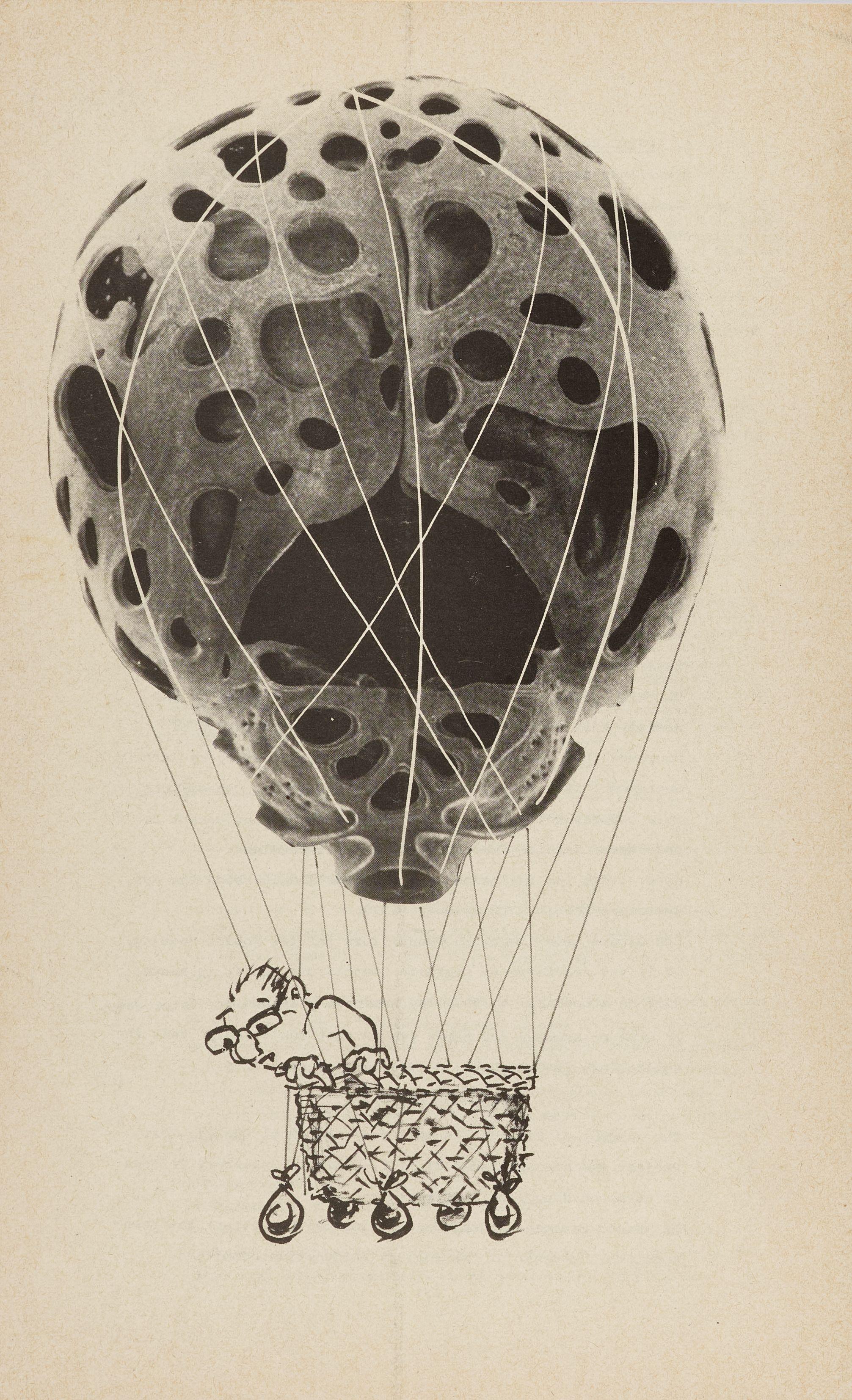
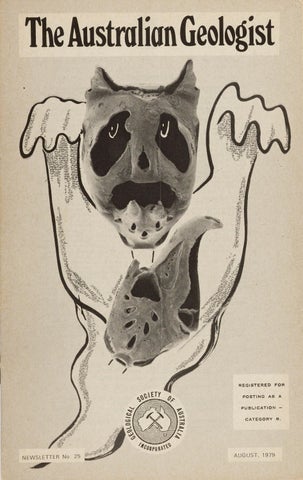
Front cover: Orthoscuticella maculata ( sensu Levins en), Recent, Bass Str a it; an autozoid and ovicell comp l e x at the end of a bra nch.
Back cover: Orthoscuticella wilsoni (MacGill ivray), Hecent , Bass Str a it; an ovicell complex
Bryozoans by courtesy of Robin Wass (pictured back cover) beautified by Len Hay
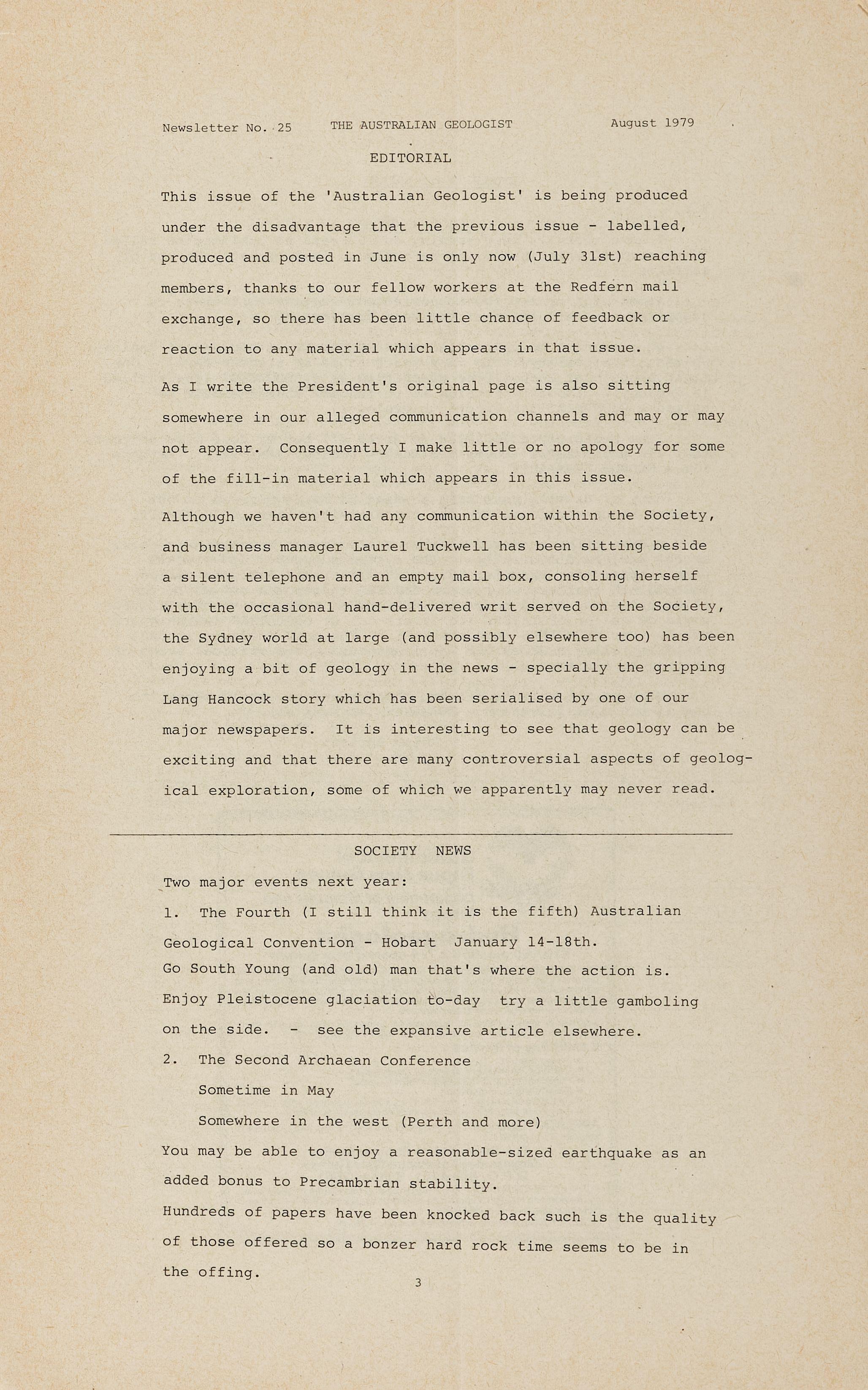
Newsletter No 25 THE AUSTRALIAN GEOLOGIST August 1 979 EDITORIAL
This issue of the 'Australian Geologist ' i s being produced under the disadvantage that the previous issue - labelled, produced and pos t ed in June is only now (July 31st) reaching members , thanks to our fellow workers at the Redfern mail exc hange , so there has been little chance of feedback or reaction to any material which appears in that issue
As I write the President's original page is a l so sitting somewhere in our alleged communication channels and may or may not appear. Consequently I make little or no apology for some of the fill - in material which appears in this issue.
Although we haven't had any communication within the Society, and business manager Laurel Tuckwell has been sitting beside a silent telephone and an empty mail box, consoling herself with t he occasional hand - de l ivered writ served on the Societ y , the Sydney wor l d at large (and possibly elsewhere too) has been enjoying a bit of geology in the news - specially the gripping Lang Hancock story which has been seria l ised by one of our major newspapers It is interesting to see that geology can be exciting and that there are many controversial aspects of geological exploration , some of which we apparently may never read.
SOCIETY NEWS
Two major events next year :
1. The Fourth (I still think it is the fifth) Austra l ian Geological Convention - Hobart January 14 - 18th.
Go Sou t h Young (and old) man that ' s where the action is .
Enjoy P l eistocene glaciation eo - day try a little gamboling on the side. see the expansive article elsewhere
2 The Second Archaean Conference
Sometime in May
Somewhere in the west (Perth and more)
You may be able to enjoy a reasonable-sized earthquake as an added bonus to Precambrian stability
Hundreds of papers have been knocked back such is the quality of those offered so a bonzer hard rock time seems to be in the offing.
LETTER TO THE EDITOR
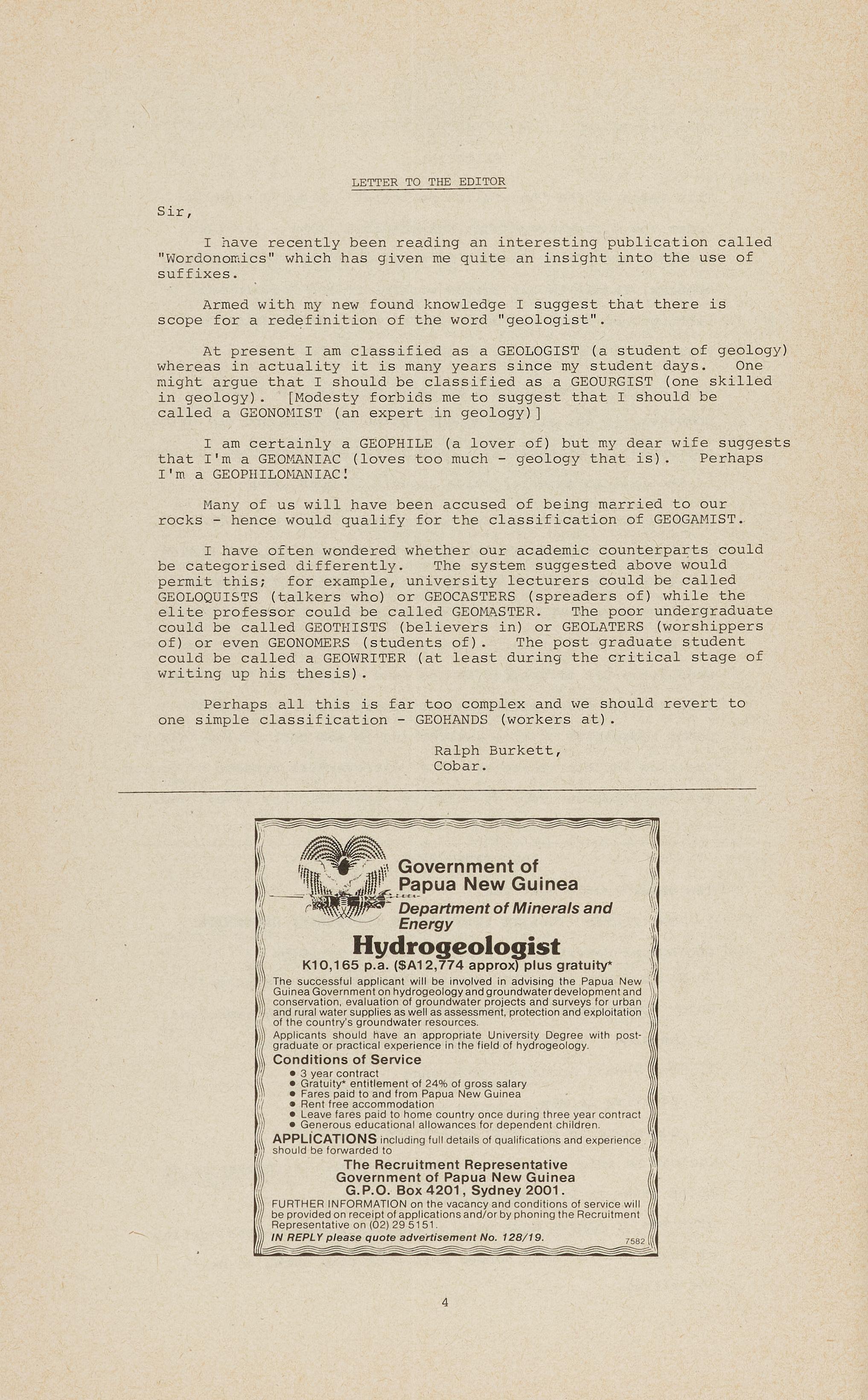
Sir,
I have recently been reading an interesting publication called "Wordonomics " which has given me quite an insight into the use of suffixes.
Armed with my new found knowledge I suggest that there is scope for a redefinition of the word " geologist "
At present I am classified as a GEOLOGIST ( a student of geology) whereas in actuality it is many years since my student days. One might argue that I should be classified as a GEOURGIST (one skilled in geology). [Modesty forbids me to suggest that I should be called a GEONOMIST (an expert in geology))
I am certainly a GEOPHILE (a lover of) but my dear wife suggests that I'm a GEOMANIAC ( loves too much - geology thc1.t is) Perhaps I'm a GEOP!!ILOHANIAC!
Many of us will have been accused of being married to our rocks - hence would qualify for the classification of GEOGAMIST.
I have often wondered whether our academic counterparts could be categorised differently. The system suggested above would permit this; for example, university lecturers could be called GEOLOQUISTS (talkers who) or GEOCASTERS (spreaders of) while the elite professor could be called GEOMASTER. T,he poor undergraduate could be called GEOTHISTS (believers in) or GEOLATERS (worshippers of) or even GEONOMERS (students of). The post graduate student could be called a GEOWRITER (at least during the critical stage of writing up his thesis).
Perhaps all this is far too complex and we should revert to one simple classification - GEOHANDS (workers at).
Ralph Burkett, Cobar.
11 r ~ Department of Minerals and
(:' Energy
(~ K10,165 p.a. ($A12,774 appro x) plus gratuity' )j
1 Th~ successful applicant will be involved in advising the Papua New /i ii Guinea Government on hydrogeology and groundwater development and conservation, evaluation of groundwater projects an~ surveys for .ur~an and rural water supplies as well as assessment, protection and explo1tat1on
\~I of the country's groundwater resources.
I) Applicants should have a~ appropriate University Degree with post· (I graduate or practical experience in the field of hydrogeology
I) Conditions of Service
I• 3 year contract
tl • Gratuity* entitlement of 24 % of gross salary
)) • Fares paid to and from Papua New Guinea ,~
• Rent free accommodation
• Leave fares paid to home country once during three year contract
• Generous educational allowances for dependent children
APPLiCATIONSincluding lull details of qualifications and experience ) s hould be forwarded to rN The Recruitment Representative 'i Government of Papua New Guinea G.P.O. Box 4201, Sydney 2001.
FURTHER INFORMATION on the vacancy and conditions of service will be provided on receipt of applications and/or by phoning the Recruitmen t Representative on (02) 29 5151
IN REPLY p lease q u ote advertisement No. 128/19.
SURVEY OF GRADUATE GEOLOGICAL TRAINING
by Lewis B. Gustafson Research School of Earth Sciences , ANU.
Since coming to Aus tralia, and comparing with the American scene , I have been struck with what appears to be-a relatively poor degree o f communica.tion ana co-operation between earth scientis t s at most Australian universities and both industry and government. This reflects a rather low level of understanding and concern for the requirements and views of non - academic employer s, particu l arly at the graduate level.
Prompted by a broad inquiry · into its graduate education program by A N U I sent out a questionnaire to non - academic employers of earth scientists to a ss ess the i r views on several issues Their thoughtful responses, summarized below , reflect a spectrum of opinion which should be taken seriously by the universities, particularly when considering graduate programs
The questionnaire was sent to 39 organisations , most of the non - academic employers of earth scientists with more than 6 or so geologists on their staff Replies were received from 8 of 9 geological surveys , 11 of 21 traditional mining companies and 7 of 9 petroleum and coal companies who were invited to participate in the survey These organisati on s emp l oy a total of 1101 earth scientists
For comparison the membership of the Geo l ogical Society of Australia is about 2800, though the number in non - academic employment is not available Also for comparison , a National Science Foundation survey in 1976 indicated that in the United States , industry employed 57% of the earth scientists, academic institutions 16% , and government 22%
Probably a fair percentage of earth scientist s emp l oyed outside of.academia was covered in this survey. Though the survey did not assess the views of small employers , which will differ somewhat from those of the large employers , I think the responses are reasonably representative.
The original questions asked are printed in italics .
Government Surveys (633 earth Scientists)
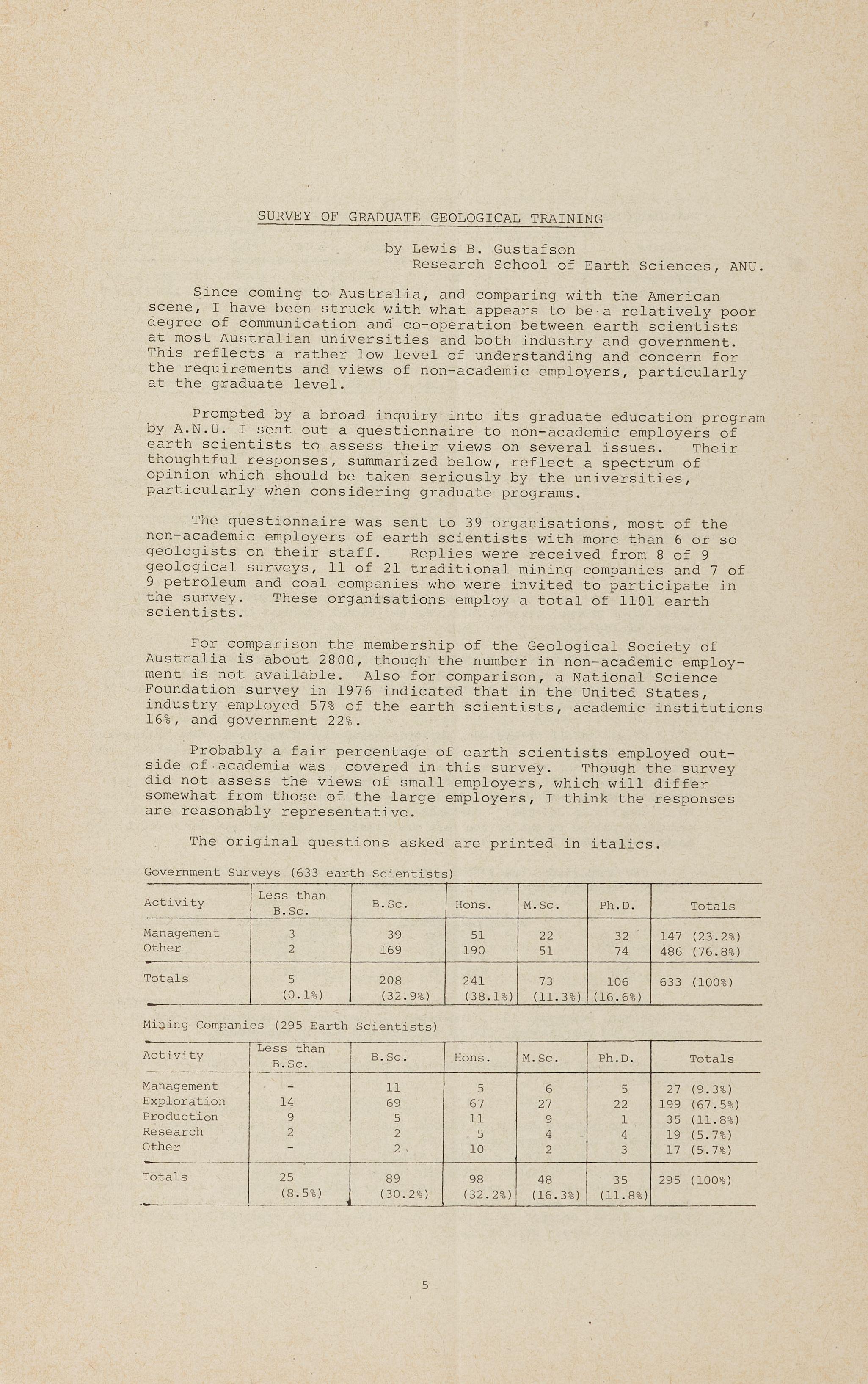
Mioing Companies (295 Earth Scientists)
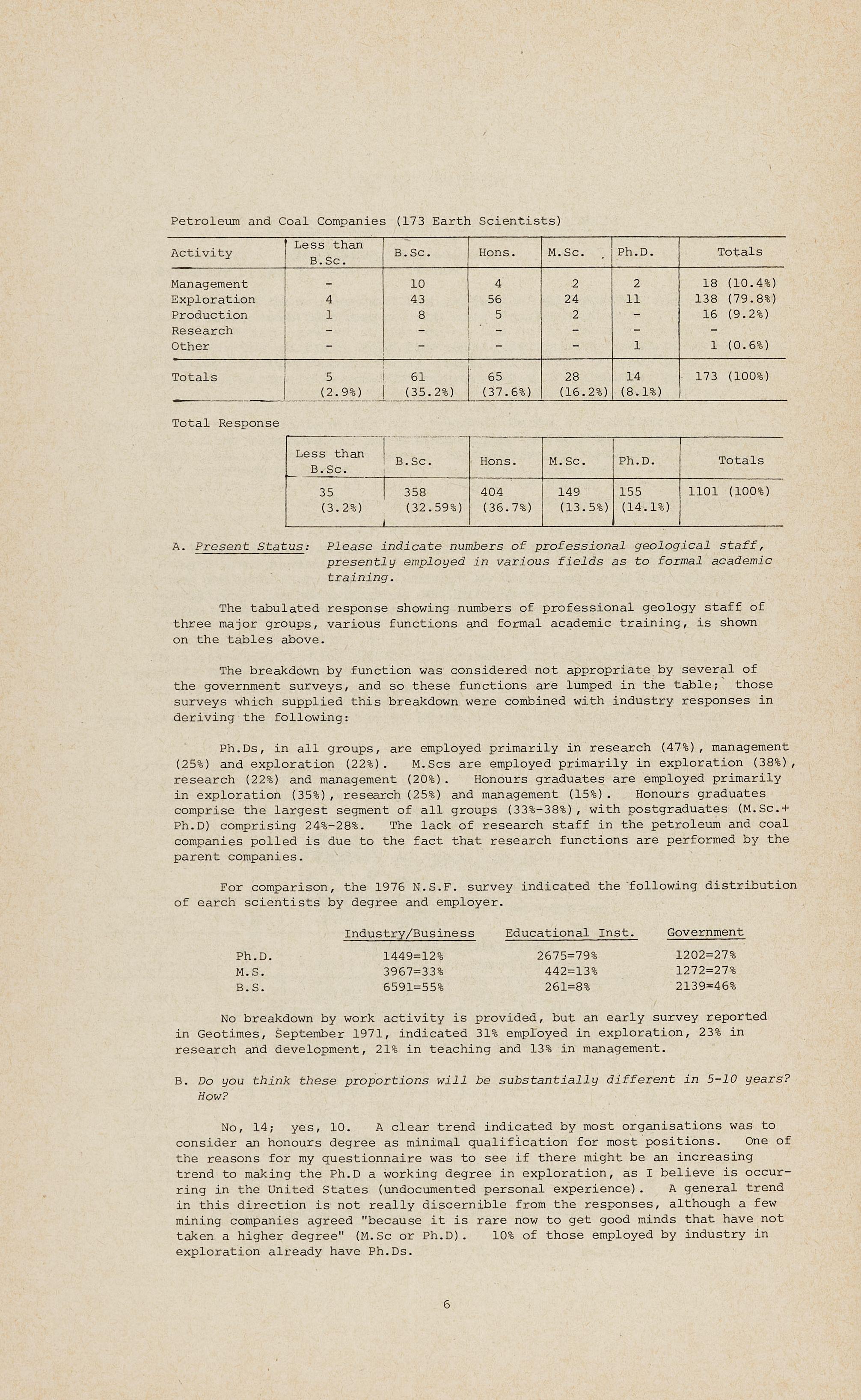
A Presen t Status: Plea se indicate numbers of professional geological staff, presently employed in various fields as to formal academic training
The tabulated r e sponse showing numbers of professional geology staff of three major groups , various functions and formal academic training, is shown on the tables above
The breakdown by funct ion was considered not appropriate by several of the government surveys, and so these functions are lumped in the table; · those surveys which supplied this breakdown were combined with industry responses in d e riving the following :
Ph.Ds , in all groups , are employed primari ly in research (47 %) , management ( 2 5 %) and exploration (22 %) M.Scs are employed primarily in exploration (38%), research (22 %) and management (20%). Honours graduates are employed primarily in exploration (35 %), research (25 %) and management (15 %). Honours graduates comprise the largest segment of all groups (33 %-38 %), with postgraduates (M Sc.+ Ph. D) comprising 24 %-28% The lack of research staff in the petroleum and coal companies polled is due to the fact that research functions are performed by the parent companies
For comparison, the 1976 N S F. survey indicated the following distribution of earch scientists by degree and employer
Ph.D. M S B.S.
No breakdown by work activity is provided , but an early survey repcrted in Geotimes , September 1971 , indicated 31% employed in exploration, 23 % in research and deve lopment, 21% in teaching and 13 % in management.
B Do you think these proportions will be substantially differen t in 5-10 years? How?
No, 14; y es, 10 A clear trend indicated by most organisations was to conside r an honours degree as minimal qualification for most positions. One of the reasons for my questionnaire was to see if there might be an increasing trend to making the Ph D a working degree in e xploration, as I believe is occurring in the United States (undocumented personal experienc e) A general trend in this direction is not really discernible fr om the responses, although a few mining compani es agreed "be c ause it is rare now to get good minds that have not taken a higher d egree " (M. Sc or Ph.D) 10% of those employed by industry in exploration already have P h Ds
C vlhat do you consider as the particular strengths and/or deficiencies in undergraduate geological ed ucat ion in Australia? Any suggestions for improvement?
This question e l icited a wide spread of opinion Most considered undergraduate training to be generally of sound academic qualit y and honours graduates to "provide exce llent raw material to train as practical explorationists. Any additional exposure to the Australian university system tends to isolate the individual from commercial realit ies as: - (a) is a research goal relevant to Australian society today? (b) the harsh short-term deadlines for completing projects and the consequent need for careful time allocation and cost control. " " I prefer B Sc Hons and B Sc because they haven ' t become too specialized and non - flexible."
Samples of constructive criticism:
"communication skills need more attention ".
"The quota system of budget increases proportional to student numbers has lowered the geological standards in most undergraduate schools I interviewed about 70 job applicants recently and their knowledge of simple grass - roots • explorati on programs is minimal or non - existent Some schools produce "black- box " mentalities , e g Landsat is the answer to everything - you go from photograph to ore body. "
"There is nothing like enough interest yet by many Australian universities in economic geology at undergraduate l evel. "
"Not enough field work - lack of appreciation of rigours (privations?) and fun of field work Lack of training to think in 3 dimens ions and to think of original environment rather than its present modified form. "
" Less appreciation of what field work is about than their counterparts in North America and parts of Europe I think this is almost entirely a result of the fact that in North America and Europe the long summer vacation coincides with the most active part of the field season , whereas in Australia it is the time when least field work is carried out. "
"Students should be exposed to non - university specialists more frequently and towards the end of the course at least they should be made to realise the role of the geologist in the- practical world: "
" Sandwich courses with alternating work and study would be useful "
" Exploration geology is experience and this is hard to teach at a university Undergraduate geology is not practically oriented towards field work, or explor ation geology. Suggestion - at the end of high school prospective geology students should be apprenticed to a practising geolog ist and after two years have the option to attend two years undergraduate course at a univers ity or collect Academically inclined people will continue with post- graduate courses. "
D. Regarding your requirements and expectations of graduate education and research :
1) When you need specialist training, do you prefer to hire new M Sc ' s and Ph D 's or to send your own staff back to university for training?
Based on only partial response , government surveys preferred to hire new Ph Ds and M. Scs , while industry tends to prefer to send staff back for further training (though not necessarily for further degrees)
2) Do you expect post-graduate courses to be weighted primarily toward practical training in applied subjects (e.g. exploration , engineering and management techniques) or more conceptual geologic training in fundamental subjects (e.g. orebody characteristics and genesis , geochemistry , tectonics, etc )?
Most responses from all groups (12) expressed preference for a balance between conceptual and practical , 9 preferred a conceptual emphasis while only
3 preferred emphasis on applied subjects One perceptive response : " Conceptual geological training - that's what people in universities should be good at. People in universities soon get out of touch with the practical. "
3) vlhat specialty subjects are inadequately covered in Australian universities?
Responses constitute a very long list with no subjects repeatedly mentioned other than petroleum and coal geology , and many responses reflecting a local situation One comment: "In general , academics worry too much about the form and content of courses , forgetting that their main :functions are to provide the stimulus and the opportunity for students to learn. "
4) How many postgraduates do you expect to hire, or send for training, in the next 5 years?
Organisations indicated an intent to hire about 135 postgraduates and sending 109 for postgraduate training of one kind or another.
5) If you send your own staff back to school, to what extent do you prefer part-time programs (such as the James Cook Applied M Sc. program) or non - degree courses over full - time study?
A clear preference for part-time programs (11) and short non - degree (6) over full-time graduate studies (4) was expressed , with no significant difference between employer groups surveyed.
6) If you are prepared to send staff back for full - time Ph.D study, is there any particular advantage or disadvantage in a 2-3 year full-time thesis program such as that at ANU compared with the 3 - 4 year program with formal course requirements of most North American universities?
Related to the small number of organisations favoring full - time graduate programs , only about half of the replies answered this question. Individual situations are overriding considerations, with the desirability of course work balanced by shorter time of full-time thesis programs; appropriate academic strengths and philosophy of individual departments and supervisors are most important.
7) To what extent would you prefer to have your own staff undertake research into critical geologic factors affecting your exploration or exploitation programs or to "farm out " research projects to graduate students, university staff or CSIRO?
Fifteen organisations were in favor of doing their own research , 7 in favor of farming out research The 2-1 preference for in - house research (including using research facilities of parent organisations) was common to each of the three employer groups
8) it be possible and/or desirable for your company to take on university staff, while on 6-12 months study leave, onto full~time employment in your company to work on a specific project of mutual interest?
Yes , 10; qualified yes, 5; no, 7. Most government surveys expressed favor with the idea but had staff ceilings and budgetary inflexibility which prevents the practice. Companies which oppose the idea did so either for financial or security reasons.
E How adequate are present graduate programs in Australia and what improvements could you suggest for university postgraduate education and research in geology? Are the universities fulfilling the needs of industry and how can communication between industry and the university be improved? (i. e is there anything not covered above you want to get off your chest?)
The following comments reflect a general dissatisfaction with the quality of communication between academia and industry and with many aspects of
postgradu ate as we l l as undergraduate training They provide a few suggestions for possible improvements.
" Too many universities in Australia are trying to provide postgraduate geo- science 11
" Defic i encies - The development of graduate and postgraduates to have the abil ity to see through and past geological features traditionally regarded as i mportant t o ore occurrences , i e. the universities have to scrap traditional teaching of belief and start to concentrate on teaching disbelief ."
" Programmes not adequate , too academic , not practical Students too immatu re when starting research Supervision tends to be too thinly spread, supervisors themselves i nexperienced on practical side. "
" Geolog i sts are not taught to think. They are spoonfed vast quantities of established academic dogma such that it becomes a very real difficulty for them to recognise the inconsistencies and defects in the basic geological science when it comes to us i ng it as a tool to discover orebodies. They attempt to use the "mode l " they have been taught which cannot be used to predict or adequately expl ain ore deposits ."
" It is a l so not wide l y enough appreciated that the main advances in our knowledge of ore environmen ts have c ome from mapping, not from laboratory work. "
" Unfortun ately , littl e of real benefit is likely to be achieved until u n i vers i ties i mprove the calibre of their teaching staff Lifetime academics are not the people to prepare students for a lifetime in industry "
" To o many short studies, half - baked and leaving important questions not stu died , i ncluding most Ph D studies , many structural studies and a lot or ore genesis studies Long continuity of programmes is needed if possible "
" Too few academics have had experience in industry "
" Communicat i on between industry and the university can undoubtedly be improved by greater staff mobility with the accent on exchanges. Other factors wh i ch wo uld assist would be joint research projects and a greater willingness on the pa rt of the universities to allow part - time Ph.Ds ."
" Inherently , a drifting away from industry orientation in the acad~mic atmos- phere The concept of industry or even government surveys 'study leave ' should be enc ou raged more . 11
" Study to ur or working excursions comprising 20-25 people maximum with adequate t i me on relevant literature and topic might help Group should be about equal academics/ industry "
F Is the subject of this questionnaire of sufficient importance to justify a symposium or workshop to consider the problems?
Yes , 7 ; no , 9 ; maybe , 9 .
There is no consensus that such a workshop would be desirable or productive. Many individu al dialogues , however , are required to improve what is clearly not a very satisfactory situation in the teaching of earth sciences in Australia Serious thought should be given to restructuring post-graduate programs to provide mo r e course work , more field work and more flexibility to allow part-time study.
History of Australian Geology?
Anyone interested in presenting a paper on any aspect of this topic at ANZAAS [ May 1980 - Adelaide] please contact the Editor, who is organising a session.
4TH AUSTRALI('.N GEOLOGICAL CONVENTION
SPEND 14- 18 JANUARY , 1980 IN TASMANIA
Don ' t forget to register for the Fourth Convention by 30 September this year, and join over a hundred of your fellow earth scientists who have already done so Who could pass up this opportunity to discuss their latest ideas in any of the many symposia being arranged Below is a list of symposium titles , along with the conveners who will be only too happy to accept titles of papers or answer any queries regarding topics , presentation details etc.
Cl & C2 The geo l ogy of the southern part of the Tasman Fold Belt Dr E. Williams; G P O Box 124B , Hobart , Tasmania 7001.
C3 The genesis of tin and tungsten deposits Mr P L.F Collins , G.P.O. Box 124B , Hobart , Tasmania 7001.
C4 The genesis of magma at sub-crustal depths: integration of geological, ryeochemic~l , tflennonyn;:imic r.1.n<l expe rirru=mtal approaches Dr R Varne; G P 0 Box 252C , Hobart, Tasmania 7001.
CS The stability of rock and clay in engineering and land use Mr P Stevenson ; G.P O Box 124B , Hobart, Tasmania. 7?01.
In addition all specialist groups are holding meeting and symposia during the convention , which will cover an extremely wide range of subjects
The economic geology group (S GEG ) wi ll be addressed by their keynote speaker , Or M J Russell , of the University of Strathclyde on Irish massive sulphide deposits. Other information and titles u[ J:..li:if.Jers can Lie conveyeU to lJr i1i . Solomon , G l'. O Bux 25.c::c , Hobart , Tasmania. 7001
The geochemistry and mineralogy group (SGGM ) are discussing the application of primary rock geochemistry to mineral exploration , the role of diagenosis in ore formation and nucleation , crystal growth and the redistribution of elements during metamorphism Further information from Mr R.J Ford , G P o : Box 252C , Hobart , Tasmania 7001.
The sedimentologists (ASG) will be talking about ancient and recent carbonate sedimentation , volcanic and volcanogenic sedimentary rocks , flysch and flysch conglomerate and glacial deposits Dr C P Rao , G P O Box 252C, Hobart, Tasmania. 7001. can provide more detai ls
• Dr E Williams, G P O Box 17.4B , !-lobart , Tasmania 7001. can prov id e details about the tectonics and structural geo logy group ' s activities (SGTSG) They are d iscussin g deformation features in Australian Fold Belts and genera l structural geology
Faunal and f loral links between Australia, New Zealand and Antarctica is the topic the palaeonto logists are considering. Dr J Jago and Mr N Kemp can tell you all about arrangements for this symposium. G.P 0. Box 1166-M, Hobart , TaSil)ania. 7001.
Topics for the Coal Geology Group include the use of coal petrography as an exploration tool , geophysics in coal exploration, coal measure scdir11enta.tion dl1d basin st.1diet; in Triassic Coal Measures Mr R.H. Castleden , G .P.0. Box 124B , Hobart , Tasmania. can yield further details
Cont ' d bottom page 11
LETTER TO THE EDITOR
S ir:
Re : PROFESSIONAL ORGANISATION FOR GEOLOGISTS AND GEOPHYSICISTS
Fo l lowing the initia l letter by Lindsay Ingal l and myself it seems appropriate t o bring new results to your notice
Firstly the response was very good and interest expressed in the format ion of P.O G.G. was bac ked by con t ributions We thank all who sent financial contributions. These contributions have been banked and wi l l be used to defray establi s hment costs We continue to we lc ome c on t ributions from those of you who are in favour of the propo s a l to form a professiona l organisation , but who as y et have no t responded
We ha ve no t been sitting on o u r thumbs We have established a Steeri n g Committee which has drawn up a draft Memorandum and Artic l es of Association in co- operation with Adamson's Committee. This draft is being forwarded to a ll who have sent contributions, for cri t ical comment The Steer i ng Committee wi l l prepare the final draft of the Memorandum and Articles of Association after it has secured all comments and suggested modifications.
Di s c u ssion has been he l d wi t h the President of G.S.A. and the Council of the A:I. M. M. We believe the help and b l ess i ngs of both these bodies is necessar y for P O G.G to fulfill its role
For those who th i nk tha t P.O.G G is not necessary I suggest they t ake t i me o f f and read some of the reports that are sti l l being published in the Stock Exchange Research Re v iew! e.g. a Consultant Geologi s t reports that he took four grab samples from a dump and these assayed up to 30 1 % uranium oxide! !
Do you believe a geologist should be able to get awa y with this without being named ? Are you interested in protecting th e status of your profession?
I trust this report will allow membe rs to f ollow the de v elo pment of P.O.G G and also indicate wh y the organisation is necessar y
Ken Glasson , Beecro f t , N S W.
Continued from P'"Je 10 opposite
The newly fo r med specialist qroup in Fngi neering Geo l ogy is r un ni n g its first con ven t ion- based meeting They are d i s cuss i ng envi ron men t al and urban geology , hyd r ogeo l ogy and the geology of c o as t al processes , the geo l ogy of quarr i e d materials and are also accepting genera l papers on eng ineering geo l ogy
Mr R Donal dson , G P O Box 1 24B , Hoba r t , Tasma nia , can supp l y add i tion al data
Any informa t ion regar ding t he c on ventio n i n c l ud i ng reg i stration fo r ms can be obt a i ned f rom t he c o nvention sec r e t ary , Mr P R . W i lliams , G P O Box 124B , Hobart , Tasmania . 7001.
I n ternationa l Uni o n of Geodessy & Geophy s ics meets a t Canberr a , 2- 1 5 December , 19 79 fo r i t s 1 7 th Ass embl y. Conta ct I.U G G at P O Box 783 Canberra City , ACT 2601 for details Registrations c l ose September 1.
BROKEN HILL REGIONAL GEOLOGY EXCURSION
A field excursion to the Broken Hill region organized by the N.S.W. Geological Survey was held from 23rd to 27th April. The Broken Hill mappers, Messrs. Stevens, Stroud , Barnes, Bradley , Willis and Brown, communicated their knowledge very effectively. About 80 geologists participated in the excursion , being mainly representatives of mining and exploration companies Geologists came from as far away as Perth and Qu~ensland to take part. All the geologists who attended the excursion participated enthusiastically. At the request of a number of company geologists the excursion was extended by one day , to visit a number of mi neral deposits in the northern part of the Broken Hill Block. About 30 geologists took part in this extra activity.
About 75 per cent of the Broken Hill Block has now been mapped on a stratigraphic basis by Geologica l Survey geologists. As a result of this mapping , the basic geological information available as a foundation for exploration has been substantially upgraded, and the Willyama Complex has been divided into 7 stratigraphic units. A map showing the distribution of these units in the areas mapped has recently been completed and was displayed to excursion participants.
A close relationship between stratigraphy and minerali~ation has been demonstrated. A progress report on the project was pre- pared to coincide with the excursion. The excursion was the lead story on the regional radio news one evening , and featured promin- ently in the local paper on two occasions.
Since the main objective of the excursion was to encourage mineral exploration in the Broken Hill region , it is appropriate to review the exploration situation. Twenty-four Exploration Licences are currently held for Group 1 Minerals in the region. Twentyeight Exploration Licence applications for Group 1 minerals are pending , seventeen of which have been applied for in the last three months. ~he average size of the E.L.A ' s is considerably larger than for the granted E.L ' s. Eight of the recent E.L.A ' s have been lodged by North Broken Hill Ltd and C.R.A. Pty. Ltd.
It is obvious that exploration in the Broken Hill region is becoming more active. In addition, a number of the companies which attended the excursion appeared keen to explore in the region, if suitable ground is available.
C.R.A. Pty. Ltd., North Broken Hill Pty. Ltd., the South Australian Department of Mines and Energy, and the Broken Hill University College assisted with the organization of the excursion.
ATLAS FOR TRAVELLING GEOLOGISTS
A concise and portable atlas of world geology and mineral deposits , intended to give a broad view of world geology and mineralization to the general public, students and professional earth scientists, is being prepared by Duncan R Derry and Associates in Canada.
Eight multi-coloured maps covering all the land areas of the world show the geology in major mineral-bearing regions. The maps are mostly 1: 20 000 000 to 1: 30 000 000 in scale and are designed to provide the most convenient overview of each area; there are over 1500 mineralized regions marked. Each map is accompanied by a brief account of the geological history of the area An introduction swnmarizes the composition and history of the earth based on the current concept of plate tectonics and its relationship to mountain building, volcanic activity, earthquake centres , and mineral concentrations. An appendix lists the production and reserves of all the principal countr:j,es for each major mineral.
Further information on the atlas may be obtained from: Concise Atlas of World Geology, c/o Box 69, Simpson Tower, Toronto, Ontario, Canada MSH 214. 12
LETTER TO THE EDITOR
Sir :
" A Geological Science Policy for Australia " (Newsletter No 23) is presumptuous in saying that the Geological Society represents tl1e professional interests of the geological community In so doing , it ignores-for example , the patient and well reasoned discussions which Mr Colin Adamson (for one) has presented from time to time showing that there is a conflict of interest between the GSA ' s current role as a " learned society " and that of a professional institute The historical fact is that it has not done so and it serves little purpose to claim that it does.
It (the "policy") also confuses three separate issues of concern to the profession - geoscience policy , a professional institute for geologists , and the lega l reg i stration of consultants who advertise advice for fees. Two of these are not parts of " science policy ", which in most contexts is taken to mean " government science policy " or the application and support of science and technology by governments and their agencies
To publish a manifesto like " A Geological Science Policy for Australia" must be considered political activity intended to influence the governments of the country in the belief that if we squeal loudly enough about our indispensibility we ' 11 be given something to suck on
Allow me to comment on the "National Goals " enumerated in the "Policy"
1. Let us all assert that " Geology is a Good Thing ". What seems to be meant by "co-ordinate geological science policy and development" is "pour money into governmental agencies which employ geologists " It could possibly be just as beneficial to the community to require developers (real estate , local councils , resource companies , farmers , etc) to file scientifically sound impact studies for certai n types of activity
2 Australia probably has too many earth science departments , at least east of Kalgoorlie , producing too many graduates with too little idea of the importance of the resource base or geology ' s role in its optimal use For too long institutional and academic geology has justified its importance by paying lip service to the application of geology in urban and industrial development.
In any case it is by- and - large a waste of time to teach geology in secondary schools as a matriculation subject. Most Tertiary institutions require English , Physics , Chemistry and two Maths for matriculation even for geology students. This leaves Geology and Biology almost exclusively for those who will not do a Tertiary science or t~chnology course In Western Australia the .rumour is that it is a subject for drongoes. Given the ignorance of the general public about the c l ose correlation between its standard of living and material comforts and the level of activity in the extractive industries of mining and agriculture , some attempt should be made to teach a secondary subject called "Earth Resources and Man" or some such title, not Sir Archibald Geikie ' s curriculum , as is currently the case
3. Support for research is important and must be central to any geological science policy Some innovations are necessary if the research is to keep in tune with the needs of industry and the larger community Recent evidence before the Senate Standing Comm i ttee on Science and the Environment showed that generally , government and institutional R and D remained separate from industrial. If that part of the Australian geological community in Government and tertiary institutions wants i ts research to be relevant to community needs, radical changes are necessary in the ways research problems are chosen and results communicated The call for more funds should be coupled with a plan to choose problems which industry and the informed community wants solved There should also be mechanisms for some more publicly competitive elements in the allocation of funds and deadlines for results A task force approach which cuts across traditional institutional barriers must be encouraged to get the dogs out of the mangers. The research encouraged should be also interdisciplinary in order to provide the necessary yardsticks of cost, benefit , social acceptability and, if relevant, perspectives on the world markets
4. Are we too passive to order our own affairs? What is wrong wi th developing a strong profess i onal institute to regulate standards , which is to say , pass judgement on the professional ethics and training of ones ' peers? A perfectly reasonable scheme has been rejected recently and one has to wonder why Will we have to buy a licence from a government clerk? Or pass an exam? Or merely sign a declaration that we believe all good things come from greater bureaucracy? If it is politically expedient to protect the public from the geological profession , compulsory licensing or registration should be required only of those geologists who advertise services available to the public for fees (see the Massachussetts legislation)
5 This is a subset of Nos. 1 and 3.
6. This is a pure politics and not the business of the GSA or a professional institute Those geologists who feel that government research vessels would be a good thing or things should write to their local members not tear the Geological Society apart or use it as a vehicle for their aspirations
7 Agree I believe it is happening.
8. Probably , a well- reasoned case showing how the geological community could co- operate, put to the Hational Library or the CSIRO , could accomplish this. At the moment nearly every library with a computer terminal is in one network or another. It is not a principle of geoscience policy anymore than support for electron microscopy is.
Im summary, I believe it is proper for the Geological Society of Australia to develop principles of geoscience policy to help the governments formulate their policies. It is possible to go beyond asking for "more money for everything" without transforming it into a plea for " jobs for the boys". The Geological Society of Australia has not been and should not be a professional institute. If legislation for registration is inevitable it should be developed with the reasoned contribution of a professional institute of geologists to protect their interests as well as those of the wider public. In the final analysis , the success of any policy designed to improve professional standards will depend on professional judgements made, not on bureaucratic decisions.
P E. Power Singapore
AUSTRALIAN GEOMECHANICS SOCIETY VICTORIA GROUP
Wednesday September 19, at Clunies Ross House, 6 p.m. Refres)unents 5 30 p m.
THE GEOLOGY OF DARTMOUTH DAM.
Dartmouth Dam, the largest dam in Australia , is a 180m high earth and rockfill structure constructed by the Sate Rivers and Water Supply Commission on the Mitta Mitta River to increase the availability of water in the River Murray system
Don Currie , the Commission ' s Supervising Geologist , will outline the geology of the site , which is in granite, and wil l discuss the salient engineering geological features associated with the investigation, design and construction of the dam. In particular, Mr Currie will discuss the relationship between the granite weathering profile and the foundation conditions actually exposed during construction, and the foundation treatment methods adopted
Wednesday October 10
GEOMECHANICS OF MELBOURNE UNDERGROUND RAIL LOOP
Dr. A.G Bennet of John Connell - Mott, Hay & Anderson , Hatch, Jacobs , Principal Consultants to the Melbourne Underground Rail Loop Au~hority will discuss the role of geomechanics on some parts of this major project 14
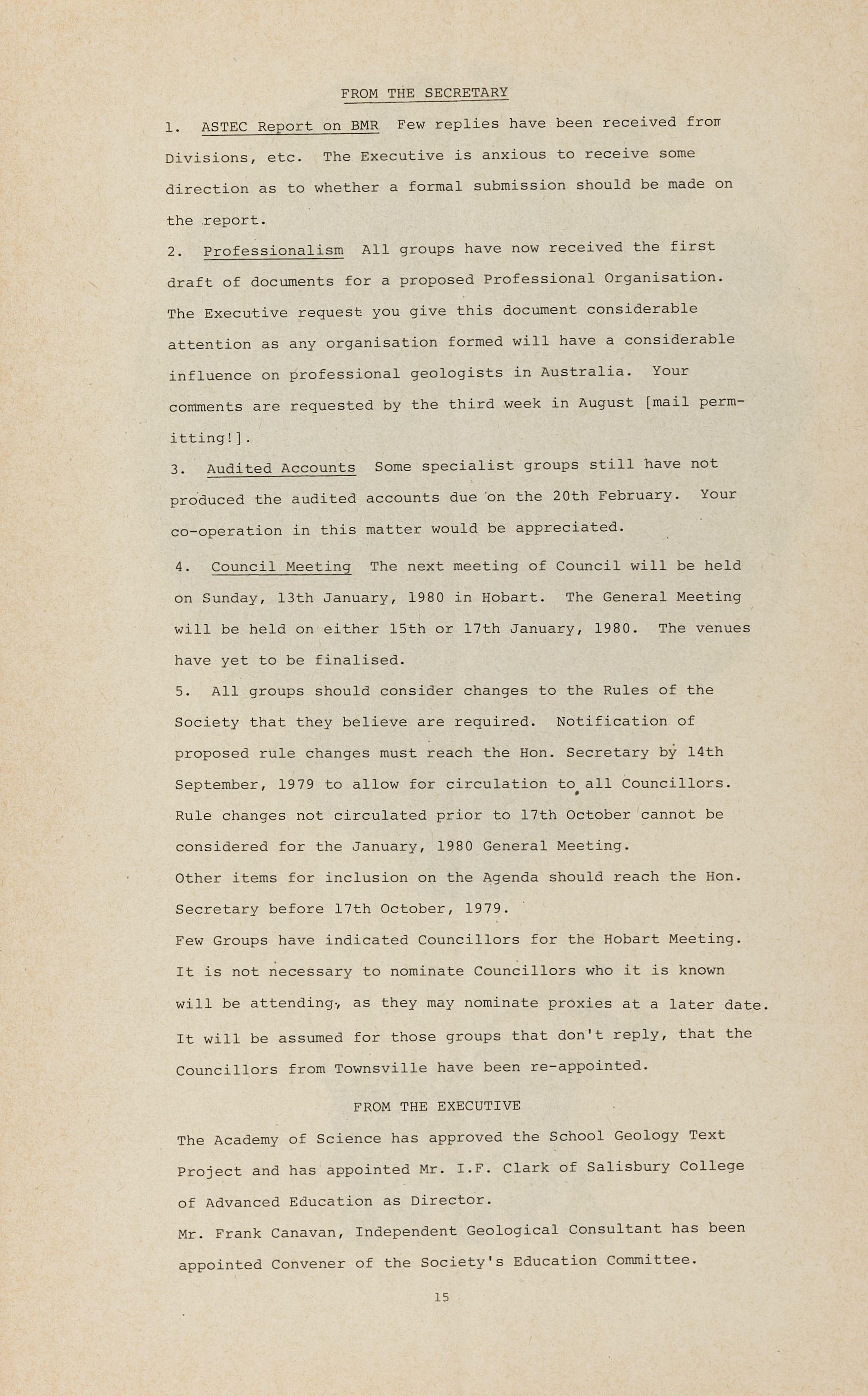
FROM THE SECRETARY
1. ASTEC Repor t on BMR Few replies have been received frorr Divisions, etc. The Executive is anxious to receive some direction as to whether a formal submission s hould be made on t he report
2 Professionalism All groups have now received the first draft of documents for a proposed Professional Organisation. The Executive reques~ you give this document considerable attention as any organisation formed will have a con s iderable influence on professional geologists in Australia Your comments are requested by the third week in Augu s t [ mail permitting!]
3. Audited Accounts Some specialist groups still have not pro duced the audited accounts due on the 20th February Your co-operation in this matter would be appreciated .
4. Council Meeting The next meeting of Council will be held on Sunday, 13th January , 1980 in Hobart The General Meeting wil l be held on either 1 5th or 17th January , 1980. The venues have yet to be finalised.
5. All groups should consider changes to the Rules of the Society that they believe are required . Notification of proposed rule changes must reach the Hon. Secretary by 14th September , 1979 to allow for circulation to, all Councillors Rule changes not circulated prior to 17th October cannot be considered for the January, 1980 General Meeting. Other items for inclusion on the Agenda should reach the Hon Secretary before 17th October, 1979.
Few Groups have indicated Councillors for the Hobart Meeting It is not necessary to nominate Coun~illors who it is known will be attending ~ as they may nominate proxies at a later date It will be assumed for those groups that don ' t reply, that the Councillors from Townsville have been re-appointed .
FROM THE EXECUTIVE
The Academy of Science has approved the School Geology Text Project and has appointed Mr I.F. Clark of Salisbury College of Advanced Education as Director.
Mr Frank Canavan , Independent Geological Consultant has been appointed Convener of the Society's Education Committee.
1 5